JAN- FEB 22
australianageingagenda.com.au
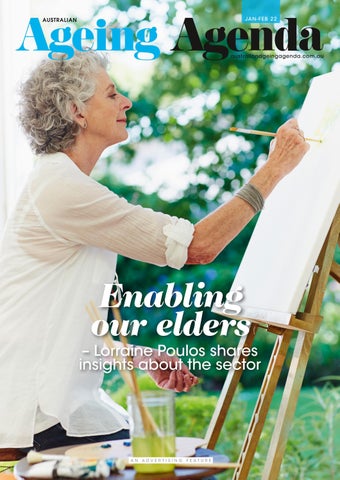
Enabling our elders
– Lorraine Poulos shares insights about the sector
AN ADVERTISING
FEATURE
SPONSORED FEATURE
‘I want to be supported and enabled to live the life I want.’
Enabling our elders The residential and home care sectors have valuable insights for the other in the common drive to deliver quality holistic aged care services, say the team at LORRAINE POULOS AND ASSOCIATES.
T
he residential and home aged care sectors are as different as they are alike. Residential care has had a much more compliance and clinical focus while home care has traditionally had a much more social approach. Conversely, there are many similarities in the different categories of the workforce, along with a shared goal to provide the care that older people need to live their best life. “Each sector has a wealth of experience and strengths to share with the other to enhance the delivery of holistic care,” says Lorraine Poulos, Managing Director of home and community consultancy and training businesses Lorraine Poulos & Associates. “Both residential and home aged care share the need for a consumer-directed and family-focused approach,” Poulos tells Australian Ageing Agenda. “Older people will benefit from aged care providers embracing families as part of the whole care model. It’s important to strengthen the circles of support across the sector. People need to be supported to live at home, but that can only be done through a collaborative approach and similarly in residential aged care.” Additionally, the workforce in both sectors 22 | JANUARY – FEBRUARY 2022
Lorraine Poulos
Elizabeth Pringle
James Lim
shares the need to be much more skilled in gerontology. This will ensure they have the skills to support people with high care needs to continue to live at home and with maximised capability in both settings. It’s about continuing the shift from “caring for someone” to “enabling” older people to live the life they choose, Poulos says. “When I grow old, I don’t want to be ‘cared for’. That sounds passive and parental to me. I want to be supported and enabled to live the life I want. I expect I may have some health
SPONSORED FEATURE limitations and needs, and I want ‘enablers’ to support me to meet those needs so I can get on with living the life I want,” Poulos says. The recent increase in the home care packages reflective of the wishes of older Australians, shows there were almost as many home care recipients (176,000) as older people in residential care (184,000) on 30 June last year. A similar correlation shows there are now 845 providers delivering residential aged care through 2,722 services and 920 providers delivering home care through 2,650 services. The workforce across these programs is diverse and changing but still much larger in the residential sector. According to the 2020 Aged Workforce Census Report, there are: • 277,671 workers in residential aged care, including 208,903 staff in direct care roles (78 per cent) • 80,340 workers in the Home Care Packages Program including 64,019 direct care staff (80 per cent). The census shows the average age of residential direct care workers is continuing its trend to younger workers. Around half of these workers are aged under 40 years, up from around one-third in 2016. In comparison, around a third of direct home care staff are under 40. This challenges the aged care sector to consider appropriate ways of engaging a workforce with a range of ages, says Poulos. Speaking on the capability of the care workforce, Poulos says, “The home care sector can learn from the residential care sector, which has adapted to the changing needs of older people over the previous two decades by upskilling the workforce to undertake more technical tasks. “We now see the same happening in home care where the acuity level of older people is much higher. The clinical requirements for safety and quality in the Aged Care Quality Standards also apply to home care. This has challenged the sector to adapt and change from a predominantly psychosocial-care model to a psychosocial-health model. “Case managers invariably come from a social work or social care background. Incorporating acute health care needs may not have previously been required, but that is changing from being optional, to a non-negotiable requirement for those with clinical need.” she says.
“It’s important to strengthen the circles of support across the sector.”
All care providers are funded to monitor and respond to the changing health needs of consumers. While they are not responsible for treating every condition, they must have strong referral networks and a workforce that is able to recognise and report a change in the condition of consumers, Poulos says. She says this may be something as simple as observing they are not their normal selves or a change in their physical ability such as breathlessness, poor mobility or not eating well. “I believe we need to upskill our case/care managers to be aware of common conditions in older people they are caring for. Identifying and reporting changes is well within their scope of practice. After all, aged care is the specialisation area they are working in,” says Poulos. LPA has been undertaking clinical case management training with many providers. The case/care managers who have participated report they are more confident in knowing when they must refer someone and why, Poulos says. “It reassures them about their duty of care and assists in providing high-quality care. Care/ case managers now understand the importance of having a circle of support that includes the GP as the primary healthcare provider, allied health professionals and most importantly families and representatives. “Consumers are increasingly aware of their health conditions. Case managers with the support of health professionals have an important role to play in supporting consumers with health literacy so that consumers can lead their care in a true consumer-directed model.” Poulos believes the future model of home care requires a total shift in thinking to enable and empower consumers to live the life they want at australianageingagenda.com.au
| 23
SPONSORED FEATURE
home for as long as possible. The onus is on the provider to ensure the workforce is as educated as possible to enable that, she says. “Tertiary education for registered nurses has traditionally focused on institutional contexts such as hospitals and to a lesser extent aged care. This has made it challenging for registered nurses to acquire the aged care specialty skills required when working in the community. This is not a criticism but rather an observation. We believe this can be overcome with some solid education around gerontology and all that it involves. “It is time that aged care became a recognised specialty, and that the workforce are supported to learn about common health conditions experienced by the older people, so they are informed and excited about the area of work they have chosen.”
Characteristics for success
At the governance level, Poulos supports the findings of the Royal Commission into Aged Care Quality and Safety on the need for clinicians to be more represented in key decisions about the model of care. Increasingly, it appears more organisations are also seeing why it makes sense. “Over the last 12 months we have seen a paradigm shift where governing body members are now more interested in understanding their responsibilities. Whereas prior to the Royal Commission, our experience was that the governing body did not necessarily understand their role in clinical care governance.” Lorraine Poulos and Associates, which is in its 13th year, has collaborated with countless aged care providers as a small, agile, professional and innovative entity. This involves working with organisations that want to improve and those that need to improve due to compliance issues. “The fact that we are out in the sector solving problems every day, gives us unique insights into what works and what does not.” Elizabeth Pringle, a senior consultant at Lorraine Poulos and Associates, says they have observed the following 10 key characteristics over the years that are predictive of consistent success. 1. Effective governance 2. Visionary leadership 3. Proactive training and learning 4. Clinical excellence 5. A positive culture 6. Performance measures and monitoring 7. Effective organisational structures, risk 24 | JANUARY – FEBRUARY 2022
“It is time that aged care became a recognised specialty.”
management and quality systems 8. A ccessible, meaningful and clear documentation at all levels 9. A motivated and supported workforce 10. A high level of engagement with consumers and stakeholders. “All of these are equally important and are highly interlinked,” Pringle tells AAA. She notes the exact words of one of these – training and learning – appear 116 times in the Commission’s final report, as does the specific recommendation for ongoing professional development of the aged care workforce. “This highlights the way learning and training is inextricably linked with quality and a positive experience for older people,” she says. “It also reflects Lorraine Poulos and Associates experience where lack of training and poorly targeted training are associated with non-compliance with the Aged Care Quality Standards,” adds Pringle, a former aged care quality assessor and General Manager, Operations. “We have also observed a causal relationship between lack of training and/or poorly targeted training with dissatisfied consumers, complaints, high staff turnover, higher rates of workplace injuries and consumers voting with their feet and moving to another provider. “Failure to learn new things almost inevitably results in failure to perform over the long term. As the sector continues to evolve and consumer expectations continue to change, it calls for rapid and responsive learning and fresh skills; not the same old topics,” Pringle says.
Link between quality and professional development Pringle points out that professional development is an umbrella term that incorporates a broad range of activities that support the workforce
SPONSORED FEATURE to develop. She says many will be familiar with Lombardo and Eichinger’s 70/20/10 theory of workplace learning. It says that 70 per cent of knowledge comes from job-related experiences, 20 per cent from interactions with others such as co-workers and managers and 10 per cent from formal learning events. “One critique of this theory is that it does not consider that learners are different. Some learners may prefer one of these modes. So, providers need to ensure the professional development program caters for all learning styles,” Pringle says. There are three key factors that make for a strong link between quality and professional development, says Pringle. “Firstly, there is a close link between the learning and the expectations of the job role. Secondly, for those in a clinical role, it is essential they are knowledgeable about typical healthrelated conditions they are likely to encounter. Thirdly, they also need to be skilled in assessment, care planning and care/case management.” The leadership and management skills essential for all levels where they lead others is an area often overlooked, she says. “This group needs knowledge, practical skills and behaviours that reflect the needs and preferences of older people and the requirements of the Aged Care Quality Standards.” She says promoting a person into a leadership role because they demonstrate leadership qualities is a great start. However, emerging leaders need to be nurtured and supported to gain the leadership knowledge, skills and behaviours required. These new leaders must be supported and mentored to learn these skills, says Pringle, who adds short courses, opportunities to act in other roles and other professional development opportunities such as projects can be vital in building skills and knowledge. The next key factor is to consider professional development as part of a bigger picture, says Pringle. “Any training and learning opportunities should take place in the context of the organisation’s strategic direction,” she says. “The successful organisations we have observed have analysed their training needs from the perspective of the consumer. They have also analysed need from an individual employee, group and organisational level. They know exactly what learning gaps they have and then have strategically identified innovative ways to address them.” The final key factor is an organisational culture conducive to learning, evident in the way the workforce is encouraged to be innovative and solve problems at their level. “I have seen excellent examples of where frontline workers have been empowered to solve problems and complaints on the spot. This has resulted in high levels of satisfaction by older people and the workforce. It has also saved a long, drawn-out complaints process that often unnecessarily ties up management time when the matter could have been simply solved on the spot,” says Pringle. “This learning culture links closely to continuous improvement as it creates an environment where learning is captured and translated into improved outcomes. Providers who actively foster a learning culture are also more likely to have a competitive edge as they tuned into changing consumer expectations and preferences.”
Considering nurse practitioners
Jacqui Culver is a nurse practitioner working for Lorraine Poulos and Associates, who has worked across the acute sector, community and residential care over the past 10 years. She says her experience shows the community in general and many in the aged care sector could benefit from understanding what a nurse practitioner can do in aged care. “There is so much opportunity for nurse practitioners within this sector and so much opportunity for organisations to work with these Jacqui Culver expert clinicians in delivering excellence,” Culver tells AAA. A nurse practitioner is a highly trained clinician who sets the bar for clinical excellence in their area of expertise, she says. In aged care, this is usually gerontology, geriatric syndromes, advanced chronic disease, dementia, and palliative care. Culver says: “A nurse practitioner working within the sector will be wellversed on community expectations for high acuity clinical care at home – whether that be in the community or residential care – and the Aged Care Quality Standards. “A nurse practitioner could be seen as a worthwhile investment in any progressive, contemporary organisation but as with any new investment the role requires wise and careful planning.” The recent initiative of the Government to grant scholarships to train more Enrolled Nurses is a positive start. It will assist with the shortage of clinicians in aged care and to provide a career pathway for care workers and care managers, Culver says.
Next stage of assisted living
“Learning and training is inextricably linked with quality and a positive experience for older people.”
Scan the QR code to go to our website
James Lim, a senior consultant at Lorraine Poulos and Associates, says the spotlight from the Royal Commission into Aged Care Quality and Safety has shone through the cracks and highlighted areas for improvement of both residential and home care services. “We can turn the tide with a wave of optimism, measured risks, creativity, engaging and listening to the people that matter to create a brighter future. There are important value propositions of home care that can be replicated in the next stage of assisted living,” Lim tells AAA. When thinking about quality care experiences in home care, Lim says the following come to mind: • choice and decision-making • self-determination, autonomy, freedom and independence • ‘I choose the care or services’ • ‘I am included at every stage of my care experience in homecare’ • true partners in care. These attributes and hallmarks can and should be carried into the future of assisted living, Lim says. “It is highly plausible to establish assisted living within clusters of tailored accommodation and live with people I choose to live and spend my life with. As residential care evolves, reframing the concept of care, new ideas and recommendations from the royal commission can be an exciting reality and not a dream.” n Contact Lorraine Poulos and Associates T: 02 9337 2337 E: admin@lorrainepoulos.com.au W: lorrainepoulos.com.au
australianageingagenda.com.au
| 25