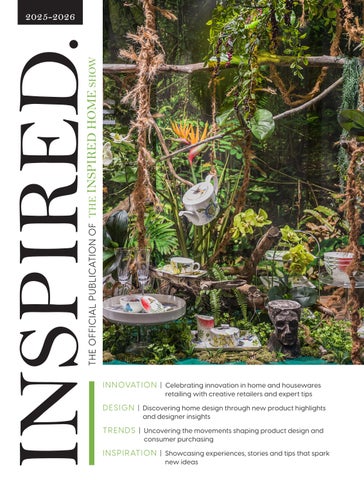
THE OFFICIAL PUBLICATION OF THE INSPIRED HOME SHOW
INSPIRED.
2025-2026
I N N OVAT I O N | C elebrating innovation in home and housewares retailing with creative retailers and expert tips
DESIGN | D iscovering home design through new product highlights and designer insights
T R E N D S | Uncovering the movements shaping product design and consumer purchasing
I N S P I R AT I O N | S howcasing experiences, stories and tips that spark new ideas
The Magic of Vision, Confidence and Creativity LETTER FROM THE EDITORS Last year we celebrated the 25th anniversary of the gia Global
We also explore utilizing AI in the everyday duties of retailing
Innovation Awards, honoring innovation and excellence in
in a way that frees time for creative thinking and personal
home and housewares retailing worldwide. Since the launch of
touches. The key is to get the balance right – as gia Expert
the program in 2000, there have been close to 600 gia retail
Juror Henrik Peter Reisby Nielsen states, “The magic happens
award winners from 57 countries on six continents – a unique
when human creativity and empathy are combined with
mix of home and housewares retailers of all sizes and formats,
efficient tools.”
presenting ideas and inspiration to benefit the entire industry.
We wish you inspiring moments with the magazine and
The most important, and very encouraging, lesson from over
warmly welcome you to The Inspired Home Show 2026 in
the years is simple – you don’t necessarily need large budgets
Chicago, where the award-winning gia retailers for
to be innovative, inspiring and memorable. Every year, we learn
2025-2026 will be introduced, shaping global housewares
about small independent retailers that excel by doing things
innovation for the years to come.
their own way, featuring innovative store concepts, creative displays, special services and unique ways of communicating with customers. A common thread with successful retailers is having a strong vision supported by good ideas, and perhaps
PS. Looking for more ideas? Various trend reports published by the IHA are available at TheInspiredHomeShow.com/Attend/Retailer-Resources.
most importantly, having the confidence to follow their passion. This issue of INSPIRED. features success stories of award-winning gia retailers from around the world that have founders and owners who are passionate and ambitious about creating something special. For additional inspiration, retail trend expert Juanita Neville-Te Rito reports about several very innovative retailers she discovered in Thailand that have become unique and popular shopping destinations. By not following traditional rules, these stores overflow with personality, color and cultural confidence, creating the most magnetic retail experiences.
2
Piritta Törrö
Derek Miller
International Marketing President & CEO International Housewares Association International Housewares Association
COVER PHOTO: 2021 gia TOP WINDOW GLOBAL HONOREE PREMIUM HOME, POLAND
INSPIRED. TABLE OF CONTENTS
I N N OVAT I O N Visual Merchandising and Display Trends: All The World’s A Stage. . . . . . . . . . . . . . . . . . . . . . . . . . . . . . . . . . . 4 gia – 2024-2025 National Winners. . . . . . . . . . . . . . . . . . . . . . . . . . . . . . . . . . . . . . . . . . . . . . . . . . . . . . . . . . . . . . . . . . . . . . 8 gia – Top Window 2025 Winners. . . . . . . . . . . . . . . . . . . . . . . . . . . . . . . . . . . . . . . . . . . . . . . . . . . . . . . . . . . . . . . . . . . . . . . . 9 gia – 2025 Global Honorees . . . . . . . . . . . . . . . . . . . . . . . . . . . . . . . . . . . . . . . . . . . . . . . . . . . . . . . . . . . . . . . . . . . . . . . . . . . . 10 Introducing… Denise Foley . . . . . . . . . . . . . . . . . . . . . . . . . . . . . . . . . . . . . . . . . . . . . . . . . . . . . . . . . . . . . . . . . . . . . . . . . . . . . . 20
DESIGN Discovering Design: Kikkerland. . . . . . . . . . . . . . . . . . . . . . . . . . . . . . . . . . . . . . . . . . . . . . . . . . . . . . . . . . . . . . . . . . . . . . . . . . 24 Design Insights from the InSight™ Trend Index. . . . . . . . . . . . . . . . . . . . . . . . . . . . . . . . . . . . . . . . . . . . . . . . . . . . . . . . . . 26
TRENDS Spring Summer 2026 Houseware Trends by Trend Bible. . . . . . . . . . . . . . . . . . . . . . . . . . . . . . . . . . . . . . . . . . . . . 32 Using Color to Inject Freshness and Joy. . . . . . . . . . . . . . . . . . . . . . . . . . . . . . . . . . . . . . . . . . . . . . . . . . . . . . . . . . . . . . . . 34 Spotting Trends in Retail – Beyond the Algorithm . . . . . . . . . . . . . . . . . . . . . . . . . . . . . . . . . . . . . . . . . . . . . . . . . . . . . 38
I N S P I R AT I O N Innovative Retail Trends – Interviews with gia Expert Jurors . . . . . . . . . . . . . . . . . . . . . . . . . . . . . . . . . . . . . . . . 44 Balancing Authenticity and AI for Social Media Success. . . . . . . . . . . . . . . . . . . . . . . . . . . . . . . . . . . . . . . . . . . . . 56
CONTRIBUTING EDITORS:
Michelle Hespe
Rachel Crippin Clark
CONTRIBUTING STAFF: Jennifer Kloptowsky, Graphic Designer
3
Visual Merchandising and Display Trends:
All The World’s A Stage by Rachel Crippin Clark
No doubt you’ve heard the term “retail theater” to describe engaging shopping experiences. But theater sometimes has the connotation of being a one-sided experience, where the audience sits still and watches a pre-planned performance unfold in front of them.
DIOR, NEW YORK
Today’s shoppers are looking for immersive experiences where they not only take part in the action, but help determine the outcome. “The boundaries between disciplines have dissolved,” says Denise Foley, a visual and brand experience consultant and leader with more than 30 years of experience across luxury retail, brand merchandising, consulting and education. “Visual merchandising, art, architecture, store design and performance now converge, working in unison to create immersive, surprising and collaborative customer experiences.” Denise, who is the newest member of IHA’s Global Innovation Awards (gia) jury, says there are several key shifts taking place in visual merchandising and store display. “Instead of just seasonal décor or products, window displays are evolving into immersive, narrative-driving and emotionally engaging experiences,” she explains.
“Think theatrical set pieces, sound or light cues, even small motion. This draws in foot traffic, increases dwell time and enhances shareability.” To make displays more immersive, she encourages retailers to think about ways to employ sound, scent and tactile experiences. Designing with social media in mind also provides ways for shoppers to interact with visual elements. (This can mean backdrops, photo walls or hands-on experiences that encourage digital sharing.) Lighting and motion (or at least, implied motion) are also gaining traction as a way to capture shoppers’ attention. These elements add a “surprise or dynamic factor” that blurs the lines between physical and digital retail, she says.
4 | I N N OVATION
REBECCA HUTCHINSON, ART ON PAPER FAIR
AMBIANCE & STYLES AMIENS, FRANCE
HOMESTEAD, NEW ZEALAND
DIOR, NEW YORK
Beyond these shifts, there are five key trends to consider for visual merchandising and display:
1. Upcycling and Craft “Natural textures, organic and back-to-nature touches are being enhanced through the re-use of materials and craftsmanship in windows,” says Denise. This design direction “provides a calming contrast to busy urban environments and supports a sustainability narrative.” There’s plenty of room here for birds, bees, flowers and other animals, but Denise also encourages retailers to look for ways to reuse materials and create handcrafted looks. Even everyday objects can have creative potential, as artist Rebecca Hutchinson demonstrated recently at the Art on Paper Fair by using pages of upcycled books to make flower petals. France’s Ambience & Styles offers a recent retail example, as they hand crafted a forest scene with kitchen objects hanging from the trees. Continued...
DIOR, NEW YORK
5
Visual Merchandising and Display Trends: All The World’s A Stage (continued)
2. Color “After years of minimalist trends, there’s a resurgence of strong color, bold contrast, layered textures and oversized props,” Denise comments. “This deepens visual interest and helps brands break through visual clutter in busy retail streets and shopping areas.” Bold color treatments can take different forms, including color blocking (see Fernando Gonzalez, Spain), incorporating the whole color wheel (Dior, NYC) or using tone-on-tone color to effectively mix patterns and textures.
DIOR, NEW YORK
FERNANDO GONZALEZ, SPAIN
BENJAMIN MOORE
POTTERS COOKSHOP, UNITED KINGDOM
3. Scale, Rhythm and Flow Denise says there are many different ways to go about achieving scale, rhythm and flow, but Hermès did this memorably with a window display featuring a giant whimsical elephant. “The contrasting size and weight grabs attention from afar, while the apparent movement of the elephant’s body forces your eye to the products below,” she explains. These techniques don’t necessarily have to be expensive to be effective. Australia’s Well Versed Homes successfully used vinyl decals to “wrap” their windows, creating symmetry and balance that forced your eye directly into the store, says Denise.
WELL VERSED HOMES, AUSTRALIA HARGREAVES & SONS, UNITED KINGDOM
6 | I N N OVATION
HERMÉS, WANDERLAND DISPLAY
4. Immersive and Experiential Attention-getting displays should not just be about product, but an experience. To illustrate the point, Denise highlights a pop-up shop at Louis Vuitton’s SoHo store created for their new LV Beauté lipstick collection in collaboration with Pat McGrath. In this immersive experience, a lacquered red portal leads shoppers to a make-up station shaped like Louis Vuitton’s signature flower. From there, shoppers can visit three individual rooms where they can “try on” different shades using immersive digital technology. From the image below, you can see that the tubes of lipstick are actually a very small part of their dramatic visual.
LOUIS VUITTON, NEW YORK
JA
DIPTYQUE, SHANGHAI, CREDITS SHOP DROP DAILY
5. Collaboration Unlikely partnerships also create opportunities for highly engaging window displays. In particular, Denise has been enjoying the partnership between Tiffany & Co. and Netflix on the opening of the new “Frankenstein” movie. Any retailer looking to replicate the appeal of this movie tie-in should think about elements that blur the lines between film and retail, whether dramatic lighting, intense storytelling or the immersive feeling of watching a movie on a big screen.
TIFFANY & CO. / NETFLIX
7
The IHA Global Innovation Awards (gia) program was created to foster innovation and excellence in home and housewares retailing throughout the world. Since the program’s launch in 2000, there have been close to 600 gia retail award winners, from 57 countries on six continents. A jury consisting of retail experts and housewares trade publication editors from around the world select the gia Global Honorees after looking at all aspects of the participating stores, including visual merchandising, marketing, branding, staff training and other innovative offerings.
2024-2025 National gia Winners: COUNTRY STORE NAME STORE WEBSITE Argentina . . . . . . . . . . . . . . . . . . . . . . . . . . . . . . . . . . CUK. . . . . . . . . . . . . . . . . . . . . . . . . . . . . . . . . . . . . . . . . . . . . . . . . . . . . . cukbazar.com Australia. . . . . . . . . . . . . . . . . . . . . . . . . . . . . . . . . . . . Mud Australia. . . . . . . . . . . . . . . . . . . . . . . . . . . . . . . . . . . . . . . . . . . mudaustralia.com Austria. . . . . . . . . . . . . . . . . . . . . . . . . . . . . . . . . . . . . . J.M.Offner. . . . . . . . . . . . . . . . . . . . . . . . . . . . . . . . . . . . . . . . . . . . . . . geschenke-offner.at Belgium. . . . . . . . . . . . . . . . . . . . . . . . . . . . . . . . . . . . . ‘t Kookdepot. . . . . . . . . . . . . . . . . . . . . . . . . . . . . . . . . . . . . . . . . . . . kookdepot.be Brazil. . . . . . . . . . . . . . . . . . . . . . . . . . . . . . . . . . . . . . . . IN8 Home. . . . . . . . . . . . . . . . . . . . . . . . . . . . . . . . . . . . . . . . . . . . . . . . in8home.com Canada. . . . . . . . . . . . . . . . . . . . . . . . . . . . . . . . . . . . Carol’s Nicetys. . . . . . . . . . . . . . . . . . . . . . . . . . . . . . . . . . . . . . . . . . shop.nicetys.com Chile . . . . . . . . . . . . . . . . . . . . . . . . . . . . . . . . . . . . . . . . Tiendas Paris . . . . . . . . . . . . . . . . . . . . . . . . . . . . . . . . . . . . . . . . . . . paris.cl Colombia. . . . . . . . . . . . . . . . . . . . . . . . . . . . . . . . . . . Carmina Villegas. . . . . . . . . . . . . . . . . . . . . . . . . . . . . . . . . . . . . . . carminavillegas.com Eastern Europe. . . . . . . . . . . . . . . . . . . . . . . . . . . . Kaubamaja, Estonia. . . . . . . . . . . . . . . . . . . . . . . . . . . . . . . . . . . kaubamaja.ee France. . . . . . . . . . . . . . . . . . . . . . . . . . . . . . . . . . . . . . Album de Famille . . . . . . . . . . . . . . . . . . . . . . . . . . . . . . . . . . . . . . album-de-famille.net Germany. . . . . . . . . . . . . . . . . . . . . . . . . . . . . . . . . . . Tavola. . . . . . . . . . . . . . . . . . . . . . . . . . . . . . . . . . . . . . . . . . . . . . . . . . . tavola.de India. . . . . . . . . . . . . . . . . . . . . . . . . . . . . . . . . . . . . . . . . Home Stop. . . . . . . . . . . . . . . . . . . . . . . . . . . . . . . . . . . . . . . . . . . . . . shoppersstop.com/category/Homestop Ireland. . . . . . . . . . . . . . . . . . . . . . . . . . . . . . . . . . . . . . Arboretum Home and Garden Heaven. . . . . . . . . . . . arboretum.ie Italy. . . . . . . . . . . . . . . . . . . . . . . . . . . . . . . . . . . . . . . . . Morandin regali. . . . . . . . . . . . . . . . . . . . . . . . . . . . . . . . . . . . . . . . morandinregali.com Japan. . . . . . . . . . . . . . . . . . . . . . . . . . . . . . . . . . . . . . . BALMUDA Inc.. . . . . . . . . . . . . . . . . . . . . . . . . . . . . . . . . . . . . . . . . . . balmuda.com/jp/about Mauritius. . . . . . . . . . . . . . . . . . . . . . . . . . . . . . . . . . . Cuisinex. . . . . . . . . . . . . . . . . . . . . . . . . . . . . . . . . . . . . . . . . . . . . . . . . cuisinex.mu Mexico. . . . . . . . . . . . . . . . . . . . . . . . . . . . . . . . . . . . . . Bed Bath & Beyond México. . . . . . . . . . . . . . . . . . . . . . . . . . . bedbathandbeyond.com.mx Middle East. . . . . . . . . . . . . . . . . . . . . . . . . . . . . . . . . Crate & Barrel ME & Majid Al Futtaim, UAE. . . . . . . . . . crateandbarrel.me Netherlands. . . . . . . . . . . . . . . . . . . . . . . . . . . . . . . . Balthazar Kookwinkel. . . . . . . . . . . . . . . . . . . . . . . . . . . . . . . . . balthazarkookwinkel.nl New Zealand. . . . . . . . . . . . . . . . . . . . . . . . . . . . . . A&C Homestore. . . . . . . . . . . . . . . . . . . . . . . . . . . . . . . . . . . . . . . . achomestore.co.nz Poland. . . . . . . . . . . . . . . . . . . . . . . . . . . . . . . . . . . . . . Gerlach S.A.. . . . . . . . . . . . . . . . . . . . . . . . . . . . . . . . . . . . . . . . . . . . . gerlach1760.pl Portugal. . . . . . . . . . . . . . . . . . . . . . . . . . . . . . . . . . . . My Kitchen by Ideiassaudaveis Saudi Arabia. . . . . . . . . . . . . . . . . . . . . . . . . . . . . . . Alhadaya Center. . . . . . . . . . . . . . . . . . . . . . . . . . . . . . . . . . . . . . alhadayacenter.com Southeast Asia. . . . . . . . . . . . . . . . . . . . . . . . . . . . . Metro, Singapore. . . . . . . . . . . . . . . . . . . . . . . . . . . . . . . . . . . . . . metro.com.sg Spain. . . . . . . . . . . . . . . . . . . . . . . . . . . . . . . . . . . . . . . . Fernando González Turkey. . . . . . . . . . . . . . . . . . . . . . . . . . . . . . . . . . . . . . . Schafer. . . . . . . . . . . . . . . . . . . . . . . . . . . . . . . . . . . . . . . . . . . . . . . . . . schafer.com.tr United Kingdom. . . . . . . . . . . . . . . . . . . . . . . . . . . Trevor Mottram. . . . . . . . . . . . . . . . . . . . . . . . . . . . . . . . . . . . . . . . trevormottram.co.uk Uruguay. . . . . . . . . . . . . . . . . . . . . . . . . . . . . . . . . . . . OYSTER Deco Design USA (Giftware). . . . . . . . . . . . . . . . . . . . . . . . . . . . . Perch Home & Company. . . . . . . . . . . . . . . . . . . . . . . . . . . . . perchhome.com USA (Housewares). . . . . . . . . . . . . . . . . . . . . . . . . The Artist's Kitchen Shop. . . . . . . . . . . . . . . . . . . . . . . . . . . . . . theartistskitchenshop.myshoplocal.com Uzbekistan. . . . . . . . . . . . . . . . . . . . . . . . . . . . . . . . . Noble Décor Visit TheInspiredHomeShow.com/Awards/gia-Retailing for more information on the IHA Global Innovation Awards program and to find short introductions and images of all 31 national gia winners from 2024-2025.
8 | I N N OVATION
gia Recognizes and Celebrates The Best Window Displays In the gia Top Window competition, the best home and housewares windows from around the world were evaluated based on:
ORIGINALITY & CREATIVITY (theme, concept, special effects)
MERCHANDISE PRESENTATION
PROFESSIONALISM: Execution & Technical Aspects (lighting, attention to detail, signage, copy)
Congratulations to the 2025 Global Honorees: SMALL COMPANIES: Potters Cookshop, United Kingdom
LARGE COMPANIES: Krawany, Austria
9
The 2025 gia Global Honorees Take Retail Excellence to Fresh New Levels by Michelle Hespe At the 2025 Global Innovation Awards (gia) gala during The Inspired Home Show 2025, five Global Honorees for Retail Excellence were celebrated for their unique approaches to retail: CUK from Argentina, Mud Australia from Australia, Album de Famille from France, Balmuda Inc. from Japan and Balthazar Kookwinkel from the Netherlands. The Martin M. Pegler Award for Excellence in Visual Merchandising was awarded to Morandin regali from Italy, while the gia Digital Commerce Award for Excellence in Online Retailing was awarded to IN8 Home from Brazil and Schafer from Turkey.
Here are the five 2025 gia Global Honorees:
Argentina CUK Captivating and caring for customers in a modern bazaar CUK was born from the friendship between two families, and a mutual dream of creating a modern bazaar with good products, good prices and exceptional service. From the beginning, the company’s goal was to create a memorable, multisensory and seamless shopping experience for its customers, with the warmth of real human connection. This focus has created and nurtured a sense of loyalty, so that customers come back again and again. Starting out as one small store in 2018, CUK now has seven stores in shopping malls across Argentina, all with the same innovative approach and dedication to outstanding customer experience. The gia judges commented on the fact that not only is CUK a ‘harmonious, inspiring and pristine store,’ but that everything is highly organized, with every item having a well-considered place, with easy navigation between categories. The judges also agreed that the wide, accessible aisles, sophisticated signage, excellent lighting and beautifully neat displays lead to a comfortable and hassle-free shopping experience. CUK’s mission is to attend to all its customers’ needs, in terms of great service, excellent product offerings and an easy shopping experience. Its vision is to create a memorable shopping destination with heartfelt human interaction. Combined, these elements have created a strong strategy where the goal of all staff is to captivate customers, so they love coming back to a place where they feel welcome. To learn more about CUK, visit cukbazar.com or see the CUK gia blog.
10 | I N N OVATION
11
2025 gia Global Honorees (continued)
Australia MUD AUSTRALIA Sustainability, craftsmanship and local connections For more than three decades, Mud Australia has held a special place in the hearts and homes of many Australians. Its loyal following across the world continues to grow, especially as more people appreciate handmade, sustainably produced homewares. It all began with the founders – husband and wife duo Shelley Simpson and James Kirton – nurturing their love and deep appreciation for beautifully handcrafted minimalist porcelain products. In 1994, they launched the company to great acclaim, and it has since grown into much more than the sale of beautiful porcelain pieces. The sustainably produced products are still firmly at the core of Mud Australia, but around it, an appreciation of true craftsmanship, carefully streamlined creativity and human connection has blossomed, turning the company into a community where everyone has similar goals and interests. The gia jury was impressed and inspired by the “company’s journey from being a small manufacturer to a successful chain of dedicated branded stores in various countries, each serving as a community hub.” With its unwavering focus on natural materials and a matching minimalist approach to visual merchandising and decor, the judges all agreed that “Mud Australia’s stores offer a consistent, cohesive and soothing customer experience without an overwhelming sensory environment.” Mud Australia is also 100 percent carbon neutral, with its own solar panel system creating the energy for its operations. “Sustainability, both for people and the environment, is a cornerstone of our business, guiding every decision we make,” says Shelley. “We are proud of the work we do. We are fortunate to be making beautiful things for people who appreciate and care about our products.” To learn more about Mud Australia, visit mudaustralia.com or see the Mud Australia gia blog.
12 | I N N OVATION
13
2025 gia Global Honorees (continued)
France ALBUM DE FAMILLE History, interior design and an extraordinary space Album de Famille’s Granville store opened in 2024, yet it looks like a fairytale castle. Known as Maison du Calvaire, the grand building was the former residence of Lucien Dior of the Dior fashion empire. Today it is a solid testament to owner Sylvie Scott’s passion for history, architecture and interior design, and her dedication to creating a retail boutique in a world of its own. The gia jury loved the fact that Album De Famille in Granville is an appointment-only retail destination that offers complete turnkey solutions for customers wanting to design and decorate their homes. The store is a showroom that does so much more than sell products – it brings together a range of trades and services all connected to the home, so its customers’ dreams can be expertly turned into reality with highly personalized solutions. The dramatic beauty of the store – which has been created to resemble a villa and its outdoor living areas – is only the beginning. Its high-end service and limited-edition, artisan product offerings create an atmosphere of warmth, sophistication and exclusivity. Album De Famille invites customers to be part of unique and inspiring artisan workshops, in areas such as sewing, upholstery and painting. There is also a showroom devoted to the fabrics, paints, wallpapers and custom-made fittings of partner brands. There truly is no other store like Album De Famille. It encapsulates the passion that its owner and staff have for interior decorating, while also showcasing, preserving and passing on some of the history and essence of French living. To learn more about Album de Famille, visit lavilla-albumdefamille.fr or see the Album de Famille gia blog.
14 | I N N OVATION
15
2025 gia Global Honorees (continued)
Japan BALMUDA Design, science and finessing products to enhance life From the moment he created Balmuda in 2003, product designer Gen Terao had a mission that is simple in terms of its meaning, and yet complex when it comes to Balmuda’s creations: To create the best products in the world. Every product released by Balmuda has its signature pared-back aesthetic, teamed with solid scientific research. “We don’t create for functionality and convenience alone – we create to bring wonder back into everyday life,” Gen says. “What sets us apart is the way we explore, with boundless curiosity in ideation and relentless precision in design and development.” The gia jury commented that often the ‘less-is-more’ approach to store design can come across as uninteresting, but not when it comes to Balmuda’s flagship store in Aoyama, Japan. “The store’s architecture is beautiful, striking, and with a Guggenheim-Museum feel – starting with two stories of
16 | I N N OVATION
black-framed windows as street frontage, polished concrete and wooden floors, and the skillful application of lighting throughout,” they said. The gia jury also loved the “strong focus on communication and the delivery of delightful experiences for customers, such as regular hands-on calligraphy classes.” Strong branding is a core pillar. Stepping into the store is like stepping into a gallery with the same characteristics as the products – every element is meticulously considered. The clean black lines in the store’s striking architecture, and even the commanding black staircase, are like frames for the products, with finely orchestrated lighting arrangements presenting them to customers as the shining stars of the show. Taking this another step further, product photographs have been framed and presented as artwork on the walls, essentially placing works of art within the artwork. To learn more about Balmuda, visit balmuda.com/jp/about or see the Balmuda gia blog.
17
2025 gia Global Honorees (continued)
Netherlands BALTHAZAR KOOKWINKEL Sharing the joy of cooking and dining through storytelling Cooking and dining, and the pleasure it brings to so many, is at the heart of Balthazar Kookwinkel in the Netherlands. However, this store is also about cultures of the world, travel, and how our experiences shape us and what we choose to have in our homes. The gia jury commented that Balthazar has a very engaging concept, and that it’s a store that is based on the strong vision of owner Irma Thierig and her daughter Julia. “Every little detail has been thought through, and you can feel the owner’s vision in the storytelling throughout the store,” they said. Irma began with a modest 50 square-meter store in Hilversum in 2012, and then a year later moved into a store twice the size and hired three staff. Her daughter Julia joined the team to launch the business online in 2020, and two years later, the store had doubled in size again. Since then, the brand has continued to grow, becoming well known across the country. The highly personalized service at Balthazar Kookwinkel makes customers feel not only like guests in a home, but also part of a community. Assorted vintage cabinets and tables for product displays, sourced from France, add to the comfortable atmosphere. Weekly newsletters are sent to customers, including curated recipes from Irma and the team, and daily social media updates keep everyone in the loop. The gia jury praised this personalized approach to retail. “One of the engaging offerings from staff at Balthazar is to share a free recipe with customers every Sunday,” they said. “Also, staff regularly share stories from their travels and trade show visits.” These personal updates make customers excited about what is going to happen in-store next and what gem they might discover on their next visit. Speaking of gems, finding the right ones is also of utmost importance to Irma and her team. “We make a strict selection of products based on quality, sustainability, origin, and the story behind it,” she says. “As a result, we have a curated collection that we personally support.” To learn more about Balthazar Kookwinkel, visit balthazarkookwinkel.nl or see the Balthazar Kookwinkel gia blog.
18 | I N N OVATION
19
Denise Foley Joins the gia Expert Jury by Michelle Hespe
Since its inception in 2000, the International Housewares Association’s Global Innovation Awards (gia) program has been guided by a small legacy group of retail experts. The IHA is delighted to welcome visual merchandiser Denise Foley to the jury for the 2026 awards. Foley will step into the role filled by her mentor Anne Kong, who is passing the baton. A legacy of retail mentors
Welcoming Denise Foley
From the beginning, the gia Expert Jury featured three industry greats: the late Martin M. Pegler, one of retail’s most prolific authors and speakers on store planning and design; German retail architecture and design expert Wolfgang Gruschwitz; and U.S. entrepreneur and retail owner Scott Kohno.
A brand experience and visual merchandising leader, Denise brings more than 30 years of experience across luxury retail, brand merchandising, consulting and education.
A few years later, Danish retail expert Henrik Peter Reisby Nielsen (a 2007 gia Global Honoree) joined the team, bringing his deep knowledge of digital transformation and omnichannel strategies. In 2017, Anne Kong – professor, designer and visual merchandising powerhouse – was invited to join after Martin, her mentor, recommended her. Anne co-authored the seventh edition of Martin’s definitive textbook, Visual Merchandising and Display, carrying forward his passion for mentoring and education. Now, in 2025, Anne is stepping down and the baton is being passed to one of her former mentees, Denise Foley.
20 | I N N OVATION
Most recently, Denise served as Senior Visual Merchandising Manager, Americas Wholesale for Burberry. There, she led initiatives across key markets and oversaw more than 70 shop openings globally. Her career, however, began in New York City’s most iconic retail institutions.
DENISE FOLEY gia Expert
SAKS FIFTH AVENUE, NYC – PHOTO BY LUIS GUILLEN
NEIMAN MARCUS, ATLANTA – PHOTO BY MATT ODOM
After studying display and exhibition design at the Fashion Institute of Technology (FIT), Denise initially thought she would work in retail buying. “It wasn’t as glamorous as I expected, and I was fortunate to have a mentor who guided me towards a more creative career in visual merchandising,” she says. That mentor helped her land a role at Lord & Taylor, where she stayed for 13 years, managing store openings and window displays across New York’s Tri-State area. The 5th Avenue flagship Lord & Taylor in New York City was renowned for its windows.
“The most exciting part was creating the huge window displays,” she recalls. “What many people don’t realize is that the displays were built underground, hidden from view, and lifted into place via hydraulic lifts. We’d press the buttons together and watch them rise into place for the world to see. It was amazing to be part of something on that scale that consumers loved.” From there, Denise moved to Bloomingdale’s, managing interiors at the flagship store during a pivotal repositioning aimed at elevating the brand. Her next role took her to Bergdorf Goodman, where she oversaw the women’s fashion floors. “It was the pinnacle of luxury retail – a world where every detail mattered, and every display told a story,” Denise says. NORDSTROM, NYC – PHOTO BY RICKY ZEHAVI
Continued...
21
Denise Foley Joins the gia Expert Jury (continued) In 2011, Denise joined Moncler USA, opening 16 stores across North and South America and over the next three years helped establish the brand’s presence in the U.S., Canada and Brazil. Then came Burberry, where she led wholesale visual merchandising across the Americas and worked with partners such as Maxfield and Saks to refine the brand’s luxury image. While serving in her corporate roles, Denise also taught at FIT. “Teaching allowed me to give back and help shape the next generation of visual storytellers,” she says. “Mentorship has always been a big part of my journey, and I wouldn’t be here without the people who guided me.”
Visual storytelling and retail trends Denise has always emphasized the importance of retail storytelling, and it’s something she will bring to the gia jury. “It’s about more than just arranging product beautifully,” she explains. “It’s about creating an immersive experience that connects emotionally and stays memorable.” Denise sees sustainability and creativity shaping the future, alongside the blending of retail and hospitality. “We’re seeing brands repurpose materials in innovative ways,” she says. “I love what Dior recently did at their New York flagship. Using reclaimed elements like fabric scraps, buttons and zippers, they created this wonderland of textures and colors.”
22 | I N N OVATION
NORDSTROM, NYC – PHOTO BY RICKY ZEHAVI
NORDSTROM, NYC – PHOTO BY RICKY ZEHAVI
SAKS FIFTH AVENUE, NYC – PHOTO BY RICKY ZEHAVI
Denise also notes the rise of cross-industry collaborations, such as fashion partnering with food, technology or wellness to create new customer touchpoints.
“Technology is also transforming retail. Video mapping, immersive digital environments… these are tools that let retailers engage audiences in ways we couldn’t imagine before,” she says. “But the tech is just the medium. It’s the story and the emotion that matter.”
Passing the gia baton For Denise, joining the gia jury is both a professional milestone and a personal honor. “Anne Kong has been such an inspiration to me,” she says. “She mentored me in my early years, especially when I was breaking into visual merchandising in New York. To now step into her shoes on the gia panel feels like coming full circle. It’s humbling, and I’m so excited to contribute.” Denise joins Wolfgang Gruschwitz, Henrik Peter Reisby Nielsen and Scott Kohno to complete the four-person expert panel. Together, they bring decades of expertise in visual merchandising, digital transformation, space design and retail entrepreneurship.
“Retail is evolving faster than ever,” Denise reflects. “But its essence hasn’t changed. Retail is still about people and products, and creating spaces and stories that resonate with customers. Through gia, we highlight retailers who aren’t just keeping up with change but driving it. That’s powerful.” |
•
SAKS FIFTH AVENUE, NYC – PHOTO BY RICKY ZEHAVI
23
DISCOVERING
DESIGN by Rachel Crippin Clark
KIKKERLAND
With equal parts form, function and delight, Kikkerland Design is known for cleverly designed products for the home, travel, play, gifting and more. CEO and founder Jan van der Lande shares the company’s roots and what fuels their creativity and success today.
TELL US ABOUT YOUR BACKGROUND.
I’m from the Netherlands, and I got an undergraduate degree in agriculture and engineering there. I then came to the USA and received a master’s degree in environmental engineering from Manhattan University in the Bronx. I worked for three years at the New York City Department of Environmental Protection, but it was a little boring… it was not for me. I quit my job and started to work in an art gallery in SoHo. It was a totally different direction for me.
TELL US ABOUT THE LEAP – AND THE RISK – OF STARTING YOUR OWN COMPANY.
I asked my dad first what he thought of the idea, and he told me I had to make up my own mind. So, in 1992, I said, ‘Okay, I’ll try it for one year.’ And after one year, I broke even. So, I said, ‘Okay, I’ll try it for one more year.’ We grew very slowly and very organically; it took us ten years to reach $1 million in sales. But we’ve now grown to offer 1,100 products in thousands of stores around the world. We’re still based in New York City (in the NoHo neighborhood).
WHAT ARE YOUR DESIGN INFLUENCES?
JAN VAN DER LANDE, CEO AND FOUNDER KIKKERLAND
Working at the gallery, I got to know – and learned a lot from– so many international designers. The owner was Japanese, and I vividly remember a Japanese designer telling me that designing an item is like telling a story. It’s got to have meaning. You cannot just design a shape. We’re an international company so we have a lot to choose from, but you’ll see a lot of items with a good sense of humor and Scandinavian minimalism – thanks to our Dutch roots – and a lot of cuteness – which is a nod to our Japanese ties.
HOW WOULD YOU DESCRIBE YOUR DESIGN STYLE?
Our style is playful and practical. Our goal is to create new and unique products that spark a little joy in people’s lives. What we really try to make are meaningful gifts that are better than others out there… little indulgences for your daily life.
KIKKERLAND CUCKOO CLOCK
24 | D E S I G N
KIKKERLAND SMILE CITRUS SQUEEZER
KIKKERLAND PRODUCTS LEFT TO RIGHT: BANORAH, HUCKLEBERRY, ELEPHANT CORKSCREW, KITTY PROP KIT
IS IT DIFFICULT AFTER 32 YEARS IN BUSINESS – AND SO MANY PRODUCTS – TO COME UP WITH NEW IDEAS?
Actually, the older we get, the better we get at it. But there still is an element of trial and error involved. We encourage mistakes. If you don’t make any mistakes, you’re probably not learning anything.
ANYTHING SPECIFIC COME TO MIND?
It’s not a mistake exactly, but twenty years ago, I had an American designer by the name of David Dear propose a product called the RainbowMaker to me. It had a real crystal and a cleverly designed solar panel on the outside that rotates it and makes rainbows of light swirl around your room. I loved it. It makes you feel so happy; it’s good for your chi, you know? But when it came to the mold-making, we had to buy the minimum order – a whole container. And you know how they say, “Don’t bet the ranch” on something? Well, I bet the ranch. I put all my money into that. We put it in all the trade shows, and it didn’t sell. But then after the next round of shows – 6 months later – some people did buy. And it took off from there. Twenty years later, we still sell it; it’s one of our best-selling items.
HOW DO YOU TYPICALLY COME UP WITH NEW PRODUCT IDEAS?
We have an in-house team of 10-12 designers, and we work with a lot of freelance designers when we get busy and need assistance. Then we also have some industrial designers who give us presentations on a regular basis; we work with them on a royalty basis and put their name on the packaging. We like to work with designers who know us a little bit. But we also have a place on our website where anybody can submit design ideas. We always give them some feedback.
DO YOU DESIGN WITH CERTAIN CUSTOMERS IN MIND?
Our number one rule is that the customer is king. So, it's very important for us to be at the trade shows and talk to the customers. Different customers have different needs. At The Inspired Home Show, we focus on more of our housewares and kitchen items.
I UNDERSTAND THAT THE JOY YOU SHARE THROUGH YOUR PRODUCTS ALSO EXTENDS TO OTHER PARTS OF THE COMPANY.
We work with a number of different non-profits here in Brooklyn and around the world to try to spread joy, wellness and opportunity. This includes 826NYC – which helps kids develop creative writing skills, Cooper Hewitt, Smithsonian Design Museum – the only museum in the United States devoted to historical and contemporary design, and international groups like Doctors without Borders. We also designed a whole line of products called Huckleberry to teach children the value of nature through play. A portion of these sales go to the Children & Nature Network.
AND YOU HAVE ALSO BUILT IN WAYS TO ENCOURAGE THE FUTURE GENERATION OF PRODUCT DESIGNERS?
Every year, we go to a design school and sponsor a product design challenge with the students there. The last three years we also invited a retailer to partner with us; these have included Bed Bath & Beyond, The Container Store and Barnes & Noble. It’s been really successful and a really great way to give back to the next generation.
WHAT’S NEXT FOR KIKKERLAND?
What we do in the future depends a lot on the factories we find (from current resourcing efforts) and the different materials we’re exploring. But I will say we plan to continue to bring customers new and unique items that spark curiosity, and that we hope to do even more housewares products. We’ve always said, ‘Good design should not only be for the very rich.’ Everybody should be able to enjoy fun and well-designed products. To learn more about Kikkerland and its products, visit kikkerland.com.
KIKKERLAND RAINBOWMAKER
25
InSight Trend Index – Entertaining
New Era of Entertaining Creates Retail Opportunities by Rachel Crippin Clark
What do you get when you combine consumers hungry for comfort and connection with a world filled with inflation and cost-consciousness? A wealth of opportunities tied to at-home entertaining. But this doesn’t mean that yesterday’s parties or products will do. As consumers look to home-based gatherings as a gift of sorts to themselves and to their guests, they’re looking for opportunities and inspiration to create shared experiences that feed both bodies and souls. BIA GORDON BLEU
“The modern host isn’t chasing perfection; they’re creating spaces for connection,” according to the Fall/Winter 2025/26 edition of the HomePage News InSight Trend Index.
“We’re entering an era of intentional entertaining, where simplicity carries new style and meaning, while elevating the experience for both hosts and guests.” The third annual InSight Trend Index entertaining issue explores the forces driving this shift and showcases key products that can inspire meaningful, memorable and shareable moments at home.
CHEF'N
26 | D E S I G N
WIDGETEER MIKASA
YOUCOPIA
TALISMAN DESIGNS
Experience-First Hosting The way consumers host, gather and connect is evolving – driven by four key aspirations that span generations, according to InSight. These aspirations are:
QUALITY OVER QUANTITY
Where hosts focus on creating personal and meaningful experiences for smaller, carefully chosen groups of close friends and family.
AUTHENTICITY AND INTENTION
Where the emphasis is on sincere engagement and sharing, rather than material displays.
PEUGEOT
SHARED EXPERIENCES
Where guests are invited to participate in activities and conversations that build connection like collaborative cooking, creative projects or simply heartfelt dialogue.
GENUINE PRESENCE
Where the host is free to be present and enjoy the company of guests without having to perform or perfect. “In this new mindset, hospitality is not about wowing guests with a flawless presentation, but creating an environment for sharing and interaction,” says Tom Mirabile, chief InSight curator and author, and principal of Springboard Futures.
“Designing for mood, storytelling and experience is increasingly important, but so is the ‘sharing’ aspect. This new perspective sees hosting as an opportunity to genuinely share our space, time and attention.” Continued...
JURA
27
New Era of Entertaining Creates Retail Opportunities (continued)
Blending ‘Feel-Good’ with Function Retailers who want to stay ahead of this new era of entertaining should focus on products, marketing and merchandising that offer both function and a ‘feel-good’ sentiment. “It’s important to keep in mind that trend reaches beyond style elements and also relates to functionality,” says Linda Levine, president of The Godinger Group. “In tight economic times, consumers need more reasons to spend, so you need to stay aware of both the want and need sides of that purchase decision when creating product assortments.” For both products and merchandising, the InSight Trend Index encourages retailers to consider all the elements that go into ‘hostingcore,’ which is described as “an aesthetic and mindset of being always ready to host – making your home feel welcoming, spontaneous and hospitable even for casual get-togethers.”
GENICOOK
That includes items that facilitate an “always-ready” bar or drinks station; flexible seating options, cushions and TV trays; movable and dimmable accent lighting; and unique but flexible serving accessories.
DASH
STOLZLE LAUSITZ
28 | D E S I GN
FARBERWARE
RBT
DOLLY PARTON
Trend-Forward Gatherings Trend-forward gatherings play an important role in this new era of entertaining, not only in inspiring would-be hosts but providing them with an opportunity to connect with the world around them.
“There is an increasing number of young people hosting their own supper clubs, themed parties and unique dining experiences,” global trend forecaster WGSN tells Business Insider.
LAV
Retailers looking to inspire purchases should make sure to create connections between pop culture, timely events and the latest entertaining trends. For its part, InSight spotlights a number of products that support entertaining trends such as game nights, indoor garden parties and outdoor entertaining – no matter the season. Continued...
GEFU
CORE HOME
29
New Era of Entertaining Creates Retail Opportunities (continued)
Style Directions Mirabile says there are two style directions that will dominate the home and entertaining landscape for the next two to three years. The first is Postminimal, which will resonate with consumers prioritizing wellness, calm and sensory comfort. These individuals are looking for grounded home environments that are simple without being sterile. They gravitate to products that have multiple – and often hidden – functions.
LENOX
This aesthetic is defined by clean lines, uncluttered layouts, soft touches and tactile depth, as well as spaces that are comfortable, comforting and function-focused. The second style trend is Neo-Traditional, which will appeal to consumers seeking timelessness, familiarity and authenticity. These individuals seek a balance between tradition and modernity, looking for pieces with lasting functional and decorative value. This aesthetic is layered and accessorized, though not cluttered. It can be described as a modern version of luxury that blends both classic and contemporary styles.
GODINGER
AEROPRESS
CUCKOO
JEAN DUBOST LAGUIOLE
30 | D E S I GN
BRABANTIA
CHICAGO METALLIC
UMBRA
The HomePage News InSight Trend Index – now entering its third year – brings to life key lifestyle trends that will feed home and housewares demand in the coming year and beyond. These trends are supported by a wealth of products, data and expert insights.
Access the first edition at HomePageNews.com. InSight is curated by consumer lifestyle trend analyst Tom Mirabile, along with his team at Springboard Futures, and creative director Dawn Evans.
•
Future editions will be published quarterly. |
ZONE DENMARK
BLOOMHOUSE
KIKKERLAND
31
Creative Pursuits : Spring Summer 2026 Houseware Trends by Danika Morris, Senior Trend Editor, TrendBible For Spring Summer 2026, homeware and interior trends are uplifting, creating space for imagination, play and wonder. Throughout, a calming and grounding midimalism (somewhere between the extremes of minimalist and maximalist) takes hold. Householders will be drawn towards intentional simplicity and clever functionality alongside purposefully placed objects, details and textures that add moments of joy and tactility. Global trend forecasting agency TrendBible shares a preview of its Spring Summer 2026 trend Creative Pursuits. Here, we take a closer look at this joyful, creative trend and how it will translate to interiors and houseware in 2026.
Creative Pursuits The indiscriminate joy of creativity and crafting sits at the heart of this experimental story and provides a therapeutic outlet to householders. Spaces, abuzz with self-expression, become a living scrapbook; adorned with an assortment of ephemera that uplifts and sparks inspiration. This is a home for those who live there, a home of comfort and play, not perfection. Interiors are playfully theatrical, blending nostalgic circus or carnival references with contemporary twists. Embracing creative resourcefulness and hobbyist culture, environments are highly personalised and ever-evolving. Here, tinkering is encouraged, and a trial-and-error mindset reigns. Hand-painted patterns feature atop hard goods and accessories, elevating core ranges.
Color: Offbeat & Contemporary This offbeat, contemporary palette has been designed with geometric and painterly blocking in mind. Near primary shades are recognizable yet nuanced. Combined, these create off-kilter pairings that are complex and sophisticated. Light and fruity tones like Lavender Fog and Canyon Sunset bring a fresh and playful energy, offsetting the warmth of Tawny Olive. Ecru creates a warm, peach-toned neutral canvas where one can play with the more exciting shades. Retailers and suppliers can experiment with the proportion of neutrals and color pops to create either highly vibrant or more calming iterations.
32 | T R E N DS
ALL IMAGES ON THIS PAGE: TRENDBIBLE HOME & INTERIORS SPRING SUMMER 2026
“ A desire for hyper-personalisation sits at the heart of this playful trend, which can be used to create either bold imagination-filled product collections or understated modern-vintage updates. Use statement silhouettes and playful decorative elements to ensure spaces strike a balance between theatrics and comfort, creativity and liveability.” Naomi Pollard, Head of Publications, TrendBible
TrendBible is a global trend agency and leaders in predicting the future of life at home. They work collaboratively with the world’s best brands helping them seize tomorrow’s opportunities. Creative Pursuits forms one of four trends published in TrendBible’s Spring Summer 2026 Home & Interiors trend forecast, available now on their trend subscription platform My TrendBible.
Shape & Form: Game Pieces Simplified board game pieces inform shape direction and reference communal, analogue play. Pawn and counter-like silhouettes create bold, singular statements. For added impact, designers can experiment with scale, repetition and vibrant color or pattern finishes.
Product Direction: Bold Borders & Accents Playful and unexpected placements breathe new life into classic candy and cabana stripes. To create a youthful aesthetic, mix, stack or layer bold bands of color with polka dots, hearts and scallops.
ALL IMAGES ON THIS PAGE: TRENDBIBLE HOME & INTERIORS SPRING SUMMER 2026
33
Using Color to Inject Freshness and Joy by Rachel Crippin Clark
In uncertain times, it’s natural for consumers to gravitate to comforting colors or neutrals. But retailers looking to attract attention and win sales still should incorporate something unexpected, says Leatrice (Lee) Eiseman, executive director of the Pantone Color Institute and director of the Eiseman Center for Color and Information Training. In fact, unexpected color combinations are a highly effective way to inject feelings of freshness and joy. Eiseman, a global color expert who studies and advises clients in a variety of industries from fashion and entertainment to art and beauty, says the home and housewares industry has an advantage in today’s economy. Because these products are less expensive than furniture, carpeting or curtains, they offer a “tempting sales point” and are “a more attainable way to offer sweet indulgences” for our homes. It’s all about sparking an emotion, showing them new possibilities, and helping them reimagine what they have.
Unexpected Hues Anyone who’s heard Lee speak at The Inspired Home Show knows that fashion trends are a good indicator of future home trends. Right now, there’s plenty of unexpected cropping up in the fashion world; she’s been fascinated to see colors traditionally associated with certain seasons cropping up in different ones.
MUD AUSTRALIA, FITZROY, AUSTRALIA
For example, both terracotta and teal (typically considered fall colors) are trending for spring/summer fashions. Overall, Pantone’s New York Fashion Week Spring/Summer palette is a contrast of warm familiar shades with more vibrant, stimulating colors and foundational tones.
“Celebrating self-expression and individualism, NYFW Spring/Summer 2026 gives us a very new way of putting colors together,” says Lee.
BEAUTY HERO, SHUTTERSTOCK
34 | T R E N D S
AHSANRA1214, SHUTTERSTOCK
The key, she says, is finding ways for unexpected colors to work with traditional or expected ones. For a home example, yellow or black might not fit well with traditional Christmas décor, but teal green is an intriguing alternative to the usual pine green.
How A Color Makes People Feel No matter the industry or time period, Lee always advises suppliers and retailers to give extra thought to how a color makes people feel. For most people, she says this “associational emotion” is often connected to nature. Right now, pay special attention to colors that are joyful or uplifting, such as sunny yellows, sky blues (“Who doesn’t love a beautiful blue sky?” Lee asks), and any bright, vibrant hues.
LUAMOR, SHUTTERSTOCK
Greens also help us feel grounded since “green is Mother Nature’s most ubiquitous color,” according to Lee. Because the human eye is used to seeing green everywhere in nature, the color actually works as a neutral. In fact, Lee says Pantone included two greens in their 2026 Spring/Summer fashion palette, which is very unusual. One is a deeper green and the other is a sage green, which work to extend the core colors. Continued... MELINDA NAGY, SHUTTERSTOCK
35
Using Color to Inject Freshness and Joy (continued)
No Set Rules At same time, Eiseman cautions retailers not to get hung up on one “hot” color or color rules that are too rigid.
“Not everybody wants to decorate in the same way,” she says. “We all have different expectations for how we want to live. We all have different memories.” That’s especially important today as people might be holding on to things a little longer, whether out of financial necessity and/or comfort. It’s especially important for retailers to provide affordable price points and inspire shoppers with attainable ways to spark some newness in their homes. That’s a lesson well-illustrated by “Out of the Ordinary,” a palette in the Pantone® View Home + Interiors 2026 forecast. This collection, unveiled at The Inspired Home Show 2025, features mostly classic neutral tones but also includes unusual contrasts like Twilight Blue, Musk Melon and Absinthe Green.
OUT OF THE ORDINARY, PANTONE COLORWATCH
Rooted in the Past, Focused on the Future In fact, several of the palettes in Pantone’s 2026 Home + Interiors forecast are deeply rooted in the past. (There’s even one called “Ancestral” that’s reminiscent of caves and early native dwellings with their raw, earthy warmth.)
Lee predicts past eras will continue to be important influences on color selections, though again, they will continue to add unexpected colors and updates to the mix. Nostalgia is a strong factor these days, as is demonstrated by the continued popularity of rose pinks. But you have to ask, “What can I do to give a little spark to (what’s been done before)?” says Lee, who shared a personal example of how she kept an old beloved floral quilt in her guestroom, but updated the rest of the room with unexpected elements like a contrasting throw and darker furniture.
36 | T R E N DS
ANCESTRAL, PANTONE COLORWATCH
AI GENERATOR, SHUTTERSTOCK
TRINET UZUN, SHUTTERSTOCK
IHA/THE INSPIRED HOME
More Retailer Tips SMALL VIGNETTES
Feel like you don’t have enough store space to properly tell color stories and help customers visualize new color combinations? Lee advises taking just one corner of floor space or using a shelving system to help create a small vignette with several different products that reflect a specific palette.
MOOD BOARDS
Looking for an even more compact way to inspire shoppers – or want to take a digital approach? Get creative with mood boards like interior designers use. Instead of (or in addition to) carpet squares and tiles, pull together images of both useful and joyful products that can help inspire consumers with new and different colors.
LOCAL TALENT
Short on time or resources to make these ideas work? Consider local young professionals or college students who may like to intern with you or earn course credit. Lee says she’s often blown away by the professionalism of their work. Bonus: As digital natives, they’re completely comfortable putting
•
together story boards for social media. |
Be Among the First to Discover the 2027 PantoneView Home + Interiors Forecast at the The Inspired Home Show 2026
Lee Eiseman Keynote Address: Wednesday, March 11 • 1:00 PM Pantone® ColorWatch Display: All Show days and hours Connect with Lee: LeatriceEiseman.com
37
Beyond the Algorithm - Thailand's Lesson in Intentional Maximalism by Juanita Neville-Te Rito
How Thai homewares retailers are proving that 'more is more,' when curated with cultural authenticity and courage. Travel allows us time to explore and find keepsakes and gifts that nurture good times and memories. It evokes not only a cultural relationship to the time and place, but also delivers an extension of style – one you yearn for or perhaps one you never indulge in. During a recent holiday to Thailand, I discovered something retailers back home desperately need to understand: In an age of algorithmic homogeneity, the stores that dare to be deliberately eclectic are the ones customers can't stop talking about. The Asia-Pacific is one of the most exciting retail regions in the world right now, driven by sheer scale, rapid economic growth and relentless innovation. Home to over half the world's population and a booming middle class, the region is redefining how consumers shop through mobile-first ecosystems, super apps and social commerce. Yet amid all this digital transformation, it's the physical stores – overflowing with personality, colour and cultural confidence – that are creating the most magnetic retail experiences. What I witnessed in Bangkok and beyond wasn't just good merchandising. It was retail as resistance to the beige sameness of global e-commerce. Homewares, objects, décor, trinkets and curios are all having a moment with nostalgia. And all these stores delivered in spades through curation, storytelling, surprise and delightful moments. From cups, bowls and spoons to bottle openers, placemats and postcards, I found all kinds of unique things I could use and display to remember, recall or reflect. They were wonderful opportunities that went far beyond transaction.
Kitsch, Colour and the Comeback of 'More' The first thing that strikes you about these Thai retailers is their unapologetic embrace of colour and personality. This isn't the muted, monochrome minimalism that's dominated Western homewares for the past decade. This is kitsch reclaimed – playful, saturated, joyful. At Another Story in The EmSphere mall, bold colours and artistic displays create a curated retail gallery where local Thai designers sit alongside global cult brands. The layout is deliberately eclectic and immersive – fashion flows into lifestyle and homewares and décor, which flows into stationery and quirky gifts. Bangkok's Oyster & Things takes a different approach to maximalism, centering its aesthetic on organic curves, shell motifs and marineinspired textures across vintage and artisanal pieces. Even the music element (a small vinyl shop corner dealing in cactus and world music) adds to the sensory richness. The lesson here isn't about copying a specific aesthetic. It's about having the courage to commit to your own. In a world of algorithmic sameness, a strong point of view – executed with confidence – is what makes customers stop scrolling and start visiting. KEY LESSON: Stop trying to appeal to everyone. Colour isn't frivolous – it's emotional shorthand. Use it intentionally. ANOTHER STORY, BANGKOK
38 | T R E N DS
O.D.S., BANGKOK
Deliberately Eclectic: Collision as Curation These spaces refuse to organise like traditional retailers. They create deliberate collisions – vintage meets contemporary, local meets global, functional meets decorative. O.D.S (Objects of Desire Store) at Siam Discovery showcases over 130 Thai and design-led brands across 600 square metres. Developed with Thailand's Department of International Trade Promotion, the environment is curated like a gallery, with each object displayed to highlight its form, story and utility. The layout supports different "labs" – HER LAB, HIS LAB, PLAY LAB, CREATIVE LAB – to segment themes. An integrated café (I + D Style Café x Brave Roaster, emphasising local ingredients) encourages shoppers to rest, absorb and reflect.
O.D.S., BANGKOK
At Oyster & Things, vinyl records sit comfortably alongside ceramics. The space itself – walls, floors, and a ceiling left somewhat raw – becomes part of the merchandise story, embedding the store firmly in its location's heritage. KEY LESSON: Your job isn't to make shopping easy – customers can find "easy" online. Create zones that tell stories, not categories that file products. The slight friction of "I didn't expect to find that here" is what makes people remember you. Continued...
OYSTER & THINGS, BANGKOK
39
Beyond the Algorithm (continued)
Modern Interpretation: Where Global Design Meets Local Soul The most successful stores weren't trying to be purely "Thai" or purely "international." They were confidently both – taking global design language and filtering it through local culture. For example, Niko and…, a Japanese "lifestyle editorial" brand at Siam Square One, features clean, minimalist interiors that feel like pages of a magazine come to life. The brand's "uni9ue Senses" concept frames curation around nine thematic pillars (such as live, food, travel and local) that make the space feel purposeful rather than precious. But what prevents this from feeling generic is the Bangkok flagship's emphasis on local integration through exclusive collaborations with Thai artists like SundaeKids. A ground-floor café serves as a lifestyle anchor, giving customers permission to slow down. KEY LESSON: If you're stocking international brands, find ways to create local exclusives or curate them alongside homegrown talent. The stores that win are translators between global and local.
ALL IMAGES ON THIS PAGE: NIKO AND..., BANGKOK
40 | T R E N D S
MAY & CO, KOH TAO
O.D.S., BANGKOK
The Cultural Bridge: Retail as Platform Perhaps the most important shift is from retail as transaction to retail as platform – a stage for local artisans and designers to reach customers they'd never find alone. O.D.S is a flagship showcase for Thai design and craftsmanship, elevating everyday objects into expressive artifacts. It's a retail-cultural bridge, combining commerce with national creative promotion. At Another Story, Thai designers sit alongside global cult brands in a way that gives local talent equal footing.
MAY & CO, KOH TAO
Even on Koh Tao, May & Co creates a platform through its modern apothecary aesthetic – wooden shelving, glass jars and locally sourced décor create island-chic warmth. The store offers organic skincare, handmade Thai souvenirs and low-waste essentials, alongside recycled products through Plas-Tao. Visitors can take part in plastic-upcycling workshops, turning island waste into keepsakes. KEY LESSON: You're not just a store – you're a platform. Every product you stock is a vote of confidence in a maker. When you frame your role as championing craft and design excellence, you create a relationship with customers that goes deeper than price and convenience. Continued...
MAY & CO, KOH TAO
41
Beyond the Algorithm (continued)
Slowness as Strategy: Why Dwell Time Matters Across nearly every compelling retailer I visited, there was an invitation to stay. This took the form of cafés, workshops and demonstrations – really anything that gave customers permission to dwell rather than transact. This isn't just about adding a coffee machine in the corner. It's about rethinking what a retail visit means. The longer someone stays, the deeper their emotional connection. And emotional connection – not price or convenience – is what creates loyalty. KEY LESSON: Give customers a reason to dwell. Time spent in your store is the most valuable metric you're not measuring.
Authenticity as Architecture The best stores didn't try to polish away their space's character. Oyster & Things inhabits an old warehouse in Songwat, with the structure itself left somewhat raw – with walls, floors, ceiling preserved to evoke heritage and authenticity. The building becomes part of the brand story. KEY LESSON: Don't over-renovate away the character that makes your space memorable. Architectural honesty signals confidence. The slight rawness, the preserved beam, the original flooring – these aren't flaws. They're proof you're real.
ALL IMAGES ON THIS PAGE: OYSTER & THINGS, BANGKOK
42 | T R E N DS
ANOTHER STORY, BANGKOK
MAY & CO, KOH TAO
NIKO AND..., BANGKOK
The Anti-Algorithm In a world where algorithms serve us more of what we've already seen, these stores bet on the opposite: Surprise us, challenge us, show us something we didn't know we wanted.
About Juanita Neville-Te Rito Managing Director, RX (New Zealand and Australia)
The homewares sector is particularly well-positioned to lead this resistance. Unlike fashion or electronics, homewares are emotional, tactile, personal. A plate isn't just a plate – it's a memory, a feeling, an aspiration. These Thai retailers understand that, and they're building experiences around it.
With more than 30 years of retail and CX
For retailers heading to Chicago in March, the question isn't whether your customers want this kind of experience. Physical retail is growing again, but only for stores that offer something genuinely different from the screen. The real question is whether you're brave enough to create it. Brave enough to commit to a strong point of view. Brave enough to curate ruthlessly rather than stock broadly. Brave enough to let your space be a little raw, a little imperfect, a little human.
enthusiasm, Juanita is passionate about raising
Because in the age of algorithms, imperfection isn't a bug. It's proof you're real. |
Learn more at rxgroup.co.nz
•
experience, Juanita is founder and managing director of RX—a retail innovation and strategic growth practice. Drawing on her many years as a C-suite retailer and with unerring energy and the bar by creating experiences that connect with shoppers’ hearts, minds and wallets. Juanita and her RX team make it their job to go out, explore and interpret innovative and evolving retail strategies, creating an atmosphere that will attract customers to cross the lease-line and convert shoppers into buyers.
43
“ Storytelling is critical to what we do, and customers still crave authentic connections with staff.“ Scott Kohno
44 | I N S P I RATION
Scott Kohno is an entrepreneur and an expert in retail marketing and the creation of unique, identifiable retail environments that build corporate brands.
YAMA SUSHI MARKETPLACE, LOS ANGELES
AI in Retail: Staff Management, Customer Experiences and Explosive Marketing SCOTT KOHNO
by Michelle Hespe
Artificial intelligence has finally moved beyond hype and into practical application in retail. From staff scheduling and predictive product selection to personalized marketing, store design and customer feedback, AI is reshaping the way retailers operate – making businesses more efficient while also elevating the customer experience.
Scott has alleviated much of this issue by utilizing an AI Platform for scheduling. “It can analyze millions of data points to create rosters that respect personal preferences, availability, and business needs,” Scott explains. “By removing human bias and conflict, AI takes the pressure off managers and creates fairer, more efficient schedules.” The result for Scott’s business has been improved employee satisfaction, lower turnover and stronger engagement. Beyond scheduling, AI systems such as this are also providing real-time feedback and performance insights, allowing retailers to address staff concerns quickly and maintain motivation on the shop floor.
We catch up with retailer, entrepreneur and gia expert Scott Kohno to discuss his thoughts on how AI is driving change across the retail landscape now and into the future.
Smarter staff scheduling and lower turnover
Scott and his family own a popular, experience-led business in Los Angeles called Yama Sushi Marketplace. Yama offers customers a one-of-a-kind retail experience: Customers can order the freshest sashimi fish cut to order, grab some sushi that’s prepared hourly, purchase from the largest selection of sake in LA, attend sushi-making classes and sake tastings, and learn all about the many varieties of soy sauce. There’s also a wide range of lovingly curated products from Japan.
“In most retail businesses, including ours, employee turnover is one of the main challenges, particularly among Gen Z workers who expect flexibility and balance in their lives,” Scott says. “Scheduling large, diverse teams, where everyone has their own needs, families and lifestyle, is always going to be a complex task. There are always issues arising and this often leaves managers in the unenviable position of being the bad guy when conflicts arise.” YAMA SUSHI MARKETPLACE, LOS ANGELES
Continued...
45
LOUIS VUITTON, SINGAPORE CHANGI AIRPORT
Product assortment and predictive analysis
As any retailer knows, choosing the right products has always involved a mix of instinct, customer feedback and experience. But now AI is helping to remove some of the guesswork. By analyzing customer data and wider market trends, AI can suggest products likely to excite shoppers and keep stores competitive. “For specialty retailers like us, this means being able to introduce unique items – such as a new variety of soy sauce that is popular in Japan – at just the right moment,” Scott says. “AI-driven product advisory systems also help us identify gaps in our assortment and predict what customers will want next. It can do research, and basically, connect the dots for you. AI can also keep track of how many, say, sushi rolls sell on a Saturday, and then tell us how much of certain ingredients to order for the next week or month.” This deeper level of insight allows businesses to stay ahead of trends, create customer excitement and reduce waste from poorly performing products. The result is a smarter, more agile approach to curation that adapts as quickly as customer preferences shift.
making sushi in a video, and then they come here and see them, and there’s that instant connection.”
Store design, architecture and the wow factor
Scott explains that by creating spaces that are visually striking and emotionally engaging, retailers build lasting impressions that keep customers coming back. Scott mentions Louis Vuitton’s incredibly immersive store at Changi Airport in Singapore. The store is fronted by a massive, curved LED screen that forms part of the store's digital façade. It features a custom-made film with changing technicolor hues and eye-catching visuals such as underwater scenes with manta rays flying out of the screen.
“Another great example is the Onitsuka Tiger store in Tokyo, with its black, woodgrain, tiger-striped exterior and unique interior,” Scott adds.
Personalization and the customer experience
Personalization has always been central to successful retail. AI can enhance personal experiences, rather than replace or emulate them, by gathering data on customer preferences and information. Scott emphasizes that AI should be seen as an enabler of more immersive and tailored experiences, adding that it can streamline processes and free up employees to focus on genuine human interactions.
“The human touch remains critical in retail,” Scott says. “Storytelling is critical to what we do, and customers still crave authentic connections with staff. Our staff are like celebrities, with people gravitating to them. They see my wife Wendy promoting her classes on Instagram for instance, or our staff
46 | I N S P I RATION
ONITSUKA TIGER RED CONCEPT STORE, LONDON
" Surveys and sentiment analysis tools further allow businesses to capture feedback in the moment, adapt to customer needs, and demonstrate responsiveness.” Scott Kohno
“You’d think in this time where everyone is talking about the cost of living and less spending in stores, that these big brands would not be spending so much money on architecture and design with wow factor, but they are, because they can create viral, Insta-worthy moments. These dynamic spaces are built not just to sell products, but to immerse customers in experiences worth sharing.”
Scott explains that AI can help retailers by responding strategically: “Positive reviews can be acknowledged quickly with automated replies, while negative ones can be flagged for personalized human follow-up, so that issues can be solved,” he says.
AI also plays a role here, with data helping inform layout, design flow and customer movement through stores, ensuring every square meter contributes to engagement and sales.
Scott believes AI can be used most effectively to help retailers free themselves up to do what they do best – connect with customers, create memorable experiences, and bring brand stories to life.
Customer feedback and engagement
Scott says that listening to your customers has never been easier, or more vital. “We can’t keep track of all reviews out there, but AI platforms such Momos are aggregating reviews from across the web, including from sites retailers may not even be aware of, such as delivery apps or niche review boards,” says Scott. “Momos consolidates this feedback, providing real-time insights into customer sentiment.”
This balance ensures efficiency without losing authenticity. “Surveys and sentiment analysis tools further allow businesses to capture feedback in the moment, adapt to customer needs, and demonstrate responsiveness,” Scott says. The result is a stronger loop of trust and engagement between retailers and their communities.
Combining technology and people
In this scenario, technology provides the intelligence and efficiency, while people provide the empathy and creativity. Together, they create a retail environment that’s smarter, faster and still very much human-based. |
•
MOMOS
47
“ Happy customers who feel appreciated become advocates. That’s how you create loops of positive experiences that lead to more sales.“
Henrik Peter Reisby Nielsen is an entrepreneur, former award-winning retailer of gia and the CEO of Reisby Consult.
Henrik Peter Reisby Nielsen
LA IBERICA, URUGUAY
48 | I N S P I RATION
Human Connection and Community: The Real Future of Retail by Michelle Hespe We speak to gia expert juror Henrik Peter Reisby Nielsen about how human connection and community are still leading the way in retail despite AI taking the world by storm.
Retail has always been about more than the products on the shelves. At its core, it’s about people – the staff who share knowledge and stories, the customers who seek out experiences that feel authentic, and the communities that form around trusted brands. Henrik believes that no matter how fast innovations such as AI advance, retailers must remember that culture, creativity and care remain at the heart of success. “Retail has always been about people,” he says. “Technology can make us more efficient, but it will never replace that moment of connection between a customer and a person who cares. That’s what builds loyalty, and that’s what lasts.”
HENRIK PETER REISBY NIELSEN Community as the heartbeat of retail spaces
Beyond service, Henrik stresses the importance of community and culture. A successful store is not simply a transactional place; it’s a destination, a hub, and often, a cultural touchstone. In Denmark, he points to shops that double as venues for music nights, art talks or tastings. These experiences extend beyond selling products and weave retail into the cultural fabric of a neighborhood. “When stores embed themselves in their communities, they become part of local life,” Henrik says. “That’s what draws people in and keeps them coming back. It’s not just about the product, but the sense of belonging.” This philosophy is gaining traction worldwide, and consumers are increasingly drawn to brands that reflect their values – such as sustainability, craftsmanship and authenticity. Retailers who highlight these qualities are resonating with a new generation that prizes connection over convenience. Continued...
The timeless value of service and storytelling
Henrik often points to the example of Riedel to illustrate how its business model and staff training can assist in nurturing customer loyalty and creating sales: A sommelier knows which glass will best enhance a particular varietal. Sharing that expertise with a customer transforms a simple purchase into a richer, more memorable experience. Technology can provide staff with quick access to product knowledge, but it’s the human element – confidence, storytelling and warmth – that creates a bond. “In this way, tools such as AI can support staff, but they only work when paired with experience, authenticity and excellent service,” Henrik explains. “Customers remember how they felt. They don’t remember whether a fact came from a database.” This balance, where knowledge is amplified by tools and delivered through human connection, is, Henrik believes, the sweet spot for modern retail.
TIENDAS LANDMARK, ARGENTINA
49
Global examples of community-first retail
All over the world, retailers are experimenting with ways to deepen their cultural and community connections. For instance, Ginza Tsutaya Books in Tokyo, has reimagined the traditional bookstore as a lifestyle hub. Beyond shelves of literature, visitors find art exhibitions, workshops, cafés and spaces to simply sit and read together. It’s less about selling a product and more about creating a space where people can linger, discover and connect. In New York (and Chicago!), Eataly combines Italian food retail with dining, cooking schools and cultural events. Shoppers don’t just buy pasta; they learn how to cook it, hear stories about its regional origins and enjoy a glass of wine while connecting with others who share their love of food. The result is a community bound by shared tastes and experiences. Mud Australia also has events throughout the year, collaborating with other companies to provide customer experiences, such as a recent dinner with OzHarvest, that provides food to those in need. While at the dinner, patrons could meet Mud founder Shelley Simpson and learn how to create stylish table settings. These examples highlight the same truth: people crave connection. When retail spaces deliver it, they flourish.
Small gestures, lasting impact
At the core of memorable retail experiences are the little touches that make customers feel valued. Henrik recalls a retailer who bakes the first pizza for every customer who purchases one of their pizza ovens.
HENGSTYLE, TAIWAN
Craftsmanship, culture and values
Mud Australia, one of the 2025 gia retail honorees, embodies this approach. Since 1994, the brand has been creating timeless, handmade porcelain homewares, available in a palette of 19 shades and over 100 shapes. Its message is clear: community and craftsmanship come first. “Our 120-strong team believes in the values of craftsmanship and community,” one of the brand’s posts reads. “Honest pricing that reflects a fair margin allows us to grow our business and people. Just beautifully handcrafted porcelain at a fair price.”
“It’s a small gesture, but it’s brilliant,” he says. “It creates a story, an experience, and something people want to share. Suddenly, the purchase becomes a moment, and something to tell friends about.” These gestures turn customers into natural ambassadors. As Henrik puts it: “Happy customers who feel appreciated become advocates. That’s how you create loops of positive experiences that lead to more sales.”
Where technology and AI fit in
While community and culture are most important, tools like AI can still play a supporting role. Used wisely, they can simplify workflows, provide staff with quick knowledge and free up time for more meaningful customer interactions.
Mud Australia is also proudly climate-neutral, reflecting its commitment to sustainability and ethical practices. As Henrik notes, this is increasingly what customers are looking for: brands that not only sell products but embody principles that resonate with modern life. These stories are powerful because they connect to human experience. While AI tools can help highlight heritage or sustainability credentials, it is the people who tell these stories with passion and authenticity who truly inspire customers.
50 | I N S P I RATION
AMBIENTE LIVING, COLOMBIA
HENGSTYLE, TAIWAN
Henrik is quick to point out, however, that technology is far from perfect. This is why he stresses the importance of human oversight. Errors in sizing, translations or even simple product details can quickly erode trust. Retailers need knowledgeable staff, and/or local AI agents with deep brand expertise to ensure tools are applied correctly. “Technology should never replace expertise,” Henrik says. “It should be seen as an assistant. Without human guidance, the results can be shallow, even misleading.” The real value of technology, Henrik argues, lies in giving retailers more time to focus on creativity, innovation and customer experience. “The danger is when brands lean too heavily on automation,” Henrik warns. “It can flatten creativity and make everything look generic. The magic happens when human creativity and empathy are combined with efficient tools.”
Looking ahead: a human-first future
For Henrik, the message is clear: retailers who thrive will be those who double down on culture, community and service, while using technology only as a background tool to support these goals. “Retailers who get this balance right will see the greatest benefits,” Henrik says. “Technology can amplify storytelling and streamline processes, but it’s human connection that makes customers feel valued. That’s what builds trust, loyalty and community.” The future of retail, then, isn’t about choosing between technology and people. It’s about weaving them together thoughtfully, with the understanding that while tools evolve, the fundamentals never change. At the heart of it all are human stories, authentic service and communities built one connection at a time. |
•
PRACTICAL WAYS RETAILERS CAN FOSTER COMMUNITY 1. H OST CULTURAL EVENTS Turn your space into a destination by offering talks, tastings, workshops or live music. These experiences build loyalty beyond products. 2. C HAMPION LOCAL MAKERS Stock items created by artisans in your area and tell their stories. Customers love knowing they’re supporting their community. 3. T RAIN STAFF IN STORYTELLING Encourage teams to go beyond product knowledge. Teach them to share heritage, craftsmanship and sustainability stories with confidence. 4. CREATE GATHERING SPACES Add seating areas, cafés or even small libraries. A comfortable place to linger transforms a store into a community hub. 5. CELEBRATE SMALL GESTURES Whether it’s baking the first pizza in a new oven or offering a handwritten thank you note, small acts create lasting memories. 6. E MBED YOUR VALUES Be transparent about sustainability, fair pricing or ethical practices. Customers increasingly connect with brands that live their values.
51
“ People want moments, and those moments create trust and loyalty.” Wolfgang Gruschwitz
Wolfgang Gruschwitz is the owner and managing director of the Gruschwitz Corporation, which offers full-service retail store design and visual merchandising expertise to retailers.
ELI, MUNICH
52 | I N S P I RATION
The Future of Retail: Five Shifts Shaping Customer Experience WOLFGANG GRUSCHWITZ
by Michelle Hespe
Retail is in one of its most transformative eras yet. Technology, AI, the cost of resources and shifting consumer expectations are reshaping how businesses operate, blurring the lines between the physical world and digital experiences.
One of Wolfgang’s clients now uses four AI agents to handle finances, stocktaking, deliveries and administration, allowing him to free up resources for creative projects and strategic planning. “AI is becoming more affordable and accessible for everyone,” Wolfgang says. “You don’t need huge budgets or IT teams anymore. While the cost of sourcing, products and materials keeps rising, the cost of IT is not. Retailers should take advantage of that – and with AI, learning new skills is easier than ever.”
Yet gia expert Wolfgang Gruschwitz believes retailers are in a strong position to take advantage of the many changes, and that those who succeed will be companies that strike a balance between innovation, technology and human connection. By doing so, they’ll create seamless, memorable interactions that customers cherish. Here are five powerful shifts shaping the future of retail:
1) Agentic AI From automating repetitive tasks and analyzing data to personalizing shopping experiences and streamlining supply chains, AI is now helping retailers operate smarter and faster. Chatbots and virtual assistants are acting as frontline staff, while predictive insights are guiding inventory, staffing and marketing campaigns.
“One of the biggest trends right now is that everyone wants an AI agent they can create and operate themselves, and Agentic AI will soon be the norm,” Wolfgang says. “Retailers have the opportunity to create new service agents for consulting, offering more information, and taking on repetitive tasks. They have no choice but to get involved and develop agents tailored to their business. And when they do, it frees up time for other creative areas.” ELI, MUNICH
Continued...
53
HAJO STRICK GMBH, WEIDEN
2) Tech, smart fitting rooms and keeping it real However, retailers need to remember that AI isn’t about replacing people. It empowers businesses to focus on adaptability, creativity and building stronger connections with customers. The debate as to whether digital or physical retail is better is also over, because customers now expect both, and they want the transition between the two to be seamless. A shopper might browse online, test a product in-store and finalize the purchase later through an app. Click-and-collect services, real-time inventory updates and virtual try-ons are making these transitions effortless. At the same time, even Gen Z is craving in-person experiences. “They’re surrounded by digital, so analog experiences feel fresh and different,” Wolfgang notes. “Retailers who combine tech with the human touch can deliver the best of both worlds.” “For example, high-tech fitting rooms in clothing stores can now be enhanced in many ways,” Wolfgang explains. “AI can suggest clothing to suit your figure, offer styling tips, even overlay designs onto T-shirts. It’s not new technology, but with AI, it’s moving in leaps and bounds.” “Retailers who use technology in this way aren’t removing human contact, but rather enhancing it,” Wolfgang says. “It builds trust and loyalty, because it feels convenient, helpful and personal.”
3) Adding ease and comfort from start to finish Technology may be driving rapid change, but Wolfgang insists that fundamentals still matter. For example, customers want to feel welcome and relaxed when they visit a store. Stress, confusion or frustration lowers the chance of them enjoying themselves, and spending.
54 | I N S P I RATION
The customer journey begins well before entry and continues long after departure. Parking, signage and accessibility are often overlooked, but they set the tone. Smooth checkouts, stress-free exits and a friendly farewell create memories that people leave with. Friction at either end can undo an otherwise positive experience.
“AI can help with wayfinding – guiding customers to the right aisle or product, or even helping them find a good parking spot,” Wolfgang says. “While they’re inside, comfortable seating, inviting spaces and thoughtful touches encourage people to linger and explore.” These details may sound simple, but they determine whether a visit feels enjoyable or frustrating. “Some of these ideas aren’t new,” Wolfgang adds, “but they’re becoming more professional and streamlined.”
4) Human connection, loyalty and brand experience Despite rapid advances and robots appearing at every turn, retail is still built on human connection. In fact, Wolfgang argues it’s more important than ever. “Some retailers are thriving by going directly to customers through Instagram, Facebook and TikTok,” he says. “They create short, simple videos and show their faces. When customers then meet them in-store, it feels real and personal. Even mistakes can help – they’re human after all – and that creates connection.” Wolfgang emphasizes that retail is uniquely forgiving. “We’re not in aviation or medicine,” he says with a laugh. “A pilot or doctor can’t afford mistakes, and I don’t want to put my trust
into one that makes mistakes. But retail is about taste and opinion. Even if a customer pays a little more, if the experience is memorable, they don’t mind. People want moments, and those moments create trust and loyalty.” Global examples prove the point. Starbucks’ Reserve Roasteries immerse customers in the theatre of coffee-making. Long lines don’t deter visitors – instead, they reinforce the appeal of the experience, which strengthens loyalty across all Starbucks stores. Meanwhile, MUJI has extended its minimalist philosophy into hotels, while high-end names such as Armani and Bulgari have launched integrated lifestyle experiences at more accessible price points. Each demonstrates that unique, memorable experiences – not just transactions – are what anchor loyalty in modern retail.
5) Innovative concepts and visual merchandising are still key Today’s consumers are always looking for new, innovative retail concepts – and ways to enhance their brand experience. Wolfgang highlights Gentle Monster in Seoul and Nike’s House of Innovation in New York City as standout examples. Gentle Monster’s flagship store transforms shopping into a sensory story inspired by mythology. Visitors move through multi-floor installations where sunglasses sit alongside art, sculptures and performance. It’s a destination as much as a store, and every corner feels designed for sharing on social media.
HAJO STRICK GMBH, WEIDEN
Nike’s House of Innovation – a 6300 m2 temple to sportswear – showcases the brand’s past, present and future. It combines immersive storytelling with seamless digital integration, proving that even for brands with huge online followings, the physical store remains a vital piece of the retail puzzle. Both examples highlight retail as theatre – a place where storytelling, creativity and tech meet to spark emotion.
Meaningful retail experiences will always win. The common thread across these five shifts is balance. AI, accessible tech and innovative concepts bring efficiency and scale. But comfort, detail and authentic experiences ensure customers feel valued and connected.
“The retailers who thrive will be those who embrace both progress and empathy,” Wolfgang concludes. “The future of retail isn’t about replacing people with machines – it’s about giving businesses tools to deliver more meaningful human experiences. That’s what keeps people coming back.” |
•
HAJO STRICK GMBH, WEIDEN COPYRIGHT ALL PHOTOS IN THIS ARTICLE © ONMIND GMBH
55
Balancing Authenticity and AI for Social Media Success by Michelle Hespe
We chat with YouTube cleaning star and entrepreneur Melissa Maker about how authenticity, consistency and smart use of AI can help retailers sell more effectively through social media. While AI is now everywhere you look, it’s vital to remember that you and your brand are still the ones creating those powerful connections that count. Melissa Maker, the founder of Clean My Space, knows this balance better than most. From her start as a cleaning business owner to becoming a digital creator with millions of followers, Melissa has seen the social media landscape shift dramatically over the past decade.
“There’s no doubt about it – AI can make you more efficient and organized,” she says, “but it can’t replace the human touch. People still want to see and hear from real humans. You need to show up where your audience is, and you need to present yourself in a way that is authentic and likeable.” AUTHENTICITY ABOVE EVERYTHING ELSE
Melissa believes that authenticity is the most valuable currency in modern social media marketing, and that knowing your market is crucial to success. “When people feel they can trust you, they’ll buy from you,” she explains. “Overly polished or obviously AI-generated content just doesn’t land the same way. It is all about how you tell the story that connects people to your brand.” Melissa emphasizes that brands need to show up authentically: feature real staff and customers, share honest stories and let imperfections show. “People want to see you, not a perfectly generated version of you,” she adds. “Audiences can sense when something is overly curated, and people will always be drawn to what feels genuine. You should aim for 80 percent value that you’re giving customers and make it 20 percent salesy.” Another sure-fire way to connect with customers is knowing exactly who your target audience is and where to connect
56 | I N S P I RATION
with them. “Who is your demo and what platforms do they use?” she says. “Do they prefer Instagram reels, do they use Shopify? Are they on Facebook? You need to know these things, so you consistently show up where they are.”
BALANCING AI AND HUMAN CONNECTION
Melissa uses tools such as Klaviyo and Shopify for analytics, performance insights and marketing automation. “They save me money and give me rich data that used to require a full-time expert,” she says. “The numbers don’t lie. But you still need people, not AI, to interpret that data and make good use of it.” Melissa is also a fan of using AI for time-saving tasks such as video editing, editing text or brainstorming hooks, but she always injects her own personality into the process. “You can use AI to trim your footage, but the smiles, gestures and tone that people connect with? That all has to come from you. Technology can make your process faster, but it can’t make your content warmer,” she says.
KEEPING IT REAL, AND EMBRACING IMPERFECTION
Melissa stresses that giving your customers something real is another way to keep people engaged and coming back. “It could be sharing recipes before Christmas, sending thank you cards, or getting people to send in photos of themselves using your products, she explains. “Show products in situ or show someone how to care for a product. Keep it real.” Consumers now are being fed so much content, sometimes it’s hard for them to tell what is real and what is fake. We’ve all heard someone exclaiming: “I want to talk to a real person!” Or, worse, being scammed and then not knowing where to turn next.
RONIT POTTINS
YOUR SOCIAL MEDIA IS A PART OF A SHOPPING MALL: PLAN, ADAPT AND STAY HUMAN
“Have your audience get to know you, because people like to buy from people! For example, a kitchenware retailer can take some pieces to their own home and show people via social media how the pieces are styled in real life,” Melissa says. “When they know you, they will feel a kinship and a level of trust that they would not otherwise feel from just an advertisement or comments from a bot."
Melissa recommends having sales and campaigns around seasonal events, such as Black Friday, Mother’s Day and Christmas. You can align products and messaging across your social media channels with seasonal shifts, to target your audience’s ever-evolving preferences and needs.
Melissa can’t stress enough how important it is to be engaging and human on social media. “That means if you make a mistake, embrace it! The camera fell while you were filming a reel? Whoops! Leave that in the edit,” she advises. “You can regularly use your content to teach your audience who you are so that they can find a relatable point, which will keep them interested in your product or store.”
“Having sales on social media is crucial; it is where we shop,” Melissa says. “Social media is our mall. It's also our mailers and our commercials. This is how people get their information today. Many high-end brands and retailers want their clientele to know when they are having a sale. So put it out there. These days, unless you're selling a Birkin bag, your audience will be expecting to see when you have a sale on your social media account.”
Only a couple of years ago, most companies were striving to perfectly curate and showcase content on social media. Today the trend on social media is the opposite.
To have relevant sales, planning is one key to success. “You should be reviewing your analytics regularly, staying on top of trends and responding quickly to people, especially when it comes to customer service issues,” she says. “Plan and mark out tentpole events ahead of time so you have time to plan what you are going to do around them.”
“Polished content still has its place, but people feel more inclined to connect with a brand or product when there's a real-life element there,” Melissa says. “I’ve found that my more off-thecuff content performs better, and the more polished content (at least in short-form), does not. It's valuable to a point, as it communicates professionalism, but if that's all the audience sees, they will lose interest.”
GETTING SEEN ONLINE: SEO BECOMES GEO
Melissa highlights the growing impact of AI-driven search algorithms on visibility. “Search engines such as Google and ChatGPT are now crawling websites differently, using AI to decide what’s relevant,” she explains. This means retailers need to keep their websites up-to-date and make sure that AI agents can find them. Melissa’s advice is simple: “Keep your content fresh, use clear keywords, and make sure your product descriptions read naturally, because AI and humans both respond to clarity.”
BUILD RELATIONSHIPS, NOT JUST FOLLOWERS, AND BE REPETITIVE
When it comes to social media, Melissa says the real goal isn’t racking up followers. It’s about building a strong community. “Create valuable, informative, relatable content,” she advises. “And use your customers, quite literally! User-generated content is gold. It boosts engagement and builds loyalty.” Consistency also plays a major role in trust. “Be recognizable,” Melissa adds. “Your colors, sounds, even your fonts – they should feel like you. That way, customers know exactly who they’re engaging with, no matter the platform. And, whatever it is – your colors, a word you always say, a sonic tag, be repetitive,” she says. “And remember that you never know if someone is coming to your platform for the first time, or the 100th time,” she points out. “I’ll always say – ‘I’m Melissa Maker and I can teach you time-saving cleaning hacks because I don’t like cleaning.’ Continually putting what you do out there is so important.”
Melissa points out that seasonal campaigns are also great opportunities to connect emotionally with your audience. “People love celebrating moments,” she says. “If you can tap into that joy and make your customers feel seen, you’re doing something right.” AI can streamline much of this process, from analyzing post-performance to suggesting captions, but Melissa warns against letting it take over completely.
"AI doesn’t understand emotion or nuance,” she says. “That’s where humans still shine.” MELISSA’S TOP 5 TIPS FOR RETAILERS ON SOCIAL MEDIA 1. S TAY AUTHENTIC. Don’t over-edit or rely too heavily on AI. Audiences want to see the real you. 2. USE AI FOR STRUCTURE, NOT SUBSTANCE. Let it handle analytics, scheduling and captions – but you handle the storytelling. 3. ENCOURAGE USER-GENERATED CONTENT. Feature real customers, staff and followers. It builds trust and community. 4. B E CONSISTENT. Use repeatable visual and audio cues, such as colors, logos, words and tone, to strengthen brand recall. 5. PLAN, ADAPT, REPEAT. Check your analytics, learn from what works, and adjust your strategy regularly.
57
WHERE THE INDUSTRY CONNECTS AROUND INNOVATION AND INSPIRATION “ With over 2,000 brands and hundreds of thousands of unique products from over 50 countries, don’t miss attending The Inspired Home Show® 2026. When speaking with exhibitors, be sure to inquire about direct import programs that allow you to source directly from the factory without needing to worry about U.S. tariffs and transshipments. And for smaller orders, inquire about duty-drawback programs that allow foreign-made products to be exported from the U.S. without the burden of added U.S. tariffs. isit the Show to be inspired, to source new innovations and to experience our world-class city – V we look forward to welcoming you to Chicago, March 10-12!” —D EREK MILLER, President & CEO, International Housewares Association
Register for your FREE entrance badge: TheInspiredHomeShow.com © 2025 International Housewares Association. All Rights Reserved.