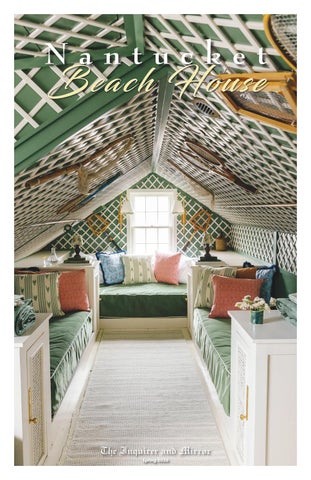
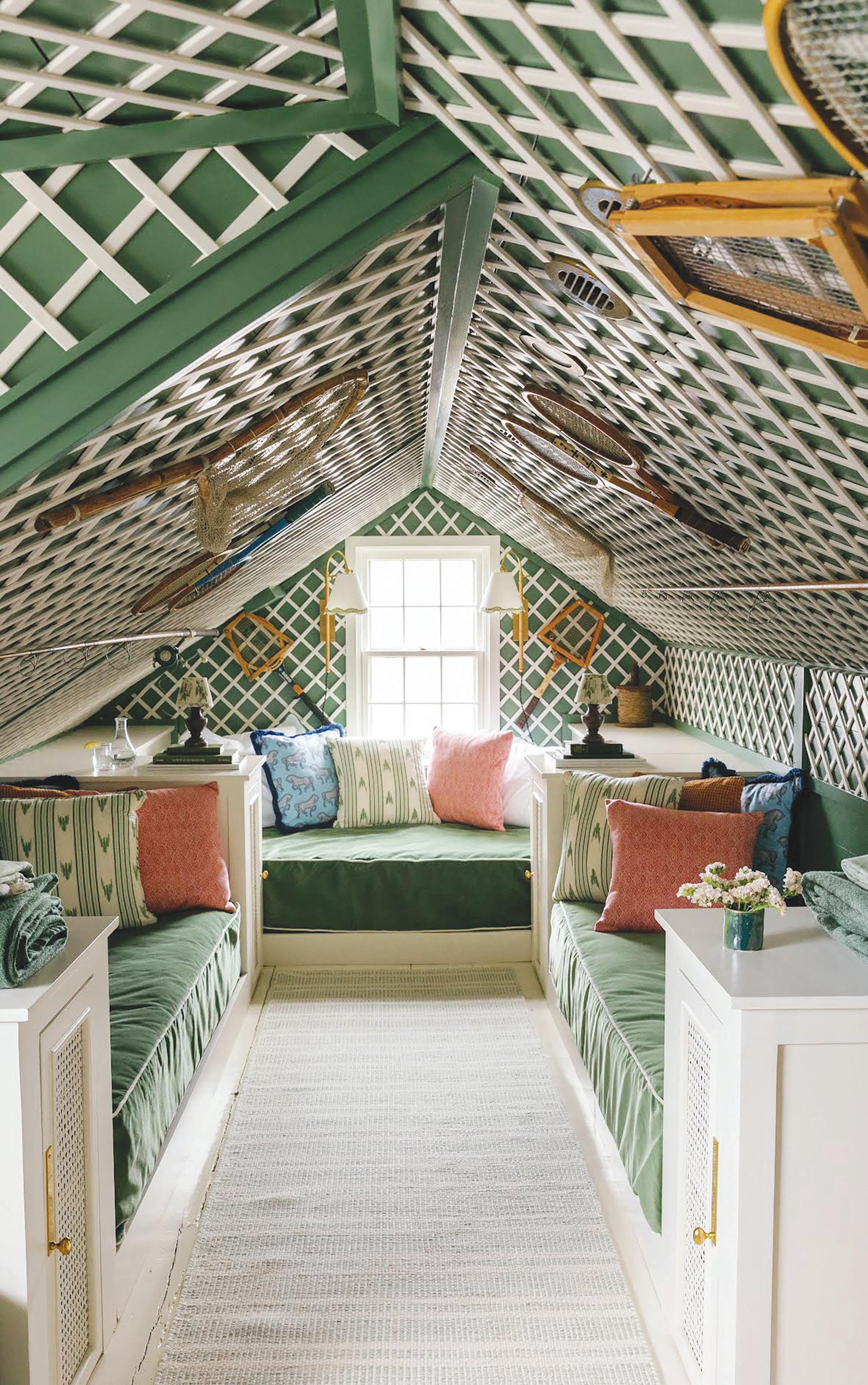
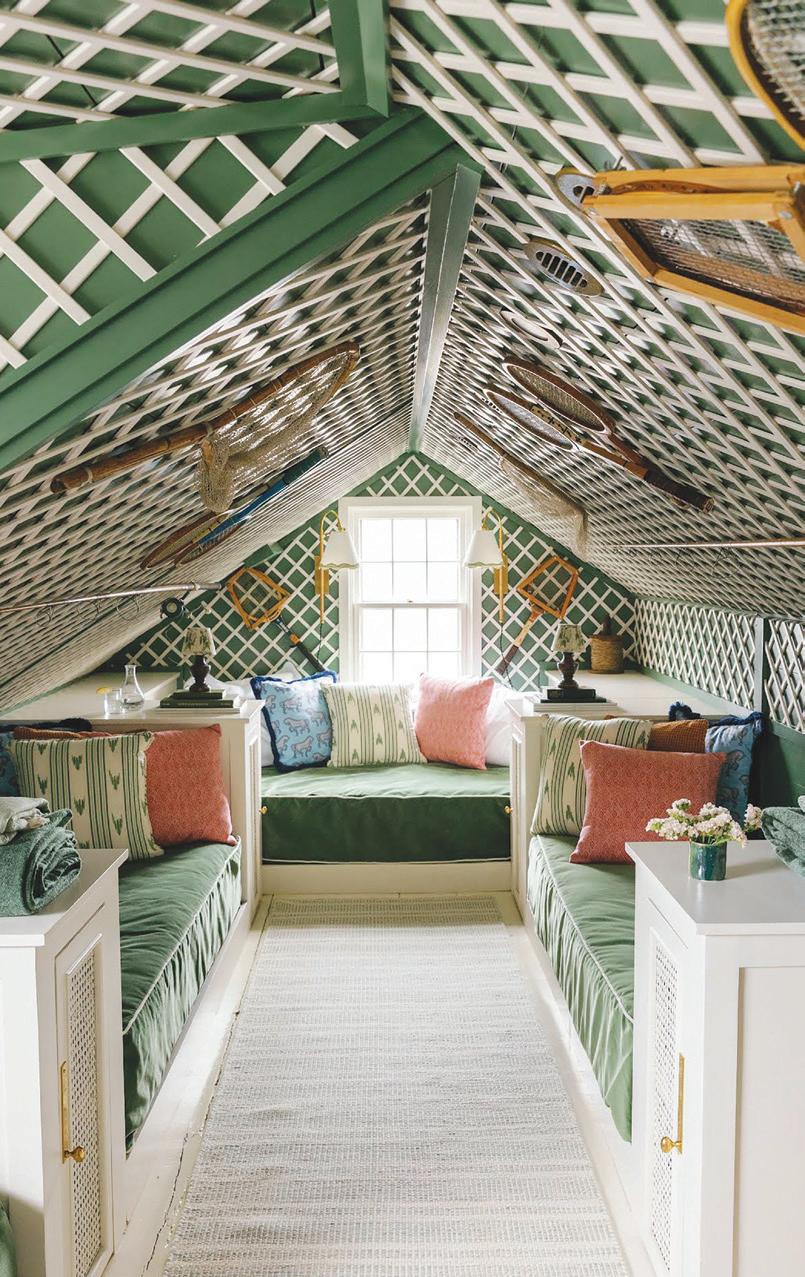
Nantucket Beach House




CUSTOM SERVICES
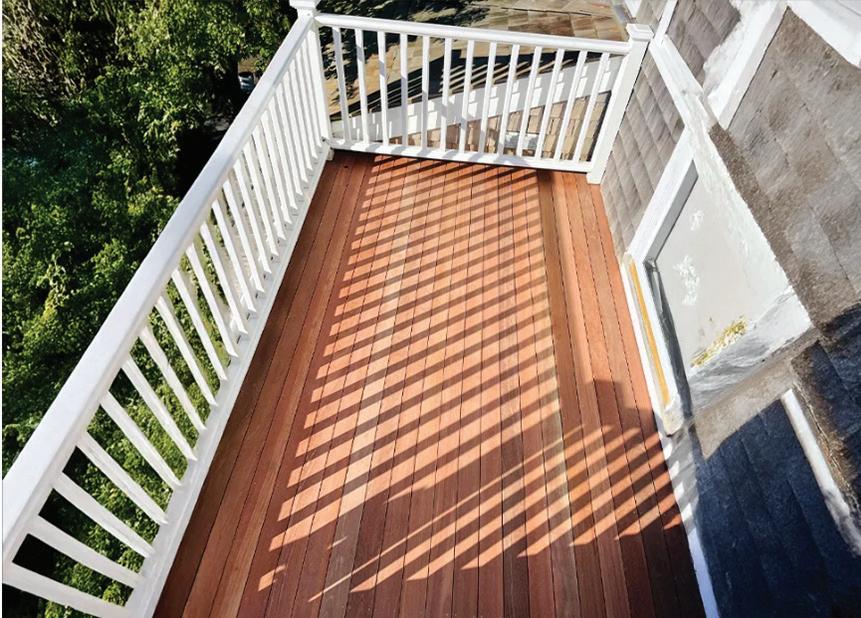
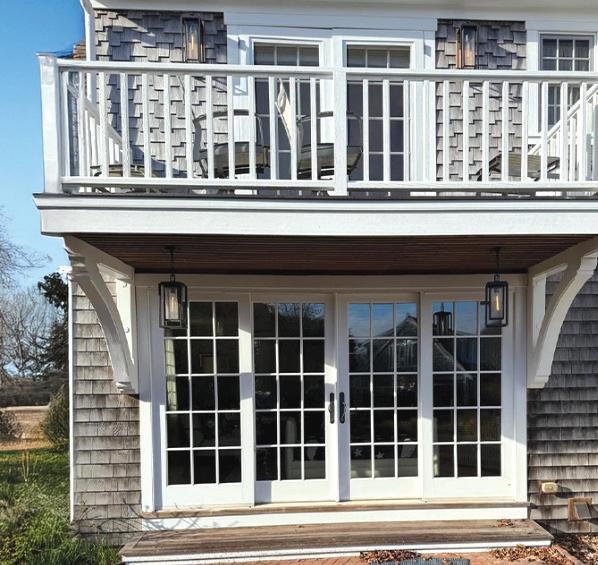
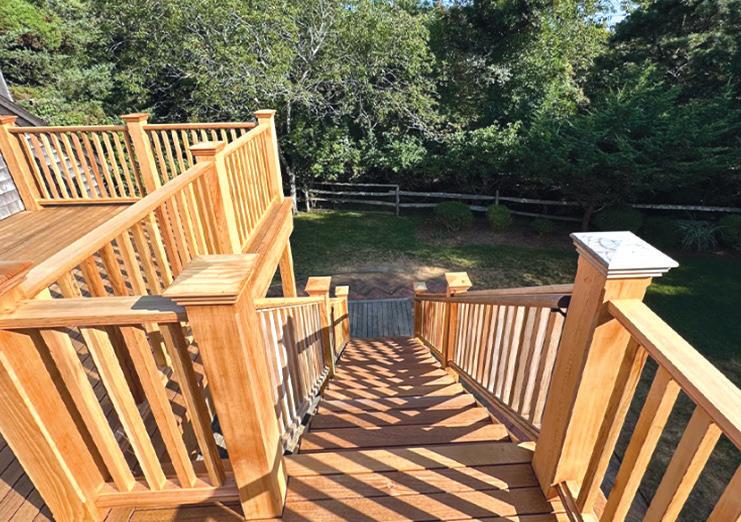
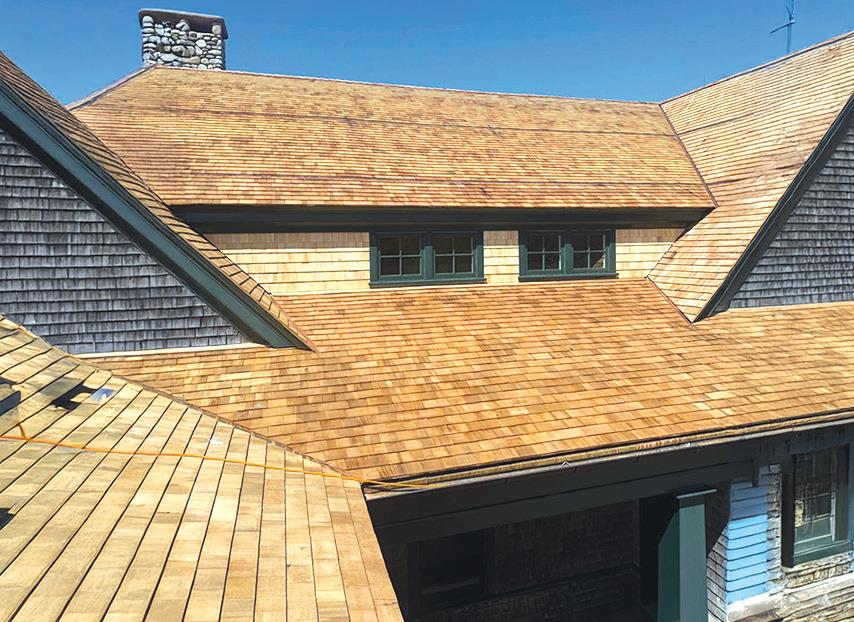
■Bespoke carpentry for both indoor and outdoor spaces.
■Custom-built porches, architectural staircases, handcrafted doors, and decorative moldings that elevate any room.
■Unique architectural finishes that add character to every property.
■On-site design and installation, right here on Nantucket.

Nantucket Beach House
Publisher Robert Saurer rsaurer@inkym.com
Editor Joshua H. Balling jballing@inkym.com
Production & Design Meghan Luksic mluksic@inkym.com
Advertising Director Mary Cowell-Sharpe msharpe@inkym.com
Advertising Sales Alexandro Sforza asforza@inkym.com
Circulation Karen Orlando korlando@inkym.com
Contributing Writers & Photographers Debi Lilly Lucy Apthorp Leske Melinda Myers
Emily Elisabeth Photography



Nantucket Beach House

The Inquirer and Mirror Spring 2025
Whispers of History
The meticulous restoration of Ivy Cottage
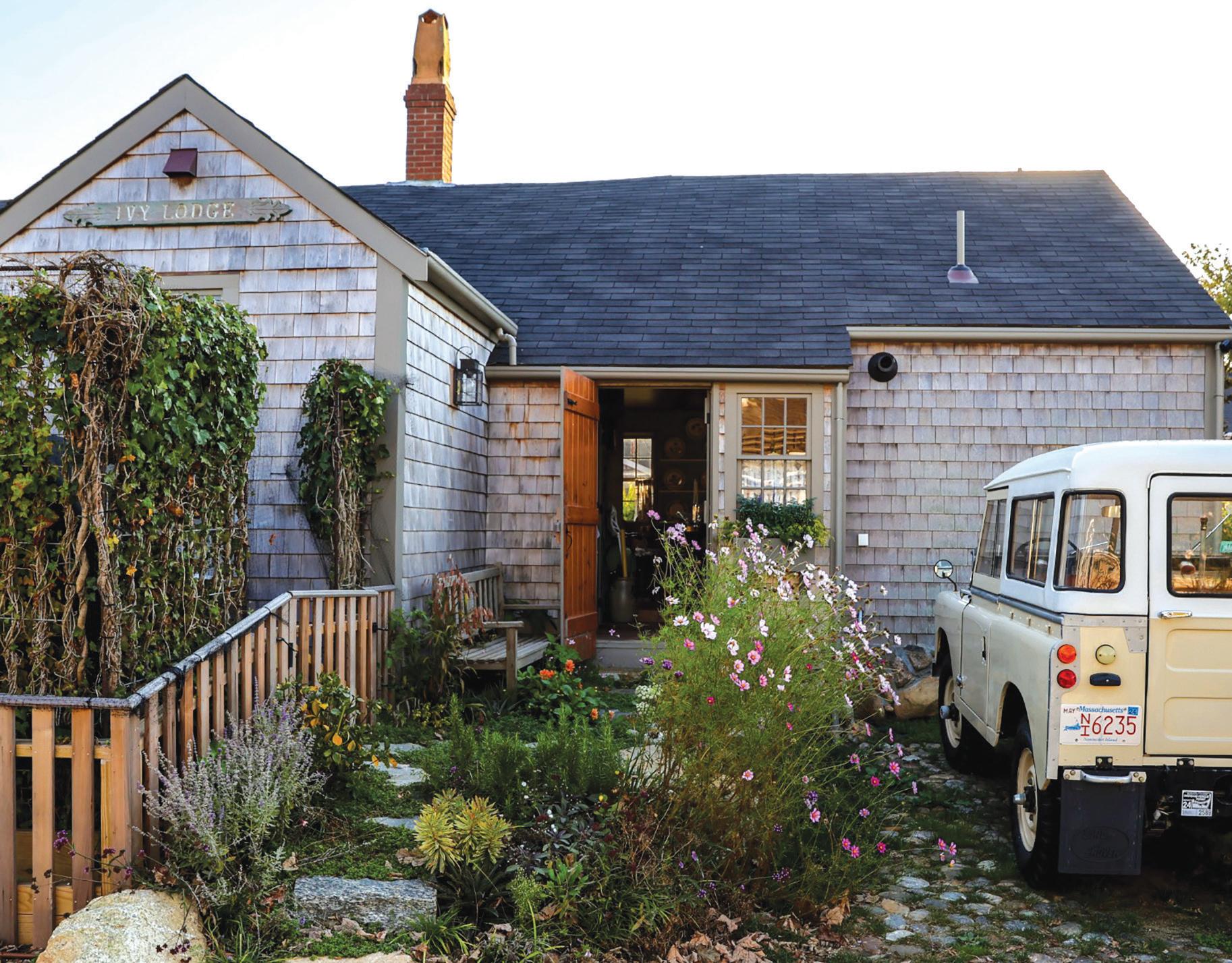
Restoration on Nantucket is woven into island life itself. Our history is the magic ingredient. Our preservation honors the people, stories, craftsmanship and quiet beauty that shaped this tiny island into one of America’s most treasured communities. It lives in the careful repair of antique windows with wavy glass that have watched and weathered three centuries of storms. It lives in the preservation of hand-hewn beams, many from whaling ships, old brick chimneys,and worn pine floors polished by generations of footsteps. It lives in the belief that imperfections tell stories, and stories deserve to survive.
Story by Debi Lilly
Photos by Emily Elisabeth Photography
Walking through town or Sconset feels like stepping into another century. Weathered cedar shingles silvered by salt air, gardens of hydrangea and roses up to the roof, every charming detail whispers history. Yet none of it happened by accident. The Nantucket we treasure today exists because generations of islanders believed that preserving history matters. Stewardship is viewed as a sacred responsibility: the understanding that these homes are only borrowed for a chapter in time. Restoration is not about perfection. It is about continuity.
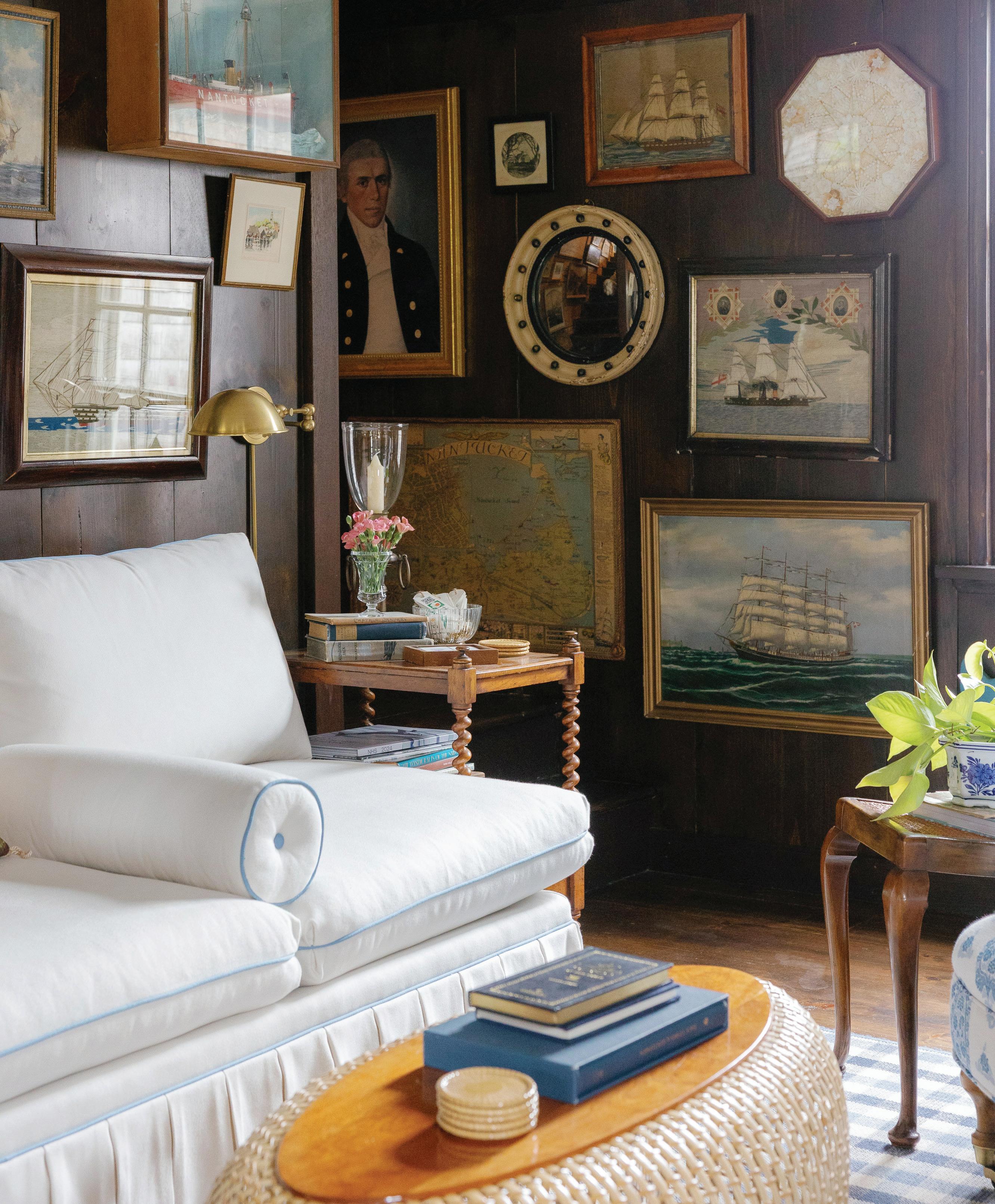
At Ivy Lodge, preservation and restoration pair together in a way that feels both intentional and deeply personal. Owner Nicole Tirapelli believes that a home should tell a story, and carefully rescued island treasures from local homeowners and estate sales, building a curated collection of Nantucket artwork, memorabilia, a sense of history and
Restoration is not about perfection. It is about continuity.
warmth into every room. Each piece is a small nod to the island, layered thoughtfully to create a home that feels lived-in, collected and meaningful.
Throughout the restoration, Tirapelli made a conscious effort to honor the home’s original 1700s character, preserving features like the rubblestone masonry in its earliest section, the original fireplace surround with its simple mantel and layers of paint built up over time, and original woodwork beneath layers of plaster, showcased along the stairway to the second floor.
Even the ivy that gives the home its name has been thoughtfully managed, allowing it to remain a defining feature while keeping its presence refined. The result is a home that celebrates Nantucket’s past while feeling uniquely inviting and personal today.
Tirapelli’s vision for Ivy Lodge was to honor its history while bringing it forward in a way that felt both authentic and livable. When she purchased the home, the Sconset Trust shared a detailed architectural and historical report that became the foundation for the entire restoration. It guided every decision and reinforced the importance of preserving the cottage’s original character. These details shaped the vision: to reveal and celebrate the history already there.
The greatest challenge was respecting the scale and integrity of a small historic cottage while thoughtfully reworking its compartmentalized layout into something more livable and functional. Introducing adequate storage without compromising the original character required a highly disciplined approach. Even the exterior demanded attention – especially keeping deer from eating the namesake, newly replanted ivy garden has been an unexpected yet persistent ongoing challenge.
The restoration of Ivy Lodge was shaped by a small group of thoughtful collaborators, each bringing a distinct layer to the project. Marty McGowan of the Sconset Gardener helped guide the landscape design, creating a setting that feels as though it has always belonged. Ivy softens the architecture, while old stone steps set into blue star creeper and a mix of roses and seasonal plantings give the garden a natural, effortless character. His work on the west-side “ladies’ garden” includes the addition of a simple, timeworn screen door, creating one of the home’s most intimate outdoor spaces.
Mary Malavase, known locally as Daffodil Mary, curated the spring daffodil gardens with a thoughtful, layered approach. Bulbs were sourced from Bill Pannill for the ladies’ garden, while the east side reflects more historic, classic varieties and the







west incorporates selections from Becky and Brett’s Daffodils. Tirapelli’s personal favorites: Asapsia, Sailboat and Cyclataz, are complemented by the smaller, more delicate miniature varieties.
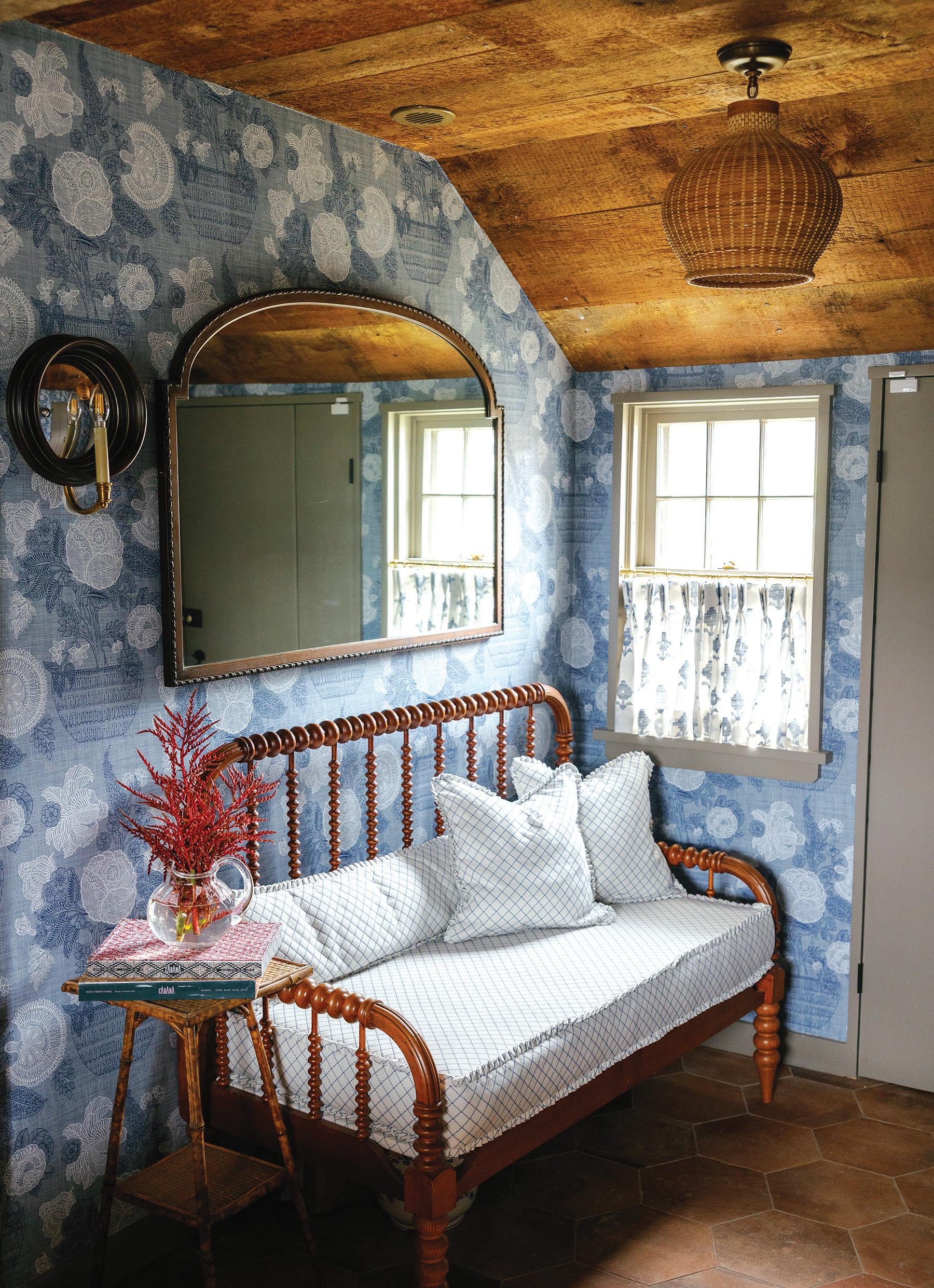
Meg Piercy of Meg Made was an invaluable partner in bringing the interiors together. Tirapelli had the initial design vision, and Piercy helped refine and complete it, restoring antique pieces collected locally over several years from Nantucket estate sales. She reimagined a Nantucket spindle bed as a bench in the entry and guided the placement of artwork throughout the home. Her ability to layer old and new brought a sense of cohesion and warmth to the interiors.
Junior Cardoso of Blue Island Painting played a key role in the final phase of the project, focusing on the finishing details that brought everything to completion. His attention to precision and consistency ensured the house felt fully resolved, carrying the project seamlessly across the finish line. Together, the whole team’s contributions helped shape Ivy Lodge into a home that feels both timeless and deeply personal, rooted in history, yet thoughtfully brought forward.
Living in Ivy Lodge has also given Tirapelli’s children, a whole new generation, a unique perspective on a simpler, more historic way of life. There’s something special about growing up in a whaling cottage in Sconset, the sense of history is constant, and the community itself is incredibly close and connected.
At Ivy Lodge, mornings unfold with a quiet sense of ritual. The Dutch door in the kitchen and the board-and-batten door along the cobblestone drive open to invite in the coastal breeze, along with the aroma of fresh coffee and a view toward the Castle Bandbox on Shell Street. The house naturally welcomes connection – which is Nantucket in a nutshell. Neighbors often pause at the open Dutch door, joining for coffee or lingering over breakfast. From the covered porch, the rhythm of Sconset life drifts by: bicycles, Fred (the neighborhood dog) making his daily rounds and tennis rackets tucked into baskets, simple, familiar and full of charm.
As the season comes into full swing, the focus gently shifts to the west side of the house – a more private outdoor space layered with pea stone, anchored by a plum tree and wrapped in ivy. It becomes a natural setting for hosting, whether as part of the summer Sconset cocktail circuit or for relaxed dinner gatherings with friends. Evenings often turn into casual neighborhood dinners, with kids gathering and favorites on the grill, house steak tips from Meat & Fish, broccolini and double-baked potatoes.
This is the true importance of restoration: not just saving buildings, but preserving a sense of belonging.
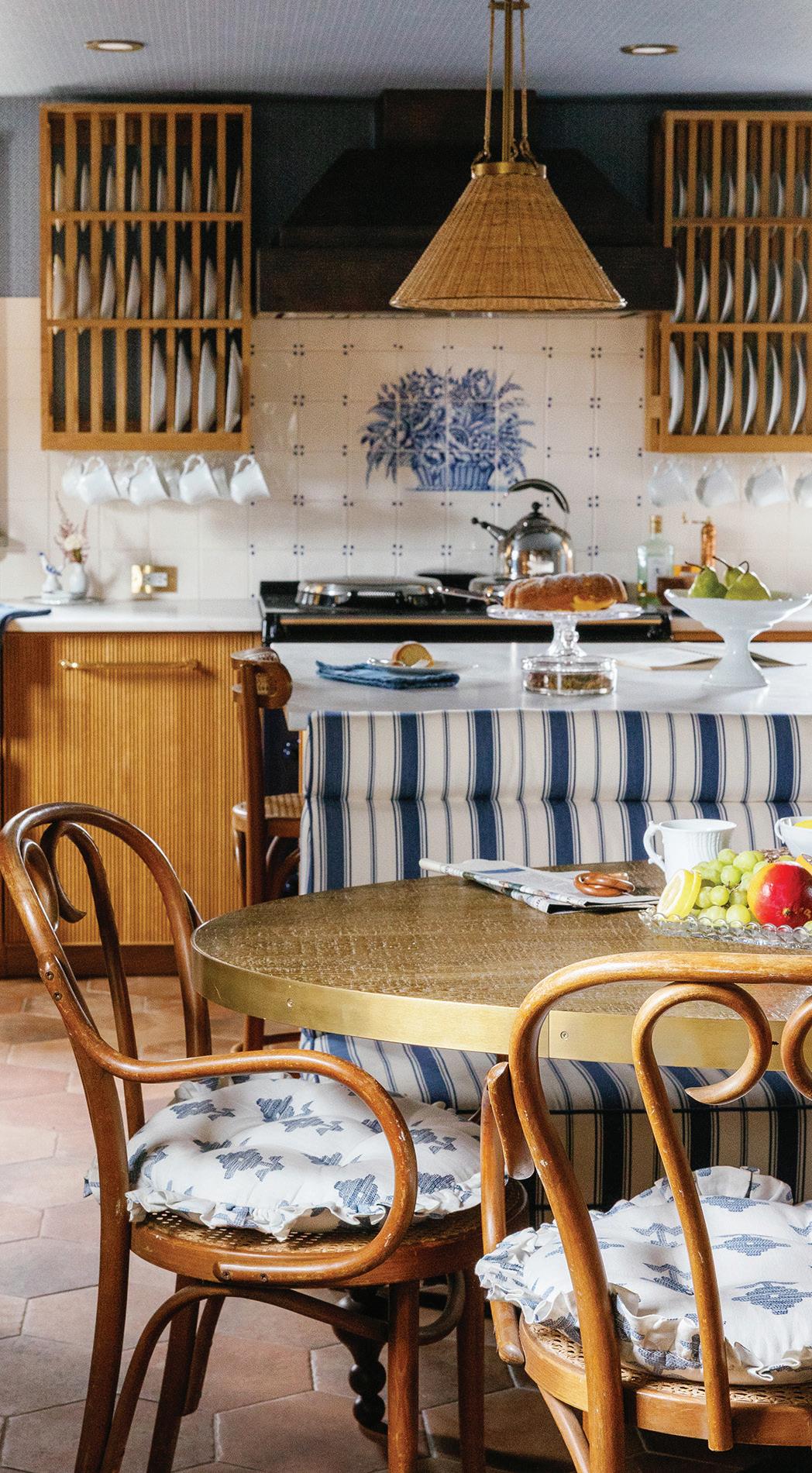
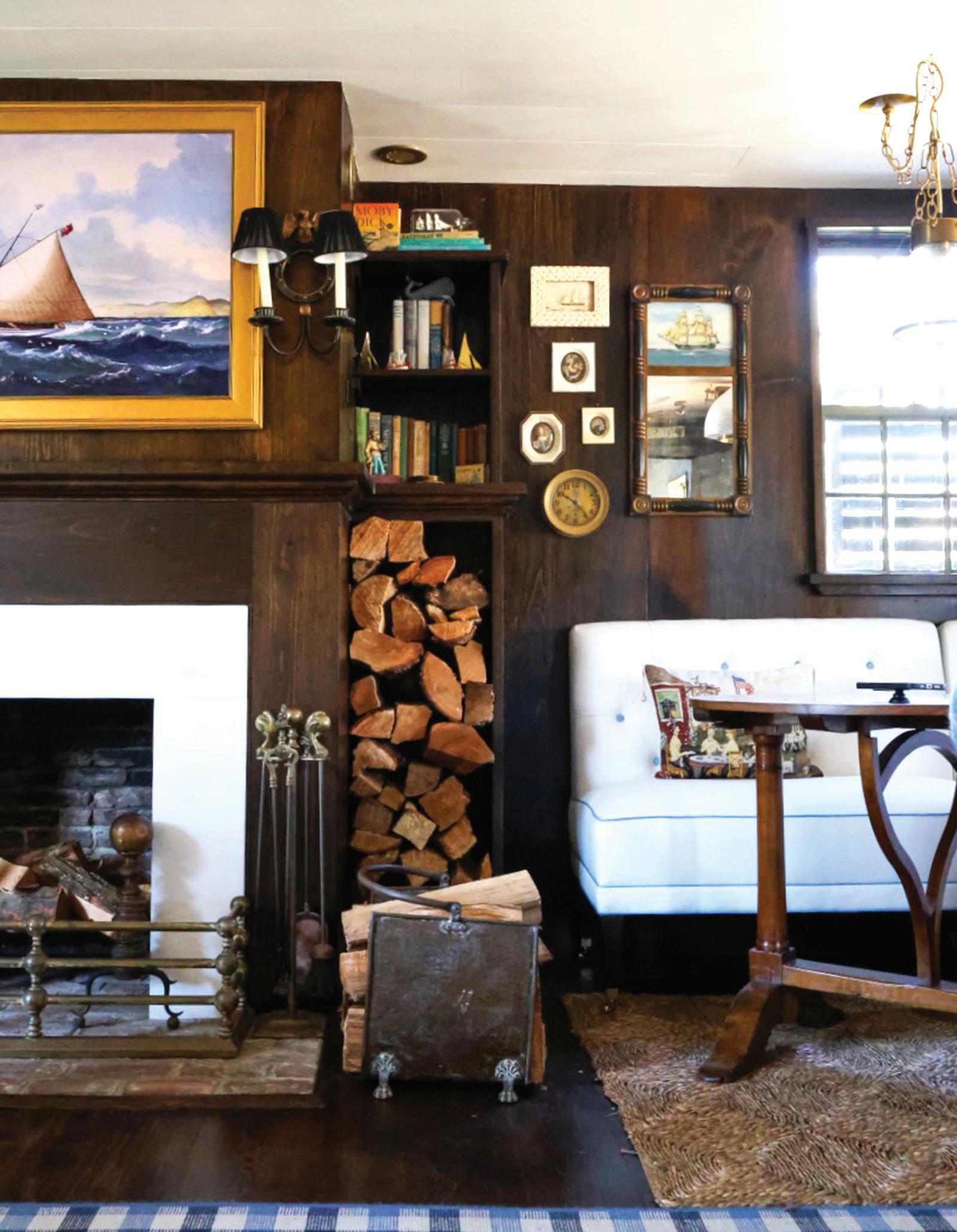
On Nantucket, these homes are part of a much larger story. Tirapelli’s hope is that anyone purchasing a historic property approaches it with a sense of stewardship, preserving its character, respecting its history and allowing it to evolve thoughtfully. You’re not just restoring a home – you’re carrying forward a piece of the island.
Owners and preservationists often choose repair over replacement, reclaiming original materials whenever possible, the way weathered shingles and rose-covered fences remind us that beauty deepens with age. In a world constantly rushing toward what is new, Nantucket offers something increasingly rare: reverence for what came before.
This is the true importance of restoration: not just saving buildings, but preserving a sense of belonging. Protecting craftsmanship. Celebrating memory. Creating roots for future generations to stand upon. When we restore history with care, we do more than preserve the past. We preserve the soul of a place. This is Nantucket.
Entertaining, floral and event designer and author Debi Lilly writes the “You’re Invited” column for The Inquirer and Mirror, Nantucket’s trusted news source since 1821. She believes in elegant and easy lifestyle ideas for all. Follow along at debi@aperfectevent.com, www.debililly.com and Instagram @debililly.
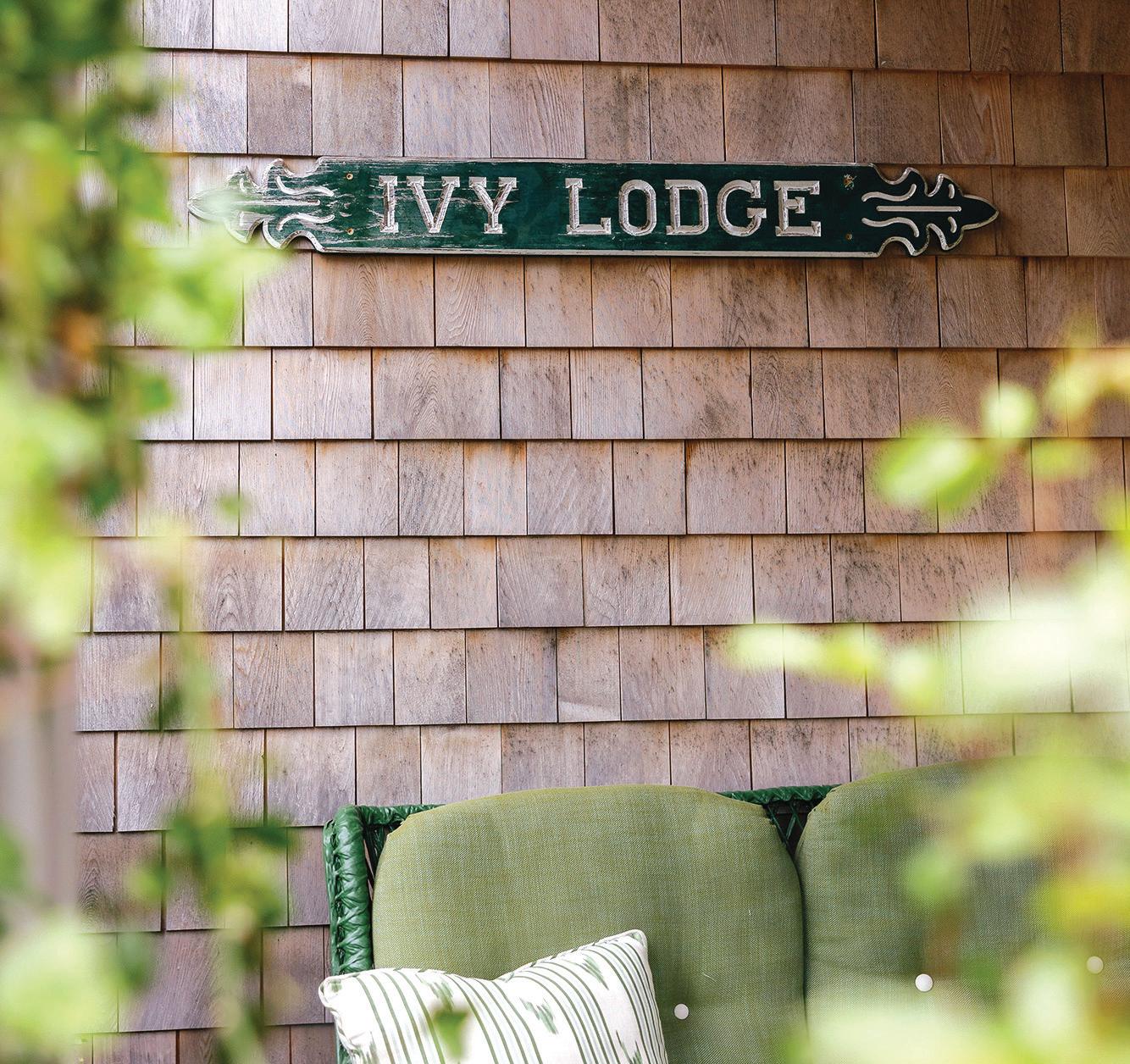

Courtesy of Debi Lilly
Transform Your Yard with Ryan Conway Landscaping Inc!
Superior landscaping, gardening, and lawn care services in Nantucket at unbeatable rates. Our skilled team delivers top-notch results, from lawn mowing to garden design. Trust us to elevate your property’s appeal - reach out today for a complimentary consultation. Plus, enjoy a free mowing on your initial regular lawn cut with a 1-year commitment. Enhance your landscape with us now!
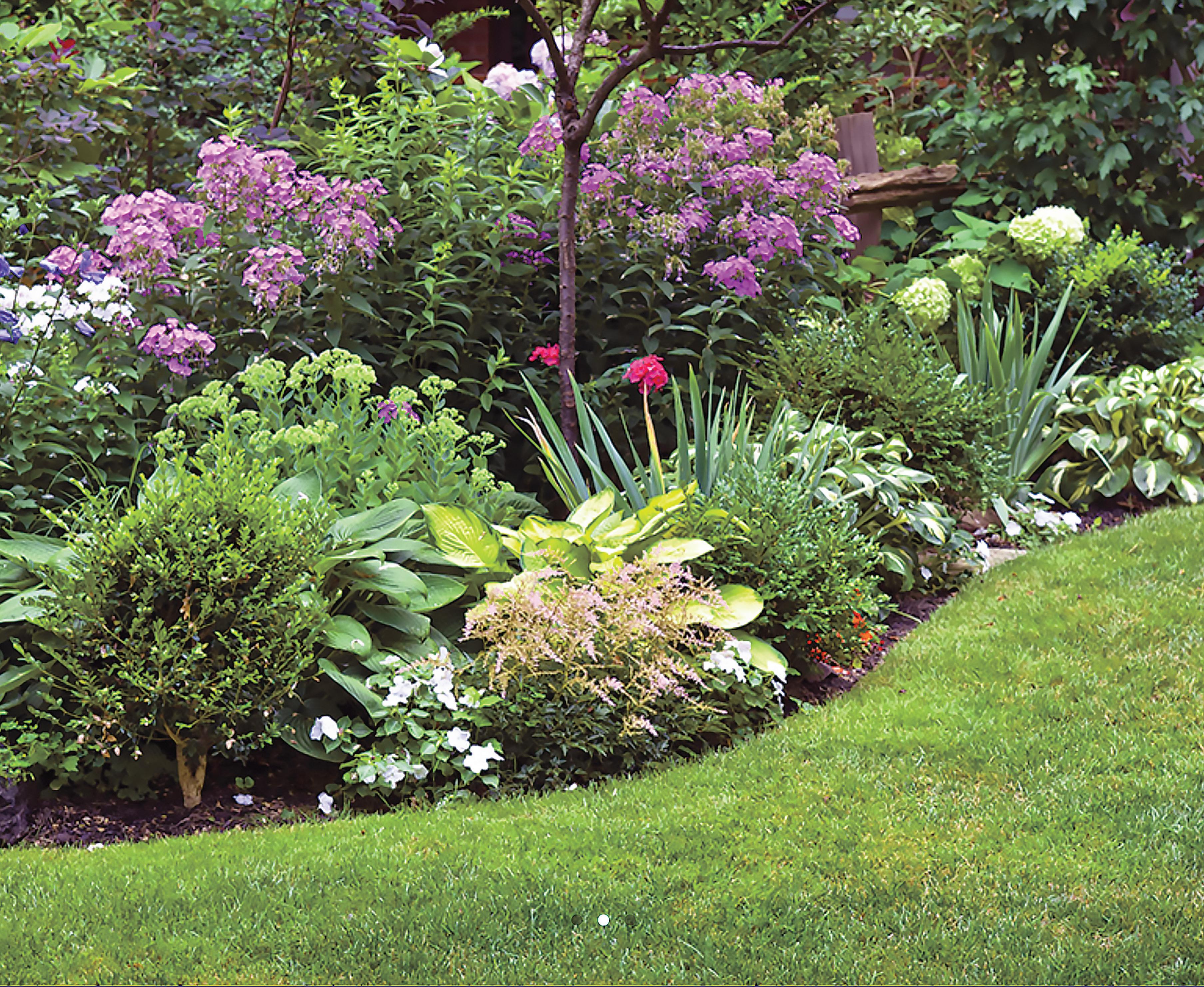
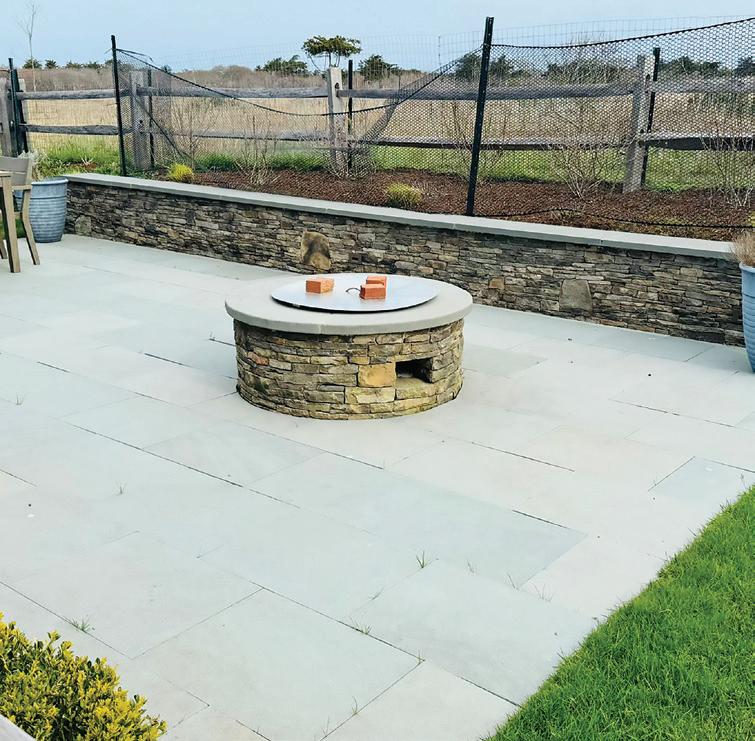
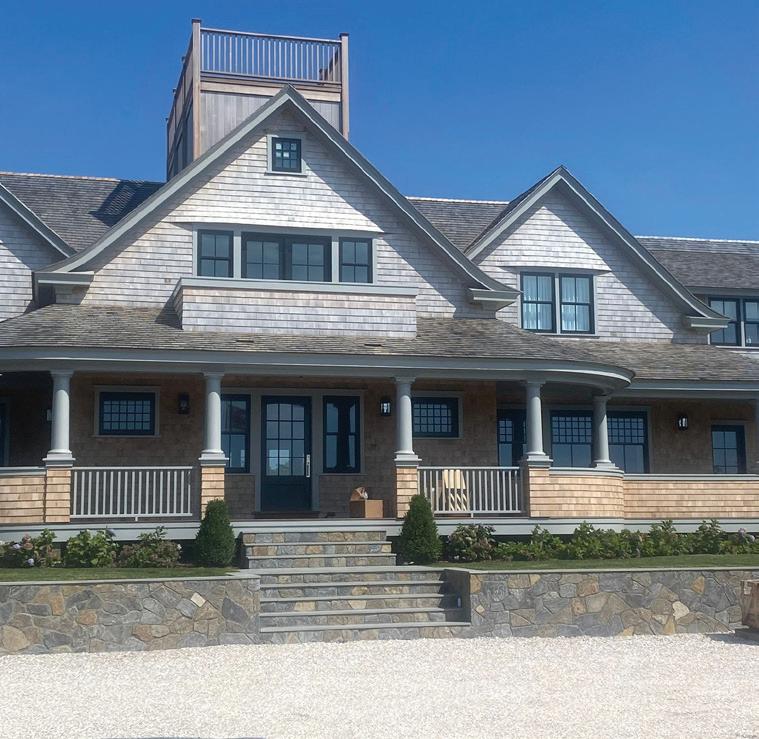
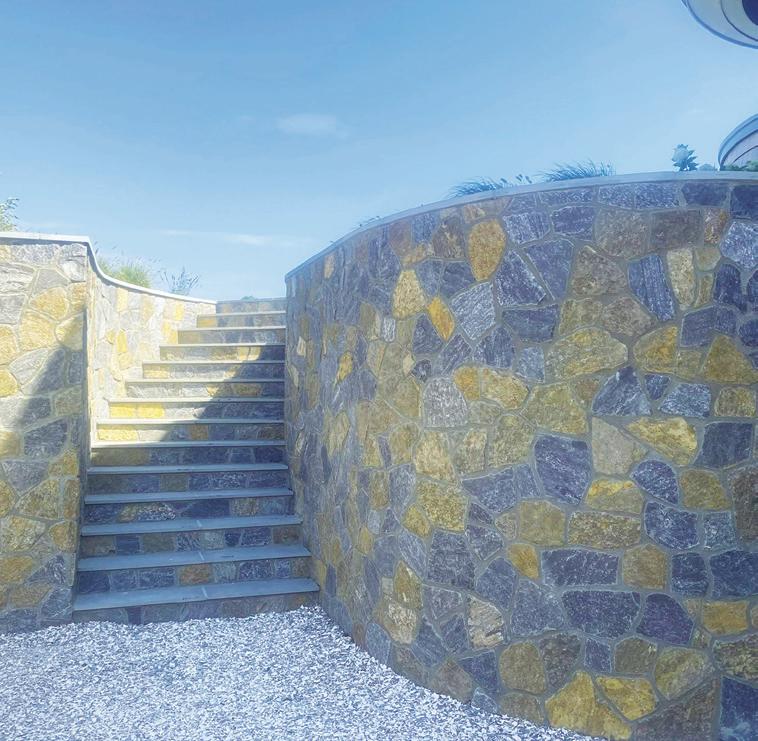
Services offered: Complete maintenance packages including lawn mowing, fertilizing, hedge trimming, seasonal clean-ups, fire pit installation, stone walls, patios, and driveway aprons.
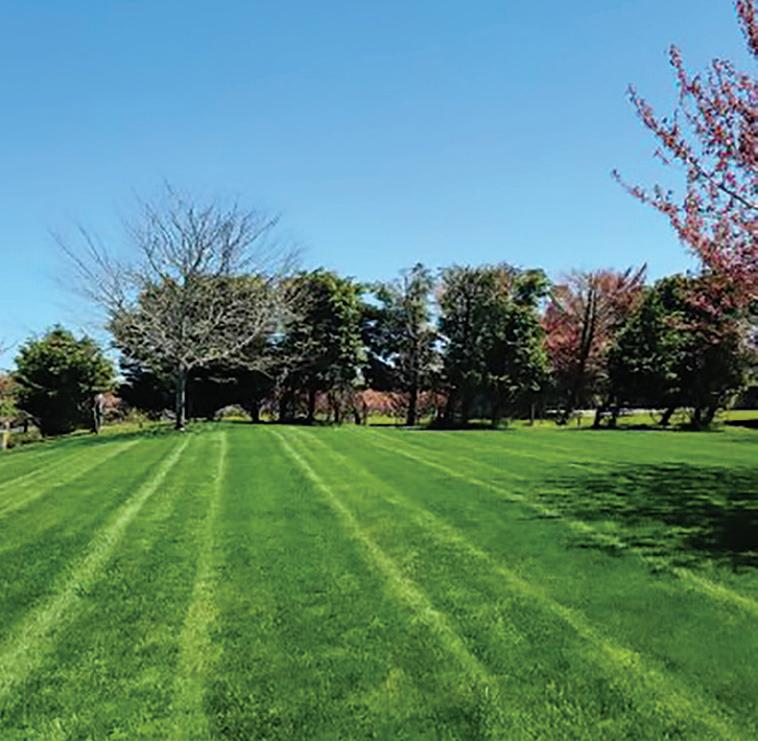

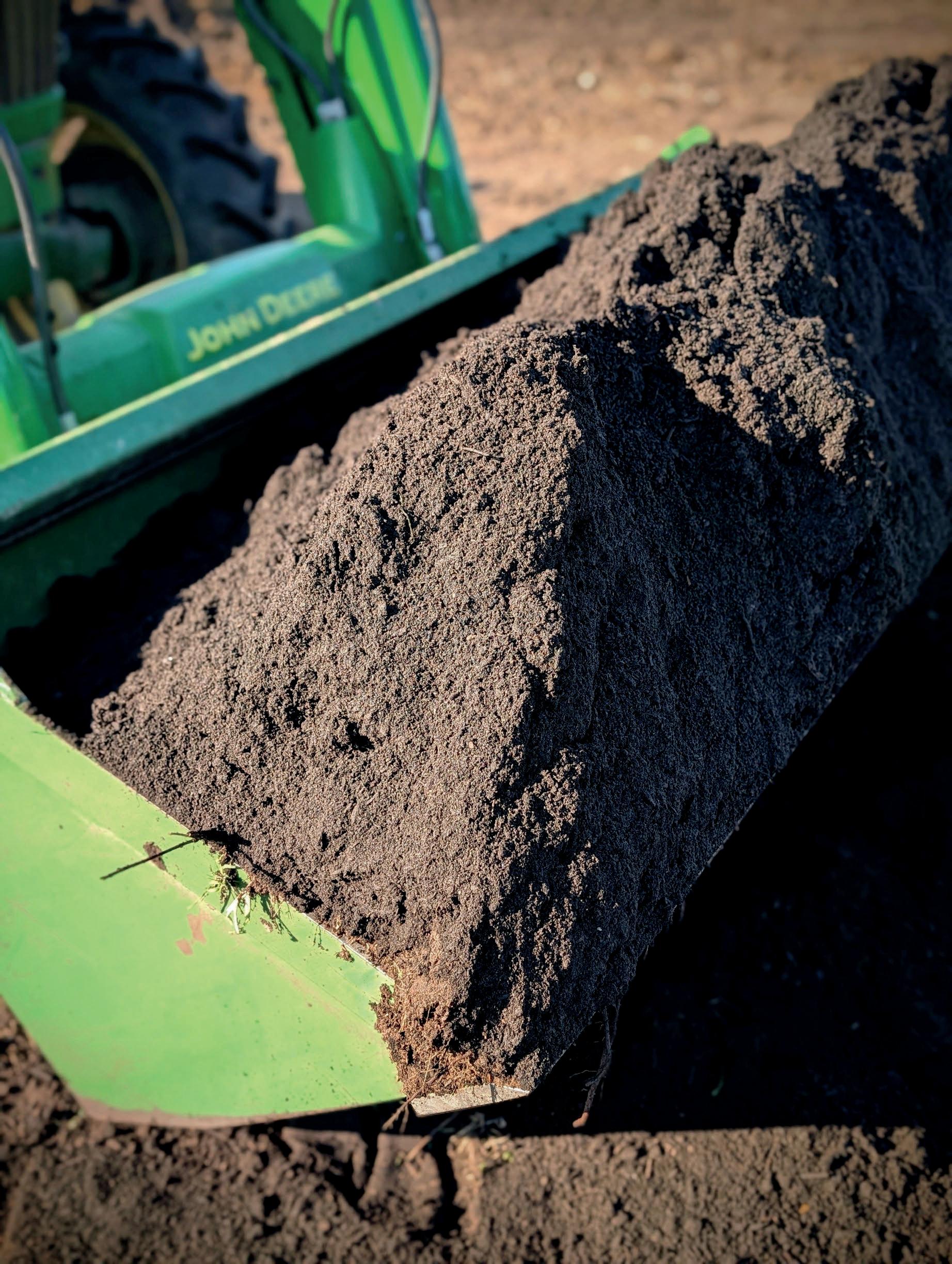
Inside Nantucket's closed-loop compost operation, where island yard waste is transformed into island soil as premium certified compost.
L O C A L Y A R D S .
LOCAL SOIL.
In 2022, Oyster Environmental the company that operates the island's compost yard under the Waste Options Nantucket contract processed roughly 12,170 tons of leaf and yard material. That same year, the material was turned, screened and finished into Nantucket Gold™ Compost, which received its OMRI listing for the first time a prestigious independent certification for use in certified organic growing and has since become a quiet fixture trusted by some of the island’s most prolific and talented growers
For JP Caron, Waste Options’ Chief Operating Officer, the compost’s credibility rests on two things: what goes into the product, and what the numbers say when it comes out. "It goes through a full cycle of testing," he says. "We keep it as affordable as possible to help the town of Nantucket sustain its vibrant landscape business community ”
“Being an island, it's important to keep our nutrient loop “ Being an island, it's important to keep our nutrient loop closed... closed... this [compost] is an important piece of the puzzle for this [compost] is an important piece of the puzzle for local food production and self-sufficiency on Nantucket." local food production and self-sufficiency on Nantucket."
-Aidan Feeney, Fogtown Farm -Aidan Feeney, Fogtown Farm
farming on
“I could not grow the way I do without it. “ I could not grow the way I do without it. Organic regenerative farming on the Organic regenerative farming on the island at any scale is economically island at any scale is economically prohibitive otherwise.” prohibitive otherwise. ”
Dan Southey, Washashore Farm Dan Southey, Washashore Farm
WHY NANTUCKET'S FARMERS KEEP COMING BACK TO NANTUCKET GOLD: CONSIST TEST RESULTS, HIGH ORGANIC MATTER, AFFORDABILITY
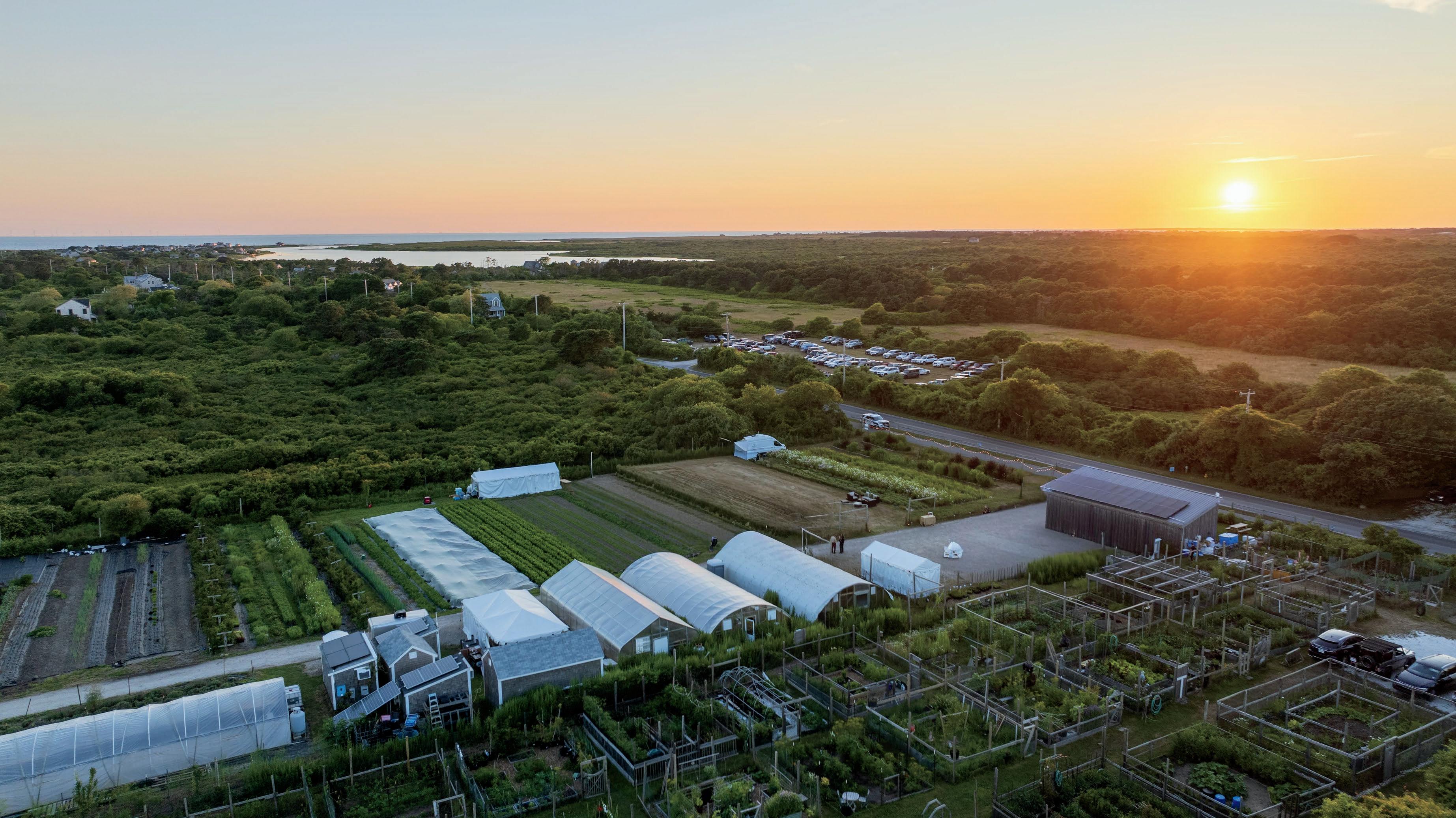
Nantucket Gold™'s following has grown to include all of the farmers at Sustainable Nantucket's farm on Hummock Pond Road, where farmer Dan Southey of Washashore Farm puts it plainly:
"I could not grow the way I do without it," he says "Organic regenerative farming on the island at any scale is economically prohibitive otherwise "
At neighboring Fogtown Farm, Aidan Feeney was one of JP's first customers, and that loyalty has only deepened over the last seven years. "The finished compost is soft, crumbly, dark like chocolate cake," says Aiden "It improves my soil structure and nutrient retention, and allows me to grow exceptional quality produce.”
That testing cycle is more rigorous than most consumers would expect. Tests are conducted throughout the year by AgroLab in Delaware under TMECC protocols and Wood’s End Lab in Maine
Results, which consistently confirm Very Stable maturity, near-neutral pH and low soluble salts, are publicly available on the company’s website. The product also passes pathogen and heavy metal tests and has maintained its OMRI certification for organic use for the last 4 years
The increase in compost quality is the result of years of deliberate refinement by JP and his team longer windrow times, tighter control of feedstock, and a production process built around quarterly testing and consistency
“Being an island, it's important to keep our nutrient loop closed JP is doing the important work of transforming local yard waste into something useful He's transparent about his practices and the materials used. This is an important piece of the puzzle for local food production and self-sufficiency on the island."
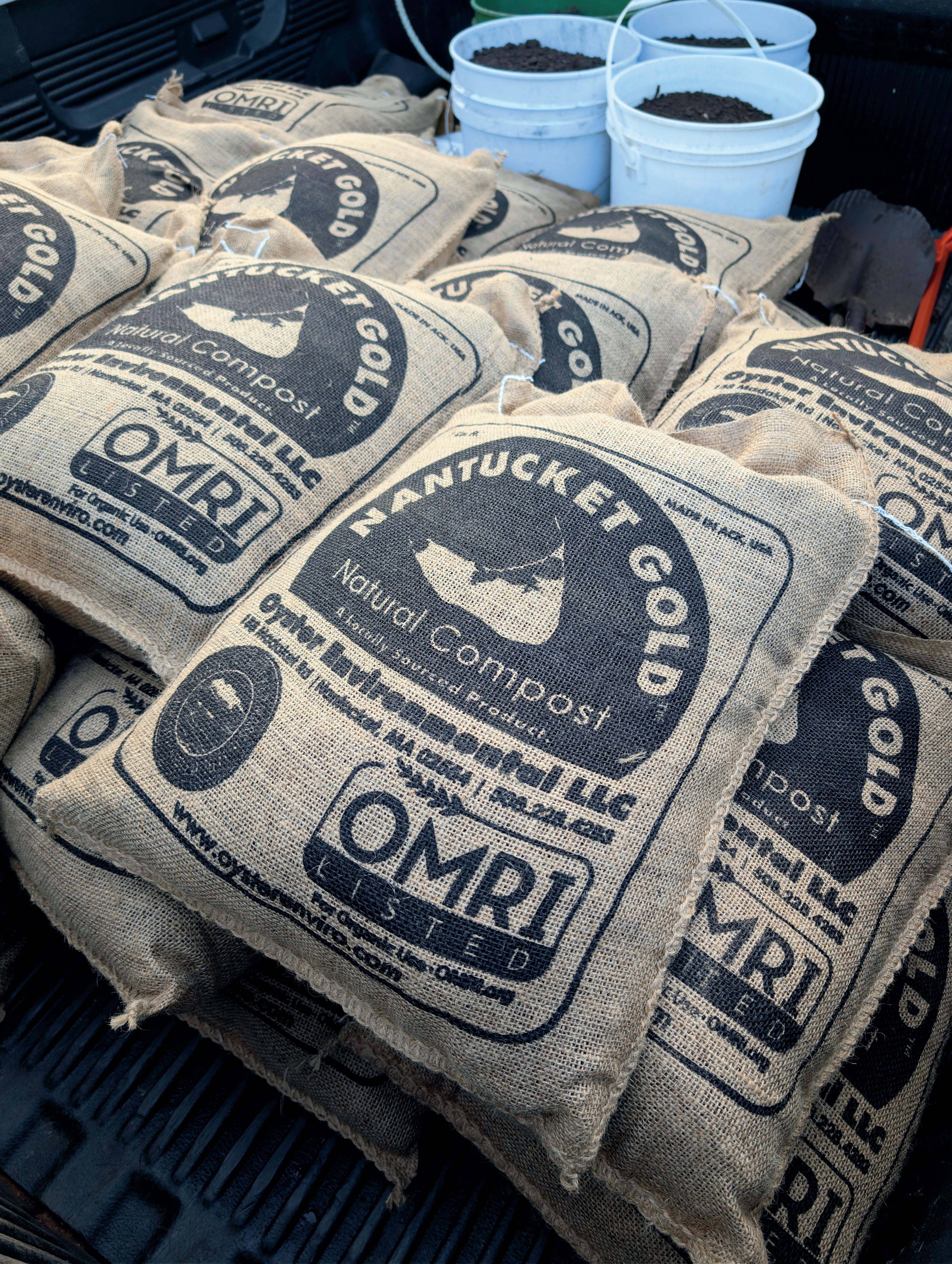
Nantucket Gold™ Compost is available in bulk and bagged. Bags are available for pickup at the Recycling Facility scale house. Bulk can be loaded by truck or delivered across the island.
To order, text 508-228-4283 or visit nantucketgoldcompost.com
Aerial photo of Sustainable Nantucket’s Mentor Farm by: Keegan Bartlett
Outdoor Oasis
Tips for Transforming a Patio, Balcony or Deck
Story by Melinda Myers
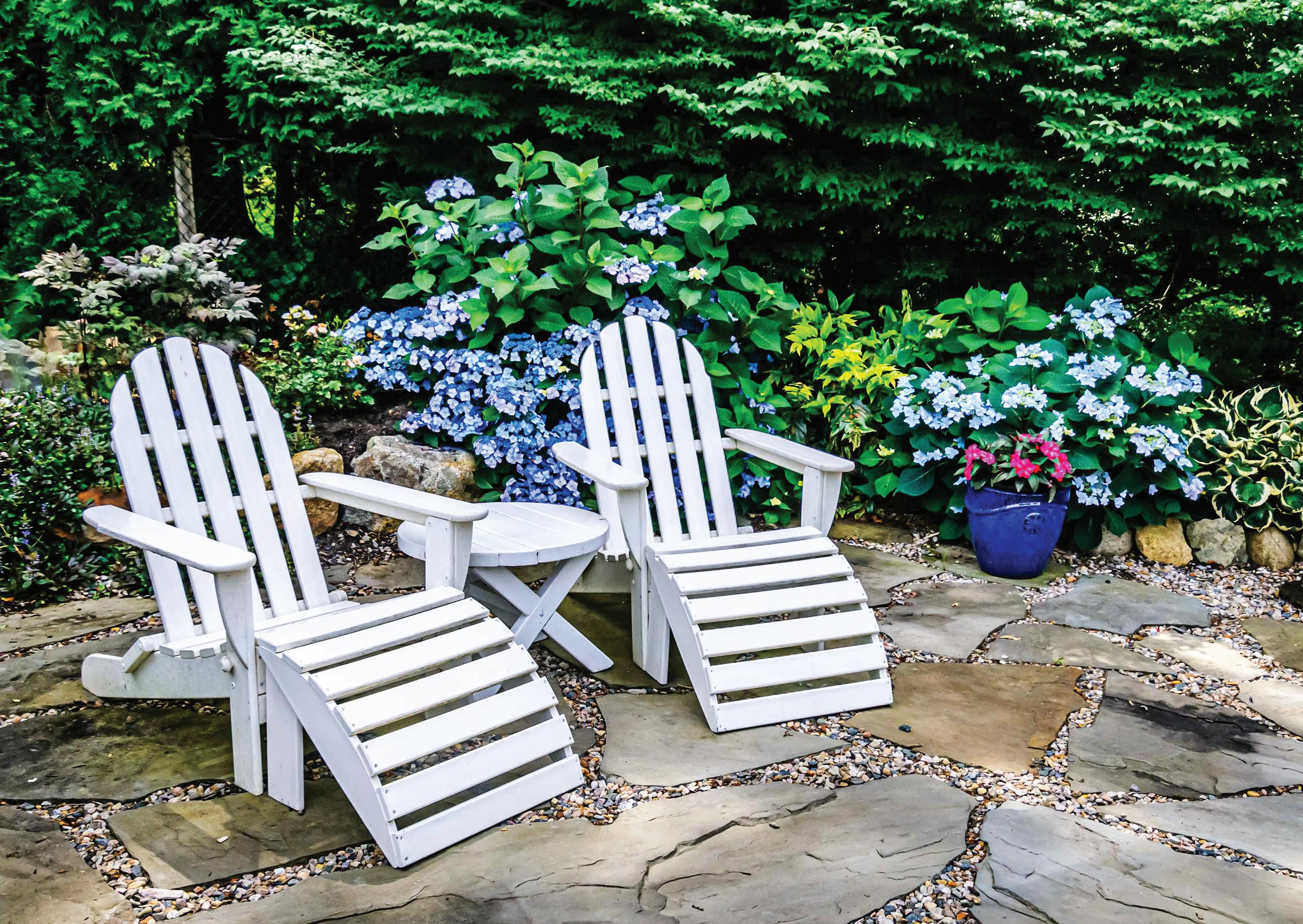
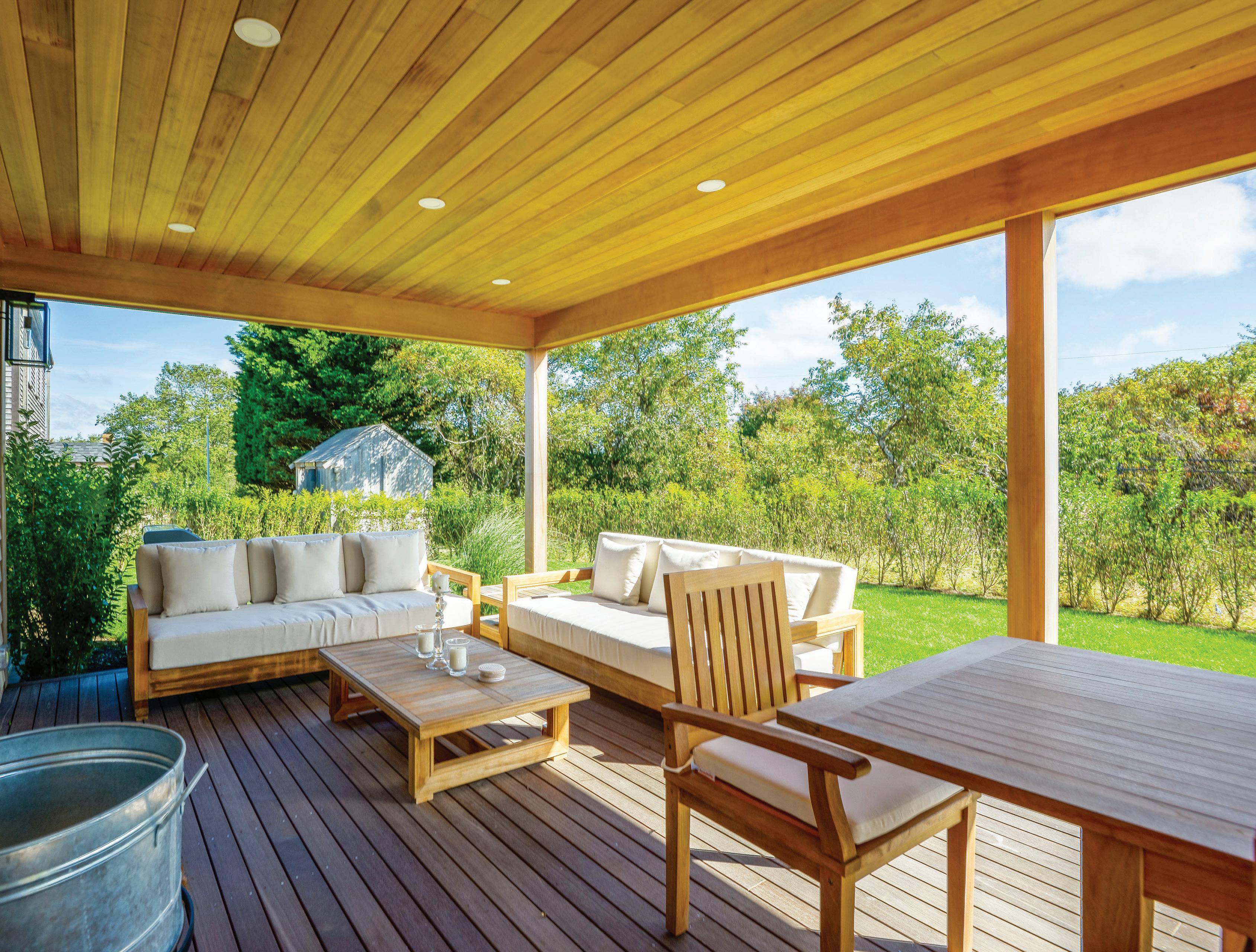
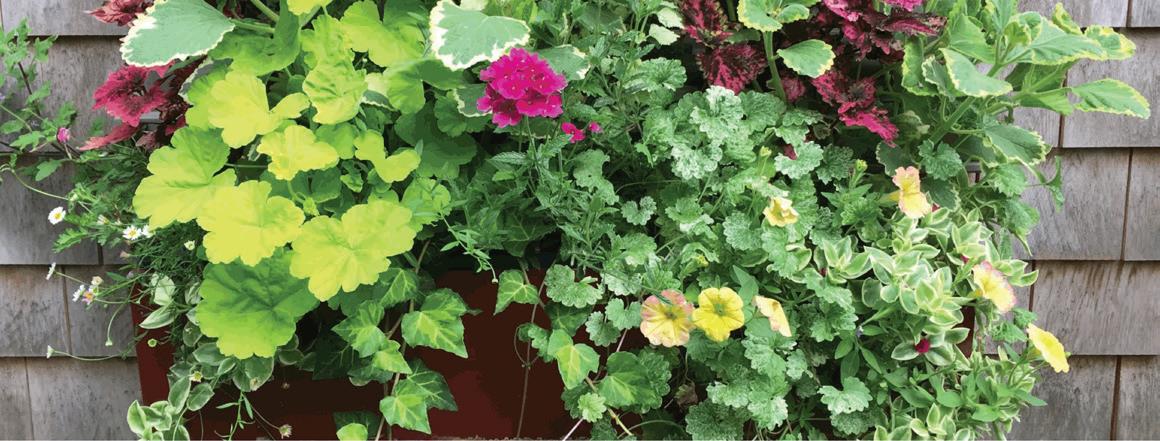
You don’t need much space to create a bit of paradise on your balcony, patio or deck. Fill the space with a collection of plants that provide texture, color and privacy. Then add comfortable seating, a fountain and lighting for additional ambiance and relaxation.
Start by evaluating the space you want to transform and how the surrounding views and noise will impact your enjoyment. Before enclosing the whole space, identify the views you need to screen and those you want to keep. Perhaps a view of your favorite flower garden, the park across the street or your neighbor’s water feature extends your enjoyment beyond the limits of your garden oasis.
Use tall grasses, large tropical plants, vines trained on trellises and upright shrubs and trees to define the space. These can be grown in weather-proof containers if no in-ground planting space is available. Just make sure your balcony or deck can handle the weight of the planters once filled with soil and plants.
or investment
we keep it

Select plants that provide multiple benefits. Look for plants that deliver several seasons of beauty with flowers, colorful foliage, seedheads and fall color. Include fragrant plants for aromatherapy and those that attract butterflies and hummingbirds to add motion and color.
Decide how you plan to use the space. Are you longing for a quiet area to relax and read, one to entertain or a space to accommodate all your outdoor activities? Select furnishings with the color, form and style that will create your desired look and feel. Then select plants, containers and accessories that complement the furnishings for your outdoor oasis.
Add a stand-alone or wall-mounted fountain or container water garden to the space. The sound of moving water helps create a sense of peace and relaxation, calming the mind, reviving the spirit and masking noise pollution.
No need to worry about mosquitoes taking residency in your water feature. Moving water is less appealing and adding an organic product like Summit Mosquito Dunks to water features prevents mosquitoes from breeding there. Just toss this donut-shaped cake of Bacillus thuringiensis israelensis (Bti) into the water. This naturally occurring bacteria only kills the mosquito larvae but doesn’t harm people, pets, fish or wildlife.
Further reduce mosquito problems by lighting a few citronella candles and placing them near you and others enjoying the space. Use a fan to help keep you cool and the weak-flying mosquitoes away.
Extend your enjoyment into the evening with some lighting. Be mindful of birds and night-flying insects by using shields to point light down to the ground instead of into the night sky. Select lights with lower lumens that aren’t as bright but still provide sufficient light and ambiance for you. Avoid white and blue light and opt for amber and yellow-greens that are less disruptive to the birds and night-flying pollinators.
Like any decorating or gardening project, be ready to make needed adjustments. While fine-tuning your design, be sure to take time to relax and enjoy your new space.
Melinda Myers has written more than 20 gardening books and hosts the nationally syndicated “Melinda’s Garden Moment” TV and radio program.


The Beach House Garden: Different Strokes for Different Folks
Story by Lucy Apthorp Leske
“If I had my choice, it would be a garden by the sea! A place where untempered winds and ocean spray often challenge the most competent of gardeners. A place where sunlit dew makes even the tiniest plants appear like jewels in the early morning sun. A place where the mingled fragrances of flowers, mixed with the salt of sea breezes, give the air a bracing freshness.” – Daniel J. Foley, “Gardening by the Sea from Coast to Coast” (Parnassus 1965)
When is a garden a beach garden? It is up to the owner. Some see all of nature as their garden, while others like to putter and grow plants or work with designers and landscapers to create a masterpiece. Each to their own. What draws all Nantucket gardens together is location. Every garden on Nantucket is within two miles of the beach, so one could say that every garden is also a beach garden.
Whether in town or on the water, all Nantucket gardens share the same climate and soil conditions that only an island 30 miles at sea can dish up. What makes each garden unique is each owner’s interpretation and solutions. Faced with salt, wind, sandy dry soils and severe coastal storms, Nantucket gardens must combine beauty with resilience, creativity with practicality and a strong offense with a stronger defense against forces of nature. The closer the garden is to the water, the more intense the conditions and the more creative and flexible the gardener must be.
Once upon a time, simple solutions worked best. Gardeners let the land and weather determine what to grow there. Six decades ago, my Nantucket summers were spent in Surfside where gardens were scarce. Most landscapes consisted of drifts of Rosa rugosa, beach plum, lowbush blueberry, deer moss, false beach heather, beach peas and a few wild orchids for good measure. The front “lawn” of my grandmother’s cottage across from the former youth hostel consisted of nothing more than Nantucket grass – a mixture of whatever would grow in sand – and wild oxeye daisies at the feet of a native Eastern red cedar. The cottage was adorned only with window boxes filled with coral impatiens to match the coral paint of the front door and a pot of geraniums in the same shade. The “garden” needed no tending other than a spring mowing and occasional water in the flower boxes. The beach was just a few yards away. The unobstructed view and surrounding wild plants spoke for themselves. No special fertilizer, irrigation, pesticides or protection were required.
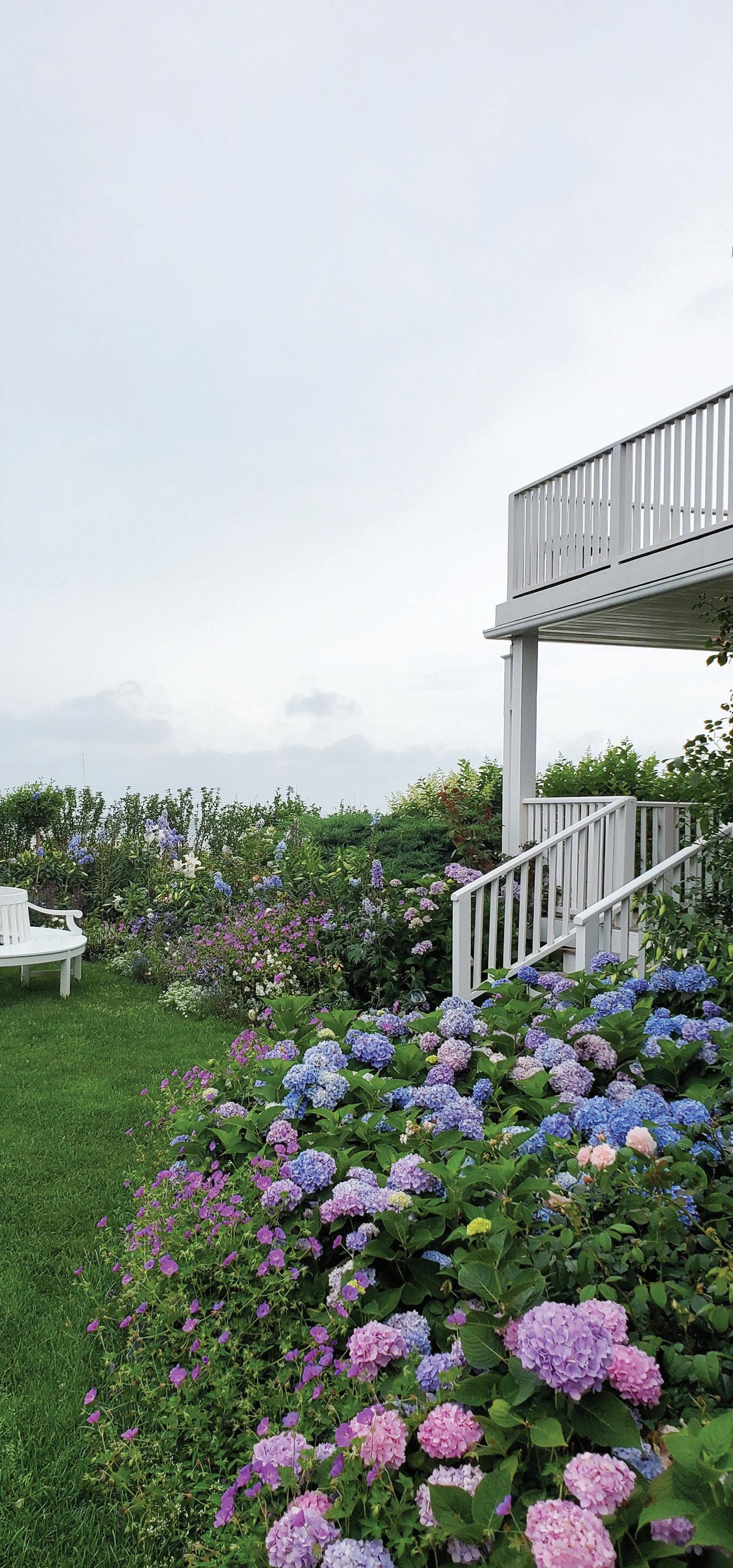
Simple is not for everyone. Fortunately, Nantucketers have found that many plants can tolerate if not thrive near the beach. Flowering shrubs, roses, perennials, cutflowers, herbs and ornamental trees are well represented in beachside gardens on Nantucket, and none more so than the quintessential hydrangea. A classic summer shrub with lush blooms in shades of blue, purple, pink and white, the hydrangea is perfectly adapted to Nantucket’s acidic soils and temperate environment. Roses, too, flourish near the water because salty air keeps diseases at bay and the ocean keeps temperatures warmer in winter and cooler in summer.
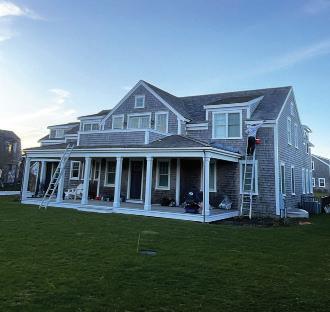
Beach houses along Hulbert Avenue, Cliff Road, Baxter Road, Polpis Harbor and elsewhere all incorporate a broad range of ornamental plants that thrive near the water.
Neither the weather nor the soil conditions have changed on Nantucket much since settlers first washed ashore in the 18th century. What has changed are the surroundings. There are more trees and houses here now, so what was once a barren landscape from end to end is now populated with a living windbreak that enables gardeners inland from the beach to grow just about anything here that once would have been unthinkable. However,
homes within a quarter mile of the beach, particularly those with northwest and northeast exposure, still bear the brunt of harsh conditions and increasing erosion. In addition, lush flower gardens and borders face new threats like deer, invasive insects and hotter, drier summers. As Edward Bowring wrote in his Nov. 21, 2025 article, “Coastal Resilience is the Next Big Luxury Landscape Trend,” in Homes and Gardens magazine, the seaside garden is “… a harsh environment and a place of destruction. As a result, gardeners are turning toward coastal resilience landscaping. Working with the environment rather than against it, coastal resilience landscaping often looks towards naturebased solutions, such as utilising [sic] hardy, native plants and incorporating natural features like dunes, alongside permeable landscaping materials.”
Working with the environment rather than against it, coastal resilience landscaping often looks toward nature-based solutions...
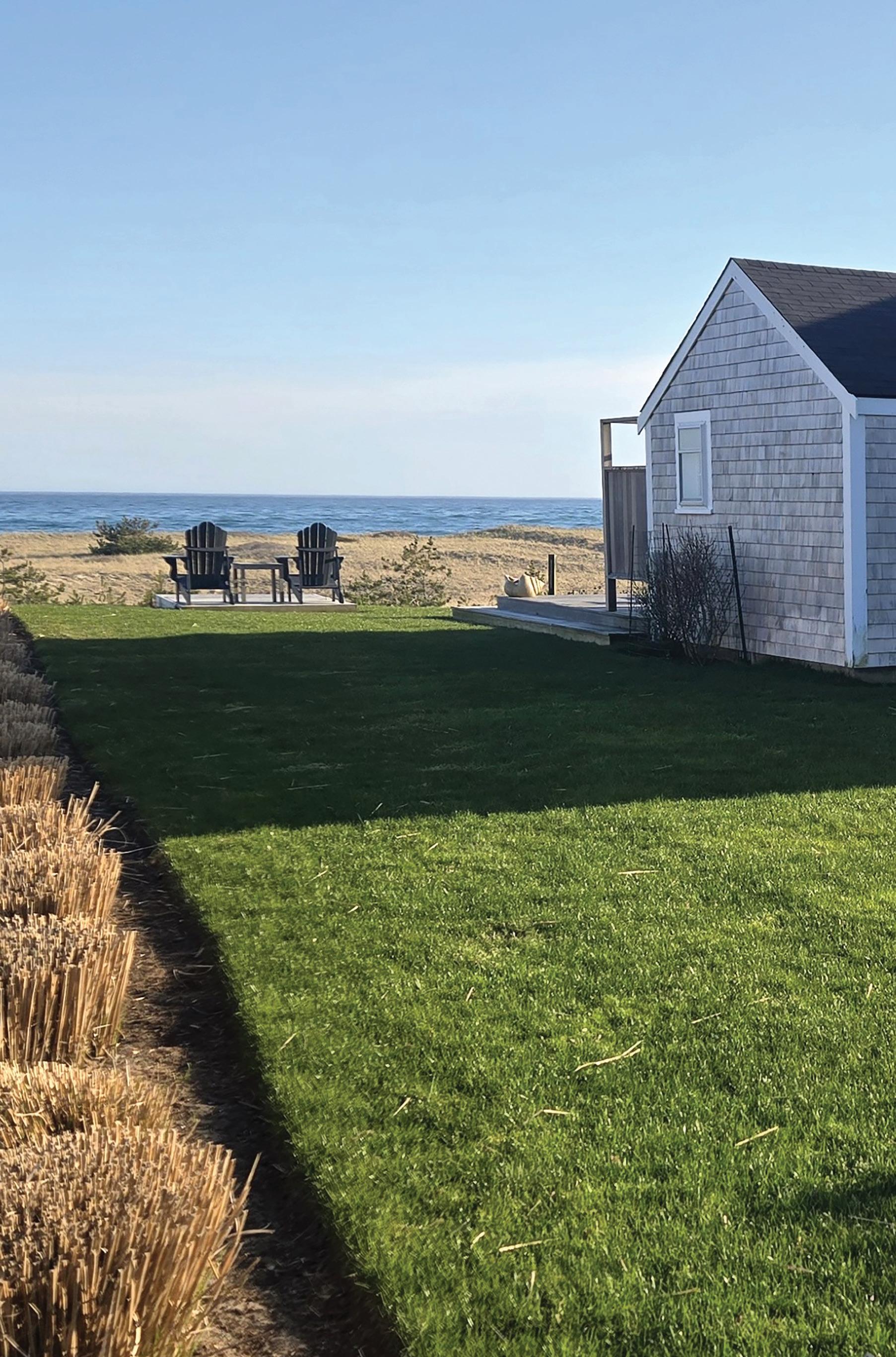



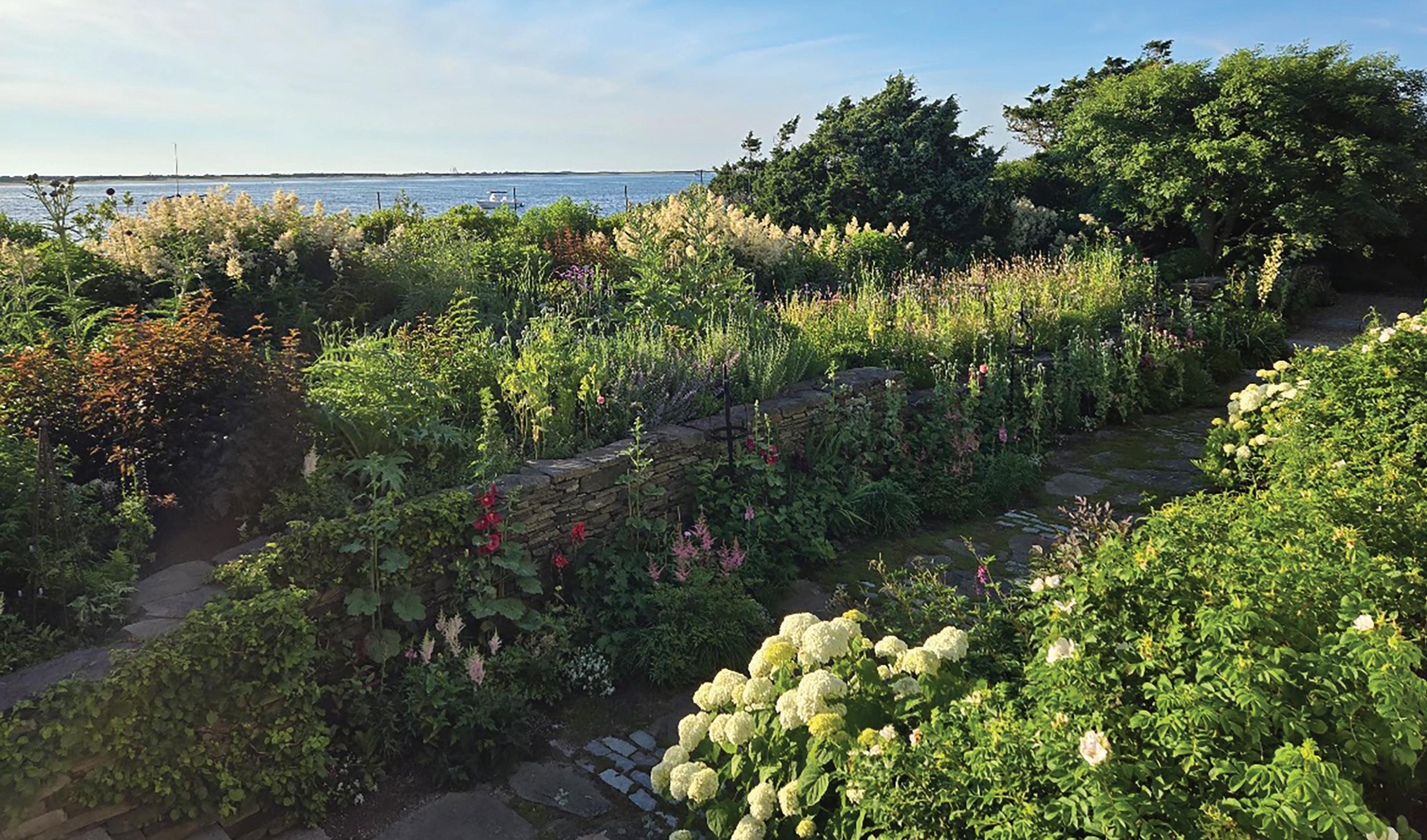
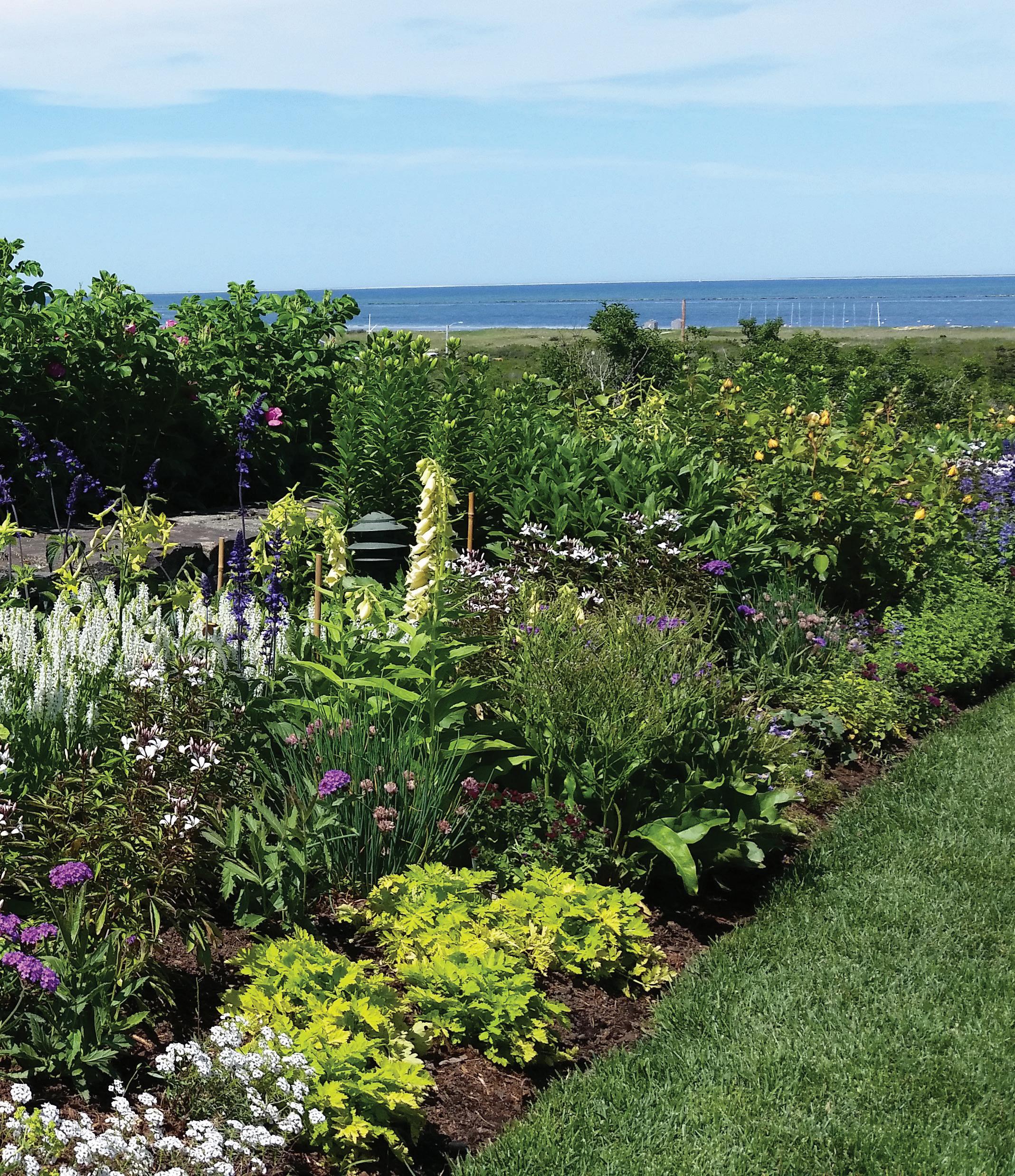
A brilliant example lies between house and beach in Shimmo. So close to the water the owner thought a garden was not possible because of Nantucket Conservation Commission restrictions and the potential to block the view of the harbor, the owner and landscape designer came up with a creative solution: a sunken garden or “haha.” A 12-foot-wide, four-foot-deep trench sits between the beach house deck and the bluff. The stone-lined sides protect a curated collection of perennials, roses, clematis, lilies and dahlias from wind while keeping roots moist. Access to the trench is provided by stone steps at either end leading to more pathways around the top of a bluff planted generously with native shrubs and grasses and beyond to the vegetable garden, sheltered grotto, and arbor, all guarded by sturdy deer fence. Few views can surpass the summer flowers framing sunsets over the harbor in this unique beach garden.
What makes each garden unique is each owner’s interpretations and solutions.





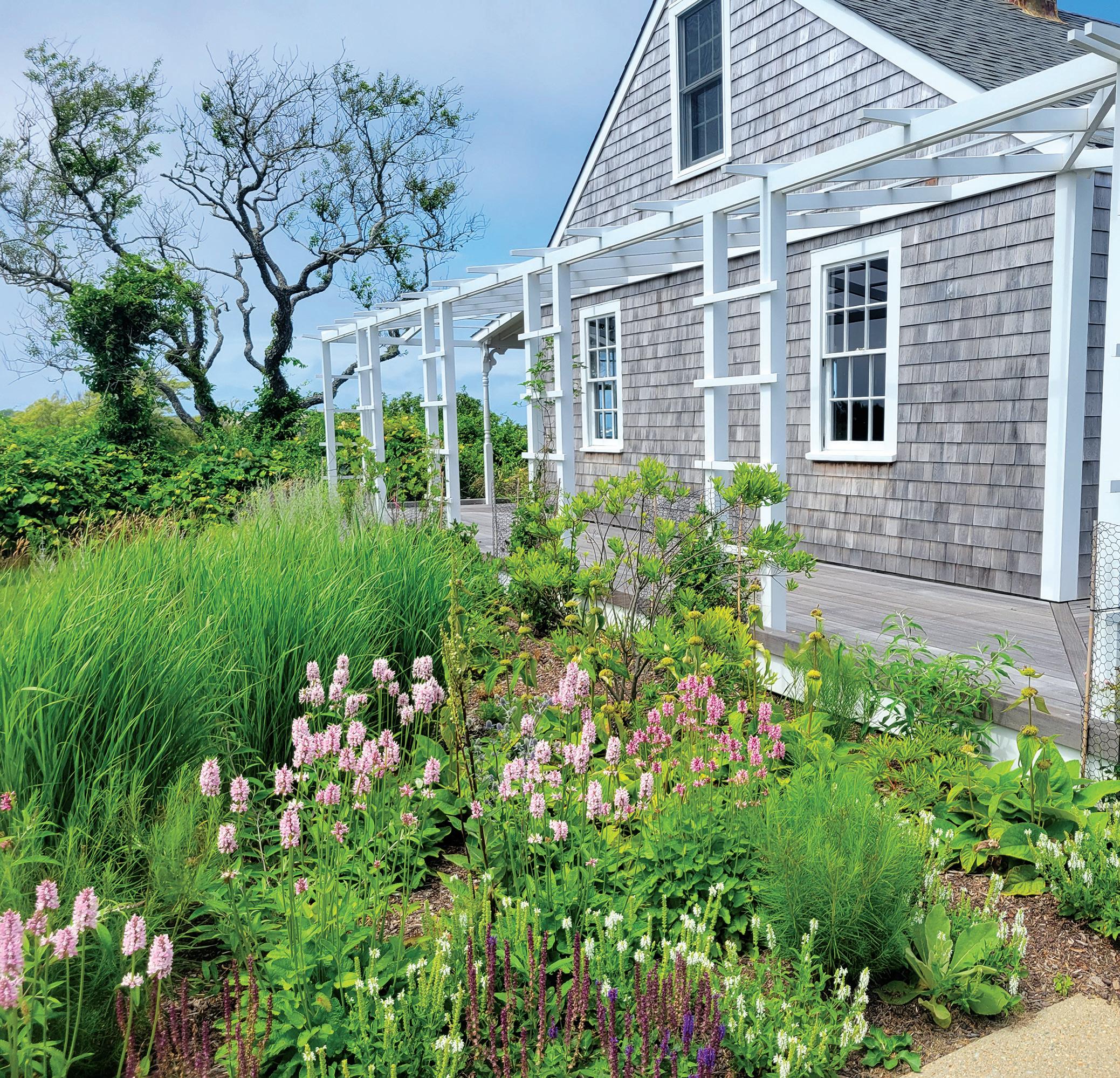
A growing number of Nantucket’s beach garden owners are either installing or transitioning their gardens to be less dependent on irrigation, fertilizer and pesticides, and more adaptable to changing weather patterns. The Nantucket Land Bank properties include excellent examples like the garden next to the former Hays cottage at the Creeks Preserve overlooking Monomoy Beach, the rain garden at the corner of Easton and South Beach streets within a block of Children’s Beach and Easy Street Park, inches from Nantucket Harbor. Each contains all or nearly all native plants that can tolerate flooding, salt inundation, wind and/or deer browsing, while still exhibiting the beauty and creativity that reflect Nantucketers’ love of the beach. Common plants used are black-eyed Susan, goldenrod, aster, sweet fern, native grass, false indigo, groundsel bush, sweet pepperbush, seaside mallow and butterflyweed.
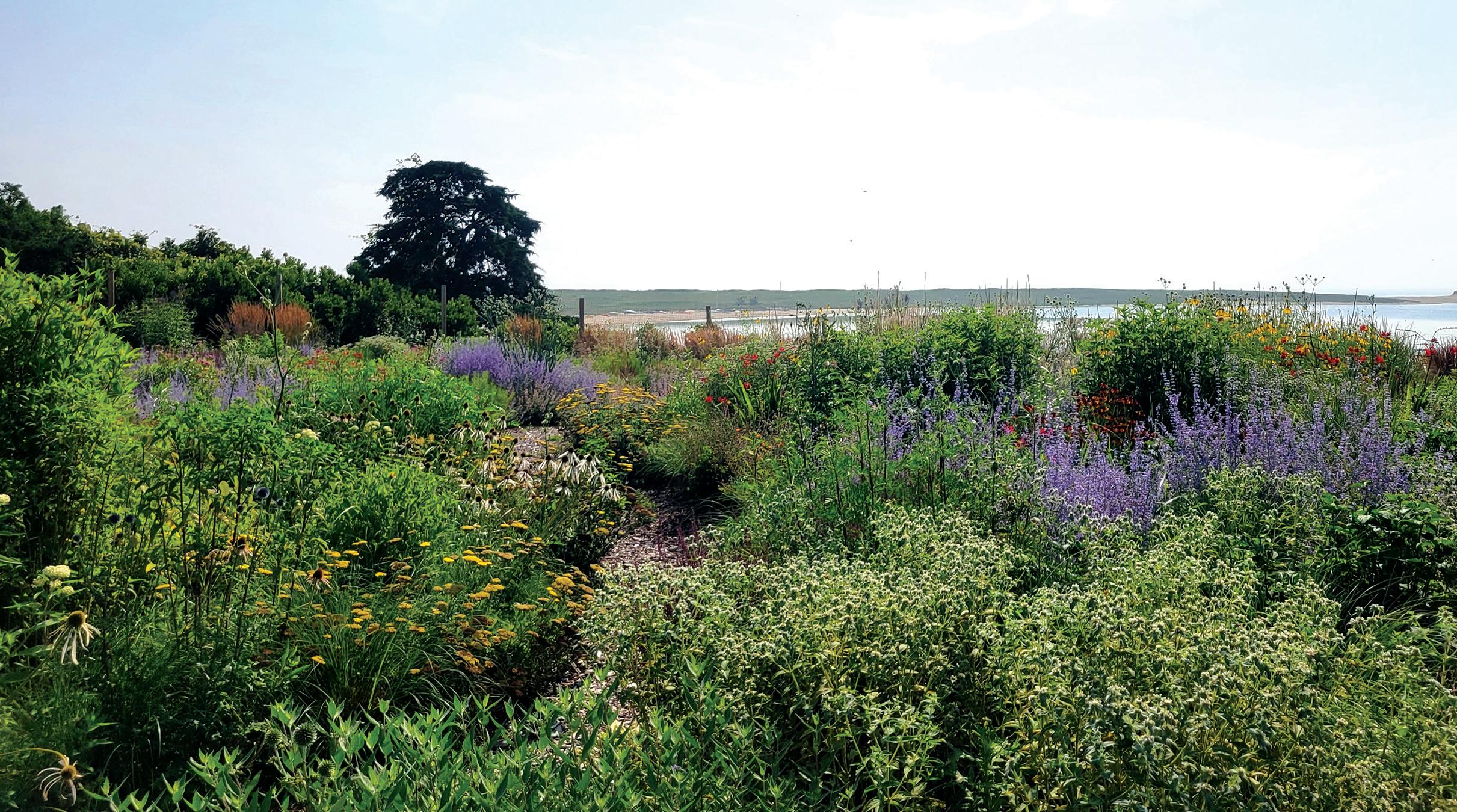
Another homeowner in Quidnet recently turned an acre of dense invasive weeds, shrubs and vines that blocked his view of and access to the beach into a spectacular flower garden featuring native plants that attract pollinators and birds. After four years, the garden now frames the view from his yard northeast to Sesachacha Pond, the barrier beach, the Atlantic Ocean and an osprey nest. Filled with plants like rose mallow, rattlesnake plant, milkweed, anemones, black-eyed Susan, coneflowers,and more, the garden is well adapted to and resilient in an exposed, windy, salty location, while providing interest and food for wildlife yearround. Needless to say, the owner did install a sturdy deer fence.
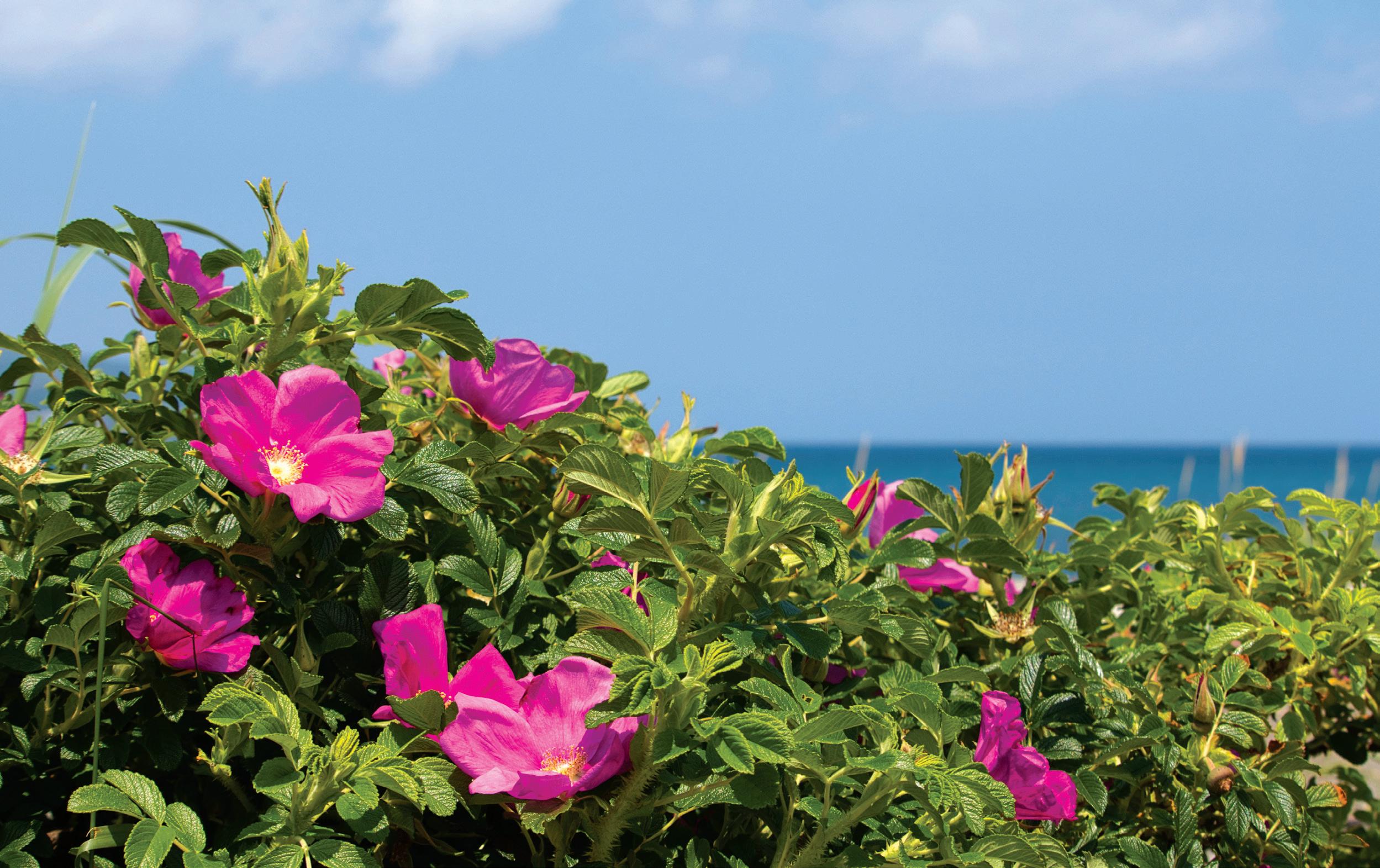
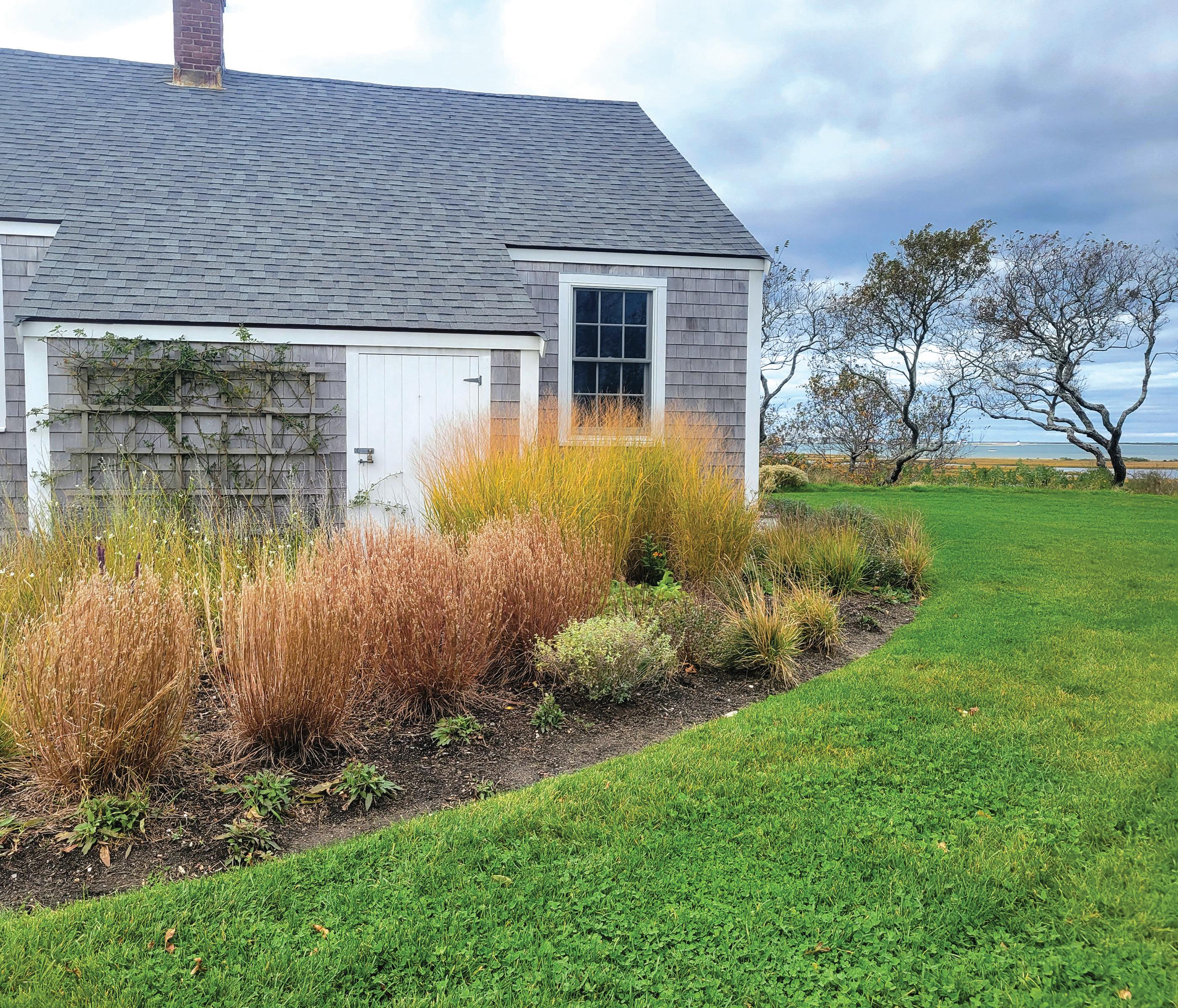
Still other beach house gardens are going back to the basics. A sturdy, drought resistant lawn of fescue grass surrounded by Rosa rugosa and other native shrubs, is all that’s needed as a backdrop for the ocean’s beauty and dramatic views. A simple garden provides another, important benefit, much like my grandmother’s little cottage did over 60 years ago. You can set it and forget it. When the ocean beckons and you want to dig your toes in the sand, the less complicated the garden, the more time you have to enjoy, what else, the beach!
Lucy Apthorp Leske writes the “Gardening by the Sea” column for The Inquirer and Mirror, Nantucket’s Trusted News source since 1821.

Now serving Nantucket!

Our Vision: To be a reference in differentiating our projects, realizing the dreams of quality of life for everyone involved in our business—from customers to employees and suppliers— with a relentless pursuit of innovation.
Our Mission: As a fully licensed general contractor, we are committed to contributing to the happiness and fulfillment of our customers’, employees’, suppliers’, and partners’ dreams — by constructing incomparable spaces built on trust, craftsmanship, and excellence.
Our Services: From demolition and new construction to full property flips, we manage every phase of your project with care.