
Volume LXI - February Edition

Page 1


V61 2025–26

The Innis Herald

EDITOR-IN-CHIEF

Julian Apolinario

MANAGING EDITOR

Marty Hewitt

COMMUNICATIONS DIRECTOR

Bianca Mehrotra

CREATIVE DIRECTORS

Burak Batu Tunçel

Ario Shakarami

LAYOUT EDITORS

Kiersten Herborth

Chloe Gong--Miniere

PODCAST PRODUCER

Simbarashe S. Mutika

GRAPHIC DESIGNER

Isabella Smith

PODCAST HOST

Zachary Yin

STAFF ILLUSTRATOR

Neecole Fabian

SENIOR COPY EDITOR

Rick Lu

JUNIOR COPY EDITORS

Callie Zhang

Katherine Chen

Theo Whittington

JUNIOR CREATIVE DIRECTOR

Astrid Yap

JUNIOR LAYOUT EDITOR

Rowan Parkinson

JUNIOR PODCAST PRODUCER

Labelle Qin

JUNIOR ILLUSTRATOR

Keira Chen

Dear Readers,

Letter from the Editor

I wish I could tell you something cute about love. About relationships. Or celebrate the ups and downs of romancing in university. But even though that’s what this issue is about, it’s not what I want to discuss in this note.

It would be naive and particularly Canadian-centric of me to say that things have never been this bad. It goes without saying that there are horrors perpetuated every day across the modern world. From the mistreatment of the Indigenous peoples of Canada to the brutal suppression of the Uyghurs in Xinjiang China, to the death and destabilization continuing from the Russo-Ukrainian War and the genocide of the Palestinian people at the hands of the state of Israel.

And at the University of Toronto, an institution this diverse, all of our students are touched by these myriad problems in some way. With all of these tragedies occurring at once, I have never been so consistently appalled and horrified by the things that I read about every day in the news.

The partial release of the Epstein Files is a testament to the levels of evil capable by human hands. To see the day-to-day life of a man capable of unthinkable cruelties to children is offensive in itself, and to see so many names implicated paints the picture of a cabal embedded throughout the world. To consider how these people can be brought to justice is a massive undertaking.

This is far from the only horror that has rocked the world of late. Ario Shakarami’s story about the death of 19-year-old Sepehr Ebrahimi at the hands of Ali Khamenei’s regime in Iran exemplifies the most recent chapter of violence the people of Iran are fighting against in an effort to push back against the country’s dictatorial rule. And across our southern border, the violent killings and brutal deportations perpetuated by the barely trained, largely unregulated, and completely empowered members of the United States Immigration and Customs Enforcement are symptoms of both the Trump regime and the Republican Party’s lack of both principles and regard for human life.

The behaviour we have seen is the antithesis of the respect for others and loving kindness that is needed so dearly today.

I write all this not to paint the world as a hellscape of blackness and terror. The vast majority of people I’ve met are decent, generally well-meaning, and capable of meaningful love. And that is why it is so important, when faced with the depths of human depravity, to do whatever possible to snuff it out, and to love others that much harder.

in the 70s, the

Innis Mosaic

was a way for the Herald community to share their thoughts and stories across the college and campus from confessions to updates, if not bar recommendations.

Need a way to profess your love to your crush without actually talking to them?

Looking for a safe space to complain about [insert minor inconvenience you’ve had to deal with]?

Came up with a pretty clever joke that none of your friends laughed at?

That’s what the Mosaic is for in 2026. Whisper your confessions to the Herald’s eager ears. We WILL be telling everyone we know. Form in bio: @theinnisherald on Instagram. Or just feeling too lazy/ shy/overwhelmed to pitch to us?

In Memory of Sepehr Ebrahimi

The first month of 2026 has been uniquely unbearable for the Iranian community, both in the worldwide diaspora and in Iran itself. What began as a seemingly inevitable revolution was rapidly silenced with bloodshed. The Islamic Regime in Iran has systematically murdered tens of thousands of innocent people as they claw for their last throws of survival. This despotic death cult has survived for nearly five decades, but like all dictatorships, it too will eventually crash into oblivion. The “Supreme Leader”, Ali Khamenei, a barbaric warlord straight out of the Stone Age, has clamped onto power for the last thirty years through endless slaughter. From 2009, to 2019, to 2022, to today, the Iranian people have marched in the streets for basic human rights; principles that ironically originated in the very same nation over 2500 years ago by Cyrus the Great. The unified chants of “Javid Shah” throughout the demonstrations point to this historic tradition: a country ruled by monarchical dynasties since its inception, until 1979. Since then, the currency exchange for 1 U.S. dollar plunged from 7…to 140,000. Basic freedoms stripped away. Outside contact restricted. Public executions unlike any other country on Earth. The outflow of savage terrorism like an octopus spreading its filthy tentacles into the free world.

The amount of bloodshed that has been witnessed on social media by the Iranian diaspora has been unbearable and mind-altering. Being so far from your homeland and witnessing a true massacre is unfathomable, especially when you are powerless to do anything but spread awareness. The country-wide internet shutdowns for weeks and weeks disallowed

any communication for average families, which completely isolated the country and blocked the bloodbath from being broadcast to the outside world. You read about such inhumanities in books about North Korea…in movies about Auschwitz…in 1984! How could one of the richest nations in the world, at the crossroads of three continents, with natural resources, unmatched human capital, and millennia of culture, be brought down to such a tragic rock bottom?

The story of Sepehr Ebrahimi is particularly tragic due to its online amplification, but it is just one among a sea of similar young innocent lives murdered in cold blood with no mercy whatsoever. Sepehr was a 19-year-old amateur boxer from the city of Andisheh, a suburb of Tehran. Andisheh is also a Persian word, meaning “reflection”. Reflecting on the life of Sepehr, a kid so similar to me in age and background, made me feel particularly blessed to be alive, and in a safe and secure country like Canada. He is now famous in Iranian circles for the outcries of his poor father, as he is searching for the body bag containing his deceased son, in a sea of other corpses, unnamed and unidentifiable. A scene straight out of The Pianist: a crying man limping through a dystopian hellhole littered with dead bodies and blood. In the chaos, he yells through tears, “Sepehr, my son, where are you…where are you, my boy?”... As he walks over corpses of unrecognizable people, he yells out in agony, “This is Khamenei’s monstrous crime!”

The echoes of his sorrow cannot be adequately described in words, and the grief in the throat of a father alive to see his own son go—so savagely and needlessly—will run shivers down the spine of any

man who cares to listen. Sepehr’s body was reportedly missing for an entire week, as his parents desperately searched for him. Eventually, the same savage animals who murdered him would not release his body without payment, intimidation, and the justification of his murder as protest-led.

He was a teenager. A boxer. Someone who should have been thinking about fights, about his future. Instead, he was taken from this world…for no reason.

I went through his Instagram account today; you can still see it for yourself. It is @sepehr_ebrahimi3. Maybe in a different life, we could have been friends. Maybe we could have worked out together. I’m sure he would have gone on to do great things with the endless potential ahead of him. Instead, he is now dead. He lies in a bag, lifeless, eyes looking to the sky, surrounded by a family in agony, in a city on fire, in a country held hostage.

But Sepehr’s fighting spirit will be his eternal legacy. We must not cry; we must be strong, like he was. After this regime is overthrown and the wave of freedom washes away the blood from the streets, strong men like Sepehr will be hoisted up in gold statues for all freedom-loving patriots to admire. His death will be martyred into eternity as a leader of men, leading the charge against injustice and cruelty. We will remember his legacy. We will honor his memory. By reading this today, you now know his name, too. Let’s all remember his name. Sepehr Ebrahimi was martyred doing what he loved best, fighting like a champion until the bitter end.

Toward A New Chapter for Innis College

An Update on the Innis Renewal and Expansion Project

FEATURE

If you have, at any point in the past two years, walked past the intersection of St George Street and Sussex Avenue, you have no doubt noticed the construction site that has shaped up, with its trucks and workers milling around the area. If you are a member of Innis College, a non-Innis U of T student who has had a class in the building, or even a visitor who attended an event at Innis Town Hall, you are also likely aware that a large part of the building—the entirety of the west wing, notably—has been closed off to the public for a while. And if you had a need to go between mid-November and the beginning of this month while in the building, and naively headed towards the stalls the first time, you probably realized that access to the basement had been temporarily blocked off.

These developments are all the result of the Innis College Renewal and Expansion project, an exciting, substantial transformation of the College’s home building at 2 Sussex Avenue. First envisioned in early 2017, the expansion’s design was finalized in 2022, before construction activity began in August 2023. The Innis Herald has covered the development of the project in April 2023 (Volume 58, Issue 4), and later on in November 2024 on the Innis Herald Podcast, in a conversation with the College’s Associate Director of Advancement Megan McDonald. Since then, the new building has continued to take on a more concrete form, with a tentative completion date set for Fall 2026, followed by a gradual public opening of spaces over the following months, concluding in January 2027.

Some significant features of the renewed and expanded College include large work, study, and event spaces for the whole community; improved first-floor circulation through a reconfigured circulation plan; and new student spaces, including a commuter lounge, an expanded Innis Café, kitchenettes, a rooftop lounge, and an outdoor terrace. The building will be organized around the courtyard (or Innis Green), which will be transformed into a pleasant, landscaped area, overlooked by the study windows on multiple floors. The library will also be moved from its current, restricted location, to a larger and more accessible space, increasing both seating and services available.

Our very own Bianca Mehrotra acts as an Innis College Ambassador, a crucial role for sharing information about the project and its impacts across the community. In this position, reflective of the student body’s involvement since the start of the project, she has had the chance to both witness its development and contribute to communication and outreach initiatives. For instance, a Q&A and information session took place on January 23, where Student Ambassadors were available to answer Innis students and staff’s inquiries. The event also included a giveaway for a free tour of the construction site. Bianca tells the Herald that she and the other Ambassadors had the opportunity to visit the site themselves alongside Staff Representatives to sign the wall of the new building—her favourite memory from taking on the role so far. “Knowing that our names and contributions are quite literally embedded into the space made the expansion feel more personal, not just something happening around us, but something we helped shape for future Innis students,” she says.

The project comes at a critical time in Innis College’s history. The original building, designed to host around 800 students—a far cry from our current community of over 2200!—has reached its maximum capacity. Much like in the late 60s when plans for the construction of the current College’s building began because Innis’ first home, affectionately baptized “the biscuit box” and “the fish bowl,” could no longer accommodate its growing population, the College now finds itself at similar crossroads. After 50 years in its current home—which opened exactly five decades ago, in 1976—it is once again time to address issues of overcrowding and limited shared space, while also considering how to better integrate the Innis community on campus at large.

Two major axes jump out as priorities in 2 Sussex’s new design, which will expand the building by about 60 per cent of its current footprint. First, the issue of accessibility is a guiding principle in the new building’s features and configuration. Aside from the library’s improved layout, an entirely accessible entrance will be opened on the Sussex Avenue side, while a new elevator in the west wing will serve all floors, including the link to the east wing. On the other hand is inclusivity. As a commuter student herself, Bianca points out how “having access to a dedicated student lounge with a full kitchenette will make it much easier to spend [her]

long days on campus without constantly needing to leave or rely on other buildings.” She also emphasizes the importance of an enhanced study space in the form of the new library, and the calm relaxation areas the terrace and new Innis Green will provide, particularly for those who do not live in residence. For a college where commuters constitute almost 80 per cent of the student population, these new features will be invaluable in making Innis more inviting and functional for all.

Updates and highlights about the project are continually shared on Innis College’s Instagram page. For information or inquiries, reaching out to the Ambassadors there through direct message or contacting the college staff are typically the best places to start. Check out the dedicated page on the Innis College website for contact information as well as the latest news. In the meantime, (re-)read Rhea Gosain’s previous informative update on the project, James Chaplain’s detailed account of Innisian spirit throughout the College’s history, which we hope to see carry on and bloom in our new home, and listen to the aforementioned podcast episode, available on all streaming platforms!

Access all the resources and content mentioned in the article by scanning this QR code:

Big Round Tables

Dining at Bao Restaurant Chinatown

FEATURE

When I flew across the country from Calgary to Toronto, I arrived with no friends or family here, no community. Well, except, of course, for the seemingly ubiquitous network of first-generation Chinese immigrants, of which my mom is a critical node.

Tapping into their collective wisdom like the past lives of the Avatar, I had one of my first dining-out experiences at a restaurant on Spadina and Dundas called Bao Restaurant Chinatown, although the signage out front simply reads, in a plain, sans-serif font—“BĀO.” In the four years since, I have not found a Chinese restaurant fit to replace it.

To say that the baozi is a major reason to eat at Bao is misleadingly obvious. It’s not just that they’re good; they’re a true specialty. That is, while the restaurant’s English name uses the generic term for any stuffed, steamed bun, the Chinese name is much more specific.

Goubuli is a type of baozi originating in Tianjin, a major Chinese city just Southeast of Beijing, where my mom was raised. In Toronto, “bao” typically means lotus-leaf bao, which is folded like a taco, not stuffed and sealed. You can also find dim sum-style chashao bao—thick and fluffy, filled with sweet barbecue pork—and soup dumplings—small, thin and, well, soupy.

All these options are delicious, but it’s just not the same: the goubuli bun is between soup dumplings and chashao in thickness, and the fillings are lighter, more varied in ingredients, and more complex in flavour. I won’t claim to have exhausted Toronto’s baozi offerings, but in my years of searching so far, Goubuli was the only place that sated my cravings.

And just why is it so difficult to find this kind of baozi ? The answer tugs on a much broader question about Chinese food in the West. It is unlikely that any of you modern readers believe that, say, the Panda Express franchise is representative of Sinitic culinary practices. But why, in our age of globalization, of Japanese sushi, Korean kimchi and barbeque, Indian, Thai, Vietnamese—shit, even Nepalese restaurants aren’t hard to find in this city—why, with our nearly limitless access to relatively

authentic Asian cuisines, does Chinese food still look largely like fortune cookies and egg rolls? If you’ll permit further digression, we’ll take a quick look at history.

The first wave of Chinese immigrants to North America arrived in the 19th century, mining this continent’s gold and building its railroads. Most of them came from the Southern province of Guangdong—the Canton region. They were underpaid, unskilled labourers, and they went on to form Chinatowns populated with cheap businesses: convenience stores, laundromats, takeout restaurants… The Cantonese cooking they brought with them evolved into Ginger Beef and General Tso’s Chicken. The more recent arrivals from China are from the North. They are educated; they come to send their children to University, to take jobs at tech companies. They are not opening restaurants.

Goubuli is a franchise based in Tianjin, and they have syncretized traditional Northern Chinese and modern culinary sensibilities. The menu features a host of elegantly simple dishes: stir-fried cabbage, potatoes, eggplant, mushroom and pea shoots, egg and tomato soup—one or two main ingredients, heartily infused with garlic and ginger—all dishes my mom has placed on the kitchen table before me. They also provide finer dining options in abalone, sea cucumber or coagulated pig’s blood. But rest-assured, you will still find staples like Sweet and Sour Pork, Kung Pao Chicken, even Pad Thai, if that is what you crave. Although, even these dishes possess more of the subdued, nuanced, earthy flavours I grew up with, rather than the heavy, flat profiles of their fast-food varieties.

And if the foundation of Goubuli’s menu is its baozi , its crown jewel is certainly the Peking Duck. Now, this menu item is available elsewhere in Toronto, but they do it as well as anyone—and as authentic as you’d find in Beijing. Again, Bao understands that simplicity is what makes this dish work. For $58, you can receive an entire duck, roasted and thin-sliced into astonishingly juicy and crispy pieces, crammed into two rows on a tray, accompanied by small dishes of sliced cucumber, spring onion, sugar, a thick, dark bean sauce, and a stack of wafer-thin wrappers. Of course, you

aren’t eating the legs, wings, neck or bones— because they go in the massive soup that comes too. There is not—and there shouldn’t be—a version of this experience that doesn’t involve leftovers. Even if you opt for the half-duck variant, this is not a meal for one.

That brings me to what I suspect is another reason the West has been slow to adopt this cuisine. Even the most basic dishes at Bao come in servings for sharing. You aren’t meant to order a meal for yourself, but a selection for everyone at the table to put some into their own bowls. Most of the seating consists of large, circular tables, with very few two- or four-person spots. A culture of dinner dates and nuclear families is simply not conducive to such a dining philosophy, and by extension, such a business model. But this, too, is a quality that only endears Bao to me further. A couple years ago, I tried to go there with my partner for Lunar New Year, but naturally, the restaurant was packed on that particular night. There was something like an hour’s wait for a table. We sat for about twenty minutes, when in walked this group of three, one of them a Chinese guy from my partner’s school. She only knows him a little, and I, barely at all. But he recognizes us and, after having a similar discussion with the waitstaff, learns that there is a table available immediately, but only for a larger group. We decided, what the heck, it seemed like a win-win. We shared a table; we shared half a roasted duck. And suddenly, we had a Chinese community for New Year.

If you’re anything like me, you think of food as much more than a natural necessity, or a consumer product that occupies a position on a linear gradient, from ‘tasty’ to ‘not tasty.’ A culture’s cuisine is something concrete and tangible, yet intimate and personal. As large and prevalent as the Northern Chinese diaspora is, I always felt like they remained absent from the public world, withdrawn and concealed the moment I stepped outside of their households. I know that others like myself have already discovered Bao, and flock to its native familiarity. But to those for whom eating Chinese has only ever meant sweet-and-sour takeout boxes, gather as many friends as you can find and sit together at a big, round table.

Love When the World is Burning FREMONT (2023)

Fremont understands the specific loneliness of being single while carrying such heavy grief. Donya is a 20-something Afghan refugee living alone in Fremont, California, working at a Chinese-owned fortune cookie factory.

Shot in black and white, the film feels quiet, unfinished, and deeply human. It asks whether it is even permissible to want to love when people back home are still dying.

Yet Fermont remains warm and gently funny, suggesting that small things like fortune cookies, shared meals, and unexpected encounters connect all of us. We hope Donya finds happiness, but more importantly, that she realizes she is worthy of it.

You’re Not the Only One Alone SIDEWALLS (2011)

For artsy people, Sidewalls feels like looking directly into a mirror. Set in Buenos Aires, it captures urban loneliness, the strange isolation of living in a big city while constantly surrounded by people. Martin, a web designer who owns Criterion DVDs and listens to Radiohead’s In Rainbows, feels instantly familiar to many of us.

The film understands how architecture and screens shape our emotional lives. It is a quiet romance made for art students, creatives, and anyone who ever felt invisible in their own city (Toronto included).

How

Far Would You Go For Love? THEY WILL BE DUST (2024)

We say things like “I love you to death” very commonly, but They Will Be Dust asks whether we truly mean it. It is a slow, layered exploration of love, family, mortality, and death, blending music and dance into its storytelling. It is unlike anything you’ve seen before. Rather than focusing on death itself, the film examines how one’s decision ripples outward through guilt, tension, devotion, and fear. Watching it with your partner will open space for deep conversations about choices and endings. It reveals how people think differently and how love persists through that difference.

Spend Your Valentine’s Day With a Film

What You Escaped MARRIAGE STORY (2019)

This is what it could’ve been and why it is good that it didn’t. Marriage Story captures the slow, painful unravelling of a relationship with brutal honesty. Adam Driver saying, “You’ve regressed,” and then naming all the women he did not have sex with when he was a hot and young director in his twenties should make you feel lucky that things did not work out with that film person…

Is Sisyphus Really Happy?

Parmida Cheraghi

Zanjani

PERSONAL

I know I must keep going. I have no memory of how I ended up here and no idea what lies on top of the mountain, but I know the journey hasn’t come to an end yet. Finding a comfortable, steady pace, I started walking, but it was hard to see ahead with all the mist clouding my vision.

The wind awakened the trees from their slumber and gave their leaves a voice, one that I was eager to listen to. They spoke of a man named Sisyphus, who was punished with an eternal life of suffering by Zeus and Hades. The rest of his life was bound to pushing a boulder up a hill, only for it to fall back down. Day after day after day, that was all he did, despite knowing that in the end, all of his efforts would be to no avail.

“One must imagine Sisyphus happy.” How? Can one be happy knowing that every single day, struggling awaits them?

Or perhaps it’s the little things along the way that give us some hope, some reason to continue forward, despite all the reasons not to. It’s the familiar faces that we see as we go to our favourite coffee shop, the friends whose words hug you, and the small wins along the way.

Maybe all that ends up being enough for Sisyphus to push the boulder back up once more is looking at the sunset every once in a while, admiring the flowers along the way when ascending, and breathing in the fresh air at the top of the mountain.

But is he really happy? Every. Single. Day? Does he have anyone to talk to about his scars and his aching hands?

I see it behind the pain in the eyes that no smile can mask, within hugs that last a few more seconds than they should, and within words saying “I’m fine,” yet the heart cries out of the lies that come out of one’s mouth. Even those feelings are a part of life and give it its blue hues, contrasting the yellow of those moments where your heart is

Love Finds You First PUNCH-DRUNK LOVE (2002)

This is a loud and chaotic romance film about how love arrives without warning. Adam Sandler plays Barry, a man overwhelmed by emotions, noises, and the randomness of life. Then, almost out of thin air, Lena appears. The soundtrack comes alive and makes the film energetic, yet tender.

We are used to Sandler being the funny guy, but here he is raw and sincere. In just 90 minutes, PunchDrunk Love argues that love is easy — not because it is simple, but because it saves you when it finally shows up.

Queer and Unfixable HAPPY TOGETHER (1997)

Happy Together begins with the most dangerous sentence in any relationship: “Let’s start over.” It is a queer love story that understands how desire can both be a shelter and a trap leading to self-destruction. Wong Kar-wai captures intimacy as something repetitive, passionate, tender, and impossible to stabilize. The film is not interested in healing or providing closure. It sits in the mess of wanting someone who cannot love you properly and choosing them anyway.

filled with an immense happiness you cannot help but feel deeply grateful for.

Life is fascinating with these contradicting moments, and I guess in a way, it makes you appreciate it even more. Sisyphus couldn’t have cherished the view at the top as much if he didn’t have to carry the burden of the boulder. It requires a special eye to be able to admire the beauty through the pain.

By this point in the trail, my legs had started to ache. With the mist being lifted off, I still could see no end. How far could I go?

Part of me hoped that the trees knew the way, as I just followed the way they swayed with no clue of where this led. Did I want there to be an end to which I was walking towards, a purpose perhaps? Somewhere between the pain in my legs from walking this far and my eyes that were in awe of the nature around me, I realized it really didn’t matter if there was an end or not.

What truly made the journey worthwhile was the experience and the peace I found within the harmony of the moun-

tain surrounding my soul, within the trees that guided me, within the sound of my footsteps as I explored, and in the beating of my heart, reminding me that I still am. Sisyphus, too, isn’t only happy, but more importantly, he is a soul who has learned to achieve a peace that has set him free and opened his eyes to see beyond what his destiny has caged him into.

Whether there is really a meaning or not, it is perhaps of no significance if we cannot be at peace with either. There are moments when we fall under the weight of the world, but our heads must rise again to see the warmth of the sun once more on our skin. That harmony with life itself gives power to persist beyond anything, for you have accepted what it means to be alive, what it means to open the door to another day, knowing it won’t be perfect. For Sisyphus to live a happy life beyond all that he must face and battle, he must first be at peace with himself and the life that flows within his soul.

Love on Clearance—or a New Dating Era?

Anonymous LOVE / STUDENT LIFE

To some people, going on dating apps is an act of desperation—a last resort for finding love because they are incapable of doing so “organically.” Some even say that putting oneself on dating apps is like putting oneself on “clearance.”

If you are a victim of these social stigmas, consider this your wake-up call.

The reality is that no matter how a love encounter begins, someone from the sidelines will always be critical about it. Ask a girl for her number at a coffee shop, and there’s a good chance she’ll text the group chat instead of admiring your courage. Slip a love letter into someone’s locker, and suddenly you’re a stalker for knowing where it is. When I was 18, I dated a 21-year-old at the time, which caused an uproar among my friends, because I was the younger one who asked him out.

However, love can be initiated in any way, and it doesn’t matter where or how it is attained.

In fact, if you think the term “love is in the air” is just an idiom, you are completely wrong about it in 2026. Girls are doing full makeup before their flights just in case they meet an airport crush—if

aska

people are preparing to fall for someone mid-air (literally), what is so wrong about falling for someone through the airwaves powered by Wi-Fi?

Below, I will share some pros and cons based on my own experience with Hinge, and you can decide for yourself if this form of dating is for you.

Pros:

1. It is unlikely that you will match with someone who has absolutely no interest in you

On Hinge, you can send a “like” to people you want to talk to, and if they “like” you back, you become a “match.”

Only then will you be able to engage in a conversation with them. This match signals that both of you are curious about one another, whether it’s based on your appearance, interests, or what you are looking for in a relationship. This way, you only match with people who are surely interested in you to some extent, increasing the chances of meaningful interaction.

2. Apps are designed to make it easy for you to move on without hard feelings

After you match with someone, you can talk with them for a while to do a quick vibe check. If you feel like you

aren’t a good match for each other, you can simply “unmatch” without ever having to talk to them again. The system ensures that you do not see them on your profile again, and they won’t show up on yours either. This removes the awkward confrontation, self-explanation, and the classic “it’s not you, it’s me” conversation from the process.

Cons:

1. Safety issues that come with online dating

Every form of dating has its flaws, and meeting people online is no exception. Meeting people online can be risky: their names, age, school, and entire identities can be fabricated. To keep yourself safe, I encourage exchanging Instagram accounts before meeting with them in person. This allows you to do a background check to confirm that their information seems legitimate. Additionally, for the first meeting, always choose a public space and make sure you know how to get home on your own.

2. Appearance matters more than you think

Catfishing is a common issue in online dating. In one case, I was the one at fault. In my profile photos, I had long

A manifesto on askastudent, in the

STUDENT LIFE

Have you ever found yourself contemplating the age-old question of what the differences between ArtSci’s colleges are? Or what on Earth “12 distinct credits” means? If you have, I present to you your salvation: a little project called askastudent.

If you haven’t visited askastudent. utoronto.ca (I feel so bad for you), it’s a U of T-sponsored website where students ask questions about academics, university life, or really anything that isn’t a crime to the nebulous “aska,” another student who answers their pleas alongside a healthy heaping of sarcasm. These questions come from many places: a form, email, Instagram, or Tumblr (yes, it’s still alive).

Luckily for you, this omnipotent being has emerged from behind their computer to write this article just for you. I’m a little out of my element here, since I usually write without any capital letters and with a handy toolbox of millennialcore GIFs, but I had to bring my message to you readers of the Herald.

hair, but right before meeting a guy, I cut it a little above my shoulders. When I told him, I could tell it made him uncomfortable. Here’s how the text exchange went:

Me: I got a haircut today lol

Date: It’s not that of a drastic change, right? Right? Right?

(Spoiler: I did not end up dating him!)

While I believe personality matters more than looks, that belief usually comes after you’ve had time to learn who someone is. When you’re operating within the three-dates-rule window, appearance tends to carry more weight than we’d like to admit.

That said, any form of dating comes with challenges, and anyone who dares to initiate a change in their lives deserves respect. At least, you are doing far better than my friend, who has spent the past three New Year’s stuffing grapes into his mouth under the table, manifesting the love of his life.

So what are you waiting for? Instead of letting endless exams and seasonal depression be your only romance candidates, take action! Perhaps the love of your life is just around the corner.

words of aska themselves

That message is, of course, why I’m still even relevant.

The birth of a deity

The aska we love today began in ye olden days of the 20th century (well, 1999). Back in the day, a work-study student at the Innis College Registrar’s office thought of a way for students to get reliable advice from their peers in a more casual setting. This student created an email inbox on a public webserver; the next year, another came up with the idea of developing the project into a website. And so it was that the askastudent forum was born on January 10th, 2000, and while I wasn’t there (sorry, didn’t exist yet), it was probably an awesome day.

Since the days of yore, many askas have come and gone. I don’t know exactly which aska I am, but we were on #14 by 2015, and I know I’m at least the fourth since then—so I’m gonna guess I’m probably around #20 or so. Writing this out makes me feel like that meme of Aang looking at all the past Avatars.

Aska in the big year 2026

But that was in the past, in the early days of the internet… what about now?

I can feel your skepticism—“aska,” you say, “in the era of high-speed internet, the uoftears Instagram page, and the slightly questionable but surprisingly helpful r/uoft subreddit, what is even the point of your existence?”

Well first, ouch, you can’t just go questioning my entire purpose. But I suppose it’s a fair ask.

My dear reader, there are countless reasons why aska still has a mission to fulfill in the big year 2026. There’s the fact that I’m more reliable than most people on r/uoft (unless it’s u/askastudent_, hi, that’s me). You can also guarantee that the person who’s giving you the scoop is another student and not Joe, who doesn’t even go here, or Suzie, who graduated in ‘89.

There’s a thing called honesty that I like to preach, which isn’t always the #1 priority for those in other corners of the internet. I also like to think of myself as candid. Yeah, you can always check a website to see how much tuition is, but where else but askastudent.utoronto. ca can you find out if frats will rent you their houses for a party?

The whole anonymous thing is also important. No one ever has to know about the cringy questions you send

to me—except if you email me from an account with your name slapped on it. But don’t worry, I’m great at keeping secrets (I kinda have my own identity to keep quiet, after all), and no one’s names get published.

So what are you waiting for?

If you’ve read this whole article, I applaud your devotion, but I have a serious question: what are you still doing here? Seriously, go get your phone and get started on all those posts you missed! Better yet, go ask me something. Hit me with your most embarrassing, weirdest questions, or ask me for some food recs.

Though I retreat back behind my computer, I can guarantee you that we will meet again. Whether this article prompts you to ask some burning question, or if you’re scouring the depths of r/uoft and spot a certain u/askastudent_ in the comments, I’m pretty certain we’ll cross paths again. Maybe I’ll even see you on campus. But of course, neither of us will know it… until you see the question you were asking your friend during lecture appear in an “overheard questions” post on the website. I did warn you I was omnipotent.

It Won’t Pass: 10 Years of Fleabag

ARTS & CULTURE

The year 2026 marks 10 years since Phoebe Waller-Bridge’s dramedy Fleabag (2016) aired on our TVs, and I still can’t get enough of it. Adapted into the show from Waller-Bridge’s one-woman play of the same name, Fleabag explores themes of grief, loneliness, and love mixed with sarcasm and comedy to create a beautiful bittersweet story packed into only twelve episodes. From guinea pigs to a hot priest, this Valentine’s Day I will be exploring the world of love and loss through the eyes of the very witty Fleabag herself, and proving very much so that it won’t pass. (If you know you know.) Just a warning that there will be SPOILERS AHEAD for those who have not yet seen the series (I mean, it has been 10 years).

“I don’t think you have to be alone to be lonely” - Fleabag

Season one introduces us to the very dysfunctional family that consists of Fleabag, her sister Claire, her father, and her very passive aggressive godmother (portrayed by the one and only Olivia Coleman). In season one, we also learn that Fleabag is grieving both the loss of her mother and her best friend Boo, the two people who seemingly understood her the most. To cope with the loss of these two people, as well as the breakup with her long term boyfriend, Fleabag indulges in a lot of meaningless sex. When rewatching Fleabag for the first time many years ago, I felt that the story of Fleabag was not just one of self-destruction, but rather a search for fulfillment of the gaping “hole” in her heart left by those who she’s lost. After Fleabag loses her mom, she sleeps with Boo’s boyfriend, an act which I saw as an attempt to fill the gap in her heart and feel something other than the numbing loneliness left by the grief she felt. This decision she made ultimately made the “hole” bigger, as it led to the death of her best friend, the second person in her life who understood her the most. With no one around her who truly understood her sarcastic and atypical personality, Fleabag is left searching to find the person/people that will fill the gap left in her life.

“The only person I’d run through an airport for is you”Claire

Claire, Fleabag’s older sister, has a complicated relationship with her, but also shows the importance of sisterly love. It is clear from the beginning that Fleabag and Claire do not fully understand each other, but attempt to support each other, with Claire continuously asking Fleabag if she’s okay, and Fleabag trying to protect Claire from her toxic husband, Martin (even though he claims he’s “not a bad guy, he just has a bad personality”). Fleabag and Claire have a complex rela-

tionship where they find comfort in each other through their childhood upbringing, their grief for their mother, and their hatred for their godmother. Claire, a successful business professional with two masters degrees, is quite uptight in comparison to the comedic Fleabag, but I think it is this dynamic which makes the two rely on each other for support. As the younger sister of a master’s degree working professional older sister, I can confirm that it is usually my job to be the comedic outlet for the family, although I would like to think I have a better relationship with both my sisters (yes, I am even a middle child) than Fleabag and Claire. By the end of the first season, we can see how after the collapse of her relationship with Claire due to a nonconsensual kiss forced upon her by Martin (which Claire chooses not to believe), Fleabag has just lost too much. Saved by the surprising friendship she has created with her banker, Fleabag is convinced that she is capable of working on herself, and is willing to heal without the approval of her family. The kindness shown and friendship offered by her banker tells both her and us that she is still capable of being loved and cared for, even with everything she’s lost.

“I think you know how to love better than any of us. That’s why you find it all so painful” - Fleabag’s dad

Now moving on to my favourite season, season two. Season two shows us a different side of Fleabag, a side where she is learning to find love again in herself and in others. After working on herself for over a year, Fleabag reunites with her family at a “passive aggressive dinner party.” She regains the trust of her sister by covering up a miscarriage, and learns that her father is engaged to her godmother. There are two reasons I believe that season two is better than season one.

The first is that we see the incredible Andrew Scott as the “hot priest.” The second is that we get to see how, when Fleabag has someone around her who fully understands who she is, she is truly not a bad person.

The priest is the only person in the series who sees past Fleabag’s flaws, and finds comfort in her sarcastic personality. The priest is also the only character who

takes notice of when Fleabag talks to the audience and breaks the fourth wall. Similarly, Fleabag is the only person around the priest who sees the fox which he claims has been following him the entire season. To me, the two of them taking notice of these “invisible” forces of nature proves that they are meant for each other and fully understand each other.

“Why believe in something awful when you can believe in something wonderful” - the priest

But the priest is just that, a Catholic priest. By choosing this position with the church he chooses to be celibate, meaning he chooses to abstain from relationships. By the end of season two, it is very apparent that the priest has feelings for Fleabag. The two have kissed many times throughout the season, and eventually choose to have sex with each other. In the last episode, after the wedding of her father and godmother, we get the most famous scene from the show, Fleabag and the priest sitting on the bench of a dimly lit bus stop when she confesses that she is in love with him. It is here we learn that the priest has chosen his position as a Catholic priest, and his relationship with God over his feelings for Fleabag. And it is here we get the most famous line from the show…

“It’ll pass”

After ten years of Fleabag, I can confirm that for me it has not passed and will not pass, as I really feel that the two are truly meant to be with each other. The priest, being someone who fully understands Fleabag, fills the “hole” that she was searching for in season one, and without him I question whether she will return to her self-destructive behaviours, or if her experience with him has finally taught her to love and find support in herself and those who were always around her. However, with all this in mind, I still feel that this was the perfect ending to a perfect show. I encourage everyone reading this to watch Fleabag this Valentine’s Day

All the Songs in the World: The Definitive Songs of the James Bond Eras

Ethan Spires

ARTS & CULTURE

Over the last seven decades and across over twenty feature films, no other spy has captivated culture as much as Bond, James Bond. After overseeing six actors’ portrayals of 007, the Broccoli family has moved on from the franchise and handed the reins to Amazon, who are now in development on a new Bond era. While we can speculate to great lengths as to who should take up the mantle (and why it should be Jack Lowden), there is value in looking back and attempting to define the previous iterations of the character by the one formal element they always shared: the Bond theme.

But what makes a good Bond theme? For starters, a degree of thematic relevance. A movie as upbeat as The Man with the Golden Gun (1974) does not match the sombre but powerful theme of Skyfall (2012), just as Duran Duran’s theme for A View to a Kill (1985) can’t match the quieter moments of reflection in No Time to Die (2021). Likewise, the song should hearken back to the intrinsic vibe of Bond himself: smart, smooth, and singular.

Another key marker of greatness is the longevity of the song’s presence in culture. Certainly, “Skyfall” by Adele has maintained relevance, with new versions finding success on TikTok, while the classic theme by John Barry in Dr. No (1962) is forever in the zeitgeist.

However, many Bond songs could be considered ‘of their time,’ most notably Garbage’s theme for the Brosnan-led The World is Not Enough (1999). Many of the Bond films starring Roger Moore also suffer from a similar lack of time, with songs like Carly Simon’s “Nobody Does it Better” feeling like a 60s ballad trapped in the late 70s era of disco.

Based on these criteria, let’s look at each era of Bond and see if we can find a distinctive theme for each. The obvious out of the way first: Sean Connery ushered in the character with the classic, distinct 007

theme. Thematically, it defines Bond instantly and matches the sleek spy-thriller vibe of Dr. No, while its longevity is not only felt in the franchise but in the cultural zeitgeist across the globe. I would be remiss, however, if I did not mention Nancy Sinatra’s “You Only Live Twice” as a strong contender for defining the specific era of Connery as James Bond.

Looking to the entries heralded by Roger Moore, which can only be described as campy and ‘fun,’ there are multiple contenders for era-defining tunes: the most famous and well-known, Wings’ “Live and Let Die,” gains significant points in the aggregate for its sustained relevance across the decades, while Sheena Easton’s “For Your Eyes Only” is a classic early-80s power ballad that hearkens to the more romantic, smooth side of 007.

Between the two, it is clear that Paul McCartney and Wings’ work on the first Moore-led Bond film set a precedent and expectation for the new actor taking up the mantle. It is slow and steady until it famously launches into a classic, fast-paced melody that changes audience expectations — they are certainly more willing to accept boat chases and alligator attacks.

Timothy Dalton would only do two films, but both are celebrated for their solid action and great themes: A-ha’s “The Living Daylights” and Gladys Knight’s “Licence to Kill.” I am inclined to argue that “Licence to Kill” is the perfect encapsulation of not just this era but this decade of Bond. A smooth, 80s ballad that feels both connected to the character’s ethos and its place in the Bond mythos. The film’s title, the same as the song’s, feels like a choice to reconnect with his more logistical, sleek past. By combining that with a thematically dense song like “Licence to Kill,” the song defines Dalton’s time as 007.

Pierce Brosnan’s Bond era is less concerned with its themes than its change in filmic style towards more heightened, plot-twist-based narratives that feel like they are trying to match up to something like Mission: Impossible. Therefore, none of the songs feel as thematically connected to their respective films, as they present a much broader style that is more concerned with current popularity than thematic cohesion.

Songs by Garbage and Madonna do not fit the quintessential ‘Bond’ framing, but of the contenders, Tina Turner’s theme for GoldenEye (1995) is the strongest because it elects to reinterpret the original John Barry theme. Turner’s song is quieter, with sporadic bursts of louder horns and instrumentation that make

it feel much closer to a rollercoaster ride compared to the other themes of his era.

This brings us to Daniel Craig, whose portrayal is multilayered and emotionally resonant because his era maintains plotlines throughout the films. This was a double-edged sword, given that the themes would also come to maintain their style during much of his tenure.

And while Adele’s “Skyfall” is the anticipated pick, I am going to point to Chris Cornell’s “You Know My Name” for Casino Royale (2006). Craig is a Bond without quips, preferring a smouldering look that matches his physical prowess. By going from Madonna to Cornell, with a rock song that includes an explosive chorus, the theme, and the movie, defines Craig’s era as immediately more raw, grounded, and exciting.

If you have been counting, you may have noticed there are only five Bond eras in this list despite six actors portraying him. That’s because George Lazenby’s single performance as 007, in On Her Majesty’s Secret Service (1969), is often forgotten despite it containing maybe the best singular Bond theme.

Louis Armstrong and John Barry made a song about love and empathy in a franchise about death and shallow connections. It is second, in my mind, only to the original theme, especially as it has (to date) bookended the franchise with a reprisal of the theme in the final Craig film.

Now, however, the keys to 007 are in the hands of Amazon and Denis Villeneuve, and where they may go with their theme selection is yet to be determined. If I can offer some future advice (that will never be heard by them), the Bond theme is best when it not only complements the film but complements what it means to be Bond, James Bond. For now, when it comes to Bond, we have all the time in the world to speculate.

2026 Awards Season Guide / Five Takeaways from the 2026 Oscar Nominations

ARTS & CULTURE

From singing vampires to ping pong matches, 2025 was a wild year for cinema, and this awards season has been just as full of twists and turns. The Critics’ Choice and Golden Globe Awards might be over, but the Actor Awards and BAFTAs are fast approaching, and the countdown is on for the 2026 Academy Awards on March 15th. With the nominations for the 2026 Oscars announced and awards season well underway, let’s take a look at five of the biggest takeaways from this year’s Oscar nominations:

Sinners Makes History

Ryan Coogler’s box office smash continues to be a heavy-hitter this season, breaking the record for most Oscar nominations of all time with a whopping 16 nods. This means that Sinners is recognized in nearly every category it was eligible for. The record was previously held by All About Eve (1950), Titanic (1997), and La La Land (2016) with 14 nominations each.

Notably, Michael B. Jordan’s double duty as twin protagonists Smoke and Stack earns him his first Academy Award nomination. Other first-time acting nominees from Sinners include Wunmi Mosaku for Best Supporting Actress, and – in a delightful surprise – Delroy Lindo enters the Best Supporting Actor race after not receiving a single nomination at any precursor awards. Expect a win for Ludwig Göransson’s incredible score, and perhaps even the inaugural Best Casting award, which has been introduced for the first time this year.

With such an impressive list of nominations, Sinners is putting up a fair fight against the other Best Picture frontrunner, One Battle After Another

One *Award* After Another

Speaking of One Battle After Another, the Leonardo DiCaprio-led film has dominated this awards season and picked up a commendable 13 nominations, including Best Director for Paul Thomas Anderson. The director of iconic movies such as Boogie Nights (1997) and There Will Be Blood (2007) has yet to win an Oscar, but the odds seem to be in his favour this year,

having already picked up numerous wins from the Critics’ Choice Awards as well as the Golden Globes. One Battle After Another seems to be following in the footsteps of Oppenheimer (2023) as another highly-acclaimed film helmed by a director seen as long overdue for recognition from the Academy, so perhaps Anderson, like Christopher Nolan before him, will lead his film to victory.

Chalamet and Buckley Take the Lead

Having swept the precursors thus far, Timothée Chalamet and Jessie Buckley are poised for Oscar glory, but will they be able to keep the momentum up until March? After a series of press tour shenanigans that saw Chalamet climb the Las Vegas Sphere and offer a rap verse on an EsDeeKid song, the 30-year-old movie star has garnered immense praise for his turn as a ping pong champion in Marty Supreme. With his 3rd Best Actor nomination for the role, this might be the year Chalamet’s lofty ambitions finally pay off.

Meanwhile, with one of the most acclaimed performances of the last ten years, Jessie Buckley looks to take home a trophy for her role as Agnes, William Shakespeare’s wife in Hamnet, which won the People’s Choice Award at TIFF back in September. The Irish actress, like Chalamet, has won at both the Critics’ Choice and Golden Globes, and is very likely to also take the top spot at the Oscars.

Canadian Talent Steals the Show

Much of Guillermo Del Toro’s Frankenstein was filmed right here in Toronto, and the film has received a tremendous 9 nominations, including Best Picture. Starring Oscar Isaac and Jacob Elordi (who is up for Best Supporting Actor), Frankenstein could very well end up winning multiple below-the-line awards, such as Best Costume Design or Best Production Design. At any rate, it is always wonderful to see the hard work of hundreds of Canadians achieve such prestigious recognition.

Del Toro is no stranger to Toronto or the Oscars, having racked up a host of nominations for Nightmare Alley (2021) and even winning the coveted Best Picture in 2018 for The Shape of Water (2017), both of which were filmed in our beloved city. Other Canadian productions that received a nomination this year include The Girl Who Cried Pearls (co-directed by Bramptonian Chris Lavis) for Best Animated Short Film, as well as Alison McAlpine’s Strangeness for Best Documentary Short Film.

Oscars Go Global

Canada is not the only international presence at this year’s Oscars. Following the success of Bong Joon Ho’s Parasite in 2020, the Academy has increasingly recognized international cinema outside of its designated category.

2026 continues this trend, as Sentimental Value, a Norwegian film from Joachim Trier, earns an impres-

sive nine nominations, including four acting nods. Elle Fanning sneaks into the Supporting Actress lineup in a surprising double-nomination alongside Inga Ibsdotter Lileaas, while Renate Reinsve and Stellan Skarsgård are up for Best Actress and Supporting Actor, respectively.

Sentimental Value is one of two foreign-language films nominated for Best Picture, alongside The Secret Agent. Mimicking the awards season run of last year’s I’m Still Here, The Secret Agent is another Brazilian film that has garnered attention for its critically-acclaimed lead performance, this year from the excellent Wagner Moura, who received a Best Actor nomination. Other films nominated for International Film include Spain’s Sirat, Tunisia’s The Voice of Hind Rajab, and France’s It Was Just An Accident

For Good or For Worse? – Surprises and Snubs

The Academy loves to throw a few curveballs every awards season, and this year is no different.

In the Best Actress category, Kate Hudson manages to snag her second nomination for her role in Song Sung Blue, which comes 25 years after her first recognition from the Academy for Almost Famous (2000). Alongside Ethan Hawke’s Best Actor nod, Richard Linklater’s Blue Moon also receives a surprise Original Screenplay nomination for Robert Kaplow’s script. And Brad Pitt’s passion project F1 has also received a shocking Best Picture nomination alongside its nods for Best Editing, Visual Effects, and Sound.

As for snubs, Wicked: For Good came up empty without even the anticipated nominations for Ariana Grande or Best Costuming and Song; this is especially shocking after the first film received 10 nominations and 2 wins only last year. Park Chan-wook’s critical smash, No Other Choice, also missed out on a number of nominations, including a spot in the competitive Best International Film category.

Another key snub is that of Jafar Panahi in Best Director for It Was Just An Accident. The film earned nominations for both Original Screenplay and International Feature, but its Best Director snub is interesting given the film’s Palme d’Or win earlier this year at Cannes and its emotional narrative: a film made in secret in Iran, critiquing authoritarianism, that will result in Panahi’s imprisonment upon his return to Iran. Many anticipated a nomination for the acclaimed director given this context, but unfortunately, that did not come true.

And lastly, other snubs that are worth mentioning include both Paul Mescal in Hamnet for Best Supporting Actor and Chase Infiniti in One Battle After Another for Best Supporting Actress, as well as Daniel Lopatin for Best Original Score for his fantastic work on Marty Supreme

Josh Safdie Dreams Big and Loves Greater with MARTY SUPREME

Defying the American Dream, the writer-director’s ambitious sports drama blossoms into a coming-of-age love letter to youth.

Matthew Barquet REVIEW

“Let’s dance in style, let’s dance for a while.”

“Marty Mauser, a young man with a dream no one respects, goes to hell and back in pursuit of great-

ness.” Following a split with longtime collaborator Benny Safdie, director Josh Safdie’s solo debut has just as much to prove as his film’s ping-pong playing, aspiringly abrasive yet charismatic protagonist. The main questions on every fan’s mind leading up to this release: which Safdie has it? Who exactly is the mastermind behind the modern-day classics of Good Time (2017) and Uncut Gems (2019)? Even more relevant:

does Marty Supreme (2025) live up to the hype of its bombastic marketing campaign? The answer is just as subjective, and complicated, as Mauser himself. What is certain is that Marty Supreme commits to a style, a dance, an idea, so relentless in nature that, whether the ball lands on the table or not, one cannot help but cast their gaze upon the bold swing of its ambition.

(See rest on next page)

(Continued from previous page)

“Praising our leaders, we’re getting in tune. The music’s played by the madmen.”

Under a system governed by order, conformity, and dispassionate thinking, art becomes the key outlet for individual expression. Anachronism, in particular—an intentional deviation from historical accuracy—forms the crux of Marty Supreme. From the incorporation of Alphaville’s “Forever Young” during the opening credits’ conception sequence to the closing Tears for Fears’ “Everybody Wants To Rule The World” needle drop, Safdie coats a film set in a gritty 1950s with 80s pop nostalgia—classics and deep cuts alike. His longtime collaborator, Daniel Lopatin (in the EDM sphere known as Oneohtrix Point Never), builds on these aesthetic choices with an original score that wholeheartedly evokes the 1980s through synth-infused genre elements of electronica, new wave, and city pop. On “The Apple,” pan flutes and choral passages sonically capture an aged starlet who ignites Mauser’s human impulses, whereas tracks such as “Endo’s Game,” “I Love You Tokyo,” and “The Real Game” use allegro synth-bass backing to embellish the urgency of his sports vision, a quest equally enthralling as it is niche. Marty’s dialect itself—a mixture of modern slang and outdated terminology—only further blurs the line between an archetypal period piece and postmodern sentiment. The entire audio-verbal projection of Marty’s spirit is thus rendered out of tune, unconventional, yet crystally-radiant from the world around him. His soul, alive and alien, appears as a shining vision of tomorrow, trapped in yesterday, pleading with every last expression to reach his dreams of the future.

“It’s so hard to get old without a cause. I don’t want to perish like a fleeting horse.”

In the months preceding Marty Supreme’s Christmas debut, no one has done more for the film’s pop culture takeover than its own frontman. Timothée Chalamet is far from a traditional movie star. Following his rise to Hollywood leading-man status, the 30-year-old actor has, alas, been given the opportunity to fully flex his digitally fluent nature as a marketing savant. From attending fashion-forward Marty Supreme-labelled merch drops and transforming the Las Vegas Sphere into a giant ping-pong ball, to bombastic in-character interview junkets, orange-branded blimp popups, WWE analysis, celebrity endorsements, Wheaties-box collaborations, and even an EssDeeKid feature—Chalamet’s guerilla-style social media crusade is as audacious and self-mythologizing as his character. There is a meta quality to the interplay between Mauser’s athletic aspirations and Chalamet’s prophetic self-promotion that extends to the film’s external inhabitants. Marty’s spiritual opposition, a senior cutthroat business magnate, Milton Rockwell, is portrayed by none other than Shark Tank media mogul, Kevin O’Leary. Meanwhile, Rockwell’s washed-up, Hollywood film star-turned-trophy wife, Kay Stone, seductively manipulates Mauser through a return-to-form performance from the industry-abandoned actress herself, Gwyneth Paltrow. The mirroring of Marty Supreme’s character ensemble by its cast only further embellishes the fictional couple’s symbolic embodiment of sovereign cynicism. These figures of authority, egomaniacal and abundant with power, manifest as Marty’s spiritual antagonists, both in ideology and influence. Disheveled dreamers turned elder socialites, lost to archaic thinking over time, the duo form the core antithesis to Marty’s youthful vitality. Equally corrupt as they are pragmatic, Rockwell and Stone—

mere silhouettes of once glistening spirits, shattered by the gradual desecration of soul — are the gatekeepers to the forgotten dreams of adolescence. Dreams desperately championed, hand-in-hand, by Chalamet and Mauser, from forever fading into obscurity.

“So many dreams swinging out of the blue. We’ll let them come true.”

Any filmmaker, artist, or auteur, protects an idea, vision, or dream, of what they want their film to be. The larger the scale of its production, the likelier the director is to face pushback from the studio, financiers, and audience for their authentically unique perspective. The result of this conflict is often a compromise, typically at the expense of the dream. Much has been said about the criticism regarding the ‘uncomfortable,’ possibly sociopathic actions and values of Marty Supreme’s titular character. While criticism is a valid and intrinsically vital component of media, it is where these criticisms derive from, and not the critiques themselves, that often demonstrate fallacy. Personally, I subscribe to the notion that art inher-

ently is not, and does not have to function as, a ‘how to life’ manual for viewers. While films are inherently reflective of the place, period, or moment in cultural thinking they are conceived in, they do not seek to tell their stories for the vain objective of socially accepted ideological espousal, but rather to explore exciting— even if controversial—fictional scenarios rooted in our complex world. This balancing act between upheaval and subversion to the audience’s reality is what keeps them invested to the very end. Only in retrospect can one recognize that an engaging story felt exciting, yet ‘natural.’ The insufficient masquerade of binary morals that some choose to project onto fictional protagonists is more indicative of their own worldview rather than the supposed ideals of the film itself. The same lack of depth that some often fault characters for, they fail to apply to both their reviews and their own blaring, self-serving moral philosophies. I do not have to align with nor glorify the sins of the flawed or even evil protagonist in order to emotionally invest in their dreams. One can still be compelled by the journey, so long as its vessel contains some element of nuance. The grand vision of Marty Supreme—for better or worse—is anything but rudimentary. At least for once, the vision has actually reached us.

“Forever young, I want to be forever young.”

Marty Mauser is, through and through, an asshole. Maybe the exact antithesis to the long-needed, male ideal of modern American progressivism, or maybe just a traditional antihero. He recklessly robs, manipu-

lates, and lies his way to the very ‘top’—at least, what can be described as the top of the undermined world that is competitive table tennis, constantly using his own ascension up the ranks of the system to justify his breakage of it. Marty is a hustler, with all the ambitiously abnormal charm and emotionally detached callousness that comes with it. But he is also a baby fish in a world of sharks, too obtuse and inexperienced to internalize the damage caused by his actions. It is easy to paint this ignorance in the same light as the often toxically worshipped protagonists of the ‘internet age’ (think American Psycho’s Patrick Bateman or The Wolf of Wall Street’s Jordan Belfort), but doing so invariably strips the character of their complexity, losing the vital nuance that accompanies humanity. Marty, despite his ‘success,’ does not have the privilege of impunity attached to the aforementioned capitalist archetypes. He is an iconoclastic, physically frail, inner-city Jewish boy who chases escape amidst a post-WW2 empire that preys on the dreams of youth. Antisemitism and poverty are mere footnotes in the cascade of setbacks that Uncle Sam imposes on the adolescent backbone of American society. Adhering to his status as an underdog, Marty’s careless behavior does not go without consequence; the powerless will always be punished for their wrongdoings. Humiliation and severance are just as catastrophic to his journey as the narcissism and victory that precede it. There is a distinct absence of glory for Marty in the third act of this sports drama that distinguishes his story from genre convention. He does not get his ‘big break’ nor a simple congratulations. Externally, Marty ends just as he begins: a nobody. Just another adolescent having pursued an idea that cannot, and could never, survive. It is this pursuit in the face of futility—a desperate, uncompromising attempt to hold onto the hope of youth, that the aged, long-neglected part of ourselves admires.

“Do you really want to live forever?”

Where Safdie’s past iterations of the maniacally-obsessive, self-destructive yet compelling protagonist ultimately conclude in complete annihilation (Connie’s arrest in Good Time , Howie’s demise in Uncut Gems), what’s presented here is a development, or reinvention, of the anxiety-riddled, stylistic cautionary tale: a second chance. Marty, having reached some semblance of his dream—despite his abolishment from the competitive world—bids farewell to both his ignorance and this formative period of his life, having just for an instant, touched victory. Not for the adults, audiences, judges, or even Rockwell—their approval was never in the cards—but for himself. A small, fleeting moment of internal gratification for all the sins committed and suffering endured. What awaits is simultaneously moral penance and spiritual liberation for the grand dreamer. “You will never be happy,” Rockwell leaves Marty with after being played. No matter what one accomplishes, how much they are praised, or how far their success takes them, it will never be enough. Never can be. Never could have. Returning home, Marty knows the highs of validation cannot last forever. His youth mustn’t perish, but blossom into adulthood, for his spirit to remain whole. In realizing this, he can finally tune his vision towards the deeper, external joys of living, shared with others, to fulfill what lies within. Marty’s real success—the more important story—has yet to be made for himself. What, and who, awaits him amidst the chaotic remnants of relationships left in his absence, is where the dream finally becomes real.

Welcome to your life.

After the Last Bow: The Long Afterlife of a Designer’s Vision

Valentino’s Passing: A Moment of Reflection

With the passing of Valentino Garavani, the fashion world pauses not just to mourn a designer, but to reckon with the vision that bore his name. Valentino was more than a couturier; he authored a vision in which red gowns, precise tailoring, and meticulous refinement were inseparable from his house—a reflection not just of style, but of ethos. His elegance, narrative sensibility, and commitment to refinement were more than stylistic choices—they embodied a personal philosophy, a meticulous approach to beauty itself.

Yet his death also prompts a larger question for luxury fashion: what happens to a house when its founder is gone? How much of a designer’s vision can endure, and what does it take for a brand to outlive its creator? “Even the most celebrated designers eventually step away. What matters is the durability of the vision they leave behind.”

Founder-Led Fashion: The Delicate Balance

Luxury fashion is uniquely intertwined with the personalities who build it. Founders like Chanel, Dior, and Valentino become synonymous with their houses: their aesthetic, ethics, and mythmaking define brand identity. Most major heritage houses today—including Valentino, Chanel, Dior, Gucci, Balenciaga, Hermès, Prada, Lanvin, and Louis Vuitton—no longer have founders alive or creatively in charge. This underscores a central challenge for luxury fashion: sustaining a brand’s identity and cultural resonance when the visionary who shaped it is no longer at the helm.

Each house must negotiate a delicate balance between continuity and reinvention. Some succeed through careful stewardship, interpreting and evolving the founder’s vision, while others rely on institutional design that minimizes dependence on any single personality. Two brands exemplify these divergent approaches: Alexander McQueen, which has relied on human stewardship, and Maison Margiela, whose multiple custodians have collectively maintained a conceptual core.

Alexander McQueen: Stewardship and Evolution

When Lee Alexander McQueen was alive, the house’s creative process relied heavily on his personal insight. Each collection was developed with a dedicated creative team, including Sarah Burton, who worked closely alongside him. While the team managed much of the preparation and execution, final decisions and alterations were guided by McQueen’s internal vision—his intuition, narrative, and aesthetic judgment shaped the collections. The team, including Burton, understood McQueen’s sensibilities intimately, yet the brand’s identity remained inseparable from his personal creative state.

Following McQueen’s death in 2010, Sarah Burton assumed creative leadership, inheriting not only his technical mastery and theatrical DNA but also a deep familiarity with his vision. Her stewardship preserved narrative-driven collections, precision tailoring, and British-inspired structure, while gently evolving the brand through wearability, inclusivity, and responsiveness to global audiences. Burton’s recent departure to Givenchy marks a new chapter under Seán McGirr, the first creative director without direct collaboration under Lee, tasked with preserving the house’s essence while introducing his own creative signature. McQueen illustrates how a brand rooted in a founder’s personal insight can survive, though maintaining authenticity becomes increasingly challenging as the direct connection fades.

Maison Margiela: Institution Over Individual Maison Margiela offers a contrasting approach. From its inception, Martin Margiela envisioned a house designed to exist independently of any single creator. Defined by anonymity, conceptual rigor, and collective authorship, the house prioritizes principles over personality. Multiple creative directors—including John Galliano—have brought their own sensibilities, from theatricality and glamour to conceptual minimalism, while keeping the house’s avantgarde minimalism, deconstruction, and conceptual experimentation at its core.

The current creative director, Glenn Martens, appointed in January 2025, succeeds John Galliano, who led the house for a decade. Under Martens, Maison Margiela continues to evolve, extending the conceptual

and aesthetic language of the house while maintaining its core identity. This demonstrates that Margiela functions less as an extension of a founder and more as an evolving institution, capable of reinterpretation and growth across successive leaderships.

Two Paths, One Lesson

Together, McQueen and Margiela illuminate two paths for founder-less houses:

Ɋ Stewardship: interpreting and adapting the founder’s vision.

Ɋ Institutionalization: codifying identity beyond any single personality.

Both strategies carry challenges. Stewardship risks stagnation if overly reverent, or alienation if too radical; institutionalization requires careful curation to maintain coherence over time. For houses like Valentino, already guided by a trusted creative director, the model resembles McQueen’s: interpretation guided by fidelity to a signature aesthetic. For Margiela, the house itself is the vision, designed to survive the passage of time and personalities.

Enduring Relevance Beyond the Founder

Founder-led brands operate at the intersection of culture, commerce, and mythology. The death or departure of a designer is not just a managerial shift—it is a test of resilience. Luxury houses are judged not only on aesthetic continuity but on their ability to evolve while preserving what made them iconic. Successors must interpret design principles and the narrative and aura surrounding the founder, navigating global audiences, digital storytelling, and cultural relevance. Valentino’s passing reminds us that enduring relevance is rarely about a single individual. Alexander McQueen under Sarah Burton and now Seán McGirr, and Maison Margiela under successive directors, demonstrate two complementary strategies: one centered on human stewardship, the other on institutional design. Both prove that luxury houses can survive beyond their creators, provided there is clarity of vision, attentiveness to legacy, and a willingness to adapt. In fashion, as in life, enduring relevance is about how a house translates personality into principle, and principle into legacy.

“The last bow may have been taken, but the choreography of these brands continues—each step guided by vision, interpretation, and the careful negotiation between myth and institution.”

Music All The Time. Harry Styles, Occasionally.

Wednesday, January 21, a cold and snowy day in Toronto. Despite the weather, a line began forming outside the record store Sonic Boom at around noon. The line was buzzing with excitement, familiar songs were being played through speakers, snacks were being passed around, and pieces of merch were given out.

I joined the line at around 4:30 p.m. I could feel the energy in the space, the anticipation, but also a familiarity. We were all eagerly waiting to hear the new Harry Styles single “Aperture” from his upcoming album, Kiss All the Time. Disco, Occasionally . This single marks new Harry Styles music for the first time in nearly 4 years, with his last release being the 2022 album, Harry’s House Toronto was one of eleven cities worldwide which hosted an Aperture First Listen fan event, and the fans truly showed up. Hushed excitement could be felt as I

walked into the store. We turned in our phones to be sealed away, and headphones were passed around. As the first few notes of the song began to play, I made eye contact with other fans in the room, realizing that we were about to listen to the new Harry Styles music. The familiarity of the community settling in.

The first few notes made it clear that this was a new sound for Styles, soft-electric pop characterized by different synths. A jerky beat pulsates through the verses and chorus. This is a song that demands to be danced to. The warbling synths and repeated lyrics, specifically the refrain of “We belong together,” invite Styles’ fans to come back and dance.

After his hiatus from music, this song felt like it was for the fans and not just a radio hit. The song’s marketing consisted of posters with pictures of his fans during his last tour. The callbacks and mirrored lyrics from previous songs, “Aperture lets the light in,” mirror the lyrics from “Lights Up,” a song from his 2019 album Fine Line: “All the lights couldn’t put out the dark / Runnin’ through my heart.”

“Dance halls, another cadence” goes hand-in-hand with the lyrics, “Kids in the kitchen listen to dance hall” from the song “Sunflower, vol. 6.” The song evokes feelings of loud nights on the dance floor, late-night drives with the windows down, and a concert pit shouting the lyrics and dancing along with other fans.“We belong together,” Styles repeats in the chorus, emphasizing the relationship between the singer and fans. The environment of the listening party reestablished that connection and community between the fans and the singer.

Styles’ last album cycle and tour, affectionately named “Harry Styles Love On Tour,” was characterized by fan interaction and connection. Through multiple fan events, listening parties, and the concerts themselves, a community was built.

Standing in line for the “Aperture” listening party brought back that community. Meeting new fans in line, bonding over songs and concert experiences, hearing the song and dancing along to it for the first time, together. “We belong together,” Styles echoes, setting the stage for a new era of music that invites his fans back in.

Megadeth Counts Down to Their Extinction

Burak Batu Tunçel REVIEW

In the unforgettably quirky music video for “Sweating Bullets,” Megadeth frontman Dave Mustaine looks at himself in the mirror in an impossibly blue prison cell. While one might expect the reflection in the mirror to slowly become a source of antagonism with the self, the horror comes from beyond the frame—an identical Dave Mustaine reaches out from behind and proclaims: “Hello me, meet the real me!”

One wonders if, after announcing retirement and a final album named after his band itself, the now older Dave Mustaine casually spends his days looking at himself in the mirror, thinking about his legacy in one of the world’s most successful thrash metal bands.

Whatever the original intent was, Megadeth became more and more about Dave Mustaine’s image as the years went along. At this point, he is even more of a band mascot than the skeleton that graces their album covers, Vic Rattlehead. After infinite lineup changes, the fierce redhead with the Flying V guitar persisted as the mastermind behind the project.

But Mustaine is more than a virtuoso of the electric guitar. He has also been reframed as a sort of internet meme. The extravagant and showy nature of Megadeth’s songwriting has inspired posts like “Megadeth be like: ‘I hate the government’ 18 solos,” while the delivery of “Watch him become a gooood” in “Symphony of Destruction” is inevitably the most memeable line in all metal.

Yet, perhaps the most important subtext surrounding Megadeth is the shadow of Metallica, which Mustaine used to be a member of over 40 years ago until his firing. And that is perhaps what challenges notions about Mustaine’s own self-awareness, given his refusal to let go of his rivalry with Metallica. Every now and then, he feels the need to say something about it in interviews, such as, “We’re still trying to improve our relationship,” which sounds more like couples therapy than band drama.

Thus, it is either hilariously tonedeaf that Megadeth’s last ever album ends with a cover of Metallica’s “Ride the Lightning,” or it’s secretly an essential part of the puzzle in crafting a complex portrait of Megadeth – which

Megadeth (2026) Album Review

also happens to be the title of their swan song.

Admittedly, Megadeth feels underwhelming on the first spin. For better or for worse, every Megadeth album has a stand-out identity, a particular sound or a tone. While a good portion of their discography is haunted by the technical complexity of the universally loved Rust in Peace, the individual albums still offer unique experiences in and of themselves, whether it’s the furious speed of Killing is My Business, the mid-tempo groove of Youthanasia, or the alt-rock crisis of the much-maligned Risk

At first, self-titled comes off as more of a compilation of songs than a cohesive album, which is a fair skepticism to have in the age of streaming, where making albums has become less of a necessity when the digital distribution of singles is enough for online consumption. However, after perhaps my third listen, it became clear what the album was going for.

Starting off with possibly the most structurally ambitious song, “Tipping Point,” the album peaks too early. The sheer speed the song picks up to later trade for crushing, heavy riffs is likely to resonate with old-school thrashers. Though once we get to the next song, “I Don’t Care,” the mood changes bizarrely from a showcase of technicality and tightness for a looser punk-rockinfluenced sound that wastes no time.

“I Don’t Care” is definitely the ‘meme’ song of the album, thanks to the bafflingly juvenile anarchy of its lyrics that go, “I don’t care and I won’t obey!” Whether Mustaine is being cheeky with the attitude is a mystery, but one thing is certain: it is not really far off from the Mustaine brand of defiance and refusal to comply.

We love Uncle Dave because of his lack of filter and unwillingness to hold back for better or worse. Perhaps when he was a punk rocker as a young man repping a Dead Kennedys Nazi Punks Fuck Off t-shirt, he had something concrete to be mad about. He is angry again in “I Don’t Care,” but this time it just comes off as an unmotivated statement that nonetheless feels like something Dave Mustaine would do without a hint of irony.

The concept of persona reveals quite a bit about the identity of this album. Perhaps to earn its status as the

self-titled album, it tries to justify the Megadeth title by showing the different sides of the band. While the band’s roots are in thrash metal and they have been more or less consistent with the style since their *checks notes* third returnto-thrash album Dystopia in 2016, they have taken many detours in their history, delving into mid-tempo heavy metal territory following 1992’s Countdown to Extinction

One of the most common criticisms against Megadeth is that it is more of a heavy metal album than a thrash metal one. While Tipping Point, Let There Be Shred and Made to Kill are definitely worthy representations of the band’s fiercer, faster side with a commitment to headbang-worthy riffs and solos, there indeed are quite a few recognizable midtempo detours in the rest of the album.

Songs like “Hey, God?,” “Puppet Parade,” and “Obey the Call” settle for groovier rhythms and more melodic sections. While it might be understood as a cop-out by those whose exposure to the band is through RIP, people who are familiar with the sound they captured from Countdown to Cryptic Writings will not be too offended by these songs. In fact, it clarifies the album’s intentions in creating a multi-layered portrait of the band by going back to revisit their sounds in different eras of their evolution.

Probably the closest-sounding album to this is 2004’s The System Has Failed , where they try to balance the more radio-friendly sound of their 90s material with the reintroduced thrash riffs.

“Puppet Parade”’s catchy riff especially echoes “Trust” from 1997, complete with a sing-along chorus. The “catchy” phrase can be used to describe many of these tracks. While Dave Mustaine’s voice is not in its full unhinged powers after his battle with throat cancer, his snarl is recognizable enough to sell the choruses on the songs, which can be as simple as saying the title of the song, like in the moody “Another Bad Day.”

Indeed, Dave Mustaine’s own health may be a factor in how these songs turned out the way they are. One of the reasons stated for the band’s retirement was Mustaine dealing with Dupuytren’s contracture in his hands, which makes it harder for him to play the guitar, especially on tour. Though

his solos are still proficient, complex, and occasionally tricky in their speed, one can’t help but speculate if slowing down in new songs would make it easier to premiere them live.

Nevertheless, he certainly is in good company among his most recent bandmates, whose talents this album feels like a tribute to. Drummer Dirk Verbeuren has been behind the kit for a while, and he is allowed to show off in the outro for “Shred” and the intro for “Made to Kill.” James LoMenzo continues to fill in on bass with his own recognizable metallic tone.

The latest addition to the band is guitarist Teemu Mantysaari, who replaced the much-loved Kiko Loureiro from the last three albums. Mantysaari brings a soloing style that is already fluent and technical from his time in the power metal band Wintersun, which he modulates for the Megadeth sound— and fits it like a glove. There is not enough “I hate the government” in this album, but there is an overabundance of solos in “Shred,” and it’s thrilling to hear Teemu and Dave play like brothers.

The sombre, slower tempo also makes Megadeth feel like a funeral hymn. The album “officially” closes with “The Last Note,” an emotional farewell from Mustaine about an artist who asks the listener to keep the legacy alive by never letting “this last note” die. Mustaine, who claimed to not care a few songs ago, lets down his guard for a while and shows that he indeed does worry deep down about his legacy and the fans as he breaks into a very pleasant acoustic solo in the bridge.

This rare moment of vulnerability is undercut by the harmonizing guitars that open the bonus track, which is Metallica’s “Ride the Lightning,” now covered by the man who claims to have written it in the first place. (What are they gonna say next, Mustaine wrote everything in “Kill ‘em All”?)

Whether you think this is disingenuous or not, you have to give in that Dave’s gotta Dave and that there is something so fascinating in his arrogance in refusing to let go of the past—and thus, subsequently refusing to let go of who he is and who he became.

Dave Mustaine contains multitudes. Therefore, so does Megadeth. Megadeth is Megadeth—for all its accomplishments and flaws.

From Me to You, Tangled Up in Blue Songs

to Fall in Love

Rowan Parkinson

PLAYLIST / LOVE

The first time I met Maya was in a music class. She played guitar, and I played drums. She asked what music I liked, and I probably said Clairo or Big Thief. I think she smiled, or maybe laughed. Naturally, it was meant to be.

Maya knows me best. It’s not often you find someone who understands you so wholly, who knows everything you’ve ever loved and everything you’re bound to love. It’s through music that we’ve learned about each other. She told me about the songs she grew up with, the songs she doesn’t listen to anymore, and the songs she’ll always return to: each offering a gesture of trust, an attempt to pull us towards each other.

There is an intimacy in someone knowing what you will love before you hear it, in being recognized through your taste, your rhythms, the shapes of your favourite sounds. When Maya tells me

Tracklist

1. Tangled Up in Blue - Bob Dylan

she loves a song I love, it reassures me that what moves me resonates beyond my mind. That my love spills over its boundaries and reaches someone else. That through blurring the separation between self and other, we get closer to inhabiting another person’s world.

After all, to love someone through music is to speak in memories. Songs become archives for all the versions of ourselves we’ve lived through. We breathe meaning into them, we stretch their narratives over our own experiences. They shift as we shift. They become new. They become mine-hersours, over and over again.

Dylan’s “Tangled Up in Blue,” a song Maya introduced me to, encapsulates this feeling. It spills out like a story constantly retold through different angles. It moves the way memory moves, spiraling through time, tripping over itself, honest in its confusion. Its fragmented narratives, stitched together by a loose thread, threaten to unravel. It mirrors the way we carry the people we

2. This Must Be the Place (Naive Melody) - Talking Heads

3. I’d Have You Anytime - George Harrison

4. L’Amour Looks Something Like You - Kate Bush

5. Northern Sky - Nick Drake

love with us, tangled in the shades of past and present, holding every version of them at once.

This playlist may not appear as a collection of love songs (in the traditional sense), but it traces the quiet forms of love we feel day-to-day. From Harrison’s intimate declarations to Cohen’s searching reflections, we remember that music itself is an act of love. We search for songs that stretch and soften us, songs that extend us towards one another. We reach out as far as we can and barely graze fingertips. We reach out as far as we can and hold on until our knuckles turn white. A song becomes a love song the moment we hear it and think of someone else.

I keep these melodies in jars and bottles and bags with the handles tied tight. I tuck them in CD cases and record sleeves. I learn them inside-out. I wrap them in bows and leave them on Maya’s doorstep. In the end, love is all we have.

6. Suzanne - Leonard Cohen

7. Cactus Tree - Joni Mitchell

8. Songbird - Fleetwood Mac

9. Cherry - J.J. Cale

10. When The Wind Is Blowing - Paul McCartney

Artwork by Maya Yemm

CREATIVE WORKS

Metafiction

And when I said that Just once, I want to be the poem, And not the poet I meant it.

No really, I meant it. Here I am.

Hello reader.

You know,

I have always believed that poems And readers are a match made in heaven. Don’t you agree?

One simply cannot exist without the other.

And there you are.

Making me exist as much as I am making you a reader. Oh, isn’t this fun?

I wish I had some eyes so I could see you.

I I I I I I I I I I I I I I

Okay, welp.

Now I have some I’s. I still can’t see you.

It’s okay, I know you’re there. I was built for reading. You were also. One in the same we are.

The biggest difference between us Is that I only know you and Everything else pales in comparison. Literally. Everything else is paper. It’s white.

And now our time is nearly up, I want you to know that I am Grateful for our time together, and That I love you, reader, I really do.

lozenge

slow medicine, bitter honey, held to the light of your tongue. do i have to make myself small to be loved? soluble, clear, a ghost wafer, dissolving before the swallow?

can you love me, for all of me— the rind, the pith, can you consider me when I will not melt?

hold me gently in the hollows of your waiting mouth. do not just simply spit me back, rejecting what refuses easy consumption.

when the unexpected sharpness overwhelms your senses, casting me aside like sweet, spent nectar among the countless flavours you’ve eagerly tasted long before me—

roll me between thought and tongue.

savour the subtle pressure of my essence against your sensitive palate, be the ultimate measure of your deliberate care.

love me with an acquired taste, feel the undertones for its complexity and worth. love me, with your consideration.

Wrath

4. Major American political party in the 1800s

8. Desert fixtures

13. Tex’s complement 14. Angel component

15. Musical syllables

16. Novelist Sandra dissects and examines a sphere

19. States of unconsciousness

20. Stubbornness

21. Kat complement

23. USA insurance org. for retirement benefits

24. 007 navigates the world of agrarian bureaucracy

31. Cloud in our Solar System

32. Singer Yoko

33. Broadcasting 35. Stores

37. Apple foes (abbr.)

39. Shoe company with a red highlight

40. A secret mission from Vietnam to Cambodia concerning renegade cattle

43. Carney’s promise to the tax

44. Iron in Lyon

45. Advocacy for country-dwellers

50. Incompetent

54. A Spanish swordsman’s weight loss journey

56. Theoden’s sister-son and Éowyn’s brother

57. Now deceased

58. Sun unit

59. Shirts’ foe

60. Pup’s sounds

61. Type of admin

1. Apple product

Nevada city 3. April stressor 4. «Anybody with me?»

Holiday meat 6. Shane’s counterpart in Heated Rivalry

Movie Title Change a Letter

7. An event that is unpleasant in the moment, maybe

8. Salty red drink brand

9. 32-bar form of music

10. Kinship group

11. Baby powder ingredient

12. Archipelago component

17. «Let’s try that again»

18. What follows 47D

22. Performers at Roy Thomson Hall (abbr.)

24. ___ Alamos 25. ι

26. Trim image

27. On and on

28. Hellfire

29. Secular, not of the clergy

30. Stich’s counterparty

34. Type of dog

36. Directionless numbers

38. Sunscreen stat

41. Could be x, y, or z

42. Takes

45. GPS suggestions

46. «Sure...»

47. Do ___

48. Utterance following 52D

49. Head statue

51. Blunders

52. Ask the big G

53. Fun objects

55. Vid. games that make money through ads or in-app purchases

The Innis Herald acknowledges this land on which both the University of Toronto and Innis College operate. For thousands of years it has been the traditional land of the Huron-Wendat, the Seneca, and the Mississaugas of the Credit. Today, it is still the home to many Indigenous people from across Turtle Island and we are grateful to have the opportunity to work in and on Tkaronto.

Turn static files into dynamic content formats.
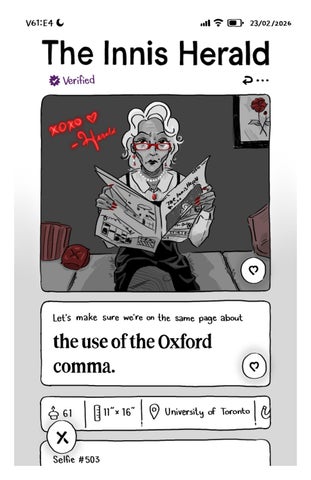
Create a flipbook