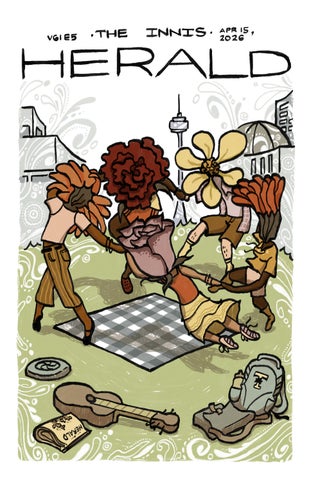
Throughout the past year, I have kept my editor’s notes relatively free from discussion of my own person, so for my last one of Volume 61, I hope you will permit me some sentimentality and reflection.
I started contributing to newspapers at U of T in the summer of 2022, before I had even begun classes. First, the Strand at Victoria, then the Gargoyle at UC, some time with the Varsity, but upon finding the Innis Herald, I knew that I was in for a very different experience. I joined the Herald after going to their speakeasy night, where I had a chance to do standup for the first time in my life. After that, I started writing, became a junior creative director, and through a strange twist of fate, quickly became one of the two creative directors for Volume 60 (shoutout Kiran, never forget).
Since becoming Editor-In-Chief, the Herald has been a source of pride and joy for me. I believe that Volume 61 has been significant for its high-quality content and design, all thanks to the fantastic masthead and our wonderful contributors. I do not aim to take much credit for these matters, as I am not a designer, illustrator, or copy editor; rather, I am someone who has simply overseen and guided people to produce. But there are some things during my tenure that I feel I have had some significant hand in bringing about. While I would prefer that any accomplishment speaks for itself, as a history student, I know that if things are not recorded, they are easily lost. With that said:
Every future volume of the Herald has now been equipped with more financial independence, thanks to the consent of Innis students, to ensure that we are able to both maintain and expand our journalism, but also to better be able to hold the Innis College Student Society accountable now that we have reduced our financial ties to them. The Herald even now has both the funds and the framework to compensate our contributors. While not a first for the University of Toronto, this is certainly uncommon and something we hope goes on to better reward the creative expression of Innis College. And finally, the Herald now prints five issues yearly, something unheard of for this publication since 2018. After seven years, I am happy to be back at pre-pandemic levels of production.
With my graduation upcoming, I know that I will look back upon my time at the Herald as one of my university experience’s most prominent highlights. Being able to create and manage for years at the same publication has been a real treat, and I really appreciate the good people I’ve met throughout my time here. I would like to give special thanks to V61’s Managing Editor, Marty Hewitt, who has worked alongside me on a great deal of administration behind the scenes. His humour, perspective, and hard work on these matters I am grateful for, and his steady hand has been instrumental in making sure we were able to deliver on our goals this year.
It’s been my privilege to be a part of this masthead, and I hope those who join the Herald in years to come are able to find and take part in the communal and creative spirit that I have witnessed over the past year. While it has been said more than enough times, I am duty-bound to remind you all that hot people read the Herald, hotter people contribute to the Herald, and the hottest people run the Herald.
Yours, for the last time,
Julian Apolinario Editor-In-Chief
in the 70s, the
Innis Mosaic
was a way for the Herald community to share their thoughts and stories across the college and campus from confessions to updates, if not bar recommendations.
As of 2026, here’s what we have to say...
“Get me all the honk shoos and the honk mimimis I can get” - Zach
“They’re called urinals because they’re shaped like kidneys right?” - MEng student in during a discussion about the etymology of the renal system
“I’m a pretty passenger princess” - Julian Apolinario, EIC
“I’m the founder of my schools celibacy club, why are you laughing?” Overheard in Robarts commons from a frat guy talking to a girl seriously at 1 am
After sitting in the Events Room all Friday: “I am become couch”
“Can I substitute that instant coffee-flavoured ice cream for my usual cup of tea when I wake up?” - me at ~2am
overheard in oise library: “do you have any tampons” “yah” “can i borrow one” “borrow?????? what, are you gonna give it back???????”
Educate, Agitate: The UTGSU Hands Off OSAP Town Hall
Delia Lappala
STUDENT LIFE
On March 10, 2026, the U of T Graduate Students’ Union held a Town Hall meeting to discuss the changes being made to the Ontario Student Assistance Program (OSAP) by the Doug Ford government. The evening consisted of a presentation made by UTGSU and CFS (Canadian Federation of Students) representatives, a breakout discussion with the audience in small groups, an open forum, and then a presentation by MPP Jessica Bell. Essentially, their goal was to strategize on what we as students can do and how these changes will affect the student body.
The OSAP changes have been a hot topic on social media as students and families objected to the sudden and drastic shift of OSAP assistance from 85% grants/15% loans to 25% grants/75% loans. This will mean students who rely on OSAP will have exponentially greater student debt when entering a job market with record-breaking highs for unemployment, especially for young people. All these changes are happening while tuition continues to be raised yearly, and after the Ford government already removed the sixmonth grace period, where provincial student loans did not accumulate interest. Although this issue did provoke pushback, resulting in many protests, including two here in Toronto at Queen’s Park, it feels like the energy of the student body hasn’t shifted.
President
Bianca Mehrotra
Athletics Directors
Youssuf Khalaf
Summer Xiao
Graduating Students
Representatives
Nate Bott
Nithya Sirsabesan
Social Directors
Juju Alolayan
Jana Malaeb
There are approximately 70,000 students at the UTSG campus, and I would estimate that in the room, combined with attendees online, there were about 150 attendees. That is 0.002% of the student body. Even when considering that a large percentage of students don’t rely on OSAP, it is fair to say that’s a low turnout.
But I also don’t blame anyone – the students or organizers. If I wasn’t supposed to write this article, I don’t know if I would’ve attended, and I rely on OSAP payments. It feels cliché to talk about the difficulties of focus ‘in the current state of the world,’ but it is also true. It is sometimes hard to feel something about your student loans being hiked when you see cities being destroyed and children dying every day. To me at least, it felt like a very small drop in a very large bucket.
Yet, once I dragged myself at 6 p.m. to a lecture hall in Sidney Smith, preparing to sit for a two-hour-long town hall, I was able to make myself care again. In my small breakout group, a few attendees talked about how the push from many people in the room for a student strike felt futile at an institution like the University of Toronto. Every U of T student knows how isolating a school can be. It is too large and too spread out for community to be built easily. It is also one of the oldest and most prestigious universities in the country and thus carries a conservative, if not tradition-heavy, focus. Since the student body is so fractured, it is hard to overcome those looming feelings of futility. Yet it is this kind of reservation that the provincial government relies on in students to get away with making outra-
Executive Vice-
President
Maya Nasiri
geous policy changes with no remorse or consultation. Just talking to a few peers and hearing some people who are passionate speak, I found I was able to actually engage and get upset.
This is a problem that directly affects us; we should care. One of the strategies highlighted by the UTGSU was to map our connections. There are pockets of upset people who want to act but just don’t know how. There are even more people who would get upset if they knew what was going on.
The student body is what funds the university; we hold a lot more sway than we think, especially as the student body of one of, if not the most influential institution in the country. If U of T began pushing back against these OSAP changes, other universities would follow suit. If we can get through the barrage of terror that Instagram sends at us everyday and find groups on campus who are upset and willing to act so we can make one of those terrors a little less bad, we will be able to continue to build those connections within the U of T community and show that the student body is not going to sit and take it.
The numbness that many of us feel towards the injustice we face is a kind of subjugating force that we have to try to fight. Talk to your peers, get upset. At the town hall, they provided us with a simple two-word mantra on how to build support for opposing Ford’s OSAP changes. It could be applied to any injustice, and I think it is what you should take with you from this article: Educate, Agitate.
Vice-President, Internal
Janeth Aguirre
Clubs & Merchandise Director
Cherim Yang
Sustainability Directors
Kiersten Herborth
Adrian Fatahillah
Vice-President, Finance
Rozhina Saririan
Equity & Outreach
Directors
Theo Lampert
Landon Sanderson
International Representatives
Zeina Khatib
Ilkim Uzunoglu
Off-Campus Representatives
Sadika Rupasinha Arachichige
Nika Moradi Haghgou
Lana Al Mawass
Loitering as an Art Form
Shuhruh Akhand
FEATURE
I have sat in the Innis College lobby for multiple hours a day, several days a week, trying to write this article. I have failed every time. Maybe I am trying to argue that loitering is an art form because I have spent so much of my time doing it, and this is my only cope. However, I think of Maria Abramović and her performance art. Sitting at a table for multiple hours, letting anyone sit at her table to do whatever. I have quite literally done exactly this for 10-12 hours at a time at the lobby. In fact, I am not the only person who does this. There’s an entire community of us out there.
Let me segue into what I really want to argue for: loitering as the key to finding community. It’s an interesting thing, having to “find it,” especially since the way our social lives are organized around the university, you’d think you’d already have it; it’s either the people in your college, people from your program, or maybe people from the student group you joined. But yet, the thing I always hear is that there is no sense of community at St. George. To be fair, this social issue of belonging (or lack thereof) stemming from individualism is not solely a U of T phenomenon. There has been a disappearance of third spaces from the public, which has contributed to the bleakness of daily life. But for most students, your life revolves around your school, so on a logistical level, students shouldn’t be suffering at the same level as the general public. While schools are considered a second space, they do offer plentiful third spaces such as student lounges, food halls, and, dare I even suggest, lobbies. And yet, we are still suffering.
The issue is that our school is too big. Sure, we have the college system that divides us up, giving us a “home base” (I have quite literally only ever been a commuter, so this was meaningless to me), but even then, if your program is not under your college, you’ll barely be around. So then I suppose you will eventually find community in your program. And yet, you never do. I have jumped around, major to major, while my friends have stayed in their respective programs, but the issue we all agree on is that there is no centralized location for many programs: it’s scattered around campus.
The same is true for student groups. Last year, I was in many Victoria College-related clubs, but many events were scattered geographically, and since I had no classes near VC, I’d always be in a rush to leave after meetings. I have made long-lasting friendships in spite of this, but having 2-3 friends coming off a larger team is not the same as having a community.
With a big campus in a busy city, it only makes sense for everyone to be in a rush, never being able to catch someone in one spot for too long. But maybe loitering is the key to reviving third spaces: seeing familiar faces at designated times weekly is bound to start up something. This is where the Cinema Studies Program and Student Union differ. Since the majority of the classes in the program are in Innis, most of our events are in the building as well. The problem of rushing and empty third spaces becomes resolved. CINSSU’s meetings this school year were wedged between two classes of mine, so there were many hours to loiter with everyone. These were the
beginnings of community, just sitting in the lobby or second-floor seating area of Innis, doing nothing. Talking to familiar faces from the meetings instead of having to run to our next class, and then finishing the day with a screening from WTF or FFF.
This community, in particular, is not just exclusive to CINSSU members. That’s the advantage of having a diverse range of events, from socials to screenings, in the same location you take classes in: you can loiter all day long and meet new people who have been there all along. Sitting in a lobby day after day, you will come across the same people, and slowly, you’ll notice yourself and others lingering a bit longer.
Loitering works. While the circumstances were perfect for Cinema Studies students since everyone is stuck in one building, community cannot just be handed to you. You have to put yourself out there as well, linger for a little longer after class, and go to those events that a club is putting on. I’m guilty of not putting in the work myself: last year, I was in a tutorial when I recognized a face from a CINSSU meeting. Out of convenience, I asked her to be my partner for a short film for class, but we would never talk outside of class and CINSSU meetings–when our short film was screened in class, I didn’t even sit next to her. Ava Derro, if you are reading this, I am sorry. However, I think I should be absolved of my sins as I join her in the lobby, loitering quite frequently now.
I keep mentioning how small Innis is, but as you might know, Innis is getting a makeover: a commuter lounge, a rooftop lounge, an outdoor terrace, and they are even bringing back the cafe! As someone in their fourth and final year, I did and still do feel a little distraught with the fact that all of this will only come to fruition immediately after I am gone. But upon reflection, the lobby being the only third space Innis College had to offer was part of the reason why community was able to manifest the way it did, which is why I am grateful to have been subjected to the construction. That being said, the community will not die because of the Innis expansion. Once a community is formed, it can only flourish and grow, especially now with the new student spaces being built.
It is an innate feeling to yearn for community, and I can now firmly state that community does exist in Cinema Studies at a time when social isolation rates are rising, and participation in civic life and community groups is falling. These problems, while bigger than us to be able to solve, can still be resisted. The first step is to put yourself out there and LOITER.
Reviewing a Decade-Long Friendship Interview with
Benjamin Thibodeau-Fillery
L.F. Shubert
FEATURE
L.F.: How long have we known each other? [pause]
L: Oh my God, you don’t know?
BEN: I didn’t know if you wanted the year or the number! Since grade 8. [Ben has never admitted that we met in eighth grade; they insist it was seventh. They have finally admitted the truth for the sake of journalistic integrity.] So, about nine years. Almost a decade.
L: Wow, I didn’t realise it’d been that long. How did we meet?
B: We went to the writer’s workshop together run by the librarian at my school, and afterwards, you sent me an email and said, “I like your bag,” and that’s how we started talking. And that was great because I really wanted to talk to you, but I was very nervous and scared, and that gave me an in.
Interests
L: Do you think our friendship has influenced our shared interests, academic careers, and career aspirations?
B: Absolutely. I mean, I’ve always really wanted to be a teacher, but certainly having friends who want to be teachers—even if it’s for a different grade, with a different level of expertise—has by and large been what’s kept me in my program as long as it has. I absolutely would have either changed programs or dropped programs and done something else if I didn’t have that. In terms of shared interests, we kind of got started with a lot of the same interests to begin with, but my interest in literature and gaming and even movies has really developed as a result of or a reaction to your interests. Even for something like Fortnite, right? I wouldn’t have ever played Fortnite for longer than the average teenager plays Fortnite if you didn’t also think it was cool and then we got into it together.
L: It’s helped me having you introduce stuff that was almost in my ballpark, but slightly to the left.
B: It’s kept your comfort zone expanding.
L: Exactly. Like, one of the last things you lent me—Perfume [by Patrick Süskind]. I don’t think I would have found that without you recommending it.
B: Well, it’s so funny you mention that, because I would not have found it if some person with an interest in deeply disturbed fiction hadn’t recommended it to me. It’s the only book I remain relatively impressed by that he recommended to me.
L: What other ones did he recommend that didn’t sit right, if you remember?
B : There was one called—oh, fuck, what was it called? It’s not gonna come to me—it was about paedophilia and vam pires.
L: Oh, goodness.
B : Yeah, not my wheelhouse.
Romance
L: What role do you think, if any, our friendship has played in our respective romantic relationships?
B: Well, you know, I was dating [REDACTED] for five years. It was really four and a half, but it’s easier to round up to five because it sounds more dramatic. [. . .] I was very uninterested in hearing criticism. Not because the criticism wasn’t valid, but because I was very defensive about it and I felt that it wasn’t worth anyone else’s time. Then it took one conversation with you where you were like, “I don’t know if you’ve considered these things, but this is what it looks like to me.” And I was like, Oh, I’ve gotta break up with this guy now. [. . . ] And I think the same is true vice versa. I don’t want to overstate my influence . . .
L: No, for sure, it was helpful having you to talk to. So many of the people that I felt I should or could be going to for relationship help were people that were mutually involved [with both my ex and I]. So, they sort of felt like they had an obligation to play devil’s advocate in a way that you don’t, because you’re only looking out for one party primarily. And that’s all that I was asking you to do.
B: [. . .] A big part of friendship is being able to take your friend to task. Being able to say, “I love you and I’m looking out for you. This is what I need in order for this relationship to work,” or more importantly, “I can see that you’re struggling and I am worried.” Confronting your friends is something that I think seems very taboo nowadays, but that’s never been a big deal to me. It’s not always going to be sunny days, and I really hate the concept of fair weather friends. [ . . .] If you want a friendship to last—and you should—you want to put effort into it.
L: There’s no point in suffering through something you foresee ending soon.
B: That’s the thing—I am not the sufferer, okay? If it sucks, hit the brakes.
L: It’s a waste of time!
B: Yes! At the same time—look at me, holding two truths at the same time—a certain degree of suffering is necessary in order to have a mutually beneficial and cohesive relationship. It really does resonate with me, the idea that “to be part of a community is to be uncomfortable.” Like, a baby moved in next door. That bitch screams non-fucking-stop. And that’s through six inches of concrete. I don’t know how we’re hearing that. That baby has lungs fit to blow the horns at rapture; he will be ready. But, am I going to say anything? Fuck no, I’m not. They have a newborn baby.
Appreciation
L: What has been your favourite part of being friends with me? [pause] I know I’ve just asked the question, but looking at the embroidery you’ve done on your pants—you’ve got so many cool things on there—I want to say that one of the things I have really liked about being friends with you is seeing you take up so many different art mediums, trying out different hobbies, and fully getting into each one and excelling in them. You’ve done sewing, you’ve done embroidery, you made me a tote bag that I use every single week, you still write, you read a lot, you cook, you’re a fantastic baker . . .
B: I ate.
L: You did eat!
B: I will say, the thing that immediately pops into my head was that you have this kind of penchant for unconditional kindness. And the layman might say that this should just be the norm in friendships, but it’s not. It really, really isn’t. [. . .] Sometimes before I know it myself, you understand how to help and support me. And that is because you are attentive, and observant, and you place a lot of stock in making sure that it’s clear that you care.
L: I also think that you are very easy to care for. You make it easy to be attentive and observant.
B: I appreciate that. But, I don’t think you give yourself enough credit for how much light you bring to the world around you, and how much joy and peace kind of exists in a bubble around you. [. . .] You have this recognition that friendship is sometimes difficult. That friendship requires mutual support and you never shy away from that.
L: Because it’s always so worth it. It always has been.
B: I love you dude.
L: I love you! Thank you for letting me interview you.
B: Thank you for interviewing me!
L: Now I’ll be happy to take you to work, if you want.
New Growth in 2026: The Resilience & Revitalization of the Innis Community Gardens
Cedar J. MacTavish STUDENT LIFE
For the past three springs, the northwest corner of St. George Street and Sussex Avenue has come to life through the Innis Community Gardens. Located just below Innis College, this vibrant space features a variety of vegetables, herbs, and flowers, grown by and for the Innis community all summer long. Despite many trials and tribulations –from construction work blocking off available space to the ravenous nibbling of produce by squirrels – the Gardens have persisted since their 2023 founding and now find themselves freshly poised for the growing season.
This springtime brings with it an even more significant flourishing than usual for the initiative, as Innis is entering a new era through both the Renewal & Expansion project’s much-anticipated completion and a greater College-wide commitment to sustainability. In this exciting moment, the Innis Community Gardens represents a flagship initiative which welcomes the participation of students, staff, and faculty alike as we prepare for spring planting, now just around the corner!
With the new rise of sustainability at Innis, the Gardens are now coming to represent more than just a space for the College’s green thumbs to congregate. In October of 2025, the Innis College Council (ICC) unveiled a new five-year strategic plan for the College going forward. This landmark moment in Innis’ 62-year history included all-new strategic priorities in sustainability across three primary areas, these being: Physical Infrastructure & Greenscape, Food & Hospitality, and Teaching & Learning.
Since then, a new sustainability portfolio has been developing under the joint work of Innis staff and students, particularly through the efforts of the
Innis Sustainability Advocates (ISA) volunteer group. Many student-driven projects and initiatives are being actively created in areas like green roofing, waste diversion, food security, and ecological wellness, with more on the way. This exciting shift to sustainability at Innis creates new opportunities for operational, infrastructural, and educational changes in all areas of the College.
However, no existing initiative maps onto the College’s strategic priorities quite so well as the Innis Community Garden. In working the soil and seeding new life for the growing season, the Gardens create a new greenscape on the College grounds. The use of native plants like asters and goldenrod in these transformations attracts pollinator species to the area, increasing ecological health and providing a point of safe harbour for members of the urban ecosystem. Through the growth of local and nutritious produce, made available to community members at zero cost, the Gardens affect positive change for food access on St. George campus.
With the holding of regular events and gardening activity sessions, alongside the creation of teaching materials for distribution, the Gardens create an effective space for experiential sustainability education and ecological interaction in the heart of the city. Aligned with the upcoming completion of the College’s Renewal & Expansion project – a large-scale infrastructure addition aimed at creating more space and resources for Innisians – the Community Gardens will soon provide a sustainability-centric and aesthetically pleasing entryway to all who call Innis home.
As springtime prompts us to look to the warm weather and growing season ahead, it also creates the space for much-needed reflection. For the Innis Gardens, the path to this point hasn’t always been smooth.
The initiative has gone through many iterations and changes since its inception. It first began as a transformation of a small, grassy patch beneath a Norway Maple tree on the south side of the primary College building. A joint effort of student groups
and supporting staff built planter boxes, poured soil, and sowed the seeds of a brand-new urban agriculture project. Management of the nascent garden was taken over by the Innis Garden Club, a collection of students invested in fostering sustainability and food justice at Innis.
But challenges lie ahead for the young initiative. The reconstruction of the college building at 2 Sussex crowded out the available growing space, and fences were constructed by the municipality to protect the Norway Maple at the garden’s center from any potential damage. In addition, local critters took the opportunity to snack on the veggies grown in the limited space, resulting in lower yields at year’s end for distribution to the campus community.
Amid such turbulence, however, the Gardens have adapted admirably. With the primary garden space fenced off for construction, the interior area has been seeded with predominantly nonfood-producing pollinator plants, which require less tending while still providing ecosystem services.
Raised garden boxes have been set up outside the fences, expanding the growing area across the concrete walkways on the street corner. In these boxes, strategic companion planting combinations of mutually beneficial veggies, herbs, and flowering plants have been seeded to get the most out of smaller soil space.
Additionally, eco-friendly innovations for produce protection were implemented to ward off squirrels, including an accessible water bucket to redirect squirrels (who often bite produce because they are thirsty), and the sprinkling of cayenne pepper over freshly sown seeds. Through these methods, the Gardens have managed to maintain summer operations and a season’s-end yield in spite of the challenges faced.
Spring 2026 brings with it the newest iteration of the Gardens, and the most major adaptations yet. With the impending end of construction, we are eagerly anticipating the renewal of volunteer access to the fenced-off garden space for the first time in nearly three years.
Such access gives us the chance to not only run operations and planting in the raised planter boxes, but the interior grounds as well. New planters and hanging boxes are also on order, further increasing the grow-space for Gardens programming.
Additionally, to ensure a greater range of consistent community and staff advising, the Innis Garden Club’s governance has been reconfigured, with the Gardens now being managed directly by the garden volunteers and ISA student group, and supported by the Innis College Student Society (ICSS) Sustainability Directors and the Innis College Sustainability Steward. With allnew governance, infrastructure, space access, and student/staff support, the Innis Community Gardens are freshly revitalized and meeting the moment for sustainability at our college.
So come out to the garden this spring! Whether you are most interested in food growing, flowers, sustainability, or just finding community, the Gardens welcome you. We are open to all Innis and U of T community members, from students to staff to faculty.
The initiative will be operating all year round, with seed starting and planting events right around the corner in April. You can come check out the space anytime, and drop in on any of our activities. However, if you’d like to be on the mailing list or get CCR accreditation for your participation, be sure to sign up as a garden volunteer.
And if you’d like to learn about and support Innis Sustainability, including not just the Gardens but so much more, consider joining the ISA team! Just visit folio.utoronto.ca and look up Innis Community Gardens or Innis Sustainability Advocates to get involved, or follow along on Instagram (@inniscommunitygardens) to learn about updates. Feel free to reach out to sustainability.innis@utoronto.ca with any questions about sustainability and gardening at Innis College.
To all the Innis community, we hope to see you at the Gardens this year, and celebrate together the wonder of a new spring season!
Planter boxes sitting outside the fenced-in garden area
Miniature biquinho peppers growing in a garden box
A harvested bunch of cherry tomatoes
Student volunteers transplanting a crop of arugula
Life is Strange—And So Is Innis (in the Best Way)
Wing Yip | STUDENT LIFE
“When a door closes, a window opens… Or, something like that.”
– Max Caulfield
This quote from Life is Strange (one of my favourite games of all time) came to mind as I reminisced about my time at Innis over the past four years. I guess I share the same feeling as Kyle, our IRC President Emeritus, once expressed: everything leading up to my memorable experience at the college feels like a progression of the butterfly effect.
To be fair, I wasn’t even looking forward to U of T for most of the summer before university. It wasn’t my top choice, and I only chose Innis because it was first on the list of colleges on the OUAC portal. I was anxious about not getting into Innis Residence, especially after U of T emailed me in late July saying that I would likely be placed in off-campus housing and “encouraged” me to cancel my residence guarantee by offering $2000 to find other accommodation. But on August 9th, 2022, the email titled “Innis Residence: Offer of Placement” lifted my spirits a little. At least there was something to look forward to at U of T, I thought.
However, this hopeful feeling didn’t last long as the first day of classes approached. I began to feel homesick. I worried about the academic pressure at “U of Tears.” I was scared that I wouldn’t make friends at all. Then I remembered the night before orientation, when my dad told me that “I make my own luck” is the way to approach university. And so, I decided to take the initiative to combat my pessimistic projections.
I met my first friend on the very first day of orientation, when I asked to borrow a pen and started introducing myself. We were thrilled when we discovered we were from the same city. She then introduced me to another friend, and soon another girl joined us, turning our trio into a group of four. We nicknamed ourselves the “Super Four” and stuck together for the entire three days. We stayed up late playing Animal Crossing Monopoly during orientation nights. We skipped the cheer-off to head to Chinatown for steamed rice rolls. We even sang karaoke at Harold’s House. (For someone who doesn’t like their singing voice, this was definitely a breakthrough for me.) The chant “Innis Loves You” wasn’t just a mindless slogan to assert dominance over other colleges, and from that moment on, I wanted to contribute more to the place I had (almost) immediately fallen in love with after just three days.
Nowadays, people often tell me that my name is widely recognized around the college. What surprises many, however, is that I didn’t begin my leadership journey at Innis until the end of my first year. While making
housing plans after that year, I applied to return to Innis and decided to make my first meaningful contribution by joining the Innis Residence Council as a House Representative in my second year. This experience rekindled my passion for leadership that I had lost during the pandemic—I truly enjoyed planning and running events, mentoring my junior House Rep, and connecting with people across the residence. I became so attached to the council that I returned as VP Communications the following year, eventually culminating in my presidency today.
Being part of the council was also a stepping stone to getting involved beyond the residence. I had many opportunities to connect with student life staff. I still remember unexpectedly crashing a Principal’s Dinner, where I met Kelly, our Student Life Coordinator, for the first time. We had a great conversation, and I shared my desire to contribute more to student life. Kelly showed immense support and encouragement—something she continues to do today. Since then, I have said yes to every opportunity to contribute to Innis: I have been a Lead Mentor for the Insider Mentorship Program, a student representative on the Innis College Council, and a work-study student for the former Office of Student Life.
I have definitely been fascinated by the tight-knit nature of Innis. Yes, Innisians might be quirky, but we always have each other’s backs, and the wildest ideas for fun. Playing Mafia while sipping homemade boba? Celebrating potatoes at three Potato Parties? Hosting a formal on a boat? Count us in! It’s sad to realize that these moments are coming to an end. I’ll have to say farewell to late-night McDonald’s runs, Wii Sports sessions in the Video Games Room, and board game chaos in the student life office.
Looking back, this journey down Innis memory lane wouldn’t exist if I hadn’t accepted the residence offer, if I hadn’t introduced myself to my first Innis friend during orientation, or if I hadn’t submitted my application to the IRC. Like the butterfly effect, every small action I took led to something meaningful. I built
valuable connections, grew into a more well-rounded student leader, and discovered that the most fun in university often comes from the smallest moments. I am incredibly grateful to everyone at Innis: my suites (606, 107, 315, 513), the Innis Dons, everyone in the Office of the Dean of Students, my mentorship team, Principal Charlie, and every Innisian I’ve had the pleasure of meeting. To the returning students reading this: Innis is truly an incredible place to live, learn, and grow. Whether it’s joining a club, attending a free food event, or simply greeting the Innisians around you— trust me, you never know what windows those small acts might open. You do make your own luck!
“I wish I could stay in this moment forever... But then it wouldn't be a moment.”
– Max Caulfield
First-year Wing, who arrived at Innis feeling scared and uncertain, would never have imagined that fourth-year Wing would want to stay here forever. As much as I wish I could, it’s time to move on to bigger and better things—carrying my Innis experiences with me wherever I go.
Please remember: Innis loves you, and Dog (my stuffed animal and the IRC’s tertiary mascot) loves you too!
Fighting For Community: VPS Student Fight Night
Burak Batu Tunçel & Vince Woodford
FEATURE
In 1976, Rocky Balboa captured audiences across the world, upholding the place of boxing as a popular sport within pop culture. More importantly, the film’s ending refuses to focus on who won the final fight, reframing the sport not as a competition to be won, but more as a way to build community, self-confidence, and personal relationships. It is within this community spirit that boxing has broken into the social life at U of T through the Victoria Pool Society’s (VPS) student fight night.
In this piece, we won’t be focusing on the technicality of the fights. Instead, we will look at how the fight night was the product of collaboration and support from across the student body.
Inhabiting approximately 68,000 students per year, U of T’s body of students form a vast landscape that’s hard to narrow down for generalizations. However, this broadness can lead one to think that what’s typically categorized as “campus spirit” is absent amongst students. This is a criticism often lobbed at U of T—that the sheer size of the student body makes organizing large, campus-wide, student events incredibly difficult, or nearly impossible. Yet, under the microscope, it becomes evident that, like every mass of people, U of T is built up of many diverse micro-circles and communities that complexify and inform the whole.
Both the construction and the gathering process that eventually became VPS’ Student Fight Night is rather revelatory of the hidden threads that connect students both as individuals and the groups to which they belong.
In that regard, it may not be surprising to hear that the reportedly over 800 people who got together for the Fight Night—either on an organizational or participational level—weren’t total strangers to one another: they were there for someone, something, or even somewhere—whether to support a friend, to be a participant of history-in-the-making, or to find a community that reveres competition, friendship, and partying.
The fight, which was the first of its kind at U of T, was held by VPS, led by co-CEOs Theo Sokol and Magdalena Berton. Despite what their name may suggest, VPS is not solely focused on pool, but rather on creating social events for students across campus. The group’s guiding principle is creating more student social events at U of T.
Since 2023, they have expanded both in size and scale, as well as their weekly pool socials; the group now hosts parties and pub nights. They also work to partner with other social groups on campus in order to create larger, wide-reaching student events. However, the fight night was one of their biggest undertakings yet, with a months-long preparation process leading to a night-long event held at the Queen Elizabeth Theatre.
Student fight nights, while not incredibly common in Canada, are a ubiquitous tradition across universities in the United Kingdom. For Ivy Thomas, VPS photographer, it was amazing to see the tradition brought to Toronto. “A lot of the British university culture,” she said, “had amazing things for putting people together, and that was kind of lacking in Toronto. One of the big things in the UK is the culture of student fight nights, so we wanted to bring that in.” Her attitude seemed to be shared by the student body, as over the course of the night, the stadium was quickly filled with audience members dressed in formal wear, waiting anxiously for the fights to start.
The event certainly did bring people together, as the Queen Elizabeth theatre was a full house of stu-
dents from across all backgrounds and social groups. On the organizational side, the event blended many different groups and talents at U of T. From athletics to student journalism and local musicians, all areas of student life were working together to create a night of sport and celebration that showcased a broad array of talents.
While the event was sanctioned by Boxing Ontario, and involved a notable degree of professionalism in its organization, the preparation for the boxing and how it was inevitably carried out served more as a highlight for the students partaking in it rather than a showcase of polished talent.
The fighters had varying degrees of experience going in. Richard Leung, who fought in the first round as a light middleweight, admitted to having very “casual” experience with the sport from the past. Meanwhile, Bruno Sullivan, who was going last as the Blue Team’s cruiserweight, said his background in sports was normally in soccer. Yet, athletes overall seemed keen on testing themselves in a discipline that might be unfamiliar to them otherwise.
Evidently, this was similar to the rationale of those who volunteered to be a ring girl. Eden Kendall, who was on duty that night, told the Herald that she liked to try new things—but also added that her volunteering was an extension of the support she was giving to her friend who was fighting that night.
Nonetheless, the fighters who responded to VPS’ call were split into two as the Blue and Red teams, and they all undertook 3 months’ worth of training. They learnt about different styles of fighting to prepare for their time in the ring, with the practices being done in groups and not between the actual opponents who were assigned to fight against each other that night. “I don’t know how my opponent’s been training or how their team has been training,” claimed Sullivan, and within the vein of competitive humor, added: “but I don’t think they’ve been training as hard as us.”
The fighters, while competitive, had a sense of humour and friendliness that sometimes overshadowed their on-court aggression. This was evident even in the lead-up to the fight, as during the VPS press conference on Wednesday night, athletes on both teams joked and laughed as they partook in cross-talk to taunt their competition. While the athletes may have been making predictions as to how many rounds they would need to defeat their opponents, the energy in the room remained amicable and open, with all sides clearly having fun with the teasing.
The structure of the fights was simple: athletes belonging to two separate teams (Blue and Red) would meet in the ring, moving through a series of fights until a victor was named. The fights spanned a number of weight divisions, with matches alternating between male and female categories.
On Friday, the energy and anticipation of everyone in the theatre were running high. The atmosphere of the fight was difficult to describe. At times, the event felt more like a clubbing event than a sporting one, with DJ-curated music playing over a sea of students holding cans of drinks and seltzers. When the fights started, however, the audience was quickly engrossed in the sport taking place on stage. In the crowd, the strength of community was felt as people gathered to cheer on athletes while standing next to people they had likely never met before. At certain times, the support chants for both teams became so entangled that once you indulged in your selective listening, your mind would switch channels in whose name you’re actually hearing—like the famous Yanny and Laurel phenomenon.
On a personal level, going out to an event where people become so homogenized was interesting for us—the authors of this article—because whether we want to admit it or not, our mutual friend group consists of people in our Cinema Studies major. We were indeed flattered by the “CINSSU is here!” exclamation we received backstage, but that certainly calls into question how much of our personas are baked into the social groups and programs we are in – especially given the conception of U of T as a very academic space overall.
Vince had to leave towards the end, but I, Batu, stuck around. After the show was over, the conversations still carried on from the lobby to the outside. Either it was the anticipation of the official afterparty that held people together, or to some degree, it was the hope for the collective fun to not end quite yet. In retrospect on the show, spectator Dustin Kai admitted that it was the first event that got him this pumped in a long while, and added, “It was great meeting with people I didn’t even know and talking to them.”
Certainly, Vic Pool Society’s presence brought together people from different circles who were united in the fight, and soon it became irrelevant whether or not these people knew each other from before. “Truthfully, it’s a lot of friendship even between the teams,” said Bruno Sullivan, hours before he fought with the eventual champion Max Berton in the finale; “We’ve all known each other for three months now. Obviously, there’s competition with the opponent, but at the end of the day, it’s all good, we’re all friends.”
We ended up meeting a lot of people that night, like our colleagues from The Mike and Hart House Film Board. It was also a night of stumbling into old friends from all around. One of my closest friends, Mark Metri, came by towards the finale to cheer and chant for his former roommate—who happened to be Sullivan himself. In the meantime, I realized that my high school friend Derin Iman happened to be there, too. I was especially surprised to hear she was doing a DJ set later that night. And finally, I bumped into the Editor-in-Chief of this newspaper you’re currently reading, Julian Apolinario, and reported to him that I was on duty.
Probably the most recurring piece of dialogue that night after “Who-areyou-here-for” was the factual statement “This is the biggest boxing event in Ontario.” I do not doubt this sentence—which tells me that Student Fight Night was a fitting microcosm of this fishbowl we call the University of Toronto: despite how massive it may seem to us students, we are more connected and aware of each other than we normally perceive. Eventually, we all end up sailing towards the familiar spots we have warmed up for ourselves, but every now and then, we inhabit the same time and setting with a potential soon-not-to-be stranger.
Invincible Season 4 Just Dropped, and It’s Back with a Vengeance
Invincible is BACK, with season 4 hitting Amazon Prime Video in late March! The show jumped right back into the action, with the three episodes taking us through Mark’s newfound fearlessness, a look into Omni-Man’s backstory and the broader lore of the Viltrumites, and the ongoing dynamics between Mark and Cecil as villains try to conquer Earth every episode.
In season 3, Cecil Stedman, the director of the Global Defense Agency, uttered the famous line: “We can be the good guys, or we can be the guys that save the world. We can’t be both.” Right you were, Cecil! Now, in season 4, Mark is realizing it too.
There’s no sugarcoating the fact that, for most of this show, Mark was a very lackluster protagonist. He simply lacked the guts to actually do what was necessary when fighting for victory, at least not on the same level of execution that Omni-Man or Cecil have demonstrated. The conflict within this show was always the way Mark would have to learn to go all-out, for instance, when fighting the Viltrumites on Thraxa or fighting Conquest to save Eve, without losing his humanity like his father. It was always when he was pushed to his breaking point—or when innocent people were put in danger—that he understood the stakes and unleashed his full power.
Well, now…this dude just KILLS! The fourth season literally starts out with an invasive species called the Sequids attaching to human hosts and taking over the Earth. An astronaut who brought the alien species to Earth with him becomes the main brain of the hive-mind, and just seconds before the Earth’s defences fall short of collapsing, Mark punches through the man’s mind-controlled head and bursts his skull into a thousand pieces, defeating the entire infestation and saving the day before disaster.
The whole scene is predicated on the Trolley Problem, and Mark has failed this test so many times throughout the series that it finally feels deserved here. As the audience, we understand that not killing that one man, who was unfortunately mind-controlled, would have collapsed the barrier and led to the deaths of countless other people, much like Mark’s inability to kill Angstrom Levy previously did. Ironically, the one time he has the guts to finish the job, he has to kill some innocent guy!
In all seriousness, though, the persisting tonal inconsistency with this show was always how serious the tone was, especially in how it portrayed graphic violence and death, with how naive Mark was to the threats he faced. Don’t get me wrong, that was his character arc, and in some ways, his charm. He wasn’t like his father, and that’s what made him pure and unique. But we all have to admit, it got pretty ridiculous at times.
Now that he’s at full force and we see what he can do, we’d all be lying if we said we didn’t at least somewhat enjoy seeing it! It’s just so much more satisfying to see Mark go all out and actually put a threat down permanently for once, even if it means breaking his ethics. It’s a bit like when Batman would throw a guy off a building and break his legs—as long as he technically didn’t kill him. The brutal vigilantism felt satisfying in some respects, because it recognized that the cruelty of the villain needed to be fought with at least some cruelty in return. Otherwise, it would be a police show or courtroom drama, rather than a complex superhero story.
It’s the same here, I WANT a powerful protagonist, not a wimp! And I’m glad the show goes through the trouble of justifying his actions multiple times, especially by explaining how his inaction previously with Angstrom led to countless deaths that could have been prevented. We WANT to see Mark make traumatic decisions. That’s literally what made Spider-Man and, I don’t know… every single superhero to ever exist… COOL! Here, he doesn’t even have a secret identity to worry about, so at least unleash a bit more when defending your planet, Mark!
That’s another reason why I think we’re off to a great start, because we get a scene dedicated to this concept through his conversation with Cecil. In a beautifully serene conversation, Cecil pleads with Mark to ask him for his approval in times like these, just so Mark can sleep at night. Cecil reveals that he calls the shots with other superheroes for the same reason: to take the burden off them and ease their conscience. His character was always so well-written, and it’s exacerbated by his masterful voice performance by Walton Goggins.
On top of Mark going through changes, the apple doesn’t fall far from the tree in that respect. We get a really interesting look at Nolan’s origin story here, showing how he became who he was, and taking us on an entire episode focused on him and Allen floating through space together. After basically two entire seasons of treating Nolan as a two-minute cameo every four episodes, now he gets a whole fifty minutes dedicated to just him! We see a more gentle side to him here, as he genuinely defects spiritually, almost entirely, from the Viltrum mindset of conquest and brutality.
All the characters are undergoing the most change we’ve seen after two seasons of stagnation, and it’s really satisfying to witness in real time. After facepalming for seven out of the eight episodes last season when Mark didn’t have the guts to do anything, this is a great relief! I feel hopeful for season 4, and I think this will be the best season yet. I hold season 1, especially the final two episodes, as major pinnacles in animation, but I feel that this season could rival those episodes with the way things are starting off. Please don’t make me regret saying that, Invincible writers!
Ario Shakarami REVIEW
Checkmate! Jiving Between the Opposites with Victoria College Drama Society
Nina Chen
FEATURE
Warning: Please note that this article contains spoilers for those who have not watched Chess
Directed by Chris Wong and Mokshali Raman, the Victoria College Drama Society (VCDS) played all the right moves with its spring musical Chess . In this mega production consisting of an enormous team, the gameboard extends far beyond the tournament between the stories of two Grandmasters—it is a story of allegory revolving around the high-stakes tensions of the Cold War.
If you haven’t played Chess before, the game is known for its simple rules and its difficulty to master—it is a complex game in that sense.
complex. definition: when two or more things are true at once. In the musical Chess , victory and bittersweet loss coexist. Love and loyalty attempt to tear people apart in all kinds of directions. Identity is not always fixed, but lies somewhere between the binary opposites of societal expectation and personal desire.
This is a lot to take in, and the world may seem like it’s on fire, but the music, written by Benny Andersson and Bjorn Ulvaeus from the pop group ABBA, eases our stress. With combinations of jiving rock music, synth-pop, power ballads, and lyrics written by Tim Rice, the show captivates the audience. VCDS goes above and beyond to deliver this
astounding production with skillful acting, vocals, and creative touches.
Florence Vassy, played by Diya Tirone, serves as the American grandmaster’s second. Tirone presents Florence as a composed and professional businesswoman assistant, and restrains herself from announcing herself loudly in the first few acts, especially with her troublesome grandmaster commanding the stage. Her acting gradually shifts, however, as Florence grows more independent and ultimately decides to walk away from the American grandmaster. Fierce and grounded, Tirone sings Nobody’s Side, hitting the high notes effortlessly and weaving each note with her delicate, yet liberating manner.
Lizzy White is a blast as Frederick (Freddie) Trumper, the American grandmaster. With a childlike temper, White swaggered across the stage with boyish fury. Freddie’s aggressive attitude and sudden outbursts in the Press Conference leave a rebellious impression, but beneath the defiance and emotional immaturity, there is more to the character. White also captures Freddie’s undeniable hint of brilliance and talent as the American reigning chess champion, with radiating hostility and sharp eyes in front of the chessboard.
Choreographers Eileen Lu and Jessica Wang responded to the music in different styles, ranging from balletinspired sequences to more aggressive, stylized movements. The ensemble, representing the larger forces of
Project Hail Mary: Go Space or Go Home Question
“Grace Rocky save stars cinema”
Astrid Yap | REVIEW
Each season, there is one guaranteed talk-of-thetown movie. Last spring, we got A Minecraft Movie (2025), followed by a Superman (2025) summer, and a Marty Supreme (2025) winter. With the coming of spring, Project Hail Mary (2026) by the director duo Phil Lord and Christopher Miller, starring Canada’s own Ryan Gosling, is undoubtedly the movie of spring ‘26. Adapted from Andy Weir’s same-titled novel, this science fiction adventure film follows Gosling’s Dr. Ryland Grace on a mission in space to discover the key to save the Earth, as well as other planets, from a mysterious substance that causes the sun to die out. Giving it straight, this is a light-hearted hopemaxxing family-friendly movie. The film constantly uses humour to cope with trauma and fear, making it easily digestible and softening the stakes, even as the fate of Earth is up in the air. While trapped
media and propaganda, executed their symbolic roles with exaggerated facial expressions and dazzling, energetic performance.
“All the dance choreography was intentionally blocked in terms of specific formations and kinds of complexity in dance styles. Chess itself has different pieces and moves, and we wanted to reflect that and diversify the choreography as well. We played around a lot with world-building and aimed to construct something meaningful,” said Wong.
I would also like to give a special shoutout to the number Anthem. Jacob Dowdall, playing Anatoly Sergievsky, the Soviet Grandmaster, captured this profound song beautifully. His vocals soared across Isabel Bader with grounded sincerity and clarity that conveyed a powerful testament of his love and loyalty to his home country. As he departed his country after winning the championships to be with Florence, there was a sense of bittersweetness that resonated with me.
“A powerful message in this song is the adversity of feelings humans face. The emotions we gain from having to face and acknowledge the things we supposedly left behind and moved on from are timeless,” Wong stated.
Below is part of an interview I conducted with Wong. This section is edited for clarity and conciseness.
Chen: What do you hope the audience takes away from this performance?
Wong: In terms of the general message of the story, we hope to convey that even if there is a huge looming pressure, whether it be political or social, that surrounds and affects the choices we make, we should never give up on all the things that connect with us.
alone on a spaceship, Gosling’s charm and stellar performance make up for this spatial emptiness both formally and narratively, making the pacing more exhilarating. With the majority of the film being almost a one-man show for Gosling, his presence alone certainly made it worth watching. Lord and Miller are known for producing and directing poptrending teenage comedies: think Sony’s Spider-Verse saga, the Lego Movie franchise, or the early 2010s classics, 21 and 22 Jump Street (2012, 2014). Examining their filmography, Project Hail Mary fits right into this narrative. While being an adventure epic movie, it is still harmless and morally conscious. While it might not be your typical sci-fi dystopian and technophobic story, it nonetheless evokes the astronomically sublime, capturing the sensational, boundless aesthetic of space travel.
One of the film’s biggest selling points is its production. To prioritise practical effects over CGI, many sets were physically built. The film claims to use no green screen during filming to enhance its realistic and tactile aesthetic. Besides the setting, Gosling’s co-star Rocky, his newly met alien companion, is brought to life through puppetry with the help of animation. However, much of this visual brilliance is credited to the cinematographer, Greig Fraser (known for Dune: Part One and Two), and the nameless visual artists, for successfully transforming space (literally and cinematically) into something phenomenal, seamlessly
Even when there are systems or people that try to divide us, we should all strive to continue standing strong in those difficult moments, and do the things we do not just believe in, but what we feel like is the right thing to do. We are a lot stronger than what appears to be oppressing us.
In a chess game, each player is given sixteen pieces total, with each of them having a specific role. Within the chessboard, players make their moves toward their destiny through the limited moves that are available, but the great thing about life is that we have far more possibilities than what can fit in a single chessboard. Behind the layers of focus and systems that may try to pull us apart, we are our very own Arbiters who narrate our story, holding unlimited potential.
Even when the crippling anxiety attempts to grip us, we must remember that love is full of flaws. We don't exist without its imperfection, nor can we exist without it. And yet, we keep fighting for our lives like a bad love affair, searching for a way to defeat the systems through our desire to connect. Life may be bound by rules and pressures, but this is ultimately what makes us a society worthy of human beings—we are all part of this game.
Watching the casts come together in One Night in Bangkok, the momentum of the number had me in awe. Like VCDS, campus theatre thrives with the collaboration of extremely talented casts, crews, and musicians with different backgrounds. Together, they are able to reach such an incredible level of coordination. Whatever life may throw at these talented artists, I wish them nothing but the best and hope to see the community grow through love and passion.
immersing audiences into the story world. The practice of hybrid filmmaking — digital and analogue — allows the film to embrace the craftsmanship of filmmaking while being more cost-effective. In the age of AI and an industry that prioritises profits and efficiency, the return to practical methods embraces the tradition and essence of cinema, not only as entertainment but also as an art form.
And without further exaggeration, Daniel Pemberton’s score is a crucial element in the film’s strong emotional resonance. While at times it feels overpowering in the mise-en-scène, the music conveys each scene’s tone and atmosphere with little ambiguity, making the plot easy to comprehend. As a formal technique and narrative device that tells the audience exactly what and how to feel, it elevates the visuals even more astonishingly.
Overall, this is a fun, exhilarating, and heartfelt story about hope and friendship. A refreshing take on the typical dystopian space journey; if not for its optimism, the adorable alien Rocky will definitely win the audience over. Maybe a movie does not have to be full of deep philosophical dilemmas that take hours to decode to be counted as good. It is the journey and the friends we meet along the way that make it worth it. And sometimes, we just need someone like Grace or Rocky to fist our dump, watch us sleep, and save the world. Amaze! Amaze! Amaze!
The case for video essays in universities
Victoria Dubrovsky ARTS & CULTURE
I learned what a video essay was a few weeks ago. This fact surprises me, since for years I considered them to be my favourite genre of Youtube video.
As an alternative to the short-form and AI generated slop which is unavoidable when browsing social media, a well-made video essay offers creative and thought provoking analysis on any topic imaginable whether it's art, politics, history, philosophy, science, and often several of these topics at once. For better or for worse, video essays by Hbomberguy and Zoe Bee were my first introduction to leftist politics, and have played a significant role in shaping my beliefs. It is with these experiences in mind that I noticed a discrepancy between the definitions of what a video essay is within academic institutions and what video essays mean to me and many others, which is unfortunate because video essays provide an excellent opportunity for academic tools to become more readily accessible for the public and for higher quality social media content to thrive.
An example of this discrepancy was when I saw on the syllabus of one of my political science courses that there was an assignment titled “Video Essay”. I was ready to fire up OpenShot and get scripting for roughly twenty seconds until I looked at the instructions which specified not to do any video editing including citing the sources on screen – horrible advice for any aspiring video essayist!
Not only is citing sources on screen and in the description standard practice to avoid plagiarism but an effective video essay should have the form match the content using tools specific to the medium such as editing in a way which makes it engaging, working…well, as a video essay! Not a podcast, not a regular essay, and not what my project suggested which is closer to a recording of a speech.
As it turns out however, my project’s definition would not be as far off as I thought.
According to Columbia University’s School of International and Public Affairs, the Schulich School of Business, and several other postsecondary institutions who have adopted the term in applications, a video essay is an unedited and conversational 90 second recording either introducing oneself or answering a randomly assigned question. Joke’s on me for assuming that my niche interests would be recognized on an academic level. Case closed?
However I would not be alone in my assumption. Since 2017 the British Film Institute’s magazine Sight and Sound has released an annual list of the best video essays selected by a panel of over 30 scholars,
journalists, and filmmakers. Entries on the lists range from the directly filmic such as Alison Peirse’s “Knit One, Stab Two”, reflecting the genre’s origins as a visual method of film criticism. Other video essays like Jacob Geller’s “Fantasies of Nuremberg” are closer to my project’s instructions (save for the length), with background music and occasional clips and images interspersed between on-camera narration of history and politics. Neither variety requires paying for any complicated editing software.
This low barrier to entry can also be seen in where video essays are published. YouTube is the primary platform for video essays, where some have garnered tens of millions of views. Alternative avenues include Vimeo, as well as subscription services for creators wishing to monetize their work such as Patreon and the emerging creator-run streaming service Nebula.
It may be this “digital D.I.Y” not mediated by academic institutions which prevents video essays from being fully embraced as legitimate methods of academic scholarship despite often being extensions of the work of various academics. Common arguments against video essays in universities typically involve some judgement about the difficulty of making a video essay when compared to writing one. Another factor may be the vastly different production techniques and methods of perception that come with the differing mediums, and the misplaced value judgments therein for what criticism is. There is some truth to this, as stated previously the two mediums involve significantly different production processes and the standards for what makes one or the other effective involves different criteria. Be it for reasons of practicality or elitism, the fears of video essays replacing academic writing can safely be assuaged.
But video essays do not need to become commonplace assignments for them to have earned the institutional respect that they deserve. The emerging industry offers vast potential for scholarly inquiry in the fields of Book and Media Studies, Digital Humanities, and Cinema Studies. Beyond analysis, courses on the production of video essays can be created in the previous areas, perhaps even cross-listed with other disciplines in the arts and sciences. While academic assignments may prefer more traditional methods, for presenting the findings of research, video essays can provide an accompaniment to traditional research posters. Encouraging students to get involved in the video essay making process on the university level can help bridge the divide between universities and the general public through the findings of research being communicated to the public via essays, and video essay making tools being a way for non academics to engage in research and writing. Today, the internet is many people's first introduction to a variety of issues, so why not make this introduction as well researched, thoughtfully made, and engaging as possible?
The Video Game Movie: Adapting Play to Screen
Ethan Spires ARTS & CULTURE
We are in the golden age of adaptational cinema! Comic adaptations continue to soar in popularity with the rising DC Universe and future Marvel releases, while novels have been adapted into blockbusters and critical darlings, such as Dune (2021-2026), Hamnet (2025), and Project Hail Mary (2026). The concept of adapting other artistic mediums into the cinema is not a recent phenomenon, either: Jane Austen’s Pride & Prejudice has been adapted at least a dozen times over the past century, for example, while celebrated director Peter Weir rose in popularity thanks to his 1975 adaptation of Joan Lindsay’s Picnic at Hanging Rock And yet, one particular source of film adaptation is usually met with skepticism or overt criticism: the video game.
Early adaptations like Doom (2005), starring The Rock, of all people, were easily considered box-office bombs and fell into a general B-movie passivity, forgotten and often thrown to the wayside. However, with recent box office successes, including the two Five Nights at Freddy’s films (2023 & 2025) and YouTuber Markiplier’s directorial debut Iron Lung (2026), things seem to be changing on the big screen.
More movies are being developed from video games, now with critically acclaimed directors set to helm new features. Zach Cregger of Weapons (2025) fame has taken on the newest Resident Evil film, whereas Michael Sarnoski, director of Pig (2021), is adapting Hideo Kojima’s Death Stranding for the big screen. The same is happening on the small screen, with HBO’s The Last of Us and Amazon’s Fallout garnering massive praise from critics, gamers, and the broader public.
But what changed? The general air of skepticism appears to have lifted from the adaptations seen in the 2000s, but the reason why and how it could continue to change are up for debate. One could argue that more game adaptations are just a sign of the classic ‘Hollywood is out of ideas’ narrative, simply taking on more variations of pre-conceived stories. However, I would argue that the rise is for a different reason: the idea of a ‘video game’ itself has changed and is now well-developed enough to encompass far more narrative options than before.
In its own way, this development is a double-edged (master) sword. Video games started off incredibly simple, but the days of Pong and Tetris are long gone. Technological development came with an advancement
in both graphical fidelity and narrative complexity. Some franchises transcended these shifts in development, otherwise known as the ‘console generations,’ with the aforementioned Resident Evil or Call of Duty, while others became emblematic of a specific timeframe in gaming history: the Sly Cooper franchise was relatively contained within the PlayStation 2 era, and Gears of War (itself getting a film adaptation), despite continued additions to the franchise, remains considered an Xbox 360 franchise. This timeframe capitalized on storydriven games, building on formulas of action, adventure, and puzzles; levels to be completed became chapters to finish, with emotional beats and characters carrying the player through the game. This is where The Last of Us and Fallout found their footing. Narrative gaming became just as credible an option for storytelling as watching a movie or reading a novel.
But with narrative complexity came sweeping formal innovation. New console generations came with new mechanics, new options, and even new buttons on new controllers. This increasing complexity eroded the ‘pick up and play’ mentality of earlier games. Gaming today has developed into a whole new language, and therefore, the barrier to entry has also gotten higher and higher. With that consideration, it makes sense for a rise in film adaptations to occur. As games become more time-consuming and technologically demanding to engage with, porting their narratives to other formats can allow more people to connect with them without any instruction manual. Notably, these adaptations are coming from a relatively bygone era of gaming. While these games are still popular within circles, and many have received remakes in recent years to connect with newer audiences, the biggest games by player count today, such as Fortnite and Call of Duty, as well as the subgenre of ‘extraction shooters,’ such as Arc Raiders and Marathon, are multiplayer, fast-paced, and any storyline is effectively optional.
Where does that leave video games today and future video game adaptations? One could consider ‘indie’ games the new frontier of game adaptation: Five Nights at Freddy’s and Iron Lung are part of a new kind of independently produced project, with lore designed to both inform and confound the player. A rise in online game theories about these smaller-scale franchises also led to mass appeal across genres and generations. Perhaps where triple-A titles have declined in their adherence to narrative, smaller passion projects will come to the forefront and deliver a new kind of video game adaptation built on connecting with a loving fanbase while showcasing a rich world and story. Video games are, in part, about being immersed in a world and its intricacies. As video game adaptations continue to shift between two competing industries, hopefully a balance can be found where these stories are told with their video game roots intact while allowing more and more audiences to engage with their narratives and ideas.
Gorillaz Transcends Existence & Afterlife Through an Emotional Journey Up & Down The Mountain
Amidst the impending chaos on earth, Damon Albarn & Co. channel life, loss, and liberty into a musical meditation on grief, mending our suffering with cultural harmony.
Matthew Barquet REVIEW
What is The Mountain? In 2024, Damon Albarn, onehalf of the virtual band Gorillaz, lost his father. Less than two weeks later, Jamie Howlett, the adjacent half, suffered the same loss. Grief-stricken and artistically stagnant, the duo left England, embarking on a crosscontinental journey to the only place that could nurture both soul and sound: India. What emerged from this transformative expedition across the streets and vistas of Varanasi, Jaipur, Rishikesh, Mumbai, and New Delhi became the core rocks of culture, buried deep in the emotional layers of sediment that comprise The Mountain
The Mountain, The Moon Cave & The Happy Dictator
And then there was sound. First, we hear breaths of a bansuri from flutist Ajay Prasanna, plucked strings of the sitar from Anoushka Shankar, and sarod improvisations from the Bangash brothers. Mixing classical Hindustani elements with the multi-layered voices of deceased Gorillaz collaborator Dennis Hopper, the opening title track immediately sets its sonic-spiritual ambitions loose: “All good souls come to rest.” From here, Gorillaz begins the ascent up The Mountain from the very bottom, deep beneath the earth in “The Moon Cave.”
Awakening, 70s fusion artist Asha Putheli and R&B legend Bobby Womack provide harmonies over angelic, orchestral strings alongside disco-inspired synth palettes, while Albarn’s bereaved lyrics portray a transition from life to death that commences within the dark confines of the cave. Hindu philosophy— stripping the ego from the soul—further initiates the departure from the mortal world: “You must wash all your perfume from your body.”
After shifting grooves to a hip-hop-rooted Black Thought verse between both soul singer Jaden Ngonda and De La Soul member Trugoy the Dove’s adlibs, “The Moon Cave” then rises to “The Happy Dictator,” where pop-rock duo Sparks provides sharp satiric commentary on the absurdities of political propaganda and detached leaders. As the ironically upbeat, 80s-inspired digital rhythms fade, the pain then centers back into view.
The Hardest Thing / Orange County
From the grave, Africa ‘70’s drummer Tony Allen provides a meditation in Yoruba on the interlude, “The Hardest Thing,” as Albarn’s heartbroken sentiments lay the melancholic tone that will bleed into the following “Orange County.”
The emotional centerpiece of The Mountain , “Orange County” blends Mexican trap horns from Argentine producer Bizzarap with indie artist Kara Jackson’s gentle vocals to convey Albarn’s reluctance to continue climbing amidst the emotional toll of his suffering: “I don’t know if I can take this anymore, so why are you trying to break me?” Interweaving Shankar’s sitar with a whistle melody that is as catchy as it is tearful, “Orange County”—in the same musical vein as “On Melancholy Hill”—serves as a fleeting goodbye to a lover, father, friend, or family member.
The God of Lying, The Empty Dream Machine & The Manifesto
Naturally, this reluctance persists in the existentialism that is “The God of Lying,” where contemporary post-punk lyrics from the Idles criticize the ongoing epidemic of misinformation plaguing the digital age. Repeating, “hope is behind, and I wanna get high,” Gorillaz fuses psych-reggae experimentations with falsetto vocals to portray the dark and nihilistic decay of society—led not by beings, but 6-inch screens.
In a similar existentialist light, “The Empty Dream Machine” further slows the tempo to reflect the harrowing, hopeless sentiment of Albarn as he plaintively navigates both personal loss and pensive depression over the deteriorating state of civilization. Gradually building with The Smiths’ guitarist Johnny Marr, a second Black Thought verse, and Shankar’s sitar embellishments, “The Empty Dream Machine” concludes in a desolate plea for solace amidst the impending chaos, a cry before the incoming high at the top.
With “The Manifesto,” the band reaches this high on the bright summit of The Mountain. A sonic odyssey of production and language, the first half of the track features Argentine rapper Trueno laying a Spanish verse over Indian tabla drums and choir chants. As the melody fades, the track disperses into a cacophony of brass from the Jaipur Jea Band, accompanying a posthumous freestyle by D12 member Proof. Building in tempo, the track climaxes in its fusion with the first half, as Trueno returns with an aggressive second verse before dissolving into a dreamy, synth-coded outro under hypnotizing lyrics from Albarn. Taking in the views that lay atop, Gorillaz must now begin their descent down The Mountain to fully complete the journey. “Only automatic now.”
The Plastic Guru, Delirium, & Damascus Trekking downwards, the band encounters “The Plastic Guru,” a musical critique against the faux nature of authority figures desperate for power and profit. Combining choir harmonies, sitar, electronicpiano backing, digitized Lou Reed vocal excerpts, and diegetic Indian city street ambience, Gorillaz portrays an ironically vivid picture of a corruption polluting religious gurus, presidential candidates, and socialmedia influencers alike.
The commentary continues in “Delirium,” an electro-funk anthem that infuses The Fall frontman Mark E. Smith’s eclectically abstract vocals with wonky disco synths, screaming choir refrains, and punchy drum kicks to invoke the lyrical chaos of authority gone mad. “Open the door / raise the alarm”—Albarn’s messaging serves as a danceable cautionary tale against civilizations entrusting the delusional with absolute power.
Delving deeper, “Damascus” continues the up-tempo streak with a call-and-response between 90’s conscious rapper Mos Def and Syrian Dabke singer Omar Souleyman. Bouncing between English and Arabic, the track incorporates ancient Middle Eastern woodwinds—such as the mijwiz—alongside hip-hop drum machine samples to underscore its themes of the refugee ship-to-sea experience across coasts.
The Shadowy Light, Casablanca & The Sweet Prince
Nearing the bottom, “The Shadowy Light” marks a breakthrough in Albarn’s grieving process. Featuring vocal passages by renowned Hindi cinema playback singer Asha Bhosle and Welsh musician Gruff Rhys, the title and chorus of the song suggest a different way of interpreting death: moksha—a Hindu belief that sees physical passing not solely as pain and loss, but also as spiritual transcendence—an attainment of eternal liberation. Death as both beauty and suffering—an oxymoron that directly encapsulates “The Shadowy Light”—reverberates through the omnipresent choir, bansuri, and sarod accompaniment.
The following “Casablanca,” enlisting The Clash’s bassist Paul Simonon as vocal backing for Albarn’s somber lyrics, returns to the melancholy of the initial ascent up The Mountain : “And the inmates’ cells / always remain open / as they stare into the abyss.” Sung above the ballad-inspired string and keyboard work, the constraints holding humanity back from liberation become a matter of mind; we are our own worst enemies, enclosing our respective worlds from touching one another.
With the floor now in sight, Albarn makes one last detour on “The Sweet Prince.” Finally facing the moment of his father’s passing, Damon comes full circle on the journey to understanding ‘the end’—or at least what this ‘end’ may entail: “Sweet prince, don’t be sad / You were never meant to be here / And the sword you hold in your hand / Well, its mighty blow will set you on / Your patterned path into the next life.” Channeling his father’s passing into an optimistic reincarnation of soul and body, “The Sweet Prince” finally heals our wounds; serene ocean waves and distant harp strings, alas, bring peace.
The Sad God
Touching ground, Albarn & Co. return to the mortal world. Transformed by the excursion across life, loss, and time, “The Sad God” becomes the final comedown of a beautiful high. Detailing the disappointment of a deity distraught by the malpractices of humanity, The Mountain closes on a somber, yet calm moment of acceptance regarding the futility of the human condition to learn: “I gave you atoms, you built a bomb.”
This ignorance of the damages made in our wake becomes a premonition of abandonment: “Now there is nothing, and I have gone / No more mountains, no more song.” A culmination of the journey, featuring Albarn’s passive vocals, Prasanna’s bansuri, Black Thought’s final verse, and Shankari’s expressive sitar, the track releases a mirage of melancholy reflected in each passing line: “No more prayers sent up into space / only screens left to see your face.”
Climaxing in a harmonious instrumental outro comprised of the ever-present Hindustani classical instruments, alongside digitized chords and children chanting in the distance, The Mountain closes with one last impression, an invocation for the heart of the human race to propel: “I gave you garlands / You closed your eyes / In paradise.” In the end, all that is left is the solitary sobs of the bansuri, gently dimming back into oblivion. Transcended, we return, reconciled and ready, for the sweet, sweet silence.
C lassof2022
Second Year - Mr. Morale & The Big Steppers – Kendrick Lamar Recommending: “Mirror,” “Savior,” “Count Me Out,” “Father Time” Honestly, it was difficult to pick an album for my second year. Think 2018-19 Clippers. Denzel, Thee Sacred Souls, Jordan Ward, Vince Staples, and Little Simz all dropped solid records that made the year greater than the sum of its parts. MMATBS, though, would be Lou Will.
I love how tender this album is. You can hear the pain in Kendrick’s voice in the tracks. To be transparent, I didn’t like this album back in first year, especially when I compared it to DAMN. However, I found myself revisiting this album many times in second semester, as I was getting taught a lesson about humility in my personal life. With the extra brownie points from the 2024 beef (euphoria>), I feel closer to this album than any of the other HMs.
Fourth Year - learn 2 swim – Redveil
Recommending: Listen to the whole album.
Back in my first month in Toronto, “pg baby” was recommended by the algorithm, I gave the album a listen, and the rest is history. I still cannot believe Redveil wrote and produced it independently before he turned 18. If not for the past 3 months, I would have put l2s down for second year. Honestly, it probably ties with The Forever Story for first year too.
So what happened in the past 3 months? I learned that misfortune does not announce its visit, and it’s better to do things scared than not do anything at all. To me, this album is about quietly becoming the person you promised your loved ones you would become. It’s a reminder that even though you are not there yet, you will be one day if you keep going.
First Year - The Forever Story (Extended Version) – JID
Recommending: “Raydar,” “Dance Now,” “Just In Time,” “2007”
If you know that “Just In Time” has been my alarm for the past 4 years, we’re probably close enough for me to feel pretty self-conscious that you’re reading this.
Shoutout to Nik for recommending this album to me when we first met in September of 2022. I genuinely think that this was the first album I listened to front to back. I am glad it was, because JID is a masterful storyteller. I have never had a stronger introduction to an artist. When I listen to this album now, I think about how much of a rush I was as a freshman. JID’s constant flow switches remind me of how eager I was to prove myself to everyone I was meeting. JID was also the first artist I ever bought a concert ticket for, and he did not disappoint.
Although this album does not make me feel the way it used to, I really enjoyed revisiting it while writing this.
ByJeffCh
Third Year - Luv 4 Rent – Smino
Recommending: Listen to the whole album. This album is proof that my attention span is not THAT bad. If I ever make a movie or any media, I would want Smino as the music producer. I actually heard most of L4R for the first time live, because Smino and JID were co-headlining their 2022-2023 tour. Although I went for JID, Smino’s performance left such a strong impression. In my third year, I would often take a walk down the green and quiet Rosedale Valley Road, and the album would end right when I got to the end of the trail. It’s funny that an album about communal joy was what helped me learn how to spend time alone. If you don't listen to rap and hip-hop, this will be your favourite out of the four. Smino flexed his versatility with this album; anyone could have fun with it.
Graduating soon as a member of the class of 2026 (hopefully, at least), I look back at how much I have changed since I graduated high school back in Shanghai as a member of the class of 2022. This was originally going to be a simple “4 albums that got me through U of T” music review/personal essay. Listening to entire albums was something I started doing after arriving in Toronto, and I wanted to reflect on how the albums I keep coming back to have been a constant in my life, almost like a friend, since I came to this city. After spending a week reviewing about a dozen candidates, I realized that the four albums that I played the most were coincidentally all released in 2022, hence the pivot to this “Class of 2022” idea. I really do wish I had a higher word count, though, because I barely scratched the surface on the good things I can say about each of these albums.
I love that I not only grew into these four albums, but I was able to grow with them. Each one had a breakout year in their own fashion. I’m certain that I will keep revisiting these 4 albums for the rest of my life, and I know that “Just in Time” will still be my alarm for the foreseeable future. Now y’all know too :D
turning twenty
Chloe Gong--Miniere
PERSONAL
The week of my twentieth birthday, I lost the opportunity to interview for my dream internship due to factors outside my control. I accepted that the deepseated anxiety that arises from interacting with strangers and distant acquaintances would never leave my body. I was visited once again by nightmarish thoughts of ending up alone, loveless, in a job I hate, and exhausted by thirty.
A week earlier, the notion of turning twenty had begun sinking in. Part of me felt hopeful that perhaps this day would finally signal the end of my teenhood, the first part of my conscious life over and to be left behind.
Evidently, that did not happen. All the same dreams and fears I had at thirteen still haunt me. All my actions are still guided by irregular waves of emotions, and I still can’t speak up in class. For the first time in months, I had three panic attacks in the span of two days, in arguably worse conditions than when I first started having them (I was driving during one).
I’m not sure when or why this immense, uncontrollable sadness emerged in my chest. It’s a difficult feeling to describe, and that might be the most painful part. There are no words. It’s like a hand is ripping your ribcage apart and grabbing at your throat. The only relief your brain can come up with is to end it all. And once it’s over, it feels too silly to even speak about.
Sitting in the car staring at the red light, I was struck by the realization that the one constant in my life has been a desire to be part of something larger than myself, to contribute to things that last. It’s why I enjoy work and volunteering—the chance to participate in projects and events that have a real impact on those who frequent the spaces in question—more than classes and their endless string of inconsequential, soon-forgotten essays.
It’s also why I constantly attempt to plan my future years in advance. Anything that disrupts the trajectory I’ve built in my mind feels apocalyptic, world-ending. I say all this to say that the thought I couldn’t let go of at that point was, “I have not changed a bit.” Turning eighteen didn’t feel as monumental as turning twenty, because then I could still brandish the teen part like a shield excusing my sensitivity. But on the morning of my twentieth, when I woke up feeling the exact same, commuted to campus while worrying as before about getting a summer job, and failed several human interactions, I knew that the hopes I could not help but let plague my mind had once again been crushed. I isolated myself when I needed to talk, and I cried sitting down on a cold tiled floor, and I was fifteen all over again.
When do you become an adult? I remember asking my father when I must have been eleven or twelve.
The truth is that no one ever does—at least not in the sense you believe the word means as a child. Some people never find a home. Some people never settle. Some people, while legally adults, act even more impulsively than children, and there is no one and nothing to stop them.
Faced with these facts, it would be easy to fall into despair and let the terrifying mystery of the future swallow your heart whole. I know that I do, whenever I hit this kind of low, and it always takes me days if not weeks to get fully out of it.
Two days after my birthday, I had a tough but lovely conversation with a fellow AGO volunteer. She told me how she had experienced her first panic attacks some days earlier, after a rough month marked by a family emergency that momentarily upheaved her routine. She has a beautiful, artistic soul, a love of learning, and a kind heart. She is older. She is happily married. She is as fragile and human as I am, and that felt like a hug to know.
Another truth rings distantly in your ear, when the fog of sadness begins to dissipate: you have changed. You are not the child you were then. There is not one
The Time We Have
second the clock hits that transforms you into an adult, because time is a construct, and so is age. Underneath all these made-up categor ies, though, you are born anew every spring, and possibly, every dawn.
Even if it is the smallest change, there are things you do now that you never used to before. There are deci sions you make, places you’ve just discovered, people you’ve recently met, hobbies and com munities you immerse yourself in. The very essence and beauty of our world lies in its fluidity.
The reason why my dreams, as much as my anxieties, will never leave me entirely is because they are part of me. They make me who I am. Sometimes, they make me feel like shit. But sometimes, they are also the very reason I am able to accomplish things.
My mother named me Chloe. I never asked her if she knew what it meant when she chose it, but I’ll write it down here because it feels relevant. Etymologically, the name comes from the Ancient Greek Χλόη, meaning “a new green shoot,” “a sprout.” It is also an alternative name for Demeter, the goddess of harvests.
We expect life to be perfectly linear, when in fact, so much of it is cyclical. Seasons fade into one another, years begin and end, a feeling comes and goes and might never fully leave you.
Here is to a happy renewal. Here is to a happy spring. And as a dear friend often quotes to me, “O wind if winter comes, can spring be far behind!”
Jai Mann FICTION
I will sit and wait for you in Med Sci by the large windows, as we wait for warmer weather, so that we can walk around King’s College Circle like it’s fall. I’m still waiting for the rest of the snow to soak into the grass, as spring is supposedly here. We can cheer that we are halfway there, about to finish second year, though neither of us has much of a plan for what to do after. Though maybe we have time to figure it out, as everyone says, or maybe we don’t. Through the windows, I can see the trees start to turn back to green through small sprouts, as to remind us that time waits for no one.
When you walk through the door, you spin your head about till we spot each other. We both break into
smiles and wave. In the first year, we saw each other nearly every day, both living on campus, now we see each other a few times a week, or sometimes once a week—hopefully never less than that—as deadlines pile and timetables conflict. Still now you drop your heavy backpack to the floor and wrap your chair in your winter coat to keep it warm. We talk of a dozen things that I can’t quite remember, never sticking to one topic, but if you asked me a question about you, I feel that I would know the answers. Still, from time to time—and honestly, frequently—we speak while looking out the windows as we dread the distance that we have to walk to reach our next class.
Still, we pause, praise that the weather is turning for good, then pause again. You turn to me to say,
“Can you believe the year is almost over?”
Not really, no, but, “Yeah, it went by fast.”
We sit there looking at each other for a moment as I think that perhaps you share the sentiment. Sometimes when I’m walking about, I can still feel the autumn air fill my lungs with a sweet decay and the summer sun of last year warm my skin through windows. Perhaps my brain is lagging behind, perhaps I will feel winter’s frost burning my nose in the summer. As I try to hold on to some time that is running past, the start of the year feels like a dream, both distant and just yesterday.
Still, when we look out the window and see green starting to sprout about, we can’t help but smile, even if our smiles have some doubt. We made it to spring; we told each other we would keep in contact in the summer. When we are back in the fall, it will be like time hasn’t changed at all, and we will have a little more time till we’ve got graduation caps on our heads. But it will be a while till then, so let’s enjoy the short time we have now.
home from the movies down queen street
and if i felt my shoes walk on without me, in the image of a mid-night puddle as the late car streaks by slowly would it be so bad to stop and watch them go?
i turn right and jump up on the final step—slip slightly at the peak, a glimpse of possible concussions.
whether they watch me or not changes little—not their red light or my green. drive on if you dare and run me down—you, the individual. show the world your passion.
the individual behind me passes on, one of many. what a shame for him i guess, not me— it would be odd to die. too bad for the chump though.
when my feet ahead hit dundas the world comes into focus, fractured segments stitched together in an uneasy quilt. so many patches, the individuals, all asleep inside; save for a few poor souls beside me, and myself still on the way.
all this talk of blankets makes me feel the night behind my eyelids; good as such that i arrive at home. but there is noise in the living room, laughing; voices; nights i missed and did not live, rubbed deeply.
rubbing my eyes deeply does not dislodge the night—i simply sit and let it simmer waiting for the dark to die down.
— A.W. JENKINS
POETRY
Insomniac Dreaming
I’d fall like sheets upon my bed, Let fall out whispers that swallow my head, But the chair by the window, the light through the blind, Bear fruit of temptation for this weary mind. My brain and I swore vows when we wed, And sleep, being its slayer (the unconscious dead) Swift widows hearts held in bodies unkind, So feet leave to fallow their pillow behind In unfettered pitter patters, down the rain flows, Stir, kindle mist sticky, luminous shroud, Haze serene, broken by thunderous arrows. Horns blare keen, cut the gloom over shuffling crowds, Metropolitan millions, my city’s bared marrow Clarified, this night, I’ll forgive them being loud.
— CALLACHAN MCNULTY
the sun, sung
down on me.
a slow burn, burdened with beauty— built for butter hues, cool-toned patio dinners, and polka dotted capris.
just to be alive is a grand thing. to feel, feel— and feel it all over again. to let the overripen peaches, drip down and touch your soul.
plant your feet where your heart is, letting the grass worm through your toes. nurture your garden without remorse, and sprout anew in the dragonflied morning.
— PETRA AMON
What
Many a Punjabi “____ there?”
Best, knife-wise
Twisted and turned
Touch gently
Debate or seminar fixture
Improvising
1.61 CAD
Second largest in the violin family
So last year
Boats like Noah’s ___ Vista, “good view” in Spanish Exchange for money
Stitch again
Begin to decide
Many student jobs
US spy
Just managed to find a spot
Leaf drink
Top dog
Milk-producing class
Lust et al.
Muslim ruler
Not urban
The Flash actor Miller, Vox cofounder Klein, or Jedi Padawan Bridger
US citizen digits
Congratulations to oneself
DOWN
Hole piercers
“Not good”
Famous public transportation user
Off the right path
Knot implement
“My bad”
Coal waste
“Poster” or “infer” suffix
Totally miss
Singers Frank, Nancy, and Frank Jr.
By
“___ to Move It,” song featured in Madagascar
One tethered to an aircraft "Father of the Symphony" composer Joseph
With regards to your peepers
Step one in whiteboard use
Actress Natasha of But I’m a Cheerleader, Orange Is the New Black, and Russian Doll fame
The Innis Herald wishes to acknowledge this land on which the University of Toronto and Innis College operates. For thousands of years it has been the traditional land of the Huron-Wendat, the Seneca, and the Mississaugas of the Credit. Today, this meeting place is still the home to many Indigenous people from across Turtle Island and we are grateful to have the opportunity to work on the land of Tkaronto.