![]()
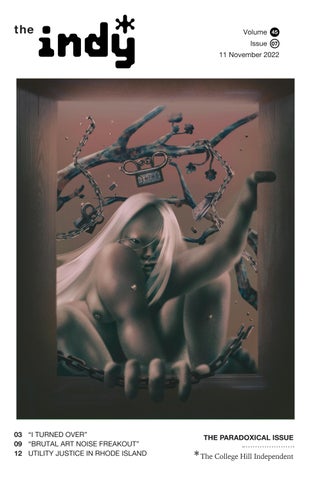
Even after Rhode Islanders elected Democrats up and down the ballot Tuesday night, questions are still swirling. Will Governor McKee be nicer to reporters now that he’s actually won a gubernatorial election? Will Seth Magaziner get a better haircut? Why does Little Compton hate weed so much?
In all seriousness, we’re thrilled to officially name the *coolest duo* of the 2022 Rhode Island midterms: the Sanchez brothers, Providence City Councilman-elect Miguel Sanchez and State House Representative-elect Enrique Sanchez (who sat down for an interview with the Indy in Issue 5)!
And, lastly, a question for Brown and RISD students: Rhode Island did well on its midterms—what about you? -SS
MANAGING
EDITORS
Corinne Leong Sacha Sloan Jane Wang
WEEK IN REVIEW
Masha Breeze Nora Mathews
ARTS
Cecilia Barron Anabelle Johnston Lola Simon
EPHEMERA Chloe Chen Ayça Ülgen
FEATURES
Zachary Braner Ryan Chuang Jenna Cooley
LITERARY Madeline Canfield Tierra Sherlock
METRO
Jack Doughty Nélari Figueroa Torres Rose Houglet Nicholas Miller
SCIENCE + TECH Justin Scheer Ella Spungen Katherine Xiong
WORLD Priyanka Mahat Alissa Simon
X
Lucia Kan-Sperling Seoyoung Kim Maxime Pitchon
DEAR INDY Annie Stein
BULLETIN BOARD Sofia Barnett Kayla Morrison
SENIOR EDITORS Alisa Caira Sage Jennings Anabelle Johnston Deb Marini Isaac McKenna Peder Schaefer
STAFF WRITERS
Hanna Aboueid
Madeleine Adriance Maru Attwood
Graciela Batista Kian Braulik
Mark Buckley Swetabh Changkakoti
Laura David Emma Eaton
Danielle Emerson
Mariana Fajnzylber Keelin Gaughan Sarah Goldman
Jonathan Green Faith Griffiths
Eric Guo
Charlotte Haq Anushka Kataruka Roza Kavak Nicole Konecke Cameron Leo Kara McAndrew Morgan McCordick Sarah McGrath Charlie Medeiros Alex Purdy Callie Rabinovitz Kolya Shields Alex Valenti Julia Vaz Kathy/Siqi Wang Justin Woo
COPY CHIEF Addie Allen
COPY EDITORS / FACT-CHECKERS
Ava Bradley Qiaoying Chen
Dun Jian Chin Klara Davidson-Schmich Eleanor Dushin Mack Ford
Zoey Grant Aidan Harbison Doren Hsiao-Wecksler
Rahmla Jones Jasmine Li Rebecca Martin-Welp Everest Maya-Tudor Eleanor Peters
Angelina Rios-Galindo Grace Samaha Shravya Sompalli Jean Wanlass
SOCIAL MEDIA TEAM
Klara Davidson-Schmich Britney De Leon Ayça Ülgen
DESIGN EDITORS
Anna Brinkhuis Sam Stewart
DESIGNERS
Brianna Cheng Ri Choi
Addie Clark
Amy/Youjin Lim Ash Ma
Jaesun Myung Enya Pan Tanya Qu Jeffrey Tao Floria Tsui Anna Wang
ILLUSTRATION
EDITORS
Sage Jennings Jo Ouyang
ILLUSTRATORS
Sylvie Bartusek Noah Bassman
Ashley Castañeda Claire Chasse Julia Cheng Nicholas Edwards Lillyanne Fisher Sophie Foulkes Haimeng Ge Elisa Kim Joshua Koolik Lucy Lebowitz Sarosh Nadeem Hannah Park Sophia Patti Izzy Roth-Dishy Livia Weiner Iris Wright Jane Zhou Kelly Zhou
DEVELOPMENT COORDINATORS
Anabelle Johnston Bilal Memon
DEVELOPMENT TEAM
Rini Singhi Jean Wanlass
MVP Doren Hsiao-Wecksler
The College Hill Independent is printed by TCI in Seekonk, MA
The CollegeHillIndependent is a Providence-based publication written, illustrated, designed, and edited by students from Brown University and the Rhode Island School of Design. Our paper is distributed throughout the East Side, Downtown, and online. The Indy also functions as an open, leftist, consciousness-raising workshop for writers and artists, and from this collaborative space we publish 20 pages of politically-engaged and thoughtful content once a week. We want to create work that is generative for and accountable to the Providence community—a commitment that needs consistent and persistent attention.
While the Indy is predominantly financed by Brown, we independently fundraise to support a stipend program to compensate staff who need financial support, which the University refuses to provide. Beyond making both the spaces we occupy and the creation process more accessible, we must also work to make our writing legible and relevant to our readers.
The Indy strives to disrupt dominant narratives of power. We reject content that perpetuates homophobia, transphobia, xenophobia, misogyny, ableism and/or classism. We aim to produce work that is abolitionist, anti-racist, anti-capitalist, and anti-imperialist, and we want to generate spaces for radical thought, care, and futures. Though these lists are not exhaustive, we challenge each other to be intentional and selfcritical within and beyond the workshop setting, and to find beauty and sustenance in creating and working together.
DEMOCRACY ALERT!!! We don’t usually like to get political here at Week in Review, but this week we saw a news story that we couldn’t resist: Pres ident America Jo Biben gave a gazillion dollars to people with student loans to forgive them for going to college! When I heard about this, I was like— blorpscuse me??? But then I thought, while we’re forgiving people, why not cut us some slack for some of the light mistakes we’ve made over the years? So without further ado, here are our top ten things we think Presbyterian Bison should forgive us for in a legally binding way!
1. Being bad fundamentally! Oops, did we do that? Yes we did, if by ‘that’ you mean just having an essentially evil soul. Sorry not sorry; God just made us that way.
2. Wearing a ugly shirt :/ On Tuesday I wore a ugly shirt to my semi nar (How to Be Rich in a Cute Way) and no one said anything but I really felt the vibe of the room shift when I walked in. Mea culpa Mr. Biden!
3. Starting a rumor…if you heard that sophomore and absolute beast Ugly Beth ate her twin in the womb, it might be because we made it up. Sorry Beth, but you wouldn’t let me borrow your glasses for my Halloweekend costume (Sexy Beth—like if Beth was sexy), so I had to take my revenge. In all fairness, you do kind of have a twin-eating smile. Love you girlie!
4. While we’re talking about the Beth of it all, I should probably also apologize for screaming “I saw Ugly Beth with the Devil!” in the street and trying to get everyone to try her for witchcraft. It just honestly didn’t make sense that she got chosen as the Brown Uni versity campus rep for Newports over me, because I’m so naturally coquettish and happy-go-lucky. Beth is a Camel Crush girl at best, so literally the only way she could have gotten that job is through a Faustian bargain.
5. Starting a Fleetwood Mac cover band without truly capturing their whimsy and sense of play. This is really difficult to admit, because I tried so hard to convey Stevie Nicks’ boyish charm, but I couldn’t
do it. When I sang “Oh, mirror in the sky / What is love? / Can the child within my heart rise above?” my voice just didn’t warble with homespun yet incisive longing. Please forgive me as I listen and learn.
6. Single-handedly causing the Adderall shortage. I thought they were vitamins so I ate them all. Egad!
7. Double-handedly stealing! I caused a large collection of family heir looms to go missing via me taking them with both my hands.
8. Tricking my neighbor’s son into thinking I came up with saying “wawaweewa,” which is famously the hilarious celebrity Borat’s favorite phrase. I took advantage of the goopiness of my neighbor’s son’s prefrontal cortex and I’m sorry! He thinks all cats are girls and all dogs are boys.
9. Muddying the sanctity of 3 out of the 7 holy sacraments :(
10. I cyberbullied the MacArthur genius grant committee, and I stand by that because they ultimately deserve it. I’m asking for forgiveness because I forgot to make fun of those nerds for having flat butts from sitting in an ergonomic desk chair all day!
To describe a zombie novel as a catalog of idleness may sound callous, but perhaps that is the point. The world is ending in Ling Ma’s Severance and her protagonist feels nothing; rather than contend with the logistics of survival, we bear witness as the world spins empty with her at its absent center. In the moments between mass death, Candace Chen drones on about her lackluster photography blog, her tedious corpo rate job, her malcontent boyfriend and the men who orbit their relationship. She charts her indif ference to sex (“Fucking was just seeing that to its end, a white yacht docking”), to others’ suffering (“It was a sound of pain, but resigned; flattened into monotony … Such a sound is mesmerizing. It comes into your body”), to the apocalypse (“Nothing happened. I waited and waited. I still wait”).
Presented with her apathy, I turn inward, in part from frustration, in part out of envy. While I feel burdened by a responsibility to act—a form of subjecthood I grimace and bear— Candace flattens herself into a landscape upon which feeling may be projected. “I didn’t want anything. I didn’t need anything,” she proclaims matter-of-factly, though not without pride. Here, the expansiveness of anything looms against want and need. Abnegation becomes rejection and I read a steeliness in this negation, such that nothingness is worn as an armor against desire. With such statements, Candace shrinks into the perfect woman, evading the tension inherent to being controlled by merely acquiescing. Such indifference embodies a form of femininity that equates desirability with cuteness—as articulated by cultural and literary theorist Sianne Ngai—as “an aestheticization of powerlessness (what we love because it submits to us).” She explicates, outlining the desire to consume what is cute, the wash of violence that the adorable other inspires alongside expected feelings of tenderness and care. Cuteness, she writes, is a commodifica tion of the relationship between ownership and domination. I return to Candace, to myself, to the willing submission that protects her from the danger of intersubjectivity. Rather than loss, she faces self-inflicted powerlessness, trading I can’t for I won’t
Such methods of resistance have long been a hallmark of women’s fiction. Author and critic Lynn Steger Strong writes that stories in this genre often “are built in fragments, structured around failure, absences, passivity and lacks. They defy the novelistic demands for a certain type of resolution; they land in spaces of confu sion and of questions, refuse to give clear lines between cause and effect.” When addressing the reception to Rachel Cusk’s sparse Outline
trilogy, Strong suggests that while agency and individualism signpost the white male canon, women have written outside and beyond such arcs for centuries. (Outside of white literary discourse, I hold Sei Shōnagon’s The Pillow Book as an example of artful meandering, in which the subject does not move towards Something but through.) Though I detest the category, I see value in troubling the masculine plot structure, centered around climax—or more crudely, male ejaculation. However, the flattening of the plot arc by the likes of Ling Ma does not trouble the systems which leave her protagonist powerless. Candace’s inattention borders on masochism, such that her pursuit of feeling is displaced onto others who may act on, against, or through her as they please. Thus, the modern departure does not lie in form but rather function: the disaf fected literary heroine of popular fiction today weaponizes her nothingness against herself.
Writer and critic Namwali Serpell writes of this phenomenon, “The millennial wants to be wanted or to be abjected. Either way, the focus is on someone else’s desires and actions, and the appeal seems to lie in inciting a feeling in them: you make them want to fuck you or hurt you, while you escape the vulnerability of wanting, which, after all, puts you in the posi tion of potentially being rejected, disappointed, judged, or taken advantage of.” Candace Chen is protected by her pursuit of pain: through it she is valorized, she becomes invulnerable. In slim novels of desire and despair, the millen nial author may play out these fantasies before an audience, articulating a need to be choked, hit, spit on, degraded, and most fundamentally, fucked. Such want may first read as transgres sive, though as with all repetition, it dulls with time. Masochistic anti-heroines dominate new release charts: Raven Leilani’s Edie, Miranda Popkey’s unnamed protagonist, Rachel Cusk’s Rachel Cusk, Ottessa Moshfegh’s anti-hero, Halle Butler’s Millie, the extended Sally Rooney universe… (Before them, Sylvia Plath’s Esther Greenwood, Joan Didion’s Maria Wyeth, Edith Warton’s Lily Bart…) They are disenchanted with their jobs, their relationships, their lives. They wander listlessly through unnamed cities, fall asleep at their desks, obey orders to the point of dissolution (“Turn over, he said. I turned
over,” Candace recounts). The same story is iterated over itself, arriving eternally at the same thesis: to hurt may be better than to feel nothing at all. +++
I search for rationale. It may be impossible to disentangle this disaffected figure from neolib eral labor logics, which render the worker an unfeeling cog in an ever-churning machine. I turn to Mark Fisher’s language of capitalist realism, seeking answers in “the widespread sense that not only is capitalism the only viable political and economic system, but also that it is now impossible even to imagine a coherent alter native to it.” Candace pours hours into her office job, sleepwalking through meetings about the latest Gemstone Bible edition. When presented with the opportunity to leave New York, she refuses, not because she is anchored in the city but because she cannot conceive of anywhere else. Her indifference may then be read as a natural response to the larger pulverizing forces of the attention economy, a consequence of the numbing process that accompanies labor without purpose. She is swept into a spiral of inaction and response, not through enthusiastic submission, but an inability to figure life outside or beyond. Resignation is then the inevitable conclusion of the oppressive logic of late capi talism that has already subsumed us all.
Still I find this reading dissatisfying, in part because I want/need to believe in the possibility of escaping such suffocation, in part because this reading imagines a flat racial playing field paved by gendered disenfranchisement. The experi ence of womanhood is fundamentally racialized, and the dismissive wave of late-capitalist logic imagines a neutral (white) landscape of being, upon which gendered inaction or violence may play out. The belabored worker is the belabored worker is the belabored worker, so it is imag ined. Her—be it Marianne Sheridan’s or Annie Ernaux’s—sexual deviancy, within this logic, is merely a rebellion against the holdovers of Victorian bourgeois discretion, or a part of the Catholic imperative to transform desire into discourse through confession, or simply a
The pain-pleasure paradox in masochistic chick-lit
continuous encroachment of public moderation upon the domestic sphere. But the map nearly aligns; I can plot stolen sex scenes amidst office politics and tightly wound social spheres. As such, the tension between sexuality and work then serves as an example of the implicit control industrialization holds over women engaged in an undervalued and uninspiring form of labor.
I concede some degree of truth but see the new literary influx of disaffection as more than a side effect of socioeconomic malaise. Despite neoliberal insistence otherwise, labor does not render us all equal within the global production system. I read Candace’s indifference to pain, sexual or otherwise, as a symptom of some thing more, or at least something different. Confronted with the contours of my own other ness, and self-imposed expectations of apathy toward such inarticulable non-belonging, I read racial melancholia in Candace’s resignation. Ling Ma’s work arrives in a wave of Asian American literature—distinct from the politically charged works of Frank Chin and John Okada which appeared in tandem with a larger activist and liberation movement—that figures race as a subconscious othering, dispossession without displacement, estrangement without explicit violence. The contemporary Asian American protagonist is haunted by not-belonging but cannot reconcile herself through cultural reinte gration, as there is no unified home to return to. Instead, she confronts a funhouse of projections, self-Orientalizes, and denies herself kinship out of a form of self-hatred that is articulated ad nauseam by the likes of Cathy Park Hong and Jay Caspian Kang. As Elaine Hsieh Chou writes in Disorientation, “She’d be split apart, never certain if the submissive and docile figure in the mirror was a reflection of who she really was, or the ghostly effect of someone telling her her entire life: this is who you are, this is all you can ever be.” Candace’s passivity then extends beyond personal preference, as she negotiates the stereotypes of the silent East Asian woman while contending with the role of racial meta phor. Apathy, in this reading, may be a form of self-preservation in a society which repeatedly reads one’s body as ornamental. Rather than attempt invulnerability, characters like Candace may resign themselves to the dangers, and pains, of objecthood. Sometimes there is power in not fighting back. +++
Both hypersexualized and de-sexed, the East Asian feminine body appears in the public imagination as an object of fetish relegated to the realm of decoration. As theorist Anne Anlin Cheng writes:
Our models for understanding racialized gender have been predominantly influenced by a particular view of bodies of African origins that has led us to think in a certain way about raced female bodies, when there has been in fact something of a bifurcation within the racial imaginary between bare flesh and artificial ornament.
Just as Black femininity has been erased by a cultural logic that insists upon the sub-human ness of “transitional mere flesh,” yellow femi ninity is made non-human through alignment with objects and decoration. Both readings impress a kind of legibility on the racialized body that denies interiority, and establishes a scale for femininity which leverages race as two opposing weights, Black women representing too much and Asian women not enough. As a result, both are rendered vulnerable to violence, sexual and otherwise, that is inextricable from objecti fication, for without interiority, one cannot feel pain. Roland Barthes may suggest “where there is a wound, there is a subject,” but refusal to read deeper allows the violent actor to view these traces as mere scratches on a surface.
The novel, of course, complicates such notions in offering access to an interiority—or imagined interiority—so frequently denied to these figures. I recall when Zadie Smith became
the face of critic James Wood’s hysterical realism, her picture looming alongside his critique of White Teeth and proliferated across the internet, or at least literary circles online. His argument, naturally, rests on the idea that she shirks reality while insisting upon realism, that her writing is too overwrought with details and externality, before delivering a final indictment of her work as “all caricature.” Her characters too gratuitous in their desires, her relationships too tightly wound. When Irie, a young Black woman who culminates a long line of strong-willed women with milquetoast husbands, has sex with Magid and his twin bother Millat in quick succession (resulting in an unidentifiable pregnancy, at least for the time being), Wood dismisses her actions as impractical and impossible, rather than nuanced and deeply felt. As an active agent in her own want, Irie is interpreted as un-human, and Smith is labeled as a storyteller blinded by her own excess. Simply, Wood claims Smith writes too much.
Furthermore, Serpell writes of the asymp totic pursuit of “Black pussy” throughout history and in popular culture: the biologic and anthropological dissection of anatomy in pursuit of reproductive purpose, the pathologization of pleasure, the mechanics of shame meant to subdue Black feminine desire. She offers “WAP” as antithesis to such figuring, though still artic ulated as pursuit of pain: “I wanna gag, I wanna choke / I want you to touch that little dangly thing that swing in the back of my throat.” Megan Thee Stallion and Cardi B invoke the body in their expression of masochistic want, claiming an agency rooted in inciting desire and mastering the pleasure/pain paradox. Serpell continues to situate Meg and Cardi’s claims (“Swipe your nose like a credit card; I don’t cook, I don’t clean / But let me tell you, I got this ring; Pay my tuition just to kiss me on this wet ass pussy”) within a larger economic system: “This is hoeing in the era of neoliberal capitalism, where the boundless ramification of choices— consumerist, artistic, sexual—forms a thin veil over the material fact: we’re all hustling, we’re all selling ourselves.” Here she draws our atten tion to the articulation of excess and embodi ment tangled in the language of capitalism and commodity. This is not to dismiss such want; to be afforded the same subjective freedoms as the white male subject and overcome the fungibility implicit in mere flesh is a noble, worthwhile, and altogether understandable means of asserting agency. If one is to hurt, is it not better to want it? Seeking pain protects against the flatness of objecthood, the vast nothingness of unfeeling that lurks on the edges of unconsciousness.
Similarly, yet on the other end of the imposed racial spectrum, Andrea Long Chu writes of the proliferation of (mixed) Asian char acters whose want is not unruly so much as it is unformed. Within this constructed binary, the narrator as ornament—with incidental wants that are thus not central to the construction of the plot—embodies a contemporary malaise that is inherently racialized, as she responds to powerlessness by merely submitting to it. While Candace’s parents are both Chinese, the metaphor holds. “Opting out is not a real choice,” Candace thinks when breaking up with her all-too-idealistic boyfriend. She submits, “there is nothing to do but wait. And Wait. And wait.” And wait she does. Alexandra Chang’s JingJing waits, Elaine Hsieh Chou’s Ingrid waits, Jessamine Chan’s Frida waits, Claire Kodha’s Lydia waits (even as she devours others). In waiting she makes fetish of silence and proj ects, or internalizes, indifference toward the violence that follows. Her racial dispossession only exemplifies the general sense of alienation that pervades her inner monologue, as she submits to something larger than herself. To be pinned down, spit on, gagged, choked, pene trated, dominated, slapped, hurt, is to belong, even momentarily, to someone else. While her rationale may differ from Cardi and Meg, the end result is the same: submission to pain.
I watch as both modes of arrival are made
into metaphor, means of achievement and escape. Candace’s passivity provides a blueprint for white women looking to practice such obsti nance, a mode of being that one may dip into in reaction to the drum of modern life. The East Asian feminine object is more than mere sex symbol, she is a way of being in a world indif ferent to those without power. She escapes the trappings of asking for it, offers a means of acqui escing while maintaining selfhood by asserting that this pain is sensation devoid of meaning, accruing feeling while calcifying herself against vulnerability. In the wake of sex-positive femi nism, sex-negative feminism, sex-agnostic feminism, radical feminism, liberal feminism, Marxist feminism, political lesbianism and political celibacy, postmodernist feminism (etc.), it makes sense one would become disillusioned with self-advocacy, frustrated with the inherent contradictions of existing within a system that denies want. So much simpler to disavow desire, to smooth the creases of selfhood, to imagine shrinking along the horizon until you become mere landscape, mere ornament.
+++
I grab a post-it and draw a circle, leaving the ends unclosed. At the start I mark pain, where I raise my pen I write pleasure. I note numbness along the opposite pole and hand this to you, receiving a blank stare in return. It is easy to imagine the opposite of joy to be suffering, I try to explain. But it’s not It’s nothing. Together we pathologize: when suffering from a migraine the patient seeks anesthetic, not elation. We speak in sermons: perhaps heaven and hell share borders, bounded together against the vast nothingness beyond. I tell you about the times I’ve hurt, or have wanted to be hurt, or have mistaken pain for pleasure due to their sheer proximity on the nebulous map of feeling. I tell you that letting it happen to me somehow protects me from it all.
I don’t tell you that I am afraid to want because doing so leaves me vulnerable. I don’t tell you how many times I have ignored my impulses, disavowed my compulsions, evaded the black hole of my own desire which always sucks, always swallows. Instead, I dress up in Moshfegh’s words, “I did crave attention, but I refused to humiliate myself by asking for it,” and drape them around me, a satin cocoon. I am caught in the vortex of my own fear of being too much, the swirling gyres which spin for Asian women reduced to porcelain, embroidery, silk. So much easier to be acted upon than act, to be hurt than to hurt you. I read as remedy, sifting through the plotless landscape of unre alized want and self-inflicted powerlessness. Instinctively, I recoil as Candace hesitates, waits, turns over—not out of judgment but because we teeter along the same line in the sand. Too afraid to leave, she submits to the crushing weight of staying, in this city, in this job, in this life. I don’t tell you I want to run, need to run, until my lungs quiver on the outer boundaries of feeling. Until my knees give out, until my ankles shatter, until, on the brink of collapse, I arrive at the ecstasy of overwhelming sensation, white light awash with the possibility, bursting from within.
You notice I bruise easily.
Most others revel in the opportunity to leave a mark.
JOHNSTON B’23 wants some thing. Needs something.
I used to go to my parents’ room every night when I was a kid after my sister and I got our own rooms. I told myself I was a big girl and I could handle having my own room, but truth fully, I was scared. My eyes would open at what felt like the exact middle of the night when there was not a soul awake and the world was completely still. And a scared me believed the only people in the world that could possibly comfort me were my parents. I’d crawl out of bed, open the door, and walk down to my parents’ room at the end of the hallway, one handle-push away from seeing Mom curled on her side and Dad with his mouth wide open and snoring, one handle-push away from entering a sanctuary. As relief floods you when your eyes find the familiar face in an overwhelming crowd, so did the protection I felt when mom’s warm sleeping back brushed against mine.
Sometimes I would stand above my dad and whisper out to him, hoping he would let out a little grunt of acknowledgement, and that was enough of an invitation to climb over him and snuggle between the warm shoulders of him and my mom. But most times, all I needed was to see their chests steadily rise and fall as they breathed deeply, and then I could enter from the foot of the bed. Hands and knees would crawl toward the pillows, and I’d burrow myself between them. The world was asleep so I should be too. I think it started when I began having nightmares. Dad used to come in and tuck me into bed, lean down and kiss my forehead, and then turn off my lamp as he left, holding the door handle down until it closed quietly behind him. I think about how scared I was of the dark and I wonder if everybody felt the same fear that I did as a kid. I hated if the closet door was even slightly ajar with a sliver of blackness that seemed it could swallow whole anything that got near, of the unknown taunting me from across the room. I hated the idea that there was space underneath my bed where something could hide. Someone could be chuckling to themselves that they could spring out at any time and I would be left defenseless, isolated, perched atop my bed in the center of the room.
I only slept on my left side. This way, I was facing my door and could see the warm hallway light stream in from the crack beneath, and that was enough to make me feel safe. Eventually I would learn to sleep on my right side to face the three windows that looked into our backyard. While my eyes grew heavy watching the tree tops sway under the deep blue roof of sky and the canopy of stars, the sounds of evening still surrounded the room. A tower of plates and bowls in the sink would fall against each other as one was picked up to be scrubbed; the vacuum would whirr against the living room carpet at a steady pace; Dad would find his rhythm snapping shut tupperware lids.
Maybe these are sounds of chaos, of unbe lievable clatter and are the exact opposite setting you wish to have when you are sleeping. But this taught me to sleep on my right side. I could turn over with my back against my room’s point of entry and sleep, soundly and peacefully like a butterfly still wrapped in its cocoon. The room
sat in dark ness, but as long as the house on the slanted street of Tara Drive was awake, the world was still awake. I could slip seamlessly into the cracks of the night, and for this period of my life, the world was never dark. I imagine this is what blissful ignorance refers to or what they mean about the joys of childhood that tarnish over time as they are exposed to the crude reality of adulthood. Growing pains, they say.
Perhaps that is why I can fall asleep during the Big Apple Circus or underneath the bed with a blue raspberry lollipop hanging out from the corner of my mouth as voices multiply and concern grows more urgent in search of me. I don’t mind dad’s snoring and I don’t mind when Mai-Thanh and Tommy still have energy left in the night to do everything pretending they are the other person (which really just ends up in fits of uncontrollable laughter because Tommy has an infectious glorious laugh capable of making your belly ache with laughter too). There is a certain tenderness and peace to these moments where it feels as though this will continue forever. So when I close my eyes, it is as if I am choosing the moment forever. This is it, I’ll say. This is enough.
Someone told me recently that your brain alters a memory every time you recall it. Whenever you remember something, a detail or two will be slightly different because we may be remembering a time we recalled the event, and not the actual event itself. They say it’s like the telephone game and that our memories are capable of changing and this is normal and happens over time.
I am thinking about my old house that sits on the slanted street of Tara Drive. I am wondering if Dad only vacuumed that one time after we had guests over and actually didn’t
vacuum when I went to bed so as to not disrupt me as I tried to fall asleep. I am realizing I was four years old quietly tiptoeing over to Dad’s side or cautiously avoiding limbs hidden under the covers as I finessed my way between the two sleeping bodies. But anytime you ask a fouryear-old to do something discreetly, they usually do the exact opposite even when they are trying to be silent. I probably stepped on every squeaky floorboard. As one leg climbed over Dad, it’s likely my other leg hit him; contrary to the elegance and tact I confidently imagined having, I probably instead tripped and stepped on legs and arms all the way through, finally collapsing into my perfect nesting place. I am questioning if it was the middle of the crisp and quiet night when I would sneak into mom and dad’s room or if it was really 20 minutes after they went to bed and I would jostle them awake just as they were dozing off.
Memories may distort and change, but what if it’s about holding onto the things we know? It’s possible I stopped having nightmares after the second week of sleeping in my own room and didn’t need to wriggle my way into my parents’ bed continually after. But I still did, and they always let me. That much I know. While all I knew was the love and safety that I felt nestled between my parents, maybe they were pushed to the edges of the bed and never got good sleep when I muscled my way in. But they always let me stay, and I always woke up with them by my side. This much I know, and that can be enough.
SARAH KIM B’24 can sleep anywhere.
For all children of immigrants who cried during their lunch time at school because the food in their lunchboxes did not look, smell, or taste like the rest
Content warning: mentions of war, slavery, violence, and racism
Growing up in south eastern Turkey as a Kurd, my belonging to the state and the land that is present-day Turkey was constantly put into ques tion. Being a member of the biggest ethnic minority group in the world without a state meant I was displaced. But even during the most challenging times, I was able to feel a sense of belong ing because I knew the best place to eat baklava in Diyarbakir, my town. That place was my home, and I belonged there.
I left my town at the age of 14 in pursuit of better educational opportunities. Even after sev en years, you can find me sobbing at the airport right before my flight is about to take off, as I eat my last piece of baklava. The strong senso rial associations evoked by food and practices around it are essential for all, but especially for immigrant communities to create a sense of home, even in environments that are hostile toward them. While food is an obvious point of connection between humans, it can also cause separation by reinforcing who is ‘us’ and who is ‘them.’ I hope to trace the stories of immigrants through the foods that transcend the borders that divide us from them. Tacos, curry, gumbo, and soup joumou not only reveal the painful struggles, becomings, and belongings of immi grants in new lands but also their hope. These foods are only a few of the threads that weave together the collective human story; threads that speak of recipes from all cultures, carried in memories, on folded and stained pieces of paper, in pockets and bags. They are like identity papers, meaningful only to the beholders, fully real only once prepared, cooked, and eaten.
Immigrants carry complex and life-affirming foodways—a term that connects food to cul tural, social, and economic phenomena—with them. These foodways are their memories and their dreams, creating an umbilical link between where one used to call home, where one is now in transit, and where one hopes to make a home. Tacos are a great example of such a foodway. While the process of culinary mixing led by the immigrants can be traced back to the combination of Spanish pork and Indigenous corn during colonial rule in Mexico, I focus on the recent history of tacos.
International migration, specifically from the Middle East to Mexico after the collapse of the Ottoman Empire, contributed to the story of tacos. Immigrants from Lebanon introduced shawarma, lamb cooked on a vertical rotisserie, (yes, like in Al-Shami on Thayer Street) to Mex ican society. Shawarma, served on wheat flour tortillas, became known as tacos Árabes which translates to ‘Arab tacos.’ By the second-gen eration of Lebanese Mexicans, this technique was made more local, a testament to the trans
national yet local identities of the immigrants. Second-generation Lebanese Mexicans started to cook pork in the same vertical fashion and serve it inside corn tortillas along with a slice of pineapple—a fruit indigenous to South Amer ica—creating tacos al pastor. The story of how tacos al pastor came to be a common menu item on today’s taquerías reveals how food is a cultur al, social, and economic product that exists and evolves in relation to the happenings around them. This makes immigrants integral agents in constructing a sense of belonging and com munities in new lands where their transnational and local identities unfold. Mexico is not the only place to which Middle Eastern immigrants brought shawarma. The shawarma industry in Europe is estimated to be worth about 3.5 billion euros, despite challenges like the rightwing politician Robert Ménard proclaiming his wish to see shawarma sellers ‘disappear’ from the historic center of the city where he was elected mayor.
The Mexican American taco became a common element of the distinct regional cuisine after the Mexican-American War in the Southwestern U.S. It grew out of colonial borderlands, eventually getting hyphenated with names such as ‘Tex-Mex,’ and ‘Cal-Mex.’ This new cuisine combined the novel cooking techniques of immigrants with North American ingredients and Mexican sensibilities, reflecting the emerging Mexican American identity.
Having already begun to demand civil rights in the first decades of the 20th century, Mex ican Americans used their disposable income to invest in Mexican cuisine in the new lands. Formal restaurants replaced street vendors as the places to go for Mexican food, offering gathering and organizing spaces for Mexican Americans while acting as an upstanding public face to outsiders. In the meantime, Glen Bell, the American entrepreneur who founded Taco Bell, made his fortune catering to white Amer icans who were curious about Mexican cuisine but did not want to enter Mexican American neighborhoods.
The experience of Mexican immigrants in the United States is an example of the notion of “food citizenship,” meaning that when the state’s definition of citizenship has failed its inhabitants, food can become an alternative way to perform community care, responsibility, and belonging, as explained by Njeri Githire, a professor of African American & African Stud ies at University of Minnesota, in her book Empire Bites Back. The contributions of Mexican immigrant women to the process of becoming
Mexican American are highlighted by historians as they were the ones who mediated the borderlands between Mexican family traditions, U.S. citizenship, and consumer culture.
Even though these restaurateurs initially chose to call the food that they serve ‘Mexican,’ many Mexicans based in Mexico refused to acknowledge their authenticity. The tension between Mexican Americans and Mexicans reveal how the same food can be imagined differently. Othering of Mexican American cuisine by Mexicans based in Mexico shows how such imaginations are not only sov ereign and limited but also can force hierarchies between distinct ways of belonging.
“Going for an Indian” is a widely used expression in Britain to describe going out to eat a curry, show casing the prominent place curry holds in British cultural, social, and economic life. In 2001, the late foreign secretary of Britain, Robin Cook, famously stated, “Chicken tikka masala is now a true Brit ish national dish, not only because it is the most popular, but because it is a perfect illustration of the way Britain absorbs and adapts external influences.” Such cultural traffic did not threaten British nation al identity, according to Cook, but rather proved “multiculturalism as a positive force for [Britain’s] economy and society.” However, the simplification of how curry came to be “a true British national dish” overlooks not only the struggles but also the choices of immigrants.
The foodways of curry illustrate how gastro nomic tastes are far from fixed concepts. Cross-cul tural contacts and exchanges lead culinary borrow ings, or in the case of curry, culinary colonization, to form the basis of cuisines around the world. As Njeri Githeri states, “assimilated food becomes naturalized and normalized in the course of time.” While I think deconstructing the supposed ‘authen ticity’ of national cuisine has the potential to dis mantle essentialist and static approaches to identity, in curry, a food that captures the story of those who immigrated to Britain increasingly after the libera tion of India and Pakistan from colonial rule, we see the opposite.
As curry houses became ensconced within Brit ain’s culinary landscape, they took on an instantly recognizable stereotypical image, from the char acteristic food served to interior decorations and how staff presented themselves. Even though these curry houses were labeled ‘Indian,’ they were owned and staffed mainly by Bangladeshis and Pakistanis. Moreover, the food they served differed from what is consumed in the Indian subcontinent and by most people of South Asian origin in Britain. Prepared by taking shortcuts and omitting ingredients, the cur ries of curry houses ended up similar in style to one another, lacking subtleties of original recipes.
Despite these shortcomings, according to Uma Narayan, an Indian feminist scholar, eating curry for white Britons “still meant eating India, or at least the ‘tasty’ India of spices and muslins, silk and shawls,” which was necessary to “provoke an imperial interest in incorporating this Jewel into the British Crown.” It is hard for me to feel comfortable when I hear the expression “going for an Indian,” since it conjures up images that hark back to the so-called glory days of the empire for some. Colo nial thought process also lurks in Cook’s statement, which erases the agencies of South Asian immi grants by positioning them as passive in the process of turning chicken tikka masala into “a true British national dish.” Yet, the standardized forms that South Asian restaurants decided to embrace affirm the agency of immigrant populations. These restau rants portray the strategic choices immigrants made to build a customer base among a white population
that was outright hostile toward their place in Brit ish society.
While curry may have been incorporated into British cuisine as Cook claimed, “the desire to assimilate and possess what is external to the self did not extend to actual people of Indian origin,” asserts Narayan. For many white Britons, food is the non-threatening, acceptable face of multicultur alism. While multicultural food is afforded a place in the imagined British community, immigrants are not. Similarly, in Turkey, while the Kurdish borek, a filled pie made of thin flaky dough, is one of the favorite foods of the nation, Kurdish people are denigrated as ‘mountain Turks,’ whose language is reduced to a ‘dialect of Turkish.’
Multiculturalism as either a culinary celebration or a white consumer practice not only constitutes a limited form of tolerance and prevents opportunities for structural change but also denies, masks, and ar ticulates racism. For instance, in 2007, during Celeb rity Big Brother, a popular British ‘reality’ television program, Indian Bollywood star Shilpa Shetty was attacked by other contestants including Jade Goody following a dispute about supposedly undercooked chicken. Many of the slurs directed against Shetty revolved around food. Goody referred to Shetty as “Shilpa Poppadom”—poppadom is a common curry house appetizer—refusing to even learn Shetty’s surname let alone try to pronounce it. Later, when asked why she called Shetty “Shilpa Poppadum,” Goody claimed that she wanted to use an Indian name and the only word she could think of was the name of an Indian dish, adding “I love chicken cur ry.” The story of curry in British society illustrates the dynamic between intolerance and multicultural celebration that many immigrants are left to navi gate, complicating the boundaries between diasporic and historically dominant groups.
“There shall be an official state cuisine. The official state cuisine shall be gumbo. Its use on the official documents of the state and with the insignia of the state is hereby authorized,” declared the Louisiana State Legislature in 2004. Gumbo is derived from ki ngombo, which means okra in different languages and dialects across West Africa, okra’s place of origin and the homeland of many enslaved individuals who were forced to migrate to Louisiana. Honoring its name, the earliest recorded recipe for the dish includes okra as the main ingredient.
While okra is attributed to thickening gum bo and giving the stew its body, such contribu tion is often contested. Some gumbos achieve their thickness, texture, and color from a flour and fat mixture, roux, a technique used by the French as early as the 14th century. Roux-based gumbo is the reason why people argue gumbo to be derived from the French dish, bouillabaisse Another theory suggests that the usage of dried sassafras powder, called filé, as the thickening agent in some gumbo points to its relation with the Indigenous Peoples of Southeastern Wood lands, specifically, Choctaws, whose word for sassafras is kombo, and them introducing filé powder to the French. Despite the claims of French influence in the development of Creole cuisine due to colonial history, I agree with Lolis Eric Elie, a New Orleanian journalist and food writer, that attempts to minimize the African roots of gumbo arise from the racist assumption that “Africans either had nothing to contribute or were unable to contribute, based on the condi tions of servitude.”
Attempts to minimize African contributions also overcrowd the discourse around soup jou mou, a traditional food of Haiti. Soup joumou is
synonymous with home for Haitians. Its signifi cance goes back to Haiti winning independence on January 1, 1804, ending the French colonial rule. Sandy Dorsainvil, a first-generation Haitian American who works on community develop ment and cultural programming for the Haitian diaspora, shares how during French colonial rule, enslavers always had soup on Sundays and enslaved Haitians were not allowed to consume it.
When Haiti gained its independence, be coming the first Black republic, one of the first things that now-freed people said was “Let us have the soup,” in a symbolic act of taking over what had been forbidden to them. “There is a legend that every single pot on the island had soup on that day,” Dorsainvil says, creating the foundation of what is now known as soup joumou. While the soup’s main ingredient remained winter squash, which grows abun dantly in Haiti and which enslaved Africans were forced to cultivate, the soup that the slave masters used to have should not be confused with soup joumou. Soup joumou is distinctively heartier and thicker than what a French version of the soup might look like. Contrary to the soup tradition of France, soup joumou includes whole vegetables instead of puree, and is sea soned with all kinds of spices, including the Scotch bonnet, a chili pepper that is ubiquitous in West Africa and the Caribbean.
Gumbo and soup joumou are the result of a social history and geography of foodways that allows us to see traces of multifarious struggles and adaptations, oppressions and liberations, customs and cultures in something as mundane as the food we eat. The presence of everyday objects, sensory impressions, and familiar routines is crucial to the feeling of home for all of us. Considering how enslaved Africans were forced to migrate to the U.S. and Haiti, their everyday objects, sensory impressions, and familiar routines that once provided security to their lives were left behind against their will. Therefore, preparing, cooking, and eating food was almost bound to acquire a more significant role in restoring a sense of intimacy, safety and normality. Gumbo and soup joumou carry the legacy of enslaved African women conduct ing make-do cabin cooking in their quarters while also cooking in plantation kitchens for the enslavers. Women cooking gumbo and soup joumou is a prime example of oppressed people practicing their agen cy and countering the dominance of the exclusive colonial archives that obscured marginalized histories in the official narra tives of conquest. +++
Baklava is still a part of my story as
an immigrant to the United States. During my first visit to Aleppo Sweets—probably because of how I smiled when I saw baklava even before I had ordered—the cashier asked me where I was from. When I responded saying Turkey, he asked whether I was Kurdish, only for me to find that he was a Kurd from Syria. The familiar ity he must have felt toward me was not neces sarily due to my appearance; baklava itself gave us access to a shared community.
The intimate decisions we make about what we eat and the social and geopolitical bound ary-work we carry out (or that is carried out in our name) are strongly tied to each other. Considering that states are the main perpe trators of creating an outgroup to establish an ingroup, and therefore, enforcing the borders between us and them, I start to wonder more about the role that they play in this discussion. Claims that states make toward ownership of food go against their dynamic natures as cultur al commodities—like the stories of tacos, curry, gumbo, and soup joumou reveal—and overlook the contributions of immigrants to how these foods came to be. Even against structural chal lenges posed by states, immigrants exact agency and power through the choices they make about food. While I acknowledge the importance of reclamation of cultural commodities, especially for groups whose existences has been contested, I am worried about these attempts falling into the same trap of othering and erasure.
As you prepare, cook, or eat foods that capture such stories of immigration, you will reconcile with the weight of pain caused by leaving the place you once called home. You will feel the hope immigrants hold on to and bring wherever they go. You will smile with signs of celebrating culture and overcoming struggle. You will follow the maps that reveal where peo ple have been and how we have gotten where we are now. You will also think, can all the food that surrounds me hold a story of migration within? Recognize the power food holds as a political tool and use it for good, to overcome borders, not to deepen them.
With respect to all the immigrants who shared their stories through food in the interest of building connections despite the unbearable oppressions they faced as the others.
ROZA KAVAK B’24 promises that pistachio baklava will never let you down.
On the outskirts of Providence’s Olneyville, Eagle Square Plaza boasts a Price Rite, a Veri zon store, a Sovereign Bank, and an H&R Block among other prosaic chain businesses. The plaza is a mundane manifestation of modern development, a flat parking lot surrounding a plain brick building, a stock photo of a com mercialism-saturated, practicality-saturated humdrum shopping center. But the facade of the unextraordinary veils what once existed in Eagle Square: from 1995 to 2001, the now-developed strip mall was a pre-Civil War era warehouse which housed the members of Fort Thunder, a RISD student-founded noise rock collective and underground venue for Providence musicians and artists.
“It had a very ‘we’ll make our own rules’ kind of atmosphere,” said Shawn Greenlee, a RISD professor and alumnus who lived at Fort Thunder for several years after graduating, in an interview with the College Hill Independent “There would be bands rehearsing at any hour of the day. If you wanted to sleep, you had to figure out what was gonna be your acoustic cocoon.” +++
“Noise” and “music” were almost synonymous at Fort Thunder, but the concept of noise as music began much earlier with the rise of punk rock in the 1960s. While folk musicians on the West Coast were writing melancholic, self-re flective songs, rock musicians on the East Coast channeled their angst, anger, and boredom, and hurled it into the world through volume, through discord, through shrieking instru ments. The Velvet Underground’s John Cale said he “couldn’t give a shit about folk music … Every song was a fucking question.” Sixties punk rock artists weren’t asking questions, they were making statements. Loud ones. “A scream is always just that—a noise and not music,” wrote psychiatrist Carl Jung in 1932, only to be disproven several decades later by the likes of Aerosmith, Led Zeppelin, and the Beatles.
In the ’80s, this style of music began to surface as its own genre; “noise rock” was an experimental, avant-garde subgenre of the punk rock scene. Dissonant, atonal, and, above all, loud, noise rock hijacks the traditional rock ‘n’ roll structure to create noise that exists solely for the purpose of distortion.
The Velvet Underground’s 1968 album White Light/White Heat was one of the earliest instances of musicians embedding raw feedback into their studio tracks; the band is often cited as pioneers of noise music. Noise rock gained real traction about a decade later, when bands like Sonic Youth and Big Black started experi menting more explicitly with chaos, noise, and wailing electric guitars. In the ’90s, Nirvana incorporated aspects of noise rock into their music, and Sonic Youth, already prominent in noise rock circles, garnered mainstream popu larity. Noise rock became its own entity as well as something ingrained in wider genres, folded into the broader concept of rock music.
Genre itself was more fluid in the ’90s, said Greenlee, wearing a black sweater, black jeans, magenta-and-orange checkered socks, and bright blue sneakers. Rather than a show
conforming to one genre, setlists were typically more piecemeal. A single concert would often range from metal to anarcho-punk to electronic music to indie rock to just “straight-up noise,” Greenlee said.
“At that time, there seemed to be a real open spirit amongst anyone who was a musician in town, so when you would go to see shows, it wouldn’t be so genre-specific,” he said. “It was less about, like, ‘oh, that genre doesn’t fit into this bill.’ I think it made it an experimental kind of time, because people were free to move beyond genre boundaries. But I do think it’s ap propriate to think of noise rock as being a genre that was key to what was happening in that area, in the warehouse area of Olneyville.”
The space itself was once a textile factory, relegated by time to an empty warehouse. The neighborhood, which was full of other historical structures now rendered almost derelict, be came a hub for scrappy artists seeking space for music, visual art, and collaboration. The pres ence of these warehouses in then-underpopulat ed Olneyville was key to the rise of the exper imental music scene in Providence. Musicians could be loud without disturbing neighbors or worrying about noise complaints.
“I don’t know that the Providence noise scene would have developed in such a strong way without the availability of massively huge mill buildings that were tailor-made for putting on insanely loud shows,” said Phil Eil, former editor of the arts publication the Providence Phoenix, in a 2015 interview with Warped Reality magazine.
Rent in Fort Thunder was cheap, but some members still had to work day jobs. Greenlee worked at an industrial screen printing factory, while many other musicians found jobs at coffee shops in the area. In a 2001 interview with Nest magazine, artist and Fort Thunder resident Jim Drain recounted how the founders briefed each new resident: “There are no rules except for one … you can make as much noise as you want, any time of the day, and you can’t object to that.” Drain remembered the rule fondly but acknowledged that it “was hard when you had a job you had to get to at 8 a.m.”
graduat ing. Like much of the punk scene in the ’90s and today, the collective was predominantly white and male; of Fort Thun der’s 25 total residents, just four were women, none of whom were founding members.
As Fort Thunder started to gain traction, more and more young artists started moving into the warehouse, so many that several moved across the street to another warehouse, which they called “556” after its address—556 Atwells Avenue. Greenlee moved to 556 in 1997 after six months of living in Fort Thunder.
“I think they’re probably making some kind of lofts there now with some other name, but a lot of folks moved in over there,” he said. “There became these ‘satellite warehouses’ around Fort Thunder, which were being popu lated by people that stayed in Providence after going to Brown or RISD, or people that were from the area.”
People would show up to Fort Thunder at random wanting to move in, and would be relegated to living in the remaining corners of already occupied bedrooms. “There was a guy named Leek or Lake or something, some dude who just came in that nobody knew, and he just sat down in a chair; he sat there for a week or something and then he just left,” Chippendale recounted in a 2016 interview with The Comics Journal. “Things like that; some weird dude sleeping over there.” +++
Eventually, Fort Thunder started to garner national recognition in the indie music world. People would come from New York or Boston for shows that were held in the warehouse’s performance space, an open area toward the back of the building.
“Fort Thunder, I think, gave a name to Prov idence, where people would want to come and play there,” Greenlee said. In fact, after several years of reaching out to bands in order to fill their performance space, bands started reaching out to Fort Thunder.
“We were getting phone calls from all sorts of shitty bands,” Chippendale said. “We made a rule that bands only play once, which was basi cally just to tell people so they wouldn’t call us anymore, but we’d let bands we liked play more than once.”
Fort Thunder originally housed founders Mat Brinkman, Brian Chippendale, Brian Gibson, and Hisham Bharoocha. All were RISD stu dents, though Chippendale dropped out before
Though a focal point of Providence’s experimental music scene, its presence was contentious among established Providence clubs and venues. By city standards, Fort Thunder wasn’t one of those established spaces; it wasn’t licensed to hold performances, and, in the era of warehouse raves, law enforcement regarding
drug use was a consideration.
“There was probably more concern from the police for cracking down on raves because of the drug culture associated with that,” Green lee said, but a noise rock show at Fort Thunder “wasn’t a space where people just came to do a certain party drug. People were there to see the music.” And the music was loud.
“The sounds of Fort Thunder weren’t delicate,” Eil said in his 2015 interview. “They were sweating, churning, ribcage-rattling nois es. Aggressive and direct from the gut.” And nothing epitomizes this more than Lightning Bolt, the innovative noise rock band from Fort Thunder founders Chippendale, Gibson, and Bharoocha. “Marrying thrash-metal dynamics to the anarchic irregularity of Japanoise [a genre of post-industrial noise music in Japan], they were certainly one of the loudest bands I’d ever heard up until that point. Their brutal art-noise freakout electrified the whole room.”
Lightning Bolt, still active today, is known for their so-called “guerilla gigs,” where they play on the floor instead of the stage as the crowd gathers around them. They often impro vise a large portion of their shows, taking cues from each other and letting the noise of the moment take over the song.
“It’s really exciting to not know what’s going on,” Gibson said in a 2005 interview with The Wire, “to hear something happening but not getting all the information, and knowing that you might have to fight your way to get it … you’re getting all these people’s reactions, you’re seeing that people are going crazy in the front.”
Bharoocha left Lightning Bolt in 1996, re ducing the noise rock outfit’s range of sound to just Chippendale on bass and Gibson on set— but that didn’t take away from the band’s determination to make noise.
“Lightning Bolt has showed me the power of an extremely limited palette. And persistence … ” Gibson stated in a 2007 interview with the blog LotsOfNoise. The duo has never stopped rediscovering and rede fining noise as art, with Chippendale pushing the melodic and rhyth mic boundaries of his bass guitar and Gibson furiously pounding away on the drums for over 25 years.
Fort Thunder began as a place for musicians to make noise, and though it expanded and incorpo rated other art forms, it never skewed from its initial purpose.
“Mat and I started this place because we wanted to have shows and let things happen,” Chippendale said in a 2020 Curbed article. “A place where we could be loud.”
“We’ve blown a lot of speakers,” Brinkman said in the same article, “and a lot of shit gets broken.” Brinkman needed a place to defend himself from “the quietness of American bull shit,” where he could retaliate against banal life with noise.
Noise wasn’t all that Fort Thunder did, though. The building was full of idiosyncrasies. Upon entering was a “big bicycle fabrication zone,” Greenlee said, where one Fort Thunder member tore apart bikes and then re-configured them in various ways. An espresso machine al lowed for a room with a makeshift ‘coffee shop,’ which members called Cafe Intelligentsia. There was also a room with silkscreen poster-mak ing materials, a kind of print shop where Fort Thunder members designed posters to advertise their shows.
“The bathroom doubled as a wash-out area
for the silkscreens, so if you were, like, taking a shower in there, it was all this old ink and stuff,” Greenlee said. “It did not have a clean feel to it.”
Fort Thunder’s chaotic visual aesthetic was perhaps most apparent in its walls. Covered from floor to ceiling in homemade prints, post ers, zines, mirrors, and found trash, the ware house’s walls were just as bold and abrasive as its sound.
“Everything was immediately critically bi zarre,” said comic artist Evan Sult after touring the space with his band in 1997. “There were bike parts everywhere, in amazing colors … There were screenprints, posters, cast-offs from projects … There were piles of stuff, and it was a lot like a squat, but it was like a dream squat: all the records were good, everyone here was actively productive, all the posters were screen printed and all the drawings were intriguing.”
“When you’re in this environment, you start to think like the walls,” Drain said in his 2001 Nest interview. The members of Fort Thunder were thinking like the walls, drumming like the walls, screaming like the walls, living like the walls. The fort even occasionally held costumed wrestling matches in which members would lock themselves in a cage and tackle each other dressed in feathers, spandex, paper mache, and more. +++
Fort Thunder, as well as 556 and other ware houses in the area, weren’t meant as living spaces, but inattentive landlords and low rent meant that artists could use these warehouses as both cheap apartments and music studios. It also meant that the buildings were often in
warehouse living after that,” he said), but Fort Thunder persisted until 2001. After its shut down, rather than making the space into afford able housing, developers created a strip mall with chain businesses.
“This is a common story. These warehouse spaces fall into disuse, they become cheap spaces, artists start to move in,” Greenlee said. “Then, real estate developers start to watch where the artists are going, where they’ve pop ulated, and then figure out that that’s the next zone they can acquire and renovate.”
After continued threats of eviction, the artists in Fort Thunder and other warehouses started attending city council meetings to speak against the idea of renovating. Though artists and community members protested the devel opment of the area, members of Fort Thunder were evicted in 2001 to make room for the strip mall. +++
Fort Thunder was far from perfect; it was, ulti mately, a space dominated by white men—but this wasn’t true of the artist collective scene in Providence as a whole. A year before Fort Thunder was demolished, former 556 residents Xander Marro and Pippi Zornoza founded the Dirt Palace collective nearby. With a focus on intersectionality, the palace, to this day, serves as an incubator for hundreds of feminist artists. Through Dirt Palace, Marro and Zornoza have expanded the legacy of artistic experimentation in Providence.
“The Dirt Palace has helped to put Prov idence on the map in terms of big picture art world awareness of the culture in Rhode Island,” Marro and Zornoza said in a 2019 interview with feminist magazine Got a Girl Crush, “and brought a feminist twist to the story of Providence’s freewheel ing underground that often gets told solely through the lore of exclusively male projects like ... Fort Thunder.”
Dirt Palace’s efforts demonstrate a new commitment toward inclusivity in Providence’s art scene, showing that experimentation and collaboration in underground art spaces didn’t die with Fort Thunder’s collapse.
varying states of disrepair. Fort Thunder’s lock was broken for several years; 556’s fire alarm would sound, unprompted, at any hour.
It was this fire alarm that led to the eventu al eviction of 556’s residents and its shutdown in 1999. Each time the alarm went off in the middle of the night, the artists in 556 had to file out of the building and wait in the parking lot of the Dunkin’ Donuts across the street while the fire department checked the building. UPS and FedEx drivers would be situated in the parking lot for the night as well, and occasional parking lot baseball games broke out during the evac uations. But the constant presence of people in 556, especially during the night, raised city officials’ concerns.
Greenlee and the other artists in 556 started receiving letters from the fire department about inspecting all of the units. Shortly after, they heard a knock on their door and tried to hide their beds in an effort to make the warehouse look like a studio rather than an apartment.
They were ultimately unsuccessful, and members of 556 were forced to leave. Greenlee moved into an apartment (“I was done with
About eight months after their eviction, Chippendale and Brinkman visited the construction site that had been Fort Thunder. Developers had “knocked a big hole in the back,” Chippendale said.
“It was kind of amazing; it’s a weird senti mental thing, just the two of us standing there,” he said in his interview with The Comics Journal “It was funny because they only knocked down our half of the building. We had one side; and the other side was still standing there. It was just like they took us out. Which is kind of fun ny and awesome. Everywhere you looked, there were little pieces of pattern papers and little shit just starting to blow in the air. It was almost like they set us loose.”
B’24 is wondering what Leek or Lake is up to these days.
*Please be advised of potentially sensitive content*
Breath in. Breath out. Feel the iron on my wrists, sharp where it cuts into bone—Mom says I need to gain weight, mijo-mijo-mijo, what have I done to deserve the soft press of sincerity on my skin, be careful or bunions will sprout from the soil beneath your toes—if this is all I am maybe this is all I will ever be. Forever sev enteen, sweat beaded in the corners of my eyes, acne growing like dandelions in my pores. I am no longer a child yet somehow forgiven, whoso ever holds this hammer if they be worthy shall possess the power of Thor but I am not good and I am not worthy so perhaps I am fated to die. I’m going to die and I don’t want to die I don’t want that please Mama don’t let me die.
Breath in. Breath out. My wrists are bare.
All courtrooms look the same: gray hair balding at the temples, wrinkles thick with pity and derision. Not everyone is old but someday they will be. They get to be. You never think about words until they become you, but I might, but one day I will, but I’m thinking of maybe—we don’t get but and we don’t get maybe. We get will and won’t and the endless, gaping hole of never in between. Or at least I thought we did.
I think I’d prefer it that way, thrown like cattle into an unforgiving tide (I never learned how to swim but someone could still teach me,
alarms set for seven and not a minute later you hear, blankets spread wide onto the sand—pushed me into a wave once and laughed when I came up spitting, ver hijo no da miedo no tienes miedo solo piensas que lo eres, maybe he was right because I haven’t felt scared since not even when I should have, when will I ever feel scared if I wasn’t scared then what have I done what have I done) but we don’t always get what we want. Maybe we never do.
Last month I read a book for school, some thing with yellowed pages and a cracked spine. I lie to myself all the time. But I never believe me. Maybe God found me in the space between my prayers and my pleading—please Lord don’t let me live, close my eyes to the weight of the things that I have done—and opened His ears to listen, glanced over my trembling frame and realized that He’d forgotten something. You’re looking the wrong way, kiddo. Relayed my message to the people who deserved to hear it—but people isn’t the right word, is it, what do we call those who speak in truths we cannot name—and left them alone to cast their judgment.
Last week my mother wrapped her arms around my shoulders, pressing her thumbs in the divot between bone and sinew, said in a sun-warm whisper: it’s all over now. I opened my mouth to respond but my lips couldn’t form the words, mouth too stiff for the soft, woolen feel of a yes. I said instead—it shouldn’t be
In August, the hottest month on record in Rhode Island, 75-year-old Providence resident Brenda Taylor endured what she described to the College Hill Independent as “the very very hottest of times.” Taylor, who lives alone in a second-floor apartment in South Providence, said she could rest each evening only by running the air conditioning in her bedroom for a few hours before going to sleep. South Providence has much less tree cover than whiter, wealthier neighborhoods, making it even hotter through the summer’s two heatwaves. Though she was cautious with her ener gy use, by the end of the season, Taylor found herself several hundred dollars behind in utility payments. Eyeing her most recent bill, Taylor recalls thinking, “My eyes are getting big, did I use this much electricity?” She says she puts half her fixed monthly income toward rent. With inflation and other expenses, these days she seldom has enough to pay her utilities in full. Now, with utility company Rhode Island Energy increasing electricity prices by the high est annual percentage seen in decades, Taylor wonders how she’ll make it through the winter.
Since October, Rhode Island’s electricity prices have gone up by a historic 47 percent and gas by 15 percent. Camilo Viveiros, director of the George Wiley Center, a grassroots organizing group that fights for utility justice in Rhode Island, told the Indy that it is “unacceptable to increase rates that will cause more shutoffs,” leaving many without heat and electricity and directly harming working-class Rhode Islanders. And even as they pay higher rates, people like
Taylor in predominantly low-income, non-white areas like South Providence are also exposed to the worst of the pollution created by energy providers. “We need to address who’s being harmed right now by this system,” Viveiros said. “And we need to make sure utilities are affordable to have a truly just transition.”
At a public hearing in September, activists’ demands for Rhode Island Energy—the state’s main electric and gas provider—to bear the costs of rising prices were dismissed by the Pub lic Utilities Commission (PUC), a government body that oversees private utility companies. The commission decided instead to draw on government funding and money secured by Rhode Island’s attorney general as relief for the increases—allowing Rhode Island Energy to keep earning as usual.
Governor McKee and the PUC assert that these payments will alleviate the impact of the rate increase for the state’s lowest-income households, which they say will actually see a reduction in utility payments this winter. How ever, activists highlighted how these measures work in the interest of the utility company. They say the measures are deeply inadequate in the face of a broken system, especially for the work ing-class Rhode Islanders who won’t qualify for aid. Activists emphasized that the funding effectively subsidizes the utility company—their profits and pollution levels stay high, while Rhode Islanders carry the cost.
“We’re paying in so many ways,” Monica Huertas, an energetic social worker and envi ronmental justice activist in Providence, told the Indy. “We have all the downfalls of having toxic polluters in our neighborhood, yet we have the highest rates of shut-offs because we can’t afford the utilities.” Huertas is a vocal resident of Providence’s Washington Park neighborhood, where she lives with her husband, a carpenter at a local union, and their four children. Their family’s home is just a short walk away from a cluster of gray factories and energy facilities in the Port of Providence, which merge into the sky behind them on an overcast day. But their sharp chemical smell is harder to miss.
These industries’ emissions have created a mix of toxic air pollution that has sent Huer tas’ children and neighbors to the hospital for asthma. Washington Park has one of the highest asthma rates in the state, and Rhode Island has the fourth highest asthma rate in the country, according to the CDC. In a pattern of environ mental racism seen across the United States, communities like Huertas’ and Taylor’s South Providence, which are largely home to people of color, receive the worst of the pollution.
Most of Rhode Island’s gas supplies are pro cessed in the Port of Providence, where facilities have grown rapidly in recent years. As the direc tor of the local environmental justice group, the People’s Port Authority, Huertas has been at the
forefront of the fight to oppose the expanded natural gas infrastructure in her neighborhood. She points to a paradox: The energy developers “constantly [say], ‘we need to build these things because they heat your homes.’” But now that utility bills are so expensive, this same com munity struggles to pay the bills to warm their homes. +++
The cost of natural gas and other fossil fuels has spiked around the world over the last year due to pandemic supply chain disruptions, COVID-19 economic recovery measures, and a continued reliance on fossil fuels—all of which were exacerbated by the war in Ukraine. Ted Kresse, communications manager for Rhode Island Energy, told the Indy, “The New England region has been significantly impacted by the ongoing conflict in Ukraine.” He explained that especially in the winter, New England relies on the same supplies of natural gas imports as Europe.
Timmons Roberts, professor of environmen tal studies at Brown University, told the Indy that “we’re facing this crisis of energy costs …
because of a dependence on foreign, and espe cially Russian, natural gas and oil.” According to the World Energy Outlook 2022, regions with “higher shares of renewables were correlated with lower electricity prices.” Fossil fuel prices are volatile. Years of delays in a decisive transi tion to renewable energy are at the core of this crisis.
The reasons for the energy crisis are glo balized—but that doesn’t mean that local decision-makers shouldn’t be held accountable. Viveiros argued that utility rates are “things that humans create, the economy is a manmade, mostly white-man-made thing… and we can push back against it.” The structure of private utility companies means that the costs of electricity are passed directly onto ordinary residents. “This is the historical result of mo nopoly power and corporate power asserting itself,” said Roberts.
Rhode Island Energy is a regulated monop oly. This means that it is not legally allowed to make a profit on the actual electricity and gas it distributes. Kresse said, “We work to secure the lowest possible price and pass it along to the customer without mark-up or profit.” Utility policy is somewhat confusing, and this can
make it seem like the company doesn’t make a profit at all. But it does. Rhode Island Energy is allowed to make a profit by investing in infra structure (things like transformers, wires, and poles) and earning a return on this investment. The PUC publicly reports this data as a Return on Equity. (This is the profit a company makes, divided by the value of the shares in a compa ny.) In 2018, Rhode Island’s utility company earned a 4.8 percent Return on Equity. In 2021, they made just over 10 percent. “If they have shareholders, they are obligated to make a prof it,” explained Viveiros.
In September, activists called on Rhode Island Energy to absorb the increased costs of fossil fuels by reducing its profit margin. Monica Huertas expressed frustration that although consumers will face higher costs, Rhode Island Energy likely won’t have a reduction in their profits next year. As the utility regulator, the Public Utilities Commission has the jurisdiction to require Rhode Island Energy to reduce its profit margin. Todd Bianco, Chief Economic and Policy Analyst at the PUC, told the Indy that the commission did not consider reducing the limit on a company’s return on equity because no legal arguments were made in favor of reducing
it. He said “it cannot rule on that issue at will. The return on equity was not within the scope of [September’s rate increase] proceeding.”
During September’s hearings, Viveiros emphasized that activists are tired of being dis missed by technocratic and legal arguments that mask the lack of political will to create an ener gy system that works for low-income people. He told the commission that “if you feel like you don’t have the legal, administrative authority to do the right thing, you should resign.” +++
During the hearing, more than two dozen peo ple described the negative impact the hike will have on increasing utility shut-offs; people’s health, livelihoods, and dignity; rates of home lessness; and the environment.
Huertas told the Indy, “We need to reduce the rates and have the companies suck up some of these prices.” But ultimately, the Public Utilities Commission ruled that “Rhode Island Energy had complied with the procurement plan … and was therefore legally entitled to cost recovery,” according to Bianco. Instead of listening to calls to reject the increase or require Rhode Island Energy to take on some of the costs, the commissioners worked out a number of sources of funding to provide customers with immediate relief for this winter.
The largest sum of money is a one-off pay ment that will take $64 off all Rhode Islanders’ electricity bills, likely in November. This money comes from settlement credits that Rhode Is land Attorney General Peter Neronha won from the sale of former utility Narragansett Electric from National Grid to PPL Corporation. But as energy prices remain high in coming winters, a single month’s relief will do too little, argued Viveiros. He also pointed out that this sum was owed to Rhode Islanders even without the rate increase. Utility justice activists like Viveiros believe this money secured in the settlement should have been spent on providing relief during the transition to renewables, rather than to keep intact a rate increase driven by fossil fuel prices.
Rhode Island residents gave testimony arguing that these relief measures are not
only inadequate but also serve as subsidies for the fossil fuel industry, protecting the utility company from its decision to rely on natural gas. “We have too long subsidized the industry, now is the time to allow the fossil cabal to exit gracefully,” said Central Falls resident Lorraine Savard in her testimony. Huertas echoed this, saying that this relief funding was “welfare for the companies” and that it should be going toward “environmental justice rather than [to] ... paying the polluters.”
The second large sum will go toward the lowest-income ratepayers, but according to Viveiros, only “a very narrow group of people” will be protected by this. Qualifying people will receive an approximately $50 credit on their December and January electric bills, through money secured by the Office of Energy Re sources. Finally, a monthly $6 customer charge on residential and small commercial bills has also been lifted. According to a statement from Rhode Island Governor Dan McKee, these mea sures will alleviate the impact on Rhode Island’s most vulnerable.
Ted Kresse of Rhode Island Energy said to the Indy, “Fortunately, for our most vulnerable electric customers, there should be almost no increase compared to last winter’s rate.” But many people who need relief won’t qualify for it. “The majority of working-class people, struggling people, that are not low, low income, are not going to be protected,” Viveiros said. Working-class families who are in debt will also be hit especially hard. “Let’s be clear: if [the PUC] would have rejected the rate increase, they would have been protecting many, many more consumers,” he continued.
Huertas’ family won’t qualify for in come-based relief. “There are some people that are right at the cusp like myself and do not qual ify for any type of incentives. We’re suffering as well… we don’t qualify because we’re not at the quote-unquote, poverty level,” she emphasized. Even with her income as a social worker and her husband’s salary as a carpenter, she has never been able to afford to pay a utility bill in full. Now, looking toward the colder months, she is saying, “Let me put 50 bucks on this electricity so they don’t cut it off and let me do 50 dollars’ worth of food shopping—just stretching, nick elling, and diming.”
people in the community, grassroots organi zations, people at the forefront, making those decisions. We’ve laid out what we need,” said Huertas. The clearest call from those fighting for utility justice in Rhode Island is a Percentage Income Payment Plan, or PIPP. This program would cap the proportion of a household’s income that can be spent on utilities between 4 and 6 percent. This is crucial to stopping “low-income folks [from] paying disproportion ate rates,” Viveiros explained.
Other states such as Colorado, Illinois, Maine, New Hampshire, and New Jersey have all implemented a PIPP to significant success, often reducing the rate of utility shutoffs. Ac cording to Bianco, the Public Utilities Commis sion “would certainly consider a PIPP if it was filed with us,” but legislative action is needed to create one. Under the current laws, the commis sion cannot order or approve a PIPP unless the utility company puts one forward, he added.
The George Wiley Center has been advocat ing for a PIPP since the 1990s. Again and again, their efforts to have one passed in the Rhode Island House and Senate have been thwart ed. Viveiros said legislators in the state aren’t committed to fair utility systems: “What we’re really lacking is the political will to grapple with how we actually create more of our own energy in ways that would be equitable.” In light of the rate hikes, Viveiros is imploring legislators to call an emergency session to implement a PIPP.
Rather than using state funding to cushion utility companies from the price of fossil fuels while making community members pay, Huertas says Rhode Island needs to be putting money toward closing down polluting industries, like those in Washington Park, and equitably reduc ing carbon emissions. Huertas has emphasized the necessity for community-driven renewable energy and climate adaptation programs like weatherizing homes so they use less gas and installing heat pumps and solar panels.
Still, a PIPP or infrastructure changes will not be enough. “We’re not going to get out of this by having any one magic solution. We’re going to have to have social movements that keep accountability, honesty, transparency across the whole realm of our public utilities, we have to have cooperative energy programs, and we have to get utilities out of the market,” said Viveiros. “There’s no way we’re going to get out of this without some bold, local, cre ative action by looking at the ways we can get non-fossil energy here in Rhode Island.”
MARU ATTWOOD B’24 won’t be gaslighted.“There cannot be environmental justice without
We are obsessed with black holes. They are one of the few concepts in modern science that make the leap from academic problem to $165 million sci-fi thriller, courtesy of Christopher Nolan’s 2014 movie Interstellar. Picture books have been made about black holes, as have Disney movies, and theme park rides. On YouTube, six different popular explanations of black holes each have more than 20 million views. In 2019, when the first image of a black hole was produced by a network of eight telescopes all over the earth’s surface, the blurry orange ring made front page spreads at The New York Times, The Washington Post, and The Times of India.
But black holes are more than a scientific wonder. In the paradox of modern life, where profound uncertainty exists alongside a sense of impending doom, black holes have become a defining cultural touchstone. They have come to represent, in the public and intellectual imagina tion, the God-shaped hole in the Western world, linked by the history of the concept itself to the imperial origins of modernity.
The notion of a black hole as an all-con suming primordial maw, an almost Lovecraftian horror stalking our reality, has begun to change. New science has transformed our understanding of black holes: They may not be as absolutely inescapable or destructive as was once thought. Is it possible to find new possibilities for ourselves in this metaphysical upheaval?
A black hole is not a thing, it is not a place, it is not an event, it is not a theory: it demands all the superlatives physicists and science writers can throw at it, but none of them seem to stick. Erik Curiel, a philosopher of science, concluded in a 2019 paper: “Most physicists, I believe, know what a black hole is, right up until the moment you blindside them with the request for a definition.”
According to the conventional story, black holes come from the concept of escape velocity,
which is the speed you need to reach in order to overcome the gravitational attraction of an object, like a planet or a star. When Newton published his theory of gravity, astronomers had already considered the abstract possibility of an object so massive nothing could escape its grav itational pull, no matter how fast it was going. But it wasn’t until Einstein published his theory of general relativity in 1915 that this possibility really threatened the unity of the scientific worldview. The first exact solution to Einstein’s theory created an exception to its own logic: presented by Karl Schwarzschild that year, it mathematically allowed for matter to become so condensed its gravitational pull would approach infinity. This means its escape velocity would too, until even light could not travel fast enough to get free. The region would be totally dark, invisible to the rest of the universe. Actually the problem was more acute: since space and time are understood to be intertwined as a single fabric—spacetime—in general relativity, the extreme gravity of a black hole punctures reality itself. It creates a ‘hole’ unmappable by coor dinates or chronologies, breaking the back of the “most beautiful theory of all,” and dashing Einstein’s wish for a logical, coherent universe. The only evidence of a black hole would be its surrounding effects, what the physicist John Wheeler compared to the Cheshire cat: “it fades away and leaves only its grin.”
Einstein did not believe it was possible, and he spent much of his later career denying the disturbing consequences of his own theory. But by the 1960s, black holes had been shown to be possible under normal conditions, and physicists even had a theory of how they might evolve: from spent stars collapsing under their own weight. This is where the ‘classic’ definition of black holes comes around, and the language used to describe them comes off the hinges. We have “the attraction of disembodied mass,” (John Wheeler), “the boundary of the causal past of future null infinity,” (Steven Hawking) and one notorious physicist, John G. Taylor, following the logic of black holes to a “liberating conclusion”: “in the beginning there was no beginning; in the future there will be no future. Man is at one with the black-hole Universe.”
Today, black holes have been confirmed by
a number of experimental observations, most recently the EHT image and LIGO’s detection of “gravitational waves,” ripples in spacetime produced by the collision of two black holes. Physicists think there is a supermassive black hole at the core of every galaxy, including our own, and that black holes may in fact be crucial to galaxy formation.
But science does not belong only to scientists, and black holes have a larger life outside the academy. Another history of black holes would trace the birth of a concept with its own memetic force and power of cultural attraction to a dungeon in a fortress in India in 1756. Here is a moment in history like the crossing of the event horizon. Private soldiers of the British East India Company were forced to abandon Fort William after refusing to leave per their treaty with the Nawab of Bengal. Between 60–120 soldiers were captured and held in an underground guard house approximately 252 sq. ft., without air or water. The dungeon was called the “Black Hole.” It was an atrocity of war, described in a grue some (and possibly exaggerated) account by one of the few survivors.
Soon the story of “The Black Hole of Calcutta” was imprinted on every British subject’s mind. According to Partha Chatterjee, historian and anthropologist at Columbia University, this event became Britain’s justifica tion for launching a full-scale conquest of India. The British erected a monument to the victims at the site, which was torn down by Indian nation alists and rebuilt several times, until its perma nent relocation to a disused churchyard in 1940, where it remains today.
While British rule dragged on, “The Black Hole of Calcutta” slipped into metaphor, and became a popular saying to refer to any dark or suffocating place. In the early 20th century, an American astronomer named Robert H. Dickie would use the phrase around the house: his daughter remembers when they lost some thing, he would say, “It must have slipped into the Black Hole of Calcutta!” In 1960, Dickie compared the strange ‘Schwarzchild objects’ to the Black Hole of Calcutta, according to physicist
Hong-Yee Chiu, originating the term in its modern scientific sense. Thus a founding trauma of modernity had filtered over the centuries into the label for gaps in our reality.
It’s easy to call this a coincidence, and from the perspective of science it is. But, again, black holes are not purely scientific objects. They have been absorbed and refigured into a cultural symbol on the strength of their appeal to the modern imagination. The terror and violence of the reality we now inhabit seems answered by the mute horror of black holes. Before the First and Second World Wars, pious Europeans considered the Black Hole of Calcutta a “festering spot of history,” an aberration in the march toward progress. Primo Levi, the scientist and writer who survived the Holocaust, redi rected this use of the term when he wrote of the “Black Hole of Auschwitz.”
The experimental poet NourbeSe Philips has written an essay called “Black W/holes,” an examination of racism organized around defi nitions from Steven Hawking’s A Brief History of Time. It is common for psychologists to describe depression as a black hole (rates of depression being one symptom of modern dysfunction, and psychology potentially being another). Science fiction has made black holes a literary subgenre, serving to narrate what one group of critics has called “metaphysical silence.” The black hole has become a convenient metaphor for subjectivity overall, both for today’s Christian evangelists (Austin Fischer: “We are black holes—walking, talking pits of narcissism, selfpity, and loneliness, pillaging the world around us in a desperate attempt to fill the void inside us”) and radical philosophers (Slavoj Zizek’s “void of self-relating negativity”). Something
about black holes seems to fit with the post modern condition, an irreconcilable rupture in reality that echoes the abandonment of the “grand narratives” that once provided the West with a unified, coherent worldview—religion, the nation, the family. In the same way that black holes prove that general relativity cannot be a complete theory of reality, the atrocities of the 20th century mark fatal weaknesses in the civilization that now prevails everywhere. “At the heart of all of our conceptions of a spacetime singularity is the notion of some sort of failure,” Curiel writes.
John Wheeler summarized his pioneering description of black holes in 1967: “A black hole has no hair.” He meant that black holes were simple, mathematical objects—perfectly round featureless spheres, all of them identical. In the 1970s, Steven Hawking unraveled this picture. He found that black holes give off a tiny amount of radiation, that this radiation grows over time, and that, in the long run, black holes evaporate. This led to the question: What happens to every thing that fell into the black hole? According to Hawking, all of it was lost, simply vanished out of existence. However, quantum mechanics requires that information is never lost. In prin ciple this means that every process in nature is reversible: The information encoded in a book is theoretically still encoded in the patterns of atoms emitted by burning it. But if black holes take all the matter that fell into them with them when they disappear, that information would be unrecoverable. Here again, black holes seem to physically embody the modern dilemma: The
sense that meaning itself is finite, that nothing lasts. Hawking accepted the implication of his findings and argued we live in a universe that is emptying itself out.
Another school of physicists, headed by Leonard Susskind (now at Stanford), tried to find a way to repair reality, and in the last 10 or so years, they finally succeeded. Through a chain of mathematical reasoning that draws upon Einstein’s work on wormholes, Leonard Susskind and Juan Maldacena have shown that information may actually be preserved on the surface of the black hole—plastered, in impos sibly dense inscription, on the event horizon. Moreover, the particles radiated by black holes may contain this information, and carry it off as the black hole evaporates. The stunning results transform the scientific conception of black holes: over the course of the black hole’s life, every piece of information that it consumes reemerges, in total if not intact. Hawking himself admitted in 2015: “They are not the eternal prisons they were once thought. Things can get out of a black hole, both to the outside, and possibly to another universe. So if you feel you are in a black hole, don’t give up. There’s a way out.”
Reviewers in 2014 criticized Interstellar for using love as a cop-out. At the end of the movie, Matthew McConaughey’s spaceship flies into a black hole, where, instead of meeting certain doom, he is able to see the threads of time. He knocks a watch from a bookshelf in his daugh ter’s childhood and creates the butterfly effect that allows the movie to happen, somehow preserving a future for humanity. This was viewed as cheap, a classic deus ex machina, even cringeworthy in its evocation of ’60s ‘love is all you need’ sentimentality. It failed to meet the stakes of a black hole.
But perhaps Christopher Nolan saw possi bilities the critics did not. The movie refuses to regard black holes as pure negativity, a void which turns stars and people and love into nothingness. Sure, it fails as science fiction, but all stories fail. All theories fail. Black holes have come to represent this indomitable failure. The wider cultural history of the concept reveals its deep connections to the collapse in the West of frameworks of meaning, and its colonial reverberations.
It now appears black holes are not cosmic Others. They are not “bottomless pits of noth ingness,” as Overbye wrote in The New York Times last month. Black holes have memories, they grow old and die, and they speak with the universe in cryptic radio emissions that carry the details of everything inside them. In other words, they’re hairy. Interstellar ’s ending, then, can be seen differently: not as shaving away the reality of black holes and the crises of modernity, but following one among many strands of hope.
The life of an artist is a difficult life, a life of struggle and pain. I would know, because Sam Stewart is the artist who designs and illustrates this column, and his life is full of struggle
not, dear artists: the difficulty/strug gle/pain will be worth it for the sake of your art. The layout of Dear Indy always looks great, and Sam
Dear Indie, I have writers’ block. I have to turn in a short story for my fiction class next week, and I have zero ideas for it. What should I do? Tell me what to write about!
Love, Unblock Me
Have you ever heard of adaptation? It’s like plagiarism that’s allowed. Pick your favorite old-timey text, like Pride and Prejudice, and then rewrite it so that everyone has an iPhone. Now it’s a brilliant commentary on the intersection of new technology and antiquated social values!
Here’s a different strategy: In order to tell a good story, you need to live a good story. This is an awesome strategy, because you can be making the most preposter ous, ill-advised decision of your life, or wreaking general havoc, or crying hysterically, and then just tell yourself, “This will be such good material for my workshop piece!”
Alternatively, you can write a witty romance about a mysterious woman named Indie with whom the narra tor (which is obviously you, everyone in your class can
Dear
DearIndie, piecesIjusthadanartshow,anditwasahugesuccess.My wereamazing—tooamazing,andnowI’mworwantriedI’llnevercreateanythingasgoodagain.Idon’t tostartsomethingnewbecauseI’mtooscared it’llprovethatIalreadyreachedmypeak.Ilovevisualart,butmaybeIshouldfindanewhobby…
DownhillLove,fromHere
Downhill from Here,
How do you think I felt writing such a stellar Dear Indy Issue 1 knowing that I would then have to produce Dear Indy Issue 2? And then issues 3–7? Don’t even get me started on forthcoming issues 8–10.
Love, BadPoetsSociety
I could dive into some kind of long speech about how there’s no such thing as ‘good’ poetry or ‘bad’ poetry, but who are we kidding. Some poetry is just not good. Let’s stop pre tending. If you say you’re bad at poetry, I’m taking your word for it.
While bad poetry exists, the good news is: it doesn’t matter! I don’t think you need to be discouraged at all. If your poetry is serving a purpose for you, then that’s cool, not embar rassing. Your poems don’t need to go any where. No one needs to read them. You don’t even have to read them after you write them. If I were going to write a really bad, cliché poem about your dilemma, it would end with a rhyme like
the journey is more important than the destination and the final product is less important than the process of creation
Wait, maybe that’s kind of good…
The act of creation is a perpetual risk, but it’s a risk you have to take if you want to keep expressing yourself in the way you love. I love expressing myself via advice column, and in order to keep doing that week after week, I can’t let myself feel like the Indie writing issue 7 is competing with the Indie who wrote issue 2. I shouldn’t even be think ing about how great issue 2 was at all. On top of that, if I were to produce a hypo thetically bad issue 8*, it wouldn’t cancel out, say, the sweeping achievement of issue 4. I would just have to keep going, knowing that the only way to truly have peaked would be to stop creating alto gether.
*Apologies for outlandish hypothetical scenario.
TEXT ANNIE STEIN DESIGN SAM STEWARTIndie, terribleIlovetowritepoetry,butI’m embarrassing,atit.Thisfactispretty andalittlediscouraging,butIstillwanttokeep writing.HowdoIreconcileloving somethingwithknowingI’llnever begoodatit?Dear
All Day until December 22nd: Art Exhibition: Perceptions of Organizational Change, through a Kaleidoscopic Lexicon of Color Jazzmen Lee-Johnson and Deborah Spears
Moorehead, two Rhode Island-based artists, have created site-specific artworks that respond to the Center for Public Humanities’ historic wallpaper, Les Vues d’Amérique du Nord, which features false depictions of
Location: Main Hall in the Nightingale-Brown House, 357 Benefit St, Providence, RI 02903
Saturday 11/12 @ 10AM-12PM: NaNoWriMo Sprint Day B/I/POC Creatives Write-in Hosted by What Cheer Writers Club, join fellow Rhode Island writers taking the NaNoWriMo (National Novel Writing Month) Challenge at this series of free in-person writing sprints. Meet fellow writers and keep up your writing momentum for the month! No
Location: What Cheer Writers Club, 160 Westminster Street Floor 2,
Are you community rights minded? Attend Providence Youth Student Movement’s youth leadership program workshops to learn about grass roots organizing, abolition, leadership, and more! Reserve your spot at bit.ly/ocworkshopsform
Location: 807 Broad Street, Room 430, Providence, RI 02907
Monday 11/14 @ 3:30PM: The Crown Act
Join the youth-led advocacy group Providence Student Union for a work shop/conversation on the ability to wear our hair the way we want, as well as a discussion on the Crown Act, a law which prohibits discrimina tion based on hairstyle and hair texture. Fill out this link: bit.ly/psu-pro grams to let them know you are coming.
Location: 769 Westminster St, Providence, RI 02903
Monday 11/14 @ 5-6:30PM: Become a Driver with AMOR’s Transportation Team
AMOR (Alliance to Mobilize Our Resistance) is an alliance of commu nity-based grassroots organizations mobilizing to end state violence against the community. AMOR’s Transportation Team provides trans portation services for people in need of accessible and timely trans portation to important events or meetings such as court dates, ICE check-ins, or detention center visitations. If you want to become a driver for this program, sign up to attend the virtual training here: tinyurl.com/ drive4amor
Location: Virtual
Tuesday 11/15 @ 6-7:30PM: New England’s Original Inhabitants: Thanksgiving Myths Come join this conversation hosted by John B. Brown III, the Narragansett Tribal Historic Preservation Officer for the Narragansett Indian Tribe and the Tribal Medicine Man, and Dr. Robinson, who’s served for 30 years as State Archaeologist for Rhode Island at the RI Historical Preservation & Heritage Commission. This will be a discussion about the “first Thanksgiving,” its place in the American imagination and historical narrative, and how it was made possible by the gener osity of Indigenous people. Sign up to attend at this link: tinyurl.com/ thanksgiving-myths.
Location: Community Libraries of Providence: Rochambeau Library, 708 Hope Street, Providence, RI 02906
Tuesday 11/15 @ 7:30-9:30PM: UpRiseHer’s Feminist Book Club
Join UpRiseHer, an organization aimed at empowering women, for their Feminist Book Club, which meets every second Tuesday of the month. The club studies female authors and their books that explore feminism. Sign up to attend here: tinyurl.com/upriseher-bookclub
Location: UpRiseHer, 335 Hope Street, Providence, RI 02906
Sunday 11/20 @ 10AM-2PM: Revive The Roots Volunteer Days
Revive The Roots is a growing non-profit organization advocating for open space and caring for a piece of land built off of community support. The organization is hosting weekly volunteer days, where you can aid in their annual production, trail maintenance, habitat restoration, or community-building projects. Get a free ticket on Eventbrite at tinyurl. com/revive-the-roots-volunteer
Location: 374 Farnum Pike, Smithfield, RI 02917
Saturday 11/19 @ 2:30-4:30PM:
Zines are an empowering medium where artists and writers find expres sion and community outside of mainstream publishing. For this work shop, engage with What Cheer Writers Club and local artist Zooey Kim Conner at Binch Press / Queer.Archive to learn about how zines can be used as a tool for knowledge sharing, participate in drawing and writing exercises, and learn the basics of zine assembly and binding. Participants will also get to take home a copy of What Cheer Writers Club’s collabo ratively designed zine. Reserve a free spot on Eventbrite at tinyurl.com/ collaborative-zine-workshop
Location: Binch Press / Queer.Archive.Work 400 Harris Ave Unit F, Providence, RI 02909
*Mutual aid is “survival pending on revolution,” as described by the Black Panthers. Join in redistributing wealth to create an ecosystem of care in response to a system of institutions that have failed or harmed our communities.
+ Support RI Family Donate at tinyurl.com/help-ri-family
Support a family that is part of the Pioneer Tenants Union, a group that stood up to a slumlord’s derelict living spaces. Donate to help this young family pay their legal bills and find a new place to live.
+ Donations needed for a Housing Activist Donate at tinyurl.com/donate-2-hope
The Housing Opportunities for People Everywhere (HOPE) club at Brown is organizing this GoFundMe for a fellow housing activist. This friend of HOPE’s is facing eviction and recently lost his job and had to pay for eye surgery. Donate to help him out of this stressful situation.
+ Black and Pink Providence’s Fundraiser for Tunji Donate at tinyurl.com/help-tunji
Black and Pink Providence, a non-profit organization working towards prison abolition, is raising money through a GoFundMe for Tunji. Tunji is formerly incarcerated and recently lost his job.
+ Amenity Aid Rhode Island
Donate at amenityaid.org/donate-money
Amenity Aid works to provide hygiene resources to marginalized communities and low-income people in need. On top of serving individuals, Amenity Aid part ners with local shelters, food pantries, anti-domestic violence organizations, and other community groups that support underserved communities to distribute hygiene resources.
+ Project LETS Providence COVID-19 Relief Fund
Donate at projectlets.org/covid19
Project Let’s Erase The Stigma (LETS) is working in coalition with various grassroots organizations in Rhode Island to support marginalized groups in our community in the wake of the COVID-19 pandemic. All donations will directly help individuals, children, and families meet their basic needs.
+ Ocean State A$$ Mutual Aid Fund
Donate at tinyurl.com/oceanstateass
Support sex workers statewide. Priority is given to BIPOC sex workers, trans sex workers, and sex workers who have been impacted by the pandemic.
+ Queer & Trans Mutual Aid Providence
Venmo: @qtmapvd; Paypal: qtma.pvd@gmail.com / Info: tinyurl. com/qtma-pvd
QTMA PVD is a small, volunteer-run mutual aid fund for queer and trans folks in the Providence, RI area. They do payouts once per week and have distributed over $80,000 since their founding in June 2020. They currently have over 30 outstanding requests for aid and would appreciate any donations!