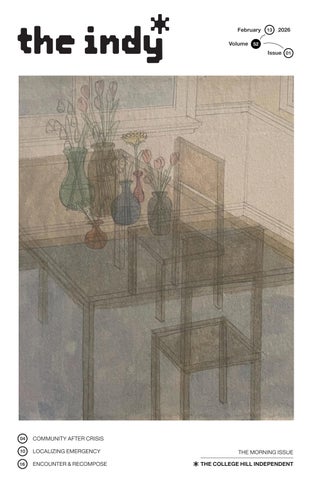
On December 13, 2025, a gunman shot and killed Ella Cook and Mukhammad Aziz Umurzukov, and injured nine other students during a Principles of Economics review session in Barus and Holley.
The title of the first issue of Volume 52 is morning, a time when one might begin their day or end their night; turn on music or sit in meditative silence; commune at the table or run out the door on fumes.The only given is that the sun will rise.
Thinking and writing about senseless violence feels daunting. Yet in the wake of December 13, we must, as the morning insists, carry on. A number of pieces in this issue are dedicated to the shooting and its aftermath.
In seeking to think and write about an experience that was as collective as it was varied and specific, we reckoned with senselessness, continued asking critical questions, and aimed to maintain accountability to our readership on College Hill and across Providence.
A fresh layer of snow covered campus the morning of December 14. It was the first snowfall of the season. - BNK
DESIGN EDITORS
Mary-Elizabeth Boatey
Kay Kim
Seoyeon Kweon
DESIGNERS
Isabella Castro
Hongrui Guan
Rose Holdbrook
Esoo Kim
Jennifer Kim
Jordan Kinley
Selim Kutlu
Jennie Kwon
Soohyun Lee
Chelsea Liu
Kayla Randolph
Anaïs Reiss
Lea Seo
Liz Sepulveda
Anna Wang
Caleb Wu
STAFF WRITERS
Layla Ahmed Tanvi Anand
Cameron Calonzo
Megan Chan
Nan Dickerson
Ray Eggerts
Jacob Hansen
Maxwell Hawkins
Mohamed Amine Jaoudi
Annie Johnson
Nadia Mazonson
Keya Mehra
Naomi Nesmith
Nikolaos
Nikolopouslos
Alya Nimis-Ibrahim
Nora Rowe
Alex Sayette
Samdol Sichoe
Luca Suarez
Santino Suarez
Mahliat Tamrat
Ben Underwood
Ellie Wu
Jodie Yan
ALUMNI COORDINATOR
Peter Zettl
SOCIAL CHAIRS
Raamina Chowdhury
Lila Rosen
Alex Sayette
DEVELOPMENT
COORDINATORS
Peter Zettl
Cindy Li
FINANCIAL
COORDINATORS
Zak Hashi
Simon Yang
*Our Beloved Staff
MISSION STATEMENT
ILLUSTRATION EDITORS
Selim Kutlu
Benjamin Natan
Serena Yu
ILLUSTRATORS
Abby Berwick
Rosemary Brantley
Rosalia Gonzalez Pousa
Hongrui Guan
Koji Hellman
Jiwon Lim
Ellie Lin
Megha Nambiar
Ruby Nemeroff
Meri Sanders
Angelina So
Luna Tobar
Naomi Zaro
Cora Zeng
Alena Zhang
Faith Zhao
COPY CHIEF
Eric Ma
COPY EDITORS
Sabine Cladis
Jordan Coutts
Mackenzie Ellis
Kainalu Faucher
Lucie Huang
Indy Nijjar
Camilla Rodriguez
Zeke Tesler
Sasha Watson
WEB EDITORS
Casey Gao
Erin Min
WEB DESIGNERS
Maja Mishevska
Amy Pan
Dominic Park
Joy Zou
SOCIAL MEDIA EDITORS
Olivia Falk
Sylvie Foster
Isabel Hahn
Avery Reinhold
Eurie Seo
SENIOR EDITORS
Jolie Barnard
Nan Dickerson
Paulina Gąsiorowska
Angela Lian
Nadia Mazonson
Luca Suarez
Sabine Jimenez-Williams
OUTREACH AND INCLUSION
COORDINATORS
Naomi Nesmith
Raamina Chowdhury
The College Hill Independent is a Providence-based publication written, illustrated, designed, and edited by students from Brown University and the Rhode Island School of Design. Our paper is distributed throughout the East Side, Downtown, and online. The Indy also functions as an open, leftist, consciousness-raising workshop for writers and artists, and from this collaborative space we publish 20 pages of politically-engaged and thoughtful content once a week. We want to create work that is generative for and accountable to the Providence community—a commitment that needs consistent and persistent attention.
While the Indy is predominantly financed by Brown, we independently fundraise to support a stipend program to compensate staff who need financial support, which the University refuses to provide. Beyond making both the spaces we occupy and the creation process more accessible, we must also work to make our writing legible and relevant to our readers.
The Indy strives to disrupt dominant narratives of power. We reject content that perpetuates homophobia, transphobia, xenophobia, misogyny, ableism and/ or classism. We aim to produce work that is abolitionist, anti-racist, anti-capitalist, and anti-imperialist, and we want to generate spaces for radical thought, care, and futures. Though these lists are not exhaustive, we challenge each other to be intentional and self-critical within and beyond the workshop setting, and to find beauty and sustenance in creating and working together.
Week in Just Fine Dining
c In the aftermath of tragedy, I found myself at a Greek diner in Summit, New Jersey, still scrolling. At this point, I had spent much of advent partaking in a sort of Marian pilgrimage across the North East. Feeling suddenly uprooted from my home base—a Providence apartment with no window locks and a flimsy back door—I began making my way to the suburban homes of various friends and distant relatives, whom I begged for accommodation on their sectional couches. I traveled through Western Massachusetts, “just outside of” Boston, and New Jersey, where I stayed in towns called “Morristown,” “Shaker-back,” and “Orange,” place names I thought to have been made up for comedic effect in Philip Roth novels. I stayed on inflatable mattresses, refining my Dunkin order, flipping through albums full of pictures of other people’s relatives, and watching TV. Mostly I scrolled on my phone, mechanically switching tabs between Sidechat and the Providence local news.
Now here I was, two weeks into my journey—the birth of Christ a fair way behind me—sitting in a cramped railway car in the northernmost city of Union County, munching on stale oyster crackers, and still scrolling. Having done the impossible—getting all the way to the bottom of Instagram—I refreshed my home page which revealed a grainy photo of the familiar facade of Louis Family Restaurant, Providence’s premier hole-in-the-wall diner. In the short caption to the post, it was announced that the mainstay establishment would be closing in less than a week.
Louis had been defying all expectations for years. Notorious for having medium to bad food, stale muffins, bitter coffee, mean—if not racially prejudiced—owners, horrific ventilation, no ambiance, old ketchup bottles with crusty tips, dirty floors, and smelly rags, hungover patrons with halitosis and bad manners, no service after 3 p.m. (in spite of a dinner menu offering childhood nightmares from the 1950s like meatloaf, barley soup, and a side of lima beans), sticky floors, no itemized receipts, and a dubious tax status, it had somehow been in operation since 1946. Not only that, but it was quite popular. Up until the very end, in some of its last weeks of operation, Louis was frequently packed– serving helpings of hangover food to frat boys, weird men, disaffected mothers and children, RISD printmakers, and bespectacled suitwearing types at all hours of the day—as long as it was before 3 p.m.
For years I was a Louis regular. I went there for the first time as a freshman, when I had been lured in by a wafting smell of grease. During my first ever Louis breakfast, I shared a table with a lanky middle aged man who was using a hair straightener to flatten a tome sized stack of CVS receipts. He ordered an off-menu matzo brei, ate it with a spoon, and declared loudly that although he was not himself Jewish, he felt an affinity for the Jews as they had been the wonderful people who had not only escaped slavery in Egypt but had also invented Matza, a delicious delicacy which also happened to be his favorite food. He then proceeded to order two Heineken 0.0s which he nursed for the next hour. From that day on, I came back to Louis at least once a week, most days just to get a cup of coffee and sit around.
Come senior year, my Louis visits became more infrequent.
Although it had seemed inflationproof, still serving full meals for under five dollars well into the age of the $20
( TEXT MARIA GOMBERG DESIGN ROSE HOLDBROOK ILLUSTRATION FAITH ZHAO )
breakfast plate, at some point management bumped all of the prices up by 20%. Around the same time multiple allegations of racist and homophobic profiling of customers by the ownership started to circulate. It became harder to justify Louis as a weekly expense.
Now, sitting in an unfamiliar diner in suburban New Jersey, this one with greasier curtains, rustier bar stools, and a larger variety of pudding-like substances on the menu, I experienced conflicting feelings. Around me were patrons, some haggard, some remarkably pristine, sharing a meal at a remarkably flawed restaurant, not terribly dissimilar from the one I knew on College Hill. I was failing to make sense of the fact that it was in such a place that the many faces of Northern New Jersey came together to battle the boxing day hangover. Diners, to my eyes, are a uniquely American space, a unique and loose network of vaguely familiar faces tied together by the love of one (albeit problematic and perhaps, unsanitary) establishment serving various kinds of potatoes.
I thought about the same scene unfolding at Louis, just a few hundred miles away, tinged with additional layers of grief. While my relationship with the diner had soured, I found myself moved by the prospect of seeing a community come together to commemorate a local institution that was closing down after decades of service.
Soon I was on my fourth Greyhound of the week inching my way back to Providence. I am like Mary going back to Nazareth or something like that.
On New Year’s Eve, I waddled, properly bundled, the three familiar blocks to Louis. Even for a holiday, the place was packed. Some fifty people were crammed into the tiny storefront, everyone trying their best to keep their coats out of their neighbors’ eggs. The servers, uncharacteristically aproned and uniformed, hurdled past patrons with arms full of plastic dishware brimming with breakfast foodstuffs piled higher than usual, and with more precision than custom.
The line to be seated was amorphous and endless, bunching up at the door and transforming into a smoking zone outside. A second, even longer line snaked away from the register, and towards a kitchen rack housing some paraphernalia–mostly T-shirts, some mugs, and antiques. This pile was being picked over by eager regulars and teenagers, hoping to bring a piece of the restaurant home. From the snippets of conversation I heard in my first few minutes of waiting, I was able to identify the motley crew as an array of out-of-town alumni, devoted locals, friends of the establishment, and reporters for online-only newsletters. The absence of Brown students felt eerie.
By the time I had my turn at the rack, everything was mostly gone. I grabbed one of the last remaining knickknacks, a papier-mâché mask coated in a thick film of greasy dust, and huddled my way to the end zone—an open bar seat next to the cash register. I sat around waiting to catch a server’s attention. In the meantime, Mayor Smiley and his entourage of appropriately pomaded white boys in pea coats, walked in, skipped the line and sat only a few tables behind me. I ordered my usual from my favorite server, a no bullshit twenty-something with great hair. As I waited for my order, an older man, decked out in a Carhartt and talking loudly on a Nokia some would deem vintage, sat down beside me. He ordered a cheeseburger and a large fry from somebody who I couldn’t see, and began swearing loudly under his breath.
“This sucks man, fuck this for real.”
I looked down at my hands, still gloved, and attempted to make conversation.
“Weather?” “Yep.”
We kept sitting in silence as the various elements of our orders made their way to our table. First coffee, then water, then a big glass of fountain soda with a wedge of lemon from a mystery bucket out back. Finally, when our
food arrived, my seat mate released from a hunger induced silence, began a monologue.
“In the 1960s, I used to be the Milkman for Louis. Back in the day, the dad, Louis, who was a real serious guy, would run this place like a prison. I would do my morning route, dropping off the milk in the morning, and I would order something at the bar, and chat up the waitress as I waited. Then the dad would come out and ask:
‘are you here to eat or to talk?’ and if you said ‘eat,’ he would say:
Well then eat, she is here to work and I am not paying her to talk’.
“It was a tight ship back in the day–”
He was interrupted by one of the owners; handshakes and pejoratives were lovingly exchanged.
Soon my neighbor’s meal was done, he paid for his food and ordered me a plate of fries with no remark but a tip of his Red Sox hat. I kept drinking my now-lukewarm coffee as he traded seats with a woman wearing a leopard print jumpsuit and feathered earrings. She immediately, before even sitting down, handed me her phone to take a picture of her.
My new neighbor grew up in Pawtucket. She had been put on to Louis by a friend of a friend, whose late husband had been an elementary school teacher in Fox Point. He had, quote, “taken his daily lunch break at Louis religiously.”
“No wonder he died in his 40s!
Now she was in town to visit her aging parents, and she saw it fit to go to Louis one last time before it closed or her parents died.
For the next few hours, I sipped on refills and butted my way into other people’s conversations. Some of the folks I talked to swore that Louis had never changed, and that they remembered things being exactly the same since the start. This I diagnosed as a false sense of nostalgia. Even in the time that I have been going to Louis, some meaningful alterations took place. Back in the day, the tables—now a new but cheap wood textured linoleum—used to be a glass panel covering big lumps of peach-colored mulch. The menu became laminated some time this past fall.
Now, mere days from closing its doors for good, the place was as different as it had ever been. The big wall of pictures of patrons and friends had been stripped and haphazardly painted over, the artwork had been given away to loyal regulars, the Garfield and Mashed Potato illustrations were placed in a photo album to be browsed at the front. The many family, friends, aficionados, visitors, alumni skeptics, and gawkers started to go home for the night. For better or for worse, Louis had closed.
MARIA GOMBERG B’26 is thinking about how this spring, Louis will be replaced by “Suis,” and she is wondering if they are somehow pronounced the same.
Community After Crisis
FOLLOWING THE BROWN UNIVERSITY SHOOTING, DINING HALL WORKER EXPERIENCES, AND MUTUAL AID EFFORTS RAISE QUESTIONS ABOUT COMMUNITY
This piece anonymizes dining workers at Brown University and does not include a student’s last name to protect their identities.
c The day after the December 13 mass shooting at Brown University that took the lives of Ella Cook B’28 and MukhammadAziz Umurzukov B’29 and injured nine others, J’s daughter urged them not to return to their job at a Brown dining hall. “She said to me [...] If I was you, I would not go back,’”J told the College Hill Independent. “But to me, I had no choice. I mean, community, we stand together.”
J’s decision to return reflects an emphasis on community that was foregrounded in the weeks after the shooting, especially in internal University communications and efforts. Brown Ever True, a “whole community” healing initiative founded in the aftermath of the shooting, also foregrounds the idea of community, displaying “community resources” and “community messages” on its website. “The Brown community is resilient, caring, and strong. We are ever true,” reads a line of bolded text near the top.
University President Christina Paxson acknowledged the breadth of the Brown community in an email sent on December 18. “We will never know and cannot possibly capture the full breadth of the countless selfless acts that continue to reflect who we are as a community at Brown—from staff providing shelter to students and helping reunite students with their families, to serving meals and rescuing belongings left behind during emergency evacuations, to offering embraces, consolation and solace,” the message reads.
In the days after the shooting, this community manifested in several tangible forms: in the masses of people who gathered at vigils, in the bouquets that accumulated, row by row, outside Barus and Holley, and in the dining hall workers who served food to injured students and their families while they waited at a nearby hospital. Mental health initiatives and funding efforts seemed to demonstrate the idea of community as a catalyst for meaningful action.
But tributes to Brown posted on social media tended to spotlight students. Public-facing media likewise implicitly reinforced a student-centered
notion of community: News articles investigating how Brown’s community reacted to the shooting mostly used student interviews to supplement their reporting. And while a student-organized mutual aid fund raised over $50,000 for students, another fund for dining hall workers, created by the same organizers, only collected around $21,000.
Like many other faculty and staff, dining services
staff took on roles that exceeded their job descriptions on the day of the shooting. M, a Brown Dining Services staff member who was working at the time of the shooting, shared that dining hall workers joined students in FaceTiming their families to tell them they were okay. Workers also locked down the dining hall, relocated students to a more secure location, escorted students to and from the bathroom, cooked meals for them, and offered verbal reassurances. After the shooting, one dining hall worker opened her home for nine students to stay the night.
Aarav Gandhi B’28, one student who was in the Sharpe Refectory during the shooting, recalled that the individuals working there at the time “were (really) reassuring and they did everything to make us feel safe and comfortable,” Gandhi wrote in a message to the Indy.
According to S, who was working in a dining hall on December 13, dining hall staff were unable to leave until around 12:30 a.m. Because some workers didn’t drive or had missed their buses, S and other employees drove several coworkers back home. Getting home around 2 a.m., S described feeling “physically exhausted but mentally wide awake” and mentioned how they were only able to sleep for
(
TEXT ANDREA LI DESIGN LIZ SEPULVEDA ILLUSTRATION MERI SANDERS )
about two or three hours.
The next day did not offer S any respite. ‘Business as usual’ was the plan for Sunday, management told S. In fact, S, alongside the approximately 15 other Sharpe Refectory staff who were working on Saturday, December 13, were all also scheduled to work on Sunday. So the day after the shooting—before the gunman had been caught—dining hall workers, alongside all other Brown staff, came in to work.
Following management orders, S returned to work on Sunday, but left halfway through the day: they remember thinking to themself, “it doesn’t feel right to be here.” Then, although S wasn’t sure if they would be paid for taking days off, they did not come to work for two days. When they returned from their break, S said they “still [felt] a bit of anxiety.”
Brown employees were not granted extra sick days in the wake of the shooting. In order to take time off, they had to use their paid sick days, of which dining hall workers have between 5 to 15 per year—depending on how long they have worked in their position. The University did, however, bring in mental health counselors and police therapy dogs to the Sharpe Refectory, a gesture intended for students and workers. In response to the shooting, Brown employees were given “access to an additional 10 [...] mental health counseling sessions” through Brown’s counseling provider, Spring Health, for a total of 20 free sessions, according to the University’s HR website.
“Counselors from Family Services of Rhode
Island were available from 9am to 4pm daily in the Sharpe Refectory, South Street Landing, Athletics/ Facilities Management building [...] and in the Campus Center,” University Spokesperson Brian Clark wrote in an email to the Indy.
J came back because they felt “it was right to come back and to feed the [students] that was here.”
The University “wanted us to come back. Some of us did. Some of us didn’t,” J said.
After returning, for J, a sense of fear remained. They mentioned “being dramatically impacted and not being able to go to work mentally, because you think, ‘Is there gonna be another copycat or something like that?’”
Though M, another dining hall worker, was not scheduled to work immediately after the shooting, M, similar to J and S, was back at work before the shooter was identified and located. They told the Indy they felt uneasy coming back to work, yet M did not receive much communication in advance of their return. “Nobody called me to ask if I was okay to come in for work. If I was capable, physically or emotionally,” M said.
M, who has worked at the Sharpe Refectory for over a decade, went on to describe the uncertainty workers felt during the initial lockdown phase. Throughout M’s employment at Brown, they noted how dining hall staff had never been trained on what to do in the event of a shooting—something M believed workers “desperately need.” M shared that about three years ago, a speaker had been scheduled to come in for a safety training workshop, but a conflict prevented them from coming, and the session was never rescheduled. M also recalled that on the evening of Dec. 13, it wasn’t until a Sharpe Refectory cook got a call from an employee at the Andrews Commons dining hall advising people in the building to relocate to a safer place—an hour after staff got word of the shooting—that dining hall staff moved students to the basement.
Within the Brown community, existing financial and material inequalities became more apparent in the aftermath of the shooting. Workers at dining halls had to return to work the day after. Meanwhile, although some students were able to head home the following week, others, due to their financial situation, visa status, or other circumstances, remained on a campus that felt physically unsafe.
Witnessing students’ pressing needs, on Sunday, December 14, Fanny B’26 called together a meeting of a few “organizers from various groups” and some members of the Undergraduate Council of Students whom Fanny was familiar with to discuss how they could help students access immediate needs such as food, temporary shelter, or transportation. “It very quickly became clear that we needed a fundraising effort” for students, Fanny said.
Fanny acknowledged the lack of agency many students felt in the face of tragedy. But having previous experience as an organizer means that “your crisis response is usually different,” they said. “Part of that is learning that you are not powerless during crisis.”
Fanny and others ended up creating a Google Form where individuals could either request aid or donate to the mutual aid fund. Requesters used the form to indicate how much money they would need, while donors provided their contact information. An organizer would then reach out to potential donors and receive funds via online payment methods, then transfer payments to individuals who had requested aid.
As students began departing in the hours after the shooting, a false report that shots had been heard on Sunday—coupled with fears of a shooter that had still not been caught—prompted an influx of aid requests, according to Fanny. Responses to the form rapidly accumulated, rising from “a couple hundred requests at first [...] [before] it started just doubling and tripling,” Fanny said, sharing that the final version of the form received 2,271 responses both offering and requesting support.
By the Wednesday after December 13, out of concern for non-student members of Brown’s community whom organizers had formed relationships with, organizers had contacted and were in communication with several of Brown’s dining hall
workers. “Conversations [with workers] eventually coalesced into a Google Form that we sent to dining workers,” organizer Kenneth Kalu B’27 said.
Although the form was initially distributed to workers whom organizers like Kalu “had personal relationships with,” it was sent to the United Service and Allied Workers of Rhode Island (USAW-RI)— the labor union currently representing Brown Dining Services, Brown Facilities, and Brown Libraries staff—on December 15. Union agent Amy Cardone sent the form to individuals who were working on the day of the shooting, though the form was open to all employees. A few workers whom the Indy spoke with heard of the form through the union, while several others were alerted to the form’s existence by coworkers.
“From those responses, we created a spreadsheet, contacted people who said that they needed funding, and began our fundraising process,” Kalu said. Gathering funds meant posting about the aid effort on Instagram and textbanking “alumni networks,” which Kalu described as “extremely generous. We raised about $21,000 from about 170 donors,” he said.
83 respondents to the form requested a total of $46,172 in funding. One respondent, who missed work for a week after the shooting, asked for stopgap funds to make up for lost wages, while others expressed a need for transportation and food. As of February, requests are still being fulfilled.
According to Kalu, “that effort is still ongoing,
“Still, as previously mentioned, there is a more than $30,000 gap between the amount raised for students relative to the amount raised for workers.”
though it is obviously winding down, given the fact that we’re getting further away from the shooting and our capacity as coordinators is diminishing.”
J received around $1,000 from mutual aid. Though he said the funding somewhat helped ease his transition back to work, “the atmosphere is still here. Now we have more security. It’s like a reminder when you see all these people walking around the streets and walk inside the dining hall, you know, [it] reminds you what happened before,” he said.
Security guards now monitor students as they enter the foyer of the Sharpe Refectory. According to the Department of Public Safety and Emergency Management, these guards are part of a campuswide initiative to “enhance safety measures.” To this end, “the number of Brown Public Safety officers on every shift” has doubled.
J mentioned that he was grateful for the students who “are helping us deal with this” and that “the funding helped out a lot.”
Still, as previously mentioned, there is a more than $30,000 gap between the amount raised for students relative to the amount raised for workers. On this disparity, Fanny said, “it’s so much harder to raise money for the workers, like, exponentially more difficult in terms of [the] timeframe and in terms of people being willing to give money.”
Kalu specifically raised concerns about the perceived constituents of community in the wake of the shooting. “I think that often, Brown employees are excluded from that notion of community. And I think that the difficulty of raising funds for Brown employees is a reflection of that [...] limited view of community,” Kalu noted.
“I don’t attribute this to any malice. [...] I think that people’s first thoughts were reasonably, you know, students, and I think that, and as a student, I’m grateful for that,” he continued. “But at the same time, I think that the ordeal that many Brown employees went through was unsung in a lot of ways, and I think that it made it more challenging to then fundraise on their behalf.”
Because the relative difficulty of collecting funds for dining hall workers limited the amount of money available, some workers were unable to access financial aid. Dining hall worker R, who had
applied for funding after hearing about the program from a friend, said that they eventually “received another email [from organizers saying] that they had ran out of funds.”
Despite difficulties with student organizing, in Fanny’s view, a student-led fundraising effort enabled a smoother process than if the University had taken over. “Brown usually can’t just give funds away without needing a whole application process that is really difficult,” while students’ funding efforts were “happening on a trust basis,” according to Fanny.
But it “also is disheartening to see that the administrative barriers are so rough that [the University] can’t top students in a case like this,” Fanny continued. “It’’s just the way that institutions work […] they will always have less flexibility” when it comes to providing immediate support in a crisis.
Reflecting a similar sentiment, S mentioned that they believed that “students and alumni supported us more than the University.” They added that they felt there wasn’t enough acknowledgement of dining hall workers’ experiences. “We were also here,” S said.
Two months after the shooting, workers at dining halls continue to face pre-existing issues with working conditions. Mutual aid requests from dining hall workers notably included wage-related “labor protection requests,” according to Kalu. These were redirected to USAW-RI.
Another persistent issue at Brown’s dining halls has been understaffing, which M attributed to the retirement of older workers during the COVID-19 pandemic as well as the hiring freeze that has been in place since March of 2025, which means that many staff are stretched thin.
M’s first shift back lasted 14 hours, from 6 a.m. to 8:15 p.m. While M emphasized that dining hall staff are “not obligated” to work more than their standard nine-hour workday and 40-hour workweek, many staff members work 14-hour shifts on two of their five workdays. Other times, they come in during their day off to work an additional nine hour shift because workers have “bills to pay and [Brown Dining Services] need the help,” said M. Unions continue to do critical organizing work. Notably, organizers with USAW-RI negotiate with Brown to ensure better conditions for union members. As of April 2025, USAW-RI has established a contract between Brown Dining Services and union members that improves wages: the terms of the contract stipulate five consecutive years of percentage-indexed wage increases for dining workers, and resulted in an immediate 1.5% wage increase for food service workers.
Most students might not engage with staff labor union efforts. But healing in community means healing with all community members. For his part, Kalu hopes that the support for dining hall workers will continue even though aid efforts have stalled.
“I don’t envision this format of the mutual aid effort continuing, but I do think that when the dining workers are organizing in their union, trying to win better conditions from Brown University,” Kalu said. “I think it’s our responsibility as students who benefit from the work of all of these people to back them up against university administration.”
ANDREA LI B’28 wants you to get organized.
Crickets from the crowd
c But the crickets are calm, and the stirring is long—they’re humming and whirring a spell-bound song1 They rhyme and they whine with a knowing concealed, loud respite from the grain of halls left unpeeled. Never short, sharp, high-pitched, or taunting, that noise we now know is nothing but haunting. To make it a ballad, to make it continue, to make sure the crickets are snug, we turn sinew. The silence that followed left a cabin for crickets. Days upon days buried deep into thickets.
Of feather and blue light and hot, hot sleep. You, still you, are now someone who weeps. You rock and you creak and you croak for routine, remembering grandmother’s Sony TV. Its speakers, a speckled and sandy black boulder—soft blankets of soap operas shift colder and colder. Her wide raisined cheeks and round stare passed to you, let a pupil walk off at the sight of the news.
In bed where you sleep in sharp corners of arms, a paisley of sweat rolls down hairs now alarm. Chimes of pebbles make rounds in the washing machine, skipping ripples of clothes and a hug of a sheen. Nails slick and stick to the wood of your limbs, it’s the bone of the floor where it pressed on your skin.
Hungry for pockets of blooming and budding, the crickets return to you planless and flooding. Your mind, a furnace of scarlet and black—crowds upon crowds creep through the smokestack. They dance and they jump on the start of your dream, with footprints of echoes just wishing to gleam.
No words, they say, and now you say it too. No rhymes, no rhythms, for someone like you.
A chirp, (v.): (of a small bird or an insect) make a short, sharp, high-pitched sound. Or, to speak to (someone) in a taunting way. Merriam-Webster
LILY ELLMAN B’27 is afraid of bugs.
c He who swallowed it all has swallowed the lights the invisible green wound that killed the pigeon last night yes He swallowed that too. The field is frozen. The stars are faint
The
( TEXT SEHEE OH DESIGN JEN EUNGYO KIM ILLUSTRATION CORA ZENG )
Interval
and You in whose ultimate madness we live You hang Your arm out the window pane out into the empty darkness You like us in the only universe we know pray for some kind of weather
the sign from the sky. The late green shimmer behind the leaves paralysis strikes us from afar and the freezing wind paints pink the pink that leaves a streak on Your cheek, that pink. The outlines of leg
after leg pulse pull and push and no one is talking anymore. We wait for He who has swallowed it all to spit things back out like the hidden sun that once gave pink to the sky the dot to dot of the stars blurred now
those were the blueprint of our faith and I heard that Jesus performed miracles but not so long ago I have established absence and our brains foamed at the boom of the explosion. We were mourning not His death but ours
in private, where no one would suspect us of sorrow and according to the news I have two ears two eyes two arms two legs. I have a skull too that was once used as a cup to hold nasty water in the myth of a monk who married a princess.
There, a pause and I realize that it was all one to me cold hard light blown dry chill and when the lash up derails and the rumor calcifies to keep the words a wild faith that someone will want to see will return to what we have made.
SEHEE OH B’26 has two hands two feet.
The Costs of Feeling Safe
A CASE AGAINST HEIGHTENED SECURITY
c It is only after checking every pocket—jeans, backpack, coat, jeans again—that I realize how truly fucked I am. It’s 11 p.m., my roommates won’t answer the phone, there’s a foot of snow on the ground, my socks are soaked through, and I have forgotten my student ID.
Immediately, I start to panic. It’s not my first time getting locked out of my building—in fact, last semester alone, I had to retrieve my ID card from the campus Lost and Found office no less than five times. But back then, it was just a minor inconvenience: Even without an ID I could always get into my dorm with relative ease, either by waiting for a familiar passerby to unlock the door or by tailgating a neighbor inside.
Now, the situation is different. Campus has changed, and the signs are everywhere, subtle but pervasive. Police cars idle on every corner, emergency phones cast sharp blue light across sidewalks, guards wander campus in their bright yellow vests. All of them, painful reminders of the same tragedy.
On December 13, 2025, a gunman attacked the Principles of Economics review session I was attending. Two of my classmates died and nine others were injured. In the following weeks, Brown’s security apparatus faced a barrage of media criticism, and the university is now under investigation by the
( TEXT ANNIE JOHNSON
DESIGN JENNIE KWON
ILLUSTRATION ALENA ZHANG )
Department of Education for potentially failing to provide emergency alerts in a timely manner.
In response, university administrators implemented decisive new security measures. These actions included constructing camera-integrated emergency phones, requiring swipe access on all previously public university-owned buildings, and not only doubling the number of Brown Public Safety officers but sourcing additional guards from Allied Universal, the world’s largest private security company. Some of these guards are stationed inside newly swipe-only buildings—such as Page-Robinson Hall, the John Hay Library, and the Student Health and Wellness Center—to doubly verify that students are carrying their IDs.
Brown has implemented these measures temporarily while security consulting firm Teneo conducts two comprehensive reviews: an “After-Action Review,” specifically focused on Brown’s response to the tragedy, and a “Comprehensive Campus Safety and Security Assessment,” addressing Brown’s campus security policies more generally. The results of both reviews will inform how the University approaches campus safety in the long-term. In particular, administrators announced that in the coming weeks, they would be engaging members of the
Brown community in reflecting on “what it means to maintain a campus where students, faculty and staff feel secure in their living, learning and working environments.”
But what does it mean to feel secure? Since December 13, the words “security” and “secure” have appeared in University communications upwards of seventy times; media coverage of the event was similarly repetitive. In the wake of a tragedy, it’s logical to try to understand how it happened in order to prevent it from happening again in the future.
However, it is important to keep in mind that these new security measures are not designed with the sole intention of mitigating risk. They also serve a secondary purpose: to make the community appear safer. This may explain, in part, why the University doubled its security staff without hiring any additional full-time mental health counselors. Privacy specialist Bruce Schneier covered this topic extensively in his 2003 book Beyond Fear: Thinking Sensibly About Security in an Uncertain World. In the book, he coined the now-popular term ‘security theater,’ referring to practices whose primary purpose is imparting the feeling of safety more so than actually achieving it. The term is often used to describe the TSA, another post-tragedy countermeasure, which, according to
a 2015 report, is less than 5% effective at preventing banned items from passing through security checkpoints. In spite of this, a 2023 survey found that 94% of passengers felt confident in the TSA’s ability to keep them safe.
Sometimes, security is rooted more in feeling than in fact. All security protocols that make a point to be visible and obtrusive are, in some sense, a form of performance. However, just because something is performative does not mean it’s ineffective. Rebuilding a safe atmosphere on campus is a legitimate goal. After all, real security failures took place on December 13, and if the new security initiative can help put community members’ minds at ease at a time when we are all recovering from trauma, then that is not something to disregard.
But when I look around at how the campus has changed, I can’t help but wonder whether this new sense of safety also comes with a cost. Of course, there are the monetary costs: Consultants, cameras, and security guards are not free. It cost Michigan State University $8 million and the University of Nevada, Las Vegas $11 million to implement similar measures after the respective mass shootings on their campuses in 2023. But then, there are also the invisible costs: harder to monitor, but just as present and pervading. One Brown employee who asked to remain anonymous told The College Hill Independent over email that the new Event Security Planning Guidance requirements have made it difficult to host events that are open to the larger Providence community. The new swipe access restrictions required her to hire an extra student staffer just to let people into the building.
A student employee in the Literary Arts Department, Faramade Odunlami, shared in a text with the Indy that her shifts at the front office now overwhelmingly consist of helping swipe people into the building. Additionally, internal spaces are now inaccessible overnight. “A professor on campus constantly has to ask for key access because the door to his classroom is always locked,” she wrote.
Brown’s culture has always been unique in its openness. Campus has never been sequestered from Providence at large; in fact, the University’s own admissions website advertises a “classic New England college experience within the heart of Rhode Island’s vibrant capital city.” However, the new security initiatives put that at risk: The anonymous Brown employee wrote that while she thought the new protocols made campus safer at this time, “we will have to wait and see how it plays out.” Odunlami also added, “Increased police presence on campus doesn’t necessarily make me feel safer,” but “sad at what has happened to our community.”
This is not to mention the cost for populations most vulnerable to increased police presence, such as students of color and undocumented students. Troublingly, the security reviews in partnership with Teneo are being co-led by former NYPD commissioner and LAPD chief Bill Bratton, whose tenure in law enforcement has been heavily criticized for targeting poor Black and Hispanic communities at the height of the ’80s and ’90s. He has since transitioned to the private sector, forming security consulting firm
The Bratton Group, which Brown previously commissioned to conduct another campus security review in 2002. Bratton’s consultants advised the administration to arm campus security officers, stating guns were necessary to “equip them for the broader role of policing College Hill and not just Brown property.”
The report then went on to recommend combining Brown, Providence, and RISD police forces, suggesting that the three groups meet biweekly to merge their databases and post foot patrols on Thayer Street.
In an email to the Indy, Brian Clark, the University spokesperson, wrote that “Teneo was selected based
on its extensive experience conducting higher-education campus safety and public safety assessments.” He added that “Commissioner Bratton knows the University well, having conducted public safety assessments for Brown earlier in his career,” and that, as of the time he was contacted, “there has been no long-term decision to vastly increase the police presence on campus.”
As previously discussed, the purpose of this entire security initiative is to make campus safer. If it accomplishes this goal, one could argue that these costs are requisite, even justified. But as someone who was shockingly close to the violence on that day, I feel that this premise rings a little hollow. The new security measures may be effective at preventing crime, but I can’t help but wonder if they could realistically prevent another attack like the one on December 13. One could imagine hundreds of horrible ways an attacker could potentially subvert them, especially an attacker with nothing to lose. Moreover, though somewhat reassuring, these measures also serve as constant, unavoidable reminders of the tragedy, making recovery hard and moving on almost impossible. Indeed, one 2020 study showed that rigorous policing in K-12 schools actually made students, especially those from disadvantaged socioeconomic backgrounds, feel less safe by signaling that such security is, in fact, necessary. When a guard demands I present my ID before getting my mail, or when I pass by a cop car on the way to the Blue Room, it reinforces the idea that there is still something to fear.
The attack and its aftermath exposed me to the worst of humanity, but also to the best of it—the impossible selflessness, courage, and strength of the Providence community. Closing campus and locking the doors cuts us off from both.
And maybe there is. Short of turning Brown into an armed fortress, there is no realistic way to 100% eliminate the possibility that violence could once again strike our community. How do we live with that? How can we carry on normally with that knowledge hanging over our heads? As humans, our senses of security balance on a razor edge. It’s easy for us to forget how fragile our lives are until suddenly, violently, we are reminded. I have certainly thought a lot about my mortality since that day: had I chosen a different seat in that review session, or failed to make it to the door in time, I might not have the privilege of writing this right now.
Could swipe access and security guards have prevented this? Maybe they could have; maybe they couldn’t have. We can only speculate. But what is certain is that on December 13, it wasn’t law enforcement or campus security that protected us: It was “John,” an unaffiliated community member who, under Brown’s new security policies, wouldn’t have had access to the building as he had no ID. Had it not been for John, more lives could have been lost, and by the investigators’ own admission, had John not submitted a tip to the Providence Police, the case may have remained unsolved.
In these critical moments where our input can shape the future of this campus, I want to urge my classmates to remember who took care of us in the wake of the tragedy. Police, yes, and government officials, but also facilities workers, dining hall
workers, business owners, faculty, and our peers. I don’t remember feeling particularly safe when a cop pounded on my dorm room door asking to take me to the OMAC, or when detectives questioned me about what I saw. But I did feel safe when I sobbed into the arms of a stranger at the Ratty, when a professor offered to drop everything to drive me to the airport, and when a local schoolteacher held my hand the entire plane ride home. The attack and its aftermath exposed me to the worst of humanity, but also to the best of it—the impossible selflessness, courage, and strength of the Providence community. Closing campus and locking the doors cuts us off from both.
I understand that our campus has suffered an unspeakable loss, and that all of us, in one way or another, are afraid. But to isolate students from each other and from the city that was on the frontlines of our support and recovery—is this really what Brown needs to heal? Maybe our sense of security isn’t something that needs to come from cops and cameras, but rather something we can find in one another. Reach out to friends. Join a support group. Hold the door for a classmate. Start a conversation with a stranger. Smile at someone. Pet a dog on the Main Green. Just do something—anything—except retreat into yourself. In his confession, the shooter revealed himself as isolated, suspicious of the world, with the intent to spread as much suffering as possible. I believe that the best way we have to resist this sentiment is to embrace each other, even if that embrace carries risk. To lose the openness, optimism, and integration that defines Brown’s culture would be a tragedy. To maintain it would be the ultimate show of strength.
The night that I get locked out of my dorm, it is pitch black, and the temperature is just beginning to dip below freezing. I shove my hands inside my pockets, preparing for a long wait in the cold, when another student approaches. We make eye contact, and I can sense her assessing me, wondering whether or not I am a threat. For a moment, I’m certain she’s about to pass me by. But instead, she stops. She turns around.
“Do you need help?” she asks, and pulls out her ID.
She lets me in, and I step into the warmth.
ANNIE JOHNSON B’28 is holding the door.
Key
Information
Four categories of communication
channels appear on this time map, listed here in chronological order of their first notifications about the December 13 shooting:
Directly unofficial local sources: S Local news reporting, a Informal communications (including Sidechat )
This time map was composed out of information disseminated by Brown and RISD to their respective communities, published by news outlets, posted on social media, and shared by spokespeople for Brown, RISD, and the Providence Mayor Office in email exchanges with The College Hill Independent .
Official communications from Brown: c Rave BrownAlerts, @ Administration emails
Official communication from the City: a Social media communications, T Press conferences, b PVD311 Alerts Official communications from RISD: § Rave RISDAlerts, @ Administration emails
J: direct informational link (causation) —: indirect informational link (correlation)
Please refer to the next page for expanded definitions of items in this key.
Localizing Emergency
A TIME MAP OF INFORMATION SPREAD THROUGH BROWN, RISD, AND PROVIDENCE ON THE EVENING OF DECEMBER 13
S News, 4:25 p.m. WPRI notifies their readers, live viewers, and X followers about the shooting for the first time
a Reddit, ~4:30 p.m. The first BrownAlert circulates beyond the Brown community. Social media users post about the shooting on r/Providence
S News, 4:52 p.m.
The Providence Journal publishes its first article about the shooting a X, 5:01 p.m. The PCC posts about heavy police presence on Hope Street near Brown “due to an active shooting”—the first such designation by an institution accountable to the wider Providence community
S News, 5:12 p.m. The Boston Globe publishes its first article mentioning the shooting a Facebook, ~5:21 p.m. The PCC reposts an article in Spanish from Telemundo Nueva Inglaterra about an armed man (“hombre armado”) on Brown’s campus— the first time this PCC account designates the emergency as a shooting
§ RISD, 5:30 p.m.
The RISD community receives a 2nd alert, which mentions the active shooter situation—68 minutes after Brown’s first alert S News, 5:49 p.m. The Brown Daily Herald publishes its 1st article about the shooting T City, 6:02 p.m. City Councilman John Goncalves releases a newsletter mentioning the shooting
b PVD311, 9:49 p.m. The City sends a 2nd alert. It notifies (registered and opted-in) Providence residents that the shelter-in-place order “remains in effect” around Brown’s campus
c Brown, 4:22 p.m. The Brown community receives the first alert, notifying them of an active shooter situation near B&H. It advises them to lock doors, silence phones, and conveys the Run, Hide, Fight protocol
( TEXT SCHEMA HQ DESIGN ANNA WANG )
a X, 4:49 p.m. PPD writes of “heavy” police and fire presence “on Hope Street near Brown University,” requesting potential readers to avoid the area The City reshares Mayor Brett Smiley reshares a Facebook, 4:51 p.m. The City restates The PCC reshares
§ RISD, 4:28 p.m. The RISD community receives the first alert. It only notifies them of “police activity” near Brook and Thayer streets
The Mayor reshares a One user asks: “Why were there no emergency alerts sent out to cell phones”
a X, 5:33 p.m. PPD posts about multiple shooting victims “in the area of Brown,” and orders potential readers to shelter-in-place. This is the first time an outlet directed to the wider Providence community explicitly mentions a shelter-inplace order
b PVD311, between 5:10 p.m. and 5:23 p.m. (Registered and opted-in) Providence residents receive the first alert from the City. It notifies them only of “heavy” police and fire presence on Hope Street near Brown
The PCC reshares @ Brown, 6:05 p.m. Brown sends its first extended alert, received exclusively via email. It notifies the community of the victims’ hospitalization
~4:03 p.m. A revision session for Principles of Economics, taking place in Room 166 of Barus & Holley (B&H), is ending. Among others, MukhammadAziz Umurzokov and Ella Cook are in attendance. As the students start to leave, a masked man enters the auditorium and opens fire. He departs the building a few minutes later 4:07 p.m. The Providence Police and Fire Departments (PPD and PFD) are dispatched, 1 minute and 22 seconds after the first 911 call 4:10 p.m. First responders arrive on site. PPD and PFD start securing the crime scene 4:11 p.m. PFD determines multiple people have been shot 4:15 p.m. PPD formally declares the incident an active shooter situation 4:21 p.m. The shelter in place is instituted 4:23 p.m. All eleven victims are transported to Rhode Island Hospital Y 4:05 p.m. The first 911 calls are made a Sidechat, 4:05 p.m. –4:22 p.m. ~25 posts referencing the shooting appear
c Brown, 4:52 p.m.
a X, 6:11 p.m.
The Mayor reshares Brown’s post linking the brown.edu website for access to community updates a Reddit, 6:15 p.m.
The Brown community receives a 2nd alert, which states a suspect is in custody
c Brown, 5:11 p.m. The Brown community receives a 3rd alert, which clarifies no suspect is in custody
A user publishes a post titled: “Has anyone received alerts from the city in all of this?”
a X, 5:45 p.m. U.S. President Donald Trump states he has been briefed on the shooting, that the FBI is on the scene, and a suspect is in custody—34 minutes after Brown’s clarification a Facebook, 6:05 p.m. The PCC clarifies the police do not have a suspect in custody a X, 6:16 p.m.
B&H believes he has found the suspect 4:46 p.m. Statewide mutual aid begins responding to calls for investigation and safety support a Facebook, 4:47 p.m. In response to a (since-unavailable) post, The Providence City Council (PCC) tells potential readers to stay clear of an (unstated) area of police presence
An officer searching
~4:36 p.m.
RIEMA reshares. This is their only post of the evening a Facebook, 5:39 p.m
The PCC posts a screenshot of the 3rd Rave BrownAlert
The PCC shares there is no suspect in custody, and restates the shelter-in-place order a X, 5:31 p.m. RI Governor Dan McKee states the shooting is being “actively” monitored. Local law enforcement is supported by RI State Police and the Rhode Island Emergency Management Agency
c Brown, 6:10 p.m. The Brown community receives a 6th alert, clarifying that earlier reports of shots on Governor Street were unfounded
a Change.org, sometime after 6:35 p.m.
RISD student Sabela Chelba publishes a petition calling on Brown and RISD “to collaborate on a unified emergency system”
a Change.org, 12/15, 10:18 p.m. Chelba shares that texting “BrownEmergencyList” to 67283 allows people to opt into
§ RISD, 5:38 p.m.
The RISD community receives a 3rd alert, reporting on shots fired near Governor Street
The PCC notifies potential readers about reported shots on Governor Street
c Brown, 5:28 p.m. The Brown community receives a 4th alert, sharing the report of shots fired near Governor Street a Facebook, 5:34 p.m
§ RISD, 6:35 p.m.
The RISD community receives a 4th alert, learning the situation remains ongoing, and they may find ongoing updates at brown.edu
The RI Governor restates the shelter-in-place order and expresses grief over the citywide tragedy a Facebook, 8:21 p.m.
The PCC shares a message from PCC President Rachel Miller, noting the shelter-in-place order remains and no suspect is in custody X, 8:43 p.m. The PCC restates
~5:25 p.m. Officials receive reports of shots fired near Governor Street 5:37 p.m. The Providence Emergency Management Agency (PEMA) requests activation of RIPTA buses for transport of students to the reunification center. People start being evacuated from non-residential buildings in the vicinity of the crime scene
BrownAlerts @ Brown, 12/16, 11:18 a.m. President Paxson officially names the two students killed during the tragic events of December 13: MukhammadAziz Umurzokov and Ella Cook.
Brown University President Christina Paxson sends her first email to the Brown community. She acknowledges the deaths of two students, confirms the hospitalization of at least eight other victims, and urges community vigilance throughout the shelter-in-place order a X, 7:48 p.m.
c Brown, 7:30 p.m.
The Brown community receives a 7th alert, which restates the shelter-in-place order @ Brown, 7:31 p.m.
c Brown, 5:53 p.m. The Brown community receives a 5th alert, which restates the shelter-in-place order @ Brown, 6:33 p.m. Brown sends its 2nd extended email alert, confirming two students have been killed T City, 6:34 p.m. –6:59 p.m. 1st press conference. City officials confirm two students have been killed, and the eight other victims they are aware of are in critical but stable condition
The PCC states the shelter-in-place order remains in effect and apologizes for “any confusion” a X, 6:55 p.m. PEMA notifies readers the shelter-in-place order remains in effect The City reshares The Mayor reshares a X, 7:11 p.m. The PCC urges residents to review their home security footage to aid the investigation Facebook, 7:11 p.m. The PCC restates
a Facebook, 6:41 p.m.
c Brown, 8:28 p.m.
The Brown community receives an 8th alert, which restates the shelter-in-place order a Reddit, 8:52:22 p.m. A user voices anxiety about residents receiving no official communication from the City, and expresses confusion over whether the city is on lockdown a Reddit, 8:58:17 p.m. A user publishes a post titled: “Why [ha]s the shelter-in-place alert not been issued yet?”
@ RISD, 8:58 p.m. RISD
President Crystal Williams sends her first and only email of this evening. She references the “active shooter situation,” notes RISD is in contact with Brown Public Safety and PPD, but does not explicitly mention the shelter-inplace order
c Brown, 9:29 p.m. The Brown community receives a 9th alert, which restates the shelter-in-place order a X, 9:32 p.m. The Mayor states the shelter-in-place order remains in effect, and thanks local, state, and federal agencies for their support The City reshares
a X, 11:04 p.m. PPD posts the brief video of the suspect The RI Governor reshares a Facebook, 11:10 p.m. The Mayor reposts
@ Brown, 12/14, 1:49 a.m. President Paxson sends a 2nd email to the Brown community. She restates the shelter-inplace order, details the ongoing evacuation and reunification processes, and confirms that all victims are students c Brown, 12/14, 1:55 a.m. The Brown community receives an 11th alert, conveying the ongoing evacuation process and restating the shelter-in-place order
T City, 9:35 p.m. –9:56 p.m. 2nd press conference. City officials confirm a ninth victim. The shelter-in-place order remains in effect. The Mayor states video of the suspect will be released at the end of the conference a X, 9:52 p.m. PEMA restates the shelter-in-place order PPD reshares The City reshares a Facebook, 10:02 p.m. The Mayor restates a X, 10:13 p.m. The PCC urges readers to submit to the FBI tipoff site
9:54 p.m. The FBI and PPD launch a tipoff website and phone number
T City, 11:11 p.m.
–11:30 p.m. 3rd press conference. There are no updates on the investigation. The Mayor shares a new FBI tipoff site link specific to Brown and the PPD tipoff number. The shelter-in-place order remains in effect
c Brown, 11:08 p.m. The Brown community receives a 10th alert. They learn about the established perimeter, and the evacuation plan for all people hiding throughout non-residential buildings within it. This evacuation plan involves all RISD affiliates, as well as Providence residents and visitors located in the perimeter, who would not have received this alert directly a X, 11:09 p.m. The Mayor reshares the FBI’s post about its tipoff site and number
Between 10:46 p.m. and 10:51 p.m. Almost an hour after the 2nd press conference, City officials release a brief video of the suspect ~11:00 p.m. The police establish a perimeter
The Mayor reshares a X, 11:11 p.m. The City shares the PPD tipoff number and the Brown-specific FBI site link a Facebook, 11:15 p.m. The City reposts the Mayor’s video, alongside sharing the PPD tipoff number and the Brownspecific FBI site link a Facebook, ~11:30 p.m. The PCC restates a X, 11:23 p.m. PPD distributes bilingual (English and Spanish) information about their tipoff number a GoFundMe. 12/14 A fundraiser in memory of MukhammazAziz Umurzukov is published, revealing him to be one of the two victims killed in the shooting a Parish message. 12/14 The Cathedral Church of the Advent in Birmingham, Alabama, sends a message to its parishioners, revealing Ella Cook to be one of the victims killed in the shooting
§ RISD, 12/14, 8:24 a.m. The RISD community receives a 5th alert, informing them the shelter-in-place order is lifted and directing them to brown.edu for details
12/14, before 5:42 a.m. The City lifts the shelter-in-place order c Brown, 12/14, 5:42 a.m. The Brown community receives a 12th alert, informing them the shelter-in-place order is lifted T City, 12/14, 7:05 a.m. –7:26 a.m. 4th press conference. The shelter-in-place order is lifted a X, 12/14, 7:07 a.m. PEMA informs potential readers the shelter-inplace order is lifted
On December 17, the Journal reported on a different reason for not deploying WEAS RISP Lieutenant Colonel Robert Creamer assessed that “a statewide alert was not sent [on December 13] because there was not a wider threat.” This is despite RISP not having a suspect in custody nor credible evidence of the shooter’s whereabouts at the time deployment of WEAS would have been appropriate. A day later, the RI Governor Dan McKee provided yet another reason to the Journal : Since officials initially did not have “enough details,” they were concerned about distributing inaccurate information. Though they are not location-dependent, both Rave BrownAlerts and Rave RISDAlerts are affected by many of the same problems as WEAS . Silenced or not, Rave pushed notifications across multiple channels to these schools’ entire communities, regardless of whether they were in immediate risk or already gone from campus for the break. At times, both systems also relayed information that later proved inaccurate—at 4:52 p.m., Brown notified its community that the shooter had been apprehended, and at 5:38 p.m., RISD reiterated Brown’s later-retracted notification of shots fired near Governor Street. Nonetheless, both institutions’ internal threat assessments eventually designated the December 13 shooting as necessitating the deployment of Rave alerts to their entire communities. Ultimately, even though it may not have correlated to a sense of safety, affiliation with an elite institution facilitated automatic access to targeted, passively gained information throughout this emergency. The alerts distributed—and, indeed, those not distributed—by the City left the responsibility of informational spread among the wider Providence community in the hands of individuals, and to the powers of coincidence. On the evening and in the aftermath of December 13, members of r/Providence on Reddit deemed it necessary to scrap information together from sources such as: (semi-accessible) university alerts, (dispersed) newspaper updates, and (potentially misinformed) communications from the Citizen app—a self-described real-time, location-based “personal safety network.” These efforts were responding to what some users had determined to be a “total lack of information” from local officials. On December 15, the Globe reported that “neighbors of Brown University” did not feel adequately notified of the “danger [they were in] as an assailant was still on the loose.” Two weeks later, the Journal recorded the general reflection that “the absence of automatic alerts at the outset of the crisis [had] worried many people,” especially on “the East Side of the city.” On February 10, dosReis informed the Indy that the City is currently “focused on establishing a shared factual timeline and identifying opportunities to strengthen layered, accessible, and clearly standardized emergency communications moving forward.”
from PVD311 . Nonetheless, a Journal article the next day reported that Mayor Brett Smiley “stood by the city’s emergency communications to residents” when asked about the performance of PVD311 on December 13.
CodeRED Alerts: CodeRED is a bilingual (English and Spanish) emergency notification service “that allows public safety to notify residents and businesses by phone, email, and text about emergency situations.” Sign-up is required to receive alerts by phone, email, or text. The most recent data on CodeRED user numbers (2016) cites ~400,000 registered Rhode Island residents. In a December 29 Journal article, RIEMA spokesperson Courtney Marciano stated that CodeRED can be used to send both statewide and targeted, citywide alerts. CodeRED was subject to a national cyberattack in November 2025. RIEMA reported the system was “functional” the weekend of the shooting. Though PPD spokesperson Kristy dosReis stated in the January 22 Herald article that CodeRED was one of the channels the City used to communicate with residents on December 13, on December 31 the Journal reported registered users not receiving “any CodeRED notifications about the Brown shooting.” In response to a request for comment from the Indy dosReis wrote: “with respect to the CodeRED system specifically, the City is currently reviewing the use and effectiveness of all notification tools deployed during the incident as part of a broader after-action process.”
Official communication from the City a Social media communications: The first social media post from the City came at 4:47 p.m., when the Providence City Council (PCC) Facebook page reshared a now-unavailable post warning readers to stay clear of an unstated area. Like RISD’s alerts, it was not until later (5:01 p.m.) that the City dubbed the emergency a shooting, this time on the PCC’s X account. Throughout the evening, city and state officials distributed (often disparate) information across social media platforms and individual accounts, all with distinct engagement rates—e.g. the 4:47 p.m. PCC Facebook post has two likes and two shares, while the 5:01 p.m. PCC X post has ten likes and ~3,000 views. These outlets included but were not limited to: X accounts of the PCC, the City, the Mayor, the Providence Police Department (PPD), the Providence Emergency Management Agency (PEMA), the RI State Police (RISP), the RI Governor, and the Rhode Island Emergency Management Agency (RIEMA); Instagram accounts of the PCC, the City, the Mayor, PPD, and the RI Governor; Facebook pages of the PCC, the City, the Mayor, and PPD. Similar to news outlets, social media platforms are not designed to deliver life-threatening alerts. Though they serve as popular sources of information, the responsibility of ensuring delivery rests on individual users, not on the platform itself—especially when the information is dispersed across many outlets.
@ Administration emails: Starting at 6:05 p.m., the Brown community began receiving extended, email-exclusive updates from Rave , and from University President Christina Paxson.
BrownSiren: The university DPS website states BrownSiren is an outdoor, non-targeted alert system for campus-wide, life-threatening emergencies. Its warning consists of a loud alert tone and a voice message describing the emergency. It is meant to urge people within earshot to go indoors and shelter in place. Though the website lists an “Active Shooter” as one example of an emergency where this system “would likely be activated,” Clark says that Brown’s public safety team decided not to deploy it “to avoid inadvertently sending community members into the path of an active shooter who was reported to be in a University building complex.” Official communications from RISD
Directly unaffiliated local sources
S Local news reporting: This time map includes first mentions of the shooting by WPRI, The Providence Journal, The Boston Globe, and The Brown Daily Herald . These are neither comprehensive nor representative of the news coverage that evening; they serve as reference for when Providence residents or visitors unaffiliated with Brown or RISD could have found out about the active shooter situation, especially before Providence officials sent their alerts. News outlets—even ones with breaking news notifications—are not targeted emergency alert systems. They relay information recipients must know to seek out themselves. As such, though citing subscription numbers of particular newspapers is possible, determining how many Providence residents or visitors learnt about the shooting through these outlets is not.
WEAS Alerts: WEAS is a “Wireless Emergency Alert System” whose notifications reach every cell phone within a designated emergency alert area automatically. The City requests its deployment from RIEMA. It does not require sign-up or opt-in. According to a July 24 press release introducing WEAS this ensures that not only Providence residents, but also “visitors and temporary residents receive critical life-saving emergency alerts.” WEAS was not deployed on December 13. In the December 29 Journal article quoted above, Estrella states a WEAS alert “was considered at the beginning of the incident,” but the City decided against its use out of “safety concerns related to cell phones potentially beeping at the wrong time.” The article links these concerns to the possibility of pushing alerts to people hiding in silence and the impossibility of targeting “a small geographic subset of Providence residents.”
T Press conferences: Rhode Island and Providence officials held three press conferences on December 13. These were livestreamed, posted on YouTube , and summarized by local news outlets. The first of these conferences was held two and a half hours after the shooting, and lasted ~25 minutes. Though an official source on the state of the victims, the shelter-in-place order, and on the investigation to anyone in Providence, they were not meant to provide the public with immediate and succinct warnings.
Two days later, another Journal arti cle reported that the Federal Communications Commission had adopted new rules at the start of 2025 “that allow emergency management officials to send ‘silent alerts,’ which can be used in an active shooter situation.”
b PVD311 Alerts: PVD311 is an information service for “city services and department support—a place [to] ask questions or report a non-emergency issue pertaining to the City.” It was the only City-operated communication channel used to update Providence residents throughout December 13. To receive text alerts from PVD311 , users must register on the website and opt into receiving text alerts. On January 22, the Herald reported that “just over 6,000 Providence residents had created a PVD311 account as of Jan. 20 at 3 p.m.” The population of Providence is just under 195,000. In a December 15 Globe article, Mayor spokesperson John Estrella admitted the City “has been made aware that some individuals are not receiving texts”
RISDAlerts: According to RISD’s website, this is the school’s “mass notification system […] designed to alert our community in the event of a campus emergency.” Similarly to the Rave BrownAlert system, all RISD community members are subscribed to Rave RISDAlerts, and will receive texts, emails, or push notifications regardless of location relative to campus. As such, this system is designed to reach between ~4,000 RISD students, faculty, staff, and affiliates. The RISD community was not explicitly notified of the active shooter situation until 5:30 p.m.—a nearly 90-minute delay. By then, Brown had already sent four Rave notifications. This motivated Sabela Chelba, a RISD student, to publish a petition to unify the alert systems at the two schools. The petition had received over 2,300 signatures by the night of December 15. RISD Public Safety informed the campus mailing list on February 10 that “families and members of the public” may opt-in to receive RISD’s alerts by texting “RISDALERT” to 226787. @ Administration emails: The RISD community received a single email from College President Crystal Williams on the evening of December 13.
§ Rave
a Unofficial communications: This time map gives a glimpse into the multidirectional channels of communication that were used across social media and micro-social networks. It focuses on Reddit and Sidechat, but could have included X, Instagram, Discord, and, of course, texts and calls to and from loved ones. a Sidechat posts: Sidechat is an anonymous messaging app. Brown’s local Sidechat group, usually host to routine discussions of college life, is accessible only with a brown.edu email. It has ~8,000 registered users, most of which are undergraduate students. Brown has a student population of ~11,000.
Official communications from Brown
c Rave BrownAlerts: In an email to the Indy university spokesperson Brian J. Clark stated that these alerts are Brown’s “primary emergency notification system,” meant to deliver urgent warnings via phone, text, and/or email to all students, faculty, staff, and other university affiliates. The system’s reach has been stated as ~20,000 people, regardless of a recipient’s location relative to campus. Clark noted that the most important of these alerts were also uploaded to the brown.edu website. The first BrownAlert was sent at least 15 minutes after the shooting was first mentioned on Sidechat This delay distressed some of its users. Nonetheless, a December 15 article by the Globe assessed that “Brown faculty and students felt adequately notified of the dangers by their administrators,” possibly because the mechanics of the Rave BrownAlerts allow recipients to gain information passively, without having to seek it out themselves. According to Clark, “any member of the greater community” may now opt in to receive Brown’s emergency alerts by texting “BrownEmergencyList” to 67283.
All of a Sudden It Has Happened: On Tragedy with Art
( TEXT LFSGTCLGMMH DESIGN SEOYEON KWEON ILLUSTRATION ALENA ZHANG )
c How to narrate a tragedy that is not, or is only partially, your own? How to write as one voice among many? What is the binding element, the ligature, that allows us to situate our own experiences within a network of the experiences of others?
Decentering any single authorial voice, we are seeking to formally enact the premise of a communal working-through. We are interested in the ways in which different individuals—members of the Indy, Brown/RISD, Providence communities—understood this event through and with different artistic objects, and how encounters with the arts take us outside of ourselves, allow for identification with difference, allow people to escape the discreteness of their experience while remaining attuned to the ways in which their experience may exist as a constitutive part of a larger totality.
What is the “we” that grieves? Where, and how, may we find ourselves in it?
“The
Dead”
I woke up the morning of December 14 early, having spent the previous night locked down in my dorm. It was snowing, the first snow of the season, late, unexpected and slightly obscene in its timing. I had spent the night before— the time that I was not reading the news or talking on the phone with, as the news of what was happening spread, increasingly distant members of my family—switching back and forth between Baldwin’s Go Tell It on the Mountain and, trying to preserve some sense of normalcy, a few Dickinson poems assigned for a class. The language that arrived, strangely immediate in my thinking, was from neither Baldwin nor Dickinson. Instead, it was the final sentence of James Joyce’s short story “The Dead,” a story that I had last read on a plane from Des Moines to Chicago about a year ago. “His soul swooned slowly as he heard the snow falling faintly through the universe and faintly falling, like the descent of their last end, upon all the living and the dead.”
It is this first word that has so occupied my thinking here— this “his.” In that moment, by routing my understanding of these events through those words, I was identifying with the “he” of this text. It is the way in which the arts may offer ways of thinking simultaneously as and outside of the self—particularly important in this very moment, where the rhetoric of ‘communal grieving’ or ‘working-through in community’ can overlook the fundamental distinctness of all of our experiences of that moment—that is so essential here.
LFS, B’27
Antigone
These days, I’m thinking about Antigone.
In the Greek tragedy, Antigone defies the decree of Creon, the new king of Thebes, to perform burial rites for her brother Polynices, who died in a siege against the city of Thebes, a traitor to the country. When she is brought to trial, she admits to burying her brother proudly. In the translation I read, she tells Creon he has no right to make decisions about Polynices’ burial because his laws, the laws of the state, are not the laws of the gods and the laws of nature. “Death is another country.” I will never forget this line.
In sophomore year, we read Antigone in the context of the U.S. war across the Pacific. In junior year, we read Antigone in the context of the Mothers of the Plaza de Mayo protests in post-dictatorship Argentina. To take the position of Antigone is to advocate for the rights of the living against a state through the position of the dead. In the two readings, Antigone articulates the unspeakable grief Asian (im)migrants in America hold for the families, homes, and ecologies in Asia destroyed by U.S. military occupation, and the state disappearings of intellectuals, activists, students, citizens who were the children, grandchildren of the mothers and grandmothers of the Plaza de Mayo.
Since December 13, I cannot help but think about an Antigone-like position taken on by people speaking about the victims of school shootings. Their deaths are named, discussed, reiterated, reposted, to make graspable the constant threat from a nation-state that sponsors and profits from the global arms industry.
Yet, I feel irked by their politicization. I did not know Mukhammad or Ella. I will never get to know them. No description of their interests, studies, personalities, or politics, can capture who they were, who they could have been. My task, and that of too many people, is to grieve an absence of knowing. We should not be asking them to steer the American state. Their country is death, and we should learn to respect its sovereignty.
CL, R’27
“Under
Pressure”
“Is That All There Is?”
On December 13 and the days following, I found myself listening over and over to Peggy Lee’s 1969 rendition of “Is That All There Is?,” a song written by Jerry Lieber and Mike Stoller. Lieber was inspired to write the song after reading German writer Thomas Mann’s 1896 short story “Disillusionment.” Indeed, disillusionment is what the narrator experiences in the face of the events of the song— when her house burns down, when she goes to the circus, when she falls in love, she can’t help but wonder: “Is that all there is?” After hearing stories about great tragedies, the actual experience of one is disturbingly mundane. It seems that it could never truly happen, and then all of a sudden it has happened.
GT, B’26
Three days after December 13, I was in the car with my mother as she drove me home from an appointment with a psychiatrist. Quick and cold. We were almost home, so I closed my eyes. I’d had a headache since I’d gotten back, but the silence made it worse, and I asked her to turn on the radio. She turned the dial a few times until “Under Pressure” by Queen and David Bowie came on. She likes this song. It used to make me uncomfortable. It is about something big and rich and it is not a love song, but it is also in many ways the only love song. It was written during a bender in Montreux, Switzerland in 1981, the year of the first reported case of AIDS, the premiere of MTV, the death of Bob Marley, Princess Diana’s marriage. Tragedy and culture interchanged, the confusion of how they can coexist. It was the first thing I had heard since leaving Brown that made much sense. Why can’t we give love, give love, give love, give love, give love? If love is an answer, it is equal parts instinctual and evasive. Obvious, easy to forget. And so I cried into my hand for what felt like no reason, or too many to make sense of.
GM, B’28
EXPORTED VIOLENCE
THE MATERIAL, POLITICAL, AND RHETORICAL EXCHANGE BETWEEN ICE AND THE IDF
( TEXT BENJAMIN RINGEL DESIGN YAK MIK
ILLUSTRATION PAUL LI )
c On January 30, 2026, over a thousand Providence residents marched to the State House, joining a nationwide general strike to protest Immigration and Customs Enforcement’s (ICE) violent raids and kidnappings in U.S. cities and the killing of eight people this year alone. Among the bundled heads and winter coats was a large cardboard sign, its message simple: “ICE = IDF.” Other signs made related demands: “End Zionist political funding,” “Free Palestine,” and “End state violence everywhere.”
At first, these causes may seem tangential; the equation “ICE = IDF” simply a metaphor comparing the racialized means by which ICE tears apart families and Israel’s violent subjugation of Palestinians. However, the relationship between the two is not strictly symbolic or protest hyperbole; rather, it is material, institutionalized, and deliberate. Both are rooted in shared funding, joint training programs and policies, similar surveillance technologies, and a common logic that treats entire populations as threats to be managed, tracked, and eliminated.
Israeli and American law enforcement have long exchanged information, tactics, and training. Since the early 2000s, thousands of U.S. agents, including ICE officers, have trained with the Israeli military and police. The Anti-Defamation League runs an IsraelU.S. law enforcement program where, according to the director David C. Friedman, U.S. law enforcement “learn[s] lessons from Israel in terms of tactics and strategies” while also being swayed to support Israel’s imperial cause: Friedman also bragged that officers who participate “come back [to the US] and they are Zionists.”
U.S. Army veteran and whistleblower Anthony Aguilar, who worked as a military contractor in Gaza and witnessed joint training sessions between U.S. and Israeli personnel, drew explicit parallels between Gaza and Minneapolis: “ICE trains in Israel—then brings those same apartheid tactics back home.” Aguilar contends that “the terror that we export, the oppression that we export, will come back to our streets. It’ll come back to our neighborhoods, and we are all next.”
In addition to holding joint training sessions, the Department of Homeland Security (DHS) has
organized conferences with Israeli security officials and awarded grants to Israeli officers conducting research on areas such as countering “violent extremism.” According to the executive director of Researching the American-Israeli Alliance (RAIA) Eran Efrati, when training with Israel, U.S. police delegates watch “live demonstrations of repressive violence in real-time, in protests across the West Bank, patrols in East Jerusalem, and visits to the Gaza border.” Efrati told Al Jazeera that delegates learn about Israeli tactics that deploy “mass surveillance, racial profiling[,] and the suppression of protests” to manage Palestinian dissent.
Of one exchange program between Atlantan and Israeli law enforcement, Musa Springer, an organizer with Black Alliance for Peace, observed “racial profiling [...] is sewn into the tactics” of policing so that “Black residents, as well as activists and organizers who are mobilizing, are increasingly treated as terrorists.” Similar effects are being felt in Latino communities, where, as one lawmaker put it, “normal everyday life is completely disrupted” by the fear of being swept up in raids, regardless of one’s immigration status. The implications of these exchanges are insidious and expand oppressive methods for suppression into a larger imperial project that normalizes racialized violence and subjugation.
Zionist groups in the U.S. leverage the relationship between ICE and the IDF to target their political opponents. ICE accepts tips from civilian groups and investigates pro-Palestinian students whose names are submitted by Zionist organizations. In July 2025, an ICE official revealed most student names come from the Israel lobby–linked website Canary Mission. The extremist group Betar also submitted hundreds of pro-Palestinian protesters’ names to ICE for review, seeking their deportation.
+++
ICE and the IDF also weaponize material links by sharing military contractors and surveillance technologies. Since 2015, the Israel-U.S. Binational Industrial Research and Development Homeland Security Program has provided funding for companies building “advanced cybersecurity applications for mission-critical homeland security needs.” Further, the DHS’ Science and Technology Directorate has
partnered with Israel’s Ministry of National Security for products such as “threat detection and drone command systems.”
Shortly after Israel began its genocide in Gaza in October 2023, the American data mining company Palantir, which formed in 2003 with funding from the CIA, entered into a partnership with Israel, providing the Israeli military and intelligence agencies with many of its products. Palantir mines data from intelligence records, including data from communications between Palestinian Americans and their relatives in Gaza and the West Bank. These tools then generate lists of thousands of targets for the IDF to track and bomb. Human agents serve only as a ‘rubber stamp’ on the AI’s life-or-death decisions.
What appears as mere technological collaboration is in fact a transnational system that transforms racialized violence into innovation. Each community’s oppression subsidizes and streamlines the surveillance capacities used against others, normalizing a global architecture of control that treats entire communities as not just threats to be neutralized, but also resources to be mined for the perfection of their own subjugation.
At the same time, Palantir holds multiple contracts with ICE and the federal government, including a recent $30 million deal to build ImmigrationOS, a program that will enable detailed, real-time tracking of immigrants targeted by ICE. Palantir was also reported to be working with Elon Musk’s DOGE to build a “mega API,” a platform which will consolidate and mine government data to build surveillance tools, although the status of the project is currently unclear. What’s more, Palantir isn’t the only company that contributes to both ICE’s and the IDF’s operations. In 2024, ICE signed a $2 million contract with Paragon Solutions, an Israeli spyware company. Paragon’s Graphite software allows agencies to remotely hack into smartphones, access encrypted applications such as WhatsApp and Signal, extract data, and even covertly activate microphones to spy on users’ conversations. The spyware can infiltrate mobile phones through ‘zero-click exploits’—meaning ICE could access someone’s phone simply by sending it a message, even if that person does not click or download anything.
Since 2004, the DHS has contracted the Israeli defense electronics company Elbit Systems for border surveillance technology, beginning with Hermes unmanned aerial vehicles and expanding to a $145 million contract in 2014 for an Integrated Fixed Tower system in Arizona, a collection of 479 surveillance towers building a “virtual wall” along the order. This technology was directly borrowed from surveillance systems Elbit developed for Israel’s apartheid wall in the occupied West Bank.
These technological exchanges reveal a deeply troubling pattern: Surveillance tools are not merely
shared between ICE and the IDF but are actively refined through cycles of state violence that render one population’s suffering as another’s subjugation. Palestinians effectively become test subjects in an ongoing laboratory of oppression, where each checkpoint scan, each algorithmic assassination, each phone infiltration generates data that improves the technologies’ precision and efficiency.
This creates a grotesque feedback loop where technologies of domination are perpetually enhanced through their application on bodies deemed expendable—whether Palestinian or migrant—before being redeployed with clinical precision against the next targeted community. The apartheid wall’s surveillance infrastructure becomes the border wall’s ‘virtual’ counterpart; Gaza’s automated targeting systems become ICE’s immigrant tracking platforms. What appears as mere technological collaboration is in fact a transnational system that transforms racialized violence into innovation. Each community’s oppression subsidizes and streamlines the surveillance capacities used against others, normalizing a global architecture of control that treats entire communities as not just threats to be neutralized, but also resources to be mined for the perfection of their own subjugation.
It’s easy to imagine that this institutionally embedded relationship between ICE and the IDF is further from College Hill than it is. But companies such as Palantir have held recruitment events at Brown, and students graduate every year to go work for companies arming genocide and state violence. Further, Brown has refused to divest from companies that student activists have flagged as profiting from apartheid and deportation by producing weapons for the IDF and ICE, including Safariland, Northrop Grumman, Boeing, and Textron. Communities, in turn, suffer from the violence the University enables: ICE continues to arrest immigrants and split up families in Providence, New England, and dozens of other places that Brown students call home.
Beyond the material ties and policy exchange between the IDF and ICE, their violent campaigns are also unified by a shared grammar of terror that both reveals and reinforces the deeper structural connections between these systems of control. Since the Trump administration began escalating ICE activity in U.S. streets, officials have deployed rhetorical strategies to legitimize violence: For immigrants, particularly those who are non-white, the label ‘immigrant’ itself often outright does the dehumanizing work, marking entire communities as illegal or threatening. Now, state officials are deploying the term ‘domestic terrorism,’ a label born out of the post–9/11 policies expanding state surveillance under the pretense of protecting against Islamic extremism. While historically targeting Muslim, Arab, and South Asian immigrants, it has recently been extended to vilify individuals who challenge the state’s use of violence. For example, when Renee Good was killed by ICE, Vice President JD Vance said Good was engaging in
“classic terrorism.” When Alex Pretti was murdered by ICE agents while standing on the sidewalk holding his cell phone, DHS Secretary Kristi Noem and top Trump advisor Stephen Miller told the media that Pretti was, too, a “domestic terrorist.”
According to the Brennan Center for Justice, these accusations of domestic terrorism are void of any legal merit. DHS Secretary Kristi Noem asserted that Good “weaponized her vehicle” against ICE agents and claimed that officers mistook Pretti’s cellphone for a gun. Even setting aside the clear video evidence disproving both claims, labeling either as a domestic terrorist is a baseless contortion of the truth. And yet these two incidents are just small pieces of the DHS’ well-oiled, heedless rhetorical machine. This falsified language is intentional, resurfacing at every stage of Trump’s assault against immigrants in U.S. cities. Americans are being force-fed the notion that the raids, deportations, and killings are not only for their safety but also being done to someone fundamentally unlike them—an enemy within.
The same rhetoric is weaponized to justify the violent suppression of pro-Palestinian activists on college campuses. When Mahmoud Khalil, a student activist at Columbia, was first arrested last fall, Secretary of State Marco Rubio justified Khalil’s detention, alleging that his pro-Palestinian political views posed a threat to national security and “undermine[d…] foreign policy objective[s].” Across the country, students have been doxxed, suspended, and arrested for protesting Israel’s actions in Gaza. Universities have deployed riot police against encampments, citing vague concerns about safety and order, the same language of threat and disruption that greenlights ICE raids in majority-immigrant neighborhoods. Pro-Palestine organizing is reframed not as dissent, but rather dangerous extremism, warranting the state’s surveillance and violence.
This propaganda doesn’t need to be believed in order to be effective—it only needs to create enough doubt, enough distance between ‘us’ and ‘them,’ to make violence palatable and easier to look away from. Critically, it is this exact logic that justifies Israel’s assault on Palestine. When Israel bombs hospitals, schools, and refugee camps in Gaza, the justification is always the same: Hamas terrorists were hiding there. Prime Minister Benjamin Netanyahu claims there are “no innocents” among Palestinians, framing his genocide as a war against a “murderous ideology” and asserting that the existence of any Palestinian state would be a “reward for terrorism.” When the IDF shoots journalists, medics, or children, they’re reclassified as combatants, threats, or human shields. The nebulous label of ‘terrorist’ legitimizes the transformation of entire populations into targets, stripping them of their humanity and their right to exist safely in their own communities.
Beyond justifying specific instances of violence, this rhetorical logic undergirds Israel’s entire ethnic cleansing project in Palestine and allows Americans to tolerate, and often actively defend, apartheid. In the Israeli case, the word “terrorist” is recklessly tossed at individuals challenging state power and does enormous political work. It collapses civilians
into combatants, resistance into criminality, and apartheid into security policy. In the American case, those who challenge ICE become threats to national security worthy of extrajudicial execution.
The dominant narrative of counterterrorism obfuscates the reality of the IDF and ICE’s projects—systematic domination, segregation, racialized violence, and denial of basic rights—and even the people who do see what’s happening and find it tragic are ultimately taught that it’s necessary, justified, and eventually tolerable, because those subjected to it are dangerous.
It is this rhetorical alchemy and systematic othering that undergirds both ICE’s and the IDF’s campaigns of violence and subjugation—enabling repressive surveillant programs, racialized enforcement practices, and preemptive criminalization of dissent. Such linguistic manipulation operates on two levels: It provides a veneer of bureaucratic legitimacy for administrators and enforcers to justify their actions, while also allowing those insulated from the violence to maintain willful ignorance as entire populations are denied dignity in the name of security.
+++
Any ignorance to these connections prolongs and endorses state violence and its catastrophic impacts. The ongoing genocide in Gaza has killed over 46,000 Palestinians and destroyed over 85% of its infrastructure. Thousands of people have been kidnapped on U.S. streets and detained in inhumane immigration facilities. ICE has murdered people in our communities. We are complicit in all of this brutality when we remain blind to their connections, but it becomes harder to meaningfully push back against fascism when doing so would mean confronting the ways in which we and our communities are materially entrenched in this violence, whether through job pipelines that funnel college graduates into companies like Palantir, through endowments that swell from investments in human rights abuses, or through the false and empty promise of safety purchased with other people’s safety. And since the system responds to resistance with repression—organizing for Palestine results in greater ICE surveillance, defending immigrant communities results in terrorist allegations—each act of othering makes state violence more acceptable, and each act of violence makes further othering more necessary.
As such, when you see signs equating ICE to the IDF, know that it’s not only a slogan but a material reality. Dismantling one requires dismantling both: the same companies, the same technologies, the same logic of dehumanization. To refuse complicity is to build movements that recognize these connections and root our solidarity in active opposition to the infrastructure of control that links American cities to occupied Palestine.
BEN RINGEL B’26 wishes you’d cancel your Palantir interview.
( TEXT CARRIE KOUTS, NAHOM GHEBREDNGL DESIGN HEIDI LEE, SARA PARULEKAR )
CARRIE: Pulling the deer off the highway …It feels so much like that could be me. Like, that body on the highway is also my body. I’m feeling the cars going by me, and I’m feeling the fear of being in that moment. And so it’s kind of an …encounter with that being in its life.
A SQUIRREL FORAGES FOR AN APPLE ON THE MET CAFETERIA STEPS. OVER MISO SOUP, BROCCOLI, AND A TWO HOUR VOICE MEMO, CARRIE AND NAHOM ENCOURAGE US TO INTERROGATE THE MATERIAL INTEGRITY OF OUR UNIVERSE.
Intermedian …was definitely …the longest ...process with bones that I’ve jumped into …weeks and weeks with a body
NAHOM: The ...work of every artist is to ...allow you to see something familiar in a new light …80% …is something you see every day or something you feel every day …it’s what a good love story is …new, but it’s only really new because you haven’t been looking at it,
NAHOM: The thing I’m trying to do is … impossible, right? …Combined glue and paste and papier-maché, and make something that can break someone’s heart or mend it or … feel in their body …When it works, when I felt it work on me, it always sort of feels like a miracle …The thing …is craft …it’s not just telling the truth, but it’s telling the truth in a composed way, in a convincing way, a compelling way.
NAHOM: THE THING …IS CRAFT …IT’S NOT JUST TELLING THE TRUTH, BUT IT’S TELLING THE TRUTH IN A COMPOSED WAY, IN A CONVINCING WAY, A COMPELLING WAY.
CARRIE: I think of …all material as …beings. If I’m with them long enough, then we’re …discovering something together. ...There will eventually be something that comes from that, even if that never gets shown, even if that’s just something I experience. … For the future of my work ...I think it often comes from taking walks and having those encounters with material.
CARRIE: I could see where, the initial impact from the car was and then the secondary impact of where it then hit the concrete and then skimmed it in certain areas.
NAHOM: because you’re sort of frightened of it … So if you are working with old shit, …we’re just surrounded by all this material all the time. Building up, wearing weight. And our bodies are sort of following a similar process.
CARRIE: “I THINK OF …ALL MATERIAL AS …BEINGS.”
CARRIE: So, [Intermedian] started with having an encounter with highways and streets and the structure of the street itself, and then, later on …
INTERMEDIAN (HIDE CARE)
…bathing its skin literally in my bathtub, or taking care of the body, in the kitchen of my house to being in the studio and trying to find the ways that it came back together.
with the bodies that were on the street, and then, who knows what ...the next encounter will be, you know, it could be up in a tree, it could be in an airplane …And I kind of hope for a shift again soon.
CARRIE: It kind of feels weirdly forensic, because you’ll start to see ...the narrative of what happened I think that also changes the kind of emotional resonance of that material dialogue …My goal is not to disgust or to shock …I would rather the work be more emotionally resonant in …a connection between all of us living beings.
CARRIE:
NAHOM GHEBREDNGL
CARRIE KOUTS
CARRIE KOUTS
GOSSIP GIRL (A WISHBONE SPLITS AT THE PRESS OF TWO THUMBS)
INTERMEDIAN
NAHOM: These light cans ... …are basically the thing between the interior of your house and its secondary interior, right?
They’re gatekeepers or they’re lips.
THIS IS …THE THRESHOLD.
…The mouth … has a similar relationship to the body as this does to the house, right?
You might think of the door or the window as the gateway into the house, but there’s ... another interior.
CARRIE: It also goes back to this idea that I’ve actually been really obsessed with right now called metaphorical embodiment …It’s neuroscience research that is basically the way we understand metaphor and meaning is actually through the same sensory motor neurons that understand physical touch …
CARRIE: You come to one of Nahom’s paintings, …some of these elements, you may have done with your hands, and, to see it, you are then re-experiencing it. …I would love for the work, these discarded, unmournable objects …for them to get retranslated for people as …the moment you held this thing and you cared about it. …I would like it to come back into the body and …a time that you experienced, death and it affected your body in a central way …and you are actually feeling that sensory motor connection.
STEAMER (A JUNKYARD FLOATS ON YELLOW LINE)
NAHOM: So when you were describing this encounter with a creature on the side of the road, there was a moment where you were talking about sort of the violence that it went through.…
NAHOM: But to me, what’s much more interesting is that, encounter with the animal wasn’t an encounter with that creature. It was an encounter with your own ...creaturely qualities, your, uh, closeness to death.
CARRIE: I WAS THE DEER AND …I WAS A PART OF A GROUP THAT SAYS I CANNOT BE THE DEER. LIKE …I’M SOMEHOW HIGHER THAN A DEER.
CARRIE: …that space is where I find that excluded middle, space outside of logic, where I kind of have to be both. We are experiencing this thing we call reality simultaneously with other beings, but they’re experiencing it in, this totally other, capacity, …outside of what we would call, cognitive thought.
CARRIE: OUR BODY IS MADE UP OF HUNDREDS AND THOUSANDS, MILLIONS OF OTHER CREATURES WHO ARE ALSO EXPERIENCING THIS THING. AND SO EVEN AFTER WE DIE, ALL THESE BEINGS ARE STILL EXPERIENCING LIFE.
The crawl space, that’s the furthest inside a house you can get, in between its walls …
NAHOM: I’ve been having trouble with recently is that contemporary sculpture is completely alienated from its past. …But …if you can’t see your past …then there isn’t any way to imagine a future. …Maybe even that metal piece, [Dinner Party], …is actually maybe the most successful example …of the transformation of a found object into a figure.
NAHOM: I have another question for you if that’s okay.
SARA/HEIDI: Oh, I like that you’re interviewing each other.
NAHOM: Is that alright?
SARA/HEIDI: Sara + Heidi: No, no, no, absolutely. Like, you know each other better.
CARRIE KOUTS, RISD MFA ‘25, IS A SCULPTOR FROM OKLAHOMA, PRIMARILY WORKING WITH ROADKILL AND DISCARDED MATERIAL.
NAHOM: When you compose something and then you take responsibility for it, you know, you sort of risk destroying it…And by risking its destruction, you might be able to transform it. …This is part of why I’m interested in bringing all these materials into the studio, and sort of obliterating their history, or obliterating their meaning, combining them, and trying to find something new out of this edition.
NAHOM GHEBREDNGL, RISD MFA ‘26, IS AN ERITREAN AMERICAN SCULPTOR AND INSTALLATION ARTIST EXPLORING THE INTERPERSONAL AND THE EMBODIED.
CARRIE KOUTS
400 LANTERN FLIES
NAHOM GHEBREDNGL
NAHOM GHEBREDNGL
DINNER PARTY (AN EDGE CRAWLS FROM A CRAG)
COLLECTIVE CARE IN THE AFTERMATH OF MASS VIOLENCE
“GIVING” BLOOD
( TEXT EVAN LI
ANNELIE DELGADO
EVAN GRAY-WILLIAMS
DESIGN CHELSEA LIU
ILLUSTRATION RUBY NEMEROFF )
COMMODIFICATION AND CARE IN THE AMERICAN BLOOD AND PLASMA INDUSTRIES
c Giving blood is an act of care. It is connection from afar; we typically ‘share blood,’ after all, with our closest family. Blood donation spikes after community tragedy, when people want to feel closer to each other. In Providence, donors turned out in droves following 9/11, The Station nightclub fire, and the shooting on December 13.
But like any procedure that takes from one body to benefit another—organ donation, surrogacy—blood donation risks commodification, reducing the bodies of donors to the value of their constituent parts and the donating blood to a transaction.
This unaltruistic understanding may seem strange in our contemporary landscape of unpaid whole blood donation. However, from the end of World War II to the 1970s, blood donation was decentralized and privatized in the United States; many volunteers were paid for their blood.
BLOOD DONATIONS, GRIEF, AND A POLITICS OF VULNERABILITY
c My visit to the Providence Donor Center of the Rhode Island Blood Center is one month and 15 days after the shooting at Brown University. It was arranged quickly—I had filled out a contact form the day before, and was connected almost immediately to Hunter Shaffer, the vice president of operations and a Brown alum. It’s 8:30 in the morning, an hour and a half after the center has opened, but the lobby is almost entirely empty. Shaffer greets me and leads me into the donation room. None of the phlebotomists want to give an interview, but they wave me off with such good cheer that I can’t even take it personally.
The first person I interview is Jacqueline Gatlin, the director of Hospital Services. This department works around the clock every day, packing and transporting the different units of things-from-blood (plasma, red cells, cryo) that hospitals need. Gatlin tells me that the blood which is sent to hospitals in any event of mass violence is from the preexisting stores, the blood “already on the shelf” from regular donors. Of course, Gatlin says, every donation the center receives is important, but I still think with some guilt about my fear of needles and the nearly empty lobby. I make a promise to myself to attend Brown’s next blood drive.
Next, I speak with Shaffer again. He mentions that, while the center (with the exception of Hospital Services) was closed at the time of the shooting, logistical calls began as soon as the news broke. He also mentions that, starting the moment he arrived the next morning, the flow of donors was constant; there were overflow rooms, people who waited hours to donate, and eventually, people who were turned away. Shaffer says he had never seen so many rental scooters in his life.
This influx of students is echoed by Yvonne Sheehan, the director of the testing lab. “Coming through the donor door and seeing the students sitting out there, that was horrible. I mean, adorable and horrible, too.” She tears up. When she talks about what was going on behind the scenes, employees offering up their time—“When can I come? How can I help?”—and other blood centers offering their resources, so do I. Sheehan calls it “an unbelievable outpouring of support.”
This is all still bouncing around in my head when I meet with Celine Huang, B/R’27, for an interview that evening. We speak about her seeing RIBC’s call for donations on Instagram, the three hours she waited before donating, and the exhausted phlebotomists. An employee of 20 years told her they had only seen the center this busy three times: after 9/11, after the The Station nightclub fire, and on December 14. After I’ve finished asking questions, Celine says, “I guess, if I were to put it into Indy terms, it reminds me of how, when your body gets a cut, white blood cells rush to help it heal.”
The loss which Brown has suffered cannot be put into words; the violence cannot be undone. But in its aftermath, as the blood of our student body, the blood of our neighbors and friends and community flows toward the injury, healing can begin.
c Whenever I see “PVD♥Brown” stuck to a car, buried under snow, or staring out from a Thayer Street restaurant window, I think how unlike its anatomical counterpart this cartoon heart is. It’s simple and it’s abstract and it means love. And I think about an actual heart, and why this organ represents love. That’s when I think about blood.
Donating your blood is an act of benevolence, one that welcomes you into community: of your nation, of your city, of your school. However, this logic also flows in the other direction—you must be part of the community to donate blood.
In 1970, Richard Titmuss, an English scholar of social administration, published The Gift Relationship, comparing the privatized blood economy of the United States to the volunteer-based system of the United Kingdom. Titmuss concluded that the altruistic alternative was more efficient, more ethical, and simply safer. The decentralized network of private companies was administratively inefficient. Paid ‘donors’ tended to be poor and vulnerable, motivated by economic need rather than goodwill. Commercial blood was also more dangerous. Titmuss focused on hepatitis. Paid donors were more likely to carry the virus and more likely to carry it without knowing. Even donors that knew about their hepatitis diagnosis were at greater risk of hiding it, scared that they wouldn’t be paid. Hepatitis positive blood was pooled with that of other donors and transfused to medically fragile recipients.
In 1978, the FDA began to require blood bags be labeled “paid” or “volunteer”; as no patients or hospitals wanted the increased risk of commercial blood, this effectively ended paid whole blood donation.
Yet not all blood products were subject to this new rule. Plasma—the yellowish liquid which transports cells, proteins, and salts around the body, making up 55% of blood volume—was exempt from labeling. Once removed from the body, plasma can be processed to remove potential viruses, making the risk of infection far lower. However, the commercialization of plasma retains Titmuss’ moral quandaries. Since the development of plasmaspheresis in the 1960s, private companies have exploitatively recruited ‘donors’ in need. Plasmapheresis centers are predominantly located in poor urban areas and in Black and Hispanic communities. At around $100 to $200 dollars a gram and 70 grams per session, a plasma company like CSL Plasma or Grifols can sell one person’s donation for $7,000 to $14,000—minus the 30 or 40 bucks given to the donor.
The United States has the least restrictive plasma donation guidelines in the world, allowing paid donations up to twice a week. Around three million Americans, mostly impoverished adults, provided 70% of the world’s plasma in 2019 to great industrial profit; the plasma industry had an estimated value of $35.79 billion as of 2024.
The vast majority of these donors do not act out of altruism, but deep need: 70% of those who donate plasma do so to pay for day-to-day living expenses and emergencies. Little research exists on the long-term impacts of frequent plasma donation; in the short term, it may deplete blood-clotting factors and reduce antibodies that fight infections. Many paid donors already live precarious lives, at higher risk of health issues and with fewer resources to treat them.
Today, we consider blood donation an altruistic act. Yet plasma, a major component of blood itself, has been stripped of its connotations of care. While plasma donation constitutes both a valuable source of income for millions of poor Americans and a font of life-saving therapies, we must ask: Can we reintroduce care to this system of commodification? And how?
EVAN GRAY-WILLIAMS B’28 is type B+.
In 2023, the Red Cross finally removed its ban prohibiting queer men from donating their blood. Codified in 1985 in response to fears of HIV being transmitted through blood, the outright ban has instead been replaced by a three-month deferral period after anal sex. Though trumpeted as a win by gay activist groups, the shift—from queer men to anal sex, from identity to act—signals that the same anxieties that animated the policy—of infection, of disease, of the Other—have not been extinguished but now simply possess other bodies. As OmiSoore Dryden argues, “sex workers, people addicted to drugs, people from continental Africa [...] are considered to be at greater risk for HIV/AIDS infection and are therefore also subject to indefinite deferral in […] attempts to safeguard the blood.”
When violence is committed, when blood is spilled, this safeguarding is exactly what we must do to survive. We must staunch the bleeding. Let it clot. As Judith Butler writes in their essay “Violence, Mourning, Politics,” violence reminds us that “our skin and flesh expose us to the gaze of others, but also to touch, and to violence.” Losing something, someones, safety somewhere, shatters our fantasy that we are self-constituted, self-sufficient bodies. Simply, violence reminds us that we are never fully in control; that we can be, at any moment, snuffed out.
Yet to buttress ourselves against our fundamental vulnerability to others is to let clotting clog our hearts. It is to enact a violence similar to the historical antagonisms of blood donations: to forbid people from loving and grieving. Perhaps at Brown, this looks like more security cameras and guards to identify those who are not part of our community. Perhaps this looks like closing the Brown Design Workshop to the public. Making buildings swipe access only.
Whenever I see “PVD♥Brown,” I think of what a friend said jokingly. “But does Brown♥PVD?”
While the history of blood donations is one filled with exclusions, I think there’s still a reason that giving blood means love. It’s a reminder that, while violence spills blood, so too does healing. Literally. To save someone’s life sometimes requires that we open ourselves up and give some blood away. Violence’s verso is grief, an inversion of its promise. Our skin and flesh expose us to violence, yes, but as Butler reminds us, also to touch. It is a reminder that love, like violence, is something that makes us more than ourselves, makes us dependent on another.
Security cameras will not, as Butler writes, “do justice to passion and grief and rage, all of which tear us from ourselves, bind us to others.” Brown cannot completely create a campus invulnerable to violence by excising itself from Providence. Brown cannot completely create a campus invulnerable to violence at all. We must take grief as our maxim, understand our wounds as openings, and abide by our loss beside and among the wider community.
To safeguard is necessary and exclusionary and violent. To survive, we must keep our blood within us. Yet to love, grieve, and save others, we must sometimes undo ourselves. We must sometimes give blood.
EVAN LI B’28 is a universal receiver.
ANNELIE DELGADO B’27 is unsure of her blood type.
Indiecision
R ESOLUTIONS, MEET-CUTES, AND THE YEAR OF THE HORSE
c There is a Big Problem.
Dearest readers, I hope you’ll excuse me for stepping off the page and turning to stare right at you with my big blue eyes that turn grey when I’m upset, but given that this is the very first Indy issue of the year of our Lord 2026, I thought it might be appropriate to use this column to wax poetic about the new year (Malfoy, anyone?) and its overabundance, really, of possibility. But then I realized something. This issue happens to grace our city’s newsstands on the day before Valentine’s Day. Saint Valentine’s Eve, if you will. So you understand my dilemma. On the one hand, the celebration of a new year and all that it may bring; on the other, the celebration of LOVE! One of my top five things I think.
A decision had to be made. An impossible decision. And after many hours of pained deliberation (picture me at my desk, tapping my feathered pen against my chin and generally looking really pensive yet beautiful), I came to a conclusion: having two things is more fun than one (like shoes, or girlfriends). Happy New Year and Happy Valentine’s Day all at the same exact time and I don’t even care what you have to say about it. Lunar New Year is only three days after Valentine’s this year anyways, so it’s basically the same. Is this like when people have birthdays really close to Christmas so people only give them one gift?
Both New Year’s and Valentine’s Day represent beautiful Opportunities. ANYTHING CAN HAPPEN!!!! The day is your oyster. And boy is it a buck a shuck. Another thing that they share this year is horses. I like horses.
But lately, I’ve been kind of disenchanted with the New Year. It’s become increasingly individual-focused and inward-looking, all “resolutions” and personal goals and “becoming” “better.” Indie is not immune to this. I, too, have fallen victim to the never-ending onslaught of self-optimization rhetoric. Past resolutions include: drink more water, eat a vegetable, do yoga, learn to juggle, be 5’6” at least once, stop smoking, start smoking, journal every day. None have succeeded. So this year, I’m turning all inside-out and taking a new approach. I have one resolution: Valentine’s Day. And, readers, you should too!
It shouldn’t be very hard to do this resolution. Love can be easy. There is so much to love in the great city of Providence. That’s why they call it the Paris of New England. Love is all around us! Just tilt your little chin upwards and take a nice, long, deep breath in like someone just spilled poppers and you’re trying to inhale as much of it as you can if that’s even possible. Can you smell it?
If not, I’m sorry to say you have some work to do. You have to hunt the love down. And you can’t simply go to a bar, spin around with your eyes closed, point at someone, and live happily ever after without even getting a little bit dizzy. That is just improbable. Unless you’re me. (Or you’re a horse: they don’t need to spin on account of their nearly-360º vision.) Unfortunately, most people just don’t have that kind of spinning skill, and must resort to other tactics for finding love. For inspiration, here are some of the ways my beloved friends have met their beloveds (in the most generous sense of the word). Try one of them out tomorrow! You can also do the bar thing if you’re good at spinning.
I locked eyes with a beautiful man at a hot dog stand (not the stand operator to be clear though there is nothing wrong with being the stand operator) outside of an Irish pub and he saved me from an awful conversation with a British man. We went back to his ginormous house and he had a stable full of horses.
She passed out on my couch after a Halloween party. Weeks later, she came into the coffee shop I worked at. I wrote my number on her cup. The end.
I first understood my boyfriend to be a discourse-forward textual supremacist when, on an early date to the RISD Museum, he told me he doesn't really care about art because he never has much to say about it. (I found this really hot, not least because I find sweepingly general statements incredibly sexy.) Taking love, all the same, as an extended exercise in talking a lot about the thing in order to really care about it, we walked around and came up with some opinions. After, we went to the Ratty; he had beans and I had curly fries.
My doorman asked me out and I said sure.
My now-boyfriend and I met when I lost all of my friends at a white lies party. I had no one to go back to campus with, and I asked if I could Uber with him and his friends. We talked for a while, but nothing really came of it and I assumed we wouldn’t interact again. About two weeks later, we were on the same bus to New York City, and I watched him give up his seat for a girl so she wouldn’t have to sit by a creepy guy. I have been in love with him ever since.
I started dating my Indy editor three years after she was my Indy editor. (Takeaway: join the Indy.)
Now—armed as you are with the inextinguishable light of wisdom, self-actualization, and the secondhand experiences of those who have loved before you—gallop forth and love. It may seem hard to love right now, with the looming triple threat of midterms, seeing ugly boyfriends on Instagram Stories tomorrow, and eating sh*t on the slippery sidewalks every time you step outside, but I trust that you can find it within yourself. Love the Learning Process. Love the fact that at least it’s not your boyfriend. Love the icy New England snow, even. As a friend of mine said recently: I forgot how the snow glitters in the light. I am remembering.
(
TEXT ANGELA LIAN DESIGN KAYLA RANDOLPH
)
P.S. Will you be my Valentine?
If yes, email dearindyemail@gmail.com with a headshot and resume.
Pitch to Bulletin
For Volume 52, we at Bulletin want to provide a space for brief and snappy opinions on current events. Whether it’s a review of a movie you just saw at the Avon or your thoughts on current events, we’re down to hear just about anything—just reach out! We want this to be an accessible (and friendly) space for you to try your hand at writing. So pitch to us, tell your friends to pitch to us, tell your grandmother to pitch to us—we don’t care…just pitch! You can reach us at: indybulletinboard@gmail.com
Resources
Student Support Services Telephone: (401) 863-3145
Suicide and Crisis Lifeline Telephone: 988
The Bulletin 2/13
Events
Deportation Defense Interest Forms
[College Hill Deportation Defense Interest Form]: Now more than ever, we need to be organized in the fight against fascism and ICE terror. To keep pushing ICE out of our community, and to keep growing this movement, we need your help. Students and members of the College Hill community have a crucial role to play in protecting community members from deportations at the courthouses downtown, and reaching out to our community members about a general strike.
BWell Health Promotion Telephone: (401) 863-2794
Chaplains and Religious Life Telephone: (401) 863-2344
Counseling and Psychological Services (CAPS) Telephone: (401) 863-3476
[Intro to Student Power RSVP]: Brown Rise Up is a student-led movement to protect every member of the Brown community from authoritarian threats. None of us should fear deportation, imprisonment, or retaliation because of who we are, where we were
Will you be my Valentine? To. From.
you be my Valentine?
Will
Add your message here Cut along the edge to complete the card, and give it to someone special.
c Brown Mindfulness: Weekly Community Meditation Gathering February 16, 5:30–6:30 p.m. Virtual Free c Bereavement Group February 16, 7:30 p.m. Page-Robinson Hall, 69 Brown St Rm 411 Free c A Petting Zoo February 20, noon–3 p.m. Public Shop & Gallery, 50 Agnes St #101 Sliding scale, starts at $15 c Arts & Crafts w/Family (any group of 2-6) February 21, noon–1:30 p.m. Public Shop & Gallery, 50 Agnes St #101 Sliding scale, starts at $5 c Rainbow “Tea”: Celebrating the LGBTQ+ Community February 21, 5–9 p.m. arc{hive} book + snackery Free Mutual Aid
c Salsa Bachata Social February 13, 5 p.m. AMOR Office, 545 Pawtucket Ave $15 general admission, proceeds go to the RI immigrant community
c Reading: CRUCIBLE by John Sayles
February 13, 6 p.m. Riffraff Bookstore + Bar, 60 Valley St #107A Free c Scared of Love: Speed Dating February 13, doors open at 6 p.m., event starts at 6:30
Small Point Café, 230 Westminster St Free c Friday the 13th : Movie Screening February 13, doors open at 7 p.m., film starts at 8
Buttonwoods Brewery, 50 Sims Ave $10
[From Mutual Aid for Impacted WorkersProvidence Shooting Aftermath]: Workers deserve to take time off and recuperate with loved ones without losing access to material needs. If you are getting a work bonus or otherwise have disposable income to share to make this possible, please fill out the form below. This mutual aid effort is organized by independent students, alumni, and Providence community members and is not affiliated with Brown UCS or the Brown administration. The organizers are in contact with workers as needs and requests emerge.
c Love & Basketball: Movie Screening + Crafts February 14, 1–3:30 p.m. 50 Agnes St Free c Valentine’s Day Jazz Night + Poetry Reading February 14, 6 p.m. Riffraff Bookstore + Bar, 60 Valley St #107A Free c Galentine’s Social Hour February 14, 6–8 p.m. Small Point Café, 230 Westminster St Free c Providence Flea February 15, 11 a.m.–3 p.m. Farm Fresh Rhode Island, 10 Sims Ave #103 Free c Lunar New Year Craft February 15, 3–4 p.m. The Providence Athenæum, 251 Benefit St Free c Restorative Yoga February 15, 6–7 p.m. 450 Brook St Rm 195 Free