Dmitri Atapine & Hyeyeon Park, Artistic Directors
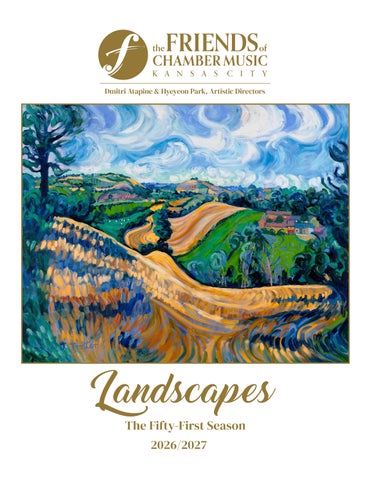
Landscapes The Fifty-First Season 2026/2027
a karbank project
1900 Shawnee Mission Parkway, Mission Woods, Kansas | 1900bldg.com | (913) 730-1905
therestaurantat1900.com | (913) 730-1900
Catering Confidence ... at no extra charge
GrandmasCatering.com
Connec t with your
Audience
Reserve your seats for Program Advertising for the 2027-2028 Season.
For More Information, Contact: Christin Painter christin@kcindependent.com 816-471-2800x218
www.chambermusic.org
Published by the The Independent Magazine Publisher .............................................................................. Rachel Lewis Falcon Dir. of Program Guide Operations ............................................... Christin Painter Graphic Design/Production .......................................... BurningStar Studios, LLC
The Independent Magazine 5201 Johnson Drive, Suite 300 • Mission, KS 66205 The Friends of Chamber Music Kansas City program guides are a publication of the Performing Arts Division of the Independent Magazine. Information in this publication was carefully compiled to ensure accuracy. However, the publisher does not assume responsibility for accuracy. Editorial program content was provided by the Friends of Chamber Music Kansas City. Copyright by the Independent Magazine. No part of this publication may be reproduced in any form without written permission of the publisher.
Table of Contents 7
Welcome from the Artistic Directors
9
Welcome from the Executive Director
12
Concert Program Pages Begin
22 Soirée
Brailes Hill by Josephine Trotter (b.1940)
The Friends of Chamber Music Dmitri Atapine & Hyeyeon Park Artistic Directors Lisa Merrill Hickok Executive Director
70 Contributors
Mikaela Garrett Marketing Manager
73
Kate Whitney Operations and Events Manager
Glossary
Concert Programs
Gray Robison Patron Services Manager Jackie Lee Young Artist Project Director
12
American Landscapes
Edward Sien Development Consultant
18
VOCES8
Christy Peterson Accountant
24 Modigliani String Quartet 30 Gabriela Montero 36 Jupiter Ensemble 40 Bach's Musical Offering 46 Sir Stephen Hough 50 Espressivo! Piano Quartet 54 Balourdet String Quartet 58 Cappella Pratensis & Piffaro 62 The Mad Lover 66 The Great Clarinet Quintets with Chamber Music Society of Lincoln Center SPECIAL THANKS TO OUR SEASON SPONSORS
Ruth Bigus Media Relations
Board of Directors Dwight Arn, President Albert Mauro, Jr., Vice President Lisa M. Browar Richard Bruening Alietia Caughron, Secretary Ron Fredman Nancy Lee Kemper Isabel Kramer, Finance Committee Cindy Longbottom Patricia Cleary Miller Kate Brubacher Murphy Tom Nanney, Treasurer John Stroh
Past Chairs of the Board Steven M. Karbank Nancy Lee Kemper William G. Levi David Steinhaus Jerome Wolf
Founder Cynthia Siebert
2026/2027 • THE FIFTY-FIRST SEASON
19 American Landscapes
Chamber Music/Pianists • Folly Theater
SEP
Barber • Beach • Dvořák
C. Hoopes, D. Um, violins · M. Rostad, S. Lee, violas · D. Atapine, cello · H. Park, piano
03 VOCES8
Early Music • Village Presbyterian
OCT
Towards Paradise
16 Modigliani Quartet
Chamber Music • St. Paul’s Episcopal
OCT
Debussy • Schumann • Mařatka
21 Gabriela Montero
Pianists & Friends • Folly Theater
OCT
Spanish Inspiration Albéniz • Chopin • Scarlatti • Soler • Liszt…
20 Jupiter Ensemble
Early Music • Atonement Lutheran
30 Sir Stephen Hough
Pianists & Friends • Folly Theater
JAN
Schubert • Brahms • Beethoven • Sherman: Mary Poppins Suite
06 Espressivo! Piano Quartet
Chamber Music/Pianists • Folly Theater
FEB
Mozart • Ngwenyama • Brahms
J. Laredo, violin · M. Pajaro-van de Stadt, viola S. Robinson, cello · A. Polonsky, piano
24 New Horizons
Chamber Music • 1900 Building
FEB
Balourdet Quartet
05 Cappella Pratensis & Piffaro Early Music • Immaculate Conception
MAR
Mass for Manila Guerrero: Missa Sancta et immaculata
19 The Mad Lover
Early Music • Grace & Holy Trinity
NOV Lea Desandre, mezzo-soprano
MAR
15 Bach’s Musical Offering
24 The Great Clarinet Quintets
Vivaldi • Marais • Philidor • Cavalli… Early/Chamber Music/Pianists • Folly Theater
DEC
K. Weiss, harpsichord · S. Kim, flute · J.A. Smith, oboe · B. Hristova, S. Lee, violins · M. Lipman, viola · D. Atapine, cello
Théotime Langlois de Swarte, violin Thomas Dunford, lute
Chamber Music • Grace & Holy Trinity
APR
CMS of Lincoln Center on Tour
S. Manz, clarinet · S. Chen, C. Hoopes, violins · T. Ridout, viola · C. Greensmith, cello
To learn more visit ChamberMusic.org
From the Artistic Directors Dear Friends, As we turn the page to our Fifty-First Season, we do so with a renewed sense of curiosity and wonder. Following the celebration of our Golden Jubilee, this year’s theme, Landscapes, invites us to journey through a rich array of musical terrains, each with its own colors, contours, histories, and emotional character. Landscapes offers a way of considering how music reflects the worlds around us: places, traditions, memories, and imaginations. It also allows us to consider how composers inherit these influences, respond to them, and transform them into something distinctly their own. We begin with American Landscapes, bringing together Samuel Barber, Amy Beach, and Antonín Dvořák, three composers whose very different musical voices offer distinct perspectives on America. From there, the season travels widely. Our Early Music Series takes us from the intimacy of the human voice with VOCES8 to Jupiter Ensemble’s vivid world of Amazons and heroines; from the sacred soundscape of A Mass for Manila to the fantasy and melancholy of seventeenth-century England in The Mad Lover. Elsewhere, Gabriela Montero traces the musical colors and influences of Spain, while Sir Stephen Hough explores the expressive possibilities contained within the world of the piano miniature. At the center of the season stands Bach’s Musical Offering, one of the most extraordinary acts of musical invention in the repertoire. Presented in partnership with the Chamber Music Society of Lincoln Center alongside works by Bach’s sons, it offers a profound window into the ways musical ideas are inherited, transformed, and carried forward from one generation to the next. That same sense of exchange runs throughout the season. In The Great Clarinet Quintets, Mozart and Brahms speak across generations; the Modigliani Quartet brings Kryštof Mařatka into conversation with Debussy and Schumann; Espressivo! Piano Quartet brings together Mozart, Ngwenyama, and Brahms; and the Balourdet Quartet’s New Horizons looks boldly toward the future. For us, this is one of the great joys of chamber music. Curating creates a conversation among composers, traditions, and performers, one that ultimately extends to each of us who listens. A familiar masterpiece can change when heard beside a new voice; a work written centuries ago can suddenly illuminate something about our own time. We know that each program will offer not simply a collection of extraordinary music, but an opportunity for discovery. This sense of discovery extends beyond the concert hall. Through masterclasses, school visits, and our Young Artist Project, we continue to nurture the next generation of musicians and listeners, ensuring that chamber music remains a living and continually evolving art form. We are also delighted to welcome Lisa Merrill Hickok as Executive Director and look forward with great excitement to our partnership as The Friends enters its next chapter. Above all, we are grateful to share this season with you. We invite you to travel with us across styles, centuries, cultures, and sensibilities, and to discover the many landscapes that chamber music can open before us. Yours,
Dmitri Atapine & Hyeyeon Park Artistic Directors
7
40t hSeason
Our
A celebratory season
Music Director Bruce Sorrell
of brilliant musical experiences — music that can light up and illuminate your life in a way that little else can!
For Season or Single tickets visit Eventbrite.com*
Autumn Glow featuring Tchaikovsky’s Serenade for Strings
Tuesday, October 20, 2026
Holiday Sparkle Baroque Holiday Favorites – by Candlelight!
Tuesday, December 1, 2026
The Light of Love Sweetheart Dinner Concert
Saturday, February 13, 2027
Summer Sunrise Mozart 40~41 Double Symphony FINALE!
June 11, 2027 * Use code FCM25 for a special Friends ticket discount!
Visit kcchamberorchestra.org or call 816 960-1324
BEST HISTORIC SMALL TOWN
-USA Today
VISIT THE EISENHOWER PRESIDENTIAL LIBRARY AND MUSEUM
Plan your getaway!
EisenhowerLibrary.gov
AbileneKansas.org
From the Executive Director Dear Friends, Welcome—and thank you for being here. Whether this is your first concert with The Friends of Chamber Music or one of many you have attended through the years, your presence matters. A performance is not complete until artists and listeners come together in the same room, ready to experience something that exists only in that moment. By purchasing a ticket, opening this program, and taking your seat, you become part of the music-making itself.
Photographer: Bruce Mathew
In my first season as Executive Director, I am deeply honored to join an organization that has brought exceptional chamber music to Kansas City for more than fifty years. My career has been devoted to strengthening arts organizations, building meaningful connections, and helping more people experience the power of live performance. Yet this appointment feels especially personal. Music has been part of my life since childhood, and I know firsthand how it can awaken curiosity, deepen understanding, and create connections that remain with us long after the final note. The Friends has always been about more than presenting extraordinary musicians. It is also about friendship: the relationship between artists and audiences, the conversations that begin in the concert hall, and the community created when people gather to listen together. That sense of welcome and belonging is central to our name—and to our future. You may have arrived tonight as a longtime subscriber, a devoted chamber music enthusiast, a guest of a friend, or someone simply curious about what you might discover. However you came to be with us, we are glad you are here. I hope you will feel that this organization belongs to you—that The Friends is a place where you can return, bring others, encounter something new, and feel connected to a vibrant community of listeners. My colleagues Dmitri Atapine and Hyeyeon Park have written beautifully in these pages about the musical journeys awaiting you this season. My role is to help ensure that the artistry they envision is supported by a strong, welcoming, and forward-looking organization—one that honors its remarkable history while continuing to reach new audiences, nurture young people, and deepen its service to Kansas City. That work is possible because of you. Ticket buyers, subscribers, donors, volunteers, community partners, board members, and friends all play a part in sustaining what happens onstage and extending its impact beyond the concert hall. As we celebrated during last year’s 50th Anniversary Season, generations of patrons have made this organization’s remarkable legacy possible. I am grateful to inherit that legacy and excited to help carry it forward with you. Thank you for choosing to spend this time with us. I hope tonight’s performance gives you something memorable: a moment of beauty, a new perspective, an unexpected emotion, or simply the pleasure of listening closely. With gratitude,
Lisa Merrill Hickok Executive Director
9
he o SEPT 19, 25 & 27, 2026
NOV 7, 13 & 15, 2026
FEB 20, 26 & 28, 2027
APR 24 & 30, MAY 2, 2027
Kauffman Center for the Performing Arts
season
kcopera.org | (816) 471-7344
Leave a Legacy Inspire the Future
Your legacy gift will bring extraordinary chamber music into the future. A legacy gift is a simple way to ensure that this tradition continues. By including The Friends of Chamber Music in your will, trust, retirement account, or life insurance policy, you can make a lasting impact—at no cost today and with the flexibility to update your plans, if desired. Your generosity will help sustain world-class performances while supporting education and community engagement programs that bring the power of chamber music to audiences of all ages. Since 1975, The Friends of Chamber Music has brought the world's most celebrated ensembles and artists to Kansas City, creating extraordinary musical experiences that inspire, connect, and enrich our community.
To discuss your meaningful legacy, please contact Lisa Hickok, Executive Director.
Lisa@chambermusic.org · ChamberMusic.org · (816) 561-9999 x108
Stone City, Iowa by Grant Wood (1891–1942)
SEPTEMBER 19, 2026 • FOLLY THEATER
American Landscapes Chad Hoopes, violin Danbi Um, violin Scott Lee, viola
Masumi Rostad, viola Dmitri Atapine, cello Hyeyeon Park, piano
Samuel Barber (1910-1981) Serenade for String Quartet, Op. 1 (1928) Un poco adagio - Allegro con spirito Andante con moto Dance. Allegro giocoso Um, Hoopes, Lee, Atapine Amy Beach (1867-1944) Piano Quintet in F-sharp minor, Op. 67 (1907) Adagio - Allegro moderato Adagio espressivo Allegro agitato - Adagio come prima - Presto Park, Um, Hoopes, Rostad, Atapine
- intermission Antonín Dvořák (1841-1904) String Quintet in E-flat major, Op. 97 "American" (1893) Allegro non tanto Allegro vivo Larghetto Allegro giusto Hoopes, Um, Rostad, Lee, Atapine
The Friends of Chamber Music is grateful for our Signature Sponsor: Stanley H. Durwood Foundation
12
Samuel Barber: Serenade for String Quartet, Op. 1 Composed: 1928 Duration: 10 minutes Samuel Barber remained separate from the modernist trends of the twentieth century, writing music with an emotional directness and melodic generosity largely out of fashion at the time. Part of a musical family – his mother was a pianist, his aunt a contralto at the Metropolitan Opera, and his uncle a composer – Barber was attracted to music at a very early age. At fourteen he became part of the very first class at Philadelphia’s Curtis Institute of Music, where he studied piano, composition, and voice. There he met composer Gian Carlo Menotti, who became his life partner and musical collaborator. The slow movement of Barber’s String Quartet, now known as the Adagio for Strings, has become his signature piece, more or less launching his career when Arturo Toscanini featured it in a famous NBC Symphony concert in 1938. Barber won two Pulitzer Prizes: the first in 1958 for the opera Vanessa, and the second in 1963 for his Piano Concerto. His music was embraced by some of the greatest musicians of his time, commissioned and first performed by the likes of Vladimir Horowitz, Dietrich Fischer-Dieskau, and Leontyne Price. Barber wrote little music for string quartet. Along with the aforementioned String Quartet with its famous Adagio, and a single movement from a later, unfinished quartet, there is only the Serenade, Op. 1, which Barber wrote when he was eighteen. He had already written several works by that point, including an operetta, and had just entered the adult professional program at the Curtis Institute of Music (he had already been in the Institute's youth program for several years). The Serenade is relatively conventional in form and content, but still gives many hints of the composer to come. The slow, lyrical opening of the first movement has a characteristically Barber-like melancholy and harmonic freedom. The faster main body draws on the music of the introduction, adding some lively, tricky rhythms and surprising changes of mood. For the slow central movement, Barber adopts a graceful siciliano rhythm, even as the atmosphere is one of pathos. That music contrasts with short sections that suggest Brahms in their two-against-three rhythms. The tone lightens considerably in the third movement, with its dance-like triple meter. A recollection of the first movement leads back to the lively opening music and the work's graceful, if somewhat abrupt, conclusion.
Amy Beach: Piano Quintet in F-sharp minor, Op. 67 Composed: 1907 Duration: 30 minutes Born in New Hampshire as Amy Marcy Cheney, Amy Beach was a remarkable child prodigy who was making up her own melodies at age two, reading by age three, and playing her own compositions at the piano at four.
By her teens, she was playing public recitals as a pianist, and her new compositions were routinely published. At eighteen she married a surgeon, Dr. Henry Harris Aubrey Beach, and for many years after that she was known as Mrs. H.H.A. Beach. During that time, she largely gave up piano recitals and turned to composing. After her husband's 1910 death, however, she resumed playing concerts. By the 1920s, she was recognized as the most important and successful female composer in the United States, and eventually produced a catalog of some 300 pieces. The Piano Quintet was often performed by Beach herself as pianist. Its first movement begins with a hushed, slow introduction that leads to a faster, rather nostalgic (and Brahms-like – Beach specifically took inspiration from his Piano Quintet in F minor, Op. 34), main melody in the first violin. Its descending phrases turn up in each of the Piano Quintet's three movements. That theme and a second, introduced by the piano, become the basis of extended development. While the strings have much to do, it is often the brilliant piano part that takes the lead. The slow second movement is intense and emotional but largely restrained in volume, save for a more stormy central section. By contrast, the third movement begins in a rush with a descending scale from the piano and a melody in the violin, related to the main melody of the opening movement. The momentum slows with the second, more songful theme from the viola over chords from the piano. But soon the music builds to more than one powerful climax, including a contrapuntal elaboration of the first theme and a return of the slow introduction from the first movement.
Antonín Dvořák: String Quintet in E-flat major, Op. 97 “American” Composed: 1893 Duration: 32 minutes In 1892, Dvořák made his way to the United States to become the founding director of the National Conservatory of Music in New York. The President of the Conservatory, Jeannette Thurber, offered Dvořák an annual salary of $15,000 – equivalent to over half a million dollars today, and approximately twenty-five times what Dvořák was earning at the Prague Conservatory. Along with the teaching and conducting duties at the new Conservatory, Dvořák had plenty of time for perhaps his central goal in coming to the United States: to hear and engage with American music, not so much the classical music being produced, but rather the African-American and Native American music, which he believed could become the basis of a new vision for American classical music. During the summer of 1893, Dvořák, accompanied by his wife and six children, vacationed in Spillville, Iowa. Its initial attraction was a large and thriving Czech immigrant community, which Dvořák came to know about through his secretary, Jan Josef Kovařík, whose family lived in Spillville. In his first month in Spillville, Dvořák composed
13
the well-known String Quartet in F major, Op. 96, the “American,” and within days had started work on the E-flat major Quintet – also sometimes called “American,” and likewise completed in a matter of weeks. Both the Quartet and Quintet were premiered in New York in January 1894 by the Kneisel Quartet, probably the bestknown American string quartet of the day. Like the “American” Quartet, the E-flat major String Quintet features transformations of Native American melodies. At one point during Dvořák's stay in Spillville, a group of traveling Native Americans, referred to in some sources as The Kickapoo Medicine Show, visited, performing traditional music and dance along with selling their herbal medicines. Dvořák attended each of their performances, and the music he heard strongly informs this Quintet. Likewise, there are more recognizably Czech elements here – including much material based on the pentatonic scale, the five-note scale common to much of the world’s folk music, including the songs of Dvořák's native Bohemia and the African-American songs he had encountered in New York. The first movement opens with a slow introduction in which the second viola hints at the movement's main theme – Dvořák was himself a violist, and the instrument plays a prominent role throughout this Quintet. The movement's second theme, both its melody and the accompanying rhythm that some say is related to Native American drumming, may have been derived directly from one of the Native American melodies Dvořák heard in Spillville. In the development section, the two violas exchange a rather sad theme, and the slow introduction is recalled in the movement's peaceful conclusion. The viola's ostinato repeating figures in the second movement, while evocative of Bohemian folk music, may also be related to Native American drumming. This
14
spirited music is contrasted with a more mournful central section, with the viola presenting a broad, melancholy melody against the pizzicato accompaniment of the other instruments. The Larghetto third movement is a set of five variations on a wistful double theme, half in the minor and half in the major. Interestingly, the major key second half of this melody was originally conceived as a setting of the familiar words “My Country, ‘Tis of Thee” by S.F. Smith, which Dvořák had thought might become a new American National Anthem! The first violin intricately decorates the melody in the first variation, and the second variation features the violin accompanied by pizzicati, repeated notes, and a tremolo line from the cello. The third variation focuses on the minor key half of the theme. After a fourth variation dominated by the cello, the main theme is presented at first passionately, then in an almost hymnlike manner. After this relatively restrained music, the jaunty Finale – a rondo in ABACABA form, with a lively, rambunctious repeating A section – comes as quite a contrast. Despite its lyrical interludes in the minor, this movement brings the Quintet to a most enthusiastic close.
Program notes by Chris Morrison
Biographies Praised for his “brilliant technical chops” (Gramophone), “prodigious technique” (American Record Guide), and “highly impressive” performances (The Strad), cellist Dmitri Atapine has appeared at many of the world’s foremost concert venues, including Alice Tully Hall at Lincoln Center, Carnegie Hall, the National Auditorium of Spain, and Beijing’s Forbidden City Concert Hall. A regular performer with the Chamber Music Society of Lincoln Center, Atapine is an alum of the Bowers Program and he is a frequent guest at leading festivals including Music@Menlo, Chamber Music Northwest, Nevada, etc. Atapine’s wide-ranging discography includes recordings on Naxos, Bridge, Blue Griffin, Albany, MSR, and Urtext Digital. His acclaimed albums feature numerous world-premiere recordings, including the complete works for cello and piano by Lowell Liebermann, recorded in collaboration with pianist Hyeyeon Park. He is a top prizewinner at the Carlos Prieto, Vittorio Gui, and Plowman competitions. Atapine studied with Alexander Fedortchenko and Suren Bagratuni before earning his Doctor of Musical Arts degree from the Yale School of Music under Aldo Parisot. He is Professor of Cello and former Department of Music Chair at the University of Nevada, Reno, and is the co-Director of the Young Performers Program at Music@Menlo. A passionate chamber musician, he is founder of Apex Concerts in Reno and serves as Artistic Co-Director of The Friends of Chamber Music Kansas City, and in 2027 he will assume the role of Artistic CoDirector of Music@Menlo, one of the nation’s leading chamber music festivals.
Acclaimed worldwide for his exceptional talent and magnificent tone, American violinist Chad Hoopes has established himself as a versatile performer with many of the world’s leading orchestras and ensembles. Highlights of this season include Mendelssohn’s Violin Concerto with the Orchestre National du Capitole de Toulouse under Markus Poschner, Brahms’s Double Concerto with cellist Jan Vogler and the Dallas Symphony Orchestra, and Berg’s Violin Concerto with Aalborg Symfoniorkester. He also appears at major festivals including the Santa Fe Chamber Music Festival, Seattle Chamber Music Society, and Music@Menlo. In recent seasons, Hoopes performed Korngold’s Violin Concerto with the Orchestre National du Capitole de Toulouse and the Gothenburg Symphony Orchestra under Tarmo Peltokoski. Other notable engagements include appearances with The Philadelphia Orchestra, Orchestre de Paris, Konzerthausorchester Berlin, San Francisco Symphony, Pittsburgh Symphony, Houston Symphony, National Symphony Orchestra, Minnesota Orchestra, Frankfurt Radio Symphony, and Canada’s National Arts Centre Orchestra. A frequent guest of the Chamber Music Society of Lincoln Center, where he holds the Susan S. and Kenneth L. Wallach Chair, Hoopes has also given recitals at the Ravinia Festival, Tonhalle Zürich, the Louvre, and Lincoln Center’s Great Performers series. His recordings include the Mendelssohn and Adams concertos with the MDR Leipzig Radio Symphony Orchestra and chamber works by Dvořák on SONY Classical. Hoopes studied at the Cleveland Institute of Music and Kronberg Academy.
Violist Scott Lee has established himself as one of today’s most distinguished artists, celebrated for his exceptional musicality and virtuosic playing. The New York Times praised his “flawless technical resources” and “assured sense of musicianship,” while String Magazine hailed him as “the superstar of his generation.” Winner of the 1996 Concert Artists Guild Competition, Lee became the youngest winner in the competition’s 50-year history. He has also earned top prizes at the Lionel Tertis International Viola Competition, the William Primrose Viola Competition, and the Corpus Christi Young Artists Competition. As a soloist, he has appeared with the Kansas City Symphony, San Diego Symphony, Los Angeles Chamber Orchestra, Longmont Philharmonic, and International Sejong Soloists. His recital appearances include Carnegie Hall’s Weill Recital Hall, Merkin Hall, and the Kennedy Center, and he has been featured at the International Hindemith Viola Festival and the International Viola Congress. An accomplished chamber musician, Lee has performed at the Santa Fe Chamber Music Festival, Chamber Music Northwest, Ravinia Festival, Newport Chamber Music Festival, La Jolla SummerFest, Chamber Music Society of Lincoln Center, Musicians from Marlboro, and numerous leading venues throughout North America and abroad. His collaborators have included Gil Shaham, Hilary Hahn, Cho-Liang Lin, Ralph Kirshbaum, Peter Wiley, Gary Hoffman, and members of the Guarneri, Juilliard, Orion, and Miami String Quartets. Born in Taipei, Taiwan, Lee studied at the Curtis Institute of Music and The Juilliard School. He is Professor of Viola at the University of Missouri–Kansas City Conservatory and a faculty member of the McGill International String Quartet Academy.
Pianist Hyeyeon Park has been described as “a pianist with power, precision, and tremendous glee” (Gramophone), praised for her expressive nuance and interpretive depth by outlets including The Washington Post and Lucid Culture. She has performed as a soloist and chamber musician at venues such as Zankel Hall at Carnegie Hall, the Kennedy Center, Merkin Hall, Seoul Arts Center, and the Phillips Collection, and has been featured on broadcasts by WQXR, WFMT, KBS, and RAI3. Park has appeared as soloist with the Seoul Philharmonic, Incheon Philharmonic, Seoul Arts Center Festival Orchestra, and Gangnam Symphony, among others. A committed advocate of new music, she has commissioned and premiered works by Lowell Liebermann, Libby Larsen, Patrick Castillo, Ezra Laderman, and others. Her recordings on Blue Griffin, MSR, Urtext Digital, and Naxos include the complete works for cello and piano by Liebermann, as well as a solo CD Klavier 1853 and a recent collection of premiere recordings of works for clarinet trio. A prizewinner at the Ettlingen, Oberlin, Maria Canals, and Hugo Kauder competitions, Park was named “Artist of the Year” by the Seoul Arts Center in 2012. She is a regular collaborator with distinguished artists including David Shifrin, Paul Neubauer, Ani and Ida Kavafian and many others. Originally from South Korea, Park studied with Daejin Kim, Peter Frankl, and Yong Hi Moon. She holds degrees from Korea National University of Arts, Yale University, and a doctorate from Peabody Institute of Johns Hopkins University. She is Professor of Piano at the University of Nevada, Reno where she founded Apex Concerts. She serves as Artistic coDirector of The Friends of Chamber Music Kansas City, and in 2027 she will assume the role of Artistic Co-Director of Music@Menlo, one of the nation’s leading chamber music festivals, where she currently leads the Young Performers Program.
15
Biographies Praised for his “burnished sound” (The New York Times) and described as an “electrifying, poetic, and sensitive musician,” Grammy Awardwinning Japanese-Norwegian violist Masumi Rostad is recognized as one of today’s leading soloists, chamber musicians, and educators. He serves on the faculty of the Eastman School of Music in Rochester, New York. Recent highlights include concerto performances with the Los Angeles Chamber Orchestra, Grant Park Symphony Orchestra, and The Knights, along with festival appearances at Music@Menlo, Marlboro, Aspen, La Jolla SummerFest, Caramoor, Bridgehampton, Spoleto USA, and Bowdoin. In 2025, he performed an all-Shostakovich program with pianist Evgeny Kissin and the Kopelman Quartet at Carnegie Hall and the Lucerne Symphony Orchestra Piano Festival. He has also collaborated with the Miró, Emerson, St. Lawrence, Pavel Haas, Ying, and Verona String Quartets. Rostad was a member of the Grammy Award-winning Pacifica Quartet from 2001–2017, performing in many of the world’s foremost concert halls, including Carnegie Hall, Amsterdam’s Concertgebouw, London’s Wigmore Hall, Vienna’s Musikverein, and Tokyo’s Suntory Hall. An advocate for expanding access to classical music, Rostad founded the DoCha Chamber Music Festival, presenting free, innovative performances and educational programs for new audiences. A frequent writer and speaker on music, he has contributed to The Guardian, Gramophone, and Strings magazine. A graduate of The Juilliard School, Rostad studied with Karen Tuttle and received the Lillian Fuchs Award for outstanding graduating violist.
16
Praised by The Strad as an “utterly dazzling” artist with “a marvelous show of superb technique” and “mesmerizing grace” (New York Classical Review), violinist Danbi Um captivates audiences with her virtuosity, distinctive sound, and interpretive sensitivity. A Silver Medalist at the Menuhin International Violin Competition and recipient of the 2018 Salon de Virtuosi Career Grant, she performs as a soloist, recitalist, and chamber musician. Recent and upcoming engagements include appearances with the Chamber Orchestra of Philadelphia, Ridgewood Symphony, and her Washington, D.C., recital debut at The Phillips Collection. She also returns to the People’s Symphony, Saratoga Performing Arts Center, Santa Fe Chamber Music Festival, North Shore Chamber Music Festival, and La Musica Festival in Sarasota. An avid chamber musician, Um regularly appears with the Chamber Music Society of Lincoln Center on national and international tours, as well as Chamber Music San Francisco, the Society of the Four Arts, and Chamber Music Society of Fort Worth. Her collaborators include Pamela Frank, Cho-Liang Lin, Vadim Gluzman, Anthony Marwood, David Finckel, Wu Han, David Shifrin, and Gilbert Kalish. Her debut recording, Much Ado: Romantic Violin Masterworks, was released on Avie Records in 2023. Born in Seoul, South Korea, Um began violin studies at age three before moving to the United States to attend the Curtis Institute of Music. She also earned an Artist Diploma from Indiana University and performs on a 1683 “ex-Petschek” Nicolo Amati violin on loan from a private collection.
Discover More with TeenTix KC The Friends of Chamber Music is proud to partner with TeenTix KC, making it easier than ever for teens to experience the arts. Teens ages 13–19 can sign up for a FREE TeenTix KC Pass and purchase up to two $5 day-of-show tickets at participating arts organizations across Kansas City. At The Friends of Chamber Music, admission is always FREE for youth ages 17 and under. TeenTix KC simply opens the door to even more incredible live performances throughout our community. Sign up today and start exploring!
Join The Friends of Chamber Music & TeenTix KC!
Hey Teens! Join the Friends for a special pre-concert pizza party and spooky tour of the haunted Folly Theater before the Gabriela Montero concert on October 21. Don't miss this one-of-a-kind experience. Sign up today and join the fun!
17
OCTOBER 3, 2026 • VILLAGE PRESBYTERIAN CHURCH
VOCES8 Savannah Porter, soprano Virginia Taylor Grabovsky, soprano Katie Jeffries-Harris, alto Barnaby Smith, alto & artistic director
Blake Morgan, tenor Euan Williamson, tenor Christopher Moore, baritone Dominic Carver, bass
Towards Paradise Giovanni Croce (1557–1609)
Buccinate in neomenia tuba
Henry Purcell (1659–1695)
Thou Knowest, Lord
Ola Gjeilo (b. 1978)
Ubi Caritas
Felix Mendelssohn (1809–1847)
Richte mich, Gott
Pablo Casals (1876–1973)
O vos omnes
Antonio Lotti (1667–1740)
Crucifixus à 8
Orlando Gibbons (1583-1625)
Drop, Drop, Slow Tears
Arvo Pärt (b. 1935)
The Deer’s Cry
Orlando Gibbons (1583–1625)
O Clap Your Hands
- intermission Giovanni Pierluigi da Palestrina (c. 1525–1594) Magnificat Primi Toni Robert White (c. 1538–1574)
Christe qui lux es et dies
Charles Villiers Stanford (1852–1924)
Nunc dimittis
The Friends of Chamber Music is grateful for our Supporting Sponsors: Al Mauro, Jr. and Molly Dwyer
18
VOCES8 has described this “Towards Paradise” program as “a deeply reflective sacred tapestry tracing a spiritual journey through music of longing, faith, consolation and peace.” Giovanni Croce, a composer identified with the Venetian School (as is Claudio Monteverdi, whose music appears elsewhere in this program), was born near Venice, and became a member of the choir at Venice's St. Mark's Cathedral when he was eight. At twenty-eight, he took holy orders. While he may have had a connection with other cathedrals, much of Croce's life revolved around St. Mark's, where he became maestro di cappella in 1603, the same position that Monteverdi held ten years later. Croce wrote a number of sacred works, including three masses and two books of motets, but was better-known for his secular madrigals. Buccinate in neomenia tuba, from his second book of motets, is a setting of a text better-known in its elaborate nineteen-part setting by Croce's fellow Venetian Giovanni Gabrieli. With its text that begins “Blow the trumpet when the moon is new,” Croce's motet is an exuberant and triumphant beginning to this program. Initially, Henry Purcell wrote mostly for the church and royal court. Both his father and uncle were also court musicians, and Purcell spent time as a violinist in the Twenty-Four Violins, a string orchestra established by Charles II. But, as court music played less of a role during the reign of William and Mary, Purcell increasingly turned to writing theater music for additional income, ultimately producing six major stage works as well as incidental music for some 43 plays. Purcell produced two settings of the text Thou knowest, Lord, taken from the burial service in the Book of Common Prayer. The earlier dates from 1672. The later stately lament, from 1695, was written for the Music for the Funeral of Queen Mary, which includes several pieces and was first performed at the funeral of Queen Mary II of England in Westminster Abbey on March 5, 1695. Purcell's music was also performed in 2022 at the State Funeral for Queen Elizabeth II. Ola Gjeilo was born in 1978 in Norway. Attracted from an early age to both jazz and classical music, Gjeilo studied piano and improvisation on his own, then pursued formal studies at London's Royal College of Music and The Juilliard School. He is best-known for his choral music, including one of his most-performed pieces, Ubi caritas. Gjeilo writes of it: “This short work is one of my first choral pieces, written in 1999. After having sung Maurice Duruflé’s incredible Ubi Caritas in high school (one of my absolute favorite choral works of all time), I wanted to humbly try my own hand at this beautiful, timeless text. The work is very much influenced by Gregorian chant and Early Music, though not based on any existing medieval material.”
Although they aren't performed often today, Felix Mendelssohn wrote quite a number of works for choir, including some thirty motets featuring psalm texts. One of the most important of these is Richte mich, Gott (Judge me, O God), composed in 1844 and published with two other psalm settings as Op. posth. 78. In this flowing and graceful setting of the opening lines of Psalm 43, Mendelssohn makes use of a number of textures, from unisons to call-and-response passages, as in the work's opening, to multi-part homophonic sections. With considerable knowledge of the choral music of the Renaissance and Baroque, Mendelssohn may have found some inspiration here in the motets of Heinrich Schütz. Pablo Casals, one of the best-known classical musicians of his time, took up the cello at age eleven, and within a decade had started his long, busy, international career as a performer, teacher, conductor, and humanitarian. After the Spanish Civil War and the rise of General Francisco Franco, Casals went into self-imposed exile in France, but remained famous throughout the world. Composed in 1965, O vos omnes (O You People) is a setting of a text adapted from the Lamentations of Jeremiah, often spoken or sung during Holy Week. While the words focus on sorrow, there is also a sense of hope that, at the very least, others will sympathize with the suffering. Casals's music is emotive, contrasting voice pairings and the full choir, and ending with a hushed version of the opening line. Another composer closely associated with St. Mark's in Venice, Antonio Lotti started there as a singer, later becoming organist, and eventually maestro di cappella. Lotti was also a notable teacher, counting among his students well-known figures of the Baroque era like Benedetto Marcello and Jan Dismas Zelenka. Lotti wrote in a number of genres, producing upwards of thirty operas as well as masses, cantatas, madrigals, and instrumental music. Perhaps his best-known work today is the Crucifixus in eight parts, a motet derived from a larger work, a Credo in F major for choir and orchestra. The Crucifixus features a plain-spoken yet moving text: “He was crucified also for us under Pontius Pilate. He suffered and was buried.” Lotti's vocal lines enter one at a time, gradually building to a richly imitative texture. Lotti's music is known for its suspensions, where a note from a chord is held while the other notes change to a new harmony. Here, the technique introduces poignant dissonances to the flowing vocal lines. Orlando Gibbons was the leading composer of early seventeenth century England, famous for his organ playing and his compositions, including sacred motets, secular madrigals, and instrumental pieces for keyboard and viol. Gibbons was long associated with the Chapel Royal, the choral group that served the Royal Family. Toward the end of his life, Gibbons also served as organist at Westminster Abbey. The consoling Passiontide hymn Drop, Drop, Slow Tears, with words by Phineas Fletcher, reflects the sufferings of Christ and invokes tears as a
19
symbol of penitence for one's sins. One of Gibbons's most famous anthems is O Clap Your Hands Together, based on Psalm 47. There have been suggestions that Gibbons was awarded a Doctorate of Music degree late in his life, in 1622, and that this anthem, with its rich eight-voice polyphony, was his qualifying exercise for the degree. From nearly 400 years later, but working in a similar musical space, is one of the most famous composers of the present day, Arvo Pärt, who turned 91 last month. Pärt was born and trained in Estonia. Having grown disillusioned with the modern composing techniques then in favor, he spent years finding a new way forward. The result was a style called tintinnabuli, from the Latin tintinnabulum or “little bell,” in which the melody line and its harmonies become a single unit, evoking the ringing of bells as well as the vocal music of the Middle Ages and Renaissance. The Deer's Cry, from 2007, sets part of a traditional prayer, St. Patrick's Breastplate, attributed to the patron saint of Ireland. According to the legend, knowing that he and the monks with him were going to be ambushed and killed, St. Patrick led his men through the woods reciting a prayer: “Christ with me, Christ before me, Christ behind me...” Their enemies saw them as a mother deer with calves, and St. Patrick and his monks were saved. Giovanni Pierluigi da Palestrina was one of the greatest composers of the Renaissance, the central figure of what came to be known as the Roman School of composers. Born in the town of Palestrina, he moved to Rome as a child, where he started studying music. In 1551, Pope Julius III appointed the twenty-six-year-old Palestrina maestro di cappella at the Cappella Giulia (Julian Chapel) at St. Peter's Basilica. Later, he held similar positions at St. John Lateran and Santa Maria Maggiore before returning to St. Peter's in 1571, where he remained until his death in 1594. Palestrina composed a vast amount of music, including over one hundred masses and some 300 motets. His skill in counterpoint as well as the melodic, flowing style of his music, became famous, and highly influential in subsequent generations. His Magnificat primi toni, published in 1591 – the “primi toni” in the title refers to the notes of Dorian mode, the first of the eight modes or scales of church music – sets a frequentlyused text from the Gospel of Luke, the Magnificat or Canticle of Mary, which has been set to music by a host of composers, from Claudio Monteverdi and Antonio Vivaldi to Johann Sebastian Bach and Anton Bruckner. In the text, Mary describes her exultation in the divine: “My soul doth magnify the Lord, and my spirit hath rejoiced in God my Savior.” Robert White is yet another composer who started as a singer. He attended Cambridge University and sang in the choir of Trinity College, Cambridge. After working at cathedrals in Ely and Chester, in 1570 he became organist and master of the choristers at Westminster Abbey. Among his compositions are motets, anthems, and other sacred vocal works, along with a number of instrumental works for viols. Written for Compline, the Night Prayer or
20
Prayer at the End of the Day in the Christian canonical tradition, the hymn Christe qui lux es et dies (Christ, who art the light of day) is a prayer for rest, full of images of light and darkness. White's settings of the hymn (he wrote four) alternate plainchant, with its monophonic textures, and rich polyphony featuring subtle changes of harmony. Charles Villiers Stanford was an English-Irish composer, teacher, and conductor. He was educated at the University of Cambridge, where he served as organist, before studying in Leipzig and Berlin. In 1882, he became one of the founding professors of the Royal College of Music, where he taught composition for the rest of his life. He also served as Professor of Music at Cambridge. Among his many students were Ralph Vaughan Williams and Gustav Holst. Along with his teaching, he composed quite a lot of music, including seven symphonies and a host of sacred choral music. His Nunc dimittis sets the canticle from Luke, where the child Jesus is presented at the Temple, that begins “Lord, now lettest thou thy servant depart in peace according to thy word.” This valedictory piece, which has become a standard part of the Anglican choral repertoire, is typically sung at Evening Prayer, or Evensong, and features lyrical vocal lines and rich harmonies.
Program notes by Chris Morrison
Biography
The 2023 Grammy-nominated British vocal ensemble VOCES8 is the world’s top-streaming classical vocal group and proud to inspire people through music and share the joy of singing. Touring globally, the group performs an extensive repertory both in its a cappella concerts and in collaborations with leading musicians, orchestras, conductors and soloists. Versatility and a celebration of diverse musical expression are central to the ensemble’s performance and education ethos which is shared both online and in person. VOCES8 has performed at many notable venues since its inception in 2005 including Wigmore Hall, Barbican Hall, Amsterdam Concertgebouw, Elbphilharmonie Hamburg, Berlin Philharmonie, Cité de la Musique Paris, Vienna Konzerthaus, Tokyo Opera City, NCPA Beijing, Sydney Opera House, Mariinsky Theatre Concert Hall, Victoria Concert Hall Singapore, and Palacio de Bellas Artes Mexico City amongst many others. This season they perform over 120 concerts in 20 countries. They have collaborated in concert and in the recording studio with musicians including Paul Simon, Jacob Collier, Eric Whitacre, Christopher Tin, Olafur Arnalds, Cody Fry, Rachel Podger, Jack Liebeck, Bomsori Kim, Jonathan Dove, Chanticleer, The King’s Singers, the Queensland Symphony Orchestra, English Chamber Orchestra, the Royal Philharmonic Orchestra, the Philharmonia Orchestra and others. VOCES8 is passionate about music education and is the flagship ensemble of music charity the VOCES8 Foundation, alongside ensembles APOLLO5 and Lyyra, which actively promotes ‘Music Education For All’. Engaging in a broad range of in-person outreach work that reaches up to 40,000 people a year, the Foundation runs an annual programme of workshops and masterclasses at the VOCES8 Centre at St Anne & St Agnes Church, London. Dedicated to supporting promising young singers, VOCES8 awards eight annual choral scholarships through the VOCES8 Scholars initiative. These scholarships are linked to the annual Milton Abbey Summer School at which amateur singers of all ages learn and perform with VOCES8. Through the separate VOCES8 USA Foundation there is another set of twelve talented Scholars. VOCES8’s entrepreneurial and community spirit is fostered by Co-Founders Paul and Barnaby Smith. The Covid-19 pandemic gave the impetus for VOCES8 to transform its already exceptional offerings, nurturing a new online audience community providing a chance to engage with classical music in new ways. Pioneering initiatives include the LIVE From London online festival and the VOCES8 Digital Academy.
LIVE From London was created as a specific response to the pandemic. Winning praise for its collaborative approach with artists, press and audiences around the world the team has delivered twelve digital festivals to date, broadcasting over 150 concerts and selling over 250,000 tickets around the world. This season will see Christmas, Easter and Summer online festivals. The VOCES8 Digital Academy is an online choral programme for high schools, colleges and individuals featuring live interaction with members of the ensemble, live and recorded lectures, and video resources to learn and perform music from the renaissance to today. Both LIVE From London and the Digital Academy are filmed by VOCES8 Studios, the in-house recording company. Alongside their online work VOCES8 is heard regularly on albums, international television and radio. The ensemble is a Decca Classics artist, also releasing on its own label, VOCES8 Records. The Decca Classics recording of Christopher Tin’s “The Lost Birds” featuring VOCES8 and the Royal Philharmonic Orchestra was nominated for a Grammy-Award in 2023. Their new album is “TWENTY”, a celebration of the group’s first two decades of performing. Recent releases are “Nightfall”; “A Choral Christmas”; “Home” conducted by Eric Whitacre, featuring his extraordinary work “The Sacred Veil”; and “Seven Psalms” by Paul Simon in which VOCES8 was thrilled to participate. VOCES8 is proud to be working with Taylor Scott Davis as the group’s Composer-in-Residence and Jim Clements as Arranger-in-Residence. The ensemble has premiered commissions from Jonathan Dove, Roxanna Panufnik, Roderick Williams, Paul Smith, Jason Max Ferdinand, Jocelyn Hagen, Melissa Dunphy, Lucy Walker, Ken Burton, Taylor Scott Davis, Alec Roth, Ben Parry, Ola Gjeilo, Mårten Jansson, Philip Stopford, Owain Park and many others. They publish arrangements of its music, original compositions and educational material with the new digital VOCES8 Publishing house, as well as E.C. Schirmer with whom they curate the VOCES8 Foundation Choral Series, and with Edition Peters with whom they have published two anthologies and a series of single octavos. The VOCES8 Method written by Paul Smith is a renowned and unique teaching tool now available in four languages that adopts music to enhance development in numeracy, literacy and linguistics.
21
The Friends of Chamber Music’s annual Soirée was held on May 2 at the Hilton President Hotel, celebrating The Friends' Fiftieth Anniversary season of sharing world-class chamber music with the Kansas City community. Honorary Chairs Jonathan and Nancy Lee Kemper joined over 200 guests for a festive evening of sumptuous food and inspiring music presented by distinguished guest artists and students from The Friends of Chamber Music Young Artist Project. Guests supported the organization's concert and education programming through exclusive live and silent auctions, including a wine auction curated by Master Sommelier and Master of Wine, Doug Frost.
22
Jonathan and Nancy Lee Kemper, Hyeyeon Park, Dmitri Atapine
Julie and Vince Clark, Lisa Merrill Hickok, Brian McCallister
Dwight and Naomi Arn
Distinguished guest artists Kristin Lee, Arnaud Sussmann, Anthony Manzo, Nicholas Canellakis, Paul Neubauer
Dana Koehn, Marilyn Gaar, Jo Anne Dondlinger
Dmitri Atapine, Anne Gatschet, Steve Karbank, Hyeyeon Park
Save the Date
SATURDAY, MAY 1, 2027 · 6:00 PM Mark your calendars! Soirée 2027 will be an elegant celebration of chamber music bringing together supporters, artists, and friends for a memorable evening in honor of the organization's enduring legacy. Guests will enjoy inspiring performances and special moments that celebrate the power of live music while helping ensure the future of The Friends of Chamber Music.
Visit ChamberMusic.org to join our email list and receive updates! For more information contact Kate Whitney, Operations and Events Manager Kate@chambermusic.org (816) 561-9999 x107
OCTOBER 16, 2026 • ST. PAUL'S EPISCOPAL CHURCH
Modigliani String Quartet Amaury Coeytaux, violin Loïc Rio, violin
Laurent Marfaing, viola François Kieffer, cello
Kryštof Mařatka (b. 1972) AMEDEA—visage de jeune fille (2025) *United States premiere with the Friends of Chamber Music Kansas City Claude Debussy (1862–1918) String Quartet in G minor, Op. 10 (1893) Animé et très décidé Assez vif et bien rythmé Andantino, doucement expressif Très modéré - intermission Robert Schumann (1810–1856) String Quartet in A major, Op. 41 no. 3 (1842) Andante espressivo — Allegro molto moderato Assai agitato Adagio molto Finale: Allegro molto vivace
The Friends of Chamber Music is grateful for our Supporting Sponsors: Naomi and Dwight Arn
24
Kryštof Mařatka: AMEDEA—visage de jeune fille Composed: 2025
Duration: 9 minutes
In his string quartet AMEDEA–Visage de jeune fille (Face of a Young Girl), the composer Kryštof Mařatka relies on his artistic philosophy of “origINnovation,” taking inspiration from universal principles of the past and connecting them to contemporary creation. During a retrospective exhibition of painter Amedeo Modigliani (1884–1920), the composer was fascinated by his body of work, particularly the painting Visage de jeune fille. He realized that Modigliani’s artistic approach was based on principles similar to those he applies in his music: combining universal archaic techniques with contemporary methods. In music, the string quartet embodies one of the most intimate forms of musical expression. Modigliani, for his part, explores intimacy primarily through the human figure, and Kryštof Mařatka draws inspiration from one of his portraits, questioning our own existence through the solitary contemplation of another’s face—a reflection of humanity through the image of a woman. Modigliani – Mařatka: each with his own language and culture, yet both drawing inspiration from France— especially Paris—where they immersed themselves in the city’s multicultural artistic energy. Two artists who never abandoned their roots while fully embracing their art and the cosmopolitan, open, Francophone, and freespirited universe that surrounded them. Born in Prague, Kryštof Mařatka studied piano and chamber music before completing a course on computer music at IRCAM in 1999. The diverse sources from which he draws inspiration are the traditional music of the world, the birth of human language, the musical instruments and art of the Paleolithic era, and the world of dreams, contemplation and memories. Mařatka has also established careers as a conductor and a pianist, and has directed a film. He has lived and worked in Prague and Paris since 1994. The statement of intent for AMEDEA – visage de jeune fille reads as follows (slightly edited): “AMEDEA – visage de jeune fille is inspired by an eternal source for artists: love, women and passion, with musical icons such as Schubert’s Death and the Maiden, Janáček’s Kreutzer Sonata and Berg’s Lyric Suite in mind. “Written both for a competition for young quartets and as a concert piece for a contemporary string quartet, the work AMEDEA – visage de jeune fille opens the doors for young ensembles to new creative experiences, new techniques and challenges of performing a work never heard before. On the other hand, through its spirit and its language, the quartet has the requirement of a personal, autonomous work, going beyond a competition test. Modigliani-Mařatka, two artists who come ‘from elsewhere,’ with their own language and culture, and
who draw in France, and mainly in Paris, this inspiration of a multicultural artistic effervescence coming from the whole world; two artists who never renounce their roots, while being immersed in their art and an open, francophone and free cosmopolitan universe.”
Claude Debussy: String Quartet in G minor, Op. 10 Composed: 1892-93
Duration: 26 minutes
Claude Debussy was one of the most important and influential composers of his time. After more than a decade of studies at the Paris Conservatoire, his receipt of the prestigious Prix de Rome in 1884 allowed him two years of work in Rome. Visits to Bayreuth in 1888-89 brought him under the spell of Wagner’s music, which he later rejected, and the 1889 Paris World Exhibition exposed him to the music of Asian cultures. His famous, revolutionary Prelude to the Afternoon of a Faun, as well as the opera Pelléas et Mélisande and the orchestral work La mer, secured his reputation as one of France’s great composers. While his music – often tied to the label Impressionism, although he didn’t like the term – is appreciated for its sensuous beauty, it is also noteworthy for its fluid sense of tonality and the use of unusual scales like pentatonic and whole-tone. These innovations were influential to many major musicians, from Igor Stravinsky and Olivier Messiaen to Pierre Boulez and Bill Evans. In 1892, thirty years old and still in the early stages of his musical career, Debussy abandoned work on an opera, Rodrigue et Chimène, and decided to take up what were slated to be two string quartets. He only completed the one, the present Quartet in G minor, which he had planned to dedicate to composer Ernest Chausson until Chausson expressed reservations about both the work and Debussy's various romantic attachments. The Quartet was premiered in Paris on December 29, 1893 by the Ysaÿe Quartet, to whom the work is dedicated. At the time of the Quartet, Debussy was still formulating the very personal musical language that soon made him famous in the Prelude to the Afternoon of a Faun, composed the year after the Quartet. While the Quartet shares some qualities with the Prelude, Debussy also looks backward to composers like César Franck in his use of cyclic form, in which musical ideas recur in each of the work's movements. The first movement starts assertively, with a main theme in Phrygian mode that recurs throughout the Quartet, but very quickly moves to a more languorous idea accompanied by ascending and descending arpeggios. That swirling motion continues as variations on the opening theme spin out. The music builds to a unison, leading to a sweet new theme, even as the cello quotes the opening theme again. That opening theme is subjected to a number of variations that build in intensity, then recede, then build again, leading to an exciting conclusion.
25
Pizzicati open the energetic second movement, as what becomes the main theme of the movement (it's also a variant of the first movement's opening idea) is introduced by the viola. That figure moves to the first violin, then the cello, and never quite disappears even as new figures and phrases are introduced. A bit of further turbulence arises in the movement's central section as the violin takes the melodic lead. Commentators have heard influences in this music from such diverse sources as flamenco and the gamelan of Java. A melody from the second violin, then the viola, opens the hushed, sensuous slow movement. An achingly melancholy melody is then introduced and mused on. Subtle dissonances give the music extra color. The viola then introduces a new theme over spare, quiet chords. That idea is developed further before the melancholy song returns, and slowly fades to silence. Themes from earlier in the work again recur in the finale, which begins in a restrained manner before picking up speed the instruments one-by-one enter, leading to a turbulent new idea. Intensity and restlessness seem to be the dominant mood, even as the music ebbs and flows. A variant of the first movement's opening theme takes over, as the music builds to a powerful conclusion.
Robert Schumann: String Quartet in A major, Op. 41 No. 3 Composed: 1842
Duration: 30 minutes
Robert Schumann was one of the quintessential artists of music’s Romantic era. Encouraged in a wide range of studies by his writer/publisher father, Schumann became a law student at the University of Leipzig. But music was his first love. He studied piano with Friedrich Wieck, and later married Wieck’s daughter Clara, one of the finest pianists of her time. Schumann’s efforts to become a piano virtuoso were foiled when he developed partial paralysis of his right hand, so he focused on composing and writing. His music was often written in feverish bursts of activity – 1840, for instance, saw the creation of over 150 songs, and 1842 was a year of chamber music. While he composed in larger forms such as opera, symphony, and concerto, many feel that Schumann’s true genius came to the fore in his songs and piano miniatures. As a critic he co-founded the influential Neue Zeitschrift für Musik and wrote articles praising composers like Chopin and Brahms. Having long suffered from mental problems, in 1854 Schumann tried to drown himself in the Rhine, and he spent his final years in an asylum. As mentioned above, 1842 was Schumann's year of chamber music – after composing the three string quartets, Op. 41, Schumann also composed his Piano Quartet and Piano Quintet (which was performed in this series last season). Schumann wrote the three Op. 41 string quartets in just five weeks in June and July of 1842, with the No. 3 taking just four days, from July 8 to 11. To prepare for these works, according to his diaries and writings, Schumann, who described himself as having “continual quartet thoughts,” made a close study of the
26
quartets of Haydn, Mozart and Beethoven, including the latter's “late” quartets, which had a special impact on Schumann. Schumann was likely also acquainted with the quartets of Felix Mendelssohn, to whom the Op. 41 is dedicated. All three of the Op. 41 quartets were given their first private performances on September 13, 1842, on the birthday of Schumann's wife Clara. The sonata-form first movement begins with a short, lyric Andante in which a falling fifth interval is heard several times and establishes a pensive mood. That interval is also featured as the music speeds to its main Allegro molto moderato tempo. Two main themes are heard here: the first is tender and in two parts, joining a graceful phrase with an arpeggio, and the second is sung by the cello over an off-beat accompaniment from the other three players. A short, stormy development section is largely focused on the first of the two themes, broken into short motifs. The movement ends quietly with one last falling fifth from the cello. Rather than the usual Scherzo, Schumann's second movement is a theme-and-variations. That falling fifth interval from the first movement makes further appearances here. The first couple of variations of the heavily-syncopated main theme are rather dark and agitated, but the next is more song-like, taking the form of an imitative canon between the violin and viola. The final variation grows stormy again, but Schumann caps the movement with a warm, serene coda that moves into the major. Perhaps the highlight of the Quartet is the third movement Adagio molto, which displays Schumann's characteristic lyricism and romantic imagination. A lovely song opens the movement, soon supplanted by a more fragmented and heated idea that threatens to turn the music into an angry march. The song reasserts itself, only to be interrupted again. Eventually, the music settles back into gentle lyricism. In rondo form, the concluding Allegro molto vivace features a repeating refrain characterized by vital good humor. In between those repetitions, other symmetrically-arranged interludes provide contrast, ultimately leading into the exciting coda.
Program notes by Chris Morrison
Biography
Founded in 2003, the Quatuor Modigliani is recognised as one of today’s most sought- after quartets, regularly performing in leading international concert series and on the world’s most prestigious stages. Starting from the 2025/26 season, the Quatuor Modigliani will be the artist-in-resident at Radio France in Paris. As part of this residency, the quartet will give two string quartet concerts annually, as well as a chamber performance with guest musicians. The residency will culminate in the premiere of a commissioned work by composer Philippe Manoury. Other highlights of the upcoming season include a North American tour in Autumn 2025, with performances at prestigious venues such as Carnegie Hall and the Kimmel Center in Philadelphia. An extensive tour of Asia will follow, featuring concerts in South Korea, China, and Singapore. In Europe, the quartet will perform at major venues including the Alte Oper in Frankfurt, Laeiszhalle in Hamburg, the Gulbenkian Foundation in Lisbon, or the Concertgebouw in Amsterdam. In 2020, the quartet became artistic director of the string quartet festival “Vibre! Quatuors à Bordeaux” as well as the renowned “The Bordeaux International String Quartet Competition.” The quartet is the founder and artistic director since 2011 of the
Saint-Paul-de-Vence Festival. Since Autumn 2023, they have been mentors at the École Normale de Musique de Paris Alfred Cortot. The Quatuor Modigliani has been recording for the Mirare label since 2008 and has released 13 award-winning albums. In January 2024, the quartet’s latest album with string quartets by Grieg and Smetana was released and received enthusiastically by the international press: “The French Quatuor Modigliani brings these highly emotional works to life with energy, color and glowing passion.” (Rondo, January 2024) The recording was also featured in the bestseller list 2-2024 (category chamber music) at the “Preis der deutschen Schallplattenkritik”. Since 2024, the Quatuor Modigliani is dedicating itself to the greatest challenge in the life of a string quartet: recording all 16 string quartets by Beethoven. The Modigliani Quartet thanks the SPEDIDAM for its travel help during the US tours. Thanks to the generosity and support of private sponsors, the Quatuor Modigliani plays on four outstanding Italian instruments: Amaury Coeytaux plays a 1715 violin by Stradivari, Loïc Rio plays a 1780 violin by Giovanni Battista Guadagnini, Laurent Marfaing plays a 1660 viola by Luigi Mariani, François Kieffer plays a 1706 cello by Matteo Goffriller.“
27
THE NEXT STANDING OVATION BELONGS TO YOU!
Your generosity will make possible every performance, every young artist, and every inspiring musical moment.
Your Gift Helps ... Inspire audiences Nurture young musicians Connect our community Preserve the future of chamber music For more information on how to support our mission, contact Lisa Hickok, Executive Director at Lisa@chambermusic.org.
Donate today at ChamberMusic.org/support
Personal, Corporate & Group Travel • Airport Transfers • Serving Private Aviation • Meetings • Special Events
YOUR SEAT IS RESERVED. YOUR RIDE SHOULD BE TOO!
RESERVE A LEADER LIMO FOR THE SHOW SAFE You deserve to feel safe everywhere you go. We take your safety seriously, which is why our staff training includes situational awareness and defensive driving.
RELIABLE
We take responsibility for your global travel so you don’t have to think about it. What’s our track record? We are 99.7% on-time and incident-free.
The ONLY operator based at Kansas City Downtown Airport -Wheeler Field
PROFESSIONAL ®
Our PAX Certified Chauffeurs are career professionals, so you can count on us to provide the same elevated service standards with every ride. • Celebrating 25+ Years of Award Winning Service • New Model Fleet - Sedan to Motor Coach • 2x National Operator of the Year • Named “Best Ground Transportation” in Kansas City • KC Owned & Operated with Worldwide Service • Available 24/7/365
PEACE OF MIND, WHEREVER YOUR GO Leave the logistics to us. Safe, reliable, professional service in over 1,000 cities worldwide.
LEADERLIMO.COM | 816.753.5323
OCTOBER 21, 2026 • FOLLY THEATER
Art of the Piano
Gabriela Montero - intermission Domenico Scarlatti (1685–1757) Sonata in C-sharp minor, K. 247 (c. 1750s) Antonio Soler (1729–1783) Sonata in C-sharp minor, R. 21 (c. 1750s–60s) Sonata in G major, R. 45 (c. 1750s–60s) Domenico Scarlatti (1685–1757) Sonata in G major, K. 427 (c. 1750s) Frédéric Chopin (1810–1849) Scherzo in C Sharp Minor, Op. 39 no. 3 Enrique Granados (1867–1916) Valses Poéticos (1894-1900)
Introducción No. 1: Melódico No. 2: Tempo de Vals noble No. 3: Tempo de Vals lento No. 4: Allegro humorístico No. 5: Allegretto (elegante) No. 6: Quasi ad libitum (sentimental) No. 7: Vivo Coda
Isaac Albéniz (1860–1909) Sevilla, from Suite española, Op. 47 (1886) Frédéric Chopin (1810–1849) Bolero in A minor, Op. 19 (1833) Alicia de Larrocha (1923–2009) Sueño infantil Minué triste Federico Mompou (1893–1987) Cançó i dansa No. 6 (1943) Frédéric Chopin (1810–1849) Prelude in D-flat major, Op. 28 no. 15 Enrique Granados (1867-1916) Andaluza, from Doce Danzas españolas, Op. 37 Franz Liszt (1811–1886) Rhapsodie espagnole (1863)
Isaac Albéniz (1860–1909) Triana, from Iberia, Book II (1906)
The Friends of Chamber Music is grateful for our Signature Sponsor: Sanders and Blanche Sosland Music Fund
30
Domenico Scarlatti: Sonata in C-sharp minor, K. 247 Composed: 1750s Duration: 6 minutes Sonata in G major, K. 427 Composed: 1750s Duration: 3 minutes
storms erupt again, with momentum gradually building to the work's triumphant C-sharp major conclusion.
Scarlatti was appointed organist and composer to the royal chapel in Naples at age sixteen. He subsequently served at the Cappella Giulia in the Vatican, the patriarchal chapel in Lisbon, and at the Spanish court in both Seville and Madrid. Although he composed operas, cantatas, and liturgical pieces, he is remembered today mainly for his 555 keyboard sonatas. They are typically single movements of three to six minutes duration, in AB binary form, and often require a virtuoso performer. Many evoke Portuguese and Spanish folk music.
Spanish composer-pianist Enrique Granados studied music in both Barcelona and Paris. By the 1890s he had become well-known as a pianist, and performed for a time in a trio with the young Pablo Casals. In 1911, he completed what became his most famous compositions, the piano pieces of Goyescas, inspired by scenes of Spanish life by the great eighteenth-century artist Francisco Goya. Goyescas proved so successful that Granados used the music as the basis of an opera of the same name, premiered at New York's Metropolitan Opera in 1916. Granados was at that performance, and on the same American trip played a recital for President Woodrow Wilson. Granados and his wife Amparo were both killed on their return from that trip, when their ocean liner was torpedoed by a German U-boat while crossing the English Channel.
Both of the sonatas in this program were likely composed in the 1750s. The Sonata in G major, K. 427 is a fleetfingered virtuoso exercise. By contrast, the Sonata in C-sharp minor, K. 247 is more measured, and cuts a bit deeper emotionally, while still being highly decorative.
Antonio Soler: Sonata in C-sharp minor, R. 21 Composed: 1750s Duration: 5 minutes Sonata in G major, R. 45 Composed: 1750s-60s Duration: 4 minutes Padre Antonio Soler was born in Catalonia. At age six, he entered the monastery of Montserrat. His musical talents became obvious, and at seventeen, he became the director of music in Lleida. Six years later, having been admitted to the monastery of San Lorenzo del Escorial, Soler moved to Castile. There he received more musical instruction from, at least according to legend, Domenico Scarlatti. Eventually Soler became a music teacher himself, working with the sons of King Carlos III. He produced over 500 compositions, including around 150 keyboard sonatas. It's no surprise that Soler's sonatas frequently resemble those of Scarlatti. Pianist Alicia de Larrocha, whose own music is featured elsewhere in this program, was known for her performance of the Sonata in C-sharp minor, R. 21, which is in 6/8 time and rather serious-minded, despite some rhythmic playfulness. The Sonata in G major, R. 45 is nimble and lively.
Frédéric Chopin: Scherzo No. 3 in C-sharp minor, Op. 39 Composed: 1838-39 Duration: 8 minutes Chopin started work on the Scherzo in C-sharp minor in 1838 in an abandoned monastery on the island of Mallorca, Spain, where he was then living with writer George Sand. Toward the end of 1839 he put the finishing touches to the work back in France. The Scherzo No. 3 opens in a virtuoso, almost Lisztian fashion. That stormy music develops in passages of high contrast, powerful octaves, complex runs, and furious energy. With a key change to D-flat major, the work's central section is serene and hymn-like, each phrase separated by brilliant arpeggios in the upper reaches of the instrument. This beautiful music, though, is but a brief respite before the
Enrique Granados: Valses poéticos, Op. 10 Composed: 1886-87 Duration: 14 minutes
Like many of Granados's compositions, the Valses poéticos are hard to date. But they may have been written around 1886 and 1887, when the young composer was making his move from Barcelona to Paris. The seven Valses of the set are framed by a fast Introducción and a colorful coda that recalls the first waltz. Valse No. 1 is appropriately marked Melódico, and No. 2 is elegant and, as its marking suggests, “noble.” No. 3 is slow and graceful, and No. 4 is described by Granados as “humoristico.” Some of that humor carries on into the Valse No. 5. For many, the highlight of this set is the Valse No. 6, slow and heartfelt. No. 7, by contrast, is lively and playful.
Isaac Albéniz: Triana, from Iberia, Book II Composed: 1906 Duration: 5 minutes Sevilla, from Suite española, Op. 47 Composed: 1886 Duration: 5 minute Isaac Albéniz was a Spanish pianist, composer, and conductor who was one of Spain's best-known and most influential musicians. He was another prodigy who was playing concerts by age nine. Accompanied by his father, Albéniz had performed literally all over the world by his teens. Many of his compositions were inspired by his homeland's history and folk music. Although he never composed anything for guitar, many of his piano pieces have been arranged for the instrument and have become an important part of the guitar's repertoire. His masterpiece is probably the twelve “impressions,” four books of three pieces each, collectively titled Iberia. They range from evocations of dance music and portraits of street festivals to sound pictures of locations around Spain. Triana, a district in Seville known for its dedication to flamenco, was the inspiration for the third and final section of Book 2 of Iberia. Triana incorporates the rhythms of the seguiriya, a form of flamenco, and taconeo, the heel-clicking characteristic of its music.
31
Albéniz’s Suite española, Op. 47, is a collection of eight pieces composed in honor of Queen Victoria Eugenie of Spain. As with Iberia, the pieces depict different regions and musical styles in Spain. The third piece of the suite, Sevilla (Sevillanas) is a flamenco-like dance of Andalusian origin, to which Albéniz brings a touch of lyrical grace and virtuosity.
Frédéric Chopin: Boléro, Op. 19 Composed: 1833 Duration: 8 minutes The boléro is a Spanish dance in 3/4 time that emerged in the eighteenth century, and was well-known by the early nineteenth. Typically a solo dance accompanied by guitar and castanets, the boléro tended to be slow, and could be quite sultry. Certainly the best-known example in the classical world is Maurice Ravel's from 1928. About a century before that, the dance had become quite popular in France, where Chopin wrote his own Boléro. Dedicated to Mademoiselle la Comtesse Émilie de Flahaut, a young pupil of Chopin's, the work was apparently inspired by Chopin's friendship with the French soprano Pauline Viardot, whose father, Spanish tenor Manuel García, had introduced boléros to Paris just before Chopin arrived there. There is a certain amount of Spanish flavor in Chopin's work – Chopin had not yet visited Spain by this point, although he did later, in 1838 – but the Boléro also bears some resemblance to Chopin's Polonaises of the time. Three opening chords announce the piece, with its light and dance-like main theme, more dreamy second idea, and exciting, triumphant conclusion. Alicia de Larrocha: Sueño infantil Duration: 2 minutes Minué triste Duration: 1 minute Alicia de Larrocha was one of the most renowned pianists of the twentieth century, dubbed “the greatest Spanish pianist in history” by Reuters. She was born in Barcelona, and started her piano studies at age three, performing publicly for the first time at five. By her teens, she was famous throughout Spain, and by her twenties was touring internationally. Over the years she was nominated for fourteen Grammy Awards, winning four, and in 1995 became the first Spanish artist to win the UNESCO Prize. Her recordings of Spanish piano repertoire from the Baroque to the twentieth century are still touchstones. Less known, though, is the fact that she composed fairly regularly until well into her twenties, although she apparently never performed her own music in public. The gentle Sueño infantil (Childhood Dream) is here followed by the flowing Minué triste (Sad Minuet).
32
Federico Mompou: Cançon i danse No. 6 Composed: 1943 Duration: 4 minutes Born like Alicia de Larrocha in Barcelona, Federico Mompou attended the Paris Conservatoire alongside another once-famous Spanish pianist, José Iturbi. Mompou's introversion led him to focus on composition over performing, and he generally played the piano only at small, private concerts and parties. By the 1920s, his works were being heard regularly, and were especially popular in Paris. After setting music aside during World War II, he returned to regular composing, remaining in Barcelona until his death in 1987 at age 94. Mompou was very much a miniaturist. This includes the fifteen Cançons i danses (Songs and Dances) he wrote over several decades, from 1918 to 1972. One of the betterknown of the set is the Cançon i danse No. 6, dedicated to Artur Rubinstein. Employing rhythms influenced by Cuban, Argentinian and Brazilian cultures, it begins with the languorous, songful melancholy of the Cançon section, leading into a much more vigorous danse. Frédéric Chopin: Prélude in D-flat major, Op. 28 No. 15 “Raindrop” Composed: 1838-39 Duration: 5 minutes The 24 Préludes were published in 1839, right after Chopin had returned from his trip to the island of Mallorca with George Sand. While most of the Préludes are just a minute or two in length, the major exception is the famous No. 15, the “Raindrop.” One of its main features is its repeating A-flat, which appears throughout the piece and sounds like raindrops to many listeners. Starting with a calm theme in D-flat major, the music soon moves to a new, stormy episode in C-sharp minor, with that tolling A-flat continuing and becoming more ominous. But the mood calms again as the opening music returns, as one commentator puts it, “with the smiling freshness of dear, familiar nature.” Enrique Granados: Andaluza from Doce Danzas españolas, Op. 37 Composed: 1888-90 Duration: 4 minutes The actual date of composition of the Twelve Spanish Dances is uncertain – Granados was not very good about documenting his music. But most of the pieces in this set, published in four volumes of three pieces each, were probably written over the years 1888 to 1890, while Granados was living in Paris. Although they reflect their origins in Spanish folk music, no actual folk tunes are quoted in the Danzas. In Andaluza, the best-known piece in the set, the sounds and rhythms of flamenco are evoked, with the left hand sometimes imitating the strumming of a guitar.
Franz Liszt: Rhapsodie espagnole, S. 254 Composed: 1863 Duration: 13 minutes The 1860s were a time of great sadness for Liszt. After leaving his conducting position in Weimar in 1858, and the deaths of his son Daniel in 1859 and daughter Blandine in 1862 – not to mention the Pope failing to sanction the divorce of Liszt's mistress Princess Carolyne von Sayn-Wittgenstein, whom Liszt very much wanted to marry – Liszt gradually retreated into a more solitary and spiritual life, moving into a ruined Dominican monastery near Rome in 1863. That year saw the composition of the Rhapsodie espagnole. The Rhapsodie is an expansion of an earlier work, the Grosse Konzertfantasie über spanische Weisen. Both include variations on the Jota aragonesa, a Spanish dance, and the famous La Folia de Espagna, a tune employed by many other composers over the years
– you'll hear another piece based on this theme, by Nicola Matteis, in the concert The Mad Lover in March. The Rhapsodie evokes the traditional Spanish music that Liszt heard during his tour in Spain and Portugal in 1845. The work opens with a lengthy, dramatic cadenza, eventually moving into a passacaglia on La Folia, in which the tune serves as a repeating bass line over which variations filled with dotted rhythms and lighthearted passages unfold. Eventually the music moves from minor to major for the Jota aragonesa. Liszt's Jota begins simply and delicately, with the melody sounding over a repeated drone bass, but eventually builds into a lively and exciting display. Program notes by Chris Morrison
Biography
Gabriela Montero’s visionary interpretations and unique compositional gifts have earned her international acclaim and a devoted following. The New York Times praised her playing for its “crackling rhythmic brio, subtle shadings, steely power… soulful lyricism…unsentimental expressivity.” A recipient of the 2018 Heidelberger Frühling Music Prize and the 2024 Václav Havel Prize for Creative Dissent, Montero is celebrated for her exceptional musicality, improvisational gifts, and compelling artistry. Montero has performed with many of the world’s leading orchestras, including the New York Philharmonic, Cleveland Orchestra, Gewandhausorchester Leipzig, Royal Liverpool Philharmonic, Rotterdam Philharmonic, Vienna Radio Symphony Orchestra, and Academy of St Martin in the Fields. She has also collaborated with distinguished conductors including Marin Alsop, Mirga Gražinytė-Tyla, and Kristjan Järvi. Her recital and chamber music engagements have taken her to Carnegie Hall, Wigmore Hall, Berlin Philharmonie, Vienna Konzerthaus, Amsterdam Concertgebouw, Kennedy Center, and Sydney Opera House, as well as major festivals throughout Europe, North America, and Asia. As a composer, Montero’s works reflect her commitment to musical innovation and social advocacy. Her Latin Concerto, premiered at Leipzig’s Gewandhaus in 2016, has been performed internationally, including appearances with the Chicago Symphony Orchestra and Dallas Symphony Orchestra. Her orchestral work
Ex Patria—a powerful response to the political and social crisis in her native Venezuela—was premiered by the Academy of St Martin in the Fields in 2011. Montero’s compositions have become an important part of her artistic identity, combining her Venezuelan heritage with contemporary classical expression. An award-winning and bestselling recording artist, Montero won a Latin Grammy for Best Classical Album for her recording of Rachmaninov’s Piano Concerto No. 2 and Ex Patria. Her album Bach and Beyond held the top position on the Billboard Classical Charts for several months and earned two Echo Klassik Awards. Her recordings also include Baroque, which received a Grammy nomination, and Solatino, featuring music inspired by her Venezuelan heritage. A passionate advocate for human rights, Montero has been recognized by Amnesty International and the Human Rights Foundation for her ongoing work on behalf of Venezuela. She has spoken and performed at the World Economic Forum in Davos, delivered a Dean’s Lecture at Harvard’s Radcliffe Institute, and was a featured performer at Barack Obama’s 2008 Presidential Inauguration. Born in Venezuela, Montero began piano studies at age four and made her concerto debut at eight. She later studied at the Royal Academy of Music in London with Hamish Milne. In 2024, she was appointed Jonathan and Linn Epstein Artist-in-Residence and Piano Faculty Member at the Cleveland Institute of Music.
33
The Friends of Chamber Music Young Artist Project gives exceptional musicians ages 12–19 the opportunity to learn, perform, and grow through full scholarships, weekly coaching with leading musicians, and masterclasses with internationally renowned artists. These talented young artists take their music beyond the studio—performing throughout the community while developing the artistry, confidence, and leadership skills that will shape their futures.
Help us nurture the next generation. Learn more and support the Young Artist Project at ChamberMusic.org.
35
NOVEMBER 20, 2026 • ATONEMENT LUTHERAN CHURCH
Jupiter Ensemble Thomas Dunford, lute and artistic direction Lea Desandre, mezzo-soprano Louise Ayrton, violin
Augusta McKay Lodge, violin Manami Mizumoto, viola Cyril Poulet, cello
Doug Balliett, double-bass Tom Foster, harpsichord & organ Keyvan Chemirani, drums
Francesco Provenzale (1632-1704)
“Non posso far,” from Lo schiavo di sua moglie (1671)
Francesco Cavalli (1602–1676)
Sinfonia to Act I, from Ercole amante (1662)
Francesco Provenzale (1632-1704)
“Lasciatemi morir, stelle crudeli,” from Lo schiavo di sua moglie (1671)
Giovanni Buonaventura Viviani (1638–c.1693)
“Muove il piè fuor d’averno,” from Mitilene, regina delle Amazzoni (1681)
Georg Caspar Schürmann (1672/73–1751)
Sinfonia pour la tempête, from Die getreue Alceste (1719)
Carlo Pallavicino (c.1630–1688)
“Vieni, corri,” from L’Antiope (1681) “Sdegni furori barbari,” from L’Antiope (1681)
Anne Danican Philidor (1681–1728)
Marche – Thalestris – Marche, from Les Amazones (1700)
Marin Marais (1656–1728)
“L’Amériquaine,” from Suite d’un goût étranger (1717)
André Cardinal Destouches (1672–1749)
“Ô mort! Ô triste mort,” from Marthésie, première reine des Amazones (1699)
Antonio Vivaldi (1678–1741)
Sinfonia from Ercole su’l Termodonte, RV 710 (1723) I. Allegro
Georg Caspar Schürmann (1672/73–1751)
“Non ha fortuna il pianto mio,” from Die getreue Alceste (1719)
Antonio Vivaldi (1678–1741)
Sinfonia from Ercole su’l Termodonte, RV 710 (1723) II. Andante
Giuseppe de Bottis (1678–1753)
“Lieti fiori,” from Mitilene, regina dell’Amazzoni (1707)
Antonio Vivaldi (1678–1741)
Sinfonia from Ercole su’l Termodonte, RV 710 (1723) III. Allegro “Onde chiare che sussurrate,” from Ercole su’l Termodonte, RV 710 (1723) “Armatae face,” from Juditha triumphans, RV 644 (1716)
36
The Friends of Chamber Music is grateful for our Supporting Sponsors: John and Hilary Stroh
“When I was a child, my heroines flew high above the rooftops, raced through green meadows, singing as they went, dreamt beneath starry skies, and galloped away on horseback with a freedom and courage that still fascinate me today. Amazone is a hymn to the women who have guided me and continually amazed me with their kindness, their loyalty, the magic of their artistry and the strength of their actions. Amazone is a hymn to Mother Nature; powerful and vital, she plays an essential, miraculous role in keeping us balanced.” – Lea Desandre, in notes for the album Amazone In mythology, the Amazons were female warriors, famous for their strength, ferocious warlike attitudes, and skill in riding and archery. They fought battles through many centuries and all over the world, often establishing new cities and temples where they went. They had limited social contact with men, and raised only daughters, returning the sons to their fathers – or, in some legends, simply put the male children to death. Where the Amazons may have hailed from remained a mystery. In more recent times, archaeological discoveries in the Eurasian steppes suggest that the inspiration for the Amazon myth originated there. The Amazons have appeared frequently in history and art. They are referred to by many authors of ancient Greece and Rome, including Homer, Herodotus, Aeschylus, and Virgil. They continued to appear in writings of the Middle Ages and Renaissance, are even mentioned in accounts of Christopher Columbus and Walter Raleigh, and Shakespeare included an Amazon queen in A Midsummer Night's Dream, In visual art, there are depictions of Amazonian battles by Peter Paul Rubens and Jan Brueghel. Even today, the Amazons appear frequently in novels, films, television, and video games. Interestingly, Amazons were also something of a mainstay in musical works of the Baroque and beyond. It is from this rich store of music, in particular French and Italian works of the late seventeenth and early eighteenth centuries, that the present program is derived. Certain aspects of the Amazon persona emerge as central in this program. Gender ambiguity, for instance, has long been a mainstay of operatic plotting. How many female characters have dressed as males, or male characters dressed as women, on operatic stages over the years? This male/female duality, often taking the form of androgyny, runs, in various ways, through much of the music of this program. Likewise, while heroic, martial arias for men are commonplace in opera, one seldom encounters such sentiments from female characters. And yet, they abound in the operas highlighted here.
The Amazons came to be seen as symbols of strength, freedom, and self-determination. As Yannis François, the program creator, has suggested, one can't help but wonder – in a society that rarely allowed women the opportunity to wield any sort of power or control over their own lives and destinies, how – and why – is it that women could be allowed to wield that very power so frequently on operatic stages? * Francesco Provenzale was one of the most important composers of the Italian Baroque, a founder of the Neapolitan school of opera. His Lo schiavo di sua moglie from 1671, thought to be the first Neapolitan opera, has been called “a Baroque soap opera.” In Lucillo's aria “Non posso far,” we hear immediately of “women transformed into men” who are “unable to tear themselves away from battle.” But in Menalippa's “Lasciatemi morir, stelle crudeli,” the sentiment is more circumspect: “Weapons are never, are never true expressions of love.” Francesco Cavalli was a Venice-based composer who succeeded his teacher Claudio Monteverdi as the dominant opera composer of the seventeenth century. His Ercole amante (1662), written to celebrate the marriage of Louis XIV (who even danced in the production) to Maria Theresa of Austria, was a grand spectacle based on a story from the life of Hercules, who, as we see below, had his own dealings with the Amazons. We hear the opera's Sinfonia from Act I. Two different composers wrote operas based on the libretto Mitilene, regina delle Amazzoni (Mitilene, Queen of the Amazons). Giovanni Buonaventura Viviani was known mostly as a violinist, although he also composed operas and oratorios, working with famed musicians like Cavalli and Arcangelo Corelli. His aria “Muove il piè fuor d’averno,” from his 1681 setting of Mitilene, has Mitilene working herself into a warlike state: “The fury of Avernus advances with serpents writhing around her breast.” Later in the program, we hear from Giuseppe de Bottis, an eighteenth century composer and organist. “Lieti fiori” from his 1707 version of Mitilene finds the Queen in a more reflective mood: “Lovely lilies and lovely roses, relieve the great passion in my heart.” The short instrumental Sinfonia pour la tempête is from the opera Die getreue Alceste (1719) by the German composer Georg Caspar Schürmann. That opera is also the source of the aria “Non ha fortuna il pianto mio,” in which Hippolyte, or Ippolita, gives way to grief over the nature of her life: “I was not born for any happiness and thus wretched shall I die.” Carlo Pallavicino was a Italian-born, Dresden-based composer of some twenty operas. In his L'Antiope of 1681, he takes as his subject one of the most famous of
37
the Amazons: Antiope, daughter of Ares the Greek war god, sister of Hippolyta and Penthesilea, and possibly the wife of Theseus. Antiope sings the lively Act III aria “Vieni, corri,” but it is Celinda (a man, by the way, Prince Idaspe, who disguises himself as an Amazon to get closer to Antiope) who sings another aria from the same act, “Sdegni, furori barbari,” which strikes the familiar warlike stance: “Anger, barbarous furies, where are you? Be ignited, perfidious jealousy, and let this sword be the minister of wrath.” Anne Danican Philidor, a composer and woodwind player, was part of the famous Philidor family of musicians. He is best remembered today for founding the Concert Spirituel, an important series of public concerts that entertained Parisian audiences throughout the eighteenth century. From the masquerade, or opera-ballet, Les Amazones (1700), the excerpt on this program, “Marche – Thalestris – Marche,” has the Amazon queen Thalestris (who in legend tried to start a family, or a race of children, with Alexander the Great) asking her warriors to take a moment to rest in “this place full of allure.” Marin Marais was a French composer and virtuoso of the viol, or viola da gamba, an early cello-like string instrument. He worked at the royal court of Versailles for some forty years, and composed operas and instrumental works. Like many composers of his day, Marais had a fondness for fanciful names for his compositions, and even sometimes engaged in descriptive program music. His 1717 Suitte d'un Goût Étranger (Suite in a Strange Style) is the source of L’Amériquaine (The American). Thalestris makes a further appearance in the 1699 opera Marthésie, première reine des amazones by André Cardinal Destouches, a French composer who, like so many composers and artists of the day, was associated with the court of Louis XIV. Marthésie is another name for Thalestris, the Amazon warrior queen who, in her “Ô mort ! Ô triste mort” expresses sorrow and acceptance of death. Even the famous Antonio Vivaldi embraced the legends of the Amazons. In his 1723 opera Ercole su’l Termodonte, the orchestral Sinfonia of which is featured here, Hercules, as one of his twelve labors, must travel to Thermodon and capture the sword of the Amazon Queen Antiope. However, in the aria “Onde chiare che sussurrate,” Ippolita, the sister of Antiope, gives way to more tender emotions, singing of her love for Theseus, “You bright and babbling waters, you murmuring brooks, assuage my longing; tell my love at least of my sorrow and my yearning.” While it isn't explicitly linked to the Amazons, the program's closing aria, “Armatae face,” from Vivaldi's oratorio Juditha triumphans, strikes an appropriately
38
bellicose attitude: “Teach our inflamed hearts with the lash, with death and slaughter...” * “Amazone is the poetic, universal and timeless message of a sentimental and emotional journey. We’re centuries apart, but the struggle remains the same: it’s about our love for life. Amazone is a message of idealism. A challenge awaits us. We are all 'Amazone.'” – Lea Desandre Program notes by Chris Morrison
Biography
Founded in 2018 by lutenist Thomas Dunford, Jupiter Ensemble was born from the meeting and friendship between Mr. Dunford and young, brilliant musicians of his generation: Lea Desandre, Jean Rondeau, Douglas Balliett, Bruno Philippe, Sophie Gent, Thibaut Garcia, and Peter Whelan. The great freedom, energy, listening and improvisation skills of each individual musician allow them to perform with passion, strength, and emotion as a virtuoso ensemble. Their mastery is on display in all genres from Vivaldi to Joaquin Rodrigo, through Handel, Destouches, Couperin, Mancini or original compositions by Thomas Dunford and Douglas Balliett. Jupiter Ensemble's first disc, released in autumn 2019 for the Alpha label, is dedicated to Vivaldi. Alternating extracts from operas and instrumental concerti, it highlights the different soloists of the ensemble. The multiple awards garnered for this recording confirm the success of this first project: Diamant Opéra Magazine, Caecillia prize awarded by Union of the Belgian Music Press, International Classical Music Awards (ICMA), and France Musique choice.
Jupiter Ensemble recorded its second album Amazone, a recital by Lea Desandre, for the Erato-Warner Classics label. Composed of arias from French and Italian operas, this new disc features works from the 17th and 18th centuries. Also for EratoWarner Classics, the ensemble released Eternal Heaven in 2022 featuring countertenor Iestyn Davies and the music of Handel. Jupiter Ensemble has performed worldwide at such prestigious venues as Wigmore Hall, Philharmonie de Paris, La Chaux de Fonds, Festival de Pâques d’Aix-en-Provence, Köln Philharmonic, Carnegie Hall, Rouen Opera, and the Salle Gaveau in Paris, among others. Jupiter Ensemble is sponsored by La Caisse des Dépôts, its principal patron, and is in residence at the Singer-Polignac Foundation. Jupiter Ensemble is a member of FÉVIS and PROFEDIM.
39
DECEMBER 15, 2026 • FOLLY THEATER
Bach's Musical Offering
In collaboration with the Chamber Music Society of Lincoln Center Kenneth Weiss, harpsichord Bella Hristova, violin
Sean Lee, violin Matthew Lipman, viola Dmitri Atapine, cello
Johann Christian Bach (1735–1782) Quintet in C major for Flute, Oboe, Violin, Viola, and Continuo, Op. 11 no. 1 (1772) Allegretto Andantino Menuetto con variazione
Kim, Smith, Lee, Lipman, Atapine, Weiss Wilhelm Friedemann Bach (1710–1784) Chorale Prelude on Christe, der du bist Tag und Licht, F. 38, No. 2 Hristova, Lee, Lipman, Atapine Carl Philipp Emanuel Bach (1714–1788) Fantasia in F-sharp minor for Violin and Harpsichord, H. 536 (1787) Sehr traurig und ganz langsam Allegro
Hristova, Weiss Johann Sebastian Bach (1685-1750) Fourteen Canons on the "Goldberg" Variations, BWV 1087 (arr. Weiss) (1747–48)
Sooyun Kim, flute James Austin Smith, oboe
- intermission Johann Sebastian Bach (1685-1750) A Musical Offering, BWV 1079 (1747)
Ricercar a 3 Ricercar a 6 Sonata sopr’il Soggetto Reale Largo Allegro Andante Allegro Canon perpetuus super Thema Regium Canon perpetuus per giusti intervalli Canon à 2, cancrizans Canon à 2 in unisono Canon à 2 per motum contrarium Canon à 2 per augmentationem, contrario motu Canon à 2 per tonos Fuga canonica in epidiapente Canon à 2, quaerendo invenietis Canon à 4
Lee, Hristova, Lipman, Atapine, Kim, Smith, Weiss
Canon simplex Canon all rovescio Canon in motu recto e contrario Canon in motu contrario e recto Canon duplex à 4 Canon simplex à 3 über besagtes Fundament Canon simplex à 3 Canon simplex à 3, il soggetto in alto Canon in unisono post semifusam à 3 Canon à 2 alio modo per syncopationes et per ligaturas Canon duplex über das Fundament à 5 Canon duplex über Fundamentalnoten à 5 Canon triplex à 6 Canon à 4 per augmentationem et diminutionem
Kim, Smith, Hristova, Lee, Lipman, Atapine, Weiss
40
The Friends of Chamber Music is grateful for our Presenting Sponsors: JoZach Miller and Peter Bali, and J. Scott Francis, Francis Family Foundation
While it might appear that this program’s music represents the work of two generations—that of Johann Sebastian Bach and his sons—in terms of style, we actually have three generations. The oldest composing sons, Wilhelm Friedemann (b. 1710) and Carl Philipp Emanuel (b. 1714), were the products of Johann Sebastian’s first marriage, to Maria Barbara. His youngest composing son, Johann Christian, was born over two decades later, in 1735, to Bach and his second wife, Anna Magdalena. To put it in perspective, Johann Christian Bach is nearly the same age as Joseph Haydn (b. 1732). He is thus an entire stylistic generation younger than his oldest brothers and two generations removed from his father. The greatest stylistic contrast on the program will therefore be between the first two pieces. It is more than time that separates the Baroque music of Johann Sebastian from that of Johann Christian, though: it is an entire worldview. Arguably, the difference is audible in the easy sociability and melody-dominated textures of Johann Christian’s Enlightenment-era music. Those attributes are foreshadowed in the generally busier, Galant style of his older brothers (although C. P. E. Bach’s late style, especially in the fantasias, went beyond Galant-era content and pointed more toward music of the early Romantics). The intricate, bass-driven music of their father’s generation provided them all with sturdy harmonic scaffolding over which to create attractive new surface textures.
Johann Christian Bach: Quintet in C major for Flute, Oboe, Violin, Viola, and Continuo, Op. 11, No. 1 Composed: 1772
Duration: 14 minutes
Johann Christian Bach (1735–1782), sometimes known as the “London” Bach, was the only one of Johann Sebastian’s sons to build a career abroad. Unlike his father, who worked all his life for establishments, Johann Christian was almost entirely dependent on commissions and producing music for the public sphere. Fortunately, he was good at it. When the Op. 11 quintets were first published in 1774, Johann Christian had been living in London for a decade. He ran a successful subscription concert series there together with his childhood friend Carl Friedrich Abel. Johann Christian was publishing collections of his keyboard sonatas and symphonies, and his influence on the young Wolfgang Amadeus Mozart is apparent in Mozart’s own transformation of Bach’s Op. 5 keyboard sonatas into piano concertos (K. 107, Nos. 1–3). Johann Christian was also fulfilling commissions for Italian operas for one of Europe’s most musical courts (Mannheim). The Op. 11 quintets were dedicated to Karl Theodor, Elector Palatine and Elector of Bavaria, whose Mannheim musicians were among the best in Europe. These quintets were probably designed to showcase their talents.
Music of this era, the Enlightenment, is often conversational, with each instrument participating in congenial dialogue with the others. This is especially true in the outer movements, such as the opening Allegretto. Things start and end here in convivial fashion, with a few turns toward weightier matters. The second movement, Andantino, offers a delicious sample of what made J. C. Bach the opera composer so successful. Each instrument gets its chance to shine as a solo voice, as part of a duetting pair, and then united as an ensemble. The final movement, Menuetto con variatione, is exactly what the title advertises: a series of imaginative variations on the minuet introduced at the beginning. The variations seem light and playful to begin with, but as the movement goes on, it becomes apparent that Johann Christian is keen to vary not only melodic material, but also shades of mood and character, including passages of surprising profundity. Perhaps this is to be expected of a Bach who happens to sound a lot like Mozart— although it is more historically accurate to say that Mozart sounds a lot like him.
Wilhelm Friedemann Bach: Chorale Prelude on Christe, der du bist Tag und Licht, F. 38, No. 2 (arr. Grayson) Composed: Unknown
Duration: 3 minutes
Wilhelm Friedemann Bach (1710–1784), the famously troubled first-born son of Johann Sebastian, was a gifted musician who taught some extremely important students, including Felix Mendelssohn’s great-aunt, the keyboard virtuoso Sara Levy. Friedemann’s father had trained him personally, beginning with an instruction book he created just for his nine-year-old son: the Clavierbüchlein vor Wilhelm Friedemann Bach (Little Keyboard Book for WFB). It contains essential information (such as note names and clefs) as well as examples of staple repertory for budding organists, including preludes and chorale settings. It also includes early versions of pieces that Johann Sebastian would rework in later publications such as the Well-Tempered Clavier. The young Friedemann also added to this book by copying in a few favored works along with very youthful compositions of his own. It was long assumed that among the latter is the chorale prelude Christe, der du bist Tag und Licht (Christ, you are the day and light). A chorale prelude is a composition based on a traditional hymn tune of the Lutheran church; the chorale melody is generally quoted in part or in full in a recognizable way while still demonstrating compositional creativity. In this particular prelude, each phrase of the melody is successively treated as a point of imitation between the top two voices. The ability to produce such preludes on the spot was a basic expectation for all Lutheran church organists.
41
This piece is attributed to Friedemann Bach only in a secondary copy of the Clavierbüchlein that derives from the circle one of Johann Sebastian’s last students. The line of transmission is thus indirect. Compositionally, it bears no trace of W. F. Bach’s mature style and cannot be attributed to him with certainty. All we can safely say for sure is that this prelude was included in Bach-circle materials and that it was known among its members.
The keyboardist does most of the heavy lifting in this piece. The violinist’s job is to closely sympathize with and emphasize the keyboard’s every utterance. Music of this era is frequently conversational, and that is especially true of C. P. E. Bach’s slow movements, which also take on a sense of the intimate and confessional. It requires players who are extremely well-attuned to one another to bring pieces such as this one to life.
Carl Philipp Emanuel Bach: Fantasia in F-sharp minor for Violin and Harpsichord, H. 536
Stylistically speaking, the closing Allegro is from another, more joyful dimension. It bursts onto the scene, instantly scattering the shadows of the first movement. C. P. E. Bach’s music often has great emotional range and no small supply of wit and wisdom. Perhaps this pair of movements, among the last he ever produced, is meant to remind us that after darkness comes the light.
Composed: 1787
Duration: 14 minutes
Johann Sebastian’s second-oldest son, Carl Philipp Emanuel (1714–1788), was regarded as one of the most original composers of his generation and a leading musical thinker. His two-part treatise on musicianship and performance, Versuch über die wahre Art das Clavier zu spielen (Essay on the True Art of Playing Keyboard Instruments), is required reading for anyone interested in knowing how this learned son of Johann Sebastian understood music, including how to play and teach it. C. P. E. Bach had steady employment, but like most of his generation, also had to supplement his income through composition and publication. The Fantasia in F-sharp minor for Violin and Harpsichord reflects a life of extraordinary creativity, but also entrepreneurial savvy. The Fantasia is one of the last pieces he ever wrote (1787), and it exists in two versions. The original is for solo keyboard; his adaptation of it for violin and keyboard quickly followed and included the addition of a second movement (Allegro). That Allegro is also an adaptation, but from a sonata of some twenty years earlier. Once combined, he gave the set a new title: C. P. E. Bach’s Empfindungen (Sentiments). Fantasias are traditionally improvisatory, unstructured pieces that freely explore a key area, mode, or other musical idea. C. P. E. Bach’s fantasias reflect the kinds of improvisatory practice expected of every Baroque musician, but the fantasias he published necessarily crossed the divide from the spontaneous to the composed. Even so, they retain the improvisatory spirit, including virtuosic flourishes and mercurial shifts of mood and character. Unlike some of Bach’s earlier fantasias, the F-sharp minor Fantasia is serious business. In the autograph manuscript, his instruction is Sehr traurig und ganz langsam (Very sad and very slow). It is also a complicated piece composed in several sections, demarcated in the score by tempo markings and meticulous dynamics. C. P. E. Bach’s music is frequently connoisseur’s music and as such, it demands, but also rewards, unwavering attention. For the willing, this fantasia offers a journey far beyond passive entertainment.
42
Johann Sebastian Bach: Fourteen Canons on the “Goldberg” Variations, BWV 1087 Composed: 1747-48
Duration: 10 minutes
In 1974, it was discovered that Bach had written fourteen previously unknown canons whose subject shared its first eight notes with the famous bassline of the “Goldberg” Variations (BWV 988). Bach copied these canons into his personal copy of the Clavier-Übung IV (1741–42), the publication that contained the original “Goldberg” Aria and its set of 30 variations. Fans of Bach’s “Goldberg” Variations will know that some of its variations are also canonic, and some are not. Music composed according to a canon, or rule, includes usually a line or two of notated music plus instructions, often cryptic, on how to transform the notation into a complete composition. The fourteen “new” canons are puzzle canons, which is to say that their instructions are intentionally enigmatic and Bach did not offer an answer key. They present an intellectual challenge to the performer and there may be more than one plausible solution. Which solution(s) Bach would have preferred, we will never know. Each canon in the set increases in complexity and density. The first two are relatively straightforward: they present the basic material in transformations that will recur throughout the next twelve canons. Already by the third canon, things begin to intensify: Canon No. 3, Beede vorigen Canones zugleich, motu recto e contrario (Both previous canons played simultaneously, in direct and contrary motion). The instruction means that one voice is to play the subject from beginning to end, as written, while the other voice plays it in inversion. The notation indicates that that second voice is to delay its entrance until indicated by a congruence sign on the fifth pitch of the first voice. Ten dizzying canons later, we reach the one Bach must have been especially proud of, because he posed for
his portrait while holding it: No. 13, Canon triplex à 6 (Triple canon for six voices). The subject appears in the two outer voices, in two different forms. The bass voice has the subject in its original form. The top voice has it in inversion at the fifth, and with a varied rhythm. The middle voice is freely composed. Each of the three voices indicates in its part where a second voice is to enter, reading from the same line, but starting in a different place, and playing the pitches in inversion (up is down, down is up). The final canon, No. 14, presents the subject in four voices, but in all different time divisions (faster, slower), in inversion, in retrograde, and in transposition. Bach ends the set by writing “Et cetera.” One can only imagine what further possibilities he had in mind.
Johann Sebastian Bach: Musical Offering, BWV 1079 Composed: 1747
Duration: 50 minutes
In 1747, J. S. Bach traveled to the court of Frederick II (“The Great”) of Prussia to visit his son Carl Philipp Emanuel, who was keyboardist to the famously musical king. When Johann Sebastian arrived in time for the evening chamber music, Frederick summoned him immediately and asked him to improvise using the palace’s harpsichords. Before long, Frederick presented Bach with an improvisation subject, asking him to create, on the spot, a multi-voice fugue from it. Reports differ regarding what happened next, but what is consistent is that Bach promised to use the king’s theme (thema regium) as a basis for new composition. He fulfilled his promise and had the music engraved at his own expense, in the process creating a special dedication copy to send to Frederick as a gift, hence the “Musical Offering.” The king’s copy bears the Latin inscription Regis Iussu Cantio Et Reliqua Canonica Arte Resoluta (RICERCAR: Upon the King’s Demand, the Theme and Additions Resolved in Canonic Style). The Musical Offering is an erudite collection of pieces, each of which is based on the royal theme. It includes compositions that were designed to appeal as much to the intellect as to the ear. The piece that is perhaps easiest to appreciate on first hearing is the trio sonata, which Bach composed in a modern (for him) style. It features the king’s theme (albeit diffusely) and instrument (flute), and might well have been designed for performance at court. Written three years before Bach’s death, it represents one of his best efforts to compose chamber music in the Galant style of the young generation.
while creating expressive art. While both genres are virtuosic demonstrations of Bach’s total command of harmony, the canons, in their original presentation, are also musical logic puzzles. Music produced according to a canon, or rule, relies on specific written instructions that, once deciphered and applied, reveal the composition. Bach sent the king “unresolved” canons, meaning that for Frederick to hear the pieces, someone would have to decipher the riddle and then write out the realized version of the music so that it could be performed. Some canons are relatively straightforward, requiring a given subject to be repeated (imitated) after a set number of measures or at a specific pitch level. Such is the case with the Canon à 2 Violini in Unisono, in which the second violin imitates exactly what the first violin has played at a delay of four beats. The king’s theme is heard underneath these canonic voices, in the bass. In the Fuga canonica in Epidiapente, the canonic voices, which feature the king’s melody, are in imitation at the interval of a fifth apart—the second voice states the same melody five notes higher, beginning at a place indicated in the score. To increase the technical display, Bach also treats these two canonic voices fugally. Some of his other canons are delightful in their cleverness, such as the “crab canon” (Canon à 2 cancrizans), in which the first player starts the piece from the beginning, reading it the usual way (from left to right), while the second player simultaneously plays the piece, but reads it from the end to the beginning (from right to left). The two parts cross in the middle as they move sideways (crab-like) through the music. Perhaps the most astonishing of the canons, though, is the Canon à 2 per Augmentationem, contrariu Motu (Canon for two voices in augmentation and in contrary motion). The instructions here call for the two canonic voices (the outer ones) to operate using the same notated music, but one reads the part upside down (inversion) and in double-length note values (augmentation). The Musical Offering is an awe-inspiring example of Bach’s musical imagination and technical mastery. We do not know what King Frederick made of it, but one doubts whether he ever saw an equal demonstration of compositional skill. Program notes © Ellen Exner
The rest of the set’s pieces are technical wonders cast in much older forms, such as two ricercares (fugues) and ten canons (including one that is also fugal). Fugues and canons follow their own specific procedural rules. The challenge for composers is to observe those rules
43
Biographies Praised for his “brilliant technical chops” (Gramophone), “prodigious technique” (American Record Guide), and “highly impressive” performances (The Strad), cellist Dmitri Atapine has appeared at many of the world’s foremost concert venues, including Alice Tully Hall at Lincoln Center, Carnegie Hall, the National Auditorium of Spain, and Beijing’s Forbidden City Concert Hall. A regular performer with the Chamber Music Society of Lincoln Center, Atapine is an alum of the Bowers Program and he is a frequent guest at leading festivals including Music@Menlo, Chamber Music Northwest, Nevada, etc. Atapine’s wide-ranging discography includes recordings on Naxos, Bridge, Blue Griffin, Albany, MSR, and Urtext Digital. His acclaimed albums feature numerous world-premiere recordings, including the complete works for cello and piano by Lowell Liebermann, recorded in collaboration with pianist Hyeyeon Park. He is a top prizewinner at the Carlos Prieto, Vittorio Gui, and Plowman competitions. Atapine studied with Alexander Fedortchenko and Suren Bagratuni before earning his Doctor of Musical Arts degree from the Yale School of Music under Aldo Parisot. He is Professor of Cello and former Department of Music Chair at the University of Nevada, Reno, and is the co-Director of the Young Performers Program at Music@Menlo. A passionate chamber musician, he is founder of Apex Concerts in Reno and serves as Artistic Co-Director of The Friends of Chamber Music Kansas City, and in 2027 he will assume the role of Artistic CoDirector of Music@Menlo, one of the nation’s leading chamber music festivals.
Performer, curator, and onstage host James Austin Smith has been praised by The New Yorker for proving “an oboist can have an adventurous solo career.” Acclaimed by The New York Times for his “virtuosic,” “dazzling,” and “brilliant” performances, Smith is a frequent guest with the Chamber Music Society of Lincoln Center and appears at leading chamber music festivals across the United States and abroad. He also performs at Carnegie Hall, tours as Co-Principal Oboe of the conductorless Orpheus Chamber Orchestra, and is an artist with the International Contemporary Ensemble. As Artistic and Executive Director of Tertulia Chamber Music, Smith creates immersive evenings that blend food, drink, and chamber music, offering audiences distinctive cultural experiences in New York, San Francisco, and Serenbe, Georgia, as well as an annual international festival. He also serves as Artistic Advisor to Coast Live Music and teaches oboe and chamber music at Stony Brook University while regularly guest coaching at London's Guildhall School of Music and Drama. In 2023, Smith premiered Hearing Memory, an innovative program combining live performance, storytelling, and archival film to explore politically engaged musicians in former East Germany. The New Yorker praised the production as “a model” for performers seeking creative alternatives to traditional concert presentations. Smith earned a master's degree from the Yale School of Music and bachelor's degrees in music and political science from Northwestern University. A Fulbright Scholar to the Felix MendelssohnBartholdy Conservatory in Leipzig, Germany, he is also an alumnus of Carnegie Hall's Ensemble Connect. Born in New York and raised in Connecticut, Smith studied with Stephen Taylor, Christian Wetzel, Humbert Lucarelli, and Ray Still.
Bulgarian-American violinist Bella Hristova has earned international acclaim for her “expressive nuance and rich tone” (The New York Times) and “impressive power and control” (The Washington Post). A recipient of the prestigious Avery Fisher Career Grant, she is also a First Prize winner of the Michael Hill International Violin Competition and a Laureate of the International Violin Competition of Indianapolis. Recognized for her adventurous programming and wide-ranging repertoire, Hristova has established herself as one of today's leading violinists. She has appeared as soloist with major orchestras throughout the United States, including the Buffalo Philharmonic, Fort Worth Symphony Orchestra, Chamber Orchestra of Philadelphia, the New York String Orchestra at Carnegie Hall, and the Kansas City, Hawaii, and Milwaukee Symphonies, as well as orchestras across Europe, Asia, Latin America, and New Zealand. An active chamber musician, she performs regularly with the Chamber Music Society of Lincoln Center and has appeared in recital at Carnegie Hall, the Kennedy Center, Merkin Concert Hall, and Boston's Isabella Stewart Gardner Museum. A passionate advocate for contemporary music, Hristova's commissioning project, Lineage, features six new solo violin works by leading living composers. Her recordings include Bella Unaccompanied on Tonegold Records, a Naxos album devoted to Charles de Bériot, complete Beethoven and Brahms violin sonatas with pianist Michael Houstoun, and David Serkin Ludwig's Violin Concerto with JoAnn Falletta and the Buffalo Philharmonic. Born in Bulgaria, Hristova studied at the Curtis Institute of Music and Indiana University. She performs on a 1655 Nicolò Amati violin once owned by violinist Louis Krasner.
American violinist Sean Lee is one of few violinists who dare to perform the complete 24 Caprices of Niccolò Paganini in concert. A recipient of Lincoln Center’s Avery Fisher Career Grant, Lee has captured the attention of audiences worldwide, with performances described by The New York Times as “breathtakingly beautiful”. Lee’s ongoing educational YouTube series, “Paganini POV”, utilizes modern technology to share a unique perspective on violin playing. In January 2022, Lee and pianist Peter Dugan released selections from Niccolò Paganini’s 24 Caprices as arranged by Robert Schumann, as an EP and video series titled “Paganini X Schumann: 9 Caprices”, after giving the first performance of the complete 24 Caprices in the Chamber Music Society of Lincoln Center’s 52-year history. Lee’s debut album was released by EMI Classics, and reached the iTunes top 20 classical bestsellers list. In 2018, Lee collaborated with pianist Peter Dugan to release a second album, SONGBOOK, featuring songs from all over the world from classical to jazz. As a soloist, Lee has appeared with orchestras including the San Francisco Symphony, Jerusalem Symphony, Israel Camerata Jerusalem, and Utah Symphony, and recital appearances have taken him to Carnegie Hall’s Weill Hall, Tel Aviv Museum of Art, Festival di Carro Paganiniano of Italy, and Vienna’s Konzerthaus. A top prizewinner at the “Premio Paganini” International Violin Competition, Lee embraces the legacy of his late mentor, violinist Ruggiero Ricci, who made the first solo recording of the 24 Caprices in 1947.
44
Biographies Matthew Lipman is a celebrated American violist praised by The New York Times for his “rich tone and elegant phrasing” and by the Chicago Tribune for his “splendid technique and musical sensitivity.” One of the most sought-after instrumentalists of his generation, he performs regularly as a soloist and chamber musician with leading artists and ensembles around the world. Recent highlights include debuts with the Chicago Symphony Orchestra at the Ravinia Festival, the Chamber Orchestra of Europe at the Rheingau Music Festival, and the American Symphony Orchestra at Jazz at Lincoln Center. He has appeared at Carnegie Hall, Wigmore Hall, the Berlin Philharmonie, Vienna Musikverein, and other major venues. A passionate advocate for contemporary music, Lipman has premiered works by Clarice Assad, Helen Grime, Malika Kishino, and David Ludwig. His recordings include the world premiere of the Shostakovich Impromptu, released on his debut album Ascent, and The Dvořák Album on Sony Classical. He also appeared on PBS’s Great Performances and performed with Anne-Sophie Mutter in chamber music by André Previn. A recipient of an Avery Fisher Career Grant and prizes in several major international viola competitions, Lipman is a faculty member at Stony Brook University and performs regularly with the Chamber Music Society of Lincoln Center.
Praised as "a rare virtuoso of the flute" by Libération, Sooyun Kim has established herself as one of the rare flute soloists on the classical music scene. Since her concerto debut with the Seoul Philharmonic Orchestra, she has enjoyed a flourishing career performing with orchestras, including the Bavarian Radio Symphony, Munich Philharmonic, Munich Chamber Orchestra, and Boston Pops. She has been presented in recital in Budapest's Liszt Hall, the Kennedy Center, Sibelius Academy in Helsinki, and Kobe's Bunka Hall. Her European debut recital at the Louvre was streamed live on medici.tv. A winner of the Georg Solti Foundation Career Grant, she has received numerous international awards and prizes including the third prize at the Munich ARD International Flute Competition. She makes frequent appearances at music festivals like the Music@Menlo, Spoleto USA, Yellow Barn, Rockport, Olympic, Charlottesville, Ravinia, and Tanglewood festivals. Her special interest in interdisciplinary art has led her to collaborate with many artists, dancers, and museums around the world such as Sol Lewitt, the Isabella Stewart Gardner Museum, and Glassmuseet Ebeltoft in Denmark. An Artist Member of the Chamber Music Society of Lincoln Center, she studied at the New England Conservatory under the tutelage of Paula Robison. In addition, she studied baroque dance with Melinda Sullivan. She teaches summer courses at Orford Musique and is recently appointed Assistant Professor of Flute at University Cincinnati College-Conservatory (CCM). Kim plays a rare 18-karat gold flute specially made for her by Verne Q. Powell Flutes.
Harpsichordist, conductor, and educator Kenneth Weiss is internationally recognized as one of today's leading interpreters of Baroque music. Born in New York City, he studied at the Oberlin Conservatory before continuing his training with the legendary Gustav Leonhardt at the Sweelinck Conservatorium in Amsterdam. From 1990 to 1993, Weiss served as Musical Assistant to William Christie and Les Arts Florissants, contributing to numerous acclaimed opera productions and recordings. He later conducted the ensemble at the Paris Opera and co-directed the first three editions of Le Jardin des Voix, the company's prestigious young artist program. Today, Weiss maintains an active international career as a recitalist, chamber musician, conductor, and teacher. He performs regularly with the Chamber Music Society of Lincoln Center, the Bridgehampton Chamber Music Festival, and the Berkshire Bach Ensemble, and has collaborated with artists including violinists Fabio Biondi, Daniel Hope, Lina Tur Bonet, and mandolinist Avi Avital. As a conductor, he has led ensembles and orchestras throughout Europe in both concert and opera performances. An acclaimed recording artist, Weiss has released celebrated recordings of works by J.S. Bach, Domenico Scarlatti, Jean-Philippe Rameau, and Élisabeth Jacquet de La Guerre. His recording of Bach's The Art of Fugue received the prestigious Diapason d'Or, while his recording of The Well-Tempered Clavier earned a Choc award from Classica magazine. A dedicated teacher, Weiss has served on the faculties of the Juilliard School, the Norwegian Academy of Music, and the Geneva Haute école de musique. He is currently Professor of Chamber Music at the Paris Conservatory.
45
JANUARY 30, 2027 • FOLLY THEATER
Art of the Piano
Sir Stephen Hough Franz Schubert (1797–1828) Klavierstück in E-flat major, D 946 (1828) Johannes Brahms (1833–1897) from Klavierstücke, Op. 118 (1893)
No. 6: Intermezzo in E-flat minor
Arnold Schoenberg (1874–1951) Sechs kleine Klavierstücke (Six Little Piano Pieces), Op. 19 (1911) Leicht, zart Langsam Sehr langsame Viertel Rasch, aber leicht Etwas rasch Sehr langsam
Karlheinz Stockhausen (1928–2007) Klavierstück III Ludwig van Beethoven (1770–1827) Bagatelle in A major, Op. 119 no. 10 (1820–22) Sonata for Piano No. 21 in C major, Op. 53, “Waldstein” (1803–04) Allegro con brio Introduzione: Adagio molto Rondo: Allegretto moderato – Prestissimo
- intermission Robert Schumann (1810–1856) Carnaval, Op. 9 (1834–35) Préambule Pierrot Arlequin Valse noble Eusebius Florestan Coquette Réplique Sphinxes Papillons A.S.C.H. – S.C.H.A. (Lettres dansantes) Chiarina Chopin Estrella Reconnaissance Pantalon et Colombine Valse allemande Paganini Aveu Promenade Pause Marche des “Davidsbündler” contre les Philistins
Richard M. Sherman (1928–2024) / Robert B. Sherman Mary Poppins Suite (arr. Sir Stephen Hough)
The Friends of Chamber Music is grateful for our Signature Sponsors: Charles (in memoriam) & Virginia Clark Presenting Sponsor: Irv and Ellen Hockaday Fund for The Friends of Chamber Music Supporting Sponsors: Jonathan & Nancy Lee Kemper
46
Franz Schubert: Klavierstück in E-flat major, D 946 No. 2 Composed: 1828 Duration: 12 minutes Among the vast output of Franz Schubert's last years of life is considerable piano music, including largescale piano sonatas and more intimate works. The eight Impromptus of 1827 are among the latter, as are the three Klavierstücke (Piano Pieces), sometimes also referred to as Impromptus (they are untitled in Schubert's manuscript), which were composed in May 1828, just six months before Schubert's tragic early death. They may well have been composed as separate pieces, rather than intended as a set, but they were published together in 1868, edited by Johannes Brahms himself. Perhaps the most popular of the three is the second, in E-flat major. It is essentially in ABABA rondo form, with the first A and both B portions being repeated. The A section is moderately fast, songful, and serene, in 6/8 time in the manner of a barcarolle, a song traditionally sung by Venetian gondoliers. The first trio, or B, is largely in C minor, with dramatic tremolos, and the second in A-flat minor, with its repeated chords and feeling of intimacy. Johannes Brahms: Klavierstück in E-flat minor, Op. 118 No. 6 Composed: 1893 Duration: 5 minutes Like Schubert, Johannes Brahms turned frequently to solo piano music in his last years. Along with its companions – the six Intermezzi and Capriccios, Op. 116, the three Intermezzi, Op. 117, and the four Klavierstücke, Op. 119 – the six pieces of Op. 118 reflect a more introspective sort of lyricism, although not without more passionate moments. Pianist Piotr Anderszewski has characterized the music this way: “These late works by Brahms are like a testament. But what is this secretive man revealing to us here? Or rather, what is he still trying to hide? Hiding it until the very end, arousing in us an irresistible desire to guess what it is? Perhaps that is where the beauty of these scores lies.” Brahms wrote Op. 118 at his summer home at the Austrian spa town of Bad Ischl, dedicating them to his great friend Clara Schumann. The last piece of Op. 118, the Intermezzo in E-flat minor, is rather more weighty than the title Intermezzo might suggest. It begins with the famous Dies irae motif from Gregorian chant, often associated with death. That motif recurs several times in various forms, as the music moves through a central section including a solemn march of a heroic yet tragic character. After a return of some of the opening music, one further appearance of the Dies irae, fully harmonized, leads into the mournful concluding arpeggio. Arnold Schoenberg: Sechs kleine Klavierstücke, Op. 19 Composed: 1911 Duration: 5 minutes One of the most influential, but also controversial, composers of the twentieth century, Arnold Schoenberg became famous for his gradual abandonment of
conventional tonality and his embrace of the serial, or twelve-tone, method to structure his musical materials. Even as he was orchestrating his huge GurreLieder, and proofreading his major theoretical treatise Harmonielehre (Theory of Harmony), Schoenberg was starting to consider more intimate modes of expression. The first five of the Six Little Piano Pieces, Op. 19 were written in a single day, February 19, 1911. Therese Muxeneder of the Arnold Schönberg Center has described these almost aphoristic pieces: “[The] first of the Op. 19 pieces is exactly seventeen bars long and consists of melodic nuclei that do not come together into a phrase but are heard one after the other, like disjointed thoughts. In the next piece, the rhythmic ostinato of repeated major thirds assures a far greater degree of stability, as though the composer had now underpinned the piano writing with tonality. In the third piece, the right and left hands develop in independent dynamic frameworks, thus forming a contrast with each other, in a very fragmented way. The next two pieces can be perceived as a combination of recitative and aria.” sixth and final piece was written on June 17, shortly after the death of Gustav Mahler, and is thought to be a memorial to him. Karlheinz Stockhausen: Klavierstück III Composed: 1952 Duration: 1 minute Stockhausen was one of the most influential composers and musical theoreticians of the second half of the twentieth century. After initial studies in Cologne and work with Olivier Messiaen and Darius Milhaud in Paris, Stockhausen returned to Cologne in 1953, joining the West German Broadcasting electronic music studio, serving as its director from 1963 to 1977. His nineteen Klavierstücke (Piano Pieces) were composed from the 1950s into the early 2000s. Stockhausen called the Klavierstücke “my drawings,” and in them he explored a range of sounds and textures. The smallest of the nineteen pieces, just sixteen bars and not even a minute long, Klavierstück III seems related to his teacher Messiaen's Mode de valeurs et d'intensités, in which dynamic and articulation values are related to particular pitches. Ludwig van Beethoven: Bagatelle in A major, Op. 119 No. 10 Composed: 1820 Duration: 1 minute Along with the extended, profound works of Beethoven's late period are smaller pieces, including his Bagatelles. By the end of 1803, Beethoven had already sketched the first five of the eleven Bagatelles, Op. 119. In 1820, he composed the last five, publishing them as a set the following year. Finally, late in 1822, he composed the last of the eleven, No. 6, and added them to those other sets of five for a new publication in London. The playful No. 10 is the shortest of the set, clocking in at barely fifteen seconds.
47
Ludwig van Beethoven: Piano Sonata No. 21 in C major, Op. 53, Waldstein Composed: 1804 Duration: 25 minutes Alongside the Sonata No. 23, the Appassionata, the Sonata No. 21 is one of the most important piano works from the early part of what has come to be known as Beethoven's “middle” period. Both musically substantial and a formidable challenge for any pianist, the sonata has been called “surely a landmark in Beethoven’s development, as well as in the development of the sonata genre in Beethoven’s hands” by pianist Boris Giltburg. The sonata's name comes from Beethoven's dedication to Count Ferdinand Ernst Gabriel von Waldstein, a Viennese nobleman who was one of Beethoven’s most important supporters in Bonn. In sonata-allegro form, the first movement features two main themes. The first is a set of repeated chords, played pianissimo, interspersed with arpeggios and other phrases that create a feeling of some anxiety, of contained energy. The second, marked dolce, is also based on chords. A short melodic figure from the third bar of the work becomes the basis of much of the central development section. First it appears as an imitative passage, then in a hushed section, and finally as the basis of a grand buildup. Beethoven also makes use here of a short transitional motif that gets repeated a dozen times, moving into many keys, yet another instance of Beethoven's ability to take a humble idea and make something adventuresome of it. In contrast to the extended outer movements, the central movement is brief, only some four minutes in length. That wasn't Beethoven's original intention – he had originally created a longer slow movement which was later published as the Andante favori, WoO 57. His new and atmospheric slow movement, initially calm and then growing more agitated, serves as a introduction to the Rondo third movement. Sometimes nicknamed L'Aurora (The Dawn) due to the beauty of its opening, the Rondo begins with a pianissimo melody, played with crossed hands, that quickly grows louder, over fast scales in the left hand and a trill in the right hand. The next section, a set of chords played in triplets, leads into a stormy episode. But that soon calms as the opening music returns. That calm, though, is only brief before another tense and turbulent section erupts, with swirling triplets. The music continues to alternate between lighter and more dramatic passages, as the movement seems to die into silence before the Prestissimo coda, in which the main ideas are recalled one further time, with virtuoso octave glissandi, before the work's triumphant close. Robert Schumann: Carnaval, Op. 9 Composed: 1834-35
Duration: 30 minutes
Robert Schumann's Carnaval is a set of twenty-one short pieces that depict revelers at a masked ball
48
during Carnival, a festival that takes place before Lent. Carnaval's subtitle, “Scènes mignonnes sur quatre notes” (Little Scenes on Four Notes), refers to the central pitches Schumann employs. He found that the name Asch (now Aš in the Czech Republic), the hometown of his then-fiancée, Ernestine von Fricken, could be turned into musical notes – in the German system, A is A natural, S is E-flat, C is C natural, and H is B natural. That same sequence appears in the German word Fasching, or carnival. Asch is also the German word for ash, as in Ash Wednesday, the first day of Lent. Likewise, rearranging the pitches as S-C-H-A, he found a portion of his own name (SCHumAnn). These pitches and combinations pervade Carnaval. Schumann meant all of this to be rather cryptic, saying that he was aiming to express a “soul state” with his music, and predicting that “deciphering my masked ball will be a real game.” The opening Préambule derives in part from a set of variations Schumann wrote on a waltz by Franz Schubert (D. 365). This ceremonial fanfare is mixed with a short survey of the carnival scene. The second and third movements, Pierrot and Arlequin, are depictions of characters from the commedia dell'arte. A Valse noble leads into the Eusebius and Florestan movements that describe Schumann's alter egos that appear in many of his works – the introverted, idealistic dreamer Eusebius and fiery, impetuous man of action Florestan. The latter includes a quotation of the main theme from Schumann's earlier work Papillons, Op. 2. The seventh and eighth movements are again linked, with the flirtatious Coquette answered in the following Replique – Sphinxs. Papillons (Butterflies) is followed by the tenth movement, A.S.C.H. S.C.H.A. (Lettres Dansantes), making use of the motifs mentioned earlier. Chiarina is a portrait of Clara Schumann, Chopin a depiction of the famous composer, and Estrella a musical portrayal of Ernestine von Fricken, Schumann's one-time fiancée. In the following Reconnaissance, Schumann and Ernestine recognize one other at a ball. We return to the commedia dell'arte for movement 15, Pantalon et Colombine. The sixteenth and seventeenth pieces are once again joined: the Valse allemande, a lyrical German waltz with a march-like contrasting theme, is heard twice, framing the fast-paced, virtuoso Intermezzo, which pays tribute to violinist Niccolò Paganini. Aveu is a confession of love, followed by a Promenade. The Pause twentieth section includes a brief quote of the opening Préambule, serving as an introduction to the work's finale. Carnaval's concluding Marche des Davidsbündler contre les Philistins (March of the Davidsbünd Members Against the Philistines) portrays the members of the Davidsbünd, an imaginary group of musicians Schumann created – here symbolized by Carnaval participants including Florestan, Eusebius, Ernestine, and Paganini. They do battle with the “Philistines” of the day – an old German
song, the Großvatertanz, represents those holding onto outdated and inartistic ideas. Richard M. Sherman and Robert B. Sherman: Mary Poppins Suite (arr. Hough) Composed: 2022 Duration: 9 minutes Our evening ends in the world of Disney. Mary Poppins, from 1964, starred Julie Andrews and Dick Van Dyke, and memorably combined live action and animated components. The film's music and lyrics, by brothers Richard and Robert Sherman, won two 1965 Academy Awards, one for Best Original Music Score, the other for “Chim chim cher-ee” as Best Song. Stephen Hough
includes that song and two others in his Mary Poppins Suite, commissioned for pianist Lang Lang and his 2022 album The Disney Book, and also appearing on Hough's own 2026 album Stephen Hough's Piano Postcards. “Chim chim cher-ee,” turned into an elaborate rhapsody, is followed by “Feed the birds,” almost hymn-like at times and lovely in its restrained elegance, but still filled with decorative fantasy. Finally, we hear “Supercalifragilisticexpialidocious,” in the words of Jeremy Nicholas in his notes for Hough's recording, “swooping in and out of Beethoven, Weber, RimskyKorsakov, Stravinsky and others to exhilarating effect.”
Program notes by Chris Morrison
Biography
One of the most distinctive artists of his generation, Sir Stephen Hough combines an internationally celebrated career as a pianist with those of composer and writer. Named by The Economist as one of Twenty Living Polymaths, Hough was the first classical performer to receive a MacArthur Fellowship (2001). He was awarded Northwestern University’s Jean Gimbel Lane Prize in Piano in 2008, won the Royal Philharmonic Society Instrumentalist Award in 2010, and became an Honorary Member of the Society in 2016. Appointed a Commander of the Order of the British Empire (CBE) in 2014, he was knighted in the Queen’s Birthday Honours in 2022. Since winning first prize at the 1983 Naumburg Competition in New York, Sir Stephen has performed with many of the world’s leading orchestras across Europe, Asia, and the Americas. He appears regularly in major recital halls, from London’s Royal Festival Hall to New York’s Carnegie Hall, and is a frequent guest at festivals including Aldeburgh, Aspen, Edinburgh, La Roque d’Anthéron, Mostly Mozart, Salzburg, Tanglewood, Verbier, and the BBC Proms, where he has made 29 concerto appearances, including acclaimed performances of all of Tchaikovsky’s works for piano and orchestra. His discography of more than 60 recordings has earned numerous international honors, including the Deutsche
Schallplattenpreis, Diapason d’Or, several Grammy nominations, and eight Gramophone Awards, including Record of the Year in 1996 and 2003. His complete Saint-Saëns Piano Concertos received Gramophone’s Gold Disc Award in 2008, recognizing it as the finest recording of the previous 30 years. His recording of the complete Chopin Waltzes won France’s prestigious Diapason d’Or de l’Année, while his recordings of the Rachmaninoff Piano Concertos and Hummel Concertos remain landmark bestsellers. Published by Josef Weinberger, Sir Stephen has composed works for orchestra, choir, chamber ensemble, organ, harpsichord, and solo piano. His music has been commissioned by organizations including the Takács Quartet, the Cliburn, CMS Lincoln Center, the Berlin Philharmonic Wind Quintet, the Gilmore Foundation, Wigmore Hall, the National Gallery in London, the Louvre, and Musica Viva Australia. A noted writer, Sir Stephen has contributed to The New York Times, The Guardian, The Times, Gramophone, and BBC Music Magazine. He is the author of four books, including Rough Ideas: Reflections on Music and More and the memoir Enough: Scenes from Childhood. Sir Stephen is an Honorary Fellow of Cambridge University’s Girton College, holds the International Chair of Piano Studies at the Royal Northern College of Music, and serves on the piano faculty of The Juilliard School.
49
FEBRUARY 6, 2027 • FOLLY THEATER
Espressivo! Piano Quartet Jaime Laredo, violin Milena Pájaro-van de Stadt, viola
Sharon Robinson, cello Anna Polonsky, piano
Wolfgang Amadeus Mozart (1756–1791) Piano Quartet in E-flat major, K. 493 (1786) Allegro Larghetto Allegretto
Nokuthula Ngwenyama (b. 1976) Joy Steppin’ for Piano Quartet (2024) - intermission Johannes Brahms (1833–1897) Piano Quartet in G minor, Op. 25 (1861) Allegro Intermezzo: Allegro ma non troppo Andante con moto Rondo alla zingarese: Presto
The Friends of Chamber Music is grateful for our Supporting Sponsor: Patricia Cleary Miller
50
Wolfgang Amadeus Mozart: Piano Quartet in E-flat major, K. 493 Composed: 1786 Duration: 30 minutes Mozart wrote the first of his two Piano Quartets, the Quartet in G minor, K. 478, in late 1785 as part of a commission for three such works from publishercomposer Franz Anton Hoffmeister. Hoffmeister didn’t much care for the new Quartet, though, thinking it too dark and complex to sell well, and canceled the commission. A few months later, in May-June 1786, Mozart went on to write the Piano Quartet in E-flat major anyway, possibly to perform himself in Prague the following year. Compared to the dramatic G minor Quartet, the Quartet in E-flat major – described by Mozart scholar Alfred Einstein as “bright in color, but iridescent, with hints of darker shades” – is more relaxed and genial, but no less difficult to play. In fact, when the latter became popular in Europe’s salons, a columnist for a Weimar music journal of the day wrote humorously of performances by less accomplished amateurs, where “everyone yawned with boredom at the incomprehensible racket of four instruments that did not keep together for four bars on end.” By contrast, he continued, “What a difference when this oft-mentioned work is performed with the greatest accuracy by four skilled musicians who have studied it carefully, in a quiet room where the suspension of every note cannot escape the listening ear.” The piano quartet as a genre essentially began with Mozart. This was due, at least in part, to the increased ability of the piano to hold its own in an ensemble with three other instruments. By the mid 1780s, Mozart had established himself as one of Vienna's great pianists, composing both piano concertos and chamber works that featured the instrument. In his piano quartets, he was able to find a balance between public virtuosity and more domestic music-making, writing a demanding and often flashy piano part, sometimes (especially in the third movement) in the manner of a concerto, while also giving ample prominence to the strings. With its relaxed yet purposeful stride, the first movement has several themes, probably the most important of which is a graceful tune that begins in the piano and is quickly taken up by the violin. This motto is heard some 37 times throughout the movement and dominates the central development section, with its keyboard runs and string dialogues. Mozart often splits the ensemble into two parts, piano and string trio, creating colorful calland-response exchanges between them. The beautiful, tender, expressive slow movement is largely a dialogue between the piano and the strings, dominated by a melody that Alfred Einstein described as “the purest, most childlike and godlike melody ever sung.” The contrasting middle section expands further on the main melody.
Dominated by an idea heard first in three unison strings accompanied by syncopated piano, the third movement is a Rondo, with contrasting episodes including a dialogue between the piano and strings, and a minor-key passage marked by virtuosic piano writing. In the coda, Mozart ingeniously combines the main idea and first contrasting episode for a sparkling conclusion. Nokuthula Ngwenyama: Joy Steppin' Composed: 2024 Duration: 15 minutes One of the best-known violists in the world today, Nokuthula Ngwenyama, known familiarly as “Thula,” first won prominence when, at age sixteen, she won both the Primrose International Viola Competition in 1993 and the Young Concert Artists International Auditions in 1994. Since then she has performed all over the world as a soloist and chamber musician, including at the Louvre, Suntory Hall and the White House, and she has received the prestigious Avery Fisher Career Grant. Her compositions have been performed by leading orchestras and chamber ensembles in North America, Africa and Asia. Ngwenyama attended the Crossroads School for Arts and Sciences and the Colburn School for the Performing Arts before graduating from the Curtis Institute of Music. As a Fulbright scholar, she studied at the Conservatoire National Superieur de Musique et de Danse de Paris, and received a Master of Theological Studies from Harvard Divinity School. Born in Los Angeles of Zimbabwean and Japanese parentage, her names are Zulu for “Mother of Peace” and “Lion.” Ngwenyama has written the following about her work Joy Steppin’: “When Sharon Robinson of the fabulous piano quartet Espressivo! kindly invited me to write a piece for the ensemble, she offered this prompt: Embrace the joy that is all around us! I was honored to accept. “'Happiness' skirts around the edges, while 'joy' settles deep and carries us beyond the abyss. Joy can be a challenge to cultivate, but it remains one of our great human gifts. Joy – on both a personal and universal level – draws from the same deep wellspring as grief, celebrating our capacity for love, compassion and generosity. It is ever hopeful, drawing us forward, embracing and nourishing the human capacity to make things better. “Joy Steppin’ anxiously begins walking along the shallow side of happy. It then settles and reflects, through the più lento, adagio and più andante, before toetapping into its G minor dance theme of the title. And then, just before the final section brings the work to a close, the cello and piano take a deep breath, create a sliding, reverberating tone, a deep spiritual sound that begins low and gradually rises – like a meditational “Om” – providing a unifying moment to allow us to feel our interconnectedness.
51
“As I was composing, I was uplifted reading The Book of Joy, by the 14th Dalai Lama and Archbishop Desmond Tutu with Douglas Abrams, and moved by the words of Dr. Brittney Cooper: Joy is an invitation to make new worlds rather than being held hostage to the old ones. “To which I add this wish: May all beings know love, compassion, peace and the experience of stepping into joy. Thanks very much to Espressivo! – Anna Polonsky, Jaime Laredo, Milena Pájaro-van de Stadt and Sharon Robinson – for including me in this blessing.” Johannes Brahms: Piano Quartet in G minor, Op. 25 Composed: 1856-61 Duration: 40 minutes In the autumn of 1853, the twenty-year-old Brahms was introduced by violinist Joseph Joachim to Robert and Clara Schumann. They were soon enthusiastically promoting the young composer-pianist's career, even as Robert's mental and physical condition deteriorated, and as Brahms was falling in love with Clara. After Robert Schumann's death in 1856, Brahms and Clara followed their own paths, but remained close friends over the ensuing years and decades. In the wake of Robert's death, Brahms was having a hard time composing. But with some help from Clara and Joachim, he found his way. Into the 1860s, Brahms wrote a number of masterpieces of chamber music. Some were in established forms, but others were for more novel instrumental combinations, such as the two string sextets and the Trio for horn, violin and piano. The piano quartet had barely established itself at that time, with the two quartets by Mozart, one of which is featured in this concert, as well as works by Beethoven and Schumann among the few examples. The Quartet in G minor, the first of Brahms’ three quartets for piano and strings – written alongside the Piano Quartet in A major, Op. 26 – is the result of Brahms’ love of the music of Franz Schubert, as well as his close study of early music that came in part out of his work leading women’s choirs. Arnold Schoenberg, for one, was so impressed by the rigor and integrated nature of Brahms's work that he cited it in his important article “Brahms, the Progressive,” and even made his own arrangement of the Quartet for full orchestra. Schoenberg was particularly appreciative of Brahms's use of so-called “developing variation,” in which Brahms would subject his thematic ideas to a variety of transformations almost as soon as he introduced them, rather than waiting until, for instance, the development section of a sonata-form movement. Despite Schoenberg's scholarly approach, Brahms actually felt the Piano Quartet in G minor to be among his most listener-friendly chamber works, the easiest to “hear at sight.” It might be interesting, by the way, to compare this product of Brahms's twenties with a work he produced
52
some three decades later, the Clarinet Quintet in B minor, Op. 115, that will be performed in this series by the Chamber Music Society of Lincoln Center on April 24. The first movement of the Quartet features five main musical themes, but much of the movement is based on the first, a four-note motif which is stated initially by the piano, with the other instruments soon joining in. The second idea is for all four instruments, the lyrical third opens with solo cello, the fourth is an extension of the third in the minor, and the fifth is a more extroverted theme marked “animato.” These ideas are developed at some length, moving between minor and major modes, building tension even as the opening four-note motto holds the music together. Brahms had originally called the second movement a scherzo – a title that usually implies a high energy level and a playful, extroverted nature – but eventually opted for the title Intermezzo, which, as in his lovely solo piano pieces also thus titled, implies a more intimate tone, set here by muted strings and gentle piano display. At one point Brahms confided to Clara Schumann that he had been thinking of her in writing this movement, and she replied that it was music “after my own heart … it is as if my soul were rocked to sleep on the sounds.” The slow third movement opens with a lyrical and graceful song, full-throated and grand in its textures, later moving into a military-style central section that, for some commentators, calls to mind the Turkish March section from the last movement of Beethoven’s Ninth Symphony. Reflecting Brahms's long-standing love of Hungarian folk music, the final movement Rondo alla Zingarese (usually translated as “Gypsy Rondo”) is a wild romp that, as Brahms’s biographer Ivor Keys wrote, is “obviously designed to bring the house down.”
Program notes by Chris Morrison
Biography For more than six decades, violinist, conductor, chamber musician, and pedagogue Jaime Laredo has captivated audiences worldwide with his passionate artistry. He made his orchestral debut with the San Francisco Symphony at age 11 and, at 17, won the prestigious Queen Elisabeth of Belgium Competition, launching an extraordinary international career. Laredo studied with Josef Gingold and Ivan Galamian and received coaching from Pablo Casals and George Szell. He has performed and conducted with leading orchestras including the Chicago, Boston, Cleveland, Philadelphia, Pittsburgh, and San Francisco Symphonies, as well as the Los Angeles and New York Philharmonics. For more than 45 years, Laredo was a member of the acclaimed Kalichstein-Laredo-Robinson Trio and has championed new works with his wife, cellist Sharon Robinson. A Grammy Award-winning recording artist, Laredo has made nearly 100 recordings, collaborating with artists including Emanuel Ax, Isaac Stern, Yo-Yo Ma, Glenn Gould, Jennifer Koh, and Sting. A revered educator, he has taught at the Cleveland Institute of Music, Indiana University, and Curtis Institute and serves as CoArtistic Director of Cincinnati’s Linton Chamber Music and the Hudson Valley Chamber Music Circle.
Praised by The Strad for her “lyricism…a silky tone and beautiful, supple lines,” violist Milena Pájarovan de Stadt is one of the most sought-after violists of her generation. She has appeared as a soloist with the New York String Orchestra at Carnegie Hall, Tokyo Philharmonic, Jacksonville Symphony, Sphinx Chamber Orchestra, and Symphony in C, performing throughout the United States, Latin America, Europe, and Asia. Pájaro-van de Stadt was the founding violist of the twiceGrammy-nominated Dover Quartet, performing with the ensemble from 2008–2022. During her tenure, the quartet won First Prize and every special award at the 2013 Banff International String Quartet Competition and the Gold Medal and Grand Prize at the 2010 Fischoff Chamber Music Competition. The quartet also received the Cleveland Quartet Award and an Avery Fisher Career Grant. Her honors include First Prize at the Lionel Tertis International Viola Competition and top prizes at the Sphinx and Tokyo International Viola Competitions. A Curtis Institute graduate, she is now a member of Espressivo! Piano Quartet with Jaime Laredo, Sharon Robinson, and Anna Polonsky.
Anna Polonsky is widely acclaimed as a soloist and chamber musician, performing with renowned ensembles and artists including the Guarneri, Orion, Juilliard, and Shanghai Quartets, Mitsuko Uchida, Yo-Yo Ma, Richard Goode, and Emanuel Ax. She has appeared at major venues including Amsterdam’s Concertgebouw, Vienna Konzerthaus, Alice Tully Hall, and Carnegie Hall, and has toured extensively throughout the United States, Europe, and Asia. A frequent guest of the Chamber Music Society of Lincoln Center, Polonsky was a member of Chamber Music Society Two from 2002–2004. Her honors include a BorlettiBuitoni Trust Fellowship and the Andrew Wolf Chamber Music Award. Born in Moscow, Polonsky made her solo debut at age seven. She studied at Interlochen Arts Academy before earning degrees from the Curtis Institute of Music and Juilliard School. Polonsky serves on the piano faculty of Vassar College and participates in the Marlboro and Kneisel Hall chamber music festivals. A Steinway Artist, she is a member of Espressivo! Piano Quartet with Jaime Laredo, Milena Pájaro-van de Stadt, and Sharon Robinson, and performs with the Polonsky-Shifrin-Wiley Trio.
Winner of the Avery Fisher Recital Award, Piatigorsky Memorial Award, and Pro Musicis Award, and a Grammy nominee, cellist Sharon Robinson is celebrated worldwide as a consummate artist. As a soloist, recitalist, and chamber musician, she has performed with leading orchestras including the Philadelphia, Minnesota, and Boston Symphonies, the Los Angeles Philharmonic, and the London Symphony. Robinson co-founded the acclaimed Kalichstein-LaredoRobinson Trio, with which she performed for more than four decades. She has collaborated with many of the world’s leading musicians, including Isaac Stern, Yo-Yo Ma, Itzhak Perlman, Emanuel Ax, and Pinchas Zukerman. A passionate advocate for contemporary music, Robinson has worked closely with composers including André Previn, Richard Danielpour, Ned Rorem, David Ludwig, Ellen Taaffe Zwilich, and Joan Tower, championing numerous new works and co-commissioning projects. Robinson is a faculty member at the Cleveland Institute of Music and serves as Co-Artistic Director of Cincinnati’s Linton Chamber Music and the Hudson Valley Chamber Music Circle. She performs regularly with her husband, violinist and conductor Jaime Laredo, and is a member of Espressivo! Piano Quartet.
53
FEBRUARY 24, 2027 • 1900 BUILDING
New Horizons: On the Frontier of Chamber Music
Balourdet String Quartet
Angela Bae, violin Justin DeFilippis, violin
Benjamin Zannoni, viola Russell Houston, cello
A Cleveland Quartet Award Recital Paul Novak (b. 1998) impossible inventions (2024) Nicky Sohn (b. 1992) Galaxy Back to You (2024) Eric Nathan (b. 1983) A FCMKC Co-Commission Premiere (2026) Kyle Brenn (b. 1997) Blossoming Like Crazy Guillaume Du Fay (c. 1397–1474) Nuper rosarum flores (excerpt) (1436) Isaac Smith (b. 1991) Canetis Cathedrali String Quartet, Electronics and Predictive AI Kebra-Seyoun Charles (b. 1997) Ballroom
The Friends of Chamber Music is grateful for our Presenting Sponsors: Dr. Irene E. Bettinger Steven M. Karbank
54
Paul Novak: impossible inventions Composed: 2024 Duration: 14 minutes
from major institutions, reflecting her broad artistic range across orchestral, vocal, ballet, and socially-driven music projects.
Paul Novak is a Chicago-based composer and flutist. His “spellbinding” (Washington Post) music immerses listeners in shimmering and subtly crafted worlds full of color, motion, light, and magic. His recent projects engage with dreams and memory, queer identity, climate change and the natural world, and psychosomatic illness. Novak has been commissioned by and collaborated with orchestras, chamber ensembles, and musicians around the world. He has received awards from the Fromm Foundation, Barlow Endowment, ASCAP, BMI, and American Academy of Arts and Letters. He is 2026-29 composer-in-residence of the California Symphony, the co-artistic director and flutist of Chicago-based ensemble Mycelium New Music, and a PhD candidate at the University of Chicago.
She has written the following about Galaxy Back to You:
He has written the following about his impossible inventions: “impossible inventions (2024) makes the string quartet defy the laws of physics. Structured in four interlocking movements without pause, this piece takes its inspiration from hypothetical technologies envisioned in science fiction, reimagining the quartet as a series of fantastical machines. The first movement, the most substantial of the four, imagines a spacecraft hurtling at an extraordinary speed. The second and third movements are shorter interludes which conjures churning clockwork with pizzicati and the weightlessness of space with shimmering natural harmonics. The final movement transforms the viola in a robot falling in love, accompanied by a lyrical, gentle dance. The 'inventions' of the title have a double meaning, referring to both the wondrous sci-fi machines and to the piece’s swirling contrapuntal writing reminiscent of Bach. “impossible inventions was commissioned by the Barlow Endowment Award, and was made possible thanks to a generous residency at Avaloch Farm Music Institute in August 2024. It is dedicated with gratitude and warmth to my friends Angela, Justin, Ben, and Russell of Balourdet Quartet – an extraordinary ensemble that defies the laws of physics.” Nicky Sohn: Galaxy Back to You Composed: 2024 Duration: 14 minutes Selected as one of the “Cool 100” by Houston CityBook Magazine, composer Nicky Sohn is a versatile and sought-after voice in contemporary classical music. With a distinctive style characterized by jazz inspired, rhythmically driven themes, her work has been praised internationally as “undoubtedly the crowd pleaser of the evening” (YourObserver) and “dynamic and full of vitality” (Korea Defense Daily). In 2026, the American Academy of Arts and Letters selected her to receive the Charles Ives Fellowship, a prestigious honor awarded annually to only two young professional composers of extraordinary gifts. Sohn has received commissions and performances
“Two of the most exciting aspects of being a composer have become the inspirations for Galaxy Back to You – working within the parameters of each commission and drawing from my personal experiences. The Balourdet Quartet is an ensemble I have admired for years, and it was an absolute delight to finally write for them. All four of them are ecstatic players with so much character and depth, and every performance of theirs has been electric. I wanted to write a piece that showcases their powerful dynamic as a group but also highlights their individuality, with a variety of textures, moods, and energy. “For this project, the Balourdet Quartet asked me to incorporate some aspect of AI. While AI can be seen as a threat to artists in all genres, I decided to explore various music-generating AI programs to see what they offered. Though intriguing, I wanted to create a work where I could maintain full ownership of the musical material. So, I turned to ChatGPT, arguably the most widely used AI program, to brainstorm and structure the piece. “Earlier this year, my partner gifted me a 'galaxy' named after me for my birthday. It was an unusual but incredibly sweet gift because he thought I deserved a whole galaxy. The galaxy he gave me is NGC 4258, discovered in 1781. It is an intermediate spiral galaxy in the constellation Canes Venatici, rich with fascinating characteristics. ChatGPT helped conceptualize seven distinct sections, each with names and musical descriptions, which I endeavored to honor with my imagination. I used the galaxy number 4258 as the main thematic idea, focusing on the intervallic relationships of those four numbers. The title, Galaxy Back to You, is quite self-explanatory, as I am giving the galaxy back to my special person, but in my own musical form, for his birthday.” Eric Nathan: Friends of Chamber Music Kansas City Co-Commission Composed: 2026 Eric Nathan has been described as writing music that is “as diverse as it is arresting,” with a “constant vein of ingenuity and expressive depth (San Francisco Chronicle) and “a marvel of musical logic” (Boston Classical Review). A recipient of the Rome Prize and a Guggenheim Fellowship, he has also received a Goddard Lieberson Fellowship from the American Academy of Arts and Letters, as well as fellowships from MacDowell, Civitella Ranieri, Copland House, and Yaddo. Nathan is Artistic Director of Collage New Music in Boston, Composer-in-Residence of the Rhode Island Philharmonic Orchestra and Music School, and Associate Professor of Music at Brown University. He holds degrees from Cornell, Indiana University, and Yale. At the time of this writing, Eric Nathan was still at work on his new composition. He was kind enough to provide the following:
55
“I am inspired by the immense artistry and range of expressivity that the Balourdet Quartet brings to its performances. My piece imagines the sea and the vast multitude it contains. I have been drawn to the horizon line between sea and sky as a point of possibility and departure in the work.” Kyle Brenn: Blossoming Like Crazy Composed: 2020 Duration: 12 minutes Kyle Brenn is a New York-based multi-disciplinary music and theater artist. Described as “keenly composed” and containing “endearing melodicism” (Washington Post), his work blends styles and tells stories, often focused on coming-of-age, tight spaces, nature, and world-building. He was a member of Washington National Opera’s American Opera Initiative, and he has had work performed at Carnegie Hall, the Bang on a Can Marathon, MASS MoCA, and the Kaufman Center, among others. His music has been commissioned and/or performed by numerous contemporary music groups, including Bergamot Quartet, Verdigris Ensemble, TACETi Ensemble, and Ensemble Connect. He holds a B.M. in Music Composition from NYU, where he studied with Michael Gordon. Brenn has written the following about Blossoming Like Crazy: “My grandfather took the songs he loved (mostly from the 40s and 50s) and wrote his own words to the tunes. Many of these were performed over the phone and recorded onto my home answering machine, along with spoken messages to me and my family. As the messages move forward in time, the decline in his health is evident, making singing a belabored process. The players in this piece interact temporally and dramatically with one specific song that he dedicated to me. Not knowing the source material, I attempt to fully realize the song in the characteristic arranging style of mid-century 'crooner' music, while also exploring distorted and transformed versions of the same ideas. “Dedicated to Frank Messina, 1938–2014.” Guillaume Du Fay: Nuper rosarum flores (excerpt) Composed: 1436 Guillaume Du Fay was one of the most important composers of the fifteenth century. Described as either French or Franco-Flemish, he worked throughout Europe, spending considerable time in Italy. After his ordainment as a priest, he settled in Rome, where he composed for the papal choir. His works, which include seven Mass settings and dozens of motets and hymns, reflect his cosmopolitan background and travels. In 1436 he composed his most famous work, the motet Nuper rosarum flores (Recently Flowers of Roses, or The Rose Blossoms Recently), which celebrated the consecration of Filippo Brunelleschi's dome for Florence Cathedral. The title reflects the actual name of the cathedral: Santa Maria del Fiore, or St. Mary of the Flower. With its elaborate counterpoint, the motet has been described by musicologist Craig Wright as “an icon in the history of Western musical culture.”
56
Isaac Smith: Canetis Cathedrali Composed: 2025 Isaac Smith is a composer and performer of bright, engaging, thoughtful new music. His works for winds and brass have contributed to the existing repertoire of both chamber groups and large wind ensembles, and he has performed in the premieres of dozens of new works as a tubist, trombonist, pianist and conductor. Born in Sacramento, he was educated at California State University, Sacramento, Trossingen Hochschule für Musik, and received his Master's in Music Composition from the University of Oregon. He is currently pursuing a Doctorate of Music in Composition at Jacobs School of Music in Bloomington, Indiana. In addition to his contributions to the world of new music composition and performance, he is also an accomplished educator, currently serving as an Associate Instructor of Music Theory at the Jacobs School of Music. Smith kindly provided the following note on his Canetis Cathedrali: “Canetis Cathedrali, translated as 'cathedral of sound,' is a response to Guillaume Du Fay's Nuper rosarum flores, famously inspired by the architecture of the Florence Cathedral. In it, a recorded performance of Du Fay's work by the Balourdet Quartet is placed into a machine learning model, which breaks it into many tiny pieces. These pieces of sound then are reassembled virtually into their own sonic 'space,' creating a digital resonant chamber for the live string quartet. As they play into this virtual space, remnants of their original performance echo back, not unlike the reverberations of a real cathedral. The music itself also pays homage to Du Fay, borrowing the playful dialogue between voices, reimagining his solemn cantus firmus, and returning over and over to powerful choral harmonies that stir up the otherworldly resonance of the 'cathedral of sound.' Canetis Cathedrali was generously commissioned by the Balourdet Quartet for their album Strange Machines.” Kebra-Seyoun Charles: String Quartet No. 1 “Ballroom” Composed: 2026 Duration: 8 minutes 2022 Sphinx Competition winner Kebra-Seyoun Charles is a double bassist and composer lauded for their innovative and integrated approach to musical expression, as both soloist and creator. As a modern virtuoso and composer of concertos, ballets, and pop ballads, Kebra’s music has been praised for its “buoyancy and verve – pushing the far reaches of tonality while savoring hummable grooves” (I Care If You Listen). Program notes by Chris Morrison
Biography
The Balourdet Quartet is acclaimed for its vibrant energy and masterful blend of technical precision and emotional depth, bringing a fresh perspective to both beloved classics and contemporary works. Its distinctive artistic chemistry earned the ensemble the 2024 Avery Fisher Career Grant and Chamber Music America’s 2024 Cleveland Quartet Award. Performing more than 70 concerts each season, the quartet has made acclaimed debuts at Carnegie Hall and Wigmore Hall and premiered works by Karim Al-Zand, Paul Novak, and Nicky Sohn through grants from Chamber Music America and the Barlow Foundation. The ensemble was recently named the inaugural Quartet-in-Residence at the Seattle Chamber Music Society and has completed residencies at Indiana University and the New England Conservatory’s Professional String Quartet Program. Highlights of the 2025–26 season include performances at Carnegie Hall, the Freer Gallery at the Smithsonian, Boston’s Celebrity Series, and Chamber Music Houston. Recent engagements have also taken them to the Kennedy Center, Chamber Music Society of Detroit, La Jolla Music Society, and Rockport Music. Collaborations have included James Ehnes, Marc-André Hamelin, Simone Dinnerstein, Zuill Bailey, Astrid Schween, Jordan Bak, and the Dover, Pacifica, and Ying Quartets. The quartet continues its residency with the Chamber Orchestra of the Triangle in North Carolina, where it curates the Up Close Chamber Music Series and engages with the local community. The ensemble recently received the National Federation of Music
Clubs' Chamber Music Award for the 2025–26 season and won the Indiana University Jacobs School of Music’s 2025 Innovation Competition for its educational initiative, Expedition Strings. Dedicated to inspiring the next generation of musicians, the Balourdet Quartet regularly serves on the faculty of leading summer festivals and has presented masterclasses and coachings at universities and conservatories across the United States. The quartet’s story began in 2018 at the Taos School of Music, where violinists Justin DeFilippis and Angela Bae, together with cellist Russell Houston, formed lasting friendships through chamber music and evenings hosted by chef Antoine Balourdet. Inspired by his generosity, love of music, and zest for life, they named the ensemble in his honor. Later that year, violist Benjamin Zannoni joined the group at Rice University. After just one year together, the quartet won second prize at the Nielsen International String Quartet Competition and was selected as the only quartet admitted to the New England Conservatory’s Professional String Quartet Program under the mentorship of Paul Katz. In 2021, the ensemble won the Grand Prize at the Concert Artists Guild Competition, securing joint management with Concert Artists Guild in the United States and Young Classical Artists Trust (YCAT) in the United Kingdom and Europe. Additional top prizes at the Banff, Premio Paolo Borciani, Fischoff, and Yellow Springs competitions have established the Balourdet Quartet as one of the leading young string quartets on today's international stage.
57
MARCH 5, 2027 • CATHEDRAL OF THE IMMACULATE CONCEPTION
A Mass for Manila
Cappella Pratensis - The Renaissance of Polyphony Tim Braithwaite, Artistic Director
Piffaro - The Renaissance Band Priscilla Herreid, Artistic Director
Cristóbal de Morales (c. 1500–1553)
Motet: Sancta et immaculata
Plainchant
Introit: Ave spes nostra, Dei genitrix
Francisco Guerrero (1528–1599)
Missa Sancta et immaculata Kyrie Gloria
Plainchant
Gradual: Propter veritatem
Francisco Guerrero (1528–1599)
Motet: Alma redemptoris (instrumental)
Plainchant
Alleluia: Alleluia, salve Virgo serena
Francisco Guerrero (1528–1599)
Missa Sancta et immaculata Credo
- intermission Francisco Guerrero (1528–1599)
Offertory: Ave Maria a 4 (instrumental)
Plainchant
Preface
Francisco Guerrero (1528–1599)
Missa Sancta et immaculata Sanctus Pater noster (instrumental) Missa Sancta et immaculata Agnus Dei
Plainchant
Communion: Ecce Virgo concipiet
Francisco Guerrero (1528–1599)
Motet: Ave Maria a 8
The Friends of Chamber Music is grateful for our Supporting Sponsor: Haverty Family Foundation Fund
58
By the fourteenth century, some early settlements had emerged in the Philippines. Trade with China was growing more extensive, India became an important cultural player, and Islam was established. In 1521, explorer Ferdinand Magellan arrived during his circumnavigation expedition, and claimed the islands for Spain. In ensuing decades, unification began and colonization was imposed, as Manila became a major hub for trans-Pacific trade. At the same time, Catholic missionaries and friars started to convert the inhabitants of the islands in large numbers. Inspired by the official founding of the Diocese of Manila in 1579 by Pope Gregory XIII, the arrival of Manila’s first bishop in 1581, and the building that same year of the first version of Manila Cathedral (the city’s first cathedral) under the title of “Immaculate Conception of the Blessed Virgin Mary,” this program recreates the sort of liturgy that would have been celebrated there. That initial form of Manila Cathedral, the first of eight to be thus designated over the centuries, was built, like most of the buildings in the city at that time, of wood, bamboo, and nipa (a kind of palm). Sadly, a fire engulfed Manila in 1583, and the Cathedral was destroyed along with many other buildings. A rebuilt Cathedral of similar materials was destroyed by a hurricane in 1588. This led to the raising of funds for a stone cathedral, construction of which extended through the 1590s. But Mass was being celebrated through all those years, with a considerable amount of the music performed of Spanish origin. Francisco Guerrero: Missa Sancta et immaculata The centerpiece of this program is this Mass by Francisco Guerrero. Guerrero was both a composer and a Catholic priest. At the age of 18, Guerrero was appointed maestro de capilla (music director) at Jaén Cathedral. Three years later he became a singer at Seville Cathedral, eventually advancing to music director and chapel master. Over his many years in Seville, he became quite popular as both a singer and a composer. In 1589, he traveled to the Holy Land. Unfortunately, on the return home his ship was attacked by pirates, who threatened his life, stole his money, and held him for ransom. (He wrote a book about this adventure years later.) Back in Spain, Guerrero encountered more difficulties. But his old employer Seville Cathedral intervened, and Guerrero resumed working there, remaining until his death due to the plague in 1599. Guerrero's compositional output encompasses both sacred and secular works, including instrumental music for the vihuela (a Spanish version of the lute), nineteen masses, requiems, Passion settings, motets, and sacred songs. Guerrero is generally ranked with Cristóbal de Morales and Tomás Luis de Victoria as one of the greatest Spanish composers of the sixteenth century. In his Book of True Portraits, Francisco Pacheco called Guerrero “the most extraordinary of his time in the Art of Music.” The Missa Sancta et immaculata, Guerrero’s first published Mass setting, comes from his first published
collection of Masses from the year 1566. It derives its main themes from Morales's Sancta et immaculata virginitas that leads off this program (see below). Guerrero adds a second soprano line to Guerrero's original four parts, creating an even richer texture that has been described as “shimmering.” All five voices are used in the opening Kyrie and Gloria, the melodic lines interweaving and commenting on one another in complex, flowing polyphony. In the Credo, at the word “Crucifixus,” Guerrero reduces the five voices to just three, the two sopranos and alto, creating a diaphanous texture. This makes for a dramatic contrast when the other two voices return at “Et iterum venturus est” (And he will come again with glory). In the Sanctus, Guerrero employs a repeating ostinato melody, repeating in five times at different starting pitches in the second soprano part while the other voices sing the entire text. Once again the texture reduces to three voices at “Pleni sunt coeli” (Heaven and Earth are full of your glory), with the following “Osanna in excelsis” (Hosanna in the highest) back to five voices, the jubilant nature of the music emphasized with syncopation and other rhythmic play. The Benedictus features a rather less elaborate texture, at least until a return of the “Osanna” from the previous movement. For the concluding Agnus Dei, Guerrero expands his choir to six voices, adding a bass line to the original five voices. Phrases overlap and imitate gracefully. With the concluding “dona nobis pacem” (grant us peace), the words echo in a moving way among the voices. Cristóbal de Morales: Sancta et immaculata virginitas Opening this performance is the motet that inspired the composition of Guerrero's mass. Cristóbal de Morales was one of the best-known and most influential Spanish composers of his time, his music performed throughout Europe and beyond. He was born and raised in Seville, where many members of his family had important political and artistic positions. He eventually made his way to Rome, where he was a singer in the papal choir. But he eventually moved back to Spain, ending his career as the master of music at Málaga Cathedral. He wrote many masses, over 100 motets, and eighteen settings of the Magnificat, the Canticle of Mary (a setting of which by Palestrina was sung by VOCES8 in this series a few months ago). His Sancta et immaculata virginitas, a motet in praise of the virginity of Mary, was published in 1541. Plainchant In the Renaissance, plainchant – the monophonic (single melodic line) chant of the Western Church, often described as Gregorian Chant – continued to be an important part of the mass, even as the new music being composed at that time was lavishly polyphonic in texture. Composers frequently integrated plainchant into their Mass settings.
59
In the case of the present mass by Francisco Guerrero, chants associated with the Feast of the Blessed Virgin Mary – including such Marian feasts as the Annunciation, Assumption, and Immaculate Conception – would likely have been employed. In this program, we hear: Introit – a short chant for the entrance procession, Ave spes nostra, Dei genitrix (Hail, our hope, untouched Virgin Mother of God). Gradual – Propter veritatem (Because of truth), which can be sung as a responsorial. Alleluia – the joyful, flowing Alleluia, salve Virgo serena, employing a familiar text: “Hail Mary, full of grace, The Lord is with thee, O serene Virgin.” Preface Pater noster – the Lord's Prayer, here heard in an instrumental arrangement. Communion – a chant for the reception of the Eucharist, here Ecce virgo concipiet (Behold, a virgin shall conceive), a prophesy found in the Book of Isaiah.
Francisco Guerrero: Alma redemptoris (instrumental) Ave Maria a 4 (instrumental) Ave Maria a 8 Also interspersed among the Mass movements and Chants are three motets by Guerrero, two of them played instrumentally. Alma redemptoris (Loving Mother of our Redeemer, or Kindly Mother of the Redeemer) is a hymn in honor of the Blessed Virgin Mary. Ave Maria (Hail Mary) is of course one of the most familiar texts of Christianity, set by a host of composers over the centuries. In this performance, we hear an instrumental version of Guerrero's four-part setting. To conclude the program, we hear Guerrero's glorious, yet tranquil, setting of the same Ave Maria text for eightvoice double choir. Published in 1574, it is one of the most beautiful of Guerrero's many motets. It is based on a wellknown Gregorian Chant melody that would have been familiar to those attending Mass at Manila Cathedral in the 1580s. But the setting is unique to Guerrero, flowing, graceful, and unhurried. Program notes by Chris Morrison
Biographies
For almost forty years, the Gramophone Award-winning ensemble Cappella Pratensis has been renowned for its innovative approach to the performance of Renaissance polyphonic music, being one of only a handful of professional ensembles in the world who perform directly from historical notation, as opposed to transcriptions in the form of a modern choral score. In recent years, the ensemble has dived further into the musical traditions surrounding this repertoire by exploring historical methods of improvisation and pedagogies, as well as working within the contexts of liturgical reconstruction. The result is an inherently immersive approach, in which the performers draw on a truly
60
embodied relationship with past musical cultures in order to provide convincing and engaging performances. The singers of Cappella Pratensis all specialise in Renaissance music, and many hold positions at higher educational institutions at European universities and conservatoires, including the Conservatoire of Amsterdam, the University of Vienna, and the Schola Cantorum in Basel. Cappella Pratensis also enjoys a formal partnership with the Alamire Foundation, International Centre for the Study of Music in the Low Countries (Leuven) as ensemble in residence. The ensemble’s programming draws on both the wealth of knowledge and experience within the ensemble, as well as
collaborations with leading scholars in the field. Cappella Pratensis increasingly combines this approach with innovative performance contexts, including regular collaboration with actors, digital animators, dance companies, and composers. In addition to regular appearances at concert venues in the Netherlands and Belgium, Cappella Pratensis has performed at leading international festivals and concert series throughout Europe, North America, South America, and Japan, including the Boston, Berkeley, Utrecht, and York Early Music Festivals. The ensemble’s recordings have met with critical acclaim and distinctions from the press, including the Diapason d’Or, the Prix Choc and, for the last three CDs, three consecutive Gramophone Editor’s Choice mentions. Gramophone magazine recognised the ensemble’s recording of the Ockeghem Requiem as the best out of more than twenty recordings made over the last forty years. In 2022, Cappella Pratensis won the prestigious REMA-EEMN Heritage Project of the Year Award with the CD recording Apostola apostolorum. The ensemble’s 2023 recording of Obrecht’s Missa Maria zart won the Premio Abbiati della critica musicale, was awarded with a Disco
Excepcional by the Spanish music magazine Scherzo, and was rated five stars by the Spanish magazine Ritmo. In 2024, the recording won a Gramophone Classical Music Award, perhaps the most important award for Classical Music in the world. Cappella Pratensis makes it a priority to pass on the wealth of knowledge and experience within the group through an established educational program, which ranges from introductory outreach sessions in local schools to appearances at international conferences and festivals, including an annual ‘Summer School’ hosted by the Antwerp-based festival Laus Polyphoniae, the group engages in regular workshops at a higher educational level, which have been held with great success at such notable institutions as Yale, Harvard, Princeton, and Oxford.
“Widely regarded as North America’s masters of music for Renaissance wind band” (St Paul Pioneer Press), Piffaro has delighted audiences throughout the United States, Europe, Canada and South America since its founding in 1980. Under the direction of Priscilla Herreid, Piffaro recreates the rustic music of the peasantry and the elegant sounds of the official wind bands of the late Medieval and Renaissance periods. Its ever-expanding instrumentarium includes over 40 shawms, dulcians, sackbuts, recorders, krumhorns, bagpipes, lutes, guitars, harps, and a variety of percussion — all careful reconstructions of instruments from the period. Through Piffaro’s many recordings on Newport Classics, Deutsche Grammophon Arkiv Produktion, Dorian Recordings, PARMA/Navona, and its own house label, and through radio and internet broadcasts, its music has reached listeners worldwide,
as far away as Siberia. Back Before Bach, Piffaro’s most recent recording for PARMA/Navona, was released in July 2017. Piffaro’s National Recorder Competition for Young Players attracts talented competitors from around the country to Philadelphia every two years. Piffaro and its artistic directors have been honored with Early Music America’s Howard Mayer Brown Award for Lifetime Achievement in Early Music in 2021, Early Music Brings History Alive award in 2003, the Laurette Goldberg Lifetime Achievement Award in Early Music Outreach in 2011, and the American Recorder Society’s Distinguished Achievement Award in 2015. In December 2016, it was one of 13 U.S. arts organizations invited to launch the new performing arts division of Google’s Cultural Institute, where it has mounted two exhibits.
61
MARCH 19, 2027 • GRACE AND HOLY TRINITY CATHEDRAL
The Mad Lover Théotime Langlois de Swarte, violin
Thomas Dunford, lute
John Eccles (c. 1668–1735)
Aire V, from The Mad Lover Suite
Daniel Purcell (c. 1664–1717)
Sonata in F minor Adagio • Allegro • Adagio • Vivace
Improvisation
(Lute solo)
Nicola Matteis (c. 1650–c. 1714)
Folia
Nicola Matteis Jr. (c. 1670–1737)
Fantasia in A minor
Nicola Matteis (c. 1650–c. 1714)
from First Book of Ayres for the Violin Suite in A minor: Sarabanda Amorosa Suite in C major: Diverse bizzarrie sopra la Vecchia Sarabanda o pur Ciaccona
Joan Ambrosio Dalza (fl. 1508)
Calata
John Eccles (c. 1668–1735)
Aire III, from The Mad Lover Suite
Henry Purcell (1659–1695)
Prelude in G minor, ZN 773
Daniel Purcell (c. 1664–1717)
Sonata in G minor Grave • Courante • Adagio • Vivace
Nicola Matteis (c. 1650–c. 1714)
from Second Book of Ayres for the Violin Suite in G major Preludio • Aria burlesca • Sarabanda • Giga al genio turchesco
Henry Eccles (c. 1680–c. 1740)
Sonata No. 5 in E minor Andante Presto A New Division upon the Ground Bass of “John Come and Kiss Me”
The Friends of Chamber Music is grateful to an Anonymous Supporting Sponsor
62
This program, The Mad Lover, takes its title from a play of the same name by John Fletcher, a younger contemporary of Shakespeare who worked with him on two plays. Likely written in the 1610s and published in 1647, Fletcher's play tells the story of Memnon, a valiant soldier who finds himself overwhelmed by emotion when he falls in love with Princess Calis. The extremity of Memnon's emotional state, approaching madness, is addressed in a masque, or musical play, involving various animals and dancing trees, all of them foolish lovers in a previous existence. John Cutts has called The Mad Lover “the most extensive example within a single play of the use of musical sound and imagery in the depiction and cure of madness.” The Mad Lover remained popular for decades, including a 1695 revival featuring new music composed by Peter Motteux and starring Anne Bracegirdle, a then-famous actress and singer known for her real-life romantic adventures as well as her ability to depict characters experiencing their own various forms of madness. Many composers had written music for her, including John Eccles, her singing teacher (and, reportedly, lover). Eccles, who eventually served as Master of the King's Musick for King William III, Queen Anne, King George I and King George II – he was the only composer ever to serve in that position under four monarchs – was heavily involved with the theater. He wrote incidental music and songs for a variety of plays, including The Mad Lover, two Aires from which are heard tonight. In the notes for the recording of The Mad Lover, Théotime Langlois de Swarte referred to one of these pieces as “a piece of some three minutes' duration, utterly sensuous in character, with a poignant alternation between major and minor and written with such inspiration that it deeply touched me and became a kind of obsession.” Two members of the Purcell family also contribute music to tonight's program. By far the better-known of the two is Henry Purcell, himself a great and prolific composer for the theater, here represented by a short Prelude in G minor. Another member of the family was Daniel Purcell, who for a long time was thought be Henry's younger brother, but is now believed to have been a cousin. Daniel Purcell was, like his cousin, a member of the choir of the Chapel Royal in his teens. He began to compose after becoming organist at Magdalen College, Oxford. Soon he was, again like Henry, heavily involved in music for the theater, and composed incidental music for some forty plays. He also wrote purely instrumental music, including the two sonatas on this program, both published around 1710. Both the Sonatas in F minor and G minor take the form of the sonata da chiesa, or church sonata, common in the seventeenth century. Purcell alternates heartfelt, melancholic slow movements and short, bracing fast movements. One of the major figures in this program is Nicola Matteis, one of the first great Italian violinists to establish himself in London. Matteis was evidently quite the musician: as John Evelyn reported in his diary in 1674, “I heard that stupendious Violin Signor Nichola (with other rare Musitians) whom certainly never mortal man exceeded
on that instrument, he had a stroak so sweete, made it speaking like the Voice of a man and when he pleased, like a Consort of severall Instruments: he did wonders upon a Note: was an excellent Composer also.” Matteis enjoyed great commercial and artistic success with his compositions, in particular a set of four books of Ayres published in 1676 and 1685. The directions Matteis included with the music, detailed instructions as to bowing, tempos, ornamentation, and so on, have been valuable in reconstructing the performance practices of his day. His treatment of the famous Folia theme, also sometimes known as La Folia or Folies d'Espagne – employed in compositions by the likes of Sergei Rachmaninoff, Arcangelo Corelli, George Frideric Handel, and Franz Liszt (in Gabriela Montero's performance in this series last October) – is characteristically virtuosic and expressive, with a highly decorated melodic line. Although many of his compositions are gathered as suites with relatively conventional titles, Matteis also helpfully provided more fanciful titles for many of his pieces: for instance, from the First Book of Ayres for the Violin, the flowing Sarabanda Amorosa from the Suite in A minor is followed here by the highly ornamental intricacies and fancy of the Diverse bizzarrie sopra la Vecchia Sarabanda o pur Ciaccona from the Suite in C major, which covers a lot of musical ground in its five minutes of variations over a repeating bass line, and shows what a tremendous violinist Matteis must have been. The Suite in G major drawn from Matteis's Second Book of Ayres for the Violin includes a lovely, flowing Preludio and the delightful skipping motion of the Aria burlesca. The Sarabanda, the longest movement of the Suite, is delicate and tentative, while the Giga al genio turchesco, the shortest movement, is rustic and playful. Not a lot is known of the life of Matteis's son, Nicola Matteis the Younger, sometimes also referred to as Nicola Matteis Jr. But it seems that father endowed son with much the same sort of musical talent. After becoming well-known in London, Nicola Jr. set his sights on Vienna, where he became concertmaster, won many fans for his violin virtuosity, and composed music for the court. Later he moved back to England, living in Shrewsbury as a violin and language teacher and counting the famous music historian Charles Burney among his students. The Fantasia in A minor on this program combines an intense lyricism with the sort of virtuosity for which the Matteis family was known. Having already encountered two pairs of family members – Matteis Sr. and Jr. and Henry and Daniel Purcell – the program concludes by introducing us to a third. Henry Eccles, the younger brother of John, was a fine violinist who became part of the household of the Duke d'Aumont, the French ambassador to Britain. With the Duke, Henry eventually settled in Paris, where his first compositions were published. As it happened, Henry Eccles's two main published sets of music contained movements plagiarized by Giuseppe Valentini and Francesco Bonporti, a notunheard-of practice in that time. But the four movements
63
of the Sonata No. 5 in E minor – the graceful and poignant Largo, the intense Courante, the ethereal Adagio, and the lively Presto – seem to be Eccles's own. The program concludes with another composition based on a repeating bass line, A New Division upon the Ground Bass of “John Come and Kiss Me,” Eccles's fantasy based on a popular Elizabethan folk song. Program notes by Chris Morrison
Biographies
“Performances so special that I feel a changed man from listening” (Gramophone), “A stunner by any standard” (The Strad), and “Mesmerizing” (The New Yorker) are among the accolades earned by violinist Théotime Langlois de Swarte, who has quickly emerged as one of the most compelling artists of his generation. Equally at home on baroque and modern violin, he is acclaimed as a soloist, chamber musician, recitalist, and conductor. Whether performing familiar masterpieces or rediscovering neglected works by composers such as Vivaldi and Giovanni Reali, he brings fresh insight, spontaneity, and an improvisatory spirit to every performance. His artistry has been recognized with numerous honors, including the 2022 Diapason d’Or de l’Année for his recording of concertos by Vivaldi, Locatelli, and Leclair on harmonia mundi, as well as the European Early Music Network’s 2022 Ambassador of the Year Award. His growing international profile was further highlighted by a 2022 cover feature in The Strad. As a soloist on both baroque and modern violin, de Swarte regularly performs concertos by the great Baroque masters as well as Haydn and Mozart. He has appeared with leading ensembles including Les Arts Florissants, Le Consort, Holland Baroque, Orchestra of the Eighteenth Century, Orchestra of St. Luke’s, the Australian Brandenburg Orchestra, Les Ombres, and Orchestre National de Lorraine. His performances have taken him to many of the
64
world’s foremost venues, including Carnegie Hall, Wigmore Hall, the BBC Proms at Royal Albert Hall, the Philharmonie de Paris, Vienna’s Musikverein, Hamburg’s Elbphilharmonie, Berlin Philharmonie, Walt Disney Concert Hall, and Shanghai National Art Center. A graduate of the Paris Conservatory, where he studied with Michael Hentz, de Swarte joined Les Arts Florissants in 2014 at the invitation of William Christie while still a student. In 2025 he led the ensemble on a 31-concert North American tour. He has also appeared frequently in recital with Christie, including their recording Generations, featuring sonatas by Leclair and Senaille. De Swarte is also co-founder, with harpsichordist Justin Taylor, of the acclaimed period-instrument ensemble Le Consort, whose recordings for Alpha Classics have received widespread praise. In recital, he regularly collaborates with Taylor and lutenist Thomas Dunford, with whom he recorded The Mad Lover. His recent recording of Vivaldi’s The Four Seasons on harmonia mundi has been widely celebrated. Alongside his performing career, de Swarte is increasingly active as a conductor, leading productions at Paris’ Opéra Comique and creating innovative projects that unite music and dance. A laureate of the Banque Populaire Foundation, he performs on a 1733 Carlo Bergonzi violin generously loaned by an anonymous patron.
Born in Paris in 1988, Thomas Dunford discovered the lute at the age of nine, thanks to his first teacher Claire Antonini. He completed his studies in 2006 at the Conservatoire de Paris (CRR), when he obtained a unanimous 1st Prize with honors in the class of Charles-Edouard Fantin. Thomas Dunford continued his studies at the Schola Cantorum in Basel with Hopkinson Smith, and participated in several master classes with artists the caliber of Rolf Lislevand and Julian Bream, and in workshops with Eugène Ferré, Paul O’Dette, Pascale Boquet, Benjamin Perrot and Eduardo Eguez. He was awarded his Bachelor’s degree in 2009. From September 2003 through to January 2005, Thomas gave his first performances playing the role of the lutenist in Shakespeare’s Twelfth Night on stage at the Comédie française. Since then, Thomas has played recitals in New York’s Carnegie Hall and Frick Collection, London’s Wigmore Hall, the Washington Kennedy Center, the Vancouver Recital Society, Cal performances at Berkeley, the Banff center, the Palau de la Musica in Barcelona, the festivals of Saintes, Utrecht, Maguelone, Froville, TAP Poitiers, WDR Cologne, Radio France Montpellier, Saffron Hall. He made numerous solo or ensemble appearances in the most prestigious European festivals including Ambronay, Arc La Bataille, Bozar, La Chaise-Dieu, Nantes, Saintes, Utrecht and many others. He has also performed further afield in England, Scotland, Ireland, Spain, Germany, Austria, Norway, Belgium, Netherlands, Switzerland, Poland, Hungary, Romania, Estonia, Czech Republic, Bresil, Colombia, Chili, Mexico, United States, Israel, China, Japan
and India. Thomas Dunford’s first solo CD Lachrimae recorded for the French label Alpha in 2012, was unanimously acclaimed by critics and was awarded the Caecilia prize of 2013, BBC Magazine calling him the “Eric Clapton of the lute”. His second CD « Labirinto d’Amore » was awarded the « Choc » from Classica magazine. Thomas Dunford is regularly in demand, playing a variety of early plucked string instruments with the ensembles Les Arts Florissants, Akadêmia, Amarillis, Les Ambassadeurs, Arcangelo, La Cappella Mediterranea, Capriccio Stravagante, Le Centre de Musique Baroque de Versailles, La Chapelle Rhénane, Clematis, Collegium Vocale Gent, Le Concert Spirituel, Le Concert d’Astrée, A 2 Violes Esgales, The English Concert, l’Ensemble Baroque de Limoges, La Fenice, Les Folies Francaises, the Irish Baroque Orchestra, Marsyas, Les Musiciens du Louvre, Les Musiciens du Paradis, Les Musiciens de Saint Julien, Les Ombres, Pierre Robert, Pygmalion, La Sainte Folie Fantastique, Scherzi Musicali, La Serenissima, Les Siècles, the Scottish Chamber Orchestra, La Symphonie du Marais…Thomas Dunford is attracted to a wide variety of music including jazz, and collaborates in chamber music projects with conductors and soloists Paul Agnew, Leonardo Garcia Alarcon, Nicola Benedetti, Keyvan Chemirani, William Christie, Jonathan Cohen, Christophe Coin, Iestyn Davies, Lea Desandre, Isabelle Faust, Bobby McFerrin, Philippe Herreweghe, Monica Huggett, Alexis Kosenko, Francois Lazarévitch, Anne-Sophie von Otter, Trevor Pinnock, Patricia Petibon, Sandrine Piau, Anna Prohaska, Hugo Reyne, Anna Reinhold, Jean Rondeau, Skip Sempé, Jean Tubéry…
65
APRIL 24, 2027 • GRACE & HOLY TRINITY CATHEDRAL
The Great Clarinet Quintets
Chamber Music Society of Lincoln Center Sebastian Manz, clarinet Chad Hoopes, violin Stella Chen, violin Timothy Ridout, viola Clive Greensmith, cello
Johannes Brahms (1833–1897) Quintet in B minor for Clarinet, Two Violins, Viola, and Cello, Op. 115 (1891) Allegro Adagio Andantino — Presto non assai, ma con sentimento Con moto Manz, Chen, Hoopes, Ridout, Greensmith
- intermission Wolfgang Amadeus Mozart (1756–1791) Quintet in A major for Clarinet, Two Violins, Viola, and Cello, K. 581 (1789) Allegro Larghetto Menuetto Allegretto con variazioni Manz, Chen, Hoopes, Ridout, Greensmith
The Friends of Chamber Music is grateful for our Supporting Sponsors: Benny & Edith Lee
66
Johannes Brahms: Quintet in B minor for Clarinet, Two Violins, Viola, and Cello, Op. 115 Composed: 1891 Duration: 38 minutes Many of Johannes Brahms’s later compositions are outwardly virtuosic. The animated G-major Quintet (Op. 111), for example, forces five string players to swing and sing across the full range of their instruments. The Op. 118 collection of short piano pieces contains a couple of selections that put the chops of any keyboardist to the test. The four works that he wrote for the clarinetist Richard Mühlfeld, who inspired Brahms to come out of an early retirement, are also incredibly difficult to play, but they involve a more subtle brand of virtuosity. The 1891 Clarinet Quintet in B minor, Op. 115, has almost no fast music at all apart from some phrases for the clarinet in the second movement, a medium-tempo scherzo passage in the third, and some barely playable pizzicatos for the cello in the finale. But there is a density of spirit pervading this music that makes it a heroic work to perform despite its understated, reserved character. In the first movement, it is often challenging to identify a single melody. The role of primary voice passes between the instruments so seamlessly, and it is so strongly rooted in little melodic gestures and not in something long and memorable, that passages go by without feeling securely like themes. This is not always the case—the clarinet’s first entrance is otherworldly and lyrical, a vehicle for the qualities Clara Schumann observed in Mühlfeld’s musicianship: “delicate, warm, and unaffected, and at the same time it shows the most perfect technique and command of the instrument.” But much of the movement is lost in swirling, contemplative fragments. Brahms was particularly inspired by a performance that Mühlfeld gave of Mozart’s Clarinet Quintet, which led the composer to believe that “nobody can blow the clarinet more beautifully than Herr Mühlfeld.” The slow movement of Brahms’s own quintet begins as an homage to Mozart, with the clarinet singing a sincere, pastoral tune above a bed of muted strings. But the music departs considerably in the central passage, which betrays inspiration from Eastern European folk music. This rhapsodic episode, a lamenting aria for the clarinet, is likely what stirred Schumann to write that she was moved by how “the wailing clarinet takes hold of one.” In the third movement, an inviting Andantino nonchalantly turns into a Presto non assai, ma con sentimento, the only nominally up-tempo music in this piece. The “with sentiment” part is as important as the “presto”—Brahms is much more interested in setting a scene and telling an expressive story than inspiring us to get up and dance. Throughout the movement, he creates witty rhymes between the slow introductory section and the Presto. He also allows the clarinet to peek out of the texture for hooting calls and sighs, gestures that resonate with the nickname Brahms assigned to Mühlfeld: “My Dear Nightingale.”
Despite the “con moto” indication, the last movement is not a motoric, buzzing finale. It is one of Brahms’s perplexing variation sets, based on the melancholy chorale that is played by the full ensemble at the opening. The first variation is a cello solo built on wide arpeggios, in which practically every note is on a different string from the last and the player must exhaust a good deal of emotional energy getting from each pitch to the next. The syncopations and melodic ornaments of the second variation recall the impassioned wailing of the central passage in the slow movement. The third, a sincere violin solo, is interrupted by an ironic, dancing clarinet line supported by plucked offbeats. A major-key variation offers a bit of consolation and a stroke of textural genius on Brahms’s part: the second violin and viola pass off sixteenth-note figures, while the first violin and clarinet have a corresponding exchange on a different time scale. After a nostalgic, viola-centric variation, Brahms uses a coda to reveal how the material in the finale relates to the music that occurs at the very start of the piece, and he ends the quintet in a cyclic fashion, quoting the firstmovement theme with great solemnity. In an early review of the piece for the London Times, the writer noted, “The quality which first strikes the hearer is that of homogeneity. The key, B minor, is hardly departed from during the whole work; the thematic material is welded together by the use of a phrase which appears in various modifications, in nearly every section.” Brahms’s accomplishment is that within a relatively homogenous set of themes and key areas, he manages to create such a far-reaching and varied narrative. It’s a testament to all that he had left to say as a composer at the end of his life, and also to the ways in which the playing style of a great artist like Mühlfeld can inspire a new sense of the meaningful variety that can be generated from a consistent set of sounds. Program note © Nicky Swett Wolfgang Amadeus Mozart: Quintet in A major for Clarinet, Two Violins, Viola, and Cello, K. 581 Composed: 1789 Duration: 33 minutes There are very good reasons for why Mozart’s Clarinet Quintet in A major is among the most beloved pieces in the clarinetist’s repertory and occupies a treasured space within the chamber music canon. As a relatively late work for Mozart (meaning he was in his early thirties when he wrote it), this work reflects the efforts of an extraordinarily gifted composer at the height of his powers. At the time of the quintet’s composition, Mozart had recently written what would turn out to be his last three symphonies (Nos. 39, 40, and 41) and was mere months away from writing one of his great comedic stage masterpieces, Così fan tutte. We can hear the many facets of Mozart in the clarinet quintet’s four movements—from the playful to the sweetly sensual, from the complex and instrumental to the soaring and operatic—each in its own, seemingly perfect place.
67
Mozart always wrote music for a specific purpose and usually even with specific performers in mind. This quintet was written to feature the clarinetist Anton Stadler, who also actively contributed to the invention of the then-newfangled basset clarinet. It was an experimental type of instrument that united two ranges (low, or “chalumeau”, and high, or “clarinette”) brilliantly into a single design, resulting in a much-extended range. Knowing that a demonstration of Stadler’s new instrument was part of the work’s purpose helps us to appreciate Mozart’s clever way of highlighting its novel features. Although the clarinet’s special wind timbre and newly extended technical capabilities are in many ways the work’s main topic, the ways in which it can combine, collaborate, and compete with its string-quartet accomplices are also on full display, making this piece a gratifying musical experience for all involved. Among the ways to listen to this work, in fact, is to observe how it unfolds like a conversation. One can focus on who takes the lead in introducing a new melody or mood, and then notice how that idea is taken up, responded to, and transformed by the others. The opening of the first movement provides a ready example: the strings begin very simply, with a hymn-like melody and a very smooth texture, into which the clarinet quickly injects fresh energy by way of a flurry of quick notes. It is as though a lively, witty, and charming guest of honor has arrived at a small party. Throughout this movement, the strings exchange musical ideas with the clarinet, passing them
from one instrument to another, as in the elaboration of a conversation topic. In case not every witticism lands the first time, the opening section will be repeated verbatim, true to a standard form of Mozart’s time, which served as a clear aid to listeners in an era when all music was live. The slow movement (Larghetto) is a beautiful demonstration of Mozart’s incomparable skills as a vocal composer. Perhaps it should come as no surprise to learn that the smaller works with which he was immediately occupied around the time of the quintet’s composition were solo arias. The third movement brings a change of character and mood: rather than a slow movement, it is a gracious, light-hearted menuetto with a pair of contrasting trios, while the final movement is a delightfully mischievous theme and variations. Repetition is a key feature of the first, third, and fourth movements, and indeed of most Classical-period music. It serves both composer and audience because it allows even listeners with little technical knowledge of music to follow and appreciate with relative ease a composer’s creativity in transforming the familiar or withholding the expected, usually to their great delight. Program note © Ellen Exner
Biographies Praised for her “silken grace” and “brilliant command” (The Strad), American violinist Stella Chen captured international attention as the winner of the 2019 Queen Elisabeth International Violin Competition, followed by the 2020 Avery Fisher Career Grant. Her debut album, Stella x Schubert, was released in 2023 on Apple Music’s Platoon label to critical acclaim, garnering her the title of Young Artist of the Year at the Gramophone Awards. Stella has performed across North America, Europe, and Asia, appearing as soloist with orchestras including the New York Philharmonic, Chicago Symphony, Minnesota Orchestra, San Francisco Symphony, Brussels Philharmonic, and the Chamber Orchestra of Europe. A recently appointed faculty member of the Juilliard School, she holds a bachelor’s degree from Harvard University and a doctorate from Juilliard, and is an alum of CMS’s Bowers Program. Chen performs on the 1720 “General Kyd” Stradivarius, generously loaned by Dr. Ryuji Ueno and Rare Violins In Consortium, Artists and Benefactors Collaborative.
Clive Greensmith has a distinguished career as soloist, chamber musician, and teacher. From 1999 until 2013 he was a member of the world-renowned Tokyo String Quartet, giving over 100 performances each year in the most prestigious international venues. As a soloist, he has performed with the London Symphony Orchestra, Royal Philharmonic Orchestra, Seoul Philharmonic, and the RAI Orchestra of Rome. Over 25 years, he has built up a catalogue of landmark recordings, most notably the complete Beethoven string quartet cycle for Harmonia Mundi with the Tokyo String Quartet. He was appointed professor at the Colburn School in Los Angeles in 2014. In 2019, he became the artistic director of the Nevada Chamber Music Festival and was appointed director of chamber music master classes at the Chigiana International Summer Academy in Siena, Italy. He performs on a cello made by Stefano Gibertoni & Valerio Nalin made in Milan 2021 and is a Pirastro Strings Artist.
American violinist Chad Hoopes performs with the world’s leading orchestras, including the Philadelphia Orchestra, l’Orchestre de Paris, l’Orchestre National du Capitole de Toulouse, Orpheus Chamber Orchestra, the Konzerthausorchester Berlin, and the Minnesota and National Arts Centre orchestras, as well the San Francisco, Pittsburgh, Houston, and National symphonies. An alum of CMS’s Bowers Program, he currently holds the Susan S. and Kenneth L. Wallach Chair at CMS, supported by the Wallach Artist Fund. He has been featured on recordings including the recent Moritzburg Festival Dvorák album with cellist Jan Vogler, released by Sony Classical, and with the MDR Leipzig and conductor Kristjan Järvi performing Mendelssohn’s Violin Concerto on the Naïve label. A 2017 recipient of Lincoln Center’s Avery Fisher Career Grant, Hoopes studied at the Cleveland Institute of Music and the Kronberg Academy. He plays the 1991 Samuel Zygmuntowicz, ex Isaac Stern violin.
Clarinetist Sebastian Manz has performed as a soloist with major European orchestras such as the Nuremberg Symphony Orchestra, the Munich Chamber Orchestra, and the National Youth Orchestra of Germany. As a chamber musician, he has performed at the Elbphilharmonie Hamburg, Beethovenhaus Bonn, Festspiele Mecklenburg Vorpommern, and MDR Musiksommer in Germany, collaborating with artists like Danae Dörken and the Danish String Quartet. At the ARD International Music Competition in 2008, he won first prize in the clarinet category, which had not been awarded for 40 years, and the coveted Audience Prize. He is Principal Clarinet of the SWR Symphony Orchestra in Stuttgart. His recording A Bernstein Story was awarded with the Opus Klassik award in 2020, and he recently released a recording of clarinet concertos by Carl Nielsen and Magnus Lindberg, as well as a recital recording of works by Brahms and Schumann with pianist Herbert Schuch. He is an alum of CMS’s Bowers Program.
Timothy Ridout, a former BBC New Generation Artist, Borletti-Buitoni Trust Fellowship 2020 winner, and recipient of the Royal Philharmonic Society 2023 Young Artist Award, is one of the most sought-after violists of his generation. Highlights of this season include the world premiere of Mark Simpson’s viola concerto Hold Your Heart in Your Teeth at the Berlin Philharmonie with Deutsches Symphonie-Orchester Berlin as well as performances with the Tokyo Symphony Orchestra and Verbier Festival Chamber Orchestra. Born in London in 1995, Ridout studied at the Royal Academy of Music, graduating with the Queen’s Commendation for Excellence. He completed his master’s at the Kronberg Academy with Nobuko Imai in 2019 and, in 2021, joined CMS’s Bowers Program. He plays a viola by Peregrino di Zanetto c. 1565–75 on loan from a generous patron of Beare’s International Violin Society.
69
CONTRIBUTORS July 1, 2025 - June 30, 2026 The Friends of Chamber Music gratefully acknowledges the generosity and kindness of our many contributors whose support sustains our concerts and educational programs. To join our community of partners in music, please call (816) 561-9999 or visit ChamberMusic.org. Visionaries ($100,000+) Stanley H. Durwood Foundation William T. Kemper Foundation – Commerce Bank, Trustee Luminaries ($50,000+) Jennifer and Bud Bacon Charles (in memoriam) and Virginia Clark Maestoso ($25,000+) J. Scott Francis, Francis Family Foundation Irv and Ellen Hockaday Steven M. Karbank Muriel McBrien Kauffman Family Foundation Jonathan and Nancy Lee Kemper Missouri Arts Council Sanders and Blanche Sosland Music Fund II Grandioso ($10,000+) Dwight and Naomi Arn Ann Baum - G. Kenneth and Ann Baum Philanthropic Fund Alietia Caughron Hall Family Foundation Michael and Marlys Haverty Family Foundation Fund Hebenstreit Family Foundation Irv and Ellen Hockaday Fund for The Friends of Chamber Music Cindy and Jay Longbottom Al Mauro, Jr. and Molly Dwyer Mdivani Corporate Immigration Law Firm JoZach Miller and Peter Bali Kamal Mikhail and Mary Lynn Soli Mikhail Kathleen and Marshall Miller Patricia Cleary Miller Tom and Kathy Nanney Cynthia H. Schwab* The Sosland Foundation Richard J. Stern Foundation for the Arts Commerce Bank, Trustee Glorioso ($5,000+) Cathy Beaham-Smith and Geoff Smith Dr. Irene E. Bettinger David and Suzy Bradley E. Kemper Carter and Anna Curry Carter Community Memorial Trust UMB Bank, n.a., Trustee Commerce Bank Paul and Bunni Copaken David and Sandy Eisenberg Marilyn A.W. and Norman E. Gaar Hallmark Lisa Merrill Hickok Tim and Lana Jonkman Hibberd and Chris Kline Kansas City, Missouri Neighborhood Tourist Development Fund
70
Benny and Edith Lee Adele Levi Honour Miller Myers Grayson Murphy and Kate Brubacher Murphy J.B. Reynolds Foundation Robb & Robb LLC Charitable Foundation/Gary C. Robb and Anita Porte Robb James R. and Laurie A. Rote Jonathan and Meredith Sternberg John and Hilary Stroh Virtuoso ($2,500+) Gregory E. Gille Kim and Ted Higgins Bill and Peggy Lyons Ewing Marion Kauffman Foundation Mike Paxton George and Wendy Powell William and Stacy Pratt Lisa and Charles Schellhorn Dr. David Steinhaus Amoroso ($1,000+) William and Susan Bell Charlotte Kemper Black and Christopher Black Chris and Katherine Claflin Perry and Kit Culver Katherine DeBruce Dr. Daniel and Anne Durrie, in honor of Nancy Lee and Jonathan Kemper Dr. Richard Gutknecht Joseph T. Fahey Michael D. Fields, in honor of Jonathan and Nancy Lee Kemper Ron and Tricia Fredman Dr. John and Mrs. Hilary Fried Philanthropic Fund Barbara Haman Shirley and Barnett Helzberg Jr. Donor Advisory Fund of the Jewish Community Foundation of Greater Kansas City Dr. Marc Johnson and Karen Penner Donna and Ward Katz Kramer Family Fund of the Jewish Community Foundation of Greater Kansas City Dr. David Meyers and Gay Burns John K. Lee and Charisse Lachica Wai and Olive Lee Dennis Marker and Susan Lordi Marker Patrick and Angela McAndrews Ann McCray Ann Miller Muchnic Foundation Musicians Advocacy Fund Doug and Dana Nelson Dr. Norman and Charito Pay
David Powell and Anne Riker Powell Janice Newberry Carmen Sabates and Doug Peavey Michael and Eileen Schwartzman Julia Scherer Ian Spinks and Juliette Singer Mary Anne Toll, in memory of Perry M. Toll Patrick and Kathy Townsend Maurice A. Watson White-Simchowitz Charitable Family Fund Overture ($500+) Susan S. and Russell Baker Steven Beldin Dan Bernstein Denny A. Brisley Samuel Caughron Patricia Chasnoff, in honor of Adele Levi Steve Christiansen Julie Anderson Clark Christopher Crenner and Kathrine Levy Don and Patricia Dagenais, in memory of Glion Curtis David Forsee Kathy and Kirkland Gates Sherrill Gerschefske Kenneth Goertz Christopher and Sheila Gramling Channing and Louise Horner Bill Hughes Bernard and Barbara Jung Lisa Krigston Dan and Michele McClain P. Alan McDermott Drs. Barry and Margaret Nickell Holly Nielsen Stephanie and Craig O’Dear Robin L. Onikul Margot Patterson June and Larry Rouse Roger and Susie Rowan Michael Schermoly
Veronica and Jere Sellers Edward Sien J. Michael Sigler Joshua and Jane Sosland Philanthropic Fund Terry and Pam Sullivan Melanie and Wayne Thompson David Von Drehle Mary Ann Wyrsch Prelude ($100+) Gary and Mary Adams Andy and Kathy Anderson David and Emilie Atkins Mr. and Mrs. Richard O. Ballentine Thomas Bamford, in memory of Susan Bamford Drs. Linda Bannister and J. Quentin Kuyper John Nicholas Blaha Marcy Chiasson Kathleen Cita Dr. Richard L. Cronemeyer Jennifer Davidner Cattano Don and Jamie Closson Michael Depriest and Barbara Braznell Roger Dirks and Cindy Capellari James van Eman David Feingold William J. Fossati Charles and Evelene Gallardo Cynthia Gibson Mr. and Mrs. Nathan Gorn, in honor of Donna Braxdale Kenneth and Rose Hagen Roger Hiatt and Patricia Haegelin-Hiatt Susan Hawk Nancy Hawkins George Helmkamp Larry Irick Mollie K. James Brian and Chris Jewell David and Tracey Johnson Victoria Kaufman and David Bluford John Kinsey and Marti Moore
Karen and Stephen Clegg Fund, in memory of Glion Curtis Art Lafex Deborah Lane and Howard Welch, in memory of Glion Curtis Henry and Elizabeth Lane Heather Leith and Brent Leopold Phyllis Lerman, in memory of Dr. Stephen Lerman James Marshall Drs. Marino Martinez and Ana Iriarte Doris and Scott Mattingly, in honor of Jackie Lee Jay and Symie Menitove Ernest and Diane Neighbor Stefan and Carol Offenbach, in honor of Lisa Merrill Hickok George Pagels Geoff and Betsy Parker Kathy Peters Douglas Polsky Bartley J. and Ann Readey Kevin Joseph and Peggy Rooney Alejandro Sánchez Alvarado Peggy Schmitt Janice and Mark Schonwetter Mareta J. Smith Susan Sien Egon and Ellene Stammler Edward Stevens Helyn Strickland Sue and Robert Strickler Craig Sole Willis Theis Monica Tiffany Arturo A. Vera-Rojas Blake Wendelburg Bruce Williams John Wise Jeffrey Witsken David and Nicolette Zimmerman *Legacy Donor
SPECIAL THANKS TO OUR SEASON SPONSOR
SPECIAL THANKS TO OUR SEASON PARTNERS
Richard J. Stern Foundation for the Arts - Commerce Bank, Trustee
71
SOIRÉE AUCTION CONTRIBUTORS The Friends of Chamber Music gratefully acknowledges the generosity of those individuals and organizations who supported the 2026 Soirée auction. These generous contributions helped make Soirée a tremendous success! To learn more about how you can be part of this season’s Soirée, please call (816) 561-9999 or visit ChamberMusic.org. Aaron Wynhausen Aixois Al Mauro, Jr. and Molly Dwyer Alietia Caughron Anita and Gary Robb Anne Hershewe B&B Theatres Bach Aria Soloists Brett Robison Brian and Chris Jewell Brian McCallister Brookside Framing & Gallery Café Provence Carmen Hostiuc Celeste Sollars Charlotte Kemper Black and Christopher Black Chicken N' Pickle Christopher Elbow Chocolates Christine and Hibberd Kline Clinton & Mikaela Garrett Corey Bettis Craig Sole Designs David and Sandy Eisenberg David Forsee DelBrenna Jewelry Devin Winter Dmitri Atapine and Hyeyeon Park Donna and Ward Katz Doug and Dana Nelson Doug Frost Dwight and Naomi Arn Eddie V's Prime Seafood Erin Brower Eye Style Optics Family Tree Nursery George and Meghan Skevington Greg and Julia Malter Hannah Ceule Harriman-Jewell Series Heather Leith and Brent Leopold Holladay Distillery Holly Nielsen Honour Miller Myers Hotel Indigo Downtown Kansas City Hulme Piano Imole Collections Inspired Occasions
72
Jane and Keith Gard Janell and Brandon Peterson Jay and Cindy Longbottom Jazzercise Overland Park Jennifer and Bud Bacon Jerry Eisterhold Jim and Alicia Starr John and Hilary Stroh John K Lee and Charisse Lachica John Nicholas Blaha Household Jonathan and Meredith Sternberg Jonathan and Nancy Lee Kemper Josh Sosland Joslin's Jewelry Julia Scherer Jyoti's Indian Kitchen K.C. Strings Kamal and Mary Lynn Mikhail Kansas City Ballet Kate Whitney Kathleen and Marshall Miller Kathy and Kirkland Gates Lori Morgan Lyric Opera of Kansas City Marika and Dallas Ivanko Martin City Brewing at Mission Farms Mary Stringer Mathew and Maria Caughron Matt and Emily Heuton Matthew Wells Melanie and Wayne Thompson Melinda and Darold Frenzen Michael and Nancy Thiessen Midwest Trust Center at Johnson County Community College Mike Paxton Misty Lee Molly Cropper Montanari Fine Art Jewelers Paul and Bunni Copaken Peruvian Connection Phyllis G. Leach Powell Gardens, Kansas City's Botanical Garden Q39 Richard and Lauren English Rita Shelton and Daniel Martin
Rye Samuel Caughron Shannon Eason Sharon and John Hoffman Simon Kass and Amelia Mallet-Kass Spire Chamber Ensemble Stacy and Bill Pratt Stephanie and Craig O'Dear Stephanie Dawson & James Redler Steven M. Karbank Susan Whitney TerraVox The Regnier Family Wonderscope Children's Museum of Kansas City The Roasterie Tim and Lana Jonkman Topgolf Overland Park Travis Statlander Tyla Swalley VanBrock Verbena, An American Restaurant Veronica and Jere Sellers Vince and Julie Clark WestWind Creative
Crescendo (cresc.) – Gradually getting louder.
Piano (p) – Soft.
Decrescendo / Diminuendo – Gradually getting softer.
Piano Quintet – Piano plus string quartet (two violins, viola, cello).
Accelerando – Gradually getting faster.
Development – The section of sonata form where themes are altered and explored.
Piano Quartet – Piano plus violin, viola, and cello.
Adagio – Slow and stately tempo, often conveying calm or solemnity.
Divertimento – A light, entertaining multimovement work, popular in the 18th century.
Piano Trio – Piano plus violin and cello.
Allegretto – Moderately fast, slightly slower than Allegro.
Elegy / Elegiac – A piece of mournful, reflective character.
Allegro – Fast and lively.
Espressivo (espr.) – Expressively.
Andante – At a walking pace; moderately slow.
Étude – A study piece focusing on a particular technical challenge.
GLOSSARY A cappella – Choral or vocal music performed without instrumental accompaniment.
Andantino – Slightly faster than Andante. Animato – Animated, lively in character.
Exposition – In sonata form, the section presenting the main themes.
Antiphonal – Music featuring alternating groups or voices.
Fermata – A hold on a note or rest beyond its written value.
Appassionato – With intense passion or emotion.
Forte (f) – Loud.
Aria – A lyrical solo piece, typically for voice, with instrumental accompaniment. Arpeggio – Notes of a chord played in succession rather than simultaneously. Attacca – Proceed immediately to the next movement without pause. Atonality – Music that lacks a tonal center, avoiding traditional harmonic progression. Baroque era – c. 1600–1750. Known for ornate musical lines, counterpoint, and the birth of opera; composers include Bach, Handel, and Vivaldi. Basso continuo – Continuous bass line with harmonies, typical of Baroque music.
Pizzicato – Plucking the strings of a bowed instrument. Poco – A little. Polonaise – A Polish dance in triple meter, stately and processional. Polyphony – Multiple independent melodies sounding simultaneously. Presto – Very fast. Recapitulation – The return of the main themes in sonata form.
Fortissimo (ff) – Very loud.
Recitative – Vocal style imitating speech, often used in opera.
Fugue – A contrapuntal composition built on a main theme (subject) introduced and developed in interweaving voices.
Renaissance era – c. 1400–1600. Known for polyphony, modal harmony, and the rise of instrumental music.
Giocoso – Playful, merry.
Rhapsody – Free-flowing work with contrasting moods and themes.
Hob. (Hoboken catalogue) – A thematic catalogue of Joseph Haydn’s works compiled by Anthony van Hoboken. Impressionism – Late 19th–early 20th century style emphasizing tone color, atmosphere, and suggestion; associated with Debussy and Ravel. Intermezzo – Short piece, often light and lyrical, placed between larger works or movements. K. (Köchel catalogue) – Chronological catalogue of Mozart’s works.
Ritardando (rit.) – Gradually slowing down. Romantic era – c. 1820–1910. Emphasized expression, expanded forms, and rich harmonies; composers include Brahms, Chopin, and Wagner. Rondo – Musical form featuring a recurring theme alternating with contrasting episodes. Rubato – Flexible tempo, allowing expressive timing.
Largo – Very slow and broad.
Scherzo – Lively, playful movement, often in triple meter.
BWV (Bach-Werke-Verzeichnis) – German for “Bach Works Catalogue.” A numbering system compiled by Wolfgang Schmieder in 1950 to organize the works of J.S. Bach by genre rather than chronology.
Legato – Smooth and connected.
Sforzando (sfz) – Sudden, strong accent.
Lied (plural Lieder) – German art song, typically for voice and piano.
Sonata – A multi-movement work for solo instrument or small ensemble.
Maestoso – Majestic, dignified.
Cadenza – A solo passage, often improvised or written to sound improvised, typically showcasing virtuosity.
Marcato – Marked, accented.
Sonata form – Structure with exposition, development, and recapitulation.
Bel canto – “Beautiful singing”; an Italian style emphasizing lyrical, elegant vocal lines.
Marcia – March-like.
Cantabile – Singing style; lyrical and smooth.
Mazurka – A Polish dance in triple meter, often with accents on the second or third beat.
Canon – A contrapuntal form where a melody is imitated by one or more voices, entering successively.
Minimalism – A style featuring repetitive motifs, steady pulse, and gradual change.
Capriccio / Capriccioso – A lively, free-spirited piece, often whimsical.
Staccato – Detached, short notes. String Quintet – Usually a string quartet plus one extra viola or cello. String Quartet – Two violins, viola, and cello. Suite – Collection of dances or character
Moderato – At a moderate speed.
pieces, often in the same key.
Molto – Very, much.
Tempo – The speed of music.
Chaconne – A set of variations over a repeated harmonic progression.
Mordent – Rapid alternation between a note and its lower (or upper) neighbor.
Timbre – Tone color; the quality of a sound.
Chamber music – Music for a small ensemble, usually one player per part, without a conductor.
Motif / Motive – A short, distinctive musical idea.
Classical era – c. 1750–1820. Characterized by balance, clarity, and form; composers include Haydn, Mozart, and early Beethoven.
Neoclassicism – 20th-century style inspired by forms and styles of earlier periods.
Col legno – Playing a string instrument with the wood of the bow. Con brio – With vigor, energy, and spirit. Con fuoco – With fire, passionately. Con moto – With motion, not too slow. Concerto – A work for solo instrument(s) and orchestra, often in three movements. Counterpoint – The art of combining independent melodic lines.
Opus – A term indicating a work’s chronological publication number. Ostinato – A repeated musical figure or rhythm. Overture – An instrumental introduction to an opera, suite, or oratorio. Pastorale – Gentle, rustic style suggesting the countryside. Pentatonic scale – A five-note scale common in folk music worldwide. Pianissimo (pp) – Very soft.
Trill – Rapid alternation between two adjacent notes. Tutti – All instruments or voices playing together. Variation form – Structure where a theme is repeated in altered form. Vibrato – Small, rapid fluctuation in pitch, adding warmth and expressivity. Vivace – Lively, brisk. WoO (Werke ohne Opuszahl) – German for “Works without opus number.” Used in catalogues of composers such as Beethoven for pieces that were not assigned an opus number. 20th century / Modern era – c. 1900–2000. Diverse styles including Impressionism, atonality, minimalism, and neoclassicism.
73
TAKE CENTER
STAGE Connect with Your Audience this Season and Advertise in Kansas City’s Top Theater and Performance Venues. Contact Christin Painter at: christin@kcindependent.com • 816-471-2800 x218 • kcindependent.com