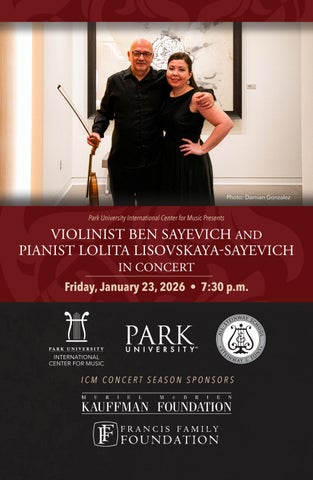
Photo: Damian Gonzalez
Park University International Center for Music Presents
VIOLINIST BEN SAYEVICH AND PIANIST LOLITA LISOVSKAYA-SAYEVICH IN CONCERT
Friday, January 23, 2026 • 7:30 p.m.
PA R K U N I V E R S I T Y
INTERNATIONAL CENTER FOR MUSIC
ICM CONCERT SEASON SPONSORS
Connect With Your Audience Program Advertising for the 25-26 Season
FOR MORE INFORMATION, CONTACT: Christin Painter christin@kcindependent.com 816-471-2800x218
ICM.PARK.EDU
Published by the The Independent Magazine Publisher ................................................ Rachel Lewis Falcon Dir. of Program Guide Operations ................. Christin Painter Graphic Design/Production ............. BurningStar Studios, LLC
The Independent Magazine 5201 Johnson Drive, Suite 300 | Mission, KS 66205 Park University International Center for Music program guides are a publication of the Performing Arts Division of the Independent Magazine. Information in this publication was carefully compiled to ensure accuracy. However, the publisher does not assume responsibility for accuracy. Editorial program content was provided by Park University International Center for Music. Copyright by the Independent Magazine. No part of this publication may be reproduced in any form without written permission of the publisher.
Catering Confidence ... at no extra charge
GrandmasCatering.com
WELCOME TO OUR 23RD SEASON! Dear Esteemed Patrons and Lovers of Music, At Park University’s International Center for Music, our purpose is simple yet profound: to shape the future of classical music by nurturing extraordinary talent and sharing it with the world. Each season, our students — rising artists from across the globe — come to Kansas City to learn, perform and inspire. Their artistry enriches our community, connecting hearts through music and leaving a lasting impact far beyond the stage. This season, we invite you to witness their brilliance alongside renowned guest artists and faculty who join us in advancing our mission. Every performance you attend supports not only world-class music, but also the dreams of the next generation of great musicians. Thank you for believing in the transformative power of music and for being part of this remarkable journey with us.
With gratitude,
Stanislav Ioudenitch Founder and Artistic Director International Center for Music at Park University This position is partially funded through the generosity of Paul and Linda DeBruce.
PROGRAM
Violinist Ben Sayevich and Pianist Lolita Lisovskaya-Sayevich
VIOLIN SONATA NO. 27 IN G MAJOR (K. 379/373A)
..................................................... Wolfgang Amadeus Mozart (1756-91) I Adagio - Allegro II Theme: Andantino cantabile, with variations
VIOLIN SONATA NO. 3 IN D MINOR, OP. 108
...................................................................... Johannes Brahms (1833-97) Allegro Adagio Un poco presto e con sentimento Presto agitato
INTERMISSION
VIOLIN SONATA NO. 1 IN A MAJOR, OP. 13
......................................................................... Gabriel Fauré (1845-1924) Allegretto molto Andante Scherzo: Allegro vivo Finale: Allegro quasi presto
5
ABOUT TONIGHT’S ARTISTS Ben Sayevich Lithuanian-Israeli violinist Ben Sayevich has established himself as one of the most distinguished violinists and teachers of his generation. He has performed in concert extensively throughout North America, Europe and the Far East and has appeared on radio and television as a soloist and chamber musician. He is featured as the soloist in a recording of Vivaldi’s “The Four Seasons” with the Kansas City Chamber Orchestra. At the New England Conservatory, he was chosen to play the Violin Concerto by Alban Berg for the celebration of the composer’s centenary. Sayevich’s interpretation carries the tradition that comes down directly from the composer, through his work on the piece with the late Louis Krasner, the commissioner, dedicatee and the violinist at the work’s premiere. His extensive activities with orchestras have included the concertmaster posts at the Kansas City Camerata and the Kansas City Chamber Orchestra, with both of which he made numerous concerto appearances, including Violin Concertos by Vieuxtemps, Glazunov, Mozart and Beethoven. He was also concertmaster of the Heidelberg Chamber Orchestra during a five-week world tour of Japan, Singapore and Canada. Sayevich also maintains a vigorous schedule as chamber musician. He is a founding member of the Park Piano Trio, established at Park University in 2006, and is violinist of the London-based Rosamunde Piano Trio. With the Rosamunde Trio he has performed widely in Europe, including appearances on BBC Radio London, Irish Public Radio in Cork and the Abbado Festival Bologna. 6
He is also a founding member of Quartet Accorda, which began in the 1990s and was officially incorporated in 2002. Sayevich has taught at the University of Kansas, the Grieg Academy in Bergen, Norway, at the New England Conservatory, the Hartt School of Music and the Yellow Barn Music Festival, in Vermont. Born in Kaunas, Lithuania, he studied violin in Vilnius from the age of 6 at the Churlonis School for the Performing Arts. At 12 he immigrated to Israel with his family and studied with Felix Andrievsky. At age 21, after serving in the Israeli Army, he went to the United States to study with Dorothy DeLay, later moving to the New England Conservatory to continue studies with her (1981-85) and with Eric Rosenblith (1985-87). He is a recipient of the prestigious artist diploma from the New England Conservatory, where he was Rosenblith’s teaching assistant.
Lolita Lisovskaya-Sayevich Born into a Tashkent (Uzbekistan) musical family, Lolita Lisovskaya-Sayevich began studying piano at the age of 4. In 1985, she entered the Uspensky Central Music School in Tashkent. In 1993, she started attending a private school for young musicians in Moscow, and that same year received the first prize at the Chopin International Piano Competition in Göttingen, Germany. She entered the Tchaikovsky Special Music School in 1995, and two years later was accepted to the Tchaikovsky Moscow Conservatory under the tutelage of Vera Gornostaeva, with whom she continued postgraduate study from 2002 to 2004. Lisovskaya-Sayevich also studied with Stanislav Ioudenitch at Park University.
7
In 1996, Lisovskaya-Sayevich received the first prize from the Nikolai Rubinstein International Piano Competition, and in 2007 the first prize at the Iowa International Piano Competition. She was awarded scholarships from the Rostropovich Foundation, the Spivakov Foundation and the Nikolai Petrov Foundation. She has also earned the laureate designation from the international program “New Names,” and the festival “Virtuoso 2000” in St. Petersburg, Russia. Lisovskaya-Sayevich has recorded at the Hessen Radio Station in Frankfurt, Germany, and at Orfei Radio in Moscow. Lisovskaya-Sayevich has presented numerous solo recitals and has played as a soloist with orchestras in Austria, France, Japan, Spain, Germany, Hungary, Italy and Russia. She has participated in many music festivals, including the Bashmet Festival in Tours, France, “Wave 2000” in Japan, International Musical Arts Institute in Maine (USA), Killington Music Festival in Vermont (USA), “Ars Longa” and “Primavera Classica” in Moscow. She collaborated with such renowned musicians as Daniel Muller-Shott, Shmuel Ashkenazy, members of the Boston Symphony Orchestra and many others. She now performs extensively in chamber music ensembles.
8
Program Notes by Paul Horsley Wolfgang Amadeus Mozart (1756-1791): Violin Sonata in G major, K. 379/373a That Mozart wrote 36 sonatas for violin and piano— twice as many as those for solo piano—is a testament to the importance that this genre played in his development. His earliest works for this combination (K. 6-15) were written for his childhood “musical tours,” during which he and his sister, Nannerl, appeared as a violin-piano duo in the courts of Europe. Mozart’s Portrait by Barbara Kraft middle-period sonatas, written in the 1770s for Paris and Mannheim (K. 301-K. 306), were already beginning to give the violin a more prominent place—in works that were still published as “sonatas for the piano with accompaniment of the violin” (well into the 19th century). By the time of his early Viennese violin sonatas, “equality” had nearly been achieved, as seen in the works that some call the Auernhammer Sonatas (K. 296 through K. 380)—after Mozart’s student Josepha Auernhammer, to whom he dedicated Photo: Damian Gonzalez the sonatas of 1778-81. Mozart’s return appearances to Vienna as an adult were thrilling events for the composer-pianist, and it is clear from his letters that they were a shot in the arm for the wunderkind who had languished too long in the Austrian hinterlands. Mozart made the trip of 1781, during which tonight’s sonata was composed, as part of the retinue of Archbishop Hieronymus Colloredo: for concerts at the court of his ailing father, Prince Rudolph Joseph Colloredo. Mozart’s excitement at being in Vienna spills over into the letter he wrote to his father, Leopold, on April 8th: “Today (for I am writing at 11 at night) we had a concert on which three of my pieces were performed—new ones, of course. The Rondo of a Concerto for [Antonio] Brunetti (K. 373) and a sonata for myself with violin accompaniment (K. 379) which I composed last night between 11 and 12 o’clock— but in order to have it ready in time, I wrote out only the accompaniment for Brunetti and retained my own part in my head. The third was a rondo aria for [Francesco] Ceccarelli (K. 374).” 9
Mozart statue in Salzburg, Austria
PROGRAM NOTES (CONT.) We learn a great deal about the composer from such letters—specifically, we see the extent to which no work was complete or “fixed” until it was written down. It was not uncommon for Mozart to improvise the keyboard part in performance, often right up to the time that he had to write it down for a publisher—or for the aid of a performer who lacked Mozart’s skills at extemporaneous creation. The Adagio introduction is sophisticated enough, but the turbo-charged Allegro (which begins, weirdly, in the relative minor key) contains something of the noisy turbulence of a 25-year-old trying hard to draw attention (of potential benefactors, perhaps?). Yet the heart of this sonata is the disarming set of variations (Andantino cantabile) that clarifies the equal roles of the two instruments. The piano takes charge of the first variation, the violin the second, and they collaborate on the third. The fourth returns to the G minor of the earlier Allegro, while the fifth features pizzicato throughout. An elaborated return of the theme (now at Allegretto) brings sunlight to the pensive version heard at the outset.
Johannes Brahms (1833 – 1897): Violin Sonata No. 3 in D minor, Op. 108 Brahms’ three sonatas for violin and piano represent a sort of endgame for the Classic-Romantic duo sonata. By the 1870s and 1880s, the chamber sonata that Mozart, Beethoven, Mendelssohn, and others had established earlier no longer entertained a discussion of which instrument was preeminent. In the late Romantic duo sonata and beyond, violinist and pianist were distinct artists, each playing a specific role toward achieving a common ideal, and a balance of textures. In early performances of these works, the composers were usually sitting at the piano, though generally with famous collaborators whose gifts they were eager to highlight. All three of Brahms’ sonatas belong to his mature style—they were the product of a very busy decade, from 1877 to 1888—and all were dedicated to his close friend and musical partner, Joseph Joachim. But where the First Sonata is meditative and the Second filled with introspective lyricism, the Third is almost 10
PROGRAM NOTES (CONT.) symphonic in texture and design. It stands as a pinnacle of the chamber music repertoire—magisterial in its control of theme, structure, and expression. It was written at one of Brahms’ favorite Swiss summer spots on Lake Thun, whose beauty provided respite and a quiet place to work. Among the fruits of these summers were the Second Cello Sonata, the Piano Trio in C minor, the Lieder of Op. 105-Op. 107, the Double Concerto for Violin and Cello, and the Second and Third Violin Sonatas. Brahms began the D-minor Sonata in 1886 and finished it in the summer of 1888. The premiere was in December 1888 in Cologne, with violinist Jenő Hubay and the composer on piano. Having recently reconciled with Joachim after a seven-year rift, Brahms performed the sonata with his old friend the following year in Vienna. With its dedication to the conductor Hans von Bülow, a longtime champion of Brahms’ music, the sonata was a favorite of Clara Schumann, who admired its emotional power and spiritual content. The third movement was for her “like a charming girl playing with her lover,” she wrote. And: “I wish the last movement could accompany me in my journey from this world to the next.” Despite the sonata’s expansiveness, it lasts just over 20 minutes, roughly the same length as the first two sonatas, both of which are in three movements. It shows Brahms at his most economic: What feels leisurely is actually quite distilled and concentrated. The Allegro opens with an elusive meander, almost as if it were in search of a theme, followed by a declarative transitional theme. The tender second subject, in F major, comes as a relief, but its lyricism is short-lived and the dark-hued development section is soon upon us again; a recapitulation arrives with so much stealth we hardly realize the movement is nearly over. The Adagio is one of Brahms’ most sentimental yet profoundly sensitive slow movements, a concise and frank expression of feelings that does not linger long enough to grow maudlin. The scherzo-like third movement (Un poco presto e con sentimento) seems to encapsulate the serious-yet-jocose spirit of Hanseatic humor in just three minutes, while the final Presto agitato sends pianist and violinist overboard in a raucous ride through headlong gallops, hymn-like interludes, and a snake-like theme that is reminiscent of the first movement’s opening bars. The movement ends with a brief, effective, no-nonsense coda. 11
PROGRAM NOTES (CONT.) Gabriel Fauré (1845-1924): Violin Sonata No. 1 in A major, Op. 13 Fauré was such a dashing figure in 19th-century Parisian society that he even makes an appearance in Marcel Proust’s novel À la recherche du temps perdu (In Search of Lost Time)— or at least many have believed that the author modeled his fictional composer Vinteuil after Fauré. (Proust was one of the composer’s most avid admirers, and he would later write to the surprised Photo by Charles Reutlinger musician: “I know your work well enough to write a 300-page book about it.”) Contemporary accounts paint Fauré as an exceptionally handsome fellow, perhaps a bit of a ladies’ man but fundamentally modest and even introverted. “He had a dark complexion,” wrote one observer of the composer, “a somewhat distant expression of the eyes, a soft voice and gentle manner of speech that retained the rolled provincial ‘r’, and a simple and charming bearing.” Fauré began his life a musical prodigy, the youngest of six children in the quiet village of Pamiers in southern France. At age nine he was sent to Paris’ École Niedermeyer, where he trained to be an organist and church musician. Among his early teachers was Camille Saint-Saëns, who taught him piano and introduced him to the music of Liszt and Wagner. Fauré went on to earn a modest living as a church organist (as did Proust’s Vinteuil), though he did, later in life, step into the prestigious post of director of the Paris Conservatory. As he entered his 70s, the modernist strains of Stravinsky and Schoenberg were taking hold in Europe—not to mention jazz. Fauré remained true to his muse; he is today viewed as one of the greatest composers France has produced. Among his works are two operas and numerous choral and orchestral works, but his most significant contribution are the chamber works with piano and his French chansons. He composed a trio, two quartets, and two quintets for piano and strings, in addition to several string sonatas for violin or cello—nearly all of which place the piano in a prominent role. In 1873, Saint-Saëns introduced Fauré to the great mezzo-soprano Pauline Viardot, and the younger composer was immediately drawn to the singer’s 12
PROGRAM NOTES (CONT.) celebrated household with its lively salon scene. Fauré dedicated a number of his finest songs to Viardot, but it was the mezzo-soprano’s daughter, Marianne, who captured his heart—utterly. Although the young woman broke off their fledgling relationship after just three months, the lovestruck Fauré had already written one of the most beautiful violin sonatas of the era, which he dedicated to Viardot’s son, Paul, a superb violinist. Yet it was Marie Tayau who gave the sonata’s premiere, in January 1877, with the composer at the keyboard. Saint-Saëns was so overwhelmed by it that he told Fauré he felt the sadness of a mother who sends her child into the world because she is no longer needed. “In this sonata you can find everything to tempt a gourmet,” he would later write, “new forms, excellent modulations, unusual tone colors, and the use of unexpected rhythms. A certain magic floats above everything, encompassing the whole work. With this piece, Monsieur Fauré takes his place among the masters.”
Fauré in 1875
The languorous Allegro molto opens with a piano outburst, setting up a lush and extravagant mood but also a straightforward sonata structure. The Andante is a barcarolle that starts in the minor mode and gives way, eventually, to D major. The Allegro vivo forms a sort of scherzo, bursting with cascades of fleet playfulness. The Allegro quasi presto finale concludes the sonata not with grandeur, but with what seems like a tender, clear-eyed search for tranquility.
13
Park International Center for Music
FACULTY & STAFF
Photo: Damian Gonzalez
Stanislav Ioudenitch
Christine Grossman
Founder & Artistic Director Piano Studio
Orchestral Repertoire, viola
Lolita Lisovskaya-Sayevich
Director of Collaborative Piano
Behzod Abduraimov Artist-in-Residence
Steven McDonald
Director of Orchestra
Gustavo Fernandez Agreda ICM Coordinator
Ben Sayevich Violin Studio
Shmuel Ashkenasi
Distinguish Visiting Artist, violin
Daniel Veis
Peter Chun,
Cello Studio
Viola Studio
14
Park International Center for Music
PATRONS SOCIETY MEMBERS
The Patrons Society makes it possible for Park International Center for Music students to pursue their dreams of professional careers on the concert stage. Our Patrons provide essential support for scholarships, faculty, and performance opportunities, ensuring world-class music thrives in Kansas City and beyond. We are deeply grateful for the generosity of each member listed below.
PATRON
SUPERLATIVE
Andrew and Peggy Beal * Lisa Browar * Rich Coble and Annette Luyben * Paul S. Fingersh and Brenda Althouse * Patty Garney * David and Lorelei Gibson * Ihab and Colleen Hassan * Ms. Lisa Merrill Hickok Robert E. Hoskins, ‘74 Walter Love and Sarah Good * John and Jacqueline Middelkamp * Patrick and Teresa Morrison * Holly Nielsen * Charles and Susan Porter * James and Laurie Rote * John and Angela Walker * Barbara and Phil Wassmer * Joyce Weiblen * John and Karen Yungmeyer *
Richard J. Stern Foundation for the Arts - Commerce Bank, Trustee * Ronald and Phyllis Nolan * Jerry M. White and Cyprienne Simchowitz EXCEPTIONAL
Brad and Marilyn Brewster * SUPREME
Commerce Bank * Brad and Theresa Freilich Barnett and Shirley Helzberg Benny and Edith Lee * John and Debra Starr * EXTRAORDINAIRE
Joe and Jeanne Brandmeyer * Thomas and Mary Bet Brown * Vincent and Julie Clark * Stanley Fisher and Rita Zhorov * Stephen L. Melton * Mira Mdivani/Mdivani Corporate Immigration Law Firm * Susan Morgenthaler* Rob and Joelle Smith Nicole and Myron Wang *
* 2025-26 Member We gratefully acknowledge these donors as of December 21, 2025.
15
JOIN THE PATRONS SOCIETY! Your gift brings world-class music to life.
Your gift makes an impact: Supporting scholarships that bring gifted students from around the world to Kansas City Sustaining performances that connect our community to international artistry Advancing communication and outreach that inspires the next generation of musicians
Ways to support Park ICM: Annual Gifts - Every contribution, no matter the size, fuels our students’ success Patrons Society - join with a commitment of $1,000 or more annually and enjoy the unique opportunities to connect more deeply with Park ICM Sponsorships - support a concert, artist or special event and receive recognition for your leadership. Planned Giving - leave a legacy through bequests, estate plans or endowed funds
Scan the QR code or visit ICM.PARK.EDU to learn more. 16
Together our donations sustain Park ICM’s mission and ensure that the music continues for generations.
P A R K
U N I V E R S I T Y
I N T E R N AT IO N A L
C E N T E R
F O R
M U S IC
ICM Orchestra’s Annual Valentine Concert The annual Valentine’s Week concert will highlight the many moods of dance music, including the Romanian Folk Dances of Bela Bartok, the lilting Waltz from Tchaikovsky’s Serenade for Strings, and the boisterous Hoedown from Aaron Copland’s ballet Rodeo. This all-strings program will also feature Handel’s Concerto Grosso in G Major op.6 no.1, the vigorous St. Paul Suite of Gustav Holst, Puccini’s tender and moving Chrysanthemums, Jan Sibelius’ elegant Romance for String Orchestra, and will conclude with Leroy Anderson’s virtuosic showpiece for strings, Fiddle-Faddle.
FRIDAY • FEBRUARY 6, 2026 7:30 P.M. PARK ICM ORCHESTRA WITH Filippo Ciabatti, Conducting GRAHAM TYLER MEMORIAL CHAPEL AT PARK UNIVERSITY. FREE WITH RESERVATION
ICM.PARK.EDU
17
CLASSICAL MUSIC FOR EVERYONE. Set your dial to 91.9 FM or stream at ClassicalKC.org
Sign up for Take Note to stay in the loop on local events and exclusive content from Classical KC 18
Park University International Center for Music Presents
Park ICM Strings Studio in Recital
Friday, April 24, 2026 | 7:30 p.m. | 1900 Building Park ICM’s concert season continues with an esteemed lineup of string
musicians under the tutelage of studio professors violinist Ben Sayevich,
cellist Daniel Veis, and violist Peter Chun. Our talented string students will take the stage to present a diverse and rich program,
showcasing the broad spectrum and emotional depth
of compositions written for string instruments. The Park Quartet will also make an appearance.
For additional information, visit ICM.PARK.EDU General Admission $30. Students $10 with I.D.
PA R K U N I V E R S I T Y
INTERNATIONAL CENTER FOR MUSIC
19
FOR TICKETS, SCAN HERE
E S TA B L I S H E D 1 8 9 9 | K A N S A S C I T Y ’ S J O U R N A L O F S O C I E T Y | W W W. K C I N D E P E N D E N T. C O M
A Kansas City tradition since 1899
Looking for a Church? Try Resurrection! Worship in-person at any of our nine locations Leawood | Olathe (West) | Downtown | Blue Springs | Overland Park | Brookside Spring Hill | Liberty | Lee’s Summit
Worship on TV, online, and on-demand Find all the details at our worship page: resurrection.church/worship Resurrection is... Passionate about following Jesus Committed to serving our city Serious about welcoming everyone A church for people with questions A place where you can find hope
Contact Laura Gabriel at 816.471.2800 to start your subscription.
Visit the Eisenhower Presidential Library and Museum Best Historic Small Town by USA TODAY (2025)
Top 10 True Western Town of the Year by True West Magazine (2025)
Best Presidential Attraction by Newsweek (2025)
AmericaLikesAbilene.com
P I AN O • V IO LIN • C ELLO • VIOL A • OR CHE ST R A
Historic Graham Tyler Memorial Chapel on the Parkville (Mo.) Campus
Ready for More World-Class Music INCLUDING ORCHESTRA AND
STUDENT RECITALS?
SCAN THE QR CODE FOR DATES AND TIMES. Free admission underwritten by Park University. 21
Scan QR to view Park University’s Impact Report, 100 Years of Building a Legacy, including inspiring stories about Park alumni and donors.
P A R K
U N I V E R S I T Y 2 0 2 3 - 2 5 I M PACT R E P O RT O F F I C E O F A DVA N C E M E N T
150 YEARS OF BUILDING A
PAR
K UNIVERSITY
1875
2025
150
YEARS
22
&
FOR THE PERFORMING ARTS
SAVE THE DATE
&
STANISLAV
FRIENDS
MARCH 22, 2026 KAUFFMAN CENTER FOR THE PERFORMING ARTS PRESENTED BY PARK UNIVERSITY Experience an unforgettable evening of world-class artistry as Stanislav Ioudenitch, Park ICM founder and artistic director, joins acclaimed alumnus Michael Davidman ’21, winner of the 2025 American Piano Awards.
&
This year’s Stanislav & Friends will also recognize the distinguished career of Daniel Veis as he retires from the Park ICM faculty.
STProceeds ANISLA FRIENDS from the eventV support Park ICM’s renowned program and
student scholarships, ensuring the continued excellence and impact of this KAUFFMAN CENTER world-class institution. FOR THE PERFORMING ARTS
23
TAKE CENTER
STAGE Connect with Your Audience this Season and Advertise in Kansas City’s Top Theater and Performance Venues. Contact Christin Painter at: christin@kcindependent.com • 816-471-2800 x218 • kcindependent.com