
January 16, 2026
The independent student newspaper of the Northeastern community
January 16, 2026
The independent student newspaper of the Northeastern community
Beth Winkelstein, a long-time leader at the University of Penn sylvania, stepped into the role of provost and senior vice president of academic affairs in fall 2025, overseeing Northeastern’s academic mission and research enter prise.
At the start of the semester, five weeks after stepping into the role at Northeastern, Winkelstein sat down for an interview with The Huntington News to discuss the university’s research, academic mission and global campus network.
In deciding to come to Northeastern, she noted the university’s innovative academic mission and histori cal commitment to experiential learning.
“I made a deci sion to be at a place that was leading and not fretting and not wringing their hands about the future, but saying, ‘Let’s get in front of the future. Let’s evolve.’ That’s what North eastern has done through its entire history,” she said.
As part of Winkelstein’s role at Northeastern, she oversees the
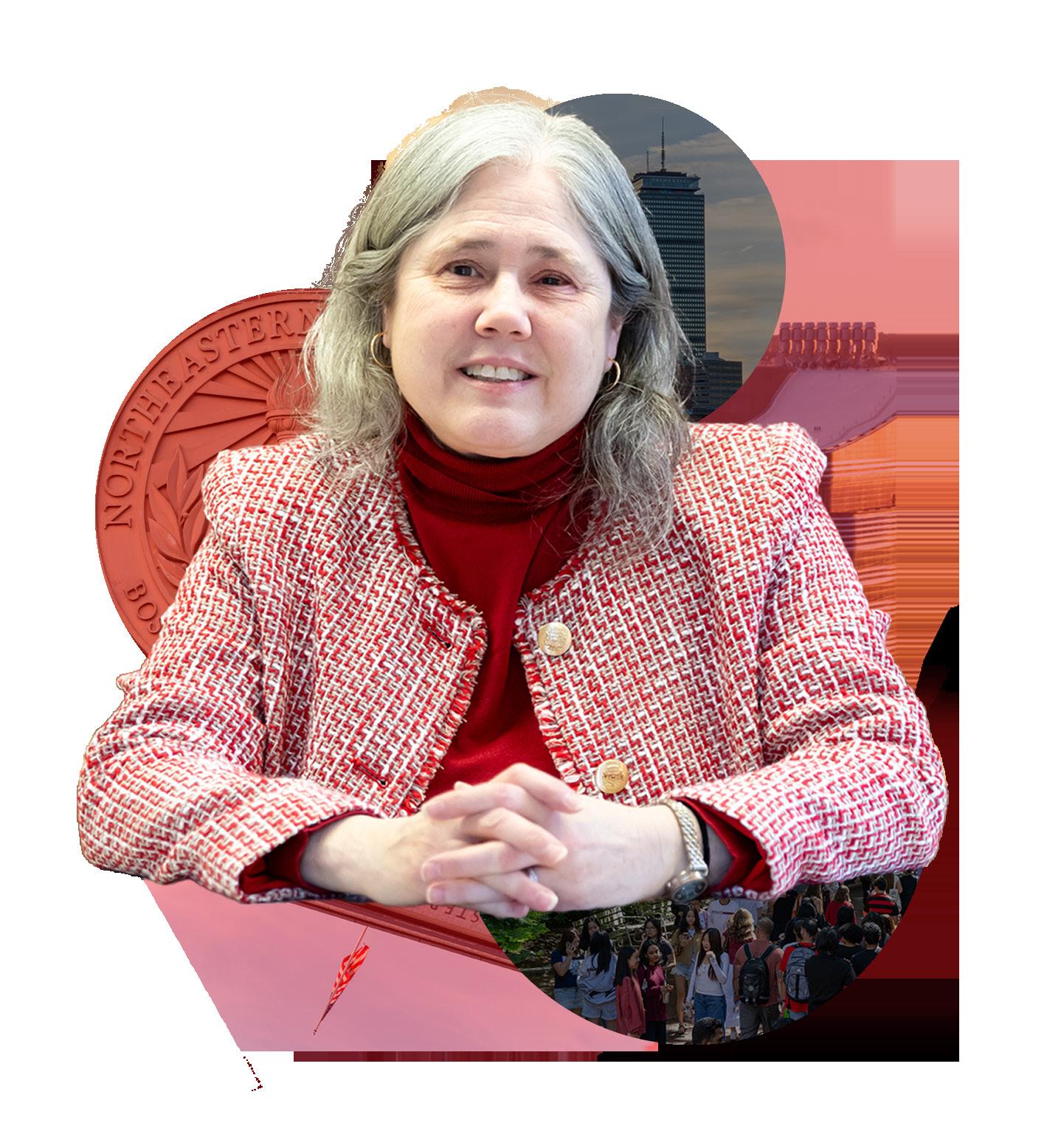
Photo by Aya Al-Zehhawi
Funds for CSSH departments slashed 75% to 80%
FRANCES KLEMM News Staff
Northeastern’s College of Social Sciences and Humanities, or CSSH, department discretionary budgets — or non-compensation budgets that cover items like events and speakers — have been cut to “75-80% less
than the average of actual expenses over the last three years,” CSSH Associate Dean for Administration and Finance Jim Rollins wrote in a July department-wide email obtained by The Huntington News. Funds allotted for faculty research as well as administrative staff positions have also decreased.
its global campus network, which continues to be one of the universi-
“I think that it’s more than just planting our flag,” Winkelstein said of the university’s 13 campuses beyond Boston.
“It’s actually really thinking about how we can personalize and customize the entire global university system.”
Part of strategizing how the university runs its non-Boston campuses, she said, is to “make the best and highest use of each of our programs, as well as each of our campuses.” For instance, the Seattle campus, located in a city saturated with tech companies, offers graduate programs in disciplines including computer science and information systems.
Winkelstein also oversees the university’s research enterprise. Northeastern is one of 187 American universities with an R1 status, a designation granted by Carnegie Classifications that recognizes institutions for a high level of research output.
To earn the status, universities must spend at least $50 million for research and award 70 research doctorates annually, according to
Beanpot turns sibling support into rivalry
Read more about an NCAA matchup between twins.
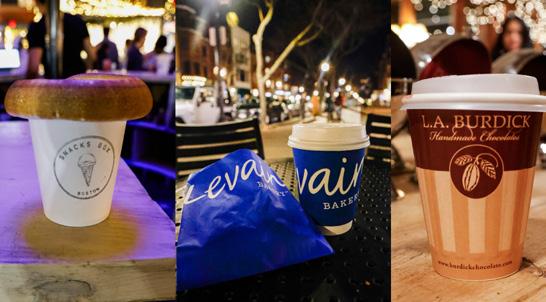
Hot or not: The best hot chocolate in Boston
Read more about tried and true spots around the city.
Solve The News’ January crossword!
Answers will be revealed in the next print issue.

“I have been a chair for dozens of years in [a] number of different universities. I have never seen cuts of this order,” said Suzanna Walters, chair of CSSH’s Women’s, Gender, and Sexuality Studies program. “I’ve seen cuts [of] 10%, 20%, but I’ve never seen cuts that are so enormous.”
CSSH, on Page 2
SYDNEY
WOOGERD News Correspondent
Every evening, Duane Mitchell — a 73-year old semi-retired software development consultant — opens his Uber app, grabs his keys and walks out of his home in Roslindaleto his blue 2015 Subaru Forester. From there, he sets off to across Boston, where he has worked as a rideshare driver for 10 years. After around four hours of shuttling passengers and sitting at red lights, Mitchell returns having made little more than $100.
According to annual reports from the Massachusetts Department of Public Utilities, nearly 1.5 million drivers have been background-checked and approved by the state between 2017 and 2024 and around 100,000 drivers in Massachusetts are actively working for one or both of the two main rideshare apps: Uber and Lyft.
Despite the popularity of a flexible job like rideshare driving, many workers hold major grievances against their companies. One of their main complaints is low wages, especially in a state with the second-highest cost of living in the country.
“Uber and Lyft are coming into our city and taking lots of money out of it. They’re not paying the drivers enough to make a decent living, and on top of that, the drivers have to go to the state to get [financial] assistance,” Mitchell said. “Every citizen in Massachusetts should have an interest in this, because this is some real gangster stuff … middle-class Americans need to fight these corporate tech people.”
Inadequate wages haven’t always been the norm for rideshare drivers; Mitchell said drivers have been making less and less per ride over the past few years and need more tips to fill the gap.
UBER, on Page 3
A bioengineer by training, Winkelstein most recently served at Penn as deputy provost and the Eduardo D. Glandt President’s Distinguished Professor of Bioengineering and Neurosurgery. She earned her undergraduate degree in bioengineering from Penn and went on to complete a doctorate in the field at Duke University. After completing postdoctoral training at Dartmouth College, she joined Penn faculty in 2002.
One year after entering the role of deputy provost at Penn in 2020, Winkelstein was tapped as interim provost. She held the role from July 2021 through May 2023 before be
task force. According to her Northeastern biography, she co-led a $750 million initiative to recruit faculty in “strategic academic fields” and led efforts to expand faculty diversity.
Winkelstein herself is a seasoned researcher, having authored more than 175 papers and book chapters, according to her biography. (On the shelves of her office sits a copy of “Orthopedic Biomechanics,” a 2012 book she was the editor of.) Her work, which has been widely cited, focuses on how injuries to the spine and joints cause pain. She received a Presidential Early Career Award from the National Science Foun dation and is an elected fellow of several engineering societies.
She discussed how Northeast
federal grants, saying the university
the number of its grants the federal
Northeastern terminations bled their suffi cient funds and a
Winkelstein to appeal, a responsibility
of Penn, in 2022, Winkelstein faced controversy when she and other Penn officials accused then-undergraduate student Mackenzie Fierceton of misrepresenting herself as a first-generation, low-income student and a victim of abuse in her Rhodes Scholarship application. Fierceton, whose parents abused her for years before she was placed in foster care during high school, according to reporting by The New Yorker, attended
Penn on a full-ride QuestBridge scholarship. Fierceton’s story and ensuing legal battle with Penn attracted the attention of national media outlets.
Following an investigation, the Rhodes Trust rescinded Fierceton’s scholarship offer. In 2021, she sued the university and reached a settlement in February 2025. Winkelstein declined to comment about the controversy.
Aoun tapped her to replace former Provost and Senior Vice President for Academic Affairs David Madigan, who stepped down in June 2025.
During the interview, Winkelstein repeatedly referenced the university’s co-op program, global network and stance on artificial intelligence.
“We are in a place here where we have always thought about how do we do this better,” she said. “It’s in our DNA.”
planning events and hiring co-op or non-federal work-study students.
“We can’t have speakers. We can’t have events. We can’t buy pizza for the students. We can’t do anything.”
Northeastern media relations did not respond to several requests for comment about the budget being slashed up to 80% when compared to the average over the past several years.
Department budgets are typically released in May or June for the coming year, prior to the start of the fiscal year July 1, according to one faculty source who was granted anonymity due to concerns of retaliation from the university. This year, department chairs received budgets for the 2026 fiscal year in August.
In the July 1 email, Rollins wrote that the 2026 fiscal year budget would be “significantly more constrained than initially anticipated.” Additionally, Rollins told departments within CSSH to refrain from submitting travel requests, signing contracts,
In a July 15 email, Rollins clarified that the non-compensation allocation of CSSH’s annual operating budget has been reduced by 75% from the previous fiscal year.
In an Aug. 15 internal email, Rollins announced that CSSH will no longer hire student co-ops or student employees besides stipended graduate assistants. He did not specify how long the hiring freeze will last.
The email also stated that university leadership may make “small changes” to CSSH budgets throughout the academic year and that CSSH leadership would work with departments to “identify sources” of funding to hire teaching assistants for courses with more than 50 students.
The college’s Director of Reporting and Financial Planning Nancy Falk confirmed in a different Aug. 15 internal email that faculty who are tenured or on the tenure track and who don’t have other funds, such as
through grants, available to them will receive $1,000 in development or research funds.
According to the anonymous faculty source, in previous years, CSSH faculty have generally received around $5,000 in development or research funds annually. This sharp decrease could have an impact on tenure and promotion, they said.
When asked about the decrease, Northeastern Vice President for Communications Renata Nyul said funds are typically adjusted each year.
“The level of faculty development funds is adjusted annually depending on available resources. Note that tenure-track faculty in CSSH have access to either start-up research funds or professional development funds,” Nyul said in a Nov. 21 statement to The News.
The budget cuts come as the Trump administration threatens to slash research indirect cost rates and grants and cap international student enrollment. Other Boston schools,
including Berklee College of Music, University of Massachusetts Boston and Boston University, have laid off dozens of staff due to budget cuts.
At least one CSSH department is operating without any administrative staff, while others have started sharing administrators in the past year, the anonymous faculty source told The News. Previously, each department had between two and four administrative staff members who helped with finances and events.
“There is an attempt to sort of move staff around without any real consultation with the staff,” Walters said.
The steep cuts going into the 2025-26 school year could be worse, said Christopher Bosso, a professor of public policy and political science.
“While nobody is happy about dealing with budget cuts, the alternatives are worse. We haven’t seen widespread layoffs or pay freezes, unlike other institutions. So things are tight at the moment, but they are not
dire. We’ll see how the year plays out,” Bosso wrote in an email to The News.
Bosso added that during his 40 years at Northeastern, he has seen cuts in discretionary spending during times of financial uncertainty.
Walters is calling on the Northeastern administration to be more transparent about why these cuts are necessary and said she has repeatedly asked administrators to provide information on the university’s financial situation.
“We’ve asked for detailed accounting, and we have repeatedly been refused that accounting. I mean, quite explicitly refused it. They just offer vague statements,” Walters said. She is concerned that the university’s lack of transparency on the issue defies Northeastern’s values as a university.
“We are an institution of higher learning that relies on data. We believe in science. We believe in transparency and accountability. And none of that has happened,” Walters said.
AOIFE JEFFRIES News Staff
A sharpied paper sign rustles in the wind, taped to the side door of an Allston basement. Microphones reach toward the low ceilings and wires snake across the floor as an eager audience filters in. Entrance is $5 cash, and the bill lists three college-aged bands ready to make some noise. Boston’s DIY music scene is covert, creative and saturated with aspiring bands looking to dive into the community.
However, building an audience isn’t easy. Beyond the music, bands must handle outreach and booking, building connections and growing a following to find success. Starting a band is the first step, but where do musicians go from there?
“We’re starting to kind of tackle with the realities of like, okay, it’s really fun to play, that’s always still fun and it makes doing all of the other work worth it … but the question of how to build an audience and how to promote yourself on social media is definitely really difficult,” said Danny Rollo, a Northeastern master’s of computer science student and singer of the band Music Farm.
Music Farm played its first live show at Dedham Porchfest and started with basement shows before entering the bar scene.
“The artist needs to think of themselves as artist, management, agent, promoter — they need to think of themselves as all those things,” said Jeff Dorenfeld, a retired music business professor at Berklee College of Music who worked in the industry for over 25 years with artists including Ozzy Osbourne and Sammy Hagar. “There’s
always something you should be doing to promote your career.”
The indie music scene in Boston is heavily connections-based, and building those relationships can be difficult early on. In Rollo’s case, he was connected through Hillside Bistro, the DIY venue he and friends ran out of their basement. However, the shows were discontinued when Hillside fell victim to a widespread crackdown on basement venues following a fall 2023 Boston Globe article uncovering the scene.
“It was a tough time, and everyone kind of just closed their doors,” said fifth-year Northeastern human services major Maddy Westcott, one of the collaborators on Hillside Bistro. “It was a real struggle for artists … people couldn’t congregate and have fun at a show together; it was really rough.”
This wasn’t the first time that house venues faced challenges with law enforcement, and it probably won’t be the last. The DIY scene is unpredictable, but when it thrives, bands can capitalize on its resources and accessibility.
Back in 2010, indie rock band Pile experienced a flourishing Boston basement scene very different from today’s. Now, 15 years later, Pile has just completed an international tour, having found the success out of Boston that current young bands are searching for.
“We ended up finding a really vibrant community through playing at people’s houses,” said Rick Maguire, Pile frontman. “That was a big part of our development as a band.”
Even as the DIY music scene returns to local culture, new bands have to focus on small venues, bars and
basement shows to find an audience.
“Being the artist is going around and you’re like, ‘Hey, can I please play, can I please play, can I please play,’” Rollo said.
In this industry, the more persistent and shameless an artist is with their promotion, the better.
Outreach has been effective for Music Farm so far, Rollo said. However, as bands grow and seek bigger venues, management and booking agencies increasingly come into the picture.
Rollo and his bandmates have started to push into nearby cities to further grow their audience. Music Farm still operates independently, and Rollo continues to handle much of the networking and booking.
“You don’t actually need a manager until you have more going on than you have time to deal with,” said Mark Kates, founder of artist management agency Fenway Recordings, which has worked with bands like Mission of Burma, The Beastie Boys and MGMT.
Pile, for instance, has self-managed successfully. The band has operated
almost entirely on its own throughout its 16-year career.
Working with booking agents and managers can be advantageous for bands in Boston, but given the city’s quickly-evolving music scene, the most important thing for artists is to be adaptable, proactive and persistent.
“I think these days you need to find your audience anyway and anywhere you can,” Kates said. “I applaud anybody who finds a way to operate these days.”
Young artists in Boston must navigate management and booking decisions, promotion, networking and outreach in an ever-changing music scene. Within this convolution, what remains most important to many musicians is the depth of community Boston provides.

UBER, from Front
“I don’t think [companies] care,” Mitchell said. “All they care about is profit. I think they’re making good profit now, and I don’t see why they can’t pay us enough. They used to.”
Len Sherman, adjunct professor of marketing and management at Columbia Business School, published “How Uber Became A Cash-Generating Machine” in June 2025. The paper presents the results of Sherman’s study explaining Uber’s $12 billion increase in free cash flow after consistently declining flow before 2022. Such financial change triggered “one of the greatest turnarounds in business history,” Sherman said.
The conclusion connected Uber’s mid-2022 “upfront pricing” initiative — which bills riders before they are matched to a ride — to a decrease in overall profits seen by drivers as their company makes billions.
Sherman said he now believes rideshare companies use a secret algorithm to charge riders the most they are willing to pay and offer drivers the lowest-paying jobs they are willing to take, subsequently increasing their profit margin.
“They’re taking full advantage of this significant information advantage they have over individual riders and individual drivers and it’s serving
them extremely well,” Sherman said. This shift and the rapid change in rideshare companies’ profit isn’t going unnoticed by the drivers in the community.
“If you ask any drivers right now, all of them, their income dropped to 30-40%,” said Farouk Yahi, a 39-yearold driver of six years. “Uber and Lyft right now are taking advantage of the drivers and the riders.”
The community is finding that creating change as a collective may be more plausible. In July 2024, after months of protesting and advocating, Massachusetts rideshare drivers started a ballot initiative allowing state residents to vote on whether drivers should have the right to unionize. Previously, drivers were banned from unionizing because they were classified as independent contractors rather than employees. But in November, with the support of 54% of state voters and two major union organizers — 32BJ Service Employees International Union, or SEIU, and the International Association of Machinists and Aerospace Workers — the initiative was passed. Nonetheless, there’s a long way to go before drivers can officially be declared a union and begin negotiations with Uber and Lyft.
“[They] are big corporations, and it’s so hard to beat them,” Yahi said.
“[But] with the union, we’re gonna have the power to negotiate a better contract and better pay and access to retirement programs and access to health insurance.”
In June 2024, only months before the ballot initiative was voted on and approved, the Massachusetts Attorney General’s Office entered into a settlement agreement with Uber and Lyft, ending a 4-year battle. The settlement established a $33.48 per hour minimum wage for drivers based on their “active time,” guaranteed a maximum of 40 hours per year of sick leave and a stipend for health and other benefits. More protections and benefits are needed, according to Rahim Abbasi, an activist and 32BJ SEIU organizer behind the App Drivers Union.
“A union is what will give working people a fair shot. I would say the American worker doesn’t have a chance without a union,” Abbasi said. “I was a driver, and I was like, ‘Oh, these wages aren’t sufficient. We need something else to be done.’”
There are people outside the community who believe the union may misrepresent drivers because of the low 25% signature threshold required to begin negotiating. In most cases, the National Labor Relations Board requires aspiring unions to obtain the approval of 50% of workers to
Thousands rally in Boston after ICE shooting, Venezuela strikes
More than 1,000 people gathered on Boston Common Jan. 10 amid a nationwide wave of demonstrations protesting President Donald Trump’s immigration policies and U.S. aggression overseas.
The rally began at noon at the Massachusetts State House. Organizers spoke for about two hours before the crowd marched to the JFK Federal Building.
The Boston demonstration was one of more than 1,000 held across the country following U.S. strikes on Venezuela Jan. 3 and the shooting of a woman by a U.S. Immigration and Customs Enforcement, or ICE, agent in Minnesota Jan. 7.
“We’ve been talking about the violence in Venezuela and the violence here in our country being carried out by ICE,” said Bonnie Jin, Boston co-chair of the Boston Demoratic Socialists of America, or DSA. “Seeing . . . the pain so many of our neighbors feel made us want to come together today.”
Organizers included DSA as well as the Educational Freedom Project, or EFP, a cross-campus group defending the integrity of universities.
“There’s a lot to get discouraged about, but there’s also a lot of hope in places like this. It’s important people continue to look for that hope,” said Jenssen Sebree, EFP’s deputy policy director and fourthyear international affairs major at Northeastern.
Former NU police officer moves to give up certification
John Landers, a former Northeastern police officer who was criminally prosecuted in the past, voluntarily relinquished his law enforcement certification Dec. 18.
be immediately certified. However, due to the nature of rideshare work being completely independent from any workplace with atypical hours and a high turnover rate, the nuance of this particular unionization lies in the difficulty of reaching drivers, making it extremely tedious to collect a majority vote.
“The hardest thing about this campaign is there’s no work site,” Abbasi said. “The drivers are spread across the whole state, and you have to go look for them.”
Currently, the aspiring union is doing just that. According to the new Massachusetts law, once the group has proven support from 5% of active rideshare drivers, they’ll be given a list of all active drivers statewide to aid their efforts. From there, they need to receive an additional 20% to be recognized as an official union. Once established, they’ll draft contracts and negotiate with their companies in Massachusetts to fight for a voice in the industry.
“Some people will be pro-union, some people will be anti-union. But when you dig into the issues, most people just want the same thing,” Abbasi said. “They just want to go home safely at the end of the night, making a fair wage.”
Landers’ voluntary relinquishment request was granted by the Massachusetts Peace Officer Standards and Training, or POST, Commission with conditions that permit him to reapply for certification in the future, POST spokesperson Alia Spring wrote in an email to The Huntington News.
The Northeastern University Police Department, or NUPD, hired Landers in 2021. He worked there for four years before retiring in September, according to Spring. Before joining NUPD, Landers worked for MBTA police for 29 years, from 1992 to 2021. Before he voluntarily relinquished his certification, Landers was certified until July 1, 2026. (Officers must be re-certified every three years.)
Originally introduced by the POST Commission in April, voluntary relinquishment of certification is not a form of discipline, according to Spring. Officers may have their own reasons to request voluntary relinquishment, such as obtaining a private investigator license. It is unclear why Landers applied to have his certification relinquished. The university did not respond to requests for comment from The News about the details around Landers’ employment and departure from the force.
a co-op? You might want to avoid NU
FRANCES KLEMM News Staff
When Washington, D.C. native Kaylee Burkett was applying to college, she was immediately drawn to Northeastern for its renowned coop program. Her excitement about the university’s London campus, coupled with the promise that she could still go on co-op outside of its flagship Boston location, led her to accept an offer at NU London.
“That’s what I was planning on,” Burkett, a second-year politics and international relations major, said of going on co-op. “And what I think I chose Northeastern for.”
What she found upon arrival at the London campus was “dodgy” information on co-ops from her academic advisors and rumors challenging their very existence from her peers.
Although NU London’s website boasts the program and lists exemplary student co-ops, students say experiential learning opportunities on the U.K. campus are hard to come by.
“While co-ops at our London campus are a new offering, Northeastern students have been doing co-op for decades across our global network of campuses,” the Northeastern London website reads.
The university began marketing co-ops at Northeastern London in fall 2023, but the program was officially launched in spring 2025, said Elizabeth Zulick, Northeastern’s senior vice chancellor for education
students say.
innovation. During the inaugural semester, Zulick told The Huntington News that “something like 40” NU London students were either on co-op or had an internship. According to its website, 2,281 students attend the London campus.
The university did not respond to a follow-up question about whether part-time co-ops or internships are included in the number.
“The model is not a carbon copy of what we do in Boston, because students who are typically going for a U.K. degree have different expectations,” Zulick said. Students can attend the London campus for three years to earn a U.K. degree, then have the option to transfer to Boston to receive one in the U.S.
A 56 person survey conducted by the London campus’ Student Union from Oct. 6 to 8 revealed that, when asked whether they were aware of coop opportunities, eight NU London students said, “No, I am a first year. I haven’t heard of this.” Fourteen said they have very little information on how to access the program. Sixteen said they had some idea of what it is and how to access it, and 15 said they knew what it is and how to access it. Only three respondents said that they had accessed it.
Petar Petrov, a 2025 Northeastern alumnus and former president of Northeastern London’s Student Union, noticed complaints from second-years about the London campus’ co-op program during his 2024-25
term as president. Petrov described the process to get a co-op as “very different” from how it was marketed.
“The marketing that has been put out by the university for the co-ops has pretty much marketed them as an identical thing to those in Boston — and they’re not,” Petrov said.
NU London students who are not eligible to work in the U.S. can’t access NUWorks, the exclusive platform Northeastern students use to apply for co-ops, Zulick said. Instead, students use Handshake, a global job posting website that anyone can access, and can talk to their career advisor about accessing NUWorks.
“U.K. citizens don’t have work rights in the United States, by default. The NU London career team can support students who have questions around visa support, as there are some case-by-case exceptions possible,” a Northeastern spokesperson told The News in an interview.
Matilda Edwards, a third-year politics and data science major who completed a six-month-long internship in London, applied for her internship on Handshake.
Edwards, who has had three academic advisors in the last two years, explained that the constant staff turnover made the London co-op search “not organized.”
Mia Humphries, a third-year psychology student, took co-op preparatory classes in her second year, which she said were attended by around a hundred students each semester.
While she believes the class helped her with the interview and application skills necessary for internships, she could not find a co-op related to psychology and instead applied to work for her professors.
“I think our discipline was a little bit disappointed with the availability of co-ops around our industry,” Humphries said, referring to psychology. “I really couldn’t find anything on [Handshake] that was tailored toward psychology or kind of an allied industry.”
While Edwards did acquire an internship through NU London’s co-op program, her sister, a student at the University of Bath, completed a “year in industry” to gain job experience.
a third-year computer science and philosophy combined major, worked as a communities officer, a position she chose as her job for an in-thefield class.
When Mills tried to look for internships in Boston over summer 2025, the career office told her they could not help with international internships.
As a student ambassador, Mills is also tasked with promoting the school to prospective and incoming students. She tells students that the university will walk them through

The program, which U.K. universities traditionally offer but NU London does not, lets students work full-time in a position related to their field of study between their second and final year.
NU London does offer another option for experiential learning: inthe-field classes, which take the place of an elective, meet once every two weeks and require students to work a job for over 300 hours. Seren Mills,
every step of the co-op process and that there may be Northeastern-exclusive offers. But off the job, her advice to students is not to let coops be their deciding factor when choosing NU London.
“I don’t want to say it’s not going to get any better, but it just currently isn’t where it should be,” Mills said.
KATARINA SCHMEISZER AND ELSA O’DONNELL Projects Editors
With 14 campuses, almost 44,000 students, more than 3,400 faculty and 4,800 staff members, Northeastern stands out among higher education institutions. But to govern a globally growing university, President Joseph E. Aoun can’t work alone.
Below Aoun are seven vice presidents who form his senior leadership
viduals making the decisions that impact every student on campus.
Director: The president
The director is the visionary whose ideas are brought to life by the cast and crew. Similarly, the president of a university sets the agenda for its present and future. Widely known by the community as the face of the university, the president is the leader of the institution’s academic and research endeavors. Announcements to the Northeastern community are often signed and attributed to the president, such as statements on national and international events.
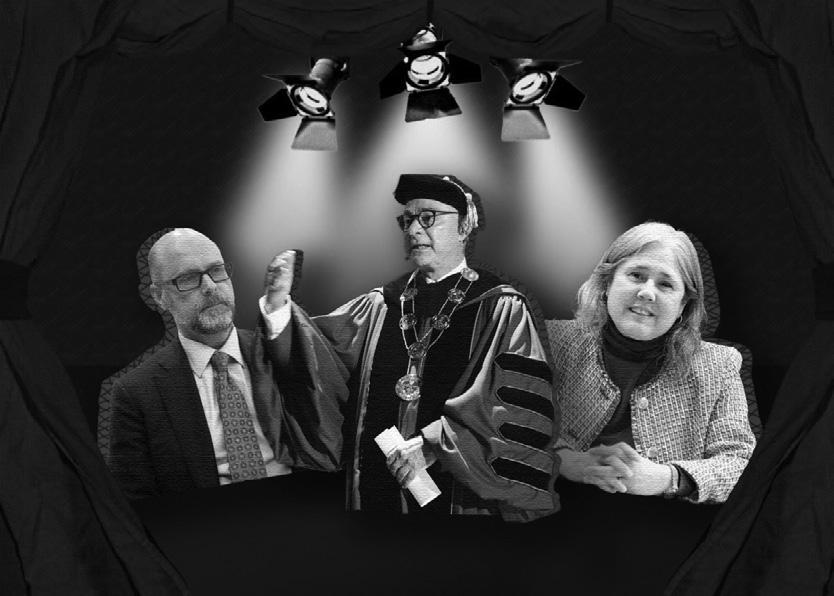
This position is currently held by Joseph E. Aoun. Northeastern media relations did not respond to a request to speak with Aoun.
Playwright: Provost and senior vice president for academic affairs
team. The team runs the most critical offices that manage academics, research, legal matters, communications, finances and university advancement. Like a Broadway production, all eight people on the leadership team play crucial roles in ensuring the “show” runs smoothly. Here’s a look inside the playbill of “The Northeastern Show,” outlining the indi-
The playwright is the author of the play — their job is to write character dialogue and provide stage directions. Like a playwright, the provost oversees the facets of Northeastern that make it unique: its academic programs and research pursuits. The provost oversees initiatives in academics and research, including the implementation of the university’s official academic plan, “Experience Unleashed.”
The Office of the Provost consists of the provost and deans from the university’s 10 colleges and schools and the administrators who work together to execute the efforts of the provost’s office.
Currently, Beth Winkelstein holds this position. Northeastern media relations did not respond to a request to interview Winkelstein about her role for this article.
Stage manager: Chancellor and senior vice president for learning
The stage manager coordinates the actors and behind-the-scenes operations during a production. Similarly, the chancellor and the senior vice president for learning keeps the university’s academic programs aligned, ensuring the “production” runs cohesively. The chancellor oversees all learning and teaching initiatives at Northeastern, including expanding the university’s global and experiential learning network.
Kenneth Henderson currently holds this position. Northeastern media relations did not respond to a request to speak with Henderson.
Lighting coordinator: Senior vice president for external affairs
In a show, the lighting coordinator focuses the spotlight on certain actors or parts of the stage, highlighting what they want the audience to focus on in the storyline.
Similarly, Northeastern’s senior vice president for external affairs spotlights announcements the university wants to share with the public. The Office of External Affairs has five vice presidents who report
to the senior vice president and focus on specific areas, including marketing and federal relations.
This position also works closely with the president, playing an important role in crisis management.
Mike Armini currently holds this position. Northeastern media relations did not respond to a request to speak with Armini.
Set designer and builder: Senior vice president for global network and strategic initiatives
The set designer and builder for a Broadway production create and maintain the set pieces on which the actors perform. The senior vice president for global network and strategic initiatives helps expand Northeastern’s global network of campuses and establishes programs that expand classroom opportunities.
Mary Ludden currently holds this position. Northeastern media relations did not respond to a request to speak with Ludden.
Casting director: Senior vice president for university advancement
A casting director works to bring talented actors together and gather resources that add monetary value and storytelling to the stage. The senior vice president for university advancement uses their knowledge of the university’s inner workings to ensure the community has the resources and services it needs to move forward as an institution. This position focuses heavily on philanthropy. It works closely with all parts of the university, families and alumni to spearhead effective fundraising initiatives.
Diane Nishigaya MacGillivray currently holds this position. Northeastern media relations did not respond to a request to speak with MacGillivray.
Producer: Senior vice president for finance and treasurer
The producer oversees the production’s budget and coordinates investors. The senior vice president for finance and treasurer ensures the university is financially stable and organized. This position heads Northeastern’s financedivision and oversees its financial affairs and portfolios. Additionally, it oversees the university’s endowment, which totals approximately $1.83 billion as of June 2024.
Currently, Thomas Nedell holds this position. Northeastern media relations did not respond to a request to speak with Nedell.
Choreographer: Senior vice president and general counsel
The senior vice president and general counsel is Northeastern’s choreographer, stepping in to manage the university’s legal moves. With experience as an attorney, the senior vice president and general counsel acts as the chief legal, compliance and risk officer for Northeastern. They direct the Offices of Labor Relations and Public Safety, ensuring that all legal matters run smoothly. The office represents Northeastern as an institution and employees in university-related legal matters. Mary Strother currently holds this position. Northeastern media relations did not respond to a request to speak with Strother.
CATIE NIPPINS AND EVELYNN LIN News Staff
As winter settles in, hot chocolate is making its return as a classic way to stay warm and ease into the cozy holiday spirit.
Hot chocolate, also known as “sipping chocolate” or “drinking chocolate,” is made of melted chocolate mixed with either milk, water or cream. Unlike hot cocoa, which is made using cocoa powder, hot chocolate utilizes actual pieces of chocolate, which creates a thicker texture and a more fudgy flavor.
We visited six different shops all over Boston and judged each hot chocolate on a scale from “hot” to “not.” The best, most flavorful and rich drinks earned a rating of “scalding,” to “steamy,” “toasty,” “lukewarm” and the worst rating — “ice cold.”

Cacao
Hot or not: Scalding
Price: $6.50
Located on Columbus Avenue, Cacao is a close stop from campus. Right at the door, we noticed that both the exterior and interior of the cafe were very cute, upscale and gave off a warm, fuzzy vibe.
Cacao’s small Classic Drinking Chocolate is made with a 53% dark chocolate signature blend and topped with whipped cream. It was fudgy, not too sweet and contained
the perfect amount of foaminess. It felt like drinking a chocolate bar, and aromatic spices lingered in the aftertaste.
But beware: The drink comes out very hot! We burned our tongues when we first took a sip.
For $7.20 with tax, this hot chocolate is a worthy investment if you are a dark chocolate fanatic and need a calm atmosphere to study.

Levain Bakery
Hot or not: Toasty Price: $5.00
Known for its delectable baked goods, Levain Bakery, located on Newbury Street and in Seaport, offers the lowest price for hot chocolate at $5 before tax. Decked out in holiday boughs and bows, the cafe touts a festive atmosphere.
Unlike Cacao, the drink was the perfect temperature upon first sip. The flavor was less bold and less sweet but still rich and foamy at the top. We recommend enjoying this with a plain, freshly-baked chocolate chip cookie — the doubly chocolate flavors melt perfectly in your mouth.
Caffé Vittoria
Hot or not: Scalding Price: $5.84
Located in the North End and fully immersed in the Christmas
spirit, Caffé Vittoria — known worldwide as the first Italian cafe in Boston — is a quaint, old-school cafe decorated with 1900s-era steam machines. Offering both sit-down and to-go services, Caffé Vittoria embraces European-style dining. However, be warned that, like true Europeans, their takeout orders are cash only.
Despite the purchase limitations, Caffé Vittoria’s hot chocolate was by far the most excellent of the ones we tried, offering a decent-sized drink and price for a cup that fills you with nostalgia. Steamed and slightly foamy milk layered with cinnamon and other spices gave way to a warm, chocolatey flavor; this drink tastes like coming home after a cold, snowy day and taking a big sip of mom’s hot chocolate (but better). Expect to compulsively sip this childhood throwback until no drops are left. Order it with whipped cream for additional texture upon request.
were in a quaint European shop. The Burdick Blend Dark Drinking Chocolate was also delightful, with a spiced, rich flavor that was both frothy and not overly sweet. While the price was higher than some of the other cafes we went to — $7.50 before tax — this cafe offers water to digest the rich chocolate.

Thinking Cup
Hot or not: Toasty Price: $5.35

L.A. Burdick
Hot or not: Steamy Price: $7.50
After waiting in a brief line to enter L.A. Burdick’s small shop on Newbury Street, we immediately entered a chocolate wonderland. Shelves of chocolates lined the walls and the brown and green interior, tiled roofing and a surplus of Christmas decorations felt like we
With three locations across Boston on Newbury Street, the North End and Boston Common, the Thinking Cup is a classic cafe with great seating and even better drinks and French-style treats. At only four ounces, the hot chocolate was small compared to others, but it contained pure dark chocolate that stuck to the roofs of our mouths. Luckily, like L.A. Burdick, the Thinking Cup offered complementary water to help wash down the rich taste.
The drink itself was warm, but not scalding, and mildly spiced with a rich, nutty flavor. Leaving it on the table for even a few seconds created a thin, chocolatey film on the top, where the rich melted chocolate had begun to harden.
If you’re looking for more bang for your buck, this may not be the right spot, as the drink itself was small; however, if you want a quick flavor explosion on a cold winter
cough, fever and muscle aches can prevent students from actively participating in their classes, extracurriculars and social lives.
Coughs, sniffles and sneezes have been making their rounds at Northeastern, and as spring semester kicks into gear, staying healthy has never been more important.
Influenza, the common cold and the infamous “frat flu” are pervasive on campus at this point in the year.
Symptoms like a sore throat, drowsiness, nasal congestion, headaches,
Students try everything from saltwater mouthwash to “medicine ball” Starbucks orders to combat attacks on their immune systems.
From science-backed hacks to cozy home remedies, here are a few needto-know methods to stay healthy and beat the flu this semester!
• Honey lemon ginger •
Although the name is a mouthful, warm honey lemon ginger tea works wonders for a sore throat. Each ingredient combines to make a soothing remedy for common illnesses, helping you get back on your feet as soon as possible.
The steam from the hot tea helps reduce congestion, and the honey soothes a sore throat. Additionally, the tea itself provides much-needed hydration.

Ginger, often used in holistic medicine, contains antioxidants that reduce inflammation and nausea — perfect to aid in relieving the common muscle aches and nausea symptoms of the flu.
Lemon, the third ingredient, provides vitamin C and antioxidants to boost your immune system while fighting off the virus.
While there may not be a miracle cure for
night, the Thinking Cup has just the right hot chocolate for you.

Snacks Box
Hot or not: Toasty
Price: $10.19
Located as a vendor at SoWa Winter festival over the holiday season, Snacks Box — a food truck that travels across Boston — offers luxury hot chocolate with merengue topping, marshmallow snowmen and Dubai chocolate flavoring.
After its rise to fame on Instagram, Snacks Box attracted many interested customers. When we got there, there was a long, winding line wrapping along the inner wall of the venue, though the efficiency of the orders kept it moving relatively quickly.
The hot chocolate itself, the Classic Hot Chocolate, was simple and not nearly as rich as the other drinks; however, the merengue rim elevated both the taste and the presentation. Whether the drink was worth the wait or the price — the highest of all — is up for debate, but the setting enveloped customers in the holiday spirit and featured many festive offerings in a cozy — yet bustling — scene.
Get bundled up and enjoy a delicious hot chocolate at any one of these delectable locations across Boston!
the flu, honey lemon ginger tea is a delicious, healthy drink perfect for someone under the weather!
• Long, hot, steamy showers •
The weather is only getting colder here in Boston, and sometimes a hot shower after a long day is the only way to warm up. Steam-filled showers help to reduce nasal congestion by opening airways and clearing nasal pathways.
Hot showers also relieve body tension and help with relaxation, making them a calming remedy for sick days in the colder weather.
• Before you get sick — vaccinate! •
Vaccinations are one of the best ways to prevent the flu. According to the Centers for Disease Control and Prevention, during “the last flu season prior to the COVID-19 pandemic, [the] flu vaccination prevented an estimated 7 million influenza illnesses, 3 million influenza-associated medical visits, 100,000 influenza-associated hospitalizations and 7,000 influenza-associated deaths.”
You can get vaccinated, often for free, at local pharmacies like CVS, Walgreens and Star Market — sometimes in less than 20 minutes.
University Health and Counseling Services also hosts vaccination clin-
ics throughout the semester. Health professionals highly recommend disease prevention over mitigation, as preventing the disease means few to no symptoms with an even lower chance of longer-term effects.
Getting the seasonal flu vaccine is one of the best ways to avoid getting sick, and the few barriers to scheduling the shot makes it an easy way to stay healthy!
• Rest and relaxation •
As spring semester picks up, students’ schedules are packed, leaving little time to rest, relax and take care of themselves. With high stress levels and little recovery time, students are more at risk for sickness because of their immune systems’ lowered ability to fight off viruses. Take time to destress and relax through activities like getting coffee with a friend, reading a book or taking a yoga or meditation class held by the Center for Spirituality, Dialogue, and Service weekdays at noon and 4 p.m.
By doing something as small as enjoying time away from studying or stress, students dramatically reduce their probability of getting sick.
Whether you’re symptom-free or stuck in the depths of flu sickness, these tips and tricks for relaxation and a faster recovery are bound to bring comfort to a stressed or sick student.
meats, we don’t use much oil,”
Defar said.
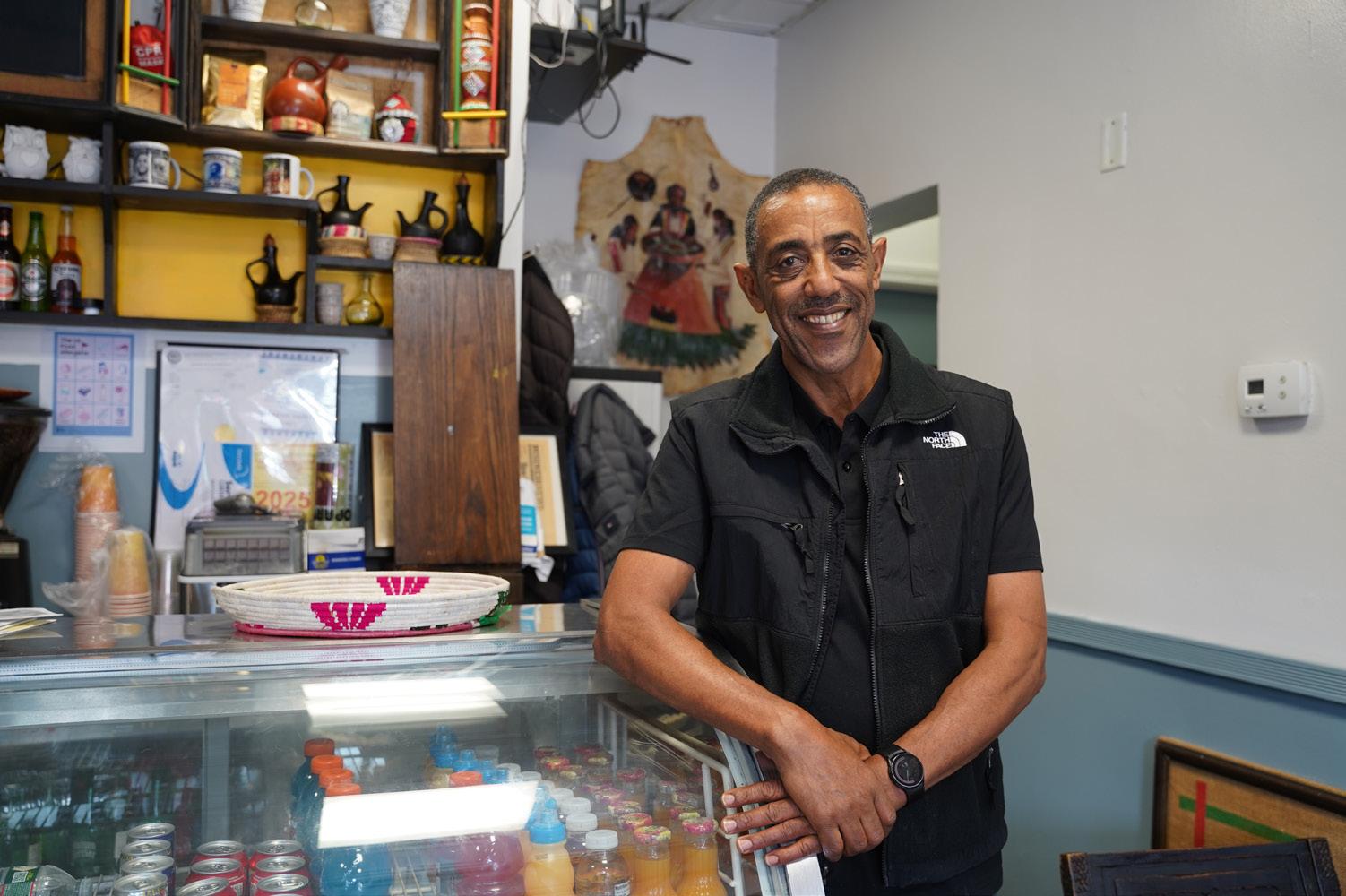
Just a 20-minute walk away from Northeastern’s Boston campus sits Fasika Cafe, a family-owned Ethiopian restaurant with only five tables.
Despite its small space, the restaurant’s culture and smell of “korerima”
(Ethiopian cardamom, chili, turmeric and coriander) fill the room.
Befekadu Defar, Fasika’s owner and head chef, is the mastermind behind the cuisine. He — along with his wife and occasionally his children — arrive at the cafe early in the morning to open the place and keep it running from 10 a.m. to 8 p.m. seven days a week.
“Whenever people come here, through our food, they know our background, our culture, home and what it looks like. We become ambassadors for our country,” Defar said.
Originally from Ethiopia, Defar studied at a hotel school, which prepared him for a career in hospitality.
After receiving a scholarship, he traveled to Switzerland to attend culinary school before moving to Boston in late 1993. He ran two Ethiopian restaurants in Jamaica Plain and Somerville before downsizing to the current Roxbury location.
“Ethiopian food is very seasoned with aroma and a lot of spices. It’s also more healthy. We don’t use any fried cooking at all. Most dishes are vegetarian, and [if we do have]
The food is traditionally served on a circular piece of injera, fermented flatbread made from teff flour. Teff grains are a staple in Ethiopian cuisine; they are gluten-free and rich in protein, iron and fiber.
“Ethiopian dishes cannot be served the traditional way without the injera. It’s a flatbread with a spongy texture.
The bread is your spoon and fork,” he said.
When people new to Ethiopian food first learn to eat the Ethiopian way, Defar said they find it “strange.”
He smiled and laughed as he recalled newcomers using the injera as a burrito or as a piece of toast to spread food on top.
“I like the layout of it, like how it was placed on the injera. It was really good,” said 12-year-old Ylva, a cafe customer who brought her family and friends for lunch.
But it’s not just the injera that makes Ethiopian food unique.
“If you see, in Ethiopia, everything is in a circle: our traditional houses are circle huts, our stores, our plates. The family all comes together to eat from the same plates. There is no such thing as ‘This is my portion,’” Defar said.
Defar’s favorite aspect of Ethiopian cuisine, he said, is that each dish requires time to prepare, making Ethiopian food his craft.
“It’s not something you can make in five minutes. I can buy pasta and
make it with no skills needed, but in Ethiopia, you cannot do that,” Defar said.
Defar explained that even if you have the lentils, greens and meat ready, the injera requires at least 24 to 48 hours of fermentation before it can be baked to eat.
Still, for this family, all the hard work pays off because their customers are happy.
“It has a lot of spices in it and it smells really good and tastes really good. I love spicy food. I liked the lentils and the beef and the chicken,” said 12-year-old Wanda, another cafe customer dining with Ylva. “The food went well with the bread.”
After discovering Fasika Cafe in The Boston Globe and online, the family came to eat at the restaurant for the first time.
“I was surprised that there was just a little bit of everything and how savory it is. I was overwhelmed with the menu, but when we were recommended the combo
plate, it was perfect,” said Jordyne Wu, Wanda’s mother.
It’s not just the food that keeps customers coming to the cafe. Gerehiwet Mogos, a regular customer, first met Defar at one of his previous restaurants. Now, he comes to Fasika Cafe every day for one reason: the coffee.
“They have the best coffee, especially when [Defar] makes it. He gives it to you like a family member, not a business. That’s different from other places,” Mogos said.
Defar imports his coffee from Ethiopia. Once it’s in the U.S., he
and his wife roast the coffee inhouse to serve to customers.
“Ethiopia is the origin of coffee. The name ‘coffee’ comes from the region of Kaffa,” Defar said. He explained that coffee is a major part of Ethiopian culture. “It’s a whole ceremony when you make coffee.”
Whether you’re looking for coffee or a new place to eat and try a new culture’s food, Defar said his doors are always open.
“The community should know about this place. It’s not just a business. They take care of the community,’’ Mogos said.
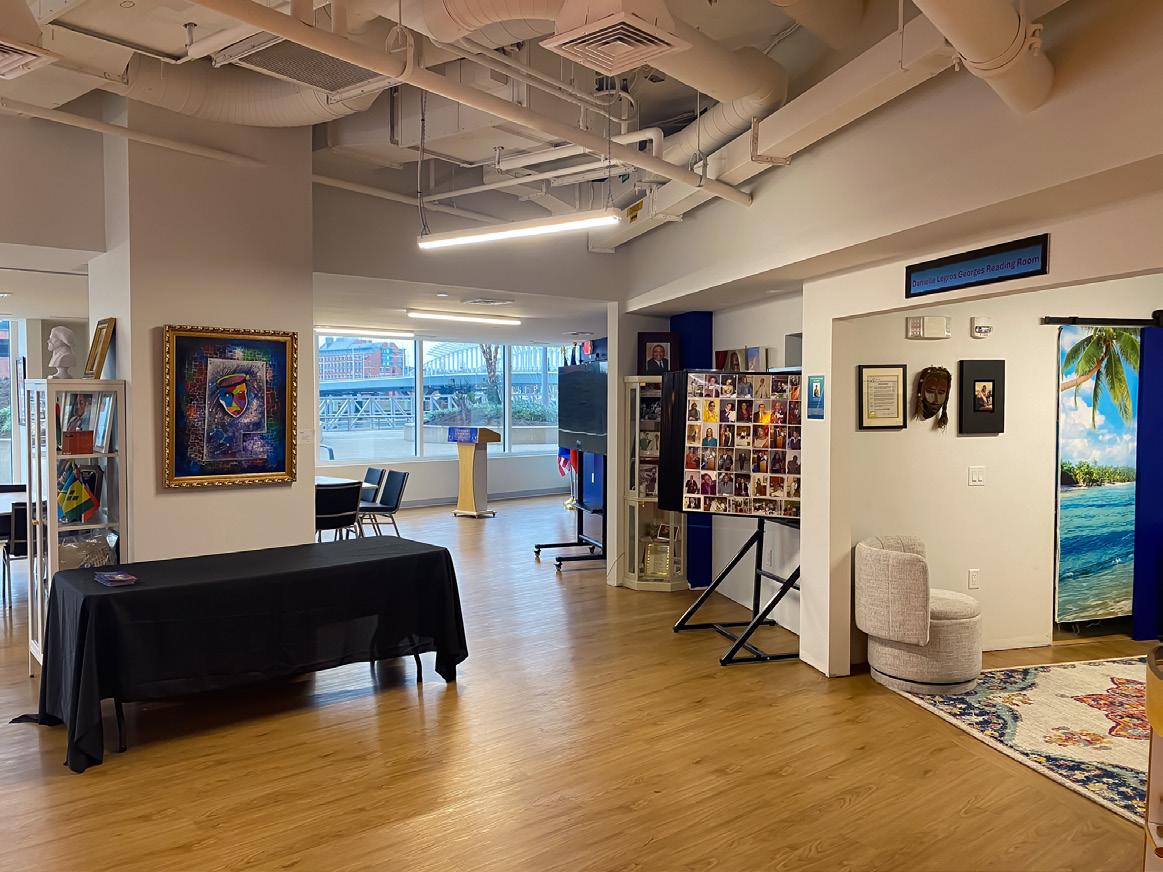
Situated at 131 Beverly St. and overlooking both the iconic Charles River and the tranquil Paul Revere Park, the newly-opened Toussaint Louverture Cultural Center, or TLCC, rests along Boston’s windy waterfront.
The center, which opened in May, serves as a home for Haitian cultural expression — including art, music and literature — and hosts gatherings for emerging Haitian American business leaders. It aims to support the local community of Haitian immigrants, with a population of about 77,000 in Massachusetts, according to the U.S. Census Bureau.
Wilner and Mary Auguste, the Haitian-born couple who founded the center, have dreamed of opening it since 2005.
“It took us 20 years,” Wilner Auguste said.
Before starting the center, the couple served Boston’s Haitian community by initiating Creole language programs, opening educational centers and creating family support groups.
bridge the generational gap within the Haitian community. Often, young Haitians like to embrace their community through dynamic activities that suit their ages. TLCC feels especially proud of its work returning young Haitians to their roots.
“For a long time, the younger generation has been straying away from the community, and once they graduated from college, they didn’t want to come back,” said TLCC program director Karm-Syndia Augustin.
“But now, seeing them return and get involved is great.”
Older generations, on the other hand, tend to seek the quieter spaces TLCC offers to relax and enjoy spending time with family and friends.
“For older folks who might not feel comfortable in loud venues, this gives them a place for book signings, lectures or simply to sit and talk,” Augustin said. “They feel like, ‘Okay, I can come here. This is for me.’”
The founders have made it their aim to intertwine generations of Haitian immigrants, believing that maintaining a culture’s essence requires passing knowledge to younger members.
Although the center’s primary focus remains on displaying Haitian art and history, its integration of influences from other cultures has broadened visitors’ understanding and attracted wider audiences, the founders said.
“We want people to know about our history, our culture and our heritage and share those things with other cultural groups,” Marie Auguste said.
To make partnerships fruitful, Octave believes it’s important to “approach other organizations with the right mindset and make sure the message is clear, because if it is clear, and people find themselves inside, they will embrace it.”
Marie Auguste emphasized the importance of those connections to preserve history.
“One of the biggest things about this cultural center is awareness about other cultures, because sometimes, people want to oppress other people’s cultures, but you cannot suppress the truth,” she said.
Since the grand inauguration, the center has routinely hosted events along the waterfront, benefiting from its picturesque waterside scene.
$915,000 to 100 small and mid-sized cultural organizations.
Whether intentional or not, its location mirrors Haiti’s, emulating the island surrounded by water.
For events, TLCC invites local vendors, designers, poets and actors from different cultures to sell products and share their expertise.
“The events have had great success because they unite communities and help vendors sell out their products,” Augustin said.
She added that as a nonprofit organization, TLCC relies heavily on donations and grants. But, for the center, donations don’t necessarily involve monetary contributions; people can simply volunteer talent.
“Let’s say you are a singer or you know how to play the guitar. You can say, ‘Hey, do you guys need a guitar player? can come and play for you,’” Augustin said.
“What I’m hopeful about is that we have more power when we come together and collaborate and put our resources together than we do separately,” MOAC interim Chief Kenny Mascary said. “So some of the things that we’re exploring is, how do we collaborate our resources to make sure that our impact can be sustained?”
There are 28 local cultural organizations and museums in the inner Boston area, according to the Boston Municipal Research Bureau, a research hub that monitors cultural development.
Mascary said satisfying all of such programs’ needs with funding from the city is an arduous task, especially “when we’re thinking about cost-cutting ways, arts and culture is usually the first to go off.”
“We are working on a very aggressive marketing campaign to get the message out there that we are a multicultural center, and we want other people to get involved,” Marie Auguste said.
The groundwork for community outreach has been laid, but much remains to be done, the founders said.
“There’s always more work to do to help people know we’re here,” Augustin said. “We’re still building our newsletter and mailing lists to keep the community connected.”
Looking back at their work, the founders say it all served one purpose: bringing Haiti to where it belongs.
“There was a time when the news about Haiti and Haitians in general was bad; they were saying so many bad things that the young kids, even in school, would not say they were from Haiti,” Wilner Auguste said.
“Our mission has always been to improve the quality of life for Haitians as well as Haitian Americans’ access to education, community, environment and cultural development,” Marie Auguste said.
The center’s opening was a culmination of the founders’ service to the Haitian community, they said.
At the entrance, a glass cabinet displays 20 miniature Caribbean flags, reminding visitors of the diverse communities the center aims to represent. Haiti, along with its Caribbean neighbors, played an important role in the independence of other nations, and recognizing those cultures — as well as involving people from those communities — is part of TLCC’s mission.
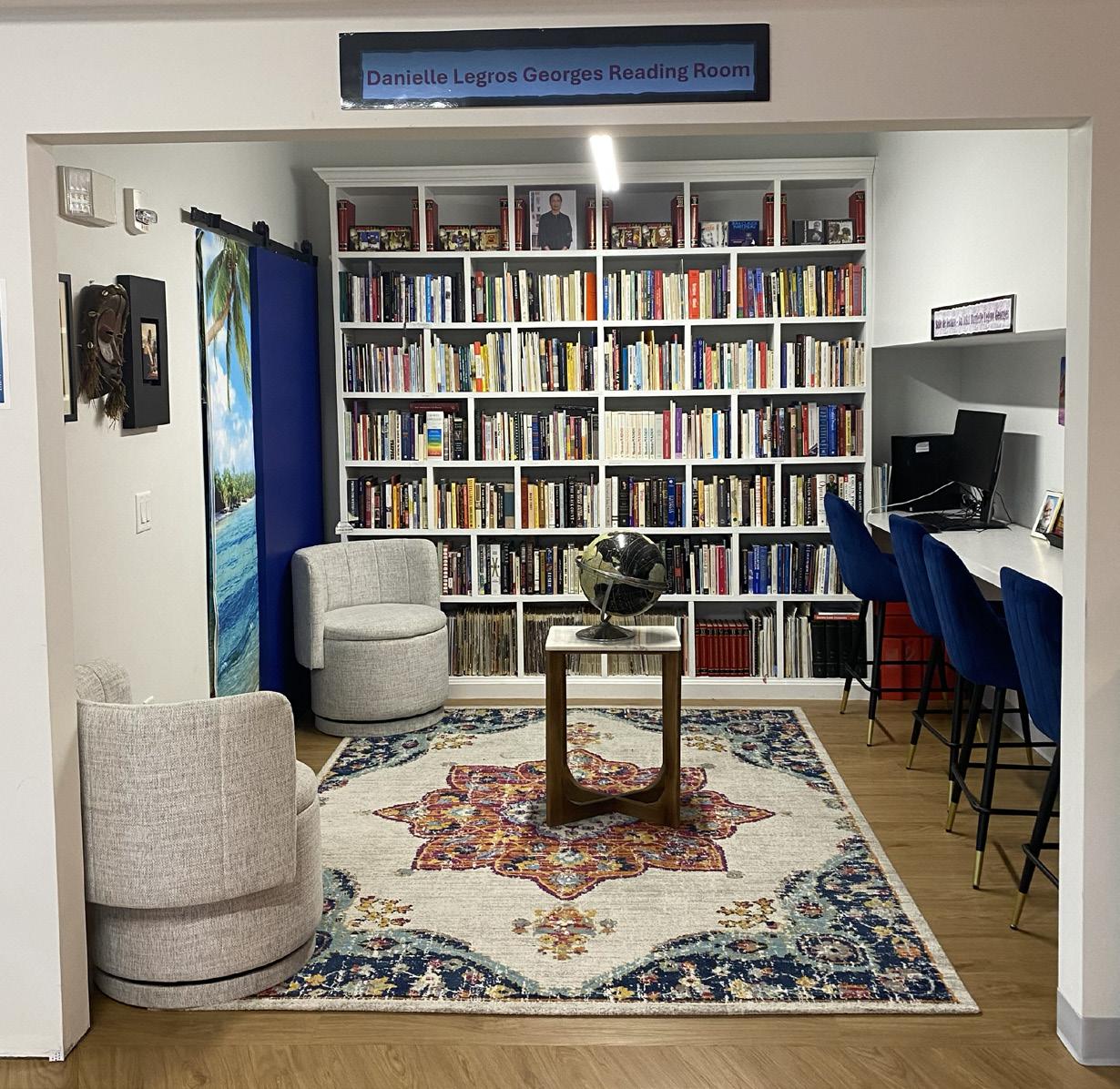
Tucked in the left-hand corner is the tranquil reading room, a space hosting everything from historical articles about the Haitian Revolution to novels by promising Haitian writers.
Up front, several pieces of Haitian art — from large canvas paintings to small wooden sculptures — stand on display in rotating exhibitions. So far, this has been the center’s fourth exhibition in six months.
Part of the center’s purpose is to
“We want the older and newer generations to learn from one another, because that is how you keep your culture alive.” Marie Auguste said. From the moment it opened its doors, flocks of visitors have stopped by to flip through books, gawk at paintings and embrace the space.
Augustin said visitors react with “pride and curiosity” the moment they step in.
She notes that older generations are surprised at first, as most have not experienced this type of cultural representation in Boston before.
“There are guests who tell us, ‘I’ve been in this country for 50 or 60 years and never thought I’d see a space like this,’” she said. “You feel the pride right away.” Beyond cultural celebration, TLCC serves as an intellectual hub, fostering cross-cultural discussions.
“[The founders want] to convert TLCC as the epicenter of cultural centers in Boston,” Fritznel Octave, a reporter for The Haitian Times, an online news outlet that serves the Haitian diaspora in the U.S., said.
“They hope to join forces and create something impactful altogether instead of everyone trying to do things on their own.”
With the federal government cutting grants to cultural organizations, all types of help have become essential to the survival of projects like TLCC.
TLCC founders were unprepared for the major changes the federal administration made to economic policies and began to analyze different avenues to seek financial help.
“We go after a lot of people in the Haitian community and send them letters as well as hosting fundraising events that can bring money,” Wilner Auguste said.
They did not anticipate that organizations which had initially planned to support TLCC would drastically reduce their grant budgets or, in more extreme cases, shut down entirely.
“When we were going into the project, there were no cuts, and we thought we could get other organizations to sponsor us,” Marie Auguste said. “But because these organizations got cuts, they had to close, and the ones who remained alive had to reduce their staff.”
The Boston Mayor’s Office of Arts and Culture, or MOAC, has put in place policies to curb the negative effects on funding for local cultural hubs. Last summer, it awarded
Still, many Haitians living in Boston maintain their stance, advocating for more resources so others can know “what Haitians are, what they can offer to the world and what they have already offered to the world,” Octave said.
TLCC is working to solve funding problems whilst preparing for what’s looming ahead, the founders said.
“There’s an interactive project that we’re working on for 2026, and we are hoping that project will bring a lot of countries together,” Augustin said.
Another of the founders’ goals is to improve the current marketing strategy in order to reach new communities that aren’t yet familiar with the center.
“That’s changed. Young people are now glad and proud to be Haitians. That has happened because of the work we’ve been doing. They are not afraid to talk about our history, our culture and especially our food.”

JANUARY 16
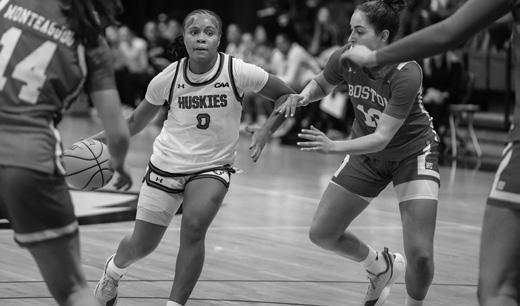
Women’s basketball vs. Campbell
7 p.m. - 9 p.m. at Solomon Court
Admission: Free with Husky Card
JANUARY 19
Free admission to Franklin Park Zoo on MLK Day
9 a.m. - 4 p.m. at 1 Franklin Park Road
Admission: Free until 3 p.m.
JANUARY 20
Women’s Beanpot Championship
7:30 p.m. at TD Garden
Admission: Ticket price may vary

JANUARY 22
Men’s basketball vs. Stony Brook
7 p.m. - 9 p.m. at Solomon Court
Admission: Free with Husky Card
JANUARY 24
Swimming and diving vs. Stony Brook
1 p.m. at Barletta Natatorium
Admission: Free with Husky Card

JANUARY 24
Select Winter Thrift Market
12 p.m - 5 p.m. at 539 Tremont St.
Admission: Free
JANUARY 28
Spring Volunteer Fair 2026
11 a.m. - 2 p.m. in Curry Student Center
Admission: Free
Men’s Beanpot Semifinals (Northeastern vs. Boston University)
8 p.m. at TD Garden
Admission: Ticket price may vary FEBRUARY 2
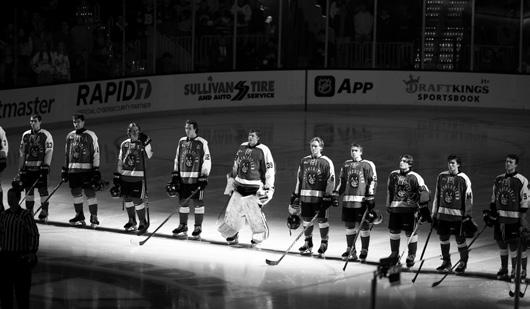
JANIRA SKRBKOVA Lifestyle Editor
On Oct. 21, 2025, Warner Bros. Discovery, Inc., or WBD, declared it would re-evaluate plans to split its streaming and studio business into Warner Bros. and its cable assets under Discovery Global.
The move comes after outside companies expressed interest in buying or investing in WBD with some showing interest in just Warner Bros. and some in the entire company.
Netflix, Comcast and Paramount Skydance all threw their hats into the ring. After a weeks-long bidding war, Netflix announced Dec. 5 a definitive agreement with WBD under which it will acquire Warner Bros. and its film and television studios, HBO and HBO Max. The deal holds an enterprise value of approximately $82.7 billion and is expected to close mid-2026 when Discovery Global is separated from Warner Bros. into a new, publicly-traded company.
What will the merger mean for the entertainment industry?
“Nothing that good,” said William Lancaster, a film and TV producer, writer, journalist and Northeastern professor. “It’s a consolidation of power — just raw power.”
Lancaster owns and operates Boston-based media production company Video Blender, which produces everything from documentaries to scripted comedy and drama features. Among a laundry list of issues a conglomerate of Netflix’s
scale presents, Lancaster anticipates major spinoff fatigue.
“There’d be no impetus for any diversity,” Lancaster said. “Suddenly, you own ‘Star Wars,’ or ‘Succession’ or ‘Game of Thrones,’ and shows can be made from that indefinitely.”
He also worries about the jeopardization of cinema.
“It doesn’t bode well for people who like to sit in the theater with a box of popcorn,” Lancaster said.
In April 2024, at the Time100 Summit, Netflix co-CEO Ted Sarandos said cinema is “an outmoded idea.”
Now, he says Netflix is “fully committed to releasing Warner Bros. films in theatres, with a traditional window, so audiences everywhere can enjoy them on the big screen.”
Jason Marcaida, a fourth-year film art major at Emerson College, is exactly the kind of person who prioritizes the silver screen. Marcaida serves as co-chair of cinematic literacy at Delta Kappa Alpha, a professional cinematic society and co-ed fraternity at Emerson.
With films needing a theatrical qualifying run of at least seven consecutive days for Academy Awards consideration, Marcaida predicts Netflix will maintain the theatrical experience in “a capacity that’s satisfactory” — nothing more, nothing less.
Netflix showed a penchant for these kinds of “qualifying” theatrical runs last year with films like “Frankenstein,” “A House of Dynamite” and “Wake Up Dead Man,” all of which ran in select theatres
for only 17 days before hitting the streaming platform.
“A lot of the things that are being delivered to us make the consumption of art very convenient,” Marcaida said. “I love my HBO Max account. I do like my Netflix and Hulu accounts. I love my Disney+ account. But I’m still going to the cinemas.”
Contrary to most film aficionados, when Neil Macartney, a fourth-year media and screen studies and communication studies combined major at Northeastern, learned about the Netflix deal, “My knee-jerk reaction was happiness,” he said. “I think I was relieved that it wasn’t going to Paramount.”
On Dec. 8, Paramount Skydance launched a counter offer against Netflix at an enterprise value of $108.4 billion, which, having status as a legacy studio built on theatrical release, reassured some film buffs but raised political concerns for others.
David Ellison, son of Larry Ellison, centibillionaire co-founder of Oracle Corporation, acquired Paramount Aug. 7 in an $8 billion merger with family-backed company Skydance Media. The merger’s federal approval hinged on two key concessions: Paramount acquiesced to President Donald Trump in a $16 million settlement over a “deceitful” edit of a “60 Minutes” Kamala Harris interview, and Skydance promised in writing to eliminate preexisting diversity, equity and inclusion initiatives at Paramount as well as “undertake a comprehensive review of CBS” to ensure unbiased reporting.
“I was worried about Warner Bros.,” Macartney said. “They’ve been having an incredible year with such incredible content and diverse things that they’ve been putting out. I didn’t want all of that to end up in Trump-allied hands.”
Marcaida called the Netflix and Paramount mergers a question of “the lesser of two evils.”
Warner Bros. rejected Paramount’s offer Dec. 17, citing “inadequate value” for shareholders. Paramount challenged the rejection with a guarantee that Larry Ellison would back $40.4 billion in equity financing, but Warner Bros. rejected the offer for the eighth time Jan. 7. Behind the scenes, industry professionals are worried about the practical consequences of a merger.
“The potential Netflix/Warner Bros transaction is a consolidation … which raises many serious questions about its impact on the future of the entertainment industry, and especially the human creative talent whose livelihoods and careers depend on it,” wrote SAG-AFTRA in a Dec. 5 statement.
Marcaida, who aspires to be a writer and director, is already anticipating the fallout.
“We’re only getting big, massive budget, blockbuster tentpole films … that cannot be the only avenue of filmmaking,” Marcaida said. “The industry that I would prefer to see is an industry that, alongside major blockbusters, also emphasizes midbudget films and low-budget films. It emphasizes a wider variety of genres and who’s in the director’s chair. It takes a lot more chances.”
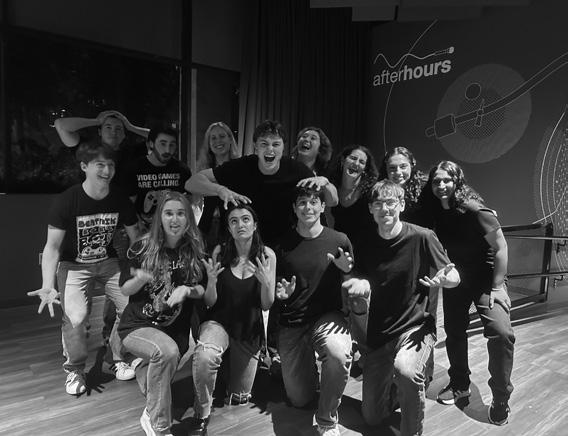
You’re on stage in front of dozens of people. With no script, set or props to fall back on, it’s up to you to get the whole crowd laughing. While this task sounds like a bad dream to some, it is exactly what the quick-witted members of NU & Improv’d pull off on the regular. Founded in 1997, NU & Improv’d is not only Northeastern’s oldest improvisational, or improv, comedy troupe, but also one of the oldest in the U.S.
Made up of 13 members, the audition-based troupe brings laughter to student audiences through its monthly on-campus performances and participation in competitions across New England.
This semester, NU & Improv’d has lived up to its name. “I’m really impressed with the abilities of the people on our troupe this year,”
said Ethan Knizhnik, a third-year mechanical engineering major and NU & Improv’d president. “We just added four people, which is a lot.”
Most members had never tried improv before college. Even for veteran members like Knizhnik, discovering NU & Improv’d at Fall Fest was a happy accident.
“I was a theater kid in high school. But I wanted to try something different,” Knizhnik said of deciding to audition. “Ever since I got in first semester of freshman year, it’s been my home here in college, because theater was my home in high school.”
Calli Colvin, a fourth-year computer science and film production major, joined the same semester as Knizhnik. Now serving as the club’s marketing director and videographer, Colvin has long had a knack for comedy.
“It had always been something I was interested in because I ran a satire magazine,” Colvin said.
After learning more about NU & Improv’d and its tight-knit community, “I fell in love with it,” she said. “When I got the call back, I was over the moon.”
As one of two improv groups on campus, NU & Improv’d also stood out to Colvin for its frequent collaborations with other universities. Most members cite their all-time favorite event as “BeanProv!” a friendly competition between the
same four universities that compete in Boston’s annual Beanpot hockey tournament.
In rehearsals twice a week, each troupe member hones their craft so they can achieve smooth spontaneity on stage.
That effort doesn’t always come easy. Other than receiving a place, location or theme from an audience member, “you’re starting with nothing,” Knizhnik said.
Luckily, improv actors can turn to a few universal rules to guide the process. “Key points in an improv scene that you always want to hit immediately are who, what and where,” King said, drawing from years of technical improv experience in high school.
Many improv shows, King mentioned, consist of a series of “games,” which can include anything from “Spacejump” or “Interrogation” to the intriguing “Sex with me,” which they end each of their shows on.
To gauge the audience’s interests and overall mood, Colvin said, “We always start with an introduction where we have the crowd yell out their name, their majors and then something silly.”
And what if they don’t bring the energy? Knizhnik said performers need to be comfortable with audience members not laughing at their jokes. “You do have to be okay with not looking cool and doing
embarrassing things,” he said. “You will fail, but so much of it is failing with confidence and just rolling with it.”
Throughout their time in the troupe, NU & Improv’d members grow this confidence not only in themselves but also in each other. Connections are built throughout practices and numerous outside bonding opportunities, from dining hall trips to “Prov’luck,” a pun-filled take on a potluck.
“These are some of my closest friends at school,” Colvin said. “I will have made lifetime connections through improv.”
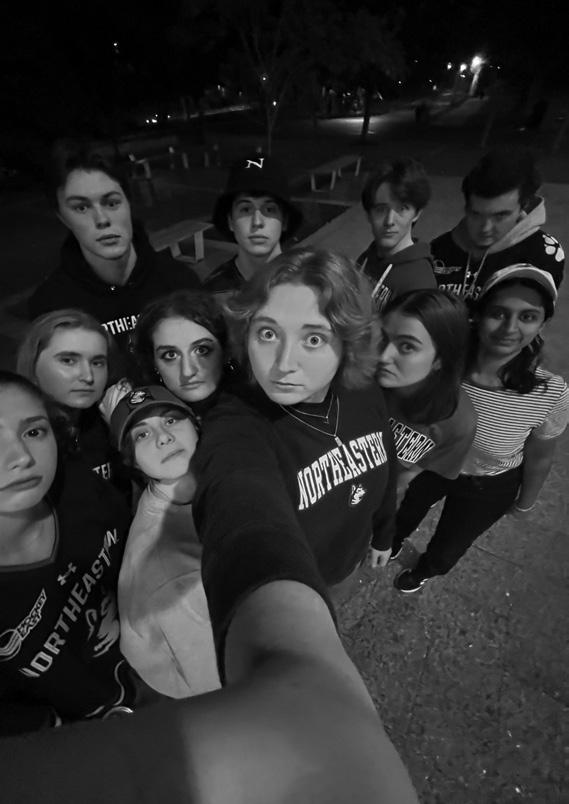
FRANCES KLEMM News Staff
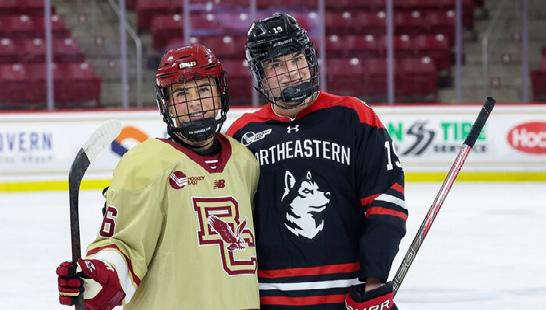
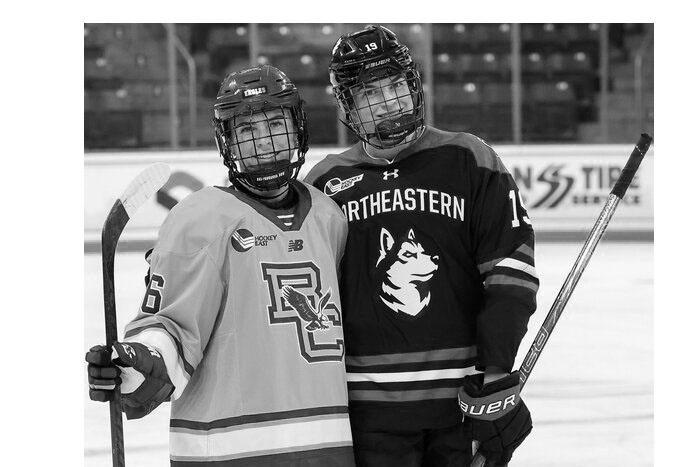
No one wants their sister to win more — but no one wants to beat her more, either. Now make them twins on rival college hockey teams.
The last women’s hockey game at Matthews Arena was emotional for everyone in the building. But for the Mara twins, tensions were especially high as Lexi, a freshman defender for Northeastern, and Emily, a freshman forward for Boston College, faced each other in the NCAA for the first time.
“Neither one of them is afraid to throw an extra hard elbow against her sister,” said Liz Mara, the twins’ mom.
While Lexi knew in the spring of her junior year she was headed to Northeastern for hockey, Emily committed to Boston College for soccer, and only in the winter of her senior year did she officially secure a spot on the hockey roster.
Starting in early November, after Lexi moved up the lineup and Emily’s soccer season ended, both have made an impact on their teams. A month in, the whole family was in Matthews — not dressed in any team colors — for the Huskies vs. Eagles double-header Dec. 5 and 6, 2025.
Emily purchased a Boston College sweatshirt for their youngest sister before the game, which she was forbidden to wear on game day.
“[Our family] tries to say they’re
[as] neutral as possible, so no team was worn on sweatshirts or anything,” Lexi said of the rivalry. “But hopefully they’re Huskies fans.”
The twins grew up learning to skate in a makeshift backyard rink made from a tarp and water from the hose. In the third grade, Emily, Lexi and their older sister, Caitlin, who is a sophomore soccer player at the University of North Carolina, decided they would play hockey, following in the footsteps of their dad, who played college hockey at Colgate University. They all joined the local team, and as Liz said, “the rest is history.”
Emily and Lexi played on the same team all the way until high school. Emily wanted a boarding school experience at Phillips Academy in Andover, while Caitlin and Lexi went to Buckingham Browne & Nichols School in Cambridge, and their teams only met once a year. They remained on the same Assabet Valley girls’ hockey team, where they became four-time state champions from 2021-25.
The competitiveness of having a sibling on the ice goes both ways. Liz remembers when — while they were in elementary school — Lexi hipchecked another skater to clear a path for Emily.
“I’m pretty sure she got a major penalty for it, but it was a very funny family moment because she was definitely protecting her sister,” Liz said.
Competitiveness runs in the Mara family.
“Even playing board games at home, our family is so competitive that there will [be] fights if you don’t win,” Emily said.
Both sisters credit sibling competitiveness and companionship as a driving force in improving their skills.
“They’re not easy on each other. So, if one of them was like, ‘Oh, I thought I did well,’ [then] the other one’s like, ‘No, you didn’t.’ I think it also brings a level of honesty to their game,” Liz said, describing car rides home after games. “Especially being twins, there’s always a level of, ‘I don’t want the other one to be better than me’ that goes on and pushing each other to get better.”
The hour-long drives to and from practice can be taxing for young ath letes, but the sisters did it all together and would often end the evenings by skating in the backyard and shooting pucks in the driveway. The family would play the hockey version of the game H.O.R.S.E. every summer.
“You weren’t ever doing it alone,” Emily said. “I always had my sister there with me. Even if I didn’t want to go, at least I was doing it with someone.”
Emily and Lexi were born into a true Boston women’s hockey family, if there ever was one.
Bruins. But more importantly for the girls, he was the head coach of the Boston Pride — Boston’s professional women’s hockey team before the Professional Women’s Hockey League, or PWHL, was founded — for five years. The Mara family was watching stars like Jillian Dempsey and Hilary Knight in their prime.
“The women on that team were excellent players and very generous with their time. As a young girl, it’s fun to have another girl to look up to,” Liz said. “I think that [Emily and Lexi] really understand that they’re in a generation where women’s sports are becoming such a bigger part of society. I think both of them are super proud to be part of that.”
Emily and Lexi grew up going to Beanpots (while Lexi says she was neutral, Emily insists she would root
— and now they’ll play in the third Women’s Beanpot tournament hosted in TD Garden Jan. 20. While they are not meeting in the championship game, BC and Northeastern will face off in the consolation game.
“It’s something a kid dreams of, coming from Massachusetts, and it’s really awesome that we get to play in [TD] Garden because I’ve gone to so many Bruins games,” Lexi said. “When I was little, I was like, ‘This would be such a great place to play.’”
Given the unusual timing of their commitments, the sisters didn’t expect to play against each other but said they were excited to stay close to each other and to home. Now, the pressure is on for this year’s Beanpot tournament, and Emily says divided sweatshirts might already be on the way.
Their uncle is Paul Mara, a former NHL player who spent 13 years in the league, one of them with the
“That should be such a cool experience, going from watching all the Beanpots to being able to play in one, and it’d be even cooler to play against my twin there,” Emily said.
The final women’s hockey game in Matthews Arena ended in a 3-2 win and a weekend sweep over BC for the Huskies.
“I’m never going to hear the end of it at the dinner table,”
Sports Editor
Erin “Kiki” Murphy has spent her whole life in the water. From growing up on Cape Cod to immersing herself in water-based sports, Murphy just can’t get enough.
Murphy’s love of the water led to her career as a diver at Northeastern, which was nothing short of incredible. Yet, that was only the beginning of her time as a Husky athlete. During her fifth year, Murphy exchanged her towel for an oar, changing her title from a DI diver to a DI rower.
As her final diving season was underway, Murphy faced the reality that, at the end of the season, she would no longer be a Division I athlete. Her four years of diving eligibility were about to be over. When talking to her dad about it,
he proposed an alternative: Why not join the rowing team?
It was a sport she had already done in high school. It would allow her to continue to compete, and her sister, Maeve, was set to join in the upcoming season. She took the jump and now spends her mornings on the Charles River, chasing after a new set of dreams.
Murphy grew up on the Cape as the second-youngest of four siblings, all of whom became Division I athletes, and she followed with diving.
For Northeastern diving coach
Lauren Colby, Murphy’s excitement and passion made her stick out in the recruiting process.

“Speaking to her the first time over the phone, you could tell how hardworking and determined as a person she was,” Colby said. “She sounded confident as a 17 year old. She wanted to be one of the best.”
Murphy was just that — the best. She holds the school record in 1-meter diving, was named CAA Diver of the Year three years in a row and CAA Rookie Diver of the Year in 2022. She is a 10-time CAA Diver of the Week — and those are just a few of her many accomplishments, on top of being a strong leader.
For Colby, her favorite moment coaching Murphy was her junior year CAA championship finals. Murphy reached the 3-meter dive finals and was faced with a difficult dive. Typically, Murphy was serious during meets, but after nailing the dive, she could not contain her excitement.
“She comes out of the water, looks over at me and she’s got this huge smile on her face,” Colby recalled with tears of pride in her eyes. “It was just really sweet that there was that acknowledgement, and there was just a connection. It was this unspoken thing between us, and we just knew that if she kept doing what she was going to do, she was going to reach her goal of becoming a 3-meter champion.”
Murphy enrolled in the PlusOne program, meaning she would stay at Northeastern for a fifth year. But with her four years of diving eligibility up, the end of her diving career was a tough pill to swallow. She had spent 13 years learning the craft, building relationships and perfecting her technique for it all to come to a close on a Tuesday in New Jersey.
“I just felt like there was a huge gap in my life because it’s all I’ve ever known. I would be doing homework at night, and I would just start crying because I would think of a memory or I would hear a certain song,” Murphy said.
When her dad suggested Murphy use her final year of eligibility to row, she saw an incredible opportunity she could not pass up. The NCAA allows athletes to take an additional year of eligibility in a different sport, an opportunity not many athletes actually take. While the pain of losing diving didn’t go away, having another sport and new teammates to look forward to helped Murphy through it.
Murphy talked to Roy Coates, the head swim and dive coach, who connected her with his friend Joe Wilhelm, the women’s rowing head coach. After a trip to the boathouse, Wilhelm offered her the opportunity to walk on the team.
“She’s a championship athlete. That takes more than just skill,” Wilhelm said. “Clearly, she was a good diver, but to get to the level she achieved [in] diving, she had to have a lot of the same intangibles we’re looking for in our athletes. She’s got a great, positive attitude, and she’s got all the physiological tools that a rower would want to have.”
While both rowing and diving are water-based sports, they could not be more different. Diving is an individual sport, but rowing requires everyone in the boat to be perfectly in sync to be successful. Diving is over in seconds, rowing is not. Diving is indoors, rowing is outdoors.
Other than the differences between the sports themselves, Murphy had to get used to a completely different training and practice schedule. Rowing season is in the fall and spring, and diving is a winter sport. The diving team always had practice in the evening, but for rowing, Murphy has to wake up at 5 a.m. to fit practice in before classes.
Although it had been years since she last rowed, Murphy is taking the adjustments in stride and has enjoyed every moment. The coaches’ support and watching others has pushed her to be successful.
“I feel like I’ve made a lot of progress in a short amount of time,” Murphy said. “I feel like I’m running against the clock right now, so it’s kind of stressful, but it’s been amazing having a brand new set of goals in a sport and the lift room and working toward those every day. Every single day I’m excited to go out there and get better.”
Not only is Murphy having her first experiences as a collegiate rower, but so is her younger sister, Maeve, giving them their first chance to row together. Not only do they get to be on the same team, but they were in the same boat during Head of the Charles Regatta.
“That was an incredible experience, easily a top-five memory,” Murphy said. “I’ll never forget rowing that with Maeve, too. It was so fun and surreal hearing, ‘Northeastern club, welcome to Head of the Charles, row it up to the start line.’ Going under a bridge and hearing our parents cheer for us was just so incredible.”
Murphy dedicated her entire life to diving. She took the late nights on cold winter evenings in stride, went above and beyond in conditioning and cemented herself into Northeastern athletics history forever. While she still struggles to come to terms with her diving career ending, she has more time on the water to look forward to and a new CAA title to chase.
“I can’t wait to be able to witness and watch her out on the water because she just amazes me,” Colby said. “Seeing her face this challenge is really admirable.”

Editor-in-Chief
Emily Spatz
Managing Editors
Annika Sunkara
Gitana Savage
Editor-at-Large
Alexis Algazy
Campus Lily Cooper Madison Evangelist
Auden Oakes
Elizabeth Chalmers City
Chloe Craft
Devyn Rudnick
Sports Elli Einset
Siera Qosaj
Cassandra Joyce
Lifestyle
Janira Skrbkova
Jennie Koh
Jenny Tran
Opinion
Samantha Denecour
Ava Vitiello
Projects
Katarina Schmeiszer
Elsa O’Donnell
Photo Margot Murphy
Tanvi Saxena Evelynn Lin
Design
Catherine Gore
Katie Mulcahy
Audiovisual
Curtis DeSmith
Data Abdullah Ismail
Social Media
Daniel Patchen
Catie Nippins
Copy Chief
Sarah Mesdjian
Web Manager
Arielle Rabinovich
BUSINESS
Business Manager
Nikolas Lyras
Advertising Manager
Emily Liu
Outreach Coordinator
Annelise Dramm
STAFF WRITERS
Darin Zullo, Emily Chung, Bailey Reynolds, Aoife Jeffries, Caroline Baker Dimock, Zach Cohen, Paloma Welch, Emily Rodriguez, Kayla Goldman, Olufolake Okunsanya, Aiden Barker, Laila Guzman Griffin, Carson Lyle, Elise Peffer, Hir Panchal, Annie Jones, Aadit Ganesh, Gabriel Trajano, Jonathan Winter, Alex Payá, Mikayla Tsai, Robby Wolff, Antaine Anhalt, Nora Harr, Honor Seares, Phil Warren, Shreya Pillamari, Taylor Zinnie, Mora Peusner Dacharry, Niaz Alasti, Annalise Karamas, Emma Shkurti, Daniela Rynott, Chloe Mondi, Frances Klemm, Declan Lane, Blue Tiernan, Yashavi Upasani
COPY EDITORS
Bowen Rivera, Aaniya Mahajan, Antaine Anhalt, Kacey McNamara, Lizzie Harrison, Christiana Ranft, Frances Klemm, Annie Jones
DESIGN STAFF
Anusha Sambangi, Natasha Sun, Laila Guzman Griffin, Mayah Hamaoui, Juliana Rodriguez, Mary Dunn, Rhea Lamba, Alana Udell, Megan Le
PHOTO STAFF
Nia Calais, Molly McAlevey, Hana Dada, Will Holloway, Annie Jones, Naseem Mohideen, Alana Udell, Ian Dickerman, Elise Peffer, Michael Chang, Niaz Alasti
SOCIAL MEDIA STAFF
Emily Chung, Keira Weitz, Grace Cargill, Christina McCabe
BUSINESS STAFF
Maggie Nahas, Isaac Pedersen
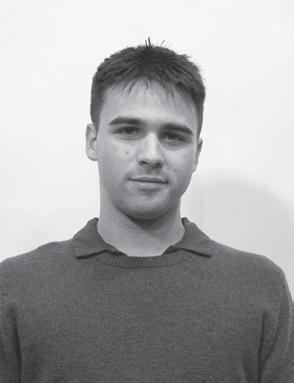
PHIL WARREN Columnist
The Financial Times, or the FT, recently exposed what they call the “Bermuda Triangle of talent” — the black hole of finance, consulting and corporate law jobs that swallow up the brightest minds of our generation.
But the FT missed one critical part: this isn’t just a problem at the Ivies and Oxbridge — it’s happening right here at Northeastern. And it’s so prevalent because the university has become a machine so efficient at producing professionals that it’s forgotten how to produce people.
I attended one of the best private high schools in America. Many of my friends have gone on to some of the most prestigious universities in the world — and I’ve lost count of the number that have already begun a descent down the corporate pipeline. It’s hard to blame individuals. These jobs in the Triangle offer impressive salaries that justify the cost of university, exclusive social circles that promise belonging and luxury and the challenge of solving incredibly complex problems.
But I wonder what happened to the people who, in their applications to top universities, said that they would change the world one day? Why hasn’t the world been changed?
Although the university doesn’t strive for the class and distinction of an Ivy League, it seems to me that Northeastern’s funneling into
corporate STEM careers through the co-op program is just as effective at contributing to this pipeline.
Northeastern markets itself as a leader in “global experiential learning” and rigorous academics, and after three semesters in Boston and one abroad, the university has delivered on that promise with a fascinating N.U.in program and difficult classes. But, somewhere along the line of learning to be a competent engineer, I’ve missed out on a liberal arts education.
As a mechanical engineering and physics major, I’ll finish my five years at Northeastern having taken only two non-STEM classes: First Year Writing and Advanced Writing. Five years of university education, and I’ll graduate having never grappled with moral philosophy concepts, never analyzed literature that might strengthen my empathy and never studied history that could provide invaluable context for the problems I claim I want to solve. I’ll know everything about my job and nothing about the human condition.
Investing in Northeastern requires an understanding that you’ll graduate as a professional who can hit the ground running with a return offer from your highest-paying co-op. You’ll have an optimized LinkedIn profile, networking skills and a set of cover letters that, on paper, will tailor you to employers. You’ll have mastered the ability to appear as someone while remaining a stranger to yourself — at least in the classroom. Any self-realization has occurred by your own means, on your own time.
Last spring, my introductory Cornerstone of Engineering class offered lectures to cover engineering ethics, which drew scattered attendance. It seemed many students reasoned that, because our professor wasn’t covering new SOLIDWORKS material pertinent to our technical assignments, they’d prefer the extra free time.
And, because no large grade was deducted for missing those ethics classes, it sent the message that they weren’t worth attending at all.
I hope that the engineers who design and manufacture every aspect of our lives are competent, and I have no fear in the ability of myself and my peers to learn how to be engineers. But small anecdotes like this remind me that we’re more likely to get competent engineers than ethical ones, and probably not both.
Northeastern’s culture has shaped students who arrive at university carrying idealism but abandon it for pragmatism — and who can blame them? It feels like you must optimize your life in a superficial manner for the chance at a co-op in mechanical engineering, much less a return offer.
Why spend six months of your precious time at a small firm with morals when the big leagues of defense and private sector manufacturing are calling? The very program designed to help us discover our passions has become a stepping stone toward surrendering them.
The tragedy runs deeper than individual career choices. Without exposure to literature, philosophy and history, how can we understand the moral weight of our professional
decisions? Northeastern is producing technically competent graduates who lack direct instruction in the intellectual framework necessary to question how their abilities are used.
But please do not misunderstand me. I chose Northeastern with a full understanding of its deliberate STEM instruction. I came here to study the sciences, and hopefully, as a result, I will find myself making an impact in the world of physics and engineering. But I wonder if there needs to be a slightly better balance.
Until Northeastern recognizes that professional success without moral development is a hollow achievement, we’ll keep feeding our brightest minds to the corporate machine. The world doesn’t need more technically gifted analysts who can optimize quarterly earnings with flashy slide decks that no one will read. It needs more morally informed professionals who understand that some problems matter more than profit margins.
The graduation gown should represent more than technical mastery — it should symbolize the integration of competence and conscience, of knowledge and wisdom. When we need it the most, our brightest are graduating with half an education, and the world is paying the price.
Phil Warren is a second-year mechanical engineering and physics combined major. He can be reached at warren.p@northeastern.edu.
If you would like to submit a letter to the editor in response to this piece, email comments@huntnewsnu.com with your idea.
A fifth year isn’t for everyone, but it was for me
When I first started at Northeastern, I assumed I’d graduate “on time.” I was so certain I’d be the person who checked every box right on schedule.
But somewhere between exploring my major, co-ops and just life in general, I found myself on the full five-year track.
And honestly? I’m glad that I did.
A big reason I chose this path was to pursue a third co-op. Personally, I wanted more time to explore different industries, and having that additional work experience has made me feel more confident in post-grad life. If you didn’t love your first two co-ops, a third is a real gift; you get another chance to try something different, build new skills and have a little more negotiating leverage when you’re looking for full-time roles.
University students conduct all operations involved in the production of this publication.


Another perk of the five-year path: I didn’t have to do summer semesters! The five-year track definitely has more flexibility with summer sessions — since you aren’t squeezing all of your classes and co-op semesters into four years, you naturally have more breathing room. That means you often don’t have to take classes over the summer — giving you time to work,
travel or just exist without juggling school. Doing five years also gives you more flexibility to extend co-ops or start them early, something I was able to do myself and something that is much harder to do if you’re locked into summer classes.
Many students take summer classes anyway — especially by going on a Dialogue of Civilizations. I genuinely recommend a Dialogue because they’re such cool, compressed experiences abroad. The difference with a fifth-year schedule is that you’re choosing those programs out of excitement, not because you need to cram in requirements to graduate. It’s hard to write this without acknowledging that Northeastern is trying to phase out the five-year model by requiring fifth-years to petition their departments to do a third co-op. Even though I didn’t initially picture myself on the five-year track, Northeastern still presented it as a common, flexible path for students who wanted more time for co-ops and exploration. The university has since gotten rid of a lot of that advertisement. If you look at the “plan of study” section for many majors (for example, my history and economics combined major), you’ll now see a sample layout for four years and two co-ops instead of the five-year model advertised a couple of years ago. With the push to move students through college more quickly, fewer
people are staying the extra year. Campus definitely feels a little different now, with most people wrapping up sooner and fewer students overlapping across co-op cycles. But I think if you’ve got a good crew and still know people in the Boston area, being a fifth-year student doesn’t really change much about the social scene.
So, would I recommend staying for a fifth year?
It depends. I think it’s a great option if you want extra time to explore your interests, gain more work experience or simply move at a pace that feels sustainable. There’s real value in not sprinting through college. You can take a class just because you are curious or try a co-op you didn’t originally plan for.
But it can work the other way, too: If you loved your first two co-ops, there’s less incentive to stay longer. In that case, it can make more sense
to skip the third co-op and try to pursue one of those for a full-time offer sooner.
But you absolutely don’t need that fifth year to get the most out of Northeastern. Plenty of students do two co-ops and graduate in four years with incredible experience and clarity about what’s next. A fifth year isn’t a magic key — it’s just one version of the Northeastern journey. And much like everything here, it is what you make of it.
For me, it was all worth it. But it doesn’t have to be for everyone.
Honor Seares is a fifth-year history and economics combined major. She can be reached at seares.h@northeastern.edu.
If you would like to submit a letter to the editor in response to this piece, email comments@huntnewsnu.com with your idea.

HONOR SEARES Columnist
In September, my friend group and I all decided to rush sororities. Most of them got into the one that is considered “better” or “more popular” than mine. I feel like they constantly find reasons to bring it up in front of me or even try to act superior to me. Also, now that they’re in the same sorority, they’re always leaving to attend the same events. It’s started to really bother me and I’m not sure what to do.
From,
In a Different Sisterhood
Ouch, I totally hear you — this is a super tricky situation, and hopefully I can make it slightly more navigable. Witnessing your old friends bond in a new group can be jarring. It can create a confusing mix of feelings when that group might be flaunting its “superiority.” You’re happy for them, but also maybe disappointed, insecure or even a little angry. All are valid in their own right.
There’s another layer worth considering here: Sometimes, when people join something new, they’re really, really into it at first — it becomes the center of their world. It might feel like they’re trying to bring up their new sorority in front of you or act superior to you, but in reality, it may come more from enthusiasm than comparison. I would advise you to pay closer attention to their tone: are they bragging or just sharing?
There are a few helpful ways to reframe this situation.
First, the idea of being in a “better” sorority than someone else is just that — an idea. Greek rankings (or whatever name we’re giving them this year) are more myth than reality, and they lose all meaning the second you’re a year or two out of college. No one is asking about your letters at your first real job.
The “best” sorority is the one that is the best for you, not your whole friend group. Your chapter chose you, and you chose them, because it offered something authentic that resonated with you.
As a recruitment counselor this year, I told every potential new member the same thing: This is Northeastern, not the University of Alabama — it truly is never that serious. “Social worth” doesn’t really hinge on Greek letters here.
But it is still fair to feel singled or left out. Even if they mean no harm, it can hurt to watch your friends do everything together. Friendship is built on shared experiences, and suddenly you’re not sharing as many. You can communicate honestly or gently name how you’re feeling without accusing them of bad intentions. This can give them a chance to be better friends without put ting them on the defensive.
You can also lean into your own sorority experience. Make new connections and
invest in the community you have joined! While I did just say sororities are not that serious, especially at Northeastern, what you put into them is what you receive, so let this be a chance to expand your world and not shrink it. If you feel like your friends are always leaving to attend the same sorority events, you can use that time to get closer to members of your own chapter.
At the same time, you don’t need to tolerate behavior that makes you feel uncomfortable — if their behavior persists even after the new member “high” fades, maybe they aren’t worth the emotional energy. Focus your energy on the people who value you, not what sorority you are in.
Everyone says that you’re supposed to talk to everyone next to you in college and make new memories, but I feel like I dropped the ball on this the first few months of college. I feel like I
blew my chance to make friends because people aren’t as open anymore to talking to new people.
Sincerely, Worried It’s Too Late
You have absolutely not “blown your chance” to make friends. The idea that college friendships are only forged during the first few months is a straight-up myth, and it puts immense, unnecessary pressure on new students.
To be honest, I barely remember half the people I talked to during my orientation week! It feels like if you don’t have a perfectly curated friend group within the first few months, the world will end, but trust me: It will keep spinning.
You are correct, though, that the friendship dynamic has slightly changed. During orientation or Welcome Week, everyone is on high alert as they look for their “crew.” These weeks are more of an active search period.

Now that the semester is in full swing, people have settled into routines and might not be as aggressive about meeting new people. But this doesn’t mean the doors are closed. People may not be introducing themselves on sight like they were during the first week, but they are still looking for connection. Everyone is still open to new friends; you might just have
to change your approach strategy a little bit. People I’ve met at Northeastern like to have friends in different places — like a reliable study buddy for a difficult class, or a specialized lab partner or even just a low-key friend to hang out with in the dorm lobby.
Besides, the “talk to everyone next to you” sentiment you mentioned is pretty vague. While this advice is definitely helpful, it might not always be the most effective. I would urge you to focus on shared activities. Join something that requires consistent, repeated attendance. This could literally be anything, from The Huntington News, a cultural association or even an intramural sport, but the key part is showing up every week. This allows you to build familiarity and trust, which are the foundations of friendship.
Also, don’t underestimate the power of academic friendship. These bonds are so highly underrated. If you haven’t already tried to chat with people in your classes, don’t fret: group project season is right upon us! Take advantage of meeting up with people in person and integrating academic and social connections. It really only takes one person to start a butterfly effect or chain reaction. You meet one person, and suddenly, they are introducing you to their friends or roommates and so on. College friendships are often just a bunch of happy accidents. Making friends takes time, patience and often requires you to be the initiator. Stop looking backward at what you think you missed, and start looking forward to the great people you are about to meet.
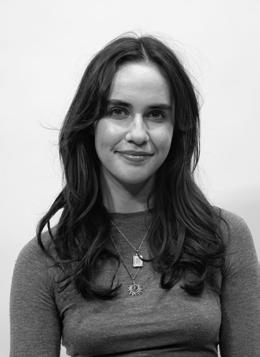
When I swing open the door of my apartment, I have the routine perfected: release the heaviest of sighs, abandon my bag in the threshold and dive into a breathless recounting of the day’s frustrations.
The procedure is painfully predictable, yet it never grows tiresome for my roommate and I to indulge each other in the familiar litany of complaints. The lineup often looks something like the following: I slept through my alarms, got cold-called on in class, have back-to-back co-op interviews scheduled and, to top it all off, the heat in our apartment is still inoperable.
The monotony of the daily classclubs-work ritual can drag like a ball of steel tethered to an ankle.
With so much weighing us down, it is easy to lose sight of the gift of having tasks and opportunities to juggle in the first place. We spend endless hours consumed by what we have to do rather than appreciating that we get the chance to do it at all.
Gratitude has devolved into a lost art, an obsolete practice buried beneath an endless catalog of complaints that we deem more deserving of attention. The expectation of productivity found on college campuses breeds a particularly insidious
form of gratitude bankruptcy as students render thankfulness almost laughably out-of-step with the pace of our lives.
Our culture glorifies hustle and rewards overachievement. At Northeastern, that pressure is amplified, leaving many of us stretched between competing versions of ourselves: the student, who should be polishing next week’s presentation, and the young professional, who should be securing a co-op that promises the perfect résumé line and the right network. Taken alongside the comparison trap that is your LinkedIn feed, it’s easy to feel like you’ve come up short in one way or another.
Each semester, the unaccomplished items on my to-do list are the last thoughts swirling in my head before bed and the first to hit me when I wake up. Only after I begin to pack my belongings for break, when the noise of exam season has quieted and there is an unburdened moment free of responsibility, do I step back and recognize what an impressive feat it is to conquer another stretch of the college experience.
Still, this sense of gratitude arrives late, like an overdue reminder, reserved only for the aftermath and never the process.
A reframed mindset matters most in the thick of it, to serve as an anchor grounding me in what I am already achieving instead of

everything I fear I am neglecting. Oftentimes, admitting that I am struggling can feel just as defeating as the struggle itself; stress is easily mistaken for weakness.
When I pause long enough to recognize that I’ve survived every week that felt unbearable, I can see resilience where I once saw failure. Gratitude allows us to place our strain against a new backdrop, reframing the stress we all carry not as a sign of inadequacy but evidence that we are in motion, inching toward a better future. It is a quiet way of choosing presence and perspective over panic.
Practicing thankfulness in real time means permitting yourself to acknowledge small strides before they amount to an accomplishment. While gratitude is often understood as merely a feeling, it is also a skill that can be developed through intention and practice. This can look small and ordinary: savoring the completion of an assignment you
dreaded, an impromptu hangout squeezed into a busy day or simply the warmth of the sun on your face as you walk to class.
These moments, when noticed, create pockets of relief in a calendar otherwise dominated by deadlines. They become a buffer against burnout by nudging us to take stock of what is working. Gratitude does not eliminate stress but softens its edges.
Small celebrations empower us with the momentum to move through struggle without being swallowed by it. If we allow ourselves to recognize and revel in these moments as they happen, the semester may feel more than just survivable.
Research continues to affirm the tangible, enduring power of gratitude, from boosted motivation to improved sleep quality — benefits that any overworked college student would happily welcome. But beyond the science, practicing thankfulness also offers something far more potent: a form of resistance in times of broader societal uncertainty. When it is tempting to succumb to feelings of powerlessness as cultural and political tides change, gratitude uncovers the patches of light that motivate our fight.
Gratitude is inextricable from hope, forming the meaningful precursor to action. By redirecting our attention to the slivers of good that still surround us, we create stamina, fueled by our faith in the potential
for progress. Gratitude grounds us in what remains true, valuable and cherished — a reminder of all that is worth protecting and the work that lies ahead to preserve it. In a climate of division, choosing gratitude is an act of strength and courage, replacing mindsets of scarcity with those of abundance. We must give thanks to our world before we can change it. We must be grateful for the love around us before we can spread it.
Whether expressed through a carefully maintained gratitude journal, daily affirmations or a 10-second pause to appreciate that you’re still showing up when it’s tough, gratitude celebrates the minute efforts that lay the bricks of a bridge toward something meaningful. In a college environment where we are constantly encouraged to look ahead, remembering to cast your gaze in the rearview is just as important. After all, what a privilege it is to feel exhaustion in the pursuit of the life of your dreams.
Taylor Zinnie is a third-year criminal justice and psychology combined major. She can be reached at zinnie.t@northeastern.edu.
If you would like to submit a letter to the editor in response to this piece, email comments@huntnewsnu.com with your idea.
The goalie coaches have also noted positives from the addition of their new goaltender.
Lawton Zacher might be Northeastern’s most valuable new addition.
The junior goaltender is a major contributor to the team’s current winning record, racking up a .930 save percentage and standing ironclad with three shut-out games in his first season as a Husky.
The Buffalo, N.Y., native recently transferred to Northeastern from Brown University, where he had already built a name for himself. The transition has allowed Zacher to focus on hockey as a responsibility outside of academics, differing from the Ivy League university’s intense emphasis on scholastics, he said.
The men’s ice hockey team currently sits at a 10-9 record and is No. 11 in the NCAA. This is a huge improvement from its 7-9 start last season, and Zacher is one influential factor in the change.
Adjusting to a new team was challenging at first, but Zacher attributed his successful transition to the support of Northeastern coaching staff, who invested in his well-being both on and off the ice.
“The coaches are really understanding and really competitive, which is right up my alley,” Zacher said. “They care about us, not just as their players in a system but as people.”
“[Zacher’s] outgoing personality and focus in general has complemented our group from both our group as a team and our goaltend ers,” said assistant coach Brian Mahoney-Wilson.
Northeastern’s coaching staff has already given Zacher advice he resonates with — such as keeping tall hips in stances and staying balanced for second saves — skills that have helped him assist the team in attaining its winning record.
Not only do goalies have intense physical requirements, but they also need to emphasize form and study shot angles from a geometric perspective. Visualizing improvement points to rehearse in practice is a training strategy that Zacher prioritizes, leading to his above-average save percentage.
relaxed mentality is also a key contributing factor to Zacher’s performance.
“I just get on the ice, rip around out there, trip some guys and let them know that they are not scoring on me,” he said.
moments of hardship in the game.
“I’m not really afraid to let goals in or afraid to lose,” Zacher said. “It also kind of takes the stress out of [playing].”
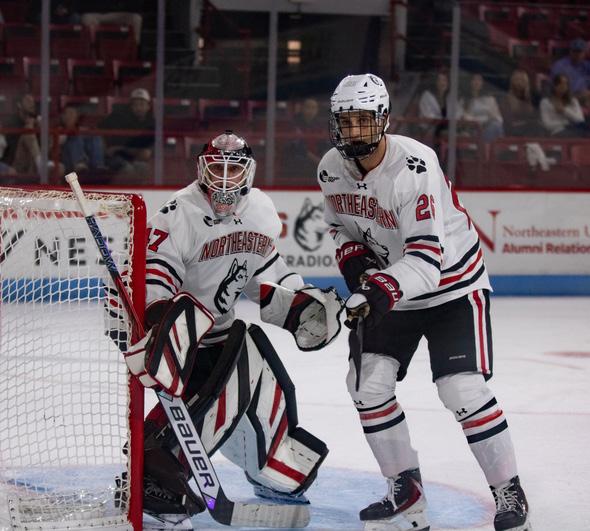
As a Husky, Zacher has already been named Hockey Commissioners Association Goaltender of October, ranking top 15 nationally for his goals against average at the time.
Zacher is inspired by his dad, who was his first coach, and brothers, who were his friendly competitors growing up. He holds these memories as motivation for his on-ice performance.
“In between whistles, I will do a little wrap around, and I will look up in the crowd and I’ll see a bunch of little kids,” Zacher said. “When I was a kid, this is what I was dreaming of, so I might as well have fun, reset, get back into it.”
game starts on Sundays,” Zacher said. “Preparation is the most important part.”
Zacher’s teammates are also influenced by his mindset and preparation.
“Whether it’s nutrition or stretching, off-ice performance stuff, he’s got it dialed to a tee, and I think that makes a difference in his on-ice gameplay,” Henry said.
As the goaltender continues to grow his skills, Zacher is focusing on personal growth rather than public perception. The standard he sets for himself is based on his past, increasing the threshold as his skills become more fine-tuned.
“I just want to make myself proud, my younger self,” Zacher said.
In practice, Zacher’s consistency translates into a confidence the entire team can feel. Mahoney-Wilson has especially noticed this dedication.
This season, Zacher has a season high of 40 saves against Boston College Oct. 10. His defense stays consistent with over 14 saves each game, and most games have over 30 saves.
As a team, the Huskies have developed a chemistry that has led to confidence on the ice, stemming from the backline. Maintaining a confident,
Edited by Arielle Rabinovich
Due to his hard work off the ice, Zacher allows himself to enter each game with energy, enthusiasm and lightheartedness.
“I have fun every time I strap on the skates. I have fun during the games; I have fun just saving the puck,” he said.
This mindset has also allowed Zacher to develop resilience during
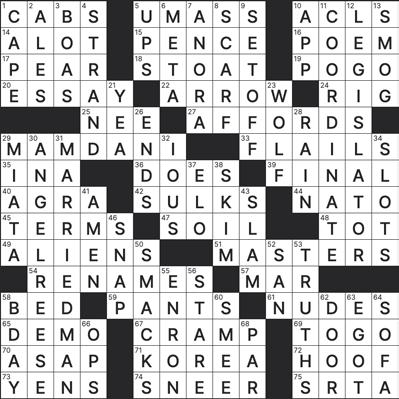

In high school, he played lacrosse, soccer and squash, becoming a lacrosse MVP and winning championships in the latter two sports. Through athletics, Zacher was able to explore various mindsets and activities, supplementing his already intense hockey conditioning.
While currently playing hockey at the Division I level, Zacher incorporates skills he’s learned from the different sports, especially off-ice.
“My mindset going into the
ACROSS
1.Turn the other __ 6.December 31, for short 9.Opposite of fail, in class 13.__ diem
14.“You’ve got mail” co.
15.Ctrl-v
16.Hall between floors
18.__ DeGeneres, voice of Dory in “Finding Nemo”
19.“__ That Soulja Boy”
20.Mentally prepares 21.Wash the floor, perhaps 24.Ted __, character played by Jason Sudeikis
26.Clock, in Bogotá
27.Mimic
30.College class helpers who are often other students
32.Average, in golf
33.__ and Garfunkel
34.The city of love
36.Get on one’s feet
37.AI-opponent in a game
38.Water-filled ditches surrounding
castles
42.Creepy
44.Bear from “The Jungle Book”
45.TV network home to “Survivor”
48.Was in a chair, perhaps
49.With Spotify, end-of-year review of one’s listening habits
51.They can be steel cut or instant
53.Cone-shaped tent
55.Retirement benefits org.
56.Ordered data structures
58.Money for property (plural)
61.To push
62.You may get one on a road trip (2 wds.)
66.Arcade coin
67.Between “bee” and “dee”
68.Tundra, Taiga, e.g.
69.Went fast, maybe
70.Peanut butter __ jelly
71.Sees
“What has been an important trait to Lawton’s game is his competitiveness,” said Mahoney-Wilson, who has worked closely on Zacher’s gameplay. “That competitive drive leads to him wanting to focus on a lot of detail and what can make his game better day to day.”
Although Northeastern just fell to Vermont, Zacher is focused on continuing to improve as the Huskies enter 2026.
“The sky is the limit for him, so it’s exciting to see what he can do,” Henry said. “We’re really just getting started.”
DOWN
1.Includes on an email
2.Bowler, fedora, e.g. 3.Distinct period of time
4.__ Games, company behind “Fortnite”
5.Steve __, coach of the Golden State Warriors
6.Dance move accompanying the whip
7.Egg centers
8.__ Hall, located in Krentzman
Quad
9.More white
10.Not awake
11.__ Artois, belgian pilsner
12.Detector
15.Furry friends
20.The eagle ___ high
21.What you may have to clean
22.Leave out
23.Athletic apparel brand sharing a name with a big cat
25.“ASAP!”
28.Singular
29.Mountain range in South America
31.Cub in “The Lion King”
34.Edgar Allan __
35.Hygiene essential
37.Chomp
39.Mountain range spanning eight
European countries
40.Ballerinas are often on these
41.Pepsi, Sprite, e.g.
43.Rodents often seen on Mission
Hill
45.Gets by easily
46.To go from pub to pub (2 wds.)
47.Caress
49.Quit slowly
50.Landlord’s income
52.Rescued
54.To groom, as a bird
57.Japanese currency
59.What you may start at bars
60.Fall on some ice, say
62.Record label home to Elvis Presley and A$AP Rocky
63.Pigeon sound
64.Value, briefly