
February 6, 2026
The independent student newspaper of the Northeastern community

February 6, 2026
The independent student newspaper of the Northeastern community
It has been more than three years since Northeastern President Joseph E. Aoun last sat down for an interview with The Huntington News, and numerous requests from News staff to interview the president about university and world events have gone unfulfilled.
The News has asked for an interview with the president in writing 11
times since Aoun was last interviewed by The News in December 2022. Members of The News’ staff and editorial board have also directly asked for interviews during in-person conversations with either Aoun himself or members of Northeastern’s Office of External Affairs.
In the past decade, Aoun has spoken with The News three times, in the fall of 2020, 2021 and 2022. Prior to these interviews, the last time Aoun sat down with The News was October 2013.
Aoun is one of the most important voices and recognizable senior figures at the university, setting priorities for how Northeastern is run, both now and in the future, and partly influences how student tuition dollars are spent.
Since taking over as president in 2006, Aoun has shaped Northeastern into a global university. During his presidency, the university has added 14 satellite campuses — in both domestic and international locations
ELLI EINSET Sports Editor
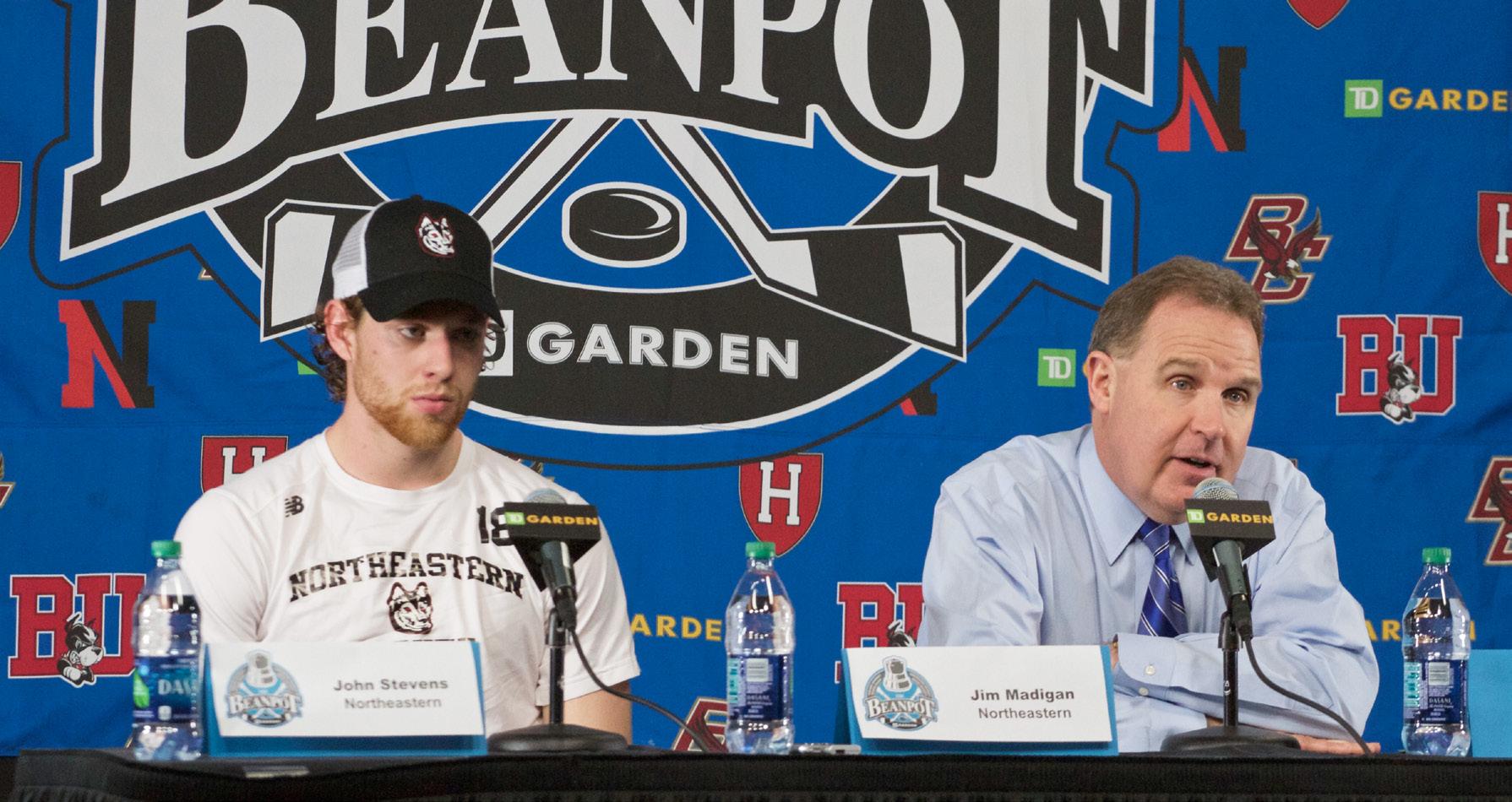
Northeastern University has been a staple in Jim Madigan’s life since 1981. He’s seen the institution from every angle — from student-athlete to associate dean of advancement for the D’Amore-McKim School of Business, to head coach of the men’s
hockey team and now the university’s athletic director.
“I thought all my experiences kind of aligned up to this role … It was one that I embraced and enjoyed, and I was honored that the institution had thought about me in that role,” Madigan said of his promotion in 2021 to athletic director.
As a hockey player, Madigan made an impact on the ice with a career record of 67-59-5. He helped the team to the NCAA Frozen Four and two Beanpot trophies in 1984 and 1985, was voted NU Rookie of the Year in 1982 and was named an assistant captain his senior season.
@HuntNewsNU
Epstein corresponded about Northeastern
Read NU-related emails among the Epstein files.
‘Marty Supreme’ rallies ambition and reality
Read about the emotional rollercoaster of a film.

Solve The News’ February crossword!
Answers will be revealed in the next print issue.
— to its global network. Additionally, under Aoun, Northeastern became an R1 research university in 2016, added new research-focused buildings to the Boston campus and expanded its research capabilities by establishing the Roux Institute in Portland, Maine, which opened in 2020.
The News is the only student-run, independent news publication at Northeastern and one of the most widely-read publications on campus.

Last fall, Northeastern University and the City of Boston announced they would enter two new agreements, increasing Northeastern’s annual payments to the city by 36.8% — a commitment experts say requires long-term accountability and community engagement by the university.
The city announced the new agreements — a 5-year-long payment in lieu of taxes, or PILOT, program and 10-year institutional master plan, or IMP — Nov. 13. The payments for the PILOT program are slated to start in Fiscal Year 2026, while the IMP proposals have their own development schedules.
Over the next decade, the IMP obligates Northeastern to pay approximately $62.5 million in community benefits, including investments in affordable housing, funding for the planning and beautification of Nubian Square and expanded public access to Northeastern facilities such as Carter Playground and the field bubble. With the PILOT agreement,
Northeastern separately pledged more than $49 million in cash and additional benefits to the city over five years.
The IMP, which includes plans for the next 10 years, outlines specific obligations the university must meet and is determined by negotiations between city and university officials. Previous IMP editions laid the path for Northeastern’s rapid urban growth: specifically, a 73% increase in real estate holdings in Boston over the past 25 years, according to reporting by The Boston Globe. This included the construction of Snell Library, Curry Student Center, Marino Recreation Center, the Interdisciplinary Science and Engineering Complex and EXP. Notably, Northeastern’s expansion into Roxbury has raised concerns of gentrification and housing displacement from local residents.
During payment negotiations last fall, the city requested Northeastern pay the city $10 million annually — an increase from previous payments of $1.9 million — because of its expansion, The Globe reported.
He stepped into the head coach position in 2011, and under his leadership in just the first season, the team tied for the third-most wins in program history. Two of these victories were against the highly-ranked hockey programs at the University of Notre Dame and the University of Minnesota. At the end of his time coaching the Huskies, Madigan had a 174-132-39 record, helping earn a reputation for Northeastern’s program.
Despite years of experience, Madigan faces his most difficult challenge yet as Northeastern’s home rink is demolished, with a replacement not slated to open until 2028. Northeastern is also a smaller institution when it comes to name, image and likeness, or NIL, deals and revenue sharing, making it more difficult for the Huskies to compete for big-name athletes.
In June, a federal judge approved a settlement allowing universities to pay athletes directly through a revenue-sharing model — in addition to traditional scholarships — for the first time. Athletes have been allowed to make money off NIL deals since 2021, with most of the money coming from third parties.
Bigger schools like Texas A&M and Ohio State can pay more to their athletes due to their larger budgets, boosted by donors. These institutions also
receive more exposure for their athletes, bringing more opportunities for them to profit off NIL deals.
In a Dec. 4 interview with The Huntington News, Madigan discussed the new arena and how Northeastern plans to compete with larger schools regarding NIL deals.
This interview has been condensed and edited for clarity.
The Huntington News: NIL deals are a hot topic in college sports right now, with recent changes affecting how athletes will get paid. How does Northeastern plan to make itself a
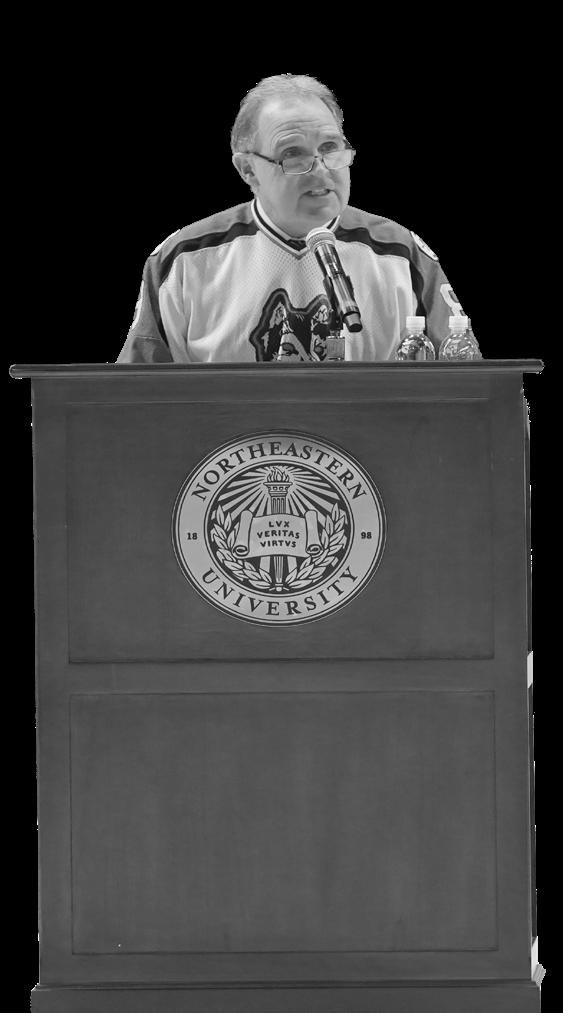
Madigan: NIL and revenue sharing — there’s two different elements there. With revenue sharing, the institution is allowed to pay up to $20.5 million [to student-athletes]. NIL is through an outside third party, and we’re active in both. The landscape has changed significantly. I don’t know if we’re ever going to be able to compete against the Big Ten schools.
The hockey level for us is more reasonable.
In basketball, our competitors in our conference are increasing their contributions and commitments to the NIL, so it’s forcing us to be more assertive with our opportunities to create more revenue through support from alumni, individuals and corporations. I’m not sure if we need to be competitive at basketball with the Power Four schools, but we need to be competitive within our own conference so we can maintain and sustain success.
On the hockey side, the dollars are a little bit less than they are in basketball and football. We’re certainly involved in supporting our men’s and women’s hockey players or women’s and men’s basketball players with NIL, and we’ll continue to do so and continue to articulate the message to our alums that, if you want to support the program, then it is through NIL and revenue sharing, because that’s where the landscape is now.
HN: Is there a strategy the school is trying to take in promoting our ath-
letes for big deals within the league?
Madigan: Revenue sharing is pure revenue sharing, right? So it’s not NIL. It’s different — you can just compensate student-athletes, so we have a strategy with some of our programs and how we can generate additional funds for revenue sharing and through NIL. A big part of that is through individual donations, utilizing our family, friends, parents and alumni to support the program, which they’ve been doing for a long time. And it’s been going to program support [or] endowment support. Now, it can still go to those two areas, but also there’s another third area, a bucket that they can support, and that’s through NIL that will allow us to maintain excellence more than ever in our programs.
HN: For the second part of the hockey season, there will be different home rinks. Next season, will you try to have one rink as some sort of home base?
Madigan: On the men’s side, we’ve got the Boch Ice Center as a practice facility for the next two and a half years. For games, it’s very challenging and difficult to get one rink, because if you go to Boston University or if you go to Harvard … they also have men’s and women’s hockey, so the schedules don’t always align. So that’s why we need multiple rinks and have that flexibility to go to those different rinks. Will it be a little disruption? Absolutely, there’ll be disruption, but I’m confident our coaching staff
and our student-athletes have the resolve and the resilience to work through this. And at the end of the day, they’re still attending a top-50 institution. They’re still playing in the best conference in college hockey, Hockey East, men’s and women’s. They’re still in Boston. They’re still at Northeastern. They’re still playing in the Beanpot, so there’s still a lot of positives to experience while you’re here during this disruption period.
HN: The women’s basketball team never played in Matthews, always in Cabot. Can we expect them to play in the new arena?
Madigan: We’re gonna look at that also. That decision doesn’t have to be made right now — it can be made in the next two to three years. The challenge with that is that men’s and women’s hockey are on a Friday-Saturday cadence. Men’s basketball is on a Thursday-Saturday cadence and women’s basketball is on a Friday-Sunday cadence, so Fridays are challenging because sometimes we have two hockey games down there. The women will play sometimes at 2 p.m. and the men will play at 7 or 7:30 p.m., so you can’t fit in a game there. Sunday becomes a better option for us. We’re also mindful that Sunday’s a major activity day for our club and intramural programs at the arena. So, through my lens, I’m looking at varsity sports, but I’m also looking at club sports and I’m also looking at intramurals and recreation sports. That all comes within our department.
station, meaning she walks past the site every day.
Caroline Bricknell doesn’t need an alarm to get up for her 8 a.m. class. By 7:15 a.m. each morning, she is awoken by the sounds of metal clanging next door. From her fifth-floor apartment at 780 Columbus Ave., Bricknell lives with the sounds of construction of Northeastern’s newest residence hall.
“It’s so awful,” said Bricknell, a second-year combined criminal justice and psychology major. “Sometimes our building starts shaking. It’s awful because you can’t even block out the noise because you can physically feel it.”
Since September, construction at 840 Columbus Ave. has involved the loud, rhythmic banging sound of a pile driver from sunup to sundown. It goes on Monday through Saturday as workers secure steel piles for the foundation of the new 23-story, 1,370-bed Northeastern residence hall, construction worker Jeff Sherman said. The site is located near International Village, or IV, which houses classrooms, the United Table dining hall and 1,900 beds.
Bricknell isn’t the only one inconvenienced by construction on the building. Zaidee Peterman, a second-year architecture major, has most of her classes in the architecture studio underneath the Ruggles
“I have to cover my ears and wear headphones,” Peterman said. “It really hurts my ears.”
The noise disturbance has affected students’ daily lives, interrupting co-op interviews, phone calls, study sessions and conversations.
“We just have to walk silently for that entire block because we just have no clue what the other one’s saying,” Peterman said of her walks past the construction site with her roommate.
“We have to just be silent; no one is trying to have a conversation.”
Kayla Wolf, an assistant teaching professor of political science, has an office in Renaissance Park, the building right next door to the construction site.
“It’s kind of a joke now at meetings, like we [the other professors with offices in the building] all just know, ‘Okay, the building’s shaking again, just keep going on like that didn’t happen,’” Wolf said. “I know some people really hate it and will do their office hours from home instead of being in person, but I think I’m used to it.”
According to the City of Boston website, an unreasonable level of noise is anything louder than 50 decibels from 11 p.m. to 7 a.m. or anything louder than 70 decibels at any time, except for permitted construction.
From a room with a closed window on the 19th floor of LightView,
0.2 miles away from the construction site and approximately 190 feet up, a Huntington News reporter recorded an average noise level of 70.1 decibels, or dB, over 5 minutes during construction at 10:40 a.m. Jan. 21 using an online loudness meter. The highest number recorded was 92.7 dB, which is the equivalent of having a hair dryer, blender or power tool on in the same room.
Sherman has been on the job for three weeks.
“I hear it in my head,” said Sherman, whose job is to count the number of blasts per beam being installed. “I find myself counting at night when I get home from work.”
Every 100 blows sends the beam approximately one foot deeper, and the team is aiming for 100 feet total for every beam, meaning each beam requires 10,000 blasts, Sherman said.
Some residents on Columbus Avenue, which is home to seven residence halls housing Northeastern students, have decided to make light of the situation.
“We just think it’s kind of funny,” said Lexi Ledvina, a third-year cell and molecular biology major who lives on the 18th floor of LightView. “It’s very consistent, and so me and my roommates have a joke about it, like whenever we hear it we are like, ‘Guess they’re back at it again.’”
Other residents understand that construction is necessary to increase housing on campus.

“I know housing has been a consistent issue with this university,” Bricknell said. “I have friends who live in forced triples and forced doubles. At the end of the day, it will be beneficial for everyone.”
According to the Northeastern Planning, Real Estate, and Facilities website, the residence hall will house approximately 800 beds, in an effort to establish more affordable housing on campus.
Sherman said the building currently has an expected completion date of 2028, with pile driving hopefully concluding in February.
“Yes, [the noise] does suck, but I also understand they can’t just wait until it’s a good time for everyone,” Peterman said. “When do you expect people to build this thing if they can’t do it when you want them to do it?”
While the $2.6 million in cash annually and $37 million in community benefits Northeastern pledged to contribute under the new PILOT agreement add up to well below the original $10 million ask, it’s still a nearly 40% increase from previous payments.
“Boston thrives when our leading institutions match their global reach with a deep commitment to our neighborhoods,” said Boston Mayor Michelle Wu in a statement included in the November announcement.
“Our five-year PILOT agreement sets a new standard for higher annual cash payments and community benefits at a time when Boston taxpayers need relief.”
The PILOT program, formalized in 2009, asks tax-exempt institutions to make voluntary payments to offset lost property tax revenue for the city. Northeastern has been part of the program since its launch in 2012.
However, many of the city’s largest tax-exempt institutions pay well below the amount requested in the program’s guidelines. In the 2024 fiscal year, Boston received only 76% of the combined cash and community benefit totals requested. Tax-exempt institutions like the Boston Symphony Orchestra and Boston Architectural College met 100% of their PILOT obligations, while others such as Harvard University, Boston University and Boston College paid far less.
Northeastern’s contributions sat at around 67% of the amount requested by the PILOT program during Fiscal Year 2024.
“It’s a wise move for Northeastern
and any institution to commit money up front, knowing that if we did it annually, the cost would probably rise [because of inflation],” said Kimberly Lucas, Northeastern professor of the practice in public policy and economic justice who previously served as the director of civic research for the city.
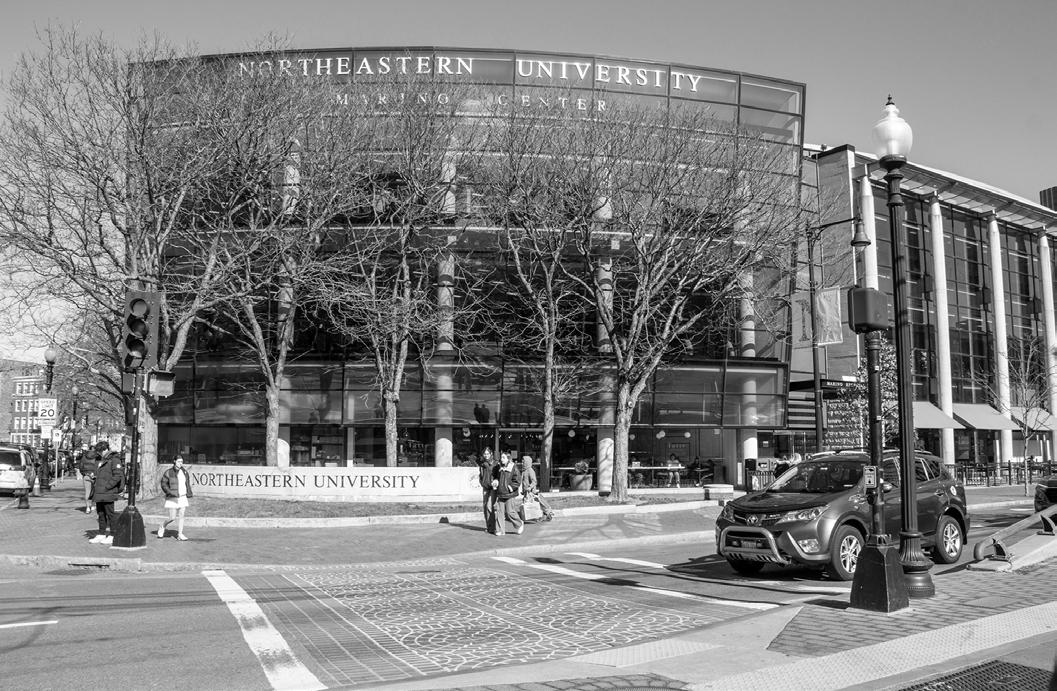
“[This way], we’re not paying as much as we should be or would want to commit annually.”
As part of the IMP, Northeastern plans to build new on-campus student housing, including a large residence hall at 840 Columbus Ave. The Columbus Avenue project will add 800 new beds according the the university, which they hope will encourage students to live on campus, according to the university’s website. With this expansion, the university estimates that 69% of undergraduate students will be able to live on campus.
For the past several years, Northeastern has grappled with a growing student population. Many students move off campus due to a lack of on-campus housing, reducing the available housing supply for the city’s long-term residents in surrounding neighborhoods.
“Northeastern has a lot of resources and there’s a lot of local people who live nearby who would like to take
advantage of them,” said Armani White, executive director of Reclaim Roxbury, a community-based nonprofit coalition focused on anti-displacement and housing justice. “Northeastern is required — through the institutional master plan — to invest in the local community.”
According to Boston’s Student Housing Trends report, Northeastern had the largest year-over-year increase in undergraduates living in private, off-campus housing out of all universities in Boston, with a 31.9% rise in 2023.
“We definitely need more [and] better housing,” said Narn Rojvachiranonda, a fourth-year civil engineering major who has been a resident assistant at Northeastern for three years.
“[As a first-year], my room was quite small. [If] I stood in the middle of my room, I could touch both beds with my arm stretched out.”
Historically, Northeastern has fallen short on its promises for commu-
nity investment, Lucas said.
“What we’re seeing in this IMP is us rectifying the past 10 years of a poor ‘How,’” Lucas said. “It’s not just about giving money.
It’s about being able to give things that are countable in money and say, ‘We’re benefiting the community in this way.’”
Previous IMP negotiations were unsuccessful in guaranteeing meaningful community access to the university’s facilities, Lucas said. Privileges granted to the broader Boston community came with significant restrictions: At Marino, for example, a maximum of 50 community members are allowed at a time for limited hours and each must show proof of residency and sign waivers.
“Access needs to be stronger to really have that community investment be more than just something written on paper,” White said.
Northeastern and other universities have struggled as President Donald Trump’s administration slashed federal research funding and targeted international students over the past year. Still, community members say the coming months will be a test of whether the university’s promises truly translate into lasting action.
“Now the deal is done, I think it’s the work of the community and the work of Northeastern students, alumni, faculty, staff — all of us — to
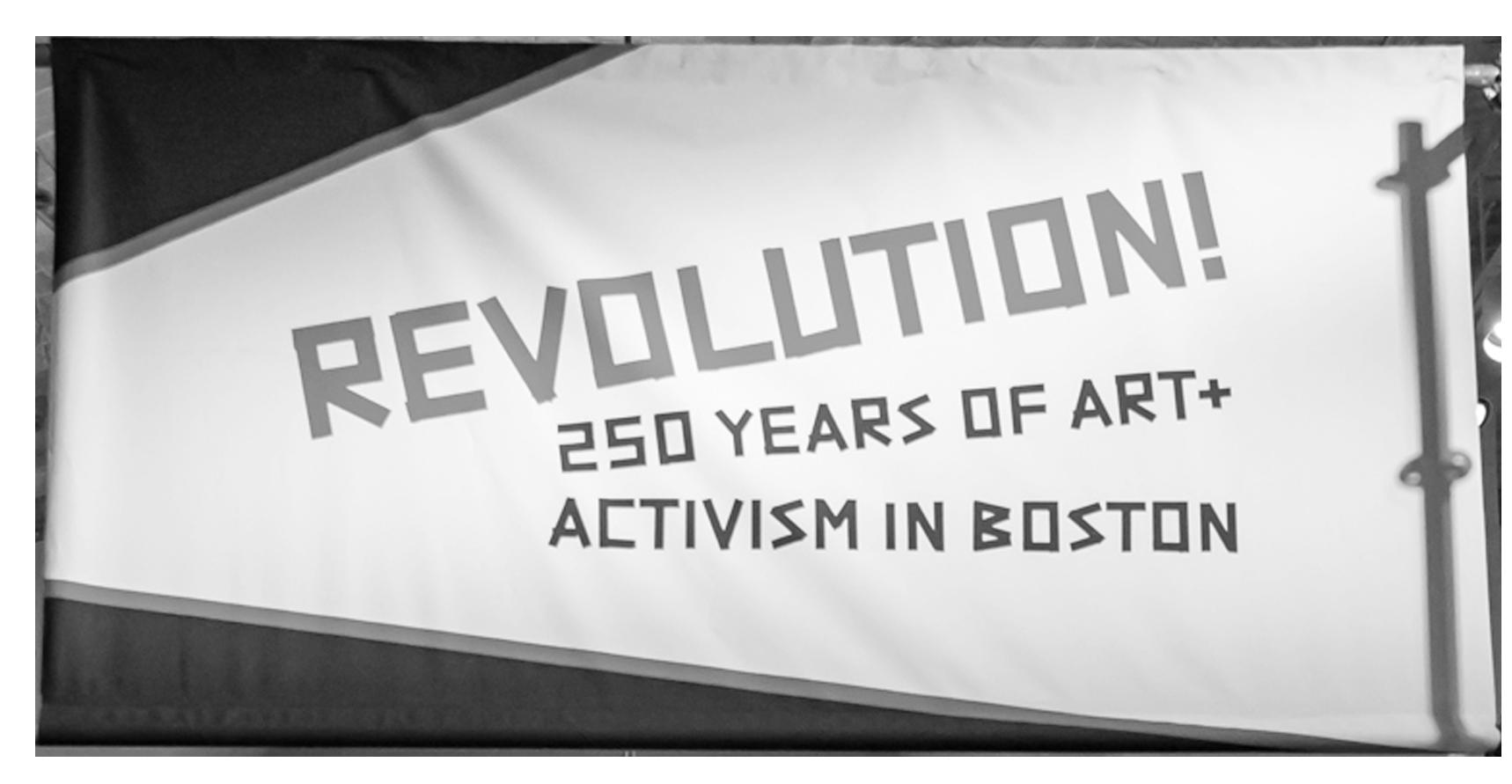
The Boston Public Library, or BPL, is marking the 250th anniversary of the founding of the United States with its exhibit “Revolution! 250 Years of Art & Activism in Boston.”
The exhibit opened Oct. 23 at the BPL in Copley Square, featuring over 100 works dating from 1776
to 2025. The pieces examine the ideals set forth at the United States’ founding through various historical lenses, all set in Boston.
“When the BPL first opened its doors, the very idea of a free public library was revolutionary,” said BPL President David Leonard in a September 2025 press release. “With ‘Revolution!,’ we carry that spirit forward, inviting visitors to explore how the ideals of liberty and justice have evolved over the past 250 years.”
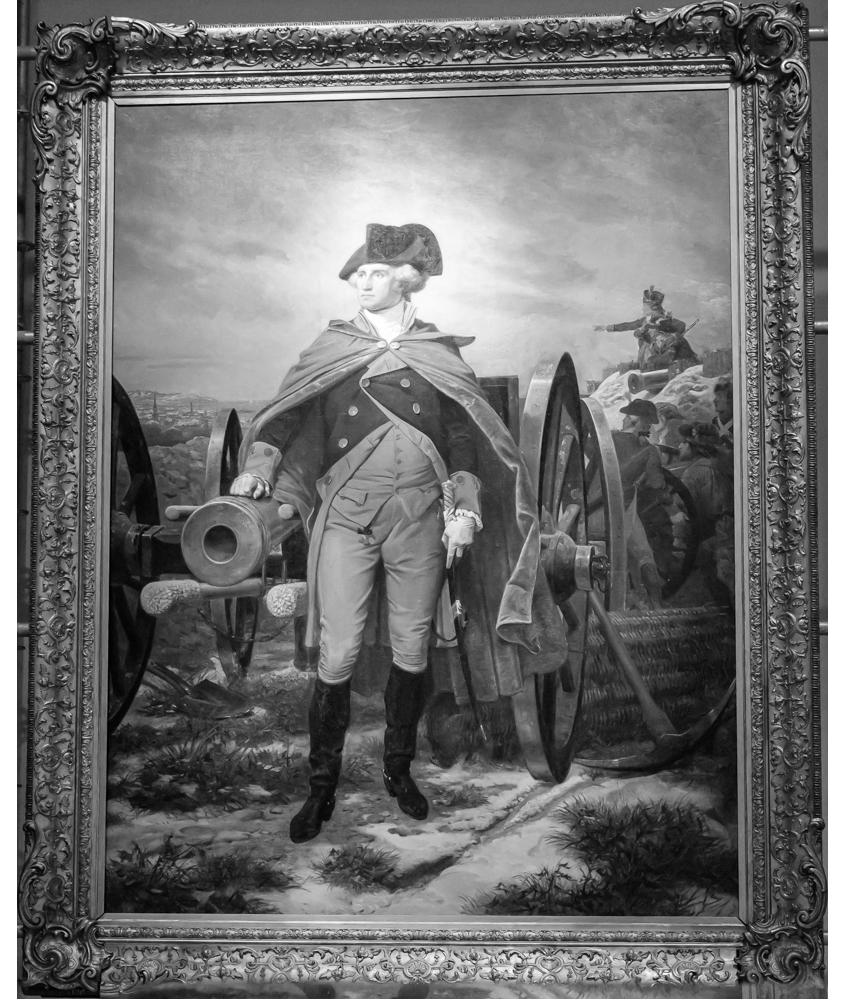
The exhibit features various moments in local history: Engravings of the Boston Massacre, photographs of Martin Luther King Jr.’s march to Boston Common and art about immigrant communities in Boston all highlight how the city has been a home for social change.
“I really like [the exhibit], but I was surprised,” said Camila Vargas, a high school student from Florida.
“There’s a lot of the [American] Revolu-
tion [content] in the beginning and, then [the exhibit] slowly comes to different situations.”
Visitors are first greeted by Emanuel Leutze’s 1852 painting “Washington at Dorchester Heights.”
The exhibit ends with Newton textile artist Michael Thorpe’s response to the painting, “George Washington quilt.” Thorpe’s piece is made up of 20 puzzle-piece-like squares showing Leutze’s painting, which he will periodically rearrange, distorting the image.
“History is a static thing, but the interpretation of history is constantly changing,” Thorpe told The Huntington News. “That’s the nature of this piece specifically, because it legitimately changes.”
Several other local artists are
Northeastern receives record number of undergraduate applications for 2026-27 academic year
Northeastern received a record 105,190 undergraduate applications for the Class of 2029, Chancellor and Senior Vice President for Learning Ken Henderson said in a Jan. 28 faculty senate meeting, marking the seventh consecutive year that undergraduate applications to the university have increased.
The number of applications rose by 98 from 105,092 for the 2025-26 academic year. From the 2024-25 to 2025-26 academic year, the university received over 10,000 more applications.
“You can see we had a record-high number of applications. We actually believe that we will exceed that number again this year,” Henderson said during the Jan. 28 virtual meeting.
Other key enrollment metrics presented at the meeting were a “tremendous” 47% yield rate for the fall 2025 semester and a 600% growth in early decision applicants since 2015.
Last year, Northeastern’s acceptance rate rose for the first time since fall 2020 to 5.6%, up from the previous year’s 5.2%. This number only reflects students who are admitted to the university’s Boston campus and does not account for students accepted through alternate admissions programs.
MFA faces backlash after laying off BIPOC curators, DEI head
The Museum of Fine Arts Boston, or MFA, eliminated 6.3% of its workforce effective Jan. 30.
In an email to The Huntington News, the MFA cited a “structural deficit” of $13 million, which it “recognized a staff reduction and reorganization would be necessary” to address.
Social media users voiced concerns after many laid-off employees represented marginalized communities, including Assistant Curator of Islamic Art Nadirah Mansour and Assistant Curator of Native American Art Marina Tyquiengco.
“The MFA tried to make it look like a tactical decision to save on costs, but when we look at who’s actually being targeted in these layoffs, it [was] what little minority staff they had,” said content creator Ayia Elsadig in an interview with The News.
featured, including Boston University Chair of Photography Toni Pepe and Boston Printmakers Secretary Robert Tomolillo.
Many pieces are juxtaposed to convey how ideals of the country’s founding didn’t guarantee freedom for all. A 19th-century engraving, “Rejoicings at Faneuil Hall, Boston, at the close of the revolution,” hangs beside a visually similar lithograph from 1850, “Rocking Slaves in Faneuil Hall,” depicting the continuation of oppression and ongoing battle for civil rights.
“I’ve lived in Boston my whole life,” said Boston resident and exhibit attendee Andrew Sharpe. “But every time I come to something like this, I feel like I’m always learning more about
Elsadig added the MFA’s head of diversity, equity and inclusion, or DEI, was also among the layoffs, which she said was “opportune, considering the national administration that is vehemently against DEI.”
When asked if the museum currently has a director of DEI, the MFA said its current approach to DEI “is to integrate these values across all functions rather than silo them in a single office.”
Evelyn Mayberger, MFA objects conservator and chief steward of the MFA Union, told The News around half the layoffs were Union members. She added the Union is “still waiting on a lot of information” and began formal bargaining sessions Feb. 2.
ZOE MACDIARMID Senior Reporter
In an email sent to Jeffrey Epstein in 2018, the unidentified writer gushes about Northeastern and their desire to attend the university, according to a document among the millions of files released by the Department of Justice Jan. 30.
The latest batch of files is the largest released to date and sheds new light on Epstein’s far-reaching connections, including President Donald Trump, university donors and celebrities.
The Huntington News identified 25 distinct files that mention Northeastern, most of which are news clippings and do not implicate professors or the university in direct communication with Epstein.
The exchange contains three emails between Epstein and another sender, whose email address is redacted. Epstein appears to have forwarded himself the longest email of the exchange, which raves about Northeastern. It is unclear who authored the typo-ridden email.
“I consider Northeastern university bachelor’s degree completion the most valuable program I could use inorder to fulfill my passion for gaining knowledge in management science,” the email that Epstein forwarded to himself reads. “I view a two-year term as not only an efficient use of time but also as the only opportunity to fully emerse into the school’s activities while focusing primarily on the following three key areas of my professional and personal interests.”
According to reporting by The Miami Herald in November 2018,
Epstein “counseled” young girls about their schooling and “told them he would help them get into college, modeling school, fashion design or acting.” Members of the House Judiciary Committee, which investigated Epstein, have also said Epstein lured in girls by promising to help them gain admission into universities. The intent and context behind the email exchange about Northeastern is not clear.
In an email statement to The News, the university said it reviewed all the files that mentioned Northeastern.
“We have thoroughly reviewed the files that are publicly available and have not found anything concerning related to Northeastern,” Vice President for Communications Renata Nyul wrote.
The email exchange between Epstein and the unidentified person occurred July 22, 2018, 10 years after Epstein was first convicted of procuring a child for prostitution. A little over a year after the emails about Northeastern were exchanged, Epstein hanged himself in his jail cell. He was facing life in prison for sex trafficking girls as young as 14 alongside Ghislaine Maxwell, who was sentenced to 20 years in prison in 2021 and groomed many of the victims.
The 2018 thread includes three emails. In the final exchange included in the files, Epstein wrote, “you deeseve [sic] the best,” to which the unidentified sender wrote, “SIR, THANK YOU SO MUCH!!!♥♥♥”
The files released so far constitute nearly half of the materials the Justice Department has on its investigation into Epstein and reveal close ties to high-profile universi-
ties, including Harvard University, Columbia University and the Massachusetts Institute of Technology. The New York Times reported Feb. 4 that Epstein helped Woody Allen’s daughter get into Bard College.
The main email of the exchange, which is around 810 words, discusses Hurricane Irma and natural disaster prevention at length before the sender abruptly pivots to describing their admiration of Northeastern.
“With my degree in meteorology science, I knew that such a devastating hurricane and its disruptive impact on people’s lives had been forecasted long before it slammed into the islands and made the news,” the email reads.
Toward the end of their email, the sender names the three reasons they’d want to attend Northeastern, the first being to “acquire worldclass managerial skill.”
“I see the education provided by Northeastern University ,by immersing students in real-world experiential opportunities through co-op programs necessary and the most effective to adapt to current management challenges,” they wrote in the 2018 email, which contains many grammatical errors.
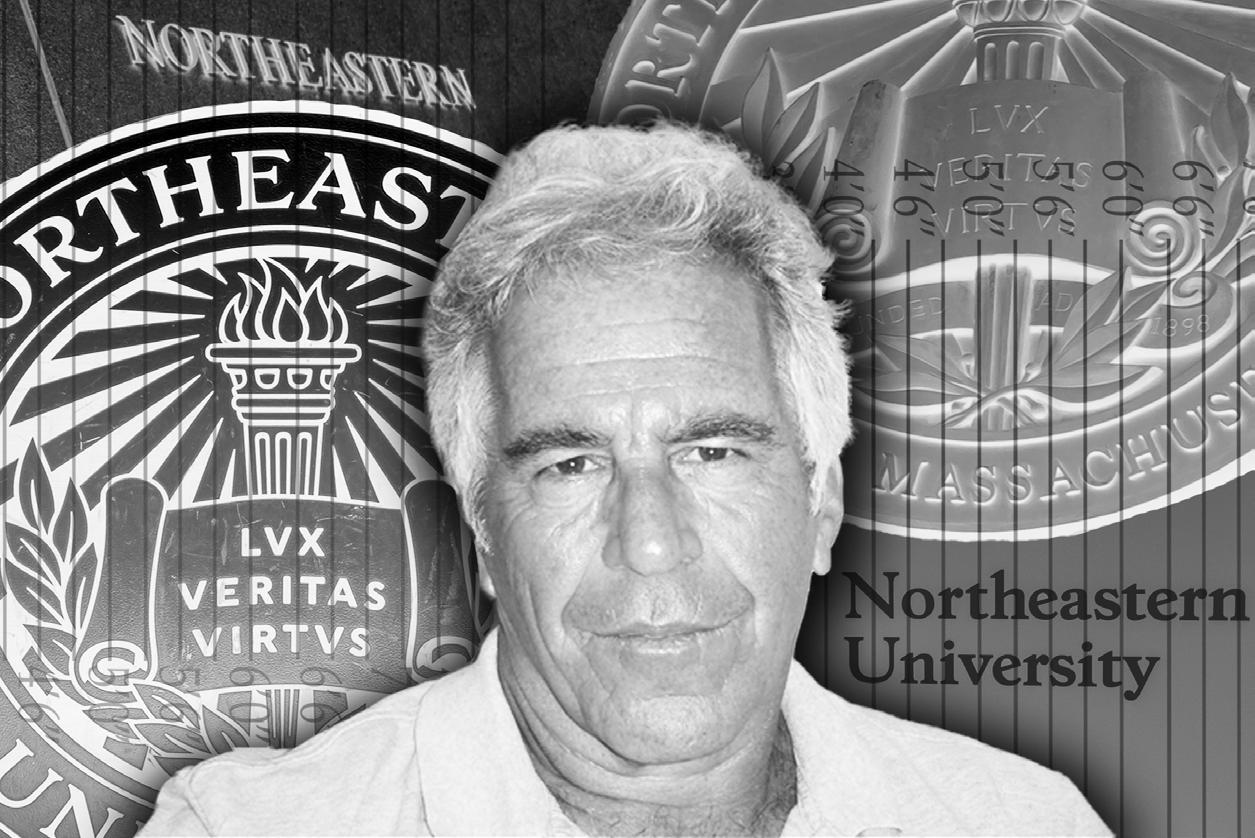
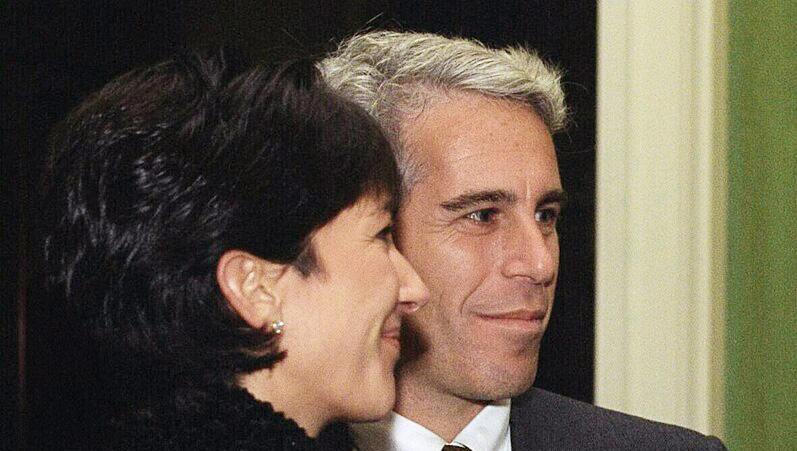
A graphic featuring a 2016 headshot of Jeffrey Epstein and Northeastern signage. Northeastern was mentioned in 25 distinct documents in the most recent Department of Justice file release.
sender said they aimed to “build an influential network.”
“I am confident that in the diverse and ambitious NEU environment, I can expand my network which I can later draw upon to solve a myriad of business and social problems,” the email reads.
“Most importantly, however, I will have an unparalleled opportunity to meet a variety of interesting people, develop friendships, and build successful business partnerships.”
In the second bullet point, they highlight “finding market opportunities and building effective solutions” and name and describe a Northeastern College of Professional Studies professor as someone “interested in promoting innovation and team effectiveness” whom they would want to study under.
In the third and final section, the
The investigation into Epstein, carried out by the House Judiciary Committee, unveiled the former financier’s tactics for grooming young girls. Rep. Jamie Raskin, a ranking Committee Democrat, penned letters Jan. 14 to the presidents of New York University and Columbia University after receiving information from survivors about how Epstein would lure young girls by “prom-
Murphy.
ising to help them gain admission into colleges and universities.” In the letters, Raskin demanded the universities report the total number of NYU and Columbia students whose tuition or fees were paid by Epstein.
At the end of the July 2018 email about Northeastern, the sender wrote that the university would provide “unparalleled” opportunities for making professional and personal connections.
“I see my general purpose in life as being useful to the society and making people’s lives better. Creating and seeing the result of work brings the meaning to my life,” the sender wrote, adding, “My dream is one day to become a part of The Global Bank Group and I think that completing an education at Northeastern University along with co-op internship programs will help me reach this goal.”
Northeastern’s faculty senate passed a resolution Dec. 10 urging the university to protect international and transgender members of the university community in the wake of attacks from the federal government.
The resolution proposes three “core principles” focusing on free speech, academic freedom and civil rights and calls on the university to “use all reasonable means, up to and including litigation” to defend vulnerable communities. It draws attention to, and opposes, the U.S.
government’s “widespread effort to deny free speech and academic freedom to non-citizen members of the academic community.”
The goal of the resolution, Stotsky Professor of Jewish Historical and Cultural Studies Simon Rabinovitch said, is to delineate where the senate stands in the event that the university comes under more direct attacks from the federal government.
“If Northeastern were to be targeted, [the goal is] to preemptively express that the faculty does not want the administration to go along with it. Essentially, to embolden the administration to fight and to not use us as the excuse,” Rabinovitch said in an interview with The Huntington News.
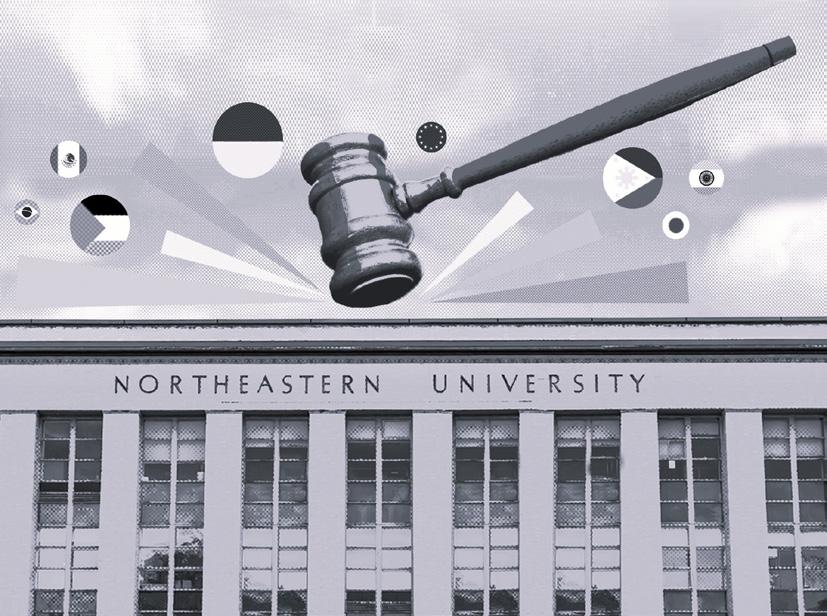
The first of the three core principles in the resolution states that the rights of free speech and academic freedom should apply equally to U.S. citizens and non-citizens. The other two principles affirm that the senate supports the rights of transgender community members and op-
poses efforts to dismantle academic freedom and institutional autonomy in higher education.
The U.S. government has attempted to hurt these principles through “means including executive orders, university agreements, and regulatory and funding agency actions,” the resolution reads. The resolution states that, among other things, the U.S. government has attempted to deny free speech and academic freedom to non-citizens, erase identities of transgender Northeastern community members and restrict university speech and teaching.
The resolution was first proposed in the spring of 2025 by Rabinovitch. It was passed after it went to a special committee led by Peter Desnoyers, an associate professor of computer science.
Other higher education institutions, such as Columbia University and the University of Texas at Austin, have signed compacts or settlements that give the federal government greater authority over university operations. The University of Texas at Austin was the only university to sign Trump’s Compact for Academic Excellence in Higher Education, which was sent to nine universities and asked for institutions to align with a more conservative agenda in order to receive federal funding advantages.
“We were still seeing universities and law firms basically proceeding as if agreeing to the federal administration’s demands was a normal business decision … and really rushing to act without considering the reputational effect,” Desnoyers said in an interview with The News. “These are extraordinary times, and not in a good way … What’s been happening this last year seemed to have a high probability or a decent chance of destroying the U.S. university system.”
In the resolution, Rabinovitch highlighted transgender and international community members as the primary groups in need of support from the university.
As public opinion on transgender Americans — a group continuously thrust into the political spotlight — grows increasingly negative on both sides of the aisle, transgender Northeastern students and staff say politics can hurt their mental health and perception of Northeastern as a safe space.
“I wanted those people to feel supported by their employer, to feel that they belong in this community, that their employer was going to stand up for them,” Rabinovitch said. “I wanted that expression of support. If it wasn’t going to come from the administration, let it come
from the faculty senate, let it come from their colleagues.”
Over the past year, the federal government ramped up attacks on immigrants with the mass deployment of Immigration and Customs Enforcement, or ICE, agents throughout the country. Last spring, the Trump administration also revoked thousands of student visas, placing international students — Northeastern enrolls more than 20,000 of them — in an increasingly vulnerable position.
The State Department revoked the visas of “approximately” 40 Northeastern students and graduates, according to an April 14 update to the university’s “Federal Landscape” FAQ page, formerly known as the “Navigating a New Political Landscape” FAQ page. The FAQ page no longer lists the number of students and graduates whose visas were revoked, but the university said in May all had their legal statuses restored.
Rabinovitch hopes the university issues a clear statement of principles, which he said was not sufficiently offered in earlier statements to the Northeastern community.
“This is a major research university,” he said. “It claims to be attached to a certain set of values, and if our leaders are the bold leaders that they say they are, let them lead.”
SIMEON EIG News Correspondent
After an extensive press tour that featured a Zoom call, custom windbreakers, blimps, a remix of “4 Raws” by EsDeeKid and even the color orange, fans and movie enthusiasts alike waited eagerly to see if Timothée Chalamet and Josh Safdie could pull off the seemingly impossible: captivate audiences with a movie about something as simple as ping pong.
As the masses flooded into theaters on Christmas Day, they quickly realized that their expectations for the film hadn’t prepared them for what its 149 minutes would hold.
“Marty Supreme” is a movie about much more than two paddles and a little plastic ball. Instead, the captivating story and Chalamet’s Oscar-worthy performance take viewers on a roller coaster of emotions spanning nostalgia, suspense and reflection.
Having recently parted ways with his brother and directing partner, Benny Safdie, “Marty Supreme” director Josh Safdie had much to prove with his first major solo feature film. With the heat turned all the way up, how would Safdie prove to Hollywood that he could stand on his own two feet? The answer is simple: Safdie writes a script worthy of a Pulitzer Prize and enlists the help of one of the hungriest and most popular film stars of the past decade: Chalamet.
Chalamet was coming off an excellent performance in Josh Mangold’s “A Complete Unknown,” where he received critical acclaim for his portrayal of music icon Bob Dylan, notably taking home the Screen Actors Guild Award for Outstanding Performance by a Male Actor in a Leading Role. Upon receiving the award, Chalamet
delivered his acceptance speech, announcing to the world that he is “in pursuit of greatness,” not-so-subtly alluding to the upcoming Academy Awards ceremony.
However, at the Oscars, Chalamet fell just short of becoming the youngest recipient ever of the Academy Award for Best Actor, losing to current record holder and “The Brutalist” star Adrien Brody. Yet, Chalamet did not let this loss deter him; instead, he used it as fuel, shaping an even stronger portrayal of Marty Mauser that has brought him back into contention for the Oscar he missed out on a year ago.
Chalamet’s commitment to this role (including years of ping pong training in preparation) allowed Safdie to focus on bringing his vision of a rough, postwar 1950s New York City to life. The film uses immersive set and costume design to transport viewers into the unique combination of grit and class that Manhattan housed after World War II, utilizing skilled tailors to outfit the cast in sharp suits and elegant skirts against the backdrop of busy mid-20th century streets.
Even with these meticulous visual details to ensure period accuracy, Safdie takes a creative risk by incorporating an ‘80s-themed soundtrack — a choice that ultimately pays off. Though not historically accurate, the familiar ‘80s hits and synth-driven soundtrack ease viewers into the New York City of “Marty Supreme” by evoking a sense of nostalgia while simultaneously representing the urgent and forward-thinking nature of the film.
This authenticity is heightened by a talented ensemble of both actors and non-actors who embody all walks of New York life, from fellow
celebrities making their debut on the silver screen. The two deliver impressive performances that make the audience wonder why they haven’t appeared in films sooner, providing a similar contrast to the female leads while also offering a combination of comedic relief and believability. Together, the cast not only brings the characters to life but also reinforces the film’s exploration of ambition and desire in a postWorld War II New York.

Standing in contrast, Chalamet is given a deliberately unkept look for the film, sporting an unshaved unibrow and pock marks on his face. This choice visually emphasizes Marty tunnel-visioned obsession with his dreams, showing that they take priority over taking care of himself or those around him, and selling the look of a 1950s hustler.
hustlers to the rich and famous. The two female leads, Odessa A’zion and Gwyneth Paltrow, deliver excellent performances as Marty’s love interests and embody the contrast of the worlds and desires that shape his journey. Rachel Mizler (A’zion), who Marty has known since childhood, reflects his youthful impulsivity and the harsh realities of his lower-class background, while actress Kay Stone (Paltrow) projects an image of Marty’s aspirations: wealth, sophistication and status.
Other key figures include Stone’s husband, Milton Rockwell (Kevin O’Leary) and Marty’s confidant, Wally (Tyler, the Creator), both
All of these production elements make the film feel real to viewers and ultimately convey the rawness portrayed in the pièce de résistance of the film: Marty Mauser’s return to reality and the subsequent morals it teaches. Throughout these two and a half hours, the audience feels like an accomplice to Marty’s poor choices, bearing witness as he digs himself into a progressively deeper hole through a series of bad deals and risks that creates an electrifying and anxiety-inducing viewing experience.
Yet, after all his gambles and setbacks, Chalamet’s character completes his arc of making it to Japan and defeating Koto Endo (Koto Kawaguchi). For Mauser as a ping pong player, this moment of victory serves as confirmation that all of his sacrifice was worth it. By beating Endo fair and square, the film emphasizes Marty’s growth as a player and competitor, showing he has earned his spotlight on the world stage despite not making it to the Tokyo World Championship. However, the film’s ending draws
the audience past the intense back and forth of these ping pong matches to offer something much more complex than Marty’s sporting triumph: the moment when his dreams confront the new responsibilities he must face. Upon rushing through hospital doors back in New York, Marty is met not with a celebration of his personal triumph but with the weight of reality. The true victory of this moment lies instead in the celebration of life.
Of course, much of the film’s tension comes from being spectators in the 21st century, knowing that ping pong will not become the phenomenon that Marty dreams of, raising the lingering question of whether any of his sacrifices were worth it. Yet the birth of his and Rachel’s child, paired with Chalamet’s tears, the cries of newborn babies and the needle drop of Tears for Fears’ “Everybody Wants to Rule the World,” offer a bittersweet reckoning for Mauser. Though the road to this moment was costly, the life that Marty chased brought him face-to-face with responsibilities he cannot ignore.
At this moment, Josh Safdie and “Marty Supreme” remind us that ambition must always meet obligation, and dreams must collide with the reality of caring for more than ourselves. Marty Mauser may not achieve a full transformation on screen — we don’t know if he will be a fully present father or a reformed man — but instead, his story is given a pause.
Is this necessarily a satisfying end to his saga? Not in the traditional sense. “Marty Supreme” closes not on a triumphant victory but on a reflection on ambition, consequence and responsibility, offering the audience a meditation on the boundaries of aspiration and what it means to be an upstanding human being.
Even with virtually every song ever released available to stream at the tap of a screen, many people still choose to drop their phones and instead drop needles to listen to their favorite albums.
Whether it’s the tactility of playing a record, the ability to support their favorite artists directly or the nostalgia for a time they may or may not have lived through, physical media has created a tightly knit community of analog music fans. Lately, artists, store owners and a growing community of collectors have come together to share a common value: ownership.
Kacey McNamara, a second-year journalism and English combined major at Northeastern and avid media collector, said the thing that drew them to records was a desire to safeguard their favorite music.
“When you stream something, you don’t own it,” McNamara said. “[Collecting has] that aspect of being a form of media preservation and making sure that this music you really love is something that you now own and will have for the foreseeable future. It can’t be stripped away from you.”
Songs can vanish from streaming services for many reasons: copyright issues, distribution disputes or simply because an artist doesn’t resonate with their older releases. For example, in November 2025, The 1975 removed the track “Human Too” from its latest album so it better fit frontman Matty Healy’s taste. Those who own a physical copy of the album still have access to the track, which is why more people are promoting investing in vinyl.
“The physical media push is making sure that, years down the line, we don’t lose access to this great music,” McNamara said. “These streaming services definitely won’t always be around.”
Many vinyl enthusiasts also highlight the exploitation artists face from streaming services. Spotify, in particular, has been criticized for failing to fairly compensate artists for their work. Small artists who don’t have a platform to financially support themselves through other avenues often can’t earn a livable wage from streaming services alone, which is why many in the record community choose to put their money directly in artists’ pockets by purchasing vinyl.

less than a tenth of a cent per stream, and most of the revenue ends up back in the hands of record labels.
“It means nothing compared to investing in a title,” Wetjen-Barry said. “You vote with your dollar, and the same thing is true of what you’re supporting musically.”
An investment in physical media, Wetjen-Barry said, is an investment for the entire music industry, including artists, labels and record stores like Vinyl Index.
Aaron Wetjen-Barry, a collector and specialist at the Somerville-based record shop Vinyl Index, assumed responsibility for preserving artists’ work and supporting the industry when he started selling vinyl.
“I don’t trust any of the [labels],” he explained at the counter of the Somerville shop, surrounded by shelves of musical history. Wetjen-Barry condemns the “gross injustice that was done to all musical artists when their record labels negotiated Spotify and digital contracts,” he said.
On average, services like Spotify and Apple Music remunerate artists
Combined with directly investing in artists, for physical media collectors like Olivia May, a thirdyear music and communications combined major at Northeastern, owning a vinyl brings them closer to music creators.
“There’s something so cool about being able to actually hold a piece of media by this artist you feel so connected to,” May said.
While vinyl is still far from its glory days, sales have slowly but surely been increasing in the past few years, according to Taylor Corp, a global print and graphic communications company. In 2024, the U.S. music industry sold 43.6
million records, marking the 18th consecutive year of growth.
After the phonograph, vinyl was one of the first formats through which artists shared their work.
As early as 1948, records have showcased musical projects, with everything from the track order to the vinyl sleeve and lyric booklet being canvases for artistic expression.
While many of today’s collectors were born after the advent of digital formats like MP3s or iPods, using an analog format like vinyl symbolizes a specific intention: to be present with the media they consume.
“I often stream my music for convenience. But that’s why one of the things for me about my physical music is the ritual of it,” McNamara said. “I try to intentionally put Spotify away for a little bit and sort of increase the friction. It just makes you think more deeply about what you’re listening to.”
In the record community, vinyl creates a lasting relationship between listeners and the music they love, and it’s one that won’t vanish within the ever-changing landscape of streaming.
“Music is a whole ecosystem of passion and connection,” May said.
The News garners over 1 million impressions on social media each month and produces around four print editions every semester, circulating 3,000 papers around campus for each edition.
Since The News’ last interview with Aoun, Northeastern’s campus has experienced a number of significant events.
Interview requests issued since December 2022 include one in fall 2023, when The News asked the president to speak about rising tensions and turmoil on campus in the wake of Hamas’ October 2023 attack on Israel. The 2023-24 academic year was marked by protests — including some met with disciplinary action — culminating in an April 2024 encampment that resulted in the arrest of around 100 individuals, including students, faculty and staff, on Northeastern’s campus.
At the time, the university conveyed information to the Northeastern community through a frequently asked questions, or FAQ, article called “Safe Campuses, Civil Discourse: Frequently Asked Questions,” published through the university-run media outlet Northeastern Global News, or NGN. The answers were unattributed and the FAQ article did not state how NGN determines frequently asked questions.
Since President Donald Trump’s second inauguration in January 2025, students have expressed frustration about the university’s perceived neutrality and lack of transparency about Trump’s policies, which include threats to international students, federal research funding for universities and diversity, equity and inclusion programs.
Throughout his second term, Trump has targeted higher education institutions, and Northeastern has been no exception. Aoun wrote a statement to the university community Feb. 12, 2025, emphasizing the university’s continued commitment to experiential learning and research. It remains the only statement he has publicly authored addressing the second Trump administration as of the publication of this article.
In each interview request, The News provided, or offered to provide, Northeastern’s media relations department with topics it would like to discuss with Aoun.
Media relations did not respond to three requests. The News was told three times that the team would check Aoun’s calendar, or were reminded of the president’s busy schedule, but never got a response back despite repeated follow-ups.
One additional request in April 2025 was met with the intention to schedule a meeting between The News and Northeastern’s media relations, but media relations gave no response to additional follow-ups.
The meeting never occurred.
In response to two of the requests, media relations offered The News interviews with other university administrators, such as Ken Henderson, Northeastern’s chancellor and senior vice president for learning. The News interviewed Henderson in April 2024 and spoke to him about topics like diversity and Northeastern’s global campus network.
In response to a February 2025 request for an interview with Aoun, media relations gave The News information about the athletic facility replacing Matthews Arena, but did not answer further requests for comment about Northeastern’s expansion.
The university granted The News’ 2020 interview with Aoun — the first in seven years at that time — after The News launched a months-long public campaign, which included a petition created by a News alum pressuring the president to talk to The News that garnered 436 signatures. The issue was picked up by The Boston Globe after former managing editor for The News Deanna Schwartz posted on X, formerly Twitter, calling the lack of communication between the university and the newspaper “unacceptable.”
“Northeastern University President Joseph Aoun has, since 2013, denied interview requests from The Huntington News, NEU’s independent student newspaper.
The News works to ‘maintain a high standard of quality’

of reporting, but it is unable to do so without transparency from the university’s foremost leader,” the petition, created by former News staff writer Sully Barrett, reads.
When Aoun last sat down with The News in 2022, interviewers Marta Hill and Rachel Erwin, editor-at-large and editor-in-chief at the time, respectively, asked the president about Northeastern’s new Miami campus and various other global campuses.
During Aoun’s 2020 interview with The News, interviewers
Kelly Chan, former editor-in-chief; Schwartz; and George Baker, former staff reporter, asked Aoun various questions centered around the worsening COVID-19 pandemic and campus diversity, equity and inclusion, or DEI, policies.
The 2020 interview was conducted via online video call and lasted about an hour.
Presidents of other Boston-area universities — and comparable universities nationwide — speak to their university’s student newspapers more frequently than Aoun.
Former Boston University president Robert Brown spoke with The Daily Free Press, BU’s independent student paper, three times between 2012 and 2023 (the year he stepped down from the role). The university’s current president Melissa Gilliam granted the paper an interview in 2024.
Down the street from Northeastern, The Berkley Beacon, Emerson College’s independent student newspaper, has sat down with Emerson’s presidents six times since 2020. The president of Simmons University spoke with the independent student-run newspaper The Simmons Voice in 2023, and Boston College’s president spoke with the university’s paper, The Heights, in February 2025.
Across the river in Cambridge, The Harvard Crimson last spoke with Harvard President Alan M. Garber in May 2025. In response to an interview request, The Crimson directed The News to that interview, in which Garber discussed Harvard’s dedication to protecting internation-
al students. The article noted that Garber had previously spoken with The Crimson in December 2024.
Maren Halpin, a senior print/web journalism major at Suffolk University and editor-in-chief of The Suffolk Journal, said the student newspaper has a good relationship with the university’s media relations team.
For Halpin and other writers at The Journal, Greg Gatlin, vice president of communications at Suffolk, is the main point of contact, and responds to requests in a “timely manner.”
“If I wait more than an hour or two, it’s unusual,” Halpin said about Gatlin’s swift response time to The Journal’s various requests.
Since starting at The Journal in 2022, Halpin has sat down with Suffolk’s president, Marisa Kelly, six times, discussing a range of university topics including arming campus police officers and faculty layoffs.
Halpin feels that student journalists’ access to their universities is critical to accurately report on their communities. She drew a parallel to journalists interviewing CEOs of companies, a common practice when reporting a story.
“Higher ed colleges are businesses at the end of the day. And it would be baffling if the press didn’t have access to a CEO of a business. That would be appalling, I think,” Halpin said.
Halpin said many of The Journal’s stories would not be possible without input from Kelly. She added that, while the newspaper is not independent from the university, Suffolk’s administration doesn’t control what The Journal publishes and has not infringed upon the paper’s editorial freedom.
Student journalists at The Daily Free Press have a standing semesterly interview with Gilliam, according to Lauren Albano, a third-year journalism major who served as The Free Press’ editor-in-chief during the fall 2025 semester.
The Free Press usually communicates with Colin Riley, a BU spokesperson. When the paper asks for comment requests from any department, they get forwarded to Riley, according to Albano.
Albano was a campus editor last
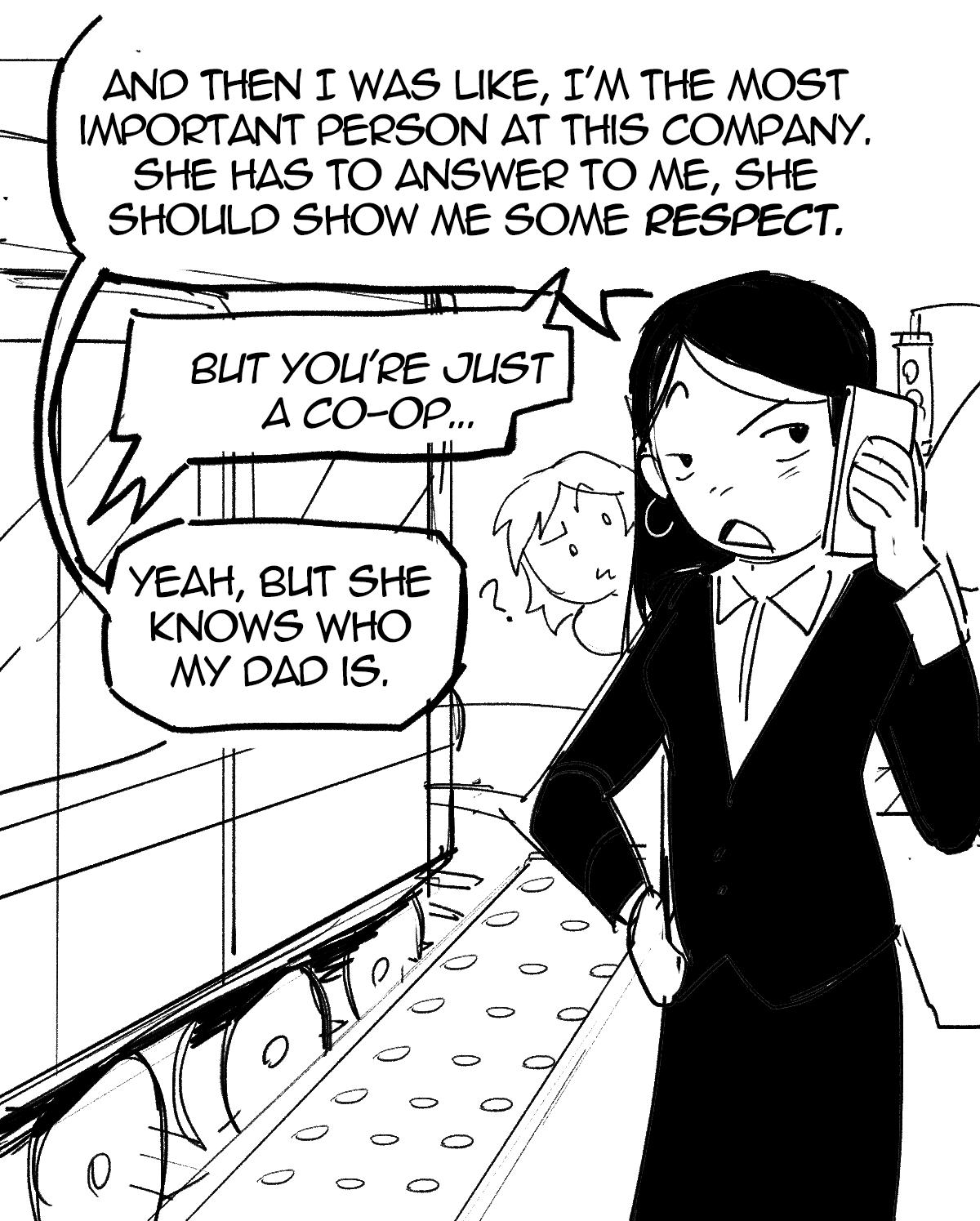
spring and interviewed Gilliam about her first year as BU’s president at the time.
“A few weeks out from the end of the semester, we scheduled a date with Colin [Riley]. We were able to reach out to him to schedule that in- terview, and he was pretty responsive in getting us the time,” Albano said about her interview with Gilliam last spring.
While The Free Press has been able to speak to the president a few times, Albano said it usually reaches out to the university’s media relations team for a statement about a topic rather than requesting an interview. However, she said that universities should be willing to work with their student journalists and maintain a good relationship.
“I would just advocate for university administration to be transparent with its journalists and be helpful, because also, you know, we’re trying to build our careers,” she said. “You should support uplifting student journalists as they’re beginning their careers … it’s important to help the next generation of students, you know, in that way.”
In its most recent request, sent on Dec. 30, 2025, The News asked to speak with Aoun and offered to provide the university with a list of topics it wants to discuss with the president. After media relations told The News the request would be raised internally, The News asked that the university give a response by Jan. 21, which it did not receive.
The News reached out for comment on this article from Northeastern’s media relations on Jan. 27. In response, Vice President for Communications Renata Nyul offered to set up a meeting with The News and her and Senior Vice President for External Affairs Mike Armini to talk about setting up an interview with the president. She did not directly offer an interview with Aoun.
The News agreed and asked for times media relations would be available, but has not heard back as of publication.

is more than just that
Malcolm Purinton, Northeastern’s resident beer historian, did not always consider the study of alcohol to be a legitimate academic pursuit. But when he dove deeper into the history and significance of alcohol in cultures across the world, he realized the depth hidden in the subject.
“Beer and alcohol [is] a lens to look at the world. It is a lens to look at society, economics, business, education, trade, empire, migration,” Purinton, who is an assistant teaching professor of history at Northeastern, said. “[It’s a way to look at] the history of the world and our species through something that is often problematic and controversial.”
Purinton always had a vested interest in beer and began brewing his own in 2002 after earning his
bachelor’s degree in theater from Hampshire College. He was attending beer festivals around Boston at the time when he met the publisher of the Yankee Brew News, who asked if Purinton wanted to write for the publication. Purinton is still a columnist for the site.
His formal journey into the study of alcohol began at Northeastern, where he pursued his master’s degree in history.
While taking a class on African colonialism, Purinton’s instructor Katherine Luongo, an associate professor of history and international affairs, encouraged him to write a paper on beer and alcohol after he mentioned his interest in beer and brewing.
Purinton, who was studying the history of religion at the time, initially felt that writing about alcohol was “crazy.”
“I was learning Arabic, I was diving into that world when beer came along,” Purinton said of his research into the Middle East and religious history. “I thought, ‘Wow, learning German is a lot easier than learning Arabic and going to Europe is probably a lot easier and delightfully cooler both politically and climate-wise than the Middle East.’ It just sounded like a lot more fun.”
Purinton chose to submit a literature review examining how people have studied the history of Africa through alcohol. From there, he let his curiosity drive his research and identified a gap in the research market.
“Much of what had been written about beer and alcohol was focused on looking at people who weren’t drinking. So, looking at Prohibition, looking at religious societies, one of the reasons being they had so many sources they could draw from,” he said. “Obviously, it’s more fun to talk about people who are drinking, so that’s why I said, ‘I’m going to take a hard left.’”
After completing his master’s degree, Purinton remained at Northeastern, where earned a doctorate degree in history. He specifically focused on the sociocultural connections between empires, trade and technology in the history of beer and brewing, culminating in his dissertation titled, “Empire in a Bottle: Commerce, Culture, and the Consumption of the Pilsner Beer in the British Empire.”
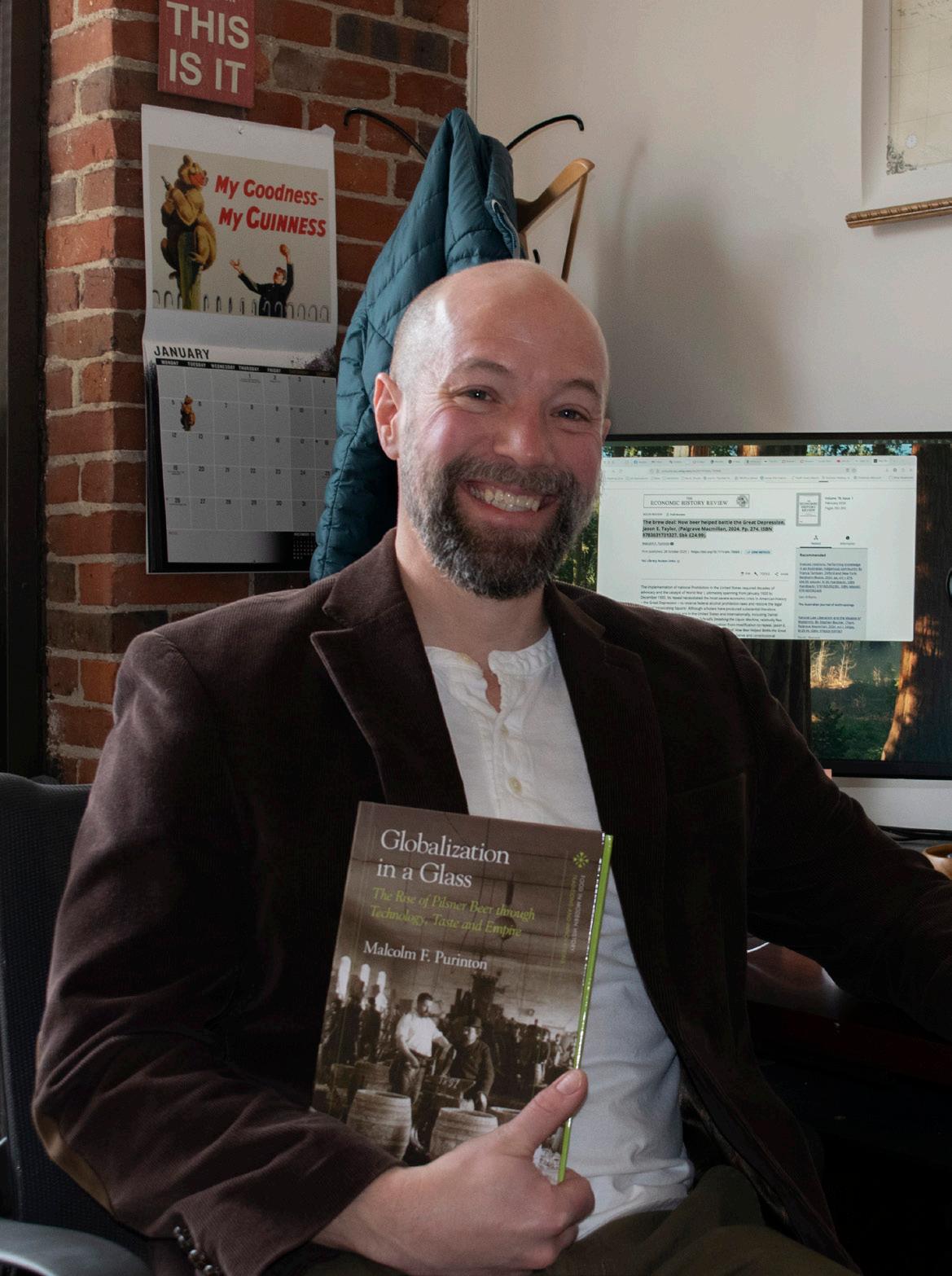
In 2023, Purinton published a book titled “Globalization in a Glass: The Rise of Pilsner Beer through Technology, Taste and Empire.” The book examines the development and spread of pilsners as a global style of beer.
Today, Purinton teaches a range
of history classes at Northeastern, including “The World Since 1945,” “History of Capitalism and Business, Colonialism and Imperialism” and “Taste of History: A Global Exploration of Food and Drink.”
When students find out about Purinton’s specialization, their eyes often go wide; some chuckle, while others ask if he’s kidding. The biggest misconception people have about what he does, he said, is that his expertise is only about beer and alcohol. The subject can actually offer a lens into power dynamics and local economies. Even Mesopotamia’s Code of Hammurabi, one of the earliest and most complete known legal texts, had many rules regarding beer, he said.
“[There has] always been control of beer and alcohol because of the psychotropic elements of intoxication,” he said. “Across societies and time, there is control over who drinks, how much people drink, where they drink and who produces alcohol. You can break down the relationship of power with alcohol to look at gender, race and class.”
Purinton added that the study of alcohol is particularly fascinating because of its ubiquity throughout human culture and time. Humans have been drinking and eating for as long as they’ve been around, making the study of alcohol a unique pathway when studying the development of societies across the world.
“[Alcohol] is something that is always there, whether it is approved of or something that people speak out against,” Purinton said.
Because of its widespread and pervasive nature, trying to show the significance of the field was difficult, and Purinton struggled at first to gain academic acceptance.
To overcome this, Purinton found a way to “use beer and alcohol to weave through dramatic changes in societies, economics, politics and political relationships” that occurred during the age of high imperialism in the late 19th century. He connected each of these broader categories with beer and created a narrative that showed drastic change in human relations and society.
Purinton believes that food and drink history is an easy entrance into looking at complex topics and broader historical themes and emphasized that it is important for historians to engage with non-academic audiences.
“‘History doesn’t often repeat itself, but it rhymes.’ I think that’s Mark Twain,” Purinton said. “Engaging with the public is the way that you can help them understand the importance of learning the past. And that’s not just learning about the mistakes of the past to not repeat them, but also learning about the positive aspects of the past, in order to intentionally repeat them. Maybe choices politically, economically, socially did not work in the 1930s but could work right now.”
Although humans have a complicated relationship with beer and alcohol, Purinton recognizes that beer is a lot of things. He highlights how tap rooms, public houses and breweries can create communities outside of the home or workplace, known as third spaces.
“People think it’s just, ‘Oh you’re just looking at people drinking,’ and in a way I am, but it’s more about the connections between people, the choices in types of commodities, the choices of production, the choices of consumption,” Purinton said.
Comic by Sree Kandula

FEBRUARY 6
Talent Connect Success Tips Workshop
12 p.m. - 1 p.m. online
Admission: Free
FEBRUARY 6
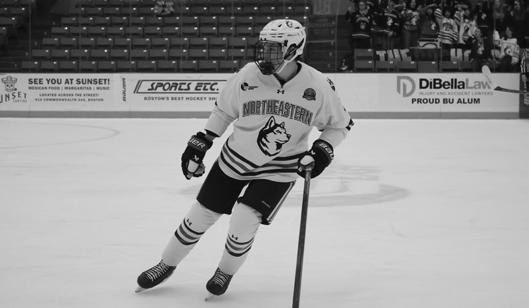
Men’s ice hockey vs. UConn
7 p.m. - 9 p.m. at Bentley Arena
Admission: Free with Husky Card
FEBRUARY 7
Swimming & Diving: NU Diving Invitational
12 p.m. at Barletta Natatorium
Admission: Free with Husky Card

FEBRUARY 12
Men’s basketball vs. William & Mary
7 p.m. - 9 p.m. at Solomon Court
Admission: Free with Husky Card
FEBRUARY 13
Women’s ice hockey vs. Boston University
6 p.m. - 8 p.m. at Walter Brown Arena
Admission: Free with Husky Card

FEBRUARY 15
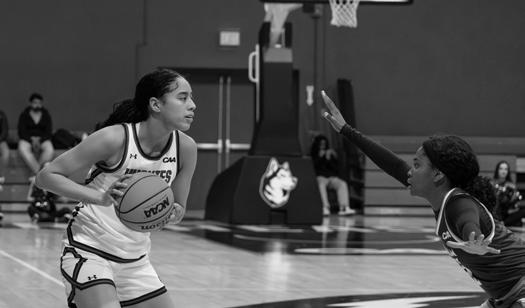
Women’s basketball vs. Stony Brook
7 p.m. - 9 p.m. at Solomon Court
Admission: Free with Husky Card
FEBRUARY 19
Men’s basketball vs. Drexel
7 p.m. - 9 p.m. at Solomon Court
Admission: Free with Husky Card
FEBRUARY 19
Snowshoeing Safari with Boston Park Rangers
2 p.m. - 3 p.m. at 1 Circuit Drive
Admission: Free
City Editor and News Correspondents
About 250 people gathered at Forsyth Park Jan. 20, the anniversary of President Donald Trump’s second inauguration, as part of a nationwide walkout to protest his аdministration’s policies.
More than 900 “Free America” events were held across the country at 2 p.m. local time as organizers called for people to walk out of schools and workplaces in protest of U.S. Immigration and Customs Enforcement, or ICE; legislative attacks on women and the LGBTQ+ community; and perceived erosion of free speech.
The demonstrations come amid the Trump administration’s widespread efforts to crack down on illegal immigration. In January, federal agents in Minnesota arrested 3,000 people and fatally shot two civilian observers: Renée Good and Alex Pretti.
Suzanna Danuta Walters, director of women’s, gender and sexuality studies at Northeastern, was the lead organizer behind the Boston walkout.
“The [Trump] administration works off of misogynistic ideas. Gender studies, my own field, has been under attack from the very beginning,” Walters said. “We happen to be in a private institution at Northeastern and in a blue, progressive state. But in states all over the country, it’s illegal to do the work I do. I never thought this day would come … but that’s why we’re fighting back.”
Walters worked with several Northeastern student groups, who she described as “fabulous and energized,” to make the Boston protest happen.
“During horrible times in history, people have stood up,” Walters said.“Marchers stopped the Vietnam War. Women fought and got the vote. The civil rights movement changed laws and changed minds.”
Other protesters, too, were inspired by resistance movements throughout history.
“We’ve seen this picture before, and it’s not like we don’t know what’s going on,” said Scott Gilbert, a representative of the activist group Refuse Fascism, which advocates for a fascism-free United States through nonviolent protests, resistance and teamwork, according to its website.
Gilbert added, “It’s great that there are 300 people out here, but we need 300,000 people out in Boston.”
While the turnout for the planned event at Forsyth Park was significant, there were other pockets of civil resistance throughout the city.
Outside the Massachusetts State House, six people formed a small demonstration. Dallas Fites, a hospital employee and attendee, said, “We’re out here to say that enough is enough.”
Fites referenced the Jan. 7 incident when an ICE agent fatally shot Good, a 37-year-old U.S. citizen. Federal law enforcement officials argued that Good had attempted to run agents over with her car — which Homeland Security Secretary Kristi Noem described as “domestic terrorism” — and the shooter was acting in self-defense. This claim has been widely disputed.
“They’re trying to intimidate us. They’re shooting people in the face, in their cars, and claiming that they’re domestic terrorists,” Fites said.
Meanwhile, dozens of Northeastern students walked out of classrooms or workplaces to join the protest at Forsyth Park. Phylicia Dias, Northeastern Black Student Association co-president and third-year music industry and communication studies combined major, said she hoped the protest encourages others to stand up.
“I’m walking out to encourage other students who look like us — people of color — to speak up and also because freedom of speech is getting restricted at the university and federal levels,” Dias said. “It’s important to exercise your right to speech, especially when you see other people who feel like they can’t speak up because they’re scared of getting deported or arrested.”
Josiehanna Colon, fourth-year criminal justice and human services combined major and president of the Dominican Student Association, walked out of her workplace and delivered a speech.
“I’m tired of how silent it has been when it comes down to Northeastern’s stance on the political climate right now,” Colon said. “I’m hoping Northeastern stands on business after this walkout. Northeastern, your community is showing up. Do something about it.”
Colon said representation was critical, adding, “The most marginalized voices are not being represented in the spaces that need the representation. We need your voices there.”
As demonstrators arrived at Forsyth Park, they held signs bearing slogans like “ICE will melt” and “Fight ignorance, not immigrants.” Student leaders were at the forefront of the crowd, which formed a semi-circle around the speakers. Kaylin Daniels, a Northeastern third-year political science and economics combined major, Student-Athlete Advisory Committee president and Black Athlete Caucus administrative liaison, stood beside Dias and Colon.
“Especially being an athlete … we have a direct tie to the university,” said Daniels, a varsity volleyball player. “We wear the [Northeastern] name across our chest all the time.”
Daniels added she understood the solution isn’t as simple as just showing up, but she hoped standing up and speaking out could prompt some change.
“I love my country and I think it’s patriotic to be here to protest,” Daniels said. “I’m also here to say to the university and to this administration that what’s happening right now isn’t okay and this isn’t the America I love.”
Walters said she did not believe Northeastern leadership has been “outstanding in its resistance to the Trump agenda” and the federal administration’s attacks on higher education.
“[Northeastern] leadership needs to come out and say, ‘We are for diversity, equity and inclusion. We believe in the departments of gender studies and African American studies and Latina studies. We believe immigrant students belong here,’” Walters said. “We need an administration that defends us.”
Hundreds gathered in front of Boston Public Library Jan. 20 to protest the increased deployment of U.S. Immigration and Customs Enforcement, or ICE, agents to immigrant communities across the country.
People gathered in solidarity with Boston’s immigrant community, marching from the library through Boston Common to the corner of Park Street.
The protest — organized by the Boston chapter of the Party for Socialism and Liberation, or PSL, and Massachusetts 50501— was advertised on social media as part of a continuous movement against President Donald Trump’s administration.
“We see all of the attacks that the [Trump] administration is waging against people, from the ICE terror in our communities to wars abroad to the ‘Big Beautiful Bill’ … It’s all connected to the same root cause, and we’re organizing to uproot that root cause and replace it with something new,” said Joe Tache, who is running to represent Massachusetts in the U.S. Senate in the upcoming midterms.
Jan. 20 marked one year since Trump took office for a second term. Since then, his administration has carried out mass deportations,
sparking tense confrontations between ICE agents and community members. Earlier on Jan. 20, thousands walked out from classrooms and jobs to participate in the nationwide “Free America” protest against Trump.
“I want to use my privilege to the best of my ability. Anything is better than nothing, as long as it’s something,” said Tad MacDonald, a senior at Somerville High School who organized their school’s walkout. More than 200 students followed MacDonald outside the school, finding community in their col lective anger against the adminis tration’s actions.
gave me a lot of hope in my com munity at school. I hope we can do
more in the future,” MacDonald said.
Cambridge Rindge and Latin School senior Ryan Sutthoff-Peña led a similar movement at his high school, though he said he received pushback from the school’s administration. But he was still able to gather a large number of students to join his school walkout.
“You don’t have to be a part of one political thought process or anything, you just have to show up and be there consistently to protest. If you don’t show up, then who
observer Renée Good, the state erupted in protest.
“The community all across Minnesota has taken such brave action since then to fight to demand justice for Renée, but also the immigrant communities under attack right now,” Tache said.
Within the chaos and uncertainty, people are mobilizing to fight back. Larger protests are erupting throughout the country in hopes of creating a lasting impact.
“All of these different groups from

ELLI EINSET Sports Editor
Northeastern men’s hockey (1212-1, 7-9-0 HE) fell to the Boston University Terriers (12-13-2, 8-10-0 HE) in the Beanpot semifinals Feb. 2 in a shootout. The loss will count as a tie in both teams’ records, as shootouts are only used to see who will advance to the next round.
“I thought our guys played a really solid game, put ourselves in a position to win a game in the third period,” said head coach Jerry Keefe. “In overtime, I thought we had some looks. I just feel for the guys in the room, because I know how much it
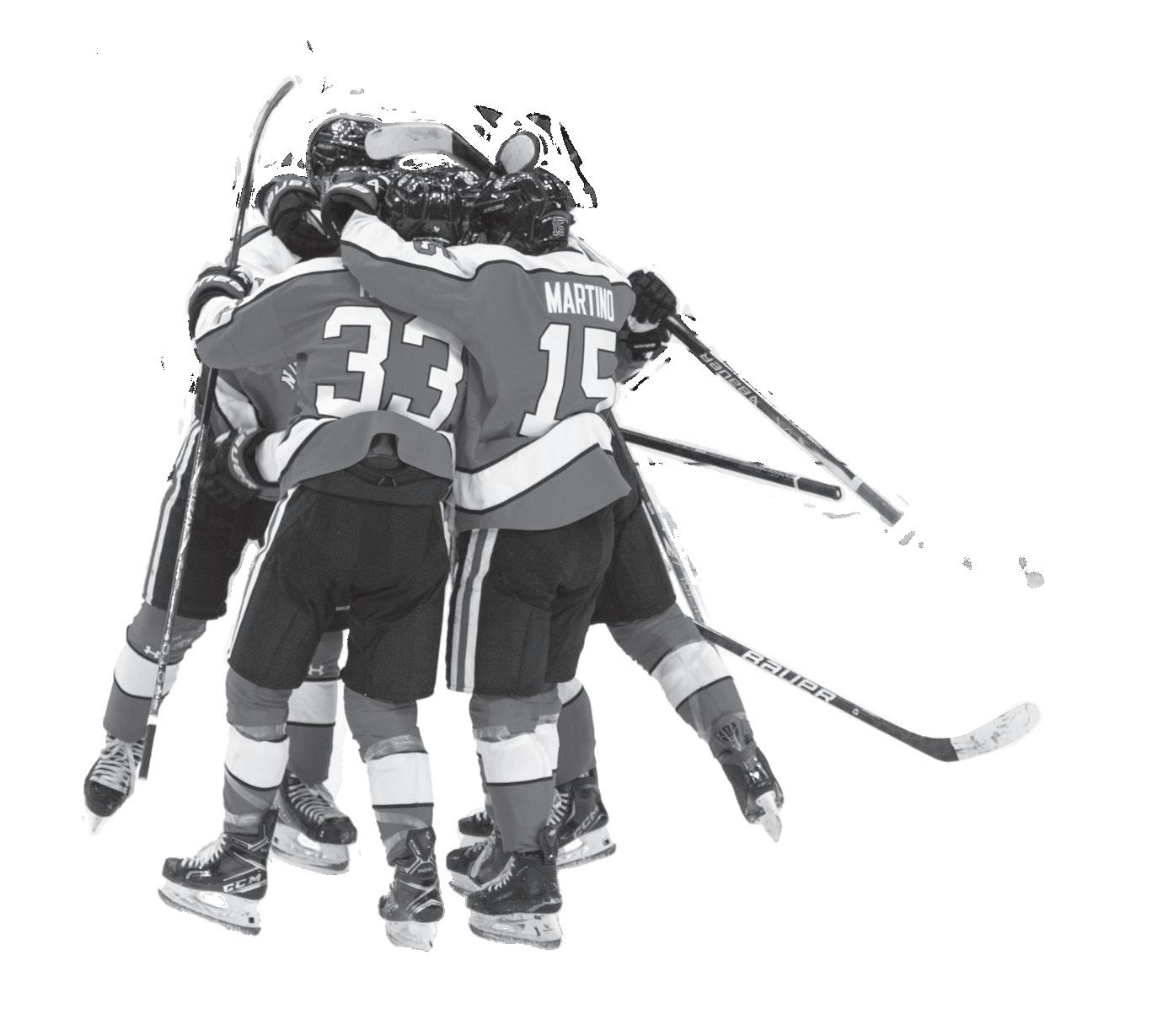
Nine minutes into the first period, junior forward Dylan Hryckowian scored the first goal of the game on a power play.
From the right of the net, freshman forward Amine Hajibi passed to senior defenseman and captain Vinny Borgesi above the circles. Borgesi passed to Hryckowian in the left faceoff circle, and he sniped the puck past sophomore goaltender Mikhail Yegorov.
Four minutes later, junior forward Andy Moore received a kneeing penalty, giving the Terriers a chance to level the score. BU only took four shots in their two minutes with the advantage and could not
The Terriers found the equalizer less than two minutes into the second period.
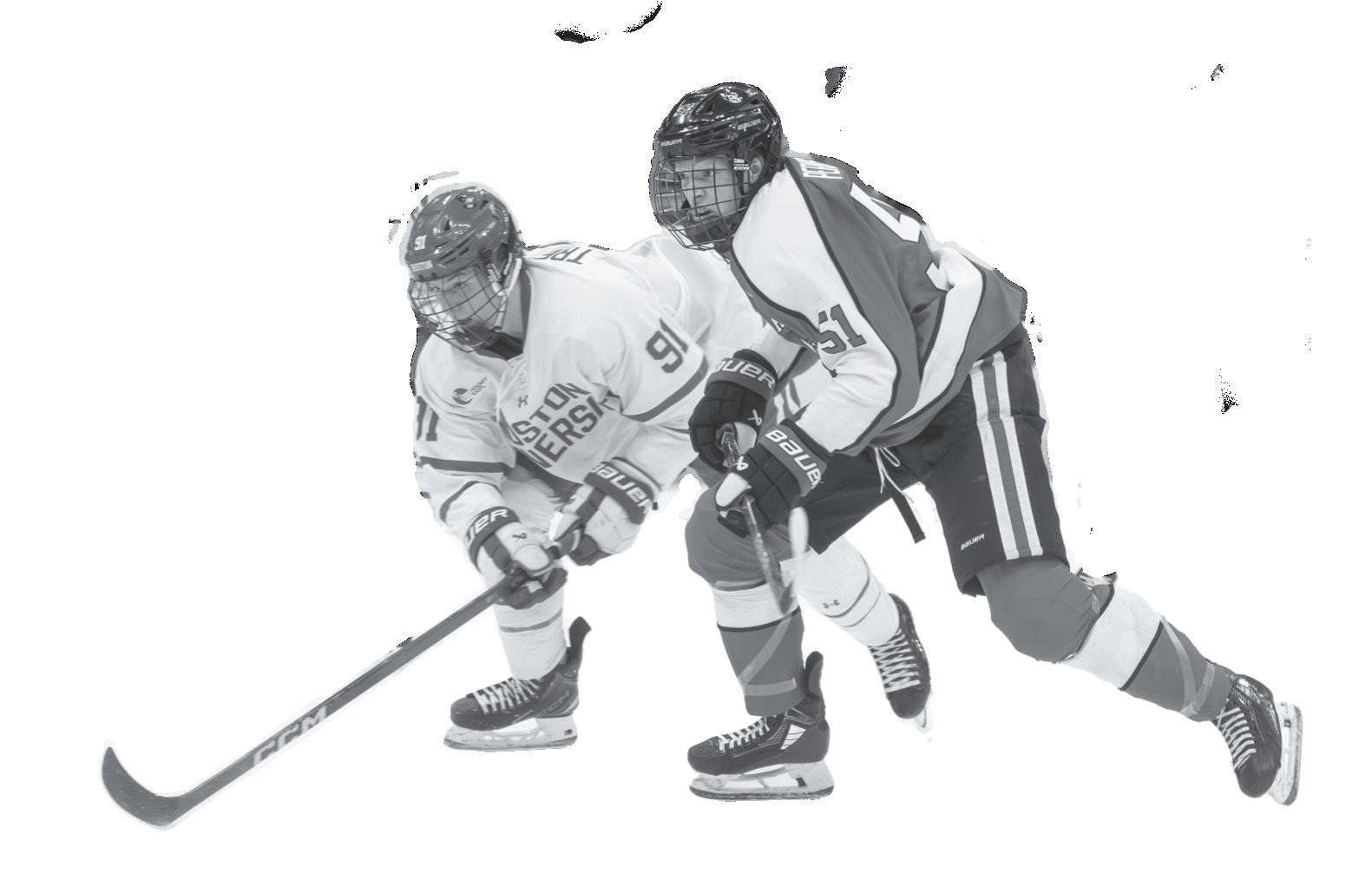
Freshman defenseman Charlie Trethewey skated from the right side to the left along the blue line before sprinting toward the net. He attempted a shot that deflected off the skate of freshman forward Jonathan Morello and found the back of the net past Zacher.
Northeastern quickly bounced back, with freshman forward Jacob Mathieu scoring his first Beanpot goal.
Mathieu received a pass in the neutral zone from sophomore defenseman Jack Henry before passing to Hryckowian in the offensive zone. Hryckowian passed back to Mathieu, who fired the shot into the back of the net.
Seven minutes into the period, the Terriers equalized once again. This time, it was sophomore forward Nick Roukounakis who lit the lamp for BU. By the end of the second period, Northeastern and BU had 19 and 22 shots on goal, respectively. Both had multiple opportunities to get ahead, but none set off the buzzer.
The third period provided no clarity for the winner, meaning the DogHouse went shirtless for overtime, affectionately dubbed “No T-OT.”
The men’s hockey team celebrates a goal (left) and a player competes for the puck against his Boston University opponent during the Beanpot semifinal game. The Huskies fell to the Terriers in a shootout Feb. 2.
to the net for the rest of the game.
“Yeah, he’s banged up,” Keefe said. “Give him credit for staying in there.”
With 33 seconds left, junior defenseman and BU captain Gavin McCarthy fired a shot that seemingly scored, sending Terriers fans and the bench into celebration. However, McCarthy was called for interference and the goal did not count, putting Northeastern on the power play. The Huskies failed to score, sending the game into a shootout.
Although Zacher was “banged up,” he was still between the pipes for the Huskies in the shootout.
“Obviously, he didn’t want to come out,” Keefe said. “We’re not going to take him out if he doesn’t want to come out in that situation.”
First up for the Huskies was freshman forward Giacomo Martino. His goal was saved by Yegorov. Junior
Next was Hryckowian, who tied the shootout. Zacher kept the Huskies alive with a save on a shot from Eiserman. Mathieu was the last Husky to go, and his goal was saved. Sophomore defenseman Cole Hutson scored the last goal for BU, clinching the win.
Northeastern will face the Harvard University Crimson (12-9-1, 10-5-0 Eastern College Athletic Conference) Feb. 9 at 4:30 p.m. for the consolation game at TD Garden. Last year, the Huskies fell to the Crimson in the consolation game 4-3, taking last place in the tournament.
In the meantime, Northeastern will take on the University of Conecticut Huskies (15-7-3, 9-5-1 HE) Feb. 6 at 7 p.m. in Bentley Arena. The teams faced each other in November, where UConn swept Northeastern 4-2 and 4-3 in overtime, respectively.
Expect continuous airplay of Dropkick Murphys’ hit song “I’m Shipping Up to Boston” this summer.
From June 13 to July 9, while not technically in Boston, seven games of the biggest sports competition in the world will be played at Gillette Stadium in Foxborough, a suburb outside of Boston and, famously, home to the New England Patriots and New England Revolution. Here is a guide to all the games that will be played near Boston.
Scotland vs. Haiti
The FIFA World Cup kicks off in Boston with a seemingly uninteresting matchup as Scotland takes on Haiti in a Group C clash June 13. Scotland is a dark horse in the tournament, bolstered by a strong squad including fullback Andrew Robertson, a standout player for Liverpool FC; midfielder John McGinn, captain of Aston Villa; and, most importantly, 2024-25 Serie A player of the year, midfielder Scott McTominay. With a strong core, Scotland shouldn’t be underestimated.
This game is made more important by the structure of the group the two teams were drawn into. Scotland and Haiti face the tough task of having to outqualify five-time champions Brazil and 2022 semifinalists Morocco. Earning three points from this faceoff may provide a significant boost for a potential upset.
Norway
The second clash is also not a particularly marquee matchup, as Norway takes on one of Boliv-
ia, Iraq or Suriname in Group I June 16. However, this gives fans in Boston a chance to see prolific striker Erling Haaland in full flow. The 25-year-old will be playing his first ever FIFA World Cup and has a point to prove. He is supported by Arsenal standout midfielder Martin Ødegaard, Atletico de Madrid striker Alexander Sørloth and former club teammate midfielder Oscar Bobb. Expect a strong showing from Haaland and his fellow Norwegians, especially as they have a strong chance to qualify in their group. Scotland vs. Morocco
The third game in Boston is another Group C matchup, as home favorites Scotland take on Morocco June 19. This game has more star power than Scotland’s first clash, as the team faces a Morocco squad that overachieved in Qatar in 2022. Morocco reached the semifinal stage before being bested by France and then Croatia, settling for fourth place overall.
There are interesting matchups across the board in this clash, as Scotland’s attackers will take on a resolute Moroccan defense led by captain Achraf Hakimi and goalkeeper Yassine Bounou. This is also a crucial Group C game, as the winner improves its chances in the round of 32 — a crucial advantage considering the sheer talent in this edition of the tournament.
England vs. Ghana
Game four is the first time Bostonians will see a team ranked in the FIFA top five as England takes on Ghana June 23. This will be an exciting game to watch, as England
has become a consistent figure in the knockout stages of major competitions, making two consecutive European Championship finals and a semifinal appearance in the 2018 World Cup.
Players to watch include striker and captain Harry Kane, a veteran and top scorer in the 2018 tournament, Real Madrid star and SKIMS model Jude Bellingham, and midfielders Cole Palmer and Phil Foden. One game may not define an entire tournament, but a win in this match would certainly boost England’s chances of bringing the trophy home.
Ghana isn’t without talent either, with electric players like winger Mohammed Kudus, forward Iñaki Williams and young defender Tariq Lamptey. Given the talent on display for both sides, don’t expect England to walk away easily, as Ghana can put up a strong fight.
Norway vs. France
Norway is in action again June 26 against 2018 champions France in a clash that pits two strong rosters against each other. This will be a crucial game in Group I, as both teams will duel for supremacy and a superior draw in the round of 32, boosting their chances for the rest of the tournament.
Boston will get to see Haaland and company in action again, this time against a stronger defense boasting FC Barcelona center back Jules Koundé and Arsenal FC center back William Saliba. France also has a strong attack with the likes of forward Kylian Mbappé, midfielder Rayan Cherki, forward Antoine Griezmann and young, talented for-
ward Bradley Barcola. This game is between two strong teams on paper — hopefully the actual match lives up to the billing.
Game six
Game six is the first of two knockout games to be held in Boston. The game will be played June 29 between the winner of Group E and the best third-place team from Groups A, B, C or D/F. Due to the unpredictable nature of soccer and the FIFA World Cup, it is incredibly difficult to predict who will be playing in these games, and judgement will have to be reserved for how the actual tournament progresses. However, this can be considered the first high-stakes game played in Boston, with elimination at stake for both teams in the matchup. Thus, you can expect the quality of soccer to be intense and competitive.
The quarterfinal — the final and most important game played in Boston — will be played July 9 between the winners of the round of 16 games held July 4. Since this game is later in the tournament than the others played in Boston, it’s expected that the teams playing will be strong contenders for the trophy. Fans are likely to witness some marquee players and matchups, as both coaches will be eager to field their strongest 11 players and advance toward the tournament’s pinnacle. Boston will host seven interesting games that will have long and far-reaching consequences for teams and the entire tournament. Expect strong performances from all involved as they slug it out to summit the highest and most prestigious peak soccer has to offer.
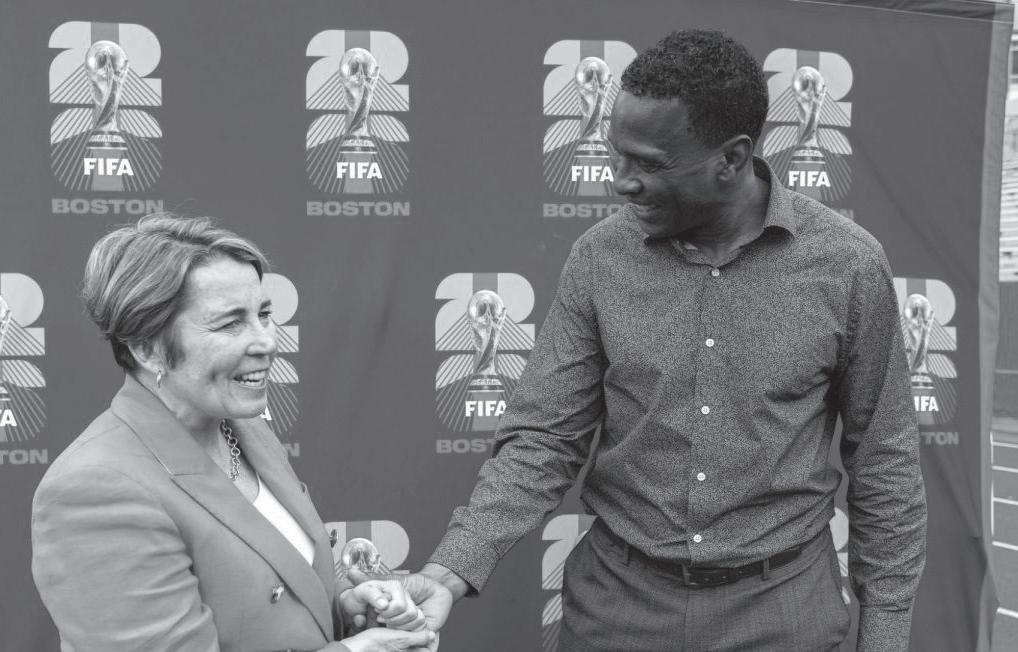

Editor-in-Chief
Emily Spatz
Managing Editors
Gitana Savage
Annika Sunkara
Editor-at-Large
Alexis Algazy
Campus
Lily Cooper
Madison Evangelist
Auden Oakes
Elizabeth Chalmers
City
Chloe Craft
Devyn Rudnick
Sports
Elli Einset
Siera Qosaj
Cassandra Joyce
Lifestyle
Janira Skrbkova
Jennie Koh
Grace Phillips
Opinion
Samantha Denecour
Ava Vitiello
Projects
Katarina Schmeiszer
Elsa O’Donnell
Photo
Margot Murphy
Evelynn Lin
Tanvi Saxena
Design
Catherine Gore
Katie Mulcahy
Audiovisual
Curtis DeSmith
Data
Abdullah Ismail
Social Media
Daniel Patchen
Catie Nippins
Copy Chief
Sarah Mesdjian
Web Manager
Arielle Rabinovich
BUSINESS
Business Manager
Nikolas Lyras
Advertising Manager
Emily Liu
Outreach Coordinator
Annelise Dramm
Zoe MacDiarmid, Frances Klemm, Darin Zullo, Emily Chung, Bailey Reynolds, Aoife Jeffries, Caroline Baker Dimock, Zach Cohen, Paloma Welch, Emily Rodriguez, Kayla Goldman, Olufolake Okunsanya, Aiden Barker, Laila Guzman Griffin, Carson Lyle, Elise Peffer, Hir Panchal, Annie Jones, Aadit Ganesh, Gabriel Trajano, Jonathan Winter, Alex Payá, Declan Lane, Niaz Alasti, Annalise Karamas, Emma Shkurti, Daniela Rynott, Chloe Mondi, Blue Tiernan, Yashavi Upasani, Christina McCabe, Jenny Tran, Nidhi Prakash, Robby Wolff, Antaine Anhalt, Nora Harr, Honor Seares, Phil Warren, Shreya Pillamari, Taylor Zinnie, Mora Peusner Dacharry, Sana Gandhi
COPY EDITORS
Bowen Rivera, Aaniya Mahajan, Antaine Anhalt, Kacey McNamara, Lizzie Harrison, Frances Klemm, Annie Jones, Christina McCabe, Zoe MacDiarmid, Bailey Reynolds, Ashley Pappas, Claire Hudson, Paloma Welch, Jenny Tran, Nora Harr, Caitlyn Sutrisno, Lea Hendler
DESIGN STAFF
Anusha Sambangi, Natasha Sun, Laila Guzman Griffin, Mayah Hamaoui, Juliana Rodriguez, Mary Dunn, Rhea Lamba, Alana Udell, Megan Le
PHOTO STAFF
Hana Dada, Naseem Mohideen, Alana Udell, Ian Dickerman, Niaz Alasti, Heidi Ho, Ray Huang, Eva Ciolek-Passeri
SOCIAL MEDIA STAFF
Emily Chung, Keira Weitz, Grace Cargill, Zoe MacDiarmid, Bowen Rivera, Caroline Baker Dimock
BUSINESS STAFF
Maggie Nahas, Isaac Pedersen
Opinions expressed in The Huntington News through letters to the editor, cartoons and columns are not necessarily those of The News staff or the Board of Directors. Northeastern University students conduct all operations involved in the production of this publication.
For inquiries about the Board of Directors, email outreach@huntnewsnu.com. For general inquiries, email managing@huntnewsnu.com.
The Huntington News 360 Huntington Ave. 102 Lake Hall Boston, MA 02115


huntnewsnu.com

EMILY CHUNG News Staff
In January, it seems as though everyone decides to hit a giant reset button and forget about all of their holiday indulgences. The gym is packed, students down water and grocery carts brim with lean ground beef and broccoli. Com pared to December’s sweets and elaborate holiday spreads, January’s meals can often feel dull and unin spired. But eating healthy doesn’t mean you have to sacrifice flavor or satisfaction. Whether you’re cooking for yourself or sharing with others, these recipes make healthy eating a lot more enjoyable. Gochujang salmon bowls
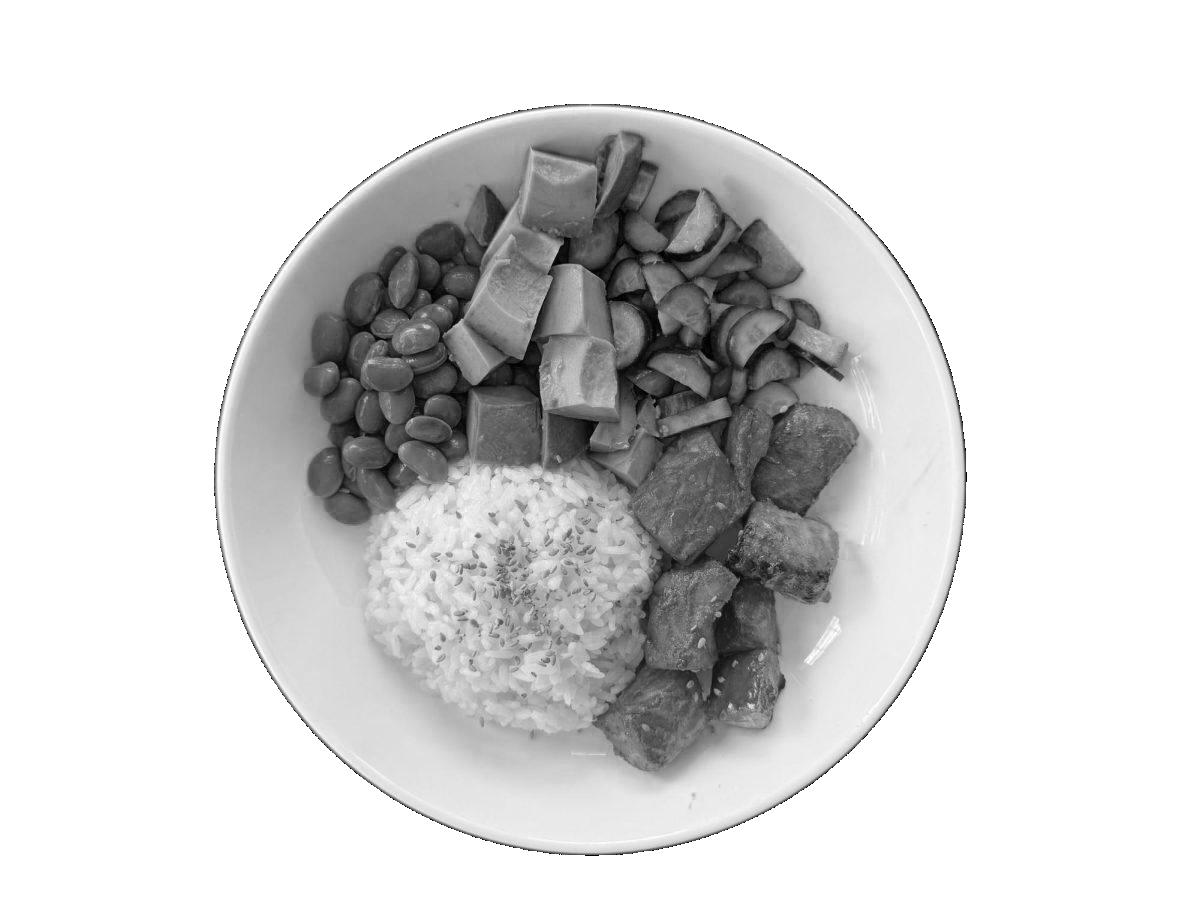
This bowl is packed with flavor and nutritional value. Rich in omega-3 fatty acids, salmon is a nourishing and satisfying source of protein to add to your rotation. Crunchy and tangy vegetables balance out the salmon’s sweet and spicy marinade, and the edamame gives the bowl an extra plant-based protein boost. This meal is hearty, well-rounded and sure to satisfy your taste buds.
Ingredients: Salmon fillet (about 6 ounces)
3 tablespoons soy sauce
2 teaspoons honey
3 tablespoons gochujang
2 tablespoons rice vinegar, divided
2 mini cucumbers
1 cup cooked white rice
Half a ripe avocado
@HuntNewsNU
½ cup shelled edamame
Toasted sesame seeds to garnish
Salt to taste
Instructions:
Cube the salmon into bite-sized pieces and add to a medium bowl.
In a small bowl, whisk together soy sauce, honey, gochujang and 1 tablespoon of rice vinegar. Pour the marinade over the salmon cubes and mix until all the salmon is coated. Cover the bowl and refrigerate for at least 30 minutes.
While the salmon is marinating, cut the cucumbers into half moon shapes and add to a bowl. Add a tablespoon of rice vinegar and salt to taste. Cut the avocado into small cubes.
Once the salmon is done marinating, preheat the oven to 400 degrees. On an aluminum foil-lined baking
tray, spread the salmon out evenly. Bake for 12 minutes. During the last 1-2 minutes, turn the oven to broil to get a nice color on the salmon.
To assemble the bowl, add a cup of white rice and shape it into a dome. Add edamame, cucumbers and avocado. Add your baked salmon bites and sprinkle sesame seeds over the
Creamy sun-dried tomato butter beans and lemon garlic
Butter beans have come back into style, and I’m glad for it. Comforting and creamy, they make the perfect base for this dish. The recipe comes together easily, and the aromatics will have your apartment smelling amazing. The butter bean stew is great on its own or with a crusty slice of bread for a plantbased meal. If you want an extra boost of protein, add the lemon garlic chicken thighs!
Ingredients: For the beans:
1 tablespoon olive oil
1 large yellow onion
3 cloves of garlic
2 cans of butter beans
1 cup cherry tomatoes
1 can of light coconut milk
3 tablespoons of tomato paste
¼ teaspoon dried basil
¼ teaspoon dried oregano
¼ teaspoon dried thyme
1 teaspoon salt
¾ cup sliced sundried tomatoes
2 cups chopped spinach
For the chicken:
4 chicken thighs
2 tablespoons olive oil
3 cloves of garlic
3 tablespoons lemon juice
1 teaspoon salt
Instructions:
For the beans:
Dice the onion and mince garlic cloves. To a large pan, add 1 tablespoon olive oil and diced onion and cook on medium heat until the onions become translucent. Add the minced garlic and mix. Drain the butterbeans and add them to the pan. Add coconut milk, tomato paste, seasonings and salt. Stir gently and lower the heat to medium-low.
Simmer the beans for about 15 minutes until the coconut milk is reduced to a creamy consistency. Remove the pan from heat and mix in the sundried tomatoes and spinach.
For the chicken:
Preheat the oven to 400 degrees. Add the chicken thighs to a medium bowl.
Mince garlic cloves and add to the bowl. Add in 2 tablespoons olive oil, the lemon juice and salt. Mix until the chicken is covered in the marinade.
Place the chicken thighs on an aluminum foil-lined baking tray and bake for 40 minutes.
That’s it?: ‘Stranger Things’ did not get the series finale it deserved, fans say
Warning: Spoilers ahead. Season five, Vol. 3 left “Stranger Things” fans disappointed and desperately grasping for a ninth episode after the New Year’s Eve series finale, finding it an unworthy conclusion following a drawn out release schedule and nearly 10 years of buildup.
It’s a given for viewers to have critiques at the wrap-up of a decade-long show that so many grew up with. But the debates go far deeper than fans mourning the show or wishing for spin-offs, leaving many perplexed.
“It was underwhelming. It’s like walking up a mountain to see a beautiful sunrise, but then seeing nothing,” said Gabrielle Cros, a second-year chemistry major at Northeastern. “There was so much buildup between each of the three volumes that you thought that something was going to happen, but by the end, you’re unsatisfied.”
Cros is referring to the three volumes released across major American holidays. Vol. 1 aired on Thanksgiving, Vol. 2 on Christmas Day and the feature-length finale dropped on New Year’s Eve on Netflix and in theatres. Fans on social media felt conflicted over the show “stealing” their holidays and later felt the showrunners introduced many ideas throughout the season that didn’t pan out well, if at all.
“I thought there were a lot of gaps that should have been filled,” said Sigal Judd, a first-year speech-language pathology and audiology major at Northeastern. “Everything went really quickly and yet there were no substantial feelings for the plot goals. I watched it and was like, ‘That was so good!’ and then after, I had a lot of questions.”
Judd specifically mentioned the creators bringing back Eleven’s (Millie Bobby Brown) “sister” from the second season, the, “I don’t believe in coincidences,” line delivered by Lucas Sinclair (Caleb McLaughlin) and many other details that were built up to have a more significant impact than they did.
Fans were quick to theorize that the plotholes and continuity errors would be smoothed over with a conspiracy they called “Conformity Gate.” Many found that the ending made so little sense that it had to have been the conjuring of the villainous character Vecna (Jamie Campbell Bower) through the eyes of one of the main characters, Mike Wheeler (Finn Wolfhard).
Fans used this theory to explain away the gaps they saw in the season, such as why Will Byers (Noah Schnapp) said he and his friends liked “biking to Melvald’s and getting malted milkshakes,” when the “milkshake” spot he mentions was actually a convenience store Joyce Byers (Winona Ryder) worked at in season two. Melvald’s was, however, a diner in the play “Stranger Things:
The First Shadow,” which takes place in the ‘50s and explores Vecna’s youth as Henry Creel. Putting two and two together, fans figured this was more evidence toward their theory rather than a writing error.
Following the finale, one fan on TikTok noticed something jarring about their “Stranger Things” merchandise flashlight, beaming it on the interior of its packaging to reveal the hidden message “Vecna lives!” Discoveries like these only fueled fan speculation, causing some to pay extra attention to marketing stunts like the show’s ‘80s radio station “WSQK ‘The Squawk,’” which was accessible through Global Player and actualized to promote the season. Eventually, listeners found patterns in music and random notes in morse code, but most importantly to their theorizing, heard strange noises that some found made out the words, “Mike, wake up,” corroborating their theory that the character Mike was under “Vecna’s curse.”
“I think the fans pointed out a lot of details,” said John Shalhoub, a firstyear business administration major at Northeastern. “I liked it, but I do wish there was a ninth episode.”
There never was a ninth episode on the predicted Jan. 7 date, and a lot of the supporting evidence fans found ended up being writers’ room errors.
“I’ll be honest — I wanted it so bad, but I always knew that the Duffer Brothers weren’t capable of that,” Cros said. “If something does come up in the future for a sequel,
it’s gonna come from the internet’s theories, not from them.”
Fans’ anger was only further fueled by the release of the documentary, “One Last Adventure: The Making of Stranger Things 5.” Anticipation for a documentary providing fans with a little more of the show they loved turned sour with some of the dialogue the creators shared. Fans were especially upset that the Duffer Brothers hadn’t completed the finale’s script before the season’s production began.
“The fact that they waited so long between seasons, you’d think it would be incredible when they had so much time to write,” Cros said of the documentary, which showed the brothers actively writing while filming. Viewers also observed that the actors themselves were bewildered by the script, paralleling negative fan reactions to moments like the final battle scene, the Jonathan and Nancy (Charlie Heaton and Natalia Dyer) “un-proposal” scene and the ambiguity of Eleven’s death. Overall, though fans were upset with the show’s end, some could put their anger aside to appreciate “Stranger Things” as a whole body of work.
“I grew up watching the show, so I appreciate the ending, but in terms of good writing: it wasn’t,” Cros said.
Judd agreed. “I felt like the show was with me as I was growing up — it didn’t shape my life, but it was a constant,” she said. “When the show ended, a smaller chapter of my life also ended.”

DR. SRIVIDYA NARAYANAN Contributor
When I enrolled in Northeastern’s College of Professional Studies, or CPS, as a master’s regulatory affairs student, I never imagined that within a short time span, I would be speaking at international conferences in the U.S., Spain and Germany, winning global competitions and representing the university on stages as a keynote and oral speaker across the world.
What I also did not expect was how often I would be doing that on my own.
While these achievements brought global visibility to the university, they were accomplished with nearly no financial or logistical backing from Northeastern itself.
During the past year, I have been fortunate enough to have represented Northeastern at nearly 25 of the most prestigious venues in the regulatory field. I was first featured on a billboard advertisement in Times Square, invited to keynote speaker engagements throughout the United States and Europe, and, in March 2025, won the Global Medtech Innovation Challenge through the Massachusetts Institute of Technology.
Although I represented Northeastern at these events and gained significant recognition for my presentations, everything was based on “self-effort” and not supported by the university on a national or international level — therefore, my experiences at these events have revealed to me a significant need for the university to
be proactive in assisting students to make themselves known on a global level. Specific support could include financial assistance for the conferences — either registration, travel and logistics (I have self-funded approximately $2000 of my travel), as well as institutional recognition through website features and social media announcements. For instance, when I was selected as a top-three finalist in TOPRA among global professionals or gave talks at conferences alongside seasoned professionals as a student, there was no institutional acknowledgement. Additional support, such as professional development grants and branded marketing materials, will not only benefit individual students but also elevate the university’s reputation.
In every room, on every stage and through every hackathon, Northeastern’s name was on my badge. These experiences were transformative.
spaces often do so quietly, without much institutional visibility or conformed support.
For many of us in CPS or other professional programs, conferences are not “nice-to-have” extras. They are our pipeline to the industries we hope to enter or advance in. Yet, the system for accessing these opportunities remains fragmented and inequitable.
This makes it financially risky to attend a conference as opposed to a professional career opportunity. For many students, this uncertainty alone deters them from seeking out global opportunities.
Even when I do attend these events, there is inconsistency in how I get
actively shaping conversations in my industry, not just preparing to join them. If Northeastern wants to truly represent that identity, it needs support systems that actively recognise the global work its students are already doing.
What could that look like?
First, Northeastern could establish a more centralized way to identify and celebrate students who are selected for competitive conferences, scholarships and speaking opportunities. It would have been great if I could have received that support and recognition from Northeastern. When a Northeastern student wins a global competition or is invited to speak on an international stage, it should be more than a personal win — it should become part of the university’s story.
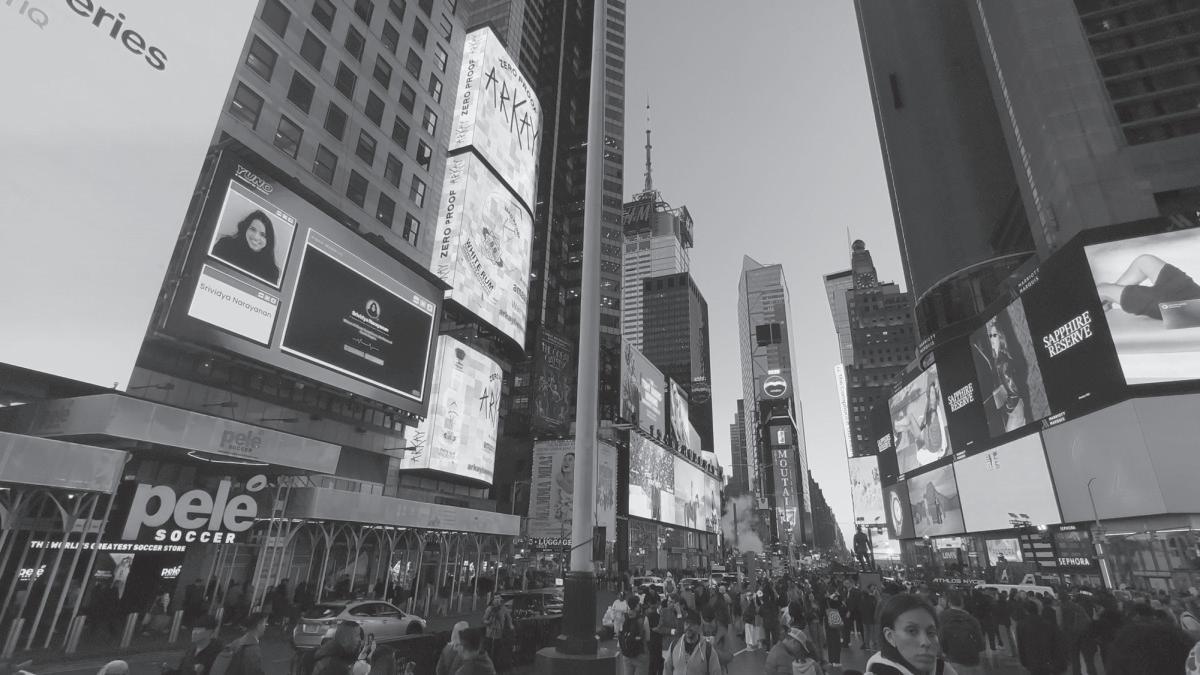
They gave me access to mentors, start-up innovators, regulators and executives I would have never met otherwise. They pushed me to translate classroom learning into real-world impact, and they affirmed that Northeastern students, more broadly, can stand shoulder to shoulder with professionals who have decades of experience.
But they also revealed something else: Students who make it to these
recognized. Visibility often depends upon whether someone happens to notice a LinkedIn post, signaling that recognition is more a matter of luck than an intentional and meaningful aspect of a student’s experience.
Northeastern is known for experiential learning. My presentations at these conferences are experiential learning at the highest level — I’m
Second, the university should provide more accessible and predictable support for travel, accommodation and registration. Not every student has the financial flexibility to accept an invitation, even when they earn it. Targeted micro-grants, transparent and faster funding approval processes and better communication about existing funding could make a meaningful difference.
Third, Northeastern should build stronger bridges in the university ecosystem. Many CPS students are working professionals, international students or professionals pivoting to
new fields. Their achievements often span time zones, industries and continents. Yet, they may be less visible in student media and campus-wide narratives. Highlighting these stories doesn’t only benefit the individuals involved; it signals to prospective and current students that nontraditional paths are valued, not sidelined.
This is not a criticism of what Northeastern is already doing, but an invitation to build on it.
The faculty and mentors who have supported me have been extraordinary. They encouraged me to submit abstracts, supported my preparations and celebrated every milestone. What is missing is a more coordinated, institutional way to amplify these efforts — so that when one student opens a door, others can follow more easily.
Students like me are already putting Northeastern on the map at conferences across the world. With a bit more structure, visibility and support, the university can leverage these individual wins into a stronger, more inclusive culture of recognition and opportunity.
For every student who has stood at a podium in another city or country with “Northeastern University” on a slide, the message is the same: We are already out there. The question is whether our own university community fully sees us.
Srividya Narayanan, MDS, MSc is a master’s student in regulatory affairs. She can be reached at narayanan.sri@northeastern.edu.
If you would like to submit a letter to the editor in response to this piece, email comments@huntnewsnu.com” with your idea.
As a university with no football team, it’s easy to write off Northeastern as a lost cause for school spirit. We have the Beanpot hockey tournament, which is a ton of fun and probably our biggest display of school spirit, with our signature hockey chants and large student section. But school spirit goes beyond cheering for Northeastern during sports events — it’s a larger feeling of pride for our university and a feeling of community with other students.
But day-to-day, I’m used to hearing people express their frustration with Northeastern and how much they dislike attending it.
The school spirit deficit makes sense, considering the university’s roots as a commuter school and leadership’s response to the current political climate. But, at the end of the day, rejecting any school spirit by focusing solely on the negative aspects of Northeastern deeply impacts the sense of belonging that is possible for all students and only ends up hurting our university experience.
I’m not asking for us to start rah-rahing about the Huskies or attend every hockey game, but I think
our lack of school spirit is worth reexamining on our own terms.
Compared with other universities, Northeastern’s undergraduate population is midsize, but it can feel so much larger than it actually is. We don’t have tailgates or long-standing traditions to bring the student population together the way some universities do. When we’re not seeing the same faces on campus, it’s hard to feel connected to the people we go to university with — they don’t feel any different than other students in the Boston area, so why would we feel a connection?
Community is essential for our well-being, and while it doesn’t necessarily need to come from our university, a sense of belonging at school has its benefits. A study from Massachusetts Institute of Technology’s Teaching and Learning Lab reports that having a strong sense of belonging as a student can improve academic outcomes, increase continuing enrollment and benefit mental health overall.
Understanding the importance of community is the first step to developing a greater sense of school spirit at Northeastern. There’s plenty of resistance to claiming, “I’m proud to go to this school.” Northeastern continues to face backlash from students for its weak stance on free speech and bending to President Donald Trump’s anti-DEI demands,
among other concerns. I’m not proud of the leadership of this university for a multitude of reasons, but they don’t make up the bulk of Northeastern — the students do.
The students I’ve met at Northeastern have shaped my experience more than anything else. While I don’t adore every student I’ve ever met here, there’s plenty that I do, and it’s enough to make me appreciate Northeastern as a whole and want to build a stronger community here.
School spirit goes beyond pep rallies and old traditions. If we don’t have any sense of pride or belonging at Northeastern, we hinder the pro gress we can make as a student body. As we know, organized group protest is more effective than individual work when it comes to political change — there are plenty of political student groups on campus that could use more student voices and support. So many students are frustrated with Northeastern leadership, but if we don’t feel like a community, we can’t work together like one.
The second we start hating something and dismissing it as not worth our energy, we’re calling it a lost cause. Northeastern is not a lost cause, if only because of the students that belong to it; our university should be better because we deserve for it to be. If that’s what’s fueling my pride in attending here, then so be it. It’s not a traditional approach to
school spirit, but Northeastern isn’t known for being a traditional school.
This past month, I attended the No Limits Dance Crew show in Blackman Auditorium to see some of my friends perform. No Limits is one of the many student performance groups on campus, and its end-of-semester showcase features more than a hundred dancers of all experience levels. While watching people I vaguely knew from classes or other clubs appear in the show, I felt a sense of familiarity and community that can be lacking on campus.
that sense of familiarity that makes campus feel a little bit smaller.
As silly as it seems, the lack of school spirit can have a serious impact on our college experience socially, academically and politically. I want to go to a school I’m proud of, with students I feel I have a sense of community with — there’s no reason Northeastern can’t be that for everyone.
Nora Harr is a second-year English and computer science combined major. She can be reached at harr.n@

Northeastern, which means it can look like anything, as long as you’re engaging with the community on campus. Supporting our fellow students doing what they love can be really enjoyable, and it builds up
If you would like to submit a letter to the editor in response to this piece,
Northeastern’s women’s club rugby team won the DI-AA 15s national title Dec. 4 in Houston, Texas. The final face-off against the University of Colorado Boulder resulted in a 44-10 win.
“We all went in knowing exactly what we wanted out of the weekend,” said Mira Mahmoud, a second-year biochemistry major who plays wing. “The best thing is, we all knew we wanted to win, but more than that, we want to play a clean game always, which is really fun because everyone’s out there not only to win but to play their best.”
The Maddogs are now backto-back national champions after winning the DI club 7s championship April 27, 2025, 15-12, beating the University of Iowa.
Rugby 7s games differ from the fall season 15s: they are played with seven players on the field rather than 15, and matches last 14 minutes rather than 80.
The team was established at Northeastern in 1995 and has grown and improved since, switching its membership from the Collegiate Rugby Association of America to National Collegiate Rugby in the spring of 2024. Further, the team introduced the 7s program in 2017 and won its first DI 7s national championship in 2023.
“We’ve seen the rise of women’s rugby, but I think we’re all very
invested in continuing that and getting it out to more people and having it be more recognized in sports,” said Kyra Grimes, a cultural anthropology and data science double major who served as the 15s forwards captain in the fall semester.
Grimes, who joined the team at the start of her second year, had no prior rugby experience but played soccer for 15 years.
“My friends were like, ‘You’re an aggressive person. You should probably play an aggressive sport,’ and so then I did it and honestly haven’t looked back since,” Grimes said. “I love being a part of this team. I love hitting my friends.”
The team is player-run and has a board that decides which teams it will play and where and which strategies to use on the field. There are also four coaches on staff who help train new players and conduct practices focused on learning to pass and fall safely.
“Our community is very diverse. It’s very accepting,” said Isabella Hernandez, a second-year health science major who plays center. “People put it on the fact that we have no cuts, but I don’t think that’s the case. I think it’s because our coaches [and] our teammates are just so incredibly welcoming that you kind of get hooked, and you don’t want to leave.”
The team is made up of 60 members, who are split into A and B sides following tryouts, but everyone can continue to participate throughout
Edited by Arielle Rabinovich
the season. Northeastern women’s rugby makes it clear that everyone, “despite skill level, experience and identity,” is welcome to join the family.
“On and off the field, we are a community,” Hernandez said. “We’re there for each other, and whether it’s your biggest high or biggest low, you always have people to have your back or to feel supported.”
According to the players, quality time spent with their teammates, especially traveling together, are their fondest team memories.
“I think the opportunity to travel with our teammates is so fun. It’s time spent together that is irreplaceable,” said Alex Peterson, a fourth-year computer science and media arts combined major and the 15s backs captain.
The strong bond among players only makes the team that much more successful and the wins that much more satisfying. Setting them apart from other sports teams, the close friendships made among the Maddogs translate into their performance on the field, pushing the players to work hard and play hard with their teammates.
“[It’s] motivating to be a part of something that’s so successful and to actually contribute to that,” Mahmoud said. “And then again, tying that into the social aspect, like really win with a community that you feel comfortable with.”
After graduation, the commitment to and support from the rugby community does not go away.
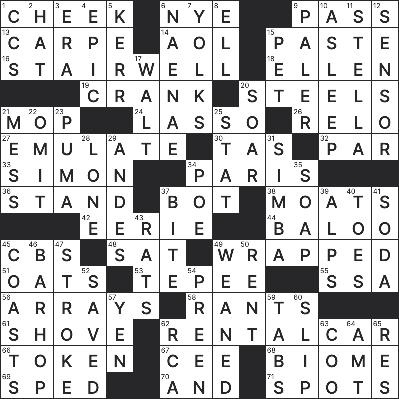

On Nov. 1, the team beat The University of Connecticut in the 15s Conference Championship, securing a spot in the quarterfinals. This game also marked the 30th anniversary of the Northeastern women’s rugby team, drawing in generations of Maddogs for support and a celebratory banquet following the game. Team members past and present met, shared stories and bonded over their love for Northeastern women’s rugby.
“This is why I’m here,” Mahmoud said. “I’m playing for me, but I’m playing for the Maddogs, the ones who I’m sitting next to but also the ones who I can’t see, the ones who I’ve never met.”
Thinking ahead to 7s in the spring, Hernandez is excited to
show up for the team as a “vet.”
“I got to meet six generations of my family, and just seeing them all, hearing their stories and how these really big traditions were formed on the team, made me take a step back and be like, ‘Wow, I am a part of something bigger,’” Hernandez said. “I really want to be a part of and leave my own mark on the team as well, because they have been such a big impact on my life that I want to do the same for the new rookies.”
The team is not ready to give up its win streak this spring season.
“I’m excited to go back to back to back again,” Mahmoud said. “I really think we’re capable of it. We’re a great team. I really think we’re able to rise to the occasion when it calls for it.”
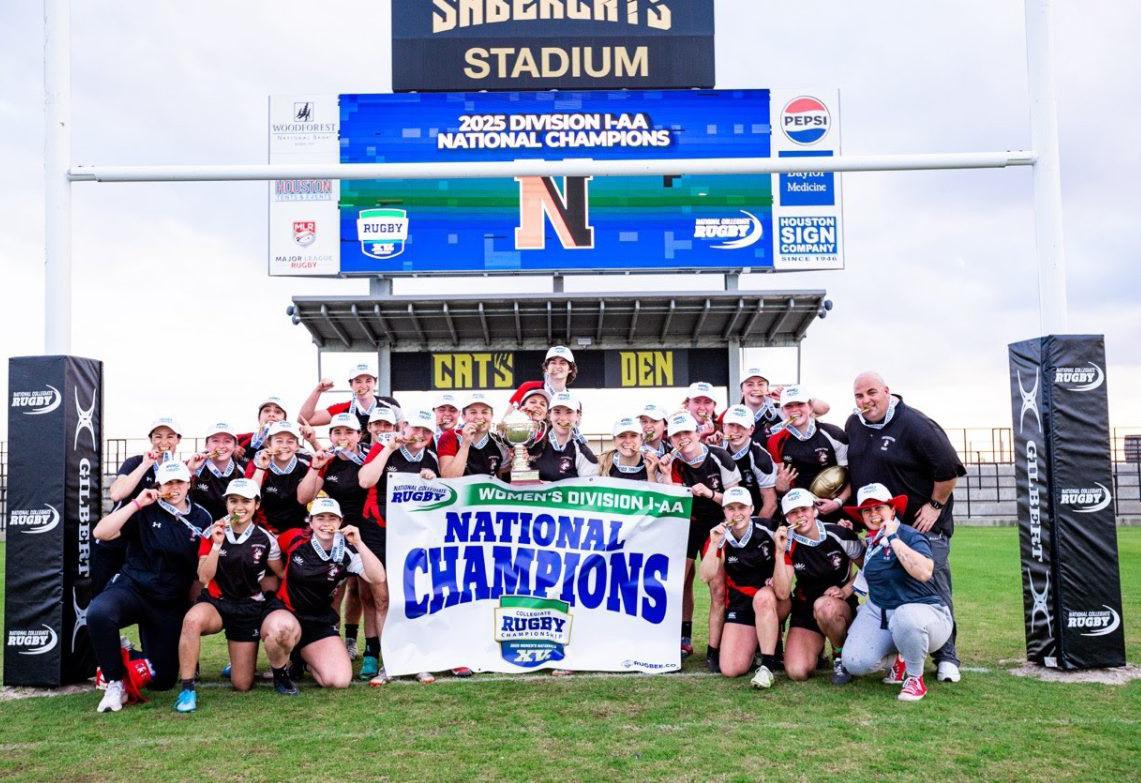
ACROSS
1. Vandalized, as a house
5. Role in a play
9. Damage
13. Smallest bit
14. Away from shore
15. Sunburn reliever
16. Theology of the Latter Day Saints
18. With 49-across, NFL championship on February 8
19. Brazilian soccer player who won three world cups
20. “Totes”
21. Yearned
22. Ctrl + __ + Delete
23. “An eye __ an eye”
24. Minivans are often eight __
26. Natural landmark on the Canadian-New York border
29. Yellowish resins
30. “I’ll pay” (2 wds.)
31. With fi, book genre
34. There’s 26.2 in a marathon
35. “You __ what you eat”
36. Opposite of rich
37. Did well, in modern slang
38. At the front of the line, perhaps
40. Spanish rice dish
42. “(I Can’t Get No) __” Rolling Stones song
44. Letters on a slant
47. Small business suffix
48. Prefix meaning three
49. Words before senior to describe 5th years
50. To perceive
51. Counterpart to guys
52. Skin affliction
53. Melty cheese appetizer (2 wds.)
56. Rapper turned Law & Order actor
57. Leave out
58. “I’m all __” (I’m listening)
59. Days, in Buenos Aires
60. Lots
61. They’re found on potatoes and needles
DOWN
1. You might set this for TikTok or Instagram (2 wds.)
2. Billiards surface (2 wds.)
3. To be, in Paris
4. Beaver structure
5. Chain sandwich shop on Huntington Avenue
6. Cher’s catchphrase in “Clueless” (2 wds.)
7. What you book on OpenTable, for short
8. Tim-__, Australian biscuit
9. “Old __ die hard”
10. Not with anyone
11. Coxswain’s teammate 12. Blend, combine 17. Foul aromas
19. Country at the southern end of Central America
21. Ashen
23. Not close
24. Of a solid state of mind
25. “Nightmare on __ Street,” 1984 film
27. “Golly!”
28. Structures you may build with pillows
31. One player card game
32. Lacking vibrancy
33. Distinct group who emigrated from Qajar-era Iran
35. Could be X or Y
36. Caress gently
38. Hair removal cream
39. “And so on”
40. It __ in comparison (to do worse)
41. Duke’s conference
42. Freezing rains
43. Groups of vehicles
44. “I’ll repeat myself” (2 wds.)
45. Stanley __ “Devil Wears Prada” actor
46. Sleep affliction
50. Its the largest organ!
51. Like an overcast sky
53. AI opponent
54. “Te __,” Spanish for I love you
55. Stinging insect