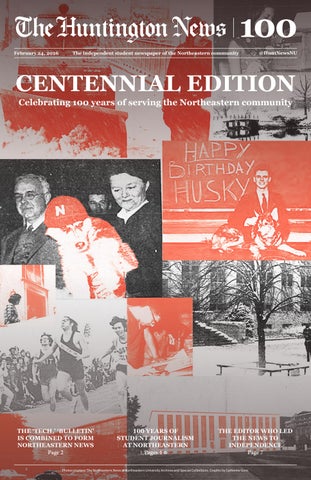
Centennial edition

Page 1


CENTENNIAL EDITION

‘Our responsibility has been increased’: The ‘Tech,’ ‘Bulletin’ is combined to form

Combine ‘Tech’ and ‘Bulletin’ to form unit publication

Editor’s note: This article, which announced the formation of The Northeastern News, is republished from The News’ first edition printed Feb. 24, 1926. The article has been lightly edited for grammar.

As a result of student conferences, which have been held for the past three weeks, the aim of a combination of activities on a University basis, rather than being fostered by separate schools, is culminated in the joining of “The Northeastern Tech” and “The Bulletin.” Previously, athletic and musical clubs have made similar adoptions of policy, and this combination presents all three departments of activities, publications, athletics, and musical clubs, working on a University basis. In the publication field, it is felt that this arrangement will be of special advantage to both schools. From now on, both papers will work in full conjunction with one another for the publication of The Northeastern News. The papers formerly issued, “The Northeastern Tech” published weekly by the School of Engineering, and “The Bulletin,” published monthly by the School of Business Administration, are now non-existent, and the purposes served by the two separately will from now on be supplanted by the newly established News.

For some time past, it has been evident that the efforts of one publication have only been duplicated

in the other. Thus, in the athletics department especially, news of various events have been carried by both. To prevent this repetition, which was accompanied with corresponding waste of time and money, it was thought advisable to remedy the situation by bringing the two together. This has finally been done with equal satisfaction to both branches of the University.

Joseph W. Maddocks ‘26, formerly editor-in-chief of “The Tech,” is editor-in-chief of the new publication. Under his able leadership, “The Tech” flourished and became an outstanding paper in the realm of collegiate newspapers. The success of The Northeastern News will be greatly assisted by the able leadership and untiring efforts of Mr. Maddocks.

Gordon J. Stewart, previously editor-in-chief of “The Bulletin,” is the next ranking head of the paper being assistant editor-in-chief, and is the senior representative of the staff of the School of Business Administration. His ability, which he has displayed in his former position, is expected to materially assist the progress of the succeeding issues. With the exception of a few other changes, the staff of The News will be practically the same as those of the two separate papers. The only two important shifts are the raising of R. E. Barrett, ‘27, to the post of managing editor and the transfer of R. E. Fennell, ‘26, to general charge

The Northeastern News

of the business department. Barrett has been in charge of the circulation department of “The Tech” for the past year, and despite the natural difficulties which arise from this position, he has handled the position in such able manner as to warrant further advancement. As managing editor, Fennell will act as general editor of the School of Business Administration. Crawford, formerly business manager of “The Bulletin,” already has the business department of The News functioning in proper manner. The only other alteration in the general list of staff positions is the elevation of A. C. Chalmers, ‘28, to the post of circulation manager, to take the place of Barrett. Chalmers was previously a member of the circulation staff of “The Tech.” As concerns other positions of the two papers, each staff member will retain his former status until the close of the current volume and elections for next year’s staff, which will come around the first of next April.

The policies of The News will continue along the same direction as those carried heretofore by both papers. The makeup, for the present, at least, will continue to follow much the same style as was customary with “The Tech.” At the beginning of next year, an entirely different style of makeup will prevail, but the present makeup customs will not be affected.

As the immediate result of the union, the size of the paper has been

increased. More developments are expected to follow later, which will give better news service to the University as a whole.

The uniting of The Bulletin and The Tech

Editor’s note: This statement was published in the Feb. 24, 1926, edition of The Northeastern News under the masthead. It has been lightly edited for grammar.

For some time, there has been developing at Northeastern a commendable dissolving of the boundaries which seem to separate the various collegiate schools of the University. For the narrowness of the Department there is being substituted to a broader conception which includes all as an entity. This is especially true of the Colleges of Business Administration and Engineering. Realizing that we have many interests and undertakings in common, we see in the future the possibility of closer co-operation in all our activities.

It is significant that the first movement toward union was in the field of athletics. The varsity teams have done more than is imagined toward developing the growing spirit of unity. The increased number of candidates makes better teams possible, and the honor due to Northeastern for the creditable work they have done can be shared by all. This is true of other activities as well.

The union of The Tech and The Bulletin is not the result of a recent and sudden decision; it has been anticipated for some time. The increasing amount of news of general interest, and the possibility of developing further unity, with the result of a better and a bigger paper, have long been on our minds. In this union the former Tech staff and Bulletin staff will work for the benefit of Northeastern, and not for the dominance of any faction. This means a broader outlook, not only of ourselves, but for the whole school as well. Our responsibility has been increased, but we expect the whole-hearted support of everyone, since the success of the paper is a matter of importance to Northeastern.

Our responsibility has been increased, but we expect the whole-hearted support of everyone, since the success of the paper is a matter of importance to Northeastern. ”

50 years after leading The Northeastern News, Larry Rothstein found his way back

Larry Rothstein didn’t always put the “student” in “student journalist.”

Oftentimes, above classes, The Northeastern News came first.

In 1971, he was a fifth-year political science major and editor-in-chief of The News during a particularly

at local papers, Rothstein picked up news writing and editing skills which became foundational to his career at The News. He served as a reporter, features editor and managing editor before succeeding Matorin as editor-in-chief in 1970.

At the time, Northeastern’s campus was buzzing with anti-Vietnam War activism. The university had approximately 5,000 Reserve Officers’ Training Corps, or ROTC, students preparing to serve in the military, and many male students

classmate, Bob Matorin. Under the mentorship of senior editors, who had worked co-ops

In May 1970, Ohio National Guard officers shot at a sea of anti-war protesters at Kent State University, killing four students and wounding nine others. The killing, known as the Kent State Massacre, set off a firestorm of protests spanning universities nationwide — one of the largest mass movements of campus activism in U.S. history. Rothstein remembers his editorship of The News as “electric” but also

In the week following Kent State, Northeastern faculty voted to strike, and students protested en masse. Early morning May

11, 1970, News staffers were in their office in Ell Student Center (now Curry Student Center) assembling a “strike edition” of the paper when Rothstein heard word of police mobilizing against protesters on Hemenway Street.

With all his staff occupied, he left to cover it. Soon after he arrived, about 100 tactical police officers removed their badges and charged at a crowd of more than 2,000 protesters. Rothstein fled toward a nearby apartment and was chased up four flights of stairs with a policeman on his tail.

Rothstein’s most permanent takeaway from The News was community. It demanded so much time and collaboration that the staff became tight-knit. He remembers editing in his office until 4 a.m. and beloved latenight print dinners. He’s remained in touch with many of the editors he worked with, and those bonds transcended his time at The News.

The protests — and university and police response — were erratic and demanded more frequent publishing than printing weekly allowed. Rothstein printed The News daily from May 12 to 22, 1970. It was an ambitious goal for approximately 35 staffers, but he felt it was critical to keep students continuously updated.

“By that point, there was a significant liberal element on campus, and The News was the leader for that,” Rothstein said of The News’ protest coverage. “We, I believe, really helped transform the campus.”

When he wasn’t in class or, more likely, in his News office, Rothstein completed co-ops with the speaker of

the Massachusetts House of Representatives and at the Office of Education’s Teacher Corps in Washington, D.C. He graduated in 1971 with a degree in political science.

Rothstein went on to earn a doctorate in public policy from Harvard University, where he continued student journalism as an editor of the Harvard Business Review and Harvard Educational Review. He assisted Nobel Prize-winning sociologist Gunnar Myrdal with research on systemic racism and has co-authored several best-selling books about mental health. In 2002, he co-founded No Limits Media, a nonprofit media organization platforming people with disabilities.

In 2021, Rothstein reunited more than 30 News alumni to publish a print edition and website commemorating the 50th anniversary of The Northeastern News class of 1971. Former photographers, reporters and copy editors alike picked up where they left off half a century prior; “Everybody did what they used to do,” he said.

The Northeastern News went independent from the university and was renamed to The Huntington News in 2008. In fall 2025, Rothstein joined The News’ board of directors, advising its senior editors on editorial and financial decisions. It was an opportunity to give back to the paper that once gave him “everything.”

“Once you’re a member of The Northeastern News or The Huntington News,” he said, “you’re always a member of The Northeastern News and The Huntington News.”

ANNIKA SUNKARA Managing Editor
Rothstein (center, holding a thumbs-up) poses for a group photo alongside members of The News for the 1970 edition of The Cauldron, the Northeastern yearbook. Rothstein joined The News in 1967 and became editor-in-chief in 1970. Photo courtesy The Cauldron, Northeastern University Archives and Special Collections.
Rothstein poses with a 50th anniversary edition of The Northeastern News. News alumni reunited to write and design the special edition together.
Photo by Annika Sunkara

Dan Kennedy remembers when he was the student

tington News. And Kennedy, who graduated from Northeastern with a degree in journalism in 1979, has been a fixture in his alma mater’s School of Journalism since 2004.

“After I graduated from Northeastern, I said, ‘I spent so much time at the school paper, I forgot to get an education,’” he said. He went on to take night classes soon after graduating, earning a master’s in American history from Boston University.

sion’s news staff felt we were better than the others,” he said, “so why would we consult with them?”

Between stints as an editor, he worked co-ops at United Way, a non-profit, The Woonsocket Call, a local newspaper in Rhode Island, and the department store chain Zayre doing communications. While at Zayre, he picked up assignments at The Daily Times Chronicle in Woburn, where he took a job soon after graduating.

Tucked away in an office on the fourth floor of Ell Student Center, every Monday, 21-year-old Dan Kennedy hunched over a manual typewriter as young journalists scurried around the newsroom. Only breaking for a quick dinner, the team worked through the night to put together the weekly edition of The Northeastern News. It was 1978, and Kennedy was the editor-in-chief of the paper.

By the morning, running on no sleep, Kennedy dragged himself to his 8 a.m. class. Afterward, he rested for a few hours, then headed over to the Newbury Street office of The Boston Phoenix, which ceased publication in 2013, where The News did its typesetting and layout.

Before digital publishing, designers and editors had to tussle with filling print pages just so: Stories could not be too long or too short. Kennedy would help troubleshoot the layout before the pages were sent to a printing press in western Massachusetts. The shippers dropped off copies on Thursday, but by then, the staff was already preparing for the coming Monday’s print night.

By 2026, things had changed. The Ell Student Center was renamed the Curry Student Center. The Northeastern News became independent in 2008 and rebranded as The Hun-

As a child, he dreamed of being an astronomer. That is, until he realized a career in astronomy would require math. But after discovering a love for politics, coupled with a proclivity for writing, he had his eyes set on journalism and became the first in his family to graduate from college.

“Northeastern seemed like a good place to come if college was not an experience for your family. It was affordable, believe it or not,” said Kennedy, who hails from Middleborough, Mass. “It was a commuter school, although I lived just a little bit too far away, so I stayed in the dorms.” His first residence hall was the recently-demolished White Hall.

Upon starting college in 1974, Kennedy worked his way up the chain of command in a newsroom of about 20 people, holding a variety of roles including staff reporter, news editor, managing editor and, ultimately, editor-in-chief of Division B in 1978.

Until it switched to semesters in 2003, the university used a quarter system that divided the student body into two groups. As students alternated between co-ops and classes, upperclassmen at The News would switch staff between Division A and Division B teams. One division’s members would lead the paper while they took classes, and it had its own editors, differing typefaces and distinct reporting styles.

For all intents and purposes, Kennedy said, it felt like two entirely different papers that did not seek collaboration. “I’m sure each divi-

Kennedy’s old clips, housed in Northeastern’s archives, include a piece about the best radio programs and when to listen, the rambunctious spirit of Boston sports fans and swine flu. (“We were very concerned about swine flu, and it ended up not being any big deal,” he said.)

Among the clips is an extra edition, printed in December 1976, covering the brutal murder of F. Andre Favat, an associate professor of education at Northeastern. The killing of Favat stunned the university and heightened lingering fear over campus safety, according to The News’ reporting.

“Northeastern students don’t and can’t live in a vacuum. Northeastern is part of the real world, and this includes the Mission Hill Project area,” an article from the December 1976 edition reads, referring to the defunct housing complex adjacent to Ruggles Street, where Favat was murdered.

He critiqued The News’ coverage as being too sensational and recalled that the Division B staff was enthralled by papers like The New York Daily News, with its big-font headlines, punchy verbs and plenty of exclamation points.

“We went out and did a lot of reporting for that, and I remember we got a significant award for it from the Society of Professional Journalists,” said Kennedy, who was managing editor that quarter. “But the presentation, not so great.”

At the time, The News’ faculty adviser was Harvey Vetstein, a long-time professor of English who spent 16

years advising the paper. He ensured the editors received their tuition stipends and “ran interference for us with the administration.” Though overall, Kennedy said, the university did not interfere with the paper and its coverage, and Vetstein let the young journalists steer the ship. Week after week, editors had to fill the pages of the weekly edition. Kennedy recalled an especially frosty night in February 1978 as Northeastern faced off against Harvard University in the annual Beanpot tournament. As the teams battled on the ice, more than 27 inches of snow piled atop the city in what many dubbed the “blizzard of the century.”

By the end of the last match up, which was between Boston University and Boston College, the conditions had worsened, forcing TD Garden to remain open overnight as a refuge. Among those trapped were the sports editors of The News. About two miles away, on campus, Kennedy was in the throes of his weekly Monday all-nighter and urged them to come back, unaware of the harsh conditions outdoors. He said the paper was saving space for a Beanpot article.

As some fans opted to sleep in the sky boxes of the 15,000-seat arena, others ventured out into the relentless blizzard. “It must have been 2 or 3 in the morning,” Kennedy said. “They suddenly walk into the newsroom covered with snow and ice, and we said, ‘Oh, gee, we shouldn’t have told you to come back. This is awful.’

But they sat down and banged out their story, and we produced the whole paper.”

The journalists worked through the night

and rang The Phoenix in the morning.

“We called The Boston Phoenix, and they said, ‘Are you out of your minds? We can’t get the pages out to the western part of the state, where the printing plant is. You’re not having a paper,’” he said. “Of course, today it would be immaterial. It would just be in digital and that would be that. But they nearly killed themselves for nothing.”

But, importantly, did Northeastern win the Beanpot that year? Kennedy shook his head.

“Oh, no, we never won,” he said of the men’s hockey team. “That’s a recent phenomenon.”

After graduating from Northeastern, he spent nine years at The Daily Times Chronicle, and his work has been published in several major outlets, including The Washington Post and The Boston Globe. He’s authored four books, spent years as a media columnist for The Guardian and The Phoenix, is a journalism professor at Northeastern and frequently posts on his blog “Media Nation.”

Looking back on his career of reporting, editing and teaching, when asked about the lessons he learned at The News, one stood out: “A bunch of fairly inexperienced young people can come together and put together a pretty good newspaper every week.”

From aspiring novelist to long-time reporter: John Ellement’s path to 40 years at The Boston Globe

John Ellement did not always aspire to be a journalist — he simply fell into it.

Ellement always enjoyed writing, but his plans consisted of writing novels, not articles.

Arriving at Northeastern in 1975, he joined The Northeastern News, the school’s independent student newspaper. His first task was to visit a lab on campus and speak to students about their knowledge of a pigeon-related experiment.

“I was supposed to interview the students coming by, and I had a really tough time reaching out, saying hello, getting myself to ask people to talk to me. It was quite challenging for me,” Ellement said. “But I found out I could do it.”

Ellement pushed through his initial fears, finding a love for journalistic writing. He has now reported at The Boston Globe for nearly 40 years, covering a variety of topics including New Hampshire politics, transportation and Boston City Hall.

After finding his footing at Northeastern, Ellement became the crime reporter for The Northeastern News, speaking once a week with the university’s deputy police chief at the time, Joseph Ferriter. Ferriter would tell Ellement the crime updates for the week, and he would listen and take notes.

“I wasn’t an investigative reporter, I’m still not an investigative reporter. Maybe there were a million questions that I should’ve asked him that I never did, that would’ve made it more relevant. He controlled the conversation, which was a lesson in itself,” Ellement said.

Ellement continued his work with the paper throughout his first year at Northeastern, building his skills to apply for his first co-op position.

During Ellement’s time at Northeastern, the university’s co-op program followed a three- to six-month cycle, with three months on the first co-op, three months back in school, then six months on co-op and six months back at school.

When he applied for a co-op position as a general reporter at The

Boston Globe, he assumed he would be rejected.

“I was really surprised because I remember coming back and telling my co-op counselor at Northeastern, ‘I did a terrible job, what else you got?’ and he said, ‘Well... that’s funny because they just called me and told me that they want to hire you.’”

The Globe was a pivotal space for learning in Ellement’s career, a place where he met his mentors and solidified foundational reporting skills that he now passes on to other young writers.

“They understand that you’re coming in as a student. They understood that their job was to help you learn how to be a good, ethical, accurate reporter,” Ellement said.

That’s what Ellement has emphasized throughout his career: accuracy and compassion for all. One of the stories that stuck with him throughout his time at Globe never made it to print — an ethically sound decision in hindsight, Ellement said, because public officials had made a mistake.

A man was arrested for an OUI on Cape Cod, who happened to

share the same name as a Massachusetts state representative. The details of the arrest had matched the representative’s name, address and description, but the representative insisted it was not him. As it turns out, the officer filing the report had made a mistake and entered the wrong man into the system. Because of Ellement’s fact-checking, he was able to confirm the mistake before the article was ever written.

“That was the greatest thing. We didn’t do that story, [and] that’s real reporting. That’s really one of the highlights of my career — on a personal level, because it never made it into the newspaper,” Ellement said.

The story is a prime example of his journalistic mantra, “negative is positive,” a phrase he stands by in his reporting today.

“It’s better to have spent an hour going down a road and then you learn at the end of your hour that it’s the wrong thing … I got nothing to show for it, but it’s a positive because I’m not making a mistake,” Ellement said.

Ellement eventually worked as a researcher for the Spotlight, The

Globe’s investigations team, advised and taught by Stephen Kurkjian, who worked as a reporter and editor for The Boston Globe for 39 years. It was through Kurkjian he learned how to find accurate information quickly at a time when information was found in books, not computers. But years of having to sift through hard copies of materials honed his research skills, something he said he still carries with him in a digital world.

“While covering law enforcement, criminal justice and doing breaking news — all of those things require that you find out accurate information fast,” Ellement said.

Ellement began his long, decorated career at Northeastern, and he hopes other students follow the same path in the future. His advice to aspiring young writers? Join the university’s newspaper.

“If you’re going to do it, do The News. It does help you get a job. If you show up after two years at Northeastern having never done a story … they’re going to go onto the next person,” Ellement said.

KAYLA GOLDMAN News Staff
Kennedy (center) takes notes while on co-op for The Woonsocket Call newspaper in 1978. While on co-op at Zayre, Kennedy also picked up assignments for The Daily Times Chronicle. Photo courtesy Dan Kennedy.
Dan Kennedy poses for a headshot. Kennedy accepted a teaching position at Northeastern in September 2004. Photo courtesy Dan Kennedy.

THE STORY OF A CENTURY: REFLECTING AS TOLD BY THE HUNTINGTON

Every week, The Huntington News staff gather in Holmes Hall to pitch stories, attend workshops and meet with editors. On Feb. 24, 1926, Northeastern students congregated in a similar manner in an office at 306 Huntington Ave. to prepare the first print edition of The Northeastern News.

One hundred years ago, around a dozen budding journalists who ran The Northeastern News were all male, and the paper was published only in print. Now, more than 100 students of all genders, backgrounds and identities contribute to The Huntington News to publish online articles daily and print editions monthly.

Throughout The News’ history, its staff have reported through divisive and impactful world events and faced challenges surrounding editorial freedoms and pushback from the university. Still, for a century, it has remained committed to serving the Northeastern community.

Here is The News’ journey from 1926 to now: Its evolution from The Northeastern News, a university-supported publication and The Huntington News’ direct predecessor, to the independent student newspaper thriving at Northeastern today.

1920s: The News is born from humble beginnings

The first edition of The Northeastern News was published Feb. 24, 1926. The four-page paper featured a front-page story about the merging of “Northeastern Tech” and “The Bulletin” to create what they called a “unit publication” of The Northeastern News. Previously, The Tech was published by Northeastern’s School of Engineering and The Bulletin was published by the College of Business Administration.

The four-page spread covered campus news, sports, fraternities and information about other student groups. Ads for various businesses, events and restaurants also appeared in the early pages of The News. Prior to the internet and The News’ independence from the university, the physical paper was one of the main channels of communication between the administration and students.

Early editions of The News focused heavily on events, including a chemical engineering conference; “class days” hosted by different grades that included dinners and games; sports games played against other Massachusetts schools; and fraternity events.

1930s: The Great Depression and the co-op program — a contradiction

The 1930s was largely marked by the challenges of the Great Depression: a particularly troublesome economic trend for a university that prides itself on high student and post-grad employment rates. The Northeastern News briefly reported on how the market impacted the university while maintaining regular stories on academics, sports and student life.

The first mention of the Depression was pulled from an edition of College Humor, an American humor magazine that highlighted

college life, satire and romance.

The News included a satirical piece called “Abe Martin Comments on ‘Hard Times,’” in which the writer, dubbed Martin, joked about parents struggling with controlling their unemployed children.

“Mrs. Joe Kite is solicitin’ subscriptions to magazines to keep her girl in the Adirondacks,” Martin wrote. “She don’t worry about her boy. She knows where he is. He’s in jail an’ out of harm’s way.”

Yet, the university and News staff couldn’t ignore the numerous changes and tremendous fear and uncertainty that had taken root throughout the country. The paper’s 1930 holiday edition included a letter from then-President Frank P. Speare, in which he first recognized the “titanic struggle for … preferment.”

“The stresses and strains of modern living are so overwhelming in comparison with those of bygone days that it taxes the physical and mental endurance in an alarming way and creates new and constantly evolving problems,” Speare wrote.

Despite trying times, The News continued reporting on day-to-day Northeastern happenings and even maintained “Husky Says,” a satirical column of light-hearted jokes. There were few mentions of the Depression.

In December 1931, an article from The News titled “Co-op department sees lift in Depression near” explained how Northeastern was dedicated to finding employment for students and “holding its own with regard to the number of men employed.”

The department was “doing its best for those men who have not been assigned to jobs, and until jobs [were] found, special courses [were] offered, at no extra charge to those men.”

According to the article, the number of jobs lost balanced the number of jobs secured, which, for the time, was an impressive statistic that was even recognized nationally. In 1934, The News reported that President Franklin D. Roosevelt congratulated Northeastern’s co-op department on its “phenomenal industry and [its] stupendous success” in the height of unemployment.

Coverage of the Depression fizzled out by 1933 as other foreign affairs took center stage.

“World Conditions,” an article overviewing diplomatic issues, called March 1933 “one of the most crucial periods in modern history. At no time since [World War I] has the future course of events seemed so uncertain.”

The story touched on Roosevelt’s bills in response to the Great Depression, the formation of the “Little Entente” — a defensive alliance in Eastern Europe — and the beginning of Hitler’s reign in the German Reich.

“Thus we see the world in grave trouble,” The News wrote. “Not that we should resign ourselves in fear and trembling to dangers of the months ahead. Even if there is nothing we can do except keep well informed on events, we should do that.”

The majority of foreign affairs coverage published throughout the

1930s was explainers, laying out the beginnings of World War II. These articles included “The Rise of Facism,” a sociology professor’s summary of facism; “The War,” an overview of the Chinese-Japanese conflict; and “The Source of Hitler’s Power.” All of these articles — along with many others — urged students to be concerned and take more interest foreign events.

In 1938, as political tensions mounted, Northeastern students asked The News to take a stance.

“Dear Editor,” a Northeastern student wrote, only identifying themselves as R.S. “A number of students in the University are interested in your unmentioned stand on Facism. Previous editorials have surrounded the subject yet they have never hit the spot, so to speak. I suggest that you state a NEWS policy list over the editorial column each week. At least the students will know on which side of the fence you stand.”

Army will commence throughout the country March 1,” an article in a February 1943 edition reads. Just a short month later in a March 1943 edition, The News reported on the first group of student reserves that left the university to serve in the Army during the war. Two weeks later, The News reported that 118 additional reservists “received orders for active duty.”

The News responded in an April 1939 edition with an article by staff writer H. R. Austin placed on the front page: “War Unnecessary, Enlist for Peace.” 1940s: The draft domination

Following Japan’s attack on Pearl Harbor Dec. 7, 1941, The News published a statement from then-Northeastern President Carl Ell titled “Northeastern and The Emergency,” providing students with information on the attack.

While Northeastern was strictly a men’s college since its founding in 1898, in a November 1942 edition, The News announced the university’s intention to enroll women, with the headline “Northeastern To Admit Women” plastered on the front page. The article outlined what women’s admission to the university would look like through direct statements from Ell.

“The women admitted will be allowed to elect the Co-operative Plan, whereby they will alternate ten week periods at studies with tenweek periods at work in paying jobs in business and industry,” the article reads. “Every year since the opening of the day colleges, young women have sought admission but have been rejected in favor of the men.”

Women were finally admitted to Northeastern in 1943, when six women joined the 1947 class of 206 men.

As World War II continued into 1943, The News reported on soldiers entering Northeastern to be trained as engineers as part of a contract with the U.S. Department of War. Soldiers were expected to enter in April 1943 and study at Northeastern’s College of Engineering.

“This specialized training program under the auspices of the

In a July 1944 edition, The News published a letter from the editor, who had since recovered from his tonsillectomy, titled “Democracy

Demands Tolerance,” encouraging readers to stand united as the second world war continued to unfold.

“Of prime importance will be our ability to retain the democratic spirit of tolerance,” Littlefield wrote.

“To keep a clear head, to make a wise choice on the basis of reason, as little as possible influenced by either strong propaganda or our somewhat untrustworthy emotions, is highly commendable, but it seems to your editor that tolerance is the spirit of democracy and as such is fundamentally vital to the performance and continuance of our democratic processes. Only by tolerance can 135,000,000 people of divergent views live together without oppression.”

When U.S. President Roosevelt died in 1945 in the middle of his third term, The News covered his death with various articles including an obituary and student responses.

On April 14, 1943, The News printed another article about 129 Air Corps reserves, consisting of both students and recent graduates, who were called to serve. The rest of the edition is sprinkled with references to the war, such as Army training, awards given to Northeastern students in the Army and other Northeastern- and World War II-related information.

In August 1943, The News reported Northeastern “drop[ped] intercollegiate football” in wake of the draft and the enrollment drop that followed it. Most students who previously played on the team were in service, News reporter Irving Galis wrote, and freshmen alone could “not conceivably undertake a schedule of practice from 5 o’clock on through the evening without sacrificing educational standards.”

“Franklin Roosevelt was helping us to win the battle of nations, and already was planning for the battle of the peace. A good foundation he gave us for both, but neither did he live to see. He devoted his whole life to his people. He died for his people,” wrote Elliot V. Rice, editor-in-chief of The News at the time.

On Aug. 23, 1945, The News published an edition marking the end of the war by writing, “Nation Shall Not Lift Up Sword Against Nation, Neither Shall They Learn War Any More …” over its masthead. The war officially ended Sept. 2, 1945, but Germany had already surrendered in May of that year.

As normalcy returned to Northeastern and The News turned its attention back to campus happenings, women protested the co-op program, which they were allowed to enroll in only four years earlier. The demonstrators gathered in front of Richards Hall, protesting the requirement to go on co-op in the fall.

Humor in The News was largely overshadowed in the early 1940s because of the war, but playful satire made a comeback. In a June 1944 edition, a small box on the bottom of page two reads, “NOTICE: Littlefield is having his tonsils out,” referring to Arthur Littlefield, the serving editor-in-chief.

“Although the announcement pertains to the entire section, the women feel that they are being discriminated against unjustly,” the article states, explaining that veterans and other men were still able to choose to go on co-op due to their status within the school or as veterans. Many women, however, did not belong to these exclusive groups.

In 1948, Northeastern celebrated its 50th anniversary and The News looked back on the university’s history. The October “Fiftieth

REFLECTING ON 100 YEARS OF HISTORY HUNTINGTON NEWS

Anniversary Issue” reported on an alumni ball hosted at Hotel Copley Plaza and Northeastern’s expansion throughout the years and included a series of photos from The News’ anniversary celebration.

As the 1940s came to an end, The News released a “Year’s End Editorial,” where the editors dissected the process of assembling the paper.

“We on the NEWS feel that this is time well spent. We feel that the NEWS is like a fraternity to us,” the editorial reads. “We find many lasting friendships and good fellowship. We learn the practical side of journalism. How a paper is put together, and what makes it tick.”

1950s: The draft continues with the outbreak of the Korean War

The 1950s saw another round of war drafts hit Northeastern students with the outbreak of the Korean War.

The News published an article titled “Korean War Felt, But Students Keep Working” in June 1952, focusing on student activities held the previous academic year.

“The Korean situation, however, was felt,” staff writer Joe Vaccaro wrote, detailing the arrival of ROTC on campus, the influx of students going to and from class in uniform and increased opportunities to donate blood.

“While the effect of the draft was not too noticeable, some students were called up by reserve units,” Vaccaro wrote.

In October 1952 — halfway through the Korean War — The News’ editorial board published an editorial in favor of the deferment of military service, which would allow men to receive a college education before serving.

“Deferment is only a postponement of, not exemption from military service,” the article stated. “They are willing to put in their time, but why should they not be permitted to get a college education first?”

But not all students were fortunate enough to defer their military service. Northeastern’s 1954 freshman class hosted 350 Korean War veterans, The News reported.

Other coverage of the Korean War included “N.U. Korean Vets

See Heavy Action” — an account of the experiences of two marines and an army soldier who served in Korea before studying at Northeastern.

In collaboration with Northeastern’s History-Government Department, now the History Department, The News conducted polls to gauge student reactions to post-WWII events, finding that a majority of students felt they could put their trust in military preparedness, and a small majority considered the United Nations a success.

The News’ Korean War coverage concluded with an April 1953 letter by Editor-in-Chief Ed Goodstein about the war’s lasting impact on students.

students looking for post-graduation employment.”

1960s: ‘When Winds of Change Blow’

President John F. Kennedy’s assassination filled The News’ front page on Dec. 6, 1963, the first of many pivotal events in the 1960s that shook the Northeastern community but also united the student body.

reported. In September 1969, The News published an obituary with a headline that read: “Former NEWS staffer James McGarry killed after first week in Vietnam.” McGarry was killed by a hand grenade.

According to The News, Northeastern students were quick to join the nationwide movement against a war that had taken the lives of

“Usually separate in our scurrying to class, or chatting over a cup of coffee to the syncopated roar of the jukebox in the Commons, here in our silent sorrow we were closer as a body of students than we had ever been before,” wrote The News’ rewrite editor Peter R. Briggs. Anti-war sentiments that took root in the ‘50s extended into the ‘60s, manifesting in the form of campus activism.

In 1966, special assignments reporter James McGarry voluntarily joined the Northeastern University ROTC on an “escape and torture” training to report on the Viet Cong Village simulation at Fort Devens, Mass. He published his in-depth account of the simulation that mimicked a battlefield, writing about his experience ducking behind ridges, navigating mock tunnel systems and outsmarting “the enemy,” who interrogated McGarry and the soldiers for their commander’s name and the group’s destination.

many of their friends, families and peers. There were sit-ins and protests against the ROTC’s presence on campus that, at times, turned violent. Subsequently, Northeastern increased campus police security.

As anti-war sentiment flourished, The News polled Northeastern students on their opinions about de-escalation and reported on an anti-war rally on Oct. 20, 1967. About 500 to 600 students gathered in Krentzman Quad to condemn the war in Vietnam and the university’s “complicity.”

“I’ve never seen this at Northeastern before,” Northeastern student Jack Fahey told The News. “The rally seemed to create the kind of dialogue I’d like to see more of.”

The News also reported on Northeastern students who took their frustration beyond Boston. On Oct. 21, 1967, about 100 Northeastern students traveled to Washington, D.C., to participate in the March on the Pentagon. Their part in the protest was documented through photos and an in-depth News article headlined “Bloodshed, Militancy Fill Peaceful Washington Air.”

“After every period of defense there has been a depression,” Goodstein wrote. “The recession we face could be serious, but even if it is slight it may seriously affect

“The boys were going home after their first taste of war, their first taste of hell,” McGarry wrote, noting the group’s exhaustion after the training.

After graduating from Northeastern in 1968, McGarry left his job at The Boston Globe to serve in the Marine Corps, The News

The assassination of Martin Luther King Jr. on Apr. 4, 1968, rocked the Northeastern community. About 800 students attended a memorial service hosted by the Black Student Union, or BSU. In the aftermath of his death, The News published numerous articles covering on-campus BSU events, Black art and culture in Boston and student upheaval.

In a December 1968 article, “When winds of change blow even the indifferent respond,” staffer Martin Beiser wrote: “Change has taken place at Northeastern in the past year, change far more profound than the apparent completion of the additional buildings and the skeletal outline of a fourth. The change can be found in the mood of the student body and the apparent new awareness of the administration toward the grievances of that student body.”

Liberal activism of the 1960s reshaped Northeastern’s student

body to more closely resemble that of today: an opinionated community not afraid to challenge authority, engage in political activism and demand change.

In December 1969, The News published “Farewell to the 60’s,” a recap of, arguably, the university’s most transformative decade thus far.

“We must continue to work for peace,” The News said. “And in a season so religiously important throughout the world, we will pray for peace. It cannot be too much to ask.”

1970s: Social change marked by protests, strikes and riots

The 1970s kicked off near immediately with protests, strikes and riots. A Jan. 30, 1970, edition of The News described students protesting General Electric recruitment on campus as part of a wider labor strike spanning over 100 days. In February, The News reported riots following a speech at Northeastern by Dr. S.I. Hayakawa, president of San Francisco State University and a hardline conservative who notably opposed on-campus anti-war protests. Thirty-one students were arrested and indictments were sought against them, but 19 of the cases were dropped just a few weeks later, according to a Feb. 27 edition of the paper. In May 1970, The News published a special edition of the paper covering ongoing Vietnam War strikes on campus followed by daily editions documenting the strikes from May 12 to 22.

publishing abortion ads, which The News had run for approximately two years. A Massachusetts law prohibited publishing ads for abortion, and The News said it would comply with the law out of fear of a lawsuit, yet the paper published the phone numbers of Planned Parenthood and Parents’ Aid Society in the same edition. The editorial came at a pivotal time for reproductive rights, and the Supreme Court legalized abortion nationally in the Roe v. Wade decision the following year.

The April 12, 1974, News edition reported that, for the third time in two years, Northeastern raised tuition. Per term, engineering upperclassmen would pay $947.50, all other upperclassmen would pay $922.50 and freshmen would pay $655.

In the mid to late ‘70s, The News’ coverage focused heavily on the university, with recurring stories about professors unionizing and parking pass issues. “Parking: A commuter headache,” one headline read in a January 1976 edition; “Parking lot staff beefed up,” another reads in the same edition. A fifth consecutive tuition hike was reported in 1976.

The News covered many social and political issues into the late ‘70s, both through reported pieces and editorials. Following the 1969 Stonewall Riots, the gay liberation movement gained prominence, which The News covered by platforming student perspectives. In a June 1976 story, a member of Northeastern’s Gay Student Organization criticized the Army for barring openly gay people from service. A March 1978 edition featured a front-page story called “Homosexuality: Struggle for acceptance,” chronicling gay students’ social struggles on campus.

Tuition hikes were a mainstay in the pages of The News over the years; Northeastern raised tuition from $700 to $750 for the fall 1970 quarter.

As the Vietnam War waged on, strikes followed suit, with News reporters traveling to Washington, D.C., to report on the anti-war strikes in April 1971.

In 1972, The News notified readers in an editorial that the university directed the paper to cease

A January 1978 edition highlighted the affirmative action director at Northeastern, which was followed by a February 1978 edition that asked students “Is Affirmative Action fair?” Two students responded with columns of opposing views. As the ‘70s came to a close, the Islamic Revolution in Iran evolution trickled into News coverage through on-campus protests, and Iranian students feared deportation after President Jimmy Carter ordered the “deportation of all Iranian students who are violating the terms of their visas following the takeover of the U.S. Embassy in Iran” two weeks prior.

In the midst of political turmoil, women’s sports saw newfound opportunity in the first Women’s Beanpot, held in March 1979. The Men’s Beanpot had existed since 1952, but this was the first time the women’s teams of the four Beanpot schools faced off at Boston Arena HISTORY, on Page 6

(later renamed Matthews Arena).

1980s: A radical decade

The 1980s was a transformative decade at Northeastern for the rights of marginalized communities.

In 1982, The News reported heavily on racial inequalities at Northeastern and other universities nationwide. That year, Ronald Reagan’s administration reversed a Nixon-era policy that denied tax exemptions to universities that racially discriminated against students.

In the article “Reagan losing control and Racism gains,” staff writer Dana Gardener questioned “how … a healthier society free of racism [can] exist if the government allows, if not promotes, schools that teach racism?”

Despite strong civil rights advocacy from The News and Northeastern’s student body, the university struggled to uphold equality on campus.

A May 1982 article announced, “Black studies department to be dropped.” In June, the university dissolved the program after 10 years, partially due to a lack of student involvement.

“Black students on this campus have a very weak network of communication and this will only make things worse,” Olan Godare, a lecturer in the department, told The News at the time.

There was also a lack of representation among Northeastern staff; the 1984 article titled “University must attempt to overcome racial barrier” reported that only 20 of Northeastern’s 859 full-time faculty members were Black.

Simultaneously, The News wrote about women at Northeastern fighting their own battle for equality.

In a story titled, “She climbed the heights for equal rights,” The News wrote about Northeastern student Mary Taylor, who celebrated Susan B. Anthony’s birthday by getting arrested for scaling the metal fence surrounding the White House. Her

“Perhaps the French, well known for their way with amour, said it best: the more things change, the more things stay the same,” she added.

In a similar article from the time, students agreed they’d become more liberal.

“I think sex is more open nowadays,” one student said. “People are much freer with their feelings now.”

Subsequent articles also tackled more controversial topics, such as abortion and birth control. The News wrote about how sex precautions were left mainly to women, and writers argued that men were seldom involved in birth control measures.

With increased reporting on sexuality came more articles on rape and sexual harassment. The 1982 article “Rally aimed at reforming sexual harassment penalties” debated whether cat calling was considered sexual harassment. The News also published “A guide for rape victims.”

However, rape was still considered a taboo, and audiences in the 1980s were hesitant to engage with articles that addressed the topic.

In The News’ article “Rape: Should it be in the news?” Northeastern students argued that Northeastern police should release all information pertaining to a rape case, including where it occured, when it occurred and the assailant’s name.

“If students don’t know, they won’t take precautions,” student Jeff Millett told The News at the time. 1990s: A growing campus and a push for civil rights

In 1990, fall enrollment dropped 28% from the previous year, a stark contrast to the enrollment increase the university would see in the next few decades. Additionally, the Student Government Association, or SGA, took “a stand” against the Department of Defense’s policy discriminating against LGBTQ+ ROTC students, and students rallied for more minority faculty.

goal was to petition Reagan to support the Equal Rights Amendment, or ERA.

“I believe in my heart that [the ERA] will pass. Women have been working on it for 60 years and it might take another 40 but it will pass,” Taylor said. “There are people in my generation and the preceding generation that are willing to work for what they believe in.”

Following the “Me Decade” of the 1970s, characterized by a cultural shift toward individualism, The Northeastern News editions of the ’80s built upon increasingly open attitudes toward sex and sexuality.

In her article “Love in, free love out?” staff writer Laurie Ledgard questioned whether attitudes toward sex had changed among the new generation of college students.

“Yup, they’re doing it,” Ledgard wrote. “They’re not all doing it. But they’re doing it and when they’re ready to do it.”

rents,” Jorge Drosten, described as a “concerned citizen,” told The News in November 1999. “The students are willing to pay higher rents.”

While Northeastern students see six-month co-ops as the norm in 2026, a November 1999 edition of The News declared that these lengthier positions could “become the standard” after decades of coops mostly spanning three months.

The “Style” section of the final edition published in the 1900s featured a “NU2K” article reporting on students’ plans for the new millenium. While the rest of the world prepared for the end, Northeastern students rallied for parties and New Year’s celebrations, according to a December 1999 edition.

“I am not worried in the slightest,” student John Dewsnap, a junior computer science major, told The News.

“I’m not going to fly on January 1, 2000,” said Naved Ahmad, a then-economics lecturer at Northeastern. “I do believe nothing is going to happen, but why take the risk?” 2000s: An ‘inescapable tragedy’ reaches Northeastern

In January 2000, after the chaos of the new millennium quieted, The News asked students, “What were your expectations of the coming of the millennium?” Students spoke about fearing riots and “maniacs … [running] freely through the streets,” and one student speculated the fear was all a ploy by the Federal Bureau of Investigation.

unjustly persecuted Japanese Americans at the inception of World War II. Consequently, do not punish, nor pass judgement on our fellow citizens of Arabic descent or of the Muslim or Islamic faiths. They are our neighbors, our friends, and our fellow countrymen.”

Heightened tensions in the Middle East dominated the early 2000s — and thus the pages of The Northeastern News. In an Oct. 2, 2002, article, “Middle East conflicts come to campus,” The News wrote of mounting tensions between Iraq and the U.S. with interviews from students sharing their opinions.

“We go to war with Iraq at our own peril,” said Professor Denis Sullivan, then-chair of the political science department and director of the international affairs program. “We would be taunting the terrorists to strike us again.”

“September 11 was a clear documentation that the United States is not ‘fortress America’ and is vulnerable to weapons of mass destruction,” said a professor who was only identified by their last name, Schmitt, and taught a U.S. national security policy class.

Debates about the Israeli and Palestinian conflict also unfolded in The News’s op-ed pages.

In letters to the editor, some students, such as second-year political science major Mohammed Junaid Alam, argued for the rights of Palestinians.

“The Palestinian people demand freedom — and justice demands they should have it,” he wrote in the Oct. 30, 2002, edition.

Others, however, were intimated by the hostile political climate on Northeastern’s campus.

versity has caused friction between the administration and The News, leading to lack of communication between the two. Aoun spoke with The News in 2013 and then not again until 2020. News staffers launched a social media campaign pushing for an interview with the head of the university. Now, Aoun has not spoken to The News since 2022, despite 11 requests.

Even through organizational changes, news staff continued reporting as usual — covering transformative current events impacting Northeastern, Boston and the world.

In 2014, Northeastern broke ground on its first satellite campus in Charlotte, North Carolina. The campus serves as a graduate campus and focuses on research related to health science and healthcare. Since then, Northeastern has expanded nationally and globally to include 14 satellite campuses, with its newest addition in New York.

After President Donald Trump’s first election in 2016, news staff reported on protests against the results in Boston. In 2020, staff writers informed students about Northeastern’s COVID-19 policies, including closures, vaccinations and virtual learning.

In early 2024, The News published an article about the charges brought against a Seattle police officer who struck and killed a Northeastern graduate student with a police cruiser, and how they were dropped after months of investigations. In April, a pro-Palestinian encampment on Northeastern’s campus resulted in one of the largest investigations in The News’ recent history. The award-winning analysis outlined what unfolded before and after police arrested 98 protesters on Centennial Common during the 48-hour long protest, inspired by a nationwide encampment movement on college campuses.

The decade continued with advancements at the university, such as what The News called the “facelifts” to Huntington Avenue and Forsyth Street, as well as the opening of the Latino Center, now the Latinx Student Cultural Center, in 1997. In October, Northeastern unveiled “West Campus,” now known as West Village.

New buildings like the Davenport Commons and the Stetson East dining hall broke ground, according to two fall 1999 editions of The News.

Northeastern’s encroachment into surrounding neighborhoods wasn’t always a welcome move, however. As more and more Northeastern buildings pushed into Lower Roxbury, rent increased. Some local residents worried that Northeastern was “getting there” when it came to “following in the footsteps of Boston University and Harvard by taking over neighborhoods.”

“The area is affected by high

The Sept. 11, 2001, terrorist attacks quickly muted The News’ playful tone. In a Sept. 20 article that year, The News labeled 9/11 an “inescapable tragedy” that had closely affected the Northeastern community. Candace Williams, a 20-year-old “middler” business major, meaning she was in the middle of her degree at Northeastern, and four Northeastern alumni died on the hijacked American Airlines Flight 11. The News reported on several events honoring their lives, as well as the lives of the almost 3,000 others who died in the attacks.

“Being too public, too visible, not just with one’s opinions, but with one’s mere identity, could have fatal results,” wrote Allison Hodgkins, adjunct lecturer in the political science department and a doctoral candidate at the Fletcher School of Law and Diplomacy, in an October 2002 article “Debate the issues.”

The last 26 years: Introducing the modern ‘Huntington News’

As the 2000s pushed on, so did The News, with a major development hitting the paper in 2003: the internet. Establishing an online presence allowed news staff to push articles out to a wider audience on a daily basis, gaining more traction and recognition.

In the remaining months of 2001, The News focused its efforts on documenting mounting discrimination against Muslims. “Violence doesn’t solve anything,” read one commentary headline, and “Don’t take it out on the Muslim community,” read another.

In the article “Americans must reject evil at root of attack,” The News’ Editorial Board wrote that “This catastrophic event cannot lead us to … replicate a time when we

An even larger change took place July 1, 2008. The News published a story called “The News goes independent,” informing readers that, after 82 years, The Northeastern News would become the independent publication The Huntington News that fall semester.

Still referred to as “The News,” the paper still ensures editorial freedom and accountability. All editorial control resides with student editors, and Northeastern administration does not control publishing or business. Independent coverage of the uni-

With the start of Trump’s second term in 2025, The News reported on the administration’s impact on Northeastern in the span of just one year, including the significant loss of federal research funding.

One trend that has remained consistent in The News’ coverage over the past 100 years is Northeastern’s steadily increasing application rates. In a February 2024 story, The News reported that the school received the “largest number of applications of any private university in 2023.” Since then, application numbers have only continued to rise, with the university receiving a record number of applications for the 2026-27 academic year.

With a growing student body comes the need for a university to accommodate them — and a newspaper to hold the administration accountable. The duty of an independent student newspaper is to represent the Northeastern community and report the truth — the mission of The Huntington News.

Special thanks to the Northeastern University Library Archives and Special Collections for allowing The News to spend many hours sifting through archived documents. This story would not have been possible without their help. Additional thanks to managing editor Annika Sunkara and news correspondent Haley Schaff for assisting with research for this story.

All photos courtesy The Northeastern News at Northeastern University Archives and Special Collections.

From her first byline to TVLine, Kimberly Roots’ entertainment reporting career started at The News

Kimberly Roots didn’t need Entertainment Weekly to end up in her dream career. She just needed The Northeastern News.

Roots, the current editor-in-chief of TVLine, an entertainment news site, served as The Northeastern News’ style editor from 1999 to 2000. The Northeastern News changed its name to The Huntington News in 2008, after the publication became independent from the university. In her five years at Northeastern, the journalism major dabbled in a bit of everything at The News, starting as an all-around staff writer before becoming The News’ style editor, a fitting role for her aspirations of working in entertainment writing.

“I came up on Entertainment Weekly, that was like the Holy Grail,” Roots said. “By the time I got to a place in my career where I could get a job like this, [TVLine] was just like this beautiful godsend.”

Roots came into The News looking for any opportunity to write about anything. The current style editor at the time, Philip Bell, assigned her a story “nobody else wanted.”

“There was like a Scrabble tournament, an all-night Scrabble tour-

nament or something on campus that some group was doing,” Roots said. “When I turned my story in, he was like, ‘Oh, that’s good. Here, do more.’ And so it was just kind of one of those things where it built.”

The moment Roots felt like she had made it at The News, however, was at a Northeastern News party.

“A guy came up to us … We shook hands and I’m like, ‘Oh, I’m Kim Roots,’” Roots recalled. “And he’s like, ‘Oh, you wrote that thing.’ And that was the first time in my life that anyone had ever been like, ‘Oh, that work you did. Like, I thought it was great.’”

After this encounter, Roots continued to chase the feeling that came with that recognition — one that made her feel “like I was in the right place and doing the right thing.”

“I remember when I was learning how to do the layout, that took me a little bit longer,” Roots said. “And so I would go in and try to work on that in between classes and try to make my layouts … It became the

“I remember very clearly sitting in a restaurant on my lunch break during co-op writing about Tori Amos for music, like a concert review or something like that,” she said.

As her time at The News progressed, Roots continued to delve into the style section, working her way up to assistant style editor before becoming style editor in 1999. In between classes and throughout the day, Roots could often be found in The News’ office on the fourth floor of the Curry Student Center.

place that we went to be with our friends and work on stuff.”

Despite completing three co-ops, Roots’ commitment to The News never faltered. While on co-op at The Patriot Ledger, a daily publication in Quincy, she often worked on stories for The News during her lunch break.

After her tenure as style editor, Roots became a columnist during her last year at Northeastern before graduating in 2001. Her column was titled “Root Causes.” It was in this role, Roots said, that she wrote one of the pieces she’s most proud of: a piece about Kerry Dugan, a professor in the philosophy department at the time.

“I took my first class with him freshman year. I think I took my final class with him senior year. He was just the best, like the absolute best,” Roots said. “I wrote one of my final columns just about how much he had taught me and what a good instructor he was.”

At the time, Roots said, the university was pushing to “raise their status” as an institution, and that included replacing professors who were not “getting published in academic journals.” These professors were “eased out.”

“I wrote my final column about how, if you are in the university, you should take a class with him and it will not do you wrong,” Roots said. “I found out later that it did help with the situation in his department a little bit.”

Roots and Dugan’s friendship expanded beyond the walls of the university. Dugan even officiated Roots’ wedding to her husband Nate, who she worked with at The Northeastern News.

“Kerry ended up doing the ceremony,” Roots said. “He died a couple of years ago, and I miss him very, very, very much. But even more than that, Northeastern lost something amazing when he went, and that column is the thing that I’m the proudest of.”

Reflecting on her time at The News, Roots said that without the experience she gained, she does not think she would have ended up where she is today.

“It really cemented that I wanted to write about culture and not write hard news,” Roots said. “I left Northeastern with a bunch of my work that I could show people and say, ‘Look, I do know what to do.’”

How Ricky Thompson led The Huntington News to its name and independence

help us build upon it through class and through co-op.”

The Northeastern News published one print issue a week in addition to publishing articles on its website, then called nu-news.com. This made it necessary for staff to meet often and have a large place to convene.

Their office on the fourth floor of Curry Student Center was managed by the Office of Student Affairs, now Student Life. In 2007, Student Affairs required The News to move to a smaller, second-floor space in the student center, only one-third the size of the former newsroom, in order to move its own offices to the larger space.

In 2007, Richard “Ricky” Thompson was elected editor-in-chief of The Northeastern News. During his tenure, he led the charge on one of the most significant changes in the paper’s century of operation: making it independent from the university.

Thompson joined The Northeastern News, now The Huntington News, his first year in college without any prior journalism experience, working his way up from staff writer to news editor and finally editor-in-chief.

“[Journalism] was something that I was interested in, but I didn’t have experience with it,” Thompson said. “So the experience being at The News was kind of my first exposure to it; to be able to learn from the other reporters and others there … I think, for me and for other people, it gave us our first lessons, and it was really the experience that would

As rising editor-in-chief at the time, Thompson commented on the downsizing of the office in an article published in The News: “The News should have been provided adequate time and careful planning to allow for flexibility in the changing atmosphere of the modern newsroom. Instead, we were pressured to choose from three options that were based on availability, not research, and our office space was reduced from 2,527 to 941 square feet.”

The decrease in newsroom space was the first of many factors that contributed to The News’ decision to become independent.

One of the primary reasons The News became independent from the university was to maintain editorial freedom. Staff worried about the possibility of having articles reviewed by the administration before publication, which would hinder the objectivity of their reporting.

“There was some discussion ...

within Student Affairs about potentially having [The News’] adviser review articles, or having somebody review some articles before they came out,” Thompson said. “I think it stemmed from one of the other [on-campus] media groups publishing something that was controversial and maybe not well-reported. It wasn’t something that we had done, but that started to look like it could become more of a policy or more of an issue that would come forward.”

With the looming threat of prior review from the administration and the unwanted relocation of the newsroom, Thompson began to set in motion plans for The News’ independence.

Along with its independence, The News established World Series Way Publishing Company, the nonprofit under which The News now operates.

“[Student journalism] fills a critical need on the campus to keep people informed, keep the student government honest, keep people abreast about changes the university might be considering so that maybe they can have a voice in it before it comes to pass,” Thompson said.

During his time with The News,

to report and create information and have the newspaper, which is to the benefit of the university community,” Thompson said. “So why you wouldn’t want to have more of a dialogue and bring them into the fold, is a good question.”

The last time Aoun spoke with The Huntington News was December 2022. Prior to 2020, it had been seven years since the president had done an interview with The News.

At the time, The News sustained itself through advertising and had between $100,000 and $150,000 in its bank account, making the idea of editorial independence even more appealing and realistic.

The Northeastern News became The Huntington News in September 2008, shortly after Thompson graduated. The News was named after Huntington Avenue, where Northeastern’s main campus is located. The staff also began meeting at a rented property on Huntington Avenue, which was above Boston House of Pizza and Huntington Wine and Spirits.

Thompson wrote many notable articles, including some covering Northeastern’s football program before it was cut in 2009, which garnered attention and protests from alumni.

Thompson also interviewed President Joseph E. Aoun before The News went independent. The interview was published in the paper as a transcript, and Thompson recalls there was less of an open dialogue with Aoun after this decision.

“I think there’s a lot of value in the university having an open line of communication with student leaders who are putting the time in

Thompson did two co-ops at The Boston Globe during his time at Northeastern, where he picked up shifts during his semesters in classes and freelanced for a year after graduating. He was a reporter for The Times-Picayune in New Orleans, from 2009 to 2013 before joining The New Orleans Advocate, where he remained for five and a half years.

Thompson earned his master’s of business administration at HEC Paris Business School in 2020 and worked in communications at the International Chamber of Commerce for a year after. He now works at IBM Consulting in analyst relations.

“The News was a really great experience for me because [it] gave me the opportunity to actually learn by doing, and to get the experience, to learn from each other, to learn from what we’re doing in the classroom and to actually put it into motion,” he said.

PALOMA WELCH News Staff
Roots poses for a photo. Roots became The Northeastern News’ style editor in 1999. Photo courtesy Kimberly Roots.
Comic courtesy Richard Thompson
Thompson discusses ethics and the The News’ process to becoming independent with 2025 staff members March 31, 2025. The News officially became independent in 2008. Photo by Margot Murphy.

Zolan Kanno-Youngs went from covering Northeastern sports to the U.S. president

News in the spring of his first year.

Throughout his time as a beat writer — first for baseball, then men’s basketball — the coaches treated him as a professional journalist. “But with that respect also comes expectation,” Kanno-Youngs said.

Before he was interviewing President Donald Trump for The New York Times, Zolan Kanno-Youngs’ beat was Northeastern baseball. For his first assignment with The Huntington News, he met with longtime baseball coach Neil McPhee before the start of the 2012 season. When he began furiously writing down every word from the interview by hand, McPhee stopped him. “There’s no way you’re going to get all my words right. You need to record it,” Kanno-Youngs recalled him saying.

McPhee didn’t let any journalist covering his team “half-ass it,” said Kanno-Youngs, who joined The

After graduating from Northeastern with a degree in journalism in 2016, Kanno-Youngs wrote for The Wall Street Journal as a New York Police Department beat writer and covered the New York Jets and Brooklyn Nets on the weekends. In 2019, he joined The New York Times, where he currently serves as a White House correspondent reporting on the Trump administration.

But Kanno-Youngs’ ascent in the field of journalism began with reporting on college sports for The News and WRBB, Northeastern’s student-run radio station, experiences he said a classroom environment can’t replicate.

“Pretty early on, you’re doing reporting. You know what it’s like to have a mistake in a piece and have a coach call you, mad at you, and how do you handle that,” he said. “That’s something you don’t get in the classroom.”

Kanno-Youngs covered home baseball games and wrote recaps

afterward, often while also providing broadcast coverage for WRBB and giving play-by-play commentary. During his first semester on The News, he described himself as a “pretty horrible match” for his editors, often working on drafts right up to the print deadline.

At the time, he worked with editors and writers Sarah Moomaw, Todd Feathers and Jennifer Smith. It was Jillian Saftel Young, the sports editor, who he would keep up with late-night drafts.

As a sports reporter, most of his time was spent in the field, where he would communicate with editors through emails and calls. In his spare time, Kanno-Youngs would meet editors in coffee shops to workshop rough drafts and game recap structures.

“It was like, I have this team of people who love this stuff, and they’re almost like student tutors for me,” he said of his editors.

At the time, The News was newly independent, having rebranded from The Northeastern News to The Huntington News in 2008. For the young journalists leading the paper, he said it was “a source of pride.”

“What an incredible thing, right? You have this operation committed to providing students at Northeastern information that they can use and potentially news that the uni-

versity was not revealing to them,” Kanno-Youngs said.

Shortly after starting a co-op on the sports desk at The Boston Globe, he applied to an open position on the city desk to earn extra income, where he took interest in reporting outside of sports.

“I caught the bug for news, the idea that each sentence and each word carries the potential for human impact,” Kanno-Youngs said of his time at The Globe.

In his third year, he was asked to write a weekly column for The News breaking down topics like the “American Dream” and diversity at universities. He was pitching new stories weekly and exploring his writing voice with more analytical prose than before.

He stepped away from The News in his fourth year. After college, he drifted further away from his roots in the sports world, but a decade later, he’s not convinced he’s left it behind entirely. The deadline-driven nature of college sports reporting prepared him well for politics.

“[In] sports reporting, you’re doing some of the most deadline writing, that tight, high-pressure deadline writing that people do in journalism,” he said. “I’ve never really thought of it as I pivoted too hard.”

In January, he was one of four New York Times journalists to interview Trump, pressing him on immigration enforcement tactics and U.S. involvement in Venezuela.

Kanno-Youngs was an eager student journalist first, and now, he tries to be a resource to those coming up after him.

“I think that [it] is important for the student journalists to have an [alumni] network that they can go to for advice here,” he said.

His advice to students is to keep writing and to always be empathetic and intentional. Most importantly: Don’t stop being a fan of other journalists.

“There’s a lot of great work out there to be inspired by,” he said.

How did Kelly Chan lead The Huntington News at 18? ‘Audacity,’ she said.

When Kelly Chan started at Northeastern in the fall of 2019, life was normal. Students packed into classrooms during the day and attended house parties at night.

But when COVID-19 hit in March 2020, everything changed. Classrooms emptied and faces were hidden behind masks as the world grappled with the pandemic. Chan, a Class of 2023 journalism major, remembers a night shortly before she went home to New Jersey, running through the empty Boston campus with her friends, in awe of the barren walkways.

That semester, Chan was deputy editor for the lifestyle section of The Huntington News. At the end of April, when semesterly editorial board elections rolled around, she had her eyes on the highest position in the newsroom: editor-in-chief.

“I had a lot of audacity, for some reason, to want to run for it,” she said. Chan won the role of editor-in-chief, stepping into the position at the end of her first year at Northeastern.

Among the challenges during Chan’s editorship, she said, was running a virtual newsroom. That fall, The News saw an influx of writers, as the work could be done remotely. Despite being physically separated, Chan saw The News as a space for students who wanted to band together.

“Who wants to be in a Zoom room where you don’t know anyone?” she said. “And so that was really difficult. But we made do with what we had, and what we had was

a Zoom room, and what we needed to get done was get the layout to the printers.” The News continued to produce and distribute print papers in the fall 2020 semester.

When Chan became editor-in-chief, universities had to make tough decisions about how to teach students in the throes of a global pandemic. Part of the responsibility she felt as editor, Chan said, was to get answers from Northeastern’s senior leadership about how the university would function, as well as how it would approach anti-racism policies and initiatives.

Chan spent the summer vying for an interview with Northeastern President Joseph E. Aoun, and on her 19th birthday that August, she got the green light. The News produced two Q&As from a one-hour interview with Aoun, with one focusing on reopening the shuttered Boston campus and the other on anti-racism and diversity goals.

“I think what we were hearing the most from students was that they just wanted to hear from our leader about what was going on, and there was gonna be so many changes at Northeastern,” Chan said.

attention and became one example of how universities would handle disciplining students for congregating during the pandemic.

The night after she published the article reporting on the dismissals, Chan recalls intentionally putting aside her laptop to de-stress. Around 10 p.m., she opened her laptop to find two emails, one from CNN and one from the Today show. By that point, the Today show segment had passed, but CNN slotted her in for

of protest reached college campuses, prompting universities to revise or pen entirely new anti-racism plans.

Chan said she put The News’ coverage under a microscope, asking herself and her editors of their work, “Are there voices that are missing?” She conducted diversity trainings within the newsroom and kept up with how major outlets went about covering hot-button issues. For instance, she pointed out, the Associated Press Stylebook, the golden standard of journalistic writing, revised its guidelines to capitalize “Black” when referring to the race of people in June 2020, among other changes.

After she ended her semester-long term as editor-in-chief, she took on the role of editor-at-large, a position that acts as an adviser to the senior editors of The News. But the news climate and society alike were still in upheaval. That March, a gunman killed eight employees in an Atlanta spa, targeting Asian employees. The killings sparked the “Stop Asian Hate” movement and came amid a wave of anti-Asian racism brought on by COVID.

up until 4 a.m., frontloading some of the research. In the following three days before publishing the 2,073-word piece, she conducted interview after interview and verified the signatories’ complaints. (The letter garnered more than 1,250 signatures from Northeastern community members.)

The outcry from Asian American leaders came after what they perceived as an insufficient response from Northeastern administration about anti-Asian racism, notably the Atlanta spa shootings, sources told Chan. She said she understood their anger.

“Especially in college, you want to belong. That’s a big part of being in college in general,” she said. “And a lot of what they were telling me was they just don’t feel heard. And I think that was just a common thread of people feeling like they had a chance to speak up more.”

Days before the fall 2020 semester began, the university was embroiled in controversy when it dismissed 11 students who were caught gathering in the Westin Hotel, which was previously used as a residence hall. The incident, dubbed by the media as the “Westin 11,” gained national

the following afternoon to discuss the Westin 11 and how Northeastern was enforcing its COVID-19 policies.

As Chan juggled leading a virtual newsroom and diligently covering COVID-19, her editorship was largely marked by the societal reckoning with police brutality and systemic racial oppression. The nationwide howls

Days after the shooting, Chan received a text from a friend stating Asian American leaders at Northeastern would be releasing a letter calling on the university “for greater funding, resources, transparency and other measures to address issues faced by the Asian American community.” That night, she stayed

After serving as editor-at-large for a semester, she stayed on as news staff until graduating and going on to earn her master’s in media innovation from Northeastern in 2024. Outside of The News, she did co-ops at Massachussets Institute of Technology Solve and Nicole Chan Photography, where she ultimately found her stride in multimedia. She now works as a content producer for Boston.com, designing multimedia projects and newsletters.

But, Chan said, many of her formative experiences in journalism came from long hours spent on Zoom meetings.

“Student journalists are doing real quality journalism that I think is really important to the community,” she said.

ZOE MACDIARMID Senior Reporter
Kanno-Youngs moderates a panel during the “A Tribute to the Dream: Voices of Past, Present, and Future” event Jan. 15, 2025. Kanno-Youngs joined The New York Times in 2019.
Photo by Margot Murphy
Kelly Chan poses for a headshot. Chan addressed Northeastern’s COVID policies and student dismissals in a live CNN segment.
Photo by Curtis DeSmith
Kanno-Youngs poses for a photo next to a WRBB associate. Kanno-Youngs covered basketball for WRBB in addition to The News, providing commentary and writing recaps after games. Photo courtesy Zolan Kanno-Youngs.

Turn static files into dynamic content formats.

Create a flipbook