10, 2026
The independent student newspaper of the Northeastern community

CAMPUS

![]()

10, 2026
The independent student newspaper of the Northeastern community


DANIELA RYNOTT News Staff
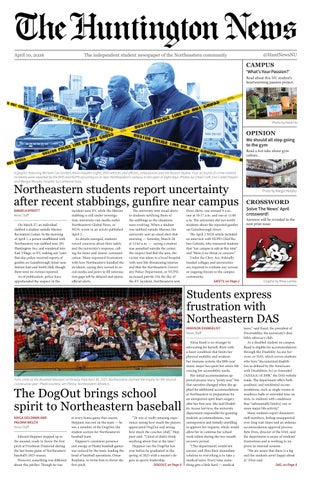
On March 27, an individual stabbed a student outside Marino Recreation Center. In the morning of April 1, a person unaffiliated with Northeastern was stabbed near 291 Huntington Ave. and wandered into East Village, or EV, seeking aid. Later that day, police received reports of gunfire on Gainsborough Street near Stetson East and Smith Hall, though there were no victims reported.
As of publication, police have apprehended the suspect in the
incident near EV, while the Marino stabbing is still under investigation, university-run media outlet Northeastern Global News, or NGN, wrote in an article published April 2.
As details emerged, students voiced concerns about their safety and the university’s response, calling for faster and clearer communication. Many expressed frustration with how Northeastern handled the incidents, saying they turned to social media and peers to fill information gaps left by delayed and sparse official alerts.
The university sent email alerts to students notifying them of the stabbings as the situations were evolving. When a student was stabbed outside Marino, the university sent an email alert that morning — Saturday, March 28 at 12:43 a.m. — saying a student was assaulted outside the center, the suspect had fled the area, the victim was taken to a local hospital with non-life-threatening injuries and that the Northeastern University Police Department, or NUPD, increased patrols. On the day of the EV incident, Northeastern sent

Staff
Edward Heppner stepped up to the mound, ready to throw the first pitch at Friedman Diamond during the last home game of Northeastern baseball’s 2025 season.
However, something was different about this pitcher. Though he was
at every home game that season, Heppner was not on the team — he was a member of the DogOut, the student section for Northeastern’s baseball team.
Heppner’s consistent presence and energy at Husky baseball games was noticed by the team, leading the head of baseball operations, Omar Rouhana, to invite him to throw the first pitch.
“[It was a] really amazing experience seeing how much the players appreciated DogOut and seeing how much the coaches [did],” Heppner said. “I kind of didn’t think anything about that at the time.”
Heppner ran the DogOut last year before he graduated in the spring of 2025 with a master’s degree in sports leadership.
‘What’s Your Passion?’ Read about this NU student’s heartwarming passion project.

We should all stop going to the gym
Read a hot take about gym culture.

three alerts: one around 9 a.m., one at 10:17 a.m. and one at 11:08 a.m. The university did not notify students about the reported gunfire on Gainsborough Street.
The April 2 NGN article included an interview with NUPD Chief Ruben Galindo, who reassured students that “our campus is safe at this time” and “there is no threat or concern.”
Under the Clery Act, federally funded colleges and universities are required to evaluate any serious or ongoing threats to the campus community.
Solve The News’ April crossword!
Answers will be revealed in the next print issue.

leave,” said Rand, the president of Diversability, the university’s disability advocacy club.
Alexa Rand is no stranger to advocating for herself. Born with a heart condition that limits her physical mobility and weakens her immune system, the fifth-year music major has spent her entire life voicing her accessibility needs.
Her initial accommodation approval process was a “pretty easy” but that narrative changed when she applied for additional accommodations at Northeastern in preparation for an unexpected open heart surgery after her first year. She said Disability Access Services, the university department responsible for granting students accommodations, was unresponsive and initially unwilling to approve her requests, which would allow her to continue her school work online during the two-month recovery period.
“[The department] would not answer, and then their immediate solution to everything is to take a medical leave. Every time something gets a little hard — medical
As a disabled student on campus, Rand is eligible for accommodations through the Disability Access Services, or DAS, which serves students who have “documented disabilities as defined by the Americans with Disabilities Act as Amended (ADAAA) of 2008,” the DAS website reads. The department offers both academic and residential accommodations, such as single rooms in residence halls or extended time on tests, to students with conditions that “substantially limit[s] one or more major life activity.”
Many students report dismissive staff members, feeling unsupported over long wait times and an arduous accommodation approval process. Kyle Droz, director of the DAS, said the department is aware of students’ frustrations and is working to improve its internal systems.
“We are aware that there is a lag and the students aren’t happy about it,” Droz said.
They must determine if a “timely warning needs to be issued to all staff and students,” according to the Clery Center. If there is an immediate safety or health risk to the campus community, campus officials “may issue an emergency notification.” In light of these events, many students took to social media to voice their fears. Some students turned to online platforms, namely Sidechat, an anonymous social media app also known as Yik Yak, to disseminate information.
“I hear about [events like this] more from my friends and on Yik Yak than anything,” said Thy Luong, a first-year behavioral neuroscience major.
Some students called for the university to take more action following the stabbing incident.
“I feel like [Northeastern] should have been more comforting. They should have given us time to pro-
off for the students who actually saw it,” said Benjamin Lobo, a firstyear business administration major. Lobo said he found out about the stabbing near EV through a friend’s Snapchat story.
Northeastern media relations did not respond to a request for comment about students’ safety concerns after the stabbings.
Kaile Tom, a third-year health science major, said she also found out about the stabbing near EV through peers before receiving any official confirmation from Northeastern.
“I found out way before any emails were sent out about the situation, which is a little bit concerning, because a lot of rumors can spread that way instead of having the university themselves confirm all the information,” Tom said.
Charlie Hauck, a first-year political science and business administration combined major, found out about the
he was safe. Others encountered the news through social media posts.
“In the email they said it wasn’t Northeastern’s campus, but in reality, it was on a road right there,” Hauck said. “They need to be more clear with students in addressing problems rather than brushing them away.”
In the email alert to students around 11:08 a.m. April 1, the university stated that the stabbing incident near EV “did not take place on Northeastern’s campus” and advised students to avoid the area while police responded. The stabbing incident took place 0.1 miles away from EV, according to a Huntington News analysis using Google Maps.
College campus safety has been in the spotlight since the December mass shooting at Brown University. A survey conducted by The News in March found that 84.4% of Northeastern students are unfamiliar with

In the aftermath of the incidents, students around campus are focusing on taking precautions. In its alerts, the university advised students to plan their walking
“I’m not going to walk around alone at night,” Vraj Patel, a fourthyear political science and economics combined major, said. “And [I’ll] be more aware of my surroundings

MARGOT MURPHY
It’s an unassuming black cube. With six sides of solar panels, dense wiring, circuit boards and a tape measure as an antenna, the satellite fits in the palm of your hand.
Despite this, it’s taken three years of contracting, development and teamwork to build, and on April 10, it’s being launched into space.
The Northeastern Satellite Laboratory, or NSL, will be launching its first CubeSat — a low-cost nanosatellite — into low Earth orbit alongside a resupply mission for the International Space Station, or ISS, from the Cape Canaveral
University, University of California, Santa Cruz, California State Polytechnic University, Pomona and Mt. San Antonio College to build a constellation, or a collection of CubeSats, called the Pleiades Five. These university CubeSats will be deployed together from the ISS and orbit the globe for a year before returning to Earth.
“I think one thing that CubeSat really puts into perspective is the actual stakes of [CubeSat development and launch],” said Ganesh Danke, a fourth-year computer science major and president of NSL.
Northeastern’s CubeSat, dubbed Pleadias-Atlas, will test a student-developed intra-satellite con-

Space Force Station in Florida. The project is in collaboration with NASA’s CubeSat Launch Initiative, or CSLI, grant, which gives college students the opportunity to develop a working satellite and get hands-on experience with space exploration.
The NSL has been working with Columbia University, Texas State
stellation communication algorithm and try to take a relatively clear picture of Earth before returning to campus a year after launch.
The project began in 2023, when members of the AerospaceNU club submitted a proposal for the CSLI grant. After it was granted, some students from AerospaceNU interested
in working solely on the CubeSat project started their own club: NSL.
Thus, the newly born, nearly 50-member CubeSat team joined the Pleiades Five and started creating models using the program’s PROVES CubeSat kits.
The Pleadias-Atlas registers as a 10 x 10 x 10 cm, or 1U, satellite, the smallest available CubeSat. The main parts of the satellite consist of solar panels, an internal battery regulator, printed circuit boards, or PCBs, and a Sony Spresense camera.
Despite its small size, the Pleadias-Atlas requires intense coding, electrical configuration and engineering. To conquer it, the NSL team is organized into four sub-groups: software, mechanical, electrical and simulation.
The electrical and mechanical teams worked on creating sound wiring and structure, respectively. The software team spearheaded the coding that will allow the satellite to correctly orient itself and communicate with the constellation’s other CubeSats, while the simulations team gathered data by running mock experiments to ensure the Atlas’ mission success.
Soldered into the PCBs are sym bols representing the Pleiades Five teams and PROVES Kit. Hidden between this important labeling and branding lies some of the team’s favorite memes and inside jokes.
“When people make PCBs, they love to use the extra space to put some random drawings on it. It’s part of the PCB culture,” Teixeira said.
Among the symbols are the astronaut “always has been” meme, a PDF icon titled “bee_movie_script. txt,” a line reading, “This is where the magic happens,” and nods to the film “Everything Everywhere All at Once.”
Aside from the programming and construction, Danke explained that for a satellite to launch, it needs to have reliable parts for its many prototypes, but tariffs proved to be a roadblock. In April 2025, President Donald Trump enacted “Liberation Day” tariffs, adding 10% to 25% tariffs on many countries, which have increased prices on goods including lab equipment and microchips. For NSL, the tariffs affected the price of electronics for the Atlas and its supplementary elements. Similarly, PCBs made overseas also rose in price exponentially, resulting
to spend less on support and testing equipment in favor of purchasing more expensive items.
After creating and testing multiple prototypes, the team packaged the Atlas and sent it for vibration and temperature testing to a private company — Voyager — in Houston, ensuring that the model could operate under harsh space conditions. Now, the Atlas resides in Florida, where it will be launched.
While waiting for the final countdown, the NSL team began to accelerate the development of a ground station on the roof of Hayden Hall, which will act as an Earth-bound

loosen risk tolerance, choosing
KAYLA GOLDMAN, NIAZ ALASTI, LIAM KARAMANOGLOU
City Editor, News Staff, News
Correspondent
More than 150,000 people packed into Boston Common March 28 to protest President Donald Trump in the third wave of worldwide “No Kings” protests.
According to the “No Kings” website, more than 8 million people attended more than 3,000 associated demonstrations across all 50 states and abroad in what organizers claimed was one of the nation’s largest single of day protests in history.
Organizers said the “day of action” was held to condemn several Trump administration policies, including perceived attacks on freedom of expression, the ongoing war in Iran and the aggressive deployment of Immigration and Customs Enforcement, or ICE, officers.
The Boston protest featured a diverse lineup of speakers and performers who took to the stage near the corner of Beacon and Charles streets. Massachusetts Gov. Maura Healey, U.S. Sen. Ed Markey and Marcelo Gomes da Silva, the Milford teen who was detained by ICE last year, delivered speeches before a performance by Celtic punk band Dropkick Murphys.
“The American Revolution started right here across the Common,” Markey told the crowd. “The Civil Rights Movement, the Freedom Riders, they started right here on Boston Common. They were knocked down,
they were not knocked out, they got up, they fought and they won.”
Organizations set up dozens of “action tables” around the Parkman Bandstand, where spokespeople from various activist groups galvanized support. Massachusetts resident Parmelee Eastman hosted the table for the Indivisible Massachusetts Coalition, or IMC, an organization that aims to support democracy. Eastman said she campaigned for Hillary Clinton in the 2016 presidential election, and after Trump won, she decided to join IMC to stand up against him.
“I feel very good with IMC. We’ve been very successful,” Eastman, who represents Massachusetts’ second congressional district in IMC, said. “We’ve doubled in size since Trump was reelected. I’m leveraging my expertise by finding people out here and introducing them to local organizing groups, which feels amazing.”
Many protesters came out in droves with flags, signs, t-shirts and costumes condemning the Trump administration. Sarah Caiazzo Pyke, a youth advocate based in North Central Massachusetts, donned the red robes and white bonnet of a Handmaid from Margaret Atwood’s dystopian novel “The Handmaid’s Tale” to raise awareness about the survivors of the rape and sex trafficking ring orchestrated by Jeffrey Epstein, who reportedly had a close friendship with Trump.
“Me personally, I’m a survivor, and the effect of watching your extended family or just people in your
community treat Epstein survivors that have gone through horrific, devastating crimes like it was nothing, it’s devastating,” Caiazzo Pyke said. “I want to bring some closure and comfort to those people who have gone through so much, because they’re not alone.”
Just below the Soldiers and Sailors Monument, more than 100 pairs of girls’ shoes and 13 pairs of combat boots were displayed across the grass to honor those who have lost their lives in the U.S. and Israeli bombings in Iran.
“It brings the war home to people. You look at these little shoes, and
it can be your kid, your grandkid, and it makes it real to them. It’s not just about dollars and explosions, it’s about people’s lives,” said Bahar Sharafi, a member of the National Iranian American Council’s Massachusetts chapter and an organizer of the traveling exhibit, titled “Eyes Wide Open: The Cost of War.”
Sharafi emphasized the importance of continuing protests and getting the attention of elected officials.
“I just want Americans to be on the streets and create enough disruption that this administration feels enough pain to change its course,” Sharafi said.

A protester holds a sign reading, “I still love you America, I’m just very disappointed.” Attendees brought custom-made costumes, signs and flags to the protest.
Every winter in Boston, when the Green Line screeches like a banshee after a 20-minute delay and the oncewhite snow turns to grey mush, one can begin to question: Why live here?
Compared to sunny Los Angeles or the concrete jungle of New York City, Boston often feels next-best — cold and, well, a bit dull.
Despite their grievances, many of the city’s long-term residents may enjoy complaining about Beantown but, ultimately, take immense pride in being Bostonians.
Dan Kennedy, a Northeastern journalism professor and alumnus who has lived his entire life in or around the area, recalled a very different Boston from the one he knew when he graduated in 1979.
“I lived on Beacon Hill. Believe it or not, there was a cheap side of Beacon Hill back then,” Kennedy said. “It was a cheap apartment with cockroaches.”
Since 1970, Boston has gained over 30,000 new residents. As demand increases, so does rent. More than half of renters in the greater Boston area are rent-burdened, spending over 30% of their income on housing. New construction permits have also dropped 44% since 2021.
“Building-wise, the bones are the same, but it was a more rundown and dirty city than what it is today,”
Kennedy said. “I don’t like all the money that has come in … When people say, ‘Oh, Boston is so much nicer than it used to be’ — It is, but that comes with a cost.”
Angel Amaya, a fourth-year computer engineering major at Boston University, or BU, who was born and raised in East Boston, fondly remembers summers spent playing in city parks and carries a deep appreciation for East Boston’s Latino community.
“There’s a very small Latino community in Boston, but they are in East Boston, that’s for sure,” Amaya said. “[East Boston] was a lot more unified back then. Gentrification happened.”
According to ¡Avancemos Ya! research, Latinos in Boston face greater levels of economic oppression than Latinos nationally, and that weight is only made more crushing by the staggering housing crisis.
Rental discrimination runs rampant in Boston, income segregation has increased over the past 40 years and the city consistently ranks low on cross-group exposure despite being a diverse metropolitan area.
“One thing that does not make me proud at all is that we always have the reputation of being the most racist city in America,” Kennedy said.
In 2022, Massachusetts ranked second in the nation for white nationalist propaganda activity, and it remains among the most segregated cities in America.
To infuse cash into local economies, long-term residents remain advocates for their neighborhoods. Citywide intentional, co-housing communities, such as Cambridge Cohousing and the Millstone Co-op, combat unaffordable housing, and community organizing has led to new living facilities, such as the Maria Sanchez House in Mission Hill. The Boston Public Market, Open Streets festivals and other free public events support local businesses and help financially challenged community members not only stay in Boston but also enjoy what it has to offer.
For example, Boston ranks first in quality of public schools in the nation and second in safety.
“When you are a resident of Boston, you have access to the best public schools in the country,” Amaya said.
Although residents have complaints about public transit, the MBTA was ranked first in the country for accessibility, reliability and functionality. “As much as we all mock the MBTA, we really do have a good public transportation system,” Kennedy said.
Boston is also ranked sixth among the top 10 most walkable cities in America.
Whether you’re on Beacon Hill’s cobblestones or the Freedom Trail, there’s plenty of green space to decorate routes — the Emerald Necklace connects 1,100 green acres and waterways, spanning nine major parks
Boston City Council passes resolution against ICE in Boston Airport
Boston City Council passed a resolution with a 12-1 vote April 1 demanding Immigration and Customs Enforcement, or ICE, agents not be deployed at Boston Logan International Airport to staff vacant Transportation Security Administration, or TSA, positions amid a partial government shutdown.
Councilors Miniard Culpepper, Julia Mejia and Brian Worrell co-sponsored the resolution, demanding the Department of Homeland Security ensure the TSA retains responsibility for airport security.
“This is a message from the Boston City Council to ICE: Don’t you dare come to our airport,” Culpepper said at the council meeting. “The presence of ICE agents at security checkpoints would create fear, confusion and distrust … and will deter people from traveling altogether.”
This comes after President Donald Trump ordered ICE agents to 14 major airports across the country March 23 to assist the TSA. About 50,000 TSA workers have gone unpaid since the partial shutdown began Feb. 14, resulting in staffing shortages and long wait times; however, a March 27 memorandum resumed TSA pay.
Mike Gayzagian, president of the New England TSA officers union, said in a March 23 statement that ICE would not be deployed.
“Even with TSA employees coming back to work now they’re being paid … I send a clear, unified message: Boston stands for dignity, inclusion and the fundamental belief that everyone belongs here,” Culpepper said.
across Boston, including the beloved Boston Common.
Nicoleta Savvidis, a fourth-year health science major at Northeastern, born and raised in West Roxbury, said “Boston is a small city, a quieter version of New York.” Quiet as it is, she added, “People complain about how there’s nothing to do in Boston, such bad nightlife, but you have to look in the right places.”
Boston wouldn’t be Boston without the more than 44 colleges and universities that call it home, including high-profile institutions like Harvard University and the Massachusetts Institute of Technology. According to the City of Boston’s 2025 Housing Report, more than 162,000 students enrolled in Boston-based undergraduate and graduate programs in fall 2024.
Many students are “city transplants,” struggling through four brutal winters, then running for the hills after they graduate with a degree. Even with this annual mass exodus from the city, new students are moving in to take their places at higher rates than Boston’s housing can keep up with. Universities like Northeastern are receiving record applications, and enrollment rates have increased for seven consecutive years.
Despite Boston’s flaws and bitterly cold, seemingly eternal winters, “There’s a lot of life to be lived here,” Amaya said.
Northeastern students demand answers after string of violent crimes near campus
Dozens of students gathered outside Marino Recreation Center at 1 p.m. April 6 to voice dissatisfaction with Northeastern’s communication following several recent violent crimes around campus.
The demonstration, organized by students, called for increased transparency from the university’s administration regarding campus safety policies. Several student leaders gave speeches criticizing the university for its response, which they said failed to provide timely or detailed information about the crimes.
The protest came just two days after Boston police fatally shot a suspect likely experiencing a mental health crisis after they stabbed first responders inside an apartment building on Hemenway Street April 4. Northeastern students received one alert at 11:57 a.m. stating there was police activity reported in the area.
The incident was the latest of a string of alleged assaults, including a stabbing near East Village the morning of April 1 and reports of shots fired on Gainsborough Street later that evening. On March 27, a student was stabbed outside Marino.
‘What’s Your Passion?’ This Northeastern student wants to know.
LAKSHAY VERMA
Correspondent
The number 100 has followed Cooper Rivard his entire life. His high school had 100 students in each grade, and in his first year at Northeastern, he set a goal to make 100 friends. So when he realized there were 102 days left until his graduation, he knew that once the countdown reached 100, he would finally launch the project he had been thinking about for nearly a year.
On Centennial Common, he set up a chair, a camera and a microphone and started asking students one question he believes nobody asks enough: “What’s your passion?”
“I wanted to create a platform that allowed students to express themselves,” Rivard, a fourth-year data science and mathematics combined major, said. “I really love when somebody tells me that their passion is the little things, or their passion is being a good big sister. Just things that embody what it is to be a human and to share love with others.”
Rivard grew up in Encinitas, a suburb outside San Diego, where he attended Pacific Ridge School. During high school, he was involved in very few activities, which he decided to change at Northeastern.
“In high school, I basically did nothing. I played volleyball and that
was kind of it,” Rivard said. “But when I got to college, I realized that’s not what I want to do anymore. So I completely [did a] 180 and now I do everything.”
The shift was immediate. On his
This instinct to connect with people never left him. Four years later, with graduation looming, Rivard turned this impulse into something a lot bigger than himself.
“It started almost a year ago. I was
For around an hour and a half each day, Rivard sits on the edge of Centennial Common waiting for strangers to stop.

“My dad [was] like, ‘Do you want to sit with me?’ I was like, ‘No, I don’t. I want to go make some new friends,’” Rivard said. “So I turned around and I pointed at a person and said, ‘I’m going to go sit with that person.’ That person was the first person I ever talked to at Northeastern, and he is still one of my closest friends to this day.”
Rivard’s setup is simple: two adirondack chairs, a camera, a microphone and a colorful handmade sign. The sign was designed with the help of his collaborator Jane Gullason, a fourth-year business administration and economics combined major who helps run the “What’s Your Passion” social media accounts.
When they started the project, Rivard and Gullason’s initial goal was to complete one interview a day, totaling 100 by graduation day. But over the past couple of months, the project has gained more traction than they anticipated. Already, they have uploaded 120 videos to the whatsyourpassion_neu Instagram account, which has 704 followers as of publication.
“When I got my first interview, it was awesome. I was so excited. I was like, ‘If this is the only one I get today, I don’t care,’” Rivard said. “The most I’ve gotten in a day is seven. I never expected it to grow this much.”
Students now stop and wait in line to speak to Rivard and sometimes walk by whispering about him, not realizing that he can hear every single word.
While Rivard and Gullason do some minor editing, including cuts between close ups and wide angle shots, the one thing Rivard refuses to remove is what people say.
“Originally, I wanted to edit down the videos so that each one was 45-60 seconds, something short form,” Rivard said. “If somebody comes up and tells me about everything they love, I shouldn’t be the one to say, ‘That wasn’t a good part of it,’ and cut it up. So I decided I’m keeping everything.” Throughout the project, Rivard has kept his own passion a secret but said he will reveal it on graduation day.
“The main reason why I don’t want to reveal my passion is that I wanted to keep it as a little surprise,” Rivard said. “I would say people can have multiple passions. So I guess my answer is I have two passions. One will be a secret, and the other is [running What’s Your Passion].”
For Rivard, What’s Your Passion was never just about building a following on social media or counting the number of interviews. It was about something much simpler.
“If you have the opportunity, talk to people about their passions,” Rivard said. “If you know somebody’s passion, then you’re more able to help them achieve that goal. So just talk to people about their passions. Find out what they love.”
Deputy Campus Editor
More than 100 people filed into Boston City Hall March 23 as community members testified about an alleged lack of transparency among Boston’s higher education institutions, particularly at Northeastern.
The three-hour hearing consisted primarily of 28 public testimonies that centered around Northeastern’s administrative transparency, including its rebranding of the Office of Diversity, Equity and Inclusion, or DEI, last January and the role of student representation and influence in university policy decisions.
City Councilor At-Large Julia Mejia, chair of the city’s Committee on Education. The hearing opened with statements from a panel of three members of Northeastern’s community.
“[Universities] are sustained by millions of dollars in uncollected property taxes, access to public grants and, critically, participation in federal student aid programs which allows them to collect federally-backed student loans,” said Kyle Beltramini, a senior research fellow at the academic excellence non-profit American Council of Trustees and Alumni, during the opening panel.
“This public support hinges upon a promise that they are going to do
Vice President of City and Community Engagement John Tobin were invited to the hearing, but neither were present.
“Our reporting indicates that presidents of Boston University, Emerson [College] and Boston College have sat down with their [student newspapers] in the past two years, sometimes several times in the past year,” Spatz said in her five-minute testimony.
The third panelist, Northeastern professor of philosophy and affiliate professor of law Adam Omar Hosein, spoke about Northeastern’s duty as a higher education institution to encourage democracy among its students.
munication studies combined major and co-president of the Northeastern Black Student Association.
A few students and professors from Boston University and Suffolk University also gave public testimony, offering remarks about their respective institutions.
In a March 24 statement to The News about the hearing, Vice President for Communications Renata Nyul said the university encourages students to make their views known.
that’s from my experience. But even more so for international students.”
The second panel featured four speakers who detailed legislation passed by Northeastern’s Student Government Association, or SGA, that calls on the university to include more student voices in university decision making. Dylan Lee, a fourth-year data science and economics combined major and SGA’s executive vice president, was one of the testifying panelists.

“It’s crucial that universities remain committed to the democratic mission and retain their independence from those political forces that would seek to suppress that mission,” Hosein said.
“Northeastern’s administration admires the passion of our students, who clearly care deeply about their university,” Nyul wrote. “Their advocacy makes Northeastern stronger. We encourage our students to take advantage of the multitude of channels — both formal and informal — to express their views.
A passionate student body is one of the hallmarks of a great university.”
“SGA collaborates with the Northeastern administration, who have the real power to enact change, but our model with them is a reactive, not a structural one,” Lee said. “Students hold no guaranteed seat at the decision making table.”
E. Aoun. Aoun and
Following the panelists’ remarks, the hearing opened testimony to the public. Several students of color raised concerns regarding the rebranding of the university’s DEI office to the Office of Belonging. More recently, in January, the university cracked down on the operating hours for the John D. O’Bryant African American Institute.
“Research regarding DEI has been cut. Terminology for DEI is also considered a threat to institutional funding, and I’ve been kicked out of our cultural center multiple times now because of newly enforced hours for safety concerns,” said Phylicia Dias, a third-year music and com-
Others expressed concerns about Northeastern’s immigrant and international student communities amid the surge in Immigration and Customs Enforcement, or ICE, activity in Boston and nationwide. Leo Ansari, a second-year political science major whose family emigrated from Iran in the 1980s, called on the university to create a policy that would protect international students if ICE agents came to campus.
“Their dream was for me to come here, join one of the prestigious academic universities here and be able to express my beliefs freely,” Ansari said of his family. “Northeastern does not support [that] dream in anything, and
Mejia announced her plan to file a resolution with the Boston City Council which states that “higher education institutions need to do a better job at listening to their staff, students and faculty.” She also proposed continuing to work with Northeastern students and Boston residents to create a community oversight panel.
“I was really inspired trying to figure out a pathway because the city government has very limited powers over private institutions,” Mejia said in an interview with The News following the hearing.
Editor’s note: Emily Spatz, the editor-in-chief of The Huntington News, testified at the March 23 hearing and was not involved in reporting or editing this article.
The sun is dying. The stars are dying. Soon, Earth will be dying, and you are tasked with saving it.
In a world burdened by existential dread and heavenly crises, “Project Hail Mary” rockets audience members’ fears out of the stratosphere with refreshing cinematography, comedy and a call to believe in humanity.
“Project Hail Mary” is based on a 2021 novel by author Andy Weir, a science fiction writer, and was directed by Phil Lord and Chris Miller. This is the second book‐to‐screen adaptation for Weir, whose 2015 film “The Martian” won multiple Golden Globes and a People’s Choice Award. The must-watch speculative sci-fi film premiered in theaters March 20, becoming a box office hit and grossing over $80.6 million that weekend.
The film follows middle school teacher Ryland Grace (Ryan Gosling) as he wakes up alone on a spaceship with no memories of his name, life or reason for being there. Slowly, his amnesia wanes to reveal that he was recruited by Eva Stratt (Sandra Hüller) on a suicide mission — a “Hail Mary” — to find out why the sun is dying and how to save Earth from mass extinction.
While researching the Astrophage,
an unintelligent alien organism siphoning the sun’s energy, and one star’s perplexing immunity to it, Grace encounters Rocky (James Ortiz), a rock-spider-like alien who traveled millions of light-years for the very same goal.
Book lovers will be excited to see the near-accurate onscreen portrayal of “Project Hail Mary,” with only a handful of differences: an additional room in the spacecraft, a few missing moments and a shift in Grace’s characterization.
Gosling’s performance as Grace is overtly cowardly, a direct contrast to his initial noble portrayal in the novel. Grace is socially awkward and fearful. But his sardonic wit and overwhelming stress make the character feel real and relatable. While watching, the audience easily laughs at Grace’s quips and grows silent when he navigates life-or-death scenarios.
The most compelling portion of the film is the onscreen chemistry between Grace and Rocky. The duo’s jokes, personalities and insatiable love for science mold into an unlikely friendship. Their shared sense of responsibility and desire to save their respective populations not only inspire each other but also reinforce their belief amid adversity.
Rocky was not just an interaction between a blue-suited, polka-dotted Ortiz and Gosling but a mix of pup-
petry and animatronics. The directors, producers and “Project Hail Mary” team took extra care not to use any green or blue screens in the creation of the movie. The Hail Mary spaceship and other set pieces similarly use no CGI, prioritizing the use of in-camera effects for striking scenes.
Fully-built sets and VFX creation have become a rarity in the majority of blockbuster productions. Many critics complain that recent movies’ post-production modifications are bland and unrealistic, and film fans are increasingly picking up on a flat, washed‐out style they call “Netflix lighting.” With its dedication to artistry, “Project Hail Mary” is a palette cleanser.
As the name implies, “Project Hail Mary” features slight religious undertones that are emphasized by Daniel Pemberton’s masterful score. Pemberton is best known for his work on the “Spider-Man: Into the Spider-Verse” accompaniments, but he completely transforms his style to weave awe into the film.
Pemberton intertwines sonic sound design with an enchanting chorus and organ to add to the larger-than-life plot of the film. Plucky strings in comedic interactions, sonified “hallelujahs” and low choral baritones in tense scenes compliment the film’s overarching theme of belief — not in God, but in each other. Miller and Lord are no strangers
to stories of belief; one of their bestknown films, “The Lego Movie,” has an overarching theme of belief in oneself. But Miller, Lord and Weir take “Project Hail Mary” a step further by advocating for a belief in one another and finding the bravery to persist in spite of challenges. As the utilitarian head of the Astrophage task force, Stratt is an antihero and nearly a villain in the story, but she does not give up on Grace nor Project Hail Mary’s possible success. Stratt’s perseverance against the momentous odds sows a feeling of trust.
In a world of political turmoil, food insecurity and climate change,
where fear and dread abound, it’s easy to distance ourselves to avoid discomfort, much like how Grace distances himself (sometimes by light-years) from Earth’s crisis in “Project Hail Mary.” But despite the inherent fear, Grace finds the bravery to continue his mission through his belief in Stratt, the scientific community and especially Rocky.
“Project Hail Mary” asks audiences to acknowledge that although we may be miles away from a problem and years away from a solution, we should look for connection, trust our dedication to creativity and always believe in each other in defiance of it all.

Review: Literally everything happens in Mitski’s
‘Nothing’s About to Happen to Me’
GRACE PHILLIPS
Deputy Lifestyle Editor
After a three-year hiatus, Mitski is back — and she’s now a Gothic homeowner scampering around on all fours, shattering milk bottles, sucking blood, surviving a home invasion by Victorian carolers, sobbing, sticking her tongue out, making out with someone (maybe a caroler), killing a man in a beret, partying and possibly witnessing a virgin sacrifice. Or, at least, that’s what she’s up to in the music video for “Where’s My Phone?”
Under the guise of a story about a God-awful breakup, Mitski’s new album “Nothing’s About to Happen to Me” is a work of masterful, conceptual art. Counter to the tongue-in-cheek title, this album’s 11 tracks tell an action-packed story about a “reclusive, weird woman living alone in an old house,” Mitski said in an interview with The Current. The heroine mourns a lost love, encounters ghosts, moves to a big city, gets stalked by cats and loses her mind — all while the
small town. With a folksy, slow-driving ballad that culminates in grandiose instrumentals, the natural world blooms into the narrative; Mitski’s belting vocals revere the freedom of solitude, explaining, “In a lake, you can backstroke forever / The sky before you, the dark right behind.” Comparing swimming in a seemingly endless stretch of water to city life, splashes of cars honking, wind whistling and traffic flows underlay the sound, promising that “in a big city, you can start over.” However, as the narrator recalls the smell of an old lover’s soap and laments past mistakes, this promise is immediately complicated and tossed with unreliability — one song in, and the narrator’s grasp on reality is already slipping.
“Where’s My Phone,” track two, is manically upbeat, brimming with rock noise, choir background vocals and self-effacing humor — I mean, seriously, where did she leave her phone? But, as always, there’s more to the story. Hard-hitting lyrics massage a painful knot of loneliness; the narrator confesses: “I keep thinking, ‘Surely somebody will save me’ / At every turn, I learn that no one will.” Projecting unrealized desire onto the darkness above, she supposes that “If night is like you punched a hole into tomorrow / I would f*** the hole all night long.” Reverb at the end distorts a facetious “la-ti-da” bridge, repeating “pa pa pa” with ironic cheer. Mitski certainly knows how to tear your heart out and “yippee” at the same time.

“Cats,” track three, offers a mournful ballad and narrative stepping stone. The
narrator is in a relationship that she knows is ending soon, yet despite this knowledge, she admits, “I won’t leave you ‘cause I still love you / So it’s up to you if you choose to go / In the meantime, sleeping by my side / Our two cats, making sure I’ll be alright.” While listening, the image of the heroine stroking cats in her lap in time with the slow, restrained rhythm marks a new motif for Mitski, whose discography is populated with dogs, notoriously “I Bet On Losing Dogs” from the 2016 album “Puberty 2” and “I’m Your Man” from the 2023 album “The Land Is Inhospitable And So Are We.”
With a cat as the album cover, “Nothing’s About to Happen to Me” plays coyly with the gendered pitting of cats and dogs against one another, weaving in allusions to feminist literature and prioritizing the heartbroken heroine’s interactions with the feline.
“[Cats] love you how they love you, and they do what they want. And I think often cats are demonized for that in a similar way that I think a lot of women maybe are misunderstood for that quality,” Mitski told The Current.
Track four, “If I Leave,” dissipates the joyous facade of “Where’s My Phone” and extinguishes all hope for the relationship that flickered dimly in “Cats” — the narrator is mourning the inevitable dissolution of her relationship, begging, “I couldn’t lose you / How could I lose you?” Even as she rationalizes an impulse to stay — “If I leave, somebody else will find you / But nobody else could see me / Quite as clearly as you” — both the listener and the narrator know the breakup is looming.
Departing from this yearning ballad, the next track, “Dead Woman,” growls with resentment, cutting darker, meaner and more menacing.
The narrator speculates that her lover wishes her dead and would posthumously muse, “‘She gave her life so we could have her in our dreams’ / ‘She gave her life so we could f*** her as we please.’” Imagining attempting suicide to fulfill these wishes, Gothic feminist tropes of the “madwoman” surface alongside archaic images of a drowned Ophelia and that of a more modern Esther Greenwood in “The Bell Jar.” The hammer-like instrumentals are unrelenting, and the entire track feels like a woman’s exhausted, guttural scream, embittered with a society negotiating her worth.
Track six, “Instead of Here,” is reminiscent of Mitski’s 2018 album “Be the Cowboy,” with sorrowful, harrowing vocals isolated within a more stripped-down sound. If the narrator wasn’t at rock bottom before, she’s surely there now, proclaiming, “I’m not here, I’m where nobody can reach.” She is estranged from herself and flirts with a kind of psychic — if not literal — death.
“I’ll Change for You,” track seven, furthers the breakup storyline. Jazzy, weakly up-tempo instrumentals feel like a watery, chin-trembling smile that isn’t fooling anyone. The narrator sits in a bar alone, and the song is overlaid with snippets of glasses clinking, ice-rattling in a cup and soft laughter. After being kicked out of the bar at closing, she speaks aloud to the night sky: “If you don’t like me now / I will change for you.”
Track eight, “Rules,” is a jarring follow-up to this crushing scene. Trumpets sound and Mitski’s voice counts cheerily to five, elaborating in Dua Lipa fashion on a set of dating rules: “Number one: I’ll come over / I’ll be dressed like your best idea / Number two, you’ll be gentle / Then number three, you will ruin me /
Number four: I’m nobody’s anyone anymore / So, five, I’ll be alone for a while.” While summarizing a seemingly banal relationship trajectory — you date, you fight, you break up — the narrator dissociates, asking her ex, “When I leave my body / Please pretend that you don’t see / How I’m no longer there behind my eyes.”
A direct nod to the album cover — an oil and acrylic painting by the artist Marc Burckhardt of a white cat with heterochromia — track nine, “That White Cat,” rears its head with drilling drums resembling pelting rain and belting vocals. It feels as though the narrator has finally snapped, accusing a cat of watching her from the window, “marking my house.” The natural world creeps through the floorboards and the windowsills — wasps, possums, blood sucking bugs and birds join the ghostly cat in stalking her like prey.
The following track, “Charon’s Obol,” references the coins placed on eyelids or in the mouth of the dead to grant their souls a safe passage into the underworld. The narrator feeds the dogs of the other dead girls who lived in the house before her, finding kinship within a long, ancient history of “hysteric” women. The mourning dogs gather like the old dogs haunting Mitski’s discography.
The final track, “Lightning,” begins softly, then flares with the thunderous crash of drums and buzzing electric guitar — aptly reminiscent of a lightning strike. The narrator does not fear the storm or death; in fact, she dreams of reincarnating as the lightning itself and hails “the rain running like ghosts on the roof.” In this poetic end, the narrator transcends her body and house, dissipating into the darkness of the night, reborn.
understood by me whenever I was put in those positions.
When Ariana Borromeo arrived at Northeastern in 2022, she had no plans to work in music. She was a first-year political science major, fresh off a semester abroad in N.U.in Germany, browsing the club fair. Then, she saw the table for Green Line Records, the university’s student-run record label, and something clicked.
Within weeks, she was managing a project for a local punk band, and, as she puts it, “faking it till [she] made it.” Three years later, Borromeo is the president of Green Line Records and independently manages rising pop artist Beno. She changed her major to music before the end of her first year and never looked back.
“It’s a very communal type of scene. I really fell in love with Boston’s music culture at that point,” she said.
Her trajectory illustrates what Green Line Records has been doing
Being co-head was more so on the people-managing side, because I was overseeing the A&R reps, balancing projects and making sure that the reps are getting everything done on our strict timeline by the end of every semester.
Getting to be the president has been even more so on the people-managing side as opposed to the artist-managing side. But because my roots are in working with the artists, I’ve been integrating that at each level. I don’t think I can go without making those personal connections. It has fostered more of a community, knowing that it’s coming from the top-down of everyone getting to know each other. I really trust the rest of my e-board and they are really into this thing, and I think the fact that I am so into it encourages them. It spreads.
HN: Is there a particular artist or project you’re especially proud of?
Borromeo: The artist I manage

Northeastern music scene. They’re underrated. I didn’t know about it until I got here and made the decision to be one of them. Within the

attention than it gets.
In a Q&A with The Huntington News, Borromeo spoke about her unlikely path into the industry, what makes Boston’s music scene special and why the best thing aspiring music professionals can do is just start.
This interview has been edited for length and clarity.
The Huntington News: You went from an Artists & Repertoire (A&R) representative to A&R co-head to president. How did each role shape the way you think about the work?
Ariana Borromeo: I was an A&R rep for two semesters, where I was just a member of the club and learning the ropes on what any of this means, just faking it until I made it. It’s how you get into the industry, really — just exposing yourself. I realized that I was good at communicating with artists, and they felt
own drive. I think it is important for artists you work with to have their own visions, ideas and plans for their music that you can help them execute as opposed to coming up with it for them.
I’m proud of the way that our work developed organically into something that I think will continue after graduation, and it’s a growing relationship with him and his band. The fact that I’ve been able to ex tend that project, and the trajectory it’s going now, is really great.
HN: Boston has a lot of colleg es and emerging artists, but it doesn’t get the same national attention as New York or Los Angeles. What makes the scene here unique?
Borromeo: Obviously, it’s a hub for a lot of creative people, spe cifically in music, with Berklee [College of Music] and even the
selves in it, giving
potential, so they can get to a point where they get signed and work with other people who they really mesh with. It’s an environment for mutual growth. It’s an even playing field — we’re all in it.
I think it’s also a great way to learn, because when you’re out there in the industry, it can feel like there are people who are so far ahead of you, even if they’re here to work on your project, and it’s intimidating. So I think it subtracts that intimidation and gives a good foundation for people to learn how to work.
HN: Green Line has been around for about two decades. How do you think about carrying on that legacy?
Borromeo: I was thinking about this today because we’re starting to get into the stage of who’s gonna run it next year. People have different visions of what Green Line is, and I think after COVID-19, this type of model was kind of lost. But I think we brought it back with the artists that we’ve been signing and with the attention that we’ve been getting from the local scene. That’s why it matters a lot to me. We’ve really upped it in the past couple of semesters.
it on. The stuff that we do fosters a certain type of community, and it attracts a certain type of person, so I don’t doubt that more people will come in who have the same type of energy. And everyone I meet who’s a part of Green Line is really just a good hang. That’s a thing people say, in the music industry, that the real requirement or baseline is that you’re a good hang, because that’s all it is. It’s just the culture that I think will be everlasting.
HN: For students who might want to work in music but aren’t sure it’s realistic, what would you say?
Borromeo: I would tell them to give it a shot. You can just make things happen in this industry yourself, and that’s hard to realize at the first stage — it’s not like other industries. I’ll say it again, fake it till you make it. I’ve confirmed that with people who are in the industry; you just have to give things a shot. It’s really learning the ropes, and any artist, I would hope, is looking for help. Green Line is a great way for that — but also, whatever you want to do, like photography, managing,
understand that
work together, you

‘Who let them do this?’: NU
On March 21, after announcing almost six trigger warnings, the lights in Blackman Auditorium faded as apprehensive laughter rose throughout the crowd in anticipation of NU Stage’s spring revue, “Misfits & Mayhem.”
Unlike traditional modes of musical theater, the biannual revue is a no-cut collection of numbers linked in theme rather than by plot. This semester’s was split into two parts: mischief followed by mayhem.
“The way that the NU Stage revue works is we have a one-word central theme that the show and the title and the song list are all born from,” said co‐director Alison King, a third‐year business administration major.
NU Stage members performed 20 numbers, meticulously curated to revolve around the word “freak” and follow a descent into chaos.
With canonically accurate height differences, second‐year international business major Joseph Oltman and second‐year behavioral neuroscience and philosophy combined major Bella Soderstrom opened the show as Gomez and Morticia with “When You’re an Addams,” a pointed song about what it means to be a part of fiction’s oddest family.
“‘Misfits & Mayhem’ is a show about people who don’t really fit in and building connection around that,” King said.
Made possible by the work of more than 130 people, a production like this takes more than just excitement and inspiration to execute.
“We had six weeks of actual rehearsal time for pit, staff and cast to learn all of the music and the blocking,” said co‐director Zoleigh Borg, a fourth‐year human services major. “It was just a crazy whirlwind on such a small, limited timeline, but everything came together remarkably.”
The revue was chock‐full of songs about feeling different but finding community nonetheless, connecting the cast and crew as much as it inspired its audience. And without a clear‐cut narrative structure, the cast bounced between classic and contemporary numbers both above and below the stage, bringing audience members closer to full‐blown chaos with every song.
“Throughout the entire process, everybody was just having a good time. We definitely wanted the audience to feel that joy emanating off the stage,” King said. “But also, we wanted them to feel a bit scared, like, ‘Oh my God, who let them do this?’”
With a repertoire ranging from the “Tangled” ballad “I’ve Got a Dream” to a gender-bent rendition of “Turn it Off” from “The Book of Mormon,” the show set out to highlight how the same things that set people apart can be what brings them together.
“It’s really gay, this show. It’s great. It’s really freaky,” said Olive Lewis, a fourth‐year architecture major and a regular NU Stage attendee.

The pit, led by fourth‐year cell and molecular biology major Jillian Scott and fourth‐year environmental engineering major Julia Ariano, arranged songs of its choosing to continue to evoke the theme of “freak” between numbers. Notably, the Subway Surfers theme blasted in the theatre, which prompted a series of giggles throughout the crowd
in with a spotlight and a whistling flute, a cast member slowly rolled across the curtained stage like a tumbleweed, and out of the pit popped two pianists into a classic Western duel.

from those who recognized it. “I really like all the musical interludes in between each of the songs … I always [get] a laugh seeing what they’re gonna play next,” said Andrew Glorioso, a first‐year robotics engineering major at Worcester Polytechnic Institute.
One of these gripping interludes began the exciting second act. Cued


“I didn’t know what was happening. It was so exciting, and I got to do special lighting for it,” said lighting designer Sam Jamison, a first‐year mechanical engineering major.
For their final number, one cast member walked onto the stage singing the opening solo of “This is Me” from “The Greatest Showman.”
The song built with intensity as the curtains finally dropped to reveal the rest of the cast singing along arm in arm.
“In this kind of current political climate, and also in the chaos of college, I think that a lot of people are stressed, and they need an outlet for creativity and for fun,” Borg said.
“And the revue is sort of a place for people to come together and be a little bit ridiculous.”
Filled with the entire cast from “SpongeBob SquarePants: The Broadway Musical” and “Cabaret” to “The Book of Mormon” and “Freaky Friday,” the final song left audience members with a reminder that sometimes belonging comes when you let your


APRIL 10
MFA Special Event: College Night
5 p.m. - 8 p.m. at the MFA Admission: Free with Husky Card

APRIL 11
Northeastern Symphony Orchestra Spring Concert
6 p.m. at the Fenway Center Admission: Free
Several students told The Huntington News that emails go unanswered by the department’s representatives for weeks. Droz said there are about 350 to 400 students assigned to each specialist at the DAS, including students from campuses beyond Boston.
Francesca Turner, a Northeastern alumna who graduated with a master’s degree in counseling and applied psychology in the spring of 2024, recalled feeling like a “nuisance” to the DAS. Turner, who applied for accommodations to support her autism spectrum disorder and ADHD diagnoses, reported difficulty getting in contact with her DAS representative.
“The hardest part of working with the DAS was just getting to talk to a person. It just felt like I was pulling teeth,” Turner said.
TBA at Fenway Park
Admission: Ticket price may vary

APRIL 18
7
10 a.m. - 5:30 p.m. on Boylston Street Admission: Free to spectate
To get accommodations approved by the DAS, students must submit a series of forms signed by relevant medical professionals detailing their symptoms and the accommodation they want approved. These
forms are then reviewed by two, or more, DAS specialists who determine if the request is approved or denied, Droz said.
“Over the past few years, we’ve done a lot of updating to internal procedures that students wouldn’t necessarily see,” Droz said.
Droz explained that one reason accommodations are not approved is because the request is “not really supported by the documentation” provided in the application. Additionally, college-level accommodations available under the ADAAA differ from those appropriate for kindergarten through grade 12, which fall under Section 504 of the Rehabilitation Act of 1973.
Due to the differences between Section 504 and the ADAAA, the DAS relies on formal diagnosis paperwork or, in the case of a yet to be diagnosed condition, documentation from a medical professional outlining the student’s symptoms.
“I am chronically disabled,” Rand said. “I’ve had documentation on my disability since my birth, so I have the privilege of having those
resources and having doctors who can write those [files] up for me on speed dial.”
Droz explained that the demand for accommodations has evolved during his time at Northeastern. When he began working at the DAS in 2013, Droz said that ADHD and learning disabilities were the most common diagnoses he encountered. Today, he said, the student profiles are more complex with students often having two or three diagnoses.
While students’ needs have changed, Droz said the goal of DAS remains the same: to ensure that students are able to get the accommodations they need.
“We never want to have an accommodation be a reason [why] someone can’t do something or can’t participate,” Droz said. Students say there is a high representative turnover rate at the DAS, leading to frustration when trying to get answers or support. Edith De Rosa-Purcell, a Northeastern alumna who graduated last spring with a bachelor’s degree in behavioral neuroscience, said consistent
changes in personnel caused her to feel “left in the dark.”
“There has also been a lot of turnover in the advisers,” De Rosa-Purcell said. “Pretty much from my freshman year until I was going to graduation, I’d gone through at least three different advisers. I went long stints of time not knowing who my case manager was.”
This high turnover drastically impacted De Rosa-Purcell’s experience with the DAS. While applying for accommodations her freshman year, she felt immensely supported by her specialist, noting that they effectively explained the differences between high school and college-level accommodations. But when her representative left, her positive experience ended.
“I also wish the DAS just had a bit more structure and stability and was more accommodating and welcoming to their students,” De Rosa-Purcell said. “It’s very mentally taxing to be disabled and to have to constantly be the one advocating for yourself, on top of the fact that you may be doing clubs, sports, … co-ops.”
Boston.WBCA broadcasts daily from 6 p.m. to 2 a.m., featuring a diverse mix of local news, current events, talk shows and music.

APRIL 24
APRIL 20 Charles River Earth Day Cleanup
10 a.m. at 41 West St.
In Boston’s vibrant Egleston Square neighborhood sits the Charles J. Beard II Media Center, home to Boston’s community radio station WBCA 102.9 FM.
The station was created as a partnership between local nonprofit Boston Neighbor Network Media, or BNN, and the City of Boston in 2016. The then-Mayor of Boston Marty Walsh praised the collaboration, extending his thanks to BNN “for their partnership with the city to create another platform for civic engagement” in a 2015 press release.
Although BNN is now independent, its partnership with the city helps continue its mission of uncovering the unique culture of
Segments range from discussions on education and technology to multi-language programming and sports. One highlight is the station’s music segments: Through both in-studio performances and recorded plays, the broadcasts give local musicians an open platform to perform for the community they know and love, according to BNN general manager Glenn Williams.
“To break into that realm of being able to be heard, it’s really, really important to make sure that the bands and the people who are performing … do have a place where their music can be heard,” Williams said.
BNN’s mission extends beyond
broadcasts. The organization encourages public engagement in media production through extensive volunteer opportunities, internships and youth programs. Their philosophy is simple: “The most important thing to us is to make sure that you have the opportunity to tell your story,” said Brett Rodrigues, WBCA radio manager.
For students and young creators like Seth Weintraub, a third-year computer science and music student at Northeastern who helps produce the “Music Is Healing Us” radio show, the opportunity to be a part of the radio has been transformative.
the United States. In 2022, the station was awarded the “Overall Excellence in Community Radio” award from the Alliance for Community Media.
“We get international [engagement]. You get people who listen to us all over the place,” Williams said. “We’re a very established radio station.”
WBCA doesn’t just broadcast content, Weintraub added: It builds relationships between people who may not otherwise hear from one another.
“I love that it’s a community radio station — it’s been really nice to connect with people,” Weintraub said. By shaping its programs to bring people together, BNN works organization-wide to bridge the quiet gaps between neighborhoods — something Williams said he deeply values.
APRIL 25 Select Markets
1
1 p.m. - 3 p.m. at Friedman

“Having the ability to work on a radio show has motivated me to create content and sharpen my own skills,” Weintraub said. “It’s pushed me to be more confident about putting my voice out there and sharing my work with anyone who wants to listen.”
Weintraub’s experience reflects the broader mission of WBCA Radio: to create a space where diverse voices are not only welcomed but truly heard and valued.
“I’ve recorded a bunch of stuff in studios and just kind of sat on it, and I was hesitant to put it out there, and this has been motivating for me to push out my work and be confident about it,” Weintraub said.
Along with its initiatives, BNN’s physical facilities reflect its distinct story. The station’s building, which was introduced as its headquarters in 2007, was transformed from an old MBTA power station. BNN kept many of the technological components of the power station when remodeling, turning the interior into a display honoring the Boston community and history.
Despite its low-power FM signal that often fails to reach beyond city limits, WBCA has earned recognition as a top community station in
“It’s so important for somebody in East Boston to be able to hear from someone in West Roxbury,” Williams said.
Rather than competing with major news organizations on mainstream channels, Williams sees WBCA as an entity that provides its own authentic content, allowing locals to feel seen.
“Leave [typical reporting] to [stations] four, five and seven,” Williams said. “Let’s talk about why you’re proud to be a Bostonian. What makes being a Bostonian so groovy?”
This is the question that lies at the heart of the station, and its mission is to elevate citizens’ voices. Williams said WBCA aims to do what many other organizations don’t: comprehensively represent the city’s true attributes and eccentricity.
“This is Boston,” Williams said. “I want to see some people from Southie, I want to see some people from East Boston, West Roxbury, Jamaica Plain, Hyde Park, Roxbury ... Let’s represent the city.”
He took over from Ethan Fasking, a freelance website developer who graduated from Northeastern in 2022 with a bachelor’s degree in computer science and physics. The idea to start the DogOut sparked the night after Northeastern fell to Boston University in the 2022 men’s hockey Beanpot.
“I was ranting and raving about how fun the baseball games are and how I can’t wait for baseball season to start because we had just lost the Beanpot. We got to talking and eventually that spiraled into ‘Wouldn’t it be fun if we had a DogHouse but for baseball?’” Fasking said.
Throughout college, Fasking remained an active member of the DogHouse, Northeastern’s student section for men’s and women’s hockey. Using his DogHouse connections, he was able to gather a group to attend baseball games in Brookline in the spring of 2022.
Graduating the same year the group was created, Fasking let Heppner take the lead.
“I have to give all the credit [to] everyone who came after me,” Fasking said. “I started it up, [but] really what I created was five to seven people who would come out and watch a couple of games.”
Heppner built the program up from the seeds Fasking planted, hoping to create a larger student fanbase for Husky baseball.
“When you go to the games at Friedman, you’ll see a lot of times it is parents, some young kids who are in the area, a lot of scouts. And I just want to see the student body,” Heppner said. “It’s never going to be like it is for hockey, but I want to see the student body show up for this team in the way that they deserve.”
After a year of growth, Heppner handed leadership over to the group’s current co-leaders, Felix Kreis, a second-year marine biology major, and Angelo Bartolomeo, a fourth-year mechanical engineering major. The two joined the group in the spring of 2025.
“A big thing for me is, for incoming freshmen who are baseball fans, they have a couple of options. You can, of course, go to a Red Sox game. We are lucky to be next to Fenway Park, but that can definitely get pricey,” Kraus said. “But you have this really cool option where you can take the Green Line down a few stops, go to Parsons Field and watch a baseball game for nine innings right behind home plate for free, and you can watch them win.”
The Huskies are coming off of a historic 2025-26 season. After winning the CAA regular season and tournament, they advanced to the NCAA tournament, losing to Mississippi State University in the Tallahassee Regional.
The DogOut’s social media presence is one of its key elements, consistently highlighting when and
where games take place. The DogOut also posts live game updates and directs followers to broadcasts where they can tune in, like the New England Sports Network, or NESN.
“I don’t think I’ve ever seen [the Huskies] lose in person. I went to, I think, 20 games or so last year, and they didn’t lose a single one,” said Kieran Smyser, who works in guest services at the Warrior Ice Arena and has been a part of DogOut for two years.
Smyser, whose mom is a professor at Northeastern, has been an active member of the Northeastern sports community. He frequented hockey so often that, in 2021, he was invited to join the DogHouse as a non-student and eventually joined the DogOut, too. Smyser will begin pursuing a degree in communications studies at Northeastern in the summer.
The DogOut’s presence at baseball games does not go unnoticed by the team and its coaches.
“Because the DogOut hasn’t been as active in past years, the team is really excited that they have fans the way that they do right now, and so they gave the DogOut — whoever wanted them — free tickets to the [Louisiana State University] games,” said Lindy Nelson, a third-year political science and communications studies combined major who joined the DogOut in March 2025.
Five members of the DogOut followed the team to Baton Rouge,

La., where it played Grambling State University Feb. 27 and March 1 and LSU Feb. 28 and March 2. The Huskies beat the Gramblers 4-1 and 10-0, lost to LSU 3-1 and then beat the then No. 2 ranked team 13-10.
“[It’s] just awesome. We’re 1,400 miles away from Boston, and you’ve got people coming down to watch us play, which is pretty sweet,” said sophomore catcher Cooper Tarantino.
The team appreciates the DogOut’s support and continued attendance at games.
“[It has] been really nice to watch the work that Edward and now Angelo put into [the DogOut] get rewarded
with almost immediate appreciation from the team itself,” Nelson said.
Aside from hockey, Northeastern athletics is not necessarily known for its lively student sections, but the DogOut is trying to change that.
“I would love for us to have a reputation at some point for being a school in New England that fans show up to, fans are loud at and, in some way, build a reputation that if you go to Northeastern, it’s going to be somewhere you have an atmosphere and you’re not just playing in front of your parents and scouts, you’re playing in front of a fan base,” Heppner said.
Last season, the Northeastern baseball team rose to the forefront of collegiate baseball after reaching No. 19 in national rankings, the highest in program history. The Huskies finished the team. Glavine has led the team to two CAA Championships and four NCAA tournament regional appearances. However, few Northeastern baseball campaigns compare to the historic 2025 season.
“You move on, you don’t even really talk about it,” Glavine said
A .367 batting average, team-leading 18 home runs — tying the team’s single-season stolen bases record at 37 — and 67 RBIs earned him the title of 2025 CAA Co-Player of the Year.
“I have to remember to just have fun, play out there with my
fense, with his arms. So if he’s not hitting that day, then he can beat you in a different way.”
Of course, no one player can do it on their own. And despite losing a large number of the pitching staff to the MLB draft last year, Feinberg has faith in those who remain.
Hailing from North Andover, Mass., Griffin followed in the footsteps of his high school teammate, Sebastian Keane, who turned down playing for the Boston Red Sox to play at Northeastern following his senior year of high school and now plays in the Yankees organization.

Feinberg hits the ball March 22. Feinberg was named to the National Collegiate Baseball Writers Association Preseason All-American Second Team and was listed in the Golden Spikes Award Preseason Watch List at the start of the season.

EDITORIAL BOARD
Editor-in-Chief Emily Spatz
Managing Editors Gitana Savage Annika Sunkara
Editor-at-Large Alexis Algazy Campus
Evangelist
Auden Oakes
Rudnick
Sports
Einset
Siera Qosaj
Janira Skrbkova
Jennie Koh
Opinion Samantha Denecour
Ava Vitiello
Projects
Katarina Schmeiszer Elsa O’Donnell
Photo Margot Murphy Tanvi Saxena
Catherine Gore Katie Mulcahy
Audiovisual Curtis DeSmith
Data
Ismail
Social Media
Daniel Patchen
Catie Nippins
Copy Chief
Sarah Mesdjian
Web Manager Arielle Rabinovich
BUSINESS
Business Manager
Nikolas Lyras
Advertising Manager Emily Liu
Outreach Coordinator
Annelise Dramm
STAFF WRITERS
Zoe MacDiarmid, Frances Klemm, Emily Chung, Bailey Reynolds, Aoife Jeffries, Caroline Baker Dimock, Zach Cohen, Paloma Welch, Emily Rodriguez, Kayla Goldman, Olufolake Okunsanya, Aiden Barker, Laila Guzman Griffin, Elise Peffer, Hir Panchal, Annie Jones, Aadit Ganesh, Gabriel Trajano, Jonathan Winter, Alex Payá, Declan Lane, Niaz Alasti, Annalise Karamas, Emma Shkurti, Daniela Rynott, Chloe Mondi, Blue Tiernan, Yashavi Upasani, Jenny Tran, Nidhi Prakash, Quinn Morgenroth, Ashley Pappas, Sunny Diamond, Simeon Eig, Robby Wolff, Antaine Anhalt, Nora Harr, Honor Seares, Phil Warren, Shreya Pillamari, Taylor Zinnie, Mora Peusner Dacharry, Sana Gandhi, Arvind Chettiar, Heidi Ho
COPY EDITORS
Bowen Rivera, Antaine Anhalt, Kacey McNamara, Lizzie Harrison, Frances Klemm, Christina McCabe, Zoe MacDiarmid, Bailey Reynolds, Ashley Pappas, Claire Hudson, Paloma Welch, Jenny Tran, Nora Harr, Caitlyn Sutrisno, Lea Hendler
DESIGN STAFF
Anusha Sambangi, Natasha Sun, Laila Guzman Griffin, Mayah Hamaoui, Juliana Rodriguez, Mary Dunn, Rhea Lamba, Megan Le
PHOTO STAFF
Hana Dada, Naseem Mohideen, Alana Udell, Ian Dickerman, Niaz Alasti, Heidi Ho, Ray Huang, Eva Ciolek Passeri, Penelope Evatz, Nimo Ren
SOCIAL MEDIA STAFF
Emily Chung, Keira Weitz, Zoe MacDiarmid, Bowen Rivera
MULTIMEDIA STAFF
Dylan Kim, Darshan Balaji, Aaron Wu, Ruthvik Penubarthi
BUSINESS STAFF
Maggie Nahas, Sana Gandhi, Sophia Bonanno
MORA PEUSNER DACHARRY Columnist
The following content is satirical and meant for humorous purposes. It is part of The Huntington News’ recurring satire column, “While Your Ramen Cooks.”
Although American universities have decided to depend on drywall in residence halls because of its efficiency, fire resistance and cheap production, they did not consider privacy or personal space. I believe drywall’s success is merely a fabricated concept, and it is an illusion that drywall effectively separates rooms.
Because I live in university housing, located in the sweet spot between the Berklee College of Music and Northeastern, my building houses students from both universities. Last month, I finally experienced what it means to “break the fourth wall” upon being serenaded by my neighbor at 3 a.m. — after I had gone through a breakup. Only then was I able to realize how much we truly underestimate how powerful music students can be at projecting their voices, even if they’re out of tune.
are being chased by a masked killer based on the way they’re speeding from one room to the other. Or, maybe, the said criminal is forcing them to vacuum, since they do it so often that their life must depend on
them for them to be my lifelong friends. Most of their conversations occur at a volume which seems to imply that they are waiting for my input. I fear I’ve developed a parasocial relationship with them

it. And, from the way they constantly move their furniture around their apartment, I’m left to wonder if I am expressing my decorative creativity to the fullest.
I cannot decide if I prefer hearing their constant singing or loud stomps from the ceiling. I always wonder if my upstairs neighbors
However, my upstairs neighbors’ main hobby is dropping items on the floor. You would think that they are the reincarnation of Isaac Newton, but instead of testing the laws of motion, they are testing my patience.
I have never seen these Berklee students, but I know enough about
after feeling included in their gossip sessions, and now, I hate “Bryan” just as much as they do.
Occasionally I attempt to engage in a conversation with them via Morse code. But instead of using coherent combinations, I prefer loud consecutive bangs on the ceiling. Often it is to express my shock at their unwillingness to stop having loud council meetings late at night or to convince them that objects do not float if you let go of them. One time, I even got
a verbal response back; after banging on the ceiling in an attempt to make them stop dropping their belongings, I was met by a strong “NO!” I knew that it was finally time to take more extreme measures.
My roommate and I decided to come up with a plan. Fueled by exasperation and an intense fear of confrontation, we brainstormed means of communication that do not include banging on the ceiling. We decided that I could finally use my literary talent for something useful: to write a heartfelt letter to them.
I want to inspire everyone being pestered by their neighbors to do the same. Instead of taking undiplomatic measures such as using your swiffer handle against the ceiling, everyone should consider attempting other healthy methods of expressing their irritation, such as writing an informative letter expressing how frustrating it can be living under the same building as them. Keeping a lighthearted tone would be ideal.
Mora Peusner Dacharry is a second-year international affairs and business administration combined major. Mora can be reached at peusnerdacharry.m@northeastern.edu. If you would like to submit a letter to the editor in response to this piece, email comments@huntnewsnu.com with your idea.

What does it mean when a university markets itself as a global, experiential institution while quietly gutting the programs that make this possible?
Northeastern has been doing just that, cutting the College of Social Sciences and Humanities, or CSSH, discretionary funding by up to 75 to 80% while offering negligible explanations to staff and students.
Budgetary plans are usually announced in the spring of the academic year prior. Last spring, staff and faculty in CSSH were left waiting for months. The administration did not share the planned budgetary cuts until August 2025, according to The Huntington News.
Faith McAdam, a third-year philosophy major with a concentration in law and ethics, told me that the sudden nature of the budget cuts “naturally leaves both teachers and students in the department to feel like they’re drowning and that the university is not a helping hand to pull us out of the water.” I couldn’t agree more; not only is it not helping us, they are turning a blind eye to our struggle.
McAdam is currently working as a teaching assistant, or TA, in CSSH. She not only is unpaid for her role as a TA but is paying to do the work.


MA
McAdam said, “I never assumed that I would have to pay for those credits. I’m essentially paying to do this job and getting directed study credits.”
The administration is fundamentally harming CSSH students’ experience at the university. Its lack of transparency is unfair to students who pay increasingly high tuition while their education is being defunded.
As a first-year journalism and political science combined major at Northeastern, I applied and committed to the university with the promise of a robust journalism and humanities department. I was marketed a college with extensive opportunities for outside-of-class learning, guest lecturers
I want to attend lectures and I want to eventually become a TA. The administration has made me, and many students, feel that it doesn’t value what we care about and aspire to. These cuts, coupled with the administration’s intentional silence, have left students and faculty wondering not only what has happened but why. The Board of Trustees has made no comment on the budget. What we do know is that five of these members have donated more than $1.1 million to Republican

and a space to connect with my peers. I feel misled.
I agree with McAdam’s sentiment when she said, “This is kind of a statement from the university that we are not as important of a department as others.”
I want my passions to feel supported by the university I attend. I want to be actively involved on campus,
candidates and right-leaning organizations in the last couple years. I do not see these facts as unrelated.
We should not be content with going unheard. Professors feel threatened by the administration and do not have the means to publicly express discontent. This means it’s on us to show the administration we care about CSSH and we notice what they’re doing.
The opinions the administration really values aren’t ours. It’s those who pay tuition — namely, the parents of Northeastern students. Encourage your parents to complain and demand that the university, at the very least, recognizes the impact of its decisions. We must make this administration understand the consequences of its actions.
One way your parents or guardians can make their voices heard is through Facebook groups. Two prominent groups, each with over 11,000 members, are the Northeastern University (NU) Parent Group and Northeastern University Parents. These groups can be used to express frustration with the administration in a manner that will likely be noticed.
Despite the budget cuts, I have felt CSSH students and staff’s commitment to community and learning. This gives me hope that we will push for the change we need. We will fight to be acknowledged as a vital department worthy of time, attention and money. Let this serve as a reminder to give CSSH staff and faculty extra appreciation and recognize their dedication despite desertion from the administration.
Francesca Siciliano is a first-year journalism and political science combined major. Francesca can be reached at siciliano.f@northeastern. edu.
If you would like to submit a letter to the editor in response to this piece, email comments@huntnewsnu.com with your idea.

ARVIND CHETTIAR Columnist
We should all quit complaining that Marino Recreation Center is crowded and stop going to the gym.
You might be thinking something along the lines of, “How will we stay healthy?” But let me ask you another question: When did “healthy” start meaning “going to the gym?”
The gym, as it exists in popular culture, is less about health and moreabout sculpting bodies to meet certain
aesthetic ideals. You might disagree, but it’s fair to say that if you ask most people why they lift, it’s more about “gains” than it is about longevity. Just ask any gym bro his favorite stretches.
Much ink has been spilled over why the societal obsession with changing bodies is negative, with reasons ranging from eating disorders and body dysmorphia to the harm done by narrowing beauty standards. These critiques are valid. But they don’t explain the root cause of our society’s gym obsession — just the symptoms.
Why does society want us to go to the gym so badly? The answer has less

to do with beauty standards and more about who benefits from you spending your free time grinding out reps.
Going to the gym is a ritual of hyperindividualism. You are often alone, working on perfecting yourself, attempting to achieve the highest level of performance or aesthetics that you can manage. Gym motivation posts tap into this with quips like — “Be stronger than your excuses” or “Be the hardest worker in the room.” Of course, in a vacuum, there’s nothing wrong with willpower, discipline and motivation.
But under capitalism, this type of resilience is a resource to be exploited. The stronger and more resilient we are as individuals, the easier it is for systemic failings to be reframed as personal failings. If you’re burned out, then you must not be tough enough. If you’re unhealthy, then you should be working harder.
The gym is the perfect example of this phenomenon. People, who spend their days at sedentary office jobs, are fed ultra-processed foods and provided with inadequate healthcare. Then, the gym-industrial complex places the responsibility for any lack of strength or health on their shoulders, selling gym memberships and supplements.
We spend our evenings slowly
and solitarily lifting weights, doing remedial work on bodies breaking down under the stress of capitalism. And then we show up for work the next morning. The gym isn’t us taking our personal liberty back and reclaiming our labor for ourselves. It’s unpaid maintenance on a body that someone else profits from.
This is not to say that being healthy is bad, or that we should simply let ourselves waste away. It’s an argument against the current model we’re being sold — isolated, individualistic fitness that has turned self-care into an industry.
If we reject that model, what can we replace it with? Community.
Play sports with your friends, join a fitness club or go for a hike outside in the wilderness. Swim, dance, practice martial arts — do anything that makes you healthier and more connected.
These activities aren’t “just as good” as the gym; they’re better than the gym. The difference between a gym session and a pick-up basketball game isn’t theoretical but concrete. You can’t commodify an evening soccer game with friends like you can sell a gym membership, a protein powder or a supplement.
And the health benefits of community are real. Loneliness is one of the

worst public health crises affecting America today — the surgeon general has compared it to smoking 15 cigarettes a day. The gym only further isolates us, pushing us farther into the atomized, headphones-on, head-down model that leaves us individually strong but weak in the face of the systems that exploit us.
So next time you walk into Marino and see that it’s too crowded, consider walking right back out the door — and taking a friend with you.
Arvind Chettiar is a third-year business administration and political science combined major. He can be reached at chettiar.a@northeastern.edu.
If you would like to submit a letter to the editor in response to this piece, email comments@huntnewsnu.com with your idea.

About six months ago, I came across a TikTok from a Northeastern freshman. She was a couple weeks into her first semester, venting to her camera about the fact that she had no friends. She was not sorry for herself; she was actually making a relevant observation about university social life. Personally, I was lucky enough to meet my friends during orientation week. But this is not the case for everyone — and her video made me realize that.
I’ve heard from numerous people that they have a lot of acquaintances. But having friends — the ones that might one day be your bridesmaids — is a seemingly rare experience for many on campus.
The Northeastern student said she goes outside. She goes to class. She goes to club meetings. She was doing all the things you’re supposed to do.
The comments were exactly what you’d expect: people tagging friends and offering invitations. One girl even invited her to taco night. But the most common response wasn’t advice or encouragement. It was just people saying, “Same.”
My observations were confirmed. I watched it, kept scrolling and then kept thinking about it for the next six months. Because the more I paid attention, the more I started noticing the same thing everywhere. People walking through campus with AirPods in, not looking at each other. Lecture halls where 200 students sit in complete silence before and after class. As the clock strikes the end of class and the doors open, so does everyone’s AirPods case. You can spend an entire day surrounded by people and still not have a single real conversation with anyone.
Making friends in college is hard. Genuinely, unexpectedly hard. And I feel like nobody talks about that. What they do tell you is everything else. “You’ll find your people,” “College friends are forever” or “There are so many clubs and opportunities to meet others.” Parents say it. College admissions brochures say it. Every college movie ever made says it. By the time you actually get to campus, you’ve basically pre-written your whole story: You’ll bond with your roommate on move-in day. You’ll click with someone in your first lecture. You’ll walk into a club meeting as a stranger and walk out planning brunch.
And then you get here, and it’s just not like that.
Classes move fast. Professors start talking immediately, and everyone leaves immediately. The girl in the video brought up a great point — in college, there is no built-in social time like in high school. No hallway chats, no study hall, no five minutes between each period to catch up with someone. If you want to talk to the person sitting next to you in a 300-person lecture, you basically have to psych yourself up like you’re about to give a TED Talk. And for what? To say, “So … that exam, right? Hope the professor curves our grade.” Most of the time, if you are anything like me, you just don’t bother.
And the headphones thing is real. Walk around campus any day of the week and actually look. Almost everyone is plugged in. Heads down, phones out, AirPods doing their thing. Nobody means anything hostile by it. But when everyone is wearing the universal sign for “Don’t talk to me,” the result is a campus full of people who are physically inches apart and socially miles away from each other.
The data backs this up. A 2024 survey from Active Minds and TimelyCare found that nearly 65% of college students report feeling lonely. More
than one in four feel isolated. The U.S. surgeon general called loneliness a public health epidemic in 2023. So if you’ve ever felt like you’re the only one eating alone in Curry Student Center, you’re statistically very much not.
Northeastern adds its own twist.
Nobody here is on the same schedule. Some people go on co-op in the fall, some in the spring. Some do four years, some do five. N.U.in firstyears arrive on the Boston campus a semester later than the others. You finally get into a groove with a group of people, and then half of them leave for six months to go work in San Francisco or wherever. By the time they’re back, the dynamic is different. Nobody did anything wrong, but it’s hard to maintain friendships when the calendar keeps shuffling everyone around like a deck of cards.
First-year students on the Boston campus talk about feeling like they missed some window where everyone else made their friends. And past the first year, that feeling doesn’t totally disappear. You just stop talking about it.
Then there’s Instagram, which exists specifically to make you feel
like you’re the only person on Earth without a friend group. Everyone else has the group photos, the birthday dinners and spontaneous weekend trips that look so effortless it’s almost suspicious. Nobody posts about the nights they stayed in because they had no one to go out with.
If you are reading this and feel the same way, I promise you that half of the people you’re seeing on Instagram are not even real friends with each other. The gap between what college social life looks like online and what it actually feels like in person is enormous.
Here’s what I think people miss about making friends: It’s not that students aren’t trying. Most of us are. We go to the club meetings, we show up to orientation events and we say yes whenever someone invites us somewhere. But friendship isn’t really built on effort. It’s built on repetition and proximity. Running into the same person over and over. Sitting near them enough that you eventually just start talking without thinking about it. That kind of thing happened naturally in high
school because you saw the same 30 people every day for years. College takes that completely away and then says, “Good luck, go make friends,” as if you can just squeeze that in between your 9 a.m. class and your campus job.
That girl on TikTok did something impactful, probably without realizing it: She said the thing out loud. And because she did, people showed up. Someone offered to become her friend. Someone dropped their Instagram handle. A bunch of strangers just said, “I feel this.” While that’s not a fix, it’s something.
Because, the truth is, the people who eventually find their friends in college aren’t the ones who had it all figured out in the first three weeks. They’re the ones who were willing to admit they didn’t.
Sana Gandhi is a second-year business administration major. Sana can be reached at gandhi.san@northeastern.edu.
If you would like to submit a letter to the editor in response to this piece, email comments@huntnewsnu.com with your idea.

As one of the top seniors on Northeastern’s swim and dive team, Anna Verlander has spent the past four years building toward her final season, which has been defined by stellar performance.
Verlander, a record holder in the 100- and 200-yard backstroke and a key piece of the program’s record-setting 400-yard medley relay, closed out her college career with a bang. Head coach Roy Coates described her trajectory as one of growth and resilience.
“She’s a tremendously talented athlete,” Coates said. “She’s our school record holder in the 100-yard and the 200-yard backstroke. She’s finishing up a very strong year.”
Coates emphasized Verlander’s approach, one rooted in both rigorous physical training and mental preparation.
“I would say a combination [of mental and physical] training, but also just a really heavy focus on mental health and using all the resources Northeastern has available,” Verlander said. “Even just more check-ins with Coach Roy has really improved
my training week to week.”
Verlander consistently delivered when it mattered most. In her freshman year, she established herself as a high-level competitor, winning the 200 backstroke at the CAA championships and setting multiple program records along the way.
“My freshman year, when I got first in the 200 backstroke, I was very proud of myself then,” Verlander said.
Her ability to perform under pressure is something Coates has come to expect.

“She’s always been a big moment kind of swimmer,” he said. “Her moments of breaking school records at CAAs and winning the 200 backstroke, those are moments that define her.”
Over the course of her career, Verlander has earned All-CAA honors, conference medals and set program records in the 100 back with a time of 53.84, 200 back at 1:55.87 and 400 medley relay in 3:38.7. This season alone, she posted multiple wins and podium finishes, culminating in a bronze medal in the 200 back at the 2025 CAA championships.
Edited by Arielle Rabinovich


Beyond her individual success, Verlander has played a key role in a senior class that has guided the program through four competitive seasons.
“We have a re ally great bunch of seniors. That class has done a lot for our team,” Coates said.

“There’s a lot of leadership right there that we certainly will miss.” Verlander embraces responsibility through example rather than words. Her leadership showed during a pivotal moment this season, when she stepped up amid team absences and earned CAA Swimmer of the Week honors Jan. 20.
“I do my best to be a good role model with technique and motivation,” she said. “Treat your pool like your home. Leave it better than you found it.”
Outside of the pool, Verlander, who is a civil engineering major, is preparing for her next chapter. She is currently on her second co-op at
ACROSS
1. “We should all stop going to the gym,” e.g.
5. Away from shore
9. You may do this when stressed
13. Person from an ethnic group in Turkey or Iran
14. Barbie, Bratz, e.g.
15. __ the Terrible, Russian leader from 1533-1547
16. Northeastern’s 2026 convocation speaker
18. Queen of hearts, e.g.
19. Slithering sea creatures
20. Class for non-native speakers
21. __ Montoya, “The Princess Bride” character
22. Nutrition guideline, briefly 23. Where Kim Mulkey coaches, for short
24. ε
26. What b and p stand for in BPL
29. Pose describing hands on the hips
30. Vertical spear on a ship supporting sails
31. “Give me a sec” in a texter’s
shorthand
34. Jar tops
35. Speak
36. A boggy piece of land
37. To perceive
38. The birds and the __
40. __ The Rapper
42. Beats the rest, idiomatically (3 wds.)
44. Pacified, medically
47. Goal
48. Retro candy that came out of dispensers
49. What will take place for many Northeastern students April 21-25
50. Ginger __
51. Give 3/5 stars, say
52. __ Straits, “Sultans of Swing” band
53. Opening one can get pretty messy (3 wds.)
56. Keys next to ctrl
57. Could be dutch or convection
58. __ James, jazz singer
59. Bird’s home
60. The Huntington __
61. Well, in Paris
Howard Stein Hudson, working on its roadway engineering team.
She will return for a fifth year academically but has completed her athletic eligibility. Though her competitive swimming career is winding down, she’s left a mark on the team.
“I think she’s built herself and proven to herself that she is capable of doing whatever she wants,” Coates said.
When asked what advice she has for younger athletes, she emphasized enjoying the process.
“I would say have fun,” she said. “My freshman year, I was trying to have fun, and the speed came after that.”
DOWN
1. Cutesy affirmative (2 wds.)
2. Ask to speak to privately, perhaps (2 wds.)
3. Time periods
4. Soviet-era Germany, briefly
5. “Checks out” (2 wds.)
6. The eyes are the window to it!
7. One of Santa’s helpers
8. 1980s sitcom featuring a titular alien
9. Dine outside, say
10. “But to no __” (it was unsuccessful)
11. Many ships’ contents
12. “Lets __ _ a good note!” (2 wds.)
16. Many decaf teas
17. Binary question type (2 wds.)
21. “Are you sure?” (2 wds.)
23. To throw with a large arc
24. Online marketplace giant
25. Texter’s magic word
27. Controversial therapy using magnetic pulses
28. “Zoomass”
31. Napoleon __
32. 1972 Elton John hit (2 wds.)
33. With by, completes quickly
35. March Madness ranking
36. __ and cheese
38. Nocturnal cave dwellers
39. With out, to barely make it through
40. Kansas City football player
41. To shorten, as a dress
42. Most docile
43. Claws found on birds of prey
44. Honda Civic, Toyota Corolla, e.g.
45. Send away, perhaps
46. Pub game
50. With start, meaning to begin again
51. Round flatbread originating from India
53. Counterpart to pro
54. Mass. __, T stop on the Orange Line between Back Bay and Ruggles
55. Spider’s creation