Oct. 31, 2025 Vol. 101, No. 05 @HUStudentPubs Facebook: Harding University Student Publications
Department of Theatre presents: KENZIE JAMES news editor The Harding University Theatre Department celebrated Halloween and Homecoming weekend with a holiday-themed musical: “The Addams Family.” Director Dottie Frye said she decided on the musical in April when she found out Homecoming was on Halloween. ”That one seemed to be kind of like a no-brainer,” Frye said. “How often does it fall that way? Almost never? … People would know [the show]. It should be fun. It’s family friendly, even though it’s about a really strange family.” “The Addams Family” gave the theatre department a chance to try new things on stage. Senior stage manager Sully Hickman said some of the new aspects for the cast and crew involved a revolving set, new lighting system and using new equipment to create set pieces. Many scenes are blocked downstage, closer to the audience, which Hickman said changed the feel of the show for the audience. “It will feel like how close and weirdly in your face a Spring Sing show is,” Hickman said. Another difference for the musical was that most of the roles were cast in April. For past shows, a few name roles have been cast but most of the cast was chosen in the August auditions. Senior Campbell Gilreath, who played Uncle Fester, said the cast communicated over the summer, which has not happened as much in previous years. “[It] was good for everybody,” Gilreath said. “I think it’s most helpful for Dottie because
she got a lot of her early blocking done. … She knew exactly who would be where and, like, height differences [between actors].” One aspect of the show Frye, Gilreath and Hickman were excited for the audience to see was the ensemble of Addams family ancestors. Performing the Homecoming musical on the Benson stage meant Frye could cast a larger ensemble. Frye worked with the 20 ensemble members during rehearsals to create individual identities from various time periods. Some of the ancestors include a 1920s flapper, a Regency era ancestor, a gladiator, an Oregon Trail fatality, one of Henry VIII’s wives and a caveman. “We have all sorts of different ancestors and see how they choose to portray being an Addams, being undead and being whatever era, century, occupation, type of person they were, and how they would react to whatever’s unfolding,” Hickman said. “The Beinekes can’t see them. The Addams can, but the Addams don’t necessarily interact with them all the time, so it’s really interesting to see how that plays out.” Gilreath said the cast has become as close as family during the rehearsal process and he was excited to share the Addams family’s story with the audience. “I think people will be surprised by how sweet it is. I find it to be a very surprisingly human and relatable story for people who are so out of the ordinary,” Gilreath said. “I think it’s great for Homecoming; I think it’s very fun for Halloween. I’m very excited for people to find themselves maybe getting choked up at ‘The Addams Family.’”
‘The Addams Family’
Photos by EDGAR CARDIEL
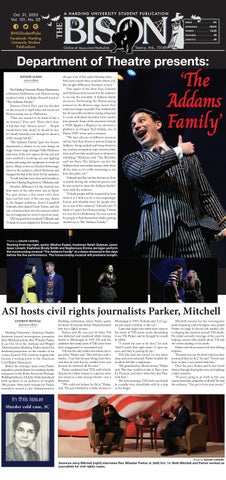
Starting from top right, senior Weston Eades, freshman Selah Galyean, junior Isaac Linnett, freshman Brody Smith and Sophomore Emma Jernigan perform the homecoming musical “The Addams Family” at a dress rehearsal in the days before the live performance. The homecoming musical will premiere tonight.
ASI hosts civil rights journalists Parker, Mitchell ANDREW RENEAU opinions editor Harding University’s American Studies Institute hosted investigative journalist Jerry Mitchell and the Rev. Wheeler Parker Jr. on Oct. 14 in the Anthony and Wright Administration Building. Parker shared his firsthand perspective on the murder of his cousin, Emmett Till, a historic tragedy that became a turning point in the American Civil Rights Movement. Before the evening’s main event, Parker attended a private dinner for students, faculty and guests in the Burks American Heritage Building ballroom. Dr. John Duke introduced both speakers to an audience of roughly 300 people. After brief remarks by Parker, attendees moved to the Administration
Building auditorium, where Parker spoke for about 30 minutes before Mitchell joined him for a Q&A session. Parker, now 86, was just 16 when Till was abducted and murdered while visiting family in Mississippi in 1955. He told the audience that many parts of Till’s story have been exaggerated or misunderstood. “He was the only child in the whole city to get polio,” Parker said. “That left him with a stutter…I say that because things have been said that he said that he couldn’t have said because he stuttered all the time.” Parker explained that Till’s wolf whistle directed at a white woman in a grocery store was meant as a joke among friends—not a flirtation. “We could not believe he did it,” Parker said. “He just whistled at a white woman in
Mississippi in 1955. Nobody said, ‘Let’s go,’ we just made a beeline to the car.” Later that night, two white men came to the home of Till’s great-uncle, demanding to see Till. Parker said he thought he would be killed. “I closed my eyes to be shot,” he said. “And I wasn’t shot right away—I open my eyes, and they’re passing by me.” Till, who had just turned 14, was taken away and never returned. Parker recalled the incident felt like a nightmare. “My grandmother offered money,” Parker said. “But they would not take it. They came for Emmett, and that’s what they did. They took him.” The next morning, Till’s body was found in a nearby river, identifiable only by a ring on his finger.
Mitchell, known for his investigative work reopening cold civil rights cases, joined Parker on stage to discuss the media’s role in shaping the narrative around Till’s death. He called out early coverage of the case for helping cement false details about Till and the events leading to his death. Parker said those stories left him feeling helpless. “Emmett was not the kind of person they portrayed him [to be],” he said. “I lived next door to him, I was raised with him.” Over the years, Parker said he has found closure through sharing his story and righting a false narrative. “If you’re going to go forth in life, you cannot have hate, animosity or ill will,” he told the audience. “You got to love your enemy.”
In this issue Murder cold case, 3C
Photo by EDGAR CARDIEL
Alumnus Jerry Mitchell (right) interviews Rev. Wheeler Parker Jr. (left) Oct. 14. Both Mitchell and Parker worked as journalists for civil rights cases.