The Bison Vol. 101 No. 11

Page 1


HUF attends 2026 Milano Winter Olympics

the Olympics. The HUG program attended the Summer Games in Paris on their way back from their studies in 2024. This sparked an idea for Pleasant.

Olympic Games. Although the group did not get to see Team USA compete, the energy expressed by France and Germany was unprecedented.

On Feb. 9, the HUF students got the opportunity to attend the 2026 Milano Winter Olympics taking place in Milan, Italy. The group watched a women’s hockey game between Germany and France, with Germany taking the win in overtime. This was a once-in-a-lifetime chance for the group to witness history.

Audra Pleasant, executive director of International Programs, is part of the team that made it possible for HUF students to see

“The idea of HUF visiting the Winter Olympics in Italy in 2026 first came on my radar in the summer of 2024, after the Paris Olympics,” Pleasant said.“I started looking up when the next games were and their locations and saw that in 2026, they would be in Italy, and it seemed like too good of an opportunity to pass up.”

For most of the students, this was their first in-person hockey experience and first

Sophomores Ethan Cutts, Mason Cutts and Jake Miller attended a speed skating match the day before the hockey game when the group was in Milan.

Ethan Cutts described the atmosphere in the arena during the match.

“It was super cool, there were a ton of different countries and fans, and they were all supportive of each other,” Cutts said. “There were 20 competitors the whole night, but only two at a time.”

BSA celebrates Black History Month

The Harding Black Student Association is celebrating 100 years of Black History Month by hosting numerous events celebrating the anniversary throughout February.

The month celebrates the central role of African Americans in the United States, honoring their contributions and achievements, and offers a moment to reflect on the struggle towards racial equality while showing the resilience of Black people. In previous years the BSA has hosted events such as guest speakers and historical displays in certain parts of the campus, though celebrations this year look a little different.

The BSA has hosted several events across campus to start Black History Month, and will continue to do so across the rest of the month. Some events include a presentation with the Harding Film Club of the Blackkklansman, Tea+ Talk, Canvas and Coffee and a Black history jeopardy night. An officer with the BSA, senior Victoria Kirwa has shared their experiences with the club during this season, and what it means to them.

“We want to educate the student body about Black history and encourage other students of color to feel represented and welcomed at Harding,” Kirwa said. “Lack of education leads to ignorance, and change can only happen through learning.”

Although not hosting their own events, the Harding University Young Democrats are supporting BSA events by attending and standing alongside fellow students. Sophomore Carmen Campbell is a member of and secretary for the HUYD as well as secretary to the College Democrats of Arkansas. Campbell said several members of the HUYD are excited to attend the remaining events hosted by the BSA this month.

“We have decided to allot time as a group to attend the Black Students Association’s events in an effort to amplify their voices rather than our own,” Campbell said. “They have already had some amazing events this month, and several of us are looking forward to attending future events that are open to the entire Harding community.”

One Harding student is celebrating Black History Month even further, demonstrating her skill and own experiences through painting.

Junior Madison Smith showcased her talents on Feb. 7 in the Irving Black Arts Council Annual Black History Month Visual Art Exhibition in Irving, Texas. Smith took part in the “Reflection and Inspiration” exhibition,

where she portrayed her identity as a black woman through her art.

“If it takes works of art for others to learn the value, history and irreplaceability of minorities, then I and many others will continue producing such works,” Smith said. “Create for those who came before you who never had the opportunity to do so.”

To Smith, art is a pathway for her to highlight her history, and shine a light on others in her community.

“You are the product of perseverance, resilience and excellence; honor that fact however you can, and help humanity make a better future,” Smith said.

“It was a cool experience to get to see people’s pride for their country expressed through sports,” sophomore Aniston Risinger said. “You could see everyone’s different culture in how they celebrate their country through supporting them in sporting events.”

Risinger explained taking the trip was a good choice.

“Yes, it was definitely something that I wouldn’t normally do on my own, but now that I’ve experienced it, I want to go to more games.”

LORELAI CURTIS guest writer
ETHAN FARMER guest writer
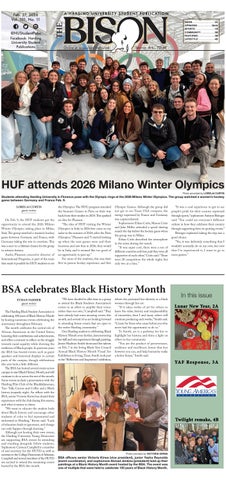
Students attending Harding University in Florence pose with the Olympic rings at the 2026 Milano Winter Olympics. The group watched a women’s hockey game between Germany and France Feb. 9.
BSA officers senior Victoria Kirwa (vice president), junior Yasha Reynolds (event coordinator), and sophomore Ahmad Jenkins (president) hold up their paintings at a Black History Month event hosted by the BSA. The event was one of multiple that were held to celebrate 100 years of Black History Month.
Photo provided by LORELAI CURTIS
Photo provided by VICTORIA KIRWA

The Caf celebrates Lunar New Year

Harding’s dining hall rang in the year of the horse on Tuesday with a decorated cafeteria, games teaching students how to use chopsticks, a wishing wall, and an immersive menu of egg rolls, pot stickers, black tea and more.

“I like it when the caf does cool theme days like that, because usually the food is better, and it’s a chance to try new things that they don’t normally make,” senior Jacob Carlin said after attending the event.

Harding’s International Students Committee collaborated this month with Bison Hospitality and the Chinese Students and Scholars Association to bring a Lunar New Year celebration to Harding’s Dining Hall Tuesday. To advertise it to students, they made a special announcement for it during Tuesday’s chapel, which included international students and the committee putting on a skit. They also placed red tickets underneath Benson seats inviting people to the event, allowing students without a meal plan to experience the event without paying. One of those students was Ben Evans, a senior who typically brings his own lunch to campus.

“I was leaving chapel and then somebody pointed out under a different seat that they saw one of the lucky tickets, so then my friend Jacob Page grabbed it and gave it to me because I don’t have a meal plan,” Evans said. “It was very fun. I haven’t been in a while, and so it was really great to see it all decorated. They had a lot of games out there. It was very interactive, and I even got to talk to some people and put a wish up on the wishing wall. I wished for help finding a job after I graduate, but I saw a lot of people wishing for things like world peace, for like prayers.”

This event not only gave the opportunity for students from the Americas and Europe to experience the Lunar New Year holiday, but also for international Asian students to feel at home in sharing their celebration with others. The International Students Committee made it clear during chapel that

this celebration was not one solely celebrated in China, as many might typically think, but all over Asia.

Thien Ho, a senior from Hue, Vietnam, commented on the importance of celebrating Lunar New Year to him.

“It’s a time for family; it’s a reset to the year,” Ho said.

Harding’s history department hosts Living Letters exhibit

The Clifton L. Ganus Jr. endowed chair and the Harding History and Political Science Department are partnering with the Remnant Trust to bring an exhibit of 21 Living Letters to Harding this semester. The Living Letters are early printings of important American documents, including a first printing of the U.S. Constitution and the Emancipation Proclamation. These important documents will be displayed in the Holland Waller Center from Feb. 20 to March 20.

Dr. Kim Laing, the Clifton L. Ganus Jr. distinguished chair for history and political science, said bringing the documents to Harding is a way to demonstrate the ideals of the American Revolution to the state of Arkansas.

“With America celebrating its 250th anniversary, we wanted to make sure that Harding was a participant in that effort, and Arkansas doesn’t really have any locations where revolutionary activities happened,” Laing said.

With America celebrating its 250th anniversary, we wanted to make sure that Harding was aparticpant in that effort. Friday, February

– Dr. Kim Laing

Clifton L. Gainus Jr. distinguished chair

The Remnant Trust is an Indianapolisbased public educational foundation that collects historical manuscripts and documents for the purpose of public education. Laing worked with the organization to select and

pay for specific documents for the Harding exhibit that best represented the goals of the exhibit.

Along with the exhibit itself, there will also be a series of three lectures on the documents by Harding professors: Dr. Heath Carpenter covered the African-American documents on Feb. 22, Dr. Julie Harris will cover the European documents on March 1, and Dr. Nathaniel Wiewora will cover the U.S. founding documents on March 8. Additionally, there will be a day-long symposium on Thomas Paine on March 13 involving scholars from across the country.

“It’s essential to understand how the past shapes our understanding of today and our expectations for what’s next,” Carpenter said. “This is particularly so when dealing with marginalized people whose voices were often overlooked, silenced or watered down.”

Along with the documents housed in the history department office, there will be a traveling exhibit of documents that will be housed in various locations around campus, such as the Brackett Library and the Heritage Building. Associate professor of political science Dr. Liann Gallagher explained how students can be involved with this exhibit.

“Come and view the exhibit of the 21 documents,” Gallagher said. “Come and watch the symposium, and observe and listen to the lectures. And the big thing is, [students] can participate in the transcribe-a-thon.”

The transcribe-a-thon is happening on March 14, and is another opportunity to be involved with the Living Letters exhibit. The event is in collaboration with Arkansas PBS, the Library of Congress and the State Library System; those who sign up to participate will have a unique opportunity to transcribe early American

documents from handwritten form into a digital version. Laing emphasized the importance of transcription to historical research.

“You get to participate in making American history accessible for everybody; that’s really awesome,” Laing said.

In-house legal counsel brings benefits to campus

Alumna Robin Maynard stayed connected with Harding after graduation, but recently reconnected with life on campus when she was hired as the University’s chief legal and compliance officer.

Harding previously hired outside legal counsel, but officially hired Maynard on Sept. 21, 2024. She said Harding still uses outside counsel for some legal issues, but there are benefits to having in-house counsel.

“If you have someone who is in-house, you can help [with] proactive and reactive [issues],” Maynard said. “You don’t really use outside counsel for proactive things like ‘Oh, help us think through this’ or… looking through policies.”

One of the proactive committees Maynard has served on is the University Emergency Management Team, which coordinates Harding’s annual safety drills. Director of Public Safety Craig Russell said Maynard helps the team ensure all the drills and procedures are legally and practically safe.

“Robin Maynard has the legal expertise where she can kind of provide insight and guidance on legally what are things we can do, and what are things that would be appropriate,” Russell said. “Part of [the team] is having that kind of big net that’s multidisciplinary. She does bring an important piece that we just didn’t have before.”

Maynard has served on the Threat Assessment and Behavior Intervention Team, as a liaison to the Board of Trustees and in advising Harding on Title IX issues. She said one of the most important projects she worked on was clarifying the language that defines Harding’s religious beliefs. The project included creating a statement of faith for University employees, which they will sign starting in the 2026-27 school year.

“How does Harding protect itself so that we can not only have our First Amendment freedom of speech, but how we can exercise our freedom of speech based on our religious beliefs?” Maynard said.

Maynard said she is also involved with many academic programs, including the

Waldron Center, the CFIT program and Physician Assistant program.

“I love getting to work with all the different departments, that’s one of the best parts of my job,” Maynard said. “The guys on Public Safety are great, … and really just all kinds of academic and nonacademic areas. It’s fun to just see all the different talents, all the different people who are pouring into the mission here.”

Business professor and former Waldron Center director Phil Brown said having in-house counsel has helped engineering students with the process of filing product designs and patents. The process for the University to waive their legal claims to a student’s design existed before she started, but Maynard said she wanted to increase students’ awareness of the opportunity.

“[Maynard’s] been very proactive in making sure that all the parties up the chain of command understand they’re going to waive any financial right,” Brown said. “That’s been understood, but now it’s been streamlined.”

Robin Maynard poses for her staff headshot. Maynard was hired in September 2024 as Harding’s chief legal and compliance officer.
Photo provided by ROBIN MAYNARD
Graphic by MELANIE GUYETTE
Photo provided by BEN EVANS
Chinese red wish envelopes, coins, stickers and chopsticks decorate the Lunar New Year tables in the Caf. The red wish envelopes symbolize good luck and blessings.

I am the founder and chairman of the Harding Young Americans for Freedom chapter. Our organization was criticized recently in the opinions section of The Bison for handing out stickers which read “ICE ICE Baby.” I handed out these stickers in the student center myself. So, to answer the article’s condemnations, is YAF promoting antiimmigrant rhetoric? Are we betraying Harding values?

It may surprise some that I am the son of a Mexican immigrant. My mother was born and raised in Mexico, then married my white American father in 2001 and immigrated here (legally) shortly thereafter. She received her U.S. citizenship several years ago and holds dual citizenship. My mother has 11 siblings, which means family reunions are rather large when we visit Mexico every couple of years. I have 40+ cousins in Mexico alone. I may or may not even have relatives who are in the U.S. illegally.

The only thing more powerful than hate is love

is not the solution–it only benefits the dangerous who take advantage of the open border policy and wreak havoc on our nation; it also harms those who are legitimately seeking a better life.

In regard to Andrew’s article, he was honest and civil in his critique of YAF.

stickers did not uphold civility. Our YAF chapter’s constitution includes Harding’s core values; we intentionally added them upon forming the organization. Were our ICE stickers civil? Harding’s definition of civility includes that we should “respectfully work through differences.” I would further ask, does respectfully working through differences mean constantly avoiding offending others or refusing to state differing views?

So clearly, I am not advocating against immigrants by participating in YAF. I’d personally love to see plenty of immigrants come over to the U.S. That’s the only reason I exist! And of course, I have compassion on the plight of those who want a better life for themselves and have not been able to do so legally. The Bible encourages us to be kind to foreigners.

However, having a legal process for immigration should be an American priority, no matter one’s political beliefs. Without a process, or with an “open border” policy, human traffickers, sex traffickers, drug traffickers, gangsters and criminals have free reign to enter our nation. Of course, most people do not fall into these categories. But the state of our fallen world requires defending against the worst cases. Having no process

It’s not often that I read a book in one sitting – especially a nonfiction book – but that’s exactly what I did with The Abduction of Mrs. Ruby Lowery Stapleton.

Deana Hamby Nall and Mike S. Allen’s book tells the story of a Harding University professor’s disappearance in October 1963. Ruby Stapleton disappeared from a local laundromat and her body was found 11 days later. Sadly, her case remains unsolved after 63 years.

The prologue starts with a beautiful description of central Arkansas’s woods in October, with just enough suspense to encourage the reader to turn the page. The picture was very clear for me and reminded me of fall days spent hiking Petit Jean or Sugarloaf. Nall and Allen’s storytelling immediately drew me into the story; as I dove further into Stapleton’s story, there were moments I forgot I was reading.

As Stapleton’s story unfolds, Nall and Allen incorporate stories that introduce and describe all of the characters in Stapleton’s story.

I researched the Stapleton case for The Bison in October 2025 and knew it well, but I was pleasantly surprised to read anecdotes that I hadn’t discovered yet. Nall and Allen did an excellent job of sharing stories that described various aspects of all the characters in Stapleton’s story. Two stories in particular were new to me: a story about E.R. Stapleton (Stapleton’s husband) during the 1942 cotton harvest, and one about Stapleton’s memories from Mother’s Day in 1963. I found the story about E.R. Stapleton interesting because it revealed a light-hearted and competitive side of his character. It added a depth to his character that I had not seen much of during my own research. E.R. Stapleton is

I was impressed with his respectful expression of his disagreements, and I am grateful for this chance for open conversation, even if the stickers were personally upsetting. To answer Andrew’s question, we were approved by campus authorities—though, approved or not, we were concerned by the immediate jump to censorship. Pursuit of truth— exercising the freedom to pursue truth in every discipline—is also a Harding value, and this is one we feel censorship does not reflect. This leads us to the heart of the matter. Andrew’s main criticism was that our

As the Young Americans for Freedom, we disagree with outside censorship, but we do have the choice to selfcensor. So, we invited Andrew to a YAF meeting and discussed our options in a respectful manner. In fact, I initially thought we would make the decision to not pass those stickers out. But the discussion convinced us that most people did not doubt the civility of the stickers. Only a few complained, whereas 50+ people happily took the stickers. Tension is understandable—I too am angered by stickers with which I disagree—but those stickers aren’t doing violence to me. I must be willing to be offended by an opposing side, this is the nature of democracy, and the nature of civility.

We do not want to make light of tragedies related to ICE. But our organization agrees with ICE enforcing America’s laws within the bounds of their legitimate power, and we do not believe this opinion differs from Harding values. As YAF, we will continue to relentlessly pursue civility as followers of Christ, always trying to make an impact on modern political issues. We will respectfully work through opposing opinions and continue to freely speak our own.

Revisiting Stapleton’s story

portrayed in a very different manner through the interview transcripts and comments from others in the book — as a suspect.

Nall and Allen’s book is thoroughly researched and is an extremely detailed account of the events of Stapleton’s case. They present a comprehensive timeline of the events connected with the case. One thing I particularly appreciated about the timeline is that Nall and Allen include context for the time of Ruby Stapleton’s disappearance outside of the “Harding bubble.” It’s easy to forget sometimes, but life goes on outside of campus. In 1963, a couple big events were happening. Earlier in the fall 1963 semester, Harding President George Benson announced the University was desegregating. Shortly

after Stapleton’s body was found, local and national media focused on another tragedy: JFK’s assassination in November 1963. Both the news and federal law enforcement, as Nall and Allen describe, shifted their efforts away from the Stapleton case and towards the assassination.

The Abduction of Mrs. Ruby Lowery Stapleton is a factual, engaging presentation of the Stapleton case. Anyone who reads it – whether they are familiar with the story, are true crime fans, or are reading Stapleton’s story for the first time – will close the book with a thorough knowledge of this complex case and the impact it still has today.

Time of writing: 2:33 a.m.

Call me

Curious George, but I have a question.

I’m sure all you true and noble readers of The Bison have noticed that our brother-inarms HU16 has been booted unceremoniously off the chapel stage. It was really like that T. S. Eliot poem, The Hollow Men. This is how HU16 ends, not with a bang, but with a whimper.

I had one foot in the shallows and one off in the deep. That is to say, I’ve worked on the newspaper side and the TV side. Let me tell you, when our faculty adviser, Noah Darnell, said we would be allowed to air news segments at the start of Tuesday and Friday chapel, I was tickled. Our viewership frequently hovered around a couple of dozen viewers, which spiked when we covered events like the eclipse, or election seasons. But on our first Tuesday morning, that all changed. I watched thousands of students’ eyes swing to the big screens. The intro played, and there were our anchors, giving hard news to the

Notwithstanding the oddities and fun memories, chapel edition was straight-up resume fodder. Fall of ‘25 anchors could say they anchored weekly clips to an audience of several thousand. That’s legit. That’s hirable. More than the anchors, our whole team benefited from the shows, from the student directors shouting cues all the way to the students manning cameras. We all benefited from those five minutes of chapel.

I’d like to say you benefited too. I haven’t talked to everybody, but from what I’ve gathered, the student body generally liked the news. Now, the times when a genocide was the first story crashing out of the Benson speakers weren’t our best moments. But the students I’ve listened to say they enjoyed it, and the heads swivelling from their phones on Tuesday mornings back that up.

I survived having chapel edition stripped from me in January, but this February I discovered something new. I learned from a Harding faculty member that HU16’s chapel broadcast was cut because it did not fit the tone of chapel, and that it did not add to the chapel experience.

I learned that from asking. As far as I know, our team was never given an announcement. That only seems odd because students were the ones writing, recording, directing and editing those news clips.

I’m going to find out more, but here’s what’s going through my mind. Were we unprofessional or crude? Someone reviewed all our news segments before airing them in the mornings—they had ample time to ask for adjustments, or to simply cut the news. I’m also curious what tone we missed. Campus organizations take the stage multiple times every week to announce events they are holding on campus; our news team covers local and national events, and could easily accommodate news from student organizations. At the very least, it would be useful to know how we could improve. This entire situation feels like finishing an internship, and during the exit interview, instead of complimenting or critiquing the work we completed, the boss says, “Meh, could have been better,” and shuts the door.

All that to say, I’m taking it upon myself to discover why we were booted, and find some answers for y’all. I’ll let you know what I find in two weeks.

News editor Kenzie James
Opinions editor Andrew Reneau Guest writer Nathan Thomas
KENZIE JAMES is the news editor for The Bison.
NATHAN THOMAS is a guest writer for The Bison.
ANDREW RENEAU is the opinions editor for The Bison. He may be contacted at areneau@harding.edu.
Graphic provided by the Young America’s Foundation

Samples of gold

I have always absolutely loved expressing myself through clothes. I feel the phrase, “look good, feel good,” so deeply in my bones. Not necessarily to look good to others (not that that hurts) but more that when I look in the mirror, I think, “I feel like me in this.” The wrong sock color or sweater texture can throw off my entire day. So, through years of continuous trial and error (and with no end in sight), I have been finding which clothes make me feel like me.

Somewhere along the way, that search became warped. Instead of asking what felt most like me, I started asking what would make me stand out the most in comparison to others (as cringe that is for me to admit). I forgot that there’s a difference between expressing who you are and performing for who you hope will notice.

This week, my Sample of gold is not shiny, but rather dim. It’s the kind of gold that doesn’t stick out in a pile of rocks, but blends in with all of the other pebbles. I think that so many clothing lovers feel like, in order to prove that their fashion sense is worthy of note, that it needs to be different in some way; it needs to prove some sort of originality or identify them with a certain group of people. As a victim of this narrative (and not even close to being recovered), it starts to feel so draining when something that you love so much begins to depend so much on other people. Do other people think I’ll look cool if I wear this? Will they want to be like me? Will they recognize that I am unique?

I realize that not all clothing lovers have these thoughts, but I do—and I don’t think I am in the minority. I don’t even think many of us recognize how much these thoughts drive our clothing choices. However, as Christians, I do think that trying to be too “seen” for your own glory is falling short of where we know our priorities should be. We should be okay with blending in with the crowd; we should be okay with not being seen as more unique than others; we should be okay with people not idolizing us. This, of course, applies to way more than clothing, but clothing has always been my main source of acknowledgement, so I’ve been tempted to lean into it.

And I believe it genuinely is that—a temptation. A friend once told me a story about a preacher that gave an incredible sermon. After the service, people rushed to tell him how wonderful he did. His response was, “I know, the devil already told me.” I think hearing that story was the catalyst for reflecting on my own motives for receiving praise. Getting dressed in the morning had turned to, “what will keep up my image the best,” instead of, “what makes me feel like me.” I remembered looking at myself in reflections throughout the day; picking out particularly “on brand” outfits; finding pieces that I knew for a fact no one else had. All of this, only to find the humbling truth: no one is actually paying that much attention to you. And if people aren’t watching me the way I thought they were, do I really want my most notable feature to be my… outfit?

So, as my fellow clothing lovers pick out your next outfits, I encourage you to ask yourselves: would I still wear this if no one saw me today? Would I still be confident if I blended into the background? Has the devil already told me that I look cool today? You may find that there is something unexpectedly peaceful about not needing to be the most interesting person in the room.

How much time do we spend on our phones? How many hours do we throw away for a cheap escape? I admit that I would downplay my phone dependency to my peers. But in truth I really spend too much time on my phone. As a self-diagnosed “Chronically Online” young adult, I find myself often in the pits of the internet. In my searching for distraction, my subconscious started to pick up a pattern of content, spoon-fed to me like a lethargic dog.

Unless you live under a rock, you certainly know who Jeffery Epstein is. Plastered on news outlets and conspiracy theorist YouTube channels, Epstein has been one of the biggest controversial figures of recent history. In the wake of the files being released more discussion about this figure has permeated the internet. And my attempt to escape from the headlines is often scrolling. I look for memes to laugh as a remedy for the heartache of the state of the modern world. Slowly, my algorithm has started recommending Epstein-related memes and satirical content. To illustrate the nature of the content, a lot of memes recently have A.I. generated videos which place figures like Jeffery Epstein into movie clips, dancing, lipsyncing and more. We create Frankenstein’s monster by reanimating a corpse of a dead man, plastering his face for mockery. We slowly forget what he did. It is a copy of a copy of a copy but with each new iteration, the public loses urgency or conviction. This trope has become disgustingly common, with other controversial figures falling to the same fate. The purpose of this content is to please us, to give us something to be amused by and our gluttony for this deepfried, smothered in sugary nonsense has made us weak. It was made for us to have a

This morning, I just finished reading Franz Kafka’s novel The Trial. First published in 1925, it’s an absurdist tale of a man named Josef K., who is arrested on his thirtieth birthday for some crime unknown to him. He’s allowed to stay in his apartment and resume his work as a banker, but he must report constantly to the court.

Yet the magistrate never tells him what he’s accused of, never reveals any evidence against him and never suggests what he should do. K. spends an entire year stuck in a bureaucratic no-man’s land, going from office to office, getting no answers and making no progress on his case. In fact, he keeps making his situation worse, without knowing how.

A year later, K. is executed for whatever crime he had supposedly committed. At least, that’s how we assume his story ends. Kafka died before he finished the tale.

While reading the book, I had a flashback to the novel Bleak House by Charles Dickens. At the center of the story is a probate case—Jarndyce v. Jarndyce—that involves a contested estate. The dispute has dragged on for decades, and each day, lawyers in powdered wigs push wheelbarrows full of documents into the courtroom to continue the pointless proceedings.

At the end of each day, the lawyers make their exit, wheelbarrows in tow, only to return the next morning to start all over. The money in the estate is long gone, gobbled up in legal fees. As the endless cycle grinds on, Dickens satirizes the nightmarish chancery courts of his day.

Both novels, written seventy odd years apart, plunge readers into worlds that make no sense, where truth is mysterious and elusive, and where people go through the motions of a system that no one understands, repeating things without knowing what they are talking about. Joseph K. is an everyman, befuddled by events that have the trappings of logic but without a shred of the real thing. He

Dancing Frankensteins

new association for when we see his face. It was made to be easily and readily engaged with, shared, reposted, and commented on to keep the machine running off of our time spent. (Time wasted, in my opinion.) There is another discussion of what that machine is that wastes our time, but I would need a tinfoil hat and a soapbox to stand on. But by looking at this strange case of dancing Epsteins, it makes me wonder, why am I convicted of this and others are not?

This is not a conversation on who deserves to be mocked but rather: why are we bending

Death of a Meme

and the Jarndyce clients are condemned to sit and watch helplessly as insanity takes over.

During much of 2025, we all knew how they felt, as the world seemed to be at the breaking point, but I recently learned from sources deep within the middle-school scene that the whole “6-7” thing is over. Like, really over. So over, in fact, that news about its being over is, in itself, over. Even on Facebook, where old people routinely arrive eight months late to a trend, 6-7 is over.

I need not remind you that for months, every sporting event was paralyzed by the fear that if a team scored sixty-seven points, the twelve-year-olds in the crowd would inexplicably break into hysterics, chanting the number and making a balancing-scales hand gesture. Twelve-year-olds have not held this much cultural power since Pokémon.

But now it is over. I tried to find an obituary, but no one knows the time of death. The cause—massive and concentrated overkill—is all but certain. McDonald’s still managed to cash in on the trend, and its chain in the United Arab Emirates gave away free chicken nuggets each day between six and seven. Some restaurants took the opposite approach and stopped calling out number “67” in orders.

reality into a form that makes it easier to digest? Is it worth a quick laugh to lose sight of the truth? I am not advocating to ban all memes, or to banish public forums, but rather to think before you watch. For by consuming, they (the machine) are betting on you to also forget. Throw away all knowledge and laugh. That’s what they want us to do.

You may wonder how I can logically get away with saying that something was “immortal for a while.” Let me simply confess brain rot and move on.

The whole point of a meme, of course, is to give people a way to indicate they’re “in” and that those confused by it are “out.” It has to be short-lived; otherwise, too many people will figure it out and claim to be “in.” Granted, for some fads, there is little danger of too many people figuring them out. Having lived through the whole parachute pants episode of 1984, I can attest to this firsthand.

Get this. The Trial is considered one of the greatest novels of the 20th century, and yet its Wikipedia entry is shorter than the entry for “6-7,” which traces the meme’s origin to a rap song by Skrilla. The wiki also quotes Vice President J.D. Vance as proposing an exception to the First Amendment’s free speech clause, just for the annoying phrase. Thankfully, there’s no need for another Constitutional Convention now, as the meme is no more. Still, absurdity reigns on the internet’s greatest encyclopedia, as the entry on Kafka’s masterpiece gets sixteen footnotes, and “6-7” gets fifty-four. But please don’t tell your younger brother. We can’t afford to let 5-4 happen.

We’ve long had inexplicable fads involving numbers. Folks in their twenties tipped their straw hats as they said, “23 Skidoo” to each other. The dreaded “thirteen” is such a bogeyman that it has a phobia named for it. Douglas Adams made “42” immortal for a while.

Narrative columnist Michael Claxton
RANDI TUBBS is editor-in-chief
Comic by GRACE BROWN
Graphic by GRACE BROWN
Graphic designer Grace Brown
GRACE BROWN is a graphic designer for The Bison.

Tucker soars with record-breaking leap

Sophomore Carly Tucker presented a historic performance on Friday. Rewriting the Harding record books with a barrierbreaking leap in the long jump event at the Music City Challenge and establishing herself in Harding track and field history.

Competing against Division I ability, Tucker jumped 5.79m (19-00) at Vanderbilt’s Music City Challenge, surpassing a 37-yearold school record that was set in 1989. Along with setting a program record, she made her mark as the first woman in team history to clear the 19-foot barrier indoors.

Despite the significance of this achievement, Tucker said she didn’t immediately grasp its importance.

“First, I didn’t realize how old it was,” Tucker said. “At the beginning of the year, I had my goals set for the year, and one of them was to break the school record, so I was really excited.”

The breakthrough came during a highpressure sequence of attempts. After an average first jump and a scratch on her second

attempt, Tucker knew she needed to unleash a clutch performance.

“I knew I had to pull out a great jump to even try and make it to the finals,” Tucker said. “And it felt like a pretty good jump, but not 19 feet.”

A week prior, Tucker missed the mark by half an inch. The mechanical adjustments and growing confidence throughout the season are credited with her standout performance.

Assistant track and field coach for hurdles and multis, Paul David Quillin, emphasized Tucker’s composure, which led to her historic jump.

“She never lost her cool,” Quillin said. “Her two jumps beforehand didn’t go exactly as planned, but she stayed focused. She locked in, did the same thing, and hit it right that time, and then got to go up in school records.”

Freshman teammate Roselyn Spencer reflected on how the moment was exciting and inspiring for her. Additionally, she said that Tucker’s success is found in unnoticed consistency.

“Something that a lot of people don’t realize is that we are out there for three hours

every afternoon,” Spencer said. “Carly works so hard. There is not a day out there that she is not giving her full effort. She is intentional with everything she does, and that’s part of the reason why she is so successful.”

With the Harding indoor long jump record secured, Tucker is already looking ahead to what is next.

“I have another meet this weekend, and I will hopefully break it again,” Tucker said.

“I’m an inch and a half off my PR, so I hope to beat my PR and break the outdoor school record for long jump as well.”

Following her historic performance, Tucker was named the Great American Conference Women’s Indoor Field Athlete of the Week on Feb. 17, honoring her record-setting leap.

Baseball starts off conference title defense with 8-4 record

The Harding Baseball team has won two consecutive Great American championships, and the Bisons will look to continue the streak this season.

Coming off of their most recent series in Weatherford, Oklahoma, they hold the 6th ranked position regionally and 23rd nationally among Division II teams. While the team values these high rankings as it allows them to visualize their victories, head coach Dr. Patrick McGaha says that the most important thing is building a team that both represents Harding and Christ well.

“It’s not about wins and losses,” McGaha said. “Winning championships is nice, but at the end of the day, it’s really about building relationships with your players and hopefully helping them learn how to become the kind of man that the Lord wants them to be.”

Merritt Jay, a management and business ethics major and senior pitcher, said that his

favorite part of Harding baseball is getting to play and compete with some of his best friends, gaining a greater appreciation for not only winning games but also the relationships and memories made on and off the field.

Jay also said that his ambition for this season is to secure another regional win and from there, get as close to the DII national championship as possible. This, however, is secondary compared to the small victories the team is currently focused on.

“This season our team has high goals and expectations for ourselves,” Jay said.

“But before we get to those large overall goals for the year, we are focused on trying to win each day or game in front of us and hopefully that translates into the large goals we have for the year.”

Senior third baseman Logan Lacey said that the culture of Harding’s baseball team is what drives them towards their success. He said that it is a culture filled with attitude, intensity and toughness, and it’s what wins

them games even when their talent isn’t enough.

Lacey said that his ambition for the team is to have as many team wins as possible, meaning that every player contributes to the win. He says that every member plays a significant role and has their individual moment of success. The most important thing to Lacey, however, is his team members’ relationship with the Lord.

“I want all of my teammates to grow closer to Christ,” Lacey said. “Having a relationship with Jesus is all I could ever ask for my boys.”

Dugout Dispatch: A U.S. Olympics Divided Cannot Stand

I want to start off my column that attempts to unite our country in some small, meaningful way by showing two instances of the leaders of our country being divided on really important issues during America’s most famous pep rally, the State of the Union address.

DJ Daniels, a 13-year-old boy who fought terminal brain and spine cancer since he was 6 years old, was honored during President Donald Trump’s speech last year. Daniels always wanted to be a cop, and so when Trump made Daniels a member of the Secret Service, Republicans erupted in cheers and applause. Meanwhile, on the C-SPAN broadcast of the speech, Democrats in the chamber can be seen staying seated and not applauding a kid who is fighting brain and spine cancer. This isn’t a one-party problem, however. In 2023, when Joe Biden said in his speech that “political violence has absolutely no place in America,” Democrats erupted and Republicans stayed seated. Maybe there’s an argument to be made that the whole State of the Union thing is outdated if we can’t agree on honoring kids with cancer or the statement that political violence is wrong. Although that’s probably another opinion article for another time.

But this is a sports column, so what does any of that have to do with, well, sports? And the answer I’ll give to that question is this: when over the last decade has sports not been political? To tie in the State of the Union to this idea, during his speech this year, Trump brought the U.S. men’s hockey team to his address on Tuesday. And when he introduced the team and said that goalie Connor Hellebuyck would be receiving the Presidential Medal of Freedom for his 41 saves in the gold medal game victory over Canada, almost everyone stood and clapped. I think watching back, I only saw three or four people in the chamber not standing. It’s odd that of all things, a hockey team winning gold would unite politicians more than the two stories from above. However, it was a different story outside of he chamber. Sports pundits bashed the team for their visit to the White House and

the postgame locker room call the team had with Trump. A writer from The Athletic said that the team “lost the room” and Vox made the team the “losers” of the Olympics in a “winners and losers” story after the Games concluded. When the NHL spent time on social media Tuesday to promote hockey players and their daughters, the comment section turned ugly on a post about Dylan Strome and his daughter, who is Canadian. Soon after, the post was deleted.

The uproar has caused even more division after the Games ended. Despite this iteration of the Winter Olympics being one of the most exciting ever, it has become the most tiring when it comes to America’s response to how politics merge with the athletes that represent us, and especially

It shows our recent demand in our athletes and celebrities who likely don’t have a ton of political knowledge to talk about the important issues of our time. Is that fair to them? Again, that’s another opinion column for another day.

Two different athletes with similar backgrounds caused another storm despite them being in two totally different sports.

Alyssa Liu is the greatest figure skater on the planet, winning a gold medal in solo and team play. She representsthe the U.S..

those who choose not to.

skier Hunter Hess said that it was hard to represent the U.S. given what is going on in our country. Trump called him a loser, and so after his final run, Hess put his fingers up over his forehead to mimic an L shape. Quickly, he became a darling to one side of the political spectrum and the total opposite of that to the other.

Eileen Gu is the greatest freestyle skier on the planet, winning two silver medals and a gold medal during this year’s Games. She represents China, despite being born in the U.S., raised in the U.S. and briefly competing with the U.S. ski team. China,which does not allow for dual-citizenship, has made Gu the wealthiest woman athlete in the world, where her sponsorships and alleged payments by the Chinese government have netted her $23 million, while she has only made $100,000 in competition winnings.

It’s important to note that she’s not even close to being the first person to compete for a different country; it happens all the time.

Both Gu and Liu were presented with a choice when they were young. At 15, Gu decided to compete for China, while Liu decided to stick with the U.S.. When Liu won gold this year, Americans cheered, and even that was a controversy. Liu is publicly a liberal in terms of her political views, so when Republicans celebrated her success, Democrats online were quick to point out the irony that conservatives were propping up someone who would reject a lot of what they believe in. That showed a greater divide between liberals and conservatives and highlights where each side is in accepting the other.

According to research done by the Skeptic Research Center, 45% of Gen Z and 39% of millennial liberals would end a relationship with a friend if they expressed a political thought that they found inappropriate. Meanwhile, conservatives in those same groups are 24% and 19% likely to do the same. It’s a problem across the board, and given our political climate, it is not going to get better any time soon.

I’m not sure what the solution is to any of this, and in the past, when sports used to be the “distraction” and sports fans bemoaned the phrase “stick to sports,” it’s clear that none of that is possible anymore. There are friends in my life who actively rooted against U.S. athletes during the Games because of how they feel about this country. And they’re still my friends despite that.

In another sense, athletes who dodged questions about the current political climate were criticized. That goes for some of the hockey players, who said the tradition of going to the White House after victory is an honor that they simply couldn’t refuse.

But at the same time, when asked about US politics, Gu is prepared to criticize our current landscape, but her “I don’t think it’s my business” response to questions about the population of Chinese Uyghurs who are being forced into labor camps and into eventual genocide speaks louder.

All I can say is, I’m thankful that this country allows for that type of dissent in ways that many other countries don’t. If Gu said a thing about the Uyghurs, she’d lose all her money and endorsements, or could be beaten into submission of her statements, similar to what might have happened to Chinese tennis player Peng Shuai in 2021. In America, Hess can openly protest the sitting president and not be banished from representing the country. Americans can criticize anything the country does on social media and elsewhere and still live their lives freely. If there’s one thing we can agree on, it’s that America, for all of its obvious flaws and problems, really is the greatest country in the world. And not just at hockey.

Photo provided by CARLY TUCKER
Sophomore Carly Tucker leaps in the air to try and get a top finish in the long jump during a track meet. Tucker is the record holder for the long jump.
Photo by RYLEE JOHNSON
Freshman Easton Jones celebrates a double during Harding’s 9-3 loss to
Ouachita Baptist Feb. 17. The Bisons are off to a solid start at an 8-4 record.
Graphic by GRACE BROWN

Searcy Public Library offers classes for community

Since moving into a new building just over a year ago, the Searcy Public Library has expanded its class offerings, providing residents with more opportunities to learn, create and connect. These classes are open to the whole Searcy community, including children and college students. The upgraded facility allows for programming that simply was not possible in the previous space.

Heather Smith, branch manager of the Searcy Public Library, said the library offered programs before relocating, but space was limited.

“They had some programs and classes before they moved over into the new building,” Smith said. “They had some, but they didn’t have the facilities to handle all of that.We also have people who come and do classes that use our rooms, as well as what we offer here ourselves.”

With the expansion, the library has a large variety of classes for all different ages and interests, with Tai Chi class on Tuesdays, Dutch embroidery classes once a month and the typical book club. The space also allows

The main hall of the Searcy Public Library, where

classes including meditation sessions and poetry workshops.

outside instructors and organizations to reserve rooms for their own classes.

“We also have people who come and do classes that use our rooms, as well as what we offer here ourselves,” Smith said. Programming began expanding immediately after the building opened and continues to evolve.

“As soon as this place opened, a little over a year ago, they started with a lot of classes,”

Smith said. “It constantly is morphing because we have three different programming people who handles those things.”

Jenna Owens is one of those program coordinators, and she said that her main job is to run the adult classes, sometimes lead them and ensure that different classes people would enjoy make it on the calendar.

“Our administrative office is here, and this

is considered the main campus of the library, our program coordinators are housed here, and they do at least two different programs monthly at each of the branches,” Smith said. For those who may not know how to get involved, Owens said that by far the most important thing to do is to check the website.

“Even when our paper calendars are not updated, the website is updated,” Owens said. “So if there is a cancellation, they will be able to see it. They can look forward in advance and then they can know when they need to register.”

Kristen Burton echoed this sentiment.

“The easiest way to get involved truly is by seeing what we have on the website.” Burton said. “I provide story times for all of the libraries in our county, and we also do a homeschool and an after school program.”

Some classes, particularly craft-based workshops, require registration and may include a small fee. Details about registration dates, materials and costs are listed online. As the library continues to grow into its new space, staff members say programming will continue adapting to meet the interests and needs of the Searcy community.

Liz Howell invests in Searcy’s property, people

Liz Howell, former vice president of alumni and parent relations at Harding University and principal broker at Howell Realty Pros, is launching a dual effort this spring to empower local residents through financial literacy and spiritual mentorship.

Howell will host “Brick by Brick: Women in Real Estate” on Sunday, March 1, from 1 to 3 p.m. at the Robbins Sanford Grand Hall. The seminar is open to the public and will highlight the role women play in the housing market.

“Women make about 90% of the decisions in married-family real estate,” Howell said. “In single-family homes, women make 100% of the decisions. This is an informational meeting to show people what it looks like to invest. What are the pros, what are the cons, and what can I do?”

Those who work closely with Howell say this drive to educate comes from a genuine affection for the area.

“I can see her love for Searcy through how hard she works,” said Julia Howell, an intern for Liz Howell. “She is hard-working and driven, but also values time with anyone and everyone.”

The seminar will feature a panel of local professionals, including interior designerPia Quiroga and Deana Powell, vice president of mortgage at Simmons Bank. Dustin Howell will speak on property management and how rental ownership can become passive income when structured properly.

The event will also spotlight current investment opportunities in downtown Searcy, including a property Howell described as “ready for investors,” with potential for a restaurant and upstairs space designed for families and young people.

Beyond real estate, Howell hosts “Heartfelt Ministries,” a monthly in-home Bible study rooted in the teachings of Titus 2, which encourages older women to mentor younger women. She has led the gatherings for more than a decade.

“The reason I did this is because women were investing in me when I was at school,” Howell said, reflecting on her time as a student and later as the first female vice president at Harding. “We didn’t have to have a program; it was just a friendship. This is my way of paying it forward.”

The group meets on the third Tuesday of each month and emphasizes hospitality, bringing together Harding students and local residents for fellowship and mentorship. Josh Patterson, a junior at Harding University who has worked with Howell on advertisements, said her mentorship is often paired with a personal touch.

“One way she shows her hospitality is through food,” Patterson said. “One time, I was invited to her house and she had prepared an entire feast for me. This goes to show how important hospitality is to her.”

A member of the devotional group, Lola Madden, said learning from someone with Howell’s experience is a unique blessing.

“It means so much to learn from someone who can speak wisdom into our everyday lives because she’s actually lived it,” Madden said. “I also just really appreciate how much effort Mrs. Liz puts into everything, especially with preparing the food, the decorations, and opening up her home to us.”

Howell noted that these personal connections are the heartbeat of her work.

“I love being around them because of their energy,” Howell said. “Hospitality is very powerful. It means everything. It’s a time to bring them into a home and show them the love of older and younger women coming together.”

As Searcy grows, Howell said she remains focused on the personal connections that define the community. Whether assisting first-time buyers or hosting students at her table, she said her mission remains the same, to invest in the people of Searcy.

Those interested in attending “Brick by Brick: Women in Real Estate” can RSVP at HowellRealtyPros.com or by texting 501-230-2667.

Soda Jerk pours coffee, community into Searcy

Soda Jerk is more than coffee.

That’s what Lisa Douglas said from behind the counter of her storefront in downtown Searcy—and she means it in both senses.

Literally, the shop sells more than coffee.

Above the chilled dipping cabinets, stocked with several flavors of ice cream, a hand-drawn chalkboard menu lists smoothie bowls and specialty drinks. Students walk in for an afternoon pick-me-up but often leave with more than caffeine.

But the “more” has less to do with the menu and more to do with the atmosphere.

Several times during this interview, Douglas jumped up mid-sentence to greet customers walking through the door. She knew every name. That fits her mentality towards anyone who walks through the door.

She wants her customers to feel like they belong.

“If you were having a really bad day, you could just pop in here,” Douglas said. “We could talk.”

Students find the spot cute and worth a trip.

“I thought it was a very cute and homey place,” senior Ana Rodas said. “I got a vanilla and caramel ice cream, and it was a good treat. I’d definitely go back because it’s a walkable distance and you can get it after Burrito Day.”

Douglas was raised in Arkansas and attended the same high school where her parents met. She found her husband in Searcy, and the two traveled across the United States and abroad before the 2020 pandemic brought her back home. Talking with Douglas, it became clear she did not travel passively. In 2023, she thrifted along her road trips to collect curated pieces to stock Vintage Vibes, another shop she owned. That venture has since evolved into pop-up thrifting stands in Conway.

Douglas thinks running a business is directly tied to giving. She hires students from the nearby Harding University, and frequently gives to non-profits and advocacy groups around Searcy.

“We joke that it’s a non-profit,” Douglas said.

Those students working with Douglas leave blessed.

“Working at Soda Jerk has been one of my biggest blessings,” freshman Sadie Washam said. “It’s a small business that serves a big purpose—the love for God and others. Lisa is a go-getter, a friend to all, and pours into the community every way that she gets the chance to. We spend lots of time laughing, bonding and serving at Soda Jerk. It’s a welcoming and cozy environment that anyone can find a place in.”

ANDREW RENEAU opinions editor
TUCKER ALLEN guest writer
AVA HAGEDORN guest writer
Liz Howell sits with Harding students around her dining table during a Heartfelt Ministries gathering. The monthly Bible study brings students and local women together for mentorship and hospitality.
the library hosts
Lisa Douglas and her husband Kevin Douglas stand inside Soda Jerk. Lisa Douglas ran the shop with a focus on faith, generosity and personal connection.
Photo provided by AVA HAGEDORN
Photo provided by LIZ HOWELL
Photo provided by LISA DOUGLAS

Senior wins top honors for travel research

What if planning your next trip were as simple as taking a personality test? That question led Harding University senior Evelyn Filleman to develop her award-winning honors thesis that earned first place at the Southeast Journalism Conference (SEJC).

Filleman, an integrated marketing communications major graduating in May, explored whether personality traits could predict travel preferences and whether marketers could use that information to better target consumers. Her thesis, titled “Personal Preferences in Travel: A Study on Personality-Driven Travel Marketing,” examined the relationship between personality typing and travel behavior.

The idea originated during a conversation about spring break plans, when a friend said she wished someone could simply tell her where to travel based on who she was. That question evolved into a year-long research project investigating whether travel companies could use personality assessments to recommend destinations and tailor marketing strategies.

Filleman conducted her research in three phases: analyzing marketing strategies used by major airlines, hotels and travel agencies; reviewing scholarly research on traveler segmentation and personality theory; and designing her own survey using the International Personality Item Pool (IPIP) framework to test correlations between personality traits and travel tendencies. Creating a concise but effective survey that balanced personality typing, travel categories and marketing strategy proved to be the most challenging part of the process.

Audra Pleasant, executive director of Harding’s International Programs office, served on Filleman’s thesis committee

and described the project as “creative and innovative.”

“Much of my work is in the area of travel, and I enjoyed thinking about the questions we’re asking ourselves and others about how and why we travel,” Pleasant said.

She also noted that Filleman’s use of artificial intelligence in building and analyzing the project prompted further thought about the ethical application of AI in research.

Dean of the Honors College Dr. Jim Miller praised Filleman’s achievement and the dedication behind the project. “Her level of professionalism and work ethic doesn’t surprise me one bit,” Miller said. He noted that the year-long research process requires persistence, attention to detail and a willingness to engage deeply with theory and strategy. These are qualities he believes distinguish strong honors scholars.

With a first-place SEJC award and a completed honors thesis, Filleman’s work demonstrates how a simple question – where should I travel? can evolve into meaningful academic research. As she prepares to graduate in May, her study leaves open the possibility that future travel planning may be shaped not just by destinations, but by personality itself.

Theological studies lunch series connects faith and work

The theological studies program has hosted two different lunch opportunities for students pursuing a theological studies second major.

“Theology and ____” is a discussion series that brings in professionals from different disciplines to talk to students about what it looks like to be a Christian in the professional sphere.

Sara Ritchie, assistant to the Center for Ministry and Theological Studies, said these lunches are great to help students get connected to the professional world outside of Harding.

“‘Theology and ____’ lunches are a really great insight of people who are in different professions, and [students] basically ask them to answer the question, ‘How do you live out your faith in this said career?’” Ritchie said.

Lunch and Theology Talks are another opportunity for students to get connected and hear from professionals. As opposed to the “Theology and ____” series, these lunches take a more casual and conversational form. These are more localized to Harding and draw from experts on campus who chat with students over a provided free lunch.

“We asked the students, ‘Who do you want to hear from? What kind of subjects would you want to talk about casually with faculty?’” Ritchie said.

Topics for the Lunch and Theology Talks so far this semester have been “The Art of

Feasting” and “Evolution.” Topics for the “Theology and ____” series have included “Theology and Occupational Therapy” and “Theology and Artificial Intelligence.” Both events took place in the Theological Studies lounge. Mia Craig, a sophomore psychology and theological studies major, said she enjoyed coming to both of the Lunch and Theology Talks thus far.

“It’s a really fun way to engage in some different theological discussions that I wouldn’t necessarily have anywhere else with people that are qualified to talk about them,” Craig said.

Theological studies is the fastest-growing major on campus, and includes students from every department on campus. It is available to add as a second major to almost any primary major, and is “designed to help students see themselves as called to ministry,” according to Harding’s website. The top participating majors are psychology, education and business. Dr. Mac Sandlin directs the Theological Studies Program for the College of Bible and Ministry; he said that the best part about the theological studies program is the students.

“What unites them all is this deep love for God and a desire to say, how do I grow in my faith?” Sandlin said. “How do I learn to apply my faith in my career field? How do I make a community with like-minded people? It’s the students and the work that God is doing through those students that make the program really awesome.”

Political science classes visit Arkansas Supreme Court

Two Harding University political science classes visited the Arkansas Supreme Court on Thursday, Feb. 19, to hear oral arguments. The Arkansas Supreme Court holds sessions every Thursday morning between September through the following July at the Justice Center in Little Rock. Political science professor Steven Breezeel took his Constitutional Law and Judicial Process classes to the court to experience opposing sides of a legal malpractice case.

Breezeel, accompanied by associate professor of history and political science Melanie Gallagher, spent half the day with these classes to experience the Arkansas State Supreme Court process. Unlike lower court cases, the Supreme Court functions as oversight for appeals and addresses whether the original trial court made the right decision.

“We have access to them in a way we don’t to the United States Supreme Court,” Breezeel said. “One [aspect] that was very nice was that two of the justices came out and spent 20 to 25 minutes with my students, kind of answering questions, talking about their job, and how the oral argument process works.”

To Breezeel, a top priority in the trip was to immerse students in an experience unlike attending regular courts.

“This was an opportunity to get handson, direct experiences with the profession that many of them are going to choose for a career,” Breezeel said.

Dave Richardson, political science major,

science

hear from two of the justices.

was one of the 40 students who attended the hearings. As part of his judicial process class, Richardson has grown well acquainted with the court system, and how the process typically works. Through experiencing a state Supreme Court hearing, Richardson was able to gain a new perspective.

“I have been in several different courts but never a state supreme court. I knew the general idea of how a supreme court works because of my experience reading court briefs and opinions,” Richardson said. “This trip gave me a new perspective on the work the

attorneys have to do, as well as the justices.”

Students of the judicial processes class are required to sit in on and observe court sessions for around two hours during the semester. While Breezeel cannot form his students into lawyers yet, his hope is to introduce them to the law and concepts of the judicial process.

“I wanted students to see the idea, how they’re presenting the argument, essentially the added process to what they’ve already seen,” Breezeel said. “I very much got what I wanted the students to see.”

In addition to hearing oral arguments

students had the opportunity to visit the Arkansas Civics Education Center, which is a newer addition to the larger supreme court building. Between seeing the mock trial room and printing out a copy of the state constitution to keep, Breezeel’s classes saw the best of the Education Center. The website reads:

“The Arkansas Civics Education Center features a variety of interactive and stationarylearning exhibits, spacious meeting rooms, and a unique mock courtroom dedicated to renowned civil rights attorney Scipio A. Jones.”

HALEIGH CARTER guest writer
ETHAN FARMER guest writer
MIKAYLA MALOTTE guest writer
Theological studies students fix their plates at a Lunch and Theology talk. The speakers at these events connect theology to their professional experience.
Political
students sit at the mock trial bench in the Arkansas Supreme Court. Students visited the court and got to
Senior Evelyn Filleman poses with her research project poster over personality and travel. Filleman recently won first-place for her research at the Southeast Journalism Conference.
Photo by KENZIE JAMES
Photo provided by JOSHUA KOHLBACHER
Photo provided by CAMILLE BEWLEY

Students film “Twilight” remake

Senior Ayden Gardner directed and produced “Twilight but Worse Than Better,” a parody film of the original 2008 “Twilight” starring Kristen Stewart and Robert Pattinson.

The Harding version will be abridged, with some creative liberties taken.

“We followed the story pretty closely,” Gardner said. “We watched the movie and wrote down the most important scenes that we needed for the plot, or we felt were funny, and then recreated.”

The largely-improvised acting was all filmed in a 35-hour period the first weekend after winter break by a group called Checkles Film.

“Checkles has just evolved into a friend group, and Skylar Hembree, Isaac Brown and myself produce a lot of our own projects,” Gardner said.

Gardner also works closely with junior Skylar Hembree, who serves as an assistant director and producer.

“This wasn’t for a class assignment, just for fun and bonding with everyone,” Hembree said.

For many students, in-class work and assignments are as far as the educational journey will take them during their four years, but there may be something to be said for intentional extracurricular work.

“One of our professors, Bryan Hudkins, likes to say that as a film major the classroom

experience is a six out of 10, while the onset experience is a 10 out of 10,” Hembree said. “Just trying something, whether we knew it was going to succeed or not, is far more valuable than some of the things we learn in classes.”

Sophomore Callie Disch starred in the production as Bella Swan, the human girl

living in Forks, Washington, who falls in love with the vampire Edward Cullen. Disch is a theatre student with various film and stage credits.

“I had done a bunch of student films the last few semesters and was put on an email chain with a bunch of my film friends,” Disch said. “It was such a silly idea, I just knew I

would love to be a part of it.” Checkles Film hopes to have a formal screening of the project at the Rialto sometime within the next few months.

“If you are a die-hard fan of the Twilight franchise, you will absolutely love this film,” Disch said. “It is hilarious, dramatic and entertaining.”

Students struggle to find employment in Searcy

As rent prices rise and living expenses add up, many Harding University students are finding it increasingly difficult to secure part-time jobs off campus. Jobs are always in high demand for college students, especially in a college town like Searcy.

Kendra Gavin, a senior integrated marketing communications major, has worked at the checkout room at the Reynolds building for a few years now, but with rent to pay, she needed to get a second job.

“I made a spreadsheet, and I think I applied to over 20 different places in Searcy, and most of them did not get back to me,” Gavin said. “One day I got a call at like seven o’clock at night, and they were asking me if I wanted to come in for an interview. It took them like a month to get back to me, so I just wasn’t expecting it.”

Isabel Hoggard, a freshman and Searcy local, reported similar struggles and said that in this month alone she has applied for 11 jobs.

“I have been offered interviews for about four different jobs, and then for real, in-person interviewed for one of them,” Hoggard said. Because of the extreme competition between

The Bison Crossword

students vying for entry level positions, even employers can get overwhelmed at the amount of applicants.

Claire Shoemaker is a Harding graduate who manages three Slader’s Alaskan Dumpling locations.

“We kind of have a general interest all of the time of people wanting to work here,” Shoemaker said. “Because we have such a small staff and such a loyal staff, I unfortunately have to reject most of the people who express interest.”

Shoemaker went on to add, “We have a lot of Harding students specifically who want to work here, and then some Searcy High and Harding Academy kids too; Which being a college town, getting part time jobs is a lot more competitive.”

At the Jonesboro and Little Rock locations, there is less of an interest in working at Slader’s, which Shoemaker mainly attributes to the cities not being college towns, as well as the restaurant having a lower profile than in Searcy.

As more students seek flexible employment to balance school and financial responsibilities, the demand for off-campus work in Searcy shows little sign of letting up anytime soon.

AVA HAGEDORN guest writer
PAUL RYAN guest writer
Students produce and direct the reimagined movie Twilight. Film students shown in this photo filmed for 35 hours the first weekend.
Graphic by MELANIE GUYETTE
By JACOB BRANSON
Photo Provided by CONNOR DUNCAN

Turn static files into dynamic content formats.

Create a flipbook