2025
Euclid to Einstein Scholars June Newsletter
OUR SCHOLARS
TABLE OF CONTENTS
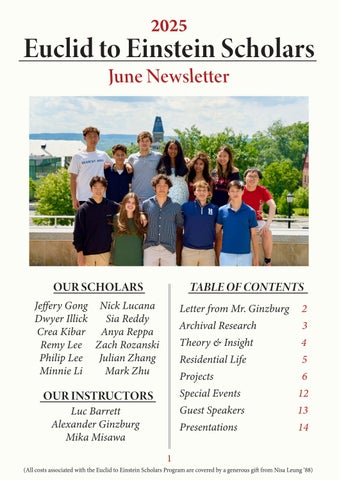
Jeffery Gong Nick Lucana Dwyer Illick Sia Reddy Crea Kibar Anya Reppa Remy Lee Zach Rozanski Philip Lee Julian Zhang Minnie Li Mark Zhu
OUR INSTRUCTORS Luc Barrett Alexander Ginzburg Mika Misawa
Letter from Mr. Ginzburg
2
Archival Research
3
Theory & Insight
4
Residential Life
5
Projects
6
Special Events
12
Guest Speakers
13
Presentations
14
1 (All costs associated with the Euclid to Einstein Scholars Program are covered by a generous gift from Nisa Leung ‘88)
Euclid to Einstein Scholars 2025
A Letter from Mr. Ginzburg hold in our hands these magnificent We cannot be more grateful for their volumes that paved the way for the wonderful engagement with us, and, Scientific Revolution which shows needless to say, we look forward to no signs of slowing down. continuing our relationship. We received a very warm welcome The second goal of our Cornell visfrom the library teams and profes- it was to learn more mathematics. sors of Cornell’s mathematics depart- We held daily classes on a variety ment. Everyone here was looking of topics necessary for the History for ways to make our stay more en- of Math and Physics course. We exjoyable and productive. Head of the plored Vectors and Matrices, (re)“Math Library, Henrik Spoon, looked invented” Complex Numbers, and after us, and checked in daily to see learned Taylor Series expansion and if everything was going well, helping the famous Euler’s formula. Then we students along the way (for example, explored Linear Ordinary Differenby effortlessly producing the origi- tial Equations, Partial Differential nal volumes of world-famous Feyn- equations, and Calculus of Variaman’s Lectures on Physics, delivered tions, finishing with the foundationwhen Richard Feynman, a Nobel al Euler-Lagrange equations. Using Laureate in Physics, was a professor them, we proved that a straight line Dear Friends of the Euclid at the Cornell’s Physics department). truly is the shortest path between to Einstein Scholars Program, Several professors from the Mathe- any two points on a plane (hard to matics department came to speak believe, but mathematicians get exThis June was the inaugural run of with us about their work. Professor cited about proving these “obvious” the Euclid to Einstein program at Lionel Levine spoke about AI, Large things!). Cornell. The university is known for Language Models, and their power its outstanding library collections in and pitfalls. Professor Moon Duchin It has been a challenging, busy, and many disciplines, including (and es- delivered a fascinating talk about her productive visit. I look forward to pecially!) mathematics. After much research on how to draw electoral our stay next year. It will be great planning beforehand, we found our- districts to achieve a fair outcome. to reconnect with our Cornell colselves on the beautiful campus in She is a leading expert on this sub- leagues, and continue to explore the Ithaca, ready to do our work. But ject and highly sought-after expert life and work of outstanding mathewhat is our work? First and fore- witness at the state and federal lev- maticians and physicists of the past. most, we came to do research on the el. Professor Timothy Riley spoke Just about everything we see around leading mathematicians and phys- about Big Numbers. And Professor us today would not exist had it not icists of the past. Each student had Tara Holm, head of the Mathemat- been for their genius, foresight, and picked a mathematician or a physi- ics Department, welcomed us on hard work. cist whose life and work they want- our first Monday morning, giving us ed to study. We knew that Cornell li- an overview of how the department Sincerely, braries were outstanding. But as our functions, and a tour of the campus. Mr. Ginzburg work progressed, we began to realize just how spectacular Cornell libraries actually are. In addition to having full access to the math library, which seems to have every book on math over the last century, we also had access to Cornell’s Rare Books and Manuscripts Collections. Original editions of works by Newton, Euler, Descartes, Viète, and many others were made available for us as well as English translations of many foundational works originally published in Latin. We were thrilled to
2
Euclid to Einstein Scholars 2025
Research at Malott, Uris, & Olin
An essential aspect of the Euclid to Einstein lized in our independent research. We were Scholars Program was the incredible oppor- especially excited by the opportunity to contunity to conduct archival research on our duct research on the original works of famed luminaries at Cornell’s mathematics library, mathematicians, such as Euclid’s Elements or Olin Library, Uris Library, and the Rare Books Newton’s Notebook, and we spent countless and Manuscripts Collections. These libraries hours analyzing delicate diagrams, studying offered us special access to the original texts, marginalia, deciphering symbols, and uncovold biographies, complex diagrams, and cen- ering the influence of social and cultural conturies-old manuscripts that brought our re- text on the development of our luminaries’ work. search to life. At 9 a.m. each morning, we gathered in the The experience not only deepened our underreading room, surrounded by shelves of books standing of the work we were studying, but and digital sources. With the guidance and reminded us of an important lesson: mathesupport of Cornell’s experienced and skilled matics and physics are far more than formulibrarians—who helped us navigate the cata- las and numbers—they are a living history of log, locate materials, and handle fragile manu- ideas passed down and reshaped over severscripts—we delved into original and support- al generations. The opportunity to work with ing work of our chosen mathematicians and such rare works added depth to our research, physicists. The Rare Books and Manuscripts and we are especially grateful to the dedicated Collections houses thousands of rare and im- librarians who made this opportunity possiportant mathematical and scientific volumes ble. and manuscripts—works that some of us uti-
3
Euclid to Einstein Scholars 2025
Theory & Insight
Luc Barrett Instructor
previous lessons to real-world problems. In one class, we used partial differential equations to calculate how heat moves across a rod, allowing us to predict physical phenomena with precision and accuracy. Furthermore, we used partial differential equations, functionals, chain rule, and integration by parts to work through the logic behind why a straight-line segment is truly the shortest path between two points. It is interesting how complex the logic behind such a basic fact is, and often we take these “simple” mathematical facts for granted. Looking back, Euler’s formula stands out as one of the most pleasing results we encountered as it links exponentials, trigonometry, and complex numbers in an almost unimaginable way.
Mika Misawa
Residential Assistant
Each afternoon, following our work in the archives and lunch at Cornell, we would transition to math classes that spanned three hours. We began with mathematical induction, through which we learned to build mathematical arguments that held true for infinitely many cases. The class was taught by resident assistant and mentor Mika Misawa, a recent Cornell graduate with a double major in mathematics and philosophy. Furthermore, during our class on induction, we were introduced to “cake numbers”—the maximum number of regions a cube can be divided by n planes. From there, the concepts we learned grew larger and more complex. Luc Barrett, an incoming Cornell PhD student in physics, and Mr. Ginzburg taught us many topics including: Taylor series expansions, calculus of variations, hyperbolas, linear differential equations, functionals, Fermat’s Principle, partial differential equations, complex numbers, and the foundations of Linear Algebra. Through studying calculus of variations, we were taught how to find functions that minimize certain values—a tool with many applications to engineering and physics. Later topics added depth to our mathematical understanding, and we were consistently amazed by how the concepts connected to one another and to the physical world. Some of the most thrilling moments arose when we were taught how to apply the abstract ideas we had learnt in
4
Beyond daily classes, our learning extended to evening study halls where we worked collaboratively, alongside teaching assistant Luc Barret, on problem sets that pushed us to apply the concepts we learned and solidify our understanding. The evening sessions were difficult but rewarding, allowing the scholars to develop creative strategies to walk through rigorous math problems. By the end of the two weeks, Scholars came away with new mathematical knowledge, along with a deeper appreciation for how mathematics reveals much of the structure of the world around us.
Euclid to Einstein Scholars 2025
Life at Court-Kay-Bauer Life in Court-Kay-Bauer hall—one of the way, turning competitive as people would many residential buildings on Cornell’s North dive for the ball, hoping to outplay each othCampus—was one of the most memorable er. Even more, the common room was always and meaningful parts of our time at Cornell. full of energy, with people engaging in intense Outside of class, scholars found many ways games of pool, ping pong, and just hanging to relax, have fun, and—most importantly— out. bond with each other. On many evenings after classes, we would head to the beach volley- One of the best parts of dorm life was learnball courts. Despite many of us not knowing ing new card games together. Whether it was how to play volleyball prior to our time in the Chinese Break the Egg, President, or Bluff, program, several hours spent at the courts al- there was often a group of students at the table lowed us quickly to learn, and games ended teaching others, playing, and laughing. While with plenty of laughs. It became a tradition to we had attended school with each other for gather on the bridge to watch the sunset—or, the past few years, these small moments in on occasion, the sunrise—with our “Spotify the dorm—sharing snacks, telling stories, and Jam” playing in the background. playing games—allowed us to create tightknit, lasting friendships that we look forward Inside the dorm, there was never a dull mo- to continuing in our Senior year. ment. Spikeball games popped up in the hall-
5
Euclid to Einstein Scholars 2025
Notes From Our Scholars Jeffery Gong
Tracing Mathematical Lineage Pierre de Fermat was, as his biographer puts it, “a judge by profession, a mathematician by passion.” I was fascinated at first by his last conjecture (now theorem) and how an amateur who rarely published could still launch entire fields of mathematics. At the Rare Books and Manuscripts Collections, I came across three separate restorations of the same book by Apollonius of Perga, a foundational figure in ancient Greek geometry. One of these restorations was by Fermat himself. Seeing how different mathematicians over centuries reconstructed and reinterpreted the same classical text offered a window
into the evolution of scientific thought. Alongside this, I reviewed Fermat’s complete works, a supplement volume, a physics treatise, and a German edition on his maxima and minima methods. These showed how his technique of adequality anticipated core concepts of calculus. To continue my research, I turned to Mahoney’s Career of Fermat, Devlin’s Unfinished Game, and Singh’s Enigma, which helped me understand how Fermat’s ideas bridged ancient geometry and modern analysis. Looking ahead, I hope to explore how Fermat’s methods influenced later developments in calculus and mathematical proof, especially through his correspondence with Pascal and Wallis. During the spring course, I plan to translate key Latin excerpts and analyze how his approach, such as that to the concept of “adequality,” reflects a period of transition in mathematical thinking.
6
Einstein’s Science and Society I’ve always heard about Einstein’s amazing scientific breakthroughs, and I wanted to spend some time getting a more solid understanding of his theories and life. For the purpose of this program, that meant learning about the interplay between his personal, social, and political life with his scientific breakthroughs. Einstein dropped his first batch of serious scientific insights in 1905, and he shared his game-changing General Theory of Relativity ten years later. The collection of books held at Cornell tell the story of how this impressive scientific feat was met by an unfortunate, antisemitic resistance to his ideas. The quality of his ideas eventually overcame this injustice, as experimental evidence proved him right in 1919, and later, his ideas earned worldwide acceptance. With General Rel-
ativity, Einstein resolved the lingering problems left by Newton’s centuries-old conception of gravity. With his discoveries about E = mc2 and the existence of photons, he laid the groundwork for atomic bombs and quantum mechanics. Einstein ended his life with an unfinished search for a unified theory of the universe, something still open for us to resolve today. In the spring, I’ll continue reading through the sources I’ve found at Cornell’s libraries and learning about Einstein’s contributions.
Dwyer Illick
Notes From Our Scholars Cont.
Einstein was Right I chose Einstein as my luminary. He is one of the greatest and best known scientists in history for his work on Special Relativity, General Relativity, Brownian Motion, and the Photoelectric Effect.
I had initially chosen Newton, but I quickly switched to Einstein because of my fascination with time dilation after watching Interstellar. For most of the time at Cornell, I chose to focus on un-
Remy Lee
in Sicily in the 3rd century BC, he made profound contributions to mathematics, physics, and engineering by proposing laws of mechanics and estimating volumes and areas of various geometrical shapes by applying the idea of infinitesimals and the method of exhaustion, which anticipated integral calculus by two thousand years.
Un-Archiving Archimedes I chose Archimedes as my luminary of interest at Cornell. As a scholar of Classics and mathematics, I have always been intrigued by how great minds of antiquity conceived mathematical notions that laid the foundation for modern technological feats. Naturally, Archimedes struck me as the prime choice. As a native of then-Greek Syracuse
I dedicated much time at the Rare Books and Manuscripts Collections, where I examined 16th- through 18th-century compilations of Archimedes’ works scribed in Ancient Greek and Latin. Analyzing authentically preserved forms of Archimedes’ diagrams and writings firsthand in conjunction with edited, published modern
7
derstanding the math behind General Relativity, which is a theory that describes gravity as the curvature of spacetime rather than a force. The most fascinating thing I learned about him during my time was that Einstein had added a Cosmological Constant to his theory of General Relativity in order to make the model consistent with the notion that the Universe was unchanging. However, later on, it was discovered that the Universe is indeed expanding and his original theory is correct and no fudge factor is needed. While this finding wasn’t a key insight into his personal life, nor one of
his major contributions, it highlights the fact that Einstein was a true genius, since his theory predicted what we had not yet observed. In the spring, I’m most excited to learn more about his philosophies, especially on humanism, and how they affected his work.
English compilations yielded a fascinating experience of archival study in which I was challenged to understand his work in a similar mode as it had inspired later Renaissance and Enlightenment thinkers like Galileo, Newton, and Leibniz. Further,
investigating the social forces from which Archimedes’ works sprung enriched my understanding of the history and legacy of the ancient intellectual tradition, which I hope will invigorate my study of Classics at Hotchkiss and beyond.
Crea Kibar
Notes From Our Scholars Cont. Philip Lee
Geometry, Gambling, and God My research was on Blaise Pascal, a French mathematician, physicist, and philosopher. Pascal was a polymath, devising Pascal’s Theorem and Pascal’s Law while making significant contributions to fluid mechanics, probability theory, and the comprehension of Pascal’s Triangle. What initially intrigued me was his philosophical reasoning, specifically Pascal’s Wager: a philosophical argument proving the rationality behind believing in God. While conducting more research, I was particularly fascinated by Pascal’s probability theory and subsequent utilization of his triangle, which I found provides practical implementations when
determining chance in our everyday lives. The Math and Olin libraries provided great resources that helped illustrate Pascal’s numerous concepts and provided additional insight into the environmental factors that enabled him to conduct his studies. I’ve gotten the privilege to search through the archives where I obtained access to his work. In my most recent session, I examined his multiple essays and treatises along with a set of letters exchanged by Pascal and Fermat where they attempted to solve gambling problems utilizing their probability theory prototypes. At another archival session, I looked through some of Pascal’s socalled miscellaneous writings along with his written thoughts regarding his philosophical and religious beliefs. I’ve enjoyed my studies in Cornell and I look forward to further examining my resources this coming year.
Latin to Algebra: The Mathematical Legacy of Viète After switching my person a few times, I settled on François Viète, who was a mathematician known as the father of symbolic algebra. I was particularly intrigued that although Viète was French, he wrote all of his mathematical work in Latin which was the academic language of his time. One of his most fascinating contributions was that he introduced symbolic notation, using consonants for knowns and vowels for unknowns.
information on geometry, logic, Gregorian Calendar, and angular sections, my research led me to focus on his algebraic discoveries, which had the most lasting effect on the development of mathematics. Hence, I focused on his introduction of letters as variables, Viète’s formulas (the relationship between the coefficients of a polynomial and the sums and products of its roots), and his infinite product for π. There is still so much to uncover about Viète’s math and I look forward to writTo look at primary sources, ing my paper for next spring. I visited the Rare Books and Manuscripts Collections Minnie Li at Cornell which had two volumes of his original Opera Mathematica. I examined the original Latin and photographed and translated pages that seemed interesting. While his book included much interesting
8
Notes From Our Scholars Cont. Nick Lucana
The Architecture of Uncertainty My research at the Cornell Mathematics Library and Rare Books and Manuscripts Collections centers around one of the leading Japanese mathematicians of the 20th century, Kiyoshi Itô. Known as the father of stochastic analysis, Itô reshaped how we understand randomness with stochastic differential equations (SDEs) and what
is now known as Itô calculus. His work is primarily used in quantitative finance, physics, and biology to model previously inexplicable phenomena such as Brownian motion. My initial interest in him stemmed from my curiosity in both management and technology. Rummaging through his publications, university lecture notes, and translated work from Japanese, I became increasingly intrigued by the depth of what defines a stochastic process. Within that process lies time evolution and state space, with Itô’s work in the most confusing realm: continuous state space—an uncountably infinite number of possible states in a system that evolves randomly over time. Yet, in-
terestingly, his work was nowhere near as appreciated at the time of its discovery. For context, Itô’s infamous paper On Stochastic Processes was published during World War II, with limited communication to the Western world. I am extremely grateful to have had the opportunity to begin early research on Itô and am excited for the upcoming school year, where I will dive
Aristotle’s Legacy: How on his work in the fields of shape foundational geometStructure Endures Error logic, mathematics, and phys- ric principles and the develInitially interested in logic, I chose to research mathematician, physicist, and philosopher Aristotle, often referred to as the “father of logic.” At Cornell, I began exploring the intellectual legacy of Aristotle with a particular focus
ics. As part of this research, I examined Euclid’s Elements at Cornell’s Rare Books and Manuscripts Collections to understand how Aristotle’s logical principles, such as the use of axioms and demonstrative reasoning, helped
9
opment of later, more rigorous scientific theories. I also engaged with more modern interpretations of Aristotle’s work that highlight the enduring influence of his ideas across several disciplines, as well as older sources within the Mathematics Library that critiqued his scientific theories as fundamentally flawed. Early in my research, I became especially interested in how many of Aristotle’s theories, particularly in mathematics and physics, were later proven incorrect. This led me to shift my focus toward examining the root of his inaccuracies and the lessons we
deeper into the sources I’ve already found and strengthen my understanding of the mathematical framework behind stochastic processes. It has been truly fascinating to see how finance, mathematics, and engineering have intersected in the work of Itô, building on the legacy of mathematicians before him.
Sia Reddy
can learn from his errors in process and result. My goal is to continue analyzing both the strengths and flaws in his thinking to show that Aristotle’s true legacy lies not just in his claims, but in his methods—and what they reveal about the importance of demonstrative, disciplined reasoning over dogma and tradition.
Notes From Our Scholars Cont. Anya Reppa
Ada Lovelace, the Mother of Computing I chose to center my research around the life and work of Ada Lovelace, which also allowed me to follow the evolution of early computers. While at the Cornell Mathematics library, I traced the origins of computing back to the French textile industry and the invention of the jacquard loom—an early punchcard system that used sequences of circular holes to encode complex machine-woven patterns. It was Lovelace’s notes on the Jacquard loom as well as another early computer, Charles Babbage’s analytical engine, that served as some of the
first computer programs and changed the trajectory of computing beyond simple calculations. I found the Mathematics library to be rich with detailed blueprints and diagrams of the analytical engine. Since the engine was never completed, the drawings were instrumental in helping me understand the machine’s mechanics as well as the process of transforming Lovelace’s punched code into complex calculations. I was also able to access a number of books containing transcripts of Lovelace’s letters. These included thoughts that were vastly influential on the work of Alan Turing as well as our current understanding of artificial intelligence and its capacity for sentience. For example, her objection that while opportunities for computing are limitless, a computer has “no pretensions whatever to originate anything. It can do whatever we know how to order it to perform.”
10
Einstein Beyond Equations During my time at Cornell, I chose to research Albert Einstein—not only for his accomplishments and contributions to physics and mathematics, but also to explore how the personal, political, and social contexts of his life shaped his work. Working alongside my peers, Crea Kibar and Dwyer Illick, who also chose Einstein as their luminary, I began by understanding his greatest theories, such as special relativity and general relativity. As I became more aware of how complex and revolutionary Einstein’s theories were, I also began to wonder about the effect they had on society. This led me to Cornell’s Math Library and Rare Books and Manuscripts Collections, where I searched for direct sources covering both Einstein’s theo-
ries and the reactions they provoked. I found that his greatest works emerged in the early 20th century which was marked by World War I and a rising tide of antisemitism, especially in Germany, where Einstein was born. I am excited to continue my research in the Spring and delve deeper into the mathematical explanations behind Einstein’s theories. My final research paper will combine these aspects and showcase all I have learned in the process.
Zach Rozankski
Notes From Our Scholars Cont. primary texts through the Cornell Library Catalogue. I had known of his philosophical contributions, so I found his impact as a mathematician even more interesting and impressive. I started with comprehensive biographies on the University of St. Andrews Math History MacTutor site to build basic knowledge. I gathered specific volumes and texts from the Olin Library, Math Library, and Rare Books and Manuscripts Collections, though many were in French and Latin. My research was structured around the novelty of Descartes’ contributions
to mathematics, and how he was able to create commonly used mathematical concepts such as Cartesian coordinates. To answer these questions, I traced social order and academic funding in seventeenth-century Europe, examined his family background and educational influences, and mapped his collaborations with other mathematicians like Fermat. He invented analytic geometry by introducing a coordinate system that translated geometric curves into algebraic equations. In his 1637 treatise La Géométrie, he showed how equations such
as the standard form of representing straight lines and algebraic methods could be used to solve classical problems of tangents and intersections. In the spring, I hope to have a better conceptual understanding of analytical geometry to recreate some of Descartes’ work.
was a 17th-century English mathematician, physicist, Mark Zhu and opticist who is considered the founding father of modern science, classical mechanics, optics, and calculus. Through inventing the three laws of motion and universal law of gravitation, Newton was able to explain God, Gravity, and Apple: every motion we see around A Look Inside Newton’s us – from celestial motion to the motion of everyday Manuscripts objects like an apple dropI chose Isaac Newton as my ping from a tree. Mathematician of interest at Cornell because I wanted I spent much time in the to learn more about how his Cornell RMC, examinreligious beliefs influenced ing Newton’s 17th-cenhis scientific work. Cornell tury works in a blend of also has numerous resourcancient Greek, Latin, and es about Newton both in English. I was intrigued the Rare Books and Manuby his thought process bescripts Collections and the hind the three laws of moMath Library. Isaac Newton tion. One of the works that
I investigated was Newton’s Notebook from his days at Trinity College. I used AI to translate the manuscript into English, and discovered that Newton’s notes had deep theological roots. He believed nature’s laws were the design of God. Newton also rejected Aristotle’s ideas on motion and referenced
Descartes’ ideology of inertial motion in his creation of the first law of motion. My future plan regarding Newton in the spring course is to further unpack his physicist contributions to the scientific world, specifically focusing on understanding his differential equations.
Descartes’ Mathematical Exploits I started my research project on Descartes by gathering secondary sources and
11
Julian Zhang
Euclid to Einstein Scholars 2025
Special Events
bowls in the common room! Nature had its own way of wowing us, particularly during our visit to the Robert H. Treman State Park to see one of Ithaca’s famous gorges, Enfield Glen. The views of the waterwall were breathtaking, and the trails wound through lush greenery. We paused to take it all in, taking group photos, wading in the water, playing volleyball, and skipping stones. The trip was a reminder of how beautiful Ithaca is, and how truly lucky we were to experience it together. Finally, we several trips to Collegetown throughout our time at Cornell. We went out Our time at the program outside of our re- to eat an array of cuisines, attended Ithaca search was about bonding, adventure, and Pride, and went on bubble tea and 7-11 runs. making unforgettable memories with one These moments, small or big, helped turn our another. Throughout our two weeks in Itha- group of math scholars into a real community ca, we got to explore the town and beyond with so many unforgettable memories to take away. through several amazing trips. We began with a trip to Ithaca downtown for Circus Culture. There, the instructors taught us how to juggle, balance, and do acrobatics. Although we quickly came to realize that gravity always wins, we enjoyed cheering each other on, and laughing when we fell. On our weekend off, we traveled to Six Flags at Darien Lake, NY. The bus ride itself felt like a party, with everyone playing music, games, and engaging in good conversation. Upon arrival, we teamed up to conquer the many roller coasters and games, enjoy some wings, fries, and the amusement park classic—Dippin Dots. Later in the afternoon, the group enjoyed the rides and slides within the water park. The day was filled with smiles, laugher, screams, and energy—the Scholars would surely name the trip a highlight. Upon coming back, we enjoyed Chinese food and poke
12
Euclid to Einstein Scholars 2025
Guest Speakers
Our time at the program was made special Duchin discussed her unique career path at through the opportunity to meet and talk the intersection of mathematics and public with some of the Cornell Mathematics De- policy. She educated the scholars on her recent partment’s most inspiring figures, including research that explained how to draw electoral Dr. Spoon (Librarian of the Mathematics Li- districts to achieve a fair outcome in a dembrary), Professor Tara Holms (Head of Cor- ocratic election. And finally, Professor Riley nell’s Mathematics Department), Professor visited the scholars as a guest during one of Moon Duchin, Professor Lionel Levine, and their afternoon math lectures, where he disProfessor Timothy Riley. Professor Holms cussed “Big Numbers” and his research into kindly greeted us on the first day of our ar- geometric group theory. Scholars played a chival research, giving us a tour around the game where they had to avoid making monolibraries we would be using, explaining the chrome triangles, learned about Hydra, and role of mathematical principles in 3D-print- thought about how to express the greatest ed fidgets, and narrating some of Cornell’s whole number in only words and mathematlong-standing, unique traditions. Later, Pro- ical notion—a feat much harder than we had fessor Levine delivered a thought-provoking first thought! lecture on how math helps us think about AI safety. During the lecture, Professor Levine In retrospect, we left Cornell not just with challenged students to engage in discussions new knowledge, but with a deeper excitement debating the moral status of AI, what “con- for where math can take us, along with gratitrol” over AI really means, and if it could lead tude for the special guests who were willing to to human extinction. The next day, professor share their time and passions with us.
13
vw
Euclid to Einstein Scholars 2025
Final Presentations Z.R. on Einstein R.L. on Archimedes
M.L. on Viète
S.R. on Aristotle
N.L. on Itô
A.R. on Lovelace
P.L. on Pascal
J.G. on Fermat
D.I. on Einstein M.Z. on Newton
J.Z. on Descartes
C.K. on Einstein
Contributor Credits
Graphics—Nick Lucana & Sia Reddy Editing—Nick Lucana & Sia Reddy Texts—All Scholars & Intstructors Layout & Organization—Nick Lucana & Sia Reddy Photos—All Scholars & Instructors The Hotchkiss School, 11 Interlaken Road, Lakeville, CT 06039-2141, (860) 435-2591
14