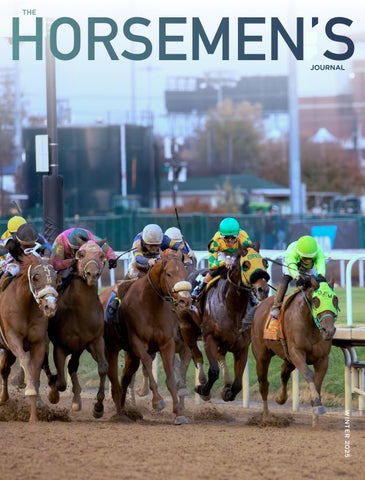
HORSEMEN’S THE
JOURNAL
WINTER 2025
OFFICIALSPONSOR SPONSOR OFFICIAL of the the National NationalHBPA HBPA of
Are You Covered? OWNERS’ & TRAINERS’ LIABILITY PROGRAM
AreYou You Covered? Covered? Are
What is it?
A program to protect your assets in case of an injury or damage to property OWNERS’ & TRAINERS’ LIABILITY PROGRAM arising from your equine activities (breeding, racing, sales, training). This is not OWNERS’ & TRAINERS’ LIABILITY PROGRAM a substitute for workers’ compensation coverage.
What is it? What is it?to protectItyour What Cover? A programDoes assets in case of an injury or damage to property
A program to protect your assets ininjuries case of to anracing, injurysales, or damage toThis property from your equine training). is not participants •arising Liability claims arisingactivities from (breeding, (non-employee arising from your equine activities (breeding, racing, sales, training). This is not ajockeys substitute forexercise workers’ riders) compensation coverage. and a substitute for workers’ compensation coverage.
•What Contractual liability Does It Cover? (i.e. hold harmless in Race Track Stall Agreements) to participants (non-employee What Does Itarising Cover? Liability claims from injuries •• Premises and Operations liability coverage for all equine operations injuries to participants (non-employee jockeys and arising exercisefrom riders) • Liability claims including breeding, boarding, training, and racing. jockeys and exercise riders) • Contractual liability (i.e. hold harmless in Race Track Stall Agreements) • Premises and Operations • Contractual liability coverage forTrack all equine operations (i.e. holdliability harmless in Race Stall Agreements) How Much Does It Cover? including boarding, training, and racing. • Premises and breeding, Operations liability coverage for allown equine operations Each member additional insured has their $1,000,000 coverage for including breeding, racing. general aggregate. Damage each occurrence or offense and and $2,000,000 How Much boarding, Does Ittraining, Cover?
Each memberrented additional their ownby$1,000,000 for to premises toItinsured you orhas occupied you withcoverage the permission How Much Does Cover? each occurrence or offense and $2,000,000 general aggregate. Damage
of the owner is provided with a limit of $50,000. Medical payments
Each to member additional has their by own $1,000,000 coverage for premises rentedas toinsured you or occupied youof with the permission coverage applies well in the amount $5,000 per person. each of occurrence offense and generalMedical aggregate. Damage the owner or is provided with$2,000,000 a limit of $50,000. payments to premises occupied withper theperson. permission coveragerented appliesto as you well or in the amountbyofyou $5,000 of the owner is provided with a limit of $50,000. Medical payments Cost:as$50 Horse / $100 Minimum Premium coverage applies well Per in the amount of $5,000 per person. Cost: $50 Per Horse / $100 Minimum (Beginning May 1st)Premium (Beginning May 1st)
Cost: $50 Per Horse / $100 Minimum Premium Stone Lane, LLC (Beginning Stone Lane, LLC May 1st) 3006Eastpoint Eastpoint Parkway • Louisville, KY 40223 3006 Parkway • Louisville, KY 40223 Phone:502.228.1600 502.228.1600 Fax: 502.638.5060 Phone: • Fax:• 502.638.5060
Stone Lane, LLC
3006 Eastpoint Parkway • Louisville, KY 40223 Phone: 502.228.1600 • Fax: 502.638.5060
Formerly Formerly
Formerly Endorsed by
Endorsed by The National Horsemen’s The National Horsemen’s Benevolent & Protective Benevolent & Protective Association, Inc. Association, Endorsed byInc.
The National Horsemen’s Benevolent & Protective Association, Inc.
Sterlingthompsonequine.com Sterlingthompsonequine.com
THE HORSEMEN’S JOURNAL CONTENTS | WINTER 2025 | VOLUME 72/#4
DEPARTMENTS
FEATURES
22
02
Firm Footing Perfect weather, big fields and close finishes contribute to a successful 27th Claiming Crown. Double Your Money, Ashima and Echo Lane were among the winners on a memorable mid-November day at Churchill Downs
Message from the National HBPA
38
Small Steps The Horseracing Integrity and Safety Authority’s proposed revised regulations address only a few problems
08 Industry News
44
The Matter of Metformin Classic environmental substance detected at trace levels in post-race samples
16
48
HBPA News
50 Affiliate News Sound Advice Make your donations work harder for you and the missions that matter most
THE HORSEMEN’S JOURNAL
WINTER 2025
1
GWEN DAVIS/DAVIS INNOVATION
MESSAGE FROM
THE CEO NO QUESTIONS ASKED AND NO MEANINGFUL DUE PROCESS
W NATIONAL HBPA PRESIDENT DR. DOUG DANIELS (LEFT) AND NATIONAL HBPA CEO ERIC HAMELBACK AT THE 2025 CLAIMING CROWN AT CHURCHILL DOWNS
NATIONAL HBPA
3380 Paris Pike Lexington, KY 40511 P (859) 259-0451 F (859) 259-0452 racing@hbpa.org www.hbpa.org
PRESIDENT/ CHAIRPERSON OF THE BOARD Dr. Doug Daniels SECRETARY/ TREASURER Lynne McNally CHIEF EXECUTIVE OFFICER Eric J. Hamelback VICE PRESIDENT SOUTHERN REGION Rick Hiles VICE PRESIDENT CENTRAL REGION Joe Davis VICE PRESIDENT WESTERN REGION J. Lloyd Yother VICE PRESIDENT EASTERN REGION Naomi Long
e saw some amazing days in horse racing in the fourth quarter of 2025, and I felt the need to touch on the current Horseracing Integrity and Welfare Unit (HIWU) arbitration process and the serious structural problems that deserve urgent attention by stakeholders. We’ve repeatedly heard that horsemen across the country are losing their livelihoods, their reputations and in many cases their desire to remain in this industry because the testing and enforcement system is fundamentally imbalanced. Under the rules as written, the entire process was designed so HIWU effectively cannot lose. Do each of you truly understand why we have continued to champion that the Horseracing Integrity and Safety Act (HISA), which includes the HIWU regulations, is unconstitutional? The written regulations prohibit a trainer from contesting, challenging or even questioning any aspect of the sample collection, laboratory procedures or analytical findings. The trainer must accept the laboratory’s conclusions at face value—no questions asked and no meaningful due process. We have seen this in case after case. Consider a recent case involving a controlled medication. The medication involved has been routinely used for decades by trainers and is part of standard veterinary protocols. In this case, the withdrawal period was observed and exceeded by several additional days out of caution. Yet, in a narrow window of time, HIWU reported a sudden cluster of positives for this medication. This after years with no issues. The obvious question arises: What changed? We may never know. HIWU refuses to disclose screening limits or thresholds for the vast majority of substances. Only a small handful of common medications have publicly stated thresholds, most of which were simply adopted from the Racing Medication and Testing Consortium, Association of Racing Commissioners International or other jurisdictions. For the rest, the industry is flying blind without any guidance from HIWU. We do not know whether HIWU is altering screening limits, changing analytical sensitivity or selectively targeting certain substances. If these thresholds are grounded in objective science, as HIWU has suggested, why not tell the covered horsemen what they are? Meaningful scrutiny by anyone, much less independent experts, is nearly impossible. In addition to HIWU objecting to providing any information related to laboratory standards, HIWU heavily redacts laboratory packets themselves. Entire pages are redacted, including information pertaining to the trainer’s own horse. Key data that is necessary to evaluate the integrity of the testing process is withheld. This level of opacity prevents independent experts from performing a complete and accurate analysis. In the aforementioned controlled medication case, as in nearly every contested HIWU proceeding, HIWU objected to providing key records, and the arbitrator declined to compel production. HIWU also refused to pause the proceedings to investigate the matter further on its own. At the hearing, despite serious doubts about the accuracy of the laboratory findings, the
2
arbitrator did not require any documentation to be authenticated, preventing the trainer from cross-examining the labs. Further, the trainer was barred from presenting testimony from a highly credible expert witness. Forced to expend substantial resources defending himself, the trainer had little chance of mounting a fair defense. Under these conditions, it is easy to see why trainers are discouraged from challenging HIWU rulings: The system itself strongly favors HIWU and leaves little room for meaningful contest. We are also seeing an increasing number of cases involving environmental contamination. One notable example occurred at a small track where several horses tested positive over a few days for a substance that is legal for human use. All affected parties believed this to be a straightforward case of hay or grain contamination (understandable, given that this substance is grown legally across the country). Yet HIWU refused to investigate under its own Atypical Findings Policy, instead placing the full burden of testing and investigation on the trainers, who obviously did not intentionally give their horses the substance. Compounding the issue, by the time trainers received notice, their horses had already consumed the potentially contaminated feed. This in itself makes it virtually impossible for a trainer to prove the source. Adding to this unfairness, the only substances detected were an inactive metabolite, which provides no performance benefit to the horse. Multiple jurisdictions and regulatory bodies have explicitly stated that trainers should not be penalized for the presence of this metabolite alone. In those jurisdictions, the parent compound is also recognized as a common environmental contaminant. The current HIWU/HISA Anti-Doping and Medication Control (ADMC) rules are deeply flawed in a way that undermines other fundamental scientific principles. Under the ADMC program, if a horse tests positive in one matrix (for example, urine) but negative in another (such as blood or hair), a trainer has no right to use the negative result to challenge the finding. According to publicly available arbitration decisions, the system is treated as single matrix, meaning a single split urine sample is deemed sufficient to establish an adverse analytical finding and no supplemental testing in other biological matrices is required. This approach runs counter to basic forensic toxicology in which different matrices reflect different pharmacokinetic windows, drug metabolism and elimination dynamics. Not allowing use of other matrices when they benefit the trainer defies science, the law and common sense. In nearly every case, HIWU adds another “positive” to its statistics, producing headlines that suggest it is catching cheaters when, in reality, it is penalizing accidents and refusing to consider context. The backbone of fair regulation is transparency. At present, HIWU’s system is neither transparent nor accountable. We deserve transparency and fairness, not a system that is designed and operated to stack the deck against horsemen.
SINCERELY, ERIC J. HAMELBACK
THE HORSEMEN’S JOURNAL
WINTER 2025
THE
NATIONAL HBPA WOULD LIKE TO THANK ITS CORPORATE
AFFILIATES
SPONSORS
BOARD OF DIRECTORS - AFFILIATES Dr. David Harrington, Alabama Lloyd Yother, Arizona Bill Walmsley, Arkansas James Miller, Charles Town Kim Oliver, Colorado Mike Lecesse, Finger Lakes Tom Cannell, Florida Jim Watkins, Illinois Joe Davis, Indiana David McShane, Iowa Dale Romans, Kentucky Benard Chatters, Louisiana Jason Uelmen, Michigan Justin Revek, Minnesota Garald “Wally” Wollesen, Nebraska Anthony Spadea, New England Paul Jenson, DVM, New Mexico Joe Poole, Ohio Joe Offolter, Oklahoma Ron Sutton, Oregon Sandee Martin, Pennsylvania Mike Dini, Tampa Bay Downs David Ross, Virginia Pat LePley, Washington David Milburn, HBPA of British Columbia Sue Leslie, HBPA of Ontario Dan Hurley, HBPA of Alberta Blaine McLaren, HBPA of Manitoba Eddie Esquirol, HBPA of Saskatchewan
CONTRIBUTORS Dr. Kimberly Brewer Dr. Clara Fenger Dr. Robert Holland Dr. Andreas Lehner Jennie Rees Jen Roytz Dr. Thomas Tobin PHOTOGRAPHERS Coady Media Coady Media/Ashley Phillips Coady Media/Cady Coulardot Coady Media/John Gallagher Coady Media/Renee Torbit Eclipse Sportswire/Breeders’ Cup Gwen Davis/Davis Innovation Olivia Witkowski STAFF Tom Law Editor P (859) 396-9407 hj@hbpa.org Michelle McShane Advertising Director P (515) 508-1811 info@hbpa.org Limb Design www.limb.co Graphic Design THE HORSEMEN’S JOURNAL 3380 Paris Pike Lexington, KY 40511 P (859) 259-0451 F (859) 259-0452 hj@hbpa.org HBPA WEBSITE www.hbpa.org COVER PHOTO Gwen Davis/Davis Innovation
The opinions, representations and viewpoints expressed by the authors in the articles contained in The Horsemen’s Journal do not necessarily reflect the opinions, representations and viewpoints or the official policies or positions of The Horsemen’s Journal, National Horsemen’s Administration Corporation or National Horsemen’s Benevolent & Protective Association Inc. and its affiliates (collectively “HJ”). HJ is not responsible for, and expressly disclaims all liability for, damages of any kind arising out of use, reference to or reliance on any information contained within this issue. Information in this issue may become outdated due to the rapidly changing nature of the horse industry. The publication of any advertisements or articles should not be construed as an endorsement of any product, service or position unless specifically stated. The Horsemen’s Journal, Volume 72 #4. Postal Information: The Horsemen’s Journal (ISSN 0018-5256) is published quarterly by the National Horsemen’s Administration Corporation, with publishing offices at 3380 Paris Pike, Lexington, KY 40511. Copyright 2025 all rights reserved. The Horsemen’s Journal is the official publication for members of the Horsemen’s Benevolent & Protective Association, a representative association of Thoroughbred owners and
THE HORSEMEN’S JOURNAL
WINTER 2025
trainers. HBPA is a non-profit 501(c)6 Kentucky corporation. Members receive The Horsemen’s Journal as a benefit of membership paid by the national office from affiliate dues. Annual nonmember subscriptions are $25. Single-copy back issues, if available, are $7. Canadian subscribers add $6. All other subscriptions outside the U.S. add $20 payable in U.S. funds. To order reprints or subscriptions, call (859) 259-0451. The HBPA National Board of Directors has determined that the publication of this periodical is necessary in the transaction of the public business required of the association. Views and opinions expressed are those of the authors and/or advertisers and do not necessarily represent the opinion or policy of the publisher or HBPA board or staff. Query the editor prior to sending any manuscripts. Periodicals Postage Paid at Lexington, Kentucky and additional mailing offices. CANADA POST: Publications mail agreement no. 41530527. Return undeliverable Canadian addresses to: P. O. Box 503, RPO West Beaver Creek, Richmond Hill, ON L4B 4R6. POSTMASTER: Send address changes to The Horsemen’s Journal, 3380 Paris Pike, Lexington, KY 40511.
3
Help Your Your Fellow Fellow Horsemen Horsemen Make a Tax Tax Deductible DeductibleDonation Donation to the National National HBPA HBPAFoundation Foundation
The tax-exempt501 501(c)(3) (c)(3)fund, fund,was wasdeveloped developedasasa safety a safety net horsemen TheNational National HBPA HBPA Foundation, Foundation, aa tax-exempt net forfor horsemen andhorsewomen horsewomen when other forms after disaster strikes. and forms of of assistance assistanceare areunavailable unavailableororhave havebeen beenexhausted exhausted after disaster strikes. Everyyear year the the National HBPA Foundation difficult Every Foundationhelps helpshorsemen horsemenand andhorsewomen horsewomenmake makeit itthrough through difficult timessuch such as as disease disease quarantines quarantines at byby providing tens of of times at aa racetrack racetrackor ornatural naturaldisasters disasterslike likefloods floodsand andfires fires providing tens thousands of of dollars dollars in needed assistance. thousands assistance. “Itwas was just just fabulous. fabulous. I can’t It’sIt’s because of of thethe “It can’t thank thank the the HBPA HBPAenough; enough;IIreally reallyappreciate appreciateallallthat thatthey theydo. do. because National HBPA Foundation combined with our insurance and other supporters like Fasig-Tipton’s Blue Horse National HBPA Foundation combined with our insurance and other supporters like Fasig-Tipton’s Blue Horse Charities, we were able to build this kind of barn. ” –Old Friends’ Michael Blowen after receiving aid from the Charities, we were able to build this kind of barn.”–Old Friends’ Michael Blowen after receiving aid from the National HBPA HBPA Foundation Foundation following National following aa barn barnfire. fire. TheNational National HBPA HBPA Foundation Foundation extends The extendsheartfelt heartfeltgratitude gratitudetotothe theEstate EstateofofBob BobReeves Reeves for its generous donation. The contribution will make a significant impact on our for its generous donation. The contribution will make a significant impact on ourmotto, motto, “Horsemen Helping Horsemen. ” Bob Reeves’ legacy of compassion and generosity will “Horsemen Helping Horsemen.” Bob Reeves’ legacy of compassion and generosity will continue to assist Horsemen everywhere as we work towards the Foundation’s mission. continue to assist Horsemen everywhere as we work towards the Foundation’s mission. We appreciate honoring his memory in such a meaningful way. Scan the QR code or visit We appreciate honoring his memory in such a meaningful way. Scan the QR code or visit https://nationalhbpa.com/remembering-bob-reeves/ to read the Winter 2023 The Horsemen’s Journal article https://nationalhbpa.com/remembering-bob-reeves/ to read the Winter 2023 The Horsemen’s Journal article remembering Bob Reeves. remembering Bob Reeves.
To make a tax deductible donation to the National HBPA Foundation To make a tax deductible donation to the National HBPA Foundation and make a difference in the lives of your fellow horsemen and women and make a difference in the lives of your fellow horsemen and women who may find themselves in need, either: who may find themselves in need, either:
• Log onto https://nationalhbpa.com/donate/ to make a credit card donation • Log onto https://nationalhbpa.com/donate/ to make a credit card donation • Mail a donation check made payable to National HBPA Foundation to: • Mail a donation made payable to National HBPA Foundation National HBPA check Foundation, 3380 Paris Pike, Lexington KY 40511 to: National HBPA Foundation, 3380 Paris Pike, Lexington KY 40511
OFFICIALSPONSOR SPONSOR OFFICIAL of the the National NationalHBPA HBPA of
GWEN DAVIS/DAVIS INNOVATION
LEADING OFF
6
THE HORSEMEN’S JOURNAL
WINTER 2025
RACING FANS STUCK AROUND LATE FOR THE FEATURED $224,943 CLAIMING CROWN JEWEL AND $182,886 CLAIMING CROWN EMERALD UNDER THE LIGHTS AT CHURCHILL DOWNS.
THE HORSEMEN’S JOURNAL
WINTER 2025
7
NEWS
INDUSTRY NEWS BREEDERS’ CUP HANDLE JUMPS FOR THIRD STRAIGHT YEAR
T
BREEDERS’ CUP TWO-DAY ATTENDANCE AND HANDLE (COMMON-POOL) HISTORY YEAR
LOCATION
ATTENDANCE
HANDLE
2025
Del Mar
65,232 $180,036,799
2024
Del Mar
67,418 $179,218,631
2023
Santa Anita
109,624 $176,281,989
2022
Keeneland
85,824 $189,060,373
2021
Del Mar
47,089 $182,908,409
2020
Keeneland
No attendance $160,472,893 reported
2019
Santa Anita
109,054 $174,628,986
2018
Churchill Downs
112,672 $157,445,841
2017
Del Mar
70,420 $166,077,486
2016
Santa Anita
118,484 $156,861,811
2015
Keeneland
94,652 $149,869,035
2014
Santa Anita
98,319 $151,158,813
2013
Santa Anita
94,628 $160,704,877
2012
Santa Anita
89,742 $144,272,332
2011
Churchill Downs
105,820 $161,512,867
2010
Churchill Downs
114,353 $173,857,697
2009
Santa Anita
96,496 $153,271,176
2008
Santa Anita
86,588 $155,740,328
2007
Monmouth Park
69,584 $129,197,262
ECLIPSE SPORTSWIRE/BREEDERS’ CUP PHOTO
otal all-sources handle for the two-day Breeders’ Cup World Championships rose for the third straight year at the 2025 renewal held at the Del Mar Thoroughbred Club. Breeders’ Cup Ltd. reported total handle of $180,036,799, highlighted by Japanese invader Forever Young’s victory in the $7 million Breeders’ Cup Classic. The 2025 total handle, the third largest in the history of the event, marked a less than 1% increase over the 2024 total handle of $179,218,631. Total common-pool handle on the 12-race Championship Saturday card November 1 was $118,028,444, up 2.2% from the $115,538,687 reported in 2024. Total common-pool handle on the 10-race Future Stars Friday program October 31 was $62,008,354, down 2.6% from $63,679,944 in 2024. Breeders’ Cup also reported a 2% dip in on-track handle of $18,079,169 for the two-day event, which saw $18,450,754 wagered on track in 2024. Attendance for the two days declined by 3.4% from 67,418 in 2024 to 65,232. The attendance total included the 35,173 people who turned out on Championship Saturday to see the Classic win by Forever Young as well as victories by 27-1 longshot Ethical Diamond in the $5 million Breeders’ Cup Turf, Notable Speech in the $2 million Breeders’ Cup Mile and Scylla in the $2 million Breeders’ Cup Distaff. Keeneland Race Course will host the 43rd renewal of the Breeders’ Cup October 30-31, 2026, in Lexington, Kentucky, with the newly renovated Belmont Park set to host the 2027 event. The Belmont construction project continued into late 2025 with an expected completion in time for the 2026 Fall Championship Meet in September.
JAPAN’S FOREVER YOUNG FENDS OFF AMERICAN STARS SIERRA LEONE AND FIERCENESS TO WIN THE 2025 BREEDERS’ CUP CLASSIC AT DEL MAR.
8
THE HORSEMEN’S JOURNAL
WINTER 2025
CHURCHILL DOWNS OUTLINES ‘VICTORY RUN’ RENOVATION
C
RENDERINGS COURTESY OF CHURCHILL DOWNS INC.
hurchill Downs Inc. unveiled plans in late October for a $280 million to $300 million project called Victory Run, a new structure on the first turn at Churchill Downs between the First Turn Club and the Skye Terrace. Victory Run will replace uncovered, ground-level box seats and dining areas with a new premium hospitality and seating offering. The four-story structure will feature a variety of hospitality experiences with views of the finish line and will include private suites, indoor and outdoor dining and covered box seating. The project will increase available seating in the area from approximately 6,400 existing seats to approximately 7,800 seats. Pending incentives that must be approved first by the City of Louisville and then by the appropriate state agencies, including the Kentucky Cabinet for Economic Development, Churchill anticipates construction of Victory Run will begin following the 2026 Kentucky Derby and will be completed by the 2028 Derby. Churchill plans to offer an interim upgraded seating experience in this area with temporary seating and enhanced amenities for the 2027 Derby. “We are excited to unveil the Victory Run project for Churchill Downs Racetrack,” said Bill Carstanjen, CEO of Churchill Downs Inc. “This project will create a greatly improved experience for our guests in an important section of our racetrack while delivering long-term growth and value for our shareholders.” CHURCHILL DOWNS’ NEW FOUR-STORY VICTORY RUN SPACE ON THE FIRST TURN PAST THE FINISH LINE WILL REPLACE APPROXIMATELY 6,400 OUTDOOR SEATS WITH ABOUT 7,800 PREMIUM SEATS.
CALL HORSEMAN LABOR TODAY! We provide comprehensive labor solution of immigration and I-9 compliance issues.
For international labor needs including: • I-9 Compliance • P-1/P-1S Jockey and Valet visas • H-2B Temporary Worker visas • H-2A Agricultural and Farm visas
OFFICIALSPONSOR SPONSOR OFFICIAL of the the National NationalHBPA HBPA of
Horseman Labor Solutions assists in the immigration visa process for individuals who are: • Jockeys • Exercise Riders • Grooms • Hot Walkers • Stable Attendants • General Laborers
FREE INITIAL CONSULTATION Hablamos español
1-877-678-RACE (877-678-7223) THE HORSEMEN’S JOURNAL
WINTER 2025
www.horsemanlabor.com 9
NEWS
INDUSTRY NEWS GODOLPHIN PRESENTS 2025 THOROUGHBRED INDUSTRY EMPLOYEE AWARDS
T
he Thoroughbred Industry Employee Awards honored its 10th group of individuals who make the Thoroughbred industry special and unique October 21 in Lexington, Kentucky. Winners were announced in seven categories with more than $122,000 awarded. Scott Hazelton, FanDuel TV analyst, served as the master of ceremonies, and Joe Clancy, publisher and co-owner of The Saratoga Special, served as this year’s judging panel chair.
“I commented earlier in July on the difficult task in determining the three finalists in each category,” Clancy said. “I must admit we were presented with an even harder assignment in trying to choose the actual winners in each category. It’s rare for a triple dead heat in our business, but that’s pretty much what we faced with these fantastic and talented individuals in each category. They truly are the backbone of our industry and are great ambassadors and representatives of our sport.”
Winner
Finalists
Runners-up
Katherine McKee Administration Award, sponsored by Keeneland
Isabel Escobar, Todd Pletcher Racing Stable
Vicki Forbes, Thoroughbred Daily News; Sandy Martin, Race Track Chaplaincy of America
Lacey Coler, Barton Thoroughbreds; Lauren Monnet, National HBPA
Support Services Award, sponsored by 1/ST Racing
Lynne Hewlett, Hagyard Equine Medical Institute
Robert “Elmo” Richardson, KatieRich Farms; Mary Perkins, Keeneland Association; Steve Nathan Stephens, Stephens Farrier Service Peterman, Gulfstream Park Inc.
Dedication to Breeding Award, sponsored by Hallway Feeds
Sara Patterson, Cedar Run Farm
Juan Piedra, Stone Bridge Farm; Mario Ponce, Coolmore America
Luis Sanches, Kenneth McPeek Racing Stable; Alan Shell, Kenneth McPeek Racing Stable
Dedication to Racing Award, sponsored by the NTRA
Fiona Goodwin, Jena Antonucci Racing
Jackie Dayutis, WinStar Farm; Carlos Alarcon, D/M Racing Stables
Rafael Fernandez, Herringswell Stable; Lee Vickers, Miguel Clement Racing Stable
Managerial Award, sponsored by Hagyard Equine Medical Institute
Jesus Pinales, Mulholland Springs
John Motaung, Sequel Bloodstock; Duane Reed, Coolmore America
Kali Kleinfelt, Stone Bridge Farm; Edwyn Kiely, Hunter Valley Farm
Newcomer Award, sponsored by NYRABets
Kinnon LaRose, Tom Amoss Racing Stables
Braden Heath, Three Chimneys Farm; Ivanna Rabii, WinStar Farm
Madison Jackson, Churchill Downs; Maxine Pina, Taylor Made Sales Agency
Dr. J. David “Doc” Richardson Community Award, sponsored by Churchill Downs
Nancy Turner, This Old Horse
Peter Drumsta, Finger Lakes Thoroughbred Adoption Program; CJ Wilson, Win Place Home
Victoria Mangini, Pennsylvania Thoroughbred Horsemen’s Association; Caroline Tatum, Sterling Equestrian
COURTESY OF GODOLPHIN
Award
THE 2025 THOROUGHBRED INDUSTRY EMPLOYEE AWARD WINNERS—(FROM LEFT) JESUS PINALES, KINNON LAROSE, NANCY TURNER, SARA PATTERSON, ISABEL ESCOBAR, LYNNE HEWLETT AND FIONA GOODWIN—WERE HONORED THIS FALL AT KEENELAND.
10
THE HORSEMEN’S JOURNAL
WINTER 2025
with over $50 million in total purses paid out annually. Ohio’s three thoroughbred tracks combined Ohio’s three thoroughbred Ohio’s three thoroughbredtracks trackscombined combined Ohio’s three thoroughbred tracks combined conduct over 290 days live racing each year conduct over 290 days ofof live year conduct over 290 days liveracing racingeach eachyear year conduct over 290 days ofof live racing each over $50 million total purses paid out annually. withwith over $50 million inin total purses annually. with over $50 million total pursespaid paidout outannually. annually. with over $50 million inin total purses paid
www.ohio-hbpa.com www.ohio-hbpa.com www.ohio-hbpa.com www.ohio-hbpa.com Ohio Horsemen’s Benevolent and and Protective Association Ohio Horsemen’s Benevolent Protective Association Ohio Benevolent and Protective Association OhioHorsemen’s Horsemen’s Benevolent and Protective Association www.ohio-hbpa.com 800-321-8367 800-321-8367 800-321-8367 800-321-8367 Ohio Horsemen’s Benevolent and Protective Association
NEWS
INDUSTRY NEWS JOHNSON WINS BIG SPORT OF TURFDOM, NEW OWNER HONORS
S
OwnerView also honored Johnson for his ambassador role and promotion of racing. His behind-the-scenes videos with Sandman reached more than 200 million people and generated more than 35 million views. “Griffin Johnson has had an incredible impact on horse racing through his social media platforms, helping to create new fans, which will ultimately result in new owners,” said Gary Falter, project manager for OwnerView. “We appreciate his continued promotion of the sport and look forward to his future success as an owner.” OLIVIA WITKOWSKI PHOTO
ocial media influencer Griffin Johnson earned a pair of honors from the Turf Publicists of America (TPA) and OwnerView to close out his memorable year marked by international attention for his association with 2025 Arkansas Derby winner and Triple Crown competitor Sandman. The TPA selected Johnson for its 2025 Big Sport of Turfdom Award, which recognizes a person or group who enhances coverage of Thoroughbred racing through cooperation with media and racing publicists. OwnerView selected Johnson as the 2025 New Owner of the Year, sponsored by 1/ST Racing. Born in Paris, Illinois, Johnson is a content creator, entrepreneur and investor who has amassed more than 14 million followers across popular social media platforms, including TikTok, Instagram and X (formerly Twitter). Johnson is also a co-founder of the venture capital firm Animal Capital, through which he invests in and advises early-stage companies shaping the future of consumer tech and lifestyle. Johnson entered racing in 2024 through America’s Best Racing’s “A Stake in Stardom” campaign as a partial owner of Grade 1 winner Sandman with West Point Thoroughbreds. Johnson is also a part owner of Grade 2 winner Ewing. “In using his platforms and influence, Griffin Johnson has helped grow horse racing by bringing our sport unprecedented exposure,” TPA President Najja Thompson said. “Our membership selected Johnson for this award in recognition of his role as a tremendous ambassador for horse racing and his consistent openness and availability to the media.” The Big Sport of Turfdom Award was presented at the University of Arizona Race Track Industry Program’s annual awards luncheon at the 2025 Global Symposium on Racing & Gaming at Loews Ventana Canyon Resort in Tucson, Arizona. “I’m incredibly honored to receive the 2025 Big Sport of Turfdom Award,” Johnson said. “Horse racing has given me a community, a purpose and a platform to help grow the sport I love. I’m grateful to everyone who’s welcomed me into this industry and inspired me to be a small part of its future.”
SOCIAL MEDIA INFLUENCER GRIFFIN JOHNSON LAST SUMMER AT SARATOGA RACE COURSE
ANNUAL THOROUGHBRED CHARITIES GRANTS EXCEED $1.1 MILLION
T
horoughbred Charities of America (TCA) announced that grants totaling more than $1.1 million were awarded to 98 organizations in 2025. The organizations approved for a grant include 63 aftercare organizations, 24 backstretch and farm worker programs, seven equine-assisted therapy organizations, three Thoroughbred incentive programs and one research organization. Grant recipients can be found on TCA.org. Over the last 35 years, TCA has awarded more than $28 million in grants. With a record number of grant applications this year, the TCA Grants Committee established clear funding priorities with an emphasis placed on approved organizations working to serve the backstretch and farm employee communities as well as non-traditional aftercare organizations.
12
The committee defined non-traditional aftercare organizations as those that are either working to provide on-track placement services to retiring Thoroughbreds or working to incentivize equine enthusiasts to choose a Thoroughbred as their next mount. “Our annual grants reflect both the generosity of our donors and the strength of the organizations we are privileged to support,” said Erin Halliwell, executive director of TCA. “We take our responsibility as stewards of donor contributions very seriously because it is these donations that allow us to make a real impact via our grants. Every dollar entrusted to TCA helps us invest in organizations that are making an impact on Thoroughbreds and their caretakers.”
THE HORSEMEN’S JOURNAL
WINTER 2025
WHITE HORSE AWARD HONORS REMARKABLE TRIO
C
COURTESY OF RTCA
hino Gudino, his son Luis Gudino and Doug Adams were honored in November at Mountaineer Park with the Racetrack Chaplaincy of America’s White Horse Award for their exceptional act of sacrificial service. The award went to the Gudinos and Adams for their unwavering dedication to caring for their dear friend, Dennis VanMeter, a Vietnam veteran and horseman, during his final days battling cancer. The three transformed Dennis’ tack room into a peaceful sanctuary and provided constant companionship, ensuring he felt loved and respected in his final weeks and days. VanMeter passed away in September 2024. A special tribute video showcasing the inspiring story and celebrating the winners premiered at the RTCA’s annual Night of Faith, Hope and Love on the Monday before the 2025 Breeders’ Cup World Championships at the Del Mar Thoroughbred Club. The Gudinos and Adams were honored later in the month at Mountaineer, where they celebrated with their co-workers, families and friends. Established in 2003, the White Horse Award honors individuals in racing whose bravery and selflessness uplift those around them. Whether lifesaving or transformative, these acts define the heart of the horse racing community. CHINO GUDINO (LEFT), LUIS GUDINO (CENTER) AND DOUG ADAMS EARNED THE RTCA’S 2025 WHITE HORSE AWARD FOR THEIR UNWAVERING CARE OF FRIEND AND MENTOR DENNIS VANMETER.
Watch their story: https://youtu.be/cyXCsFH5hQE
Oh what fun it is to ride... “
From all of us at Horsemen’s Track and Equipment, Inc., we wish you the good tidings of the season, and a New Year filled with peace and hope.
OFFICIALSPONSOR SPONSOR OFFICIAL of the the National NationalHBPA HBPA of
”
~ RANDY BLOCH
WWW.HORSEMENSTRACK.COM PHONE: 502.423.7798 MARK PEARSON PHOTO
THE HORSEMEN’S JOURNAL
WINTER 2025
13
NEWS
INDUSTRY NEWS THE 2025 THOROUGHBRED MAKEOVER CHAMPIONSHIP WINNERS
T
en champions were crowned at the 2025 Thoroughbred Makeover and National Symposium, presented by Thoroughbred Charities of America, October 11 at the Kentucky Horse Park in Lexington. The signature event of the Retired Racehorse Project, a 501(c)(3) nonprofit organization dedicated to increasing demand for Thoroughbreds beyond racing, the Thoroughbred Makeover is the largest and most lucrative retraining program in North America with $139,000 in prize money.
The championships format was new to the Thoroughbred Makeover in 2025, allowing twice as many horses and trainers to stay through Saturday and compete for their share of the prize money. Individual discipline championship rounds took place around the horse park. Here are the championship winners of the 10 makeover disciplines:
Category
Champion
Barrel Racing
Battle Born, trained by Elizabeth King (junior)
Competitive Trail, sponsored by Godolphin
Vestal’s Gap, trained by Nathan Bowers
Dressage, sponsored by PTHA’s Turning For Home
Patou Road, trained by Marty Riney
Eventing, with support from Phoenix Performance Products
Sekt, trained by Amy Faison
Field Hunter, sponsored by Masters of Foxhounds Association
Street Ready, trained by Kara Lee
Freestyle, with support from Thoroughbred Aftercare Alliance
Bandon, trained by Jacquelyn Dickey
Polo, sponsored by United States Polo Association
Qia, trained by Buck Schott
Ranch Work, with support from Juddmonte Farm
Miz Mosler, trained by B.J. Heffelfinger
Show Hunter, with support from Beyond the Wire
Mentha, trained by Rachel McMahan
Show Jumper, with support from Excel Equine
Late Night Cruiser, trained by Rebekah Vernon
TAA AWARDS $4.7 MILLION TO 86 AFTERCARE ORGANIZATIONS
T
he Thoroughbred Aftercare Alliance (TAA) provided $4.7 million in grants to 86 Thoroughbred aftercare organizations that currently hold accreditation status for 2025. This financial support is designed to assist organizations in delivering exceptional care and rehabilitation services for retired racehorses. Since its inception in 2012, the TAA has seen significant growth, expanding from 23 to 86 accredited organizations and increasing its annual grants from $1 million to $4.7 million. The TAA has awarded more than $40.74 million in grants allocated specifically for equine care. These accredited organizations have successfully retrained, retired and rehomed approximately 20,000 Thoroughbreds across 175 facilities. Of the $4.7 million in grants awarded this year, $250,000 was provided by the commonwealth of Kentucky and is being delivered directly to accredited aftercare facilities in Kentucky. Accreditation reflects compliance with rigorous standards for horse welfare, facility operations and overall management. It underscores an organization’s commitment to equine care, ensuring that retired racehorses continue to receive the highest level of attention and compassion. “Thoroughbred Aftercare Alliance is proud to continue supporting our 86 accredited organizations through this year’s grant awards,” said Janice Towles, the TAA’s director of accreditation and grants. “This funding helps sustain the remarkable efforts of these organizations to continue their incredible work as
14
they provide care, rehabilitation and second-career opportunities for retired Thoroughbred racehorses. We commend their ongoing commitment to giving every horse a secure and rewarding life after the track.” Organizations seeking accreditation must successfully complete a detailed application and inspection process to demonstrate adherence to the Thoroughbred Aftercare Alliance Code of Standards. The code encompasses five core areas: operations, education, horse health care management, facility standards and services, and adoption policies and protocols. All facilities housing Thoroughbreds within each organization are inspected, and continued compliance is verified through periodic updates and reinspections as a condition of accreditation. Support for the TAA comes from across all facets of the Thoroughbred industry, including owners, breeders, trainers, stallion farms, racetracks, sales companies, horsemen’s groups, foundations, veterinarians, horseplayers, racing fans and wagering technology companies. “Each year, we’re proud to expand the reach of our grants and strengthen our support for accredited aftercare organizations,” said Stacie Clark-Rogers, TAA operations consultant. “Exceeding previous funding milestones is a direct reflection of our commitment to the lifelong welfare of Thoroughbreds and the generosity of our donors. Their continued support ensures more retired racehorses have the opportunity to transition safely and successfully into their next chapters.” HJ
THE HORSEMEN’S JOURNAL
WINTER 2025
READY FOR LIVE
RED RACING ACROSS
ASKA TRACKS!
ng Circuit will host Live Racing across its ghbred racing will continue in Nebraska ding the momentum started in 2024 with re Stakes races, and increased purses.
owners $125 for horses that run 2026: 2026:GET GETREADY READYFOR FORLIVE LIVE th place atTHOROUGHBRED Legacy Downs)! RACING THOROUGHBRED RACINGACROSS ACROSS
55NEBRASKA NEBRASKATRACKS! TRACKS!
InIn2026, 2026,the theNebraska NebraskaThoroughbred ThoroughbredRacing RacingCircuit Circuitwill willhost hostLive LiveRacing Racingacross acrossitsits 55tracks! tracks!Starting StartingininFebruary, February,live livethoroughbred thoroughbredracing racingwill willcontinue continueininNebraska Nebraska through throughAugust. August.Nebraska’s Nebraska’stracks tracksare arebuilding buildingthe themomentum momentumstarted startedinin2024 2024with with new newand andimproved improvedtracks, tracks,new newbarns, barns,more moreStakes Stakesraces, races,and andincreased increasedpurses. purses.
The TheNebraska NebraskaHBPA HBPAwill willalso alsopay payowners owners$125 $125for forhorses horsesthat thatrun run 6th-10thplace place(plus (plus11th-12th 11th-12thplace placeatatLegacy LegacyDowns)! Downs)! 6th-10th
BUS
SOUTH SIOUX CITY
GRAND ISLAND
12 | nebraskahorsemen.com 7055 70551st 1stStreet, Street,Lincoln, Lincoln,NE NE68512 68512| nebraskahorsemen.com | nebraskahorsemen.com LINCOLN LINCOLN
OMAHA OMAHA
COLUMBUS COLUMBUS
SOUTH SOUTH SIOUX SIOUX CITY CITY
GRAND GRAND ISLAND ISLAND
NEWS
HBPA NEWS
T
he Jockey Club Chair Everett Dobson will deliver the keynote address at the 2026 National Horsemen’s Benevolent and Protective Association Conference March 4 at Oaklawn Park. The telecommunications entrepreneur and philanthropist from Oklahoma City is an owner and breeder as well as a partner in the Oklahoma City Thunder, the reigning NBA champions. Dobson is the first Jockey Club chair to reside outside the Northeast and the 11th chair since Saratoga Race Course cofounder John Hunter became the first in 1894. Dobson follows the 42-year reign of cousins Stuart Janney III, who stepped down this year after a decade in the post, and the late Ogden Mills Phipps. “I’m very honored to get a chance to address the National HBPA,” Dobson said. “I’m very much looking forward to it. It will largely be around a message of collaboration, how our two organizations can collaborate on initiatives [and] activities that are mutually beneficial for the betterment of our sport that we all love.” The conference will run March 3-6 at the Oaklawn Park hotel in Hot Springs, Arkansas. Dobson’s March 4 remarks will conclude the conference lunch and award presentations. The conference opens Tuesday, March 3, with an evening cocktail reception and continues the next three days with speakers and panel discussions. “Each year I try to focus the National HBPA Conference by taking a deep dive into the most pressing issues facing our industry, not just to identify problems but to explore constructive solutions and celebrate what makes Thoroughbred racing so special,” said National HBPA CEO Eric Hamelback. “I have known Mr. Dobson for many years, dating back to my time as general manager at Adena Springs, and I have tremendous personal and professional respect for him. While we may not always see every issue from the same vantage point, I’ve always appreciated his thoughtful approach and genuine commitment to the betterment of our sport. “I also believe Everett brings a unique and valuable perspective to The Jockey Club, not only as a successful owner and breeder but also as an accomplished business executive with a proven record of innovation and leadership,” Hamelback added. “We are genuinely thrilled he accepted our invitation to address the conference, and I hope everyone views his participation as an important opportunity for collaboration and consensus-building among all industry stakeholders. I hope his keynote serves as a meaningful step toward working together to tackle the complex challenges we all face.” Dobson, who grew up around horses in the ranching community of Cheyenne, Oklahoma, will return to his racing roots at the conference. “The first Thoroughbred race I ever went to was at Oaklawn when I was still in college,” he said. “And the first racehorse I had raced at Oaklawn many years later. It’s going back to one of my favorite places.” Dobson majored in economics at Southwestern Oklahoma State University in Weatherford, where he starred on the golf team and was inducted into the university’s sports hall of fame. He also founded the Oklahoma Golf Hall of Fame and each year presents the Everett Dobson Award—$5,000 cash—to an outstanding male or female golfer graduating from an Oklahoma college or university with strong citizenship, sportsmanship and character among the recipient’s important attributes, more so than golf accomplishments.
16
COURTESY OF THE JOCKEY CLUB
DOBSON SET FOR HBPA CONFERENCE KEYNOTE ADDRESS
EVERETT DOBSON, WHO STARTED HIS TENURE AS CHAIR OF THE JOCKEY CLUB IN 2025, PLANS TO BRING A “MESSAGE OF COLLABORATION, HOW OUR TWO ORGANIZATIONS CAN COLLABORATE ON INITIATIVES [AND] ACTIVITIES THAT ARE MUTUALLY BENEFICIAL FOR THE BETTERMENT OF OUR SPORT THAT WE ALL LOVE” DURING HIS KEYNOTE ADDRESS AT THE 2026 NATIONAL HBPA CONFERENCE.
Dobson’s family has been in the telecommunications industry since 1936. Dobson is executive chairman of Dobson Fiber, a 7,000-mile fiber-optic network in Oklahoma, Texas and Arkansas. In 1989, he founded Dobson Communications Corporation, which sold to AT&T in November 2007 for $5.1 billion. At the time of the sale, the company was one of the nation’s largest independent rural wireless providers, operating in 17 states, producing $1.6 billion in revenue and with 3,000 employees and 1.6 million subscribers. Dobson owns the award-winning Oak Tree National golf club—host of the 2027 U.S. Senior Open—in the Oklahoma City suburb of Edmond. His board memberships include the Dobson Family Foundation, National Cowboy & Western Heritage Museum and the Keeneland Association. Dobson, who splits his time between Oklahoma and Kentucky, races in the name of Cheyenne Stables, which campaigned 2011 Breeders’ Cup Dirt Mile winner Caleb’s Posse,
THE HORSEMEN’S JOURNAL
WINTER 2025
trained by fellow Oklahoman Donnie Von Hemel. He also raced Grade 1 winner Mastery, $1.35 million-earner Madefromlucky and Grade 2 winners Mystical Star and Ozara. His breeding stock resides at his Candy Meadows Farm in Lexington, Kentucky. He acquired his first racehorse in 1996, a Texas-bred named Undeniable who went 1-for-6 with three seconds. “My wife soon named him Unreliable for some reason,” he joked. “He had a short career, but he was beautiful.” Dobson said he tries to bring in perspectives acquired from his diverse background to his leadership role as The Jockey Club chair. “I come at this job from a horse owner’s perspective, a breeder’s perspective,” he said. “My background has a lot of business elements to it—the NBA being one—but also bringing a perspective from the part of the country that is very important to this sport. That’s the Midwest and Kentucky in particular.” Dobson said he wants “to reach out to all the constituents of The Jockey Club.” “I really believe the role of The Jockey Club is to support, frankly, everybody in the sport,” he said. “That is a big tent. It extends beyond being a breed registry. The Jockey Club has the resources and understanding of our industry to provide support services and do what’s best for the sport as we conduct our business.” —Jennie Rees
HISA COMPLIANT VICTORY RACING PLATES VICTORY MODEL
ALL SURFACES
DIRT
SPORT QUEENS FRONT & HIND EC QUEENS FRONT & HIND EC QUEENS WEDGE FRONT & HIND RX FRONT & HIND SPORT XLT HIND SPORT XLT WEDGE HIND SPORT LT HIND EC XLT HIND EC XLT WEDGE HIND
JOIN US IN
HOT SPRINGS
EC LT HIND RX XLT HIND
VISIT HISAUS.ORG FOR UPDATED RULES
THE 2026 NATIONAL HBPA CONFERENCE TUESDAY, MARCH 3 – FRIDAY, MARCH 6
Cocktail Reception Keynote Address by Everett Dobson Panel Discussions Racing at Oaklawn Park
MARCH 3 MARCH 4 MARCH 4-6 MARCH 6
FULL BOARD MEETING — MARCH 7
Conference hotel room block will be available for conference attendees
Check the National HBPA website for additional information and to sign up
HBPA.ORG
DENIS BLAKE
THE HORSEMEN’S JOURNAL
WINTER 2025
17
TRADITION OF SUCCESS Since 1973, Race Track Industry Program graduates have been united by passion – for the horse, for racing, for making their own mark. This passion and drive connects them long after the degree has been earned and careers have been launched. From winning Triple Crowns to running racetracks, managing bloodstock enterprises to calling races, RTIP alumni are leading the industry. Become a part of this legacy.
Horsephotos.com
Race Track Industry Program | ua-rtip.org
OFFICIALSPONSOR SPONSOR OFFICIAL of the the National NationalHBPA HBPA of
NEWS
HBPA NEWS SUCCEED JOINS CLAIMING CROWN AS 2025 SPONSOR
T
he National Horsemen’s Benevolent and Protective Association and Thoroughbred Owners and Breeders Association added SUCCEED Digestive Conditioning Program as a sponsor of the Claiming Crown at the most recent edition held November 15 at Churchill Downs. Created in 1999 by the National HBPA and TOBA, the Claiming Crown gives Thoroughbred racing’s blue-collar workhorses a day in the spotlight. Churchill hosted the Claiming Crown for the third time in four years, providing a central location for convenience and providing another lure for horsemen who have never run beneath the twin spires. “What I love about the Claiming Crown is that it reaches so far and wide,” said Paula Dorsey, SUCCEED’s vice president of business development. “When you have an industry leader with the credibility, it’s a win-win choosing an organization that is going to represent the kind of people we want to participate with.” Sold globally, “SUCCEED is an all-natural digestive conditioning program that works to right the entire GI tract and, when used daily, keep every horse at its best,” Dorsey said. Created to serve all horses, the program is designed to be particularly beneficial for horses experiencing digestive issues due to high-grain diets or potentially stressful conditions such as travel and competition.
Each of the eight Claiming Crown race winners received a SUCCEED Challenge—a 75-day program containing 90 servings, enough for a 15-day double serving to start and an additional 60 single servings, valued at $315. Additionally, the winners of the Claiming Crown Jewel and Emerald received branded horse blankets. “While racehorses are wonderfully created equine athletes, they present gastrointestinal challenges at all levels of competition,” said National HBPA CEO Eric Hamelback. “SUCCEED is a well-studied product that can assist trainers in their often daily battles with horses’ gut health, and we embrace their sponsorship. Their enthusiasm for the Claiming Crown matches our own in wanting to promote the horses and the horsemen who make American racing possible.” HJ
Applications are Open for The Jockey Club Scholarships and Internship Program The Jockey Club Scholarship: $15,000 ($7,500/semester) The Jockey Club Advancement of Women in Racing Scholarship: $20,000 ($10,000/semester) The Jockey Club Vision Scholarship: $20,000 ($10,000/semester) The Jockey Club Nancy C. Kelly Benevolence Scholarship: $15,000 ($7,500/semester) The Jockey Club Jack Goodman Scholarship: $6,000 ($3,000/semester) The Jockey Club Internship Program The Jockey Club hosts up to three paid interns per summer in its Lexington, Ky., office.
More information can be found at bit.ly/tjceducation.
20
THE HORSEMEN’S JOURNAL
WINTER 2025
REACH OWNERS, TRAINERS AND BREEDERS WITH DRF! Over a recent two-month span, trainers, owners, breeders and other horsemen downloaded more than 200,000 sets of DRF past performances
Put your message where you know it’s going to be seen and reach your target audience with a laser focused DRF marketing campaign
During that time, 40% of the Top 20 PP downloads were from Horsemen
*STATS DERIVED FROM A RECENT INTERNAL DATA REVIEW OF PP DOWNLOADS Please contact Daily Racing Form for more info. drfadvertising@drf.com
OFFICIALSPONSOR SPONSOR OFFICIAL of the the National NationalHBPA HBPA of
FEATURE GWEN DAVIS/DAVIS INNOVATION
Firm Footing PERFECT WEATHER, BIG FIELDS AND CLOSE FINISHES CONTRIBUTE TO A SUCCESSFUL EVENT By Tom Law
A
little less than two weeks before Thanksgiving, the organizers of the 27th Claiming Crown put together an ingredient list for success. Prerace promotion, large and competitive fields, a lively on-track crowd and ideal weather paved the way to what those same organizers called one of the best days to celebrate the blue-collar stars of the sport. “From a statistical standpoint, it was certainly one of the best events that we’ve had to date,” said Eric Hamelback, CEO of the National HBPA, which presents the Claiming Crown in conjunction with the Thoroughbred Owners and Breeders Association. “We put a lot of work into doing that. We really ramped up a lot of the push before the event. “This year we had the opportunity to really push this day,” Hamelback added. “We have for several years done the event jointly with our executive committee meetings. Having National HBPA board members from across the country be there and experience the event in person also means a lot to me. From everything that we saw, [there were] 30 different racetracks represented, 121 horses, 110 trainers, 54 different jockeys. It was a great day.”
A crowd of nearly 7,000 came out to Churchill Downs for the 11-race card, which featured the eight Claiming Crown events worth nearly $1.2 million in purses along with the Grade 3 Chilukki Stakes for fillies and mares. Horseplayers like big fields and responded accordingly on Claiming Crown Day, which featured an average field size of 10.5 (11.75 for the eight Claiming Crown races). Churchill reported total handle of $12.8 million, almost 25% more than last year’s $10.3 million and the largest since $14.6 million in 2020 when there were nine Claiming Crown races at Gulfstream Park. The $12.8 million handle figure also came in fourth best in history, behind only 2020, 2019 at Gulfstream ($13.8 million) and 2018 at Gulfstream ($13.6 million). “Those big fields, they’re a horseplayer’s dream,” Hamelback said. “That was pretty amazing. I had one person standing next to me when the field for the Jewel went by the first time and they were like, ‘My God, that felt like the Derby.’” Hamelback credited the races’ participants, who came from all corners of the country, along with Churchill’s management team and racing office, led by Vice President of Racing and Racing Secretary Ben Huffman, and the Kentucky HBPA for the successful day.
THE FIELD FOR THE CLAIMING CROWN JEWEL PASSES IN FRONT OF THE STANDS THE FIRST TIME. THE JEWEL FEATURED A FIELD OF 14, A RARE SIGHT EXCEPT ON KENTUCKY DERBY, KENTUCKY OAKS AND STEPHEN FOSTER DAYS AND REQUIRING SPECIAL PERMISSION FROM CHURCHILL DOWNS.
22
THE HORSEMEN’S JOURNAL
WINTER 2025
GWEN DAVIS/DAVIS INNOVATION
“A ton of credit has to go to the Kentucky HBPA, their board members, President Dale Romans, who embraced this event, not just accepted it, but embraced this event,” Hamelback said. “They’ve gone up on purses and have already committed to 2026, really wanting to continue to showcase this event. I have to thank them. “Churchill Downs’ management go above and beyond,” he continued. “They go out of their way to support the owners and the trainers that had horses in that day. The event itself, having everyone be in the SI [Club], that was a great success. Winners went to the Directors Room. Everything that management did to showcase these owners as being a special part of racing, they completely succeeded. I really appreciated all of their efforts.” The eight Claiming Crown winners were presented gifts from the SUCCEED Digestive Conditioning Program through its sponsorship. The winners received SUCCEED Challenge, a 75-day nutritional program containing 90 servings, enough for a 15-day double serving to start plus an additional 60 servings, valued at $315. The winners of the Claiming Crown Jewel and Claiming Crown Emerald also received branded horse blankets.
ALL THE STARS WERE OUT ON CLAIMING CROWN DAY, INCLUDING LEGENDS HARLEY AND MONNIE GOETZ.
Take a Number
GWEN DAVIS/DAVIS INNOVATION
$1,183,149: Total purses for the eight Claiming Crown races, including money from the Kentucky Thoroughbred Development Fund
$851,006: Earnings for Bad Beat Brian going into the
Canterbury Tom Metzen Memorial, the most of any runner on the card. He finished fourth to boost his bankroll to $858,981
146: Horses on the overnight for Claiming Crown Day 110: Trainers represented on the overnight for the Claiming Crown 23: Claiming Crown victories for all-time leader Mike Maker, who sent out Canterbury Tom Metzen Memorial winner Shape Note
15: Racing jurisdictions represented by runners on the card—
Arkansas, California, Colorado, Connecticut, Florida, Illinois, Indiana, Iowa, Kentucky, Louisiana, Maryland, New York, Ohio, Pennsylvania and West Virginia
GWEN DAVIS/DAVIS INNOVATION
THE FIELD FOR THE CLAIMING CROWN EMERALD, INCLUDING BACK-TOBACK WINNER ECHO LANE (FAR LEFT), RETURNS UNDER A VIBRANT AUTUMN SUNSET AT CHURCHILL DOWNS.
9 3/4: Combined margin of victory for the eight Claiming Crown races, which included two wins by a neck, one by a head and one by a nose
9: Breeding programs represented by the runners—California, Florida, Indiana, Kentucky, Louisiana, Maryland, Minnesota and Pennsylvania, along with Ontario, Canada
7: Entries on Claiming Crown Day for trainer Joe Sharp 6 1/4: Nation’s margin of victory in the Rapid Transit, the largest on the card
6: Races that drew overflow fields on the Claiming Crown card—
Rapid Transit (18), Tiara (16 entrants), Kent Stirling Memorial Iron Horse (16), Canterbury Tom Metzen Memorial (16), Jewel (16) and Emerald (15)
5: Combined winners on the card for brothers Jose Ortiz and Irad Ortiz Jr.
3: Defending champions on the card—Concrete Glory (Ready’s RACE PARTICIPANTS AND NATIONAL HBPA BOARD MEMBERS AND EXECUTIVE COMMITTEE MEMBERS TOOK IN THE RACES FROM THE NEW SI CLUB AT CHURCHILL DOWNS. THE HORSEMEN’S JOURNAL
WINTER 2025
Rocket Express), Jubilant Joanie (Glass Slipper) and Echo Lane (Emerald)
23
FEATURE
GWEN DAVIS/DAVIS INNOVATION
Say What? “We’re going to rename this the Ortiz Claiming Crown.” — Coady Media’s Kurtis Coady after Irad Ortiz Jr. won his third Claiming Crown race aboard Nation in the Rapid Transit to give him and brother Jose five of the eight winners
“It’s a good thing that I have him because he helps feed the rest of them.”
GWEN DAVIS/DAVIS INNOVATION
—O wner Anthony Rogers on Echo Lane, who boosted his earnings to $531,655 with a second straight win in the Emerald
“Lot of good problems to have.” — Trainer Mike Maker discussing potential future options for Canterbury Tom Metzen Memorial winner Shape Note
“I wish we could keep Churchill open all year long.” — T rainer Rohan Crichton after Echo Lane improved to 3-for-4 on the grass at Churchill in the Emerald
“The mile and an eighth is too short for him. I wish I could run him two miles and an eighth. He can go all day and then some.” — Trainer Ben Dunn on Jewel winner Double Your Money
“As a gambler, it’s one of the better cards to bet anywhere. Look at the fields; they’re full fields, and it’s one of the best betting cards of the year.” — Wallace Moore Jr., owner of Tiara winner Ashima
“I never had a horse good enough to think about this. When I was able to get Curlin’s Malibu back in the barn, I wanted his input. When he went to Saratoga, he was like, ‘Oh yeah, we can do this.’” — Owner Jeanine Cumiskey on the impact of trainer Joe Sharp on Iron Horse winner Curlin’s Malibu
— Trainer Rohan Crichton after The Horsemen’s Journal editor Tom Law pointed out that Echo Lane prepped for both Claiming Crown wins at Colonial Downs
“My new best friend.”
“I look forward to this the day after.” — Owner Frank Rupolo of Big Frank Stable after Concrete Glory won his second straight Ready’s Rocket Express
GWEN DAVIS/DAVIS INNOVATION
“You’re right. Master handicapper.”
—N ation’s owner Kevin Koentopp after the National HBPA’s Jennie Rees mistook him and son Jake for brothers
“Play the music.” — Trainer Joe Sharp, wrapping up a post-race interview after Curlin’s Malibu won the Kent Stirling Memorial Iron Horse
24
THE HORSEMEN’S JOURNAL
WINTER 2025
Horse must have started ONCE at the claiming level or less since January 1, 2013 to be eligible. COURTESY OF MIKE SALETTA
Gulfstream Park • Saturday, December 6, 2014 $1,000,000 in Purses
#FromClaimToFame for the Horseplayers Too For qualification criteria and nomination deadlines, call the Thoroughbred Owners and Breeders Association (TOBA) at (888) 606-TOBA. Visit claimingcrown.com or email claimingcrown@toba.org for more information. The Claiming Crown is a partnership between the National Horsemen’s Benevolent & Protective Association and the Thoroughbred Owners and Breeders Association.
MIKE SALETTA OF ALDEN, N.Y., WINS TWINSPIRES CLAIMING CROWN NHC TOURNEY By Jennie Rees
M
ike Saletta knew virtually nothing about the Claiming Crown or its social media hashtag #FromClaimToFame this past fall but quickly became a fan—even more so after winning TwinSpires’ Claiming Crown National Horseplayers Championship (NHC) qualifying tournament November 15 at Churchill Downs. “The Claiming Crown was not on my radar until TwinSpires started promoting their contest around it and started putting on feeders to get into the event,” the 56-year-old resident of Alden, New York, said by phone in late November. “If I’m being honest and transparent, it was the first I’d heard of the Claiming Crown. Then it piqued my interest because everybody else was talking about it. I’m like, ‘Holy cow, now we’ve got a contest around it,’ which is pretty cool. I began paying more attention.” Saletta already was familiar with TwinSpires.com’s live-money handicapping contests and the NHC qualifying competitions. When TwinSpires offered its first online tournament for the Claiming Crown, which celebrates American racing’s everyday warhorses, he jumped into the feeder tourneys. Though he didn’t win a feeder tournament, Saletta secured two seats with their $500 buy-in and subsequently won Churchill’s Claiming Crown NHC qualifier. When Echo Lane repeated victory in the $182,886 Claiming Crown Emerald that concluded the card, Saletta earned his first seat in the 2026 NHC Championship in March and $8,000 in prize money. Players started with a $250 bankroll, keeping everything they won. Saletta finished with a tournament-best $2,501.75 to edge the $2,406.50 earned by James Orban of Homer Glen, Illinois, who also earned an NHC prize package and will participate in handicapping’s championship tournament for a fourth time. “It promotes the horse and racing industry and stuff like that too,” Saletta said of the Claiming Crown. “I love it. I thoroughly enjoyed it. It brings the human aspects and the focus on the horses and the people, the ownership, the connections, all of it. When we can focus on that in the industry, I think it does a world of difference than just being a sport.” Of course, the sport of handicapping remains an integral component of horse racing. Thus, the Claiming Crown NHC qualifier was a horseplayer’s dream. The eight Claiming Crown races on the 11-race November 15 card totaled 94 runners for an average Claiming Crown field of 11.75 horses. “As horseplayers, we appreciate that because you get better opportunities to find value without having to do combination bets, whether verticals or horizontals,” said Saletta, who is in supply chain software management and also
covers Santa Anita Park and Del Mar for EquinEdge, which uses AI to analyze past performances. “You can place a nice single win wager where you find value as opposed to trying to get to that with two favorites.” Saletta said when he plays a live-money tournament, he starts by analyzing the last race and works backward through the card, striving to land on a number he thinks it will take to win the entire competition. “I like to get to a number early and let everybody catch me as opposed to being the chaser,” he said. “When I started working my way backward, I thought it was fairly difficult toward the end. Then there were a couple of races early. I cashed in on an exacta ($19.20 for the $2 exacta of Shred the Gnar and One Magic Philly in the Grade 3 Chilukki Stakes) in the third race—my first opportunity to put something hefty in. After I looked at it deeper, I found a couple of later spots where I thought I could maneuver. I thought, ‘You know what? I do have some strong opinions on those last two races, as long as I have a decent enough bankroll to hammer away at a chance.’ ” Saletta said Echo Lane was his key horse in the finale. He initially bet $700 to win but calculated he might still come up short in what he thought would be the necessary bankroll to prevail. He bet another $25 to win. Echo Lane paid $6.90 to win as the tepid favorite over Risk Manager, who broke slowly and finished sixth in the 12-horse Emerald. Saletta said he’s “been playing the ponies since I was a kid,” growing up not far from Buffalo Raceway and Batavia Downs harness tracks. He got into handicapping Thoroughbred racing after he attended the Kentucky Derby (in the infield) for the first of what is now 25 straight years. He considered himself a “weekend warrior” handicapper until delving into tournament competition about two years ago, gravitating this year toward live-money contests such as those offered by TwinSpires. Also earning prize money at the Claiming Crown NHC event were 2021 NHC Final Table participant Jeff VanDrie ($2,000), 2021 Breeders’ Cup Betting Challenge winner Matt Miller ($1,200), Albert Witt ($960) and 2023 NHC champion Paul Calia ($640). According to the National Thoroughbred Racing Association, which owns and operates the NHC, the 108 participants were the third-highest number of players in a TwinSpires NHC qualifying tournament behind the Kentucky Derby Betting Challenge’s 173 and the KDBC qualifier held on the Kentucky Oaks card (140). Seven players converted their $250 bankroll into at least $1,000.
ABOVE, MIKE SALETTA AT CHURCHILL DOWNS THE WEEK BEFORE THE 2023 KENTUCKY DERBY. SALETTA, WHO WON THE CHURCHILL DOWNS CLAIMING CROWN NHC QUALIFYING TOURNAMENT ON TWINSPIRES.COM, GOT INTERESTED IN BETTING THOROUGHBREDS AFTER ATTENDING HIS FIRST DERBY IN THE INFIELD 25 YEARS AGO. THE HORSEMEN’S JOURNAL
WINTER 2025
25
COADY MEDIA/RENEE TORBIT
FEATURE
MELVIS GONZALEZ AND DOUBLE YOUR MONEY EMERGE FROM THE PACK IN THE STRETCH TO WIN THE $224,943 CLAIMING CROWN JEWEL.
Jewel – Double Your Money
B
en Dunn didn’t like what he saw more than halfway through the 9 furlongs of the $224,943 Claiming Crown Jewel November 15 at Churchill Downs. Expecting the distance-loving Double Your Money to be on or just off the lead per his usual style, Dunn instead saw his charge buried on the rail through the first 6 furlongs of the jammed-up Jewel. Double Your Money and jockey Melvis Gonzalez were eighth to that point, just 23/4 lengths off the lead as 12 of the 14 runners in the feature bunched up within less than 31/2 lengths. “I was very frustrated,” Dunn said. “Because of this horse’s running style, the one thing I thought is that I was going to get a good trip. I couldn’t have been [more] wrong, but he overcame it.” Double Your Money shot through several holes from the end of the far turn and through the stretch to win by 11/4 lengths as the 9-1 fifth choice over the 6-1 Cadet Corps. Welaka, who closed from behind Double Your Money, finished third at 15-1 with 134-1 longshot Dr. Storm fourth. Navajo Warrior, the even-money favorite looking for his sixth straight win, finished eighth after a troubled trip. A private purchase not long after being claimed for $30,000 in October 2024 at Keeneland Race Course, Double Your Money gave Dunn his fifth win as a trainer from his sixth start. The 25-year-old son of trainers John and Felissa Dunn, Dunn took out his license in mid-September. He won with his first starter, Golden Ice, in a starter-optional September 16 at his Parx Racing base and four days later saddled Double Your Money to a second in the Grade 3 Greenwood Cup Stakes on Pennsylvania Derby Day at Parx. “This is the first horse I’ve run on the Kentucky circuit,” Dunn said. “It was a pleasure to come down here—great day, great atmosphere and a great horse race. … It means the world to me. To be able to run a horse like this for $200,000, plus the Kentucky bonus, it’s a great day that you guys have here, letting the small guys come in and have a big day.”
26
Double Your Money improved to 6-for-25 with his big day in the Jewel, picking up $127,840 to boost his bankroll to $473,536. The Demarchelier gelding started his career in the Midwest, won his second start in a 1-mile turf maiden at Kentucky Downs and made four stakes starts in his next five starts. He was claimed for $16,000 on August 12, 2024, in his 10th start when fourth at Ellis Park at a mile on the turf and then claimed again two starts later when fifth going about 7 furlongs on the dirt at Keeneland. Double Your Money ran for Dunn’s mother for his next 10 starts at Parx, Aqueduct and Saratoga, winning three times with six seconds and a third with Ben Dunn and Chris Mancusi the owners. Double Your Money won the Jewel for Mancusi and Dunn as co-owners. The winner’s circle celebration after the Jewel included Dunn’s father, who picked out the gelding in 2024. “I trained for like 30 years, and now he’s taken over the family business,” said the elder Dunn, who retired from training in late 2023. “This is great for him—what a stepping stone. He’s off to a great start.” Mancusi, who lives on Staten Island in New York, also relished his first trip to the Claiming Crown and Churchill Downs and couldn’t help but remember coming close two years ago. “The coolest part about this race is it’s been a target of mine for a couple years because I lost a shake on Money Supply,” Mancusi said of the 2023 Jewel winner. “It was a three-way shake that we lost, and I said, ‘Man, that was our opportunity to try and win this race.’ Then once [Double Your Money] started blossoming, I thought, ‘Holy cow, how ironic would it be to get this race after losing Money Supply?’ ” —Tom Law
THE HORSEMEN’S JOURNAL
WINTER 2025
IT PAYS TO RACE IN IOWA!
• Racing resumes May 2026 • Race days guaranteed by law
• Stakes program of over 3.2 million
• Purses guaranteed by law
• Iowa Bred stakes program totaling $1,150,000
• Total Purses of over 12 million in 2025
• Breeders’ awards paid first fourth place
Iowa Horsemen’s Benevolent & Protective Association
Advertisement brought to you by the Iowa HBPA to promote Live Racing www.iowahbpa.org
GWEN DAVIS/DAVIS INNOVATION
FEATURE
IRAD ORTIZ JR. KEEPS ASHIMA IN THE CLEAR ON THE WAY TO VICTORY IN THE $157,286 CLAIMING CROWN TIARA.
Tiara – Ashima
W
allace Moore Jr. told himself and his family and friends, but mostly himself, to keep it together if Ashima looked like a winner in the $157,286 Claiming Crown Tiara at Churchill Downs. “If we look like we’re going to win,” Moore said, “act like you’ve been here.” A good idea, in theory. When Ashima split rivals approaching the stretch and surged through the lane to win the 11/16-mile turf event for fillies and mares, Moore whooped it up in equal parts celebration and disbelief, hugging and highfiving all the way from the owners’ viewing area to the winner’s circle. “He feels like a priest that just saw the Vatican for the first time,” said Sal Santoro, who trains the 4-year-old daughter of The Big Beast for Moore. Moore, who manages a car dealership near his home in Forked River, New Jersey, deserved the celebration. Ashima, an $8,000 claim out of a win almost a year before at Gulfstream Park, won for the sixth time in nine starts since the claim for Santoro and Moore. She also picked up $86,490, giving her career earnings of $345,660. Moore, who finished 25th at the 2025 National Horseplayers Championship, ventured into horse ownership six years ago. He started small, and Ashima helped him win big. She’s earned $266,440 since the claim, with victories in the Tiara and the $75,000 Sunshine Filly and Mare Stakes in January at Gulfstream Park leading the way. “She’s been something else,” Moore said. The Tiara marked Moore’s first start at Churchill. Santoro, who trains three horses owned by Moore at Gulfstream Park, made his return to Louisville for the 2025 Claiming Crown.
28
A winner of 59 career races through late November, Santoro made his Churchill debut in the 2013 Kentucky Oaks with Rose to Gold. The daughter of Friends Lake won six stakes, including the Grade 3 Fantasy and Grade 3 Honeybee at Oaklawn Park, before her eighth in the Oaks. She later won the 2014 Houston Ladies Classic Stakes at Sam Houston Race Park before being sold for $450,000 at the 2015 Fasig-Tipton Kentucky winter mixed sale. Santoro’s stable enjoyed a strong three-year run from 2012 to 2014— racking up $705,545, $566,709 and $488,187 in purses—but he prefers to keep his operation small. He’s made 20 starts in 2025 with six wins and earned $266,630 in purses through November 24. “I had a big stable once, but I don’t want to do it again,” Santoro said. “Maybe eight, maybe 10 [horses]. I’ve got to look at them, touch them every morning. I want to train horses, not manage people. Being here is great. It’s the holy land. I love it here. The people in Kentucky are great.” The 2-1 favorite in the field of 12 coming out of a third in an optional claimer October 18 at Gulfstream, Ashima popped the doors of her starting stall but stayed in the gate under a good hold from Irad Ortiz Jr. She settled in midpack after the start, racing seventh early while longshot Getaway Palace set the pace ahead of Goats On a Tree. Goats On a Tree took control around the far turn while Ortiz angled Ashima between rivals to reach contention. Goats On a Tree opened up by 2 lengths in midstretch but couldn’t hold off Ashima and Settling Storm. Ashima won by three-quarters of a length over Settling Storm with Goats On a Tree third and Nerazurri fourth. Ashima won in 1:43.08 over the firm turf to improve to 10-for-20. —Tom Law THE HORSEMEN’S JOURNAL
WINTER 2025
COADY MEDIA/JOHN GALLAGHER
ECHO LANE DEFENDS HIS TITLE IN THE $182,886 CLAIMING CROWN EMERALD FOR JOCKEY LUIS SAEZ, TRAINER ROHAN CRICHTON AND OWNER ANTHONY ROGERS.
Emerald – Echo Lane
A
nthony Rogers knew what to wear for his second trip to Churchill Downs for the Claiming Crown, even with the weather slightly warmer than his first go. “I had to come with the jacket again,” Rogers said, standing proud in his gray bubble jacket after Echo Lane scored a second straight victory in the $182,886 Claiming Crown Emerald to close the card. “I want to say thanks for the opportunity to compete for the second year in a row. My wife and I look forward to it. I have this bubble jacket, and if we come back next year, I’ll be back in the same jacket.” Echo Lane sparked the jacket-clad celebration by Rogers and trainer Rohan Crichton with his 1-length win as the 2-1 favorite in the Claiming Crown’s featured turf event. Under Luis Saez—who also rode the Treasure Beach gelding for the first time in last year’s Emerald—Echo Lane improved to 3-for-8 on the season and pushed his 2025 earnings to $252,983. A $25,000 claim by Rogers and Crichton out of a December 2023 dirt race at Gulfstream Park, Echo Lane also boosted his total earnings to $531,655 with his latest Emerald victory. He’s earned $507,375 since the claim, with 17 starts on turf and one on synthetic, not to mention the admiration of his connections. “He’s a half-million-dollar earner now,” said Rogers, who claimed the Florida-bred partly because he’s from the Jamaica city that shares the name of the gelding’s sire. “From a $25,000 claimer to half-a-million, that’s the way to go. … He’s never run a bad race. He’s always there. It’s possible that he might lose, but he’ll be second or third; if you look back at his starts, he doesn’t flop.”
THE HORSEMEN’S JOURNAL
WINTER 2025
Echo Lane, 2-1-3 in his seven starts in 2025, didn’t flop in the Emerald. Crichton didn’t run Echo Lane from August 21, when he finished third in $87,500 Emerald Qualifier starter on the Claiming Crown Preview Day card at Colonial Downs, until November 15. That followed a similar plan that worked in the 2024 Emerald, when Echo Lane returned after a close fourth in the Grade 3 Virginia Derby in early September to win in Louisville in mid-November. “We have a little bit of a secret,” Crichton said. “We know that he likes a little bit of a rest in between his races. When we ran him in the Preview Day at Colonial, the whole idea was to sit and wait for today. A great job by the guys at the barn. We don’t talk enough about the guys at the barn. … This horse is really special, does his work, does not do anything wrong and really stays sound.” Crichton prepped Echo Lane with his Kentucky string at Churchill’s Trackside Louisville training center. He breezed six times between the Colonial race and the Emerald and came in with strong enough form to land the second choice on the morning line at 3-1 behind 2-1 favorite Risk Manager for the Claiming Crown’s all-time leading trainer Mike Maker. Echo Lane wound up a slight favorite over Risk Manager at post time and then tracked the early pace of Gewurtztraminer and Grounded through splits of :23.93, :48.52 and 1:12.68. Saez moved four paths off the rail approaching the stretch, and Echo Lane delivered, overtaking Gewurtztraminer inside the final sixteenth to win in 1:42.49 over the firm ground. “Last year I was really confident because of the Virginia Derby race,” Crichton said. “This year we were quietly confident, but we were a little disappointed in the race before. I was on edge. This was special.” —Tom Law
29
GWEN DAVIS/DAVIS INNOVATION
FEATURE
JOSE ORTIZ AND SHAPE NOTE STRETCH TO THE FINISH ON THE WAY TO VICTORY IN THE $165,228 CLAIMING CROWN CANTERBURY TOM METZEN MEMORIAL.
Canterbury Tom Metzen Memorial Shape Note
T
he connections of Shape Note always wanted to get him back on the grass. The only problem was the Mendelssohn gelding kept being claimed out of dirt substitute races. No such worries existed in the $165,228 Claiming Crown Canterbury Tom Metzen Memorial at Churchill Downs—Shape Note’s first turf start in more than 13 months. Shape Note relished the return to the grass, just as trainer Mike Maker and owners Peter Proscia and David Staudacher hoped, and won the 51/2-furlong event by a neck over Final Verdict. “We’ve had good luck since we claimed him,” said Maker, who won his 23rd Claiming Crown race to extend his lead in the event’s all-time standings. “We were disappointed when we lost him first time back. We originally claimed him to get him on the turf, and he rewarded us today.” Jose Ortiz rode Shape Note, picking up his second Claiming Crown win on the card along with Next Girl in the Glass Slipper one race prior. “Credit to Jose making all the right moves now,” Maker said. “He was the difference between winning and losing.” Proscia’s Paradise Farms Corp., Staudacher and Maker claimed Shape Note for $40,000 when he finished third in a 6½-furlong race April 12 at Keeneland Race Course for owner and trainer Anna Meah. He won his first start off the claim about a month later at Churchill Downs but was claimed for $32,000 by Workman Ranch and trainer Lon Wiggins. Two starts later when he showed up for $25,000 July 6 at Ellis Park, the trio discussed another claim and didn’t hesitate. 30
“We all said, ‘Claim him back,’ ” Staudacher said. Maker dropped a slip, and the Kentucky-bred gelding rejoined the barn after finishing fourth going 61/2 furlongs on the dirt. He made three more starts— all on the dirt—with two wins and a second before the Canterbury Tom Metzen. “I was very surprised,” Proscia said of Shape Note’s win as the 8-1 fifth choice in the field of 12. “I thought he was a better dirt horse, but Mike decided to put him on the grass here for the Claiming Crown, and lo and behold, he got a great ride. It’s good for us; we got another win.” Paradise Farms Corp. and Staudacher ranked 70th in North America with nearly $1.4 million in purses through November 24, and Paradise Farms solely checked in 90th through that same date with more than $1.2 million in purses and 25 wins from 99 starts. Maker, who returned to the Claiming Crown win column after a rare shutout in 2024, headed into the final month of 2025 eighth by earnings with a near career-best of more than $15.7 million in purses. “We love the Claiming Crown,” Staudacher said. “A lot of our horses are claimers. We’ve had such great success with Mike claiming horses, moving them up, moving them up to stakes races. That’s what racing is all about.” “We lead up to it,” Proscia said. “We think about it about three, four months out and see if we can get a few. We’re happy with the performances today; we had one third [Goats On a Tree in the Tiara] and a win so quite pleased with that.” —Tom Law
THE HORSEMEN’S JOURNAL
WINTER 2025
GWEN DAVIS/DAVIS INNOVATION
FEATURE
NATION DOMINATES THE $136,925 RAPID TRANSIT, WINNING BY 6¼ LENGTHS FOR THE LARGEST WINNING MARGIN OF VICTORY OF THE EIGHT CLAIMING CROWN EVENTS.
Rapid Transit – Nation
T
he Las Vegas-based father-son ownership duo Kevin and Jake Koentopp and trainer Bob Hess Jr. tried to claim the 5-year-old Nation for $10,000 when he won in July at Del Mar. Out-shook but undeterred, the group came back a month later, spent $10,000 more and came away with the Constitution gelding. “It was a team effort,” Kevin Koentopp said after Nation provided the group with a second straight victory in Kentucky in the $136,925 Claiming Crown Rapid Transit at Churchill Downs. Nation dominated the 7-furlong Rapid Transit, winning by 61/4 lengths about a month after a narrow victory in a starter allowance at Keeneland Race Course. Irad Ortiz Jr. rode Nation for his third Claiming Crown winner on the card, adding to scores on Ashima in the Tiara and Concrete Glory in the Ready’s Rocket Express. Nation, the third most expensive auction purchase on the Claiming Crown card as a $385,000 Fasig-Tipton Saratoga yearling, won as the 6-1 fourth choice in the field of 13. Nation also improved to 2-for-2 at 7 furlongs and 4-for-12 overall, adding $80,300 to boost his earnings to $198,293. “The key with this horse is, I don’t know if it’s really dirt or turf, but really a one turn,” said Jake Koentopp. “When he ran for [$10,000], he ran lights out. He came back for [$20,000], ran great, just finished second, and then when he ran third, it was not enough ground for him at 51/2. The 7 furlongs just hits him right between the eyes.” Nation’s October 17 win at Keeneland also came at 7 furlongs and in his sixth start on the dirt. The Claiming Crown wasn’t really on the team’s radar
32
before that race, his first back in Kentucky after nine straight runs in Southern California. Hess liked what he saw in that win enough to pick up the phone. “I’ve got an idea; what about the Claiming Crown?” Hess said that day. “I just told him, ‘Sounds like a good idea to me,’ ” Kevin Koentopp said. “And here we are.” The only horse owned by Koentopp Racing, Nation found a stalking position behind longshots Soze, Freedom Stance and Miacomet through a strong opening quarter-mile in :22.57. Ortiz sent Nation after the leaders heading to the far turn and inched up to second and just a head back of Soze on the midpoint of the bend to the half in :45.15. Nation took control off the turn and zipped past 6 furlongs in 1:09.33 with a 31/2-length lead that continued to grow in deep stretch. He won in 1:22.01. My Noble Knight rallied for second, a half-length in front of Unlimitedpotential, the most expensive auction purchase on the Claiming Crown card as a $750,000 2-year-old, in third. Seven-time winner and 2-1 favorite Gilmore finished seventh. Kevin Koentopp said he was numb watching the final strides of the win, his stable’s first foray at the Claiming Crown with its only horse. “But a good one to have,” Jake Koentopp said. “We knew the way the races were running today that you had to be somewhat close to the pace. Irad had him in the perfect spot, moved at the right time and drew off with authority. It was really a great run.” —Tom Law
THE HORSEMEN’S JOURNAL
WINTER 2025
Ignite Your Pa s s i o n
Racing in Ontario is more than a thrill it's rewarding!
Dive into the excitement today! 420 - 135 QUEEN’S PLATE DR. TORONTO, ONTARIO M9W 6V1 (416) 747-5252 · 1-866-779-3067 WWW.HBPA-ONTARIO.COM THE HORSEMEN’S JOURNAL
WINTER 2025
33
GWEN DAVIS/DAVIS INNOVATION
FEATURE
NEXT GIRL (OUTSIDE) EDGES SADIE THE GOAT AFTER A THROWDOWN IN THE $103,967 CLAIMING CROWN GLASS SLIPPER.
Glass Slipper – Next Girl
T
rainer Robbie Bailes and owner Wade Meadows always believed in Next Girl. A $20,000 purchase out of a digital sale shortly before she became a yearling, the Maryland-bred daughter of Divining Rod just took a little longer to back up that belief. Next Girl, who started her career with three off-the-board efforts in the maiden-claiming ranks, continued her ascent for Bailes and Meadows with a victory in the $103,967 Claiming Crown Glass Slipper at Churchill Downs. Under Jose Ortiz, Next Girl edged Sadie the Goat by a nose in the 1-mile Glass Slipper for her seventh victory in 23 starts. “They put on a good show down the lane, and I’m glad I came out on top,” Ortiz said. “The other horse was coming back at me.” Next Girl, who won in 1:36.10 for her second victory in eight starts in 2025, shipped in from Bailes’ Laurel Park base off a sixth in the Maryland Million Distaff October 11. She earned her way into the Claiming Crown with a victory in Colonial Downs’ Glass Slipper qualifier three starts back. Ortiz rode the filly for the first time in the Glass Slipper, which came just before his win aboard Shape Note in the $165,228 Claiming Crown Canterbury Tom Metzen Memorial. He didn’t know much about Next Girl aside from one bit of pre-race info from Bailes. “I talked to the trainer, and he said, ‘Just keep her outside,’ ” Ortiz said. “I went out there and rode her my way and made the move when I thought it was the right time to do it, and she won.”
34
Next Girl, bought by Meadows and Bailes out of the 2021 Fasig-Tipton Digital December mixed sale, broke her maiden for a $12,500 tag in a maiden claimer January 12, 2024, at Laurel. She also ran multiple times for a $20,000 tag, but the $12,500 made her eligible for the Glass Slipper. Next Girl won for $16,000 in May 2024, the last time Bailes and Meadows risked her for a tag. “As a 3-year-old filly, she was kind of stuck,” Bailes said. “We weren’t even sure how long we were going to have her. She was running for $12,000, $16,000 back then. All of a sudden, she hit a switch and went forward for us. She went from the maiden 12 to … winning the Maryland Million starter handicap last year. … She’s grown up over the last year or so.” Bailes saddled Scrappy T to a memorable runner-up finish in the 2005 Preakness Stakes at Pimlico Race Course. Afleet Alex won the Preakness after colliding with Scrappy T at the top of the stretch. Bailes made his Claiming Crown debut with Next Girl, who picked up $58,280 for winning the Glass Slipper and boosted her bankroll to $255,330. “She was a light-boned filly and [I] thought she would grow into a little stronger filly,” Bailes said before the race about what he liked about Next Girl before making that $20,000 digital sale purchase. “It has taken her a while to mature, but she has gotten a little stronger and a little bit bigger. She’s just a really honest-type horse.” —Tom Law and Jennie Rees
THE HORSEMEN’S JOURNAL
WINTER 2025
COADY MEDIA/RENEE TORBIT
FEATURE
CURLIN’S MALIBU TAKES THE OUTSIDE ROUTE TO VICTORY IN THE $109,914 CLAIMING CROWN KENT STIRLING MEMORIAL IRON HORSE.
Kent Stirling Memorial Iron Horse Curlin’s Malibu
J
eanine Cumiskey wanted Curlin’s Malibu back. She bought the gelding by Curlin out of the multiple Grade 2-placed Malibu Moon mare Tonasah as a 2-year-old and ran him five times at 3 without success in maiden special weight events at Charles Town, Fair Grounds, Keeneland Race Course and Churchill Downs. Cumiskey found a softer spot and lost the gelding for $10,000 when he finished fourth in a two-turn turf race in late July 2022. “I’ve been chasing him for two and a half years; the owner finally decided to sell him to me,” said Cumiskey, who enlisted trainer Joe Sharp for help. “So, I called Joe, and Joe went to look at him, vetted him and he was perfect.” Easy enough, right? “When Jeanine called me to go look at this horse, I was actually on a camping trip in Harpers Ferry, West Virginia, right by Charles Town, where I’m from,” Sharp said, remembering the pre-Saratoga meet vacation with his wife, Rosie, and their two young children. “We left the campsite—I was in a set of pink swim shorts, flip flops—and we went to see the horse.” The story of Curlin’s Malibu, who at the time was a stakes-placed four-time winner and earner of $188,412, only gets better from that point. The parties made a deal, and Curlin’s Malibu returned to Cumiskey, who was in the midst of an outstanding season as an owner thanks largely to the success of Gilmore and Refuah. “Where do you want to send him?” Cumiskey asked Sharp about Curlin’s Malibu, who finished a distant fifth in the Deputed Testamony Stakes in late June at Laurel Park in his last start before the sale. “Saratoga.” “Wait, we’re going to look at a horse in West Virginia that you’re going to
36
send to Saratoga?” Curlin’s Malibu made it to Saratoga by mid-July, worked a few times on the main track and finished second for a $32,000 tag in early August. The ultimate goal was down the road. “[After] Saratoga … we brought him for the Claiming Crown [Preview],” Cumiskey said of the inaugural event August 21 at Colonial Downs. “That was my initial thing because he’s run for that price lifetime. We went to Colonial, he won there, and this was the next adventure.” Eligible for the Claiming Crown Kent Stirling Memorial Iron Horse because he’d run for $8,000 or less—he ran for $6,250 in February 2023—Curlin’s Malibu won the Iron Horse Preview. About three months later and after finishing third behind eventual Claiming Crown Jewel winner Double Your Money in a prep at Aqueduct, Curlin’s Malibu returned to Churchill to win the $109,914 Iron Horse. Luis Saez rode the 3-1 second choice to a neck victory over the 8-5 favorite Freedom Road with 2022 and 2023 Iron Horse winner Time for Trouble third in the field of 12. Curlin’s Malibu, who ran the 11/16 miles in 1:45.01, improved to 6-for-41, and the $63,660 winner’s share boosted his bankroll to $304,872. “It all worked out and has been a ton of fun; Jeanine’s had a wonderful year,” Sharp said. “We sent her a video of this horse breezing in the fog the other morning, and she said, ‘It looks like it’s out of a movie.’ I just told her that these three horses have been like a movie for us this year. They’ve been so good to us.” —Tom Law
THE HORSEMEN’S JOURNAL
WINTER 2025
GWEN DAVIS/DAVIS INNOVATION
CONCRETE GLORY AND IRAD ORTIZ JR. (INSIDE) GET THE BETTER OF WOUND UP AND JOSE ORTIZ IN THE OPENING $102,000 CLAIMING CROWN READY’S ROCKET EXPRESS.
Ready’s Rocket Express Concrete Glory
T
he middle part of Concrete Glory’s 6-year-old campaign proved quite cringeworthy. The Bodemeister gelding turned his head just before the break of the Grade 3 Maryland Sprint Stakes at Pimlico Race Course and was pulled up by Irad Ortiz Jr. after walking out of the starting gate. He returned three weeks later, led early, but finished last and 23 lengths behind Book’em Danno in the Grade 3 True North Stakes at Saratoga Race Course. Nothing like familiar territory to put things back on track. After an optionalclaiming win in mid-July and a four-month layoff, Concrete Glory reverted to his late 2024 form with a second straight victory in the $102,000 Claiming Crown Ready’s Rocket Express at Churchill Downs. Just the way Frank Rupolo, the voice and namesake of his daughter Nikki Rupolo’s Big Frank Stable, knew it would turn out. After last year’s Express, he predicted, “You’ll see me again. He’s eligible for life.” “I said I’ll be back, and I came back,” Rupolo said. “A lot closer this year than last year, oh my God. Only difference is my daughter, again, who is the owner, couldn’t make it. But she’s getting married. … We’re going to transfer the horse to my beautiful wife [Yasmin], who is now going to be the owner of Big Frank Stable.” Regardless of ownership, Concrete Glory continues to churn out big wins aside from those two disasters this year and a distant fifth as the 9-5 favorite in the sloppy renewal of the Ready’s Rocket Express in 2023 at Fair Grounds. The 4-5 favorite in the field of eight for this year’s race, Concrete Glory and Irad Ortiz Jr. edged 8-5 second choice Wound Up and Jose Ortiz by a head. Concrete Glory improved to 17-for-39, and the $60,140 first-place check boosted his bankroll to $519,874.
THE HORSEMEN’S JOURNAL
WINTER 2025
“That was fun,” Irad Ortiz said after a prolonged stretch duel with his brother. “The horse is pretty honest. The last time at Saratoga he won the same way. He broke so good, I let him be him and he fights. He fights back.” Rupolo and trainer Saffie Joseph Jr. claimed the then 3-year-old Concrete Glory for $6,250 out of a win going 6 furlongs in December 2022 at Gulfstream Park. He’s racked up 11 wins in 18 starts since, and his score in this year’s Express gave Joseph his sixth Claiming Crown victory, third on the all-time list behind Mike Maker (23) and Scott Lake (nine). Concrete Glory went to the front from the start and clicked off a strong opening quarter in :22.42 ahead of Wound Up, Empire’s Best and Illini. Wound Up, off back-to-back graded stakes sprint starts in California, ran alongside Concrete Glory around the far turn, and the two were separated by just a head past the half in :44.67. Concrete Glory and Wound Up came into the lane together, with the former repelling another challenge straightening for home a few paths off the rail. Concrete Glory hung tough on the inside and never lost the lead, winning in 1:09.89. “That scared the hell out of me,” Rupolo said. “I’m a betting guy, and they bet [Wound Up] down from 3-1 to 8-5, and the exacta went [Wound Up] favorite to my horse. I said, ‘We’re in trouble.’ It looked like it was going to be OrtizOrtiz, one way or another. He never really passed him. Concrete, is this horse unbelievable? They come after him, and he doesn’t stop.” The win set off a raucous celebration by Rupolo and his crew—and, of course, another prediction. “And 100 percent we’ll be back again,” Rupolo said. “I look forward to this the day after.” HJ —Tom Law 37
COADY MEDIA
FEATURE
Small Steps HISA’s proposed revised regulations address only a few problems
M
edication control in racehorses in the United States used to consist of blanket restrictions on a small number of substances known to enhance performance and tight restrictions on what substances could be present in a post-race sample. This allowed complete management of the health and performance of the equine athletes by the horsemen and their veterinarians, based on what owners, trainers and veterinarians felt was right for the health, welfare and performance of the horse.
By Clara Fenger, DVM, PhD, DACVIM; Kimberly Brewer, DVM, MSc.; Andreas Lehner, PhD; and Thomas Tobin, MRCVS, PhD, DABT Then on May 22, 2023, the program shifted dramatically when the Horseracing Integrity and Safety Authority (HISA) Anti-Doping and Medication Control (ADMC) program went into effect. The list of banned substances skyrocketed, often without scientific basis except for occasional “lack of FDA [Food and Drug Administration] approval.” Most of the substances in use in veterinary medicine are not FDAapproved, and some substances without FDA approval are not banned by HISA. Pharmaceutical companies pursue FDA approval based on marketing decisions and not necessarily on what is in the best interest of the horse. Many substances considered by horsemen and veterinarians alike to provide health benefits, such as thyroxine and carbazochrome (Kentucky Red), have been randomly tossed aside and are therefore unavailable for use in the equine athlete at any time for any reason. The penalties for serious violations, like venoms and toxins, are exactly the same for possession of therapeutic substances, many of which turned into banned substances overnight. Racing laboratory responsibilities have paralleled the path laid out by HISA by increasing the sensitivity of drug testing far beyond its capability only a few years ago. The confluence of the HISA “presence” regulation and the labs’ abilities to test for levels of drugs hours to days or even weeks beyond their effective concentrations has resulted in a capricious change in the
application of regulations every time a laboratory changes its testing sensitivity. Such changes have occurred without any notification to the industry and have therefore resulted in clusters of positive tests for therapeutic medications like aminocaproic acid and trichlormethiazide, which are legal for use out of competition. The other problem with the increasing sensitivity of drug testing is, of course, the likelihood of environmental contamination. Very low quantities of human therapeutic medications or recreational drugs that are banned for use in racehorses can readily transfer from the hands of a groom or racing official to a horse and, despite the lack of any possible effect on the horse, come up positive in a post-race sample. Any positive at any level results in a disqualification, which often puts up the second-place horse that might not be drug tested but is at equal risk of a contamination positive. Many such positives, despite being obviously beyond the control of the trainer, result in large fines and suspensions, essentially harming the industry. If a trainer is unlucky enough for the random environmentally derived positive test to be for an S0 substance (prohibited at all times), the penalty may be a two-year suspension and $25,000 fine. HISA has recently posted a proposed revision of its medication rules. Equine scientists hoped revisions would result from an honest review of the
THOROUGHBREDS IN THE U.S. COMPETE UNDER RULES THAT FEATURE A LIST OF BANNED SUBSTANCES THAT HAVE SKYROCKETED, OFTEN WITHOUT SCIENTIFIC BASIS ASIDE FROM THE OCCASIONAL “LACK OF FDA APPROVAL” SINCE THE ADVENT OF HISA’S ANTI-DOPING AND MEDICATION CONTROL PROGRAM.
38
THE HORSEMEN’S JOURNAL
WINTER 2025
manner in which the existing regulations were damaging the industry. Such an approach would address the illogical regulations that make possession of perfectly legal medications, such as thyroxine, a violation equivalent to stealth administration of erythropoietin with the intention to blood-dope or address the presence violation for valid therapeutic medications when the levels are days to weeks beyond any possibility of an effect. The proposed revised regulations address only a few of these problems.
Rule 4111. S0 Non-Approved Substances The original HISA section 4111 specifically permitted the use of any legally compounded medication not specifically banned as long as it conformed with the FDA Guidance for Industry 256 (GFI 256). GFI 256 permits the compounding of drugs for use on a “group” of horses. This allows a veterinarian to have, for example, compounded injectable methocarbamol (Robaxin is no longer on the market) for “Trainer Smith’s stable,” instead of having to carry 10 individual bottles of methocarbamol because Trainer Smith has 10 horses that require it. GFI 256 also permits a limited number of substances to be carried as “office stock,” meaning they can be carried without being tied to a specific patient. Examples of this are atropine for ophthalmic use or dexamethasone as an oral suspension or powder. The new HISA verbiage inexplicably excludes this section of GFI 256, requiring all compounded medications to be for an individually identified horse. There is no exception for the veterinarian, so office stock products would be banned even for the veterinarian to carry in case of an emergency. The way the Horseracing Integrity and Welfare Unit (HIWU) has applied the regulations up to now suggests that this regulation change is intended to make it easier to penalize veterinarians for the possession of compounded medications. The proposed regulation would have a significantly negative impact on equine welfare. A horse with an eye injury would have to wait days to be treated because the compounded atropine would have to be ordered specifically for each patient. The new regulation would require that each horse in a barn have its own separate bottle of methocarbamol or even of compounded vitamins. The veterinarian, despite having a bottle for one horse on their truck, would have to order a separate bottle for any new horse, and between the ordering, preparation and shipping of the new bottle, the new horse would not actually be able to receive treatment until days later. This requirement also would markedly increase the cost of veterinary medicine for racehorses because owners would have to bear the cost for any separate bottles ordered for each of their horses. All manufactured vitamins and sterile fluids are also S0 substances banned at all times under this regulation change. With the notable exception of injectable vitamin E and selenium, no other injectable vitamins and no sterile saline or lactated ringers are FDA-approved. While this was true even under the original May 22, 2023, ADMC regulations, HIWU investigators have not yet penalized any veterinarians for carrying these substances. We can only hope they continue to use enforcement discretion in such situations, but there is no guarantee. One would think they could correct this oversight if they are already revising the regulations, but they only seem interested in making the regulations more burdensome, not less.
Technical Document Additions The changes to the HISA technical document—the chart of substances and their classifications—fall into several general classifications. For example, HISA has added adenosine, AMP, ATP and Hemo-15 to the list of S0 banned substances, based on the lack of FDA approval. This classification is an interesting gray zone because the various forms of adenosine are incorporated in everything that was ever alive, including all THE HORSEMEN’S JOURNAL
WINTER 2025
feed, forage and hay. The composition of Hemo-15 varies depending on the compounding pharmacy, usually being a vitamin B complex mixture, although the Vetoquinol formulation that is not available in the U.S. does contain a small amount of the cobalt salt cobalt gluconate at concentrations well below what would be found as a daily amount in horse feed. HISA does not specify whether these substances are banned only in injectable form, although we must presume they know these substances are ubiquitously present in the diet of horses and intend to exercise regulatory discretion. This also brings into question the status of other substances not scheduled but ubiquitously present. The justification in the technical document for the banning of Hemo-15 is that it stimulates erythropoiesis, which is simply not supported by the available scientific literature. N-butyl alcohol, used as a bleeder medication under the brand name Clotol, has been added to the S0 category. N-butyl alcohol turns out to be a huge environmental contamination risk, as it’s used extensively in agricultural and industrial applications and is highly stable in the environment. Therefore, any regulation of N-butyl alcohol should be accompanied by the determination of a threshold or screening limit to avoid penalizing horsemen for inadvertent environmental exposure. No specified substance designation or screening limit is included with the new HISA classification of N-butyl alcohol. Notable other additions to the S0 category include iron dextran (pig iron), most likely owing to the rare but well-documented occurrence of anaphylactic reactions, as well as lysergic acid diethylamide, also known as LSD. O-desmethylvenlafaxine (Effexor), a commonly used medication to prevent stall walking and improve compliance with stall rest, also has been added to the S0 list. Fluoxetine (Prozac), another medication commonly used for the same purpose, is also classified as S0, but trazodone, also used for this purpose, has ironically been changed to a Controlled Substance (S7). Caution still should be used for the use of trazodone, because the withdrawal is prolonged, likely three or four months. HISA has taken one step forward and two steps back for the management of a horse that is stall walking while on stall rest. Added to the list of S7 substances is Apoquel (oclacitinib), a commonly used medication for atopy (itchy skin) in dogs and used off label in horses with allergic dermatitis. Zycosan (pentosan), an anti-arthritic intramuscular injectable, has been added to the Controlled Substances list. Several anti-ulcer medications also have been added, including dexlansoprazole, rabeprazole and nizatidine with 48-hour withdrawals. Pantoprazole, esomeprazole, famotidine and lansoprazole were added to the list of anti-ulcer medications already permitted at 24 hours, which includes omeprazole, ranitidine, cimetidine and sucralfate. Unexplained changes not in the technical document but in “Section 4310 Violations Involving Prohibited Substances” are listed in Table 1. The period of ineligibility for a covered horse is dramatically decreased for most substances. Presumably, HISA has recognized that forced periods of no training predisposes to some breakdown injuries, although almost all of the periods of forced rest for horses testing positive have been changed to two months. Specifically, this time frame of rest has been clearly identified as a risk factor for breakdown injuries, so this change is unlikely to mitigate the risk associated with forced time off. One of the changes of ineligibility to two months involves anabolic agents, which includes anabolic steroids. The period of ineligibility was previously 14 months. While a positive change for anyone treating a sick or injured horse that needs an anabolic agent, it is a curious reversal for HISA. The second change of note is the removal of the lifetime ban for the use of the still-banned bisphosphonates and decreasing the ban to two months. This brings the U.S. in line with Europe, where the withdrawal is two months, but again, a curious reversal for HISA. There is no differentiation between the FDA-approved Osphos and the less well-characterized nitrogenous bisphosphonates, such as ibandronate. No explanation exists for these changes in the proposed technical document.
39
FEATURE
Table 1. HISA Status
Substance
Minimum Reporting Level
Screening Limit
S7 – stallions and geldings
Altrenogest (Regumate)
0.040 ng/mL in blood
Limit of Detection
S7
Beclomethasone
0.2 ng/mL in serum or plasma
Limit of Detection
S0
Benzylpiperazine (BZP)
0.2 ng/mL in serum or plasma
Limit of Detection
S7
Budesonide
1 ng/mL in serum or plasma
Limit of Detection
S7
Capsaicin
0.010 ng/mL in serum or plasma
Limit of Detection
S7
Ciclesonide
0.025 ng/mL in serum or plasma
Limit of Detection
S0
Cocaine (as benzoylecgonine)
1 ng/mL in serum or plasma
Limit of Detection
S7
Dexamethasone*
0.005 ng/mL in serum or plasma
0.200 ng/mL in urine
0.200 ng/mL in urine; Limit of Detection in serum or plasma
S7
Diclofenac
0.5 ng/mL in serum or plasma
50 ng/mL in urine
50 ng/mL in urine; Limit of Detection in serum or plasma
S7
Diphenhydramine
1 ng/mL in serum or plasma
Limit of Detection
S0
Ethamsylate†
1 mcg/mL in serum or plasma; 5 mcg/mL in urine
Limit of Detection
S7
Fentanyl
0.020 ng/mL in serum or plasma
Limit of Detection
S7
Flumethasone
0.1 ng/mL in serum or plasma
Limit of Detection
S7
Fluphenazine
0.1 ng/mL in serum or plasma
Limit of Detection
S7
Gabapentin
1 ng/mL in serum or plasma
Limit of Detection
S0
Guanabenz
0.1 ng/mL in serum or plasma; 10 ng/mL as 4-OH Guanabenz in urine
Not listed previously
S7
Harpogoside (Devil’s Claw)
2 ng/mL in serum or plasma
Limit of Detection
S7
Isoflupredone
0.05 ng/mL in serum or plasma
Limit of Detection
S7
Meclofenamic Acid
5 ng/mL in serum or plasma
Limit of Detection
S4
Metformin
4 ng/mL in serum or plasma
Limit of Detection
S0
Methamphetamine
0.1 ng/mL in serum or plasma
Limit of Detection
S7
Methylprednisolone
0.05 ng/mL in serum or plasma
Limit of Detection
S7
Phenylbutazone
S7
Prednisolone
1 ng/mL in serum or plasma
10 ng/mL free prednisolone in urine
S7
Prednisone
1 ng/mL in serum or plasma
Limit of Detection
S1
Testosterone (intact males) 2 ng/mL free testosterone in serum or plasma
S7
Triamcinolone (acetonide)‡ 0.050 ng/mL in serum or plasma
300 ng/mL in serum or plasma
Previous Document
200 ng/mL in serum or plasma
Permissible at any level 0.5 ng/mL in urine
0.5 ng/mL in urine
Changes for screening limit (SL)/minimum reporting level (MRL) in HISA’s proposed technical document are shown with the previous level. Both the proposed version and the original version state that where an SL or MRL is indicated in one matrix (such as urine) but not listed in another matrix (such as serum or plasma), it is Limit of Detection in that second matrix. *The HISA technical document lists dexamethasone as a separate line item from dexamethasone sodium phosphate, but the latter is rapidly hydrolyzed into dexamethasone, so the substance tested is dexamethasone for both. †Presumably this is meant to be 2,5-dihydroxybenzene sulphonate, because ethamsylate is a 2,5-dihydroxybenzene sulphonate salt and therefore could not be identified as the parent drug. The purpose of an MRL in blood or urine is unclear because 2,5-dihydroxybenzene sulphonate is synthetic and would not be naturally occurring. ‡The actual substance that is identified in testing is triamcinolone acetonide, not triamcinolone, but this error was also present in the original technical document. In addition to what is published on HISA’s website as current or proposed thresholds, SL or MRL, there is an unpublished HIWU testing specification document. This document is distributed to the laboratories and has minimum required performance levels, which are the levels at which the laboratories must be able to find a substance as well as additional SLs that are not publicly available.
40
THE HORSEMEN’S JOURNAL
WINTER 2025
YOUR NEW OR MAIDEN MARE IN IOWA
IOWA NEW MARE BONUS
IOWAonNEW to Lonnie Umdenstock winningMARE the $10,000 BONUS New Mare Bonus in 2025!!
For Mares that have never foaled in the State of For Mares that have never foaled in the State of nating your Iowa mare, you are eligible or Maiden Mares for 2026 Foaling Season Iowa or Maiden Mares for 2026 Foaling Season ,000 Bonus if that foal is the leading DID YOU KNOW? RECEIVE UP TO $20,000 BONUS BY FOALING arner (from mares nominated) at that when you purchase a mare and RECEIVE UP TO $20,000 BONUS BY FOALING YOUR NEW OR MAIDEN MARE IN IOWA bring her to Iowa, you can make her Meadows for any season, in MAIDEN MARE IN IOWA YOURstarting NEW OR foal an Iowa-bred. Here’s how: hat foal is only eligible to win Congratulations to Lonnie Umdenstock on winning the $10,000 New Mare Bonus in 2025!! Congratulations to Lonnie Umdenstock on winning the $10,000 New Mare Bonus in 2025!! nus one year. Register the mare with the Iowa Department
By nominating your mare, you are eligible nominating your mare, you are eligible 00 BonusBy if that foalBonus went for a $10,000 ifthrough that foal is the leading for a $10,000 Bonus if that foal is the leading money earner (from nominated) at ales ring as a weanling or mares yearling money earner (from mares nominated) at Prairie Meadows any season, starting in g the ITBOA Fall Sale. for Prairie Meadows for any season, starting in 2022. That foal is only eligible to win That is a only eligible to win 00 Bonus2022. if the foalfoal is by stallion the Bonus one year. the Bonus one year. old in the• Dec. 2024 $5,000 Bonus if that foal went through • $5,000 Bonus if that foal went through the salesAuction. ring as a weanling or yearling A Stallion Season the sales ring as a weanling or yearling during the ITBOA Fall Sale. during the ITBOA Fall Sale. • $5,000 Bonus if the foal is by a stallion • $5,000 Bonus if the foal is by a stallion that sold in the Dec. 2024 that sold in the Dec. 2024 Stallion Season Auction. MINATIONITBOA SCHEDULE: ITBOA Stallion Season Auction.
July 1, 2026: 200 (ITBOA MEMBERS) NOMINATION SCHEDULE: 300 (NON-MEMBERS) NOMINATION SCHEDULE: July1, 1, 2026 2026: tries by September July 1, $200 (ITBOA 2026: MEMBERS) $500.00 $200 (ITBOA MEMBERS)
of Agriculture. Call (515) 281-4103
KNOW? The mareDID must YOU be registered prior to DID YOU KNOW? that when you purchase a mare and foaling and remain in the state until that when you purchase a mare and bringmust her to Iowa, you can make her bring her to Iowa, you can make her foal an Iowa-bred. Here’s how: she foals. foal an Iowa-bred. Here’s how:
If you brought to Iowa and Registerthe the mare mare with the Iowa Department Register the mare with the Iowa Department registered her beforeCall December 15, 2025, of Agriculture. (515) 281-4103 of Agriculture. Call (515) 281-4103 you mayThe breed to any prior stallion. mareher mustback be registered to The mare must be registered prior to
foaling musttoremain the state until If you bring theand mare Iowain after foaling and must remain in the state until she foals. December 2025, and registered her she15, foals. If you brought the mare to Iowa and prior to foaling, you must breed herand back to If you brought the mare to Iowa registered her before December 15, 2025, registered herstallion before December 15, 2025, an Iowa-registered iftonot foal to you may breed her back anyinstallion. you may breed her back to any stallion. an Iowa-registered stallion If you bring the mare to Iowa after IfDecember you bring15, the2025, mare and to Iowa after her registered
The mareDecember is required to be the stateherof 15, 2025, andinregistered prior to foaling, you must breed her back to to foaling, you must breed her back Iowa for prior a minimum of 30 days during the an Iowa-registered stallion if not in foal toto an an Iowa-registered Iowa-registered stallion stallion if not in foal to foaling period.
an Iowa-registered stallion The mare required to beof in the state of After foaling, theisDepartment Agriculture The requiredofto30bedays in the statethe of Iowamare for aisminimum during must inspect your foal before it leaves Iowa for a minimum of 30 days during the $300 (NON-MEMBERS) foaling period. $300 (NON-MEMBERS) foaling period. the state. Late entries by September 1, 2026 After foaling, the Department of Agriculture Late entries by September 1, 2026 the Department of itAgriculture $500.00 must inspect your foal before leaves The foal After mustfoaling, also be registered with the $500.00 must inspect your foal before it leaves the state. Iowa Department the state. of Agriculture prior to $20,000 IN BONUSES AVAILABLE foal must also be registered with the racing. The The must alsoofbeAgriculture registeredprior with to the rrable. Bonus will only be paid to the Breeder of the Iowafoal Department TOTAL OF $20,000 IN BONUSES AVAILABLE Iowa Department of Agriculture prior to racing. TOTAL OF $20,000 IN BONUSES s it isThis the same entity that nominates the mare.AVAILABLE is non-transferrable. Bonus will only be paid to the Breeder of the racing. This foal, is non-transferrable. Bonus only be nominates paid to the the Breeder as long as it is the samewill entity that mare.of the foal, as long as it is the same entity that nominates the mare.
IOWA THOROUGHBRED BREEDERS BREEDERS AND OWNERS ASSOCIATION IOWA THOROUGHBRED AND OWNERS ASSOCIATION
THOROUGHBRED BREEDERS AND OWNERS ASSOCIATION ormation For Contact Our IOWA ITBOA Office 800-577-1097 or e-mail More Information Contact OuratITBOA Office at 800-577-1097 orITBOA@msn.com e-mail ITBOA@msn.com For More Information Contact Our ITBOA Office at 800-577-1097 or e-mail ITBOA@msn.com www.iowathoroughbred.com
www.iowathoroughbred.com www.iowathoroughbred.com
FEATURE
COADY MEDIA/ASHLEY PHILLIPS
T echnical Document Screening Limits and Minimum Reporting Levels The proposed technical document includes a number of changes to screening limits and minimum reporting levels. The screening limit (SL) is defined in section 1020 Definitions as “a concentration to be used by Laboratories when screening for certain Non-Threshold Substances during the Initial Testing Procedure, below which a Laboratory shall not pursue the possible presence of a Prohibited Substance.” A minimum reporting level (MRL) is defined as “the estimated concentration of a Prohibited Substance or its Metabolite(s) or Marker(s) in a Sample below which Laboratories will not report that Sample as an Adverse Analytical Finding.” The addition of MRLs for substances susceptible to inadvertent transfer to horses from the environment is a welcome change from HISA. Countless horsemen have already had their lives upended over spurious charges against them for meaningless positive tests. Besides, the process has been less than transparent. Three important factors should be considered in the determination of an SL or MRL, whether required because of prolonged detection times for therapeutic medications or because of the risk of inadvertent transfer from the environment: (1) the level of the substance should have a low probability of having an effect on the horse, (2) the level should be inconsistent with intentional administration, and (3) the level should be supported by publication in the scientific literature. The way the international racing community approaches this for most substances is by the determination of irrelevant plasma concentrations and irrelevant urine concentrations, concepts well documented in the scientific literature by Dr. Pierre-Louis Toutain, renowned pharmacologist and professor emeritus at École Nationale Vétérinaire de Toulouse. Using those well-accepted concepts, our research group has evaluated existing research and identified recommended MRLs and SLs for a number of substances, outlined in Table 2, shown alongside HISA recommendations. Our recommendations have been published in the international scientific peerreviewed literature. EVERYONE FROM HORSEMEN TO RACING FANS SHOULD BE CONCERNED ABOUT THE LIKELIHOOD OF ENVIRONMENTAL CONTAMINATION OF BANNED SUBSTANCES IN RACEHORSES.
Table 2. HISA
Published
Fentanyl
20 pg/mL
40 pg/mL
Metformin
4 ng/mL
5 ng/mL
Methamphetamine
100 pg/mL
1,000 pg/mL
Cocaine (as BZE)
1 ng/mL
1 ng/mL
Gabapentin
1 ng/mL
8 ng/mL
Pemoline
Zero tolerance
2 ng/mL
Comparison of HISA MRLs/SLs and recommendations from published scientific literature for substances in serum or plasma.
Despite clear international acceptance of the levels we have proposed, HISA, without explanation, has adopted lower levels in almost all cases. The difference between the scientifically valid SL/MRL and the HISA-adopted SL/ MRL for gabapentin, methamphetamine and metformin would have a significant impact on horsemen as positive tests have been called between the two levels.
42
Additional Steps Necessary The proposed changes to the regulations from HISA present some positive steps in that horse racing regulators have been slow to identify that environmental contamination is a real problem with a real solution. The MRLs adopted by HISA fail to consider published literature based on principles accepted worldwide as the basis for determining levels that should not matter in horse racing. While any MRL is a positive move for horsemen, adopting levels validated by publication in the international scientific literature would be better. Changing the compounding regulations to be more restrictive than the FDA’s GFI 256 is likely to negatively impact the health and welfare of horses. No compelling event or series of events has occurred to require restrictions beyond those recommended by the FDA. Horses will no longer be able to receive treatment at the time they are diagnosed but will have to wait for a compound to be specifically made for them, shipped and then administered or dispensed. Everyone concerned about these issues should contact their members of the HISA Horsemen’s Advisory Group and members of HISA. HJ
THE HORSEMEN’S JOURNAL
WINTER 2025
THE HORSEMEN’S JOURNAL
WINTER 2025
43
COADY MEDIA/CADY COULARDOT
FEATURE
the matter of metformin
Classic environmental substance detected at trace levels in post-race samples
By Kimberly Brewer, DVM, MSc; Clara Fenger, DVM, PhD, DACVIM; Andreas Lehner, PhD; Robert Holland, DVM, PSc, PhD; and Thomas Tobin, MRCVS, PhD, DABT
R
ecent news of the Horseracing Integrity and Safety Authority (HISA) and Horseracing Integrity and Welfare Unit (HIWU) minimum reporting level (MRL) for metformin in blood/plasma/serum is essentially right on the mark, although possibly off the mark by one part per billion. The decision of HISA and HIWU to not call positives based on urinary detections of metformin is also correct and fully supported by published science describing the highly variable relationships between blood and urinary concentrations of medications in general and metformin in particular. In the summer of 2023, we reviewed the matter of positive calls for metformin as per the then available number of calls both prior to and after HIWU went into effect. We first reviewed the published pharmacology of metformin, a widely prescribed human antidiabetic medication with a total of 22 million U.S. prescriptions in 2022. Metformin is unusual in that the human dose is relatively large, approaching 3 grams per day per adult patient. Also, and quite unusual, this entire daily dose is excreted unchanged in urine, so each individual on metformin may urinate up to 3 grams a day of metformin into the environment. Metformin is stable in the environment, so it persists and accumulates there. As a result, metformin is a classic human therapeutic medication that has become a significant environmental substance on the planet, with ongoing accumulation in the environment. It is therefore no surprise that metformin at
44
times presents as trace-level detections in racehorse samples associated with random environmental exposures. The solution for horse racing to this 21st-century problem is to identify an irrelevant plasma concentration (IPC) and to not call pharmacologically irrelevant detections. Given the large daily dose of metformin in humans, it was not particularly challenging to determine an effective plasma concentration (EPC). The next step was to divide this EPC by 500, as per a protocol designed by Professor Pierre-Louis Toutain, and come up with an IPC. We estimated the EPC from published data at about 2.5 micrograms per milliliter (mcg/mL) or 2,500 nanograms per milliliter (ng/mL), fully consistent with the large daily human dose of metformin. Dividing this figure by 500 gives one 5 ng/mL in plasma as an IPC, so any concentration below 5 ng/mL in plasma would be, by definition, pharmacologically irrelevant. We next reviewed the relatively small number of metformin identifications reported in U.S. racing by summer 2022. All five of the identifications reported in plasma came in below 5 ng/mL, with one as low as 160 picograms per milliliter (pg/mL) and the highest one at 4.1 ng/mL. We therefore proposed 5 ng/mL in blood/plasma/serum as an interim screening limit of detection (SLOD) for metformin. The term “interim” reflected the possibility of further data suggesting a need to adjust this proposed limit, and we submitted a paper on this limit for publication in November 2023.
THE HORSEMEN’S JOURNAL
WINTER 2025
Fast-forward to November 2025. We are pleased to note that after two years of regulatory experience and apparently three full scientific studies on metformin in horses performed at the University of California, Davis, HIWU has recommended a 4 ng/mL MRL for metformin in equine blood/plasma/serum samples, quite close to our proposed 5 ng/mL interim SLOD for metformin in blood. The difference is meaningful, however, because there has been one metformin positive in plasma between the two levels, which would result in a significant penalty despite still being a pharmacologically irrelevant level.
“ Metformin demonstrates an erratic elimination behavior in urine” We also note that, according to the UC Davis studies, “metformin demonstrates an erratic elimination behavior in urine and an inconsistent relationship between urine and blood concentrations.” The basic physiological factors underlying what the studies describe as “erratic elimination behavior” are simply part of being a living organism. The fact that HIWU has chosen to avoid quantifying metformin in urine is a scientifically and forensically correct approach to the variable relationship between plasma and urinary drug and drug metabolite concentrations. Plasma to urine drug concentration ratios are variable because blood and urine are body fluids with two different functions. Blood coordinates the living functions of our bodies and is held as closely as possible to very narrow criteria. The classic example is blood pH. In the human body, blood averages pH 7.4, a slightly alkaline pH value. If the blood pH goes down to 7.35, it is considered acidic for blood pH, and if it goes up to pH 7.45, it is considered basic for blood pH, a relatively narrow range. Now let’s look at urine. In horses at pasture, urine pH is typically alkaline,
varying from pH 7.0 to pH 9.0, which is a 100-fold range since pH units are logarithmic values. Exercise, which produces lactic acid from anaerobic muscle function, can move the pH value of a horse’s urine from a resting value of pH 8.0 or so to pH 5.0 or less. Simply put, intense exercise in a Thoroughbred horse can easily move the pH of the horse’s urine from pH 9.0 to pH 5.0, a three-log unit or a 1,000-fold increase in urine acidity, or hydrogen ion concentration. The reason for this dramatic shift is that the urine is being correctly and physiologically used as a “dumping ground” for the excess lactic acid generated during intense exercise. Long story short, this dumping ground function is the reason that there can be quite large differences between blood and urinary concentrations of drugs and most particularly of drug metabolites, as detailed below.
E ffect of urinary pH on urinary drug concentrations The effect of urinary pH on urinary drug concentrations is relatively straightforward. Basic (alkaline) medications are trapped in acidic urines, and acidic medications are trapped in basic urines. An abstract published by Drs. Diane Gerken and Richard Sams at Ohio State University indicated that excretion rates of the basic medication lidocaine increased up to 1,000-fold in acidic post-exercise urines. Similarly, when they elected to follow the excretion rate of an acidic medication, phenylbutazone, its rate of elimination decreased about 20- to 50-fold. The phenylbutazone data is fully consistent with post-race sample field data from the University of Kentucky Equine Research Program, which showed that urinary concentrations of phenylbutazone increased up to 200-fold in
HORSEMEN’S HORSEMEN’S THE
Don’t Miss 2026!
THE
JOURNAL
JOURNAL
2026 PUBLISHING SCHEDULE SPRING Approximate Mail Date: Friday, April 3 Advertising Space Reservation Deadline: Friday, February 27 Advertising Materials Due Date: Wednesday, March 4
HORSEMEN’S HORSEMEN’S THE
THE
FALL Approximate Mail Date: Monday, October 16 Advertising Space Reservation Deadline: Friday, August 28 Advertising Materials Due Date: Wednesday, September 2
SUMMER 2025
SPRING 2025
SUMMER Approximate Mail Date: Friday, July 3 Advertising Space Reservation Deadline: Friday, May 22 Advertising Materials Due Date: Wednesday, May 27
JOURNAL
JOURNAL
WINTER Approximate Mail Date: Friday, December 11 Advertising Space Reservation Deadline: Friday, November 13 Advertising Materials Due Date: Wednesday, November 18
WINTER 2025
WINTER 2025
THE HORSEMEN’S JOURNAL
FALL 2025
Horsemen's Journal Advertising Department at Call The Horsemen’s (515) 508-1811 or e-mail us at info@hbpa.org today to reach the most horsemen for your advertising dollars.
45
FEATURE alkaline post-race urines (i.e., the acidic medication phenylbutazone was trapped in a basic or alkaline urine). The take-home message is simple: Acidic medications, phenylbutazone being a classic example, can concentrate (trap) up to 200-fold or so in alkaline pH urines. Similarly, basic medications can concentrate (trap) up to 1,000-fold in acidic pH urines. These trapping effects can be matters of some importance in Thoroughbred racing, given that a significant proportion of Thoroughbred horses can produce markedly acidic, pH 5.0 or less, post-race urines.
D rug metabolism and urinary concentrations of drugs
Additional questions The ability of horses to glucuronidate substances and excrete them at 1,000-fold or higher urinary concentrations raises questions about the pharmacological significance of glucuronidated metabolites of substances recovered from equine urine in the absence of any detections of the parent substance in equine plasma. In a recent case at Mountaineer Park, a horse’s urine sample came back as positive for the substance O-desmethylvenlafaxine (desvenlafaxine) in the absence of any detection in the corresponding blood/plasma samples. This desvenlafaxine molecule is the active substance in Pristiq, a human medication widely prescribed for the treatment for various depressive, social anxiety and panic disorders. The human dose is 150 mg/day, at times as high as 375 mg/day, and the number of U.S. prescriptions is about 13 million per year. Desvenlafaxine is chemically stable in the environment with a literature search for environmental detections of desvenlafaxine/venlafaxine bringing up about 50 references. The desvenlafaxine molecule is unusual in that, like isoxsuprine, it is immediately accessible for glucuronidation. The best data on desvenlafaxine identifications comes from a review of COADY MEDIA/CADY COULARDOT
First, some evolutionary facts. If you are a plant being grazed by an animal such as a horse, it is to your advantage to include toxic lipid soluble molecules in your leaves. These molecules will be absorbed by the horse, and if they are toxic or noxious enough, they will hopefully discourage the horse from eating your leaves. On the other hand, if you are the horse, you will arrange for such toxins to be rapidly modified chemically—in other words, rendered harmless in your liver and rapidly excreted in your urine, a process known as drug metabolism. This drug metabolism process follows two steps. First, as soon as the substance hits your liver, you perform a minor chemical modification on the substance (phase 1 metabolism) so you can next, in phase 2, chemically link it to a highly water-soluble molecule, such as glucuronic acid. The original toxin is now a highly water-soluble “toxinglucuronide” molecule. You then arrange to dump this toxin-glucuronide molecule in your urine, effectively trapping it. Then, as you reabsorb water in your kidney, this trapped toxin-glucuronic acid substance is concentrated in your urine and urinated out into your environment at your convenience. This process, which evolved to handle plant toxins, also handles medications administered to horses. They wind up in the horse’s urine chemically linked to glucuronic acid, effectively trapped and usually at quite high concentrations in the urine. Next, if you are a racing chemist and you are being paid to detect substances in horse urine, all you need to do is add a specific enzyme, a glucuronidase, to the urine sample and keep it warm for a few hours. The enzyme will split (hydrolyze) the glucuronic acid toxin/drug link and release the drug molecule itself or the modified version of it linked to the glucuronic acid for you, the chemist, to detect in the urine sample and report to the racing authority.
likely to be detected in urine samples (following standard enzymatic hydrolysis of the urine sample by the racing chemist) at several hundred to 1,000-fold or higher concentrations than the corresponding plasma concentration of the actual medication.
High concentrations of isoxsuprine Isoxsuprine is the classic example of an equine medication rapidly glucuronidated and excreted at relatively high concentrations in equine urine. Administered orally, isoxsuprine is rapidly absorbed and directly transported to the liver. Isoxsuprine is unusual in that its chemical structure allows it to be immediately glucuronidated, accounting for two of its characteristics: (1) This rapid glucuronidation means that it is essentially pharmacologically inactive when administered orally, and (2) it is rapidly excreted at high concentrations as its glucuronidated metabolite in equine urine. In experiments in which we administered isoxsuprine intravenously at a 2 milligram per kilogram (mg/kg) dose, the peak concentration of isoxsuprine glucuronide in horse urine at one hour post-administration was 700,000 ng/mL, to our knowledge one of the highest reported urinary concentrations for a glucuronidated drug metabolite. This was 700-fold higher than the plasma concentration of the isoxsuprine glucuronide metabolite and 2,000-fold more than the corresponding plasma concentration of free isoxsuprine. The takeaway for the racing industry is that medications/substances that are glucuronidated and excreted in urine as their glucuronidated metabolites are
46
TRACE LEVELS OF BANNED SUBSTANCES CAN BE TRANSFERRED TO HORSES FROM HUMANS DURING THE COURSE OF A DAY, WHETHER THEY ARE RACING OR SIMPLY TRAINING.
THE HORSEMEN’S JOURNAL
WINTER 2025
communicated Fédération Equestre Internationale records, which show a total of eight identifications of venlafaxine/desvenlafaxine worldwide. The first of these cases was in 2017 in Canada, followed by two cases in 2018 (one each in Spain and Portugal), no cases in 2019 and 2020, one case in 2021 in France, one in 2022 in Belgium, one in 2023 in Chile and two in 2024 (one in Australia and one in Spain). Only the Portuguese “person responsible” was suspended and fined, whereas all of the other cases were defined as “no fault or negligence” with a simple disqualification of the horse but no penalty against the person responsible. In five of these cases, the groom was prescribed a venlafaxine- or desvenlafaxine-containing medication, in another case the owner, and in yet another case, the source of the desvenlafaxine was attributed to its presence in sludge in the horse’s environment. In the Portuguese case, venlafaxine was reportedly identified in the hay in the absence of the metabolite, presumably accounting for the penalty for the person responsible in this case. Venlafaxine/desvenlafaxine medications are prescribed to humans worldwide and at times transfer inadvertently from these humans to horses, generally at very low concentrations and most likely detectable only as a trace level of the high-concentration glucuronidated urinary metabolite. As outlined above, the relationship between plasma and urinary concentrations of medications or their metabolites can be quite variable with urinary medication or medication metabolite concentrations at times being
1,000- to 2,000-fold higher than the corresponding plasma concentrations. These relationships are normal and physiological, and the large differences between plasma and urinary concentrations of medications/substances primarily reflect the fact that the transfer of a substance to urine is the final step in getting the substance out of the body, a process that is generally performed quite efficiently. Given this physiological reality, it is always wise to consider the blood plasma/serum concentration of a substance when you are assessing the potential for an actual pharmacological response to a medication. In particular, if the substance is not detectable in blood but has been recovered from the urine sample post-enzymatic hydrolysis, it may well be that the original exposure was nothing more than a trace-level exposure to the substance in question. Regarding metformin samples, a review of the data set available to us in 2023 showed only one set of paired plasma and urine samples, the plasma concentration being 162 pg/mL and the corresponding urine concentration at 242.5 ng/mL, a 1,496-fold concentration difference. Given this wide plasma to urine ratio and the fact that the plasma concentration is essentially 25-fold below the proposed HISA/HIWU MRL of 4 ng/mL in plasma for metformin, the HISA/HIWU decision to not consider urinary metformin concentrations is, in our opinion, both scientifically and forensically correct. HJ
ATTENTION TRAINERS
The March Meet returns to Colonial Downs from March 12th-14th, 2026. The 3-day meet will feature.... • 3-days of racing on the Colonial Downs dirt track • An average of $670,000 a day in purses • The Virginia Derby running for $500,000 and awarding points on the Road to the Kentucky Derby for 1st-5th place finishers (50-25-15-10-5) • The Virginia Oaks running for $250,000 and awarding points on the Road to the Kentucky Oaks for 1st-5th place finishers (50-25-15-10-5)
THE HORSEMEN’S JOURNAL
WINTER 2025
47
KENTUCKY HORSE COUNCIL PHOTO
FEATURE
Make Your Donations Work Harder for You and the Missions That Matter Most By Jen Roytz
SETH SALOMON OF LEXINGTON, KENTUCKY-BASED SALOMON & COMPANY ADVISES SEVERAL NONPROFITS, INCLUDING THE KENTUCKY HORSE COUNCIL, WHOSE PROGRAMS INCLUDE LARGE ANIMAL EMERGENCY RESCUE TRAINING (SHOWN ABOVE).
48
THE HORSEMEN’S JOURNAL
WINTER 2025
F
rom supporting equine aftercare and backside workers to contributing to research, education, substance abuse recovery programs, disaster relief and more, the Thoroughbred racing and breeding industry offers plenty of ways for people to give back. But how do you know if you’re making the most of your charitable contributions? Could they be going further and working harder, both for you and for the nonprofits you choose to support? We asked Seth Salomon of the Lexington, Kentucky-based wealth planning group Salomon & Company which strategies he suggests his clients consider when making their charitable giving decisions as well as what changes are on the horizon in 2026 with the advent of the One Big Beautiful Bill Act.
What are some things people should keep in mind when making gifts to nonprofits as 2025 comes to a close? The first question is whether the donor has the desire and capacity to give. If so, the goal is to maximize the gift to the organization while also making it as efficient as possible for the donor. If this has been a high-income year for the donor, several approaches can amplify their impact. Cash gifts are the simplest—quick to make, flexible for the charity and fully deductible for most donors. Gifts of appreciated stock or mutual fund shares can be even more beneficial. When donating investments held for more than a year, the charity receives the full market value, and the donor avoids capital gains tax on the appreciation. For donors over 70½ years old and subject to required minimum distributions, a qualified charitable distribution allows up to $100,000 per year to go directly to qualified charities without counting as taxable income. Less liquid gifts (real estate, art, etc.) also can be valuable but may take longer for a charity to convert into usable funds. If the donor wants the gift to be tax-deductible, they should confirm the organization is a 501(c)(3) public charity. Gifts must be completed by December 31, meaning checks postmarked, transfers settled and stock gifts initiated several business days before year-end. And always retain the organization’s acknowledgment.
What are some of the key changes coming in 2026 as part of the One Big Beautiful Bill Act with regard to charitable giving and donation deduction tax rules? There are a few changes for 2026 that are worth noting. For starters, if a donor currently itemizes their deductions and makes a gift, they can generally deduct the full amount, with gifts currently deductible up to about 60% of income. If they don’t itemize, they can simply take the standard deduction, which covers many givers as it’s high enough that their individual deductions, including charitable gifts, don’t exceed it. Starting in 2026, there will be a small threshold the donor will need to clear before any deduction kicks in; basically the first half-percent of your income won’t count. It’s not a huge number, but it’s a new hurdle donors haven’t seen before. There’s also a change for higher-income households. Today, a gift reduces taxable income at the donor’s full tax rate. In 2026, the benefit will be capped so the deduction won’t be quite as valuable at the top brackets as it is now. For donors who don’t itemize, they will actually get a small new deduction for charitable gifts. While not sizable, it’s the first time in years that nonitemizers are granted a tax benefit for giving. With these changes in mind, if a donor is planning a larger gift or has had a high-income year, they should likely consider gifting in 2025 before the rules change.
THE HORSEMEN’S JOURNAL
WINTER 2025
What does it mean to “bunch” contributions from multiple years into a single tax year, and what are the implications? Bunching is a timing strategy centered around pre-funding contributions. Instead of spreading charitable gifts evenly over the course of multiple years, the donor can combine several years’ worth into a single tax year, often with the intention of the charity counting it toward an annual gift for that number of years. For some donors, the standard deduction is at a level where their annual giving doesn’t move the needle on taxes. By grouping several years together, they can reach that threshold where the deduction applies. It doesn’t change how much is ultimately given, only when the deduction happens. It can be especially useful in a high-income year because that larger deduction offsets the increase in potential tax exposure. High-networth donors can use it the same way in years when their income is higher or they have a bonus, a business sale, stock vesting or another liquidity event.
What is a donor-advised fund, and how can it play a role in bunching and other forms of long-term planning? A donor-advised fund (DAF) is a charitable account the donor controls. They make contributions into the fund, recognizing the tax deduction in the current year, and then recommend grants to charities over time. It separates the timing of the deduction from the timing of the actual gifts. A DAF is a great tool for bunching as the donor can make a larger contribution in a single tax year—especially a high-income year—and take the full deduction up front while supporting organizations at their own pace. Additionally, it gives the donor the ability to change their mind about when and where they give their funds. Perhaps they want to give to new organizations if their passions change or not make further gifts to a charity if they are no longer satisfied with their mission or operations. A DAF is also a great long-term planning tool. The funds can be invested and grow while they await deployment and can be inherited by future generations for continued gifting. DAFs also have the ability to be converted to endowed funds so their interest can be donated each year while the principal is retained in perpetuity.
Why should someone consider creating a charitable trust to donate from? A charitable trust allows donors to give in a structured way while also satisfying long-term financial planning goals. There are various configurations of charitable trusts that can solve for various needs. Maybe the donor wants income for themselves or their family, perhaps they’re planning around a big tax year, or maybe they’re looking for a way to make a large donation but not all at once. A charitable remainder trust allows the donor to receive annual income with the remainder ultimately gifted to one or more organizations. A charitable lead trust is the inverse in which the charity receives the annual income presently and the family ultimately receives the remainder. These trusts can help donors balance generosity with long-term planning, wealth transfer or even smoothing out income after selling a business or concentrated stock position.
49
FEATURE
Why is it beneficial to include your charitable giving strategy or desires in discussions with your financial advisor? Donors often think of giving as something separate from their financial planning, but the two are highly connected. When the advisor understands what their client cares about and how they want to give, they can help the client do it in a way that’s thoughtful, tax-efficient and sustainable. Sometimes it’s about timing, like matching a meaningful gift to a year when income is unusually high. Sometimes it’s about choosing the right vehicle like appreciated stock, a DAF or a trust. And sometimes it’s about unlocking bigger gifts than the donor thought was possible by taking advantage of opportunities for tax efficiency, timing and structure. Gifting also can be a key part of estate planning as many donors want to dedicate a portion of their assets to charity both during their lifetime and as part of their legacy. When an advisor is doing their job, they can make sure the donor’s generosity aligns with all of their goals and strategies—for their family, their future and for the organizations they care about. HJ
Seth Salomon Certified Financial Planner, Salomon & Company Education: MBA in finance, New York University’s Stern School of
Business; BA in international economics, Emory University Family: Wife Erin and two daughters (ages 8 and 10) Favorite part of the Thoroughbred business:
“Being out with my girls when they are riding and seeing them pursuing a passion while connecting with animals and nature as a whole. It’s really special spending time with them in an environment like that, especially on a beautiful day.” Salomon & Company offers wealth management and financial planning services to individuals, families and businesses, many of which have interests in Thoroughbred racing, breeding and sales. Salomon says that many of his clients include charitable giving as part of their overall wealth management strategy.
AFFILIATE NEWS ALABAMA HBPA SUCCESSFUL SEASON FOR ALABAMA-BREDS The 2025 year of racing for Alabama-breds ended on a good note with the $75,000 Magic City Classic December 12 at Fair Grounds in New Orleans, Louisiana. For 3-year-olds and up at 1 mile, the Magic City was expected to attract a good field. After ending the season with nine Alabama-bred races and total purses of $410,000, we are continuing to see an increase in both new owners and new breeders of Alabama Thoroughbreds. Our fields for Alabama-bred races continue to increase. The $50,000 Buggin Out Stakes for 3-year-olds and up was run at 7 furlongs over the dirt at Evangeline Downs July 26. Aoide, a 4-year-old Khozan gelding bred by Kathleen Mordenti and Belinda Hubbell, owned by Hubbell and trained by Rylee Magnon, won by 13/4 lengths over Wabash with Lemon Fizz third in the field of nine. The $50,000 Alabama Cotton State Stakes for 3-year-olds and up that have never won three Alabama-bred stakes was run at 1 mile on the dirt August 23 at Evangeline. Wabash, a 4-year-old gelding bred and owned by Hubbell and trained by Magnon, won by 2 lengths over Jovie G with Aoide third in the field of eight. The $50,000 Sweet Home Alabama Special Stakes for 3-year-olds and up that have not won three Alabama-bred stakes was run at 7 furlongs on the dirt at Delta Downs October 18. Jovie G, a 4-year-old filly bred by Kent and Lisa Gremmels, owned by Kent Gremmels and trained by Jonathan Wong, won by 21/4 lengths over Channelfortynine with Unaffiliated third in the field of seven. Hauling expenses can be reimbursed through the Birmingham Racing
50
Commission by contacting Leda Dimperio at leda@mindspring.com or texting or calling (205) 937-2232. The Alabama HBPA continues to pay supplemental purses for horses running in open company at any track and finishing first through fourth. The added monies are also available for horses running in open company at any of the four Louisiana tracks and finishing first through fourth. Thanks to the Birmingham Racing Commission for its continued sponsorship and funding for these races. Also, many thanks to the Louisiana HBPA for allowing us to work races into their schedules—truly horsemen helping horsemen. We look forward to continuing this momentum in 2026 with the $50,000 Vulcan Stakes for 3-year-olds and up, non-winners of an Alabama-bred stakes, going 7 furlongs on the dirt at Delta Downs January 17. There will be a 10-pound weight allowance for 3-year-olds. Best of racing luck to all in 2026. Nancy Delony Alabama HBPA Executive Director
ARIZONA HBPA CLEAN BREAK, FRESH START FOR PHOENIX’S OLDEST MAJOR SPORTS VENUE Jerry Simms is passing the torch effective December 16, and Turf Paradise will be under new ownership. The new owner is Skyfall Seven Racing, led by majority owner Gary Hartunian, a successful California real estate executive and Thoroughbred owner. Hartunian’s Rockingham Ranch broke through to racing’s elite level in the 2017 Breeders’ Cup World Championships with Stormy
THE HORSEMEN’S JOURNAL
WINTER 2025
AFFILIATE NEWS COADY MEDIA
Liberal’s win in the Grade 1 Breeders’ Cup Turf Sprint at odds of 30-1 and Roy H’s win in the Grade 1 Breeders’ Cup Sprint. Rockingham was the sole owner of Stormy Liberal in 2017 but raced Stormy Liberal in partnership when the gelding repeated in the 2018 Turf Sprint. The thunder of Thoroughbred hooves has torn down the Turf Paradise stretch for 70 seasons. As Fay Fredricks of Phoenix’s ABC15 (KNXV-TV) reported on November 10, the racetrack, built in 1956, is undergoing massive renovations under the leadership of a new team that has an impressive pedigree. Hartunian has partnered with Tom Ludt, who will serve as general manager of Turf Paradise. An industry veteran, Ludt has served as president of Santa Anita Park and as board chairman of the Breeders’ Cup and spent more than a decade on the Kentucky Racing Commission. Ludt told Fredricks, “[Phoenix] is a wonderful city. It’s the perfect time of year. They have a great population, economics, everything fits well and they have just never really pushed horse racing. I thought this was a great chance to take horse racing to the next level. “This all starts with the horse. [The horse] is our star,” he continued. Fredricks noted the track is spending millions on major renovations, starting with the track surface, which is critical for safety. “It’s vital and we’ve spared no expense,” Ludt said. Legendary track announcer Vic Stauffer arrived in November, coming out of retirement after a career calling races at Oaklawn Park, Gulfstream Park and Hollywood Park. The reputation of the new operators was a prime reason. “These are major players in the racing industry, and I realized that I’d like to be a part of that,” Stauffer told Fredricks, who noted that only time will tell if the new team is putting money on a winner and if their dream of returning Turf Paradise to its former luster will cross the finish line. “We have to create an environment that’s appealing to the novice and the big player,” Ludt said. “We want people to come back to the track.” In other news, Turf Paradise and the Arizona HBPA served the traditional Thanksgiving dinner November 26, benefiting approximately 400 backside employees and their families. The Arizona HBPA also is planning a Christmas party for the backside workers. The Arizona HBPA has implemented the “Ring the Bell” program. After each race, the winning connections have the option of ringing the bell, and if they choose to do so, they are donating a minimum of $25 to the Arizona HBPA Aftercare Horse Foundation. Please join in and ring the bell on your next visit to the winner’s circle. In January, the Arizona HBPA will start taking nominations for its board of directors election. Please watch for a notice for the nomination meeting to be held January 10 at 11 a.m. Be on the lookout for ballots to arrive in your mailbox in early March. Ballots also may be picked up at the HBPA office. All ballots must be in the HBPA office by 3 p.m. April 9. Make sure the HBPA has your current mailing address and email address. Happy holidays, Leroy Gessmann Arizona HBPA Executive Director
THE LATE HALL OF FAME TRAINER D. WAYNE LUKAS WILL BE HONORED WITH A SCHOLARSHIP IN HIS NAME FOR INDIVIDUALS OR THE CHILDREN OF INDIVIDUALS CURRENTLY LICENSED BY THE ARKANSAS RACING COMMISSION AS A TRAINER, ASSISTANT TRAINER, STABLE FOREMAN, EXERCISE RIDER, GROOM, HOT WALKER OR PONY PERSON.
ARKANSAS HBPA
spring semesters to support educational advancement and professional growth among Arkansas horsemen and their families. “D. Wayne Lukas spent a lifetime shaping not just great horses but great people,” said Arkansas HBPA President Bill Walmsley. “This scholarship pays tribute to his incredible legacy of mentoring young men and women in our sport. It’s our way of continuing that spirit of opportunity and excellence for the next generation.” In addition to the new scholarship, the Arkansas HBPA is excited to share several upcoming initiatives for the 2025–26 Oaklawn racing season. A new Horsemen’s Lounge, built by Oaklawn Park and furnished by the Arkansas HBPA, will open on the second level of the paddock grandstand. The space will be available for all owners and trainers to use on race days. The Arkansas HBPA Medical Clinic will continue serving horsemen every Tuesday and Wednesday from 11 a.m. to 1 p.m. during the meet, offering essential medical, dental, vision and chiropractic services. Through these initiatives, the Arkansas HBPA remains committed to supporting, serving and strengthening the community of horsemen who make racing in Arkansas possible.
ARKANSAS HBPA LAUNCHES D. WAYNE LUKAS SCHOLARSHIP
CHARLES TOWN HBPA
The Arkansas HBPA is proud to announce the creation of the D. Wayne Lukas Scholarship, honoring the legendary trainer’s decades of excellence and mentorship within the racing industry. The scholarship will be offered to individuals or the children of individuals currently licensed by the Arkansas Racing Commission as a trainer, assistant trainer, stable foreman, exercise rider, groom, hot walker or pony person. Scholarships will be awarded for both the fall and
THE HORSEMEN’S JOURNAL
WINTER 2025
STAMPEDE FOR A CAUSE AT CHARLES TOWN Charles Town welcomed more than 3,000 attendees at an unusual set of races October 23. Charles Town jockeys took to the track on camels, ostriches and zebras to support the American Cancer Society’s Men Wear Pink campaign to raise money for breast cancer research and education.
51
NEWS Here is the complete list of winners from the card: Sam Huff Classic: Teachintherelease Cavada: Petty Perfect West Virginia Lottery: Zip Start Russell Road: Spotafreeone Triple Crown Nutrition: Edy’s Flame Moscarelli Memorial: Tricks R for Juba Onion Juice: No Change Distaff: Jubaslilballerina Dash for Cash: Time to Rock 1/ST Bet: Maggie’s Girl COADY MEDIA/RENEE TORBIT
COURTESY OF CHARLES TOWN HBPA
“I wear pink for the women in my life—my mother, my sister and my daughter,” said Sean Demeule, general manager at Hollywood Casino at Charles Town Races. “Cancer doesn’t care who you are, but we do. That’s why we’re coming together to raise funds, fuel research and stand with families facing this disease. Together, we fight. Together, we wear pink.” The Men Wear Pink initiative is a national program led by the American Cancer Society. Since its inception, the initiative has raised more than $40 million to support these efforts.
TEACHINTHERELEASE ROLLS TO VICTORY IN THE SAM HUFF WEST VIRGINIA BREEDERS’ CLASSIC TO HIGHLIGHT THE OCTOBER 11 CARD.
INDIANA HBPA RECORDS FOR INDIANA CHAMPIONS DAY CHARLES TOWN’S SUPPORT OF THE AMERICAN CANCER SOCIETY’S MEN WEAR PINK CAMPAIGN FEATURED LOCAL JOCKEYS COMPETING IN CAMEL, OSTRICH AND ZEBRA RACES.
WEST VIRGINIA BREEDERS’ CLASSICS NIGHT Robert Cole Jr.’s Teachintherelease took charge soon after the start of the October 11 Sam Huff West Virginia Breeders’ Classic Stakes, before bounding away to a 141/4-length triumph. Trained by Stephen Murdock, Teachintherelease was claimed for $20,000 in July 2024 at Charles Town, where he has raced exclusively and has since won eight races for his connections. The victories include repeats in both the Frank Gall Memorial Stakes August 22 and Randy Funkhouser Memorial Stakes November 15. He earned $135,000 for his Breeders’ Classic win and $45,810 for the Funkhouser to improve his bankroll to $579,472 on a record of 15-10-1 in 33 starts. Petty Perfect, a 4-year-old Candygram filly bred, owned and trained by Kristy Petty, took the victory in the West Virginia Cavada Breeders’ Classic Stakes. She won by 51/4 lengths for her seventh win.
52
Indiana’s signature day of racing, Indiana Champions Day on October 25, proved to be a record-setting success as total handle reached $2,765,776 and reflected the growing interest in and the quality of the state’s racing industry. The day featured some of the best equine athletes in the state, culminating with the Quarter Horse Governor’s Cup. Fans at Horseshoe Indianapolis and across the country responded in record numbers, underscoring the strength and competitive nature of Indiana’s racing program. Special guests in attendance included Governor Mike Braun, First Lady Maureen Braun and Secretary of Business Affairs Mike Speedy, along with several members of the Indiana General Assembly. Their presence signaled the state’s ongoing recognition of horse racing as a vital part of Indiana’s agri-business and rural economy. According to a 2022 study commissioned by Purdue University, the industry produces an annual economic impact of $2 billion. “Today was a great day for Indiana horse racing and a reflection of the quality of product we continue to showcase to fans both here and around the world,” said Tim Glyshaw, executive director of the Indiana HBPA. “We were proud to host our governor, first lady and members of the legislature to see firsthand the talent and dedication of our horsemen, breeders and racetrack staff. It was truly a team effort and a moment to celebrate the success and future of Indiana racing.”
THE HORSEMEN’S JOURNAL
WINTER 2025
COURTESY OF INDIANA HBPA
AFFILIATE NEWS
INDIANA GOVERNOR MIKE BRAUN (THIRD FROM RIGHT) MET WITH HORSEMEN AND OTHER INDUSTRY PARTICIPANTS ON INDIANA CHAMPIONS DAY IN LATE OCTOBER AT HORSESHOE INDIANAPOLIS.
“Iowa Code section 99D.7 provides that the Iowa Racing and Gaming Commission (IRGC) has the authority to ‘adopt standards regarding the duration of Thoroughbred and Quarter Horse racing seasons, so that a Thoroughbred racing season shall not be less than 67 days, and so that a Quarter Horse racing season shall not be less than 26 days.’ The code is specific, though, that the 67-day Thoroughbred season and the 26-day Quarter Horse season ‘shall be run independently unless mutually agreed upon by the associations representing the Thoroughbred and Quarter Horse owners and’ Prairie Meadows. “The IRGC voted October 2 to establish overlapping schedules for the 2026 Thoroughbred and Quarter Horse racing seasons, but the IRGC did so without the agreement of the petitioner, which is the association that represents the Thoroughbred owners. Thus, the seasons are not independent under section 99D.7 and the IRGC’s decision is contrary to law or otherwise unreasonable, arbitrary, capricious or an abuse of discretion.” Because of this situation, the Iowa HBPA has a contract that expires December 31, 2025, and no contract in place for 2026 that would normally establish many key parameters of the upcoming season, including agreements on simulcast export. We remain hopeful that, with the recent changes in upper management at Prairie Meadows, the Iowa HBPA will be able to negotiate a comprehensive and equitable contract. We will keep membership informed of any updates through our social media channels. Aside from national meetings, conventions and major holidays, our office is open Monday to Friday from 9 a.m. to 3 p.m. You may reach Jon Moss or Michelle McShane at the office by calling (515) 967-4804.
Chris Duke, president of the Quarter Horse Racing Association of Indiana, added, “The amount of purses paid for Quarter Horse races was also a record amount. It was a successful day and showcased great racing for fans.” Indiana Champions Day is the annual showcase event for the state’s Thoroughbred and Quarter Horse programs, which contribute to an industry that reaches all of Indiana’s 92 counties by supporting family farms, breeders, trainers, equipment dealers and thousands of Hoosier jobs. The event was jointly supported by the Indiana HBPA, Indiana Thoroughbred Breeders and Owners Association and the Quarter Horse Racing Association of Indiana.
IOWA HBPA FIGHT CONTINUES FOR HORSEMEN’S RIGHTS The Iowa HBPA continued to negotiate for the 2026 racing season into late November while simultaneously responding to an unusual racing schedule set by the Iowa Racing and Gaming Commission (IRGC). In October, the IRGC accepted and approved a submission by Prairie Meadows and the Iowa Quarter Horse Racing Association, led by Tom Lepic, that created an inexplicable racing schedule in which Quarter Horses would run first on a given calendar day, followed by a short break, and then Thoroughbred racing would begin. The IRGC considers this to constitute two independent race days held on the same calendar day. Additionally, the schedule includes only 67 Thoroughbred race days but 55 Quarter Horse race days within that same 67day period, meeting the minimum number of Thoroughbred days but providing more than double the required number of Quarter Horse days. Because this arrangement appears to be inconsistent with the intent of Iowa law, the Iowa HBPA filed a petition against the IRGC to ensure the plain language of the law is recognized. An excerpt from the petition is as follows (unchanged):
THE HORSEMEN’S JOURNAL
WINTER 2025
OFFICIALSPONSOR SPONSOR OFFICIAL of the the National NationalHBPA HBPA of
53
NEWS
KENTUCKY HBPA
•
CLAIMING CROWN KUDOS, TURFWAY HOLIDAY MEET ON DECK
•
As we turn the page to winter racing, we also celebrate the tremendous success of the 2025 Claiming Crown at Churchill Downs. This year’s edition once again brought horsemen and women from across North America to the prestigious fall meeting, showcasing the grit, resilience and heart of the sport’s blue-collar stars. The diversity of participants and the stories behind each horse and connection reaffirmed Kentucky racing’s strong national presence. One of the most memorable moments came from the connections of Double Your Money, winner of the Jewel. Trainer and co-owner Ben Dunn captured the emotion of the day: “I got so excited and nervous after the race that I got sick. It means the world to me to run a horse here. This horse doesn’t stop running.” Dunn’s words underscored the deep passion and meaning the Claiming Crown brings to the horsemen who compete. We also would like to recognize the exceptional marketing and media coverage led by Gwen Davis and Jennie Rees. Through social media, interviews, feature stories and behind-the-scenes coverage, Davis and Rees showcased the full scope of the event and the people who make it special. Thanks to their work and the collaborative efforts of many across the industry, the 27th annual Claiming Crown at Churchill Downs proved to be a day that will be remembered for years to come. The event was capped off by the fourth-highest Claiming Crown handle in history at $12.8 million. Following the Churchill Downs fall meet, racing in the commonwealth shifted to Turfway Park Racing and Gaming’s Holiday Meet, running December 3-27. The meet was highlighted by the second annual Synthetic Championships Saturday, December 13, featuring four stakes worth a combined $1 million. Horsemen are competing for record-setting purse money, reinforcing Kentucky’s position as the place to race year-round. The Holiday Meet is offering $100,000 maiden special weight purses and allowance races worth up to $106,000, providing unmatched opportunities throughout the winter months. For those shipping out of state this winter, we wish you safe travels and the best of luck in your racing endeavors. Your continued success on circuits across the country reflects the strength and depth of Kentucky’s racing community. We look forward to welcoming you back in the spring as we embark on another exciting year in the Bluegrass State. To all owners, trainers, jockeys, breeders, grooms, exercise riders, racing staff and fans—thank you. Your dedication and hard work are what make Kentucky racing thrive. Alex Foley KYHBPA Executive Director
•
THE HBPA IS YOU The HBPA, established in 1940, is an organization of owners and trainers, approximately 40,000 nationally in 23 states and Canada and more than 6,000 in Kentucky. The association is governed by a board of directors consisting of owners and trainers volunteering their time and elected by the membership every three years. The HBPA is committed to working for the betterment of racing on all levels. The HBPA represents owners and trainers on several fronts: • The HBPA negotiates with each racetrack regarding purse structure, equitable share of simulcast revenues, overall track safety, sanitation and security. • The HBPA provides benevolence to horsemen in need, education and recreation programs to the backstretch and various insurance packages that include—free of charge to members—fire and disaster insurance. Visit one of the fully staffed HBPA offices at the currently running racetrack in Kentucky for details.
54
The HBPA works in conjunction with the chaplaincy program and the Kentucky Racing Health and Welfare Fund to provide support and benefits for horsemen. The HBPA supports scientific research and marketing initiatives on a regional and national level to help promote interest in Thoroughbred racing. The HBPA is at the forefront in litigation and legislation on issues involving horsemen’s rights with regards to interstate simulcasting, proprietary rights, casino gambling, therapeutic medication, sports betting and many other areas of concern to horsemen.
HOW CAN I JOIN? You are invited to drop into the HBPA office to meet the staff and learn more about current projects and how you can get involved in helping to improve the industry. There are no membership fees. Remember that this is your organization. Become an active participant and one of the “horsemen helping horsemen.” To join, all you need to do is fill out our membership card and fax, mail or email it back to us. For more information, please visit our website at kyhbpa.org and click on “How to Join.”
LOUISIANA HBPA DELTA DOWNS The 2025–26 Delta Downs Thoroughbred meeting concludes February 21. Louisiana Premier Night is February 7, featuring almost $1 million in purses for Louisiana-breds. For additional information, contact the Delta Downs racing office at (888) 589-7223.
EVANGELINE DOWNS The Evangeline Downs 2026 Thoroughbred meeting is scheduled to begin April 3. Stall applications are due by late February. For additional information, contact the Evangeline Downs racing office at (337) 594-3022.
FAIR GROUNDS The Fair Grounds 2025–26 Thoroughbred meet began November 20 and is scheduled to end March 22. The 154th meet features a stakes schedule worth more than $8.9 million. Fair Grounds will host the male and female divisions of the $100,000 Louisiana Futurity January 3 to start the year. Graded stakes action returns to New Orleans on January 17 when Kentucky Derby hopefuls square off in the Grade 3 Lecomte Stakes on a card with five supporting stakes. The Road to the Kentucky Derby at Fair Grounds continues February 14 with the Grade 2 Risen Star Stakes presented by Fasig-Tipton and concludes March 21 with the Grade 2 Twinspires.com Louisiana Derby. Early-bird nominations for the Louisiana Derby, which include nomination fees for the Lecomte and Risen Star, are due January 1. For more information, contact the racing office at (504) 948-1288.
LOUISIANA DOWNS The 2026 Quarter Horse meet will run January 12 to March 28. The $350,000-estimated Louisiana Downs Futurity and the $450,000-estimated Mardi Gras Futurity will both be run March 28. Trials for the Futurity will be held March 6, with trials for the Mardi Gras Futurity conducted March 7. The estimated $100,000 Mardi Gras Derby and $100,000 Mardi Gras Oaks will be run March 27. For more information, contact the racing office at (318) 741-2511.
THE HORSEMEN’S JOURNAL
WINTER 2025
AFFILIATE NEWS MINNESOTA HBPA LIVE RACING OVERVIEW The live racing season at Canterbury Park concluded September 20 with positive results. Despite numerous weather-related challenges throughout the season, the meeting was ultimately deemed successful. The HBPA supported several key programs throughout the year: • Furlong Learning enjoyed a successful summer with 47 children enrolled. The program offered a fun summer of learning and adventures for the kids in partnership with Shakopee Public Schools and Three Rivers Parks. • Abijah’s continued to support backside workers by providing equine-assisted mental health therapy sessions incorporating retired Thoroughbreds. • Canterbury Chapel supported the backside community with worship services followed by a meal on Monday nights, a monthly backside breakfast and multiple cookouts, including a Salsa Fiesta.
LOOKING AHEAD TO 2026 RACING SEASON Minnesota HBPA President Justin Revak will be actively engaged in collaboration with the HBPA lobbyist, management and legislators during the offseason. The efforts will focus on preparing and advocating for legislation in the upcoming session with the goal of finding opportunities to enhance purses in the years to come. The HBPA has officially approved the 2026 racing calendar and is optimistic about another successful meet in the coming year.
NEBRASKA HBPA
Fonner Park remains dedicated to allocating an equitable distribution of our revenue to provide necessary support to our horses, horse breeders and horse caregivers. Among other improvements to our stable area, LED lighting has been installed in the R Barn, and eight sides of our race barns have been resided with plans for additional barn improvements. Pavement repair has been completed along with racetrack maintenance expenditures. Also, my directors have embraced and improved offerings to our Racetrack Chaplaincy of America’s Chaplain program. Guests and horseplayers in nearly every seating area will experience upgrades as the old clunker televisions have been replaced by new HDTVs. Plus, everyone will enjoy the new giant LED screen located next to our LED-renovated toteboard. Since 1990, Fonner Park has attracted national horses and horsemen to our hallmark race, the Bosselman/Gus Fonner Stakes. I am pleased to announce that the race purse has returned to its original value of $100,000. For decades, local horsemen have considered this race their ultimate goal, and they have sought, acquired and trained horses to win the race. They have won it and have been rewarded for their efforts. The race is also a treat for our dedicated horseplayers to witness national stars compete at Fonner Park. Plus, it is a terrific way to promote our Thoroughbred racing facility and industry. You are invited and welcome to race with us in 2026. Finishing first is important, but please come with the interest of putting your horses’ welfare first. Sincerely, Chris Kotulak Fonner Park CEO
2026 THOROUGHBRED
RACING SEASON
NEBRASKA RACING READY FOR 2026
JANUARY 2RD - APRIL 4TH
Here is a look at the 2026 racing schedule in Nebraska: • Fonner Park in Grand Island—31 days over 12 weekends (February 14–May 2) • Legacy Downs in Lincoln—11 days over four weekends (May 16–June 14) • Horsemen’s Park in Omaha—Seven days over three weekends (June 27–July 12) • Harrah’s in Columbus—15 days over five weekends (August 7–September 7) • Atokad in South Sioux City—Five days over two weekends (TBD)
NEW PAYOUTS AT NEBRASKA TRACKS Nebraska HBPA will make a $125 payment directly into owner accounts for horses that finish sixth through 10th.
FEATURING:
FONNER PARK ANNOUNCES EXCITING CHANGES FOR 2026 SEASON Building off strong attendance numbers at the races and crucial support from the Grand Island Casino Resort at Fonner Park and casino partner Elite Casino Resorts LLC, Fonner Park announced a 10% increase in overnight purses for 2026. This equates to nearly a 75% purse increase in the past four years. Additionally, the 61/2-furlong Elite Sprint Cup Stakes purse has been raised to $50,000.
THE HORSEMEN’S JOURNAL
WINTER 2025
HOUSTON’S
SATURDAY, JANUARY 24, 2026
BEST BET! $200,000 JOHN B. CONNALLY TURF CUP LISTED
$300,000 HOUSTON LADIES CLASSIC G3 $100,000 BOB BORK TEXAS TURF MILE
NOMINATIONS CLOSE JANUARY 3RD
281-807-8700 or Visit shrp.com
2025-BLOODHORSE SEPT 19-3375X49375.indd 1
10/7/25 2:20 PM
55
NEWS
NEW ENGLAND HBPA OPEN LETTER FROM EXECUTIVE DIRECTOR
THOROUGHBRED RACING ASSOCIATION OF OKLAHOMA INCUMBENTS ELECTED BY ACCLAMATION Due to the lack of nominations for the Thoroughbred Racing Association of Oklahoma (TRAO) Trainer or Owner/Trainer election, the TRAO board will revert to the bylaws that state, “For any election of a director should there be no nominations to oppose any incumbents running for re-election, the election committee will verify all eligibility requirements outlined in the bylaws to be presented to the TRAO Board allowing all incumbent candidates be elected by acclimation.” The TRAO board unanimously agreed that the election will not be held for the 2026–2029 term, and the incumbents will be elected by acclimation.
VIRGINIA HBPA CLAIMING CROWN PREVIEW DAY BRINGS CHAMPIONS TO CHURCHILL Horses that competed over the summer during the first Claiming Crown Preview Day at Colonial Downs dominated at Churchill Downs during the November 15 Claiming Crown, winning three of the eight races. GWEN DAVIS/DAVIS INNOVATION
Dear Fellow Horsemen and Horsewomen: It’s been many years and many sleepless nights since the last day of live racing took place at Suffolk Downs June 30, 2019. Rest assured the New England HBPA remains committed and the chapter is actively working to restore racing and revitalize the breeding industry in Massachusetts. The Bay State is not the easiest state to get local folks to understand the countless benefits of racing and breeding and to realize that there are thousands of jobs—full time, part time and ancillary—that are created within the Thoroughbred industry. To the contrary, there is the widespread dissemination of negative comments and damaging images by those opposed to us, which we all see and hear. Sadly, we don’t advocate enough to show the other side—the positive side—of our industry. We don’t outsource jobs or make cuts to meet the bottom line or, for that matter, use AI to replace jobs like many companies are doing in today’s business climate. As leaders in our industry, we need to find ways to keep racing and breeding alive not only in Massachusetts but in all the other states and provinces across the continent. We need to improve our image. We need to come up with creative ways to educate and draw new fans into our sport. The casinos took our industry away from us, and now sports betting is doing the same. We all need to think outside the box and be competitive and creative at that same playing level. It’s too easy to pick a five-team NFL parlay for $10 and win $200 instead of simply putting a $10 win wager on a horse when you don’t understand past performances to begin with. While we will continue to pursue the future of Thoroughbred racing here in Massachusetts, our future begins with the younger folks who are attracted to gambling in the ever-growing sports marketplace. If we can’t make the industry more appealing, easier for them to understand and, more importantly, at the same time be more supporting and mentoring while educating our future employees, we have no future. Paul Umbrello NEHBPA Executive Director
Belterra Park will host 93 days of live racing in 2026, from May 1 to October 10. Live racing will be conducted on a Wednesday through Saturday schedule each week with the Best of Ohio tentatively scheduled for Friday, May 29. The racing commission is expected to finalize the Ohio stakes schedule based on the recommendations of the Thoroughbred Advisory Board at its January 2026 monthly meeting. Dave Basler Ohio HBPA Executive Director
OHIO HBPA OHIO DATES APPROVED FOR 2026 The Ohio State Racing Commission approved the 2026 date requests of Ohio’s three Thoroughbred tracks at its October 21 meeting. Mahoning Valley Race Course will conduct 100 days of live racing in 2026, split into winter-spring and fall meetings. The winter-spring meet will begin January 5 and race through April 9 on a Monday through Thursday schedule with an additional racing day on Friday, February 20, for a total of 59 racing days. Mahoning Valley’s 41-day fall meet will run from October 19 to December 31 on a Monday through Thursday schedule. Mahoning Valley will host its 2026 Best of Ohio Day Saturday, October 24. The Best of Ohio series will feature five stakes for Ohio-breds each worth $100,000 at each Ohio track. Live racing also will be conducted the Friday after Thanksgiving, November 27. Thistledown will conduct 100 days of live racing in 2026 with opening day April 20 and the meet racing through October 8. The regular weekly schedule at Thistledown will feature live racing Monday through Thursday. Live racing also will be held on five Saturdays during the meet—the Saturdays of the three Triple Crown races, June 20 for the Grade 3, $500,000 Ohio Derby and August 8 for its Best of Ohio.
56
JOE SHARP TACKS UP CURLIN’S MALIBU, ONE OF THREE CLAIMING CROWN WINNERS WHO PREPPED AT COLONIAL DOWNS, BEFORE HIS VICTORY IN THE IRON HORSE.
THE HORSEMEN’S JOURNAL
WINTER 2025
AFFILIATE NEWS Five of the eight winners on the Preview Day card made the trip to Louisville. The Virginia HBPA supplemented their shipping costs with a $2,000 stipend to owners who won at Colonial and made the trip to Churchill. Jeanine Cumiskey’s Curlin’s Malibu was the first Virginia-connected horse to take a race on the Claiming Crown card when the Joe Sharp-trainee won the Claiming Crown Iron Horse under Luis Saez. Also winning on Claiming Crown Day and on Preview Day was Wade Meadows’ Next Girl. Trained in Maryland by Robbie Bailes, Next Girl won the Claiming Crown Glass Slipper under Jose Ortiz. Anthony Rogers’ Echo Lane, trained by Rohan Crichton and ridden by Saez, rebounded from a third place at Colonial to win his second straight Claiming Crown Emerald. Special thanks to all the horsemen who competed on Claiming Crown Preview Day at Colonial Downs. Claiming races are the backbone of the game, and we look forward to continuing this program moving into the 2026 season.
MARCH MEET, VIRGINIA DERBY TAKE SHAPE The Virginia Derby returns to Colonial Downs in March 2026 for the second time as a prep race for the Kentucky Derby. Colonial Downs will race for three days, March 12-14, pending Virginia Racing Commission approval. After a successful 2025 race meeting at Colonial Downs, the Virginia HBPA is excited to welcome horsemen back to Virginia for an expanded 2026 season. For more information about the upcoming Colonial Downs meet and everything Virginia racing, please visit virginiahorseracing.com or check any of the Virginia horse racing social media accounts or the Virginia HBPA’s Instagram @VAHBPA. To contact the Virginia HBPA, please call Executive Director Glen Berman at (312) 505-7722 or Field Director Aidan Turnage-Barney at (814) 424-2213.
WASHINGTON HBPA INCREASE IN HORSES, HANDLE, AND OPTIMISM The success of the Emerald Downs 2025 live race meeting created a revival of optimism for the future of racing at Washington’s only surviving racetrack. The influx of horses, primarily from Northern California, contributed to a significant increase in average field size, average daily handle and attendance at the meeting, which concluded September 7. Boosted by significant increases in handle on the Emerald Downs product, both on-site and via simulcast, total handle was $66,264,922 for an average per day of $1,325,928, compared with $48,870,629 for an average of $888,557 over a 55-day meet in 2024. Emerald Downs’ average daily handle was up a healthy 49% in 2025. Exclusive of the decline in advance deposit wagering purse generation, average daily purses generated were up 16% from 2024. Average field size jumped to 7.35, with 3,074 starters in 418 races (412 Thoroughbred), up significantly from 6.45 a race in 2024. Although five fewer days were carded in 2025, only 13 fewer Thoroughbred races were run in 2025 compared with 2024. Stakes races were concentrated over four days—June 22, July 20, August 17 and September 7—with each generating mutuel handles of more than $1.9 million. Longacres Mile Day on August 17 generated an all-time track record of $3,305,806. The Pacific Northwest has a reputation for rain, but weather could scarcely have been better during the 2025 season spanning April 27 to September 7. The racing strip was fast for a remarkable 97% of the races (403 of 418). The meet was originally carded for 51 days, but one Friday in August was
THE HORSEMEN’S JOURNAL
WINTER 2025
canceled due to an atmospheric river. Although providing much-needed rainfall to western Washington, the atmospheric river formed within a plume of very moist air and produced the third highest amount of precipitation of all time (and highest for summertime) on August 15. Although a cancellation of racing is not without financial hardship to all connections, the joint decision by Emerald Downs and the Washington HBPA required no debate. Protecting the safety of horses and riders was paramount. The near perfect weather for most of the meet also contributed to the 18% increase in on-track wagering. Attendance was up nearly 10%, averaging 4,000 fans per race day with a season high of more than 10,000 on Father’s Day. Located in an area with a plethora of options for entertainment and professional sports fans, these increases are significant and indicative of a growing fan base for Thoroughbred racing in Washington state. “There are over 1,000 people involved with putting on a race season, and we would like to thank them all,” said Emerald Downs President Phil Ziegler. “We have great fans who support live racing and all our special promotions.” The Washington HBPA wants to acknowledge Emerald Downs management and ownership for allowing trainers to remain and train at Emerald Downs through the end of September to facilitate a smooth transition to their fall and winter racing destinations. Emerald’s willingness to keep employees on staff to facilitate keeping the barn area and track open at no additional cost to trainers is unprecedented. With all the woes and stresses in horse racing that at times seem overwhelming, there is still a lot to be grateful for at Emerald Downs.
EMERALD DOWNS’ 30TH SEASON DATES SET Shortly after being approved at the November 14 Washington Horse Racing Commission meeting, Emerald Downs announced a 51-day meeting for its 2026 live racing season. Opening Day Saturday, May 2, coincides with the 152nd Kentucky Derby. The season concludes Monday, September 7, with holiday racing on Labor Day. Emerald Downs’ 30th anniversary celebration is Saturday, June 20, featuring a special remembrance of the track’s first three decades of operation. The meet is composed of 18 Saturdays, 18 Sundays, 13 Fridays and holiday racing on Memorial Day and Labor Day. Friday racing begins June 5. Twenty Thoroughbred stakes are scheduled to be run on four days throughout the meet. Piggybacking on the success experienced at other tracks across the country, Emerald Downs implemented multiple stakes race cards in 2025. As is often the case with a change in tradition, the idea was met with some resistance but proved fruitful to the purse account. In 2025, Championship Sunday featured an all-time Emerald Downs’ record handle of $3,305,806. Four stakes will be offered June 21 and six stakes July 19, which also will include the first stakes opportunity for 2-year-olds. Championship Sunday is August 16 and features the 91st running of the Longacres Mile Stakes as well as the Emerald Distaff Stakes, Muckleshoot Derby, Washington Oaks and the WTBOA Lads Stakes and WTBOA Lassies Stakes for 2-year-olds. Stakes conclude September 6, the last Sunday of the meet, which features Washington racing’s historical Gottstein Futurity, the only two-turn stakes opportunity for 2-yearolds, plus the Muckleshoot Juvenile Fillies Stakes, Muckleshoot Tribal Classic and the Muckleshoot Distaff. Popular promotions returning in 2026 include Indian Relay Racing (June 12-14), T-Rex World Championships (July 12), Fiesta Premio Esmeralda (July 25-26) and Oktoberfest (September 5-7), along with a full slate of races for dogs: bulldogs (May 17), corgis (June 27-28) and wieners (August 23). These days historically bring large, enthusiastic crowds and often introduce and create new Emerald Downs racing fans.
57
NEWS ROSALES, ALOHA BREEZE, SURPRSINGLYPERFECT TOP 2025 MEET Jorge Rosales captured his second Emerald Downs training title, winning 41 races to dethrone two-time champion Justin Evans, who finished runner-up with 27 wins. Rosales finished the season red hot, winning with 31 of his final 108 starters (28.7%). Creative Om was among his top runners, capturing the $30,000 Cupcakes and Carrots Starter Allowance on closing weekend and tying Surprsinglyperfect for most wins at the 50-day meeting. An 11-year-old in 2025, Surprsinglyperfect won his second straight Top Claimer award, compiling a 4-0-1 mark in six starts for Evans. Owned by Evans and Rakoczy Racing, Surprsinglyperfect is a sparkling 8-1-2 in 13 starts at Emerald over the last two seasons and 28-17-15 in 99 career starts. After three lackluster starts at Woodbine at 2 and a disappointing fifth as the 3-5 favorite in his first start as a 3-year-old at Turfway Park, the Kentucky-bred Perfect Soul gelding sold for $9,000 at the 2017 Fasig-Tipton Kentucky winter mixed sale. He then headed west, and the rest is history. Due to his running style, his age and the way he stands out in the crowd, Surprsinglyperfect fits his name and has become a fan favorite at Emerald Downs. George Todaro’s ultra-consistent 5-year-old mare Aloha Breeze was voted Horse of the Meeting. Todaro was also leading owner by earnings and shared top owner by wins with three others—Ramon Chavarria-Delgado, Kevin Chavarria and Rosales Racing F1. Trained by Tom Wenzel, Aloha Breeze finished her Emerald campaign 3-2-0 in five starts, scoring stakes wins in the Washington State Legislators and the Muckleshoot Tribal Distaff and topping the meet with $89,820 in earnings.
In addition to Horse of the Meeting, the Kentucky-bred daughter of The Factor won Top Older Filly or Mare, becoming the first horse in track history to win four consecutive divisional titles—Top 2-Year-Old Filly (2022), Top 3-Year-Old Filly (2023) and Top Older Filly or Mare (2024 and 2025). Wenzel led all trainers with six stakes wins while conditioning three champions (Aloha Breeze, Slew’s Tiz Whiz and Robin Racer). Wenzel won three stakes in a day twice, earning the meet’s Top Training Achievement. Aloha Breeze edged stablemate Slew’s Tiz Whiz and Si That Tiger for the season’s top honor. The latter two also received deserved recognition: The Blaine Wright-trained Si That Tiger earned Top Sprinter and Top 3-Year-Old Colt or Gelding for owners John and Janene Maryanski and Gerald and Gail Schneider, and the Wenzel-trained 7-year-old Slew’s Tiz Whiz was recognized as Top Older Horse and Top Washington-Bred for owners Slew’s Crew Racing. After an impressive placing in her first lifetime start July 12, Bewitching Joy was purchased from Mark Dedomenico LLC by trainer Frank Lucarelli for owner Cinco Vino Stables. Two weeks later Bewitching Joy began a run of three victories. A two-time stakes winner, Bewitching Joy was a near unanimous choice as Top 2-Year-Old Filly. Gottstein Futurity champion Robin Racer took honors as Top 2-Year-Old Colt or Gelding. Owned by Todaro and trained by Wenzel, Robin Racer finished second in the WTBOA Lads Stakes and relished added ground in his convincing Gottstein victory. Top 3-Year-Old Filly went to Steve and Letha Haahr’s consistent Ima Margarita Girl. Trained by Scott Tubbs, the daughter of Coast Guard was awarded first-place money in the Kent Stakes and finished second in the Washington Oaks and against older fillies and mares in the Tribal Distaff, missing by a head to Aloha Breeze. EMERALD DOWNS PHOTO
GEORGE TODARO’S FAN FAVORITE AND ULTRA-CONSISTENT ALOHA BREEZE EARNS THE EMERALD DOWNS HORSE OF THE MEETING TITLE FOR 2025.
58
THE HORSEMEN’S JOURNAL
WINTER 2025
EMERALD DOWNS PHOTO
AFFILIATE NEWS
Advertisers’ Index Canada Horsemen's Benevolent & Protective Association ..........33 CHRIMS-PGSI...........................................................................53 Daily Racing Form......................................................................21 Finish Line Horse Products..........................................................5 JORGE ROSALES, WITH HIS NEW BRIDE ELIANA THOMPSON ROSALES, WON HIS SECOND EMERALD DOWNS TRAINING TITLE WITH 41 VICTORIES IN 2025. HE FINISHED THE SEASON ON A STRONG RUN WITH 31 WINS FROM HIS FINAL 108 STARTERS.
Flair......................................................................................... BC Horseman Labor Solutions ..........................................................9 The Horsemen's Journal ............................................................45
Kevin Krigger ended Alex Cruz’s run of five straight Emerald Downs riding titles in 2025. A 41-year-old native of St. Croix, U.S. Virgin Islands, Krigger finished first by wins (70), win percentage (23%) and earnings ($914,559). Krigger previously won the Emerald Downs title in 2005. Fueled by an influx of Northern California horsemen, California-breds won 162 of 413 races, or 39.2%, followed by Washington-breds (114/27.6%) and Kentucky-breds (103/24.9%). Claiming activity was strong throughout the meet, with 224 horses redtagged for an aggregate $1,466,500. For more information on the 2025 season honors at Emerald Downs, go to https://emeralddowns.com/aloha-breeze-2025-horse-of-meeting/. HJ
advertising deadline
SPRING 2026
Horsemen's Track & Equipment.................................................13 Illinois Horsemen’s Benevolent and Protective Association .........31 Iowa Horsemen’s Benevolent and Protective Association ...........27 Iowa Thoroughbred Breeders and Owners Association ...............41 The Jockey Club .................................................................20, 35 National Horsemen’s Benevolent and Protective Association .. 4,17 Nebraska Horsemen’s Benevolent and Protective Association ....15 Ohio Horsemen’s Benevolent and Protective Association ...........11 Sam Houston Race Park ............................................................55 Sterling Thompson Equine .......................................................IFC Thoroughbred Charities of America ...........................................43
ADVERTISING SPACE RESERVATIONS:
Thoroughbred Racing Association of Oklahoma ........................ IBC
FRIDAY, FEBRUARY 27
TwinSpires................................................................................19
AD MATERIALS DUE:
University of Arizona .................................................................18
WEDNESDAY, MARCH 4
Victory Racing Plates ................................................................17
For more information or to reserve space, contact The Horsemen’s Journal advertising department at 515-508-1811 or advertising@hbpa.org
THE HORSEMEN’S JOURNAL
WINTER 2025
Virginia Horsemen's Benevolent & Protective Association ..........47
59
14. Issue Date for Circulation Data Below
13. Publication Title
The Horsemen's Journal
07/01/2025
15. Extent and Nature of Circulation
Average No. Copies No. Copies of Single Each Issue During Issue Published Preceding 12 Months Nearest to Filing Date
b. Paid Circulation (By Mail and Outside the Mail)
12,800
12,909
a. Total Number of Copies (Net press run) (1)
Mailed Outside-County Paid Subscriptions Stated on PS Form 3541 (Include paid distribution above nominal rate, advertiser's proof copies, and exchange copies)
12,909
(2)
Mailed In-County Paid Subscriptions Stated on PS Form 3541 (Include paid distribution above nominal rate, advertiser's proof copies, and exchange copies)
0
0
(3)
Paid Distribution Outside the Mails Including Sales Through Dealers and Carriers, Street Vendors, Counter Sales, and Other Paid Distribution Outside USPS®
0
0
(4)
Paid Distribution by Other Classes of Mail Through the USPS (e.g., First-Class Mail®)
0
0
12,909
12,800
Free or Nominal Rate Outside-County Copies included on PS Form 3541
0
0
Free or Nominal Rate In-County Copies Included on PS Form 3541
0
0
Free or Nominal Rate Copies Mailed at Other Classes Through the USPS (e.g., First-Class Mail)
0
Free or Nominal Rate Distribution Outside the Mail (Carriers or other means)
285
►
c. Total Paid Distribution [Sum of 15b (1), (2), (3), and (4)] d. Free or (1) Nominal Rate Distribution (2) (By Mail and Outside (3) the MaiQ (4)
12,800
e. Total Free or Nominal Rate Distribution (Sum of 15d (1), (2), (3) and (4))
► ►
f. Total Distribution (Sum of 15c and 15e)
g. Copies not Distributed (See Instructions to Publishers #4 (page #3))
h. Total (Sum of 15f and g)
►
i. Percent Paid
(15c divided by 15f times 100)
285
285
285
13,194
13,085
30
30
13,224
13,115
97.84%
97.82%
* If you are claiming electronic copies, go to line 16 on page 3. If you are not claiming electronic copies, skip to line 17 on page 3.
PS Form 3526, July 2014 (Page 2 of 4)
Statement of Ownership, Management, and Circulation UNITEDSTJJTES POSTJJ.L SERVICE® (AH Periodicals PubHcations Except Requester Publications)
16. Electronic Copy Circulation
Average No. Copies Each Issue During Preceding 12 Months
a. Paid Electronic Copies b. Total Paid Print Copies (Line 15c) + Paid Electronic Copies (Line 16a) c. Total Print Distribution (Line 15f) + Paid Electronic Copies (Line 16a) d. Percent Paid (Both Print & Electronic Copies) (16b divided by 16c x 100)
► ► ► ►
No. Copies of Single Issue Published Nearest to Filing Date
0
0
0
0
DI certify that 50% of all my distributed copies (electronic and print) are paid above a nominal price. 17. Publication of Statement of Ownership 01f the publication is a general publication, publication of this statement is required. Will be printed in the 12/1/25
D Publication not required.
issue of this publication.
18. Signature and Title of Editor, Publisher, Business Manager, or Owner
Tom Law, Editor, The Horsemen's Journal
Date
10/07/2025
I certify that all information furnished on this form is true and complete. I understand that anyone who furnishes false or misleading information on this form or who omits material or information requested on the form may be subject to criminal sanctions (including fines and imprisonment) and/or civil sanctions (including civil penalties).
60
THE HORSEMEN’S JOURNAL
WINTER 2025
ROUGHLY $4 MILLION TO BE PAID TO THOROUGHBRED
OWNERS & BREEDERS IN OKLAHOMA THIS YEAR
THOROUGHBRED RACING ASSOCIATION OF OKLAHOMA
ONE REMINGTON PLACE | OKLAHOMA CITY | 405.427.8753 | WWW.TRAORACING.COM
OKLAHOMA HORSE RACING COMMISSION | 2800 N. LINCOLN BLVD., SUITE 220 OKC 73105 | 405.943.6472 | OHRC.OK.GOV
OFFICIALSPONSOR SPONSOR OFFICIAL of the the National NationalHBPA HBPA of
EVERY HORSE. EVERY BREATH. Optimize Their Breathing. Unleash Your FLAIR. ®
Designed by veterinarians to make breathing easier for every horse, FLAIR® Nasal Strips are clinically proven to reduce EIPH, quicken recovery and optimize performance.
Experience the breath of innovation at FlairStrips.com