
HORSEMEN’S
SALUTING THE BEST IN OUR INDUSTRY
SALUTING THE BEST IN OUR INDUSTRY
SALUTING THE BEST IN OUR INDUSTRY
SALUTING THE BEST IN OUR INDUSTRY
SALUTING THE BEST IN OUR INDUSTRY
The TIEAs give us the opportunity to recognize those who so often go unseen. They are the early mornings, the quiet sacrifices, and the steady hands that keep everything moving forward. They are truly the reason this industry thrives.
The TIEAs give us the opportunity to recognize those who so often go unseen. They are the early mornings, the quiet sacrifices, and the steady hands that keep everything moving forward. They are truly the reason this industry thrives.
The TIEAs give us the opportunity to recognize those who so often go unseen. They are the early mornings, the quiet sacrifices, and the steady hands that keep everything moving forward. They are truly the reason this industry thrives.
The TIEAs give us the opportunity to recognize those who so often go unseen. They are the early mornings, the quiet sacrifices, and the steady hands that keep everything moving forward. They are truly the reason this industry thrives.
The TIEAs give us the opportunity to recognize those who so often go unseen. They are the early mornings, the quiet sacrifices, and the steady hands that keep everything moving forward. They are truly the reason this industry thrives.
Kinnon LaRose
Kinnon LaRose
Kinnon LaRose
Kinnon LaRose
Kinnon LaRose
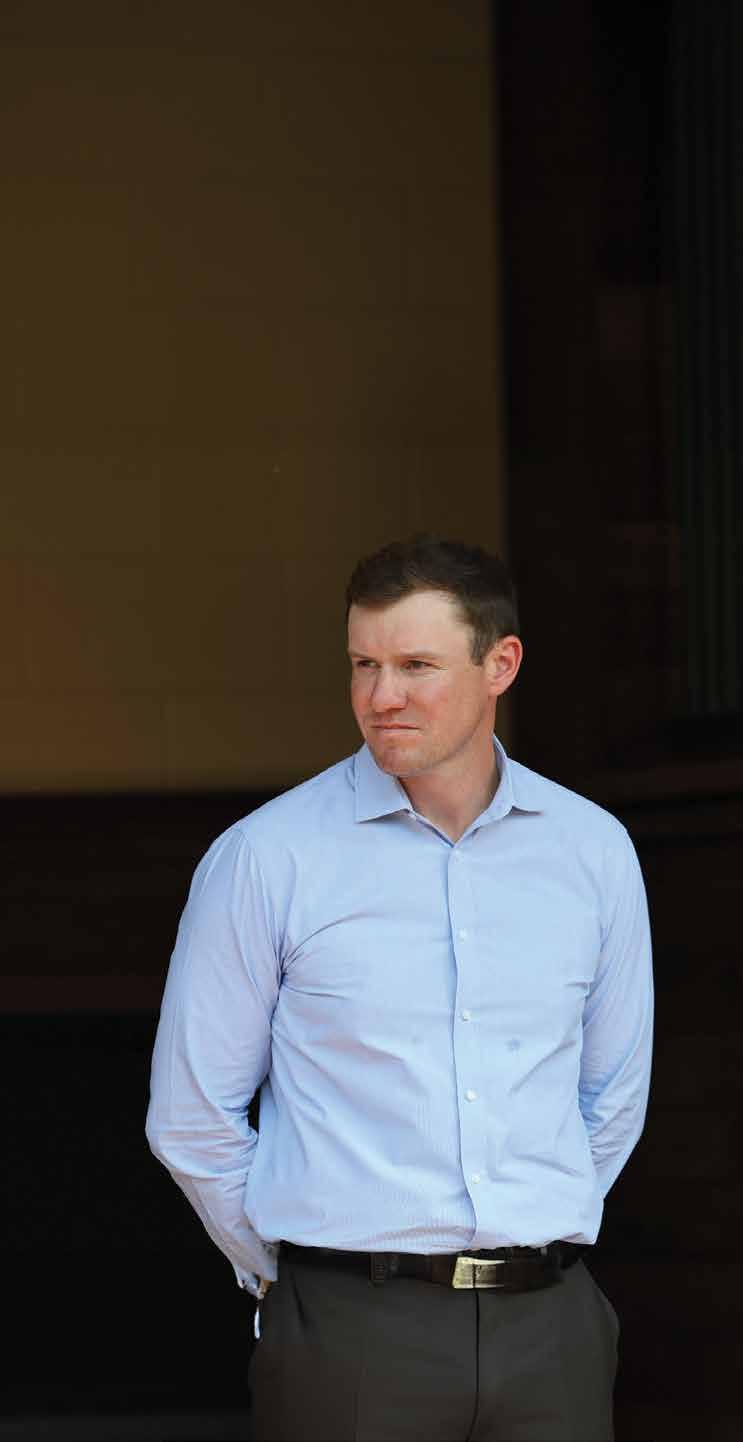
Trainer & TIEA Newcomer Award winner 2025
Trainer & TIEA Newcomer Award winner 2025
Trainer & TIEA Newcomer Award winner 2025
Trainer & TIEA Newcomer Award winner 2025
Trainer & TIEA Newcomer Award winner 2025
INDUSTRY EMPLOYEE


Kentucky Downs is set for its 2026 meeting after alumni posted late-season success last year
Reading the Equine Injury Database: What Can the Data Support?
Data collection serves three broad purposes: Describe problems, predict future events and explain causes so effective interventions can be developed
Are Breakdowns Increasing?
Veterinarians weigh in after analyzing HISA's 2025 Annual Metrics Report
A Day in the Life
Racetrack Chaplain Dean Carpenter provides spiritual guidance to those on the backstretch and a wide array of other services, including emotional, physical and social support
Louisiana’s Jade Favre charts the course for a horse’s future
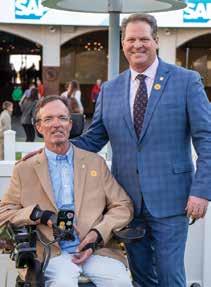
NATIONAL HBPA PRESIDENT DR. DOUG DANIELS (LEFT) AND NATIONAL HBPA CEO
ERIC HAMELBACK AT THE 2025 CLAIMING CROWN AT CHURCHILL DOWNS
NATIONAL
HBPA
3380 Paris Pike
Lexington, KY 40511
P (859) 259-0451
F (859) 259-0452
racing@hbpa.org www.hbpa.org
PRESIDENT/ CHAIRPERSON OF THE BOARD
Dr. Doug Daniels
SECRETARY/ TREASURER
Lynne McNally
CHIEF
EXECUTIVE OFFICER
Eric J. Hamelback
VICE PRESIDENT SOUTHERN REGION
Rick Hiles
VICE PRESIDENT CENTRAL REGION
Joe Davis
VICE PRESIDENT WESTERN REGION
J. Lloyd Yother
VICE PRESIDENT EASTERN REGION
Naomi Long
MESSAGE FROM THE CEO
HORSE RACING’S VIDEO CONTENT: CONTROL AND THE FUTURE OF RACING
One of the most important responsibilities we have as industry stakeholders is to constantly evaluate whether the structures that served us well in the past are still serving us well today and into the future. Thoroughbred racing has continued to evolve. From on-site pari-mutuel wagering to simulcasting to advance-deposit wagering to historical horse racing, our sport has adapted to changing technology and consumer expectations while trying to preserve the traditions that make racing special.
Today, another important conversation is beginning to emerge. This one is centered around racing’s video content and how that content is distributed, accessed and ultimately used to grow our sport.
For horsemen, the discussion is about far more than technology. It is about economics, visibility, increasing fan engagement and the long-term sustainability of the industry. Every race run at a racetrack represents the investment of owners, breeders, trainers, jockeys and countless backstretch workers. The resulting video content is not merely a record of that race; it is one of the industry’s most valuable assets.
In today’s sports landscape, content drives engagement. Fans should have full access to races through streaming platforms, social media clips, mobile applications and digital broadcasts. New customers should be introduced to the sport through accessible content. Our existing fans can deepen their engagement through improved viewing experiences, data integration and even on-demand access. Nearly every successful sports league in the world has recognized that their content is not simply a byproduct of competition but a critical component of growth.
I know Thoroughbred racing has benefited tremendously from the partnerships and distribution systems that helped the industry build the simulcast era. Those systems expanded racing’s reach, created more wagering opportunities outside the on-site facility and led to increases in revenue that have supported the industry for decades. The purpose of bringing this up is not to diminish those accomplishments. Rather, it is to ask whether our industry as a whole is positioned to fully capitalize on the opportunities that exist today as well as those that will emerge in the future.
For horsemen, this issue has direct implications. More fans can mean more wagering. More wagering means stronger purses. Greater visibility can mean increased ownership participation. Better access to racing content can help introduce new people to the excitement of the sport.
As viewing habits continue to evolve, I believe horsemen need to ensure that racing content can be fully leveraged to attract new owners, recruit new fans, enhance wagering products and create stronger connections between racetracks and the public. The next generation of customers expects immediate access, digital integration and seamless viewing experiences. If we want to compete for their attention, we must be willing to evaluate whether the current systems provide the flexibility necessary to meet those expectations.
The question is not whether change should occur overnight, nor is it whether existing relationships should be disrupted. The question is whether the industry should take a comprehensive look at the ownership, management and strategic use of its content assets. As technology continues to advance, the value of our sport’s assets increases.
This conversation should involve horsemen’s representatives, racetracks, industry organizations, regulators and technology partners alike. It requires thoughtful analysis, collaboration and a willingness to consider what racing will need not just five years from now but 20 years from now.
The National HBPA has long advocated for policies and initiatives that strengthen the economic foundation of Thoroughbred racing. As we look toward the future, understanding how our industry creates, manages and distributes its content deserves to be part of that discussion. The goal is not simply to keep pace with change but to position racing to thrive and grow in an increasingly digital world.
Our industry’s greatest asset will always be the sport itself—the horses, the jockeys, the competition and the people who dedicate their lives to it. The challenge before us is ensuring that the way we present our product to the world is as strong and sustainable as the product itself. Let’s find a way for our content to be positioned to help horse racing.
SINCERELY,
ERIC J. HAMELBACK









AFFILIATES
BOARD OF DIRECTORS - AFFILIATES
Dr. David Harrington, Alabama
Lloyd Yother, Arizona
Bill Walmsley, Arkansas
James Miller, Charles Town
Kim Oliver, Colorado
Mike Lecesse, Finger Lakes
Tom Cannell, Florida
Jim Watkins, Illinois
Joe Davis, Indiana
David McShane, Iowa
Dale Romans, Kentucky
Benard Chatters, Louisiana
Jason Uelmen, Michigan
Justin Revek, Minnesota
Mark Lemburg, Nebraska
Anthony Spadea, New England
Paul Jenson, DVM, New Mexico
Joe Poole, Ohio
Joe Offolter, Oklahoma
Ron Sutton, Oregon
Sandee Martin, Pennsylvania
Mike Dini, Tampa Bay Downs
David Ross, Virginia
Pat LePley, Washington
David Milburn, HBPA of British Columbia
Sue Leslie, HBPA of Ontario
Dan Hurley, HBPA of Alberta
Blaine McLaren, HBPA of Manitoba
Eddie Esquirol, HBPA of Saskatchewan

The opinions, representations and viewpoints expressed by the authors in the articles contained in The Horsemen’s Journal do not necessarily reflect the opinions, representations and viewpoints or the official policies or positions of The Horsemen’s Journal, National Horsemen’s Administration Corporation or National Horsemen’s Benevolent & Protective Association Inc. and its affiliates (collectively “HJ”). HJ is not responsible for, and expressly disclaims all liability for, damages of any kind arising out of use, reference to or reliance on any information contained within this issue. Information in this issue may become outdated due to the rapidly changing nature of the horse industry. The publication of any advertisements or articles should not be construed as an endorsement of any product, service or position unless specifically stated.
The Horsemen’s Journal, Volume 73 #2.
Postal Information: The Horsemen’s Journal (ISSN 0018-5256) is published quarterly by the National Horsemen’s Administration Corporation, with publishing offices at 3380 Paris Pike, Lexington, KY 40511. Copyright 2026 all rights reserved.
The Horsemen’s Journal is the official publication for members of the Horsemen’s Benevolent & Protective Association, a representative association of Thoroughbred owners and
CONTRIBUTORS
Dr. Kimberly Brewer
Dr. Clara Fenger
Dr. Rob Holland
Dr. James C. Meyer
Jennie Rees
Dr. Andrew Roberts
Jen Roytz
Dr. Thomas Tobin
PHOTOGRAPHERS
Denis Blake
Grace Clark
Coady Media
Coady Media/Ashley Phillips
Coady Media/Cady Coulardot Coglianese Photo/Angelo Lieto Coglianese Photo/Susie Raisher
Coglianese Photo/Walter Wlodarczyk Equisport
Clint Gaige
Gwen Davis/Davis Innovation
Sam Decker
Bill Denver/EQUI-PHOTO
Hodges Photography Keeneland STAFF
Tom Law
Editor P (859) 396-9407 hj@hbpa.org
Michelle McShane Advertising Director P (515) 508-1811 info@hbpa.org
Limb Design www.limb.co Graphic Design
THE HORSEMEN’S JOURNAL 3380 Paris Pike Lexington, KY 40511 P (859) 259-0451 F (859) 259-0452 hj@hbpa.org
HBPA
trainers. HBPA is a non-profit 501(c)6 Kentucky corporation. Members receive The Horsemen’s Journal as a benefit of membership paid by the national office from affiliate dues. Annual nonmember subscriptions are $25. Single-copy back issues, if available, are $7. Canadian subscribers add $6. All other subscriptions outside the U.S. add $20 payable in U.S. funds. To order reprints or subscriptions, call (859) 259-0451.
The HBPA National Board of Directors has determined that the publication of this periodical is necessary in the transaction of the public business required of the association. Views and opinions expressed are those of the authors and/or advertisers and do not necessarily represent the opinion or policy of the publisher or HBPA board or staff. Query the editor prior to sending any manuscripts.
Periodicals Postage Paid at Lexington, Kentucky, and additional mailing offices. CANADA POST: Publications mail agreement no. 41530527. Return undeliverable Canadian addresses to: P. O. Box 503, RPO West Beaver Creek, Richmond Hill, ON L4B 4R6.
POSTMASTER: Send address changes to The Horsemen’s Journal, 3380 Paris Pike, Lexington, KY 40511.

Help Your Fellow Horsemen
Help Your Fellow Horsemen
Make a Tax Deductible Donation to the National HBPA Foundation
Make a Tax Deductible Donation to the National HBPA Foundation
The National HBPA Foundation, a tax-exempt 501 (c)(3) fund, was developed as a safety net for horsemen and horsewomen when other forms of assistance are unavailable or have been exhausted after disaster strikes. Every year the National HBPA Foundation helps horsemen and horsewomen make it through difficult times such as disease quarantines at a racetrack or natural disasters like floods and fires by providing tens of thousands of dollars in needed assistance.
The National HBPA Foundation, a tax-exempt 501 (c)(3) fund, was developed as a safety net for horsemen and horsewomen when other forms of assistance are unavailable or have been exhausted after disaster strikes. Every year the National HBPA Foundation helps horsemen and horsewomen make it through difficult times such as disease quarantines at a racetrack or natural disasters like floods and fires by providing tens of thousands of dollars in needed assistance.
“It was just fabulous. I can’t thank the HBPA enough; I really appreciate all that they do. It’s because of the National HBPA Foundation combined with our insurance and other supporters like Fasig-Tipton’s Blue Horse Charities, we were able to build this kind of barn.”–Old Friends’ Michael Blowen after receiving aid from the National HBPA Foundation following a barn fire.
“It was just fabulous. I can’t thank the HBPA enough; I really appreciate all that they do. It’s because of the National HBPA Foundation combined with our insurance and other supporters like Fasig-Tipton’s Blue Horse Charities, we were able to build this kind of barn.”–Old Friends’ Michael Blowen after receiving aid from the National HBPA Foundation following a barn fire.
The National HBPA Foundation extends heartfelt gratitude to the Estate of Bob Reeves for its generous donation. The contribution will make a significant impact on our motto, “Horsemen Helping Horsemen.” Bob Reeves’ legacy of compassion and generosity will continue to assist Horsemen everywhere as we work towards the Foundation’s mission. We appreciate honoring his memory in such a meaningful way. Scan the QR code or visit https://nationalhbpa.com/remembering-bob-reeves/ to read the Winter 2023 The Horsemen’s Journal article remembering Bob Reeves.
The National HBPA Foundation extends heartfelt gratitude to the Estate of Bob Reeves for its generous donation. The contribution will make a significant impact on our motto, “Horsemen Helping Horsemen.” Bob Reeves’ legacy of compassion and generosity will continue to assist Horsemen everywhere as we work towards the Foundation’s mission. We appreciate honoring his memory in such a meaningful way. Scan the QR code or visit https://nationalhbpa.com/remembering-bob-reeves/ to read the Winter 2023 The Horsemen’s Journal article remembering Bob Reeves.
To make a tax deductible donation to the National HBPA Foundation and make a difference in the lives of your fellow horsemen and women who may find themselves in need, either:
To make a tax deductible donation to the National HBPA Foundation and make a difference in the lives of your fellow horsemen and women who may find themselves in need, either:
• Log onto https://nationalhbpa.com/donate/ to make a credit card donation
• Log onto https://nationalhbpa.com/donate/ to make a credit card donation
• Mail a donation check made payable to National HBPA Foundation to: National HBPA Foundation, 3380 Paris Pike, Lexington KY 40511
• Mail a donation check made payable to National HBPA Foundation to: National HBPA Foundation, 3380 Paris Pike, Lexington KY 40511


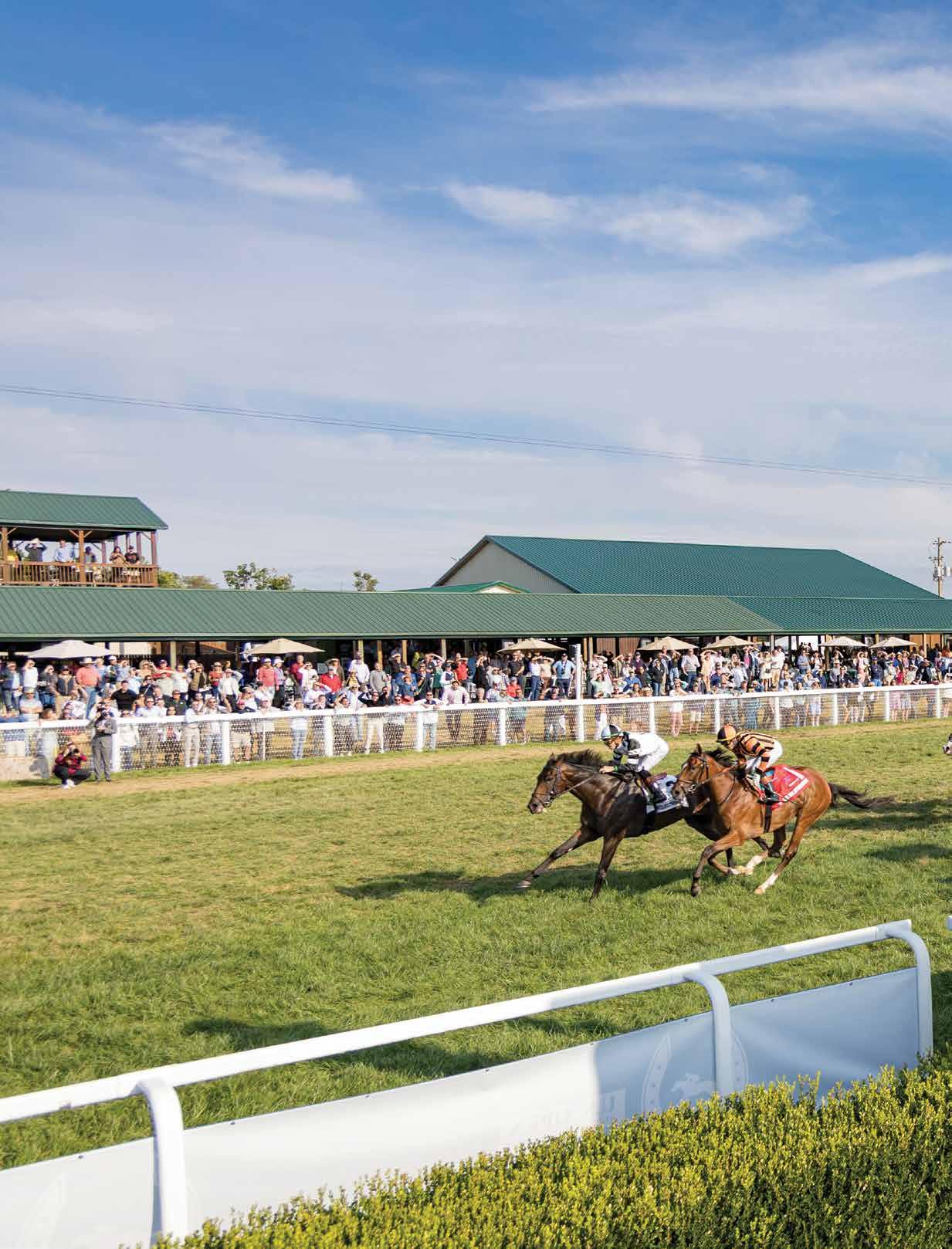
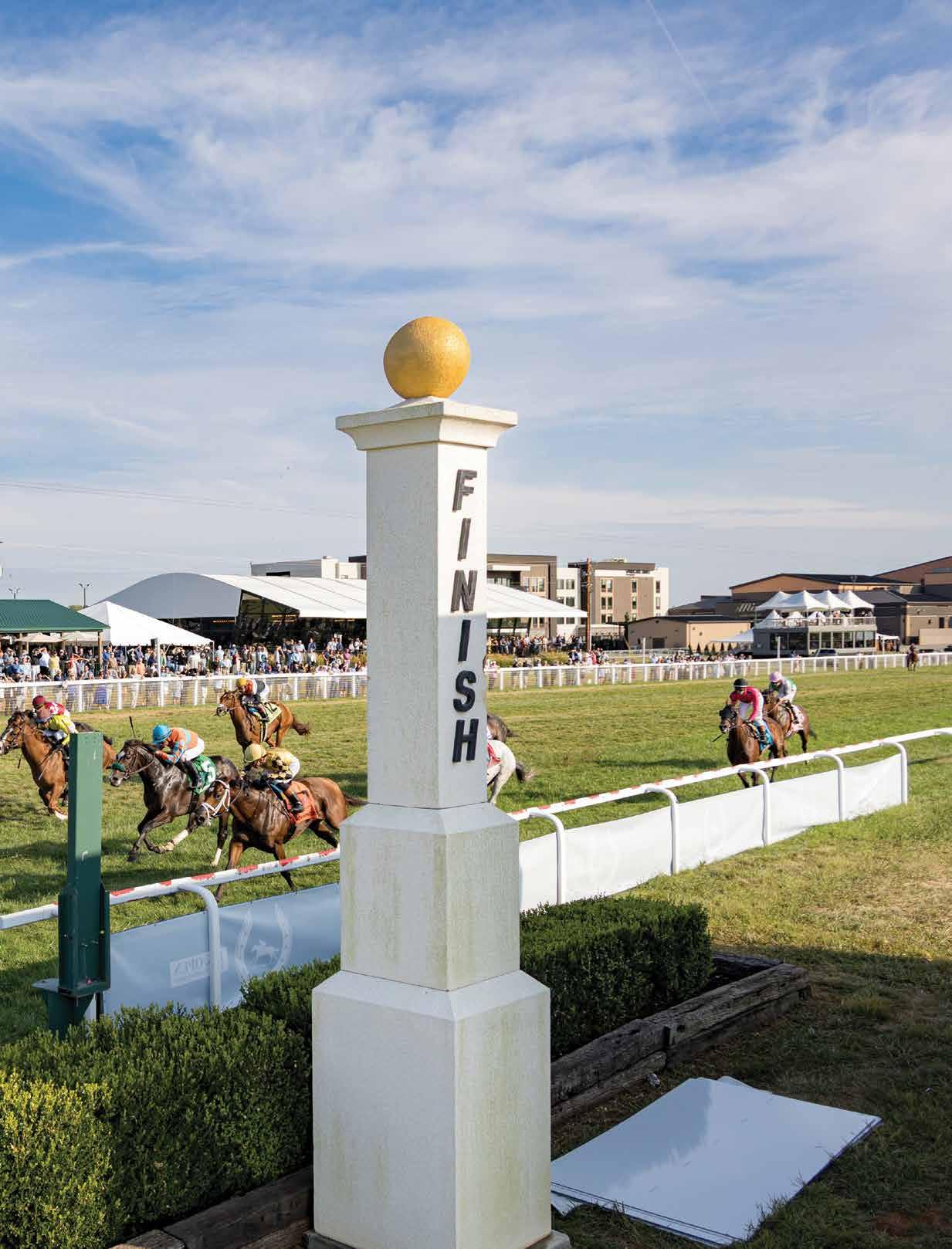
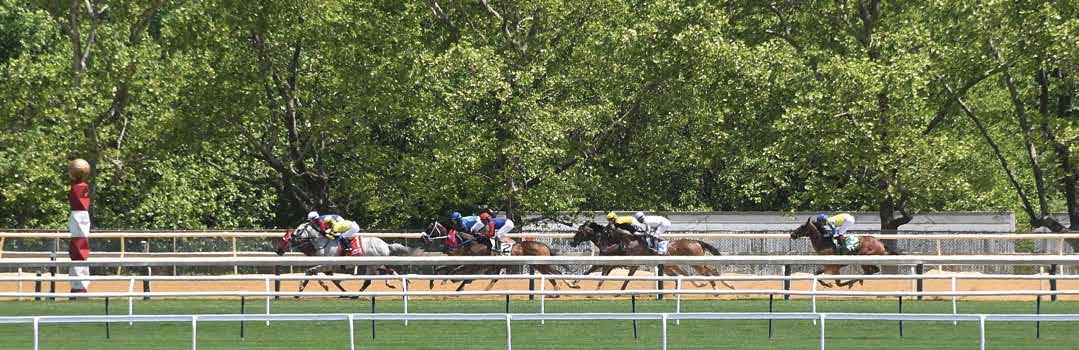
THE GRADE 2 FRANKLIN-SIMPSTON STAKES FOR 3-YEAR-OLDS GOING 61/2 FURLONGS, WON LAST YEAR BY TROUBLESHOOTING, HIGHLIGHTS THE RICH KENTUCKY DOWNS MEETING THAT RUNS AUGUST 29 AND 30 AND SEPTEMBER 3, 5, 6, 7 AND 9.
SHIRREFFS, CLEMENT HIGHLIGHT NEW HALL OF FAME CLASS
The late John Shirreffs, who trained Zenyatta throughout her Hall of Fame career; the late trainer Christophe Clement, who conditioned the winners of 286 graded stakes races; and champion sprinter Kona Gold headline the 11 new members elected to the National Museum of Racing and Hall of Fame for 2026.
Shirreffs joins Clement and Kona Gold in the Contemporary Category, earning the requisite votes from the nationwide voting panel for election. In the Historic Review Category, racehorses Gulch and Mongo and the late trainer David Whiteley were chosen by a committee vote. In the Pillars of the Turf Category, the late Prince Khalid bin Abdullah, Dr. Robert Copelan, Seth Hancock, G. Watts Humphrey Jr. and the late Joseph Widener received the necessary support from the selection committee.
Kona Gold, Clement and Shirreffs were chosen on the majority of ballots submitted (50% plus one vote is required for election). A total of 143 voters (92.8%) participated from the 154 eligible to cast ballots. In the Historic Review and Pillars of the Turf categories, 75% approval from the respective committee is required for election.
The 2026 Hall of Fame class will be enshrined at 10:30 a.m., Friday, August 7, at Fasig-Tipton’s Humphrey S. Finney Sales Pavilion in Saratoga Springs, New York. The event will be aired live on the museum website at racingmuseum.org. It is open to the public and free to attend. Renowned broadcaster Charlsie Cantey will serve as the master of ceremonies.
Kona Gold’s election comes after appearing on the final ballot nine times, including a run of seven straight through 2026. Clement appeared on the last eight ballots, while Shirreffs made his fifth straight and seventh overall.
Campaigned by his trainer Bruce Headley and co-owners Irwin and Andrew Molasky, Michael Singh and others, Kona Gold raced from 1998 through 2003 with a record of 14-7-2 from 30 starts and earnings of $2,293,384. He earned the Eclipse Award for champion sprinter in 2000, the same year he set the Churchill Downs track record for 6 furlongs in 1:07.77 in winning the Breeders’ Cup Sprint.
Kona Gold also set a track record for 51/2 furlongs at Santa Anita Park and won 10 graded stakes. Hall of Fame jockey Alex Solis rode Kona Gold to each of his 14 wins, including multiple editions of the Grade 2 Bing Crosby Breeders’ Cup Handicap, Grade 2 Potrero Grande Breeders’ Cup Handicap and Grade 3 El Conejo Handicap. Kona Gold made five consecutive appearances in the Breeders’ Cup Sprint.
Shirreffs, who passed away at the age of 80 in February, trained the winners of 113 graded stakes with purse earnings of $58,581,916. He won the 2005 Kentucky Derby with 50-1 longshot Giacomo and later became the conditioner of the legendary Zenyatta. Shirreffs trained the four-time Eclipse Award winner to 19 consecutive victories, including 13 Grade 1s, from 2007 through 2010. Named Horse of the Year in 2010 and champion older female each year from 2008 through 2010, Zenyatta included two Breeders’ Cup victories—the 2008 Breeders’ Cup Ladies’ Classic and the 2009 Classic—among her Grade 1 wins. In 2009, Shirreffs also won the Ladies’ Classic with Life Is Sweet, becoming the first trainer to win both races in the same year.
Shirreffs trained nine millionaires: Baeza, Express Train, Giacomo, Gormley, Hollywood Story, Life Is Sweet, Manistique, Tiago and Zenyatta.
Clement, who passed away in May 2025 at age 59, won 2,576 races with purse earnings of $184,127,449 million (12th all time) in a career that spanned from 1991 to 2025. He trained three-time Eclipse Award winner Gio Ponti, winner of four straight Grade 1s on the turf in 2009, as well as 2014 Belmont Stakes winner Tonalist, who won consecutive runnings of the Grade 1 Jockey Club Gold Cup in 2014 and 2015. Clement won 286 graded stakes. His Grade 1 wins included multiple editions of the Beverly D. (2001, 2007, 2008), Del Mar Oaks (2007, 2013), Diana Handicap (2003, 2015), Manhattan Handicap (2001, 2009, 2010), Man o’ War (2009, 2010), Turf Mile (2010, 2011) and Sword Dancer (1999, 2011, 2021, 2022, 2024), which was renamed the Christophe Clement Turf. Clement trained 22 horses that earned $1 million or more.
Gulch, champion sprinter and winner of the 1988 Breeders’ Cup Sprint, posted a record of 13-8-4 from 32 starts with earnings of $3,095,521. A homebred for Peter Brant and trained by Hall of Famers LeRoy Jolley (1986 through 1987) and D. Wayne Lukas (1988), Gulch won 11 graded stakes, including seven Grade 1 races that ranged in distance from 6 furlongs to 11/8 miles.
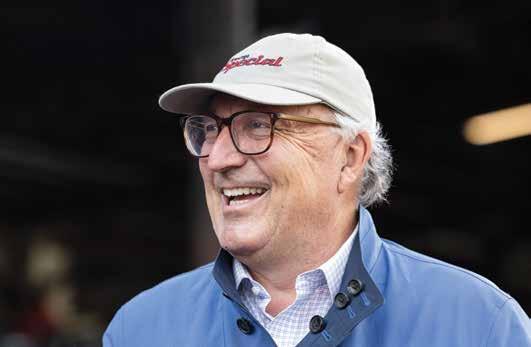
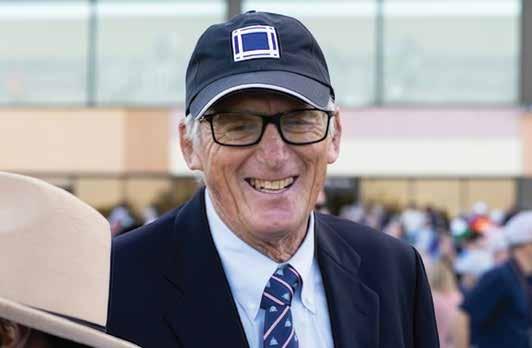
THE LATE TRAINERS CHRISTOPHE CLEMENT (TOP) AND JOHN SHIRREFFS LEAD THE 2026 INDUCTION CLASS INTO THE NATIONAL MUSEUM OF RACING AND HALL OF FAME.
A chestnut colt bred in Virginia by Marion duPont Scott, Mongo raced from 1961 through 1964 with a record of 22-10-4 from 46 starts and earnings of $820,766. Trained by Frank Bonsal for duPont Scott, Mongo was voted champion male turf horse in 1963. He won 16 stakes, including the prestigious Washington, D.C., International and two editions each of the United Nations Handicap, Trenton Handicap and Diamond State Handicap.
Whiteley, who passed away in 2017 at the age of 73, won 454 races with earnings of $11,837,823 in a career that spanned from 1970 through 1995. He won 45 graded stakes and 62 total black-type races. Whiteley trained Eclipse Award winners Revidere (champion 3-year-old filly in 1976), Hall of Famer Waya (champion older female in 1979) and Just a Game (champion female turf horse in 1980). He won the 1979 Belmont Stakes with Coastal, denying the Triple Crown hopes of Hall of Famer Spectacular Bid. Whiteley’s other top horses included Bailjumper, French Colonial, Highland Blade, Instrument Landing and Tiller.
Abdullah was a native of Saudi Arabia who established Juddmonte Farms, which he developed into one of the world’s most accomplished breeding and racing operations. Juddmonte was recognized with five Eclipse Awards for outstanding breeder (1995, 2001, 2002, 2003, 2009) and four Eclipse Awards for outstanding owner (1992, 2003, 2016, 2017).
Copelan, a native of Cincinnati, is a pioneer in the field of equine surgery and was one of the 11 founding members of the American Association of Equine Practitioners (AAEP) in 1954. Copelan served as its president in 1973 and continued to participate on multiple AAEP committees throughout the years.
Hancock took over the reins of historic Claiborne Farm in 1972 at the age of 23, following the death of his father, Arthur B. “Bull” Hancock Jr., who in turn had taken over the farm in the 1940s from his father, Arthur B. Hancock. In Seth
Performance
FLAIR® Equine Nasal Strips are clinically proven to reduce airway resistance, lower the work of breathing, and decrease the severity of EIPH—supporting efficiency at speed, sustained effort through the stretch, and recovery after the race.
Hancock’s 40-plus years of running the farm, he guided the operation through significant changes in the sport. One was the creation of the Breeders’ Cup in 1984. Hancock gave the program an important endorsement by signing up Claiborne to provide income from stallion seasons, a key source of Breeders’ Cup funding. Claiborne homebred Lure, a Hall of Famer, was twice a Breeders’ Cup winner for the farm.
Humphrey was born in Cleveland into a family with strong ties to Thoroughbred racing and breeding. His paternal grandfather, George M. Humphrey, was a prominent owner who served as secretary of the treasury under President Dwight D. Eisenhower. Humphrey raises his Thoroughbreds on the fringe of the famed Bluegrass region at his 1,000-acre Shawnee Farm near Harrodsburg, Kentucky, 30 miles southwest of Lexington. Humphrey’s racing stable has traditionally focused on fillies that have been channeled back into his breeding operation. Top runners for his stable include Grade 1 winners Centre Court, Clear Mandate and Personal Diary as well as multiple graded stakes winners Frivolous, Rey de Café and Communique.
Widener was the second son of transportation and real estate magnate Peter A.B. Widener. The Philadelphia-born Widener studied at the University of Pennsylvania and Harvard. In 1901, at the age of 30, Widener made a significant commitment to compete both in flat and jump racing. He was elected to The Jockey Club in 1909 and later served the organization as a steward and vice chair. Widener bred and owned steeplechase immortals Fairmount and Bushranger, both Hall of Fame members. He also bred flat champions Polynesian (1945 Preakness winner), Stagehand and Valenciennes.
—Tom Law

how better breathing makes the
at

HISTORY, POSITIVE BUSINESS RETURNS MARK TRIPLE CROWN
The 2026 Triple Crown season concluded June 6 with the third and final edition of the Belmont Stakes at Saratoga Race Course, a series marked by historic firsts and positive business returns.
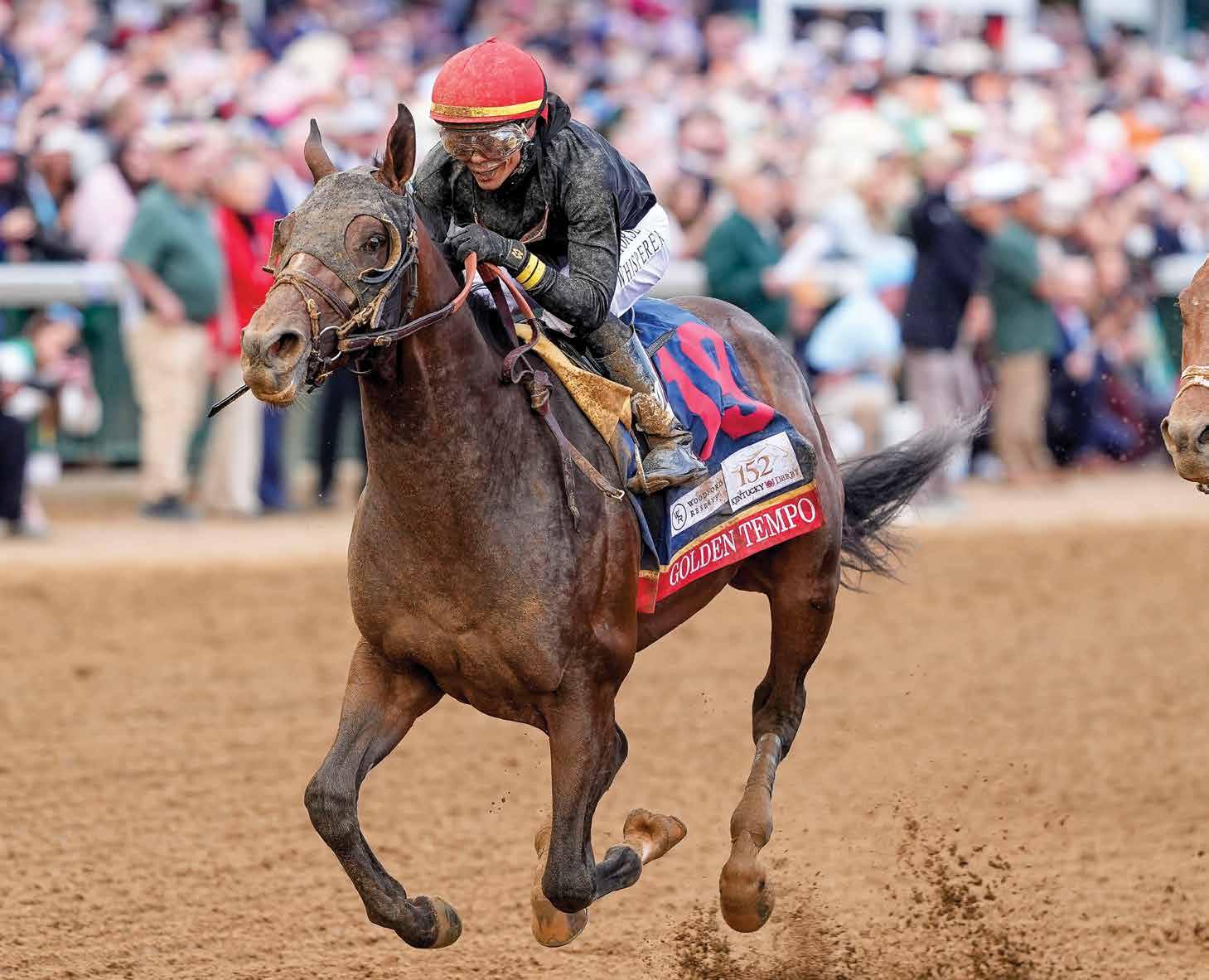
Trainer Cherie DeVaux came away from the spring classics as the clear star of the show, becoming the first woman to send out a Kentucky Derby winner with Golden Tempo before adding to her growing resume five weeks later with the Curlin colt’s victory in the Belmont. She’s the second woman to win the Belmont, joining Jena Antonucci with Arcangelo in 2023.
“I keep saying it’s surreal and it’s overwhelming and it’s amazing, all the superlatives,” DeVaux said after Golden Tempo won the Belmont. “I kind of wrongfully probably thought that because of the way the race was run in the Derby, he was going to have to go out and prove himself. We felt the best horse won the Kentucky Derby, and he just solidified that today.”
A homebred for Phipps Stable and Vinnie and Teresa Viola’s St. Elias Stable, Golden Tempo won the Belmont by 11/4 lengths under Jose Ortiz. Florida Derby winner Commandment finished second with Arkansas Derby winner Renegade third, Chief Wallabee fourth and Emerging Market fifth in the field of nine. Those top five finishers all ran in the Kentucky Derby, skipped the Preakness Stakes at Laurel Park and waited the five weeks until the Belmont.
Churchill Downs reported strong business for its Kentucky Oaks-Kentucky Derby weekend.
The Oaks moved into the primetime television window for the first time— with the marquee event for 3-year-old fillies going off under the lights at 8:43 p.m. ET—and Churchill reported record wagering on the day’s card. Total handle on Oaks Day set a record at $89 million, up 18% from the previous mark set in 2024. Wagering on the Oaks itself also hit an all-time high at $29 million, an increase of 29% from 2025.
Total handle on Derby Day, which featured five other Grade 1 stakes in addition to the headliner, dipped from $349 million in 2025 to $340 million in 2026, and total wagering on the Derby itself dropped from a record $234 million
last year to $225 million this year. Total wagering on Derby Week set a record at $487 million, up $13 million or 3% from the previous record set in 2025.
NBC Sports’ broadcast of the Derby was the most watched in history with 19.6 million viewers on the flagship network and accompanying streaming channel Peacock. That increased 11% from 2025 when 17.7 million viewers tuned in for the Derby broadcast and was the largest in 36 years, going back to the 18.5 million viewers that watched Sunday Silence beat Easy Goer in 1989. NBC reported that viewership peaked during the 7 p.m. to 7:15 p.m. ET window— when Golden Tempo won—at 24.4 million.
The final Preakness Stakes run under the management of 1/ST Racing moved to Laurel Park with construction ongoing at the new Pimlico Race Course in Baltimore. Attendance was capped at approximately 4,800 for Black-Eyed Susan Day and Preakness Day, but total handle only featured a slight dip.
Total handle for the 14-race Preakness Day card came in at almost $107 million, down less than 3% from the $110 million bet last year when 14 races were run at Pimlico.
The $2 million Preakness didn’t include Golden Tempo and Renegade but featured a competitive field of 14 that included Derby third-place Ocelli and top local threat Taj Mahal. Trainer Chad Summers, jockey Paco Lopez and owner Al Gold of Gold Square all celebrated their first classic victory when last year’s Grade 1 Champagne Stakes winner Napoleon Solo held off Iron Honor and Chip Honcho to win the 13/16-mile Preakness.
Summers, who grew up on Long Island and cut his teeth in the racing business in New York and Kentucky in high school and college, used some of his time in the spotlight to praise Laurel for stepping in to host the Preakness with its own uncertain future while offering some caution about old tracks going by the wayside.
“I was at Pimlico during the COVID Preakness with Swiss Skydiver, and we ran in the Black-Eyed Susan, and it was strange,” Summers said. “Five thousand seems like a lot compared to what that COVID Preakness was. Being the only one at Laurel, we can say that we won the only one at Laurel. No one will ever take that record from us.
“We won the last-ever Grade 1 at Aqueduct,” he continued. “It’s a shame and a tragedy that racetracks like Aqueduct and Laurel are no longer going to be around because they’re foundation racetracks. They had the Preakness here for so many years. Big races here for so many years, obviously the Preakness at Pimlico. That’s the thing about it. It’s great, and we’re going to love this and remember this for the rest of our lives. But the fact that Aqueduct and Laurel [are] going to shut down and only be a training center is a travesty. I would just hope that we get the opportunity as an industry to rally and save some of these tracks. We can’t allow this to keep happening.”
NBC also broadcast the Preakness and reported its best audience—5.5 million across the flagship network and Peacock—since 2021. Viewership peaked during the same 7 p.m. to 7:15 p.m. ET window—when Napoleon Solo won by 11/4 lengths over Iron Honor—at 7.1 million viewers.
None of the Preakness starters returned three weeks later for the Belmont Stakes, run for the third straight year at Saratoga while the New York Racing Association puts the finishing touches on the new $500 million Belmont Park.
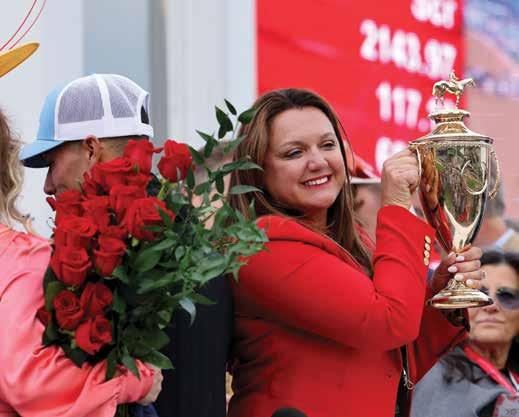
CHERIE DEVAUX CRADLES THE KENTUCKY DERBY TROPHY AFTER MAKING HISTORY WITH GOLDEN TEMPO.
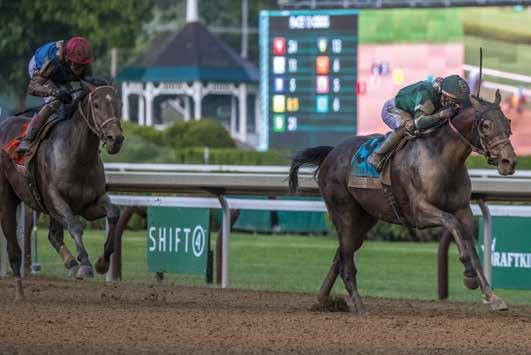
GOLDEN TEMPO AND JOSE ORTIZ POWER AWAY FROM COMMANDMENT TO WIN THE BELMONT STAKES, RUN FOR THE THIRD AND FINAL TIME JUNE 6 AT SARATOGA RACE COURSE.
A crowd of 46,128 turned out June 6 for the Belmont—the smallest of the three editions at Saratoga compared to a capped and sold out 50,000 in 2024 and 46,243 in 2025. Wagering on the 14-race Belmont Day card, which also featured five other Grade 1 stakes—was $116.1 million, up 14% from last year’s
$108.9 million on the 12-race card. NYRA drew 14 races for Belmont Day in 2025 but moved two turf stakes to the Sunday program after heavy rains in late morning and early afternoon soaked the Saratoga grass courses. Total handle for the first Belmont at Saratoga came in at $125.7 million.
NYRA reported $13,416,742 in on-track handle for this year’s Belmont Day card, with all-sources handle of $50.9 million for the Belmont Stakes.
Fox Sports broadcast the Belmont and reported similar viewership numbers to the previous two editions at Saratoga. Fox reported an average of 3.73 million viewers during its broadcast, down from 3.83 million in 2025 but up from 3.66 million in 2024. Viewership peaked at 4.7 million during the showery window when Golden Tempo won by 11/4 lengths over Commandment.
DeVaux’s decision to bypass the Preakness and wait for the Belmont followed a similar move last year by Bill Mott and owner Godolphin with Sovereignty. The decision worked for both, with the Derby winner delivering a decisive and division-leading victory five weeks later in the Belmont. DeVaux stood by the move after the race, even while fans and pundits questioned Golden Tempo’s lost chance at a Triple Crown bid.
“I do think we made the right decision,” she said. “I don’t think we’d have the same horse if we did run back in two weeks. That’s a horse-by-horse, case-by-case decision. And for him, as much growth as we’ve seen in him, it would’ve been hard for him to follow that up in two weeks and then subsequently three weeks.”
HJ
—Tom Law
CALL HORSEMAN LABOR TODAY!
and I-9 compliance
For international labor needs including:
• I-9 Compliance
• P-1/P-1S Jockey and Valet visas
• H-2B Temporary Worker visas
• H-2A Agricultural and Farm visas
Horseman Labor Solutions assists in the immigration visa process for individuals who are:
• Jockeys
• Exercise Riders
• Grooms
• Hot Walkers
• Stable Attendants
• General Laborers
WHAT WE LEARNED
BY AMY BRIN
Light Up Racing has been close to the work of addressing issues facing racing for the past three years—supporting stakeholders, responding when issues escalated, watching public narratives build in real time and trying to understand why this industry so often struggles to speak clearly when it matters most.
These are not observations made from the sidelines. They come from being inside the work, dealing with the pressure points, the hesitation, the politics, the goodwill, the frustration and the genuine desire from many people to do better. This commentary does not focus on what is broken; it focuses on what is possible and what it will take for the industry to move forward together.
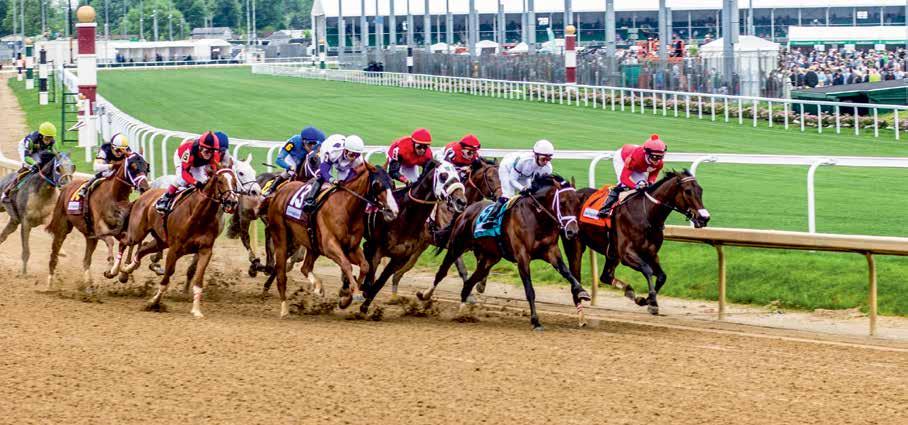
RACING FEATURES COUNTLESS PARTICIPANTS WHO CARE ABOUT THE SPORT, AND LIGHT UP RACING IS WORKING ON PRACTICAL SOLUTIONS TO MOVE THE INDUSTRY FORWARD.
COADY MEDIA/ASHLEY PHILLIPS
NO SILVER BULLET
One of the most common questions we heard from leaders was some version of “What is the solution?” The campaign. The message. The strategy. The thing that will finally “fix” public perception.
The honest answer is there is no single thing. But there is a clear starting point: Do the right thing, and be willing to change when the old way is no longer good enough.
Public scrutiny is a mirror the industry has too often been afraid to look into. If there are areas where racing is exposed—in safety, welfare, aftercare, transparency, accountability or the way decisions are explained—then the work has to begin there.
Public trust is not rebuilt through one campaign, one clever slogan or one organization carrying the load. It is built slowly, through consistent and credible action over time. It is built when the industry explains itself before a crisis, responds properly during one and remains willing to listen when the conversation is uncomfortable.
“That is how it has always been done” is not a strategy. In many cases, it is the very thinking that creates the risk.
Public trust is built through consistent, coordinated, credible engagement over time. Not in moments. Not in reaction. And not by any one organization alone. The future has to be approached with more curiosity than cynicism and with the conviction that a better version of the industry is within reach.
INDUSTRY FRAGMENTED BY DESIGN
In almost every part of the work, we saw the same pattern—good people and good organizations working hard but largely working separately with different messages, different priorities and different levels of response.
Inside the industry, those differences feel obvious and reasonable. A racetrack is not a research center. A horsemen’s group is not an aftercare organization. A promotional body is not a veterinary authority.
But the public does not experience racing that way.
To the public, racing is racing. A welfare issue in one state, a safety question at one track, a controversial moment in one race or a weak response from one organization can affect confidence in the whole sport.
That gap between how the industry is organized internally and how it is judged externally is one of the biggest barriers to progress.
IMPORTANT WORK OFTEN LEAST RESOURCED
The issues that carry the greatest reputational weight—public perception, safety, aftercare and welfare—are largely being addressed by small, underresourced nonprofit organizations.
Light Up Racing experienced this directly.
Organizations tasked with solving industry-wide challenges are required to:
• Seek funding from multiple sources.
• Navigate unclear, nontransparent and inconsistent funding processes.
• Operate within a philanthropic model that ties future investment to demonstrated impact—without first funding the basic infrastructure required to achieve that impact.
The result is a structural contradiction:
The industry wants professional, coordinated, effective public trust work but often funds it as if it is a side project.








The result is predictable. Progress is slower than it should be. Reach is more limited than it needs to be. Relationships can become transactional because everyone is operating inside the pressure of limited time, limited money and limited certainty.
This is not a sustainable model. It is a structural limitation on impact.
PRIDE AND NEED CAN COEXIST
Across tracks and organizations, we encountered strong communications teams with a deep sense of ownership over their work. There are capable people across this industry who care deeply about what they do.
But pride does not remove the need for support.
We also heard plenty of questions. How should we respond to this? What should we say when this issue comes up? How do we correct misinformation without sounding defensive? How do we talk about welfare, safety or aftercare in a way that is credible to people outside the industry?
When training sessions, working groups and shared discussions were created, people engaged. They asked smart questions, they wanted practical tools, and they wanted to understand what was working elsewhere and how they could apply it in their own roles.
The issue was not a lack of willingness. It was the lack of consistent spaces where people could come together, learn from one another and build a more unified approach.
INDUSTRY SHOWS UP WHEN BROUGHT TOGETHER
One of the most encouraging lessons was that, when stakeholders were properly convened, they did show up.
People shared openly. They aligned more quickly than expected. They were often relieved to have a space where difficult issues could be discussed honestly, without every organization having to solve the same problem alone.
What is missing is the infrastructure to sustain it. Without structure, collaboration becomes episodic, but with structure, it becomes strategy.
Again and again, the same lesson surfaced: The industry needs to be better connected, not in a vague “let’s all work together” way but in the practical sense—shared information, resources, understanding of risk, language and a shared responsibility for the future of the sport.
At times, the industry values its individual parts more than the strength of its whole.
GRASSROOTS SUPPORT REAL, LACKS PATHWAY
We consistently heard from individuals across the industry who want to engage more actively. They care deeply about the future of the sport and want to be part of the solution.
But many asked the same questions:
• Where do I plug in?
• What do I say?
• How do I help?
Without a clear pathway, that energy remains scattered. With one, it could become one of the industry’s greatest strengths.
FINAL OBSERVATION
Strong industries do not only invest in their own immediate success. They invest in the systems that allow the whole ecosystem to remain healthy.
A series of strong individual castles does not automatically create a strong kingdom.
Without shared direction, resourcing and coordination, the industry will continue to have moments of progress without the sustained impact it needs.
This cannot stop at naming the problems.
There is no shortage of commentary in racing about what is not working. Light Up Racing is not interested in simply adding another critique to the pile.
The purpose of this reflection is not to point fingers but to be honest about what the work has shown.
This is a moment for leadership—not just to acknowledge the issues but to participate in building what comes next.
Over the coming months, Light Up Racing will be bringing forward practical solutions shaped by what we have learned through this work. We also invite stakeholders across the industry to contribute their own perspectives.
Where are you seeing friction? What would make collaboration easier? What support would help you communicate better? What should the next version of this work look like? HJ
Light Up Racing Interim Executive Director Amy Brin and the organization’s board of directors wrote this piece to follow up on the May 5 announcement that Light Up Racing would sunset following the 2026 Breeders’ Cup. Light Up Racing encourages direct engagement from industry stakeholders. To share your perspective or participate in solution-focused discussions, reach out via hello@ lightupracing.com.

‘THIS HORSE KEEPS ME ALIVE’
CANCER SURVIVOR ‘BIG FRANK’ RUPOLO CELEBRATES CONCRETE GLORY’S LATEST WIN AS CLAIMING CROWN HORSE OF THE YEAR
Big Frank can put a ring around another accomplishment for Concrete Glory.
The horse that owner Frank Rupolo’s Big Frank Stable claimed 24 races ago for a bottom-level $6,250 at Gulfstream Park on December 9, 2022, has been selected as the 2025 Claiming Crown Horse of the Year after the Pennsylvania-bred gelding won the $102,000 Claiming Crown Ready’s Rocket Express for the second straight year at Churchill Downs.
The announcement was made by the Claiming Crown co-founders, the National Horsemen’s Benevolent and Protective Association and the Thoroughbred Owners and Breeders Association (TOBA). Trained by Saffie Joseph Jr., the now 7-year-old Concrete Glory will be honored at the TOBA National Awards Dinner September 10 at the Kentucky Castle near Versailles.
The multirace Claiming Crown—staged in conjunction with the host track and the state HBPA affiliate—was created in 1999 to give American racing’s blue-collar racehorses their own championship day on the lines of the Breeders’ Cup. Each year the National HBPA recognizes one of the competitors as the best of the Claiming Crown’s best. The honor comes with Concrete Glory already immortalized on the gold-and-diamond-encrusted championship-style ring that Rupolo wears.
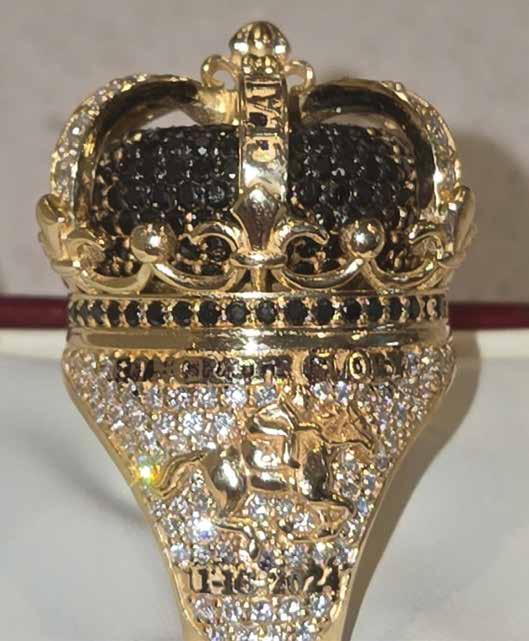
"BIG FRANK" RUPOLO’S SPECIAL RING HE DESIGNED TO HONOR HIS CLAIMING CROWN WINNERS—2021 TIARA WINNER SUGAR FIX AND 2024–25 EXPRESS WINNER CONCRETE GLORY
“I knew he was good enough to be up there with the selected horses, but to be Horse of the Year, I couldn’t believe it,” Rupolo said from Florida in a phone interview. A cancer survivor, Rupolo believes Concrete Glory has helped extend his life. “He’s just a super horse. … This is not a joke: The day after he runs in the Claiming Crown, I’m already thinking about next year. That is my favorite of all.
“I’m a low-level claimer [as an owner]. I did have a horse once in the Derby, believe it or not, but I only had 10% of Closing Argument [second at 71-1 odds to 50-1 Giacomo in 2005]. That was unbelievable, but I’ll never get another chance like this. This is like my Breeders’ Cup. … This is the best I’ve ever had. It’s so much fun with him, and I just hope he just keeps continuing. I can run him at 8, 9 and 10.”
Concrete Glory, a son of 2012 Arkansas Derby winner and Kentucky Derby and Preakness runner-up Bodemeister, has proved to be well named: He’s a true iron horse. He ran nine times at age 2, from June 10 through December 15, and 12 times at 3, from January 1 through the day he was claimed. Concrete Glory clearly has thrived in Joseph’s care, winning 12 times for his current barn. That includes feasting on starter-optional claiming races at Gulfstream Park, but he became a regular in stakes races last year and this year captured Tampa Bay Downs’ $125,000 Pelican Stakes.
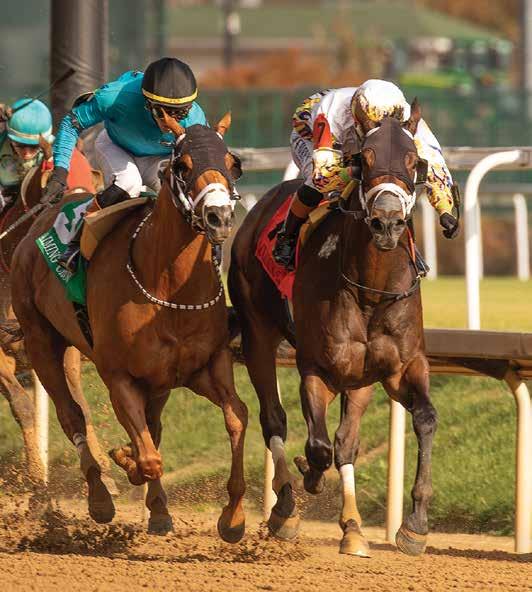
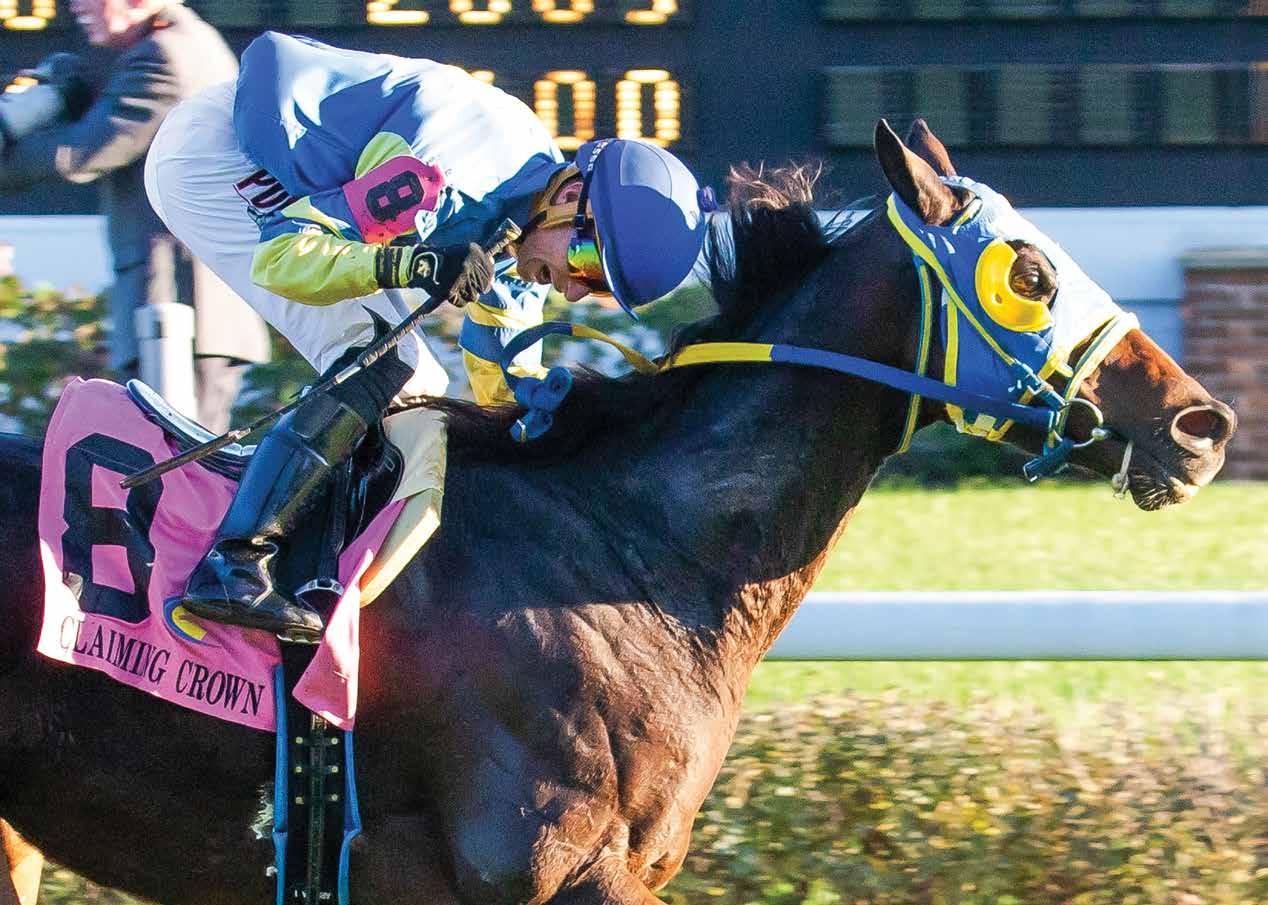
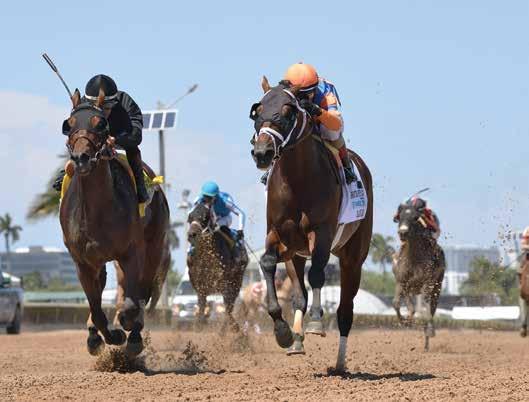
CONCRETE GLORY AND JOCKEY IRAD ORTIZ JR. (INSIDE) EDGE WOUND UP IN THE 2025 CLAIMING CROWN READY’S ROCKET EXPRESS AT CHURCHILL DOWNS. CONCRETE GLORY EARNED CLAIMING CROWN HORSE OF THE YEAR HONORS FOR THE VICTORY, HIS SECOND STRAIGHT IN THE EXPRESS AND ONE OF 18 IN HIS CAREER THROUGH MID-JUNE.
Concrete Glory’s 18 victories have come in front-running fashion or being head-and-head for the early lead. After winning the 2024 Express by 71/2 lengths, Concrete Glory was hounded by Wound Up throughout the 2025 edition before holding on by a head under Irad Ortiz Jr. The gelding also has six seconds and two thirds while grinding out career earnings of $598,474 the hard way, through sheer longevity.
“Concrete Glory is exactly the type of horse that the Claiming Crown series and our Claiming Crown Horse of the Year award were created to honor,” said Pennsylvania HBPA Executive Director Todd Mostoller, who chairs the National HBPA’s Industry Awards Committee. “In addition to being a two-time winner who also ran in the Express in 2023, Concrete Glory epitomizes the heart, soul and resilience of the claiming horses that make American racing go by filling out the racing programs for the stakes horses. He was claimed for $6,250 but 31/2 years later is in the same barn and has advanced to being an open stakes winner who has run 44 times and earned almost $600,000. It’s a testament to Concrete Glory as well as Saffie and his team.”
The Claiming Crown races are held under starter-allowance conditions for horses that have competed for a certain claiming level or cheaper during a designated time frame. With the 6-furlong Express being for horses that have competed for an $8,000 claiming price or less anytime in their life, the goal for Concrete Glory is to return to Churchill Downs November 14 to try for a historic three-peat. Concrete Glory and Emerald repeater Echo Lane last year became only the fifth and sixth horses to win two Claiming Crown races. No horse has won three.
“This is a great achievement for the horse,” Joseph said. “He’s been so fun to have. He’s one of the favorites in the barn, just for his personality. He’s a little goofy. When we first got him, he used to be very difficult to saddle and stuff, but he has quieted down a lot. He just has a lot of try in him.
“He was never supposed to be in that class though,” Joseph continued. “He was coming off a bad run, and the previous ownership took a chance to drop him in from $25,000. They obviously wanted to make him starter-eligible. There were two claims in for him that day, and thankfully we won the ‘shake.’ We never envisioned he was going to be this good.”
Concrete Glory has done much more for Rupolo than all his win photos and $468,580 in purses since being claimed. The saying “there is something about the outside of a horse that is good for the inside of a man” truly applies to Big Frank, who has been battling multiple myeloma, a cancer of the plasma cells.
“This horse keeps me alive, Concrete Glory,” he said. “I just think about him every day. Six years ago, they told me I had five years, and then three years ago, they told me I got another three, and they keep upping my life with new experiments and drugs, so I’m just riding this wave.”
Rupolo said he underwent a stem cell transplant four years ago—he named his other horse in training Stem Cell, a 3-year-old who should make his debut soon—and the new CAR-T therapy two years ago.
“They keep going further and further with research, so hopefully I’m around for another five or 10 years,” said Rupolo, who is working to get his stable numbers back up after having six horses claimed or otherwise sold in the last four months.
Joseph agreed Concrete Glory may be Big Frank’s best medicine. “More than even the therapies he gets,” the trainer said. “Even when he’s in the hospital and weak—he goes through spells where he gets very sick—he’ll be texting me, ‘Just tell me the horse is all right.’ Or ‘Where are we going? Because that’s what keeps me going.’ That’s what horses do for you.”
About that ring: Rupolo won his first Claiming Crown race as an owner with Sugar Fix in the 2021 Tiara at Gulfstream Park, which came the same day he
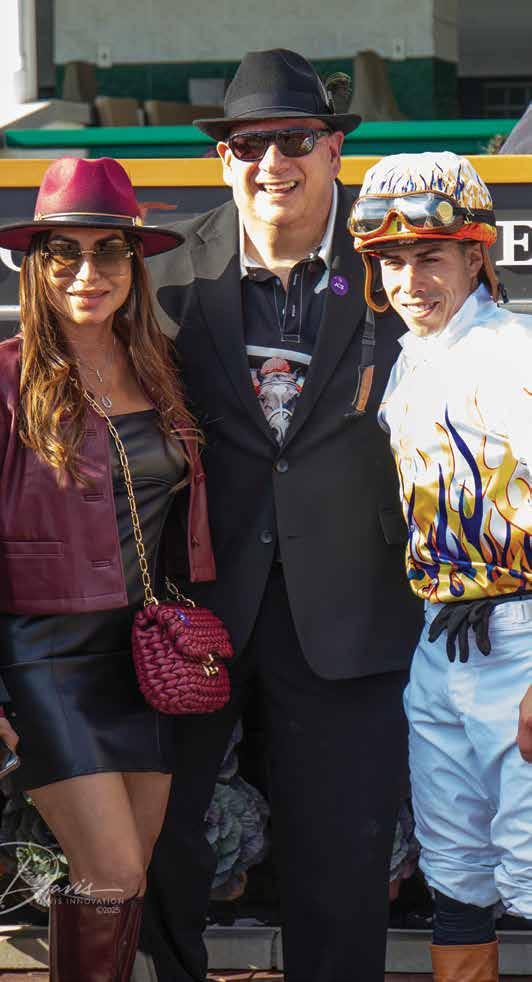
RUPOLO WITH HIS WIFE, YASMIN, AND JOCKEY IRAD ORTIZ JR. AFTER CONCRETE GLORY’S VICTORY AT CHURCHILL DOWNS LAST NOVEMBER
married his wife, Yasmin, in a wedding and celebration at the track. Last year, he gifted the stable ownership to Yasmin, though Big Frank remains the force and big personality behind the operation. He commissioned the Super Bowl-sized ring topped with a crown image and emblazoned with “Claiming Crown.” One side has a cutout of a horse with the name “Sugar Fix” and the Claiming Crown date; the other side has “Concrete Glory” and the date of his first Claiming Crown win.
“And then he won it again,” Rupolo said. “But I can’t change the ring, so there’s nothing I could do. So I’m going to wait until he retires and get a bracelet made or something nice. I like my jewelry. Somebody said, ‘What are you going to do if he keeps winning?’ I said, ‘Listen, I’ve got nine other fingers.’ ”
—Jennie Rees
5TH CIRCUIT STRIKES DOWN HISA FOR THIRD TIME
The 5th U.S. Circuit Court of Appeals unanimously declared the Horseracing Integrity and Safety Act (HISA) to be unconstitutional June 11. The court ruled in favor of the National Horsemen’s Benevolent and Protective Association and 12 state affiliates, stating, “The Horsemen … contend that HISA facially delegates unsupervised enforcement power to private actors. They are right.”
The court held that HISA violates Article II, Section 1, Clause 1 of the U.S. Constitution, which delegates all executive power to the president. Instead, HISA delegates executive power to a private corporation, Horseracing Integrity and Safety Authority Inc. The court ruled that this private corporation is not properly overseen by the Federal Trade Commission (FTC). It is unlawfully enforcing government horse racing regulations directly on horsemen. Therefore, HISA violates the nondelegation doctrine.
As the court stated in its opinion, because “HISA is enforced by private entities that are not subordinate to the FTC, we declare that HISA violates the private nondelegation doctrine.” It also stated, “The statute empowers the Authority to investigate, issue subpoenas, conduct searches, levy fines, and seek injunctions—all without the FTC’s say-so. That is forbidden by the Constitution.”
The court continued, “HISA’s explicit division of enforcement responsibility empowers the Authority with quintessential executive functions and gives the FTC scant oversight until enforcement has already occurred. Such back-end review by the FTC does not subordinate the Authority.” The court concluded that HISA is “a radical delegation.”
The June 11 decision marked the third time the 5th Circuit has ruled HISA unconstitutional. In November 2022, the court ruled that HISA was an unconstitutional violation of the private nondelegation doctrine, resurrecting a doctrine that had been little used in the last 90 years. The court ruled that Congress had illegally given legislative powers to a private corporation. Shortly thereafter, Congress tweaked the law, and the case returned to the Court of Appeals. In July 2024, the 5th Circuit ruled that Congress had illegally given executive powers to a private corporation.
Last year, the Supreme Court decided another nondelegation case, FCC v. Consumers’ Research, and returned the horsemen’s case to the 5th Circuit for a third decision in light of the Consumers’ Research decision. The 5th Circuit ruled June 11 that “Consumers’ Research does not change our analysis.”
“We have been fighting this battle for the constitutional rights of horsemen for over five years, and we continue to win,” said National HBPA CEO Eric Hamelback. “It is just common sense that Congress cannot make a private corporation the judge, jury and executioner of our industry.”
Daniel Suhr, president of the Center for American Rights and HBPA lead counsel, added, “We are thrilled that the court sided with our legal arguments once again. By basically reissuing the prior ruling, the 5th Circuit has laid down a strong marker that government power must be wielded by government officials, who are accountable to the people. That is a cornerstone of our Constitution.”
Peter Ecabert, general counsel of the National HBPA, stated, “The HBPA will fight this legal battle all the way to the Supreme Court if we have to. If today’s victory is upheld by the Supreme Court, as we expect, it will mean that horsemen will no longer be controlled by a small number of industry elite.”
States are also challenging HISA in the courts. The state of Texas joined the June 11 victory in National Horsemen’s Benevolent and Protective Association v. Black. Oklahoma, West Virginia and Louisiana lost a separate lawsuit against HISA in the 6th Circuit, but they have petitioned the Supreme Court to take the case.
A third case is pending before the 8th Circuit. Because the June 11 ruling creates a circuit split between the 5th and 6th Circuits and because it enjoins a federal law, the Supreme Court is likely to make the final decision. HJ
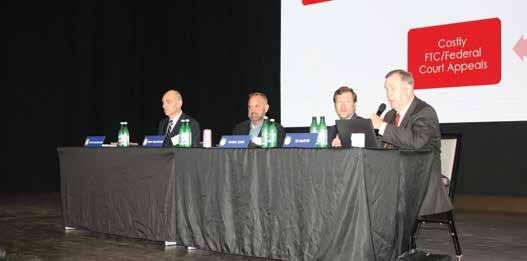
ATTORNEY DANIEL SUHR (SECOND FROM LEFT DURING A PANEL AT THIS YEAR’S NATIONAL HBPA CONFERENCE), LEAD COUNSEL FOR THE NATIONAL HBPA IN ITS CASE AGAINST HISA AND PRESIDENT OF THE CENTER FOR AMERICAN RIGHTS, SAID THE JUNE RULING SHOWS THAT THE “5TH CIRCUIT HAS LAID DOWN A STRONG MARKER THAT GOVERNMENT POWER MUST BE WIELDED BY GOVERNMENT OFFICIALS, WHO ARE ACCOUNTABLE TO PEOPLE.”

LAUNCHPAD
Kentucky Downs is set for its 2026 meeting after alumni posted late-season successes last year
By Jennie Rees
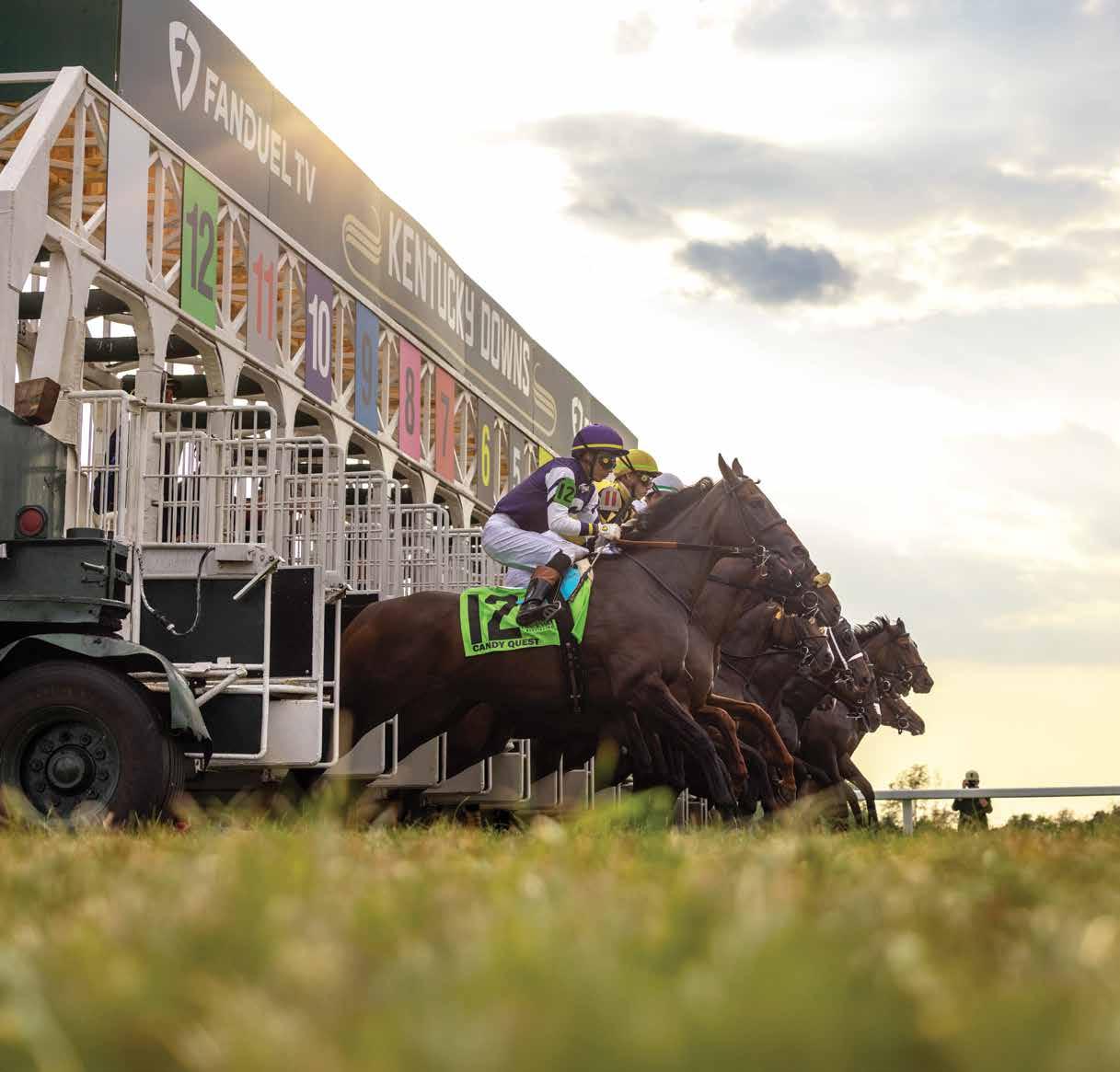
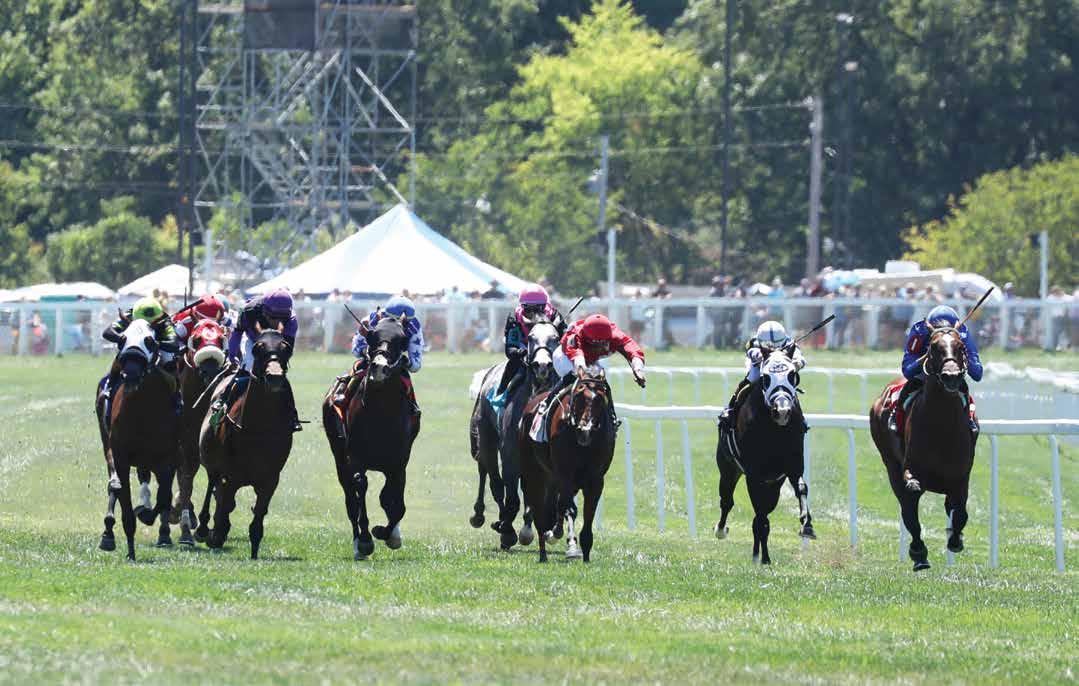
KENTUCKY DOWNS’ ALL-TURF MEETING RUNS AUGUST 29 AND 30 AND SEPTEMBER 3, 5, 6, 7 AND 9.
GRACE CLARK
For several years, Kentucky Downs has offered the largest purses in the world spread over seven days, including North America’s most lucrative stakes schedule. But 2025 provided a breakthrough as the track’s $2 million, Grade 2 AGS Music City Stakes winner Shisospicy became the first 3-yearold filly to defeat older males in winning the $1 million, Grade 1 Prevagen Breeders’ Cup Turf Sprint.
The seven-day all-turf meeting held on the Tennessee border in Franklin, Kentucky, opens this year on a Saturday, August 29, rather than its traditional Thursday launch. The remaining dates are Sunday, August 30; Thursday, September 3; Saturday, September 5; Sunday, September 6; and Labor Day Monday, September 7, with closing day on Wednesday, September 9.
Total Purses Since 2011
Note: 2011 is the last year that purses weren’t enhanced by historical horse racing.
Kentucky Downs 2026 Stakes Schedule
Saturday, August 29—$1.75 million ($875K KTDF) Kentucky Downs Ladies Turf Sprint (G1), 3&up fillies and mares, 61/2 furlongs; $750,000 ($375K KTDF) Kentucky Downs Juvenile Sprint, 2yos, 61/2 furlongs; $500,000 ($250K KTDF) Tight Spot Overnight Handicap, 3&up, 1 mile.
Sunday, August 30— $750,000 ($375K KTDF) Untapable, 2yo fillies, 61/2 furlongs; $500,000 ($250K KTDF) Tapit, 3&up, 11/16 miles, restricted to horses that have not won a sweepstakes in 2026.
Thursday, September 3—$750,000 ($375K KTDF) Bowling Green Gold Cup Invitational, 3&up, 21/16 miles.
Saturday, September 5—$3 million ($1.25M KTDF) Nashville Derby Invitational (G2), 3yos, 15/16 miles; $2 million ($1M KTDF) Kentucky Turf Cup Invitational (G2), “Win and You’re In Breeders’ Cup Turf Division,” 3&up, 11/2 miles; $1.75 million ($875K KTDF) Kentucky Downs Turf Sprint (G2), “Win and You’re In Breeders’ Cup Turf Sprint Division,” 3&up, 6 furlongs; $1.5 million ($750K KTDF) Kentucky Downs Ladies Turf (G2), 3&up fillies and mares, 1 mile; $1.5 million ($750K KTDF) Music City (G2), 3yo fillies, 61/2 furlongs.
Sunday, September 6—$1.5 million ($750K KTDF) Kentucky Downs Ladies Marathon Invitational (G3), 3&up fillies and mares, 15/16 miles; $500,000 ($250K KTDF) One Dreamer, 3&up fillies and mares, 11/16 miles, restricted to fillies and mares that have not won a sweepstakes in 2026.
Monday, September 7—$2 million ($1M KTDF) The Mint Millions Invitational (G3), 3&up, 1 mile; $1.5 million ($750K KTDF) FranklinSimpson (G2), 3yos, 61/2 furlongs; $1.75 million ($875K KTDF) Gun Runner, 3yos, 1 mile; $750,000 ($375K KTDF) Kentucky Downs Juvenile Fillies, 2yo fillies, 1 mile; $250,000 Lucky Lantern, 3yo fillies, 61/2 furlongs, restricted to non-winners of a sweepstakes.
Wednesday, September 9—$2 million ($1M KTDF) Dueling Grounds Oaks Invitational (G3), 3yo fillies, 15/16 miles; $750,000 ($375K KTDF) Kentucky Downs Juvenile Mile, 2yos, 1 mile.
Shisospicy was the fifth Kentucky Downs-raced horse to go on to win a Breeders’ Cup event but only the second to do so in the same season—the first being One Dreamer back in 1994 when the then 5-year-old track was named Dueling Grounds. One Dreamer went from finishing third in the $150,000 Rachel Jackson Stakes on grass to winning the Breeders’ Cup Distaff on dirt at 47-1.
A Kentucky Downs victory clearly means a lot more now in terms of both money and prestige. The two-race parlay catapulted Shisospicy to victory as last year’s Eclipse Award champion female sprinter as well as a finalist berth for both champion 3-year-old filly and turf female.
“One hundred percent,” trainer Jose D’Angelo said of the importance of Shisospicy’s 3-length victory over Kentucky Downs’ undulating course in the 61/2-furlong Music City, a race he believes helped give the filly the stamina to go gate-to-wire through testing fractions, culminating in a final eighth-mile in :11.38 in the 5-furlong Breeders’ Cup race at Del Mar. “The Music City was that special race for her because she proved that she can make it 61/2 furlongs, and also that was the final preparation, the last big race before Breeders’ Cup.”
D’Angelo is hoping to get his first champion back to Kentucky Downs for the newly promoted Grade 1, $1.75 million Kentucky Downs Ladies Turf Sprint Stakes August 29 and then the October 31 Breeders’ Cup at Keeneland. She’s on a tight timeline, having come out of a poor effort in her only start of the year, Churchill Downs’ Grade 2 Unbridled Sidney Stakes, with a virus.
“I feel very proud about her,” D’Angelo said. “She was ready to run against older horses after the effort at Kentucky Downs on the hill. It’s a very important thing for her career, for me.”
Building on Shisospicy’s success is a major emphasis as the 15/16-mile track prepares for its 35th racing season over America’s only European-style turf course. Along the way, Kentucky Downs’ $170,000 maiden races for registered Kentucky-breds and allowance events up to $250,000 (for 2025 Keeneland September yearling sale graduates) provide year-making opportunities for stables of all sizes in the commonwealth and beyond. For owners, a single victory can provide important funding right on top of the Keeneland sale.
Second in the Breeders’ Cup to Shisospicy was Kentucky Downs Ladies Turf Sprint course-setting repeat-winner Ag Bullet, while third was the 9-year-old British invader Khaadem, who also had been third in the Grade 2 Mint Kentucky Turf Sprint Stakes before taking Keeneland’s Grade 2 Woodford Stakes. The Kentucky Downs-raced trifecta in the Breeders’ Cup Turf Sprint paid $134.80 for 50 cents.
Even without Shisospicy’s win, Kentucky Downs-raced horses have figured prominently in the Breeders’ Cup turf races, which tend to be dominated by the Europeans. According to Equibase, 15 horses that ran at Kentucky Downs finished second or third in the Breeders’ Cup that same year since 2015.
Horsemen’s notes: Kentucky Thoroughbred Development Fund (KTDF) money is included in the purses listed, not additional. Email stakeinvites@kentuckydowns.com to request consideration for the invitationals. Invitational deadlines: Nashville Derby, Saturday, August 15; Bowling Green Gold Cup, Thursday, August 20; Kentucky Turf Cup, Saturday, August 22; Kentucky Downs Ladies Marathon, Sunday, August 23; The Mint Millions, Monday, August 24; Dueling Grounds Oaks, Tuesday, August 25.
For all other stakes, nominations close Monday, August 17, for stakes run August 29-30 and September 5, except for the September 5 Music City, which closes Wednesday, August 19. Nominations close Wednesday, August 19, for stakes run September 6, 7 and 9.
“It was great for all of us to see, to get over that hurdle,” said Ted Nicholson, Kentucky Downs’ vice president for racing. “Every year, in the last seven or eight years, we have improved our program. Last year having Shisospicy winning, Ag Bullet second and Khaadem third was like the culmination of all the work that’s gone in from our racing office and our team overall. We’re obviously not stopping there. We’re hoping that we continue to draw Grade 1 horses and they perform well when the horses shift this year to Keeneland for the Breeders’ Cup.”
Kentucky Downs’ 80 scheduled races feature 20 stakes worth a total of $25.75 million for Kentucky-breds, with the Ladies Turf Sprint run as a Grade 1 for the first time. America’s richest sprint stakes for fillies and mares (on grass or dirt) was prominent when owners Calvin Nguyen and Joey Tran opted to turn down live money topping $2 million for Ag Bullet at Fasig-Tipton Kentucky’s “Night of the Stars” sale last November, choosing to race her another season. No horse has won the same Kentucky Downs stakes three years in a row. In fact, only Snapper Sinclair has won three stakes there, coming in three different races.

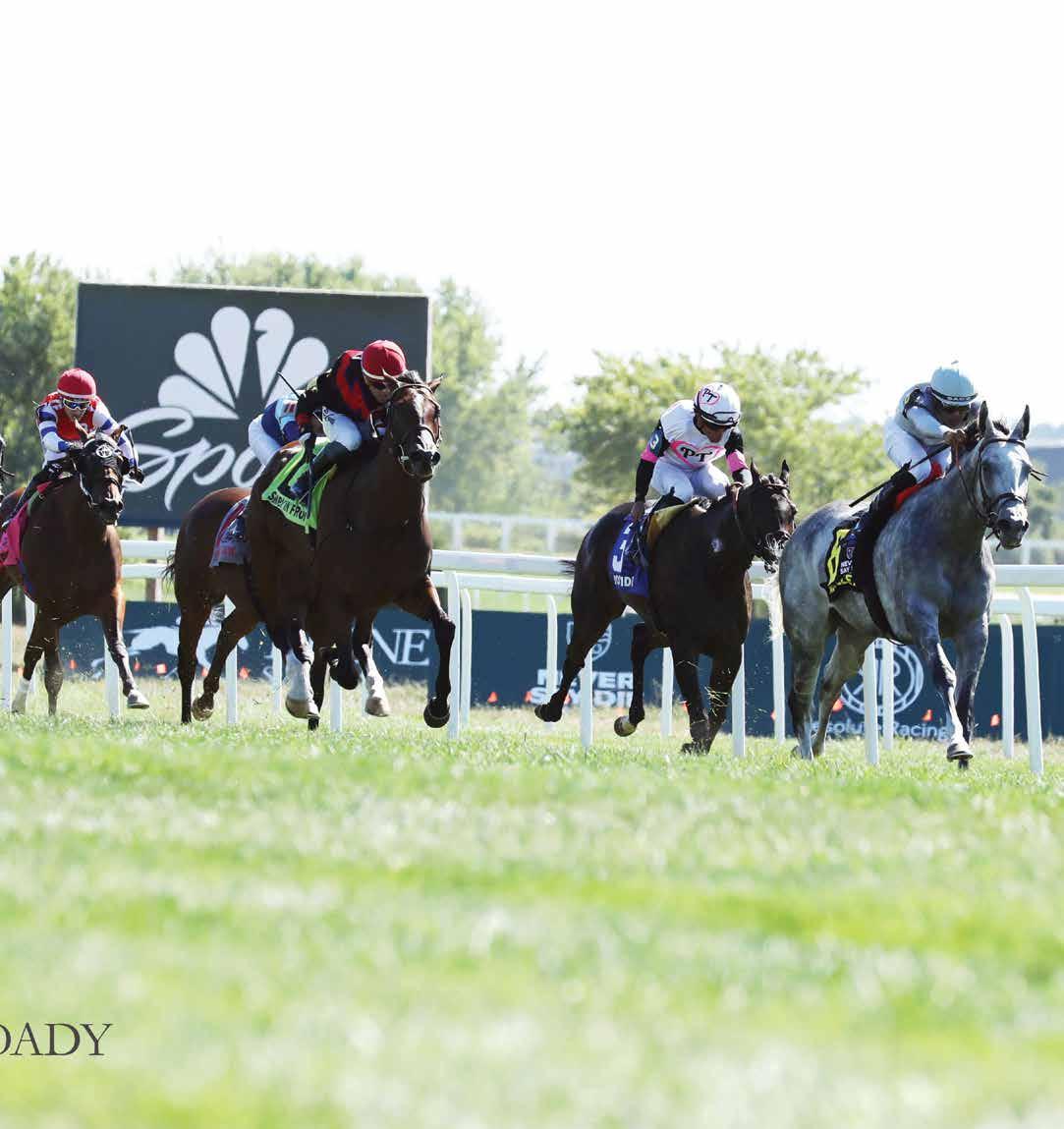
AG BULLET’S CONNECTIONS LOOK TO RETURN TO KENTUCKY DOWNS THIS YEAR FOR THE LADIES TURF SPRINT, WHICH SERVED AS HER PREP LAST YEAR FOR A RUNNER-UP FINISH IN THE BREEDERS’ CUP TURF SPRINT AT DEL MAR.
“She made $1.6 million last year and a million-something the year before, and a lot of that had to do with Kentucky Downs,” trainer Richard Baltas said of his $3 million-earner. “We’re always thinking about coming back to Kentucky Downs because we’ve had a lot of luck there, and the [61/2-furlong] distance is just perfect for her. And yeah, we’re looking forward to—I don’t want to say three-peat—but I guess it would be a three-peat.”
Told no horse has ever won the same stakes three times at Kentucky Downs, Baltas laughed and said, “Well, let’s do it! Let’s be that one.”
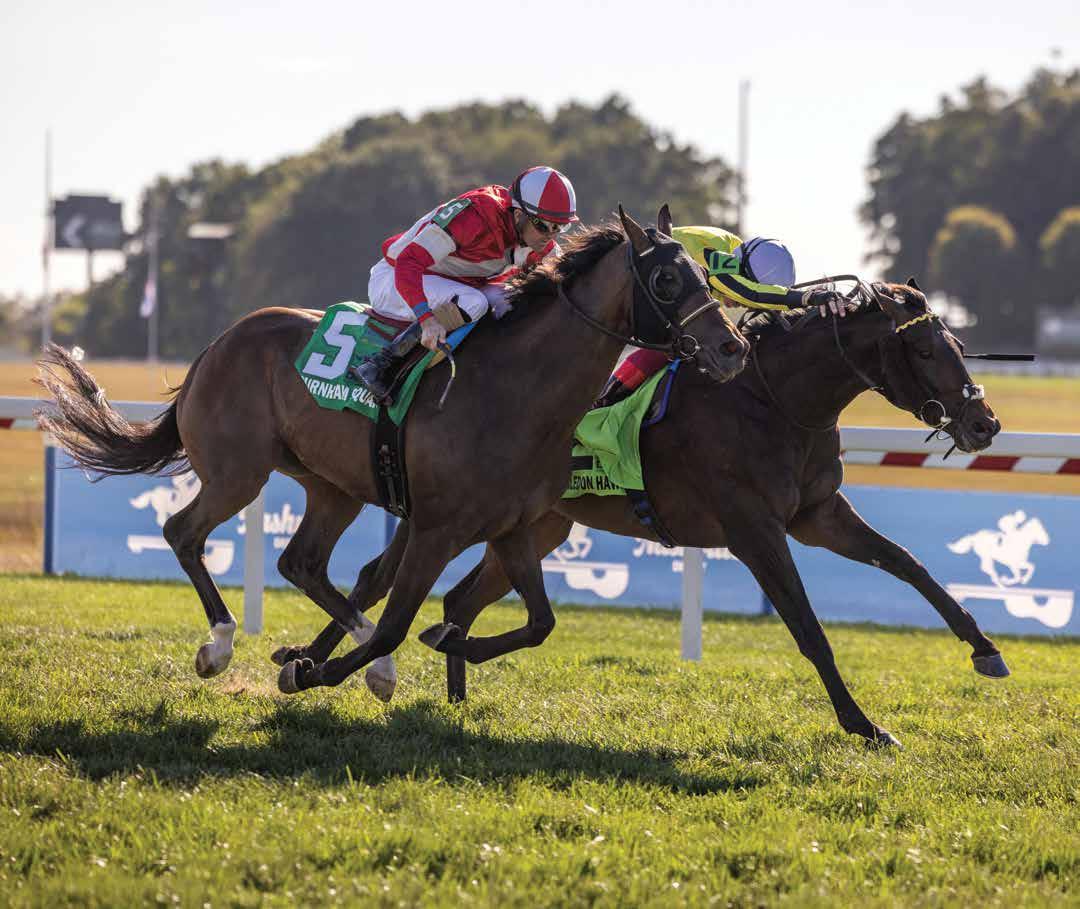
Whitham Thoroughbreds’ homebred Burnham Square is among the horses that could give Kentucky Downs another Breeders’ Cup winner. In his grass debut, the gelding lost last year’s $3.5 million Nashville Derby by a diminishing head to British shipper Wimbledon Hawkeye. Trainer Ian Wilkes’ 2026 wish list
for Burnham Square long has been the $2 million, Grade 2 Kentucky Turf Cup Invitational, whose winner gets an automatic, fees-paid berth in the $5 million Longines Breeders’ Cup Turf. Burnham Square has two wins at Keeneland: last year’s Grade 1 Blue Grass on dirt and a 93/4-length turf score in this April’s Elkhorn Stakes at the Breeders’ Cup Turf’s 11/2-mile distance.
“The Whithams love Kentucky Downs,” said Wilkes, who plans to first run Burnham Square in Colonial Downs’ Grade 1 Arlington Million. He noted that the Whithams’ 2012 Breeders’ Cup Classic winner Fort Larned “won [an allowance race] down there, right before there was any real money. The Whithams really enjoy Kentucky Downs, and yes, when you give away good money, they really enjoy it even better.”
Average Number of Starters Per Race Since 2011
Claiming Crown Preview Day August 22 at Colonial Downs
1st & 2nd place finishers earn an automatic entry into the November Claiming Crown at Churchill Downs

Colonial Downs and the VHBPA will be hosting the 2nd annual Claiming Crown Preview Day . The day will feature eight starter-allowance races with $550,000 in total purses. The top two finishers in each race earn automatic entry into their corresponding Claiming Crown races this fall at Churchill Downs. Winners that start in the corresponding Claiming Crown race at Churchill Downs receive a $2,000 travel stipend from the Virginia HBPA. No entry fees required to compete at Colonial Downs.




Total Handle on Kentucky Downs’ Live Racing Since 2011
$107,294,876
$90,181,408
$83,640,261
$80,175,928
$74,088,532
$59,828,444
$41,239,699
$36,421,721
$30,246,888
$22,540,764
$16,887,134
$15,880,755
$12,814,891
$7,570,731
$3,596,354
Kentucky Downs enjoyed a record-smashing meet last year, including breaking $100 million in all-sources handle at $107,294,876 and $41.76 million in purses paid. Field size remains the industry standard-bearer, checking in at 10.82 horses per race last year and 10.89 in 2024.
But the track—which, in an arrangement with the Kentucky HBPA, has transferred millions of dollars to the purse accounts of other racing associations in the state throughout the past decade—faces some challenges in 2026. That’s reflected in its purse projections of $36.18 million for the meet, which include $17.365 million in Kentucky Thoroughbred Development Fund purse supplements for registered Kentucky-breds.
Kentucky Downs’ 2026 dates were compacted by the lateness of Labor Day (which usually falls during the track’s first of two weekends) and the fact that the October 30-31 Breeders’ Cup at Keeneland knocked two days out of Churchill Downs’ fall meet to further tighten the state’s fall schedule.
The way the calendar breaks, Kentucky Downs will go up against Saratoga and Del Mar on both weekends, whereas New York was dark during the second weekend in recent years. Facing only Del Mar as major competition for wagering dollars on the second Saturday, Kentucky Downs bet a record-shattering $25,385,003 last year and $21,184,941 in 2024.
But in Kentucky Downs’ favor is—besides the significant carrot of offering by far the largest purse money in America—the presence of the Breeders’ Cup at Keeneland this year, making it convenient to ship to the commonwealth and just stay put.
“We’re hoping that trainers will look at our stakes program and kick off the races that fit for them as the last prep—or as a prep before the last prep at Keeneland a month out from the Breeders’ Cup,” Nicholson said.
NBC will broadcast live from Kentucky Downs both Saturdays—on NBC Sports (and Peacock) August 29 and on the NBC flagship network September 5. The five Grade 2 stakes September 5 include the $3 million Nashville Derby, $2 million Kentucky Turf Cup Invitational and $1.75 million Kentucky Downs Turf Sprint (a Challenge Series qualifier for the Breeders’ Cup Turf Sprint).
Horsemen and racing fans will find the facilities similar to 2025, as Kentucky Downs works on a master plan that promises significant renovation in 2027, Nicholson said. There is one exception—the new Lucky Lantern, a Chinese restaurant being constructed in The Mint Gaming Hall that he hopes will be open in time for the race meet. The track has added the $250,000 Lucky Lantern Stakes for 3-year-old fillies at 61/2 furlongs on September 7, designed to accommodate overflow from the highly popular Grade 2 Music City two days earlier. HJ



WHAT CAN THE DATA SUPPORT?
Since 2009, the Equine Injury Database (EID) has recorded racing fatalities occurring within 72 hours of a start across the great majority of North American Thoroughbred racetracks. The primary metric is an incidence rate: fatalities per 1,000 starts. The database’s primary finding is encouraging. The fatal-injury rate has declined from approximately 2.0 per 1,000 starts in 2009 to roughly 1.1 per 1,000 starts in 2025, representing a reduction of about 46% over 17 years. That decline is an important and indisputable observation.
To fully appreciate what the EID can and cannot tell us, it helps to understand the strengths and limitations of a large surveillance database. Data are commonly used for three purposes: description, prediction and causal inference. The EID contributes to all three but not equally.
Data collection serves three broad purposes—describe problems, predict future events and explain causes so effective interventions can be developed
By James C. Meyer, DVM, MSc, DACVIM
Description is the EID’s greatest strength. Any individual race can be influenced by pace, weather, traffic, rider decisions or simple bad luck. When hundreds of thousands of starts are aggregated, however, those random influences largely average out and stable patterns emerge. The EID functions much the same way. It provides a reliable picture of what has happened across the sport: long-term trends in fatality rates, differences among racing surfaces and broad patterns associated with factors such as age and distance.
For example, over the 17-year study period, fatality rates averaged approximately 1.78 per 1,000 starts on dirt, 1.35 on turf and 1.09 on synthetic surfaces. These figures do not explain why the differences exist, but they accurately describe them. In this role, the EID serves as a benchmarking tool for the sport and performs as well as virtually any safety surveillance system in athletics.
STATISTICS FROM THE EQUINE INJURY DATABASE, INCLUDING AN AVERAGE FATALITY RATE OF APPROXIMATELY 1.35 ON TURF PER 1,000 STARTS OVER A 17-YEAR PERIOD, HELP US TO UNDERSTAND THE STRENGTHS AND LIMITATIONS OF A LARGE SURVEILLANCE DATABASE.
Prediction is more challenging. Fatal racing injuries are rare events, and rare events are inherently difficult to predict with high accuracy. The publicly available EID data contain a limited number of risk factors, such as horses’ ages, surfaces and race distances, which are insufficient for precise prediction at the individual-horse level. Nevertheless, the database may help identify broad categories of elevated risk and could contribute to risk-stratification models when combined with more detailed information on horses, training histories, veterinary findings and management practices.
Causal inference requires the greatest caution. The EID is an observational database; it records what happened, not why it happened. Asking it to identify causes is a bit like examining a race chart and trying to determine why the winner prevailed. The chart accurately records the outcome, but many explanations remain plausible. A fast pace may have favored a closer. Track conditions may have benefited some horses and disadvantaged others. Superior conditioning, rider tactics, breeding or simple chance all may have contributed. The chart alone cannot separate their individual effects.
Racing safety data face the same challenge. Surfaces, medication policies, jurisdictional regulations, weather, field sizes, horse populations, training practices and veterinary management all change simultaneously. The EID can identify patterns worthy of investigation and provide the foundation for more rigorous causal analyses. However, descriptive statistics, no matter how accurate, cannot by themselves establish that a particular intervention caused the observed decline in injury rates.
The appropriate use of the EID is therefore straightforward. Trust it as a surveillance tool that measures the health and safety of the sport. Use it cautiously as one component of prediction. And view it as a generator of hypotheses about causes rather than the final authority on them. Most misunderstandings of safety data arise when a descriptive observation is quietly transformed into a causal conclusion. Keeping those distinctions clear is essential for interpreting both the strengths and the limitations of the EID.
Dealing With Uncertainty
Every rate published by the EID is an estimate of the true underlying risk. Even though the EID captures every documented start and every fatality during the period (it is not a random sample) at the tracks that contribute their data, the rate is still an estimate because of the rare and random nature of fatal injuries. A different but equally realistic set of chance outcomes in the same period could have produced a somewhat higher or lower number.
The key factor that determines how much uncertainty surrounds any rate is the total number of starts. The more starts that go into the calculation, the more stable and trustworthy the resulting rate becomes. With fewer starts, a small difference in the number of fatalities can cause the rate to swing sharply from one year to the next.
Think of it like baseball batting averages. A hitter who goes 20-for-50 in spring training posts a glittering .400 average, but everyone understands the sample is too small to mean much. The same principle applies here; the posted fatality rate is the exact arithmetic for that period, but when it rests on limited starts, it can be as unreliable as that spring training batting average.
The EID data illustrate this clearly. In 2022, the synthetic-surface fatality rate dropped to 0.41 per 1,000 starts—the lowest in 17 years—only to rise to 0.97 the following year (see chart below). No major change occurred in synthetic racing itself. The 2022 figure came from a relatively small number of starts and 12 fatalities, so the statistical uncertainty around it was large enough to easily cover most of the rebound the next year. Treating the dip as a major safety breakthrough and the rebound as a setback would be mistaking normal year-toyear variation for a genuine change in safety.
This is why a fatality rate quoted without a margin of error is incomplete, even misleading. A single number gives no hint of whether it’s a steady blue-chip estimate built on thousands of starts or a penny-stock figure that could swing by half. The fix is simple and should be routine: Attach an interval to every rate
A persistent gap, measured with very di erent precision
U.S. Thoroughbred fatal injuries per 1,000 starts: dirt vs. synthetic, with 95% confidence intervals
Source: Equine Injury Database, The Jockey Club, 2009–2025. Bands are exact Poisson (Garwood) intervals.
Reading the bands: Each line is the yearly fatal-injury rate for one surface—blue for dirt, red for synthetic. The shaded band around each line is its confidence interval, the range in which the true rate most likely lies. What sets a band’s width is how many races are included. Dirt is raced on roughly seven times as much as synthetic, so its rate rests on a far larger number of starts leading to far more fatalities, and the band is narrow. Synthetic runs only a fraction of the starts, so a similar rate is built from a few dozen fatalities a year and the band is wide. The line swings accordingly, with synthetic’s steep 2022 dip (12 fatalities) and the rebound that followed both falling comfortably inside the band.
The takeaway: Dirt has run consistently higher than synthetic, but synthetic’s figure is measured far less precisely, and most of its year-to-year movement is noise rather than real change in safety.
(the exact count-based intervals statisticians call Poisson or Wilson intervals are the honest choice here, not the textbook approximations that misbehave when events are scarce), and let the width of that interval, not the point itself, drive how much weight you give it.
The deeper lesson is about resolution. To estimate a single rate to within 10% of its true value at today’s baseline, you would need roughly a quarter of a million starts behind it. A busy track runs a few thousand races a year; onequarter of one track is a few hundred. So, the finer you slice—one track, one meet, one quarter, one barn—the wider the error bars grow until at some point the number is mostly static. The database doesn’t get less honest as you zoom in; it just runs out of resolution, the way a photograph turns to grain when you enlarge a tiny corner. Knowing where that resolution gives out is most of the skill in reading safety data.
Making Comparisons
Comparison is one of the most valuable uses of the EID. In fact, the entire purpose of a surveillance system is to compare—one year with another, one surface with another, one region with another or one set of practices with another. The challenge is not whether to compare but how much confidence to place in the comparison.
Some comparisons are extraordinarily reliable. The decline in the fatalinjury rate from approximately 2.0 fatalities per 1,000 starts in 2009 to about 1.1 per 1,000 starts in 2025 is based on millions of starts and thousands of fatalities. The signal is so large and persistent that random variation cannot plausibly explain it. Likewise, long-term differences observed across surfaces are based on many years of data and deserve serious attention. These are precisely the kinds of comparisons that surveillance databases are designed to make.
Other comparisons are informative but require more restraint. A difference between one state and another, one track and another, or HISA and non-HISA jurisdictions may reveal patterns worthy of investigation. Such comparisons can identify where risks appear higher or lower and where further study may be warranted. What they cannot do, by themselves, is explain why the difference exists. Tracks differ in horse populations, racing schedules, surfaces, climates, management practices and many other factors. A descriptive difference is not necessarily a causal one.
The greatest caution is required when comparing small samples. A single quarter, meet, track or barn may experience only a handful of fatalities. In those settings, chance plays a large role. A track that posts the lowest fatality rate one year may simply have been fortunate, just as a track posting the highest rate may have been unfortunate. Statisticians call the tendency for extreme results to move back toward average values “regression to the mean,” but the phenomenon is familiar to anyone involved in racing. The horse who runs a career-best figure one start often regresses in the next. The barn that seems unable to lose eventually cools off. Exceptional results rarely persist indefinitely.
This becomes especially important when evaluating interventions. Suppose a track experiences a troubling increase in fatalities, introduces a safety reform and subsequently sees its rate decline. The improvement is encouraging and may reflect a genuine benefit of the intervention. However, it is also true that interventions are often introduced immediately following an unusually bad period, precisely when rates would be expected to move closer to their long-term average even without any change. Distinguishing between a real treatment effect and a natural rebound requires more than a simple before-and-after comparison. It requires an appropriate comparison group, a longer period of observation or a formal study design.
None of this means comparison is hopeless. It simply means that comparisons should be weighted according to the amount of information behind them. Large, long-term comparisons generally deserve confidence. Moderatesized comparisons can identify patterns that warrant further investigation. Small, short-term comparisons should be viewed cautiously because they are often dominated by random variation.
The EID is at its best when used to identify meaningful patterns, monitor trends and highlight areas deserving closer study. The farther we move from large, stable comparisons toward small, highly specific ones, the more uncertainty enters the picture. Understanding that trade-off is essential to interpreting racing safety data responsibly.
The EID is an excellent industry-wide scoreboard and a valuable tool for identifying trends and priorities. It has already helped drive a nearly 50% reduction in fatality rates when used for these purposes. However, it is not well suited to serve as a definitive arbiter of blame or to conclusively determine what caused specific outcomes. For questions of liability or the effectiveness of individual interventions, the EID needs to be supplemented with additional data and analysis. HJ
James C. Meyer, DVM, MSc, DACVIM, is an equine veterinarian and clinical researcher with more than 30 years of experience practicing across North America, Dubai and Europe. Board-certified in large animal internal medicine, he has worked extensively with both Thoroughbred and Standardbred populations, combining hands-on clinical expertise with rigorous analytical methods. Meyer holds a master’s degree in medical statistics from the University of Oxford and is widely recognized for his work in study design, statistical analysis and interpretation of complex veterinary datasets. He serves as a statistical and study design consultant for the Equine Veterinary Journal and the Journal of Veterinary Internal Medicine and is a member of the Grayson-Jockey Club Research Foundation grant committee. Meyer’s research portfolio includes large-scale retrospective and longitudinal analyses, most recently examining the impact of furosemide (Lasix) use on career length in Thoroughbred racehorses. He currently consults on study design and data analysis for a range of animal health organizations, bridging clinical insight and biostatistics to support high-quality, impactful research.
STATISTICS FROM DIRT RACING MAKE UP A LARGE PORTION OF THE EQUINE INJURY DATABASE.

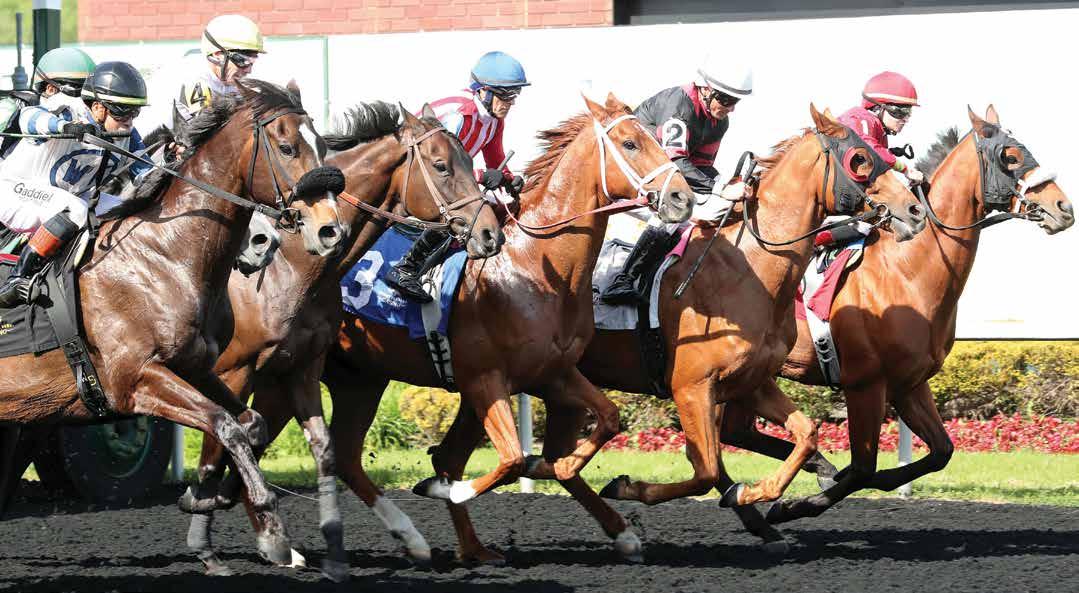
ARE BREAKDOWNS INCREASING?
VETERINARIANS WEIGH IN
By Clara Fenger, DVM, PhD, DACVIM; Kimberly Brewer, DVM, MSc; Andrew Roberts, DVM;
The Horseracing Integrity and Safety Authority (HISA) published its 2025 Annual Metrics Report in March. In the report, HISA claims a fatality rate of 1.00 per 1,000 starts, carefully spreading its claim over both 2024 and 2025. In fact, there has been an ongoing trend for decreasing breakdowns over the previous 10 years, with a steady decline starting in about 2014.
The decline in fatalities can be attributed to any number of factors, not the least of which is a better understanding by both horsemen and racetrack management of the factors that play into fatalities.
Horsemen and racetrack management are doing a better job all the time. While medication regulation and regulatory scrutiny may contribute to the decline, it is hard to believe that these factors are significant, since they are uniform across jurisdictions, and the fatality rate is far from uniform across jurisdictions.
Most interesting is the actual increase in the fatality rate at HISA-regulated tracks from 2024 to 2025—0.90 in 2024 to 1.04 in 2025.
While the increase may simply be a statistical anomaly, several individual jurisdictions had substantial increases in their fatality rate. If the regulations had the most impact, we would not be seeing increases of any magnitude.
To get a handle on why this might be occurring, the member veterinarians of the North American Association of Racetrack Veterinarians were asked what factors played into this phenomenon. Regulations aside, the attending veterinarian of the individual racehorses has substantial input into the health and welfare of the racehorse and also shares the on-track experiences of the trainers. Their thoughts on these matters are summarized below.
Veterinary Shortage
There is a nationally recognized shortage of equine veterinarians, and the racetrack is no exception to this reality. A single racetrack practitioner is most likely to provide veterinary care to hundreds of horses. As older practitioners retire, there are few younger practitioners to take their place. This places more strain on the existing veterinarians, contributing to burnout and earlier retirement. Fewer trained and expert veterinary eyes on the athletes, especially with older, more experienced practitioners leaving the field, is a likely contributor to horses with a higher risk of injury slipping through the cracks.
The HISA Burden
Prior to the current HISA reporting requirements, many jurisdictions required the reporting of joint injections and often all medications administered within a specific time frame related to the race. HISA has increased this requirement to all medications administered and all diagnostics performed on the horse from its first timed work until it is retired. This reporting requirement includes procedures like administering antibiotics for an infection in a horse that is months away from racing.
Common sense dictates that such a treatment has no impact on the horse’s risk of injury or death and is simply busywork required by an authority run by laypeople and a paperwork burden placed on a highly educated professional. As one veterinarian suggested, “Instead of going through a barn
Rob Holland, DVM, PhD; and Thomas Tobin, MRCVS, PhD, DABT
2026 OHIO HBPA
BOARD OF DIRECTORS
ELECTION BALLOTS DUE BY FRIDAY, SEPTEMBER 4TH WILL BE MAILED TO OHIO HBPA MEMBERS BY AUGUST 1ST.

IF YOU ARE A MEMBER OF THE OHIO HBPA AND DID NOT RECEIVE A NOTICE OF ELECTION LETTER IN MAY PLEASE CONTACT DIANE SEXTON IN THE OHIO HBPA MAIN OFFICE AT 614-875-1269.
Have your OSRC license number and mailing address available and she will add you to the mailing list for an election ballot.
and routinely looking at the horses in a trainer’s barn, I am sitting in my truck outside the barn logging medications.”
The horses are simply not getting as much routine veterinary surveillance. The HISA reporting burden is also a barrier to attracting new veterinarians into racetrack practice.
There was a time when the best equine veterinary students lined up for a job at the racetrack. There is no better profession than working on elite, healthy young athletes, sleuthing out subtle performance issues and being able to use cutting-edge treatments and technology.
Contrary to what racing’s detractors would claim, young healthy athletes rarely perish, whereas in most other areas of equine practice, field injuries, colic and laminitis claim horses on a daily basis. Relieving that suffering requires a veterinarian, and that is not a fun job.
The days of racetrack practice attracting the best and the brightest veterinary students are over. The allure of working with the most elite athletes and ensuring that they are in the best possible condition is overshadowed by restricting practice to a small portion of the spectrum of care available and the onerous reporting and recording requirements.
Prospective racetrack veterinarians are simply going into other lines of work in which they have access to cutting-edge veterinary medicine and no risk of the not-insignificant penalties associated with the HISA regulatory processes.
Penalties for Veterinarians
Veterinarians have been penalized for a wide range of HISA infractions. The majority of the infractions have been not for doping or inappropriate treatments at inappropriate times but for possession of substances now banned, with no evidence that those substances were actually used after the start of the HISA medication regulations.
Veterinarians who treat farm or show horses, track ponies or noncovered racehorses have been handed suspensions and fines for possession of substances that are perfectly legal in those other classes of horses. The infractions stem from a lack of understanding of the ambiguous regulations.
Combined with the veterinarian shortage, the lengthy suspension of veterinarians for these types of infractions adds to the lack of appropriate veterinary care for the horses. There is no surplus of veterinarians available to cover the horses, and those who remain available to care for the horses are stretched too thin for complicated evaluations and diagnostics.
The penalties also add to the industry’s inability to attract bright new veterinarians to the sport. Veterinarians, even first as veterinary students, are accustomed to commanding respect as highly educated professionals. These penalties, many of which seem random, have kept veterinarians who cherish their reputations away from racing.
Scratches by Regulatory Veterinarians
Horses are being scratched in record numbers, with the number of scratches quadrupling in Kentucky since 2019. No amount of evidence presented by the practitioners and horsemen is able to sway the regulatory veterinarians.
Horses’ careers are ended because a regulatory veterinarian “just doesn’t like the way the horse goes.”
Regulatory veterinarians and other HISA officials claim the system is working.
Between 15% and 30% of horses scratched never race again, and of those that race again, it takes twice as long for them to return to racing as the winner of the race from which they were scratched. HISA argues that this is proof that regulatory veterinarians are using their judgment appropriately and that these horses should not race. The statistics regulators quote are accurate, but the regulators are also making this a self-fulfilling prophecy.
There are repeated examples in which a regulatory veterinarian demands advanced diagnostic imaging before a horse will be removed from the vet’s list, and after the owner complies at great personal expense and with negative findings, the regulatory veterinarian will still refuse to allow the horse to race.
The best way to have statistics that back up your opinion is to have complete control of both ends of the statistics. Horses on the cheaper end of the spectrum may simply not be worth the cost of diagnostics required by the regulatory veterinarians and so are retired or rehomed.
The fact that these horses never show back up in the entries does not necessarily reflect inherent unsoundness or lack of suitability to race. It is simply the cost of the diagnostics required and the repeated result that even when a horse passes all of those tests it may still not be allowed to race.
Regulatory veterinarians have routinely ignored the recommendations of board-certified surgeons assuring them that the horse is at no greater risk than any other horse of a fatality. Even the opinions of the undisputed experts do not sway the regulators.
Horsemen Avoiding Diagnostics
Possibly the most concerning factor repeated by veterinarians as contributing to the uptick in fatalities is the potential for avoidance of diagnostics.
HISA requires all diagnostics and the veterinarian’s conclusions to be uploaded into the portal. Horsemen may therefore believe that if they radiograph a knee or an ankle, that structure will subsequently receive undue attention from the regulatory veterinarian, thereby increasing the chances of a scratch. As detailed above, a stay on the vet’s list may result in permanent retirement of the horse for an issue that would have never affected its ability to race in the past. Diagnostics bring any issues or concerns to the regulatory veterinarian’s attention, even if the condition is well managed.
The concern here is that treatment without diagnostics is a step backward and also a factor shown to put horses at risk of injury.
A research paper by Chris Whitton of Australia is often cited to support the restriction of corticosteroid joint injections in racing, but it turns out that his paper does not support the restriction of corticosteroid joint injections in racing at all. The risk of injury was actually shown to increase when more than one joint injection in the same joint was performed without diagnostics. And diagnostics here doesn’t mean advanced imaging like PET and MRI scans, but simple radiography and ultrasound, like every practitioner has at their ready disposal. Yet this is exactly what is happening in the United States today.
Simple diagnostics only put the crosshairs on your horse, attracting extra scrutiny.
Doing right by the horse puts that very same horse at risk of ending up on the vet’s list forever. So doing right is done less often. Rather than a collaborative relationship between regulators, horsemen and their veterinarians, the HISA program has led to a record level of animosity between the regulated and the regulators, leaving horses undiagnosed and untreated.
Solutions?
The uptick in fatalities is multifactorial and may simply be a statistical anomaly. Limiting the input of the backside practitioner, the veterinarian most responsible for the health and welfare of the competing equine athlete, has to be one of the most significant factors.
Penalties that include more fines and fewer suspensions would go a long way toward protecting the horse, particularly for violations that are difficult for the practitioner to comply with such as the purging of banned substances from their vehicles that are legal and appropriate in non-covered horses.
Every time a veterinarian is suspended, a horse goes without. Every time a veterinarian is suspended, there is a risk of that person simply walking away from racetrack medicine, and walking away with them is, in some cases, decades of experience. Every time a veterinarian is suspended, there is a young veterinary student who turns away from racetrack medicine because who wants to risk such a hit to their reputation and income when other fields are not accompanied by such severe penalties? No one disagrees that lengthy suspensions are appropriate when doping has occurred. Few of the HISA veterinary violations represent doping.
The onerous paperwork of HISA similarly pulls veterinarians away from examining their patients. Most racehorses have historically been examined by a veterinarian on a weekly or more frequent basis. Veterinarians’ time is now being monopolized by the requirement of recording every treatment and every procedure on every horse, including those months away from a race.
Veterinarians during a busy race meeting typically work 14-to-16-hour days, and unless they have hired someone to input all their data, they have
to spend hours typing it into the portal. Even when someone is hired, the veterinarian is responsible for the data being correct.
A simple solution would be to dial back the requirements to the preexisting model.
HISA should require certain procedures, like joint injections and shock wave, to be contemporaneously recorded as well as all medications and treatments from entry until race time. It should require certain medications, like clenbuterol, to be reported. And it should require production of all records on a horse within 48 hours upon request. The requirement of every treatment and every procedure every day is excessive, and it is clear no one at HISA routinely reviews the information.
The regulatory veterinarian scratches and the domino effect of the cost of proving the horse is actually clear to race, plus spending time and money on diagnostics, all while losing the opportunity to race, may lead trainers to be less than open with regulatory veterinarians. Trainers also may refrain from conducting appropriate diagnostics out of fear of increasing their chances of being scratched.
The current regulatory scheme is in need of reform because, in many cases, horsemen are left with no way to prove that the horse on the vet’s list is approved to race. An appeals process in which the experts can meet with both the veterinarians for the horsemen and the regulatory veterinarians and come to an independent conclusion should be simple and would go a long way toward restoring confidence in the process.
An undisputed expert, such as a board-certified surgeon, should have the ability to weigh in on risk, based on training and experience lacking in the average regulatory veterinarian. HJ
LATE CONSIGNMENTS ACCEPTED UNTIL August 1, 2026
Catalogs and sale information available: www.iowathoroughbred.com
For more information: itboa@msn.com or 800-577-1097
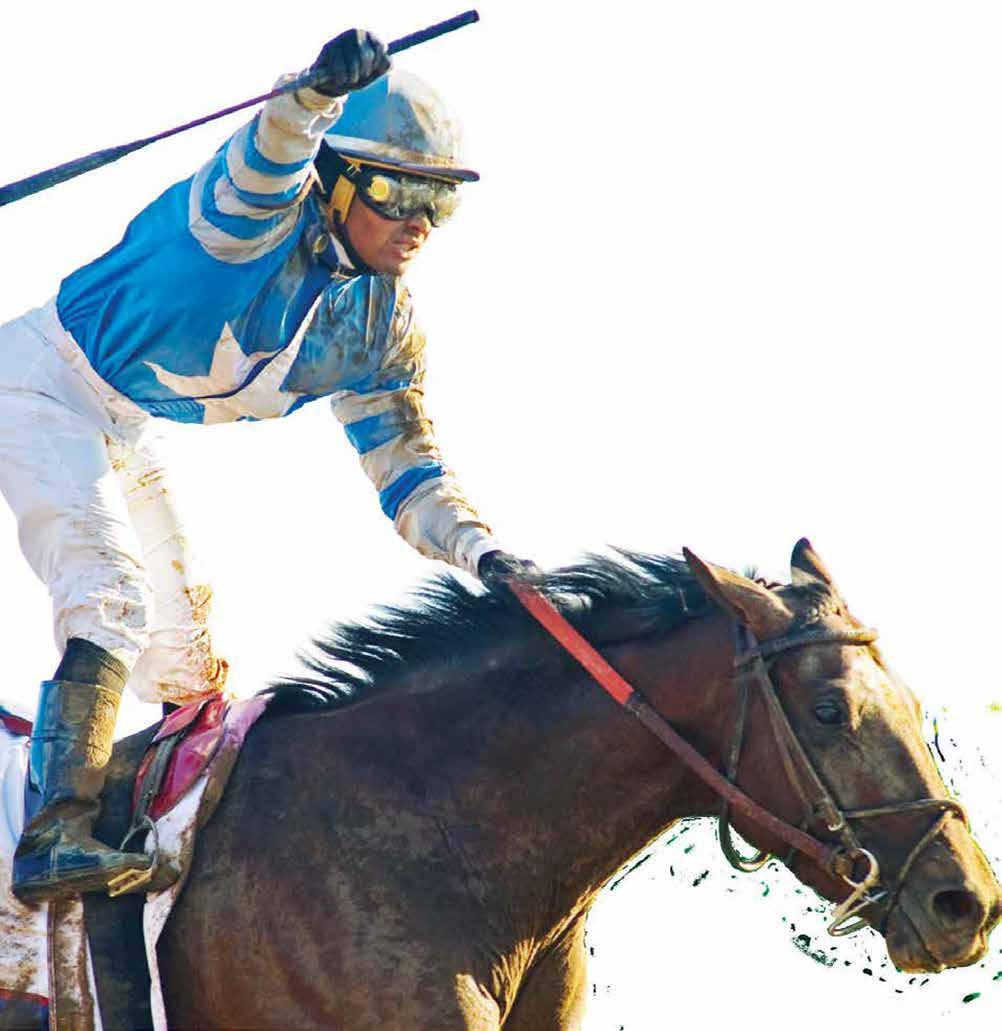
TRADITION OF SUCCESS
Since 1973, Race Track Industry Program graduates have been united by passion–for the horse, for racing, for making their own mark. This passion and drive connects them long after the degree has been earned and careers have been launched.
From winning Triple Crowns to running racetracks, managing bloodstock enterprises to calling races, RTIP alumni are leading the industry.
Become a part of this legacy.

A Day in the Life… …Racetrack Chaplain
Dean Carpenter
By Jen Roytz
W alk the backside of any racetrack in North America, and you soon realize it is not the typical work culture found in most industries. For many, working at the track is more than simply a job; it’s a way of life.
This way of life isn’t easy though. It’s often unsettled, moving from one track or race meeting to the next. The days start early, don’t end until the work is done and span the seasons and the conditions that come with them.
Those who work on the backside live this life unequivocally. Their early mornings and long days are dedicated to the horse—the equine athletes that require daily care, feeding, exercise and a bit of luck to bank the wins that keep the paychecks coming in and the whole operation running.
Those who work—and often live—on the backside are part of a special community, and racetrack chaplains serve this community in countless ways. These nontraditional clergy members provide spiritual guidance to those on the backstretch as well as a wide array of other services, including emotional, physical and social support.
For Keeneland Chaplain Dean Carpenter, it’s as meaningful of a role as he ever could have dreamed.
FINDING HIS CALLING
Carpenter began his tenure as Keeneland’s chaplain in 2015, but it is actually the second position he’s held at the Lexington, Kentucky, track.
“Funny enough, I started at Keeneland 15 years ago working in the maintenance department as an HVAC, plumbing and mechanical technician,” Carpenter said. “I remember seeing a golf cart drive past one day that said ‘chaplain’ across the side and I asked one of my co-workers, ‘What’s a chaplain doing here?’ I later met Keeneland’s then-chaplain, Bobby Aldridge, one day in the dorms when I was working on a water heater, and we started talking about his job and the needs on Keeneland’s backside.”
That meeting was serendipitous because, at the time, Carpenter was balancing his day job at Keeneland with coursework in ministry studies at Kentucky Wesleyan College in Owensboro with the hopes of one day transitioning his career toward the clergy.
After 31/2 years, Carpenter left Keeneland’s maintenance department to take a job with the city of Lexington, but when Aldridge announced his retirement in late 2014, Carpenter was approached about stepping into the role.
The decision to do so not only changed his life but has had a profound impact on the lives of countless others.
Carpenter and his assistant, Diana Varon, dedicate their days to making the lives of Keeneland’s backside community better in a variety of ways, offering camaraderie and fellowship as they walk the grounds; holding chapel services; assisting with baptism, marriage and funeral services; providing assistance in the forms of food, clothing and healthcare; and supporting individuals during times of emotional or physical need.
“One of my favorite phrases is ‘We want to be a light in what can sometimes feel like a dark place in someone’s life,’ ” Carpenter said. “The backstretch of a track can sometimes be a lonely place, and you never know what people are going through. It can make a tremendous difference just to know someone truly cares and is looking out for you and supporting you.”
A DAY IN THE LIFE
Much like those who work day in and day out at the racetrack, Carpenter’s day starts bright and early each morning, walking the barns and visiting the dorms to check in on people he’s already met and to introduce himself to new faces he comes across, ensuring they know where his office is if they ever want to stop by to chat.
“One of my favorite parts of this role is getting to know people on the backstretch; the better they get to know me, the more comfortable they are talking with me about what they need or what others might be struggling with,” said Carpenter, who added that it’s not about talking as much as it is about listening. “If I’m the one doing all the talking, I’m not learning what they, their friends or their co-workers are dealing with or what they need.”
CHAPLAIN DEAN CARPENTER IN THE JOCKEY’S ROOM AT KEENELAND RACE COURSE
Make a Connection
In addition to her role at Keeneland alongside Chaplain Dean Carpenter, Diana Varon also serves as a client service coordinator for the Kentucky Racing Health and Welfare Fund, a nonprofit organization that provides funding toward the payment of medical, hospital, dental, vision and funeral expenses not covered by traditional insurance, workers’ compensation, Social Security, military benefits or other types of insurance.
The fund takes the proceeds of uncashed wagering tickets throughout the commonwealth of Kentucky and puts them toward health benefits for backside workers.
“So often, our role is to help members of our community connect with and navigate the appropriate solutions to the problems they face, and the Kentucky Racing Health and Welfare Fund has been a tremendous resource in that effort,” Carpenter said.
In 2025 alone, the fund assisted 628 Kentucky racetrack licensees by providing more than $1.1 million in health-related benefits. Since its inception in 1978, the fund has distributed more than $51 million in health-related benefits, the majority of which would have gone unaddressed without this assistance.
our food pantry and clothing closet. For example, maybe someone just came up from Florida, where it’s warm and sunny, for the Keeneland spring meet, but we often still get snow and freezing temperatures in April. They may need warmer work clothes and boots or food to make their first few meals, but maybe they can’t afford to buy them until they get that first paycheck. That’s where we can step in and assist.”
Carpenter said churches in and around Central Kentucky have truly embraced his efforts, regularly helping to stock the pantry and closet and inviting him to speak so their members can learn about his and Varon’s efforts and ongoing needs as well as the impact their kindness has on a very worthwhile population.
“Throughout Lexington and the surrounding areas, I find people eager to help our backside efforts,” Carpenter said. “They love being a part of our community because racing is such an important part of their community.”
Working with racehorses is physically demanding, and with a 1,000-pound animal at the peak of its fitness, there is always the potential for injury. From grooms and hotwalkers to exercise riders and jockeys, when members of Keeneland’s racetrack community get injured, Carpenter makes a point of visiting them if they are hospitalized or checking in on them at the barns, at their dorm or home, or with a friendly call or text.
Often such injuries, as well as routine medical or dental procedures, require the patient to have someone with them in order to undergo sedation. Carpenter explained that he regularly comes across members of the backside community whose jobs working and traveling with horses have taken them far away from their families and traditional support networks. Not only can that present emotional challenges but it can make simple tasks like going to the doctor or dentist for procedures much more difficult and stressful.
“Every once in a while, any of us will need to have a medical or dental procedure in which you need someone to drive you or be there in the waiting room, either due to medical rules and regulations or simply because you are nervous and would benefit from the supportive company of someone you know and trust,” Carpenter said. “We often come across members of our backside community who need someone to simply go with them to such appointments, and we are happy to step in and be there for them. It seems so simple, but it can often be the difference in whether or not that person gets the medical care they need.”
Keeneland’s chaplaincy also offers assistance when people need help finding and navigating resources in the community, such as enrolling their children in school and connecting them with the resources to give those kids the supplies they need.
“Much of the work we do is thanks to collaborative partnerships with other organizations in our community,” Carpenter said. “We work with entities like the Blue Grass Farms Charities, for example, to provide back-to-school backpacks, and we work with them and multiple others to host dinners for our backstretch community and their families for Christmas, Thanksgiving and other holidays.”
CHALLENGES OF THE JOB
Keeneland’s chaplaincy stocks a food pantry that provides everything from fresh fruits, vegetables, milk and bread to canned goods, other nonperishable items and toiletries. The chaplaincy also manages a clothing closet that offers donated items such as work clothing and boots, winter coats, hats, gloves, bedding, towels, luggage and more.
“So many of the people on the backstretch live a nomadic lifestyle,” Carpenter said. “For one reason or another, there are so many that depend on
Carpenter and others like him at racetracks around the country are a welcome and comforting presence for those working on the backstretch, but the role is not without its challenges.
One of the biggest challenges, according to Carpenter, is finding housing for people when they get hurt or become ill and require an extended leave of absence from their job.
KEENELAND PHOTO
DIANA VARON WITH CHAPLAIN DEAN CARPENTER AT KEENELAND
Race Track Chaplaincy of America: StrongerTogether

Every racetrack’s backside community is a unique tapestry of cultures, languages, ages and more.
Founded in 1972, the Race Track Chaplaincy of America (RTCA) is an interdenominational organization that supports chaplains, chaplaincies, councils, volunteers and others that minister to backside workers across the United States and Canada, offering resources and networks that allow them to better serve the spiritual and material needs of their track’s populations.
The RTCA supports chaplaincies with programs and services such as Bible studies and worship services, food and clothing banks, referrals for professional and health-related services, transport to and from procedures, injury and crisis support, funeral services, educational workshops and more.
“We have housing at the track, but that is only for people who are employed and working, so if someone gets hurt or receives a diagnosis, for example, requiring treatment and an extended leave of absence, or if they’ve simply aged out of the ability to physically do their job, it is challenging to find them an appropriate place to stay, especially for an extended period of time,” he said. “To meet that need, sometimes we need funds, other times we need resources, but what that person often needs is others working on their behalf to help find solutions so they can focus on recovering.”
Another challenge presented almost daily to Carpenter and every other backside chaplain in the country is simply reaching the people who need help the most. Those on the backstretch may need a helping hand for a variety of reasons—depression or other mental health issues, relationship challenges, substance use issues or medical needs—but they are conditioned to navigate their struggles alone.
“No matter where a chaplain is—a racetrack, the military, a hospital or anywhere else—it can be tough to convey to people that they are in need of assistance, and that is something that just cannot, and should not, be forced,” he said. “People who work at the track are tough. They’re used to getting up early, working really hard—like exceedingly hard—and just muscling through.”
Carpenter said it’s often friends of someone who needs his services that might initially put them on his radar, or they might talk with the individual about Carpenter and offer an unsolicited recommendation and reference.
“Word of mouth is very helpful,” he said. “If someone tells a person, ‘This guy is OK. I needed help, and he helped me,’ that can be huge and go such a long way. It can be hard to earn the trust of people, and it’s hard to do alone, but together, we can lift each other up.”
Challenges like these can be heavy, and people like Carpenter need to feel like they’re not navigating these roads alone, both on behalf of the people they serve and their own mental health, because compassion fatigue—a term common in both the veterinary community and in aftercare—is a real concern for those in the clergy, especially those assisting underserved populations.
“The Race Track Chaplaincy of America allows all of us working in this space to connect and collaborate on behalf of the industry and the people we serve,” Carpenter said. “But beyond that, the team in the executive offices at Keeneland, they get it, and I feel it every day, and I wish every chaplain had the support of their track management and every track had the support of their community as much as we have here. The team at Keeneland works to support our message to the community, and they embrace us.” HJ

LISTING AGENTS:
Charting the Course for a Horse’s Future
By Jen Roytz
JADE FAVRE WITH CAPTURE THE MAGIC, A HORSE NICKNAMED “HOUDINI” THAT SHE REHOMED AND WHO IS NOW AN UPPER-LEVEL EVENTER AND STANDING AS A THOROUGHBRED SPORT HORSE STALLION LICENSED WITH THE WESTFALEN NA WARMBLOOD REGISTRY
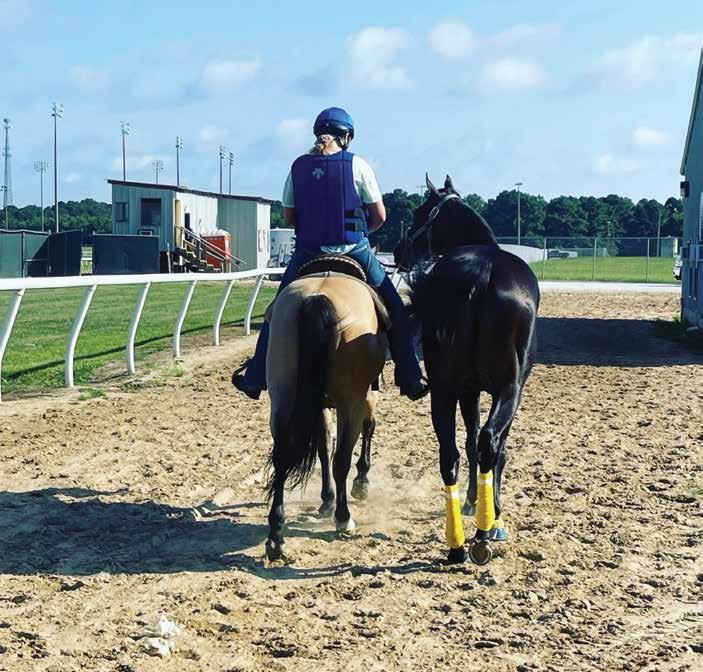
Everyone looks at the racehorse through a unique lens, and for Jade Favre it goes deeper than simply a love of horses or racing. Growing up in a family of athletes, she has developed an affinity for racehorses that extends well beyond what they accomplish in their racing careers. She also has gained an understanding of the unique challenge an athlete—horse or human—faces, at the height of their fitness and competitive mentality, in transitioning to a completely different life, lifestyle and environment.
Not surprisingly, that’s where Favre has found her niche in the racing industry—placing more than 150 horses annually as a backside listing agent.
“My uncle Brett [Favre] is the most well known of my family,” she said of the former NFL star and Super Bowl winner, “but all of us are pretty athletic. My dad played college [foot]ball at Southern Miss, my brother was the Gatorade Player of the Year in Mississippi, and my cousins have played football and volleyball at the college level.”
Favre, who attended Edinboro University in Pennsylvania on a full scholarship to play basketball, noted, “I didn’t consciously get into racing with a ‘professional sports’ mindset, but if I think about it, I definitely look at racing and training differently than most because of it, and it probably gives me a very different take on what it’s like for racehorses to transition away from being a high-level athlete to that next phase of life.”
As a listing agent, Favre coordinates the marketing, sale and associated paperwork and transfer of horses for trainers and owners at the tracks and farms.
Based in Mississippi near the Louisiana border, Favre splits her time between rehoming horses, helping to manage her partner Justin Jeansonne’s racing stable and raising their two young children.
“Rehoming horses is how I met Justin, and for a long time I balanced that with playing a traditional assistant’s role in the barn,” said Favre. “With how big my rehoming business has gotten, my role with Justin’s stable is a lot different these days. I do the billing, deal with the owners, schedule the farrier—things I can do remotely or on the go while I’m listing horses for trainers or running our kids around.”
What Is a Listing Agent?
Favre, who grew up riding Western style and doing a fair bit of barrel racing as a teenager, began her foray into Thoroughbred aftercare in the more traditional sense—getting horses off the track, giving them the start of a foundation in a new sport and selling them as riding or competition mounts.
It wasn’t long, however, before the demand for her assistance outpaced her ability to accommodate. To better meet the need, she transitioned from being a traditional “reseller” to a listing agent, and since doing so, her business has grown exponentially.
As a listing agent, Favre coordinates the marketing, sale and associated paperwork and transfer of horses for trainers and owners at the tracks and farms near Jeansonne’s stable base, including Fair Grounds, Louisiana Downs, Evangeline Downs and Delta Downs.
JADE FAVRE PONYING AT THE TRACK
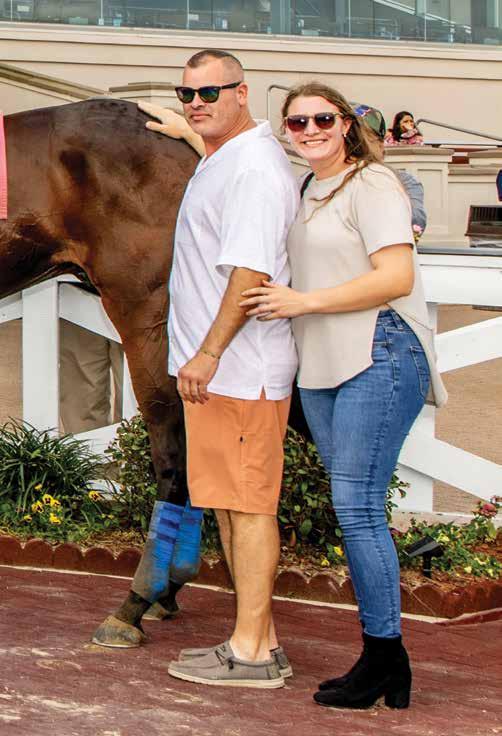
“In its most basic sense, I rehome racehorses on behalf of their connections, helping them transition quickly and safely out of that trainer’s stable and into a new owner and career that’s appropriate for them,” said Favre.
As a listing agent, Favre first gathers all of the relevant information about a horse, including its history, a description and photos and videos. She handles the marketing and networking, answering questions from potential buyers and conducting due diligence to ensure it’s the right person for the horse. Finally, she coordinates shipping the horse to its new home and does the paperwork to transfer ownership.
When contacted about a horse to rehome, Favre first goes to see it in person, doing everything from feeling legs and checking teeth and eyes to getting photos, videos and a full description of the horse.
“Most trainers want to know how much they can get for a horse, but I don’t know that until I see them in person,” said Favre. “I ask the trainer about how they are to gallop, any vices they have or previous or current issues or injuries. I also ask the groom about what they’re like in the stall or to handle, and they’ll usually tell you the kinds of things that can only come from working so closely with the horse every day. Then we’ll set the price from there.”
Favre says most of the horses she places sell based off of the videos, photos and descriptions she posts online, either on her Facebook page or website, jadefavresporthorses.com, rather than from in-person visits. Typically, she takes a 10% commission for her role.
“A lot of trainers lean on me to advise them on price while others have a price in mind, and I’d say on average a good-sized, sound horse goes for somewhere around $2,500 fresh off the track,” she said. “If they need rehab or have previous injuries that will limit their potential, if they have behavioral quirks or issues or if they’re on the smaller or plainer side, they might go for less, and if they are truly outstanding individuals in every way, they may go for more. And for the ones that are harder to place, they may be free to a good home, and for those I do a lot of extra due diligence to make sure it really is a safe long-term home, asking a lot more questions and requesting veterinarian and farrier references.”
The Value of Experience
Private listing agents can be found at tracks all over the country as well as through nonprofit organizations, such as CANTER USA’s affiliate network and Finger Lakes Finest Thoroughbreds, that offer such services. Listing agents not only take a significant burden of time and work off of a trainer’s to-do list but also add a layer of protection to ensure their former racehorses end up in safe and appropriate homes—and that all of the associated paperwork has been completed and transferred.
While the job seems simple, the devil is truly in the details.
“After I see the horse and get photos and videos, I put together a description and post on my website and on Facebook and field all of the questions and inquiries and ask my own questions to ensure it is a suitable home,” said Favre. “Not every possible home is a good home, and not every good home has the money for the most expensive horse. I can learn a lot about a person and their horse experience, especially with Thoroughbreds, by the types of questions they ask and their answers to the questions I ask.”
Once a match is made between a horse and potential buyer, Favre handles the paperwork and related details, including ensuring a bill of sale is signed by both parties, coordinating shipping, getting an up-to-date Coggins test and health certificate and collecting or transferring the money to the racing connections.
“It’s important for the trainers to have a paper trail with a bill of sale, and often I’ll use the contract I keep on file, which includes all of the important information, like the date, name and address of both parties, [to note] that the horse is retired from racing, the buyer is not allowed to sell the horse at auction or send it to slaughter and so on,” she said.
Favre explained that a reputable listing agent’s role serves not only the horses but both the buyers and sellers as well.
“There aren’t a lot of people who can go on the backside of a racetrack, put their eyes on a horse and know what they’re looking at,” said Favre. “Not only do I know what I am doing when I’m feeling legs, looking at teeth and watching them walk or jog, but I have a relationship with these trainers. I know what questions to ask, and I know they’ll shoot straight with me. At the same time, having talked with thousands of buyers over the years, I know what information they’re usually most interested in and how to ask about it or assess it for myself.”
When asked what owners or trainers can do to get their horses rehomed faster and to the best possible homes, she said the answer is simple—make the decision sooner rather than later.
“If a horse is sound but just not competitive, which is so often the case, let them go have another career,” she said. “It’s better for your wallet, better for the horse and better for the industry. If you retire a sound horse, the process is quicker, and the outcome is better. The possibilities are endless.” HJ
JADE FAVRE AND JUSTIN JEANSONNE IN THE WINNER'S CIRCLE AT EVANGELINE DOWNS
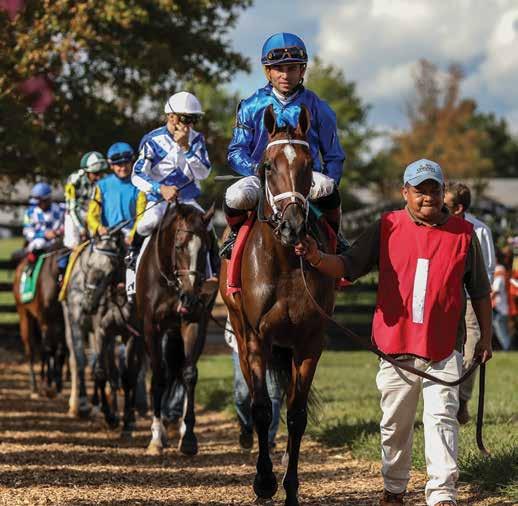
www.themintkentuckydowns.com
FRANKLIN, KY (35 MILES NORTH OF NASHVILLE)

TURF— Aug. 29, 30, Sept. 3, 5, 6, 7, 9

More than $40 million (includes KTDF), in purses, over seven race days including the world’s richest maiden races at $170,000 (includes KTDF). Allowance races worth up to $250,000 (includes KTDF).
Home of a record 11 stakes worth at least $1 million (includes KTDF), led by the $3 million Nashville Derby (G3). 19 stakes overall, 11 graded.

KTDF is the amount included for Kentucky-breds | LR-Restricted to horses that have not won a stakes in 2026. **BC-denotes a Breeders Cup “Win and
2026 PUBLISHING SCHEDULE
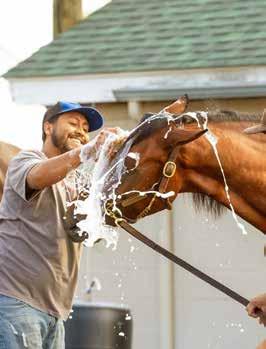
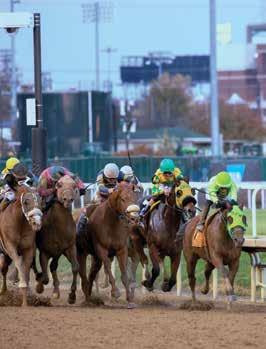
FALL
Approximate Mail Date: Friday, October 16
Advertising Space Reservation Deadline: Friday, August 28
Advertising Materials Due Date: Wednesday, September 2
WINTER
Approximate Mail Date: Friday, December 11
Advertising Space Reservation Deadline: Friday, November 13
Advertising Materials Due Date: Wednesday, November 18
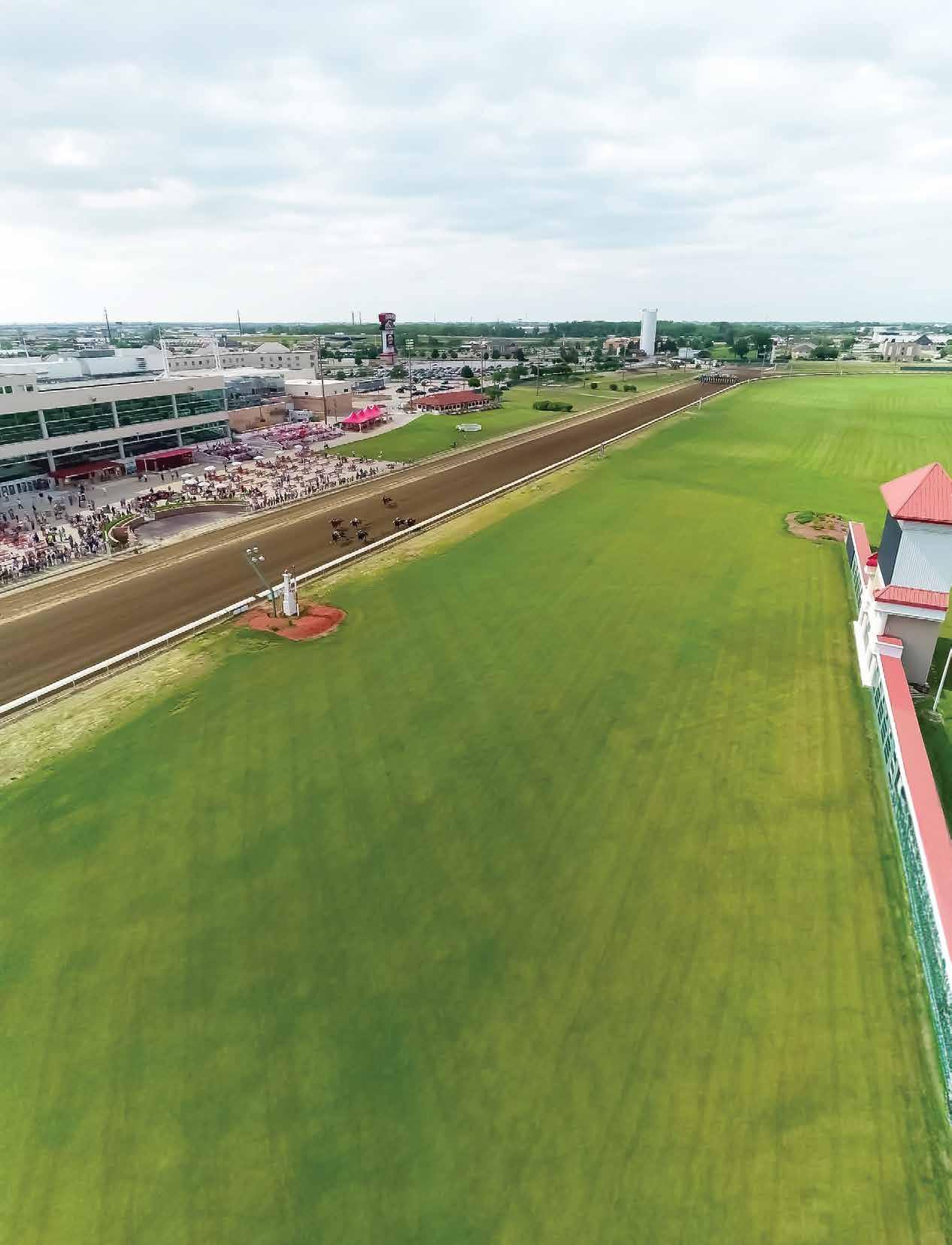
ALABAMA HBPA
WHAT GIVES IN ALABAMA?
Once again, we are a stand-alone state with various facilities that have simulcasting and historical horse racing (HHR) machines deemed legal as a form of simulcasting, but only one of which contributes back to the racing industry. Birmingham Race Course, now operated by the Poarch Band of Creek Indians, by legislative statute pays one-quarter of 1% of revenue into an escrow account held by the Birmingham Racing Commission.
We want an update to the legislative statute to include funding from all facilities using our industry for their benefit. Revenue received by the Birmingham Racing Commission is the source of funding for the Alabama-bred races run in Louisiana. The increase in purses comes from the operation of HHR machines. We are hopeful that a new governing body coming in the fall of 2026 may help to change some of this.
Three Alabama-bred races have been run since our last update.
Hackett Brothers Thoroughbreds’ homebred Wendy’s Ghost, a 3-yearold gelding by Wendy Wend out of the Entrepreneur mare Eye for Money, won the $50,000 Vulcan Stakes February 21 at Delta Downs. Trained by Aubrie Suarez, Wendy’s Ghost held on to win the 5-furlong event for 3-year-olds and up, non-winners of an Alabama stakes event, by a half-length to provide another longtime Alabama breeder and supporter with a well-deserved win. Unaffiliated, owned and bred by Laurie Sanderson and Nanette Cartier, finished second, with Can See Da Feet, owned and bred by Live-Lee Farm, third.
Unaffiliated, a 7-year-old gelding by Americain out of the English Channel mare Track Teller, prevailed by a head over Can See Da Feet in the $50,000 Buggin Out Stakes April 4 at Evangeline Downs. Moor to Conquer, also owned and bred by Live-Lee Farm, finished third in the event for Alabama-breds that have never won a $50,000 Alabama stakes, going 61/2 furlongs on dirt.
Liken It, owned by Jason Grudzien and bred by Kent and Lisa Gremmels, won the $50,000 Kenny Cotton Memorial Stakes sponsored by the Alabama HBPA May 9 at Evangeline. The 9-year-old Doc N Bubba G gelding stalked the field of 10 over a sloppy track before drawing clear to win by 11/4 lengths over Channelfortynine, owned and bred by Bobby Pruitt. Belinda Hubbell’s Wabash finished third.
The Alabama HBPA will pay up to $500 shipping cost for the Kenny Cotton with a verified receipt. Mail receipts to Nancy Delony, 3221 Ridgely Dr., Vestavia, AL 35354, or email to nancy.m.delony@ms.com.
Upcoming races include a $50,000 event going 1 mile on turf for non-winners of two Alabama stakes races September 12 at Louisiana Downs. A $50,000 stakes will be scheduled at Delta Downs in October as well as an allowance race. Details on these two to follow. The Magic City Classic will be run December 11 at Fair Grounds along with the Kudzu Juvenile for 2-year-olds. More to come on those as well.
It’s exciting to see the Alabama foal crop increase along with new people getting involved throughout the state. The increase in purses has had an impact on this; just imagine what we could do if all the simulcast and HHR machines paid their fair share. It is a proven fact that horse racing and breeding have a positive economic impact for their respective states.
Nancy M. Delony
Alabama HBPA Executive Director
TURF PARADISE 2025–2026 RACE MEET LEADERS
ARIZONA HBPA
SUCCESSFUL SEASON AT TURF PARADISE
Horsemen are excited about the years ahead working together after concluding our first race meeting under the Skyfall 7 management team. Ontrack attendance increased by more than 100% over the previous year. Handle also showed a substantial gain. Kentucky Derby Day delivered record-breaking on-track attendance and handle.
BACKSIDE SUMMER IMPROVEMENTS
A few things are different this offseason at Turf Paradise. Work began immediately after the last horse left the grounds, and improvements began with cleaning up the barns, grading between the barns, leveling the areas around them, filling the stalls with new dirt and grading the shedrows so water will run
out of the barns instead of into the stalls. Work will be done in every barn. Other items on the list include painting all barns inside and out, repairing streets and removing all dead trees in the barn area.
The HBPA and chaplaincy monthly meals continued throughout the meet and were remarkably successful. February’s meal was spaghetti and meatballs. Board member Valorie Lund’s special sauce was outstanding. The March event was followed by a taco night. April’s event was a burger night. Planning is already underway for next year’s events.
We launched the Ring the Bell program, which gives owners, trainers and jockeys the opportunity to ring the bell after winning a race. Ringing the bell signifies that the winning connections contributed to HARP (Horses After Racing Program). The program was very well received, with 99% of winners participating. The HARP Foundation helps place horses that can no longer race into new homes. In its first year, the program helped 14 Thoroughbreds find new homes. We also have established relationships with several facilities willing to work with us to place retired horses in new homes. HARP wants to thank all of the Turf Paradise winners for their contributions.
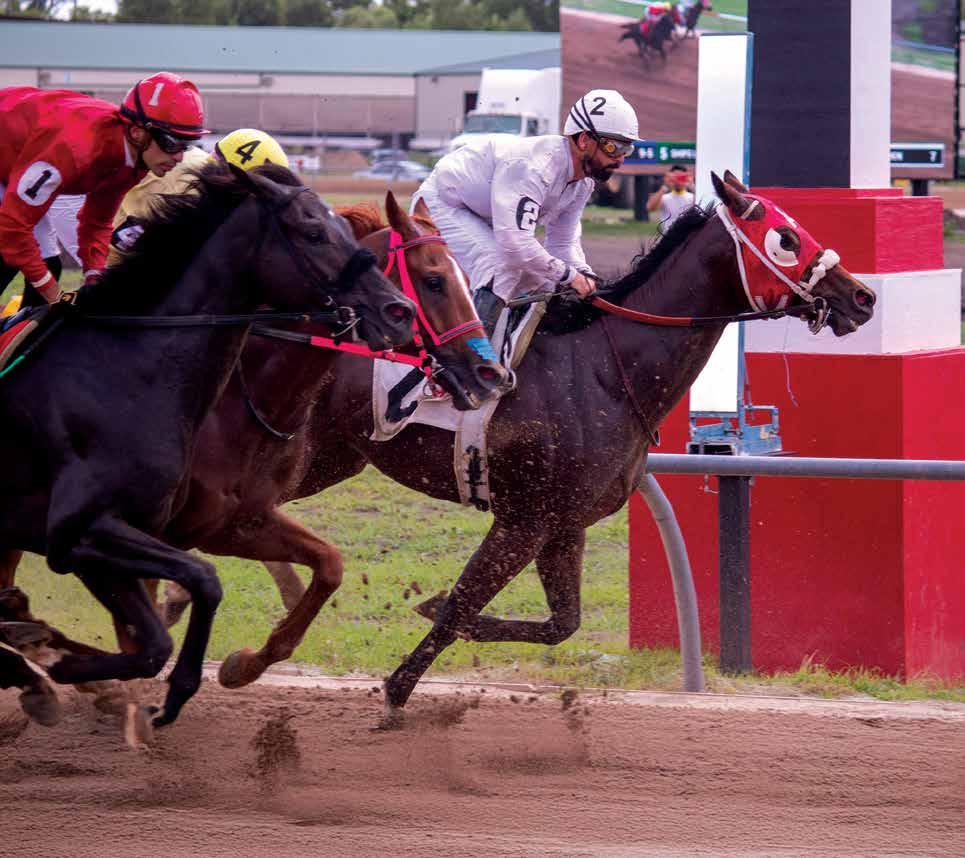
In 2026, the Nebraska Thoroughbred Racing Circuit will host Live Racing across its 5 tracks! Starting in February, live thoroughbred racing will continue in Nebraska through August. Nebraska’s tracks are building the momentum started in 2024 with new and improved tracks, new barns, more Stakes races, and increased purses. The Nebraska HBPA will also pay owners $125 for horses that run 6th-10th place (plus 11th-12th place at Legacy Downs)!


2026 ELECTION RESULTS
The Arizona HBPA conducted its board of directors election at the meet. We had 13 trainers nominated and six owners nominated. Ballots were mailed in early February and were due back April 16. The ballots were counted the evening of April 16.
The results:
Owners: Robert Budoff, Kevin Owens, Carrie Fales, Tawnja Elison, Kristen Boice. First alternative: Brian Hayes
Trainers: Kevin Eikleberry, Mike Chambers, Valorie Lund, Martin Bourdieu, Vann Belvoir. First alternative: Jim Crotts.
Bob Budoff was elected president, and Valorie Lund was elected vice president. This moved Brian Hayes from the first alternate seat to a board member. The Arizona HBPA would like to thank the Election Committee of Ken Pearson (chairman), Stacy Campo and Debi Ferguson for all their hard work in helping make the election run smoothly.
BIG THANKS TO LLOYD YOTHER
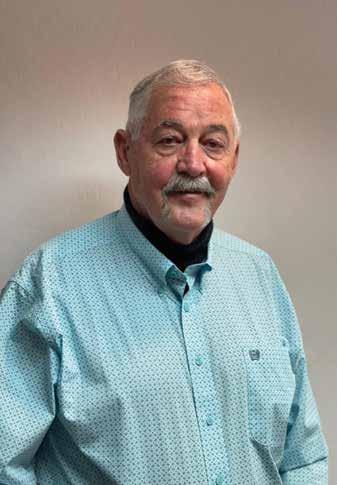
Arizona HBPA members want to extend a heartfelt thank you to our outgoing president, Lloyd Yother. Over the years, Lloyd has been a tireless advocate for all horsemen and a dedicated leader for the Arizona HBPA. He served on the Arizona HBPA board for more than 20 years, including as vice president and president. In 2015, Lloyd was elected western regional vice president for the National HBPA, a position he continues to hold.
Lloyd’s journey in horse racing began in 1982 with a visit to Prescott Downs. From that first experience, Lloyd knew he wanted to own a horse—and as many of us know, one horse often leads to many more. In 2019, Lloyd purchased 50% of the EIRE Equine Nursery located in Broken Arrow, Oklahoma. The farm foals out an average of 45 to 60 foals a year. All are offered at yearling sales. The ones that do not meet their reserve are moved into the Kelly-Yother Racing Stable. Over the years, EIRE has raised several top racing Quarter Horses, including O Donovan Rossa and Answer the Dream, to list a few.
Lloyd has campaigned several Thoroughbred stakes winners at Turf Paradise, including Fortified Effort, U Can Do U, My First Pearl, Brazen Now and Just Call Me Lucky. He also has participated in more than 10 award-winning partnerships recognized by the Arizona Thoroughbred Breeders and Owners Association, and in 2017, he received the Julep Cup Award.
Lloyd has been a steady presence in helping Arizona racing navigate constant change. He played a key role in negotiating several contracts with Jerry Simms and was instrumental at the Legislature in securing purse enhancements for horsemen and increased breeder funding. While it is impossible to satisfy everyone, Lloyd continued to move the industry forward through perseverance, dedication and determination. We all owe Lloyd Yother a sincere thank you.
ARKANSAS HBPA
STRONG SEASON CONCLUDES IN HOT SPRINGS
The 2025–26 Oaklawn Park racing season concluded May 2 following a successful meet that delivered another strong spring stakes season in Hot Springs, Arkansas. The 90th running of the Arkansas Derby once again kept Oaklawn in the national Kentucky Derby conversation while Apple Blossom weekend reinforced the track’s standing as one of the premier racing destinations in the country.
The closing days of the meet also included a winner’s circle ceremony honoring the retirement of longtime Arkansas horseman William “Jinks” Fires. The 85-year-old Arkansas native compiled more than 1,500 career victories and over $28 million in purse earnings across five decades, highlighted by a Grade 1 victory in the 2011 Arkansas Derby with Archarcharch. Fires also served for decades on the Arkansas HBPA board, where he became known for mentoring fellow horsemen and never missing a meeting. Earlier this year, he was recognized as a Living Legend by the National HBPA.
“His impact went far beyond the races he won,” said Arkansas HBPA President Bill Walmsley. “This recognition reflects the lasting mark he made on Arkansas racing and the HBPA.”
Arkansas racing also received statewide recognition this spring as Oaklawn President Louis Cella and Hall of Fame trainer D. Wayne Lukas were inducted into the Arkansas Sports Hall of Fame for their lasting contributions to the sport and the state.
Racing commission license holders and their families are encouraged to apply for the D. Wayne Lukas Scholarship for the fall 2026 semester. The scholarship program supports license holders and their children pursuing college or vocational education while continuing Lukas’ legacy. Application information can be found at arkansashbpa.com.
The Arkansas HBPA appreciates the support of owners, trainers, jockeys and backside workers throughout another successful Oaklawn season and looks forward to the 2026–27 meet.
CHARLES TOWN HBPA
GOVERNOR, LEGISLATORS CELEBRATE BILL SIGNING
West Virginia Governor Patrick Morrisey and state legislators including Senators Jason Barrett and Patricia Rucker and Delegates Joe Funkhouser, Wayne Clark and Bill Ridenour made a stop at the Hollywood Casino at Charles Town Races April 13 for the ceremonial signing of Senate Bill 1060, which is aimed at revitalizing the state’s racing industry.
“You can really feel the history of this track,” Morrisey said. “I think that there’s a palpable energy of what makes this place run. And it’s not just the actual race day. It’s the trainers, it’s the breeders, it’s the farmers, it’s the backstretch workers and of course the fans. It’s never just about one person. But when I look here, I don’t just see a sport; I see an incredible way of life for the Eastern Panhandle and for our state. This is an incredible chance. What we’re doing today to help drive more racing here in the Eastern Panhandle, better purses, fans, more tourism, it’s all going to lead to great things. When we put more money into the purses for our homegrown horses, we’re supporting the local feed stores, the vets and the family farms. This is about making sure West Virginia remains the best place in the country to do business and raise a champion.”
The bill adds approximately $1.5 million to the West Virginia Thoroughbred Development Fund by allowing the state’s Thoroughbred tracks to retain more of the revenue generated through video lottery terminals and simulcast wagering. It also establishes a new West Virginia Certified Thoroughbred program, which
DENIS BLAKE
requires horses to spend at least six consecutive months in the state prior to their three-year-old season to qualify.
Morrisey gave special recognition to Barrett and Rucker for helping to drive the bill, along with Funkhouser for being a driving factor when Morrisey served as attorney general.
“Today marks a great day for Thoroughbred racing in West Virginia,” Barrett said. “Senate Bill 1060 provides a major boost to our horse racing industry. This smart, fiscally responsible bill will help grow field sizes, support
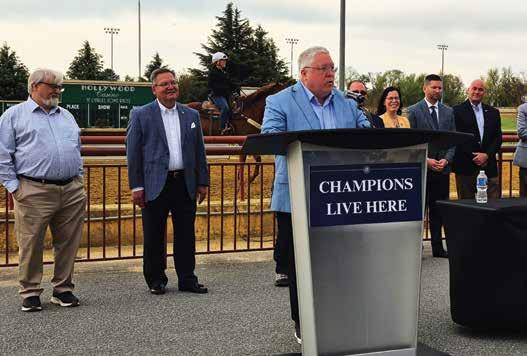
PATRICK MORRISEY SPEAKS FROM THE PODIUM AT THE EVENT TO CELEBRATE THE CEREMONIAL SIGNING OF SB 1060, ALONG WITH (FROM LEFT) CHARLES TOWN HBPA PRESIDENT JIM MILLER, PAUL ESPINOSA OF THE WEST VIRGINIA RACING COMMISSION, DELEGATE WAYNE CLARK, SENATOR PATRICIA RUCKER, SENATOR JASON BARRETT AND DELEGATE JOE FUNKHOUSER.
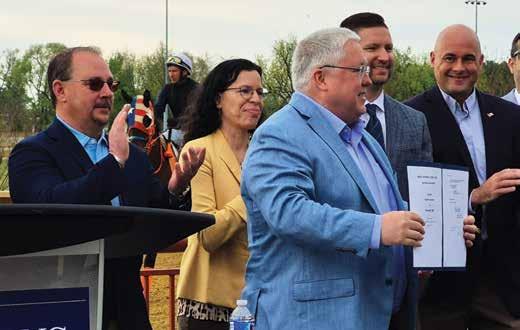
GOVERNOR PATRICK MORRISEY SHOWS OFF THE SIGNED BILL WITH (FROM LEFT) DELEGATE WAYNE CLARK, SENATOR PATRICIA RUCKER, SENATOR JASON BARRETT AND DELEGATE JOE FUNKHOUSER.
our breeders and owners and ensure racing in West Virginia remains strong for years to come.”
“This bill is about fixing something that was wrong,” Rucker said. “It should have always been this way—that the money that is raised here stays here and gets reinvested here. And I am very happy to support this, as I do all things that support our local farmers and our local racing industry.”
“This legislation makes West Virginia more competitive with surrounding states and enhances investment and employment opportunities for our small businesses, farms and tourism economy,” Funkhouser said. “I am thankful for the team effort in getting this legislation past the finish line.”
SB 1060 passed with broad bipartisan support during the 2026 Regular Session and went into effect June 7, 2026.

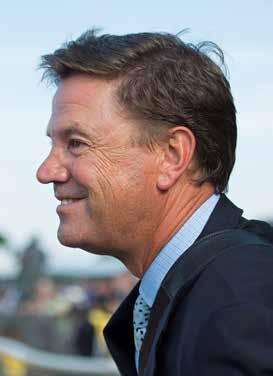
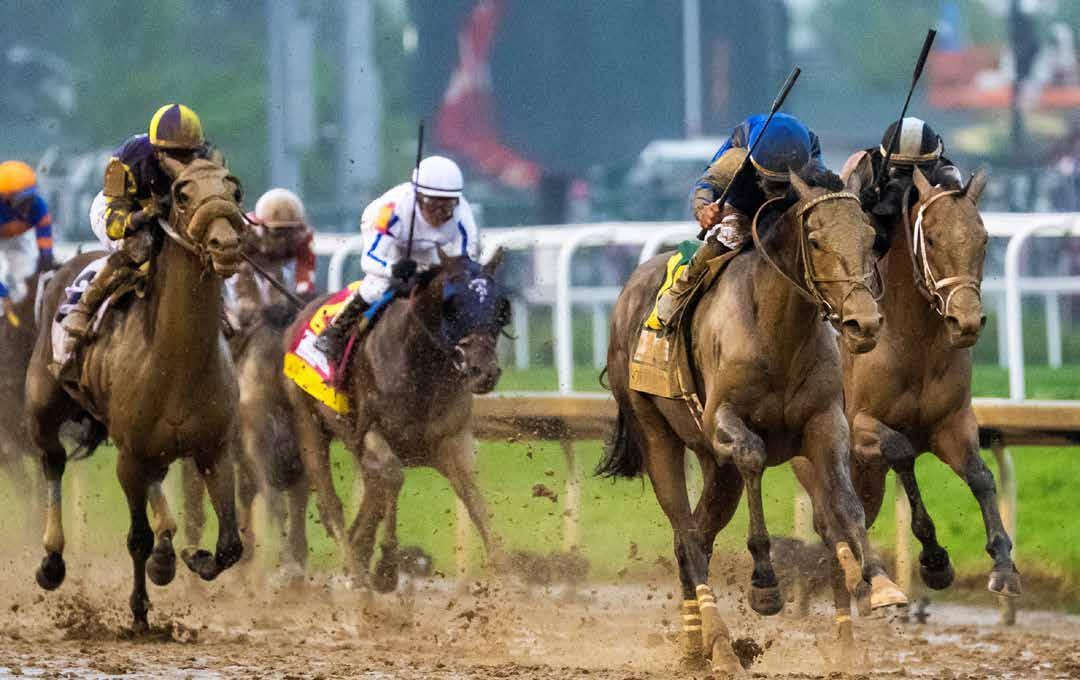
GOVERNOR
ILLINOIS HBPA
OPENING DAY AT FAIRMOUNT PARK
Blue skies overhead and excitement in the air greeted fans as they arrived for opening day of the 101st season of horse racing at Fairmount Park Casino and Racing in Collinsville, Illinois, and it turned out to be a spectacular day. We were amazed to survey the crowd and realize how many people love the sport and love to come out to watch and wager on the horses.
Attendance April 14 was at nearly 5,000, on-track handle was more than $155,000, and overall wagering was right at $1.2 million for the day.
“We greatly appreciate the support of the horsemen and the community as we continue to build something special here at Fairmount Park,” said Vince Gabbert, senior vice president of U.S. gaming and general manager.
Illinois HBPA President Jim Watkins echoed that sentiment.
“The meet is off to a tremendous start,” Watkins said. “Attendance is up, purses are up 18.5% over last year, field size is up, and we ran our first 12-horse field in decades. Our future couldn’t be any brighter.”
The Illinois HBPA also has been dedicated to building something special, making improvements to both the facilities and the program. Highlights include new AstroTurf in the winner’s circle, a stately new gazebo for the jockey’s scale and a Ring of Honor for those whose lifetime commitment to Fairmount Park or extraordinary accomplishments have left lasting legacies.
The first honoree was John Scully, honored on opening day. John began his announcing career at Fairmount Park January 1, 1971, and called his last race there on September 6, 2016. Spanning an amazing 45 years, his career was the result of what was supposed to be a three-month post filling in for another announcer. John was always an ambassador for horse racing and Fairmount Park, and his love of racing has never waned. When it comes to track announcers, John Scully is all alone at the top and now has a sign dedicated to him.
We instituted a Ring the Bell program, modeled after Oaklawn Park’s program, in which winning owners, trainers, jockeys and even fans may ring the bell to make a minimum $25 donation to Thoroughbred aftercare. Spearheaded by board members Cynthia Rush and David Warchol, implementing an aftercare program has been a priority for the HBPA, and we are so pleased to see it come to fruition.
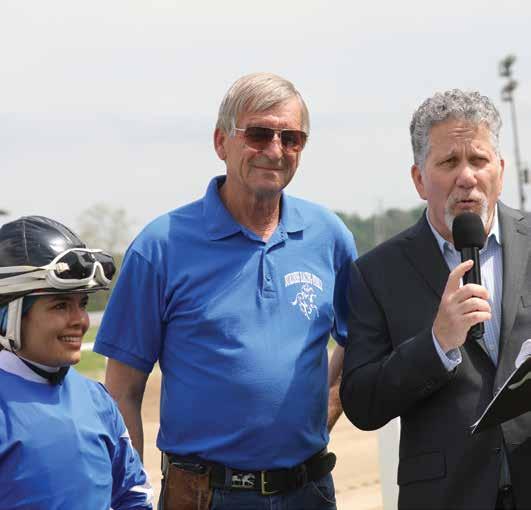
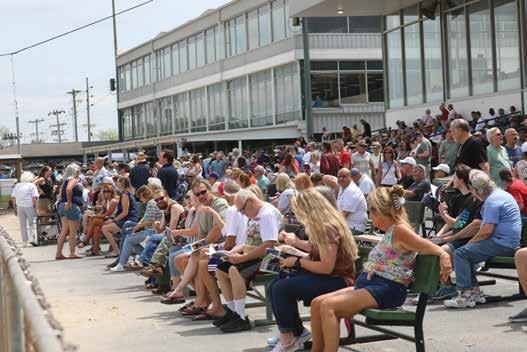
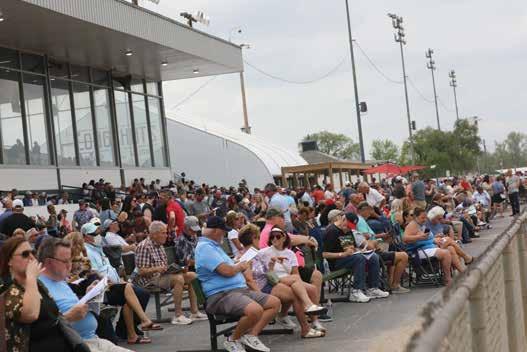
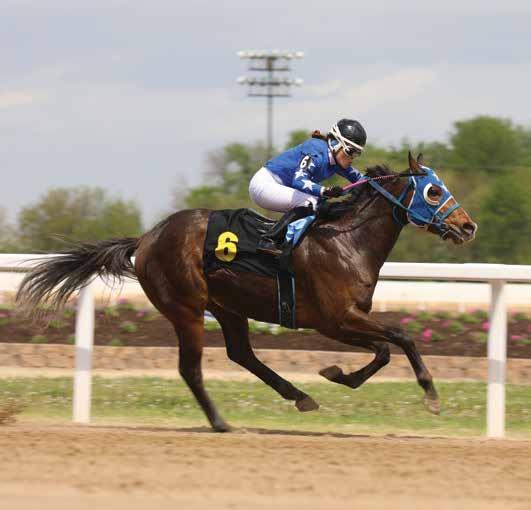
A CROWD OF NEARLY 5,000 TURNED OUT FOR OPENING DAY AT FAIRMOUNT PARK APRIL 14.
TRAINER TERRY BURDESS AND JOCKEY JOHANIS ARANGUREN ARE INTERVIEWED BY PETER LURIE AFTER WINNING THE FIRST RACE WITH TIME TO TOAST ON OPENING DAY. ARANGUREN WON FOUR RACES ON THE CARD.


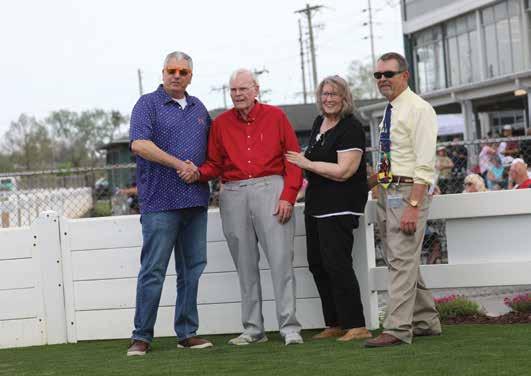
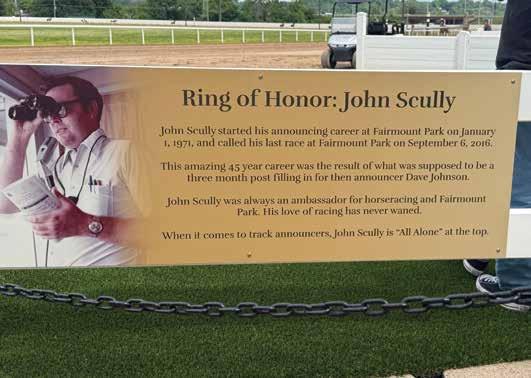
Perhaps the biggest highlight of all is the purse increase of $10,000 for Illinois-bred maiden, allowance and optional claiming allowance races, which elevated the purses to $39,500.
Opening day also saw young apprentice rider Johanis Aranguren win four of her five mounts. We also thank her agent, Lucas Miranda, for bringing her here and giving trainers the opportunity to ride a very talented up-and-coming jockey.
We also have welcomed several seasoned trainers this year, including Ida Spagnola, who moved her stable from Chicago, and Tammy Hornsby, who moved her stable from Oaklawn Park, and we welcome any others wanting to stable and race here with open arms.
Running Tuesday and Saturday afternoons, we have 57 race days this season and look forward with great excitement and enthusiasm for a fantastic meet.
IOWA HBPA
2025 RACE MEET AWARD WINNERS HONORED
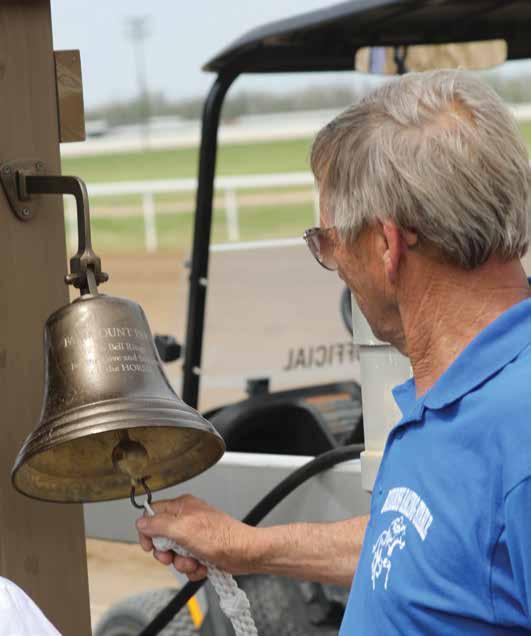
The positive energy and new opportunities have spurred several to pursue their trainers’ licenses, and in recent weeks we have welcomed new trainers Dennis Hornbostel, Omar Razvi and Jessica Jelinski. Razvi won his first race at the track May 19 with Fast N Happy, and Jelinski won her first with Bureau April 25. Congratulations to both of them, and best wishes for a successful future. TRAINER TERRY BURDESS WINS THE FIRST RACE AT FAIRMOUNT PARK ON OPENING DAY AND BECOMES THE FIRST PERSON TO RING THE NEW BELL THAT DEDICATES MONEY TO THOROUGHBRED AFTERCARE.
The Iowa Horsemen’s Benevolent and Protective Association proudly recognized the accomplishments of the 2025 race meet award winners during the annual awards celebration held in conjunction with the Iowa Thoroughbred Breeders and Owners Association (ITBOA).
This year’s event also marked an important moment for the future of Prairie Meadows and Iowa racing, as newly appointed Prairie Meadows President and CEO Brian Ohorilko attended alongside Prairie Meadows Board Chair Dr. Steven Neville, Prairie Meadows board members Andrea Morse and Deb Leech and former Prairie Meadows Board Chair Linda Grandquist as well as upper corporate management including Chief Operating Officer Julie Stewart and Vice President of Racing Derron Heldt.
To kick off the event, Ohorilko was invited to address attendees, and he shared his appreciation for the importance of horse racing to Prairie Meadows and to the state of Iowa. He emphasized Prairie Meadows’ renewed long-term
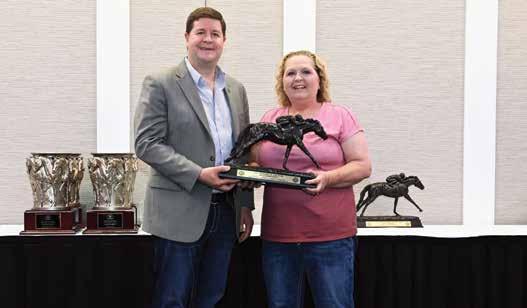
ILLINOIS HBPA PRESIDENT JIM WATKINS (LEFT) HONORS JOHN SCULLY (RED SHIRT) AS A MEMBER OF THE RING OF HONOR.
IOWA HBPA EXECUTIVE DIRECTOR JON MOSS WITH 2025 TRAINER OF THE YEAR KELLI MARTINEZ, WHO SENT OUT 54 WINNERS ON THE SEASON
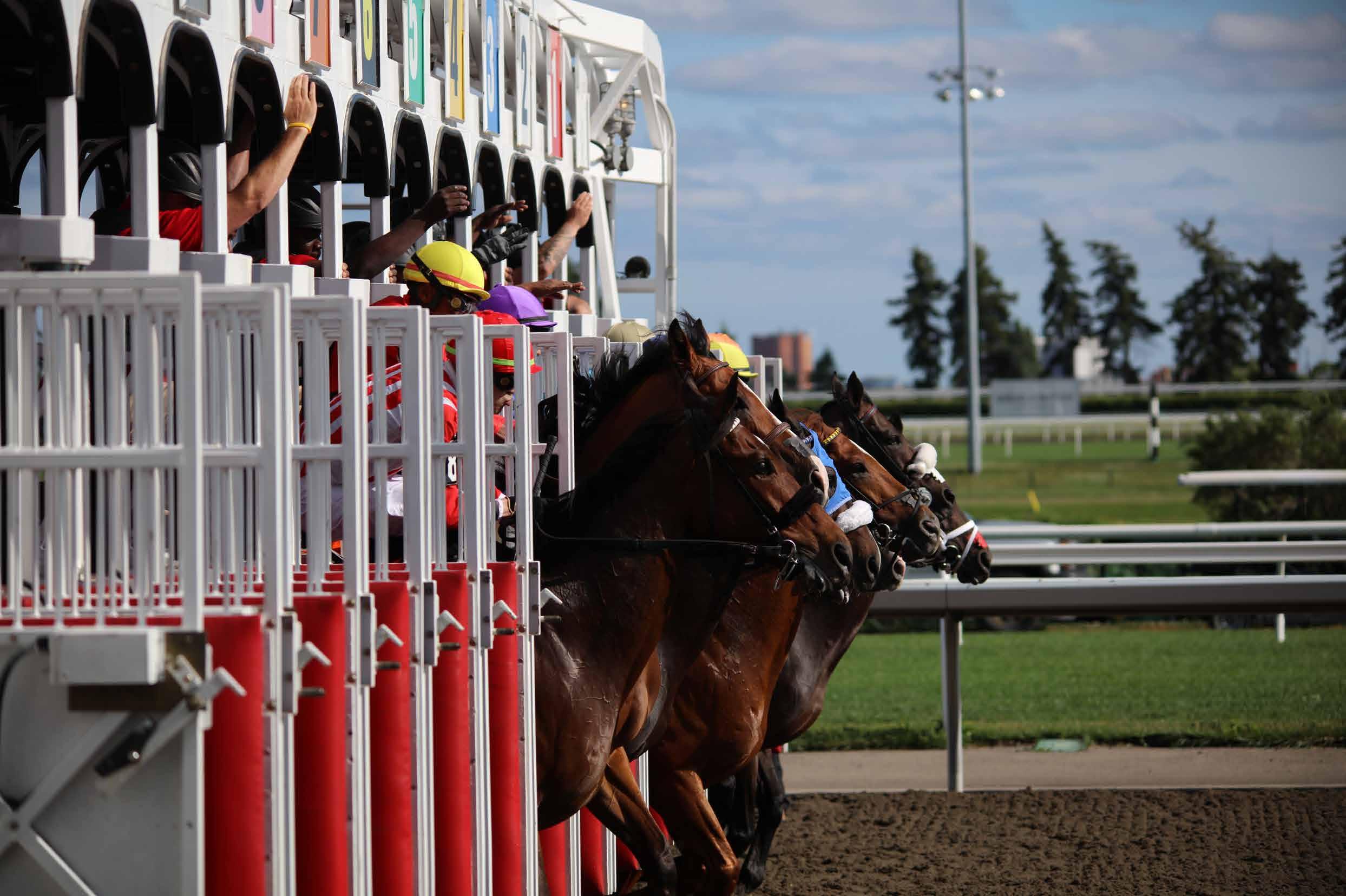
Woodbine Oaks
Sunday July 19th
$500,000 King ’ s Plate
Saturday August 15th
$1,000,000
CTHS Sales Stakes Day
Sunday August 30th
Prince of Wales Monday September 7th
$400,000
Woodbine Mile Saturday September 12th $1,000,000
E.P. Taylor Stakes
Saturday September 12th
$750,000
Breeders ’ Stakes
Sunday September 27th $400,000

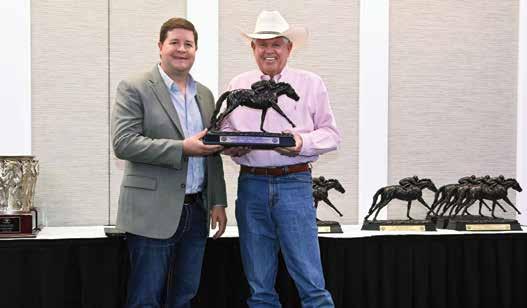
Stakes on Iowa Classic Night.
The 2025 Iowa HBPA Claiming Horse of the Year honors went to Battleshipper, whose consistency and toughness throughout the Prairie Meadows season exemplified the competitive nature of Iowa racing. The filly recorded four victories during the meet while changing connections multiple times through the claiming ranks, demonstrating the unique opportunities and excitement that claiming competition brings to the racing program.
A milestone season for trainer Kelli Martinez earned her recognition as the 2025 Iowa HBPA Trainer of the Year after securing her first Prairie Meadows Leading Trainer title. Martinez sent out 54 winners during the meet, highlighted by multiple standout performances throughout the summer including a three-win evening on September 20. Her breakthrough season reflects the dedication and hard work required to compete successfully at the highest levels of Iowa racing.
vision and commitment to the racing industry and expressed his desire to work collaboratively with horsemen to ensure the continued success and growth of Iowa racing for years to come.
Ohorilko also highlighted several major investments and facility improvements already underway or planned for the near future, including construction of a new barn scheduled for 2027, the purchase of a new exerciser wheel for 2027, an accelerated timeline for adding windows to all barns to improve ventilation for horse comfort and health, additional round pens, more walking machines and other backside improvements that will continue to enhance the racing environment at Prairie Meadows.
While many of those improvements are still ahead, the enthusiasm surrounding Prairie Meadows’ renewed commitment to racing helped set the tone for an event dedicated to recognizing the accomplishments of Iowa horsemen and horsewomen from the outstanding 2025 racing season. The award winners honored reflected the continued strength, competitiveness and momentum of Iowa Thoroughbred racing and the individuals whose dedication continues to move the industry forward year after year.
Longtime Iowa racing supporter and breeder Allen Poindexter continued his remarkable success in 2025, earning honors as both the ITBOA Champion Breeder and Owner as well as the IAHBPA Owner of the Year. Under the Poindexter Thoroughbreds banner, the stable recorded 19 winners and more than $619,000 in earnings from 92 starters during the season while Poindexter-bred runners accumulated over $1.6 million in earnings overall.
Poindexter had many standout runners including Amorosa, winner of the Cyclones Handicap, and Miss Peach, who secured victory in the Donna Reed
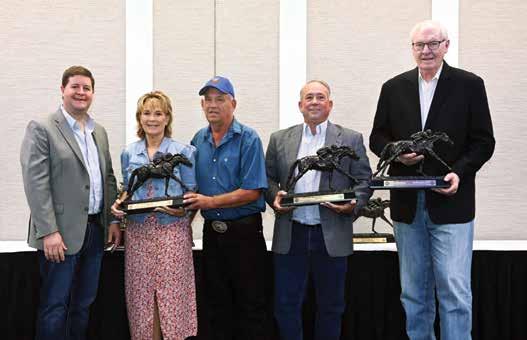
The 2025 Iowa HBPA Horse of the Year honors belong to Kanojo, whose exceptional 3-year-old campaign captivated racing fans throughout the season. The talented daughter of Prairie Meadows Hall of Famer Mywomanfromtokyo won five of six starts during the meet and earned more than $230,000 in seasonal earnings. Kanojo’s victories in the Iowa Stallion Filly Stakes and Hawkeyes Handicap helped solidify her status as one of the premier Iowa-based Thoroughbreds of the year. Bred by Crimson King Farm and campaigned by trainer Kevin Eikleberry, Reunion Racing Stables and Arapahoe Thoroughbreds, Kanojo concluded the season with seven wins from nine career starts and more than $326,000 in earnings.
The Iowa HBPA congratulates all of the 2025 award recipients and extends appreciation to the owners, breeders, trainers, grooms, exercise riders, blacksmiths, veterinarians, jockeys and countless individuals whose daily commitment continues to strengthen Iowa’s Thoroughbred industry.
IOWA HBPA NEWS
To stay up to date on news and developments involving Iowa Thoroughbred racing, follow the Iowa Horsemen’s Benevolent and Protective Association on Facebook, follow @IowaHBPA on X, sign up for email updates at info@iowahbpa. org, and visit our website at iowahbpa.org.
KENTUCKY HBPA
HISTORIC MOMENTS AT THE KENTUCKY DERBY
The Kentucky HBPA would like to congratulate Kentucky-based trainer Cherie DeVaux on becoming the first female trainer to win the Kentucky Derby, with Golden Tempo’s victory in the first leg of the Triple Crown May 2 at historic Churchill Downs. Congratulations as well to winning owners Phipps Stable and St. Elias Stable, jockey Jose Ortiz and all connections on capturing our sport’s greatest prize.
The 152nd running of the Kentucky Derby was, once again, a historic success. The NBC broadcast peaked at 24.4 million viewers while the Kentucky Oaks averaged 2.4 million viewers at its peak, setting a new record.
As we transition from Derby excitement into the summer months, all eyes turn to Ellis Park in Henderson, Kentucky. A record $4.125 million stakes schedule, featuring 18 races, will be offered during Ellis Park Racing and Gaming’s 2026 season, which runs July 2 through August 23. Maiden and allowance races will once again carry purses of $100,000.
Kentucky Downs’ 2026 meet will feature 20 stakes races offering a combined $25.75 million in purses. The seven-day championship meet will run from August 29 through September 9. Maiden and allowance purses remain among the most lucrative in the world, making Franklin, Kentucky, a popular destination for horsemen across the country.
Turfway Park and Churchill Downs Trackside will remain open for summer stabling, ensuring year-round facilities and flexibility for Kentucky horsemen.
ALLEN POINDEXTER (RIGHT) RECEIVES THE OWNER OF THE YEAR TITLE FROM IOWA HBPA EXECUTIVE DIRECTOR JON MOSS.
IOWA HBPA EXECUTIVE DIRECTOR JON MOSS WITH THE CONNECTIONS OF IOWA HBPA HORSE OF THE YEAR KANOJO AT THE AWARDS CEREMONY. FROM LEFT ARE MOSS, PAM EIKLEBERRY, KEVIN EIKLEBERRY, MICHAEL HENDERSON AND DAN ISSEL.
The Kentucky HBPA continues to work collaboratively with racetracks and industry stakeholders to maintain Kentucky’s position as the premier jurisdiction for Thoroughbred racing in North America. As Kentucky racing continues to evolve, the Kentucky HBPA remains committed to advocating for horsemen, supporting safe and competitive racing and preserving a year-round circuit that benefits the entire commonwealth.
A heartfelt thank you to our horsemen, racetrack leadership and state legislators for their collaboration and continued efforts in making Kentucky racing the success it is today.
See you at the track.
Dale Romans Kentucky HBPA President
LOUISIANA HBPA
EVANGELINE DOWNS
The Racing Employees Assistance Program (REAP) is an organization that supports the good work of our Chaplain Dwight Brown and provides financial assistance to horsemen in need.
REAP will hold its annual fundraiser August 1 in Mojo’s at Evangeline Downs. We would like to thank everyone who supports the event each year. For more information, call Chaplain Brown at (337) 308-0960.
The 2026 Thoroughbred meeting at Evangeline Downs began April 3 and ends Labor Day, September 7. The D.S. Shine Young Futurity filly division and colts and geldings division will be conducted July 31 and August 1, respectively. The Louisiana Stallion Stakes for fillies and colts presented by Coteau Grove Farms, the Au Revoir Stakes and the First Lady of Louisiana (Sharon Landry) Stakes, all with purses of $75,000 each, will be run August 31. For additional information, contact the Evangeline Downs racing office at (337) 594-3022.
LOUISIANA DOWNS
The Backside Benevolence Fund (BBF) will be conducting its annual Chaplain’s Banquet in September along with the annual golf tournament. Items will be available for live and silent auction at the banquet. The proceeds will help the BBF continue its support of the Louisiana Downs Chaplaincy, Thrift Store and the backside workers. If you would like to help the BBF, please contact Chaplain Jimmy Sistrunk at (318) 560-7466.
The 2026 Louisiana Downs Thoroughbred meeting began May 2 and concludes September 30. Louisiana Downs will host Louisiana Cup Day, featuring $450,000 in purses for Louisiana-breds September 19. The highlight of the meet will be the Super Derby with an estimated purse of $250,000 on September 12. For additional information, contact the Louisiana Downs racing office at (318) 741-2519.
DELTA DOWNS
The 2026 Quarter Horse meeting at Delta Downs began April 24 and ends July 18. The meet features the $200,000-added (last year’s purse was more than $600,000) Lee Berwick Futurity for 2-year-olds July 11. The trials for the Lee Berwick were run June 19. For additional in-ormation, contact the Delta Downs racing office at (888) 589-7223 or LQHBA at (318) 487-9506.
FAIR GROUNDS QUARTER HORSE MEETING AT DELTA DOWNS
The 2026 Fair Grounds Quarter Horse meeting at Delta Downs is scheduled to begin July 23 and conclude August 29. The meet will feature the LQHBA Sales Futurity August 29 with an estimated purse of $650,000. The trials will be August 8. For additional information, contact the Delta Downs racing office at (888) 589-7223 or the LQHBA at (318) 487-9506.
NEBRASKA HBPA
NEBRASKA LIVE 2026 RACING SEASON
The 2026 Thoroughbred racing season is well underway in Nebraska, with Fonner Park completing its 31-day live meeting and Legacy Downs completing its 11-day live meet. Horsemen’s Park is racing over three weekends from June 27 to July 12, Harrah’s Columbus is racing over five weekends from July 24 to August 23, and Atokad will host its live meet over two weekends from August 29 to September 7.
FONNER PARK WRAPS SUCCESSFUL MEET
With a picture-perfect Saturday afternoon, Fonner Park concluded its 2026 Thoroughbred season on Kentucky Derby Day, May 2. The day produced the largest mutuel handle of the year. Despite one day of racing canceled due to weather, on-track wagering for the year was up 1% continuing a string of several years of increased on-track mutuel handle.
“I’m grateful for the horses and horsemen who put on a terrific show this year,” said CEO Chris Kotulak. “My staff also goes full tilt, and it’s nice to see how our guests embrace their effort. We’re a community here at Fon, and it shows.”
The purse for the Bosselman/Gus Fonner Stakes returned to its original $100,000 value and produced possibly the most exciting race of the year when Cornishman rallied to surge past the 2025 winner, Komorebino Omoide, inside the final sixteenth. Trained by Dan McFarlane, Cornishman earned $65,700 for
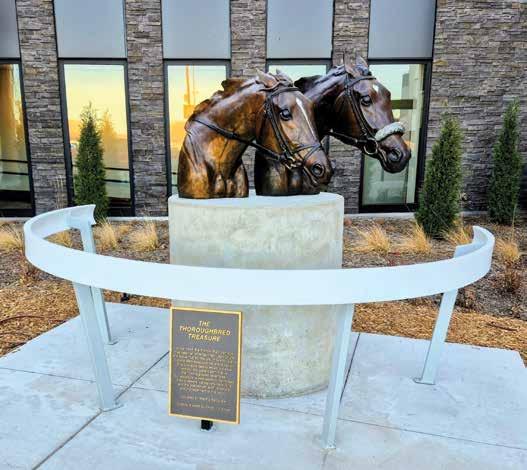
FONNER PARK UNVEILED A NEW BRONZE SCULPTURE TITLED THE THOROUGHBRED TREASURE NEAR THE NORTH CLUBHOUSE ENTRANCE THIS PAST SEASON.
owner Joseph Schumer. Winning jockey Elvin Gonzalez kept up the tradition to “Drink from the Cup!” in a toast with the trophy cup in the winner’s circle.
The third running of the Elite Sprint Cup also featured an increased purse, jumping from $30,000 to $50,800. Locally based Jack Sixpack won the race under jockey Travis Cunningham for trainer Marvin Johnson and earned owner Spencer Kucera $30,480.
Mark Hibdon won the titles for 2026 champion trainer and champion owner. As a trainer, he made 207 starts and won 35 races with $401,107 in purses earned. He won the owner title with 35 wins and purses of $399,913. Jose Medina won his first riding title with 54 wins, with Cunningham second at 35 wins. Medina and jockey Alberto Pusac also rode their respective 1,000th winner at the meet.
Fans at the 2026 meet were treated to an overhauled infield tote board, as old incandescent lights were replaced with LED indicators. The new tote board was complemented by 110 new HD televisions and a new 29-by-16-foot LED video screen in the infield. This created a greater span of video presentation throughout the facility and was appreciated by many.
A gorgeous bronze sculpture was unveiled early in the season near the north clubhouse entrance. Titled The Thoroughbred Treasure, designed by Chris Kotulak and created by Nebraskan Martha Pettigrew, the piece depicts the head and neck of two Thoroughbreds battling to the finish. A plaque at the sculpture’s plinth recognizes the decades of commitment to Fonner Park from horse and human.
BREEDER, OWNER WORKS TO IMPROVE EDUCATION
A Nebraska rancher is making her case to state leaders that racing could be a key part of the state’s future economy and that now is the time to act. Judy Pryor invited lawmakers, including Governor Jim Pillen, to her ranch near Lake Cunningham to see firsthand what it takes to get horses ready for the racetrack.
“I’m pretty sure they don’t really know the work and the passion that goes into the horses, and we’re trying to showcase that and the expense,” Pryor said.
From breeding to training, state leaders saw up close how the industry works. The goal of the visit went beyond the ranch itself. While there were a lot of cool things to see at the ranch, the goal of the day was all about increasing opportunities to keep kids living and working not only in the state but in the industry.
Pryor ultimately hopes the state invests in more programs like 4-H, with the goal of getting young people interested in equine careers.
“We need more scholarships,” Pryor said. “We need the scholarships to keep the kids in Nebraska, to grow our horse community.”
Pillen told the crowd that efforts like Pryor’s help boost the agricultural economy and that Nebraska is making progress in retaining young talent.
“But we need to do better with keeping our best and brightest,” Pillen said. University of Nebraska–Lincoln agriculture student Daniela Currie said the experience opened her eyes to new possibilities.
“I don’t think I would have ever thought I would be interested in horses coming to college, but since then I’ve had so many opportunities from both UNL and Judy to open my eyes to a whole new opportunity,” Currie said.
Pryor is currently working with state leaders on a bill for 2027 to boost funding and hopes to bring more students to her ranch for hands-on experience. One in four jobs in Nebraska is tied to agriculture.
NEW ENGLAND HBPA
WHY END PROGRAM THAT SAVES FARMS?
Six months ago, a special commission of legislators and advocates released an urgent report on the historic disappearance of farmland in Massachusetts, noting that 83% of our farmland from a century ago is gone and more farms will likely follow. On a similar path, the Healey-Driscoll administration has been actively engaged in trying to keep working farms working to preserve our open spaces and farmlands.
One program that has helped in that effort is the Race Horse Development Fund (RHDF) created by the Massachusetts Legislature 15 years ago and funded by a percentage of casino revenue that supports horse racing and breeding farms. Despite their historic roots in our farming culture, horse farms—and their role in preserving open space—are overlooked in the commission’s report.
That omission has left the RHDF in danger of being eliminated in the current state budget at a time when securing funding for a future racetrack is critical and horse breeders are growing their farms and businesses as envisioned in the 2011 law—while keeping developers at bay.
Emptying the RHDF has been discussed in years past since the closing of Suffolk Downs in 2019 left the Thoroughbred industry in limbo. Those efforts faltered largely because the annual funding amounts to a fractional share of the current $61 billion state budget.
But the argument in favor of continuing the RHDF isn’t simply a matter of it being too little money to worry about. The RHDF is actually working as the Legislature intended. Breeders last year reported 45 foals born on their farms, up from just five foal births in 2022. That number is expected to increase in 2026, but the economic effect of breeding farms across Massachusetts is about more than the number of foals born here.
Behind those numbers are breeders like Amy Riley, owner of Forge Field Farm in Raynham, where she and her husband recently completed a new 40-by80-foot barn using local labor and local concrete contractors, lumberyards and steel suppliers. The Rileys purchased the 20-acre farm in 2017 from an owner who wanted to sell to someone committed to maintaining the land as a farm. They spend thousands of dollars every month on feed and grain, building supplies and tools and local veterinarians.
She is part of a new “breed” of breeders, most of them women like 28-year-old Nogah Bust, who operates the Johnny B Farm in Plainville with her contractor husband, Isaiah. The Busts also raise beef cattle, chickens and sheep and have become more active in breeding and raising Thoroughbreds and Standardbreds. It is not a life of leisure, but income they receive from breeding helps pay the bills.
“It is hard work,” said Nogah Bust. “But we feel like we are making an investment not only in breeding and livestock but also in our family’s future. There are others like us who believe in this work and believe that the future is bright.”
There is also a growing awareness and recognition within the Legislature and administration that the state’s 181 rural communities are unique and at times overlooked in favor of the more urban and suburban communities.
To back up her pledge to “hear and see” rural communities, Governor Maura Healey appointed former state Senator Anne Gobi of Spencer as the
inaugural director of the Office of Rural Affairs, created by the administration in 2023 to ensure that rural voices and issues are heard across state government.
Maybe one day a foal born on a Massachusetts farm will stand in the winner’s circle at the Kentucky Derby with a local breeder or trainer like Cherie DeVaux, the first female trainer to win the Derby. More likely, you will find breeders mucking out stalls, feeding their horses or spending cold nights in a barn midwifing mares.
They are not just symbols of our pastoral past. They are working to help ensure that farming and racing are going to be part of our future.
The Legislature secured a victory in its efforts to support farming and need only look at what it did 15 years ago when it created the RHDF. The success of the program argues in favor of expanding it, not ending it.
Paul Umbrello
Executive Director, New England HBPA Board member, Massachusetts Thoroughbred Breeders Association
OHIO HBPA
PERFECT DAY FOR BEST OF OHIO KICKOFF
Belterra Park kicked off the 2026 Best of Ohio Series on a beautiful sunfilled day Friday, May 29.
The Best of Ohio series features five $100,000 stakes for Ohio-breds at each of Ohio’s three Thoroughbred tracks on a yearly basis. Thistledown will host the Best of Ohio Saturday, August 8, and the series will wrap up at Mahoning Valley Race Course Saturday, October 24.
Heavily favored Superwolf set a fast pace and fought back bravely when headed in deep stretch by Win Herbie Win to score a nose victory in the 6-furlong Best of Ohio Babst/Palacios Memorial Stakes to kick off the Friday stakes action at Belterra. Erik Barbaran rode the winner for trainer Robert Gorham and owner Mast Thoroughbreds. Superwolf won his fifth straight and ninth overall to boost his earnings to $416,550.
City Scene parlayed a stalking trip under jockey Luis Rivera into a 31/2-length victory in the Best of Ohio Diana Stakes while covering the 6 furlongs in 1:11.01. Lionistic rallied to gain the place in the final strides, a neck clear of Lo Bug. James Jackson trains City Scene for her owner/breeder Elkhorn Oaks Inc. The 5-year-old daughter of Dominus won for the 12th time in 23 starts and sent her earnings to $483,985.
The jockey/trainer combination of Barbaran and Gorham crossed the finish line first again in the off-the-turf 11/16-mile Best of Ohio Green Carpet Stakes with heavily favored Mark My Words finishing a neck in front of Water Into Wine and jockey Hector Diaz Jr. After a lengthy inquiry, the stewards disqualified Mark My Words and placed him second for interfering with Water Into Wine in the final sixteenth.
Tim Hamm trains Water Into Wine for owners Blazing Meadows Farm and America’s Thoroughbred Investors. Water Into Wine improved to 2-for-8 in the Green Carpet and boosted his earnings to $132,790.
R U Enticed rallied strongly through the stretch under jockey John McKee to score a convincing 33/4-length upset over Miss Elecktra in the Best of Ohio Norm Barron Queen City Oaks for 3-year-old fillies at 11/16 miles. Echo Valley, the 9-5 favorite, rallied from last early to complete the trifecta.
Tommy Drury Jr. trains R U Enticed for owner Bobby Rankin. The Queen City Oaks marked R U Enticed’s first start of the year and was only the third start of her career. She’s won twice with earnings of $73,545.
Ekati’s Way tracked the pacesetters under jockey Victor Fernandez before taking control on the final turn on the way to a 11/2-length victory over Villian in the Best of Ohio Sydney Gendelman Stakes. Ekati’s Way won the 11/16-mile offthe-turf event for his 10th win in 25 starts, boosting his bankroll to $314,910. Bobby Cline co-owns and trains the 5-year-old Tale of Ekati gelding for William Stapleton, Richard Wilkinson and Robert Lucas.
THOROUGHBRED RACING ASSOCIATION OF OKLAHOMA
HANDLE GAINS AT WILL ROGERS DOWNS
The 28-day live 2026 winter-spring Thoroughbred season at Will Rogers Downs concluded on Kentucky Derby Day, Saturday, May 2, with a sharp 38% increase in total handle compared to 2025. Will Rogers Downs reported wagers of more than $20 million for the season.
The season kicked off January 12 with the Wilma Mankiller Stakes, nearly two months earlier than last year’s March 3 opening, to avoid springtime weather delays and better align with the schedules and needs of local trainers. Only three racing days were rescheduled this year because of extreme weather conditions, contributing to an additional 21 total races that were run this year.
“We can credit our increase in wagers to the early season start,” said John Lies, racing secretary, announcer and oddsmaker at the Cherokee Casino track. “It provided Oklahoma horsemen the opportunity to continue racing seamlessly at the conclusion of prior circuits without relocating to another state. We also were able to give out-of-state horsemen another option during a slower time of the year. As a result, we saw increased field size, and the bettors showed their appreciation.”
Classy Empire, an accredited Oklahoma-bred 4-year-old gelding by Classic Empire, was named the 2026 Horse of the Meet. Trained by Mike Biehler and owned by Hilltop Stable and Eleanor Martin, Classy Empire won his three starts in the track’s 1-mile handicap division and earned $65,760.

Jockey David Cabrera was the leading jockey with 57 wins from 179 mounts, 31 more than apprentice Ronnie Huckaby. Scott Young earned Trainer of the Meet honors with 31 wins from 139 total starters. Owner of the Meet honors were tied and awarded to owner and trainer Steve F. Williams and Steve and Wanda Dupy with 12 wins apiece.
The racing facility also saw bigger crowds to celebrate national races and presented a festive atmosphere in the Turf Club on two Saturdays this year.
“The addition of live racing on our track on Arkansas Derby Day in March set the table for a terrific Kentucky Derby Day, which surpassed last year’s expectations and was such a perfect way to close a positive season,” Lies said. “We’re excited to see what the future holds for our Thoroughbred circuit next year.”
VIRGINIA HBPA
PREPARATIONS UNDERWAY FOR SUMMER MEET
The Virginia HBPA is preparing for another summer meet at Colonial Downs, with racing scheduled on Thursdays through Sundays from June 25 through September 7. First post every day will be 12:30 p.m. The backstretch opened June 10 with the first day of training June 11.
Colonial Downs installed new pavers around the entire paddock, including in the stalls and all the way leading down to the track.
The summer meet will include the Virginia HBPA’s PDJF Benefit Golf Tournament, which benefits the Permanently Disabled Jockeys Fund and local disabled jockey Shannon Campbell. The event has become a regular part of the Colonial Downs calendar and brings together horsemen, jockeys, sponsors and industry participants in support of riders who have suffered permanent racing injuries. The tournament will be August 5 at the Golden Horseshoe course in Williamsburg. Please contact Virginia HBPA Field Director Aidan Turnage-Barney at (814) 424-2213 to enter a team or with any questions.
Virginia’s Triple Tiara steeplechase series will debut this summer. The three-race series will highlight some of the best 3-year-old filly jumpers in the

country with the Grade 2 Theodora A. Randolph (June 29), The Life’s Illusion (July 23) and the Marion duPont Scott (September 3).
Colonial Downs and the Virginia HBPA will host Claiming Crown Preview Day on Saturday, August 22. The card is designed to highlight the claiming-level workhorses who make up the backbone of the Thoroughbred industry. Prep races will be run for all eight classes of the Claiming Crown, which will be run in November at Churchill Downs. Winners and second-place finishers of the preps at Colonial will get an automatic entry into the Claiming Crown. Winners will receive a $2,000 stipend from the Virginia HBPA to pay for shipping costs to Louisville.
To contact the Virginia HBPA, please call Executive Director Glen Berman at (312) 505-7722 or Field Director Aidan Turnage-Barney at (814) 424-2213.
Advertisers’
What is it?
A program to protect your assets in case of an injur y or damage to proper ty arising from your equine activities (breeding, racing, sales, training). This is not a substitute for workers’ compensation coverage .
What Does It Cover?
• Liability claims arising from injuries to participants (non-employee jockeys and exercise riders)
• Contractual liability (i.e . hold harmless in Race Track Stall Agreements)
• Premises and Operations liability coverage for all equine operations including breeding, boarding, training, and racing.
How Much Does It Cover?
Each member additional insured has their own $1,000,000 coverage for each occurrence or offense and $2,000,000 general aggregate . Damage to premises rented to you or occupied by you with the permission of the owner is provided with a limit of $50,000. Medical payments coverage applies as well in the amount of $5,000 per person.