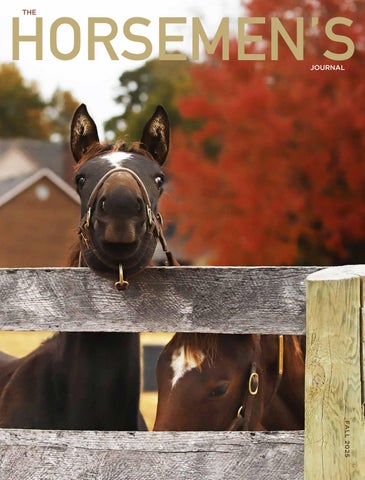
HORSEMEN’S THE
JOURNAL
FALL 2025
TWO MEET SEASON! A NEW ERA OF RACING
HOLIDAY MEET DECEMBER 12 - JANUARY 4
OAKLAWN MEET JANUARY 30 - MAY 2
Maiden Special Weights $100k+ Allowances $115k+ VISIT oaklawn.com/racing or EMAIL racing@oaklawn.com for more information.
THE HORSEMEN’S JOURNAL CONTENTS | FALL 2025 | VOLUME 72/#3
DEPARTMENTS
FEATURES
02
22
Message from the National HBPA
‘You Always Knew He Was Around’ Bernie Flint still involved in racing as an owner after successful training career
30
08
Deny and Defy A look at scientific research involving atypical findings of specified substances met with resistance from racing’s leadership groups, plus an update on the complicated case involving trainer Phil Serpe
Industry News
40
14
Day in the Life
HBPA News
Alpha Event Medicine offers a variety of medical services at the track, including those for horsemen, participants and fans
44 20 Guest Commentary
48 Affiliate News
Picture Perfect The importance of quality photos or videos when rehoming racehorses
THE HORSEMEN’S JOURNAL
FALL 2025
1
MESSAGE FROM
THE CEO NATIONAL HBPA
3380 Paris Pike Lexington, KY 40511 P (859) 259-0451 F (859) 259-0452 racing@hbpa.org www.hbpa.org
PRESIDENT/ CHAIRPERSON OF THE BOARD Dr. Doug Daniels SECRETARY/ TREASURER Lynne McNally CHIEF EXECUTIVE OFFICER Eric J. Hamelback VICE PRESIDENT SOUTHERN REGION Rick Hiles VICE PRESIDENT CENTRAL REGION Joe Davis VICE PRESIDENT WESTERN REGION J. Lloyd Yother VICE PRESIDENT EASTERN REGION Naomi Long
GWEN DAVIS PHOTO
WE ALL MUST DEFEND HORSE RACING’S FUTURE
A
As summer racing wraps up, the National HBPA continues to stand at the forefront of the issues shaping our industry. Summer was a season of contrasts—on the one hand, recordsetting purses and landmark meets across the country and, on the other, pressing legal and regulatory battles that could redefine account wagering, casino partnerships and the future of Thoroughbred racing itself.
t the core of our mission is a simple but powerful promise: horsemen helping horsemen. Whether it’s the stability of smaller tracks, the preservation of horsemen’s earnings or legislative debates with far-reaching consequences, the NHBPA is working daily to make sure your voices are heard and your livelihoods protected. Safety and integrity are nonnegotiable. The NHBPA has long advocated for uniform, science-based rules that protect horses, riders and the integrity of racing. But meaningful reform must be constitutional, transparent and economically sustainable. Unfortunately, the Horseracing Integrity and Safety Authority (HISA) has fallen short on all three counts. Its recent public relations push leaned heavily on selective numbers stating a “slight increase” in fatalities when the underlying data reflects a rise of more than 50%. Let me be very clear: Fatality counts, whether up or down, are the wrong metric to define success in Thoroughbred racing. Measuring our sport by its rarest tragedies is misleading and unfair to the horsemen who work tirelessly to care for and protect their horses. The proper measure of progress is the percentage of horses that run safely. Every day, across the country, thousands of horses enter the starting gate and complete their races without incident. That “safe completion rate” consistently exceeds 99.8%, which is a safety rating any professional sport would be proud to claim. That is the true story of horse racing and the standard by which reforms should be measured. If HISA is to justify its immense cost to this industry, it must demonstrate real results in areas that matter— identifying and eliminating intentional doping, improving equine welfare and enhancing the safe completion rate of races. To date, that proof has been lacking, and horsemen are left footing the bill for a system that punishes the wrong people while highlighting the wrong metrics.
2
HISA’s current funding model continues to erode horsemen’s earnings, particularly at smaller venues and regional circuits that are already under economic pressure. The rigid enforcement of medication and testing standards without accounting for environmental contamination or trace levels places horsemen at risk of unfair penalties even when there is no intent to enhance performance. The NHBPA will continue our path forward to advocate for reform that is fair, accountable and rooted in science. The Racehorse Health and Safety Act (RHSA) offers exactly that. By returning oversight to state racing commissions and recognized industry experts, the RHSA ensures collaboration, transparency and constitutional integrity while maintaining the highest standards for equine health and safety. We as horsemen have never opposed reform. In fact, we demand it. But reform must be measured by its impact on both horse welfare and the safe completion rate of races—not by headlines highlighting rare tragedies. This is how we protect our industry and ensure horsemen can continue making a living while maintaining the highest safety standards. Looking ahead, I remain optimistic despite challenges. Our sport is vibrant, with historic meets, strong wagering and passionate fans. The NHBPA will continue to work with policymakers, regulators and industry stakeholders to safeguard Thoroughbred racing’s future. That means fighting for fairness, advancing science-based reforms and ensuring that the horsemen and women who are the backbone of this industry have a voice in every decision that impacts their livelihoods. Together, we will focus on what truly matters—horses that run safely, races that uphold integrity and a future where horsemen thrive alongside the horses they care for. SINCERELY, ERIC J. HAMELBACK
THE HORSEMEN’S JOURNAL
FALL 2025
THE
NATIONAL HBPA WOULD LIKE TO THANK ITS CORPORATE
AFFILIATES
SPONSORS
BOARD OF DIRECTORS - AFFILIATES Dr. David Harrington, Alabama Lloyd Yother, Arizona Bill Walmsley, Arkansas James Miller, Charles Town Kim Oliver, Colorado Mike Lecesse, Finger Lakes Jim Watkins, Illinois Joe Davis, Indiana David McShane, Iowa Dale Romans, Kentucky Benard Chatters, Louisiana Jason Uelmen, Michigan Justin Revek, Minnesota Garald “Wally” Wollesen, Nebraska Anthony Spadea, New England Paul Jenson, DVM, New Mexico Joe Poole, Ohio Joe Offolter, Oklahoma Ron Sutton, Oregon Sandee Martin, Pennsylvania Mike Dini, Tampa Bay Downs David Ross, Virginia Pat LePley, Washington David Milburn, HBPA of British Columbia Sue Leslie, HBPA of Ontario Dan Hurley, HBPA of Alberta Blaine McLaren, HBPA of Manitoba Eddie Esquirol, HBPA of Saskatchewan
CONTRIBUTORS Dr. Kimberly Brewer Sean Clancy Dr. Clara Fenger Dr. Andreas Lehner Jennie Rees Jen Roytz Peter J. Sacopulos Dr. Thomas Tobin Bill H. Walmsley PHOTOGRAPHERS Benoit Photo Coady Media Coady Media/Adianez Acosta Coady Media/Julie Clark Coady Media/Kurtis Coady Coady Media/Cady Coulardot Coady Media/Renee Torbit Coglianese Photo Gwen Davis/Davis Innovation Bill Denver/EQUI-PHOTO John Engelhardt Jim McCue/Maryland Jockey Club Cynthia Rush J J Zamaiko Photography/Dale Dengerd STAFF Tom Law Editor P (859) 396-9407 hj@hbpa.org Michelle McShane Advertising Director P (515) 508-1811 info@hbpa.org Limb Design www.limb.co Graphic Design THE HORSEMEN’S JOURNAL 3380 Paris Pike Lexington, KY 40511 P (859) 259-0451 F (859) 259-0452 hj@hbpa.org HBPA WEBSITE www.hbpa.org COVER PHOTO Gwen Davis/Davis Innovation
The opinions, representations and viewpoints expressed by the authors in the articles contained in The Horsemen’s Journal do not necessarily reflect the opinions, representations and viewpoints or the official policies or positions of The Horsemen’s Journal, National Horsemen’s Administration Corporation or National Horsemen’s Benevolent & Protective Association Inc. and its affiliates (collectively “HJ”). HJ is not responsible for, and expressly disclaims all liability for, damages of any kind arising out of use, reference to or reliance on any information contained within this issue. Information in this issue may become outdated due to the rapidly changing nature of the horse industry. The publication of any advertisements or articles should not be construed as an endorsement of any product, service or position unless specifically stated. The Horsemen’s Journal, Volume 72 #3. Postal Information: The Horsemen’s Journal (ISSN 0018-5256) is published quarterly by the National Horsemen’s Administration Corporation, with publishing offices at 3380 Paris Pike, Lexington, KY 40511. Copyright 2025 all rights reserved. The Horsemen’s Journal is the official publication for members of the Horsemen’s Benevolent & Protective Association, a representative association of Thoroughbred owners and
THE HORSEMEN’S JOURNAL
FALL 2025
trainers. HBPA is a non-profit 501(c)6 Kentucky corporation. Members receive The Horsemen’s Journal as a benefit of membership paid by the national office from affiliate dues. Annual nonmember subscriptions are $25. Single-copy back issues, if available, are $7. Canadian subscribers add $6. All other subscriptions outside the U.S. add $20 payable in U.S. funds. To order reprints or subscriptions, call (859) 259-0451. The HBPA National Board of Directors has determined that the publication of this periodical is necessary in the transaction of the public business required of the association. Views and opinions expressed are those of the authors and/or advertisers and do not necessarily represent the opinion or policy of the publisher or HBPA board or staff. Query the editor prior to sending any manuscripts. Periodicals Postage Paid at Lexington, Kentucky and additional mailing offices. CANADA POST: Publications mail agreement no. 41530527. Return undeliverable Canadian addresses to: P. O. Box 503, RPO West Beaver Creek, Richmond Hill, ON L4B 4R6. POSTMASTER: Send address changes to The Horsemen’s Journal, 3380 Paris Pike, Lexington, KY 40511.
3
OFFICIALSPONSOR SPONSOR OFFICIAL of the the National NationalHBPA HBPA of
GWEN DAVIS/DAVIS INNOVATION PHOTO
LEADING OFF
6
THE HORSEMEN’S JOURNAL
FALL 2025
THE FIELD FOR THE CLAIMING CROWN CANTERBURY TOM METZEN MEMORIAL STORMS DOWN THE STRETCH LAST YEAR AT CHURCHILL DOWNS. THE 27TH RENEWAL OF THE CLAIMING CROWN RETURNS TO LOUISVILLE NOVEMBER 15. THE HORSEMEN’S JOURNAL
FALL 2025
7
NEWS
INDUSTRY NEWS TOBA HONORS GODOLPHIN, MYSTIK DAN CONNECTIONS COADY MEDIA/JULIE CLARK
The partnership of Lance Gasaway, Daniel Hamby and 4G Racing, breeders of Mystik Dan, was honored as 2024 National Small Breeder of the Year. The group, which campaigns Mystik Dan with Valley View Farm, bred the son of Goldencents out of the winning Colonel John mare Ma’am. National Small Breeder of the Year finalists also honored during the dinner were William “Buck” Butler and CUYATHY. Other honorees included Like a Saltshaker as Claiming Crown Horse of the Year, presented by the National HBPA; Sataves as National Broodmare of the Year; and Zealand as Rood and Riddle Sport Horse of the Year. Sataves is the dam of 2024 Horse of the Year, champion 3-year-old filly and multiple Grade 1 winner Thorpedo Anna. The Cot Campbell Partnership of the Year was presented to SF Racing, Starlight Racing, Madaket Stables, Robert E. Masterson, Stonestreet Stables, Waves Edge Capital and Catherine Donovan. The Cot Campbell Partnership of the Year finalists recognized were Lance Gasaway, Daniel Hamby, 4G Racing and Valley View Farm and MyRacehorse. Alan Foreman was honored with the Dr. J. David Richardson TOBA Industry Service Award.
2024 STATE AND CANADIAN BREEDERS OF THE YEAR MYSTIK DAN, WINNER OF LAST YEAR’S KENTUCKY DERBY AND THIS SUMMER’S BLAME STAKES AT CHURCHILL DOWNS, HELPED HIS CONNECTIONS EARN HONORS AT THE 40TH ANNUAL THOROUGHBRED OWNERS AND BREEDERS ASSOCIATION NATIONAL AWARDS IN SEPTEMBER.
CATEGORY
eading global racing and breeding operation Godolphin and the breeders and connections of 2024 Kentucky Derby winner Mystik Dan were the big winners during the 40th annual Thoroughbred Owners and Breeders Association (TOBA) National Awards September 6 in Lexington, Kentucky. Godolphin took the fourth straight National Owner of the Year and National Breeder of the Year titles during the awards dinner held at Fasig-Tipton Kentucky. Those titles followed similar honors during this year’s Eclipse Awards, where Godolphin came away with its fifth consecutive outstanding owner title and fourth straight outstanding breeder title. Godolphin finished well clear on the North American list of leading owners by purses earned in 2024, racking up $20,234,455 from its 460 starts. The stable’s 104 victories included Rebel’s Romance in the Breeders’ Cup Turf and eventual champion 2-year-old filly Immersive in the Breeders’ Cup Juvenile Fillies, both at Del Mar, along with scores in the Grade 1 Jockey Club Gold Cup (Highland Falls), Grade 1 Arlington Million (Nations Pride), Grade 1 Manhattan Stakes (Measured Time) and five other Grade 1 stakes. TOBA recognized the other finalists in the National Owner category (Juddmonte and Klaravich Stables) and National Breeder category (Judy Hicks and Town and Country Horse Farms) during the ceremony. “Congratulations to all the winners of the TOBA national and state awards as well as the finalists,” said TOBA President Dan Metzger. “We were honored and privileged to celebrate the 40th anniversary of the TOBA National Awards and recognize the outstanding achievements of 2024, including the incredible success of Godolphin as both National Owner and Breeder of the Year for the fourth consecutive year.”
California Breeder of the Year . . . . . . . . . . . . . Richard Barton Enterprises (Richard Barton)
L
8
WINNER
Arizona Breeder of the Year . . . . . . . . . . . Fleming Thoroughbred Farm LLC (Marvin Fleming and Gerald Fleming) Arkansas Breeder of the Year ��������������������������������������������McDowell Farms (Bill and Mary McDowell)
Canada Breeder of the Year ��������������������������������������������������� Adena Springs Canada Small Breeder of the Year ������������������������������������������� Jesse Korona Florida Breeder of the Year ������������������������������������������������ Stonehedge LLC (Marilyn Campbell) Indiana Breeder of the Year . . . . . . . . . . . Justice Farms Inc. (Greg Justice) Iowa Breeder of the Year . . . . . . . . . . . . . . Poindexter Thoroughbreds LLC (Allen Poindexter) Kentucky Breeder of the Year ������������������������������������������������������ Godolphin Louisiana Breeder of the Year ������������������������������������������������Tony Doughtie Maryland Breeder of the Year ������������������������������������������������Larry Johnson New Jersey Breeder of the Year ����������������������������������������Vincent Annarella New Mexico Breeder of the Year ��������������������������� J. Kirk and Judy Robison New York Breeder of the Year ������������������������������������������������ William Butler North Carolina Breeder of the Year ���������������������������������������Nancy Shuford Oregon Breeder of the Year . . . . . . . . . . . . . . . . . . Connie and Lee Erickson Pennsylvania Breeder of the Year �������������������������������Warriors Reward LLC (Donnie Brown and Tom McClay) South Carolina Breeder of the Year ������������������������������Franklin G. Smith Sr. Texas Breeder of the Year ����������������������������������������������������Danele Durham Virginia Breeder of the Year . . . . . . . . . . . . . . . . . . Audley Farm Equine LLC Washington Breeder of the Year ����������������������������������Nina and Ron Hagen THE HORSEMEN’S JOURNAL
FALL 2025
NTWAB HONORS AGELESS JOCKEY OUZTS, DEL MAR’S HARPER Through late August, Ouzts had ridden in a record-extending 53,621 races, winning 7,522 times—the fifth-most wins by a North American jockey behind Hall of Famers Baze (12,842), Laffit Pincay Jr. (9,530), Bill Shoemaker (8,833) and Pat Day (8,803). He is reportedly seventh by wins worldwide. Harper will be honored with the Joe Palmer Award for meritorious service to racing, having served as a track executive at Del Mar Thoroughbred Club since 1978, guiding the Southern California track through a period of significant growth. During this time, Harper has overseen Del Mar’s emergence as one of the nation’s top racetracks for daily average handle and attendance while preserving its unique story. A native Californian, Harper serves as a board member for numerous organizations, including as chairman of Winners Foundation, a drug and alcohol counseling center for the California racing industry. Andersen is the recipient of the Walter Haight Award for career excellence in turf writing. A longtime news correspondent who joined the Daily Racing Form in 1994, Andersen covers the Southern California circuit, writing race previews, recaps, notes and features. Andersen’s passion for the sport extends beyond flat racing to jump racing, illustrated by his regular forays to the United Kingdom to attend race meetings, such as those at Aintree and Cheltenham. He also reports on Quarter Horse racing at Los Alamitos, a short drive from his Seal Beach, California, residence. Luck, one of international horse racing’s most respected and recognizable broadcasters, is the recipient of the Jim McKay Award for broadcast excellence. He rose to prominence through his work with Channel 4 Racing and Racing TV in his native United Kingdom. His articulate and insightful coverage has resulted in him being named Racing Broadcaster of the Year nine times by the Horserace Writers & Photographers Association in Britain. The organization has honored him twice as Reporter of the Year. In the United States, Luck has been a vital presence in American horse racing television for nearly two decades, widely recognized for his analysis and interviewing skills on display during NBC’s broadcasts of the Breeders’ Cup and Triple Crown.
JOE HARPER, AT THE HELM AT THE DEL MAR THOROUGHBRED CLUB SINCE THE LATE 1970S, WILL RECEIVE THE NTWAB'S JOE PALMER AWARD FOR MERITORIOUS SERVICE TO RACING.
THE NTWAB’S ANNUAL AWARDS DINNER IS SET FOR OCTOBER 29 AT THE BRIGANTINE, NOT FAR FROM DEL MAR.
BENOIT PHOTO
BENOIT PHOTO
JOHN ENGELHARDT PHOTO
P
erry Ouzts, the 71-yearold jockey who this summer passed Russell Baze for the most rides by a jockey in North American racing history, will be honored along with track executive Joe Harper, turf writer Steve Andersen and broadcaster Nick Luck during the 65th annual National Turf Writers and Broadcasters (NTWAB) Awards Dinner October 29 in RACING’S “MAN IN BLACK,” 71-YEAR-OLD JOCKEY Del Mar, California. PERRY OUZTS WILL RECEIVE THE MR. FITZ AWARD The honors will FOR TYPIFYING THE SPIRIT OF RACING FROM THE NATIONAL TURF WRITERS AND BROADCASTERS IN be given out at The LATE OCTOBER AT DEL MAR. Brigantine Del Mar, overlooking nearby Del Mar Racetrack, which will host the Breeders’ Cup World Championships October 31-November 1. In honoring Ouzts with the Mr. Fitz Award for typifying the spirit of racing, the NTWAB recognizes the achievements and astounding longevity of the veteran rider, who began his career in April 1973, just weeks before Secretariat won that year’s Triple Crown. Besides holding the mounts record, he is the oldest winning rider in North American racing history.
THE HORSEMEN’S JOURNAL
FALL 2025
9
NEWS
INDUSTRY NEWS DEMOLITION UNDERWAY AT PIMLICO RACE COURSE
T
he Maryland Stadium Authority has started the structural demolition necessary for the redevelopment of Pimlico Race Course, with the razing in late July of the existing barns and outbuildings adjacent to Winner Avenue. In 2024, the Maryland Legislature passed H.B. 1524, Racing Facility Ownership and Construction—Racing Operations, authorizing the authority to issue $400 million in bonds to finance, demolish, design and reconstruct Pimlico in Baltimore and to build a new training facility at Shamrock Farm in Carroll County. The design of both facilities is led by Ayers Saint Gross/Populous, and Clark Construction Group LLC is tasked with the construction. The demolition package was approved by the authority’s board and the Maryland Board of Public Works in May. After the successful completion of the
150th Preakness Stakes, the operator and all horses moved out of the facility, the Maryland State Archives removed and secured existing artifacts from the property, and the authority and its project partners began securing the Pimlico site by installing temporary fencing, performing pest control, preparing utilities and conducting abatement as necessary and important steps as part of the demolition process. The authority plans to develop an exhibition about the history and significance of Pimlico. The exhibition will use artifacts, oral histories, photographs, salvaged materials and other appropriate graphics for display in the newly constructed clubhouse and the publicly accessible spaces on the property and its perimeter.
JIM MCCUE/MARYLAND JOCKEY CLUB PHOTO
DEMOLITION OF PIMLICO RACE COURSE STARTED THIS SUMMER WITH THE RAZING OF EXISTING BARNS AND OTHER STRUCTURES IN THE STABLE AREA.
THOROUGHBRED CHARITIES OF AMERICA AWARDS $1.1 MILLION IN GRANTS
T
horoughbred Charities of America (TCA) announced that grants totaling more than $1.1 million were awarded to 98 organizations in 2025. The organizations approved for grants include 63 aftercare organizations, 24 backstretch and farm worker programs, seven equine-assisted therapy organizations, three Thoroughbred incentive programs and one research organization. Grant recipients can be found at tca.org. Over the past 35 years, TCA has awarded more than $28 million in grants. With a record number of grant applications this year, the TCA Grants Committee established clear funding priorities with an emphasis placed on approved organizations working to serve the backstretch and farm employee communities as well as nontraditional aftercare organizations. The committee defined nontraditional aftercare organizations as ones that are either working to provide on-track placement services to retiring Thoroughbreds or working to incentivize equine enthusiasts to choose a Thoroughbred as their next mount. 10
“Our annual grants reflect both the generosity of our donors and the strength of the organizations we are privileged to support,” TCA Executive Director Erin Halliwell said. “We take our responsibility as stewards of donor contributions very seriously because it is these donations that allow us to make a real impact via our grants. Every dollar entrusted to TCA helps us invest in organizations that are making an impact on Thoroughbreds and their caretakers.” TCA’s mission is to fund and facilitate the support of Thoroughbreds and the people who care for them. TCA distributes grants to several categories of Thoroughbred-related nonprofits including rehabilitation, retraining, rehoming and retirement organizations; backstretch and farm employee programs; equine-assisted therapy programs; and research organizations.
THE HORSEMEN’S JOURNAL
FALL 2025
IT PAYS TO RACE IN IOWA!
• Racing resumes May 2026 • Race days guaranteed by law
• Stakes program of over 3.2 million
• Purses guaranteed by law
• Iowa Bred stakes program totaling $1,150,000
• Total Purses of over 12 million in 2025
• Breeders’ awards paid first fourth place
Iowa Horsemen’s Benevolent & Protective Association
Advertisement brought to you by the Iowa HBPA to promote Live Racing www.iowahbpa.org
NEWS
INDUSTRY NEWS CHURCHILL, NBC SPORTS MOVE KENTUCKY OAKS TO PRIMETIME COADY MEDIA
C
hurchill Downs Inc. and NBC Sports will showcase the Kentucky Oaks in primetime for the first time in 2026. The 152nd Oaks, centerpiece of the Friday, May 1, program at Churchill Downs, will be presented during a broadcast starting at 8 p.m. ET on NBC and Peacock. The post-time shift for the Oaks will affect the entire card, which will move to 12:30 p.m. with gates opening at 11 a.m. The 2025 Kentucky Oaks Day card kicked off at 11 a.m. with the first of 13 races. The Kentucky Oaks, won by Godolphin’s Good Cheer, went off at 6:04 p.m. as the 11th race of the day. With sunset in Kentucky in early May occurring around 8:30 p.m., the Oaks will run under the lights at Churchill. “By moving the Kentucky Oaks to primetime, we’re giving one of horse racing’s most treasured traditions the national stage it deserves,” said Churchill Downs Inc. CEO Bill Carstanjen. “This decision is rooted in our commitment to growing the sport, reaching new audiences and creating unforgettable experiences for our fans.” “We are excited to present the Kentucky Oaks in primetime for the first time ever,” said Jon Miller, NBC Sports’ president, acquisitions and partnerships. “With the Oaks on Friday night leading into the Kentucky Derby on the first Saturday in May, we can’t wait to get back to Churchill Downs for another historic weekend of racing.” HJ
THE 2026 KENTUCKY OAKS WILL BE RUN UNDER THE LIGHTS AT CHURCHILL DOWNS AND WILL AIR IN PRIMETIME ON NBC AND PEACOCK.
OFFICIALSPONSOR SPONSOR OFFICIAL of the the National NationalHBPA HBPA of
12
THE HORSEMEN’S JOURNAL
FALL 2025
NEWS
HBPA NEWS RED INK TO BLACK TYPE: A RACEHORSE OWNER’S JOURNEY OF PASSION, PLANNING AND PROFIT By Bill H. Walmsley I gathered data on the sire and first two dams, past performances, workout patterns, sale history and family earnings. Once Mark and Steve reviewed the information, we’d decide if the horse merited consideration. The final word always belonged to our trainer. He inspected conformation, movement and overall athleticism. No claim was dropped unless he gave a resounding yes. Even then, success wasn’t guaranteed, and we often lost horses at the claim box due to multiple bids. From 2019, we watched our business model take root, and we began to see the fruit of our planning right here at Oaklawn Park, our hometown track offering America’s highest winter purses. Between 2019 and May 1, 2025, our horses made 127 total starts, won 23 races and placed in 41. In 2023, we were rewarded with stakes wins from Coastal Charm, who won the Dig A Diamond at Oaklawn and the Iowa Distaff at Prairie Meadows. After claiming her for $30,000 and getting black type, we consigned her to the 2024 Keeneland January horses of all ages sale, and she sold for $250,000. Our total earnings reached $1.6 million, averaging more than $12,600 per start. If a horse didn’t meet our expectations, we placed them back in a claiming race to allow for minimal loss. Best of all, Mark and I never put another personal dollar into the operation after 2018. In May, we amicably dissolved HWL Partnership, splitting more than $400,000 in accumulated profits. The numbers told the story, but they didn’t capture the joy of doing it right, or the pride we felt in succeeding on our own terms.
COADY MEDIA
For as long as I can remember, the thrill of Thoroughbred racing has been in my blood. I stepped into this world in 1983 with eyes wide open and full of hope, like so many small stable owners across the country. I was also keenly aware then and still know now that very few racehorse owners ever make a true profit. Operating expenses routinely outpace earnings, and before a dollar is earned, there’s the up-front investment of purchasing the horse. It’s even more challenging when you’re not backed by a big-name operation. For decades, I was in that majority who deducted their racing losses on their taxes each year. But in 2016, that story began to change. That year, my friend and business partner Mark Lamberth and I launched HWL Partnership. From the start, we brought a new mindset to the stable. We wanted to build something sustainable that was also profitable, but most important to us, we wanted to keep it fun. Our first three years looked like most small-scale operations. From 2016 to 2018, we made 56 starts, won four races and earned $154,984, or about $2,768 per start. Not exactly the financial future we had envisioned. That’s when we called in our trainer, Steve Hobby, a proven horseman with more than 1,100 career wins. We sat down to create a better strategy. We agreed to a disciplined plan and called it “Claiming With Purpose.” That plan consisted of the following: • Budget: No horse would cost more than $50,000. • Strategy: We would target 2- and 3-year-olds running in $30,000 to $50,000 maiden claiming races. • Due diligence: Every horse would undergo a comprehensive pedigree and production review.
BILL WALMSLEY, MARK LAMBERTH AND STEVE HOBBY TEAMED FOR THE SUCCESSFUL CLAIMING VENTURE HWL PARTNERSHIP AT OAKLAWN PARK, THEIR HOMETOWN TRACK, WHICH ANNUALLY OFFERS THE HIGHEST WINTER PURSES IN AMERICA.
14
THE HORSEMEN’S JOURNAL
FALL 2025
The lessons learned from HWL are simple yet powerful: Profit is possible in Thoroughbred racing. But to get there, owners must operate with the mindset of a business, not a hobby. Have a plan. Stick to your limits. Work with trusted professionals and, above all, never let passion blind your judgment.
For Mark, Steve and me, HWL Partnership was more than a racing venture. It was a master class in discipline, teamwork and long-term thinking. And yes, we had a whole lot of fun doing it. COADY MEDIA
HWL Partnership Results (2019–2025) Annual Performance Breakdown YEAR
STARTS
1ST – 2ND – 3RD – 4TH
EARNINGS
2019
20
6–4–2–2
$280,723
2020
21
4–5–6–1
$244,563
2021
20
2–7–1–6
$211,271
2022
19
1–4–2–3
$154,562
2023
19
6–2–2–2
$412,111
2024
19
2–3–1–2
$165,213
2025*
9
2–1–1–0
$131,966
TOTAL
127
23 – 26 – 15 – 16
$1,600,409
• • • •
HEADLAND, AN 11-TIME WINNER INCLUDING HERE APRIL 6, 2019, AT OAKLAWN PARK, LED HWL’S LIST OF LEADING RUNNERS WITH EARNINGS OF $473,057 FOR THE PARTNERSHIP.
Win Rate: 18.1% Top 3 Finishes: 50.4% Top 4 Finishes: 63.0% Average Earnings/Start: $12,601.54
Bill H. Walmsley, a lifelong Thoroughbred owner, is president of the Arkansas Horsemen's Benevolent and Protective Association and served as president and board chair of the National HBPA from 1992 to 1996. Additional contributions are from Mark Lamberth, who is vice chairman of the Arkansas Racing Commission and an advocate for racing integrity and innovation, and Steve Hobby, a veteran trainer with more than 1,100 wins.
*2025 earnings reflect activity through May 1
CALL HORSEMAN LABOR TODAY!
OFFICIALSPONSOR SPONSOR OFFICIAL of the the National NationalHBPA HBPA of
We provide comprehensive labor solutions for international labor needs including: H2A Agricultural and Farm Visas H2B Temporary Worker Visas Employment-Based Residencies (Green Cards) P1/P1-S Jockey and Valet Visas I-9 Compliance We assist in the immigration visa process for:
Hablamos Español
THE HORSEMEN’S JOURNAL
Jockeys
Exercise Riders
Grooms
Hot Walkers
Call us for a FREE Initial Consulation
FALL 2025
Breeding Technicians Stable Attendants
Farm Workers
General Laborers
1-877-678-RACE (877-678-7223) www.horsemanlabor.com
15
NEWS
HBPA NEWS KENWOOD, BREEN, LOPEZ TEAM FOR CLAIMING CROWN PREVIEW WINS Kenwood Racing, trainer Kelly Breen and jockey Paco Lopez teamed to sweep the headlining events on Claiming Crown Showcase Day August 21 at Colonial Downs. The trio won the $100,000 Jewel Qualifier with Cadet Corps and the $87,500 Emerald Qualifier with One Time Willard. Colonial hosted the inaugural eight-race Claiming Crown Showcase Day, which offered $550,000 in purses under starter-allowance conditions. The top two finishers in each race earned an automatic berth into the Claiming Crown November 15 at Churchill Downs, with race winners also receiving up to $2,000 in travel support from the Virginia HBPA if they compete in Louisville. WWCD LLC’s Next Girl opened the preview portion of the card with a victory in the $50,000 Glass Slipper Qualifier for trainer Robbie Bailes and jockey Denis Araujo.
Madison Avenue Racing Stable, Morris Kernan Jr. and Jagger Inc.’s Quick Tempo won the $75,000 Canterbury Qualifier for trainer Jamie Ness and Lopez. Jeanine Cumiskey’s Gilmore rallied from last to first to win the $62,500 Rapid Transit Qualifier for trainer Joe Sharp and jockey Ben Curtis. Cumiskey also celebrated a win by Curlin’s Malibu in the $50,000 Kent Stirling Memorial Iron Horse Qualifier for Sharp and Lopez. Jim Tichenor’s Busk surged past Silver Slugger late to win the $50,000 Ready’s Rocket Express Qualifier for trainer Manuel Chavez and jockey Carlos Barbosa. Liberty House Racing, Team Gaudet and Penwood Racing’s Cairo Street pulled the upset in the $75,000 Tiara Qualifier for trainer Lacey Gaudet and jockey Forest Boyce.
COADY MEDIA
CADET CORPS WINS THE JEWEL QUALIFIER FOR KENWOOD RACING, TRAINER KELLY BREEN AND JOCKEY PACO LOPEZ AUGUST 21 AT COLONIAL DOWNS.
16
THE HORSEMEN’S JOURNAL
FALL 2025
ANNUAL HART DINNER AND SILENT AUCTION A SUCCESS
Navigating the world of Thoroughbred aftercare is anything but a linear venture. Never knowing when a horse might come in, what kind of care they might need or how long they might be in a program leaves organizations in a constant state of fundraising, but between grant applications, Hope After Racing Thoroughbreds (HART) has found a way to have a little fun. Now in its third year, the annual benefit dinner and silent auction is proving to be one of the biggest fundraising events on HART’s calendar. Held in the lodge at Griff’s Valley View RV Park, the summer home of most of the trainers based at Prairie Meadows in Altoona, Iowa, this casual affair brings together HART adopters and professional horsemen for a night of home-cooked food, friendly games, stories, laughter and, of course, the highlight of the night—the silent auction. This year’s auction brought in more than 75 donated items and featured a Blackstone grill and a Milwaukee Tool set. Donations ran the gamut from kid’s toys, equine books and collectible bourbons to horse care supplies, Jack Coady photographs and custom silks, with a goal of offering something for everyone.
HART officials estimate this year’s event pulled in more than $12,000 for the organization, making it not only one of the most engaging but also one of the best-producing fundraisers they run. The fundraiser, while a lot of work to pull together for the HART team, always ends up feeling like a family affair. It is so heartening to see the (horse) donors come together with the adopters and then to have them support the organization in such a spectacular way. “This event has become one of my favorite things to do each summer, and seeing all of my racetrack family and friends show up big to support Thoroughbred aftercare here in Iowa makes all the hours worth it,” said Michelle McShane, HART’s treasurer. HART is Iowa’s only Thoroughbred Aftercare Alliance-approved aftercare organization. It was established in 2010 with the purpose of providing an avenue to rehabilitation and rehoming for the horses of Prairie Meadows Racetrack and Casino. HART houses up to 25 horses at a time and prides itself on rehoming 20 to 30 horses per year. To date, the organization has rehomed more than 150 horses. To learn more about HART, visit iahart.org. HJ
Grace Clark-Sweet Photo
THANK YOU, HORSEMEN AND HORSEPLAYERS, FOR ANOTHER AMAZING MEET! The overwhelming support of owners, trainers and bettors has made Kentucky Downs one of horse racing’s greatest success stories in modern times.
SEE YOU IN 2026!
THE HORSEMEN’S JOURNAL
FALL 2025
17
Entries as of July 30th, 2025 Follow them and learn more at www.TheRRP.org/entries Acceleritas, '20 B G (Sharp Azteca - Celeritas)
Dontcrossthedevil, '19 B G (Cross Traffic - The Devil is Mine) Imposing Ruler, '21 Ch G (Noble Mission (GB) - Sway)
Acorn to Oak, '21 B G (Adios Charlie - Deceitful Darling)
Dosage and Mimosas, '13 B M (Bustin Stones - Parsippany)
Acorus, '21 Dk B G (Sharp Azteca - Sapphire Blue) Afleet Sniper, '16 B G (Afleet Alex - Border Slew) Aim for the Sky, '17 Ch G (Sky Mesa - Pohdi Pohdi) Akari, '21 Ch M (First Samurai - My Mertie)
Dream Time, '21 Dk B G (Always Dreaming - Tiz Da Biz) Improper, '19 B G (Into Mischief - Beholden) Dreamer’s Disease, '18 B G (Laoban - Marketplace) SP, BC In American, '21 Gr M (Wait - Frost) Du Jour, '18 B G (Temple City - Guiltless) MGSW, BC In the Numbers, '21 B G (Flatter - Simply Sunny) Dynamic One, '18 Ch G (Union Rags - Beat the Drums) GSW Indecent Behavior, '21 Dk B G (Enticed - Fly Girl) Eddie Lea, '20 Ch G (Lea - Twice Charmed) Insouciant, '21 Ch M (More Than Ready - Not Taken) Eden Paradise, '19 Ch G (Jimmy Creed - Mille Luna) Interrupter, '21 Ch G (Tapiture - Miss Malice)
American d'Oro, '18 Ch G (American Pharoah - Mega Dream) SP
Annabelle's Smile, '21 Ch M (Smiling Tiger - She's So Vain)
Appraisal, '18 B G (Paynter - I Have a Price) Arrowheart, '18 B G (Hard Spun - High Pitch) Aruba, '17 Dk B G (Kitten's Joy - Crane Beach)
Elusive Empire, '20 Gr G (Pioneerof the Nile - Classy Grey Lassy)
Impressively, '21 Dk B G (Majestic Harbor - Genuine Luck)
Irish Angel, '21 Ch M (No Never No More - Crusader's Angel)
Elusive Motion, '17 B G (Great Notion - Deep Run) Emmalyn Rose, '20 Ch M (Tapizar - Mostly Lies)
Irish Bandit, '21 B G (Irish War Cry - Gracies Bandit) Isocline, '20 B G (Producer (GB) - Isoclone) Avenue, '18 Dk B G (Quality Road - Magic Union) MGSP Endersroyaldance, '20 B G (King Cha Cha - Topper Too) Jeff the Lion, '15 Ch G (American Lion - Dutchie) Baby Fade, '19 Ch M (First Samurai - Dun in One) Joe Brains, '18 Dk B G (The Big Beast - Offlee Sheikh) Ernie Banker, '17 B G (Central Banker - Tall Timbercowgirl) SP Eryx, '14 B G (Xenodon - Jordani) Juancho, '20 B G (Elnaawi - I Juana Win) Bamboo Garden, '15 B M (First Samurai - Seal the Greel) Bandon, '20 Blk G (Speightstown - Sansibar Jewel) Esteemed, '17 B G (Atilla's Storm - Play the Favorite) Justa Scoch, '14 B M (Jump Start - Free Strike) *Brdm Bassanio (GB), '19 B G (Bated Breath (GB) - Unnatural) Fancy Scepter, '19 B M (Divining Rod - Our Fantene) Justastar, '19 B M (Mohaymen - Afillyation) *Brdm Battle Born, '19 Dk B G (More Than Ready - Mine for Keeps) Ferda, '20 B M (Cloud Computing - Alternative Energy) Kannon Fire, '19 Dk B M (Kantharos - Walton Place) Battle Creek, '17 Dk B G (Tiznow - Desert Gazelle) Financier, '21 B G (Central Banker - Just Call Me Angel) Keen Dancer, '19 B M (Keen Ice - Moonshine Bertie) Bays Castle, '19 B M (Windsor Castle - Langford Bay) Flat Out Flashy, '16 Dk B G (Flat Out - Marvelous Monkey) Khozy Colby, '21 Dk B M (Khozan - Blue Baby) Baytown Bama Girl, '21 Ch M (West Coast - Street Surrender) Flex Warrior, '22 B G (Warrior's Reward - Curious Wings)
Beach Veggies, '21 Gr G (Grazen - Zip Cash Back)
King Of Comedy, '20 B G (Oscar Performance - Rupert's Promise)
Kingsville, '15 B G (Street Move - Day Lily) SP Kittansett, '17 B G (American Pharoah - Bsharpsonata) Beer Mosa, '20 B G (California Chrome - Roughing) Kitty Quick, '20 B M (Adios Charlie - Country Queen) Bella Skye, '21 Dk B M (Tonalist - Party Cat) Knock Out Kid, '16 B M (Tritap - Sometimes Not) Big Pete, '19 Dk B G (Congrats - Twenty Six Acts) La Peer, '20 Dk B M (Girvin - Tanita Belle) Big Rainbow, '21 Dk B M (Mr. Big - Twin Spirit) Lady Merla, '21 B M (Sharp Azteca - Princess Priscilla) Big Warden, '19 Ch G (Big Screen - Executive Affair) Game Change, '20 Dk B G (Candy Ride (ARG) - Sweet Corine) Lake Nakuru, '16 B G (Animal Kingtom - Catbird Seat) Bleeding Blue, '19 B G (Jack Milton - Halo At Last) Gav N Brody, '21 Ch G (Awesome Slew - Kluki) Lamasco, '19 B M (Summer Front - Mountain Baby) Blessed by Cupid, '21 Gr G (Cupid - Blessed Bloom) General Robinson, '20 Ch M (Field Commission - Pantheress) Last Cookie, '20 B G (Bernardini - Fast Cookie) Boston Burglar, '21 Ch G (Gig Harbor - Quite Effective) Get Down Brown, '18 Ch G (Big Brown - Get Busy) Late Night Cruiser, '21 Ch G (Catalina Cruiser - Unbelievable Dream) Brooklyn Strong, '18 B G (Wicked Strong - Riviera Chic) GSW Ghost Giant, '15 Dk B G (Frost Giant - Falbala) Latin Jet, '21 Ch G (Air Force Blue - La Tina) Bruce Attack, '20 Ch G (Forest Attack - Miss Gigi) Ghost Of Danzig, '21 B G (Qafeef - Judith Basin) Legittimo, '21 Gr G (Fast Anna - She's Legit) Beautyinthebeast, '19 Ch M (Dads Caps - Summer Garden)
Flint Ridge, '18 Gr G (Into Mischief - Chantess) Fretensis, '20 B G (Bold Storm - Irish Joy) Fury Kap, '18 B G (Fury Kapcori - Samantha G) Fuzzy Wuzzy, '21 B M (Palace - Dun in ONe) Gage Has A Gray, '18 Dk B G (Bradester - J Grat) Gallant Star, '18 B G (Star Guitar - Five Star Momma)
Leopard Bait, '20 B M (Always Dreaming - Miss Spot On)
Buehler's Day Off, '19 B G (Anchor Down - Bedroom Eyes) SP
Ginnsu Warrior, '19 Ch G (First Samurai - Sweeter Thancandy)
Bushwick Bruiser, '19 B G (Union Rags - Derby Eve) By My Side, '21 Dk B G (Stanford - Babe I'm Ready) C J’s Legacy, '20 B G (Den's Legacy - Centerville)
Glossy Life, '20 Ch M (Get Stormy - Kilmore Quay (IRE))
Leo's Roar, '19 B G (Lea - City Roar)
Go Grad, '21 Dk B G (Congrats - Flashy Note) Go Green, '20 B G (Greenpointcrusader - Truly Loved) Go Tothe Principal, '21 B G (Kennedy - Tylan)
Let's Go Big Blue, '20 Gr G (Cairo Prince - Giant Win) MSP
Cairo's Ghost, '20 Dk B G (Cairo Prince - Ghost Dancer)
Cajun Cashew, '20 Dk B M (Mr. Prankster - Sofie S) Call Em Karl, '21 Dk B G (Exaggerator - Kat O Mine) Call West, '15 B G (Street Sense - Goaltending)
Golden Confusion, '19 Ch G (Goldencents - Causeforconfusion)
Levi, '21 Dk B G (Danzing Candy - Emma Named Me) Lexi's Spirit, '20 Dk B M (Kantharos - Educating) Libs Contento, '18 Ch G (El Padrino - Speak Lib) Lichita, '18 Ch M (Cinco Charlie - Cactus Cocktail)
Golden Dollar, '21 B G (Goldencents - Mama's Dia)
Lilmiss Sassypants, '18 Dk B M (Victor's Cry - Masamune Moon)
Gogo Boots, '22 B F (Eclipticalspraline - Another Cougar)
Cal's Girl, '17 B M (Circumference (IRE) - Chautauqua Creek) Golden Oak, '17 B G (Goldencents - Grace for Grace) Goose Drank Wine, '16 B G (Oxbow - Ultimate Temper)
Little Bop Peep, '10 B M (Bop - Polish Treaty) *Brdm Little Gray Flower, '20 Gr M (Graydar - Sara Sara) Lobsta, '18 Dk B H (Emcee - Salty Little Sis) MSP
Carmelita's Man, '17 Ch G (Mucho Macho Man - Carmelita) MGormleyesque, '20 Dk B M (Gormley - Creative Design)
Logan's Red Falcon, '20 Gr G (Practical Joke - Kashami)
Carpe All Day, '19 B G (Carpe Diem - Lady Astola) Cedar Valley, '17 B M (Itsmyluckyday - Glad It's May)
Governor Atwood, '19 B G (Kantharos - Sidisinforthree)
Lookinatlightening, '20 Dk B M (Lookin At Lucky - Belletta)
Grace and Freedom, '21 B M (American Freedom - Vivian's Grace)
Lord Mio, '19 Dk B G (Unified - Causin Commotion) Lorenzen, '17 Dk B G (Flatter - Road to Mandalay)
Cannon's Roar, '14 B G (Orientate - Polyantha) MSP
Goodbye New York, '21 Dk B M (Frost Giant - Crystal Kris)
Caribbean Night, '19 Dk B M (Cross Traffic - Lady Midnight)
Cedar's Image, '21 B M (Imagining - Cedar'sgreatnotion)
Central Station, '20 B G (Central Banker - Flomar) Changi, '16 B G (Giant Oak - Our Miss Brookside) SP Chaokoon, '20 Ch G (Lakerville - Byballot)
Gray Magician, '16 Gr G (Graydar - Burg Berg) MGSP Great Blake, '14 B G (Greatness - Arundel) Green Light Girl, '20 Gr M (Cross Traffic - Soloing)
Love To Singh, '15 Dk B G (Songandaprayer - Some Came Running)
Luck Of The Draw, '16 Dk B G (Lookin At Lucky - Queen of War)
Gullane, '19 Gr G (Bernardini - Daydreamin Gracie) Chief Mystique, '18 B G (Chief White Fox - Painted Mystique) Gunleather Al, '20 B G (Goldencents - Flickering)
Macassar, '21 B G (Demarchelier (GB) - Onthekisser) Macho Girl, '21 B M (Mucho Macho Man - Osheen) Magnetic Appeal, '21 B G (Enticed - Mystic Mama)
Circle Indy, '18 Dk B G (Perfect Circle - Pretty Plain Jane)
Gunslinger (IRE), '16 B G (Born to Sea (IRE) - Glorious Melody (FR))
Majestic Pharoah, '20 B G (American Pharoah - Majestic Fantasy)
City Kid, '21 Ch G (Collected - Mystra) Class Wizard, '19 B G (Street Magician - Classy Coco)
Gushing Oil, '18 B G (Dialed In - You Look Neigh) Half The Battle, '20 B G (V. E. Day - Inspiration (IRE))
Major Spin, '18 Ch G (Hard Spun - Avendesora) Mansueto, '20 B G (Cloud Computing - Best Manners)
Classic Shine, '19 B G (Classic Empire - Mooning for You)
Happy Farm, '14 Dk B G (Ghostzapper - Gospel GIrl) GSW
Markitoff, '14 Ch G (Giant's Causeway - Myriad) MGSP
Clinton, '20 B G (Into Mischief - Front Page Story) Coach Kenny, '18 B G (Interactif - Mind Blowing) Colonel Juan, '14 B G (Colonel John - Senorita Louisa)
Harry's Onthebeach, '19 B G (Treasure Beach (GB) - Fly Express)
Masked, '15 Ch G (Data Link - Wildcat Melody) MSP
Hay Room, '20 Dk B G (Redeemed - Winter Place) Heavenly Ciella, '21 B M (Holy Boss - Ciella)
Meckes Priority, '20 Dk B G (Apriority - Mecke's Reflection)
Conspiractherapist, '21 B G (American Freedom - Beauty N Balance)
Henley's Joy, '16 Ch G (Kitten's Joy - Blue Grass Music) GSW, BC
Mel's Baby Sister, '21 Gr M (Cross Traffic - Childhood Dream)
Conure, '20 B M (Practical Joke - Caymanbird) Cool and Collected, '20 Gr G (Collected - Fort Prada)
He's a Showboat, '19 Ch G (Woke Up Dreamin - Ocean Dancer)
Cool Blue, '20 Gr G (Sasha's Prospect - Another Wild Thing)
Honeymoon Hero, '20 Gr G (Frost Giant - Haunted Honeymoon)
Cool Hand Heatly, '22 Ch G (Euroears - Tea Party Girl)
Honky Tonk Star, '21 B G (Magna Graduate - Symphony Ride)
Greyes Creek, '16 Gr G (Pioneerof the Nile - American Lady)
Charm the Ladies, '19 B G (Maimonides - Mystical Charm)
Meet George Jetson, '18 Ch G (Orb - Please Be Discreet)
County Jail, '20 B G (Cinco Charlie - Krystal Pistol)
Hozier, '18 B G (Pioneerof the Nile - Merry Meadow) GSP
Mentha, '21 B G (American Pharoah - Wild Mint) Misfit Toy, '20 B G (Bolt d'Oro - Spice Drop) Miss Kaline, '20 Ch M (Smiling TIger - Recoiling) Miss Pretender, '21 B M (Mendelssohn - Guise) Mixter Jensen, '19 Ch G (Mixmaster - Paige's World) Miz Mosler, '21 Dk B M (Mosler - Tiz Heaven)
Customize My Quest, '18 Dk B G (Custom for Carlos - Casino Cat)
I Have Courage, '19 B M (Bourbon Courage - Crossing Again)
Miztergrandcentral, '21 B G (Central Banker - Miz Owell)
Dare To Be Great, '19 B M (Stephanoatsee - Born Sunday) De Last Dance, '15 B M (Big Band Sound - Carr de Dancer) *Brdm
I Know, '20 Ch G (Overanalyze - Chic Soiree) I’m Just, '20 Ch G (Afleet Alex - Je T'aime)
Debbie Darling, '20 Ch M (Frost Giant - Subtle Sweetness)
If We Get Lucky, '20 B G (Irish War Cry - Majestic Forestry)
Devoted To You, '18 B G (Bayern - Loving Lorraine) Diabolical Might, '18 B G (Diabolical - Sky Sprite)
Iggy Bigs, '19 Dk B M (Run Away and Hide - Scatter Point)
Mo’s Treasure, '20 B G (Mo Town - Beautiful Treasure) Money Magician, '21 B G (Medaglia d'Oro - Tapitry) Monkey, '21 Ch G (Super Ninety Nine - Trendy Wendy) Moon Over Tuscany, '19 Gr M (Mohaymen - Nitara)
Illusioned, '19 Dk B G (Mastery - Ismene)
Moonlight Joker, '21 Dk B G (Practical Joke - Clair de Lune)
Disco Princess, '21 Dk B M (Disco Partner - Freedom's Flame)
Imfreefallin, '18 Gr M (Field Commission - Silent Honor)
Motown Collection, '20 B G (Collected - Dream of Bertie)
Holy Mitole, '22 B G (Mitole - Lady Silverrod)
Corner Three, '12 Gr M (Scat Daddy - Gretta's Dream) *Brdm Honorandprinciple, '21 B G (Frosted - Flame Mingo)
Stakes Horses | BC: Breeders' Cup Runner | *Brdm: Former Broodmare
Entries as of July 30th, 2025 Follow them and learn more at www.TheRRP.org/entries Mr. Doda, '18 Ch G (Uptowncharlybrown - Sweeter Turn)
S S Spartan Energy, '19 Dk B G (Unbridled Energy - Didhementionmyname)
Vivy, '22 B F (Instagrand - Pat Pat Pat)
Mr. Houghton, '20 B G (Gormley - Coldfeetwarmheart)
Salesman (IRE), '17 Ch G (Dubawi (IRE) - HIgh Maintenance (FR)) GSW
Wake Up Dolores, '20 B M (Bodemeister - Sunrise Sister)
Mr. Pete, '15 Dk B G (Shanghai Bobby - Dakota Doll) SP
Salta, '20 B G (Carpe Diem - Rapid Decision)
War of Thrones, '18 Dk B G (War Dancer - Tipthetrolleygirl)
Mr. Sarcastic, '16 B G (Magician (IRE) - Sugardance) Ms Kays Cowgirl, '19 B M (Imagining - Patty's Pride)
Sam With Wings, '21 B G (Free Drop Billy - With Golden Wings)
Saminator, '22 Dk B G (Liaison - Four of Hearts) Mucho Misstique, '20 B M (Mucho Macho Man - Miss Scarlett Road) Sanquist, '22 Ch G (Candy Ride (ARG) - Margalo) Music Gem, '20 Gr G (Make Music for Me - Al's Bride) Sansa Ariel, '20 B M (Sky Mesa - Happy Gaby) My Brown Eyed Girl, '20 Dk B M (Uptowncharlybrown - O Sarpedon, '21 B G (Medaglia d'Oro - Hillaby) My Little Tipsy, '18 B G (Mykindacandy - A Little Tipsy) Scarab, '19 Gr G (Cairo Prince - Shesakitty) My Man Vito, '19 B G (Congrats - Sweet On You) Seatiger, '18 B G (Central Banker - Cat in Deed)
Warrior's Place, '20 Dk B G (War Dancer - Save My Place) Warrior's Special, '20 B G (Warrior's Reward - Bluegrass Special)
Way Too Fast, '21 B G (Redesdale - Raffie's Bebe) Whistle Me Home, '15 Ch G (Passion for Gold - Grand Illumination)
Wicked Again, '20 Gr G (Gun Runner - Just Wicked) Wonder Wonderland, '21 B G (Catalina Cruiser - Gentle Gale) Xtrasaucewelldone, '20 B M (Competitive Edge - Longstocking)
My Princess (IRE), '21 Ch M (The Last Lion (IRE) - Moody Blue (IRE))
Sekt, '21 Ch G (Mendelssohn - Champagne Forever (FR))
Yes and Yes, '16 B G (Sidney's Candy - Aberdeen Alley) GSP
My Ticket, '18 Gr G (Tidal Volume - Sweet Lolinda)
Seven On the Rocks, '16 B G (Rock Slide - Seven Days)
Mynumerouno (AUS), '18 Dk B G (Vancouver (AUS) - Splash of Moet (AUS))
Shakem N Breakem, '17 B G (Shakin It Up - Super Girlie)
Young Turk, '19 Ch G (Tapizar - Gracies Bandit) Zora, '20 Ch M (Broken Vow - Lady Lindy)
Mythic Performance, '21 Ch G (Oscar Performance - Cat Myth)
She Speaks Well, '19 Ch G (Producer (GB) - Georgiana)
Newtown, '19 Gr G (Mizzen Mast - Go Samantha Go)
Shesmisunderstood, '21 B M (Not This Time - Business Decision)
Nieve, '11 B M (English Channel - November Snow) *Brdm
Shot Girl, '21 B M (Frosted - Strawberry Tequila)
Night Livin, '20 B M (Pass Rush - Kathreenas Moon)
Sibelius, '18 Ch G (Not This Time - Fiery Pulpit) MGSW
Nineteen Oysters, '20 Gr G (Bolt d'Oro - Platinum Song)
Silent Steve, '18 B G (Dominus - It Takes Two)
No Foolin Mo, '21 B G (Uncle Mo - Sultry) No Lime, '17 Gr G (Flashback - Wildwood During) No Mas Cerveza, '20 B G (Vaquero - Holy Harem) Nucci, '20 B M (Connect - Somme)
Silver Tempest, '22 B F (Honest Mischief - Cloud Jumper)
Numero Dix (GB), '18 Ch G (Territories (IRE) - Timely Words (GB))
Oboy, '19 B G (Limehouse - Stray Bullet) On Another Level, '21 Gr M (Speightster - Artesian) Ordinary Love, '12 B M (Red Giant - Left Correct) *Brdm
Origami, '21 Ch G (Yoshida (JPN) - Caribbean Sea) Orley’s Angel, '21 Dk B M (Bradester - I'm Juliette)
Sinful Dancer, '18 B G (War Dancer - Sensationista) SP
Single Ruler, '20 Dk B G (Empire Maker - Smara) Sister Chloe, '17 B M (Archarcharch - Sister Survivor) Slick Eddie, '20 Ch G (Palace - Afternoon Prayer) Smart and Fast, '20 B G (Congrats - Smart Woman) Snakebit, '20 B G (Overanalyze - Victory Tough) Snarky, '21 B M (Redesdale - Elba's First) Sole Risk, '22 B G (Gun Runner - De La Soul) Sound Recall, '20 Ch G (Excaper - Izaclever)
Our Hoisted Mast, '18 Gr G (Mizzen Mast - Kiss the Storm)
Southwestern Hope, '16 Blk G (Southwestern Heat - Rumor Is)
Overwhelm, '21 Gr G (Arrogate - Ifurhappynuknowit) Pachi, '17 B G (Global Response - Girl Band) Patou Road, '19 B G (Quality Road - Patou) Patriotic Party, '19 Dk B G (Redeemed - Picnic Party)
Soviet Pimpernel (IRE), '15 B G (Elusive Pimpernel - Soviet Belle (IRE))
Spanish Pharoah, '21 Ch G (American Pharoah - Elevenses) Splendid Summer, '19 B G (Summer Front - Going for Broke)
Starquist, '20 B G (Nyquist - Star Grazing) MSP
Peanutbuttertoast, '20 B G (Snow Trouble - Spring Lightning) Sterling Honor, '21 Dk B G (Honor Code - Seeking the Heart) Phra Phrom, '18 Dk B G (Street Sense - Sweetie Darling)
Stirdatpot, '19 Gr G (Trinniberg - Challenge Accepted)
Picardy, '21 Dk B M (Winchill - Cruisenforlove) Ponza, '20 B G (Special Rate - Precious Life) Prado City, '19 Gr G (Fort Prado - Mountain City) Praline Pecan, '18 B M (Hard Spun - Andrea's Pic)
Stormy Sky, '12 Ch M (Sky Mesa - Sweetness 'n Light) GSP *Brdm
Prevalence, '18 B G (Medaglia d'Oro - Enrichment) GSW
Tapit Twice, '20 Gr G (Double Irish - Orange Street) Tappin Into Genius, '21 B M (Tapiture - I Love Nola) Team T. S. Strong, '21 Ch G (Palace Malice - Gloaming) Ten Count, '20 B G (Not This Time - Daring Darling) Texas Toast, '19 B G (Texas Red - Credential) The Malbec Factor, '21 B G (The Factor - Airizon)
Proper Grammar, '18 Dk B M (Laoban - Lady Daphne) Prospering, '20 B G (Arrogate - Stellaris) Qia, '20 Dk B M (Mendelssohn - Qiaona) Quad Party, '19 B G (Normandy Invasion - Auntgrace) Quantity, '21 B G (Gun Runner - Don't Blame Me) R Hot Mess, '21 B M (Awesome Slew - Melrose Bay) Rah Orphana, '19 Dk B G (Excaper - Rah Rah Rachel) Rally Board, '20 B G (Into Mischief - Smashing Serena) Rathcormac, '19 Ch G (Overanalyze - Juanita Senorita) Ravenex, '22 B F (Exaggerator - Ravenesque) Reach, '22 Ch G (Hard Spun - Broken Bridle)
Stormy Wager, '18 B M (Get Stormy - Five Star Wager) Stow On The Wold, '20 Ch G (Freud - Alma Llanera) Street Ready, '17 Dk B G (More Than Ready - Sense to Compete) MGSP
The Pepsodent Show, '20 Ch G (V. E. Day - Hope Cross (IRE))
The Rush Is On, '21 Gr G (Cross Traffic - Carrie) The Wayne Factor, '14 B G (The Factor - Cedar Run's Emblem)
Thunderstrike, '21 B M (Bolt d'Oro - R Holiday Mood) Thundertakesdalead, '19 Gr G (Bind - Gallop) Time Heist, '17 B G (Gervinho - Bachelorette One) Recent Revelations (IRE), '16 B G (Moohaajim (IRE) - Shirley Blake (IRE)) Tintagel, '19 B M (Editorial - Olympic Medallist) Reconvene, '17 Dk B G (Summer Front - Lemon Crusta) MSP Toms Creek, '19 Ch G (Birdrun - Omega Cat) Redeem Eddie, '17 B G (Redeemed - She's Achance) Tonality, '21 Ch M (Tonalist - Twirl Girl) Remember Arrogate, '21 Dk B G (Arrogate - Do You Remember (SAF)) Top Secret, '19 B G (Uncle Mo - Secret) Remuda, '19 Gr G (More Than Ready - Elaine's Cat) GSP Total Discretion, '19 B M (Fed Biz - One Time Only) Reserve Judgement, '21 B G (Always Dreaming - Timeless Treasure) Trisaetum, '18 B G (Tiznow - Morning Gallop) Reunion Tour, '18 Ch G (Super Saver - One Show Only) Truculent, '17 B G (Raison d'Etat - Raver) Revelatory, '21 Ch G (Munnings - Causal) True Heiress, '15 B M (Wildcat Heir - True Chick) Revenge Tour, '21 B G (Tourist - Miss Liz) Tsuris, '20 B G (Astrology - Ms. Jean Elizabeth) Richies Noble Girl, '17 B M (Noble Mission (GB) - Dyno Temper)
Tyrannosaurus Rex, '19 Dk B G (Temple City - Rock Star Royalty)
Risky Priority, '19 B G (Apriority - Risky Game) Ritualistic, '21 Gr M (War Dancer - Royal Express) Robitaille, '19 B G (Quality Road - Pearl Turn) Rock Island, '21 Ch G (Danza - Swinkey)
Ultimate Baroness, '14 B M (Cozar - Turkocraft) Uncle B, '14 Gr G (Zensational - Graziella) SP Uncle Remi, '19 B G (Uncle Lino - My Precious Baby) Upstate, '22 Ch G (Country House - First Fed Biz)
Rockymountaintwist, '16 Dk B G (Oliver's Twist - Keyed to Rock)
Uptown Miss, '22 B F (Uptowncharlybrown - Imagistic)
Rookie League, '21 B M (Maximus Mischief - Frolic's Candy)
V Lo, '21 B G (Laoban - Esken Lady)
Rookie Year, '18 Gr G (Tapit - Sweet Beat) Rosia Bay, '19 Ch M (Lord Nelson - Kool Kat) Route Sixty Six, '21 Ch M (Liam's Map - Flutterby)
Valdolobo (IRE), '15 B G (Lopa de Vega (IRE) - Eucharist (IRE))
Royally Measured, '20 Ch G (Mizzen Mast - Golden Crown (URU))
Vero Sun, '16 B G (Super Saver - Vero Amore) Vestal's Gap, '22 Ch G (Bullsbay - Ransom Past Due)
Ruby Bleu, '14 B G (Messner - Ruby Soul) MSP S J Mater, '21 B G (Temple City - Punky B)
Distribution of this entry list at tracks across the country has been made possible by the generous support of the National Horsemen's Benevolent & Protective Association.
The Makeover Champions program invites members of the Thoroughbred racing industry to demonstrate public support for former connected horses who are entered in the retraining competition.
Valobra, '20 B G (Ghostzapper - Margarita Mistress) Valuable Cowboy, '19 Gr G (Value Plus - All Round Cowgirl)
Victoria E, '16 B M (Warrior's Reward - Escape With Me) *Brdm
Stakes Horses | BC: Breeders' Cup Runner | *Brdm: Former Broodmare
Learn more and sign up today by scanning the QR code below.
GUEST COMMENTARY
INJUSTICE By Sean Clancy
20
which is bad enough, give him two weeks, but you don’t give a guy two years. There is no common sense.” Donk, a veteran of 45 years on the New York circuit, agreed. “With Phil, it’s very cut and dry: This is the rule, case closed. ‘You’re a cheater.’ Someone made a comment in the process of this about trainers being cheaters. I’m offended by that,” Donk said. “I’ve been doing it a long time and that’s not how we play the game. That’s not why we love what we’re doing. Like with anything in life, when it pertains to money, are there some people who might have larceny in their blood about something? As a whole, that’s not what we are.” It’s certainly not Phil Serpe, and it’s certainly not most of the trainers I know. Arnold faced a similar situation as Serpe when a horse he trained, Figgy, tested positive for a trace level of a tramadol metabolite after she won a maiden race at Turfway Park December 27, 2023. Arnold served a sevenday suspension, paid a $1,000 fine and voiced his concern about an illogical approach to a trace amount of a human painkiller. You can be sure Arnold didn’t dope Figgy with tramadol. Just like Serpe didn’t dope Fast Kimmie with clenbuterol. “They’re trying to justify their existence." Arnold said. "He’s a scapegoat. He’s a sacrificial lamb. They’re showing everybody out here; ‘This is what we’re going to do to you if you cheat.’ It just happened to be him. Horsemen better be careful. I said it when it happened to me, ‘Your turn is coming.’ It’s just a matter of time. Something is not right about this case. They know it’s not right. They absolutely know that this isn’t right what they’re doing. They just figure here’s a guy we’ll send down the road and make everyone pay attention. There is no thought process. If it doesn’t seem right, it’s not right.” Serpe is ruled off for two years. A hardworking trainer with average numbers and a clean record is run out of the sport for two years. Possibly forever. That is not right. Sean Clancy’s column appeared in the final 2025 edition of the 25th season of The Saratoga Special, produced by the editorial team at ST Publishing Inc. that includes The Horsemen’s Journal Editor Tom Law. Reprinted with permission.
COGLIANESE PHOTO
Phil Serpe is not a cheater. There, I said it. The veteran trainer has been suspended for two years because of a clenbuterol positive found in his horse Fast Kimmie at Saratoga August 10, 2024. I’ve spent part of the summer asking trainers what they think of Serpe’s case. Dave Duggan, Fernando Abreu, Dave Donk, James Bond, Rusty Arnold and George Weaver. To name a few. Each one scoffed at the notion that Serpe is a cheater. You can look at his win total, his win percentage and his clean record. You can look at his horses, you can look at his life’s work. And you can listen to his peers. In the heyday—the dark years—of Jason Servis and Jorge Navarro, the federally indicted trainers were always suspected of wrongdoing. It was there in black and white, race after form-reversing race. Unfortunately, they were hard to catch (remember it wasn’t a drug test that ultimately got them). I remember the visceral feeling I got when Maximum Security finished first in the Kentucky Derby. I had never been so disgusted, like the last line had finally been crossed. No one ever felt that disgust, disdain when Serpe won a race. Never once in more than 1,086 career wins has anyone ever thought Serpe cheated. The career 13% trainer is not a cheater. Just like when Weaver, Arnold, Abreu and other topclass, hard-working, by-the-rules trainers’ horses tested positive for miniscule amounts of innocuous drugs. Racetrack truth is not always in a testing center and not always in a courtroom; it’s on the backstretch. “Phil Serpe isn’t a cheat,” Abreu said. “There is no way, with 100% confidence, that Phil used clenbuterol,” Donk said. “If these are the criminals they’re catching …,” Duggan said. Yeah, these are the criminals that the Horseracing Integrity and Safety Authority (HISA) and its enforcement arm, the Horseracing Integrity and Welfare Unit (HIWU), are catching. I wasn’t against HISA when it was passed in 2020. I was concerned about the implementation of HISA and the approach of HISA, but I still believe a national governing body with uniform rules and a uniform licensing system could move the sport forward. I was skeptical on how HISA was going to take on such a big job—drug testing, whip violations, shoe rules, joint injections, jockey mental health, layoff forms, vet lists, etc.—and that skepticism has turned into reality. Certainly for Serpe. Throwing the book at Serpe has done nothing but erode any confidence anyone had in HISA and HIWU. We did a stable tour with Arnold August 3. It started with Grade 1 Test Stakes winner Kilwin and ended with Serpe. “It’s nicer at this smaller number,” Arnold said of his pared-down stable. “I like it, especially with what is going on with HISA, to keep everything under control. We don’t know the rules every day because they don’t know the rules every day. It’s a sore subject with me what they’ve done to this Phil Serpe.” I asked Arnold, a trainer for 55 years, if he wanted to talk about it. He didn’t stop. “I’ve had two or three talks with [HISA’s Lisa Lazarus]. She said they were going to use common sense; they were going to learn the game and were going to do this and that. I asked her last week, ‘Where did the common sense go?’” Arnold said. “We’ve got a guy who has trained 40 years with an overage. You think a guy in 40 years of training wakes up one day and gives clenbuterol? One of about five things that are on their hit list. It’s positive in the urine, not positive in the blood. I’m not saying you didn’t have to do something, take the purse,
MULTIPLE GRADE 1-WINNING TRAINER PHIL SERPE CONTINUES TO FIGHT HIS TWO-YEAR SUSPENSION FROM HISA OVER AN ALLEGED CLENBUTEROL POSITIVE.
THE HORSEMEN’S JOURNAL
FALL 2025
REACH OWNERS, TRAINERS AND BREEDERS WITH DRF! Over a recent two-month span, trainers, owners, breeders and other horsemen downloaded more than 200,000 sets of DRF past performances
Put your message where you know it’s going to be seen and reach your target audience with a laser focused DRF marketing campaign
During that time, 40% of the Top 20 PP downloads were from Horsemen
*STATS DERIVED FROM A RECENT INTERNAL DATA REVIEW OF PP DOWNLOADS Please contact Daily Racing Form for more info. drfadvertising@drf.com
OFFICIALSPONSOR SPONSOR OFFICIAL of the the National NationalHBPA HBPA of
JOHN ENGELHARDT PHOTO
‘YOU
ALWAYS KNEW
HE WAS AROUND’ BERNIE FLINT STILL INVOLVED IN RACING AS AN OWNER AFTER SUCCESSFUL TRAINING CAREER By Jennie Rees BERNIE FLINT, CELEBRATING IM A DIXIE GIRL’S VICTORY IN THE 2004 BASSINET STAKES AT RIVER DOWNS, CAPPED A SUCCESSFUL TRAINING CAREER IN LATE 2023 BUT CONTINUES INVOLVEMENT IN THE GAME AS AN OWNER.
22
THE HORSEMEN’S JOURNAL
FALL 2025
B
ERNIE FLINT, THE FORMER NEW ORLEANS DETECTIVE WHO BECAME ONE OF KENTUCKY’S ALL-TIME LEADING TRAINERS,
EXUDED A LARGER-THAN-LIFE PERSONA DURING MORE THAN 50 YEARS AT MIDWESTERN RACETRACKS. HANGING UP HIS TACK IN NOVEMBER 2023 SURELY RANKS AMONG THE QUIETEST ACTIONS HE EVER TOOK.
Now 85, Flint did not quit training almost two years ago because 54 years doing anything is plenty. Rather, health issues kept him from spending the time at the barn he felt his horses and owners deserved. Flint opted for a silent exit: He didn’t ship horses as he normally would have from Churchill Downs to Fair Grounds for the 2023–2024 winter meeting. Thus, an era unceremoniously ended.
BERNIE FLINT AND YOUNG HALL OF FAME JOCKEY MIKE SMITH TEAMED TO WIN WITH SOVEREIGN’S ACE AT ODDS-ON IN SEPTEMBER 1986 AT TURFWAY PARK.
THE HORSEMEN’S JOURNAL
FALL 2025
23
FEATURE
COURTESY OF FLINT FAMILY
“He’s never done anything quietly in his life; this might be a first,” joked Frank Brothers, a nationally prominent trainer who retired in 2009. Brothers was a kid in New Orleans when he first met Flint, then a police officer, at Quarter Horse shows. “He liked the horses and the horse shows,” Brothers said. “He rode some, but he’s a big guy, so it wasn’t quite as easy for him as us smaller guys. He got into Thoroughbreds and did well through the years. He’s a good horseman. He’s always won races, and he’s always done well—and you always knew he was around.” Flint—booming and looming at 6 feet, 3½ inches and, at his peak weight, 245 pounds—completed his training career officially with 3,551 victories, which ranks No. 28 all time in North America. That includes 501 wins at Churchill Downs, at the time making him the sixth trainer to reach 500 under the Twin Spires. Fittingly, Flint went out a winner, with Bright Spark his last starter November 10, 2023, at Churchill. Flint hasn’t left racing completely. His L.T.B. Inc. (named for youngest son Lance, wife Terri and himself) continues to breed, own and race, predominantly in Indiana and in partnership with longtime client Ron Hillerich. “There are certain people who are bigger than life, and he’s one of them in the racing business,” said Hillerich, who had Flint as his trainer almost exclusively since the Louisville attorney got into horse ownership in 1992. “Everybody who knows him loves him. He’s just that kind of guy.” Unlike some other Kentucky trainers who got out of the business in the past few years, Flint didn’t run out of owners or horses. He had about two dozen when he stepped away, he said. “The age caught up with me,” Flint said this spring. “I really didn’t want to have to explain it to everybody. I just quietly left. I thought that would be better. … I’m doing pretty good. I’m still here.” Flint, recently diagnosed with treatable cancer, remains tough himself. “I’m all right,” he said. “Just got to get rid of that cancer and I’ll be fine.” Hillerich acknowledged that some of the fun is gone from racing with Flint no longer training. “The biggest part of the racing I’ve been involved in was being able to go to the backside and visit with Bernie in the morning,” Hillerich said. “Bernie holds
court there—used to—in the tack room. I miss that. … He’s one of the best horsemen, and he doesn’t get the proper credit. He’s got that eye for a horse that a lot of horsemen don’t have. He’s a very smart man, very intelligent. He’s not only my partner; he’s one of my very best, dear friends.” The man also is a world-class talker. If you need to ask Flint a simple question, it’s best to budget a minimum of 20 minutes. “Oh yeah, if not longer,” said longtime assistant Georgia Jackson, who worked for Flint for 23 years. “When it came to an issue he liked talking about, he’d just keep talking. That’s true. And he made a lot of sense. People listened to him.”
EARLY CIGAR SMOKING The big man rode a big pony on the track up until his final few years of training. Then Flint indeed held court in his tack-room office, inevitably smoking a fat stogie. He still smokes cigars, a practice he said began many years ago after witnessing his first autopsy as a homicide cop. The victim stunk something awful, but Flint’s senior partner, smoking a cigar, was unfazed. “He said, ‘I smoke this cigar, and it kills the smell,’ ” Flint said. “I asked the guy doing the autopsy, ‘Why’s this guy smell so bad?’ The doctor turned around and told me he had only three or four months to live anyway—he had black lung. I asked what that was, and my partner told me, ‘That’s what you get for smoking cigarettes.’ “I went out of there with a full pack of cigarettes in my pocket,” he continued. “I threw it in the trash can, and I never smoked another cigarette since then. I smoked cigars. I spent only one year in homicide. I could type around 80 to 90 words a minute on a manual typewriter. The problem was I couldn’t stand the smell.” Trainer Bret Calhoun has known Flint for years from both Kentucky and Louisiana. “Bernie’s got a big, booming voice, a big man,” Calhoun said. “Tough man. Did a little bit of everything in his life from police officer to training horses. Very, very successful horse trainer and loved the game. I hate that he’s gotten out of it. He was a lot of fun to be around in the morning and at the races. He was very entertaining.” Flint told a turf writer many years ago that he was going to retire at age 60 and turn the stable over to his oldest son and longtime assistant, Steven. (Another son, Scott, is a farrier in Kentucky.) At 61, Bernie still insisted he didn’t want to be what he called a “Social Security trainer.” However, the prospect of having a Kentucky Derby horse with Outofthebox, runner-up in Gulfstream Park’s 2001 Fountain of Youth Stakes (then a Grade 1) and Grade 1 Florida Derby, delayed the alleged retirement plans. A fifth in Hialeah’s Flamingo Stakes dashed the Kentucky Derby dreams, but four races later, Outofthebox upset heavy favorite E. Dubai in Louisiana Downs’ Super Derby for what would be Flint’s only Grade 1 victory.
22 YEARS LATER
BERNIE FLINT AND HIS SON LANCE AT CHURCHILL DOWNS IN 2019
24
Flint blew past Social Security age and trained another 22 years. With a large claiming operation for much of his career, he won at least 100 races each year except twice between 1988 and 2004. His horses earned at least $1 million in a season 23 times from 1988 through 2019. Steven Flint estimates his father trained as many as 90 to 95 horses at his peak, back when that was a massive operation and not the norm for the top stables. Although Flint’s official win total as a trainer stands at 3,551 dating to 1972, according to Equibase, trade publications note that his first Thoroughbred start came in 1969 at Fair Grounds. Flint and his sons said the win total is much more than what shows officially. Not only do Equibase statistics not go back that far but they said the elder Flint was rolling in an era when tracks required the trainer to be on hand so many days to run horses in their name. With a large stable spread out among multiple tracks at the time, Flint horses often ran with an assistant listed as trainer. THE HORSEMEN’S JOURNAL
FALL 2025
Help Your Your Fellow Fellow Horsemen Horsemen Make a Tax Tax Deductible DeductibleDonation Donation to the National National HBPA HBPAFoundation Foundation
The tax-exempt501 501(c)(3) (c)(3)fund, fund,was wasdeveloped developedasasa safety a safety net horsemen TheNational National HBPA HBPA Foundation, Foundation, aa tax-exempt net forfor horsemen andhorsewomen horsewomen when other forms after disaster strikes. and forms of of assistance assistanceare areunavailable unavailableororhave havebeen beenexhausted exhausted after disaster strikes. Everyyear year the the National HBPA Foundation difficult Every Foundationhelps helpshorsemen horsemenand andhorsewomen horsewomenmake makeit itthrough through difficult timessuch such as as disease disease quarantines quarantines at byby providing tens of of times at aa racetrack racetrackor ornatural naturaldisasters disasterslike likefloods floodsand andfires fires providing tens thousands of of dollars dollars in needed assistance. thousands assistance. “Itwas was just just fabulous. fabulous. I can’t It’sIt’s because of of thethe “It can’t thank thank the the HBPA HBPAenough; enough;IIreally reallyappreciate appreciateallallthat thatthey theydo. do. because National HBPA Foundation combined with our insurance and other supporters like Fasig-Tipton’s Blue Horse National HBPA Foundation combined with our insurance and other supporters like Fasig-Tipton’s Blue Horse Charities, we were able to build this kind of barn. ” –Old Friends’ Michael Blowen after receiving aid from the Charities, we were able to build this kind of barn.”–Old Friends’ Michael Blowen after receiving aid from the National HBPA HBPA Foundation Foundation following National following aa barn barnfire. fire. TheNational National HBPA HBPA Foundation Foundation extends The extendsheartfelt heartfeltgratitude gratitudetotothe theEstate EstateofofBob BobReeves Reeves for its generous donation. The contribution will make a significant impact on our for its generous donation. The contribution will make a significant impact on ourmotto, motto, “Horsemen Helping Horsemen. ” Bob Reeves’ legacy of compassion and generosity will “Horsemen Helping Horsemen.” Bob Reeves’ legacy of compassion and generosity will continue to assist Horsemen everywhere as we work towards the Foundation’s mission. continue to assist Horsemen everywhere as we work towards the Foundation’s mission. We appreciate honoring his memory in such a meaningful way. Scan the QR code or visit We appreciate honoring his memory in such a meaningful way. Scan the QR code or visit https://nationalhbpa.com/remembering-bob-reeves/ to read the Winter 2023 The Horsemen’s Journal article https://nationalhbpa.com/remembering-bob-reeves/ to read the Winter 2023 The Horsemen’s Journal article remembering Bob Reeves. remembering Bob Reeves.
To make a tax deductible donation to the National HBPA Foundation To make a tax deductible donation to the National HBPA Foundation and make a difference in the lives of your fellow horsemen and women and make a difference in the lives of your fellow horsemen and women who may find themselves in need, either: who may find themselves in need, either:
• Log onto https://nationalhbpa.com/donate/ to make a credit card donation • Log onto https://nationalhbpa.com/donate/ to make a credit card donation • Mail a donation check made payable to National HBPA Foundation to: • Mail a donation made payable to National HBPA Foundation National HBPA check Foundation, 3380 Paris Pike, Lexington KY 40511 to: National HBPA Foundation, 3380 Paris Pike, Lexington KY 40511
FEATURE
“LOT OF STORIES … MOST OF THEM AREN’T TRUE.” COURTESY OF FLINT FAMILY
Flint’s dad was a Russian emigrant who ran a taxi company and then a clothing store. Flint graduated from Loyola University on a police scholarship with a degree in criminal justice. He said he started out as a patrolman in the French Quarter with an acting rank of detective, having been fast-tracked to the detective bureau because his impeccable typing ALWAYS COLORFUL AND INTERESTING, was coveted in a FLINT POSES AS “FATHER BERNIE FLINT” ON department short on HALLOWEEN AT CHURCHILL DOWNS. secretaries. “In those days, the guys were hunt-and-peck,” Flint said. “I had abilities with the typewriter. I could type as fast as you could talk.” Flint retired from the force in 1976 after 16 years, including two years heading the burglary division, to become a trainer because, as he once told a reporter, horses “don’t shoot at you.” 26
Tales about Flint said he slept in his police cruiser until the track opened for training or that he wore his uniform aboard his pony. According to Flint, that’s just racetrack lore where facts are optional. He does admit to running out to the track in uniform to saddle horses for races. “I did have the uniform on because I had to go to work,” he said. “I’d put an overcoat FLINT CELEBRATES HIS 3,000TH VICTORY WITH on to saddle a horse JOCKEY CALVIN BOREL ABOARD MORE THAN or something. I PRETTY FOR LONGTIME FLINT CLIENT NAVEED would not sit on CHOWHAN. the pony in uniform with an overcoat; I wasn’t stupid. I had a small outfit. I didn’t have anyone else to saddle the horse. There are a lot of stories about me, but most of them aren’t true.” By contrast, he said of his version of events: “It’s not stories; it’s truth. That’s the way it was.” Flint first started competing in barrel racing and the other disciplines at the Quarter Horse shows. He progressed to running in match races at the bush tracks sprinkled around Louisiana’s Cajun country—rough-and-tumble competitions where a man might have to fight to get his money if he won, he said. With a barn on some lakefront property that he got from his mother, Flint said he kept his horses fit by attaching a lead shank and letting them swim in Lake Pontchartrain. “I couldn’t get anyone to come out to gallop them on the levee,” he said. With his police job, Flint wasn’t able to run very often at Delta Downs’ sanctioned Quarter Horse races near the Texas border. He looked for a way to stay home and race at Jefferson Downs and Fair Grounds. “I bought a horse called House Seats from J.R. Smith for $1,500,” he said. “He won like eight races for me. I fell in love with the Thoroughbreds.” Flint gave up getting on a pony only in his last few years of training after his doctor made it clear that he might be paralyzed if he fell. “I rode every day, just like Lukas,” Flint said of his friend, the late Hall of Fame trainer D. Wayne Lukas. “I mean, I came up a little short and Lukas kept on going. Old-time trainers are hard to find, but you’ve got to have your health. I felt I couldn’t do the job 24-7 because of my health, and I just hung it up and never said anything.”
COURTESY OF FLINT FAMILY
Flint, who moved his main base to Kentucky in 1980, was honored by the now-defunct Kentucky Thoroughbred Media every year from 1998 through 2003 for winning the most races in the commonwealth. He earned a thenrecord 20 meet titles at Turfway Park, as well as being the leading trainer at Churchill Downs, Keeneland, Oaklawn Park, Hoosier Park, Ellis Park, Canterbury, Sportsman’s Park and Balmoral, according to BloodHorse. He also won multiple training crowns at Jefferson Downs. Flint-trained horses won 28 graded stakes, from Top Corsage in Churchill Downs’ 1988 Falls City Handicap (G3) to America’s Tale in Gulfstream Park’s 2019 Inside Information (G2). His most successful runners included 14-time winner Hurricane Bertie, who has a stakes named for her at Gulfstream, and Swept Away for the Klein family of Louisville. Runway Model, winner of Keeneland’s 2004 Alcibiades (G2), went on to take third in the Breeders’ Cup Juvenile Fillies at Lone Star Park before capturing Churchill Downs’ Golden Rod (G2) for owner Dr. Naveed Chowhan. The homebred One Mean Man won five stakes, and his full sister Mizz Money won four for Flint and Hillerich. “One thing I did do is we did beat Swale at Keeneland,” said Flint, pointing to He Is a Great Deal’s 8-length victory in the slop in the 1984 Lexington Stakes over the future Kentucky Derby and Belmont Stakes winner. (Flint sold He Is a Great Deal for a reported $200,000 but, as the gelding’s career waned, bought him back privately to give him a retirement home. He Is a Great Deal died in 2009 at age 28 on Scott’s farm.) “My mother is 91 years old, and she most probably bet on every horse Bernie Flint ever ran, whether it was Churchill Downs or, obviously, Fair Grounds,” said trainer Al Stall Jr., another native New Orleanian, who, like Flint, has made Louisville his main base for years. “I don’t really know why. I guess he was winning and caught her eye.” Even if her son had a horse in the race? “Maybe she’d do an exacta,” Stall said. “Every time she’d say, ‘I’m betting Bernie Flint’s horse.’ She did that for 40 years.”
BREEDING AND RACING IN INDIANA Today, the horses he owns with Hillerich (and a few others Flint owns with a couple of longtime clients) are trained by Genaro Garcia, whose main base is Horseshoe Indianapolis but who also races in Kentucky. Flint and Hillerich are prominent in the Indiana Thoroughbred breeding industry. That includes the 2019 Indiana Stallion of the Year Unbridled Express, a son of Unbridled’s Song bred by Flint, Hillerich and the late Tom Conway. Unbridled Express beat Street Sense in a 2006 maiden race at Churchill Downs. Street Sense went on to win the Breeders’ Cup Juvenile and the 2007 Kentucky THE HORSEMEN’S JOURNAL
FALL 2025
“We used to always talk about watches,” Stall continued. “Did you know Bernie is an absolute expert on Rolex watches? But he knows about all watches. Bernie is very smart—brilliant, actually. He knows a lot of stuff about a lot of things. Those are the things I’d talk to him about, rather than, ‘Did you see who won the feature race yesterday?’ ” When he turned in his NOPD badge to go into training full time, Flint never expected the racetrack to be his life for another half-century. “I never planned to be training into my 80s, believe me,” he said. “Lord knows how many races I really won. I was into it. I loved it. It meant the world to me. I was proud every time I won a race. I got as much of a kick out of winning a $5,000 claiming race as I did a $500,000 race.” HJ
COURTESY OF FLINT FAMILY
Derby. Unbridled Express sustained an injury when third in Saratoga’s Grade 1 Hopeful and, after two races following a 21/2-year layoff, was retired to what has been a highly successful breeding career in Indiana. “One injury after another,” Flint said. “We decided to just go ahead and go with the Indiana program because he wasn’t quite good enough to stand in Kentucky. His foals are winning races hand over fist.” Flint and Hillerich’s stable consists of horses sired by Unbridled Express or out of his daughters. Hillerich said they have 19 horses together, including seven at the track and five broodmares. “He’s doing well as an owner,” Steven Flint said of his father. “He won a couple of $250,000 stakes last year.” With a laugh, he added, “He probably should have done that a long time ago.” Evangeline Downs recently feted Flint in absentia as part of the track’s Louisiana Legends Night. “Listen, he deserves all the accolades he can get,” said Steven Flint, who now trains at Woodbine near Toronto. “I can’t even put it into words. He had no idea what a horse was when he started with Quarter Horses. He was a self-taught guy. … He had a long, long run where if he wasn’t on top, he was 1-2 for the training title, and no one ever spent a lot of money on babies for him.” Stall, whose father was a prominent horse owner, remembers being a kid and seeing Flint at Fair Grounds. “He was just so big. His voice was big. He was an intimidating guy,” Stall said, adding with a laugh, “You kind of had to cozy up to him at first, make sure everything was cool. That’s the thing I remember when I was really young. I used to talk to him a lot there at the end, in the parking lot at the Fair Grounds watching horses train. Very interesting guy. We’d talk about horses a little bit here and there, but we’d talk about the old days in New Orleans. His police stories were mind-boggling, and the people he knew—it was almost like lore. He was very front and center for the Mark Essex sniper [who killed nine people, including five police officers between December 31, 1972, and January 7, 1973].
BERNIE FLINT WINNING AT FAIR GROUNDS IN 1973 WITH BRUSH AROUND
nightwatch reimagined $199
ay r 50¢/d
+ unde
OFFICIALSPONSOR SPONSOR OFFICIAL of the the National NationalHBPA HBPA of
the horcery ai stall monitor lets your nightwatch do more with less barn wide visibility See every horse at once so issues are spotted faster
Run Leaner Empower your team to work smarter and target effort where it counts
human presence in stall Logs & alerts on every entry, any time of day or night
Horse entering & exiting stall Tracks movement to detect escapes or relocations
beaªioral ¤onitoring Rolling, lying down, inactivity, or sleep changes are flagged
for a free demo exclusive to hbpa members
contact us at (859) 484-8375 THE HORSEMEN’S JOURNAL
FALL 2025
27
It PAYS to NOMINATE ATTENTION OWNERS: ALL 2024 foals by the following stallions are eligible to nominate to Iowa Stallion Stakes, regardless of what state they are foaled in. One time payment, due Dec 1st makes your 2024 foals eligible for a 2yo and a 3yo stakes. Discreet Lover Greatest Honour Drain the Clock Higher Power Holiday Promise Elnaawi Enticed Honest Mischief EZ Effort Idol Favorable Outcome Isotherm Flameaway Karakontie King Zachary Flat Out Fort Larned Known Agenda Free Drop Billy Lexitonian Giant Expectations Liaison Gift Box Lotsa Mischief
McKinzie Mobil Moretti Mucho Macho Man Need More Mo Outwork Pass the Buck Pataky Kid Per Capita Pinehurst Popularity Prayer for Relief
SMARTY HARDY
TIME TO FLY
by STROLL
by LOTSA MISCHIEF
Won the ($74,140) 2025 ITBOA Stallion Futurity
Won the ($74,968) 2025 ITBOA Stallion Stakes
■
Season donated by Iowa State University
Prince of War Raging Bull Revved Up Rivers Run Deep Sacred Life Sing Baby Sing Sombeyay Spaniard Spun to Run Stroll Tacitus Take Charge Indy
Tale of Ekati Tapiture Tapwrit Texas Ryano Thousand Words Timeline Tiz Mischief Tom’s d’Etat True Timber Very Cool Volatile Wedding Party World of Trouble
Coady Photography
Coady Photography
Coady Photography
Alternation Bustin Stones American Freedom Calculated Risker Anchor Down Caleb’s Posse Anyportinastorm Cinco Charlie Coal Front Arizona Moon Army Mule Code West Bee Jersey Core Beliefs Blueblood Country House Blueskiesnrainbows Court Vision Bravazo Dennis’ Moment Brethren Den’s Legacy Bucchero Dialed In
■
Season donated by Fleming TB Farm
KANOJO by DIALED IN ■
Won the ($91,000) 2025 ITBOA Stallion Filly Stakes
Season donated by Darby Dan Farm
Nominations are also due December 1st for Iowa Bred Foals born in 2024. Visit www.iowathoroughbred.com for nomination forms
STALLION OWNERS:
Consider donating a season to the ONLY Stallion Auction where YOU could receive up to $15,000 • ALL foals born in 2027 by your stallion, regardless of what state they are foaled in, are eligible to nominate to our 2029 ITBOA Stallion Futurity for two year olds and 2030 Stallion Stakes for three year olds. • Proceeds from the season’s sale will be solely designated to the ITBOA Stallion Futurity & ITBOA Stallion Stakes • NO ENTRY FEE FOR THE STALLION OWNER INTO THE STALLION AUCTION
2025 Stallion Auction, December 9-15 www.iowathoroughbred.com for donation form and more info
IOWA THOROUGHBRED BREEDERS AND OWNERS ASSOCIATION For More Information Contact Our ITBOA Office at 800-577-1097, or e-mail ITBOA@msn.com Visit our website at www.iowathoroughbred.com
ATTENTION STALLION OWNERS & FARM MANAGERS
Here is the ONLY Stallion Auction where YOU could receive up to $15,000 SEASON DONOR FORM FOR 2026 BREEDING SEASON • • • • • • • • • • • •
ALL foals born in 2027, regardless of what state they are foaled in, are eligible to nominate to our 2029 ITBOA Stallion Futurity for two year olds and 2030 Stallion Stakes for three year olds. (3 yo race will have a filly AND a colt/gelding division) EASY one time nomination of only $200 for the foals to nominate; which means MORE of your foals will be eligible to run in a Black Type race. 2025 Stallion Futurity, Stallion Stakes & Stallion Filly Stakes had total purses of over $240,000!!! The ITBOA will mail nomination forms to ALL breeders with a foal by your stallion The opportunity to receive $15,000 to the Stallion Donor with our Stallion Incentive Bonus Program, $210,000 paid out so far!!! All sale prices will be kept STRICTLY CONFIDENTIAL between the buyer, the seller and the ITBOA. Seasons will be sold online through www.thoroughlybred.com, ending on December 15th. Only E Bay like website dedicated to the thoroughbred industry! Donations are not split with the season donor and/or stallion owner. Only 100% donation seasons accepted. Bidding will begin at $500 unless a higher reserve is set. Any reserve must be in writing. Reserves are defined as “the minimum a season may be sold for”. Proceeds from the season’s sale will be solely designated to the ITBOA Stallion Futurity & ITBOA Stallion Stakes YOU decide if to allow a Breed Back if no foal in 2027. NO ENTRY FEE You can provide up to five pictures to be used on website and provide a link to the stallion’s page and/or farm website.
# of Seasons To Each
Stallion
Standing Farm
2026 Stud Fee
State
*Breed Back Yes or No?
_______________________________________________________________________________________________ _______________________________________________________________________________________________ _______________________________________________________________________________________________
_______________________________________________________________________________________________ _______________________________________________________________________________________________ _______________________________________________________________________________________________ _______________________________________________________________________________________________ *This will allow a breed back in 2027 if the mare does not conceive, aborts the fetus, or does not produce a live foal which stands and nurses in 2027. Applicable only if the stallion is standing at the same farm in 2027.
Donor: (as it is to appear in advertising. Please print)_______________________________________________________________________ Address:__________________________________________________________________________________________________________
Authorized Signature:__________________________________________Print Name:____________________________________________ Phone No.:_____________________________________________E-mail address:_______________________________________________
Email pictures and website links to itboa@msn.com by November 20th to be included in our advertising. Donations WILL be accepted until the day of the auction.
Please fill out and submit to: Fax: 1-888-505-3556 Email: itboa@msn.com Or mail to: ITBOA 1 Prairie Meadows Dr Altoona, IA 50009 800-577-1097
Special Instructions, Reserves, Website Links, etc: (this may be left blank) _________________________________________________________________________________________________ _________________________________________________________________________________________________ _________________________________________________________________________________________________
If your season does not sell, would you like to buy it for the minimum to make ALL the foals eligible for the Stallion Futurity & Stallion Stakes? _____Yes _____No
It PAYS to donate to the ITBOA Stallion Auction: Congratulations to Iowa State University, Darby Dan, & Fleming TB Farm on being the 2025 Stallion Incentive Bonus winners of $5,000 each. Their stallion’s foals, Smarty Hardy by Stroll, Kanojo by Dialed In and Time to Fly by Lotsa Mischief won the 2025 ITBOA Stallion Stakes Races.
FEATURE
COADY MEDIA
DENY AND DEFY A look at scientific research involving atypical findings of specified substances met with resistance from racing’s leadership groups By Kimberly Brewer, DVM; Clara Fenger, DVM, PhD, DACVIM; Andreas Lehner, MS, PhD; and Thomas Tobin, MRCVS, PhD, DABT
S
cience. The word is defined by Merriam-Webster as “knowledge or a system of knowledge covering general truths or the operation of general laws especially as obtained and tested through scientific method.” As a rule, for a concept to be accepted into the scientific community, it must be tested through experimentation, submitted to a scientific journal, submitted by that journal for anonymous review by accepted experts in the field and, if it passes this independent review, subsequently published. Only after this process has played out can a concept be accepted as meeting the first step of scientific validity. Every horseman would like drug regulation to be based on science so deliberate attempts to cheat can be scientifically ferreted out and the offenders punished accordingly.
Science should determine if small amounts of chemicals that are unavoidably present in our environment can be inadvertently present in a horse through no fault of the animal’s caregiver and also have no effect on that horse’s performance. How can we best use science to accomplish these goals? The Racing Medication and Testing Consortium (RMTC) was established to perform these tasks. The RMTC formed a Scientific Advisory Committee (SAC) that included the laboratory directors from the existing testing labs and a few others, all of whom signed a nondisclosure agreement, and research plans were developed and implemented.
HORSEMEN WITH INFLUENCE ON MAJOR INDUSTRY ORGANIZATIONS SHOULD PUSH FOR SCIENTIFICALLY VALIDATED SCREENING LIMITS BASED ON PUBLISHED RESEARCH.
30
THE HORSEMEN’S JOURNAL
FALL 2025
The problems with this approach were numerous: Using testing laboratory directors as scientific advisors reflected a massive conflict of interest. • Thresholds and screening limits were developed to maximize the profitability of the laboratories. • The hard work of identifying new pharmaceutical threats to horse racing was given no attention or funding, and little consideration was given to the very real problem of environmental substance identifications. Substances that pose a great risk of inadvertent environmental transfer to horses in competition are fairly easy to identify. They are substances that are (1) administered or taken in large quantities by animals or humans, (2) excreted unchanged in the urine and (3) stable in the environment. Alternatively, they may be substances present naturally in common food or bedding for the horses. With the help of donations from the racing community, we have systematically identified common substances of environmental risk, reviewed existing literature and conducted research where the literature was lacking. We have submitted our research to scientific journals, where it has undergone rigorous peer review prior to publication. The Horseracing Integrity and Safety Authority (HISA) has at least recognized that irrelevant identifications occur. This has led to a new classification called “specified substances” for substances that may give rise to atypical findings. An atypical finding arises when a substance reported to the regulator is either “endogenous to the horse” or has entered the horse “as a result of possible environmental contamination.” This new classification was introduced by the Fédération Équestre Internationale (FEI) in late 2020 and associated with three clusters of synephrine identifications in South Africa, Mexico and Spain. HISA adopted the concept, with at least 26 such substances currently identified and a much smaller number recently added by the FEI, namely ractopamine, zilpaterol and diisopropylamine. Given the large number of substances identified by HISA as potential atypical findings, the question arises as to the role of substance concentration in determining the regulatory significance of an atypical finding. The Horseracing Integrity and Welfare Unit (HIWU) policy lists as atypical findings caffeine, hordenine, morphine, scopolamine, theobromine and theophylline, but it also lists these substances as having screening limits similar to the “residue limits” recommended by the International Federation of Horseracing Authorities (IFHA) for these substances. Presumably these substances are not reported if they are identified below the screening limit but may be treated as atypical findings if they come in above the screening limit and are therefore reported to the regulatory authority. The basis for inclusion of substances on the HIWU list is unclear, but it is determined by HISA’s AntiDoping and Medication Control Standing Committee, presumably with input from the SAC. Racing not under HISA control continues to participate in the Association of Racing Commissioners International (ARCI) Model Rules, through which •
Given the large number of substances identified by HISA as potential atypical findings, the question arises as to the role of substance concentration in determining the regulatory significance of an atypical finding.
THE HORSEMEN’S JOURNAL
FALL 2025
individual commissions provide input that shapes the rules, with the commissions often adopting the resulting rules in part or in whole. This includes Thoroughbred racing not under HISA control, Standardbred racing and Quarter Horse racing. On behalf of the U.S. Trotting Association (USTA), we brought our peer-reviewed findings to the ARCI at its Model Rules meeting in May 2025, where we were met with resistance. Here are seven examples of our findings.
1. SYNEPHRINE SCREENING LIMIT: 50 NG/ML IN URINE Synephrine is listed as an S0 (atypical finding) by HISA and unclassified by ARCI. It is banned by the World Anti-Doping Agency as a stimulant, because it is believed to share properties with ephedra, a banned substance that causes high blood pressure and risk of stroke. Humans can be exposed to synephrine by consumption of bitter oranges, and it can even be found at very low levels in other citrus fruits. Horse exposure mostly results from the consumption of teff hay, a high-quality roughage that is drought resistant and grown commonly in many regions, such as South Africa and gaining increased cultivation in the U.S. A show jumping horse competing in an FEI event in South Africa in August 2019 tested positive for synephrine at the LGC laboratory in England. The LGC laboratory identified and reported the synephrine identification to the FEI, which resulted in a lengthy legal battle. The competitor received a no fault or negligence ruling but was disqualified from the competition. Presumably the testing for synephrine was recent at the U.K. laboratory, because every horse person in South Africa knew that synephrine in horses resulted from ingestion of local teff hay and the South African authorities had an in-place synephrine/teff hay screening limit of about 50 nanograms/milliliter (ng/mL) in urine. Synephrine first showed up in horse racing in Australia in 2012 and then was sporadically identified in a handful of Australian cases up to 2018. In 2019, in addition to the South African identification, clusters of synephrine identifications occurred in Spain and Mexico, all reported by the LGC laboratory. To our knowledge, at least some of these cases were handled by a high-profile legal firm, Morgan Sports Law, in London, with expert assistance from Kimberly Brewer. It also seems likely that these three synephrine identification matters led the FEI to introduce the concept of atypical findings in November 2020 and formally present this policy in 2021. We summarized these events in a case report titled “Synephrine, a Plant Substance Yielding Classic Environmental Clusters of Hay Related Identifications in Equine Urine” and presented the long-established South African 50 ng/mL in urine concentration as a synephrine screening limit to prevent inadvertent positive tests from innocent exposures to hay. A threshold in the U.S. is important because of potential exposure to teff hay, as noted above. However, when this screening limit was presented to the ARCI by the Harness Racing Medication Collaborative, the ARCI declined to review it, claiming that a full pharmacokinetic study was an absolute requirement for a threshold determination, even though the proposed screening limit is already in place in South Africa. More importantly, our paper also made clear that this screening limit could not affect a horse’s performance.
2. GABAPENTIN SCREENING LIMIT: 8 NG/ML IN PLASMA Gabapentin is a medication used for nerve pain, a source of pain less common than inflammation. The drug, also commonly prescribed in humans and canines, is excreted in urine unchanged and commonly comes up as an environmental contaminant from inadvertent exposure to human and canine prescriptions. The dose for humans is large, up to 3 grams per day, such that a modest 12 septillion (a million trillions, or more than the stars in the universe)
31
FEATURE molecules of gabapentin per day are being contributed per human consumer to the environment. As a consequence, the Ohio Horse Racing Commission put in a screening limit of 8 ng/mL in plasma on the recommendation of its scientific advisor, Dr. Rick Sams, in November 2019. In 2018–2019, when the commission started plasma testing for gabapentin, the positive tests continued in the face of penalties, evidence that the horsemen did not know how to prevent these identifications. We reviewed the published literature to be sure that, as determined by Sams, any proposed screening limit would not pose a threat to the integrity of horse racing by having an effect on the horse. We recommended this 8 ng/mL screening limit in our published paper and proposed it to the ARCI. The ARCI refused to comment on the already published Ohio screening limit for gabapentin. Further, despite both existing pharmacokinetic research and clear evidence that no clinical effect could be identified at low nanogram/milliliter concentrations of gabapentin, the ARCI/SAC insisted that administration and withdrawal studies be conducted before they would consider any screening limit.
3. BENZOYLECGONINE SCREENING LIMIT: 1 NG/ML IN PLASMA Cocaine is a widely used human recreational substance, rapidly metabolized to the inactive metabolite benzoylecgonine (BZE) and excreted in equine urine at up to 2,000 times the plasma concentration. Screening limits for BZE in urine are set at about 100 ng/mL and have long been in place in horse racing. Recently the Pennsylvania Equine Testing and Research Laboratory (PETRL) reported a sub 1 ng/mL BZE identification in equine plasma, and HIWU called this BZE plasma identification, the first to our knowledge, at less than 1 ng/mL. We reviewed the published equine science and proposed the 1 ng/mL plasma concentration of BZE as an equivalent to the U.S. Substance Abuse and Mental Health Services Administration screening limit for BZE of 150 ng/ mL in urine. This paper, along with the others, was submitted to a scientific journal, and our findings were confirmed as scientifically valid by the process of anonymous peer review. Reviewing this information, HIWU adopted a plasma screening limit for BZE and ceased further investigation of this matter. When we submitted the information to the ARCI for review and potential incorporation into the ARCI regulations, the ARCI again claimed that a full pharmacokinetic study was required.
4. PEMOLINE SCREENING LIMIT: 2 NG/ML IN PLASMA Pemoline is a stimulant medication closely related to aminorex and at one time marketed in the U.S. for treatment of attention-deficit/hyperactivity disorder. In 2009, pemoline was detected in English racehorses following antiparasitic levamisole administration, and in 2016–2018, it was reported at trace levels in Indiana racing. Our European colleagues later described ongoing low-concentration detections of pemoline in European and South African samples, to the point that they considered pemoline a naturally occurring substance in European horses without levamisole use. While the source of pemoline remains elusive, it is clearly the result of some natural origin, so the French and German equine drug testing laboratories have established in-house screening limits for pemoline in urine. In November 2023, a 143 picograms/milliliter (pg/mL) positive for pemoline in plasma was reported by PETRL and presented by HIWU as a medication violation to the horseperson. We shared the above pemoline history 32
with the Pennsylvania Horsemen’s Benevolent and Protective Association and presented our best estimate of 2 ng/mL (2,000 pg/mL) as a plasma screening limit for pemoline in horses. This screening limit was based on an equine pemoline administration pharmacokinetic study performed at the University of Kentucky and published in 1983, and we published a review and analysis of these pemoline matters in 2024. The ARCI declined to review this pemoline screening limit even though HIWU had “determined that this finding will not be pursued as either an Adverse Analytical Finding or as an Atypical Finding.”
5. METHAMPHETAMINE SCREENING LIMIT: 1 NG/ML IN PLASMA Methamphetamine is a human recreational substance at times detected at pharmacologically irrelevant trace levels in equine samples. Traces of methamphetamine on the hands of recreational users may transfer to the oral mucous membranes of horses, where methamphetamine directly enters jugular blood and may therefore be detected at atypically high concentrations in jugular blood samples. In cases at Lone Star Park and Canterbury Park, suspected mucosal transfer from assistant starters to horses resulted in trace methamphetamine positives. In an RMTC-sponsored paper, the administration of 10 milligrams (mg) of methamphetamine to horses by intravenous infusion achieved plasma concentrations of 10 ng/mL (1,000 pg/mL) and resulted in no observable effect on the horses, with the exception of head tossing for 15 minutes in one horse. Oral mucosal exposure of horses to this same 10 mg dose of methamphetamine resulted in jugular blood plasma concentrations up to 88 ng/ mL, again with no observable effects on the horses. Using that published equine research, we have proposed that blood methamphetamine concentrations of less than 1 ng/mL are pharmacologically irrelevant and of no regulatory concern, which would protect horsemen from inadvertent oral exposure to methamphetamine. Jugular blood concentrations above 1 ng/mL also may be associated with transfer from an identifiable human user in contact with the horse, and identification of a specific source is helpful. Jugular blood concentrations above 1 ng/mL may require more detailed evaluation as set forth in our methamphetamine paper. Even though this proposed screening limit is based on published research, the ARCI refused to review this proposed screening limit.
6. AMINOREX SCREENING LIMIT: 30 NG/ML IN URINE Aminorex is an amphetamine-related substance and a U.S. Drug Enforcement Administration Schedule 1 controlled substance. Aminorex in equine urine is usually present as a metabolite of levamisole, but aminorex also has been identified in equine urine with no history of exposure to levamisole and with the plant substance glucobarbarin as the most likely source. Kentucky Barbarea vulgaris (yellow rocket) contains glucobarbarin, which is related to Brassicaceae plants worldwide, so in May 2018 we harvested flowering Kentucky yellow rocket and administered it orally to two horses. Urine analysis showed the presence of aminorex, confirming that consumption of Barbarea vulgaris can give rise to aminorex identifications in equine urine. These identifications are consistent with occasional low-concentration identifications of aminorex in tested equine samples, with the source considered to be glucobarbarin. Reviewing available aminorex urinary detection data, we proposed 30 ng/mL of aminorex recovered from equine urine as an interim screening limit. This proposed limit is based on published research and field regulatory experience, but the ARCI also declined to review it.
THE HORSEMEN’S JOURNAL
FALL 2025
EVERY EVERY HORSE. HORSE. EVERY EVERY BREATH. BREATH. Optimize Their Breathing. Optimize OptimizeTheir TheirBreathing. Breathing. Unleash Your FLAIR. Unleash UnleashYour YourFLAIR. FLAIR. ® ® ®
Designed by byveterinarians veterinarians to to make make Designed Designed by veterinarians to make breathing easier easierfor for every everyhorse, horse, breathing ® breathing easier for every horse, ® Nasal Strips are clinically FLAIR ® FLAIR Nasal Strips are FLAIR Nasal Strips areclinically clinically proven to to reduce reduce EIPH, quicken proven EIPH, quicken proven toand reduce EIPH,performance. quicken recovery optimize recovery recoveryand andoptimize optimizeperformance. performance. Exper Exp erience ience the the breath breath of of Exp Exper erience ience Exper Exp erience ienceat the breath of innovation FlairStrips.com innovation at FlairStrips.com innovation at FlairStrips.com OFFICIALSPONSOR SPONSOR OFFICIAL of the the National NationalHBPA HBPA of
THE HORSEMEN’S JOURNAL
FALL 2025
33
FEATURE
7. METFORMIN SCREENING LIMIT: 5 NG/ML IN PLASMA Like gabapentin, metformin is a high-dose (3 grams per day orally) human medication excreted unchanged in human urine. Metformin is the most commonly prescribed medication for Type 2 diabetes and is so common in the environment that levels present in tap water can be high enough to represent a real risk of a positive test in a horse. Metformin presents at low nanogram/milliliter plasma concentrations in equine samples, often with no known relationship to a medicated human. As with gabapentin, we reviewed the scientific literature and calculated an irrelevant plasma concentration of 5 ng/mL. Given that the highest reported plasma metformin concentration was 4 ng/mL, we proposed 5 ng/mL in plasma as a screening limit in equine medication regulation. This interim screening limit was based on published research and field regulatory experience, but the ARCI also declined to review it.
SUMMARY
such as BZE, the ARCI has never formally acknowledged a BZE screening limit, suggesting an organizational policy of silence. Finally, since the advent of HISA/HIWU, the great bulk of screening limit regulatory decisions for Thoroughbred racing are being made by HIWU as directed by the RMTC, such that the ARCI is no longer a decision-maker in this area even though HIWU also has a policy of not sharing its screening limits. Given these long-established institutional realities, the only currently available approach to providing screening limits for endogenous, dietary and environmental substances is to calculate and publish these screening limits in the refereed scientific literature. The goal is that horsemen are not improperly punished for detections of unavoidable and pharmacologically irrelevant concentrations of such environmental substances. The HISA rule-making process, for which there is no input from the horse industry at large, and the confidential HIWU screening limit determination process, which is driven by the RMTC and ARCI processes, have left science behind. The lack of transparency in the RMTC scientific process, in which published research can be actively ignored, has resulted in the inappropriate and expensive penalization of innocent horsemen for environmental exposures they cannot prevent. The best recourse is for horsemen with influence on the organizations that make up the RMTC—The Jockey Club, American Association of Equine Practitioners, and American Quarter Horse Association, among others—to talk to their RMTC representatives to push for the adoption of these scientifically validated screening limits based on published research. HJ
BILL DENVER/EQUI-PHOTO
Given that all of these environmental substance identifications are both unavoidable and ongoing in U.S. horse racing, there is a clear need for these environmental substance screening limits. As each of these environmental substances has been reported in equine samples, we have reviewed the published equine pharmacology and calculated conservative screening limits, which we have presented in the scientific literature as proposed interim screening limits. Our studies of these substances were carefully reviewed and also underwent the peer review process, wherein scientific experts in the field review and determine if our methods and conclusions are scientifically sound. Despite these papers successfully navigating the scientific review process, the ARCI dismissed our findings, instead requiring administration studies and withdrawals. They also provided no basis for this conclusion. We want to draw attention to a number of ARCI realities. The first is that the only environmental screening limits that the ARCI lists are the residue limits for the 10 substances listed by the IFHA. The second is that although many U.S. racing commissions have historically had screening limits in place for substances
The HISA rule-making process, for which there is no input from the horse industry at large, and the confidential HIWU screening limit determination process, which is driven by the RMTC and ARCI processes, have left science behind.
UNLIKE THE FIELD ON ITS WAY IN THE 2025 PENNSYLVANIA DERBY, PROPOSALS PUT FORTH BY VETERINARIANS AND SCIENTISTS FROM THE NORTH AMERICAN ASSOCIATION OF RACETRACK VETERINARIANS, ON BEHALF OF THE USTA, WERE NONSTARTERS TO THE ARCI AT ITS MODEL RULES MEETING IN MAY 2025.
34
THE HORSEMEN’S JOURNAL
FALL 2025
COGLIANESE PHOTO
DENIED INJUNCTION IN SERPE V. FTC, ET AL.:
IRREPARABLE HARM IN A SEVENTH AMENDMENT CHALLENGE
V
eteran Thoroughbred trainer Phil Serpe was charged by the Horseracing Integrity and Welfare Unit (HIWU) after his horse Fast Kimmie tested positive for clenbuterol following a race in August 2024. After a confirmatory test and Serpe’s decision to contest the charge, HIWU imposed a provisional suspension in October 2024, though that suspension
was later lifted while proceedings continued. Serpe filed suit in federal court, challenging the enforcement structure of the Horseracing Integrity and Safety Authority (HISA) as unconstitutional under the Seventh Amendment. He also sought a preliminary injunction to halt the administrative proceedings and block further enforcement by HISA or the Federal Trade Commission (FTC).1
PHIL SERPE (FAR LEFT), THE WINNER OF MORE THAN 1,000 RACES IN A TRAINING CAREER DATING TO 1984, CONTINUES HIS LEGAL FIGHT AGAINST HIWU AND HISA FOR A TWO-YEAR SUSPENSION OVER AN ALLEGED CLENBUTEROL POSITIVE IN 2024.
By Peter J. Sacopulos
THE HORSEMEN’S JOURNAL
FALL 2025
35
FEATURE
SEVENTH AMENDMENT CHALLENGE AND PUBLIC RIGHTS DOCTRINE Serpe’s primary constitutional claim at this stage was that HISA’s adjudicatory scheme violates his Seventh Amendment right to a jury trial in civil cases. The Seventh Amendment preserves the right to a jury in suits at common law in which legal rights and remedies are at stake. Serpe argued that despite HISA’s label of an administrative proceeding, the enforcement action against him is essentially a legal dispute seeking to impose civil penalties—the kind of relief that historically could only be imposed in a court of law before a jury. In support, Serpe leaned heavily on the recent case SEC v. Jarkesy,2 in which the Supreme Court held that the Securities and Exchange Commission’s in-house imposition of monetary penalties violated the Seventh Amendment. HISA argued that Serpe’s Seventh Amendment claim fails under the public rights doctrine, which permits Congress to assign adjudication of certain regulatory matters to non-Article III bodies3 without a jury. Citing Atlas Roofing Co. v. OSHA,4 both HISA and the FTC maintained that HISA’s enforcement scheme (like historical horse racing regulation) falls within that exception. For decades, entities like The Jockey Club and, later, state commissions imposed penalties through administrative mechanisms without jury involvement. Regulation of doping in horse racing, HISA and the FTC emphasized, is a public policy function distinct from private-law claims like fraud or breach of contract. Because HISA’s structure channels enforcement through statutorily created rights overseen by the FTC, they contended the process is constitutionally sound and does not trigger the Seventh Amendment’s jury guarantee.
HIWU’S FINE WAIVER AND THE COURT’S MOOTNESS ANALYSIS
•
HIWU’s position applied only to Serpe and lacked any evidence of broader application or enduring policy, signaling to the court that this was a one-off exception rather than a consistent or reliable change in enforcement practice. This holding kept Serpe’s motion for a preliminary injunction alive and allowed the court to address the merits of the claim.
THE COURT’S RATIONALE: AN UNRIPE CLAIM (FTC) AND NO IRREPARABLE HARM (HISA) Despite the earlier win, Serpe’s request for an injunction against the FTC failed on ripeness grounds, finding that Serpe’s claims were not “ripe” or ready to be heard by the court because the FTC had not yet taken any action against him. Under HISA’s structure, the FTC only becomes involved after arbitration concludes, and at the time of Serpe’s motion, it was still uncertain whether he would be sanctioned at all. Leibowitz emphasized that courts do not issue rulings based on hypotheticals, and Serpe’s claim relied on a chain of future events that might never happen. While the court acknowledged that Serpe might later have a stronger case for irreparable harm (since sovereign immunity would bar him from recovering monetary damages against the FTC), such harm was purely speculative at this stage. The court denied the injunction “without prejudice,” explicitly leaving the door open for Serpe to raise his Seventh Amendment challenge again if the FTC were to impose a fine. As the court put it, “While the merits of Mr. Serpe’s Seventh Amendment claim may ultimately win the race, this Court will not grant extraordinary relief before the starter’s gate has even opened.”7 To prevail on his motion for a preliminary injunction, Serpe had to satisfy four elements: (1) a substantial likelihood of success on the merits; (2) a likelihood of irreparable harm; (3) that the balance of harms favors the plaintiff; and (4) that the public interest would be served. Leibowitz found he failed to do so, particularly with respect to the showing of irreparable harm. Serpe’s suspension had already been lifted and was not currently harming his ability to train or race, undercutting claims of ongoing injury. His allegations of reputational harm and lost business were deemed too speculative and unsupported by specific evidence. And although he argued that being forced into an unconstitutional adjudication process caused irreparable harm, the court rejected this framing under 11th Circuit precedent that limits irreparable harm presumptions to certain fundamental rights, not procedural or forum-based claims.8
After the April 2025 hearing on Serpe’s motion, HIWU submitted a declaration5 stating it would not pursue any monetary penalty against Serpe at arbitration. HISA quickly argued that this mooted the Seventh Amendment claim since only non-monetary sanctions remained and jury rights attach only to legal (not equitable) relief.6 But U.S. District Judge David Leibowitz rejected that argument under the voluntary cessation doctrine, which requires defendants to prove it is “absolutely clear” the challenged conduct will not recur. Because HIWU is a quasi-private entity, it did not benefit from the usual presumption of good faith afforded to government actors. The court found that HIWU’s strategic posturing mid-litigation failed to carry the “heavy burden” needed to establish mootness. Specifically, the court found that: • HIWU’s promise not to impose a fine was too vague and informal to constitute a clear termination of the challenged conduct, especially since it was unsupported by any binding rule change and left open the possibility that an arbitrator might still issue a penalty. While the merits of Mr. Serpe’s Seventh Amendment claim may • Because HIWU made its no-fine ultimately win the race, this Court will not grant extraordinary declaration immediately after the court suggested it might moot the case, the relief before the starter’s gate has even opened. court viewed it as a reactive strategic maneuver rather than a deliberate policy decision.
36
THE HORSEMEN’S JOURNAL
FALL 2025
The court emphasized that subjection to an unlawful administrative process (even one that might violate the Seventh Amendment) is not itself irreparable harm under federal injunction standards. Courts have repeatedly held that litigation in an unconstitutional forum, standing alone, does not justify extraordinary relief, such as an injunction, since any resulting sanction can later be vacated and monetary harm compensated. Citing Offolter, et al. v. HISA, et al.9 and Leachco, Inc. v. Consumer Product Safety Commission,10 Leibowitz joined other courts in declining to treat constitutional litigation burdens as per se irreparable. Because Serpe could challenge any final outcome through normal channels, the harm was neither certain nor irreparable. Moreover, the court stressed that even if Serpe prevails on his constitutional claims, he will have an avenue for full legal redress. HISA’s own arguments characterize itself as performing a quasi-governmental role in tandem with the FTC, opening the door for Serpe to sue under constitutional tort theories. HISA conceded it was not immune from damages, and the court noted that its actions, if unlawful, could be corrected by later monetary or equitable relief. In the court’s words, “[t]he possibility that adequate compensatory or other corrective relief will be available at a later date” strongly undermines a finding of irreparable harm.11
LOOKING AHEAD: OVERCOMING IRREPARABLE HARM HURDLE Leibowitz’s ruling leaves a road map (and some warnings) for future HISA challengers or, generally, anyone seeking to enjoin an administrative proceeding on constitutional grounds. A plaintiff in Serpe’s shoes may ultimately win on the merits (indeed, the court hinted that his Seventh Amendment claim could have merit once ripe), but to obtain relief before the court addresses the merits, the irreparable harm requirement must be met with evidence and strategic framing. How might a plaintiff better show irreparable harm in a similar case? A few considerations and approaches emerge: • Emphasize intangible and unquantifiable harms. A trainer seeking injunctive relief can improve their showing of irreparable harm by submitting specific evidence that the HISA charge is causing actual, non-compensable damage. For instance, if owners begin removing horses from the trainer’s care in response to the pending enforcement action or if the trainer loses exclusive breeding contracts or high-value sales opportunities that cannot be reclaimed later, those losses may qualify. Courts have held that reputational harm or the loss of goodwill can be irreparable when it threatens the survival or trajectory of a professional career.12 In support, a plaintiff might offer affidavits from clients, owners or industry experts attesting that the damage goes beyond lost prize money and reaches the trainer’s long-term prospects or standing in the racing community. Missing a high-profile event like the Kentucky Derby or Breeders’ Cup due to suspension also could be cited as a unique and irreversible loss of prestige that a later damages award would not cure. • Argue irreparable harm from sovereign immunity (if applicable). If the injunction targets a government entity like the FTC or a state racing commission, plaintiffs should emphasize that any monetary losses are unrecoverable due to sovereign immunity. Courts, including the 11th Circuit, have held that this kind of loss qualifies as irreparable harm. In Serpe’s case, the court acknowledged this principle but found the claim premature because the FTC had not yet acted. A future plaintiff could time their challenge to coincide with imminent agency enforcement, avoiding the ripeness issue and highlighting the irreversibility of the financial harm. For example, if an FTC administrative law judge imposed a fine, a plaintiff could immediately seek an injunction on the ground that each day the fine
THE HORSEMEN’S JOURNAL
FALL 2025
remains enforceable inflicts irreparable economic injury. Frame the constitutional injury in a rights-based manner. Although the 11th Circuit does not presume irreparable harm for most constitutional violations, plaintiffs might still try to analogize their situation to categories in which such harm is presumed. If HISA’s procedures involve compelled disclosure of private data or impose sanctions that chill speech (such as a gag order or public branding as a cheater), courts may view the case through a First Amendment or privacy lens. These constitutional categories are often treated differently, and violations often support injunctive relief without a showing of additional harm. One creative approach might be to argue that being subjected to an unconstitutional forum is a present injury and that the choice between compliance and violating one’s rights creates a legal dilemma that courts have recognized in other constitutional contexts. • Demonstrate imminence and severity. To satisfy the “actual and imminent” requirement, a plaintiff should file for injunction at a point when the harm is about to occur or is ongoing, not too far in advance. In Serpe’s case, one reason the court was unconvinced is that, after the suspension was lifted, Serpe was essentially in a holding pattern with no active harm except the looming arbitration. If instead a plaintiff is in the middle of serving a suspension or is days away from a sanction taking effect, the urgency is clearer. • Leverage immunity concessions wisely. In Serpe’s case, HISA’s concession that it could be sued for damages actually weakened Serpe’s irreparable harm argument. A future plaintiff might not seek such a concession or might argue that, even if damages are theoretically available, they are inadequate. For example, one could contend that monetary damages from HISA wouldn’t fully restore one’s reputation or lost opportunities or that the litigation process to obtain those damages would itself be lengthy and burdensome. • Cite supporting precedents from other contexts. Drawing on analogous cases may strengthen the argument for injunctive relief. Courts have enjoined universities and sports bodies from suspending athletes when doing so would prevent participation in time-sensitive events, recognizing that such lost opportunities are irreparable.13 Cases involving Olympic eligibility, NCAA competition or pro sports suspensions often emphasize that missing a singular event cannot be remedied later.14 By analogy, a trainer losing a season or a horse missing its prime racing window faces a similar loss that money cannot restore. Framing the harm as the permanent forfeiture of a unique competitive opportunity may persuade courts to intervene. In sum, to clear the irreparable harm bar in a case like Serpe’s, a plaintiff needs to do more than identify a constitutional issue; they must make a compelling factual showing that without an injunction, they will suffer a profound harm that cannot be later remedied. This might involve waiting until the harm is more concrete (ripe), accumulating evidence of intangible damages and perhaps tailoring the target of the injunction (for example, focusing on the immune government actor). It’s a strategic tightrope. As the Serpe case demonstrates, courts are cautious about intervening in ongoing administrative proceedings, but they leave open a possibility: If a plaintiff can substantially illustrate an injury that money cannot fix and that is about to occur, the courts may step in. Until then, as Judge Leibowitz implied, challengers must bide their time at the gate, waiting for the right moment to make a break.15 •
37
FEATURE
NOTES
As the Serpe case demonstrates, courts are cautious about intervening in ongoing administrative proceedings, but they leave open a possibility: If a plaintiff can substantially illustrate an injury that money cannot fix and that is about to occur, the courts may step in.
9. No. CIV-24-749-D, 2024 U.S. Dist. LEXIS 141046 (W.D. Okla. Aug. 8, 2024). 10. 103 F.4th 748 (10th Cir. 2024). 11. Philip Serpe v. Federal Trade Commission, et al., No. 0:24-cv-61939, 14 (S.D. Fla. May 28, 2025). 12. Register.com, Inc. v. Verio, Inc., 356 F.3d 393 (2d Cir. 2004). 13. Ohio v. NCAA, 706 F. Supp. 3d 583 (N.D. W.Va. 2023). 14. Braham v. NCAA, No. 3:25-cv-00253-MMD-CSD, 2025 LX 296037 (D. Nev. July 18, 2025). 15. It’s worth noting that after the court initially denied Serpe’s request for a preliminary injunction on the ground that he had not shown irreparable harm, the matter proceeded to arbitration. On July 9, 2025, the arbitrator ruled against Serpe, imposing a two-year suspension, disgorgement of the purse, disqualification of the results and a public disclosure of liability. Following the court’s previous hints, Serpe filed a renewed motion for preliminary injunction arguing that the arbitration decision and the initiation of FTC review had transformed his situation from speculative to concrete harm. He contends that the penalties imposed by the FTC create irreparable harm because sovereign immunity prevents him from recovering economic harm later, even if the process is ultimately found unconstitutional. He also asserts that the continuation of the enforcement process (now before a federal agency) forces him to defend against the penalties in a non-jury forum, which he characterizes as an ongoing violation of his Seventh Amendment rights that cannot be remedied after the fact. The court has yet to rule on the motion. HJ
COURTESY OF THE SARATOGA SPECIAL
1. Philip Serpe v. Federal Trade Commission, et al., No. 0:24-cv-61939 (S.D. Fla. May 28, 2025). 2. 603 U.S. 109 (2024). 3. A non-Article III body refers to an entity that is not part of the federal judiciary established under Article III of the U.S. Constitution. In the public rights context, this means that Congress may assign adjudication of certain matters— such as administrative enforcement proceedings or regulatory sanctions—to agencies or tribunals that do not have Article III judges (i.e., judges with life tenure and salary protections), so long as those matters involve public rights rather than private common-law claims. This allows bodies like the FTC’s or HISA’s arbitral panels, which are not part of the formal judicial branch, to conduct proceedings without violating the Seventh Amendment or separation of powers, because they are enforcing statutory rights created by Congress within a public regulatory scheme. 4. Atlas Roofing Co. v. OSHA, 430 U.S. 442 (1977) upheld an OSHA scheme imposing civil fines via an agency adjudication, holding that Congress may create new causes of action enforceable by an administrative agency without a jury, so long as the proceedings involve public rights as opposed to private rights. HISA and FTC argued HISA fits squarely within this principle. 5. In this context, the declaration was the functional equivalent of an affidavit. 6. Legal relief is that which seeks monetary damages, while equitable relief asks the court for another remedy, such as an injunction or a declaratory judgment. 7. Philip Serpe v. Federal Trade Commission, et al., No. 0:24-cv-61939, 2-3 (S.D. Fla. May 28, 2025). 8. Notably, the 11th Circuit’s strict view contrasts with some other courts. In certain jurisdictions, constitutional violations have been held to inherently cause irreparable harm (on the theory that one should not be forced to endure a violation of constitutional rights). (See Melendres v. Arpaio, 695 F.3d 990, 1002 (9th Cir. 2012); Doe v. Mundy, 514 F.2d 1179, 1183 (D.C. Cir. 1975)). The 11th Circuit, however, demands a more concrete, non-monetary injury unless the case involves free speech or privacy. This poses a high hurdle for plaintiffs like Serpe.
PHIL SERPE'S BARN ON THE SARATOGA RACE COURSE BACKSTRETCH IN 2023.
38
THE HORSEMEN’S JOURNAL
FALL 2025
with over $50 million in total purses paid out annually. Ohio’s three thoroughbred tracks combined Ohio’s three thoroughbred Ohio’s three thoroughbredtracks trackscombined combined Ohio’s three thoroughbred tracks combined conduct over 290 days live racing each year conduct over 290 days ofof live year conduct over 290 days liveracing racingeach eachyear year conduct over 290 days ofof live racing each over $50 million total purses paid out annually. withwith over $50 million inin total purses annually. with over $50 million total pursespaid paidout outannually. annually. with over $50 million inin total purses paid
www.ohio-hbpa.com www.ohio-hbpa.com www.ohio-hbpa.com www.ohio-hbpa.com Ohio Horsemen’s Benevolent and and Protective Association Ohio Horsemen’s Benevolent Protective Association Ohio Benevolent and Protective Association OhioHorsemen’s Horsemen’s Benevolent and Protective Association www.ohio-hbpa.com 800-321-8367 800-321-8367 800-321-8367 800-321-8367 Ohio Horsemen’s Benevolent and Protective Association
FEATURE
A Day in the Life… …Emergency Medical Personnel
W
hen someone is experiencing a medical emergency, seconds count, and the skill of the first responders on the scene can make all the difference in the outcome.
By Jen Roytz PHOTOS COURTESY OF ALPHA EVENT MEDICINE
40
THE HORSEMEN’S JOURNAL
FALL 2025
Racetracks have a uniquely varied population that could potentially require medical attention. There are, of course, the riders, including jockeys, exercise riders, pony people, outriders, haulers and more, but there are also numerous others coming into contact with these powerful, excitable racehorses, from trainers, grooms and other barn staff to paddock and test barn officials, veterinarians, starters/assistant starters, members of the gate crew and more. Then, there is the patron side, which includes everyone from race-day attendees (owners, handicappers and those just out to enjoy a day at the races) to track employees (mutuel clerks, food service staff, track maintenance crew and security personnel). It takes a strategic mix of people who possess not only the right set of specialized medical skills but also a working knowledge of racing and race-day protocols to successfully meet the needs of this unique sports venue.
MEETING THE NEED At the Keeneland Association in Lexington, Alpha Event Medicine is helping meet those needs as part of a collaborative response with University of Kentucky HealthCare. Beyond the racetrack itself, Keeneland also operates a training center on the other side of Lexington, hosts four of the world’s largest Thoroughbred auctions and serves as a major event venue for galas and weddings, music festivals, car shows and more. Keeneland’s relationship with UK HealthCare includes everything from manning the track’s First Aid and Emergency Care Center to providing health and wellness services for the jockey colony. Alpha Event Medicine, which was formed in 2021, complements those services by providing the team and vehicles during morning training and afternoon racing days. “Alpha Event Medicine really began with a simple idea: Keeneland needed a partner who understood the unique medical challenges of racing, training and large-scale events,” said Miranda Adkins, RN, DPN, an emergency nurse and one of the two founders of Alpha Event Medicine. “By teaming up with UK HealthCare, we were able to bring our experience in event medicine together with their physicians and care center staff, creating a model that was tailored specifically for Keeneland’s needs.” Adkins and co-founder Matt Ward both had experience in health care roles at Keeneland previously, with Adkins serving as the nursing director in the track’s First Aid and Emergency Care Center during the race meets while Ward, the former clinical manager for the UK HealthCare EMS and a former Lexington Fire Department paramedic, had experience responding to riding-related calls during his 911 work and his time running the EMS teams at the Kentucky ThreeDay Event, North America’s largest eventing competition.
ALPHA EVENT MEDICINE PROVIDES EVENT-BASED MEDICAL COVERAGE TO A VARIETY OF EQUINE EVENTS, INCLUDING THE KENTUCKY OAKS AND OTHER MARQUEE RACES AT CHURCHILL DOWNS.
THE HORSEMEN’S JOURNAL
FALL 2025
Emergency nurse Miranda Adkins and paramedic Matt Ward co-founded Alpha Event Medicine, creating a model that was originally “tailored specifically for Keeneland’s needs” and subsequently expanded to other major equine and nonequine events in Kentucky. Since then, Alpha Event Medicine has expanded to serve not only Keeneland but also Churchill Downs, Turfway Park, Fairmount Park and the Red Mile. In addition, it provides event-based medical coverage to the Kentucky Three-Day Event, Fasig-Tipton, Rupp Arena, the KFC Yum Center, Paycor Stadium and music festivals such as Live Nation. The medical needs of a racetrack differ from many other mass gathering events and event venues. There are, of course, the typical patron needs, which include a mix of slip-and-fall accidents, dehydration and elderly patients getting overheated or experiencing adverse reactions to medications, with the occasional cardiac or respiratory episode. But the equine-related injuries, especially those that occur while riding at high speeds, are markedly different. “Seventy-five percent of rider injuries involve head and neck,” Ward said. “Riders are perched eight to nine feet off of the ground on top of a horse that is traveling upwards of 35 to 40 miles per hour. When they fall, their head is often the first thing to strike the ground. Other common injuries from horse falls include thoracic, abdominal trauma and musculoskeletal injuries to the spinal column and extremities. EMS providers working at racetracks or other equestrian venues need to not only have a certain level of experience dealing with traumatic injuries such as these but also understand the types of vests, helmets and other equipment riders wear and how to remove them safely.” With the nature of horse-related injuries being significantly more traumatic than most other activities, Alpha Event Medicine sets the bar high for the qualifications needed to work as a member of its medical response team. “Often people think medical providers on standby at entertainment venues and athletic events are less educated or qualified than providers in a street ambulance, but that is a huge misconception,” Adkins said. “Every provider we employ for racetrack service must not only be a licensed provider but must have significant 911 experience and have gained a high enough volume of experience through responding to motor vehicle accidents and other major trauma incidents.” She explained that Alpha’s providers not only have a depth of experience in trauma response but also have been trained on the details specific to a racetrack and the more common trauma scenarios for high-speed equestrian sports. “The only way to prepare to work in a racing environment is to be experienced at dealing with major trauma and familiar with nuances and processes of the track environment,” Adkins said. “While we don’t have a high quantity of incidents, when horse-involved accidents occur, from rider falls to kicks and more, they are often critical in nature.” Once hired, there is a steep learning curve for the medical personnel to ensure they fully understand how to safely work in a racing and training environment. Alpha Event Medicine requires each new hire to learn the basic
41
FEATURE
WHAT IS A TRACK RESCUE VEHICLE? With Alpha Event Medicine’s singular focus on providing medical care for large events, its vehicular needs are different. Rather than using a traditional top-heavy street ambulance, Alpha’s crews use more rugged vehicles to handle the terrain of racetracks, grass courses, fields and other nontraditional surfaces. They also use a fleet of smaller, more maneuverable vehicles, such as golf carts and utility terrain vehicles, to provide patient care and transport medical equipment and immobilized patients.
Track Rescue Vehicle (or Track Ambulance): This vehicle offers full-scale emergency response care and is typically staffed with a twoperson advanced life support team consisting of at least one paramedic and a second person who is either an EMT or paramedic. With a lower center of gravity, wider base, special tires and premium shock absorption, it is the ideal choice for navigating the deep, loose surface of a racetrack.
Response Utility Terrain Vehicles: These vehicles provide versatility and access on varied terrain and offer moderate medical capabilities. These are ideal for navigating the infields of racetracks.
Golf Carts: These vehicles are ideal for quick response in confined areas or large crowds with specially equipped wheels to navigate rougher terrain.
42
routine and rules surrounding morning training and afternoon/evening racing, the racetrack terminology, the locations of all poles and landmarks around the track and how to safely operate one of its vehicles at speed in the deep racetrack footing. “Racetracks have very specific needs,” Ward said. “You can’t just pull any ambulance off of the street to have them work during morning training or a race day for many reasons and at the top of that list is for the sake of safety and efficiency. In an emergency, you have to have people who know how to navigate the track and the grounds and understand what is going on at any given time with regard to the horses and surrounding environment and vehicles that can safely drive in the deep dirt or synthetic surface.”
A DAY IN THE LIFE For the racetracks it serves, Alpha Event Medicine assigns a team in one of its rescue vehicles to each track during morning training. At Keeneland, that means one vehicle for the main track, another for the five-eighths-mile training track and two additional vehicles at the Thoroughbred Training Center across town. The team arrives 30 minutes before the track opens to make sure all equipment is in working order and to get a radio, which allows them to hear the conversations between outriders and other safety personnel. “It’s important that the crew not only be listening to the outriders on the radio but have an understanding of how morning training goes at a racetrack,” Ward said. “For example, if a rider is down on the track, it is crucial that the team first assesses the scene for safety before entering the racetrack while closely following instructions from outriders.” Ward said it’s also critical that all emergency personnel know the basic landmarks of any track they are working at, such as specific poles, chutes and gaps; the layout of the grounds including the barn area and paddock; and track-specific language like “front side,” “backside,” “furlong” and directional instructions like going “the right way” and “the wrong way” when referring to going counterclockwise and clockwise, respectively, around the track so they can take the most direct route when responding to an emergency or know from which direction a loose horse may be coming. At some tracks, with their varied layouts, crews are equipped not only with radios but also with iPads in each vehicle, allowing them to visually monitor activity, particularly in blind spots. During morning training activities, the medical team and vehicles are typically stationed in an area with easy access to the track should they need to drive onto it and also so people can easily come to them should they need medical attention but are able to walk or drive over. On race days, where the medical teams situate themselves prior to the start of each race depends on where the starting gate will be placed due to race length. Tracks’ protocol for having a vehicle chase the horses or remain stationary (or having a hybrid of both) varies. This decision is based on the track, its safety management team and, at times, the weather. “Every track has a different approach based on their layout and specific in-house safety initiatives,” Ward said. “For example, at one of the tracks, we chase the field in the last quarter mile, as their data shows that is the most competitive part of a race, and perhaps the most likely location for an incident. At another track, we follow the field in a medical response SUV with a wide wheelbase driven by a member of their equine safety team with two of our providers ready to deliver care. At certain locations, we start at the starting gate and do what’s called a reverse chase, and at others, we chase traditionally.” Ward explained that in all of these cases, you need a vehicle capable of navigating a deep racetrack surface at speeds of 35 to 40 miles per hour.
THE HORSEMEN’S JOURNAL
FALL 2025
“You couldn’t just pull an ambulance off the street to do this type of work safely,” he said. “Not only do you need drivers familiar with driving at speed on this type of surface and who are keyed into the landmarks, routine and protocols of a racetrack but you need a vehicle with superior stability to protect the patients, critical equipment, medications and surrounding staff members and patrons.” Weather plays a crucial role in the scenario as well. “On days that the track is sealed or there are adverse conditions that make the track exceedingly wet, we can’t chase, as we’ll do more damage to the track and the truck has more potential to spin out into the rail if trying to go at speed,” Ward said. “So we watch from a stationary position, listen closely to the radios while observing the track visually and follow along with the video feed when there is limited visualization.” When an incident during racing does occur, similar to morning training, the medical team must be aware of not only where the fallen rider is located but also all other horses and riders on the track. They communicate with the track’s outriders and safety team via two-way radios to identify when it is safe to proceed onto the track and the best way to get to the stricken rider. The crew works to assess, stabilize and remove the rider from the track as quickly as possible. For more critical medical emergencies, this may include advanced airway management (intubation), administering intravenous fluids and medications, performing advanced cardiac life support and other potentially life-saving procedures. As the fallen rider is being assessed and attended to, a member of the medical team coordinates with a transport ambulance to take the rider to the hospital with the on-call provider (at Keeneland, this is the Lexington Fire Department) to get them there as quickly as possible. “It’s all about having a plan in place to get anyone in need of medical attention to the hospital as quickly and as safely as possible and to ensure they are receiving advanced medical care throughout the entire process,” Ward said.
THE WHYS BEHIND THE WHATS In this age of social media, when accidents happen on-track, especially on big race days, there is often public criticism about … everything. Often, that includes questions or criticisms of the emergency response times or methods of responding to a fallen rider. “What people don’t always see is the amount of thought, planning and past experience that goes into every decision and protocol we follow,” Adkins said. “As medical providers for racetracks, our response methods are carefully designed with safety, efficiency and the unique challenges of racing in mind.” One question Adkins said she and her colleagues field more often than others is about why they transfer patients to a street ambulance for transport to a hospital rather than taking them in one of the Alpha track rescue vehicles. While there are several key reasons for this protocol, all of them have to do with safety and efficiency. “The vehicles we drive on the track are typically four-wheel drive and are much more capable to perform in the off-road track environment than a traditional ambulance,” she said. “Most 911 transport ambulances typically have weights, sizes, tires and setups to travel quickly on the main road, not to navigate small spaces in the dirt.” She explained that there are also different safety standards and licensing requirements for vehicles that navigate city streets and highways THE HORSEMEN’S JOURNAL
FALL 2025
ALPHA EVENT MEDICINE PROVIDES A HUGE TEAM FOR ON-SITE CARE AT THE KENTUCKY DERBY.
and that those who drive city ambulances regularly know the best routes to local hospitals based on the time of day and traffic patterns. “Additionally, HISA mandates that there must be at least two advanced life support (ALS) teams in vehicles on the track in order to conduct racing, and those teams need to be trained in race-day protocols and procedures, so if one team has to leave to transport a patient, wait for them to be admitted and then drive back, that will cause a significant delay in the race day,” Adkins said. “We have learned that emergency responses at the track are most efficient and effective when a dedicated and trained team with optimal vehicles and equipment familiar with the venue handles the immediate response and then care is rapidly transferred to a locally responding transport unit. Everyone plays to their specific strengths, and the track medical team can return to immediate readiness for the remaining horsemen.” For Alpha, those ALS teams consist of two people—a licensed paramedic and either a second paramedic or an EMT with a certain depth of on-the-job experience. “Our standards for paramedics and EMTs are exceptionally high,” Adkins said. “We aren’t just looking for certifications on paper; we want clinicians who have proven themselves in fast-paced, high-acuity environments. That depth of experience is what ensures our teams can perform at the level racetrack emergencies demand.” Alpha’s track rescue vehicles are equipped with advanced life support equipment and medications, just as a traditional 911-response ambulance would be, including cardiac monitors, defibrillators, oxygen supply, suction devices, blood pressure and oxygen monitoring devices, cervical collars, back boards and intubation equipment. To supplement the ambulance response, Alpha also maintains a fleet of smaller, more maneuverable utility terrain vehicles equipped with stretchers to move patients, carry medical equipment and provide patient care. These vehicles and medical transport golf carts also can be effective in responding to patron and employee emergencies. “Event medicine is what we do and all we do; it is our full focus,” Adkins said. “It is the primary influence on our processes, safety plans and protocols based on each venue’s unique layout and challenges, and in my opinion, that, combined with our collective skill sets, depth of knowledge and experience, allows us to provide a higher level of service and care than any other event medicine resource available.” HJ ALPHA EVENT MEDICINE’S PROVIDERS ARE EXPERIENCED IN TRAUMA RESPONSE AND TRAINED ON THE DETAILS SPECIFIC TO THE RACETRACK AND OTHER HIGH-SPEED EQUESTRIAN SPORTS.
43
FEATURE
Picture Perfect
COURTESY OF STACY IACONO
By Jen Roytz
The importance of quality photos or videos when rehoming racehorses
STACY IACONO WORKS WITH ONE OF HER NEWER TRAINEES, THE FIRE WITHIN, AT HER HOUND RUN FARM IN GREENSBORO, MARYLAND, THAT SPECIALIZES IN OFF-TRACK THOROUGHBRED SALES.
44
THE HORSEMEN’S JOURNAL
FALL 2025
Good vs. Bad
W
hen it comes to rehoming horses at the conclusion of their racing careers, time is money. After a horse has been retired, each additional day the animal remains at the racetrack not only delays its transition into a letdown facility and second career but also costs the owner a day rate and the trainer a stall. While some horses may find a spot with an aftercare organization, many are rehomed privately, either by their connections or through a rehoming agent who markets the horse to their network of equestrians. A large part of that effort is fielding questions and gathering the necessary information to identify the right home for each horse. But some of the greatest assets for anyone marketing a horse and getting it rehomed efficiently are good photos and videos.
Today, when equestrians are shopping for a new horse, they typically start their search online. Stacy Iacono is one such equestrian. Her Hound Run Farm in Greensboro, Maryland, specializes in off-track Thoroughbred sales. In a typical year, she purchases 70 to 80 Thoroughbreds either directly from the track or after they’ve had a few weeks or months to be let down and turned out. Her standard practice is to purchase a horse based on photos and/or video. She then gets the horse evaluated and restarted under saddle as a sport horse while also giving it a “glow up,” which includes providing farrier work, getting its teeth floated, clipping it (if needed), adjusting its feed plan based on its new routine, treating any conditions (gastrointestinal issues, body soreness, foot problems or injury rehab) and more. According to Iacono, pictures and videos not only influence how much she is willing to pay for a horse but also whether she will even consider taking the animal for retraining. “If a horse is stood up well, there is good video of the horse jogging relatively calmly on a flat, consistent surface and if its legs are cold and tight, I’m willing to pay upwards of $4,000,” Iacono said. “But often, their photos are so bad it’s impossible to imagine the sport horse potential. If their head is way up in the air making them look pencil-necked or inverted, it’s hard to think they could be nicely round and over their toplines if that’s all you have to go on. There have been a number of horses whose pictures and/or video were so bad I was skeptical about even taking them and ended up either taking them for free or a very low price. And once I got them, I realized their pictures not only didn’t do them justice, they did them a disservice—they made it impossible to imagine any sport horse potential.” She added that other factors can influence the price she is willing to pay, such as how old and how tall the horse is, if the horse has had any previous injuries, if it is a mare versus a gelding, if it has behavioral issues (cribbing, weaving, etc.) and even its color or markings. “People want horses between 4 and 6 years old with some chrome or grays that are over 16 hands, and since those are easier for me to sell for a good price, those are the ones I’m willing to offer more for from the track,” Iacono said. For those looking for a more long-term partner, photography plays an even bigger role. This type of buyer doesn’t look at the volume of horses that a reseller like Iacono does, so they typically have a more difficult time envisioning a horse’s potential as a sport horse if the horse isn’t stood up well in the photos or if it is bouncing around or tripping over rocks or bumps in a jog video. This type of buyer is also searching the internet, including aftercare organizations, private resellers and social media, to see what is available. Often, they may look through the OTTB-related groups on Facebook, even posting an “in search of” (often termed “ISO”) post that offers a description of what they are (and are not) looking for, such as age, height, temperament and geographic location, along with a description of what they hope to do with the horse. These ISO posts often get 100 or more responses (including photos or videos) from people or organizations with available horses. A horse with poor quality photos or video will stand out for all the wrong reasons when viewed alongside more professional presentations such as what Iacono, other professional resellers and nonprofit aftercare organizations post.
How To Get a Good Shot A bit of extra time and planning can make a significant difference in how a horse comes across in photos and videos. Here are a few simple steps to help you get good, clear images:
THE HORSEMEN’S JOURNAL
FALL 2025
45
FEATURE
COURTESY OF STACY IACONO
IACONO NEARLY DIDN’T BUY DOUGS MORNING PICK DUE TO UNFLATTERING PICTURES LIKE THE ONE AT LEFT, BUT THE NOW 8-YEAR-OLD OHIO-BRED GELDING BY MORNING LINE SHOWED HIS POTENTIAL AFTER ARRIVING AT HER HOUND RUN FARM IN MARYLAND.
THE IMPORTANCE OF PROPER IMAGES COULD NOT BE MORE EVIDENT THAN WITH THE 4-YEAR-OLD GELDING RIVERS OF DENIRO—AT LEFT AT THE TRACK AND AFTER BEING BATHED, CLIPPED AND STOOD IN A MORE BALANCED STANCE AT HOUND RUN FARM.
COURTESY OF STACY IACONO
Iacono shared images of three horses she purchased from their racing connections despite underwhelming photos. She wound up pleasantly surprised that their photos did not do them justice and took more flattering conformation photos soon after. As seen in the comparison photos, standing them up properly, making sure the sunlight source is to the photographer’s back and giving them a good bath or grooming can make all the difference in how a horse presents in pictures.
• For video, choose an area with a smooth, consistent surface (not on gravel or on a slope). Walk the horse down and back a few times. This not only gives you more video to choose from but can acclimate the horse to the task at hand and make the jog a little more consistent. Ideally, you want video of the jog both from the side and from the front and back. “To me, in a good picture, a horse is stood up squarely or very close to and their neck is not inverted,” Iacono said. “In a good video, a horse is trotting evenly on a flat, smooth surface. If they’re tripping on bumps and rocks, it’s really hard to accurately judge soundness, similarly to if they’re leaping around. It’s difficult if the handler is yanking them around, as that bobbing and jerking around can sometimes make them look lame or prevents them from showing their natural movement.” HJ
COURTESY OF STACY IACONO
• Make sure the horse is clean and has been groomed, with no poultices or bandages on their legs. • Try to get the horse to stand as square or balanced as possible so its legs aren’t splayed or loading one hind leg more than the other. Often, having a treat or bit of grain in the handler’s hand for them to nibble on will help them stand more balanced and round their neck nicely. Take the photo from the side (imagine lining yourself up just behind the horse’s shoulder at eye level or a tad lower). • Clean your camera lens. While the best photos will come from an actual camera, a phone camera can work just fine, especially for video. Phones (especially horsepeople’s phones) can often get dirty and dusty. A simple wipe of the camera lens with a microfiber cloth or even the corner of your shirt can make a noticeable difference in the quality of the images you capture.
DAILY PLANET (LEFT) DID NOT CONVEY A FUTURE AS A SPORT HORSE TO IACONO, BUT AFTER BEING STOOD UP PROPERLY AND GROOMED, THE MARYLAND-BRED MARE BY EDITORIAL LOOKS TO HAVE LOADS OF OFF-TRACK POTENTIAL.
46
THE HORSEMEN’S JOURNAL
FALL 2025
OFFICIALSPONSOR SPONSOR OFFICIAL of the the National NationalHBPA HBPA of
NEWS
ARIZONA HBPA IMPORTANT DATES FOR 2025–2026 Turf Paradise’s stable area opened October 1 with racing set to begin November 10. Racing will take place Mondays, Tuesdays, Wednesdays and Thursdays, with seven additional Saturdays scheduled throughout the race meet, for a total of 102 days, concluding on Kentucky Derby Day, May 2, 2026.
BUSY SUMMER AT TURF PARADISE
48
CHARLES TOWN HBPA BANISHING TOPS CHARLES TOWN CLASSICS Banishing delivered an emphatic triumph in the Grade 2, $1 million Charles Town Classic Stakes August 22 at Charles Town Races. Under Tyler Gaffalione, Banishing was reserved well off the pace through the far turn as Skippylongstocking contended with Komorebino Omoide and Trademark passing the grandstand the first time with Awesome Aaron just behind that group. Skippylongstocking led by a half-length after a half-mile in :47.97. Banishing made a bold move on the far turn and opened a clear lead into the stretch. He held off Willy D’s to win by 21/4 lengths in 1:53.26 for the 9 furlongs. Gould’s Gold finished 3 lengths back in third. “Drawing from the one hole, we wanted to get him going early, trying to establish some position,” Gaffalione said. “He broke well, but they were going pretty quick up front so I just kind of put my hands down. He settled great for me. We turned up the backside, and I just kind of put him out in the clear. I didn’t
COADY MEDIA/RENEE TORBIT
Turf Paradise was given a list of 66 projects by the Arizona Department of Gaming’s Racing Commission to be finished by October 1, 2025, and General Manager Vince Francia and his crew have been terribly busy since racing ended May 4. Some of the changes are noticeable, including the removal of Barns L-1 through L-4. Everything left behind by horsemen has been removed. All dorm rooms have been equipped with new sprinklers and fire alarms. All false ceilings in the dorm rooms have been removed. All shavings have been hauled off. The main track inside rail has been completed, with all sections featuring metal panels; there are no Fontana sections remaining. The inside turf rail has been secured with new fasteners, and the poles to the rail have been replaced or anchored. The turf course has been watered throughout the summer, and the Bermuda grass was overseeded, resulting in a thriving lawn. The ryegrass was scheduled to be planted during the first week of September. A new speaker system has been installed, featuring new wiring throughout the backside, along with a new amplifier and speakers. New lights have been added to the track between the 5-furlong and 3-furlong areas. A new ceiling has been installed above the paddock stalls. The bridle path is having a new rail installed along its entire length. Plans for a covered area for the pony horses are in place, and the covered area will be installed before the meet begins. Potholes have been filled. Twenty-five of the manure bunkers were repaired, although several still need to be fixed. The sauna in the jockey room was replaced, as were the sewer lines. There are still items to be completed, and crews are busy working on them. Dylon Alvarez, who has been working all summer with Dennis Moore at Del Mar, will serve as the new track superintendent. We are excited to have Dylon as our superintendent. Several pieces of equipment have been leased or purchased. There are four new tractors, a new blade, three water trucks with pony motors and a second horse ambulance. Dylon hopes to reduce the dirt clods on the racetrack. Three thousand tons of sand will be purchased from Sanders, Arizona, with the purchase of a new forge to sharpen the harrow teeth and a new rake to be added to the back of the harrows along with the new sand. Horsemen will notice new management when they return to Turf Paradise. Jerry Simms will pass the torch in the near future to Gary Hartunian, a successful California real estate executive and horse owner, and Tom Ludt, a racing executive with an extensive and impressive résumé. To say the future of horse racing is in a state of transition is an understatement. Hartunian can definitely be the saving grace we have been looking for. His background as a successful businessman and racing enthusiast—owning Rockingham Ranch, with horses such as Richard’s Boy, Stormy Liberal and Masteroffoxhounds—exemplifies his love for the sport. Skyfall Racing will lease the track for two years while exploring the possibility of building a new track. Hartunian and Ludt feel Arizona racing has the potential to be a top-five racing state in the country with the construction of a new racing facility. With 38 off-track betting sites in Arizona along with plans to open more, our OTB system will be the best in the country, and it will have the capability to operate a firstclass sportsbook. Arizona now has a full racing commission for the first time in several years and an HBPA group that cares about racing. The sky is the limit, and the
potential for Arizona racing is unlimited. We have the best weather for a full six-month race meeting, and Phoenix is the fifth-largest city in the U.S. Racing in Arizona currently generates approximately $200 million for the state economy with the potential for significantly more. Mr. Hartunian and Mr. Ludt, the future of Arizona racing is in your hands. Arizona is excited for you to take the reins and meet the excellent breeders, owners, trainers, jockeys and employees of Turf Paradise. We welcome you, Mr. Hartunian and Mr. Ludt, to Arizona. Leroy Gessmann Arizona HBPA Executive Director
BANISHING INCHES CLOSER TO THE $2 MILLION EARNINGS MARK WITH A VICTORY IN THE GRADE 2 CHARLES TOWN CLASSIC UNDER TYLER GAFFALIONE. THE HORSEMEN’S JOURNAL
FALL 2025
BEST OF OHIO
SATURDAY, OCTOBER 25
OHIO BREDS 5 STAKES HALF A MILLION ON THE LINE Ohio Thoroughbred Race Fund | Learn More Today Racing.Ohio.Gov /Thoroughbred | 614.779.0268 77 South High St. 18th Floor Columbus, Ohio 43215
Must be 18 or older to wager. Gambling problem? Call 1.800.589.9966 or visit org.ohio.gov for help.
COADY MEDIA/ADIANEZ ACOSTA
NEWS
INDY BAY DELIVERS FOR JOCKEY IRAD ORTIZ JR. AND TRAINER SAFFIE JOSEPH JR. IN THE GRADE 2 CHARLES TOWN OAKS.
want to get in the way with the short stretch run, so I just kind of let him go. And he just kept finding. Coming into the stretch, he got a little bit green. He saw the gate and was looking at that a bit, but I gave him a couple of reminders and he finished the job.” Banishing improved to 9-for-23 with $1,890,709 in earnings with the victory. He nearly earned a Grade 1 win this spring when he finished second, a neck behind Mindframe, in the Churchill Downs Stakes May 3. “He’s been racing well all year, and this looked like the ideal spot for him,” said trainer and co-owner David Jacobson. “I haven’t run too many horses here over the years, but that could change. This track has not been playing to speed all night, so when he made his move down the backside, I knew he was going to win it. That was just a tremendous move.” Skippylongstocking came up short in his bid for a third straight Charles Town Classic—finishing last of eight—but trainer Saffie Joseph Jr. came away with a pair of wins on the night. Joseph sent out Indy Bay to win the Grade 2, $750,000 Charles Town Oaks and Mystic Lake to score in the $250,000 Misty Bennett Pink Ribbon Stakes.
50
“You don’t know; some horses don’t handle the course,” Joseph said. “But once you find the horse to handle it, and there’s the right race for them, you want to go.”
EYEGLASS CLINIC HELPS HORSEMEN The Charles Town Horsemen’s Assistance Fund partnered with the Appalachian Vision Project through West Virginia University to provide an eye clinic. During the event, 186 people had free vision screenings, 82 horsemen and 76 members of the community received glasses, and 14 people were set up for free or low-cost cataract surgery. “Our partnership with the team from WVU has enabled us to help hundreds of horsemen through the years,” said Naomi Long, board member of the Charles Town Horsemen’s Assistance Fund. “This year, we were excited to be able to expand the program and help members of the community as well. Many of them had not had glasses in years because they couldn’t afford them. It was great to be able to have a real impact on this many people.”
THE HORSEMEN’S JOURNAL
FALL 2025
AFFILIATE NEWS BLACK HONORED FOR RACING COVERAGE Track officials, owners, trainers and jockeys at Charles Town honored journalist Ted Black with his own race to celebrate 35 years of covering racing. Though he’s never owned or trained a horse, Black has long had a love of racing, and his first article appeared in The Bowie Blade. He’s written thousands of stories for racing publications across the region and contributed weekly stories on horse racing at Charles Town for The Spirit of Jefferson. “Ted has simply done a great job reporting horse racing here in Charles Town,” said trainer Jeff Runco. “He’s done a lot to bring recognition to the horse racing industry here in West Virginia.”
money off of them because that was never our intent.” Waters and his fellow co-founders established relationships with relatives of Bishop and White, inviting them to be part of their Los Angeles celebration of the Trifecta’s debut. The two families met at the event, and the experience moved Waters and his partners. “We literally created history, and that was just something that was so iconic and amazing,” Waters said. “Their blessing meant everything to us. We’re just a conduit to tell their stories.”
ILLINOIS HBPA CELEBRATION OF ‘FIRSTS’ IN ST. LOUIS
CHARLES TOWN NATIVE HONORED ON NEW BOURBON BLEND
CYNTHIA RUSH PHOTO
Old Hillside Bourbon Company released a new bourbon celebrating the achievements of Black women in horse racing, including Charles Town native Sylvia Bishop. The Trifecta blend celebrates the pioneering work not only of Bishop but also Eliza Carpenter and Cheryl White. Each broke significant barriers. Carpenter owned her own stable after being born into slavery, Bishop became the first African American female horse trainer, and White became the first licensed Black female jockey at just 17 years old. Old Hillside worked with the Keeneland Library to find images and research the lives of these pioneers before sharing the proposed labels with each woman’s family. “It was very important for me, knowing what we were trying to do,” co-founder and CEO Emmanuel Waters said. “I didn’t want them to think we were just taking their imagery and then slapping it on a label and just trying to make
The Illinois HBPA is proud to have had some “firsts” this quarter, and just like crossing the finish line ahead of the rest, these firsts were great victories. In May, for the first time, we awarded scholarships to two very deserving students. Cassidy Wells, who hails from a family with deep roots in the horse racing industry, was awarded a $2,500 scholarship for her junior year at the University of Missouri, where she is pursuing a degree in animal science. Hunter Fridley, the son of Fairmount Park Casino and Racing trainer Steve Fridley and outrider Dianne Van Scoyk, also was awarded a $2,500 scholarship. Hunter is entering his freshman year at Southern Illinois University Edwardsville and is pursuing a degree in business administration with a concentration in marketing. We are very proud of these students and wish them great success. Our organization was deeply honored to host the Summer National HBPA Executive Meetings June 9-11. HBPA leaders from coast to coast descended
LUCKY BOSS TAKES HOME THE NELLY CUP FOR HIS CONNECTIONS WITH A 50-1 UPSET DURING THE NATIONAL THOROUGHBRED LEAGUE’S EVENT JULY 19 AT FAIRMOUNT PARK.
THE HORSEMEN’S JOURNAL
FALL 2025
51
COURTESY OF ILLINOIS HBPA
NEWS
KENTUCKY HBPA SUCCESSFUL SUMMER, BIG AUTUMN ON TAP IN KENTUCKY
ATTENDEES OF THE NATIONAL HBPA’S SUMMER EXECUTIVE COMMITTEE MEETINGS TOOK IN THE SIGHTS, INCLUDING THE “GATEWAY TO THE WEST,” DURING A RIVERBOAT CRUISE.
upon Collinsville and between meetings experienced some of the best of what the St. Louis area has to offer, including a riverboat cruise on the Mississippi River and a trip to the iconic St. Louis Arch (the “Gateway to the West”). They also attended a St. Louis Cardinals game and racing at Fairmount Park. HBPA members were impressed by the size of the crowd, which is a normal occurrence every Tuesday when fans turn out by the thousands for “Horse Hooky Tuesday.” We couldn’t have been prouder to host a national organization event, and we look forward to welcoming them back in the future. The National Thoroughbred League’s inaugural day took place July 19 at Fairmount Park for the running of the Nelly Cup. We were thrilled to welcome NTL founders Randall Lane and Bob Daugherty for a beautiful day of racing. A diverse, high-energy crowd turned out for the event, which also included a pony race for the kids, an eclectic fashion show and a VIP party and after-party. Nelly couldn’t attend due to a family emergency, but his absence didn’t stop the fans from having an unforgettable day. Lucky Boss, the longest shot on the board at 50-1, took home the Nelly Cup trophy. Lucky Boss is owned by Dono Racing, trained by Hugo Rodriguez and was ridden by Santiago Gonzalez. We celebrated the 100th year of racing in September with a spectacular slate of events coinciding with the $250,000 St. Louis Derby September 19.
KENTUCKY HBPA, KENTUCKY DOWNS MAKE BIG CHARITABLE DONATIONS September 6 marked a historic day on multiple fronts at Kentucky Downs. Among the most important was the Kentucky HBPA teaming with Kentucky Downs to donate $100,000 to each of three industry nonprofits: the Thoroughbred Aftercare Alliance, the Kentucky Racing Health and Welfare Fund and Stable Recovery. The donations followed an identical donation in April to the Permanently Disabled Jockeys Fund. “These organizations support the heartbeat of the horse racing industry: our horses and our workers,” said Kentucky HBPA President Dale Romans. “After COADY MEDIA
IOWA HBPA
The summer months in Kentucky offered horsemen and fans one of the top circuits in North America, anchored by another record-setting meet at Ellis Park. More than $18 million in purses was distributed over the course of the meet, helping Kentucky trainers remain active year-round in the Bluegrass. Ellis Park has quickly become a top destination for summer racing, thanks to the hard work and support of countless individuals behind the scenes who make it possible. The strength of the meet was evident in the full stable areas at Churchill Downs and Turfway Park. Hundreds of 2-year-olds are preparing to begin their careers after gaining a valuable foundation at Ellis, highlighted by an average field size of 9.5 starters in maiden special weight races. Kentucky Downs showcased its unique boutique meet with some of the biggest purses in the world, further underscoring the state’s reputation for competitive racing and opportunity at every level. With Churchill Downs’ September meeting underway and Keeneland’s fall meet just around the corner, it is an exciting time to race in Kentucky. The calendar continues to build toward the Claiming Crown, which will be hosted at Churchill Downs Saturday, November 15. The event is expected to attract horsemen from across the country and will showcase some of the most competitive runners in the sport. We’re looking forward to continued success this fall in Kentucky. Dale Romans KYHBPA President
PRAIRIE MEADOWS 2026 RACING SEASON We are beginning to work with Prairie Meadows on the 2026 racing season. As of this writing, the main objectives are to maintain as high a purse structure as possible, maintain racing days and maintain racing opportunities. We also will discuss post-time changes and other improvements to the stabling situation with Prairie Meadows for Thoroughbred horsemen. We are early in the discussions, but please stay in touch to keep up to speed on the latest developments regarding the 2026 racing season.
OFFICE HOURS AND INFORMATION When racing ends at Prairie Meadows, the office offseason hours go into effect. The hours will be Monday to Friday from 9 a.m. to 3 p.m. You can contact the Iowa HBPA at (515) 967-4804 or via email at info@iowahbpa.org. To keep up to date on news and issues occurring in Iowa, you can find us on our Facebook page, Iowa Horsemen’s Benevolent and Protective Association, Inc.; follow us on Twitter, @IowaHBPA; and sign up to receive our emails at info@iowahbpa.org. Again, you also can check out our redesigned website at iowahbpa.org. 52
THE KENTUCKY HBPA AND KENTUCKY DOWNS PRESENT A BIG CHECK TO THE KENTUCKY RACING HEALTH AND WELFARE FUND, ONE OF THREE NONPROFIT GROUPS IN THE COMMONWEALTH TO RECEIVE SUCH DONATIONS DURING THE SEPTEMBER 6 CARD. THE HORSEMEN’S JOURNAL
FALL 2025
AFFILIATE NEWS COADY MEDIA/KURTIS COADY
we teamed with Kentucky Downs to donate to the PDJF, our horsemen were interested in also supporting other industry nonprofits with important roles and reach. Kentucky Downs was in complete agreement. It’s the right thing to do, and we wanted to make the donations on a huge day of racing to provide awareness for these vital organizations and encourage others to donate. “The TAA helps ensure our retired racehorses have healthy and safe forever homes,” he continued. “The Kentucky Racing Health and Welfare Fund helps pay medical expenses for backstretch workers and horsemen when there is little or no insurance. Given that most of the fund’s money has come from uncashed pari-mutuel tickets, which online betting has almost eliminated, their need is greater than ever. Stable Recovery is especially near to my heart, having dealt with my own alcohol issues.” “The HBPA’s well-known motto is horsemen helping horsemen; by extension, that’s also horsemen helping horses, because the horses ultimately take care of all of us,” said Kentucky HBPA Executive Director Alex Foley. “Thanks to the wisdom and foresight of our general assembly to allow the racehorse industry to invest in itself and our racetrack communities through historical horse racing, the Kentucky HBPA is in a position to partner with Kentucky Downs to provide some much-needed funding to help these important organizations do their good works.”
RACING ACTION AT KENTUCKY DOWNS Kentucky stalwart Greg Foley got his long-sought first Grade 1 victory, up-and-coming trainer John Ennis earned his first graded victory and Kentucky Downs’ all-time win leader Mike Maker landed a sixth victory in the KTDF Kentucky Turf Cup to highlight the record-setting September 6 card at Kentucky Downs. The achievements all came during the FanDuel TV U.S. Open Turf Championships, which covered six stakes, each worth at least $2 million. Total purses offered for the 12-race card exceeded $14 million, the most money offered (which can differ from paid out) in an American day of racing outside of Breeders’ Cup Saturday. All-sources wagering on the 12-race program came in at $25,385,003, and every field featured at least 10 starters with most having 11, 12 or even 13. The single-day total topped the previous record set on the corresponding day last year by more than $4.2 million.
FOLEY CELEBRATES GRADE 1 VICTORY Donamire Farm’s homebred Troubleshooting surged up on the outside to best Golden Afternoon in the $2 million Ainsworth Franklin-Simpson Stakes to give trainer Greg Foley his first Grade 1 victory in a career that began in 1981. “It’s been a long time trying to get a Grade 1; it feels good,” said Foley, a second-generation horseman who had 10 prior graded stakes wins. “We’ve won Grade 2s, Grade 3s, all that, but that is the first. Anyway, got that done.” The Ainsworth Franklin-Simpson for 3-year-old turf sprinters is the first race designated as a Grade 1 at Kentucky Downs with its first running with that status taking place last year. “When you have a very good horse, you can be pretty confident,” Foley said. “He fit, for sure. It was just if you can get in there and get lucky. For $2 million, you know it’s going to be the best there is around right now, a couple of horses that came from Saratoga and that. But this horse has been running against good horses too. Ellis isn’t any picnic anymore.” Troubleshooting, a son of Not This Time out of the Into Mischief mare Into Trouble, also was the first homebred Grade 1 winner for Donamire Farm of Lexington. “We bred the mare to Not This Time back when he was just getting started out, and he was having a lot of nice 2-year-olds,” said Mike Ball, son of Donamire Farm owner Mira Ball. “We were lucky enough to get in on the ground floor with this guy.”
THE HORSEMEN’S JOURNAL
FALL 2025
GREG FOLEY, A TRAINER SINCE 1981, CELEBRATES HIS FIRST GRADE 1 VICTORY AFTER TROUBLESHOOTING WON THE $2 MILLION AINSWORTH FRANKLIN-SIMPSON AT KENTUCKY DOWNS.
ENNIS, MORALES WIN MINT MILLIONS Welch Racing’s 4-year-old gelding Epic Ride, a stubborn second in his prep last month at Ellis Park, took command from the start and held off all comers in the stretch to spring a 14-1 upset over favored Lagynos and give trainer John Ennis his first graded stakes win in the Grade 3, $2.5 million FanDuel TV Mint Millions Invitational. Edgar Morales was aboard for the win. “He’s run against such tough company on the dirt, on the grass,” Ennis said. “He just excelled that dirt form to the grass. He’s run against Sierra Leone, maybe a length and a half behind him. He’s run against Seize the Grey. Run against many of those good sprinters in the Perryville. He’s danced with them all. I knew there was a big one in there someday. Today was amazing.” While on the 2024 Triple Crown trail, Epic Ride finished second in the John Battaglia Memorial and third in the Grade 1 Blue Grass to earn a shot at the Kentucky Derby, where he stalked the pace early before fading to be 14th behind Mystik Dan.
53
NEWS
COADY MEDIA
“This is right up there with his entry in the Derby,” Welch Racing’s George Hough said. “Incredible win. Right up there, wire to wire. That’s hard to do. And we’ve only been on the turf three races now. John Ennis made all the right decisions. I go along with him and act like I know what I’m talking about.” Ennis recommended gelding Epic Ride two races back. “I persuaded the owners to let me geld him,” Ennis said. “I said, ‘Look, he’s not going to be a stallion. He could make a great racehorse and run for many years.’ I said, ‘I’d love to try the grass and geld him.’ And here we are.”
SMALL STABLES JOIN ELITE CLUB Owners of two-horse stables came away with $2 million stakes victories as part of Kentucky Downs’ FanDuel TV U.S. Open Turf Championships card. Stellify is one of only two horses owned by cousins George Messina and Mike Lee; the other is Grade 1 Belmont Oaks winner Fionn. The two own Stellify with Elements Racing’s Stephen Smith. The Brad Cox-trained Stellify won a 1½-mile allowance race opening day and then nine days later took the $2 million Light & Wonder Ladies Marathon Invitational at 15/16 miles. The Grade 3 stakes was Stellify’s fourth straight win. “This partnership has been unbelievable,” Lee said. “We’re truly getting shined upon right now.” A Mill Ridge Farm partnership with Frank Garrison also has only two horses in training, said Mill Ridge Farm’s Headley Bell. One of them, the 3-year-old Plensa, won the $2 million Exacta Systems Gun Runner at 22-1. Plensa was only in the mile stakes because the Rusty Arnold-trainee couldn’t get into the field for a couple of allowance races that overfilled. “It’s fate; it’s why we do what we do,” Bell said. “The high-fives of this business are unlike anything else. You just try to position yourself to get in that position. … We had our first runner, a 2-year-old, on Thursday, and this is our second. We only have the two horses racing. … They’re just mares that we have, and we share and we play the game. We’re just very thankful. Rusty navigated this whole thing.” Bell put just being in a $2 million race—let alone winning—in perspective, saying of the Mill Ridge racing colors: “Those silks are six-generation silks. Our son Price said, ‘Dad, they’ve never seen $2 million.’ ”
COADY MEDIA/CADY COULARDOT
JOHN ENNIS, FAR RIGHT, JOINS MEMBERS OF TEAM EPIC RIDE AFTER THE TRAINER AND THE GELDING’S FIRST GRADED STAKES WIN IN THE FANDUEL TV MINT MILLIONS INVITATIONAL.
PLENSA CARRIES JOCKEY FLORENT GEROUX AND MILL RIDGE FARM’S “SIX-GENERATION SILKS” TO VICTORY IN THE $2 MILLION EXACTA SYSTEMS GUN RUNNER STAKES.
54
THE HORSEMEN’S JOURNAL
FALL 2025
ROUGHLY $4 MILLION TO BE PAID TO THOROUGHBRED
OWNERS & BREEDERS IN OKLAHOMA THIS YEAR
THOROUGHBRED RACING ASSOCIATION OF OKLAHOMA
ONE REMINGTON PLACE | OKLAHOMA CITY | 405.427.8753 | WWW.TRAORACING.COM
OKLAHOMA HORSE RACING COMMISSION | 2800 N. LINCOLN BLVD., SUITE 220 OKC 73105 | 405.943.6472 | OHRC.OK.GOV
NEWS ANOTHER MAKER CLAIM TO FAME
LOUISIANA HBPA
The six-pack of $2 million or more stakes wrapped up with Mike Maker, Kentucky Downs’ all-time win leader, earning his sixth victory in the KTDF Kentucky Turf Cup as Ole Crazy Bone rolled to a 33/4-length victory in the $2.5 million stakes at 11/2 miles. It was Maker’s latest claim to fame, taking a horse via the claim box and winning a graded stakes. Ole Crazy Bone was making his second start for Maker and owner Jay Provenzano since being claimed for $100,000. “I have never won a $2.5 million race before,” said Provenzano, who races in the name of Flying P Stable. “I’m at a loss for words right now. It’s like I won Powerball already tonight.”
DELTA DOWNS
STREET BEAST JOINS STELLIFY AS TWO-TIME WINNERS AT THE MEET Midway Racing’s Street Beast joined Stellify as the second horse at the short meet to win twice. On opening day, Street Beast won a $250,000 allowance race for 2-year-olds that went through the ring at Keeneland’s September yearling sale last year. Ten days later on September 7, he won the $1 million Global Tote Juvenile Mile. In doing so, Street Beast matched the 2024 parlay by Tiztastic, who went on to win this year’s Louisiana Derby. Trainer Ben Colebook said he had forgotten about Tiztastic until someone reminded him. “To be honest, what gave me confidence was the way he came out of the allowance race,” Colebrook said. “It didn’t take anything out of him. We know he likes the course, which is a big question a lot of times with horses. For a million bucks, there were 600,000 reasons to try it. “If a horse is doing well, the ‘bounce’ is kind of overrated, if you run back before two weeks,” he added. “When a horse is doing well, you have a zone of time where they’re going to continue to do well.”
The 2025–2026 Thoroughbred meeting at Delta Downs runs October 10 to February 21. Louisiana Premier Night headlines the meet on February 7, featuring approximately $895,000 in purses for Louisiana-breds. The older horses will compete November 11 in the Delta Mile and the Treasure Chest. The November 25 and 26 cards will feature two open 2-year-old stakes races going 71/2 furlongs for $100,000-guaranteed purses, one for colts and geldings and another for fillies. Delta Downs will feature 10% takeout for all pools on special daytime race days this meet. Those dates are November 25-26 at 12:55 p.m. CT and December 22, 23, 29 and 30 at 12 p.m. For additional information, contact the Delta Downs racing office at (888) 589-7223.
EVANGELINE DOWNS The 2025 Quarter Horse meet at Evangeline Downs runs from October 1 through December 20. The trials for the Louisiana Million Futurity will be conducted Friday, November 28, with the estimated $1 million Futurity final Saturday, December 20. On November 29, the trials for the LQHBA Breeders’ Derby will be conducted, with the final December 20. The estimated purse for the Derby is $250,000. The card also will feature an exciting Louisiana-bred program with three Champions Day races each awarding a $100,000 purse with the Juvenile, Derby and Classic. For additional information, contact the Evangeline Downs racing office at (337) 594-3022.
FAIR GROUNDS Historic Fair Grounds will conduct its 154th Thoroughbred racing season starting November 20 and concluding April 5. Fair Grounds is known as one of the best winter destinations for the top owners, trainers and jockeys in our industry. Opening weekend features six Louisiana-bred stakes worth $100,000 each. Notable dates for the upcoming meet start with our Thanksgiving Day card, an annual tradition for the people of New Orleans. Louisiana Champions Day, which spotlights the best of our state program, will be held December 13. The first point races of the Road to the Kentucky Derby series will be held at Fair Grounds December 20. The next series for 3-year-olds will be January 17, with the Grade 3 Lecomte Stakes and Silverbulletday Stakes highlighting the 3-year-old races on a card that features several other stakes. Louisiana Derby Preview Day will be February 14, featuring the Grade 2 Risen Star and the Grade 2 Rachel Alexandra. In excess of $1.3 million in purses will be awarded. The meet’s signature Grade 2, $1 million Louisiana Derby is scheduled for March 21. The Louisiana Derby card also includes the Grade 2 Fair Grounds Oaks, with a total of eight stakes races worth more than $2.6 million. Fair Grounds will offer 56 stakes races totaling approximately $8.6 million with 27 stakes for Louisiana-breds worth approximately $2.55 million. For more information, contact the racing office at (504) 948-1288.
LOUISIANA DOWNS
OFFICIALSPONSOR SPONSOR OFFICIAL of the the National NationalHBPA HBPA of
56
The 2026 Louisiana Downs Quarter Horse Meet begins early to mid-January and concludes around March 28. The Louisiana Downs meet will feature the Mardi Gras Futurity (RG2). The 2026 rendition is expected to have an approximately $600,000 purse. The 2025 LQHBA yearling sale saw 415 of the 497 horses through the ring sell for $7,015,700, an average price of $16,905 and median of $11,000. Owners and breeders will be on hand to view schooling races and watch many of these now 2-year-olds begin their racing careers at Louisiana Downs. The Grade 2 Louisiana Downs Futurity is expected to have a purse of $400,000 in 2026. The $50,000 Mardi Gras Oaks for accredited 3-year-old Louisiana-bred fillies is also expected to return in 2026. THE HORSEMEN’S JOURNAL
FALL 2025
AFFILIATE NEWS COURTESY OF NEBRASKA HBPA
NEBRASKA HBPA INCREASED RACING DAYS IN 2026, NEW ATOKAD TRACK, SMARTY HARDY SUCCESS
ATOKAD IN SOUTH SIOUX CITY ROLLED OUT A NEW FIVE-EIGHTHS-MILE TRACK FOR ITS 2025 LIVE RACE MEETING IN AUGUST.
OHIO HBPA SILENT RULE DOMINATES AT BEST OF OHIO Thistledown held its 2025 Best of Ohio card, featuring five $100,000 stakes for Ohio-breds, August 14 on a beautiful sunny afternoon with temperatures in the low 80s. The best race was arguably the first on the card as undefeated filly Silent Rule took on the boys in the 6-furlong Honey Jay Stakes. After bobbling leaving the gate, Silent Rule had a wide stalking trip under regular rider Brandon Tapara before rallying to challenge for the lead in upper stretch. Silent Rule kicked clear in the final furlong to score a 23/4-length victory over Diamond Dust with Honey Jay defending champion Stage Name a head back in third.
J J ZAMAIKO PHOTOGRAPHY/DALE DENGERD PHOTO
The Nebraska Thoroughbred racing circuit looks to increase its number of live racing days across its five Thoroughbred tracks in 2026, starting in February and running through August. Nebraska’s tracks are building on the momentum started in 2024 with new or improved tracks, new barns, more stakes races and increased purses. The Nebraska HBPA will pay owners $125 for horses that run sixth through 10th, plus 11th through 12th at Legacy Downs. Atokad in South Sioux City debuted its new five-eighths-mile track August 16 with its 2025 race meeting. An estimated 2,500 race fans took in three Thoroughbred races that featured live wagering. Atokad also simulcast its signal for the first time in years to the other tracks in Nebraska. In 2026, Atokad will host five live racing days. The Nebraska HBPA congratulates Dave Anderson of Anderson Racing Stables on the early success of 2-year-old Smarty Hardy. Bred in Nebraska by Anderson, the son of Stroll out of the Smarty Jones mare Smarty Party is trained by Todd James Jordan and owned by Donald C. Hansen. In three starts at Prairie Meadows in 2025, Smarty Hardy has three wins by a combined 171/2 lengths with earnings of $121,620, including the Iowa Stallion Futurity and the Prairie Meadows Freshman Stakes. “No other Nebraska-bred has won over $100,000 as a 2-year-old,” Anderson said. “We’re pretty proud of Smarty Hardy, and I couldn’t be happier for Todd Jordan and Don Hansen. I’ve known them both a long time and share their excitement for this special horse’s future.” Smarty Hardy was ridden in his two stakes wins by Kylee Jordan, Todd Jordan’s daughter.
SILENT RULE IMPROVES TO 10-FOR-10 WITH A VICTORY IN THE $100,000 BEST OF OHIO HONEY JAY STAKES AUGUST 14 AT THISTLEDOWN.
THE HORSEMEN’S JOURNAL
FALL 2025
57
NEWS Silent Rule, a 4-year-old daughter of Street Boss, ran her career record to 10-for-10 for trainer Jay Bernardini and owner John Hoctel. Silent Rule, who is gaining national attention with her winning streak, covered the 6 furlongs in 1:10.25 and boosted her earnings to $355,456. Promising 2-year-old colt Crown the Buckeye scored an impressive 121/4-length frontrunning victory in the Cleveland Kindergarten under Fernando De La Cruz. Water Into Wine finished second, and No More Cents finished third. Mike Maker trains Crown the Buckeye, who was purchased for $250,000 at the Ocala Breeders’ Sales April 2-year-olds in training sale. Crown the Buckeye covered 6 furlongs in 1:10.37 while breaking his maiden in his second start for owners Paradise Farm Corp., David Staudacher and Hooties Racing LLC. Elkhorn Oaks’ homebred Candlelight Hours rallied to take the lead approaching the stretch and drew off from odds-on favorite Generous Lover to score a 61/4-length victory over that rival in the Pay the Man Stakes. Jockey Terry Houghton guided Candlelight Hours to the victory for trainer James Jackson. Candlelight Hours improved to 14-for-32 with the victory and later finished third in the Michael G. Mackey Memorial Angenora Stakes September 4 at Thistledown. Kontiki made it three wins from four starts with a 12-length victory over Nava’s Gold in the Miss Ohio Stakes for 2-year-old fillies under jockey De La Cruz. Brad Cox trains Kontiki for owner Stonestreet Stables. Defending champion Fair and Square dueled to the stretch, kicked clear in upper stretch and held off a pair of closers to score by a half-length over Private Moment and Silence in the 11/4-mile Governor’s Buckeye Cup Stakes. Rocco Bowen rode Fair and Square for trainer Tim Hamm and owners Blazing Meadows Farm LLC and America’s Thoroughbred Investors. Fair and Square won for the 10th time in 22 starts and boosted his earnings to $513,805.
THOROUGHBRED RACING ASSOCIATION OF OKLAHOMA ELECTIONS NOTICE This serves as notice of the upcoming board election for the position of trainer/owner. Requirements to run for this position are as follows: Must have at least 20 Thoroughbred starts at an Oklahoma Horse Racing Commission-licensed racetrack during the previous 12 months. The nomination process begins October 1. Nominations shall be submitted to the election committee via phone or email starting on this date. Nominations close October 15 in the TRAO boardroom after nominations have been taken from the floor. Members of the election committee: Dr. Joe Alexander, (405) 747-4244, foxlair.farm.6516@gmail.com Bill Anderson, (405) 659-3806, hydryjenbill@netscape.net Randy Oberlander, (405) 812-0359, osbstables@sbcglobal.net TRAO Office, (405) 427-8753
KERCKHAERT RACE PLATES
Dominate
FIRST AND SECOND PLACE WINNERS IN ALL THREE TRIPLE CROWN RACES WERE WEARING KERCKHAERT RACE PLATES Kerckhaert Race Plates continue to be the most widely used in the racing market. The quality, design and shape options are key reasons for their popularity. Consistent availability and rapid work to have all the HISA approved styles (especially the low toe hind) has also contributed to the success.
2024 OKLAHOMA-BRED THOROUGHBRED CHAMPIONS Male Leading Earner, Male Sprinter: Lake Bee (Bee Jersey—Lake Piru). Owner: Silva Racing LLC Female Leading Earner, Three-Year-Old Filly: Miss Code West (Code West—Inca Miss). Owners: Jeffry and Julie Puryear Two-Year-Old Filly: Eireann (Flat Out—Colombe). Owners: Steve Dupy and Mark Buehrer Two-Year-Old Colt/Gelding: Mister Omaha (Omaha Beach—Cosmic Code). Owner: Bryan Hawk Three-Year-Old Colt/Gelding: Red Mountain (Sky Mesa—Deputy’s Whirl). Owner: Steve Martin Female Sprinter: Take Me Serious (Munnings—Southern Equity). Owner: Bryan Hawk Female Turf, Aged Mare: Doudoudouwanadance (Magna Graduate—Ebony Uno). Owner: Terry Westemeir Male Turf: Eakly (Caleb’s Posse—Vian). Owner: Cheyenne Stable LLC Aged Stallion: Breakable Code (Code West—Honorable Break). Owner: Bryan Hawk
58
LOW PRICES!
Ask an FPD dealer near you about the low prices of Kerckhaert Legendary and Tradition hind shoes with toe clip.
FIND FPD DEALERS AT FARRIERPRODUCTS.COM/LOCATIONS OR CALL (800) 468-2879.
THE HORSEMEN’S JOURNAL
FALL 2025
Ignite Your Pa s s i o n
Racing in Ontario is more than a thrill it's rewarding!
Dive into the excitement today! 420 - 135 QUEEN’S PLATE DR. TORONTO, ONTARIO M9W 6V1 (416) 747-5252 · 1-866-779-3067 WWW.HBPA-ONTARIO.COM
Thoroughbred Horse Mixed Meets: Mister Wayside (Twice as Bad—Rapid Roni). Owner: Juan Carlos Gallegos Leading Sire of Thoroughbred Racing Stock: Code West. Owner: Bryan Hawk Leading Dam of Thoroughbred Racing Stock: Inca Miss. Owner: Bryan Hawk Leading Owner of Thoroughbred Racing Stock: Bryan Hawk Leading Breeder of Thoroughbred Racing Stock: Bryan Hawk
advertising deadline
WINTER 2025
OREGON HBPA GREETINGS FROM OREGON We just finished our four summer fair race meetings. We traveled all around the state with racing at Union, Grants Pass, Prineville and Tillamook. The races were well attended by horsemen and women as well as our fan base. We turned our attention from there to our fall commercial race meet that ran September 7 to October 13. We anticipated the meeting to be well attended by horsemen both from Oregon and surrounding states. We feel very fortunate to have such an excellent facility as Grants Pass for our race meet. Thanks in advance to all the people who work to make this meeting successful. Our best to everyone, and we wish you a safe and successful fall for everyone’s racing endeavors. Randy L. Boden Oregon HBPA Executive Director HJ
ADVERTISING SPACE RESERVATIONS:
NOVEMBER 14, 2025
AD MATERIALS DUE:
NOVEMBER 19, 2025
For more information or to reserve space, contact The Horsemen’s Journal advertising department at 515-508-1811 or advertising@hbpa.org
Advertisers’ Index Canada Horsemen’s Benevolent & Protective Association................. 59
Iowa Thoroughbred Breeders and Owners Association................28–29
CHRIMS-PGSI................................................................................. 56
Kentucky Downs.............................................................................. 17
Claiming Crown................................................................................. 4
National HBPA Foundation............................................................... 25
Daily Racing Form............................................................................ 21
Nebraska Horsemen’s Benevolent & Protective Association............. IBC
Farrier Product Distribution............................................................. 58
Oaklawn......................................................................................... IFC
Finish Line Horse Products Inc........................................................... 5
Ohio Horsemen’s Benevolent & Protective Association..................... 39
Flair Equine Nasal Strips.................................................................. 33
Ohio Thoroughbred Race Fund......................................................... 49
Horcery........................................................................................... 27
Sterling Thompson Equine...............................................................BC
Horseman Labor Solutions............................................................... 15
Thoroughbred Racing Association of Oklahoma................................ 55
Horsemen’s Track and Equipment.................................................... 12
Twin Spires..................................................................................... 47
Illinois Horsemen’s Benevolent & Protective Association................... 13
Victory Racing Plates....................................................................... 23
Iowa Horsemen’s Benevolent & Protective Association..................... 11
60
THE HORSEMEN’S JOURNAL
FALL 2025
2026: GET READY FOR LIVE THOROUGHBRED RACING ACROSS
5 NEBRASKA TRACKS!
In 2026, the Nebraska Thoroughbred Racing Circuit will host Live Racing across its 5 tracks! Starting in February, live thoroughbred racing will continue in Nebraska through August. Nebraska’s tracks are building the momentum started in 2024 with new and improved tracks, new barns, more Stakes races, and increased purses.
The Nebraska HBPA will also pay owners $125 for horses that run 6th-10th place (plus 11th-12th place at Legacy Downs)!
LINCOLN
OMAHA
COLUMBUS
SOUTH SIOUX CITY
GRAND ISLAND
7055 1st Street, Lincoln, NE 68512 | nebraskahorsemen.com
OFFICIALSPONSOR SPONSOR OFFICIAL of the the National NationalHBPA HBPA of
Are You Covered? OWNERS’ & TRAINERS’ LIABILITY PROGRAM
AreYou You Covered? Covered? Are
What is it?
A program to protect your assets in case of an injury or damage to property OWNERS’ & TRAINERS’ LIABILITY PROGRAM arising from your equine activities (breeding, racing, sales, training). This is not OWNERS’ & TRAINERS’ LIABILITY PROGRAM a substitute for workers’ compensation coverage.
What is it? What is it?to protectItyour What Cover? A programDoes assets in case of an injury or damage to property
A program to protect your assets ininjuries case of to anracing, injurysales, or damage toThis property from your equine training). is not participants •arising Liability claims arisingactivities from (breeding, (non-employee arising from your equine activities (breeding, racing, sales, training). This is not ajockeys substitute forexercise workers’ riders) compensation coverage. and a substitute for workers’ compensation coverage.
•What Contractual liability Does It Cover? (i.e. hold harmless in Race Track Stall Agreements) to participants (non-employee What Does Itarising Cover? Liability claims from injuries •• Premises and Operations liability coverage for all equine operations injuries to participants (non-employee jockeys and arising exercisefrom riders) • Liability claims including breeding, boarding, training, and racing. jockeys and exercise riders) • Contractual liability (i.e. hold harmless in Race Track Stall Agreements) • Premises and Operations • Contractual liability coverage forTrack all equine operations (i.e. holdliability harmless in Race Stall Agreements) How Much Does It Cover? including boarding, training, and racing. • Premises and breeding, Operations liability coverage for allown equine operations Each member additional insured has their $1,000,000 coverage for including breeding, racing. general aggregate. Damage each occurrence or offense and and $2,000,000 How Much boarding, Does Ittraining, Cover?
Each memberrented additional their ownby$1,000,000 for to premises toItinsured you orhas occupied you withcoverage the permission How Much Does Cover? each occurrence or offense and $2,000,000 general aggregate. Damage
of the owner is provided with a limit of $50,000. Medical payments
Each to member additional has their by own $1,000,000 coverage for premises rentedas toinsured you or occupied youof with the permission coverage applies well in the amount $5,000 per person. each of occurrence offense and generalMedical aggregate. Damage the owner or is provided with$2,000,000 a limit of $50,000. payments to premises occupied withper theperson. permission coveragerented appliesto as you well or in the amountbyofyou $5,000 of the owner is provided with a limit of $50,000. Medical payments Cost:as$50 Horse / $100 Minimum Premium coverage applies well Per in the amount of $5,000 per person. Cost: $50 Per Horse / $100 Minimum (Beginning May 1st)Premium (Beginning May 1st)
Cost: $50 Per Horse / $100 Minimum Premium Stone Lane, LLC (Beginning Stone Lane, LLC May 1st) 3006Eastpoint Eastpoint Parkway • Louisville, KY 40223 3006 Parkway • Louisville, KY 40223 Phone:502.228.1600 502.228.1600 Fax: 502.638.5060 Phone: • Fax:• 502.638.5060
Stone Lane, LLC
3006 Eastpoint Parkway • Louisville, KY 40223 Phone: 502.228.1600 • Fax: 502.638.5060
Formerly Formerly
Formerly Endorsed by
Endorsed by The National Horsemen’s The National Horsemen’s Benevolent & Protective Benevolent & Protective Association, Inc. Association, Endorsed byInc.
The National Horsemen’s Benevolent & Protective Association, Inc.
Sterlingthompsonequine.com Sterlingthompsonequine.com