Holleman appointed president of directors association
By Emily Schutte Collegian Freelancer
The College Orchestra Directors Association named James Holleman, professor of music, its national president.
“I am honored and humbled to serve as president of the College Orchestra Directors Association,” Holleman said in a Hillsdale College press release.

“It is a terrific organization of directors who are experienced and supportive of each other and each other’s programs.”
As president of CODA, Holleman said his main job is to organize the national conference. According to Holleman, the conference brings conductors and orchestras from around the nation together to perform at the concert.
The national conference also allows conductors to network. Holleman said he met Andrew Maxfield at the conference, the composer of a symphony piece that Hillsdale’s orchestra premiered last week.
“I’ve gotten to know people all over the country and internationally,” Holleman said. “Steven Lubetkin, another composer that did a piece for my chamber choir, we met through CODA. It’s been really supportive for me.”
Other duties include managing the email list for CODA as listserv moderator, Holleman said.
“We have the resources of 400 college university orchestra conductors, and their wealth of knowledge where I can just shoot out an email, ask a question, and get all these answers or start a discussion or something,” Holleman said.
He said being an orchestra director can be a lonely job since there is usually only one in a small region. According to Holleman, CODA is a way for him to make connections with other conductors and learn from them.
“It gives me resources outside of the school,” Holleman said. “I mean, the reality we all know as conductors is in a certain small region we’re the only one. We rarely have somebody we can just go two offices down, knock on the door and talk to the other orchestra director and have give and take.”
CODA’s creation in 2003 aimed to fill a networking hole between college conductors and orchestras around the nation.
Holleman said he tapped into CODA’s resources as soon as he was aware of its existence.

Security updates threat response protocols
By Logan Washburn City News Editor

Hillsdale College Security offered staff training after the Michigan State University shooting that left three students dead last month.
Pharma CCA draws one of largest crowds in history
By Ty Ruddy Collegian Freelancer
More than 1,000 students and visitors attended “Big Pharma,” one of the most popular Center for Constructive Alternatives seminars in college history.
The event, which was March 5-8 and the fourth CCA of the academic year, focused on COVID-19 vaccines, pharmaceutical companies, and their relation to the federal government. Speakers included Robert F. Kennedy Jr., who recently hinted at a 2024 Democratic presidential campaign.

“More than 220 students enrolled, and almost 900 friends of the college attended the event,” said Matt Bell, executive director of programs. “I think the timeliness of the topic, with the current controversies surrounding Big Pharma, made it popular.”
Kennedy, author of “The Real Anthony Fauci,” spoke on Sunday about Anthony Fauci, who served as director of the National Institute of Allergy and Infectious Diseases at the time of the COVID-19 pandemic, and the American public health establishment.
In 2001, Fauci became the head of bioweapon development, which always includes the manufacturing of vaccines, Kennedy said. He claimed that during the Obama administration, three viruses escaped Fauci’s lab and, denying an appeal from the president to shut the
operation down, he moved the project to Wuhan. Big Pharma companies capture lobbyists who protect them from pollution charges, he added.
Other speakers discussed the line between operation of private businesses and necessary government intervention in the public health sector.
Jordan Schachtel, an independent investigative journalist, discussed on Tuesday the collaboration between the federal government and the pharmaceutical companies that have released COVID-19 vaccines.
“Pfizer has been interlinked with the federal government in ways that still kind of remain unexplained,” Schachtel said. “The U.S. government also jointly owns the Moderna vaccine.”
Naomi Wolf, CEO of the Daily Clout, spoke on the medical and legal content of the Pfizer documents. Ordered for release in January 2022 by a Texas judge, these documents contain information on the COVID-19 vaccine that was available to the FDA and Pfizer — but not the American public — during trials of the vaccine and immediately following its rollout. When the records first emerged last summer, thousands were released per week and those without proper medical and legal training could not have worked through them to a sufficient degree, according to Wolf. She called for a team
Music fraternity to split from nationals
By Lauren Scott Assistant Editor Hillsdale’s
men’s music fraternity Phi Mu Alpha is in the process of dissociating from its national headquarters and has changed its name to Alpha Mu Phi.
“We realized our chapter’s values did not match the values of the national fraternity,” Vice President of Alpha Mu Phi and sophomore Stephen Berntson said.
A majority of the chapter morally disagreed with some of the “secret stuff” in the fraternity, Berntson said.

“There was a moral issue with a lot of the brothers,” he said Professor of Music and faculty adviser of Alpha Mu Phi James Holleman said he was a member of Phi Mu Alpha when he was a student at
Michigan State University.
He said Phi Mu Alpha has had an active chapter on Hillsdale’s campus since the early 1990s. He said there was a split from nationals in the early 2000s, and the result was the formation of Mu Alpha.
“I think that severing our ties with nationals is a prudent decision for our campus, at this time,” Holleman said.
Alpha Mu Phi Secretary and sophomore Jack Walker said the fraternity’s attachment to nationals has been weak the past few years, but the idea of breaking away was not presented until fall 2022. Berntson said last fall the majority of the fraternity realized they had a role to fulfill at Hillsdale and can easily fulfill that role without nationals.
of professionals to boil down the language in the documents, and more than 2,500 across the world rose to the challenge.
“Some of the results are scary. For example, Pfizer told women not to get pregnant during the trial stages. Of the 270 women who did, Pfizer lost the records of 234 of them and 80% of them lost babies from either spontaneous abortion or miscarriage,” Wolf said.
In his 2020 book, “Pharma: Greed, Lies, and the Poisoning of America,” journalist Gerald Posner gives a comprehensive history of the American pharmaceutical industry, from its origins as a private sector to its relatively recent explosion in the 1960s when famed psychiatrist Arthur Sackler began to market drugs on a large scale to increase company profit.
“I know it’s a fine line — the line between private business and public health — but as long as we have companies serving both Wall Street and Washington primarily, patient health takes the backseat,” Posner said in his speech on Tuesday.
The mingling of science and public policy has raised questions about ethics and perverse incentives for pharmaceutical companies, according to Visiting Assistant Professor of Philosophy Allison Postell, who spoke at the faculty roundtable on Wednesday.
“One of the questions I would raise is ‘what is the point and purpose of drugs?’ The
criticism of the Sackler family is that profit went ahead of patience, right? That’s not to say profit is bad, but health always needs to be the goal in medicine,” Postell said.“We want profit to be the proper reward for serving people. The argument is that there are just really bad incentive structures for Big Pharma.”
Kelli Kazmier, assistant professor of chemistry, also spoke on the panel Wednesday evening. She discussed the issue of trust raised by many speakers over the course of the seminar.
“I was mostly deeply sad because there seemed to be a pretty toxic mix of general misunderstanding and distrust,” Kazmier said. “Science is not inherently easy, right? You have to be willing to trust. We actually talk about this a lot in the scientific community about what we can do to better communicate things. And I don’t know that there are any really great options.”
Postell said students hoping to work in pharmaceuticals should consider how they can best influence the industry.
“Pharmacology students should be trained to see their expertise as contributing to patient welfare, and ethical panels should guide companies to avoid overvaluing or undervaluing risks,” Postell said. “Hopefully, the liberal education students receive here will inspire them to enter Big Pharma and improve it.”
“We are always looking for ways to increase our readiness for any emergency and working with staff and faculty to address their concerns,” said Associate Director of Security and Emergency Management Joe Kellam.
Security hosted a training for staff on Monday, Feb. 27 at 1 p.m., according to Kellam. He said three years ago, he started security briefings for all new students, and all new hires cover the FBI’s “run, hide, fight” standards in a onehour briefing.
“The training that’s coming forth now is potentially for ones that have missed it, that have been here longer than the 10 years of the current staff plan for security, or those who just want a refresher,” he said. “There are a lot of people hired eight years ago that don’t remember all that, so we’ve put together a presentation.”
Kellam said security would record the training and post it online for faculty and staff. Chief Administrative Officer Rich Péwé said the college will have college employees review the training annually and continue training programs.
Sophomore Esdras Blackwell said security does a good job, but he thinks it would be helpful to hold trainings more often.
Voting to open for senior class officers
After nominating four candidates per senior class officer position, rising seniors will begin voting for officers on Monday, March 20. All members of the junior class may vote for one candidate per position. Below are the students on the ballot for each position, according to Senior Class Officer Adviser Kayla Wright.
Vol. 146 Issue 20 – March 9, 2023 www.hillsdalecollegian.com Michigan’s oldest college newspaper S.S. Hillsdale: The Hoynak Room now has an exhibit featuring the S.S. Hillsdale Victory, a 1944 victory ship. See B5 Courtesy | Mossey Library Campus Reacts: Students react to how the college handled the power outage caused by a late February ice storm. See A5 Elyse Apel | Collegian Men’s Basketball: The Chargers will play in their third straight NCAA Tournament. See A10 Courtesy | Hillsdale College Athletic Department
See AMΦ A2
Michael
Secretary
Elizabeth
Phoebe
Mary
Treasurer Grace
Luke
Sarah
Tristan
Mary
Benjamin
Holly
President Jonah Apel Claire Gaudet Joseph Perez Caleb Sampson Vice President
Bachmann Brooke Hillis Victoria Kelly Konrad Verbaarschott
Hannah Allen
Dickinson
Johnston
Ann Powers
Hearne
Joyce
Pataniczek
Wertanzl Social Chair
Clare Hamilton
Hinrichs
Stover Emma Widmer
Robert F. Kennedy Jr., the nephew of former United States President John F. Kennedy, spoke on the first night of the CCA Jack Cote | Collegian
Campus Rec to host student versus faculty and staff competitions
By Linnea Shively Assistant Editor
Students and staff will go head to head in athletic competitions hosted by Hillsdale College Campus Recreation at the first “Staff Student Faceoff” Thursday, March 22 at 8 p.m.
“There’s going to be a set of three challenges for each team,” said Meg Patrick, senior and Campus Rec creative team lead. “There is going to be a dodgeball tournament, a free throw competition, and a set of relay races. They’re going to be very unconventional relay races, so it should be fun to watch.”
A team of professors and staff will face a team of student “champions” according to Elizabeth Oxaal, senior and Campus Rec logistics team lead. The cumulative team total from all the competitions will determine the winner, she said.
According to Oxaal, the exact relay events will be a surprise but will be entertaining.
“This is not the conven-
tional relay race,” Oxaal said. “There’s a bunch of other stuff that we’re working on.”
Patrick came up with the idea based on a tradition from her high school, she said.
“Back in high school, at the end of the year, all of the seniors would play the teachers in a game,” Patrick said.
“My year, we played a game of kickball and my team beat the teachers’ team. It broke the teachers’ four year streak. I’m pretty proud of that.”
Campus Rec invited members from each dorm and Greek house to participate, according to Oxaal. Some staff in the face-off include Associate Dean of Men Jeffery Rogers and Assistant Professor in Medieval History Charles C. Yost, Patrick said.
“We found that students want to see professors be involved in campus organized events,” Kirsten Lopez, Campus Rec creative team co-leader, said. “We saw the faculty talent show and we thought it’d be a good idea to see students
Judge speaks on studying law
By Adriana Azarian Collegian Freelancer
and professors get involved in an event that’s athletic related.”
Lopez said they hope the competition will bring campus together.
“It’ll be a great event to go to because you’ll be able to support the area of campus you’re on,” Lopez said. “It’s kind of like mock rock in a way where we want to have that atmosphere and culture where you’re supporting the group that you’re a part of. It’s just a nice way to have friendly competition and see your professors do something outside of teaching your classroom.”
The event will be held at the George C. Roache Sports Complex, according to Patrick.
“Spectators are heavily encouraged,” Patrick said. “There will be pizza.”
According to Oxaal, the winning prize is bragging rights.
“Fame, glory, honor, that’s the prize and that is all you need,” Oxaal said.
Law is one of the best ways to promote a return to America’s founding principles of justice and limited government, according to Judge Kyle Duncan of the 5th Circuit of the U.S. Court of Appeals.
“Law is really trying to get to the truth of something. I care about how to use the law, the Constitution, statutes, and regulations to order our lives together as a people,” Trump-appointed Duncan said to members of Hillsdale’s chapter of the Federalist Society March 2.
The Federalist Society hosted Duncan and Marc Ayers, an attorney with Bradley Law Firm, to discuss their respective experiences in appellate litigation. With Professor of Philosophy and Director of the Pre-Law Program Nathan Schlueter moderating, Ayers and Duncan responded to questions regarding the role of the appellate procedure within the American legal system.
“In appellate court, one party either wants to get a verdict reversed or affirmed,” Ayers said. “It’s a back-andforth about the law, how we ought to interpret this statute, how to resolve this conflict and this statute.”
According to Duncan, movies and popular culture fail to portray the gravity and sanctity of the legal process.
“It’s in public and there are ceremonials,” Duncan said. “You’re sitting up on a bench in a beautiful courthouse, and that focuses the mind. There’s
AMΦ from A1
“We weren’t receiving anything for dues we were paying, and nationals, as far as I can tell, has been in a state of disarray for a few years,” Walker said.
Walker said he does not think much will change about the fraternity, but he hopes the organization can become more of a resource on campus for students interested in music.
“I would like to see us holding more music events and being a resource for music equipment for bands,” he said.
“That probably could be something that you reiterate at the beginning of every semester,” Blackwell said. “I think because Hillsdale is the way it is, I don’t feel unsafe.”
Senior Stephen Mulcahey said he is unsure the trainings will be effective.
a ceremony to it, but it’s like a liturgy.”
Appellate law is primarily a discussion between a counsel and a randomly selected panel of judges on the interpretation of law, according to Ayers and Duncan.
“From my perspective, the lawyer’s there to help me decide the case, not to make a pretty speech,” Duncan said. “I want the lawyer to tell me something about the case that I didn’t know.”
Circuit judges focus their attention across thousands of cases every year, so the counsel must present his or her cases directly and tactfully, Ayers said.
“As an attorney, you have to identify the real key issue that the judges can understand very quickly because they have thousands of cases they’re churning through, and they’re not going to know the case like you do,” Ayers said. “You have to get to that interesting issue and get them on your side.”
Sophomore Lindsey Stevens attended the discussion and said it revealed more opportunities within the law field.
“Getting to have Judge Duncan come and talk to us and, not dumb it down, but explain further to us and let us hear what the appellate courts do is really beneficial to students looking into law,” Stevens said. “And Mr. Ayers, too, is very involved in the appellate field so having him talk about his personal experience from the attorney’s side was very cool.”
The chapter decided to start the process of splitting from nationals by taking a vote. Berntson said the vote to break from nationals won by a landslide. He said they also voted on their new name, Alpha Mu Phi.
According to Berntson, the disassociation from nationals is not official until Hillsdale administration gives it final approval.

“The next step is to sort it out with the administration,” Berntson said.
He said Dean Petersen is facilitating the administrative
can sign up for Alertus with facility code “Hilcol,” and log in with their college credentials.
Péwé said the college can use Alertus and Blackboard to reach students, parents, and staff in an emergency if email is not working, or even if cell towers stop working, like they did on Feb. 21.
According to Stevens, Hillsdale’s connections to individuals in the legal field are useful resources for students pursuing law.
“My favorite thing about the Federalist Society is that so many experts in law are willing to pour in to Hillsdale, specifically in our chapter,” Stevens said. “So it’s very unique that we have this opportunity to hear from such knowledgeable people.”
Ayers discussed the Federalist Society’s work across the nation to re-introduce conservative thinking to left-leaning law schools, particularly regarding discourse on government agencies.
“There is now a huge voice, the Federalist Society, that says we need to rethink the role of federal government and the role of government agencies and how much deference they should get,” Ayers said.
Ayers and Duncan said law-interested students should consider careers within the appellate field. Both said an interest in closely reading and interpreting texts could indicate a future in appellate law.
According to Duncan, knowledge and character are important skills to have in the law field.
“You need a good reason to go to law school,” Duncan said. “One good reason to do it is because we need good people who know what our country is supposed to be founded on to be in the federal government, state governments, and law firms.”
tasks of the situation.
Berntson said the chapter already changed its Instagram username to Alpha Mu Phi because the members do not view themselves as Phi Mu Alpha, even though the break from nationals is not official.
“We cherish our chapter culture, that’s why we’re continuing it,” Berntson said. “But we have realized we don’t cherish the national connection anymore, and we don’t want to continue to pay expensive dues for something that we don’t want.”
faculty, who should use the Nightlock door stops to lock classroom doors.
“I got to know the organization,” Hollman said. “I got to know who was going to be the new president, and very quickly, from talking about what I did at Hillsdale and all this stuff, I was actually appointed to the board of directors.”
Prior to being involved in CODA, Holleman spent more than 30 years building the Hillsdale music program. He said he chose to do this by opening his orchestra to non-music majors.
“I think his idea to open everything up completely to non-music majors has really made things grow over time,” said Stacey Jones-Garrison, artist-teacher of music.
Jones-Garrison said Holleman is an excellent leader with special abilities in administrative roles.
“One of the reasons he’s made it successful here, I think, is his diplomacy and his willingness to hear, to really listen and to try to find middle ground,” Jones-Garrison said. “That’s what actually helped him build this, to be open minded enough to
do things a little bit differently than the way they’re typically done at other colleges to make it work for us here.”
Holleman said his connections with CODA have also been a source of opportunities for the college.
“Our college orchestra in 2017 performed at the national conference, it was at George Mason University in D.C.,” Holleman said. “So we performed at the conference and all these college university orchestra directors are looking at the program, and they were just blown away. Somebody else said about the audition process, they said ‘we need more Hillsdale Colleges performing at our conference.’”
Holleman said other schools were amazed that a college with only five music majors in the orchestra could play such difficult repertoire with such passion. He said that his influence in the organization brought Hillsdale’s excellence in music into the public eye and set a standard for other small colleges.
“I think that he’s been able to share that paradigm at CODA. To really be an advocate for liberal arts, music
departments, small colleges, especially,” Jones-Garrison said.
Sophomore Ella Licktenberg, flautist in the orchestra and student member of CODA, said Holleman advocates for Hillsdale and its students.
“I took private conducting lessons with Professor Holleman last semester,” Licktenberg said. “He mentioned that at the conference, they usually have student directors. And although those are usually doctoral students or master’s students, the door is open to undergrad students.”
Lichtenberg said Holleman has encouraged and taught her and many others.
“He’s very supportive, very caring of those in his ensembles, whether they are aware of it or not,” Lichtenberg said. “He does care quite a bit, and he’s very passionate about music and passionate with his work as a conductor, as the director of so many ensembles here on campus, and I’m certain that that also transfers to his position as president of CODA.”
“In the heat of the moment, will it actually make a difference?” Mulcahey said. “I think it’s kind of hard to say if the trainings are adequate or not since they’ve never been put to the test.”
Kellam said during a campus-wide threat, the security office would notify students with the app Alertus, and students could send information to security with the Rave Guardian app.
The school sent several test alerts just before noon on Monday, March 6, reaching students through email and by phone. Péwé said the college was testing Alertus and another notification system through Blackboard.
“We had a scheduled test of the emergency communications systems,” Péwé said. “Anyone who has given us their emergency contact should have received a text or e-mail and we can see what our send success rate was.”
Alertus should display notifications on any phone connected to the app, and any computers on the college’s network should flash the emergency message. According to security handouts, students and staff
“There are tiers of emergencies. Typically something like a power disruption would not utilize Alertus unless internet was down. We would for a tornado or active shooter,” Péwé said. “If we wanted to notify all students, their parents, and all the employees during an emergency, we have the ability to do that.”
He reminded students to update their contact information at https://apps. hillsdale.edu/ContactInfo/ so they can receive emergency alerts.
When students report a threat on campus, Kellam said, security immediately responds to investigate.
“Once we get notified, our staff is going direct to the location to determine the actual threat,” Kellam said. “From there, we determine if the threat is active, and we address it. We go into a lockdown.”
Kellam said the school will enter either a “hard” or “soft” lockdown after a threat is reported. A “hard lockdown” requires the school to shut down during an on-campus threat, and a “soft lockdown” responds to a possible threat in the area while classes may continue. Security will notify staff and
“Once we push the lock buttons, anything with card access locks immediately, and any interior classroom gets locked with Nightlock,” Kellam said. “Anyone that’s outside and can get away, the first thing in ‘run, hide, fight’ is run, right? So we say to get at least three to four blocks away.”
After the threat is gone, Kellam said, the deans will contact RAs and house directors to ask them to account for their students. He said the deans will reach out to parents and notify them of the situation.
“I know parents are always worried about things, but we have to handle the situation first before we can really brief them on it,” he said. “There’s no direct threat here, it’s just that we want to be the best that we can be.”
Kellam encouraged students to act as observers and report anything suspicious to security.
“Even with several of us throughout the day shift, we can’t be everywhere,” Kellam said. “The biggest advantage we have is 2,000 eyes out there.”
Students can call 517-3981522 or use Rave Guardian to report suspicious activity to security, Kellam said.
“We want to be welcoming to students, to people,” Kellam said. “We are as prepared as we can realistically be, and still have it be an institution of learning, not a prison.”
www.hillsdalecollegian.com How to: Advertise with The Collegian To advertise in The Collegian, please contact Carly Moran at cmoran3@hillsdale.edu. How to: Subscribe to The Collegian To receive weekly issues of Hillsdale College’s student newspaper, please contact Micah Hart at mhart@hillsdale.edu How to: Join The Collegian To find out more about how to contribute to The Collegian through writing, photography, or videography, please contact Maggie Hroncich at mhroncich@hillsdale.edu. A2 March 9, 2023
Security from A1
Holleman from A1
This past weekend, Senior Journalism Fellow and Senior Editor of The Federalist Mollie Hemingway spoke at the Conservative Political Action Conference for the first time. Hemingway is pictured above with junior WHIP student Elizabeth Troutman who interviewed her for The Daily Signal.
Courtesy | Elizabeth Troutman
Curate hosts first vision board event
 By Sydney Green Collegian Freelancer
The women of Hillsdale were invited to gather for a creative study break to make vision boards, organized by Curate, at Rough Draft on March 3.
The event was led by Hannah Walsh, certified art therapist and a staff member at the Ambler Health and Wellness Center. Walsh said the idea behind creating a vision board is to call the passive person to action by having them create a tangible goal.
“A vision board is a collage of images and words meant to inspire and motivate a person to reach a personal goal,” Walsh said. “They are helpful because they serve as a visual reminder of a personal goal. It’s giving a physical manifestation to what you’d like to achieve.”
The women were supplied with a variety of paints, colored paper, mod podge, pens and markers, pictures, and stickers to create their
boards. According to Walsh, vision boards are very accessible to those with varying art levels.
“A vision board can be done by anyone,” Walsh said.
“All the participants needed to do was find images and words that fit their goals, and arrange them in a way that inspired them.”
Freshman Lydia Colby said she thought the event was fun and a perfect way to quickly outline her objectives.
“I liked it because it was almost a shorter form of bullet journaling,” Colby said. “It was nice to be able to visualize what your goals really are”
Sophomore Hannah Arends said she enjoyed taking a break from her studies to attend.
“The event was a great moment to pause and take time to be creative and reflective,” Arends said. “It was also a fun social opportunity to catch up with my friends and encourage each other in our visions and aspirations.”
GOAL leaders discuss service, leadership
By Alexandra Hall Science and Tech Editor
“Service is a method of learning,” senior Will McIntosh said at the GOAL program informational panel Tuesday. “You learn as you do.”
McIntosh, leader of the High Rise Ministry GOAL program, was one of four panelists at Tuesday’s event that sought to educate students on the meaning of volunteer work while at Hillsdale. McIntosh helps ministers to low-income, elderly, or disabled residents of the High Rise Apartments, a section eight housing unit. Through parties, game nights, and Bible study, volunteers work to build relationships with members of the community who are isolated, McIntosh said.
“I know saying Hillsdale is a bubble is a super popular thing to talk about,” McIntosh said. “But you don’t really get the sense of how isolated we are until you go out into the community. There really is a disconnect between the college and this community— the GOAL programs are a wonderful way to facilitate college students serving the community. I wish more students had the desire to take what we’re
learning here and then take it into the community.”
Also on the panel were senior Macy Berglund, who runs the Buddy Reading program, and juniors Emma Widmer and Matthew Karten.
“I originally came to Hillsdale because I was recruited for the track team,” Karten said. “But it just wasn’t my place on campus. After meeting with Chief and the Horizons program, which is an alternative school within the local public high schools, I decided to get involved with mentoring some of those kids.”
Karten began S.O.A.R. mentorship, a new GOAL program as of last semester, in order to help serve high school students and support them with their academic and post-graduate plans.
“When the program really got off the ground, there was this kid who was going through some really rough stuff,” Karten said. “We were able to connect with him and see that he had a passion for football. Even though his grades weren’t all there and he couldn’t play for the school, we were able to connect him with a semi-pro team. It was super rewarding for me to see that he knew I cared about him.”
Catholic Society to host event on justification
By Tess Owen Assistant Editor
Linda Caldwell, Hillsdale’s first policewoman, died Feb. 24 at age 86. After joining the Hillsdale police force in 1964, she became the first woman on the team. See A6 for more.

Courtesy | Hampton Funeral Homes
To Berglund, running the Buddy Reading program was her way of giving back to kids in the way that mentors in her life poured into her.
“I grew up in the Indianapolis area, and my family didn’t have a whole lot of money growing up, so the chances of me getting into a school like Hillsdale were not super great,” Berglund said. “But I had a lot of mentors growing up who encouraged me. It’s amazing to be able to give back.”
Bergland organizes student volunteers to visit Williams Elementary School and read with younger students every week. Volunteers usually read to their buddies from a book of their choice, and the older students read to the volunteers.
“At the end of last semester, I had almost every single teacher reach out to me thanking me for my volunteers and how much of a difference they made in the moods and participation of the students,” Bergland said.
Freshman Maggie McGee said she began volunteering her first semester here last fall because she loves kids. McGee said she attended the panel to learn more about the programs and its leadership positions.
“I am hoping to lead the
Buddy Reading program next year,” McGee said. “I attended the panel to learn more about the responsibilities of being a program leader, and also to learn more about other GOAL programs that I was not familiar with. I want to see the program grow and flourish.”
Widmer, who now works with three local animal shelters, initially worked as a counselor for middle school girls at Crossroads Farms.
“This fall I received a text from a girl I mentored who wrote a journal entry at her school about something that had impacted her life,” Widmer said. “She wrote about me. It was probably the sweetest thing that I’ve ever read. She didn’t have a great home life, and I was someone who showed up for her every week.”
GOAL offers 26 different programs for students to become involved. If there is a need on campus or within the community, students are encouraged to explore the option of creating their own program, like Karten.
“That’s something I want people to know— there’s a reward to it all,” Karten said. “You give your time and you receive so much as well.”
Visiting poet says translating languages improves writing
By Jake Waldvogel Collegian Freelancer
The impossible aspects of translating poetry are what allow it to be an expressive form of art, Hillsdale College professors and a visiting poet said in a panel on Feb. 28.
Associate Professor of English Kelly Franklin, Associate Professor of Classics Eric Hutchinson, and visiting translator and poet Michael J. Astrue (pen name A. M. Juster), spoke on a panel hosted in the Hoynak room. Theydiscussed the barriers, limitations, and meanings behind poet translation and the art of translation.
Franklin spoke about the meaning of translation relating to the translator.
“That experience of happiness in translating poetry was just a formative moment in my life where I’ve experienced the freedom to be Kelly,” he said.
According to Hutchinson, some aspects of translation are impossible. He said some words, sentences, and sounds, whether by multiple meanings or specific placement, are distinct in their native language in ways which English cannot express.
Junior Joseph Claeys attended the event and appreciated what Hutchinson said was most relatable to their foreign language coursework.
“I do Greek, and I’ve had a similar experience trying to translate any dialogue by Xenophon,” Claeys said.
Hutchinson also said the work of a translator is important and worth the grind.
“It seems to me translators must be doing something else, likely something extremely valuable,” he said.
For all the poetry that is lost in translation, something just as valuable and important is used to fill in these missing pieces, Hutchinson said.
“So perhaps, we can talk about what is brought over when it is possible to render in translation and what is added to plug the gap where poetry used to be,” Hutchinson said.
Astrue said he is a much better poet as a result of his work in translation.
“I can do more things as a poet because I’ve forced myself to get into the position of the mind of a great poet and write about things that I would never write about on my own and write about them in a way that I would never write about on my own,” Astrue said.
Despite its barriers, impossibilities, and nuances, translation is a form of creative writing that serves the reader, develops the writer, and fills in the gaps of what is lost in translation with new and important ideas, according to Astrue.
“It’s been not only a great experience trying to relate with some or a couple of the great poets, but it’s also greatly expanded my tool kit and enriched my life in that way,” Astrue said.
Christopher
Mooney
of the Augustine Institute will speak today on the question of justification in a talk,“Augustine on Christian Justification: Imputation or Infusion?”
Hillsdale’s Catholic Society invited Mooney, and will host the talk in the Hoynak Room at 4 p.m.
Catholic Society President Noah Hoonhout said he hopes it will further the dialogue between Catholics and Protestants on campus.
“We think it will be an informative and enriching discussion of differing views on such a key theological issue, and thus we hope it will appeal to all of campus, both Catholics and Protestants alike,” Hoonhout said.
Hart said he thought the talk should be an interesting draw for different denominations.
“I can say that the talk should be intriguing to both Roman Catholics and Protestants because both sides appeal to Augustine on the doctrine of salvation,” Associate Professor of History Darryl Hart said. “And I will also be curious to see how authoritative Augustine’s own teaching is in comparison, say, to the Council of Trent that codified Rome’s teaching almost 1,100 years later.”
Mooney, assistant professor of theology at the Augustine Institute, was recommended by Hillsdale alumni who attended the Institute, according to Hoonhout.
“Our previous president and vice president, David Strobach and Katie Branigan, both went on to study at the Augustine Institute, where Mooney teaches, and he came highly recommended,” Hoonhout said. “He did his graduate study in this topic and is an incredible scholar on Augustine.”
According to Hoonhout, Mooney suggested adding a panel discussion with Associate Professors of History Matthew Gaetano and Hart after the lecture.
“Dr. Mooney was familiar with the work of both Dr. Hart and Dr. Gaetano as well and recommended a panel discussion with them,” Hoonhout said. “Both are of course very familiar with the various historical and denominational interpretations of Augustine.”
Geatano said based on alumni’s praise he thinks Hillsdale students will connect well with Mooney.
“I’ve heard from alumni who have attended the Augustine Institute that Dr. Mooney has a spirit and a vision of scholarship and theological dialogue that will resonate with Hillsdale students,” Gaetano said.
SAB to serve ChickFil-A at new event
By Michael Bachmann Assistant Editor
Starting 12:30 p.m. on March 9 in the TV room, the Student Activities Board will host a new event, Chick Flicks and Chick-fil-A. The movie marathon will run until 9:40 p.m.
“We felt that with midterm seasons and spring break coming up it would be nice to have a relaxing event to drop by and take a break between tests and studying,” said sophomore Rosie Safford, the team leader for the event.
SAB will play five movies over the course of the day:
“How to Lose a Guy in 10 Days,” “Clueless,” “Legally Blonde,” “You’ve Got Mail,” and “10 Things I Hate About You.”
At 8 p.m., chicken nuggets and a variety of sauces, including Chick-fil-a sauce, will be served. No other menu items will be provided, and the nuggets will be first come,
first serve.
“We are going to be handing out pre-portioned plates of nuggets to prevent people from clearing us out,” Safford said.
According to sophomore SAB member Jack Cote, he and his sister Hannah came up with the idea in an effort to make Chick-fil-A more accessible to campus since the nearest location is an hour away.
“Hannah and I were brainstorming how we can get Chick-fil-A to people,” Cote said. “Why not chick flicks and Chick-fil-A?”
Even students who can’t eat the chicken nuggets are excited to attend the event, said junior Emma Burbach
“It’s unfortunate that I gave up fast food for Lent, but I’m excited to watch a bunch of movies that I haven’t seen since I was home with my sisters,” Burbach said. “I can’t have the chicken nuggets, but I am going to enjoy it anyway.”
Spanish department to host trivia night
By Jacob Beckwith Collegian Reporter
The Spanish Department and Sigma Delta Pi will host a Spanish-themed trivia night on Thursday March 30 at 7:30 p.m.
“Dr. Mack mentioned the idea, and the members of Sigma Delta Pi agreed to organize the event,” said Amanda Stechschulte, lecturer of Spanish. “I don’t think a Spanish trivia night has ever been done before.”
The inaugural event is possible in large part due to Sigma Delta Pi, the Spanish honorary at Hillsdale College, according to Sigma Delta Pi President Kalli
Dalrymple
“The honorary provides the volunteer backbone to support the department’s events,” Dalrymple said. “Through it, we are able to find willing students to volunteer their time so that the department can widen its reach on campus.”
The trivia night will feature questions about Latin American history, art, geography, pop culture, and language, all asked in English.
“The questions will be geared so that even beginners in the language will be able to
participate,” Dalrymple said. “The culture and history questions are applicable to a wider audience as well.”
First, second, and third place finishers will receive gift cards to local businesses, with the amount corresponding to ranking. If a student would like to join a team that might need an additional person, they can contact Associate Professor of Spanish Todd Mack or Stechschulte.
Senior Sydney Slepian, vice president of Sigma Delta Pi, said she is most looking forward to the “name the Spanish professor” section.
“I think it will be really fun, and we will definitely get a laugh out of hearing fun facts about the different professors,” Slepian said.
Teams can sign up using the QR code on the posters around campus.
“Come with your friends!
There will be snacks and camaraderie to be had, and you might even learn something new,” Dalrymple said. “If you are not studying Spanish, this is a fun way to become even a little bit acquainted with a language that is so heavily integrated into our culture.”
www.hillsdalecollegian.com March 9, 2023 A3
Sophomores Hannah Arends and Anna Maisonville made vision boards at the Curate event. Sydney Green | Collegian
Opinions
Online : www.hillsdalecollegian.com
Editor-in-Chief | Maggie Hroncich
Associate Editor | Christian Peck-Dimit
Design Editor | Tracy Wilson
Digital Editor | Josh Newhook
Outreach Director | Hannah Cote
News Editor | Maddy Welsh
Opinions Editor | Elyse Apel
City News Editor | Logan Washburn
Sports Editor | Isaac Green
Culture Editor | Megan Williams
Features Editor | Meghan Schultz
Science & Tech Editor | Ally Hall
Social Media Manager | Jillian Parks
Circulation Managers | Micah Hart and Victoria Wagner
Assistant Editors | Linnea Shively | Michaela Estruth | Lauren Scott
| Olivia Hajicek | Tess Owen | Olivia Pero | Thomas McKenna | Jane
Kitchen | Michael Bachmann | Carly Moran
Faculty Advisers | John J. Miller | Maria Servold
The editors welcome Letters to the Editor but reserve the right to edit submissions for clarity, length, and style. Send submissions to the Opinions

Editor at ehawkins@hillsdale.edu before Saturday at 3 p.m.
The Collegian Weekly
The opinion of The Collegian editorial staff
Take a real rest during spring break
With spring break around the corner, it can be easy to neglect work until the week off, and it’s all too tempting to use vacation to catch up on school or work ahead. While working over the break may be inevitable, taking most or all of spring break off from school work can provide great benefits, mentally, physically, and academically. Humans aren’t meant to work 24/7, and being a hard worker shouldn’t extend to feeling guilty for a few days spent “unproductively.”
Resting over break is
more than simply getting 8+ hours of sleep a night.
According to sleep expert Dr. Saundra Dalton-Smith, whose research focuses on rest and burnout, there are seven types of rest that everyone needs: physical, mental, sensory, creative, social, emotional, and spiritual. Physical rest can include sleeping, but also extends to yoga and stretching. Mental rest can be as simple as taking small breaks throughout the day, and sensory rest includes taking a break from bright lights, electronics, and
background noise to avoid being overstimulated. Creative rest takes the form of appreciating art and nature, while social and emotional rest include surrounding yourself with positive people. Finally, spiritual rest includes prayer, meditation, and other aspects of faith life.
By nurturing these various areas of our mind, body, and soul, Dalton-Smith found improvements in burnout, lack of energy, and chronic fatigue. Over spring break, students and staff will have a week
to give themselves rest in these key areas. Although personal commitments and schedules may demand working over the break, don’t fall into a trap of feeling bad for taking time off. Hang out with family and friends, do some yoga or artwork, pray, read a fun book—give your brain a break so you come back to campus refreshed and ready to finish the semester strong. Letting yourself take real rest will boost both your health and productivity in the long run.
TikTok’s misuse of POV shows an identity crisis for Gen Z
By Caleb Holm
You might be on TikTok, but hopefully you’re not. However, even if you are part of the few fighting the herd, you likely still see Tiktok videos as they ooze out and infect other social media platforms. A recent development on the Chinese-owned media site struck me as odd: the misuse of the term POV.
One of the most popular video styles on Tiktok has been the “POV” (point of view), but Tiktok by no means invented it. We’ve seen it in novels like Charlotte Brontë’s “Jane Eyre” (1847), films such as
“The Blair Witch Project” (1999), and—in the age of short form media—it has appeared again. In POV content, the stories are told in the first person: Jane Eyre narrates her own life; we view the horror of the film students through the lens of their own camera. It has always been understood that the “point of view” is that of the narrator or creator.
But the world has changed a lot in the past few years. As social media consumes more and more of our time and the users become younger and younger, our interactions evolve. It’s survival of the
fittest. We’ve been trained that in order to remain safe from the mob (and seduce the masses), we have to present ourselves in just the right way. To a young millennial marketing executive in the early 2010s this was simply a new tool; to the generation that grew up online, we picked up an MBA while huddled around an iPod touch at recess. The problem isn’t the skill per se, but rather the product we sold: ourselves. We have learned to market ourselves so well that now major businesses reach out to these precocious protogees for advice, asking for brand deals. Gen Z has
Androids are better
iPhones are very popular among Gen. Z Courtesy | t rusted r eviews
mastered the internet and now reviews engagement reports with the discernment of a seasoned professional. Unfortunately, this hyperfixation on the outside perspective has erased Gen Z’s interior life; the business-like evaluation from the exterior dictates it all. A certain level of awareness in the way one is perceived is important. Yet when you learn to shape your interests, beliefs, identity, and presentation all upon an outside perspective—you have lost yourself. The identity of Gen Z is wrapped up in its presentation; in its brand-
ing and marketing and damning lack of spine. We make sure to break up feed posts with pictures that aren’t of ourselves (we mustn’t let on that we’re narcissists) and we post infographics whenever there’s a tragedy (no way we miss the chance to boost brand ethos). Our feeds and now our very selves are defined by the perceptions of others. This is what the misuse of POV shows us.
People use POV to show themselves not from their own “point of view,” but rather from the point of view of the outsider. This seemingly small change in the way we use language
reflects a sad fact: Gen Z considers themselves—not as they are—but rather as the sum of market trends that dictate who they must be. The exterior life has officially invaded and defined the interior life. What we do becomes who we are. Social media has turned the youth into marketing managers that cannot stop work for a second. Now all is performance; now we’ve lost our sense of identity; now we are pretty shells, fossils of human beings.
Caleb Holm is a junior studying art.
iPhones are better
By Joshua Newhook
Blue bubbles vs. green bub-
bles. iPhones vs. Androids. In a world where smartphones rule communication, it’s important to carry a wellbuilt machine in your pocket. For years, iPhones were the most reliable and long-lasting choice, but now, they are the clear front-runner in the smartphone world.
Even Android users agree. An Android Authority poll found that 56% of people would dump their Android for an iPhone if they were given one for free. If this is the case, why isn’t everyone making the switch?

expensive trap, but there are some connective advantages to choosing an Apple product. Do you need to send a picture of a large file to someone quickly? AirDrop allows those with Apple devices to send such attachments using low-energy Bluetooth signals, with no WiFi required. This is especially helpful in transferring large files that take forever to send via email, and are impossible to send via SMS.
By Victoria Wagner
Green text is probably the first thing Apple users think of when they think of Android phones. While having friends with Androids might be annoying for iPhone users, their phone choice should not be cause for your annoyance. In fact, Android phones are more secure, innovative, and affordable, making them superior to Apple iPhones.
Contrary to the Apple culture we have here in the United States, the majority of the world owns phones with Android OS. Statista stated 71.8% of people use Android OS globally, compared with 27.6% who use Apple. Contrary to iOS only existing on Apple products, Android OS is found on many different brands of phones.
From Samsung to OnePlus to LG, many brands use Android.
As someone whose fatherworks in database security, I have only owned Android phones and believe they are superior to iPhones. Android is known in the technology industry for having better security than iOS. Android airs on the side of transparency, making its operating system code open source so it can be reviewed by anyone.
Similar to other scientific industries, peer review produces better code. In 2013 Apple rolled out Touch ID, claiming
its security was unhackable. Well, German hackers from the Chaos Computer Club took that as a challenge and broke its code in 13 days, posting a how-to video on their website shortly after. Android largely avoids this problem by allowing its code to be peer-reviewed. Another performance-based problem iOS faces is that Apple purposely slows down a phone’s processing speed as it ages. Apple claims this is in order to protect the batteries on older phones, but it is more likely they do this to encourage you to buy their latest model, according to NPR.
Phones that use Android OS often come out with innovative advances long before Apple does. Apple adopted widgets in late 2020 with the release of iOS 14. Androids have had widgets ever since 2011 with the rollout of Android 4.0, but for some reason when Apple introduced them, everyone acted as though they were revolutionary. Additionally, Samsung created its first foldable smartphones in 2019, while Apple still has yet to do so. Samsung adopted wireless charging in 2014 with its Galaxy Note 4, while Apple rolled it out in 2017 with its X model.
The USB-C cable shows Android’s innovation. The first Android phone to use the USB-C cable was Samsung’s Galaxy Note 7 released in
2016. USB-C cables transmit information faster than Apple’s lightning cables, but Apple still has yet to adopt this superior technology. In 2022, the European Union formally adopted a law that will require Apple to switch to USB-C by the end of 2024. The world uses USB-C, and it is objectively a superior cable, Apple even uses it for their Mac PCs and iPads. Why doesn’t Apple adopt it for its phones, too?
Androids have always been and still are more affordable than Apples. Their range of price points provides options for everyone. Samsung’s basic model, the Galaxy A14, is $228; Apple’s basic model, the iPhone SE, starts at $429. Samsung’s top model, the S23 Ultra, is $1,199; Apple’s top model, the iPhone 14 Pro Max, starts at $1,099. Android phones offer something for everyone at any price point.
So next time you’re in a group chat and you’re tempted to complain to your friends about the dreaded green text, just remember they have reasons behind why they chose Android just like you have reasons why you chose iOS.
Victoria Wagner is a junior studying politics. She is an assistant circulation manager at the Collegian.
Young people, who are often more conscious of the newest technology advance, are realizing this in particular. That’s why the iPhone is by far the college student’s choice in America. 59% of people 18-34 choose iPhones over Androids, according to Statista. Teenagers are even more iPhone-crazy, with about 87% owning iPhones in the U.S., up from 40% in 2012.
Why get into the Apple bubble? For some, it’s as simple as having the ability to name and better communicate in iMessage group chats, but that is just the beginning of the advantages.
iPhones are durable and long-lasting. According to knowyourmobile.com, iPhones can last six to seven years after they are released. I used my iPhone SE (1st Generation) until the end of 2021, just about six years after its release, and I could have kept going even longer.
iPhones also hold their value much better than their Android counterparts. A 2020 Samsung Galaxy S20, now sells used for around $200 on Amazon Renewed, while the once same-priced iPhone 12 Pro sells for well over $500. Apple makes buying a used phone appealing, allowing phones up to six years old to receive updates and new features in iOS.
Getting into the Apple ecosystem might seem like an
iPhone integration with other Apple products like MacBooks allows for messages and calls to be received quickly on Apple laptops as well. If cell service goes out, for instance, you can make calls and send messages via FaceTime audio calls and iMessage texts sent over Wi-FI.
The software is much cleaner than an Android. Each phone comes without a bit of bloatware found on androids. Do you really want to sort through deleting a whopping 60 GB of Bloatware every time you buy a new phone? Apple allows your new phone to operate at peak performance right out of the box.
Many say iPhones are too expensive, but that is no longer the case. In the days of the iPhone 6 and 6s, there were dramatic steps being taken in software improvements, like the increase of 1 GB of RAM to 2 GB in just one year. Now that things have leveled off, it’s easy to pick up a used iPhone in perfectly refurbished condition with new batteries for under $300. For that matter, you pick up an iPhone SE (2nd generation) for well under $200 with the technology and software support of the latest iPhones. I’ve bought three phones using Amazon Renewed, and each has had no sign of damage or poor build quality after months of use.
If you insist on going new, Apple has budget options like the iPhone SE (3rd generation), which features a superfast processor and 5G for just $429.
Other old iPhone downsides are just plain out-of-date. For instance, Apple sets standard storage at 128 GB, and offers
up to 1 TB on some models, making the lack of expanded physical storage via a microSD card less of an issue than when 64 GB was the maximum. Innovation also used to be an Android calling card, but as the smartphone has fewer improvements new year-overyear, as any aging invention does, consistency and support are more important than having the latest and best. Who needs a 10k screen resolution and five cameras on the back of your phone anyway?
The newer versions of the most recent iOS updates have greatly improved some of the weaknesses of iPhones in the past. For instance, iOS 14, released in the fall of 2020, allowed iPhone users to customize their home screens with app-specific widgets for the first time, a feature Android users often pointed to as a sign of the iPhone’s less-customizable software. In addition, Apple’s latest software, iOS 16, allows the lock screen to be extremely customizable, allowing for widgets, customizable fonts, landscape mode, and multiple wallpapers.
Also, you can customize the exterior of your iPhone with a vast assortment of cases from which to choose for multiple generations of their phones. Good luck finding the perfect case with your Samsung or Pixel. Apple users have the choice of high-end, Apple-specific accessories designed to fit the product perfectly and just look nicer. Android offers only cheap, ugly wireless earbuds that are bound to give up well before perfectly harmonized AirPods.
In an environment at college that thrives on teamwork, it’s really important for everyone to get on the same page and to communicate well. Don’t be the odd one out with an oversized, ugly Android. Get on the bus with the cool kids and get an iPhone.
Joshua Newhook is a senior studying German and Journalism. He is digital editor at the Collegian.
www.hillsdalecollegian.com A4 March 9, 2023
Campus responds to the power outage
By Benedict Kennedy
In a letter to the editor in the March 2 issue of the Collegian, Josiah Lippincott, a graduate student, expressed his alarm over the college “unnecessarily” canceling classes for two days. This shutdown came amid trifles such as exploding transformers, shattered windshields, and blocked roads, while response crews were spread out between Hillsdale College and three-quarters of a million Michigan residents who lost power. This student’s central contention was that because historical figures did not require the mere comforts of heating, electricity, or the internet to transcribe their thoughts to paper, Hillsdale College should continue requiring class attendance during a natural disaster.
While our initial tendency might be to dismiss the idea that learning is equivalent to writing historical documents as a satire piece, we must be careful to address this argument at its core.
College is a partnership— one much more sophisticated than that between an author and his pen. It is a partnership that not only involves students and teachers but the hard work of food staff, maintenance, house directors, et al. While it may be easy to consider only our own costs and benefits in our assessment of the
college’s decision, there is much more at play. Other factors range from professors who had to leave the state so that their young children did not have to spend the night in a 45-degree house, to those who couldn’t make the commute to the college because it is hard to drive with a tree limb in the passenger seat. For some the cost of continuing school was much higher than making sure they remembered their Burberry scarf.
Hillsdale should be commended for how it responded to the outage
By TJ Montgomery
The unprecedented ice storm knocked out electrical power in Hillsdale two weeks ago, forcing the college to cancel classes for two days. Already, students have put the event behind them, returning to routine schedules and course work with as much or as little enthusiasm as they had before the storm. However, in this climate of always moving ahead, a disappointing narrative has arisen, being recently voiced by Josiah Lippincott in the previous issue of the Collegian: the college should not have canceled classes under the abnormal conditions and it somehow reflects negatively on the merits of the college because it wasn’t.
As Mr. Lippincott pointed out, “strength rejoices in the challenge.” Let us challenge ourselves to expand our calculation of what it takes to engage in such a valuable liberal education. By doing this we can avoid absolutist opinions such as stating college should continue during a natural disaster “regardless of external circumstances.”
Benedict Kennedy is a junior studying economics.
While I understand frustrations that arise from sudden upheavals to a class schedule, seeking to disparage the college’s response distracts from a proper reflection on the circumstances of the blackout. Furthermore, it serves to diminish the efforts of the Hillsdale staff to support the student body while the power was out.
Without power, most classrooms are simply impractical to use. Every room without windows would be overwhelmed in darkness, making it not a matter of just missing conveniences but also missing the necessary lighting which facilitates effective learning,
something not easily patched over with half measures, like a few candles. Potential safety hazards could also arise (which the college could be liable for), such as tripping from low light conditions in stairwells, hazards from the wet and icy conditions outside, or the dangers of falling tree branches and downed power lines across streets and sidewalks. Another overlooked problem is how, even in buildings with generators, many restrooms were closed because they required electricity to flush, an issue that would only worsen in normal conditions. While it is easy to idolize the past, that should not cloud our judgment of our current conditions, namely that most of our modern-day infrastructure is reliant on electricity to function efficiently. The desire to not disrupt classes is understandable, but any decision to persevere throughout a breakdown in the system should not come at the expense of the health and safety of students, faculty, or staff.
Another aspect forgotten by students is that this was not just a campus issue, but a blackout that affected the lives of everyone across Hillsdale and beyond. It was not only classrooms and dorms that were left without power and heat, but also the homes of those who work here. In such a scenario where they are asked to work as normal, it is not
just a request to come work under uncertain, hazardous conditions, but also to leave behind their house and their families in environments with no lights, no heat, difficulty preparing food, and other troubles.
Hillsdale College does not stand as a monolith, it is a part of a community, and its decisions should be considered for the impact they have on the lives of others in addition to any impact on daily operations. That said, remarkably, many of the college’s hardworking employees, in maintenance, health services, food services, security, and more, did show up. They worked around the clock in order to enable us to remain safe, to remain warm, and to remain fed. It is easy to take these benefits for granted in the campus bubble, considering that most of our buildings recovered its power after a period of one to two days, but in thinking of others we should not neglect to remember that they were affected as equally, if not more so, by the challenges of the blackout for even longer.
If there is anything students should take away from the recent blackout, it is this: we were fortunate enough to not need to seriously worry about it. Through it all, the college community avoided uncertainty and hardships because our faculty and administration looked out and supported the
students as much as possible, ensuring that we did not have to be concerned about basic needs. The administration should be commended for looking out for everyone’s safety, not maligned for making the difficult decision to cancel classes for the wellbeing of everyone. The maintenance workers should be applauded for finding generators and clearing sidewalks to the best of their abilities, not booed for the places that could not recover power immediately. The employees in the cafeteria should be thanked for keeping us fed throughout the entire day, not bemoaned for having limited offerings. While parroting “strength rejoices in the challenge” sounds nice, the motto becomes a hollow platitude when it is used to recklessly call for rushing headlong into avoidable dangers or comes at the expense of the wellbeing of others. This was not the time to pad egos by pretending to be tough. Instead, it was a time to come together and make important decisions to protect the wellbeing of the community. Canceling classes in those unprecedented and unworkable conditions was not only the right decision but one that credits, not detracts, from the college’s virtues.
TJ Montgomery is a junior studying history.
Canceling classes gave students a much-needed break
By Emily Schutte
When classes were canceled because of the ice storm, education did not stop at Hillsdale. These unexpected free days were a blessing to Hillsdale students and were an education in themselves. Semesters move so quickly that it can be easy to become overwhelmed with the stresses of deadlines. It can be easy to forget about what is most important to us. The two days off gave students the opportunity to refocus mentally, emotionally, and spiritually. Some friends and I returned
from Ash Wednesday Mass Feb. 22 to a darkened dorm. While we tried to do some work, it was practically impossible with only flashlights and no internet. Our phones were dying, and so the only plausible option was to go to bed early. We were all exhausted and this early bedtime was just what we needed to rest our minds in the midst of a challenging semester. It is common for students to overwork themselves and run on little sleep. This can often lead to sickness and burnout. The stress of academics
frequently pushes students to emotional breakdowns. In an article from the Harvard Law Blog, Meg Kribble found that some have even died due to over studying. Whether it be lack of sleep and nourishment or an abscess on the brain, the constant atmosphere of “gogo-go” leaves little space for emotional resets.
These snow days were spent catching up on sleep, homework, and friendships.
I was so pleased to see students taking advantage of this pause to grow spiritually, as well. Every day from Ash Wednesday to the first Sunday
in Lent, we were able to attend Mass.
Other students took the time to engage more fully in the day of prayer at Christ Chapel.
Often we are too busy to fully enter in the season of Lenten preparation, and this year we were able to step back and root ourselves in faith at this important time.
At Hillsdale, we are constantly reminded that “It’s the people.” It’s the people who bring Hillsdale to life. It’s the people that bring the faith alive. It’s the people who struggle and strive to meet the
standards of this school.
I was able to meet new people, create new friendships, and deepen ones I already made. I introduced myself to new people at the spontaneous events we planned, I was kindly offered a ride home by a new friend, and I had a sleepover with friends I already had.
There was beautiful comradery and ingenuity as the campus sought to keep itself occupied. Whether it was spikeball in the Olds Residence lobby or a spontaneous bonfire at the Grotto, we were able to rest, recuperate, and root ourselves in faith and the people
around us.
The students had an opportunity to live out what they have been learning. In the midst of a challenging experience, we were able to glean the benefits.
Hillsdale College certainly did not fail in educating its students in these days. The rest and reset with Christ at the center rooted the students as they prepared to return to the daily grind of academics.
Emily Schutte is a freshman studying the liberal arts.
Hillsdale’s classrooms should be beautiful and aesthetic
By Kate Cavanaugh
Each advertisement for Hillsdale’s online classes reminds in-person students just how plain our classrooms really are. The YouTube ad for Professor Justin Jackson’s Genesis class features old-fashioned desks, bronze and blue globes, framed paintings, diffused lighting, and paper memorabilia tucked into a wooden-framed chalkboard. But this classroom is just a film set. Those old-fashioned desks are never used by students.
Contrast that ad with almost every classroom on campus: Plain tan walls. Leftover chalk messages like “Augustine: not a mumble rapper.” The occasional Datea-Delt poster. It’s functional, not beautiful. We don’t need to learn on a film set. But Hillsdale could do better with its classrooms. We don’t need to remodel Kendall or Lane. We could just decorate.
The best example of this is the most beloved classroom on campus: the Classics Room in Kendall 232, where many upper-level Greek and Latin courses take place. The paintings, snacks, and tea kettle say it all—students love this classroom.
The seminar table is blanketed in Greek to English dictionaries. Little figurines
are scattered across it: a mini helmet, a little stuffed toy owl (the symbol of the classics honorary), and a figurine of Romulus and Remus with Lupa, the wolf
love of learning, each major should have a designated classroom. The classics room originated because someone cared enough to decorate.
. In this classroom, you can learn just by looking around. Yawn during lecture? A bust of Julius Caesar will glare down at you.
But why is this the only classroom with any personality? To further cultivate a
“It started being called the classics room within the last decade,” says Elyssa Witsken, a classics major and former president of Eta Sigma Phi, the classics honorary. “A lot of the decorations are donations. Some are souvenirs, like the tiny replica of the
Nashville Parthenon.” Several bookshelves full of books on Plato, Polybius, and Plutarch were left by Professor David Jones, a retired classics professor. A
are gifts from Professor Gavin Weaire’s parents which he shares with the classics students.
Not every classroom needs to be sponsored by
rooms won’t belong to the major alone—other classes can take place there—they’ll just be a resting place for them and an expression of the students’ and professors’ love for their subject.
Decorating our classrooms would express the love for learning that each Hillsdale student and professor holds. It would help contest the commodification of education which our nation has experienced in recent years. Education at Hillsdale is not utilitarian. Students are not meant to learn in cubicle-esque classrooms so they can become productive members of society. Rather, Hillsdale intends to form each student’s mind and soul. By making classrooms beautiful—or at least wellloved—students will enjoy classes more.
painting by our own Professor Joshua Fincher sits atop a bookshelf. Professor Joseph Garnjobst puts snacks out on the table to encourage classics students to study together. And it’s rumored that many of the decorations

Weaire’s parents. The college should designate several classrooms for specific majors and bring them to life through well-loved details. Each honorary could make this a yearly project for their designated major. Class-
Shelves of Tolstoy, Kierkegaard, Lewis, Friedman, or Hayek will inspire non-majors as they explore the core curriculum. A poster of Marie Curie, a bust of Homer, a figurine of Socrates, or a Reagan bobblehead will remind students why they love their science, English, philosophy, or politics major. Hillsdale’s classes live up to the marketing. Its classrooms should, too.
Kate Cavanaugh is a senior studying English.
www.hillsdalecollegian.com Opinions March 9, 2023 A5
“This shutdown came amid trifles such as exploding transformers”
We should not have classes during an outage
The Classics Room in Kendall Courtesy | Kate Cavanaugh
City News
Hillsdale’s first policewoman dies
By Lauren Scott Assistant Editor
The first policewoman of the Hillsdale City Police Department died in a nursing home on Feb. 24 at 86 years old.
Linda Caldwell of Jerome, Michigan, became Hillsdale’s first policewoman in 1964. She served as a meter maid, but unlike many women in law enforcement during the 1960s, she acted with the full authority of a police officer, said Hillsdale Police Chief Scott Hephner. When St. Anthony’s Elementary School requested assistance for school children crossing the street, according to a 1971 Hillsdale Daily News article, Caldwell was there to help.

“I remember Linda when I was a young boy, and she served as a parking meter maid and crossing guard near St. Anthony’s Elementary School, where I attended,” said Greg
McLogan ’88, a Hillsdale native. “She was always nice to me and very friendly.”
Caldwell is survived by her three children, four grandchildren, and six great-grandchildren, according to Hampton Funeral Homes, which held her memorial service. The funeral home said in her obituary that she loved hunting, fishing, and taking care of her plants.
The Hillsdale Daily News published an article about Caldwell on Aug. 5, 1964, called “She brings smile to work with her.” When she first became an officer, her name was Linda Sawyer.
“Pretty Linda Sawyer brings her walking shoes, a smile, and a pad of tickets to work with her each day,” wrote Hillsdale Daily News Managing Editor Joe Cisneros.
Cisneros wrote having a female policewoman in Hillsdale was an asset. Caldwell accompanied a city patrolman when he
was removing a neglected child from a home and helped FBI agents who were investigating local matters regarding women and children.
“I really like working with people,” Caldwell said in the article.
While Caldwell offered a feminine presence in the police force, according to Cisneros, she was not scared to get her hands dirty. She often repaired broken meters, hay balers, and bulldozers in her free time.
“The uniform is official looking and commands respect,” Caldwell said. “But a more feminine outfit might detract.”
Chi Omega House Director Jodi Martin said she knew Caldwell as a kind neighbor.
“I respected her as a police officer,” Martin said. “She was always very sweet, but you know she meant business.”
Students discover family history at Mitchell Research Center
Olivia Hajicek
Assistant Editor
An eighth grade Davis Middle School history teacher is partnering with Mitchell Research Center to help students learn more about their ancestry.
A group of four or five students started visiting the center this semester every Thursday to explore their family history.
Teacher John Coakley said he has helped his students do ancestry research in the classroom, but he said doing it at the Mitchell Research Center really contributes to the students’ experience.
“It's just oozing with history and that feeling of nostalgia,” Coakley said.
Coakley said he has been looking into his own genealogy for about 15 years and even found information about his father’s birth family.
“I knew my dad was adopted, but a few years ago, my dad did not know who his
biological parents were, and we ended up finding who they were,” Coakley said. “We’ve done some searching, some digging, and even traveling to where my dad was born and finding local records.”
Coakley said he shares his passion for family history with his students, beginning when he first starts teaching them.
“We study all these people that lived hundreds of years ago, but we have no idea who our own family is, our grandparents, our great grandparents, and their energy, their decisions, who they were, has really been poured into us,” he said.
“I think at the very least, we could do them credit in figuring out who these people were, why they did what they did, and knowing that their history is really wrapped up in our history and our future.”
Coakley said for the last couple of years he has assigned his students a family history project where he hands them pedigree charts and has them
talk to family members to fill in as many generations as they can.
Melanie Shearman, a Mitchell Research Center volunteer, said her cousin’s son was in Coakley’s class last year.
“My cousin called me and said, ‘Would you sit down with Benny and go through the family genealogy?’ I said, ‘Sure, no problem,’” Shearman said.
Shearman said she met with him after school at the Mitchell Research Center.
“Ben would walk up to the Mitchell, and I’d sit down, and we’d start going through the genealogy,” she said.
While the program is new, it is building on a legacy that goes back to Shearman’s own eighth grade teacher, Fran Tipton. Shearman also turned to her relative for help.
“When I was in eighth grade, my eighth grade history teacher did the same assignment,” Shearman said. “I went home, and Mom and
Dad helped me with it. But my mom said, ‘You know what, your great aunt has been doing this for 10 years.’ So they called my great-aunt Selma and she had me over for Saturday. I think I was there for six hours.”
Beginning with the information she got from her great aunt, Shearman began piecing together her own genealogy. After using her research to help her cousin’s son, Shearman said she wanted to do more.
“I was sitting there thinking, if Mr. Coakley does this every year, what a great way to bring everybody in here,” Shearman said. “So I approached Mr. Coakley and made the suggestion that they come down.”
Coakley and Shearman are now teaming up to offer an after-school program for students who would like to research their family history.
For children whose families are from the area, volunteers have helped find old
Officers respond after dogs kill sheep
By Olivia Hajicek Assistant Editor
Officers from the City of Hillsdale Police Department killed one dog and wounded another on Tuesday, after the dogs killed several sheep and then attacked them.
Police responded to a call about two vicious dogs at 130 State St. around 7:15 a.m., where they found the dogs had already attacked and killed several sheep belonging to a local family.
“I got a call early that morning from my friend on whose land the sheep were grazing at that time. He told me what happened, and I got to the scene as fast as I could and saw the carnage,” said Jacob Bruns, owner of the sheep and a student in the Van Andel Graduate School of Statesmanship.
yearbooks and other historical records. For children whose families come from out of state, volunteers help find information on FamilySearch or Ancestry.
Carol Shearman, who volunteers at the Mitchell Research Center with her daughter, said one of the students found his birth announcement in their file of birth and death announcements from the paper.
“He was just excited about finding that his baby picture was in there,” she said.
Coakley said four to five students participate every week. He said he hopes to expand the program and may open it to seventh graders next year.
“There’s a lot of support at the center, but there’s a lot of self-direction, and we want the kids to make sure that they’re mature enough to do it,” Coakley said. “So we’re just starting with eighth grade. We may grow that next year.”
Historical Association plans Jonesville mural
Bruns said by the time he arrived, police officers were chasing the dogs.
“No people were hurt in the attack,” Bruns said. “The dogs did, however, behave aggressively toward my friend prior to my arrival. He had to defend himself and his daughters by hitting the dogs with a broom while they approached him threateningly.”
Bruns said the attack happened so fast that nobody knew what was happening until the dogs had already killed two sheep and injured a third sheep, along with a goat.
“The dogs killed two sheep, apparently hamstringing their back legs then tearing at their throats once immobilized,” Bruns said. “They also wounded another sheep and the goat in a similar but not immediately fatal manner. We began tending to the wounded animals and buried the dead sheep later that afternoon.”
Police responded, and then the dogs turned on the officers, according to a statement the City of Hillsdale released on Facebook.
By Alexandra Hall Science & Tech Editor
The Heritage Association of Hillsdale will install a mural detailing the history of Jonesville in a downtown alleyway this spring.
TreeTown Murals, the same company that illustrated the “Welcome to Historic Hillsdale” mural that went up downtown on the north face of the Wedge near N. Broad Street and N. Howell Street last May, will paint the 10-by64 foot mural in Jonesville.
“It’s going to look like you’re looking at pictures on a table, or in a scrapbook,” said Connie Sexton, Executive Board Director and founder of THA. “Each one’s going to be like a picture with descriptions hand-written out
like people used to do with pictures.”
The images will include Sauk Trail fur trading with Chief Baw Beese, the Underground Railroad with the Munro House, the Grosvenor Museum, the American flag with four military service people from the town, and the Sauk Theater, alongside other pieces of Jonesville history. “The first sketch had our original building that was built open in 1905, which unfortunately had a fire and burned to the ground,” said Trinity Bird, executive director of the Sauk Theatre.
“But the current building is the same one as the picture on the mural. Same foundation, same layout. A lot of what’s cool about Jonesville is that

a lot of the things have been around for quite some time, including the theater. It’s nice to know that they are included in that history.”
the Edward Jones building, owned by Don L. Toffolo.
“The original location was supposed to go across the street on a building that was a better spot for driving by, but that didn’t work out,” Toffolo said. “Looking for other locations, they approached me. I thought that was a really cool idea.”
Instead of being visible from the road like the murals in many other cities, including Quincy, the Jonesville mural encourages viewers to get out of their cars.
a history walk that people can check out when they’re downtown.”
The THA has plans to place a protective roof over the mural, and bring lighting and small tables and chairs to the alleyway to make it a place people can use in the future. Since the alleyway leads into the north side of downtown Jonesville, it will act as a history walk for locals and tourists alike to explore the local businesses that surround it.
“The dogs turned to face the officers and acted in an aggressive manner. Several children were also present who had to be escorted to safety by a neighbor,” according to the city.
Police killed one dog and wounded the other, according to the city’s statement. The wounded dog was captured and later euthanized.
Bruns said the vet told them the wounded sheep is expected to recover, but the goat has a less than 50% chance of survival and may have to be put down.
The project began before the COVID-19 pandemic, but after facing problems with location changing, inflation, and a change in artists, THA finally settled on a new mural location in the alleyway beside
“This one will be a little unique from what I gather because people are walking by it versus driving by,” Toffolo said. “It’s very conducive to more detail, and you can have smaller pictures. It’ll be
“We’re the Heritage Association,” Sexton said. “We’re all about educating and preserving our history for future generations with visual reminders.”
“The animals were both livestock and pets, which my children and other neighborhood children helped raise,” Bruns said.
The city said the police department has identified and made contact with the owner of the dogs and an investigation is ongoing.
www.hillsdalecollegian.com
“It’ll be a history walk that people can check out when they’re downtown.”
“He had to defend himself and his daughters by hitting the dogs with a broom.”
Officer Linda Caldwell also served as a meter maid. Courtesy | Hampton Funeral Homes
A mock-up of the mural showcases parts of local history.
A6 March 9, 2023
Courtesy | The Heritage Association of Hillsdale
City council rejects nominee to library board
By Josh Hypes Political Correspondent
The Hillsdale City Council rejected a nominee for the city library board during a contentious public hearing Monday night.

The council voted to reject Daniel LaRue, a member of the Hillsdale Community Schools Board of Education, by a vote of 3-4, leaving the fifth seat on the library board empty. The school board controls one seat on the library board.
The appointment garnered controversy after a selection of LaRue’s Facebook posts resurfaced, which criticized efforts by Councilman Joshua Paladino ’18 to restrict political and sexually explicit material in the children’s section of the Hillsdale Community Library. LaRue is the financial director at Perennial Park Senior Center and a resident of Ward 4.
Last May, Paladino urged the library board to remove any books pushing political activism or sexually explicit content from the children’s section of the library, but the library board refused to act on his proposal.
When Paladino ran against Penny Swan to represent Ward 4 on the city council this past fall, the library became a prominent issue.
Paladino said during an Oct. 24 forum at the college that he found the novels “50 Shades of Gray” by E.L. James and “Lolita” by Vladimir Nobokov in a banned books display for adults and children. He also found “The Hate U Give” by Angie Thomas in a section for ages 12 and up, marked as a banned book. He emphasized his interest in creating a “book
curating system” and not a “book ban.”
“Anything that has a public name on it must meet the highest possible standards. This means we should have information that is academic and uplifting in the children’s section,” Paladino said during the council candidate forum
and Paladino clashed at the podium in Hillsdale City Hall this week.
Elizabeth Schlueter said she opposed LaRue’s appointment due to his statements online.
“There are many families in this community with legitimate concerns about our children’s section
Christian churches, the college, exemplary businesses, multiple opportunities to educate children from pre-K to high school, and a belief in a higher calling because of faith-based principles.”
Supporters of LaRue, however, were quick to defend his character.
“right down to the accusations that I am divisive and political on Facebook.”
During the meeting Paladino added a last-minute item to the agenda to amend the city charter to strike the requirement that a member of the Hillsdale Community Schools Board of Education
dangerous person for our city that you do not know — it’s hard to see how we’re going to be able to work together,” Paladino said.
Councilman Gary Wolfram said he opposed LaRue’s nomination because of differing opinions regarding library policy.
“A parent should want to ensure that they know what their children are reading,” Wolfram said. “I think that some books are better served by being in the adult section of the library than in the children’s section of the library. Given that we have to vote on these things, I would prefer an alternative.”
Councilman Bruce Sharp said he supported LaRue’s appointment and the school board should have a member on the library board. “I think on a board, diversity is a good thing, and if you don’t think so, look at me, folks,” Sharp said. “I’ve been elected five times, the fifth time I finally came out and told people I’m a Democrat. I believe the school board should have a member on the library board, it’s very important.”
in October.
LaRue shared posts from Swan that called Paladino’s actions on the library board “dangerous.”
“Don't believe the statements this man makes, or for that matter any candidate. Do your own due diligence and verify what is being said,” Swan wrote on Facebook in October.
Other posts from local residents Lahryn Spencer and Carson Cooley said that Paladino wanted to shut down the library and pushed “a right-wing book banning agenda.”
Supporters of LaRue
becoming politicized and containing books related to sex and gender,” Schlueter said. “It is the parents’ job to determine what to promote to their children and how to educate them. We feel that Mr. LaRue will not listen to those concerns based on that public advocacy.”
Resident Jean Heise said the council needs to fill the position with someone with faith-based values.
“People are clamoring to find a home in Hillsdale, just like we did 18 months ago, because of the community values here,” Heise said. “Hillsdale has numerous
Sheriff, family rescue dogs abused in video

“I think what’s going on here is horrendous and this is character assassination,” Edwin Fogarty said. “The people here denigrating Dan LaRue, what’s their evidence? They got it on social media. I notice they use the same words ‘volatile’ and ‘divisive.’ I can’t help but think there is a political agenda.”
Stephanie Myers, the most recent appointment to the library board, said she empathized with LaRue.
“Shortly before my appointment, many of the same things that are being said of Mr. LaRue were being said about me,” Myers said,
sit on the library board. The amendment was sent to the Operations and Governance Committee for further consideration.
When the council began considering LaRue’s nomination, Paladino said he opposed the nomination on principle, saying the mayor could not make an appointment of his choice due to the city’s charter, and that he had concerns about how they would be able to work together, given LaRue’s activity on social media.
“The shares were sent to me from other people, but to call someone evil, extremist, or a
Councilman Robert Socha, who voted for LaRue’s appointment, said during the summer’s library controversy there were books in the library that were offensive to at least half of the Hillsdale community.
“I heard from the podium multiple times to respect diversities,” Socha said. “Well, it appears to me that you want people to respect diverse views so long as they are views that promote attitudes that are contrary to nature. Two moms is contrary to nature, two dads is contrary to nature.”
By Olivia Hajicek Assistant Editor
Two local men are facing misdemeanor charges after Facebook videos were posted Feb. 26 showing one of the men throwing, dragging, and punching a dog.
“I think the measure of a man is how he treats animals and children,” Mayor Adam Stockford said. “If our county will accept this sort of brutality, it is nothing short of failure and neglect.”
The Facebook posts sparked outrage among residents, who called for intervention by law enforcement and animal welfare groups.
“We’ve received lots of calls and messages regarding the animal cruelty videos that have been circulating that took place in Hillsdale County,” the Greater Hillsdale Humane Society said in a Facebook post the same day. “We can confirm that the dogs will be removed from the situation shortly, and will be placed into foster homes not associated with GHHS.”
The Hillsdale County Sheriff’s Office helped a couple from Albion, AJ and Amanda Ringler, pick up the dogs on Feb. 27 and take them to a no-kill animal shelter.
“Today was a whirlwind
of emotions,” Amanda Ringler said in a Feb. 27 post, which is no longer on Facebook. “Last night I reposted a series of videos of dogs being abused. Today, I got confirmation that the owners were willing to surrender the animals. I immediately messaged the wife of the man in the video telling her I would come get the dogs no questions asked.”
Ringler said she received a message from the sheriff’s office, and a sergeant and two deputies accompanied her and her husband to pick up the dogs.
“The owner brought each dog out one by one and placed them in the back of my Jeep as he told me a little bit about each of the dogs and their personalities,” Ringler said. “They were cordial with us, however, they had confrontation with their neighbors who were pretty upset, understandably, with them and the videos.”
Ringler posted a video on Feb. 28 she said she received from the GHHS, showing the dogs running and playing in a fenced-in yard.
Hillsdale County Prosecutor Neal Brady said when a Facebook post told people to contact the prosecutor, his office got so many calls about the
incident that it began to interfere with its work.
“The problem is that we didn't have any police report, we didn't have a warrant request, we didn't have any tickets or documentation. This is something that happened outside of our knowledge and influence, and so we couldn't help any of the people who were calling,” Brady said. “What we had to do was get a hold of the investigating agencies and tell them to send their police reports or request for charges.”
Brady said Cody Wilson, allegedly shown in the video, and Rodney Cousino are facing charges for the incident.
Cousino was arrested March 3 on warrants for controlled substance possession and cruelty to animals, according to the sheriff’s office. He posted a $25,000 bond with 10% allowed. According to the Hillsdale 2B District Court, he was arraigned on March 3, with a pretrial scheduled for March 15.
The Michigan State Police is handling the case, according to the sheriff’s office. The GHHS asked readers who have witnessed animal abuse to call the sheriff’s office at 517-4377317.
By Micah Hart Circulation Manager
Not even a snowstorm could prevent ProEdge Arena from hosting its weekly Saturday night rodeo.
ProEdge, located in Osseo, is in its seventh season and has never canceled an event. Owner Earl Proctor said even after recent snowstorms and the Feb. 22 ice storm that brought countywide blackouts, the arena continued as usual.
With the help of prayer and some generators, the arena was ready for a night of Bible and bulls this past weekend.
Tuff Slieff, 18, said he appreciates ProEdge’s dedication to the sport.
“In the winter, there are not really many events, so this is the main place,” Slieff said. “I just really like the environment here and all the other riders here.”
Although weather conditions created hazards on the dirt roads of Osseo, fans piled into the arena, ready to watch their favorite riders take on the bulls.
Blankets and makeshift chairs lined the wooden benches, and 40 minutes before the event, attendees were already packing the stands. Unlike at many rodeos, however, Christian music echoed through the arena, and the building
was covered in crosses and nods to biblical events and passages.
“When the enemy wants you to shut down a night of talkin ‘bout Jesus…you pray even harder!” the arena’s Facebook page reads.
The bulls emerged from gates adorned in Bible verses.
Before the lights dim and the competitors take their seats to compete, the attendees gather for a devotion.
“It’s just a platform to tell people about Jesus,” Proctor said. “I rode bulls for 16 years, so that’s what I know and love, and grace got a hold of me when I was 26.”
Lester Yoder said he rides at the arena not just for the “good bulls,” but also for its commitment to spreading the gospel.
“They bring God into it. They share everybody’s testimony,” Yoder said. “They bring everybody to God, bring everybody closer. They show everybody how good he is, and what he can do for everybody if you just devote your life to God.”
The arena also offers Christian growth for riders and bullfighters, who act as a shield between the riders and bulls after a ride.

Lawayne Wickey, 20, has been bull-riding for a year. He said ProEdge helped his personal and spiritual growth.
The lights turn off. The audience goes quiet. The focus turns to a large screen, where Christian worship music plays. The atmosphere changes from rowdy to reflective, and the pastor or member of the local church community shares the message of Jesus Christ. Proctor said he shares the gospel with audience members because he wanted to share his faith through a sport he knew and loved.
“Bull-riding made me stronger mentally, brought me closer to God,” Wickey said.
Proctor said he thinks with God’s grace, the message and the bull riding will continue for years to come.
“So as long as we’re here,” Proctor said, “We’ll do his work until he calls us home.”
www.hillsdalecollegian.com City News March 9, 2023 A7
ProEdge rodeo continues sharing the gospel despite snowstorm
Buster, the dog from the abuse video, peers out Ringler’s car window. Courtesy | Facebook
Riders with a bull in the ProEdge arena. Micah Hart | Collegian
Penny Swan records the meeting as attendees offer public comment. Josh Hypes| Collegian
“Bull-riding made me stronger mentally, brought me closer to God.”
Action Shooting
Hillsdale prepares for national competition in Alabama
By Carly Moran Assistant Editor
The Hillsdale action shooting team will be fighting for first place next weekend at the Scholastic Action Shooting Program College Action National Championships.
The SASP, a subsidiary of the Scholastic Shooting Sports Foundation, is hosting nationals again at the CMP Talladega Marksmanship Park in Talladega, Alabama, Mar. 10-12.
“Once a year all the colleges come down and compete in Alabama,” senior Zac Ailes said. “That’s where the team really earns our keep at the college. We get to say, ‘We beat the United States Military Academy at West Point and Texas A&M.’”
The competition consists of four different stages, with different configurations of five steel plates downrange. Variations include setups
Baseball
like “Focus” which involves shooting from right to left at a decreasing distance from 48 to 24 feet from the firing line.
“It takes a lot of precision,” freshman Joseph Grohs said. “Especially these particular stages, they’re very short. If you miss once, your time is no longer competitive. You can make it up a little bit, you can get a little lucky, but having good, delivered shots on each target is what’s going to win you a match.”
The John Anthony Halter Shooting Sports Education Center’s partnership with Springfield Armory provided the team with 9mm 1911 pistols. The past few weeks have been focused on sighting in any final errors by running imaginary matches, and determining which athletes will be on the top competing team.
“They make you pick your A, B, and C team before you go down there,”
Chargers drop road games, move to 5-8
By Jilllian Parks
Social Media Manager
The Hillsdale baseball team lost all four games in its series against the Missouri University of Science and Technology Miners this weekend, scoring 14 runs against the Miners’ 37.
After 13 games, the Chargers now have a 5-8 record with a .237 team batting average, and a .346 on-base percentage.
“This was a rough weekend,” junior outfielder Lewis Beals said. “We didn’t play well all around, specifically us hitters. If we plan on winning a lot of games this season we need to be better at the plate. Frankly, our pitching staff has carried us through our victories this year and we need to find a way to help them out.”
In game one, senior pitcher Will Gifford pitched six innings, but allowed three runs in the first inning after two hit-by-pitches and two singles. The Chargers had a total of five hits for the game, leaving two runners on base in the fifth and seventh innings.
“An off week and spring break couldn’t come at a better time for us, and we are going to take this next week as an opportunity to get healthy, recharge, and reevaluate our roles going into conference play,” head Coach Tom Vessella said. “We do not have any more
Swim
time to waste. How we come out of this little time off will tell us everything about who we are as a team.”
Games two and three saw the Miners pulling ahead in the latter half of the game. Game two remained close until the Miners scored four
MacLean said. “I struggled a bit more than other weekends in the third inning to stay consistent in the strike zone. I need to continue to get better each week and keep doing my best to give the team a chance to win.”
In game four, the Char-
Ailes said. “Everybody’s been gunning pretty hard for those four spots on that A-Team. That’s the best chance we’ll get at winning a gold medal equivalent in college. You’re there with the other three best people.”
Despite all three teams competing, many team members say they have fought hard to gain a position on the A-team. A good time is considered shooting five targets in 2.5 seconds, with quarters of a second determining who makes the cut. All shooters have attended practice for months, three times per week, in rain, ice, and snow.

“The competition has really been truncated in that everybody has a very similar set of skills, with a quarter-second timing difference between people,” Ailes said. “Coach Adam went with other considerations, like consistency and people who’ve been to Nationals before. People will some-
Softball

MacLean said. “We need to continue to get better at staying focused on the task at hand and working towards the end goal. As a pitching staff, we need to stay confident and know that we are good enough to compete and stay locked in.”
The Chargers will play one game against Saginaw Valley State University March 14 in Saginaw County. They will play Trevecca Nazarene University in a four game series to open the Great Midwest Athletic Competition March 17-18. They will also play one game against Grand Valley State University March 22.
“This week in practice we will just be digging deep and grinding out reps to get ready for the conference schedule,” Beals said. “We’ve played some really good teams so far in our non-conference start to the year, and it has been a really good tune-up.”
Once players can put last weekend’s losses behind them, the team can focus on important G-MAC matchups, Beals said.
times shoot poorly when the pressure’s on, who’ve never been there before.”
The action shooting team has a variety of members, with some shooting for the first time at Hillsdale, and others being military veterans.
At the end of the practice on March 6, it was announced that Ailes, Greg Clement, Zechariah Steiger, and Will Galstererwill be competing for the A-Team.
“Our A squad has a very good shot at taking it,” Grohs said. “It’s like track. It’s a very mental game.”
While the B and C teams could also win in their respective categories, the athletes guess that Team A has the strongest chance at winning first.
“I’m very blessed that I get to work with these guys,” assistant coach Michael “Doc” Sweeney said. “I haven’t prepared them, they’ve prepared themselves.”
Softball exits invitational 1-3 after facing top regional teams
By Olivia Pero Assistant Editor
runs in the bottom of the fourth inning. The Chargers jumped to a 4-0 lead in the beginning and held the lead into the seventh inning until the Miners hit a walk-off grand slam.
“I felt pretty good this weekend on the mound,” sophomore pitcher Tommy
gers opened the game with a run in the first inning, but the Miners responded with six runs in the bottom of the second and kept the pressure on for the rest of the game to win 14-4.
“We really struggled to be consistent on the mound and at the plate as a team,”
“We have to have the ability to mentally flush this weekend and turn our eyes to the part of our season that really matters, which is conference play,” Beals said. “I’m confident we will find our stride. We have talent, experience, and leadership. Can’t ask for much more.”
The Hillsdale softball team won one game out of a four-game series in the University of Illinois-Springfield Invitational March 4-5, after facing top regional teams: the Quincy Hawks, the Illinois-Springfield Prairie Stars, and the McKendree Bearcats.
The Chargers lost two games by one run, but beat McKendree 5-2 in the third game.
“We would’ve loved to have come out of this weekend with a couple more wins, but we played pretty well,” head coach Kyle Gross said.
Despite an RBI single from senior first baseman Jenna Cantalupo that brought sophomore infielder and utility player Ashley Strick in, and an RBI double from junior middle infielder Hailey Holtman, the Chargers lost the first game 5-4 to Quincy.

In the second game, sophomore pitcher Joni Russell pitched nine innings to Illinois Springfield, but the Chargers ultimately lost 3-2.


Holtman said she can see Vis being a leader among the pitching staff moving forward after her performance against McKendree in the third game.
“Emma Vis started that game and pitched amazingly,” junior catcher McKenna Eichholz said. “She did not walk a single batter which is very impressive considering the number of batters she faced.”
In the last game against Quincy, the Chargers lost 3-1 but freshman utility player Anna Chellman hit her first home run of the season.
Gross said the team had some good performances this weekend but needed a few more runs in order to
have more victories.
“A couple of our freshmen got their first career hits this weekend, which is a great accomplishment for them as well as a good sign for the team that our performance is beginning to ramp up all around,” Holtman said.
According to Holtman, the competition in the beginning of the season is intended to be tough, and the Chargers are pushed to play at a high level early in the season so they are prepared for conference and the battle for regional rankings.
“The competition we are playing right now is very good,” Eichholz said. “They are all regional teams, and it’s important to play good around them so it can help our regional ranking.”
Moving forward, Holtman said the team will work on bringing energy the entire game and having a true competitor’s mindset for each and every pitch.
“Considering the team’s performance this weekend, I think the team is quickly approaching the quality of play we’ve been striving for all along,” Holtman said.
“The small pieces are beginning to come together and all we’re missing is a little spark to give us the edge we’re looking for over our opponents.”
Over spring break, the Chargers will play 12 games in Florida, competing against teams including the Queens College Knights, the Florida Southern Water Moccasins, and the Molloy Lions.
“Going to Florida is a great opportunity for us to keep playing as well as bond with each other,” Eichholz said. “We will be playing regional competition down there so these games are very important. We want to come out of Florida hot as we go into conference.”
www.hillsdalecollegian.com Sports A8 March 9, 2023
Elise Mason (Left) and Megan Clifford (right) are competing in the NCAA DII Championships this week in Canton, Ohio.
Courtesy | Hillsdale College Athletic Department
Sophomore infielder Andrew George tosses the ball to his teammate. Courtesy | James Gensterblum
The action shooting team prepares for Talladega in the cold weather.
Courtesy | Carly m oran
The Chargers grabbed a win last weekend against the McKendree University Bearcats.
Courtesy | James Gensterblum
Tennis Feature
Meet Hillsdale’s German tennis player
Lennart Kober on playing tennis in the U.S., fast food, and American patriotism
By Thomas McKenna Assistant Editor
Freshman Lennart Kober does not remember the first time he picked up a tennis racket.
“My mom thought I was too young to start playing at five years old,” Kober said.
“But I really wanted to play. I played with her a few times and then started practicing with my club.”
Kober arrived at Hillsdale last fall as one of the three new additions to the Hillsdale men’s tennis roster. Unlike his fellow freshmen, who hail from Georgia and Massachusetts, Kober grew up in Paderborn, Germany.
“As a child, I saw tennis as a fun sport to do,” Kober said. “I was not really that ambitious to play tournaments every weekend.”
Kober competed for his local club, TuRa Elsen, throughout his entire childhood until he reached his final year of high school.
“I transferred to a new club,” Kober said. “When I decided I wanted to play college tennis, that’s when I was like, ‘I have to do more to be able to play in college as well.’ The last year I lived in Germany I was really playing a lot.”
During his final year in high school, Kober’s mother encouraged him to play college tennis in the U.S.
“She thought it would be a cool opportunity for me just to practice English and study abroad, which would be nice,” Kober said. “The last year, I played a lot and I was wanting to play more. She was just like, ‘I mean, if you want to you can just try it.’ I said ‘okay, why not just try it?’”
Kober said he emailed between 50 and 100 colleges in the U.S., seeking a school with good academics and a strong tennis program that could offer him a scholarship.
“Lennart reached out to me via email with a playing video last January,” head coach Keith Turner said. “My first reaction was that he had solid fundamentals and strong academics. Obviously getting accepted to Hills-
dale is very difficult. In my experience, very few international players are able to get accepted here.”
Twenty-one international students currently attend Hillsdale College, nine of whom are varsity athletes, according to Financial Aid Director Rich Moeggenberg. Kober said Hillsdale was the only DII school that gave him a “valid” offer he considered.
“As soon as I saw what they could give me in scholarship and what they could offer me, I was deciding to go to Hillsdale,” Kober said.
Kober said he doesn’t know his own height — he estimates 6 feet, 5 inches — but he knows he is now the tallest player on the Hillsdale tennis team. Turner said Kober’s height caught his eye.
“The video he gave me showed a tall lefty which is a bonus,” Turner said. “He had good strokes. I saw him as a guy who wouldn’t necessarily be a lineup guy right away, but someone who had a lot of potential.”
While he participated in fall tournaments, Kober has yet to compete for the Chargers in conference play. However, Kober said he is honing his craft on the court.

“I’m working on my serves,” Kober said. “I’m tall, so I can have a really good serve because I can basically just slap the ball down. The taller you are, the better the angle to just smack the ball above the net.”
Tennis in Europe is usually played on clay while the
sport in the U.S. is played on hard court, asphalt or concrete. Kober said he prefers the American style.
“I like playing on hard court,” Kober said. “We play on clay in Germany. It’s faster here, I like that.”
In addition to harder courts, spectators and fellow players are also noisier in the States, according to Kober.
“It’s louder here,” Kober said. “People cheer a lot and scream. I like that. You can feel the competition.”
Kober and his teammates said he is often loud himself.
“He’s very nervous when he plays tennis, so when he
Sports Opinion
Red Wings fans need to trust the Yzerplan
what happened,” Kober said, referring to events during World War II. “It’s just not typical in Germany to, for example, have a national flag in your front yard or to wear clothes with the flag on. The only exception is during soccer tournaments. If you are patriotic, people will quickly think you might be a Nazi or something like that.”
Although Kober studied English for ten years, as is standard for students in Germany, he said he struggled when he first arrived in Hillsdale.
“Being forced to talk – not being able to talk in German – I just had to speak English,” Kober said. “Just listening to it all the time improved my phrases and such.”
Kober said he enjoys fast food in the U.S. Among his favorites are Wendy’s and In-n-Out.
“The food is good,” Kober said. “But I don’t know if Saga really represents American food.”
Janicijevic, who grew up in Serbia before moving to the U.S. for college, said he thinks Kober has handled the trans-Atlantic move well.
By Alex Deimel Collegian Reporter
After trading away four players for future draft picks last week, it is safe to say that the Detroit Red Wings are not focused on making the playoffs this season. However, despite the inevitable continuation of the Wings’ playoff drought, Detroit hockey fans need to continue to put their trust in Steve Yzerman’s “Yzerplan.”
The Red Wings will have a grand total of 28 draft picks throughout the next three entry drafts. Ten of these picks will be first and second round selections.
“It gives you options,” Yzerman said. “Today, do I have many options for trades with those first-round picks? No, but we’ll see what comes up.”
prospects, Seider is projected to finish with 41 points this season after last year’s 50 point season.
In addition to Seider, Yzerman drafted Swedish defenseman Elmer Söderblom in the sixth round, who scored in his NHL debut on opening night this season. After his debut, Söderblom has spent most of this season with the Grand Rapids Griffins, the Red Wings AHL affiliate team, and has eight points in 19 games this year.
misses a ball he screams in German,” senior Bogdan Janicijevic said. “Our coach doesn’t really like that. Once, Lennart was really mad the entire practice, and coach said ‘please don’t do anything.’ The next second, we hear Lennart throwing his racket into the curtain and we burst out laughing.”

When he was first making his college decision, Kober said he was looking for a bigger city, but Hillsdale presented him with the best offer.
“It’s kind of boring in Hillsdale,” Kober said. “But I also figured out that you’re spending most of the time on campus. It doesn’t matter as much as I thought.”
Since arriving in Hillsdale, Kober said he has been impressed by the patriotism of the college and the community.
“In Germany, it’s kind of tough to be patriotic after
“I tried to help him out just like international people helped me out when I was a freshman,” Janicijevic said. “It was kind of the same –getting used to everything, having a little bit of trouble with language – but I think he got used to everything fine.”
Janicijevic also said Kober is a huge fan of Legos.
“His room is actually full of Legos,” Janicijevic said. “He has an Eiffel tower made of Legos. We all think it’s really funny. One of his goals is to work in Legoland one day.”
Kober confirmed his love for Legos.
“My room is full of them,” he said.
Besides a future Legoland gig, Kober said he plans to study economics or accounting and return to Germany after college.
“In Germany, we have these leagues where you can play tennis until you’re 60 or 70 years old,” Kober said. “I’m going to do that.”
Forwards Tyler Bertuzzi and Oskar Sundqvist, who were both traded last week, are set to become unrestricted free agents at the end of the season. After extending current captain Dylan Larkin to an eight year, $70 million contract, Detroit acquired future draft capital for players they no longer have to spend money on.
The stockpile of draft picks, however, is not what gives me confidence in the Yzerplan – it’s Steve Yzerman’s eye for talent. Before returning to Detroit in 2019, Yzerman spent nine years as general manager of the Tampa Bay Lightning. During that time, he drafted and developed a team that has reached three of the last 10 stanley cups, and includes NHL All-Stars such as forwards Nikita Kucherov and Brayden Point, and goaltender Andrei Vasilevskiy. Yzerman took a franchise that was previously known for weak draft classes, and turned it into a consistent Stanley Cup contender.
Since his return to Detroit, Yzerman has already begun to establish the next generation of Wings hockey. His first draft pick, defenseman Moritz Seider, started his career by winning the Calder Memorial Trophy, which goes to the NHL’s best rookie each season. According to elite
The very next year, Yzerman drafted Swedish forward Lucas Raymond, who finished his rookie season last year with 23 goals and 34 assists. Yzerman would continue the trend of drafting European talent by picking Swedish defenseman Simon Edvinsson with the sixth overall pick. Edvinsson is projected to finish with 36 total points as a member of the Griffins.
In addition to Yzerman’s eye for talent, the coming draft classes are full of future stars. Regina Pats forward Connor Bedard, and University of Michigan center Adam Fantilli are the top of a loaded 2023 draft class. The Red Wings will have two picks in the first round of this upcoming draft alone.
Along with the influx of draft picks, the four trades made last week opened up enough cap space for the Red Wings to extend their current players, including defensemen Jake Walman and Olli Määtä. Walman, who the Wings acquired last year from the St. Louis Blues has 11 total points in 44 games, with a +/- of 16, a number which tries to measure a player’s impact on the team’s point differential. Määtä, who the Wings signed last offseason, has had 19 points in 59 games.
It felt good when the Wings had a wild card spot for two days a couple weeks ago. But seeing what “Stevie Y” was able to create in Tampa during his time there gives me the utmost confidence in his ability to bring the Stanley Cup back to Detroit very soon.
Charger Chatter
Which fast food restaurant are you stopping at to eat after a win?
Given the sparse options for fast food in Hillsdale I’d have to say McDonald’s is a safe choice after a big win. But if I could pick anywhere it’d have to be Chipotle.
What do you do to help yourself focus in a game?
I Make sure to take lots of deep breaths to ensure I stay level headed. The constant dialogue I have with myself keeps me engaged and ready to attack the next pitch.
What is your favorite place you’ve traveled to?
I traveled to Europe with my family and went to France and Italy which were both amazing, and I want to go back there someday for sure.
What is the most intense part of a baseball game for you?
the last three innings are the most intense. most of the time I’m out of the game then, but personally getting guys out in the fifth, sixth, or seventh inning is really challenging.
www.hillsdalecollegian.com Sports
March 9, 2023 A9
W ill G ifford , B ase B all
C ourtesy | H illsdale C olle G e a t H eleti C d epartment
C ompiled B y m i CH aela e strut H
Freshman Lennart Kober played tennis in Germany as a boy. Courtesy | Lennart Kober
C harger S port S
Men's Tennis
Hillsdale grabs wins in back-to-back matches, improves to 8-2
By Emily Schutte Collegian Reporter
The Hillsdale men’s tennis team went undefeated this weekend with 5-2 wins both days, moving their record to 8-2 on the season.
The Chargers headed to both Springfield, Illinois, and St. Louis, Missouri, to play the University of Illinois-Springfield Prairie Stars and the University of Missouri-St. Louis Tritons.
The win against the Prairie Stars was important for the Chargers’ postseason hopes as Illinois-Springfield has been a tough competitor in the Midwest region, making an appearance in the DII NCAA tournament two years ago.
“The regional rankings aren’t really posted right now,” senior Tyler Conrad said. “But we kind of have an idea of where we would be. There’s like three or four teams fighting for the last couple spots in the region, like the 7 and 8 spot, and we’re in that group and Springfield was in that group as well. So it was a really good win to knock them out.”
The doubles point was clinched by the No. 1 and No.
2 teams each pulling out a win. Junior Brennan Cimpeanu and senior Brian Hackman won 7-5 in a tiebreaker match while junior Sean Barstow and Conrad won 6-3. Freshman Nik Wastcoat and freshman Aidan Pack had a strong performance but ended with a 4-6 loss.
“They showed a lot of promise,” Conrad said. “They didn’t get any wins this weekend, but it still shows a lot of promise for both of them in the future.”
Singles matches also held a number of wins for the team. No. 1 Cimpeanu won 6-1, 6-2.
“I think this is the first weekend that I played my best this whole semester, just feeling a lot more loose than I usually am,” Cimpeanu said. “The pressure kind of came off me in terms of just being the No. 1 singles, and you’re expected to perform, but I think this week I just had fun.”
Hackman played to a tie break set after losing the first 1-6 and winning the second 6-4. He took home the win, scoring 6-2. Barstow and junior Daniel Gilbert also gained singles points winning 6-2, 6-0, and 6-1, 5-7, 6-0
Men’s Basketball
respectively.
“I played well,” Gilbert said. “The first match was a bit of a challenge. He was a smart player who kept changing his game style to mess me up.”
Pack and Conrad were unable to gain a win. Pack lost 0-6, 1-6 while Conrad almost pulled through in a tiebreaking round but ended in a 2-6, 6-3, 4-6 loss.
“I could have played a little bit better,” Conrad said. “I got a little bit unlucky at times. I think I played well and getting a single win outdoors on Sunday gives me more confidence going into spring break. We’ll have more outdoor experience than usual before going to play the top teams in the country down in Florida.”
Hillsdale was unable to take a doubles win on Sunday.
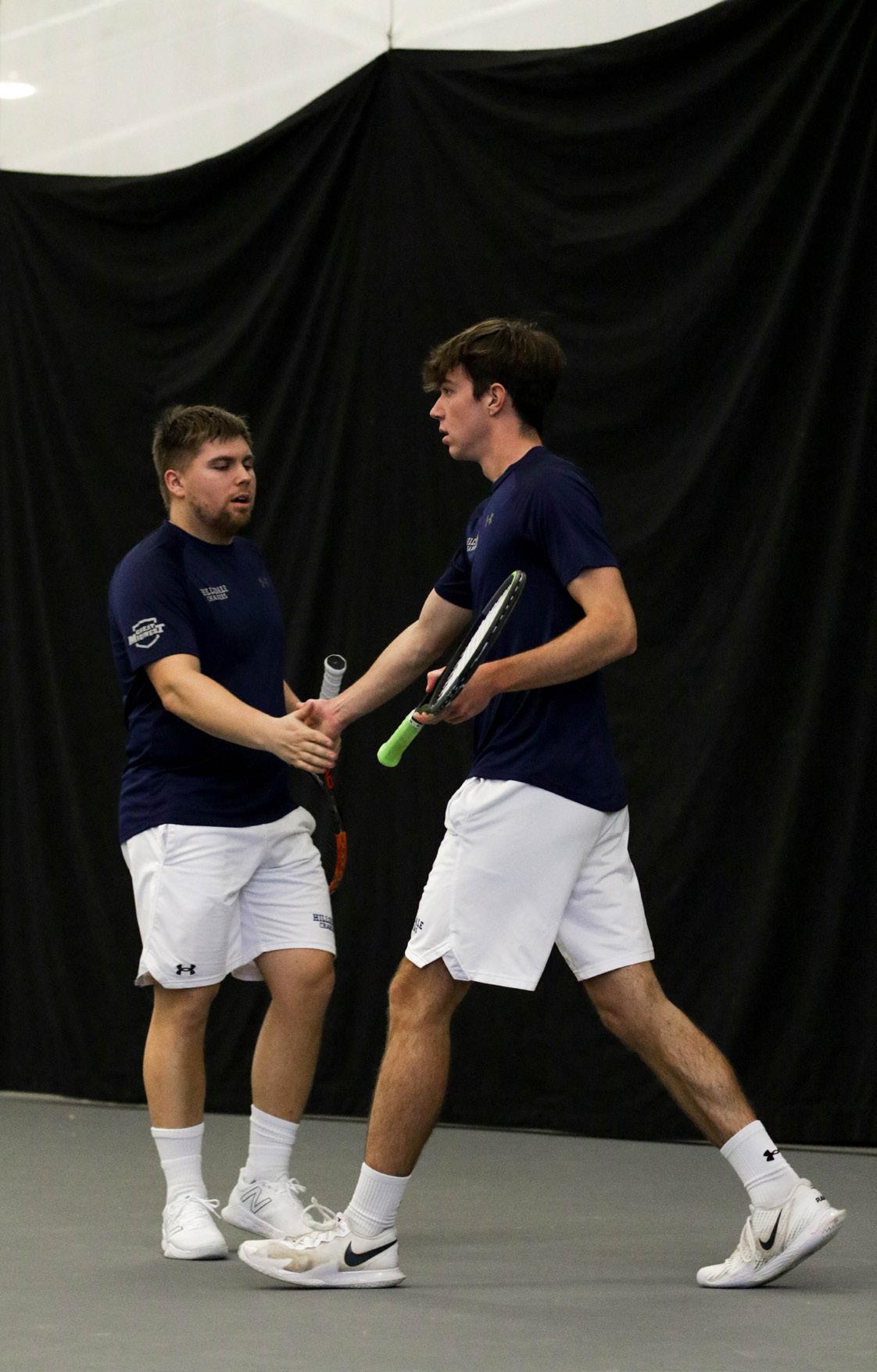
Cimpeanu and Hackman won their match 7-5, but Barstow and Conrad, and Pack and Wastcoat lost their matches 4-6, and 3-6 respectively.
“Brian and Brennan were really good together,” Gilbert said. “They haven’t had a chance to play together since Brennan’s freshman year. They definitely have good chemistry. We got to see
how some of the other guys meshed, and maybe we’ll change it again based on that.”
Singles was a strong event for the Chargers with only one loss at No. 2 singles.

Hackman went 5-7, 1-6, Cimpeanu won 6-4, 6-4, and Pack lost his first set 0-6 but pulled through with a 7-5, 7-4 win. Conrad and Gilbert also gained singles points, winning 6-4, 6-4 and 6-2, 6-1.
“It was our first outside match of the season, and it was in 65 degree weather which we don’t really have here at this time,” Gilbert said. “It was a little tough to get adjusted to the wind and the sun, but it was fun.”
Hillsdale is headed to Florida next weekend to play against Rollins College in Orlando March 12 and St. Leo University in St. Leo March 13.
“I think just staying motivated in singles is big,” Gilbert said. “It’s tough playing a long doubles point and then going straight into singles. We just gotta bring it at the beginning of the singles matches and then Florida should be good. We’ll get used to playing outside which will help us for the conference season.”
stack all-conference teams, prepare for NCAA tournament
By Christian Peck-Dimit Associate Editor
The Hillsdale men’s basketball team is dancing once again, making the NCAA DII Tournament for the program-record third year in a row as it put a record-tying four players on the G-MAC all-conference first and second teams.
Though the team lost to Ashland for the third time this year, ending its conference-tournament run, it received an at-large bid to play in the NCAA Tournament.
After making the NCAA Sweet Sixteen for the first time in program history two seasons ago, the team made another historic run a year later, punching its first ever ticket to Evansville, Indiana, for the NCAA Elite Eight. Now, the Chargers are set to play in the national tournament for the third straight year, the only such stretch in the program’s 122-year history.
“I’m very pleased, what an awesome thing, not to get an automatic bid, but to hear your name called up there,” head coach John Tharp said.
After spending much of the season as the region’s two-seed, the NCAA put the Chargers into the fourth seed of the eight-team Midwest region.
“I thought, based on our numbers throughout the entire year, we were going to be higher,” Tharp said. “But I think there’s that whole side of Ashland beating us three times, and what do you do with Ashland?
How can they be ranked lower than us? Even though our numbers, strictly from a formula standpoint, were better.”
Prior to the team’s loss to Ashland in the semi-finals of the G-MAC tournament on Friday, the conference released its 2022-23 awards. Fifth-years, center Peter Kalthoff and guard Jack Gohlke, were selected to the All-GMAC first team, while sophomore forward Joe Reuter and senior guard Kyle Goessler made the second team.
“It was much deserved for our team overall,” Gohlke said. “I think we definitely deserved the recognition. We had some guys that had great individual years, but also that kind of just plays off of how we play pretty well together and that’s why we were able to get all of us recognized.”
The honors mark the first conference-team appearance for all four players, only one of whom, Goessler, was a full-season starter last year. Additionally, this year’s Charger squad becomes the fifth in G-MAC history to put four players on the first or second teams. Two of the other four teams to have done it were also Charger teams, from two and three seasons ago.
“We’ve had some great players and great people be a part of this basketball program,” Tharp said. “The thing that I’m most proud of is that there’s some individual talent, but they’ve always played as a team. These guys have put aside some of their own individ
ual accolades and contributed to our program, so I’m proud of that.”
All four Chargers saw both expanded roles and increased production on this year’s team, all averaging career-highs in points and rebounds per game. Kalthoff headlines the team’s vast improvements, having scored more points this year, 390, than his first four years combined times eight.
“I was a little surprised I got first team,” Kalthoff said. “I was super happy that a lot of us made some kind of honors. I think it’s really telling of something that we knew all year long, which is that we have a really balanced starting five, that’s one of our strengths.”
Goessler and Kalthoff made the All-Defensive team as well, leading a team that sits at 13th in the nation in scoring defense. Goessler leads the team in minutes and is second in steals, often guarding the opposing team’s best guard. Kalthoff led the team in both blocks and rebounds.
Multiple members of the team noted that the team’s senior point guard, Cole Nau, who led the team in steals, was left off of the All-Defensive team after what they viewed as a stellar season on that side of the ball.

“I definitely thought that Cole could have been a part of that All-Defensive team,” Gohlke said. “I think he brings a lot when it comes to guarding the other team’s best wing and being an impact defender, so it would
have been cool to see him get on that team as well.”
Following the all-conference selections, the team faced off against the Ashland Eagles for the third time this season, in the G-MAC Tournament semi-finals.
A late push from Ashland and a cold streak from the Chargers gave the Eagles a 76-69 win.
The squads were knotted up at 60 entering the game’s final minutes, but a Hillsdale scoring drought that lasted from 6:43 to 1:23 remaining, knocked the Chargers out of the tournament.
“Hopefully we’ll get a chance to see them again sometime soon,” Kalthoff said. “We’ve definitely improved upon the last two times playing them and I think we shot ourselves in the foot a couple times down the stretch, kind of hurt ourselves a little bit.”
The Chargers are set for a 7:30 p.m. tipoff on Saturday in the round of 64, playing against the winners of the GLIAC tournament, Northern Michigan. The team beat Northern Michigan by 21 when they faced off on Nov. 20 during non-conference play.
“These guys are playing really well, winning the GLIAC Championship and we haven’t been playing as well as maybe earlier in the year,” Tharp said. “That’s so far back in the past, it’s similar to what Ferris State did to us last year, and then we saw them in the NCAA Tournament and things got turned quickly.”
A10 March 9, 2023 www.hillsdalecollegian.com
-
Fifth-year
made the AllGMAC first team after a career-best season. Courtesy
Chargers
senior Peter Kalthoff
| James Gensterblum
Senior Tyler Conrad and Junior Daniel Gilbert high five on the court during a meet earlier this season.
The Chargers went undefeated last weekend against UMSL and UIS. Courtesy | Isabella s heehan
Courtesy | Isabella s heehan
D.C. campus dances the night away
By
Osborne Collegian Reporter
Walking into the Organization of American States, the smells of baked brie and made-to-order crepes meet your nose. You take someone’s hand, and walk into a room filled with ball gowns and tuxedos, where students and professionals alike are dancing to a live orchestra’s performance of Johann Strauss’s “Vienna Waltz.”
“It was very magical to walk into the atrium,” Hamilton said. “You have to process into the dance, and so you line up two by two in a promenade and then join the event. It was so surreal, and like walking into a ‘Pride and Prejudice’ movie.”
Decorated with white marble, grecian columns, and the flags of every country in North and South America, the Organization of American States building opens into a courtyard with water fountains and topiaries.

This may sound like a scene out of a Jane Austen novel or a 19th century period film, but in
Washington, D.C., it is the Intercollegiate Studies Institute’s annual Viennese Waltz. An invite-only event, the students on the Washington-Hillsdale Internship Program were invited to join the table of Matthew Spalding, dean of the Van Andel School of Government.


The ISI Viennese Waltz is the only white tie dancing event in D.C., and one of two waltz events, the other of which is hosted by the Austrian embassy. White tie attire for men requires wearing tuxes, while women wear floor length gowns. In fact, the ISI has been

known to turn attendants away from the Viennese Waltz who do not wear the proper attire.
“If a guy didn’t wear a tuxedo, he was not allowed to enter,” Hamilton said.
A lot of students drew inspiration from the past in their outfits, including WHIP student Meredith Kottom, who wore her grandmother’s dress from 1968.
ton said. “Dr. Spalding taught me how to waltz while we were there.”
Hillsdale College also hosted a brief dance lesson for Viennese Waltz at the Kirby Center prior to the dance on Saturday.
“While it’s not entirely necessary that you know how to dance, we hosted a pizza and practice night,” WHIP Undergraduate Program Coordinator Mary Greco said.
“Hillsdale College has a good relationship with the ISI, so each Spring we get to bring our WHIP students and a couple of the staff members to enjoy a night of dancing,” Greco said.
The waltz was very beginner-friendly, but dancers of all skill levels attended, according to Hamilton.
“The dress was a Chinese red and was sleeveless with an embellishment on one of the sides,” Kottom said. “I also wore some vintage earrings.”
Other WHIP students recycled prom dresses, or rented outfits. Junior Caleb Holm borrowed Spalding’s tuxedos.
Students on the Washington Hillsdale Internship Program had the opportunity to join hundreds of people in the dance, including students from the Naval Academy as well as experienced dancers from the D.C. area. The ISI also hired professional dancers to perform throughout the night.
“There were professional dancers there, and also people who had absolutely no idea what they were doing,” Hamil-
The waltz has been running for the past forty years, but it was canceled in 2020 or 2021 due to COVID.
“The ISI brings in professional dancers to the event,” Hamilton said. “It was very aesthetically beautiful, but you could also just do a basic waltz step if you didn’t know how to dance.”
However, participants don’t need to know how to dance to attend.
The ISI provided everything from cheesecake to creme brulee and chocolate mousse, as well as a crepe station, where you could order toppings and have a fresh crepe made for you, Hamilton said.

“If you weren’t a dancer, you could just eat your way through the dance if you wanted to,” Hamilton said. “It was literally dessert heaven.”
Old world, new jokes
By Catherine Maxwell Collegian Freelancer
A.M. Juster was a visiting fellow with the English department. He is a poet, a critic, a retired government official, and a lawyer.
Looking at your job history, you seem to be quite the renaissance man. How did you get into poetry and editing?
I wanted to do poetry from a pretty young age. I published my first poem when I was 8. I won a contest in the third grade and my Arbor Day poem got into the local paper. And I was pretty intent on that into college. And then a number of things happened, including a very discouraging poetry workshop I took with a big-shot professor, so I stopped for about 10 years. Then I decided I wanted to restart, but it took me a long time and I was in my early 30s before I found my poetry niche and what I wanted to do.
Why did you want to leave government work?
Sometimes you don’t have a choice. When you’re a political appointee, you come and go with the administrations. My last job actually, I think set a re-
cord for durability because I’m the longest-serving Republican commissioner, and was the only one that did a full six-year term under the independent agency statute. It’s kind of a rough business so you don’t go in expecting long runs. So, from my vantage point, it was a good long run. I feel really privileged because I worked in all three branches of the federal government. I worked in senior positions for four presidents, and I reported directly to two different parties. It was a really interesting run. I don’t have any reason to complain.
Do you see any similarities between poetry and government work?
Oh, a little bit. Part of politics in poetry is persuasion. If you go back and look at history, you’ll get classical education. Training in rhetoric was believed to be the credential you needed to write poetry or to argue in court. To be a public servant, it was all basically considered the same. We segment things differently today, but I think a lot of the skills are the same. I’ve bounced back and forth and done different things using different parts of that toolkit. Early in my career, I wrote speeches and ghostwrote op-ed pieces for politicians.
When I needed to, I would step in and write things.
What is your favorite line of poetry that you’ve written?
I guess the fact that I’m having trouble answering the question says the answer is probably no. I don’t go back and reread my own poetry a lot. I don’t have it memorized the way a lot of poets do. Sometimes I feel like I should, but that doesn’t feel right to me. So when I have time, I read the poets I admire.
What is your favorite line of poetry that someone else has written?
I’m not sure. The poem that moves me the most is Richard Wilber’s poem “Love Calls Us to the Things of This World.” For me, it feels like a religious poem. And one of the things that’s great about it is it’s moved by very mundane, everyday scenery, and yet as he looks in and reflects on it he just takes it to a whole other level. Because it’s something from the 1950s that you wouldn’t see so much anymore. It’s an urban setting where there’s laundry out on the laundry line, and yet it’s incredibly beautiful. I tend to fall for those kinds of poems.
private
From working in politics to writing poetry A Q&A with A.M. Juster about his life in the public and
Why did you decide to write under a pseudonym?
I talked about the pseudonym originally as a joke with a friend of mine because of new Office of Government Ethics restrictions on federal employees publishing their work, and then decided that it would be good for privacy. People at the senior levels of government business don’t really respect people that have artistic interests and poets don’t really tend to respect people that have those kinds of jobs. They expect that poets will be academics of one kind or another. So, I decided it was kind of a good thing to just keep my privacy.
How many languages do you know?
Well, it depends a little bit on how you count it. In terms of being really fluent, it really is just English. I don’t converse well in anything other than English. I have reading knowledge of French and Latin. I have a reading knowledge of Italian and a little Middle Welsh. With the Italian-Latin-French base, I can usually pick my way through Portuguese. It’s pretty close to Italian. With enough time I can usually pick my way through even Spanish.
By Jane Kitchen Assistant Editor
“Why do they say it’s a mystery how the pyramids were built when it’s obviously just big bricks in a triangle?”
Philomena Cunk asked Joyce Tyldesley, professor of Egyptology at the University of Manchester, in the new Netflix series, “Cunk on Earth.”
Clearly, Ms. Cunk isn’t one to shy away from tough– or ridiculous– questions.
That’s just one example of the many absurdly provocative (or provocatively absurd?) lines of inquiry posed to subject matter experts in Netflix’s most recent mockumentary. British actress and comedian Diane Morgan stars as Philomena Cunk, the show’s delightfully unreliable narrator. Plucky and half-witted, Cunk is determined to guide her audience through the entirety of human history in five 35-minute segments brimming with dubious historical commentary.
Cunk spends the bulk of each episode conversing with academics about weighty topics such as art, philosophy, and religion. Striking a tone that is somehow both ludicrous and sincere, she delivers her ridiculous questions with perfect timing and an unfaltering deadpan expression. Her charming inanity makes for a remarkably authentic farce.
Each of the series’ five episodes focuses on a different era, from prehistory to the
present day. Clocking in at roughly 30 minutes each, the series is low commitment and high payoff. Sporadic and impeccably-timed references to her friend Phil, her ex-boyfriend, and the early ’90s dance hit “Pump Up the Jam” add an element of surprise that packs a hilarious punch.
Though the show is American audiences’ first introduction to Cunk, the character has a decade-long history in British TV. She first appeared in 2013 on the BBC television review program, “Charlie Brooker’s Weekly Wipe.” In early 2018 she starred in “Cunk on Britain,” the less ambitious precursor to “Cunk on Earth.”
The show’s greatest accomplishment is its tone. It’s satirical, but not sneering or cynical. It manages to avoid the moralistic condescension that seems ever-present in modern comedy. It’s not self-important and it doesn’t try to be anything more than it is. The show is skillful execution of a simple goal: make people laugh. It’s just funny.
Diane Morgan’s genius lies in her willingness to look stupid. There’s no social commentary, no hidden meaning, and no tortured moral message. It’s not shrouded in layers of irony.
In a refreshing about-face, “Cunk on Earth” trusts its audience to value the humor simply for what it is: pure, unadulterated silliness. That’s something we could all use a little more of.
www.hillsdalecollegian.com March 9, 2023 B1
Culture
WHIP students attended a Viennese Waltz in Washington, D.C.
Courtesy | Mary Greco
Erin
a cornucopia of
the
There was
food at
event.
Courtesy | Mary Greco
Students learned how to waltz before the event.
Courtesy | Mary Greco
Junior Evalyn Homoelle and Senior Gabs Basette posed in the courtyard. Courtesy | Mary Greco
The Organization of American States had flags and statues lining the hallway.
Courtesy | Mary Greco
Culture
Winter market highlights local artisans
By Cassandra DeVries Collegian Freelancer
The Winter Market opened this year in the Hillsdale Brewing Company. Every other Saturday at 10 a.m., vendors set up tables and sell homemade items, including smoked cheeses, knitted products, soaps, clothing, and baked goods. Now, instead of waiting until the summer farmers market, customers can pay cash for a variety of fresh and unique products.
Aaron and Kathy Brackman sell smoked cheese and cream cheese at the Winter Market through their company Smokin’ B’s Cheese. They started the business after their son wanted to learn how to use a smoker, and an acquaintance mentioned smoked cheese.

The Brackmans purchased the smoker and cheese from Wisconsin and spent the next three years perfecting the art of cheese-smoking. Initially, they shared their fresh cheeses with friends, who urged them to go into business.
The Brackmans installed a commercial kitchen, got their license, and reached out to local grocery stores, who gladly began selling their products.
The couple also started attending local markets, like those in Hillsdale, to sell their products.
As customers flock to the novel
cheese company, the Brankmans hope to expand to larger markets. “Right now, it’s part time, but we hope it will take off,” Aaron Brackman said, optimistic about Smokin’ B’s Cheese’s future and the growing demand for the carefully flavored cheese.
Katja Szarafinski knits hats, pot holders, coats, flowers, and bags to sell at the Winter Market. She makes her own yarn from sheep’s wool for all of her products. Last Friday, she attended a sheep shearing in Pittsburgh, Michigan, where she bought two fleeces. She washes and brushes the fleece herself, before taking it to her spinning wheel where she slowly feeds the wool into the machine, which spins the wool into a stand of yarn. Szarafinski learned to knit in grade school in a small provincial town in Germany.
“Knitting saved my life because I was pretty introverted,” she explained. “I wasn’t good at many things but I did some pretty cool knitting even back then.”
As a child, Szarafinski could not afford the fancy storebought yarn, so she learned to make her own on a spinning wheel. Years later, Szarafinski is still spinning and knitting, contributing tables full of knitted items to the Winter Market.

Kari Amstutz sells T-shirts
and soaps at the Winter Market.
“The business stems from my love of clothes,” Amstutz said. “I’ve always loved creating things.”
Using Etsy for inspiration, Amstutz creates most of her own designs, while occasionally purchasing them from fellow artists. Using her Cricut machine, she cuts the design out of vinyl, weeds it (removes the spare scraps of vinyl), and uses a heat press to seal the vinyl onto t-shirts and crewnecks. Amstutz also makes her own soaps.
“I started making homemade soap, just for our family because it’s amazing for dry skin in the wintertime,” she said. After finding the soap recipe online, she traded out several ingredients for healthier alternatives, developing her own soap recipe.
“I like to make them pretty too,” she added, showcasing a cinnamon soap with brown swirls and a cinnamon stick artfully placed on the top. “Soaps don’t have to be boring.”
From smoky cheese to homespun yarn to numerous other homemade goods, the products at the market are all far from boring. Each vendor brings unique and carefully crafted products to the table.
Rough Draft showcases lattes & live music
By Aubrey Gulick Senior Reporter
Friday nights find Rough Draft full of music and patrons from 7-9 p.m., while weekly live-music concerts give students and community artists a chance to perform for their peers in a friendly and relaxed environment.
“We want it to be more of a jam session, not something super orchestrated and overly performative. But more that, if a student just wants a study break on a Friday night or doesn’t want to do a big thing and drive to Ann Arbor for a night out, they can just come in, sit down, and leave whenever they want,” said Nikoleta Klikovac, a junior who runs the coffee shop’s social media pages. “There’s no ticket to entry; just show up.”
Friday nights and live music have always played a part in the vision for Rough Draft.
“When Rough Draft opened, the goal was to be an off-campus hangout for students, and part of that was hosting live music every Friday night; the live music kind of dropped off during COVID,” Klikovac said.

Beginning in the fall, Rough
Draft reached out to student and community artists to bring live music back to Rough Draft.
“We bring in a lot of people throughout the community. A lot of students play. We’ve had the college jazz band play and the community jazz band,” Klikovac said.
during that one hour,’ it’s just a nice break,” she said.
Concerts are very informal, with attendees sitting on couches or the floor, sipping on coffee or tea, VanHeyningen said.
“The vibe of a concert at Rough Draft is very low-key. It’s a low-pressure situation
Senior Series: Paul Trainor Q&A
By Christina Lewis Collegian Freelancer
Paul Trainor is a senior majoring in music from Nacogdoches,Texas.
What instruments do you play?
It’s just cello, and really, that’s been my thing. I’ve played it since I was 7. You know, I’ve kind of picked up a few things, dropped a few things since that point, but cello is kind of my one-stop shop.
What made you want to pursue music at Hillsdale?
so creative. I really appreciate creative minds because my mind does not necessarily work like that super easily. That would be surreal.
What’s your favorite genre to play?
I’m a classical musician by temperament. I’m a classical musician by training. It’s what I do.
What’s your favorite song you’ve played so far?
arrangements of popular tunes in the fall of 2022. They have performed at Rough Draft three times since they were initially invited after their debut at Concert On The Quad.
“We do some pop mixes that we arrange and some folk songs. At our last gig, we did some Irish folk songs and some Taylor Swift, so we go all over the place,” VanHeyningen said.
The relaxed vibe is the perfect venue for groups like Tuition and Fees to try out new arrangements and experiment with different styles.
“When we’re arranging pop songs, we’ll be like, ‘I think Rough Draft is the perfect place to try this out,’” VanHeyningen said.
Tizedes and VanHeyningen said they value the opportunity to perform and to listen to their peers outside of a college setting.

I didn’t come here to do music, actually. I came here majoring in physics and math. I had all my high school STEM credits set up, I was doing dual enrollment, I did robotics in high school. Then I came here, and I started the physics track, and I was burning out really quickly. I realized this wasn’t something that I could do long term and be fulfilled. Music has always been there. I think I kind of had my priorities flipped in high school, without really realizing it should have been the other way around. Music is something I can never get tired of doing. You could say it’s accidental, you could say it’s providential, that’s just kind of the way things ended up.
What music groups are you part of on campus?
Sophomore Phoebe VanHeyningen said that attending concerts serves as a great study break.
“It’s really important to support music outside of the academic environment. It’s never something that you’ll come to regret, like ‘oh man, I wish I would have studied
as a performer, as the setting is very social,” said Abigail Tizedes, a student artist with more than 16 years of performance experience. “It’s one of the most chill venues I’ve ever performed in.”
Phoebe VanHeyningen, Fiona Mulley, and Emily Griffith began performing three-part
“I think events like these, though small, bring communities together to enjoy something really beautiful,” Tizedes said. “Music touches the soul in a way that no other art can. I think Hillsdale students are aware of this, thus why so many show up to music-oriented events.”
Wallen releases several songs, few hits
By Josefina Cuddeback Collegian Freelancer
What’s better than Morgan Wallen’s chart-topping, 30song album “Dangerous”? His much-anticipated, 36-song monstrosity “One Thing At a Time,” obviously.
No, not really. Despite setting an all-time record for most streamed country album in one day on its release day with a staggering 52 million streams, Wallen’s 2023 album can be summed up easily: some winners, a lotta fillers.
Wallen covers all of the bases with his 36 songs, ranging from undiluted Nashville to more individual pieces paying homage to some of the greats of old country music. This range once again solidifies Wallen’s universal appeal across a multitude of demographics. His albums always have something for all, as well as several across-theboard favorites. Country music aficionados and only-in-summer, radio-country listeners can for once agree on a music
opinion, e.g. that “Chasin’ You” is actually a pretty good song.
Wallen stays consistent with the album, serving both catchy Nashville country and some older-sounding songs. He strategically dropped a three-song teaser one month out from the release date to keep excitement up. In the intervening month, “Last Night” topped the Hot Country charts and hit no. 3 on the US Billboard Hot 100. While the song is undoubtedly the most catchy on the album, several other songs from the main release deserve recognition.
The album boasted several songs that, although popular, lacked the musical genius that Wallen is capable of. Closely following “Last Night” in streams is the title song, “One Thing at a Time.” Although catchy with smart lyrics, the song stops short after the feelgood element and is nothing earth-shattering.
“Cowgirls” channels Diplo x Wallen with a distinctive, fun pop-country feel, but the chorus pretty blatantly rips off CoJo’s
hit song “Long Live Cowgirls.” “I Wrote the Book” promised to serve a raw and autobiographical set of lyrics, but rambled on repetitively and unresolved for its three-minute duration. These songs fall into the distinctive set of Wallen’s decent, add-to-thesummer-playlist songs. Love them, next please.
Wallen’s talent is more subtly displayed in some of his less ostentatious pieces. “Man Made a Bar” featured country legend Eric Church and won out with unique lyrics whose creative composition is reminiscent of Church’s own distinctive flair for songwriting.
Listeners found themselves under the lights in “98 Braves,” which, unlike the writer’s love life, connected with a fair ball as it swung for the fences. “Keith Whitley” did its namesake proud with a country love ballad which mourned the fleetingness of good things like love, whiskey, and the ‘80s country singer who passed on too soon.
Between the winners to the losers, one thing is evident: Wallen could have done in 15
songs what he did in 36. With the rise of Spotify and other streaming platforms, the high number of songs in an album is more lucrative because artists are paid based on an “album unit” of a certain number of songs.
Re-releasing many previous singles allowed Wallen to make them relevant again and recycle their money-making ability as they are streamed countless times over with the rest of the album. While critique surfaced about the album’s similarity to Wallen’s previous work “Dangerous,” “One at a Time” was still enormously lucrative, and proved an intelligent way to monetize music in an ever changing music industry.
Lucrative or not, “One at a Time” succeeded in both pleasing old fans and gaining the Tennessee native new followers. Some might critique the amount of tracks dropped at once, but ultimately the album produced several winners, and fans are not disappointed.
I am part of the fraternity formerly known as Phi Mu Alpha, which has recently been re-named Alpha Mu Phi, that’s cool. I was song master until this semester. I’m part of the college orchestra, and I’m part of the Joy Quartet within the music department. I don’t sing here– I can hold a pitch but that’s about it.

Are you involved with any other clubs on campus?
I’m vice president of the philosophy honorary, Phi Sigma Tau, and I run a Bible study in my house.
Who has been your biggest inspiration in the musical world?
One of the people who consistently always wows me–and I hate that this is so cliche, because everyone knows him– is Yo-Yo Ma. But, there’s a reason why everybody knows him. He does literally everything. He’s played everything. I reference his recordings and his performances constantly, even if I’m not agreeing with every decision he’s making. He’s just so obviously mastered his craft. I’ve actually been to see him live three times now. He’s mind blowing.
If you could do a song collaboration with anyone, who would you do it with?
Jacob Collier. Outside the world of classical music, he might be my singular favorite musician on the planet right now. He is a literal polymath with music. The only limit to what he can do is his own imagination, with the technical mastery of like 3 billion instruments. They’re all really quirky instruments, too. His vocal range is nuts, and he just has so much fun doing it. He’s so, so,
One of my perennial alltime favorites is a piece from Tchaikovsky. His Variations on a Rococo Theme, Opus 33. It’s got the whole emotional gamut. It’s whimsical, then it’s playful, then it’s manic, then it’s very somber, and then suddenly, it’s not. It’s kind of faking you out the entire time. It’s so cool to be able to take that in as an audience because you’re sort of carried along for the ride. It’s so cool to be able to create that effect as a performer and to kind of know what goes into that, which makes the learning process so much fun to bring the piece up. I think that’ll just be with me forever.
Do you have a senior recital coming up?
My senior recital is on April 15 at 7p.m. There are three huge pieces, and not really anything more, because they are huge, and it’s gonna be great. I’m a little terrified, learning them all right now. I’ve started them all already, but getting them up to speed is going to be a gargantuan task. We’ll see how it fares. One of the pieces I’m playing is actually a sonata with a harpsichord and Dr. Tacke will be playing the harpsichord with me. One of them is a Brahms Sonata with piano. The piano part is insane and Chloe Tritchka will be playing it. She’s a senior music major too. And then the other one is a Chinese piece written about three years ago for just solo cello, and that’s nuts because you’re doing all sorts of things you would never do normally with a cello. There’s guitar picks, there’s body percussion. It’s insane.
If you could have dinner with any three people, who would you have it with?
Marsilio Ficino, Gustaf Mahler, and Matthew Gaetano.
Do you have any hidden talents?
I can clap really fast. It’s something I learned when I was 12 as a way to pass time, and I don’t do it ever anymore for any reason, because there’s literally no use for it. But I don’t know, I haven’t run into anyone else who can do that. So I guess that counts.
What’s one piece of advice you would give to your freshman self? Calm the frick down. Literally, just calm down. I was not the most stable individual, and I think I just kind of learned to take in where I was and appreciate what I was doing and sort of be present with myself and everyone I knew. That would have been great. It was a wild time. That was a wild time. But that’s the first thing I would say.
www.hillsdalecollegian.com B2 March 9, 2023
The Schlueter Family performed at Rough Draft last Friday night as part of the coffee shop’s weekly performances. Aubrey Gulick | Collegian
Paul Trainor has played the cello for 16 years. Courtesy | Paul Trainor
Aaron & Kathy Brackman pose with their cheese. Cassandra DeVries | Collegian
Katja Szarafinski sells her knit goods. Cassandra DeVries | Collegian
Kari Amstutz sells t-shirts made on her Cricut machine. Cassandra DeVries | Collegian
Features
Bringing centuries of history to campus
Mossey Library archivists curate displays of rare coins and photographs of the S.S. Hillsdale Victory
By Carly Moran
Assistant Editor
In the Hoynak Archive Center, black-and-white photographs and artifacts wait to share the story of their history with curious visitors. Two new exhibits, one on the S.S. Hillsdale Victory and one featuring the Carus Coin Collection, are now on display.
Sophomore Natalie Spaulding, who curated the S.S. Hillsdale Victory collection, first decided to work in the
archives after her freshman orientation tour of Mossey Library. Special Collections
Librarian Lori Curtis showed Spaulding’s group a picture of a navy ship and asked them what it was.
The photograph featured the S.S. Hillsdale Victory, one of 160 victory boats built in 1944 by the U.S. Maritime Commission.
“I would hold up a picture and say, ‘Who knows what this is?’ No one knew, of course, but then I could give a little
QUICK HITS with Rebekah Dell
background,” Curtis said. “That brief introduction to the story inspired a student last year to do a documentary film, and then for Natalie to make the display.”
The cargo ships were used at the end of World War II to replace the bulkier Liberty Ships. Each was named for an American university, and Hillsdale College was chosen among giants like Harvard and Yale University.
“I got to basically design the exhibit from day one. I had the whole wall to fill out, seven cabinets total,” Spaulding said. “Not the entire collection made it into the exhibit. Then I went through and wrote captions for all of the materials and figured out a design theme.”
In 1944, once the victory ship was ready to launch, various donors and employees of the college gathered at the dry dock in Richmond, California to christen the ship. The party was led by Chilean diplomat and poet Juan Guzmán Cruchaga, his wife Raquel, and chairman of the Chilean delegation to the United Nations Joaquin Fernandez.


“Miss Vivian Moore was the first to collect all this material and kept it at her house,” Cur-
 By Michaela Estruth Assistant Editor
In this quick hits interview, Associate Dean of Women Rebekah Dell talks southern France, comfort food, and floral arranging.
What is your go-to coffee order? Lavender oat milk latte from Penny’s.
What’s the best piece of advice you’ve been given? Don’t miss the unique opportunities that come in your current stage of life because you are always looking to the next.
Do you have a favorite memory from your time as a student at Hillsdale?
Can I count my senior year spring break trip to Europe? We visited Paris, Rome, and Florence in seven days and had the time of our lives.
What is your favorite spot on campus? The Arb, especially in the months of May and June.
tis said. “Unfortunately, her house caught fire in the 1960s. You can tell by looking at some of the photographs that there’s smoke damage on the edges.”
The boat was built by industrialist Henry J. Kaiser’s Permanente Metal Corporation at his shipyard. These two names would later become synonymous with Kaiser Permanente, one of the largest medical groups in the nation.
The S.S. Hillsdale Victory went on to serve in the Philippines and Okinawa during the last year of the war. The boat has since been purchased by a Dutch shipping company and sold for parts.
Across from Spaulding’s exhibit in the Hoynak is the Carus Coin Collection, curated by library technician Sarah Gilchrist.
“I plan to work with some students this coming month for a museum studies class,” Gilchrist said. “As far as exhibits or displays, I like to just pick a topic. One of the displays in the Hoynak is about German hyperinflation. I’ve got coins from that period and banknotes as well.”
The German display is a part of the larger collection owned by the college.
Summer, fall, winter, or spring? Spring.
If you had two weeks off, what would you do? Rent a house in a quiet European town. You’d likely find me somewhere in southern France or Switzerland.
Favorite place you’ve traveled? Place you want to visit?
Can I pick three? Time spent in southern France, Morocco, and the Faroe Islands all hold a special place in my memory. The place to visit that has been on my bucket list the longest is Antarctica. I’ll get there someday!
Pets, yes or no? If yes, what kind? No pets. I was raised on a farm and prefer outdoor pets only.
Who is your favorite female Bible character? The story of Ruth is one I’ve returned to a number of times.
“The largest donation was given by a man named Alwin Carus in 2004. He traveled a lot. He learned about the German hyperinflation during the 20s and visited Germany during that time,” Gilchrist said.
The college received roughly 1,000 coins from Carus alone, with currency ranging from ancient to modern and from China to England.

“You put them in little slabs because it’ll keep it airtight. You don’t want any oxygen, any air or other particles messing with the metals or the design on the coins,” Gilchrist explained.
Who was your favorite princess growing up? Cinderella.
What is your favorite pastime?
Floral arranging. I grew up with a mom who had a floral design business out of our home, and it is a skill that I learned at a young age and still brings me so much joy.
Do you have an all-time favorite movie?
“Far and Away.” It’s a sentimental favorite for several reasons.
Where is the best place to shop?
I thoroughly enjoy the Allen Antique Mall. My family owns a home goods store in southern Ohio called the Sugartree Mill Company, and I meander through every time I visit.
If you could recommend one book to young women ages 18 to 22, what would it be?
“None Like Him” by Jen Wilkin.
Spaulding learned her archival skills from both Curtis and Gilchrist. They work as a team to make the archive collections more accessible.
“We’re working towards making the Hoynak Center more accessible to students, faculty, staff, everybody,” Curtis said.
The S.S. Hillsdale Victory display will be featured in the Hoynak Center for the remainder of the semester.
“I love what they did with the archive center for the President’s Ball,” Spaulding said. “I thought that was great because they made it what it’s supposed to be: they made it an art gallery.”
What is your favorite homemade meal?
My mother’s homemade chicken and noodles with mashed potatoes. The perfect comfort food that reminds me of home.
What do you think is the best holiday? Christmas.
What does your ideal weekend look like?
My ideal weekend includes a slow start to the day with a good cup of coffee and a book, a creative element — working on a personal creative project, visiting a museum or art fair — time outside in nature, and a good meal with close friends.
Do you have a favorite memory in Hillsdale after college?
A group of dear friends gathered in my backyard for a seven-course dinner in honor of Dr. Tom Conner’s retirement from Hillsdale and 70th birthday.
www.hillsdalecollegian.com March 9, 2023 B3
her first home.
Rebekah Dell celebrates purchasing
Courtesy | Rebekah Dell
Guests wait for the launch in Richmond, California.
Courtesy | Mossey Library
These coins originated in Rome during 31 A.D. Courtesy | Mossey Library
Raquel Guzmán Cruchaga, wife of Chilean diplomat Juan Guzmán Cruchaga, celebrates the launch of the S.S. Hillsdale Victory and waits to christen the ship with a decorative champagne bottle in hand.
Courtesy | Mossey Library
Features
‘Walking the walk’ by living out pro-life activism
Faced with an unexpected pregnancy during her sophomore year, Sabrina Sherman embraced the opportunity to honor her pro-life beliefs. Her son, Wyatt, was born in November 2022.

 By Maggie Hroncich Editor-in-Chief
Junior Sabrina Sherman has always been pro-life, but she never expected how soon she would be challenged to live out her beliefs. After finding out she was pregnant in March 2022, Sabrina faced health complications, severe morning sickness, and pressure to abort — all while taking a full course schedule.
“Obviously, it wasn’t a part of our plan to have things happen this quickly,” Sabrina said of herself and Lucas Sherman, her now-husband. “We were seriously dating for a while. And then I got pregnant and we got engaged. We were planning on getting married after we graduated, but we moved things up before Wyatt was born.”
Sabrina, who is president of Hillsdale’s Students for Life chapter, said having a baby has changed how she approaches her work.
“One of the biggest reasons why people argue for abortion is, ‘What if you’re in college and unmarried and unemployed, and then you get pregnant randomly and then you have to have abortion for that situation?’”
Sabrina said. “And that was kind of my situation.”
Sabrina hopes telling her story will inspire others who face unexpected pregnancies. She said the pro-life club is focusing on street activism this semester and is planning several events outside of Planned Parenthood clinics.
“I actually walked the walk. I was put in that situation, and I think I’m handling it well, as well as I can,” Sabrina said. “I hope that I can use my knowledge to help other people not make that choice.”
Junior Katie Reid, vice president of Hillsdale College for Life, said she was always confident in Sabrina, even during the initial panic about her pregnancy. “Sabrina has never wavered in her pro-life convictions,” Reid said. “ So when it came to her being in that position, we knew, rallying around her, that she would choose life.”
Sabrina and Lucas Sherman got married civilly last summer and plan on having a religious ceremony as soon as their financial situation allows.
“We kind of split our wedding in half. We did a civil wedding at the courthouse in August at the beginning of the semester,” Sabrina said. “It was important that we at least had our marriage license, but we’re Catholic so we’re still planning on having a convalidation ceremony.”
Lucas said the initial reaction to the pregnancy on campus was mixed.
“Some people have been very nice — in particular Greek InterVarsity threw us this whole surprise baby shower. We were really touched by that,” Lucas said. “No one’s been mean to us directly, but there have been things that have gotten back to us. People talk behind our backs a lot.”
Both Sabrina and Lucas took classes during her first trimester, which was complicated by health issues that left them both with a few incomplete classes in the spring. The Shermans had their baby in the fall.
“All of last semester, I was pretty much showing, and then he was born Nov. 7. So that was right before finals,” Sabrina said. “I had five classes in the fall semester,
and I was pretty pregnant in all of them and no one gave me any trouble. Most of my professors were super nice and helpful and understanding.”
The Shermans said that although completing coursework has been a challenge, the college administration has worked with them extensively.
“The college especially has been super awesome,” Sabrina said. “Dean Philipp calls me from her personal cell phone just to say, ‘How are you doing?’”
Three months after Wyatt’s birth, Sabrina is back to a full course load and plans on graduating this year. Lucas,
who currently stays home with Wyatt, is in the process of being hired for a full-time job.
Lucas said child care has been complicated by Wyatt’s treatments for a severe case of laryngomalacia, a condition in which loose tissue in his larynx makes it difficult for him to breathe. Wyatt’s breathing improved after having surgery at 6 weeks old.

“We had a lot of appointments originally at Hillsdale Hospital, and then we transferred to the University of Michigan Hospital because we needed more specialized care,” Lucas said. “They literally saved Wyatt’s life.”
When she was pregnant with Wyatt, Sabrina said she could already tell what some of his personality traits would be.
“We’d go swimming, and he would have a field day, having so much fun kicking around,” she said. “And then now when we give him baths, he loves baths. He’s crazy about water.”
Although the Shermans said they still face ongoing family struggles, they’ve received support since Wyatt was born.
“We had a lot of pressure from family members to have an abortion,” Sabrina said. “And now that he’s born, fast forward a year, they love him
more than they like me. They always want to hold him and play with him, and he’s the light of their lives.”
Lucas said he was always pro-life but wasn’t passionate about it until he watched the process of pregnancy and birth firsthand.
“Nothing changed from before the birth until after the birth. It’s the same person, just a different stage of development,” Lucas said. “I’m so glad we went through with it. It’s been difficult, but he’s been really one of the greatest things to ever happen to us.”
Embracing the Michigan tradition of euchre
By Olivia Hajicek
Assistant Editor
The euchre league at Hillsdale’s American Post came together again on Thursday night after taking a week off due to the recent ice storm. The league meets at 6:30 p.m. every Thursday at American Legion Post 53. Last week

eight groups played euchre, while other attendees sat at the bar or talked over food.
League member Mary Rogers said the group used to play euchre often but took a break due to COVID-19. “It’s fun to hear everybody laughing and talking, especially after not being able to come for a couple of years,” Rogers said.
Rogers said she has been playing Euchre since she was a little girl.
“My mom was a big card player, so we played cribbage. I learned to count by learning to play cribbage when I was four,” she said. “I’ve been playing cards a long time.”
Rogers said the league helps to raise money for the American Legion Auxiliary, which is open to female family members of soldiers and veterans in the American Legion. Some of the money will also pay for a special dinner after the league’s eight weeks of games.
“We play for eight weeks, and then we’ll have a dinner, and then we’ll play progressive euchre after we have our dinner,” Rogers said.
In progressive euchre, the winners of each game stay at their table, while the losers move to the next one, according to Rogers.
Euchre is played in two teams of two, with players on the same team sitting across from each other. Each player has five cards and lays down one in each turn (or “trick”). Whichever team lays down the highest-ranking card
and enjoy good food and company
wins the trick. One suit in each round, called the “trump suit,” is the most powerful. After five tricks, when all the cards have been played, teams earn points depending on how many tricks they won in that round. Whichever team scores ten points first wins the game.
League member Leisha Taylor described euchre as a Michigan classic.
“I told my kids when they were little that they had to learn euchre to live in the state of Michigan, and if they didn’t learn euchre, if they couldn’t play euchre, they would be deported to Ohio,” Taylor said, laughing.
Sometimes a team gets “euchered,” which means they lose most of the tricks in a round even though they
chose the trump suit. Whenever a team at the league gets euchred, both players have to put a quarter into the cup on their table.
League member Denny Latoszewski joked that with all the quarters they were putting in the cup, he expected prime rib for the final dinner. As the cup got heavier and heavier with quarters, fellow player Tanya “Joe” Walling joked it had better be surf and turf.
On Thursday night, there was neither, but players enjoyed Walling’s molasses cookies and lemon blueberry cream cheese croissants instead.
Walling and Taylor teamed up against Latoszewski and fellow competitor Jerry Moistner.
Walling and Moistner had
competed together in the American Legion Riders’ annual chili cook-off last month, where Walling took first and Moistner took second.
Walling became distracted during the game while showing off pictures of her newborn granddaughter. She mistakenly recorded a point for another team under her own team’s name, and the other players teased her about it. Ultimately, they decided one mistake was forgivable after she jokingly tried to pawn off scorekeeping on someone else.
Competition and conversation kept some teams there until after 9:00 p.m., when the post would normally have closed.
“We started out all right, then it was downhill from there,” Latoszewski said as he and Moistner were losing the final game 8-3.
“Let’s do it Joe,” Taylor said. “Finish this game.”
Taylor and Walling ended the night by winning both that game and a majority of the games they played.
“Euchre is fun. It’s a Michigan tradition,” Taylor said. “It brings people together.”
March 9, 2023 B4 www.hillsdalecollegian.com
Sabrina Sherman and her husband, Lucas Sherman, are students and parents to their son Wyatt, who was born on Nov. 9. Courtesy | Sabrina Sherman
“I told my kids if they didn’t learn euchre, if they couldn’t play euchre, they would be deported to Ohio.”
The local euchre league gathers weekly to compete in tournaments
Pairs often play several rounds of the beloved game.
Olivia Hajicek | Collegian
