
Passages schedules new humanitarian trip to Israel
By Elyse Apel Digital eD ito R
Passages recently announced Hillsdale students will have a new opportunity to visit Israel this July.
Students on the “Advocacy in Action” trip will have the opportunity to provide humanitarian aid to those in need in Israel, visit Biblical sites, and learn about the recent attacks on the nation.
“Through this unique Israel experience, you will gain first-hand knowledge on the aftermath of Oct. 7, hear expert briefings on the current situation in Israel, and pair your knowledge with action by volunteering with communities most affected by the Oct. 7 attacks, fostering a deeper understanding and solidarity with the resilient people of the region,” a statement from Passages said.
Since the war broke out on Oct. 7, at least 33,000 Palestinians and Israelis have died, according to NPR. There are concerns the conflict will escalate, especially since Iranian forces bombarded Israel April 14, launching more than 300 drones and missiles toward Israel, according to the BBC.
Despite the attack over the weekend, which it called a “definite anomaly,” Passages is still planning the trip.
“We are evaluating the security situation on an ongoing
basis with the input of our contacts in Israel,” the statement said. “If Passages determines that we cannot provide a safe trip for you, we will cancel, and your trip registration fee will be fully refunded.”
Don Westblade, assistant professor of religion and organizer of the trip scheduled for July 7-17, said though the college and Passages cannot guarantee safety, he is sure Passages will prioritize student well being.
“An armed and trained guard will accompany the bus on which students travel,” Westblade said. “And, as on past trips, Passages is informed and adept at varying the itinerary to avoid any sites that may appear to entail an unacceptable risk.”
The trip is sponsored by the Philos Project, the Museum of the Bible Foundation, and individual donors and costs $980.
Since 2015, Passages trips have taken hundreds of Hillsdale College students to Israel, visiting sites such as Jerusalem, Bethlehem, and the Sea of Galilee.
Though the trip has now been rescheduled multiple times, with a trip in May being canceled early this semester due to safety concerns, students hope the July trip will be different. Senior Fernando Bravo is one of those students.
See Passages A2
Chasing the corona: students, professor study the eclipse
By Eleanor Whitaker Collegian Repo R te R
Olivia Young was starting to cry.
Although the fourth-year physics Ph.D. student from Rochester Institute of Technology had collaborated with a Hillsdale professor to study last week’s total solar eclipse for more than two years, nothing could prepare her for the sight of that wispy white halo enveloping the shadow of the moon.
“It was like nothing I have ever seen before,” Young said.
After the halo disappeared in a flash of emerging sunlight, Young turned her eyes to the website she had open, refreshed the page and watched the eclipse a second time — through the eyes of a radio telescope.
Young was not just in the path of totality to admire the eclipse. She was also there to take data on the sun’s corona, a layer of the sun’s atmosphere that is as mysterious as it is beautiful.
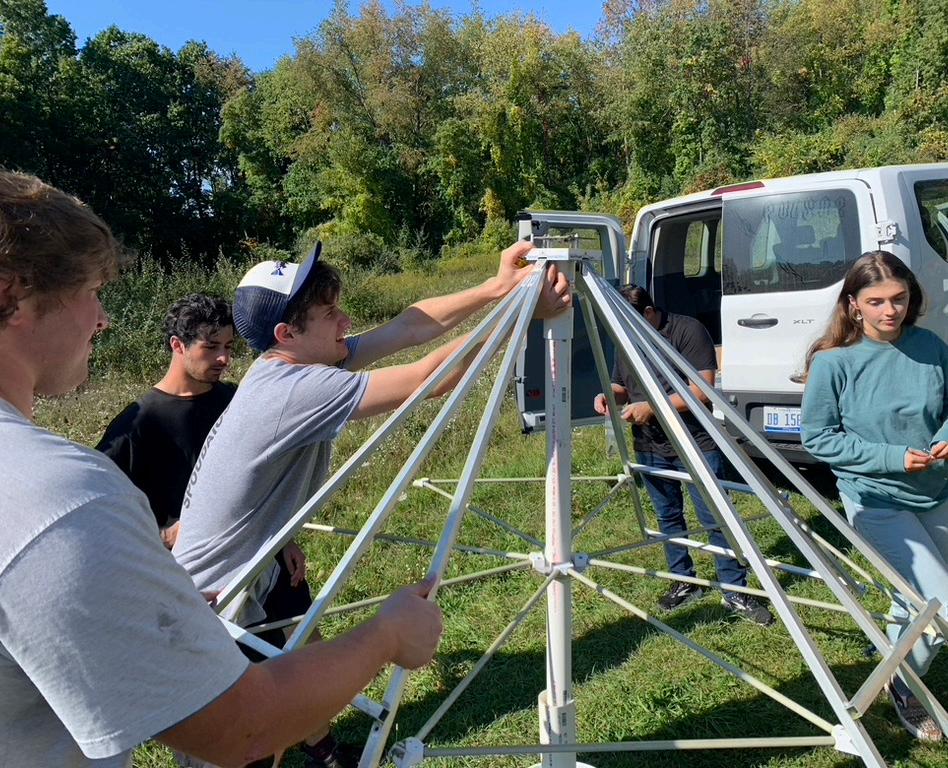
Over the past two years, Young collaborated with Associate Professor of Physics Timothy Dolch and several Hillsdale College students to build four Christmas-treelike metal structures in Observatory Park, Ohio. The four antennae combine to form the Deployable Lowband Ionosphere and Transient Experiment telescope. It records the natural radio
light emission from the sky at frequencies lower than optical light at 30-45 megahertz.
According to Young, researchers know very little about the sun’s atmosphere at these low light frequencies of radio astronomy because the atmosphere is difficult to isolate from the rest of the sun.
“You really can’t study the sun’s atmosphere very effectively in radio astronomy, because of the way that the telescopes work,” Young said. “The only time you can do it is when the sun is conveniently blotted out by some -
Documentary filmmaking class premieres ‘Hillsdale to Hilltop’
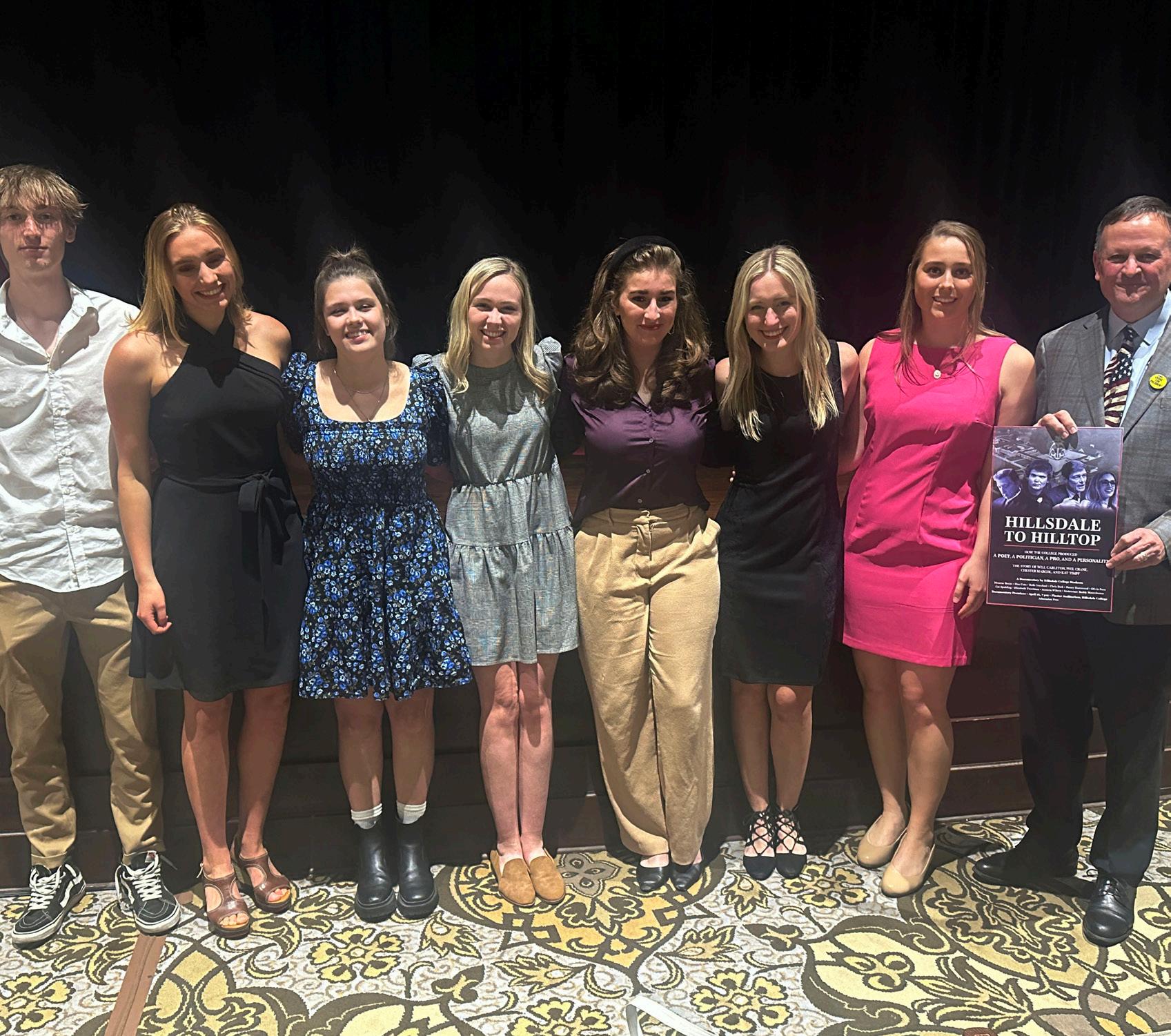
Students in the documentary filmmaking course premiered “Hillsdale to Hilltop: How the College Produced a Poet, a Politician, a Pro, and a Personality,” which explores the lives of four prominent Hillsdale alumni and how the college prepared them to achieve success.
The documentary covers poet Will Carleton of the class of 1869, Illinois Republican Congressman Phil Crane ’52, Green Bay Packers kicker Chester Marcol ’82, and Fox News personality Kat Timpf ’10.
Students in the course, part of the Dow Journalism Program, produced the documentary. This is the third year of the documentary program and its seventh production. The students behind the documentary are freshmen Max Cote and Henry Hammond, sophomore Ameera Wilson, juniors Monroe Beute and Olivia Pero, and seniors Beth Crawford, Chris Dick, Cat Spalding, and Elizabeth Troutman. Lecturer in Journalism Buddy Moorehouse led the class. Moorehouse said he was excited about this film and fascinated by the differences and similarities between all four subjects of the film.
“I learned what a special place this is,” Moorehouse said. “The only thing those four people had in common was that they all went to the same school. They wanted to reach the top, and it was all because they got their start here.”
Spalding said she believes filmmaking is an important skill to have and will serve her well after graduation. The production process taught her many lessons, she said.
“One lesson I learned is to not procrastinate because the editing process takes much longer than I thought it would,” Spalding said. “Being able to have the skill to edit and put together a film
is irreplaceable.” Troutman said her favorite part of the production was traveling to New York and interviewing Timpf in the Fox News studios.
“It was really cool to meet someone who did The Collegian and was in the same sorority as me, and now is super successful on Fox News,” Troutman said.
The documentary showed that a Hillsdale education is invaluable and aims to prepare one for life in any occupation, Troutman said.
“I learned that no matter what challenges face you, your Hillsdale education will serve you well and carry you on to great things,” Troutman said. “Hillsdale students learn lifelong principles and are able to find a lot of success in life and have wellshaped characters because of the professors here.”
Sophomore Arden Carleton attended the premiere. She said she noticed the quality of the film and said the stories of Hillsdale graduates inspired her.
“The documentary was incredibly well done,” Carleton said. “It was both informative and inspiring.”
Moorehouse said he believes this class has taught them a lot in many different aspects of the production process.
“I’m so proud of what the students did on their film,” Moorehouse said. “They worked so hard and put so much work into it.”
thing else, which would be an eclipse.”
Young and Dolch met because of their shared interest in radio astronomy. When Young heard Dolch was planning to build a radio telescope in Ohio to take data on the eclipse, she jumped at the opportunity to get involved and took a position as the principal investigator of the project.
With the data from the DLITE telescope, Young and Dolch aimed to determine where in the corona low-frequency radio emission comes from and better
understand solar radio bursts — questions that could only be answered during this rare eclipse.
“You can see the corona in optical light, but it is even bigger in radio light,” Young said. “There has not been enough research to be able to define how big it is in radio light, so that’s one of the really exciting research questions that we’re hopefully going to be able to shine a little bit of light on.”
Q&A: Princeton professor encourages free speech, debate on campuses
By Moira Gleason a ssistant eD ito R
Robert P. George is a professor of jurisprudence and the director of the James Madison Program in American Ideals and Institutions at Princeton University. He has served as chairman of the United States Commission on International Religious Freedom, a presidential appointee to the United States Commission on Civil Rights, and on the President’s Council on Bioethics. He holds a juris doctor and masters of theological studies from Harvard University and a doctor of philosophy, bachelor of civil law, doctor of civil law, and doctor of letters from Oxford University.
What is your advice for students who may want to go into public life?
I think the most important thing for all of us is to discern our vocation, our calling, and not to be deflected from pursuing what we discern to be truly our vocation. For some of us, that will be a life that is not lived in any major way in the public view. I think we all have certain responsibilities as citizens, so we’re all to some extent living in public as citizens. I think we all have obligations to be good citizens and to participate in public deliberation and discussion. So there’s a limited sense in which all of us do live in the public domain. But not all of us are called to be activists or to be primarily concerned vocationally with public discussion, persuasion, advancing worthy causes, and so forth. I’ve discerned my own vocation to be one that puts me very much in public life. But
that doesn’t mean that you have that same vocation. That’s the thing about vocations, they’re different. If you do discern a vocation to a life that gives you a more public role, you should embrace it. It will come with slings and arrows. And if you’re thin skinned, you have to toughen up. You shouldn’t just assume because ‘I don’t like criticism’ or ‘I don’t take criticism well,’ that ‘it must be the case that I don’t have a vocation to public life.’ It might be that you do have a vocation to public life and what you have a need to do is toughen up so that you can bear the slings and arrows that come, so that you can take criticism as well as dish it out.
What brought you to Hillsdale?
I was invited to come by Professor Schlueter and by the Federalist Society chapter. Professor Schlueter is an old and dear friend. He visited the James Madison Program at Princeton, which I founded and direct, as a visiting fellow about a decade ago. And so we spent a year together and got to know each other. I myself have been involved with the Federalist Society at the national level for most of my professional career, and so I’m always happy to help Federalist chapters. I love coming to Hillsdale not only because I greatly admire the work that the college does and the kind of education and formation that it gives its students but also because of Dr. Arnn, who’s another old and very dear friend.
See Q&A A2
Vol. 147 Issue 26 – April 18, 2024 www.hillsdalecollegian.com Michigan’s oldest college newspaper
See Eclipse A2
Lecturer in Journalism Buddy Moorehouse (right) and his students pose after the screening of their documentary “Hillsdale to Hilltop.” John J. Miller | Collegian
Seniors Whit Lewis and Evan Anthopoulos, sophomore Liam Swick, and junior Riley Hamilton set up the DLITE telescope in Observatory Park, Ohio, before the eclipse reaches totality.` Courtesy | t i M othy Dol C h
By Ellie Fromm Collegian Repo R te R
It’s off to the races on Manning Street
By Thomas McKenna Sport S Editor
Students will race makeshift chariots down Manning Street this Saturday after Taste of Manning.
“We’re going to provide materials for competitors to build a chariot,” said sophomore Ethan Bock, events team lead for Campus Rec, which is running the event. “We bought dolly bases and we’re going to get a bunch of wood, nails, hammers, saws, and tape. They’re going to build a chariot on top of the dolly.”
Teams can be any size, said
Bock, and they will have an hour to construct a chariot. Construction begins at noon and the race is at 1 p.m.
“We had a huge turnout for Naval Battle,” Bock said. “It has the same general premise. If you like constructing something and being creative, then there’s a big draw to come out even if you don’t want to be in or pulling the chariot.”
During the race, one person will be in the chariot while the other will be in front pulling it down Manning Street, Bock said. Charioteers are free to throw water balloons at their competition.
“They can try backpedaling,” Bock said. “They can try to pull it with their hands behind. They can use ropes.”
Campus Rec will place straw bales at the end of the track and along the way to stop and slow down competitors, Bock said.
“I had to tell a couple of people, ‘No, you can’t make wooden spears to throw at people,’” Bock said.
Senior Caleb Greene signed up with his housemates from the off-campus house “Egypt.” “While all of our chariots are currently at the bottom of the Red Sea, we will build a char-
iot worthy of the pharaohs for the race this Saturday,” Greene said. “We are expecting to win glory and etch our names into the history of chariot racing here at Hillsdale College.”
Students can sign up online through a spreadsheet in the Student Activities Office newsletter.
“You could also just show up to watch,” Bock said. “It’s going to be entertaining. There’s going to be chariot crashes. There’s going to be people throwing water balloons to slow down their competitors. It will be fun to watch, build, or actually race.”
Students ‘get down’ at CHP Showdown
By Tayte Christensen CollEgian rEportEr
Runaround, Schizmatics, and Spike Jäger and the Spitfires will play at CHP on April 27 after winning the top three spots at CHP Showdown Friday night.
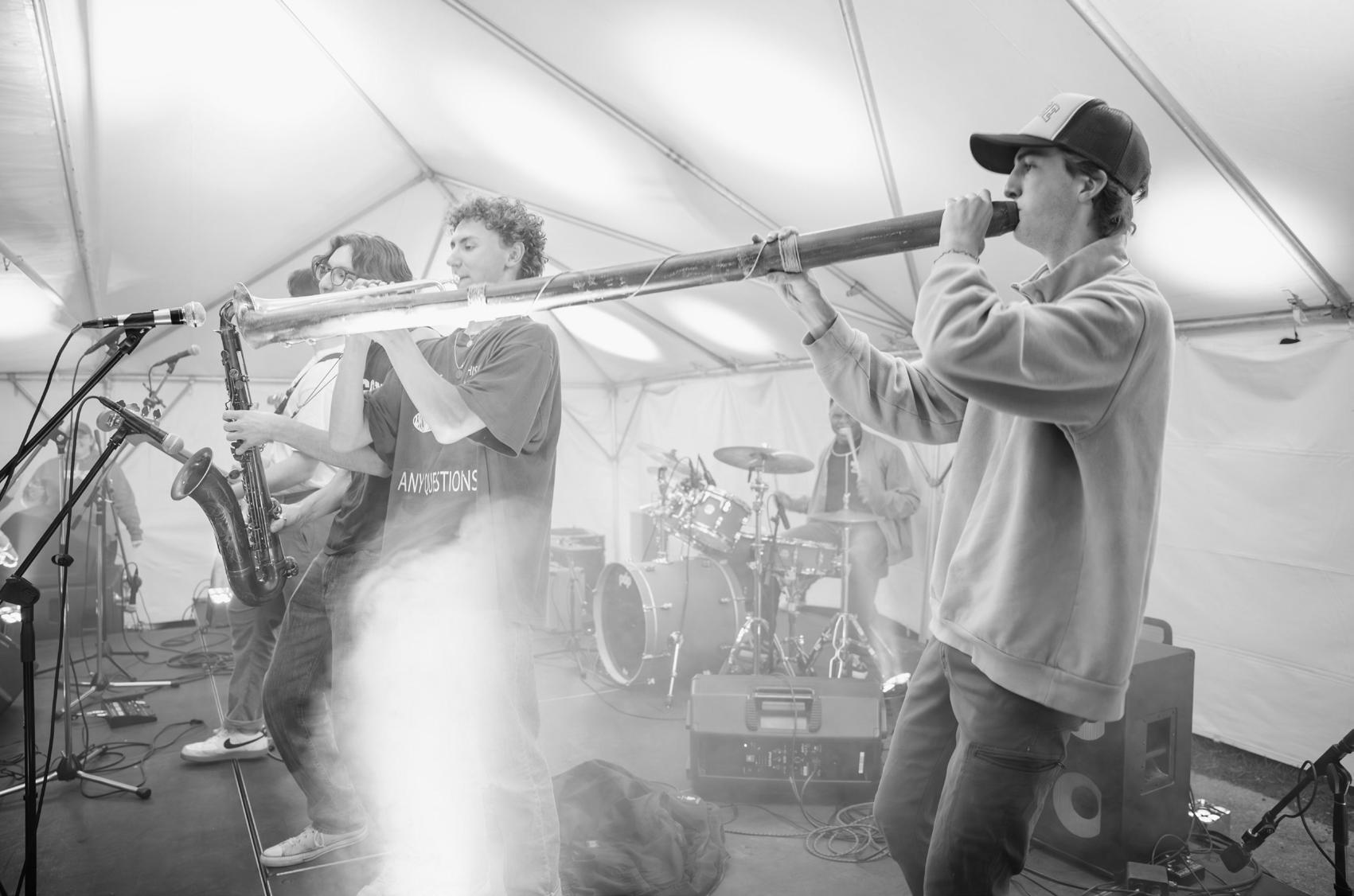
“CHP Showdown showed how Hillsdale gets down,” freshman Michael Bogumill said. Students donned glow sticks and gathered under fluorescent lights as DJ Thor & Dr. Dre, Alligator Wranglers, Ambassadors, Runaround, Schizmatics, Spike Jäger and the Spitfires, Diet of Worms, and Refresco performed at the event in the Old Snack Bar. Students tossed neon glow-in-the-dark rocks into fish bowls to cast votes for their favorite band of the night.
“All the bands had great energy and performed well,” sophomore Sophie Schlegel said. “It was such a fun experience and had me on my feet the whole time.”
Junior and SAB events team lead Abby Richardson said student attendance made for a lively event. “CHP Showdown is such a good event thanks to all the great students who come out
and support all the bands,” she said.
In addition to the music, Richardson said her favorite part of the night was the community that showed up to cheer on student bands.
“Watching all the bands play and seeing all their friends show up and support them is so sweet,” Richardson said.
Sophomore Jake Hamilton played keyboard for first-place Runaround and said the night
made for a memorable performance.
“I thought the performance was awesome. There was a ton of energy,” he said. “Everybody was engaged, the crowd was really into it, so that makes it all the more fun.”
Runaround, which formed last spring, will face its largest crowd yet at CHP, according to Hamilton.
“Playing at CHP has always been the goal of our band,”
Hamilton said. “When we formed last year, we went into it thinking we want to play at CHP next year. It’s crazy that we’re doing that now.”
For now, Hamilton said Runaround is basking in the glory of victory.
“Honestly, it still doesn’t really feel real,” Hamilton said. “But we’re super excited to be playing.”
Taste of Manning to unite campus with cuisine contest
By Michael Bachmann FEaturES Editor
Students will have the opportunity to taste home-cooked meals prepared by Manning Street residents and vote on their favorite dish this weekend.
The Student Activities Board will host Taste of Manning this Saturday from 11 a.m. to 1 p.m. In addition to food prepared by each house, the Student Activities Board will also provide coffee from Checker Records, fresh flowers, and live music per-
Passages from A1
“The people of Israel feel lonely, neglected, and fearful that the world is against them,” Bravo said. “I think it’s our opportunity as students to share Christ’s love for the people of Israel by creating an environment for them to feel like normal human beings through conversations and a willingness to listen to them.”
Jeffery “Chief” Rogers, associate dean of men, said he hopes students will use this trip as an opportunity to go serve in Israel.
“Passages is an awesome organization that takes safety seriously,” Rogers said. “This is an awesome opportunity to visit Israel when she is hurting. I get the importance of safety, but if you live a safe life, you will miss the blessed life. Besides, you can’t spell gospel without spelling go. So go.”
For more information about the trip, contact Don Westblade or visit www.passagesisrael.org.
formed by student musicians. “It’s a great way to connect off-campus life with people who live in dorms and who may not get a chance to be on Manning often,” Schaffer said. “It’s also a great way to usher in spring — provided the weather is nice.”
Senior SAB member Gabrielle Lewis described Taste of Manning as a social contract that residents of the street agree to uphold when they sign a lease.
“One thing that sets Taste of Manning apart as a tradition is
Eclipse from A1
Additionally, Young and Dolch will investigate how the ions in the earth’s atmosphere drop due to reduced sunlight.
“The Earth’s atmosphere is not as understood as you would think,” Dolch said. “The northern lights happen when the charged particles from the sun fall with magnetic field lines up to the poles and you get a lot of ionization in the earth’s atmosphere. So how exactly do these things happen? It is very hard to model, and people are learning to model it better. That is why more of these DLITE stations are being built around the world.”
Dolch, Young, and several Hillsdale students have taken four trips down to Observatory Park, Ohio, this past year to build the DLITE station.
Sophomore Joe Petullo helped construct the four DLITE antennae.
“These hardware trips have
that it encompasses the whole street,” Lewis said. “There is not another event that SAB hosts with another part of campus like Taste of Manning.”
Lewis said the event will look the same as it has in previous years but encouraged students to stick around for Campus Rec’s Manning Street Chariot Race, which will begin right after Taste of Manning ends. Sophomore and SAB promo team member Daniel Doyle said he is excited to host his first Taste of Manning.
been a ton of fun,” Petullo said. “I love doing hardware stuff, it is my favorite part of the project. Theory is great, but it’s nice to actually build something with your hands to see the results of that.”
According to Dolch, the design of the DLITE telescope is similar to the radio telescope owned by the college, the Low-Frequency All-Sky Monitor, but also has the ability to take higher definition images of the sky, as opposed to taking radio light spectra.
“We had both telescopes on during the eclipse so that there might be solar radio bursts in the data from both,” Dolch said.
During totality, Young saw the radio light from the sun decrease as expected, but the data will need to be analyzed further to determine the size of the corona in this frequency.
“There was a pretty significant dimming. There are a couple different things that
College Republicans to host Kathy Barnette for talk on political strategy
By Jackson Casey Coll E gian Fr EE lan CE r
The College Republicans will host conservative political commentator Kathy Barnette for a political strategy talk entitled “Block, Tackle, Steal: A Game Plan for the Republican Party” on Monday, April 22, at 7 p.m. in the Hoynak Room.
“If anyone knows what the game plan of the GOP should be this November, it’s Kathy. I strongly encourage all of campus to show up,” freshman and treasurer Josiah Jones said. “This event isn’t just for politics majors — everyone is welcome, and it will surely inspire everyone in attendance.”
Barnette has most recently served as the National Grassroots Director for Vivek Ramaswamy’s 2024 presidential campaign. She ran unsuccessfully for a U.S. Senate seat in Pennsylvania in the 2022 election cycle. Prior to her involvement in politics, Barnette served in the United States Army Reserve and the United States National Guard and also worked as a financier. Jones said Barnette’s life and career are admirable.
“Last year I played live music and I am excited to be on the other side this year,” Doyle said. “We will have two musical performances on the Lodge porch this year.”
Junior Cecelia Cummins, a first time Manning Street resident, is prepared for some healthy competition.
“We are using our famous Lodge white chili to beat Harbor and show that they are not actually great cooks,” Cummins said. “We have been waiting for this moment all year long.”
we have to do to make sure it was actually due to the eclipse, which we think it’s going to be,” Young said. Young, Dolch, and Hillsdale students will work on analyzing the data from the telescope for both the ionosphere and corona projects over the next few months.
Meanwhile, the DLITE telescope will continue to take data on radio frequencies from the sun and the atmosphere.
“We’re going to keep taking data because it’s not just about the eclipse,” Dolch said. “The DLITE is observing radio sources all the time, and it’s a good instrument. Things will flash that you’re not expecting in the radio sky, so we’re excited to keep using this instrument.” Dolch said he cannot believe this project is part of his career.
“This is my job. This is awesome,” Dolch said. “It is kind of an adventure.”
Freshman Drew Bennett was enthusiastic about Barnette when she first entered the political arena, he said.
“I’m really looking forward to hearing Kathy speak when she comes to Hillsdale. I first heard about her when she ran for U.S. Senate in Pennsylvania in 2022,” Bennett said. “I’m not from Pennsylvania, but she seemed like the best candidate with the most potential out of those running in the Republican primary.”
Bennett said he took note of Barnette’s crucial role in the Ramaswamy campaign.
“I followed the Vivek Ramaswamy campaign closely over the past year or two and was really impressed with his expansive policy platform,” Bennett said. “Kathy was an inspiring member of his team, and I believe she played a significant role in bringing Vivek from being relatively unknown to polling in second and third place later in the primary.”
Dues-paying members of College Republicans are invited to a private policy panel and book signing following the talk.
“She will be giving an important message on a winning strategy that Republicans should adopt in 2024,” Bennett said. “I believe Kathy has a bright future ahead of her, and I’m excited to attend the event and book signing.”
“Kathy is nothing but inspiring — she was born in poverty in the rural deep South and has experienced the American dream first hand,” Jones said. “As a Pennsylvanian, I vividly remember watching her last-minute surge against her more established competitors, all while being completely funded by the grassroots.”
Q&A from A1
How did you first meet Arnn?
Dr. Arnn and I have known each other since Dr. Arnn was at the Claremont Institute. It was many years before he became president of Hillsdale. I can remember what our first conversation was about. He won’t remember this, but I remember. It was about Thomas Hobbes’s statement in “Leviathan” that “the thoughts are to the desires as scouts and spies to range abroad and find the way to the thing desired.” That is Hobbes’ view of practical reasoning as purely instrumental. Reason can’t tell you what to want or can’t adjudicate among wants on the basis of what’s truly the best thing to want. All it can do is enable you to attain what you want, happen to want, whatever it is you happen to want. That’s a view that fundamentally challenges Aristotle’s view or the older view that reason is not purely instrumental. Its role is not simply to enable us to get what we want, whatever we happen to want. It helps us to understand what is truly wantable, what is truly good and therefore should be wanted because it’s good. Our first meeting I think somehow we got onto that topic and had a wonderful conversation about it. And we’ve been friends ever since.
What can colleges do to preserve academic freedom and freedom of speech on campus?
It’s really a matter of sticking to our principles. We say in universities like the one at which I teach that we are truth-seeking institutions. We want to empower our scholars, our professors, to boldly seek the truth on every subject, whether it’s in the natural sciences, whether it’s in the social sciences, whether it’s in the humanities, whether it’s in mathematics, and speak the truth as best they understand
the truth. We say that. And for that to be done, for that truth seeking mission to be prosecuted, you need conditions of freedom. We acknowledge that formally in our universities. We say that we believe that truth is best discovered or advanced or our knowledge of it deepened by the clash of ideas, by letting the best arguments be made on the competing sides by trying to assess the best that has been thought and said on all sides of issues on which people disagree. We say all those things, but too often in colleges and universities today, we say them but we don’t live by them, we don’t honor them. So people are punished or disciplined or disadvantaged in one way or another or marginalized because they make arguments that are unpopular, they take positions that are unpopular, that are contrary to the dominant positions on campus.
What is the relationship in your view between respecting free speech and requiring civility in discussion? You can’t have a classroom discussion without civility. The truth-seeking mission is not advanced by us calling each other names or shouting at each other. Civility is very important, and you need civility in college classrooms. I have no problem with individual professors insisting on civility or with the university saying civility has got to be respected. You can’t just call people names. That’s not an argument. That doesn’t advance the cause of truth seeking. You can’t just shout at people. You can’t be abusive. You can’t harass people. You can’t threaten people. Genuine free speech and academic freedom does not require that we abandon our prohibitions of threats, harassment, incitement to violence, defamation, obscenity, or any of the other categories of expression that the Constitution of the United States in its First Amendment does not protect.
www.hillsdalecollegian.com How to: Advertise with The Collegian To advertise in The Collegian, please contact Nathan Stanish at nstanish@hillsdale.edu. How to: Subscribe to The Collegian To receive weekly issues of Hillsdale College’s student newspaper, please contact Sydney Green at sgreen1@hillsdale.edu How to: Join The Collegian To find out more about how to contribute to The Collegian through writing, photography, or videography, please contact Elizabeth Troutman at etroutman@hillsdale.edu. A2 April 18, 2024
The Schizmatics placed second in CHP Showdown. Freshman Max Cote (right) played the didgeridoo for one of the band’s songs. Erik T E d E r | S T ud E nT Ac T ivi T i ES Bo A rd
‘Tomorrow’s leaders are at this school,’ Kehoe speaker says
By Elizabeth Crawford Assist A nt Editor
Hillsdale’s finest hour might be close at hand, and many of tomorrow’s leaders are at this school, CEO of Bold Gold Media Group Vince Benedetto said in a talk last week.
Benedetto gave a lecture on his background in the military and in media entrepreneurship as part of the Kehoe Executive Speaker series on April 10 at the Dow Hotel and Conference Center.
“I know many of you here are seeking to be entrepreneurs, and you’re learning — whether you realize it or not — through this education the virtues needed to be successful in life and in business,” Benedetto said, adding that starting or running a business requires a great deal of “Churchillian spirit.”
“In this landscape, the answers about how to move forward and be successful in business are not always found in the latest business book or self-help group,” Benedetto said. “Many of the answers about how to
move forward boldly are best found by actually looking back.”
Benedetto said that his time as a student at the United States Air Force Academy and then later working for the Air Force’s Office of Special Investigations prepared him for business and life as an entrepreneur. “What I learned, singularly, was that my limits are far beyond what I think they are, and that’s true of all of you,” Benedetto said. “Your body and your mind think they can do a certain amount of something, but they can endure so far beyond that. And that’s a great lesson for business — because you can’t quit in business.” Benedetto also said that working in counterintelligence — which required building networks of experts and reasonably reliable individuals overseas — helped prepare him for business, particularly in media.
Benedetto’s Bold Gold Media Group, based in Honesdale, Pennsylvania, operates 14 radio stations throughout New York and Pennsylvania. He helped obtain the Federal Communi-
cations Commission licensing for WRFH Radio Free Hillsdale, and funded and assembled all the equipment for the station.
“Without Vince, we wouldn’t have Radio Free Hillsdale,” said Dow Journalism Program Director John J. Miller.
Senior Lydia Hilton said Benedetto’s military experience set him apart from other Kehoe speakers.
“After different confrontations were over with the U.S., his position was closed, and that’s when he started into radio,” Hilton said. “He still used his military tactics — which was different from other Kehoe speakers who used their educational background or college. He used what he learned in the military, which was a wholly different perspective.”
Executive Director of Career Services Ken Koopmans said Benedetto’s advice on maintaining local relationships in business and using local banks is consistent with the mission of the college.
“It was unique for them to hear a little bit about someone
who had an idea, didn’t have access to the money, and he gave them a pathway to show them how it’s done,” Koopmans said.
After getting out of the military, Benedetto said he used his local bank to help him buy a few radio stations that were for sale.
“He talked about never viewing failure as an option,” Hilton said. “If he needed a certain amount of money, if he needed a loan, he had to get that money, and he would get it from any source necessary.”
Benedetto said all business is local, and encouraged students to focus on local relationships as an entrepreneur.
“People invest in you, as much as your idea and what you stand for,” Benedetto said.
Koopmans encouraged students to attend Kehoe dinners and learn from different people outside the classroom.
“It’s an environment where you can ask questions, get oneon-one, and perhaps just find somebody to get an internship, get a full-time job at some point,” Koopmans said.
Library hires technician for Archives and Special Collections
By Catherine Maxwell AssistAnt Editor
Mossey Library has hired a new library technician to assist in Archives and Special Collections.
Markie Repp joined the library in April and will assist with cataloging, sorting, and archiving and help with exhibits and collections. She was previously the director of operations for external affairs at Hillsdale College, where she worked with the Center for Constructive Alternatives.
“The college has a wealth of archival documents and artifacts that I think is pretty incredible for a small college,” Repp said. “Something I want to do and enjoy doing is preserve history. By preserving it, we can teach it and share it with others, which I think is very important as people attempt to rewrite or erase history.”
Archivist and Special Collections Librarian Lori Curtis said the college archives contain multiple collections, such as the papers of Winston Churchill biographer Sir Martin Gilbert and Hillsdale documents ranging from board minutes to official publications.
Although Repp studied history, she worked as a nurse for 12 years before joining External Affairs in 2020. She said she loves ancient European and American history.
“History is what I love and what I’ve always loved,” she said. “I’m a huge Ulysses S. Grant fan and I found out the other day we have a Grant letter, so that was pretty awesome. I haven’t seen it, but maybe someday.”
Repp said she also likes the college’s rare books and has collected some books herself. “I do have an 1868 book on Grant and his vice president at the time, Schuyler Colfax, and I have a mid-1800s book on George Washington.” she said. “One of my prized books is a first edition book about the Titanic sinking in 1912.”
Curtis said the library created Repp’s position because the archives department needed extra assistance. When Curtis joined the library in 2020, the archives were mostly unorganized.
“I had worked up an organizational plan, and being assigned to do this, and everything else, I didn’t make as much progress as I would like,” Curtis said. “Markie is going to help me
get organized.”
Library Director Maurine McCourry said having a professional archivist is crucial for ensuring archival materials are properly stored and used.
“Markie has a graduate degree in history, and having her on staff will allow Lori to focus more on developing, promoting, and using the collection in classes, with Markie overseeing the day-to-day work of student assistants and a lot of the physical processing of materials,” McCourry said.
Curtis said one of her current projects is digitizing old Winona yearbooks and Collegian editions. She said she also hopes to display more of the college’s collections, but that space is limited.
“We need a museum, we need an art gallery,” Curtis said. “There’s so many collections that I would love to be able to bring and get organized, digitize what we can, so folks know what’s here. I just need a bigger building.”
McCourry said she believes Repp will help Archives and Special Collections sort through all the material.
“I think most people, when they think of a small college, don’t necessarily think about the historical items that we have, and I think the amount of collections the college has — documents, artifacts, and otherwise — is significant and very exciting,” Repp said. “I very much look forward to working with these items.”
British historian speaks on imperial legacies
By Alessia Sandala CollEgiAn rEportEr
Americans must stop judging history by modern standards and realize that what they criticize still exists, British historian Jeremy Black said at an event hosted by the Center for Military History and Grand Strategy on April 10.
“Neither the British nor the Americans saw their global influence as resting essentially on control over territory,” Black said.
Black is the author of more than 100 books and specializes in 18th-century British and American political and military history.
Black said American imperialism appeared different to people from other nations at the time as well.
“Now, you could argue if you were a Native American or a subject of the British
Crown living in Canada, you would have seen America as a very imperial power and, functionally, you would probably have been right,” Black said.
Sophomore Ava-Marie Papillon said Black’s lecture explained why people today should avoid chronological snobbery or thinking the past is automatically inferior. “Even though we think that human values and nature are being constantly improved, human nature itself has not changed, only the historical context,” Papillon said. Black said people view all aspects of imperialism as evil without considering the motivations of the period. “The ideology and understanding of American power, in that context, was one in which what you were going to do as you expanded was not to create colonies of the existing
states,” Black said. “But what you were actually going to do is create new states. And that was a very important principle of the United States, that it was going to spread the model of the individual states as self-governing bodies.”
Americans have no respect for their own past because they judge it by modern standards as a result of their belief that people are better now, according to Black. “We trash our past,” Black said. “In trashing the past it is obviously easiest to associate it with values that, today, are regarded as abhorred. The idea of ruling other people is regarded as abhorred. Well, it may well be so today, but that doesn’t mean that it necessarily was in the past.”
Freshman Grace Canlas said judging the past will not accomplish anything and Black’s lecture emphasized
Chapel Choir performs Mendelssohn’s ‘Elijah’
By Faith Senne CollEgiAn FrEElAnCEr
The Chapel Choir collaborated with professional musicians to perform Felix Mendelssohn’s 1846 oratorio “Elijah” in Christ Chapel on Sunday.
The oratorio told the story of the prophet Elijah’s battle for the soul of Israel in 1 and 2 Kings of the Old Testament. The opening notes from the woodwinds were like a call to the Israelites to listen. Then Elijah began to sing 1 Kings 17:1, warning there would be no rain because they had turned away from God.
Recitatives, musical declamations characteristic of opera and oratorio dialogue, moved the plot along and with words sung with the rhythm of normal speech. The choruses and arias that followed conveyed the emotion of the music and characters.
Freshman Jillian Bober, a first soprano, said her favorite movement to sing was “Behold, God the Lord Passed By.”
“I loved the energy of the piece, and getting to add the orchestra this weekend made it really come alive,” Bober said. “The part about God being in the still, small voice is one of my favorite verses to pray about. The parts in the movement where we sang about the wind, the earthquake, and the fire were dramatic and loud, and there was a stark contrast when we sang about the still, small voice. I think this is such a beautiful musical reflection on the humility of God.”
Senior Bridget Whalen, who has been a member of the Chapel Choir since the beginning of the program three years ago, said the text and the music in the oratorio are intertwined.
Specific motifs and intervals in the music reflect the events and characters in the piece, Whalen said.
“When the pagans are calling on their gods and cutting themselves and doing crazy things, the music is very unsatisfying,” Whalen said. “And then when God is there — I’m thinking of one movement in particular when the altos and the sopranos would begin the movement by proclaiming triumphantly ‘Behold, God
the Lord passes by — it’s like trumpets. Their voices are like trumpets proclaiming the arrival of a great king.”
Freshman Anne Crites, an audience member, said attending “Elijah” was a blessing.
“It felt so amazing to be a small part of such a majestic piece of music,” she said.
“Since I was up in the balcony, I got to see the color of the sky as the sun set, which added so much to the already lovely experience.”
Freshman Anna Bromm said she was impressed by the faculty and student solos.
“It was awesome to get to hear people sing that you know and learn from,” Bromm said. “My favorite piece was definitely ‘Lift Thine Eyes’ because I love the melody and the three-part harmony, and it was so cool that they sang it from the balcony. It sounded very angelic.”
The choir practiced for two months twice a week for an hour and a half to prepare for the oratorio, according to Bober, but only practiced twice with the orchestra before the performance.
Crites said she was impressed with the talent and vocal stamina of the choir members, especially Andrew Smith, a guest performer who played Elijah.
“I had no idea how good the chapel choir really is,” Crites said. “Elijah’s skill was incredible, and I was amazed at his ability to create so many moods and feelings with his voice.”
Bober said the choir had to build up vocal endurance for the concert.
“During rehearsals, we had to conserve our voices, and Dr. McDonnell was very good about making sure we were being careful,” Bober said. “Unlike other instruments, your own body is your instrument, and so it has very real limitations,” she said.
The oratorio ended with four verses from the book of Isaiah 58, “And then shall your light break forth as the light of morning breaketh: and your health shall speedily spring forth then: and the glory of the Lord ever shall reward you. Lord, our Creator, how excellent Thy Name is in all the nations. Thou fillest heaven with Thy glory. Amen.”
Academy prepares for ‘Pirates of Penzance’
By Francesca Cella CollEgiAn FrEElAnCEr
The Hillsdale Academy thespians are preparing a performance of Gilbert and Sullivan’s 150-year-old operetta, “Pirates of Penzance.”
Wales said she was inspired to put on this particular show by the popularity it had when the Tower Players performed it a few years ago.
how people fail to see the reality of history today.
“War and conflict are part of our world and we can’t expect to engage in the world in an idealistic manner and ignore those realities,” Canlas said. “There is a necessity to study military history in order to be prepared for conflict.” Black said Americans should look at history in a different light to properly understand it.
“One of the important aspects of history is the idea of history as a trust between the generations, not that the people of today or tomorrow are expected to believe that we are necessarily great people,” Black said. “But they should try and understand why people did things, rather than automatically rejecting them.”
The show will premiere in the Sauk Theatre in Jonesville on Friday, April 19 at 7 p.m. and Saturday, April 20 at 2 p.m. and 7 p.m. Tickets are $7 at the door or online at HillsdaleAcademyPresents. ludus.com.
Headmaster Mike Roberts said he is eager to see the performance.
“The spring musical is one of the highlights every year for our school,” he said. “Students in grades 9-12 have been hard at work preparing for the show.”
Students have had one 45-minute rehearsal per week and a few weekend rehearsals, Hillsdale Academy acting coach Kathryn Wales said. “Even with how little time we get, the kids, without fail, put on a wonderful show,” Wales said.
“People were buzzing about it for months afterwards,” she said. “I thought if the college students could do it, we could probably do it.”
“Pirates of Penzance” is a change from the Academy’s most recent performance of Shakespeare’s “Romeo and Juliet,” according to Wales.
“It’s a big show and an ornate show with an incredible amount of singing,” Wales said. “We have a really big cast — around 60 kids.”
Wales encouraged Hillsdale College students to come see the show.
“It’s chock-full of professors’ kids, and it’s great fun to see the professor kids do these things,” she said.
The show will be worth the time to see, she said.
“We promise fun,” Wales said. “It is a rollicking romp of a show.”
www.hillsdalecollegian.com April 18, 2024 A3
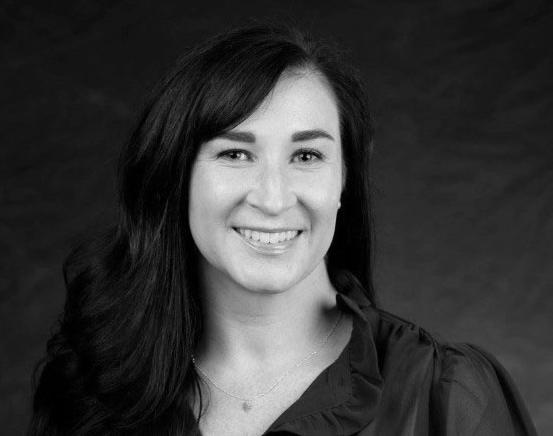
Former CCA employee Markie Repp joins the Archives and Special Collections team as a library technician. Courtesy | Linkedin
Opinions
Devil’s Advocate
Arguing against the aid package
By Christopher Martin and Charles Steele FaCulty WRiteRs
As we write, Congress is considering whether to send a large tranche of military aid to a faraway country under attack by a powerful neighbor. What follows is a short guide to some of the talking points favoring this aid that seem particularly unconvincing. We don’t pretend this discussion is comprehensive and stress that intelligent people can disagree on foreign policy. But, we fear many Americans are swept up in groupthink. We encourage everyone to think the issue through for themselves and hope the following catalog of arguments helps.
1. Proponents struggle to justify aid in terms of national interest. But the Christian worldview (and the philosophical heritage of Greece and Rome) reminds us to act only on self-interest — ideally construed as narrowly as possible. Appeals to reputation, deterrence, longrun stability, and so on only confuse this clear principle. Much of such talk is anyway just cover for motives of honor or generosity.
2. Aid proponents forget that the truth of a claim depends on the character of the person making it. We would excuse a knifing reported by a shoplifter, discount criticism of abortion from someone who once had one, and dismiss arguments for freedom made by slaveholders. Aid advocates blatantly violate this rule by condemning aggression and atrocities against civilians despite our own nation having also done bad things.
3. Cheap talk about “aggression” often ignores the imperfect moral record of victim states. In reality, departures from perfect governance justify force or invasion even if unrelated, wildly unnecessary, or disproportionate. Historians accept this justification for attacks by Barbary corsairs on ships of the (slaveholding) United States in the 1790s or Napoleon’s invasion of (autocratic, corrupt) Russia in 1812.
4. Aid proponents forget that the truth or rightness of something depends on who requests it. No one would answer an adulterer’s plea to help a drowning child. Similarly, the aid proposal is heavily favored by Democrats and the Democratic presidential administration. Since those people favor other harmful policies, this policy is also wrong.
5. Advocates talk endlessly about the high benefit/cost ratio of aid while ignoring the federal deficit. They ignore the proper either/or framing of financial tradeoffs. Families on a budget choose between heating the house, feeding their children, or buying clothing. Similarly, nations choose between foreign aid and (say) border security, police protection, maintaining Social Security, etc.
6. Aid proponents bleat that without our help the defending nation will lose, forgetting that the attacker is currently winning. They don’t recognize that weaker parties deserve to lose. Which of us, seeing a family savagely assaulted in their home, would send help before verifying the help was unnecessary?
7. Aid proponents deal one-sidedly with the risk of escalation, focusing exclusively on the risks of inaction. They forget that abandoning a friend now, while it may indeed strengthen and embolden our adversaries (especially in the Pacific), will likely sate the ambitions of the aggressor, buying us peace in our time.
8. Aid proponents don’t understand the complicated origins of the war. They harp simplistically on who invaded whom and committed widespread atrocities against civilians. Sophisticated observers, by contrast, understand the moral right of stronger nations to dominate their spheres of influence. History severely judges the Jews of Masada, the American colonial insurgents against Britain, and the few hundred Spartans who resisted benevolent Persian hegemony in the fifth century B.C.
9. Space precludes a longer list of arguments, so we end by invoking Winston Churchill. Many Americans cannot help but admire his soaring calls to resist domination by a brutal, chauvinistic aggressor. Some might even allow him to influence their thinking about the aid package. We sincerely hope this little essay has helped readers think about his words in a new way — namely, by not listening to them. Demand that Congress approve no Lend-Lease aid for Britain in this troubled year of 1941.
Why, what did you think we were talking about?
Christopher Martin is an associate professor of economics and Charles Steele is the economics chairman.
both too young and too old. Freshmen vex me. Meanwhile, most of the friends I’ve made here have already left. I need to start paying a mortgage, but I don’t really know what one is yet. Worst of all, I’m closer to having kids than I am to being one. When does youthful existentialism turn into a quarter-life crisis? I don’t know,
but I’m getting there.
The main thing keeping me sane as I toe the edge of the nest is that, as long as young people have existed, this feeling has accompanied them. Youth is — other than death — the most powerful, heart-breaking, universal equalizer out there. First kisses, first jobs, and first days of adulthood have always been this nerve-wracking and raw. When I feel like crying so hard that my lungs give way,
with Claire Gaudet

Growing pains: Too old to live, too young to die
I know I can call up my parents or talk to the Doctors Stoneman and, even if they’ve forgotten just how scary it is in the moment, I know they’ve felt this way, too. And they’re OK, so we will probably be OK.
Talk to your parents. It’s easier to like them when you’re not under their roof, and they don’t want you to mess up adulthood either.
Talk to your professors. They might be the smartest
collection of people you’ll ever be around.
As personal as this feels right now, the burden of age affects everyone. Let the hands of successful adults prop you up as you navigate the terrifying state of your mid-20s.
ism.
Vatican’s ‘Dignitas Infinita’ challenges us with radical consistency
By Caroline Kurt assistant editoR
To those more familiar with Pope Francis from headlines and Fr. James Martin clips, the Catholic Church’s outright condemnation of surrogacy, euthanasia, and gender theory as grave violations of human dignity may come as a surprise. But it shouldn’t.
Pope Francis was in the news again last week with the Vatican’s release of “Dignitas Infinita,” or “Infinite Dignity,” a phrase drawn from a 1980 address by Pope John Paul II. Released April 4, the theological treatise reflects on topics like war, poverty, human trafficking — and, notably, surrogacy, euthanasia, and gender theory — in light of human dignity.
“Dignitas Infinita” undercuts the popular perception of the Francis papacy as primarily liberal. With radical consistency, the document reflects on social issues associated with both sides of the American political divide, reminding us that faith transcends partisanship, offering a viable third way for Christians committed to reason and truth.
The document offers essential guidance on major moral issues of the 21st century. With its grounding in Natural Law, it presents wisdom appreciable by any serious Christian.
The Congregation for the Doctrine of the Faith began drafting the declaration in 2019. The pope asked for it to highlight “grave violations of human dignity in our time.”
It’s consistent with Catholic social teaching dating back to the earliest days of the Church, with the document referencing major Catholic theologians like Clement of Rome (the 4th Pope), Augustine of Hippo, and Thomas Aquinas, as well as Francis’s predecessors, Popes Benedict XVI and John Paul II.
“This dignity of every human being can be understood as ‘infinite,’” Cardinal Víctor Fernández writes in the introduction, “regardless of physical, psychological, social, or even moral deficiencies.”
This dignity is recognizable by reason, and endures through every circumstance.
Though the human person may compromise his or her moral, social, or existential dignity through sin or degrading circumstances, the fundamental, ontological dignity can never be annulled, the declaration states.
The Church grounds the dignity of the human person not in his or her present abilities (as some attempt to do with the unborn or severely disabled) but in his or her creation in the “image and likeness” of God. This unconditional dignity, intuited in classical antiquity, gained
its fullness through the person of Jesus Christ.
As the “foundation of rights and duties,” human dignity serves as the basis of the Church’s social teaching, which has much to offer Catholics and non-Catholics alike.
“Dignitas Infinita” draws attention to destructive disparities in wealth, the tragedy of wars, the plight of migrants, the marginalization of people with disabilities, human trafficking, sexual abuse, and abortion as grave violations of human dignity. Likewise, it calls out violence against women, whether through coercive abortions, the commercialization of women’s bodies, or injustice in the workplace.
The Church takes its stance on surrogacy as a “violation of the dignity of the woman and the child,” highlighting the way in which the practice turns a child into a commercial product. No adult has a right to a child. Rather, children have a right to a “fully human” conception.
The document also addresses the quiet evil of euthanasia and assisted suicide, which prey upon suffering people with a twisted conception of dignity. Suicidal, ill, and unhappy people need physical, mental, and spiritual care, not a premature death. Their suffering does not diminish their infinite
dignity, but can strengthen the bonds of love around them. The document’s treatment of gender theory is similarly apt, first affirming the dignity of every person, no matter their sexual orientation. Thus, the Church’s criticism of gender theory comes from a place of love and concern, not hate or fear. Sexual embodiment — and life itself — is a gift from God, not one of our own making.
We must reject the self-determination and deconstructionism embedded in gender theory to embrace the “most beautiful and most powerful” difference that exists between beings: sexual difference.
“Dignitas Infinita” peels back layers of misleading language surrounding these issues, giving us a way to confront offenses against dignity with charity and courage. What Christians of all kinds can take away from the text is a radical consistency of approach to our world’s most difficult moral issues.
Our challenge: to recognize the unconditional dignity of each man and woman we encounter, and to live in the hope our infinite dignity entails.
Caroline Kurt is a sophomore studying English and journalism.
The Old Snack Bar: Campus’ best-kept study secret
By Quinn Delmater Collegian Repo Rte R
It’s the only place you can get a Slim Jim at 2 a.m. and the best kept secret study spot of campus: the Old Snack Bar.
There’s nothing quite like the OSB, and in my humble opinion, there is no better study spot on campus than the former snack bar. Now converted to a multipurpose space, it’s complete with restaurant style booths to make yourself at home in and every mouth-watering snack you could desire available for purchase.
My affinity for the OSB dates back to the beginning of my sophomore year, after I had frequented A.J. ‘s and the Grewcock Student Union so often during my freshman year that I couldn’t stomach being there for more than five minutes any longer. I also spent nearly the entirety of the previous semester’s finals week in the library, and was burnt out on that, too. Plus, the color scheme in the Skittles room really
gave me a headache. Who thought that chartreuse green and deep red were a good combination?
To put it simply, I was never returning to study in any of these locations, which was unfortunate for me, as they are objectively the most popular and accessible study spots up the hill, with close proximity to food from the counter at A.J.’s when you need some fuel and the printer in the library when it’s time to turn in your hard copy. So, I began my search up the hill for a new study spot. I wrestled with my remaining options, such as a classroom in Lane or Kendall halls. But after spending the majority of my days in these buildings for my classes, that felt redundant. A study spot in Strosacker was immediately out of the question, as a humanities major like me is clearly allergic to any STEM adjacent area. Alas, my heart could not find contentment.
Until one day, when a Kappa sister suggested a new option to me: the Old
Snack Bar. I gasped when she presented the idea to me. Had I finally found my new study spot home at long last?
What began as a few late night study trips up the hill with friends to this new and mysterious spot quickly blossomed into a true love; the OSB was my study spot match made in heaven.
The vibes were immaculate. The OSB was the perfect combination of being isolated enough to truly focus on work but in the heart of campus at the same time. The dingy lighting always made me slightly uncomfortable enough to motivate me to finish my work fast, but proved to be kind to my eyes when I found myself stuck in a booth at 3 a.m. still struggling to come up with a thesis for my American Heritage paper or eavesdropping (or eaveswatching, should I say?) the swing dancing taking place right next to me on a Friday night. And, don’t even get me started on the snacks — a
whole wall of them, with something for everyone. Microwavable burritos, a vast array of energy drinks, the underrated but phenomenal Nerds Gummy Clusters, and of course, coffee. Study fuel at your fingertips!
I found the architectural layout appealing as well — with one wall of booths, and the other a floor to ceiling window leading into the abyss of nothingness between the end of the OSB and the Dow building. And the best part of all: time is not real when you are in the OSB. Existing within the bounds of this place makes one minute feel like one hour and one hour feel like one minute. Time is but an illusion, and any weird thing you may see in your time in the OSB you can also just chalk up to being an illusion. At least that’s what I do, and it works perfectly every time.
www.hillsdalecollegian.com A4 April 18, 2024
Editor-in-Chief | Elizabeth Troutman Associate Editor | Logan Washburn Senior Editor | Maddy Welsh Design Editor | Alexandra Hall Digital Editor | Elyse Apel News Editor | Isaac Green Opinions Editor | Claire Gaudet City News Editor | Lauren Scott Sports Editor | Thomas McKenna Culture Editor | Olivia Pero Features Editor | Michael Bachmann Science & Tech Editor | Olivia Hajicek Social Media Manager | Cassandra DeVries Circulation Managers | Sydney Green & Emma Verrigni Ad Manager | Nathan Stanish Photography Editor | Claire Gaudet Assistant Editors | Moira Gleason | Carly Moran| Kamden Mulder | Caroline Kurt | Jane Kitchen | Catherine Maxwell | Michaela Estruth | SK Sisk | Alex Deimel | Elizabeth Crawford Faculty Advisers | John J. Miller | Maria Servold Online : www.hillsdalecollegian.com (517) 607-2415 The editors welcome Letters to the Editor but reserve the right to edit submissions for clarity, length, and style. Letters should be 450 words or fewer and include your name and number. Send submissions to the Opinions Editor at mgaudet@hillsdale.edu before Saturday at 3 p.m. Being a college senior is awful because, for the
life,
feel
first time in my
I
Claire Gaudet is a senior studying rhetoric and journal-
Quinn Delamater is a sophomore studying rhetoric and journalism.

A Professor’s Opinion
Compiled by Quinn Delamater
“What is your favorite summertime activity in Hillsdale and why?”
Kirsten Kiledal, Rhetoric & Media
“Option 1: Driving down long country roads with my son— windows open and music blasting. Option 2: Sitting in the yard as nightfalls, the shadows and sounds of night closing in, while fire light shines on the pool and I enjoy conversation with family and friends.”
Miles Smith, History
“My favorite thing is to get up and go do work at Rough Draft for an hour or two in the morning, a nice way to start my day. The weather is always great here and it’s nice to walk there and have a glass of iced tea and read and write.
My regular go-to drink is unsweet iced tea, and my favorite cocktail is either a good Manhattan or gin martini.”
Kevin Gerstle, Mathematics
“It’s gotta be picking on summer research students! I also enjoy hiking, swimming in nearby lakes, playing video games, and hanging out with other crazy faculty members from the college. Oh, and I can’t forget eating ice cream!”
Scot Bertram, Journalism
“My favorite summer activity in Hillsdale is cycling with my son. He’s 11 now, but we started right after he learned to ride and I couldn’t stop him, so we try to get out every day possible to do it. Even on days with extreme heat, we leave early in the morning before it gets hot. A couple summers ago we did 1,000 miles around Hillsdale over the course of the summer. Sometimes we do the Concord trail, which starts in Concord and ends in Jackson. Our longest single day ride is 36 miles!”
You have to win elections, but is abortion the right compromise
By Olivia Pero Culture editor
Donald Trump said abortion should be left to the states in an April 8 video on his social media platform Truth Social.
“The states will determine by vote, or legislation, or perhaps both, and whatever they decide must be the law of the land — in this case, the law of the state,” said Trump, the presumptive Republican presidential nominee. “Many states will be different. Many states will have a different number of weeks… at the end of the day it is all about the will of the people.”
Up until now, Trump didn’t state his position on abortion in the 2024 presidential race, but abortion is a top voter issue he needed to get right. By giving the states the power to decide on the issue of abortion for themselves, Trump is establishing a campaign theme of fighting for limited government.
Former Vice President Mike Pence said he disagrees with Trump’s position.
“Trump’s retreat on the right to life is a slap in the face to the millions of prolife Americans who voted for him in 2016 and 2020,” Pence said.
Admittedly, abortion is not the issue to demonstrate this with, but Trump won’t
necessarily lose voters because of his announcement. Some pro-life voters may not vote for Trump, but most will still vote for him because they know there is no better alternative to be found in President Joe Biden, the presumptive Democratic presidential nominee.
As long as the media is around, it will always twist Trump into an evil man, pitting many Americans against him. But he can try to take a middle position on abortion and appeal to pro-choice conservatives and suburban women, too. This strategy may not work out, but if he can rely on losing some prolife voters and keep most of them who will still vote for him, the risk might gain Trump some independent and left-of-center voters. It’s a long shot, but ultimately, Trump is showing Americans he wants to give them their power back and making abortion a state issue is how he has decided to do that.
Restrictions on reproductive rights won’t help Republicans get the votes they need to beat Democrats. For example, the Arizona Supreme Court ruled April 9 to uphold the state’s 1864 law which bans almost all abortions including instances of rape and incest. The only exception is to save the life of the mother.
According to an April 16 Data for Progress poll, high numbers of voters from both parties disapprove of the Arizona Supreme Court’s decision with 82% of Democrats and 49% of Republicans saying they do not like the heavy abortion ban.
Trump is using abortion as the issue to make voting Republican more appealing to all Americans rather than just pro-life Americans. If Trump wins the presidential election, he will be able to tackle other issues Americans care about like the border crisis, education, and lowering taxes.
Trump has demonstrated an effort in the 2024 presidential race to find a position on abortion that satisfies the majority of Americans. In March 2024, Trump said he would be open to a 15-week ban on abortion, but he said he would announce his position later, wanting to figure out how best to play the abortion issue.
“Seems to be a number [15 weeks] that people are agreeing at, but I’ll make that announcement at the appropriate time,” Trump said.
Some Republicans have gone too far with reproductive restrictions, and Trump is going the other direction to make the party more appealing to win elections.
In a September 2023 interview with “Meet the Press,” Trump said Florida Gov. Ron DeSantis, his Republican primary rival at the time, made a mistake with his six-week abortion ban.
“Both sides are going to like me,” Trump said. “I’m going to come together with all groups, and we’re going to have something that’s acceptable.”
In January, Trump said during a Fox News town hall that Republicans need to win elections, and being staunchly against abortion is why many Republicans lose elections.
“We’re going to come up with something that people want and people like,” Trump said. “First of all, you have to go with your heart… But you do also have to put in a little bit — you have to win elections.”
It might seem like Trump blew it on his announcement to leave abortion to the states, but he’s a smart man who knows how to play his cards right. Trump is making an offer based on a compromise that may not satisfy his pro-life voters but one that will find a middle ground.
Olivia Pero is a junior studying politics and journalism.
Summer reading recommendations
By Zachary Chen Collegian FreelanCer
It is a truth universally acknowledged that a college student in possession of spare time over summer break must be in want of a book. Those who enjoy settling down with a good volume of poetry would be well-advised to check out A.E. Stallings, a poet and a classical scholar, writes often for Poetry and the Times Literary Supplement. I was particularly enthralled by “Like” (a Pulitzer Prize finalist) and “Hapax.”
As long as I’m on the topic of devilishly witty, classically-inspired poems, Alexander Pope’s “The Dunciad” is a hilarious parody epic in iambic pentameter which begins, “Books and the man I sing, the first who brings / The Smithfield muses to the ears of kings.” If you couldn’t get enough of Aeneas in Great Books but you want a more recent epic for your next beach read, this could be the pick for you.
Life isn’t all poetry and flowers, however — check
out Dorothy Sayers’ Lord Peter Wimsey novels if you’d prefer to ponder death, murder, and crimes. Die-hard Sayers fans are divided over whether anything can top “Gaudy Night,” but my personal favorites are “Murder Must Advertise” and “Unnatural Death.” While not quite as classic as the Lord Peter stories, Daniel Taylor’s “Woe to the Scribes and Pharisees” is also an intriguing mystery and a keen commentary on Christianity, particularly evangelical denominations.
The principle that the book is always better than the movie continues to hold true in the case of Herbert Frank’s “Dune.” A slightly less-well known series, however, is Cixin Liu’s “The Three-Body Problem” trilogy. Originally written in Chinese, Liu’s award-winning novels are both literarily enjoyable and scientifically thought-provoking. And if reading is too much work for a sci-fi novel, Netflix recently premiered a TV show on the trilogy.
Speaking of difficult
works to read, Alessandro Manzoni’s “I Promessi Sposi” – or “The Betrothed,” as it’s known in English – is one of the most highly influential works of Italian literature and an extremely edifying story. It is quite long (let the reader be warned), but is also a rewarding read. Personally, I’m looking forward to investigating Michael F. Moore’s 2022 translation this summer, though I found Bruce Penman’s 1972 translation quite readable as well.
In terms of readability, David Foster Wallace can be anything but on occasion — nonetheless, his grammar is impeccable and his prose is among the best English… ever, really. I’d recommend starting with his tennis essays: a collection such as “String Theory” is a good jumping-off point.
I really must recommend P.G. Wodehouse’s “Jeeves and Wooster” series. Jeeves and Wooster are inimitable, incorrigible, and ingenious — and they pair nicely with the Sayers mysteries men-
Brita Stoneman, Rhetoric & Media
“My favorite summer activity really has nothing to do with summer. I love building things, and the warm weather enables me to plan and make my projects outside of the garage. A more summer-y answer is that I love grilling and having family walks on nice days.”
Maria Servold, Journalism
“My favorite thing to do in Hillsdale in the summer is park wherever I want and get into confession.”
tioned above, by the way. On a completely unrelated note, “Maurice and Thérèse: The Story of a Love” (edited by Patrick Ahern) is a collection of the letters of Maurice Belliere and Saint Thérèse of Lisieux which is, quite simply, heart-breakingly beautiful.
Finally, Adrian Goldsworthy’s biography “Caesar: Life of a Colossus” provides an engaging and well-written look at one of Antiquity’s most-recognizable figures which will prove useful to anyone interested in Rome, Caesar, or the latter years of the Roman Republic.
Summer’s the time for vacations — travel to Italy with Manzoni, Arrakis with Frank, or England with Sayers. (You could even pay a visit to Pemberley Estate while you’re there.) Regardless of what you read, however, may this summer be the season when your fancy lightly turns to thoughts of books. Happy reading!
Zachary Chen is a freshman studying the liberal arts.
Senior Symposium: What was your favorite class at Hillsdale College?
Historical Geology with Anthony Swinehart
“He is the best teacher and very passionate about fossils. His love for fossils is infectious and has now made me love fossils. It’s also his favorite class to teach.”
Evan Anthopoulos, Applied Mathematics
Administrative Law with Joseph Postell
“That’s exactly what I want to do. He not only got us through some of the relevant material ahead of some of the people in law school, but it was also both good for content and good for learning the way that I’ll need to think in the future.”
Victoria Kelly, Political Economy
Galois Theory with Kevin Gerstle
“It’s been fun learning obscure math, and the class is full of a bunch of fun people, math nerds, so it’s been great.”
Emily Rose Willis, Mathematics
History of the American West, Brad Birzer
“It was something I didn’t know much about, and we looked at the West through literature as history.”
Luke Joyce, Math and History

www.hillsdalecollegian.com April 18, 2024 A5 Opinions
The series adaptation of Sayer’s “Gaudy Night.” Courtesy | BBC
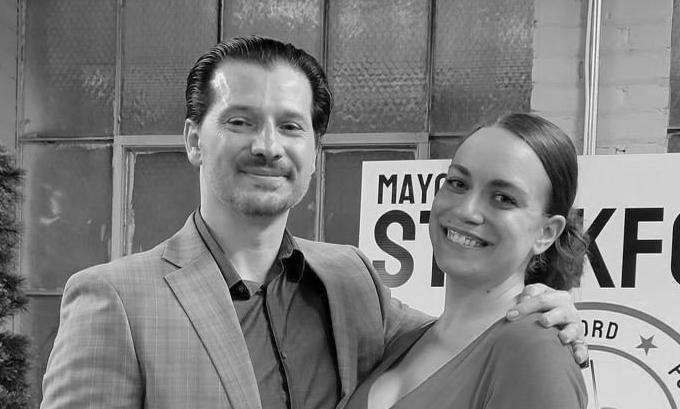
City News Arnn endorses
Stockford, a Republican, said he grew up in Hillsdale but never considered attending Hillsdale College until he read Arnn’s book “The Founders’ Key.”
“A big reason I pursued going to Hillsdale College
to run for the Michigan Supreme Court.
lican state Rep. Jim Desana, and Michigan Republican Committeewoman Hima Kolanagireddy.
has done well.”
said he is humbled and honored to receive Arnn’s endorsement. “His support means the world to me,” Stockford said. “He’s always been somebody I’ve looked up to and somebody I would turn to if I needed guidance or advice.”
“Dr. Arnn’s book was a huge motivating factor for me to want to get involved in government at all,” he said. “It’s probably one of the two or three biggest things that encouraged me to be active in any level of politics.”
Arnn said he thinks Stockford is a good mayor with good principles. “He is a good man, and I wish him the best,” he said.
Stockford said Arnn’s book encouraged him to go into politics.
“Dr. Arnn’s book was a huge motivating factor for me to want to get involved in government at all.”
was because of Dr. Arnn,” he said. “He’s one of the most influential academic minds of our generation.”
The seat is open because Andrew Fink ’06 is leaving
Stockford has also been endorsed by local business owner Steve Meckley, Republican state Sen. Jonathan Lindsey, Republican state Sen. Jim Runestad, Repub -
Stockford is running in the Republican primary against Branch County Commissioner Tom Matthew and former Quincy school board member Jen Wortz. The primary will take place Aug. 6. Stockford ran in 2020 but was defeated by Fink. “We’re being endorsed by the best and strongest conservatives in the state of Michigan,” Stockford said. “Without a doubt there’s a reason for that.” Senior Caleb Fournet said he loves to see alumni go into public service.
“It’s good that our college leaders, like Dr. Arnn, are vocal about supporting candidates who they think will promote the values instilled in us here at the college,” he said.
Stockford said if he wins, he is willing to do things for the people of Michigan that will ensure citizens have more liberty and a better standard of living.
“We’re really excited,” he said. “We’ve already got an army of conservative warriors behind us. I think that’s what Hillsdale would want and expect. They want their representatives to be strong and bold.”
Stockford faces another recall
By
Logan Washburn Associate Editor City of Hillsdale Mayor Adam Stockford faces a second recall effort after an initial one was withdrawn last week. This time, Councilman Greg Stuchell also faces a recall.
“The mayor failed to work in the best interest of the people of Hillsdale and has broken the public trust as the elected mayor for the City of Hillsdale,” petitioner Ted Jansen said. “Therefore he needs to be removed from this office.”
Jansen, a former candidate for city council, filed recall petition language on April 15, according to Chief Deputy County Clerk Abe Dane. Jansen took issue with Stockford and Stuchell voting to approve the city’s waste management contract with a provider that offered the highest bid.
“Our representatives are supposed to act on behalf of the public for the public interest, and here they’re acting on the city interest – what’s best for the city and let the people pay for it, so like a de facto tax,” Jansen said. “I’m not here to condemn people or tear them down. It’s not political, it’s an ethical issue for me.” The Hillsdale County Election Commission will hold a hearing to approve the petition language April 29 at 11 a.m. in the election
office at the county courthouse, according to Dane. If the commission approves the language, there would be a buffer period for either party to appeal the ruling in the Hillsdale County Circuit Court, after which petitioners can start collecting signatures.
Jansen would have to collect 620 signatures for Stockford and 135 signatures for Stuchell by Aug. 2 to add the recall question to the November ballot, according to Dane. He said petitioners should collect extra signatures in case some are invalid.
“This is just a tactic to try and hurt me on the ballot in August from perennial council candidates who have been rejected by the people of Hillsdale time and time again,” Stockford said.
“They’re using our courts and our city government as a playground for their campaign of pettiness and vengeance.”
Jansen’s petition language said Stockford and Stuchell “voted to award the residential and municipal trash recycling collection contract to LRS, which was the highest bidder, not the lowest” in a city council meeting Jan. 16. “This was a unanimous vote and a recommendation from our public services department,” Stockford said. At the time, LRS bid to charge residents $14.34 per month for weekly trash pick -
up and $3.61 for biweekly recycling pickup, with the price annually increasing 4.5% after year two, according to council minutes. At the same time, it offered free trash and recycling services to city facilities and public waste cans, and allowed the city to dump 25 tons of waste in the Hillsdale Transfer Facility after which it would charge $65 per ton.
Its competitor, Granger Waste Services, bid to charge residents $13.30 for trash and $3.27 for recycling per month, while charging the city $105 per month to empty four dumpsters, according to council minutes. These prices would increase 4% annually after year two.
Jansen called this a “quid pro quo,” saying it would be considered a bribe in a private context. While every council member voted to approve the contract, Jansen said he targeted Stuchell because he is a resident of Ward 1, which Stuchell represents.
“This is something that happened and is an area of corruption because you’re getting something for free and other people are paying for it,” Jansen said. “It wasn’t asked to Granger, ‘Throw this into your contract – free garbage and free dumpster pickup, and then give us your bid.’”
Stockford said he sees the recent recall efforts as politically motivated.
“They want people to get
so frustrated and annoyed they throw up their hands and say ‘Public service isn’t worth this.’ It won’t work on me. It only steels my resolve,” Stockford said. “I’m thoroughly confident their behavior won’t be rewarded. Those aren’t Hillsdale values. No weapon formed against me will prosper.”
Penny Swan, a former city planning commission member, filed recall petition language April 5 claiming Stockford “voted no on every street project, the last one being Aug. 21, 2023.” She withdrew the language April 10. Stockford voted in favor of a street project near Westwood Drive on April 17, 2023. He also voted for a special assessment district – where the city charges residents a fee to repair their street – near Williams Court on June 7, 2021, and voted in favor of another near Uran St. on Feb. 21, 2022.
“Some of those I’ve voted for. But if the residents on those streets oppose the tax increase, I stand with the residents,” Stockford said. Stockford said special assessment charges are usually close to $5,000, and residents cannot always afford the fee.
“Essentially he’s voting against fixing the roads and out there taking credit for them,” Swan said at the time. “Sneaky behind-the-publiceye finagling is not an ethical or moral way to advance in a democracy.”
Michigan law requires recalls to be based upon factual allegations.
After finding Stockford had voted to approve a street project, Swan planned to change her petition language, then withdrew it April 10 citing medical reasons.
Stockford, currently running as a Republican for District 35 state representative, said he saw the initial recall as intending to hurt his campaign and motivated by a personal grudge.
“I’m the only one Penny is trying to recall because I’m the only one she has a personal vendetta against, and because she thinks the news stories will be negative for my state representative campaign,” Stockford said at the time. “It’s got nothing to do with principle.”
Swan, however, said her recall aimed not at that election but at his office as mayor.
“I’m not doing it specifically to ruin his state representative campaign, because that’s what also was projected out there,” Swan said at the time. “If he loses that race, he is still our mayor for a couple more years. So that’s why I decided to do the recall, because I’m tired of his shenanigans.”
Swan said she found an opponent to run against Stockford if her recall succeeded, but is not sure if the candidate would run if the new petition reaches the
ballot. She said Stockford’s potential opponent is “very much a Republican,” but declined to disclose who.
“I’m getting a lot of heat and anger and hate, so I don’t want to bring that on them until we know this is going to be successful,” Swan said at the time.
Swan said she spoke with Jansen about the most recent recall.
“I am glad he stepped and took the recall issue back up,” Swan said. “I know many who had been after me to get it done, it just took me a long time to find a good candidate to run against Stockford. I had finally found one and that’s why I filed the recall when I did.”
www.hillsdalecollegian.com A6 April 18, 2024
Jansen
ford and Stuchell
the waste contract
Swan
recall
language. “This
peoples’ pocketbooks,” Jansen said. “They can relate to that rather than, ‘Adam never voted for street improvements and is taking the glory for it.’ That’s subjective, but this hurts everybody.” Stockford said he thinks Jansen’s recall is just another effort to target him. “Last week it was for streets, now it’s for trash?” Stockford said. “As we saw with the previous recall, they’ll just keep throwing junk at the wall hoping something sticks.”
said he was already considering recalling Stock -
for
when
filed her
petition
is
Lauren Scott City News Editor College President Larry Arnn endorsed City of Hillsdale Mayor Adam Stockford ’15 for state representative of the 35th District earlier this month. “He wants the city to grow, its people to be safe and free,” Arnn said.
Stockford By
“He
Stockford
Stockford stands with his wife Stephanie. Courtesy | Jessi C a Fleet Green
Meijer gas station opens today
By Eleanor Whitaker Collegian Reporter
Meijer in Hillsdale will open its gas station today and its store on May 14. “As we celebrate the 90th anniversary of Meijer this year, we’re thrilled to be opening a new store in our home state to mark the occasion,” said Shawn Buckner, vice president of Meijer’s Mid-Michigan region. “We know value and convenience are top of mind for our customers, and we look forward to providing a one-stop shopping expe-
rience that offers both here in Hillsdale.”
In addition to groceries and produce, the store will have a bakery, deli, garden center, pharmacy, pet department, and more, according to Kelli Quintana, the Meijer store director. Quintana said Meijer is on track to hire more than 300 employees.
“Our hiring goal for supercenters is generally between 300 and 350, and we’re almost there,” Quintana said. “There are about 20 positions still posted at jobs. meijer.com for this store, rang-
ing from overnight stocker to cake decorator, as well as clerks in several departments.”
Construction on the store started last spring. The store celebrated “turnkey” on March 25, 2024, the day on which most construction was complete and the construction team handed over the building keys to the store leadership. The store is now working on internal improvements and stocking the shelves.
“The team is working to build out interior shelves and fixtures and will begin stocking those shelves soon with non-perish-
able food items, as well as apparel, home goods, toys and more,” Quintana said. “We are installing signage, testing technology, and ensuring the store is ready to serve our customers on day one.”
All city construction permits have been completed and closed, said Alan Beeker, City of Hillsdale zoning administrator.
The store will host several events to celebrate its opening, according to Quintana. The first 100 customers on each day during May 15 to 17, beginning at 6 a.m, will receive a special giveaway prize. The store will
hold events on May 19, 25, and 26 for the whole family from 11 a.m. to 3 p.m.
City of Hillsdale Mayor Adam Stockford said on Facebook he was thrilled for the store’s opening and the jobs it will bring to the town.
“One of the great things is how many Hillsdale grads Meijer employs, and how many Hillsdalians they have hired and are hiring,” Stockford said.
Meijer worked well with the city during construction, according to Beeker.
“The corporation was efficient
Helping Hands offers fatherhood classes
By Alessia Sandala Collegian Reporter
The Helping Hands Pregnancy Resource Center began a seven-week course on April 4 for fathers in the Hillsdale community as part of its “Very Important Parents Program.”
Bryce Asberg, executive director of Helping Hands, said during the program participants share a home cooked meal, read a devotion, and watch and discuss a lesson about fatherhood.
The course is limited to six fathers per class, but Helping Hands hopes to begin holding the class year round, Asberg said.
“Any dad who wants a little help and encouragement in these areas can join our program. I am a new dad myself, and as I designed this class, I wanted to build the kind
of class that I would benefit from,” Asberg said. “Already I can tell you that the welcoming atmosphere, the insights of our mentors, the solid curriculum, and yes, the food, make for a class that is truly excellent.”
According to Asberg, the center wants to help end the social problems that result from fatherless households.
“An attentive, serious, and loving dad is a stabilizing force and provides a steady foundation for a child’s development and maturity,” Asberg said. “An absent, disengaged, or abusive father is the opposite. It is long past the time to kill the trope of the disengaged, dimwitted father and call men to rise to the occasion and be the fathers God calls them to be.”
Helping Hands Office Coordinator Emelie Randell said the fatherhood classes
will make a positive impact in the community because many of the dads want to be good fathers, but need a little guidance.
“We’ve only had one meeting so far, but it was a big success,” Randell said. “We had a lot of engagement from all of the dads. They were all really engaged in the conversation and really asked good questions about the lesson.”
Asberg said the primary goal of the course is to provide fathers with a mentor in a group setting and teach them to be both authoritative and responsive towards their children. Fathers will also learn the importance of creating high standards and goals for children.
“Lessons will also cover topics such as discipline, respect for moms, and being a leader and role model,” Asberg said. “Along the way, our
devotionals will introduce the Christian faith, share what it means to be a spiritual leader and role model in your family, and teach about the character of God the Father.”
Jared White, assistant professor of Spanish at Hillsdale College, said he thinks fatherhood classes are a great way to help fathers better understand how to support their children, especially since every child is different.
“I am the father to five children: four boys and, as of 11 months ago, a little girl,” White said. “As a father, it has been both a challenging and rewarding experience to learn about who my kids are, what they like to do, and things that we have in common.”
Asberg said Helping Hands’ support for parents is nothing new but requires volunteers and donations to be successful.
“We have served fathers through our parenting mentor program for over a decade, but we always knew that there was more of a need than what we were meeting through that program,” Asberg said. “As we worked with some partner agencies, particularly the Hillsdale County Drug Court, I thought, what if we tried a group class?”
White said the classes will help show fathers both the fundamentals and joys of being a parent.
“Being a father is the journey of a lifetime,” White said. “I am deeply grateful to have the opportunity to play such a vital role in the lives of my children.”
Boyle wins Hillsdale County’s Artist of the Year
By Megan Li Collegian Reporter
Artworks of Hillsdale County awarded “Artist of the Year” to life-long community member Ronald Boyle for his work at the Sauk Theater and his dedication to the Hillsdale Theatre for Youth.
Boyle was at the show “Mockingbird” with his wife when Connie Sexton, the president of Artworks of Hillsdale County, announced him as the winner of “Artist of the Year.”
“I was just dumbfounded,” Boyle said.
Boyle said the play that was just performed had ended on a sad, touching note, so the emotions were already high for him.
“I was really amazed, very pleased, but it was overwhelming,” Boyle said. “I had been to the Artists of the Year galleries before, but never, ever in my wildest dreams did I ever think that I would be a nominee plus the recipient.”
Boyle has led the Hillsdale Theatre for Youth organization for 25 years and is currently president of the organization.
“I’m probably more of a producer trying to get more young people and young adults involved in directing,” Boyle said. “I still like to produce and be able to do a lot of things that have to do with the business aspect of the shows for the kids.”
Sexton said every year in early February, the Artworks of Hillsdale reaches out to the community to nominate potential recipients of the “Artist of Hillsdale Award.”
“The award that we give out every year doesn’t necessarily have to go to someone that is an artist — someone that draws or sings or does an instrument,” Sexton said. “It can also be somebody that promotes and supports the arts.”

Sexton said the board gives the community a month to write nomination letters.
“We don’t know everybody in the Hillsdale County area that has been really active,” Sexton said. “Some of these people are behind the scenes and give to or support the arts.”
After reviewing information on Boyle’s repertoire of shows, the board of Artworks of Hillsdale unanimously voted for Boyle to be the award recipient.
“He has devoted 25 years to the youth of Hillsdale County,” Sexton said. “He does these plays and musicals — that was amazing. Because there’s so many kids now that are older now, they have kids of their own that send their kids to be in this Theater for Youth.” Sexton said her personal favorite of Boyle’s plays was “Shrek,” which the theater put on in March. She said she loved the work that the kids put in to bring the story to life.
“The kids put on the singing, the costumes,” Sexton said. “It’s the overall performance of the kids.”
Boyle said heading the production process is difficult be-
cause of details like licenses for the sets, costuming, and rehearsal sites, but it is something he enjoys.
“I am usually at all rehearsals to make sure everything’s going okay and doing a lot of problem-solving,” he said.
According to the Artworks of Hillsdale Facebook page, Boyle has been heavily involved in The Sauk Theater, Hillsdale County’s Community Theater, having worked as an actor, director, sound designer, and set designer.
“His work as a director has lead to some of the highest-attended and highest-grossing shows at The Sauk, and those who have been fortunate enough to work with him during the process know that he has a true vision for each production and gets the best out of each cast and crew member to bring that vision to life,” the page said.
Boyle’s involvement with the Sauk Theater began in 1993. His wife and daughter were playing parts in “Finian’s Rainbow,” and he decided to join the stage crew.
“I had been to many shows at the Sauk that I have always enjoyed,” Boyle said. “I was like, ‘Gosh, I would like to be able to do that one day.’”
Boyle said he kept up with kids productions and continued doing set crew, but when they needed a director for “The Homecoming: The Walton’s Christmas Story,” Boyle decided to step up.
“‘I said, ‘I would like to get my hands on directing,’” Boyle said. “That was the first show that I directed, and I think that that was probably about 1995.”
Boyle is now spending a lot of his time doing set construction for the theater.
“You really want to still be involved,” Boyle said. “I really get a lot of sense of satisfaction and gratification from doing set construction.”
Boyle said he enjoys working with the youth of Hillsdale and he has a delightful time with them. He recalled a time when all six scheduled performances of “The Lion King” were all sold out online, even after adding another performance that was sold out in 20 minutes.
and professional in their project development and responsive to any requests by the city during development,” Beeker said.
The location will be Meijer’s 127th store in Michigan. The chain has stores across Michigan, Ohio, Indiana, Illinois, Kentucky, and Wisconsin, according to its website. “We look forward to welcoming customers in the door on May 14,” Quintana said. “The team is ready and we can’t wait to serve the community in this brand-new store.”
Reading to host wrestling event
By Jamie Parsons Collegian Reporter
The Reading Chamber of Commerce is hosting Reading Rumble, a pro-wrestling event, at Reading High School April 27.
Ben Wheeler, assessor for RMCC, said Championship International Wrestling will be providing the entertainment by bringing live pro-wrestling to the gymnasium of Reading High School.
RMCC hopes Reading Rumble will draw visitors to the city and build a stronger community.
“Reading is a fun place to be,” Wheeler said. “We have had various events throughout the year to bring in people, and this is a low cost entertainment event that gives people something to do in Hillsdale County.”
“I’m always amazed at the way that people will come out and support young people’s theater,” Boyle said. “We have quite a crew with theater with Theater for Youth — costumes and set and choreography. Just an awful lot of things, so I’m very grateful for that.”
Boyle said the most rewarding part of what he does is being able to work with a lot of people.
“If I am successful, I would have to hold that success to the fact that I have really surrounded myself with a lot of wonderful people,” Boyle said.
Artworks of Hillsdale County, an umbrella organization that sponsors other art-affiliated nonprofits and works to highlight the arts within the community, will be giving an honorary open house reception for Boyle’s invite list to present him with a state acknowledgement certificate and a unique glass award. Kathi Boyle, Boyle’s wife, said that she is delighted for her husband and that the award is an honor that he absolutely deserves. “He does surround himself with wonderful people,” Kathi Boyle said. “But they allow themselves to spend that time with him because he really is very gracious in the way that he deals with people and deals with the kids and the parents of the children.”
Kathi Boyle said her husband’s hard work truly earned him the title of “Artist of the Year.”
“It’s a long, hard road to hoe when you’re working with 40 to 50 kids between the ages of 7 and 18,” Kathi Boyle said. “He never, ever loses his temper with them. He never is not kind. He is always teaching — he is excellent at what he does, and his vision is extremely art-worthy.”
Phil Monahan, event coordinator for CIW, said Reading Rumble will open its doors at 6 p.m. and the event begins at 7 p.m.
Monahan said the event will have wrestlers such as the “Amish Assassins” and the “Great Tiger” going head to head in the ring. The main event of the night will be CIW heavyweight champion the “Sinister Samurai,” personally known as “Malice,” going up against the “Amish Giant,” personally known as “Perry Mast.”
Wheeler said tickets are available for purchase in Hillsdale at Checker Records, and in Reading at Lone Ranger Cafe, Razorbak Outdoors, and Reading City Hall. It is $20 for VIP tickets, which give attendees access to a meet and greet with the wrestlers beginning at 5 p.m. Front row seating is also available for VIP ticket holders.
According to Wheeler, general admission tickets are priced at $13 for adults and $10 for children. Tickets purchased at the door on the day of the event will be two dollars more.
Monahan said he was happy to coordinate with RMCC because Reading is an old friend of CIW.
“We used to run a yearly show in Reading for the fire department and we would fill up the gym every year,” Monahan said. “Our last one was around 2006 or 2007 –– until they chose a different fundraiser.”
Wheeler and Monahan encouraged people to attend Reading Rumble and said it will be an event people will not see anywhere else.
“I think it’s a great entertaining option for families, and I would love for people to come to Reading,” Wheeler said.
www.hillsdalecollegian.com April 18, 2024 A7 City News
Boyle is a life-long community member. Courtesy | FaC ebook
Sports
Women's Track and Field
Two Chargers break school records
By Anna Broussard Collegian Reporter
The women’s track team traveled to California this week and returned with two broken school records and six provisional rankings.
The Long Beach State Invite in Long Beach on April 11 and the Bryan Clay Invite hosted by Azusa Pacific University on April 13 hosted the Chargers multiple NCAA’s national qualifying marks for the team.
On Thursday, April 11 at the Long Beach State Invite at Long Beach University, Ermakov, who ran the 400m hurdles placed fifth, nearly breaking her own Hillsdale record in the event, she said.
Ermakov’s 400m hurdles time of 59.01 seconds currently ranks her first in the country for NCAA Division
II in the event, setting her up well for conference and nationals, she said.
“I would say across the board there were a lot of good performances. Mostly, we run there to get good times, which a lot of us did,” she said.
Along with Ermakov’s impressive performances, senior Liz Wamsley received provisional marks and a 45 second personal record in the 10,000 kilometer race at the Long Beach State Invite.
“The time that I ran for the 10k should get me into nationals,” Wamsley said.
A big catalyst for the chargers enduring a 15 hour travel day to get to California is to receive provisional marks and better seed times for nationals, she said.
Junior Reese Dragovich, also received a personal record and provisional marks

Women's Tennis
in the open 800 meter dash at the Bryan Clay invitational on Saturday, April 13.
“The 800 got out super fast, faster than normal, but was I able to hang on,” she said, “there was good competition. So I just ran with them and saw what happened and it went super well.”
The 4x400 meter relay race, featuring senior Josee Hackman, Ermakov, Dragovich, and sophomore Francesca Federici posted the provisional mark and currently ranks 21st in NCAA DII, she said.
For the throwers, senior Eden Little placed third in javelin, simultaneously breaking her own school record, and posting a provisional mark to qualify for nationals, Dragovich said.
In the field events, Emily Gerdin broke her own school record in triple jump, Ermakov said.
With such tough competition it played a big part in the Chargers overall good performances, Wamsley said.
“A lot of people competed at both meets and many different people from different divisions,” Ermakov said, “There was a woman who competes for team Great Britain that was in my heat in the 400m hurdles.”
The semi-annual trip to California for the Chargers proved to be very successful, Wamsley said.
“We pretty much got everything we wanted out of California and it really sets us up well going into the rest of the season,” Dragovich said, “So overall, it was a successful trip and it was a lot of fun.”
As the Chargers recover this week, they prepare to host the first ever home opener at the brand new outdoor track facility at Hayden Park on Saturday, April 20.
Hillsdale falls to Findlay, Tiffin
By Isabella Helms Collegian Reporter
The women’s tennis team dropped home matches against G-MAC rivals this weekend.
The undefeated Findlay University Oilers swept the Chargers in a 4-0 final on April 12, followed by a 6-1 loss to the Tiffin University Dragons.
“This past weekend was definitely not the highlight of the season,” freshman Ane Dannhauser said. “We expected the matches to be tough, because they are the top 2 teams in the conference, and it was a fight to the end.”
The competition began with doubles matches, with senior Helana Formentin and junior Libby McGivern claiming a 7-5 victory in the No. 3 position.
Having captured the first two singles matches, the Oilers countered this win and claimed the singles point overall.
In singles play, the Oilers swept the first three matches at No. 1, No. 2, and No. 4 singles. Formentin, at No. 4 singles, initially took the lead by winning the first set 7-5 against her opponent but fell 6-2, 6-1 in the subsequent sets.
Even with their early losses, Hillsdale was ahead in all three unfinished singles flights, with McGivern leading 5-3 in the third set at No. 3, and both junior Courtney Rittel and sophomore Isabella
Spinazze holding early leads in their respective No. 5 and No. 6 singles matches. Hillsdale took on the nationally ranked No. 24 Tiffin Dragons on April 13.
“I honestly think Friday was like a warm-up for Saturday, because on Saturday we just came out stronger,” Dannhauser said. “The emotions were also running high
“Playing on our home courts for the last time felt very bittersweet.”
and everyone was determined to make senior day count.
Against Tiffin, who has barely lost a match this entire season, we put up one hell of a fight.”
The match took place during Senior Day, where the Chargers celebrated seniors Julia Wagner, Melanie Zampardo, and Formentin in their final home match.
“Playing my first match back against Tiffin felt good,” Wagner said, “but playing on our home courts for the last time felt very bittersweet. Everyone fought until the end and with a few more wins the
Men's Track and Field Hillsdale travels to California
By Joshua Mistry Collegian Reporter
The men’s track and field team had a handful of top performances at two meets in California, along with other middle of the pack finishes.
Freshman javelin thrower Thomas Flud led the way at the Bryan Clay Invitational hosted by Azusa Pacific University, on April 11-13. Flud took fourth in the javelin throw with a new personal best of 62.17 meters. Flud now ranks 23rd in the NCAA DII rankings, giving him a chance to earn a spot at the NCAA DII Outdoor Championships.
Junior Cass Dobrowolski took first in the high jump, with a mark of 2.06m at the Long Beach State Invitational, on April 12-13. Dobrowolski also took third in the high jump at the Bryan Clay Invitational, with a mark of 2.03m.
“We had plenty of performances that should secure spots into NCAAs and a handful of other performances that are a great confidence boost into the next few weeks,” Dobrowolski said.
On the track at Bryan Clay, senior Sean Hoeft ran a season-best time of 1:53.26 in the 800m. Junior Richie Johnston's time of 9:04.99 in the 3,000m steeplechase moved him to twentieth in the NCAA DII rankings.
Senior Benu Meintjes ran a season-best time of 48.72 in the 400m. Senior Sean Fagan placed fifteenth in the 400m hurdles with a time of 52.99 moving him to twenty-fourth in the NCAA DII rankings.
“"Training has been starting to taper off so that we’re at
“It'll be good to finally have a home meet for the first time since I've been here.”
peak condition for conference in three weeks. I feel like it definitely paid off being able to run fast in good conditions at Bryan Clay invite,”" Fagan said.
In the field at Bryan Clay, junior Ben Haas placed second in the hammer throw with a mark of 61.21m and third in the shot put with a mark of 16.34m. Junior Matthew Belanich placed fourth in the hammer throw with a mark of 53.49m.
On the track at Long Beach State, Fagan also placed twenty-fourth in the 110m hurdles with a time of 14.83 seconds
and twenty-first in the 400m hurdles with a time of 54.84 seconds.
In the field at Long Beach State, Flud also placed eleventh in the javelin throw with a mark of 55.97m. Haas also placed eighth in the hammer throw with a mark of 62.54m. Sophomore Connor McCormick had a season-best mark of 4.71m in the pole vault.
Meintjes also placed 34th in the 400m with a time of 49.51 seconds.
"Saturday’s race felt better than Thursday’s race as my body responded better in the race. The weather and environment was great for my races on both days as it was in California," Meintjes said.
According to Dobrowolski, the Chargers are excited to race at home as they head towards championship season.
"We get to compete at home this coming weekend, get to finally put our new track to the test, and we should have a huge advantage going into GMACs. It'll be good to finally have a home meet for the first time since I've been here," Dobrowolski said. Hillsdale will race next at the home Hillsdale Outdoor Season Opener on April 20.
Men's Tennis Chargers drop matches on Senior Day
By Jamie Parsons Collegian Reporter
The men’s tennis team lost two home matches to undefeated programs in the G-MAC April 12-13. The Chargers lost 6-1 to Findlay University on Friday, losing the doubles point and five of six matches in singles play.
match could’ve gone our way.”
The Chargers forced five sets into tiebreaks, ultimately losing four, as Tiffin secured the match 6-1.
At No. 3 doubles, Formentin and McGivern notched a 7-5 win, but Tiffin clinched the remaining doubles tiebreaks at No. 1 and No. 2. In singles play, while Zampardo and Wagner each forced a tiebreak, Tiffin ultimately prevailed in five of the six singles flights.
The Chargers’ only singles point came from Dannhauser at No. 1 singles, who overcame Tiffin’s player in a 6-3, 1-6, 7-6 tiebreak.
“My singles match was super long and the wind made it extremely challenging,” Dannhauser said, “but somehow I managed to win it. It still feels unreal to be honest, but I’m happy the weekend ended on a good note.”
Now holding a 7-12 overall record and 4-3 in G-MAC play, the Chargers will face Ursuline College on April 20 and Walsh College on April 21. These matches are crucial for securing a spot in the upcoming G-MAC Tournament. “I thought this past weekend was very positive. I know we keep saying that it’ll be easy to get a flip on the score, but we really were so close to flipping the score in our favor,” Zampardo said. “There were so many just really tight matches, and it was good for us to see just how closely we can compete with these highly ranked teams.”
In doubles play, the Chargers won one of three matches with senior Tyler Conrad and freshman Ellis Klanduch securing a 7-5 win at No. 2 doubles. The Chargers lost 4-6 at both No.1 and No. 3 doubles.
In singles play, the Chargers faced tough competition, winning just one of six matches. Both senior Sean Barstow at No. 3 singles, and Klanduch at No. 4 singles took their matches to third sets, but came up short in narrow defeats. Senior Daniel Gilbert got a 6-2, 6-2, victory at No. 6 singles, securing Hillsdale’s only point.
“It felt good to win my match against them,” Gilbert said. “Knowing that I can get a good win against a solid Findlay team definitely improves my confidence as we move into the last part of the season.”
The Chargers faced another 6-1 loss in their final home match and Senior Day against Tiffin University on Saturday, losing the doubles point, and five of six matches in singles play.
In doubles play, the Chargers lost all three matches, with Barstow and sophomore Aidan Pack pushing their opponents to a tiebreaker at No. 1 doubles before coming to a 7-6 (3) loss.
The Chargers won their only point at No. 2 singles with Conrad claiming a 6-4 victory in the match after his opponent retired in the sec-
ond set. Klanduch also played a tough match, pushing his opponent to tiebreakers in both the first and second set before falling short to a 7-6 (4), 7-6 (3) loss.
Assistant coach Brian Hackman ‘23 and head coach
“Barstow, Gilbert, and Conrad have had a huge impact on the team the last four to five years.”
Keith Turner reminisced on Senior Day saying all the seniors have left a unique mark on the team.
“Conrad is definitely a role model on the team,” Hackman said. “He is hard-working, competitive, and never counts himself out against any opponent. He’s fought through injuries and never wants to let the team down.” Turner said it will be impossible to replace the seniors on and off the court.
“Barstow, Gilbert, and Conrad have had a huge impact on the team the last 4 to 5 years,” Turner said. “They will be greatly missed.” Hillsdale now stands 10-8 overall and 5-2 in G-MAC play with one match left before the G-MAC Tournament at the end of April.
The Chargers will play a critical match against Walsh University on Sunday, April 21, as both teams are tied for third place with Northwood in the G-MAC standings “Walsh will be a close match,” Turner said. “We know it’s an important match to hopefully move up in the G-MAC standings.”

www.hillsdalecollegian.com A8 April 18, 2024
Senior Liz Wamsley set a personal record in the 10km race. Courtesy | Hillsdale College Athletic Department
Senior Sean Barstow has 105 career wins. Courtesy | Hillsdale College Athletic Department
Baseball splits weekend series with Malone Baseball
 By Cassandra DeVries
The
home series.
“The weather was great and a lot of people showed up at the home stadium,” senior Joe Hardenbergh said. In their first game, the
“Tommy pitched really well,” Hardenbergh said. “That was great.” MacLean said he owed his
success to his defense.
“I am very grateful for my defense behind me as they played a clean game that allowed me to have the confidence to continue making pitches and getting outs throughout the game,” MacLean said.
Senior Danny Passinault hit a pair of RBI singles, including one in the seventh that gave Hillsdale the lead. In the bottom of the eighth, senior Jeff Landis also hit an RBI double to pull further away from Malone.
In the Friday nightcap, Hillsdale lost to Malone 5-4. Hillsdale took the lead early on with a bases-loaded walk but failed to add enough runs to prevent Malone from tying the game in the sixth inning and pulling ahead in the top of the seventh.
In the bottom of the seventh, Landis hit an RBI double and tied the game again, but Malone took the lead again in the 8th. The Chargers were unable to reclaim the lead.
Senior Drew Olssen pitched six innings with three strikeouts and no walks, and senior Chad Stevens pitched in relief with one strikeout and one walk.
On Sunday, Hillsdale once again beat Malone in a 12-8
victory, but lost 5-4 in the second game, splitting the weekend with Malone.
In the first game, Hillsdale initially fell behind 5-0, but then scored 12 runs in a row to win the game.
In the bottom of the third inning, senior Jaekob Sallee hit a triple, freshman Rocco Tenuta hit a double, and freshman Will Millard hit a double. Junior Will Shannon hit a home run to left center and brought all three home. Next, Landis hit a solo homer, Hardenbergh hit a tworun single, Shannon hit a three-run double, and Landis hit an RBI single. Malone scored three runs in the bottom of the seventh but was unable to keep up.
Senior Paul Brophy pitched six innings for the Chargers and junior Kolin Endres pitched for Hillsdale’s final inning.
In Sunday's nightcap, Hillsdale lost 5-4. Landis hit an RBI single in the bottom of the first, but Malone responded with four runs in the second and third innings.
Shannon hit his second home run, Turner hit a bunt to score Sallee, and Sallee hit a solo home run bringing the game 5-4, but Hillsdale
stopped there. Junior Brandon Scott struck out six batters and walked one. Freshman Logan McLaughlin pitched in relief, striking out three and walking none.
“We would have liked to win one more, but we played really clean baseball this weekend,” senior Joe Hardenbergh said.
After their weekend series against Malone, Hillsdale is 14-21 overall and 9-11 in
G-MAC games. The Chargers are behind Ohio Dominican (8-8 G-MAC) for the last spot in the G-MAC Tournament, but could close the gap in their last three conference series to make the playoffs. Hillsdale will play next on Tuesday night against Davenport beginning at 6 p.m at home.

New Futsal Club scores official membership
By Michaela Estruth Assistant Editor
Tackles and wipe-outs don’t occur only on the football field or ski slopes. Inside the Roche Sports Complex, between two soccer goals, members of the Futsal Club experience these thrills and pains every Wednesday.
Futsal is indoor soccer played on flat surfaces with a small, weighted ball, according to sophomore and president Peyton Hutchinson.
“The club plays pickup futsal matches between club members every Wednesday
night beginning when the soccer season ends in the fall,” Hutchinson said.
Hutchinson presented his club proposal to the Student Federation in the fall and received approval and funding to make his once spontaneous soccer games an official club. The co-ed club, recruiting many from the men and women’s club soccer teams, boasts 94 members in its club GroupMe, although only about 16 come each week, Hutchinson said.
“We generally play a fast paced game until someone scores,” Hutchinson said. “The losing teams walks and the
winning teams stays on until someone scores on them.”
The club started with spontaneous games men’s soccer club members would coordinate, sophomore and vice president Mikey Berry said. They would set up goals in the basketball courts of the Sports
Complex and kick around the ball.
“Futsal is a great study break for me, and one I look forward to every week."
“Now, futsal is a regular Wednesday night activity, and tons of people consistently show up — guys and girls who want to get some touches on the ball and play a little competitive soccer with their
friends,” Berry said.
Becoming an official club has brought some funding that allows the group to invest in nicer goals and balls and maybe jerseys in years to come, Berry said.
Freshman and club member
Ellie Fromm is a regular participant on Wednesday nights which usually last about an hour to 90 minutes. Although the club is not involved in a league and therefore doesn’t have official games, Fromm said she still enjoys the casual soccer matches.
“Co-ed is definitely faster paced but it helps me learn
how to make decisions faster and clean up my first touches,” Fromm said. Hutchinson said each week is consistent but also different because the teams switch.
“The teams are different every time,” Hutchinson said. “It keeps everyone on their toes, and challenges players to learn to play with different dynamics every week.”
The regular time of the club comes at a perfect mid-week point, Berry said.
“Futsal is a great study break for me, but one I look forward to every week,” Berry said.
Charger chatter
Where do people most commonly think you are from?
Australia or England. Apparently, my accent is a mixture between the two.
What is your go-to gas station snack?
Sour Patch Kids.
Is pickleball a real sport?
It can be, but compared to tennis, it's more like a recreational activity. I've also heard there is a lot of money in pickleball, so maybe I can join in when I’m done with tennis.
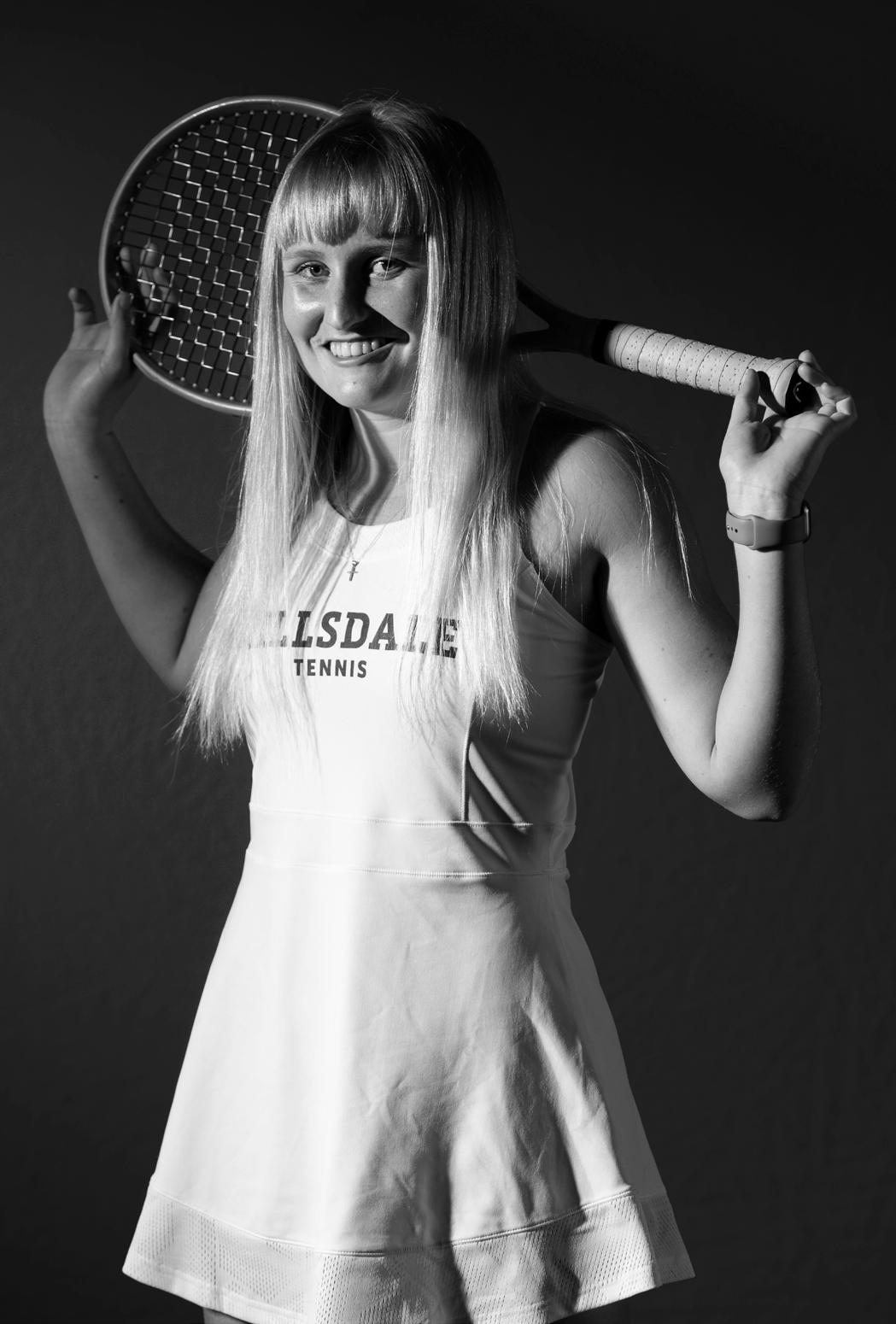
What color would you add to the Hillsdale logo?
Probably red, just for a pop of color. Then it will also match the American flag.
After growing up in South Africa, what part of American culture do you find strange?
You have about a million flavors for everything under the sun. Every time I go to the grocery store, I spend like an hour just looking around discovering new things.
www.hillsdalecollegian.com April 18, 2024 A9 Sports
Compiled by Jacob Beckwith Ane DAnnhAuser, Tennis
Courtesy | Hillsdale College Athletic Department
Social Media Manager
baseball team won two and lost two to Malone University on April 13 and 14 in its four game
Chargers defeated Malone 3-1. Senior Tommy MacLean pitched the full game for the first time in five years. MacLean threw 104 pitches, giving up one run and five hits, walking three, and striking out four players.
Feature
Senior Drew Olssen gave up two runs over six innings Saturday. Courtesy | Hillsdale College Athletic Department
Senior Danny Passinault had two hits and two RBIs on Saturday. Courtesy | Hillsdale College Athletic Department
Charger Sports
 By Ellie Fromm Collegian Reporter
won three of four games last weekend against two conference rivals, moving to 14-4 in G-MAC play.
The Chargers opened the weekend against the Ashland University Eagles on Saturday, losing the first game 8-7 in 10 innings and winning the second 5-2. On Sunday, the Chargers swept the Ohio Dominican University Panthers 6-0 and 5-0.
Over the past three years, Russell has accumulated 627 strikeouts, beating out former Trevecca Nazarene Trojan Haley Fagan’s record of 616 strikeouts.
“I had no idea this was even in the books for me,” Russell said. “I just keep playing the game I love.”
The Chargers are currently ranked second in the G-MAC behind the Trevecca Nazarene
University Trojans. According to Russell, the Chargers’ first game against the Eagles was difficult. The earlier loss increased the pressure in the second game.
“The second game was a real battle,” Russell said. “We knew it was going to be a tough game after the first game, and we would have to push through and give it all we had in every inning. We definitely played with more fire in the second game.”
Head Coach Kyle Gross said Sunday was a first in the scorebooks during his five years with the Chargers.
“In my time here, this is the first time we’ve swept Ohio Dominican in a series,” Gross said. “To do it and shut out both games was a pretty amazing feeling.”
According to Gross, the team was unified during both games, moving well in both offense and defense.
“We pitched really well in both games which led to two shutouts against a team like that,” Gross said. “We also ex-
ecuted small-ball, had timely hits, and made no errors. We played 14 innings of softball with no errors.”
This weekend, the Chargers will play four home games at Johnny Williams Field. On Saturday, they will play the Lake Erie College Storm at 1 p.m. and 3:30 p.m. Sunday is Senior Day for the Chargers, and they will play the Ursuline College Arrows at 1 p.m. and 3:30 p.m.
The Chargers will then head to Akron Ohio to compete in the G-MAC tournament at Firestone Stadium.
Graduating seniors are middle infielder Hailey Holtman, pitcher Erin Kapteyn, catcher McKenna Eichholz, first and third baseman Grace Wallner, and middle infielder Kay Suganuma. Holtman currently holds a career batting average of .278 and a fielding percentage of .929. Kapteyn has pitched 366.1 innings and has a career strikeout average of 4.62 per game. She also nears the end of her time at Hillsdale with a
career of 40 wins and 17 losses. Eichholz holds a career batting average of .274 and a fielding percentage of .986. Wallner currently holds a .300 batting average and a .929 fielding percentage. Suganuma has obtained a career fielding percentage of .931.
“I’ve enjoyed every minute of playing for Hillsdale,” Kapteyn said. “I’ve made a lot of great memories and many close friendships.”
With two games left after this weekend before the G-MAC tournament begins, this is an important weekend for the Chargers to stay highly ranked in their conference, according to Gross.
“This is another really big conference weekend,” Gross said. “These are games that we need to win to stay where we’re ranked, but we’re in a good spot.”
With Senior Day on Sunday, Gross said he wants to see the student body come out and support the team and seniors on this big day.
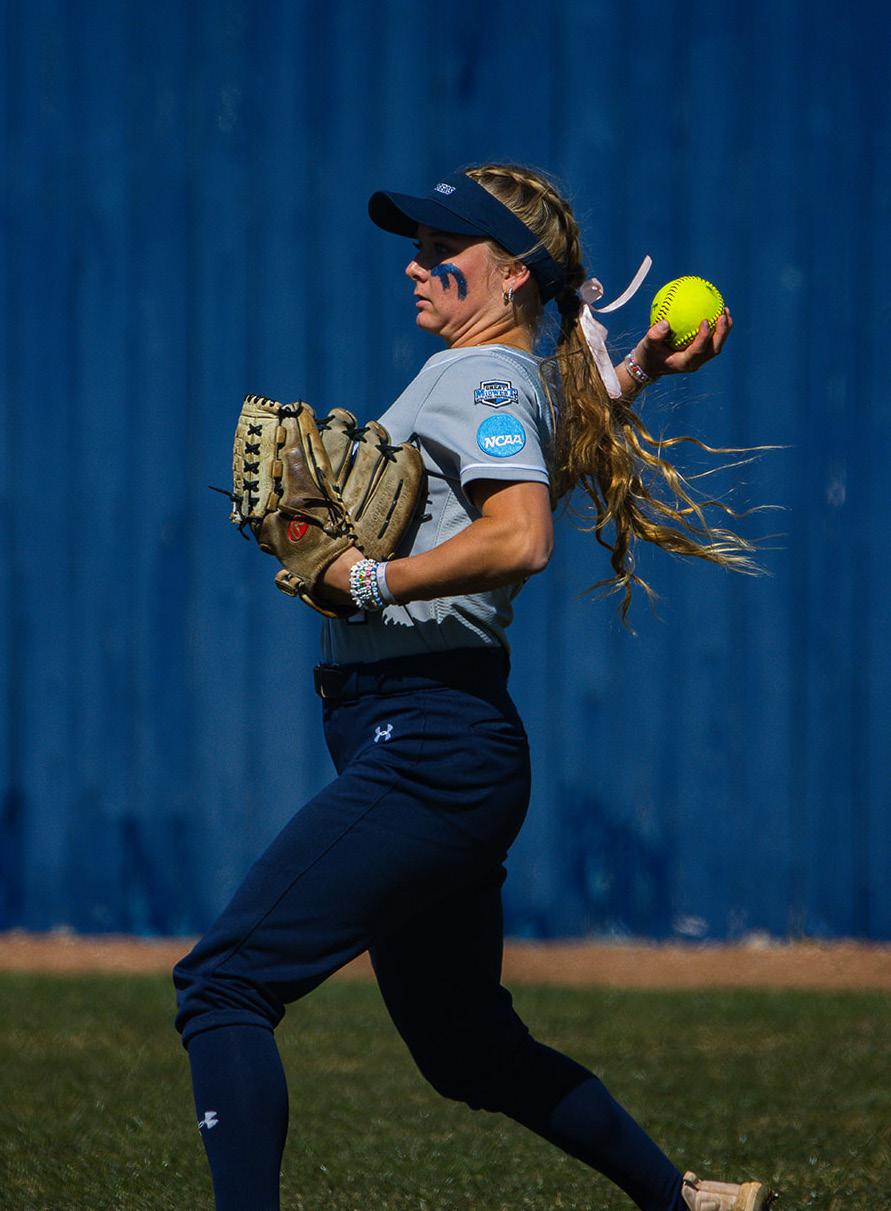
Scheffler masters Augusta for second time
A Hillsdale golfer reviews the sport's biggest tournament of the year

above everyone else on Thursday, shooting 66 and 65, respectively. Scheffler's six-under-par performance was more impressive as it came in the afternoon when the winds were stronger. The course became too firm, even for the greatest in the world, and scores in the 60s became a rarity.
Five-time winner Tiger Woods broke the record for most consecutive cuts — performing in the top half of the field — at the Masters, yet he is only a shadow of what he was even a few years ago.
Rory McIlroy disappointed once again, and big names like Dustin Johnson, Jon Rahm, and Jordan Spieth also had terrible tournaments.
In the end, Scheffler won for two reasons: he minimized his errors and many great players did not. He never let his mistakes pile on top of each other. Scheffler wasn't perfect, and he didn't need to be, as golf is not a sport of perfection.
Look at Saturday, hole
10: the young rookie Nicolai Hojgaard has just drained a 55-footer for birdie, and Scheffler misses a three-footer and cards a double. He is now two shots back, and staring down the dreaded "amen corner" of 11, 12, and 13. This three-hole stretch earned its nickname as it is the hardest part of the golf course, and it is best to say prayers before playing them. Countless tour-
naments have been decided there. Hojgaard now holds a solo lead coming off three birdies in a row, now in a spot only a handful of other masters debutants have been.
Two hours later, Scheffler went two-under in the remaining eight holes, and Hojgaard carded five bogeys in a row, looking like a fish out of
their A-game. Yes, Augusta is a hard golf course, but not impossible.
Especially on Sunday, with the wind dying down, we could have expected scores in the 60s. Rory was probably out of it on Friday, but the fact that at one point on Sunday there was a four-way tie for the lead and Scheffler had clinched the green jacket five
Scheffler won for two reasons: he minimized his errors and many great players did not.
water the whole time. The lesson? Don't let the highs get you ahead of yourself and don't beat yourself down when you make mistakes. Kipling said it best: “Meet with Triumph and Disaster / And treat those two imposters just the same.”
One could argue Scheffler lacked competition. Anyone would say the same of when Tiger was dominating — sure, he was insanely good, but he was almost playing a different game, as his driver would be 30 yards ahead of his competitors.
The gap between Scheffler and the rest of the field isn't nearly as large as the one Tiger had in his prime, but the top guys are very far from
holes later, says something of the competition. Morikawa, Homa, and Bryson all should be capable of making a charge, yet they all made silly mistakes. Morikawa chose not to hit it out of a sand trap on hole 9 just before hitting it in the water on 11. Homa carded a silly double on hole 12, killing his energy. The competition had been so close for 63 holes, and then, in a short amount of time, Scheffler was fully in control.
A message to the golf giants: step up your game. A note must be made for Ludvig Aberg's performance.
Sure, I criticized Morikawa and Homa for making silly doubles and killing the show,
and Aberg hit it in the water on hole 11 too.
But this was his first major championship, and just a year ago, he was finishing up at Texas Tech with final exams creeping up on him, just as most of us here do. Not to mention, he held tough and shot two-under after his hole 11, carding one of the few rounds in the 60s of the tournament.
Aberg looks like he doesn't have any flaws. Keep an eye out for him.
I mention him to disprove the old saying, "putt for dough, drive for show." Old timers love mentioning it, trying to give you wisdom. It represents this older vision of golf that as long as your long game is okay, putting well will win you tournaments.
The fact is, this isn't true anymore. Both Aberg's and Scheffler’s biggest strength is their ball-striking ability. Without a doubt, they are great putters, but you need more than that to win in today’s game.
What Tiger brought to the game was athleticism. What Scheffler is bringing is absolute mastery in every part of the game. As guys keep getting better and better, that is what is needed to win today. Editor's
Junior pitcher Joni Russell broke the Great Midwest Athletic Conference record for career strikeouts as the softball team
“Come out and support our seniors and put supporters on our home field,” Gross said. Russell
www.hillsdalecollegian.com
breaks G-MAC strikeout record
Softball Opinion A10 April 18, 2024
By Filippo Reale Collegian Freelancer The greatest event in golf rolls around every year among the magnolia trees and Georgia hills. Augusta National Golf Club excels in all the elements of a great golf course: visually stunning, intricately designed, and steeped in tradition. No other course in the world is so aesthetically pleasing, and her conditions are as close to perfect as can be.
requires a player to hit both sides curving,
to right, and draws, bending the opposite way. She punishes the reckless and rewards the brave.
one mastered the course like Scottie Scheffler last weekend for the second time in three years. Scheffler and
DeChambeau were in a class
Augusta
left
No
Bryson
note:
a junior on the Hillsdale Charger
team. Sophomore Taylor Lewis had two hits this weekend. Courtesy | Hillsdale College Athletic Department
Reale is
golf
Scottie Scheffler won his second Masters in three years. PGA Tour via X
Junior Joni Russell broke the G-MAC strikeout record this weekend. Courtesy | Hillsdale College Athletic Department
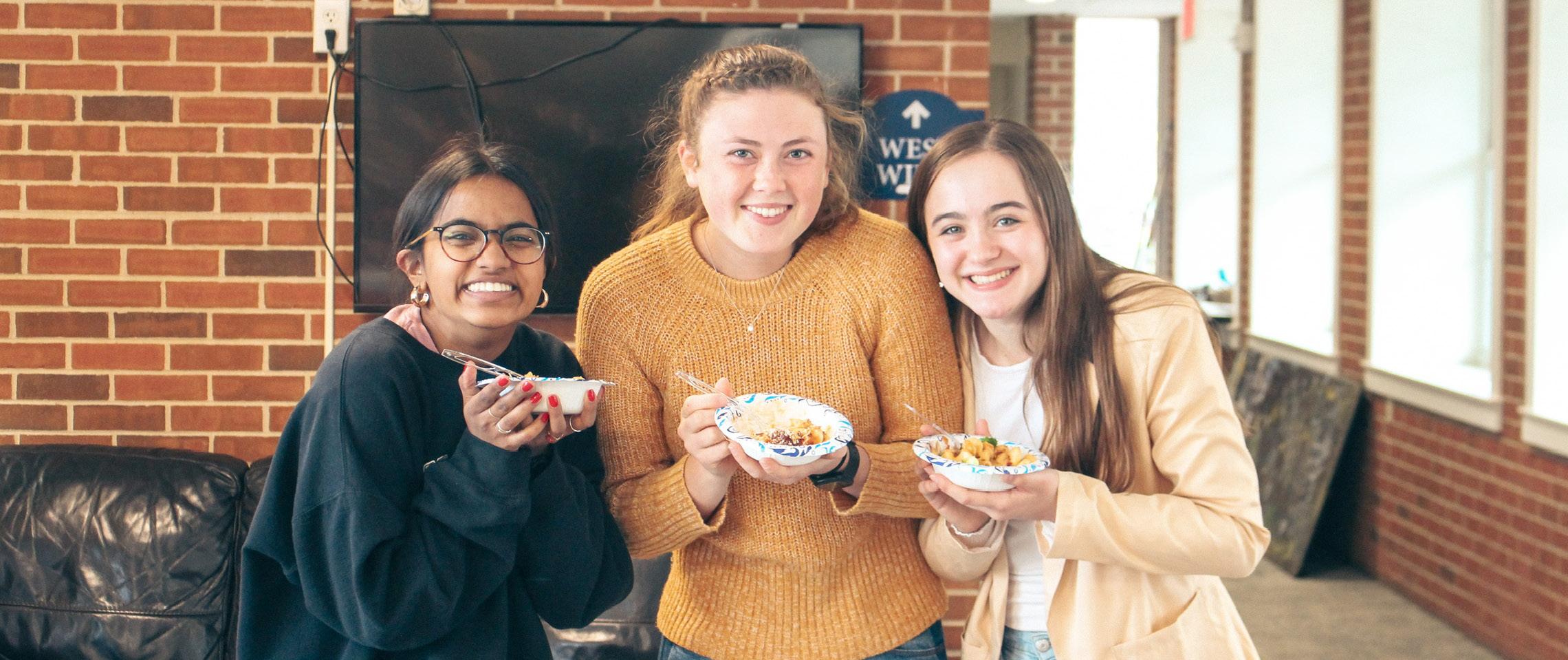
C U L T U R E
Dances, dates, and drama: dorms host various social events
By Michaela Estruth Assistant Editor
Hero Taco Libre and sidekick Enchilada Tony fought
villains Raging Bull and Udder-taker in a wrestling ring outside Simpson Dormitory to the thrill of fans.
Simpson Smackdown, a new dorm social event, based its fights off of the World Wrestling Entertainment to bring heated competition to campus in Simpson’s courtyard.
“We crafted a narrative throughout the night where Luke Waters, the Raging Bull, warned the defending heavyweight champion Taco Libre that an enemy of the past was coming back to get revenge on Taco Libre,” sophomore and Simpson resident assistant Jonathan Williams said.
“Little did the crowed or Taco Libre know that the villain was the Udder-Taker, who had his milk spilled by Taco Libre in middle school and decided to cry about it and get revenge.”
The on-campus dormitories host various events each semester, one of which is a social
event open to all of campus.The on-campus dormitories host various events each semester, one of which is a social event open to all of campus. Macaroni and cheese, dancing, country music, wrestling, and festivals all made an appearance on Hillsdale’s campus in various dorm social events this year. This year, McIntyre Residence invited all students to a macaroni and cheese bar. Benzing Residence hosted its annual Hillsdale Hoedown in the fall. Simpson Residence held a new event featuring wrestling matches. Sohn Residence hosted a fair event. And Olds Residence invited campus into its lobby for the annual Olds Glow party. Some dorms partner to host events together. The Bloc — an alliance of the Suites, Benzing, and Mauck residences, traditionally hosts a hoedown in the fall featuring barbeque, pie contests, and line dancing, according to junior and Benzing head RA Faith Henry.
“It’s a fun way to rally the dorms in the Bloc, especially since we get to work together
during homecoming,” Henry said.
Henry said more than 200 people attended the event last October, and the line dancing was a major highlight. Beyond the dancing, professors come to judge the students’ pies and flannels, Henry said.
“It’s always fun to bring in professors to help judge the pies and the flannels,” Henry said. “This past year it was Dr. Yost.”
Stepping outside of tradition, McIntyre hosted a new event called Mac ’n’ Cheese with Mac. Junior and head resident assistant of McIntyre Joanna Leckband said the event was open to all of campus and nearly 200 people came because everyone loves macaroni and cheese.
“McIntyre is tucked away from the rest of campus, so it’s nice to have people visit us,” Leckband said.
The dorm catered macaroni and cheese from Saucy Dog’s Barbeque in Jonesville and used its popcorn machine for extra snacks.
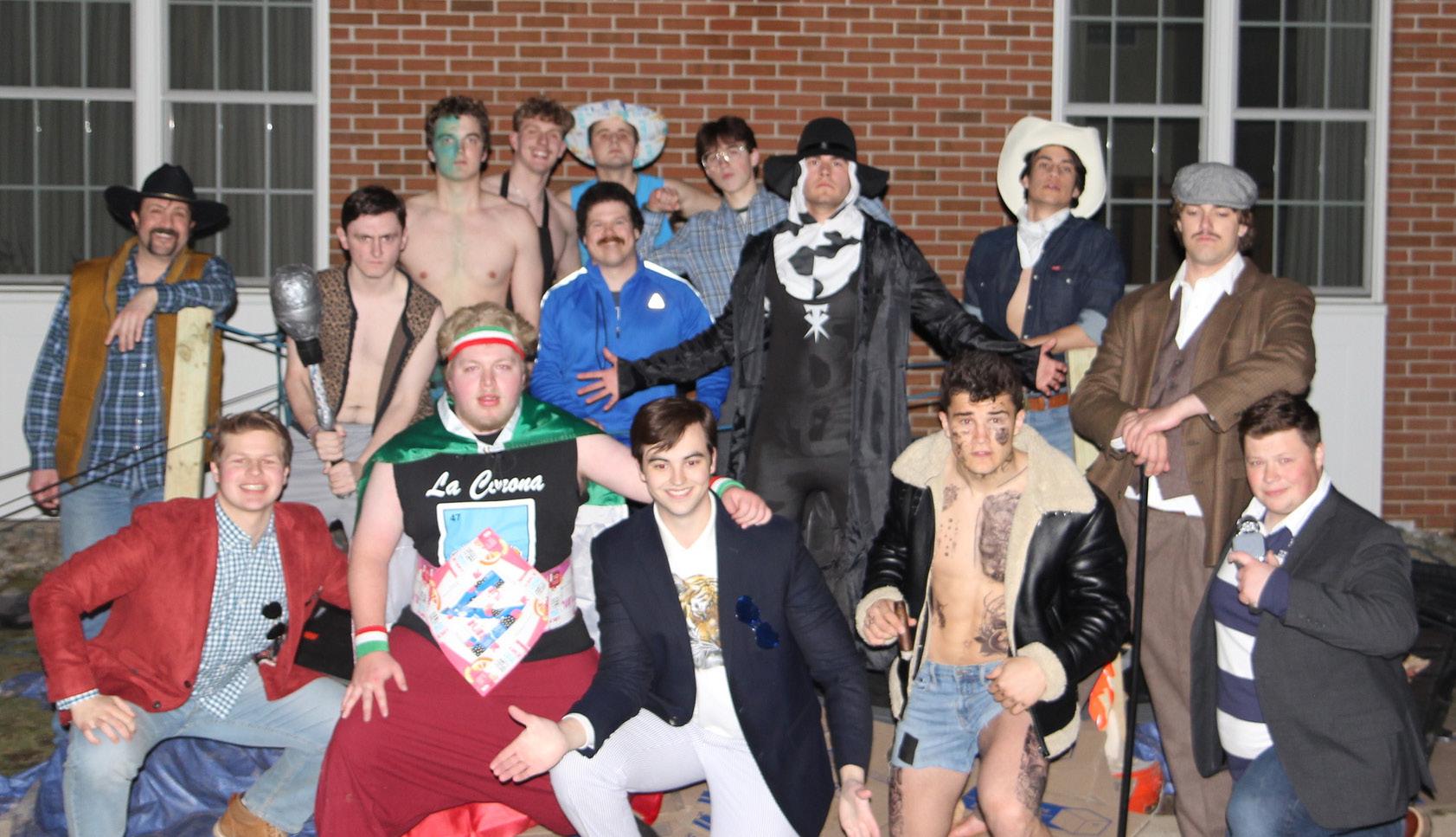
The event brought together current and previous residents and may become a tradition, Leckband said.
“I enjoyed seeing old residents come back with their friends,” Leckband said. “This event could be a great way to support the culture, if it comes back in future years.”
Like McIntyre, Simpson, the largest men’s dorm on campus, hosted a new event, Simpson Smackdown. Imitation of the WWE largely inspired the event, sophomore resident assistant Jonathan Williams said.
“The event was fantastic,” Williams said. “We had about 12 guys from Simpson script fights against each other and perform them in front of the crowd. Stunts included smashing guys through tables, clotheslining, chucking burritos and the opponent, slapping them with books, and even attacking the opponent with a pet alligator.”
More than 250 people attended Simpson Smackdown, causing the RAs to run out of food, Williams said.
“I’ve never seen our courtyard so packed,” Williams said. “Fans watched the wrestling in our newly built wrestling ring as announcers described the fight through play-by-play broadcasting.”
Contestants included senior Ben Hinrichs, Assistant Professor of History Miles Smith, and Assistant Professor in Medieval History Charles Yost. Simpson did not promote these participants, but instead, waited to reveal them at the event itself.
“When the bells started to strike as Ben Hinrichs was near a pin move on Austin Piecuch, Dr. Smith sprinted into the ring in a cowboy hat and started beating up Ben,” Williams said. “He took off his mask and the crowd lost its mind. Then Dr. Yost came out and beat up Dr. Smith including an elbow body slam that none of us were expecting.”
A highlight for the crowd was Taco Libre’s defeat of his rival Udder-Taker with his signature move, the crunch-drop supreme, according to Williams. Williams said the crowd’s enthusiasm and engagement
energized the whole event.
“The overwhelmingly positive response to this event has made Simpson decide to make it a yearly tradition,” Williams said. “People can expect it to be bigger and better next year, and we will certainly return with more big surprise cameo appearances.”
Social events are not always crowd pleasers or campus wide. Niedfeldt, another men’s dorm on campus, hosts an annual dinner in the spring called Niedformal. The men of Niedfeldt invite dates to attend a formal dinner and awards ceremony, followed by a night of dancing.
Junior and Head RA Harrison Layman said the award ceremony presents “paper plate superlatives” to the residents. The awards include accomplishments such as most likely to, and then references a dorm joke from the year.
“It’s a good chance to recap the year and relive some fantastic memories,” Layman said.

Shakespeare in the Arb to perform ‘Much Ado About Nothing’
By Olivia Hajicek Science & Tech Editor
Shakespeare in the Arb will return to the Slayton Arboretum April 19-20 following a three-year absence from students performing in the Arb. The group will perform “Much Ado about Nothing.”
“Shakespeare really works well outside in kind of a more informal setting for the comedies especially,” said junior Libby Gannon, president of the troupe.
In 2022 and 2023, the shows were moved to Mauck Residence because of cold weather.
“This weekend is going to be in the 50s, and we’ve decided that that is warm enough,” Gannon said.
Both shows start at 5 p.m. Gannon said the Shakespeare Society is in charge of
in the Arb but delegates the task of directing it to a student in the theater department.
“Our director, senior Kiley Hatch, cut it down from a two-and-a-half hour show to about 90 minutes,” said freshman Sophia Miller. “We have been rehearsing for two weeks now, since right after Easter.”
Hatch, a senior theater major, did the casting and set the schedule and she said she has enjoyed watching the rehearsals.
“Each night I find a new moment catches my fancy, makes me think, or makes me giggle,” Hatch said. “Whether we are racking our brains over why Hero never talks or finishing a run through under the parking lot lights of the Suites since we ran out of sunlight in the Arb, this cast has had a great sense of hu -
mor and team spirit.”
Miller said she plays Beatrice, one of the lead female characters.
“She’s a very, very strong character and is one of Shakespeare’s most notable female leads, and she’s very well-loved,” Miller said. “It has been kind of daunting trying to capture her, because everyone who I talk to is always like, ‘Oh my gosh, you better do her justice.’ So it is a little bit nerve wracking because she is so iconic, but I’m hoping to capture her — her essence and her spirit.”
Miller said she’s taken advantage of every theater opportunity she could since coming to Hillsdale, but she loves Shakespeare in the Arb because it’s more laid back.
“When you’re doing the official theater productions of the Tower Players, it typically
tends to be actual theater majors, but with Shakespeare in the Arb, we have just a total hodgepodge of people who just want to do it for fun or normally don’t do theater or theater majors,” Miller said. “So it’s a really fun kind of eclectic group from all around campus, and it’s a great way to get to know other people.” Hatch said directing the play has been a lovely way to welcome in the spring weather.
“I cast my actors back in January, but we did not start rehearsals properly until after Easter,” Hatch said. “My goal in taking that risk in delaying rehearsal was that my actors would be able to focus on the work and feel the momentum for a two-week focused period rather than dragging it out over the semester.”
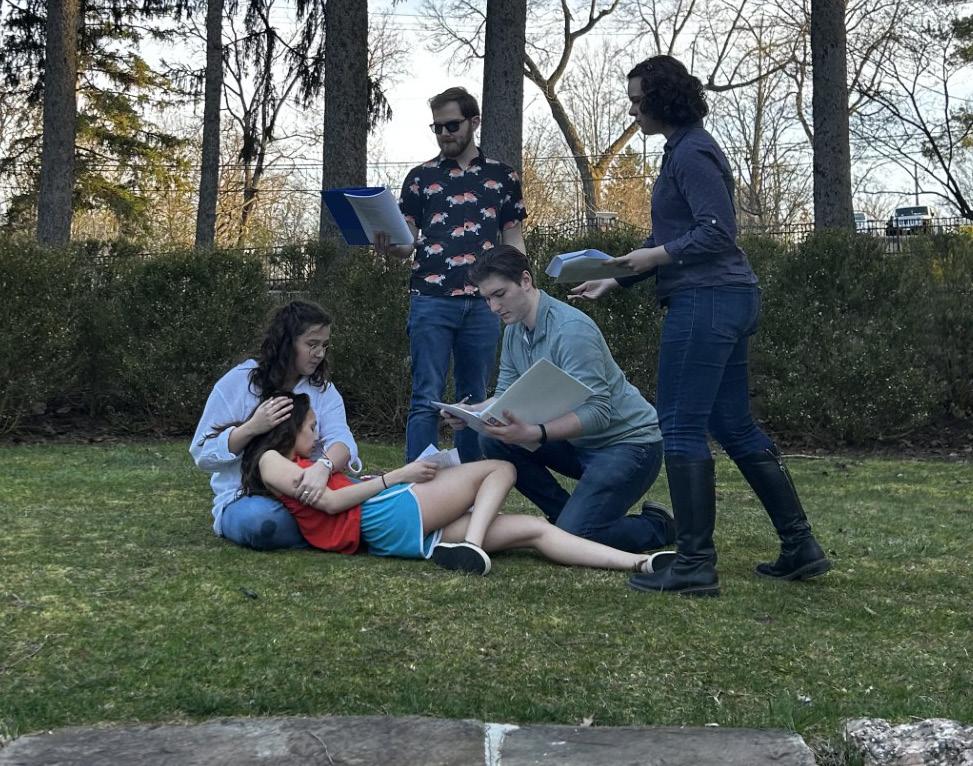
Hatch said it’s a student production and is not affiliated with the theatre department, so it’s meant to be a fun experience.
www.hillsdalecollegian.com April 18, 2024 B1
Hershey Athysivan, Ineka Pastermack, and Mercy Franzonello enjoyed McIntyre Residence’s macaroni and cheese bar. Courtesy | Chloe Noller
Shakespeare
“My role as director is to set my actors up for success by making the right bets in casting and rehearsal schedule,”
Hatch said. “I am the unifying factor among such a large cast — filtering everyone’s delightful artistic personalities through one vision.”
Simpson Residence hosted a new event called Simpson Smackdown. Courtesy | Simpson Residence
Juniors Isaac Green and Gavin Listro performed at Mac ’n Cheese with Mac. Courtesy | Chloe Noller
Senior Kiley Hatch is the director of “Much Ado About Nothing.”
Courtesy | Kiley Hatch
C U L T U R
‘Meditations’: first seniors kick off art galleries
 By Anna Broussard Collegian Reporter
The first of three consecutive senior art shows, featuring the artwork of five graduating art majors, debuted with a reception on April 5 and concluded April 8.
The gallery, “Meditations,” showcased the artwork of seniors Anna Julia Bassols, Emma Widmer, Julia Epstein, Kiri Forrester, and Sophia Frigerio.
“We ended up settling on ‘Meditations,’ because we all find things that we see as beautiful and inspirational, then we just sit with them for a little bit,” Widmer said.
The gallery displayed the variety of media that each of the artists developed during their time at Hillsdale.
For Forrester and Bassols, photography was a focal point of their work.
“A theme running through my art was a lot of momentary things, especially with my photography,” Bassols said. “A lot of my strongest pieces, and a lot of my favorite pieces, were very momentary, even if
they were an actual photoshoot.”
A specific photograph entitled “Eight-and-a-half lives,” taken while at home, depicts a cat attempting to walk a precarious ledge. Bassols said she captured it on a walk she took with her brother. The family cat and low exposure in the photo added a personal element to the photo, which ended up being a surprisingly popular piece, Bassols said. Forrester said the gallery features the artwork from her four years at Hillsdale, and it was difficult for her to select the pieces that truly represent her artistic personality.
“When you view the art, you are viewing the world through the artist’s eyes and the artist’s personality comes out in what they create,” Forrester said. “So looking at the art, you see the world from their perspective. You can show people a different side of the world.”
While none of the women had similar styles, the theme throughout the gallery was the observational aspect, Forrester said.
“A lot of our work is very observational of nature and the world around us and people and things. We wanted to invoke some kind of contemplation,” Forrester said.
Widmer, who showcased mostly watercolor pieces, said she also struggled to choose which pieces she wanted to display.
“There’s definitely some that I struggled with a lot more than others. And those pieces ended up being like the ones people asked about the most,” Widmer said. “You don’t realize how much people enjoy some of the things you make.”
Widmer hung an oil painting of her grandfather in a cornfield in the gallery.
“He is truly one of the best people in the world. But I struggled with that piece,” Widmer said. “I spent weeks on end repainting and even turned it upside down. In the end, the subject matter is very humble, like my grandpa.”
Widmer sold many of her pieces to those who attended the show’s opening. She said she currently sells prints of her pieces on her website em-
mawidmer.com.
Bassols said the pieces featured in the show reflect her focus on form.
“I primarily think of myself as a sculptor working with form, which is the first tenet of art,” she said. “One piece featured in the gallery I had worked on for multiple years, and is very dear to me, is called ‘X and Y axis.’ I saw how form is one of the things I really emphasize.”
Although each artist featured different pieces and mediums, Widmer said the talent of each individual is displayed and celebrated.
“It is a nice way to celebrate the work that you have done because a lot of it does go without people really noticing,” Widmer said. “You have spent an insane number of hours in the studio struggling for these pieces and the gallery is a final way to celebrate all that you have accomplished.”
‘Masters of the Air’ soars at end of season
 By
By
“Masters of the Air” has attracted the die-hard fans of HBO miniseries “Band of Brothers” and “The Pacific” after 10 years of anticipation. The show comes as the third World War II miniseries produced by Tom Hanks and Stephen Spielberg. It didn’t disappoint.
The long-awaited Apple TV+ series portrays the missions and struggles of the 100th Bomb Group, otherwise known as the Bloody Hundredth. The 100th Bomb Group’s nickname comes from its horrifically high casualty rate: In the span of
four months, the 100th Bomb Group loses 77% of its original members. The show narrows in on B-17 pilots Major John Egan (Callum Turner), Major Gale Cleven (Austin Butler), and Lieutenant Colonel Robert Rosenthall (Nate Mann) and navigator Lieutenant Harry Crosby (Anthony Boyle).
The series captures the bond that grows between the airmen in the frozen chaos of the air war over Europe. Stationed in England, the group flies continuously over occupied France and Germany, where they are terrorized by flak from below. “Masters of the Air” brilliantly captures the confusion aircrews experience as their tight formations are picked apart. Each time a B-17 is shot down, all 10 of its crew members die. The stark reality of the situation is difficult to capture on-screen: The action sequences in the show lead to some confusion as to who was hit and just how many planes went down.
During and immediately following the battles, viewers are left to take stock of the survivors. In one particular scene, Rosenthal discovers his plane is the only one to return to base. The crew wonders
where the other bombers are. It takes a quiet sky and pieces of debris falling around them to solidify the fact that they are alone.
Later in the show, the Luftwaffe shoots down Egan’s plane and German soldiers capture him. During the march to a prisoner of war camp, Egan and other POWs are attacked by German civilians angry at the constant death brought upon them by American bombers. The scene reflects the violence airmen suffer after escaping their destroyed aircraft. Civilian attacks on airmen are a gruesome, yet common aspect of the air war we do not often consider because of their scattered nature.
The stunning cinematography and music contribute to the impact of the show. In the opening title sequence, the music highlights the array of
Professors’ Picks: Kevin Gerstle, associate professor of mathematics

emotions felt by the characters while including some of the most beautiful shots of the entire series.
“Masters of the Air” is one of the most well-done historical shows created recently. It avoids current politics, instead focusing on the characters and the challenge of flying under extreme stress and fear. Upon return to base, crew members are expected to act as if everything was normal, then return to what many airmen called “Hell,” the next day.
“Masters of the Air” fantastically captures the experiences of American bombers in a way that is captivating for all people, not just history buffs like me.
From the minds of Hillsdale’s professors: the song, book, and movie everyone ought to know

“Linus and Lucy” (1964) by Vince Guaraldi
This is most famous for its appearance in “A Charlie Brown Christmas.” This was one of the first songs I ever learned to play on the piano, and it still brings back warm and fuzzy memories every time I listen to it.

“The Charm School” (1988) by Nelson DeMille
It’s a Cold War era spy story exploring the chilling possibility of Soviet spies infiltrating the U.S. A fun, thrilling tale of espionage.
“Star Wars: Episode IV” (1977) dir. George Lucas
I love good, classic sci-fi action.
www.hillsdalecollegian.com B2 April 18, 2024
E
Alessia Sandala Collegian Freelancer
Compiled by Quinn Delamater Collegian Reporter
Seniors Sophia Frigerio, Emma Widmer, Anna Julia Bassols, Kiri Forrester, and Julia Epstein named their gallery “Meditations.” Courtesy | Emma Widmer
“Band of Brothers” fans like “Masters of the Air.” Courtesy | Collider
Kevin Gerstle kayaks in the Gulf of Mexico. Courtesy | Kevin Gerstle
FEATURES
In the minority: College Dems challenge campus
By Sophia Mandt Collegian reporter
Hillsdale College is the third most conservative college in the country, according to the Princeton Review. But not all of its students lean to the Right.
College Democrats is a group for liberal students to gather and discuss politics each week.
Senior Avery Noel, the club’s president, said it is a place for great conversations across the political divide.
“It gives something you won’t see anywhere else on campus,” he said.
Despite his politics, Noel was drawn to Hillsdale’s education.
“I was excited to come here. I really value the liberal arts,” Noel said. “That was something that appealed to me outside of Hillsdale’s political leanings.”
Members of the club discuss issues from a left-leaning perspective such as racial justice and environmentalism. He said about 50 people are on the College Democrats email list, and about 10 show up to meetings consistently
College Democrats treasurer, junior Kelsey Bacigalupi, said she loves the weekly meetings.
“We go there and chat about current events. There’s always
something happening, especially in this election year,” Bacigalupi said. “I like the open door policy that we have about it. It’s not a Democrat only club, it’s for everyone. We’ve housed conservatives, we’ve hosted moderates. We chat and have a great conversation.”
Although Noel said most professors at Hillsdale aren’t liberal, he can think of several who he would say lean left.
“I think there’s a really good number of professors who appreciate what our club does even though they might not be left per se,” Noel said. “I would also say I think that the faculty in general is really nuanced and has a lot of different perspectives that I don’t think are always captured or represented.”
Noel said having a minority viewpoint on campus can be challenging.
“Sometimes it’s hard,” he said. “There are definitely times when I feel misrepresented.” As an economics major and politics minor, Noel said he participates in many political discussions.
“My education has been good. Even though there are a lot of things that I’ve heard in classes that I might not agree with or appreciate, it’s still
good to have those perspectives,” Noel said. “It’s made me reconsider why I think what I think and has strengthened my viewpoints.”
Bacigalupi grew up near Seattle and was introduced to progressive issues in high school.
“I grew up in a conservative household, but over time I was
and we just chatted for three hours. I love the depth that we get into with our discussions,” she said.
Bacigalupi hopes to work in politics after graduation and was accepted for an internship in the UK’s Parliament this summer.
“I will be spending 10 weeks in the summer working at Par-
“Even though we don’t necessarily agree on specifics, I admire their courage to swim against the tide.”
exposed to newer ideas. I am a big proponent of equal representation,” Bacigalupi said. “That’s my main issue that I find myself talking with my parents and family members about.”
Bacigalupi said Hillsdale’s conservatism can often create an echo chamber.
Bacigalupi said she loved a 300-level course that she took with College President Larry Arnn at Broadlawn.
“I went over there recently,
Q&A with @hillsdankcollege
By Claire Gaudet Opinions Editor
April 20, 2024, will mark the three-year anniversary of one of Hillsdale College’s most successful meme accounts. Hillsdank_college boasts 1,404 followers on Instagram, second only in followers to @barstooldale. For years, students have wondered who’s the mind — or minds — behind the posts that make them laugh so much. Now we know. Seniors Chris Dick, Caleb Fournet, and Truman Kjos have sat down to discuss their page’s success and legacy.
How did this start?
Kjos: Caleb, for weeks, was like, “Hey, guys, we need to make a meme account. This would be so much fun.”
Fournet: Yea. Chris and I were roommates in Whitley. And one night I was said, “Chris we have to do this. Let’s do it now.” And so, we called Truman because he’s good at making memes and we want him on the team. At a certain point, especially in 2021, every single meme account had a Whitley affiliation.
Throughout everything, all three years, what’s the purpose of the page been? To make people laugh? To make campus critiques?
Fournet: What’s really interesting about running a meme account at Hillsdale is that people at Hillsdale have like a high tolerance for humor but
also get pissed off really easily. There's certain areas where you can poke too much fun, like at fraternities and sororities, because you have groups like Panhel that won't allow it to happen. So, you have to deal with balancing the line there, even though Greek life is a huge target for humor. Same thing with the dorms. Their RAs might get upset. We think the point of Hillsdank — as opposed to maybe some of the other accounts you see — is that we poke fun more at like, “Oh, I was in Lane today and this thing happened,” or like a weird study habit, or the challenge of writing an essay or a particular professor, as opposed to making fun of something crazy happened at a party on Manning Street. The account stays a little less controversial that way.
Dick: We want to play on Hillsdale tropes — things that are evergreen. Like our most recent meme, Dr. Arnn walking out to the Lil Yachty thing. People like that — not because you have to have been on campus at that point, but it's just funny.
Do you ever take things down?
Fournet: We've occasionally posted stories that have upset people. And that's typically because it's Rush season. We'll post something like “Rush Kappa,” and then a bunch of people from Panhel will respond and say, “Can you please take this down?” We don't really know the rules for Panhel, so if that's really upsetting people, we take it down.
Dick: We’ve tried to make a purposeful effort to cultivate good relationships with groups like Mossey Library and SAB. I feel like we're the one account that has a good relationship with SAB.
Fournet: We decided to make this artificial love for Jack Cote.
Dick: It's not artificial for me. I love Jack Cote.
Fournet: We like to compliment their social media stuff all the time. SAB is probably another big group that's easy to make fun of because campus is always complaining about their events. And we try to do a good job because there are a lot of people that put a lot of effort into SAB and people enjoy their events.
Other than your own, who's your favorite campus meme page right now?
Dick: I’ll laugh at @fundie_ gyatt.
Fournet: I really like @ithinkyoushoulddale because I really like “I Think You Should Leave.”
Kjos: Yea, me too. I’ll go with @ ithinkyoushoulddale.
Is the page dying with you guys?
Kjos: Yeah, we think so.
Fournet: I mean, people can try to convince us to give it to them, but we have no current plans to recruit someone.
chat and get food afterward,” she said.
Associate Professor of Economics Christopher Martin said while he opposes many policies associated with the Democratic party, he finds value in attending some of the College Democrats meetings.
Martin said there are also areas in which one can find common ground with Democrats.
“We need dissenters because they might see some truth where we have a blind spot. These dissenters can help us understand our own position better by forcing us to argue for it,” he said.
Martin said Hillsdale gains honor by encouraging collegial dissent.
liament House under either an MP or lord. I want to do something international before working for a senator in D.C.,” she said.
Bacigalupi said she wants her fellow students to know that while Democrats do in fact exist at Hillsdale, they aren’t some secret organization pulling the strings.
“There’s a running joke on campus that the College Democrats control a lot of things, but we really don’t. We just
“Even though we don’t necessarily agree on specifics, I admire their courage to swim against the tide,” Martin said.
“Think about how it would feel to be red in an overwhelmingly blue environment.”
Martin said he wants there to be greater unity among those with differing opinions, mentioning his involvement with a nonprofit organization called Braver Angels, a group that builds resources and events that help people
communicate across partisan divides. “Braver Angels interested me because of what I call the ‘Thanksgiving dinner problem,’” Martin said. “You’re with relatives or friends on different sides of the partisan divide. If politics comes up, there’s a good chance of a bitter argument that strains or even ruins friendships. Families can even get estranged.”
Martin said he also hopes that a Braver Angels chapter could be created at Hillsdale.
“Both major parties are big disparate coalitions. Specific individuals on the ‘other side’ probably aren’t happy with everything people on their team says or does, just as you aren’t always happy with people on your side,” he said.
Martin said he has learned many things from College Democrats.
“You don’t have to agree with someone to appreciate that they come at an issue with intelligence and a base of experience that may differ from your own,” Martin said.
Jonesville resident serves through art
By Lauren Bixler Collegian Freelancer
Born and raised in Jonesville, Dena Rushton serves her community every day by pursuing her passion for art and sharing it with others through the Hidden Turtle Gallery
Based out of Jonesville, Rushton rents out space to teach painting lessons, every Thursday and Saturday for $35 per person. Rushton provides a canvas and materials in addition to the instruction.
Rushton said she never imagined she would be teaching art classes.. “About seven years ago, my friend invited me to a ‘Paint and Sip’ event, and from there I was hooked,” Rushton said. “I began watching Bob Ross tutorials religiously, and one day the owner of the craft supply store asked if I was interested in teaching a class.”
Rushton hopes to expand her studio soon and is the process of building a pole barn to host classes. Tracy Needham, a long-time participant in Rushton’s classes, said her painting skills have greatly improved under Needham’s class
instruction.
“These are not paint by number or pre-drawn canvases,” Needham said. “You do the work from start to finish and you walk away realizing you can do something out of your comfort zone. That is what Dena provides.”
Halee Jordan, Rushton’s sister, said she is happy to see Rushton’s passion for art help the community.
“She is a natural artist. I'm so happy that she is willing to share her talents with the community and provide a service and opportunity for others to have fun and learn a new skill,” Jordan said.
In addition to benefiting the community through her art, Rushton said she has a passion for serving in simple, everyday ways.
“There are 100 ways you can give back to the community that are free,” Rushton said.
Rushton said she incorporates service into her daily routine and tries to inspire others to do the same through her social media platform.
“Every morning, I leave the house 10 minutes early for
work to walk there and pick up trash along the road. I also send out a good morning picture of something beautiful to my Facebook every day,” Rushton said. “All I want is to take care of the earth because this is all we’ve got. If I'm not doing it, no one else will, and it costs me nothing.”
Rushton also encourages others to donate blood as frequently as possible, which is another free way to give back to the community. Since she was born and raised in the area, Rushton said she feels a duty to care for the home around her.
Additionally, Rushton volunteers at the fairgrounds to aid others artists in setting up antique, professional, and amateur displays, Needham said.
Rushton’s character and perseverance are evident to both Jordan and Needham.
“When she believes in something, she's all in. She stands up for what she believes in, even when her opinion may not be the popular one,” Jordan said. “She is proud of her faith, and does not hesitate to share her belief in God.”
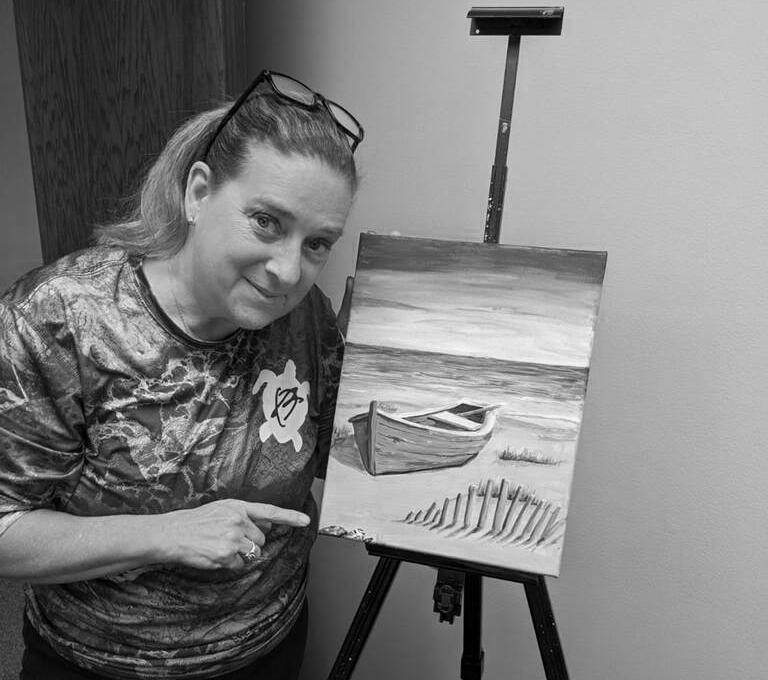
www.hillsdalecollegian.com April 18, 2024 B3
Fournet, Kjos, and Dick don’t expect @hillsdankcollege to survive after they graduate.
Courtesy | Truman Kjos
Rushton teaches art classes several times a week.
Courtesy | Dena Rushton
FEATURES

‘A theology of machines:’ Wales advises Vatican on AI
By Thomas McKenna Sports Editor
Can artificial intelligence be considered conscious?
That’s one of the questions
Associate Professor of Theology Jordan Wales and his colleagues advising the Vatican are trying to answer.
Wales is a member of the AI Research Group of the Centre for Digital Culture, which is housed in the Dicastery for Culture and Education of the Holy See.
As AI technologies rapidly advance in power and scope, the Vatican’s AI Research Group seeks to apply Catholic theology to the ethical, cultural, and societal implications of AI’s development.
“A kind of theology of machines has to be invoked and, where it doesn’t exist, developed further and rooted in the Catholic tradition,” Wales said, “To be able to give a picture that not only says, ‘R2-D2 isn’t a person,’ but also says what R2-D2 is.”
Large language models like ChatGPT or Google’s Gemini are a popular example of AI advancement. These new technologies that predict the next word in a sentence can write a poem, summarize the day’s news, and may even match proteins to create new, life-saving drugs, according to the Wall Street Journal.
At the same time, AI chatbots can simulate conversations in a romantic relationship, and
visual technologies can create artificial pornography using online images. Students at high schools around the country have used these programs to create pornographic images of their classmates, according to the Journal.
Pope Francis said in a January statement that advancements in AI raise “deeper questions about the nature of human beings.” “The technology of simulation behind these programmes can be useful in certain specific fields,” the pope said, “but it becomes perverse when it distorts our relationship with others and with reality.”
The AI Research Group was formed in 2020 by Bishop Paul Tighe, a secretary of the Dicastery for Culture and Education. Comprised of theologians from around the world, Wales said the group was without a particular direction in its first year.
“Each person was putting on the table the things that really struck them as interesting or as necessary to the conversation,” Wales said. “It’s a bit like being in a kitchen where you have cooks from different culinary traditions, and they say, ‘These are the ingredients I’m working with.’ How do you make food out of that?”
Wales said he and his colleagues have split into three groups exploring three topics. One group is investigating the “ethical formation of the human person in interaction with AI,” another is focused on the
“effect on human beings’ relationships” of “seemingly personal” technologies, and Wales’ group is researching “machine consciousness.”
“In the consciousness group, our goal was to develop a position concerning machine consciousness that made sense of the existing literature on the subject and that could communicate in that conversation,” Wales said.
When answering questions like “Can AI be considered conscious?”, Wales said it was important to apply Catholic theology in a way that experts, programmers, and other workers in the AI field could understand.
“Our work was often a matter of intellectual translation,” Wales said.
As AI becomes better at writing, learning, coding, and other more advanced tasks, it becomes more difficult to point to differences between the thinking a computer does and the thinking humans do.
Wales refers to Orthodox theologian David Bentley Hart’s explanation: “The computer doesn’t compute; we compute using the computer.”
For example, a student may use a pencil to write formulas or even a calculator for long division and say, “I externalized some of my calculations for this problem,” Wales said.
While an AI tool can manipulate informational symbols, Wales said, this act should not be confused with the human
use of reason. New technologies call on us to “develop richer accounts” of both the capabilities of AI and the uniqueness of the human person.
“The old metaphors don’t work,” Wales said. “If we say, ‘the computer reads as I read,’ then we lose something of what it means for me to read. If we say, ‘I read but the computer doesn’t read,’ then we neglect something of what is happening with the computer.”
The AI Research Group published a book online in December titled, “Encountering Artificial Intelligence: Ethical and Anthropological Investigations,” which can be read in the Journal of Moral Theology. Wales edited this book with three other members of the research group.
“It’s intended to introduce artificial intelligence to people who might not know much about it, and to engage with the questions raised by artificial intelligence,” Wales said.
Wales taught a three-credit course last spring titled “Theology and AI.”
Senior Bridget Whalen, who took the class, said many questions about AI concerned the nature of the human person.
“It was a massively important class — I didn’t expect it to be,” Whalen said. “It has underwritten the rest of my classes in a fundamental way, simply because we were defining and understanding humanity. That’s what the class was about.”
QUICK HITS: Samuel Webster
By Tayte Christensen Collegian Reporter
In this Quick Hits, Associate Professor of Mathematics Samuel Webster talks baseball cards, sandwiches, Montana, and El’ Cerritos.
How do you start your day?
I start my day typically with some brain-teasers on my phone. Chess.com has a chess puzzle of the day, and I play a little game called Wordscapes.
My son introduced my wife and I to the New York Times “Connections” game. I usually do all of those before I even get out of bed.
What is your favorite state that you’ve ever visited? Montana, especially the western edge by Glacier National
Park near the Idaho border. It’s just a beautiful area, and you’re away from everything. I enjoy the beauty out there. The eastern half of the state is beautiful as well. In the eastern half of Montana, you just have these rolling hills. As you’re driving and the hours go by, you might not even see a tree because it’s just these rolling fields, and the sky is gorgeous. And then you get to the western half, and that’s where all the mountains are at.
What is your favorite way to travel?
I prefer the train. I like seeing the country. If there’s any time for long travel and if I can swing it, I’ll take a train. I like seeing things. I’ve always enjoyed car trips and just watching the country go
by, and there’s no better way to do it than on the train when you’re not driving. It is more expensive and takes longer than flying, but you’re not doing it for those reasons. So if time and money aren’t a huge concern, it’s a great way to see the country.
What’s your favorite Hillsdale-area restaurant?
Our family loves El’ Cerrito. Our son really loves their chicken quesadilla. That’s his number one go-to food of all time. My wife and I like it, and it’s always good service there –you’re in and out, and you get a lot of food for your money. The waiters and waitresses are great.
Do you have a favorite current TV show?
Leaving the Dale: Erik Ellis heads to Dallas
By Olivia Hajicek Science & Tech Editor
Assistant Professor of Education Erik Ellis has only taught at Hillsdale for two years, but he’s already made a big impact — one that will be missed next year.
When Ellis leaves to teach at the University of Dallas next year, his students will miss sharing his Chilean cooking, listening to his stories, and speaking Latin with him over pipes.
Ellis said the main reason for the move is that it will allow him to be near his family.
“By various accidents, including people fleeing California during COVID, all of my family now lives in Irving, Texas, and 100% of my wife’s immediate family lives relatively close,” Ellis said.
picked up a stack of books. ‘I was clearing out my office and these are extras,’ he said. ‘ You can have them for having the best midterm.’’”
Ellis spent a year and a half in Chile before coming to teach at the college in the fall of 2022. Graduate student Samuel Musser said he still has a South American sense of hospitality.
Senior Michael Hoggatt experienced it firsthand.
“I think his creativity and his out-of-the box thinking is actually more classical.”
Ellis said he will be working with masters and doctoral students at the University of Dallas instead of undergraduates.
“I will be working in a more definite way with the renewal of Greek and Latin, which for me is really kind of the core of the thing,” Ellis said. “That work will be more central to what I’m doing at the University of Dallas. Ellis said the move won’t be easy.
“The thing I’ll miss most about Hillsdale is definitely my students and my colleagues. The people here have all been wonderful.” Ellis said. “There’s just a vibrancy of life here that I’ll miss.” Senior Juliana Undseth said when Ellis handed back midterms in a J.R.R Tolkien and C.S. Lewis class, he used stickers his daughter had given him to give each student an award such as “best handwriting” or “best parody.”
“He gave me two awards and then he said, ‘I also would like to give you these,’” Undseth said. “He turned around and
“When one of my friends who was close to him graduated, all three of us gathered for a Chilean asado. We grilled lamb in Dr. Ellis’ driveway over charcoal over three hours and had a grilled pepper and egg dish and just kind of lived in this cultural experience,” Hoggatt said.
Junior Nathaniel Privitt said his best conversations with Ellis happened while they smoked pipes — on the Quad, in the Arb, or at Ellis’ house.
“Some of the best conversations happen when we’re halfway through a bowl of tobacco,” Privitt said. “The conversation flows when that happens.
Privitt says they often switch to English at some point, but their conversations always begin in Latin.
Musser said Ellis has a somewhat unconventional approach to teaching that is in fact profoundly classical. He said even classical schools today don’t have the emphasis on rhetoric and reading and speaking Latin that Ellis brings to his classes.
“I think his creativity and his out-of-the-box thinking is actually more classical,” Musser said. “And with some of the things he’s doing, he’s actually getting back more to the roots of what it means to be classical.”
Currently, I would say no. I’m not a big show or series person. The last one that I watched that I was really into and was anxious for episodes to appear was “Better Call Saul.”
Do you collect anything?
Baseball cards. I collected them as a kid a lot and then in the last year or so, I got back into it a little bit. I’m able to now afford cards that I wasn’t able to as a child.
What is your biggest pet peeve?
A lot of people will try to say “moot point,” and they say “mute point.” That always irked me. I hear too many people saying “mute point,” and it gets me every time.
www.hillsdalecollegian.com April 18, 2024 B4
Webster said one thing he has always wanted to learn is how car engines work. Courtesy | Hillsdale College Wales met Pope Francis at the Vatican in 2019. Courtesy | Jordan Wales
