Entrepreneur speaks on Big Tech censorship
By Annabel Peltzer Collegian Freelancer
The government uses private companies as a back door to censor politically disfavored speech, said entrepreneur and political commentator Vivek Ramaswamy in a speech on Tuesday.
“Those on television call it ‘Big Tech censorship,’ but I call it ‘government tech censorship,’” Ramaswamy said.
Hillsdale College’s Kehoe Executive Speaker Series invited Ramaswamy to give a speech titled “The Rebellious Entrepreneur.” Ramaswamy said many corporations have merged with the U.S. government and the Chinese Communist Party, and emphasized China’s role in modern American politics and culture.
“China showed up on the scene and realized they could make U.S. companies critique America relentlessly and do business in China without saying a peep about the actual human rights atrocities there,” Ramaswamy said. “We have undermined America's greatest geopolitical asset of all—our moral standing on the global stage.”
Ramaswamy explained how the 2008 financial crisis contributed to a shift in culture and politics.
“In the wake of the bailouts, there was a grand, unspoken bargain in this country between big business and what used to be our conception of big government,” Ramaswamy said. “It is the story of this arranged marriage but not one of love. It is more like mutual prostitution. And the
net result of that is the birth of this new ESG industrial woke complex.”
Ramaswamy went on to explain what he called the greatest battle of our day.
“It is not between Democrats and Republicans,” Ramaswamy said “It is between the technocratic managerial class and the everyday citizen.”
In a Q&A following the speech, Hillsdale College President Larry Arnn and Ramaswamy discussed the rise of artificial intelligence and its potential consequences.
“It's not just about governmental control anymore. It's a culture of technocracy that dissolves the boundaries between moral and technical questions,” Ramaswamy said. “That is one of the threats to the next generation of Amer-
icans.”
Ramaswamy concluded that Hillsdale College is one of the institutions that can help people discern the difference between the two questions.
“I genuinely think that there's a good chance that our best days are still ahead of us,” Ramaswamy said. “Our identity crisis may be just part of the natural course of growing up and going through adolescence. Part of adolescence is losing your understanding of who you are. But I think places like this are going to play a role in remembering who we are.”
Charles Steele, professor and chair of Hillsdale’s economics department, said Ramaswamy hit the target.
“He understands things that are important,” Steele
said. “I think that he's a great speaker. I hope we will see him some more.”
Freshman Katie Crain said Ramaswamy was an engaging and persuasive speaker.
“He knows what he's doing. He knew the audience he was addressing,” Crain said. “He exhibited a lot of great qualities of a leader and was able to leverage his talents in public speaking in such a positive way. He was very powerful.”
Crain said she hopes Hillsdale continues to cover issues relating to business and corporate America.
“I don't think Mr. Ramaswamy’s talk could have been more relevant,” Crain said. “It’s my generation’s duty to acknowledge these issues because we are the future.”
Student athletes earn NCAA award for academic success
By Christina Lewis Collegian Freelancer

The NCAA recognized Hillsdale’s student-athletes over the break, giving the college the NCAA Division II President’s Award for Academic Success for the 12th year in a row.
Hillsdale has earned the award every year since the NCAA created the honor in 2010. A school receives this award if its Academic Success
Rate, which measures the percentage of student-athletes who graduate within six years of enrolling in their college, is 90% or higher.
For the 2022-2023 award period, Hillsdale had an ASR of 98%. Out of the 44 schools which received the award this year, Hillsdale placed fourth. This is the fifth consecutive year in a row that Hillsdale has placed in the top five. Hillsdale Athletic Director Don Brubacher said a key fac-
tor in this success is learning how to balance between their time in the classroom and their time in the gym.
“It is almost always a matter of time-management,” Brubacher said. “I've never met a student who could not do well academically and athletically if they were willing to manage their time appropriately.”
Brubacher said focus is key to success on the field and in the classroom.
Admin delays textbook program
By Thomas McKenna Assistant Editor
Students won’t see an increase in tuition this fall for the textbook program, which has been delayed, according to an email sent Monday morning from Provost Christopher VanOrman.
The new system would have provided students with textbooks through a third-party provider called Slingshot, paid for by small tuition increases. To fund the program, the college said it would gradually raise tuition over the next four to seven years to a total increase of approximately $900.
“Athletes can understand how to focus on their schoolwork because they are required to focus in their sport,” Brubacher said. “They are not always trained in academic focus, but they know what it means. So if you press them in the right ways, they tend to get it.”
Head coach of the women’s swim team Kurt Kirner said he has seen his fair share of struggles when it comes to student-athletes managing
their school and work.
“When athletes first come in, they really don't have any idea about how they're going to balance that out,” Kirner said. “And many of them struggle, but the reward is in the struggle. We don't ever get better unless we struggle.”
Kirner emphasized the importance of embracing the struggle because it will help develop character.
S ee award A8
Longtime board member dies at 97
Frank
the Hillsdale College board of trustees for 37 years
By Maddy Welsh News Editor
Former Hillsdale College trustee, diplomat, and media giant Frank Shakespeare died Dec. 14, 2022, at the age of 97.
“Frank Shakespeare was a great man, full of the blarney,” Hillsdale College President Larry Arnn said. “He was always a good friend to me.”
Shakespeare served on the college’s board from 1976 until 2013 and spent several years on the board’s outreach committee, according to Liz Gray, executive assistant and operations manager.

“He was a serious man of high character,” Chief Administrative Officer Rich Péwé said. “He was respected. He was gracious. He cared about defending civil and religious liberty, his family, and serving his country.”
Shakespeare is perhaps best known for his work in media, especially his role in
shaping the use of television for political campaigns due to his advertisements for Richard Nixon’s 1968 presidential campaign, where he worked alongside the late Roger Ailes, who later founded Fox News. His other notable achievements include serving as the United States’ ambassador to Portugal and the Vatican under Ronald Reagan, with whom he was close.
Originally from New York, Shakespeare was born in 1925 and raised in a devout Catholic family. Arnn called Shakespeare a patriot, which Shakespeare demonstrated by interrupting his education at the College of the Holy Cross to serve as a naval officer in World War II. He graduated in 1946 and entered the private sector to work in media, getting his start in radio.
He was an early executive of CBS, one of the first television networks, serving as vice president and later executive vice
president in the 1960s. Shakespeare left CBS to work on Nixon’s presidential campaign, using his media expertise alongside a team of others, including Ailes, to try to improve Nixon’s public image.
The Washington Post, in its obituary of Shakespeare, described these ads: “Nixon voiced-over ads in a conversational style as if talking to a small group — while images extolling patriotism or decrying social strife, blamed on Democrats, flicked by on the screen.”
Before the work of Shakespeare and the rest of Nixon’s media team, political candidates did not use television as powerfully as they did in 1968. Since then, television has remained an important part of political promotion, Ailes said in “The Selling of the President,” a 1968 book about this campaign.

VanOrman said the college will reconsider the program.
“We will set up both student and faculty information sessions to better understand the program and its potential benefits, as well as address concerns,” VanOrman said in the email. “After those are completed, we will make a recommendation for the future of this program.”
Chairman and Professor of Mathematics Thomas Treloar said the program, while well-intentioned, was flawed.
“Textbook acquisition experts' working with external contractors cannot obtain or negotiate the best textbook prices for students,” Treloar told the Collegian in an email. “A free market approach helps keep the costs down – see any Hillsdale economics class – at least somewhat.”
Doug Banbury, vice president for admissions and business development, previously told the Collegian the proposed increases in tuition would not have affected current seniors. Freshmen would have seen the most additional cost added to their tuition.
“I’m glad they delayed it,” freshman Luka Stanic said. “I think the fact it only took them days to decide to delay the program shows that the people in the administration recognize clear and obvious issues with it. I don’t want them bringing it back.”
Many students questioned the additional benefits the college said the program would provide.
Vol. 146 Issue 15 – January 26, 2023
www.hillsdalecollegian.com
Michigan’s oldest college newspaper
Shakespeare served on
See Shakespeare A2
textbooks
See
A2
Vivek Ramaswamy
visits campus to discuss America's economic past and future
Frank Shakespeare worked on Richard Nixon's campaign trail in 1968. Courtesy | Getty Images.
The first heavy snow of the semester fell on Wednesday. Jack Cote | Collegian.
Record number of students travel to March for Life
By Jacob Beckwith Collegian Reporter
Despite shattered bus windows and numerous delays, more than 150 Hillsdale students, a record high, traveled to Washington, D.C., this past weekend for the annual March for Life.
Hillsdale College For Life organized the group. Students rode two coach buses through the night Thursday to arrive in time for the march Friday morning.

While Hillsdale has done this trip in the past, the recent Supreme Court decision concerning abortion made this year’s trip unique.
Freshman Aidan Christian said it felt less like a protest and more like a celebration.
“The chant had changed from ‘hey hey ho ho, Roe v. Wade has got to go’ to ‘hey hey ho ho, Roe v. Wade is gone, let’s go,’” Christian said.
Sophomore and Social Media Coordinator for the HCFL Rachel Schroder has attended in previous years, and said she could see the difference the Dobbs decision made on this year’s march.
“I personally did not see a single counter-protester, much different from when I went in 2022,” Schroder said.
Junior Emma Montague also noticed the lack of prochoice advocates.
“There were no arguments or heated exchanges, as compared to previous years,” Montague said. “It was peaceful.”
Retired NFL coach Tony Dungy and his wife, Lauren, spoke at the pre-march rally, alongside Jonathan Roumie, the actor who plays Jesus in the TV series “The Chosen.”
The Hillsdale group missed the rally because one of the buses collided with a truck in downtown D.C., smashing multiple windows on the bus. No one was hurt, but the group walked the rest of the way to the march.
“The leaders handled the situation remarkably well, making the best of a situation completely out of their control,” said freshman Alayna Schoepp.
Freshman Adeline Kaufman said when the group eventually joined the ranks of protesters weaving their way across the city, the scene was powerful.
'Triumph Regained': Moyar presents new book on Vietnam
“We stood as a testament to the ability of Hillsdale students to exercise their freedom of speech and act on their moral convictions,” Kaufman said.
Freshman Jude Barton was surprised by the level of excitement that met them once they arrived.
“Everyone was energetic and spirited, and clearly happy to be there,” Barton said.
“You could see the march was celebratory, but at the same time there was still work to be done,” Kaufman said.
“Instead of ending on the steps of the Supreme Court, we were led to the Capitol building. This represented that the fight was now for legislative protection, signaling that though our focus had changed, our convictions stayed the same.”
Students were able to spend the rest of the day Friday exploring the many monuments and memorials to our nation’s history before making the trip back to Hillsdale on Saturday.
“It was such a profound experience,” Kaufman said. “A unifying statement that there is still work to be done and lives to be protected.”
Correction:
A Jan. 18 article titled “College to include textbooks in tuition” incorrectly stated tuition would be increased $900 this fall, followed by $300 increases over the next four to seven years. The phrase should have read “tuition increases will be less than $300 annually for four to seven years to total approximately $900.”
Professors debate founding
By Alexandra Comus Collegian Freelancer
Two professors debated the proper role of government in a free republic at an event hosted by the Van Andel Graduate School of Statesmanship on Jan. 20.
Thomas West, professor of politics, presented his book “The Political Theory of the American Founding: Natural Rights, Public Policy, and the Moral Conditions of Freedom.”
In his book, West argues that natural rights defined the founding fathers’ political views.
“They always had a coherent understanding of politics, and the things that are often called ‘extraneous’ were, from the Founders’ point of view, elements that were supportive of their overall understanding of what government is for–namely, protecting life, liberty, and property,” West said.
C. Bradley Thompson,
Textbooks from A1
Freshman Catherine Graham said she isn’t in favor of the new program.
“I was happy that the college allowed me to use some resourcefulness to find ways to get books on a budget, and I don’t think there’s any reason in the students’ best interest to change that,” Graham said.
Graham said she bought her $160 math textbook from another student for $20. She also saw savings on her most expensive purchases.
“I personally buy all of my textbooks used from Amazon, or sometimes from other students,” Graham said. “This semester, although my anatomy and physiology textbook was my most expensive one, I still saved a substantial amount as compared to the list price from the college bookstore.”
Junior Aruna Harihara said the program could lead to textbooks going to waste since each student would receive
professor of political science at Clemson University, discussed his book, “America’s Revolutionary Mind: A Moral History of the American Revolution and the Declaration That Defined It.”
Thompson’s book reinterprets the American Revolution as a moral revolution defined in the Declaration of Independence.
According to West, many scholars believe the Founders’ political views were a blend of various traditions.
“Thompson tacitly accepts the amalgam thesis, like every other scholar, in which the Founders’ concerns with moral character and marriage are explained as extraneous to the Natural Rights Theory,” West said.
Thompson said he believed in the merits of a “night-watchman state,” wherein the government had almost no place in the lives of its citizens except for issues of security.
According to West, the
their own.
“I think it would unnecessarily add a bigger financial burden on students, especially since a lot of students buy or rent their books from Thriftbooks or Amazon,” Harihara said. “Additionally, I feel like it would be a waste of resources, as a lot of books get passed down from people who have taken the course before.”
Harihara said she spent $140 purchasing and renting textbooks this semester. She said she is also using a textbook from last semester that costs $300 and is borrowing books from friends.
Treloar said the program could incentivize faculty to require more book purchases than necessary, adding to the cost of the program.
“For example, if my students are paying a flat fee for textbooks and it helps them to require an additional book for my class, then I will now adopt the second book,” Treloar said.
“This will be a widespread oc-
By Michael Bachmann Assistant Editor
The Vietnam War was nearly an American success story, says history professor Mark Moyar in his new book “Triumph Regained: the Vietnam War, 1965-1968.”
“Part of the book is about how the U.S. had been so successful militarily, which hasn't been fully appreciated,” said Moyar, who is the William P. Harris chair in military history. “The book also looks at missed strategic operations, and I argue that there were some opportunities to take action outside of South Vietnam that could have reshaped the war.”
“Triumph Regained,” published on Jan. 10, is the second volume on the Vietnam War. The book begins in 1965 where his last volume, “Triumph Forsaken,” left off.
In the new book, Moyar argues that the Vietnam War was necessary to curb the flow of communism in Southeast Asia.
“I go into detail on Indonesia and how it confirms the domino theory, which held that if South Vietnam fell, then other countries in the region will fall to communism,” Moyar said.”There was in fact danger of these other dominos falling, and so I show that Vietnam is what helps save Indonesia from communism.”
When Moyar wrote his first book on Vietnam, “Phoenix and the Birds of Prey,” he said he did not believe in domino theory. After further research, he changed his mind.
overlooked by other scholars of the Vietnam War, according to Moyar.
“North Vietnam has never opened its archives, but they have published a fair amount of useful information,” Moyar said. “Much of it is propaganda, but there is also a good bit of truth you can find if you shift through it carefully.”
By reading correspondence between North Vietnamese officials, Moyar concludes that the U.S. military waged a successful war of attrition under the leadership of General William Westmoreland.
“It turns out the North Vietnamese realized how badly they were doing by 1967,” Moyar said. “They were deluded. They were getting crushed so badly that some of the commanders decided to report the numbers wrong.”
Moyar said he first became interested in the Vietnam War as an undergraduate at Harvard University, where he was taught the anti-war position.
“I started doing reading on my own and it really caused me to question this conventional narrative and pushback on it,” he said.
“Triumph Regained” dispels several myths about the Vietnam war, Moyar said.
“The Vietnam War was a war forged in hate,” said Edward Gutièrrez, director of the college’s Center for Military History and Grand Strategy. “We are blessed to have scholars like Dr. Moyar to put paid to the myths of the war.”
tion that support for the war began to wane.
On Monday, the Alexander Hamilton Society hosted a lecture by Moyar on the book, followed by a Q&A session.
“We wanted to host a lecture and Q&A on Dr. Mark Moyar's book, Triumph Regained, as it is not only a great contribution to the historiography of the Vietnam War, but also a challenge to the long-standing preconceptions about the Vietnam War,” said Connor Bolanos, president of the Alexander Hamilton Society. “The Vietnam War is one of the most popular case studies of twentieth century U.S. foreign policy and Dr. Moyar's work should make us rethink how we view the Vietnam War in that context.”

The book touches on atrocities committed by the American military that have colored the American understanding of the war, according to Moyar.
“It's misleading to say these controversies are emblematic of the war when it's a couple of officers who are deeply immoral,” Moyar said. “You need to differentiate between national policy and the bad behavior of a few officers.”
Moyar said he hopes his book will give comfort to veterans and their families that the war was a worthy cause.
Founders did not believe a night-watchman state would suffice to maintain the republic. They predicted it would fail at supporting traditional morals, such as religious piety and the nuclear family, which were crucial to society.
West said Thompson’s theory appears enticing but fails in application.
“Thompson’s method is to downplay his libertarianism unless pressed. The book has the same character,” West said.“Everything moral is correct, but there is no discussion of any of the most controversial consequences of the principles he describes.”
Freshman Josephine Nolen said she found the discussion both thought-provoking and inspiring.
“I really appreciated the honest and respectful dialogue between academics who are clearly passionate about the subject,” Nolen said.
currence and would ultimately raise the cost of the program. Will it lead to rationing with a 'textbook acquisition expert' informing me that I need to keep my textbook costs down?”
Other faculty are concerned the program won’t be better for students.
“I support any kind of program if it can reduce the total cost,” Associate Professor of Biology Sang-Chul Nam said. “However, I am not sure whether this new program costs less than Amazon’s textbook rental.”
The college has not announced how or when information sessions will be conducted.
“The only students who will save money after this policy change are the ones who buy all their books from the school anyway,” freshman Aidan Christian said. “Frankly, people with that kind of laissez-faire attitude about their money deserve to lose it.”
“That is one of the reasons that I like history,” Moyar said. “You need to be true to the facts if you are a good historian. In other disciplines it is easier to fit the facts to your conclusion, but in good history, you get the facts and then draw conclusions.”
“Triumph Regained” includes new sources released by the North Vietnamese government, which have been
In addition to misunderstandings about American military success, Moyar also tackles misconceptions about public support for the war.
“I show through public opinion polling and also through analyzing the 1968 election that there is still strong public support for the war.”
According to Moyar, it wasn’t until President Gerald Ford's inability to uphold Nixon’s policy of Vietnamiza-
“A lot of them have been told repeatedly that this war they were part of was a senseless war and that all the blood they shed and the friends they lost was purposeless, but that is not at all the case.”
Since the release of his first book, Moyar said many Vietnam War veterans have reached out to him.
“I have gotten a huge amount of email from veterans and just about all of it is positive—thanking me for correcting a lot of misperceptions and myths that are out there and I think the same will happen for this book,” he said.
During Nixon’s presidency, Shakespeare served as director of the United States Information Agency,. He held the position from 1969 until 1973, and instructed libraries controlled by the agency to include more conservative books in their collections.
“He tried to make it more decent and friendly to our own country,” Arnn said.
In 1975, Shakespeare started working as the president and later vice chairman of RKO General, a film and broadcasting and film company.
Shakespeare returned to government work in 1981, when president Ronald Reagan put him in charge of the Board for International Broadcasting, an agency overseeing Radio Free Europe and Radio Liberty. After some time, Reagan had other plans for him.
“When Reagan was elected president, he wanted Frank to be an ambassador,” Arnn said. “Frank didn't want to do that. But Reagan knew Frank pretty well, and
he knew that Frank was in love with the Fatima story.”
Shakespeare, a devout Catholic, loved the story of Our Lady of Fatima, an apparition seen by three children in Fatima, Portugal in 1917. Recounting this story to author Paul Kengor in his book “A Pope and a President,” Shakespeare explained why he took the position.“The reason was Fatima, which fascinated me from my childhood,” Shakespeare told Kengor. “I wasn’t going to be ambassador to Portugal, in my mind; I was going to be ambassador to Fatima. I didn’t tell him that, of course, but that was my thinking.”
He served in this position for about a year before Reagan suggested moving him.
“Later, Reagan called and proposed to move Frank, and Frank said, ‘Mr. President, I agreed to do this only for that one special reason, and there's no other job that could attract me,’” Arnn said. “Reagan said, ‘How about the Vatican?’ We have had no ambassador to the Vatican for a while, and it is time we fixed that.”
In 1987, Shakespeare became the second ever
American ambassador to the Vatican. “He served as ambassador under Reagan to the Vatican during Pope John Paul II at the height of the Cold War,” Hillsdale College board member and philanthropist Daniel Peters said. “Reagan and JPII were arguably the two most influential leaders in the collapse of the Soviet Union.”
Frank Shakespeare was a link between these two great men, Arnn said.
In 1987, shortly after making Shakespeare ambassador to the Vatican, Reagan met with the pope, bringing Shakespeare with him. Peters, who knew Shakespeare from serving alongside him on the board of trustees, recalled a story the latter told him about this experience.
“Reagan met JPII after both had been shot, but both had survived,” Peters said. “In their first meeting Reagan said something like, ‘well, we’ve both been through a lot together, but we survived.’
To which the pope replied, ‘and do you think that was by accident?’ Frank mentioned the point was not lost on Reagan.”
www.hillsdalecollegian.com How to: Advertise with The Collegian To advertise in The Collegian, please contact Carly Moran at cmoran3@hillsdale.edu. How to: Subscribe to The Collegian To receive weekly issues of Hillsdale College’s student newspaper, please contact Micah Hart at mhart@hillsdale.edu How to: Join The Collegian To find out more about how to contribute to The Collegian through writing, photography, or videography, please contact Maggie Hroncich at mhroncich@hillsdale.edu A2 January 26, 2023
Shakespeare from A1
Professor Mark Moyar presented his new book to campus. Michael Bachmann | Collegian
Record numbers of Hillsdale students gathered in DC for the march. Jacob Beckwith | Collegian
Mock Trial teams compete across the country, earn awards
By Megan Williams Culture Editor
Two of the Hillsdale College Mock Trial teams traveled across the country last weekend in preparation for upcoming regional tournaments in February.
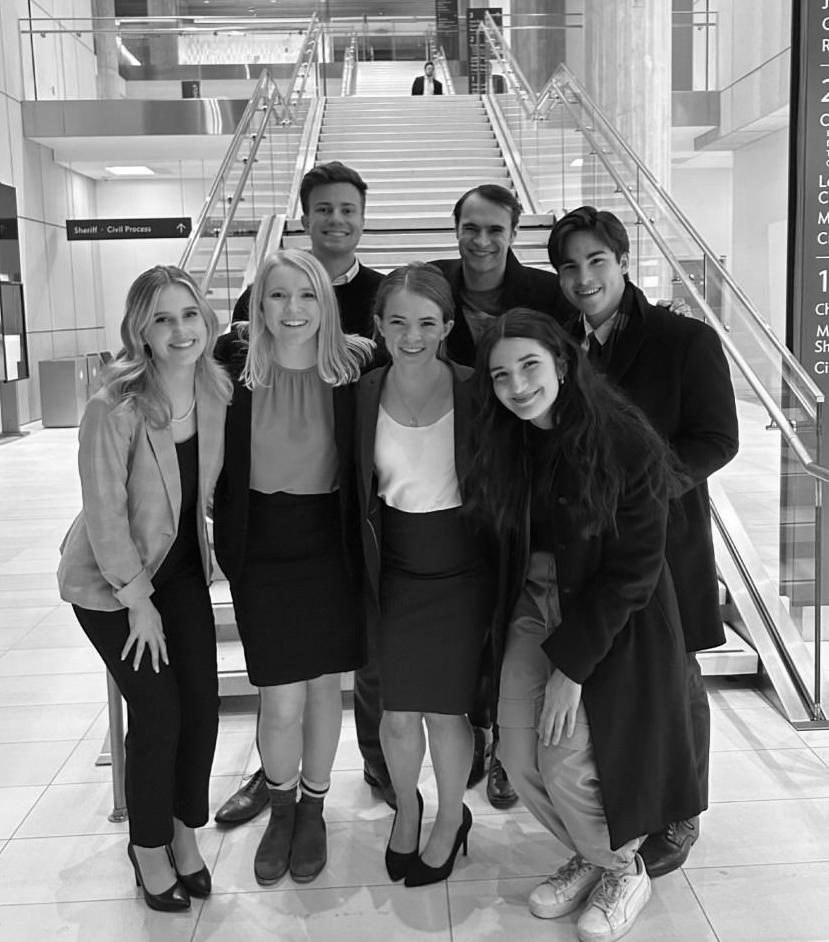
Appearing for the first time in the Pacific Northwest, Team 1076 won third place at the University of Oregon's Frohnmayer Invitational in Portland, Oregon, with a record of 11-4-1.
Junior Justin Lee won both an outstanding attorney and outstanding witness award for his performances.
Team 1077 returned to Indiana University for the Hoosier Hoedown in Bloomington, Indiana, with senior Abigail Wagner earning two outstanding witness awards. Finishing 3-5, coach Jonathan Church expressed satisfaction with both teams' performances, especially given their limited time to learn their material.
“This spring, we went
to very early invitationals during the first weekend of school,” Church said. “While that resulted in lower ballot totals than we might normally expect, the early practice allows the teams to get the rust off early and follow a scrimmage schedule that we expect to set the team up for success at regionals.”
Knowing they wouldn’t have the normal two to three weeks to work together and prepare their materials for the upcoming semester, junior Caleb Sampson said the teams met over Zoom during Christmas vacation to write their material and prepare for the upcoming tournament.
“We finished writing our cases about five days before we competed,” Sampson said. “Once we all got on campus, we scrimmaged for three days and practiced incessantly. We got where we needed to be and obviously things turned out pretty well.”
Arriving in Portland on
Hillsdale K-12 adds students, schools
By Alex Deimel Collegian Reporter
More than 15,000 students are currently enrolled in the K-12 Program this year, with 80 total schools across 26 states.
“The number and quality of the schools we work with is higher than ever, and we look forward to new Hillsdale schools getting started this fall,” said Kathleen O’Toole, assistant provost for K-12 education.
The program supports two different categories of schools: curriculum schools and member schools. The 57 curriculum schools use the K-12 Program Guide and its materials.
The remaining 23 schools are known as member schools. According to the program site, member schools are “new private or charter schools that have passed a competitive application process that includes a review of mission alignment, business plan, board fitness and charter application, if applicable.”
Collectively, the 23 member schools had 211 graduates in 2022. The graduates had an average SAT score of 1138, which was 8.6% above the national average. Sixty-three percent are now attending a four-year college, 22% attending a two-year college, and 2% are enlisting in the U.S. military.
O’Toole discussed the role of the education office
Friday afternoon, the students spent about 50 hours in the city, rushing to the
airport at 6:30 a.m. on Monday morning,” Sampson said. “We drove back to Hillsdale
in 24 hours, but I didn’t miss class.”
With such a successful weekend on the West Coast, Sampson said team 1076 is feeling confident heading into its regional tournament at the end of February. With all of their material memorized so early, the members will spend the next few weeks polishing their delivery.
Competing a bit closer to home, team 1077 also struggled to memorize its materials in such a short time period.
“We actually weren’t aware that the tournament was this past weekend until the Monday before because they rescheduled it without our knowledge,” Wagner said. “So we had enough time to write the case, but then we had four days to memorize all the material.”
airport after their last round.
“We landed at the Detroit
in establishing and managing these 80 schools.
“The K-12 Education office helps local groups found classical schools, and once founded, we provide them with teacher training, board and principal development sessions, and a comprehensive curriculum for all subjects and grades,” O’Toole said.
In addition to the member and curriculum schools, the program is planning to establish a third category of schools this year, called certified schools. According to Bryce Horswell, new school development manager for the K-12 program, the certified schools are “member schools that have demonstrated excellence in governance, leadership, use of curriculum, pedagogy, and maintain a thriving school culture. Certified schools are models for others.”
The process for founding one of these schools takes a full year, according to Horswell.
“Hillsdale’s member schools, as well as its curriculum, have been reaching many new audiences,” Director of Curriculum Jordan Adams said. “One of the special things about reaching new audiences in this way is being able to show them first hand what a Hillsdale education entails, including the effects it has on their children and families.”
Azerrad to speak on leftist politics
By Mark den Hollander Collegian Freelancer
Assistant Professor of Government and Research
Fellow David Azerrad will present “Narcissism, Wokeness, and the Modern Left” in the Formal Lounge at 7 p.m. on Jan. 26.
Azerrad teaches at the Allan P. Kirby Jr. Center for Constitutional Studies and Citizenship in Washington, D.C., specializing in political topics that include classical liberalism, conservative political thought, and identity politics.
“The premise of my talk is that conservatives do not really understand the left today in America because it is fundamentally different than the previous lefts in American history,” Azerrad said. “The contemporary American left is neither Marxist nor progressive. And it’s definitely not liberal. Although it incorporates elements of these older lefts, today’s left combines a narcissistic celebra-
tion of the self with a woke fetishization of victimhood to ennoble the former. My focus is really understanding the mind of the left.”
Mary Greco, undergraduate program coordinator for Hillsdale in D.C., said Azerrad will provide students with a better understanding of the current political environment in America.
“If any student is thinking about studying ‘abroad’ at the D.C. campus for a semester under the Washington Hillsdale Internship Program, they ought to come meet one of their professors,” Greco said. “Azerrad teaches Contemporary American Political Thought, a class that focuses on understanding what is happening in and to America today. The class changed my views entirely on economics, trade, foreign policy, feminism, and so much more. I could not recommend it enough.”
Hillsdale College students can register for the event on Handshake.
and arrived right in time for my 9 a.m. class. I hadn’t slept
Wagner explained how the team worked late into Friday night memorizing their directs, cross examinations, and witness statements
so they could be prepared by the next morning. Despite their high-pressure weekend, Wagner agreed with Sampson, saying that the early tournament helped situate the team for the rest of the season.
Looking forward to the regional tournaments, Church said Hillsdale’s teams are made up of mostly returning competitors, giving them an edge this year.
“Overall, our A and B teams are very experienced with over 80% of the competitors on those squads being returning team members,” Church said. “This is the first time in recent memory that we have an A team roster with only returning members competing on it—having enough returning members to put together such deep, talented A and B squads for the competitive season is a sign of huge growth for the program.”
SAB hosts trip to Frankenmuth Snowfest
By Erin Osborne Collegian Reporter
Students will enjoy traditional Bavarian food, ice skate, and watch ice sculpture competitions during the Student Activities Board’s trip to Frankenmuth’s Snowfest on Sat. Jan. 28.
Students will leave campus at 8 a.m. and be back on campus around 6 p.m., according to Director of Student Activities Maddie Clark.
“Students will be able to get lunch, and have about three or four hours to mosey around and check it all out,” Clark said. “Frankenmuth’s Snowfest will include ice sculptures as well as ice skating and all sorts of vendors.”
This is SAB’s first trip to Frankenmuth, although the board has run trips to
Detroit and Grand Rapids in the past.
“A lot of students go to Ann Arbor or Grand Rapids, or maybe even Toledo, but don’t spend an extra hour driving up to Frankenmuth,” Clark said. “It is a bit of a trek to drive up there, but this is also early enough in the semester that students are more available.”
SAB scheduled the event earlier in the semester, in the hope that more students would be able to attend, according to Clark.
“I feel like I still have time to go to Frankenmuth since we’ll only be two weeks into the semester, whereas later on I might not be able to go,” Junior Sarah Heinrichs said.
SAB will provide transportation via bus for students who are attending,

although students may choose to take their own cars as well.
“I was originally planning on taking the bus, but I noticed on Zehnder’s website that there might be fireworks later that night, so I may end up driving myself,” Heinrichs said.
Heinrichs has been to Frankenmuth in the past but has only visited in the summer.
“It’s a German town, and last time there was a lot of dancing,” Heinrichs said. “This time, I’m looking forward to ice skating and that sort of thing.”
Ninety-one students are presently signed up for the trip, and SAB is looking to get additional transportation for the trip.
“Students will get a confirmation email to find out if
they have a seat reserved on the bus, and we will email everyone else that signed up as well,” Clark said. SAB will also be providing coupons for the students.
“One of our students has been in contact with the city of Frankenmuth, and they are going to give us some free coupons and a welcome bag for the students on the trip,” Clark said.
Junior Lydia Hilton said she is excited to experience Bavarian culture.
“I signed up for the Snowfest trip mostly because all of my friends are going and it sounded like a good social opportunity,”
Junior Lydia Hilton said. “I have been to Czech festivals, but this will be my first Bavarian one.”
Classical schools visit campus for job fair
By Emma Verrigni Collegian Freelancer
For the first time, the Hillsdale College K-12 program has implemented an application and screening process for schools interested in appearing at the annual classical education job fair, which will be on Feb. 2 from 12 to 6 p.m. in the Searle Center. The number of classical schools seeking out Hillsdale students has grown significantly over recent years. The K-12 committee reviewed almost 200 applications and chose 59 schools that best represent the values of Hillsdale College, according to Events
Manager of Hillsdale K-12
Education Allison Wetzel.
The fair will provide students with connections in education and aid seniors in the search for teaching and administration employment. Students who attend can expect to learn about the values and curriculum of various K-12 schools and will be able to engage in individual conversations with teachers and administrators, according to Wetzel.
Many students have found jobs through this event, and even students not searching for a job have found it to be a good networking opportunity, Wetzel said.
“All of the schools and students who attend have a common goal – working together to lead students toward moral and intellectual virtue,” Assistant Provost for K-12 Education Kathleen O’Toole said in an email.
K-12 will also offer a prefair workshop on Jan. 31 to help students prepare.
“Research the schools ahead of time, and ask specific questions about the location of the school, faculty, culture, and their mission,” O’Toole advised.
“Make sure you're practically prepared, dress nicely, and have a resume ready to go,” Wetzel said. “Make sure
that you're ready to ask questions.”
Many of Hillsdale's member schools will also be represented at the fair.
“If you get a job at one of these schools, you’ll continue to have a connection with Hillsdale College after graduation, and Hillsdale professors may even do some of your teacher training,” O’Toole said. “Working at a Hillsdale member school is a way to continue to be part of Hillsdale College after you graduate, which is a helpful thing, especially while you are in your early years of teaching.”
www.hillsdalecollegian.com January 26, 2023 A3
Team 1076 wins awards at Portland tournament. Courtesy | Allison Dillow
Opinions
Online : www.hillsdalecollegian.com
Editor-in-Chief | Maggie Hroncich
Associate Editor | Christian Peck-Dimit
Design Editor | Tracy Wilson
Digital Editor | Josh Newhook
Outreach Director | Hannah Cote
News Editor | Maddy Welsh
Opinions Editor | Elyse Apel
City News Editor | Logan Washburn
Sports Editor | Isaac Green
Culture Editor | Megan Williams
Features Editor | Meghan Schultz
Science & Tech Editor | Ally Hall
Social Media Manager | Jillian Parks
Circulation Managers | Micah Hart and Victoria Wagner
Assistant Editors | Linnea Shively | Michaela Estruth | Lauren Scott
| Olivia Hajicek | Tess Owen | Olivia Pero | Thomas McKenna | Jane
Kitchen | Michael Bachmann | Carly Moran
Faculty Advisers | John J. Miller | Maria Servold
The editors welcome Letters to the Editor but reserve the right to edit submissions for clarity, length, and style. Send submissions to the Opinions

Editor at ehawkins@hillsdale.edu before Saturday at 3 p.m.
By Megan Williams
Versatility and durability are two qualities that are highly valued within today’s culture. The ability to adapt and be useful in different situations, as well as the ability to endure and improve over time makes people and objects more treasured. The same is true in the debate of wine versus beer. Because wine is more versatile, and can last and improve over time, it is better than beer.
Whether it is a hot summer barbecue at the lake or a dinner at a Michelin star restaurant, wine is a socially accepted beverage

The Collegian Weekly
The opinion of The Collegian editorial staff
Start the summer job search now
With the new semester starting, it can be easy to get caught up in the whirlwind of seeing friends after break, adjusting to classes, and joining new clubs around campus. But giving up a couple hours of time now to apply for summer jobs and internships can pay off down the road.
Many summer internship deadlines, if they haven’t passed already, will rapidly
approach by the end of January and February. Working ahead on applications now – before most classes have large papers and exams due – can make the experience of applying to jobs less stressful. Beginning the application process and lining up summer plans can help reduce overall stress and free up time to focus on school, friends, and other activities.
Even for job applications due in the spring, getting started now helps improve the quality of essays, resumes, and cover letters. Additionally, professors, mentors, and employers have busy schedules –reaching out to them about recommendation letters far in advance of your due date shows common courtesy and gives them time to write a more thorough letter.
Wine is better than beer
in any and every environment. Associated with fine dining, sophistication, and gorgeous cities like Napa, Florence, and Paris, wine has a high-class reputation suitable for every situation. Whereas beer is known for its bellies, dirty pubs, and grumpy old men, wine has hundreds of different iterations to fit your needs. Not only does wine boast over 200 varieties, but it can also be used to create classy cocktails, simple sangrias, and pleasant punches. And if you don’t feel like sipping it, wine can also be used to make a multitude of exquisite dishes. While beer only offers battered fish and
bright orange cheese, wine is known for deepening and elevating the flavors and qualities of beef roasts, chocolate cakes, and stews. Because of its extensive ranges of acidity, flavors, and alcohol content, there is a type of wine to go with any kind of food. Try a cabernet sauvignon with your rare steak, sip a pinot gris with your pear salad, or grab a sangiovese for your homemade bolognese. Regardless of your tastes in cuisine, you can conduct a quick Google search to find a glass of wine that matches your meal and flavor preferences. Not only does this versatility create endless
Mulan is a Disney princess
By Victoria Kelly
There is a common and particularly egregious affront made to one of my favorite Disney characters. It goes like this: Mulan, the heroine of the 1998 animated Disney movie, is not a Disney princess since she was neither born a royal nor made one by marriage.
It’s an appalling accusation, and indicative of a lack of understanding of what a Disney princess is. Further, it is insensitive to the strong female inspirations that little girls need. According to Merriam-Webster, one definition of a princess is “a woman of high rank or of high standing in her class or profession.” Mulan is praised above her fellow soldiers and her commander, honored with the seal of the emperor and the sword of her enemy, and offered a spot on the emperor’s counsel. A lot of people–including the emperor himself––bow down to her. That’s a level of power and influence almost approaching sovereignty that we never even see many of the “legitimate princesses” endowed with.
Urban Dictionary reveals the colloquial meaning of a princess as a woman who manifests beauty, character, and wit. Mulan does that as well as any of her peers among the Disney princesses. Teaching a girl how to emulate a princess should be less about saying, “Go find a prince of some country still backwards enough to have a monarchy and seduce him once you’re a teenager” and more about “Be good, and brave, and kind, and you’ll have every trait that matters in a princess.” For this, Mulan belongs.
Yet a Disney princess is not the same thing as a princess that is owned by Disney. Princess Leia of “Star Wars,” Giselle from “Enchanted,” Anastasia, Kida from “Atlantis,” and even Anna and Elsa from

“Frozen” are all not considered Disney princesses for various reasons. Loosely, a Disney princess has these characteristics: she’s a female human, is the protagonist, has an animal sidekick, is beautiful in appearance and character, has a musical number, and is a royal family member or a national hero. The first two rules have their own exceptions, and Mulan fits the final broad qualification.
included for more than just checking off qualifications and making Disney money. She provides an important subset of representation. There are girls–I was one of them growing up–who just don’t relate to the perfect-princess-type of a Cinderella or a Snow White. Sure, there are others, like Pocahontas and Jasmine, but Mulan is unique. She’s a warrior. She doesn’t come from privilege, yet obtains,
culinary choices, but it also opens the opportunity for a new hobby or learning experience. The art of wine pairing is a skill that takes practice and knowledge of the characteristics of wine varieties. So as you learn to cook up new dinner dishes, you can also expand your understanding of this expansive topic.
Along with the superior diversity of wine, it also never grows old. While beer has a strict expiration date, the production process of wine actually utilizes time to help make the product better. That’s why there’s popular sayings like, “he’s aged like fine wine,” because
the drink is known for getting better the longer it ages. The more time that quality wine is left in a cool, dry place, the more vibrant its flavors will become. Wine can be stored not only for years, but also decades. This quality allows consumers to save a wine for a special occasion, impress guests by serving a five year old bottle, or even fill a wine rack for decoration without the risk of it spoiling.
Unopened beer, on the other hand, can only last a maximum of eight months, but it begins to lose its carbonation and flavor after three to five months. So if you’re rummaging around
Walking outside to snow-covered streets and gray clouds can make summer feel far away, but it’ll be here before we know it. If you’re hoping for a summer job or internship, working on applications now could go a long way towards helping your future self.
your parent’s alcohol cabinet looking for something to sip on, it’s probably a safer bet, and a better experience, to choose the dusty wine bottle over the faded can. Beer has an undeniable history and culture of its own, but it is not as versatile or durable as its competitor. With only about 100 varieties, an unimpressive flavor range, and a short period of quality flavor, it is clearly worse than wine.
Megan Williams is a senior studying rhetoric and media and journalism. She is an editor at the Collegian.
Mulan is not a true Disney princess
By Alexandra Gess
Let’s get down to business to defeat the ridiculous notion that Mulan is a Disney princess. Here’s the cold, hard truth: Mulan should not be a Disney princess. No matter how much we try to deny it, Disney’s standard for who is or isn’t a princess is basically nonexistent and chock full of inconsistency. Disney
Mulan being one of the most problematic. Fa Mulan, like her father before her, was a high-ranking soldier in the Chinese imperial army. She later married General Li Shang, another high-ranking officer in the same army. While noble in status and heroic in deeds, she is not royal by blood or by marriage, making her role as a princess, by Disney’s standards, baffling.
is one of our core tenets. As students at such an institution, how dare we blindly accept the flimsy standards of a woke, postmodern mass-media conglomerate? For all we know, the next Disney princess could very well be a man, all because the Walt Disney Company said so.
Mulan is not the only inconsistency. Anna and Elsa, of “Frozen,” are princesses by birthright and yet are not included in the official list of Disney princesses, but Mulan, who isn’t even royal by marriage, is. Why? One
Ultimately, though, it’s a business decision about who will make money for Disney by being included in the lineup. Esmerelda from “The Hunchback of Notre Dame” used to be a Disney princess, but got removed for not selling well enough. Tinkerbell moved on to head up the Disney fairies. Jane from “Tarzan” apparently clashed with Belle, since both wear yellow. Anna and Elsa make too much money on their own.
Still, Mulan ought to be
without the help of a prince who has power by the luck of his birth, a country’s worth of honor. So far as Disney may be attempting to give royal-level role models to children, Mulan is a Disney princess in every way that matters.
Victoria Kelly is a junior studying political economy.
seems to be taking what a princess is and redefining it to fit their own idea of what a princess should be, rather than sticking to the objective definition. While it is true that Mulan is listed as one of Disney’s 12 official princesses, the list of characters has no real common denominator other than the fact that they are all women. Most of them are royalty, either by birth or by marriage, but there are a few awkward cases,
According to Mirriam-Webster, a princess is, by definition, “A female member of a royal family. Especially a daughter or granddaughter of a sovereign.” Mulan, unfortunately, does not meet that criteria. Sure, Disney may say that Mulan is a princess, but logic and objective truth say otherwise, which should take precedence over Disney’s attempt to redefine that term. We attend a school where the pursuit of truth
can only speculate. Even the characters Disney defines as princesses vocally disagree with their assertions. Moana outright says in a conversation with Maui that she is not a princess, but rather distinguishes herself as a chief’s daughter. This inevitably imposes the same implications on Pocahontas as well, who is in the same position as the daughter of an American Indian chief. Both women are noble, but technically speaking, their status as princesses is questionable at best.
Disney, I only have one thing left to say: in the words of Mushu, “Dishonor. Dishonor on you, dishonor on your family, and dishonor on your cow.”
Alexandra Gess is a junior studying religion.
www.hillsdalecollegian.com A4 January 26, 2023
The Disney company decides which princesses make it into the official princess lineup. Courtesy | Flickr
“While noble in status and heroic in deeds, she is not royal by blood or by marriage”
Metz should serve lemons and soy sauce
By Kiri Forrester
Metz Culinary Man-
agement expanded its supply of condiments to offer students a variety of flavors to spice up their daily meals in the past year. Two condiments are still missing: soy sauce and lemons.
Sometimes Metz serves noodles, stir fry, or other Asian dishes at Passport. There is often a bowl of soy sauce packets located at the end of the counter, but not always. More than once, I have sat down with a bowl of fried rice or noodles, wishing I had some soy sauce to add some extra flavor to the dish.
My mother is Japanese, so I grew up with her cooking. Soy sauce is the Asian equivalent of salt. We add it to our soup broth, stir fry, vegetables, sushi, dressing mixes, and even potatoes. Those I’ve talked to have shared a similar desire for a greater presence of Asian flavors in meal options. Soy sauce is also said to help with digestion, gut health, and may reduce allergies. If Texans get a plethora of hot sauce, shouldn’t the Asians be given the courtesy of a reliable supply of soy sauce?
An even more important condiment for Metz to supply is lemons. Lemons go on many things–meat, fish, salad, pasta, water, and tea. Metz has a mouth-watering sweet and sour taste that brings out the flavor of almost any food. Its acidity cuts through grease, makes food sit lighter, and adds a refreshing taste.
Lemons are also extremely healthy. They are an excellent source of Vitamin C, which is especially important during the long winter season. Eating a couple slices each day is a good way to build the immune system. Vitamin C also contributes to the formation of collagen, which the body produces to keep skin from sagging, giving a more plump and youthful look. The body’s ability to produce collagen decreases with age. Vitamin C helps maintain a healthy complexion by preventing skin damage. Providing daily access to lemons will help students be able to eat tastier and healthier meals.
Cafeteria food may not be everyone’s favorite source of daily nutrition, but we must acknowledge the challenge Metz faces in trying to please a large and diverse community of students. Condiments and seasonings allow students the freedom to modify their meals to their taste in a simple and cost-effective way. I believe that expanding the dining hall’s condiment inventory to include both soy sauce and lemons would be the next suitable step to producing happier, healthier students.
Kiri Forrester is a junior studying art and English.
Missouri is part of the Midwest
By Truman Kjos
My home state of Missouri is a weird state, one historically caught in the margins. Because of this, there’s debate over how it should be considered culturally - part of the Midwest or part of the South?

At Hillsdale, I’ve found that a handful of friends, mostly from the Eastern Midwest, do not believe Missouri can be considered Midwestern. An Instagram poll I conducted confirmed the popularity of this belief. While much of Missouri’s heritage and culture stems from the South, to deny its Midwestern roots is incorrect.
Culturally, most of Missouri fits in with the Midwest. Consider vocabulary. One of the defining cultural traits of the South is usage of the word “y’all” to refer to a group of people. A 2013 study by Joshua Katz of North Carolina State University revealed that throughout Alabama, Georgia, and the rest of the Deep South, y’all is a common word. The farther away from Jackson, Mississippi one gets, the more usage declines. In Missouri, y’all is commonly said
only in the Bootheel, that awkward bit in the southeast that we took from Arkansas. Anywhere farther north, people refer to “you guys.” One phrase Missourians do use a lot is “ope,” one of the defining phrases of the Midwest. It’s a term used to apologize for minor inconveniences. Whether these perceived inconveniences actually occurred or not is irrelevant.
Beyond vocabulary, ope can be seen as an example of “Midwest Nice,” a buttoned-up form of courtesy that sometimes edges into passive-aggressiveness. While Minnesota will always be the king of Midwest Nice, Missouri has also mastered this method. I’ve lost count of the number of four-way stops I’ve been waved through in Missouri. Additionally, we have Culver’s, John Deere, and Casey’s, serve pulled pork at every high school graduation, and wear shorts in 40 degree weather. Salt, pepper and ranch are often as spicy as food gets. Geographically, Missouri also fits in better with the Midwest than the South.
My hometown of Brookfield is an hour’s drive from
Iowa. While Brookfield is fairly far to the north, the entire state is largely parallel with the Midwest. Even as far south as Springfield, for instance, driving west brings you to Kansas and driving east brings you to Illinois. It also has similar terrain to these neighbors. Driving through Missouri means seeing a lot of corn and soy, followed by even more corn and soy. As a prospective Hillsdale student, I couldn’t help but note how similar the landscapes of even Missouri and Michigan were, particularly in the undeveloped countryside. At most, the Ozarks can be considered part of the South, since it’s a shared geography with Arkansas. Even then, the top half of the Ozarks is a gray area, and to strip anything north of them from the Midwest is ludicrous.
The most common argument for Missouri being part of the South is that it was a slave-holding state prior to the Civil War. But consider the historical context. The idea of slavery being legal in a state that far to the north was so strange that following vigorous debate, Congress had to make
Banning gas stoves would be a setback
By Chris Dick Banning
gas stoves will set the culinary world back centuries. Early this month, Richard Trumka of the U.S. Consumer Product Safety Commission announced that he was thinking about regulating or even banning gas stoves in favor of electric stoves. Citing concerns over children’s health, these officials believe that banning gas stoves will protect the health of the most vulnerable. He later walked these comments back, due to uproar, but the moment deserves a hard look at the issue.
the Missouri Compromise to allow its practice.
During the Civil War, while a significant number of Missourians supported the South, it never joined the Confederacy. Nearly three times as many men from Missouri became soldiers for the North than for the South. Thus, while Missouri certainly has some historical Southern influence, this history is too complex to just lump it in entirely with the South.
I consider Missouri a Midwestern state with Southern trappings. Its very identity is kind of an awkward combination, something God thought would be funny, like the platypus’ makeup of mammal body and duck bill. But just as the platypus is identified as a mammal despite its duck bill, so Missouri should be considered first and foremost a Midwestern state in spite of Mizzou’s presence in the SEC.
Truman Kjos is a junior studying applies mathematics
George Santos should resign from Congress
By Micah Hart
Corruption and politics are practically synonymous nowadays. Yet, a sense of responsibility and decency doesn’t seem like too much to ask for in a public official. It is time for New York Republican Rep. George Santos, who breaks away from both the former traits, to resign from his position in Congress.
The newly sworn in freshman member of the U.S. House of Representatives made headlines within just weeks of his “historic” election (the first congressional race between two openly gay candidates) for accusations of a growing list of issues: embellishing his résumé, lying about his heritage and his mother’s death, and taking thousands of dollars from a disabled veteran’s GoFundMe focused on saving the veteran’s service dog.
The congressman admitted to adding details, including that he graduated from college and that he worked for Citigroup and Goldman Sachs, to his resume along with his “Jew-ish” heritage, according to NBC News. Howev -
er, the representative still denies other accusations against him and is unwilling to resign.
The Republican Party and its leadership in the House have made strides by placing him on lower-level committees. But more must be done to ensure this doesn’t happen again and that Santos is done with his 15 minutes of fame.
The New York congressman represents the state’s 3rd congressional district, which, as CNN reports, President Joe Biden won by eight points in the 2020 election. The margin between Republicans and Democrats in the House is already razor-thin, and by resigning, Santos would only make that margin thinner. While this is a valid concern when it comes down to what can get done (and was crucial in the speaker of the house vote), morals and doing what is right should triumph over parties.
In Nassau County, some of which rests in Santos’ district, the district attorney, Anne T. Donnelly, announced Santos will be investigated, according to the Washington Post. This district attorney is a
Republican.
Other Republicans in New York sounded off on Santos. A recent Journal News (a New York State newspaper) story stated that six Republican congressmen from New York desired for the resignation of the congressman.
Unlike these members, some have condemned the congressman, but will not go to the extent of resignation, unless he committed a crime.
Whatever the case may be, Santos lied to his now constituents about serious matters, which will dictate how he governs. If he can’t be trusted to tell the public about his background, how can he be trusted when it comes to issues that affect every American and their security?
Republicans have looked broken and like they are internally falling apart. This is a moment for Republicans to take back the narrative and come out
Children’s lives should be protected, but with the science questionable and the alternatives lacking, we should not ban gas stoves. Far better alternatives to a ban exist, including increased ventilation that does not demand the limiting of culinary freedoms.
I’ve used an electric stove top all my life, and that world pales compared to gas stoves. Every time I get to use a gas stove top, the speed and consistency of the heat fill me with excitement. My electric stovetop back home, though relatively new, is inconsistent. One burner heats to a higher temperature than the one underneath, though they are set to the same level. The only way to know that is to feel the heat directly.
With a gas stove, you have the visual element, allowing you to calibrate the flame to the specific height and color that it needs to be.
Electric stovetops are used in Hillsdale dorms and the inconsistencies between the Whitley stove top and the Suites stove top exemplifies the problem with electric stove tops. What is an excellent medium cook in the Whitley kitchen is a charred mess in the suites. This inconsistency is not an anomaly, but a characteristic.
looking a little better.
Numbers are important and Republicans need a strong and unified majority to act as a check on the reckless acts of the Biden administration and Senate Democrats. Republicans could still win that seat in a special election, or at least know they did the right thing.
Politicians lie. Politicians play games to gain attention. Politicians sometimes put themselves before the betterment of the people they represent. Sadly, these are things expected in the field and by Americans, yet there must remain a standard. If Santos is able to skate past these allegations without anything except a blemish on his already mediocre résumé, then not enough has been done. Santos, it is time to resign and allow the people of the third congressional district to receive an honest and capable representative.
Micah Hart is a sophomore studying politics and journalism. He is a circulation manager at the Collegian.
Aside from the question of efficiency and consistency, the speed difference is astonishing. If you want to boil something on a gas stove, you fill a pot with water, turn the heat to medium-high, and wait till a rolling boil forms.
If you want to boil something on an electric stovetop, you develop a crochet hobby because you’ll be waiting till the coils heat up to the temperature the gas stove was at 20 minutes ago.
Kids should be protected, gas explosions should be avoided, and gas stoves beg questions about environmental impact, (Although the environmental question demands an entirely separate article) but we cannot let our fears push us into the culinary stone age. There is a reason no real restaurant has electric stovetops. The technology is not even equal to what gas stoves had 10 years ago. The government should not force poor culinary equipment on Americans…unless they like bad food.
Chris Dick is a junior studying history.
www.hillsdalecollegian.com Opinions January 26, 2023 A5
Is Missouri part of the Midwest? Courtesy | Flickr
“Republicans have looked broken”
City News
Local leaders speak at Hillsdale March for Life
By Sofie Kellar Collegian Reporter
Nearly 40 pro-life community leaders and residents gathered for the annual Hillsdale March for Life in front of the Hillsdale County Courthouse on Jan. 20.

“We were praying for the last two years for the overturning of Roe v. Wade, and now, with that decision, it went to the states,” College Director of Financial Aid Rich Moeggenberg said. “Proposal 3 passed here,
which isn’t a good thing.”
Proposal 3 was a ballot initiative that amended the Michigan Constitution to includenearly unlimited right to legal abortion. The measure was approved in the November 2022 election, less than six months after the U.S. Supreme Court’s decision in Dobbs v. Jackson overturned Roe v. Wade.
Moeggenberg helped organize the march but said it was a group effort of local pro-lifers.
“This last year was a full year,” said Bryce Asberg
’21, director of Helping Hands Pregnancy Resource Center and a speaker at the march. “We certainly need to praise God for his work overturning Roe v. Wade, but we also need to take stock of the situation and figure out what we do going forward.”
The march began near the courthouse at the gazebo steps, where Rev. David Reamsnyder, pastor of St. Anthony Catholic Church, led the group in prayer and benediction. The marchers then walked around the courthouse
Statewide network glitch causes temporary 911 outage
By Olivia Hajicek Assistant Editor
Hillsdale County suffered a temporary 911 outage on Jan. 10 due to a system error that disrupted emergency calls statewide.
Peninsula Fiber Network, which provides 911 service across Michigan, said in a press release that a network error caused the disruption.
“An error occurred in the company’s optical transport network resulting in database corruption,” the press release said.
“This caused a hardware/ software mismatch resulting in some 911 calls to not be completed as expected or calls that lacked critical caller and address information.”
The company’s technicians found a disruption in the network at 3:15 p.m. on Jan. 10, the press release said. A backup system also malfunctioned.
Hillsdale County Central Dispatch announced the issue on its Facebook page at 3:42 p.m. the same day.
“Your 911 call may get routed to an adjacent county and they will take the information for us and we will get a response to you,” the center said.
Central Dispatch 911 Director Thomas Whitaker said the issue did not result in any missed calls in the county. Whitaker said if there is an issue, calls normally roll over to the next county.
Hillsdale calls roll to Lenawee County, Lenawee calls roll to Jackson County, and Jackson calls roll to
Hillsdale County.
“To my knowledge, that was working,” Whitaker said. “I know Jackson was not 100% impacted as much as we were, but to my knowledge we did not miss any 911 calls. There was nothing reported to us from any other agencies.”
The center said that Text-to-911 was working if residents could not call, and told them to call the number that reaches the center from outside the county.
Text-to-911 is part of PFN’s Next Generation 911 system, which allows
singing hymns. Asberg and Bud Vear, whom Moeggenberg called the “godfather of the prolife movement” in Hillsdale, encouraged Christians to safeguard the sanctity of life.
“Pro-life people are in general very peaceful,” said Vear, a 96-yearold retired doctor. “But the pro-abortion side is violent. They have begun to be violent in front of crisis pregnancy centers. Hopefully they won’t bother us here at Helping Hands.” Vear added that he sees
differences in how the two sides treat their clients.
“They charge for their services. You can’t get an abortion free. It costs money at Planned Parenthood,” Vear said. “All the services at crisis pregnancy centers are free, including ultrasounds. The contrast is remarkable.”
Asberg attended the march with his wife, Celina Asberg ’20. He spoke about pro-life Christians’ goals after the fall of Roe v. Wade.
“What's our battle plan in an increasingly polarized post-Roe world?” Asberg
said. “How do we stay faithful to God and what he’s commanded us to do?”
State Rep. Andrew Fink, R-Hillsdale, attended the march with his family, as did state Sen. Joe Bellino, R-Monroe.
Vear shared experience from his career as an obstetrician, in which he delivered more than 2,000 babies.
“All the babies I delivered, I felt it was a miracle,” Vear said. “So when you talk about destroying that life, not allowing that life to live —
Hillsdale Brewing hosts indoor winter market
an email.
At 4:53 p.m. the center announced 911 lines were “back up and working.”
PFN General Manager Scott Randall said in the press release that multiple safeguards failed to stop the disruption.
“We take our missioncritical role in delivering consistent and reliable service to Michigan’s 911 operators very seriously and build multiple redundancies into our network. We also work with dispatch center managers to ensure processes are in place to reroute calls between centers when unexpected issues occur,” Randall said. “Despite our best preparations, some calls were still disrupted and for that we are deeply sorry.”
McKee said a very similar issue occurred in November, but it was not as large in scope.
“We identified the issue and are replacing the transport equipment in the network,” McKee said.
photos, video footage, and information from medical devices to be sent along with an emergency call, in addition to more precise location data.
According to Tim McKee, PFN’s Next Generation 911 Program Director, 82 of Michigan’s 83 counties use PFN’s Emergency Services IP Network.
“Not all dispatch centers were impacted but any dispatch center impact is too many,” McKee said in
According to the press release, PFN is redesigning its network and installing new equipment to make its 911 system more resilient. The company says it is investing $6 million in the upgrades, which will take several months to complete.
“We are now making several upgrades to the whole system to eliminate the possibility of additional network errors in the future,” Randall said.
By Haley Strack Senior Reporter
The Hillsdale Farmers Market, which usually ends in October, has opened indoors for the city’s first winter market.
The winter market runs from 10 a.m. to 2 p.m. every other Saturday in the back room of the Hillsdale Brewing Company.
“It’s slower than the summer markets, but there are definitely some familiar market faces,” said Ashlyn Neveau ’16, a market regular and owner of Hillsdalian Goods. “It’s always good for people in town to get out and do something when it’s cold.”
The market features grass-fed beef, chicken, lamb, dairy products, root

vegetables, apples, jams, baked goods, home goods, and clothing. Regular merchants at the summer market said they were glad to stay in Hillsdale during the colder months.
Juniors Lucy Griffin and Caitie Dugan visited the market last week.
“As a farmers market fanatic in the warmer months, the winter market was so great,” Griffin said. “This is a great way to be involved in the town until the farmers market comes back in the spring.”
Hanover-based Seffernick Farms, which sells pork, chicken, eggs, jelly, dog treats, and beeswax goods, usually participates in Coldwater’s winter market. The vendors said that compared to similar
markets, Hillsdale has had a good turnout for its first year.
Dugan said she was glad vendors had a place to showcase their goods in off months.
“My family and I all got each other Hillsdalian Goods gifts for Christmas. We ended up getting the same designs in different colors. We love Hillsdalian Goods,” Dugan said. “So I always love seeing Ashlyn’s products at the market.” The winter market will run until May, when it will return to the courthouse parking lot downtown. “I love markets. I love meeting new people,” Neveau said. “I hope everyone will stop by.”
www.hillsdalecollegian.com
A6 January 26, 2023
Local churches and the Knights of Columbus assembled for the annual Hillsdale March for Life. Logan Washburn | Collegian
Seffernick Farms sold its homemade goods at the market. Haley Strack | Collegian
“Your 911 call may get rerouted to an adjacent county and they will take the information.”
Democratic legislators push for ‘right-to-work’ repeal
By Thomas McKenna Assistant Editor
Democrats in the Michigan legislature introduced multiple bills Jan. 12 that would repeal the state’s “right-to-work” law that allows employees to work without joining a union.
While supporters of the legislation said it would restore unions’ bargaining power for better working conditions, local leaders are voicing opposition.
Susan Smith, executive director of the Hillsdale County Economic Development Partnership, said she sees no point in repealing “right-to-work” laws.
“You're limiting people's freedom of choice,” Smith said. “I don’t think that’s a democratic thing to do. If people wish to join a union,
they’re free to do so. If they wish to not be a part of the union, they have that option. As long as they know, I don’t think we need to have any more freedoms taken away from us in Michigan.”
State Sen. Joseph Bellino, R-Monroe, said he thinks the measure will pass his chamber.
“I think they probably have the votes already,” Bellino said.
Michigan has been one of 28 “right-to-work” states in the U.S. since a Republicancontrolled legislature passed the law in 2012. Democrats now hold the governor’s mansion and took control of the state Senate and state House chambers following last November’s elections, with a narrow two-vote majority in both.
State Rep. Regina Weiss, D-Oak Park, is sponsoring the legislation. She said she rejects the term “right-to-
Police find pipe bombs during fugitive arrest
of a wanted fugitive and discovered two pipe bombs and several firearms,” the press release said.
Police then safely disposed of the bombs on site, according to the press release.
work” and believes repeal would benefit Michigan workers.
“The phrase ‘right-towork’ is a lie,” Weiss said, according to MLive. “These laws do nothing but hurt hard-working Michiganders by hamstringing their ability to effectively organize for good benefits and competitive wages.”
Rep. Andrew Fink, R-Hillsdale, pointed to a 2022 study from the Mackinac Center, a rightleaning Michigan think tank. The study found that counties in “rightto-work” states had higher employment levels compared to bordering counties in non-“right-towork” states.
“Because of our unusual peninsular geography, relatively few communities in Michigan border another right-to-work state, leaving us to bear the brunt of such

a policy change,” Fink said. President of AFL-CIO Ron Bieber said in a press release that “right-to-work” laws harm workers.
“The purpose of socalled ‘right-to-work’ laws is to destroy unions and our ability to improve wages and working conditions for all people,” Bieber said.
Union membership in Michigan has dropped to 13.3% in 2021, down from 16.6% in 2012 when the law was passed, according to the U.S. Bureau of Labor Statistics. If the law is repealed, Michigan would become the first state in almost 60 years to pass and repeal “right-to-work.”
Max Nelsen, director of labor policy at conservative nonprofit Freedom Foundation, said a repeal of “right-to-work” would not help public workers.
“As a matter of fairness and civil rights, no public
employee, no worker should be forced to pay a private organization as a condition of keeping their jobs,” Nelsen said. “Without ‘rightto-work’ protections, that's exactly what happens.”
The Supreme Court ruled in the 2018 case Janus v. AFSCME that under the First Amendment, public workers could not be required to join a union as a condition of employment.
Nelsen said two bills introduced by state Democrats, HB 4004 and SB 0005, would remove “right-to-work” rules for public employees, directly violating this Supreme Court precedent.
“That is just incredible to me,” Nelsen said. “These two bills are in direct defiance to the U.S. Constitution to the First Amendment and would seek to force back into unions tens of thousands of public employees in
Michigan. I just don't see any universe in which those two bills, if passed, hold up in court. I have no idea why Michigan Democrats would waste their time attempting to directly defy the Constitution in this way.”
Weiss did not respond to a request for comment on the constitutionality of HB 4004.
Bellino said the state Senate should be focused on crafting bipartisan policy, and said repealing "rightto-work” laws would make Republicans less likely to cooperate.
“Michigan is flush with cash,” Bellino said. “Michigan has lots of problems with schools and mental health. If we're going to tackle ‘right-to-work’ first, we're telling all the other non-union people in Michigan ‘we don't really care about you.’”
By Tess Owen Assistant Editor
The Hillsdale County Sheriff’s Office and Michigan State Police discovered two pipe bombs in a Cambria residence after arresting fugitive Michael Lyon on Jan. 10.

“The 35-year-old suspect barricaded himself in the home initially but eventually surrendered without incident,” according to a press release from the Department of Homeland Security’s Technical Resource for Incident Prevention.
Court records show Lyon was originally wanted on charges stemming from an October 2022 burglary. He was arraigned on Jan. 11.
“Hillsdale County Sheriff’s Office, Michigan State Police, Region of Irish Hills Narcotics Office, and Michigan State Police Emergency Response Team executed a search warrant at a residence in Cambria following an investigation
Lyon was arraigned on Jan. 11. A probable cause conference is scheduled for Feb. 1, according to the Hillsdale 2B District Court docket. Hillsdale County Prosecuting Attorney Neal Brady is prosecuting the case, and local attorney Keith Stickley is representing Lyon.
According to the sheriff’s office a $100,000 bond was allowed but not posted. Michigan Department of Corrections records show Lyon also served
Indoor golf simulator opens downtown
By Elyse Apel Opinions Editor
A new indoor golf simulation center offers residents another way to enjoy themselves in downtown Hillsdale.
A Jonesville business owner opened Seasonal Swing on Jan. 1.
“It’s been a dream of mine for a really long time,” said owner Carter Ballinger. “I just want it to be a nice thing for the whole community.”
three years in prison after being convicted in 2004 for breaking and entering a building with intent to burglarize.
The sheriff’s office and Irish Hills narcotics office did not respond to requests for comment in time for publication.
The business, located at 47 N. Broad St., features two golf simulators that allow customers to play more than 85 courses.
“The simulators are very expensive pieces of equipment,” Ballinger said. “We picked them because of their accuracy and because of how user-friendly they are.” Ballinger, who graduated from Jonesville High School in 2014, said he has a passion
for golf and entrepreneurship. After graduating from Central Michigan University, Ballinger returned to Jonesville and opened his first business. The company was called CB Painting, and its success led Ballinger to attend graduate school for a master’s degree in entrepreneurship.
“My senior project in college was actually starting a golf simulation business,” Ballinger said.
He said he turned to golf after his college wrestling career ended due to multiple injuries.
“When wrestling ended, I needed something else,” Ballinger said. “So I picked up the game anyone can play: golf.”
Ballinger said he loves golf’s accessibility.
“I wasn’t very good when I first started, but through playing a bunch it is something you can get better
at very quickly. It’s something anyone of any age can pick up and it just takes time and consistency to get better.”
The center, only open for a few weeks, has already attracted community attention online along with supportive reviews.
“Great place, wonderful simulator. I think Carter Ballinger has a winner for downtown Hillsdale,” said John Wilson in an online review.
Ballinger said that the community response has been overwhelmingly positive.
“It’s been outstanding,” Ballinger said. “When people come in, they all say they are definitely coming back.”
While the center serves alcohol, Ballinger said he wants the community to know it is not just another bar, but aims to provide a place in downtown Hillsdale where people could improve
their golf game and have a good time.
“The center is open to people of all ages. We’re not trying to be a bar,” he said.“We applied for a liquor license because people like to have an alcoholic beverage while they play golf, but that’s not the focus.”
The City of Hillsdale welcomed the center with a statement.
“The City of Hillsdale also thanks Carter for investing in our historic downtown,” it said.
While rental clubs are available, Seasonal Swing recommends visitors bring their own.
Both gift cards and reservations are available online at www. seasonalswing.com.
Hours of operation are 7 a.m. to 11 p.m. Monday through Friday, 8 a.m. to 11 p.m. on Saturday, and noon to 10 p.m. on Sunday.
County courthouse undergoes major renovations
By Catherine Maxwell Collegian Freelancer
Renovations to the Hillsdale County
Courthouse that started last summer may not be completed by the planned deadline of fall 2023, according to County Commissioner Doug Ingles.
“It all depends on the weather,” said project manager Jake Verhagen of Renaissance Historic Exteriors. “Our plan right now is to try to get done by this fall but if we have 20 to 30 days of rain in the summer, or if the spring weather doesn't break, that could set us back a little bit.”
Hillsdale County hired Illinois-based company Renaissance Historic Exteriors to restore the courthouse. According to Ingles, the project may not reach completion on time due to supply chain issues.

“Scaffolding has been going up since late summer,” Ingles said.
The construction crew will work on the clock and bell tower, and replace bricks
where necessary, according to Ingles.
“It’s a 125-yearold building,” he said. “Maintenance has not been ongoing through the years. The roof leaks.”
The county is funding the project from two sources.
“We’re using money from our capital improvement fund and American Rescue Plan money,” Ingles said.
Verhagen said the building needs many types of work.
“There's a bunch of duction repair and stone replacements that we need to do,” Verhagen said. “All the metal elements, gutters, cornice, metal and all that stuff, along with the metal on the tower, is getting removed and reinstalled.”
Workers are also relaying the clay tiling on the roof, he said.
The State Historic Preservation Office approved the courthouse restoration as long as the building’s integrity and historical significance would not be compromised, Ingles said, noting that this meant the
county chose its construction company carefully.
The county found Renaissance Historic Exteriors the only company capable of properly restoring the courthouse. It specializes in historic buildings, with an emphasis on roofing and metalwork, according to its website. The company has won multiple awards.
“Anything to do with an old building, we do it,” Verhagen said.
The company has previously worked on multiple courthouses, churches, residences, and the Wyoming state capitol, according to its website.
Despite the damage to the courthouse, Ingles said it is an important piece of local and state history and on the National Register of Historic Places. The courthouse entered the NRHP in 1982, according to court documents.
Locals have mixed opinions of the courthouse project.
“Big pictures of Hillsdale commonly feature the courthouse. It's been the
center of the town and indeed the county,” Andrew Gelzer, manager of Gelzer’s Hardware, said. “Disruption to business has come from parking issues related to the project.”
Amy Kass, manager of The Blossom Shop of Hillsdale, said she has reservations about the project.
“I don't believe it's an important building. What goes on inside, yes, but not the building itself,” Kass said. “We didn’t know exactly what parts they were restoring. I can see keeping it maintained, but spending extra money because they think that it's an important landmark or something important that was here for years and years and years, no.”
At the same time, Kass said she has not noticed disruption downtown.
According to Ingles, repairing the courthouse is a responsibility of the county as well as a necessity.
“We have to be good stewards as commissioners,” Ingles said.
www.hillsdalecollegian.com City News
January 26, 2023 A7
More than five inches of snow fell on Hillsdale Wednesday. Maggie Hroncich | Collegian
Michael Lyon. Courtesy | JailTracker
Construction crews work on the bell tower. Logan Washburn | Collegian
“The 35-year-old suspect barricaded himself in the home.”
Alumna Feature
Alumna brings social media skills to athletic department
By Megan Williams Culture Editor
After traveling the country and living out of their Jeep for six months, Hillsdale alumna Regan Monnin, and her husband Jordan, traded the road for rural life and settled down in Hillsdale, Michigan.

Monnin is one of the newest additions to the Hillsdale College Athletic department. Working as a community and media relations associate, Regan now manages Instagram accounts, marketing, and the video footage collection for some of your favorite Charger teams.
While living on the road, Monnin managed a few personal social media accounts. Running a Tiktok and Instagram page documenting the day-today activities of living in a Jeep while exploring the country, Monnin said she learned how to perfect the algorithm to get the most views and interactions with her posts. Along with their travel account, Monnin helped cultivate her husband’s professional disc golf accounts to help attract sponsors and new viewers.
“While we were living in the Jeep, I went viral on Tiktok within the span of three months,” Monnin said. “So I learned how to navigate social media for personal accounts, but it’s definitely a lot of great experience.”
During her time as a student at Hillsdale,
Monnin was on staff at The Collegian and developed a passion for sports journalism. Along with covering the track and field team and the women’s volleyball team, Monnin took a sports journalism class at Hillsdale and had an internship during the summer of 2020.
“I worked in the ticketing office for the Florence Y’alls, a minor league baseball team in Kentucky,” Monnin said. “They were one of the only minor league baseball teams to play during COVID, so they created two teams. They were like the Harlem Globetrotters, except baseball.”
But once she met her now-husband, Monnin knew that a sports journalism career simply wouldn’t work with their lifestyle or allow her to settle down.
“I wanted to be a sports journalist,” Monnin said. “But then I figured out that if I wanted to be successful at it, I would have to work ridiculous hours and have no life outside of work, and I didn’t want to do that.”
When Monnin and her husband were ready to take a break from the road and have permanent access to a shower, this sports marketing position felt like the perfect reason to come back to Hillsdale.
“When we were looking at options, I found this position, and it’s basically my dream job,” Monnin said. “It can be really hard to break into college athletics, so this is giving me great experience for wherever we
Women's Basketball
end up in the future.”
James Gensterblum, Director of Athletic Communications, said the athletic department was very grateful for Monnin’s expertise and interest in Hillsdale athletics.
“Regan’s already proved to be a valuable addition in the first few weeks of her employment, taking over the bulk of our department social media as well as marketing for the athletic department,” Gensterblum said. “I’m personally looking forward to what she’ll be able to do as she grows into her role and gets more comfortable in the position over the coming months, given what she’s already done in such a short time.”
Even though the Jeep now occupies a permanent parking space, it’s not collecting dust. The Monnins are still traveling every chance they get, especially as Jordan continues to break into the professional disc golf circuit.
The couple traveled the three and a half hours to Ludington, Michigan, this past weekend. Completing some disc golf courses and filming more content, Jordan and Regan still work together to have fun, travel often, and pursue their individual interests.
“We’re not done traveling,” Regan said. “We’d like to end up on the road again eventually, but I have no idea when that will be. So, this was a very easy way for us to get off the road while we get situated.”
Touchette hits new milestone as Chargers fall on the road
By Moira Gleason Collegian Reporter
The Hillsdale women’s basketball team fell short on the road this week with two losses to Kentucky Wesleyan and Trevecca Nazarene, dropping to 5-6 in the G-MAC.
In a 54-56 finish against the Trojans, senior Grace Touchette hit a personal milestone, becoming only the sixth athlete in Hillsdale women’s basketball history to score 1500 career points.
“She’s an unbelievable leader and teammate,” assistant coach Brianna Brennan said. “She hasn't been solely focused on her individual accolades. She's definitely a team-first player but has continued to improve her game year in and year out, and it shows. So cool to reward and
celebrate her for such a huge milestone.”
Touchette said that reaching the milestone was exciting, but she did not realize during the game how close she was to hitting 1500 points.
“My teammates were all cheering really loudly on the bench when I made a basket,” Touchette said. “They cheer all the time, but I was like ‘that’s a little bit odd.’ And then after the post game talk, the coaches brought out a sign, and it was really sweet.”
The Chargers were short handed in their start against the Kentucky Wesleyan Wildcats on Thursday, missing junior Ashley Konkle and sophomores Carly Callahan and Kendall McCormick.
Starting out with an 11 point deficit in the first quarter, the
Chargers scored 23 points in the second quarter to trail 3034 at the half. The Wildcats rallied in the fourth to score 24 points to Hillsdale’s 13 and take control of the game. The Chargers brought it back within 9 points with 1:19 on the clock in the fourth quarter, but a strong defensive effort by the Wildcats held the Chargers scoreless for the remaining time and sealed the game 57-70.
Brennan said she was proud of how the team fought through, especially with key players missing from the roster.
“When you're down a couple players, it doesn't make it any easier. But we went down there and battled,” Brennan said. “We gave them everything we could and came up short.”
Touchette and sophomore Caitlin Splain led scoring with nine points each. Senior Sydney Mills scored eight points and grabbed a game high of nine rebounds for the Chargers. Senior Ariana Sysum chipped in eight points and seven rebounds. Senior Maverick Delp had a strong night off the bench with seven points and four rebounds. Hillsdale fell short again in the fourth quarter on Saturday to a last minute comeback by Trevecca Nazarene. The Chargers entered the fourth quarter with a 44-31 lead. In the final three minutes, the Trojans rallied to bring the score within two points. Splain hit a 3-pointer with 2:42 to play, but the Trojans took the lead on a 7-0 run. Mills scored a layup with 15 seconds left to play, tying the
game 54-54 and giving the Chargers a chance at overtime. With only 0.8 seconds on the clock, the Trojans hit a game winning layup to seal the score at 54-56.
The Chargers shot 40.4% from the floor and grabbed 22 rebounds, with the Trojans shooting at 44.1% with 45 rebounds.
Mills had a strong night with a game high 13 points and seven rebounds. Splain hit three 3-pointers and finished with a total of 11 points and four rebounds. Touchette added nine points and surpassed 1500 for her career. Head coach Charlie Averkamp said the team played well defensively in both games until the last five minutes.
“Unfortunately, you got to play 40 minutes to beat good
teams on the road,” Averkamp said. “I think in both games, we played 35 very, very good minutes. Unfortunately, in the five minutes of both games, we just let those leads kind of slip away.”
The Chargers are currently seventh place in the G-MAC and will play eighth place Cedarville at home on Thursday at 5:30 p.m. before facing Northwood University on the road on Saturday at 1 p.m. Both games will factor heavily into whether the team qualifies for the G-MAC tournament.
“Every game is a big game,” Brennan said. “So we're just excited to have a home game and then an away game on Saturday and see what we can do.”
President's Award Women's Tennis
Chargers face DI opponent in exhibition
By Isabella Helms Collegian Reporter
Despite falling to the Milwaukee Panthers on Jan. 22, the Hillsdale women's tennis team played with confidence and composure, according to freshman Isabella Spinazze, in a hard-fought exhibition doubleheader at the River Glen Elite Sports Club in Milwaukee, Wisconsin.
The Panthers grabbed the doubles points in the opening match of the day. Junior Melanie Zampardo and freshman Megan Hackman gave the Panthers a run for their money with 6-2, 6-1 leads in their first sets respectively. In the end, Zampardo took a 6-2, 5-7, 11-13 loss at No. 2 singles, and Hackman finished with a 6-1, 2-6, 10-6 loss at No. 5 singles.
Hackman said she focuses on mentally preparing for each match.
“Before matches, I mentally prepare by visualizing my match, how I want to be playing, and how I want to be thinking throughout,” Hackman said.
Hackman also said she sharpens her skills by prioritizing practice time with her sister, senior Sarah Hackman, who is also on the team.
At the No. 1 spot, Sarah and Zampardo tied 4-4 in doubles play. With one point needed to settle the match, Zampardo took a 6-7, 3-4 loss for the Chargers in the second dual of the day.
Senior Ellie Chawner and Spinazze also put up a tough fight in the second match, resulting in a 4-4 tie at No. 3 doubles.
“My doubles match with senior Ellie Chawner really stuck out to me,” Spinazze said. “We both came into the match with a lot of confidence and I played some of my best tennis. Right before the match, Coach had told us to have more confidence in ourselves — that’s exactly what we did, and it showed in our play.”
Overall, the players said that competing against the Milwaukee Panthers was a fantastic learning experience for the Hillsdale women’s tennis team. Sophomore Court-
ney Rittel said she enjoyed the scrimmages despite the tough competition.
“It was a long weekend for us in Wisconsin,” Rittel said. “The Milwaukee Panthers are a very solid DI team, and it was both fun and challenging to play them. The team really rose to the challenge and played some incredible matches. Unfortunately we fell short, but we kept it competitive all the way through.”
Spinazze agreed with Rittel on the intensity of Sunday’s doubleheader.
“Our team fought really hard,” Spinazze said. “Going up against a DI team was intimidating, but no one played scared or acted like they didn't belong on the court. We had some really close matches and everyone took the opportunity to get better. Even though we did not come back with a win, I felt like the doubleheader went very well. Everyone played surprisingly well for only having a few days of practice under their belt.”
Coach Liam Fraboulet said the girls proved that they were ready to tackle the spring
season. “The way we stood up against a D1 opponent who was the better team on paper was pretty impressive,” Fraubolet said. “Everybody competed against tough players which was the purpose of this Milwaukee trip.”
Fraboulet said there are areas where he knows the team can improve.
“Our issue was closing the match, meaning that we were close to winning sets and matches but ended up losing them,” Fraboulet said. “We talked about how to overcome that. It was again the purpose of this trip, to give us that experience of winning those matches.”
The Chargers will begin a packed spring schedule by hosting Davenport University on Feb. 5.
“The team is super excited for our upcoming season this spring,” Rittel said. “This match showed us that we have what it takes to compete against a Division-1 team, and we are ready to bring all we have to the G-MAC this spring.”
“You have to come in, you have to work hard, you have to fail a few times,” Kirner said. “It's that struggle which allows them to persevere. It takes a little bit of time to get to that point where they understand that the challenge is the whole part of being here.”
Senior Leah Tunney, co-captain of the women’s swim team, explained how she and her teammates meet to study. “The first semester we do regular study tables,” Tunney said. “We require all of the freshmen to go despite how they're doing in their classes but it is open to the entire team. We go for two hours every single night Monday through Thursday, and we sit down in a classroom and just get some work done.”
Tunney said the system is not only helpful for developing time-management skills, but also for gaining advice from upperclassmen.
“The freshmen can talk to upperclassmen if they're struggling with a class,”
Tunney said.
Tunney said she was not surprised that Hillsdale’s athletic department won the President’s Award.
“I think it's really impressive that we were so high on the list,” Tunney said. “Everyone here is very good at getting their work done and staying on track.”
Caroline Holmes, junior at Hillsdale and co-captain of the women’s swim team, said one of the most important skills to have as a student-athlete is the ability to communicate effectively.
“Keep an open channel of communication between your coach and your professors,” Holmes said. “And just really make sure to be prepared to do the work and sometimes do the extra work whenever you have schedule conflicts or whatever it may be. And just enjoy it because four years go by really fast.”
www.hillsdalecollegian.com Sports
A8 January 26, 2023
Award from A1
Regan Monnin poses with her husband Jordan. Courtesy | r egan Monnin
Men's Track
Men’s track team kicks off season with top finishes
By Alex Deimel Collegian Reporter
The Hillsdale Chargers men’s track and field team found success in its first two meets of the 2023 season. After a week of training, the team hosted G-MAC rivals Ashland University and University of Findlay on Jan. 14, and then sent five athletes to Saginaw Valley State University for the Doug Hansen Open on Jan. 20. Hillsdale took home two event victories during the first meet. Sophomore Maliq Brock took first place in the 400 meter dash with a 51.59 second run,
and junior Alex Mitchell — who also runs for the men’s cross country team — took first place with a 8:55.42 finish in the 3000 meter run.
“Saturday’s race felt like a good benchmark to start the season with,” Brock said. “I’m excited to see where I go from here.”
Freshman Seth Jankowski also competed in the 400 meter dash, finishing in third place with a time of 52:49.
Mitchell was not the only distance runner with good times at the meet. Sophomore cross country and track athletes Richie Johnston and Ross Kuhn finished second and
third respectively in the mile race. Johnston hit the 4:26.69 mark, and Kuhn the 4:26.82 mark.
The Charger jump squad had a successful first meet as well. Sophomore and 2022 G-MAC high jump champion Cass Dobrowolski took second place in the high jump with a 1.98 meter clearance. Senior Charlie Andrews — who also competed in the high jump — finished fourth overall with a 1.88 meter clearance.
“I’m happy to be competing again for one last season,” Andrews said. “I still have a lot left in the tank and I’m excited to compete one more time.”
Hillsdale had two team members finish in the top three in the 400 meter hurdles. Freshman Colsen Conway finished with a time of 56.95, which was good enough for second place overall. Freshman Connor McCormick took third place with a 59.74 finish.
Hillsdale only had one thrower competing on the field for the meet. Sophomore Ben Haas set a personal best in the shot put event at 15.85 meters, earning second place. Haas also took third in the weight throw event with a distance of 17.39 meters.
“I’ve had a lot of great aspects of my performance
these past weeks,” Haas said. “I just need to bring everything together going forward.”
Haas continued his strong season at the Doug Hansen Open by taking first place in the weight throw with a NCAA DII provisional mark of 18.59 meters, and taking third in the shot put with a 15.58 meter throw.
The Chargers had four other athletes compete at SVSU, which was a small replacement for the canceled Hillsdale Winter Classic. Senior Sean Hoeft finished the 800 meter run with a time of 1:56.59, which was good enough for second place, while Johnston ran a personal
best 8:37.05 in the 3000 meter race.
Other athletes competing in the meet at SVSU were senior Benu Meintjes, who finished the 400 meter dash with a time of 48.98, earning him second place in the meet, and senior Dagur Einarsson, who finished fourth in the 60 meter dash with a time of 7.07.
The Chargers will host the Hillsdale Wide Track Classic for their next meet on Jan. 28, and will then head to Ashland University for a meet on Feb. 3.
Hillsdale siblings reunite on the ice with club hockey
By Jillian Parks
Social Media Manager
Sports teams often thrive off of a sense of comradery with players calling one another family. Siblings Austin Gergens ’21 and sophomore Lauren Gergens are taking that a step further by joining the Hillsdale College club hockey team, sharing both the college and the ice for the first time ever.

“We’re two years apart, which I think is the most perfect age gap between siblings,” Lauren said. “I don’t know him being older. He’s my best friend, and he’s always been there to protect me. So yeah, I might be worried about someone accidentally running into me, but I know my brother’s gonna be right behind me just to get them right back.”
Austin played with the team its inaugural year but was unable to continue into the playoffs or his senior year due to COVID-19 restrictions.
Austin decided to return to Hillsdale after a year working as a middle school teacher in Texas. Now he works as a reporter for Michigan News Source and plays with the team, on the side.
“I just reached out and asked if they wanted help with scrimmaging or if they wanted someone to help, just kind of watch to give pointers or what not,” Austin said. The Gergens siblings did not overlap during their respective times at Hillsdale.
Lauren transferred in her sophomore year right after Austin graduated.
With her only hockey background being roller hockey games in her childhood, Lauren decided support from her brother was what she needed to strap on her skates and undertake a brand new sport.
“It’s my brother’s love for hockey,” Lauren said.
“It’s just very inspiring.
I’ve wanted to get back into a team sport because it’s been since high school since I’ve been on a team. Given that we’re in Michigan, and there’s lots of ice and snow, I decided that I wanted to just give it a try.”
In honor of this newfound shared love, Austin bought his sister a personal piece of new gear.
“I was born in Long Beach, California,” Austin said. “And there used to be, I can’t remember the division, I think it was an IHL League, but they’re called the Long Beach Ice Dogs, and unfortunately the franchise discontinued in the early 2000s. But as a kid, my parents would take me to games super young. And so I went on eBay and got us both jerseys as kind of an homage to home but also so we can match in practices.
I am honored to be skating with many members from the founding year of the team, and very excited to share the experience with my sister.”
This will be the club’s third season, and senior Ben Hanson serves as the team’s
president. Hanson said the team is not playing in the league this year due to the league’s already even number of teams and Hillsdale’s shorter season. The rink’s manager, Dave Templin, sets up teams for Hillsdale to play.
“Dave’s a trooper for us, and he has been since day one,” Hanson said. “He does a lot of the heavy lifting for us, and it all works out.”
The co-ed league is noncontact, and Lauren is the only girl on the Hillsdale team this season.
“In the game that was this last Sunday, she was the smallest by far,” Austin said. “I really tried to make sure she had the best gear she could have. I told her if something happens, I’ll take care of it.”
The team’s first game was Jan. 2 at the Optimist Ice Arena in Jackson, Michigan. The team lost the game 2-0 after no points were scored in the first two periods. The team has plans to play every Sunday at 12:30 p.m. at the same rink until spring break.
“I think almost like just under 50% of the original team is playing again this year,” Austin said. “So, to me, that’s really neat to be with a lot of people that I skated with that first season and come back to see them in their senior year now. It’s really something seeing how they’ve grown. This will be a really nice closing to a really great chapter, the Hillsdale chapter, but also the Hillsdale hockey experience.”
Charger Chatter
e t ou CH ette
Who was your first celebrity crush? Who’s your current celebrity crush?
My first celebrity crush was Taylor Lautner and my current celebrity crush is Chris Evans.
If you could have 1500 of anything in the world, what would you want? If I could have 1500 of anything, I think it would be 1500 free coffees from Checker Records.
If you could pick any Disney character to be your sidekick, who would you pick and why?
I would pick Mushu from “Mulan” to be my sidekick because he’s funny, loyal, and can fit in my pocket.
What is your favorite Christmas or birthday present you’ve ever received?
My favorite present I’ve ever received are the earrings my mom got me that I wear every day.
www.hillsdalecollegian.com Sports
Club Feature
January 26, 2023 A9 C ourtesy | H illsdale C ollege a t H eleti C d epartment g
ra C
Austin and Lauren Gergens share the ice at Optimist Ice Arena in Jackson, Michigan. Courtesy | Al A ur A G AG e
C ompiled by H anna H C ote
C harger S port S
Men's Basketball
Men's basketball splits road trip, falls to No. 11
By Christian Peck-Dimit Associate Editor
The Hillsdale men’s basketball team fell in a last-second thriller in Kentucky, snapping its four-game win streak, before bouncing back with a dominant win over Trevecca Nazarene.

The game against Kentucky Wesleyan marked the team’s second loss of the season, both since starting conference play. The team dropped from seventh to 11th in this week’s National Association of Basketball Coaches national poll.
Losses from other key teams in the conference, however, mean that the Chargers maintain the lead in the G-MAC, and hold a gameand-a-half lead over both Walsh and Ashland.
Injuries to Hillsdale’s frontcourt and two first-half fouls for fifth-year forward Peter Kalthoff allowed Kentucky’s big men to cause the Chargers problems defensively.
“Their two-big lineup was tough,” senior guard Kyle Goessler said. “Those are two really good players and really big bodies. We haven’t seen many teams run a lineup like
that, so it was a little bit of an adjustment.”
Hillsdale spent much of the second half playing a zone defense, something the team utilizes infrequently.
“We got hurt inside a little bit,” head coach John Tharp said. “So we mixed a couple of our zone defenses up to try to give us the best chance to win. We had some success with it –had some not very successful things with it as well.”
Nearly the entire second half of the game was backand-forth, with no team leading by more than five in the final eight minutes and 40 seconds. During that stretch, the Chargers made just two field goals, a layup from sophomore guard Charles Woodhams, and a jumper from sophomore Joe Reuter with 1:51 remaining to extend Hillsdale’s late lead.
Five straight points followed Reuter’s bucket as Kentucky grabbed a onepoint lead with 46 seconds left. Three jumpers, however, one by Goessler and two by Reuter, just missed, giving Kentucky the win.
“I felt confident in the shot, when I released it, it felt good
going in, and it just hit back rim,” Reuter said. “And the second shot was more of just improvising, just had to get a shot up, and that one felt even better, and that was just off too.”
Reuter said he doesn’t regret the shots, and that his teammates expressed their continued support of him following the game. He finished with a game-high 18 points as well as four assists, six rebounds, and three steals.
The Chargers followed up their loss with a 77-36 defeat of Trevecca Nazarene, their largest single-game scoring margin of the season. Hillsdale held Trevecca to just 11% shooting from three, and forced 17 turnovers.
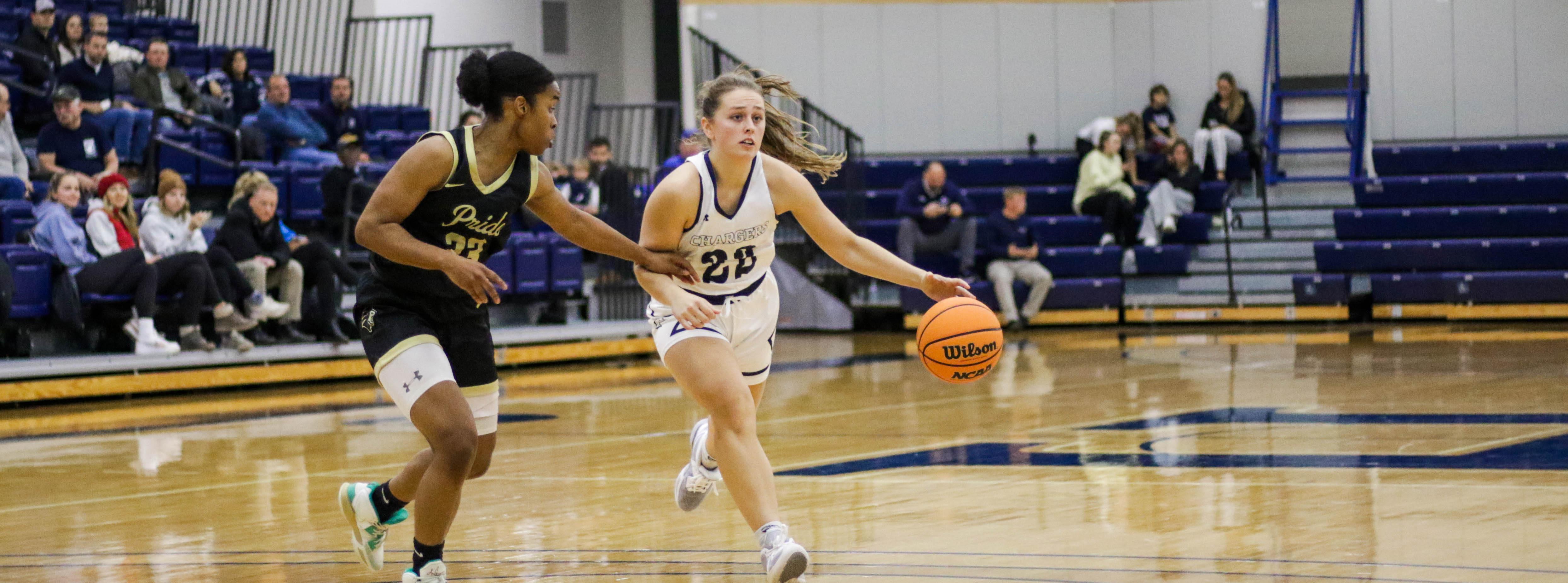
“It certainly felt good to bounce back,” Goessler said. “It’s really important to respond after a tough loss like that on Thursday, so it was nice to get back. With a short turnaround it was nice not to really dwell on the loss, just another opportunity to get back out there, play as a team, play well.”
Four Chargers finished with double-figures in scoring, led by Goessler and Reu -
Swim Women's Track
Chargers hit four qualifying marks
By Tracy Wilson Design Editor
When the Hillsdale Winter Classic got canceled, track and field coaches made a last-minute decision to take a smaller group of team members to compete at Saginaw Valley State University on Jan. 20. The team took home a victory, winning four events and setting four provisional qualifying marks.

“We had to amend what we were going to do,” head coach R.P. White said.
Junior Gwynne Riley said the change of plans didn’t stop her from excelling in her event. She took first in the 800 meter run with a time of 2:16, and second in the one mile run with a time of 4:56.
“I knew I was going to be racing the mile and the 800, so it didn’t matter to me where I did it,” Riley said. “If anything, the change was positive as there was better competition at SVSU.”
Freshman Lucy Minning said SVSU’s track helped her to perform better.
“They have a really good track,” Minning said. “It’s new and it's 300 meters. That makes a very big difference, especially in the 200 meter. The track was really hard, so it was good for sprinters.”
Minning said she was proud of both her team’s and her individual performance.
“I maintained my usual PR range in the 60 and I set a PR in the 200,” Minning said. “We’re working our way up to where we’re supposed to be in about a month for conference.”
Several other women also performed well despite the
schedule change. Junior Dakota Stamm took first in the 400 meter dash with a time of 57.53. Senior Nikita Maines took first in the shot put event, reaching 14.02 meters. Junior Katie Sayles placed first in the weight throw event with a score of 18.88 meters.
“The meet felt like it went really well for this point in the season,” Riley said. “I know Meg Scheske and I were happy with hitting 4:56 in the mile, and then to double back and run a good 800 time was something for us to be very excited about.”
Riley said if she could have changed one thing about her performance, she would have familiarized herself with her race schedule.
“I wish I had better prepared for the meet," Riley said. "I didn’t know the race schedule beforehand, so I had to do my warm up earlier than I expected.”
The team now prepares to host the Hillsdale Wide Track Classic this upcoming weekend on Jan. 28.
“Meg and I will be taking this weekend off from racing, but I know that Liz Wamsley and some of the other girls are racing this weekend and looking forward to running times that would put them in the fast heat at conference,” Riley said.
Minning said that since the upcoming meet is a home meet, her teammates’ relatives will likely come to support the team.
“It’s nice to be home and not have to travel,” she said. “I think we’re starting to get pretty good after a long break.”
ter with 16-a-piece. Kalthoff and Woodhams weren’t far behind, each chipping in 10 points. By the end of the game, 11 different Chargers had made a field goal.
“We moved the basketball, we really guarded at a high level, I think they executed what we tried to get done from a gameplan standpoint, I was proud of them,” Tharp said. “We had a lot of guys that helped us make plays off the bench align with our starters, I thought they handled themselves really well.” Hillsdale’s record moved to 17-2 overall and 10-2 in G-MAC play. They will return home, where they remain undefeated this season, for a matchup against Cedarville on Thursday before going on the road to Northwood on Saturday.
“Cedarville’s one of the best teams in the league, I think the league is incredibly even,” Tharp said. “There’s an amazing amount of balance, a lot of teams that have the ability to beat each other. I think Cedarville may have probably the best player in the league on their roster, just a tough guy to match up with.”
Swim takes third at invitational meet
By Maddy Welsh News Editor
At its final meet before conference championships, the swim team showed up and showed out at an invitational meet hosted by out-of-conference University of Wisconsin-Stevens Point.
“It was a great meet to practice the prelims/finals format of G-MACs, and we had some wonderful swims from our team,” senior Sydney Slepian said. “It was a new meet to us and the farthest meet that any of us have ever done, but it also introduced a different energy to compete in a new pool with teams that we haven’t faced before.”
The Chargers finished third out of the four teams, but they only competed one day out of the two day meet. In one day, the team scored more points than the other three teams competing and won five of the nine women’s events.
The first win of the meet came from junior Caroline Holmes’ impressive performance in the 200 yard individual medley. She finished with a time of 2:09.39, six seconds faster than her time in the preliminary round. It was also a personal best time for the junior and the seventh fastest 200 yard I.M. in Charger history.
“It was a fun race,” Holmes said. “I just tried to keep it light and relaxed. I put on a tech suit during finals to just see what I could do with no rest after a pretty intense training block. I was totally surprised. It’s definitely an honor to be on the top 10 list. I am excited to keep competing in that event and to see how much more time I can drop in it.”
Sophomore Joanna Burnham followed Holmes, placing second with a time of 2:12.61.
The next Charger win was sophomore Elise Mason’s 500 yard freestyle which she swam in 5:03.95, about 22 seconds faster than her preliminary time and 24 seconds faster than the second place finisher in the final. This performance earned her recognition from the conference as G-MAC swimming and diving athlete of the week. Her time also qualifies as a NCAA B-cut time. Senior Amy Mills finished third in the 500 yard freestyle with a time of 5:32.11.
In the 200 yard breaststroke, Burnham earned first place with a time of 2:32.32. Freshman Rotem Andegeko finished fifth in the same event (2:37.88) and senior Hannah Douthitt followed in sixth (2:40.21).
Chargers saw a 1-2-3 finish in the 200 yard butterfly, with senior Madison Pyhel in first with a time of 2:12.76.
“It was a huge confidence boost getting first, especially going into our conference championship meet,” Pyhel said.
Seniors Sarah Clark (2:16.50) and Anika Fassett (2:20.32) followed Pyhel in second and third, respectively.
The team closed out the meet with a win in the 400 yard medley relay, swimming it in 4:02.54, six seconds ahead of the second place finisher. Holmes opened the relay with a 58.12 split in the backstroke portion, followed by Burnham swimming the breaststroke in a 1:10.86 split. Sophomore Megan Clifford swam the butterfly portion (58.45) and senior Marie Taylor anchored the relay with a 55.11 split in the freestyle portion, which was faster than her individual performance in the 100 yard freestyle earlier in the meet.
A10 January 26, 2023 www.hillsdalecollegian.com
www.hillsdalecollegian.com
Last
week Grace Touchette became the sixth player in program history to reach 1500 career points. See Charger Chatter A9. Courtesy | Isabella s heehan
Sophomore Joe Reuter averaged a teamhigh 17 points per game this weekend. Patrick Miller | Colleg I an
Gwynne Riley took first in the 800 meter and second in the mile. Courtesy | r egan Monn I n
Culture
Experience the Gospel in real time
Hollywood actor performs a retelling of the life of Christ, ‘According to Mark,’ on Hillsdale’s campus
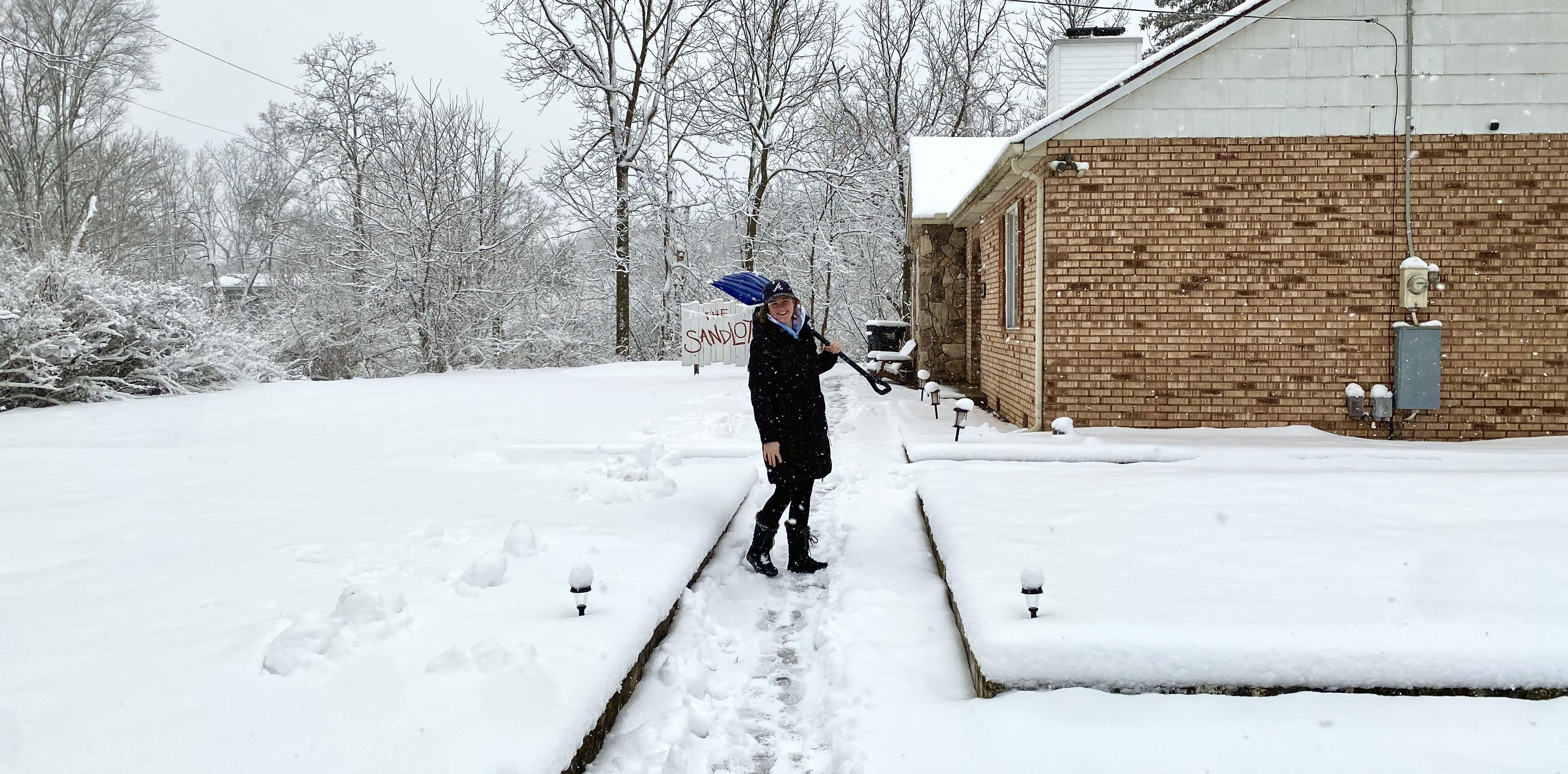 By Sofie Kellar Collegian Freelancer
With nothing but a four-legged stool, a stage, and bursting expressions of voice, actor James Krag presented the Gospel of Mark, shot through with vigor and a precise artistic vision.
One actor. One prop. Seventy-eight scenes of the Gospel of Mark. Hillsdale students, families, and friends flocked to the memorized, one-man reading of Mark on Saturday evening.
“It’s remarkable— ha, re-Mark-able— that he memorized the entire Gospel of Mark, and not only memorized it, but memorized it word for word in an antiquated form of the English language,” said junior
Isabella Zink after the performance. “It sounded natural.”
Zink said she was surprised how every word was distinguishable, even as Krag sped through parables, dialogue, and action beats.
“Most people can’t talk that fast and be that clear,” Zink said.
Krag said that performing Shakespeare familiarized him with the King James version of the Bible, which was translated in Shakespeare’s time.
Krag said his inspiration for the performance came early in life.
“When I was in high school, I read a review of a production a British actor was doing in NYC and I remember thinking, ‘what a wonderful idea.’ When I started working on it many years later, I saw how raw and fast
paced the Gospel was. I decided to try to forget everything I knew about the Jesus story and approach the gospel as I would any other script.”
Krag said he hoped that his performance would help students experience the story of Christ in a new light.
“I find a very human Jesus in Mark, whom I could really identify with,” Krag said. Through Krag’s dramatic retelling, Christ’s parables were layered with deeper meaning than a straight reading of the text would provide.
With almost nothing else on stage, Krag filled the space by painting scenes with masterful gestures, showing a vast cornfield or high stones of Jerusalem. He evoked different people through alternations of his voice,
from snarling demons to shouting Pharisees; and he summoned objects into life with perfect motion— a flip of a Caesar’s coin, the “wineskin” cupped close to the heart, and the tender hand he “holds” to raise the young girl.
“It was very dramatic and emotional,” sophomore Caroline Love said. “I feel like he was on the verge of tears. It was really good.”
Junior Juliana Undseth said it was refreshing to see these stories acted out in such a powerful way, and Krag himself described the Gospel of Mark as fast-paced and visceral.
“I had read commentaries that said Mark was just a collection of stories with no throughline and I found that not to be true,” Krag said. “There is a
Senior artist spotlight: Catherine Milem
By Isabella Helms Collegian Reporter
In this senior artist spotlight, Catherine Milem discusses her journey to choosing her major and falling in love with her own creativity.

How did you decide to become an art major?
I never really took any art classes in high school, but I have always enjoyed drawing. The first art class I took here was Drawing I with Professor Julio Suarez and I just loved that class.
I really appreciated the way he emphasized that art is not just a matter of talent, but that it is also dependent on the amount of time and work you put into it. You can only be skilled in art if you put in the time and practice every day.
And so that was my first encounter with the art department, even though I had already decided that I wanted to be an English major.
And then I took oil painting I the next semester. And at that point, I realized I really loved art and decided to declare that semester.
Do you have any prior art experience?
No; I think there are a lot of students who come to Hillsdale on art scholarships, but there are also a lot of students who take art just for fun.
I think that if you enjoy art and you enjoy that
kind of work, it is fun; but more than anything, it is challenging work because it requires a very intense level of focus for a long period of time. It’s also incredible to see the way you can develop over just one semester. There will be students who come in knowing almost nothing about drawing, and then by the end of the semester, they will be making beautiful self-portraits that will blow you away when you see them in the art show.
Do you have a specific art influence, somebody you know or somebody in the past who has inspired you/whose work you admire?
I’m from Owensboro, Kentucky, but growing up, my family and I would take trips to Chicago to visit the Art Institute there. From a young age, that was something that really stuck with me. They also have a very excellent exhibit of Impressionist artists featuring Monet and a few others.

I really love Mary Cassatt, and more recently, I visited the Cincinnati Art Museum over the summer, and there’s an artist named Elizabeth Nourse who I also love. The first time I ever encountered her work was in Cincinnati, but I have looked at her work a little bit more since then, and I really love it.
As a senior, how do you feel about graduating
in May?
It’s bittersweet because I’ve learned so much, but I know that I’ll be able to use what I have learned because making art is something that I can continue to do for the rest of my life. It’s a skill I can continue to develop, but it’s also a tangible way to represent what I’ve learned throughout my time here. It’s been such a blessing, especially since it wasn’t something that I was expecting to do here.
But I am sad because I’m getting ready for my senior show and realizing that I have so many ideas, and I just wish I had more time to work here, take more classes, and complete more projects.
Were your parents supportive of your decision to become an art major?
I came in knowing I wanted to be an English major and then my parents thought I needed some kind of practical major or minor. I had taken Drawing I my sophomore year, but when they suggested I try for a business minor, I decided to register for accounting.
Gosh, I was maybe in that class one day and I didn’t really enjoy it. I’m not particularly skilled in that area, and I figured I wouldn’t be very good at accounting. I eventually switched to graphic design because it leaned more towards art and seemed more practical. I went to Professor Su -
arez and I think he knew, based on what I was interested in, that I probably wouldn’t love digital mediums as much, and so he just asked me if I wanted to be an art major. Within the course of a month, I went from business to a double major in art and English.
What are your plans after college?
I am interested in teaching after college because there are not as many art teachers as there are English and history ones. And there are definitely not as many art teachers who are instructed in more technical and representational art.
Another exciting part of post-grad would be studying at an atelier. An atelier is primarily a place for studio work where students can improve on their technical skills and practice. All the students are working on the same thing, and it is pretty similar to the studio environment of a Hillsdale class, from what I understand.
Do your loved ones/ friends have any of your art on display in their homes?
In Sculpture I, I made a sculptor of Athena, and my mom loves it! She wants it when I graduate, and so I am making a plaster cast of it now for my show, and then I will give it to her afterwards. I save most of my work for art shows.
very obvious throughline, a story arc, a beginning, middle, and end. It was a very exciting journey and it changed my relationship with Jesus.”
Krag’s Jesus was dynamic. At first, his young Jesus trembled at the knees, and his shrill voice cracked, but soon after, the developing Christ called the fishermen to him with warm, empathetic authority.
“I liked the blocking of the play, the way he moved,” said junior Ryan Bagely. “It was a subtle way of adding to the story, drawing out the thematic elements.”
Krag brought the action to the stage as vividly as if it had been filled with props and actors. The disciples’ travels became a great circle paced around the stage, each step carefully weighted
to show the burden of a journey. The children flocking Jesus are shown in sunny smiles and a gentle hand leading them by the knees. Krag leapt from character to character with nothing more than a few steps and a startling new expression.
“He puts subtle spins that make you realize other plausible interpretations,” said senior Malia Ambrosia.
“A student said to me after the show that she now realized the scripture can be spoken of in many different ways,” Krag said in an email. “That’s exactly right. Hearing it spoken in a slightly different way can shine a light on a teaching or an idea in a way we haven’t thought of before and help build a deeper and closer relationship with the Lord.”
www.hillsdalecollegian.com January 26, 2023 B1
the snow
Senior Taylor Knight shovels her driveway after
storm. Megan Williams | Collegian
Milem painted a bouquet of flowers. Courtesy |
An oils painting of Milem’s younger sister. Courtesy | Catherine Milem
Catherine Milem
SZA revisits past loves
By Meera Baldwin Collegian Freelancer
Debuting at 67.9 million streams on Spotify, SZA’s highly anticipated, third album, “SOS,” has cemented her name in pop-culture. While the album shattered records, spending six consecutive weeks at number one on the Billboard 200, “SOS” has also served as a slight disappointment.
This newest album arrived five years after “Ctrl”— a cohesive group of 14 songs with complex, story-telling lyrics. The overarching theme of her sophomore album speaks to the growing pains experienced in a woman’s early twenties, particularly with relationships. She sings of insecurity, fear of aging, and unrequited love. Each song fits together with the next. Some songs off of “Ctrl” reached radio-level fame and the album as a whole garnered a die-hard following.
SZA first hinted to the public that the new album would be less lyrically complex by releasing a series of simple, catchy singles. “I
Hate U,” originally released in 2021, teased the theme of “SOS” as a whole: the analysis of past relationships. Why did they fail? How does she feel about her exes now? The fullness of SZA’s answer to these questions came with the full album, charged with feminine anger. As much as she dislikes the men who have wronged her, she misses the companionship they provided.
At 23 tracks long, she had time to sing about other complexities with relationships or youth or womanhood. But, across the whole album, she makes and remakes the same point of simultaneously regretting and missing her ex-boyfriends.
To the chagrin of those who still have “Ctrl” on their casual listening rotation, SZA does not explore anything new in “SOS.”
However, “SOS” redeems its subpar content with a diverse listening experience.
According to the statistics, “SOS” beats “Ctrl,” and perhaps for good reason. SZA makes up for the relative simplicity of the lyrics by taking cautious steps outside of the RnB genre. With songs like “F2F,” she jars her listeners with an acoustic guitar strumming behind her atypical, high-pitched, sing-songy voice. SZA also pays a distinct ode to her predecessors—Mary J. Blige and Lauryn Hill—with the title track and “Smoking on my Ex Pack.” By including strict rap and quasi-pop music on a largely RnB album, she creates a diverse listening experience. If she combines the lyricism of her sophomore album and experimental quality of her third, SZA’s future projects will continue to top the charts.
Professional ballerina teaches Hillsdale students
By Meghan Schultz Features Editor
Carla Lippert is a professional ballerina and teacher. Performing as a soloist for the American Ballet Theatre and a principal ballerina at the Boston Ballet, Lippert now teaches ballet. Lippert traveled to Hillsdale College as a répétiteur for the “Pas de Quatre” ballet, which the Tower Dancers will perform at their Spring concert in April.
You’ve traveled and worked in so many places. What have been your favorites?
There’s so many. As I matured as an artist, I really wanted to do something other than the classics, so to be choreographed on was really exciting for me, and I got very little of that with the American Ballet Theatre. I got a contract with Boston Ballet as principal and there I got to be choreographed on. It was the creative process that I really, really enjoyed. I didn’t want to choreograph myself — never really had that burning desire — but it was really amazing to be in that process.
As you’ve transitioned from dancing to teaching, what have you enjoyed and what have you struggled with?
Well, motherhood came in between there and learning to balance everything. Teaching young dancers comes at dinnertime, when your kids are also home from school. So that was a challenge. But what I have enjoyed as a teacher is watching my students grow. It’s also very difficult, because as they grow, they also realize this is not for them. They grow as people, not as dancers, when they’re between the ages of 10 and 16.
Very few dancers make it into major schools. Maybe 2% of them get into great schools and then maybe 1% of them actually get into a company. It’s really very sad. But that’s what we strive for, you know?
How was your experience working with the Tower Dancers on “Pas de Quatre”?
It’s been rough, because you don’t have a dance major here — it’s a minor. The emphasis is not put on training so much, so it was very difficult for them to find time to prepare for this. But to do a classical piece like this, you have to be in a certain shape. They weren’t quite ready for that, so they were a mass of sore muscles and blisters on Saturday morning after our first rehearsal. That was hard, but they have grown so much.
My students are usually quite a bit younger. Their heads are constantly turning. These women are focused, and that has been wonderful. They have their studies, their majors that they have to look out for, but when I have them in the studio, and they know now that they have to train to be able to do this at a standard they’ll be comfortable with– it’s the maturity of accepting that and putting the nose to the grindstone that’s really refreshing and wonderful. It’s rare.
How do you like to teach?
The more I taught, the more I realized there are so many teachers that don’t know what they’re doing. It disturbed me greatly more and more because I would see beautiful, talented danc-
ers that have the body and everything who were poorly trained, and it’s really hard to untrain that once it’s there. Nobody needs to be certified to open a studio in America. In France, Russia, Italy, I believe you have to be certified to open a studio or to teach. I think it’s pretty loose, but the system is there. Then I heard about ABT coming up with a curriculum. So I jumped right on and I was very, very, very blessed to be able to – being an alumna – go in and train with it for free. I go back periodically, just to audit some of those trainings. But that is a beautiful thing that America is just now starting, in the last 15 years, to certify teachers and it’s growing and growing. That’s probably one of the most beautiful things that I’ve seen happen in America.
I can usually spot a dancer that has had the ABT curriculum because they are so grounded, it’s like a clean slate. That’s what they wanted to do: present a dancer that was trained with nothing extra, just so you could tell them to do it with this style and they could do it, because they had the basic foundation.
Did you always want to be a dancer? What do you love about it?
At 3 years old, my parents put me in gymnastics because I couldn’t sit still. Then they
decided, let’s try ballet. It was good, sound training, and my teacher knew her limitations. She knew to get other teachers in there. She produced six dancers that went on to major companies. Once I learned what ballet was, I loved it. There was no turning back.
My parents were supportive; my teacher was supportive. She put me in areas where I could go further, and I got a scholarship to the School of American Ballet and American Ballet Theatre. I was in New York at the age of 16 for five weeks in the summertime. My parents did not let me go at 13, when I had a full scholarship to go to the North Carolina School of Arts. They knew they didn’t want to lose their daughter at that point. I wasn’t ready. I don’t remember discussions about it or anything, but I’m very grateful. I just kept putting one foot in front of the other. I never thought in a million years I would go to ABT.
I’m a spiritual person, too. I pray, “Lord, is this where you want me to go?” And doors opened. “Lord, tell me if this isn’t it.” Some things were, you know, “Lord, come on, that made me question what I was doing,” but it just made me stronger, all those things. I had to really want what I was doing. I never took it for granted.
Faculty impress the community during recital
By Anna MacPhee Collegian Reporter
Last week, three music professors at Hillsdale College played a selection of music for a faculty recital.
Christopher McCourry, Brad Blackham, and Emily Douglass performed several musical arrangements combining the trumpet, piano, and voice in the recital on Friday.
According to McCourry, a music teacher and trumpetist, working with Blackham and Douglass was a humbling experience.
“It’s been my pleasure to be able to work with Brad, who has been doing this for a long time,” McCourry said. “It’s also a great honor for me to share the stage with Emily Douglass. I am standing next to these guys who are such great players.”
Emily Douglass, soprano and music teacher,
said she was also honored to perform alongside her collaborators.
“I’m most excited to perform with my amazingly talented colleagues, Chris McCourry and Brad Blackham,” Douglass said.
“They are both world-class, supportive musicians and I’m honored to be able to perform with them.”
Freshman Ellia He, who attended the recital, said that she appreciated the choice of music for the concert. According to He, the music was both beautiful and meaningful.
“The music was interesting to listen to,” He said. “I really liked the choices, especially the pieces by Gustav Mahler and Giacomo Puccini.”
According to Douglass, the latter of these pieces, Puccini’s aria from “Suor Angelica,” is even more powerful within the context of the opera.




“‘Senza Mamma’ is an aria of a mother who lost her son,” Douglass said. “She is pregnant out of wedlock and is put into a convent to cover the shame. She is separated from her son, and just before this aria, she finds out that he has passed away from an illness. She begins to picture him and talk to him, and she questions when her own death will come so that she might see him.”
According to freshman Turner Callaghan, both the music and the performance were stunning and powerful.
“I enjoyed Professor Douglas’s performance a lot,” Callaghan said. “The aria was beautiful, and I would like to further research the song and the opera. The performance was very moving.”
Douglass said the ability to communicate stories
through music is one of her favorite aspects of vocal performance.
“Opera offers the ability to explore many facets of human emotion through storytelling,” Douglass said. “The marriage of text and music in opera provides a unique performing experience.”
According to McCourry, the beauty of the Christ Chapel complemented the power of the music.
“It’s a beautiful place to play in,” McCourry said. “I am so grateful to Hillsdale College that I can realize these opportunities in such a beautiful place.”
According to Douglass, music performance has always been an important part of her life. Although she has learned several instruments, Douglass said she prefers vocal performance. “During my undergraduate studies, I began to
focus almost entirely on vocal performance” Douglass said. “It quickly became the instrument that I found the most pleasure studying and performing. I was most interested in opera. The ability to explore foreign languages, stage acting, and a high level of vocal technique was a challenge that intrigued me.”
Douglass said that vocal performance is important to the liberal arts at Hillsdale College.
“Vocal performance is a culmination of different artistic fields,” Douglass said, “It explores foreign language, poetry, musicality, vocal technique, acting, and sometimes dance. Learning to use one’s voice expressively is foundational for every person. Given these factors, I believe it is an important aspect of the liberal arts education.”
Glimpse into royal life prompts public criticism
By Meghan Schultz Features Editor

Prince Harry and Meghan Markle did more than just share their American life together in their new Netflix documentary — they took a jab at family back in England.
“I genuinely feel that I – and we – are exactly where we’re supposed to be. We’ve made it to the other side,” Harry said in the sixth and final episode of “Harry & Meghan,” the documentary.
Harry’s recently published and divisive memoir, “Spare,” which recounts details of long-ago spats between himself, his brother, and their wives, was released less than a month later.
The Netflix documentary follows their progress from anxious years working in the royal family to a heavily publicized return to North America. Many
viewers and readers found a multiplicity of reasons to dislike the pair. Overwhelmingly, blame for the couple leaving their roles as senior members of the royal family fell on Markle.
Though Harry is a grown man capable of making his own decisions, some argue that Markle is a heinous, manipulative woman who forced him into this new life. Others claim that such reactions stem from jealousy spewing from women whose husbands wouldn’t do so much as a grocery run for them.
Markle’s plight was more understandable when she lived with a family allegedly largely unconcerned about her well-being, but now the couple has cut themselves off and built the exact life they wanted — and still, apparently, they care what the Daily Mail thinks of their choices?
Pity for the couple now feels woefully misdirected. Markle’s struggle with poor mental health is nothing to scoff at — but after watching her cry on a suede lounge chair, draped in a $1,625 Hermes blanket, it becomes more difficult to summon true sympathy. Harry and Meghan have the life they were always after. Why expose more private family drama now, and through more than just one medium?
Many people suffer the pangs of anxiety and depression, but they don’t choose to broadcast it from the comfort of a luxurious home in a life assured of financial stability.
After all, having invested some of the funds left to him by his mother Princess Diana, Harry inherited about $10 million on his 30th birthday. The couple has now
also accumulated deals with Netflix, Spotify, and book publishers. Fret not, concerned commentators everywhere — you can rest easy tonight knowing that Meghan and Harry certainly will.
The real tragedy here is a simple, timeless, and heartbreaking one. It’s an old story about the breakup of a family. If the royal drama evokes any emotion in readers, it should be sadness at disappointing family dysfunction and gratitude that for everyone else, that happens behind (mostly) closed doors.
Harry directs the memoir’s first chapter at his father and brother directly, writing about how he realized that neither King Charles nor Prince William truly understood why he and Markleleft.
“I have to tell them,” Harry begins. “And so: Pa? Willy? World? Here you go.”
Despite Harry’s supposedly vulnerable address to the public, any unfolding drama should only serve as another warning of what happens when modern media consumes people as if they’re living in the world of “The Truman Show.” Once again, parasocial relationships rear their ugly heads.
The American public knows as much about Meghan and Harry, the royal family, and the real intricacies of their life as they do any reality show couple — which is only as much as the family wanted the public to know and then whatever tabloids can get slimy fingers on.
In the end, slipping into judgmental hatred of two wealthy people seeking to turn their private lives into mindless entertainment will likely just pay for another shockingly expensive throw.
www.hillsdalecollegian.com B2 January 26, 2023
Culture
SZA sits on the edge of a boat in her new album cover. Courtesy | Wikimedia Commons
Carla Lippert taught the Hillsdale Tower Dancers. Courtesy | Holly Hobbs
FEATURES
Job market promises hopeful search for seniors
Benedict Whalen
Compiled by Hannah Cote Outreach Director
In this Quick Hits interview, Associate Professor of English Benedict Whalen talks walkout songs, his campus nickname, and the funniest thing his kids have said.
What is your favorite book you teach? “King Lear.”
What is your favorite work of art? Bruegel’s “Landscape with the Fall of Icarus.”
What is your walkout song?
Oh gosh, I listen to mostly classical music. Handel’s “Messiah”? No, I’m just kidding. “Sally MacLennane” by The Pogues.
When you were little, what did you want to be when you grew up?
When I was little I wanted to be a monk.

When did you first find out that people call you Baby Whalen?
I think someone came up and said it to me my first semester here, so it was very early on. I was actually charmed by it. I thought it was a clever way to play with the initials of my name, B. Whalen.
Do the faculty and staff ever call you Baby Whalen?
Sometimes, yes, I’ll get jokes. Most often I get it from Dr. Arnn.
What is one of the funniest things your kids have ever said?
One of my kids said to my 3 year old, “Stop being so bossy!” and he shouted back, “But I am a boss!”
What is your favorite way to pray? In silence. I love silent withdrawal.
What is your funniest story from class?
One of my favorite moments in class was when I was teaching F. Scott Fitzgerald’s wonderful short story, “Bernice Bobs Her Hair.” And walking into that class, one of the young woman had in fact cut off all of her hair and just bobbed it to perfection for that class.
If you could add any class to the core curriculum, what would you add?
Medieval Philosophy.
If you could take any class on campus, what would you take?
I would like to take Dr. Cole’s “Aquinas on God” class.
Who is your role model?
Richard Hart, professor of English.
What does your ideal morning look like?
At least an hour of quiet before everyone else wakes up. Since we’ve had this baby, it’s been a lot less ordered. I usually get up between 5-6 a.m. but I’ve been sleeping in more with this baby.
What is your favorite family tradition?
I love Easter morning. We hide baskets around the house, so the first thing the kids do is get up and hunt for the baskets. On a day-to-day basis, I love reading to my kids. It’s just wonderful.
What is one of your favorite books you’ve read to your kids?
“Watership Down,” by Richard Adams.
What has made you laugh recently?
Just in class today, we were laughing about Achilles’ challenge to Agamemnon, the way he suddenly accuses Agamemnon. It’s actually a very funny moment.
What is your favorite book in your office?
I have a first edition first printing signed copy of Chigozie Obioma’s “The Fisherman.”
By Aubrey Gulick Collegian Reporter
Nothing sends a chill through a college senior faster than the query, “So, what are your plans after graduation?”
But it’s likely college seniors need not worry — low unemployment rates in the economy mean the job market is looking good for the graduating Class of 2023.
“Organizations are actually looking forward to hiring new graduates. Because of the strong job market, there are a lot of jobs out there for seniors,” said Assistant Director of Career Services Sharon Rupp.
According to the National Association of Colleges and Employers, businesses plan on hiring 14.7% more graduates from the Class of 2023 than they did from the Class of 2022. Although some experts believe the economy may be in reces-
many resources to seniors seeking jobs, including practice interviews and advice on cover letters and resumes. The department also hosts 30 programs throughout the semester. Tools like Handshake allow students to find job listings for recently graduated seniors.
“We are partnered with the companies at Handshake, and so we know a little bit more about the organizations,” Rupp said. “We know who the hiring managers are, and we’ve had a conversation with someone within this organization at one point, so we know a little bit more about their hiring process.”

Career Services connected with over 400 new organizations last semester and about 600 the semester before.
“We’re continuously vetting organizations and talking with them, which obviously brings more op-
sion and several large companies like Morgan Stanley, Amazon, and Twitter have recently fired many employees, college seniors should still have a good chance to land a job.
“The current economy, while being constrained by the actions of the Federal Reserve in raising interest rates, still has very low unemployment rates,” Director of Economics Gary Wolfram said.
Most Hillsdale students will be pursuing careers in service industries which continue to have a high demand for labor, Wolfram explained.
“I think the job market seems kind of the same as it’s been over the last few years, and maybe a little better,” Associate Professor of Finance Robert Atra said.
Hillsdale students have a strong record of pursuing their career goals. According to the latest Career Services Graduate Placement Report, 91% of the class of 2021 reported that their post-Hillsdale destination is related to their career goals
Career Services offers
portunities,” Rupp said.
Rupp advises that students update and polish their resumes and meet with Career Services.
“We’re here to help. So many students don’t think of us, and we’ve got a great team: student career coaches and staff,” Rupp said. “Make sure you set time aside weekly to do some job searching.”
Seniors should keep an open mind to opportunities and remain flexible.
“I always tell my students to try to be flexible on location and try to be flexible pretty much in all aspects. Your first job should be a learning experience,” Atra said.
When it comes to the kind of job and salary students should settle for, Wolfram suggests they pursue their interests.
“My advice is to seek a job in a field in which you have an interest,” Wolfram said. “As for salary, my favorite line is from the 1964 Walt Disney movie “Mary Poppins”: ‘Enough is as good as a feast.’ Enjoy what you are doing.”
Students celebrate at post-Roe March for Life
Hillsdale College for Life sent roughly 150 students to participate in the first march since the Dobbs decision
By Michaela Estruth
Assistant Editor
In the past 15 years, only a snowstorm and a pandemic forced Hillsdale students to miss the March for Life.

On Jan. 20, 150 Hillsdale students headed to D.C.: the largest group ever, according to Hillsdale College for Life President Sabrina Nardone. Hillsdale Academy students also attended for the first time with the college.
In celebration of the overturn of Roe v. Wade in June, Hillsdale For Life planned a longer trip to Washington D.C. this year that included an overnight stay in a hotel.
Since the first trip, over 100 students have attended, filling two buses for an 11-hour drive to the nation’s capital, according to Nardone.
Vice President of Hillsdale College For Life Kathryn Reid said going on the March requires sacrificing a full weekend.
“This isn’t just a weekend away. This is for the 2,300 children whose lives are ended everyday because of abortion,” Reid said.
Hillsdale College For Life partners with Protect Life Michigan, whose goal is to make abortion “illegal and unthinkable,” Reid said.
Hillsdale College For Life
applies this goal on campus by making the pro-life cause accessible.
“We want to show that this is something that people can get involved from the legal side, argumentative side, and from the religious side,” Reid said.
Planning the annual trip to the March for Life is Hillsdale College for Life’s largest task.
“It’s the biggest display of pro life beliefs in our country every year,” Reid said. “It’s just something that we believe is important that we want to give everyone the opportunity to get involved with.”
Hillsdale’s commitment to the pro-life movement goes back to its founding, according
to Adelaide Home ’20, Coordinator of Protect Life Michigan
“The college was founded by free-will baptists who refused to discriminate on the basis of race or sex, instead recognizing that all humans possess equal rights,” Home said. “Today, we must recognize that the unborn are human and possess equal rights, despite our society’s attempts to forget that.”
Associate Professor of German Fred Yaniga agreed that Hillsdale’s pro-life stance compares to its abolitionist history.
“Standing up for the lives of the weakest and most vulnerable among us, the unborn, must be a core value of the
political consciousness of our students,” he said.
Yaniga said he recalls seeing a Hillsdale College For Life table in the Grewcock Student Union during his first visit to campus in 2010.
“It was exciting to see how active and engaged the Hillsdale students were on this topic, and I was sold on the college from that moment on,” Yaniga said.
Reid said the opportunity to visit America’s capital and see historical records — joys of the founding and sorrows of past unthinkables such as the Holocaust — moves students to guard America’s values. Students who attend are
encouraged by the hundreds of thousands of people marching for life.
“We’ve had a couple people comment on how they didn’t realize how widespread of an issue this was,” Reid said. “It helps you realize that, while we’re in a bubble, there are people all over the country who feel similarly.”
Reid said the number of people testifies to the truth of the pro-life stance.
“From every perspective the pro-life cause wins: biologically, legally, religiously, morally,” Reid said. “It’s obvious that the pro life movement is the most powerful and will be the one to win.”
www.hillsdalecollegian.com January 26, 2023 B3 Features
Hillsdale College for Life sent a record-high number of students to the March for Life. Evalyn Homoelle | Collegian
“As for salary, my favorite line is from the 1964 Walt Disney movie “Mary Poppins”:
‘Enough is as good as a feast’”
Benedict Whalen earned the nickname “Baby Whalen” during his first semester teaching at Hillsdale. Courtesy | Benedict Whalen
FEATURES
Jerusalem ‘epitomizes the human condition’

Over winter break, a Hillsdale senior joined 30 of her peers on an immersive 10-day trip through the Holy Land
 By Hannah Cote Outreach Director
At 5 o’clock in the morning, Jerusalem is restless. The Muslim call to prayer sounds across the city over loudspeakers; Palestinian Christians commute from the West Bank for work; Catholics prepare for a sunrise Mass. The Holy Land moves so fast it’s hard to keep up, living and breathing in constant chaos and noise.
Over Christmas break, I traveled to Israel with Passages, an organization devoted to bringing Christian students to the Holy Land and connecting us directly with Israel. Our group included 30 Hillsdale students, Brock and Jen Lutz, who served as our chaplains, three visiting fellows, and an incredible Australian-Jewish tour guide.


In just 10 days, we visited Tel Aviv, Nazareth, the Golan Heights, Tel Dan, Caesarea Philipi, Galilee, Capernaum, Tabgha, Magdala, the Jordan River, Ramat Rachel, Jerusalem, Bethlehem, Masada, the Dead Sea, Yad Vashem, the Gaza strip, and Jaffa. Nearly every night we heard lectures from Jews and Christians, journalists and speakers, and Israeli locals. Israel is only slightly larger than New Jersey, and in this small stretch of land, Jews, Muslims, and Christians all fight for space — the tension is tangible.
Jerusalem, the heart of the country, contains most of the
chaos. On days we traveled all around the Sea of Galilee and up to the Golan Heights, or high into the mountains of En Gedi and Masada, I felt a momentary breath of peace.
They can’t cook, use electricity, or do anything that would include labor. During this sabbath meal, the mother shared about growing up in Jerusalem. When she went to
walked around our group, shaking bells and incense during their prayers. I was quite annoyed, trying desperately to focus on the Gospel. And yet our priests were as calm as ever. They were a perfect example of virtue in tension. We visited this church earlier in the week, and though the space is flooded with massive mosaics, hundreds of hanging candles, multiple relics, and towering stone archways, I still could not comprehend a beauty within such disruption like the Jewish mother did. But our tour guide shared a powerful reflection from a Dominican priest that has begun to transform my vision of this mess:
the Holy Sepulchre because I wanted that space for Mass. I didn’t want to share it for even an hour.
I’ve learned so much from pausing my own life and visiting the Holy Land. Walking
attempt to share and respect the land. I won’t say their sharing is perfect, for all of us are human. But amid the abounding restlessness, there are people in Israel relentlessly pursuing virtue
But as soon as we re-entered Jerusalem, the energy of Israeli life flooded us. My shock didn’t come from Israel’s hectic atmosphere. It came when a dear Jewish mother told me she loved the intensity. Our group shared a Shabbat dinner with an Orthodox Jewish family during their sabbath. Every Friday, they leave all work behind to rest.
visit the U.S. with her husband, she admitted to missing the fast pace of Israel.
This desire of hers confused me. While many families in America might prefer a farmhouse with acres of land, and maybe even a wraparound porch, the people of Jerusalem continue to build homes on top of each other, crammed up against Holy Sites, apartment complexes, and markets.
Somehow, different religions coexist in such tight spaces. As my group walked the Via Dolorosa, the Stations of the Cross, we could hear the Muslim call to prayer from loudspeakers all over town. Everything blends together across Jerusalem.
When I attended 5 a.m. Sunday Mass at the Church of the Holy Sepulchre, the traditional site of Jesus’ crucifixion and burial, I didn’t think we’d end up surrounded by tourists and Greek Orthodox priests so early in the morning.

I knew beforehand that this church is shared by multiple Christian denominations, primarily Catholics and Greek Orthodox, but even at the sunrise, distractions crowded the space.
As we celebrated Mass, Greek Orthodox priests
“One expects the central shrine of Christendom to stand out in majestic isolation, but anonymous buildings cling to it like barnacles. One looks for numinous light, but it is dark and cramped. One hopes for peace, but the ear is assailed by a cacophony of warring chants. One desires holiness, only to encounter a jealous possessiveness: the six groups of occupants – Latin Catholics, Greek Orthodox, Armenian Orthodox, Syrians, Copts, Ethiopians – watch one another suspiciously for any infringement of rights. The frailty of humanity is nowhere more apparent than here; it epitomizes the human condition.”
It’s difficult to choose virtue when overcome by struggle and tension. In Jerusalem, I came face to face with my humanity. My selfishness and pride arose in the Church of
on Jesus’ streets, miracle sites, and hometown — it’s incomparable to anything I’ve ever experienced. But what I hope to honor is not my own growth and transformation, but the steadfast example of virtue I discovered more than 6,000 miles away from home.
Each day I witnessed Jews, Christians, and Muslims
and goodness, intentionally seeking sabbath and rest, and surrendering themselves daily to God. Thank you, Israel, for all you’ve taught me. You have made us for yourself, O Lord, and our heart is restless until it rests in you.

January 26, 2023 B4 www.hillsdalecollegian.com
The travelers stopped by the Church of the Primacy of SaintPeter. Hannah Cote | Collegian
Cote snapped a photo of the Agony in the Garden passage while visiting the Garden of Gethsemane. Collegian | Hannah Cote
Some students attended a Catholic Mass at 5 a.m. in the Church of the Holy Sepulchre.
Hannah Cote | Collegian
Seniors Meg Scheske and Hannah Cote held onto their hats at Golan Heights in Galilee. Hannah Cote | Collegian
Here, at Caesarea Philippi, Jesus asked the apostle Peter, “Who do you say that I am?” Hannah Cote | Collegian
The Austrian Pilgrim Hospice overlooks the sprawling city of Jerusalem. Hannah Cote | Collegian
