ElizabethofthereactsCampustodeathQueen
By Tracy Wilson Design Editor
“We took for granted that she would always be there,” said Penny Arnn, the UKborn wife of College Presi dent Larry Arnn, following the death on Sept. 8 of Queen Elizabeth II, who ruled the British commonwealth for more than 70 years.
“I think anybody that is from England or the United Kingdom will say that she’s somebody that we have known all our lives,” Arnn said. “She was certainly queen before I was born, and we’ve tended to think of her as aMultiplefixture.”students and staff agreed that while they felt sorrow over Queen Elizabeth’s death, she led an accomplished life and left behind an inspiring legacy.
“It’s a bit like watching a cricket match in which a batsman’s had a great inning and finally gets balled out, and he raises his bat to the crowd on his way to the pavilion and everyone gives him a standing ovation,” said Samuel Negus, director of program review and accredi tation. “Nobody bats forever. Eventually you’re going to get out, but you had a good inning. Queen Elizabeth had the best Negus,inning.”whowas born and raised in the UK, said he witnessed deep respect for members of the royal family when he was growing up.
“My mother and my nana loved the queen. I was drying dishes on a Diana and Charles wedding tea towel well into the late ’80s,” Negus said. “I love Elizabeth. I could not care less about the rest of the Windsors, but I will run uphill into machine gun fire for Queen Elizabeth.”Forsome, the death of Elizabeth symbolizes more than a transfer of political power.
See Queen A2
College launches new Center for Military History and Grand Strategy
By Thomas McKenna Collegian freelancer
The new Center for Mili tary History and Grand Strat egy launched last weekend with a panel and series of lec tures, aiming to explain why the study of war and strategy remains important even as similar programs disappear from American colleges and universities.“Itusedto be the case that there was a chair in military history at every major school in the country,” Professor of History Paul Rahe said. “It has been banished from the history profession, followed by diplomatic history which hardly exists anymore. To give you a sense of how bad it is, there are more military histo rians at Hillsdale College than in the entire Ivy League.”
The center held a discus sion panel Friday afternoon composed of the Hillsdale faculty who teach courses for the program. The launch event included lectures by three other academics Friday night and Saturday morning. The new program will offer a minor to students and also
plans to host guest speakers as well as an annual conference.
“Whether as educated voters or even more so as policymakers, people need to understand not just events but the explanation, the origin, the course, what war is, where it comes from, why it comes, how it's played out historical ly,” Professor of History David Stewart said. “The center is designed to try to provide that kind of fundamental educa tion for both informed voters andAssistantpolicymakers.”Professor of History Edward Gutierrez, director of the new center, worked with College Presi dent Larry Arnn to create the new“Theprogram.firstsemester I was here, Dr. Moyar and I wrote a proposal, and I laid it out,” Gutierrez said. “I met with President Arnn again and laid out what I envisioned the cen ter would look like. The first of those is the minor.”
The faculty laid out the requirements for the minor in military history and grand strategy during the panel discussion Sept. 9. Classes will be open to any students of any

major with no prerequisites. Students studying for the minor will be required to take three core classes, as well as two electives and a capstone course on American grand strategy.“Wewanted to keep it small and manageable,” Stew art said. “A politics major can take and complete this minor and understand something.”
Chair of military history Mark Moyar spoke from his experience in government on the importance of under standing military history and strategy. Moyar has written books on the Vietnam War and served in the U.S. Agency for International Develop ment in former President Donald Trump’s administra tion.“The bureaucracy is very eager to make decisions when it can,” Moyar said. “It loves political appointees who don't know anything. They can take advantage of you. We need to have people who are better educated, who understand theseGutierrezissues.” said the cen ter will likely host events, including a summer seminar
at the Allan P. Kirby Center for Constitutional Studies and Citizenship in Washington, D.C. Later in the panel, Stew art hinted a graduate program may be in the works.
“There are conversations beginning to, perhaps, offer a master’s program where students can come and get a master’s degree in military history,” Stewart said. “I think the primary audience would be people who work in D.C., people who work in think tanks, people who are asso ciated with the State Depart ment, even military officers.”
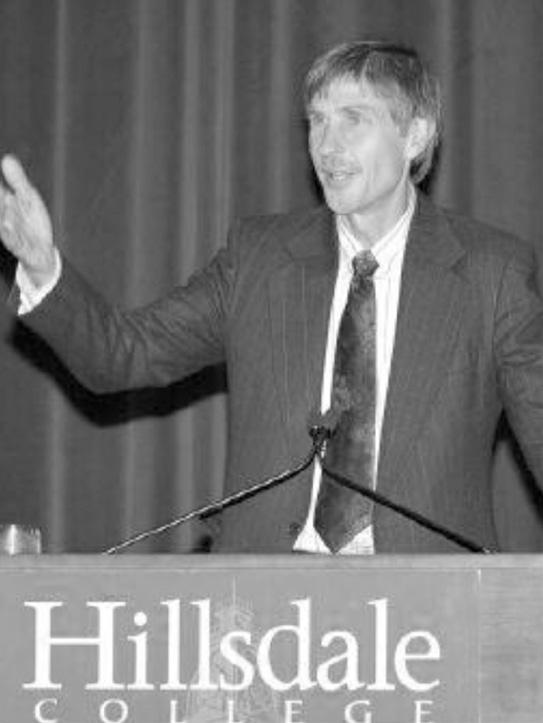
Victor Davis Hanson, a military historian and the Wayne and Marcia Buske Dis tinguished Fellow in History at Hillsdale College, delivered a speech Friday night on why the study of military history and grand strategy remains relevant today.
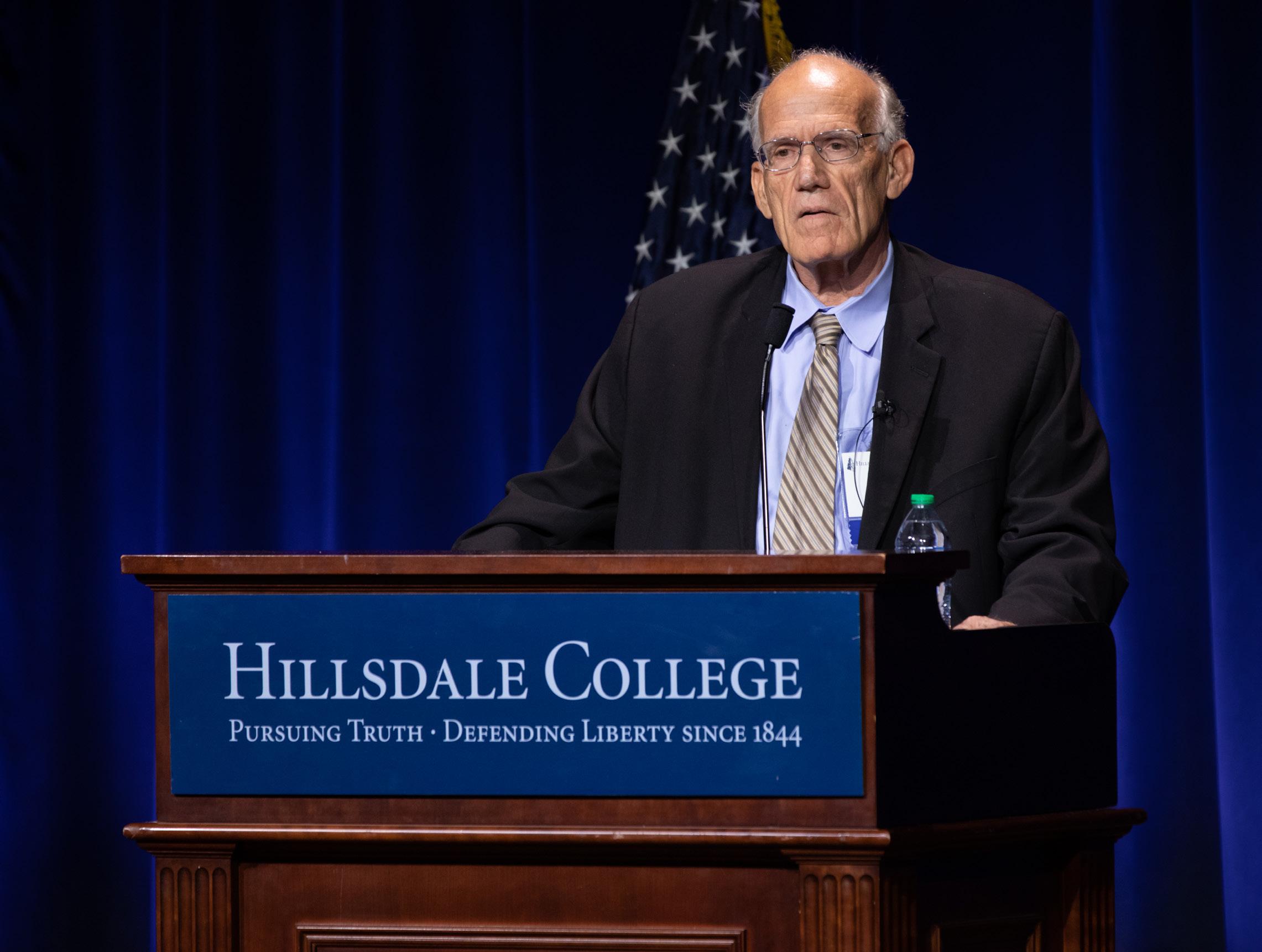
“It’s the citizen’s choice to decide when to go to war, if to go to war, how long to go to war, and how to resolve a war,” Hanson said.
By Maddy Welsh Assistant Editor
Chair of the Education Department Daniel Coup land will release a book this month about how to teach in a classical liberal arts classroom.“Triedand True: A Primer on Sound Pedago gy” is a short book offering instruction on how to teach K-12 students. Modeled after William Strunk Jr. and E.B. White’s “The Elements of Style” in both its brevity and format, the book offers advice and information about classroom manage ment, classroom proce dures, and lesson planning in 14Accordingchapters.to Coupland, the book has more nutsand-bolts advice than big picture ideas about the na ture of classical education, but it is deeply informed by the classical liberal arts tradition.“We’re not trying to rein vent pedagogy here,” Cou pland said. “There are some common sense things we know about good teaching and they’ve been tried and, over generations, they’ve been proven true. We need to get back to those.”
Coupland said “Tried and True” is meant to be a companion to the K-12 department’s “Program Guide,” which outlines a classical curriculum for every grade level. He said he thinks neither curriculum nor pedagogy can stand alone.“You actually need to have both,” he said. “You need to have the ideas, but you also need to have a method or multiple meth ods of delivery in order to truly provide a good education.”Coupland said he got the idea for the book after speaking about pedagogy at Hillsdale’s summer teacher conferences for years.
See Coupland A2Center A2
Art teacher Brian Shaw wins statewide deer patch contest
By Maggie Hroncich editor-in-Chief

Brian Shaw is the win ner of the 2022 Michigan Department of Natural Resources deer patch design competition. Shaw, a graphic designer and teacher of art at Hillsdale, won the contest on the 50th anniversary of the DNR’s Deer Cooperator Patch.Shaw said he didn’t know about deer patches or the design contest prior to this year and felt privileged it was the 50th anniversary.
“This is all brand new to me,” Shaw said. “From what I know, it’s a commemorative patch the DNR comes out with each year.”
Shaw said the patch serves as a way for the DNR to con nect with hunters, promote
conservation efforts, and showcase deer hunting.
Because the patch is embroidered in thread and cannot be larger than 3 by 4 inches, Shaw said he tried to avoid small or intricate designs.“Istarted to think, ‘Well, what’s the most important thing? It’s the deer.’ And if I can make that as big as possible, I’m going to try,” he said.Shaw’s design shows the deer in an active jumping pose, which is meant to con vey the beauty of the animal in a dynamic way, he said.
Shaw said he didn’t know about the contest until Al Stewart, director of the college’s Nimrod Education Center, sent him the call for entries in the spring. Stewart previously worked for the
DNR and ran its turkey patch“Thecompetition.designcontest helps to highlight the contribu tions hunters provide to con servation and management,” Stewart said. “By purchasing hunting licenses and having their deer inspected by DNR wildlife biologists, hunters provide information and funds that help with the management of Michigan’s deer herd. Deer patches are provided to hunters to thank them for their contributions.”
Beginning Sept. 15, the patch will be available to purchase. DNR Outreach Assistant Emilie O’Grady said in previous years about 40,000 patches have been distributed.According to O’Grady, the 50th anniversary makes this year special for collectors.
“This is a monumental year which would make acquiring this specific patch extra special for those individuals who have been collecting since the 1970’s,” sheO’Gradysaid. said Shaw’s design was selected out of roughly 260 submissions.
“Anyone can submit their design for consideration,” according to O’Grady. “Sub missions are voted on by the entire Wildlife Division of theStewartDNR.” said he was glad to see a Hillsdale professor’s art featured in the contest.
“He’s an accomplished artist and I’m excited he would take the time to focus on doing the deer patch and help be part of the tradition of hunting in this state,” Stewart said.
Teacher of Art Brian Shaw designed an award-winning deer patch.
Courtesy | Brian Shaw
A student places a flag in the 9/11: Never Forget Project memorial hosted by Hillsdale's Young America's Foundation chapter. Jack Cote | Collegian
Victor Davis Hansen spoke on the study of military history on Friday night. Courtesy | External Affairs
manualeducationliberaltoCouplandreleasearts www.hillsdalecollegian.comVol. 146 Issue 4 - September 15, 2022Michigan’s oldest college newspaper
See
Two Hillsdale alumni win Novak Fellowships for work in journalism
By Colman Rowan Collegian Freelancer
Two alumni of the Dow Journalism Program won Novak fellowships this year to pursue long-form research and reporting projects.JackButler '15 and Kate Odell '13 received the Fund for American Studies Novak Fellowship in 2022. Butler is submissions edi tor at National Review and Odell is a member of the editorial board at the Wall Street
TheJournal.fellowship is a yearlong program, named after the late political columnist and television pundit Rob ert Novak. It gives young journalists $35,000 in grant money to take a deep dive into a specific topic. Graduates of the fellowship often use their original works to write a book.
Butler said he plans to write about “the conser vative case for living well” and Odell said she will fo cus on military readiness.
To apply to the fellow ship, journalists pitch ideas which are “broadly sup portive of the principles of a free society,” Butler said.
Butler said he has been thinking about the idea of living healthy for much of his life but became partic ularly motivated to put his
bid in for the fellowship in light of the COVID-19 pandemic. His main concerns are with the left’s control of governing what it means to be healthy.
The left has “abused its monopoly, as the left often does, to subvert pre-ex isting notions to its own ends,” Butler said.
A former member of the Hillsdale Cross Country as well as Opinions editor of the Collegian, Butler called himself “the runner and theButlerwriter.”said his favorite memory as a professional journalist was reporting on a festival in Bedford Falls, the town “It’s a Wonderful Life” was based on.
“It's great to go and talk to real people and write a story about something that's interesting and good, instead of always writing opinions that make people angry,” Butler said.
Odell said she plans to write about “U.S. military readiness and U.S. military decline and how to reverse that trend before the next major world or a regional conflict emerges.”
She has written about similar topics for the Wall Street Journal, specifically involving the Navy and the AirButlerForce.and Odell are not the first alumni to receive
the Novak fellowship. Mi cah Meadowcroft ’16, the web editor at the American Conservative, is a member of the previous class.
He said he reported on the “origins and the signifi cance of the cost of educa tion” and hopes to turn the project into a book.
All three said they are thankful for the direction Hillsdale provided them as well as the skills the Dow Journalism Program taught them in preparation for their"Whatcareers.Istudied in col lege pretty much directly prepared me for what I'm doing now,” Butler said. “I think there are many people who would say that they wouldn't be where they are today if not for one John J. Miller.”
Director of the Dow Journalism Program John J. Miller said it's great to see the success of his students.
“They’ve earned it,” Miller said.
All three agreed the Wednesday nights in the Collegian office were the highlight of their Hillsdale journalism experience.
“The Collegian was like my clock tower,” Meadow croft said. “It kept me set to a rhythm and was an integral part of my whole college experience.”
Dining Hall dishwasher breaks for lunch, fixed by dinner time
By Michaela Estruth Assistant Editor
Paper plates and plastic cups replaced the Knorr Din ing Hall’s dishware during the lunchtime rush Wednesday after a dishwasher malfunc tion.The dishwasher broke down on Tuesday night, according to Head Chef Adam Harvey.“The tank was pulling too much chemical too fast,” Harvey said. “So we ran out of chemicals.”Thedishwasher depleted a two-week supply of cleaning chemicals in one day. The chemical supply comes in on Mondays and Thursdays, so the dishwasher could not be used for Wednesday’s break
fast and lunch, Harvey said. A repair man from Hobart, the dishwasher company, fixed the dishwasher Wednesday afternoon, and the dishwasher was working by Wednesday dinner.Because of the depleted soap supply, Metz offered disposable plates, cups, and cutlery for Wednesday break fast and lunch.
“We keep paper on hand in case there’s an issue,” Harvey said. “We still want to make sure we have something to serve people Sophomoreon.”Eva Lintereur said she was surprised to see paper plates at lunch because the dining hall had not used them in a while.
“Paper plates are nice to take things out, like the to-go
cups,” Lintereur said. “But it’s nice to eat a meal on a real plate with utensils.”
Metz borrowed chemicals from Albion College and other local“Somerestaurants.kitchens were like, ‘Yeah, I’ve been there. Take some and get it back to us,’” Harvey said.
The chemical supply arrives on Thursday, and the kitchen should be back to normal with limited paper plates.
Harvey said the paper plates may still deck the dining hall at times due to short dish staff, but for the most part, dining hall is “back to china.”
“The dishwasher broke, so of course I’ll eat off a paper plate, but I’m happy to have the dishes back,” Lintereur said.
Donor gives natural history museum hundreds of fossils
By Aubrey Gulick Senior Reporter
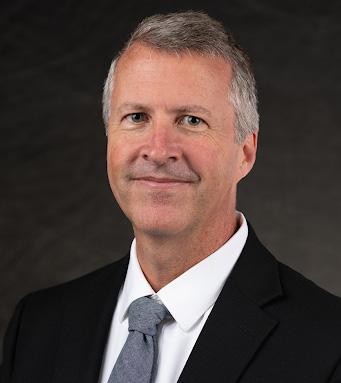
Hundreds of fossils will now call Hillsdale’s natu ral history museum home, following a donation from paleontologist and geologist, KevinTheWilson.D.M.Fisk Museum of Natural History, located on the main floor of Strosacker, received the first installment of the donation last week.
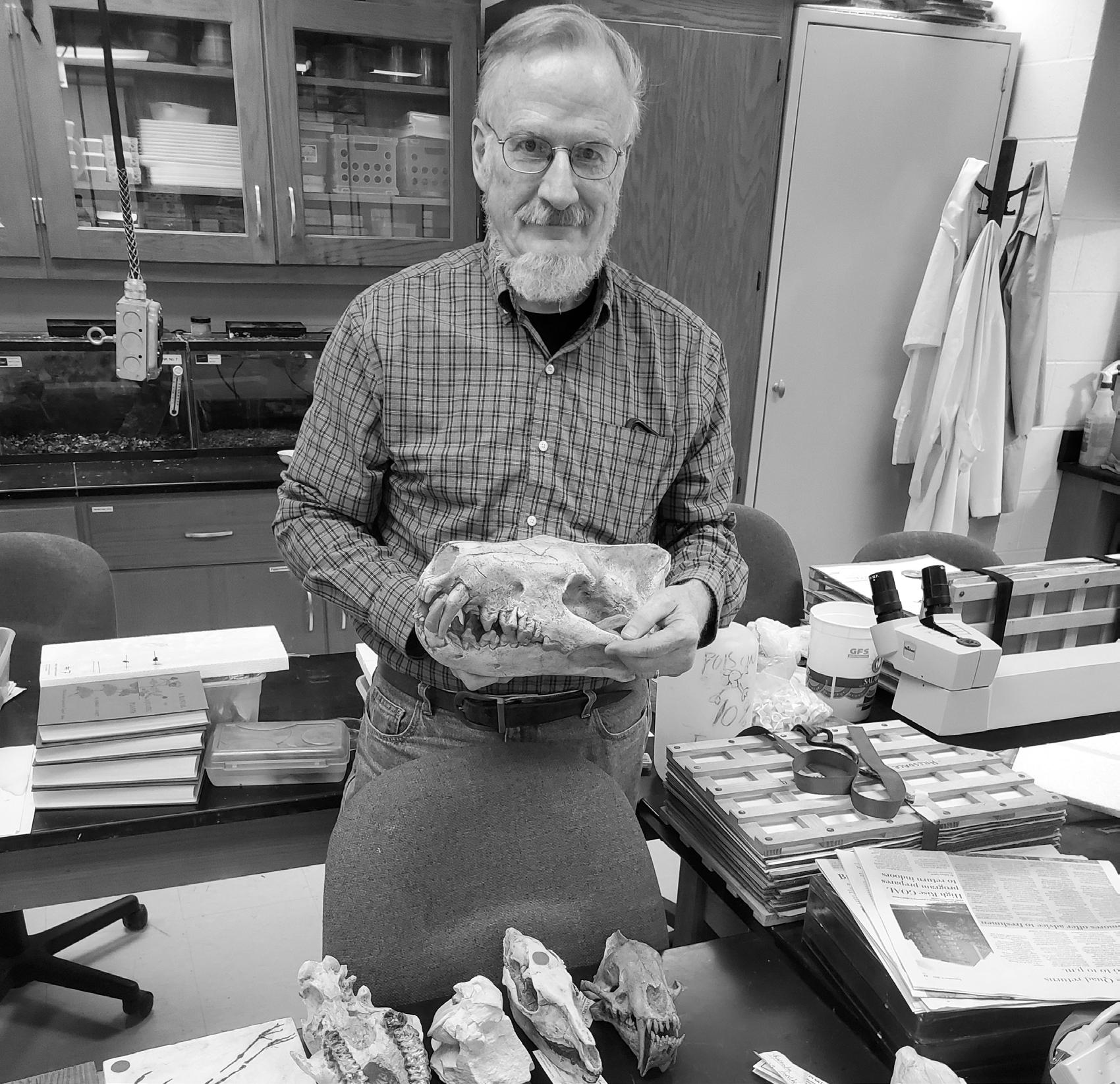
The fossils will include thousands of species from more than 30 different countries. The newest displays include a representation of life after the dinosaurs went extinct, as well as hundreds of fossilized amphibians.
“We use our museum not only as a place for what I call ‘edutainment,’ or educational entertainment, for visitors, but also those thousands of species on display are used for research,” said Professor of Biology Anthony Swinehart, curator of the D.M. Fink Mu seum of Natural History.
The donations will give biology students greater op portunities to pursue research without leaving Strosacker.
“I have two senior thesis students right now who are working on fossil specimens in the museum,” Swinehart said.
Among those students is a biology major and senior, Dakota Simms. Although she plans on pursuing a medical degree, she is studying the museum’s collection of bra chiopods, an extinct phylum somewhat similar to a modern clam.“It’s such a cool museum, and there are cool, expen sive, and rare artifacts there,” Simms said. “It has allowed me to branch into a field I would have otherwise never have thought about.”
In addition to training students to conduct in-depth research, the collection also sources important examples for the “Thereclassroom.isawhole range of subjects better taught with examples, and science is espe cially prone to that,” Wilson said. “It’s hard to talk about biology without talking about the history of life, and as soon as you’re talking about that, then you need some fossils.”
Education was one of the many reasons Wilson said he donated his collection to Hillsdale. He said he admired the school’s commitment to tradition and the liberal arts.
After traveling to the col lege to meet with Swinehart, Wilson said he was convinced Hillsdale was the right place for his donation.
“We just talked things out, and I decided not only was the college the right place, but Tony was the right guy,” Wilson
Wilsonsaid.served as a research associate at the University of Colorado’s museum for four years where he developed a passion for designing exhibits that tell a story.
“I want it to be educational and to tell a story, and so many museums refuse to do that,” Wilson said. “They just throw stuff on the display case or the wall. They give you a name and maybe an age, and that’s the end of Collectingit.” fossils has been more than a hobby for Wilson, who worked in the oil indus try and taught paleontology at Bryn Mawr College for several years before going into the finance industry. During his years as a geologist, Wilson made important contributions to the unifying theory and the theory of plate tectonics, Swinehart
Sensingsaid.Wilson was not his standard donor, Swinehart made a unique offer: Wilson could help design the exhibits.
“He’s been actively involved in the interpretive text and the design of the displays, and he’s been having an absolute ball,” Swinehart said.
“In the ideal world, we wouldn’t care as much, but I think she was one of the last residual figures of power and of a time well before all of the stuff we see today,” senior Patrick Rhode said. “In a way, it’s a signal that things are changing, and we have to get ready for it.”
While some people may feel confused about what Elizabeth’s death means from a political stand point, both Negus and Arnn said the process is straightforward.“I’vehadpeople say, ‘Do you think Charles is going to be king or will they just pass over him and go to William?’ And I’m always like, ‘Do you even monarchy, bro?’ That’s not how this works,” Negus said. “Yes, he’s going to be king. They don’t have a popular referendum on who’s the nextArnnone.”said she thought the queen’s death did not bear a greater cultural message—it was simply Elizabeth’s time to pass on.“I think it’d be easy to read too much into that,” Arnn said. “We all have our time, which is limited. She lived more than a life time and she lived more than a full life.”
Since most people have
only ever associated the British crown with Queen Elizabeth, many people will have to reimagine their idea of the crown, according to Assistant Director of Alumni Rela tions Braden VanDyke ’21, whose mother is British.
“We’ll probably have to rethink what a modern monarch looks like because, outside of the queen of England for 70 years, we haven’t had a monarch that the world really respects,” Van Dyke said. “All we will ever know for the rest of our lives will be a king of England, whether that be Charles, William, or George.”Many agreed Elizabeth was more than a queen— to many, she represented propriety and integrity, drawing admiration from people of many differ ent backgrounds. Junior Michael Hoggatt, who studied in Britain over the summer, said he grew in appreciation of Queen Elizabeth after going to her Platinum Jubilee, the parade commemorating the 70th anniversary of her“Acoronation.lotofpeople don’t realize how much she is loved by the people,” Hoggatt said. “When she was crowned queen, she gave a speech saying, ‘I declare before you all that my whole life, whether it be long or short, shall be
How to: Advertise with The Collegian
To advertise in The Collegian, please contact Carly Moran at cmoran3@hillsdale.edu.
devoted to your service.’ She really fulfilled that promise.”TheQueen’s Jubilee even attracted one family of Ukrainian refugees, ac cording to Negus, whose sister is currently hosting two Ukrainian children along with their mother at her home in Britain. Shortly after arriving at her house, the family asked to go to the Jubilee.
“Hopefully those kids will grow up to live long and happy lives, and they’ll have this mem ory,” Negus said. “She has become this outsized person in the moral imag ination of people around the world, not just En glish speakers. Everybody reveres her, apparently including middle class refugees from Kiev.”
With Charles III’s coro nation approaching, Arnn said she feels grateful for the respect shown both to Elizabeth and to her legacy as a monarch.
“It must make my gen eration really proud to see the proper ceremonies be ing addressed and carried out in a very traditional and dignified and decent way,” Arnn said. “I’m sad, but I’m optimistic too that King Charles III will carry his mother’s legacy with great seriousness. I’m optimistic that all will be well.”
“To make those choices, they should be acquainted with how wars begin and what they're caused by, how they progress or regress, if they end, when and do they resolve anything. Social science cannot provide those answers. They are only found through history.”Hanson also criticized the sentiments he said have driven war and strategy out of academia.“Let'sbe candid: military history is in crisis,” Hanson said. “We have this strange idea in the United States that the military historian is a sort of a dark brooding person who loves war. It's almost as if you were to say that an oncologist goes into his field not to cure cancer but because he loves malignancies.”
Coupland from A1
When he was on sabbat ical a year and a half ago, he started writing it.
“Our country’s schools have not only forgotten what to teach, but they’ve forgotten how to teach,” said Eric Coykendall, director of operations for the K-12 edu cation office. “A few teachers are born good at teaching, but most of us have to learn it. Dr. Coupland’s book is
How to: Subscribe to The Collegian
To receive weekly issues of Hillsdale College’s student newspa per, please contact Linnea Shively at lshively@hillsdale.edu
Professors Sean McMeekin of Bard College and Ian Johnson of the University of Notre Dame followed Han son Saturday morning with lectures sharing their perspec tives on World War II strategy. Johnson spoke before the event about the importance of the“Studyingcenter. war and grand strategy are also crucial in understanding our present moment,” Johnson said. “The U.S. has troops deployed in roughly 130 countries, a dozen and a half of which are combat zones. Despite claims to the contrary, war hasn’t gone anywhere, and it is es sential that we understand it.”
State Sen. Lana Theis, who chairs the Senate Edu cation and Career Readiness Committee and attended the event Friday evening, said she supports the center’s effort to
an important and simple tool for helping to form and sharpen good teachers.”
Matt Bell, executive director of programs for external affairs, helped with the book’s publishing.
“One of the chief purpos es of the college is to teach all those who wish to learn,” Bell said. “This book is a concise guide for teachers who want to teach well, while managing their class
further educate students on military history.
“I’m excited for it,” Theis said. “To be able to provide that kind of context to their students in the way that they do in historical reality and historical truth and not a his torical rewrite – I have a lot of trust in the curriculum they’re going to provide and a lot of confidence that they’re going to impart it Gutierrezwell.”said he has big plans for the future of the center, hoping it can become a well-known force in the field of war and strategy.
“I think we want to be something where we are known,” Gutierrez said. “Not just in town, not in the state, not even nationally, but inter nationally known as a place that is doing serious work as an institution where anyone can come.”
rooms in such a way that their students are able to learn well—and it is sorely needed.”Coupland said Hillsdale College Press is publish ing the book in mid-Sep tember. The eCommerce department does not have an official release date yet, according to its director John Quint. It is currently available for pre-order on shop.hillsdale.edu.
How to: Join The Collegian
To find out more about how to contribute to The Collegian through writing, photography, or videography, please contact Maggie Hroncich at mhroncich@hillsdale.edu
Center from A1
Correction: A Sept. 8 article titled “Hillsdale physics department welcomes two new faculty members” contained an error. Associate Professor of Physics Timothy Dolch was mistakenly re ferred to as chair of the physics department. Paul Hosmer is chairman of the physics department.
Professor of Biology Adam Swinehart holds a new addition to the D.M. Fisk Museum of Natural History. Aubrey Gulick | Collegian
Queen from A1
www.hillsdalecollegian.com
A2 September 15, 2022
Carrington speaks on views of liberty
By Anna MacPhee Collegian Freelancer
Every man thinks he is on the side of liberty and that his opponent is not, Professor of Politics Adam Carrington said in a lecture lastInweek.hisdiscussion of constitutional liberty hosted by the Classical Liberal ringtonpublishedtheCarringtonOrganization,summarizedthesisofhisbook,in2019,“JusticeStephenField’sCooperativeConstitutionofLiberty:LibertyinFull.”ThebookexploresthejurisprudenceofStephanField,aSupremeCourtjusticeduringtheReconstructionEra,andhisassertionthattruelibertyisonlyattainablefromacommongroundbetweentwoopposedsidesofdebate.“ThegoaloftheConstitutionwastoprotectindividualrights,”Carsaid.“Therewasalibertyfromgovernment.Itwasathreatandneededtoberestrained.Buttherewasalibertythroughgovernment.Otherscanviolaterightsandgovernmentactionisneededtoprotectthoserights.Andthatwouldbelibertyinfull.”Carringtonsaidhediscoveredthisdefinition
of liberty while researching StephenAccordingField.to Car rington, many of Field’s biographers claim he is an “anarchical capitalist” who believes that government is always a threat to one’s life, liberty, and property. This is only partially true, Carrington said.
While Field sought “to restrain government action, opposing, for example, gov ernment-granted monopoly and price controls, there are many more instances of him upholding regulations than striking them down.”
Field’s willingness to find liberty from various ap proaches contributes to his rulings as a Supreme Court justice, according to Car rington. Most often, Field used the 14th Amendment to defend liberty. The Equal Protection Clause, Field said, protects property rights as well as the rights to life and liberty. This is because liberty includes both the right for one to “possess” something and the right for him to “exer cise” it, Carrington said.
“The bridge of the two opposite parties makes Field unique among Supreme Court justices,” said junior and CLO officer Holden Palmer, who at tended the lecture. “Field's
opinions offer a unique per spective into the thoughts of a man who broke with his party at large in favor of preserving the Union. His stance on Constitutional rights seems very complex, but his actions by“Libertytheliberty,debatedebate,”ofpastdefinesinceoftententionreasonablytheyofmotedstraightforward—heremainedproprotectingtherightsthepublicatlargewhencouldbeconstruedasinfringedupon.”Carringtonsaidtheconsurroundinglibertyhindersitsdiscussionpeoplewhoseektolibertytendtotalkoneanother.“Libertywasasourceconstantassertionandhesaid.WhileeachsideoftheseekstounderstandonlybycombiningtwodoesonediscoverinFull,”Carringtonsaid.PresidentofCLOandseniorDevonDownessaidtheorganizationseekstodiscusstopicssuchaslibertyinarespectfulmanner.DownessaidCarrington’slecturehelpedhimtobetterunderstandliberty.“Thisdiscussionhelpedindefiningwhatwemeantheword“liberty,”rootingitinthepoliticaltheoryoftheDeclarationofIndependence,”Downessaid.
Churchill expert lectures on the prime minister's education
By Evalyn Homoelle Assistant Editor
Winston Churchill’s rigorous self-education laid the foundation for his later successes, said Christopher Harmon, a professor at the Institute of World Politics.
Harmon, who has worked in foreign poli cy and counterterrorism studies programs for the U.S. government, presented his research on Churchill’s self-education in a lecture titled “The Books Churchill Read: The Self-Educa tion of a Statesman.” The president’s office and the Churchill Project hosted the event on Sept. 8.
“This is a fun subject for me which I’ve been investi gating all the time,” Harmon said. “The glittering intellect that is Winston Churchill is hard to understand, and it is hard to fully appreciate such a remarkable mind.”
In order to understand how Churchill achieved his intellectual prowess, Har mon decided to research the books that Churchill read throughout his life. As a child and adolescent, Chur chill developed an insatiable appetite for books, accord ing to Harmon, especially war histories and adventure.
Churchill even correspond ed with some of his favorite authors, Rudyard Kipling and H. Rider Haggard, at a young“Heage.was very taken with history, military history,” Harmon said. “He read ex tensively, and he read pretty seriously. When he was 13, he asked his mom for Ul ysses S. Grant's memoirs.”
Churchill’s primary school and boarding school assigned a diverse curricu lum of literature, and it was during these years that he
came to learn Latin and ap preciate Roman and Greek classics such as Horace’s “Odes,” Julius Caesar’s “Gallic Wars,” and Virgil’s “Aeneid.”These and other great works of literature influ enced Churchill’s writings and speeches for years to come, Harmon said. Chur chill quoted Latin phrases in his speeches and used the rhetoric of epic poetry from works, such as Milton’s “Paradise Lost,” throughout his“There'scareer. so much in Churchill that’s about the highs and the lows, and the depths of the canyon but the sunlit uplands — you see those motifs in this rhetoric,” Harmon said. “I think the tragic dimension of some of the epic poems was really important to him.”Because Churchill did not attend university or possess the rigorous educa tional credentials of many of his peers, he educated himself to perform on the same level as those around him.“As a member of Parlia ment he always felt he was a step behind, not hav ing gone through the big universities,” Harmon said. “As a self-educated man, he willfully studied classics that maybe he wouldn’t have if he had gone to Cam bridge because he didn't really want to be left out and he didn’t want to seem less than his well-educated peers.”Churchill’s early fascina tion with history remained with him his whole life, Harmon said.
“The list of histories that he'd gone through are so numerous that it's almost
impossible to name them all,” Harmon said. “He read the record of debates in Parliament and all the clas sics of history. He studied his own father's career and he studied the kings and queens.”Butit wasn’t all politics and history for Churchill, Harmon said. Churchill enjoyed reading the great works of English authors like Charles Dickens, John Keats, and William Shake speare.Ashe became an import ant figure in world politics, Churchill took it upon him self to read literature from around the world. He had a great affinity for American literature, especially the work of Mark Twain and Harriet Beecher Stowe.
Junior and George Wash ington Fellow Meredith Kottom said she enjoyed learning about the books that shaped Churchill’s character and skills.
“I was incredibly im pressed with Dr. Harmon’s knowledge and research about the books that in fluenced Churchill, as well as the variety of literature Churchill read from a young age,” she said. “I learned how valuable read ing great books in a variety of disciplines is in ordering one’s life and career.”
Senior George Washing ton Fellow Abigail Elwell said the lecture challenged her to read more purpose fully.“Dr. Harmon connected Winston Churchill’s reading across genres and authors to the prime minister’s genius and endurance as a leader,” she said. “I walked away challenged to read deeply and carefully for the rest of my life.”
Hillsdale's Nimrod Education Center hosts documentary showing about conservation
By Carly Moran Collegian Reporter
The Nimrod Education Center hosted Tom Opre, an outdoors film director, as he shared his first full length documentary titled “Killing the Shepherd” on Sept.The7.production crew took three years to make the film, which follows an African chief waging a war against poaching to elim inate poverty in her com munity.Hunting serves as a primary form of sustenance and income for the village in the documentary. After years of Channel’sacompanies.producerbecomingautomotiveOpreGrandarecoursefather'sIIfilmtheintoreallyOprethehuntingawardandfilmsforforahedoorsconservationjustofwantday,”interactininbehappenedbutvation.backnotheleddestructionenvironmentalduetopoachingtopovertyandviolence,chiefrealizesshehasotheroptionbuttofightusingwildlifeconser“It'sacomplexstory,theparallelstowhatinZambiacouldhappeningexactlyhereMichiganoranywheretheworld,wherepeoplewithwildlifeeveryOpresaid.“Ireallytotargetthat75-80%peopleouttherethatdon'tunderstandourethos.”Opre’sloveoftheoutstemsfromhisfather,said.TomOpreSr.wroteweeklycolumnonwildlifetheDetroitFreePressnearly25years.“Mydadmadesomebackinthelate1960searly’70sthatwerewinningfilmsaboutandfishingaroundGreatLakesinCanada,”said.“WhenIwasyoungIusedtosneakhisofficeandthrowuprollsof16millimeteronaprojector.Thenasgotolder,likemanykidswantedtofollowinmyfootsteps,thoughofmydad'sfootstepsratherlarge.”AftergraduatingfromValleyUniversity,workedbrieflyintheindustrybeforeacommercialformajoroutdoorHeproducedseriesfortheDiscoverySharkWeek,and
then received a call from NBC Sports about starting a show called “Eye of the Hunter.” The show featured Opre and his wife, Olivia Nalos Opre, searching for big game across the globe.

After years of success, “Eye of the Hunter'' came to a sudden end after an African lion named Cecil was shot in 2015. Cecil’s death led to public distrust of hunting, and the subse quent cancellation of Opre’s show. According to Opre, this inspired his current mission: to educate the general public about how hunters promote wildlife stewardship.“Overthe years, I've grown to build really good relationships with other filmmakers and other wild life photographers, so we all got together and decided to form a nonprofit called the Shepherds of Wildlife Society,” he said. “We've really come to understand that the people that live with wildlife, whether it be ranchers or farmers or remote communities, value it most because they can benefit the most from it and take care of it.”
The film’s presentation at Hillsdale is part of an effort by the Nimrod Education Center to promote the North American model of wildlife conservation strategies both on campus and across the country. The model views wildlife as a public resource, as well as ensures market protections through democratic govern ment
hunters,“Themanagement.realityisthatanglers,and target shooters pay for conser vation in this country. As people settled the country, they looked at the resourc es as being unlimited, and then exploited them to the point that by 1900 most of these species were almost completely eliminated, including those considered common today,” Al Stew art, director of the Nimrod Education Center, said. “In the early ’60s, there were no deer in Hillsdale County, yet now you can see them outside of Moss Hall.”
Viewers said they left feeling well-educated.
“I think that people who
shoot have more of an in vestment in it than anyone else because if populations aren't being cared for, then they're not going to have their sport any longer,” sophomore Aaleyah Wel man said. “You can debate all you want about climate change, but, at the end of the day, it's common sense to care for the environment. Like God says, steward the earth.”Opre’s films have also caught the attention of the U.S.
“WeCongress.didascreening of ‘Killing the Shepherd’ at the U.S. Capitol. I ended up having a meeting with three congressional staffers to the Cecil Act, which is an attempt by Democrats to make it illegal to import an imal parts from the Big Five from Africa,” Opre said.
If passed, the Cecil Act would prohibit trophy hunt ing imports of species listed as threatened or endangered by the Endangered Species Act, as well as outlawing the importation of elephant and lion trophies from Tanzania, Zimbabwe, and Zambia.Opre said he hopes to continue his work with the Shepherds of Wildlife Society by drafting legisla tion entitled the Indigenous African Economic Empow erment Act, which would allow for further economic reinvestment in communi ties through hunting.
He also is in the final stages of production on two other documentaries. The first is titled "The Last Keeper," which focuses on agriculture in Scotland.
The other is called "The Real Yellowstone," which highlights actual ranchers in Montana as a contrast to the popular TV drama.
Stewart offered a sum mary of Opre and the Nim rod Center’s shared mission.
“There are more than 50 million Americans hunt ing and fishing every year, creating over $200 million in economic activities and supporting over 1.5 million American jobs,” Stewart said. “It's not that people need to go out and become hunters and anglers neces sarily, it's just that they need to understand.”
Admissions welcomes new assistant director
By Jane Kitchen Collegian Reporter
Admissions hired a new assistant director to manage student ambassadors and high school summer pro grams.Amelia Lawson, former operations coordinator for the Barney Charter School Initiative, said the admis sions department created her position in mid-July due to the significant growth in prospective stu dent programs and sum mer programs in recent years.“Those two things have grown so much that
a counselor is no longer able to manage them in addition to their normal counselor responsibilities,” Lawson said. “Because it's always been assigned as a second project or as a second responsibility to a counselor, there's never been the opportunity for growth, and admissions would like to see these things grow and be better, moreLawsondeveloped.”saidshe’s been impressed by the existing admissions team for some time.“I've always admired the admissions office, even from afar, working in a different office,” Lawson
said. “They're really great people. They do really good work. They always seem super organized. And really, they do a great job of embodying the mission of Hillsdale College. That was always attractive to me.”
Lawson said she hopes to streamline the applica tion process for summer programs and help student ambassadors implement important changes for the new academic year.
Junior Luke Hollister, head student ambassador, works closely with Lawson and said she’s brought a unique perspective to the admissions department.
“She’s very intelligent
and very process-focused, which means that she can see the whole goal of admissions,” Hollister said. “Because she came here from BCSI, she can see blind spots that admissions has had trouble seeing because of our closeness to theHollistersituation.”explained that the aim of the student am bassador program is to en sure that each prospective student has a one-on-one experience with a student.
“The ultimate goal is to always have one am bassador for one student,” Hollister said. “That’s something most colleges don't have. Most colleges
have one ambassador for every five or 10 students.
Very few colleges in the na tion have such a built-out ambassador program.”
Hollister said he and Lawson have collaborated to streamline the matching process and implement a new master schedule for the school year.
Junior Jane Jeffes, direc tor of continuing education on the student ambassador leadership team, met Law son while she interned with admissions this summer.
“She has been real ly amazing,” Jeffes said. “She’s super organized and determined. I think there’s definitely a new sense of
motivation at the office. In every meeting that I have with her, there’s clear goals and a clear plan. She’s very purposeful in everything sheJeffesdoes.”is working with Lawson to develop re fresh training for student ambassadors. She said she appreciates Lawson’s opendoor policy and willingness to help ambassadors with their issues.
“I think she does a good job of being involved in a job that actually does tend to be kind of hands-off,” Jeffes said. “She definitely wants to build a relation ship with all our student ambassadors.”
September 15, 2022 A3www.hillsdalecollegian.com
Tom Opre photographs children Africa. Courtesy | T.A. Opre
Opinions
The Collegian Weekly
The opinion of The Collegian editorial staff
Don’t feel entitled to your friends’ cars
Let’s face it: Hillsdale is not the most convenient place to be without a car. Unlike cities with public transport, Uber, and Lyft at one’s fingertips, not owning a car in Hillsdale means walking. A lot. But as the weather gets colder and sidewalks turn into skat ing rinks, more and more people start asking their friends for rides.
It’s understandable to take a friend up on a ride
offer or ask for the occa sional ride to Walmart. But not owning a car doesn’t entitle you to rides from other people. And carless students shouldn’t assume they can borrow other people’s cars whenever they want.Owning a car is stress ful and a lot of work. In addition to the initial pur chasing costs, car owners are responsible for paying monthly insurance, campus
parking permits, gas, and repairs. It’s the owner of the car who has to worry about even smaller things such as an E-ZPass, vacu uming the car, and taking it through the wash. And car owners are the ones who will be held responsible for a friend crashing their car or getting a ticket – and their insurance rates will likely reflect it. It’s worth keeping in mind that when asking to borrow someone’s
car, they’re doing a lot of behind the scenes work to make that ride possible.
Of course, it’s not asking for a ride that’s bad—it’s expecting one. If you’re constantly using a friend’s car, consider going out of your way to thank them: offer gas money, treat them to dinner out, or buy them a gift card. When it comes to borrowing cars, a little appreciation goes a long
Elizebeth Smith Friedman should be added to the Liberty Walk
By Lauren Scott
Elizebeth Smith Fried man is forgotten by many people, including her alma mater.After graduating from Hillsdale College in 1915, she became an expert cryptanalyst who deci phered enemy codes in both world wars. She is one of the greatest, if not the greatest, graduate of Hills daleFriedmanCollege. played a big role in both of the world wars, but her work was especially vital in defeating Hitler’s Germany during World War II. She swore an oath of secrecy until death, so nobody knew how great of a hero she was until 2008, 28 years after her death.Although a commem oration of some sort is in the works at the Kirby Center, Friedman deserves to be remembered along side people such as George Washington and Abraham Lincoln on the Liberty Walk. Hillsdale College sparked her passion for the liberal arts that made her a success in the world of cryptology.WhenFriedman was a student at Hillsdale, she studied Greek and English literature. She became fascinated with the intri cacy of language that was influenced by reading Wil liam Shapespeare’s plays, according to the documen tary, “The Codebreaker”. Her love of Shakespeare and language led her to work for George Fabyan after graduation. He was
the first person to teach Friedman a method of encoding messages invent ed by Francis Bacon. After working with Fabyan for about a year, Friedman believed that her coding days were long over, but she could not have been moreWhenwrong.the United States entered World War I in 1917, Fabyan established the first dedicated code breaking unit in America, Riverbank Laboratories in Geneva, Illinois. Friedman and her husband, William, were the first people he hired.Up until this point, cod ing was nothing more than a hobby for Elizebeth and William, but now they were expected to break codes for the U.S. military in a world war. Their success or failure would determine the fate of the nation.
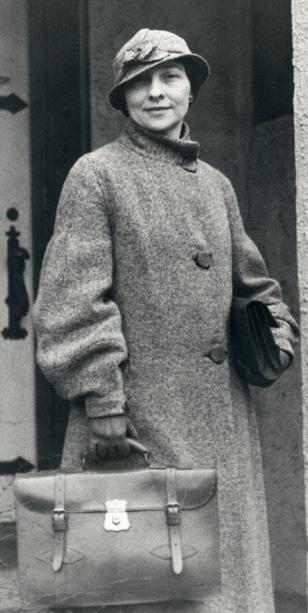
Friedman and her col leagues broke all messages for every part of the U.S. military and Department of Justice, according to the documentary, “The Codebreaker”. Friedman was forging a new science that would hold immense power, all while training the first generation of codebreakers for the U.S. military.In1925, a Coast Guard officer showed up at her house with an urgent re quest.The Coast Guard’s network of radio towers had intercepted hundreds of encrypted messages, but no one knew how to break them. They needed Friedman to decrypt the messages. During Prohi
By Erik Teder
If you want a surefire way to scare people, you can’t do much better than saying “nuclear.” Yet, it can prove to be a reliable source of energy in the coming moderntheicraidoflettersSevendecades.unassumingconjureimagessmolderingcities,airsirens,andtragaccidents.Infact,technologybehindMRImachines
is
called Nuclear Magnetic Resonance, but doctors dropped the word “nu clear” 1950s because it carried such pipelineStreamgasstoppedcrisis.Europe’sblingmakerspeanconnotations.negativeAsRussiachokesEurogassupplies,policyhavebeenscramtofindsolutionstogrowingenergyLastweek,RussiasupplyingnaturaltoGermanyviaNordOne,thelargestinEurope.
While there’s no easy solution to the continent’s energy crisis, nuclear power is a safe, clean, reliable source for Eu rope to depend on while navigating relations with Russia. It’s important that Europe invests in upgrading aging nuclear infrastructure, so this power source can light up the world for decades to come.According to Eurostat, nuclear energy currently accounts for just 17% of Europe’s energy produc tion, compared to 18% for natural gas. This percent age soars to more than 70% in France.
The most fundamental concern of energy pro duction is safety. Electric ity serves to illuminate human life, not threaten it. For many, salient im ages of nuclear disasters at Chernobyl, Three Mile Island, and Fukushima Daiichi condemn nuclear
power as fundamentally unsafe.Statistically speaking, nuclear energy is nearly the safest energy source around. According to Our
nobyl and Three Mile Island were due to human error, poor plant design, and unreasonable per formance pressures. In the decades since these
bition the Coast Guard was supposed to stop the smuggling of liquor, but it wasWithfailing.hopes to put a stop to organized crime, she agreed to help the Coast Guard. During her first three months on the job, she decrypted two years’ worth of backlogged mes sages all by herself.
But, not only was she decrypting messages, she was weaponizing the data she was gathering. She could then tell the Coast Guard who owned the ships and when a ship was scheduled to leave. The Coast Guard used this information to arrest and prosecute
Theexist.allowingU-boatsthehermanybetterJohannescamainbringingmenthelpingingteambars.otherthatwitnessbebreakingtoGuardbrilliantBecausesmugglers.ofFriedman’swork,theCoastapprovedherplanbuildanofficialcodeunit,thefirsttorunbyawoman.FriedmanwasthekeyinaseriesoftrialsputAlCaponeandgangstersbehindIn1941,Friedman’sswitchedfromhelptheCoastGuardtotheNavy.HerbiggestaccomplishinWorldWarIIwasdowntheSS’smaninSouthAmeriandoneofHitler’selite,SiegfriedBecker,knownas“Sargo.”ShealsointerceptedmessagesthatgaveinformationaboutlocationofGermanintheAtlantic,thesupplylinetoHertriumphwaslonely.Navymadeherswear
an oath of secrecy until death. She told her friends she was carrying on with a “routine Navy job.”
She could do nothing as she watched American FBI Director J. Edgar Hoover take the credit for her work. He took the 4,000 decrypts Friedman had sent and had them stamped with FBI Walk.andrecognizeHillsdaleplaque2008,ableinformationicanimportantbutfromthedeclassified.Inherwithinhadwasnursingagenciesateverythingthatsciencethehernumbers.identificationFriedmanandteamwereerasedfromofficialrecords.FriedmancreatedanewofcodebreakinglaidthefoundationforthathappensAmericanintelligencetoday.Shediedaloneinahomein1980.Shepoorandmanypeopleforgottenherinfluencetheworldofcoding.Thegovernmentkeptfilessecretfor62years.2008,theywerefinallySheisnotjustoneofmostimportantpeopleHillsdaleCollege,sheisoneofthemostpeopleinAmerhistory.Despitethefactthatthishasbeenavailtothepublicsincethereisnotevenatohonorheratthecampus.HillsdaleCollegeshouldherachievementaddhertotheLiberty
World in Data, deaths from accidents or expo sure to nuclear power oc cur at a rate of about 0.07 per terawatt hour. Coal comes in at more than 24 deaths per terawatt hour and gas is nearly three.
Accidents like Cher
incidents, computer control and better design has largely eliminated the danger of costly mistakes.

Fukushima’s meltdown occurred as the result of a tsunami, a inlandconspicuouslyphenomenonlackinginEurope.Itsafter
math represents one of the most effective con tainment operations in history, and studies have attributed only one death to the incident.
Not only is nuclear power safe, it’s also clean.
Plants produce no direct carbon emissions, which is crucial for Europe’s stringent commitment to greenAccordingenergy. to reports by the IPCC, in its life time, a nuclear power plant will produce 1.5% the carbon emissions of a coal plant, and 2.4% of the carbon emissions of a natural gas plant. This includes construction of the facility, operations, and waste disposal.
The major environ mental hurdle in nuclear energy is how to safely dispose of radioactive waste. Recently, Finland has been constructing the world’s first permanent nuclear waste disposal
site, taking steps toward a lasting solution for waste management.Europehas been looking to transition to a higher percentage of renewable energy. These power sources aren’t advanced enough to help the continent cope with dwindling raw material supplies from Russia. Germany planned to phase out nuclear power by the end of this year, but has recently elected to keep two reactors of its remaining three reactors online in anticipation of the coming winter. It’s time for other European countries to follow and look to nuclear as the solution for their growing energy conundrum.
Erik Teder is a fresh man studying biochem istry.
Lauren Scott is a junior studying history and jour nalism. She is the assis tant opinions editor at the Collegian.
Biden’s speech was meant to unite the nation. Courtesy
“The most fundamental concern of energy production is safety. Statistically speaking, nuclear energy is nearly the safest energy source around.”
California’s climate policies cause more harm than good
Elizebeth
Editor-in-Chief | Maggie Hroncich Associate Editor | Christian Peck-Dimit Design Editor | Tracy Wilson Digital Editor | Josh Newhook News Editor | Elizabeth Troutman Opinions Editor | Elyse Apel City News Editor | Logan Washburn Sports Editor | Claire Gaudet Culture Editor | Megan Williams Features Editor | Meghan Schultz Social Media Manager | Jillian Parks Circulation Managers | Linnea Shively | Micah Hart Ad Manager | Carly Moran Staff Photographer | Jack Cote Outreach Director | Hannah Cote Assistant Editors | Michael Bachmann | Michaela Estruth | Lauren Scott | Evalyn Homoelle | Tess Owen | Olivia Pero | Isaac Green | Alexandra Hall | Maddy Welsh Faculty Advisers | John J. Miller | Maria Servold Online : www.hillsdalecollegian.com(517)607-2415 The editors welcome Letters to the Editor but reserve the right to edit submissions for clarity, length, and style. Letters should be 600 words or less and include your name and number. Send submissions to the Opinions Editor at ehawkins@hillsdale.edu before Saturday at 3 p.m.
www.hillsdalecollegian.comway.A4 September 15, 2022
| Fli C kr
Smith Friedman is a Hillsdale alumna. Courtesy | Wikimedia Commons
Hillsdale should offer more classes in modern languages
By Erin Osborne
Hillsdale College should offer a broader range of modern languages, in order to better prepare students for international politics andThebusiness.college presently offers a variety of ancient classical and western Euro pean languages, including Ancient Greek, Ancient Hebrew, Latin, German, French, Spanish, and Italian. Students are able to major in all of the above except Hebrew, which is part of the classics department, and Italian, which is only offered as a series of classes.
However, as the world continues to globalize eco nomically and politically, we need to be better prepared to communicate with people who do not speak English.
Mandarin Chinese is the most common first lan guage in the world. Spanish is the second, and English is theAsthird.aSpanish major, I have found that talking to someone in their native language contributes to increased camaraderie and appreciation. I can commu nicate more effectively and gain the respect of my Span ish speaking neighbors.
When fluent or conversa tional in another language, one can understand the tonal and dialectic cues that would not be apparent given a direct translation.
We don’t have to beat Guinness World Records holder Powell Janulus’s record of conversational fluency in 42 languages, but we would gain more inter national opportunities and respect if we spoke more
Asian, Middle Eastern, and Eastern European modern languages.Chinais among the world’s largest economies. It holds political weight, and has just under a fifth of the world’s population, which means that if a person speaks at least basic Chi nese, he can communicate with substantially more people.These languages have their purpose, and the clas sical languages are central to the college’s mission in the liberal arts. Hillsdale should consider adding languages such as Chinese, Japanese, Arabic, and Russian to the list of languages students canStudentstake. in internation al business and politics majors need to learn the most common or relevant international languages. The
military trains its soldiers to speak Chinese and Arabic. Japan has the third larg est economy in the world. Russia is at the center of international conflict.
We should learn the languages that are vital in various regions of the world, not because English is less important, but be cause fluency in these other languages allows for better international negotiation and job security.
It is senseless to assume that translators will always be accessible and accurate. We need to be prepared to learn and engage with speakers of other languages, and that quest for global fluency should start at Hills dale College.
Erin Osborne is a soph omore studying the liberal arts.
Putin’s next target is green energy
By Lauren Smyth
Here’s some advice:
Before antagonizing Russia, check the weather. Na poleon, Hitler, and other would-be conquerors reaped disaster after failing to tune in to the forecast.
Despite these lessons, Eu rope is about to repeat histo ry. To avoid armed conflict, Europe needs to fight Putin’s war not with weapons, but with the power of free trade and a working knowledge of Russian history.
A popular misconception about Russia’s invasion of Ukraine is that the captured territory will be used as a base from which to attack the rest of Europe. Russian President Vladimir Putin denies the claim, noting that the motivation for hostili ties in Ukraine is not out of desire to antagonize Europe, but to protect his borders and shelter ethnic Russians.

This sounds reassuring, but presidents who have presid ed for 16 years are seldom honest. Perhaps Putin’s soothing words are nothing more than political rhetoric.
A glance at a map proves that Putin has been shock ingly transparent. After an initial westward feint, Putin has confined his attacks to Eastern Ukraine, which
is home to the country’s highest concentration of ethnic Russians. The West has nearly forgotten that this land once belonged to Rus sia, not the Soviet Union, until the Bolsheviks ceded the territory in 1920. If Pu
countries a false sense of security.Unfortunately, the map has more to tell.
Donetsk, the fur thest-westward region Russia occupies, is Ukraine’s top supplier of coal. The
By Liam Martin
Two major academics faced serious assassina tion attempts over the last month: Indian-born Brit ish author Salman Rush die and Russian political philosopher Aleksandr Dugin.Rushdie was put on a ventilator after being stabbed repeatedly by an Islamic extremist, while a car bomb intended for Dugin took the life of his 29 year-old daughter, Darya Dugina. Russia claims that Ukrainian in telligence was behind the bombing, while Ukraine asserts that it was carried out by Russians dissatis fied with the war.
conservative movement, calling her a “Florida busi nesswoman.”In2019,former National Review staff writer David French infamously referred to drag queen events for children as a “blessing of liberty.”Yetwhen it comes to conservative voices, domestic or foreign, who criticize the liberal world order, these “defenders of free speech” fall suspicious ly silent.Formany who consider themselves “free speech absolutists,” people are only free to speak in favor of state
tin’s goal is what he claims— that is, to protect “people living in the south-west of what has historically been Russian land, [who] have called themselves Russians and Orthodox Christians”— he is doing exactly what would be expected.
This is good news for non-Ukrainians worried about invasion. Without control of Western Ukraine, Putin is not positioned to launch attacks on the rest of Europe. Realizing this has given many European
area is sufficiently rich in natural resources to sus tain energy independence in Ukraine. Other forms of “greener” energy aren’t enough to keep its economy afloat. Without this land, Ukraine is crippled. That is Putin’s secondary reason for targeting this region. It should also be a warning.
Using the climate to fight battles is nothing new for Russia. But this time its weapon of choice isn’t frosty winters; it’s a deadly heat wave.
The woes of Metz
By Meghan Schultz
As long as I can get some fries, I thought, it’ll be Itfine.had been an awful day. You know the type: a kind that can only be cured by hot, greasy, fried potatoes covered in salt and pepper. With a weakened will, I wait ed for a lifetime in the lunch line and held my phone in an iron grip as the scanner robbed the poor soul in front of me of $17.Isludged through the drink line. I killed a man to get a booth. At last, I stood in front of the glittering “Sizzle” sign, shining beautifully under the fluorescent lights. I looked down at a panful of kettle “Neverchips.mind,” I told the alarmed Metz em ployee, my shaking hand barely muffling the sobs.
A day without fries was a dark, ominous tally in my book against Metz Catering. I drew a storm cloud over it and choked down some spaetzle instead.Thenext afternoon, I sat down with a friend in newly contented spirits. We split a plate of fries,
and I slathered my spin ach salad in strawberries and feta Unfortunately,cheese. she soon returned from Passport with a meal in her hands only large enough to be
split between the mem bers of Hillsdale College Democrats or eaten by a mouse.Due to a lack of nutri ents in the tiny portion, she fainted and had to be rushed to a protein source. The chicken they fed her at Sizzle was so
dry that she asked for a saltine cracker to refresh herThepalate.third strike came the very next day, when some guy walked by my hard-won booth looking woefully at the cookie in his“Whathand. happened to the double chocolate chip ones?” he asked. The cookie made no reply. But it got me thinking. We all had our mo ments with Bon Appetit. Mine included the mag ical dietary needs fridge that un-stocked itself at will and the bugs in my salad. But I’m disinclined to crown Metz with lau rels it hasn’t yet earned. The student body hasn’t had time to wallow in the lack of double chocolate chip cookies, much less make a positive judgment call about the dining hall as aForwhole.now, I’m only will ing to hillsdate Metz. I’ll get a meal with them, but who knows when I’ll be ready to commit.
Meghan Schultz is a senior studying English and journalism. She is the features editor at the Collegian.
Hydroelectricity re quires water, but Europe’s skies are cloudless. Biofuel requires crops, but Europe’s soil is parched. Nuclear power requires rivers to cool reactors, but Europe’s rivers are dry. Green energy fails when water is scarce.
Europe has positioned itself to rely solely on green en ergy when it can’t get fossil fuel, and it has made itself dependent on Russian oil by prohibiting drilling in its own territory to protect the environment.Thishasgiven Putin an unparalleled opportunity to squeeze Europe into submission by taking advan tage of a broiling summer. Heat does not require Putin to declare war. It violates no laws. But people are suffering and dying in record-breaking high temperatures—for green energy’s buildstartconditionersLetenergywhenwillpromisingproducersEurope:sake.Incentivizetodrilloilbythemthattheystillhaveabusinessproposedgreenlawsgointoeffect.themarketpowerairfirst,andthenthinkingabouthowtoagreenerworld.
Yet despite the simi larity in the two attacks, their coverage among American conservatives could not have been more different.Inanarticle published by The Federalist, au thor Davis Marcus said of Rushdie: “Blasphem ers must be allowed to blaspheme. They’re not alwaysSimilarly,wrong.”Stanley Kurtz wrote in National Review that the attack on Rush die presented a “crisis of free speech” and that, as a result, “freedom, so to speak, is on a ventilator.”
Yet those same pub lications made no such defense of free speech or condemnation of violence after Dugina’s mur der.The Federalist did not even report on the attack, despite its significance in the conflict between Russia and Ukraine, while National Review dedi cated its coverage of the murder to condemning her father’s geopolitical views.This double stan dard is all too common in conservative media. Mainstream conservatives dedicate endless arti cles to decrying “cancel culture” and the “crisis of free speech,” yet such grace is never extended to anyone to their right.
Last year, Ben Do menech, co-founder of The Federalist, defended a porn star’s role in the
believe.astheytherightdifferencecalleddefendedonsontheirbyrightspeech,”ter-righttheirthanspeech”tionlectuals,Russiancondemningdefendingdiainortheirpro-LGBTIsrael,Criticismrate-backedforeigndepartment-approvedpolicyandcorposocialpolicy.ofUkraine,massmigration,orconservatives,inminds,is“far-right”“conspiracytheories.”Whencertainfigurestheconservativemearemoreinterestedinpornstarsthanthemurderofconservativeinteloneislefttoquesiftheirbeliefin“freeisanythingotheraslogantodefendownbrandofcenliberalism.“Freeitseems,isonlyaforvoicesapprovedtheestablishment.Ifsomeonequestionsnarrative,thatpernolongercancounttheirfreespeechbeingbymanyso-conservatives.ThebetweenmanywingjournalistsandleftistcampusactivistsopposeisnotasgreattheywantAmericansto
The pros of Metz
By Chris Dick
I do not think we should speak ill of the dead. How ever, since Bon Appetit is a company and therefore cannot die, I will waste no time welcoming its replace ment. Metz, like its New York baseball counterpart, is a welcome surprise. If you’ve ever done the math, you’ll see that a standard meal swipe has averaged around $13 a meal and the past experience has not lived up to that price.
In the past, you could go to Saga on a Saturday, and they would be out of salad at 5:30 p.m., leaving you either to starve or to have chicken tenders for the thirtieth time that semester. Now, Metz offers a much broader Satur dayInmeal.mybrief experience with Metz, I have noticed that it has either improved or not touched every element of the dining hall, and breaking it down by meal illustrates that.
Breakfast - Over my en tire tenure as a student, one rallying cry has united cam pus. “Bring back omelets!” This creed has been shared by everyone, including blood rivals Simpson and Whitley. The desire to bring back made-to-order omelets has
superseded male competi tion.Metz finally answered the call. In bringing back daily omelets, it made breakfast a viable option. Freshman year, you would go to Saga in the morning because you didn’t know any better. Now the jaded upperclassmen are making their return to the most important meal of the day.
Lunch - Not content with simply bringing breakfast back from the underworld, Metz decided to give lunch a Queer Eye-style makeover. Instead of Sizzle just having the same bulbous beef puck, there’ll actually be interest ingAfterofferings.afew weeks of ex periencing what Metz offers, I regret moving to a smaller meal plan. In its short time as culinary providers for Saga they’ve accomplished so much.
Saturday Dinner - Least but not last, is its improve ment to Saturday dinner. While there were some ar dent fans of chicken tenders, mac and cheese, and BBQ sauce, moving away from that being a weekly feature is a godsend. I understand the appeal of a simple meal that doesn’t require a whole lot of prep, but Metz has answered that quandary with variety.
The Nashville hot chicken was bussin and it could not have been the most complexThingsthing.cannot always be sunshine and rainbows. Se nior Nick Treglia, through the lens of stellar humor, highlighted problems with lines to get into the dining hall and get food. The scanners were slow and the paths were undefined. This minor setback set the stage for a larger comeback. Metz saw this problem and addressed it within a week, and now those problems are things of the past. Speed is back.
Even aside from my per spective, Metz is improving labor relations. It’s offering competitive salaries with unique benefits that will definitely help solve the un derstaffing problem. Work ing at AJ’s is no longer just the most available job, it is now a good job.
As a whole, the reviews from students are positive. When I mentioned that I was writing a pro-Metz piece, people were shocked that there could be an an ti-Metz piece. Everything they’ve touched has either improved or not changed.
Lauren Smyth is a sopho more studying economics.
Liam Martin is a junior studying history. mediaattemptsassassinationrevealhypocrisy
Chris Dick is a junior studying history. disinclined to crown Metz with laurels it hasn’t yet earned. The student body hasn’t had time to wallow in the lack of chocolatedoublechipcookies.”
“Free speech is only a right for approvedvoicesbytheestablishment.”
Russian
www.hillsdalecollegian.com Opinions
September 15, 2022 A5
Two
“I’m
President Vladimir Putin has largely confined his attacks to Eastern Ukraine. Courtesy | Twi TT er
City News
Professor, graduate student run for city council
By Tess Owen Assistant Editor
A Hillsdale professor and alumnus are running for two Hillsdale City Council seats on the Nov. 8 ballot.
Professor of Economics Gary Wolfram is running for a seat in Ward 3, and Hillsdale College alumnus and current graduate student Joshua Paladino ’18 is running as a candidate for Ward 4.
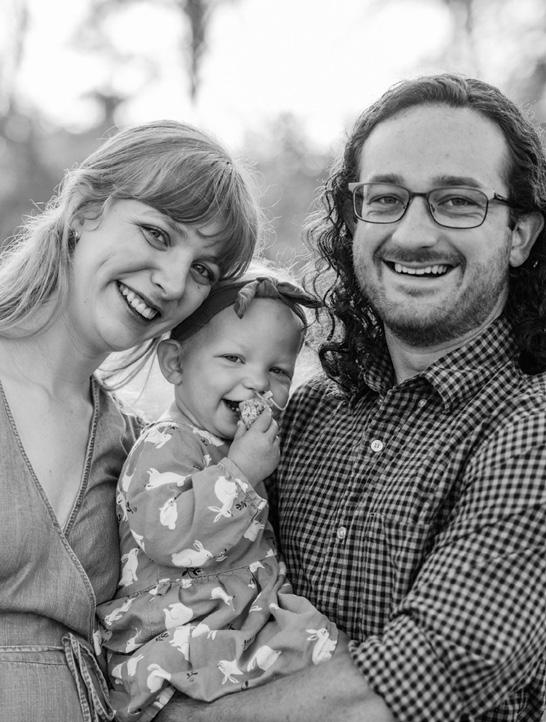
“I love Hillsdale,” Paladino said. “I want to raise my children here. I want it to be a place that is safe, beautiful, and strong for them. On a more practical note, I want to take a more active role in the community, and especially in the debates surrounding education.”Paladino is vying with Hillsdale City literacyincludeseekingintoCommissionerPlanningPennySwanreplaceRaymondBrinerWard4,whoisnotreelection.Paladinosaidhisgoalsimprovingtheratesofthelocal
public schools, reforming the local library, and strengthening the police department, especially in the face of increasing levels of ho melessness.“Manyof the City institutions have been running on auto-pilot these last few decades, and it's time to get serious about these issues,” Paladino said. “We need to shift the priorities towards the public health of the themthetheAccordingcity.”toPaladino,laggingliteracyratesoflocalschoolshavemademorevulnerabletothe
influence of ideologies like Critical Race Theory.
“I think we need to promote great literature and high literacy,” Paladino said. “The fundamental thing is to focus on a child being able to read and write at the highest level, and to move away from ideological distractions."
For Paladino, who currently serves as secretary on Hillsdale Community Library’s board, a similar focus applies to the local library.“When a kid comes in, they should only discuss books and reading. We
Mayor Stockford announces fight against mystery opponent
By Lauren Scott Assistant Editor
Mayor Adam Stockford will wrestle a mystery opponent on Saturday, Sept. 17 at the Hillsdale County Fairgrounds.

The evening event will feature a series of matches professionalbetweenwrestlers, as part of the CheckerfriendlyonMonahanyoungestfromencouragehecampaignhetostarts6serious.”justwrestle.’be‘YouStockfordbeaskedprofessionalPhilafightingpromotionInternationalChampionshipWrestlinggroup.“WegottheMayorwhichwillgiveitlittlehometownflavor,”Monahan,Americanwrestlersaid.“PhilcametomeandmeifIwantedtoasponsoroftheshow,”said.“Isaid,knowwhat,Phil?I'llasponsorifyouletmeHethoughtIwasjoking,butIwasbeingThedoorswillopenatp.m.andthefirstmatchat7p.m.Stockfordsaidhewantsbewiseabouthowspendshisreelectionmoney.Hesaidthoughtthiseventwouldthecommunity.“It’sanallagesevent,grandmatothegrandkids,”said.“We’rebigmakingthisafamilyevent.”AllticketsaresoldatRecordscoffee.
General admission tickets cost $13. VIP tickets cost $20 and allow people to enter at 5 p.m., get a front row seat, take home a souvenir poster, and meet the wrestlers. Tickets will also be sold at the door for $15.Monahan said the event will feature a large steel cage for the main wrestling match, as well as a “micro” championship.“Thatisgoing to be the first time for Hillsdale County to ever have a midget championship
wrestling match,” Monahan said.Stockford’s history in wrestling will help him in his match against the mystery opponent, who is a professional wrestler, MonahanStockfordsaid.encouraged all Hillsdale residents to buy a ticket.“Tickets are not expensive and it should be a good time,” Stockford said. “Hopefully it will give everybody a good show and everybody will get a kick out of it.”
need to cultivate smaller, worthier, and permanent collections,” he said.
Paladino said he wants to help bridge what he sees as a divide between the city and the“Unfortunatelycollege. there is a divide between the city, and if she gets her affairs in order and is productive, then maybe the college could become a partner to the city,” Paladino said.
Wolfram said he also wants to strengthen the relationship between the city and the college.
“I am running for City Council to provide a service to my community,” Wolfram said. “My goal is to act as a positive force to improve the city, and I hope to add to the interaction of the city and theWolframcollege.” and Cynthia Merrit are running to replace current city council member Bill Zeiser in Ward 3, who is not seeking reelection.Wolfram said he wants to use his experience serving on both state and federal levels, as deputy state
treasurer under former Michigan Gov. John Engler and as chief of staff to congressman Nick Smith, both Republicans.
“I hope this experience will aid the city in its interactions with the state and federal government,” WolframWolframsaid.also said he wants to explain positive economic policy to constituents in the community.“Mygoal is to explain to my constituents such things as the purpose of the Tax Increment Financing Authority and the importance of the ‘positive externalities,’ something which my public finance class would be familiar with,” Wolfram said.
TIFA is a city government council that promotes economic growth, and positive externalities are benefits that a third party gains from a transaction.
Nine members make up the city council, with two members representing each of Hillsdale's four wards, along with the mayor. Each
member serves a four-year term, with one member of each ward up for reelection every two years.
City Council members currently seeking reelection and running unopposed include Greg Stuchell of Ward 1 and William Morrisey of Ward 2, according to Hillsdale City Clerk Katy AccordingPrice.toPrice, since only two candidates filed to run for the contested wards, a primary run-off was unnecessary, and all four candidates will appear on the November ballot.
Paladino, who studied Politics and Journalism at Hillsdale College and worked as The Collegian’s opinions editor, credits the school with his love for the city.“The college gave me a great love for the city,” Paladino said. “I love this small town. The politics are face to face conversations with neighbors to get things done and decide what’s best. I’m grateful for my time here.”
Patriot’s Day Fly-In honors 9/11 anniversary despite weather
 By Kamden Mulder Collegian Reporter
More than 100 people gathered Sunday, Sept. 11, at the Hillsdale Municipal Airport for the seventh annual Patriot’s Day Fly In, despite inclement weather.
Cars lined the tarmac, parking two rows deep to accommodate the large number of attendees.

Multiple large tents housed the pancake breakfast with tables and chairs, where people enjoyed food catered by The Local Eatery. Those who attended the event supported local businesses through the pancake breakfast and a 50/50 raffle drawing.Attendees viewed classic cars and planes on the tarmac. Police officers spoke with locals as EMS units, fire trucks, and police cars joined the event. Although the event typically offers helicopter and airplane rides, including a Huey helicopter, flights were canceled due to the weather.
Livonia resident Yolanda Hlavati attended the event. Hlavati said she makes her way to the airport every year because she loves the excitement of the planes and the people. In the past, she said classic cars have been her husband’s main draw to the“Weevent.would have stayed longer because they usually
have lots of cars and planes,” HlavatiWhilesaid.weather changed the experience for attendees, regulars like Hlavati still came out to support the event. Hlavati brought her daughter Jackie Johnson to the event for the first time this year to share in the annualJohnsontradition.saideven in the rain, she was excited to see kids running around and admiring the planes.
Hillsdale City Council Member Bruce Sharp said
he was impressed with the crowd, considering the weather. The program and airport have come a long way in the past 10 years, SharpSharpsaid.said the airport is attempting to fund terminal projects, and events like this help rally community support to make those dreams
“Thispossible.eventis a vital part of the community,” Sharp said.
Hillsdale Hospital opens new infusion care center
By Micah Hart Assistant Circulation Manager
A new infusion center at Hillsdale Hospital will offer patients treatments for disorders including rheumatoid arthritis, allergic asthma, chronic migraines, and infectious diseases.
The new Center for Infusion Care, which opened Sept. 12, will also offer patients IV medications, such as antibiotics, specialty injectables, fluids, and more.
Rachel Lott, the hospital’s director of marketing and development, said in a press release the center will help it “provide the most comprehensive medical services for its patients and community.”Thenewcenter, on the hospital’s ground floor, will
offer services Monday through Friday from 8 a.m. to 4:30 p.m.
press“Havingrelease.to travel outside of the county to receive this type of care can be a significant burden – especially for patients who need infusions on a recurring or routine basis,” Lott said.
Holland is at the helm of the new project, according to the press release, with longtime Hillsdale Hospital nurse Tammy Evener serving as infusion nurse coordinator.
to inpatient hospitalization, emergency room services and home health services,” the hospital website reads.
The center hopes to assist patients accustomed to traveling as far as Battle Creek, Kalamazoo, and Jackson for their infusion therapy, Director of Ancillary Services Randy Holland said in the
According to the hospital’s website, most major insurances will cover the treatment. State and federally funded plans will also likely cover the new infusion therapy.“Outpatient infusion therapy is a benefit on most insurance policies and can save patients hundreds, if not thousands, of dollars in outof-pocket expenses compared
The hospital’s website outlines payment options and insurance verification to help ease patients’ financial concerns.Withrecliners, iPads, and Wi-Fi, along with registered nurses and trained pharmacists available, the hospital hopes to make the environment as pleasant and pain-free as possible, according to its website.
The hospital will not immediately offer oncology infusions, according to the press release, but hopes to do so in the future.
“We want patients to have access to IV therapy in a friendly, welcoming environment that is close to home,” Lott said.
Families enjoyed looking at planes during the Fly-In. Jack Cote | Collegian
The Fly-In featured a car show on the tarmac. Kamden Mulder | Collegian
Stockford is preparing for the wrestling match. Courtesy | Facebook
The new center will be on the hospital’s ground floor.
Courtesy | Facebook
Joshua Paladino and his family.
Courtesy | Facebook
Dr. Gary Wolfram is running for city council.
Courtesy | Facebook
“We want patients to have access to IV therapy in a isenvironmentwelcomingfriendly,thatclosetohome.”
www.hillsdalecollegian.com
A6 September 15, 2022
County GOP factions prepare for legal battle
By Logan Washburn City News Editor
Two Hillsdale County Republican Party groups are preparing for a legal battle.
“We’re the sanctioned, official party,” Jon Smith, the original HCRP secretary said. “They are a bogus party.”
When the HCRP’s “America First” executive committee barred delegates from the county convention in early August, County Commissioner Brent Leininger held an alternate convention. The Michigan Republican Party ruled in favor of the alternate convention, and afterward, Leininger and other Republicans attempted to oust the party’s original executive committee officers.
The attempt has not yet been successful, as the Michigan Republican Party recognized the “America First” group on Aug. 27. The two factions, however, have continued to hold events and operate independently.
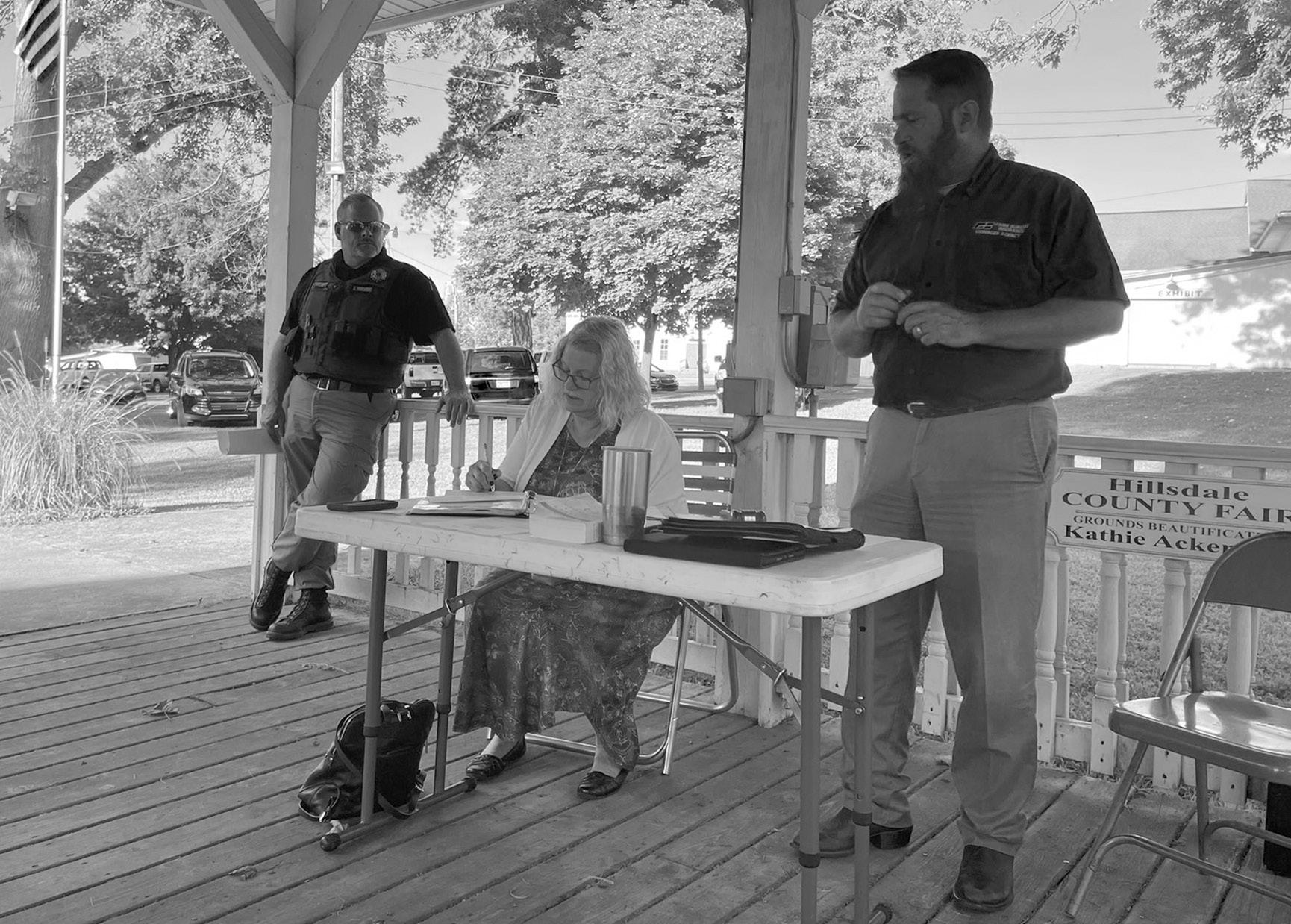
Both groups have been speaking with lawyers, preparing for a potential fight in court.Leininger, who serves as his group’s chairman, said he and his fellow officers are considering “all steps necessary, including legal action” to secure their positions. According to Leininger, Michigan election law and party bylaws justify the group’s claim to office.
“We are working with legal counsel to take the appropriate steps as we go forward,” Leininger said.
The Macomb County Republican Party has been dealing with a similar controversy, so Smith
said the HCRP’s original parliamentarian Jon-Paul Rutan is speaking with their lawyer. At the same time, Smith said officials hope
party affiliation and county convention timing to improve their response to future incidents like this.
to avoid legal action, as he thinks court involvement would set a dangerous precedent.“Courts should not be involved,” Smith said. “It’s setting a standard for clubs in general.”Smith said his group is considering questions of
Background
Officers of the HCRP executive committee accused more than 61 county convention delegates of being “Trochky [sic] International Socialists” in early August. Party officials barred the delegates, including state
their Aug. 11 county convention.Whilethe official convention took place in Sozo Church, Leininger led an alternate convention of disavowed delegates in a downtown parking lot. The state party ruled in favor of the alternate convention
on Aug. 19, and accepted their nominees to represent Hillsdale at the state Republican convention.
Twenty Republicans, many
Wiseley was arrested in Osceola County, Florida, on Aug. 7 for battery on a firefighter, according to the Osceola County Clerk. He has since been released and returned to Hillsdale.
At the Republicansmeeting,voted to replace the executive committee officers with Leininger, Zoning Board Member Penny Swan, County Clerk Marney Kast, Prosecutor Neal Brady, recently-defeated County Commissioner Kathleen Schmitt, and Bambi Somerlot.
The Michigan Republican Party ruled in favor of the HCRP’s original leadership in an Aug. 27 letter, recognizing the group they had previously ruled against. Leininger said he and the other Republican officials would not comply with the state party’s ruling.
Republican Mayor Adam Stockford called for tensions to cease in an Aug. 16 Facebook post.
“I would ask the so-called establishment faction to go back to their day jobs, which is administering the offices of this county and state,” Stockford said. “I would ask the so-called patriots to stop using the same tactics you accuse others of.”
of whom took part in the alternate convention, met on Aug. 25 to remove officers of the HCRP’s executive committee. Leininger said party members voted to oust Smith, Daren Wiseley, Belle Steier, Jon-Paul Rutan, Josh Gritzmaker, and Lance Lashaway.
Stockford said he approaches this issue as a non-interested party, though he acknowledged he is imperfect and has fanned controversy throughout the years.“We are on the verge of losing our way of life nationally,” Stockford said. “Hillsdale is supposed to be different.”Wiseley could not be reached for comment on his arrest.
Zilantros truck offers authentic Mexican street food
By Lauren Scott Assistant Editor
Carlos and Lina Alvarez are achieving their dream after opening Zilantros Tacos, a food truck, on Cinco de Mayo in 2022.
After moving to Michigan from Mexico in 2010, Carlos Alvarez said his family was determined to open a food truck. It took four years before they opened.“Wewere surprised the very first time that we came to Hillsdale,” Alvarez said.
“We were obviously not prepared and we ran out of food the first time, and we were like, ‘Wow, this is amazing.’”Although the truck goes to several places outside of Hillsdale, their Hillsdale location is 184 W. Carleton Road, and its hours are 11 a.m. to 3 p.m. every Thursday.Alvarez said his wife does all the cooking, and their daughter, Ruth Ramos, helps with the business as Zilantroswell.serves Mexican street food, so they do not offer the same traditional
Tex-Mex options as most Mexican restaurants in America, Alvarez said.
“We don't have any sour cream, lettuce, or tomatoes for our tacos, because that's not how they are in the streets of Mexico,” Alvarez said. “That's the unique part of it that we offer.”
lot at Lewis Street and Carleton Road Customersletaccommodatingwereandthemsetupshop.havekept them busy ever since the city gave them the green light, Alvarez said.
“I just want to say thank you to everybody,” Alvarez said. “Here at Hillsdale and everywhere we go, we got a really good response from everyone.”
Junior Hannah Allen said Zilantros has the best tacos in “Theytown.areoften busy but it is worth the wait,” Allen said. “The flavorful meat with cilantro and your choice of salsa on a corn tortilla is so good.”

Alvarez said when people ask for those ingredients, most are very understanding and accept the unique food they have to offer.
They first began the business mostly operating in Hudson, but Alvarez said he finally decided to give Hillsdale a try, and owners of the parking
CRIME REPORT:
9 Sept.
Allen said she heard her co-workers raving about Zilantros, but she could not believe how good their tacos were until she tried them.Alvarez said he and his wife are thankful for everyone in the community who supported them.
“It's our dream come true,” Alvarez said.
The Collegian has compiled a selection of arrests from the City of Hillsdale and Hillsdale County in the past week.
10 Sept.
- A 30-year-old Monroe woman was arrested on a felony home invasion warrant, a friend of the court warrant, contempt of court, and no valid license.
- An 18-year-old from Hillsdale was arrested on four counts of assault and battery.
-A 20-year-old from Hudson was arrested for felonious assault with a dangerous weapon. A $20,000 bond with 10% allowed was posted.
- A Hillsdale man, 25, was arrested for domestic assault. A $10,000 bond with 10%allowed was posted.
-A 30-year-old from Hillsdale was arrested for operating while intoxicated. A $5,000 bond with 10% allowed was posted.
Sources: City of Hillsdale Police Department, Hillsdale County Sheriff's Office
12 Sept.
- A 29-year-old Jonesville man was arrested for breaking and entering and larceny from a building. No bond was allowed.
- A Quincy man, 26, was arrested for breaking and entering and larceny from a building. No bond was
-Aallowed.39-year-old
Hudson man was arrested on a felony warrant for controlled substance possession. A $15,000 bond with 10% allowed was not posted.
Senate Majority Leader Mike Shirkey, state Rep. Andrew Fink, and Hillsdale College Professor of Economics Gary Wolfram, from attending
Brent Leininger and other Republican officials hope to secure officer positions on the HCRP executive committee.
Courtesy | Twitter
Right to left: Carlos and Lina Alvarez, and their daughter, Ruth Ramos. The family works together in their food truck. Lauren Scott | Collegian
www.hillsdalecollegian.com City News September 15, 2022 A7
food
“Hillsdale and everywhere we go, we got a really good response... I just want to say thank you.”
Golf starts season with runner-up finish; threatens program records
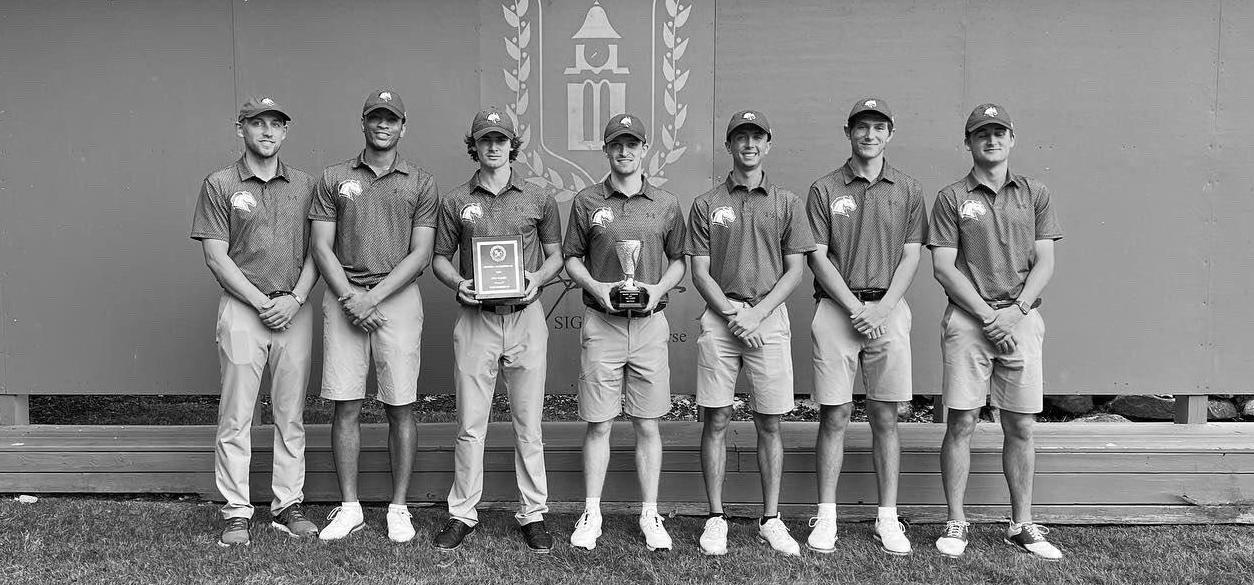 By Thomas McKenna Collegian Freelan C er
The Hillsdale men’s golf team threatened program records Monday and Tues day, starting the season with a second place finish at the Malone-Glenmoor Invita tional in Canton, Ohio.
“It's definitely nice to get off to a good start this year, but we can't get complacent,” Thompson said. “We have to keep staying focused on what we're doing.”
The team finished with a score of 282-282-296 for a three-round total of 860, just two strokes off the best 54hole score since the program was restarted in 2013. Two standout seniors, Darragh Monaghan and Gerry Jones,
Jr., led the team with career best ThompsonandwasDecember.surgerylastthreeinamodernstrokegolfer.formance68-71-208ward.”giveshotyear,boost,”“It’sperformances.amassiveconfidenceMonaghansaid.“Lastwedidn’tgetofftoastart.Hopefully,thisusabetterstepforMonaghanshota69-inhisbestperasacollegiateHisscorewasjustoneshortofHillsdale’sindividualrecord,207shotbyJoelPietila2017.MonaghanmissedmonthsofcompetitionseasonafterreceivingonhisshoulderinThompsonsaiditgoodtoseehimhealthycompetingagain.“He'splayedwellforus,”said.“Forhimto
get off to a good start to the year, be healthy, and to see him play like that was really cool. I'm happy for him. He's had the talent all along.”
One stroke behind Monaghan was Jones, who shot under par for all three rounds, including a personal best of 67 in a total score of 67-71-71-209.“Iwasreally satisfied,” Jones said. “There are a lot of minor things in my game that I put a lot of emphasis on this summer that I was hoping would translate into shaving some strokes off the course and that's exactly whatJoneshappened.”attributed this suc cessful start to the players' work during the summer.
“It validated all the work
that we put into our games individually this summer,” Jones said. “Coming together for the first tournament and being able to be right there in contention – and even be in the lead at one point – I think that’s good for our confidence.”MaxwellBurns, the only true freshman on the team, shot a 69 in the second round. Burns said the per formances of both seniors reminded him of the impor tance of “Theyconsistency.willshowup when you need them,” Burns said. “I was able to help the team out, but I need to get the point when I can do that every single time, instead of every now and then. The main takeaway is that I need
to become more consistent.”
Jones said the strong start early in the season sets the team up to remain competi tive throughout the year.
“It'll put us in a much much better position,” said Jones. “We don't have to be under so much pressure on a week to week basis, basically trying to survive to get to re gionals. This is an extremely goodMultiplestart.” players said they still think the ceiling is high er than the standard they set with their performance this week.“We can probably aver age four or five shots better apiece,” Burns said. “This tournament was good, but I don't think we really showed our full potential.”
The team heads to Find lay, Ohio next week for the Doc Spragg Invitational Sept. 19-20. Jones, Jr. said the team is looking ahead to what they can do better, not how they performed this week.“We’ve just got to not worry about what we did in Canton,” Jones said. “At the end of the day, when we’re at Findlay, nobody really cares what we did last week.”
Thompson said while the team did some things well, they must remain focused on the long season ahead.
It's a good start to the year,” said Thompson. “But we have a lot of golf left.”
Women's Cross Country
By Tracy Wilson Design eDitor
Taking first place as a team, the Chargers came home with a major victory after racing at the Calvin Knight Classic on Sept.
“The10.meet went very well from an individual and team standpoint,” Sophomore Vera Thompson said. “Everyone put themselves into position and finished in a good physical and mental spot that we’ll keep building from as the season progresses.”Headcoach R.P. White said the team mentally prepared
for the race by thinking about how they performed at the beginning of last fall’s season.
“The big talk going in was, ‘Are we a better team at this point than we were last year?’ The conditions were about the same, the course was about the same. We definitely showed progress within our times and within our Sophomoreplaces.”Liz Wamsley took first place with a time of 21:27.“Liz opened really well run ning by herself the entire race,” White said. “That was a really cool result to see.”
Hillsdale’s 2nd finisher
was Junior Meg Scheske, who came in 3rd with a time of 22:27. White said Scheske ex celled in the race considering that she took a wrong turn.
“Meg Scheske was running an awesome race at the end,” White said. “She actually put together a much better race than what her time reflects.”
Junior Gwynne Riley finished 3rd for Hillsdale, taking 6th overall with a time of 22:44. She was followed by Thompson, who took 9th overall with a time of 23:12.
“I remember feeling calm and mentally collected while running alongside my team
mate, Gwynne, for the first half,” Thompson said. “I accomplished the goal of going out there and seeing what I couldJuniordo.”Natalie Martinson finished 13th overall with a time of 23:31. Martinson said she accomplished her main goal for the race, which was to get a faster time than she did the last time she ran the Calvin Knight Classic.
“Looking at how I did at this meet last year, I am in a much better spot right now than I was a year ago.” Mar tinson said. “Across the board, all of my teammates ran much
faster than they did last year at the Calvin invite. The first half mile was fun, because my teammates and I were able to pass a lot of people and slowly work our way to the front.”
The cross country team has had a successful start, both on and off the course. Freshman Kaitlyn Rust, an academic senior, said she has been en joying her first season on the cross country team.
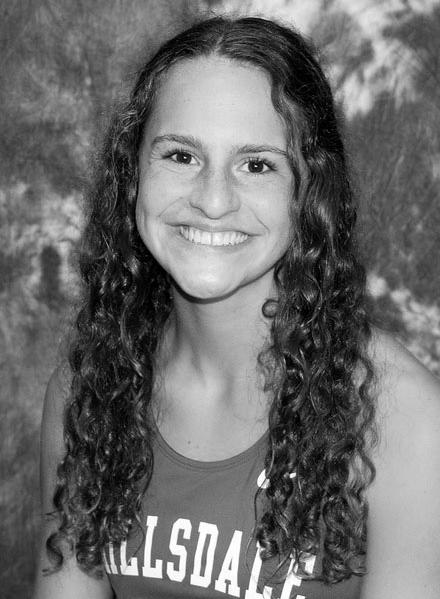
“I’ve been training with the cross country team since sophomore year, but only in preparation for my track season,” Rust said. “I knew it was a possibility of being on
Chargers take first at Calvin Knight Classic would you want to compete in Chargerwhy? Chatter S hivelySocha the the I can't even do it on land, but...
The best part is you have a break in your day and you're not a nerd all day. You have moments of run ning and getting everything out that you might have not been able to get out in class.
Probably "Super Smash Brothers." I feel like there are so many times when I play that video game and I fall off the edge of the world and then I just need to jump up and I feel like I would be able to conquer anyone with jumping skills.
the cross country team some day but I didn’t really think it would happen. Now, I not only get to train everyday with my friends and teammates, but I actually get to compete with them right now, and see the fruits of my work alongside them.”The runners hope to con tinue their successes at their next race, which will be Sept. 30 at Lansing Community
College.“Our next race will be more competitive than this last one, so hopefully that will push us to be better,” Martinson said.
We were doing a drill one day where you started in a random position to do a sprint. Our coach was changing the positions up and one day he told us to do a somersault and I forgot how to somersault and front flipped onto my back.
What’s the best aboutpartbeing a athlete?student
If you could use your pole dominateskillsvaultingto any video game, what would it be?
What is your embarrassmost ing moment?track
Golf team poses with tournament trophy.
Courtesy | Hillsdale Athletic Department
www.hillsdalecollegian.comSports Golf
A8 September 15, 2022
What winter sport
and
C ompiled by l innea
Isabella
C ourte S y | h ill S dale C ollege a theleti C d epartment Figure skating! I want to be one of those twirly girls with
dress that gets thrown in
air and then lands and it's like flawless. I want to do a backflip on the ice.
Volleyball sweeps opponents to begin conference play
By Isaac Green a ssistant e dito R
The Hillsdale volleyball team opened conference play last weekend, sweeping both competitors and extending its in-conference win streak to 73 Thematches.Chargers went on the road Saturday, Sept. 10 and Sunday, Sept. 11 in matches against the Lake Erie Storm and the Ursuline Arrows, se curing wins in both matches and rising to 9-2 this season.
“It was a total team effort,” head coach Chris Gravel
Men's Tennis
said. “Everybody played well at times, but everybody had their moments where it showed that we still have work to Graveldo.”noted that the team will be working to improve consistency when in control of the “Whenlead.things were close and there was pressure, we ac tually did really well,” Gravel said. “But we had some big leads and lost focus, which really brought down the per sonal numbers that we'd like to achieve and that is a prob lem that we need to rectify.”
Senior Madeline Zenas agreed with Gravel that, more than just winning its matches, the team looks to perform in a way that is representative of its potential in every play.
“We've had a lot of success in the past,” Zenas said. “So I think it's a huge thing for us to keep pushing forward and play to the best of our ability.”
Gravel believes the pre-season tournament experience helped to give the team an edge in high pressure situations throughout the weekend.“LakeErie came out look
ing really good offensively,” Gravel said. “But our first two tournaments were at that level, so it was very comfort able for us. When they made a mistake we were able to pounce on them and it was the same thing on Saturday.”
Overall, both matches were statistically successful for the Chargers, who outscored Lake Erie 25-10, 25-14, and 25-19. Sunday looked much the same with 25-13, 2518, and 25-20 wins against Ursuline.“Wehave such a great team with a lot of people who can
play anywhere,” Zenas said. “Having that depth will be huge for us.”
The Chargers now look to prepare for their next two conference matches against Malone and Walsh on Friday, Sept. 16 and Saturday, Sept. 17. These teams currently hold records of 5-6 and 4-3, respectively.“Whenwe've gone to Malone over the last several years, they have played out of their minds and right now Walsh leads the conference in offense,” Gravel said. “We're definitely going to make sure
that we stay well conditioned.” Senior Emily Susitko said that the team is feeling good moving into the remainder of the“Iseason.feellike the team is real ly positive right now,” Susitko said. “A lot of people thought when we lost our seniors last year that there was no way anyone could fill those roles, but they didn't understand how much depth we have on our team and how every single person is ready to go at every single moment of the game.”
Chargers win big at home invitational
Brian Hackman jumps to keep ball in play.
Courtesy | Isabella Sheehan
VolleyballMen'sCross
Country
By Jillian Parks soCial Media ManageR
Hillsdale men’s tennis brought home multiple wins in last weekend’s Charger Invita tional against the Wayne State Warriors, Findlay Oilers, Tiffin Dragons, Purdue University Northwest Pride, and Law rence Tech Blue Devils.
“Everything went well, and we competed hard and had some good wins,” head coach
“I think the invitational proved that after a rough sea son last year, we will be putting ourselves back on the map,” Cimpeanu said. “I am happy with how I played, and I’m hoping that I will be able to carry this throughout the year.”
Freshman Nik Wastcoat won the C Draw Singles competition in his first time playing with the Chargers. He, like Cimpeanu, pulled through the singles competition unde feated.“Ahighlight was the com petitiveness and talent dis played by all three freshmen: Aidan Pack, Nik Wastcoat, and Lennart Kober,” senior Brian Hackman said. “Also, for me to be able to play a match for the first time in a year after having shoulder surgery in December was truly amazing.”
a victory in the main draw doubles competitions, beating Lawrence Tech and making it to the“Wequarterfinals.willbeworking on improving our doubles play before next weekend at the ITA tournament in Indianap olis,” Hackman said. “We need to get to the net quicker.” The Chargers will travel to the University of Indianapo lis this weekend for the ITA

Keith Turner said. “Brennan Cimpeanu winning his three rounds of matches in the A draw was the highlight of the tournament.”JuniorBrennan Cimpeanu was recognized by the G-MAC for the sixth time as Men’s Ten nis Player of the Week after he won the A Draw Singles com petition. He also competed alongside junior Sean Barstow in the consolation bracket for A Draw Doubles going 1-1, with a 9-7 victory over Tiffin.
Junior Daniel Gilbert was a finalist for the B Draw Single competition, and Pack won B Draw consolation. Senior Bog dan Janicijevic and Kober both won their respective halves of the C Draw consolation, over Findlay and Purdue North west, respectively.
In light of this weekend, Turner says he is hopeful for the upcoming season.
“It’s still too early to tell,” Turner said. “We’ll have a good team, but how good is yet to be determined.”OnlytheWastcoat and Hackman pairing claimed
Midwest Regional tournament against multiple Division II teams from across the Mid west.“This weekend really helped to shed a positive light on the potential of this team,” Cimpeanu said. “I couldn't be prouder of this amazing group of guys. They fought all weekend long, and I think we will have a few surprises in the upcoming season. Teams won’t be ready for us.”
Men's XC medals at Calvin University
By Alex Deimel Collegian RepoRteR
After finishing 6th at the Calvin Knight Invitational last season, the Hillsdale men’s cross country team improved by three spots, taking 3rd place at the Knight Invitation al on Sept. 10.
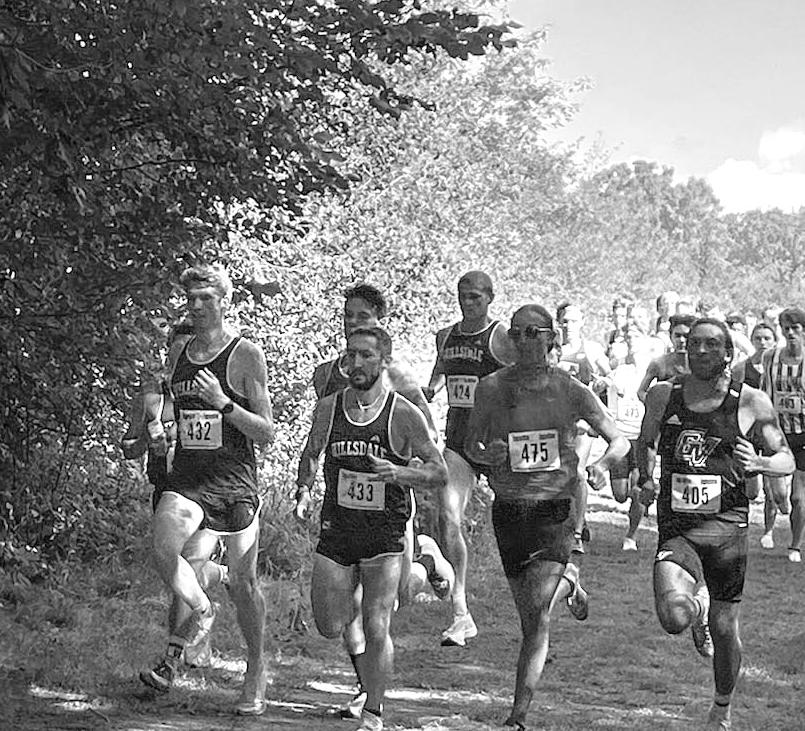
The Chargers had nine people run the 8K race, and finished 3rd as a team behind Grand Valley State University, and the host school Calvin University.Leading the Chargers was junior Alex Mitchell, who finished the race 3rd overall, finishing one of his best races at the 26:20 mark.
“Calvin was a great way to see where we were compared to last year, and that's really all we were looking for,” Mitchell said. “It's clear that we are in a much better place than we are in a much better position than we were a year ago. Personally, I have a lot more experience as a runner and am going into this year knowing that I am capable of being one of the best runners in the conference and in the region.”
The Chargers had three runners including Mitchell finish in the top 25 on Satur day. Senior Isaac Waffle fin ished 10th overall with a time of 26:27, and junior Micah Vanderkooi took 23rd after finishing at the 26:42 mark.
Following Vanderkooi was sophomore Richie Johnston in
39th place, who had his per sonal best at 26:50. Freshman Nathaniel Osborne finished 56th overall in his first colle giate race with a time of 26:52.
“I would say this is the best I’ve felt going into a cross country season,” Osbourne said. “Coach White’s training has allowed for a smooth tran sition to a higher workload and running with the team every day has given me confi dence in my ability to perform at the collegiate level.”
The team’s other runners included sophomore Donnie McArdle, who finished 74th at the 26:54 mark, as well as senior Mark Sprague at 27:10.
Freshman Emil Schlueter ran a 27:50 in his first collegiate race, and junior Sean Hoeft finished at 27:16.
Head coach R.P. White was very positive about his team’s success on Saturday.
“Many of the returning athletes have put in another year of hard training and acquired new levels of fitness,” White said. “It will be interest ing to see how they can apply this to competitions moving forward.”TheChargers will run their next race on Friday, Sept. 30 at the Lansing Invitational, host ed by Lansing Community College, and then will race the following day at the Louis ville Cross Country Classic in Louisville, Kentucky.
Chargers leading the pack at the Calvin Knight Classic
Elizabeth Troutman | Collegian
"It's still too early to tell.We'll have a good team, but how good is yet to be determined."
"This weekend really helped to shed a positive light on the potential of this team."
www.hillsdalecollegian.com Sports
C harger S port S
Chargers surge in fourth, take down Walsh in home opener
By Christian Peck-Dimit Associ A te editor
The Hillsdale football team came to life in the second half this Saturday, out-scoring the Walsh Cava liers 28-3 behind sophomore wide receiver Isaac TeSlaa and senior running back Michael Herzog, to complete a 35-17 comeback win in its homeTheopener.Chargers improved to 2-0, both overall and in conference play, behind electric performances from TeSlaa and Herzog, who combined for five touch downs in the win.
Hillsdale’s first home game of the season was a night game, featuring a 7 p.m. kickoff and a rowdy crowd at Frank “Muddy” Waters

“TowardStadium.theend, we were able to feed off a lot of the energy created by our home stands, as well as by Otter’s army,” senior linebacker Kyle Kudla said. “There was actually a time when one of the play calls on third down, the defensive line couldn’t understand the call because Otter’s army was so loud, and we were right in front of them. It was awesome.”
Hillsdale’s last home night game, last year against Indianapolis, saw TeSlaa reel in six catches for 166 yards and a Thistouchdown.year,TeSlaa was on the receiving end of eight of the team’s 12 completed passes on the way to a gamehigh 189 yards and three touchdowns. His receiving yard total topped all of the Cavaliers’ receivers com bined.“We were maybe expect ing them to start rolling over a safety, but they never did, they just trusted me to go out and make a play one-onone, and it seemed to work out pretty well,” TeSlaa said.

“I do like to tell Luke, ‘you can trust me,’ he does trust me obviously, but I like to plant the seed a little bit too, I probably shouldn’t.”
This season, TeSlaa has already picked up nearly
half of the yards, and only two fewer touchdowns, than he did across 12 games last year. The standout game earned TeSlaa the second G-MAC Offensive Player of the Week Award of his career.Sophomore kicker Julian Lee also earned his sec ond career G-MAC weekly honor, as the Special Teams Player of the Week, for going a perfect 5-of-5 on his extra pointTeSlaaattempts.started the scoring for the Chargers with a 32yard touchdown on a pass from senior quarterback Luke Keller that tied the score at seven with under five minutes left in the first half.“Luke’s been putting the ball on him, they’ve devel oped a really good chem istry,” head coach Keith Otterbein said. “The 32-yard touchdown was an audible on the line of scrimmage based on the look, and he ran a great route.”
The Cavaliers, however, responded with another touchdown, and were threat ening to score again before Kudla picked off a tipped pass as time expired in the first“Ithalf.was a little too high for him, he tipped it straight up in the air, and fortunately I was shifting over to stay on top of that route, so it fell right into my hands,” Kudla said. “I don’t think you can ask for a much easier inter ception.”TheChargers’ next score came on a one-yard touch down run from Herzog, which capped off the first drive of the second half, and tied the game again, this time at 14-a-piece.
That score marked Her zog’s first collegiate touch down ever on his way to a career-high 134 yards on 19 carries.After a 15-play drive from the Cavaliers that took nearly eight minutes of game time, and ended with a field goal, the Chargers, on both sides of the ball, responded in a big Hillsdaleway.finished each of
its next three drives in the end zone, forcing two turn overs and a punt in between.
TeSlaa dominated his matchup, scoring on backto-back drives, each of which took under a minute of game time. He followed a 26-yard touchdown grab to convert a 3rd and 11 with a 50-yard catch and run on a 50-50 ball from Keller that again ended in the endzone.
Then up by 11 points, the Chargers began to burn clock, going to the ground game on a five minute, 10play drive that left less than three minutes on the clock for the HerzogCavaliers.finished off that drive and Hillsdale’s scoring for the day, with a power ful, 11-yard run. The senior bounced off would-be tack lers and ran through Cava lier defenders before diving to the goalline for a score.
“He did a tremendous job of getting his pad-level down and keeping the de fender off his body, and then just kept his legs churning, he could smell that one,” Otterbein said. “That was an outstanding run, showed a lot of heart on his part.”
The Chargers now look ahead to this Saturday, where they will face off against the Truman Bull dogs. The two programs faced off last year, once in the regular season and once during the American Crossroads Bowl, with the Chargers coming up short eachThetime.game will kick off at 1 p.m. in Frank “Muddy” Waters, and will be the last home game for the Chargers until their Homecoming game on Oct 18.
“Third time’s the charm, we played them twice last year and lost both games, but that just means we’ve got more film on them and understand them a little bit more,” TeSlaa said. “We all want to beat them, we kind of got our asses handed to us last year a couple of times, so we want to go get a little bit of revenge.”
Golfers should reject offers from the Saudi funded L.I.V. Tour
By Thomas McKenna c ollegi A n Freel A ncer
What do you get when a despotic, oil-rich regime starts a golf league? Meet LIV Golf, the new $2 billion investment project Saudi Arabia hopes will distract you from its ongoing hu man rights abuses. Players shouldn’t support their cause.
Saudi Arabia’s Public Investment Fund, chaired by Crown Prince Mohammad bin Salman, is financing the new professional golf league which hopes to compete against the Professional Golf Association. While the PGA dominates the world of golf, its grip is starting to loosen as some top players jump ship for the upstart Saudi league.LIV has managed to snatch a slew of top talent from the PGA, including the world’s No. 2 golfer and
pion, Cameron Smith. The PGA has suspended every player who joins LIV, includ ing Dustin Johnson, Patrick Reed, and even Phil Mickel son.There’s no doubt about what is attracting players to LIV: the dolla dolla bills. Each defector has been lured by fat checks and a steady pay structure. While PGA players pay to play – exclud ing prize money – LIV pays players to play. Both Smith and Mickelson reportedly re ceived over $100 million just to play in the LIV Tour. And don’t forget about the prize money. The winner of the first LIV tournament took home $4 million, compared to the $2.7 million for the top prize at the Masters this year.This massive invest ment is part of a broader strategy by Saudi Arabia to “sportswash” its global image – diverting attention from
its human rights record to its new sports endeavors. The PIF bought Newcastle F.C. for over $400 million last year, signed a $600 million deal with Formula 1, and has spent over $1.5 billion breaking into the profession al gaming industry. Keep in mind that LIV Golf doesn’t even have an internation al television deal yet. The regime has money to spend and is willing to pour it into less financially lucrative opportunities – even a golf league – if it helps cleanse its globalSaudiimage.Arabia’s record on human rights is no secret. The government imprisons and tortures dissidents, pro hibits non-Muslim worship, and executes people for nonviolent offenses including homosexuality. Until recent ly, women were not allowed to drive without the consent of a male Journalistguardian.Jamal Khashog
gi, often critical of the regime, was killed and dis membered inside the Saudi consulate in Istanbul in 2018.
The CIA concluded that Crown Prince Mohammad bin Salman approved the ex ecution. The same hand that signed off on the Khashoggi murder is signing checks to LIV players (metaphorically).
CEO of LIV Golf, Greg Norman, had a difficult time answering questions about the league’s primary inves tor in an interview with Sky Sports."Idon't know what the Saudi government does. I don't want to get into that," Norman said. “They're not my bosses. We're indepen dent. I do not answer to Saudi
AndArabia."yet,without Saudi Arabia’s Public Investment Fund, Norman is out of a job. What about the murder of journalist Jamal Khashoggi?
“Look, we’ve all made
mistakes,” Norman said.
Phil Mickelson twisted himself into logical pretzels last February when trying to explain his thought process.
“We know they killed Khashoggi and have a horrible record on human rights,” Mickelson said of Saudi Arabia. “They execute people over there for being gay. Knowing all of this, why would I even consider it? Be cause this is a once-in-a-life time opportunity to reshape how the PGA Tour operates.”
If only logical gymnastics were a sport, he could give up Hardgolf. as Mr. Mickel son and others may try to compare the Saudi regime to the “dictatorship” of the PGA, there is no moral equivalence. The undeni able mission of the LIV is to sportswash Saudi Arabia and its despicable record of human rights abuses. Any player who joins the LIV
becomes an agent in that mission.Skeptics may point to our alliance with Saudi Arabia and ask why President Joe Biden can fist bump Crown Prince Mohammad bin Sal man and send him billions of dollars in arms, but golfers can’t take money from MBS. Here’s why: Unfortunate as our strategic situation may be, realpolitik has its de mands, and your two-putt isn’t defending regional allies like Israel from the preda tions of Iran. Besides, LIV isn’t the only way to play pro golf.To professional golf ers: When LIV Golf comes knocking with a multi-mil lion-dollar deal, turn it down. All those zeroes are tempting, but you can’t take it with you.
The cheer team pumps up the crowd at first home game.
Anthony Lupi | Collegian
Isaac TeSlaa reaches for the end zone for his second of three touchdowns against Walsh. Anthony Lupi | Collegian
A10 September 15, 2022 www.hillsdalecollegian.com
Football
Sports Opinion
recent British Open cham
Grand Rapids Ballet Company spins through Hillsdale
By Christina Grattan Collegian Freelancer
On a rainy September night, friends, family, and students of Hillsdale gathered to see the Grand Rapids Ballet performers glide across the stage in a fusion of ballet genres.
Part of the college’s Pro fessional Artists Series, the ballet featured five danc es that blended classical and contemporary ballet. The program included “a Mozart Symphony,” “Pres to,” and “Rendezvous” by James Sofranko, “soirée” by Issac Aoki, and George Balanchine’s “Serenade.”
James Sofranko, artistic director of the company, intentionally combined ballet forms in an attempt to captivate the audience.
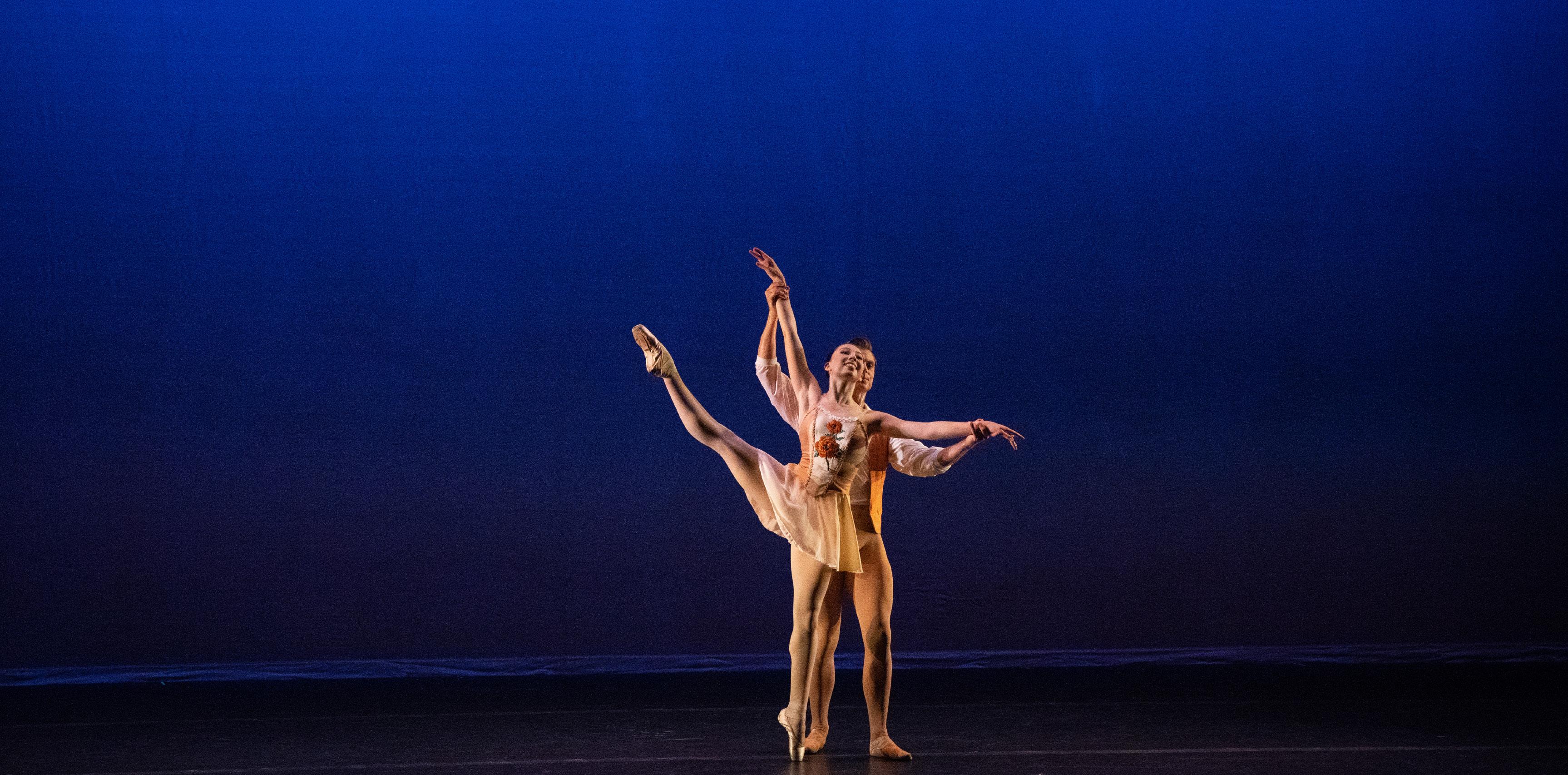
“This performance is made up of five separate ballets,” Sofranko said before the performance. “Some have a narrative, while others are completely
abstract. In either case, the dancer must shine through the technique and draw the audience into the world that has been created on theForstage.”Sofranko, ballet is the pinnacle of artistic achievement that celebrates the human experience. There’s an implicit moral duty for it to be showcased to the world, he said.
“In the same way that the ‘Mona Lisa’ and a Bee thoven symphony are con sidered masterpieces and treasured by our society, the art of ballet and specific choreographic master pieces, such as ‘Serenade’ by George Balanchine, is a testament to the artists’ ability to translate a story, an energy, or an emotion into a work on the stage,” Sofranko
Graduatesaid.student Erin Felvus said she found the performance an enchanting escape from real life.
“It was a little nostalgic
and serene. It was nice to look at this world and take a little break from my own,” sheFelvussaid. danced for 12 years before coming to Hillsdale and said attending the performance symbol ized her gratitude for ballet and artistic expression.
“I’ve been a fan of the arts for a few years,” she said. “I always try to sup port them because I think of how I felt when I danced and how much it meant to have people there. So I like to give back.”
One memorable high light of the performance was waswhopeciallysaid.niceFelvuscouplesvous’“I“Rendezvous.”likedhow‘Rendezhadjustthetwoinblueandwhite,”said.“Itwasaveryjuxtaposition,”Felvus“Thelightingwasesgoodforthatone.”FreshmanEricaKibel,hadasisterinballet,alsoinspiredbyit.“Thedance,Rendezvous,
Buzzing into business
By Adriana Azarian Collegian Freelancer
Junior Cecilia Gulick has been a busy bee since starting her own Catholic art business, Bee Holy, this past summer.Fortwo years, Gulick has been digitally design ing mugs, t-shirts, stickers, phone cases, tote bags, and other goods with Catholic images and, of course, bees.

Gulick explained how she chose the bee as her company’s namesake for its symbolism. In Catholicism, the bee, which produces the wax used to make blessed candles, represents the Bless ed Virgin Mary who, with her flesh, brings Christ to the world. Likewise, Gulick hopes her Bee Holy products would bring Christ to others.
“Since my goal is to spread the word of Christ, I’ve really focused my work on things people use every day,” Gulick said. “The goal is still to remind people constantly of God and Our Lady because we’re supposed to be constantly praying; so it’s cool to have a phone case that reminds you of Our Lady, prayer, how to act, and theGulick’ssaints.”
sister, Aubrey ‘23, recalled Cecilia’s deep-root ed love for creating religious art.“She has been interested in art for a long, long time,”
Aubrey shared. We used to have this friend who would give us old cigar boxes and she would recreate and turn them into mini shrines. She’s always been a really great artist.”Cecilia reflected on growing up surrounded by religious art and having the desire to be a Catholic artist.
“Our parents have always been really good about steeping us in the faith and exposing us to Catholic art, saint stories, and the litur gical year, and I think she draws a lot of her inspira tion from her upbringing,” Aubrey
Whilesaid.pursuing her biology degree at Hillsdale, Cecilia decided to turn her passion into a business. And as of this past summer, her artwork is now available through her website beeholy. org.“I started designing things on my iPad and thought ‘this was kind of fun,’” Cecilia recalled. “I would take short little quotes and draw them out in fun ways and I decided to start designing things for note books, phone cases, and stickers. And so two years ago I decided I was going to start [Bee CreatingHoly].”thedesigns for her many products requires much time and dedication. She works with inspiration from other Christian artists
and social media, as well as suggestions from her family and“She’llfriends.sit in the car for hours and do all the draw ings with her finger on her iPad. She’s constantly drawing,” Aubrey said. “It’s been really special being able to help her with the creative process and bringing this idea into Ceciliafruition.”explained that her product designs are meant to explicitly reflect her Catholic faith. Her friend, Elizabeth Crawford ‘24, who owns some of Cecilia’s art, also commented on the mes sages conveyed in Bee Holy products.“Thebeauty that she sees is the beauty that she wants to pass on,” Crawford ‘24 said. “She does a good job of blending modern and more traditional art together to make something really beautiful.”Inaddition to her website, Cecilia has been planning to sell her work to Catholic bookstores and small businesses so that cus tomers can purchase and see the quality of her products in person. She also hopes to get other artists involved with Bee Holy and contrib ute different styles of art in theCecilia’sfuture. artwork is on her website beeholy.org as well as on the business’ Insta gram page @beeholyorg.
was my favorite. It was kind of like a love story.”
The contemporary dance, “soirée,” added a new dimension to the whole show by departing from the more traditional ballet forms already per formed. It was suspenseful for those who had not experienced ballet’s more eccentric side.
“It was exciting to see ‘soirée,’” Kibel said. “It was just so inventive. You didn’t know what to expect, and it kept you on the edge of yourBeforeseat.”the performance, Sofranko taught a master class on campus to dance minors and members of Tower Dancers.
“It was very fast-paced,” junior Emma De Nooy said. “Sofranko only had an hour and 15 minutes to get an entire technique class in, which is really short.”
Students who took the master class gained skills from Sofranko’s expertise
while practicing techniques from a new perspective.
“It gives you different exposure to different teach ers who focus on different things,” sophomore Laura Luke said. “So that’s what a master class does. It gives you some variety to learn from another master.”
De Nooy took classes at the Grand Rapids Ballet Company from the start of her ballet career. She laments over how many students choose other arts over“Takeballet.aballet class or a dance class in general,” De Nooy said. “We often talk about the importance of the liberal arts. Everyone here is usually involved in theater or music or voice, and I think dance is pretty overlooked here. But dance should be an integral part of a liberal arts education, even if you are really bad at it. It’s still really import ant because we are holistic beings. So it’s not just our
minds. It’s not even just our voices. It’s also like our bodies.”Luke found the class to be nostalgic of her home studio in Philadelphia. She views ballet as a union of gymnastic and musical education with moorings in classical“Aristotleantiquity.saysthat lib eral arts education is both about music and gymnas tics,” Luke said. “Education and ballet are kind of that beautiful in between where it connects the beauty and the art with the athleti cism.”After all his hard work choreographing the show, Sofranko said he hopes the ballet performance provid ed the Hillsdale community with a love for the arts.
“My hope is that anyone who saw a performance of Grand Rapids Ballet is inspired by the beauty and the craft of the art of dance,” he said.
Singing Friday night blues
By Victoria Wagner Collegian Reporter
Student Activities Board’s annual event, Concert on the Quad, wel comed students and musi cians for cider, donuts, and all the flavored popcorn one could possibly desire.
This year featured 12 different bands, each with their own unique style.
“We have events where rock bands get to do their thing, but this is where the other artists get to do theirs. This is the oppor tunity for more folk style, low-key, coffee shop vibe musicians to get their name out there in a beauti ful outdoor setting,” senior and SAB member Grace JagodaConcertsaid.on the Quad was open to all of campus, bringing together students, professors, and faculty.
“It was really great to see students from all corners of campus come
together for an evening of appreciating our fellow student’s talents,” junior Mary Ann Powers said.
This year, a new group Tuition and Fees made its debut. Composed of three sophomore women, the band enthralled campus with vocal harmony and background acoustic gui tar. The group displayed a variety of genres, singing everything from Elvis Presley to Billie Eilish.
One of the group’s members, Phoebe Van Heyningen, said she remembers attending Concert on the Quad as a freshman last year. Watching the performers inspired her to form a group with her friends in the music program, Emily Griffith and Fiona Mulley.
VanHeyningen de scribed Concert on the Quad as “Four hours of students enjoying music and the act of creating music together.”
Musicians and attendees loved the event for differ ent reasons. The musical expression and the com munity fostered make the event a hit every year, and this year was no differ ent. Students sat on plaid blankets and yard chairs, taking in the sunny blue skies and warm weather. They swayed to the acous tic tunes while snacking on free popcorn, donuts, and
“Thecoffee.ambiance is fantastic, the people are wonderful, and the perfor mances are stellar,” sopho more Nate Privitt said.
Even those not involved in the music department love Concert on the Quad and the break it gives students from ordinary activities.“Idon’t know much about music, but I experi enced a moment of peace,” sophomore Abby Idstein said.
 The Grand Rapids Ballet Company performed at Hillsdale College.
Phoebe VanHeynigen | Collegian
Students perform on Friday evening for Concert on the Quad. Jack Cote | Collegian
The Grand Rapids Ballet Company performed at Hillsdale College.
Phoebe VanHeynigen | Collegian
Students perform on Friday evening for Concert on the Quad. Jack Cote | Collegian
www.hillsdalecollegian.com September 15, 2022 B1 Culture
Pick them ‘til you drop
By Isabella Helms Collegian Reporter
The parking lot on Saturday was the first indicator that Meckley’s Flavor Fruit Farm earns its reputation as a popular family destination. The apple-shaped bounce house filled with eager, buoyant children was the second.
Additional festivities for Meckley’s September festi val weekends include live music, a corn maze, and several food trucks.
Glei’s Orchards and Greenhouses and Meckley’s are two nearby Michigan apple orchards that have successfully combined their love of delicious tasting apples with lasting fami ly memories. These local institutions have managed to maintain their small business appeal while also producing fresh fall good ies that many customers have enjoyed for years.
On Sept. 8, Glei’s opened for the first time this sea son. With only five of more than 30 varieties of apples available for purchase, Glei’s awaits the arrival of new varieties each week this fall. What started in 1918 as a small family farm has now grown into a lush orchard with more than one hundred acres of apple
trees.Once Glei’s apples have naturally ripened to their peak, they are picked off the trees and packaged for customers to buy from the
orchard. There are sever al varieties of apples all ranging in different sizes, shapes, colors, and flavors; from deep, ruby red apples to apples as golden as yellow pears, some are as sweet as cinnamon sugar and others as tart as sour candies. Glei’s apples are just as tasty as they are fragrant.Glei’s treats its custom ers like family and patrons have known it for more than 10 decades. Being a small business allows Glei’s to personally cater

of corn maze, sunflower fields, cherry trees, pump kin patches, raspberry bushes, a bakery, cider mill, and farm market. This is Meckley’s 66th year in the orchard business, selling top quality apples, donuts, cider, and other specialty items.The sweet but overripe scent of fresh apples is as unavoidable inside Meck ley’s farm market as it is outside. And it doesn’t stop there, because the atmo sphere and the people at Meckley’s are just as sweet and pleasant. If Meckley’s has not thought of this al ready, they should consider making their slogan: “A Meckley’s apple a day keeps the doctor away,” because just a few hours at Meck ley’s orchard will have you fuller and in better spirits then when you arrived.
Amazon takes on Tolkien
By Elizabeth Crawford Collegian Reporter
After a whopping $715 million budget, the pro ducers and directors of the new Amazon show, “The Rings of Power,” should have remembered the old saying, “all that glitters is notOngold.”Friday, Sept. 10 a group of friends and I sat down to watch the show’s first episode. There was quite a range of fans, vary ing from loyal followers of J.R.R. Tolkien’s books to those who had only a mild appreciation for the mov ies. But all were brought together in a mixture of trepidation and curiosity about Amazon’s take on Tolkien.AsIattempted to bring my friends together to sit down and watch the show with me, opinions started flying in group chats and in conversations between classes.“It’sthe death of West ern Civilization,” said junior Liam Martin, who refused to attend the showing.Thenine of us who did attend the showing forged a new fellowship entering the wide world of Middle Earth’s prequel tv series.
lion,” Tolkien’s history of Middle Earth, so the producers and directors loosely referenced the appendices of “The Lord of the Rings” for source material. In contrast, Peter Jackson’s productions gained production rights to both “The Hobbit,” and “The Lord of the Rings.”
Some viewers, even those who did not attend my watch party, thought the show to be an excellent continuation of the trilogy.
“It’s absolutely stunning from a visual perspective,” said professor of theatre James Brandon, “and matches up pretty well with my memories of both
thing new… But it’s the points where it conflicts with the previous legend arium that bothers me.”
The question of whether or not the TV series fits nicely into the established world of Middle Earth was fiercely contested.
“The second you bring a work of fiction into perfor mance, most of the rules for maintaining a reader’s verisimilitude go right out the window,” Brandon said. “TV and film are the results of thousands of de cisions by the production team and actors to share the story with people who have never read it as well as with the many people who have read it (and have had their own experience). It will never be ‘the same’ and it will never be 100%
‘right.’”The return of How ard Shore as a composer for the main title of the series provided a thread of synchrony with the trilogy, but Bear McCreary remains the main compos er of the rest of the series’ score. As a result, the soaring musical themes the viewer is accustomed to in the films are missing. This leaves the most invested viewers unsatisfied and the least interested viewers with nothing to remember.
to the needs of each of its customers, and do so with a smile. Glei’s has succeed ed in creating a shopping experience that is just as enjoyable as its apples.
Meckley’s has perfect ed nature’s most delicious convenient food, providing fresh apples along with a fantastic fall experience.
With a total of 375 acres of land, Meckley’s is home to more than 20 varieties of apples, several miles
Make sure to come hungry, because the shop has more than a dozen spe cialty items to choose from like hand-dipped caramel apples, freshly baked do nuts and pies, frozen apple cider, fruit cobbler mixes, milkshake stouts, peanut butter porters, assorted amish candies, all natural farm fresh meat, and of course, plenty of apples.
If nothing more than a great opportunity to learn how to make some seasonal apple treats, visiting Glei’s and Meckley’s this fall is a must for those looking to make lasting memories with the ones they love.
The first episode, “A Shadow of the Past,” opened with a scene depicting Galadriel in the Undying Lands as a girl is getting bullied for trying to float a paper sailboat on water. After this incident, Galadriel, as a young elf-woman, narrates the elves’ flight from the Un dying Lands to the shores of Middle Earth and the war they waged against Morgoth and Sauron. The episode mirrors how the older Galadriel narrates the history leading up to Frodo leaving the Shire in “The Fellowship of the Ring.”However, that’s where the illusion between the trilogy and TV series is shattered. The Amazon series did not have the rights to “The Silmaril
‘The Silmarillion,’ and the appendices to the LOTR. The pacing hasn’t been a problem for me, and I am really enjoying Morfydd Clark’s take on Galadriel.’’
Junior Tomek Ignatik, however, disagreed with Brandon’s review. “It was generally uncompelling with one-sided characters,” said Ignatik. “They had some ideal for Galadriel’s character and every single thing about her character was about how she was traumatized by Sauron.”
“I didn’t even go into this expecting it to be bad. I was going into it expect ing it to be uninteresting because most TV shows are,” said senior Andrew Buonincontro. “And I honestly enjoy the places where it made up some
The most significant similarity between the original works and the tv series is the visual effects, which are nothing short of arresting. Yet, the huge production budget and the subsequent gap in technol ogy between Peter Jack son’s works and Amazon’s show only demonstrates the skills of Jackson, and less the technical skills of theOverall,series. if you’re willing to put aside compari sons both to the previous movies and source litera ture, you might enjoy the hour-long adventure. But if you’re looking for a joint heir to the original story, your adventure into Mid dle Earth will be dull and uninteresting.
‘Desert Song’ premieres at The Sauk Theatre
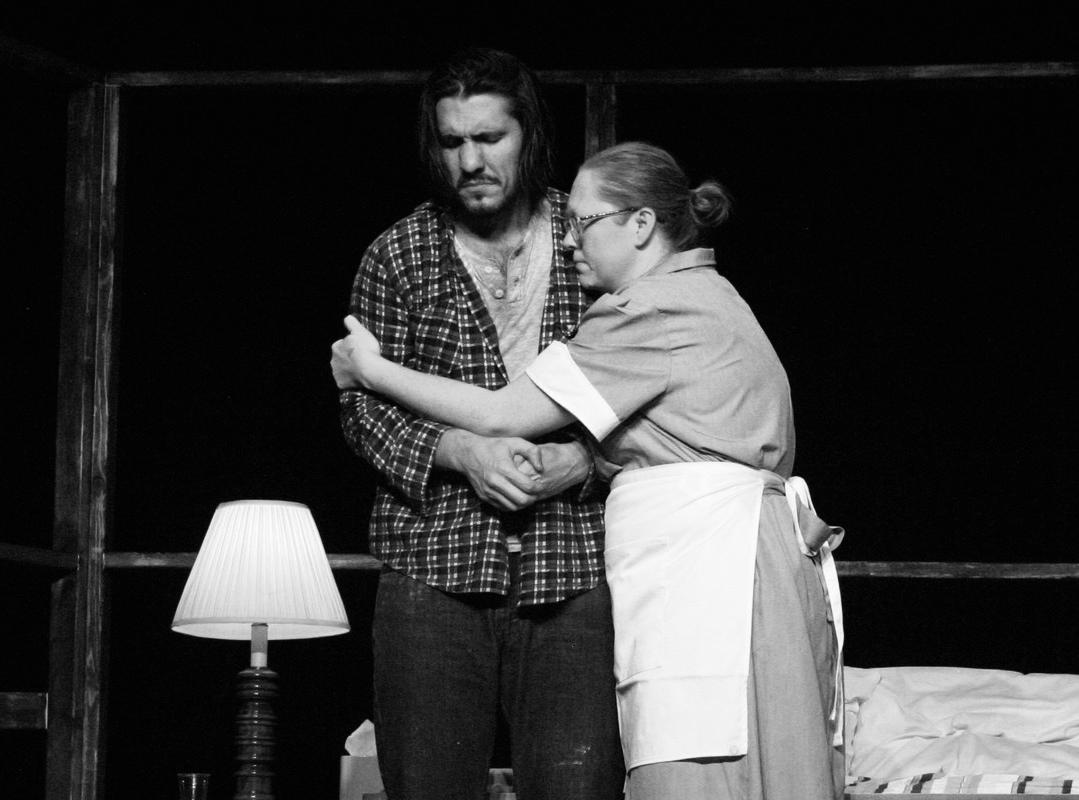 By Nikoleta Klikovac & Megan Williams Collegian Freelancer & Culture Editor
This past weekend, The Sauk Theatre presented “Desert Song,” a play about finding inspiration in the most unexpected places. A musician, played by Darren Taylor, is searching for the muse of his favorite song, “The Ballad of Eliza.” After meeting a hotel maid, played by Summer Housler, the pair come together to write a song.Housler and Taylor’s characters are opposites in every way, but they find inspiration in the musician’s personal struggles.
With his character dealing with the death of his parents, the foster care system, and self-harm, Taylor worked to portray those struggles on stage. To
develop the musician’s char acter, Taylor focused on his relationship with Housler.
“I really have to give props to Summer because she would just throw some thing at me and I would throw it right back,” Taylor said. “As we progressed with rehearsals, we changed things up a bit: how we de livered a line, how we said it, and it all worked perfectly.”
In addition to establish ing this emotional connec tion through character work, Taylor only had three weeks to prepare for the produc tion. The original actor had to withdraw from the pro duction for work reasons, leaving the freshly-cast Tay lor with only nine rehearsals left to learn the show.
“He learned his part and he learned it quickly,” Bird said. “He just did the work and it was hard work, Sum mer was gone for five days the week before production.”
To put it in perspective, The Sauk’s production of “Cinderella” had 45 rehears als
Despitetotal.
there being fewer rehearsals, the production was a feat of detail. From the set right down to the costumes, the minimalistic components of the envi
ronment allowed the cast to shine.The costume designer for “Desert Song,” Gianna
jeans, the neighborhood kids were staring at me,” Green said.The maid had a clean-cut costume, the opposite of the musician’s. Despite its seemingly simple distressed design, Green had a lot to think“Sheabout.hasher compres sion socks on,” Green joked. “Gotta keep that circulation strong.”Director Trinity Bird had the help of the playwright, Mark Cornell, while staging the“Markproduction.wasat our disposal whenever we had a question and we needed something clarified,” Bird said.
Green, paid close attention to the embellishments she could add to make costumes unique.“Iwas sitting in my driveway and destroying the
Cornell donated all roy alties from his work back to the local community theater. He was even present at the Friday and Saturday night performances, taking notes on how to improve his work. This resulted in some minor edits between this weekend’s
shows.“There was an additional verse in the song at the end, when Mark saw it on stage, he said it wasn’t necessary and we cut it the next day,” BirdThissaid.is not the first time that Cornell has asked The Sauk to perform his work. The staged reading of “On Pine Knoll Street” was per formed at The Sauk as part of the American Association of Community Theatre NewPlayFest.Cornellisstill making slight alterations to the script as it develops, but the mes sage stays clear. What does Bird want us to take from the“Whatshow? aren’t we paying attention to that is in our own world? We should take inspiration from those things that we normally wouldn’t notice,” Bird said.
Dressed poorly with somewhere to go: VMAs style review
By Meghan Schultz Features Editor
Every few months, celebri ties line themselves up along a velour carpet, dressed in clothes someone helped them put on, unhinging their plastic jaws to scream, “Judge me!” and hoping to be pat on the back by people with egos bigger than their own.
In the hierarchy of award show fashion, the VMAs lie low in their scandalous, yet unimpressive history. Fashion is an art form often beautifully and thoughtfully displayed on red carpets. De signers partner with artists to bring a creative vision to life and honor the beauty of
the clothes, highlighted by the beauty of the model. But the VMAs aren’t one of those events. So, judge them we shall.
As a general red-carpet rule, men tend to be unbear ably dull and play it safe. DJ Khaled is intimate with this banality – he wore a match ing gray set identical to an actual work jumpsuit and familiar green shoes. I think my Midwestern teenage brother owns the same pair. The most exciting part about his look was the pair of pink, translucent Paris-Hilton-es que sunglasses that I’m now in the market for myself. There’s something odd about a millionaire wearing an
ordinary American’s work clothes on a red carpet like it’s a Incostume.starkcontrast, the Red Hot Chili Peppers arrived looking beautifully mis matched and covered in obnoxious patterns. They perfected the look, while Dylan O’Brien just barely missed the target. Despite his quirky flower toproposeofchaindecorateduncle,lookingO’Briendiamond-patternedandsuit,stillstrolledaroundeerilylikeasleazylow-neckedblacktankwithagoldenandall.Amidpoliticaldiscussionwomen’srights,I’dliketotherightofwomenstopwearingabsurdcut
outs to events. It’s hard not to wonder who told Sabrina Carpenter, “Yes. The sides of your torso are so in right now.”To the other extreme, Chloe Fineman wore a silver chrome sleeping bag deco rated with an orange lining. After closer examination and serious study, assuming I must have been mistaken about the nature of the outfit, I concluded that it was not just a sleeping bag. She also had a tiny carrot hanging from her pinky nail. In advance of the awards ceremony, Dove Cameron sent a mass memo flagged as “URGENT” to everyone who would be attending, work
ing, or watching the show. She wanted to confirm what her outfit already displayed: that she is, in fact, not like the other girls. Dressed in a colorful dress reminiscent of a grandmother’s carpet, a leather belt wrapped around her neck, Cameron emulated the essence of a sharp-jawed Tim Burton character. Little trace of her history as a Dis ney starlet remained, from her jet-black pigtails to the spikes dotting her nails. For the Catholics on campus, the awards show brought some great news. Sofia Carson looks like she might be joining Shia LeBeouf in conversion to the Roman Catholic Church.
Specifically, she seems to be joining a particularly fashionable religious order with an inclination toward sweetheart necklines and ominously heavy black veils. The sisters will be in atten dance at the first silent retreat thisAfterfall. taking home the award for Video of the Year, Taylor Swift arguably also won best-dressed of the night. Draped in silver jew els, the singer kept her hair simple and came the closest to giving viewers something genuinely beautiful. For the record, though, my mother would have told her to put something on underneath.
“But if you’re looking for a joint heir to the original story, your adventure into Middle Earth will be dull uninteresting.”and
Taylor and Housler embrace on stage.
Courtesy| Facebook
“Glei’s creatingsucceededhasinashoppingexperiencethatisjustasenjoyableasitsapples.”
Culture www.hillsdalecollegian.comB2 September 15, 2022
Apples are ripe and ready to be picked at Glei’s and Meckley’s orchards. Isabella Helms | Collegian
FEATURES
Summer Student interns in Armenia
By Jillian Parks Collegian Reporter
Like most incoming fresh men, Peter Kazarian picked up a part-time job over the summer. His just happened to be in FromArmenia.theendof May to the beginning of July, Kazarian worked as a barista in the capital city of Yerevan. He discovered the warm, welcoming heart of the city’s lifestyle.“They’re about 10 years behind on a lot of things, but just have this simplicity of life,” Kazarian said. “They’re not so concerned with super fluous, unnecessary things that we often get hung up on. People are living their lives, they’re loving their family, and it’s just so cool to see a society that is so family oriented and content.”
At four years old, Kazarian and his family lived in Arme nia for eight months while his father built houses with Habitat for Humanity.
“Ever since then, I wanted to go back to get back into the language and the culture, and I’ve got some family over there as well,” Kazarian said. “This trip was really great be cause I got to check all those boxes and have a service opportunity.”Kazarianwent through his church, First Armenian Pres byterian Church in Fresno, California. The coffee shop, Altar Coffee and Books, is owned by Peter Telian. Ka zarian and the other interns stayed in The Armenian General Benevolent Union, a 10 minute walk from the shop.“Few things expose our own blinders as Americans like going overseas and seeing what the world is like outside America,” chaplain Adam Rick said. “Just seeing the whole tapestry of God’s work around the whole world draws us out of ourselves, exposes our own biases and
blinders as Western Amer icans, and helps us see the world more from God’s perspective for the beautiful kaleidoscope that it is.”
Kazarian spent half the day brewing coffee, pressing paninis, and toasting bagels in the coffee shop, and the other half reaching out to the community through the program, meeting people and hearing their testimonies and stories, and spending time in the prayer room: a space used by local churches for prayer and worship nights.
“Through the Altar intern ship, we learned how to serve in a different culture and how to be part of a team seeking to demonstrate uncommon love and care,” Ani Haroutu nian, Kazarian’s fellow intern and translator, said. “We also connected with so many amazing people in the bigger body of Christ. God opened doors for new friendships and an even stronger passion forOnceministry.”aweek, Kazarian and his group had a day set aside for exploring old churches and important historical or geographical landmarks.“Wevisited Saghmosa vank, the Monastery of the Psalms,” Haroutunian said. “It was an altar of worship in Armenia built several cen turies ago. Just as in heaven where worship goes on day and night around the throne, the psalms were sung there 24/7.”Kazarian spent his week ends with his extended family. Once, he attended a wedding in Gyumri, the sec ond largest city in Armenia, to celebrate someone he is only distantly related to.
“They’ll go bankrupt on the wedding,” Kazarian said. He described course after course of freshly barbecued pork, fish, and lamb and hours of traditional Arme nian dancing. There were also hired dancers and enter
tainers. He enjoyed all of it despite hardly knowing the married“Peoplecouple.thatyou’ve never met before, barely know how to communicate with them, still love you and will show you the same love and respect that they would show their own family members,” KazarianEuropeansaid.hospitality is foreign to Americans.
“I don’t think I was fully aware of just the almost the American allergy to hospital ity till I spent time and other cultures where that’s just more than norm,” Rick said. “Americans are kind. Amer icans are polite. But we don’t open our homes to outsiders the way people in these other cultures do.”
He said it’s important to have contact with other cultures to make our lives richer.“Our emphasis on the Western core, the great books of the Western tradition is a cultural inheritance,” Rick said. “It’s the west. The more we can have voices from outside of that corpus or, in the case of Armenia, on the periphery of that corpus, I think the more robust and rich our conversation about human nature will be.”
Kazarian said com ing back to the states and moving to Hillsdale was an adjustment in terms of food, culture, and community, but he found a few similarities despite the cultural barriers.
“There’s a sense of com munity knowing that you’ve had shared experiences with everyone that you meet,” Kazarian said. “You grew up eating the same food, you have parents that teach you the same things, in a sense, and, oftentimes, the same re ligious beliefs. I mean, that’s similar to Hillsdale in a way in that you’ve got a bunch of like-minded people.”
By Aubrey Gulick Collegian Reporter
If there’s one thing that jumped out to junior Bridget Whalen about McIntyre’s dorm culture this year, it’s the conversation.“They’reso incredibly willing to engage and initiate conversation, it’s really im pressive,” Whalen, the head resident assistant of the girls’ freshman dorm, said. “They look me in the eyes and talk to me, it doesn’t matter if we’ve had a real conversation before.”McIntyre sits on the outskirts of campus, hidden by fellow women’s dorms and neighbor to the Slayton Arboretum. Hosting only freshmen women and the li on’s share of female freshman athletes, its community hasn’t always had a strong presence in the past. This year, its RA team is committed to enliven ing the culture in a new way.
“You have to intentionally go there,” sophomore resident assistant Vivian Turnbull said. “We are going to try to do more bonfires and maybe a worship night or some thing, just to use the outdoor space.”The team really hopes to build on the culture from last year to build a welcoming and restful space.
“I actually saw what I wanted it to look like last year in little snippets here and there. Big groups of girls, studying together in the lobbies, being together, cel ebrating someone’s birthday in the lobby and everybody who walked through it would
stop and say happy birthday. That was really impressive,” WhalenWhalensaid.believes those study parties and conversa tions are the practical appli cation of an important aspect of developing a philosophical habit of mind.
essential parts of learning.
“Students are forming their minds rather than just memorizing knowledge. You have to cultivate a philosoph ical habit, that’s why it’s called a habit. You have to put the work in and it becomes a way of living,” she said.
right“Myatmosphere.ultimatevision is just to make it a place that they want to come back to in the evenings,” Whalen said.
Creating a place that strikes a balance between being a retreat, and being a place where girls can social
dorm and rest, but there’s always going to be someone around to top,” she said.
Between dorm breakfasts and study parties, the girls have many opportunities to meet and engage with their dorm
“Themates.girls are really wel
thing about Mac’s community is how you’ll randomly find girls in the couch area, and they’re just talking about ran dom things, laughing about our schoolwork, and just hanging out.”
As homecoming approach es, the McIntyre RA team is excited to make it as fun as possible for their residents.
“I’ve already noticed sever al things that are just perfect. For instance, my team of RA’s are already putting so much work into it, work that I could never do. I don’t have the imagination for these things, but they do, and they want to share it and make it great,” Whalen said. “We don’t care about placing, we just want to have
Whalenfun.” says she is im pressed by the way her team has worked together to brain storm and develop ideas.
“I anticipate that week being absolutely utterly exhausting and energetically debilitating. I’m going to be drained,” Whalen said. “It’s going to be so worth it – it will have been more than worth it and will more than pay for itself.”
She pointed to John Henry Newman’s lectures on the liberal arts, in which he talks about the philosophical habit of mind as one of the most
Although the work of cultivating the mind has to be done by the freshmen girls themselves, Whalen believes she can work to develop the
ize is an important aspect of building dorm culture, Turnbull
“There’ssaid.agood balance of being able to go back to the
coming, most of us have our doors open randomly, and we talk to one another all the time,” freshman Malina Ladz inski said. “I think the biggest
For Whalen, being a res ident assistant and creating dorm culture is a beautiful example of Christian self-sac rifice.“There’s no greater love man has than to lay down his life for a friend,” Whalen said. “And, in a way, they’re sacrificing so much, they’re laying down parts of their lives for these freshmen, and they love it, so how can you not be impressed? It’s really cool.”
 Prayer was a crucial part of Peter Kazarian’s experience.
Courtesy | Peter Kazarian
Peter Kazarian worked at the coffee shop “Altar.”
Courtesy | Peter Kazarian
McIntyre’s 2022-2023 RA team laughs together at Central Hall.
Courtesy | Bridget Whalen
McIntyre is home to a large outdoor space perfect for hosting.
Collegian | Jack Cote
Prayer was a crucial part of Peter Kazarian’s experience.
Courtesy | Peter Kazarian
Peter Kazarian worked at the coffee shop “Altar.”
Courtesy | Peter Kazarian
McIntyre’s 2022-2023 RA team laughs together at Central Hall.
Courtesy | Bridget Whalen
McIntyre is home to a large outdoor space perfect for hosting.
Collegian | Jack Cote
www.hillsdalecollegian.com September 15, 2022 B3
How ‘Mac’ got its groove back Freshmen residents enjoy a social, inviting dorm environment curated by upperclassmen resident assistants
of espresso and prayer:
Freshman Peter Kazarian spent eight months in Armenia during his childhood and returned to work there this summer
‘Seeing everything I’ve read about in the Bible’
By Linnea Shively Collegian Reporter
After COVID-19 compli cations canceled his plans last winter, junior Fernando Bravo looks forward to traveling to Israel this December.
“What better group of people to visit with than from Hillsdale College,” Bravo said. “They want to learn how to live out their beliefs both through the liberal arts and religious perspective and be able to balance the intellectual and spiritual aspect of Christianity.”
Passages is a Christian organization that takes students on trips to the Holy Land. Hillsdale College has partnered with it since 2015. Passages believes “a trip to Is rael should be a rite of passage for every Christian.” According to its website, Passages aims to “strengthen the faith of Chris tian students, connect them to Israel, and prepare them for a life of Christ-centered leader ship.”Hillsdale has room for 41 students, with 30 spots cur rently remaining. The last day to apply for the trip is Thurs
day, September 15.
A visit to Israel allows Hills dale’s largely religious student body to encounter the history in their textbooks and experi ence their faith on a personal level.In a similar way, Bravo looks forward to strengthening his personal faith while visiting Israel.“Ilook forward to under standing my faith more by seeing everything that I’ve read about in the Bible,” Bravo said.
“Through exploring Israel, walking where Jesus walked, and following the Christian story more closely in person acts, like how much closer can youDirectorget?” of Clinical Health and Wellness and Clinical Counselor Brock Lutz and his wife Jennifer will attend the trip as chaplains. Lutz hopes to help students think about the sites they visit on a deeper, spiritual“Whenlevel.Iwent to the train ing, what became really clear is that they want people to go to Israel for their faith and to be deeply impacted,” Lutz said.
“Passages wants people to have
an experience with God and to see Christ and his homeland and where he actually lived.”
Since the first trip in 2015, Don Westblade, assistant pro fessor of religion, has chaper oned the visits.
“The experience of seeing lands that you read about in the Bible in person is incarna tional,” Westblade said. “Every student comes back from the trip transformed by that expe
rience.”Between December 31 and January 10, travelers visit sites such as Jerusalem, the Dead Sea, the Garden of Gethsemane, Tel Aviv, the Sea of Galilee, the Church of the Holy Sepulchre, the Gospel Trail, observe the barrier wall between Israel and the West Bank, and the church

Dominus Flevit. According to Westblade, Passages takes advantage of its time in Israel with a full bladepartmentcontactgoingdadI’masafe,”classofforsubsidizesalumnitoconcernsapplystudentsWestbladeitinerary.encourageswhochosenottoduetosafetyorfinancialtoreconsider.Duealargenetworkofprogramanddonors,Passagesupto80%ofthetripChristiancollegestudents.“Theydoanamazingjobnotonlygivingyouafirsttour,butit’salsoveryWestbladesaid.“I’vehadcoupleofstudentssaytome,notsuremymomormywouldbeokaywithmetoIsrael.”PassagesstaysindirectwiththeIsraeliDeofDefense,Westexplained.Everyday,it
submits an itinerary and asks if the Israeli DOD notices any dangers with their intended sites. If concerns arise, Passag es alters that day’s itinerary.
Another big concern for students is the financial cost of the trip due to a recent increase in the out-of-pocket cost. However, Lutz urges students to view the trip as an investment instead of a burden.“Ithink it’s going to be time well spent growing in your faith and fellowshipping with other people,” Lutz said. “If people can make it work, I would really encourage them to doWestbladethat.” emphasizes that the educational and spiritual benefits of the trip should not be discounted due to safety or financial
“Everyconcerns.moment of the trip will be an educational oppor tunity,” Westblade said. “It’s going to be ten very packed days of travel, education, and meetings. It will all be very en joyable, but not so laid back.”
Passages intentionally leads students off the “beaten tourist path” to experience Israel’s
diverse society. A mixture of Jewish, Christian, and Muslim guides teach students about historical events. During one dinner, students eat a tradi tional Shabbat meal with an Israeli family. At another loca tion, they overlook Palestine to see Bethlehem from afar.
“I like the history of the times of the Old and New Testament,” Westblade said.
“Places like Hezekiah’s Tunnel that you can still walk through, which was built back in the seventh century is the real excitement to me.”
Lutz looks forward to seeing spiritual sites surrounding the Easter story, which were signif icant to his own faith journey, come to life on the visit.
“These aren’t just Bible stories that we might read about. These are stories where Jesus was a living, real person. He grew up in this village, this is where he performed his miracles, and this is where he died and lived,” Lutz said.
“What better way to grow in your faith than to connect with the actual roots of it?”
A Southerner’s guide to Michigan weather
By Elyse Apel Opinions Editor
“You do know it’s cold up there, don’t you?”
As an Oklahoma native, that was the first response of all my friends and family when I told them I chose a college up north.
The thought of winter — and more than just the occasional ice storm season I’m used to — was daunting.
But as I began freshman year and the first few trees turned, I had my first snow ball fight, took trips with friends to explore Michigan in the fall, and realized it wasn’t half as bad as I origi nallySo,expected.herearea few tips from a Southern girl on how to both survive and enjoy the coming months.
Wear appropriate clothes and shoes.
This may seem self-ex planatory, but it still amazes me how many people refuse to dress appropriately for the cooler weather. From soror ity girls on pin day to crocs in the snow, remember to wisen up about your fashion decisions.Thankfully, the winter weather won’t arrive until late October at the earliest.
That said, sweater weather has officially begun. Wear your sweaters with pride and joy.Umbrellas and rain jackets also become a must in the fall and early winter. An um brella has found a permanent home in my backpack after one too many unexpected showers.
Take your vitamins, seri ously.
I’d heard a few vague warn ings early freshman year but paid no attention to them as I went along. Seasonal depres sion will find you, though, especially if you come from the south and are used to an abundance of sun.
Symptoms look different for everyone, so monitor your mood and habits. If you start to feel off, start taking Vitamin D. Vitamin D is the drug of choice for many at
are no doubt one of the top highlights of Michigan. Go for a spontaneous photoshoot or start a leaf collection to mail back home. Stargazing under layers of blankets, traveling to local orchards and markets, and snowball fights made some of my fondest Hills dale
to access a wealth of great resources. Even the library lets you check out sun lamps to use during study sessions.
Don’t forget the multivi tamin too. Colds, flus, and coronas (both the beer and the virus) are already going around. Vitamin C is a must.
Enjoy seasonal activities. Stave off the seasonal blues and take a break from impend ing academic stress by enjoying everything the cooler weather has to Theoffer.many colors of fall
Blankets, fuzzy socks, and more blankets.
Did I mention you’ll want blankets? There’s nothing like cozying up in your dorm with a fuzzy blanket or two and reading Aristotle.
I received so many blan kets as graduation presents, mostly from concerned fam ily members who thought I wouldn’t survive the cold. As fall and winter began to set in my freshman year, my room quickly became the hangout spot for friends who happily stole my many blan kets—especially the electric one.So, have warm attire ready. You’ll need it before you know it.
Hot beverages are a must.
Since you have those blankets now, you can’t not have hot drinks. It doesn’t matter if you drink coffee, tea, or cider. There’s nothing like a hot drink on a chilly day. Whether you’re curled up in your dorm or walking around campus, holding a warm drink keeps away the cold.Nothing beats study ses sions at Rough Draft with a friend or two while enjoying one of the coffee shop’s tasty seasonal drinks.
So, don’t panic. I promise you the turn of the seasons won’t immediately induce hypothermia as you, or those at home, might think, but it always helps to remember a few tips and tricks to make it a little easier.
Hillsdale travelers reminisce about their journeys to the Holy Land with fellow faculty, staff, and students
Hillsdale travelers looked out over the city of Jersualem.
Courtesy | Patricia Bart
Elyse
Apel laughs with friends on a fall afternoon.
Collegian | Elyse Apel
Hillsdale’s campus stays beautiful through all seasons. Collegian | Meghan Schultz
“The experience of seeing lands that you read about in the Bible is incarnational. Every student comes back from the trip transformed”
September 15, 2022 B4www.hillsdalecollegian.com
youhealthdownblues.havefriendsitpassingorpurgatoryyourselfmightdarker,coldermonthsand,HillsdaleasthegetandyoufindinhellouttowhotheTakeawalktothecenterifwouldlike
theSidelastballfriends.adventurestakeitdoandmightWhilememories.Hillsdaleseemsmalllackingmuchto—andlet’sbereal,is—itstilldoesn’tmuchtofindfuntodowithAttendafootgameorenjoyonetriptotheUdderbeforeitclosesforseason.
FEATURES
