
College mulls education center in
By Moira Gleason Executive Editor
Hillsdale College hopes to develop an educational center and a K-12 school in Placer County, California, over the course of several years, according to Hillsdale General Counsel Robert Norton.
A now-corrected CBS article from March 5 erroneously reported that Hillsdale is planning an undergraduate satellite campus for the site.
“If completed, the campus could eventually serve about 6,000 students and include more than 1,100 student housing units,” the CBS article stated.
The figures included in the CBS article are not from Hillsdale but from a project the University of Warwick proposed for the site in 2017, according to Associate Vice President of Media Out -
California
reach and Public Relations
Emily Davis. That project fell through before Hillsdale acquired the property in 2021.
There are no current plans to build a satellite undergraduate campus at the location, though the Board of Trustees may still consider the possibility in the future, according to Norton.
“I have not heard excitement on the board level or anywhere else that we’re going to have another undergraduate campus there at this moment,” Norton said. “It’s been talked about as maybe a notion, but it’s sort of ‘who knows.’”
Radio wins best college audio station for fifth time
By Fredrick Woodward Collegian Reporter
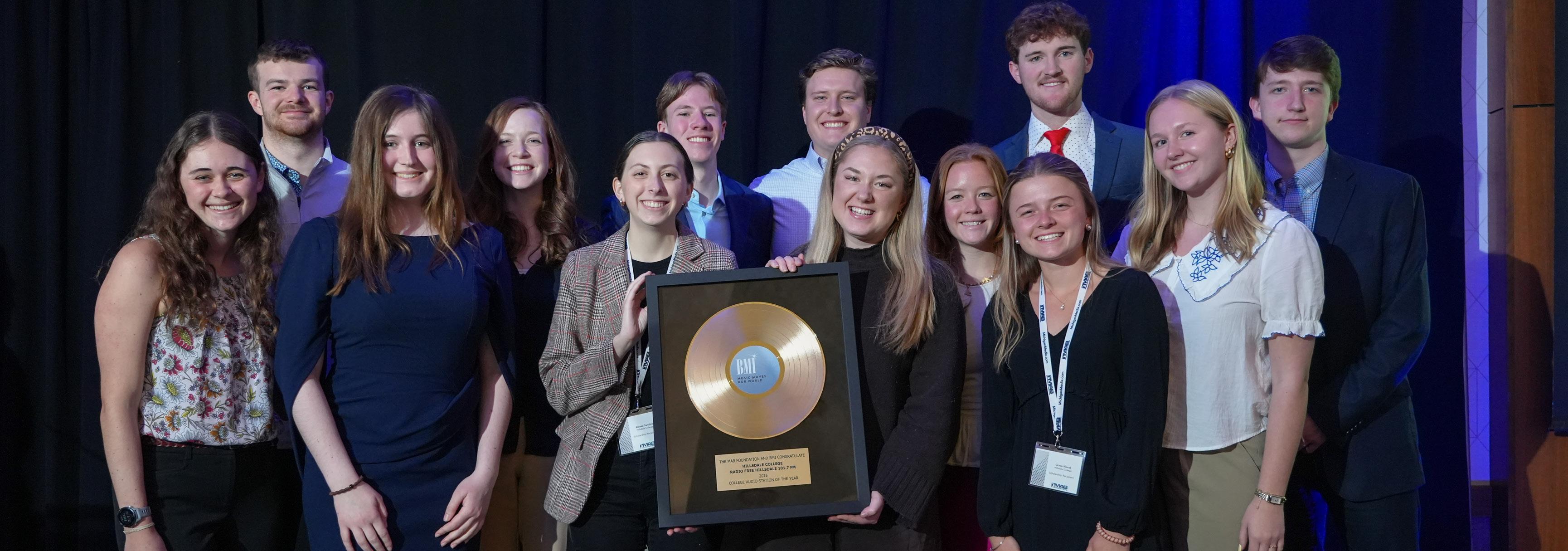
Radio students from Hillsdale College’s WRFH free radio beat out competitors from Michigan State University, University of Michigan, and nearly a dozen other competing colleges to win the Michigan Association of Broadcasters’ designation “Best College Audio Station” for the fourth consecutive year, and the fifth year since 2019.
Scot Bertram, general manager of the college radio station and lecturer in journalism, said Hillsdale students placed first in 9 of the 13 available categories.
“We had great results,” Bertram said. “We’re competing with schools like Michigan State University that are at least 20 times our size, but our students more than hold their own.”
Bertram said that while the radio department appreciated the recognition, it isn’t why his students take part in the program.
By Thomas McKenna Editor In Chief
One could forgive Hillsdale Market House owner Brett Boyd for mourning. Last month, he made what he called the “purely financial decision” to close the supermarket his great-grandfather founded 85 years ago.
But sitting in the Biggby Coffee he owns next to the shuttered Market House with near-empty shelves, Boyd is almost jubilant.
“First and foremost, I’m just utterly grateful,” Boyd told The Collegian in an interview this week. “It would be easy to be sour, but I’m not. I’m very, very grateful.” Market House, which closed for good on March 29, was “pretty much a dinosaur,” Boyd said. He was its fourth-generation owner. Elmer Pearson,
his great-grandfather and a meat-cutter by trade, opened the store downtown on North Howell Street in 1941. The supermarket did so well that it moved to its most recent location at 210 W. Carleton in 1973. Boyd took over the business from his father in 2003 and ran Market House as its owner for the last 23 years.
But the opening of two new grocery stores — Meijer and Aldi — drew shoppers away from the local grocer.
The Biggby Coffee and Anytime Fitness franchises — which Boyd also owns — will remain open in the complex. So will the family’s grocery store in Hudson, about 17 miles east of Hillsdale.
“We’re fully committed to continuing our tradition there,” Boyd said. “But this one, this one hurt.”

“We want to produce really great content,” Bertram said. “But our focus isn’t primarily on our students winning awards. We want the students to improve their craft over the course of their time here at Hillsdale. The awards are an ancillary benefit that come
about once we’ve produced things that are truly great.”
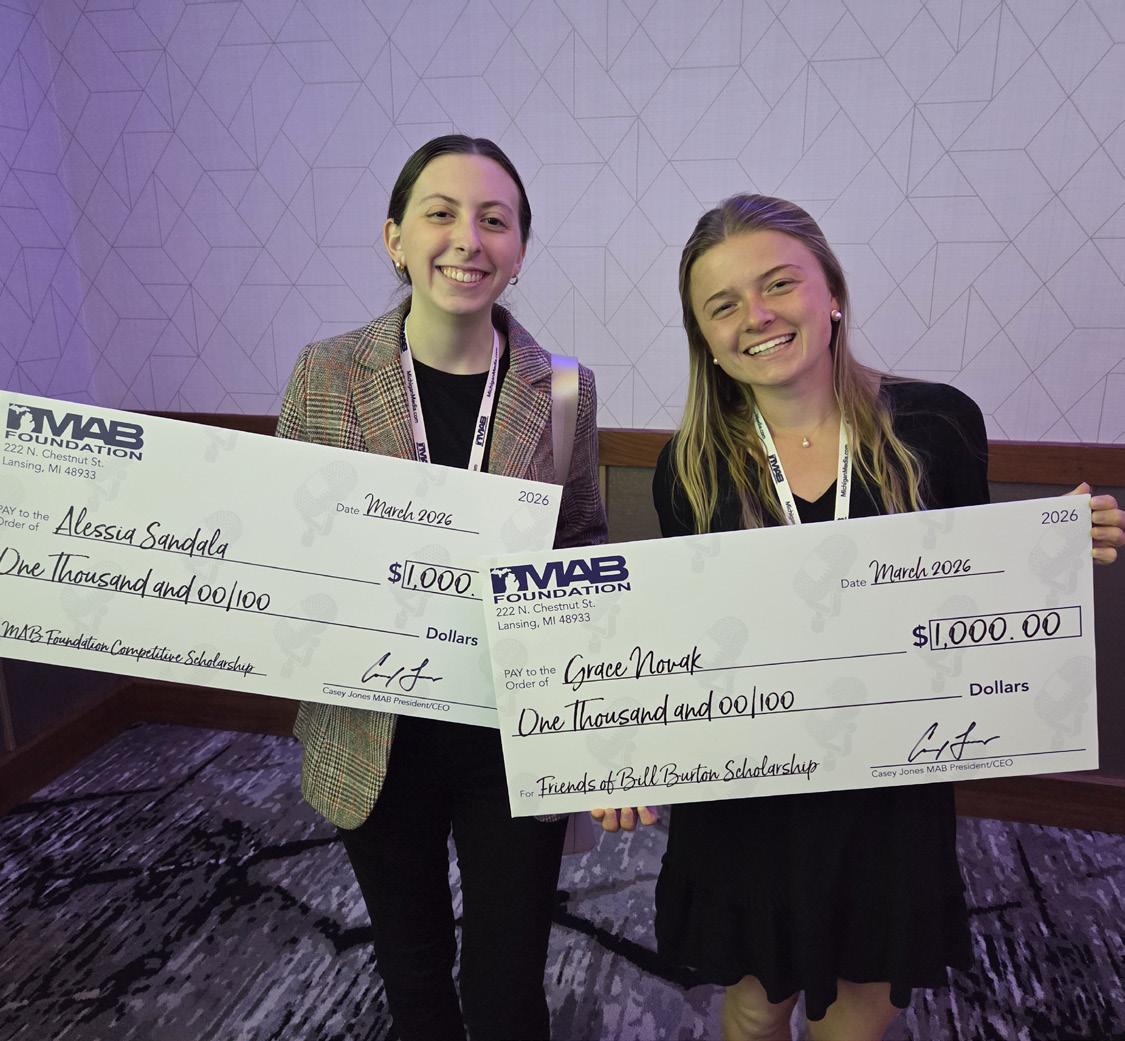
Sophomore Grace Novak received a $1,000 scholarship for her radio show “Lived and Learned,” an interview show with senior members of the Hillsdale community.
“The purpose of my show is to bring together advice for young women and college-age people,” Novak said. “I also run the Widows Connecting Point program for GOAL, and so I’m able to bring that together with my radio job. I interview all sorts of people, but especially the widows I work with. It’s really, really meaningful.”
Novak said her time with Hillsdale’s radio program has been both formative and rewarding.
“The program just sets you up for success,” Novak said. “The radio program is so easy to just get involved in, and the amount of resources that come from the radio program. How often do you get the opportunity to have an entire podcasting panel? If not now, when on earth are you ever going to do it?”
Students log over 7,000 volunteer hours in one semester
By Sydney Green Senior Reporter
Hillsdale College students logged 7,274 volunteer hours in a single semester through the college’s Great Opportunities for Assistance and Leadership program, according to Livia Dodd, junior and director of the GOAL program. As the college prepares for its annual day of service on April 11, students are continuing a tradition of giving back that is already reflected in their volunteer efforts throughout the year.
In the fall 2025 semester, 652 student volunteers served 2,316 people in the community, in addition to roughly 100
bers reflect a deeply rooted culture of service on campus.
“I would say we’re pretty good at volunteering,” Dodd
animals cared for through the Humane Society program. While some programs overlap service, Dodd said the num-
said. “Volunteering is just a natural response. It’s this innate response of, ‘I should be serving others.’”
That instinct translates into both broad participation and meaningful impact across GOAL’s 26 programs, which are led by 27 student leaders. GOAL leaders themselves represent some of the most dedicated volunteers, according to Dodd. She also said each leader is required to complete 75 hours per semester, though many far exceed that benchmark.
“Some of my leaders will have 200 hours per semester,” Dodd said. “They’re the most dedicated volunteers across the board.”
By Gianna Lodice Collegian Reporter
Thousands of people packed into the entrance of the Atlanta airport. Lines of people trying to get through security zig-zagged across the floor with no clear beginning or destination. The actual security line snaked around baggage claim and spilled into the airport entrance. The few staff members on hand looked just as stumped and frantic as the people in line.
Freshmen Margaret Runge and Bristol Whitley, sophomore Grace Brennan, and junior Mary Hannah Runge went through Hartsfield-Jackson Atlanta International Airport in their attempts to return to campus from spring break.
“It was hard to find where the line even started, and you had no hope of seeing the end of it,”
Margaret Runge said. “At one point when Grace, Mary Hannah, and I finally found where
the line started, we encountered people who had somehow waited in line only to end up at the

very beginning.”
A vast number of Hillsdale students’ spring breaks aren’t complete without a visit to the airport, as 77% of the student body hails from outside of Michigan, according to the college’s website. But after experiencing firsthand the recent crises surrounding the Transportation Security Administration, many are wishing it wasn’t so.
Runge waited in line with her sister Mary Hannah Runge and Brennan, arriving at the airport two hours before her flight’s boarding time of 8:22 a.m. After two hours of waiting in a line that resembled utter chaos, security scanners were still nowhere in sight.
By Gemma Flores Assistant Editor
After 29 years at Hillsdale, Professor of Music, Choirs, and Orchestra James Holleman will retire at the end of this semester. Holleman came to Hillsdale in 1997 as the chair of the music department. He graduated from Michigan State Universi-
Michigan’s oldest college newspaper
Illustrated by Paige Kutas.
Alessia Sandala and Grace Novak with their scholarship awards. Courtesy | Scot Bertram
Patrick Hamilton after winning. Courtesy | Scot Bertram
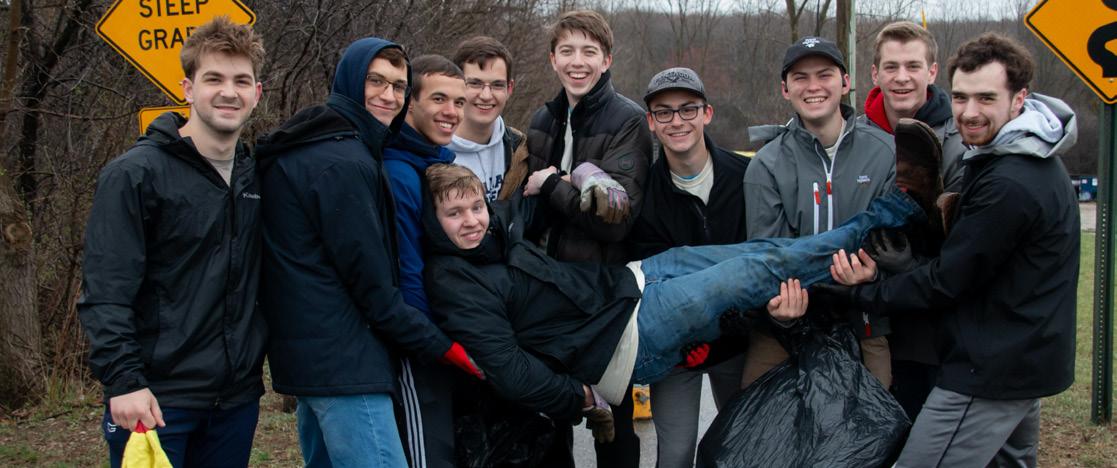
Students at Day of Service last year. Courtesy | Livia Dodd
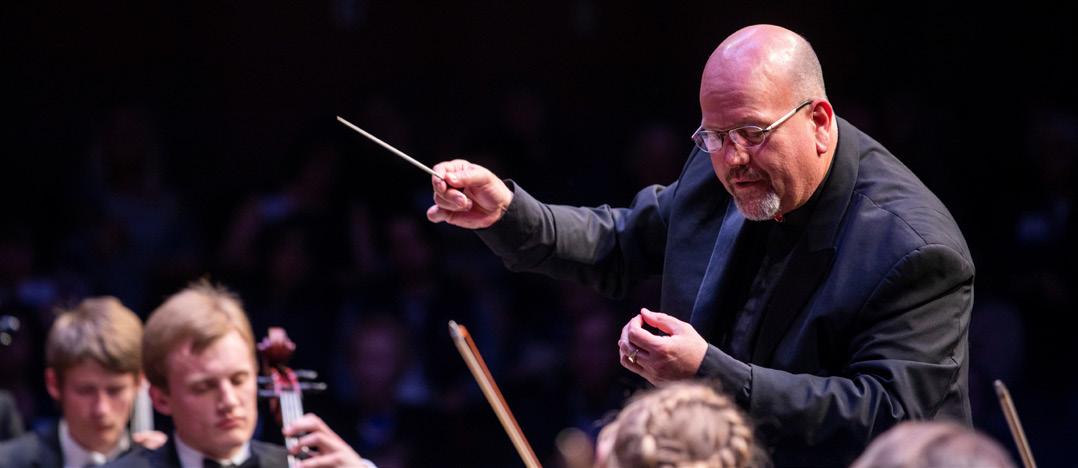
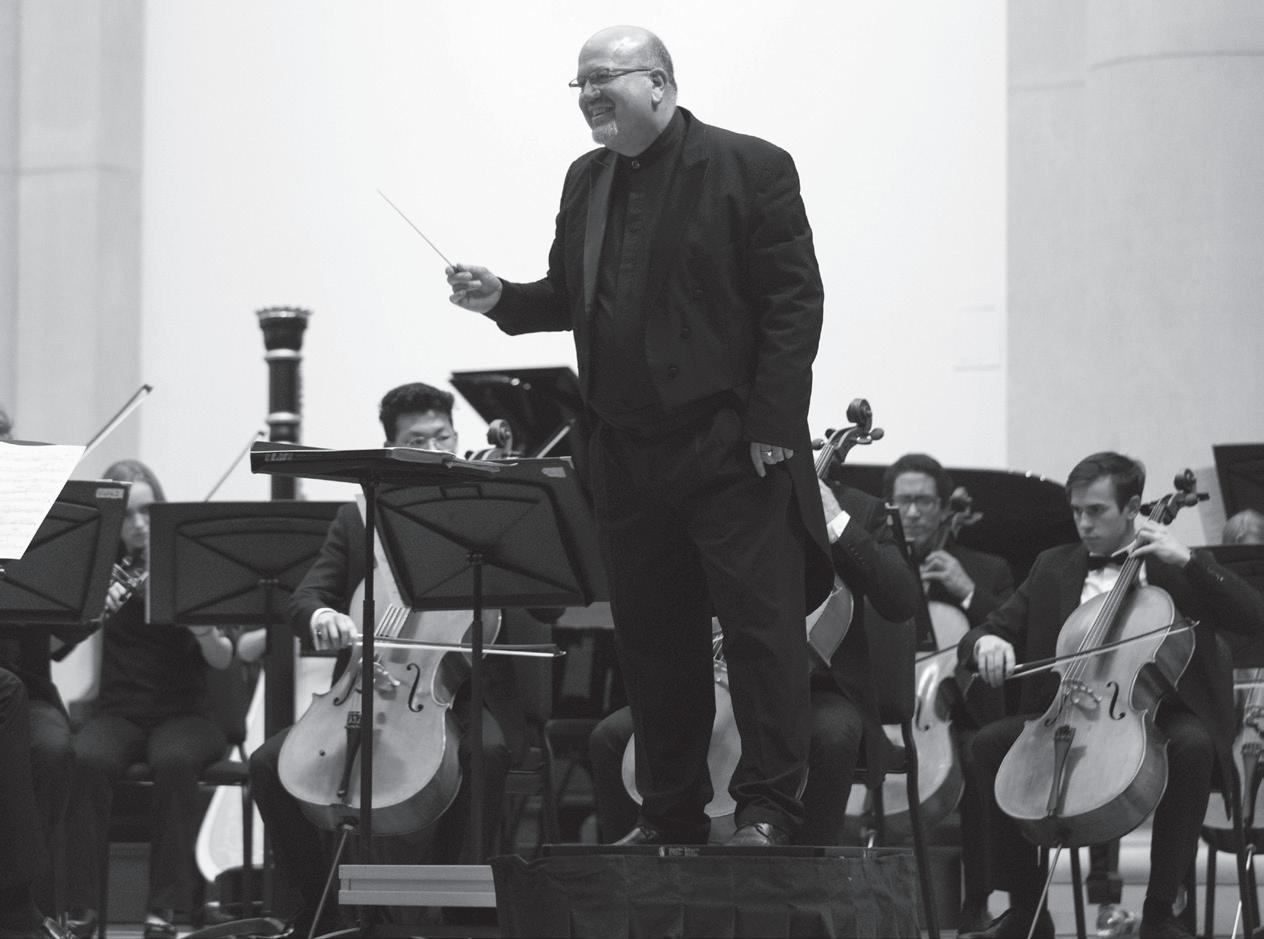
Holleman at a performance. Courtesy
James Holleman
Q&A with state and local radio newscast and talkshow host
By Ellie Fromm News Editor
Benjamin Yount is the news director and a show host at News Talk 1130 WISN in Milwaukee, Wisconsin. He is also a contributing partner at the MacIver Institute, a free-market think tank. He has covered government corruption, daily news, and daily insights in Illinois and Wisconsin, and was an early-morning and midday host for top-rated news and talk radio stations around the country before becoming a morning host.
Q. Why did you decide to go into radio and not other forms of media?
A. The proper answer is because my father did radio. My mom was a school teacher, and those were the only jobs I knew. I don’t know what people who have office jobs do. My dad read the news out loud in Chicago, Philadelphia, and New York, and it was a really cool job. You could wear jeans, and he had a great speaking voice — better than mine — and so I fell toward that because I didn’t really want to be a school teacher and I didn’t have any other ideas of what I wanted to do.

Speaker
By Anna Broussard Design Editor
Q. What do you love about Hillsdale College?
A. The all-around excellence. The first time I came it was like a J. Crew commercial, everybody’s dressed up, nobody’s in pajamas. I saw one kid on campus in shorts, and I think he was coming to or going from the sports complex or practice. And I was stunned that the college doesn’t take federal money, not even GI Bill money, and that stuck out the most to me. But Hillsdale is just a different place, and I can appreciate it.
Q. What’s your most memorable newscast?
A. It’s not the big stuff. When 9/11 happened, I was at home and I was getting dressed to go to work, and I saw that somebody flew the first plane in. We didn’t know what it was originally. We worked pretty much the next 24 hours straight. You don’t really remember the specifics of that, but that was the first time. I also remember 9/12, the day after, because you have this huge story, and everybody’s
doing the story, so you have to try and do your small part. But there was nothing. Everything was closed. It was one of the only times in my life that I ever saw people just wake up and be like, “Well, what happens today? What’s coming today?”
Q. What is the value of journalism?
A. There’s a reason that freedom of the press is among the first things that the founders said you had, and that’s because they understood what it was like when you didn’t have that, when the king could chop off your thumb if you wrote something. These guys understood that the way to a free country is through a free people, people who can think for themselves. And so I’m a huge believer that there always needs to be somebody who can say, “This is what’s going on.”
Q. What role do you see artificial intelligence playing in journalism in the next 10 years?
A. AI is the devil. I won’t even use the voice remote for my television because I don’t want Roku to have my voice. AI, like all technologies and the internet, has some really bad parts for journalism. A lot of places don’t print newspapers anymore. Google and Facebook stole all of the local advertising. But the internet also makes it easier for you to get your story to someone. Substack is a great thing. You don’t need to work for a big paper to write. You can write, you can share it — X, Facebook, all the same things. It makes it easier to get it to people. So there will be parts like that where AI is helpful.
Q. Why should people cover state and local politics?
Q. Why should students get involved with radio journalism?
A. It is a personal medium. I’m talking to you, even though I’m talking to whoever else is listening, but I’m talking to you, and that helps build a better relationship. It helps people feel more connected.
A. Ninety percent of the legislation passed in the country comes from state houses. What’s Congress done? This is what Congress has done — they shut down. They made you wait in line at the airport because they’re mad that ICE continues to exist, even though ICE is funded for another couple of years. Congress doesn’t pass budgets. Congress very rarely passes laws, and so if you go to Congress, you’re covering either horse race politics, because the midterms are coming up and the Tennessee’s third district is going to be competitive and Nevada’s 15th, or you’re covering personality politics, like “Chuck Schumer said this,” “Hakeem Jeffries said that,” “John Thune said this.” And there’s a value in that. The federal government is huge. But all of the work that gets done for roads, schools, university budgets, and vaccines is done at the state level, and there’s nobody watching.
says absolute autonomy is impossible, unrealistic
Our culture idolizes personal autonomy, but few ever reach that standard and it is a good thing, according to author and speaker Leah Libresco Sargeant.
“Dependence is the only thing we’re guaranteed in a human life,” Sargeant said. “Striving for an autonomous life, a life where our strengths are equal to our duties and our choices, necessarily means opting for a smaller life. The fewer people who can make demands of us, the more likely we are to be autonomous for a greater period of our life.”
Sargeant is the author of the books “Arriving at Amen” and “Building the Benedict Option” and owns the substack “Other Feminisms.” Sargeant, hosted on campus March 25 by the education, English, theology and philosophy, and history depart-
ments, gave a talk on her newest book “The Dignity of Dependence: A Feminist Manifesto,” in the Hoynak Room.
“No one is autonomous, and no one will achieve full autonomy,” Sargeant said. “That game is already forfeit.”
Her thesis: Autonomy is an empty goal to begin with. Sargeant said people today attempt to increase and expand the categories to be eligible for human euthanasia. This begins with understanding what an autonomous life is.
“In Canada at present, one out of every 20 Canadian deaths comes at a doctor’s hands,” Sargeant said. “There are some human lives that are not worth living, and they’re not worth living because of their dependence, and it turns out to encompass a surprisingly large proportion of the human population.”
Sargeant cited the most common reason for people request-
ing elective euthanasia — they do not want to burden their families. People are adopting the belief that living without total autonomy abdicates them of being truly alive, she said.
Modern feminism reflects the same pattern, Sargeant argued. Men can voluntarily walk away from fatherhood, while women cannot physically separate themselves from pregnancy. Abortion becomes the tool women need to achieve the same autonomy men already enjoy, and babies depending on their mother for life is an unfair standard for women, according to Sargeant.
“Factually, all of us will spend some of our lives dependent. It’s impossible to begin your life at all without a period of dependency,” Sargeant said.
If the goal to achieve autonomy is no dependence or being depended upon, then most people never reach that waterline.
Babies lost before birth, people with severe congenital disabilities never cross the waterline, and therefore, by culture’s standards, will never fully be alive, Sargeant argued.
The lecture challenged the idea that independence drives success, senior Paul Landry said.
“I think it’s important for college students, because we think of our value as how much we’re producing and how independent we are, instead of just the fact that we’re created because of God,” Landry said. “It’s good to get different perspectives that don’t fit perfectly in the box of what every Hillsdale student agrees with. That’s kind of the value of our education.”
According to senior Ashley Poole, Sergeant’s talk was insightful for understanding how the feminist thesis can be reinterpreted.
“She skillfully articulated that neither men nor women can
thrive alone,” Poole said. “We are equal in our dependence. Sargeant’s talk pushes us to accept our need for one another and to prioritize healthy dialogue about the role of women at Hillsdale and beyond.”
Sargeant closed by arguing that humans are dependent on God, and cultural rejection of this devalues human dignity, especially for women.
“What we have to offer is the additional good news that when we feel the lack of our own strength, that when we observe our loves can go beyond our abilities, we do not live in a world where that is the end of the story,” Sargeant said. “Admitting that is true, and being willing to be free of the burden of lying, concealing, and making ourselves smaller is very good news indeed.”
Professor teaches story of Hillsdale’s Civil War students
By Beckett Layman Collegian Freelancer
Hillsdale educates its students to prepare them for service, including service during a war, according to Peter Jennings, associate professor of leadership studies.
Jennings gave a lecture on March 24 called “Hillsdale Honor: The Civil War Experience.”
“All institutions of higher learning pursue truth. At least they’re supposed to,” Jennings said. “We pursue truth but we also defend liberty.”
Jennings emphasized the importance of Hillsdale’s tradition of defending liberty.
“Tradition is about handing down something, something of great worth,” Jennings said. “This thing of great worth is
GOAL from A1
Some initiatives stand out for their scale. A Few Good Men, a GOAL program that assists community members with manual labor projects, contributed the largest share of service hours, with 50 volunteers logging just under 2,000 hours over the fall semester. The Humane Society program, however, drew the largest number of student participants, with 130 volunteers, according to Dodd. Other programs made their mark through the number of people they served. Community Health reached 425 individuals — the highest of
handed down from one generation to the next. It’s a kind of gift.”
He said that it is important for each generation to pass the tradition to the next generation without corrupting it. He also addressed where this tradition originated.
“Our tradition of defending liberty was born in the Civil War, in the hour of our country’s greatest peril,” Jennings said.
He recounted details of the Battle of Gettysburg, and included many references to individual students’ sacrifice, like a woman who served as a nurse, staying on the floor with a dying soldier for 24 hours until he passed. Many Hillsdale students volunteered in the 4th Michigan infantry regiment.
“When the 4th Michigan
any program — while Bread of Life, a program supporting Christian food banks, followed closely behind, serving 300 people. Dodd also said additional efforts like Hospital Volunteering with 936 hours, Crossroads with 700 hours, and Adopt-a-Grandparent with 400 hours, further illustrate the wide range of needs students are meeting in the community.
Other programs stand out not for size, but for the depth of commitment they require, according to Dodd.
The Crossroads program, for instance, asks its 13 volunteers to commit about five hours each week — well above the typical one-hour expecta-
volunteer infantry regiment is called up to join the fight, they are 1,000 strong, but after two years of war — Bull Run, Peninsula campaign, Second Bull Run, Antietam, Fredericksburg, and Chancellorsville — they are 342,” Jennings said.
He then explained the size of the Wheatfield where most of the Battle of Gettysburg took place, explaining the size in a way students can understand by relating it to aspects of campus.
“The Chapel to Lane and Kendall Hall to the library and the science building, it’s about 20 acres,” Jennings said.
He described the field as a “harvest of death” in the lecture.
“Think about this: 20 acres of ground about the size of our main campus here, a plot of ground that small,” Jennings
tion, according to Dodd. Each Crossroads volunteer mentors a small group of middle or high school students — known as a “care cell” — meeting weekly and maintaining relationships beyond scheduled programming. Even with its smaller size, the group logged 700 hours and served 252 community members during the semester.
“It’s an insane commitment,” Dodd said. “They’re pouring into these students’ lives every week.”
Jake Hamilton, senior and leader of the Crossroads GOAL program, emphasized the relational impact of the program.
“I think the biggest thing
said. “20,000 men fought for three hours. At the end, 6,000 men lay dead or wounded on that field. Of the 4th Michigan, only 55 of the 342 were left standing.”
One of Jennings’ students who attended the talk, junior Jackson Westrick, said that Christians are obligated to serve and even die, if necessary.
“My biggest takeaway from Dr. Jennings’ speech was that our education should not only give us a clear sense of what is good, right, and just, but it should also give us a strong sense of obligation to defend them, and it should develop within us the courage required to do so,” Westrick said.
Another attendee of the lecture, sophomore Elizabeth Cavrell, said there is a lot of
that I love about this is that we are giving these kids an older sibling presence in their lives,” Hamilton said. “It means a lot for somebody to show up for you.”
Hamilton added that the time commitment, while demanding, becomes a natural part of life.
“It doesn’t feel like volunteer hours,” Hamilton said. “It just feels like part of what I do.”
That culture has gained recognition beyond campus. Last August, The Collegian reported that Princeton Review ranked Hillsdale No. 2 in the nation for student engagement in community service, based on student responses about their
value in learning the college’s history.
“Dr. Jennings’ lecture gave me a greater appreciation for Hillsdale’s role in this country and its history, and, personally, it just further cemented my belief that this college is where I was meant to come,” Cavrell said. “The courage that Hillsdale’s young students showed in the Civil War is incredible.”
Jennings drew connections to the Civil War monument between Lane and Kendall Hall.
“The soldier atop our monument memorializes the patriotic fighting spirit of our student soldier boys, a spirit that defiantly, proudly, even cheerfully accepts the duty, takes the responsibility, and challenges the world in fighting for just principles in defense of liberty on behalf of the republic,” Jennings said.
peers’ commitment and institutional data.
Emily Loner, junior and leader of the Community Health GOAL program, said service plays a key role in shaping students.
“I have witnessed the blessing of Hillsdale students in the community through their diligence and hard work,” Loner said. “Sometimes it is behind the scenes, like restocking baby clothes, or on the front lines, donating blood and comforting a patient who received a diagnosis of a terminal illness. Serving the wider community gives students a generous dose of perspective.”
Sophomore Lilly Faye Kraemer said Hillsdale College was where she first experienced radio journalism.
“I started doing radio at Hillsdale my first semester of freshman year,” Kraemer said. “I knew nothing about radio. Mr. Bertram came alongside me and helped me brainstorm ideas which developed into my current podcast, ‘Story Behind the Song,’ where I tell the stories behind a lot of the country music we hear on the radio.”

Welcoming students forms a big part of the motivation for why he invests so much time in the radio station, Bertram said.
“If you’re interested, you can do it,” Bertram said. “If you’ve always wanted to do a radio show or you want to host a podcast, we can build that with you. We will help you develop the idea and take it from idea to execution to content.”
First-place winners included senior Marc Ayers, Kraemer, Gavin Listro ’25, junior Megan Li, senior Patrick Hamilton, senior Paden Hughes, junior Luke Miller, senior Evan Mick, junior Alessia Sandala, senior Emily Schutte, Gwen Thompson ’25, and senior Lewis Thune. Coming in second-place were Gordie LaFontaine ’25, sophomore James Joski, and junior Ariel McDowell. In third were seniors Quinn Delamater, Carissa Nisly, and Mattie Grace Watson.
Kraemer said the culture at Hillsdale’s radio station is a big part of why she decided to pursue a minor in journalism.
“It’s really affirming to see the impact of what we’re doing at Hillsdale,” Kraemer said. “I think that speaks so highly to all the students involved with WRFH under Mr. Bertram’s guidance. I’m going to keep on at the radio station because it’s a great place to be at Hillsdale.”
Radio from A1
Luke Miller after winning.
Courtesy | Scot Bertram
Benjamin Yount at the Hillsdale radio station. Courtesy | Scot Bertram
‘A little speakeasy on campus’: Mocktails come to Penny’s
By Grace Brennan Assistant Editor
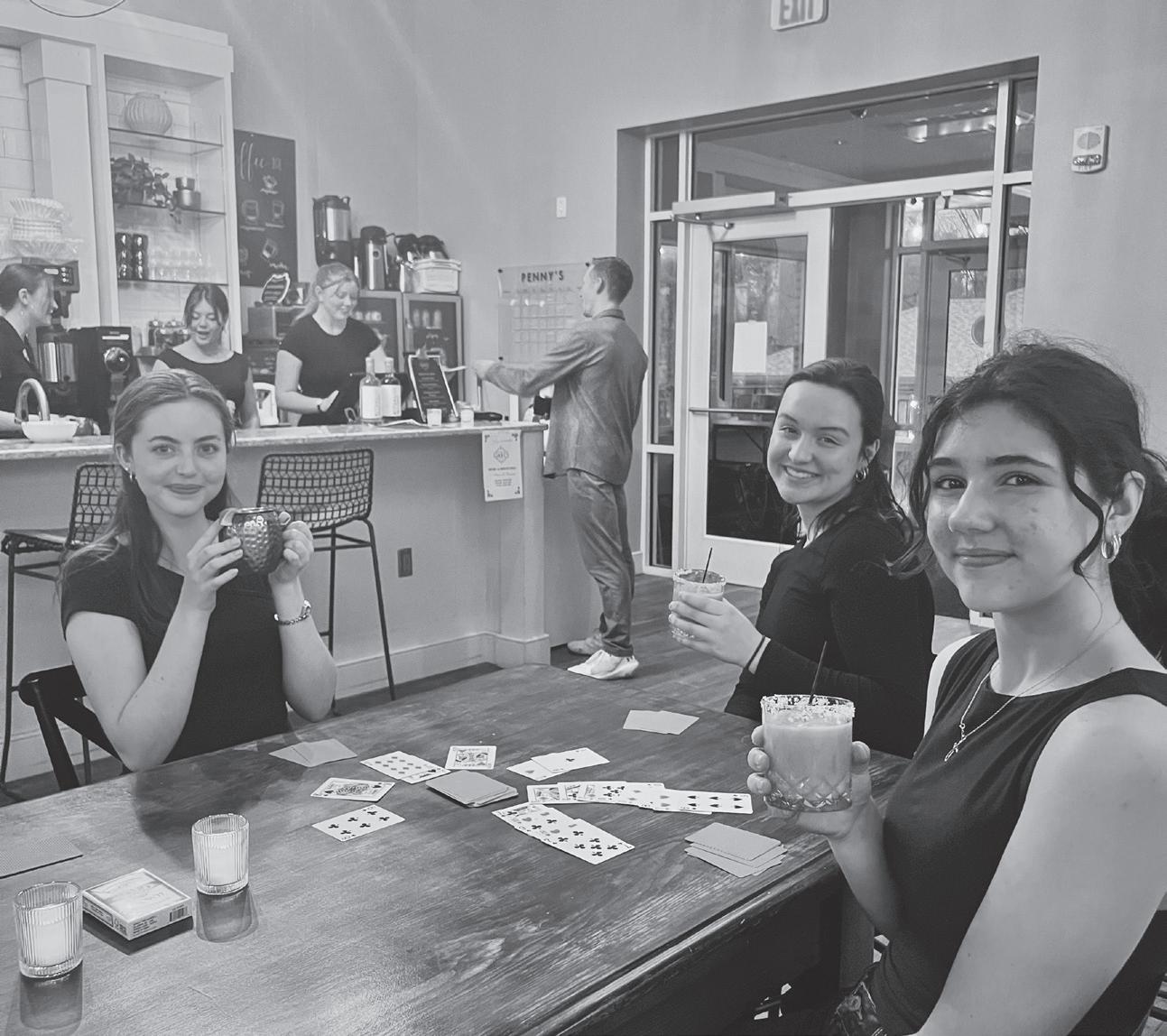
Penny’s hosted Larry’s, a night of relaxation and community for students featuring live music and mocktails, on March 26. The event offered five Hillsdale-inspired mocktails: Mock Rock Mule, Espresso Manning, Schismatics Strawberry Margarita, Senior Sunrise, and the Central Hall Shirley Temple.
drinks, students should have a bar on campus.
of the group.
According to junior and Head Shop Manager Maria Adamow, the name and theme of Larry’s was created by senior Nathan Rastovac. He told Penny’s General Manager Jennifer Lutz that while Penny’s is so popular, “What about Larry?” Afterward the idea was thrown around by Penny’s staff that since “Larry” loves
When Lutz was given permission from College President Larry Arnn to name the event after him, the team began to prepare for the event.
“We got permission and finally had the opportunity to start in March, and we’re hoping it’ll be a recurring event,” Adamow said.
“The program was almost non-existent. It was struggling,” Holleman said. “And the provost and the dean, when they hired me, they said specifically, ‘Fix it and don’t let anybody get in your way. We want music coming out of every pore on this campus. And if anybody tells you this is the way we used to do it, find a new way to do it.’”
Holleman said he knew Hillsdale’s music department would look different from bigger music programs. Rather than ignoring that fact, he said he used it to innovate.
“I thought, ‘Well, liberal arts. How do we create a model for liberal arts and, specifically, Hillsdale College liberal arts?’” Holleman said. “One of the main things was we opened our doors to every student. You do not have to have a major or minor in music to participate, and we will respect and work with you on your academic schedule.”
Holleman said opening the department to students from other majors is what makes the music program at
Angelo K. Tsakopoulos originally donated the 1,100acre California property to the University Development Foundation in 2012 for the purpose of expanding higher education in the Sacramento area. The UDF transferred the land to Hillsdale College after arrangements with other colleges including Drexel University and Warwick fell through.
Hillsdale both successful and unique. It serves high-achieving students who want music to be a part of their college experience without sacrificing other goals. Holleman said that this new model of collegiate music solves a problem he encountered when teaching youth orchestra in Jackson before coming to Hillsdale.
“My youth orchestra kids would say ‘I really love the cello, but I want to be a doctor,’ or ‘I want to be a lawyer,’ or they want to study this, that, or the other thing,” Holleman said. “And I thought, how can we be the school for those students?”
Thursday nights are perfect for hosting Larry’s because it brings the fun of the weekend earlier into the week, according to sophomore Bailey Wright.
“We wanted something unique and different, but something classy and natural as a study break, and we thought Thursdays could be like a celebration of Friday,” Wright said.
Junior Daniel Sturdy, who works at Penny’s and is also the president of music fraternity Theta Epsilon, performed live jazz and indie music with other members
pointed Music Director of the Hillsdale Arts Chorale. He conducted the orchestra and the choir, started the chamber choir, organized admissions and recruitment for the music students, coordinated with donors, and helped design the
“We played some songs that we hadn’t performed before, and we did some that we would normally play at Penny’s during the day, trying to get a mix of jazz and indie,” Sturdy said. “It felt like the best way to keep the college kids engaged.”
The mix of music and lighting made for a unique night on campus, according to sophomore Lenora Schupbach.
“The ambiance is warm, inviting, and classy, which I like because it feels different from the monotonous everyday life of Hillsdale,” Schupbach said. Sophomore Maria Logvin said she looks forward to there being a new communal space on campus.
“I had heard word of this event from one of the baristas at Penny’s months ago,” Logvin said. “I’m really excited that they’re actually making it happen. How cool would it be to have a little speakeasy on campus where people can get together. It’s such a good space for people central to campus to mingle.”
Junior Zanna Hughes enjoyed a Mock Rock Mule with
credited the success of Hillsdale’s music program to Holleman and his passion for music.
Howard Music Hall.
Holleman served as the department chair for 25 years before resigning the position in 2022, when he was ap -
The Tsakopoulos family subsequently donated the Tower Theater in nearby downtown Roseville to the college, and Hillsdale has been hosting events in the space since 2025. The college recently purchased a neighboring half-acre lot and plans to use it for drop-off, parking, and outdoor events at the theater.
The property, just outside of Roseville city limits, is divided into roughly three sections. About 500 acres of the
“Right now, I conduct seven rehearsals Monday afternoon to Thursday afternoon with four ensembles. Colleagues I have around the country think it’s crazy, but I love it,” Holleman said.
Senior Rachel Dunphey
property will be sold for residential housing, according to Norton. On an adjacent 13.5acre parcel, the college hopes to build the educational center and K-12 school. Plans for the remainder of the property have yet to be determined.
Hillsdale has begun to develop the 500-acre parcel of residential property in preparation to sell that portion of the land. The rising cost of construction in California has previously prevented the sale of the property, but those
“I admire professor Holleman so much for his dedication to the programs throughout the years,” Dunphey said. “It’s not easy to come into a program that is barely something and make it so prominent in a college.” Holleman said he is most grateful for the time spent with his students.
“The most rewarding thing is that I get to work with students who want to work hard. We get to develop together and we get to grow and present quality performances,” Holleman said. “We’re here for the students. So it has to be about them.”
costs have now stabilized, Norton said.
“What moving forward looks like, in all likelihood, is selling off the residential property in the front of the parcel along the main road so they can start putting houses in there,” Norton said. “That brings your utilities to the site. And then after you’ve got that started, you’ve got the utilities there and you just keep going deeper into the property.”
Once the college sells the

her friend, junior Sarah-michelle Eversaul, who had the Senior Sunrise.
“I think it’s a great alternative to the bar,” Hughes said. “I’ll enjoy a fun and lively drink whether it has alcohol or not.”
Adamow said she hoped Larry’s would be a place of relaxation and fun, and was pleased to see students playing cards and enjoying the live band.
“We had a great turnout, which is surprising considering it was pouring rain,” Adamow said. “But we’re hoping for more. We would love to open up the outside that could accommodate a lot more people.”
Eversaul said she looks forward to Larry’s expanding to the porch.
“I think this will be nice year round, especially as it gets warmer,” Eversaul said. “This will be nice in the evenings and lovely outside.”
Penny’s plans to host Larry’s twice more this semester, on April 16 and 28.
Freshman Anastasia Dementyev, a member of the chamber choir, said she appreciates Holleman’s drive and his passion for his students.
“I’ve liked working with him, especially with chamber choir,” Dementyev said. “He’s very kind, and even though he’s not easy on us all the time, he’s supportive and points out the best parts of our performance.”
After his retirement, Holleman said he plans to live full time in his home in the Leelanau Peninsula with his partner, Nicole. He will conduct the Benzie Area Symphony Orchestra and hopes to do some guest conducting as well. In his spare time, he plans to cook, work on his property, and fish.
Associate Professor of Music Timothy McDonnell will take over as director of the orchestra and choir. Holleman said he hopes the department will continue to be welcoming to non-music majors.
“Keep the doors open,” Holleman said. “Work with every student that wants to participate, find a place for them, and make sure they have a positive experience.”
residential property, it hopes to develop an educational center on the adjacent 13.5acre site, similar to the Blake Center in Connecticut.
“It’ll probably be where we hold events, much like CCAs,” Norton said. “There will probably be some offices there. We will probably hold teacher training there for the K-12 teachers.”
A K-12 school will likely share the site with the educational center.
“We like what we have here with the academy being near the location of the higher ed,” Norton said. “[President] Arnn really likes the idea of having schools near where these outposts might be.”
Norton said the board of trustees currently favors the idea of building a graduate school on the remaining several hundred acres of property. As far as an undergraduate campus, CBS’s original reporting was wrong.
“Is it impossible? No. Could it happen? Yes. Is it going to happen in the next five years? I would not bet any of my retirement money on that,” Norton said. “Right now, in the foreseeable future, smart money is on that 13.5-acre parcel and maybe getting a K-12 school.”
By Skye Graham Social Media Manager
Hillsdale students will help community members with volunteer projects Saturday, April 11, for the Great Opportunities for Assistance and Leadership program’s 6th annual Day of Service.
Day of Service will run from 9:30 a.m. to 12:30 p.m., and GOAL will provide students with lunch after service activities end.
“The goal of Day of Service is to have the biggest impact on the community as we can with as many students as we can in a short amount of time,” GOAL Program Director and junior Livia Dodd said. “It’s only three hours, but we make a pretty big impact in the community.”
GOAL partners with local organizations and individuals who need help and assigns teams to complete service projects in the community, Dodd said. Service projects in previous years included walking dogs at the Greater Hillsdale Humane Society, cleaning up local parks and graveyards, and making care packages.
This year will look very similar, but there will be more volunteering for specific individuals in the community, Dodd said.
“We get those submissions from church contacts and the Widows Connecting Point,” Dodd said. “We have some elderly community members who just need some help with basic yard work, so that’s quite a few of the projects.”
Another Day of Service project this year will be helping the Early Pregnancy Loss Association paint its new office.
There are teams for each dorm, Greek house, and other teams for different groups on campus, such as Catholic Society. Larger teams will be tasked with more complicated and intricate projects, Dodd said.
The Day of Service is a good way for students to exemplify Hillsdale’s honor code and focus on giving back, according to Dodd.
“It’s very clear that we are dutiful in our studies, and it’s also evident that we are dutiful in our service,” Dodd said. “This is such a great way to serve because it’s so fun and it’s just a short amount of time.”
Sophomore Billy Joe Ball led the Delta Tau Delta team at Day of Service last year, when students walked dogs for the humane society.
“It’s always kind of difficult getting 20 dudes up to go do something,” Ball said. “When we got there, any brothers’ gripes with the day quickly dissolved when they got to go out and play with the dogs.” Ball said he thinks students should attend Day of Service because it helps Hillsdale students engage with the outside community while practicing self-governance.
“It’s all fun and games to talk about being a good person for your community, but if you’re not practicing that when you’re 20 years old and you have the least amount of responsibility you will ever have in your life, you’re never going to practice that,” Ball said. “Day of Service helps us understand what it takes to contribute to our community.”
CA from A1
Holleman from A1
From left to right: Wendy Swem, Maria Adamow, and Meredith Schmidt at Larry’s.
Courtesy | Maria Adamow
Holleman at a performance. Courtesy | James Holleman
A map of the 1,100-acre property where Hillsdale may build an education center. Courtesy | Hillsdale College
Opinions
(517) 607-2415
Online : www.hillsdalecollegian.com
Editor in Chief | Thomas McKenna
Executive Editor | Moira Gleason
Design Editor | Anna Broussard
Senior Editor | Catherine Maxwell
News Editor | Ellie Fromm
Opinions Editor | Caroline Kurt
City News Editor | Alessia Sandala
Sports Editor | Elaine Kutas
Culture Editor | Ty Ruddy
Features Editor | Tayte Christensen
Social Media Manager | Skye Graham
Circulation & Ad Manager | Henry Fliflet
Assistant Editors | Christina Lewis | Sophia Bryant | Elijah Guevara | Jayden Jelso | Adriana Azarian | Gemma Flores | Christian Papillon | Jamie Parsons | Francesca Cella | Grace Brennan
D.C. Correspondents | Lauren Bixler | Megan Li | Lewis Thune
Web & Puzzle Editor | Matthew Tolbert
Illustrator | Maggie O’Connor
Faculty Advisers | John J. Miller | Maria Servold
The editors welcome Letters to the Editor but reserve the right to edit submissions for clarity, length, and style. Letters should be 450 words or less and include your name and number. Send submissions to the Opinions Editor at ckurt@hillsdale.edu before Saturday at 3 p.m.

The press misses the pope’s point
By Moira Gleason Executive Editor
Pope Leo XIV’s Palm Sunday homily caused a stir in the White House briefing room Monday.
Asked to comment on the pope’s words that “God does not listen to the prayers of those who wage war,” Karoline Leavitt responded that praying for veterans is a noble thing to do.
“I don’t think there’s anything wrong with our military leaders or with the president calling on the American people to pray for our service members and those who are serving our country overseas,” Leavitt said.
In his homily, the pope meditated on Christ as the “King of Peace” who enters into the city of Jerusalem on a donkey and fulfills Old Testament prophecies of the Messiah.
“Brothers and sisters, this is our God: Jesus, King of Peace, who rejects war, whom no one can use to justify war,” the pope said. “He does not listen to the prayers of those who wage war, but rejects them, saying: ‘Even though you make many prayers, I will not listen: your hands are full of blood’” (Isa 1:15).
Serving one’s country and praying for those who do was never the problem.
The press conference exchange missed the point. So did the headlines.
“Pope seems to rebuke Hegseth in remarks about leaders with ‘hands full of blood,’” said The Guardian.
“Pope Leo condemns Trump over Iran war in thinly veiled Palm Sunday message,” a headline in The Independent proclaimed.
“Pope Leo rejects claims that God justifies war in Palm Sunday Mass message,” according to the Los Angeles Times.
The media has chosen a narrative: Chicago-born Pope Leo versus tyrannical President Donald Trump. That’s not how the pontificate works.
Interpreting the pope’s homily as a condemnation of prayer for veterans grossly misrepresents his words.
The pope has criticized the war in Iran and made ongoing appeals for an end to violence out of concern for the lives of innocent civilians caught in the crossfire. He told reporters March 31 that he hopes President Trump ends the war quickly.
“Hopefully he’s looking for an off-ramp,” he said. “Hopefully he’s looking for a way to decrease the amount of violence.”
Take Good Friday seriously: Cancel morning classes
By Ellie Fromm News Editor
Let me mourn my Lord. Hillsdale College should not hold any classes on Good Friday.
The college currently cancels classes on Good Friday afternoon and all of Easter Monday, labeling Monday a travel day. But allowing students a break only starting at noon on Good Friday is inconsistent with the Christian founding and nature of Hillsdale College.
Good Friday is the day Christians observe Christ’s crucifixion, death, and burial. It is one of the most important days of the liturgical calendar, and the first day of the mourning period until Easter Sunday. Catholics fast on this day to honor Jesus’s sacrifice and mark it as a solemn day.
Catholics and many Protestant denominations hold Good Friday services. Many of the faithful wear black funeral attire. If the college gives us an entire day for travel after Easter, it should give us the entirety of Good Friday to observe and remember Christ’s death.
Article 6 of Hillsdale’s constitution says, “Religious culture in particular shall be conserved by the College, and by the selection of instructors and other practicable expedients, it shall be a conspicuous aim to teach by precept and example the essentials of the Christian faith and religion.” It makes sense to allow ample time for worship during the holiest week of the Christian year.
Hillsdale was founded by Freewill Baptists who were “grateful to God for the inestimable blessings resulting from the providence of civil and re-
ligious liberty and intelligent piety in the land, and believing that the diffusion of sound learning is essential to the perpetuity of these blessings, having founded and endowed a college at Hillsdale,” according to the preamble of the college’s constitution. Intelligent piety requires use of the intellect as a form of reverence to God. Not fully observing the darkest day of the Christian calendar by pausing work-related intellectual pursuits fails at this end. Good Friday requires rest and reflection.
Some may argue that keeping morning classes is consistent with Christian tradition, since the Gospels report that Jesus died in the afternoon, and Good Friday church services often occur in the afternoon. But classes distract students from the day’s meaning. No one expects just the morning
off from work on Christmas or Easter day because those are both celebrated in the morning — the entire days are given for observance.
Keeping morning classes on Good Friday also disadvantages afternoon classes (and their professors), leaving them a class session behind their morning peers. Canceling class for the entire day solves this problem. Since Hillsdale does not observe federal holidays, such as Labor Day or President’s Day, it should have the space in its schedule to give students a holy holiday. Don’t make us scramble to our 8 a.m. classes on Good Friday. Allow us to focus on the Lord and rest from our studies in honor of Him.
Ellie Fromm is a junior studying history.
Let my nephew watch me graduate
By Anna Broussard Design Editor
I am the first woman in my family to earn a college degree.
On May 9, I am going to walk across the stage in great part because of the sacrifice of all 20 members of my family. My parents, my siblings, and each of my nieces and nephews have made my graduation possible by their support of my education.
Yet not all of them will be able to attend, because I am permitted only 12 tickets to commencement.
One of those tickets is mine, leaving me 11 to distribute to my 20 family members, nine of whom are under the age of 7. If the
limitations are for security purposes, the current policy, which requires a ticket for children over the age of 2, treats my 4-year-old nephew the same as my father. If seating is limited, the 3, 4, and two 5-year-olds will be sitting on their parents’ laps, leaving open seats others could have used. Ticket limits exist for a reason. The venue has a limited capacity, and security measures are reasonable, but it is unclear what the requirements seek to accomplish. A policy that makes no distinction between adult guests and toddlers in their parents’ arms is not a security measure nor a capacity limitation. It is an oversight that dispropor-
tionately disadvantages large families, multigenerational families, and students whose graduation is much larger than themselves.
I am not the only graduate navigating this. Many Hillsdale students can’t count their siblings on one hand, to say nothing of parents, grandparents, and in-laws. A friend of mine, who is also in the middle of eight children, must decide between her young nephews and adult family members. Sorting families into 11 slots forces graduates to choose who deserves to be there.
The solution is simple: Exempt all children 5 and under from requiring tickets. Allow students to re -
quest the number of tickets they will need for their families, as is reasonable, before opening up ticket reservations to current students and friends of the college. These simple fixes would not drastically impact commencement security or capacity. A family-friendly ticket policy would give this ceremony the value it is due, not as a managed event, but a celebration.
My family members should see me walk. All 20 of them.
Anna Broussard is a senior studying politics.
Don’t kick your ox into
the pit
“As we set our gaze upon him who was crucified for us, we can see a crucified humanity,” Leo continued.
“Above all, we hear the painful groans of all those who are oppressed by violence and are victims of war.”
Interpreting the pope’s homily as a condemnation of prayer for veterans grossly misrepresents his words. Catholic chaplains have served in the military for generations, and Pope Leo’s own father participated in the D-Day Normandy landings in World War II.
At no point did the pope say God would shun the prayers of Americans during war time. Neither did he imply that military leaders in the U.S. have blood on their hands or that the country is out of favor with God because of the war in Iran.
The pope’s concern as the spiritual leader of the universal church is for souls. I’d be concerned if he were calling for more bombs.
Moira Gleason is a senior studying English.
By Samuel Sadler Collegian Freelancer
Working on the Sabbath used to merit death. But for most college students, Sunday afternoon is the perfect time to catch up on homework.
Last Sunday afternoon, I worked on a few homework assignments. Later that week, I listened to the book of Exodus and heard this passage: “Six days shall work be done, but on the seventh day there shall be to you an holy day, a Sabbath of rest to the LORD: whosoever doeth work therein shall be put to death” (Ex 35:2).
Something wasn’t matching up. Most Sunday afternoons, I visit the same coffee shop, where I see many students catching up on their reading. When I was an undergraduate at a Christian college in Tennessee, the library opened at noon and closed at midnight. In this 12-hour window, college students crowded three floors to get their homework done. How did we get from Exodus 35 to a culture of Christian college students spending their Sundays on schoolwork?
Admittedly, I have been and still am chief among these sinners. I’ve used a number of excuses: “Well, I enjoy it, so
it’s not work,” or “Well, I’m a student, and just have too much to do right now,” or “Everyone else is doing it.” Then there are the biblical warrants: “The Sabbath was made for man, and not man for the Sabbath” (Mk 2:27), or “Which of you shall have an ass or an ox fallen into a pit, and will not straightway pull him out on the Sabbath day?” (Lk 14:5).
From one perspective, homework during undergraduate or graduate studies becomes an ox in the pit. It’s not the ideal way to spend your Sabbath, but there just doesn’t seem to be enough time in the week to get everything done. I wonder, however, how many weeks per year the average Hebrew really needed to pull an ox from the pit. I wonder, also, whether students aren’t in fact pushing the proverbial ox into the pit every week by their management of time. I coasted through the first year of college. The difficulty and volume of homework, on top of part-time jobs, increased through my sophomore and junior years until I fell into a rhythm of working all the time. A lot of the work was unfocused, stretching over seven days each week. I felt perpetually busy and that I was accomplishing less
than I should. By senior year, I felt like I was missing a lot of opportunities that college afforded, thinking I didn’t have time to do them all.
I shifted my mindset, and that changed my approach to work. I committed to parties, meetings, or hangouts in advance and forced myself to do the work in the remaining time. Sure enough, the work got done. The quality might have decreased some, but I experienced all the things I used to miss out of the fear I wouldn’t be able to complete my work.
In fact, taking breaks to enjoy extracurriculars made the times of work more effective and enjoyable. I discovered that I could actually block off significant amounts of time to not do homework. It wasn’t a problem of too much work, but of effective use of my time.
I should have taken this approach to Sundays: block off the day, refuse to do homework, and enjoy a day of rest. I didn’t learn this until I started teaching. The church I attended emphasized Sunday as a feast day. There was always at least one invite for lunch which often extended into the evening. Sunday became a day of rest, feasting, and fellowship.
It was here that I experienced the significance of the Sabbath: God did not establish a day of rest as a burden; He established it as a gift to gladden the heart and refresh the soul. I don’t propose the death penalty for catching up on reading during a Sunday afternoon. But examine yourself to see whether you aren’t pushing an ox into the pit each week.
If I may offer a bold suggestion to students, simply refuse to do homework on Sundays for a few weeks. Shuffle your weekday schedule around if necessary. Rabbi Abraham Joshua Heschel offers this advice: “If you work with your hands, Sabbath with your mind; if you work with your mind, Sabbath with your hands.” Find something to do with your hands, and do it with friends. Host a Sabbath feast. Christian students have the opportunity to make the Sabbath a cultural reality. Put aside the work, and rest in God’s goodness.
Samuel Sadler is an M.A. student in the Diana Davis Spencer Graduate School of Classical Education.
Seniors answer: What was your favorite class at Hillsdale College?
political parties & elections
Thomas McKenna Editor in Chief
Professor of Politics Joseph Postell is the GOAT. Like many other seniors, I find it difficult to pick a favorite class. Courses in history, theology, and literature deepened my understanding of first principles and my relationships with others. But I’m not sure any of them changed my mind like Postell’s Political Parties & Elections. His Parties course began with a provocative thesis: We don’t have a two-party system, we have a no-party system. But his class is not a vehicle for hot takes. Postell takes a serious look at the pillars of America’s political institutions and their later perversions. He encourages student questions and pushback, however half-baked. If he disagrees, he will always take the time to articulate your objection better than you and then reveal its weaknesses. This course, along with his Congress and Administrative Law classes, fundamentally altered the way I see politics.

War and Peace
Moira Gleason Executive Editor
Almost daily, I think about Dean of Humanities Stephen Smith’s War and Peace seminar. In the novel, protagonist Pierre Bezukhov offers a spiritual insight that helped me process much of my experience at Hillsdale. At the culmination of Pierre’s moral education, Tolstoy writes: “He experienced the feeling of a man who has found what he was seeking under his own feet, while he had been straining his eyes looking far away from himself. All his life he had looked off somewhere, over the heads of the people around him, yet there was no need to strain his eyes, but only to look right in front of him.” Longing for greatness, Pierre had sought purpose for his life in the abstract, gazing through what Tolstoy calls a “mental spyglass.” But having suffered and found faith, he recognizes the access point for the divine in the world: the human person. I came to Hillsdale armed with a mental spyglass, ready to seek the Good, the True, and the Beautiful in arguments and abstractions. Like Pierre, I have instead found God in the mundane duties and details of everyday life and in striving to love others well. Thanks, Dr. Smith.
war, Empire, and Tyranny
Anna Broussard Design Editor
I will never forget Panthea breaking apart her jewels to adorn her beloved Abradatus’s armor as he went off to die in battle. In Assistant Professor of Politics Daniel O’Toole’s class War, Empire, and Tyranny, I learned about foreign policy and forms of ancient government. It began in Xenophon’s “Education of Cyrus” and the just tyrannical rule of Cyrus the Great. Panthea’s tale in Book VI is about sacrifice for a leader who is powerful and good, though it ends tragically. When we turned to Thucydides’ retelling of the Peloponnesian War, Pericles’ “Funeral Oration,” it was the height of idealism. But still the Athenians corrupted their own ideals. I still wonder at what aggressive foreign policy means in the ancient world and today, but the class lived up to its name, and because of it, I understand the sacrifice of those willing to fight in war as the most honorable of deeds.

Luther — shows you the best Protestant and Catholic arguments for any given theological issue, along with some of the worst (and possibly heretical) arguments. The class is about conversation, not conversion. I was still a Protestant when I came out, but I had a far deeper understanding of and respect for religious thinkers across the theological spectrum. Did you know Ulrich Zwingli and Martin Luther hated each other? Or that the Catholic Church’s greatest theologian, Cardinal Thomas Cajetan, was so prolific he wrote detailed responses to almost every major Protestant figure? Forget whatever your denomination taught you about the Reformation. You can’t properly criticize Luther or the Council of Trent unless you’ve read them — and you’ll read them, and much more, in Gaetano’s Reformation.
War and Peace
Caroline Kurt Opinions Editor
There are classes that give you new skills, and then there are classes that flip your life upside down and shake it. I’m grateful for classes in the former category — among them Director of the Dow Journalism Program John J. Miller’s Advanced Writing and Associate Athletic Director Nicole Walbright’s Women’s Health and Nutrition. But War and Peace with Dean of Humanities Stephen Smith stands out as the latter. It’s weird that some fictional Russians seared my heart indelibly. But I think I knew all along that the point of the English major was to become, in a mysterious way, not a smarter person but a different person. War and Peace fulfilled that intuition. Dr. Smith is kind, hilarious, and a master teacher (this is a paid endorsement). Thanks to his enthusiasm and encouragement, the reading flew by. It means nothing unless you’ve read the book — and everyone should — but the Epilogue will stay with me forever. The Bible is the greatest story ever told. But “War and Peace” comes close.

C.S. Lewis
Ty Ruddy Culture Editor
I’m not one to shed a tear. But the last day of Assistant Professor of English Patrick Timmis’s C.S. Lewis class almost had me. Through narrative, Lewis makes an excellent argument for reclaiming a mythical view of the world. The empty spaces are full of light and wonderful mysteries, not darkness. Words matter. And men are characters in a divine drama, not passive observers. Seeing through the eyes of the ancient storytellers, as Lewis suggested, has, in some ways, made the world a more interesting, dramatic stage. I became, as Lewis called himself, “a dinosaur.” For the prose quality and the attention to underlying craft, Lewis’ scholarship can be as enjoyable to read as his fiction. Dr. Timmis challenges us to follow Lewis’ example. Mini essays every week toned down the scale and pressure of academic writing and I found it a useful exercise for developing a voice. Turns out, humor and wit are allowed in scholarship! The class ended on what I can confidently say is now my favorite novel by Lewis, “Till We Have Faces,” a beautiful story about sibling love and sacrifice. And to end his final lecture, Dr. Timmis recited 1 Corinthians 13.
Narrative and Propaganda
Tayte Christensen Features Editor
When I decided to go on WHIP the fall semester of my senior year, I was full of anxiety about missing time on the main campus. Little did I know it would be the best and most formative semester of my time at Hillsdale. While on WHIP, I took Narrative and Propaganda with Mollie Hemingway, and it changed the way I viewed the intersection of politics and media. We discussed egregiously biased articles from legacy outlets each student submitted, with topics ranging from the White House’s use of social media, to the media’s coverage of the assassination of Charlie Kirk, to a leaked Young Republicans group chat. Having these discussions while interning in D.C. politics was especially revealing as I saw the news unfold around me in real time. Even now, it has changed the way I read the news outside of the D.C. bubble.
the gilded age
Christina Lewis Assistant Editor
When I signed up for The Gilded Age with Assistant Professor of History Miles Smith IV, I didn’t know what to expect. Dr. Smith began each class with a different banger — one day it was the theme song from “La La Land” and another it was a clip from “The American Tail.” While the class itself was enjoyable, Dr. Smith taught me that history is more than a series of heroes and villains. I learned
that there is a danger in trying to simplify history to fit into neatly arranged boxes. Prior to taking the class, I knew very little about what happened during this time period. From the first day of class — when Dr. Smith argued that the Gilded Age started during the Civil War — my perspective on American history developed in that instead of seeing history merely as a series of effects, I realized the importance of understanding its causes. The class showed me that the birth pangs of modern-day progressivism started long before the 20th century. Now, every time I face the temptation of reducing events and time periods to straightforward narratives, I remind myself to embrace the complexity of the past. Life is complicated, and so is history.
Advanced writing
Adriana Azarian Assistant Editor
Advanced Writing with Director of the Dow Journalism Program John J. Miller helped me significantly improve my writing skills. Having been a journalism student, intern, and a writer for The Collegian, I felt pretty confident in my writing abilities. Mr. Miller’s comments in blood-red ink all over my papers quickly humbled me. Every other week, we wrote a paper and shared it with the class to be critiqued by our classmates and Mr. Miller. By the end of the class, we had accumulated a wealth of knowledge from Mr. Miller himself as well as other writers and journalists. I almost never do this, but I’ve kept my notes and handouts from that class to reference every once in a while. Biggest takeaways: You must be a good reader to be a good writer, and you must keep writing to be an excellent writer.
Western Heritage since 1600
Christian Papillon Assistant Editor
I took Western Heritage Since 1600 with Professor of History Dave Stewart in the fall of my junior year. The course was a continuation of where Western Heritage had left off, picking up in 1600 and extending to the modern day, but it also served as a middle ground between an introductory history class and a full-on upper level. In addition to Stewart’s engaging lectures, some of my favorite assignments I completed came from that class. In one assignment, each member of the class got a different historical document which we were asked to transcribe, find out who wrote it, and write a brief introduction about the historical context for the document. In another assignment, the class was tasked with reading an account of a 17th-century murder and providing evidence with what we thought happened. The wide variety of assignments made the class more enjoyable and increased my interest in European history.
Indoor cycling
Jamie Parsons Assistant Editor
If you wish to gain glutes of steel, Indoor Cycling is a lower-body-focused class taught by Associate Athletic Director Nicole Walbright that will whip you into shape while you pedal to upbeat remix tracks. As someone who loves finding new ways to work out, I found Hillsdale’s Spin class to be a fun way to incorporate both cardio and strength into my day. Although the first few classes left me sore, as the instructor warned on the first day, the class held me accountable for exercise and also added a break to my academic schedule to prioritize self-care. Students are given many opportunities to make up missed classes, which I appreciate, given that Spin is an elective. And having taken other exercise electives, Spin was the best at mimicking a professional class and was most focused on pushing me physically. I will forever cherish the times my friends and I listened to pop music at 8 a.m. while climbing on a bike at max effort, and I encourage students to take advantage of the school’s offering.

Logic and rhetoric
Lewis Thune D.C. Correspondent
“To make an apt answer is a joy to a man, and a word in season, how good it is!” Even Solomon could not prepare for the class that came to surpass Associate Professor of Theology Cody Strecker’s History of Christian Thought I. Of all things, it was Logic and Rhetoric with Associate Professor of Education Jon Balsbaugh. I still don’t understand how he managed to consistently (and conversationally) astound me with material that half the class and I already knew. The best answer I can reckon is that I had always simply accepted that the literature, speeches, and poetry I studied at Hillsdale were “great.” That course taught me to actually grasp a small portion of the immeasurable artfulness, tact, and subtlety that made them that way.
Illustrated by Maggie O’Connor.
Catherine Maxwell
City News

‘No Kings’ protesters criticize Trump administration

By Alessia Sandala City News editor
About 40 protesters gathered in front of the Hillsdale County Courthouse Saturday as a part of the international “No Kings” protests.
lor ’95, held a sign with a photo of a balloon that presented Trump as a baby with orange skin.
“Why the orange man baby? I have a lot of different reasons,” Taylor said. “No troops, we’re better than this, don’t lie to us, all of it.”
Taylor also cited the Safeguard American Voter Eligibility Act — a bill that would require proof of citizenship to register to vote — as one of the reasons she was protesting.
“We started to see troops being sent into cities to suppress political dissent,” Lama said. “I realized this is an existential threat to the country that I love, and I need to actually get out there and join my neighbors and actually participate.”
Lama held a sign that referenced 1 Kings 18:21 and said “you can’t serve both God and Trump.”
“A lot of people in the Trump administration are trying to use religious rhetoric, including the Old Testament, to justify their racism and their oppression,” Lama said. “I wanted to include a little bit of that to push back against that. This is where Elijah says you have to choose who you’re going to serve, whether it’s true God or whether it’s Baal. To me, Baal represents money and greed and power, which is what this administration stands for, and not for justice or for the average American.”
Trump has let down the country by not releasing the Epstein files.
“I don’t understand the whole Epstein file thing where he is mentioned so many times,” Herrell said. “He promised to release everything and they have not released everything. All these people should be prosecuted.”
At one point during the protest, a blue pick-up truck drove by yelling “Donald Trump” through a speaker. Herrell laughed after the truck drove by and voiced her disapproval of Trump a second time.
“I think he is a criminal, he doesn’t follow the Constitution, and he’s just not a very nice person,” Herrell said.
One woman, Carol Flynn Tay-
More than 3,000 protests took place around the world. Protesters voiced their opposition to President Donald Trump and his administration. The protesters in Hillsdale held signs that read “This is fascism, resist,” “Iran away from the files,” and “WWJD? Not this.”
“Just anti-all of this administration, the people should have a say, and no SAVE Act because that’s just taking away women’s rights to vote,” Taylor said.
Hillsdale County resident Mark Lama said he decided to join the protest because he loves democracy and doesn’t approve of the direction the country is going.
Another Hillsdale resident, Heidi Herrell, said she was protesting Trump’s disregard for the Constitution, especially regarding military action in Iran.
“I don’t think that President Trump is doing a very good job,” Herrell said. “He does not follow the Constitution. The war should have gone through Congress to get their approval.”
Herrell said she believes
Food truck offers Lebanese eats
By Adriana Azarian
AssistANt editor
A Lebanese food truck opened this November in Jonesville, adding more variety to the area’s dining scene.
Shawarma Station is located across the street from The Udder Side and offers kabobs, beef kafta, and falafel, as well as American fare such as chicken tenders, burgers, and fries.
“The owners are Yemenis, and they decided to bring culture out here, and we thought it was a good idea to bring it out here,” said Shawarma Station server Jesus Sosa. “It’s a busy road, so we thought, ‘Why not spice it up?’”
Shawarma Station’s owner, Mohamed Abdullah, said his father owned a Lebanese restaurant in Yemen before moving to the United States. Abdullah’s father wanted to own a restaurant in Michigan as well, and first opened a location in Coldwater and also operated in Sturgis.
“When we were in Cold-

water, we had a lot of people who came from the Hillsdale and Jonesville area, and we had to get in there sooner and wanted to have a brick and mortar location,” Abdullah said. “We have a food truck in-
stead for now, just to see how it goes, and it’s been going pretty well.”

Abdullah said he might move the business into a building if the opportunity arises. For now, they serve patrons from their truck and offer catering ser-
vices. Shawarma Station will also be expanding its menu and providing seating come late April, Abdullah said.
“We have a little of everything. We have burgers and fries and wraps, what people like, and then we also do chicken and beef shawarma wraps with pickles and garlic sauce” Sosa said.
Shawarma Station provides an option for people seeking Mediterranean food who live two hours from the Metro Detroit area, where there is a greater concentration of Mediterranean and Middle Eastern restaurants and culture.
Senior Annika Monson said she sampled the beef shawarma wrap and the kafta bowl from Shawarma Station.
“The wrap part was really good, and the sauce was good, and everything was well-seasoned,” Monson said. “The beef kafta bowl, get that. That was incredible.”
Dawn Theater seeks new management
By Tayte Christensen FeAtures editor
Two management companies face a deadline of April 22 to submit final proposals to run the Dawn Theater, the TIFA Targeted Development Committee decided in a meeting March 26.
“Ideally, we’ll have proposals that we can discuss, negotiate and execute in the short term,” TIFA board member Andrew Gelzer told The Collegian. “TIFA is very eager to deliver the Dawn Theater into an awesome operator’s hands so we can get that back to contributing to the downtown’s economic activity.” The theater’s previous management group, CL Real Estate Development, backed out of its 10-year lease agreement in February 2025, leaving the Dawn Theater Governance Board to
find new management for the property, The Collegian previously reported. Gelzer said both potential candidates are local, with one from Hudson and one from Jonesville. He said while several parties have shown interest, none have submitted proposals. Chair of the Dawn Theater Governance Board James Brandon said the space has been unable to host private events due to the current lack of management. But, Brandon said, the Friends of the Dawn Theater have hosted public events.
private events,” Brandon said. “And of course, the key toward making the place eventually profitable is going to be those private events. It’s coming, but it’s just not there quite yet.”
Mary Wolfram, chairwoman of the Friends of the Dawn Theater board said the group has a use agreement with TIFA
“It’s coming, but it’s just not there quite yet.”
that will allow the nonprofit to work with the incoming management group to put on public events.
said. “And hopefully, TIFA will indicate that to the private management company, and the new management company would know that going in, that there is this organization called Friends of the Dawn, and we raise money for the theater, so they should see us as an asset.”
Wolfram said the Friends of the Dawn Theatre recently received a $20,000 Michigan Arts and Culture Council grant to go toward event operations.
Under new management, Brandon said the theater will offer private events that are profitable for the management team but will continue to serve the community through public events.
Family homes under construction
By Ellie Fromm News editor
Several houses are now framed at the Three Meadows North Subdivision after a developer purchased the roughly 22-acre-property from the city.
Three Meadows North Subdivision is a land parcel at 280-286 W. Bacon St. The owner and developer, Allen Edwin Homes, plans to build 61 single-family homes with 80% of those listed at market value and the remaining 20% to be reserved for specific, qualified middle-class families, according to previous reporting from The Collegian.
Allen Edwin Homes listed the starting price at $312,685, according to its listing website.
“There was no existing infrastructure before they started working out there,” Assistant City Manager Sam Fry said. “So they are installing all of the infrastructure. They have to actually put in the roads, they have to put in the water main, they have to put in sanitary sewer. And they have to work with our city utility on getting electric access to those sites.”
Allen Edwin Homes approached the city about building on the property, Fry told The Collegian.
“They are a large-home builder that has a significant presence here in the Midwest, and they had expressed interest in purchasing the property and building homes out there,” Fry said. “So that’s when the city began working with them.”
There are three move-in ready homes and three available floorplans, according to Allen Edwin’s listing website.
According to city documents, 58.1% of housing units in the city were built before 1970, while only 2% were built after 2010.
ing projects in Hillsdale in recent history, according to Fry. Michigan’s Brownfield Tax Increment Financing structure will fund this through reimbursing the upfront costs of the property tax revenues, a financing structure that is meant to solve the statewide housing shortage.
The council discussed and decided this assistance at a public hearing on Nov. 4, 2024.
“We are creating a tax increment authority, and that means we’re going to raise taxes on those lots and pay the tax money directly to the corporation as a subsidy,” said Ward 4 Councilman Joshua Paladino, as previously reported by The Collegian. “Essentially, we will be giving a private organization the power to raise taxes.” Paladino voted against the housing initiative in November 2024.
Sally Clark, director of the Economic Development Partnership, said she hopes this new development will ease the housing market.
“This gives us homes in a different price range and a different location for businesses to be able to say, ‘Hey, we do have new housing here,’” Clark said. “‘We have this available.’ So I think just any housing that we can have available is going to help that.”
The county is investing in a housing market study which began in March with results to come in August.
“With a manager, we would have a professional that is able to have public events and also
“The relationship hopefully will be the same where we — and our use agreement specifies this — book dates for our events in there on a first-come, first-served basis,” Wolfram
“It’ll really be a big deal when we have an actual management entity and we can get back to hosting events on a regular basis,” Brandon said.
The city gave $15 million to the development, one of the largest new home build-
“To better understand these needs, the Hillsdale County Housing Study Committee was formed, and Hillsdale College actually invested in this as well,” Clark said. “So there’s a strong cross section of representatives from across the county that have really been involved in this housing study. It is a cross section of Hillsdale County, so that’s what’s great about this housing study.”
Shawarma Station opened in November. Courtesy | s hawarma s tation FaC ebook
Protesters hold signs in front of the courthouse. a lessia s andala | Collegian
Heidi Herrell at the protest. a lessia s andala | Collegian
Hillsdale County restarts program to aid veterans
By Faith Miller Collegian Repo Rte R
Hillsdale County has restarted a program to counsel veterans who have committed crimes, following a funding lapse from the state.
The veterans probation track, which is led by Army veteran and occupational therapist Don Michael, helps connect veterans and find benefits, including healthcare and disability compensation. The program also offers the Veteran Justice Coordination Group, which meets to ensure positive, social contact for the veterans on probation, according to District Judge Megan Stiverson.
“The veterans’ individual counseling is going to look a little bit different than the individual counseling for the general population, because Major Michael is going to make connections through the Veterans Administration,” Stiverson said. “He’s helping them organize meaningful community service that actually gets them involved with other veterans in the community.”
According to Michael, over 90% of veterans who return home are able to readjust to regular life, but a hidden 5-8% struggle when returning to civilian life, facing struggles such as substance abuse, PTSD diagnoses, and anger management issues.
“The problem is that when you’re trying to transplant yourself rapidly from a military mindset, which sometimes brings people into combat situations, where they’ve seen death and they’ve seen trauma, and then they come back into the civilian sector where over 99% of Americans have never worn a uniform, that causes a lot of shock to some of the veterans,” Michael said.
The program originally received funding from the Hillsdale County Board of Commissioners in 2023 after Stiverson proposed the idea, but lost funding due to statewide budget cuts in 2025. After seven and a half months of being shut down, the program was refunded by the Hillsdale County Veterans Board and restarted in March of this year, according to Stiverson.
“When I first took the bench, I had envisioned that probation could be more effectively managed in Hillsdale County, considering we have pretty sparse resources, by tracking off probation,” Stiverson said. “Our veterans, specifically who were dealing with PTSD and other diagnoses directly because of their service, were having a difficult time making it through a generalized probation program.”
of Michigan,” Michael said. “Being a retired Army officer occupational therapist, I have treated many soldiers, sailors, airmen, and Marines. Blast injuries, burns, amputation, traumatic brain injuries, a lot of PTSD issues.”
Veterans experience a ma-
“I want it to be meaningful for them. Otherwise, we’re just going to see people back.”
jor disconnect after returning from service according to Michael. Today, about 6% of Americans have served in the military, according to the Pew Research Center.
Those behind Hillsdale’s veteran probation track received an award at the Michigan Military and Veterans Gala for their innovation in tracking off probation specifically for veterans, according to Stiverson.
“From my research, I am currently the only veteran track probation officer of any district court in the state
“They are finding that they are reconnecting at these meetings with their military ethos,” Michael said. “They are able to share stories that they don’t normally share with the normal populace.”
Michael also connects his veteran probationers with Hillsdale County Veterans Affairs Director Renae Shircliff,
who helps them get veterans benefits.
“We can help them apply for disability compensation if they were injured or apply for health benefits. Veterans’ widows are able to apply as well. We also can get them connected with the Michigan Veterans Association,” Shircliff said. “I think they just don’t understand what’s out there.”
For Stiverson, community safety is first and foremost, and because of the success this program has seen so far, it’s helping to make the community safer.
“I’m going to be far more likely to get success with an individual that’s had services for 12 months, instead of spending 93 days in jail and then getting out with the same problems they had, going right back out and doing the same thing,” Stiverson said.
Stiverson knew she wanted to do something to help veterans even before she ran for District Judge.
“I want it to be meaningful for them. Otherwise, we’re just going to see people back.” Stiverson said.
After serving as an Army officer for 28 years, Michael worked as an occupational therapist until he was diagnosed with cancer in 2019. He also serves as a Catholic deacon and was previously a chaplain at the county jail. Now, he is pursuing his Clinical MSW degree from University of Michigan while working as Hillsdale’s veteran probation track officer.
“As much as I wanted to set aside my veteran status in so many ways, I just couldn’t do that. These individuals are very important to me. I was given a second chance for a purpose. I think this is my purpose, and I’m grateful for it,” Michael said.
The program has graduated 42 veterans, with only two reoffenders, according to Judge Stiverson. “Two out of 42, that is a really good recidivism rate compared to what I have for other general probation tracks,” Stiverson said.
County deliberates as contract for stray dogs nears end
By Ethan Savka Collegian FReelanCeR
As the expiration date approaches for an animal control agreement with Branch County, Hillsdale County officials are grappling with where to house stray dogs.
The 10-year contract allowed Hillsdale County to transport unclaimed strays to Branch County’s facility in Coldwater after a 24-hour holding period at the Hillsdale County Sheriff’s Office. The contract will expire on Dec. 31, 2026. The arrangement stemmed from a 2015 fire that destroyed Branch County’s previous shelter, leaving officials short on funds to complete a new one. Hillsdale gave Branch $90,000 to help rebuild and has housed dogs there since.
Hillsdale County Commissioner Brad Benzing said Hillsdale has made progress toward extending the contract and has met with Branch County twice.
“The first was last year to attempt to get a reconciliation of the costs allocated against
Market from A1
The one-two punch
At a city council meeting in November 2017, Boyd spoke “through tears and in a voice cracked with passion,” as a Collegian reporter wrote. The council was considering what’s called a 425 agreement — a rezoning arrangement that would pave the way for bringing Meijer, the regional supercenter chain, to the Hillsdale area. “What makes Hillsdale County unique is the family-owned businesses that we are so blessed to have in our midst,” Boyd said at the 2017 meeting. “My main concern is not just about Market House and the grocery business that could be impacted, but it’s the downtown. It’s the heart of Hillsdale, the heart of Jonesville. If you look at these folks who have a long history of giving back to the community, they’re at risk. They will be threatened. They will be threatened.”
Boyd spoke alongside a handful of other local business owners, including Rich Galloway of Performance Automotive, Terry Rummel of Current Office Supply, and Kevin Conant of Here’s to You Pub & Grub restaurant, according to the meeting minutes.
the $90,000 we paid Branch County toward the construction of their current shelter,” he said. “The second was to discuss the terms of a new contract.”
Hillsdale County, along with Sheriff Scott Hodshire, has also contacted outside groups for help.
“We have also met with members of the board of directors of the Greater Hillsdale Humane Society to inquire into their interest in contraction with the county,” Benzing said. “Sheriff Hodshire has reached out to Jackson County, and we are waiting to hear if they have interest in offering us a proposal.”
Branch County Administrator Frank Walsh said the imbalance in costs and usage of animal control between the counties has influenced negotiations.
“For the nine years of the contract, dating back to its inception, we have housed 1,337 Branch County dogs,” he said. “At the same time, we housed 950 Hillsdale County dogs. Hence, 41% of the dogs that entered our building originat-
“I did speak out against the Meijer,” Boyd said this week. “I was vocal about it. I’d seen all these other family-owned supermarkets that ended up in the same spot we were in, and I’m like, ‘Listen, guys, we have a Walmart. We have a Kroger. Do we really need a Meijer?’”
The council voted down the measure that night but approved it at the next meeting. That was the one-two punch that took the business down, Boyd said. Meijer opened in May 2024 and Aldi in March 2025, both just north of the city on M-99.
A “slow bleed” of shoppers began, he said. “We lost — with the addition of Meijer and Aldi — in the ballpark of about 100 grand a week in sales,” Boyd said. “And you just can’t — you can’t.”
Larger chain stores can get better deals from suppliers, Boyd said, pushing smaller, family-owned stores out of the market.
In September 2024 and April 2025, The Collegian conducted price comparisons of common products — such as cereal, chips, granola bars, beer, and energy drinks — between the grocery stores in and near Hillsdale. Aldi almost swept the September review, and Walmart had the lowest prices for nearly all of
ed from Hillsdale County. On the flip side, during the same nine-year period, Branch County’s total an imal control budget was ap proxi mately $1 million.”
Benzing said despite the numbers, euthanasia rates are low.
“It is our understanding from Branch County officials that four dogs have been euthanized since the inception of the current contract,” Benzing
the April products. Market House never had the lowest price in any review.
Does Boyd think that, without Meijer and Aldi in the same market, his store might have remained open?
“For sure, for sure,” Boyd replied. “They’re good at what they do. They’re here for a reason. Kroger’s always been a strong competitor. But when you add two box stores
said. “We also understand that Branch County has not recovered any costs from the owners of reclaimed dogs from HillsdaleWhile Hillsdale has helped Branch financially, its share of dogs is more than its payment, according to Walsh.

“While Hillsdale County accounted for 41% of the dogs, they contributed $90,000, or 9% of the total operating costs
said he and his dad knew that if they didn’t differentiate their offerings from other stores, they wouldn’t survive. Over the years, Market House sported a pharmacy, a full-service post office, a Domino’s, and even a JCPenney catalog store.
“Our post office and UPS store, it’s going to be missed,” Boyd said. “Because we had hundreds of people a day that
“If you look at these folks who have a long history of giving back to the community, they’re at risk. They will be threatened. They will be threatened.”
with the kind of power they have, we’re not the first family-owned supermarket to succumb to them. We knew they were coming.”
But Boyd said he isn’t “bitter” about the new stores.
“Competition is king, and it’s what makes America great,” Boyd said.
‘We did everything we could’
As early as the 1980s, Boyd
shipped their packages out of here, hundreds.”
In the 2000s, the store opened a Blimpie Subs and Krispy Krunchy Chicken.
“We just recognized many, many years ago that if we’re just a grocery store, we’re in trouble, and we’ve always tried to identify needs within the community,” Boyd said.
After Meijer and Aldi entered the market, Market House opened Underdogs: Sliders, Spirits & Sports.
for animal control,” Walsh said. “We have met twice with Hillsdale County. Hillsdale County remitted three $30,000 payments to Branch County. Two of the checks were received on Jan. 12, 2018. The final check was received on April 24, 2020.”
Still, he said he hopes a deal can be reached.
“Our goal is to continue serving our neighbors with a regional approach. It’s always more economical for our taxpayers when we work together to lower costs,” Walsh said. “We have provided the county with an equitable approach to a new contract. Our offer is you simply pay your fair share for the number of dogs you bring into the shelter. We are not asking for Hillsdale to pay for building costs. The county’s preference is the same as my preference. Let’s work together in a fair manner that is best for the taxpayers and our dogs.”
Hillsdale County officials say they are still exploring options.
“We are trying to explore all of our options at this point,”
“We did everything we could to shelter us and propel us,” Boyd said. “I mean, who puts a sports bar in the center of a grocery store? We made every effort. We did a lot of things out of the box.
“Unfortunately, in the end, we lost the battle.”
‘Take care, partner’
Pearson, Boyd’s great-grandfather, helped build the Free Methodist church in Hillsdale.
“One of his claims to fame was he flew around the country to convince people to invest in Hillsdale,” Boyd said.
One of the people he met with was Bob Evans, the founder of the restaurant and food chain. Boyd’s great-grandfather made a pitch.
“He said, ‘Hey, I want you to build a factory in Hillsdale,” Boyd said. “And it’s still here to this day.”
Evans traveled to Hillsdale, surveyed the property, and visited Market House.
“My mom remembers working in the store as a very, very young girl, and the real Bob Evans, with his bow tie, walks through the store,” Boyd said.
Boyd and Market House have tried to carry on his support for the community. The store would discount hot dogs
Sgt. John Gates of the Hillsdale County Sheriff’s Office told The Collegian. “We will determine what is the most cost-effective and the most efficient path for our office and the citizens of Hillsdale County.”
Benzing said the commission is working for the residents of Hillsdale.
“We have been very satisfied with our current arrangement with Branch County and are open to continuing it,” he said. “However, we have to base any decision on the costs involved and our available funds. Our budget is very tight, and we have several large projects, such as relocating district court. Ultimately, our obligation to the taxpayers is to find the best value and lowest costs for the money they provide to us.” Walsh said the issue remains a priority for his county.
“This is an important issue for Branch County,” he said. “The care of animals is very important to our county residents.”
for fundraisers or provide donuts for a school pep rally.
“Even in our toughest times, we rarely said no to a donation,” Boyd said. When the American Legion announced that it could no longer fund a firework show for the Fourth of July, Boyd said, a Market House employee came to him and said, “You’ve got to do something.”
“I agreed,” Boyd said. “We had had the fireworks for 80some consecutive years. Market House and I spearheaded that event for 16 years, and then we passed the baton back to the Legion.”
Boyd said he hopes to see a revitalization of downtown, perhaps through the Hillsdale Renaissance project, which has bought real estate downtown, restored historic buildings, and aided local businesses.
“I remember the days when downtown was vibrant. I mean, listen, at the end of the day — take care, partner,” Boyd said to a patron leaving the coffee shop, “at the end of the day, I want to see Hillsdale flourish. I want to see Hillsdale continue to get bigger and stronger.”
Tyson was abandoned last year. Gemma Flores | Colle G ian
Men ’s Tennis
Ranked teams steal Charger wins
By Patrick Matteson Collegian Freelancer
The Hillsdale College men’s tennis team dropped two matches at home over the weekend, falling 4-1 to No. 45 ranked University of Findlay and 6-1 to No. 20 ranked Tiffin University, falling to 0-3 in conference play and 5-8 on the season.
Hillsdale opened the weekend against Findlay, where the Oilers secured the doubles point to take an early lead. The Chargers were unable to recover in singles play, as Findlay claimed three singles matches to take the overall win.
“The scores don’t really do justice to how we played,” sophomore Ryan Papazov said. “I think we played well against good opponents, we just didn’t win the crucial deciding points in some of the matches.”
At No. 2 doubles, freshman Jackson Clements, who is nursing a slight foot injury, and sophomore Samuel Plys won 6-3. Clements credited the win to their teamwork. Hillsdale’s lone point of the
day came at No. 3 singles, where Papazov earned a 7-6, 6-4 victory.
“My serves and returns were working really well in my service games,” Papazov said. “I was able to stay in the rally and hit good, quality shots, over and over again. I wasn’t missing much, so that is always useful.”
“The scores don't really do justice to how we played.”
The Chargers returned to action the following day against Tiffin but saw a similar result. Tiffin controlled the match early, winning at No. 2 and 3 doubles to gain the doubles point, and they carried that momentum into singles play, winning five of six singles matches.
At No. 1 doubles, Papazov and junior Henry Hammond won 6-4.
Noughts and Crosses
“We really just went for it,” Papazov said. “We were attacking the net player, putting a lot of pressure on them to make the mistakes. We really attacked and tried to finish the point off as quickly as week could early on. That was the decisive factor.”
Although Clements lost in a third-set tiebreak on court No. 6, he said that it helped his confidence going forward.
“Playing Tiffin with an injured toe and losing 12-10 in the tiebreaker gives me confidence of how good I can be when I am healthy,” Clements said.
Sophomore Alex Cordero Lopez provided Hillsdale’s sole point, earning a 6-1, 6-4 win at No. 5 singles.
“Alex had his best win of the year,” head coach Keith Turner said. “We hung in there with a very strong Tiffin team, and the match was closer than the final score indicated.”
The Chargers will hit the road as they look to return to the win column, facing off against Ashland University on April 3 and Cedarville University on April 4 in Ohio.


Opinion
Mid-majors aren ’ t mid. Give ’ em a shot.
By Christian Papillon Assistant Editor
March Madness is the climax of the college basketball season, but it can get repetitive.
Mid-majors, schools outside the five “power conferences” of the Atlantic Coast Conference, Big Ten, Big 12, Big East, and Southeastern Conference, give March Madness its character, and it is exciting to see them compete against power schools. Slightly increasing the number of mid-major at-large bids would allow for more variety in the March Madness tournament, while still ensuring that the power schools are rewarded for playing tougher schedules.
The same big-name schools like Duke, Michigan, and Houston appear in the tournament almost every year. These “power conference” schools account for most of the tournament slots, leading to repetitive team lineups.
But whether it is Furman’s last-second 3-pointer to beat Virginia in the 2023 tournament, Oakland stunning Kentucky thanks to former Hillsdale player Jack Gohlke ’23 draining 10 from beyond the arc in 2024, or High Point coming up clutch and defeating Wisconsin this year, March upsets show that smaller schools are capable of competing against the powerhouses.
The NCAA Division I tournament awards automatic bids to the 31 conference champions and 37 “at-large” bids based on factors such as team ranking and strength of schedule. Generally, the only way for a smaller school to make the tournament is for it to win its conference championship.
at-large bids in addition to the automatic spot for conference champion Arkansas.
Last year, the SEC had 14 total bids, which was an NCAA tournament record. Thanks to playing in a tough conference, Arkansas made the tournament that year in spite of having an 8-10 conference record.
By contrast, even though Yale had a 24-7 season record and an 11-3 conference record this season, it did not make the tournament because it lost the Ivy League championship.

In this year’s tournament, the NCAA only assigned four at-large bids outside the power conferences. The SEC led the way with nine
Feature
Difficulty:


The teams in the “power conferences” are full of talent and are able to attract good players thanks in part to having more Name, Image, and Likeness money and the ability to put their players in the national spotlight. Smaller schools, however, may still have talented players, but they rarely get a chance to prove themselves before March. It is easier to hype up a match between two power schools than one of a power school and a school that few fans have heard of. Teams and advertisers will earn more revenue promoting a game between Duke and Michigan than one between Michigan and Northern Iowa.
Even if a big school’s team is stacked with more talent than a mid-major school, sometimes the difference in play style can throw the opposing team off.
Although it doesn’t happen every year, mid-major schools are often capable of going on deep runs in the tournament, as Florida Atlantic and San Diego State proved in 2023. While the power conference teams are generally better, the NCAA should give more mid-major teams a chance to prove themselves in March.
After March Madness fame, Gohlke moves to G-League
By Nathan More Collegian Freelancer
After three overseas teams and two G-League stints, Jack Gohlke ’23 is navigating his first full season in the NBA G-League.
The former Charger became a 2024 March Madness hero when he shot 10-for-20 from 3-point range to help No.14 Oakland upset No. 3 Kentucky. After playing for teams in Brazil, Mexico, and Montenegro, he now plays for the Texas Legends, the affiliate team of the Dallas Mavericks. Gohlke arrived in March after a mid-season trade from the Motor City Cruise, stepping into a new locker room and new role.


“The G-League is a great league — it’s definitely a unique adjustment,” Gohlke said. “Overseas professional basketball, in my experience, is much more structured on the court with sets and constraints from the coach, which can be similar to college in some ways. In the G-League, it’s much more free-flowing, with concepts that are very similar for most if not all teams.”
Gohlke also said the pace has pushed him to expand his game. In the G-League, players are required to adapt quickly to different roles and playing styles. While his shooting remains his strength, Gohlke said he spent much of the season working on the defensive side of the ball. In nine games with the Legends, Gohlke averaged 17.2 minutes and 4.1 points per game, while shooting 26% from 3-point range. His new fit in Texas has pushed that improvement forward. Gohlke said his current coach, Max Hooper, has given him a clear sense of how he can contribute, especially as a shoot-
er who can create space and movement within the offense.
“I like playing for the coach I’m with because he was a shooter like me, and he understands how I can move around the court and create advantages, not just for myself for shots, but also for my teammates by using the defense’s intensity against them,” Gohlke said. “That’s one thing I really learned at Hillsdale: how to read the game and not just get myself open but also my teammates.”
Movement between teams is common in the G-League, but Gohlke said his own trade earlier this season came as a surprise. Gohlke said he knew other teams were interested, but he did not expect to be moved when he was.
“Being traded is definitely weird, especially in the G-League, because we don’t have million-dollar contracts, so you kind of forget it really can happen fast,” Gohlke said. “When I was traded, I was happy.”
Although the trade to Texas came quicker than expected, familiar faces and a shared vision with the coaching staff made for a smooth transition. Gohlke said those connections helped him settle into the team’s rhythm.
“I’ve enjoyed being on the Legends, it’s a great organization and I’m lucky to have prior ties to some of the team,” Gohlke said. “When I got here, one of my teammates from Oakland, Trey Townsend, was on the team and our coach, Max Hooper, is an Oakland grad as well. That connection was awesome to have right off the bat.”
Even with the challenges of a demanding schedule and the travel required, Gohlke said his approach to basketball has remained consistent. He was already honing professional habits early in his college career,
and those routines have carried into his first season.
“I would say now that basketball is my job, my approach hasn’t changed too much,” Gohlke said. “I tried to be as professional as I could in my approach while I was finishing college because I knew this was my goal.” Peter Kalthoff ’23, a former college teammate who also spent time playing professionally, reflected that Gohlke’s mindset stood out during their college days. From Kalthoff’s perspective, Gohlke’s approach to the game was mature and his habits spoke for themselves.
“I think part of what has separated Jack as an athlete, as a competitor, is his ability to fall in love with the process for its own sake—actually something very Hillsdalian of him,” Kalthoff said. “You know he leaves it on the court before the game, and does the prep in a way so that he can be confident.”
Kurt Wright, a former local basketball coach who often saw Gohlke in the gym, had a frontrow seat to Gohlke’s work ethic and said Gohlke’s character also stood out to him.
“Jack got so much better because he lived in the gym,” Wright said. “Anytime I would have to go to the Roche Sports Complex, Jack had the shooting machine out and was shooting. He is also the most down-toearth person. He always said hi and never acted like he was above anyone.”
Looking ahead, Gohlke said he wants to continue developing as a player, and hopes to use his experience to help younger athletes who remind him of himself.
“I want to keep playing for as long as I can,” Gohlke said. “For me, basketball has always been a joy to play, so it’s never felt like work or sacrifice.”
The numbers around the border indicate the length of the longest runs of consecutive noughts or crosses in that row or column (a zero means that symbol does not appear in that row or column).
Opinion
Prepare to Hail: Michigan will conquer
By Nathan Furness Collegian Freelancer
In the pursuit of a national championship since 1989, the Michigan Wolverines enter the Final Four as the clear favorites to cut down the nets, after a dominant regular season and a smooth run through the Midwest Region.
Following their regular season title, the Wolverines cruised through the first four games of March Madness to secure a Midwest regional title and a berth in the Final Four. Their tournament dominance was capped off with a whopping 33-point victory over the No. 6 seed Tennessee Volunteers in the Elite Eight, highlighted by an impressive 21-0 run in the first half.
The program’s quest for its first national championship since 1989 continues thanks to another outstanding offensive showing, as they became the sixth team in tournament history to score 90 or more points
in their first four games.
This offensive boom is due in part to Michigan’s star Yaxel Lendeborg, who finished his Midwest Region MVP campaign by scoring 27 points against the Tennessee Volunteers while shooting over 50% from the field.
The Big Ten Player of the Year spent much of the season deferring to teammates, but over the last three NCAA Tournament games, he has taken over. He posted three straight 20-point performances, tallying 25 against Saint Louis, 23 against Alabama and 27 against Tennessee. During that stretch, he added 25 rebounds, 13 assists, and one of the nastiest poster dunks in March Madness history over St. Louis guard Quentin Jones.
The Wolverines’ defense has also been dominant all season. According to KenPom, a computer metric that evaluates teams based on efficiency per possession, the Wolverines have the No. 1 defense in the
nation. Their dominance has carried into the postseason, where they most recently held the high-octane offense from Tennessee to 32% shooting from the field and 19% from three, along with recording eight blocks and six steals.
Michigan’s defense is anchored by 7-foot-3 Aday Mara, the Big Ten Defensive Player of the Year, who recorded two blocks against Tennessee to become the first Wolverine to reach 100 blocks in a season.
All of the Wolverines’ dominance and record-breaking statistics this season will be challenged on Saturday against the fellow No. 1 seed Arizona Wildcats. The Wildcats have been just as dominant as, if not more than, the Wolverines throughout the season and postseason thus far. Their run to the Final Four consisted of defeats over Long Island, Utah State, Arkansas, and Purdue, with an average winning margin of a whopping 20.5 points.
Although Michigan is
ranked No. 1 in KenPom with a net rating of 39.02, the Wildcats are close behind at 38.76. The two teams have been so dominant that these KenPom rankings are the third- and fourth-highest of all time, making this matchup one of the most highly anticipated games ever. Many are calling it the de facto national championship, with Illinois and UConn, both lower-rated teams, meeting in the other semifinal (Michigan State will, of course, not be participating in either game after getting knocked out in the Sweet Sixteen).
The Michigan Wolverines have spent the season proving they belong among the historically elite college basketball teams, and now they have a chance to validate that status when it matters most. A win would not only extend their run but also solidify their place at the top of the college basketball world.
Music City invite secures award
By Elijah Guevara Assistant Editor
The Hillsdale men’s golf team finished sixth out of 16 teams with a five-over 845 in a three-round invitational hosted by Trevecca Nazarene University in Old Hickory, Tennessee, March 30–31.
At the invitational, junior Oliver Marshall brought home his first collegiate medalist honor after scoring 6 under par, according to coach Luke Kelly.
“Oliver’s win was really positive and kind of put us out on a good note,” Kelly said. “He plotted his way around the course and made a few putts here and there and kept himself out of trouble. It’s the name of the game a lot of times, and he was able to do that.”
Sophomore Jackson Piacsek tied for fourth place after delivering a top-10 performance at the Findlay Spring Invite in Richmond, Kentucky, March 23–24.
The team’s sixth-place finish this week follows an overall team performance of seven out of 20 teams with a five-over 869 at last week’s invitational, which was the first tournament of the spring season.
Piacsek said difficult weather conditions at the Findlay Spring Invite led to a more difficult time playing in the tournament.
“We had some rough weather both on Monday and Tuesday morning, so it’s always going to be difficult competing in the conditions, and we’re hoping to improve
on that in the coming weeks,” Piacsek said. “Being from the Midwest, it’s always tough to get your game back after the winter, but I feel like I did a good job of that this early spring.”
Senior Max Burns said while this was not the start to the spring season that the team had wanted, most of the players had avoidable errors.

“It was really cold and windy in the mornings, and the momentum shifts were a factor given we were all in the same group,” Burns said. “Next time I think we
just need to play smarter golf, and the results will speak for themselves because we have a lot of talent on the team.”
Kelly said moving forward the team still wants to place fourth or fifth overall at a tournament.
“Improvement-wise, I would just say, sticking to their routines, letting the last shot be the last shot, not dwelling on the pass, moving forward, being patient, and taking what the course gives you are the kind of things that take us the next step forward,” Kelly said. “We have another event coming up next weekend, so hopefully it turns around for us a little bit.”
The team will compete at Ken Partridge Invitational at Noblesville, Indiana, April 6-7, before taking a break to prepare for the Great Midwest Athletic Conference championship in Florence, Indiana, April 20-22.
Weekend split sways G-MAC record to 7-5
Baseball By Christian Papillon Assistant Editor
The Hillsdale baseball team split a four-game series at home against Ohio Dominican University March 27-29 and beat Davenport University at home 13-9 April 1, moving its season record to 12-14 and its conference record to 7-5.
“We are definitely making positive steps heading into the thick of conference play,” head coach Tom Vessella said.
“We certainly need to make more as the schedule becomes more difficult every week.”
In the first game, the Chargers broke open a 2-0 game with a six-run eighth inning, winning 8-0 thanks to sophomore Brenden Smith’s eight shutout innings of two-hit ball.
making a mistake. We had a few errors in the second and third game as a team, but were able to bear down, especially in that last game and be smooth and aggressive on defense.”
After losing the Saturday doubleheader 3-2 and 14-7, the Chargers came back with a 5-4 win in the series finale.
Junior Logan McLaughlin pitched six innings of two-run ball, and senior Patrick MacLean threw three innings in relief.

After falling behind 2-0 in the top of the third inning, the Chargers took the lead in the bottom of the frame thanks to RBI singles from sophomore Tyler Sowers and junior Rocco Tenuta.
“My changeup was really working on Friday and we produced a lot of early weak contact,” Smith said. “That’s where I found most of my success. It was a really good team win to start off the series.”
Sophomore Jake Figman went 3-for3 at the plate and had the first three RBIs of the game and freshman Nolan Coppens went 3-for-4 with two runs scored.
The Panthers tied the game in the top of the seventh after an RBI triple and wild pitch, but Tenuta put the Chargers in front for good after a sacrifice fly in the bottom of the inning.

Junior Winston Delp worked around trouble in the ninth inning to close out the game and preserve the shutout.
“The mindset on defense was just to be aggressive,” sophomore Gaard Swenson said.
“Go get the ball and make a play, don’t wait for the ball to attack you and worry about
Charger Chatter
What is your order at St. Joes?
The margarita pizza. The one that has prosciutto as well. I kind of split between the two of them.
What advice would you give to your younger self?
Investing in the stock market early would be one of them. But on a more serious note, don’t let anything stop you from putting the work in that you need to get done.
If you could watch one movie for the rest of your life, what would it be and why?
“The Big Lebowski.” I can watch and quote it at any moment in time, and it makes me laugh. It’s a Coen brothers film, and it was one of their big, popular ones. All of the actors are amazing. It stars Jeff Bridges, John Goodman, and Phillip Seymour Hoffman.
“We had three really good starts from our starters and that takes a lot of pressure off of the offense and bullpen,” Vessella said. “Even so, we were still able to manufacture enough runs to keep things close.” The Chargers will next play a fourgame series against Northwood University in Midland, Michigan, April 3-4 before travelling to Grand Rapids, Michigan, for a single game against Davenport University April 7.
If you could master any skill instantly, what would it be?
I’d like to speak every language ever.
If you could travel to any moment in history, where would you go?
The first professional baseball game. I think that would be really cool to see.
What’s a moment in your life you’d love to relive?
The birth of my daughter. It wasn’t that long ago, but she’s my first kid. I could feel myself change in the moment.
If you could erase one invention from history, what would it be and why?
Social media. Part of me wants to say the smartphone, but I use my smartphone. So, I’ll stick with social media.
Tom Vessella, men's baseball head coach
Junior Logan McLaughlin throws a pitch during this weekend's series.
Courtesy | Ashley Van Hoose
Compiled by Jayden Jelso Photo Courtesy | Hillsdale College Athletic Department
Sophomore Gaard Swenson warms up. Courtesy | Ashley Van Hoose
Golf
Junior Oliver Marshall with his award. Courtesy | Travecca Nazarene
C harger S port S

Women ’s Tennis
Double defeat
By Sophia Bryant Assistant Editor
The women’s tennis team lost 2-5 to the University of Findlay March 27 at home, and lost 3-4 to Tiffin University March 28 at home, bringing its season record to 6-8, and its conference record to 0-3.
“It’s obviously frustrating coming off of losses, but we’ve had the toughest start to our conference competition-wise,” head coach Melanie Zampardo said. “We played the top three teams right off the bat.”
Freshman Esther Sura fought through two 10-point tiebreaker singles matches. At No. 6 singles, she lost 5-7, 6-3, 0-1 to Findlay, but defeated the Dragons 6-3, 6-7, 1-0.
The Chargers lost all three doubles matches to Findlay.
“Especially after playing Findlay, I was a little low on energy, so the fact that I was able to pull it out gives me confidence that I can keep going and I can keep competing despite the circumstances,” Sura said.
The Chargers beat the Dragons in doubles, with junior Ané Dannhauser and sophomore Briana Rees winning 6-4 at No. 1 doubles. Sura and freshman Dimitra Papastavrou beat the Dragons 7-5 at No. 3 doubles.
“We were just out there fighting,” Sura said. “It didn’t matter if it was for clinch or
not, we put everything out there, so I’m super proud of how we played.”
Initially, Papastavrou and Sura were down 2-5 in their match, but they stayed calm and won five games in a row, which allowed the Chargers to win the doubles point, according to Zampardo.
“I saw in their faces that they were ready to stay calm and confident, and just keep plucking away at points and doing what they could,” Zampardo said. “And they played so solid.”
Winning the doubles point allowed the team to move into their singles matches feeling energetic and positive, Zampardo said.
“It had been a minute since we’d gotten the doubles point, and so for two freshmen to be able to stay so composed like that together on court was such a proud moment,” Zampardo said.
At No. 5 singles, sophomore Julia Zlateva beat the Dragons 7-5, 6-2, and she beat Findlay 6-4, 2-6, 1-0 in a tiebreaker.
“I thought we did well in the difficult matches,” Zlateva said. “Pretty much all of them were super difficult, but we dealt with that, and we kept our composure.”
The Chargers will travel to Ohio to play Ashland University on April 3 at 2 p.m.
The following day the team will play Cedarville University on April 4 at 1 p.m.
Track and Field
Undefeated streak moves to eight
By Blake Schaper Collegian Freelancer
The Hillsdale College softball team won all six of its games, beating Northwood University on the road March 25 and Ursuline College and Cedarville University at home March 29-30, giving the team an eight-game win streak and bringing its conference record to 8-0.
The Chargers broke a school record by hitting five home runs in a 13-9 victory against Cedarville.
Senior outfielder Maggie Olaveson hit two home runs, and sophomore catcher Olivia Ligouri, senior infielder Anna Chellman, and junior catcher Medleigh Danchak each had one.
“Our offense has been incredible lately, and if we keep hitting like we are, we’re bound to continue to have success on the field,” freshman Emily Miessner said.
The other game against Cedarville University ended in a 9-1 Hillsdale victory. Sophomore catcher Nathalie Hagle’s performance against Cedarville earned her the Great Midwest Athletic Conference Softball Player of the Week award. Olaveson said the softball team took these games to practice resilience.
“Cedarville’s strategy appeared to be centered on out-hitting us, likely because they lacked the pitching depth to consistently stop our offense,” Olaveson said. “However, our pitchers kept them off balance, and combined with our strong
defensive play, their approach was not effective.”
Head coach Kyle Gross said he cherished the two wins against Cedarville, as they have been a threat currently in the conference.
“Cedarville has brushed off some of the lesser record teams in the G-MAC, and they have been playing well and late,” Gross said “They had a little rough start to the season, but they’re hitting the ball really well in conference play right now.”
The Chargers opened the series against Northwood University with a back-and-forth
and seal the win.”
Olaveson also said Northwood’s strategy in the first game was to cycle its pitchers to throw off the Charger’s rhythm while they slowly accumulated runs. The Chargers took notice of Northwood’s special strategy and readjusted in the second game, securing an 11-2 victory.
Olveson said Ursuline also took Northwood’s strategy of outpitching Hillsdale’s offensive potential, and it had the strength and the skill to make that possible.
“We knew their number one pitcher had been effective against other teams in the

10-9 win. Northwood was able to rally six runs in the sixth and seventh innings, but the Chargers pushed on with scoring two runs in the ninth.
“In the first game, senior middle infielder Taylor Lewis started us off with a home run, and Hagle had one later in the game, bringing in two runs,” Meissner said. “The first game was definitely nail-biting since it got close, but Anistyn Foster was able to finish up the game
G-MAC, so we prepared ahead of time for how we wanted to approach our at-bats,” Olaveson said. “She relied heavily on hard inside pitches, and because of our preparation, we were able to adjust and handle that effectively during the game.”
The third game against Ursuline was a 5-3 win, and Meissner said the victory was thanks to sophomore pitcher Grace Harris.
“Even though Ursuline
scored first in the first game, we were able to take that lead back by properly executing a first-and-third play which took their lead away in the first inning,” Meissner said. “Harris did a great job coming in as relief in the fifth inning and not allowing another run to score through the rest of the game.”
The fourth game rematching Ursuline consisted of a six-inning game ending 14-6 in Hillsdale’s favor. This was thanks to the team gaining five runs in the first inning, Meissner said.
“Part of that first inning was a bases-clearing double from Maggie Olaveson,” Meissner said. “I’d again name sophomore Ronnie Craft as our MVP of the second game, because she walked it off for us with a double, allowing us to end it in six innings against Ursuline.” Gross said the underclassmen teammates have been realizing their true potential in these games, thanks to consistent practice and mentorship from the more experienced players.
“I am proud of Craft for stealing bases and hitting with power this week, starting with Northwood,” Gross said. “I am also proud of freshman Ava Strip. She comes in almost every game defensively towards the end and gets sent back here. She’s so strong, and then the more pitching she sees at this level, the better she’s going to get.” The Chargers are preparing to face off against Tiffin University and University of Findlay April 3 and 4 in Ohio.
Outdoor season opens with 4x100 school record
By Francesca Cella Assistant Editor
Women’s sprints broke the school record in the 4x100 meter relay with a time of 46.61 to kick off the outdoor track and field season at the Chuck Haering Classic hosted by Colorado State University Pueblo March 27-28.
Seniors Francesca Federici, Lucy Minning, Anna Lamoreaux, and freshman Anna Roessner had never raced the 4x100m together, and took first despite some shaky handoffs.
“The goal is to go to nationals, but in order to go you have to be top 16 in the nation,” Lamoreaux said. “We would have to drop our time significantly in order to go, but we all think that’s very doable because some of our handoffs this past weekend were not very clean at all. We were very encouraged by the time that we saw, because even with bad handoffs we ran that time.”
The previous record was 46.61 set last year by current sophomore Sarah Chappelle, and seniors Lucy Minning, Anna Lamoreaux, and Tara Townsend.
Roessner won the 100- and 200-meter in 11.60 and 23.83, respectively, running both in the second-fastest outdoor time in college history. Minning took third in the 100m in 11.79, and second in the 200m in 24.18. Lamoreaux ran a personal best in the 100m with a time of 12.35, and Federici placed third in the 400-meter in 57.83. On the field, senior Ben Haas won men’s hammer throw with a mark of 65.41 meters and took second in shot put with a mark of 17.18 meters. Freshman Dominic Scharer was runner-up in hammer throw with a mark of 60.03 meters. Senior Matthew Belanich and junior Jackson Childress placed fourth and fifth in hammer with marks of 55.36 and 53.01 meters, respectively.
Junior Tommy Flud holds the school record in javelin and won the event with a mark of 59.90 meters. Flud received plasma treatment for a partially torn ulnar collateral ligament in January, and recently finished recovery.
“I actually was just getting to
lin pretty harshly, so being that close to my PR in 40 degrees and windy was a good sign. I definitely want to throw a lot further than I did, but for the first meet that was a really good indicator.”
Flud said he’s hoping to breach the “70-meter barrier,”

the point where I was cleared to throw, so to open up three meters under my PR — I was pretty happy with that,” Flud said. “The weather affects jave-
approximately 230 feet.
“For me the biggest thing is just being efficient in my technique and smooth on the runway,” Flud said.
Junior Amelia Lutz took second in women’s shot put with a throw of 14.50 meters. She also took second in discus and hammer, with marks of 45.45 meters and 51.01 meters, respectively, setting personal bests in both.
Junior Regan Wight placed fourth in hammer with a throw of 48.33 meters, followed by junior Olivia Newsome, who took fifth with a throw of 48.20 meters. In javelin, freshman Devan Foster threw 40.48 meters.
At the Charles Austin Classic hosted by Texas State University March 27-28, senior Tara Townsend took second in women’s pole vault with a clearance of 4.00 meters. She also ran a personal best in the 100m with a time of 12.55.
At the Cedarville Yellow Jacket Collegiate Invite March 28, senior Nathaniel Osborne placed second in the 10K in 33:11.06, junior Caleb Youngstedt took third in 33:11.11, and sophomore Will Winsor came in fourth with a personal best of 33:16.11.
“We were trying to be conservative, so not going very fast,” Youngstedt said. “I’m racing in two weeks again, so really it was just to get a feel of, ‘Okay, this is what a 10K is.’”
In the Cedarville steeplechase, freshman Jefferson Regitz came in fourth with a time of 9:48.84 and sophomore Zach Self took fifth with a time of 9:49.02.
Freshman Taylor Brodeur placed third in the women’s steeplechase with a time of 11:34.10, followed by senior Anna Roberts who took fourth in 11:34.16.
The Chargers will send several athletes to compete April 3-4 at the Stanford Invitational in Stanford, California, hosted by Stanford University. The rest of the team will compete April 3 at the Spartan Invitational March in East Lansing, Michigan, hosted by Michigan State University.
Junior Gracelynn Kelly looks to throw the ball during the Chargers' dominant weekend series.
Hoose
Senior Anna Lamoreaux, freshman Anna Roessner, and seniors Francesca Federici and Lucy Minning broke the 4x100 school record. Courtesy | Anna Lamoreaux
Sophomore Grace Harris pitches during the weekend series. Courtesy | Ashley Van Hoose

Seniors celebrate contrast and connection
By Grace Brennan assistant editoR
The senior art exhibition
“Connection” displayed the beauty of humanity through works of art as mentors, friends, and family gathered to celebrate the senior artists.
“Connection” was on display in the Daughtrey Art Gallery March 27-31. It showcased a four-year collection of photography, oils, watercolor, and graphite, by five senior artists: Julia Widhalm, Cecelia Jansen, Emma Cuneo, Joel Mayer, and Veronica Fogo.
The entrance to the exhibit showcased each artist’s self-portraits from either Drawing 1 or Oil Painting 1, beginning the reception with a look into the early stages of their artistry.
Sophomore Lonán Mooney said she liked the way the room was designed to see first where the artists began and then where their journey took them.
“You walk in and you’re greeted with them as an artist, and then are able to sort of see their vision as you follow them throughout their experiences,” Mooney said.
According to Jansen, she has matured a lot as an artist with the challenges that her professors have given her, such as the teaching of Chairman and Associate Professor of Art Julio Suarez.
“I’ve definitely been very challenged in the different ways that I’ve been learning art,” Jan-
sen said. “Suarez and the other professors have very distinct ways on how to draw, even how to hold your pencil. A lot of that is learning that you have to go outside of yourself, you can’t be selfish. You have to be very flexible and adaptable to the different ways that you’re learning.”
Jansen said she’s never lost inspiration while studying great artists, and she maintains an appreciation for the artists of the past.
“We’re taking art history classes along with the studio classes, and recognizing that there are so many masters and artists that have come before us that we can learn from, whose work has definitely stood the test of time,” Jansen said.
With the knowledge of how great artists create, Jansen said, she is able to learn similar values and use similar tools in her own art.
“There is a definite standard of beauty in those works of art, and truth that’s being represented in those arts,” Jansen said. “That’s something that we try to get across in our artworks, in representing what’s actually there in reality, and participating in that medium that’s accessible not just to you but to everyone.”
Jansen displayed around eight studio drawings of people from life and painted portraits, including an oil painting of two of her sisters.
“I painted it for a major studio project and for a portfolio class last fall, and I was just super

happy to do a painting of my siblings, because I’ve never done it before, and they really appreciated it,” Jansen said. “And my two sisters who came to my exhibit came dressed in the same outfit that they wore in the painting, which is super sweet.”
Not only did the seniors exhibit their best talent and style, but they showed a story through their art, according to Mooney.
“I think it’s beautiful that you can tell not only about this person’s favorite art medium, but also their friendships, experiences, and where they’re from, and so you’re getting their personal connections,” Mooney said.
Widhalm and Fogo had a wide range of watercolor paintings on display, showing off fluid brush strokes and soft lighting.
Freshman Celine Ibrahim said she especially liked Widhalm’s watercolors of scenes from “Little Women.”
“Watercolor has a very dreamy quality to it that I think contributes to the coziness and the warmth that emanates from the ‘Little Women’ book. I think watercolor captures nostalgia very well because it can capture detail, but it has this ethereal feel to it that is beautiful,” Ibrahim said.
Junior Mary Hannah Runge said her favorite piece by Fogo was her oil painting of the red barn, “Landscape: East Bacon Road.”
“I really liked her use of color, and texture in the foreground. It was very technically well done,”
and kids by telling the “Peter and the Wolf” children’s story and a sequel, “What About the Duck?”
Linton, along with seniors Samuel Jarzab and Ellia He, won the concerto competition earlier this year that gave them the chance to perform with the orchestra. Linton started preparing for the concert last summer.
“I started learning all the notes, and then coming back for this fall semester, my professor was showing me the different things I needed to do,” Linton said. “I knew some of the notes, but I needed to change the technique and approach to things, and I had to memorize it too, and learn the rest of the notes. So I hadn’t fully learned the piece until December.”
When choosing which piece to play for the concerto competition in January, Linton landed on Sergei Rachmaninoff’s Piano Concerto No.1, Op.1 because she liked the song’s range.
“No matter how much I worked on it, it was still just as beautiful,” Linton said. “Rachmaninoff wrote it when he was 19, which is crazy. It’s very Russian, so you can hear all the Russian sounds, which I love, like big bell sounds and military sounds. But it also reminds me of a soldier going through the throes of war, and remembering some of the beautiful parts back home, but
Runge said. “I like how the size of the piece makes it feel as though you’re in the scene instead of just witnessing it from a distance.”
Mayer exhibited a range of photography, most of which captured motion, such as a collection of records spinning, and jets flying across the sky.
“I really like my photo of the seagull and the Blue Angels,” Mayer said. “I got super lucky because I didn’t know that a seagull was gonna be flying by. I love the duality of the natural bird created by God and then the man-constructed jets.”
Mayer said he finds beauty in what is usually considered mundane.
“I like to capture the moments in life that we overlook a lot, but when we take the time to look at them we discover there’s a lot of beauty in them,” Cote said.
Junior Max Cote said Mayer captures quick moments, and presents them with amazing composition and color.
“I love Joel’s photography, especially ‘Harnessing Nature’ because he is always combining shot simplicity and strong composition,” Mayer said. “He knows how to frame his photos well and lead the viewer with his lines. I also love the colors of his photography. The contrast in this one especially between the kitesurfer and the deep blue sky is striking and brings a lot of energy to this photo.”
Mamma Mia! Olds glows once more
By Ashley Luke Collegian RepoRteR
Here we glow again.
Pumping with adrenaline and freshman vivacity, Olds Glow is a yearly event that draws students from all corners of campus for live music and dancing. This year’s theme was “Mamma Mia: Here We Glow Again” and featured two student bands, Backspace and Runaround.
“I think it was the best event of the year, and everyone who came here was absolutely over the moon. It was amazing,” sophomore Olds resident assistant Elizabeth Christian said.
Tropical mocktails and snacks were served by sophomore Sam Baggott in the kitchen while the moshpit bustled on the opposite side of the lobby.
“I honestly loved the mocktails; they were such a fun addition to the atmosphere. It was so much fun to sit with a bunch of girls with the mocktails and watch the bands all night,” said freshman Olds resident Alexis Arnett.
Backspace began with a mix of ABBA and indie pop songs. They incorporated special performances from freshman Olds resident Anastasia Dementyev singing Dancing Queen by ABBA, and freshman Sam Goetz playing the trumpet in “Mystical Magical” by Benson Boone.
“I loved seeing Anastasia perform and step out of her comfort zone. She is very sweet and super inviting. It was really cool to see her singing on stage. It’s a side of her that I don’t usually get to see,” Arnett said. Both bands had technical difficulties during performances. During Runaround’s set, blown speakers muffled vocals, but the audience kept up the energy as junior Clara Dornbirer took the stage to sing Raye’s popular song “Where Is My Husband.” Runaround’s set also featured freshman Olds resident Grace Torsch playing the trumpet in a variety of songs.
“Runaround did amazing, and the night was just so good,” sophomore Michael Choe, the bass player for Backspace, said. With a mixture of beachy white skirts and off-the-shoulder tops, Arnett said the women of Olds took the party by storm. Each of the current Olds resident assistants wore matching gold butterfly clips in their hair, which Arnett said they made just before the event.
Sophomore resident assistant Sophie Ortiz said the party was another addition to Old’s success this year. In the fall, the residence won Mock Rock for the first time.
“It’s officially the year of Olds,” Ortiz said. “We’re glowing again.”
also getting through the tumult — people dying left and right. So it has its little shimmery, high, beautiful parts, and quiet, soft parts. But it also has really strong military, dark parts.”
Linton said her piano instructor, Artist and Teacher of Collaborative Piano Daniel Kuheler, helped her overcome her worries and improve by giving her concrete things to work on, such as refining her technique.
“Dr. Kuehler is the best. If I was struggling with something he’d try to give me something to do, a different technique to try or a different way of practicing, so that I could approach it from all these different angles, instead of getting stuck in the same way that I didn’t know how to improve on,” Linton said. “And so that was very helpful. He also was always very available, even when he was super busy.”
Jarzab played the clarinet in Aaron Copland’s “Concerto for Clarinet,” and said it was a joy to perform with the orchestra.
“I feel very humbled and thankful to have had the opportunity,” Jarzab said. “It was a beautiful thing to sculpt the music with the orchestra and Professor James Holleman and bring it to life.”
Fellow senior Michael Berry accompanied Linton’s performance in the orchestra. As a violinist, Berry said piano concer-
tos aren’t always his favorite, but Rachmaninoff never ceases to amaze him.
“The Rachmaninoffs are always just amazing,” Berry said. “I love accompanying Ashlyn, who performed it, and there’s nothing really technical about why I enjoy it. I just love it. It sounds amazing.”
Senior Sophia Labonte said the Copland concerto was her favorite piece.
“The simplicity of the opening melody is just breathtaking,” Labonte said. “And then all of the stylized, more improvisational style elements of the second half are just really fun. And Sam did a great job.”
After playing the violin at the concert, He said she is thankful for all the people who supported her.
“Playing the piece again this time I was thinking of all the ways God had worked in just these past eight weeks, and was so grateful for all those who have taught, rebuked, and been a continual friend and mentor to me in music and life and in Christ through much darkness,” He said.
Senior Turner Callaghan decided to attend Saturday’s concert because he had been impressed by the orchestra’s work in previous performances.
“I had heard Ellia’s Vitali before, so I knew I was going to en-
joy that,” Callaghan said. Sunday’s show began with Sergei Prokofiev’s “Peter and the Wolf,” followed by Andrew Maxfield’s “What About the Duck?” During the introduction of the show, Holleman said he has wanted to perform a children’s show since he arrived at Hillsdale in 1997.
Narrated by Associate Professor of Theatre Victoria Matsos, “What About the Duck?” is the sequel to the Prokofiev story and helps answer the age-old question concerning the duck eaten alive by the wolf.
“It’s been played only a couple times,” Berry said. “It’s something that people wouldn’t be familiar with because it’s a modern piece that adds to the story.” Both Saturday and Sunday concluded with a 24-piece amalgamation of works paying tribute to the film composer John Williams, followed by movie scores from “Ratatouille,” “UP!,” and “How to Train Your Dragon.” Senior Jake Hamilton played the piano solos of “Ratatouille” and “UP!,” while Berry was the concertmaster during these scores.
“It was a pleasure to play as the concertmaster, because there was an unusual amount of solos in these pieces,” Berry said. “I was definitely blessed to be able to play them all.”
By Elaine Kutas & Christina Lewis
editoR & assistant editoR
Senior Ashlyn Linton had always dreamed of playing a concerto on the piano with an orchestra, and on Saturday her
came true.
Hillsdale College symphony orchestra performed two concerts last weekend. “Concertos & Pops” featured student concerto performances March 28. The next day, the orchestra performed “Wolves & Ducks & Dragons,” geared toward families
Jansen’s siblings, Johnny and Charlie, visit her portion of the exhibit.
Courtesy | Grace Brennan
Daniel Doyle performs at Olds Glow.
Courtesy | Ashley Luke
Ashlyn Linton takes in applause. Courtesy | Ahslyn Linton
C U L T U R E
There are no secrets for ‘The Secret Lives of Mormon Wives’
By Anna Broussard Design eD itor
Taylor Frankie Paul, the canceled lead of ABC’s “The Bachelorette,” built her 7.2 million social media followers not by capitalizing on her Mormon faith, or as a mother of three, but on scandal.
Paul rose to fame as the ringleader of “MomTok,” a group of seven Mormon mothers who became a TikTok sensation beginning in 2020. In 2022, Paul went on TikTok Live to confess the group had engaged in “soft-swinging,” which is a non-monogamous arrangement among married couples.
The confession ended her marriage, fractured her friendships, and earned her praise from fans for being “authentic.”
The scandal launched “The Secret Lives of Mormon Wives,” which premiered on Hulu in 2024 and became the platform’s most-watched reality debut of the year. Its popularity caused The Church of Jesus Christ of Latter-day Saints to distance itself from the show’s portrayal of its faith.
Paul, over the course of four seasons, has had a third child out of wedlock with a partner who has cheated on her repeatedly — all documented on camera throughout the show.
This is the woman ABC mistakenly chose to headline its flagship romance franchise, before canceling the season when Paul’s 2023 domestic abuse charges resurfaced three days before “The Bachelorette” aired. The choice was deplorable to begin with. Paul’s fame did not come through happenstance. It was built through an audience that praises, follows, and makes excuses for her. The most recent scandal, in which Paul is filmed throwing a metal chair at her third child’s father, shows one of her other children crying in the background, but the excuses from fans have continued
flowing. Her audience reflects the way culture rewards women: instability for entertainment. The common theme of Paul’s public story is not authentic resilience or redemption. It is a monetization of instability. Her failed relationships, her arrests and courtroom appearances, and every tearful confession have become her top-selling content, packaged as vulnerability and marketed to fans as relatability. The message beneath the layers of instability in Paul’s online presence is that there are no consequences to deplorable actions — it is the opposite, she is excused by her
entire fanbase. These actions became the reason she was named the 2026 bachelorette.
As the culture gets caught up in the drama of reality TV, we forget one serious thing: Paul is a person, with three children, and needs help. Her self-destruction is marketed as self-expression. The culture praising Paul for a performance in honesty falsely attributes virtue to authenticity, rather than demanding accountability.
“The Bachelorette” fed the beast of this culture of womanhood. It chose her because people find her storyline entertaining when it should be concerning. Paul’s dissolution of marriage and family is not liberation. It is a tragedy. While Paul suffers on-screen, and most definitely off-screen, she is not the only one suffering. Her children are being traumatized, and now their horror stories are displayed to the world in video footage. Culture might elevate instability for entertainment, make infidelity content, use multiple baby daddies for dramatic flare, and even excuse domestic violence. But this is not empowerment. Paul is popular for every wrong reason.
The quirks of the College compete in Hillsdale Madness
By Ethan Savka Collegian FreelanCer
The student band Runaround beat the Splex roof last week, with El Clasico besting a perfect class registration on Monday.
A bracket of 64 campus contestants — including “Warm Cookie Wednesday,” “Dr. Jackson’s Beard,” and “Driving the Cybertruck” — are pitted against one another in an NCAA tournament-style bracket to decide which is best. Each round of the tournament, hundreds of students vote via Google Forms to decide each matchup. On March 23, the first round finished with nearly 300 responses, and on March 30, the second concluded with 250 responses.
Senior Jonathan Williams, head resident assistant of Simpson Residence, created the tournament and said he was glad to see the campus embrace it.
“I did something similar in high school, but it was with a friend of mine who had a bunch of nicknames,” Williams said. “Over spring break, I realized I had a lot of time, and everybody was talking about the real world March Madness, so I texted a bunch of my friends ‘let’s try to think of obscure, specific Hillsdale things that you would only know if you went to Hillsdale.’”
Although the tournament was
created by a Simpson RA, Williams said responses have come from all over campus.
“I told everybody to send it to all the group chats that they’re in, just to try to get as many people voting as possible,” he said. “So I’ve noticed a lot of people in Greek life are filling it out, a lot of people in dorm life, some people who I don’t even know are filling it out, which is the ideal.”
Williams said he was surprised by the first round.
“The students don’t like ‘Warm Cookie Wednesday’ as much as I thought they would,” Williams said. “It barely won its round one game. I was also really surprised that ‘Saga Jill’ lost as a 5 seed to ‘Getting a B” on your Great Books Paper.’ I just think ‘Saga Jill’ is really iconic, and I thought the students were going to send her deep into this tournament, but she had a tough first round exit.”
Co-Head RA of Simpson,junior Joe Vankat, who helped create the tournament, agreed with Williams.
“‘Getting a B on a Great Books paper’ can be an accomplishment,” Vankat said. “But for me that was just kind of like a regular grade. So I voted for ‘Saga Jill’ because that’s the G.O.A.T.”
“Getting quoted in The Collegian” lost to “Open Saga Booth” by 25 points. Williams said the newspaper should take no offense.
“I’m actually surprised that ‘Getting quoted in The Collegian’ got 25% of the vote for that one, because an ‘open saga booth’ is just one of the most prized things
open one, that’s a great feeling,” Vankat said.
After the first round, Williams said he had favorites, but cannot control the outcome of the tour-

you can get,” he said. “I think an ‘Open SAGA Booth’ will, for sure, make at least the Final Four.”
Vankat originally suggested the option of an open Saga booth.
“If you get to dinner, and you find an open booth, especially around 6 p.m. after the main rush, and you happen to get an
nament.
“Obviously ‘Simpson Smackdown’ and ‘Simpson Asylum’ are my two favorites, being a diehard Simpson guy, but I know that because so many people are voting on this, the chances of those getting super far is a little low,” Williams said. “I also really like
the one where a professor reads aloud something in class that you highlighted. I also really like the ‘Schlueter Family Band,’ I think that has a chance to go really far. I love what they bring to the community, and am excited to see how far they can go.”
“The Schlueter Family Band” was subsequently eliminated by “Saga Chick-fil-A” in the second round by 18 points. “Professor reads aloud in class something you highlighted” went on to beat “Christy Maier appointment” by 30 points after ousting “Matthew Tolbert salute” by 42 points.
Tolbert said he was surprised he was in the tournament to begin with.
“It was sort of that feeling in your entire body just sort of goes, ‘Wait, people are looking at me,’” he said.
The salute, Tolbert said, has a logic behind it.
“I found it was easier to do if you’re carrying something,” he said. “So I was like, ‘this seems like it’s the perfect way to say hi to someone from across campus’ — use a salute. And now apparently it’s a Matthew Tolbert trademark.”
“CHP Showdown” beat “Brock Lutz vest” by 35 points in the first round. Lutz said his attire’s inclusion was unexpected.
“I was pretty surprised to see that the vest made an appearance and was shocked that it wasn’t list-
ed as a very low seed,” Lutz said. “Clearly, once again, this can likely be attributed to Simpson bias where someone like, well, let’s say, Jonathan Williams, assumes that simply because I was a Simpson head RA for two years, that means I’m clearly going to win this competition, hands down. Let’s face it, we simpsonites chronically overstate our abilities.”
Lutz said he may sabotage the event after his loss.
“I thought about boycotting CHP Showdown in protest,” Lutz said, “but since I’ve never been, I’ve actually convinced Daniel Doyle to do a duet of ‘Love is an Open Door’ with me, thus cementing the fact that no one will ever vote for CHP showdown again. Who is Princess Anna and who is Hans? Stay tuned.” Regardless of the winner, Williams said he hopes Hillsdale March Madness will continue after he graduates next month.
“If somebody out there likes it and they want to keep it going next year, go ahead,” Williams said. “Obviously, there’s a lot of different things that you could do for Hillsdale. I had a lot of options that didn’t make the bracket. So there’s definitely the chance that somebody could keep this going.” To participate in the remaining rounds and fill out a bracket, email jwilliams@hillsdale.edu.
Fill out a Hillsdale Madness bracket of your own
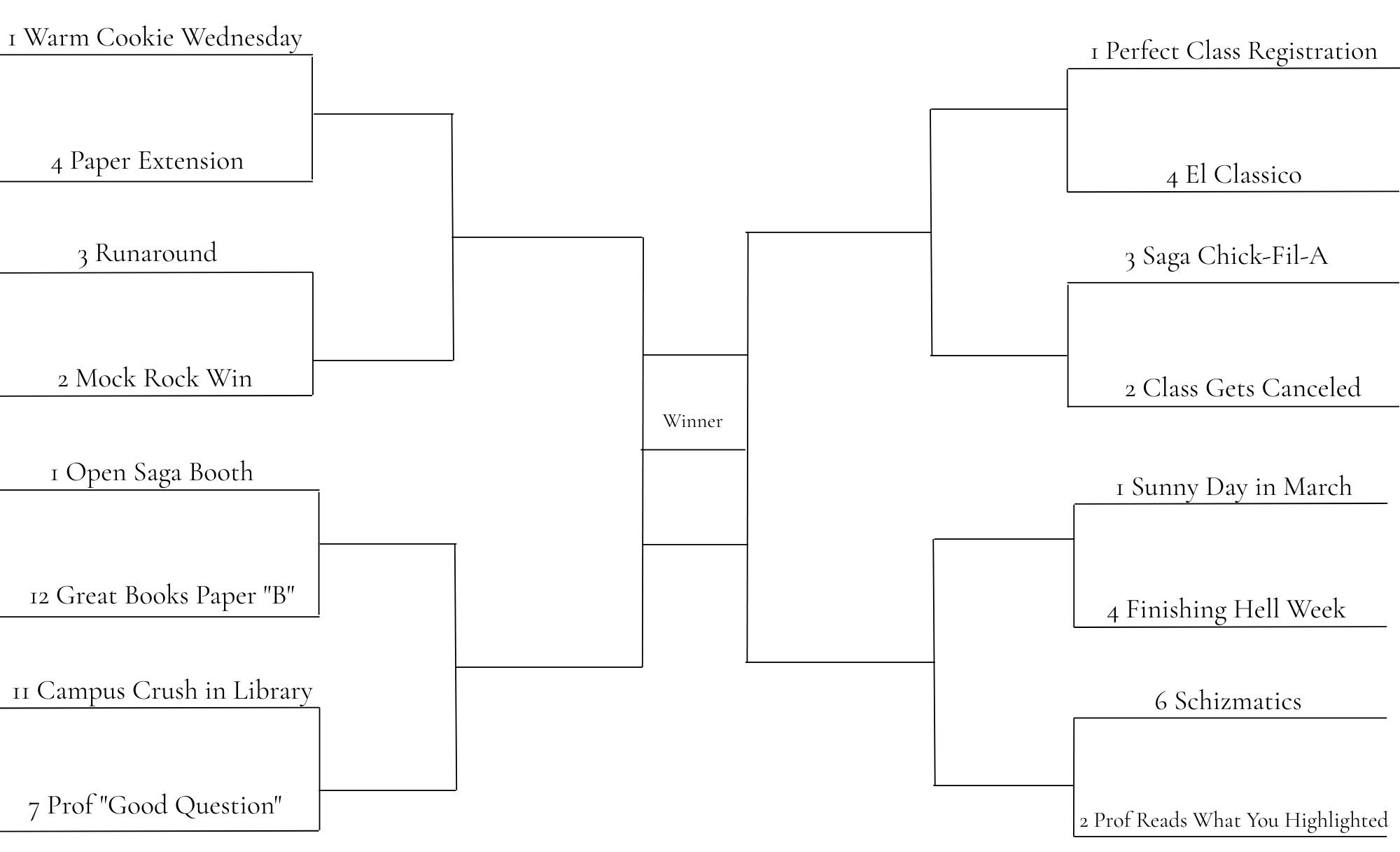
Jonathan Williams created Hillsdale March Madness.
Courtesy | Ethan Savka




Contact Advertising Manager Henry Fliflet with questions or proposals! Hfliflet@hillsdale.edu

Campus Character Lulu Celecia
Compiled by Frederick Woodward Collegian Reporter
Abigail “Lulu” Celecia is a senior English major from Atlanta, Georgia. She is editor-in-chief of the Winona yearbook, (her second year in the position). She also volunteers with journal buddies and community sports, and says most people probably recognize her from Jitters.
What's a movie character you relate to?
Probably Dory from the movie “Finding Nemo.”
Did you apply to any other colleges besides Hillsdale? I did apply to a couple other schools, because my mom made me. But I always knew I wanted to come to Hillsdale and I really felt the Lord calling me here.
What genre of music do you enjoy listening to?
I’m really big on folk music and I definitely listen to a lot of Christian music too.
Do you have any hobbies you have been able to keep doing in college?
Recently I have really loved flying the kite my friends got me for my birthday. I really just love doing anything creative. For example, this summer I built a bookshelf. I designed it, bought the wood, stained and sanded it, and put it together. I
Brennan ended up driving to Michigan after waiting for two-and-a-half hours and missing her flight, not wanting to go through the wait again. The two Runges braved out the line, eventually getting through security after three hours, but not without nearly losing their belongings in the X-ray scanners.
By the time the Runges made it to the gate, their flight had already taken off. Luckily, they were able to get on another flight, which got them to Detroit just two hours after their initial landing time.
“I was literally the last person to get scanned on for standby for that flight, by the grace of God,” Margaret Runge said.
Whitley, despite being in the same airport, had a different experience. Her original flight was scheduled for 9:15 a.m. on Saturday, March 21, and she arrived two hours early for it. After finally making it to her gate at 10:30 a.m. and learning her flight got cancelled, she got a seat on a flight leaving at 9:15 a.m. Sun-
“The point is to see if you can take it all,” Kim said. “You just get used to being aggressive toward people and having them come up to your face and yelling, sometimes literally with spittle raining down on you.”
Junior Macartan Moore, who underwent the first of his six-week sessions at OCS as a sophomore and plans to return this summer, described OCS as challenging and hard, but also rewarding.
“It’s the funniest place you can’t laugh at,” Moore said. “They yell at you. They make
love puzzles, especially the one that we have on our coffee table right now that I think most of campus helped with at some point. I also really love coaching youth sports.
Do you have a favorite conspiracy theory?
I don’t think the moon landing was real. I’m not totally sure, but it’s probably my favorite because everyone has thoughts on it that they refuse to com-

What is a favorite pastime most people don't know you enjoy?
I love golfing, although there hasn’t been a lot of time to keep up with it in college. But in high school I was the team captain.
What compelled you to pick your major?
I decided I wanted to be an English major in my Great Books class with Dr. Dwight Lindley, Associate Professor of English. I loved the way that he talked about the books and the passion that he had it was contagious.
day March 22. “I used the international security line that day, which ended up being closed to domestic flyers later in the morning, and made my gate in plenty of time,” Whitley said. “That flight was then cancelled most likely due to a lack of air traffic control personnel.”
Whitley instead drove nearly 11 hours back to Hillsdale, making it to campus on Monday, March 23 and missing all of her classes.
Thanks to a partial government shutdown that began Feb. 14, TSA agents were left without pay for over a month and a half, finally receiving a retroactive paycheck this past Monday after an executive order by President Donald Trump. Some airports experienced agent call-out rates upwards of 40-50% during the pay drought, according to Yahoo!Finance. In large airports such as Hartsfield-Jackson and George Bush Intercontinental in Houston, Business Insider reported wait times as climbing upwards of four hours. Inside the LaGuardia Airport the morning of March 22, freshman Cam Sellers found
you do some push-ups. They make you hold things above your head for a long period of time, and then sometimes do a collective punishment if someone else messes up. Ultimately, it’s a part of the bonding experience between you and your platoon. You get to work as a unit in order to be better. There are no lone wolves in that.”
Senior David Meyers, who has completed all of his sessions at OCS, said the main lesson OCS taught him is that everyone is responsible for one another in the Marine Corps.
“While OCS is grueling, it is more than feasible to complete all the physical challeng-
every episode would start by showing how people are really stressed.
If you were to give your pre-college self a piece of advice, what would it be?
Don’t worry so much about the future, it all is going to work itself out in God’s timing. Also don’t buy stupid stuff that you don’t need.
What is a fashion trend you wish would come back?
This one’s easy! Silly Bandz!
I’ve tried my best to bring them back into style on campus. Everyone should join me and start wearing them — they add a lot of whimsy.
What instrument would you like to learn?
I would love to learn how to play the guitar! I actually have one but I never learn — hopefully this summer.
promise on. It’s a fun little question to drop and then see how everyone responds.
If you had to rank the top five most important things in your life, what would they be?
In no particular order (other than the first) my faith, friends, family, learning and sharing what I learn, and marshmallows.
If life on campus were a reality TV show, what name would you give it?
“Chillin’ in the Dale,” and then
himself running to make his 6 a.m. flight back to Detroit after arriving at 4:30 a.m.
“I barely made my flight,” Sellers said. “I got to security and got through at 5:49. I then had to sprint and get a ride from a janitor to make it to my gate at 5:55, and then me and some other people had to beg to be let on the plane, which had miraculously not detached from the gate.”
Later that day, a plane landing at LaGuardia collided with a fire truck on the runway, killing both pilots and hospitalizing more than 40 of the 72 passengers.
“The TSA agents were stressed and maybe rushing people through security, and overall everyone was stressed and it just wasn’t a good environment,” Sellers said of the atmosphere at LaGuardia. “If air traffic control was anything like TSA, there was probably a lot of stress and understaffing up there too.”
A stalemate over immigration law enforcement left the Department of Homeland Security without funding on Feb. 14, causing the air travel crisis. The resulting partial govern -
es with a little perseverance,” Meyers said. “What was more difficult was to look out for other candidates who were struggling, all while you are under the stress of weather, physical exertion, and screaming instructors.”
Moore said OCS has given him the ability to build his life around service.
“It gives me purpose,” Moore said. “I believe that everyone should go through something like that at some point in their life.”
Kim, along with Meyers and three other Hillsdale seniors, is set to commission into the Marine Corps as officers upon the morning of graduation on May 9. She said
The children yearn for the fields
‘My sons will be detasseling ’
By Grace Novak Collegian Freelancer
Dawn had not yet broken at 4:45 a.m., but then-12-yearold Claire Pipher jumped out of bed. Pulling on layers of neon clothing and beat-up tennis shoes, she grabbed her lunch box.
She was not headed to school: It was July 15, and she was hopping on a bus for the day’s corn detasseling.
Pipher is one of several Nebraskan students at Hillsdale College who spent weeks of the summer detasseling corn when they were growing up. Students said doing the hard work of detasseling at such young ages taught them valuable life lessons.
“There were some days that we did corn-wrestling,” Manna said. “Other buses had a bounty on a person for the day. If you go and tackle that person you get a bag of snacks. It was kind of unofficial, but it was fun because when you fall on the corn, it kind of just breaks your fall. But as a bus leader, I couldn’t stand for corn-wrestling anymore.”
The kids would work in the fields in all temperatures, according to Pipher. The worst weren’t the days with 100-degree heat, but rather the freezing mornings.
What is the most character-developing event you've been through?
It’s kind of cheesy but definitely coming to college. It was really difficult and a little scary. I was worried about being so far away from home and I was doubting my decision. But the people here are so welcoming and really lifted me up and over the past four years they have encouraged me daily.
ment shutdown is still ongoing, though TSA agents have finally been paid and security wait times have improved. In particular, the debate centers on attempts to reform Immigration and Customs Enforcement.
Meanwhile, the Trump administration sent ICE agents into many airports last week in the wake of the TSA agent shortage. Amidst ongoing concerns about airport safety, this has only garnered even greater public outcry. ICE agents are still deployed in the major airports as TSA staffing is beginning to stabilize.
Runge said she was concerned about the effectiveness of security checkpoints.
“I didn’t feel ‘in danger,’ but with that many people passing through security, it did make me wonder how thorough security can really be,” she said.
Whitley, a Georgia resident, counts herself lucky to be able to take a road trip home once the school year comes to a close.
“Suffice it to say I’m grateful I’ll be driving home at the end of the semester,” she said.
that above all, her experience in officer candidate training has shaped her leadership, personality, and faith.
“I think God taught me a lot about having confidence in him, being able to confront hard things, having had conversations, and being a better leader,” Kim said. “If you are considering being a Marine officer, that’s a weighty thing, and you’re part of a noble tradition and something that’s greater than yourself.”
“Oh my gosh, we were decked,” said Pipher, a junior, and current head RA of Olds Residence. “They are sending out children into literal cornfields, so they dress you in neon clothes so they can spot you, because the corn is taller than the children.”
Detasseling is when the stalk in the center of the corn that holds the pollen is removed. Farms use machines to detassel the majority of the corn, but it must be done precisely to avoid unwanted pollination. Therefore, detasseling crews manually go through the fields to remove any tassels the machine may have missed.
“Basically, detasseling is the process of making new hybrid corn,” said Josiah Manna, a freshman from Omaha, Nebraska. “There are four rows of female corn with one row of male that’s trying to pollinate the whole female. You want to get all the female tassels off, so then it can’t pollinate itself and will accept the male, making the new hybrid.”
For kids and teenagers in Nebraska, detasseling is a way to make some money over the summer, especially if you’re not of legal working age. Pipher remembers detasseling for four summers of her childhood, starting at age 12.
“It’s basically for anyone who is too young to get paid anywhere else,” Pipher said. “You get paid great money, and it is the greatest character building.”
Detasselers are often employed through a larger company, such as Not Afraid To Sweat Detasseling, Inc. According to Pipher, the kids hop on buses and are escorted to fields where they spend about a month of the summer on daily trips detasseling.
“I can see how some might view it as child labor,” said Nebraskan sophomore Joseph Bromm. “But I think it’s character building.”
Detasseling is unique to the Midwest, but the skills gained from it would be beneficial for any young adult, according to Pipher.
“It forces kids to spend their summers earning money for themselves, working hard and stepping outside of their comfort zones, and there’s no other legal way to do that as a 12-year-old,” Pipher said. “It’s really hard, dirty work and a really great opportunity to see what it’s like to work hands-on and be rewarded for it.”
The kids work about 70 hours a week for four weeks, often making thousands of dollars. Manna worked as a detasseler for four years, starting at age 15, before moving to a position as a bus leader taking other groups of kids detasseling.
“You have to wear glasses and gloves, and it's recommended to wear long pants so your legs don’t get corn rash,” Pipher said. “And you wear shoes that you will never want to see again, because they will be so saturated with mud and dirt that they will expand and you won’t be able to fit your foot in halfway through the season.”
Pipher said the wet dew of the early mornings on top of the green corn stalks has a unique smell familiar to all detasselers.
“The first time I threw up in the field was because of the smell of the corn accumulating on my gloves,” Pipher said. “I got to the middle of the field and was just feeling nauseated from the smell and the heat and the walking, and I threw up but immediately felt better.”
Manna said as a team lead, he had to be aware of the possibility of kids passing out from the heat. They worked hard to keep morale up with chants and songs.
“Every once in a while there’s a nectar that we give out,” Manna said. “It’s super strong Gatorade that you give out when it’s really hot.”
While some kids quit after a day or two, most stayed and loved the opportunity.
“It’s hard, grueling work done in the dog days of summer, but I’d recommend it,” Bromm said.
Both Manna and Pipher agreed detasseling was formative in their lives.
“We are paid by the hour, not by the row. We don’t require people to work on Sundays, and the work environment there is really good,” Manna said.“You basically have all Christians running all the buses.” Although intense, detasseling is rewarding and all about team work. If one bus is falling behind on a field, another will drive to help them finish on time.
“If pulling tassels doesn’t sound that hard, you probably haven't done it thousands of times without a break,” Bromm said.
Pipher jokingly described detasseling as similar to the Hunger Games Reaping Daystyle of child labor, but minus the death and plus money and character-building experiences.
“As soon as I turned 16 and was old enough, I was in a certified nursing assistant class, so I would never have to look at another field again,” Pipher said. “Detasseling made me appreciate school and everything in life more when I wasn’t detasseling.”
Both Manna and Pipher said they will be sending their kids to detassel when they have families in the future.
“I’m super pro-detasseling,” Pipher said. “My kids will be in the fields. My sons will be detasseling.”
TSA from A1
Marines from B6
Celecia s first concert was a Cher performance. Courtesy | Lulu Celecia

By Grace Brennan Assistant Editor
Isaac Green ’25 is taking his music career beyond Concert on the Quad while he lives in Hillsdale, performing gigs every month and working on creating his first EP with record producer Tyler Neil Johnson.
“My hope is to release a few singles in May, and then release an EP eventually,” Green said.
Green commutes to Lansing three to four days a week working for the state House of Representatives. When he’s not working he continues to write music and polish his songs in the studio.
Green said he’s excited to now be working with one of the best music producers in the industry and ready to create professional music that’s fully himself.
“It is truly an expression of where I’m at right now, and I’m excited to keep working on more projects, whether it be with the producer in Toronto, or anybody else who I get the opportunity to work with,” Green said.
Green’s housemates, Lost Mary band members Luke Martin and David “DJ” Johnson ’17, said they see a bright future for Green’s music, and connected him with their producer in Toronto.
“I went to Toronto over Halloween last year to record three songs with him,” Green said.
“Then I was just there last weekend again to record more and do some patchwork over the previous three songs that we’ve recorded.”
Green started learning how to play the guitar when he was 10 years old and took sporadic lessons throughout high school. He then began to play the guitar and
Green ’ s ‘Gone Out’ into the music industry Quick Hits Benjamin Beier
Compiled by Evelyn Kniffen Collegian Reporter
In this Quick Hits, Associate Professor of Education Benjamin Beier talks Kansas City sports, literature, and parenting his four children.
How has having children changed you?
I get a lot less sleep. My children teach me things and show me ways to have fun all the time, which I really appreciate.
How did you decide you wanted to be a teacher?
I think I just loved to learn, and saw it as a way to not have to stop learning. By the time I knew I wanted to teach, I was hoping to teach college.
sing more seriously during his time at Hillsdale College, where he worked as an editor for The Collegian, and self-produced his first song “Gone Out.”
While considering going to law school Green has been working on finding the right outlet for his music. He finally found himself in the right place, at the right time, Martin said.
“If you’re trying to pursue music it gets rocky, and it gets boring, and it takes a lot of money and energy,” Martin said. “I know Isaac’s conflicted with that. But I think he’s finally leaning into pursuing his music, and I think he should. He has it, he should do it.”
Martin said Green has a good intuition and ear, and that’s evident in his song “Gone Out,” which he released last year. But with the help of a producer, Martin said, Green will be pushed to be great.
“Recording with a professional producer can change things up,” Martin said. “Before it was just him in his room with the microphone and his computer, and he’d stop himself to be a perfectionist. But when he goes to record with the producer, the producer says, ‘Let’s do it,’ and he just has to start playing through it. He will just start going for it.”
The journey of writing, playing gigs, and working with a producer for the first time has been rewarding, he said.
“This last year has been so different from what I expected it to be in a lot of ways,” Green said. “But so beautiful in so many ways I never anticipated.”
In the last year, Green has written roughly 12 songs that he’s considered to record, five of which will show up on his EP. He said although he wrote on topics
such as travel, planning, and peace in the waiting, the songs his producer advised to put on the EP are all in the category of relationships.
“I have written a lot about relationships,” Green said with a laugh. “So it all turned out to be songs about relationships on the EP, not by intent.”
According to Green, he is regularly working on a song, but during his first production process he hasn’t had as much time to be inspired and write.
“I didn’t really write anything seriously probably for a couple of months, and now I’m getting back into it,” Green said. “Otherwise, I would say I feel like I’m writing 75% of the time. I’m generally in a season of life where I’m sitting in my house playing my guitar all the time, and usually working on ideas.”
In both songwriting and production, Green takes inspiration from artists such as Tyler Childers, Gregory Alan Isakov, and Jim Croce. Green said the country folk genre is his favorite for its poetic melody and verse.
“It’s simple — but that’s the point of that genre,” Green said. “In a lot of ways it’s supposed to connect you on a very personal level, and it’s something that you don’t need to be a musical prodigy to appreciate the musical aspect of it. It’s just lyrics that are down to earth and really beautiful.”
Green’s writing process begins on the guitar before it appears on paper.
“Usually I start with an idea that I’m fiddling around with on the guitar,” Green said. “And usually that idea will be inspired by what I’m thinking about mentally. But I don’t have any words to
start off with.”
According to Jack Cote ’25, who helped Green with his cover art and social media content, Green’s songwriting gets better with every new recording.
“He’s the best songwriter I’ve ever met,” Cote said. “He bridges the gap between telling stories about his personal life and writing about universal feelings and experiences.”
DJ Johnson said Green is not only a great songwriter, but a great composer.
“He’s very dialed into the sound of his voice,” DJ Johnson said. “However he plays the guitar, whether he’s playing too hard or too soft he’s very dialed into that. He’s a great songwriter, but this makes it so he’s also like a composer. He thinks about how his voice is fitting in with the guitar.”
From the way Green writes his music to the way he plays it, he is honest and methodical, Martin said.
“I think he’s a thoughtful lyricist,” Martin said. “You can tell it’s not just words on a page. There is a lot of thought that goes into it. It’s reflective in many ways.”
Green plans to continue writing music, and he looks forward to the release of his first EP. According to Martin, Green’s success will come from his skill and style.
“He is a super humble, talented guy, and I have high hopes that he’ll succeed very well,” Martin said. “I can see within two years him having millions of streams. Hell, I could see him playing with Zac Bryan in five years time. He has the talent. And he has the intelligence.”
‘No lone wolves’: Meet Hillsdale’s Marine candidates
By Elijah Guevara Assistant Editor
Amid bear crawls, arduous marches, and endless pushups directed by screaming instructors at the U.S. Marine Corps Officer Candidate School, the only thing that came to senior Jihye Kim’s mind was to pray and recite Bible verses.
“It was so hot that the floor was slick with sweat,” Kim said.
“I was just like, ‘The Lord is my shepherd.’ There’s nothing else you can do.
“ They start screaming, you start screaming, and the instructors are making everyone run around to try to cause friction and stress in you.”
You’re just left with your own head, your own mind space, while they’re trying to break you mentally.”
With the Virginia humidity bearing down on her, Kim trained through six weeks of OCS, a rigorous program designed to break down and evaluate future officers of the Marine Corps, widely regarded as one of the most intense training regimens in the U.S. Kim is a member of Hills-
dale’s Marine Platoon Leader Class, a program for students that helps them become commissioned as Marine Corps officers upon graduation. But before they can receive a commission, students must complete two six-week summer sessions or a single 10-week session at OCS on the Marine Corps Base in Quantico, Virginia. When Kim arrived at Quantico for her second six-week session last May, the pressure and intensity began immediately.
“As soon as the instructors introduce themselves, all hell breaks loose,” Kim said. “They start screaming, you start screaming, and the instructors are making everyone run around to try to cause friction and stress in you.”
Kim said, above all, OCS is a test of strength and character.
Do you have a favorite book you would recommend to Hillsdale students?
A book that I think is a little less known that is beautiful is Thornton Wilder’s “The Bridge of San Luis Rey.”
Are you a cat person or a dog person? Neither. I’m a fish person.
Do you have a fish? No.
What’s stopping you from getting one?
Because my kids would prefer to have a dog. We have two guinea pigs.
How did you meet your wife?
We crossed paths a few times, but the best story is we were at a large state university and we
both took a class on the literature of Dave Barry and Garrison Keillor. I took the class because I enjoyed Dave Barry and she took the class because she
enjoyed Garrison Keillor, and we discovered one another and tried to convince one another of the superiority of the other author.
Was there a moment you realized she was the one?
How could she not be the one?
If you had to give a piece of advice to all of the students at Hillsdale right now, what would it be?
Don’t take yourselves too seriously.
What’s your best random hot take?
More people should listen to jazz.
What's the best vacation you’ve ever taken?
Six weeks in Europe after college graduation.
What’s your favorite sports team?
My sports life is complete. I root for University of Kansas
basketball, the Kansas City Chiefs and the Kansas City Royals, and all three have won championships within my memory.
Why is education important? Because it helps us to live a truly human life.
If you could change one thing about the education system in America right now, what would it be?
I would love to see a lot more small schools.
Who do you think would win in hand-to-hand combat, Chief or 25 Dr. Arnns? Chief.
Do you have a favorite spice? Garlic salt.
Green started playing guitar when he was 10 years old.
Courtesy | Mason Dice
Benjamin Beier with his wife Emily and their children Anna, Henry,
Genevieve, and Moira.
Courtesy | Benjamin Beier