The Hillsdale City Council voted 8-0 to repeal a policy requiring the use of special assessment districts to fund road repairs at its March 16 meeting.
SADs designate dilapidated roads for repair and charge residents on that road up to $5,000 per parcel. The council’s new approach is to leave SADs as an option for interested districts, but to also use alternative sources of funding.
At the March 16 meeting, city staff presented the council with two alternatives to special assessments: raising property taxes by increasing millages or reducing costs by decreasing the scope of individual projects.
By Elizabeth Caneday Collegian Freelancer
Construction will begin on the Knorr Student Center this May, turning the main floor of the building into an admissions welcome center and offices, according to Chief Administrative Officer Rich Péwé.
“There will no longer be a snack bar in this space,” Péwé said. “The entire admissions department and its personnel will move to this new space. The bookstore will also move from the Grewcock Student Union into the welcome center, and the old bookstore will become the Career Services space.”
Construction on this project will take 13-15 months to complete, according to Péwé.
“It will be beautiful,” College President Larry Arnn said. “It will not take as long as the library nor disrupt the quad nearly so much. We will get through it, and then we
will be glad.”
Arnn said one benefit of the new welcome center will be its location, attached to the Dow Hotel and Conference Center where admissions visitors stay. According to Arnn, most of the funding is ready for the college’s use.
“We have gifts for the lion’s share of the cost, and the people who gave it are ready for us to get started. And we need it,” Arnn said.
Associate Vice President of Admissions Zachary Miller said the admissions office space in Central Hall isn’t big enough to meet growing needs. He said during busy periods, the lobby is standing room only, and there are not enough offices for all the staff.
“Over the past 10 years or so, the admissions office has experienced growth in many areas, including guests to campus, applications for admission, and the number of staff members,” Miller said. “In many ways we have out-
grown our current space in Central Hall.”
For these reasons, Miller said the department is very excited about the new welcome center.
“It will be designed to greet any visitor coming to Hillsdale College,” Miller said. “As the starting point for their time with us on campus, it will give an impressive, beautiful first impression for our guests.”
The Knorr Student Center, including the “old snack bar,” was built in 1964 to serve as a student union. In 2008, when the Grewcock Student Union was completed, the old snack bar became a student lounge.
“The interior, its structure, HVAC, electrical and plumbing systems, and the patio and exterior façade will be substantially altered,” Péwé said.
Indoor track & field scores two national titles
By Francesca Cella Assistant Editor
Sophomore Ally Kuzma and senior Ben Haas won national titles and set Hillsdale College records at the NCAA Division II Indoor Championships March 13-14 in Virginia Beach, Virginia, leading women’s track and field to 11th place and men’s to 16th place.
Kuzma won the national title in the 5K with a time of 15:58.57, breaking the
school record by 15 seconds and beating the runner-up by more than 18 seconds. The U.S. Track & Field and Cross Country Coaches Association named her track athlete of the year in the Midwest region.
“Right at the end, when I was on the final stretch, somebody passed me. It turned out that it was them messing up a lap, thinking they were done when they weren’t. But I was fully convinced some people were right behind me,” Kuzma said.
Kuzma also ran the 3K in 9:33.57 and finished 13th. Haas won men’s weight throw with a mark of 22.97 meters, beating his former school and Great Midwest Athletic
Conference records. He also placed first in men’s weight throw at the 2025 NCAA DII Indoor Champion ships, and is the first athlete in
Hillsdale College history to be NCAA DII champion in consecutive seasons for the same event. The coaches association named Haas the midwest
region field athlete of 2026. Haas also placed 15th in men’s shot put with a mark of 17.08 meters.
“This year was definitely the most fun I’ve had at a national meet, mostly just because we had such a big throwing group there,” Haas said.
“This is the first time I’ve actually competed with another guy thrower at nationals. It was great to see Scharer PR and get third place in his first nationals.”
Committee considers new comprehensive exam
By Caroline Kurt Opinions Editor
Future Hillsdale students might be required to take a comprehensive core exam, according to members and advisors of the core curriculum review committee.
The committee began its review of the core curriculum in November and will have its
on those, even if I wanted to, because they haven’t decided.”
Changes will largely focus on areas of the core altered by the last review committee, which met about 15 years ago.
“What we’re hoping to do is take the core that we have and make it stronger,” said Associate Provost Mark Maier, a non-voting member of the committee.
“If I were a betting man, I would say that you’re gonna see some fine tuning, but not a major overhaul.”
final meeting of the semester in April. Afterwards, it may propose specific changes to the core, Hillsdale’s set of courses in humanities, sciences, and more that all students are required to take. The entire faculty would then vote on the changes recommended by the committee. If adopted, the changes would not affect students currently enrolled at Hillsdale.
“The biggest ticket items are still on the table for meeting six: the comprehensive exam idea, the structure of the capstone, and this question of how we evaluate core scholarly skills,” said Samuel Negus, director of program review and accreditation and the non-voting secretary of the committee. “I couldn’t tell you which way they’ll go
1
By Caroline Kurt Opinions Editor
The Film and Production club will debut two new student films, “The Old World Yet” by senior Ty Ruddy and “Stain” by senior Charlie Cheng, this weekend.
“I am confident enough to bet money with most people that they’ve seen nothing like this before,” Cheng said of his film. The club will show the films at 7:00 p.m. on Friday, March 27 and Saturday, March 28 in Plaster Auditorium. After the Friday showing, attendees can stay for a Q&A session. In addition to the new films, the club will screen a short film by senior Joshua Burnett, “Forced Perspective,” which came out last semester.
Cheng, the club’s president, said he shot his film in two
about five minutes featuring only two main characters, myself and a 7-year-old whom I found from church,” Cheng said. “The film is about childhood trauma, but told in a visually artistic way.”
According to Cheng, the film has no dialogue, instead using visuals and music to tell a story.
“I essentially wrote it, filmed it, directed it, edited it, and now actually, as I’m talking right now, I’m writing music for it,” Cheng said. Cheng said he is hopeful his audience will grasp his message.
According to Maier, the most radical change to come from the review could be changes to the senior capstone and College President Larry Arnn’s idea for a comprehensive core exam, though the committee has not discussed the specifics of either yet.
“We wanted to get rid of the idea that the core was just something that you just get out of the way and then move on to your major, and that’s what is most important,” Maier said.
The comprehensive exam might incentivize students to retain that information, Maier said.
in 20 Hillsdale grads go to medical school
By Luka Stevlic Collegian Freelancer
About 5% of Hillsdale graduates over the last seven years have gone to medical school, according to Christopher Hamilton, professor of chemistry and the college’s pre-med program adviser.
“Most students who do not receive acceptance in the first round are able to enrich their application and are admitted to medical school the following year — meaning 96% of applicants in the past 10 years have been admitted to a U.S. medical school,” Hamilton said.
According to Hamilton, Hillsdale students have been accepted to medical schools including Tufts University, Western Michigan University, and Michigan State University, and the college’s 2024 MCAT average of 509.3 exceeded the national average of 500.6. Of graduates in the classes of 2022–2024, 94% of first-time medical school applicants were accepted, he said.
Hillsdale’s pre-med program allows students to combine any
major with the coursework required for medical school while receiving a liberal arts education, Hamilton said, adding that some students major in non-STEM fields such as psychology, English, or Spanish. The program also includes a full-year anatomy and physiology course with cadaver dissections, which provides hands-on experience that is uncommon for many undergraduate students.
“I really enjoy the pre-med track. It’s flexible, and the professors I’ve taken have been excellent,” said junior Michael Collier, a philosophy major on the pre-med track. “Having a cadaver lab at an institution of our size is really awesome — some medical schools don’t even have physical cadavers anymore. Being able to do hands-on work with a cadaver has helped me understand the human body in a way that lectures alone never could.”
Students film ‘The Old World Yet,’ which premieres on Friday. Back, from left to right: Nathan More, Peter Gilchrist, and Joseph Johnson.
Courtesy | Natalie Kottom
From left to right: Peter Gilchrist, Joseph Johnson, and Haven Socha during filming. Courtesy | Natalie Kottom
Ben Haas and Dominic Scharer
Courtesy | Ashley Van Hoose
R.P. White and Ally Kuzma. Courtesy | Ashley Van Hoose
Clean shoes and gold coins: Kehoe students start new business
By Christina Lewis Assistant Editor
Four Hillsdale students have started a shoe cleaning business as part of their Kehoe Fellowship project.
The Kehoe Fellowship gives students a practical, hands-on experience in entrepreneurship, according to Jen Lutz, the fellowship’s director. Freshman Russel Mangiapane and sophomores Ianna Chan, Ashley Luke, and Rylan Conley started the St. Nick’s Shoe Cleaning Service at the end of January. Customers can get their shoes cleaned for $5, and can get their leather shoes polished or waterproofed for an additional $3. Shoe drop-off locations are
in Mauck, Simpson, Delp, the Splex, and by the mail lockers in the tunnel connecting Lane and Kendall Halls.
“Customers can just bring their shoes to the box,” Chan said. “We have bags for them to put the shoes in, and they simply fill out a form and submit their payment. And in filling out their form, they’re able to put their place of residence or their office. On Saturdays, we will — my team and I — clean shoes in Simpson, and we have a guarantee where we’ll deliver them in two days in a cute bag with gold coins.”
Lutz said she thought St. Nick’s was a very practical idea and a useful service to fill a need at Hillsdale.
“I also appreciate the creativity behind the name,” Lutz said. “It’s a nod to Saint Nicholas, who according to tradition tossed gold coins into homes, sometimes landing in shoes drying by the fireplace.”
The St. Nick’s business team identified a need on campus and created a business with relatively low startup costs and a simple, scalable model, according to Lutz.
“St. Nick’s started because shoe shining was something that Rylan and Russel had experience with, and Ianna and I were excited to learn something new,” Luke said. “We each have our own roles that play into our strengths, and it’s been fun to see how everyone has grown into their position. Russel and Rylan usually do most of the cleaning and finances, and Ianna and I do the delivering and marketing. But the boys taught Ianna and I how to clean as well, so now I know a fair amount about leather polishing.”
All the drop-off boxes contain cards that customers can fill out with their information and include if they’re paying with cash in the bag with their shoes, according to Mangiapane. Customers can choose what kind of shoe cleaning they would like to receive.
“With Rylan, Ianna, and Ashley, we were brainstorming what would work as a business,” Mangiapane said. “What does everybody need? What need could we meet around campus? And then also, what would be at
a low enough price point so that it’s accessible for a lot of students around campus? And then that’s how we kind of got the idea for St. Nick’s shoe cleaning service.”
Although Kehoe fellows have their own businesses, they were divided into three groups of four, with each group tasked to start a business.
“We ended up coming up with the idea to clean shoes, because everyone here has dirty shoes, especially during the winter and the salt and stuff,” Chan said. “So cleaning shoes was something that we found would be a great way to improve campus and to turn into a business.”
Starting a business as a team of four busy college students can be challenging, according to Luke.
“I have really appreciated the time and effort that we have put into the business and how we have seen both it and ourselves grow,” Luke said. “The director,
Jen Lutz, has encouraged us at every step of the way and helped us brainstorm through problems we have come across. Figuring out how to work with a team is something I have learned in a special way through Kehoe.” Chan said her business team would appreciate the support of students and faculty.
“What’s so great about Kehoe is that you don’t have to have a substantial business making five figures a year, like you can even have a business plan, and they’ll just meet you where you’re at, and they’ll just help you grow in that manner,” Chan said. “They bring in such great mentors that really pour into you.”
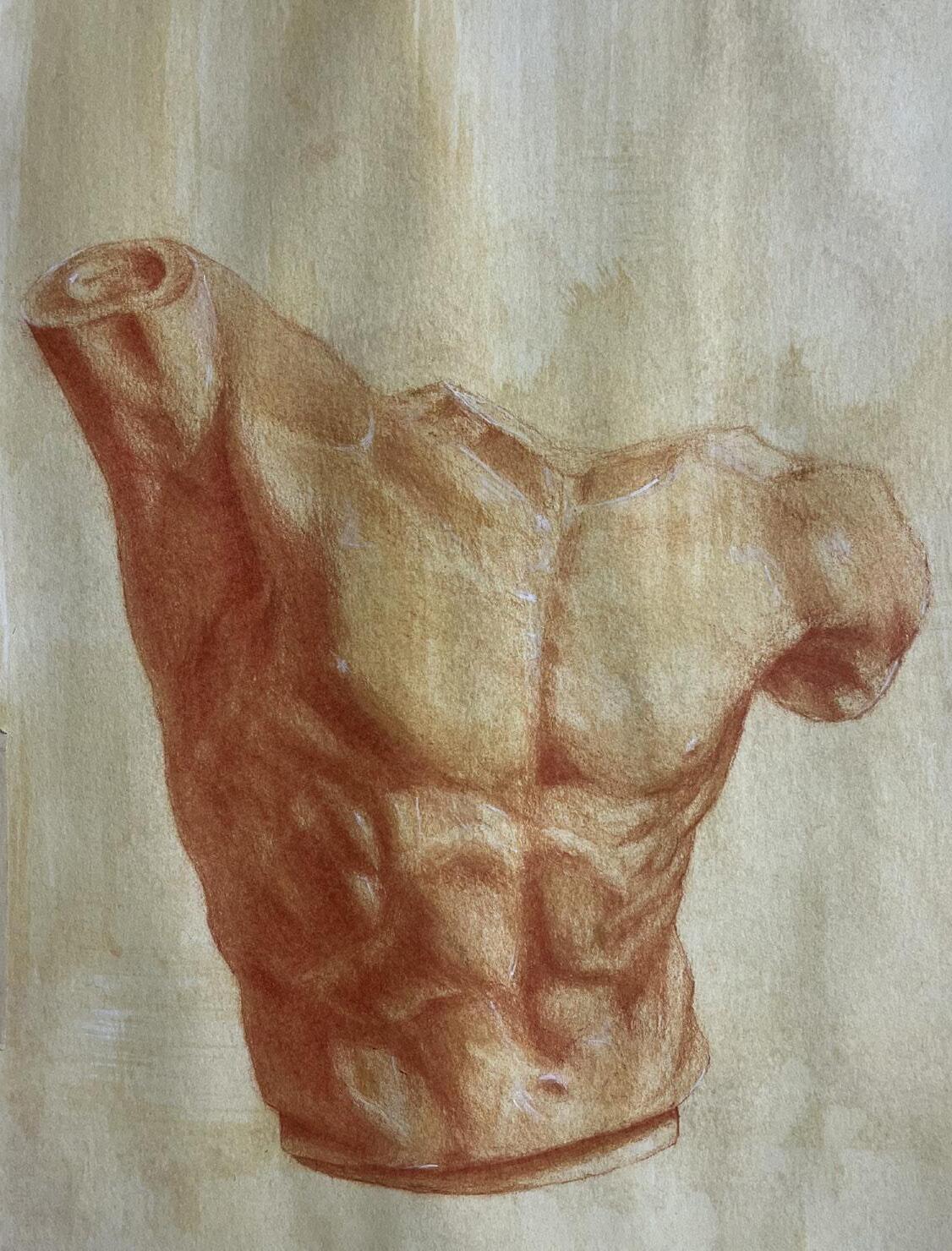
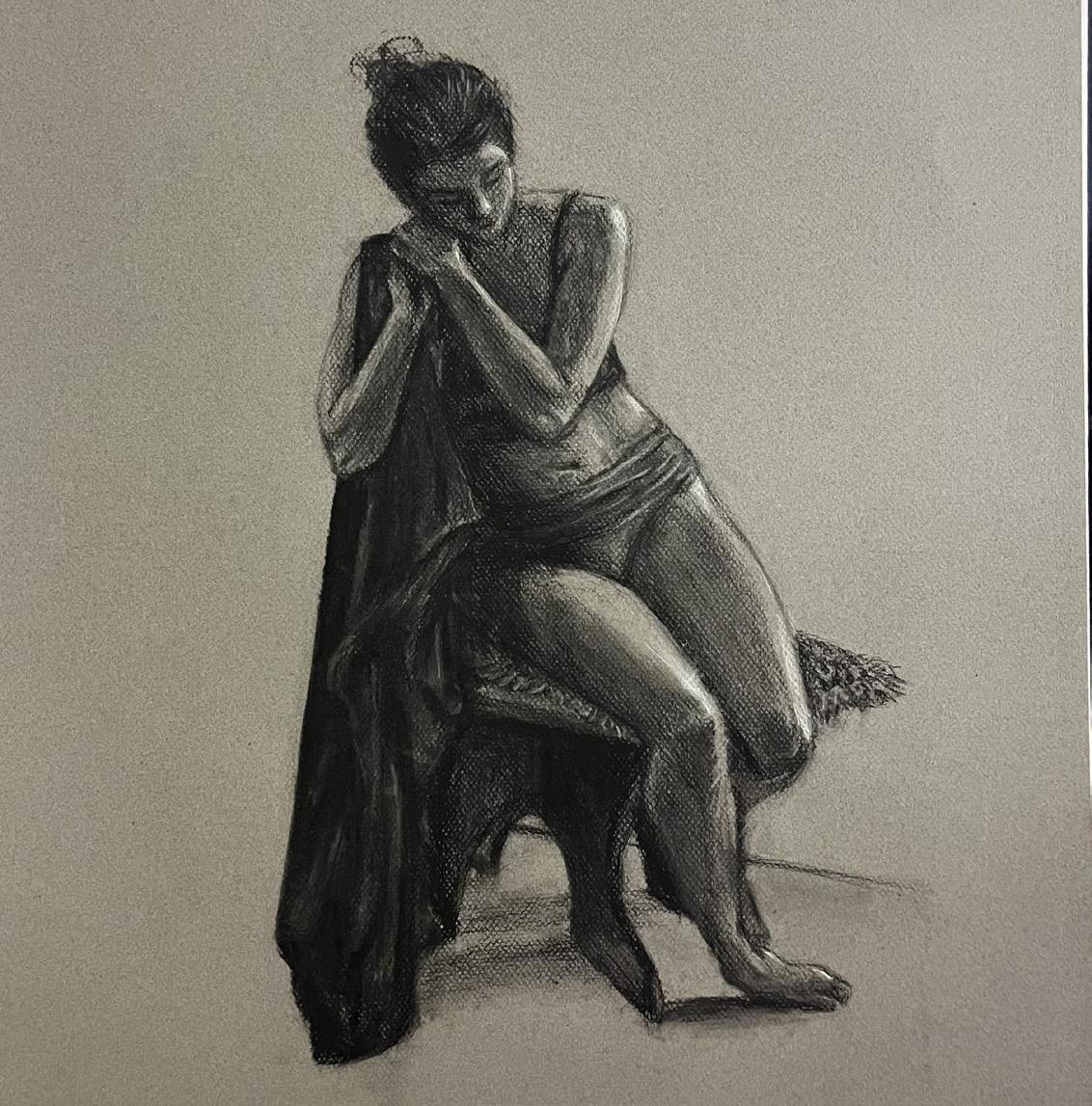
Students can submit original artwork for next year’s student planner
By Lonán Mooney Collegian Reporter
Students can submit their campus artwork to the Student Activities Office for an opportunity to have it displayed on the cover of the 2026-27 school planner.
Hillsdale’s artists are given the opportunity to design a cover for the upcoming school year’s planner each year. Designs can be any medium, including digital art, watercolor, and oils. These planners will be distributed at the beginning of the academic year on
Core from A1
“We also wanted the core to be the sort of thing that students carried on from here — what they learned in the core was something that they took out into their lives,” Maier said.
The comprehensive exam could possibly be located within the senior capstone requirement, according to Negus.
“The committee might decide to do something different, but that is one very obvious practical possibility to take care of both the core exam and capstone at the same time,” Negus said.
The committee has discussed the logistics that go into choosing core classes, including the different requirements for Bachelor of Arts and Bachelor of Science students, Maier said.
“What would the ideal first-semester freshman schedule look like? What would the ideal second-semester schedule look like?” Maier said. “That’s been the focus of a lot of the conversations.”
Associate Professor of English Lorraine Murphy, a voting member of the review committee, said the committee’s role is not to enact changes, but to make recommendations that the entire faculty will vote on.
“We’ve considered a range of options, from streamlining the core curriculum to expanding it, and we’ve spent quite a bit of time considering whether a
campus. Judges will determine a winner following the submission date.
Competition organizer Emma Widmer, assistant director of the Student Activities Office, said individual perspective is important with the artwork.
“The campus planner is a resource that is made available to students, faculty, and staff each year,” Widmer said. “For its cover, we are looking for a piece of student artwork that would appeal to this wide audience and capture the beauty of our campus and
more structured or ‘sequenced’ path through the core would be helpful to students,” Murphy said.
Maier joined the provost’s office in 2011 and had a hand in implementing the changes of the last core curriculum revision.
“One of the big changes that happened in 2008 was the decoupling of the Great Books and the Heritage classes,” Maier said. “There’s always been this goal of having a common experience for students — that the students are largely going through the core at a similar pace, exploring the same ideas.”
With the exception of Western Heritage, students haven’t had much direction in the sequencing of the core, Maier said.
campus culture.”
The completed design should relate to the individual student experience, the beauty of campus, or the values of the school, according to Widmer.
The school recently made the move to student cover designers. A recent student cover designer was Caroline Hennekes ’21. Hennekes worked on watercolor depictions of Central Hall, and the school marketing team contacted her, requesting to use them for the 2019-2020 and 20202021 covers.
“I chose photos of Hills -
quately cultivates and develops students’ scholarly abilities, according to Negus.
“What do students need to do college-level undergraduate work within the range of what Hillsdale College deems acceptable?” Negus said. “Are our students actually coming in with those things? Are they getting developed in the core? Are they getting developed consistently? We’ve looked at that question, and we’ll consider some recommendations for what we can do there.”
Another possible change
dale campus that I took myself so that the piece is wholly my own work,” Hennekes said. “I also tried to pick photo references with unique perspectives of campus and Central Hall and veer away from references that are clearly a particular season because people will be using these planners all year round, not just in peak fall or winter.”
Freshman Isabella Zatko appreciates the hands-on experience the school provides, as a competitor in the competition.
“It’s really cool that the
application. Should there be a requirement that students have to do this, but it not be a credit bearing class?”
The committee also discussed the Great Principles introductory science courses, physical wellness, and the requirement to take philosophy and religion.
“In 2008, the last core revision was a structural redesign,” Maier said. “What we’re doing now is not a redesign, it’s more of a tweaking and refining.”
Negus said the committee has focused on areas of the core introduced or altered with the last core revision in the late 2000s.
“What would the ideal firstsemester freshman schedule look like? What would the ideal second-semester schedule look like?”
“We’ve spent a lot of time talking about what are the sort of classes that are better experienced early in the college career, as opposed to those that can wait till later,” Maier said. “We discovered that there are a lot of students that take a good chunk of the core at the end of their college careers. And there’s a lot of different reasons for that.”
The committee is also considering whether the core ade-
would be to alter or eliminate the Physical Wellness Dynamics class, Maier said.
“Up until fairly recently, it used to be that everybody would take activities courses to satisfy that particular part of the core,” Maier said. “We talked about whether or not we need to go back to that. We talked about whether or not we need to change the course as it exists and streamline it and make it more geared toward practical
“This fall will be a full 10-year cycle since the first freshman class to take revised curriculum came on board, and it’ll be about 15 years since the initial recommendations were made, and so that just seemed like a good period of time to revisit those changes,” Negus said.
Maier emphasized that the committee has not decided anything.
“This is all just a matter of putting together the information that we have and talking to people and hearing ideas,” Maier said. “This semester, we’re
students get a chance to participate in the cover design instead of just having an administrator design it,” Zatko said.
“It gives us more of a sense of being a part of a greater community of the school to be able to use our God given talents to create something we all can benefit from.”
Freshman art major Elizabeth Cavrell said this competition allows artists an opportunity to recognize the complex elements of creating art in a professional field.
“It’s a great opportunity to think about how the composi-
going to formalize a list of recommendations for the faculty, and then that’ll probably be presented to the faculty for their vote in the fall next year.”
For the most part, Maier said, whatever changes are approved will only apply to the freshman class the following year, allowing students already enrolled to continue the core that was established when they arrived at Hillsdale.
“The changes are going to be mostly modest,” Maier said. “If I were a betting man, I would say that you’re gonna see some fine tuning, but not a major overhaul.”
After the April meeting, Negus said the committee will draft a report summarizing their discussions and recommendations, and will send the final draft to the entire faculty for discussion and a vote in the fall of 2026.
“It’ll be sometime before Thanksgiving when we should have a set of recommendations that the faculty has formally adopted,” Negus said. “Then it would go to the president and to the board of trustees, probably in the spring meeting of the next academic year.”
tion, style, and subject matter will affect the marketability of the piece one will submit — how it affects the appeal of the piece, and what best represents the college,” Cavrell said.
More details regarding the competition can be found in the SAO newsletter.
Academic Services will remain in the basement of Knorr until the south library addition is finished, which could take several years, according to Péwé. Junior Jonah Starr, the president of swing club, which meets in the old snack bar on Friday nights. Starr said he will be sad to see the old snack bar go.
“I understand that the college would like to get all of the construction done, but in doing so they are killing all of the spaces where students gather,” Starr said.
“At the start of my freshman year, the booths and tables outside were almost always full of people studying, and there would be events from various student groups there all of the time. Sadly, like heaven and the top floor of the student union, the OSB has already fallen from its former glory.” Construction will begin after commencement, according to Péwé. He said that Rockford Construction will be the general contractor, and the architect will be James McCrery, who also designed the Diana Davis Spencer Classical Education building.
photography, or graphic design please contact Thomas McKenna at tmckenna@hillsdale.edu.
OSB from A1
Carson Brower, the first customer, drops off his shoes. Courtesy | Ianna Chan
Ianna Chan and Russel Mangiapane with their buisness. Courtesy | Ianna Chan
Cleaned shoes are delivered to Mauck. Courtesy | Ianna Chan
Students to prepare for Holy Week with recitation
By Elaine Kutas Sports Editor
The Hillsdale Memorization Club will offer an event for Holy Week and respite from studying with a night of recitations March 31 at 7 p.m. in the Heritage Room.
Junior Evelyn Freedman organized this memorization event hoping to realign mindsets back to the weight of the Holy Week events.
“At the Holy Week recitation, students will recite poems and scripture thematically involved with the events of Christ’s death and resurrection,” Freedman said. “These include prophecies from Isaiah and excerpts from T.S. Eliot’s ‘Four Quartets.’”
The Memorization Club gained official club status in the spring of 2024. Freedman said the goal of the club is absorbing and sharing the beauty of art.
“The club puts on recitation events for people to share poetry, beautiful passages, or scripture that has been a gift for them with the community,” Freedman said.
Junior Abigail Stonestreet has participated in past memorization recitations and will be reciting Isaiah 55 this Holy Week.
“It’s a beautiful passage about the word of God as something that feeds the earth and his people,” Stonestreet said. “I have been fed by memorizing it, and it has made me reflect on the rich goodness of the word of God, and how it sustains all things. It is a very prevalent passage for Lent, Holy Week, and the resurrection.”
Stonestreet said her favorite event she has been involved with since the founding of the club was their recitation of the gospel of Luke.
Pre-med from A1
Freshman Bodie Starr, a biochemistry major, said Hillsdale’s small size and student-faculty relationships are a major draw.
“I knew I wanted to attend a small school while I study premed, and based on visits and talking to students at a few different schools, I felt that the Lord ended up leading me to Hillsdale,” Starr said. “The pre-med program at Hillsdale was par ticularly exciting to me because of the student-teacher re lationships formed and the cadaver lab.”
clinical experience through volunteering at hospitals, nursing homes, and medical offices, according to Collier.
“About 20 people each took a chapter or two and we just recited the whole thing,” Stonestreet said. “ It is a blessing to listen to people’s personal interpretation of something like that in the way they present it.”
Freedman said memorizing and reciting lines of a text builds a relationship between the reader and the material.”
“The reciter spends so much time with the poem or passage that they really incorporate the words into themselves,” Freedman said. “Through this practice, the reciter gets to co-create a unique experience as they deliver with all their own insight and affection seeped into it.”
Stonestreet said memorizing scripture helps her and others understand the language that God uses to talk to people.
“Each of our relationships has its own language,” Stonestreet said. “The phrases and mannerisms we use tend to differ from person to person, and it is a beautiful aspect of human relationship, and God has given us a language for our relationship to him through scripture,” Stonestreet said. In my own walk with God, memorizing scripture has continually transformed me in the moment I am memorizing it, but he also tends to call different passages to my attention in different seasons of my life.”
Anyone interested in delivering a piece at the Holy Week recitation can contact Freedman at efreedman@hillsdale. edu.
Senior editor details China’s organ harvesting industry
By Sophia Mandt Collegian Reporter
The Chinese Communist Party is harvesting the organs of 60,000 to 90,000 living victims every year as part of its bureaucracy, said Jan Jekielek, senior editor of The Epoch Times, during a speech sponsored by the president’s office and hosted in the Heritage Room on March 12.
“You have to be able to propagandize the population and dehumanize a large group of people as a starting point,” he said. “Whenever an atrocity happens, there’s always a dehumanization component. Normal human beings cannot do bad things easily to their neighbor. It just doesn’t work. But we can get tricked psychologically.”
The Epoch Times is an international media company that opposes the CCP and is associated with the religious movement known as Falun Gong, a traditionalist Chinese religion that is heavily persecuted in China.
Jekielek said he eventually discovered a connection between organ harvesting and a CCP longevity plan known as the 981 Project. Previously, it was known that CCP leaders live an average of 10 years longer than the average person.
Jekielek said he heard a shocking conversation between Chinese Communist Party leader Xi Jinping and Russian President Vladimir Putin that occurred last September, after friends notified him of the encounter and he received a credible translation of what the lead-
ers were saying.
“Xi says to Putin, ‘When we’re 70, we’re just babies.’ Putin responds and says ‘Through continual organ transplantation, perhaps we can achieve immortality.’ And Xi answers, ‘Our target is 150 years,’” he said.
Later, Jekielek said he was sent a Chinese obituary that celebrated that a deceased CCP minister had many transplanted organs.
Jekielek said he hopes his recently released book, titled “Killed to Order: China’s Organ Harvesting Industry & the True Nature of America’s Biggest Adversary,” can be used as a tool to end U.S. complicity in China’s organ harvesting.
“We train some of these surgeons in America,” he said. “We’ve funded research partnerships.”
a term given to low-ranking groups targeted by the CCP regime, according to Jekielek.
Practitioners of Falun Gong and Uyghur Muslims are two black classes commonly used for forced organ harvesting, and the victims are mass incarcerated, making their murder easier, he said.
“Falun Gong grew to be so big that 70 to 100 million, by government estimate, were practicing, and the regime decided to crush it,” he said. “And communist regimes have a long history of crushing different groups. It’s part of how they operate and how they maintain control of societies. They instrumentalize the use of people’s bodies that are deemed to be lesser than.”
committed in China are proof that the country isn’t liberalizing.
Jekielek said he supports Sens. Ted Cruz, R-Texas, and Jeff Merkley’s, D-Oregon, Falun Gong and Victims of Forced Organ Harvesting Act, a bipartisan bill introduced on March 11 which states that U.S. policy should be uncooperative with forced organ transplantation and sanction anyone involved. Jekielek said the practice should also be deemed an atrocity under the Elie Wiesel Genocide and Atrocities Prevention Act, which would make the U.S. government officially state that organ harvesting is both real and an atrocity.
according to Hamilton. The Pre-Professional Society also connects students with peers, advisers, and guest speakers.
Harrison Layman ’25, an economics major now enrolled in the Indiana University School of Medicine, said Hillsdale’s academic rigor helped prepare him well for the next stage of his education.
“Hillsdale is academically rigorous, and while that
ER at the local hospital and also spent time visiting hospice patients one-on-one,” Collier said. “Part of being a good doctor is taking care of human beings, not just bodies. Studying the liberal arts alongside STEM has helped me relate to patients individually and think critically about ethical issues.”
The pre-med program offers seminar courses such as “Exploring Health Careers” for underclassmen and “Professional Practices in Medicine” for upperclassmen, which guide students through shadowing, applications, and interviews,
Jekielek said the U.S. provides China with tools used for organ transplants by selling it ECMO machines, a type of life support device that temporarily supports the body when the heart and lungs are no longer functioning. ECMO machines are needed to keep organs useful for transplantation and are used in China’s organ trade.
“You can’t transplant from a completely dead body,” he said.
China has “black classes,”
Jekielek said he spent years investigating the CCP’s practice of forced organ harvesting, where he said living victims are killed for an industry worth about $9 billion annually.
Jakielek provided a hypothetical example of what a Chinese elite in need of an organ transplant would think about the procedure.
“I don’t have a lot of moral boundaries to my thinking. The moment I pay that money, that person is shipped, and they kill them so I can live,” he said. “A Chinese elite has, on demand, organs available at a moment’s notice forever. What is that worth to someone who has no moral boundary?”
Jekielek argued that America has gravely misunderstood the nature of the Chinese government. He cited the foreign policy approach put forth by former U.S. Secretary of State Henry Kissinger, known as the “Kissinger Doctrine.” He said this doctrine mistakenly believed that by economically enriching China, the country would become a liberal democracy. According to Jekielek, the grave human rights violations
Sophomore Finnian MacAulay said the talk highlighted America’s attachment to Chinese crimes.
“One point he mentioned was that administrations are very tentative about economically detaching from China, because that will have negative economic implications for our country, which would be very unpopular in the short term and prevent them from getting elected again,” MacAulay said. “It’s an issue that administrations are incentivized to stay away from.”
Senior Tommy Smith said he thought it was important to learn how China has influenced the U.S. after Kissinger’s policy ideas and noted the prevalence of utilitarianism.
“He’s a great example of a professional who understands the consequences of the work he does and how he can impact lives,” Smith said. “It’s a refreshing thing to see, especially in the biomedical field, because it is a very hard field to take a stand in.”
See A5 for a review of Jekielek’s book.
Visiting fellow says president must be ‘well taught militarily’
By Robert Matteson Collegian Reporter
The best way to be effective in war is to be familiar with your opponent’s geopolitics, according to Jeremy Black, author and professor of history at the University of Exeter.
In his lecture, “Geopolitics and Revolution: America’s War for Independence,” on March 10, Black argued that military and foreign affairs are a primary concern for the citizen, so citizens ought to understand military affairs.
program manageable.
“I’d recommend the premed program at Hillsdale to anyone interested in health care,” Collier said. “It’s challenging, but the faculty and resources make it very manageable, and you get to learn from excellent professors while staying well rounded.”
He argued that because of ever-changing technological advancements, people need to observe the past and the present in order to engage with the future of military warfare.
“If you are thinking about the future, you have to think about the data set of the present and the past, and you
“I think the central claim was that every power involved in a war has a distinctive range of political and military concerns, which result from its distinctive history, its distinctive politics, and its specific strategic geography,” Gehrke said.
The American attack on
world,” Black said. “It is a state with commitments all around the world, which have a habit of biting it, given that it has global economic, financial, geopolitical, and military issues and interests. It is absolutely crucial to win the element that ensures that you are well led and well taught militarily.”
“If you are thinking about the future, you have to think about the data set of the present and the past, and you should do that if you’re looking at military history.”
“In essence, the use of power is to try to direct a change in other people’s attitudes, essentially to make them compliant to yours,” said Black, who is also a distinguished fellow in Hillsdale’s Center for Military History and Strategy. “And it is very difficult to do that if you do not understand how those societies work.”
Black is an expert in early modern to modern war and geopolitics, according to Jason Gehrke, assistant professor of history and associate director of the center.
“Dr. Black is known as one of the most prolific living military historians,” Gehrke said.
Black spoke to about 150 people in the Searle Center.
should do that if you’re looking at military history,” Black said. “Because you want to work out how people in the past confronted and sought to mold to their advantage change, and how they did so in order to create relative capability advantages and successful outcomes.”
Actors in history have to live history forward, while contemporary people have the benefit of hindsight, Black argued.
A country has a wide range of factors that influence how it responds, Black said. If one country acts, it does not mean that another country will respond.
the British in 1775 was poorly timed, even though the British had a small army in North America, according to Black.
“It wasn’t a brilliant year to start a war,” Black said.
“The Americans were extraordinarily foolish, because 1775, 1776, 1777, and the first part of 1778 were unusual in British history. The British weren’t fighting anybody else.”
The commander-in-chief ought to lead well and have extensive geopolitical knowledge, according to Black.
“The United States is the most powerful state in the
The audience received Black’s talk well, according to Gehrke.
“My sense is that everyone enjoyed it and learned a great deal,” Gehrke said. “It is a rare thing, but he is an utterly non-dogmatic thinker. He is not pushing any kind of ideological point. He is just helping you think well about this thing about which he is an expert.” Black also taught a one-credit course for the third year as a fellow at Hillsdale College. This year’s course, titled “The American Way of War,” studied the American Revolution, Civil War, World War II, and the Korean War. “If you want to think about history, take his class,” freshman John Armani said. “If you want someone smart to tell you what to think, don’t take that class.”
Jan Jekielek poses with the poster for his talk.
Courtesy | Jan Jekielek
Jan Jekielek during his lecture in the Heritage Room.
Courtesy | Jan Jekielek
Opinions
Love Hillsdale? Wear more merch
By Ellie Fromm News Editor
Hillsdale students need to take a page out of the football team’s playbook. We should make a habit of wearing blue and white school apparel and showing our Hillsdale pride.
The group on campus with the most visible school pride is the football team, and its record last season was 6–6. Nearly everywhere they go, football players wear their team shirts, sweatshirts, and
Let God judge
By Caroline Kurt Opinions Editor
One of America’s most notorious serial killers died in prison earlier this month.
Abortionist Kermit Gosnell was sentenced to life without parole in 2013 after an investigation into alleged drug trafficking charges revealed he’d killed scores of babies born alive in his abortion clinic.
“A 2011 grand jury investigation into Gosnell’s alleged prescription drug trafficking led to the gruesome findings about his abortion clinic,” the Associated Press reported. “An FBI raid had turned up 47 aborted fetuses stored in clinic freezers, jars of tiny severed feet, bloodstained furniture and dirty medical instruments, along with cats roaming the premises.”
According to Gosnell’s former employees, he routinely aborted secondand third-trimester babies, many of whom were born alive, “moving, whimpering, or breathing,” and “dispatched the newborns by ‘snipping’ their spines.” Gosnell never expressed guilt for his actions.
One might have expected cheers from those who opposed Gosnell. But Robert P. George, professor of jurisprudence at Princeton University and longtime pro-life advocate, said he hoped Gosnell repented and would receive mercy.
“I’m glad that he was finally caught and stopped, but I’m not glad he’s dead,” George tweeted. “He was a human being. He was made in the image of God. Although, tragically, he did not recognize the inherent and inestimable value of human life, his life was of inherent and inestimable value.”
Detective Jim Wood, the Pennsylvania officer who first caught on to Gosnell, echoed George’s sentiments.
“May God have mercy on his soul,” Wood said. Compare this to the re-
action of a different public figure to the death of his enemy.
“Robert Mueller just died,” President Donald Trump announced March 21 on Truth Social. “Good, I’m glad he’s dead. He can no longer hurt innocent people!”
Mueller, the former director of the FBI who led the investigation into potential Russian interference in the 2016 election, died of natural causes March 20. The Vietnam War veteran and Purple Heart awardee had been married to his wife, Ann, for almost 60 years. Coworkers praised him as a man of faith and integrity, despite his complicated political record.
Trump’s gleeful reaction to Mueller’s death is inhumane, the sentiment of a sick and pitiable soul. If you can’t say something nice, at least don’t say something nasty.
Our social and political climate is stained with the drippings of this obscenity. Though Trump is not the first figure to act so maliciously, our country has suffered for it. We have all — left and right — learned to dance on the graves of our foes, placated by the knowledge that many of them are half the internet away or dead. But to imagine such vindictiveness is harmless ignores the damage it does to our souls. Mercy, humility, and understanding are not auxiliary virtues, but the foundation of any life worth living.
Trump is 79. He will die someday. How will we react? Like all of us, he has done good and evil, but the final balance of those is visible only to the All-Knowing.
May we extend mercy anyway.
Kurt is a
Caroline
senior studying English.
sweatpants. Their choice of apparel signals they are proud to represent our school, as are many other athletes.
For some reason, non-athlete Hillsdale College students do not often wear school merch, with more of them rocking collared shirts or heels than anything Hillsdale-related.
The Princeton Review, which relies largely on student surveys in addition to institutional data, ranked Hillsdale as No. 3 in the nation in the “Their Students
Love These Colleges” category, as previously reported by The Collegian. As other college students are protesting and forcing their schools to set more rules, such as what is permissible at graduation, it is remarkable that Hillsdale received high marks in all three categories. If you love this college, show it.
Students at other higher-education institutions, such as the nearby University of Notre Dame, wear their school apparel constantly. A
few weeks ago, I visited their campus and was shocked by just how many students sported Notre Dame vests, hoodies, and baseball caps. I stood out because I was not wearing an ND sweatshirt. Hillsdale students are in a similar position of academic rigor and fully understand the commitment of this school when they don a Hillsdale sweatshirt.
Hillsdale students have plenty to be proud of — and the fact that they were admitted to the school is enough. This year’s freshman class was the most competitive class yet, with an acceptance rate of 19.3%. The class of 2026 had a 20.74% acceptance rate, and the class of 2027 had a 20% acceptance rate, The Collegian previously reported. Hillsdale College is a difficult school, and students had to try in high school to be accepted. Students often quote “the good, the true, and the beautiful” as a reason for choosing Hillsdale, marking its difference from other institutions. Americans born here have patriotism for the homeland they did not choose, so Hillsdale students should show pride for their school, a home they did choose. Hillsdale College unifies us. All students, not only athletes, should wear Hillsdale-branded attire around campus. If you are willing to have the “Hillsdale College” name on your diploma, you should be happy to have it on your hoodie, polo, or necktie.
Ellie Fromm is a junior studying history. Illustrated by Paige Kutas.
The Collegian’s AI policy
By Thomas McKenna Editor in chief
Every academic de
partment and program at Hillsdale is deciding what to do about artificial intel
ligence. So is The Collegian. But unlike the history or chemistry departments, The Collegian is run not by professors but by students.
That’s why our three rules — printed below — were written by our editors. Earlier this month, our staff gathered to decide what role AI should have in our work.
Together, we wrote these rules. While our journalism faculty made suggestions, we wrote the substance of our policy, which we think is fair and straightforward. We will now apply it to everything that publishes in The Collegian. And we will enforce it.
1. Do not let artifici al intelligence write for you. This includes composition and revision. The Collegian teaches students to write and edit their own work. It also promises its readers that our articles are written by people.
2. You may use AI tools that highlight errors, including misspellings, improper punctuation, or subject-verb disagreement. You may
use AI as a dictionary and a thesaurus.
3. You may use AI for research, such as the discovery or review of sources and documents. AI operates well as a high-powered search engine. Do not cite an AI-generated answer as a source. Sometimes AI is wrong. Check the source it cites.
“Don’t use AI ever” is an impossible standard. You can’t do a Google search these days without seeing an AI response from Gemini.
A blanket ban also seems arbitrary in some cases. Many word processors like Microsoft Word already alert to misspellings and absent commas, and allowing a tool like Grammarly to highlight errors is fundamentally different from using it to compose something new.
For research and fact-checking, AI tools like Claude and ChatGPT can quickly lead a journalist to relevant sources. In those cases, the line between Google or Wikipedia and an AI tool seems fuzzy. And like these other resources, using AI as a search engine or to highlight errors doesn’t erase the need for human judgment.
But writing is different. Some students who have
let AI write for them have told me something like this: “It was all my own thoughts. The AI just put them into words for me.”
This appeals to what Arkansas editorial writer Paul Greenberg called the “oldest fallacy about writing — the assumption that there is a clear distinction between writing and thinking.” This error, Greenberg writes, imagines that “once you’ve thought about something (wordlessly, somehow) you sit down and perform the mechanical task of putting it on paper. ’Tain’t so.”
Writing is not a mechanical task. “Writing is thinking,” per Greenberg. Every choice you make about your argument, reasoning, evidence, attribution, sentence order, diction, syntax, and even punctuation shapes the thought you express. Writing involves thousands of these little decisions, some conscious, some not. When AI writes for you, it thinks for you.
Some newspapers care less about this distinction.
The 184-year-old Cleveland Plain-Dealer, the city’s largest newspaper, has started using AI to draft news articles. They say it’ll help boost web traffic and allow their human journalists to do more reporting.
Maybe so, but that’s not
what we’re here for. Just as “the goal of classroom writing is not for students to produce the best possible papers using any tool,” as Hudson Institute Senior Fellow Aaron MacLean put it in an essay, the goal of The Collegian is not to produce the best possible newspaper by any means. That’s why we “reject the crutch,” as MacLean said. The goal of providing our readers with an excellent newspaper is important but secondary. Our primary aim is to teach students how to write, edit, and think.
We’ll take a B+ article written by a person over an A+ one written by a robot. And we suspect you, gentle reader, might appreciate that a human, not a disembodied thing, wrote this piece.
Thomas McKenna is a senior studying political economy.
Michigan, take
By Daniel Johnson Collegian Reporter
The Justice Department is investigating three Michigan school districts for allegedly teaching Sexual Orientation and Gender Identity education without parental consent. This investigation is long overdue.
As the Supreme Court of the United States ruled on March 2 in Mirabelli v. Bonta, parental rights are constitutional rights. Michigan’s quiet approval of SOGI education undermines these rights and threatens the best interests of children. The Justice Department’s investigation into Detroit, Godfrey-Lee, and Lansing school districts is an important step towards addressing this threat.
Michigan has a commission dedicated to valorizing LGBTQ+ identities throughout society, including in edu -
a page
cation, created by Democratic Gov. Gretchen Whitmer in 2023. While the state doesn’t explicitly mandate SOGI education in its health education guidelines, leaving the decision to individual school districts, the state’s LGBTQ+ Commission is closely affiliated with Chosen Family of Michigan and Equality Michigan. These organizations are openly critical of the Supreme Court’s Mahmoud v. Taylor decision, which supports parents' right to opt their children out of SOGI education.
SOGI education standards, as defined by the national advocacy organization Gay Lesbian & Straight Educational Network and the Human Rights Campaign, say that LGBTQ+ identities and attractions must be affirmed and normalized in schools. According to these organizations, it is in young people’s
from SCOTUS. Protect kids.
best interest for schools to teach and affirm these identities and attractions regardless of parents’ wishes.
Based on a narrative that dangerously oversimplifies young people’s struggles with identity, these standards separate children from their parents, the primary protectors of their welfare. This needs to stop, and the Justice Department’s investigation is an important first step.
In Mirabelli v. Bonta, a case out of California considering whether a public school has the right to socially transition a child in accordance with SOGI education without parents’ knowledge, the Supreme Court reaffirmed that parents have the final say in how their child is treated in issues of gender identity.
Parents are the most important part of a child’s well-being. As numerous
studies compiled by the Institute for Family Studies show, “children who have two parents who are committed to one another, a stable home life, more economic resources, and the advantage of being intended or welcomed by their parents are more likely to flourish.” SOGI education needlessly drives a wedge between parents and children.
According to Whitmer’s commission, those who identify as LGBTQ+ are a distinct, static community requiring civil rights protection.
Yet they are hardly a cohesive group. Neither are they static. According to Gallup, the percentage of the U.S. population identifying as LGBT rose from 3.5 to 9.3% between 2012 and 2024. In the last two years, that same population has dropped over 20%, according to researchers Eric Kaufman and Jean M. Twenge.
Take the buffet elsewhere: Respect the Union cubbies
By Tayte Christensen Features Editor
Every Hillsdale student remembers the first time he or she saw the hallway outside the dining hall strewn with backpacks. It was a rare sight to see personal items left unattended with the expectation that no one would steal them. It was the Honor Code in action, the tour guides said.
The tradition still stands. We’ve all left our belongings in the cubbies as we grabbed a meal and found our things intact when we returned. But what used to be a temporary safe haven for coats, hats, scarves, and book bags has now become an extension of personal bookshelves and closets.
The union cubbies are great for stashing belongings during a meal. They are not,
as they have become in recent weeks, storage units.
Nor are they venues to distribute goods. Last month, as I made one of my three weekly pilgrimages to the dining hall (I’m a senior, what can I say), I noticed something different — or rather, I smelled it.
That’s when I saw a pan of crusty-looking brownies with a paper towel draped across the top, the words, “Free, take one!” written with an almost-dry Sharpie. A nearby cubby was stuffed with textbooks, and another had a teapot and several teacups covered in a slight layer of dust (and as of this week, are still in the same spot and have collected more dust).
The collection has grown to include several cubbies of board games, a bag of Lucky Charms, several tumblers, and a bluetooth speaker in various other
cubbies, among other things.
Leaving personal belongings for extended periods of time is not “respectful of the rights of others,” as all Hillsdale students pledged as freshmen.
The tradition of leaving personal items during meals is supposed to reflect the student body’s pursuit of self-government. Instead, it’s become a cesspool of irresponsibility.
Not only is it disrespectful, it’s disgusting. It needs to stop.
The union cubbies are not the place to offer baked goods. While it’s a thoughtful gesture, the dorm kitchen is a better location. Similarly, stashing leftover food — whether it’s bowls of pasta, boxes of biscuits, or containers of cereal — is also unacceptable.
Neither are these shelves meant to be personal bookshelves for textbooks. Ninety-eight percent of the student
body has figured out how to use a backpack by now. The other 2% should catch up.
Fellow students, professors and staff, and prospective families are weirded out by your tea set and confused by the 200 pounds of books left to collect dust on the shelf. And no one wants to see or smell days-old brownies, either.
There are two solutions to this problem, and one sits at the top of the union stairs. It’s called the lost-and-found. The second: leaving personal belongings in the dorm.
Self-government in practice includes keeping one’s life in order. Leaving the union cubbies full of junk for days on end is not reflective of that virtue.
Tayte Christensen is a senior studying history.
Unearthing CCP organ harvesting crimes
Review: ‘Killed to Order’ by Jan Jekielek
By Blake Schaper Collegian Freelancer
Investigative reporter Jan Jekielek has spread awareness of China’s practice of harvesting the organs of minority religious groups for its elite party members.
Jekielek, who spoke at Hillsdale this month, recently published “Killed to Order,” a book detailing whistleblower reports about the practice and his personal journey of resisting and exposing this communist practice. This book brings to light one of the most astonishing human rights violations of the 21st century.
In the book, Jekielek details how the Chinese Communist Party is obsessed with the idea of longevity and has been researching how to expand the human lifespan since the 1970s. The CCP has personally affirmed that their primary method to lengthen lifespan is via organ transplants.
“Chinese Deputy Cultural Minister Gao Zhanxiang said in his obituary that he had changed so many body parts ‘many components are not his own anymore,’” Jekielek noted.
Jekielek also cited a hot mic moment when Chinese President Xi Jinping told Russian President Vladimir Putin in 2025 that organ transplants were the key to immortality.
Facing a shortage of organs available for donation worldwide, China’s solution is to use
persecuted religious minorities, most notably members of the banned traditionalist spiritual movement Falun Gong.
When Falun Gong grew to a following of 70–100 million people in the 1990s, its rapid growth aroused the ire of the CCP.
“The Chinese Communist Party had singled out Falun Gong practitioners for persecution precisely because they viewed them as a threat to the Party’s control over the individual — the ultimate goal in any communist system,” Jekielek writes. “While it was not created in opposition to the Party, everything about Falun Gong is anathema to the Marxist system. Falun Gong speaks to China’s deep traditional culture — the very culture the CCP seeks to destroy. Falun Gong connects with ancient Buddhist and Daoist spirituality, and aligns with traditional Judeo-Christian values, while the CCP is deeply atheistic and allows for no higher authority than the Party itself.”
The CCP has labelled Falun Gong followers religious fanatics. Falun Gong members have been transferred to China’s Dabei Prison and Masanjia forced labor camp. Stripped of their human rights, these people have become a prime target for organ harvesting, Jekielek claims.
“Its practitioners meditate daily, don’t smoke or drink, and aspire to have a peaceful
mindset — healthy lifestyle habits that researchers suggest have made their organs ideal for the organ transplant trade,” Jekielek stated.
To support his contention about China’s persecution and exploitation of Falun Gong, Jekielek cites numerous whistleblower reports.
“Whistleblowers first sounded the alarm over systematic forced organ harvesting in 2006,” Jekielek writes.
“One of them, a medical staff member in a northeastern Chinese hospital, told The Epoch Times that her neurosurgeon ex-husband removed corneas from detained Falun Gong practitioners and that the remains went straight to the incinerator for cremation.”
This whistleblower, whom Jekielek called Annie, told reporters her ex-husband confided to her that he would harvest the major internal organs and even the skin of Falun Gong practitioners while they were still alive.
Though there are few survivors of China’s organ harvesting program, Jekielek cites the story of Chen Pei Ming, the first known survivor of China’s organ harvesting. Ming was forced to go through surgery against his will, and managed to flee through the hospital’s fire escape when his guards fell asleep.
Independent reports have verified this human rights violation in China.
Young people who identify as transgender provide a vivid example of this instability.
Why youth identify as transgender is a complicated question often associated with struggles with anxiety, depression, and body dysmorphia, according to the Cass review from Great Britain’s National Health Service. The review also found that transgender identity is possibly tied to the social influences of peers who play an important role in kids’ development.The American College of Pediatricians found that “80-95% of children with gender dysphoria accept their biological sex by late adolescence.”
The factors behind why young people identify as lesbian, gay, or bisexual are equally complex as those behind the transgender movement. Parents, not school administrators or activists, know their children best and should have
the final say in dealing with their struggles. In aligning itself with SOGI education, the state of Michigan is driving a wedge between the youth and their parents. Michigan’s LGBTQ+ commission should recognize the complexity of young people’s identity struggles and affirm that parents have the final say in their children’s education.
Instead of fighting the Justice Department, the rights of parents, and the best interests of children, Michigan school boards should remove all traces of SOGI education from their health education curriculum, embracing a parents-first approach instead. SCOTUS is looking out for families. Michigan should too.
Daniel Johnson is a sophomore studying philosophy and religion.
Candance Owens is not real life
By Catherine Maxwell Senior Editor
Candace Owens doesn’t contribute ideas to intellectual or political conversations. She’s just noise.
A scroll through her X posts from the past three months shows her current obsessions: the war in Iran, the death of Charlie Kirk, and the life story of Erika Kirk. Only, for Owens, everything comes back to Israel. Israel caused the bombing of Iran; Israel killed Charlie Kirk to start the war in Iran; Erika Kirk was involved in her husband’s death and is connected to Jeffrey Epstein, who was colluding with Israel.
For a normal person who doesn’t spend every waking moment thinking about Israel, it’s exhausting.
Owens makes plenty of bold claims but provides little evidence. She assumes everyone agrees that every political event is caused by the State of Israel and that only she and a select group of podcasters see the ugly truth behind the Trump administration and the global world order.
random facts from Erika Kirk’s past — former employers, old boyfriends, and text typos — and jumped to insidious conclusions.
One example: A client of Epstein married a former girlfriend of Epstein. That former girlfriend was introduced to the client by the co-founder of a modeling company. Erika Kirk once worked for the same modeling company. Kirk, therefore, must have had ties to Epstein.
You can only take Owens seriously if your entire world revolves around the X homepage. When the above argument is taken alongside a dozen other claims of equally dubious logic, you might begin to think Erika Kirk, the French army, and the state of Israel all colluded to assassinate Charlie Kirk (with a passing reference to Brigitte Macron thrown in). But put down the phone, step outside, and enjoy some fresh air and Vitamin D, and the absurdity of Owens’ arguments becomes clear. She’s not connecting the dots. She has just spent too much time online.
“Sir Geoffery Nice, KC, confirmed in 2019 that forced organ harvesting had been occurring across China under the state’s watch, with Falun Gong practitioners ‘used as a source, probably the principal source of organs,’” Jekielek writes.
Jekielek joined a group of human rights advocates from the United States, Poland, Australia, and Israel that convened on May 9, 2006, at Auschwitz. There, they drafted an appeal of the world forum to raise awareness of this genocide happening in China, prompting an international inquiry on the country’s organ harvesting.
Today, Jekielek works as a senior reporter at the Epoch Times, a news organization founded by members of Falun Gong, and is dedicated to raising awareness about the oppressive, inhuman practices in Communist China.
The stuff of “Killed to Order” might seem fantastical if it appeared in the pages of a dystopian novel. But real life is stranger than fiction. Our worship of health and longevity generates new horrors by the year. Read Jekielek’s novel to remember the human toll of this greed.
Blake Schaper is a freshman studying the liberal arts.
But posting unfounded claims over and over again isn’t the same as proving them, and Owens has shown through repeatedly faulty logic that nothing she says can be trusted.
If it’s not Israel trying to destroy the world, it’s France. The European country has been after Owens, supposedly, ever since she began claiming Brigitte Macron, the wife of French President Emmanuel Macron, is a man. Owens claims President Donald Trump personally asked her to stop talking about Brigitte Macron, for the sake of relations with France and world peace; she says Emmanuel Macron tried to have Owens assassinated; and she’s argued French legionnaires were involved in Charlie Kirk’s murder.
The final claim is a perfect example of how Owens builds her arguments. She makes a claim, establishes one demonstrably true fact as a base of credibility, and then makes the jump to a ludicrous conclusion. In the case of the French legionnaires, she established the troops were on U.S. soil around the time of Kirk’s death, then used that fact as supposed proof the French army was somehow involved.
Recently, Owens has applied the same logic to Erika Kirk, Charlie Kirk’s widow and the 2026 commencement speaker at Hillsdale College. Owens has pulled
That doesn’t mean Owens doesn’t occasionally get something right, or that she’s completely out of touch with average Americans. Wanting justice for Epstein’s victims, being upset over Charlie Kirk’s murder, expressing worries over war in Iran — all of these are perfectly normal concerns.
The problem is, for Owens, everything comes back to a grand conspiracy, one so complex it’s a miracle she can keep track of it all. Every altercation between the Macrons must be studied, every troop movement in the U.S. cross-referenced, every vague acquaintance linked to a nefarious figure. It never ends, and therein lies Owens’ only genius. There will always be another document, another murder, and another war to feed her conspiracy machine.
But real life isn’t a game of “Six Degrees of an Israeli Official” or red string zigzagged on a whiteboard. Tomorrow, Owens probably will have yet another shocking revelation that promises to blow some secret wide open. But if you want real investigations with solid evidence and logical arguments, you should look elsewhere.
Catherine Maxwell is a senior studying history.
City News
Keefer completion date uncertain
By Gemma Flores AssistAnt Editor
CL Real Estate Development officially announced its partnership with Global Builders on the Keefer House Hotel at the March 16 city council meeting. Due to the recent change, developers are unable to confirm whether the project will meet its June 2026 deadline.
CLRED, a real estate development firm, has been working to restore the Keefer House Hotel, located in downtown Hillsdale, since 2017. The company announced Feb. 26 that it had ended its contract with Phoenix Builders, the project’s former general contractor. Since then, CLRED has hired Global Builders to complete the project, which the company had promised to finish by June 2026.
ing diligently to get this project finished.”
According to Fox, CLRED is working to prepare the building, located at 104 N. Howell St., for the new con -
Ward 3 Councilman Bob Flynn asked Fox whether the change in contractor would affect the project’s end date set by CLRED Senior Development Associate Brant Cohen.
for the project. He said he hoped to have “firmer answers” by his next visit to the council.
“As you know from the communications, we are in the process of changing the general contractor that is doing the work on the project,” CLRED Vice President of Construction and Development Nick Fox said at the March 16 meeting. “Going forward, we’re going to be using another general contractor out of the Chicago area and work-
tractors to move in and begin work.
“We’ve already started a cleanup process on the site and in the building, and we’re putting together the rest of the schedule and getting the finances figured out as far as the subcontractors and getting everything else set up,” Fox said.
“I guess the obvious question is: Do you have a finish date?” Flynn said. “Mr. Cohen was here a couple of months ago and said that you would have everything wrapped up by the end of June. Are you still on that timeline?”
Fox said he would be consulting with Global Builders soon to confirm an end date
“We’re working toward that, but I still have to get an official schedule put together with the new contractor,” Fox said. Ward 4 Councilman Robert Socha asked Fox about recent allegations that CLRED refused to pay its former contractors.
“There were some pretty sharp accusations against CL in some of our local social media circles, including non-payment of contractors and just generally negative comments, naming you specifically. I would just ask you to address that quickly,” Socha said.
Fox said any discrepancies were due to the transition from one contractor to another.
“I won’t go into specifics as far as who and what, but CLRED is in the process of identifying the subcontractors that do need to be paid,” Fox said. “Some have already been brought up to date, and we’re in that process right now. But it’s an arduous process to do. So, we are working on getting everybody current.”
Johnny T’s to host comedy night
By Cassandra DeVries
sEnior rEportEr
Johnny T’s restaurant will host comedians Will Green and Bob Phillips for a night of stand-up March 28.
Green will open the show and serve as emcee, and Phillips will follow as the headliner. Doors will open at 8 p.m., and the show will start at 9 p.m. Tickets are available at Johnny T’s for $12 ahead of time and $15 at the door the day of.
Desiree Andrews, who owns Johnny T’s with her husband, said the restaurant has hosted 10 comedy nights since the couple bought the business in September 2024.
“My husband and I wanted to bring back comedy clubs because they used to do it back when it was Savarino’s,” Andrews said. “It gets people out and doing things during the winter months with the cold.”
Savarino’s became Johnny T’s when Rick Tropiano took over the restaurant in 2009.
Philips performs stand-up comedy at venues across the
United States. He grew up in a large Irish-Catholic family and said he learned early on how to read a room and when to tell a joke.
“I’ve been at this for 25 years, and it’s the only thing I ever wanted to do,” Phillips said.
And so I have a lot of material, and I never do the same show twice,” Phillips said.
Each crowd reacts differently, according to Phillips.
“I have an idea in my head about what I’m going to start with, and how I’m going to test the crowd and see what
“I have three albums that are on Sirius XM that I’ve done over the last 15 years. And so I have a lot of material, and I never do the same show twice.”
Phillips also has a connection to Hillsdale; his sister Amy Fitzpatrick graduated from Hillsdale College in 1991.
Phillips said he has several comedy sets that he draws material from.
“I have three albums that are on Sirius XM that I’ve done over the last 15 years.
they want, where they want to go. Then I gauge that and go into a certain set of material that feels right for that audience,” Phillips said. “Any stand-up comedian who’s been at it this long can tell you they know within two minutes what the audience is like and what they want and what they’ll accept.”
The first few minutes serve as a test to understand the audience.
“I have a couple of opening jokes that push the limits a little bit,” Phillips said. “It tells me pretty immediately if the crowd is not into it.”
Phillips said he pivots quickly depending on the crowd’s reaction.
“If they’re rejecting it, then I will go in a different direction. But if they like the first couple of jokes, then I know I have my crowd, and I give them the material that I most like to perform.”
Phillips explained that, ultimately, the audience needs to enjoy the show.
“But at the end of the day, you’re there to perform for a crowd and give them a fun evening,” Phillips said. “I’m an entertainer, so I have to entertain.”
Nonprofits file lawsuit against city
By Sydney Green sEnior rEportEr
Two Hillsdale nonprofits and their founder have filed a federal lawsuit against the City of Hillsdale, alleging city officials illegally blocked housing for people recovering from substance abuse.
The lawsuit, filed by attorneys with Robin Wagner Law PLLC and Hurwitz Law PLLC based in Ann Arbor, claims the city violated the Fair Housing Act, the Americans with Disabilities Act, and state civil rights law. The plaintiffs include HOPE Harbor, BMAK Charity Thrifts, and Executive Director Melissa “Missy” DesJardin.
At the center of the dispute is HOPE Harbor — which stands for Hillsdale Opportunity Promoting Empowerment — a transitional recovery housing program that grew out of “Camp Hope,” a tent-based shelter DesJardin created in 2023 after the city banned overnight camping on public land.
“We started Camp Hope and HOPE Harbor because people with disabilities were sleeping outside in the cold with nowhere to go and no support to help them lead sober lives,” DesJardin said in a press release. “Everything we built — the housing, the services, the community — was for them. We are not going to stop fighting for them.”
The city’s Zoning Board of Appeals denied a request last month from DesJardin to operate the sober living home in a business district.
Assistant City Manager Sam Fry said last month, before the lawsuit was filed, that the property’s zoning designations — B-3, the city’s general business district — contain standard restrictions that apply regardless of the applicant.
“That’s completely agnostic to who the property owner is,” Fry said, referring to the district’s prohibition on firstfloor residential use. “That’s not discriminatory in any manner toward the property owner, the petitioner, or the applicant. That’s just the standard.”
City staff declined to comment on ongoing litigation and the city attorney could not be reached for comment.
A legal win would mean the city must allow the housing program to continue and compensate the organizations for costs incurred, according to Robin Wagner, who is representing the plaintiffs.
“It would mean being allowed to run their facility and that the city would then need to reimburse them for economic losses,” Wagner said.
Over two years, Camp Hope served more than 330 homeless
people, according to the press release. According to the complaint, more than 60% of adult residents of Camp Hope are now sober and in permanent housing.
The lawsuit alleges the city took inappropriate steps to shut the operation down — including demolishing the camp’s main shelter in October 2025 and denying permits needed to operate a permanent facility.
“HOPE Harbor has done what the city of Hillsdale refused to do — provide a safe, structured path out of homelessness and addiction,” attorney Robin Wagner said in the press release. “What the city did to Melissa DesJardin and to these residents is not a land use dispute. It is discrimination, plain and simple.” Wagner told The Collegian the case centers on whether the city failed to make legally required exceptions — known as reasonable accommodations — for people with disabilities.
“What the federal laws require are reasonable accommodations — that means exceptions and bending of rules and policies to accommodate persons with disabilities,” Wagner told The Collegian. “When the federal law requires something, the zoning code takes the lower position — it has to be flexible.”
According to Wagner, HOPE Harbor requested permission to operate transitional housing out of a converted facility, arguing it was necessary because there is no other recovery housing in Hillsdale County.
According to the lawsuit, city officials denied that request without considering their obligations under federal law.
Wagner said the complaint also accuses the city of treating HOPE Harbor differently than other organizations, alleging officials supported “not in my backyard” opposition and made statements suggesting recovery housing should be kept outside city limits.
“They’ve treated them poorly, less considerately and with less concern for their well-being and their needs than others,” Wagner said.
City actions outlined in the lawsuit include denying zoning approvals, imposing fines, and allegedly coordinating with opponents of the project.
Wagner also said they may seek an early court order to prevent the city from removing current residents while the case proceeds.
For Wagner, the case is about more than zoning.
“The residents of HOPE Harbor are human beings like all the rest of us,” Wagner said. “This is about giving them their chance at living their lives without interference.”
Hillsdale Market House to close March 29 after 85 years
By Thomas McKenna Editor in ChiEf
Hillsdale Market House will close March 29 after 85 years of business, fourth-generation owner Brett Boyd announced online last week.
“Unfortunately, despite numerous investments to reinvent our business, we can no longer continue operations,” Boyd wrote in a Facebook post March 16. “We are forever thankful to our customers and vendors who supported our family and associates for so many years.”
Anytime Fitness and Biggby Coffee, along with the Boyd
family’s store in Hudson, will remain open, but Sharon’s House of Pancakes, Underdogs: Sliders Spirits & Sports, Krispy Krunchy Chicken, and Blimpie Subs & Salads will close with the store. The 46,000-square-foot Hillsdale property on Carleton Road remains available for purchase, currently listed at $5.5 million. Boyd said Hudson Market House, a drive of about 17 miles east of Hillsdale, will remain open.
“Our family remains steadfastly committed to our Hudson store, associates and customers,” Boyd said. “We look forward to future investments
there to continue our commitment and wide variety of services to those neighboring communities.”
Hillsdale Market House is in the midst of a closing sale this week.
“Starting Tuesday, March 17, many products throughout the Hillsdale store will be discounted by 25%,” Boyd wrote online. “This excludes meat, produce, alcohol, and some other items. From Friday, March 27 to Sunday, March 29, all remaining products will be reduced by 50%. Inventory remaining after March 29 will be considered for transfer to our Hudson location or donation
to many local food pantries.”
The store faced more competition in recent years after Meijer opened in May 2024 and Aldi opened in March 2025, both just north of the city on M-99.
Both the Hudson and Hillsdale locations are for sale. Brittany Ostrowski, a real estate agent from ERA Reardon Realty, told The Collegian in October 2025 that Boyd hopes to retire and spend more time with family. Business at Hillsdale Market House had become more difficult because of the saturated grocery store market in Hillsdale, according to Ostrowski.
“Hudson has been kind of taking care of Hillsdale for a long time, making money and pumping it back into Hillsdale, being creative, reducing the footprint of the grocery,” Ostrowski said. “Trying to get it to be profitable, and with the competition, it’s been hard for them.”
At the close of the March 16 city council meeting, Ward 2 Councilman Matthew Bentley marked the “passing” of the grocery store.
“Without pointing fingers, I’d just note that economic development has its downsides,” Bentley said during an open
comment period of the meeting for councilmen. “I think there’s every reason to believe that the Market House, an institution that’s been here for 85 years, seems to be a victim of it in a prime location. Meanwhile, we keep patting ourselves on the back for cramming more stuff into the sprawl out there on 99. I’d like to focus on downtown and the near-downtown. It’s an unfortunate loss to our community.”
The Keefer House Hotel on March 11. Gemma Flores | Colle G ian
State delays road funding distribution to Hillsdale
By Eleanor DeGoffau Senior r eporter
The City of Hillsdale expects to receive $51,000 less in state road funding than promised during its current fiscal year, according to Assistant City Manager Sam Fry.
The State of Michigan planned to give $407,000 to the City of Hillsdale for road maintenance beginning in October 2025, according Fry, but that the city has not received any of the money yet — and is now expected to receive a total of only $356,000.
“There are a lot of unanswered questions about how much funding and the funding sources that contribute to this bucket of new money and the timeline for getting it,” Fry told the Collegian. “So we’ve just advised a more cautious approach of waiting for direction from the Department of Transportation.”
Fry said Michigan’s Department of the Treasury has informed the city that it will likely not receive the road funds until near the end of the state’s 2026 fiscal year, which runs from October to September, or the beginning of the 2027 fiscal year, a sentiment that was iterated in a March 3 city council meeting.
“The likelihood of us getting what was originally promised is diminishing as the year
goes by, and we’ve received no funds,” Councilman Greg Stuchell said at the meeting.
The funding delay comes during a financially difficult construction season. In February, Hillsdale residents shot down proposals to use special assessment districts to fund road maintenance, and the city currently requires about $900,000 to complete the projects.
Without special assessment districts, Fry said, the state funding for roads will be invaluable for next year’s construction season.
“This reduction in expected state revenue will come into play next construction season,” Fry said in an email. “The funding amount we receive will certainly have an effect on how much road work can be done, because we won’t be able to rely on having special assessments as a revenue source.”
This issue is not particular to Hillsdale — many local Michigan transportation agencies have experienced major delays in receiving promised road funding from the state.
According to a report from the Citizens Research Council of Michigan, Michigan’s 2025 transportation funding package promised to increase road funding for road projects by more than $1 billion, beginning in October.
But according to Eric Dennis, an infrastructure research associate at the CRC, Michigan road agencies have instead experienced a 15% decrease in funding from the state over the months of October-January, with incoming data for February and March expected to show a similar trend.
“Back in October, these agencies were told they were getting more funding, and it turned out they were getting less funding,” Dennis said. “So that’s a pain for a lot of local road agency planners and people who have to try to figure out how to make the money work to get their projects done.”
According to Dennis and his report, this funding delay is the product of inaccurate financial assessments within the 2025 transportation package.
Dennis said the promised money might still be distributed in the future, but it is difficult to know when. For Hillsdale, it may not be until the city has started its next fiscal year.
“It’s a temporary decrease that will be made up in later months,” Dennis said. “Probably not at least until July, when Hillsdale will be in their next fiscal year. There’s still a lot of uncertainty, but the city will eventually be getting more money, more than enough to make up for what they were
shorted in this fiscal year.”
The $1 bil lion package relies on three new road fund ing sources: an in crease in gas taxes, a new earmark of the corporate income tax, and a new marijuana tax, and all three failed to increase funding in October, according to Dennis, for a variety of rea sons.
Dennis said the legislature set the new gas tax to apply in January 2026, but at the same time, it removed an earmark of a personal income tax, which took effect in October.
The result is a net decrease in road funding from Octo ber until March, the earliest month the tax funding can reach road agencies.
“It will be April of 2026 before that revenue is distrib uted to local road agencies,” Dennis said.
The funding com ing from the cor porate income tax has a high amount of uncer tainty because the reve nue must first be distrib uted to
currently facing a lawsuit in court, which, if it succeeds, would eliminate it as a source of funding.
Dennis said he thought the delays were caused by oversight during a rushed budgeting process last year.
“For fiscal year 2026, Michigan didn’t have a budget until like three days into the budget year, so it was all made very last minute,” Dennis said. “And that’s never really happened before. This was a really unique situation. They haven’t had to deal with these problems before.”
But Dennis said there is a silver lining — Hillsdale will receive an increase in funding for road projects, enough to make up the deficit, over their fiscal year, beginning in July.
“They will be getting more money in the next fiscal year,” Dennis said. “But during the 2025-2026 fiscal year, they will probably be getting about $100,000 less from the state than they would have expected, even though they were told they would be getting more money from the state.”
Winter poses upkeep challenges for unpaved roads
By Ethan Savka Collegian FreelanCer
County officials are continuing an approach of prioritizing maintenance of paved roads over unpaved ones, following an unusually intense winter season.
State highways are first priority for plowing and repairs, said Hillsdale County Road Commission Manager Bob Griffis said. “Numbered highways, M-99, M-49, M-34, US-12, and US-127. Then paved primary roads are next, followed by paved local roads, subdivisions, then gravel roads.”
The county’s 587 miles of gravel roads present unique challenges to the road commission, Griffis said.
“Cold temperatures, frost, and freeze-thaw cycles are what kill the gravel roads,” he said.
SAD from A1
The change comes after residents voted down the three proposed SADs for 2026, leaving the city with a $935,000 funding gap in road repair funds.
Before the city could move forward without special assessments, the council voted to repeal the city’s previous policy, set in 2025, which required that the city use SADs to fund road repairs beyond light preventative maintenance.
“We’re seeking updated policy direction from council on how to proceed with funding road projects,” Assistant City Manager Sam Fry said. “If special assessments are not going to be used as a funding mechanism for those three projects, then that revenue has to be replaced through another means or the scope of the projects will need to be adjusted.”
Ward 2 Councilman Matthew Bentley said he was glad the council ended the mandate for SADs.
This winter has been more challenging than usual, according to Griffis.
“The extreme cold, coupled with the heavy rain, caused significant potholes and wet areas on both gravel and paved roads.”
“The extreme cold, coupled with the heavy rain, caused significant potholes and wet
consistent over the years and credits the road commission for doing a reasonable job given its funding con-
“We don’t have the budget that neighboring counties have,” he said. “We’re a small, rural county, and we have small, rural roads, and a lot of folks will complain about it, but I’m good with it.” Owen’s neighbor, Timothy Wells, associate vice president for administrative affairs at the college, agreed local residents accept the realities of Hillsdale road maintenance. From his experience, side roads receive care comparable to paved ones in winter.
“Our dirt road is plowed with sand put down,” Wells said. “In the winter months, from my experience, side roads feel prioritized in a similar fashion as paved roads.” Owen said Hillsdale does
fine without urban-level road maintenance.
“I was born and raised in a county similar to Hillsdale, in that there’s no freeways or highways,” Owen said. “In my time here in Hillsdale County, if there’s somebody here from outside the county, they’re either something to do with the school, something to do with family, or they’re here to go hunting. There’s not a whole lot of other stuff. The antique shops maybe over in Allen bring some people in, but it keeps it kind of quiet. And I like that a lot. If the roads aren’t perfect, that doesn’t worry me.” Griffis said visiting drivers should be more cautious in the winter.
“Slow down, drive for conditions, and don’t be distracted,” Griffis said.
Fry said the council could consider using both of the op tions that city staff presented in order to bridge the funding gap.
“We want to emphasize that these are not mutually exclusive,” Fry said. “The idea is you could use one and not the other, or potentially both, on an as-needed basis.”
The city council is able to autho rize the Street Sinking Fund millage, according to Fry, which would generate an ad ditional $310,000 annually to go to ward road repair.
“That’s something that could be levied on an annual basis by council if we needed the funds that year to complete, let’s say, a larger project or if there was a gap between the funds we had available to do a reconstruction and what the project costs were estimated to be,” Fry said.
“It’s as encouraging that Council unanimously directed that the Oak and South street repairs be undertaken, as it is disheartening that no one on Council or staff would take responsibility for the de bacle that was SADs,” Bentley told The Collegian.
The Hillsdale City Charter caps millages, the local property
ty-enhancing features that were designed into the project scope,” Fry said.
Curb and gutter replacement, sidewalk repairs and replacement, and driveway approach replacement, all considered property-enhancing, would be cut under this proposal. These account for nearly a quarter of the cost of the 2026 special assessments, which would save the city roughly $918,000, accounting for most of the deficit. Rather than doing a full road reconstruction as was originally planned, Fry said, the city would just replace the pavement.
“Under this approach, what we’re proposing is that affected streets would receive new pavement from curb to curb,” Fry said. “That would get us, approximately, 15 to 25 years of extended life out of those
City staff, including City Engineer Robert Stiverson and Director of Public Services Jason Blake, will approach each district on a case-
“Each project, as Rob said, will be different. So each road
will probably need a different tweak, and Rob and Jason have been very active in reviewing these projects to make them fall within our budget, and they’ll continue to do that,” Mackie said.
As part of scaling back the work included in the proposed 2026 road repairs, city staff suggested dropping the
cil represents the people, and waste less energy attempting to police the discourse,” Bentley told The Collegian. Bentley moved to direct the city to continue to look into funding options for the Oak Street add-on, which would include repaving more of the road near the Roche Sports Complex. Bentley’s motion
“We’re seeking updated policy direction from council on how to proceed with funding road projects.”
optional add-ons of Proctor Drive and Oak Street from Fayette to College streets. Ward 4 Councilman Robert Socha expressed his concern about neglecting the Oak Street add-on. He proposed that the city authorize the use of half a mill to complete the optional add-on, but the motion failed 3-5.
Bentley said the move away from SADs represents lawmakers doing the will of the city’s residents.
“Staff would be well advised to recognize that coun-
passed 8-0. Ward 1 Councilman Jacob Bruns said that, though he supported the plan, it was “imperfect” and would need to be revisited down the road.
“Our road millage goes to 2031,” Mackie said. “That would be a good place to review, just because we will be reexamining the road program and whether we want to go back to voters for a millage. Or it could be done anytime in between.”
NIL promotes self-government
By Elaine Kutas Sports Editor
President Donald Trump’s March 6 roundtable featuring politicians and former coaches criticized Name, Image, and Likeness deals, bringing them back into the spotlight in an effort “to save college sports,” as the president said. Without any athletes present, they concluded that an executive order would fix the problem.
True, NIL deals have gotten out of hand. But athletes should still receive compensation for the use of their persona in school advertising and, if they are skilled enough to draw attention to a brand, should be allowed advertising deals. Encouraging Hillsdale student-athletes to make NIL deals that protect the use of their persona would help them “rise to self-government,” as the college aims to do.
The Chargers’ athletics website says athletes can participate in NIL deals as long as they “comply with our honor code and mission.” Hillsdale should encourage its athletes to participate in third-party NIL deals, ones that follow the original 2021 rules, to protect their intellectual property and capitalize on the brand their persona
could build. A 2025 revision to the initial 2021 decision allows schools to pay athletes in addition to third-party deals, but even without the school paying into the new NIL changes, Charger athletes could market themselves and gain recognition through deals with companies.
If the athlete is exceptionally talented and even the slightest bit charismatic, creating brand deals would be entrepreneurial. Former University of Iowa women’s basketball player Caitlin Clark amassed a fanbase thanks to her skills on the court, but also because of her deals off the court. Her talent, coupled with increased self-promotion through NIL deals, helped boost not only herself and her team but all of women’s college basketball. Viewership rose by 37% in 2024, according to ESPN. The deals she received with brands such as State Farm and Nike, and their commercials featuring her, made her a household name. This is how NIL deals should be used — for the benefit of the sport itself and for school recognition.
University of Texas Longhorns quarterback Arch Manning is the highest-paid college athlete, having made an esti-
Women ’s Tennis
mated $6.5 million in the 202425 season, according to Sports Illustrated. He made $3.2 million of that total in third-party deals. He has capitalized on his persona so much that he is turning down NIL money from the university, according to sports media company On3. In his commercial for Vuori Clothing, Manning is seen tossing a football, running drills, and flashing his golden-boy smile. He is proving that athletes with ability and charisma can make money with just their persona, without taking more money from the schools.
Hillsdale athletes could do the same — build a personal brand while bringing attention to the school and athletic programs it offers. Just as authors and musicians can copyright lyrics and lines, athletes should be able to protect their intellectual property and receive compensation. If an athlete is talented enough that a school uses them to market its sports and draw fans into the stadium, that athlete deserves a cut of the profit they helped the school generate.
It’s time to let students do what the College hopes they will do. Encouraging NIL deals will help create self-governing Hillsdale athletes.
Con College sports are for learning
By Ellie Fromm News Editor
Name, image, and likeness deals have become such a mess that President Donald Trump promised earlier this month to soon issue an executive order on the matter, according to CNBC.
NIL deals have turned college sports into a sub-professional NFL or NBA, detracting from the purpose of athletics at educational institutions. Hillsdale should prohibit its athletes from entering into NIL contracts.
The NCAA began allowing NIL deals in the summer of 2021. Athletes enter into NIL deals to promote a product or business using their persona, such as former University of Connecticut guard Paige Bueckers’s Gatorade deal. While some schools require student-athletes to seek authorization to keep them from promoting alcohol or drug products, it is mostly the decision of the athlete, according to ESPN. They may also hire personal professional help for marketing, law, and other aspects of business.
Collegiate sports are necessarily different from their professional counterparts. The
Chargers fall at conference play opening
By Sophia Bryant Assistant Editor
The women’s tennis team began conference play losing 5-2 to Northwood University March 22. They lost 6-1 to No. 24 ranked Midwestern State University Texas March 16, and lost 7-0 to Tarleton State University March 17. The Charger’s season record is now 6-6, with a record of 0-1 in Great Midwest Athletic Conference play. Sophomore Briana Rees beat Northwood 7-5, 4-6, 1-0 in a tiebreaker at No. 2 singles.
“I know it’s hard being on court three losses in a row,” head coach Melanie Zampardo said. “I know how difficult that is, so we’ll have to gauge how they’re feeling. But from my perspective, everything looks great, and we are so ready for the rest of the conference season.”
At No. 3 doubles, senior Bella Spinazze and sophomore Julia Zlateva beat Northwood 6-4.
“We were really right there with Northwood,” Zampardo said. “I think on any given day, it could have been either of us. I was happy with the fight.”
Zampardo said she is excited to start conference play, especially for the freshmen new to the team.
“I think now is when we can
start to showcase the hard work that we’ve been putting in since August, and we have a chance to compete with the teams that really matter for us,” Zampardo said. “Our goal is to win a conference championship, and so we’re finally getting the chance to see the competition.”
Junior Ané Dannhauser said that while the team is disappointed by the matches this week, they know what they need to change.
“We are even more motivated and ready for the next matches, which will probably be the hardest ones yet,” Dannhauser said. “It is really exciting to be playing conference matches again, because it feels like you’re playing for more and there is more at stake, which makes it super exciting.”
Esther Sura beat Midwestern State 6-3, 7-6, 7-5. At No. 1 doubles, Rees and Dannhauser beat Midwestern State 6-3. Dannhauser said the matches in Texas and against Northwood were disappointing.
“Both were extremely competitive, but I didn’t take advantage of the opportunities that I had,” Dannhauser said. “The best moments had to be when I had the momentum on my side, and I felt like I was playing and hitting the ball freely.
Unfortunately those moments didn’t last long enough, but all I can do is learn from it.”
Senior Megan Hackman said the team improves every match.
At No. 5 singles, freshman
“Although we did not come out on top, we were right there, which fuels us even more ready for the conference tournament,”
Hackman said. “Our two other biggest conference matches are this weekend at home, and our energy in the Biermann is always unmatched.”
Zampardo said the team played with composure against Tarleton, a Division I school.
“The coach from Tarleton even sent me a text the following day, just about what fighters our girls were,” Zampardo said. “And we were down a few players, so our lineup was all switched around. They played with new partners and tried new things. It was difficult, and I really commend all of them for just embracing it and doing the best they could with it.”
The Chargers will face the University of Findlay at home March 27 and Tiffin University at home March 28. Zampardo said the Chargers are playing their three toughest conference matches first.
“We’re ready for it, and we’re playing at home against Findlay and Tiffin, so that’s very exciting,” Zampardo said. “We’ve done great at home this year, and the girls are ready to fight and ready to compete. It’s been fun, and there’s not been one person who has fallen short when the competition gets tough, everyone steps up to the plate.”
aim must be education. While one of their goals is winning, the ultimate goal is learning. Colleges need sports because they shape the minds, souls, and bodies of their players, teaching them invaluable skills such as perseverance and teamwork while fostering camaraderie within the student body.
For athletes in professional sports, the goal is to win. There is no other target, and winning leads to more recognition and more contracts.
This is everything, and all time, talents, and resources are devoted to this business model. Learning and education are not the purpose of professional sports, but NIL contracts are making college sports look increasingly pro.
Some of these deals total millions of dollars. University of Texas quarterback Arch Manning has an estimated NIL deal of $6.8 million, University of Miami quarterback Carson Beck has an estimated NIL deal of $4.3 million, and Ohio State University wide receiver Jeremiah Smith has an estimated $4.2 million in NIL for the 2025-26 academic year, according to Sports Illustrated. By comparison, the average NFL salary for the 2025 season was $5.2 million, according to Sports Illustrated. Hillsdale College’s sports are necessary to the education Hillsdale offers because only so much can be learned in a classroom. You can read about how to be a good leader, but you can live it and learn it on a field or a court. Someone can tell you the importance of determination and endurance, but you only truly learn this in the last leg of the race. These experiences do not replace the classroom but enhance it. Allowing Hillsdale student-athletes to participate in NIL contracts would corrupt the nature of Hillsdale’s athletics. It would cause a conflict for the student-athletes over what their job is — is it being a student and benefiting the school through their athletic achievements, or is it representing the blue and white while being paid by institutions outside the college? NIL would shift the focus of sports from education to a professional model. Do not professionalize Hillsdale’s athletics. Let them retain their liberal arts purpose.
Track and Field
Nationals from A1
Sophomore Dominic Scharer placed third in weight throw with a mark of 21.55 meters, tying for the second-furthest weight throw mark in Hillsdale College history.
In women’s shot put, junior Amelia Lutz took fourth with a mark of 16.01 meters and received All-American honors in her first appearance at nationals.
“Luckily I had Ben, our teammate who is a three-time national champ, and he was able to give some really good insight on how to compete at nationals the day of,” Lutz said. “I kind of just left it all out there. I tried to have the most fun that I’ve ever had at a meet and trust that I’ve put the work in for it and ultimately, it led to my second-best meet of the year.”
stress, and now I’m coming in with a ton of young kids that go,” Townsend said. “We had a ton of redshirted sophomores this year, and Anna and Ally who are young, so I feel like I have a completely different role now. Obviously I’m there to do what I need to do, but then I also have other girls to take care of and spend time
Townsend attempted to clear 4.27 meters, and although the bar stayed up, it was not on the original peg.
“Nothing has added fuel to the fire more than missing that bar but having it stay up,” Townsend said. “I had an okay day — my jumps felt great — and that was just one of those things where I guess God just had to take it away.”
Freshman Sofia Boonzaaijer took 13th in shot put with a throw of 14.31 meters. In weight throw, sophomore Tori Tyo and junior Olivia Newsome fell short of final qualifying marks with throws of 18.54 meters and 18.18 meters respectively.
The numbers around the border indicate the length of the longest runs of consecutive noughts or crosses in that row or column (a zero means that symbol does not appear in that row or column).
This week's solutions will appear alongside next week's puzzles. If you have questions or feedback, please contact Matthew Tolbert at mtolbert@ hillsdale.edu.
Head coach Jessica Bridenthal said the nine athletes who competed were the largest group of individual qualifiers to make it to nationals since she joined the program in 2018.
Freshman Anna Roess ner was one one-hun dredth of a second short of qualifying for finals in the 60-meter dash, plac ing 11th with a time of 7.47. In pole vault, senior Tara Townsend cleared 4.17 meters and placed seventh, earning All-American honors as a returning competitor in nationals.
“Being a senior and having gone a couple times has definitely relieved a lot of that
“We’re really excited about the future of the program,” Bridenthal said. “This is a really young group getting good national level experience. Just making it to the meet is a big deal, and then if you can qualify for finals or become an All-American or national champion, that’s even better. But it’s a tough thing just to get there.”
The Chargers will open outdoor track and field with the
Charles Austin Classic hosted by Texas State University in San Marcos, Texas, and the Chuck Haering Open Invitational hosted by Colorado State University in Pueblo, Colorado, March 27-28.
Sophomore Briana Rees won in a tiebreaker. Courtesy | Hillsdale AD
Junior Amelia Lutz placed fourth. Courtesy | Hillsdale AD
Freshman Sofia Boonzaaijer placed 13th. Courtesy | Hillsdale AD
Campus comments on who ’ s the most overrated and underrated in the NCAA men ’ s March Madness tournament, and predict who will be crowned victor.
All it takes is a good coach and good defense.
The most overrated team left is the Purdue Boilermakers. They are one of my favorite teams offensively, but they haven’t won big games this year and can’t play defense. The most underrated team is St. John’s, coached by a hallof-famer, Rick Pitino. I could see them potentially beating Duke in the upcoming round. The Arizona Wildcats will win. They are battle tested playing in the Big 12, have one of the best point guards in the country, multiple NBA level players, and defensively present problems as they can guard 1-5, which makes it incredibly difficult to get good shots off against them.
- Senior Ashton Janowski
There are many overrated teams Hard to choose most overrated, but if I have to choose one, Purdue. Most underrated is St. John’s. Michigan Wolverines will be the champs!
After a bracket bust, choose U of A The most overrated team left I think is Purdue. They are always ranked high and lose early. The most underrated I think is Illinois or St. John's. I picked Florida as the champ, but that busted so now I’ll say Arizona.
- Senior Payton Adkins
- Head women’s basketball coach Brianna Brennan
Go Blue!
The most overrated team is University of Connecticut. They have had one of the easiest playoff roads and haven’t been as dominant as they originally were projected to be. The people love and want a Cinderella story, and the Iowa Hawkeyes are giving the people what they want! They are the most underrated team left in the bracket. The question shouldn’t be who will win it all and who will be hailed the victor, it should be how LOUD the cheers and echoes of “The Victor” will be when the Michigan Wolverines, the greatest team at the greatest program, walks away as the conquering heroes!
- Senior Patrick Hamilton
Spring starts with drop to Northwood
By Patrick Matteson Collegian Freelancer
The Hillsdale College men’s tennis team opened its series of spring break matches with a two-match split, falling 6-1 to Carson-Newman University March 13 and earning a 5-2 win over Quincy University March 17. The team finished with a 6-1 loss to No. 46 ranked Northwood University in its Great Midwest Athletic Conference opener March 22, moving to 5-6 on the season and 0-1 in conference play.
Hillsdale began the trip in Tennessee, where Carson-Newman claimed the doubles point early after winning the first two doubles matches. The No. 3 doubles team of sophomores Samuel Plys and Rintaro Goda earned the Chargers’ only doubles win, 7-5.
Carson-Newman carried that momentum into singles, winning five of six singles matches to secure the team victory. Sophomore Alex Cordero
Club Feature
Lopez provided Hillsdale’s lone point of the day with a 6-4, 6-1 win at No. 5 singles.
“This match was tough,” head coach Keith Turner said. “We only had one practice outdoors, and we had to play in 40 mph wind gusts.”
Despite the team struggles, Lopez credited the outdoor courts in his win.
“Going outdoors again for the Carson-Newman and Quincy matches was an advantage for me,” Lopez said. “I feel that my game is better suited for those courts.”
Ryan Papazov and junior Ellis Klanduch won 7-6, and sophomores Samuel Plys and Goda won 6-2.
Freshmen pair Patrick Cretu and Jackson Clements lost 3-6.
“We have the depth, but we just haven't been able to pull through yet.”
“Unfortunately, Cretu fractured his foot sliding into a fence on match point,” Turner said. “He’s out for the year, which is a huge loss for us.”
Hillsdale turned to singles play to close out the match, winning four matches to secure the win.
The Chargers then travelled to Hilton Head Island, South Carolina, to face the Quincy University Hawks on March 17.
The Chargers started off against Quincy by claiming the doubles point as sophomore
“Our match against Quincy was a much better performance,” Turner said. “We played very well in singles overall.”
Plys earned a 6-1, 6-1 victory at No. 2, while Klanduch followed with a 6-2, 6-2 win at No. 4. Junior Henry Ham-
mond battled back after dropping the second set to win in a third set tiebreak at No. 3, and Cordero Lopez added a 7-5, 6-1 victory at No. 5. Hillsdale closed out spring break by travelling to Midland, Michigan, to kick off G-MAC play against Northwood on March 22.
Northwood won five of the six matches but Hillsdale’s lone point against Northwood came at No. 4 singles, where Klanduch won 7-6, 7-6. Turner said it was Klanduch’s best match of the year.
“As a team, we can improve with everyone playing their very best tennis at the same time,” Klanduch said. “We have the depth, but we just haven’t been able to pull through yet.” The Chargers will continue conference play as they return to the Margot V. Biermann Athletic Center to host No. 44 ranked University of Findlay March 27 and No. 19 ranked Tiffin University March 28.
Hockey chases redemption on the ice
By Charles Hickey Collegian Reporter
Ending a deep playoff run to finish as the league runner-up last season, Hillsdale’s club hockey team is skating for another shot at the league championship despite starting its season without a goalie.
The club was founded in 2019 and competes in the D Division Men’s League.
Almost halfway through the 24-game regular season, the team’s record stands at 3-4-4. The high number of tied games is unusual, senior and club president Brady Birmingham said, but that won’t stop the team from making the playoffs Birmingham said the team’s chemistry on the ice has improved rapidly in the last couple months.
“Everyone’s got a different playing style, and most of us haven’t played more than a season with each other, so we’ve been figuring out how each person plays,” Birmingham said. “As this season goes on, our chemistry and passing have gotten way better. Overall, our team has been playing a lot better, our trajectory keeps going up.”
According to Birmingham, the biggest challenge so far this season was when the team had to play without a goalie.
“At the beginning of the season, we had a two-game stretch where we didn’t have a goalie and just had to play with an empty net, which was a bummer,” Birmingham said. “Teams could score on us from half court. But I found two goaltenders that play for different teams that were willing to step in and help us out, and we haven't had an issue with having a goalie for a while now.”
Austin Gergens, a graduate student at the Van Andel School of Statesmanship, said playing with the various non-student goalies has been interesting.
“We seem to have a different goalie every game,” Gergens said. “And so that’s an interesting challenge we’ve had to work with. Having to adjust our gameplay based on their skill level has just been a fun added challenge.”
Gergens said he was an inaugural member of the hockey club as an undergraduate in the fall semester of 2019.
“COVID kind of killed the end of our season, but we were
doing decently well,” Gergens said. “It’s been fun to watch the club continue from my time as an undergraduate, and be able to play again for the team.”
Director of Club Sports Ryan Perkins ‘22 said he co-founded the hockey club with fellow classmate Zach Niebolt.
“He and I — really it was mostly Zach — just found out that there was a lot of interest on campus from guys who had played hockey or wanted to learn how to play hockey,” Perkins said. “We had been skating at a local backyard rink for a while, and we’d get groups of 15 to 20 students out there playing pickup.”
The club currently practices at two outdoor rinks in Hillsdale. Derek Spiteri, the owner of local sandwich shop Handmade, owns one of the rinks — and also plays with the team.
“The team is pretty competitive this year,” Spiteri said.
“We have kind of a good group of Hillsdale students, and then a recurring cast of characters that we’ve brought into the fold from the greater Chelsea area. So, the locker room just has a really good vibe to it.”
Sophomore Connor
O’Donohue said the hockey club is a great way to stay active in the Michigan winter.
“It’s not super high-pressure,” O'Donohue said. “If you’re not incredible at hockey, that’s definitely okay. It’s a great way to hang out with people, to be active and to just enjoy a sport together.”
Senior Sean DaRos, the club’s vice president, said the biggest stumbling block to playing hockey is learning how to skate.
“You really have to skate in order to learn to skate,” DaRos said. “You can’t cut corners. You have to just get experience, it’s like that with a lot of things. We’ve found that people who want to skate and play hockey, even if they’re not super experienced, can figure it out pretty well.”
Spiteri said students should take advantage of the rare chance to play hockey for free.
“It’s such a fun, fast-paced sport,” Spiteri said. “You just get pulled into it — if you turn away, you’re going to miss something. So it really captures all of your attention. That’s why it’s, for me, one of the most fun things to do.”
Charger Chatter
What is a fun fact about your home town? I live in Oceanside California in San Diego. Part of "Top Gun" was filmed there.
What is the best form of potato? Scalloped with lots of cheese.
What’s your favorite way to spend a Saturday with your sisters? On weekends with my sisters, we get coffee then go to the beach.
Did you go through any fangirl phases as a kind? I was intensely into "Star Wars" growing up.
Do you have any pre-game rituals? I like to call my parents and my sisters. I also pray before every game.
Cayla Contreras, Softball
Compiled by Elaine Kutas Sports Editor
by Paige Kutas
C harger S port S
Maxson shines under Florida sun
By Blake Schaper Collegian Freelancer
Senior MacKenzi Maxson
was named Great Midwest Athletic Conference Softball Pitcher of the Week as Hillsdale softball won seven of 11 games during spring break, including a victory against the University of Tampa to snuff out its 11game win streak. The Chargers are also currently 2-0 in conference.
Despite facing some setbacks, head coach Kyle Gross said that he is proud of how the team is growing together and courageously facing challenging teams.
“Overall, my team has faced adversity,” Gross said. “They’ve been a little inconsistent, but I am proud of how they have not allowed that to get them down. In the end, they are still who they are, you know, and just happy and they have fun.”
The Chargers are now 14-11 for the season.
Games four and five in the week were against The University of Tampa and resulted in a 6-0 loss and 1-0 win, respectively. Maxson said Tampa is a name still fresh in the minds of the upperclassman competitors due to their standing in last year’s regional tournament.
“MacKenzi had a phenomenal game pitching and only gave up two hits,” sophomore
Baseball
catcher Nathalie Hagle said. “I would say her pitching this game was the best of the year so far. I had a double in the third inning to score Sydney Davis allowing us to win 1-0.”
Maxson threw a complete game two-hitter and only allowed four baserunners in the second game. This defense ended Tampa University’s 11win streak, granting her the G-MAC pitcher of the week.
The first game the Chargers played was against Saint Martin’s University and ended in an 8-5 loss as Saint Martin’s managed to gain a 4-0 lead against Hillsdale in the first two innings.
came out and scored 4 in the first inning, sophomore catcher and utility player Olivia Ligouri had a grand slam, and MacKenzi Maxson had four strikeouts in four innings.”
The third game was against regional rival Lewis University and resulted in a 7-4 win for the Chargers.
“I want my team to remember to stay very upbeat.”
Hagle said despite the defeat, she was proud of freshman Ava Stripp for hitting her first home run of the season. Hagle also praised junior middle infielder Sydney Davis.
“Sydney was the MVP of this game in my opinion as she did very well hitting and had three RBI,” Hagle said.
The Chargers won their second game against Edinboro University of Pennsylvania with a score of 11-1.
“Our team really shined in this game,” Hagle said. “We
“They are a regional opponent and a team that we ended up eliminating from Regionals last season after they had put us in the losers bracket at the beginning of Regionals,” Maxson said. “They’ve lost some key players, but they’re still gritty, so getting a win against them on Sunday felt amazing.”
For games six and seven, the Chargers played Florida Southern College, winning 8-5 and 5-2, respectively. During the first match, Haggle hit three sacrifice flies, scoring a total of three runs, and senior infielder Anna Chellman hit two RBI’s.
“The defense made very clutch plays, especially during double plays in the infield,” Maxon said. “Anna Chellman stopped a lot of hits to the hot corner, and our outfield range was great.”
The Chargers lost their eighth and ninth games to Embry-Riddle University, shouldering scores of 3-2 and 9-1, respectively.
For the last two games, the Chargers returned home to start their conference play against Lake Erie College. The Chargers used their home field to their advantage, securing a 10-8 and 9-0 win, respectively.
“We swept them, which is expected, but we really could not afford to underestimate them,” Haggle said. “Our offense really showed up yesterday, which made defense and pitching a little easier. Despite the win in the first game, we were definitely not happy by how close the score was.”
Gross said the psychological aspect of softball has a large influence on a player’s performance, and he noticed it in the games when some of the Chargers would get in their heads.
“There were an unfortunate couple times where players let up a little bit, and those little let ups cost us games,” Gross said. “I want my team to remember to stay very upbeat in the dugouts, having energy and really cheering for your teammates when you’re in the game, and out of the game.”
The Chargers will be facing Northwood University, Cedarville University, and Ursuline College March 25, 28, and 29.
Comeback win shows team resilience
By Christian Papillon Assistant Editor
The Hillsdale baseball team won three of four games on the road against Thomas More University March 14-15 and two of four games at home against Malone University March 20-21 to begin conference play with a 5-3 record.
The Chargers opened the series against Thomas More with an 11-8 comeback win. After six innings, Hillsdale fell behind 8-5, but rallied in the last three innings to take the lead on a sacrifice fly from sophomore Gaard Swenson in the top of the ninth inning.
Sophomore pitcher Josh Novak struck out two in a scoreless inning to earn the save.
After a 5-3 loss in the second game, the Chargers closed the series with a 7-4 third-game win and a 20-10 fourth-game win.
“The offense has been great so far in our first two conference series,” Swenson said. “For the most part, we’ve been able to keep our composure and get huge hits in key spots late in the game.”
After a 14-1 loss to Malone in the home opener Friday, the Chargers came back with a 7-4
win later in the evening. The team also secured a 6-4 win Saturday afternoon, with Swenson hitting a two-run double to break a tie in the sixth inning.
Senior pitcher Patrick MacLean worked around trouble in the top of the seventh inning to pitch a scoreless inning and earn the save.
“Pat MacLean and Josh Novak have been stellar in relief
two runs.
“I feel really good right now,” Novak said. “Especially coming after surgery, recovering after throwing is just a day or two behind, but my arm’s been catching up lately. The velocity is slowly coming up. It’s hopefully going to keep getting better.”
Novak said he was happy with the team’s ability to recover after the first game of the series.
the past few weeks,” head coach Tom Vessella said. “We feel very confident if we can get a lead going into the later innings.”
Over the break, Novak pitched five scoreless innings, striking out six and picking up three saves, while MacLean pitched five and a third innings, striking out eight and earning a save while only surrendering
“Losing that first game by a ton of runs and then being able to bounce back and play well consistently for the next three games shows some resilience,” Novak said. “Even though we lost the last game, we played pretty well. The hitters ran into a lot of barrels that got caught and the pitchers did a really good job of limiting hard contact. It’s im-
pressive bouncing back from a really bad loss like that to at least salvage a series.”
The series against Malone closed with a 15-inning marathon that saw both teams scoreless after nine innings.
Both teams scored a run in the 10th, three in the 11th, and one in both the 12th and 13th inning. After a scoreless 14th, Malone broke through with two runs in the top of the 15th to take an 8-6 victory.
“The team definitely played better in our first two conference series, but I believe it still has a lot of room to grow,” Vessella said. “We have yet to fire in all three aspects of the game, and there is no telling how good we can be once we figure that out.”
The Chargers will play another home series March 27-29 against Ohio Dominican University.
“It’s always great playing at home and long overdue,” Vessella said. “Playing the first six weeks of the season on the road with long bus rides can wear on a team. Everything’s better when you get a home series, especially playing in our stadium.”
By Daniel Johnson Collegian Reporter
Six members of the Hillsdale shotgun team received All-American honors at the Association of College Unions International and Scholastic Clay Target Program Collegiate National Championship, March 15-21.
The Chargers placed fourth overall in NCAA Division II, competing against 107 teams at the National Shooting Complex in San Antonio, Texas.
Junior Luke Johnson took fourth both overall and in the men’s division, qualifying for the first All-American team.
Senior Davis Hay and freshman David Texas Ardis tied for 19th overall and 18th in the men’s division, qualifying for the second All-American team.
Freshman Zach Hinze and sophomore Taylor Dale also qualified for the second All-American team, with Dale also qualifying in the women’s All-American division with a fourth-place finish in the women’s category.
Junior Madeline Corbin also qualified for the women’s All-American team with an 11th-place finish in that category.
Fifth-year senior Kyle Fleck was an honorable mention at the shoot.
Competitors who place top 10 overall qualify for the first All-American team, while those who place 11-20th qualify for the second All-American team. Athletes who place top 10 specifically in the men’s or women’s categories qualify for gender specific All-American teams, and those within five places of All-American status earn an honorable mention.
The six Chargers now with All-American status have a better chance shot at competing internationally for the United States in the future.
Hillsdale won the American Skeet category after shooting 496 targets out of 500, with Hay and Fleck shooting perfect 100s.
“Our strongest event was American Skeet,” head shotgun coach Jordan Hintz said.
“We took first place in DII, and in addition to that, we actually tied for the highest score of any team, regardless of any division.”
The Chargers took second in the Super Sporting event and third in Doubles Skeet in DII.
Hintz said adverse weather put the Chargers behind as they shot Trap early in the week.
“Unfortunately half our squad, including some of our
better Trap Doubles competitors, shot on Monday, which was by far the worst conditions of the week,” Hintz said.
“Luck plays a big factor.”
According to Hintz, while the team struggled early on, its performance in the Super Sporting and Sporting Clays events moved it up in the rankings.
“From my perspective on the last day, it looked like we were going to place fifth,” Hintz said. “But we shot so amazingly well on the last day that it got us within six targets of making the podium, which is just awesome.”
Senior team captain Leif Andersen said Hillsdale’s underclassmen had a great showing at the shoot.
“We have a strong underclassmen presence on the team,” Andersen said. “A lot of kids we brought in, like Brayden Hoppa, Zach Hinze, and even David Texas, all had really good weeks. They had really bright moments where they shot well, which is really good to see because that’s the future of the team.”
According to Andersen, the team also won a side tournament while in Texas.
“Two guys invented this game called Make-a-Break, and it’s in a Sporting Clays format,” Andersen said. “It’s supposed to be entertaining enough for people to watch on TV.”
Hintz added that the team’s win in the event, which involves shooting targets with different point values in pairs, was unexpected.
According to Hintz, although the team didn’t accomplish everything it wanted, its goals going forward remain the same.
“The goals remain unchanged,” Hintz said. The goal is to win that first-place DII high overall, hitting the big stepping stones on the way at the regional shoots, and continuing to have athletes earn the opportunity to represent Team USA overseas.”
Johnson said the team must stay committed to repeat their success in 2024.
“We definitely still have a future, but we need to work hard for next year,” Johnson said. “I don’t want to lose another one in a row.”
Junior Ava Downs will compete in the International Shooting Sport Federation Shotgun World Cup in Tangier, Morocco, March 27-April 3. The shotgun team’s official season is over until the fall, but several other Charger athletes will compete individually in national and international competitions in the coming months.
Freshman Cayla Contreras and junior Sydney Davis celebrate during
Ashley Van Hoose
Junior Jacob Pallo throws a pitch in the first game against Malone. Courtesy | Hillsdale Athletic Department
Culture
‘Project Hail Mary’ is a surprising score
By Elijah Guevara assistant editoR
If you’re looking for a funny, thrilling, and lighthearted movie to help power you through the last month of the semester, look no further than Amazon MGM Studios’ sci-fi flick, “Project Hail Mary.”
The family-friendly space exploration film, directed by Phil Lord and Christopher Miller — who co-created “The Lego Movie,” “22 Jump Street,” and the “Spider-Verse” franchise — is emotional, intense, and visually beautiful. Most importantly, it makes an optimistic argument not only for humanity’s role in the universe, but for the future of one-off films in an industry oversaturated by franchise blockbusters.
“Project Hail Mary,” based on the 2021 novel of the same name written by Andy Weir, who also wrote “The Martian,” stars the electric and hilarious Ryan Gosling as middle school teacher and disgraced molecular biologist Ryland Grace.
At the film’s start, Grace wakes from a coma on a spaceship stranded several lightyears from Earth, with little to no recollection of who he is or why he is there. Grace, the sole survivor on the spaceship Hail Mary, struggles with unraveling not only his identity but also the purpose of his initial mission: To find a way to save Earth’s dying sun.
The name of the film’s titular spacecraft, Hail Mary — explained in the film not as a reference to the Catholic prayer, but rather to the term in American football — underscores the urgency of Grace’s long-shot mission for all of humanity. Flashback scenes reveal scientists discovering Earth’s sun being eaten by alien microorganisms called “astrophages.” The government scopes out Grace, a teacher and biologist whose controversial research ironically pertains to the problem at hand, although it once got him ostracized from the scientific community.
Best of all, “Project Hail Mary” is full of Grace’s dry humor, personality, and knack for shrugging off authority, which Gosling perfectly embodies.
“I put the ‘not’ in ‘astronaut,’” Grace says at a table of scientists and government agents trying to convince him to go on the mission. “I’ve never done a space walk — I can’t even moonwalk!”
In another flashback scene, Grace gets sidetracked while purchasing items for a makeshift science experiment when he begins bowling with the items in a store aisle.
The heart of the film is Grace’s relationship with an endearing, sometimes equally hilarious rock-like alien he meets and subsequently names “Rocky,” his only companion on the isolated mission. As it turns out, Rocky is trying to save
his own planet, Erid, from astrophages that are eating its dying sun, leading him and Grace to team up and attempt to solve the problem for their respective species.
Both of Grace’s professions, molecular biologist and teacher of schoolchildren, come to life in his interactions with Rocky. Grace tries to understand Rocky’s biology and also to teach the childlike alien simple human behaviors, such as a thumbs-up indicating positivity — although, despite Grace’s best efforts, Rocky always responds with a thumbs-down, presumably the Eridians’ (or just Rocky’s) way of communicating the same thing.
The visual aesthetics of “Project Hail Mary” are stunning and fitting for a space exploration film, filled with bizarre planets and colorful action sequences.
Daniel Pemberton’s score explores the themes of hope, isolation, humility, and connection across the vast galaxy. It also pays tribute to past space films, with sounds of organ pipes reminiscent of Hans Zimmer’s “Interstellar” score (2014) and references to John Williams’ iconic five-note motif from “Close Encounters of the Third Kind” (1977), a film about humanity’s first contact with extraterrestrials.
Though it can verge on being too silly at times, the film avoids becoming overly intense or dark, balancing the sardonic, doomsday-like tone of government agent Eva Stratt (Sandra Hüller) and the general nature of Grace’s mission, with the humor of his and Rocky’s relationship. Notably, it contains almost no expletives, making it one of the rare recent PG-13rated films suitable for a family to watch.
Overall, “Project Hail Mary” makes a strong mark as a non-franchise blockbuster movie. While the story and characters were based on Weir’s book, no other films have been made from it. In a film industry mostly dominated by movies set within the universes of other movies, audiences readily welcomed “Project Hail Mary.” Its opening weekend netted more than $140 million worldwide, making it the largest film opening of 2026 so far. Perhaps much like the astrophages eating the sun, the film industry’s franchise blockbuster mania became too much for its own good. And, like the once-shunned and reluctant Ryland Grace, something that can help solve the problem is a return to non-franchise flicks that have also been kicked to the curb. Despite its minimal flaws, “Project Hail Mary” is a return to originality, boldness, and mainstream family-friendly media. Any moviegoer looking for those things would give this film — as Rocky would put it — an enthusiastic thumbs-down.
By Grace Brennan assistant editoR
Senior artists Veronica Fogo, Cecelia Jansen, Joel Mayer, Julia Widhalm, and Emma Cuneo invite students to connect with the artistic side of campus at the first senior art exhibit of the year. There will be a formal reception and exhibit March 27 at 6 p.m. in the Daughtry Art Gallery. The seniors chose “Connection” as the
theme for their show, inspired by faith, relationships, and the rich artistic history they have studied, Jansen said.
The exhibit is a collection of 20 to 25 works of art by each senior artist from their time at Hillsdale. The pieces range from their earliest work – self portraits done in Drawing 1 – to their greatest oil paintings.
According to Jansen, a lot of work and planning has gone into
preparing for the exhibit.
“The art seniors take a ‘portfolio’ class during the fall semester, which is largely dedicated to preparing for the senior show,” Jansen said. “We do a lot of work in creating personalized logos, invoices, statements, and art resumes, putting together a digital portfolio, and working on a major studio project of our choice outside of class.”
The exhibit showcases not only what they’ve created in the studio, but what they’ve learned about framing and presenting their art.
“As the department has professional guidelines on framing for the show, seniors are especially encouraged to buy frames and cut mat boards for their pieces throughout the whole year, so they don’t find themselves scrambling to put it all together right before their show,” Jansen said.
“We hang the show on our own as well, so we try to keep in mind a certain cohesiveness in the frames that we’re looking for.”
Putting the show together is a lot of hard work, but it can also be seen as an outlet for creativity, Fogo said.
“Ideally, I think the frames can definitely bring your show
Vernal
together and elevate the art piece,” she said.
Fogo said most of her pieces are oil paintings and watercolors, and she looks forward to exhibiting her favorite oil painting, a master copy of “Johnny” by Philip de Laszlo.
Although Jansen’s favorite medium is oil painting, most of her work exhibited will be drawings.
“I have a pretty drawing-heavy show, which I am happy about,” Jansen said.
Fogo said she always enjoyed going to senior art shows throughout the years, and now she’s excited that it’s finally her turn.
“I always looked up to them so much and loved going to their shows,” Fogo said. “So it’s cool and surreal that now it’s my turn to do that.”
According to Fogo, it’s easy to miss a lot of what happens on campus, and it’s especially easy to miss what happens in the art department. She encourages students from all different sides of campus to come to the opening reception.
“People who maybe don’t frequent the art building as much should come see what the art students do, and get acquainted with more of campus,” Fogo said. “Also, hopefully they just are struck by a piece or two, by its beauty.”
Jansen said the senior art exhibits are a perfect way for the senior artists to be recognized for the work they’ve done during their time at Hillsdale.
“I’m really excited for everyone who comes to the show to witness a different part of Hillsdale’s culture and see the fruits of the work that the seniors have cultivated over their time here,” Jansen said. “I think the senior art exhibitions are a great testament to the amount of time and hard work students put into their artwork, and really emphasize to us that art is meant to be shared with a community of people.”
vibes: Here’s a trusty list of spring films
By Gianna Lodice Collegian Repo Rte R
Here in Hillsdale, it can be hard to believe that it’s springtime, seeing as it’s a brisk 20 degrees outside one day, sunny and 65 the next, and so on. But yes, spring is upon us. And as a reminder, here are some great pick-me-ups to encourage you students who, after a week-long reprieve from having your noses in the books, have returned from spring break to an assortment of weather conditions — and of course, assignments and papers. When choosing a good spring movie, the right color palette is essential. Spring tends to start off rather rainy (think grays and mossy greens), but it ends in warmer weather with bright and fresh colors to complement.
Mood is also important.
While spring may sometimes feel dreary, the progression of springtime weather — resulting in warmth, new life, and the end of the school year — can instead be welcomed with a sunny and lighthearted attitude. The coming end of the school year also brings about a marked sense of nostalgia.
To kick things off is “Ferris Bueller’s Day Off.” This movie is all about leisure, despite the fact that Ferris (Matthew Broderick), a checked-out senior in high school, can’t afford any more absences. That’s not to say that Hillsdale students should start slacking off as the weather gets warmer, but this movie is an entertaining and lighthearted reminder to take the occasional break from studying in Purgatory, get outside, and maybe even embark upon a wacky side quest. As Ferris says, “life moves pretty
fast, and if you don’t stop and take a look around, you could miss it.” It’s especially true as the semester ramps up in the spring.
“Father of the Bride” stars the comical Steve Martin as George Banks, a father who is faced with one of the greatest emotional points of parenthood: seeing your first child married off. Banks’ daughter Annie announces that she is marrying an upper-class guy who she met while studying in Europe — three months ago. The movie chronicles the wedding preparations and the fiascos that occur along the way (all narrated by George), making for a funny and heartfelt story complemented by warm spring colors and beautiful wedding florals.
“A Knight’s Tale” is a funny spin on a story from Chaucer’s “Canterbury Tales” (for
you English majors), which takes place against a springtime medieval backdrop. The movie follows the story of young peasant squire William Thatcher (Heath Ledger), who is inspired by his last-minute participation in a jousting tournament to become a competing knight. It’s loaded with pop culture references and popular music amidst medieval references to characters including Geoffrey Chaucer and Edward the Black Prince.
“A Knight’s Tale” is a feel-good movie complete with action, romance, and plenty of laughs. To add some variety to the list is one of the earliest Pixar animated movies, “A Bug’s Life.”
Master copy of John Singer Sargent’s “The University” (left) and master copy of Phillp de Lazlo’s “Johnny” (middle) by Veronica Fogo.
Courtesy | Veronica Fogo
“Torso Detail of Laocoon and His Sons” by Cecilia Jansen. Courtesy | Cecilia Jansen
“Sophie, seated life drawing” by Cecilia Jansen. Courtesy | Cecilia Jansen
“East Bacon Road” by Veronica Fogo. Courtesy | Veronica Fogo
C U L T U R E
The Triumvirate returns: It’s funny now
Arnn, Jackson, and Smith form alliance to free students from stress
By Frederick Woodward Collegian reporter
Students at Hillsdale need to laugh more often, according to Stephen Smith, Dean of Humanities and Professor of English. He is one of three members of what he describes as a “mysterious triumvirate,” a body which he says is tasked with bringing more opportunities for laughter to the students of Hillsdale.
The triumvirate is responsible for this semester’s Bill Murray movie series, during which “Groundhog Day” was screened Jan. 28, “Ghostbusters” Feb. 28, and “What about Bob” March 9.
College President Larry Arnn said he was shocked to find out, during a conversation with Smith and Professor of English Justin Jackson, that students were prioritizing their academics over socializing on a weekend.
“A bunch of students told me on a Friday night that they were going to study. And so I said, ‘What’s wrong with this place?’” Arnn told The Collegian. “Those are two of the hardest teachers we got, too. So they’re partly responsible — it’s probably guilt that was driving them to tell me that.”
In response, the trio arranged for the “Rocky” movies to be screened last spring — the first of their endeavours.
The idea behind the “Rocky” movies, for Smith, was to remind students of the greatness of Rocky Balboa.
According to Smith, each member of the triumvirate had, in one way or another, discovered that many students were unfamiliar with the Rocky saga.
“This seemed to us a terrible thing that we needed to redress right away. So we arranged to share with the campus the best of Rocky’s character — his love of his wife, his persistence in the face of adversity,” Smith said.
So, why Bill Murray? For Arnn, the answer was simple.
“The members of the committee are interested in all forms of high culture,” Arnn said. “They haven’t made a good movie of Dante’s ‘Inferno,’ so what else are we to do? ‘Ghostbusters’ in particular is actually an excellent and inspiring movie.”
Freshman John Blaney said he appreciates the fellowship that the events foster between both faculty members and students.
“I appreciated the fact that
Dr. Arnn went out of his way to gather with the students and laugh alongside them,” Blaney said. “It’s an excellent way to build some friendship with the students here, because he definitely operates on a bit higher of a cognitive level, and what he talks about is often very esoteric for the average 18-year-old freshman.”
For Jackson, the motivation to showcase Bill Murray this semester was centered around the individual development of the students.
“Not only do I love the Bill Murray movies, but they’re good enough movies that all of our students should see them,” Jackson said. “Simultaneously, they’re edgy enough movies that some of our more uptight students should see them — and so it seemed that these movies hit what seemed to be a pretty sweet spot.”
The choice to screen Bill Murray’s movies this semester hit closer to home for Smith.
“My wife, many years ago, in an inspired moment, decided our family needed to declare a comedy emergency right about February, maybe early March,” Smith said. “Winter can get kind of dark and a bit too
Timmy, that was rude!
By Lonán Mooney Collegian reporter
Timothée Chalamet offended many when he said, “I don’t want to be working in ballet or opera, or things where it’s like, ‘Hey, keep this thing alive, even though, like, no one cares about this anymore,’” in an interview with Matthew McConaughey, aired by Variety earlier this month.
The cultural backlash shows Gen Z’s inclination toward classical art forms is stronger than its loyalty to popular celebrities.
Opera and ballet companies posted videos in response to Chalamet’s interview with footage of dancers and opera singers, captioned with phrases such as “the art that ‘no one’ cares about.” In the following days, Chalamet lost more than a million followers across various platforms. Photos of a young Chalamet in dance attire, wearing an American Ballet Theatre hat (the company both his mother and his grandmother danced with), and starring in theater performances spread across the internet spectrum. Many cited his statement as yet another rejection of his past
roles and cultural upbringing.
In a now-deleted Instagram story, Chalamet said, “In a recent interview, I expressed something I now regret saying. However, I still think it’s fair to ask whether my point was actually incorrect.”
Though Chalamet’s tone seems pompous, he raises a valid concern. Ballet and opera companies have demonstrated unease, with a 2021-2022 survey by The National Endowment for the Arts citing a 29% decrease in returning audience members and a 33% decrease in new audience members.
It’s tempting to assume interest in the arts is waning because young people consider them reserved for an elite class of wealthy elderly donors. But the main barrier is the cultural disconnect between the traditional stories and heritage reflected in these art forms and modern society’s values, according to a recent survey performed by The Wallace Foundation.
Chalamet’s comment generated a shock that caused young people to consider the value of these art forms, perhaps for the first time. If observation has proved anything about the
youth of today, they love a cause.
In response to the cultural backlash, an article from The Guardian offered a solution to dwindling attendance by Gen Z. The piece suggested employing Bad Bunny to compose “trendy” opera, or creating ballets based on music by Lady Gaga.
But the article presents too low of an opinion of the youth, as avid members of Gen Z responded to this moment with edits of timeless performances — not ballet turned trendy.
The public’s response is conservative in nature: it chose to defend arts that have endured for hundreds of years rather than siding with a beloved celebrity who slipped up.
Chalamet’s career refutes his own statement. He grew up surrounded by dance and opera, and has continued to pursue the purest form of acting in his career. His actions are a driving force in cultural conservatism.
Chalamet seems to have colored public opinion with his comment, but not in the direction he intended. Gen Z isn’t suggesting a trendy revival, but rather a growing and involved appreciation of classical art forms.
gloomy — and so in response it’s quite good to laugh yourself silly and enjoy a great comic film — and so we wanted to share three great comedies with the students from the days of old.”
Comedy movies, as Smith explained to the students before the screening of “What About Bob,” have a peculiarly human quality to them.
“Aristotle says the ridiculous is the proper subject matter of the comic and the human being is ridiculous when he laughs,” Smith said. “We all kind of know that we lack self-knowledge in ourselves and others. Sometimes we cry about it, but in comedy, we laugh about it.”
Having covered the genres of comedy with this semester’s Bill Murray series, and action last semester with the Rocky movies, the board remains reluctant to discuss next semester’s plan of attack.
“The film series is presided over by a kind of top secret trio, a deliberative group, a mysterious triumvirate, if you will,” Smith said. “We can’t, and we won’t share our secrets too soon. But something is coming in fall 2026. The students will just have to wait in anticipation to see what we will unveil.”
“It doesn’t put everything out there for the audience,” Cheng said. “They will have to watch it and interpret.”
Cheng said he decided to act in his own film, knowing it would be a challenge to juggle filming and directing at the same time.
“That was quite an experience, doing almost everything by myself, with some help from my cousin and a photographer that we found,” Cheng said. “This film involves calligraphy, which is an art form in China. But it’s hard to find an actor who knows calligraphy. I figured I’m tolerable for both calligraphy and acting.”
Ruddy’s film, “The Old World Yet,” in part retells Nathaniel Hawthorne’s short story “Earth’s Holocaust.”
“This was one of Ty’s first scripts, maybe even his first short film script,” said senior Joseph Johnson, the vice president of the club. “So that was really fun for him.”
Johnson, who acted in the film alongside senior Peter Gilchrist, said the crew endured a difficult shoot to make the film happen.
“We shot it right after a big snowfall, at Josh Burnett’s house on a quiet street, and it was super cold,” Johnson said. “Josh, who was helping with
The story of Flik the ant (Dave Foley) and his recruited troop of Circus Bugs is one of fellowship and ingenuity in the face of challenge (specifically, that of a tyrannical grasshopper gang). Though it takes place during the summer, the movie’s natural setting and colors are bright, complemented by the classic Pixar animation style. An entertaining story complete with a loaded cast of voice actors (including Julia Louis-Dreyfus, Kevin Spacey, and Denis Leary), “A Bug’s Life” is a great selection for a fun and easy springtime watch.
“Anne of Green Gables” has been developed for the screen on various occasions, but the 1985 made-for-TV miniseries is the most popular adaptation. With lush rural settings dotted with wildflowers, the film adaptation of the classic novel is perfect for the spring. It was also filmed on location throughout Canada and on Prince Edward Island, where the novel is set. Anne (Megan Follows) is passionate and imaginative, and embodies the story’s thematic appreciation of nature.
In the realm of musicals, “Mary Poppins” is a lovely springtime movie with a cast led by Julie Andrews as Poppins and Dick Van Dyke as Bert the chimney sweep. It’s a
production, Charlie, and Ty all had to deal with that. Peter Gilchrist and I were constantly going back inside because it was so cold.”
Burnett, who produced the film, said the bonfire presented different filming challenges even though they paid off in some beautiful cinematic shots.
“Continuity was a beast,” Burnett said. “Trying to get the lighting right was a bit of a challenge.”
Johnson said he admired Ruddy’s success in filming a dialogue-rich script on a tight timeline.
“It’s a very mature and sad conversation between two brothers, and to go after that for your first film was pretty impressive, and Ty did that well,” Johnson said. “He was great with us, very easy to work with, and had a good direction in mind for it.”
Like the Hawthorne story, the film wrestles with the idea of forgetting and remembering, Johnson said.
“You can destroy as many memories as you want,” Johnson said. “You can forget everything, but that’s not really how life works. You do need to remember stuff, and you’ve got to learn from that stuff.”
Johnson said that acting the script gave him a totally different experience of the story.
“I got to read Ty’s script as an observer, seeing how it
perfect representation of the nostalgia of old Disney films, with a healthy dose of magic and lots of fantastic musical numbers. Set in London, the movie features both spring rain and sunshine with lots of colorful and imaginative settings.
A couple honorable mentions must be included. “Notting Hill” is a prime Julia Roberts rom-com set in London’s quaint Notting Hill in the spring. A fun, off-chance romance between a travel shop owner (Hugh Grant) and a world-famous actress, the movie features plenty of sunshine, spring pastels, and witty English humor. “Peter Rabbit,” an action-packed and comical take on Beatrix Potter’s collection of tales starring animals, is a more recent release featuring the vocal talents of James Corden and Margot Robbie. There are plenty of rural English garden scenes populated with an animated cast of rabbits and other woodland friends.
This weekend — or even tonight, if you need some sunshine amidst your regularly-forecasted storm clouds of homework — consider watching one of these selections. The spring semester may start off cold and gray, but sunshine and new life aren’t far off. Take heart and watch a good movie to encourage your spirits.
flowed,” Johnson said. “But then once you’re in it, and you’re actually having to say it, that’s a completely different thing. A writer versus an actor — they have completely different relationships with the story. And the writer can have a completely set idea of ‘This is how I hear it in my head. This is how I wrote it.’ Then the actor takes it and uses a different voice, different inflections, and so it can change it a lot.”
Burnett said he looks forward to showing “Forced Perspective,” a film he directed and debuted last semester starring Fiona Mulley ’25 and senior Rachel Dunphy.
“It’s a psychological family drama,” Burnett said. “An aspiring artist is forced to choose between her dreams of art school and being there for a sister’s wedding.” Johnson said he hopes students will take a break from the noise and bustle of campus to see the films.
“Come watch a passionate story written by a passionate student who wants to share a very cool and authentic story,” Johnson said. “You can go and enjoy something that’s actually physical, real media that someone you know pored over and made to entertain and be loved.”
Spring from B1
Film from A1
Pauline and Timothée Chalamet at the 2026 Oscars.
Courtesy | The Academy Instagram
Behind the scenes on “The Old World Yet.”
Courtesy | Natalie Kottom
DEADLINE EXTENDED
Announcing the 2026
Robert H. and Susan M. Rewoldt Essay Contest in Politics Organized Through the Politics Department and the Office of the Provost
This essay contest is open to all undergraduate students at Hillsdale College. Essays will be judged by the politics faculty, and the winners will receive monetary prizes: 1st place essay: $5,000
2nd place essay: $3,000
3rd place essay: $1,000
2026 Topic: Is America’s NATO membership serving the national interest? Why or why not?
Maximum Essay Length: 1,500 words (longer essays will automatically be disqualified)
Only 1 essay entry will be allowed per student.
The essay must be the student’s own, wholly original work. Essays written for Hillsdale College classes are not eligible.
Please note: Only the first 30 submissions will be accepted.
Essay submissions are only accepted by email, and these instructions must be followed:
-Essays need to be fully formatted according to the Chicago Manual of Style, including footnotes and a bibliography.
-The essay needs to be in a file attachment to the email. Do not send a link. Do not put the essay text in the body of the email.
-The attached essay file should not include your name. (A pseudonym is not necessary. Essays will be tracked by the order in which they are received.)
-All essay submissions will be checked for length. If you submit a PDF, please list the word count at the top of the first page.
-Send your email to: politicsessay@hillsdale.edu
Failure to follow these instructions will result in automatic disqualification.
Students who follow these instructions will receive a confirmation email after their submission is received.
Questions? Please email Dr. Stephen Goniprow: sgoniprow@hillsdale.edu
NEW Deadline for Submissions: Sunday, April 12, 2026 at 5:00 PM
Contact Advertising Manager Henry Fliflet with questions or proposals! Hfliflet@hillsdale.edu
Compiled by Caroline Kurt Opinions Editor
Mark Masaka, also known as “bucket hat guy,” is a senior from Chicago, IL and Terre Haute, IN studying English and theology. He is a member of the track and cross country teams and runs the 800-meter and is the president of the Student Athletic Advisory.
When did you start wearing bucket hats?
I started freshman year, literally the first day I arrived on campus. An older friend told me you need a personality in college. I was like, ‘Oh, I have a bucket hat from Italy, I’ll just wear that.’ So it was just supposed to be the one bucket hat, but then I was given like, three
CAMPUS CHARACTER
within the first month, and it sort of moved from there. So now, I haven't counted, but I know I have at least 40.
What’s your favorite hat in your collection?
I like my two from Italy: the banana and the avocado. People like the space one a lot. I think out of all of them, people have commented on that one the most. It's not my favorite, but I was just surprised. And then also the modern art one
What percentage of campus do you think knows you as bucket hat guy?
I would say probably 100%, because I don't think there's really anybody who's seen me without one. I do swap it out with a cap for Mass, and that’s
Compiled by Francesca Mangravite Collegian Reporter
If you were on a deserted island and could only bring three things, what would it be?
My wife, one of my kids, and one of my dogs.
What is your favorite horror movie?
“Videodrome” (1983, directed by David Cronenberg)
What is your favorite band?
Killing Joke
What is your go-to nicotine vape flavor?
Sour Gush
What is your favorite class to teach at Hillsdale?
Media Theory & Criticism
In your opinion, what is the most underrated place in Hillsdale?
Bryan Springer’s dining room.
aren’t a lot of things to do in town,” Hoelker said.
“I can’t remember a time when I went to Duncle and regretted it, because it’s always with a bunch of people coming from President’s Ball or something like that, and we’re all just having a lot of fun.” Senior and head Galloway Residence resident
assistant Cameron Frye said he was introduced to Dutch Uncle Donuts in his first semester on campus.
“I wasn’t really sure what a Duncle was at first,” Frye said. “It was a good time, just heading out with the guys. It’s a decent drive, and you’re not necessarily there for the greatest donuts in the world, but it’s the fellowship. It was awesome just to take part in it just two weeks into my time at
Mark Masaka
just to be more reverent. Now I do baseball hats for running.
You’re the
old est of six.
Who’s your favorite sibling and why?
This one’s a hard one. Probably Nicole, mainly because she took
Quick Hits
Ethan Stoneman
If you were not teaching at Hillsdale, what would you be doing? Teaching at a differ ent school.
What’s your go-to cof fee or der?
Large coffee with room for cream.
Who’s your favorite rhetori cian?
Edward Ber nays, because he understood that public opinion can be scientifically shaped or “engineered,” society is run by an unseen elite
Hillsdale. Since then, I’ve been on at least five or six Duncle runs with friends throughout the years. It’s always a special time.”
Frye said Dutch Uncle provides a good off-campus hangout spot for students.
“Like a lot of things around
who guide public opinion, symbols are more powerful than arguments, Public Relations creates events designed to be reported — and
If your life right now were a movie genre, what would it be?
Family comedy
What do you say to students who don’t see Rhetoric and Media as a real major?
Two answers: Plato and Aristotle would disagree. People
getting to know a few different RAs,” Frye said. “And then I think it’s a cool special thing off campus and away from the town of Hillsdale. That kind of makes it appealing.”
up the responsibility of being the oldest child. I’m still the oldest child by name, and I feel like I still have all the authority of the oldest child.
But all the work of the oldest child went to her.
What was the best lie you told as a kid?
That I literally grew up in a hut in Kenya and then I moved here. But I think the most impressive rumor that I heard about me was that I moved from Kenya to the U.S. right before middle school, which was why I was really fast. I learned that when I went to the public high school for a semester, everybody in the whole county thought that. But I actually moved when I was 3.
What is the funniest mistake you made as an underclassman?
Both the funniest and most serious mistake I made was getting a D in Great Books I. I took Lindley. I remember looking at the comments on my final paper, which was not good. And
then I took Lindley again and made the exact same mistakes in Great Books II. So yeah, I probably just should have taken an easier professor.
Where do you want to be in 50 years?
The biggest thing is that I’d like to have a lot of connections, so that I don't have to actually own a lot of the places I stay. But I’d also like to own some stuff so I can return the favor. So I’ll probably be chilling at one of my friend’s country clubs, hopefully with a wife.
should check out my CV or select publications on the faculty website.
Students often refer to you as the “G.O.A.T” how do you respond to that? I would say, see the question above.
What’s the best advice you’ve ever received? Does Epictetus count? If so, then, “The sure way to win contests is to enter only those in which you are guaranteed to win. The only contest that qualifies is that for becoming a better person. Nothing else.”
(Enchiridion 19)
What’s the most persuasive excuse a student has given you? Crying.
“We’ve only been around for less than a month,” Gage said.“And we’ve already had a couple of examples of changing the type of stories the media landscape is covering.”
The Plains Sentinel is a 501(c)(3) nonprofit, non-partisan organization funded by philanthropists and its readers and led by a three-person board of directors: Gage, who doubles as the executive editor; Ryan Wolfe, director for the Center of Excellence in Journalism for The Fund for American Studies; and John J. Miller, director of Hillsdale’s Dow Journalism Program.
Miller, who taught Gage during his Hillsdale years, said part of the reason he agreed to be a board member was because of Gage’s character.
“Knowing him as a student, I could tell he was going to be successful,” Miller said. “He was smart, he was serious, and principled. You could just tell he was a good and responsible young man.”
The fourth of five Gage boys who attended Hillsdale, Gage said he never considered any other college.
in a very cynical culture: it’s very natural in our day and age where people are very skeptical about things, but to read a very deep book like that and to see how much it has shaped Dr. Arnn’s life and how much it can shape your life if you’re just willing to take it seriously is very impactful.”
Gage said that during college, he envisioned himself returning to Nebraska and getting involved in local politics. At first, he did just that.
After graduating, Gage moved back to his home city of Lincoln to campaign for Republican incumbent Pete Ricketts’ gubernatorial reelection.
After Ricketts won, Gage decided to move to Washington, D.C., where he began his career in journalism.
“When I moved to D.C., I didn’t have a job,” Gage said. “I just started emailing anybody and everybody. I did not know I was going to be doing journalism.”
After exchanging messages with Miller, Gage became a fellow for the Intercollegiate Studies Institute’s Collegiate Network Journalism Internship and Fellowship Program. He worked as a breaking news reporter at the Washington Examiner, writing eight stories a day.
visiting Dutch Uncle has decreased in recent years.
“It might be because there are more things to do near Hillsdale now,” Oeung said.
“I knew where I wanted to go,” Gage said. “The greatest school in America.”
At Hillsdale, Gage majored in American Studies and took many electives in religion.
In Washington, D.C., he and Lucchese were again roommates, this time both working as journalists.
Hillsdale, it’s not necessarily what you’re doing, but it’s forming new connections, especially as a freshman, meeting and talking with some guys you haven’t talked to before and
Oeung said she has enjoyed seeing Hillsdale students on their late-night runs to the store.
“The college kids come in at night, even when it’s icy or raining,” Oeung said.
Oeung said she thinks the number of Hillsdale students
In the last five years, the Hillsdale area has seen new businesses open, including Dairy Queen, Meijer, and Ethan’s Donut Factory.
Hoelker said students should go to Dutch Uncle if they got the opportunity.
“How many times are you going to have a chance to not only go to a 24-hour donut shop, but also with minimal consequences and with all your friends?” Hoelker said. “Plus, they’re good donuts. It’s not like Dunkin Donuts. They’re homemade.”
Frye said he has enjoyed bringing freshmen to Dutch Uncle Donuts.
“It’s been fun to introduce new people to the concept of a funny Hillsdale thing,” Frye said. “It’s always fun to share
Though he was never formally part of the journalism program, Miller said Gage was close with many who were, like Michael Lucchese ’18.
Gage and Lucchese met at a Hillsdale program the summer before their senior years of high school. They kept in contact and decided to be freshman roommates in Simpson Residence where they stayed all four years.
Gage embraced dorm culture, calling Simpson the “most Hillsdale of Hillsdale” for its camaraderie.
According to Lucchese, he and Gage enjoyed Simpsonite activities such as raiding Galloway and Niedfeldt residences, participating in homecoming, and other mischief.
Lucchese described Gage as someone with a strict sense of right and wrong.
“I’d say he’s a thoughtfully stubborn guy,” Lucchese said. “Someone who thinks very carefully about what he believes, then sticks to it.”
Gage said the most influential class he took was with President Larry Arnn who taught the “Nicomachean Ethics.”
“It taught me to take things seriously,” Gage said. “We live
“John really understands the importance of journalism and a well informed public to the kind of Republican self-government we live in,” Lucchese said.
In 2021, Gage married Andie Chandler ’19 and moved back to Nebraska to work for Jim Pillen’s gubernatorial campaign as the deputy campaign manager before working as the state director for Americans for Prosperity, a conservative-aligned political advocacy organization.
Last December, Gage said he was approached by private investors who wanted to fund a news site. With less than a month of preparation time, the Plains Sentinel launched Feb. 11.
“You have to wear a lot of hats,” Gage said. “You need insurance, you need to find writers for an organization that doesn’t exist, you need to do accounting to pay your freelancers — there’s a little bit of everything.”
Plains from B6
Duncle from B6
Stoneman with his 2003 Ford Taurus Wagon before Carvana towed it away. Courtesy| Ethan Stoneman
If Masaka switched places with Dr. Arnn for a day, he would drive Arnn's Cybertruck and interrupt classes. Courtesy | Mark Masaka
Students enjoy taking a break from campus late at night.
Courtesy | Malina Ladzinski
Meet the local couple who has made pottery for nearly 40 years
By Ashley Luke Collegian Reporter
When Nancy Gertig was five, her mother enrolled her in a pottery class. Now, she’s owned a pottery business with her husband, John, for nearly 40 years.
Prairie Springs Pottery is nestled under a small grove of oak trees in the heart of Osseo.
It is an unassuming structure — a long, white building next to a rectangular brick home. But inside, under a blanket of clay dust, are pieces of pottery that are the result of a lifetime of love and hard work for the craft.
“I don’t know how much longer we’re gonna be doing this,” Nancy Gertig said. “We’re old, you know.”
Gertig continued working with clay throughout high school, ending up at the University of Michigan’s art school, where she focused on pottery and painting. After college, John and Nancy bought materials and tools from a potter going out of business and opened their own studio.
The Gertigs named their new studio after the street they lived on in Texas.
“When I found out the old name of the street was Prairie Springs, I said, ‘Oh, that’s so cool! I would put that on my truck: Prairie Springs Pottery,’” Nancy Gertig said.
The Gertigs worked out formulas for each piece they were going to make, noting the weight and glazes for each. The recipe pages hang in a delicate garland of yellowed paper beneath the studio windows.
After that, the Gertigs started selling their pieces at various craft fairs in Colorado and later in Texas when they moved in the late 1980s.
“We found out, ‘Oh my goodness, people really love this,’ and it kind of evolved from there,” Nancy Gertig said. “We never, never would have dreamed we could start a business.”
On the side, Nancy began teaching pottery and art classes for homeschooled students, while John worked for Vought Aircraft Industries Inc. as a senior engineer building Northrop Grumman B-2 Spirit stealth bombers. When John retired, he decided to help Nancy with Prairie Springs.
“When we first got started, we had to convince our parents that this is what we really wanted to do,” John Gertig said. “My father kept saying, ‘You’re an aircraft engineer, what are you doing that for?’”
Each piece of pottery that Nancy makes begins with a block of clay, which is kneaded until malleable and all the air bubbles are removed. Then
Nancy forms the clay into a rough cone shape.
At one point, a large company tried to buy a wholesale order of 20,000 candle cups from Prairie Springs that the Gertigs had made and painted by hand. The store suggested they manufacture the cups in China instead of making them by hand. Nancy said she and John were appalled.
“I said no,” Nancy Gertig said. “Our business is so personal, and our customers develop such a personal relationship with us, it wasn’t any fun for me to make pieces for a shop and not know who is buying it. We never sold wholesale again.”
This connection they have formed with their customers when selling at various fairs is part of what has kept the Gertigs going for nearly four decades.
“I would say being successful at a business is building a rapport with your customers,” Nancy Gertig said. “People would come into the booth and introduce me to their friends and say, ‘This is Nancy, she’s my potter, she’ll make you whatever you want.’ Well, if you don’t have that kind of rapport with them, that’s a loaded statement.”
In her studio, Nancy has a pie dish ready to be sent as a replacement to a customer back in Texas. The original dish was bought more than 20 years ago.
“She is special. I know who
she is. I remember what she looks like. So of course I’ll make her a pie dish,” Nancy Gertig said.
Making this particular dish is truly a labor of love for Nancy. She has had surgery on tendons in both hands, making it hard for her to throw in the same way.
Throwing is the term potters use for the second stage of molding the clay on a wheel. Using a bit of water, Nancy will work her hands up and down the little cone of clay until it is the basic shape she wants. Bowls, plates, and mugs, among other things, are made through this technique. According to Nancy, it takes over seven years to learn and master proper throwing techniques.
“I thought I was never going to be able to throw again, so the fact that I can even throw is such a blessing,” Nancy Gertig said.
Sophomore Jillian Rudolph met the Gertigs through College Baptist Church and lived with them last summer. She said she enjoyed getting to know the couple and hearing about Nancy’s story with pottery.
“It has been cool to see Mrs. Gertig work through her struggles with her hands,” Rudolph said. “Her hands are part of her business and her passion, and then she couldn’t use them for a while, but with slow perseverance, she was able to build back
Dutch Uncle Donuts: the iconic midnight sidequest
By Christian Papillon Assistant Editor
One of the most popular late-night destinations among students is a small donut shop in Coldwater, Michigan, 30 minutes from campus.
Dutch Uncle Donuts, affectionately known as “Duncle” by Hillsdale students, has served homemade donuts since the late 1970s, according to owner Eng Oeung.
“When I first started, it was open 24/7,” Oeung said.
“We would only close for half a day on Thanksgiving and Christmas Eve, and a full day on Christmas.”
Late-night trips to Dutch Uncle are a popular tradition
lker said. “I think it was Colin Joyce ’25 who told me about
Due to short staffing, the store now closes between 2 a.m. and 5:30 a.m., and all day Monday.
among Hillsdale students, especially underclassmen, according to junior Theo Hoelker.
“My first time going was definitely freshman year,” Hoe-
it. He said, ‘There’s this donut place that’s open
and we all went together and it was a lot of fun. We got there at about 2 a.m., and everyone got a donut and a glass of milk and we just hung out there for a while.”
Hoelker said Dutch Uncle’s location and hours have a special appeal to Hillsdale students.
“I think the fact that it’s open so late and college kids love to do things late at night is a part of it, but also there
up to working with them. It was neat to see how she didn’t give up on pottery.”
The Gertigs moved to Osseo in the late 2000s, where they renovated the garage on their property to house Nancy’s studio and a small showroom. The studio houses two kilns that heat to 1,825 degrees. Once the pottery has dried after throwing, it is called greenware. After it has finished firing, the pieces are called bisqueware and are ready to be glazed.
The studio is filled with shelves scattered with bisqueware and greenware waiting to be finished. After the pieces have been glazed, they are fired again at around 2,000 degrees, which melts the minerals inside the glaze and changes its color. The whole process takes about three days.
In their prime selling days, the Gertigs traveled across Michigan to various craft fairs. They received mail orders for sets of dishes and other pieces from customers back in Texas and across the country.
“We would get orders through shows and orders through the mail. We shipped all over the country. We did it fulltime. That was our business,” Nancy Gertig said.
Because of recent health concerns, the Gertigs have transitioned to selling mainly
at Hillsdale’s Farmers Market, yet Nancy said she is still impressed by the range of people her pottery can reach. Families from across the country who are in town for Hillsdale’s events or summer vacations will stop to buy her pieces and share them with friends back home.
“This farmer’s market is way above what I ever thought it would be,” Nancy Gertig said. The Hillsdale Farmers Market will open May 9 this year, but Nancy and John won’t be there until the week after. The Gertigs are members of College Baptist Church and serve as “adoptive parents” for eight Hillsdale students. Several of these students are seniors this year, and the Gertigs will be at graduation to celebrate with them.
“We have just been really, really fortunate. We have a wonderful group of kids,” Nancy Gertig said. Rudolph said that the Gertigs’ generosity is especially evident through their adoptive student ministry.
“I had just met the Gertigs a couple of times at Bible study before they invited me along to lunch with their students. I know that at one point, the number of unofficial students they scooped up outnumbered their official students,” Rudolph said. “They are so welcoming.”
By Malia Loock Senior Reporter
Hillsdale alumnus John Gage ’18 launched The Plains Sentinel, an online website that focuses on Nebraska state and local news, on Substack last month.
“I’m an ambitious guy,” 29-year-old Gage said. “I would like the Plains Sentinel to be the go-to site for news, politics, and culture in the state of Nebraska, and I think we can do that.”
A native Nebraskan, Gage said there is a large audience for local news coverage and investigative journalism, but people don’t know how to make a living doing it.
“The demand for stories hasn’t gone away,” Gage said. “In fact, it’s probably higher than it’s ever been in our fastpaced media environment.”
Gage’s father came up with the name — it reflects Gage’s desire to alert readers to the local news from a non-partisan perspective.
“We’re going to be giving scrutiny to organizations, public officials, and people who previously hadn’t seen much scrutiny from journalists,” Gage said.
The online publication has already broken major stories before bigger state papers. Plains Sentinel was the first to report that former U.S. senator Bob Kerrey (D-Neb.) is named in the Epstein Files — a story which ultimately led to Kerrey’s resignation from the board of a Nebraska clean energy start-up.
Duncle is a popular late-night tradition for students. Courtesy | Mason Settergren
John and Nancy Gertig have operated Prairie Springs Pottery for nearly 40 years. Ashley Luke | Collegian
Handmade mugs at Prairie Springs Pottery. Ashley Luke | Collegian
It can take up to seven years to learn the techniques used to create dishes like these bowls.