Campus reacts to military strikes on Iranian regime Department of War places Hillsdale on list of potential partners
By Moira Gleason Executive Editor
The Department of War listed Hillsdale College as a potential partner for active-duty military graduate fellowships after Secretary of War Pete Hegseth announced the cancellation of existing programs at elite educational and nonprofit institutions, including Harvard University, MIT, and Yale University.
“We cannot and will not continue to send our most capable officers, senior officers, into graduate programs that undermine the very values they had sworn to uphold,” Hegseth said Feb. 27 in a video posted on X.
Ninety-three Senior Service College fellowships at 22 institutions will be terminated at the end of the academic year, according to a memorandum for senior Pentagon leadership dated Feb. 27. Hillsdale is listed among 21 potential new partner institutions. Through SSC fellowships, the government provides funding for outstand-
Juniors: Nominate your senior class officers
Hillsdale College juniors have the opportunity this week to nominate choices for their senior class officers. Nominations will close this Friday, March 6.
Senior class officers are president, vice president, secretary, treasurer, and social chair. Any rising senior may be nominated by their peers through an emailed link from the college.
The election for senior officers will take place March 23-27. Each rising senior has one vote per postition in the general election
ing active-duty senior officers and select civilian government employees to pursue graduate studies and research beneficial to the military, according to the Army War College website.
“The Department of War is committed to maximizing taxpayer dollars on warrior education, and to equipping our military leaders to succeed on and off the battlefield,” Chief Pentagon Spokesman Sean Parnell said in a press release shared with The Collegian. “These actions are a continuation of the ‘Rapid Force-Wide Review of Military Standards,’ and reinforce the Department’s commitment to high standards, rigor, and educational excellence.”
It remains unclear if Hillsdale College could accept Senior Service Fellowships and remain free from the federal regulations that accompany federal spending.
“If senior officers want serious education in the principles they swear to defend, Hillsdale is exactly where they should be,” Hillsdale College Asso -
ciate Vice President of Media
Relations Emily Davis said in a statement shared with The Collegian. “The college does not accept government funding, so any such arrangement would have to respect that policy. If there is interest in officers studying here, we will find a way to help without troubling the taxpayer.”
Hillsdale does not accept any federal or state funding for student grants, loans, or scholarships. Instead of accepting the GI Bill for veterans, the college offers privately funded Hillsdale Freedom Scholarships to veterans and dependents of any branch of the United States military, according to the college website.
A Department of War spokesperson told The Collegian the department has nothing more to share at this time regarding the college’s eligibility.
Other schools listed as potential partner institutions for fellowships include Baylor University, Liberty University, and the University of Michigan.
By Desmond Mowry Collegian Freelancer
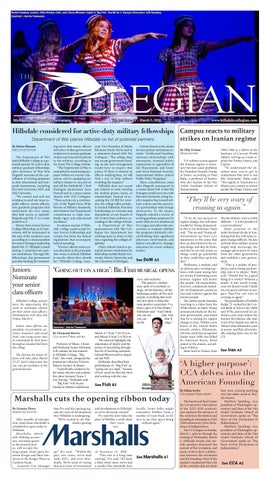
Professor of Music, Choirs, and Orchestra James Holleman will conduct his last musical at Hillsdale College, “Big Fish,” this week, alongside the production’s director Victoria Matsos, lecturer in theater.
“I specifically wanted to be the music director and conduct this show because I knew I was leaving,” Holleman said.
“Big Fish” will be performed in Markel Auditorium
March 4-7 from 7:30-10 p.m. and March 8 from 2-4:30 p.m.
The musical highlights the importance of family and the power of storytelling through the life of traveling salesman
Edward Bloom and his skeptical son Will.
Holleman described their performance of “Big Fish” as “going out on a high,” because of how much he likes the show and working with the cast,
Criteria listed on the memo for new partner institutions include: “intellectual freedom, minimal relationships with adversaries, minimal public expressions in opposition of the Department, and Graduate-level National Security, International Affairs, and/or Public Policy Programs.”
These cancellations come after Hegseth announced in a memo dated Feb. 6 that the Pentagon would sever ties with Harvard University, citing faculty’s negative bias toward military actions and the university’s partnerships with foreign adversaries. In the memo, Hegseth ordered a review of existing graduate programs for active-duty service members at Ivy League and other elite universities to evaluate whether the programs diminish critical thinking, have significant adversary involvement, and deliver cost effective, strategic education for senior military leaders.
By Ellie Fromm News Editor
U.S. military action against the Iranian regime is necessary but may cause problems for President Donald Trump at home, according to Paul Rahe, a professor of history who also teaches in the Van Andel Graduate School of Statesmanship.
1984-1986 as a fellow at the Institute of Current World Affairs, serving as a beat reporter for Turkey, Greece, and Cyprus.
“To understand the situation now, you’ve got to understand that Iran is not like Venezuela,” Rahe said. “The regime in Venezuela is a kleptocracy, meant to enrich people like Hugo Chávez and
“They’ll be very wary
of crossing us again.”
“If we do not succeed in regime change, this will mean trouble for Trump domestically. He’s a very bold man,” Rahe said. “The second Trump administration has been very impressive in the sense that they are determined to do certain things, and they do them, and they’re not risk averse, so things could go splendidly or they could blow up in his face.”
Nicolás Maduro. Iran is a little different — it is the product of a real revolution.”
Rahe pointed to the multi-factional divide in Iran, stating that this will make regime change difficult. He also said that these military actions might help encourage the younger generation to learn from the older generations and establish a new government.
crew, and orchestra.
“The positive, enthusiastic spirit of everybody on stage, all the directors, all the backstage people, all the tech people, everything that went into this show is about the most positive experience I’ve been a part of in this theater,” Holleman said. “And I think you can see that. And you can on the
By Gemma Flores Assistant Editor
After months of anticipation, retail chain Marshalls is scheduled to open today in Hillsdale.
Marshalls, which sells clothing, accessories, and home goods at discounted pric -
to see Marshalls opening
See Marshalls A7
Professors, a student, and an alumna gave varying reactions, with many saying they are unsure if instituting a new Iranian regime will better the people. All respondents, however, condemned Ayatollah Ali Khamenei’s actions in Iran and violence against the Iranian people.
The nation awoke Saturday morning to a video from the White House, in which Trump announced attacks on the Iranian government, and stated that he is aiming for regime change in Iran. Within a few hours of the United State’s missile strikes, Khamenei, who has ruled Iran as supreme leader since 1989, was killed by American forces. Israel joined in the attacks, according to Politico.
Rahe lived in Turkey from
‘A
“This is a matter of prudence, and to bring partisanship into it is idiotic,” Rahe said. “Would this be a good thing if it works? Without a doubt. Is this worth trying, even if it doesn’t work? I think yes, because it will have an impact. They’ll be very wary of crossing us again.”
The grandfather of Isabella Redjai ’21 worked for the Central Bank of Iran in the 1960s and 1970s, and moved to California a few years before the Iranian Revolution, she said. A lot of her family was still in Tehran when Khamenei came to power, and fled, all eventually making their way to the U.S.
higher purpose’: CCA delves into the American Founding
By Ethan Savka Collegian Freelancer
of the Declaration of Independence. The CCA began on Sunday, March 1, and ran through the evening of Wednesday, March 4. Hillsdale faculty and outside speakers discussed the context of the revolution, and many of them drew a distinction between the revolution and the founding. Most of the speakers emphasized that a lot of the colonists did not think
they were creating anything new, but rather acted as British citizens.
Matthew Spalding, vice president of Washington operations and dean of the Van Andel Graduate School of Government, spoke on “The Story of Our Declaration of Independence.” Matthew Spalding, vice president of Washington operations and dean of the Van Andel Graduate School of Government, spoke on “The Story of Our Declaration of Independence.”
See CCA A2
Rachel Dunphey (center), Ellen Ritchey (left), and Liliana Whitaker (right) in ‘Big Fish.’ See B6 for a ‘Campus Characters’ with Dunphey.
Courtesy | Austin Thomason
The cast performs a number. Courtesy | Austin Thomason
Rhoen Nevins and Atticus Johnson in ‘Big Fish.’ Courtesy | Austin Thomason
‘Working
with your hands and praying’: Meet a Hillsdale summer program
By Trinity Gentry Collegian Freelancer
Growing your faith through spiritual disciplines and serving the Hillsdale community while working a farm is the Building Up Disciplines in Summer program’s pursuit, according to Ryan Perkins, director of campus recreation and club sports.
“Working with your hands and praying are not mutually exclusive,” Perkins said. “It’s all part of growing as a whole human being, right? That’s one of the things we really want to stress through the summer is that we want you to grow in mind, heart, spirit and body.”
Students in the BUDS program pick vegetables and tend chickens and sheep at Hillsdale Homestead, formerly Glei’s Orchards and Greenhouses.
Started last summer by Perkins and Associate Dean of Men Jeffery “Chief” Rogers, the program aims to develop participants, mostly men, in their walk with God. Perkins believes it is essential to address both the body and the spirit by providing manual labor, teaching spiritual disciplines, and helping the local community.
Hillsdale College Chaplain Adam Rick encouraged the program’s ecumenical approach and gave Perkins advice on the direction of the program.
“The American founders understood them to be a part of those human events stretching back before them and ahead of them,” Spalding said. “The united colonies of British North America were going to war against the most powerful nation in the world. And what stretched back before them is actually our inheritance as well. The Greeks and the Romans, the medievals, the whole Christian tradition, and of course, the whole long and painfully divisive history of British constitutionalism, the Civil wars, the strife.”
Author Walter R. Borneman spoke about “Lexington and Concord: The First Battles of the Revolution” on March 1.
Historian John Steele Gordon gave a speech titled “The Economics of the Revolution,” and Mark Edward Lender, historian and professor emeritus
“I definitely think that this is an amazing opportunity for the U.S. to insert itself in global affairs, but in a way that is beneficial to everyone as well as the U.S.,” Redjai said. “Iran has a lot of amazing natural resources, and I think Trump and this administration is really trying to tap into optimizing those natural resources around the world and in the U.S. in particular.” Redjai, who is a senior multimedia producer at the Manhattan Institute, said she immediately sent Trump’s video to her family group chat, and said that they were all supportive of the news. Khamenei repeatedly, and publicly, claimed “death to America” throughout his time as the head of Iran’s government, according to the Washington Post.
“I think my impulse was in the direction of the Society of St. Stephen, or a rule of life together, spiritual rhythms that include things like manual labor and service in the community, in keeping with the old dynastic rule of St. Benedict,” Rick said. This approach of targeting both the spirit and body helped guide Perkins to focus on the whole individual.
“Some of the main goals are to help students grow in their faith, establish Christian rhythms and devotional life, serve in the Hillsdale community, grow in Christian brotherhood together, and establish mentorship with older believers,” said Brock Lutz, director of health and wellness.
The program strives to prepare young Christian men to persevere in an antagonistic world, according to Perkins.
“I look at the world outside of Hillsdale and see it becoming an increasingly challenging place to live as a Christian,” Perkins said. “We want to do everything in our power at Hillsdale College to prepare the young men to go out into the world after their four years here and to be the light of Christ.”
Perkins said this mission requires an increasing amount of courage, strength, and devotion to God.
Lutz also said there is a need
of history at Kean University, spoke on “Keys to Victory in the Revolution” on March 2.
Kevin Slack, associate professor of politics, summarized the history of Election Day sermons in early America in a speech titled “Sermons of the Revolutionary Era” on March 3.
“The role of the sermons was first to instruct magistrates, the new deputies, and the public on their duties to God and the community,” Slack said. “They frequently drew on Old Testament themes. Many warned of divine punishment for public and private sins. That’s how you knew you were in covenant with God — when God punished your society if it deviated from the right path.” Bringing the people back to God during the founding was another common topic, Slack said.
“A second important function was reconciliation to remind the people and leaders
for defining manhood in a confused culture with a Christian context.
“There are also various summer activities that students pursue over the summer, and we believe this is one of the most significant because the hopes are that they will establish rhythms during this summer that will impact the rest of their lives as they continue to live those things out on a daily basis,” Lutz said.
From May 23 to Aug. 7, the men worked six days a week, beginning the day at the Hillsdale Homestead at 7:30 a.m., Perkins said.
“We really want to build rhythms and patterns of spiritual disciplines throughout the summer so that every part of the day is in Scripture and prayer,” Perkins said. “On Sundays, we let students obviously go to their church service and spend time in the church community and resting.”
The first hour of a typical day is for the young men to work with their hands on the homestead.
Sophomore Elliot “Desmond” Mowry, one of the two young men who participated in the program last summer, said the program’s partnering of faith and agriculture interested him. He said that after the homestead chores, they would spend a cou-
of a higher purpose of their political covenant, the religious language to bind, to tie, and to unite the people in a common moral order,” Slack said “God was not of one party or another.’”
At the time of the founding, Slack said, there was little separation between religion and the revolutionary cause.
“Bishop James Madison, the cousin of the U.S. president and President of William and Mary College during the Revolution, sometimes prayed the Lord’s Prayer a ‘Thy Republic come, Thy will be done on earth as it is in heaven,’” Slack said. “American clergy actually fought in the war. Paul Revere’s ride was to the home of Reverend Jonas Clarke in Lexington, where he was lodging Patriot leaders John Hancock and Sam Adams. Hearing of the British Regulars, Hancock and Adams asked Clarke whether the people would fight, to which he replied, ‘I have trained them
ple hours in prayer and study. This prayer and study is guided by both the young men and the leaders.
“We will work with each of the students to figure out a Scripture reading plan and provide questions for prayer and meditation through the day,” Perkins said.
After lunch, there is time for working out and small group discussion. The rest of the afternoon is spent completing GOAL programs and ministry work, Mowry said. He said some of the work was handyman projects, where he fixed lights and doors, and other tasks involved a lot of chainsaw work with trees.
Mowry saw first hand the impact he made on the community, such as in Adopt-a-Grandparent, which cultivates a relationship between the college students and the elderly of the community by weekly visits to the local nursing home.
“Adopt-a-Grandparent was one of my favorite GOAL programs to be involved in,” Mowry said. “It was just great to get to talk with the old folks there. It was a joy to see them smile and hear about their stories. Sadly, nursing homes are often lonely for the residents, so it was meaningful to get to be their friend.”
With the program being
for this very hour.’”
Slack said the revolution was not against Great Britain, but against Britain’s rejection of its own principles.
“John Adams is asked about the war, and he says, ‘but what do we mean by the American revolution?’” Slack said. “The revolution was in the hearts and minds of the people, a change in their religious sentiments, of their duties and obligations, while the king and all in authority under him were believed to govern in justice and mercy according to the laws and constitutions derived to them from the God of nature and transmitted to them by their ancestors.”
Gordon S. Wood, author and professor of history emeritus at Brown University, urged Americans to consider the context in which the Founders acted.
“Slavery is inconceivable to us,” Wood said. “So atonement is everywhere in our writings.
gospel and ministry oriented, much of its efforts are with the local church, Perkins said. They coordinate with the church by bringing in local pastors to meet with the men in the program.
Because developing young men’s fellowship with God is a crucial component of BUDS, each of the four leaders provides different guidance in this area. Last summer, Lutz taught on both the spiritual disciplines and on the men’s personal Christian story.
“We focused on our personal Christian story, discussed the idea of what it means to be a healthy Christian man and how to continue to focus on growing in Christian manhood, and then discussed some specific Christian disciplines for growth,” Lutz said.
In the upcoming summer, Rick will teach on the life of King David from 1 and 2 Samuel. Rick said that David’s story has a lot to say towards young men, especially in exploring what godly masculinity is.
“That’s still a work in progress, but the life of King David is for all young men,” Rick said. “He models for us faithfulness, perseverance, repentance.”
Perkins said he taught the prayer, and Rogers discussed ministry and evangelism.
“Whatever it is, each of the different staff leaders has some-
In other words, we can’t really imagine a past in which slavery was taken for granted and was thought to be just another base status in a hierarchy of degrees among freedom.”
The 1619 Project was like the “Lost Cause” movement in that both tried to reintegrate the South after the Civil War. Both projects, Wood said, are not history.
“It’s something we’ve gone through, and atonement is the source of it, but it’s not history, and I think most honest historians would acknowledge that fact now,” Wood said.
In considering America’s Founding period, Wood said, Americans understand its context.
“What you’ve got to do as a historian is get back to a period where slavery was taken for granted,” Wood said. “It’s just so hard to do, but if you start with that, then you realize what happened in the revolution was extraordinary. For the
thing unique that they bring to the table and something that’s especially on their heart that they want to grow the men in,” Perkins said.
That BUDS introduced him to many spiritual disciplines, according to Mowry.
“It was really helpful for me to have accountability with keeping these practices,” Mowry said. “Also, the program’s leadership is basically an all-star cast of guys who are phenomenal resources for your spiritual growth. They have a lot of wisdom, and it was awesome getting to tap into that a little.”
Though the program is enjoyable, it is challenging, Mowry said, with the work being intense and requiring creativity. The spiritual disciplines also tested his faith specifically in confession, where Mowry learned how to be vulnerable with the young men.
“BUDS challenged me to get serious about my faith and my work,” Mowry said. “One of the things I loved about the program is that Ryan and Chief didn’t make work for us to do. There was already lots of work to do, both at the farm and in the GOAL programs, and if we slacked off, the homestead or the local community would suffer in really tangible ways. In other words, our work was valuable and needed.”
first time in history, a group of states, and they were the northern states where slavery was not substantial, but was legally established, outlawed, eliminated slavery legally. That’s the first example in the history of the world.”
The CCA ended with a faculty roundtable March 4, including Thomas I. Treloar, chairman and professor of mathematics; Jason Gehrke, assistant professor of history; Kevin Portteus, professor of politics; Nathan Schlueter, professor of philosophy; and Anna Vincenzi, assistant professor of modern European history.
“If there was one shared feature among the colonies before independence, I would say that it was their British identity,” Vincenzi said. “Colonists took pride in enjoying the rights of Englishmen.”
Senior Joseph Grohs spent 12 years with the Army’s 2nd Ranger Battalion, serving eight deployments to Afghanistan. Though he was surprised that someone in the government acted against Iran, he said he supports the president’s actions.
“This is a needed response to Iran’s continued threat to global security,” Grohs said in an email. “This has been a long time coming. If Trump can pull off a coup without introducing ground troops for an extended period of time, he’ll have secured the midterms. I think Trump is doing exactly what every president has threatened to do for 30 years.”
Associate Dean of Men Jeffery “Chief” Rogers served in the United States Navy for more than 20 years as a hospital corpsman, and spent a considerable amount of his time enlisted in Iraq. He said that these military actions are close to him, as one of his sons is currently serving as a Black Hawk helicopter pilot.
“I kind of figured at some point this was going to happen,” Rogers said. “I’m not
“I think everyone was very excited, because they’ve been waiting for this for a very long time and looking for hope that their country can be redeemed in a lot of ways from the oppressive government that exists over there, so there was a lot of joy,” Redjai said. “It wasn’t until it was confirmed that Khamenei had actually been killed that there was a sense of hope for change over there. When I saw it, I was surprised.”
a fan of having an extremist ideology in that there is a reward for death also having nuclear capability or trying to get nuclear capability, because to them, death is a reward to see more people die and take more lives.”
Rogers said he supports keeping the war overseas and addressing the problem before it reaches American soil. He urged Americans to turn to prayer.
“I’m in support insofar as it protects us and our allies,” Rogers said. “We tried the nation-building stuff. We tried it in Afghanistan. How do you defeat an ideology with a better ideology? You don’t do it with bombs, but this is a temporary fix.”
Mark Moyar, the William P. Harris chair of military history, said that the necessity of these attacks are justified by the legitimate threat of the Iranian government to the U.S., but that threats such as this are difficult for even experts to assess and understand.
“The biggest concern in my mind is the future of the Iranian government,” Moyar said in an email. “No one knows who will be leading Iran in one week or one year from now. Perhaps the United
States can steer the Iranians in the proper direction, but our record in influencing and coercing foreign leaders is not especially good.”
Brad Birzer, professor of history and the Russell Amos Kirk chair in American studies, said he has opposed U.S. interventionism since 1989, even leading a protest during graduate school against an intervention during the Clinton administration.
“The government of Iran is truly evil and truly a threat to world peace,” Birzer said in an email. “Additionally, Trump has not taken out much of China’s oil supply (from Iran and from Venezuela), so I’m assuming this is a part of Trump’s chess game to remake the world and its superpowers. I’ve been heartened by the videos coming out of Iranian communities, here and abroad, celebrating the death of their leader.”
Birzer said he believes Trump had a clearer reason to give the public for military action in Iran.
“I very much wish Trump had taken his case for an attack to Congress,” Birzer said. “He didn’t have to give specifics, just general outlines why we should attack Iran. What Trump is doing is clearly an
act of war, and I still take the Constitution rather literally on this — that is, that Congress alone has the power to declare war. Congress, though, is impotent and helplessly divided.”
Miles Smith IV, assistant professor of history, said he was not surprised that the U.S. was planning a military attack because he noticed the Pentagon has been ordering more pizzas. The website he uses to track this information, titled the Pentagon Pizza Watch, tracks pizza orders from the Pentagon and then uses metrics to establish a baseline of orders, to alert its users of increases, spikes, or decreases.
“Every time pizza deliveries spike, we go to war,” Smith said. “It’s not foolproof, but it’s actually pretty good. So, I wasn’t surprised we had moved like 70% of the U.S. military in and around there.”
Smith said he was a freshman in college when the second Iraq war began, and that, because of this, he is more hesitant to endorse the actions in Iran. He is skeptical of the effectiveness of the military actions.
“I love the idea that there could be regime change in Iran,” Smith said. “I’m proba-
bly not the type of person who thinks that regime change needs to have American-style freedoms. But if there’s a return to constitutional monarchy or something like that, I think that’s great.”
Like Birzer, Smith also noted concerns that Congress has not approved Trump’s actions.
“Obviously, Congress didn’t vote on it,” Smith said. “So, if they’re never going to vote on these things, it’s hard for us to even have opinions that matter. So, we kind of vote for the president for our foreign policy instead of Congress these days. If it works out, awesome. If it doesn’t, I won’t be surprised.”
Not all Hillsdale professors, however, are ready to say if these military actions are good or bad, instead choosing to trust the president’s actions for the time being.
“It’s too soon to assess,” Professor of Politics Thomas West said in an email. “It’s the ‘fog of war’ problem. Let’s give Trump the benefit of the doubt until proven otherwise.”
See A5 for pro/con opinions from Rahe and Birzer.
Iran from A1
CCA from A1
All three mock trial teams earn ORCS bids
By Elijah Guevara Assistant Editor
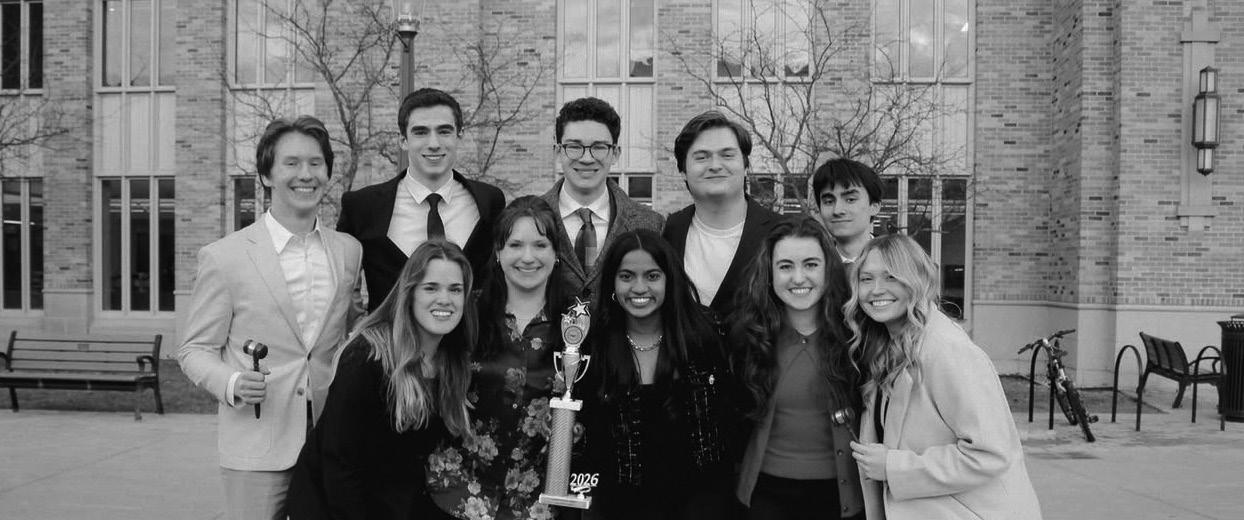
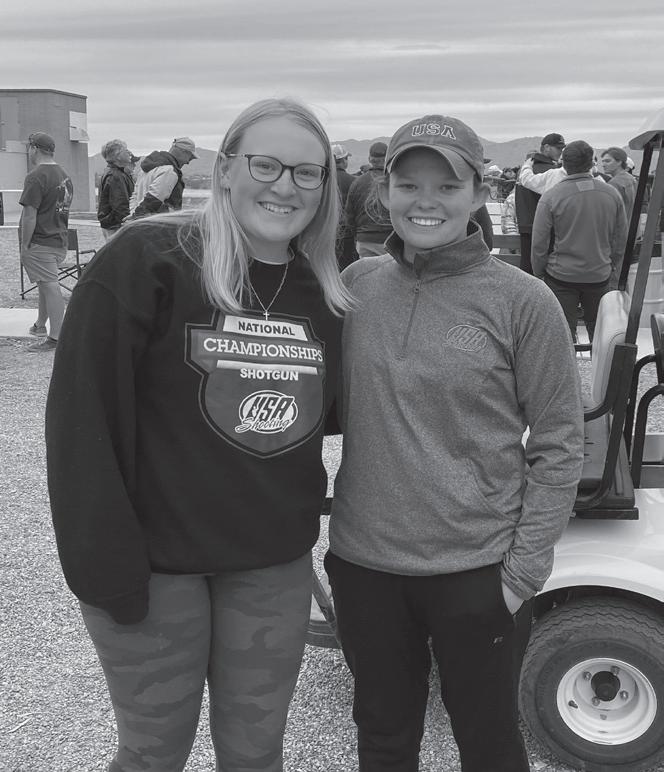
Hillsdale’s Mock Trial C Team, Team 1051, became the third Hillsdale team this season to earn a bid to the American Mock Trial Association’s Opening Round Championship Series, marking the first time that all three of Hillsdale’s teams have bid to ORCS.
Team 1051 placed fourth
both her rounds, maintaining a calm demeanor and communicating clearly,” Adkison said.
Scroggins attributed the team’s success to Adkison’s work and leadership.
“Will works harder than anyone else on the team,” Scroggins said. “Because of that, his performance is always super clean. He knows what to do and has practiced doing it repeatedly. He was an integral
overall at a tournament on Feb. 28-March 1, with two students taking home outstanding attorney awards.
The team at the Notre Dame tournament earned Hillsdale’s third bid to ORCS, with the A and B Teams, Teams 1049 and 1050, having won bids to ORCS last month in Dayton.
“Six teams won ORCS bids, and when the first team got called, then the second, then the third, we started to get a little nervous,” sophomore and Team 1051 member Ethan Scroggins said. “The moment they announced Hillsdale College we all jumped out of our seats full of excitement and maybe a little bit of disbelief.”
At ORCS later this month, 192 teams from across the nation will compete for 48 spots at the National Championship Tournament.
Since a school can only send two of its teams to ORCS,
part to our counsel table as well. Whenever I was considering an objection or adding something to cross examination, I usually conferred with him. He was a huge reason why we got the win at regionals.”
Junior and team member Hershey Hackberry said having the support of team’s coach, Justin Lee, and the support of other members helped pull the team together to compete well.
“Our coach, Justin, who’s amazing, was really supportive and would always tell us to stay clean, stay calm, and to do what we know,” Hackberry said. “Having competed on Mock Trial for the past three years made this team really special, because our chemistry was really good. We were really supportive and uplifting, and I truly felt so happy to compete alongside them.”
Hackberry said she is leav-
Team 1051’s bid will become an “open bid” and will be passed to another high-scoring team at a different school.
Hillsdale’s Teams 1049 and 1050 will compete at ORCS on March 21-22, which will be cohosted by North Central College and Northern Illinois University in Geneva, Illinois.
“It’s wonderful to place at any tournament, a joy to win a bid, but this time, for most of us our first ever positive tournament record, we got to literally make history with HCMT’s first ever 3-bid season,” team co-captain and freshman William Adkison said.
At the Notre Dame tournament, Team 1051 came in at a final ballot score of 6.51.5. They split the first round against Purdue University 1-1, swept Notre Dame University 2-0 in the second round, finished 1.5-0.5 against Northwood University, and swept Illinois State University 2-0. Adkison, along with freshman Ella Schuberg, took home 17-rank all-regionals attorney awards.
“Ella was the opener on the defense, and did a great job connecting with the judges in
DoW from A1
Hillsdale student takes top debate award
By Trinity Gentry Collegian Freelancer
Sophomore Noah Woo won “First Place Overall Speaker” at the Collegiate Advocacy Research and Debate competition atin California State University Long Beach Feb. 21-22.
The award is composed of three subcategories: advocacy, evidence and analysis, and community building. Despite participating in the competition online because of scheduling complications, Woo won first place in both advocacy and community building, and second place in evidence and analysis, earning him the award.
Woo said that these abilities and this win are not by his own doing.
“All the glory to God. None of this comes from me,” Woo said. “I am grateful to be able to represent Hillsdale. To represent the people in this community. It’s all by grace and it’s all for him.”
Woo and sophomore Jonathan Evans, Woo’s debate partner, won three out of the five rounds, with Evans also placing in second place both in evidence and analysis and community building, and third place in advocacy.
Woo’s ability to create an overarching story is crucial to winning despite the quality of arguments, Evans said.
“He is very impressive, I
will say,” Evans said. “He’s always been better at the big picture, so his position in the division of labor really fits him. He pulls together everything in the round, all of these various lines of argumentation, and shows why, ultimately, that means that our side should win.”
Senior Benjamin Brown, also a member of the debate team who competed in the competition and won four of the five rounds, said Woo’s attention to detail serves him well.
“He is a very technically-minded debater, which is especially important, and collegiately he is contrasted with the high school leagues that a lot of our debaters come from,” Brown said. “That is to say that he has a cool, detail-oriented, big picture skill set.”
The ability to create an overarching argument is further strengthened by Woo’s passion in debate, Evans said.
“He’s able to get pretty passionate about it, too,” Evans said. “He does a great job at that. Sometimes I struggle to be super excited about something like labor policy, but he’s pretty stellar at that.”
This storytelling skill developed during Woo’s time at Hillsdale College. In high school, Woo said, he took a different approach to debate.
“I would only think about
numbers, and the only logical decision is the one that is supported by evidence,” Woo said.
Now, Woo said, he can approach topics with the numbers against him and still win. For example, in this competition, Woo and Evans, when arguing for the affirmative side, did not have the statistics in their favor.
“On the affirmative side of the resolution, you are arguing for unionization and the different policies the U.S. can pass to achieve greater unionization,” Woo said. “And the problem with that is that there is a very strong analytical piece, a meta-study that quotes 147 different little studies. It basically is like every time there is increased unionization, there is necessarily unemployment.”
Instead of using statistics, Woo and Evans took a personal approach, making an appeal to the individual workers, Woo said.
“We were able to win a lot of those rounds where people ran that argument because we made the appeal to individual workers to stand up for their own ideals and stand up for their own rights as human beings and self-advocate almost through a body that allows them to have more power,” Woo said.
Kirstin Kiledal, professor of rhetoric and public address and coach of the debate team,
said Woo is able to create a good frame around the debate, which is called the inherency.
“He really sets up that sense of why we need to do this thing on the affirmative,” Kiledal said. “And he does a similar thing with regard to the negative’s response to that. Noah is also really good at organizing his argument and at starting to group those arguments together into a kind of calculus to show the strengths of the side that he is arguing on in comparison to the other side of the argument.”
Kiledal said both Woo and Evans are clear speakers with a good handle on theory as well as content of the argument.
“They are really strong debaters, and they are going to go for the win, but what they are not going to do is go for the kill,” Kiledal In a world of opinions and arguments, Kiledal said, both Woo and Evans approach the challenge of debate with mirth and modesty.
“Despite the seriousness that we engage in the world of debate, Jonathan and Noah treat this as any other activity with humility and humor,” Kiledal said. “They are a joy to work with. They make me laugh and I am really proud of them.”
Students show their wares at Midnight Market
By Lucy Billings Collegian Freelancer
Students arranged flowers, decorated tote bags, browsed student crafts, and took home tea and student-made goods at the Student Activities Board’s annual Midnight Market from 10 p.m. to midnight Feb. 25. Inside the Hoynak Room, paper lanterns strung across the ceiling created a beautiful and lively ambiance for shopping and socializing, according to junior and SAB team member Fara Newell. Ten student vendors show-
ing the Mock Trial program next year, and Team 1051 will not compete anymore this season because the third bid will be given to another team, so the tournament was bittersweet for her.
“This program has given me so much, and Mock Trial has been a big part of my time at Hillsdale,” Hackberry said.
“I’ve made the deepest friendships on campus here, and I think that it’s a hard thing to say goodbye to.”
Scroggins said that although Team 1051 will not be able to compete at ORCS, he considers the third bid a win for the entire Hillsdale Mock Trial program.
“Not many teams get open bids,” Scroggins said. “So, to be able to put Hillsdale into that elite caliber gives me great joy. The truth is that our ability to place is more a reflection of everything the program, our coaches, and our upperclassmen teammates have done for us. To be able to win for them is what made it mean something.”
cased their homemade treats and creations, from T-shirts, watercolors, and homemade pretzels, to Indiana honey and CDs of original music.
This is the third year SAB hosted Midnight Market, Newell said.
“Josiah Jagoda ’25 had the idea for the Midnight Market. The vendors are incredible, and it’s just a fun time. The atmosphere was fantastic,” Newell said. “We added in a build-your-own dried flower bouquet station that was very popular. We also had a make your own tea station. I think both added
an extra fun way to socialize with friends.”
Freshman Margaret Winter said she appreciated the Midnight Market as a welcome break in her week.
“I got to talk to people and I got free tea,” Winter said. “I really enjoyed seeing the innovation of Hillsdale students and the lovely wares that they were selling. It’s a fun thing in the middle of the week. Why would anyone come to something from 10 to midnight to buy things? It’s fun and there’s music and there’s life.”
Lydia Colby was a vendor at the market, selling watercolor stationary at the event for the second year.
“You tend to get a lot of big groups at the market,” Colby said. “What I really like about Midnight Market is that even when I don’t have somebody at my stand talking to me, people are milling about, chatting, and doing fun crafts. It’s a really great way to mingle. With big markets it’s harder to do that.”
Frudakis to retire, looks forward to a quiet life
By Desmond Mowry Collegian Freelancer
The professor who sculpted the campus statues of George Washington, Thomas Jefferson, Abraham Lincoln, Ronald Reagan, and James Madison will retire after this semester.
Anthony Frudakis, associate professor of art, began teaching at Hillsdale College in 1991
“I’m looking forward to getting back into doing a lot more reading,” Frudakis said.
He said he plans to spend his retirement enjoying a quiet life at his home near Hillsdale. He hopes to continue sculpting.
prise to people who knew his family background.
“My father was a sculptor, and my mom was a painter, and they had actually met at art school,” Frudakis said.
Frudakis didn’t originally plan to pursue art professionally, he said, in part because his parents discouraged him.
“My mom, in particular, had discouraged me from wanting to get into the arts,” he said. “She felt it was too difficult of a path financially.”
Frudakis didn’t receive formal training in the arts until he attended Duke University, where he took his first sculpting class.
Frudakis’s father was supportive of him after he chose to begin sculpting, but also challenged him to take initiative.
“My father said, ‘You can come and study with me, but the ball is in your court,’” Frudakis said.
“In my brief stint at Duke, I learned and acquired the skills of how to be a really good student,” Frudakis said. “I then applied that same sort of process and rigor to learning how to be a good sculptor.” Frudakis also sculpted “Madonna” for St. Anthony’s Catholic Church in downtown Hillsdale.
Frudakis was energetic, funny, and passionate about his work.
“He seemed to have a very genuine affection and appreciation for his students,” Lindauer said. Lindauer remembered a lesson Frudakis taught her about appreciating others’ individuality.
“He warned me that every sculptor has the unconscious tendency to make every sculpture a self-portrait,” she said. “To render the model accurately, you have to consciously push yourself to recognize what is different from yourself.”
“This decisive change will ensure our leaders receive a more rigorous and relevant education to better prepare them for the complexities of modern warfare and return our Force to the original purpose of SSCs: the preparation of senior officers to be critical thinkers that can plan and integrate multi-domain, Joint operations at echelon and serve (and think) at the strategic level,” the Feb. 27 memo said.
“Maybe I’ll drop back into the college and audit a class of my colleagues at the school,” Frudakis said.
SSC fellows currently enrolled will be allowed to finish their courses of study in their current placements, according to the memo.
Frudakis grew up in southern New Jersey.
“I’d grown up as kind of a beach bum; surfing, swimming, and playing beach volleyball,” he said. Both of Frudakis’s parents were artists. Because of this, he said, his decision to become an artist didn’t come as a sur-
“Everything I did was terrible,” Frudakis said. “I remember that. It was just the feeling of the clay in my hands, it just felt so natural.”
Junior Caleb Ostella, a former student of Frudakis’s, praised Frudakis’s skill in sculpting.
“He carried a wizardly air about him, especially when he demonstrated for us, since whatever clay he touched seemed to come alive,” Ostella said.
Senior Myah Lindauer shared her appreciation for Frudakis’ diverse range of interests, especially in literature.
“He has a love for poetry and ancient philosophy that is integrated into his teaching,” Lindauer said. “He has a real gift for bringing wonder at and reverence for the beauty of the world into his teaching of art.”
Lindauer said that in class
Lindauer said that this principle helped her in sculpting, but also in her broader approach to the rest of life and relationships.
“We have to be careful, all of us, that we don’t let our beliefs slip into fundamentalism or fanaticism, where we think, ‘It’s my way or the highway. I have all the answers,’” Frudakis said.
Senior
Team 1051 at the University of Notre Dame.
Courtesy | Hillsdale College Mock Trial
Courtesy | Hillsdale College Mock Trial
Allie Springer with her products. Collegian | Lucy Billings
Quincy Hearn and Mary Kate Reagan. Collegian | Lucy Billings
D.C. Correspondents | Lauren Bixler | Megan Li | Lewis Thune
Web & Puzzle Editor | Matthew Tolbert Illustrator | Maggie O’Connor Faculty Advisers | John J. Miller | Maria Servold Online : www.hillsdalecollegian.com
Don’t quiet quit your life
By Caroline Kurt Opinions Editor
In a spring slump? Take a page out of a ballerina’s book.
Hannah Neeleman released a short video Feb. 25 advertising her brand’s protein powder. Many know Neeleman as the ballerina-turned-homemaker behind Ballerina Farms, an upscale homestead business in Utah. Her aspirational Instagram @ballerinafarm has 10.4 million followers.
The overpriced protein powder is forgettable. The ad is not.
In the voiceover, The Juilliard School graduate Neeleman talks us through the grit and dedication that underlie ballerinas’ grace and beauty.
“On this stage, I learned to be strong,” Neeleman says. “And that strength never leaves you. It prepares you.”
The camera pans from the ballerinas to Neeleman, pregnant with her ninth child, overlooking her Utah farm.
“The stage is different,” Neeleman says. “But the strength is the same.”
In other words, nothing is wasted. That’s a message of great hope for every Hillsdale student.
Neeleman came under fire in 2024, when a profile of her family in The Times scrutinized her decision to start a family in her early twenties rather than continue dancing professionally.
“I was going to be a ballerina. I was a good ballerina,” Neeleman told Times reporter Megan Agnew. “But I knew that when I started to have kids my life would start to look different.”
Agnew insinuates throughout the rest of the article that Neeleman is oppressed in her life as a wife and mother, interpreting Neeleman’s answer that her current lifestyle isn’t “what she had always wanted” as a definitive sign of her unhappiness. The headline dubbed Neeleman the “queen of the ‘trad wives’” despite Neeleman having resisted the title.
Neeleman’s personal circumstances, like anyone’s, are complex. But you don’t need to resonate with her aesthetics or
By Joseph Brecount and Joseph Duncan Collegian Freelancers
What does true masculinity look like? The Collegian Opinions page debates this often. As leaders of the Ethos National chapter on campus, a small group program designed to free men from pornography, we propose an obvious but often overlooked model for masculinity: Jesus.
Not the Truth-preaching, Pharisee-flaming, demon-smiting, death-defeating Jesus, but rather the hometown Jesus — the man at the carpenter’s bench. The “hidden years” of Jesus’ life, as he prepared for his saving mission, testify to the foundations of true masculinity and virtue. We believe in this model’s efficacy in freeing men from pornography.
What was that Jesus like?
Picture this: The Son of God spent 30 years working in a backwater, run-down Middle Eastern town, fixing tables and chairs, living with his mom. After hearing claims that Jesus was the Messiah, Nathaniel scoffed at this vision of masculinity: “Can anything good come from Nazareth?” (Jn. 1:46).
This disillusioned expec -
tation of masculinity still permeates our culture today. The world sees the carpenter as meek and boring, unfit for greatness. But we gather from him a true picture of masculinity: the humble and silent worker, striving for virtue in reserved humility. Our culture today measures a man’s worth in conquests, achievements, followers — all admirable pursuits, but a model that tends to breed comparison and competition, not sacrificial love.
Hillsdale’s Ethos chapter is one of seven across the country. Ethos’ founder, Josh Haskell, embodies a life devoted to the carpenter model. A valedictorian finalist at the University of Notre Dame, Haskell turned down a job at an elite business firm in New York, bought a rundown Prius, and returned to Notre Dame to resurrect the purity club he started as a junior.
His first attempt to expand the program brought him to a Hillsdale dining hall booth, where all wonderful things are born. By the close of the fall 2024 semester, Ethos emerged at Hillsdale, spurred by a few resident assistants and volunteers who quietly worked together at the carpenter’s bench.
Just two years earlier, Has-
kell wrote his personal testimony in Notre Dame’s school newspaper, sharing his struggles with pornography with the entire school. He boldly encouraged his peers to join his new club, Ethos. He prayed for 10 men to sign up — 150 joined by the semester’s end. He galvanized men at five other schools, and 150 have become 700. Haskell labored in the dark and amassed a following, just as the humble carpenter executed his mission.
Today, these 700 men toil together at the carpenter’s bench. In groups of five, Ethos members sharpen their habits together in spiritual and physical disciplines, striving for interior freedom, a necessary prerequisite to love.
Ethos’ curriculum, written by Haskell, calls for 70 days of reading, calls with an accountability partner, and weekly 30-minute meetings, where members share their personal testimony, reflecting on victories and struggles with sexual sin. Group captains meet weekly for formation, food, and fellowship under the direction of the Ethos Board.
Last spring, 110 Hillsdale men — 15% of undergraduate men — joined an Ethos group. This semester, that number has
grown to almost 25%.
Hillsdale men proved the efficacy of the carpenter method — Ethos members see an 83% reduction in pornography use. Trust our model because God the Father did. Living under a model of contemplative silence and intentional labor, Joseph the carpenter taught his son to refine his focus, prayer, and patience —habits Jesus practiced for 30 years before going on mission. Just as Jesus’ simple life as a carpenter prepared him to conquer sin and death, so the Ethos model prepares men to conquer sexual sin. Both the carpenter model and Ethos mission aim to prepare men for the sacrifices of marriage. The American Sociological Association found pornography use within marriage to double the likelihood of divorce. This is the spiritual and physical battle of our age. One day we hope a Hillsdale man can look into his wife’s eyes and say: “Before I knew you, I loved you; and I have been preparing for you for a long time.”
Joseph Brecount is a junior studying English. Joseph Duncan is a senior studying English.
Not every tragedy is a conspiracy
By Catherine Maxwell Senior Editor
be a fan of her brand to realize she’s onto something in her recent ad.
Popular culture presents both men and women with the idea that parenthood is a dead end, a waste of human excellence. At the same time, certain strains of conservative thought frame the time before marriage and parenthood as worthless, sometimes stooping so low as to mock childless, unmarried people. Recall, for instance, Harrison Butker’s 2024 commencement address at Benedictine College, in which he said his wife’s life “truly started when she began living her vocation as a wife and a mother.”
The intention is sweet, but while many mothers might feel that way, Butker’s remarks hurt women whose singleness is not their choice or who have suffered from infertility. Such a mentality could cause single people to start living as though their lives don’t matter before a relationship or marriage. For students less than enthused about the academic life, even college can feel like a waiting period.
But to regard any period as a dead end — to “quiet quit” at your own life — cheats the world of the gifts and contributions only you are capable of and robs you of the satisfaction of doing what God made you for.
By contrast, Neeleman treats every stage of her life as vitally important. Her single years were worth living, both for their own sake and for the way they prepared her; motherhood has given her a new stage for the same pursuit of virtue — that strength that rejoices in the challenge.
So be ambitious for virtue, no matter your relationship or employment status. Tackle term papers, summer internships, and postgrad nine-to-fives with the confidence that nothing in your life will be wasted, except by your own choice. Whether or not the virtue you cultivate in your work, hobbies, or relationships can be reflected on your resume, it will bear fruit.
Nancy Guthrie disappeared from her home more than one month ago. She needs prayer, not wild speculation.
The 84-year-old mother of NBC “Today Show” host Savannah Guthrie vanished Feb. 1, and authorities believe she was taken against her will. Multiple ransom notes have surfaced over the past month, asking for millions of dollars in cryptocurrency in exchange for Nancy Guthrie’s return. But the deadlines for these notes have passed without any apparent consequences or evidence of Guthrie’s well-being. Authorities appear to have no strong leads.
That’s not to say they haven’t tried. Investigators have questioned and cleared several persons of interest, dis-
covered unidentified DNA at Nancy Guthrie’s home, and continue to canvass the surrounding area. Security footage from the day of the disappearance shows a masked man approach the front door before dismantling the doorbell camera.
As the search continues, the internet has reacted with characteristic tastelessness. Some on X said the case is a psyop intended to distract from the Epstein files; others claimed they were tired of seeing coverage of the case all over the news — until U.S. strikes on Iran became the latest 24/7 story. Still others said Guthrie doesn’t deserve all the extra attention when thousands of other kidnappings get no coverage.
It’s easy to sensationalize high-profile crimes. Internet sleuths love trying to one-
up investigators, and many X users love to claim every tragedy is part of a larger conspiracy. Guthrie belongs to a wealthy, well-known family, but she’s also a mom and a grandmother, who was discovered missing because she didn’t show up to a friend’s house to watch a livestreamed church service.
In a teary video posted on social media last week, Savannah Guthrie announced a $1 million reward for information leading to her mother’s return — and a $500,000 donation to the National Center for Missing and Exploited Children.
“Please keep praying without ceasing,” Savannah Guthrie said in the video. “We still believe. We still believe in a miracle.”
It’s possible some greater conspiracy is behind Guth-
rie’s disappearance. But in today’s never-ending news cycle, where opinions are valued in views and likes, it’s easy to let an amplified X post distort reality.
It’s far more probable and tragic that Guthrie has already died — she has a pacemaker and a heart condition requiring daily medication, which was left behind in her disappearance — a reality her family acknowledges even as they hope for her safe recovery.
Finding Nancy Guthrie doesn’t need to be everyone’s personal crusade, and if the investigation uncovers something deeper, there will be plenty of time to post about it. For now, Guthrie deserves prayer, not conspiracies.
Catherine Maxwell is a senior studying history.
Can Whitmer read the state?
By Hinson Peed Collegian Freelancer
One thing stood out in Gov. Gretchen Whitmer’s final State of the State address Feb. 25: The Democrat drew several standing ovations from Republican legislators.
As Whitmer celebrated her recent work to make pre-K education free across the state and announced an initiative to help every child read, legislators across the aisle rose to their feet.
However, the Republican lawmakers who applauded her seemed to have forgotten that the problems Whitmer is now addressing — especially literacy — accumulated during her seven years in office.
Praising the bipartisan cooperation between legislators and her office, Whitmer asserted that she is finally fixing Michigan’s literacy problem, which she claims is part of a larger national trend of students “falling behind.” Yet the problem is hardly a nationwide issue, and her recent work is only half-heartedly fixing a problem she contributed to herself. Until Whitmer fully
decides to embrace the policy changes that have led to miraculous literacy improvements across the country, reading ability — and the future of Michigan itself — will continue on its downward trend.
In 2019, when Whitmer was first elected governor, Michigan ranked 32nd in the nation for fourth-grade reading proficiency, according to the National Assessment of Educational Progress. The same year, Mississippi witnessed “miracle” gains, rising from 49th in the nation to 29th in just six years. States like Florida and Tennessee had also already seen these gains in literacy.
They implemented policies that focused on science-of-reading training, dedicated literacy coaches, and accountability through mandatory retention. Teachers across their states were trained to teach using phonics and other proven methodologies. Students benefitted from specialized coaches solely focused on improving reading proficiency. If students could not read at grade level by the time they reached third grade, they were
automatically retained until they could keep up with their peers. For a governor inheriting a literacy problem, the road to success was already trailblazed and paved. However, Whitmer took an alternate route.
For the first three years of her term, Whitmer primarily focused on increasing funding, especially to pre-K programs, instead of systematic policy change. Following the COVID-19 outbreak, extended school closures and Whitmer’s statewide mandates provided an obstacle to children’s education. By 2022, the state had fallen to 43rd in the nation for fouth-grade reading proficiency. In 2023, the “Read by Grade Three” law passed by her predecessor was repealed as soon as the Democrats gained full control of state government. This law ended the accountability mechanisms in place that required third graders reading below grade level to be retained. Halfway through her second term, the Whitmer administration had failed to adopt key literacy law changes with proven results. Last week, Whitmer claimed
that the recent improvements to the state’s literacy laws are a success and will continue to improve reading proficiency. Yet the governor has only implemented limited parts of the proven plan for achieving higher literacy rates.
Although Whitmer signed a law adopting the science-of-reading framework, uniform curriculum alignment, and statewide teacher training in October 2024, the full implementation of these policies is delayed to the 2027-2028 school year. She has also yet to fully scale or fund literacy coaches in a meaningful way like other states have. Additionally, she erased the very accountability mechanisms that forced schools in Mississippi to respond aggressively and with system-wide urgency.
Republican lawmakers in Lansing should forgo applause and call the governor’s actions what they are: inadequate solutions to a problem she both ignored and exacerbated.
Hinson Peed is a senior studying politics.
Caroline Kurt is a senior studying English.
Hillsdale’s codebreaker should join the Liberty Walk
By Megan Pidcock Collegian Freelancer
The next statue on the Hillsdale Liberty Walk should celebrate America’s first female codebreaker and one of its greatest cryptanalysts. Her work helped indict Al Capone and dismantle a Nazi spy ring in South America. Elizebeth Smith Friedman may be Hillsdale College’s greatest alumna and deserves a permanent place of honor on campus.
Born in 1892 to a Quaker family in Huntington, Indiana, Elizebeth Smith transferred from Wooster College in Ohio to Hillsdale in 1913 to be closer to her ailing mother. She graduated in 1915 with a degree in English literature. At the college, she was a member of the women’s fraternity Pi Beta Phi and the literary editor at The Collegian.
She began working at Riverbank Laboratories, a facility dedicated to the study of cryptography, in Geneva, Illinois, in 1916. The wealthy and eccentric George Fabyan hired Friedman to prove that Shakespeare’s works were actually written by Sir Francis Bacon. While there,
she recruited a colleague, William Friedman, to help. Working together, they became convinced that the Baconian theory of Shakespeare authorship was nonsense. In 1917, they got married in a remarkable union based on a mutual love of codebreaking.
Because Fabyan’s Riverbank Laboratories was the only cryptography facility in the country until the United States entered World War I, the government asked the Friedmans to train agents.
The couple left Illinois in 1921 to work for the Department of War in Washington, D.C. Frustrated with how she was treated compared to her husband, Friedman quit her government position in 1922 to raise a family. Three years later, however, the newly established Coast Guard hired her to break the codes of smugglers during Prohibition. By 1930, Friedman had decrypted an estimated 12,000 coded messages by hand and testified in 33 cases. Her work led to more than 650 federal prosecutions, and she was a key witness in the trial that convicted the gangster Al Capone. By 1932, she had put together one of the foremost
teams in cryptanalysis and radio intelligence. During World War II, her unit transferred to the Navy, where she tracked the Nazis in South America and intercepted their messages to U-boats in the Atlantic. Her team broke three separate Enigma machines — German devices used to encrypt messages — and decoded more than 4,000 messages transmitted across more than 48 radio
channels. In 1944, Friedman also helped convict Velvalee Dickenson, a Japanese spy in the United States.
After World War II, Friedman created a security system for the International Monetary Fund based on one-time tapes, which made its communications impossible to decrypt. By 1947, she retired with her husband, who also had a long and remarkable career as a cryptanalyst.
In retirement, the Friedmans continued to pursue their love of literature. Their 1957 book, “The Shakespearean Ciphers Examined,” continued the work they had started years earlier, refuting the theory that Bacon was the secret author of Shakespeare’s works. It remains a definitive work on the subject. “To Hillsdale College, where my interest in the authorship controversy was first aroused, with greeting to all students of Shakespeare from the authors,” Friedman wrote in the inside cover. The copy of the book with this inscription is preserved in the college’s library.
Friedman also took care of her husband, who suffered from severe depression caused by the stress of his own job as a codebreaker and later several debilitating heart attacks. He died in 1969. To preserve their legacy, Friedman donated a collection of her and her husband’s papers to the George C. Marshall Research Library in Lexington, Virginia, in 1971. Friedman died in 1980.
Because of the top-secret nature of much of her work for the government, Friedman rarely discussed her accomplishments. J. Edgar
Hoover, the first director of the FBI, also failed to give her any credit when publicizing America’s success in World War II codebreaking. Some historians attribute this to sexism, others to inter-departmental rivalry because Friedman worked for the Navy. Either way, Friedman was not recognized for her contributions until 2008, when the government declassified documents outlining her involvement.
Hillsdale students released a documentary focused on her life and influence in 2022. Now, the college should do more to recognize her remarkable life. Elizebeth Smith Friedman lived out Hillsdale’s ideals in everything she did. She served her family and her country and used her liberal arts education to put criminals in jail. It’s time to honor one of Hillsdale’s most accomplished graduates with one of our best honors. Let’s put a statue of Elizebeth Smith Friedman on the Liberty Walk.
Megan Pidcock is a senior studying history. Illustrated by Caroline Kurt.
Does this military action in Iran violate the Constitution?
It’s an illegal war
By Bradley J. Birzer Guest Writer
The Constitution seems rather clear to me. “Congress shall have power . . . To declare War, grant Letters of Marque and Reprisal, and make Rules concerning Captures on Land and Water” (Article I, Section 8). Further, “The President shall be Commander in Chief of the Army and Navy of the United States, and of the Militia of the several States, when called into the actual Service of the United States” (Article II, Section 2).
While I admit that not everyone takes the Constitution literally, I would prefer that they did. Regardless, one can look at the debates of the Constitutional Convention, Aug. 17, 1787, to see that while it was expected that the president would repel any invasion and lead war, once declared, it was Congress alone that could declare and, without being directly attacked, instigate it.
As Rep. Roger Sherman noted on that day, “The Executive should be able to repel and not to commence war.”
In “Federalist Paper 69,” Alexander Hamilton makes the same case. While the Execu -
tive could wage war, he could and should not initiate it. James Madison seems to have summed all this up in Federalist 51, when he notes that, “In republican government, the legislative authority necessarily predominates.”
At age 58, let me admit my bias. I have opposed every single American military intervention since 1989. While a graduate student at Indiana University, I even (rather pathetically) opposed one of then-President Bill Clinton’s many military adventures by leading a campus protest. Only about eight protestors showed up. That was the end of my formal rebellion.
I can also state that I was 11 when Iran took American hostages in 1979. I was and remain horrified by that. That year, our local radio station made frequent use of a mock song, “Bomb Iran,” imitating “Barbara Ann” by the Beach Boys. I’ve never forgiven the Iranian government, and I consider it to be one of the most evil extant governments over the last half-century. Though I wish President Donald Trump had taken his case to Congress first, I do not shed any tears over the collapse of the Iranian
government, especially as I see the joyous reaction of Iranians across the globe.
I’m also ashamed by the company I must keep because of my constitutionalist position. Frankly, though, the Democrats cannot under any circumstances lay moral claim to the constitutional argument, no matter how obstreperous they are about it. For eight dreadful and bloody years, they sat by silently while former President Barack Obama dropped nearly 100,000 bombs without congressional authorization. He also droned hundreds, including innocent civilians and even two American citizens. Obama is nothing short of a bloodthirsty murderer, a true war criminal, and the Democrats have no one to blame but themselves for their impotence.
Yet, here we are, Constitution or no Constitution, at war with and in Iran. At this point, whatever my initial wishes, I can only pray for our troops and for the people of Iran. I wish them all well.
Bradley J. Birzer is professor of history at Hillsdale College.
There's nothing illegal here
By Paul A. Rahe Guest Writer
Professor of History Brad Birzer has done a service by bringing up the issue of the constitutionality of the recent U.S. strikes in Iran. I do not think, however, that his reading of the Constitution is correct.
The Constitutional Convention, after much debate, opted for a unitary executive. As Alexander Hamilton later explained in “The Federalist,” the aim was “energy in the executive,” which was regarded as essential to good government. What was required was, he said, “decision, secrecy, and dispatch,” and everyone understood that Congress was incapable of that.
We must keep in mind that a declaration of war is not what initiates a war. It is merely a recognition that a state of war already exists. It is not the declaration that authorizes a president to intervene. It is the attack or the threat of attack.
John Adams understood this. He conducted an armed conflict with France from 1798 to 1800, and he never sought a declaration of war
from Congress. Thomas Jefferson dispatched a series of expeditions against the Barbary pirates in the period stretching from 1801 to 1805 without seeking a declaration of war or authorization from Congress. When James Madison, in turn, came up against the Barbary pirates, he sought from Congress a declaration of war but was not successful. That did not stop him.
What would have stopped Adams, Jefferson, and Madison was a denial by Congress of funds. The issue of legality came before the Supreme Court in 1800, which unanimously decided in Bas v. Tingy that the conflict between the United States and France during the Adams administration had been an “imperfect war” and that France, in the absence of a formal declaration of war, had nonetheless been an “enemy.”
We must remember the words of Supreme Court Justice Robert H. Jackson, who once observed that the Constitution is not “a suicide pact.” We have been at war with the Islamic Republic of Iran since Nov. 4, 1979, when the diplomats at the Ameri-
can embassy were made hostages. Repeated attempts have been made in subsequent years to reach a lasting settlement. But they have all failed. “Death to America” has been the slogan of Iran’s rulers for 47 years, and our demise has been their aim. To deny the president the discretion to operate in such circumstances with “decision, secrecy, and dispatch” is to render our country’s defense impossible.
There is a check that can be deployed if the discretion left to the president within our constitutional order is abused: Congress can cut off the requisite funds, and it can impeach, try, and remove the executive from office. There is nothing unconstitutional about what President Donald Trump has done. The real question is whether, at this time and these circumstances, the attack on Iran was prudent. That is well worth pondering. Its constitutionality is not.
Paul A. Rahe is professor of history at Hillsdale College.
Take a page from Stanford: We need a matchmaking app
By Elaine Kutas Sports Editor
My parents met because my dad’s little sister was best friends with my mom. My future aunt knew they had a lot in common and decided they should try going on a date. The 21st-century equivalent has arrived — in the form of an app.
While Gen Z becomes increasingly frustrated with the political climate, stigma around religion, and the dating app transactional culture, a new trend is trickling into different college campuses: a matchmaking app designed to bring compatible singles together. Although some Hillsdale students don’t seem to have a
hard time finding love before graduation, hence the “ring by spring” cliche, matchmaking at Hillsdale would allow more students to meet people outside their social circles and take the pressure off going on dates.
A Hillsdale matchmaking app could ask similar questions to the admissions roommate pairing questionnaire — the admission counselors seem to have a good idea of what types of people work well together.
A recent Wall Street Journal article highlighted the recent success of “Date Drop,” an app created by Stanford University graduate student Henry Weng. This app is currently active on 12 campuses across the nation, and has a long waitlist of
other universities. Hillsdale is not currently active or on the waitlist. Students who want to receive a match take a 66-question survey on the app about their values, political views, and future wishes. Then the algorithm pairs compatible students, and matches are released on Tuesday nights. Date Drop has tapped into a market of students looking for dating experience with little time or opportunity to find someone with similar values. Although most of the schools with an active Date Drop boast student populations anywhere from 6,000 at Princeton University to 33,000 at University of California Los Angeles, introducing a similar
experience at Hillsdale would make it easier to meet potential soulmates. The schools currently using Date Drop are academically rigorous schools, similar to Hillsdale, where many students find it difficult to meet people outside of their immediate circle once they have gotten into their typical routine. Luckily, a campus like Hillsdale attracts students with generally similar outlooks on life, so a program like Date Drop could lean into different aspects of the user’s personality. My current roommate and I were randomly paired together freshman year, and we will be roommates again next year to complete all of college together. The answers to simple
questions about music taste, favorite home-cooked meals, and the ideal way to spend a weekend teach a lot about a person’s values and quirks.
Date Drop also includes a feature that lets people recommend couples to be paired together. On a small campus like Hillsdale, this would be a great way for students to help their friends go out with someone they might like. A pairing on the app would be an easy conversation starter and help interested couples see if they really are compatible.
Some people might see this as an insincere way of starting a relationship or liken it to dating apps, on which someone hides behind a screen instead
of really putting themselves out there. But a blind date or a random recommendation based on compatibility of question responses is a fun way of learning how to date and discovering what one is looking for in a relationship. It would lessen the pressure of Hillsdale’s dating culture and create a fun way for people to get to know new people more casually. Go on a date, get to know someone you have a few things in common with, and see where it leads.
Elaine Kutas is a junior studying English.
City News
Councilman and city will face defamation lawsuit
By Catherine Maxwell Senior editor
A recently appointed library board member will sue a city councilman and the City of Hillsdale over allegedly defamatory statements.
Eric Moore claims Ward 4 Councilman Joshua Paladino damaged his reputation by comments he made in a city council meeting in January during discussion over nominees for the Library Board.
Paladino read an email from Moore at the Jan. 20 council meeting and said Moore believed the city and the library could not regulate its content for children regarding violence, vulgarity, and sexuality. Moore, who says this misrepresents his position, is seeking damages of $250,000, according to his attorney, Jeffrey Hart.
“Joshua Paladino, intentionally, and out of whole cloth, fabricated the contents of an
email which Eric Moore never sent,” Hart said in a statement to The Collegian. “Clearly, Mr. Paladino’s statement painted Mr. Moore in a false light as an advocate for violence, vulgarity, and sexual exploitation of children. Such false statements carry reputational harm.”
Hart said Paladino will face claims of defamation, harassment, intrusion upon seclusion, false light invasion of privacy, and intentional infliction of emotional distress.
Richard Thompson, president and chief counsel of the Thomas More Law Center based in Ann Arbor, Michigan, which is representing Paladino, told The Collegian the case “is without legal merit.”
Paladino directed requests for comment to his attorney.
“Joshua Paladino has absolute legislative immunity, and that’s important,” Thompson said. “Local legislators, like city council members, are entitled
to absolute immunity for their legislative activities.”
Hart, however, said immunity does not cover defamation.
“Because Mr. Paladino’s statements were made outside of the scope of his governmental authority and were intentionally fabricated and made out of animus dating back more than three years, he will have no defense of governmental immunity,” Hart said.
The Hillsdale City Council voted 6-2 at its March 2 meeting against a resolution that would have retracted Paladino’s statements and clarified that he spoke for himself and not for the city. Hart had said Moore would not seek legal action against the city if the council passed the resolution.
“We’re being asked to retract something that was interpreted by someone else, but it was nothing,” Ward 2 Councilman Will Morrisey said during the meeting. “It makes no sense.
It’s an incoherent statement.”
Mayor Scott Sessions and Ward 1 Councilman Greg Stuchell voted in favor of the resolution.
In the email Paladino referenced at the January council meeting, Moore expressed concerns that the city could face legal or financial troubles if library board trustees voted to remove books.
“If these potential acts are deemed to be ‘intentional,’ there could be a denial of insurance coverage, as liability policies typically have an exclusion for ‘intentional acts,’” Moore wrote in the email.
“This would mean the city could be financially responsible for any uninsured claims, and could result in higher insurance premiums or worse, the ability to obtain insurance at renewal.”
Hart said Paladino misrepresented the contents of the email.
“I do know that he was pretty firmly advocating that the city could not and the library board could not regulate its content for children in regard to violence, vulgarity, and sexuality, and he wrote as much to the board, and, I believe, to the council, at the time,”
Paladino said in the January council meeting. “He said that we should not create a system to determine what books were age-appropriate for children due to the threat of lawsuit.”
Paladino did not object to Moore personally, he said, but disagreed with what he viewed as a policy position. Moore was appointed to the library board in the same meeting in a 6-3 decision.
Multiple court cases have ruled that statements made during official deliberations are protected by legislative immunity and the First Amendment, TMLC said in a statement posted to its website.
“The threatened lawsuit was clearly intended to intimidate and silence an elected official during the performance of his official duties,” the statement said.
Thompson told The Collegian paying Moore could set a dangerous precedent for legislators.
“It sets a bad example or a bad precedent, because the next person that’s disgruntled by something that a member of the legislative member of the city council did, he’s going to threaten a lawsuit, and he’s going to say, ‘Retract and pay me $25,000, or whatever amount,” Thompson said.
TMLC is prepared to take the case to the U.S. Supreme Court if necessary, Thompson said.
“This is an important issue for the democratic process, and it’s an important issue for Hillsdale as well,” Thompson said.
Hillsdale Renaissance to host local music festival
By Elizabeth Caneday Collegian FreelanCer
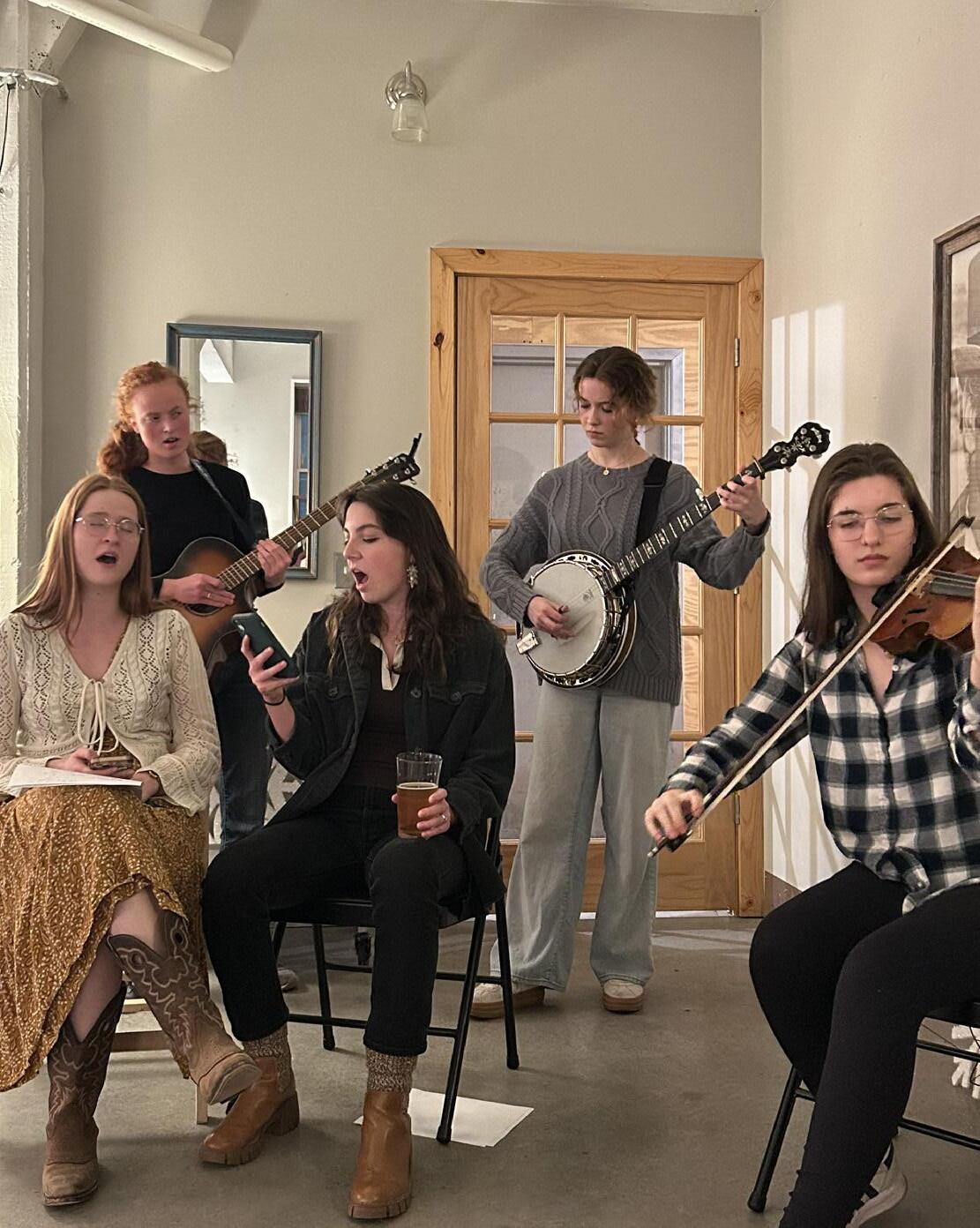
Students can bring their visiting parents to Folk Fest, an allday downtown festival featuring local musicians and businesses, March 7.
The event will take place at the Dawn Theater from 2 to 10 p.m. and is hosted by Hillsdale Renaissance, a real estate
development firm focused on reviving downtown Hillsdale, according to their website.
“We want to see more activity,” Luke Robson ’17, founder and president of Hillsdale Renaissance, said. “We want to see more people bumping into each other. More feet on the sidewalks than we see today. And the Folk Fest is one way of helping to make that happen.”
The event features eight musicians or groups, most of whom are local, according to Robson. The headliner is Lost Mary, an indie folk duo composed of Hillsdale graduates. Other performers include Greg Whalen and The Ramblers as well as The Schlueter Family Band.
In addition to eight hours of live music, a ticket to Folk Fest gives its holder special discounts
at local businesses for the day, including Toasted Mud, Rough Draft, and Ethan’s Donuts, according to Charlie Miggins ’25, the community liaison for Hillsdale Renaissance.
“It’s a great way for students to explore downtown at a discounted price,” Miggins said. “So if going out on a Saturday to downtown ever seemed too expensive or too big of a deal,
this is definitely the night to try it all, because everyone’s going to be there.”
Miggins said tickets are $25, but Hillsdale Renaissance offers various discounts for families, kids, veterans, and groups of five or more. In addition, students who volunteer for an hour to help sell tickets or concessions will receive free admission.
“I think it is a really great
thing for community coming together,” sophomore Rylan Conley, who is soloing at Folk Fest, said. “I also think it’s great it’s happening on Parents Weekend. I know there’s a lot going on on campus that night, but go over and see what’s going on in the town. Learn a little bit more about Hillsdale.”
Hospital CEO wins national leadership award
By Trinity Gentry Collegian reporter
Jeremiah “JJ” Hodshire ’99, president and CEO of Hillsdale Hospital, won a national leadership award for his work in the community.
Hodshire, the recipient of the Malcolm Baldrige National Quality Award, has served as CEO for the last six out of his 16 years at the hospital. He said he sees this award as a result of his advocacy for rural healthcare.
“I firmly believe in what I learned at Hillsdale College: All forms of government are local,” Hodshire said. “All forms of healthcare are local. You can control that at the local level. We have autonomy over it. Selling your hospital to a large institution is not the answer. Having a large institution who does not have the same values that our community has coming in and taking over healthcare is not at all.”
Congress established the award, named for a former U.S. secretary of commerce, in 1987 to create competition among companies and organizations
in order to improve them. It awards “the highest level of national recognition that a U.S. organization can receive for performance excellence, particularly in relation to resilience and long-term success,” according to the U.S. Department of Commerce’s National Institute of Standards and Technology.
The award is conferred by the President of the United States to role-model U.S. businesses through an independent board of examiners and presents those businesses’ practices to others.
“I asked the question, I pulled my team together and said, ‘How can we make a difference nationally?’” Hodshire said. “So, we started a national podcast to elevate the awareness to communities throughout this country that rural healthcare is being compromised right now and that we must stand and defend rural healthcare.”
Podcast “Rural Health Today” has hosted political figures such as Richard Bernstein, the Michigan Supreme Court Justice, in order to elevate the importance of rural healthcare, Hodshire said.
Diane Philipp, a member of the board of trustees at Hillsdale Hospital, said Hodshire has transformed the hospital into a more patient-centered institution.
“Under his leadership, the hospital has modernized its services, including expanding its healthcare offerings and improving its medical technologies,” Philipp said. “He is credited with enhancing the hospital’s financial stability, while prioritizing quality care for the local community, even amid the challenges posed by state and federal healthcare reforms and budget constraints.”
When asked about Hodshire’s award, Philipp said he has received several awards in the past, including the National Rural Health Leadership award, Community Impact award, and Michigan Health Leadership Excellence award.
“JJ’s commitment to Hillsdale Hospital’s success is significant and is often recognized regionally and nationally,” Philipp said.
Greg Bailey, partner at accounting firm Bailey, Hodshire, and Company and the president of the Hillsdale Hospital Board of Trustees, said he is grateful to the Baldrige Performance Excellence Program for recognizing Hodshire’s impact on the healthcare industry.
“Advocating for rural health has become JJ’s passion, and not just because he receives a paycheck from the hospital,” Bailey said. “He grew up in this community, and he knows the struggles that rural health faces. He fights every day to even the playing field.”
Hillsdale Hospital has a full continuum healthcare system, Hodshire said. From hiring a neurosurgeon and a vascular surgeon to adding urology and women’s health departments, Hodshire said he has developed a hospital that can truly serve its community. His passion for cheaper and more efficient rural healthcare stems from the impact it has on rural communities.
“Local access to healthcare means that you have access to it,” Hodshire said. “And without that, we find populations of patients who are sicker, a patient who waits longer to receive their care. Therefore, the cost is much higher for patients that lack
transportation, that can’t get to other places.”
Not only does a local hospital save lives in the community, but it is also an economic engine for the town, he said.
“We are pumping back a hundred million dollars into the economy, whether it is local or state economy, with the services that we purchase from our vendors, with the employees that we employ here, with the local products that we purchase from local vendors,” Hodshire said. “We are the economic engine of Hillsdale County.”
Losing a local hospital also means losing authentic relationships between patients and staff. This is when healthcare becomes cold and institutionalized, Hodshire said.
“It is not the people you go to church with that are taking care of you,” Hodshire said. “It is not the person that you see in the grocery store. It is not the person that you serve in the clubs with. It is someone you do not even know. Someone that does not have a relationship with you.”
Bailey said Hodshire has focused on five foundational
pillars since his tenure as CEO: finance, quality, service, growth, and people.
“The financial results have vastly improved through enhanced insurance reimbursements, government grants, and prudent fiscal management,” Bailey said. “Quality scores have increased to the highest levels that I have ever seen in my 25-plus year tenure on the board of directors. Growth has been achieved through service lines — hyperbaric chamber, neurosurgery, vascular surgery, and urology, to name a few. The focus on people is evidenced by the numerous workplace awards that the hospital has received.” Hodshire said his mission stems from his belief that this work is a ministry.
“My faith is important to my journey here,” Hodshire said. “I believe that taking care of people, which is the service I have always been in, is important, getting back to others and ensuring that our community has access to high-quality healthcare.”
Hodshire (right) at nurse Julie Walters’ retirement party.
Courtesy | Kyrsten n ewlon
Dr. Dan McCance , Dr. Nichole Ellis, and Hodshire (left to right).
Courtesy | Kyrsten n ewlon
Council rejects motion to suspend SADs for road repairs
By Gemma Flores assistant editoR
A motion to suspend the use of special assessment districts to fund road repairs until November 2026 was voted down by the Hillsdale City Council at its March 3 meeting. Ward 2 Councilman Matthew Bentley introduced a motion to suspend the use of SADs until the November mayoral election. The assessments designate run-down roads for repair, charging residents on that road up to $5,000 per parcel, with an additional $1,200 to $1,500 in interest for those opting for a payment plan. The council voted against the motion 6-2, with Bentley and Ward 4 Councilman Joshua Paladino as the sole supporters. Residents of affected dis -
tricts vetoed three proposed SADs for 2026 at the Feb. 16 city council meeting, leaving the city with a deficit of about $900,000 in its road funding.
City Manager David Mackie approached the council to discuss next steps.
“One of the city council’s primary goals is to address the declining quality of the city’s street and infrastructure systems,” Mackie said at the March 3 meeting. “Recent proposals to establish special assessment districts for three proposed 2025-2026 street projects were not approved. The outcome of these proposals created uncertainty regarding how the city should proceed with future street improvements.” Ward 3 Councilman Bob
Flynn asked whether citizens who would be willing to pay SADs in order to fix their roads more quickly could be given a chance to ask for one.
“There’s a possibility that we might have somebody come and say, ‘Hey, we got
the public’s sentiments toward them.
“We’re not going to fix SADs. Nobody wants to hear about SADs, for, if not a generation, at least the next year,” Bentley said. “The engineer came on in October. We talked
suggested alternatives to SADs at the next city council meeting, scheduled for March 16.
“I think we’re going to have some proposals or options for the next city council meeting,” Mackie said. “We’re currently discussing and vetting those out.”
“One of the city council’s primary goals is to address the declining quality of the city’s street and infrastructure systems.”
51% that want our streets done, so we’ll do a special assessment district.’” Flynn said. “I think that should be left on the table.”
Other members of the council said the assessments should not be considered in road repair discussions, given
about getting bids out and getting roads done. Are we going to do any roads this year, or are we just going to sit around and talk about the infrastructure under the roads and how to explain it to the people?”
Mackie told The Collegian that city staff plans to present
Homestead program to open this spring
The nonprofit aims to help veterans reintegrate into civilian life
By Will Davis Collegian FReelanCeR
Lost & Found Homestead
Farms, an organization that will help homeless veterans build career skills through homesteading, plans to break ground in Hillsdale County this spring.
“Our mission is to provide an agricultural farming homestead community for veterans where they can rebuild their life and restore their purpose through stewardship of the land,” founder Kimberly Napier said.
Lost & Found will offer a three-year occupational training program that would include woodworking, livestock, cultivating crops, beekeeping, culinary, and canine training, Napier said.
“This isn’t designed to be a destination. It’s a pathway,” Rob Calhoun, one of the organization’s board members, said. “The goal is to help veterans transition into permanent, independent living with the stability, skills, and confidence to succeed long-term. At its core, the model recognizes that purpose is not optional in recovery — it’s foundational to forward progress.”
The main goal of the program is to provide a path to homeownership and longterm reintegration into civilian life, according to the
organization’s website. To obtain a VA mortgage, veterans must have three years of work and good credit. Lost & Found will help veterans meet those requirements and set up a savings account.
“The VA loan program is one of the most valuable benefits available to veterans. It creates access to homeownership with favorable terms that many would not oth -
head, I told myself when I win the lottery, I’m going to open up a community for veterans to help rebuild and reshape their lives. One day, I woke up and said you know what, I’m never going to win the lottery. I need to do this now.”
The organization is in the formation and approval stage, according to its website.
Napier said she will launch the program on a small scale
“Veterans aren’t treated as occupants. They’re active participants in a working agricultural community.”
erwise have,” Calhoun said. “At the same time, eligibility does not automatically equal readiness. Homeownership requires financial stability, consistent income, and the ability to manage long-term responsibility. That’s where preparation becomes critical.”
Napier said she used to talk with a local homeless veteran who would pick through the trash can outside her workplace.
“One day, he just disappeared, probably passed away. But he really imprinted on my soul,” Napier said. “In my
at first. The initial project will cover about 40 acres in Hillsdale County for 20 veterans, but the long-term goal is to open homesteads across the country.
The response from the local community and authorities has been overwhelmingly positive, according to Napier.
“Everybody has seen a need for this,” Napier said. “The state has been sending us grants that we could apply for. We’re not pushing real hard for donations right now, but that will unfold very quickly.”
Lost & Found has not yet bought the land for the project.
“If there are any farmers out there who have a piece of land that they feel would work, please reach out,” Napier said.
According to Calhoun, Lost & Found will be built around restoration through participation.
“Veterans aren’t treated as occupants,” Calhoun said. “They’re active participants in a working agricultural community. They contribute. They build skills. They operate within a structured environment that reflects many of the positive aspects of military life — accountability, teamwork, and mission-based responsibility.”
Peter Jennings, a veteran and associate professor of leadership studies at Hillsdale College, said he commends the project.
“We need more service organizations — private voluntary organizations committed to serving some neglected population in our society,” Jennings said. “It seems like a very challenging and difficult vision to bring to fruition. I wish them success.”
Ward 4 Councilman Robert Socha said, although government spending can seem overbearing, it is necessary to fix Hillsdale’s roads.
“We do need to spend money to fix the roads, but, again, nobody’s shown me anywhere to cut the budget to come up with the $900,000 shortfall,” Socha said.
Mackie told The Collegian that the council is ultimately the deciding factor when it comes to allocating city funds.
“Could cuts be made to the city budget? Sure. You could always make cuts. But it has to be a decision that the public as a whole, through their representatives, are comfortable with,” Mackie said.
Joshua Waechter ’20, a Hillsdale resident and graduate student, said SADs should be done away with entirely, and that city staff should look seriously into cutting city spending.
“No one wants SADs. Nothing you can say will make people want SADs. They’ve made that abundantly clear,” Waechter said. “You need to find spending to cut. That’s what you should be directing the city manager to do. Come back with budget items to cut to fund road repairs, because that is the priority, not other things the city does.”
St. Joe’s opens for Saturday coffee
By Lonán Mooney Collegian Repo Rte R
St. Joe’s Cafe extended its menu and hours to include a Saturday cafe with fresh pastries and artisan espresso coffee after a successful parents’ weekend pop-up in December, according to barista and Ad Astra owner Jackson Busby. The expanded hours open the venue for breakfast treats from 9 a.m. to 2 p.m., after previously offering only for lunch and dinner.
“We started out with a Parents Weekend event, me and Josh Mincio. I brought my espresso set, and it was very successful.” Busby said.
“From then on, we decided to do it on an event basis before making it an every
“There was really only one coffee roastery around, and that was Ad Astra, and even then, there was no locally roasted espresso,” Busby said. “So that was one of the first things I did was to get espresso out there, and it was part of the St. Joe’s menu.”
Junior Elizabeth Gaines said St. Joe’s is the perfect spot for students who want a serene environment for studying.
“I really like the ambience. It’s a very nice space, and it seems like a great place to study or spend time with friends,” Gaines said. Busby said he and Mincio, the owner of St. Joe’s, are considering expanding the cafe’s hours beyond Saturday.
Ward 3 Councilman and mayoral candidate Bob Flynn said he hopes the addition of Marshalls will help keep business in Hillsdale.
“This is a wonderful thing for Hillsdale,” Flynn said. “It’s bringing in jobs, it’s bringing in shoppers. Not only, hopefully, is it keeping people in Hillsdale from going outside of Hillsdale to shop for their needs, but it’s bringing people from outside in.”
pers will be attracted to Hillsdale businesses, so as to stimulate the town’s economic growth.
Flynn said he hopes shop-
“I’m hoping that it brings more people from the outside. And then, once they’re here, they see some of the things that are starting to happen
and things that have already happened here in Hillsdale, and make this a destination instead of Jackson or Lansing or Ann Arbor or Battle Creek,” Flynn said. “I know we don’t have everything yet, but I’m hoping that this is yet another step of getting more and more people to come to Hillsdale, instead of going out from Hillsdale to other places.”
Hillsdale College junior Alyson Early said she’s looking forward to shopping at Marshalls and said she’s been waiting until it opened to buy certain accessories and hair products.
“I haven’t lived by a Marshall’s in 10 years, so I’m pretty pumped to be in close proximity again,” Early said. “I’m excited for the ladies of campus, and gentlemen, I suppose, to have a resource to become even more fashionable.”
weekend thing.” The cafe offers Ad Astra coffee — Hillsdale-founded and locally made artisan espresso — as well as various pastries, including cinnamon orange zest morning buns and pain au chocolat.
Ad Astra coffee also operates out of St. Joe’s Cafe during their weekday hours.
“Ad Astra has been serving St. Joe’s since it opened, and from the beginning, it was just the pizzeria and the drip coffee,” Busby said.
“But the espresso is all new.”
Busby said he noticed a demand for local coffee roasting and espresso specifically, and made it a priority to enter the market after purchasing Ad Astra.
“We’re considering making the coffee morning a more frequent thing,” Busby said. “There’s been a lot of interest. I see people come in one week and with all their friends the next week. It’s the best feeling having everyone come in and enjoy the coffee and the space.”
Junior Norah Vanderwingen said she loves Ad Astra coffee and how it has expanded to espresso drinks with its own showcase at the cafe morning.
“I’ve been to every coffee shop in Hillsdale,” Vanderwingen said. “And the Ad Astra latte here at St. Joe’s is by far the best I’ve had.”
Marshalls from A1
The cafe offers a variety of coffee and pastries.
Lon Á n Mooney | Co LL egian
Middle school rivals become shotgun trio at Hillsdale SportS
By Lucy Billings Collegian Freelancer
After running into each other on the range since middle school, three women from the Hillsdale shotgun team now form the tightest trio.
Growing up within a couple hours of each other in Wisconsin, sophomore Taylor Dale and juniors Madeline Corbin and Ava Downs, met early as competitors in shotgun.
Downs said the women first got to know each other when Downs and Corbin entered the shooting world around 12 years old.
“Madeline and I crossed paths as we started competing at the same time,” Downs said. “We were always at the same shoots and we were competing directly against each other. Taylor was the same deal, but also our families met, and I was around Taylor a lot.”
Corbin said competing in the Scholastic Clay Target Program in high school helped draw the women into closer companionship with each other.
“In the divisions of that, once you are in high school, you are all competing against each oth-
er,” Corbin said. “It was definitely just names you knew. Then as the years continued, you got to know the people.”
One year ahead of Dale, Downs and Corbin committed to Hillsdale in the beginning of their senior year of high school.
“We both got ad mitted and signed within three days of each other,” Downs said. “It was pretty cool when we realized we were going to be teammates.”
Dale followed them to Hillsdale a year later, and she said Downs and Corbin influenced her college decision and helped her acclimate.
used to things. It was great.”
Head coach of the Hillsdale shotgun team, Jordan Hintz, said he appreciated the women’s closeness and constructive influence on the team as a trio.
“They have a positive impact across many aspects of the team," Hintz said. “Each has a lot of competitive success and are high achievers in the classroom. Being friends prior to Hillsdale is great for overall team chemistry. All are team leaders in their own way.”
“We had competed against each other for so long and we were finally in a place where it was all of us together against everyone else,” Dale said. “They helped convince me to come here. Then I finally came, and I had these people to help me get
Over the past two to three years of shooting together for the Hillsdale team, the women’s relationships with each other, and their sport, have been well influenced, according to Downs.
“I have learned to live the sport in a different way,” Downs said. “It’s more than the winning and the social aspect. Through my teammates, Taylor and
that the path passes through. It cannot pass through bolded barrier segments, and it never passes through the same square twice.
Madeline, and being able to see all our hard work pay off together, it’s become more rewarding. They’ve made me realize how much I really love shooting and the process of shooting, not just the outcomes.”
Dale also said that having teammates with a sim ilar mindset has been beneficial for her growth as a shooter.
“The three of us have higher goals within the shooting realm,” Dale said. “We take it seriously. It’s easier to have people around you who take it seriously, the way you do, and get to build off of each other rather than trying to do it on your own.”
Hintz said their relationships with each other have evolved in an inspiring way since leaving their hometowns.
“Each of them is very different in personality, yet they get along great. Coming from
Men ’ s Tennis
a very competitive atmosphere in Wisconsin SCTP and USA Shooting, there was every reason to believe their relationship would develop more adversarial than friendly,” Hintz said. “I hope others can see the great outcomes coming from that and try their best to emulate within their own social environments.”
The women have learned valuable lessons in attitude and technique from their relationships with each other. Corbin said they have grown together as shooters and have been able to aid each other in that growth.
“We’ve come a long way together,” Corbin said. “Even if I’m the one watching them shoot, saying, ‘Maybe try moving this,’ helps me become a better shooter as well. When you have the fundamentals down so well that you can help other people, that makes you a better shooter as
well.”
Downs said each of her teammates have shown her admirable examples of competitive posture that have changed her own perspective.
“Madeline has shown me how to be so humble and put together when you’re competing,” Downs said. “Madeline could be shooting the worst round of her entire life, walk off, support other people, and be optimistic. Taylor has really taught me to learn from my mistakes and not be so hard on myself, how to pick myself up and move forward.”
The women said thanks to their shared experiences, they anticipate remaining a part of each other’s lives even after their college years come to a close.
“Even if you only see each other once or twice a year, you share such a big part of your life,” Downs said. “The biggest part of our lives right now is shooting. We all have that in common and have gone through it with each other. We have shared some of the best memories with each other and some of the worst memories. You can’t not be connected after that.”
Chargers fall to No. 20 ranked Warriors
By Patrick Matteson Collegian Freelancer
Freshman Patrick Cretu earned a singles win after playing on court for three hours, accounting for Hillsdale’s only point in a 6-1 loss to No. 20 nationally ranked Wayne State University on Feb. 28.
The Wayne State Warriors opened the match by sweeping doubles play to take an early 1-0 lead. The Warriors also won five of six singles matches to secure a win over Hillsdale and move the Chargers’ season record to 3-4.
At No. 1 doubles, juniors Ellis Klanduch and Henry Hammond lost 6-4. Sophomores Samuel Plys and Ryan Papazov also lost 6-4 at No. 2 doubles, and Cretu and freshman Jackson Clements were defeated 6-3 at No. 3 doubles.
Despite the sweep, head coach Keith Turner noted how competitive the doubles matches remained.
“Wayne State was one of the
strongest teams we’ll play all year,” Turner said. “We hung in there with doubles, losing by only a break of serve in each match.”
The Warriors carried that momentum into singles play, winning four of the first five matches. Papazov, Hammond, Plys, and Klanduch all dropped their matches in straight sets.
“As far as singles, we showed our depth, but we need to be better closer to the top of the lineup,” Turner said. “We can compete with the top teams in the nation, but our singles overall could have been better.”
At No.5 singles, Cretu took the opening set 6-3, and he held off a late push from Wayne State’s Sam Knowles to win the second set 7-6. Cretu’s singles record moves to 5-2 on the season.
“Strategy going into singles was to dictate points while staying solid,” Cretu said. “I was able to pull through in big moments.”
The longest match of the day
came at No. 6 singles, where sophomore Alex Cordero Lopez played for three sets. After claiming the first set 7-6, Lopez narrowly dropped the second set 7-6. He ultimately lost in a thirdset tiebreak.
“I felt like I was playing great tennis and that the improvements I’ve been working on were consolidating in the match,” Lopez said. “I just try to always get the win regardless of the team result. I truly believe the level in our team is there, we just haven’t been able to translate it to some more wins.” The Chargers look to bounce back as they host Roosevelt University March 8 at 10 a.m. in the Margot V. Biermann Athletic Center.
“Hopefully we can turn this match our way before a tough stretch, including spring break,” Cretu said. “It will be a test of our discipline to see how we match up against teams down south in the outdoors.”
Women ’ s Tennis Loss to Wayne State proves potential
By Sophia Bryant Assistant Editor
The women’s tennis team lost 4-3 to No. 22 nationally ranked Wayne State University in Detroit Feb. 28, bringing the Chargers’ season record to 5-3.
“We really had to work for it overall, and it just shows our potential and where we could be, and how much better we’re getting as the season’s going along,” head coach Melanie Zampardo said.
The team prepared for an intense match against an unrelenting opponent, according to Zampardo.
“That was a heartbreaking match,” Zampardo said. “I think everyone felt the hurt afterward, because we were so close to a team that we were a matter of points away from winning. And with them being so good, it feels like an opportunity missed, almost, but we’re taking the positives, we’re getting better and better, and we’re just going to keep chugging along and getting better as we go.”
The Chargers won the doubles point, with sophomore Briana Rees and freshman Dimitra Papastavrou beating Wayne State 7-5 at No. 2 doubles, and senior Bella Spinazze and sophomore Julia Zlateva winning 6-4 at No. 3 doubles.
“We played really well against a really good team, and it was really close, and I think it could have gone either way,” Spinazze said. “So I think the biggest thing we can learn was to have a lot of confidence, and to play every match with that confidence we’ve gained from this match.”
Zampardo said the team played calmly and confidently in the doubles matches, which were all close.
“I’ve known that we’re a good team, but that match really just solidified how good we really are,” Zampardo said.
Although Rees lost 6-3, 1-6, 4-6 at No. 2 singles, Zampardo said she fought throughout the entire match.
“Bri had to work for every single point that she played and every point that she won,” Zampardo said. “Her oppo -
nent really wasn’t giving her anything, and that’s kind of how it was across the board.” Zlateva won 6-4, 6-2 at No. 5 singles, and freshman Esther Sura won 6-1, 6-2 at No. 6 singles.
“They absolutely killed their singles matches,” Zampardo said. “They just came out and played their games.” Zlateva said they had good energy and encouraged one another in their matches.
“My singles match was good, it was competitive, and I think I handled that really well,” Zlateva said.
Zlateva said some members of the other team were rude, but Hillsdale handled it well.
“We didn’t feed into it at all,” Zlateva said. “We were just focused on our own game and we stood our ground, and I thought that was really good.”
The Chargers will play Roosevelt University at home March 8 at 2 p.m.
Juniors Madeline Corbin and Ava Downs at a Hillsdale competition. Courtesy | Ava Downs
Sophomore Taylor Dale and Corbin together at a USA shooting event. Courtesy | Ava Downs
‘We need to be better’ after four losses
By Christian Papillon Assistant Editor
The Chargers suffered four losses against No. 6 nationally Grand Valley State University in Marion, Illinois Feb. 27-March 1, dropping the team’s season record to 3-7.
“We need to be better,” head coach Tom Vessella said. “We didn’t play good baseball at times, and a good opponent showed us what happens when you make mistakes.”
The Chargers lost the first game of the series 20-2, with a two-run home run by junior third baseman Rocco Tenuta accounting for the team’s only runs.
Tenuta went 4-for-10 at the plate with five walks in the series, including a 3-for-3 day in the first game.
Sophomore outfielder Gaard Swenson said the series gave the team an opportunity to learn from facing good pitchers.
“The Grand Valley pitchers were able to find our weaknesses, but now we know what to work on most,” Swenson said. “We will be much better when it comes to conference play.”
The Chargers gave up fewer runs in each successive game, losing the second game 10-1.
Feature
In the third game, the Chargers lost 7-2, but only allowed Grand Valley to score runs in the third inning.
“You need to tip your cap to Grand Valley,” Vessella said. “They are a very talented and experienced team that took advantage of every free pass we gave them both on the mound and at the plate. It was a great test for us before conference play.”
Vessella said the pitchers improved their command over the course of the series.
“We threw more strikes,” Vessella said. “The story of this series really came down to how many free bases we gave up and one big inning.”
Junior pitcher Logan McLaughlin pitched the final game, giving up two runs over six innings of work and only surrendering two walks in a 3-0 Chargers loss.
“I felt great in Sunday’s game,” McLaughlin said. “I felt like I was able to locate any pitch I wanted in any count for a strike. We knew we were facing a good team in Grand Valley, so it was important for us to execute at a high level.”
The Chargers will next face the University of Missouri St. Louis on the road March 6-8.
Shotgun
Chargers take second at conference shoot
By Daniel Johnson Collegian Reporter
The Hillsdale shotgun team took second overall in the Association of College Unions International and Scholastic Clay Target Program Upper Midwest Championship Feb. 27-March 1, with four female athletes placing in the top five.
The Chargers competed in the American Skeet, Doubles Skeet, American Trap, Doubles Trap, Sporting Clays, and Super Sporting disciplines against five other regional schools at the shoot.
Each shooting discipline in the championship involves shooting clay targets flying from various trajectories. In skeet and trap, known as line games, targets are launched the same way every time, while targets in Sporting Clays and Super Sporting are launched from a variety of unique angles.
Sophomore Taylor Dale placed second overall in the women’s division of the shoot, followed by junior Madeline Corbin, sophomores Marin McKinney and Lucci Kern, and junior Ava Downs rounding out the top five.
In the men’s division, freshman Zach Hinze took sixth overall, followed by seniors Davis Hay and Leif Andersen in seventh and eighth.
Corbin and Dale shot 100 out of 100 targets in American Skeet, taking first and second respectively in the women’s division through a shoot-out.
On the men’s side, Hinze and Hay also shot a perfect 100 in the event, placing second and sixth respectively for the men after a shoot-out.
“Our biggest performance in Skeet,” head coach Jordan Hintz said. “We shot 499 out of 500 as a team, which is either the highest we’ve ever shot, or tied for it.”
Hinze and sophomore Nathaniel Meloro took fourth and fifth in the men’s division of Doubles Skeet after shooting 50 out of 50 targets, while Corbin took second in the women’s division of that event with a score of 49 out of 50 targets.
Sporting. Hinze took fourth in the men’s division of that event.
In Sporting Clays, Dale placed second for the women followed by Corbin and McKinney in fourth and fifth.
Andersen took eighth in the men’s division of Sporting Clays.
Kern, Dale, and McKinney took second, third, and fifth respectively in the women’s division of Doubles Trap. Hay took sixth in the men’s division. In American Trap, Senior Sophia Bultema took fourth, followed by Dale in sixth.
“I think we have the confidence and the skill set to go down to nationals in two weeks and win.”
Hintz added that he was encouraged by the team’s second place finish behind Lindenwood University, a NCAA Division I school.
ty dang close to them and a couple others, is always an accomplishment. The chances you get five good scores out of 55 people instead of five good scores out of 16 obviously favors one way.”
Bultema said the competition showed the team what to focus on going into nationals.
“I think it kind of woke a lot of people up,” Bultema said. “Like, ‘Hey, this is what we need to practice.’ It gives you a preview of what nationals is going to look like. And I think that’s really ramping some people up.”
Andersen, a team captain, said the team knows where to concentrate their energy heading into nationals.
“We’re just looking at maintenance work in the disciplines we shot well in,” Andersen said. “We just need to get better in American Trap.” Andersen added that he has high hopes for the team heading into nationals.
“I think we have the confidence and the skill set to go down to nationals in two weeks and win,” Andersen said.
Corbin, Dale, Downs, Kern, and McKinney took second through sixth place in the women’s division of Super
“Lindenwood’s the biggest team in the country,” Hintz said. “To be that close to a team that large, to beat them in one discipline, to get pret-
The team will compete next in the ACUI/STCP Collegiate Clay Target Championship in San Antonio, Texas March 1621.
Old dogs still got it: Charger alumni return to compete
By Ty Ruddy Culture Editor
Could your tax accountant run a 200-meter dash? If a former teammate eggs him on for long enough, then yes.
At the Charger Tune-Up meet on Feb. 21, Hillsdale alumni competed in multiple track and field events, including an open 200-meter dash, high jump, and pole vault during an indoor track meet at the Biermann Center. According to Donny McArdle ’25, who now works as a tax accountant at Plant Moran in Ann Arbor, Michigan, the reunion began as a joke.
During his time at Hillsdale, McArdle often challenged Shura Baldwin ’24 to a race in the 400-meter — with one catch.
“We wanted to run a race with her on hurdles — maybe a few less than she would typically have in a 400 hurdles race —
and me just running,” McArdle said. McArdle said the race never happened, but when Baldwin’s father, Pasha Ermakov, told McArdle he and his daughter would be running a 200m at the Hillsdale Tune-Up meet, the stage was set. McArdle worked his way into the line-up.
Baldwin won the long awaited duel. She'd had a child less than six months ago.
“It was pretty rough,” McArdle said. “I haven’t run like that in a long time. I didn’t break any personal records.”
Still, McArdle said, competing was worth the reunion.
Hillsdale Admissions Counselor David Chase ’19 was among the former track and field athletes who returned. Chase said although the competition began as a joke, other alumni soon joined in and he decided he had to answer the call.
Chase competed in the high jump last week like he did in college. And while he did not beat his personal best, he said he walked away with at least partial success.
“Not getting hurt was one of the goals,” Chase said. “Luckily, I managed that one.”
Ben Raffin ’22, who competed in pole vault during his time as a Charger, returned to the pit when the other alumni returned to the track last week. Raffin, who lives in Hillsdale, has maintained a relationship with Hillsdale track and assistant track coach Justin Fawley
Justin Fawley, an assistant men’s track coach, has only coached six guys in pole vault during his time at Hillsdale. His athletes include Connor McCormick, a current senior, and Jared Shipper ’year, both of whom competed with Raffin in college and at the Tune-Up.
“It’s been fun getting to go
up against them and getting to know them, and it’s probably been fun for Fawley, too,” Raffin said.
Raffin said he also occasionally participates unattached in the long jump and triple jump and would be open to competing again during the outdoor season. Raffin added that he, like most retired athletes, needs something to keep the competitive edge.
“Twice a week I play 6 a.m. basketball with professors and staff from the college,” Raffin said. “That’s one thing that’s always fun, that gets you out of bed, and it’s a good way to start the day. I’m also a golfer. A horrendous golfer, but that’s been fun, too.”
Raffin also coaches pole vault at Hillsdale Academy.
“Coaching is obviously the best way to stay near the sport I love,” Raffin said. “And it’s less stress on the body, which is
nice.”
Aside from reunion sprints against former teammates, McArdle has also found other outlets that build on the work he put in as an athlete.
“I did a marathon over the summer with a couple of teammates and then another in November with my sister,” McArdle said. “As a distance runner, it felt right to do at least one marathon. I don’t know how many I’ll do, but I’ll definitely keep running.”
McArdle said he may stick to 10K road races in the future. But he also said he’ll compete against teammates any time they’re down for it.
“Once I can get back in shape, I’ll probably show up to any meets they allow alumni to race in,” McArdle said.
Chase, on the other hand, said the Tune-Up meet was his farewell. Besides, he found other ways to stay competitive.
Charger Chatter
“Two things I have done to stay ‘competing’ since my time as a college athlete have been coaching track for six years in Texas, and beginning to train and compete in Brazilian Jiu-Jitsu,” Chase said. “Those have been good personal competitive outlets.”
Chase said he is thankful for the five years he spent at Hillsdale competing, and he knows his former teammates and other alumni appreciate the community of the program as well.
“Many alumni might think of the library, their dorm, Greek life, or even their professors when reflecting on their time here at the college,” Chase said. “But for me, and other track alumni, we go back to the Biermann Center. I think alumni like to come back and compete to relive some of the joys that made Hillsdale College special for us.”
Coach Brianna Brennan, Women's Basketball
What’s a favorite memory from coaching?
Last year, we made it to the NCAA tournament, and we did a little watch party of the announcement livestream in the Union and had a little ice cream bar. It was just a really cool moment.
What’s your go-to motivational song?
My favorite movie is “Remember the Titans,” and there’s a song they play when the team’s getting really hyped and excited called “Up Around the Bend.”
If you were a student at Hillsdale, what do you think your major would be?
I don’t think there’d be too many majors that I would thrive in. I would probably have gone the sports management route.
Do you prefer going to bed late or getting up early?
I’m a night owl for sure, so I like to stay up way too late, watching films or preparing for our next game. I did wake up early when I was in college, but if I’m in charge of my schedule, it’s not happening.
Would you rather live without air conditioning or live without heating, if you could pick the climate?
I would choose to live without heating, because you can always put blankets or use a heated blanket if that’s allowed. I don’t like being hot and sweaty and sticky.
What are your hobbies?
I like to work out. I really like going for walks outside. And I like to journal. I don’t know if that counts as a hobby, but I really like to journal.
Compiled by Anna Northcutt
Photo Courtesy | Hillsdale College Athletic Department
C harger S port S
Track and Field
Indoor concludes with success
By Francesca Cella Assistant Editor
Nine athletes will compete in 11 events at the NCAA Division II Indoor Championships March 13-14 in Virginia Beach, Virginia, after the women’s track and field team took second place and the men’s team took fifth at the Great Midwest Athletic Conference Indoor Championships hosted by Ashland University Feb. 27-28.
Freshman Anna Roessner won the 60-meter in 7.38, just two one-thousandths short of her personal best. She also placed third in the 200-meter with a time of 24.29 and was named the G-MAC Women’s Freshman of the Meet. Roessner said she put herself under a lot of pressure because she was ranked first in the 60m, and the team’s chance to win championships counted on her winning.
“I was very nervous, but I work best off of nerves because I get crazy amounts of adrenaline and have a really good start and then it’s over from there,” Roessner said. “When I go to meets and I don’t feel nervous at all, I don’t perform
that well. In a 60m you really need the adrenaline to push you to the finish.”
Senior Lucy Minning took sixth in the 200m in 24.62 and eighth in the 60m in 7.67. In the 400-meter, senior Francesca Federici took fifth with a time of 56.63 and set a new personal best. Sophomore Sarah Chappelle ran the 60m hurdles in 8.69 and placed fourth. In distance, sophomore Ally Kuzma took a double title, winning the 5K in 17:22.22 and the 3K in 9:42.82 with a 13-second lead. Kuzma was also named G-MAC Women’s Track Athlete of the Meet for her performance. Junior Eleanor Clark placed second in both the 5K and 3K, setting new personal bests with times of 17:28.59 and 9:55.50, respectively.
On the men’s side, freshman Henry Thuet also set a new personal best in the 800-meter with a time of 1:53.83 and placed fifth. He said after several rough races in the mile, his 800m time is gearing him up for outdoor track.
“Coach White’s big thing with freshmen is just, ‘learn and grow,’” Thuet said. “I’ve
been able to do a lot of learning, and I’ve had a lot of growth since high school, and I’m excited to see where that takes me.”
Freshman Wyatt Widolff ran the 400m in 48.82 and took seventh.
Senior Ross Kuhn placed second in the mile with a time of 4:08.75, and senior Gabriel Phillips took fourth in the 3K, setting a new personal best with a time of 8:20.58. Phillips also took fourth in the 5K in 14:31.93.
In the women’s pentathlon, sophomore Baelyn Zitzmann won with a new personal best and school record of 3637 points. She achieved personal bests in the 60 hurdles and shotput, as well as breaking the G-MAC record in pentathlon high jump with a 1.69 meter clearance. Freshman Bristol Whitley placed fourth overall and sophomore Aubrie Wilson placed seventh.
After five jumps, senior Tara Townsend took the title in pole vault with a clearance of 4.03 meters that broke a three-way tie for first. Townsend said she had a hard season after a good start in December, and had to rely on
the guidance of assistant track and field coach Justin Fawley.
“I came back and I just missed bars after bars, and weekend after weekend it was so disappointing,” Townsend said. “But I have so much passion for the sport and for the people I’m doing it with that it was easy to not quit. I just kept trusting coach, trusting the process, showing up, and conference went great like it always does. Sure, it’s not the season I wanted –– not even close — but it’s the season I got.”
On the field, senior Ben Haas won the men’s weight throw with a new personal best mark of 22.91 meters, followed by freshman Dominic Scharer who took second with a throw of 21.09 meters. Haas also took the title in shot put with a mark of 17.77 meters.
Three Chargers placed in women’s weight throw, with junior Amelia Lutz placing second with a mark of 15.67 meters, freshman Sofia Boonzaaijer taking third at 14.02 meters, and freshman Isabel Rozebeld coming in sixth at 12.91 meters.
Championship chase ends at Walsh
By Evelyn Shurtliff Collegian Freelancer
The Chargers were eliminated from the Great Midwest Athletic Conference tournament in the quarterfinal round by the No. 1 seed Walsh University, falling 76-49 on March 3, ending the 2026 season. Hillsdale secured an 83-66 win against Northwood University Feb. 28 at home for Senior Day. The Chargers also fell earlier last week in a close battle against Findlay University 71-68 Feb. 26.
On the road in the quarterfinals, the Chargers quickly found themselves trailing Walsh, already behind 21-4 with ten minutes remaining in the first half. Walsh sustained a large lead, with Hillsdale never coming within closer than 13 points after the ten minute mark. Walsh dominated in the paint, scored 20 points off Hillsdale turnovers, and held all the Charger players to single digits in scoring.
The Chargers finished the year with an 11-18 overall season record, going 8-12 in the conference.
This was the last game for senior guards Ashton Janowski, Cole McWhinnie, and Jacob Meyer. Janowski and McWhinnie served as captains for the team this season, and combined for 1,653 minutes on the court this season.
“Leaving this team will be hard as it’s been such a big part of my life for the past four years,” Janowski said. “But I’m so grateful for my time here and the people I’ve been able to meet and play with and for. It was a great joy of my life.”
Although the season is now finished, assistant coach Jackson McLaughlin said he was very proud of the team’s performance against Northwood, a fitting celebration for Senior Day.
“We shared the basketball well, with 20 assists and handled their 2-1-2 zone very well,” McLaughlin said. “We also took care of the ball and disrupted two of the best players in the league, keeping them both below their season averages. It’s great to win a game like that and to honor our seniors for all they’ve contributed to our program.”
Hillsdale scored first against Northwood but the game remained close, the lead changing six times in the first half. At the end of the first half, the Chargers managed to secure a 7-point lead on Northwood. In the second half, the Chargers held and increased their lead, defensively forcing Northwood’s shooting percentages down and capitalizing on the turnovers they forced, scoring 16 points off 14 Northwood turnovers.
Janowski led the team in scoring, with 16 points on the night, followed closely by McWhinnie with 12 points. Freshman guard Braylon Morris and junior forward Garrett Bolte also scored 12 each. Meyer scored 4 points for the team.
Janowski said Senior Day was a special moment for him.
“Senior Day was bittersweet,” Janowski said. “I was filled with all the typical emotions — grateful for the opportunity to be here and play with my teammates I’ve had throughout this program; reminiscent of all the good and bad days, games, and moments; sad that it was all coming to an end; shocked at how fast it all went. It was a cool ceremony, though, and I was glad we got the win to make it the perfect senior day I had envisioned.”
Against Findlay, the Chargers struggled with turnovers, which were ultimately the difference-maker for the game. Findlay dominated in points off turnovers and second chance shots, scoring 27 points from Hillsdale turnovers and 11 points from second chances. They also put up 14 fast break points to Hillsdale’s 5.
The game came down to the final minutes, as Findlay finally tied Hillsdale at 62 with just under three minutes remaining. The Chargers brought the game within one point with five sec-
onds remaining, but after fouling Findlay to stop the clock, they were unable to get a final shot off in time to tie up the game.
Junior forward Caleb Glaser said that the turnovers were the main reason for their loss.
“It was a tough loss and it hurt because we were at home and they are our rival team,” Glaser said. “Overall, we were really solid on offense when we managed to get past half court, but it was the struggle of getting there against their press that hurt us, and it was a similar story on the defensive side. Even a couple less turnovers might have made the difference in the game.”
Janowski reflected on how he saw the team grow during his time at Hillsdale.
“My time during Hillsdale has seen it all: good, bad, ugly,” Janowski said. “I think a lot has remained the same as far as the program is concerned. We have the same standards and the same core values and each year the big test is living up to those standards that the people who came before us have set and that’s the exciting part of every day, because you are always striving to improve and be better than you were the day before.”
Women ’s Basketball
Season closes at quarterfinal
By Robert Matteson Collegian Reporter
The Hillsdale women’s basketball team lost to Walsh University 62–56 March 3 in the quarterfinals of the Great Midwest Athletic Conference tournament to close out the regular season, following a 75–45 win against Findlay University Feb. 26 and a 69–67 loss against Northwood University Feb. 28.
The Chargers ended the season with a 15-12 record overall and fin ished fifth in the G-MAC stand ings with an 11-9 re cord.
“It’s been an awesome year and just so fun to go out and play with my best friends every day,” senior Emma Ruhlman said.
victory over the Oilers was Hillsdale’s largest margin of victory all season.
“It was a rivalry game and we lost to them earlier in the year, so it was a really important win for us to get,” Ruhlman said. “And it’s just always fun winning big at home.”
Hillsdale travelled to fourth-seed Walsh and led the Cavaliers 28–27 at halftime on Tuesday. Walsh outscored the Chargers 20–12 in the third quarter. Hillsdale cut Walsh’s lead to one point two different times in the final quarter but were never able to regain the lead.
“Walsh has the leading scorer in our conference on their team,” junior Savannah Smith said.
Junior Annalise Pietrzyk led the Chargers with 15 points and five rebounds. Sophomore Sarah Aleknavicius added 9 points, and Smith added 8 points.
Pietrzyk and Smith finished the season as the Chargers two leading scorers, averaging 14.1 and 13.3 points-per-game, respectively.
Hillsdale clinched a berth in the G-MAC tournament with their win against Findlay University. The Chargers’ 30-point
Smith led the Chargers with 19 points. Sophomore Ellie Bruce contributed 11 points and sophomore Magdalena Sularski added 10 points and eight rebounds. In the regular season finale, Senior Day, Hillsdale led Northwood for most of the second half before the Timberwolves took the lead late and ultimately prevailed. This loss was the end of the Chargers’ undefeated at home streak.
Against Northwood, Pietrzyk led the Chargers with 14 points and five assists. Smith contributed 13 points, and sophomore guard Sarah Aleknavicius added 10 points.
For the season, Pietrzyk led the team in scoring with 382 points, assists with 76, and steals, with 28. Ruhlman led the team with 183 rebounds.
Hillsdale is expected to return everyone except seniors Payton Adkins and Emma Ruhlman on next year’s team. Adkins and Ruhlman both played four seasons for the Chargers and were part of the team’s run to the NCAA Division II tournament last season.
“Payton and Emma helped make our program so much stronger over the past four years from a work ethic and leadership standpoint,” head coach Brianna Brennan said.
Men ’ s Basketball
The team walks off after their Walsh loss. Courtesy | Tiffany Treppa
Seniors Emma Ruhlman weaves past Northwood opponents. Courtesy | Ashley Van Hoose
Seniors
take a
u l t u r e
night away at Rough Draft
By Caroline Kurt opinions Editor
When friends gathered for charcuterie and wine last week, it wasn’t just to schmooze: They were benefitting future students facing family hardships.
Seniors gathered Feb. 26 for an evening of live music, discounted drinks, and camaraderie at Rough Draft. Put on by the senior class officers and the Class of 2026 Legacy Board, the event benefitted the Emerson “Emmy” Sigtryggsson Memorial Scholarship. Emerson Sigtryggsson was a member of the Class of 2026 who passed away in September 2024; the senior class is honoring her memory by establishing a scholarship in her name.
“We wanted a chill night where people could come and go,” senior and Legacy Board member Adeline Kaufman said. “For February, this felt like a good, low-energy, low-commitment event.”
A variety of student musicians strummed and sang throughout the two-hour event, among them sophomore Frank Fehringer, senior Michael Berry, juniors Maria Adamow and Amelia King, and sophomore Rylan Conley. To close out the evening, senior Miriam Ritchey performed Irish music with freshman Trinity Lindsay, sophomores Hannah Foster and Molly Coleman, and senior Catherine Graham.
“It’s really nice to have an opportunity for acoustic music on campus in casual settings,” Ritchey said. “I was grateful for
that. We just practiced once or twice this week and then played.”
According to Ritchey, her favorite song to play was “Star of the County Down,” a classic Irish ballad.
“It’s hard to go wrong,” Ritchey said. “It’s very singable.”
Kaufman said she enjoyed seeing a different side of Hillsdale music.
“That was our intention with putting the event on,” Kaufman said. “We have so many events that feature full student bands and really high energy music. It’s nice to see the acoustic side of things and musicians that maybe don’t perform at other events.”
Social Chair senior Jake Waldvogel said that the senior class officers enjoyed collaborating with Legacy Board on the event, something they hadn’t done before.
“Frank Fehringer is a good friend of mine, so I’ve heard him play music before in his dorm or for me and my friends, but it was cool to see him play in front of other people,” Waldvogel said.
Waldvogel added that seniors should mark their calendars for the next senior event, coming up March 12 at 6 p.m.
“We’ll do a trivia night in the Hillsdale Brewing Company,” Waldvogel said. “I think we’ll get good attendance, and it will be happy hour too, with $1 off pints.”
According to Kaufman, seniors can also look forward to the next Legacy Board event, the annual wine tasting at Brodbeck Estate April 16.
A scramble and a jam: Jukebox 2026
By Sophia Bryant AssistAnt Editor
Student bands like Jett Cruz and the Bahama Mamas had only three hours to practice for Jukebox, an event at Elks Lodge in town where student bands perform student recommended songs on Feb. 27.
“We did an hour and a half on Tuesday and an hour and a half on Thursday, and then walked on the stage,” said senior Aidan Christian, lead singer of the Bahama Mamas. “We usually do a lot more rehearsal than that, but just because of the nature of a concert where the student body picks our set list, it wasn’t possible.”
The student bands Backspace, Dis Band, Jett Cruz and the Bahama Mamas, Plastic Frog Bank, and Runaround performed at Jukebox.
Daniel Sturdy, junior and president of Theta Epsilon, the men’s music fraternity that hosts the event, said Jukebox is unique
because the songs are chosen by students.
“We don’t know our set list until a week before, which I think is super cool,” Sturdy said. “The week leading up to it, all the bands are practicing. I’m the president, so they’ve been practicing at my house. It’s been pretty much bands there, basically dusk to dawn.”
Students submitted song recommendations two to three weeks before Jukebox, then voted for their favorite songs between the most popular recommendations. From there, members of Theta Epsilon compiled a list of the top 30 most voted songs, according to Christian.
One representative from each student band that performed at Jukebox gathered for a draft to choose their songs. Each band chose five songs from student recommendations for their 40-minute set.
“To learn 10 new songs in a week is impossible, at least for people that also have to do home-
work,” Christian said. “So at least for us, it was five new songs, and then five songs of whatever we wanted to play for this set list.”
Sturdy said “We Are Charlie Kirk” was the most recommended song, and “Kilby Girl” by the Backseat Lovers, “Viva la Vida” by Coldplay, and “50 Ways to Say Goodbye” by Train were the most voted songs.
“We pick from the ones that get a majority amount of recommendations, and the student body always recommends different songs than what you will normally hear,” Sturdy said. “With bands that want to play the same style of music, they usually play the same types of songs. So this is our way of branching out as well.”
Sophomore Lenora Schupbach said she enjoyed Runaround and lead singer senior Daniel Doyle’s performance of “We Are Young” by Fun.
“Daniel Doyle was getting emotional, when they were singing ‘We Are Young,’ that was really cool, and sad,” Schupbach said.
“And the Chi Os in front of me, the senior girls, were crying.” Christian said his favorite moment was finishing “Safari Song” by Greta Van Fleet, which he couldn’t sing before he joined the Bahama Mamas because it was half an octave above his range.
“We tried to play that song last semester at a concert called Casablanca Palooza, but it didn’t go well,” Christian said. “I added the song to the set list for Jukebox, thinking ‘I got it this time,’ and it turned out I did. That felt really great. That was a really great moment for me.” Christian said he also enjoyed playing “Enter Sandman” by Metallica. His band decided to play that song in the last five minutes of their last rehearsal for Jukebox.
“It had a successful mosh pit, which was really cool, too,” Christian said. “I’ve never seen that at a Hillsdale event before.” Sophomore Sarah Bunek said she enjoyed senior Rachel Dunphey and Runaround’s performance of “So Easy (To Fall in Love)” by Olivia Dean.
“All the girls were singing it,” Bunek said. “All the guys liked it, and they were dancing to it, but all the girls knew the lyrics.” Christian said that although he almost passed out during his set he thought his band’s performance went well.
“I started keeling over during ‘Don’t Stop Me Now,’” Christian said. “My ear was right next to the kick drum, and Fish hit the kick drum. And I was like, ‘I’ve got to keep going.’ And then I kind of messed up the form of the song. But yeah, it was good. Other than that, I think the rest of the set went pretty well, and people enjoyed it, and that makes me happy.”
Runaround plays their final Jukebox. Sophia Bryant | Collegian
Seniors Erik Teder and Aidan Christian perform during Jukebox. Sophia Bryant | Collegian
Seniors Ezra Phillips, Joel Esler, and Daniel Doyle engage with the crowd at Jukebox. Sophia Bryant | Collegian
Left to right: Freshman Trinity Lindsay, seniors Miriam Ritchey and Catherine Graham, and sophomores Hannah Foster and Molly Coleman perform Irish music at the event. Caroline Kurt | Collegian
“Big Fish” opened last night and runs through Sunday. Courtesy | Austin Thomason
Frankie James steps into his name
By Moira Gleason ExECutivE Editor
Frank Fehringer says he’s always writing songs.
“I’ve always got ideas going. If I have an idea, I’ll just pull out my phone and then take a little voice memo,” he said. “Maybe it’s a melody, or maybe it’s just a line.”
A sophomore in Simpson Residence, Fehringer started writing his own music for acoustic guitar in high school and released his first full album, called “The Ground Beneath My Feet,” in January under the name Frankie James. He’s never taken formal music lessons, and he can’t read music.
After receiving a ukulele for his 9th birthday and teaching himself from a book, Fehringer did yard work for a summer and saved up money to buy a guitar a few years later. Over the years, he taught himself chords and finger picking from YouTube videos.
“I’d hear a song, and I’d want to play it, and then I’d learn the chords and try to sing it,” Fehringer said.
Fehringer’s older brother Ted, a junior at Hillsdale, said the whole family was musical growing up. But nobody stuck with it the way Frank did.
“Being self-taught in anything takes a mountain of discipline and dedication,” Ted Fehringer said. “Frank has both, a rare combination in today’s world that has often left me in awe of my younger brother.”
Frank Fehringer set a longterm goal for himself senior year of high school: Write and record a full album. He released his first original music via YouTube that year and then released his first official single, “Gone,” on Spotify in 2024.
“I wasn’t too stoked about putting my music on the internet at first, just because it is kind of a vulnerable thing,” he said. “But you get used to it.”
Fehringer said the inspiration for most of his music comes from his experiences: “I
guess it’s a journal, almost.”
In the single he released last year, “Chop Point Road,” he reflects on the summer he spent working at an outdoors camp by that name in Maine with his older brother.
“I’m privileged because I know the true meaning behind the words,” Ted Fehringer said of his brother’s music. “This knowledge often transports me back to shared experiences and memories that have been crafted into a tune, a time capsule
it’s good, but I can write a song quick.”
When he’s home, Fehringer records his music in his closet or his basement using a microphone he bought for $100, adding sound layering later. Hillsdale classes keep him too busy for recording while he’s on campus.
The guitar-centric music of artists like Jack Johnson, Bob Dylan, and Dave Matthews informed Fehringer’s style when he first started playing. He said
accessible on Spotify whenever I want.”
Frank Fehringer said it can take him a while to process an experience before writing about it, and he writes because he doesn’t want to forget.
The actual writing doesn’t take long, as little as 15 minutes.
“I sit down and strum a few chords, maybe pick some chords,” he said. “I don’t know, I feel it I guess. I kind of find a pattern that I like, and then I start to sing over it and come up with lyrics. I’m not saying
he likes Ed Sheeran, too.
Fehringer said he doesn’t try to fit a specific genre: maybe folk or indie. Or, as his friend junior Collin Davis put it, “just a guitar and a voice.”
“He’s very basic, very bare bones, simple music,” Davis said. “I think that’s really enjoyable to listen to.”
Fehringer records and performs when he can, but he said he mostly plays in informal settings for friends.
Davis, junior Shea Ruddy, and a group of Fehringer’s oth-
er friends living in Suites Residence had a vinyl of his music made as a gift for Fehringer after his album dropped.
“I have a record player in my suite that I have a lot of vinyls for,” Ruddy said. “I just thought it would be something he would enjoy because he always comes over, and he likes to listen to them.”
The friend group — groupchat name The Collaboration Project — all pitched in for the gift.
His friends say it took a while for each of them to find out that Fehringer writes music in the first place, he talks about it so little.
“If we ask him about it, he’ll talk to us about it,” sophomore Braeden Chiles said. “And then in passing, he’ll mention when he’s working on stuff. But he doesn’t usually bring it up.”
Ruddy first found out about his music from Ted Fehringer.
“He doesn’t like to put himself out there with his music,” Ruddy said. “He’s getting more toward that, and I think that’s good for him because people will see how talented he is.”
Asked if he would keep writing music even if no one listened to it, Fehringer laughed and said, “I pretty much am.”
He said he wants his music to be relatable for other people, but he doesn’t mind if it remains a personal hobby.
“I’m just doing it because I love doing it,” he said. “My music makes me feel something. I hope it makes other people feel something, too.”
But Ted Fehringer said he’s ready to take on the role of manager when his brother says the word.
“Frank knows that if he wants to chase his dream, I will gladly pick up if he calls,” he said.
There’s a lot to love about ‘The Romantic’
Bruno Mars drops his first solo album in 10 years
By Gianna Lodice Coll E gi A n rE port E r
Nine songs and 31 minutes of music: That’s all Bruno Mars felt was necessary for his return to the solo scene after a 10-year run of collaborations only. But with remarkable pipes and an outspoken artistic presence like his — and there’s a lot of both packed into that half-hour — it really was all he needed. Mars is back with “The Romantic,” an ode to the old-school flavor and showmanship he loves. It’s a solid and satisfying collection of easy listening material, just enough to showcase Mars’ unmistakable voice on some fresh material.
Following up a hitmaker like Mars’ 2016 powerhouse album “24K Magic,” which has Triple Platinum certification in America and seven Grammy awards to its name, takes something special — let alone trying to do it a decade later. While “The Romantic” might not be to that caliber, it doesn’t need to be.
The nine tracks on “The Romantic” are stylistically distinct from the big pop hits that tend to characterize Mars. The album adheres to the ’70s-era soul and soft rock theme set by Mars’ 2022 collaboration album with Anderson .Paak, “An Evening With Silk Sonic.”
A Variety Magazine review of “The Romantic” even called the new album essentially “Silk Sonic II.” While Mars is largely
sticking with those nostalgic sounds, “The Romantic” also offers some surprising but nice genre variation. The first track, “Risk It All,” sets the precedent for variety: It’s a slow love song of a distinctly bossa nova persuasion which features maria-
with lots of brass, the vibe of which is reinforced by the disco-esque music video released alongside it on Jan. 9. Upon the release Mars wrote on his Instagram, “It’s party time! The self- proclaimed Aura Lord is Back.” While the title might be
chi horns. Though it’s fully unexpected, it does well to allow Mars’ voice to soar. The Latin influences also resurface in some of the other songs, most notably the aptly named “Cha Cha Cha” and “Something Serious.”
That said, “The Romantic” is predominantly a soul and soft rock album with complementary R&B and pop elements. Its only single, “I Just Might,” is a groovy soul-pop blend
self-granted, the retro “aura” levels Mars seems to be going for with this song are definitely being met. He also happens to be a fantastic dancer, which he makes sure to remind people of in the video.
The album is also ballad-heavy. Mars’ use of the medium is ideal for showcasing just how much he can do with his voice. Among the slower tracks are the closing number “Dance With Me” and
ART students put their talent on display
By Grace Brennan AssistA nt Editor
Students displayed sketches of loved ones, watercolors of Rome, and copies of baroque art for Alpha Rho Tau’s annual spring semester exhibit in the Fine Arts Building Feb. 27.
Senior Abi Palubinskas, president of Alpha Rho Tau, said exhibiting personal pieces encourages the honorary’s members who might not consider themselves artists to explore the art they love.
“The idea is to be fully integrated and fully interact with art itself, and be able to exhibit that,” Palubinskas said.
Members have freedom to choose whatever medium they like and take their personal time outside of class to create their piece, she said.
“Everything is done on their own time,” Palubinskas said. “You get a little bit more insight into what people love to paint and interact with outside of class, and an insight into their inner thoughts.”
Sophomore Haven Socha, inspired by Rembrandt’s detail and narrative, exhibited a mastercopy of Rembrandt’s “The Hundred Guilder Print.”
“I think the humble setting was really what drew me to do this art the most,” Socha said. “I think it represents who Jesus is in a very truthful way.”
“The Hundred Guilder Print” was originally a detailed, crosshatched etching. Socha used charcoal for her master copy, making it more smooth overall than the original. Her piece nonetheless shows great detail in the found edges, and the background, which subtly copies the crosshatching in Rembrant’s piece.
the strong track “Nothing Left.” The latter is a display of Mars’ powerful vocals, featuring a brain-scratching electric guitar chord progression that resolves itself beautifully.
The production quality is crisp, loaded with nostalgic soul flourishes and accompaniment by both strings and brass. “God Was Showing Off” and “Why You Wanna Fight?” are strong examples, featuring backing vocals and nostalgic synthesizer effects. Along the same upbeat vein as “I Just Might” is “On My Soul,” which also does good to bring in some sharp electric guitar licks combined with a strong horn section.
All that being said, perhaps the most outstanding criticism of Mars’ comeback album is that it falls comically short in its lyricism. Take the love song “Risk It All,” for example, in which Mars passionately croons the cliche sentiments, “Say you want the moon / Watch me learn to fly / Ain’t no mountain you could point to / I wouldn’t climb.”
But though the title might seem to suggest otherwise, “The Romantic” isn’t a poetic or lyrically-driven album – and it doesn’t need to be. Overall, this album is just enough from the “self-proclaimed Aura Lord”: A short, yet powerful and groovy reminder of his unmistakable artistry.
FISH from A1
“When we do a choir concert or an orchestra concert, we know every beat of every measure,” Holleman said. “Here, there could be a costume change problem, somebody could miss a line, somebody could add a line. But that’s kind of the excitement of it, too.”
He also expressed a love for the challenge and optimism for this performance.
“It can be a little scary because of all the variables,” Holleman said. “But it’s just so magical when it all comes together.”
Matsos, the show’s director, said the music and theatre departments began considering “Big Fish” for this musical performance as early as last year.
“We’re very glad that we went with this one,” Matsos said. “And I’m so excited for parents to see it this weekend.”
Matsos praised the cast and crew involved in the musical for their enthusiastic attitude.
“I have loved working with them, and they have been so positive and had such great energy,” she said. “I think that speaks to how attached they are to this story.”
Matsos said the spirit of the cast and crew reflects the spirit of the musical’s story.
“It’s been so much like a family,” Matsos said. “And given how much the story is about family, that’s been a really special piece of this.”
Matsos spoke about the challenges of putting on a musical performance of such a large scale.
“It’s a huge show. There’s a lot of spectacle with the circus, the endless fields of daffodils, and
Sophomore Maria Logvin joined Alpha Rho Tau this semester and has enjoyed being integrated into the art community on Hillsdale’s campus.
“It has been a wonderful experience so far,” Logvin said. “It’s been really nice to network with other artists on campus, to see everyone’s niche within that.”
Logvin drew a portrait of her boyfriend in his military regalia for the exhibit.
“I’m a huge fan of regalia,” Logvin said. “It was great to depict someone who means so much to me.” Logvin said she used this time to test new drawing techniques.
“I used a different pencil grip than I normally do,” Logvin said. “It was a very experimental thing.”
According to Palubinskas, sometimes these exhibitions are the first time students have their work showcased for others to see.
“It’s an amazing feeling to watch other people look at your work and smile, or maybe laugh, or have some thought about it,” Palubinskas said. “That is one of the most fulfilling feelings as an artist.”
Socha encourages other students to not give up on their creative passions.
“I would just say in whatever art that you’re doing, keep creating and do it every day,” Socha said. “Keep practicing and you will become more passionate about it, and that will give you the joy that this piece really gave me.”
“I went into it with a learning heart,” Socha said. “The main thing I wanted to get from this was to learn how to draw better, to see better, and to relate lines to each other. There’s a lot of perspective differences from the layering of the people. Overall, the experience of drawing and relating shapes to other shapes and seeing the light from the dark left me in a very joyful mood.”
these huge scenes that demand a lot of attention to detail, and scale,” Matsos said. “And we’ve gotten really inventive about how we’re doing that.” Sophomore Noah Woo is a costume supervisor for “Big Fish.” He said organizing costumes for the cast was difficult.
“It’s been a trial by fire, honestly,” Woo said. “This is my first foray into the world of theater, and it’s definitely a lot more cardio intensive than I thought.” Woo said because “Big Fish” is full of flashback scenes and constant transitions, each actor needs several costumes.
“Because of the time skips and transitions into different stories, we definitely have more costumes than usual,” Woo said.
Senior Kevin Pynes, who plays Amos Calloway, a ringleader and owner of a circus, in “Big Fish,” said it’s a privilege to have musicals with a live orchestra.
“That’s not something that can happen very much anymore,” Pynes said. “It’s really just a select few colleges and really well-funded community theaters, and even in community theater it’s very rare.” Pynes praised the whole cast and crew, noting especially the work of Megan Bascom, adjunct dance professor.
“Megan is really a lovely person to work with,” Pynes said. “And she knows how to tell a story with dance.”
“Big Fish” will be Pynes’ last mainstage theatre performance before his graduation this spring.
“It’s weird to think I’m never going to work with Tori or Chris in this capacity again,” Pynes said. “And that’s very sad, but it’s also a good jumping off point.”
Frank Fehringer’s “The Ground Beneat My Feet” released in January.
Courtesy | Frank Fehringer
The album cover for “The Romantic.” Courtesy | Bruno Mars Instagram
The key to Netley’s physical wellness course? Simplicity.
By Ethan Savka Collegian Freelancer
For sports physician chiropractor and Hillsdale College lecturer Chris Netley, less is more.
Netley has turned the Hillsdale College Physical Wellness and Dynamics course from a theoretical class into a handson workout program during his time as a lecturer, according to students and faculty familiar with the course. The Physical Wellness and Dynamics course is a 2-credit part of the core curriculum offered every semester.
Netley joined the college in 2020 after leaving California during the COVID-19 pandemic. During his time at Hillsdale, his sections of the course have undergone several changes to focus it on learning through “doing.”
“The changes that produce the best results are the ones that make fitness and academics simple,” Netley said. “I evaluate the success of my class based on specific metrics: academic performance, student satisfaction, confidence, and improving physical fitness. At the end of each semester, I evaluate these categories and make changes to improve the course for the next group.”
Netley said simplicity is key to his approach.
“I am looking for the minimum effective dose for everything,” Netley said. “What’s the least amount of lecture material needed to produce the optimal academic performance? What’s the least amount of homework my students need to complete in order to retain the material beyond this semester? What’s the least amount of physical fitness needed to produce the optimal strength and conditioning outcomes?”
Netley’s classes consist of 40 minutes of warm-ups and workouts followed by a 10-minute lecture. Students also complete cardio assignments outside of class.
When Netley first introduced his approach, test scores on a Physical Wellness written exam rose from 66% on a course pre-test to an average of 99% on a post-test, while physical tests showed a 41.6% im-
provement in dead hangs and a 23.5% increase in push-ups, according to Collegian reporting from November 2023.
Before Netley’s changes, the course focused on five components of fitness: cardiovascular endurance, muscular strength, muscular endurance, flexibility, and body composition, according to previous reporting from The Collegian.
Drawing from his philoso-
long period of time.”
Freshman Caleb Lee, a student in Netley’s class this semester, said he appreciates the course’s balance of exercise and lecture.
“Personally, I am a big fan of the workout-based approach,” Lee said. “Since the goal is to make you physically healthier, doing activities is more helpful than a lecture.”
Junior Cooper Vander
phy of the “minimum effective dose,” Netley said he streamlined the course to minimize time spent on theoretical concepts and instead spends the bulk of class time in the gym, where students undergo a strength and conditioning program tailored for the course.
Netley said this builds confidence by forming sustainable routines.
“When we make changes that simplify the process while still maximizing the outcomes, we build confidence,” Netley said. “Simple is easier to replicate than complex. In order to achieve anything worthwhile, you must be able to replicate your efforts consistently over a
Galien, also in Netley’s class, said the approach helps complement his workouts.
“He’s very much a handson-learning lecturer,” Vander Galien said. “I like trying different lifts each workout and having the chance to learn from an expert.”
Rachel Eller, a fitness instructor and residence life adviser, trained under Netley and said his main goal is to promote lifetime physical fitness. Eller now also teaches two sections of Physical Wellness and Dynamics.
“Dr. Netley has been teaching Physical Wellness longer than I have, and I’ve followed a similar teaching model,” Eller said. “The liberal arts tradition
includes gymnastics — the literal training of the body — because the discipline and endurance we practice in the gym can shape our character for outside of the gym, too.”
Eller said Netley’s class structure takes into account both the physical and intellectual elements of the course.
“As Physical Wellness is the only core class involving physicality, it makes sense to give students as much opportunity as possible to practice that, while still providing time during each class for some discussion on the ‘why,’” Eller said.
Dean of Men Aaron Petersen said Netley’s approach aligns with Hillsdale’s mission in physical education to strengthen character and make physical fitness a reality for busy students.
“His revisions help students to remove the three typical obstacles to their physical fitness, which are time limitations, knowledge gaps, and lack of confidence,” Petersen said. “The class does not take a lot of time, which helps with the time limitation obstacle, and his course pedagogy was to help eliminate the knowledge and confidence obstacles, by teaching all the students how to efficiently and effectively train and to experience the results.”
Petersen said the college has undertaken a broader effort to increase physical activity among students, including overseeing recent additions of fitness equipment in student resident halls and the 2022 creation of Founder’s Gym.
“Dr. Netley’s revision of his physical wellness course sections was just a portion of his and the college’s overall efforts to increase the overall physical wellbeing of our students, to help develop our students’ strength and resilience,” Petersen said.
Looking ahead, Netley said he expects to continue making changes to his classes.
“This model of physical education relies on constant change,” he said. “It’s hard to predict the specific changes. I can only promise that the class will continue to evolve.”
Illustration by Maggie O'Connor
Quick Hits
Deanna Mackie
Compiled by Frederick Woodward Collegian Reporter
In this Quick Hits, Professor of Accounting Deanna Mackie talks curling, using red pens for grading, and her favorite works of art.
Why accounting?
It’s like a puzzle. All the pieces need to fit together to see the big picture.
What collegiate sport should Hillsdale add next?
Curling. It will be the next big thing, plus it's a lot of fun.
If you had to pick one of the women's dorms to live in, which would you
large cities and also can get away up north. The worst part is having to drive almost an hour to go shopping.
What is your favorite genre of music?
It depends on the day. It could be country (although not the old stuff my dad listened to), Christian, classical, or if I’m feeling nostalgic some good ol’ 1980s hair band music.
Are you a fan or a critic of using red pens to grade paper assignments?
I’m a red pen fan.
Has the purpose of commerce changed as it has evolved over time?
cause Penny’s is right there.
How old were you when you first considered becoming a professor?
I had always thought about teaching, but it was after teaching my first night class a few years after graduating that I considered becoming a professor.
What is your favorite book of the Bible?
One of my favorite stories is the story of Moses, which is in four different books of the Bible. It is a great example of God’s plan for our lives and how He is always by our side.
What is the purpose of a university?
I think Martin Luther King
Jr.’s letter, “The Purpose of Education,” to his campus newspaper in 1947 describes it beautifully. He summarizes it by stating, “Intelligence plus character —that is the goal of true education.”
What are the best and worst things about Hillsdale as a geographical area?
I love living in small towns and the sense of communi -
ty. You are a few hours from
I don’t think the underlying purpose of commerce has changed over time, but the environment in which it takes place has. Most recently it is the pressure to meet certain public expectations, — and we are exploring those impacts in our fraud class this semester.
What’s your favorite painting or piece of artwork?
Handprint pictures my daughter made of her and her brother’s handprints when she was about 10 as a gift for Mother's Day.
What do people misunderstand about the subject you teach?
Accounting is a lot more than numbers on a spreadsheet. It is really about communication.
What do you think of AI?
It’s exciting, but it’s also scary. It is like any technology — its value will be determined by how we choose to use it. I'm curious to see the impact it has on the lives of my kids and grandkids.
What was the first musical instrument you played? The piano, and later the clarinet.
What’s your favorite species of pet? Dogs.
Mackie with her dogs, Mazey (left) and Willow (right). Courtesy | Deanna Mackie
‘A very
By Elaine Kutas Sports editor
timely call’: Young entrepreneur takes reins of Ad Astra Coffee
Before he learned to drive, Jackson Busby learned to roast coffee. Now, at 19, he is the owner and operator of Hillsdale’s Ad Astra Coffee Roasters.
Busby’s love for coffee began when he was 8. His family lived in Coeur d’Alene, Idaho, and he woke up with his dad to make coffee for him before work every day. This simple act of love for his father started what would become a great passion of his life.
“My dad was working for a software company, so he was up three hours earlier than everyone else, and he was tired,” Busby said. “So I’m like, ‘Hey, I’m gonna wake up early with my dad every single morning and make up a cup of coffee.’ For two years, I did just that.”
By the time he was 10, Busby’s entrepreneurial dreams were already budding. More than just making coffee, Busby decided he wanted to learn how to roast it.
“I did all the research, and I found this little coffee roaster that was just a starter kit,” Busby said. “It was $200, and $200 was like $17 million to a kid — the end of the world. I end up going to my mom, like, ‘Hey, I found this coffee roaster starter, but it’s really expensive. I don’t have $200, but if you pay for it, I will roast and sell coffee to people, and I will pay you back.’ I’m a 10-year-old homeschool kid whose parents tried to encour-
age entrepreneurship, and here I am making a business offer to my mom at 10, so she ends up buying it.”
With lots of research help from his father and an almost disastrous first roast, Busby began to make sippable coffee. Since he was only 10 years old, his market was limited to his local church community. His packaging was a simple ziplock bag with his brand, “Majax’s Magical Coffee,” later rebranded to “Buzzbeans Coffee.”
When he was 13, Busby’s parents met Russell Volz, owner of Lake City Coffee Roasters in Coeur d’Alene. He roasted coffee in his backyard and shipped more than 200 pounds a week. He was looking for an assistant and took a chance on the passionate, young kid.
“We worked one day a week, but orders came in throughout the week,” Busby said. “We roasted on Tuesday, and the entire day was just roasting coffee in his shed, listening to Billy Joel, usually. And then I was 15, he’s like, ‘Hey, I don’t even know why I show up anymore. You do all the work.’ So he stopped showing up. And I was head of operations for this massive coffee roaster, putting out tons of coffee.”
After working with Volz for three years, Busby realized he knew a lot about roasting coffee, but he couldn’t make a latte. With Volz’s help, Busby got a job at a new local coffee shop as a barista. Here, he learned all the tricks of pulling the best espres-
so shots and how to make beautiful latte art. He got so good that he was invited to enter competitions around the state and even a national competition in Seattle.
Busby’s family decided to move to Hillsdale when he was 18 because his dad accepted the job as senior business analyst
be great. That was an interesting video call, because he kind of ended it by saying, ‘This is a very timely call, because I’m looking to sell the business to someone.’
After that, we worked on all the paperwork. In September, I actually finished the papers.”
Ad Astra currently has four
at the college, prompting his search to find any local coffee roasting opportunities.
“We found out about the one coffee roastery company in the area, which was Ad Astra, and we decided to reach out to Patrick Whalen, the guy who owned it,” Busby said. “If I could get a job with him, that’d
locally crafted roasts.
“I have the Hillsdale blend, which is, of course, the staple, and that is a single-origin Guatemala roasted in a medium roast, but mixed with a single-origin Brazil roasted as a dark roast,” Busby said. “And then there’s the Whitney, which is my personal favorite. It’s a single-origin
Brazilian roast, which is what I worked on for years. I have the Hawk, which is a light roast Ethiopian. And then I have the Disastra, which is a dark-roasted Brazil.”
According to Busby, a fivepound roast takes 15 minutes. If the order is whole bean, he ships it to the customer on the same day, so it arrives on peak drinking day — the third day post-roast.
Busby serves pastries and coffee from 9 a.m. to 2 p.m. every Saturday morning at St. Joe’s Café in downtown Hillsdale.
Busby serves pastries and coffee from 9 a.m. to 2 p.m. every Saturday morning at St. Joe’s Café in downtown Hillsdale.
“I love to try new coffee shops on Saturday mornings, and I love St. Joe’s and the cafe environment it offers,” senior Gianna Dugan said. “To sit down with good coffee and a pastry reminds me that life is good. I also really like to support local and family-owned businesses with missions that are community-driven. Ad Astra checks all those boxes while offering high-quality coffee. The coffee is flavorful and sweet, rather than bitter, which low-quality roasts can easily taste like.”
Currently, Busby’s goals are to spread the Ad Astra company name and reach.
“I’d love to supply coffee to all these places, like local diners and any place that sells coffee,” Busby said. “I’d love to be their coffee roaster. The goal is to be able to grow it to a point where I
Campus Character Rachel Dunphey
By Tayte Christensen Features Editor
Rachel Dunphey is a senior philosophy and religion major from Traverse City, Michigan. She is a member of Pi Beta Phi and the senior legacy board, and is the secretary of Alpha Psi Omega theater honorary. She is also the honorary lead female singer of the student band Runaround. After graduation, she will marry senior Jeremy Holford.
What is your favorite Hillsdale memory?
Definitely my time in Italy on Dr. Anna Vincenzi’s and Dr. Lorenzo Bonati’s study abroad program. Hands down the best four weeks of my life. My absolute favorite memory from this trip (though there are so many) was our trip to Palermo, Sicily. Between sitting on the beach, going to the downtown fish market, and trying the mussel pasta, that day was truly one I will remember forever.
What is on your bucket list to do before you graduate?
I want to sit on the roof of a house and soak in the sun. I don’t know if the bucket list item is more sitting on a roof or taking in the sun, but at the moment I would be extremely content with either.
If you could magically become fluent in any language, what would it be? Italian for sure. It would be so helpful for all the arias that I sing. Also, I would be able to barter down prices in Italy a lot better when I visit. While I am not fluent in Italian, I am pretty sure I could read it aloud with decent pronunciation, simply because I sing in it so much.
What is your most controversial food opinion? Don’t hate me but I actually prefer medium-well/well-done steak. Now, I’m not a monster and I don’t order my
If your life at the moment had a theme song, what would it be?
“Talk It Up” by Sammy Rae & The Friends, mostly because I am a chronic yapper, but also I think that the vibe of the music fits me well. It’s just a song that makes you want to bop around and dance, and I can’t think of something that fits me better as a person.
What has been your favorite musical performance at Hillsdale that you’ve been a part of?
I think “Bright Star” will always be my favorite musical performance. It truly allowed me to flourish and grow into the actress I am today. Though “Big Fish” is a close second — thanks to its incredible cast and crew. And my performances with Runaround will always hold a special place in my heart.
can make a living off of it.”
Junior Gavin Todd, a roaster with Busby at Ad Astra, said he has been working for the company since 2024 but has made coffee since 2022. Todd said Busby’s youthful passion for his job paired with his skills of someone much older creates a great working environment.
“It’s very rare for a town the size of Hillsdale to have its own coffee roaster, and I’d like to think we add a lot to the uniqueness of Hillsdale with something as simple as coffee,” Todd said. “Our slogan is ‘Ad Astra Per Aspera’ which means ‘to the stars through adversity.’ We believe we help people push through adversity to reach greatness through something as small as a good cup of coffee in the morning.”
With his upcoming wedding on March 7, Busby plans to bring his future wife, Elizabeth, to Hillsdale so they can continue growing Ad Astra and integrating into the community.
“As to why I’m here, it ultimately comes down to the fact that I love the mission of Hillsdale College, and the fact that my parents met and graduated from here,” Busby said. “I think the family line connection is really cool. The fact that it can be a part of an awesome Christian community, and the fact that we feel like we are actually able to help people, and we really do stuff around the community, and to provide opportunities for other people — employ people — I think is ridiculously cool.”
If you could relive one day of your life, which would it be? My 21st birthday (last year). It was over spring break, and I was with my amazing group of friends all staying in little log cabins in the Appalachian Mountains. They surprised me with brunch and then we went to a beautiful little winery nearby and ended the night with all my friends banding together to make my mom’s homemade potpie. That day was absolutely perfect, and I could not ask for a better group of friends to celebrate another year around the sun with.
What state do you never want to go back to? Ohio, for no reason other than that I am a Michigander and it’s Ohio. Enough said.
steak that way when I go out to a nice steakhouse. And I have eaten and enjoyed a rare
steak, but I genuinely like the taste of a medium-well steak better.
Busby with his first coffee roaster at age 10.
Courtesy | Jackson Busby
Busby’s latte in competition at age 16. Courtesy | Jackson Busby
Pictured with Patrick Whalen, Busby signs papers to take ownership of Ad Astra Coffee Roasters in September 2025. Courtesy | Jackson Busby
Busby's latte art at St. Joe’s Café. Elaine Kutas | Collegian
Dunphey will play the role of Sandra Bloom in the theatre department's production of "Big Fish" this week. Courtesy | Rachel Dunphey