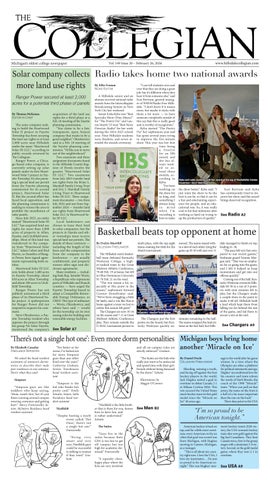
Ranger Power secured at least 2,000 acres for a potential third phase of panels
By Thomas McKenna Editor In Chief
The same company seeking to build the Heartwood Solar II project in Fayette Township has been securing the land use rights to at least 2,000 acres near Hillsdale under the name “Heartwood Solar III LLC,” according to public records reviewed by The Collegian.
Ranger Power, a Chicago-based solar company, is currently setting up solar panels under its first Heartwood Solar I project in Fayette Township. It’s also pursuing a special land use permit from the Fayette planning commission for its second project, Heartwood Solar II. But the second effort has faced local opposition, and the planning commission is seeking to rezone the area to prohibit the installation of solar panels.
Since July 2023, an entity named “Heartwood Solar III LLC” has acquired land use rights for more than 2,000 acres of property in Allen, Fayette, and Litchfield townships. Most of this land was transferred to the company from “Heartwood Solar LLC.” Adam Cohen and Paul Harris, co-founders of Ranger Power, have signed agreements representing both entities.
Heartwood Solar III LLC now holds about 1,400 acres in Fayette Township, about 610 acres in Allen Township, and about 180 acres in Litchfield Township.
Ranger Power has not publicly announced a third phase of its Heartwood Solar project. A spokesperson for Ranger Power did not respond to requests for comment.
Steve Oleszkowicz, a Fayette Township resident who opposes the project through his group No Solar Fayette, mentioned the company’s
acquisition of the land use rights for a third phase at a Feb. 10 meeting of the Fayette planning commission.
“You claim to be a fair, transparent, open, honest company that wants to be a good neighbor,” Oleszkowicz said at a Feb. 10 meeting of the Fayette planning commission. “I’d like you to move out of the neighborhood.”
Two easements and three assignment documents found in the Hillsdale County Register of Deeds involve the grantee “Heartwood Solar III LLC.” Two easements from July 2023 transfer land use rights from the Brian L. Marshall Family Living Trust and Eric J. Marshall Family Living Trust to Heartwood Solar III LLC. Three assignment documents — two from July 2024 and one from September 2024 — transfer land use rights from Heartwood Solar LLC to Heartwood Solar III LLC.
Local landowners can choose to lease their land to solar companies, but the projects in Fayette and other townships must receive special land use permits. The details of these contracts — including the length of the lease and the compensation from the company to the landowner — are usually confidential, and property owners often sign non-disclosure agreements.
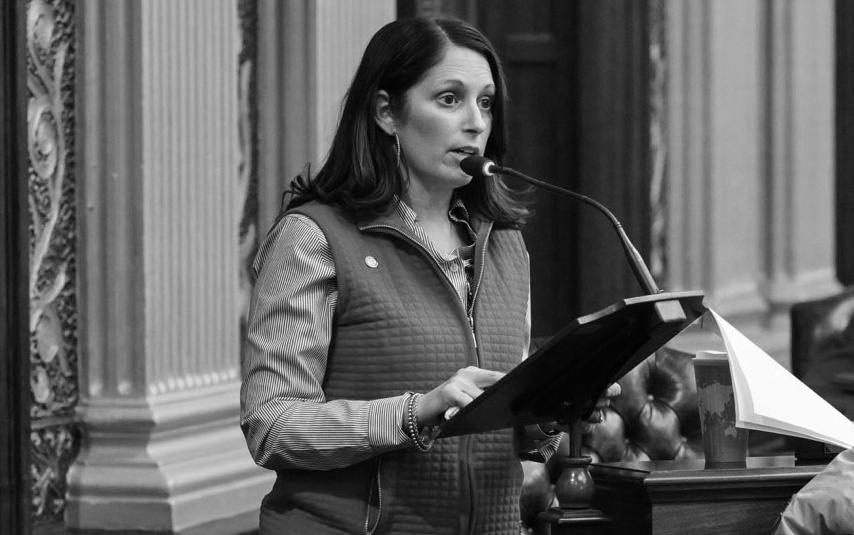
Many residents — including State Rep. Jennifer Wortz, a Republican who represents parts of Hillsdale and Branch counties — have urged the Fayette Township board to adopt a Compatible Renewable Energy Ordinance, or CREO. This type of ordinance — Wortz, Oleszkowicz, and others have said — would let the township set its own zoning rules for building new renewable energy facilities.
See Solar A7
Radio takes home two national awards
By Ellie Fromm News Editor
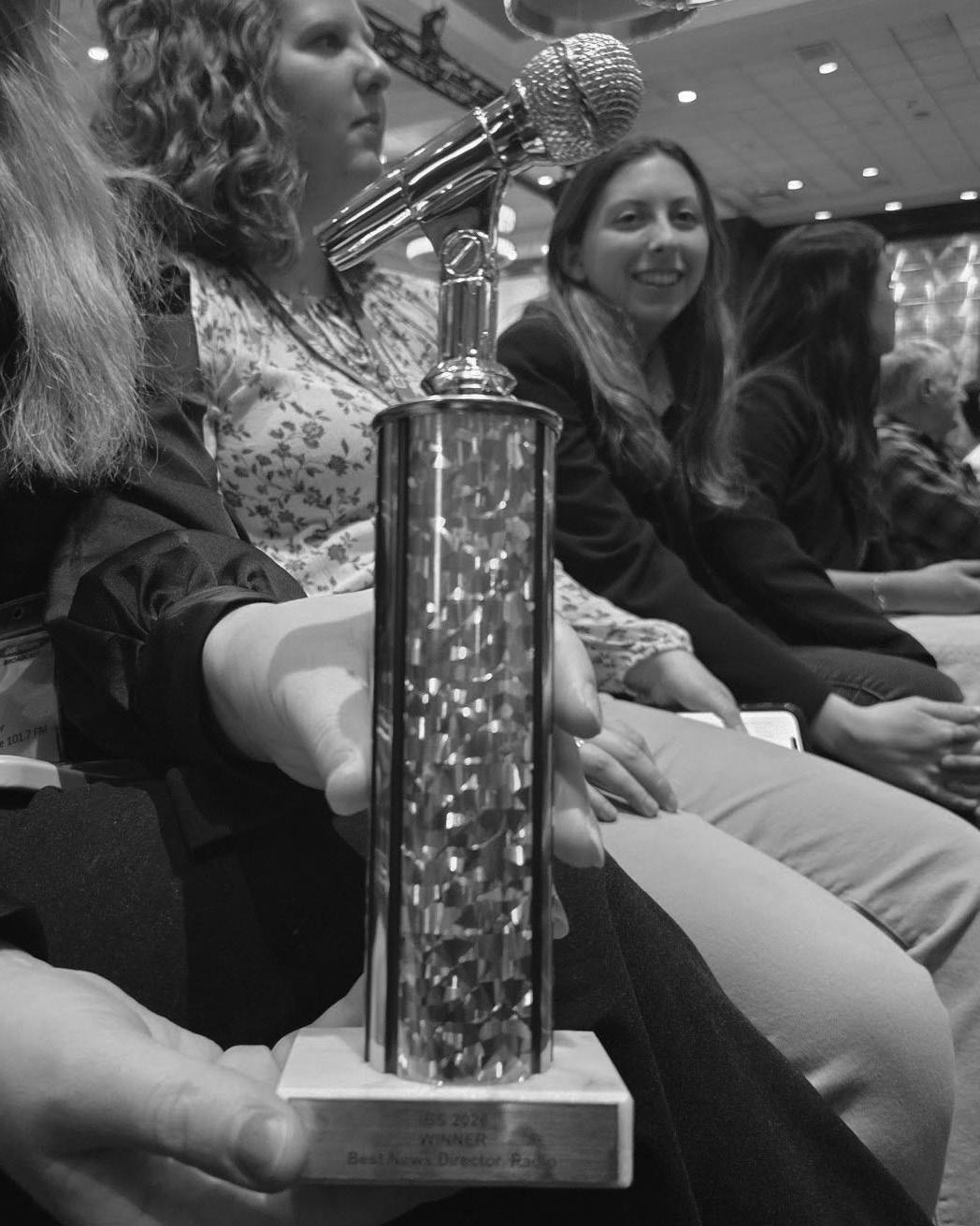
A Hillsdale senior and an alumna received national radio awards from the Intercollegiate Broadcasting System in New York City last weekend.
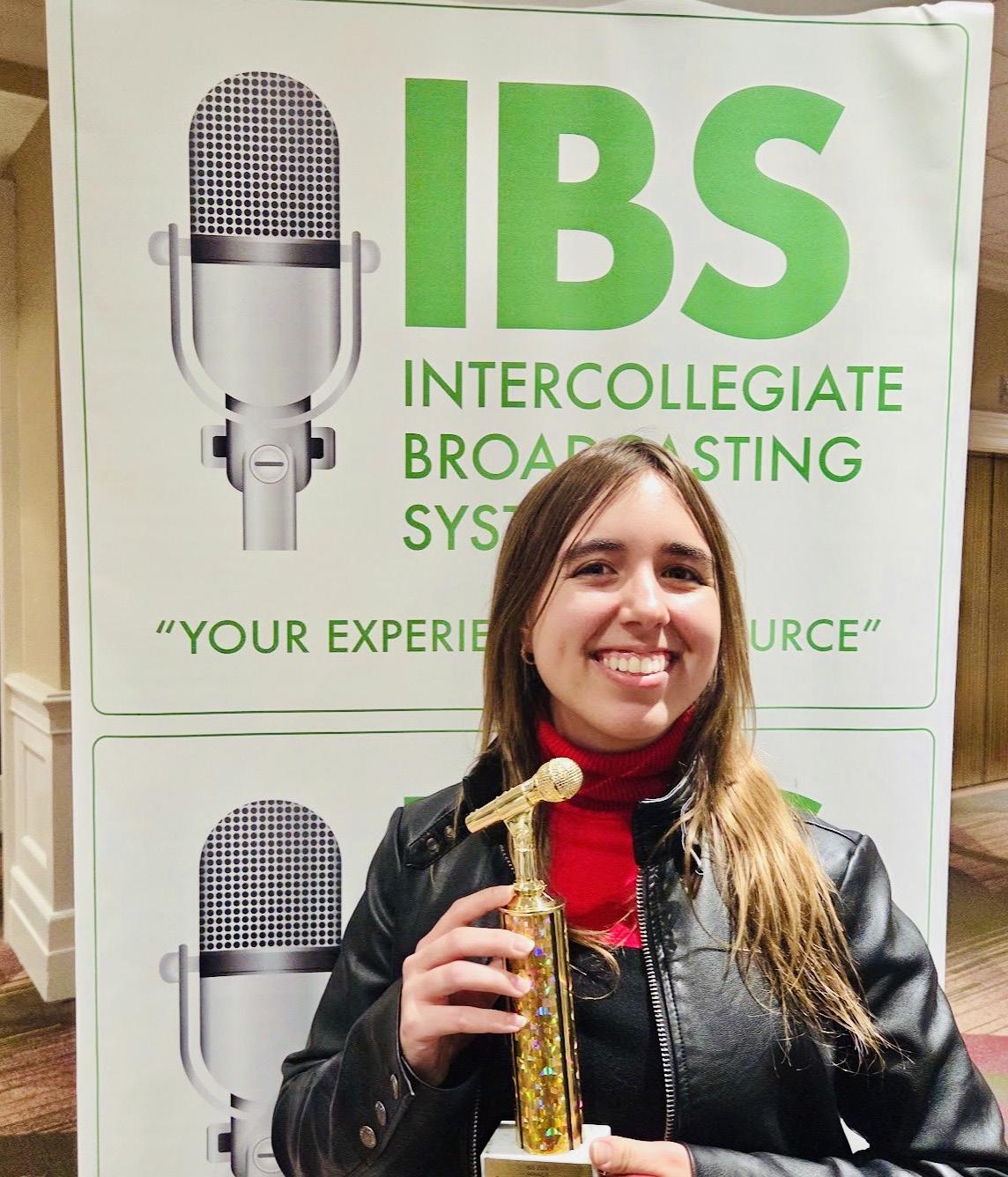
Senior Erika Kyba won “Best Specialty Show (Non-Music)” for “The Poetry Fix” and Lauren Smyth ’25 won “Best News Director, Radio” for her work during the 2024-2025 school year. Nine Hillsdale students were finalists, and seven attended the awards ceremony.
“I can tell students over and over that they are doing a great job, but it’s different when they hear it from someone else,” said Scot Bertram, general manager of WRFH/Radio Free Hillsdale. “I don’t know if it means more, but maybe it sticks with them a bit more — to have someone completely outside of this say that this is really good and is worthy of recognition.”
Kyba started “The Poetry Fix” her sophomore year and has spent several years trying to improve the five-minute show. This year was her first time being a finalist for an IBS award, and she has always wanted to attend these awards, according to Kyba.
“I’ve been working on the show for so long, and something I always keep in mind when I’m recording is how to make the show better,” Kyba said. “I just want the show to be the best it can be, so that it can be a fun and entertaining experience for people, and an educational one. So, it was really cool to hit that milestone after working so hard on trying to up the production of quality.”
Basketball beats top opponent at home
By Evelyn Shurtliff Collegian Freelancer
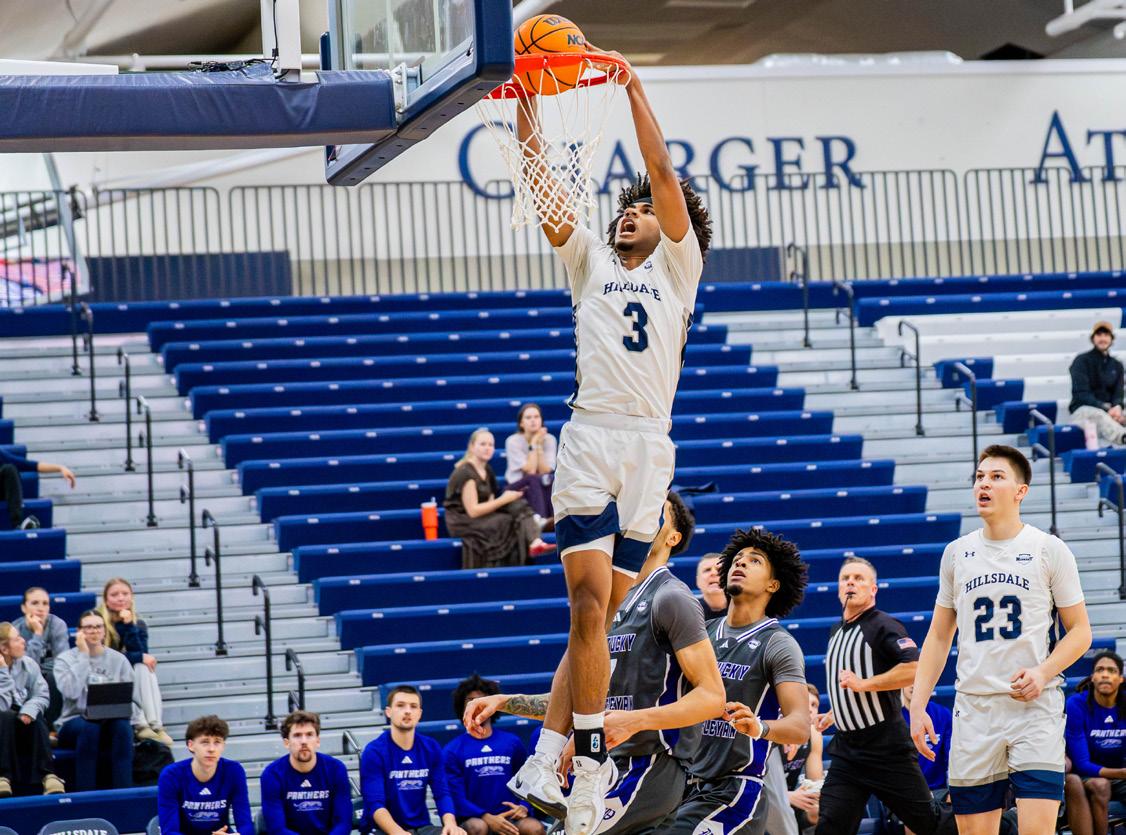
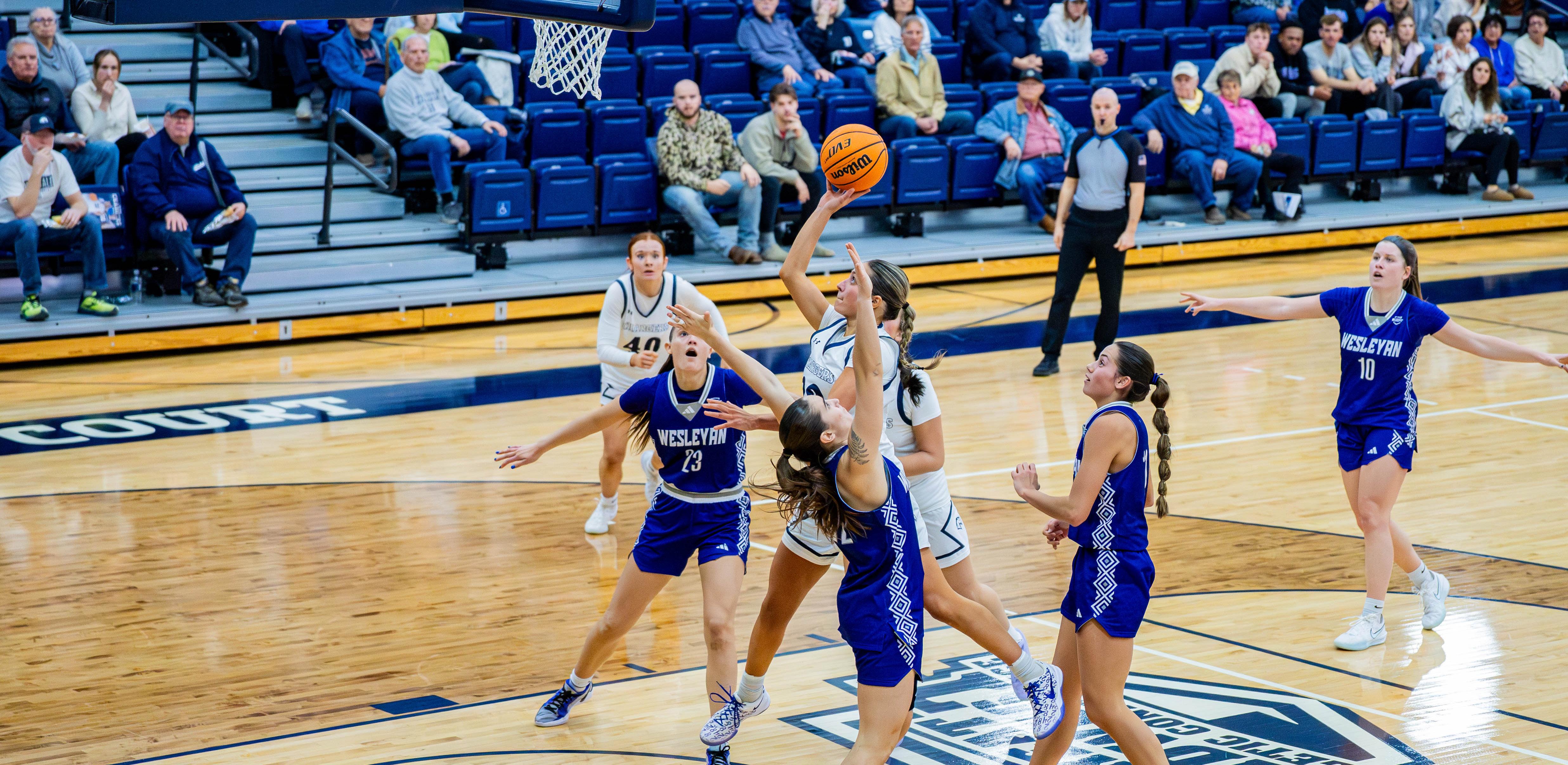
The Hillsdale men’s basketball team defeated Kentucky Wesleyan College, a higher-ranked team in the Great Midwest Athletic Conference, 79-68 Feb. 19 at home, but fell to Ohio Dominican University 91-76 Feb. 21 on the road.
“The win meant a lot, especially at this point in the season,” sophomore forward Connor Stonebraker said. “We’ve been struggling a little bit lately, and a win like that at home against a team we lost to earlier this season felt great.”
The Chargers are now 10-16 on the season and 7-11 in Great Midwest Athletic Conference play. They remain outside the G-MAC tournament picture in
top
swered. The teams stayed within a shot of each other, tying the game up 20-20 with just over 11
dale managed to finish on top, leading 41-36.
“The pace felt very fast compared to our recent games,” freshman guard Tommy Morgan said. “That was an emphasis for us going into the game, and I felt it helped us keep momentum and get into our offense quickly.”
Coming out of the half, Kentucky Wesleyan overtook Hillsdale 60-56 in a run of 3-pointers with nine minutes left to play, but the Chargers made a couple shots in the paint to make it 60-all. Hillsdale built a lead which kept them from falling too far behind the rest of the game, and led them to secure a win at the end.
quickly an -
The Chargers put the first points on the board, but Kentucky
‘There’s not a single hot one’: Even more dorm personalities
By Elizabeth Caneday Freelance Reporter
We asked the head resident assistants of womens’s dormitories to describe their male peer residences in one sentence. Here’s what they said:
Simpson
“Simpson guys are like toddlers who keep saying, ‘Mom, watch this,’ but it’s just them running around campus wearing costumes and getting hurt.” Mercy Franzonello, Junior, McIntyre Residence head resident assistant
“For better or for worse, I’ve kicked out far more Simpson guys than any other kind over the years.” Catherine Graham, Senior, Townhouses head resident assistant
“Simpson is the kid who thinks he’s pretty cool.” Emily Schutte, Senior, Sohn Residence head resident assistant Niedfeldt
“Despite hosting a yearly event called ‘Hot Ones,’ there’s not a single hot one.” Franzonello
“Being very smart and very nice, Niedfeldt guys could be successful in talking to women if they tried.” Graham
“Niedfeldt is the little brother that is there for you, knows how to have fun, and is rather underrated.” Schutte
The Suites
“Guys live in the suites because their GPA is too low to get off campus but too high for academic dismissal.” Franzonello
“A squeaky clean, happy place where the RAs are very involved
and all on-campus rules are strictly enforced.” Graham
“The Suites are the kids who really just want to be antisocial and spend time with their girlfriends without being harassed by the dorm.” Schutte
Illustrations by Maggie O’Connor.
minutes remaining in the half.
The teams swapped the lead six times in the first half, but Hills-
By Daniel Doyle Collegian Freelancer
Bleeding, missing a tooth, and facing off against the best hockey players in the world, Jack Hughes netted a goal in overtime to defeat Canada 2-1 at Milana Cortina 2026. This win secured the United States men’s hockey team its first gold medal since the “Miracle on Ice” 46 years ago.
sage to the world after his game winner. In a time where the Olympics are often a platform for political statements and ego, Hughes’ unconditional love for his country and team echoes the words of Herb Brooks, the coach of the 1980 “Miracle” team: “When you pull on that jersey, the name on the front is a hell of a lot more important than the one on the back.” Three days prior to the USA
“I’m so proud to be American tonight.”
American hockey is back on top, and for a little more sweetness, every American on the ice when that goal was scored was from Michigan, with Hughes moving to Canton, Michigan, as a teenager.
“This is all about my country right now. I love the USA, I love my teammates… I’m just so proud to be American tonight.” This was Hughes’ mes-
men’s hockey team’s 2026 victory, the USA women’s hockey team also won gold against the big bad Canadians. They beat Canada twice, first in the group stages with a dominant 5-0 victory. Second, in the gold medal game, where they won 2-1 in overtime.
ninth place, with the
eight teams making the field for the March tournament.
Wesleyan
Scot Bertram said Kyba has continuously tried to improve her show, and this award brings deserved recognition.
Kyba with her award.
Courtesy | Scot Bertram
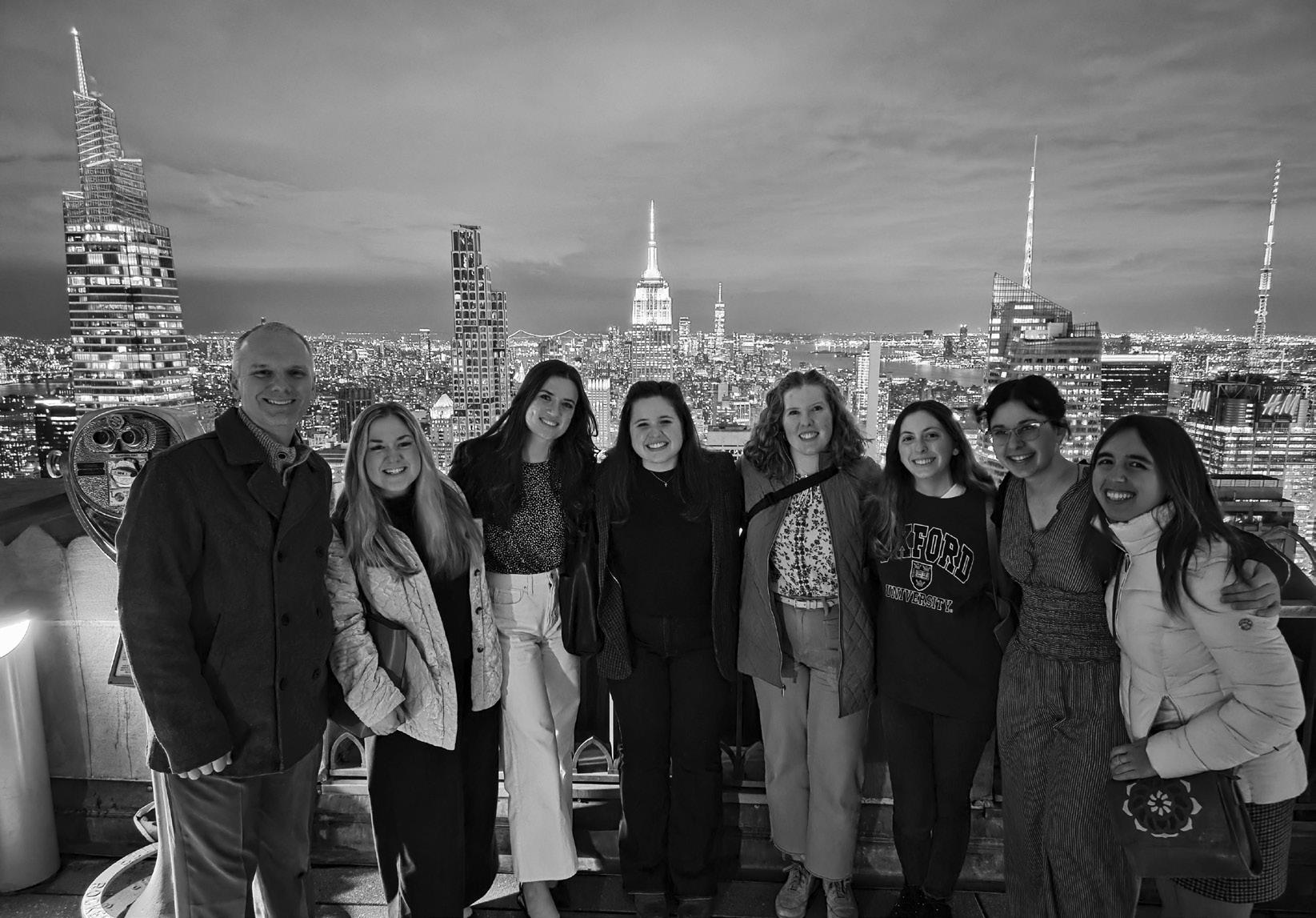
Kyba and radio students with her award at the top of Rockefeller Center.
Courtesy | Scot Bertram
Freshman Braylon Morris dunks against Kentucky Wesleyan College.
Courtesy | Ashley Van Hoose
Survivor of Oct. 7 terrorist attack recounts the ‘Code Red’
By Sophia Bryant Assistant Editor
Israeli civilians drove through fields and roads littered with bodies to escape Hamas on Oct. 7, 2023, a survivor told Hillsdale students and faculty this week.
Terrorists shot at Shye Klein, a photographer, and his friends as they fled the Nova Music Festival, where Hamas murdered 379 people. Klein told his story over Zoom Feb. 24 in the Hoynak Room.
“I remember seeing videos weeks later, there are cars on that road with people also killed, people who were in the same place as we were, almost home, and didn’t make it,” Klein said.
His talk was hosted by Hillsdale’s Jewish Mishpacha, Passages, and StandWithUs, according to sophomore Lilly Faye Kraemer, vice president of the Jewish Mishpacha.
Passages enables Christian students to travel to Israel, and StandWithUs is an organization that combats antisemitism.
Klein grew up in Toronto, Canada, but he moved to Israel about six months before the attack to be closer to his grandparents, who were in their late 80s.
“Going to the Nova, it was my first music festival,” Klein said. “I’d never been to one before. It wasn’t really my thing, and I just immigrated to the country, so I was still new.”
Klein went to the festival
with his cousin, his cousin’s girlfriend, and five mutual friends. The festival began on Friday, Oct. 6, and attendees camped overnight in the nearby woods. Around 5 a.m. on Oct. 7, Klein and his friends joined the party at the main stage.
of the Israeli cities that had intercepted rockets.
“The whole country, from north to south, east to west, everything except the sea itself, being fired at by Hamas terrorists with thousands and thousands of rockets,” Klein said. “It’s so many rockets, it’s
“We heard the machine guns. We heard the explosions. We heard everything that we didn’t want to be hearing.”
“Everybody’s having a good time,” Klein said. “Everyone’s happy to invite you to join them, to eat or drink or smoke or whatever. And you know, everybody was happy to include you in their friend circle.”
Eventually, Klein left his friends to talk to other people and take pictures. Around 6 a.m., the music stopped. “I see, in the sky, black spots, and I soon realize that they’re rockets,” Klein said. “And the producer comes over the speakers, and he says, ‘Code red, code red. Party’s over, go home.’ And then the music stops, and the security starts telling people to go back to their campsite and get their things and go home.”
When Klein reunited with his friends at the campsite, they were reading the names
insane.”
Klein’s cousin, who had served in the Israeli Defense Forces, told him that they were safe because they were in the desert close to Gaza, away from densely populated Israeli cities, but Klein insisted that they leave.
“Eventually he says, ‘OK, let’s go. We’ll go. We’ll pack up our stuff, but I want to finish my beer,’ or something along those lines,” Klein said.
At 7:30 a.m., when they had finished packing, they heard machine gun fire in the distance. They made their way to a mostly empty parking lot, and five of them climbed into a small, white car.
Klein drove toward the exit as fast as possible, trying not to hit people who were running on foot. Police barricaded the road to the north, and Hamas waited on the road to the south, so Klein drove through the surrounding fields.
“Then from behind us somewhere, there’s terrorists,” Klein said. “They open fire in this field and start shooting at all of us, and we hear this, and my cousin’s girlfriend screams at us, ‘Get out of the car!’ And we all start running out of the car, and we drop on the ground, and everyone’s just holding on to each other while my cousin had stopped in his tracks.”
Klein’s cousin ran back to the car, climbed in, and returned to pick up Klein and his other friends because he knew running on foot was a bad idea.
After driving through fields for around 45 minutes, they managed to get back on the road. Klein saw bodies, police cars riddled with bullets, rockets flying overhead, and huge, black pillars of smoke rising in the sky.
“I didn’t realize that this black smoke was caused by Hamas terrorists going house to house, burning people alive in their homes, in their cars, in the streets,” Klein said. “Really inhumane, inhuman acts
“When the terrorists arrived, we didn’t see them because they were opposite of us between the festival and the parking lot, but we heard them,” Klein said. “We heard the machine guns. We heard the explosions. We heard everything that we didn’t want to be hearing.”
that I could not imagine taking place outside of fiction.”
Klein said he photographed the entire drive, but he tried not to photograph those who were murdered.
They arrived home in Tel Aviv at 9:47 a.m., but they didn’t find out that their other three friends were alive until that night. They hid in a bush for seven and a half hours until they were rescued.
Now, Klein hopes to photograph portraits of other Nova survivors.
“I’m working on a project to photograph other Nova survivors, who are alive, who are around, who are healing and doing their best,” Klein said. “And I’m hoping to have that as an exhibition somewhere in Canada or the U.S., in order to use it as a platform and use the money towards initiatives to help with mental health, PTSD, and psychiatric care.”
Senior Tully Mitchell, who traveled to Israel with Passages in January 2025 and 2026, said she visited the memorial at the site of the Nova massacre twice.
“The Nova festival in particular is a story of civilians and people like us getting caught in the wrong place at the wrong time,” Mitchell said.
Sophomore and secretary of the Jewish Mishpacha Leon Rapoport said he was interested in hearing the firsthand story of an Oct. 7 survivor.
“I think people can be a little unaware of what actually happened on Oct. 7,” Rapoport said. “And I think this event would really help to show literally, with live photos and video what actually happened. I think that’s just helpful for people who are unfamiliar with it to know.”
Dining hall provides allergy-friendly fish on Fridays
By Christina Lewis Assistant Editor
Hillsdale Dining Services is serving gluten-free fish on Fridays during Lent, according to Campus Executive Chef Adam Harvey. Although fish are naturally gluten-free, the dining hall occasionally serves fish that has gluten ingredients in its coating, which gluten-free students must avoid.
“We offer a variety of allergen-free items every day at our Pure + Simple station, but during the Lenten season,
“Erika has been working really hard on that feature from the start,” Bertram said. “It’s the sort of thing where every week, every month, you hear of her getting better, of her show getting better. She’s always trying something different, doing a little bit more, adding music and sound effects and having guest readers, all sorts of things.”
Kyba, an English major, said she started “The Poetry Fix” to teach people how to
which began last week on Feb. 18, we know that a lot of our guests choose to eat a plantbased meal or plant-based and fish on Ash Wednesday and Fridays,” Harvey said in an email.
Since fish and seafood are two of the main nine allergens that are excluded from the Pure + Simple station, Metz knew gluten-free students may not have a fish option they can eat, according to Harvey. As a result, Metz will offer gluten-free fish on Fridays.
“We will continue to serve
understand different types of poems, such as “The Boston Evening Transcript” by T.S. Eliot and “Demain Des I’Aube” by Victor Hugo.
“The idea is to make the poem accessible to anyone,” Kyba said. “I love poetry, but there’s so much of it that I didn’t have any idea how to approach it before a professor explained it to me. Then, I was able to appreciate the beauty
the Friday fish options that we have on our rotating menu, most of which are already gluten-free,” Harvey said. “In the case that one of the entrees does contain gluten — say fish and chips — we will offer a similar gluten-free option those days that mimics the normal menu item.”
Students who either have allergy restrictions or would like a gluten-free fish option during Lent can ask their server for it, and the server will notify the kitchen and inform students where to go to be served.
of it, and I wanted to bring other people to that.”
“As always, if any students have any dietary concerns, including allergies or other dietary issues, please reach out to the dining team and we will schedule time to meet to review your individual needs and help come up with a solid dining plan,” Harvey said.
Senior Olivia Finch said she thinks it is a good decision to serve gluten-free fish, not only during Lent but also during other times in the year.
“I’m neither of these things myself, but I’m certain there are Catholics on campus who also happen to be gluten-free,
New York for the award ceremony and found out she won while putting away her groceries.
“It’s the sort of thing where every week, every month, you hear of her getting better.”
Smyth now works for World News Group, on publications such as World Magazine and its children’s newscast, “World Watch,” as a Joel Belz Fellow. She was not in
“I was just trying to put my salad away in the refrigerator when all of a sudden my phone started buzzing like crazy,” Smyth said. “Then, my friend sent me a picture of the award, and I was like, ‘Wow, that’s sparkly.’ It was a great thing to happen on a random evening.”
Bertram said, for him, Smyth’s award speaks to her impact on the radio station and the impact she had on those she led.
“Lauren was outstanding in all four years — in some way this is a legacy award,” Bertram said. “It’s not, of course, but all the great work that she did here at the station, she was nominated multiple times across the various awards we submit for. She was our news director last year at the radio station, and did a fantastic job leading that department and that team.”
Kyba said she was excited to hear Smyth win an award, as she credits her as her role model at the radio station.
“She’s the reason I got into
and I think they should be able to have access to fish on Fridays that won’t risk a bad reaction,” Finch said. “Also, there are definitely non-Catholic gluten-free students as well, and I’m sure they’d also appreciate the option for gluten-free fish — I feel like Saga does fish in general pretty well.”
Finch said she hopes Metz makes more dishes with salmon.
“I don’t think I’ve ever had Saga salmon that I didn’t enjoy,” Finch said.
Senior Clare Horvath said
she has plenty of friends who are gluten-free and still need protein on Fridays.
“I’m really grateful that Saga serves fish on Fridays,” Horvath said. “I think between the Catholic and Orthodox students, and anyone else who has decided not to have meat on Fridays, it’s a large part of the Hillsdale population. And, for more traditional Catholics and the Orthodox, I think, we abstain from meat every Friday, not just during Lent.”
radio in the first place,” Kyba said. “She was always a great mentor to everyone on the team, and so driven and creative, and so we all really admire her. We were so thrilled to have her name called.”
In addition to Smyth and Kyba, sophomore Peter Andrews, Bertram, Hana Connelly ’25, senior Sydney Green, junior Megan Li, senior Catherine Maxwell,
“This is always a fun trip culmination of a lot of work that the students have put into shows, features, newcasts, and content throughout the course of a year,”
junior Alessia Sandala, and senior Emily Schutte were finalists for awards.
Bertram said.
Radio from A1
Lauren Smyth’s award. Courtesy | Scot Bertram
The group that attended the award ceremony.
John J. Miller | Collegian
Senior Tully Mitchell visits the Nova Festival memorial in Israel in January. Courtesy | Cade Chudy
‘Absolute serendipity’: Fifth Circuit judges speak about path to the bench
By Matthew Tolbert and Ethan Savka Web & Puzzle Editor and Collegian Freelancer
The federal bench is not a career path one can choose, according to two judges on the Fifth Circuit Court of Appeals.
Stuart Kyle Duncan and Don Willett joined the Hillsdale College chapter of The Federalist Society Feb. 20 for a panel titled, “Lives in the Law: Becoming — and Being — a Federal Judge.”
Both Willett and Duncan began by recounting the stories of how they became federal judg-
es. Willett spent only two-anda-half of his 34 years in law in private practice. The rest of the time was spent in government. He then entered the judiciary at the state level before joining the federal bench.
“I spent about a dozen years on the Texas Supreme Court, and then came over to the federal bench,” Willett said. Duncan said he did not set out to become a judge.
“I went to LSU law school because I couldn’t get a job with my English degree, and I had no plans to be on the bench,” Duncan recalled. “I thought, ‘Wouldn’t it be nice if I could be a lawyer in Baton Rouge and make partner one day?’ I had no ambitions in that regard.”
After stints in state government and at a nonprofit, Duncan ran a
firm taking constitutional law cases — something he thought would keep him away from the bench.
“I had my law firm, and we handled cases about transgenderism, about abortion. I handled a bunch of gay marriage cases, and every time I would get one of these cases,” he recounted. “I would tell my wife, ‘Well, we’ve taken another one, and now I’m sure that I’ll never be a federal judge.’”
Yet, under President Donald Trump, Duncan’s record became an asset rather than a liability.
“In the old days — especially under Republicans — you’d want to have no paper trail at all,” Duncan said. “Trump, as he does in many things, goes the opposite direction. He sought out people, as I understand it, who were out there on the front lines.”
On the other hand, Duncan said joining the federal judiciary is not something one can plan on.
“You can’t set out to become a judge,” Duncan said. “It’s so few people who get to do this.”
Willett agreed, saying that much of the process depends on unmanageable factors.
“It really is divine happenstance. It is absolute serendipity,” Willett echoed. “There are 1,000 stars that have to align, and roughly 999 of them are utterly beyond your control.”
However, both also noted that there are ways to set oneself up well. Willett, for instance, focused on reputation.
“Try to be a really good lawyer, a really versatile kind of top tier lawyer, who has a reputation for being a credible candidate,” Willett advised.
Duncan stated that government work can be helpful to acquire that reputation.
“One way to put yourself in a position to do that is to go to work for the government,” Duncan said. “You get to be involved in cases that are quite consequential. They’re often in
the public eye.”
For Duncan, this helped him practice handling politically charged cases as a judge.
“Being in the public eye as a lawyer kind of prepares you for being in the public eye as a judge,” he said.
Senior Hugh Macaulay said he thought that getting the judges’ perspective was novel.
“I’m very grateful both distinguished judges could come and speak,” he said. “It’s very interesting to hear them speak about questions surrounding public policy.”
Macaulay said the discussion around faith life as a judge was a key takeaway for him.
“It was interesting to hear them talk about praying while considering their role in relation to the news,” he said. “Their emphasis on staying grounded in Scripture was very striking to me.”
Senior Marc Ayers also said he enjoyed the opportunity to hear from federal judges.
“I really enjoyed the talk,” Ayers said. “It’s always so valuable in any profession as secluded from the public eye as federal judges to get their opinion on things.”
Ayers particularly enjoyed the emphasis that the judges placed on the difficult task of placing the law above personal values.
“The judges are focused on the law,” Ayers said. “That’s what’s important to them, and that’s what they’re deciding, not feelings, not emotions, not opinions.”
Willett said that despite the lower pay of being a judge, he wouldn’t have it any other way.
“Duncan and I could leave the bench and go to private law firm life, and multiply our salaries by a very large number,” Willett said. “But in terms of satisfaction, in terms of difference making, in terms of how consequential it is, it’s really hard to beat.”
Occupational therapy provides a path to independence
By Skye Graham Social Media Manager
Speakers from Concordia University Ann Arbor spoke Feb. 18 about how occupational therapy can help patients with disabilities become more independent.
The talk was one of many in the “Med Talk” series hosted by Career Services, which educates students about careers in the medical field.
Juliane Chreston, professor and program director for the
occupational therapy doctorate at Concordia, spoke about how occupational therapists can impact the lives of young people who suffer injury. She told the story of a 17-year-old boy, Matt, who suffered a traumatic brain injury in a car accident and needed the support of occupational therapists to accomplish daily tasks.
“He had difficulties with his cognitive skills,” Chreston said. “His ability to problem solve, concentrate, initiate tasks, those kinds of things.”
Chreston said Matt needed help doing basic, everyday tasks because of his injuries. With the organization Rehab Without Walls, a team of therapists helped him regain some independence.
“He needed 24-hour supervision,” Chreston said. “So here’s this 17 year old needing help with bathing, dressing, toileting, eating, and spending his day with older women telling him what to do.”
According to Chreston, her team worked on helping Matt
be independent in the bathroom by installing proper supports. Later, they were able to give him more privacy by giving him song cues to keep him on task. Finally, Matt’s team was able to get him into an apartment with his older sister as his caregiver.
Chreston said occupational therapists can work in hospitals, schools, or even in the military.
“I had a graduate who went into the army and served on the front lines of Afghanistan,” Chreston said. “He was work-
Hillsdale in DC hosts American history lecture series
By Cassandra DeVries Collegian Reporter
Secretary of Education Linda McMahon will join Hillsdale College President Larry Arnn at Hillsdale in D.C. on March 13, as a part of a series of events meant to celebrate America’s 250th anniversary, with events such as the geopolitical context of the American Revolution, constitutional interpretation, and classical architecture.
The event series began in early February and will continue until mid July.
“We’re calling it ‘Education in America at 250,’” said Shaun Rieley, director of educational programs and teaching fellow. “It’s going to be a sit-down conversational fireside chat with the current secretary of education asking her about her thoughts on education and how that can help to sustain our country and perpetuate its institutions, and that sort of thing.”
The first event, titled “The Making of the American Mind” by Matthew Spalding, vice president of Washington operations and dean of the Van Andel Graduate School of Government, was hosted on Feb. 11.
“At Hillsdale in D.C., we seek to equip citizens and statesmen to restore America’s founding principles and
revive American self-government,” Spalding said in a press release. “Through these events, we will look at what made America great and what we are trying to restore.”
Rieley is heading the initiative and said he wants to target a well-read, educated, interested public. The events are public and will be advertised to the Hillsdale in D.C. email list.
tanks, or developing policy,” Rieley said. “So we are uniquely positioned to speak about the direct mechanisms of governance and to apply some of these more philosophic, more theoretical ideas in practical ways.”
In the first lecture, Spalding talked about his recent book, “The Making of the American Mind: The Story of our Declaration of Independence.”
“Through these events, we will look at what made America great and what we are trying to restore.”
“We wanted to do something that was meaningful and distinctly Hillsdale D.C.,” Rieley said. “A lot of big institutions around town have their own initiatives, and we wanted to do something unique.”
Rieley said Hillsdale in D.C. decided that, as part of a college, it would lean into the education side of the anniversary and crafted a lecture series surrounding the Founding.
“Many of our students are working in D.C. in positions of leadership and influence, whether it’s in the administration, on the Hill, in think
“During the event for his new book, Dr. Spalding guided our attendees through thoughts and debates that gave rise to our Declaration of Independence,” said Andrew Heim, executive director of Washington operations. “It’s a beautiful story, and every American should hear it, know it, and share it.”
Rieley agreed and said the talk was a successful kick off.
“There was a lot of anticipation there because it is the 250th anniversary of the country, but also because we had just moved back into our newly renovated facilities, and
Dr. Spalding’s book came out at the same time,” Rieley said. “That worked out really nicely.”
Hillsdale in D.C. will host Hillsdale College Professor of History Dave Stewart on March 9 in conjunction with the Center for Military History and Strategy to assess the American Revolution as a military venture, and how this influenced the economy, according to Rieley.
This lecture will be titled “‘No Man Will Think Himself Bound to Fight’: The Crises of Supply During the American Revolution.”
The Center for Military History and Strategy with the D.C. campus to provide “The Revolutionary War in Its Geopolitical Context: The Contributions of the Dutch, the French, and the Spanish to the American Victory” by University of Virginia Professor of History Andrew O’Shaughnessey on April 13.
Another lecture, titled “Readers and Leaders of Revolutionary America,” will focus on the Founding Fathers’ libraries. This lecture will be given by University of Central Oklahoma Emeritus Professor of English Kevin J. Hayes on April 27.
Other events in the series include “The American Book of Fables,” “The Music of the Revolution,” and “Classical Architecture and the American Idea.”
Each lecture brings in a leader in a field of study relating to the Revolution, according to Rieley.
The Hillsdale D.C. leadership is putting together ideas for the lecture series and may host 250th anniversary events in addition to those currently listed in the press release, Rieley said.
“I hope people leave Hillsdale’s D.C. campus and events with a renewed appreciation for our country’s history,” Heim said. “I want people to fall in love with America again.”
ing with soldiers and some of the PTSD they experienced. Wherever there’s people, we can work.”
Concordia admissions counselor and outreach specialist Laura Nail spoke about the admissions process for their Direct Entry Master of Science in Nursing program and gave students advice on things to look out for when pursuing graduate education.
“Go to the schools, see the facilities, and see where you feel comfortable,” Nail said.
“Let that give you a road map as you’re starting to look at those graduate applications.”
Sophomore Maddie Krappmann said the talk helped her learn about the relationships occupational therapists form with their patients.
“The talk taught me how involved you are in someone’s life as an OT,” Krappmann said. “You get to know the person you are seeing on a deeper level, and I think forming relationships like that is incredibly special.”
International Club rings in the Lunar New Year with lanterns
By Grace Brennan Assistant Editor
The International Club painted traditional Chinese lanterns for its first event of the semester Feb. 21 in the Mauck Solarium to celebrate the Lunar New Year.
Sophomore and President of the International Club Nayeon Kim grew up celebrating the Lunar New Year in Korea. Kim said she wants to bring the traditions of her youth to Hillsdale.
“The Lunar New Year is the beginning of a new year in Asian cultures,” Kim said. “We have a lot of good food and fellowship together, and we wanted to do that at Hillsdale’s campus because there’s not many celebrations going on.”
To celebrate the Lunar New Year — a 15-day festival marked by the first moon of the lunisolar calendar and the arrival of spring — students painted white lanterns while engrossed in traditional Japanese and Chinese instrumental music, with friends and even family.
Sophomore Victoria Stonebraker painted lanterns with her sister, who was visiting campus. Stonebraker said she liked the immersive atmosphere.
“The music really brings you into a different environment,” she said. “It’s hard to get out of Hillsdale sometimes, and it’s hard to remember that the rest of the world has things going on. You have to interact with, and embrace different cultures. It’s an important and beautiful thing to do.”
Kim said she hopes the students will decorate their dorms with the lanterns they paint.
“After they’re done, they can put mini light bulbs in their lantern so that it can light up their rooms,” Kim said.
Stonebraker said she plans to carry her lantern with her wherever she goes.
“I have big plans for my lantern,” said Stonebraker. “Like the Flat Stanley trend in grade school when you would take him everywhere, that’s going to be my lantern. Or it’ll be my Wilson, like the volleyball from ‘Cast Away.’” Junior and Secretary of the International Club Lauren Audrey Paschoud, said even though this is only the second time the club has celebrated the Lunar New Year, it is her favorite event.
“We have a good representation of Asians in our international club, and so it’s fun to bring that aspect of international influence into Hillsdale,” Paschoud said. International club events are designed for the whole school to enjoy, she said.
“Some people may think that the International Club is more for people that are just international students, but it’s also a way to bring more cultural awareness and experience to the campus,” Paschoud said.
Stonebraker said she learned a lot about the culture and plans to celebrate the Lunar New Year in the same way next year. According to Kim, next year the club hopes to release the lanterns into the sky like in the Disney movie “Tangled.”
“If we could incorporate the technology, and if we have enough officers who know how to do that, we would definitely love to raise the lantern like in ‘Tangled,’ because I feel like that’s really beautiful,” Kim said.
Matthew Spalding at Hillsdale in DC’s first America 250 event. Courtesy | Hillsdale in DC
Duncan (left) and Willett (right) at the event. Courtesy | Evelyn Shurtliff
D.C. Correspondents | Lauren Bixler | Megan Li | Lewis Thune
Web & Puzzle Editor | Matthew Tolbert
Illustrator | Maggie O’Connor
Faculty Advisers | John J. Miller | Maria Servold
before Saturday at 3 p.m.
Jack Hughes: Toothless patriot
By Moira Gleason Executive Editor
We’re all hockey fans now.
Jack Hughes, with his toothless grin and an American flag draped over his shoulders after scoring the golden goal for Team USA, gave us the unifying cultural moment we didn’t know we needed.
When the men’s Olympic hockey team filed into the gallery at President Donald Trump’s State of the Union address Tuesday night, members on both sides of the aisle stood up — one of the few occasions throughout the entire speech. The room erupted into cheers and chants of “USA! USA!” as Trump announced he would award goalie Connor Hellebuyck the Presidential Medal of Freedom.
If you have been living under a rock for the past week or grew up in the Southwest with only sisters, let me catch you up.
The U.S. women’s Olympic hockey team took gold in an overtime game against Canada Feb. 19. The men of Team U.S.A. then battled Canada into overtime Sunday on the way to their first gold medal since the “Miracle on Ice” win over the Soviets in 1980. Goalie Hellebuyck kept the U.S. in the fight, making 41 saves and preventing Canada from converting a 5-on-3 power play in the second period.
In the third period, center Jack Hughes lost a couple of front teeth to a high-sticking penalty by Canada’s Sam Bennett. But that didn’t stop the 24-yearold New Jersey Devils player. He wiped the blood off his mouth and came back to score the game-winner in sudden-death overtime. The team swarmed the ice, sticks and gloves flew, and the loudspeakers blared Lynyrd Skynyrd’s “Free Bird.”
It was the perfect game, if only for the drama. Even
By Elijah Guevara Assistant Editor
The Civil War soldier stands as the most prominent statue on the Liberty Walk. Erected in 1895, the Civil War Monument is now joined by Founding Fathers and other statesmen on a walkway dedicated to “honor the great leaders who have come before us and paved the way for freedom.” But the Liberty Walk is incomplete without the presence of another soldier who also fought for American liberty and deserves a place on that same walkway: the World War II soldier.
Like the Civil War student soldier, built in honor of the Hillsdale students who fought for the Union, a statue dedicated to the World War II soldier would not depict any specific person who fought in the war. Rather, the identity would remain anonymous and represent the millions of young American men and women — among them Hillsdale students — who enlisted in the armed services. An anonymous World War II statue could complement the
Civil War Monument, perhaps placed between the statues of the Civil War soldier and George Washington, the Army’s first commander-in-chief. We do not know the exact number of Hillsdale students or alumni who served in World War II, as we do for the number of students who served in the Union forces during the Civil War (530) or in World War I (more than 300). More than 500 Hillsdale men and women served in World War II, according to records from the Hillsdale Community Library. The numbers, however, do not distinguish between servicemembers from Hillsdale College and those from the city of Hillsdale.
Still, more than 16 million men and women wore the uniform of the United States Armed Forces during World War II, the highest enlistment number of any war in American history. They fought in and won one of the most consequential wars in history, not only for American sovereignty and liberty, but also for nations and peoples worldwide.
Countless stories and anecdotes passed down for generations recount the heroism of famous World War II soldiers.
The nation celebrated the boldness of Audie Murphy, who, in defense of his company, single-handedly fought off six German tanks and hundreds of soldiers with an exposed machine gun and a wounded leg. The country even hailed the bravery of non-combatants, such as the incredible story of Desmond Doss in the Battle of Okinawa, who, as a combat medic and conscientious objector, saved the lives of 75 soldiers — American and Japanese — without firing a single shot.
The sacrifices of American soldiers reached my own family, who owe their survival to the United States Army that defeated the Imperial Japanese Army. Both of my maternal grandparents lived under the rule of the Japanese, who had seized control of the Philippines in 1941. They told us grandchildren stories of evacuating homes in the late night, escaping into the hills, and even hiding under a
porch as Japanese forces raided their small village. They also remembered meeting the young American soldiers who helped them resist the Japanese and who eventually liberated the Philippines in 1945. Without the arrival of the Americans, my family would likely not have been able to come to the United States after the war. My family and I owe our lives to the bravery of the unnamed American soldiers who crossed an ocean to fight tyranny. Most of the soldiers who served and gave their lives for the liberation of others are now unnamed and unknown, like the countless American soldiers whose faces my grandparents could recall, yet could never name. Whether he was a celebrated hero, a combat medic, or an unknown Philippine liberator, the memory of every American World War II soldier deserves to be enshrined on Hillsdale’s Liberty Walk.
Guevara is a sophomore studying history.
Use this Lent to go deeper
By Paul Bwamiki Collegian Freelancer
better was Hughes’ postgame interview.
“Unbelievable game by Hellebuyck,” Hughes told NBC. “He was our best player tonight by a mile. Unbelievable game. Unreal game by our team. Just a ballsy, gutsy win. That’s American hockey right there. That’s a great Canadian team, but we’re U.S.A. We’re so proud to be Americans. Tonight was all for the country.”
People like Jack Hughes make America great. With a lisp and dried blood on his lips, he praised his teammate, acknowledged the opposing team’s strength, and declared his love for his country.
No politics. No trash talking. No public confessions. Just pure patriotism and a victory hard-won.
“Look at these guys. We’re such a team,” Hughes said. “We’ve been together for two weeks. We’re such a team. The U.S.A. brotherhood is so strong. And we’re so proud to win for our country.”
Shortly after the victory, the team posed for a photo on the ice with their medals and the toddlers of fallen would-be teammate Johnny Gaudreau, holding a USA No. 13 jersey bearing his name. The father of three and all-time international lead scorer for the NHL was killed in August 2024 by a drunk driver.
The world got to see true American greatness in action on Sunday. Not only did Team U.S.A. carry home the gold, they did so with equal parts guts and grace — fighting through pain for the victory and supporting each other like brothers.
Excellence like that deserves to be celebrated, no matter on what side of the aisle you stand.
Moira Gleason is a senior studying English.
Lent is an invitation to every heart. For many college students, living Lent well is not a question of belief, but of time, attention, and space
At its core, Lent is not simply a tradition. It is a call to slow down, examine our lives, and return to God with intention. In the middle of college life, that call can feel difficult to answer. College is a place of movement and ambition. Our schedules are full, our minds are engaged with lectures, assignments, and exams. These things are not wrong; they shape us into disciplined and capable individuals.
But too easily we can neglect the formation of our hearts. We can devote so much of our time and energy to intellectual formation and external accomplishment that our priorities
become disordered. Devoid of meaningful silence, we lose touch with God, the source of our identity.
Lent invites us into a different kind of discipline, strengthening the foundation of our lives. This season can feel challenging in college, not because we do not care about our faith, but because our lives seem so full.
On a typical weekday, a student might wake up just in time for an 8 a.m. class, rush across campus, grab a quick meal, and move straight into afternoon commitments. By evening, assignments demand attention, and by the time the day ends, there is little energy left for prayer beyond a few tired words before sleep.
We often think of Lent in terms of what we give up. These sacrifices can be meaningful, but they are not the heart of the season. A student might give
up scrolling before bed, only to find themselves reaching for their phone out of habit. Others might give up coffee and suddenly realize how dependent they are on it to get through long days. These small struggles reveal how deeply routines shape our lives.
The true purpose of Lent is not to prove our strength but recognize our need. It reminds us we are limited and dependent on grace. It calls us to ask: Where have I become distracted? Where have I grown distant from God? Where have I filled my life with noise?
We need honesty to look within and see how much time we give to God. Reading books or doing assignments is not wrong, but we need to make sure they don’t become idols to replace God.
Lent reminds us that faith does not grow automatically. It grows when we make space
for God. In college, that space might be as simple as setting aside 10 minutes in the morning for prayer before checking your phone and attending mid-week campus ministry gatherings. These small, consistent choices shape faith more deeply than occasional, dramatic efforts. Lent invites us to live not by withdrawing from our responsibilities, but by carrying them with a deeper awareness of God’s presence. It does not ask us to escape our lives, but examine them. Lent becomes real when we make concrete choices to deepen our relationship with God.
In a world that rarely slows down, Lent calls us to pause and be quiet in God’s presence. We could all heed that call.
Paul Bwamiki is a junior studying biochemistry.
Letter to the Editor
Residents have spoken on road repair. City Hall isn’t listening.
By Jonah and Elyse Apel Guest Writers
When Hillsdale residents unanimously opposed special assessment districts for road repairs during the Feb. 16 city council meeting, they delivered a clear verdict. Yet last week’s Collegian article, “Residents reject road repair plan at public hearing,” reflected a City Hall perspective that mischaracterized SADs and ignored real alternatives available for fixing our roads. Under state law and Hillsdale city charter, special assessments are meant for “public improvements” — not for repairing infrastructure that has crumbled after years of neglect. Calling long-overdue maintenance “improvements” shifts responsibility from the city and onto residents, even though maintaining streets is one of local government’s most basic duties.
An essential part of governing is choosing policies that citizens will consent to — or, at the very least, will not actively oppose. In the case of
SADs, the last four have all been soundly rejected by the people of Hillsdale, reflecting a clear indictment of a policy that imposes a steep cost above existing property taxes.
Compounding the problem is a lack of imagination in how the city approaches road funding. This fiscal year, the city is set to receive a substantial increase of about $400,000 in state road funding, while SADs accounted for only about 25% of total funding in the proposed 2026 projects. The city council majority also refuses to seriously examine budget cuts, reallocations, or reprioritization. Instead, city officials continue to portray SADs as unfortunate but unavoidable.
In a further failure of leadership, the city council refused to compromise despite multiple good-faith efforts by residents. In October, despite believing SADs were fundamentally unfair, South Street residents proposed a compromise capping assessments at $2,800. When the city refused to even consider it, the citizens’ complete rejection of
SADs was a foreseeable consequence.
When citizens object to special assessments, they are disciplined with the ongoing neglect of their roads. Instead of funding the projects the city previously deemed most urgent, the city leaves objecting streets in disrepair and moves on to new neighborhoods they hope will shoulder a $5,000 special assessment. When those residents inevitably object, the pattern repeats.
Unfortunately, the city’s cycle of avoidance became even clearer at the Feb. 16 council meeting. Rather than treating public opposition to SADs as a mandate to rethink policy, Councilman Robert Socha called the public backlash “insulting,” complaining, “I think we deserve better from the community.”
Meanwhile, mayoral candidate and Councilman Bob Flynn proposed an explicitly pay-to-play system.
“Has staff ever, for lack of a better phrase, thought about asking somebody? Is there somebody out there who
would like to do special assessments?” Flynn asked.
In response, City Manager David Mackie suggested the city see whether residents want to “move their streets up” before scrapping SADs. The implication was clear. If this vision prevails, functioning roads in Hillsdale will be relegated to the few with residents willing to pay $5,000 above and beyond their current taxes.
Hillsdale’s road problem is not just a funding challenge, but a failure of governance. When residents reject a policy four times in a row, the correct response is not to search for more compliant neighborhoods. City leaders must change course, or Hillsdale voters will force them to come November.
Jonah and Elyse Apel are both 2024 graduates of Hillsdale College and residents of South Street. Jonah is a current Ph.D. candidate at the Van Andel Graduate School of Statesmanship.
Elijah
On ‘gender-affirming care,’ facts win
By Daniel Johnson Collegian Reporter
The American Medical Association asserted for years that transgender surgeries for minors were “medically necessary,” according to its website. On Feb. 4, the organization officially recommended against gender transition surgeries for minors, following a growing precedent around the world.
Closer to home, Michigan’s attorney general continues to defend these treatments as best practice. Michiganders should remind her of the facts.
The recent reversal on “gender-affirming care” has a simple explanation: Facts win when people are bold enough to speak them out loud.
“Gender-affirming” surgeries and hormone treatments are based on a false narrative. The World Professional Association for Transgender Health said gender dysphoric teenagers’ lives depended on aligning their bodies with their inner sense of self through irreversible surgeries, an idea contradicted by both the best practices of medicine and the experiences of many who underwent and regretted the procedures.
A narrative without facts can only be maintained through force. Without facts behind them, defenders of sex-change surgeries and hormone treatments simply labeled all dissenters as violent bigots. This worked until a few people, led by the very victims of these surgeries, spoke out.
Critics such as swimmer Riley Gaines and University of Sussex Philosophy Professor Kathleen Stock were labeled as violent and ostracized from society. Parents who questioned whether their 15-year-old son should get an estrogen implant were asked whether they “wanted
a dead son or a live daughter.”
The cardinal rule of medicine is “do no harm.” As an independent review in the U.K. found, permanently altering gender surgeries and hormone treatments for minors lack the evidence and safeguards necessary to prevent harm. Instead, as whistleblowers such as gender clinic case manager Jamie Reed have now admitted, these treatments were given the green light out of “political considerations.”
Ideas have consequences, and bad ideas — like medical procedures driven by politics instead of facts — have victims. One of these victims was British woman Keira Bell, one of the thousands of young women fasttracked into these medical procedures who regretted her choice. But unlike most, Bell took action.
“I was an unhappy girl who needed help,” Bell said in a statement online. “Instead, I was treated as an experiment. But it was the job of the professionals to consider all of my comorbidities, not just to affirm my naive hope that everything could be solved with hormones and surgery.”
In 2019, Bell started a public campaign against “gender-affirming” surgery for minors, suing the prominent Tavistock Gender Identity Development Service in court. A year later, despite death threats, she won.
Others joined the campaign, including Chloe Cole, driving a movement against sex-change surgeries and hormone treatments that activists could neither silence nor dismiss as conservative bigots clutching for control.
Transgender activism drew its authority from the experiences of people with gender dysphoria. When those same people’s lived experience was that “gender-af-
firming” care was criminally irresponsible, the narrative began to crack.
Drawing on the testimonies of detransitioners like Bell, the Cass Review, an independent investigation for U.K.’s National Health Service, declared in March 2022 that gender-affirming procedures lacked the evidence and safeguards of best practice medicine and pointed out evidence of irreversible long-term harm — such as infertility, fragile bones, and endocrine disruption — caused by the treatments. In conclusion, the researchers recommended postponing these gender treatments until adulthood.
The U.K. closed its youth gender clinics.
America moved more slowly. However, in recent months, not only the AMA but also the American Society of Plastic Surgeons and the American Academy of Pediatrics have revised their standards. The state of Michigan, meanwhile, has doubled down, releasing a letter threatening healthcare providers who refuse sexchange treatments to minors with prosecution.
According to a poll this month, a majority of the American public now supports banning sex-change treatments for minors. Once a few courageous people spoke up, citizens could see the facts through the narrative.
The President Donald Trump-era political climate has helped. But the monumental shift on “gender-affirming” surgeries ultimately is due to the willingness of brave individuals such as Keira Bell to speak the truth regardless of personal cost.
Still, more truth must be spoken.
Teens wrestling with gender dysphoria, defined by the American Psychiatric Association as “psychological
distress that results from an incongruence between one’s sex and one’s psychological sense of gender,” often have several problems, including depression, dissociative disorders, and autism spectrum disorders. Thus, the teens who’ve been rushed into these surgeries are often the most vulnerable, isolated, and desperate for identity.
Banning the “gender-affirming” treatments harming these teens is important. But it’s not enough. Instead of being guided toward a healthy acceptance of their whole person, teenagers are told they’re born in the wrong body, destabilizing their identity from external reality.
This is manipulative and cruel, and it needs to stop. Every American medical association, including the Michigan Department of Health and Human Services, should follow the AMA’s lead and work to help young people accept their bodies rather than lie to them.
This won’t happen unless brave individuals keep speaking the truth out loud.
Know a doctor? Have him over for dinner to share your concerns. Is your state legislator unsure about this issue? Give them a call. Have a friend struggling with gender dysphoria? Be a good friend and tell them the truth to help them accept their own bodies.
As Soviet dissident Alexander Solzhenitsyn once said: “Live not by lies.”
Daniel Johnson is a sophomore studying philosophy and religion.
Carpe summer
By Ty Ruddy Culture Editor
I couldn’t have worked another summer on the cemetery mowing crew. I’d grown to know the headstones well but didn’t weep when I left them for Washington, D.C., last summer.
During my first three years of college, I grew accustomed to a rigid schedule. Semesters were time at school; summers and breaks were time at home. I enjoyed both, but by year three of the same old thing, I had become Alfred Tennyson’s Ulysses, desirous of a new world. Washington, D.C., became my happy isle.
Before I started college, a friend told me I was entering the only four-year period in my life in which I was the only person I had to worry about. It’s basically true. Few college students have spouses. Fewer still have families to provide for.
Take advantage of this free time while you’re a student. If you pack up and move to D.C. for three months, you’ll miss your family. But you’ll gain something, too. While you may miss your hometown friends, you’ll leave the city with new friends from around the country. If nothing else, spending a summer out of your comfort zone will be an adventure. Before last May, I had never lived more than an hour from where I grew up. So when, three days after classes ended, I transferred my whole life to the East Coast, I wasn’t sure I would make it. I survived those three months living on my own just fine — and along the way, discovered a spirit of adventure beneath my homebody tendencies.
I spent my first Saturday alone walking the National Mall. I had been to the city twice be-
‘Bridgerton’ is smut
By Adriana Azarian Assistant Editor
Netflix will release more episodes of the hit series “Bridgerton” today. You shouldn’t watch it.
Set in Regency-era London with modern twists, “Bridgerton” presents a world of attractive, well-to-do characters searching for suitable spouses. It can be easy to set aside the historical in accuracies and predictable plotlines, given the gorgeous costumes, enthralling drama, and orchestral adaptations of modern music.
But woven throughout the show are graphic sex scenes. Simply fast-forwarding through them isn’t enough to avoid the show’s perva sive sexual content. Entire subplots consist of charac ters’ sexual confusions and explorations. In the first half of Season 4 alone, an episode devotes significant screen time to characters explaining sexual climaxes to newlywed Francesca Bridgerton. Even Lady Violet Bridgerton, the respectable widow and moth er of eight children, hooks up with a side character because “life is meant to be lived” — or so says her maid. Compare this with another beloved British period drama, “Downton Abbey.” Let’s not fool ourselves that “Downton” was always PG-rated. But even the show’s sexual aspects — which are never shown in nearly as much detail as in
Turkish diplomat haunts her for the rest of the series and affects whether her father’s heir will still marry her and save the estate. In “Downton Abbey,” sex
was an aspect of the show, but not its main draw. “Bridgerton,” on the other hand, relies on sex to keep viewers engaged and furthermore suggests that extramarital sex doesn’t have consequences. In short, “Bridgerton” offers little more than smut. The term refers to literature and media containing pornographic descriptions of sexual acts, most often appealing to female audiences. While pornography, broadly speaking, appeals to physical desires, smut attracts women specifically because it seeks to fulfill emotional desires as well. Bridgerton’s brand of smut gives women unattainable expectations for their self image and relationships: that they are, and ought to always be, highly desirable to men. The male characters in “Bridgerton” are handsome and instinctively know just what to say
to woo women. It’s as if they exist only to pursue and please women.
Comparing real life to this distorted version of reality will only yield disappointment. And relying on fictional worlds and characters to satisfy our human longing for love and relationships will prove more harmful still.
Christians often think of pornography as something people view alone, hidden in their room, staring at a screen. But it’s also proudly celebrated in women’s book clubs and viewing parties. Just look at the popularity of the romantasy “Empyrean” series by Rebecca Yarros, which contains graphic descriptions of sexual encounters between characters. The third book, “Onyx Storm,” became the fastest-selling adult novel in 20 years.
But just because smut is more socially acceptable doesn’t mean it isn’t wrong. Images form our thoughts, and when we dwell on thoughts, they do shape our character. Church Father St. Gregory of Nyssa writes, “after thoughts and words comes action, for our deeds carry out what the mind has conceived.” Entertainment shapes your imagination. Don’t let smut disguised in sparkly Georgian garb shape yours.
Adriana Azarian is a senior studying politics. Illustrated by Maggie O’Connor.
fore, but never with the freedom to go and do as I pleased. Who knew they held revivals on the mall on summer nights?
My second Friday in D.C., I received a text from a Hillsdale roommate who said he needed help on a sales job in Annapolis, Maryland. The next morning, we found ourselves in Pittsburgh, Pennsylvania. There, I ate authentic Korean food for the first time and met a host of people you wouldn’t believe were real. Outside the city, we made a fire and slept on the ground under the stars. And I made it home in time for work on Monday. Practically, spending a summer away from home widens the net for future job opportunities. There is something to be said for showing up and shaking hands. As Alexander Hamilton once said (in the Broadway musical), “You don’t get a win unless you play in the game.” So play in the game. Experience in another city, at a high-end company, or in a unique role is a golden ticket when job interviewers inevitably ask, “What sets you apart?” As a Hillsdale student, you have plenty of time to bore yourself between September and April. Make things interesting between May and August. Move to a new city; take a long vacation; hit the road without a plan. Challenge yourself. You’ll be thankful for the adventure, and you’ll return home with stories for those hometown friends. In August, I drove back to Temperance, Michigan, and spent time with my family before school started. The graves hadn’t moved an inch.
Ty Ruddy is a senior studying English.
Don’t blame AI for
unemployment
By Hershey Hackberry Collegian Freelancer
Many Hillsdale students wonder if there will be a place for them in today’s job market. What good is it nowadays to be able to translate “The Aeneid” when ChatGPT could just do it for you? But the advancement of artificial intelligence should not cause students to worry that they’ll be out of a job. While AI is taking certain jobs off the market, the only ones it’s taking are ones that we are overqualified to do anyway.
Just as the teenage boys who scraped manure off the streets began working at gas stations during the boom of the automobile industry, technological innovation will not necessarily result in a shortage of jobs.
However, AI is changing the job market, as the ability to perform busywork tasks is no longer marketable. If you don’t present your skills to employers correctly, you’ll be viewed as only talented enough for the jobs that AI has consumed.
Fortunately, there are three things you can do to make you stand out in job application pools.
First, present yourself professionally. If you are requesting a letter of recommendation from your professor, do it in person and then follow up with an email. Double-check spelling and grammar on everything.
Employers spend on average 6 to 7 seconds looking at an applicant’s resume, so make it clean, concise, and easy to read. When interviewing, arrive 15 minutes early. And finally, always overdress for your interviews. There’s nothing that conveys “lazy and uninterested” like walking into an interview in jeans.
“Show, don’t tell” in inter-
views and resumes. Include concrete, specific details: i.e. “worked on a team of nine people to host monthly events for 1200+ students,” not “collaboration skills.” This makes it easier for the employer to see how you’ll meet and exceed expectations. At the end of every interview your employer will ask you: “Do you have any questions?” Always ask a question. Interviewers use this moment to gauge your enthusiasm and knowledge about the position. This is the best opportunity to make a lasting impression on an interviewer, as your enthusiasm can set you apart from other candidates. It may seem counterintuitive to return a question, but doing so actually makes the interviewer perceive you as more thoughtful, genuine, and trustworthy. A couple of my go-to post-interview questions are: “What skills do people have that allow them to succeed in this role?” “What are some challenges people face in this role, and how have you seen them overcome them?” If the interview went well, ask them this: “Let’s entertain a hypothetical. Let’s say this interview went well, and you hired me, and we’re sitting together a year from now. What would I have to have done to convince you that hiring me was a good decision?”
These are just a few tips that will significantly improve your job-hunting outcomes. Implement them well, and translating “The Aeneid” isn’t the only skill you’ll have when you walk out of this small town.
Hershey Hackberry is a junior studying politics.
City News
Local woman struck by vehicle, in critical condition
By Alessia Sandala City News editor
Longtime Hillsdale resident
Joni Norris remains in critical condition but is breathing on her own after being struck by a county-owned vehicle Feb. 17.
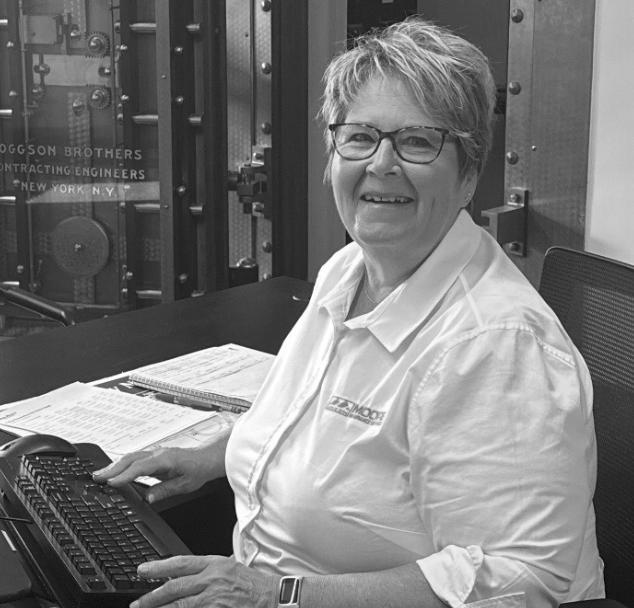
Norris, a wife and mother who worked at Moore Insurance Services for nearly 30 years, was hit while walking in the crosswalk at the intersection of North Broad Street and McCollum Street. She was first taken to a Hillsdale Hospital before being airlifted to another hospital, according to a Michigan State Police news release.
Norris suffered a life-threatening head injury and underwent brain surgery, according to the GoFundMe her son Allan Norris created.
“The road to recovery will be long and challenging,” he said on the GoFundMe page.
Police said the vehicle was a Ford F-Series utility vehicle that was turning from McCollum Street onto Broad Street.
The county maintenance and facilities department
employee who was driving the truck has been placed on leave, according to a statement released by Hillsdale County. Ryan Servold, the maintenance man for St. Anthony of Padua Catholic Church, said he saw the truck turn before it suddenly stopped.
“I was coming up McCollum Street on the sidewalk, and I saw people on their phones calling 911, and I saw her laying face down in the middle of the street,” Servold said.
“I ran over and noticed she wasn’t responding. I tried to stop the bleeding from her head and keep her airway open.”
Servold said he took care of her until a police officer took over.
After the accident, Norris’s
boss, Richard Moore, said he received a call shortly after the office had closed for lunch.
“Joni is a person that likes routines, and every day, weather permitting, she’d go out for a walk,” Moore said.
“Everyone in this downtown knows Joni, because she’d walk. I went home for lunch, and I got a frantic call around 12:30 p.m. saying, ‘Hey, something happened downtown. We think it might be Joni.’ I rushed in my car about a mile out of town and got downtown. The street was already blocked.”
Moore said people from the community who heard what happened came into the office to ask about Norris’ condition.
“Our new chief of police, Kristopher Joswiak, actually came in that day, then came back the following day and talked with me. I didn’t realize this at the time, but these are things you learn. It was his second day on the job,” Moore said. “He’s a certi-
fied EMT, that’s how he got his start. He was able to actually ride in the ambulance with Joni and comfort her. It made me feel so good, just knowing our new chief was there with Joni in her time of need.” Cindy Bieszk, owner of the Filling Station Deli downtown, said Norris would come in most Tuesdays for its taco salad, which was on special. Norris was known for being attentive while on her daily walks.
“She’ll always come across at one of the crosswalks,” Bieszk said. “She’s always very careful about that because she’s been terrified for a long time about getting hit.” Norris had a close call about a month earlier on the same crosswalk, according to Bieszk.
“She nearly got hit four weeks ago now,” Bieszk said. “Same situation. The older couple in my shop witnessed both events.”
State House passes bill that would lift deer bait ban
By Thomas McKenna editor-iN-Chief
Michigan hunters could soon use deer bait again after the House passed a bill earlier this month to end the state’s ban.
“We’ve continued to see an exponential growth of deer, in particular in southern Michigan,” said Michigan Rep. Jennifer Wortz, the sponsor of the bill and a Republican who represents Hillsdale and Branch counties. “This would just repeal that ban and allow for baiting to happen again.”
Wortz’s House Bill 4445 would lift the ban on deer bait — piles of food to attract deer — and roll back other deer and elk feeding restrictions. The state’s Natural Resources Commission banned the use of deer bait in 2019 to prevent the spread of bovine tuberculosis
and chronic wasting disease. But Wortz argues the rule does little to prevent disease while increasing the deer population in the state, which leads to more collisions with cars and crop damage. The measure would need to pass Michigan’s Democrat-controlled Senate.
“Drive around, you’ll see deer congregate everywhere,” Wortz told The Collegian. “They’re a herd type animal, so they live in groups, and you see them all the time feasting together in fields and drinking along streams together. And so there just really was no logic behind this decision.”
according to the Department of Natural Resources.
“This is to try to help increase and incentivize hunters,
anteed to take some deer. Also, the youth, trying to get them back into hunting.”
But state regulators and lob-
Michigan’s deer population has grown to about 2 million, up from 1.7 million in 2012,
especially maybe those weekend hunters or tourist-type hunters who come out for a weekend,” Wortz said. “They can be guar-
“The Natural Resources Commission is charged with using sound scientific management when they’re creating regulations,” Ridderbusch said earlier this month, according to Bridge Michigan.
“There’s just that extra layer of protection in terms of what they put forward through a wildlife conservation order as opposed to what the legislature is bound to when they are considering legislation.”
Jim Sweeney, a lobbyist with the Concerned Sportsmen of Michigan, made a similar point.
“There’s a reason we delegate natural resources policy to the experts, which is the department and the Natural Resources Commission,” Sweeney
said, according to Bridge Michigan. “By usurping that authority, we get into very dangerous territory, because, essentially, then you’re managing our natural resources by popular vote. Because that’s what politicians are chasing at the end of the day.”
Deer overpopulation can lead to more car crashes and crop damage. In 2024, more than 58,000 vehicle-deer crashes occurred across Michigan, according to state data. Wortz also said some farmers lose up to 10% of their crop every year to damage by deer.
“It’s estimated that, even just to help maintain the current herd in Michigan, we need to be killing 40% of our deer population every hunting season,” Wortz said, citing estimates from a state environmental agency. “And that’s not happening.”
Local credit union donates to county K-9 unit
By Skye Graham
soCial Media MaNager
The Hillsdale County Sheriff’s Office will hire a new K-9 after receiving a $21,500 donation from a local credit union.
American 1 Credit Union, which serves the Hillsdale area, donated the money to help the sheriff’s department use K-9s to target illegal drugs more effectively.
“We want to get as many
drugs off the streets as possible,” Hillsdale County Sheriff Scott Hodshire said. “The two road K-9s are on opposite shifts. We have taken several guns, drugs, and money off the streets and were able to send two of these drug runners to prison. We have to work closely with the prosecutor’s office to get a good conviction.”
According to an A1CU press release, the donation will fund the purchase of a new K-9 and
a 210-hour training course for Deputy Colton Bassage, who will be training the dog. The donation will also cover monthly training and essential supplies for the K-9 unit.
Bassage said the department adopted the new dog, Jager, from Magnum K-9 in Quincy. By the time the sheriff’s department got the dog, workers at Magnum K-9 had trained him in basic obedience. The courses funded by A1CU teach the dog how to locate drugs while teaching the handler how to work with the dog.
“We are going through the handler course for me and the K-9 course for the dog together,” Bassage said. “Eventually, he gets to the point where he can run around 30 cars, and if there’s only drugs in five of them, he doesn’t pay attention to the other five of them.”
Bassage and Jager will com-
plete their training courses in March. Bassage said he and the dog have built a strong bond throughout their training.
“It’s cool because I get to see him progress, and he gets to see me progress,” Bassage said. “We learn together as we go. I might be biased, but Jager has one of the best noses I’ve seen out of a dog.”
Bassage currently takes Jager with him in the back of his car at all times,. He can use the dog to sniff out an area if he suspects someone of possessing or transporting narcotics.
A1CU invested $180,000 last year into the communities it serves, according to Vice President of Communications Kelly Grygiel.
“When crime is reduced, and residents feel secure, everything from local businesses to schools and families benefit,” said Grygiel. “For us, this donation isn’t
just about funding a program, it’s about strengthening the foundation of our community and standing alongside those who work every day to protect it.”
A1CU reached out to the Hillsdale County Sheriff’s Department after learning it was planning to expand the K-9 unit, Hodshire said. The sheriff’s
and four dogs, all of which are trained in different specialties, according to Hodshire
“One of our K-9s, Tito, is trained in explosives,” Hodshire said. “Two of our dogs, Jager and Drako, are trained in all drugs except marijuana due to it being legal. The fourth dog, Mayson, is trained in all drugs and is our jail K-9.”
byists say they would rather the administrative agency change its rules than for the legislature to change the law.
Joni Norris has worked
City councilman aims to repeal blue laws
By Charles Hickey Collegian RepoRteR
Ward 4 Councilman Robert Socha is once again leading a ballot petition to overturn a 46-year-old Hillsdale County law prohibiting serving alcoholic spirits on Sundays.
“Out of 83 counties in the state of Michigan, we are the only one where restaurants and bars can’t serve li quor on Sundays,” So cha said.
He said he first learned about the prohibition, known as a “blue law,” when he looked into starting a restaurant after moving to Hillsdale in 2013. He led a movement to overturn the law in 2024 but did not reach the re quired number of signatures to make it on the ballot.
Socha said he has worked with owners and employees at local restaurants to collect signatures for the petition.
“If we succeed, more restaurants will be open in our county on Sundays, and we’ll have more choices,” Socha said. “More
vote in the county and has not moved away.
Socha said interested Hillsdale voters should contact him via the city council website, and that petition copies are located at Dante’s and Here’s to You Pub & Grub.
The law prohibiting Sunday liquor sales was approved by nearly 60% of Hillsdale County voters during the 1980 general election.
“Since the people put it on the ballot by a vote of the people, you have to have a vote of the people to remove it,” Socha said.
John Biscaro, bar manager and wine director at Dante’s Fine Wines and Spirits, said he supports overturning the law.
“To my knowledge, the blue law is an older law left over from when Hillsdale was more of a teetotaler town. I think that if it’s repealed, we’ll see a lot of good economic growth in the town,” Biscaro said.
Biscaro said the blue law deters businesses from opening in Hillsdale as few businesses will want to give up an income source like alcohol sales on Sundays.
people will stay in Hillsdale County on Sundays instead of leaving and going to Jackson or Ohio.”
State Rep. Jennifer Wortz, a Republican who represents Hillsdale and Branch counties, introduced a bill in April 2025 that would lower the required signature threshold to 5% and clarify the ballot language.
According to Jonathan Meckel ’21, legislative director for Wortz, the bill passed the State House with overwhelming support in September.
“The bill is currently in the Senate Committee on Regulatory Affairs, which is chaired by Senator Jeremy Moss,” Meckel said. “My staff has been in touch with his office, and I sent him a hearing request letter. We are hopeful that we can get a hearing scheduled soon.”
‘Ready,
set, shop’: Marshalls will open March 5 at 8 a.m.
Gemma
Flores | Collegian
If adopted, a CREO could make it more difficult for the company and state agency to override a potential rejection by Fayette Township’s planning commission.
“Make sure you have a CREO,” Wortz told the Fayette Township board at a Jan. 23 meeting. “That’s what I’m encouraging all my townships to do.”
Residents have repeatedly spoken against the projects during public comment at Fayette Township board and planning commission meet-
According to County Clerk Abe Dane, at least 1,482 Hillsdale voters must sign Socha’s petition by July 28 in order for the initiative to be on November’s ballot. This number is required by state law and equals 8% of the total number of votes cast in the county for all secretary of state candidates in 2022.
Senior Joseph Buff said he is registered to vote in Hillsdale and will sign Socha’s petition.
“We should be allowed to enjoy a cocktail, to relax and hang out with friends on the Lord’s day. I don’t think there’s anything inherently immoral or unholy about enjoying one or two cocktails on Sunday,” Buff said.
“We should be allowed to enjoy a cocktail, to relax and hang out with friends on the Lord’s day.”
Dane said the signatures Socha gathered in 2024 are still valid — so long as the signee is still registered to
ings, saying the project would disrupt the landscape and local wildlife.
Brady Friss, a Ranger Power development manager overseeing the Heartwood Solar project, said the company conducts extensive environmental reviews, including effects on water sources, before starting construction on the project.
“We do a lot of work early on to minimize concerns of wetland or threatened and endangered species habitat impacts,” Friss said. “The projects do field surveys of the whole project area.”
The planning commission will meet to consider the adop-
Buff previously attempted to order liquor on a Sunday in Hillsdale but was unsuccessful.
“The founders defined liberty as the ability to do what’s right,” Buff said. “Sometimes, having a cocktail on Sunday is what’s right.”
tion of a CREO on March 9 in the Jonesville Middle School gym at 7 p.m.
If Fayette Township were to block the project and establish a CREO, the solar company could still go to the state and try to get the Heartwood II Project approved through that channel. Brady Friss, a Ranger Power development manager overseeing the project, told The Collegian Jan. 29 that it is not the company’s intention to do that, though it is not “a 100% certainty that it is totally off the table.”
“It is an option that the developer ultimately has to go through,” Friss said last month.
City zoning board denies HOPE Harbor appeal
By Sydney Green SenioR RepoRteR
The Hillsdale Zoning Board of Appeals denied a request from a proposed sober living home to operate in a business district during its Feb. 11 meeting.
HOPE Harbor — which stands for Hillsdale Opportunity Promoting Empowerment — is the new name for a sober transitional housing facility that its director, Melissa “Missy” DesJardin, hopes to create behind Hillsdale Community Thrift. DesJardin — who previously ran the makeshift homeless shelter, Camp Hope — aims to use a former storage building to house residents, but the project hit a roadblock last November when the Hillsdale Planning Commission rejected a request to convert the structure into a “dwelling facility.”
Assistant City Manager Sam Fry said the property’s zoning designations — B-3, the city’s general business district — contain standard restrictions that apply regardless of the applicant.
“That’s completely agnostic to who the property owner is,” Fry said, referring to the district’s prohibition on firstfloor residential use. “That’s not discriminatory in any manner toward the property owner, the petitioner, or the applicant. That’s just the standard.”
In a letter submitted to city officials on Jan. 12, the Fair Housing Center of Southeast & Mid Michigan said the planning commission improperly denied HOPE Harbor permission to operate a sober living home within the city.
“To deny HOPE Harbor’s request is imposing an unnecessary barrier to housing for people with disabilities in the City of Hillsdale,” wrote Jessica Farley, associate director of the organization.
The Fair Housing Center is a nonprofit organization based in Ypsilanti that investigates complaints of illegal housing discrimination. According to Farley, cities are required by law to make reasonable accommodations
for housing that serves people recovering from substance use disorders.
“People in recovery from substance use disorders and housing designated for people in recovery are protected by the Federal Fair Housing Act, the Elliott Larsen Civil Rights Act, and the Michigan Persons with Disabilities Civil Rights Act,” Farley said in the letter.
Farley also said that even though the proposed HOPE Harbor location is not currently zoned for residential use, zoning rules do not override fair housing protections when housing for people with disabilities is involved. Federal guidance from the U.S. Department of Housing and Urban Development and the Department of Justice requires cities to make reasonable accommodations in these cases, she said.
Hillsdale City Council Member Joshua Paladino disputed that the denial constituted discrimination, saying the decision was based on longstanding zoning and safety requirements rather than opposition to sober living housing.
“The city followed its ordinances and its procedures to review this matter,” Paladino said. “The planning commission reviewed it impartially, according to our laws, and they made the determination that they made.”
Paladino said the city has not passed any new ordinances in response to HOPE Harbor and has only enforced regulations already on the books.
“We have done nothing, from a legislative or administrative standpoint, except enforce laws that are already in place,” Paladino said. “Portraying this as if we’ve gone out of our way to persecute them is simply not accurate.” According to Paladino, the primary violation involved the structure itself, which he said does not meet zoning requirements for residential use.
“The structure was not authorized because it isn’t a permanent structure,” Paladino said. “You can’t just erect a tent and have people live in
it. If anyone did that on their own property, the city would intervene for the same health and safety reasons.”
Fry said the zoning board’s denial represents the end of the city’s local administrative review process unless HOPE Harbor chooses to pursue legal action.
“Any petitioner to the zoning board of appeals, if they’re denied, the next step, should they wish to appeal, is to go to circuit court,” Fry said. “But as far as your local administrative options, the zoning board of appeals denial is where it ends, unless the petition chooses to take it on.”
Fry noted that residential living spaces are allowed as long as they are not on the first floor of a building.
“In the B-3 district, you can have a mixed-use building where the first floor is commercial,” Fry said. “And then you can have residential units on the second floor, which is allowed here in B-3.”
The Fair Housing Center’s letter cited one of its previous cases from 2023, when the city of Howell agreed to pay $750,000 to settle a housing discrimination lawsuit involving a sober living home. According to a 2023 press release from the organization, Howell imposed a 20-month ban on a proposed sober living facility following opposition from neighbors.
“This type of differential treatment of housing for people with disabilities is plainly prohibited by federal and state antidiscrimination laws,” the press release stated. “The city was intentionally discriminating by giving force to opposition from neighbors.”
DesJardin said she believes the Howell case closely resembles HOPE Harbor’s situation.
“When you read the case, you will find that literally you could take the name of that transitional housing out of it and put our name right in it,” DesJardin said. “That’s how closely the cities acted.”
Solar from A1
Councilman Robert Socha. Courtesy | City of Hillsdale
SportS
Teams eye conference title after weekend of personal bests
By Francesca Cella Assistant Editor
Several track and field athletes broke personal bests across the board at the Silverston Invitational hosted by the University of Michigan Feb. 20 and at the Tune-Up Meet hosted by Hillsdale College Feb. 21.
Freshman Anna Roessner placed second in the 200-meter at the Silverston Invite with a time of 24.24 and set a new personal best, ranking her third in the Great Midwest Athletic Conference. She also took fifth in the 60-meter with a time of 7.49.
Roessner also ranks first in the 60m in the G-MAC with her time of 7.36 at the Grand Valley State University Holiday Open, and she said she hopes to take first in the 60m at the G-MAC Indoor Championships Feb. 27-28. She also said because the team has started to taper, race times have started to decrease.
“The last few weeks lead
ing up to championships have been a little bit more mellow, and that’s why we started seeing people dropping so much time,” Roessner said. “Hopefully that continues on to G-MACs because girls have a chance to win. If everyone places where they should and some people do a little bit better than they’re supposed to, we have a good shot.”
Senior Lucy Minning came in sixth in the 60m with a time of 7.64, followed by senior Anna Lamoreaux, who placed fourth in 7.95.
Freshman Watson Magwenzi placed seventh in the 200m with a time of 22.09, marking a new personal best. Magwenzi ran the 60m dash in 6.96 and took ninth.
At the Tune-Up Meet, women’s track and field took first place in 10 events and men took first in four events. Junior Savannah Fraley won the 3K with a time of 10:29.39, senior Francesca Federici took first in the 60m with a time of 7.82,
and junior Megan Roberts won the 800-meter in 2:20.19.
On track, freshman Jefferson Regitz took first in the 3K with a time of 8:49.26, followed by junior Noah Gazmin in second at 8:58.81, and sophomore Zach Self in third at 9:00.76.
the mile in exactly what I wanted to: 4:38 was a 1600 split. I just fell off a little bit from that. I think part of that was because I was running solo up front.”
Freshman Wyatt Widolff placed second in the 200m in 22.53 and came in fourth in the
All three set new PRs in the 3K.
“Performance wise, I’m pretty happy with it,” Regitz said. “I probably won’t get into the fastest heat at conference but I definitely put in a good effort and I’m happy with how I performed. I went through
60m with a time of 7.03, setting personal bests in both.
In high jump, sophomore Natalie Spielman and junior Elaine Kutas set personal bests with a clearance of 1.53 meters, which is equal to 5 feet and half an inch.
“Clearing 5 feet in high
By Christian Papillon Assistant Editor
The minor leagues are a unique and underrated form of sports entertainment.
Minor league sports bring their own quirks that one does not often see in the top leagues. Whether it is a flying fish blimp at a Toledo Walleye hockey game, or a build-a-burger contest between innings at a Fort Wayne TinCaps baseball game, in which fans rush to build a hamburger with giant foam ‘ingredients’ as quickly as they can, each minor league venue has its own flavor, making each team’s games a unique experience.
But despite all the color, minor league sports do not have the same level of popularity that major league sports do. For instance, G League basketball, the developmental league for the NBA, drew an average audience of 72,000 viewers in 2023 according to the U.S. Television Database.
Both major league sports and Division I college sports, however, regularly attract millions of viewers per game. The average NBA game, for example, attracted an average of 1.53 million viewers last season according to Statista, and college basketball games can draw more than 6 million viewers. It is easy for these teams to market to the fans, as the players either represent the best of the best, or the future of the sport.
For example, fans tuned in to watch Duke University
from A1
The men’s final was not only a nail-biter, but the real-life-hockey version of “Rocky IV” where the Canadians were Drago and the Americans were Rocky: no matter how many punches the reds threw, the good guys refused to go down. The star-studded Canadian offense outshot the USA 42-28. Still, on the back of an all-time performance by their goaltender Connor Hellebuyck, the Americans were able to hold out for an opportunity.
jump is a pretty big milestone in opening up more ability,” Spielman said. “It’s really awesome to see because now our entire high jump squad is over 5 feet.”
Spielman said women’s track and field has prepared well for championships.
“Our team across the board is looking really strong,” Spielman said. “This past week we didn’t see any super crazy marks, but we saw a lot of really high averages. Between the six throws taken over the day, Amelia Lutz had a higher average at this meet in shot put than she’s ever had before.”
Junior Amelia Lutz won shot put with a throw of 15.78.
Junior Olivia Newsome won weight throw with a mark of 18.23 meters, followed by sophomore Tori Tyo in second with a mark of 18.15 meters.
In men’s weight throw, senior Ben Haas won with a season-best mark of 22.31 meters and took second in shot put with a throw of 16.5 meters.
Sophomore Yahli Salzman placed third in shot put with a new personal best mark of 15.47 meters. Senior Tara Townsend placed second in pole vault with a clearance of 3.72 meters, and freshman Sophia Williams placed fifth with a new collegiate best clearance of 3.42 meters. Williams said she hasn’t been jumping as high as she did in high school and wanted to relax so she could improve her performance.
“I tried to take the pressure off myself mentally because the week before I realized that I was putting too much pressure on myself to do well,” Williams said. “I was like, ‘It’s okay, I’m just going to remember how fun it is to be in the air, to go over bars, and still how much fun it is to not go over bars if I don’t.’”
The Chargers will compete in the G-MAC Indoor Championships hosted by Ashland University Feb. 27-28.
basketball games last year in part to watch future No. 1 pick Cooper Flagg and fellow future first-rounder Kon Knueppel play together on one of the top teams in the NCAA.
While limited network coverage is part of the reason why fewer fans watch minor league sports, more people should attend minor league sporting events live.
First of all, tickets to minor league games are far less expensive than their major league equivalent, and the difference
“I didn’t
care
that
it wasn't a game between the Chicago Cubs and St. Louis Cardinals.”
in quality of play is not equivalent to the difference in price.
For example, floor-level tickets to a Motor City Cruise game cost about $70, while equivalent tickets to its major league affiliate, Detroit Pistons, cost more than $700. Box seats at a TinCaps game cost about half of what the cheapest seats at a Detroit Tigers game cost.
Even if there are few bigname players in minor league sports, it provides the same level of entertainment that going to a big-league event does. The teams may not be as immedi-
They got that opportunity in overtime, scoring the golden goal to win 2-1. To understand the weight of this win, we must compare it to the “Miracle on Ice.”
The 1980 Winter Olympics in Lake Placid, New York, came during the tail end of the Cold War. The USA faced off against the Soviet Union — gold medalists in 1964, 1968, 1972, and 1976. The USSR was heavily favored, experienced, and arguably the greatest hockey team of all time. The USA, on the other hand, was a team of amateurs in a time when NHL stars could not
ately recognizable, but minor league sports can provide the same level of excitement as fans watch the teams battle through a close match or execute flashy plays. When I watched the TinCaps execute a comeback walkoff win against the West Michigan Whitecaps as a boy, after playing coach Norman Dale’s motivational speech from the 1986 film, “Hoosiers,” I didn’t care that it wasn’t a game between the Chicago Cubs and St. Louis Cardinals. Minor league stadiums also provide a more intimate atmosphere than the larger major league venues. Fort Wayne’s Parkview Field, for example, can hold about 9,000 fans, while the Tigers’ Comerica Park can hold 41,000. As such, minor league teams often capitalize on maximizing the fan experience. In major league sports, the experience is largely the same across stadiums, with the only noticeable difference being the hosting team’s uniforms. Finally, even though minor league athletes are not as good as their major league counterparts, they are still extremely talented and play their respective sports at a high level. It still requires a large amount of skill, talent, and determination for athletes to reach the minor league level. If the goal is merely to enjoy a professional sporting event, minor league sports can provide entertainment that is near the major league level, and much easier on the wallet.
compete. The USA geared up for impending humiliation on a national stage. When they won, they donned American flags, wept, and gave the country something to be proud of when it desperately needed it. This is the legacy of American hockey; this is what the current players have dreamed of since their childhood. It’s not just a trophy. It’s a show of American spirit: One that refuses to go down, never gives up, and does so for love of country.
Freshman Anna Roessner is currently ranked first in the G-MAC for the 60m.
Courtesy | Ashley Van Hoose
Each row, column, and bolded 3×2 region contains one each of 1–6.
Chargers drop both competitions
By Patrick Matteson Collegian Freelancer
The men’s tennis team dropped two matches on the road, falling 7-0 to Ferris State University Feb. 21, and 4-3 to Davenport University Feb. 22.
Ferris State controlled the match on Satur day, winning all 7 points and losing just two sets in the process. Despite the score, sopho more Sam Plys won his first set in singles. He would go on to drop the second and ultimately lose in the third set tiebreak.
20 minutes on doubles court No. 3.
“I was very impressed with the doubles from our freshmen this weekend,” Plys said. “They played a high-level of tennis and were able to play consistently throughout the whole match.”
“Nobody likes to lose, and it is a greater challenge to find a way to win when the score is not going my way,” Plys said.
Sophomore Alex Cordero Lopez spent almost two hours on the court. Dropping the first set 7-5 to Ferris State’s Andrew Vincler, Lopez bounced back with a 7-5 second set win but lost the tiebreak.
The Chargers then traveled about 70 miles south to take on the Davenport Panthers.
“Ferris State was a strong team,” head coach Keith Turner said. “But we responded by playing the best doubles of the year against Davenport.”
On singles court No. 2, junior Henry Hammond dropped his first singles set 7-5, but he fought back to claim the second set 7-5 and the third set 6-3.
“We played better in singles than against Ferris,” Coach Turner said. “Henry Hammond played a great match.”
On singles court No. 5, junior Ellis Klanduch lost just five games, winning 6-4, 6-1 to tie the overall score at three apiece heading into the final singles match on court No. 6.
After losing their doubles matches on Saturday, sophomore duo Ryan Papazov and Sam Plys won 6-3 on doubles court No. 2, and freshmen duo Jackson Clements and Patrick Cretu didn’t drop a game, winning 6-0 in just
“I’m always going to do my best to get the win,” Klanduch said. “Even when we have a slight chance to win, it’s a non-negotiable to stay competitive.” Lopez faced off against Davenport’s Jaden Bender to break the tie, but he lost 6-4, 6-1. The Chargers return home Feb. 28 to face No. 23 Wayne State University at 1 p.m. in the Margot V. Biermann Athletic Center.
“I’m hoping our team brings the intensity against Wayne State,” Cretu said. “If we play smart, we always have a chance to win.”
First losses of the season show team grit
By Sophia Bryant Assistant Editor
The women’s tennis team lost for the first time this season, falling 5-2 to the Ferris State University Bulldogs Feb. 21 and 4-3 to the Davenport University Panthers Feb. 22.
Junior Ané Dannhauser was named Great Midwest Athletic Conference Women’s Tennis Player of the Week Feb. 23 for the third time this season. She remains undefeated at No. 1 singles, beating her Bulldogs opponent 6-4, 7-5, and her Panthers opponent 6-4, 6-3. The team’s season record is 5-2.
“I was down on Saturday, but stayed calm and managed to get back into the match and turn it around, which goes to show that the hard work is paying off for sure,” Dannhauser said.
Head coach Melanie Zampardo said Ferris State is always a good team, but the Chargers came closer to winning than in previous years and every match was close.
“Sometimes you just have to get the losses out of the way,” Zampardo said. “And now, the ice is broken. Now it’s okay; we
can relax. We don’t have to win every single match.”
Sophomore Julia Zlateva beat the Bulldogs at No. 4 singles, playing a spot higher than she usually does, according to Zampardo. Zlateva and senior Isabella Spinazze won 7-6 at No. 3 doubles.
“We knew that we had to step into the matches this weekend with a little bit extra
match. We were loud. We were cheering. We were supporting each other.”
The Chargers switched up the doubles pairings for their matches against the Panthers, according to Zampardo. Usually, Dannhauser plays with senior Megan Hackman, but on Sunday Dannhauser and sophomore Briana Rees won 7-6 at No. 1 doubles and Hack-
energy, a little bit extra effort,” Zampardo said. “And I felt that we could feel that, truly, the energy on Saturday was some of the best energy we’ve had. We had good vibes the entire
Men ’s Basketball
Chargers from A1
Although they were missing their leading scorer, senior guard Ashton Janowski, Hillsdale made up for it with four players scoring double digits, led by junior forward Caleb Glaser at 22, then senior guard Cole McWhinnie at 14, and freshman guards Braylon Morris and Morgan both scoring 12. The close battle continued in the second half, with the lead changing six more times before the final buzzer. The Chargers scored 50 points in the paint throughout the game and capitalized on their fast-break points, keeping the quick tempo of the game.
Assistant coach Jackson McLaughlin said he was proud of the team for their performance.
“It was a great win for our guys,” McLaughlin said. “I thought we had a great week of practice prepping them and I thought they were very well prepared for what was coming.”
On
20-3 in the first seven minutes.
“Ohio Dominican did a really good job of being physical with us, blowing up a lot of our screening actions,” McLaughlin said. “We weren’t able to get the offense running and with a lull on that end, it’s just hard to compete with them. And on the defensive end, they did a great job transitioning and getting quick, early baskets that we didn’t get matched up on time.”
Ohio Dominican held and built their lead the entire game, despite Hillsdale matching their points scored in the second half. Stonebraker led the team in scoring with 15 points for the game, McWhinnie followed with 14, and Morgan with 13.
The Chargers face Findlay University Feb. 26 and Northwood University Feb. 28 for Senior Day at home at 3 p.m.
man and freshman Esther Sura won 6-1 at No. 2 doubles.
“We just try to bring our best every day,” Zampardo said. “And we’re trying different things, and it’s not always
Swim
Swim from A10
May secured a NCAA B-cut in the 500 free at the Chargers’ mid-season meet, further improving her time at G-MACs to finish in 5:01.28. Her time is the second-fastest in program history and so is her time in the 400 individual medley.
May also helped break the school-record in the 400 free relay at the Don Kimble Invite at Davenport University during mid-season with the help from Babenko and sophomores Ella Malone and Ella Schafer. Babenko also broke the school record in the 200 medley relay, along with Malone and freshman Kate Potwardowski.
gonna work, and that’s okay. They’re embracing it well. They’re taking the changes like champs and doing their best.”
Spinazze and Zlateva were down 5-1 in their No. 3 doubles match against the Panthers, but they wound up losing 7-6 in a tiebreaker, according to Sura.
“It was just crazy to see the comeback, and again, another proud moment to show how much we’re fighting for all these matches,” Sura said.
The Chargers beat the Panthers at No. 1 and No. 5 singles. Other than the win at No. 1 by Dannhauser, Sura, who played at No. 5 singles, won 7-5, 6-2.
“I was just super proud of how we fought in every single match, and for every single point,” Sura said. “Even though we did come up short, and 5-2 against Ferris looks like a convincing win, but every single match was close, and we had so many matches go three sets, or 7-5, or 7-6, and even with Davenport, we were right there the whole time.”
The Chargers will play at Wayne State University on Feb. 28.
in events they qualified for nationals in and increase their odds of being selected. There, Babenko swam the 100 free, 500 free, and 100 back, and May swam the 500 free, 400 medley individual, and 100 breast.
“Our whole team had a good season. It makes me hopeful for next year.”
Babenko and May attended the Midwest Invitationals the weekend after G-MACs, hoping to improve their times
“For this last chance meet, I wanted to have fun and enjoy my races,” May said. “I wanted to perform my race plan and make it better than it was last week. I tried to focus on that more than time or qualifying. Our whole team had a good season. It makes me hopeful for next year.”
May and Babenko were not given spots to swim at nationals, however, both women said they are excited to compete and represent Hillsdale for three more years.
If you didn't play baseball, what sport would you try and why?
Tennis. I used to play when I was younger, and it has a similar swinging aspect to baseball.
What is your biggest pet-peeve? People chewing loudly.
Imgaine you have an off-day. What is the number one thing on your to-do list? Sleep.
Which professor would you recommend to other students?
Dr. Negus. He was my Western Heritage professor my freshman year, and we would always talk about college football in his office.
What is your dream NIL deal and why? Chipotle, so I could get free food.
What is your biggest hot-take? I think that being in a frat is just paying for friends.
What do you like to binge watch? Old Fortnite videos on YouTube.
What is your go-to pregame meal? Three of everything from Finish Line with white toast and scrambled eggs and a black coffee.
Saturday, Hillsdale got off to a slow start in their game against Ohio Dominican, as they were outscored
Photo Courtesy | Hillsdale College Athletic Department
Junior Ane Dannhauser is still undefeated in singles this season. Courtesy | Hillsdale Athletic Department
Junior Ellis Klanduch at the beginning of this season. Courtesy | Hillsdale AD
Sophomore Sam Plys won his first set of singles. Courtesy | Hillsdale AD
C harger S port S
Redemption win closes 3-2 weekend
By Blake Schaper Collegian Freelancer
The Charger softball team won three out of five games in Chicago at the Lewis Dome Invitational Feb. 20-22, the best record there for Hillsdale softball in the last seven years, moving their overall season record to 5-5.
At the invitational, the Chargers competed against Bemidji State University, Quincy University, Upper Iowa University, University of Minnesota Duluth, and Truman State University.
The final game of the series was against Truman State, where the Chargers sought to make up for their 12-0 loss with them from last year. Head coach Kyle Gross said since the Chargers have a history with this team, they were ready to face them.
“We started off hot, but then they put in a new pitcher
Shotgun
and we had to adjust,” Gross said. “It was definitely a different style pitcher, and we did what we had to do. You know, it wasn’t more than grinding it out and grinning it out.”
Gross congratulated the efforts of sophomore catcher Olivia Liguori for hitting an RBI groundout, and junior middle infielder Sydney Davis for hitting two doubles and two RBI’s.
“Olivia had the creativity to hit a ground ball to the backside,” Gross said. “She’s a power hitter, but knew that was what needed to be done in the game.Then Sydney almost hit a home run. She’s no power hitter, but she hit a ball that went off the fence for a double that and she went 2 for 2 that game.”
The Chargers won 5-3, redeeming themselves after last year’s loss.
The Chargers lost the first game of the series against Be-
midji State University 4-3, but sophomore catcher Nathalie Hagle hit her first collegiate home run, a two-run shot.
“This was a bad game for us,” sophomore outfielder Ronnie Craft said. “In the 7th inning, we got walked off, but throughout the game we left 10 runners on base. We will need to work on making sure our batters come home next time.”
The second game was a 10-5 win against Quincy, thanks to sophomore pitcher Grace Harris finishing a 1-2-3 7th inning with a strikeout to end the game.
“All hitters in the lineup hit amazingly, making adjustments at the plate with senior middle infielder Taylor Lewis going 3 for 3 with three hits,” Craft said.
The third game against Upper Iowa saw Liguori start her season hitting a home run, leading the Chargers to a 4-3 win.
The Chargers lost 5-2 to University of Minnesota Duluth as Duluth added two late insurance runs in the 7th inning.
“Practicing outside on turf has really improved our defense overall,” senior infielder Anna Chellman said. “We are able to have more realistic situations, and it translated well into playing in Chicago. We communicated a lot better and were able to stop a lot more hard-hit ground balls than we did in Texas.”
Chellman said the Chargers’ greatest strength was their ability to adapt to the various different pitching styles.
The Chargers will travel to St. Louis, Mo. for the Maryville Invitational where they will play Maryville University, University of Wisconsin-Parkside, and Purdue University Northwest March 7-8.
Chargers sweep podium at home invite
By Daniel Johnson Collegian Reporter
The Hillsdale shotgun team swept the podium at the Hillsdale Invitational Shoot Feb. 21, taking first overall and winning three of the four events at the shoot.
The shoot included both collegiate and high school competitors in the Trap, Doubles Trap, Doubles Skeet, and 5-Stand events.
The Chargers placed first overall in both the men’s and women’s categories, with junior Luke Johnson taking first for the men, followed by freshman Roman Barrett and senior Davis Hay. For the women, sophomores Taylor Dale, Marin McKinney, and Lucci Kern took first, second, and third, respectively.
“This shoot is kind of like a warm-up,” senior team captain Leif Andersen said. “To see where our team is at in terms of scores. We cater our disciplines that we shoot at our invitational to what we think we need to work on.”
Each event involves shooting clay targets launched from various trajectories in a specific amount of time. Targets in the Trap and Skeet events are launched from a standardized trajectory, while in 5-Stand, a type of Sporting Clays event, they’re shot from a variety of different angles and depths. Hay led the Chargers to a decisive win in the Skeet Doubles event, shooting 50 out of 50. Freshman Max Versluys, Johnson, senior Kyle Fleck, and junior Madeline Corbin rounded out the top five in the
Women ’s Basketball
By Robert Matteson Collegian Reporter
Junior Savannah Smith scored a last-second layup to lift the Hillsdale women’s basketball team over Kentucky Wesleyan College 61-59 at home Feb. 19.
“Savannah Smith made an incredibly strong bucket to secure the win, but it took all five on the floor,” head coach Brianna Brennan said. “Our guards dribbled out the clock against very aggressive ball pressure. Sophomore Maggie Sularski delivered the first clean pass to sophomore Sarah Aleknavicius, Sarah delivered another beautiful pass to Savannah, and Savannah truly set the cut up perfectly to get herself set in scoring position.”
tered at the end.”
Sophomore Ellie Bruce led the Chargers with 15 points on 7-9 shooting and seven rebounds. Aleknavicius added 13 points.
In addition to holding the Panthers to just 15 points in the first half, Hillsdale only allowed Kentucky Wesleyan to shoot 23% from 3-point range.
“We played the best game of team defense we have of the season,” Aleknavicius said. “In the first half specifically we did a very impressive job of never leaving one of our teammates on an island.”
Against Ohio Dominican University, the Chargers trailed by 11 points at halftime and were unable to come back in the second half.
event, each shooting 49 of the 50 targets.
“We shot maybe the best we ever have in Skeet Doubles,” head coach Jordan Hintz said. “Shooting perfect scores in Skeet Doubles is quite challenging.”
The team won 5-Stand,, after the team’s top five hit 136 out of the 150 targets. Freshmen David Texas Ardis and Zach Hinze tied for the top individual score in the event, each hitting 28 out of 30 targets. Dale and Johnson tied for second with a score of 27, and McKinney took third with a 26.
The team narrowly placed second in Trap after Olivet College, with a score of 242 out of 250 targets hit. Dale took first in the women’s category for the event, hitting 49 out of 50 targets, while junior Alex Hoffman took third in the men’s category with the same score. Hinze, Hay, Kern, and McKinney rounded out Hillsdale’s top six in the event after each shooting 48 out of 50 targets.
“Our Trap score wasn’t quite where we wanted it to be,” An-
“I’m the one that set up that 5-Stand,” Hintz said. “And 28 is probably better than I was expecting anyone to shoot on it. That’s a pretty dang good score.”
The Chargers also took first in Doubles Trap after sweeping the top five individual scores. Barrett took first after shooting a 100 out of 100, followed by Andersen and Johnson scoring 95, Kern with 93, and Hay with 91.
dersen said. “We kind of struggled a bit on Trap Singles. That’s where we’d like to improve a little bit, but it was nice to see our Trap Doubles and Skeet Doubles scores be really good, because that’s what we’ve really been working on.”
Dale said she was encouraged by the growth she saw in the shoot.
“I did considerably better than I had been doing in practice,” Dale said. “It’s not perfect by any means, I know I’ll still keep working, but it was defi-
nitely like that next stepping stone that gives me a little confidence going into these next competitions.”
Hintz said the team consistently performs well in Trap.
“It’s not like this group isn’t incredibly proficient in Trap already,” Hintz said. “It just, for some reason or another, wasn’t their day on Saturday. It just helps you see how to best tune up for these bigger competitions.
According to Hintz, the shoot showed the team how to best prepare for the upcoming conference and national championships.
“We’ll have a couple of practices between now and when we leave for Sparta,” Hintz said. “So everyone will be doing whatever they need to to make sure they’ll have the highest level of confidence across the board.”
Andersen said the team is aiming high in the upcoming conference championship.
“We’re looking to win team High-Over-All,” Andersen said. “There’s going to be some division one schools there and they usually put up some pretty good competition for us, but we’re looking to beat them.”
Dale added that the team’s ambitions are united.
“As a team, our goal is to win and perform our best,” Dale said. “And to be there for each other, to be good teammates.”
The team will compete next in the Association for College Unions International and Scholastic Clay Target Program Conference Championship in Sparta, Illinois Feb. 27 - March 1.
The Chargers played a second game, losing to Ohio Dominican University 81-69 on the road Feb. 19. The Chargers’ record moved to 14-10 overall and 10-8 in Great Midwest Athletic Conference play as Hillsdale enters the last week of the regular season sixth in the G-MAC standings. The top eight teams will advance to the G-MAC tournament at the end of the regular season.
Against the Kentucky Wesleyan Panthers, the Chargers led 31-15 at halftime, but the Panthers battled back to tie the game 59-59 with 1:07 remaining. Following a defensive stop, the Chargers executed a play out of a timeout to score the deciding basket with less than two seconds remaining.
“Even though it wasn’t my best game statistically, I kept telling myself that my open looks would come to me and to not force anything and remain composed,” Smith said. “Keeping a cool composure the whole game allowed me to score my shot when it mat-
Swim
Smith led Hillsdale with 22 points and seven rebounds. Junior Annalise Pietrzyk added 19 points and five assists. The Chargers are playing their final two regular-season games at home this week, where they have not lost this season. Hillsdale needs just one win to clinch a spot in the G-MAC conference tournament.
“We’ve got to play with great urgency and intensity,” Brennan said. “We love playing at Dawn Tibbetts Potter Arena, and we are so grateful for all the support each game.”
Hillsdale plays Findlay University Feb. 26 at 5:30 p.m. and G-MAC regular-season champions Northwood University Feb. 28 at 1 p.m., when the team will honor Payton Adkins and Emma Ruhlman for Senior Day.
“Payton and Emma have drastically impacted our program, so I know the team will be ready to battle for them to get a win on Senior Day,” Brennan said.
Freshmen cap season
By Lucy Billings and Jamie Parsons Collegian Freelancer and Assistant Editor
Freshmen Avery May and Sasha Babenko rounded out their first collegiate season with a last-chance meet hosted by the University of Chicago Feb. 20-21. Both women earned NCAA B-cuts, finished top-three in multiple events at conference, and broke school records over the course of the season.
“It feels so great to represent the team,” Babenko said. “We are all such dedicated and supportive athletes. As a freshman I feel so honored.”
Babenko broke the school record in the 200 backstroke earlier in the season, only to break it again at the Great Midwest Athletic Conference championship Feb. 1014 with a time of 2:02.37. Her time is a NCAA B-cut, and gave her the chance to be considered for qualification to the NCAA Division II Championship in March. Babenko also broke the school record and got a NCAA B-cut in the 100 back, swimming her best time of the season in 56.07 at G-MACs.
Freshman Roman Barrett, junior Luke Johnson, and senior Davis Hay all placed. Courtesy | Hillsdale Athletic Department
O-L-D-S: Who was the best assassin?
By Blake Schaper
C O ll E gian rE p O rt E r
Chaos reigned in Olds Residence this month as roommates betrayed each other, RAs paired off against residents, and one freshman racked up eight kills in the dorm’s inaugural “spoon assassin” tournament.
“At one point, multiple roommate pairs had each other,” sophomore resident assistant Kate Mureen said. “There were lots of skirmishes that went down, especially towards the end of the game.”
Mureen introduced the game to the dorm. The rules of spoon assassins are simple: Competitors must keep their spoons visible and grabbable at all times. Steal your target’s spoon to kill them or tag them if their spoon is not visible. Then take that person’s target as your next victim until only one woman remains standing.
In the Olds tournament, students could be killed anywhere but the dorm or in class.
Maureen said she didn’t last long in her own game.
“I got out because I was tabling, and one of the other RAs came to me, and said ‘It’s good to see you!’ and hugged me,” Mureen said. “While she was hugging me, she grabbed my spoon and said, ‘And, you’re out.’”
Freshman Caylee Norris came out on top after 17 days and eliminated a third of the competition. The two other freshmen women who remained in the game at the end, Madeline Olson and Josephine Ziegler, surrendered their spoons to the victor. Norris got the edge early, eliminating two friends on the first day of the tournament.
See SPOONS B2
‘GOAT’ is Curry’s publicity stunt
By Henry Fliflet ad & CirCulatiOn ManagEr
If you want to succeed, you’d better count on getting lucky and going viral. That’s the underlying premise to the 2026 animated film “GOAT,” produced by and starring Steph Curry. It’s a little disconcerting.
The movie follows Will Harris, a medium-sized ungulate who dreams of becoming a professional “roarball” player, the co-ed, co-species perversion of physics that substitutes for basketball in the movie.
Will’s life at the beginning of the film is simple: He misses rent on a one-room pad owned by a rodent with hundreds of children. He delivers food for a sports bar fallen on hard times since their home team, the Vineland Thorns, stopped winning games. He idolizes the one-time star of the Vineland Thorns, Jet, the black panther whose skill he dreams of imitating. When a meme edit of Will playing a pickup game of roarball against a professional roarballer, a horse called Mane Attraction, goes viral, the warthog owner of the Vineland Thorns signs him onto the team as a media gimmick.
Using inter-species conflict as a stand in for America’s ra -
cial tension — a tactic also used in Disney’s 2016 “Zootopia” — “GOAT” presents a world of sports defined by the phrase “smalls don’t ball.” In Will’s case, the freakishness of watching a goat play roarball against polar bears and Andalusian horses boosts the financial valuation of the team.
This publicity stunt, its fallout, and Will’s eventual triumph form the body of the movie, which follows the fairly predictable beats of an underdog story, culminating in a big game.
The movie stands out for its visual effects, but its near-constant use of phones and technology to drive the plot falls flat.
The impressionistic art style, which is satisfyingly pastel and textured, gives the picture a special feel: The way characters move and interact with the world distinguishes it from most other animated movies in recent years.
The Gen Alpha-esque dependence on the digital is less appealing. There aren’t many other animated films with this much of an in-world phone addiction, whether that’s Will watching an ad for “Big Bronco Crypto” or an audience of would-be animal influencers livestreaming his pickup games.
See GOAT B2
Alumnus’ poetry is an overflow of life
By Caroline Kurt Opini O ns Edit O r
Dog carcasses, bad paintings, and hiccups: Everything is game for poetry to Hillsdale alumnus Forester McClatchey ’16.
After years of teaching poetry in the classroom and publishing his own in journals, McClatchey released his first volume of poetry, “Killing Orpheus,” this month.
Associate professor of English Dwight Lindley, who taught McClatchey while he was at Hillsdale, said he has enjoyed reading the collection.
“The guy’s got a great ear and just a fascinating imagination,” Lindley said.
McClatchey chose the title of the collection, which includes newer poems as well as some composed during his time at Hillsdale, to express a major theme of his work.
“Beauty is always a little bit dangerous or terrifying, even on the micro level,” McClatchey said. “I hoped that the title would evoke the beauty of Orpheus singing, but also the kernel of violence that’s always tucked inside beauty.”
McClatchey attributes his love of poetry to his high school English teacher, Maggie Blake Bailey, who was a poet herself.
“She was very much into the contemporary scene and experimental poetry,” McClatchey said. “So that kind of poetry was probably my first love, in an un-Hillsdale way.”
McClatchey said reading through the core ciriculum at Hillsdale introduced him to some of his current favorite poets.
“I really fell in love with the more bombastic formal poets like Hopkins and Tennyson,” McClatchey said. “I found their music drunken and ridiculous, but also sort of intoxicating. There was something wonderfully ludicrous but also wise about it.”
According to McClatchey, his writing process begins in reading. Then, when he has an idea, he said he tries to write an entire first draft. Next comes editing.
“I mostly write sonnets, so the predictability of the form helps compress what I want to say,” McClatchey said. “You have certain rules that are hemming you in and pressurizing language. And so even if you have no idea what you want to say metaphysically or how to phrase a description, you know that this line has to rhyme with
bitious subjects for his poems.
“Then when you get married and have a kid, certain facts like mortality or sacrificial love become so obvious and embedded in your body that you don’t have to hunt for them anymore,” McClatchey said. “So maybe there’s something poetically helpful about that, but it also reminds you that you can’t really build your life around poetry.”
McClatchey, whose wife is also a poet, said the two of them at times considered ordering their lives to serve art, but concluded it should work the other
want it to.”
According to McClatchey, teaching has forced him to deconstruct poetry better.
“I have to be able to explain everything in such a way that an 11th grader who doesn’t want to be there can understand and process it,” McClatchey said. “If you can’t explain something to a ninth grader, you probably don’t understand it yourself. So I find that strangely helpful, even though teaching kind of feels like getting a concussion every day.”
this line, and that’s a provocation that’s helpful.”
According to McClatchey, his experience of marriage and fatherhood has altered the way he writes.
McClatchey never intended to write formal poetry, he said — though the majority of poems in “Killing Orpheus” are sonnets. Rhyme and meter seemed to him rules he needed to learn before he broke them.
“Then I found it kind of turbocharged what I was writing,” McClatchey said. “I still have an instinctive tug toward something more experimental and something that breaks the rules, but I find that writing formal poetry gives me something to push up against, in a way that gives the language energy.”
“Having a child forces you to understand that you’re not the center of the universe,” McClatchey said. “I’ve heard having a kid compared to the Copernican revolution. You have a kind of geocentric, self-centered worldview inevitably before you have kids. And then when you have a kid, there’s something — maybe theological, maybe biological, maybe both — that happens where suddenly, your life and your imagination no longer revolve around yourself.”
At Hillsdale and in graduate school, McClatchey said he had trouble finding intense and am-
way around.
“We both found something sickly and hollow and sad about that,” McClatchey said. “We agree that poetry should be the overflow of a full life.”
After five years teaching at the University of Florida, McClatchey moved to work at Atlanta Classical Academy, where he teaches American and British literature to 10th and 11th grade students. McClatchey works alongside friends and fellow alumni Joshua Andrew ’14, Garrett Holt ’14, and Aaron Schepps ’14.
“Teaching high school is unspeakably more intense than teaching college,” McClatchey said. “You form deeper bonds with your students, and it’s very clear that what you’re doing matters whether or not you
McClatchey says he is surprised by how much his students enjoy memorization.
“There’s something very communal and also bodily and ritualistic about memorizing poems together,” McClatchey said. “So even if they have very little interest in English as a subject, they get excited about it, almost like they’re at a sports game.”
“Killing Orpheus” has received positive reviews online, as well as from McClatchey’s former professors.
“He’s clearly just going through the sonnet form and trying to explore all these different ways to do the sonnet,” Lindley said. “It feels fresh, even though it’s an old form that he’s working with.”
According to Lindley, McClatchey’s poetry feels very natural.
“That’s the fruit of a lot of labor, but also good taste,” Lindley said.
Associate professor of English Dutton Kearney said he is impressed by “Killing Orpheus.”
“His poems linger in your mind like Raphael’s voice must have lingered for Milton’s Adam,” Kearney said. “One of the volume’s most defining features is that each poem knows when it is complete. Craft and intuition come together for Forester in ways that are always unexpected, yet always fitting.” According to Kearney, McClatchey was one of the best students he ever had.
“I remember asking him to rewrite his freshman Great Books paper and remove all adverbs, adjectives, metaphors, and similes,” Kearney said. “Many of his classmates wrote in a similarly overwrought style, but where they resented my audacity, he embraced the challenge. Now he writes circles around me, which is what education is all about.”
Teacher of Music Daniel Kuehler performs the “Dante Sonata” by Franz Liszt. Courtesy | Beckett Layman
The book cover for “Killing Orpheus” by Forester McClatchey.
Courtesy | The University of Chicago Press
C U L T U R E
SPOONS
from B1
“Their heads weren’t in the game yet,” Norris said. “It was easy eliminating the clueless competitors until I had to get one of my RAs.”
Her friends refused to help her, but Norris said she was able to take out the RA in Saga while she did not have her spoon on her.
“My next target was my roommate,” Norris said. “At this point, I was freaking out, because my roommate is pretty competitive, as am I, and neither of us was gonna go down without a fight.”
But the roommate — freshman Sophia Cantrell — was soon vanquished. Oblivious to the fact that she was Norris’s next target, Cantrell chatted with Norris at a table in Saga during dinner, and then, letting down her guard, put the spoon on the table.
“When I started to leave, I saw that she set it on the table,” Norris said. “So I go back
under the pretense of getting a coat that I wasn’t actually wearing, and I turn to my chair. I said, ‘I’m going crazy. I didn’t leave my coat, but I did leave this!’ and I grabbed the spoon and held it up. She was shocked.”
For runner-up Ziegler, spoon assassin was a contact sport. She said someone threw a sweatshirt over her head and grabbed her in one attempt to win the spoon.
“I just held it in my hand 24/7,” Ziegler said. “I got tackled four times by girls who were trying to get it. The first two lasted four or five minutes outside class.”
Olson and Ziegler ended with one kill each for Norris’ eight.
“I got somebody on the first day, and I only ever got one person. I just made it to the end,” Ziegler said. “I’m competitive, but I’m not crazy.”
GOAT takes place in an attention economy where every hometown hero, spunky underdog, or amateur game is just another opportunity to generate clicks.
Will’s character, rather than resenting or escaping this world, merely plays into its twisted reality. He is essentially without agency, a memetic creature who brings no particular talent to the game of roarball other than making trick shots and monologuing his dreams. He’s part of the team because he makes for good content, and even in the final game, the film never concretely establishes Will’s contribution to the team.
The mechanics of the sport are left completely ambiguous. The games are a hallucinatory vision of hundred-foot leaps, falling stalactites, and raw physical violence.
When the team is saved from being sold out of Vineland by an inexcusably bad deus ex machina, there’s a collective cheer that “roots run deep,” but it’s a Pyrrhic victory: Even in Will’s victory against the naysayers, his talent never seems to outweigh his luck. Roarball, it seems, is doomed to be relegated to mere content.
Visually satisfying but with an insipid message that never rises above the cliche “follow your dreams,” the persistent pattern of digital addiction and the siren song of virality and content creation makes “GOAT” an eerily relevant movie for America that bet $1.76 billion on the last Super Bowl and dreams collectively of rising above the monochromatic drear of student debt, loneliness, and high interest rates with one perfect viral moment or lucky parlay.
Professor’s Picks: Christopher Robertson
Visiting Assistant Professor of Sociology
“Cure For Pain” by Morphine (1993)
This is painful. In a former life I was a studio and live sound engineer; now I’m a sociologist who buys too many records. From a shortlist of 20 all-time favorites that deserve to be here, I grabbed one. This one is by Morphine: a jazz drummer, a two-string bass played with a slide, a baritone and tenor sax, and the late great Mark Sandman’s voice. It’s a vibe.
“There Will Be Blood” (2007) “Lincoln in the Bardo” by George Saunders (2017)” Saunders drops readers into the hallucinatory, heartbreaking, and creepily beautiful “bardo” occupied by Willie Lincoln, the recently deceased 11-year-old son of a grief-stricken president. Bardo is the Tibetan Buddhist concept of an interstitial space where souls in limbo wait for whatever comes next. It’s an emotionally harrowing, sometimes hilarious, and indescribably imaginative piece of historical fiction.
“There Will Be Blood” wins out as one of only a handful of perfect films. The script (adapted from the novel “Oil!” by Upton Sinclair), the acting, the cinematography, and Johnny Greenwood’s score, all cohere seamlessly. The story follows wildcatter Daniel Plainview as he travels west with his son, securing oil fields against his rivals. It’s a pitch-black meditation on how the unbridled pursuit of wealth, power, and control corrupts the soul. Needless to say, beware of ambitious men whose circle of friends is held together entirely by their proximity to power.
Men from A1
Galloway
“Their whole personality revolves around publicly displaying their lack of muscles every Thursday night and being mad at Simpson.”
Mercy Franzonello, Junior, McIntyre Residence head resident assistant
“A haven for sweet, nerdy little weirdos. Contrary to popular belief, they practice less nudity than Simpson does.”
Catherine Graham, Senior, Townhomes head resident assistant
“Galloway is the middle child who doesn’t realize that tattling makes him unpopular.”
Emily Schutte, Senior, Sohn Residence head resident assistant
Whitley
“If never talking to women was an Olympic sport, Whitley would win gold.” Franzonello
“The time I’ve spent in the math and physics departments have introduced me to more Whitley residents than any
other context, and they are consistently the students in the class who know everything — to quite an aggravating extent, actually.” Graham
“Who? Oh, yeah… Whitley. He’s the 30-year-old living in his mother’s basement playing Dungeons & Dragons and building his train sets and Lego Death Stars.” Schutte
Koon
“It’s a men’s dorm?” Franzonello
“The Head RA is cool. He learned my name after two years of knowing me. And I think Sam Goetz lives there, and he’s also cool.” Graham
“Koon is the trans dorm. It can’t really decide whether it’s male or female.” Schutte
GOAT from B1
Robertson wears a cookie on his head and poses next to a man-horse.
Courtesy | Christopher Robertson
The poster for “GOAT.” Courtesy | GOAT Movie Instagram
Norris, who won, collected the spoons of her victims. Courtesy | Caylee Norris
Houses for Rent for 2026-2027
January 22, 2026
The following houses are for rent for the 2026-2027 school year:
● 85 East Fayette Street - This is a very spacious, recently renovated, partially furnished, five-bedroom, one and a half bath Victorian home that is two blocks from campus It is centrally air conditioned, has a large eat-in-kitchen with a garbage disposal and dishwasher, separate dining room, living room, parlor, large front porch, deck off the back, unfinished basement useful for storage, and is equipped with a washer and dryer The rent is $550 per student per month based upon five student occupants Available August 1, 2026 (earlier if desired)
● 173 West Street – This is a partially furnished three-bedroom, onebath Victorian home that is only two blocks from campus It has a separate dining room, living room, and unfinished basement that can be used for storage and is equipped with a washer and dryer The rent is $525 per student per month based upon three student occupants A fourth student may be added at a reduced rate if desired Available August 1, 2026
● 171 West Street – This is a three-bedroom one bath Victorian that is two blocks from Campus It has a living room den eat-in-kitchen and an unfinished basement available for storage that is equipped with a washer and dryer The rent is $525 per student per month based upon three student occupants A fourth student may be added at a reduced rate if desired Available August 1 2026
If you are interested please call Berry LeCompte at: 847 809-4843 (cell phone; preferred), 847 381-2514 (office) or email at cblecompte@aol.com.
For these students, hunting is more than a family tradition features
Hillsdale’s Drummond Fellowship allows students to both study the Great Books and be outdoorsmen
By Ashley Luke Collegian Reporter
The graying stalks of sunflowers rattled in the late September wind as senior Madeline Corbin nestled the butt of her gun into her shoulder. She breathed in, out, and shot. Dove feathers fell from the sky.
In front of her, her family’s pointer dog zigzagged through the canes, the dove securely in his mouth. He laid the bird down on the ground as other students and friends of the college began emerging from their spots along the edge of the field.
“A lot of people think of hunting as just killing animals, which it definitely is, but what people don’t know is that the funding for conservation of wildlife and land actually comes directly through sportsmen,” senior Drummond Fellow Michael Angelbeck said.
Rather than funding coming from public taxes, Angelbeck said, money for wildlife conservation comes from taxes on hunting and fishing gear.
Corbin and Angelbeck are part of the Drummond Fellowship, a group of 12 individuals who work with the Nimrod Education Center. The fellowship’s initiative is to teach Americans about wildlife conservation, hunting, fishing, and the Second Amendment.
The center’s new facility, the Nimrod Complex, will open on the grounds of the John A. Halter Shooting Sports Center in early March, according to Alan Stewart, Director of the Nimrod Education Center. It will house new indoor and outdoor archery, shotgun, and pistol ranges, according to the Halter Center’s website.
The Drummond fellowship began in 2022 because of the vision of friends of the college Alan Taylor and Brian and Mel-
ody Drummond. They hoped to continue the hunting tradition that the early founders of America practiced. Students of all classes and majors with an interest in hunting, fishing, and conservation may apply to spend their time shooting and fishing on hunting trips, taking classes in wildlife conservation and law, and learning from the various speakers that the Nimrod Education Center invites to campus.
The fellowship hosts hunting trips in the fall and spring semesters, which range from dove and quail hunting to deer and most recently, antelope, according to Stewart. In the fall, the fellows travel to Indiana to hunt doves in sunflower fields. The birds feast on sunflowers while the friends of the college use dogs to sniff out the fowl. These highly trained dogs are called pointers.
Pointers are trained specifically to smell out birds and hold the fowl in place while the hunters get into position. Stewart described their technique of weaving back and forth as “a sort of ballet.”
time enjoying nature and God’s creation. Then there is the excitement of when you get a chance to shoot.”
Corbin has been able to connect with alumni during her time on the shotgun team. She said friends of the college are eager to hear about the shooting teams or life on campus.
“You really get to know the guests,” Corbin said. “Some of them are experienced hunters so you’ll hear stories about the adventures that they have
pond on site, and I had brought a lot of fishing gear down there. We would go hunting for quail during the day and then in the evenings after dinner and a speaker, I invited anyone who was interested to go fishing.”
The Nimrod Education Center focuses most of its efforts on hunting, but it is working toward making fishing trips for friends of the college to attend, according to Angelbeck.
Stewart said he allows the fellows to take home most of
over and had a big fish fry. We made fish tacos and just had a blast.”
The fellows are also involved with Nimrod’s speaker series which brings in specialists in conservation and other hunting topics. Most recently, Nimrod hosted a two-day lecture series on Art and the Sporting Tradition, which highlighted duck decoy sculptures, a collection of wildlife paintings, and lectures from an award-winning duck stamp painter. Duck stamps are duck hunting licenses that are skillfully painted and often collected because of their beauty.
Once the hunters are ready, the dogs “flush” or spook the birds so they fly up and out of the field, allowing the hunters to aim and fire. According to Stewart, it is important that the pointer dogs not flush the doves too early so that the birds are not unfairly spooked.
Hunting trips host between eight and 70 guests, according to Corbin. She said she has enjoyed talking with the people who attend.
“You get to sit with the friends of the college right out in the shooting post for a while because obviously hunting is not a lot of action all the time,” Corbin said. “We spend a lot of
gone on. Some of them are new to hunting, which is a really unique experience because those of us who are more experienced in the fellowship can help educate others.”
In the Nimrod Education Center, there is a large culture of teaching and training others through the youth hunts that they host and the hunting trips themselves, according to senior Drummond Fellow Leif Andersen.
Angelbeck said he shared his passion for fishing with friends of the college on one of the quail hunting trips to Southwind Plantation in Georgia.
“I was able to lead a night fishing session on a couple of the nights during that trip,” Angelbeck said. “They had a
the game they catch and shoot on the trips. He saves the rest of the meat for Nimrod’s yearly wild game feasts. Students process and prepare the game for each dish with recipes passed back and forth between donors and fellows. Stewart said the meal gives the fellows a personal connection to their food and an understanding of where it comes from.
In various off-campus houses, the fellows host their own feasts, including fish fries with walleye caught in Lake Erie, and quail roasts from the Southwind hunts.
“After our Lake Erie fishing trip we had just dozens and dozens of walleye,” Angelbeck said. “We flayed those up and invited a bunch of our friends
The Nimrod lectures often center around conservation, which is the backbone of the center’s work. These lectures are important to Nimrod’s work because it is common for Americans to confuse conservation with preservation, according to Andersen.
“Conservation is how humans interact with nature and the utility that humans derive from it because we are a part of nature,” Andersen said. “Preservation is more about setting aside land or a certain species or population for the sake of returning things back to the time of Lewis and Clark.”
Stewart said people often don’t see the value of shooting and fishing sports or believe that hunting and fishing are harming natural resources. He said Hillsdale shows how hunters support conservation.
Most of this support comes financially through an act called the Pittman-Robertson Wildlife Restoration Act, which uses the money from licenses, gear, and firearms, and distributes it to help monitor conservation on the federal level. States also reg-
Campus Character
Siobhan Weed
Compiled by Lonán Mooney Collegian Reporter
Siobhan Weed is a junior history major from Michigan. She works at the Contact Center and is a member of the Student Federation.
What’s your unofficial “title” on campus?
Probably something along the lines of “that girl who has no volume control in the library and AJ’s.” I’m not proud of this — it’s just that I am excellent at starting and holding conversations when I have catastrophic amounts of homework to do, which at this school is a constant reality. It’s not my fault I go to a school with a lot of cool and interesting folks. I’m just a girl
“I would see ladies who were older than me when I came into the hostels. They would not ask me, ‘Are you tired?’ They knew that I was tired,” Betty Mack said. “Once, I was so tired that I could hardly walk, and I was carrying my backpack, my walking sticks and my sheets, but I couldn’t even hold them, and this lady who was around 70 just came and saw me, and she said, ‘Let me help you.’ She took my backpack and my sheets. She made the bed for me.”
who appears around campus and giggles really loudly with people.
If people followed you around for a day, what would surprise them most?
My breakfast never consists of anything other than a Chobani Flip from AJ’s.
What’s your signature routine before class?
I’m ashamed to admit it, but my routine lately has been to pull up my Self Service schedule to remind myself which building and classroom my classes are in. I don’t know what’s been up with me this year. As I am advancing into my old age as a junior, I think I’m losing it. This semester, I
Betty Mack said the compassion of other pilgrims helped her and her family journey peacefully.
“One of the biggest lessons that we learned was to be resilient,” she said.
Both Todd and Betty Mack said they learned from the ruggedness of their journey.
“Sometimes we forget we can have joy and simplicity, even if we do not have everything,” Betty Mack said.
Freshman Anna Coyle said Mack’s story reminded her to be present in the physicality of what is happening around her.
“We forget what’s really important,” Coyle said. “You can feel the importance of those
have gone to the wrong classroom building four times and sat in the Lane classroom of a class that was happening in Kendall or vice versa.
Are you known for something specific among your friends?
My productivity patterns are kind of a trademark. I always put off my big projects un til the absolute last second and have pulled multiple all-nighters in a row to turn
physical things when they’re lacking in your life, like how they didn’t know where their next meal or place of sleep was going to be. It is there that you really learn to appreciate the physical world in an even greater way and to connect with God through those things.”
Mack said he was surprised to find how much the pilgrimage forced his focus outside of his mind and on his body and his experiences of the real world.
Following the philosophy of Hans Ulrich Gumbrecht, from his book, “The Productions of Presence: What Meaning Cannot Convey,” Mack described
papers in on time or at the already extended deadline. I know it’s not groundbreaking to be an expert procrastinator as a college student, but it just so happens that most of my close friends have actually figured out the whole time management thing, so I would say that’s a habit my friends would say is classic Siobhan.
What song would play every time you walk into a room?
how he saw “meaning” and “presence” cultures throughout his journey. Mack said “meaning cultures” aim at understanding and dissecting a phenomenon until it is no longer part of the observer’s experience, whereas “presence cultures” focus on being present in the experience of what truly is happening. He said walking the Camino helped him be more present.
Throughout the journey, Mack, a member of the Church of Jesus Christ of Latter-Day Saints, said he began to understand his faith in a deeper sense through experiences and felt that he was part of a Eucharist-like communion. Mack
ulate conservation through deciding the prices of licenses and the amount of game each hunter can catch or shoot, according to Angelbeck. The money from the licenses goes back to the state to manage game.
“Through some of our lecture series, as well as through the classes we offer at Hillsdale like Wildlife Conservation, and Wildlife Law, we as fellows have been able to become more educated about the actual mechanics of how wildlife conservation is funded,” Angelbeck said. “It has allowed us to be good spokespeople for the outdoors and for the importance of hunting.”
While fellows learn to be spokesmen for the outdoors through Hillsdale’s classes, their knowledge is often passed down through generations. Most of the Drummond Fellows have grown up hunting and fishing from when they were very young. Through the tutelage of their parents and grandparents, the fellows have learned to appreciate the natural resources of American land and the gift of game to hunt.
“Hunting is a genetic hand me down,” Stewart said. For Stewart, the Drummond Fellowship feels like a family that he is able to mentor.
“We are a family,” Stewart said. “We observe and believe in the tradition of passing these things on. That commitment that I see from our students as they hold through this process and just seeing them recognize the experience they are having and seeing value in being able to pass on the tradition that our country was founded on is in the fabric of who we are as people in this nation.”
Applications for the Drummond Fellowship will open in early March.
The “Curious George Theme Song.”
What motivates you to get out of bed for early classes?
Mostly the GPA minimum requirement number that is attached to all of my scholarships. That and the possibility of running into Dr. Calvert outside of Delp and hearing him say “What’s up, Weed, are you staying out of trouble?”
What advice would you give your freshman-year self?
I would say, “Girl, stop using your 11 daily hours in the library to yap in heaven. Invest in a pair of noise-canceling headphones, and do your Western Heritage reading be-
said love was at the center of the whole sabbatical, in the sacrifices made to draw himself and his family to sacred places.
“I talked a lot with my kids about what it means for something to be sacred,” Mack said.
“It was one of the most important topics of conversation that we would have. We talk a lot about important things and deep things. We did a lot of talking about sacred space, and what it means for something to be sacred.”
He argued it is important to incorporate both meaning and presence cultures in our lives, but that in the world of academia, presence cultures are
cause there is no reason you should have gotten a B- in Western with Calvert.”
What’s something you’re currently obsessed with?
The AJ’s chicken quesadillas with salsa and sour cream and guacamole on the side have been taking up a lot of my mental space recently. Holy cow, they are just so good. Whenever I go to Saga and get a proper meal with veggies or whatever, my tummy feels better and I feel better about myself but gosh darn it, I’m usually sitting there eating my quinoa from the fresh plate station and thinking about how much better one of those quesadillas would be.
lacking more than ever.
“I invite you all, at least for a moment, to set aside analysis and allow a painting, a passage, or a line to caress you with a letter’s touch or hit you like an impossible sunrise,” Mack said in his presentation.
“If you do, you may, if you are lucky or blessed, someday, find a moment of presence and love a little bit like this.” Mack said the experience did not give his family merely a tangible idea or lesson to understand, but an experience that would continue to shape them.
“To reduce it to a sentence is impossible,” he said.
Camino from B6
Weed’s favorite spot on campus is the chemistry floor in Strosacker. Courtesy | Siobhan Weed
Senior Madeline Corbin hunts doves on the Drummond Fellowship’s hunting trip to Indiana in September. Courtesy | madeline Corbin
F eatures
A sacred journey: Camino pilgrimage for Spanish professor was a family affair
By Monica Smies Collegian Freelancer
When Spanish professor Todd Mack told his wife he wanted to spend his sabbatical hiking the Camino de Santiago with her and their five children, she thought he was out of his mind.
“I told him, ‘You are crazy! What, walk 500 miles and have kids with you?’” Betty Mack said. “But he had a strong feeling that he needed to take the family, and he told me more than once, ‘Betty, I feel in my heart that we need to do this, that this is the right thing for our family.’ When he told me that, I felt deep in my soul, and prayed about it, and asked for answers.”
In the winter of 2023, department chair and Associate Professor of Spanish Todd Mack and his family embarked on a six-month, 25,000-mile sabbatical journey from the
United States to Europe, culminating in the 500mile hike of the Camino de Santiago. Mack gave a talk on his travels and learnings in a lecture Feb. 19 titled “Presence, Pilgrimage, and the Humanities on the Camino de Santiago.”
The Camino de Santiago, also called the “Way of Saint James,” is an ancient system of pilgrimage routes ending at the Cathedral de Santiago de Compostela in Santiago,
Spain, where Saint James is believed to be buried. The routes span several European countries, including France, Spain, and Portugal, and typically takes a month to complete.
“I can explain what a pilgrimage is,” Mack said. “I can tell you any number of facts about the Camino. I can even describe the sacred experiences of others, but none of that is similar in kind to the vital, embodied understanding I get
through presence.”
Mack said he set out on his journey to study pilgrimage and sacred travel, but he said he’s still uncertain why he felt such a call to journey with his wife and five children. Mack said he knew the trip would be physically demanding, but it was more exhausting than he anticipated.
When Todd Mack’s then fouryear-old daughter, River, refused to continue walking on
By Tayte Christensen Features Editor
In this Quick Hits, Associate Professor of Politics Joseph Postell talks little league baseball, strange foods, and board games.
If you owned a five-star restaurant, what kind of cuisine would you serve?
Korean. I cook some Korean dishes at home, but I wouldn’t call my work anywhere near five-star quality.
In a movie about yourself, what actor would you want to play you?
My first instinct was to say Matt Damon, but Jason Bateman would probably be a better fit.
What’s the weirdest food you’ve tried?
Maybe not the weirdest, but the most memorable: The Slovakian ambassador to the U.S. and his family hosted me (and Matthew Spalding) for dinner, and they served borscht. I disliked it very much, but ate as much as I could handle to avoid causing offense.
What’s your favorite way to spend a completely free Saturday?
Watch Premier League soccer (go Toffees!), cook an indulgent brunch around 10:30-11 (or grab donuts from Ethan’s or Meckley’s), relax, spend some time outside, then go for an evening drive on country roads with the family.
How did you propose to your wife?
I was working in D.C. at the time, and Allison was fin -
the first day of traveling the Camino, Todd Mack said he was not daunted. From that point on, he kept River on his shoulders, and she remained there chattering in his ear or sleeping for the remainder of the 500-mile hike.
Betty Mack said she began to understand that the journey would not be a tourist trip, but a sacred journey. She said they met an old man who walked alongside their family, strug-
gling slowly on the journey together.
“He was on the Camino because he was waiting for a miracle to happen. And when I saw him, I knew the pain he was having,” Betty Mack said. “He touched my heart and helped me. He showed me compassion and the faith he had in why he was doing the Camino.”
She said on the hardest days of the pilgrimage, she kept going because the people she met motivated her, even those who did simple things to make the trip easier.
See Camino B5
Quick Hits
Joseph Postell
ishing her coursework and comprehensive exams at the University of Dallas. She visited me one weekend in D.C., and I took her to the Me
my life, my fortune, and my sacred honor.
mo rial to the Sign ers of the Declaration of Independence. It’s a well-kept secret on the National Mall, on a small island reachable by bridge. There, I pledged to her
What is a favorite childhood memory?
with the windows rolled down, listening to Cleveland Indians baseball on the radio. My dad was an exceptional pitcher who nearly made it to the majors in the 1960s. I had potential, but nothing like his talent.
If you had to participate in one TV competition show, which one would you choose?
“The Amazing Race.” It bundles several of my favorite things: traveling, teamwork, and solving puzzles.
What movie should everyone watch?
“The Shawshank Redemption”
Going to little league baseball practices and games with my dad (who coached me) in his old, red pickup truck. No A/C, just driving down Ohio country roads
What’s a trend from your childhood you wish would come back?
A common pop culture. My sister and her high school friends
would all watch “Seinfeld” together at our house on Thursday evenings. Sometimes she would let her little brother, a mere middle schooler, join the watch party. We used to talk at school and work about TV shows, music, and movies that we all saw and heard. Today, the culture is far more individualized, and I think we are a more fragmented nation because of that.
What’s one thing most people don’t know about you?
I am extremely into strategy board games (like Frosthaven, Robinson Crusoe, and Pandemic Legacy). I have a group with several of my best friends from childhood, and we travel to Bourbon Country once or twice a year for a multi-day board game getaway, playing 15-16 hour days.
The Mack family hiked the Camino de Santiago in 2023. Courtesy | Todd Mack
The Mack family in front of the Cathedral de Santiago de Compostela. Courtesy | Todd Mack
River Mack, then age 4, spent most of the hike riding on Todd Mack’s shoulders.
Courtesy | Todd Mack
Hiking the Camino was not a tourist trip for the Mack family.
Courtesy | Todd Mack
Postell with his wife Allison and sons Luke, age 11, and Ben, age 6. Courtesy | Joseph Postell