‘He was a beloved teacher’: Mickey Craig dies at 70
By Catherine Maxwell Senior Editor
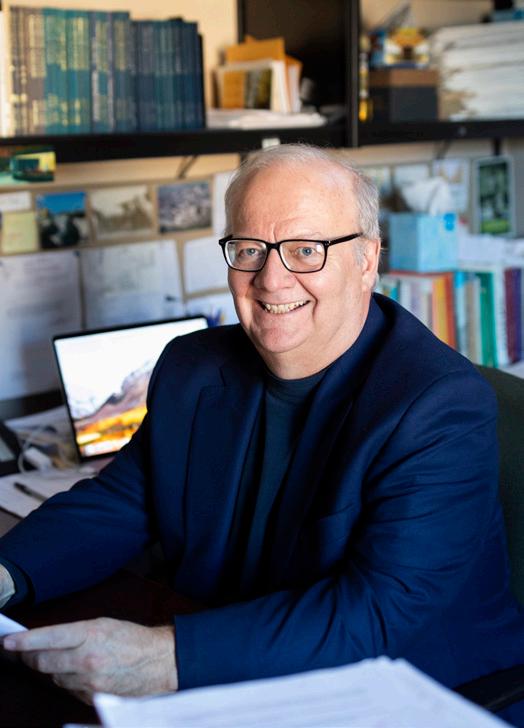
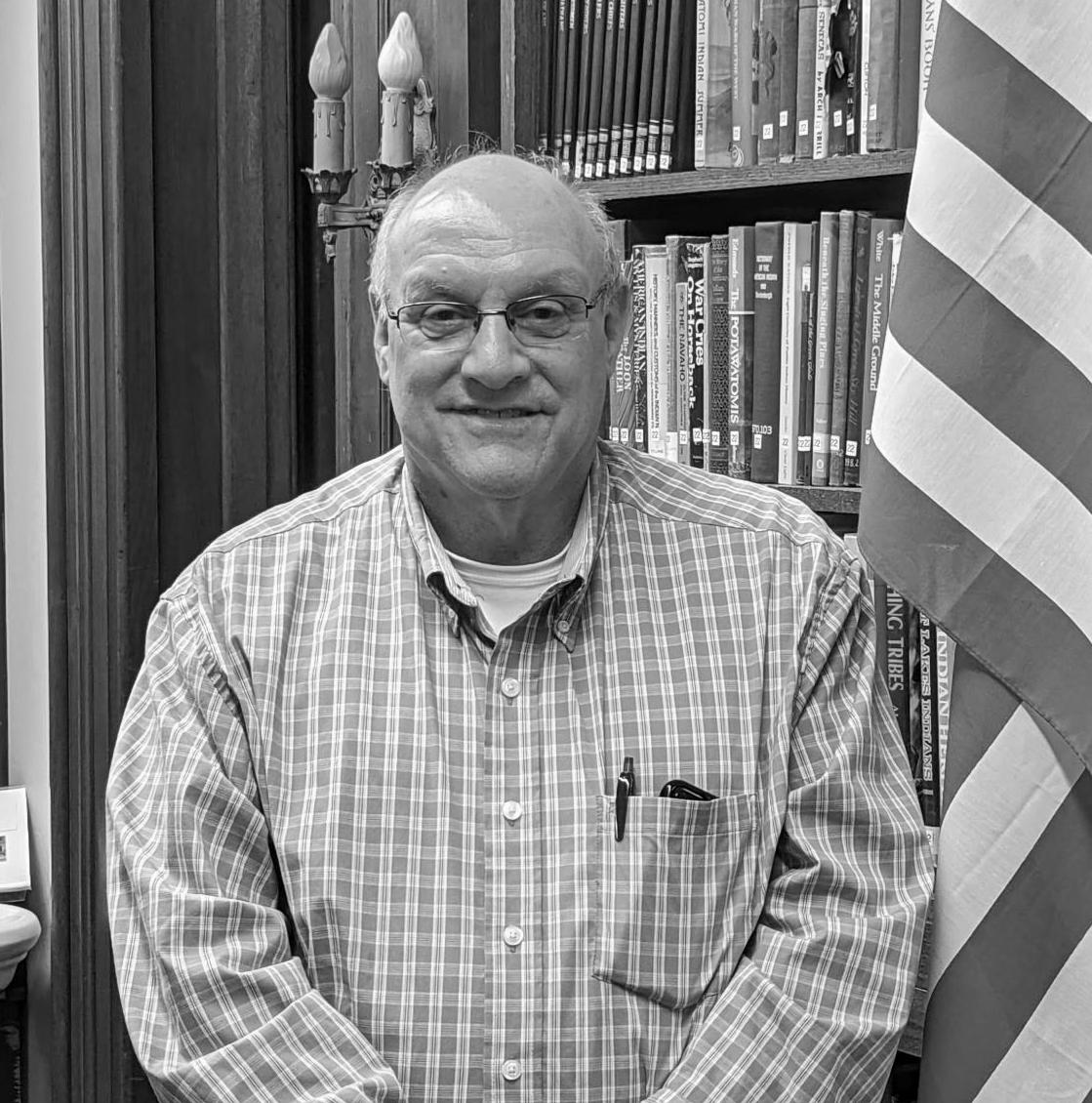
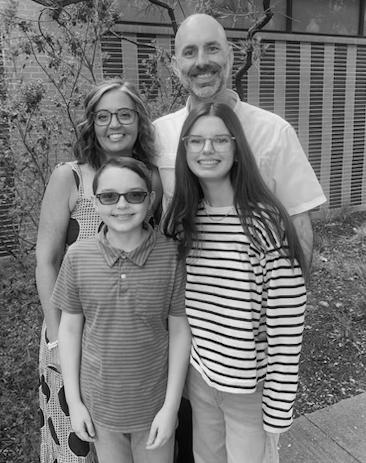
Mickey Craig, professor of politics at Hillsdale College for almost 40 years, died Feb. 10 at age 70 in the city of Hillsdale.
“His loss will be felt keenly here, but his warmth, his wit, and the steady example of his good life will remain in the memories of the students he formed and the colleagues
who knew him,” Hillsdale College President Larry Arnn said in a statement. “He was above all a teacher, and he piled up his treasure in the hearts of his students and his colleagues.”
Craig loved classical political philosophy and always returned to Plato’s Socrates, Xenophon’s Cyrus, and the Federalist Papers, according to his daughter, Assistant Professor of Classics Patricia Aeschliman. He cared deeply about both his family and his students, she said.
“He gave his time and devoted his life, in a real way, to his students, some of whom he inspired to become professors or politicians, and others whom he helped in their various careers or simply encouraged as they started families of their own,” Aeschliman said.
Fayette eyes new rules to stop solar project
By Adriana Azarian Assistant Editor
The Fayette Township planning commission is reviewing an ordinance that could prevent the installation of solar panels on 1,350 acres of farmland, the board said at a Feb. 17 meeting. Chicago-based solar company Ranger Power is seeking approval to build the Heartwood Solar II project north of the City of Hillsdale, along U.S. 12 and White Road. But the local planning commission is considering a Compatible Renewable Energy Ordinance, or CREO, that would allow the township to set its own zoning rules for new renewable energy facilities. The project comes as part of the state of Michigan’s 2023 Green Energy Initiative, which aims for the state to use 100% clean energy by 2040.
By Ethan Savka Collegian Freelancer
Seven minutes before the “The All-American Halftime Show,” Turning Point USA ran a one-minute ad sponsored by Hillsdale College. The ad, titled “Learn Like Charlie,” was also uploaded to the college’s social media pages.
The ad opens with images from Charlie Kirk’s last event at Utah Valley University last year before playing clips of Kirk speaking at or about Hillsdale, concluding with an invitation to “pick up the mic.” The ad displays the website LearnLikeCharlie.com.
The website lists several of the college’s online courses, including Constitution 101 and The Genesis Story. It
“I’m just somebody who bought a lot of land and spent a lot of money to enjoy what life I have left and give to my kids and grandkids, not to be around these solar panels,” Jonesville resident Dennis Rhoniy said at the meeting.
If Fayette Township were to establish a CREO, the solar company could go to the state and get the Heartwood II Project approved through that channel. Brady Friss, a Ranger Power development manager overseeing the project, told The Collegian Jan. 29 that it is not the company’s intention to do that, though it is not “a 100% certainty that it is totally off the table.”
“It is an option that the developer ultimately has to go through,” Friss said. “It is a very long, costly process that doesn’t always benefit everybody.”
CHP to welcome a ‘Freedom Truck’
By Elaine Kutas Sports Editor
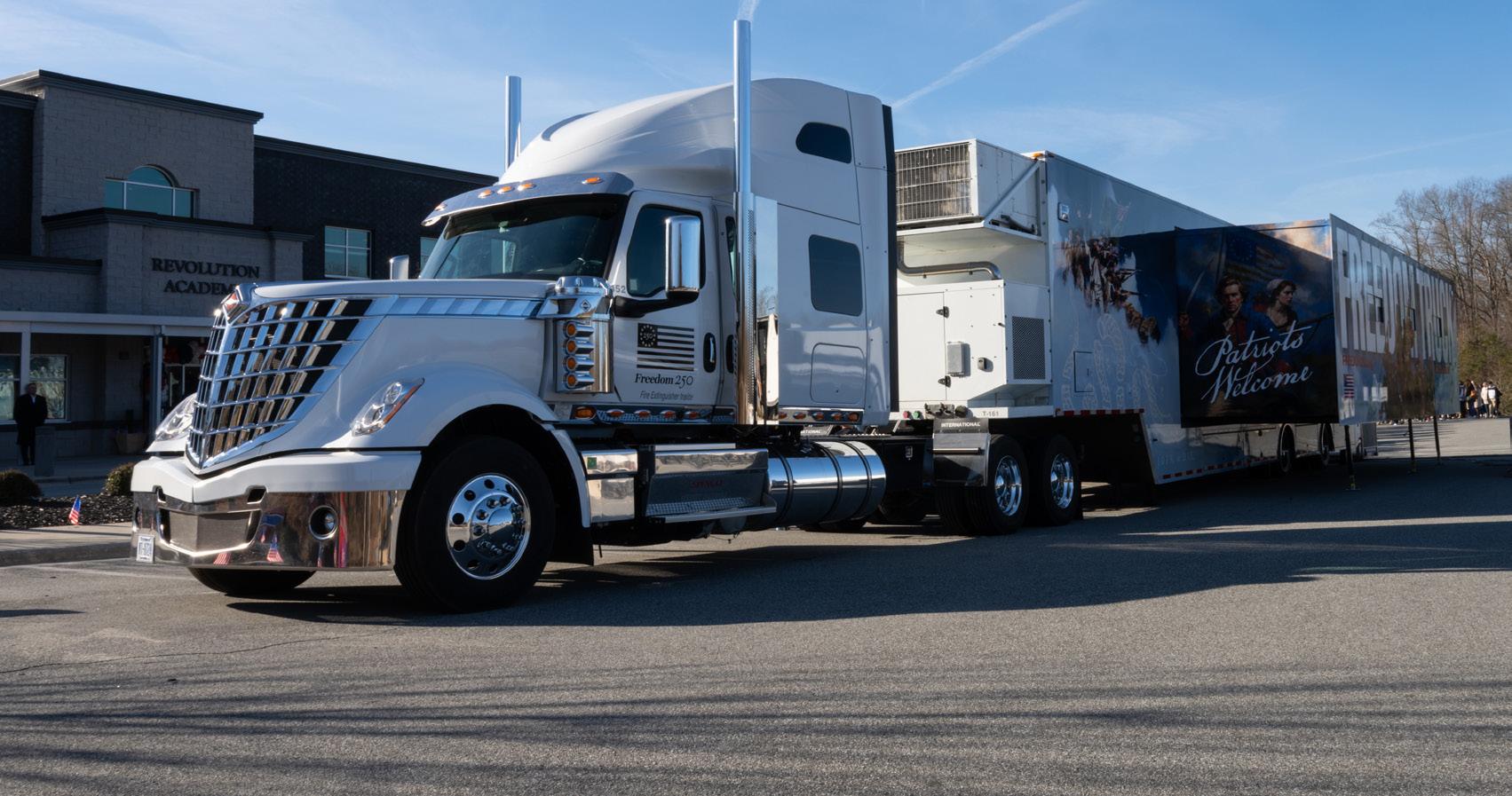
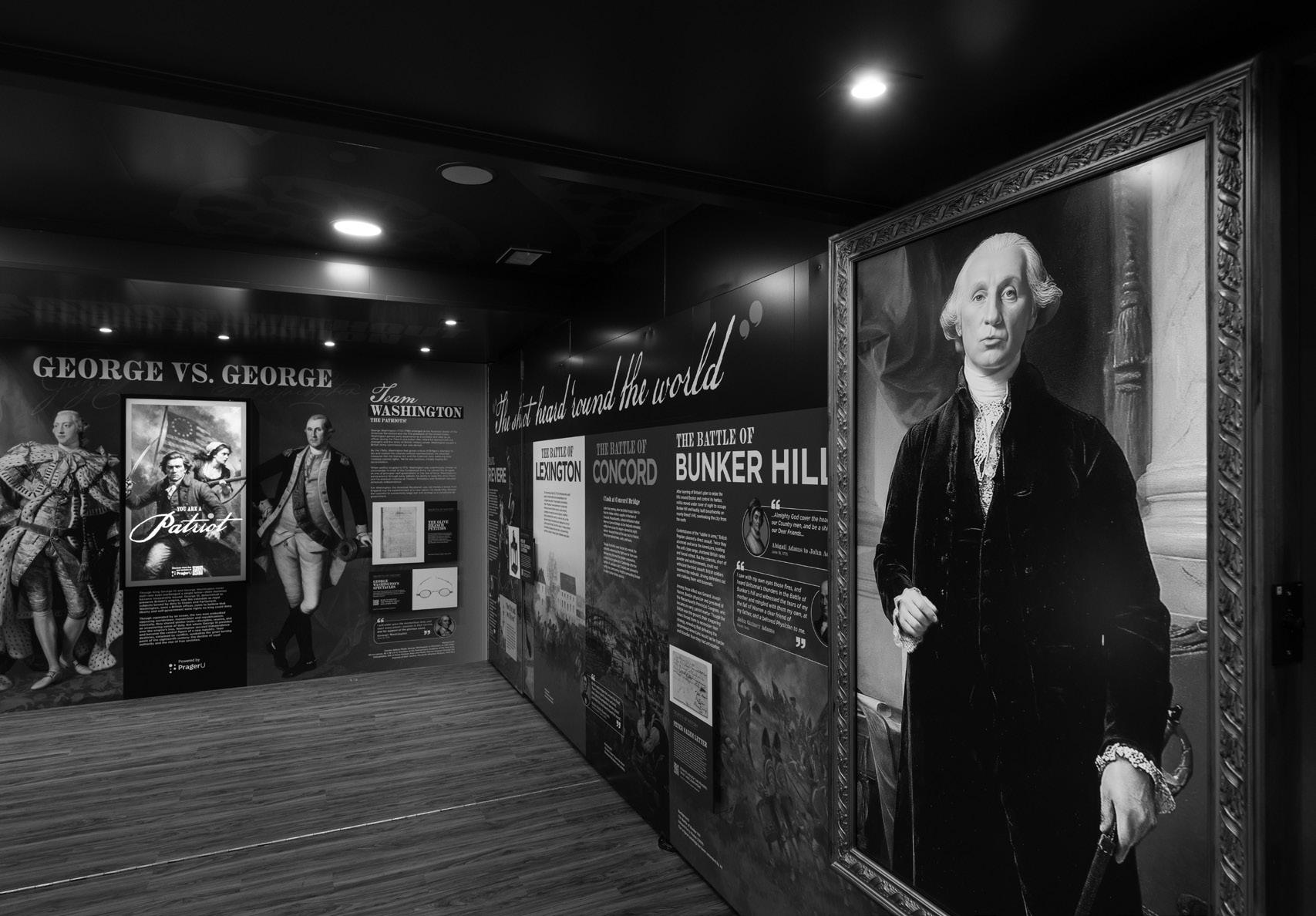
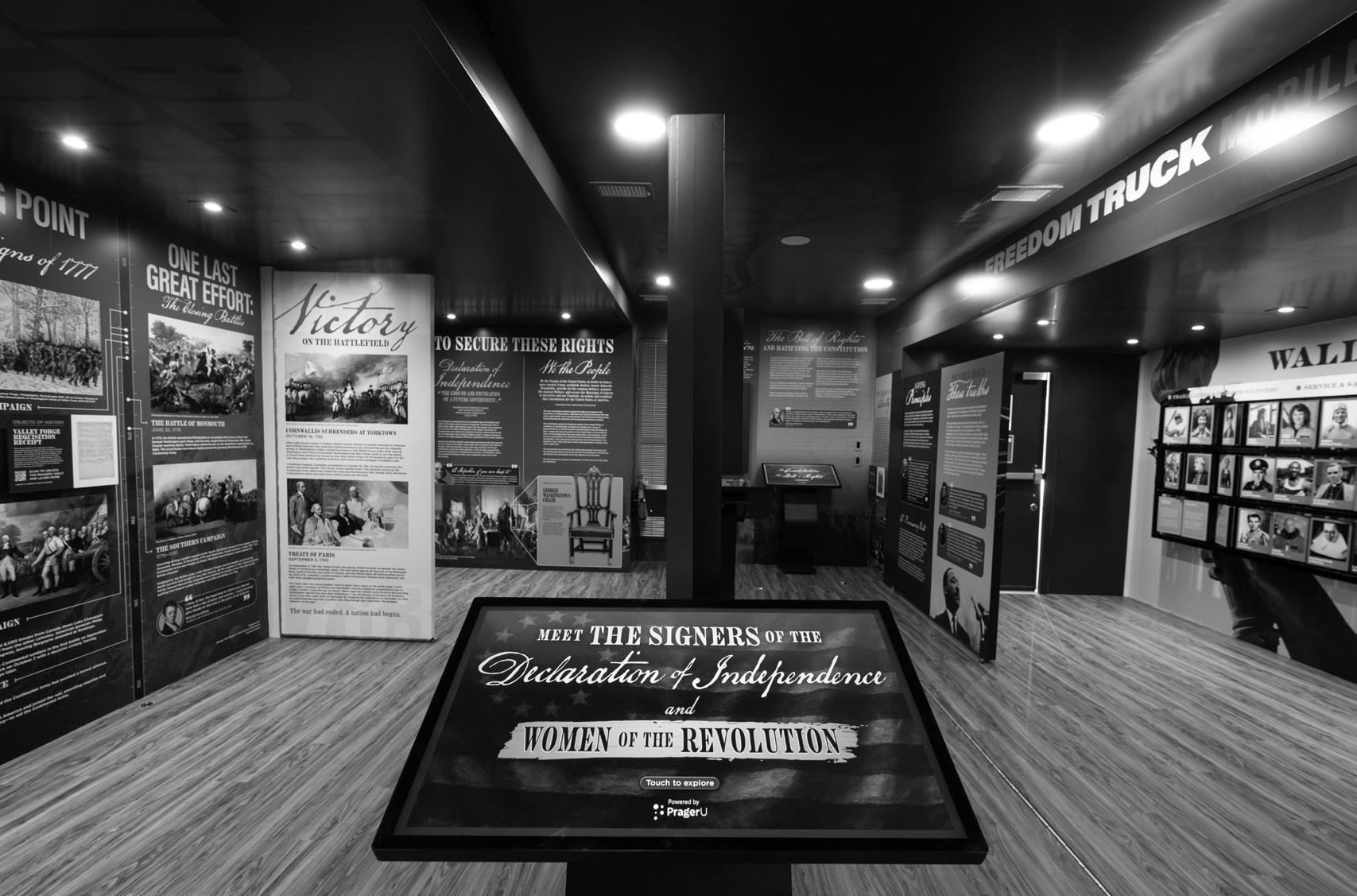
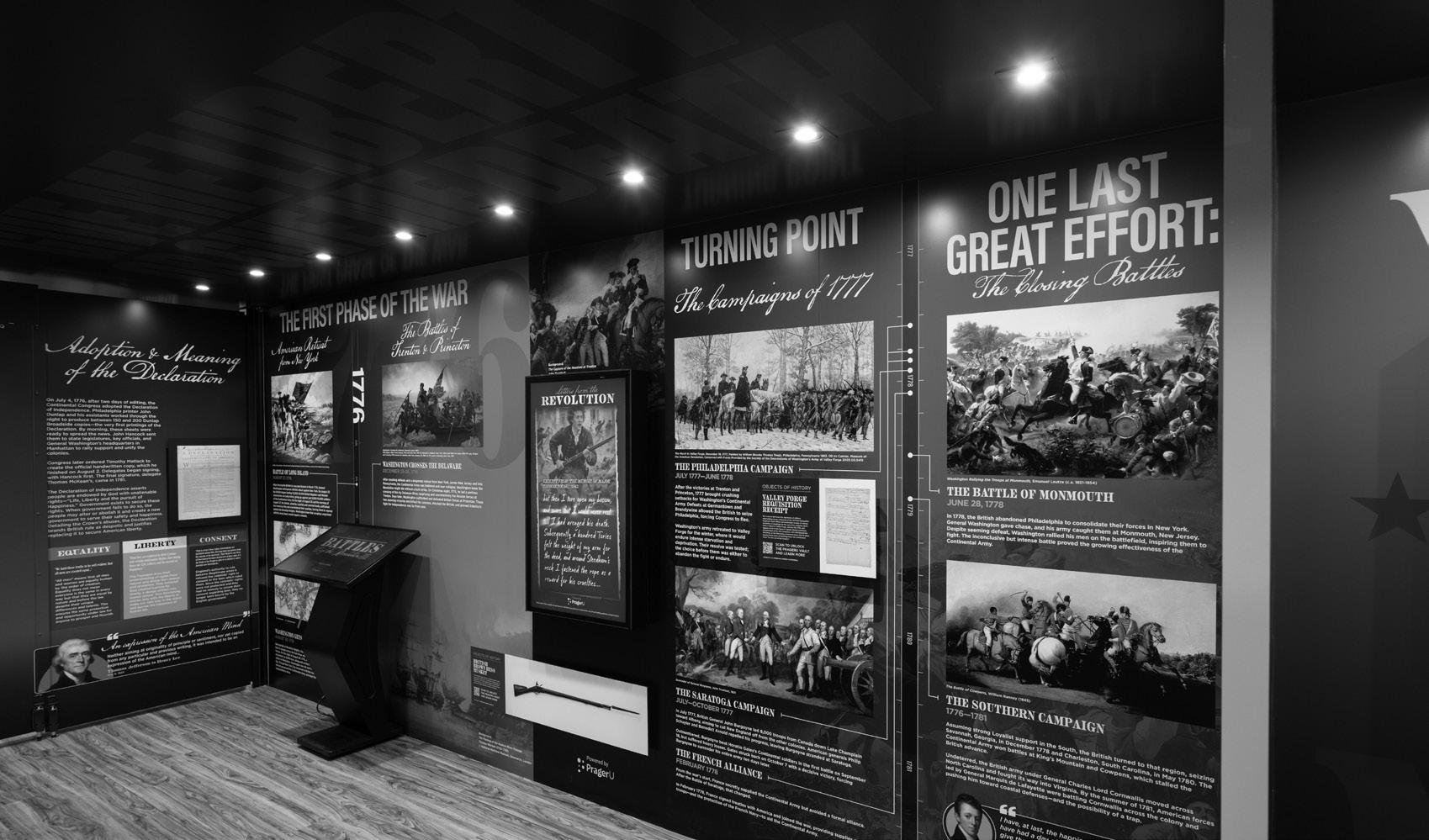
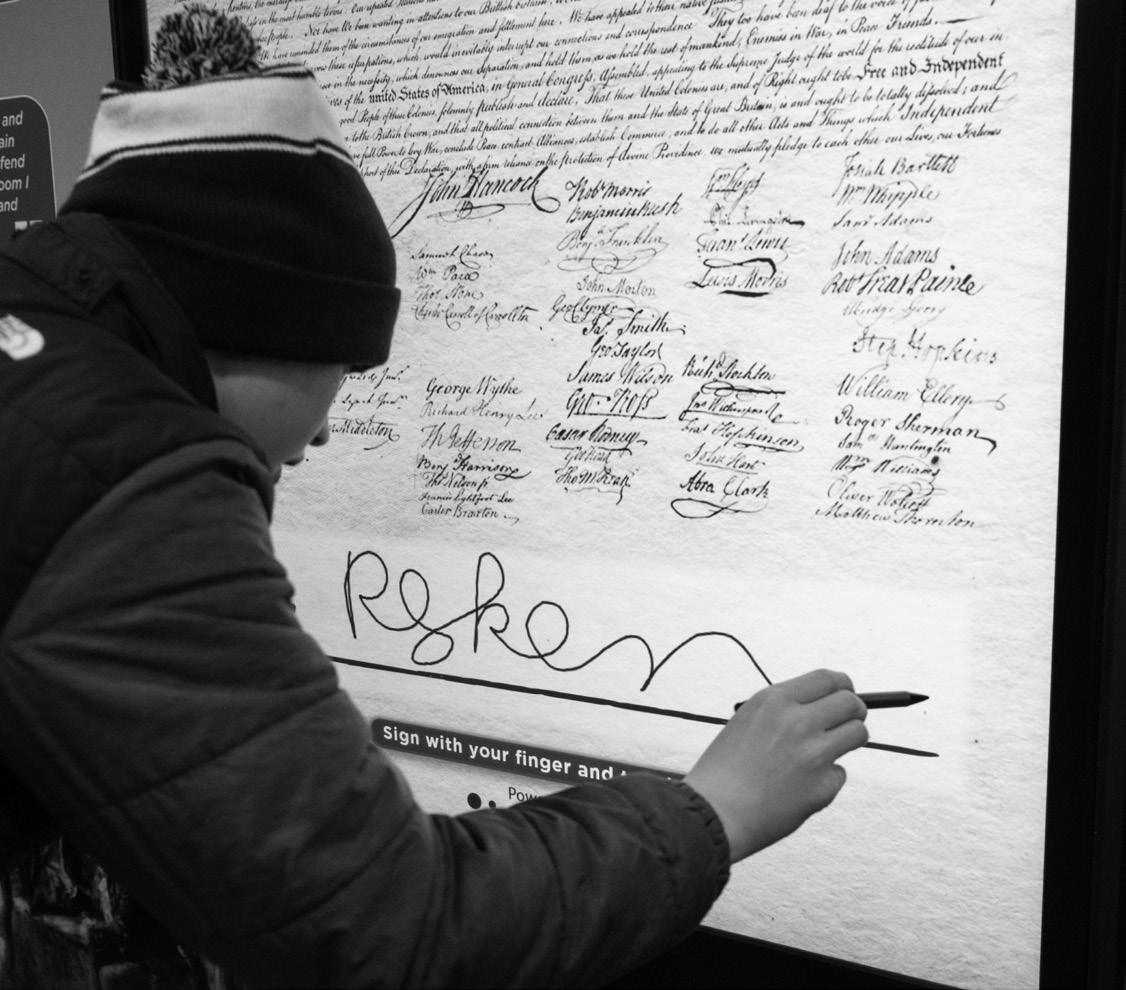
A “Freedom Truck” will come to Hillsdale in April as a part of its national tour, bringing the history of America’s founding to campus during Centralhallapalooza weekend.
The Freedom Trucks are a fleet of six mobile museums inside semitrucks. Created by Freedom 250 and with the help of Hillsdale’s Matthew Spalding, vice president of Washington operations and Dean of the Van Andel Graduate School of Government, the curriculum inside the trucks seeks to educate people of all ages.
Hillsdale will be one of the main stops for Michigan, according to Spalding. The Freedom 250 website currently lists the April 23-26 Hillsdale stop as the only destination in the state.
“Hillsdale will be one of the key stops for southern Michigan and northern Ohio,” Spalding said. “The trucks will be scheduled to stop places where local schools, the local com -
munity, as many people as possible can go through the museum.”
President Donald Trump instituted the Salute to America 250 Task Force last year to
American ‘high culture’ just looks
By Tayte Christensen Features Editor
As plastic beads and toilet paper filled the streets of New Orleans this Fat Tuesday, palaces in Vienna, Austria, hosted their final Viennese waltz of the season.
Ball season in Vienna, which traditionally lasts Nov. 11 to Shrove Tuesday each year, attracts thousands of visitors to Viennese palaces that host
hundreds of balls every season. With string ensembles, fancy attire, and grand ballrooms, Viennese ball season is reflective of something that is lacking in American society: high culture.
Last semester, I attended a Viennese Christmas waltz in Washington, D.C., while participating in the Washington-Hillsdale Internship Program. There, other students and I briefly talked with Austrian ambassador to the United
States Petra Schneebauer about the history of Viennese waltzes in Austria and the ball season.
She showed us pictures of her daughter leading a procession of hundreds of dancers across the dance floor in a Viennese palace to commence the evening’s activities. It was clear she took great pride not only in her daughter, but in the tradition of Viennese waltzes, which spans centuries and is still alive.
A comparable event in
create a year-long celebration of the 250th anniversary of the signing of the Declaration of Independence. Its purpose is to invite Americans “to have a renewed love of American history, experience the beauty of our country, and ignite a spirit of adventure and innovation that will raise our nation to new heights over the next 250 years,” according to the White House website.
This mission for the trucks aligns with Hillsdale’s mission to educate America, according to Vice President of Marketing Jonathan Hall. He also said the college has big plans for the truck’s visit to campus.
America is hard to identify. There’s the Fourth of July, and while it’s arguably the best day of the summer, it’s not the same as nearly four months of elegant balls. Mardi Gras certainly isn’t the answer either, as many Americans are repulsed by the depravity surrounding the modern celebration of the day.
credits Kirk with “studying the Classics, the American Founding, and the Bible through Hillsdale College’s free online courses.”
“Start with the Bible, read the classics, and study the founding of America,” Hills -
dale President Larry Arnn once told Kirk. The TPUSA founder would go on to complete 31 Hillsdale courses before his assassination last fall.
TPUSA’s All-American Halftime Show ran for 35 minutes, finishing with Michigan-native Kid Rock’s performance. The show was marketed as an alternative to Bad Bunny’s NFL halftime performance. Shortly after the show ended, Hillsdale’s X account wished “congratulations to @TPUSA on an incredible All-American Halftime Show. Over 5 million tuned in on YouTube alone! We were proud to be a small part of it.”
By Lucy Billings Collegian Freelancer
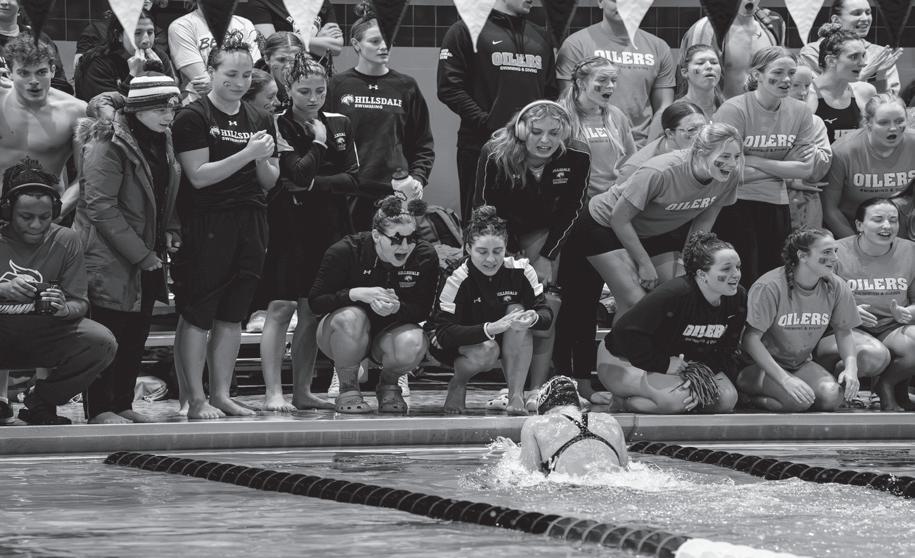
The Hillsdale women’s swim team placed second at the Great Midwest-Mountain East Conference Championship held in Canton, Ohio, Feb. 10-13. This marked the last collegiate meet for senior Rotem Andegeko, who despite a torn ligament in her left knee, achieved seasonal bests in every race.
The Chargers finished with 1514 total points, behind champion Findlay University by 320 and ahead of third-place finisher Ashland University by 336 points. Andegeko competed in seven separate events throughout the meet, dropping over a second in each personal time for the season. Freshman Sasha Babenko remarked on Andegeko’s last swim. “She swam the 200 breaststroke so beautifully. Such a bittersweet moment for the whole team,” Babenko said. During finals, Babenko finished first place in the 100 freestyle in 53.61 and the 200 freestyle in a personal best of 1:53.74.
Michigan’s oldest college newspaper
Matthew Spalding at the Freedom Truck Moblie
in North Carolina last month.
Mickey Craig. Courtesy | Patricia Aeschliman
Attendees at the Freedom Truck Mobile Museum Debut last month.
Courtesy | Austin Thomason
A freedom truck at the debut in Greensboro, North Carolina. Courtesy | Austin Thomason
A clip of Charlie Kirk from the ad. Courtesy | Hillsdale College
Christopher Scalia gives conservatives a novel reading list
By Sophia Bryant Assistant Editor
Novels create the habits of mind necessary for a democracy: a knowledge of human nature, a moral imagination, and sympathy towards others, according to Christopher Scalia, a senior fellow at the American Enterprise Institute.
“Storytelling helps us appeal to the hearts of readers through beauty and by telling compelling stories, by creating myths, myths that ring true, myths that are compelling because they are grounded in truth,” Scalia said.
He gave a talk based on his book titled “13 Novels Conservatives Will Love (But Probably Haven’t Read)” Feb. 17 at 6:30 p.m. in the Heritage Room.
Scalia said only a handful of novels tended to come up in conversation when conservatives discussed fiction, such as “The Lord of the Rings,” “1984,” and “Animal Farm.”
“Many conservatives have gotten into a little bit of a rut with that handful of books, and we are not aware of the extent of the literary tradition that discusses ideas of particular concern to conservatives, or that explores conservative themes, or depicts conservative characters with particular sympathy, nuance and understanding,” Scalia said.
The Citizens for Self-Governance club hosted the talk.
The CSG vice president and senior Annika Monson said junior Alex Mooney approached CSG about hosting Scalia’s talk.
“It fits in really well with
what we’re trying to do as a club,” Monson said. “Obviously, our big focus is for individuals to educate themselves and be educated by others that they can govern themselves well. And so I think a lot of what he touched on this talk, developing that empathy, developing that moral imagination through reading great novels that we haven’t really been exposed to, I think that really fits in to what we’re trying to do as a club.”
ic Lionel Trilling, who called the novel “the most effective agent of the moral imagination,” and argued novels taught the extent of different personalities.
“Storytelling helps us appeal to the hearts of readers through beauty.”
Scalia also claimed that novels can help people be more sympathetic to each other. He referenced a letter Pope Francis wrote in which Francis explained that studying literature can help form a person’s spiritual life.
In the talk, Scalia quoted the 20th century literary crit-
New summer course to offer
By Alessia Sandala City News Editor
A new summer session course on the American Revolution, sponsored by the Center for Military History and Strategy, will take students on a tour of the East Coast.
The trip will take place in May and will last 16 days for $200, and students will visit historic locations such as Fort Niagara, Yorktown, Valley Forge, Boston, and more.
Professor of History David Stewart said the trip is an opportunity for students to see the
places they are reading about.
“I think the students understood things in a way by being there,” Stewart said. “I’ve heard that from every student who’s gone on these various trips before. Being there, seeing something, makes them understand, not just remember things, but understand things, and the complexity of things and how pieces come together.”
Transportation, lodging, admissions fees, meals, and tuition are covered by the CMHS, and students can opt to take the course as a one or three credit class. The trip is a combination
“One of the things he focused on was the empathetic abilities, the empathetic
imagination, and that’s very important in a democracy,” Scalia said. “We have to be able to understand other people. Pope Francis made an important distinction, though. He said that empathy does not mean that you suspend judgment.”
Scalia said NPR reported on a study that found that 30% of Americans now say they may have to resort to violence to get the country back on track, with 31% of Republicans and 28% of Democrats affirming this belief.
“I don’t think reading a lot of Jane Austen will solve that problem,” Scalia said. “I’m not that delusional about it. But I think a lack of fiction in our diet is probably both symptomatic and a cause of what we’re seeing around us.”
Scalia said not all great fic-
trip on the American Revolution
and expansion of former spring break trips, also sponsored by CMHS, over the past two years.
Junior Grace Canlas attended both spring break trips and has already submitted her deposit for the summer course. She said she heard about it in class and immediately ran to her dorm room to write a check.
“I signed up because I’ve had just an incredible experience every time I’ve gone on a trip sponsored by the Center for Military History and Strategy,” Canlas said. “Not only have they created great friendships and unforgettable memories,
but they’ve deepened my understanding of reverence for the American heritage.”
Despite having been on the two trips the summer course is based on, Canlas said she is excited to see the sites with a new perspective.
“A couple of places will be new, so I’m looking forward to seeing those for the first time, but then revisiting the places I’ve already been, I think will still offer a new perspective with things I’ve learned since then from my classes here,” Canlas said.
The trip offers students a chance to see places they might
not otherwise get to for a great price, according to Stewart.
“In a very practical sense, you’re never going to have a better opportunity for $200 to see so many things and just the raw tuition costs,” Stewart said.
“You’re never going to class for $200 in Hillsdale. But seeing these things, having access to two or three professors from an unconstrained way, the professors aren’t distracted by anything else because it’s their only class. You’re not distracted by anything else because it’s your only class.”
tion tries to develop sympathies, especially not satire, but much of it does.
Scalia recommended Samuel Johnson’s “Rasselas,” Walter Scott’s “Waverley,” Nathaniel Hawthorne’s “The Blithedale Romance,” Evelyn Waugh’s “Scoop,” Willa Cather’s “My Antonia,” and Zora Neale Hurston’s “Their Eyes Were Watching God.” Sophomore and CSG co-president Noah Abrudeanu said that he enjoyed listening to Scalia answer questions.
“The way that Dr. Scalia answered questions was very indicative of his deep knowledge of literature,” Abrudeanu said.
Turn to B2 for a Q&A with Scalia.
“We are hoping this is a moment for the entire college and local community to come together in celebration of our 250th year as a free country,” Hall said. “What a great opportunity for our country to see how Hillsdale is grateful for all its blessings by celebrating and bringing the history of America to life in a museum truck, and, hopefully, many more ways to teach our youth and community how truly blessed we all are. We hope to see the entire community learn from the Freedom 250 truck that will be stopping by for a few days.”
Inspired by the 1976 “freedom train” that traveled across the country educating about American history, the Freedom Trucks will provide the same education but with greater accessibility, according to Spalding.
“It’s a mobile museum, so you can go through the truck and you learn the American story,” Spalding said. “It’s designed for the public, generally, but especially for K-12 students, and for everyone to learn about the history of America’s beginning in a way that is inspiring, interactive, fun, and true.”
As a senior academic advisor working with the White House task force, Spalding developed the educational content inside the trucks.
Junior Ava Jolley is leading the student side of campus involvement with the trucks. She is coordinating a live Liberty Walk of students dressed as the Founding Fathers to bring the history of America’s founding to life.
“The weekend before finals is typically jam-packed with fun things to do to take a break from studying,” Jolley said. “But this event offers a way to take a break, engage with the community, friends, and the history of our country. And what could be more Hillsdale than that?”
Hall said that the incorporation of the live Liberty Walk and other events, still in the planning stages, will help create memories for the community outside of the college campus.
“I am personally hoping to see real-life George Washingtons and Abe Lincolns walking around,” Hall said. “How cool would that be for the young kids from all the different elementary schools. They will remember this 4th of July-like celebration in April 2026 for the rest of their lives. We still hear stories like this from those who got to celebrate in 1976 when
America turned 200.”
Freedom from A1
The interior of a freedom truck.
Courtesy | Austin Thomason
Attendees at the Freedom Truck Mobile Museum Debut last month
Courtesy | Austin Thomason
Matthew Spalding at the debut last month
Courtesy | Austin Thomason
The interior of a freedom truck.
Courtesy | Austin Thomason
Attendees at the Freedom Truck Mobile Museum Debut last month
Courtesy | Austin Thomason
The interior of a freedom truck.
Courtesy | Austin Thomason
Freedom from A1
Mock trial B team takes home gold, sweeps the competition
By Elijah Guevera Assistant Editor
Hillsdale Mock Trial’s A and B teams could advance to nationals after last week’s regional tournament at the University of Dayton.
The B team finished in first place overall at Dayton Regionals Feb. 14-15 with a perfect 8-0 score. They defeated Bowling Green State University, the University of Cincinnati’s A team, University of Michigan’s C team, and Cedarville University’s B team, sweeping each team 2-0.
Sophomore Aaliyah Moore received a 19-rank attorney award, and junior Ty Tomasoski won a 16-rank witness award.
“Ty gave some really fun and engaging performances this weekend,” team member and sophomore Zoe Katsa -
Craig was born in Jonesboro, Arkansas and got his bachelor’s degree at Arkansas State University. He received his master’s degree and doctorate from Claremont Graduate School before coming to Hillsdale College in 1986, according to the obituary published by Eagle Funeral Homes. He married his wife, Joanne, in 1987, and they had six children.
“Dad considered himself the luckiest man in the world to have worked at Hillsdale College for nearly 40 years,” Aeschliman said. “He loved teaching, loved the college, loved his students and colleagues.”
Craig is survived by his wife, Joanne; his three sons, Joe Craig ’14, Michael Craig ’22, and Matthew Craig; his three daughters, Aeschliman, Monica Fiedorek, and Christina McNamara; and seven grandchildren.
Craig had planned to retire later this year, according to Aeschliman.
“Mickey was, in a real sense, the founding chair of an independent department of politics here, something that mattered greatly to him,” Arnn said. “He helped to create the major and left a strong imprint on its curriculum.”
While at Hillsdale, Craig served as dean of social sciences, led the Washington-Hillsdale Internship Program, advised the Tau Kappa Epsilon fraternity, became the founding chair of the politics department, and won Professor of the Year in 1995.
Aeschliman said some of her favorite childhood memories of Craig were the history-themed vacations the family took, including to the
According to the post, TPUSA’s halftime show received more than 5 million live views while the NFL halftime show counted more than 130 million. In the nearly two weeks since airing, the show’s video has 38 million impressions across all social media platforms.
Andrew Kolvet, co-host of “The Charlie Kirk Show,” applauded Hillsdale on the ad, saying “I think it should be nominated for top 10 commercials from the night” in a X post. Other media personalities have also reacted to the ad, with CNN host Scott Jennings featuring it on “The Scott Jennings Show.”
Jeremiah Regan, executive director of online learning for Hillsdale, said the college has seen an increase in online course enrollment since the ad aired, and expects more in the coming weeks.
“The mission of the col -
ros said. “And Aaliyah has a kind of confidence that really commands the courtroom whenever she’s delivering her material. She was clean, precise, and connected especially well with the judges.”
The Dayton Regionals was a single-elimination tournament, meaning only the top six teams could bid to the Opening Round Championship Series, according to Katsaros. At ORCS, 192 teams from across the nation will compete for 48 spots at the National Championship Tournament. Because the B team placed first at Dayton Regionals, they won the first bid to ORCS from Dayton.
“It was such an exciting moment to hear our team be called as the first team advancing to ORCS,” Katsaros said. “We’ve put in a lot of work to make that happen, and it’s really special that we
birthplace of Mark Twain in Missouri and sites associated with Laura Ingalls Wilder. The family would also spend hours playing card and board games.
“Later in the evening, some Craigs could get silly and slaphappy,” Aeschliman said. “My sister Chrissy and my dad were most likely to start laughing uncontrollably. Dad would sometimes get up and walk out of the room to regain his composure, then walk back in with a straight face only to lose it again upon making eye contact with any of his children.”
Mark Kalthoff, professor of history, said he knew Craig for almost 40 years, and the two worked together on a variety of college projects. At the time, history and politics were one department.
“The department kept growing, and we got to the point where when it came time to put together the schedule for who’s teaching what courses, I would do the history and he would do the politics,” Kalthoff said. “So we kind of jointly helped run the department together for a lot of years.”
When the college launched its Hoogland Center for Teaching Excellence in 2001 — an initiative to provide quality, classical content for teachers — Kalthoff and Craig helped lead one of its pilot programs on the Declaration of Independence.
“We were both interested in the history of the American founding,” Kalthoff said. “We both lectured on that a lot and talked about it a lot.”
Kalthoff’s children grew up with Craig’s children, and the two often spent years attending the kids’ sporting events together.
“I’ve lost track of how many times I sat in the stands with him, watching soccer or basketball games or going to track
lege is to educate all who wish to learn,” Regan said. “There are many people who have not yet heard of Hillsdale College — putting a precise number on that is difficult — but we welcome anyone who learns of Hillsdale’s online learning through affinity with Charlie or association with TPUSA.”
Jonathan Hall, vice president of marketing at Hillsdale, also said this sentiment in an email to The Collegian.
“At Hillsdale College we are striving to become the best college in America and simultaneously teach mass audiences of truth seeking Americans from the same core teaching, philosophy, the rigorous and dangerous classic liberal arts that embodies the idea that strength rejoices in the challenge,” Hall said in his email. “We want to extend our mission to all who wish to learn, developing minds and improving hearts.”
Hall said the ad was inspired by a favorite ad of Kirk’s.
“The commercial was orig-
get to keep working alongside each other at this level. We’re celebrating that win, but there’s still work to be done.”
Hillsdale’s A team placed third overall at Dayton Regionals, with a 7-1 final score. They swept University of Cincinnati’s A team, University of Dayton’s B team, and Saint Louis University 2-0 each. The A team tied 1-1 with Indiana University’s B team in the second round, causing them to finish just one point short of a perfect score overall.
Co-captain and senior Valerie Check took home a 17rank attorney award, while co-captain and senior Patrick McDonald won a 17-rank witness award, and senior Chloe Noller received a 16-rank witness award, according to Check.
“Patrick’s witnesses are always fun. They bring life to a long trial,” Check said. “Chloe
meets, watching our sons play together,” Kalthoff said.
Craig’s students loved him, Kalthoff said.
“He was a beloved teacher, and he was a mentor to many students who would go on either in law or politics,” he said. “And I think the fact that the church where the funeral was was standing room only was a testimony to how many of his former students were expressing their sympathy for his family.”
One former student, Joseph Cella ’91 — an ambassador to Fiji and other Pacific islands during the first Trump administration — attended the funeral and read the Prayers of the Faithful during the Mass. He said Craig helped shape his political career and the careers of other graduates.
“His formation of us, really in a fatherly mentor way, had an indelible impact on all of us and our lives’ callings,” Cella said. “He was an exemplar of a professor who loved his students, who cared about them as the whole person, heart, mind, and soul, and cared for their dignity.”
Cella said there was a group of students from the class of ’91, including himself, that Craig called “his boys.”
“We would make contact with him throughout the years, whether it was email or text messages or dinners, and update one another on life’s developments and babies being born and weddings or career updates, and he was always there for us,” Cella said. “He had a very, very special fatherliness about him that I’m forever grateful for.”
Craig attended Cella’s farewell party before Cella went overseas as an ambassador, Cella said.
“He was very special, and I’ll treasure him forever — a great witness as a father and as
inally inspired by the Gatorade’s ‘Be Like Mike’ commercial that Charlie was a big fan of, growing up in Chicago,” Hall said. “It’s an iconic spot that showed the heroic nature of young kids wanting to play basketball like Jordan. Generation X, our bullseye growth audience, loves the nostalgic connection from their days dreaming of being like Mike.”
Kirk’s legacy is tied to Hillsdale, Hall said.
“You can see in the spot that Charlie’s advice to others who want to think and lead like him was to learn the classic liberal arts like he was doing at Hillsdale College,” Hall said. “It’s literally his voice being amplified to the work. The TPUSA team said they loved the spot and hoped millions of people start to engage in the learning program.”
The marketing department plans to continue its “Learn Like Charlie” program, Hall said.
“We will be driving this all year with TPUSA socials,
was particularly smooth this weekend. She was credible and brought great emotion to her character.”
Because the A team placed third at the tournament, they won the third bid to ORCS, according to Check.
“If you don’t place high enough at regionals, you’re out of the tournament,” Check said. “ORCS is like the sweet-16 of mock trial. It’s a blessing to be there. We are excited to keep pushing to prepare for the upcoming round of the tournament. The field narrows significantly, so we will have to be prepared to face great programs with difficult teams.”
Check said the team has spent many hours preparing for the Dayton Regionals tournament as well as the rest of the season.
“We put in a lot of hours to prepare for this tournament,”
a husband and certainly as an academic,” Cella said. “He’s an exemplar for all to follow.”
In addition to his care for his family and students, Craig loved baseball, especially the St. Louis Cardinals, and racquetball, according to Dean of Men Aaron Petersen, who said he remembered challenging Craig — who was about 15 years Petersen’s senior — to a game of racquetball.
“He and another professor were playing, and I barged in with another staff member and started talking trash, challenging them to a game,” Petersen said.
The group started playing, and the game quickly turned in Craig’s favor.
“We weren’t making the shots, and they were just hitting everything. Mickey was playing out of his mind,” Petersen said. “They stumped us, and he walked out looking at me, and he said, ‘Yeah, anytime you want to play, Petersen.’ That was humbling.”
Petersen then ran into Craig’s wife at Sunday Mass a few days later.
“She had a big, happy smile on her face and she said, ‘Maybe you shouldn’t talk so much trash when you play racquetball,’” Petersen said. “She left me speechless, which doesn’t happen often. Later, when I saw her and Mickey again, I said, ‘Did you really tell your wife to talk trash to me at church?’ And he just grinned and shrugged his shoulders.”
Joseph Postell, associate professor of politics, met Craig during Postell’s interview for a job at the college.
“Unlike a lot of job interviews, he was very welcoming, and he really just wanted to make me think that Hillsdale was the right place for me,” Postell said. “He told me what he told everybody, which is, ‘You’re going to love
podcast, events and much more,” he said. “The marketing challenge now is to build awareness of the offering and make it easy for audiences to learn from us in all forms of modern-day teaching platforms.”
Juan Dávalos, Hillsdale’s executive director of brand management, agreed with this hope in an email to The Collegian.
“We recently learned that about a third of current high school students do not plan to attend college,” he said. “What would the country look like in a few years if we could reach some of those students with the classical liberal arts and guide them to arm their minds against the confusion that pervades modern society? Through our online courses and campaigns like ‘Learn Like Charlie,’ the College can be a means of learning for millions of people.”
Dávalos hopes the new initiative will connect people to Kirk’s story.
Check said. “It’s the start of the real season, so we have been locking in in Lane Hall. I’m grateful for the hours my team helped me prepare.”
While the work was grueling, the B team enjoyed working hard together and growing closer over the weekend, according to B team co-captains and juniors Elizabeth Gaines and Ella Lovins.
“Tournaments are always demanding, both mentally and physically,” Gaines said. “Though the days are long, we loved spending time together and bonding even more as a team.”
Both of Hillsdale’s teams will appear at ORCS on March 20-22 in Geneva, Illinois.
“We were grateful to bid to ORCS this year and are excited for the work ahead,” Lovins said.
it here.’ Every single time we hired a new faculty member, or we interviewed somebody, he would say, ‘You’re going to love it here.’”
Craig loved teaching at Hillsdale, and he was especially excited when the college hired his daughter, Aeschliman.
“I think that made him both extremely proud and extremely happy, and it was fun to see his reaction to that,” Postell said. “His daughter got a good job, and it was at this college, and in some ways she was his student as well, because he gave her a lot of advice and mentorship. It was like all of the things he loved happening at the same time. I know that made him profoundly happy, and it was a lot of fun to see him that happy.”
Professor of History Kenneth Calvert said Craig’s children are a testament to the kind of man he was.
“His six children are all great people, and all just absolutely in love with their father,” Calvert said. “You could see that in their relationships. Were there hard times, of course, but they loved and respected their dad, and that speaks a lot of a man and of Mickey Craig, that his children would see him that way.”
Aeschliman said her father was very supportive through her time in graduate school.
“He was incredibly proud to have me join him at Hillsdale as a colleague,” Aeschliman said. “My dad prioritized above all taking care of his family; we’ve seen first-hand his love for my mom, his care and planning for my brother’s health and happiness, and his hard work to keep himself healthy so that he could continue providing for the family. He was a great man and a most loving father.”
“‘Learn Like Charlie’ is a campaign that we hope will inspire those who admired Charlie to follow in his footsteps and awaken that deep desire for learning that Charlie had,” he said. “The kind of leadership and knowledge Charlie demonstrated comes only through hard work that is intentionally chosen. In Charlie, we have an example for the nation of how to do that hard work and the effects of that hard work on the nation.” The ad is not Hillsdale’s first entry into the Super Bowl arena. In 2017, the college ran an ad before and after Super Bowl LI titled “Freedom,” directing viewers to hillsdale. edu/freedom. The webpage now explores the legacy of Thomas Jefferson.
Sophomore wins art critic essay contest
By Christian Papillon Assistant Editor
Sophomore Grace Brennan won $1,000 in the inaugural Kenyon Cox Art Critics Essay Competition, sponsored by Hillsdale alumnus Nathaniel Stewart ’95 and art critic William Newton.
“We were hoping to inspire students to take a shot at learning how to write some art in a succinct and lively article format,” Stewart said. “We didn’t want this to be a research paper or a heavy theoretical piece.”
More than 20 students submitted entries, which were due earlier this month. They were judged by Assistant Professor of Art Christina Chakalova and John J. Miller, director of the Dow Journalism Program, in consultation with Newton and Stewart.
Newton is an art critic who has written for the Spectator World and The Federalist. Newton said he and Stewart came up with the idea for an essay competition after Newton visited the college last year and lectured on the current state of art criticism.
“He said it would be a good thing to talk with some of the professors about encouraging Hillsdale students to take a look at art criticism,” Newton said. “Art criticism is very important, but a lot of people are not aware of how to get involved in it as part of their writing career.”
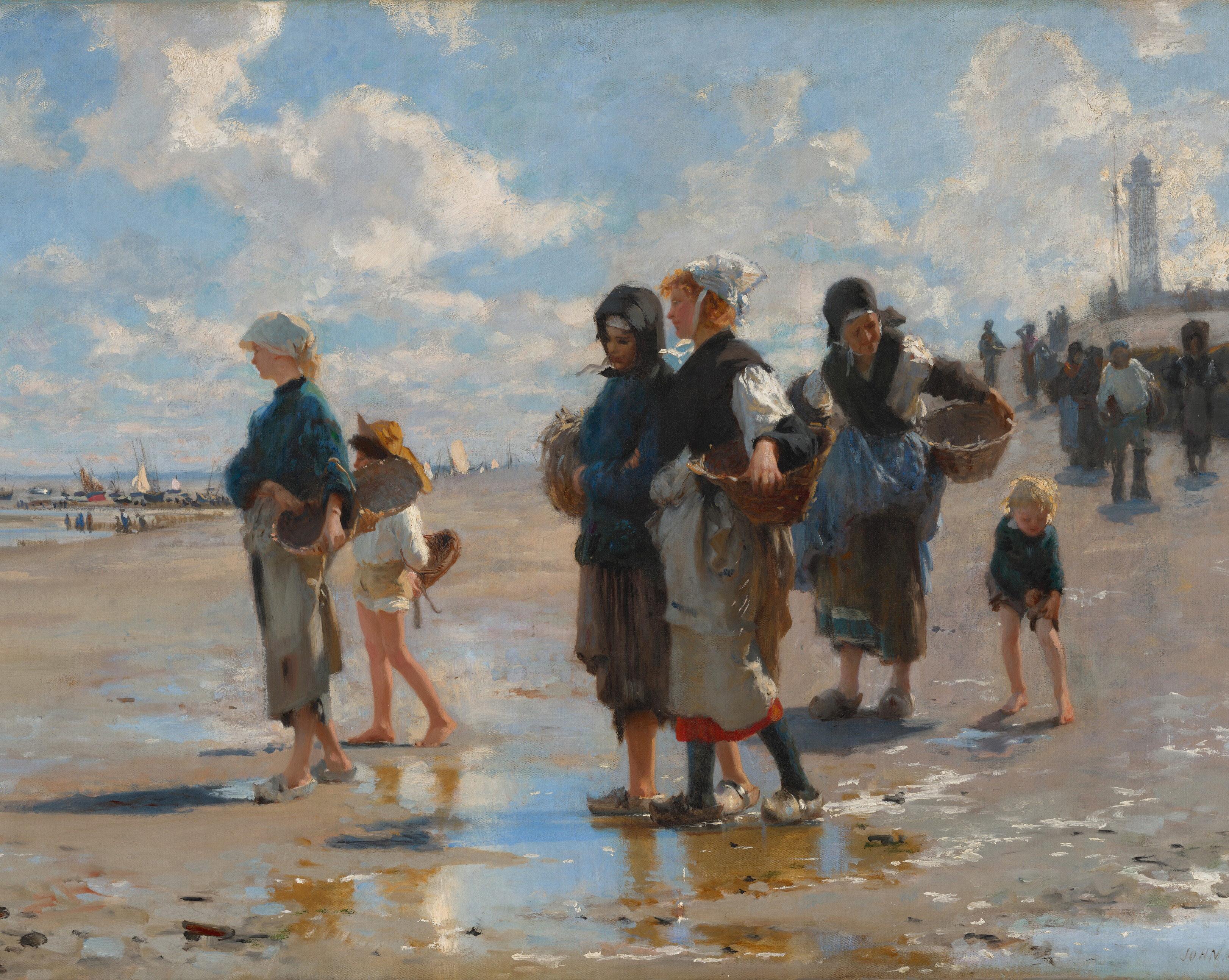
Contestants wrote essays of 800–1,000 words about one of three paintings by John Singer Sargent and argued why Hillsdale should take the painting on loan.
Brennan, who serves as assistant culture editor for The Collegian, said she entered the competition because she had previously studied Sargent’s works under Chris di Domizio.
“When I saw there would be a competition critiquing one of Sargent’s paintings, I thought that’s perfect for me because I’ve studied his art for a long time,” Brennan said.
John Singer Sargent (18561925) was an American artist famous for his depictions of Belle Époque-era France and Edwardian-era England. Brennan said she chose the painting “Setting Out to Fish,” also known as “En route pour la pêche,” because she was familiar with it due to her work with di Domizio.
“The main reason I picked it is because I’ve studied it, I’ve drawn it, and once I’m back in my studio, I will paint it,” Brennan said. “I love the composition. The other paintings didn’t really stand out to me as far as composition goes. The one I chose has a lot of movement and beautiful colors.”
The contest was named for Kenyon Cox (1856-1919), an American painter who became an art critic for magazines such as The Nation, and Scribner’s.
“We had some really high-quality work,” Stewart said. “I really enjoyed reading all the submissions and seeing how the students approached the prompt, and we’re really hoping that the students will give it a shot again next year.” Stewart said he was happy with the success of the competition.
“We are hoping that it will be an annual sort of thing,” Stewart said.
To read Grace Brennan’s winning essay, see page B1.
Halftime from A1
Craig from A1
Opinions
‘ I play for the United States of America’
Watch the US take gold in Olympic hockey
Editor in Chief | Thomas McKenna
Executive Editor | Moira Gleason
Design Editor | Anna Broussard
Senior Editor | Catherine Maxwell
News Editor | Ellie Fromm
Opinions Editor | Caroline Kurt
City News Editor | Alessia Sandala
Sports Editor | Elaine Kutas
Culture Editor | Ty Ruddy
Features Editor | Tayte Christensen
Social Media Manager | Skye Graham
Circulation & Ad Manager | Henry Fliflet
Assistant Editors |
By Robert Matteson Collegian Reporter
The Winter Olympics have been filled with ice. Figure skaters have landed the quadruple axel on the ice, luge racers have travelled speeds north of 90 mph, lying on their backs on boogie boards with blades on the ice, and curlers have demonstrated strategy and finesse in chess matches on the ice. But hockey is the real king of the ice, and the real reason everyone should watch this year’s Winter Olympics.
Knowing your GPA is overrated
By Caroline Kurt Opinions Editor
Don’t kill me, Dr. Jackson: I can’t remember the last time I checked my grades.
It’s not technological incompetence or fearful avoidance. Instead, it’s been my way of reaping the fruit of Hillsdale’s academic rigor and character-building. After four years, I’m happy to report that it’s worked.
The median college GPA has increased by more than 21% since 1990, according to a study by the U.S. Department of Education.
Though Hillsdale has experienced some of this “grade inflation,” as The Collegian reported in 2024, many professors are still averse to giving out an easy A. That means Hillsdale students still face the proper challenges of an academic environment.
Like many, I entered freshman year as an academic perfectionist. The high standards I set for myself paid off in some ways — I made it into Hillsdale, after all. But my high school friends knew me as a high-strung workaholic, and I was. Too much of my identity was wrapped up in quantifiable, exterior achievements. I would get emotional if I did poorly on a test, or ignore my family if a big project loomed.
In college, something needed to change.
Surrounded by bright peers and brilliant professors, I felt the temptation to turn these four years into a comparison game.
“Is my internship prestigious enough? Am I performing as well as my best friend in Great Books? Does my professor even like me?”
But it turns out, ignorance is bliss.
Sometime during freshman or sophomore year, I stopped checking my grades. Sure, I would see the individual scores of quizzes (bad) or essays (marginally better) when they were
handed back. I had a vague sense of how I was faring in individual classes. But beyond that, I didn’t know. And gradually, I began not to care.
I felt free to take reputedly difficult professors without worrying about what it would do to my grades. I adopted extracurricular roles that increasingly took time away from academics. I spent evenings on the couch at home talking to friends instead of tackling my to-do list.
Learning grew richer and more fulfilling when it became less quantifiable. Classes offered life lessons, even when I struggled with papers. Essays were a chance to branch out. Stress dwindled when my self-worth didn’t hinge on the outcome of a test. My education, in short, became less about me.
Grades can be a helpful tool; it’s good they exist. For those planning on law school, medical school, or a master’s after Hillsdale, close attention to grades is warranted. But many of us could stand to step away from external quantifiers, be they grades, likes on social media, or confirmation that that scary professor did, in fact, like me.
In Alfred Tennyson’s imagination, the king Ulysses suffers from the vice of curiositas , or a disordered appetite for knowledge: “to follow knowledge like a sinking star/ Beyond the utmost bound of human thought.”
Don’t be Ulysses. This Lent, perhaps resolve to know less. It’s a great life.
Caroline Kurt is a senior studying English.
The United States team upset the heavily favored and four-time-reigning goldmedalist Soviet Union in 1980 on its way to winning gold in Lake Placid, New York. America’s “Miracle on Ice” is the greatest upset in sports history. But the United States has not returned to the throne since that victory.
“I play for the United
States of America,” Mike Eruzione said in the movie that memorializes the historic team of 1980. He no longer played for Boston University. His teammates no longer played for the University of Minnesota or the University of Wisconsin. Together, they played for the Stars and Stripes, leaving their college dorms to take down the Red Machine.
This year, the United States will have professional hockey players wearing the red, white, and blue sweaters. These athletes, though, will be leaving the teams that sign their paychecks so that they can play for pride in Italy. If you were to ask any player who they play for now, they would not say the Dallas Stars, Florida Panthers, or Detroit Red Wings. They would say, “I play for the United States of America.”
The last time National
Hockey League players competed in the Olympics was in Sochi in the 2014 Olympics. The Canadians won that year. The Canadians also won in 2010. Canadian hockey has assumed the same role the Soviets held leading up to 1980: they dominate. They reinforced this within the past year. Last February, Canada defeated the United States in the championship of the Four Nations Face-Off in overtime. It was the second most-watched hockey game of the past decade.
Despite the heartbreaking defeat, the United States should enter the Olympics with a high level of confidence. They defeated Canada once in the preliminary round of last year’s round robin. And, they showed the bullies up North that they were willing to fight. Now, they have their chance.
The final event of the 2026 Winter Olympics in Milan
and Cortina, Italy, is the gold medal match of the men’s hockey tournament. On the evening of Sunday, Feb. 22, nothing else should occupy the television. Assuming the United States and Canada take care of business leading up to the championship, all eyes will be on them in a monumental culmination to the Olympic Games.
As skaters take the ice, the total medal count of the entire Olympics won’t matter, nor will anyone remember who won the curling championship. The only thing that will matter is whether or not the United States of America can return as kings of the ice, and stand on the podium with gold ice around their necks.
Robert Matteson is a sophomore studying the liberal arts.
Woke art has something to teach you
By Jayden Jelso Assistant Editor
Ben Shapiro has it wrong. You should watch woke movies.
Over Christmas break, one of my best friends showed me the flashy mish-mash of absurdism that is the 2022 movie “Everything Everywhere All At Once.”
For two hours and 19 minutes, I was subjected to hot dog fingers and googly eyes galore, an on-screen manifestation of Antonin Artaud’s Theatre of Cruelty. But the most striking part of the movie wasn’t its ridiculous imagery, it was its message.
“Nothing matters,” the characters conclude. Yes, you read that right. The message of “Everything Everywhere All At Once” is sheer nihilism.
It is a message I could not disagree with more strongly. Despite this, I loved the movie and believe it absolutely deserved its 2023 Best Picture win at the Oscars. This is because it forced me to wrestle with an objectionable message.
The film promotes a liberal worldview on a thought-provoking level without vomiting up buzz-phrases like “diversity is our strength” or “love is love.” It forces viewers — especially Christian ones — to wrestle with ideas they might instinctively dismiss, such as atheism. That is one of the fundamental purposes of art; not to spoon-feed audiences what they already believe, but to challenge them. You will never understand
opposing worldviews if you focus only on strawmen without entertaining the source itself.
Now, this does not mean you should engage with — how shall I say this? — slop. Poorly written stories that focus on activism rather than art, even crossing into objectionable content, exist everywhere. These less-thanstellar films, TV shows, and books are not worth your time. James Cameron’s “Avatar” franchise comes to mind.
Instead of exploring
to be “agenda-free,” but this is self-contradictory — the supposed agenda-freeness is the agenda. Films like “Lady Ballers” and “Reagan” fail to garner good reviews (especially among the youth) not wholly because liberal audiences hate conservative ideas but because their sole purpose for existing is that they’re not the supposedly worse alternative. These films are created as responses to culture rather than as cultural building blocks, and this only furthers cultur-
“The way we heal the cultural divide is not by blasting a canyon between opposing worldviews or hibernating in ideological cliques. ”
themes of colonialism by depicting imperfection in both the human invaders and the native Na’vi, Cameron portrays the former as totally evil and the latter as totally good, at least in the first two movies. He leaves no room for nuance or interpretation, nearing a propagandistic political message. People hate “Avatar” because the films tell audiences what to think instead of allowing them to interpret the message for themselves.
Many neo-conservative works of art have this problem as well. Their creators, such as Ben Shapiro, claim
al division.
Just recently, we had two separate Super Bowl halftime shows, one by Bad Bunny and the other by Turning Point USA, designed to cater to America’s two dominant political parties. Nothing screams “we’re doing fine” quite like that.
Still, there are plenty of quality films that shine despite their dodgy messages.
Christopher Nolan’s “Interstellar,” in my not-sohumble and stereotypically male opinion, is one of the greatest movies ever made. The film asks us to ponder
what a millennium of human development might look like. Though I disagree with Nolan’s conclusion — that human evolution will save mankind, implying that we don’t need God — he presents thought-provoking questions. At Hillsdale, we read literature and philosophy with which many of us have staunch disagreements. For me, that’s Oscar Wilde’s preface to “The Picture of Dorian Gray” and Karl Marx’s “Communist Manifesto.” Classical education should challenge worldviews and presuppositions, thereby strengthening the mind of the individual. If we consume classic literature and philosophy that is contrary to our beliefs, it should not be different for quality modern entertainment.
The way we heal the cultural divide is not by blasting a canyon between opposing worldviews or hibernating in ideological cliques. It is by wrestling with ideas we disagree with and arguing for something substantive instead of against everything else. So, watch that nihilistic movie. Read that communist novel. Binge that woke TV show.
Find out, on an intellectual level, why you disagree with it.
Jayden Jelso is a junior studying English.
Letter to the Editor
Bad Bunny ’ s halftime show was un-American
By Atticus Maas Guest Writer
I want to respond to the Feb. 12 article “Boomers vs. The Bunny” by Moira Gleason. The piece was well-written and polite; however, I had a problem with it. What I found problematic in the article was the line, “It wasn’t art, but he did what he was hired to do. Nothing about Bad Bunny’s performance was especially hostile
to faith, family and freedom, and he put on a good show.”
I agree: It wasn’t art, and he did what he was paid to do. But what Bad Bunny was paid to do wasn’t what he should have been doing. Flashy effects, scantily clad dancers, and songs in a language that most Americans don’t speak don’t celebrate what makes America unique and excellent. And that is what the halftime show should do. It shouldn’t be just
mildly offensive, or only a little sexual. It should be bold, clean, understandable, and fun, because that represents America.
The Turning Point USA halftime show was all of those things.
Gleason admits a 10-yearold shouldn’t watch Bad Bunny’s show. I agree. So, we should give them an alternative. I’m not saying it will be as flashy or shiny, but it will represent America better.
Though Bad Bunny’s rise to fame benefited from America, he cares nothing for our values and spouts obscene lyrics. We get what we tolerate, and I’m not willing to let this be the standard.
It was TPUSA that had the guts to put on an alternative show. Good for them.
Atticus Maas is a dual-enrolled student.
‘Learn
By Luke Waters Collegian Freelancer
Like Charlie’ can shape the Right How to beat the winter blues
The debate about Hillsdale’s new marketing campaign is really a debate about what a liberal education is for.
Critiques of Hillsdale’s “Learn Like Charlie” campaign share an underlying concern: Packaging education for a broader audience risks trivializing it. That argument is understandable, but it misrepresents what the project hopes to do.
Any partnership between a serious academic institution and a mass political organization raises the same question: Who is forming whom? Will Hillsdale’s intellectual standards be swallowed by the noise of popular politics, or will those standards instead shape the movement with which they engage? I’ll wager on the latter. “Learn Like Charlie” seeks diffusion, not dilution.
Hillsdale’s core mission has never been to create an intellectual enclave for the fortunate few. The Western tradition, constitutional government, and moral philosophy are not private luxuries; they are the inheritance of a free people. If that inheritance is forgotten by the broader culture, no amount of rigor on a single campus can preserve it.
The criticism that the campaign feels “off” to some students misses its point. A marketing campaign is not supposed to feel like an English seminar. It is, by its very nature, an invitation. Hillsdale classrooms will still assign Aristotle, Aquinas, and the Federalist Papers. No professor is replacing Tocqueville with jingles. The campaign simply recognizes that serious study often begins with accessible entry points.
The liberal arts have always required translation across audiences, ages, and mediums. Presenting first principles in a more accessible register does not corrupt them; it translates them. We instinctively recognize that education meets the student where he is to lead him to something higher. The same logic applies here. If “Learn Like Charlie” helps
can recite talking points but cannot explain the structure of the Constitution or the philosophical grounding of natural rights. That is not entirely their fault. Civic education across America has deteriorated. If institutions
a chronically online high schooler, a Turning Point USA student, or a curious adult encounter the basics of American political thought for the first time, that is an extension, not a betrayal, of a liberal arts education. The deeper problem is the state of conservative intellectual life nationally. Too often, it is driven by personalities, outrage cycles, and fragmented historical knowledge. Many activists
Aeneas deserves
By Ty Ruddy Culture Editor
As of now, the Liberty Walk features only political and historical giants. But in the spirit of the liberal arts tradition, we should embrace the myth. Aeneas should be the next statue on the Liberty Walk.
Sent by the gods to conquer the Italian peninsula, the Trojan warrior Aeneas became the father of Rome. As the main character of Virgil’s “Aeneid,” a staple text in the Hillsdale curriculum, Aeneas and his feats are familiar to many at the college.
Tradition and devotion drive Aeneas. A famous image from Book II has spurred on many a late-night essayist or ambitious graduate, himself on the cusp of something great. The altar is cracked, the city fallen. In the middle of it all, Aeneas, tired from battle but driven on by fate, hoists his aging father onto his shoulders and follows his young son through the flames. Like Aeneas, Americans, and Hillsdale students in particular, are bound by duty to shoulder the past and save what they can with an eye fixed on the future.
Aeneas embodies the American spirit. Plucked from his home in Troy, he takes to his mission with zeal for himself and his posterity. From Thrace to Delos to Crete and all around the Mediterranean, Aeneas and his men battle harpies, evil queens, and gods in search of the land they were promised would be theirs. Adventure defines the American identity, too. The minutemen of
the colonies defeated a world superpower; humble pioneers pushed further and further into the New World until they reached another ocean; and a boy from Ohio made the first footprints on the moon.
Aeneas undertakes his voyage in service to a nation he would never see. Halfway through the epic, the Sibyl tells Aeneas he will never be king. Still, he celebrates the accomplishment of his descendants. Our Founders did not encounter a Sybil that foretold the nation’s resolve through the Civil War, its military feats, or the American century. But our Found-
like Hillsdale do not step in to fill that gap, who will?
Some critics suggest that tying education to political interest risks instrumentalizing learning. That danger exists. But it is not new. Students have always arrived at Hillsdale with mixed motives: career ambition, parental influence, or simple curiosity. What matters is what they encounter once they begin. Many come for politics and
a
statue
dence Hall, and the oath of the Founders who mutually pledged to one another their lives, their fortunes, and their sacred honor.
A mythical character would make the Liberty Walk itself a more complete example of the liberal arts. We have history and politics. We have military strategy and philosophy. We’re missing literature. A statue of the Roman hero would also be a worthy nod to Virgil, whom the Founders loved.
“‘Aeneid’ is like a well-ordered Garden, where it is impossible to find any Part unadorned or to cast our Eyes upon a single Spot that does not produce some beautiful Plant or Flower,” John Adams said.
“A mythical character would make the Liberty Walk itself a more complete example of the liberal arts . ”
ers, like Aeneas, set aside cowardice and risked their lives for a calling they would not see fully realized. Devotion to the gods defined him as a warrior first, and then as a captain, and then as a founder. Wherever he goes, he prays to his gods, sacrificing with a spirit uncertain but devoted. Aeneas prays in the face of a storm at sea. Aeneas prays for discernment as he enters Hades. And, in the end, he binds himself, on oath, to carry through his sacred mission of founding Rome. The American myth breaks in again: Washington’s prayer at Valley Forge, Franklin’s prayer in Indepen-
stay for philosophy. Many arrive for debate and leave with a love of theology or literature. Moreover, it is naïve to pretend that politics and education are separable in a republic. The Founders wrote extensively on the necessity of virtue and education for self-government. If young Americans are first drawn to serious ideas because they care about the country’s direction, that can be the beginning of genuine formation rather than its corruption.
If “Learn Like Charlie” nudges thousands toward primary sources, constitutional literacy, and the moral vocabulary of the West, it strengthens the culture Hillsdale seeks to defend.
None of this requires Hillsdale to change its on-campus identity. The college can remain what it is: demanding, classical, and rooted in the permanent things. A society that better understands first principles is more likely to support institutions that teach them seriously. Students are right to care about the college’s reputation, but reputation ultimately rests on substance.
The real question is whether conservatives want a broader culture that knows what it is talking about. If the answer is yes, then efforts to introduce more Americans to the intellectual foundations of liberty should be welcomed, even if the packaging is not to everyone’s taste.
Education does not lose its dignity by being shared. It loses its influence by being hoarded.
Luke Waters is a junior studying English. Illustrated by Maggie O'Connor.
By Sophia Mandt Collegian Reporter
These past miserable, cold, and dreary Michigan days may have you feeling down in the dumps. Thankfully for the stressed Hillsdale student, there are straightforward ways to treat seasonal depression — or what is commonly coined “winter blues.”
Seasonal depressive symptoms stem from a lack of sunlight, according to The University of Chicago Medicine. The darkness of the colder months negatively affects the body's circadian rhythm cycle (aka your internal biological clock). A severe lack of vitamin D reduces the body's production of melatonin and serotonin, which help the body regulate sleep and mood. Plus, the brutality of Midwestern winters deters most people from going outdoors during the day anyway.
For starters, you can purchase a light therapy lamp.
Cleveland Clinic notes that light therapy lamps mimic natural light, a trick that successfully restores the circadian rhythm and with it the body’s production of serotonin and melatonin. Light therapy lamps are available to borrow from both the library and health center on campus.
Unlike many medications and therapeutic services, light therapy lamps are cheap, with many models running for less than $20 on Amazon.
In addition, you can consider purchasing vitamin D supplements to reap the benefits found from lazing about on warm and sunny days, such as mood regulation and focus.
If you don’t feel like spend-
ing a bit of extra money, consider some accessible dietary fixes. These options are easy to find even if you rely on the student meal plan. Chicago Medicine recommends a diet rich in protein and fiber to help combat seasonal depression. Foods such as lentils, fish, meats, and eggs form great dining hall staples — perfect for increasing serotonin levels. Consider focusing on high-fiber and protein-rich foods like vegetables, whole grains, legumes, and fruits. Many of these foods contain tryptophan, an essential amino acid that produces serotonin, your body’s favorite “happy chemical” against depressive symptoms. If you prefer a warm drink to dining hall meals, Verywell Health reports that certain teas may provide significant benefits against depressive symptoms.
A scientific study found that a relaxing cup of lavender tea aids in reducing anxiety and depression. If you fancy chamomile tea, research shows that apigenin, a plant compound found in chamomile, reduces anxiety symptoms and promotes calmness. These fixes won’t magically solve the realities of academic stress and the cruelty of Mother Nature’s refusal to bathe Michigan in more sun. But these techniques will help. Better yet, none of these solutions requires an expensive trip to the Bahamas.
Sophia Mandt is a junior studying Sociology and Social Thought.
Build sidewalks where students make shortcuts
By Christian Papillon Assistant Editor
The snow has melted away, but it has left behind a valuable lesson.
We saw the trails students created across the snow, and learned the shortcuts they want to take around campus. The college should build new sidewalks on the most popular pathways.
These include a path that cuts diagonally across the South Quad from Kendall to Delp Halls, and another through the lawn behind the library to the Howard Music Building.
Aeneas would sum the worthy characteristics of the other statues into a single image of Western greatness.
George Washington, James Madison, and Thomas Jefferson represent the courage of founding a nation against uncertainty. Frederick Douglass and Abraham Lincoln won over a nation with their words; and Winston Churchill, Margaret Thatcher and Ronald Reagan defeated tyranny.
Aeneas would stand alongside them all as a founder and a hero, the bulwark of a people that became a great republic.
Ty Ruddy is a senior studying English.
Ohio State University, Columbia University, and University of Maryland built sidewalks after checking the preferred routes students would take across campus. Ohio State’s “Oval,” the main park in the center of campus, is likely the most famous sidewalk network built with this method.
Since students will continue to take the shortcuts whether there are sidewalks or not, the college has the option of either constantly reseeding the trodden-down pathways, or leaving the ugly muddy trails in place.
Adding sidewalks where students have worn down paths, as the college has done before, would accomplish several things.
First, it would reduce the travel time for students between campus locations. While the necessary locations on campus are generally less than a five-minute walk apart, it is a longer distance than it was before construction. Building new pathways would help bring cross-campus travel closer to its pre-construction times. The college could accomplish a double goal of reducing travel time during the construction period and providing routes that would remain effective once the projects are complete.
Second, sidewalks would accomplish an aesthetic goal. Replacing the muddy trails with sidewalks would make the campus look cleaner and more streamlined.
Finally, adding sidewalks would save the college maintenance costs. In the long run, it will be easier for the college to maintain the sidewalks than to replace the dead grass. The grass that remains after the new sidewalks will be safe, as students won’t trample over grass that is right next to a sidewalk. In addition, the new sidewalks will provide students with enough options so they won’t need to cut across campus anymore.
During the snowfall, we got a chance to see the pathways students prefer to take while traveling between campus locations. While Ohio State is not the model to follow in everything, they got it right with sidewalk planning. Hillsdale should do the same and put paths in the locations that students actually use.
history.
Christian Papillon is a senior studying
City News
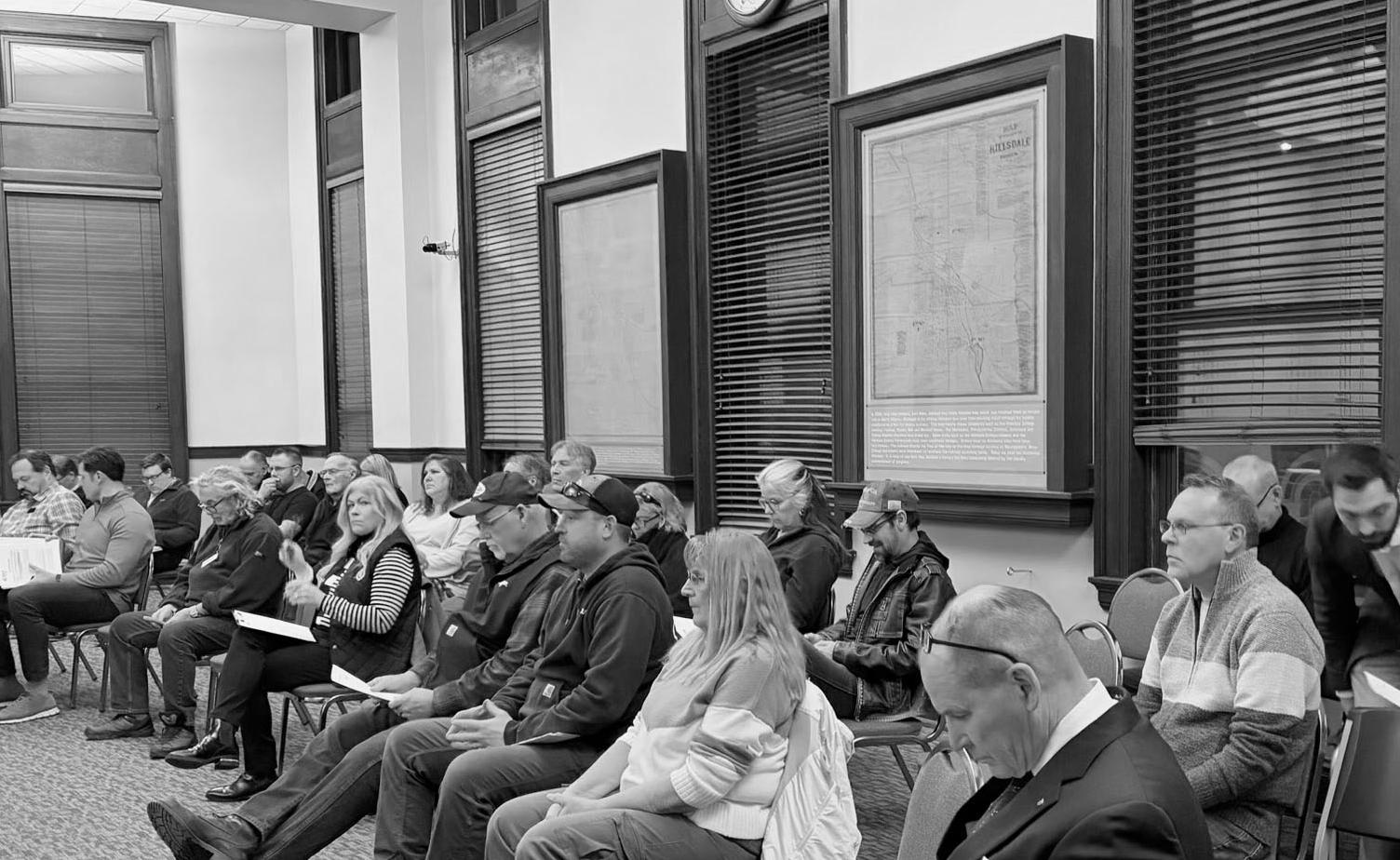
Residents reject road repair plans at public hearing
By Gemma Flores AssistAnt Editor
Residents in three proposed special assessment districts rejected road repair funding plans through citizen petitions during public hearings held at the Feb. 16 Hillsdale City Council meeting.
Property owners on Oak and South streets, as well as parts of Arch Avenue, Industrial Drive, and Proctor Drive, all submitted their respective petitions to the council.
The council can override the petitions with a supermajority of seven votes. When Mayor Scott Sessions asked if any councilmember would make a motion to vote on any of the three projects, no one raised their hands, effectively killing the projects.
A special assessment district designates roads for repair and funds the work by charging property owners in the specified district up to $5,000 each.
If 51% of the parcel owners in a district sign a petition and submit it to the council, the SAD cannot move forward unless a supermajority of the council votes to override the petition.
“Hillsdale has used special assessments since its early days, even under the old city charter,”
Assistant City Manager Sam Fry told The Collegian.
In 2021, Fry said, the council was approached by residents of Williams Court to create a SAD for their street. According to Fry, support for SADs among residents was high at the time.
“Even if we didn’t have a citi-
zen-led petition drive to start it, for many of those projects, we had citizens that had come to the city and wanted road work done,” Fry said.
According to Fry, the council voted unanimously for the city’s current policy on SADs in 2025.
“Even as recently as February of last year, all council members serving at the time endorsed that current policy, which directed staff to use these for all of the road projects that we do,” Fry said.
of the South Street special assessment district,” Fry said at Monday’s meeting.
Fry made a similar statement about the Oak Street assessment shortly after.
Matt Patillo, organizer of the
“If you can’t afford to do this under your own budget and parameters, why do you think the citizens can?” Hardway asked. “As stated repeatedly tonight, we pay property taxes for essential services.”
people are saying to me, and I’m saying to them, ‘Well, I’m 100% sure that I don’t have the money to cover this,’” Meckle said.
David Hambleton, a South Street property owner, shared his experience with SADs.
Oak Street residents submitted their petition at the Feb. 2 city council meeting, and South Street submitted theirs Feb. 9, according to Elyse Apel ’24, a South Street resident.
After verifying the signatures, city staff advised the council against the projects in the introductions to the Oak Street and South Street hearings.
“Based on the written rejections received, which exceed 50% of owners of privately owned real property proposed to be assessed, staff does not recommend the establishment
Arch Avenue petition, presented the petition at the meeting, which included signatures from more than 60 percent of the district’s parcel owners.
“I have a packet here for each of the councilmen that shows you the signatures I’ve gathered,” Patillo said when addressing the council. “One hundred percent of the people I talked to signed.”
Numerous citizens stood up to voice their concerns about the road funding plans. Jill Hardway ’89, organizer of the Oak Street petition, said SADs aren’t fair to taxpayers.
Jonathan Meckle ’21, legislative director for State Rep. Jennifer Wortz and a Hillsdale resident, also spoke against the Oak Street SAD. Meckle said the city should work with the state and federal governments to ensure funding from other sources rather than relying on taxpayers.
“It’s really pretty easy for me to go and talk to my neighbors and say, ‘Hey, you know, the city is saying, “We can’t give up our special assessment districts because we’re not 100% sure that we’re going to get new money to cover the roads.’ And all these
Sessions will not run for reelection
months,” Sessions said.
By Moira Gleason ExEcutivE Editor
Mayor Scott Sessions will not run for reelection this fall as his one-year term expires in November, the mayor told The Collegian in an interview marking his first three months in office.
“I’ve been mayor twice now, and I think it’s time for someone else to step up,” Sessions said.
Sessions, who previously served as mayor from 2013 to 2017, won a special election in November 2025, defeating Ward 2 Councilman Matthew Bentley for a one-year term.
As mayor of Hillsdale, Sessions is a voting member of the city council and runs meetings, but lacks executive authority. The city council as a whole oversees the job of city staff, which is led by the city manager.
Reflecting Tuesday on his first three months in office, Sessions said overseeing the appointment of Police and Fire Chief Kristopher Joswiak has been his most important accomplishment. Joswiak, a native of Canton, Michigan, replaced former Police and Fire Chief Scott Hephner and began work for the city Monday after a week of onboarding.
“He’s already had an opportunity to go out and do some training with our fire department, actually put on his turnout gear and get out in the field with the guys,” Assistant City Manager Sam Fry said. “He’s doing a great job so far, just in the short time he’s been here.” Under Sessions, the city has also begun to fill some of the staff positions left vacant when five city officials resigned last year. Planning
and Zoning Administrator Olivia Smith, City Engineer Rob Stiverson, and Code Enforcement Officer Nicole Leroux have all begun work since Novem ber.
Ses sions has also over seen eleven successful nomina tions in the space of his three months.
New appointments include Felicia Ray-Finch, Rachel Doty, and Chris Sumnar to the TIFA Board; Cathy Kelemen to the Planning Commission; John Kast to the Zoning Board of Appeals; and Ronald Spence
Sessions campaigned in the fall on the promise to oppose what he saw as a culture of negativity in the city of Hillsdale and unnecessary tension between the city council and the city staff. He said at the time that his opponent Bentley, as well as former Mayor Pro Tem Joshua Paladino, had fostered this toxic culture.
At the time, Sessions said he would institute a chain of command in which the city council would communicate with city
“I’ve been mayor twice now, and I think it’s time for someone else to step up.”
to the Cemetery Board. Additionally, Sessions reappointed Amber Yoder to the Zoning Board of Appeals, Eric Moore to the Library Board, Ginger Novak and William Mullay to the Election Commission, and Anthony Vear to the Board of Review.
“It’s been a busy three
staff only through him. Now, he says he has largely abandoned that goal after other council members refused to follow the arrangement.
“I asked for it to be done,” Sessions said. “Now it really hasn’t been done because I got some pushback, but that’s fine.”
Nevertheless, City Manager David Mackie said Sessions has maintained a good work-
ing relationship with the staff.
“Staff appreciate his collaborative approach and his willingness to meet with us to better understand our work and the challenges facing the city,” Mackie said. “Mayor Sessions asks thoughtful questions, listens to our professional perspectives, and emphasizes working together to find solutions. That openness and communication has created a more constructive working environment and improved morale.”
As Sessions makes plans to step down in the fall, Ward 3 Councilman Bob Flynn announced his candidacy for mayor at the Hillsdale City Council meeting Monday. The retired WCSR on-air personality is the first to step forward to run for the fouryear term.
With his remaining time, Sessions and the city council will have to address the open question of road repair funding after three proposed special assessment districts for 2026 were rejected Monday by citizen petition.
Special assessment districts, or SADs, require individual property owners in a designated district to pay up to $5,000 for repairs on their street. Without SAD funding, the city lacks the money necessary to fund road repairs, but Sessions said he and the city council will seek other sources of funding.
Meanwhile, he said he will prioritize keeping up the morale in city government.
“I want everybody to feel comfortable working here — it’s not a toxic environment,” he said. “I think it’s a great staff here.”
“My grandmother lives in that house at 65 East South. She’s a World War II veteran’s widow. Shall I raise her rent for you?” Hambleton asked. Ward 4 Councilman Robert Socha said the SAD decesions are not made lightly.
“Nothing has been shown to me in our city budget to make headway on the crumbling infrastructure without these terrible special assessments,” Socha said. “And my hope was that we might, as a community, bite the bullet today so that our children don’t have to do it in the future.”
Fry said the public hearings served their purpose by allowing the citizens of Hillsdale to make their voices heard.
“I’m certainly glad that people come out and voice their opinions. That’s the purpose of holding these public hearings. It’s to give residents an oppor-
tunity to say whether they’re in favor of these projects or they oppose it. That was a process that our charter set up,” Fry said. “We do the engineering, we do the reviews, and we identify these projects, but ultimately, it’s up to the neighborhood.” Fry, along with other members of the city staff, worked to secure state and federal funding for Arch Avenue and Industrial Drive, which receives a lot of traffic from the Hillsdale Industrial Park. Now that the future of the road work is less certain, he said he worries they may have to return the funding.
“It’s funds that myself and others, took a lot of time with the applications to get that money, to return those funds to our community,” Fry said. “I think it would be a shame if that money goes to waste and we have to give that money back.”
Fry stressed that city staff members have one goal: to serve the Hillsdale community. Though their projects may seem overbearing, Fry said it’s both necessary and time-sensitive.
“Ultimately, we want to do projects for the community,” Fry said. “A lot of these roads, South Street, Oak Street — you get about 25 years average life out of a road. Many of these we’ve pushed two or three times. You can only patch your pothole road so many times, and then it needs a full reconstruction.”
Bob Flynn will run for mayor
By Gemma Flores AssistAnt Editor
Ward 3 Councilman Bob Flynn announced his plans to run for mayor at the Feb. 16 city council meeting.
“I wanted to take a quick minute to announce that I will be running for mayor in this year’s election, and I would encourage others to run, whether it be for mayor or for city council,” Flynn said at the meeting. “We have four council seats, along with the mayor, coming up. We have some very important things to discuss over the next four years.”
and encouraged him to keep the constituents informed about his platform.
“I would challenge you and encourage you, not any time soon, I suppose, but as the election draws nearer, if you have an opponent, you have public forums where you discuss the issues,” Bentley said at the meeting.
Among the top issues that Flynn will have to address during his campaign is the state of Hillsdale’s roads. His announcement came shortly after the three proposed special assessment districts for 2026 were rejected via citizen petition.
“Basically, just to make Hillsdale a great place to live, work, and raise a family.”
Flynn said he had long thought of running for a government position but put it off while he was working at local radio station WCSR, so as to maintain impartiality in his reporting. He retired from the station in March of 2024 and was elected to the city council in November of that same year.
“I got a lot of support from folks in Ward 3 who asked, ‘Why don’t you just run for mayor?’ And since then, I’ve had a lot of people express that desire and got to thinking about it, talked with my wife, talked with my family, and came to the realization that I’d like to give it a try,” Flynn told The Collegian.
Ward 2 Councilman Matthew Bentley congratulated Flynn on his announcement
“We still have to work on streets. I mean, we’ve kicked that can in every direction, and we still haven’t come up with an idea,” Flynn said. “This is something that should have been addressed back in 1980.” Flynn said his main priorities as mayor would be to make Hillsdale a safe and pleasant place to live and to embrace its opportunities for growth.
“Basically, just to make Hillsdale a great place to live, work, and raise a family. There are a lot of opportunities that I foresee, especially with our downtown here, in the next five to 10 years,” Flynn said. “I really would like to be a part of that.”
Scott Sessions before the November election.
Increase in gas tax to fuel state road repairs
By Francesca Cella AssistAnt Editor
Taxes on gasoline now contribute directly to road maintenance in Michigan rather than to the state government, thanks to a state law enacted Jan. 1.
The law removed the 6% sales tax on fuel and increased the motor fuel tax from 31.0 to 52.4 cents per gallon. Whereas the prior sales tax on fuel funded various state programs, 98% of the now-increased motor fuel tax goes to the Michigan Transportation Fund.
The new system taxes two cents more when gas is $3 per gallon, but it taxes less than the old system when gas costs $3.33 or more. Unlike the sales tax, which increased with the price of gas, the motor fuel tax is a static number.
As of Feb. 18, a gallon of gas at the Marathon gas station on 185 W. Carleton Road
costs $2.60, 5 cents more than it would have last year. Under the old system, 65 cents would have contributed to taxes, with 15.6 cents in sales tax, 31.0 cents in motor fuel tax, and 18.4 cents in federal fuel tax. Now, 70.8 cents go to taxes, with 52.4 cents in motor fuel tax and 18.4 cents in federal fuel tax.
State Sen. Jonathan Lindsey, a Republican who represents part of Hillsdale County, said the change reflects an effort to allocate more funding to Michigan’s roads. “We’ve been stuck in a cycle of deferred maintenance and not being able to keep the roads where they need to be,” Lindsey said. “There’s a need in Michigan to play catch-up and get the infrastructure back to where it needs to be. It was never meant to be a tax increase. There are times we’re going to pay a couple cents more per gallon — even that I wouldn’t have liked to see.
Poorhouse floods after pipe bursts
By Alessia Sandala City nEws Editor
Nearly 300,000 gallons of water from a burst pipe damaged the interior of the Will Carleton Poorhouse, according to Darin Sheffer, Hillsdale Historical Society vice president and curator of the poorhouse.
A pipe under the kitchen sink burst during the stretch of cold weather Hillsdale experienced at the end of January. Water leaked into the kitchen building for about the past two weeks, according to a Hillsdale Historical Society post on Facebook.
JoAnne Miller, a Hillsdale Historical Society board member, said she discovered the leak when she went to turn up the heat in the poorhouse for a board meeting.
“As soon as I opened the door, it sounded like a waterfall,” Miller said. “Obviously, what I assume is that we’ve got a water leak. I went down to the basement, and there it was, up to my ankles.”
Water entered the basement and crawl space underneath the kitchen and seeped into the foundation of the building. As the snow melted, a sinkhole was also found, according to Sheffer.
“There’s a sinkhole on the south side of the kitchen foundation,” Sheffer said. “We’re assuming the majority of that
Solar from A1
Friss said the project alone will generate $20 million in tax revenue for the township which would go toward new infrastructure, schools, and emergency services.
Hillsdale resident Toni Carpenter said she is concerned for the health of her grown children, grandchildren, and great-grandchildren, as long-term effects of solar panels and pesticide sprays used in their installation remain unknown.
“I’m concerned about the environmental effect of all this. I’m worried about the health aspect of it,” Carpenter said. “They didn’t know that was going to happen when they put power lines in. And they don’t know what’s going to happen with these things either.”
Jonesville resident Chester Briner said at the meeting he is worried about losing the view and value of his property and those of surrounding properties to the solar panels.
“People are going to have to have these wrapped around our property and reassess our property,” Briner said. “I believe that it’s going to cause the values of their properties to fall, because we got solar panels on both sides of Jonesville.”
Elizabeth
I would have liked to see us going the other direction and figuring out how to more efficiently spend the people’s money.”
The tax change was part of a funding deal estimated to generate more than $1.8 billion for roads through a 24% wholesale tax on marijuana and the increased motor fuel tax.
Ward 3 City Councilman and Professor of Political Economy
Gary Wolfram said the state needed revenue dedicated to funding the roads because roads are not prioritized in a general state budget.
“One of the reasons that the roads have fallen into disrepair is because that’s something you can easily postpone in your budget, whereas a number of other things, like your programs, you can’t just say, ‘We’re not going to pay for that program this year,’” Wolfram said.
James Hohman, director of fiscal policy at the Mackinac
Center for Public Policy, said taxes are higher per gallon of gas because gas prices have dropped since legislators estimated the appropriate amount of motor fuel tax.
“The legislators set those rates on typical fuel prices over the past couple of years,” Hohman said. “Fuel prices are lower than they have been, so the motor fuel excise tax is going to raise more revenue than taxpayers are going to save from not having to pay the sales taxes.”
Hohman said the new tax system demonstrates that people who use the roads also have to fund them.
“We should, over the long term, try to treat our transportation services like utilities,” Hohman said. “Utilities are user-fee-based systems where, if you’re using electricity, you pay electricity rates. Fuel taxes and vehicle registration taxes are tied to usage. You’re mostly not pay-
ing fuel taxes unless you’re filling up your vehicle and using the roads in the state of Michigan.”
Wolfram agreed that it’s good for the amount people use the road to correlate with the amount of taxes they pay to fund the road. He said if the motor fuel tax hadn’t increased, another tax would have funded the roads.
“It just depends on what source of revenue you’re using to fund your roads,” Wolfram said. “If I’m using a corporate income tax and taking that money to fund the roads, then I’ll have less motor fuel tax. It makes sense to relate the tax directly to the usage.”
The registration fee for electric vehicles also increased as part of the bill by $63 to ensure electric vehicle owners pay their share of taxes on the roads, since they do not purchase motor fuel.
Wolfram said a system that tracked each car’s road use
would be most effective.
“You could conceive of toll roads being used more than just on the freeways,” Wolfram said. “If the technology were to change enough, you could have toll roads on all the roads.”
According to the Citizens Research Council of Michigan, a pavement quality assessment ranked Michigan 40th in the nation for road quality, and 10th in a group of 11 peer states.
Legislators have been attempting to improve Michigan’s roads for the past 15 years, according to Hohman, and the tax change offers a viable solution.
“This latest round is probably going to get us to a level where administrators are fixing roads faster than they fall apart, which sets us into a process of continual improvements over the long term, and that’s a good thing,” Hohman said. “It gets lawmakers to accomplish their basic responsibility to provide a service.”
‘Fish out of water’: 35 pairs compete in local ice fishing tournament
279,000 gallons went under the kitchen foundation and out that south wall. There is some structural damage. We’re not sure of the extent yet until the ground warms and the severity of the sinkhole is known.”
Sheffer said he has been on the historical society board for 23 years, and the poorhouse has never shut off its water during the winter.
“We’ve always kept it on,” Sheffer said. “But this year was an especially severe cold snap. It’s very rare that we have weeks of zero degrees or even lower. I think it was just a test of it and unfortunately, we had a failure.”
The poorhouse formerly housed Hillsdale’s impoverished population and is named after Hillsdale alumnus and poet, Will Carleton. It was donated to the historical society in 1987. The water damage should not disrupt the poorhouse’s next event, which is a car show scheduled for June, according to Sheffer. The historical society used the basement of the poorhouse, one of the areas that filled with water, to store some of its historic items, according to Miller.
“We didn’t have a horrible loss,” Miller said. “We lost some priceless things that are probably worth zero, but they’re priceless because they come from the past, and we can’t replace them.”
panels would be installed across the street from her property in Hillsdale. After her family’s home burned down two years ago, she and her family have resided in Allen Township with the intention of rebuilding their home. She now worries about the health effects and view of the solar panels from their property.
“Nobody wants that in their backyard or their front yard. We have a large pond in our backyard. It’s been fabulous. We fish there. Our grandchildren swim there. We won’t be doing that anymore, because they’re going to be spraying pesticides across the street that’s going to run right across the road, into my yard,” Mann said in the meeting.
“Why build a house? Why come here if this is what we have to look forward to? It’s like losing my home twice.”
The board will hold a public hearing on a CREO and submit a recommendation to the township board at a date and time that is yet to be determined. Planning Commission Chair Jane Munson said she expects the public notice will be printed in the Hillsdale Daily News and posted at the township hall within the next few days. That starts a 15-day clock before the planning commission can hold the public hearing.
By Anna Broussard dEsign Editor
The winners of the Bawbeese Open ice fishing competition, Matthew Osborn and Levi Watkins, were among 35 pairs competing in the Bawbeese Open ice fishing competition on Baw Beese Lake at 7:30 a.m. on Feb.15.
The competition was the ninth of 13 ice fishing competitions hosted by the Branch County Panfish Club and took place on Baw Beese Lake. Teams had to catch 15 bluegills to enter the weighin and could additionally catch five crappies, one yellow perch, one northern pike, and one junk fish.
One of the club directors, Israel Ferguson, said the fishing on the lake was very slow, and most fishermen blamed the sunny weather conditions but did not affect the fishing. There were many fish beneath the ice; it was just a matter of finding where they were biting.
“The 15 bluegills, that’s the most important part of the whole tournament,” Ferguson said. “We’ve been fishing for three days, and yesterday we caught a lot more fish with the sun out, same temperatures. There’s so many fish right now underneath us, it’s crazy. There’s big fish here, but they’re just not biting today.”
The competition has a $50 entry fee and up to $100 total with side pot entries. Many fishermen use tents for sight fishing, which allows them to watch the fish approach the bait and also provides warmth during colder weather.
Watkins and Osborn won the competition with 15 bluegills weighing in at 7 pounds, 2 ounces. Watkins said teamwork is an important part of the competition.
“He caught most of the big redear sunfish, and I just caught some big bluegills to put in with them,” Osborne said.
According to Kevin Clinton, who has won the championship three times, pre-fishing a lake is the best tactic for doing well in these competitions. Pre-fishing includes scouting the location, finding where the fish are, and testing out bait colors. Clinton said he always spends a few days pre-fishing, but this year, he did not have the time to properly prepare.
“If we had more time to pre-fish, we’d probably do it up a little bit better ourselves,” Clinton said. “But yeah, I’m gonna have to win the lottery for that to happen.”
One of the biggest problems in ice fishing tournaments involves the honesty of fishermen, according to John Hudson. He and his son Jake said “bird-dogging” is a big problem, which is when competitors follow around successful fishermen. Many fishermen will show up for the competition without preparing and tend to follow the more experienced fishermen.
“Half of these guys don’t even know where they’re going when they pull up there,” Hudson said. “They just let everybody go out there. Then they go out there and sit down beside somebody they know is good. Then from there, they just birddog it. They see somebody raise their rod, and they take off running.”
“Gary, him and his fami
ly, the Mainstones, they prefish,” Hudson said. “They know where to go, and they find out what they’re biting. If anybody accused them of cheating, I’d call them out. They’d be dead.”
Although Clinton has won three years running, along with his partner, Gary Mainstone, there is a point system that accumulates over the course of the 13 competitions. For the Bawbeese Open, first place receives 30 points, second receives 25, and side pots are worth an extra 15 points. The current overall standings are Jaiden Maniston and Jamie Mainstone with 172 points, Israel and Tim Ferguson with 154 points, and Jason Lee and
The
have fished two tournaments before the Classic to enter.
Hudson said ice fishing is not for idiots because it is difficult. Yet, it is more fun than steelheading, which is fishing in rivers as the ice begins to melt.
“The only bigger idiot than an ice fisherman is a steelheader, because at least ice fishing, you’re standing on top of the water,” Hudson said. “When you’re steelheading, you’re standing in the river with ice chunks bouncing off at you.”
Mann said the solar
Hudson said the Mainstone family is well-known as some of the best fishermen around.
-
Jason Mainstone with 140 points.
next event in the tournament is the Club Classic Championship on Long Lake in Reading Mich., which will take place on March 1. Fishermen must
Kenny Petersen goes
Brouss
Men's Tennis
Chargers bounce back with win over Purdue Northwest
By Patrick Matteson Collegian Freelancer
After last week’s loss and a few lineup changes, the Chargers men’s tennis team bounced back to defeat Purdue University Northwest 6-1 Feb. 14, moving their record to 3-1 overall.
“It was the most complete match we’ve played so far this year,” head coach Keith Turner said. “It showed that we can compete for an NCAA tournament bid.”
Junior pair Ellis Klanduch and Henry Hammond opened
play at No. 1 doubles and got a 6-4 win in just 26 minutes.
“We compliment each other pretty well,” Klanduch said. “On Saturday, neither of us played great tennis, but we were able to pick each other up and eventually get to a better level of tennis.”
Sophomore pair Ryan Papazov and Alex Cordero Lopez lost 4-6 at No. 2 doubles, but freshmen duo Jackson Clements and Patrick Cretu brought home a gritty 7-6 win at No. 3 to earn the lone doubles point.
“Patrick and Jackson
Noughts and Crosses
clinching the doubles point for us was huge, and it took a bit of pressure off us going into the singles,” Turner said.
In singles play, the Chargers earned five of the six possible points, with wins coming at No. 1, 2, 4, 5, and 6 singles.
while Papazov and Cordero Lopez earned their first.
“It was the most compleete match we've played all year.”
Klanduch, Hammond, and Cretu each picked up their second win of the day,
The numbers around the border indicate the length of the longest runs of consecutive
or
in that row or column (a zero means that symbol does not appear in that row or column).
Difficulty:
B, C, and D, as well as two blanks. The letters around the border indicate the first letter to appear on that end of the corresponding row or column.
Cordero Lopez dropped the opening set 7-5 to Purdue Northwest’s Daniel Sroka at No. 6 singles, but he did not let that knock him down.
“After the first set, I knew I had to change something in my strategy,” Cordero Lopez said. “I began to make
Feature
the points longer instead of trying to win the point in a few shots.”
Cordero Lopez’s strategy worked with a 6-3 win in the second set, and he eventually went on to win the third set tiebreak 10-5 after an hour and 46 minutes on court.
“Even though we had already won, I still had the same hunger to win that match,”
Cordero Lopez said. “Giving my team the last point for a 6-1 win instead of a 5-2 win would give us a high morale boost.”
The Chargers will travel to
Ferris State University on Feb. 21 and Davenport University on Feb. 22 to take on two instate foes. “We have a very tough schedule coming up,” Turner said. “It was important to gain some confidence from this match after a disappointing loss last week.”
The Chargers will return home on Saturday, Feb. 28, to take on No. 23 nationally-ranked Wayne State University at 1 p.m. in the Margot V. Biermann Athletic Facility.
Who's the voice of Hillsdale Charger sports? Students.
By Skye Graham Social Media Manager
Have you ever wondered how sports broadcasters engage an audience that can’t see the action? Junior Nathan Furness said broadcasters on the air need to keep their style conversational.
“What started as screaming at the TV with my brothers has turned into more thoughtful, intelligent conversations about the game we’re watching,” Furness said. “I’ve realized that the best way to broadcast a game is to tap into that same energy. I try to bring the feel of those living room debates to the booth — just with a live audience listening in.”
WRFH Radio Free Hillsdale 101.7 FM currently broadcasts home football, basketball, and baseball games on its live radio feeds. After the game, the audio is uploaded to Spotify.
Furness, who played basketball in high school, said his experience as an athlete helps make his broadcasts better.
“It’s almost like you’re playing again,” Furness said.
Furness said his background in basketball allows him to capture the emotion of the basketball games when giving commentary.
“Because I’ve been on the court in those moments, I understand the little things, the communication on defense, the frustration from missing, or the confidence that builds after seeing a couple shots fall,” Furness said. “This allows me to let
Swim
Swimming from A1
“I was really impressed with how the team carried themselves,” Babenko said. “When we lost, we handled it with grace. When we won, we handled it very humbly.”
the emotion of the game translate into the way I broadcast.”
Before each game, sports broadcasters spend time looking up the opposing team’s roster and its best players so they can know who to look out for.
“You look at players’ names, obviously,” senior Evan Mick, sports director at the radio station, said. “You also look at some stats. You look at how they’re shooting the ball, how they played last game, and the last couple of games. You also look for anything out of the ordinary.”
Mick was named a finalist in the Michigan Association of Broadcasters Student Broadcast awards for his coverage of a Charger basketball game last February. MAB will announce the first, second, and third place awards March 26.
“Last year, he had all three finalist spots in the sports feature category,” Scot Bertram, general manager of WRFH 101.7 FM said in January. “This year, he only has two of the three finalist spots. As you can tell, it’s quite the disappointment.”
Every sports broadcast needs at least three people: one person runs the board at the radio station, while two students watch the game live and give commentary, according to Bertram.
“At least one is doing playby-play and describing the action exactly as it’s happening out on the field,” Bertram said. “The other one is a color commentator to hopefully provide some insight and analysis
meet in both spirit and achievement.
of things that are happening. Those two work together at the game, and one back here at the studio to make sure the game is on the air.”
The student at the station who is not on air makes sure the audio equipment is working properly and manages the sound throughout the game. Mick said sports broadcasting gives him a chance to watch exciting games and be a part of the action.
“I remember the men’s basketball game last year when Cole McWhinnie took a step back three and drained it to win the game,” Mick said. “That was the most exciting broadcast I’ve ever been a part of.” Bertram said the station is currently exploring the possibility of expanding sports broadcasting to include home softball games and various other away games. Senior and Radio Free Hillsdale Program Director Quinn Delamater said sports broadcasts are best when the two hosts are well-versed in the sport they’re covering.
“You can definitely tell when the person has knowledge about sports,” Delemater said. “That really adds color and contributes to it. Especially if the two people are friends and have a lot of chemistry with each other, that can make for a really phenomenal broadcast.” Next time you listen to a sports broadcast, consider the work and technique it takes to bring these games to life.
in 1:46.42 and led the 800 freestyle relay placing second in 7:35.81.
This week's solutions will appear alongside next week's puzzles. If you have questions or feedback, please contact Matthew Tolbert at mtolbert@ hillsdale.edu.
Sophomore Ella Malone took fourth in the 100 butterfly finals with a time of 57.05 and fifth in the 100 backstroke finals in 57.72, both personal bests. She also swam butterfly for the 400 medley relay placing second in 3:52.26 and led off the second place 400 freestyle relay team coming in at 3:30.41.
“Both the team's membership and the energy was a substantial part of our success over the entire week,” Kirner said. “I am very proud of our chargers in this respect. We pretty much knew how the cards would be dealt as we were going in. How-
“This meet marked the end of the season for most of our team,” Schafer said. “I personally feel unfinished, but the Lord has a plan for me and I’m thrilled for what the next season may bring.”
“Over a four day meet, it is important to keep things in perspective,” Malone said. “I think a lot of people broke some thresholds and got past some points where they were stuck at a specific time, finally got some momentum, and started shaving time off races, which was a big deal.”
Head coach Kurt Kirner said the team performed well this
ever, we actually scored 100 points more than we did last year and I felt that was a great showing.”
Sophomore Ella Schafer placed third in the 100 freestyle finals in 52.60, third in the 200 freestyle finals in 1:52.90, and third in the 200 individual medley with a time of 2:09.21. She anchored the 200 medley relay, swimming the 50 freestyle, touching the wall in third
Other top swims from Hillsdale include sophomore Matilyn Wilhelmsen’s second-place finish in prelims for the 500 freestyle with a season-best time of 5:06.96. Freshman Avery May took first place in the 500 freestyle in 5:01.28, second in the 1000 freestyle swim with a time of 10:32.29, the 1650 freestyle in 17:48.37, and in the 400 individual medley in 4:31.95.
Chargers Babenko, May, Schafer, and Willhelmsen hold DII B-cut times, giving them a chance to compete in the DII Championships taking place in Evansville, Indiana, March 1014. Decisions regarding spots will be released on Feb. 25.
noughts
crosses
The team cheers on junior Lauren Kamp at conference. Courtesy | Ashley Van Hoose
A day in the life of a student-athlete
By Daniel Johnson Collegian Reporter
Junior Alyson Early swims 4,000 yards before the sun rises.
“I wake up at 5:30 a.m., get ready, and then I go pick up all my friends,” Early, a Charger swimmer, said. “Then it’s usually a really hard practice.”
Hillsdale is home to 16 varsity sports teams and hundreds of student-athletes. Alongside the rest of the student body, athletes walk the halls of Lane and Kendall and struggle through the core classes. But there’s much more to the life of an athlete.
For Early, Tuesday and Thursday start with more than an hour gliding through the pool, breathing chlorine-scented air. But that’s just the beginning.
“Then I work, go to class, and then we lift,” Early said. “Then we swim again for two hours, and then we have dinner, and then it’s like trying to get homework done, and it’s almost impossible, but you get into a routine.”
Hours of training on top of a hectic Hillsdale schedule are typical for athletes. But according to senior women’s basketball player Payton Adkins, practice is just the beginning.
“If I have a slower day of practice or classes, I’ll try to go in and get shots up, or different ball handling drills two or three times a week,” Adkins said. “Everyone knows you have practice and lifts, but no one necessarily sees all the outside stuff you have to do.”
Freshman baseball pitcher Brodie Romnek starts his day in a very ordinary fashion, with breakfast and four classes. But once Romnek’s last class gets out, it’s time to grind.
Romnek said with baseball being in season, practice on the field starts at 2 p.m.
and ends sometime between 4-5:30 p.m. As a pitcher, Romnek begins his practice by warming up his arms before starting a specific set of drills designed to make him the best pitcher possible.
“Being a pitcher is different from being a position player,” Romnek said. “As one of the pitchers, I start out doing dynamic warmup, throwing practice, then fielding practice, shoulder work with bands, stuff like that, and then go shag for batting practice. After that it’s your own lift.”
Romenk said the lift ends from 6-7 p.m. Afterwards, he eats dinner and does homework until 10 p.m. or 11:30 p.m.
Athlete, but still a student
For Romnek, all that time in practice makes the remaining few hours a precious commodity.
day carries over to academics,” Adkins said. “The athletes here are going on to do something bigger with their life, purpose, and degree, and I think that same discipline carries over to both of them.”
When Romnek steps onto the practice field, that bigger “why” stays in the forefront of his mind.
“I know I gotta put in 100% for this team,” Romnek said. “I’m competing for the guys, for the program, for the school.”
For Romnek, all these “whys” ultimately go back to faith.
“We're just as devoted to the academic side as we are to the athletic side.”
“You’ve got to be really active on time management,” Romnek said. “It’s hard to go to office hours, so you’ve got to get stuff done fast.”
When Adkins steps off the court to attend her Wednesday psychopathology class, she brings the same goal-driven mindset.
“I feel like athletes are, in a way, looked at like we’re just here for our sport,” Adkins said. “But I know at least six of my teammates who are physician assistants, and a couple are going into med school. We’re just as devoted to the academic side as we are to the athletic side.”
According to Adkins, there’s a common drive behind shooting baskets and writing lab reports.
“Why we get up for the 6 a.m. practice or lift every
“God gave me this talent to play baseball,” Romnek said. “I want to give glory to him.”
For Adkins, the greater “why” of her team plays a prominent role on gameday.
“We’ll do a prayer before the game,” Adkins said. “And we do this thing called a heartbeat clap. One person will start it, like the beat of a heart, and we pass it around until everyone’s in, and we slowly speed up, showing the unity of one team, one heartbeat, and then we’ll go out and start the game.”
According to Romnek, all the little daily disciplines carried out in practice seep into the classroom too.
“All these little things, even though you don’t see it, will make you better in the long run,” Romnek said. “Throw by throw or assignment by assignment, you’ll get better in the long run.”
Sports, school, sleep, repeat
As Romnek gets his throws in, Early is back in the pool.
“I’m always in the pool,” Early said. “I like to say I live
there and that I have a bed in the back room.”
To the onlooker, it seems like the same thing over and over again. But as with Romnek, Early’s endless reps across the pool are fine-tuned for excellence.
“Pretty much everything we do in swimming is interval-based,” Early said. “You’ll have a certain amount of time where you’re trying to hit a certain pace, a certain heart rate.You’re trying to train yourself up to a certain time.”
A team and a community
Once Adkins finally makes the last basket for the day, she often finishes her evening with the team. However, expanding her social circle is a priority.
“It can be very hard to leave that group when you’re with them constantly,” Adkins said. “It’s like, ‘Oh, we just had practice, why don’t we just go eat dinner together.’ But I personally try to make it my goal to go out and be with other people because your sport isn’t your entire circle.”
For Adkins, investing socially in the team comes back to a common spiritual center.
“I run the team Bible study,” Adkins said. “We try to meet once a week. There’s almost a spiritual unity on top of our athletic unity.”
Long after the sun sets, Romnek returns to his house, where he lives with four other teammates. But Romnek says they’re more than just guys he plays baseball with.
“Discussing little things, like how marriage should play out, how we should go about living, or playing baseball, creates a strong brotherly bond,” Romnek said. “Brothers not only on the field, but everywhere else.”
Men's Basketball
Chargers fall twice over road weekend
By Evelyn Shurtliff Collegian Freelancer
The Chargers men’s basketball team lost to two of the top three teams in the Great Midwest Athletic Conference, falling 91-73 to Lake Erie College Feb. 12 and 80-63 to Ashland University Feb. 14. The team’s season record dropped to 9-15 and its conference record is 6-10.
Against Lake Erie, Hillsdale got behind early, with their first two possessions resulting in Lake Erie getting 26 points off turnovers by the end of the night.
Head coach Keven Bradley said Lake Erie is very good at applying pressure to force quick decisions.
“Lake Erie is a pressing-trapping, five-in, five-out type of team,” Bradley said. “They stress you out with their different full court presses, traps, and rotations, and we did a poor job taking care of the basketball and making tough passes from the very first play of the game. That’s something we have to change moving forward.”
Turnovers continued to play a large role in the game. By the half, Lake Erie had already put up 50 points to Hillsdale’s 31 and shut down Hillsdale’s shooting to 33%. The Chargers threatened Lake Erie’s lead at the start of the second half with a 15-2 run, but Lake Erie responded with back-toback 3-pointers to help keep a steady lead. Although Hillsdale outscored Lake Erie 42-41 in the second half, the halftime deficit was too great to overcome.
Sophomore forward Connor Stonebraker said he was proud of how the team fought back in the second half.
“I think everyone stepped on the floor with more confidence in the second half,”
Chatter
Stonebraker said. “Lake Erie is a team that likes to make you uncomfortable handling the ball and I believe we did a better job taking care of it and finding the open man in the second half.”
Hillsdale had their second road game of the week against Ashland. The Eagles attacked with a quick aggressive pace from the start, going up 8-0 within the first three minutes of the game. Hillsdale fought back and trailed 36-24 with just over four minutes left in the half. By the end of the half, however, Ashland had forced turnovers and fouls to put them well in control, leading 48-24. The Eagles made 32 to Hillsdale’s 6 in the first half.
Freshman guard Braylon Morris said he believes the key to changing the tempo of these games lies in the players' mindsets.
“I believe it all lies in our energy,” Morris said. “We can’t allow negative things that happen over the course of the game to take away our energy and effort on both sides of the floor.”
Once again, the Chargers outscored their opponents in the second half, this time 3932, but were not able to make a full comeback.
Senior guard and captain Ashton Janowski said the team needs to reset for the next few weeks.
“We need to calm down, take a deep breath, and rely on what makes our team unique and good,” Janowski said. “We need to screen, be physical on both ends of the floor, and take away what the other team does well. We didn’t do enough of that this week, and it showed.” The Chargers face Kentucky Wesleyan College at home Feb. 19 at 7:30 p.m., and Ohio Dominican University on the road Feb. 21.
Compiled by Grace Brennan
Photo Courtesy | Hillsdale College Athletic Department
What’s your very first memory?
parents taking me and my sister on bike rides.
C harger S port S
Women's Tennis
Undefeated season continues 5-0
By Sophia Bryant Assistant Editor
The Chargers women’s tennis team remains undefeated this season at 5-0 after beating Purdue University Northwest 5-2 at home Feb.
14.
“It’s hard to play a team like we did, because they were just kind of dead,” head coach Melanie Zampardo said. “They were quiet, not always going for every ball, but they were a good team. So it’s this contradiction in your mind of, well, we have to create the energy ourselves. So we did a good job doing that.”
Zampardo said that at one point, the Chargers were down 5-1 at No. 3 doubles, but sophomores Emma Palus and Julia Zlateva came back to win 7-5.
“It was Emma’s first championship season dual match win, so I’m happy for her that she got that, and on top of that, it was an amazing comeback,” Zampardo said. “She started playing the way that she wanted to play and felt good about that.”
Palus said keeping Purdue from winning the game point when they were down 5-1 helped her and Zlateva play more aggressively.
“We were really proud of each other honestly, after that one game, and then that helped us be more aggressive and be more positive,” Palus said.
At No. 1 doubles, junior Ané Dannhauser and senior Megan Hackman won 6-3.
“I think we are all see-
ing our hard work from the fall pay off, and it’s very exciting to see our potential this spring,” Hackman said. “Playing doubles with Ané this season has been going super well, and I think we are both pleased with our camaraderie on the court.”
The Chargers beat Purdue at No. 1, 2, 5, and 6 singles. Although she was recovering from sickness, sophomore Briana Rees won 6-1, 6-4 at No. 2 singles.
“We needed her to hold that spot, and she ended up winning her match,” Zampardo said. “So not only did she hold her spot and hold her ground, but she ended up getting another win for the team, which was huge.”
Palus said starting the season up 5-0 shows how hard everyone on the team is working.
“Everyone is doing their best on the court, and it’s just working,” Palus said. “Coach Mel is also amazing with supporting us. Even though we are winning, the girls are going through really tough matches.”
The Chargers will face Ferris State University away on Feb. 21 and Davenport University away on Feb. 22. Zampardo said these matches will be the team’s toughest matches of the season so far.
“From the fall, we’ve been saying, ‘Doing the little things the correct way every single day is gonna add up, and they’re gonna start to culminate,’” Zampardo said. “So I’m hoping for that to happen this weekend.”
Women's Basketball
Distance and throws secure national bids
By Francesca Cella Assistant Editor
Several athletes hit personal bests and reached provisional marks at the Grand Valley State University Big Meet Feb. 13-14.
Sophomore Ally Kuzma ran a personal best in the 3K, placing third with a time of 9:29.62.
Kuzma is on track to race the 5K and the 3K at the
NCAA Division II Indoor
Track National Championships. She said her training will focus on priming her for nationals.
“Conference is a big priority too, but with nationals after that we still have to be a little careful to make sure that I’m ready,” Kuzma said. “I’ll still do the best that I can but then I’ll also be a little conservative with what I race at conference to make sure that I’m the best set up for nationals.”
Junior Eleanor Clark ran a personal best in the 3K open at 10:07.09, cutting 27 seconds off her previous record.
Clark said she was racing to prepare for conference and attributed her improvement to assistant track and field coach R. P. White’s training style.
“He really emphasizes being grateful for every opportunity to race,” Clark said. “I like that he puts it that way because it takes a little bit of the stress and pressure off. At the end of the day, it is such a great opportunity to use the talents God has given you.”
“It is such a great opportunity to use the talents God has given you.”
Senior Ben Haas took first in men’s weight throw with a mark of 21.86 meters and placed fourth in shot put with a mark of 17.03 meters.
Sophomore Dominic Scharer placed third in weight throw with a mark of 20.48 meters.
Junior Olivia Newsome placed third in women’s
weight throw with a mark of 18.56 meters, followed by sophomore Tori Tyo in fourth at 18.30 meters. Junior Amelia Lutz took fourth in shot put with a mark of 15.75 meters, and ranks third in DII women’s shot put.
In men’s track, senior Gabriel Phillips took seventh in the second-fastest heat of the 5K at 14:41.00. Phillips said racing with pace lights that were slower than his usual speed threw off his race.
“We wanted to try for the school record, and then I got bumped from the fast heat, so I was the fastest person in the second heat, and the lights were a little bit slower than I wanted,” Phillips said. “Typically, I can zone out and disassociate, kind of go to sleep while running, but I
was thinking the whole time, so that wasted a lot of energy.” Senior Ross Kuhn placed fourth in the mile with a time of 4:03.14, and freshman Watson Magwenzi took fourth in the 200-meter open with a time of 22.22.
Senior Lucy Minning took fifth in the 200m dash with a time of 24.63, and 15th in the 60-meter at 7.72. Freshman Adella Schmoll set a personal best in the 60m hurdles with a
time of 9.29, and sophomore Baelyn Zitzmann hit the provisional mark in high jump with a clearance of 1.67 meters. In pole vault, senior Connor McCormick hit the provisional mark with a clearance of 4.80 meters.
The Chargers will compete next at the University of Michigan’s Silverston Invite Feb. 20 and will host the annual Tune-Up Meet at
Chargers split on road as conference play nears end
By Robert Matteson Collegian Reporter
The Chargers came from behind to defeat Lake Erie College 62-55, with juniors Savannah Smith and Annalise Pietrzyk scoring 25 points apiece on Feb. 12, before losing at Ashland University 6553 Feb. 14.
With the split, the Chargers’ record moved to 13-9 overall and 9-7 in conference play. Hillsdale trailed Lake Erie 46-40 at the beginning of the fourth quarter, and was down by as many as 9 points before outscoring the Storm 22-9 in the final frame. The Chargers went on a 13-0 run in the fi-
nal 3:35 of the game.
“The fight we showed in the fourth quarter really showed our grit and belief in each other as a team,” head coach Brianna Brennan said. “It wasn’t our best performance, but we dug down when we needed to and battled until the very last possession.”
Smith and Pietrzyk combined to score more than 80% of the Chargers’ points.
Smith added eight rebounds and two steals, and Pietrzyk added five rebounds and three steals. Senior Emma Ruhlman contributed nine rebounds and seven assists.
“Teams have been guarding Annalise tighter, and
she’s been doing a great job of making everyone around her better and finding the right looks for our team,” sophomore Sarah Aleknavicius said. “Savannah has been a key to our recent success.”
Smith’s performance against Lake Erie marked her third 25-point performance in the last seven games.
“When I’m attacking, I do my best to get my defender off balance so that I can score easily around them,” Smith said.
As a team, the Chargers had 17 assists, nine steals, and only eight turnovers.
Hillsdale held the Storm to just 28% shooting in the second half.
The Chargers sought a second victory against Ashland and led the Eagles 30-29 before being outscored 36-23 in the second half.
“We out-rebounded them, and they are a strong rebounding team, so we are definitely holding onto that positive,” Brennan said. “We will learn and get better from it as we get closer to tournament play.”
In just her fifth game since returning from an injury, Aleknavicius led the Chargers against the Eagles with 11 points, nine rebounds, and four assists. Smith added 11 points and seven rebounds. Sophomore Emilia Sularski contributed 11 points, and
sophomore Ellie Bruce added 7 points and eight rebounds.
“I think it has been challenging mentally, coming back from injury and thinking I’m not where I left off, so just seeing the ball go through the hoop during the game and getting that aggressive mindset back will help me personally and our team’s success,” Aleknavicius said.
Hillsdale enters the final two weeks of the regular season in eighth place in the Great Midwest Athletic Conference. The Chargers, who are undefeated at home, will play three of their last four games of the season at Dawn Tibbetts Potter Arena.
“We have four crucial
games left, all with teams around us in the standings, so winning these will set us up well in the tournament,” Aleknavicius said.
The Chargers play Kentucky Wesleyan College at home Feb. 19 at 5:30 p.m., and then travel to play at Ohio Dominican University Feb. 21.
“We will need to be ready to execute each game plan and show up as our best in order to take care of business,” Brennan said.
Senior Ben Haas won weight throw. Courtesy | James Gensterblum
Senior Lucy Minning in the 60m. Courtesy | James Gensterblum
Junior Eleanor Clark ran a personal best in the 3K. Courtesy | James Gensterblum
C u l t u r e
‘Storytime’ for students: Variety show returns for third year
By Anna Northcutt CollEgiAn rEportEr
Students performed everything from original ballads to comedy sketches about being in church during “Storytime: A Variety Show,” hosted by sophomore Gabriel Schutte and Hillsdale College for Life Sunday Feb. 15.
Proceeds from the $3 entry fee for the show will go to Hillsdale College for Life, according to sophomore Madeleine Fleury, secretary of the club.
Seated in a rocking chair wearing a fleece-lined blanket
hoodie, Schutte wove together a wide variety of performances by reading a fictional narrative about a girl named Becky.
“Becky was scrambled,” Schutte read aloud. “She had just left the last class of the day, which she regretfully remembered happening something like this.”
This was the cue for sophomore Karol Schlueter to perform a parody of “You’ll Be Back” from the musical “Hamilton.” However, instead of King George singing to the American colonies, Schlueter’s lyrics revolved around a professor
assuring his students they were stuck in his class.
Fleury, who sang a duet with Schlueter, said he brought a lot of energy to their performance.
“In the words of my voice professor, Kristi Matson, he’s a ham,” Fleury said.
After Schlueter’s parody, Schutte resumed his story, explaining how Becky was sad after losing her boyfriend. To express her feelings of heartache, freshman Lilly Williams and sophomore Dave Bellet sang Laufey’s “From the Start” with Bellet on guitar.
Schutte continued the story, explaining how Becky participated in a variety of activities trying to make herself feel better. In the process she encountered two siblings, Schlueter and Fleury, singing the competitive duet “Anything You Can Do (I Can Do Better),” three cashiers, seniors Lizzie Putlock, Maria Adamow, and Amelia King, recounting their own experience with love by singing “Travelin’ Soldier” by The Chicks, and countless other performances.
Junior Moriah Mitchell, whose tap-dancing performance represented Becky realizing that she simply wanted to dance for the glory of God, said she purposely chose a song that was very nostalgic for her.
“It was a song that I had danced to before in high school, so I was able to go with my feelings and to tap in the moment and make something that was
really special and fun,” Mitchell said.
According to Mitchell, the choreography she demonstrated in her performance was a mix of pre-planned and improvisation.
“That’s something that is very popular in tap dance culture, so I decided to bring some of that in, and I think it turned out well,” Mitchell said.
According to Fleury, while the people performing know who else is in the show, they don’t find out what the performers are doing until they see it along with everyone else.
“Gabriel does such a good job of tying it together, and the people here are so crazy-talented,” Fleury said.
In addition to narrating, Schutte himself acted in multiple performances, including an ad he wrote about colonoscopies. During the ad, he sang, strummed a ukulele, and played a kazoo, which he managed to operate hands-free by suspending it in front of his face with wires.
“A lot of times, people are super stressed around campus with all the stuff that they have to do, so it’s nice to come and just be in a place where you can laugh and enjoy various talents,” Schutte said. “I have a very creative imagination, so it’s kind of like a playground for me.”
Freshman Olivia Neukam said she appreciated how the
show managed to be hilarious while still appropriate for all ages.
“The whole thing was a really big Hillsdale moment. It was so wholesome and so genuinely funny,” Neukam said. “Very Hillsdale — in the best way.” Schutte concluded Becky’s story and the storytime variety show with a brief reflection on the purpose of stories, particularly the story of the Gospel which informs all others.
“Stories like the one you just experienced are always centered around some grand adventure,” Schutte said. “We know that our supreme adventure is being born. It is from this point that life has so much potential.”
By Grace Brennan AssistAnt Editor
The Dow Journalism Department and the Hillsdale Art Department hosted the inaugural Kenyon Cox Art Critics Essay Competition earlier this semester. Students were invited to imagine that The Metropolitan Museum and the Musée d’Orsay would lend Hillsdale College one of three works by American painter John Singer
Sargent: “Setting Out to Fish,” “Portrait of Edouard Pailleron,” or “An Outdoors Study.”
The object was to choose one of the paintings for display on Hillsdale’s campus.
Sophomore Grace Brennan, assistant culture editor at the Collegian, was awarded the $1,000 prize for her essay in favor of “Setting Out to Fish,” or, in the French, “En Route Pour La Pêche:”
Not every story comes from the great books. As much as Hillsdale College prides itself in the liberal arts tradition, it lacks an emphasis on storytelling through art. John Singer Sargent’s oil painting “En Route Pour La Pêche” tells a human story better than words could convey.
Sargent, an American artist and portraitist of the 19th century, painted “En Route Pour La Pêche” in 1878 as his second submission to the Paris Salon. He visited the fishing village of Cancale on the North Coast of Brittany, France, during the summer months of 1877 to make oil and pencil studies of his models on the beach. Among his observations were the routines of oyster gatherers.
Freshman Lilly Williams and sophomore Dave Bellet
“En Route Pour La Pêche” by John Singer Sargent.
Courtesy | National Gallery of Art
Sophomore Karol Schlueter dances at “Storytime: A Variety Show.”
Anna Northcutt | Collegian
Sophomore Gabriel Schutte performs a song on kazoo. Anna Northcutt | Collegian
C U L T U R E
Professor’s new album reflects the sounds of Michigan
By Daniel Johnson Collegian RepoRteR
Daniel Palmer started playing guitar when he was 13 years old. Since then, he’s dreamed of performing on the big stage. Today, he’s planning on releasing his first 11-song debut album “NorthWest,” fulfilling a piece of that childhood dream.
“When I first started playing, I used to stand in front of the mirror and pretend I was in Lynyrd Skynyrd,” Palmer, a Hillsdale College Adjunct Instructor of Music, said. “I’d always think, ‘You know, man, that’d be so cool to tour around the world and do all that.’” Palmer didn’t tour the country, but he never gave up on creating his own music.
“NorthWest” is planned for release today, Feb. 19, on all major streaming platforms, including Spotify and Apple Music. A blend of alternative jazz and acoustic guitar sounds brings a decade of dreaming, composing, and experimenting to life.
“It’s been a long time coming,” Palmer said. “Some of it I wrote over 10 years ago. The first few tracks were ideas that I’d written a long time ago that every couple of years I would come back to.”
Palmer, a guitarist, along with saxophonist Patrick Booth, bassist Ben Rowston, and drummer Travis Aukerman, collaborated to create Palmer’s debut album. The group once collaborated formally as a band under the name “Talking Ear,” but now has no official title.
“North West” was recorded and mixed by Ben Cohen with Dream Louder Music, and produced by Dan Palmer.
Named after the northwestern part of the Lower Peninsula of Michigan, the album draws its inspiration from Palmer’s experiences with the lakes, sand dunes, and forests of various parts of the state.
“I grew up camping and hiking and backpacking and fishing,” Palmer said. “When I compose, it comes from a feeling of being inspired. Most often that feeling will come to me after spending time in nature.”
The progression of the album reflects changes in Palmer’s life.
“I grew up in the woods in northwest Michigan,” Palmer said. “The first half of this album is where I’ve been, and the second half is where I’ve gone since moving from Northern Michigan down to Southern Michigan and figuring things out there.”
An earlier album the group did under Booth’s name, called “Stillness,” served as inspiration for his compositions, Palmer said.
“Booth and I are both big outdoor enthusiasts,” Palmer said. “I could hear that in the music of
Palmer added that the album was written to be played with Booth, Rowston, and Aukerman.
“These songs are very specifically written for these people,” Palmer said.
Booth highlighted the group’s tight personal bonds as an im-
his that we played, and I could also hear that in mine, but I didn’t quite know how to structure it. Doing that session for his record planted the seed for me to think of the way this could actually work.”
portant factor in the album’s creation.
“The way we work together is a unique experience in and of itself,” Booth said. “There’s a very deep relational aspect to this whole making of music. Dan
trusts us, that’s why he picked us. And that’s really important to the chemistry that a band can evoke, even on a record.”
Palmer added the album drew inspiration from guitarists Bill Frisell, Julian Lage, and Michael Gulezian and their willingness to mix acoustic elements with jazz improvisation.
“Their music is inspiring in the way that they can craft sounds with the acoustic guitar and open strings,” Palmer said.
According to Palmer, the album’s method of blending improvisation and composition is unorthodox.
“The solo sections are not at all like the traditional solo sections where you’re just playing over the form,” Palmer said. “We’ll play through the composed material, and then a lot of the pieces just open up. There’s a small idea that’s a launch pad for improvisation, and then we’re all improvising together, and it’s not bound by a strict form.”
According to Booth, much of the work that went into the album was done far apart, with Palmer sending each member of the band music they could work on independently before the band came together to workshop the whole album.
“Dan sent us a ton of music as potential choices for the record,” Booth said. “And then we practiced them on our own, because our band is split up in all areas of the country.”
Rolston said he worked on the album from another continent.
“I was headed to China for a gig most of the summer, so I just put the music on the iPad I was taking on the trip, and I spent a bit of time looking at the pieces,” Rolston said. “Though most of the work was done in the week or so before the recording session.” Booth added that the four musicians, along with vocalist Estar Cohen, started working together from out of Ohio.
“The band was originally all Toledo-based musicians,” Booth said.
According to Palmer, although the group started in 2013 and disbanded in 2020, it still maintains strong ties today.
“We all still play together,” Palmer said. “Every chance we get. The friendship is important. Getting to know people, having shared experiences in life outside of music, that’s going to impact your music in a far greater way than just playing together.”
Christopher Scalia talks ‘Walden,’ poetry, and young adult fiction
By Jamie Parsons assistant editoR
Christopher Scalia is a senior fellow in the Social, Cultural, and Constitutional Studies department at the American Enterprise Institute, and the poetry editor at The New Criterion. He recently gave a lecture to Hillsdale students about his newest book, “13 Novels Conservatives Would Love (but Probably Haven’t Read).” I sat down to ask him some questions about literature and the culture.
When did you begin to develop an appreciation for the arts and literature?
In high school I really started enjoying literature. I remember especially liking Henry David Thoreau’s “Walden.”
ESSAY from B1
Sargent took 12 studies back to his Paris studio, and painted four women and two children making their way to the lowtide shoreline to fish for oysters on a winter morning. Sargent’s subjects, dressed in wool, clogs, and bonnets, show that this outing is not for summer play but winter work. Their clothing, the baskets they carry, and the puddles of water that mirror the sky, are dappled in sunlight. In the distance another group of peasants makes its way to the water, creating an s-curve that repeats throughout the painting, leading the viewer’s eye to the girl in the center.
The other s-curves are found in the clouds and the puddles of water, which, apart from acting as radial lines to the girl in the center, also touch the edges of the canvas, creating an open composition. Sargent purposefully creates an inviting composition so the viewer feels welcomed into the scene. Only the right side of the canvas is closed so as to help the viewer follow the oyster gatherers in the direction of the sea.
Sargent’s brushstrokes are bold and intentional. He uses thick strokes of white to brighten the scene and grab the viewer’s attention. This choice of color and contrast acts as another radial line. White jumps from long strokes of sand and sky to speckled light that moves from
That was a work that really drew me into literature.
What led you to take the position of Poetry Editor at The New Criterion?
I have long been a fan of The New Criterion, but especially the poems it publishes. So when Roger Kimble, who is the editor and publisher of The New Criterion, offered this job to me, it was a very easy decision to say yes. I get to select poems to be published in a really important cultural periodical, and it is a great honor.
What is your favorite genre of literature?
One of the people I love studying the most is Scottish romantic poet and novelist Walter Scott. He is not a genre, but I am a great admirer of what he accomplished
the center girl’s shoe to her skirt, basket, sleeve, then her bonnet flowing in the breeze.
Sargent was never afraid to make false lines of light and shadow for the sake of controlling the eyes of the viewer. Sharp strokes of white mark the skirt of the girl in the center, giving off the effect that the skirt is reflecting fragments of light. But
in perfecting the genre we now know as the historical novel.
From your recent book, “13 Novels Conservatives Will Love (but Probably Haven’t Read),” how did you encounter and read these novels, and what about them made you decide to include them?
I wanted to make clear that there are still great novels being written that explore things, topics, and ideas that conservatives are especially interested in exploring or celebrating. And what I was trying to do with the book was bring in a range of writers from different time periods, and novels dealing with a range of topics that would interest conservatives and that reflect conservative themes, ideas, and values.
Some of the novels I included in this collection I already knew
to enhance the realism of the moment.
Sargent was especially talented for knowing how to paint at a high level without having been taught yet in Spain. In Spain, he would learn that Diego Velázquez took the same approach to figure-ground relationships. After copying “Las Hilanderas” by Velázquez, Sar-
“People often recognize Sargent for his portraits of important people in high society, but “En Route Pour La Pêche” showcases his ability to accomplish a more relatable human image: the image of selflessness, and the humility of labor.”
a wool skirt cannot reflect light. Although these strokes of white may be a false illusion of light, that doesn’t mean they aren’t necessary. Every few inches Sargent switches up the figure-ground relationship so that an object is at one point lighter and at the next point darker than its background. He subtly changes color and contrast with every stroke so as not to distract from the shapes or the scene at large, but rather
gent began to intentionally make those technical decisions in his own work. Sargent’s observation of detail was a sign of excellence rare in his time, and exceptionally rare in ours.
Sargent spent two months in Cancale observing the routine and behavior of oyster gatherers. He was on the same beach at the same time every morning, watching the way their clothing and baskets were affected by
about, but about half of them I hadn’t read until I started research for this book. Either I had heard about them and was meaning to get to them, or people told me about them during the research process, and I was drawn to them after I had read them.
Which novel in your book did you personally find the most profound and why?
“My Ántonia” by Willa Cather. I had read other Cather novels, but I hadn’t read “My Ántonia” until I worked on this project. It is a beautiful novel, a very moving novel that celebrates the possibilities of America in a way that not a lot of great novels do and that really stuck with me. It recognizes the difficulties of success in America, and specifically of immigration and the immigrant experience. It’s not a
light and shadow. Sargent’s understanding of the way nature interacts with humans and their material qualities is one of the most noteworthy things about this painting. People often recognize Sargent for his portraits of important people in high society, but “En Route Pour La Pêche” showcases his ability to accomplish a more relatable human image: the image of selflessness, and the humility of labor.
“En Route Pour La Pêche” tells the real story of simple people doing honest work — a traditional concept that is disappearing in modern art. Art is supposed to tell the human story. In his Nobel Prize Acceptance Speech renowned author Aleksandr Solzhenitsyn emphasised the importance of communicating stories carefully and clearly through artwork. “The task of the artist is to sense more keenly than others the harmony of the world, the beauty and the outrage of what man has done to it, and poignantly to let people know,” he said. Sargent does just that in “En Route Pour La Pêche.” In a time when flesh and blood have been replaced with AI, and abstractism has overtaken realism, artists like Sargent should be honored and studied. Hillsdale College should exhibit “En Route Pour La Pêche” as an example of disciplined work that is beautiful for its detailed and traditional approach to art.
purely sentimental novel, but it ultimately celebrates those possibilities and is a very powerful novel as a result.
Do you think there is a certain age readers should be or a maturity level they should have when reading the novels in your book?
These days, there is a huge market for young adult fiction. I don’t necessarily have a problem with that, but I do think that, as a consequence, high school students are reading fiction that is specially written for them and as a result, they are not really challenging their reading abilities and experiences, and are not immersing themselves in different ways of thinking that they would if they read more adult fiction.
I hope people who homeschool their children, or just want
CULTURE from A1
America has always had a kind of ruggedness about her and her people. While America has her fair share of beautiful buildings, Europe has the advantage of centuries of history that America does not have. And with history comes old artwork.
In some societies, like republican Florence, guilds were responsible for funding the beautification of the city. If they wanted an elegant city, it was up to them to fund the artwork that would grace their town.
This gave the world some of the greatest works of art including Ghiberti’s “Gates of Paradise” doors on the baptistery of San Giovanni, Donatello’s “David” statue.
The glitz and glamour of Art Deco cocktail parties, à la Gatsby, while great in their own sense, are not the lasting marks of high culture seen in many European nations’ history.
their children reading more mature works of fiction, are able to use my book as a resource to introduce them to some mature but appropriate works.
Is there a novel that you have not yet read but wish to?
There are a million novels I have not yet read but wish to. In the coming months, I am going to read a couple of novels by James Fenimore Cooper about the American Founding. One is called “The Spy,” and the other one is called “Lionel Lincoln; or, The Leaguer of Boston.” Both of these novels are set during the Revolutionary War, so I think they are appropriate to read this year, given the anniversary coming up.
In the summer of 2024, sculptor Sabin Howard completed the National World War I memorial “A Soldier’s Journey,” located in Washington, D.C., and gave a talk at Hillsdale College in October 2024. Howard’s sculpture honors the greatness of American soldiers in World War I and tells the story of American involvement in the war through the lens of several human figures. For Howard, he aims to tell the story of heroic Americans through great works of art.
“Art and culture are just not important in this country and that needs to be changed,” Howard said in his speech on campus Oct. 3, 2024. “That is the critical moment we are facing right now because modern art has really fallen apart in a big way. So I have another job to do now.” America will never have a “high culture” like many European nations have had for centuries because, as Howard noted, art does not mean much to most Americans. Yet the things that make America what she is are uniquely American qualities, and are something we should celebrate. And while some traditions, like Mardi Gras, are not as lofty as many European high culture traditions, we should be proud of what American traditions we do have.
But, great things have come out of America, many we celebrate often at Hillsdale: the Founding and the Constitution, which laid the foundation for the great nation America is to this day; skillful painters like Albert Bierstadt and Thomas Cole, who beautifully captured the American landscape in their works, such as Bierstadt’s “A Storm in the Rocky Mountains,” and Cole’s “The Oxbow”; and jazz music, which brought new life to the music scene.
FEATURES
Meet Hillsdale’s new financial aid director
Criswell journeyed from jewels to schools before reaching the ’Dale
By Blake Schaper Collegian Freelancer
Jimmy Criswell officially took on the role as Hillsdale’s director of financial aid this month, after working at various academic institutions for over 18 years.
Criswell trained under former director of financial aid Rich Moeggenberg for the last six months. After working in financial aid for 21 years, Moeggenberg took over as the director of Hayden Park.
“I don’t know how much change that I want to make to this role, because Mr. Moeggenberg had such a fantastic relationship with students, with other staff, all the administrators, and so I really wish to carry that forward,” Criswell said.
Criswell started his career in the jewelry business in Cedar Hill, Texas, working for Baca Manufacturing Jewelers, Inc. through a high school program.
“I did not end up in financial aid with a plan, per se,” Criswell said. “I started off in the jewelry industry. I worked for a small jewelry shop in a high school cooperative education program. I got off a couple of hours early every day, and worked on that as a polisher. I worked at that same jewelry store for a while. I began to repair jewelry while I continued my education at community college for just a short period.”
Criswell said he has fond memories of working with clients and fashioning accessories.
“My time in the jewelry store was very good. I got to work with my hands and see the value in that,” Criswell said. “It was helpful primarily in developing customer relationships, because we repaired and sold our jewelry. So I would meet with people, size their rings, repair their bracelets, and then sell them different kinds of jewelry.”
Criswell credits his work in the jewelry business with building his character.
“I learned perseverance, because jewelry is a very cyclical business, so you do a lot of your time in the winter months
leading up until Christmas,” Criswell said. “During that season, I was starting days at 8 a.m. and working until 3 a.m. the next morning. That’s where I really learned and valued work ethic.”
After finishing his studies in business administration at LeTourneau University in Longview, Texas, however, Criswell decided it was time to find a different job.
“I realized that I needed stable work that also had benefits, interest, insurance, etc.,” Criswell said.
Criswell said a friend working in financial aid at a different institu tion rec -
me to take the position.”
The next time he prayed about his work, he heard about a job at Criswell College — no relation to Criswell himself.
“It wasn’t playing out how I saw fit, so I just prayed about it, and I got a call from the VP of admissions at the time at Criswell College,” Criswell said. “Initially, I didn’t know it was a recruiting call. He said, ‘Do you know anybody that’s looking to be a director in financial aid?’
I had already been a director. I finally realized he was directly asking me to apply for the position. I did, and I landed there and was there for just
om mend ed him for a role at The Art Institute Dallas, where he started in 2006. Criswell later landed a job in the financial aid office of Dallas Baptist University, which he said was providential.
“Each time that I’ve had a transition in life where I’ve moved jobs, it’s been followed or preceeded with a night of prayer and asking for direction from the Lord,” Criswell said. “When I got the offer to join financial aid at Dallas Baptist University, I asked the Lord for guidance. They were looking for someone to lead the department, and they were planning on promoting me to assistant vice president in two years. That was what prompted
Criswell said there was little in the future for the college and that he saw
Hillsdale as a college with more
“There wasn’t a lot of growth enrollment, and the future just did not look incredibly bright,” Criswell said. “There was not 100% missional alignment as well. And I said, ‘Okay, that’s interesting,’ because I had been praying, ‘Lord, show me what I’m supposed to do next.’ After a lot of praying, I accepted the position. And the reason I did it is just because Hillsdale is a beacon of light.”
Criswell said the greatest lesson he learned in his career is to make prayer a habit with God.
“I think what has helped me the most is prayer time,” Criswell said.“I will just outright admit I’ve not always been the best about spending as
much time in his word. When something comes up, whether it’s of big importance or little importance, I’m just asking for his guidance and his direction.”
Criswell said he wants to continue Moeggenberg's legacy with the students. He also said he wants to digitize Hillsdale’s records.
“I do think we have opportunity for process improvements, mainly just with digital use and electronic file attribution,” Criswell said.
Financial Aid Counselor and Loan Manager Joshua Henning said Criswell’s experience has brought new ideas to the department.
“He’s very open with communication and likes everyone to feel like they have a voice,” Henning said. “I think he brings a fresh outside look. Because he’s worked with other colleges, he has input from how he’s done things with other organizations. He has a lot of different takes on things he wants to see improved. I think there will be a lot more attention focused on need-based kids, as opposed to in the past.”
Assistant Director of Financial Aid Iona Kopp said Criswell is improving technology use at Hillsdale.
“We started moving to Self Service. I think he’ll be able to help us improve much of that process,” Kopp said. “I sometimes feel that Hillsdale has been a little behind the eight ball, though, when it comes to technology, so I think he’s definitely wanting to move forward in the technology area.”
Kopp said Criswell has fostered a good environment in the financial aid department.
“He is really team oriented, and not really looking to change the atmosphere, just looking for all of us to use our abilities, to expand further in what we can do,” Kopp said. “He definitely has talked about us being cross-trained so that way we can achieve our main goal to be here for the students, and for the parents.”
Campus Characters
~ Chris Ambuul ~
Compiled by Ellie Fromm News Editor
Chris “CriCri” Ambuul is a sophomore majoring in philosophy and is a resident assistant of Simpson Residence. In his free time, he volunteers with SOAR, dabbles in Campus Rec’s intramural sports leagues, and eats ice cream.
Would you prefer time travel or space travel?
Stars are cool. My second year of eighth grade I was a big fan of Phineas and Ferb. They made ice cream in space. I think it would be cool to make ice cream in space. If I could time travel though, maybe I would be able to convince my eigth grade self to do my homework so that I wouldn’t have to repeat a year again.
If you were a Star Wars character, who would you be?
I haven’t watched Stars Wars in a couple of years. A couple
of years ago, though, I was in Los Angeles and some stranger said that I would make a good Ki-Adi-Mundi.
What was your dream job as a little kid? I always wanted to play in the NBA or work at Dairy Queen. Fourth grade year I wanted to be in the NBA. A year after that I discovered ice cream. I realized ice cream was really good. Basketball got a lot harder to play. There weren’t a whole lot of jobs that I was interested in as a kid other than working at Baskin Robbins: good ice
cream and you got a discount.
If you were competing in this year’s Winter Olympics, which event would you compete in and why?
Vanilla ice cream looks like snow. If they had a competition where you eat ice cream I think I would compete in that.
I also have a lot of practice eating ice cream so I think I would be good at it.
What is your favorite nickname?
In seventh grade I was the water boy for the basketball team. I was out of shape. One of the starters, Zion, started
Have
you
met Electra? Leif?
Zelda?
What's in an (unusual) name?
By James Joski Collegian Reporter
When senior Zelda Gilbert gave her name for a restaurant order, the cashier thought she wasn’t telling the truth.
“I ordered at Chick-Fil-A one time and they asked me what my name was,” Gilbert said. “I said, ‘Zelda,’ and the woman was like, ‘You’re lying.’ I offered to show her my passport.”
Gilbert is one of several college students whose unique name stands out in the campus directory. Scrolling through the sprawling list of Johns and Sophias, names like Lonán, Leif, and Ingelise are easy to overlook, but unmistakable when
Mooney’s dark hair and 5’1” stature fits her name, which means “little blackbird” in Gaelic, Mooney’s native language.
Gaelic, the native dialect of Ireland, was nearly eradicated during British rule but has become more popular since Ireland gained independence in 1921. Despite this, only about 2% of the population speaks it as a first language. Mooney is one of them.
“It is cool how I can speak the language after all those years of people trying to keep it alive,” she said. For siblings senior Leif Andersen and sophomore Ingelise Andersen, names are a way of remembering the past.
“I was really annoyed because no one could say my name right... as I got older I realized it meant something. It came from where my family started.”
spotted. For freshman Electra Fire, her name has always turned heads.
“I have not heard of anyone else who knew someone with my name,” Fire said.
Fire’s parents, however, didn’t choose her name on account of its uniqueness. The name, which means “shining” in Greek, came from one of her great-greatgrandparents.
Fire’s middle name, “Uriela,” is just as deliberately chosen, and is Hebrew for “Flame of God.”
“My parents really wanted me to be rooted in God,” she said. “They wanted my name to be as well.”
calling me CriCri. Being a water boy wasn’t that bad after that. My friends and family have called me “Cri” or “CriCri” ever since. The nickname reminds me of Zion. Good guy.
If you gave a TED Talk, what would be the topic?
Maybe pathological liars or how to be a good water boy. I think people need to be more honest when they interact. Being a water boy is a lost art. We should bring the water boy back.
If you could only eat one dessert for the rest of your life, what would it be?
I like ice cream. You can never go wrong with ice cream. What is your go-to AJ’s order?
Totally thought you had to live off campus to go to AJ’s.
Before she came to college, Fire said people would ask if she was named after the Marvel superhero, Elektra. Now they ask her if she is named after the Greek princess.
Fire said her name often stumps people.“One time I went to a restaurant and they spelled it ‘Alequtra,’” Fire said. “They just aren’t expecting to hear it.”
Sophomore Lonán Mooney, originally from Donegal, Ireland, found a different solution to chronic restaurant misspellings.
“Since moving to America, I always say my name is Alex because I think it is the easiest name to recognize and get right,” Mooney said.
If she’s getting to know someone, Mooney said she will introduce her real name, but she saves food service employees the trouble.
Even in Ireland, the name “Lonán” is rare. When it is used, it is often for men.
“It was always a weird name, even being home,” she said. “But it has always felt like me.”
“When Great-Grandpa Einar was a kid, he saved up money by selling milk, farming sugar beets and doing other odd-and-end chores in Denmark,” Leif Andersen said. “He saved up all this money and showed it to his dad when he turned 17. His dad broke down crying saying, ‘I’ve never seen that much money in my life, where did you get all of this?’ and Einar said, ‘I’m buying a ticket to America because I hear that I can actually do something with my life instead of being a serf.” Einar Andersen settled in America, establishing a farmstead that has remained in the family for three generations.
Today the family still celebrates various Danish customs for marriages and holidays as a way of connecting to their heritage. For the Andersens’ father, Josh, names were another way to honor his family history.
But for a young Ingelise Andersen, all she saw was inconvenience in her name. It took time to see its beauty.
“I was really annoyed because no one could say my name right,” she said. “I actually went by the name ‘Inga’ for a long time, and then as I got older I realized it meant something. It came from where my family started. So every time people talk about our names, I’m actually really proud of it now.”
Sophomore Chris "CriCri" Ambuul really, really, really loves ice cream. Courtesy | Chris Ambuul
Criswell with his wife Cassandra, daughter Kierstin, and son Jett. Courtesy | Jimmy Criswell
Tom Ryskamp pitches a perfect repertoire
By Trinity Gentry Collegian Reporter
When Thomas Ryskamp ’19 was an undergraduate student, he thought being a concert pianist would be a miserable job.
“You sit in a practice room by yourself and don’t talk to anyone,” Ryskamp said. “You don’t see anyone. You just practice your music.”
After starting as a piano accompanist at Hillsdale in 2021, Ryskamp said his experience has been anything but lonely.
“One of the things I most enjoy about this job is I get to see so many people and do so many things,” he said.
Ryskamp said his experience as an undergraduate accompanying fellow student artists in their solos, fused with his post-graduate studies in collaborative piano, have prepared him for his work as an accompanist.
“It’s a combination of being very good at sight reading and being familiar with some of the repertoire already,” he said. “Plus, when I go to lessons week after week, that also is an opportunity to fix mistakes as they happen.”
Though the college has a large repertoire for its students, Ryskamp said his previous experiences have prepared him well for many musical challenges.
“It’s a lot of the repertoire I’m already familiar with at this point,” he said. “And the rest of it, I get familiar as we’re working on it. If I played it before, I remember it. And if I haven’t, it gets ready in time.”
Ryskamp studied at Hillsdale partly so he could continue accompanying.
“I actually had done some accompanying before that in high school and earlier, and it was the fact that I could do a lot of accompanying at Hillsdale that was one of the deciding factors to come here,” Ryskamp said.
He played for voice lessons all four years as a student, always accompanying more students than the scholarship required. Although he enjoyed accompanying, it
Quick Hits FEATURES
What do you like doing on weekends?
was not until Hillsdale College that he decided to pursue it as a career thanks to teachers of music Brad Blackham and Taylor Flowers ’16, a fellow student at the time.
“Professor Blackham had gotten a master’s degree in collaborative piano, and then when I was a freshman, a certain senior named Taylor Flowers went on to get a master’s degree in collaborative piano himself,” Ryskamp said. “That opened me up to the possibility.”
In 2021, Ryskamp graduated from the University of Cincinnati Conservatory of Music with a Master’s in Collaborative Piano before starting his work at Hillsdale.
Ryskamp said his schedule depends on the needs of the music professors. He accompanies a variety of music lessons, recitals, and choirs, as well as special rehearsals or music events throughout the semester.
“There are always different things happening,” he said. “In October, there are opera workshops. In November and December, there are recitals. In January, there’s the concerto competition. In February and March, there’s the musical, and in April and May, there’s a lot more recitals.”
Throughout his career, Ryskamp has played for shows in places such as Miami Beach and Italy. Some of his favorite shows to accompany were the theater department’s “Bright Star,” which he helped direct in 2024, and Handel’s “Messiah,” in which he played the organ.
Ryskamp said an accompanist can often be misconstrued as someone who merely plays along with the singer, which can result
in a lack of respect in certain circles. However, he said accompanying forms a partnership between pianist and performer.
“To study collaborative piano, you’re not just playing the right notes at the right time,” Ryskamp said. “You’re also getting familiar with many more categories of repertoire, like songs for voice and piano, opera, sonatas for instrument and piano, and concertos for instrument and orchestra.”
When working with less experienced performers, Ryskamp said he helps them through their piece.
“That takes lots of different forms, sometimes just helping them with notes and rhythms, sometimes getting them mentally prepared for a performance, and often in the case of singers, helping them with their languages,” he said.
Ryskamp learned Italian, German, and French pronunciation in grad school when studying for his Master of Music in Collaborative Piano.
Professor of Music James Holleman works with Ryskamp on a number of musical performances and said Ryskamp brings many talents to the music department.
“I appreciate so many things about working with Thomas: his talent, sight-reading ability, kindness, and excellent musicianship,” Holleman said.
Ryskamp’s dedication to the music department makes him a great person to work with, Holleman said.
“He is completely engaged in
the music department and college,” Holleman said. “He knows schedules and activities across the department and campus better than anyone.”
Senior Sophia Labonte, a mezzo-soprano studying with teacher of music Emily Douglass, performs in the Chamber and College choirs. She often works with Ryskamp, including with her most recent solo performance at the concerto competition. Labonte said Ryskamp does more than just accompany.
“He is specially trained in working with soloists and accompanying them, so he knows the languages that the singers need to know and is able to help and critique them and not just play the piano for them,” she said.
Labonte said working with Ryskamp is beneficial not only because he provides an outside perspective on a performance, but also because of his skill.
“He’s always super well-prepared, and his sight-reading powers are formidable,” Labonte said. “He’s super easy to work
with and always has really good diction critiques, and is, generally speaking, fantastic.”
Labonte said practicing with Ryskamp is a collaborative process with his help in areas such as phrasing and dynamics.
“Typically, I’ll set the rehearsal schedule of the pieces that I want to cover, and then we’ll run through it,” Labonte said. “Then we’ll both look back at the runthrough and figure out things that we’d like to be better or to change slightly, and then we’ll work on specific passages.”
Labonte said his presence onstage also has a massive impact on performers.
“A good pianist provides so much support on stage for the people they’re accompanying, and this is definitely the case with Tom,” Labonte said. “It’s like having a really stable foundation to stand on as you do your solo work, because you know that he’s always going to be playing the notes exactly the right way, the way that you rehearsed.”
Compiled by Gianna Lodice Collegian Reporter
In this Quick Hits, Assistant Professor of Chemistry Kelli Kazmier talks Copernicus, college shenanigans, and planting onions.
What has made you laugh recently?
This morning, my 4-year-old son listed off the reasons that we love each other: we are family, we both love nature, and we are both Pokemaniacs. He is exactly right.
If you had the chance to go to space and see a black hole, would you do it (despite the dangers)?
Definitely not. I suspect that the experience would be underwhelming given my limited sensory capacity as a human. Certainly not worth giving up my life over. I am accustomed to enjoying marvelous phenomena second hand via technology. It steals little of the wonder.
Gardening. I am planting my first seeds of the year this weekend: onions. Exciting.
If you could make up a name for an element, what would it be?
Ooh, hot take alert. I would name an element after the father of quantitative chemistry, Antoine Lavoisier. Absolute legend. Totally ridiculous that we name an element after noted non-chemist Copernicus before arguably the most important chemist of all time. There, I said it.
If you could be in any movie, what would it be and why?
I would want to be the diabolical villain with the elaborate and ridiculous plans for world domination in a spy movie.
Are you a morning person or a night owl?
Definitely morning. My mind is clear and productive in the morning. I start powering down around 9 p.m.
If you had a walk up song, what would it be?
While it misses the mark for a good walk-up song in some ways, for lyrics and swagger alone, “Do I Move You (Version II)” by Nina Simone.
During graduation week, we scavenged and installed an entire home’s worth of furniture and appliances (toilet included) in the quad and hung out there for the week.
If you won the lottery, what would be the first thing you’d do?
Find and buy a unicorn property with an old house, five or more acres of land for cultivation (for me) but also with sidewalks and located within walking distance of parks and restaurants (for my husband).
What is your favorite element on the periodic table?
ed on water.
What’s your favorite band?
Have you seen them in concert?
My favorite college band Detholz! playing a Halloween show in the tiny basement of our now-condemned-but-probablyshould-have-then-been-condemned on-campus bar. Magical. If interested, check out “Cast Out Devils” on Bandcamp.
Would you rather spend a year in the ocean on a submarine or a year on the International Space Station?
My deceased matrilineal line: my mother and my grandmothers. I would love to just see them again, but also I have so many questions and so much gratitude to express.
What’s your favorite college memory?
If you could eat dinner with any three people, who would they be and why?
I’m a biochemist, so I am a carbon chauvinist. The size and diversity of molecules required for the processes of life would not be possible without the unique chemical properties of carbon: the tetrahedral geometry, the plethora of bond types with intermediate reactivity, forming stable molecules that can also change. I could go on and on. And don’t get me start-
Both of these options sound awful. I am a people person. I hate routine. I don’t like confined spaces. I love the land. What is with all the space questions? Did Physics put you up to this? Are they angry about my Copernicus take?
What would be your zombie apocalypse survival strategy, in three words? Trust no one.
Kelli Kazmier with her son and husband at a winery. Courtesy | Kelli Kazmier
Ryskamp performs with the National Repertory Orchestra in Breckenridge, Colorado in August.
Courtesy | Joe Kusumoto
Ryskamp performing "Piano Concerto No. 4" by Camille Saint-Saëns with the National Repertory Orchestra in July.