English and history majors are the most likely to enter field
By Faith Miller Collegian Reporter
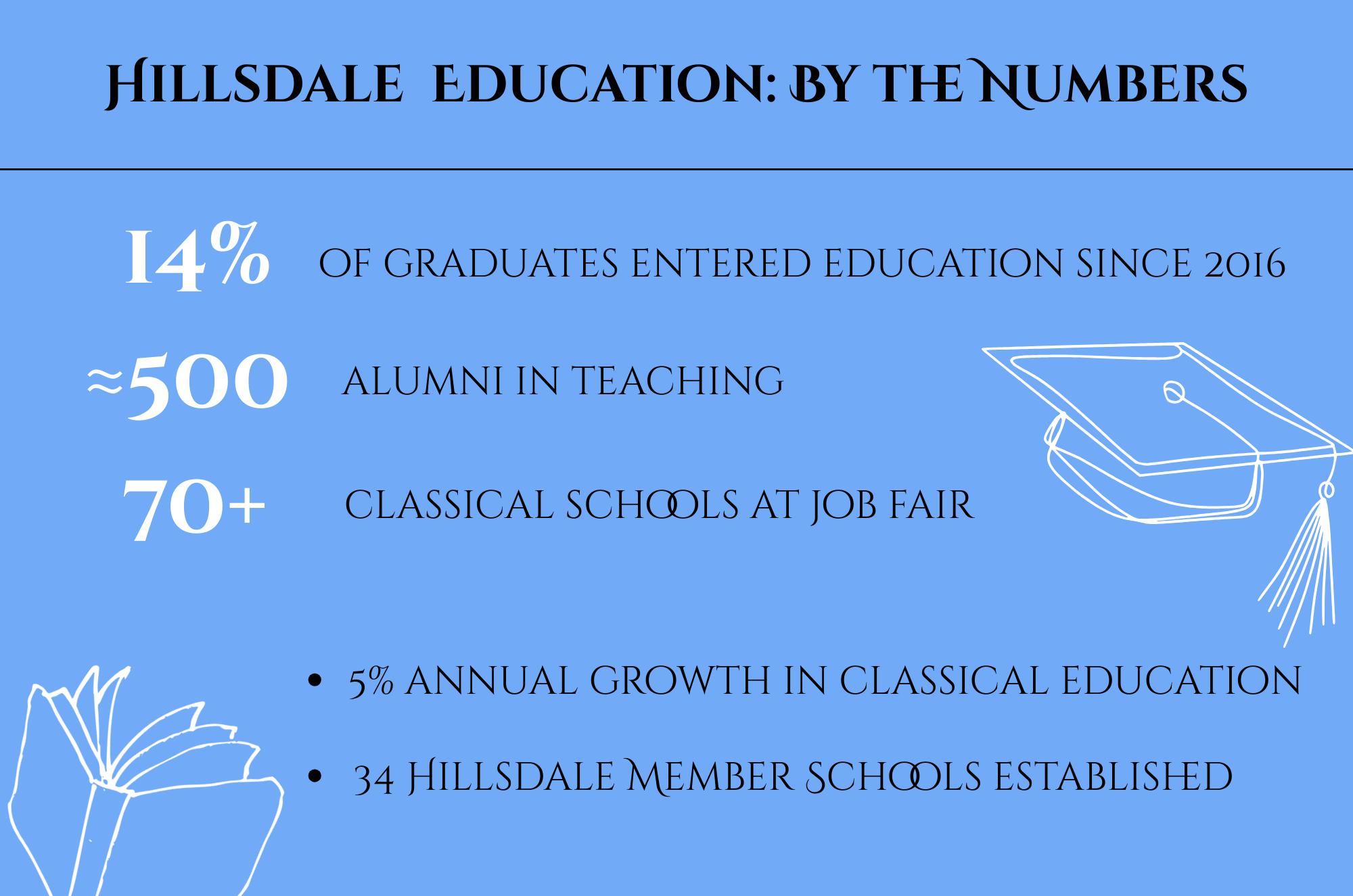
About 14% of Hillsdale graduates have started their careers in education since 2016, according to a report by Career Services, and most of these roughly 500 alumni have gone into classical education.
“Hillsdale College is incredibly highly respected within the world of classical education, and so it’s natural that classical schools would look to Hillsdale as a source for highly qualified teachers,” said David Diener, assistant professor of education and former headmaster of Hillsdale Academy.
Representatives from more than 70 classical schools are scheduled to attend Hillsdale’s
cation Office hosts the job fair to connect Hillsdale students with schools whose missions
event manager.
Hillsdale teaches students how to learn humbly, going to older and wiser sources instead of relying on one’s own knowledge, according to Elizabeth Penola ’25, a 6th grade humanities teacher at Seven Oaks Classical Academy, which is a Hillsdale Member School. Hillsdale Member Schools are schools that receive curriculum, consultation, and training from Hillsdale’s K-12 Office, according to the K-12 Office website.
Classical Job Fair Thursday, Feb. 12, in the Searle Center from 1-6 p.m. The K-12 Edu-
are aligned with that of the college, according to Cherri Lindsley, the K-12 education
Tempers rise at Fayette solar project meeting
By Thomas McKenna Editor In Chief
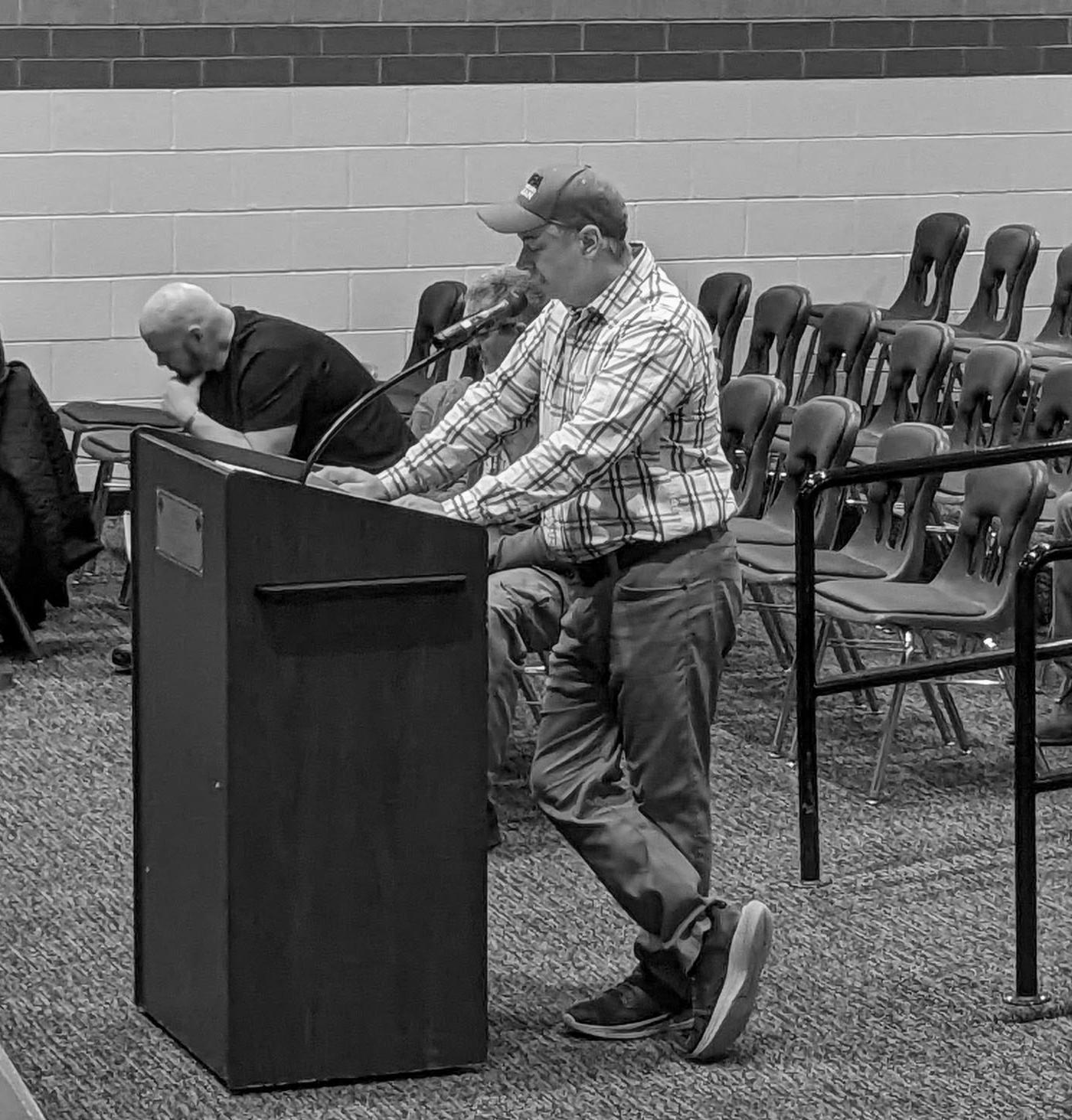
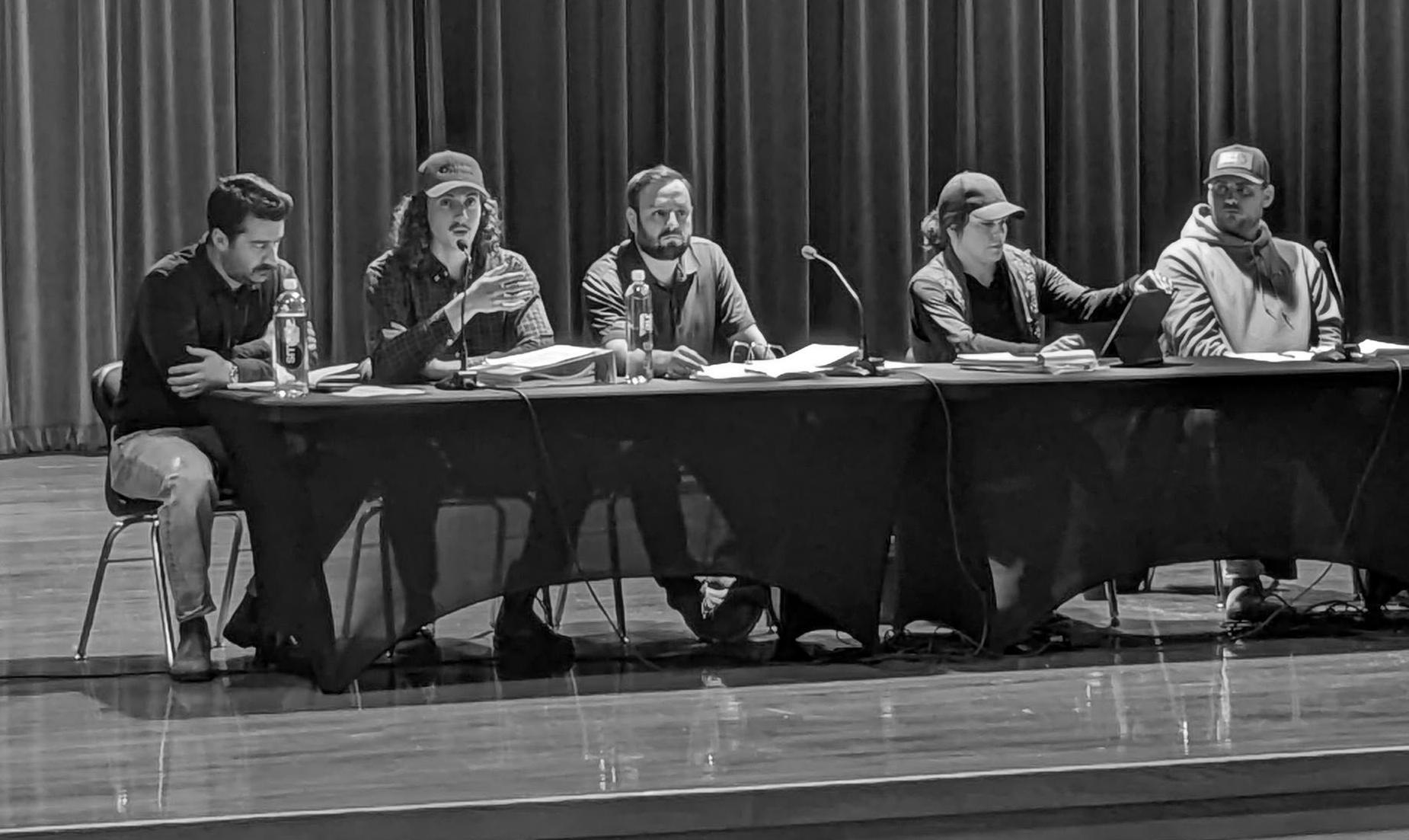
A Fayette Township planning commission meeting turned tense Tuesday night when three representatives from Ranger Power took questions from residents about the company’s plan to turn 1,350 acres of farmland into a solar field.
More than 60 people from in and around the township attended the meeting, with about 20 speaking against the project. Nobody voiced support for the plan during public comment, and some of the speakers directed comments toward the Ranger Power representatives.
“These people right here,” said Dennis Rhoniy of Jonesville, tearing up a piece of paper at the podium. “That’s what I feel about them. They don’t care.”
commission — which would need to approve the project’s special land use permit — that a green light would put the members “spiritually” in the “wrong place.” When a Ranger Power member said he knocked on every door adjacent to the project’s land, one audience member shouted, “Lies.”
“You claim to be a fair, transparent, open, honest company that wants to be a good neighbor,” said Steve Oleszkowicz, a Fayette Township resident leading opposition through his group No Solar Fayette. “I’d like you to move out of the neighborhood.”
By Catherine Maxwell Senior Editor
Testing has revealed that mold contamination has not increased in residence halls over the last five years, according to Associate Dean of Women Stephanie Gravel.
Recent health concerns from the former head resident assistant of Mauck Residence prompted the college to test her room for mold. The results showed no elevated mold levels, Gravel said, but the student decided to move out anyway.
“We don’t want anybody living in an unsafe space,” Gravel said.
College reports no rise of mold in dorms See Mold A2
‘The girls deserve better’: Up your dating game this Valentine’s
By Ty Ruddy and Blake Schaper Culture Editor and Freelance Reporter
We asked a group of seniors and faculty where to take your date on Valentine’s Day. Put down “The Odys sey,” and find your Penelope.
Q. What are the best first date, dinner date, and activity dates in Hillsdale?
“If you really want to impress her, take her to the bowling alley. She won’t expect that at all, shock her! Then she’ll be impressed by your creativity, and courage. It is so important that you do not take her to Saga, that should be a given but it’s not. You’re welcome, boys.”
Senior Lulu Celecia.
“For a first coffee date, I would definitely recommend Rough Draft. That way, all the poor souls in there who are
themselves because not only are they stuck reading, but they also don’t have dates. For an activity date, I think going to the Silos Fun
Park is a solid choice. Sooner or later you need to determine whether or not this boy you like is a serial killer. If you make it home alive from this date, you have absolutely nothing to worry about.
For dinner, please go on a picnic in the arb.
The benefit here is more opportunities to show the single pringles out there just how single they are. Additionally, you get to have a touching full-circle moment later in the month when he proposes in the gazebo — ring after three dates or something.” Senior
Illustrated by Maggie O’Connor
About half of the audience applauded. At another moment, Rhoniy began shouting at members of the commission and stepped toward the stage, but he was walked back to his seat by a nearby man.
Lawrence Peter, who lives on Milnes Road, told the planning
The meeting is the latest flashpoint of local opposition to Ranger Power’s Heartwood Solar II project. The company needs the green light from the township’s planning commission, but residents say the panels would disrupt the view of the landscape and potentially disrupt wildlife and nearby water sources. The project is the second phase of the similar Heartwood Solar I project approved by the township board in 2022.
‘Whiplash in the best way’: Student publishes second book
By Eleanor DeGoffau Senior Reporter
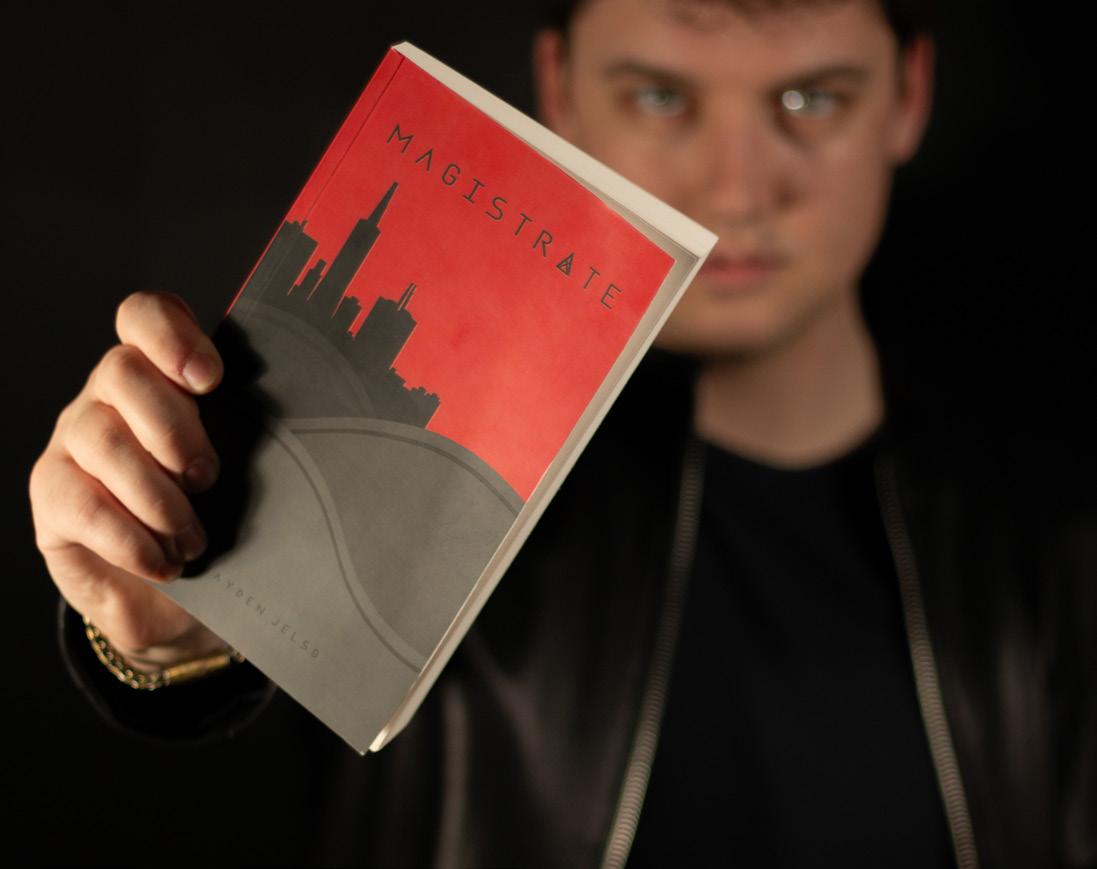
In a culture where popular young adult books are praised for explicit content and ambiguous morals, junior Jayden Jelso’s newly self-published book is just the opposite.
“I often say, ‘Let’s bring art
his novel to also stand up to the forces of evil in the young adult genre — explicit content, bad literature, and uncompelling Christian writing. Jelso, an English major, said he set out to write a quality book series for teens that would make them think — not just cater to self-gratification.
Q. What was your reaction to being nominated?
Padrón: I was really surprised! I was not expecting to be nominated, and I had kind of forgotten that there was a president’s ball court. Williams: I’ve been told that I have a very public presence on campus. Being nominated forced me to look back on how faithful God has been to me over the last four years even when I wasn’t as faithful to him.
He’s given me amazing friends and such a rich community in Simpson to be a part of, and I’m so grateful.
Q. What is your favorite Hillsdale memory?
Padrón: Hosting brunch at Dow House on Sundays. Williams: When I was a sophomore, my best friends and I had the crazy idea that we could get all our Simpson guys to dress in costumes and script out WWE fake wrestling fights, and we could build a wrestling ring and put on a show with professor cameos in the Simpson courtyard. I
my friends and I thought nobody would show up and that it would be a failure. Then we walked out to the courtyard and there were 250 people from all parts of campus. It became such a hit and such a unifying campus event that is now something that Simpson looks forward to every year. I can’t wait to do it one more time with my favorite professor, Dr. Jackson. April 18. Mark your calendars.
back to literature,’” Jelso said. “I want to be part of a movement that brings truth and exploration of humanity back to literature, in particular, back to mainstream literature.”
“Magistrate,” which became available for orders on Amazon Feb. 9, is a sequel to Jelso’s first self-published novel, “Talon,” and follows a 15-year-old orphan named Talon who faces secret assassins and unravels government conspiracies in a futuristic New York City.
But just like his protagonist, Jelso says he hopes to use
“Literature, at least, modern literature, has become a means of self-gratification, as opposed to something that helps you thoughtfully explore the world around you and challenge yourself,” Jelso said. “Books should have you wrestle with ideas that you would instinctually not agree with, or you would instinctually push away, but I think that’s the purpose of literature.”
See Jelso B6
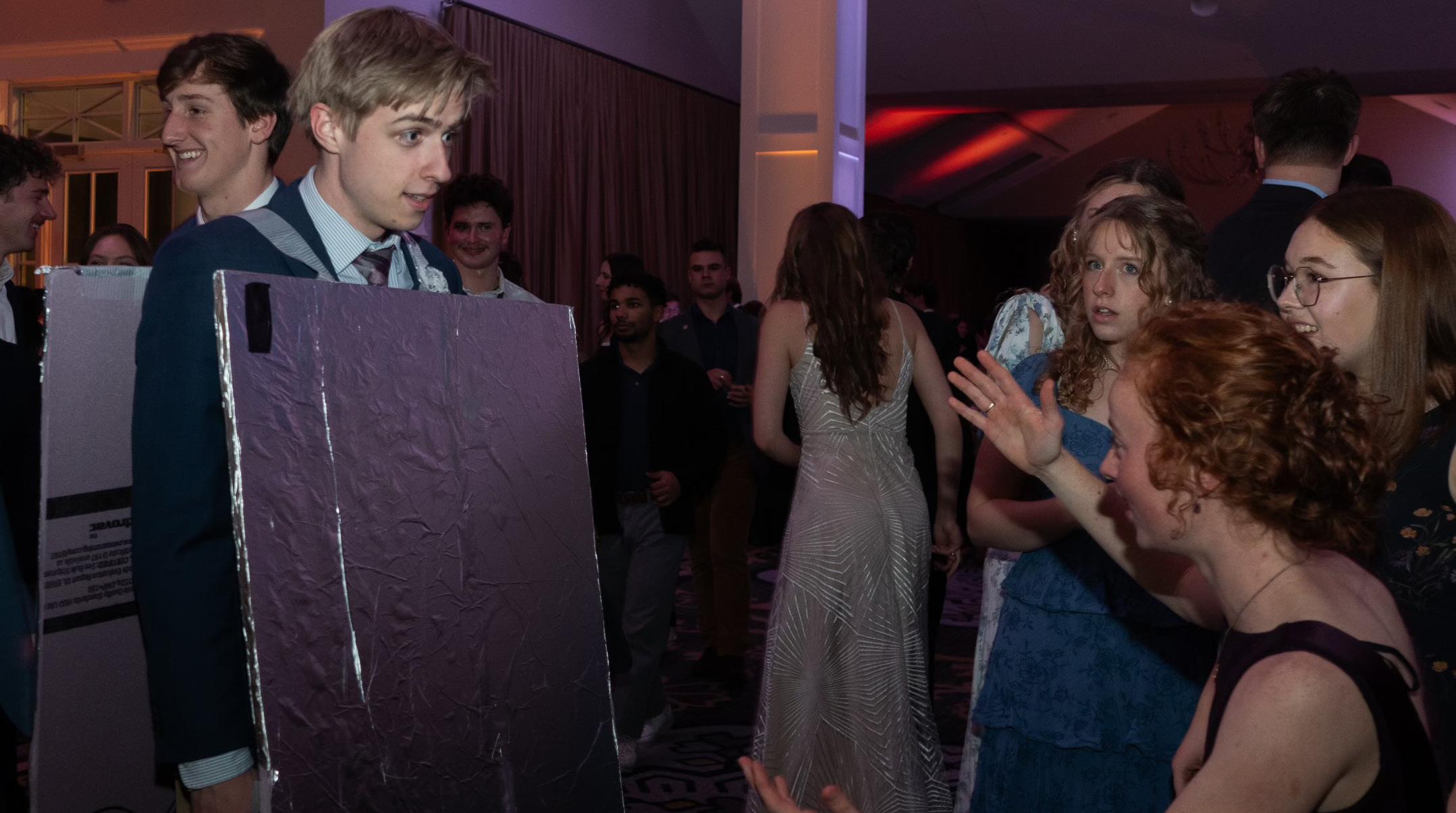
Sophomores Maggie Phillips and Anders Moody sit for a caricature at President’s Ball on Saturday night.
Board
By Ellie Fromm News Editor Seniors Jonathan Williams and Alba Padrón were crowned President’s Ball King and Queen by Hillsdale College President Larry Arnn Saturday night.
‘The historian’s craft’: Richard Gamble to retire after spring semester
By Monica Smies Collegian Freelancer
Richard Gamble, professor of history, will retire at the close of this semester. Gamble has taught at Hillsdale College since 2006.
“I will miss my church, my colleagues, and the students,” Gamble said.
He plans to spend his retirement time with family in South Carolina and working on his biography on John Lukacs.
Charles Yost, assistant professor in medieval history, remembers all the interesting conversations he and Gamble had throughout the years.
“I learned so much from him, not just about American history, but about the historian’s craft,” said Yost. Gamble’s book, “The Great
Tradition: Classic Readings on what it Means to be an Educated Human Being,” is used for the Collegiate Scholars Program and is appreciated across homeschool and classical school communities according to Gamble.
Bradley Birzer, professor of history and Gamble’s longtime friend, met him before either of them taught at Hillsdale.
“He’s a man of deep integrity, insight, morals, and imagination,” Birzer said. “I really can’t imagine my own career without his inspiration and friendship.”
Birzer and Gamble first met in the early 1990s at a conference in San Francisco.
Roughly 12 years later, at an Intercollegiate Studies Institute conference in Seattle, Washington, a conversation
about Hillsdale College first came up.
“We were riding the elevator together,” Gamble said. “And he said to me, ‘You know, there’s an opening at Hillsdale College.’ And I said, ‘Brad, don’t complicate my life.’”
history, made Gamble feel at home and helped him move in after Gamble was hired at Hillsdale. They went to church together and became good friends according to Kalthoff.
“Dr. Gamble has been very
“It is a rare gift to be able to call your professor a friend.”
Gamble initially encountered Hillsdale College in October 2005. After his lecture during that visit, he was drilled by then-undergraduate student Jason Gehrke, assistant professor of history, in the following Q&A session. Gamble said after his visit he hoped to work for Hillsdale.
Mark Kalthoff, professor of
diligent as a scholar throughout his career. That speaks to both his intellectual curiosity as well as to his intelligence and ability,” Kalthoff said. Matthew Gaetano, associate professor of history, has worked with Gamble for approximately 15 years. During this time, they have built a friendship, according to Gaetano.
CEO lectures on the qualities of leadership
By Hershey Hackberry Collegian Reporter
“Decisions should be made by your brain and implemented by your heart,”
Keith Rozolis, the chief executive officer of ABC Supply, said at a lecture Jan. 28.
As an entrepreneur, Rozolis spoke on leadership and gave three practical tips on how to become an effective leader.
Rozolis joined ABC Supply, the largest wholesale distributor of roofing materials in North America, in 1999. During his talk, Rozolis gave students advice about the approach successful leaders take when starting a business.
“Leadership requires three things: Do the right thing always. Do your best, always. Show people that you care, always,” Rozolis said. He said good leaders are most needed in places where there is no process, like starting a small business.
ment associate, said that his talk impacted students in a meaningful way.
“Keith was incredibly down to earth, which really resonated with our students,” Lutz said. “He spoke thoughtfully about leader-
gram has 28 students who are all looking to start a new business. A fellow is provided with the training and resources to get their business off the ground. Applications are open to sophomores in the fall.
Rozolis said that benevolence was an element of good leadership.
“Take chances in your 20’s. Don’t worry about the money,” Rozolis said. “If you can impact other people’s lives in a positive way, that is the highest good.” Rozolis also said that branding is extremely important for young entrepreneurs.
ship, and from conversations afterward, it was clear that fellows were genuinely impressed by both his insight and his approachability.”
“Leadership matters when there’s chaos and uncertainty — what I call dynamic times,” Rozolis said.
Jen Lutz ’98, career place-
from A1
When students raise concerns about mold, the college brings in an outside company to test the room and the surrounding area, Gravel said. The deans share the results with the students.
Tim Wells, associate vice president for administrative affairs, said college staff will first conduct a visual inspection of the space after receiving concerns about mold.
This talk is mandatory for all students in the Kehoe Entrepreneurial Fellowship. It is one of many in the Executive Speaker Series, which is open to the public. The Kehoe pro-
“Additional steps may be taken to ascertain and correct whatever may have been the contributing issue,” Wells said.
In the case of sophomore Evelyn Gray, who briefly lived in Mauck Residence in the fall, the school did find mold in her room. Gravel said the mold developed when, after housekeeping shut the door after cleaning the room, the
Sophomore Ianna Chan, a Kehoe fellow, appreciated Rozolis’s advice for younger people.
“I liked how he mentioned that we are at the ‘prime of our life,’” Chan said. “We aren’t supporting a family yet, so if it doesn’t work out, we can pivot. It’s easier for us to take risks.”
the wooden furniture. Once I found it in one place, it was easy to see it everywhere.”
Gray and her roommate moved to Kirn Residence while the room was cleaned.
If the necessary cleaning is beyond what maintenance crews can handle, Gravel said, the college hires an outside company.
“I was not super happy with the response. At the
“Your brand is what people say about you when you’re not in the room,” Rozolis said. “The best thing your brand can be is trustworthy. I want people to say, ‘I trust Keith,’ when I’m not in the room.”
Lutz appreciated the perspective he provided about leadership.
“He framed leadership around trust,” Lutz said. “Which is built through competence, honesty, and benevolence, and reminded students that the best leaders consistently do the right thing and genuinely care about others.”
in New Dorm,” Gray said. “It honestly turned out the best it could, and I love where I am now.”
The increased mold testing over the past few years comes from rising concerns from students, Gravel said. The school works to complete testing as quickly as possible.
“The college is very gracious in honoring these tests when we have these concerns,” Gravel said.
“Once I found it in one place, it was easy to see everywhere.”
“At that point, regardless of whether there are visible signs of mold, the facilities department typically contracts with a third-party testing company that specializes in environmental, occupational health, and safety testing to conduct sampling in accordance with industry standards and the guidelines of the analyzing accredited laboratory where the samples are sent for inspection and analysis,” Wells said in an email.
If the company finds mold, the room is cleaned according to industry best practices, Wells said.
air handlers in the dorm were accidentally turned off, preventing air circulation.
Gray said she noticed the mold the night she moved into the dorm.
“We had gotten all my stuff into the room, and I was dusting before unpacking, and noticed some dust that was too white and regular to be real dust,” Gray said. “I couldn’t believe it — we had already found the mattress to be moldy, and I thought that that was the end of it. But there was mold on all
to: Advertise with The Collegian To advertise in The Collegian, please contact Henry Fliflet at hfliflet@hillsdale.edu.
time, it seemed like it was being minimized and not taken seriously,” Gray said. “Later on, I talked to the deans and it turned out that most of the problems I had with the response boiled down to misunderstandings with the chain of communication. So overall, I’m happy with the response.”
After an outside company deemed the room safe, the deans gave Gray the option to return to Mauck or stay in Kirn.
“I was really happy to stay
“Richard has been and will continue to be an example of what it takes to be a teacher and scholar for many of us in the history department,” Gaetano said. “And alongside his role as an exemplary teacher and scholar, Richard is a good friend and a faithful Christian. It is hard to imagine the fourth floor of Delp Hall without him.”
Since his freshman year, senior Ethan Bourgeois said Gamble’s time at Hillsdale College has enriched him not only in his love for history, but travel, art, and classical music. Gamble and Bourgeois have traveled to Turkey, Hungary, Norway, among others according to Bourgeois.
“I am indebted to Dr. Gamble for mentoring me as a Christian, historian, and fellow traveler on this earth,”
Education from A1
“Hillsdale prepared me really well in many ways, one of which is that Hillsdale really teaches you how to think about things, and it teaches you the habit of going to primary sources, especially the history major,” Penola said.
“It teaches you to not just rely on your own perspective, but to try to see things from a broader perspective, and to not be so arrogant to think that the modern way to view something is the correct way.”
English is the most common major for students who go into education, with history as the second-most common, according to the Career Services report.
“We talk about the difficult things in the history department, but we also talk about the good things and the triumphs and that which we can really be proud of.
That’s where I think the history department has a really good balance,” said Kenneth Calvert, professor of history and also a former headmaster of Hillsdale Academy.
“The students that we turn out want to take that excitement, that enthusiasm, to schools and really make it into something that is positive in a school.”
Part of being a good teacher is loving the subject you teach because, when you study what you love, you become better at it, according to Brent Cline, associate professor of English.
Bourgeois said. “I will continue to learn from and work with him in years to come. It is a rare gift to be able to call your professor a friend.”
Retiring was a hard decision for Gamble. He said he finds joy in the community of Hillsdale, and wants to give students historical insight, allowing them to recognize how history shapes the modern world.
“When I first arrived at Hillsdale in 2006, I was impressed by the students,” Gamble said. “They welcomed me to a lunch table my first semester here, and I am still in touch with many of them today.”
Wells said students can help prevent mold in their rooms by maintaining cleanliness and air flow.
“In addition to good communication relative to any observable issue, ensuring that exhaust fans are utilized in the bathrooms to remove moist and humid air is a good step, as well as maintaining the general cleanliness of spaces and ensuring that proper air circulation and filtration is not inhibited by moving furniture so that it inadvertently blocks equipment or air vents,” Wells said.
“English is a good major for several reasons. One, language and communication are at its core. Any teacher is, first and foremost, a communicator with a whole bunch of different kinds of people in different registers,” Cline said. “I also think the study of literature is the study of the human condition and human struggles, and that’s going to be in any English or humanities class you teach in school, if not all classes you teach.”
When teachers focus on caring about their students and teaching them to love learning, the test scores and GPAs fall into place on their own, according to Penola.
“You’re shaping souls, you’re not just trying to get them to retain information. With teaching, it’s really easy to get lost in the details, and you just lose sight of the goal. But in classical education, it’s so clear that the goal is forming human souls. So, if the goal is shaping souls, then you can kind of let go of a lot of the stress of the other stuff,” Penola said.
Classical schools want Hillsdale students because of the preparation they receive with Hillsdale’s liberal arts curriculum, according to Diener.
Classical education is growing at a rate of 5% per year, nationally and internationally, making it the fastest growing sector in private and public charter education, according to Diener.
“People are increasingly realizing that the radical educational experiment that we have foisted upon children for the past 100 to 150 years is failing,” Diener said. “People recognize that we should go back to the long standing tradition of classical education, which worked for centuries and is part of our heritage and educational legacy that we’ve inherited.”
Hillsdale’s core curriculum gives students a broad understanding of a traditional classical education, which, alongside studying something they love and want to pass on through teaching, is necessary for classical teacher, according to Diener.
“Hillsdale College is uniquely situated to prepare students for working in classical schools, given that we focus on developing their content knowledge in the area of their major and then provide the classical education minor to give them some instruction in teaching and the classical education tradition,” Diener said.
Hillsdale’s K-12 Office helped to establish 34 Hillsdale College Member Schools and Candidate Member Schools, and is adding three more this fall.
“We focus on the liberal arts and all of those areas of study that are necessary for a good, intelligent citizen,” Calvert said. “What we’re trying to do is train their minds and their hearts and their souls to be ready to do anything that they’re asked to do, or any job, or any trade that they’re going to go into.”
Classical schools are special because they treat students as a whole person, not just test scores and GPAs, according to Penola.
“One thing that I love about teaching is that every day when I go into work, even if I feel under qualified or overwhelmed, I feel like the work I’m doing matters,” Penola said. “Whether I’ve had a good lesson or a bad lesson, or a good day of classroom management, or a bad day of classroom management, I have 27 little faces looking at me. That’s 27 kids that I can love in that class.”
Mold
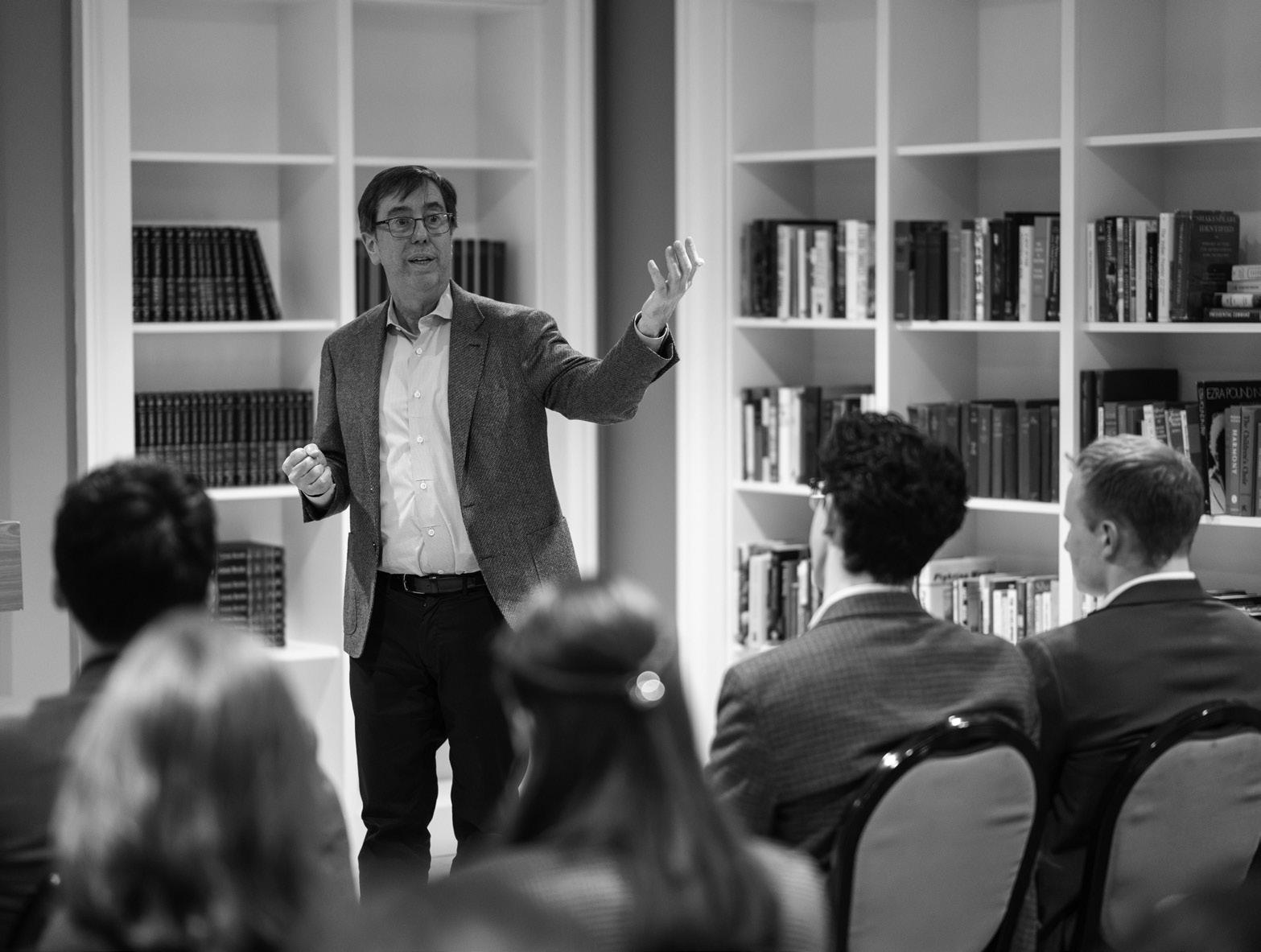
Keith Rozolis during his lecture on Jan. 28. Courtesy | Austin Thomason
Sophia Rome to take over Student Activites Office
By Elizabeth Caneday Collegian Freelancer
Sophia Rome ’25 will replace Ingrid Dornbirer ’24 as the director of the Student Activities Office in June.
“I love the people in the SAO office so much. Working with them every single day sounds so fun,” Rome said. “They’re all really awesome people, the students, and they love their jobs. They put so much into it.”
Dornbirer, who grew up in rural Ohio, plans to move to Pittsburgh after marrying her fiancé, Dean Ballantyne ’24, in July.
“I am so excited for Sophia,” Dornbirer said. “There really isn’t anyone else I would entrust my team to, because I love my team a lot.”
Dornbirer said while she was a student, and later as SAO director, Concert on the Quad was her favorite event, though she still appreciates the bigger events like President’s Ball and Garden Party.
“Something I’ve learned in this job, I think, is that an event, to be a party, or to be an event, requires three different aspects, and it’s people, food and music,” Dornbirer said. “Concert on the Quad is the perfect example of that.”
Originally from the Twin Cities in Minnesota, Rome graduated with a history degree and a minor in dance. She said she enjoyed homecoming week and organizing events as a resident assistant in Olds and Sohn residences.
“I loved homecoming as an RA. Putting on homecoming was so fun,” Rome said. “Freshman year, participating in it was really, really fun. That’s where I
Q&A from A1
Q. If there is one thing you could tell your freshman self, what would it be?
Padrón: Sleep more, wear more layers. Williams: Ask for help more often and sooner. I didn’t really start utilizing the Health Center counseling services, Father Adam’s direction, Career Services, or Academic Services until my senior year. That was such a mistake. It might surprise people that my freshman year was actually a time of very deep emotional and spiritual struggle. College just didn’t start the way I had hoped, and the beginning was a time where I felt very alone and lost. There were some really rough and dark days, and I really had no idea what senior year would be like and whether it would still feel the same way. If you had told me in those moments that I would one day be on the President’s Ball Court, I just wouldn’t have believed you. Like it just wasn’t a possibility in my mind.Things don’t have to be at a crisis point to ask for help from these people, they’re all here to help for any questions you have, and they’re all rock stars. I love how Hillsdale cultivates a sense of humility where asking for assistance isn’t viewed as weakness. Instead, the act of asking for help is a sign of strength and the desire to grow.
Q. If you could do Hillsdale all over again, what is something you would do that you didn’t?
Padrón: I would get involved in the Student Ministries Board. I love what they do and I kind of missed them until now.
Williams: First is to take more classes in areas of weakness for me. I [also] wish I would’ve tried to take instrument lessons or join a club that would have forced me to learn something new. College is the absolute perfect time to
got to know a lot of my friends throughout all of college.”
Rome said she will start working with Dornbirer to learn her new role at SAO on March 23. Dornbirer said that an average day in the life of the director is full of responding to emails, organizing the calendar, and making sure the student team is ready for upcoming events.
“Sophia will be learning the role while I am here, but she will start to do more tasks herself in the summer,” Dornbirer said.
Rachel Marinko ’20, director of student programming, said Dornbirer has excellent organizational skills.
“She has been such a joy to work with,” Marinko said. “She has a great eye for aesthetics and the little details that elevate an event. She is also so kind and caring and just a joy to be around. I will miss her!”
Marinko said that she encouraged Rome to apply when the position opened over winter break. Rome was an RA in Olds during one of Marinko’s three years as the house director.
“As an RA she was such a hard worker, a natural at event planning, and always an enthusiastic and encouraging person,” Marinko said. “I’m excited to see what unique things Sophia will contribute.”
Dornbirer’s last day in the SAO office will be June 30.
“I was nervous about the transition and thinking about who’s going to steward this team really well and be their friend and mentor,” Dornbirer said. “And there’s no one more deserving. She’s gonna kill it.”
try new things, and sometimes I feel like I stayed in my comfort zone too much.
Q: What was your reaction to your name being announced as king/queen?
Padrón: My first reaction was shock followed by, “What do I do now? Should I wave?”
Williams: My girlfriend in the front row and a bunch of Simpson guys also up close to the stage kept pointing at the back of Dr. Arnn’s sheet and looking at me, so I was starting to figure out that my name was written on the other side. So, when my name was announced, I wasn’t totally surprised in the immediate moment. Then I looked down and saw Mrs. Arnn and thought, “I hope last year’s king, Zach Ponraj, doesn’t show me up on the dance floor.” In all seriousness, my heart was full of such immense gratitude.
Q: What are your plans after graduation?
Padrón: I am staying in Hillsdale. I will be doing the master’s in classical education, and I will be the house director of Kirn Residence.
Williams: Being an RA in Simpson for three years has shown me that I have a deep passion for helping young men with emotional struggles. So many people here have helped me with my struggles, and I want to give back in that area. So I am planning on pursuing a career in clinical counseling, but I would like to take a short hiatus from academics and work for a nonprofit before pursuing graduate school. I have a couple of favorite contenders right now but we’ll see — I’d love to live in a bigger city with Hillsdale friends. D.C. would be an awesome spot because I’m a die hard D.C. sports fan.. And, of course, I have to come back and watch Simpson continue its legendary Homecoming streak for four years in a row next fall.
Rabbi explores covenantal community in early US
By Anna Northcutt Collegian Reporter
One of the country’s top Jewish leaders said George Washington’s correspondence with an early Jewish congregation demonstrated not only his recognition of the covenantal nature of America’s founding but also his belief that it could bind together a diverse nation, in a lecture hosted by the President’s Office Feb. 10.
“Washington is saying, ‘For us, toleration is insufficient.’ He’s saying, ‘In Europe, you may be tolerated, but here, everyone is equal. You are not here because we are allowing you. You are here, because you deserve to be as much as us,’” Soloveichik said.
Meir Soloveichik is the rabbi of the oldest Jewish congregation in the United States — a fact which he and others in his congregation are extremely proud of — and Vice Chair of the U.S. Commission on International Religious Freedom.
After Washington’s inauguration in April 1789, leaders of various minority faiths wrote to the president to ensure their group’s equality in the nascent nation. Since the Jews couldn’t agree on who should write their letter, they wrote three, and Washington responded to all of them, according to Soloveichik.
To the first letter, written from the Hebrew congregation in Savannah, Georgia, Soloveichik said Washington not only provided an assur-
ance of religious freedom, but also concluded with an invocation of the Torah, drawing a parallel between God’s deliverance of Israel out of Egypt and God’s deliverance of America in the Revolution.
“No letter in Jewish history from a non-Jewish leader shows his not only embracing the Jews, but comparing his country, his country’s story, with the original, ancient Jewish story,” Soloveichik said.
In his second letter, Washington answered the Hebrew congregation in Rhode Island, Soloveichik said.
In this response, Washington’s quotation of the original letter’s description of America as a country that “gives to bigotry no sanction, to persecution no assistance” is now so famous that it is often misattributed to the pres-
ence religious “toleration” in America, but that they should view living in this country as their right just as much as anyone else’s.
Washington was building on a long history of Anglo-American ideas of religious freedom while also creating a distinctly American concept of religious liberty, according to Soloveichik.
Jonathan Sacks, a British rabbi, observed this difference after noting that American memorials recorded a person’s words and ideas on his memorial statue as well as just his name, Soloveichik said.
This was because American society is a covenantal society modeled after those set up in the Hebrew Bible, where people get together and pledge themselves to each other in the presence of
“It may be hard to escape from tyranny. It is harder still to build and sustain adults transmitting to the next generation the story of the origin of liberty.”
ident instead of the Hebrew congregation, according to Soloveichik.
Still, Soloveichik said, even after Washington assured them of their right to religious freedom, he went a step further, asserting that not only would the Jews experi-
God around a certain set of ideas, according to Soloveichik.
“Covenantal societies represent conscious new beginnings,” Soloveichik said. “They are founded on an idea, dedicated to a proposition. That’s why we have ideas everywhere.”
This kind of covenantal society allows many different sorts of people to bind themselves to the covenant and be considered American, Soloveichik said.
Emanuel Leutze captures this idea in his famous painting “Washington Crossing the Delaware,” according to Soloveichik.
In recent years, Soloveichik said the painting has fallen under heavy criticism due to its historical inaccuracies, such as the time of day, dawn instead of night, and an inaccurate depiction of the American flag — the Betsy Ross flag shown wasn’t actually adopted until after the crossing.
According to Soloveichik, however, Leutze was not trying to be historically accurate so much as send a message
about America. The men in the boat include an African American, a Scottish immigrant, and a Native American.
The boat represents all of America, and the time of day represents the dawn of a new idea. Leutze hoped these new ideals of democracy and equality would eventually be adopted in Europe, thus why his depiction of the Delaware river more closely resembles the Rhine river in Germany, according to Soloveichik.
“Leutze is emphasizing that what unites us is the American creed, so that together, without denying our differences, we unify by embracing the American covenant,” Soloveichik said.
Sophomore Yahli Salzman said he appreciated hearing a different perspective on what brings Americans together.
“I’m Jewish, and we obviously hear from the Christian perspective on campus a lot, but hearing a different perspective always gives us a little more hope, a little bit more opportunity to see something new,” Salzman said.
Mickey Mattox, professor of theology, also said he enjoyed the lecture.
“Rabbi Soloveichik’s exhilarating lecture today reminded me of the greatness of America’s first president, George Washington, whose readiness to welcome Jews into the American experiment without prejudice placed their tiny communities on an equal political footing with the many and larger Christian ones,” Mattox said in an email.
According to Soloveichik, Sacks also pointed out that before Moses gave the Ten Commandments in Exodus, he told the children of Israel how to explain Passover to their children.
“One of the central lessons of the Hebrew Bible is you have to make sure that your covenantal beliefs are passed down from generation to generation,” Soloveichik said. “It may be hard to escape from tyranny. It is harder still to build and sustain adults transmitting to the next generation the story of the origin of liberty.”
Spalding urges educators to encourage patriotism
By Sydney Green Senior Reporter
Teachers must encourage their students to love America by capturing their imagination, said Matthew Spalding, dean of the Van Andel Graduate School of Government in a talk at Hillsdale’s main campus Feb. 9
“The good life is one that calls us to rightly order our loves, and the Declaration of Independence is part of our civic love,” Spalding said. “Nothing can truly be loved unless the object of love is known, and we must make sure the story of it is being told well.”
Spalding addressed school leaders gathered for Hillsdale College’s annual conference of affiliated K–12 schools and talked about his newly released book titled “The Making of the American Mind: The Story of Our Declaration of Independence.” Spalding urged educators to recover the story at the heart of the American Founding.
“Education should form attachments to country,” Spalding said. “It should inspire the young, but then it should teach them to be good citizens.”
Spalding said he wanted the Declaration of Independence to
tell its own story in his book.
“The Declaration is like a symphony; it has different parts, different sounds, different melodies, and it all goes together,” Spalding said. “We just need to listen.”
Spalding highlighted four key phrases of the Declaration, beginning with the introduction: “When in the course of human events.”
The Founders did not see themselves as swept along by impersonal forces, according to Spalding.
“They understood themselves to be actors in that history,” Spalding said. “Looking to shape that history by making decisions.”
Turning to the assertion “we hold these truths to be self-evident,” Spalding emphasized the Founders’ confidence in reason.
“The Declaration assumes the human mind is capable of knowing the truth of things,” Spalding said. “They didn’t say, ‘We have some personal opinion we’d like to share with you.’”
Spalding also pointed to the often-overlooked phrase that follows: “Prudence, indeed, will dictate.”
“It’s no coincidence that the next word after the discussion
of abstract truths is the central cardinal virtue, prudence,” Spalding said. “Particulars are always changing. We often make mistakes. We are imperfect, but are supposed to live up to our principles, and not wallow in our human imperfections.”
Spalding closed with the Declaration’s final pledge: “We mutually pledge to each other our Lives, our Fortunes and our sacred Honor.”
Spalding said that line is an oath.
“The Declaration is not a document of mere modern, secular rationalism,” Spalding said.
“The references to the laws of nature and of nature’s God, the creator, the supreme judge and divine providence show that it is a document of both reason and revelation.”
Quoting Abraham Lincoln, Spalding said the Declaration is what unites Americans across generations.
“It is the electric cord that links the hearts of patriotic, liberty-loving men together,” Spalding said. “Educators should help students to claim it as though they were blood of the blood and flesh of the flesh of the men who wrote the Declaration.”
Mike Roberts, headmaster of Hillsdale Academy, said teachers have an opportunity right now to capture the attention of students as the nation approaches its 250th anniversary.
“I think it’s really critical that our schools are inspired to teach history,” Roberts said. “And we have this opportunity to recapture the story and grab the attention of youth as we prepare to celebrate our nation’s 250th anniversary.”
Abigail Teska, an art teacher at Seven Oaks Classical School in Ellettsville, Indiana, said she believed in the call to view America as something beautiful and worthy of our appreciation. “Students cannot love what they do not understand,” Teska said.“How is a student going to appreciate a work of art if they don’t have any of the skills or knowledge behind what you’re asking them to appreciate? The same is true of civic education.” For Spalding, the task of civic education is urgent and hopeful.
“Make your students fall in love with America,” Spalding said.
Rabbi Meir Soloveichik during his lecture on Tuesday. Anna Northcutt | The Collegian
D.C. Correspondents | Lauren Bixler | Megan Li | Lewis Thune
Web & Puzzle Editor | Matthew Tolbert
Illustrator | Maggie O’Connor
Faculty Advisers | John J. Miller | Maria Servold
The editors welcome Letters to the Editor but reserve the right to edit submissions for clarity, length, and style. Letters should be 450 words or less and include your name and number. Send submissions to the Opinions Editor at ckurt@hillsdale.edu before Saturday at 3 p.m.
Boomers vs. the Bunny
By Moira Gleason Executive Editor
The dueling halftime shows of Super Bowl LX were the most boomer thing I have seen in entertainment since the 45th-anniversary reunion of “The Waltons” cast.
In defiance of Puerto Rican pop star Bad Bunny’s all-Spanish halftime show, Turning Point USA streamed its own pre-recorded “All-American Halftime Show,” featuring middle-aged country singers, cheap pyrotechnics, and headliner Kid Rock. The whole concept sounds like some geriatric reenactment of “West Side Story,” minus the murder and teenage sex.
“The All-American Halftime Show is an opportunity for all Americans to enjoy a halftime show with no agenda other than to celebrate faith, family, and freedom,” TPUSA spokesman Andrew Kolvet said after Bad Bunny announced his show in October 2025.
The problem wasn’t giving Bad Bunny a little competition. It was the optics of presenting mediocre country singers as authentically American art over and against a successful American artist singing in Spanish.
Despite their statement to the contrary, TPUSA did advance an agenda. “This is real American,” country singer Brantley Gilbert said after his lead guitarist kicked off the TPUSA show with an electric rendition of the national anthem.
Performances from Lee Brice, Gabby Barrett, and Kid Rock followed. It was the kind of honky-tonk patriotism that you might expect at a smalltown Fourth of July party: trucks, girls, guns, and beer. Nostalgic, but not exactly great art and certainly not representative of American culture at large.
Meanwhile, Bad Bunny took the stage at Levi’s Stadium.
On its face, his performance was a fun, colorful celebration of Latino culture and family life. Lady Gaga sang a salsa version of “Die with a Smile,” families with children danced together on stage, and a real couple got married in the middle of the show.
Translate Bad Bunny’s lyrics into English, and the themes ar-
By Elijah Guevara Assistant Editor
Imagine you’re scrolling through Instagram Reels: First, you see a Steph Curry highlight. Next, Jeffrey Epstein and Ghislaine Maxwell with a trending song. Then, a European travel reel. After that, Epstein lying on a bed with a child. And, finally, a “Stranger Things” edit.
No, this isn’t a dystopian fiction. It’s the reality of social media for millions amid the Epstein scandal. While we can raise awareness of the files and demand accountability from political leaders, we must caution ourselves against the danger of consuming Epstein-related content on social media: Algorithms desensitize us to the reality of his crimes.
After the U.S. Department of Justice released more than 3 million pages of documents related to Epstein on Jan. 30, the files flooded social media in a wave of commentary, memes, outrage, and conspiracy theories. Allusions to Epstein’s crimes — including references to sexual assault of children and even torture — have become more visible than ever. But online publicity of the files comes with consequences for their viewers, too.
minutes, a few brief interactions with Epstein-related posts had filled my feed with content not only of Epstein himself, but also photos and videos of his victims and alleged accomplices from the new files. And worse: This content simply mixed with other interests of mine that the algorithm had already procured, like movie scenes and basketball.
My case is only one of several million. Because of personalized algorithms, this is the reality of social media for people globally after the latest wave of files hit the internet. Allowing our algorithm to blend heavy, nauseating revelations about Epstein’s crimes with standard entertainment can desensitize us and distort our perceptions of the scandal entirely. It takes only a brief interaction with a certain type of content for the algorithm to try to keep you hooked. One view of an Epstein video can make it pop up everywhere, alongside travel reels and stand-up comedy bits.
repeated exposure causes fatigue, which can ultimately result in numbness. In the worst cases, people create unnecessary memes about heavy subjects, neglecting to treat them with the gravity they deserve.
This is the problem with the Epstein files’ newfound publicity on social media.
This scandal deserves critical thought that social media, which prioritizes low-effort and short-form consumption, cannot provide. Much of the content about Epstein is well-intentioned and seeks to inform and educate. But the mental effort we ought to devote to the files cannot be properly accommodated by platforms designed for instant gratification.
en’t G-rated. The backup dancer choreography is not something I would encourage a 10-yearold to watch, but twerking is par for the course in the Super Bowl halftime show.
It wasn’t high art, but he did what he was hired to do. Nothing about Bad Bunny’s performance was especially hostile to faith, family, and freedom, and he put on a good show.
Conservative influencers identified Bad Bunny’s criticism of the Trump administration’s immigration enforcement and his decision to perform in Spanish as threats to American culture, and the president himself weighed in during the show.
“It makes no sense, is an affront to the Greatness of America, and doesn’t represent our standards of Success, Creativity, or Excellence. Nobody understands a word this guy is saying,” Trump wrote in a Truth Social post.
If conservatives really want to foreground the greatness of America, they should treat Bad Bunny as a fulfillment of the American dream. Ten years ago, the performer was a college kid bagging groceries. Now he is at the top of the music world because — no matter what you think of his politics — the man is a good performer.
Bad Bunny can say what he likes about the Trump administration and immigration enforcement. Nobody is looking to him for answers, and his success as an artist runs counter to his own criticisms of the United States.
The halftime show could have been a moment to celebrate the greatness of a country in which an artist who never even performs in English rose to the top because of his merit. Instead, the right threw a fit and only increased division about our national identity by staging a half-baked alternative.
The dueling halftime performances proved the right is still stuck in the mire of a boomer culture war. If conservatives want to make headway in culture and continue the momentum of last year’s “vibe shift,” we must rise above the culture war, end the pity party, and celebrate good art.
Moira Gleason is a senior studying English.
After the release, my Instagram algorithm began showing me more of Epstein, from artificial intelligence-generated memes to Minecraft edits. Thinking it was a one-off thing, I rolled my eyes and continued scrolling.
But it didn’t stop. Within
As a report by Psychology Today puts it, “The more news headlines we see, the less we care.” When exposure to distressing news on social media increases, the report finds that people’s emotional and behavioral responses decrease — that is, they become numbed.
While news of tragedies, crimes, and scandals can still move us emotionally, it is much harder to do so through Reels or TikToks, where absent-minded swiping can reduce critical thinking and in-depth analysis. Rather,
We should feel outraged by the files and have cognitive and emotional responses to the abominable revelations within their pages. If anything, we should preserve and defend our righteous anger against any numbness, apathy, or cynicism toward the scandal. But to do this, we must avoid Epstein-related content on social media and regulate our intake of entertainment and information in such a way that tells our brains they are separate things. On Instagram, a new button added to the top-right of the Reels menu, indicated by two lines with hearts, allows users to block certain keywords such as “Epstein” from their feeds. It doesn’t work perfectly, but it’s a major step against desensitization. If that fails, you could simply delete the app. After all,
Lent is coming. But, for those of us who care enough about uncovering the truth — or who simply have the stomach for it — we ought to take a deep study of the files for ourselves. While we can start to learn more about Epstein through social media, it would be better to set down Instagram, turn off the podcasts, and find out what the files say for ourselves. Whether through a trusted news site or on the DOJ website itself, search for the truth somewhere designed for serious study. It is very common to feel powerless against the forces behind Epstein’s crimes. Neither political party has offered an immediate solution to tracking down and locking up Epstein’s clients. Although the DOJ released millions of files and Congress continues to subpoena former Epstein associate Ghislaine Maxwell for further testimony, many Americans don’t feel they are being told the entire truth behind Epstein. I certainly don’t. But, despite this lack of control, the last thing we can afford to be is desensitized. Above all, we still have power over our minds — the power to regulate our consumption of information and entertainment as two strictly separate things. Maybe the moment we find that balance is when we start to view Epstein as more than just a trending name on X.
Elijah Guevara is a sophomore studying history.
Letters to the Editor
By Ezra Phillips and Jonathan Williams Collegian
Freelancers
Did Simpson win homecoming? Yes. Does Simpson deserve to have the trophy? Yes. Does Simpson need it? No. The trophy — part of which is still at large — is just a symbol. It ceases to mean victory the moment it leaves Simpson.
There’s a reason we don’t post guards around the trophy. We like to say in Simpson that the telos of the dorm is not a trophy. We put our heart and soul into homecoming, not for a metal cup, but because we believe
our men must deepen their ability to love. Devoting one week to homecoming is perfect training for devoting the rest of your life to your wife, your children, and your God. When Simpson men give their all to the silliest events you can imagine, you see crazy people; we see great husbands, fathers, and Christians being made.
As resident assistants, we have seen the courage it takes the freshmen to enter into the Simpson homecoming legacy just two weeks into college. At first, they attend Mock Rock practice because upperclassmen tell them to, but then they show
up out of brotherly love. We don’t lose sleep and work like dogs for ourselves; we pour everything into homecoming for the men next to us in Mock Rock. Each Simpson man wants that victory not only for himself, but for his roommate, for his RAs, and for the seniors he sees giving their all to one last campaign for victory. Nothing can take away the friendships we forge in homecoming. Just look at us two: last May we were best man and groom together in a wedding party with seven Simpson men. We will know each other the rest of our lives, and that all began with homecoming.
We don’t need to go on a wild goose chase for the trophy. So you know where the trophy is? In Cormac McCarthy’s “No Country for Old Men,” Chigurh says it best: “I know something better … I know where it’s going to be ... It will be brought to me and placed at my feet.” The trophy will be brought to us when the men of Simpson win homecoming next fall. Ecce Viri. Simpson Forever.
Ezra Phillips is a senior studying English. Jonathan Williams is a senior studying English.
By Timothy Post Guest Writer
I write in response to the Feb. 5 Opinions article “Please fix Hillsdale’s WiFi” by Skye Graham. First, it is fair to note that wireless performance can fluctuate between classes when large numbers of users move simultaneously between buildings. Brief surges in device density can strain access points in specific locations, and continued growth in connected devices presents real planning considerations. We appreciate that the article brought attention to this dynamic. At the same time, it is
important to distinguish between momentary congestion and systemic network failure. The article presents a campus-wide reliability problem but relies primarily on anecdotal experience. When broad institutional claims are made, they should be supported by verifiable data or reconciled with available reporting records. To date, there are no corresponding service tickets documenting the systemic outages described. Our department maintains formal reporting channels so issues can be investigated, tracked, and resolved efficiently.
Our staff code of commitment emphasizes part -
nership — engaging concerns in good faith, working through established processes, and striving for accuracy in how our work is represented. Those principles matter not only within administration but across the campus community. Constructive criticism is welcome, and accountability is important. When concerns are raised and examined carefully, it strengthens both campus services and campus journalism. We would also welcome greater student partnership in this area. Students interested in networking, infrastructure planning, or IT operations are encouraged
to connect with Information Technology Services. We regularly look for capable student workers who want hands-on experience supporting a growing campus network. Improving systems is not just an administrative responsibility; it is a shared campus effort. We remain committed to transparency, accountability, and continuous improvement — and to working alongside students who want to be part of that work.
Timothy Post is the operations manager of the Information Technology Services department.
My postgrad plans? Rediscover hobbies
By Eleanor DeGoffau Collegian Freelancer
After more than 2,800 days of formal learning over my 21 years of life, I will soon accept my diploma and say goodbye to teachers, homework, classes, and essays — likely for the rest of my life.
As someone who has loved being a student and is not pursuing graduate school, this is a big shift. I will be leaving a vocation that has brought me so much joy. But thankfully, my education didn’t prepare me to be skilled at graduating from college — it prepared me to educate myself in the real world.
Now my fellow seniors and I are going to have to accept a new challenge that is not talked about enough: We have to relearn how to learn.
At the beginning of freshman year, Hillsdale College promised us that our education would teach us to love the higher things, learn how to think, and love the pursuit of a good life. As a second-semester senior, I’d say I received what was promised.
Yet sometimes the classical liberal education mantras make it seem like, once we graduate from Hillsdale, we will retain our newfound desires and skills for the rest of our lives, with no additional effort.
But if we expect to remember what we have learned here in 10 years without the practice of applying it in our post-grad life, we’re kidding ourselves.
Preserving our education outside an institution will require self-directed or active learning — a type of education that requires a person to set her own goals, motivate herself, and make her own assessments.
A Hillsdale curriculum, much more than other college curriculums, encourages stu-
dents in this self-directed learning, but we still follow a list of course requirements, learn material from a professor, and complete required assignments. Once we graduate, this guidance will be gone, and it will be up to us to craft our own curriculum. This type of learning is a part of the inheritance of the Western Tradition. Many of the great thinkers — John Milton, Ben-
But sometimes figuring out where to start learning is the greatest challenge — so here are five suggestions for things to always be learning in your life. First, learn something completely new. When someone asks me what I am most looking forward to doing after graduation, sometimes I say crochet. I had never crocheted seriously before last winter break, but after
jamin Franklin, C. S. Lewis — read books for hours each day in pursuit of self-directed learning. Studies have shown self-directed learning has many benefits. According to a 2023 article in the journal Thinking Skills and Creativity, self-directed and problem-based learning methods increase critical thinking skills. But the task of self-directed learning requires a plan and motivation. As a result, unlike in formal education, in which learning unfamiliar subjects helps develop discipline, adult self-directed learning should be driven by personal interests — which for a Hillsdale grad, should hopefully be directed toward worthy subjects.
making a baby hat for my future niece or nephew, I was “hooked.” Trying a new skill has taught me a greater appreciation for the homemade arts and has challenged my patience. Whether it’s yodeling or programming, everyone should pick something new to learn after graduation. Second, learn something in your specialty. While it’s great to try new things, there is also an importance to choosing one or two fields in which to pursue excellence, even when it gets hard. For many graduates, their career will determine their expertise, but it does not have to. I’m hoping to return to my piano after years of neglect and get really good, even if it is just for myself.
Third, learn something related to your faith. I’m not just talking about reading your Bible more — that’s obvious and should be done anyway. But how are you going to learn more about God in a way that helps you love him and his word more? Whether it is Greek, apologetics, church history, hymns, or writing Christian fiction, there’s a way for you to learn about what you believe. Fourth, learn something that improves your health. I’m sorry to say that one Physical Wellness class won’t ensure your lifelong fitness. The best way is to find a thing you love that will also encourage your health — a new sport, a pet that requires daily walks, or Wii Fit (hey, it worked for middle-school me). As someone who prefers doing schoolwork to physical exertion, this has been hard for me, but I’ve discovered I love swimming. Finally, learn something that brings you closer to other people. A few years ago, I learned how to play the extremely nerdy collectible card game “Magic: The Gathering” (I think I may be one of 10 women worldwide who know how to play) to spend more time with my then-boyfriend. While I originally did it for his sake, now I look forward to playing it with my now-husband on a weekly basis, and it has brought both of us a lot of joy. Shared skills and interests create deep friendships and relationships, so invest time into learning something that brings you close to another person, or even something that will help you create a community in your post-college life.
Eleanor DeGoffau is a senior studying physics. Illustrated by Maggie O’Connor.
For bathrooms, unisex is not a flex
By Adriana Azarian Assistant Editor
Women deserve their own bathrooms.
Since library construction began, the two previously single-sex, single-occupancy bathrooms on the top floor of the library have been unisex. We women used to have our own bathroom, and we want it back.
But now — how shall I say this? We often find the toilet seats up. The bathrooms, specifically the floors, are less clean. Should we women use the traditional men’s bathroom, some of the amenities are lacking. And you’d better double- and triple-check those locks are locked all the way (some people don’t know the difference between “vacant” and “in use”). I know there are men on campus with their own grievances as well. Whenever possible and
reasonable, men and women are both entitled to their own personal spaces in public settings. Even with the bathrooms being single-occupancy, the rooms present challenges. Women can’t discreetly dispose of feminine products in the men’s room and often have men waiting outside the bathroom while using it. Even on a safe campus like Hillsdale, this is uncomfortable for many women.
There are still separate women’s and men’s rooms on the second floor of the library. All the bathrooms in public spaces ought to follow this model.
Women’s restrooms exist for the sake of women’s safety and privacy and to account for biological differences. Women’s restrooms protect women and honor their dignity. Even the way we speak about them — “powder rooms” and “ladies’ rooms” — affords some
delicacy and discretion to an otherwise embarrassing subject matter.
Separate bathrooms establish a clear boundary between the two sexes, which the college has, in many areas of campus life, enforced. This is why we have sex-segregated dorms and separate deans of men and women. Privacy and propriety can only benefit men and women. We don’t need to be pearl-clutching Victorian prudes to acknowledge that a sense of mystery ought to exist between men and women. There’s not a whole lot of mystery in those unisex library bathrooms.
Two unisex bathrooms in the library are hardly destroying campus morality or culture. Most women would likely still agree that campus feels safe, and there’s no danger of destroying male-female distinctions outright. But the unisex bathrooms put wom-
en in an uncomfortable and vulnerable position without good reason. They may not be significantly hurting anything, but they’re just not helping anyone.
Making the top-floor bathrooms unisex made sense — at one point. Since the library renovations blocked off the multiple-stalled bathrooms on the second floor, the unisex single-occupancy bathrooms can accommodate people more efficiently. However, with fewer people spending time in the library (which I bemoaned in a previous Collegian opinion piece), it’s prudent to separate the bathrooms by sex again. If we can give proper respect to both sexes, we ought to do it. Men and women both deserve their own place. It’s time to switch it back.
Adriana Azarian is a senior studying politics.
This is your last Valentine’s Day. Ever.
By Charles Hickey Collegian Reporter
Make the most of this Valentine’s Day — there won’t be one next year.
Ladies, are you already planning ahead for another romantic dinner by candlelight? Forget about it. The most popular sporting event in America will have your boyfriend’s attention in a chokehold.
For the first time in history, the Super Bowl next year will be played on Feb. 14, in a quirk of scheduling caused by the NFL’s 17-game season expansion.
In this unprecedented overlap between two secular American holidays, the increasingly extravagant finale of the NFL will easily prevail over the mild celebration of love and affection. For all intents and pur-
poses, Valentine’s Day next year will not exist.
If you, like doubting Thomas, require evidence to believe, just remember that the majority of the men on campus recently watched the halftime show in a language that they don’t even understand — the siren song of Super Bowl Sunday is that irresistible.
Even if you miraculously manage to drag your man out to dinner on Sunday night next year, rest assured that he will find a way to constantly check in on the big game, eagerly watching a TV behind your head or slyly glancing at his phone underneath the table.
Since you will have to resign yourself next year to spending Valentine’s Day beside your significant other as he whoops and hollers at football, you should
carpe diem this year. Make sure to enjoy a classy dinner date — or simply max out his credit card for a new purse.
Gentlemen, the jig is up. We know that the Super Bowl trumps everything else, unfortunately even the lovely ladies in your lives. They simply can’t hold a candle to the glories of the gridiron, the clash of conference champions, the modern matchup of David and Goliath.
But there is hope for you yet. This Valentine’s Day, you can preemptively redeem yourself. By playing your cards carefully on Saturday, you can win enough good will to last through 2027.
If you foolishly have not planned anything yet, fear not. While the quiet hamlet of Hillsdale may seem bereft of fine dining, a few options do exist.
Dear Collegian,
Freshmen who date should be flogged on the quad
By Joseph Oldsboy Collegian Reporter
It’s me again — your old boy, Joseph Oldsboy. I know it’s been a while since you’ve heard from me, so I’ll be quick with the summary: I took a break from Hillsdale, spent the time when I wasn’t writing for The Collegian in striving to conform my life to the norms of philosophy through reflection and maturation, had two life-changing epiphanies when I visited a Buc-ee’s and asked Aristotle into my heart again, and managed to get to Prez Ball last week, which is what sparked all these meditations, anyway. My homecoming made me realize that I was no longer the same Joseph who used to visit monasteries after missing swing. I found I’d grown reflective — old in soul, one might say — and quickly identified the crucial change: I’m not a freshman anymore. Somehow, somewhere, I acquired wisdom, humility, nuance, humility, brevity, and even humility. For example, freshman Joseph would have said that Aristotle is the only philosopher worth reading, but sophomore Joseph now recognizes that Thomas Aquinas had some good things to say, too.
But the realization of my newfound maturity laid a grave burden on my heart and a burning question on my lips, one that every wise statesman ought to ponder. Should freshmen be allowed to date?
Hillsdale’s mission is to elevate its students to self-governance. But sometimes, self-governance means that we must govern the freshmen with an iron fist until they become capable of rational thought.
Would you let a hormonally imbalanced squirrel with impaired fine motor skills run around a busy parking lot entirely unsupervised while blindfolded people in Ford F-150s do doughnuts?
Of course not. And that’s exactly why we shouldn’t let freshmen go on dates, either.
Here, there, and everywhere, I’ve seen young, blithe, first-year faces, chatting and taking up booths in SAGA for hours on end, sitting up ramrod-straight
on a couch together in the Union discussing the Good, and even going on mid-afternoon walks in the Arb. Some of the poor little ones — I shudder to say it! — might even be doing depraved things like standing outside Olds talking about Donne or Evelyn Waugh until as late as 9 p.m. And I get it — I’ve been there. It’s that time of year again, when the frost is on the punkin and the lark is on the wing, when a young man’s fancy lightly turns to thoughts of spring. But that doesn’t mean we upperclassmen have to stand by idly as the freshmen all run around going on dates with one another.
Either Jesus or Aristotle (it doesn’t really matter which) once wrote that virtue seeks the mean, and that means that virtuous, ethical dating must seek the mean. But let’s be clear: Freshmen are an extreme, the opposite to which are the seniors, who are all either engaged or married by now. Thus the only truly virtuous people on campus are the sophomores and juniors, who are therefore responsible for making sure that the freshmen don’t all completely blow the time they should be spending on Western Heritage papers playing “spin the bottle” in the Mac lobby. So my call to those of you who are no longer blinded by the wiles of freshmanity is this: Take care of your young, innocent, first-year compadres who haven’t yet taken American Heritage, and don’t let them play havoc with each other’s emotions this Valentine’s Day. Instead, restrain their passions — tie them up, if need be — and then wisely, temperately, and charitably celebrate the Feast of St. Valentine yourselves. Go in peace. Read Aristotle.
Joseph P. Oldsboy is a sophomore majoring in Aristotelian Political Economy. He hopes to pursue a minor in Public Management and an ex in New Dorm.
Local Italian pizzeria St. Joe’s is offering a special setcourse meal, and Olivia’s Chop House and Rosalie’s Roadhouse, both perennial date destinations, are both a short drive away in Jonesville.
Able to range farther afield?
A trip out of the Michigan boondocks is a surefire winner. Steakhouses and sushi are just two of the countless cosmopolitan options that will undoubtedly secure the heart of your beloved for the next calendar year.
So book a table and buy some flowers. Next year, Valentine’s Day will compete in vain against the unstoppable force of America’s football holy day.
Charles Hickey is a sophomore studying the liberal arts.
This piece was edited by Zack Chen. Illustrated by Maggie O’Connor.
City News
LifeWays bond will not appear on August ballot
The resolution would have let voters weigh in on an up to $15.5 million loan
By Catherine Maxwell Senior editor
Hillsdale County voters
won’t consider a mental health program’s requested loan this August, after the Board of Commissioners voted 3-2 this week against a resolution that would have put a bond for LifeWays on the ballot.
LifeWays has requested a bond of up to $15.5 million to build a new facility on Industrial Drive, Commissioner Doug Ingles told The Collegian. The resolution would let the county borrow money and issue municipal securities — bonds intended to finance civic improvements — to LifeWays. Previous boards did not approve two earlier bond requests. Commissioners Kevin Collins, Brent Leininger, and Mark Wiley voted against the resolution to include bond language on August ballots at the Feb. 10 meeting. They cited procedure as their primary concern. County citizens had the chance to collect signatures to request the bond be on the ballot but didn’t collect enough.
“I feel that for the statute — there were petitions submitted — it did not meet the number of signatures that would re -
quire a vote on this issue, and this is something that should have been handled by this body without having to take it to the electors,” Leininger said during the meeting.
The vote comes as the board tries to find a new building to house the 2B District Court. The board previously discussed renovating the building at 25 Care Drive, which LifeWays currently occupies and leases from the county.
expire in 2028, The Collegian reported.
At the Jan. 27 meeting, the budget committee presented
LifeWays bond before voters. But at the Feb. 10 meeting, he expressed concerns over the resolution’s language.
Last year, the board voted to extend LifeWays’s lease to 2030, although the lease includes a termination clause that allows the county or LifeWays to opt out with 180 days’ written notice. The court’s lease in a building owned by Hillsdale Renaissance, a real estate development and property management firm, will
seven different funding options for the renovation, all of which involved either tax increases or expenditure cuts. Instead of those options, the committee recommended the board find a new location to use for the court.
“As a result, the facilities committee did begin a search,” Ingles said.
Collins supported a previous resolution to put the
“The thing I don’t like is that what would be going on the ballot is down near the end, where the taxpayers will not be responsible for any of the money,” Collins said. “But it’s down near the end, where people probably will not read.”
Commissioners Brad Benzing and Ingles voted for the resolution.
“It’s a $15.5 million bond request,” Ingles said. “And this
body of five, while it could approve or not approve that request, I feel that the magnitude of the request justifies and, in my mind, requires the vote of the people.”
The resolution would not have levied any additional taxes on Hillsdale County citizens.
“Procedurally, this issue, especially since it’s a zero-millage issue, is something that we can do ourselves,” Wiley said before the vote. “So I’m not sure that I can support it.”
Still, Benzing said voters should decide whether or not the county borrows money to loan to LifeWays.
“I am not saying that we should or should not do this.
I am not encouraging anyone on how they should vote on it,” Benzing said. “I believe that they should do their research
and vote as to what is most appropriate following that.”
LifeWays requested the bond from the county because the interest rates would be lower than those for a commercial loan, Ingles told The Collegian.
“They were trying to be fiscally responsible,” Ingles said.
County citizens have expressed concerns that, should LifeWays default, the county would be responsible for the loan’s repayment.
“Federal funding is in question,” Ingles said of county finances. “Cuts are everywhere, and money received from federal and state sources is less than what had been previously appropriated.”
Leininger told the board during the Feb. 10 meeting he intends to bring forward a motion at the next meeting to rescind the original resolution to put the bond before voters. It remains unclear, Ingles told The Collegian, if the commissioners will vote on the bond themselves.
“I’m not sure what the request will be from LifeWays,” Ingles said. “We’ve been told in our meetings that LifeWays is reconsidering the scope of their project, and they may do it in phases.”
Metro Detroit set to receive ‘rural’ health funding
By Thomas McKenna editor-in-Chief
Funds for rural hospitals are headed to Metro Detroit, State Rep. Jennifer Wortz, a Republican who represents parts of Hillsdale County, told The Collegian last week.
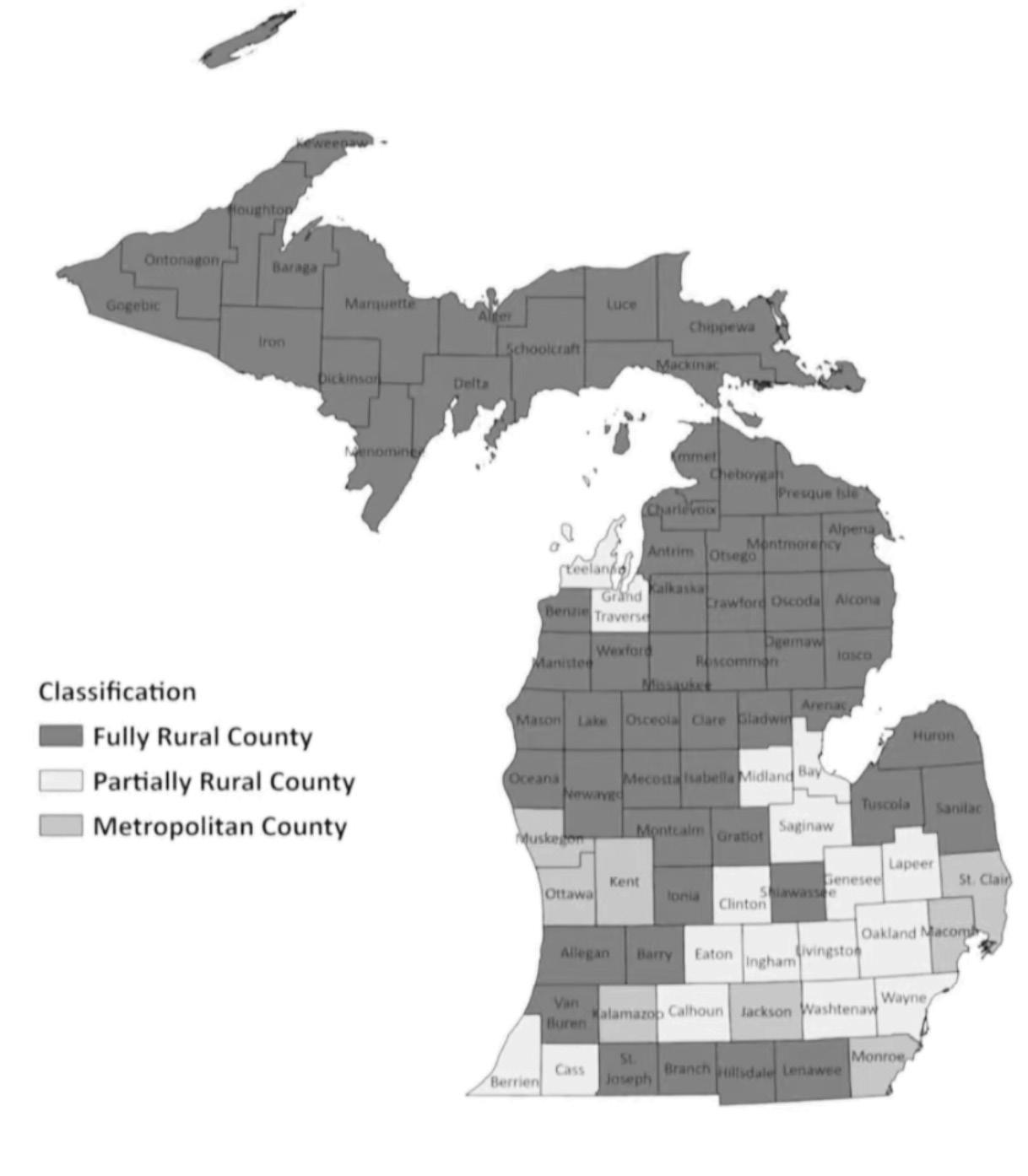
Michigan is set to receive about $173 million from the federal government for healthcare in rural communities. Oakland and Wayne counties will be eligible to receive funds, as they are designated as “partially rural.” But Jackson and Kalamazoo counties will be ineligible, since they were labeled “metropolitan.”
“It’s completely insane,” Wortz said.
The Centers for Medicare & Medicaid Services, the federal agency administering the rural funds, did not define “rural,” said Beth Nagel, senior deputy director of Michigan Department of Health & Human Services.
“Instead, they said, ‘You know your state best.’ You tell us,” Nagel told the Michigan House Appropriations Committee Jan. 21.
Nagel said the MDHHS decided to use a classification system created by the Federal Office of Rural Health Policy. That criteria created 75 rural counties, including 17 partially rural counties.
Smaller rural hospitals will be at a disadvantage to larger hospitals when applying for grants, Wortz said.
“Large hospitals that are in larger metropolitan areas — they have grant writers,” Wortz said. “So this is probably going to be a great opportunity for them because they already have full-time grant writers. They can apply for these grants. Meanwhile, small rural hospitals, who are on a shoestring budget already, now have to fight for these funds.”
The state’s health agency will take about $19 million for bureaucratic overhead, Wortz said.
“If you took that amount alone, the $19 million, and divided it by the 73 rural hospitals in Michigan, that’s
tals all across the state, including hospitals in Wayne and Oakland County, the highest populated counties in our
if the MDHHS hadn’t fumbled the application for federal funds.
“We’re at the bottom of the
by CMS. Ohio will receive about $202 million, ranking 26th.
Kyrsten Newlon, director
$260,000 each hospital could receive,” Wortz said. “That money is getting taken by a bureaucratic office in Lansing. And then you take the remainder of the $173 million we were awarded, and hospi-
state, now get access to those funds because of the way the department labeled them as semi-rural.”
Wortz also said the total number — $173 million — could have been much larger
amount of funds we received,” Wortz said. Michigan ranks 43rd out of 50 states in the amount of funding it will receive from the Rural Health Transformation Program, administered
of communications for Hillsdale Hospital, said this could be due to the application the MDHHS sent to the federal government.
“We were very discouraged by the application that MDHHS submitted, because it didn’t address the true needs of rural hospitals in Michigan,” Newlon said. “We’re nervous that that’s happening in all of the states across the nation.”
J.J. Hodshire, president of Hillsdale Hospital, served on a Michigan Health and Hospital Association committee that provided recommendations for the state health agency’s application for federal money. But the MDHHS ignored MHA’s suggestions.
“When they submitted their application, it basically didn’t take any of our recommendations into account,” Newlon said.
She said the MHA’s recommendations aimed to fill gaps in access to healthcare created by Medicaid reforms in the One Big Beautiful Bill Act — the Rural Health Transformation Fund’s original purpose.
“The actual application that was submitted was really targeted at things like new technology, new programs. Great in theory,” Newlon said. “It’s exciting to think about where healthcare might go in the future, but we can’t go there if we can’t keep our hospitals open.”
Newlon said Hillsdale Hospital will become a microcosm for the problems facing all health centers across rural Michigan.
“We have no intention of closing our doors,” Newlon said. “We’re here for our community. We are sustainable, and we’re in a good place, but there are certain services that are more at risk than others. We will not have the opportunities that we need to grow, the opportunities that we need to expand services for more people to access this care.”
Whitmer signs school cellphone ban into law
By Adriana Azarian AssistAnt Editor
Smartphone usage will be restricted in public schools starting next fall after Michigan Gov. Gretchen Whitmer, a Democrat, signed House and Senate bills into law Feb. 10.
House Bill 4141, passed in January, bans smartphone usage across all grades during instructional time, with exceptions for phones without internet access, students with medical and learning needs, and in cases of emergencies. The Senate passed a separate bill, Senate Bill 495, ordering public schools and districts to implement plans for the handling of emergency situations in schools.
“There isn’t a teacher, school administrator, or parent out there that doesn’t know that learning and scrolling on your smartphone are incompatible,”
it was a great way to start off the legislative year with a big, overwhelming bipartisan win in both chambers, and it will really help students by eliminating smartphone distractions during instruction time.”
Tisdel first sponsored a House bill to restrict cellphone use in schools in June 2023. He previously intended the bill to prohibit cellphones completely for elementary schoolers, from the beginning to the end of the school day for middle schoolers, and during instructional time for high schoolers.
Tisdel worked with Dem -
requests usage for educational purposes,” Rep. Jennifer Wortz, who represents Hillsdale and Branch counties, said in a statement to The Collegian.
Alexis Zeiler, a chemistry and physical education teacher at Jonesville High School, said her school does not allow cellphones in the classroom. She said she has seen a “net positive” effect on students since the school implemented the ban two years ago.
“From my perspective, teaching with and without cellphones in the classroom, there is a dramatic difference.”
Republican Rep. Mark Tisdel, who represents Rochester and Rochester Hills and first sponsored the House bill, told The Collegian.
Tisdel’s bill passed in the House 99-10 and in the Senate 34-1.
“It involved a lot of other people on both sides of the aisle. The governor enthusiastically endorsed the idea and actually asked for bipartisan legislation in her last State of the State,” Tisdel said. “So all the pieces fell together, and
If the planning commission does not approve the project, Ranger could ask a state regulatory agency — the Michigan Public Service Commission — to override the local opposition, under a state law that took effect in late 2024.
Brady Friss, a development manager for Ranger Power overseeing the Heartwood II project, told The Collegian Jan. 29 that asking the state commission to override the local authority is a “last resort.” Friss said he couldn’t say “with 100% certainty” that going to the MSPC is “totally off the table,” but it is not the company’s intention to use it.
“We’re committed to permitting locally,” Friss said late last month. “That said, the state process exists, but we don’t intend to use it.”
The full township board took the first step to prevent this override at a meeting Monday. The body voted unanimously to contract a Portage-based township law firm, Bauckham, Thall, Seeber, Kaufman & Koches P.C., to help draft a zoning ordinance that would make it harder for the company to build the project or for the state to override.
ocrat Sen. Dayna Polehanki, chair of the Senate Education Committee, to compromise and prohibit cellphones and communication devices only during instructional time for all grades, with allowances during passing periods and other non-educational times.
The bill also makes exceptions for the use of cellphones for educational reasons and for emergencies
“This bill addresses some of the concerns districts and parents had in regards to allowing cellphone usage during an emergency or a class assignment in which a teacher
“From my perspective, teaching with and without cellphones in the classroom, there is a dramatic difference as far as student concentration and how much more classwork we get through. There’s less drama. There’s less bullying. There’s less distractions,” Zeiler said.
“There’s less teachers having to take time to chase down kids that are on social media or some other inappropriate thing they’re doing.”
Tisdel said he is following up on the bill with two more House bills, one that would require age verification and a parent or guardian to consent to social media terms and conditions, and another that would impose a 32% excise tax on minors purchasing smartphones.
Many residents — including State Rep. Jennifer Wortz, a Republican who represents parts of Hillsdale and Branch counties — have urged the township board to hire a law firm that could help establish a Compatible Renewable Energy Ordinance, or CREO. This type of ordinance, Wortz, Oleszkowicz, and others have said, would let the township set its own zoning rules for building new renewable energy facilities.
If adopted, a CREO would make it more difficult for the company and state agency to override a potential rejection by Fayette Township’s plan -
ning commission.
Planning Commission
Chairman Jane Munson said at the Tuesday meeting that she and other members of the planning commission had met with attorneys from the firm earlier Tuesday. But she said they didn’t discuss when the attorneys could deliver a draft of the CREO, because the firm wants to meet with the full board first, likely on Monday.
“It’s not too late,” Munson told the crowd. “This project has not even been reviewed or looked at.”
‘Shop till you drop’: Marshalls set to open in early March.
Faith Miller | Collegian
Residents say library cards are worth the cost
By Elizabeth Caneday CollEgiAn FrEEl AnCEr
Each library card at the Hillsdale Community Library costs around $125 in taxes each year, according to data from the Library of Michigan — but residents say the cards are worth the cost.
Each of the approximately 1,200 active library cards from the Hillsdale Community Library unlocks access to a collection of more than 50,000 physical items, from books to movies to power tools. Residents of the parts of Hillsdale County qualify for a free library card.
The combined population of the City of Hillsdale, Jefferson Township, and Hillsdale Town ship in 2024 was 13,364, ac cording to the Cen sus Bu reau. Only about 8.9% of the popu lation has library cards.
in Hillsdale since 2016, said she agreed that library resources help families.
“I have young children,” Case said. “To be exposed to more and more words is huge for learning to read.”
Case said she and her four children have visited the library at least once a week for almost nine years. Peter, Case’s 8-year-old son, has a library card of his own. He said he appreciates the library’s scavenger hunts.
“It’s really fun to be able to get books and look at them,” he said. “Usually we’re all doing the scavenger hunt, and I find books.”
In addition to supporting local families, Case said librar-
“There’s something for everybody.”
Another benefit of Hillsdale Community Library is its “Library of Things,” according to Dobski. Patrons can check out power tools, such as circular saws and drills, for home improvement and other do-ityourself projects.
“Things that somebody might need only one time that they don’t want to have to invest the $100 or so into,” Dobski said. “They can borrow it here just one time, and it’s entirely free.”
Library Director Maurine McCourry said another benefit of public libraries is simply the books’ physical existence. Online bookshops and platforms often allow writers and publishing houses to update their books after publication, so McCourry said having a first edition is valuable.
A Michigan Enjoyer article recently called for library reform to block additional tax money going to libraries. The article reported Ann Arbor District Library cards cost $348 each, coming from taxpayer revenue, despite only half of the 123,000 residents using the library’s resources.
“Our number might look like we just have 1,200 library cards, but we have a lot of families that have just one library card,” said Rebekah Dobski, the library director at Hillsdale Community Library. “We look at it like one card supports a whole family.”
Dobski said families often use the library to supplement their reading, which supports children’s literacy.
Jackie Case, who has lived
ies also add value to communities as gathering places.
“Our library kind of functions as a community center, because we don’t have one in town,” Case said. “They do so much more than just what you would think of for a library.”
Dobski said the library has been making an effort to organize more programs that bring the community together over the last few years. In response to a need the board perceived within the community, a group for homeschool families has recently been added to the library calendar. There, according to Dobski, more experienced families can give advice to newer homeschoolers.
“A lot of things happen at the library,” Dobski said.
“Physical books matter because they’re a permanent record. A digital record can be changed,” McCourry said. “For a public library, having that physical item on the shelf the way it was published is something you’re not necessarily going to get from Overdrive or Amazon. Amazon has changed the text of books that they sell. You might buy a copy on Amazon, and what ends up in your Kindle is not what you originally thought. It’s been sanitized.”
Mary Rogers, a long-time Hillsdale resident, said she thinks the Hillsdale Community Library is indispensable.
“As a card-holding member of the library for 69 years, I think the library is marvelous,” Rogers said. “I couldn’t live without it.”
Solar from A1
Three representatives from Ranger Power (left) with two planning commission members (right). Thomas m cKenna | c ollegian
Steve Oleszkowicz speaks against the proposed solar farm. Thomas m cKenna | c ollegian
Illustration by Caroline Kurt.
Undefeated to start the spring season SportS
Baseball
Two late-game rallies secure wins
By Christian Papillon Assistant Editor
Thanks to two late-game rallies, the Hillsdale baseball team won two of three games on the road against Lincoln Memorial University in Harrogate, Tennessee Feb. 6-8, lifting its season record to 3-3.
“We are learning more and more about our team each week and the type of competitors we are,” head coach Tom Vessella said. “I’m really proud of how we maintained an even keel despite being down for most of the se ries and simply played our game until the end.” In the first game, the Chargers found them selves down 7-3 after sev en innings of play.
balls, some of which have been caught, but with all these hard hits they stack together and lead to us scoring often and in big chunks.”
The Chargers were tied 3-3 after eight innings in the second game, but RBI singles from Tenuta, freshman Ryan Wiehe, and freshman Drew Law resulted in a four-run ninth inning and a 7-3 win.
The Chargers got two runs back in the eighth inning on doubles from sophomores Jake Figman and Billy Porotzky, and a single from junior Aaron Jasiak.
Junior Rocco Tenuta started the ninth inning with a double. After a strikeout and a walk, Figman tied the game with a two-run double. The Chargers took the lead for good when sophomore Logan Dichler hit a two-run double of his own.
A single by Jasiak and a double by sophomore Gaard Swenson capped off the 11-7 win for the Chargers.
“We have been putting together a lot of good at-bats, which leads to us stringing hits together and having big innings,” Figman said. “We have had a lot of hard-hit
Games
“After coming from behind in two of the games, we learned that every person on the roster is capable of delivering a clutch hit when we need it most,” Vessella said. “Seeing how this team rallied around each other in the close ball games shows us that we can handle any situation that we come up against.”
The Chargers couldn’t complete the sweep in the third game and took a 9-4 loss.
“Our offense went really well this series,” Swenson said. “Our defense continued to play error-free for the most part and make the routine plays, along with the difficult ones. Our pitchers struggled a little bit to find the zone in the last game, but the team isn't overly worried about it. Once we make that adjustment for the next series, we will be very difficult to beat.”
The Chargers will play their next series against Grand Valley State University Feb. 27-March 1 in Marion, Illinois.
Women's Tennis
By Sophia Bryant Assistant Editor
The Charger women’s tennis team improved its record to 4-0 after beating Goshen College 5-2 on Feb. 7 and Saginaw Valley State University 5-2 on Feb. 8.
“We had two matches that we could have let slip away from us, but we really took advantage of all of our opportunities, and we just keep coming out and trying to do our best every day,” head coach Melanie Zampardo said.
At No. 1 singles, junior Ané Dannhauser beat Goshen 6-1, 6-2, and Saginaw 7-6, 6-3, earning her Great Midwest Athletic Conference Women’s Tennis Player of the Week for the seventh time in her career.
“G-MAC athlete of the week is always a wonderful surprise,” Dannhauser said. “I was with my team when I found out, and we could all celebrate and just recognize that all the hard work is paying off. But the plan is to just take it one match at a time.”
Men's Tennis
The team won the doubles point in both matches. At one point in the match against Saginaw, the Chargers were down on all three doubles courts, but they came back to win the doubles point and win the match.
“There was a point where all three courts were down, and we just weren’t playing our best,” Zampardo said. “But at the same time, our energy was so good that I knew that we were gonna turn around. I never had a doubt in my mind.”
Dannhauser and senior Megan Hackman beat Saginaw 7-5 at the No. 1 doubles match.
have always been good, and to beat them was just amazing.”
Sophomore Briana Rees and senior Bella Spinazze lost to Saginaw 4-6 at No. 2 doubles, while freshman Dimitra Papastavrou and sophomore Julia Zlateva beat Saginaw 7-6 at No. 3 doubles.
“Our energy was so good that I knew we were gonna turn around.”
“This was the best outcome from the weekend I could have possibly asked for, to be honest,” Dannhauser said. “We were kind of nervous going up against Saginaw because they
Freshman Esther Sura played her singles match against Saginaw on a court off to the side, beating her opponent 7-5, 6-0. A curtain divided Sura’s court from the rest of the courts, making it so that Sura couldn’t see the rest of her team’s matches.
“Mentally, that’s a really tough battle to go through, and just to not know what’s going on on the other side, but to just know that you have to hunker down and do your best,” Zampardo said. “And she did. She killed it. She had a great match.”
Sura said the team encouraged each other this weekend to battle through the tough matches against Goshen and Saginaw and come back when they were down.
“Every meet we have, we have built off of it coming into the next one,” Sura said. “We just keep increasing the energy, the cheering, the intensity, we just keep building up. There is no limit. There is no good enough, we just keep on going up and we keep on building.”
Against Goshen, Dannhauser and Hackman won 6-2 at No. 1 doubles, Rees and Spinazze won 6-4 at No. 2, and Papastavrou and Zlateva won 6-2 at No. 3. At No. 2 and No. 5 singles, Rees and Zlateva won their matches against Goshen and Saginaw, respectively. At No. 6 singles, Sura also won her match against Goshen.
The Chargers will face Purdue University Northwest in their next match at home Feb. 14 at 12 p.m.
Cretu and Hammond carry despite loss
By Jamie Parsons Assistant Editor
Freshman Patrick Cretu
earned the Hillsdale men’s tennis team its second and last point from a 6-2, 6-4, win against Goshen College at No. 5 singles, with the overall match ending in a 5-2 loss for the Chargers at home Feb. 7.
“Patrick is doing a great job,” head coach Keith Turner said. “He keeps improving every week. He’s a guy that I hope I can move further up in the lineup as the season progresses.”
The Chargers lost all three doubles matches, the doubles point, and four singles matches against the Maple Leafs on Saturday. The team is now 2-1 on the season.
At doubles, junior Ellis Klanduch and sophomore Ryan Papazov competed in the top match, falling to their opponents 6-3.
Papazov said he and Klanduch have a friendship on and off the court that allows them to be good partners.
“We really try to motivate one another, especially if one of us is struggling on the day or struggling in the moment,” Papazov said. “We are able to be there for one another and try to get the other going.”
Papazov also competed in the top singles match, winning the first set 6-3, losing the second set 6-2, and losing the third set 6-3 to hand over the win to Goshen.
Papazov said he was able to get ahead early on in his
singles match but lost focus. Going into the next match, he wants to be more intentional with his decision-making and step through the ball more.
“It’s a lot to work on, but I know we’ve got the week ahead of us practice-wise, we are going to be on the court every day, and it’s something I will be focusing on in practice,” Papazov said.
At No. 2 singles, sophomore Sam Plys played his opponent to a third-set tiebreaker, falling short to finish the match 6-3, 6-2, 7-6(6).
“When playing a tiebreaker set, usually I try to focus on going for my shots and being more aggressive, but I did not do that to the best of my ability last week,” Plys said.
Before Cretu won at No. 5
Turner said Cretu and Hammond’s singles plays were highlights of the match, but the team’s overall performance against the Maple Leafs revealed that there are still areas the Chargers need to improve in.
“We need to make more returns and lessen the amount of unforced errors in both singles and doubles,” Turner said.
The Chargers will compete against Purdue University Northwest in their fourth straight home match Feb. 14 at 5 p.m.
singles, junior Henry Hammond secured the first point for Hillsdale at No. 3 singles, defeating his opponent 6-3, 6-3.
Junior Rocco Tenuta runs the bases during their competition last week. Courtesy | Ashley Van Hoose
Feature Track and Field
From track to field, PRs abound
By Francesca Cella Assistant Editor
Senior Ben Haas won the men’s weight throw with a mark of 21.84 meters, and sophomore Dominic Scharer became the third athlete in Hillsdale College history to throw over 21 meters, at the Grand Valley State University Mike Lints Invite Feb. 7. Scharer placed third with a throw of 21.09 meters and now ranks fifth in NCAA Division II weight throw. Junior Dimitry Ermakov threw 18.42 meters, placing ninth.
Women’s weight throw also saw strong performances, with junior Regan Wight throwing 18.41 meters and beating the record of 17.53 meters she set at the last meet. Junior Amelia Lutz won shot put with a mark of 15.80 meters and threw 15.93 meters in weight throw, beating her former record.
Senior Alfonso Garcia also broke his personal record in triple jump at GVSU and came in first with a mark of 14.13 meters, beating his previous record set in 2024 by nearly half a meter. Garcia said he’s been aiming to hit 14 meters for a while.
“This was the big goal for me all season, and I got it really early, so I guess next would be provisionals, which is normally top 40 in the nation,” Garcia said. “That’s 14.40, but I’d like to break 14.60 or 14.70 by the end of the season, and I think that’s super doable after this weekend.”
On track, freshman Anna Roessner beat her personal record in the 200-meter with a time of 24.31, the second fastest indoor track time in Hillsdale College history. Senior Lucy Minning placed fourth in the 200m with a time of 24.63.
Mining, Roessner, senior Francesca Federici, and freshman Jessica Church won the 4x400-meter relay in 3:51.09. Federici said she is savoring her last season running track.
“I’m not going to get to run fast like this after this season, so I’m focusing a lot on enjoying it and having fun during races and soaking in my time as a student athlete,” Federici said. “The sprint squad had a really good performance this week-
end –– so many PR’s. We’re all excited to go to conference and compete even harder.”
Senior Nathaniel Osborne won the 5,000-meter with a personal best of 15:03.50, followed by senior Emil Schlueter, who placed second with a time of 15:04.84. Sophomore Will Winsor and freshman Jefferson Regitz came in sixth and seventh with times of 15:14.63 and 15:20.34, respectively.
Freshman John Richardson beat his personal best in the mile, placing ninth with a time of 4:14.39. Freshman Henry Thuet came in 11th at 4:26.92.
Sophomore Baelyn Zitzmann won Hillsdale’s pentathlon Midweek Multi Invite Feb. 6 with a score of 3,483 points, followed by freshman Bristol Whitley, who came in second with 3,097 and broke her personal record.
Zitzmann said she performed so well because she has been talking to assistant track and field coach Justin Fawley about how she can improve.
“It was a lot of coach and I having really intentional conversations about what we were seeing,” Zitzmann said. “I got some really good practice this past week, and then getting to do it at home with my friends and having the good practice going into it –– I just felt more confident and more excited to do it.”
Some sprinters and jumpers competed in the Michigan Invitational hosted by the University of Michigan, where freshman Watson Magwenzi broke his personal record in the preliminary 60-meter dash with a time of 6.94. He placed seventh in the finals with a time of 6.99.
Magwenzi said he wants to cut more time from his race and hopes to break the school record.
“My short-term goal is just getting better than I was yesterday –– one percent better,” Magwenzi said. “For long-term goals, beating a school record, but that’s up to God. It’s his timing, and I trust that he does what’s best for me.”
The Chargers will return to GVSU for the Big Meet Feb. 13-14.
Jiu-jitsu resurrected after hiatus
By Charles Hickey Collegian Reporter
The Hillsdale Brazilian Jiu-Jitsu Club returned to campus last fall after a yearlong hiatus.
Club President and sophomore Finnian Macaulay said he restarted the club with two other students after taking a one-credit course on Brazilian Jiu-Jitsu from the Sports Studies department.
“I saw that there was so much interest,” Macaulay said. “Many people in the class expressed the desire to participate in a jiu-jitsu club.”
Macaulay said he was also encouraged by Mike Cantrell, lead instructor of the class.
“I want jiu-jitsu to be a thing on campus,” Cantrell said. “I expressed that I wanted it to be happening outside of me, and not just a class that I teach. But the student who originally started the club stepped down from running it, and nobody else stepped up, so the club sat dormant for two semesters.”
Macaulay said he wanted to introduce jiu-jitsu to more people on campus and establish the sport on a more solid footing.
“Coach Mike does so much for jiu-jitsu on campus, and he heads all the classes,” Macaulay said. “But I wanted to set up something that could survive beyond one or two individuals. Coach Mike agreed that he wanted a club or some sort of organization that could popularize jiu-jitsu as a skill and an art on campus, and enable it to survive beyond us.”
According to Macaulay, another motivation to restart the
club was the desire to compete in tournaments, which the one-credit class does not do.
“Tournaments are like a piano recital for somebody who plays piano,” Macaulay said. “You might know a piece, but performing in front of people is a whole different ball game, and it helps you test your skills and courage. You get to test that against new people when you go to a tournament, you get documented recognition, and it's a great way to improve.”
Junior Andriy Pasichnyk, the club’s vice president, said the sport is a great way to become more physically fit and agile.
“That’s not something that you really get from weightlifting,” Pasichnyk said. “All you get from that is big muscles and tight muscles. You don't learn how your body moves, and you don't really learn the limits of your mobility.”
Macaulay said the objective in jiu-jitsu is to submit or incapacitate the opponent entirely through grappling.
“When you watch a UFC fight — when they’re not striking each other — they’re grabbing each other’s arms and trying to take each other to the ground,” Macaulay said. “They’re choking each other and doing locks and submissions. That’s all jiu-jitsu.”
Macaulay said jiu-jitsu does resemble wrestling, but it also incorporates judo and other martial arts.
“It’s more universal,” Macaulay said. “It’s all grappling technique, with no striking. It’s a very sustainable way of practicing martial arts with-
out frequent injuries or concussions, and it’s a fun and competitive sport.”
Pasichnyk said the relatively low level of injury risk distinguished jiu-jitsu from other sports.
“You’re not getting hammered in the head like boxing,” Pasichnyk said. “Besides that, it’s just cooler. It’s cool to choke people and threaten to break their arms. You might get pinned in wrestling but that’s it. A wrestler won’t threaten to put you to sleep.”
According to Macaulay, jiu-jitsu could help students become more capable in self-defense situations.
“There’s so much strategy and technique that is applicable and transferable to self defense,” Macaulay said. “While not everything you learn in jiu-jitsu would be useful on the streets, much of it would be helpful to know if you happen to find yourself in a fight.”
Cantrell and Pasichnyk both recommended that interested students with no martial arts experience either audit or take the introductory
one-credit SSD class before joining the club.
“You need that time,” Macaulay said. “You need that experience. Join the club after you hop in the one-credit. You shouldn’t rely on the club to teach you the most basic fundamentals.”
“Having a little experience is enough that you can go and learn and improve and contribute to the level in the club,” Cantrell said. “If you wrestled in high school, good enough. You did two months of jiu-jitsu back home, good enough. The club’s happy to have you. But if you expect to be taught from scratch, that’s not what the club is doing. For the first timers’ class, you don’t need anything — except some courage.”
Cantrell stressed that no level of experience is required for the one-credit introductory class.
“We have every body type, and we start all the way from the beginning,” Cantrell said. “So there’s basically no prerequisites except the willingness to try at something that’s unapologetically difficult.”
Macaulay said the goal of the club is to survive past the current crop of students.
“We want to grow and to help more Hillsdale students gain a foundation for fitness and self-defense,” Macaulay said.
Charger Chatter
What is your favorite flavor of sunflower seed and which do you think is the worst?
I like dill pickle the most, and I'm not really a fan of honey mustard.
If you could be really good at any winter Olympic sport, what would it be? The alpine skiing.
What class is Hillsdale missing?
A skydiving class. I'd love to take it and go skydiving.
What word would you remove from the English language? Aspect.
What event would you add to the Winter Olympics? Ice Fishing.
If you could play a role in any movie, whose role would you play? I would love to play Ken Miles in "Ford v Ferrari."
If you could only eat one meal for the rest of your life, what would it be? Rice and seasoned ground beef.
Which major league player would you most like to take hitting lessons from? As a Minnesota Twins fan, I'd say Byron Buxton.
Compiled by Charles Kennedy
Photo Courtesy | Hillsdale College Athletic Department
The jiu-jitsu team at the Lansing Winter Championship last year. Courtesy | Frederick Woodward
Junior Andriy Pasichnyk beat his competitor last year. Courtesy | Frederick Woodward
C harger S port S
Women's Basketball
Chargers stay undefeated at home
By Robert Matteson Collegian Reporter
The Chargers defeated Tiffin University 76-73 in overtime behind junior forward Savannah Smith’s 25 points Feb. 5, and defeated Ohio Dominican University 63-52 led by senior guard Emma Ruhlman’s second double-double of the season Feb. 7.
Hillsdale improved to 12-8 overall, 8-6 in Great Midwest Athletic Conference play, and remains undefeated at home. The Chargers moved up to sixth in the conference standings.
“There’s something special about playing on our home court in front of all our people, and the girls take a lot of pride in that,” head coach Brianna Brennan said.
Against the Tiffin Dragons, Ruhlman contributed 8 points and set a season-high with 15 rebounds.
“Rebounding is my focus every game,” Ruhlman said. “You can’t control your shooting performance, but you can control your effort on the boards.”
Sophomore guard Sarah Aleknavicius added 11 points, including the game-tying basket with 12 seconds remaining in regulation, as well as seven rebounds and three blocks.
In overtime, the Chargers held the Dragons to 2-8 shooting from the floor. Hillsdale was 2-2 from three-point range and 7-8 from the freethrow line.
“An overtime win is huge,” Savannah Smith said. “It was our first overtime of the season, but it proves that we can stick it out no matter how long the game takes.”
Junior guard
Annalise Pietrzyk added 15 points and six rebounds, and freshman point guard Maddie Smith contributed six assists.
Against the Panthers, Ruhlman
matched her season-high of 15 rebounds and also scored 15 points.
“Emma’s effort and physicality on the boards right now is unmatched,” Brennan said. “It gives our team so much energy and second opportunities.”
Savannah Smith put up 15 points, her fourth game of at least 15 points in her last five games, and Pietrzyk added 5 points and eight rebounds.
“Savannah Smith had two incredible performances for us,” Brennan said. “She scored the ball with ease and couldn't be stopped. She is a strong post player with a beautiful shot and used both this week in our victories.”
The Chargers held Ohio Dominican to 32% shooting from the floor.
“We played very good defense this week, and that’s something that we can always control and take with us on the road,” Ruhlman said.
Hillsdale will be back on the road to play Lake Erie College Feb. 12 and Ashland University Feb. 14.
“It’s going to be crucial that we carry this momentum on the road,” Brennan said. “We have to build off of it, and fine-tune the areas we need to so we can be playing our best basketball come March.”
Stonebraker gets
By Evelyn Shurtliff Collegian Freelancer
The Chargers men’s basketball team went 1-1 this weekend, beating Tiffin University 67-59 Feb. 5 and falling to Ohio Dominican 76-71 Feb. 7 at home, making its season record 9-13.
Sophomore forward Connor Stonebraker made his first career start for the Chargers in their game against Tiffin, leading the team in scoring with 14 points. Junior forward Caleb Glaser added 11 points, and senior guard Cole McWhinnie, freshman forward Tommy Morgan, and freshman guard Braylon Morris each scored 10 points.
The Chargers also made 44% of their shots in the first half and 86% of free throws while keeping Tiffin’s completion rate at 30.5%. At the end of the half, the Chargers were up by 11 points.
“I believe that offensively, we did well at playing the game unselfishly,” Morris said.
“Always trying to make the extra pass, always trying to get a good screen to get someone open. Defensively, we did well at playing in the gaps. Tiffin is
first start despite
a team that wants to drive and get into the gaps. We did well that game at understanding that and playing in the gaps to force them to shoot 3s or tough 2s.”
The Chargers maintained their lead through the second half, making nine 3-pointers with six different players hitting at least one to help gain separation from Tiffin. Hillsdale also limited its turnovers, with just nine on the night, and turned 14 Tiffin turnovers into 11 points.
After winning against Tiffin, the Chargers faced Ohio Dominican in their second home game of the week. The Chargers were down 38-23 at the end of the first half.
3s, which we were not able to match on the other end.”
Despite their early deficit, the Chargers fought to recover in the second half. They trailed 55-32 with 13:57 remaining, but over the subsequent 10 minutes, they pieced together a 34-10 run, taking a 66-65 lead with less than four minutes to go. McWhinnie took charge of the game during that stretch, hitting four 3-pointers and scoring 15 of his 17 points to help the Chargers make their way back into the game.
“You really have to take it week to week, win or lose. Each week is a new opportunity.”
“I think the big challenge against Ohio Dominican was defending the 3-point line,” Stonebraker said. “They do a great job at running sets and finding guys for open
“Although we dug ourselves a hole early in the game, the team stuck together to give ourselves a chance to win in the end,” Stonebraker said. “We were not able to pull it out, but I’m super proud of the effort everyone gave to crawl back into it.”
The Chargers’ comeback was cut short with Ohio Dominican reclaiming its lead in
loss
the last few minutes with a few back-to-back shots.
“You really have to take it week to week, win or lose,” head coach Keven Bradley said. “Each week is a new opportunity, and this goes for game-to-game as well. Every game is a new opportunity for us to get back on the floor, grow better, learn and improve, and get a little bit more consistent.”
Despite the effort they gave in the second half, the Chargers lost 76-71 to Ohio Dominican.
“Sports are all about how teams handle both failure and success during the season,” Stonebraker said. “This year, I think the team has done a good job of bouncing back from a tough loss, but we have not yet been able to string a few games together.”
The Chargers are on the road this week, competing at Lake Erie College Feb. 12 and Ashland University Feb. 14.
Softball
Season opens 2-3
By Blake Schaper Collegian Freelancer
Sophomore pitcher Grace Harris threw a complete game to lead the Hillsdale softball team to a 4-1 victory against the defending national champion University of Texas-Tyler to open their season Feb. 6, but fell to a 2-3 record by the end of the UT-Tyler Invite in Texas.
In the UT-Tyler Invite, the Chargers competed against the University of Texas-Tyler, Northeastern State University, and New Mexico Highlands University Feb. 6-8.
“Our first win in the season against Texas Tyler was thanks to Grace Harris,” head coach Kyle Gross said.
“Our strategy was to throw Gracie who throws a command spin at pitcher to throw the op posing team off. Our offense kept putting pressure on Tyler until we scored in the seventh inning.”
man did great for their first weekend out. All of them had a chance to get their feet dirty. Cayla made no errors on defense. Maggie Hayward got the first RBI, and Katie Jonas pitched a few good innings. They all have been looking to contribute in any way they can.”
Danchak said she was positive about the first game against UT-Tyler.
The following day Hillsdale played two games, the first game was against Northeastern State and ended in a loss for the Chargers. The second game was a rematch against UT-Tyler where the Chargers lost 13-7.
“Texas Tyler made adjustments the second time through as a championship team does,” Gross said. “But we still scored seven runs against them.”
On the third day of competitions, the Chargers led Northeastern State 7-3, going into the bottom of the fifth inning, but fell 9-7 after allowing three runs in both the fifth and sixth innings.
Thanks to an RBI single by senior Emma Sather, and an RBI groundout by junior Medleigh Danchak, the Chargers secured a 5-3 eight-inning win against New Mexico Highlands to close out the series.
Despite losing both games to Northeastern State, Gross said the team’s defense shone during both matches.
“Northeastern State came in undefeated this season with a new coach,” Gross said. “They stole 23 bases the opening weekend, but they had none against us. We threw them out twice and they did not steal the bases. It was huge containing them in our games.”
Although many seniors graduated, Gross said he was proud of the freshmen for stepping up and continuing to maintain the excellence of the team.
“Filling shoes is really tough,” Gross said. “The fresh-
“During the first game with UT-Tyler, I hit a double during the seventh inning which was very exciting because I was able to keep the rally going after Anna Chellman’s single,” Danchak said. “Gracie Harris was the MVP of the first game with UT-Tyler because she pitched a one hitter against the No. 1 ranked team.” Danchak said the spirit of the Hillsdale softball team motivated each competitor to do their best and achieve success.
“Our team did a great job of having high energy this weekend which helped our offense to produce,” Danchak said.
“We kept our bats hot and a lot of girls stepped up in big moments. We need to work on executing our short game, such as with bunting, base running, etc. But I appreciated that we started aggressive with these aspects.”
Harris said she enjoyed showing her skills against the No. 1 team in the nation, throwing a seventh inning complete game against UT-Tyler, as well as a one-hitter.
Harris said she noticed many of the team’s obstacles and is ready to work with the team to fix them before the next tournament.
“If we lost a game, it was usually due to being outhit or missing cues by the pitchers, not to mention the competition was very good,” Harris said.
“Baserunning is something we now know we should work on more. As a pitcher I saw what pitches were really good and what I need to improve.” Harris sees herself surrounded by teammates with talent, and sees great potential in this team’s upcoming games.
“We have a lot of talent so I’m really excited to keep working and see how we do in the Great Midwest Athletic Conference play,” Harris said. “I think we will be really good as long as we all continue to work really hard.”
The Chargers will next compete in the Lewis Dome Invitational Feb. 20-22.
Men's Basketball
Junior Savannah Smith shoots inside the paint during the overtime win. Courtesy | Ashley Van Hoose
Junior Sydney Davis celebrates under the Texas sun. Courtesy | Lang White Photography
Team celebrates a 3-pointer. Courtesy | Ashley Van Hoose
Hillsdale in Versailles: Who was the belle of the ball?
By Tayte Christensen Features eDitor
While some men chose their cleanest dress shirt and most recently ironed suit as their outfit for a Versailles-themed President’s Ball Feb. 7, senior Erik Teder chose to be a mirror.
“I wanted to do something related to the architecture or history of Versailles,” Teder said. “I thought about being a beheaded Louis XVI, but I didn’t have time to pull that together.”
Instead, Teder had to settle on a more attainable outfit for the Student Activities Board’s annual event, and the last President’s Ball of his Hillsdale career. Upon remembering a discussion of Versaille’s Hall of Mirrors in an art class taught by Assistant Professor of Art
Christina Chakalova, Teder knew he’d found his answer.
“This room was one of the most extravagant displays of wealth in the palace, because importing huge Venetian plate mirrors was unthinkably expensive,” Teder said. “Dressing as an escaped mirror seemed like the perfect mix of a historical curiosity and a conversation starter.”
And a conversation starter it was, as Teder said his ensemble, which he made out of foam insulation and aluminum foil, received a lot of attention throughout the evening as students approached him and questioned what he was wearing.
“The most common reaction was a mixture of surprise and confusion,” Teder said. “I quickly learned that the architecture
of Versailles is not as commonly known as I was expecting.”
Teder said he then explained his costume and invited onlookers to gaze into the mirror and tell him what they saw. This, Teder said, led to several amusing interactions.
“When I meet new people, I like to ask them to explain their life story in six words, à la Hemingway,” Teder said. “Being a mirror was the perfect excuse to ask people to reflect on their lives.”
The costume was clever and attention-grabbing, but Teder said it came with its setbacks.
“I didn’t keep the mirror on the entire night, because the foam insulation got warm and the whole apparatus made me about three times as wide as normal, and while this rigorously enforced personal space,
it became impractical,” Teder said.
While Teder’s costume was memorable, not all students took the same creative liberties with their President’s Ball outfits.
Senior Ava-Marie Papillon said she didn’t intentionally dress to the theme of the evening, but the dress she planned to wear — a light yellow ballgown — just happened to resemble Belle from Disney’s “Beauty and the Beast.”
“Before I knew the theme for the dance, I just knew that I had a yellow dress stashed away in my closet that I wanted to wear again,” Papillon said. “I had been told by many in the past that my yellow dress resembles Belle’s in ‘Beauty and the Beast,’ so I guess I always had it in the back of my mind that I could be Belle for the dance.”
Papillon, a French major, said she was excited to learn the theme of the event had French influence.
“When I heard that the President’s Ball theme was going to be Versailles, I was so excited and decided to lean into the theme by embracing the ‘Belleness’ of my dress and trying to do my hair like hers,” Papillon said. “I found it to be a happy coincidence that I was planning on being Belle for the dance and then the theme turned out to be French.”
For Papillon, the event was an excuse to give “second life” to a dress she bought for musical recitals several years ago.
“I generally don’t think too much about matching the theme because I am honestly
just so excited to have an occasion to dress up in a fancy dress,” Papillon said. “But this year was different for me because I actually owned a dress that really seemed to fit the theme.”
When it came to sophomore Samuel Baggott’s wardrobe for the night, he chose a historically accurate outfit: a maroon tailcoat with gold embroidery layered on top of a black and gold vest and a ruffled dress shirt.
“I definitely took inspiration from the theme in putting my outfit together,” Baggott said.
for SAB events, he had never purchased attire specifically for an event before this year’s President’s Ball. “This theme gave me an excuse to add to my wardrobe and bring smiles to a bunch of party-goers in the process,” Baggott said. “A win all the way around.”
“When I heard what the theme was I started looking for a ruffle dress shirt and a tailcoat, both of which I found on Amazon. With those pieces procured I just added a pair of black dress pants and shoes, and it was complete.” Baggott said while he typically tries to dress on theme
‘Pack for a weekend in an envelope’: Colloquium reflects on 1960s fashion
By Anna Broussard Design eDitor
In the 1960s, high fashion was paper clothes, according to Helen Jean, the keynote speaker at the third annual hybrid Hillsdale College Visual Arts Colloquium on Feb. 7.
The Colloquium, which was student-led by seniors Claire Bowers, Maggie McWhinnie, junior Maria Grazia Stroik, and sophomore Maria “Masha” Logvin, featured over Zoom, Helen Jean, the Jacquie Dorrance Curator of Fashion Design at the Phoenix Art Museum, and multiple student speakers.
Student speakers included Alessandra Vincelli from McGill University, Anne Wells from Benedictine College, Hillsdale seniors Oliver Beiser and Phaedra Kelley, and Hillsdale junior Mary Virginia Vietor from Hillsdale College.
Jean’s lecture, “Generation Paper: Fast Fashion of the 1960’s,” highlighted a unique fashion fad during this time period: pa-
per clothes. A collection of these clothes, displayed in the Phoenix Art Museum, represents the obsession with this trend during the 1960s.
“The mission of the collection really is to present clothing alongside artwork,” Jean said. “To really embolden that conversation about what is happening in the period. How, not only is art inspiring life, but how is life inspiring art?”
Jean said it began when the young started to differentiate themselves from the older generations in regard to style. Paper clothes, specifically paper dresses, were marketed toward the young based on what was trending.
“In the 1960s, youth had really started to establish their own style of dressing, rejecting what was really expected by their elders, and being very experimental,” Jean said. “They were the perfect audience for a mail-in campaign led by paper companies.”
Paper companies began
printing and designing dresses to be mailed to customers and mar keted as “disposable fashion.” The clothes were meant to be a state ment, inspir ing fashion to become political and representative of ideas or movements.
“This is a flash in the pan moment. It’s an op portunity to be outra geous,” Jean said. “It’s wearing a paper dress at a party. I mean, this is such an exciting time. This is a moment in time where the human body is becoming a billboard.”
The actual construc tion of the dresses was experimental and caught nationwide atten tion, with a variety of companies market
ing products through paper dresses. Seagram’s 7, Campbell’s Soup, and airplane companies came out with different designs. Although the dresses seemed to be a futuristic trend, they were impractical from the beginning,
“In inter-
views with a few people who I was able to find that actually wore these, they said the dresses were not comfortable,” Jean said.
“Again, they were exciting. This was to be part of a wild moment, not to be practical. Air-hostesses that I had the pleasure of interviewing joked that their repair kit was a roll of Scotch tape.”
Designers at the time were convinced the movement was a wave of the future, while others believed the materials could be used like regular clothes and sold for high prices. Ultimately, the paper dress trend ended a few years after it began, largely due to its impractical nature, Jean said.
“You can pack for a weekend and just take an envelope. You can travel around the world with just your purse or briefcase,” Jean said. “It ended because it wasn’t practical. These were not comfortable. They were not recyclable. This is the rise of Earth Day, which was established in 1970, and this was antithetical to wanting to save the planet.”
The colloquium provides an opportunity for students to meet artists or scholars who specialize in different areas of art and art history, according to Assistant Professor of Art Christina Chakalova.
“Part of being on the committee is understanding that it’s not just putting on the event,” Chakalova said. “It’s having a chance to network with art historians and do your best to reach out to them.”
Jean’s talk offered students a different perspective on the fashion industry as a whole, but also provided the interesting parts of its history. The colloquium is a great tradition that the Art department hopes to continue by highlighting elements of important art history, Stroik said.
“The board did a good job of publicizing the event,” Stroik said. “I am excited to keep it going. This year was the best we’ve had. Next year I hope to get our keynote speaker in person.”
Paper clothes were popular in the 1960s.
Courtesy | Maria grazia Stroik
Sophomores Joseph Diprima and Samuel Baggott take a picture at President’s Ball. Tayte Christensen | Collegian
Senior Ava-Marie Papillon as Belle. Tayte Christensen | Collegian
Less politics, more music: Keep ‘ICE
By Elaine Kutas SportS editor
Politics was more important than music during the 2026 Grammys.
Anti-Immigration and Customs Enforcement sentiment
Ssuffocated the atmosphere of celebrating the hard work and talent of today’s musicians.
Every person has the right to free speech and to express his beliefs, but using a platform to alienate people with differing beliefs will not cultivate a
DATES
from A1
musical culture for everyone to partake in. Bad Bunny, Shaboozy, Olivia Dean, Kehlani, and Billie Eilish’s statements during their acceptance speeches don’t spread awareness; they create division.
Bad Bunny — who won three
“The best first coffee date is Jilly Beans. I know, I know. Rough Draft is better in pretty much every category, but that’s exactly why you go to Jilly Beans. Avoid the crowds. It’s impossible to have a private conversation at Rough Draft.
For dinner, Hunt Club. Ed Sheeran is wrong. The club is the best place to find love. Also, if you don’t go for coffee or dinner, cinnamon rolls at Local Eatery are your best bet.
This is a little bit unconventional but I think it would fly: disc golf at Baw Beese is way too underused in general by Hillsdale students. If nothing else, it’s free.”
Jake Hamilton
“I think the best spot for a first date in Hillsdale is Toasted Mud — it’s the spot my girlfriend and I went on our first date. You go there and select a piece of pottery to paint; I suggest painting something with your date. If it is sunny out and the weather is warm, reserving kayaks from the Students Activities Office and doing that at Baw Beese is a
By Will Davis Collegian FreelanCer
“Wonder Man” is a hidden gem. Even with some plot frustrations, Marvel Spotlight’s latest show streaming on Disney+ is worth the watch.
Recent productions from Marvel set the bar incredibly low. Critics predicted “Wonder Man” would be a drawn out show about nothing; a half-hearted cash grab such as “She-Hulk” or “Ironheart.” Yet, after the first episode, “Wonder Man” seemed different.
Simon Williams (Yahya Abdul-Mateen II) was born with two gifts: acting and superpowers, the latter of which no one knows about. After the tragic incident of a superpowered actor called the Doorman, the government passes the Doorman Clause, making it illegal to be an actor while possessing superpowers. If Williams’ secret is exposed, his future as an actor is over.
Williams’ budding acting career is pathetic, mostly consisting of small, occasional roles on TV shows. But, after overhearing a
tip, he is given the acting opportunity of a lifetime — an audition as the lead role for an upcoming superhero movie: “Wonder Man.”
During the course of his audition, he strikes up a friendship with a seasoned actor who has a checkered past, Trevor Slattery (Ben Kingsley). Throughout the course of the show, Slattery becomes a mentor and a friend to Williams. With the stress of the audition process — as well as Slattery’s past catching up to him — Williams starts losing control of his powers. Williams isn’t a hero. The world isn’t in danger, and there isn’t even a clearly defined villain. Williams is a self-absorbed wannabe actor. He’s a lonely man who is constantly putting on a confident façade. The first time we are introduced to Williams, the song “Act Naturally” by Buck Owens plays. The lyrics “We’ll make a scene about a man that’s sad and lonely,” capture the theme of the show. The only times Williams seems truly himself is when he’s acting.
The Department of Damage
of his six nominations, including Album of the Year for “Debí Tirar Más Fotos” — commented about ICE during his acceptance of Best Música Urbana Album for the same record.
“Before I say thanks to God, I’m going to say ICE out,” Bad Bunny said. “We’re not savage, we’re not animals, we’re not aliens. We are humans, and we are Americans.”
Billie Eilish also used her platform for politics, as she barely even recognized the fact that she had just won Song of the Year for “WILDFLOWER.”
“As grateful as I feel, I feel like I don’t need to say anything but that no one is illegal on stolen land,” Eilish said.
She called for her fellow musicians to speak out against injustice and ended her speech with an enthusiastic profanity against ICE. Eilish wasn’t the only star to use strong language against ICE and the Trump administration. Kehlani, who won Best R&B Song, closed her ac-
great option. Other activities that will take the stress off it feeling like an interview are mini-golf at Silo’s, or a walk with coffee at Stocks Park. If it is too cold, then something fun to do is going to either of the thrift stores in Hillsdale and each choosing an item of clothing for the other person that breaks them out of their comfort zone a little bit.” Jonathan Williams
Q. What should guys do for Valentine’s Day to impress a lady?
“Obviously, you need roses, as many as you can get your hands on. Whatever you’re thinking, multiply that. Then some wine, doesn’t matter what kind because we’re in college and she won’t know the difference. Lastly, write her a love sonnet, and then deliver it with confidence. You could also get a boombox and stand outside of her window in the rain if you’re trying to win her back.”
Lulu Celecia
“Guys definitely need to display their physical prowess. The less clothes the better. I’m not advocating for full nudity but Galloway seems to be doing something right. If you see the woman of your dreams approaching, remove your shirt and start your burpees (these are the best because they combine legs and arms. The Dorito bod will not be winning you any Valentine’s Day points). Anna Heldt
“Gift giving is a really valuable skill. If guys have any ounce of creativity, they should use it for Valentine’s Day. Music, words, art, etc. — do something you’re good at that’s both impressive (not Clash of Clans) and that not everyone’s good at. Or if you’re a business major, just buy her something thoughtful with all of that money you’re going to make.” Jake Hamilton
Q. What should a guy not do to get a date?
“Don’t run around campus. Actually that’s all I can think of. This should be a priority. Walk at a reasonable pace, it’s better to be
Control is the closest thing to a villain in “Wonder Man.” Most of the scenes with Agent Cleary, the man in charge of the operation to
ceptance speech with the same vulgar phrase. Why does politics need to infiltrate every aspect of human life? Can’t musicians create music and be grateful for the opportunity they have to use their talents and be recognized for it?
During Jelly Roll’s acceptance of Best Contemporary Country Album award for “Beautifully Broken,” he thanked Jesus and his wife for saving his life. He used his time on stage to preach the good news that “Jesus is for everybody,” and that music is also for everybody. His example was one of unification during a night of blatant division. Although not everyone may not be a Christian, his message centered on what he was there for — a recognition of his God-given talent for making music.
Even Bill Maher, a political independent, commented on the “virtue signaling” that was prevalent during the Grammys. He said what we’re all thinking: If you don’t have something nice
late to class and for your lover to see you walking, than to be there on time and she sees you sweaty.” Lulu Celecia
“A guy should not ask nicely. He should not have a plan. He definitely should not have chocolate and flowers at the ready nor should he compliment his date on how she looks. It’s the 21st century and women are not into that anymore (For any of those who struggle with written tone please look up sarcasm in the nearest dictionary).” Anna Heldt
“Don’t get her number from someone else. And if you’re a freshman, stop bragging about what time you get up.” Jake Hamilton
What advice do you have for the hopeless romantics on Hillsdale’s campus?
Romance is about pleasant surprise. So here’s my advice: Have a plan, and plan to pay. Get out of Hillsdale. Share some work of art. Ask her to dress up and be ready to leave at 4 p.m. Take her to the Toledo Museum of Art, which is a gem, and is open until 8 p.m. on weekends. Afterward, take her to the restaurant Kengo Sushi & Yakitori. Make sure you get a cozy booth where you can talk about what you saw. Good time, guaranteed.
Nathan Schlueter, Professor of Philosophy
“The men of Hillsdale are a sorry lot. But here’s a starting place for the guys. The cheapest place to go to that’s good is St Joe’s Cafe. If you want a greater variety of pizza, try Cascarelli’s Pizza in Homer. If you want to impress a girl, go down to Grand Rapids to a place called Leo’s, a fine white tablecloth restaurant with excellent fish. The music on this campus is terrific, and it would be great to take a young lady on a date to a recital or orchestra. There’s theater on campus — less of it than there is music — but the plays are very good. Shakespeare in the Arb in the late spring is very nice.”
Paul Rahe, Professor of History
Illustrated by Maggie O’Connor
the plot seems pretty boring. But what makes “Wonder Man” worth a watch is how it tells its story. The sloppy CGI effects are
Williams, feel
stripped away. Marvel does not use fluff to cover up weak writing. The show’s powerful moments are not action scenes but
to say, don’t say anything at all. Artists who make their living in the entertainment industry should strive to entertain and bring joy to their audience. Music should be an escape from the fractured and sometimes scary world that we live in. Artists should consider keeping their political beliefs out of award ceremonies and refocusing themselves on the reason they create music. Politics shouldn’t be intertwined with music.
The fractured political world doesn’t need to corrupt the music industry. Artists have a right to create the music they want, but their goal should be unification, not division. Spreading hate through a platform does not inspire goodness in culture, and continued negative messaging from celebrities is a degradation of our culture. Especially when she lives in a $3 million mansion on Native American land (ahem, Billie Eilish).
S y m p o s i u m
acting scenes. “Wonder Man” is at its best in the dialogue between Williams and Slattery. The actors are witty and charming. Williams and Slattery often converse over the meaning of acting and the issues with the film industry.
“Wonder Man” is a meta show.
It is a show about making a show.
“Wonder Man” doesn’t focus on the glamorous Hollywood. In “Wonder Man” the scenes are full of camera crews, golf carts, assistants, costume designers, and the dozens of behind-the-scenes workers we never see.
The show’s run time is perfect, as the first season consists of six, 30-minute episodes. Even with a short run time, “Wonder Man” does an excellent job of developing characters the viewer falls in love with.
The cinematography also looks stunning. The shots are vivid and have intentionality behind them. Williams is commonly seen in a hallway or doorway — trapped and isolated from everyone else — representing the pressure of people’s expectations closing in from all sides. The best
shots were of Williams driving with Slattery in his car, as there is a gritty aesthetic to the Los Angeles background.
Is “Wonder Man” perfect? Of course not. The ending unfortunately falls flat. Williams’s powers seem as though they were tacked on as an afterthought. Most of the time, when he uses his powers, it feels forced, as if the writer suddenly remembered that he even has them. Additionally, Williams’s powers are never given a decent explanation. His superpowers are vaguely described as “power.” “Wonder Man” is a fast paced and thought-provoking show on the film industry that doesn’t take itself too seriously. If you have given up on the MCU, that’s understandable. But “Wonder Man” isn’t trying to save the Marvel Cinematic Universe. It might actually be a soft apology from Marvel and proof that they still know how to make entertaining and intelligent content. If this doesn’t completely convince you, Josh Gad singing “Its Summer” from “Frozen” at a night club in the show might.
capture
like filler. Marvel made a show that doesn’t fall into the trap of being, well, Marvel. At face value,
Houses for Rent for 2026-2027
January 22, 2026
The following houses are for rent for the 2026-2027 school year:
● 85 East Fayette Street - This is a very spacious, recently renovated, partially furnished, five-bedroom, one and a half bath Victorian home that is two blocks from campus It is centrally air conditioned, has a large eat-in-kitchen with a garbage disposal and dishwasher, separate dining room, living room, parlor, large front porch, deck off the back, unfinished basement useful for storage, and is equipped with a washer and dryer The rent is $550 per student per month based upon five student occupants Available August 1, 2026 (earlier if desired)
● 173 West Street – This is a partially furnished three-bedroom, onebath Victorian home that is only two blocks from campus It has a separate dining room, living room, and unfinished basement that can be used for storage and is equipped with a washer and dryer The rent is $525 per student per month based upon three student occupants A fourth student may be added at a reduced rate if desired Available August 1, 2026
● 171 West Street – This is a three-bedroom, one bath Victorian that is two blocks from Campus It has a living room, den, eat-in-kitchen, and an unfinished basement available for storage that is equipped with a washer and dryer The rent is $525 per student per month based upon three student occupants A fourth student may be added at a reduced rate if desired Available August 1, 2026
If you are interested, please call Berry LeCompte at: 847 809-4843 (cell phone; preferred), 847 381-2514(office) or email at cblecompte@aol.com.
This new Hillsdale prof is a British banjo player — and he teaches math
By Sophia Mandt Collegian Reporter
Although he was born in London and raised in Cambridge, Edward Goldsmith thinks more fondly of America than his home country.
“England is a once-great country. America is a great country, and I think my personality aligns more with American culture than it does British culture these days,” Assistant Professor of Mathematics Goldsmith said. “America’s the country where you can trust the citizens to have a gun without the big man getting involved. That’s what I like about it.”
Goldsmith joined the department last fall after teaching at the University of California, Davis where he researched with fellow UC Davis mathematics professor Joseph Biello. At Hillsdale, Goldsmith has taught courses in Calculus, Differential Equations, and Mathematical Modeling.
Goldsmith said his research is mainly concerned with modeling the physical world through mathematics. He said his mathematical subfield is “geophysical fluid dynamics,” in which he models the physics of fluids to see how the earth’s fluid systems behave. Goldsmith also studies the Coriolis force, which affects the Earth’s atmosphere and weather patterns as
a result of the Earth’s rotation.
Goldsmith said he’s found that clouds in the atmosphere increase the non-traditional Coriolis force in large scale weather patterns. This analysis contradicts the work of others in tropical meteorology who assume this non-traditional force can be disregarded. Goldsmith said he’s worked to make the inclusion of the non-traditional Coriolis force more mainstream.
“I’m interested in a model where the pattern uses mathematics to understand that the atmosphere is like a fluid that obeys Newton’s laws,” Goldsmith said.
Goldsmith said he doesn’t work in California in part because it’s difficult to work in his field without buying into climate change, which he considers nonsense.
“Most of the reason that we have the whole climate crisis being pushed on us at the moment is that meteorologists have models that are broken and they make stupid predictions,” Goldsmith said. “They say the earth is going to get really hot, and don’t factor in the fact that the atmosphere will basically turbulently diffuse almost all of its energy. They don’t include enough degrees of freedom that seem to restore everything to equilibrium anyway.”
Goldsmith said he loves the beauty of the American topog-
raphy and the pride Americans express in their calling.
“I can see why most Americans don’t have a passport. Because why do you ever need to leave? You’ve got beaches, you’ve got wilderness, everything in between,” Goldsmith said. “Every country has its faults, but America has come
jo with the band James White and the Wildfire, and recalled a time after a gig when a tire fell off of the band’s car while driving.
“We ended up just sitting in the middle of the motorway in the U.K. for six hours waiting for someone to come with a replacement tire for the car. And I
up with the closest thing to perfection.”
In his English childhood, Goldsmith played the banjo, a hobby he said he started because he thought it would be fun to play a unique instrument. He continued while in college, where banjo playing became Goldsmith’s side gig. Recently, he played the ban-
Meet the senior on track to complete 16 CCAs
By Jayden Jelso Assistant Editor
Some students wish they didn’t have to attend any CCAs. Senior Brendan Burnham has attended 15 — and he’ll complete his 16th next month. He won’t have missed a single CCA during his four years of college.
During Burnham’s freshman year, one of his RAs said students could earn a Center for Constructive Alternatives minor if they attended all 16 of the lecture series during their time at Hillsdale. Though intended as a lighthearted jest, Burnham took it seriously.
“I think everyone understood it was a joke, but I totally missed that,” Burnham said. “After a couple CCAs, they were like: ‘Oh, you’re actually doing it? We were joking.’”
Learning that his dormmates were joking didn’t squash his desire to attend four CCAs a year for four years.
“I was like, ‘I’m still going to do it because it’s funny,’” he said.
Burnham quickly realized that, as an accounting major, he actually needed the credits to graduate. Hillsdale’s core requires students to complete one CCA during their four years as well as write a paper on the seminar’s topic, equalling one credit.
“I realized I needed the CCAs for my 150 credits to get my CPA certification. So it actually worked out super well,”
from B6
Wilfred McClay, Hillsdale’s Victor Davis Hanson Chair in Classical History and Western Civilization, said he knew about the legacy of Clark Judge before he ever met him.
“Clark really believes the role of a speechwriter is an anonymous one.” McClay said.
“He may not be known for specific speeches, but he’s known as a master of the craft.”
he said.
Matt Bell, executive director of programs for external affairs, says Burnham is the first student to do this that he is aware of.
“After reviewing our records and checking with the registrar, I’m fairly confident in stating that no other student has taken all 16 CCAs during his time at Hillsdale College,” Bell said
Burnham has only one more CCA to attend — called “1776” in celebration of the 250th anniversary of America’s independence, which runs March 1-4 — before reaching the 16-CCA milestone.
“We may have to create a Burnham Award for future students who do it,” Bell said.
“Congrats to the Meriwether Lewis of the 16-CCA journey.”
Burnham said he has found enjoyment in attending the CCAs.
“They’re a nice way to get a credit and learn a little bit about a new subject,” he said.
“We’ve had some really cool economics lectures and we even had Robert F. Kennedy Jr. my freshman year for the Big Pharma CCA.”
Burnham said his favorite lecture series was “Classical Greece and Rome,” in the spring of 2023. It explored “the history, philosophy, and literature of classical Greece and Rome,” according to the college’s website.
His least favorite was last spring’s “The Myth of Artificial Intelligence: Why Computers
Clark Judge is a remarkable man, one who is never spoken of without respectful admiration, according to McClay.
“It’s like having royalty among us,” McClay said. “I think he’s the kind of person that you have to know the nuts and bolts of politics to know how important he is.”
After his time as a White House speechwriter, Judge founded the White House Writers Group, a strategic communications firm, in 1993. White House Writers
Can’t Think the Way We Do.”.
“The AI one was rough because a lot of it wasn’t related to AI,” Burnham said. “But there was this one guy — I think he was the sixth lecturer — who looked like Jack Black. He had a cool hat and was insanely knowledgeable.”
Burnham said in a situation like his, where he will graduate with exactly 150 credits, every CCA was crucial.
“If I were to offer a blanket statement of advice to people on how to take CCAs, it would be that you’re probably going to be more engaged with the seminar if you like the topic,” he said.
Senior Joey Buff said he’s been good friends with Burnham since their freshman year. He’s witnessed Burnham’s perseverance firsthand, and not just in attending CCAs.
“Our freshman year, we had a couple Taco Bell runs,” Buff said. “He would always challenge himself to see how many bites he could eat a burrito in, and eating a whole burrito in two bites is very impressive.”
According to Buff, once Burnham sets his mind on something, no one can stop him.
“Brendan is like the penguin — sometimes he chooses to do things that no one understands, but he does it anyway,” Buff said. “He perseveres and he finishes what he starts.”
Group handled many cases, including one on the Florida sugar industry.
“When I got involved, there wasn’t anybody in politics in Florida who wanted to touch the sugar industry,” Clark Judge said.“They’d been libeled, slandered, everything. By the time I was done, there was nobody in politics in Florida who didn’t want to be involved.”
Senior Adriana Azarian, who is interested in going into speech writing, consult-
two worlds,” Laubacher said. “There’s applied math. That’s what Dr. Goldsmith does. I work on the other side of math, which is called pure math, and it’s theoretical. So it’s proofs and a lot of abstraction to verify why math works.”
Goldsmith, however, said he prefers applied mathematics to pure math.
“I find more satisfaction in asking what math can tell us about the real world than asking about what math can tell us about itself,” Goldsmith said.
Goldsmith said while computers can solve mathematical equations, they don’t express the underlying structure of equations.
“Often, the solution isn’t what we care about. Often, the structure is what we care about,” he said.
Goldsmith said that while a calculator will quickly provide a solution, it doesn’t tell anyone what it is doing.
think James wrote a song about it,” Goldsmith said.
These days, Goldsmith mainly enjoys playing banjo for his 8-month-old son Alfred.
Associate Professor of Mathematics Jacob Laubacher also joined the department last fall, the same time as Goldsmith.
“Math is kind of split into
“Sometimes we want to understand what the relevant physics is. We want to understand, ‘What are the dominant forces in the atmosphere? What is the most important balance?’” Goldsmith said.
He compared his studies to an experiment run in a hypothetical, perfect laboratory.
“I can’t have this laboratory existing in the real world, because the real world cannot operate like that. The real
world always has some noise or some mess that you have to deal with,” Goldsmith said. “For applied mathematicians, the laboratory they use is a hypothetical laboratory that exists in the world of mathematics. We do our experiments using a theoretical framework that the pure mathematicians have established, and we can run our experiments by applying mathematical roles in an idealized situation.”
Goldsmith said his research has changed how he sees the world.
“I look out the window, and I see Michigan being extremely cold, and I say, ‘OK, I think that’s because the polar vortex is split,’” he said. At Hillsdale, Goldsmith still spends time in research, because he thinks it is important to be aware of cutting-edge developments in the field while instructing students.
Junior Jonah Starr took Goldsmith’s Differential Equations course last semester. Starr said Goldsmith makes his Britishness a large part of his personality, which he finds amusing.
“He has a very dry sense of humor,” Starr said. “I think I’ve heard more laughs from the students in his class than I have in any other class that I’ve taken, and this is among math people and physics people in Dow.”
Quick Hits with
Charles Yost
In this Quick Hits, Assistant Professor in Medieval History Charles Yost talks cigarettes, Iowa, and Pelagianism.
If you weren’t teaching history, what career could you see yourself in?
A monk scrawling out anonymous polemics that some poor graduate student will have to study in 800 years.
Where are you from?
I am from God’s country: Iowa.
What’s your favorite part about where you’re from?
The vast stretch of sky and the beautiful humans, who may in fact be outnumbered by the pigs.
What is your favorite period of history and why?
of which modern people seem incapable. It is rather we who are the middle-aged ones. They were young and heroic.
Coffee or tea?
Coffee.
Have you ever done something illegal in a foreign country?
Yes: drink beers in Turkey
If you could buy a Lego set of any historical event, what would it be and why?
Maybe the Inquisition or the Trial of Saddam Hussein or something like this. I am imagining all the little Lego figurines with their ineradicable smiley faces in the midst of a really grim situation.
If you were going to subscribe to a medieval heresy, which one would you pick and why?
The Middle Ages, without question. We do a fundamental injustice to medieval men and women by so labelling their era, because there was nothing “middle-aged” about them. They saw everything in the vivid colors of cathedral glass; it is we who see reality in boring beige. They loved and hated with feelings and passions
ed Judge after he spoke in her Advanced Writing journalism course with Director of the Dow Journalism Program John J. Miller.
“He definitely gave me a better sense of the field of speech writing, and what it’s like to work for a president, someone who’s so dynamic like Ronald Reagan,” Azarian said. “To hear him talk about that was a really amazing experience. Even just to be in the presence of someone like that is amazing.”
on election day, which is forbidden. The baristas at the cafe were good enough to put it into a Burger King cup and call it apple juice.
If you could only eat one food for the rest of your life, what would you pick?
Kebab (what the Christians call “souvlaki”).
Judge said he continues to write and sits on the board of the Eisenhower Foundation, a nonprofit with a mission to share the legacy of Dwight D. Eisenhower. He also appears as a guest speaker in journalism classes. Margo Judge is an author and works as a young adult coach. The couple is kept entertained by their dog Yogi, who Clark Judge said is beloved by many students on Hillsdale’s campus.
While the Judges enjoy their slower pace of life in
Pelagianism. (But from the Byzantine perspective, I am already an azymite heretic).
What’s a funny thing students do?
The way they make a big deal when they see me in public places. I am grateful for the enthusiasm (I think that is what it is…), but I am not always sure how to respond.
What is your favorite type of nicotine and why? Cigarettes. They are the most effective vehicle for a swift and potent nicotine hit. I smoke Lucky Strikes (short reds), but if you want to buy me some, I’ll take the more expensive American Spirits.
Alessia Sandala contributed to this article.
Hillsdale, Judge said he loved his time in politics, particularly working as a White House speechwriter and that he felt he helped move America in the right direction.
“It looks, in retrospect, easy, but there was nothing about it that was easy,” he said. “But there’s no moment in American history that I would prefer to be in than the one I was in.”
Compiled by Skye Graham Social Media Manager
Goldsmith often plays banjo for his son Alfred. Courtesy | Edward Goldsmith
Charles Yost throws tea into the Boston Harbor with Professor of History David Stewart. Alessia Sandala | Collegian
Judge
FEATURES
‘Royalty among us’: Hillsdale’s resident Reagan speechwriter
By Faith Miller Collegian Reporter
The day his son was born, Clark Judge wrote a speech for President Ronald Reagan, finishing it just before stepping into the delivery room to be with his wife, Margo.
“I had the table over here, and I’d help with the pushing and all that over there,” Judge said. “I was helping Margo, but I was also updating a draft for the president.”
Judge’s son, Ben, now has a signed copy of the speech with a note: “Look at what your father was doing while you were coming into the world. Good luck. Best wishes. Ronald Reagan.”
“There were two things going through my mind, quite frankly,” Margo Judge said of that day. “One is that there had been some kidnappings in hospitals in D.C., and I was a little paranoid. So I said, ‘Make sure you put a name tag on.’ And then the second one was, I wanted the president to sign the speech, because I did go into labor while Clark was writing the speech.”
These days, Clark and Margo Judge call Hillsdale their home, having made the move from Washington, D.C., in 2023 after 32 years in the district. Ben Judge and his wife Jean both work for the college and have two sons, which is what prompted Clark and Margo Judge to retire in Hillsdale.
“One day, they call up and they say, ‘The house next door to us will be on the market. It isn’t yet, and if you put in a
Jelso said the idea for his first book began when his distress at the 2020 political climate fused with his love of sci-fi stories.
“I read ‘1984’ that year, and I became interested in dystopian science fiction novels,” Jelso said. “The political happenings of the day, as well as my love for fiction, kind of collided in my head, and I was suddenly inspired to write my own dystopian novel.”
After he had the idea, his younger brother Tanner, a current freshman and another aspiring author, challenged him to a competition to see who could finish writing a book first. Jayden Jelso self-published “Talon” in 2023, while Tanner Jelso’s
bid now, you can get it,’” Clark Judge said.
Judge got his first job in politics in college, taking a year off Indiana University to begin his career in politics working for the governor of Indiana.
“One of my professors was prominent in state politics, and I had impressed him,” Judge said. “I had been very sick and left school and came back and caught up with everything. I think he decided that I was a standout student. So he be came the governor’s aide, the principal policy person and liaison with Washington, and I became the head of the Wash ington office.”
Judge eventually graduated from Indiana University, after wards attending Harvard Busi ness school before working as a writer for a publishing group in New York City. The com pany published biographies of figures living in the immediate post-war period.
While in New York, Judge studied on his own time, read ing Aristotle, Plato, and Alexis de Tocqueville. Judge said he taught himself economics, fill ing himself in on anything that he did not learn in school.
“I couldn’t have moved up the way I did in my career if I hadn’t had that period of self study, as well as a lot of other jobs that involved getting up to speed,” he said. “The result of my work here was, when I got to the White House, we were at the end of the Cold War, and I had a very strong grounding in the origins of the Cold War and of our policies in this Cold War.”
Reagan’s presidential campaign in 1979, with hopes of becoming part of the administration.
“I was a volunteer, but I was a very enthusiastic volunteer,” Judge said. “I got known in the campaign as someone who was a writer for a living, which was
“I was really into politics and government,” Judge said. “It was my passion. It wasn’t just that I wanted to be important and all that. I had very strong views about the economy, where we were in the world, the challenges for the country, and where we
other so many times,’ so I say to him, ‘Look, I’m having friends over Friday night,’” she said. “I thought to myself, ‘Alright, I’ll invite him, and if he has a girlfriend, he can bring his girlfriend.’ But he said to me, ‘No girlfriend.’”
had to be.”
absolutely true.”
He volunteered for Ronald
first epic fantasy book, “Alavi,” will be published in April.
“I was writing a book with my friend, so we were going to compete against Jayden to see who could finish first and who could write the better book,” Tanner Jelso said. “Of course, he finished before us, and he actually ended up publishing his book, but I think he still has an acknowledgment in the beginning of his book toward me and my friend.”
Jayden Jelso’s first book was met with positive reviews, garnering 130 four-star average reviews on Amazon. His friend, junior Isaiah Joiner ,said he loved how the book portrays male characters.
“I really liked that he tried to incorporate strong Christian themes and a positive male role model for young boys,” Joiner said. “In the dystopian genre, that is really rare, and that’s what made it stand out so much for me when I read it.”
Only a few months after publication, Jel-
Judge spent time working on an urban development campaign before then joining an unpaid commission, which oversaw the management of the government. From there, Judge quickly moved up in the administration and soon took a job with the Department of Housing and Urban Development.
so jumped into writing the sequel — the same year he started as a freshman at Hillsdale.
Jelso said writing a book while in college was challenging. He worked on most of “Magistrate” during summer and winter breaks, taking three years to finish.
“Being in college, and especially a college like Hillsdale, which is very rigorous and a difficult place to be academically, the second book had to be put on the back burner,” Jelso said. “It has been three years since I started the second book till now, and it’s very rewarding to finally have it come out.”
Last year, Jelso began using Instagram to promote his book series and speak out against explicit content in YA and fantasy novels, which is called “spice” in the internet world. He quickly gained followers — today, he has more than 39,000 — as well as many haters.
“I discovered I am very good at rage-baiting people on the internet,” Jelso said. “I speak out against a lot of the debauchery on what’s known as BookTok, which is the TikTok book community. I think it’s immoral. I think it’s wrong. And if you’re reading that consistently, then that can be classified as a porn addiction.”
According to Tanner Jelso, the hateful comments almost pushed Jayden to stop writing his sequel, but through Tanner and his mother’s encourage-
Before moving to Washington, D.C., however, Judge met his wife, Margo, on a crowded bus in New York City. They began dating only after they ran into each other in the city on multiple occasions, according to Margo Judge.
“I finally decided to myself, ‘Alright, we’ve run into each
ment, Jayden continued on.
“Me and my mom were like, ‘No, you’ve got to finish this because you’re almost done with it, and there are so many people who want to read it,’” Tanner Jelso said. “Thankfully, he continued on and he finished it, and he’s very excited now, much more than he was at that time.”
For Jayden Jelso, “Magistrate” is a chance to revisit the themes of his first book with a more mature mind and better writing.
“With the first book I was immature in my political worldview at the time, and I didn’t really understand the true inner workings of a lot of politics,” Jelso said. “When I came to Hillsdale, I started experiencing a lot more different ideas. The second book still has themes of governmental oppression, but really it explores how people in power, no matter what side of the political spectrum they’re on, don’t really care about goodness and morality.”
Joiner said he is excited to see how the ideas Jelso has told him about play out in his new book.
“I’ve watched him test a lot of ideas by saying them to me and just talking about them,” Joiner said. “It’s been really fun to give feedback on different possibilities.”
Jelso said the second book also attempts to weave Christian themes into his plot and characters without being
Six months after joining the commission, he moved up in rank again as a special assistant to the assistant secretary for international economic policy, where he began editing speeches for his boss and higher positions. But submitted drafts were written by academics who had not been trained in writing these types of speeches, which Clark said was difficult.
Judge said one of the poorly-written speeches submitted would have gotten back too late if he sent it back for edits, so instead of waiting for the author’s response, he rewrote it himself.
“After it was done and delivered, I got a call from the under secretary. He was known for being very candid about what he liked and what he didn’t,” Judge said. “I go into his office, and I don’t really know him, and he goes on for 15 minutes on what a great speech it was.”
While working for the assistant secretary for international economic policy, Judge connected with a former editor who had moved on to be a speechwriter. The speechwriter told him they were looking to hire another member of the speechwriting office. Within six months, Judge was writing speeches for Vice President George H. W. Bush.
But writing for the vice president came with different
challenges, Judge said, namely, staying consistent with the president’s messaging given the smaller team in the vice president’s office.
“For a good portion of a year, I was his only speechwriter,” said Judge. “There was only one writer, and the vice president was speaking more often than the president, who had five.”
After two-and-a-half years with the vice president, Judge began writing speeches for President Ronald Reagan.
Although she was not always accepted as a stay-at-home mom in the career-focused Washington culture, Margo remained in the district to be near her husband.
“I wasn’t a career person at that point, so the decision to stay in D.C. meant that I was going to be around all the women who were career women,” Margo Judge said.
While giving friends a tour of the White House one weekend, Ben Judge, only 2 years old at the time, found freedom in the East Room, a room bigger than the Judges’ apartment. He began to run from one corner to the other and back, grabbing the drapes and running with them, letting go only at the last moment before he pulled the drape down.
“I thought, ‘My life is over, my life is over,’” Judge said. “I’m there, ready to tackle this 2 year old.”
“preachy.”
“I’m trying to, as best I can, rope in people who are not Christian and hopefully help them see the truth of Christianity in a way that maybe they haven’t seen before,” Jelso said.
Tanner Jelso, an avid fiction reader, said the genre needs more books like Jelso’s.
“I definitely see a need for a book like this in this genre, especially since it’s like clean fiction, just with all of the crap that’s been coming out recently,” Tanner Jelso said. “I think it’s also valuable to put biblical themes in your book, even if it’s not upfront in your face.”
Joiner recommended Jelso’s book to everyone.
“Jayden Jelso is a great guy, and everyone should read his book,” Joiner said.
According to Jayden Jelso, “Magistrate” ends with a twist — which means Jelso will begin
working on the third installment to his trilogy later this year.
“In book two, my editor described the multiple plot twists as ‘giving her whiplash in the best way,’ so I’m very happy about that,” Jelso said. “But all those plot twists lead into an explosive third book that ties everything together and will hopefully complete the story on a satisfying, albeit bittersweet, note.”
In the future, Jelso hopes to keep writing novels.
“I view this current trilogy that I’m writing as practice for the type of stuff that I want to write down the road, because these are the first books I’ve written,” Jelso said. “And hopefully, one day I can have my name next to some of the biggest authors.”
Jelso from A1
Clark Judge began as a volunteer for Ronald Reagan’s presidential campaign and later became his speechwriter. Courtesy | Clark Judge