Campus reacts to ‘nihilist penguin’ social media ad
By Moira Gleason Executive Editor
The Hillsdale marketing team posted a parody of the viral “nihilist penguin” clip, generated in part by artificial intelligence, on the college social media accounts Jan. 25.
The post drew some criticism in the comment section from current and former students for adopting an internet trend and using generative AI, but the marketing team says the video was a fun way to reach more people and just as much a human creation as it was AI.
“The penguin meme struck an interesting cultural nerve, resonating immediately with audiences around the world,” Executive Director of Brand Management Juan Dávalos said. “When we saw that mil-
lions of people identified with a penguin that refused to follow the crowd and chose instead to head into the mountains to pursue the higher things, we thought we could leverage the opportunity.”
The ad parodies the “nihilistic penguin” clip and meme that went viral last month, in which a lone penguin in Antarctica departs from its colony and heads toward the distant mountains. The footage originates from Werner Herzog’s 2007 documentary “Encounters at the End of the World,” in which a penguin — which has apparently given up on life — heads inland instead of toward the mating grounds with its colony.
Can American journalism be saved?
By Daniel Johnson Collegian Reporter
A free people needs a free press, not censorship, speakers said at this week’s Center for Constructive Alternatives seminar on “Journalism and American Democracy.”
“The Founders never tired of affirming that the free press was one of the great bulwarks of liberty,” Hillsdale College Professor of Politics Thomas West said. “The danger, as Tocqueville wrote, is when many members of the press come to take the same line.”
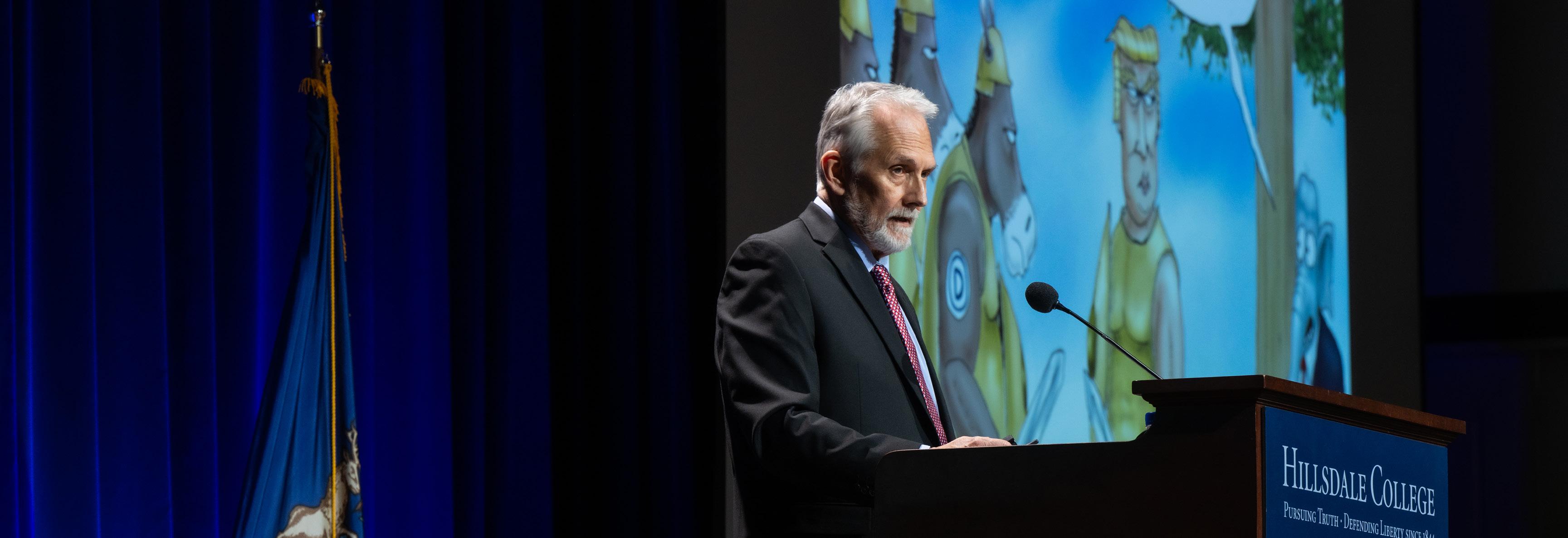
The college hosted its third CCA of the academic year Feb. 1–4, featuring West, Professor of Politics at Claremont McKenna College and Editor
of the Claremont Review of Books Charles R. Kesler, former columnist for the Chicago Tribune and host of “The Chicago Way” John Kass, Host of “Next Up With Mark Halperin” Mark Halperin, political cartoonist Antonio F. Branco, Daily Caller Senior Editor Amber Duke, and a Hillsdale faculty panel, in Plaster Auditorium.
West opened the conference Sunday afternoon, speaking on the historic role of the free press in American democracy and criticizing the censorship of political discourse by progressive elites during the last century.
West contrasted the decentralized, vigorously partisan newspapers of America’s colo-

nial era with the oppressive control of a few major media outlets that dominated America after the institution of the fairness doctrine and the Federal Communications Commission by Franklin D. Roosevelt.
“In the 1930s, President Roosevelt hounded the broadcast industry, and to some extent the newspaper industry, to the status of willing minions of the Democratic party. For the most part, they have remained so ever since,” West said.

down and silence conservatives to have anything close to a just society,” West said.
The drive to censor conservative speech comes from the progressive understanding of justice, which is based on equity between groups instead of objective principles, according to West.
“Many liberals will openly defend the point of view that you absolutely have to shut
On Sunday night, Kesler reflected on William F. Buckley Jr.’s role in bringing conservative voices into the media.
Q&A with Daily Caller senior editor
By Skye Graham Social Media Manager
Amber Duke is a senior editor for the Daily Caller. She gave a speech titled “The Rise of the New Media” at the CCA on Tuesday night.
Q. How did you get into journalism?
A. It was kind of by accident. I was graduating from Georgetown, majoring in economics and government and wanted to be an economic researcher. I was applying to a whole bunch of conservative think tanks in D.C. and various nonprofits, and wasn’t having much luck finding a job. I was very insistent that I did not want to have to move back home after graduation, so I just started applying
to anything vaguely conservative. I got two callbacks from journalism outlets: Campus Reform and the Daily Caller News Foundation. I thought, “Well, why not?” So I went to Campus Reform because they offer training for new journalists, which I thought would be really useful since I didn’t have any experience. I ended up completely falling in love with the process of being first to a story and uncovering information that hadn’t previously been shared publicly. After a year, I moved over to the Daily Caller to do more national reporting as opposed to campus based reporting. The rest is history.
Q. Who is the most interesting person you’ve interviewed?
By Caroline Kurt Opinions Editor
The Urban Dictionary defines “ragebait” as “content deliberately created to provoke anger or frustration online.” For Simpson residents, an Instagram sketch by the off-campus house Casablanca was just that.
“Hey Erik,” senior Aidan Christian says, opening a kitchen cabinet. “No bowl.”
“How’s this one?” senior Erik Teder replies, walking into frame.
Then Christian pours himself a bowl of Frosted Flakes — milk first, then cereal — into the homecoming trophy.
“Come and get it,” the caption on the video reads, with the tune of “Champion” by Kanye West.
Teder and Christian’s Ins-
tagram reel comes as the latest installment of a months-long game of hide and seek. The homecoming trophy, which Simpson won in October, vanished in mid-November when a group of Alpha Tao Omegas took it from Simpson Residence. “They claim that they lost it,” Simpson Head Resident Assistant senior Jonathan Williams said. “They tried finding it and returning it but failed to do so.
There has been silence on the matter since right before Thanksgiving until last weekend.”

That all changed when housemates and seniors Aidan Christian, Thomas McKenna, Joshua Mistry, and Erik Teder posted the short video Jan. 25 on their joint Instagram, @casablancaexecboard.
“I must’ve gotten eight text messages in 30 minutes from people asking me if they could do something with the trophy,”
Christian said. “Everyone wanted to see it, everybody wanted to touch it, to feel it, like it was the ring — the all-corrupting power of the homecoming trophy.”
Freshman James Lennington said two friends, ATOs Emmett Fleischer and Christian Sosa, originally took it from Simpson in November and brought it to the off-campus house Jungle. The freshman pair removed one AirTag tracker from the trophy, but more remained, clueing Simpson into its whereabouts.
Illustration by Maggie O’Connor.
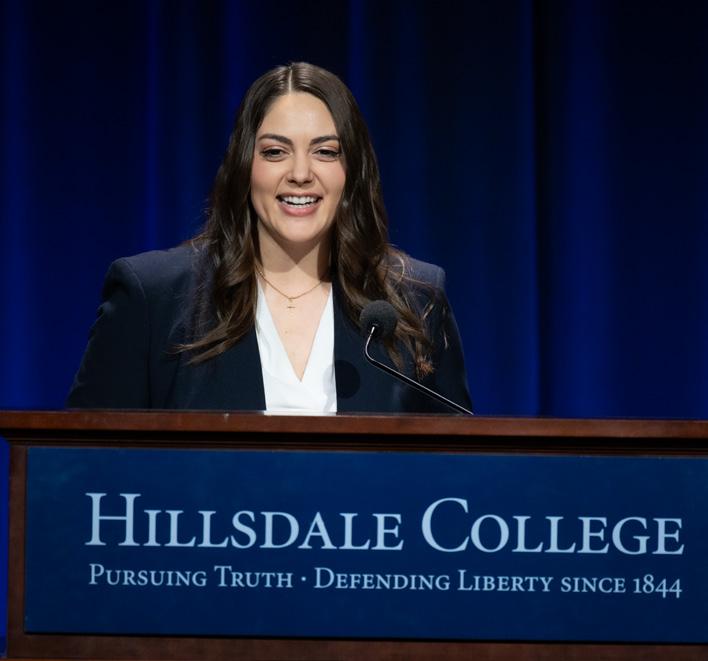
A. Definitely Donald Trump. It was a phone interview. I wish it had been in person, but he is obviously someone who has impacted not only American politics, but also culture, the media, every aspect of society. Having the opportunity for even just 20 minutes to pick his brain was really fascinating. It was between presidential runs, so it was the summer of 2021. It was kind of understood at that point that he was still going to play a big role in politics, but no one was certain if he was going to run for office again. It was reflective on his first year in office and things he wished he had done differently or things he was really excited about and happy that he had done in terms of his legacy. So that was very, very cool and a unique experience. I mean, it’s hard to top Trump. Everybody wants to interview Trump.
Baseball opens with longest game in Charger history
By Christian Papillon Assistant Editor
Despite winning a 15-inning marathon game 14–9 — the longest game in Chargers history since formal recordkeeping began in 1998 — the Hillsdale baseball team dropped its first series of the season to the University of Montevallo 1–2.
The series opened with a doubleheader Jan. 30, with Montevallo taking the first game 6–2. In Game 2 of the doubleheader, the teams were tied at 6–6 after the ninth inning. The Chargers took the lead in the top of the 13th inning after a home run from sophomore outfielder Jake Figman, but the Falcons answered back in the bottom of the inning with
a run of their own on an RBI single. In the top of the 15th inning, the Chargers loaded the bases with one out after walks by freshman catcher Ryan Wiehe, Figman, and freshman outfielder Drew Law. Sophomore infielder Billy Porotsky followed up with an RBI single, junior outfielder Tyler Turner batted in another run with a walk, and sophomore outfielder Gaard Swenson batted in two more with a single. Junior infielder Rocco Tenuta capped off the inning with a three-run home run to extend the Chargers’ lead to 14–7.
Michigan’s oldest college newspaper
Duke on Tuesday night.
Courtesy | Austin Thomason
Mark Halperin on Monday night. Courtesy | Austin Thomason
Thomas West opened the CCA. Courtesy | Austin Thomason
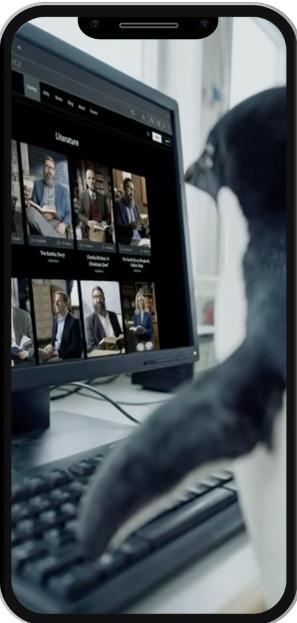
The penguin selects a course. Courtesy | Instagram
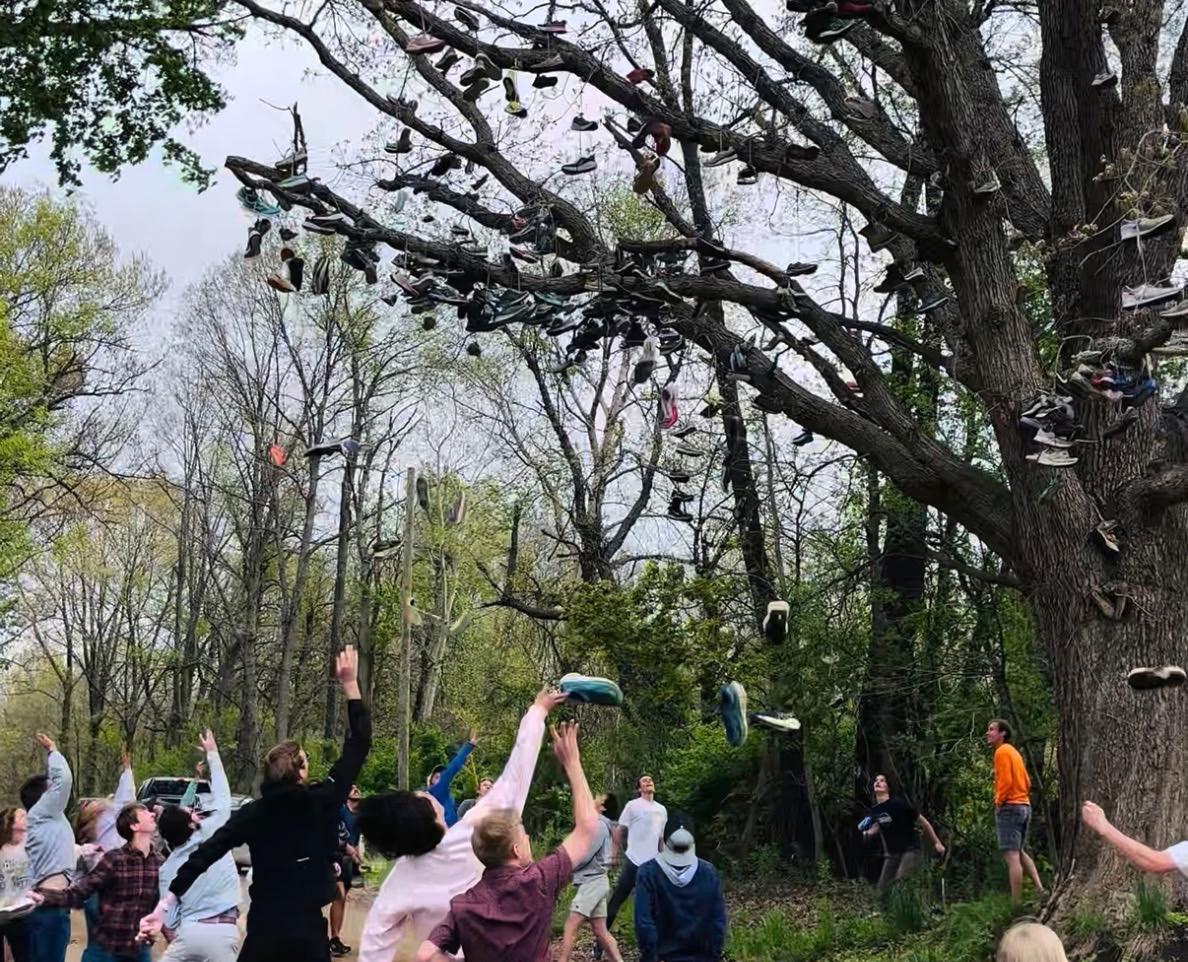
Old running shoes are thrown to their final resting place. Courtesy | Anna Roberts
Duck Dynasty members begin Hillsdale’s C.S. Lewis online course
By Christina Lewis Assistant Editor
Hosts of “Unashamed with the Robertson Family” are taking the college’s C.S. Lewis online course and discussing it on their podcast every Friday.
The podcast features members of the Duck Dynasty family — Al Robertson, Zach Dasher, John Luke Robertson, and Christian Huff — as they take the course, “C.S. Lewis on Christianity,” taught by Michael Ward, a distinguished fellow at Hillsdale and a leading scholar of C.S. Lewis. Their first discussion on the course was on Jan. 23. Dasher described the podcast as “kind of like Seinfeld.”
“There’s a lot of nonsense, but that’s kind of the method that we’re employing to explain the scriptures to people,”
“Doctor Ainslie explained that even if he caught him and brought him back to the colony, he would immediately head right back for the mountains,” the voiceover says in the documentary clip. “But why?”
An image of the penguin heading toward the mountains has circulated on the internet as a symbol of individualism for the past month with the caption: “But why?”
In Hillsdale’s version, the penguin heads not toward certain death but toward a human research facility, where it finds a computer, climbs into an office chair, and punches in the online.hillsdale.edu website.
“He enrolls in ‘Exodus,’ taught by Professor Jackson, an excellent choice, for Exodus is the story of departure, of leaving what is known when staying has become impossible,” the voiceover in the college’s ad says. “The researchers will call this coincidence. They are wrong. Truth is simpler and more unsettling. The penguin did not abandon the colony to become different. He left because he already was.”
The screen fades to bold words: “BE THE PENGUIN.”
Chair and Professor of English Justin Jackson said he
“What he was about was really finding a way for Americans, and particularly the American middle class, to come together in a new conservative movement ambitious to reverse progressivism, and to sort of resume traditional and patriotic American principles going all the way back to the Declaration of Independence,” Kesler said.
He emphasized Buckley’s role in fueling American conservatism by founding National Review magazine in 1955.
Dasher told The Collegian in an email. “There is a method to the madness.”
Previously, Hillsdale partnered with the “Unashamed” podcast to cover “The Genesis Story,” “The Exodus Story,” and “The David Story,” taught by Chair and Professor of English Justin Jackson.
Unashamed Academy Powered by Hillsdale College is a “student becomes teacher” concept that the college is piloting to see if it can bring in new audiences to the online courses learning platform, according to Vice President of Marketing Jon Hall.
“The idea is that hosts of the ‘Unashamed’ podcast, which includes multiple generations of the Robertson family, take a course while encouraging their audience to take a course,” Hall said in an email. “Then, on Friday’s, the
loved the ad when he saw it.
“Thank God conservatives actually can have a sense of humor,” Jackson said. “God forbid, because where are we turning to in this world if we can’t have a sense of humor?”
There is a dark humor to the meme itself, Jackson said, as the penguin walks toward death. He said he was proud of whoever made the parody video and would have done the same himself.
“I will say this as a die-hard existentialist. In one’s own death, that’s where you find your individuality, because it will only be your own death, no one else’s,” Jackson said. “I think that’s what Herzog was trying to do. Is the college goofing on it and playing with it?
Yes. I don’t want to overanalyze that. I just thought it was damn funny.”
The aim of Hillsdale’s marketing is always to draw people toward the liberal arts on campus and online, Zeiser said.
“Of course, we know the penguin in the documentary was not choosing to pursue the higher things or rejecting narratives, but that is how the meme was interpreted on social media,” Dávalos said. “Memes are about recontextualization.”
The marketing team saw an opportunity to tie the idea behind the trend into Hillsdale’s mission, Dávalos said.
podcast releases a discussion of what the hosts are learning, and the audience can follow along to help aid in their learning process as well. It’s kind of like a classroom podcast for audiences that are interested in learning from our courses.”
Senior Ashley DeVore took Ward’s one-credit course on the “Chronicles of Narnia” last fall. She said the course reinvigorated her love for C.S. Lewis’s imagination.
“‘The Chronicles of Narnia’ might look planless, but all is planned,” DeVore said.
“I gained an appreciation for the entire series, whereas before I really only had a very surface-level conception of ‘The Lion, the Witch, and the Wardrobe’ as an allegory of the Gospel story. Dr. Ward showed us how medieval cosmology serves as the unifying
“The penguin helped make an important point: We should all seek the higher things, even when the crowd is headed elsewhere,” Zeiser said.
The video received more than 900 likes on Instagram and 2,000 on X, but some current and former students criticized the ad in the comment section on Instagram.
“Not a fan of the use of AI here nor in the tendency of Hillsdale lately to jump on the latest social media trends without care,” Maya Toman ’25 wrote in the comments.
“My Hillsdale education meant a lot to me because it taught me to go ad fontes [to the sources] and test new ideas against the enduring truths. I am not seeing this spirit in Hillsdale’s online presence these days.”
Senior Oliver Bieser said he thought the ad made the college look ridiculous and amounted to a cheap ploy to attract donors.
“AI slop advertising does not appeal to Gen Z — the college’s future students — much less to academic audiences, the prestigious institutions with which the college hopes to align,” Bieser told The Collegian, adding it attracts only those who pursue progress at the expense of art and humanity. “The college is implicitly saying with this ad that it cares more about these
principle for all seven books, causing readers to consider different aspects of Christ’s character with each tale.”
Dasher said the online courses have helped him gain a deeper understanding of biblical truths.
“I think that you can expect a very deep and robust discussion on Lewis’s work and the conversation was extremely meaningful, impactful, and we do break it down for the common man,” Dasher said.
Huff said he appreciated the way Jackson articulated things in a way that made it easy for people to understand.
“Even after all the lectures we’ve done, I’ve gone back and reread the stories throughout the Bible, especially David, going through the David story,” Huff told The Collegian in an email. “Then for me,
people and their money than anyone who might actually advance its mission beyond a financial standpoint.”
He and his friends filled the comment section with memes and gifs in protest.
“The use of generative AI in any capacity by an institution that claims to be a bastion for the liberal arts is tragic and embarrassing,” senior Gabriel Bileca said. “As an art major who wholeheartedly believes in the unique beauty of human creation, I find it disheartening to see this college that I love so dearly endorse the use of generative AI.”
Senior Chris Tufaro said he thought the ad was funny.
“Hillsdale is getting in on the trend, and it’s not that serious,” Tufaro said. “People shouldn’t get so worked up about things that aren’t very serious. Social media is at its best when it is used to entertain people, and that is exactly what the Hillsdale ad did.”
Leveraging social media trends like the penguin meme allows messages to travel further and more efficiently in marketing, Dávalos said.
“The penguin video may seem somewhat tongue-incheek, but we take the college’s mission very seriously, especially the charge to educate ‘all persons who wish,’” Executive Director of Social Media Bill Zeiser said. “To
watching the TV show, it’s led me into wanting to study his life so much more. So it’s really helped me and encouraged me to read the Bible more often.”
Jackson traveled to Louisiana to discuss his online courses with the Robertsons last year.
“Well, him being a literary guy, he sees things that I didn’t necessarily see in text just because of his literary eye,” Al Robertson told The Collegian, in an email, about Jackson. “So that perspective really grew my knowledge, especially of the Old Testament.”
John Luke Robertson said he has loved taking Hillsdale’s online courses, and that they are easy to follow along.
“The study guides are awesome,” John Luke Robertson told The Collegian in an
raise awareness of Hillsdale, we have to engage people where they are, including on social media, and occasionally turn cultural moments into teaching moments.”
Jackson said parodying the viral video made the college look clever.
“It’s beyond clever, it’s smart,” Jackson said. “If we do a dichotomy between progressives and conservatives, and one side makes us laugh, and the other side chides us for laughing, I know which side I’m on.”
He said the ad did not in any way conflict with the college’s approach to the proper use of AI. The college does not tell students to avoid AI completely, he said, but only when its use would retard the exercise of the student’s intellect.
“Are there unethical ways to use AI? Of course there are,” Jackson said. “Was this one of them? No. Does AI reduce labor? Yes. Is this labor reduction with great fruits on the other side? Yes.”
The artificial intelligence software used to create the ad, higgsfield.ai, did not generate a finished product, Zeiser said, but helped in a collaborative creation process.
“The process is surprisingly close to traditional filmmaking,” Zeiser said. “A member of our team developed the concept, wrote the script, created short AI-assisted clips,
email. “I print all the study guides out, and they’re definitely something I’m going to think about and keep doing.” Hall said students can suggest other online courses that they would like to see Unashamed Academy take. Additionally, students are welcome to suggest other people they would like to see partner with Hillsdale’s online courses program.
“The audience we are scaling to teach is an audience of nearly 50 million that is primarily made of Americans that love the country, believe in God, have the conviction to stand for both, and are searching for trusting sources of learning information that can help them grow in understanding and become better leaders and citizens in their communities,” Hall said.
edited them together much as he would conventional footage, and handled sound design and color correction.” Zeiser compared the process to the use of Massive Software, an early AI software, to create battle scenes with tens of thousands of orcs for the “Lord of the Rings” films. A short film like the penguin ad would have required six figures and months of work a few years ago, he said, but advances in AI technology have made that process more accessible.
Using generative AI for animation in this way does not contradict the college’s mission, he said, and the ad was an early experiment for how AI can be used in the college’s marketing on a more formal basis.
“The ‘Lord of the Rings’ films, like our penguin clip, use computer technology not as a substitute for human thought, but as an aid to human vision,” Zeiser said. “That is fundamentally different from having AI write a term paper. There is no substitute for the exercise of reason. A liberal arts education exists precisely to cultivate that special capacity, which sets human beings apart from the penguins.”
In a speech titled “The Decline of Trust in the Legacy Media,” independent columnist John Kass attributed American’s disillusionment with the legacy media to the loss of one key trait.
“Journalism lost something irreplaceable,” Kass said. “The one thing a journalist needs to do his job: Curiosity.”
Kass highlighted mainstream media’s coverage of former President Barack Obama’s campaign as a turning point for the mainstream media.
“I was there when it went bad,” Kass said. “We opened the newsroom wide to the American left, and we manufactured demigods like Barack Obama to lead the country where it did not want to go. When the media tried to create a myth, they lost themselves.”
Despite this shift away to-
“Without Bill Buckley, there would have been no National Review,” Kesler said. “That would have meant no Goldwater candidacy and in all probability no Reagan. If there were no President Reagan, there may have been no victory in the Cold War, and we might be sitting in a very different America today.”
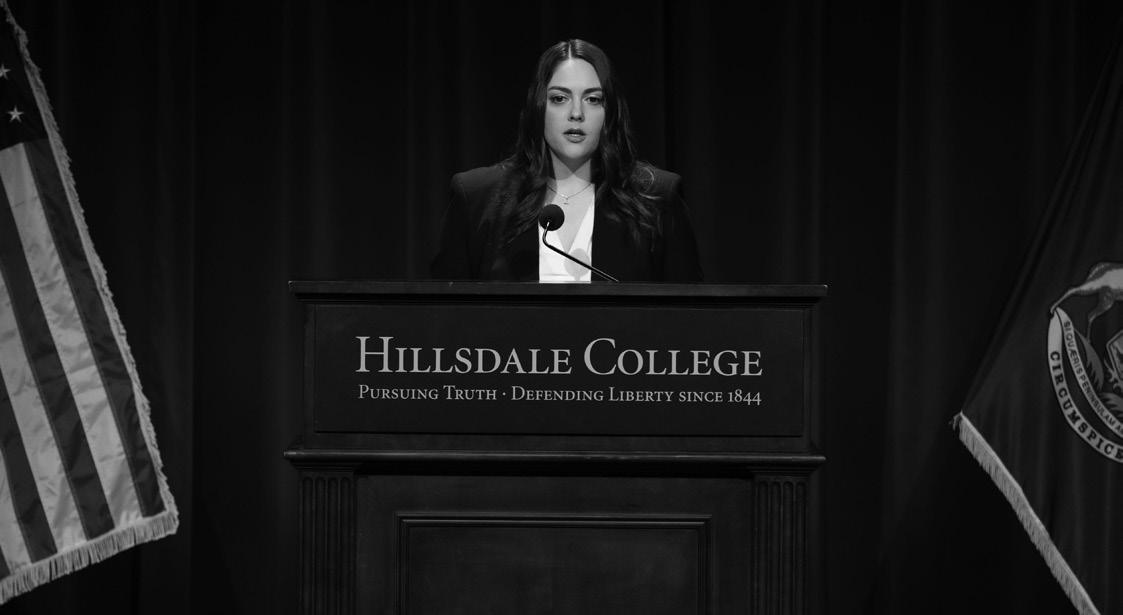
wards myth, Kass expressed some optimism for the future of journalism through alternative media and open-forum media, such as X.
“They hate Elon Musk because he saved X,” Kass said. “We have a chance now, so there’s journalism to be done.
This is Hillsdale’s time. The path is well lit, but it’s not easy to carve your own way. All you have to do is take that first step.”
Mark Halperin, founder of the live video platform known as 2WAY, argued President Donald Trump is playing an important role in challenging the mainstream media system and restoring a healthy and free press.
“Donald Trump understands the press, and he understands what’s wrong with the press,” Halperin said. “He understood how angry tens of millions of Americans were about what was wrong with the media.”
Halperin presented his platform as a model for restoring the free press.
“2WAY uses virtual technology to create an authentic community around a shared belief in America,” Halperin said. “The point of 2WAY is to put all voices under one shared roof and to have a civil conver-
sation. And my community members love it.”
Political cartoonist A.F. Branco, in a talk titled “Make America Laugh Again” Tuesday afternoon, used his cartoons to echo earlier criticisms of legacy media outlets.
“MSNBC, ABC, CBS, PBS, NPR, the New York Times, and the Washington Post, with their liberal bias, are absolutely the reason we have a very vibrant alternative media today,” Branco said. “Legacy media just isn’t trusted anymore.”
Duke spoke on the rise of alternative media platforms in the internet age, contrasting it with the elite-dominated media landscape of the 20th century on Tuesday night.
“In broadcasting you need access to a finite number of licenses that actually are doled out by the government,” Duke said. “That scarcity created a kind of structural gatekeeping on behalf of these corporations.”
Duke emphasized the role of digital technology in the rise of the new media.
“Then the internet came along and did something pretty radical,” Duke said. “It broke the bottleneck. All of a sudden, anyone anywhere could be a publisher. And when people realized they had

this power, they used it.” West said the rise of the internet has made the American press more free, closer to the Founding ideal.
“Much has changed since the internet became widely accessible,” West said. “Here’s now an alternative news source that’s free. If you dig around enough, it’s competent and informative. The phenomenon of going viral has allowed long-suppressed facts to reach the national consciousness.”
At a faculty roundtable event held Feb. 4, Director of the Dow Journalism Program John J. Miller said journalism today is a paradox, emphasizing the need for a discerning citizenry.
“It’s never been worse, and
it’s never been better,” Miller said. “What we need now, more than ever, are readers and consumers of the news who are discriminating and intelligent, and who know how to take advantage of this moment where we can get the best news and information ever available to us.”
According to sophomore Thatcher Debowski, the CCA deepened his understanding of the media in America.
“I enjoyed learning about the historical progression of the media, how it’s changed over the last 40 years,” Debowski said. “How there’s not only more polarization, but less of a concern with the true nature of the situation.”
CCA from A1
Penguin from A1
A.F. Branco on Tuesday afternoon.
Courtesy | Austin Thomason
Amber Duke on Tuesday night. Courtesy | Austin Thomason
President’s
Ball aims to bring France to Hillsdale students
By Faith Miller Collegian Reporter
Students can transport themselves to France this weekend at the Versailles-themed President’s Ball, hosted by the Student Activities Board, Feb. 7 from 9 p.m. to 12 a.m. in the Searle Center. Swing dancing begins at 8:30 p.m. Sugar cookies, cheesecake bites, charcuterie cups, and mocktails will be served.
This year’s President’s Ball will feature the usual staples like dancing, food, and a photobooth, but there is a new addition for students to enjoy, according to Director of Student Activities Ingrid Dornbirer ’24.
“A little sneak peek is that we’re bringing in a caricaturist this year. People will get to sit down and have their portrait done,” Dornbirer said.
Around 9:40 p.m., SAB will announce the President’s Ball court, and College President Larry Arnn will crown the winners, according to Dornbirer.
“We’ll get to see which seniors win and get to dance with Dr. and Mrs. Arnn,” said senior Emma Kate Mellors, a SAB media team lead.
The Jerry Ross Band will play music throughout the night as they have in past years, according to Mellors.
“This is one of my favorite events because of the band that we bring in,” Mellors said. “The Jerry Ross Band is always very energetic and upbeat, and it’s so fun to see everyone having a good time on the dance floor.”
Dornbirer said this event offers activities for everyone.
“If you’re a big dancer and want to be in the center of the mosh pit, that’s really fun. If you just come for the food, that’s also fine. There are lots of places to just sit and chat, even if you’re just an enjoyer of music,” Dornbirer said.
The Hoynak Room will be open during the event and will feature a student art gallery, according to Dornbirer.
“This is playing into the Versailles theme,” Dornbirer said. “Originally, we kind of leaned more into an art gallery theme, and then it developed into Versailles.”
Hillsdale’s new silver ‘H’ is ready for a photo op
By Ashley Luke Collegian Reporter
Terrence “T” Wall donated a giant “H” sculpture in order to rally campus spirit and provide “a selfie spot.”
“I noticed there really weren’t any selfie spots for visitors or students to remember Hillsdale by,” Wall said in an email. “Sure, the tower is on the logo, but you can’t stand up in the air in front of the tower!”
The sculpture, which stands more than eight feet high outside the George Roche Sports
oper in Wisconsin who said he envisioned the “H” for Hillsdale as a way of both promoting awareness of the college and thanking College President Larry Arnn for his efforts in bringing K-12 schools to the Madison area.
Wall said he wanted the “H” to be distinctly Hillsdalian as well as spectacular.
“I wanted it to be reflective and antirust so that it would mirror the conservative Christian values found in all of those who visit Hillsdale. It had to be larger than life,” he said.
“I noticed there really weren’t any selfie spots for visitors or students to remember Hillsdale by.”
Complex, arrived in October.
Wall is a real estate devel-
Wall also commissioned Hillsdale’s sister sculpture, an
eight foot tall “W,” on the campus of University of Wisconsin–Madison.
He said he was inspired by University of Wisconsin–Madison’s interaction with the “W” and thought Hillsdale could benefit similarly.
Wall worked with Director of Advancement Russell Richardson, Chief Administrative Officer Richard Péwé, and Director of Athletics John Tharp to determine the location and concept for the sculpture.

Tharp said he suggested placing it outside the sports complex, as students and visitors can view it from a variety of angles coming up and down Oak Street. He said he sees the sculpture both as a photo opportunity and as a conduit for Hillsdalian pride.
Professors to discuss the historical meaning behind “The Trump Doctrine”
By Sophia Bryant Assistant Editor
Professors will debate “The Trump Doctrine,” at an event sponsored by the College Republicans Thursday at 7 p.m. in the Heritage Room.
“Following the administration’s actions in Venezuela, we were curious as to what the Trump administration’s international strategy is,” sophomore and Vice President of the College Republicans Jordan Nelson said.
John Grant, associate professor of politics; Mark Moyar, director of the center for military history; Charles Steele, associate professor of economics; and Paul Rahe, professor of history, will speak at the event.
scholars, according to Nelson.
“To diversify who we’re hearing from, we invited Dr. Charles Steele of the economics department,” Nelson said. “He’s a politically interested professor, as most of the econ professors are, but he is a very seasoned and respectable
thing endemic to the Republican cause,” Nelson said.
The new College Republicans board was elected in November. This is the first event it is sponsoring this semester.

“These people all have some sort of expertise or vested interest in the topic of the event, and so that was important to us, to try to find people who not only were interested, but also could speak to various different aspects of it,” junior and club president Joseph Diprima said.
Grant’s specialty is in international relations, Moyar is one of the world’s leading scholars on the Vietnam War, and Rahe learned from some of the greatest war and ancient history
Q. Do you have a favorite story that you’ve written?
A. That’s a tough one. My first big story that I broke working at the Daily Caller was that Chris Matthews, an MSNBC primetime anchor, had been accused of sexually harassing one of his staffers in the ’90s, and the network had paid out a settlement to the staffer when she left. That was covered by major outlets like NBC, Vanity Fair, the Washington Post, and that was the first time that I felt my reporting had a big national impact. But lately, I’ve been really enjoying writing my twice weekly newsletter, “Unfit To Print,” where I present unique angles and analysis on the news stories of the day and also do original reporting. I debunked the Washington Post report linking homeschooling to child abuse and uncovered the initial court documents in the Kilmar Abrego Garcia case, which in-
dicated he was credibly found to be a member of MS-13 and had been approved for deportation, just not to El Salvador. Any time I can either correct the record or advance the story from what the mainstream media is doing, I feel like I’m adding a great service to the general public.
Q. Do you prefer writing or editing? ?
A. I love both. It’s been hard for me throughout my career to choose, and my current role is sort of a hybrid one. I write my newsletter in addition to overseeing our original and enterprise reporting with a team of five or six reporters. Writing is really great because you get to be the person who is sharing news and information with the general public. Uncovering stories and investigating can be really challenging and rewarding, but editing is also great fun and rewarding. I get to mentor the next group of reporters who are coming
member of the faculty when it comes to political issues.”
The club hopes to hear the insight that faculty members will provide into why the Trump administration might be making these decisions and what could come in the future by giving context and a historical perspective. It also wants to gauge students’ interest in College Republicans with this event, according to Nelson.
“It’s always difficult to deal with hypotheticals, especially in politics, and that is some-
up after me, teach them what I’ve learned in my 10 years of working in media, and hopefully cultivate that next group of conservative journalists who are going to be shaping the conversation.
Q. How do you balance your personal life and your career in a field that is 24/7?
A. Probably not well. But it helps that my husband works in politics as well. He’s a consultant, so he understands the long hours and the weird, flexible schedule sometimes when news is breaking or when I have to be online. So that’s incredibly helpful. But I find that the more time you spend in the media, as a young beat reporter, you are expected to be on the weekends, late nights, being available whenever news breaks.
As you get further in your career and start to have a more managerial role, there’s new people coming up who can help manage the 24/7 news cycle and take some of
“Getting the opportunity to see what it’s like to work as a board together for the first time has been really fun, I think, and surprisingly efficient,” Diprima said. “We’ve been able to put this together with a little bit of a short notice.”
Diprima said they hope to grow College Republicans this year as they prepare for the midterm elections in 2026. College Republicans registered more than 500 people to vote in Michigan for the 2024 presidential election, according to Nelson.
Diprima said one of his goals as incoming president was to emphasize the importance of midterms and local elections.
“You are a part of this southern Michigan community, and by exercising your vote, you are saying, ‘This is how I want my new home to be run,’” Nelson said.
that off your plate. But I think you have to really love it. You have to be super passionate and hungry, and I always tell young journalists this. This is not a 9-5 job, and for the first five to 10 years, you’re probably not gonna make a lot of money. So it has to be something that you really care about. You have to care about making a difference and have a mission behind what you’re doing. Without that, I think people get burned out pretty quickly.
Q. What would you say is the hardest part about being a journalist?
A. I think the part of journalism where I get the most frustrated is when someone beats me to a story that I was working on, because you can put so much time and effort into investigating something, and then somebody else gets it out a day before you did, or even a week before you did, and it can feel like wasted effort.
“I hope that people can celebrate the school there,” Tharp said.
Richardson said the piece aligns with a vision for campus improvement the college has been pursuing.
“It is a unique gift,” Richardson said. “We are extremely grateful to Mr. Wall. It is an
been able to do something like that without his creativity and willingness to suggest the idea.”
Temporary exhibit marks 81 years since the Holocaust
By Moira Gleason Executive Editor
When patrons enter Mossey Library this week, they encounter a series of panels telling the story of the 6 million Jews murdered during the Holocaust. In commemoration of the 81st anniversary of the liberation of the Auschwitz-Birkenau death camp on Jan. 27, 1945, the exhibit highlights the years of reconstruction in which the Jewish people searched for loved ones, rebuilt communities, and looked to the future.
“In between classes, stop and just understand what happened,” Jewish Mishpacha president and sophomore Yahli Salzman said. “You can have your beliefs about Israel, you can have your beliefs about the Jewish people. But the fact of the matter is that 6 million Jews died.”
The Jewish Mishpacha student group, in collaboration with Mossey Library, organized the display. Faculty adviser and Associate Professor of French Anna Navrotskaya ordered the exhibit,
Navrotskaya said, referring to the Hebrew term for the Holocaust. “We have to remember Auschwitz. We have to remember the victims so that they were not murdered in vain.”
Twenty panels offer information on the liberation of the Nazi concentration camps, the mental and physical challenges survivors faced in the aftermath, and the displaced persons camps and children’s homes they stayed in during rehabilitation.
Encountering the Holocaust has taken on new urgency in recent years, according to Visiting Professor of Jewish Studies Michael Weingrad, especially since the Oct. 7, 2023, attacks in which Hamas terrorists massacred more than 800 Israeli civilians.
“Our own country and the rest of the world are seeing a resurgence of violent Jew-hatred, threatening Jews and their non-Jewish friends alike, such as the young couple gunned down in D.C., the elderly woman, a Holocaust survivor, burned to death in Colorado, and the Bondi
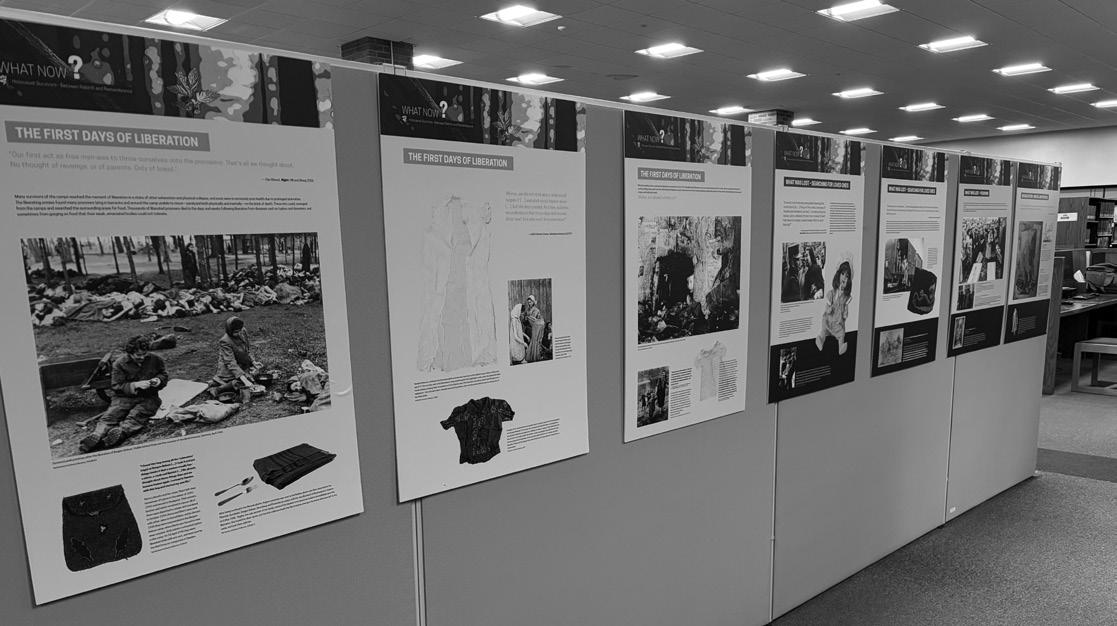
titled “What Now? Holocaust Survivors – Between Rebirth and Remembrance,” from Yad Vashem, the world Holocaust remembrance center in Israel.
“It’s been only 80 years. Historically, it’s nothing. It’s a second,” Navrotskaya said. “We know that human beings are capable of the highest levels of heroism, and we also know that human beings are capable of the lowest levels of betrayal. And we need to remember our past, respect our past, and accept the fact that it happened if we don’t want it to happen again.”
An exhibit about the Holocaust would not be acceptable in many institutions in the United States and Europe at the current moment because it would be perceived as a political statement on the modern State of Israel, Navrotskaya said.
“We specifically did not want it to be a political statement. It’s about the Shoah,”
Beach mass murder in Australia, all in the last nine months,” Weingrad said. “We are unfortunately still contending with the dark forces that turned Europe into a death factory and snuffed out millions of Jewish lives.”
Remembering the horrors of the Holocaust is not about ideology, Navrotskaya said. Rather, we remember because we must recognize what we as human beings are capable of doing, both for good and for evil.
“We start feeling as if it were the distant past and no longer related to us,” Navrotskaya said. “But the people who went through it, some of them are still with us. And it’s not 80 years already, it’s only 80 years. Saying ‘Never again,’ of course it’s very important. But we also know that ‘again’ happens, and it happens all around the globe.”
thing, and we totally would not have
Duke from A1
The Holocaust memorial exhibit in the library. Sophia Bryant | The Collegian
College Republican’s “Trump Doctrine” promotional poster. Courtesy | Instagram
The “H” outside the sports complex. Ashley Luke | The Collegian
Opinions
Minnesota is more than its politics
Though the media storm rages, life in my state goes on
Editor in Chief | Thomas McKenna
Executive Editor | Moira Gleason
Design Editor | Anna Broussard
Senior Editor | Catherine Maxwell
News Editor | Ellie Fromm
Opinions Editor | Caroline Kurt
City News Editor | Alessia Sandala
Sports Editor | Elaine Kutas
Culture Editor | Ty Ruddy
Features Editor | Tayte Christensen
Social Media Manager | Skye Graham
Circulation & Ad Manager | Henry Fliflet
Assistant
By Zachary Chen Collegian Freelancer
I grew up about three minutes from the stretch of road where Philando Castile, an African American man, was shot by a police officer at a traffic stop in 2016. I remember the lockdowns and the “mostly peaceful” Minneapolis riots of 2020. When I visit home, I’m greeted by rainbow flags, Ilhan Omar yard signs, and an endless array of public paraphernalia proudly displaying its owner’s political predilections. Minnesota Nice seems to have morphed into Minnesota Nasty.
Yet Minnesota is more than Minnesotan politics.


Cool it with the diamonds, y’all
By Caroline Kurt Opinions Editor
Valentine’s is around the corner, with March on its heels. For many a Hillsdale man, that means one thing: ring by spring.
The phenomenon describes the many couples who go from boyfriend and girlfriend to fiancé and fiancée sometime in their latter years of college, especially in the final semester of senior year.
At this college, we are fortunate to be inundated with sage advice, whether from older peers, professors, or other mentors. Around the one-year mark of a relationship, people start to ask if it’s “serious.”
It’s a gift to hear votes of confidence in the idea of young marriage when the world beyond Hillsdale is often bewildered by or disapproving of such a thing.
But consider this an anti-advice column: I had to learn the hard way that however valuable the input of our family and friends, only my fiancé and I could discern the right direction and timing of our relationship.
Brady and I met at 16 and started dating at 17. Midway through college, I was eager to begin the next stage of our relationship, having dated him for longer than some of our married peers had even been together. As we began to discern the next steps, we received sound advice from different friends pointing us in totally different directions.
For those of us who don’t consider divorce an option, marriage is an especially sobering decision.
As much as we joke about the subject, it isn’t one to take lightly, much less to rush. A one-year turnaround might be plenty for some couples, but far too short for you, or vice versa. You’re the only one who can know that.
For Brady and I, that turned out to be four years of dating and an engagement last July. In retrospect, we wouldn’t have it any other way.
Advice is by nature limited. In Jane Austen’s “Persuasion,” the meek Anne Elliot cuts off a relationship with the man she loves at the advice of a well-intentioned friend. When the lovers meet seven years later, Elliot comes to regret her former persuadability.
The friend, like Elliot’s Lady Russell, who issues advice as a divine edict is unwittingly doing you a great disservice. In contrast, the friend who truly respects you will conclude their advice with a note of freedom, expressing trust in your ability to learn and do what is best. And you ought to feel confident in that power.
An enormous part of our education at Hillsdale focuses on forming our moral intuition — the inner compass that enables discernment. The literature, history, theology, and art we absorb at Hillsdale educate our hearts as much as our minds, sharpening our judgment and equipping us to navigate thorny issues in our personal lives.
Our fast-paced student lifestyle promotes rapid-fire decision-making, but any kind of heavier decision demands a more reflective pace. If that means putting off your best friend’s pestering or mom’s questions for a while, do so. The “dream ring” Pinterest board can wait.
Caroline Kurt is a senior studying English.
It’s easy for conservatives to shrug their shoulders and sigh about Minnesota, just as it’s easy to rile up a crowd about the draconian bureaucracy and astronomical cost of living in California. In retrospect, it’s obvious to the nation’s armchair policymakers that the only state that voted for Walter Mondale over Ron -
ald Reagan in 1984 would be lit up by race riots and obstruction of federal officers in the 21st century. It is true that we have our problems as a state. Amateur journalists and mantra-chanting activists believe their assaults on public order defend democracy against an imagined, impending Third Reich under President Donald Trump. X broadcasts their antics for the rest of the nation to see. Our disgraceful governor, Tim Walz, fraud scandals, and political theater lie exposed to the leering eyes of anyone who cares to turn on the television.
But the news cycle doesn’t define Minnesota. As happens so frequently, it loses sight of the quotidian, the mundane, and therefore truly noble. The news loves to talk about the sensational, the lurid, and the spectacular. The twin sins of impersonal curiosity and ignorant outrage drive our modern world, poor sinners that we are, and we mind not the hidden beauty of the commonplace.
If you blink, you’ll miss the small but faithful ecumenical community in West Side St. Paul caring for the impoverished. If you look away from stories about leftists storming churches, you’ll find the vibrant, devout parishes and churches serving Christ right where he has placed them. Look up from your cell phone, and you’ll be able to see my dear friend Phyllis, the little old lady who sits by herself at the Divine Service and nudges you to point out that the hymn was written in the 8th century (“How old! Can you believe it?”).
If you don’t live there, you wouldn’t have known Peter, an old gardener who loved trees and trashy detective novels. The news doesn’t portray the children who show up at public tennis courts during the summer to take free lessons just because they’re kids who like to run around.
I don’t worry about my home state. It’s not because I think sanity will return again now that Tampon Tim is leav -
ing office (it won’t) or because the state is doing just fine (it’s not) or because I’ve given up all hope for the land of 10,000 lakes (I haven’t). It’s because — despite the alarms of the news — Minnesota simply isn’t special. It is, in the best way possible, merely ordinary. The unrest will pass, the protestors will go inside and warm up from the cold, and we’ll probably elect another governor most charitably described as “cringe” and “unc.” So what? Minnesota hasn’t yet lost the ordinary, everyday faithfulness of the men and women who trust that Christ will not allow the gates of hell to prevail against his Church. Walz’s ills will never trump the quiet, heroic fidelity of someone like Phyllis.
Zachary Chen is a junior studying Greek and Latin.
Dear seniors, it’s time to die — to yourself
By Madeline Scheve Guest Writer
“Don’t graduate; you’ll hate it,” was a warning I received from a well-meaning alumna during my senior year. But eight months post-graduation, I can report that I am thriving in a way I did not expect.
Fear of graduation is in the air during senior spring, and rightly so. There are many things to mourn when your four years are up: the bond with your housemates, hours spent in transformative classes, or knowing someone everywhere you go on campus. After graduation, however, you have the opportunity to multiply the gifts you received at Hillsdale by giving them to others. Dying to yourself is the key to loving life after Hillsdale. College is an inherently self-oriented time, and that is a good thing. Your meals are made for you. Your dorm is cleaned for you. Academic
experts work grueling hours for you. Practical needs are handled so that you, the student, can focus on your intellectual, moral, and spiritual development. You don’t even need to go far outside of yourself to find this formation: Opportunities are pouring into your inbox. If we take the maxim “you can’t give what you don’t have” at its word, then college is a time when you build up wisdom, strength, and talents so that you have something to give.
Graduation signals that you have something you did not four years ago, and that it’s time to start giving it away. No longer an insecure and ignorant 18 year old, a Hillsdale graduate is (hopefully) confident in the knowledge they have gained and yet possesses the humility to see what they do not know. The new battle is against the undisciplined parts of yourself that keep you from serving those you
work, live, and pray with.
At 7:30 a.m. every morning, I face a classroom of 24 middle schoolers. When I manage my time poorly, I am unprepared for class. In college, this might lead you to lose a participation point. But in teaching, my lack of preparation is reflected back to me in the faces of students who do not understand fractions. If I don’t get enough sleep, my patience for sixthgrade antics is short — very short.
When my life is in order, I can attend to my students as they deserve. They have asked: “Can we keep reading this book?” They’ve translated hundreds of lines of Latin. And some strugglers have gone from D-minus to B.
I can’t say that I have nothing to give anymore because of my time at Hillsdale. Receiving C’s on my papers forced me to search for self-confidence away from academics. Jane Aus -
Please fix Hillsdale's
By Skye Graham Social Media Manager
Hillsdale students should be able to complete discussion posts without CampusNet crashing mid-sentence.
Last semester, as I wrote a term paper in Hill House, CampusNet went out more than two dozen times, some of the outages lasting more than 30 minutes. I wasn’t alone: I heard similar stories from my fellow students who also deal with outages, particularly in the dorms where many people are connected at once. This fartoo-common issue is worth the college’s attention and budget.
According to Information Technology Services, CampusNet has 862 wireless access points across campus,
each of which can handle about 50 devices on them at a time. If an access point exceeds that capacity, Wi-Fi becomes more spotty. This means students and faculty are more likely to experience poor connection in the more populated areas of campus, such as AJ’s or the dorms.
Most students and professors have multiple devices connected to Wi-Fi at any given time. Devices like TVs and cameras also connect to Wi-Fi, which makes the problem more severe than a few personal devices. Even when devices are turned off, they still slow down the WiFi and make it less likely that other devices will stay connected.
It may seem like a minor concern, but students find it harder to complete their
work when Wi-Fi is sporadic. This can become a major setback during midterms and finals, especially when most students have assignments that can only be completed with access to the internet.
The solution is simple: Add more access points in each building. According to ITS, more were added when iPhone usage between classes became the norm. There is precedent for improvements in the past, and the college should add access points now to keep up with the growing role of technology in schoolwork and dayto-day life.
Students can also help make this happen. According to ITS, if they continue to get Help Desk tickets in a specific area, ITS will work
ten’s “Emma” taught me to tell the truth in all things. Aristotle’s “Metaphysics” gave me an ineffable account of the divine. What holds me back now is my desire to sleep in, avoid confrontation, and watch YouTube shorts on cooking. So I am happy to shed the comforts of my off-campus house for the reality of the classroom. It shows me who my time at Hillsdale was for: others. Do not fear graduation. Search for a job that requires you to die to yourself, in whatever field you feel called. We spend four years at Hillsdale receiving gifts. Happiness lies in giving them away.
Madeline Scheve ’25 is a sixth-grade teacher at Cincinnati Classical Academy, a Hillsdale College Member School.
Wi-Fi
to improve the Wi-Fi in that area. Sometimes they simply raise the antenna strength of an existing access point, or plan to add new ones in a future budget.
ITS noted that Greek houses are expected to pay for running cables and access points themselves, meaning the Wi-Fi in those areas depends on how much each house was willing to pay at the time of installation.
There may be additional updates to improve Wi-Fi performance and support more devices, but this necessary fix can address a common complaint on campus.
Skye Graham is a junior studying history.
Join the Zynsurrection

By Charles Hickey Collegian Reporter
There’s this new stimulant on campus. It neither stains your teeth nor burns your tongue like coffee, it doesn’t contain sickening amounts of sugar, and it doesn’t pack enough caffeine to stop a horse’s heart, like most energy drinks do.
Meet Zyn: a Swedish brand of small, tobacco-free nicotine pouches that students place between their lip and gum for a discreet yet satisfying nic hit. You should try it.
Unlike cigarettes, there’s no need to brave the bitter Michigan cold to consume this particular form of nicotine. And the repulsive juice that spitting tobacco brings to mind? Gone the way of the dodo bird and the quad.
Zyn comes in a handy compact container, which, if you flash it, will attract knowing smiles from fellow initiates. For those unfamiliar with Zyn, simply observe an athlete or frat boy for long enough, and the signature two-tone tin will inevitably make an appearance in his hands.
Students who partake (affectionately referred to as “Zynners”) swear by the beneficial cognitive effects of Zyn. They declare there is nothing more
helpful for cramming for an exam or a headache-inducing homework session. Zyn’s nicotine helps them relax while improving their attention and focus — the perfect prescription for a stressed college student. But there’s no need to simply take their word for it. A swift internet search reveals a plethora of scientific studies that come to the same conclusion:
Nicotine has proven mental benefits. Reduced anxiety is one, due to elevated levels of beta-endorphin. Improved concentration and memory are another, thanks to increased activity of neurotransmitters.
Zyns are safe — even safer than never talking to girls — since their pouches are made of plant-based fibers and filled with foodgrade ingredients, a contrast to the cancer-causing cocktail of chemicals labeled as cigarettes or the brain cell decimator known as alcohol.
You have a better chance of contracting cancer from eating a sizzling platter of processed bacon or tanning au naturel than from enjoying these little Swedish delights, which have the pleasant taste of gum without the incessant cow-like chewing. Concerned about torn-up gums, nicotine-induced tummy aches, or other bodily ailments? The answer is what Cicero called the virtutem maximam: moderation. Just like alcohol or caffeine, nicotine should be used temperately and judiciously — more than your Mormon friend but less than the local Alpha Tau Omegas. Student aficionados also cite the social aspect of Zyn as another reason to give it the ol’ college try. Asking a fellow student for one of their Zyns is a surefire way to break the
Be the penguin: Leave the
By Tayte Christensen Features Editor
Hillsdale prides itself on being different: No government funding, a small student body, and a mandatory logic class.
We can add rejection of artificial intelligence as a replacement for human creativity to that list. Professors have different rules regarding the use of AI, but all of them rightly forbid students from using it to compose our papers. The college’s marketing department takes a different approach. It released a video Jan. 25 promoting online courses. In a spin-off of the viral “nihilistic penguin,” the video features a penguin who diverges from his colony and finds his way into a human camp in the Antarctic.
ice and establish that sense of community and shared interest — without the seven-minute time commitment of smoking a cigarette together. Both the meathead athlete and the scrawny Latin enthusiast can find common ground by breaking bread together with a can of Zyn.
Thanks in part to the fellowship it inspires, Zyn is growing more popular, counting Secretary of Health and Human Services Robert F. Kennedy Jr. and UFC commentator Joe Rogan among the faithful.
Zyn is the lonely man's nic
By Francesca Cella Assistant Editor
If you’re hankering for a hit of nicotine, take time to revel in the experience.
Zyn is the no-nonsense substance that delivers dopamine to the nicotine fiend without unnecessary steps. Forget the 10 minutes of leisure afforded by a smoke break — savor the steady drip of a nicotine IV that shoots into your bloodstream without wasting a moment of your

quarterback Baker Mayfield surreptitiously popped in a Zyn on national TV.
In the truest sign of American acceptance, political leaders even squabbled about Zyn in the hallowed halls of Congress. Senate Minority Leader Chuck Schumer called it a "pouch packed with problems.” Congresswoman Marjorie Taylor Greene responded: “This calls for a Zynsurrection!” Students (of legal age), heed her call. Join the Zynsurrection.
Charles Hickey is a sophomore studying the liberal arts. Illustrated by Maggie O'Connor.
AI pack
While the concept, script, and editing were handled by a team member, the video clips were created via generative AI.
Hillsdale professors require academic and creative originality of their students. Through most professors’ strict AI policies, we have learned the beauty of thinking for ourselves rather than pawning off the duties to a robot. If the college’s professors don’t accept AI, neither should its marketing team.
If the college's professors don't accept AI, neither should its marketing team.
While the marketing team said using technology in this instance sped up the process and significantly reduced production costs, the time and money saved are not worth the message it sends to students.
What starts out as a documentary-like scene quickly becomes an obvious invention of AI as the penguin scrolls on a computer and navigates to Hillsdale’s online course website and begins his education.
While the video’s concept is clever and charming, it’s disappointing to see the college turn to AI for the execution.
The college marketing team told The Collegian it chose to capitalize on the penguin meme to promote the online courses.
The college should avoid using AI to replace human creativity and artistry. That’s the policy for students in the classroom, and so it should be for college accounts.
“The penguin did not abandon the colony to become different. He left because he already was,” the video quips.
Hillsdale College already stands apart from other colleges in the nation. Let’s keep it that way.
Tayte Christensen is a senior studying history.
nicotine pouch takes out the leisure and conviviality of smoking and provides a continuous rush you enjoy in the solitude of your own mouth. The last thing a culture facing an epidemic of loneliness needs is a substance that offers the user contentment and mental stability without the help of others. It’s borderline addict behavior to trigger pleasure hormones with the sheerly utilitarian activity of popping in a pod.
I’m not advocating that you pick up a pack of cigarettes. The effects of nicotine are too destructive. Studies deceivingly indicate that nicotine is beneficial
for mental health because it releases neurotransmitters such as dopamine and serotonin. Short term — yes, it improves memory and mood. But it only does this by raising the levels of dopamine your brain needs.
Once you start relying on nicotine, it’s a catch-22. Over time, the buzz is less potent and the crashes are more devastating, and you need more nicotine to produce the same effect. That’s why Zyn sales increased 641% from 2019 to 2022: Nicotine makes addicts.
But if you’re already an addict and looking to expand your options, or if you’re new to the sport and thinking about sampling these enhanced breath mints, think again. Zyn is not an innocent alternative to “white trash” cigarettes — it has its own host of vices.
Zyn’s essentially the “soma” pleasure drug from Aldous Huxley’s “Brave New World”: “All the advantages of Christianity and alcohol; none of their defects.” It’s not just that people around you are unaware that you’re currently absorbing chemicals — you’re hardly aware when you grab a bag. An instant, disguisable pouch you can slide between gum and cheek just before a dull class or busi ness meeting does away with the stigma, smell, and time-suck of smoking. For the perfect ly manicured youth with an attention span shorter than a goldfish, Zyn removes the biggest disincentives to consuming nicotine. There’s a lot less to stop you from Zynning when you’re in too deep. You don’t even
need to puff a vape, let alone step outside and send acrid smoke signals to every student walking into Kendall Hall that you’ve decided to light a cigarette.
They say don’t drink alone, not just to keep yourself in check, but also because it’s far more enriching to crack a beer with a friend than to have a solitary drink in front of your television. Drinking and smoking in community shifts your purpose from pounding substances to chatting with your pals.
Sure, you pass a tin around to your buddies in the back of class, but you suck on your “upper deckies” alone. It’s not the same as standing around to catch a light from a friend and smoking to the very butt of the cigarette because your reprieve from homework only lasts as long as your cigarette does. If you’re bound and determined to have a bad habit, humanize your nicotine with a community smoke with an album cover aesthetic.

The Gen Alphas yearn for the snow day
By Gianna Lodice Collegian Freelancer
The elusive snow day: that rare glimmer of freedom that breaks up the humdrum of school. A day solidified in legend, whose traditions are like an unspoken code of childhood. A day, above all else, when possibilities abound.
And unfortunately for the hundreds of thousands of kids in New York City, a day that lay just out of grasp. A day mocking them as they look past their computer screens and out the window, at the millions of snowflakes turning their city into an enticing winter wonderland.
Didn’t you know? Snow days don’t exist in New York City. There’s no need for them. The technology implemented during the COVID-19 pandemic showed city officials that rather than letting the weather ruin a perfectly good school day, students could learn remotely. So, according to the snow day protocol instituted in the 2022-23 school year, Mayor Zohran Mandani sent his students to their computers Jan. 26 rather than to the park.
In fact, by the same year New York City implemented this protocol, 29 states had policies in place to replace a certain number of snow days with remote learning days. While 10 of these states only allow a maximum of five snow days for remote learning, others —
including Michigan — do not specify a limit, leaving it up to districts. New York is among eight additional states that have provisions for unlimited remote learning days, abandoning the snow day altogether.
Remote learning wasn’t the most effective in 2020, and it still isn’t. A report from the Centers for Disease Control and Prevention found that remote education generates poorer learning outcomes than in-person education, not to mention a plethora of mental health and behavioral effects in young children. Snow days, of course, have not been reported to have any of these effects.
Despite this, some credit can be given to the New York City Department of Education officials and others like them who believe themselves to be discarding snow days for the sake of education. Considering that technology isn’t going anywhere, it is good that kids understand how to use it in a place of work. For children with unstable home lives, it is understandable that public school systems might look to maintain the stability and structure of schooling by avoiding days off.
But childhood isn’t about efficiency, cramming in school days by any means possible. Schooling is not meant to mass-produce new generations of technologically adept, hardwired cyborgs who don’t know how to take a day off.
Rather, the classroom expe-
rience should inspire the creativity of young minds while still educating them in traditional areas and encouraging them to enjoy learning. Having a day off every once in a while to enjoy new snow can actually help do that. Hillsdale Academy understands this, as its students have enjoyed three snow days this winter.
As the rise in remote learning resulted directly from the events of 2020, Generation Z — its youngest members born in 2012 — represents the last cohort of students who were able to rely on snow days during their elementary education. Most in this generation were lucky to come of age before they could feel the influence of remote learning. The youngest Gen Z students are now in eighth grade; their Gen Alpha counterparts will have a much different experience during the winter months than they did.
The snow day is a rare but necessary glimmer of freedom. School requires attention and endurance which, even for students who love it, can be both boring and tiring. It seems unfair to young and developing minds to work them exhaustively — and furthermore, to force them to grow up so quickly. School systems should support kids being kids, and keeping snow days preserves some of the magic of childhood.
A healthy balance of work and play not only adheres to the old saying “everything in
moderation,” but also allows kids an outlet to release their pent-up creative energy. And whatever fun the snow day brings may very well inspire good energy in classrooms upon returning to school. I recall many a school day following a snow day discussing escapades and adventures with teachers, friends, and classmates, relishing the opportunity to write stories about them. That being said, the snow day is a day that should rightly be the stuff of childhood legend. The endearing nostalgia of a snow day has inspired many wonderful children’s books (for example, Ezra Jack Keats’ “The Snowy Day”), movie scenes (like that early scene in “It’s a Wonderful Life”), and family stories (too many to recall). These things all spark wonder and can also serve as great teaching tools — just as the occasional snow day sledding incident or snowball fight tragedy can. Kids deserve snow days. Generations of children have enjoyed them and benefited from them, and so should those of today. Amidst the long and sometimes dreary weeks of attending school in the winter, the snow day is a magical blip — yes, a non-detrimental blip — on the radar.
Francesca Cella is a junior studying English. Illustrated by Maggie O'Connor.
Gianna Lodice is a sophomore studying history.
City News

City council selects new police and fire chief
By Gemma Flores AssistAnt Editor
The Hillsdale City Council selected Kristopher Joswiak as the new Hillsdale police and fire chief in an 8-1 vote at its Feb. 2 meeting.
Joswiak, a native of Canton, Michigan, has served in both fire and police departments for more than a decade, according to Mayor Scott Sessions. Ward 2 Councilman Matthew Bentley, who objected to the selection process, was the sole vote against Joswiak.
“I am confident his background and leadership experience will be an asset to both the police and fire departments in our community,” Sessions said.
The appointment comes after former Police and Fire Chief Scott Hephner announced his retirement in December.
Sessions appointed Joswiak with the help of city staff members and the Public Safety Committee, as outlined in the Hillsdale City Charter. Through a series of meetings, Sessions and his team of city
staff members interviewed each of the five top candidates, three of whom were internal.
Bentley and Ward 4 Councilman Joshua Paladino agreed that Joswiak was a qualified and likeable candidate, but said they felt the entire council should have been involved in the decision-making process.
“Were I to have been in your position, I would have wanted the candidate to get a full, unanimous support from the council. But having only met him for the first time, and this appearing in the packet, this paltry information, I can’t vote for this,” Bentley said. “Did you think we would rubber-stamp whatever you put forward?”
Other council members said they believed the selection process was fair.
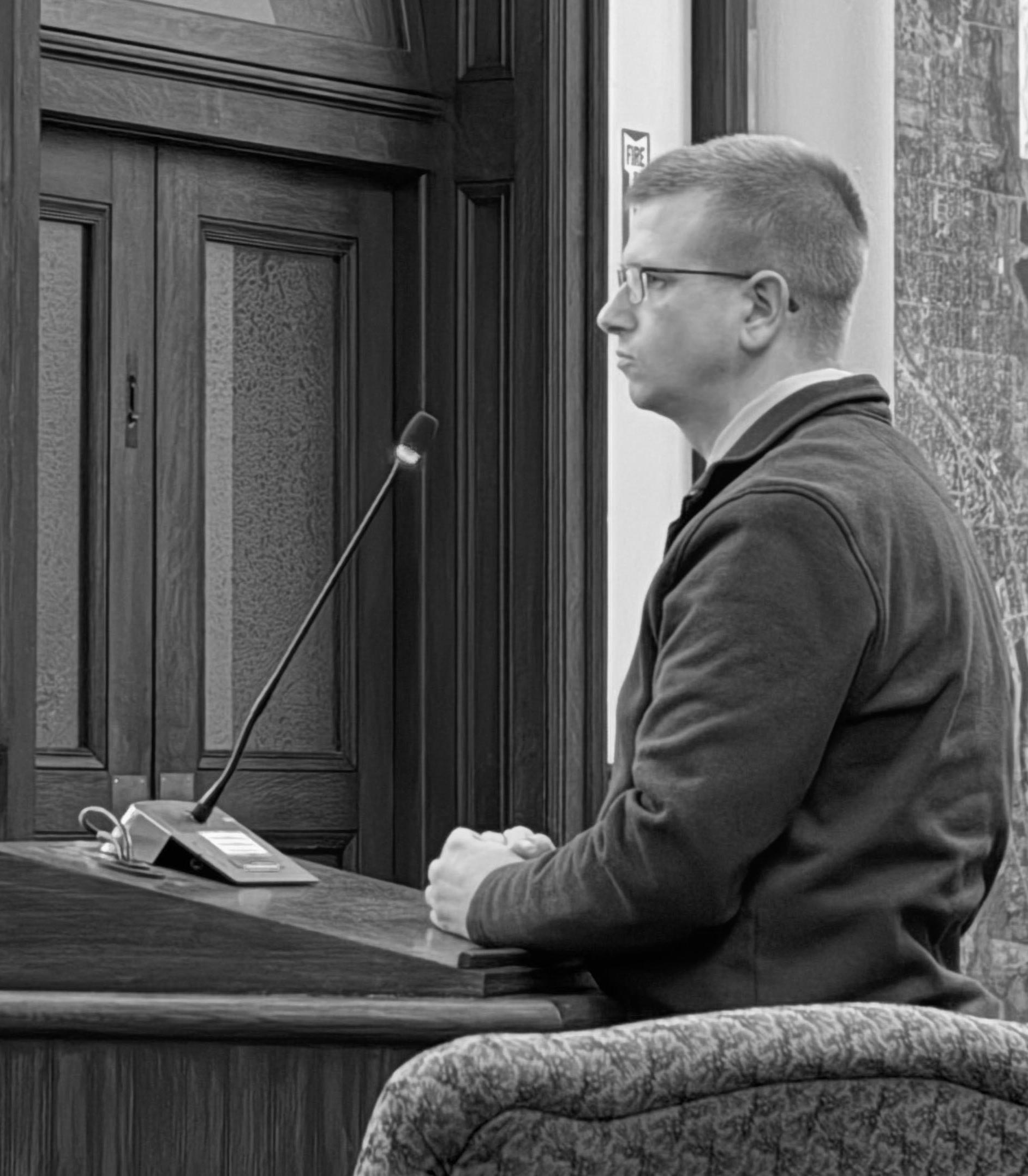
“This mayor did not select his chief of fire and police in a vacuum,” Ward 1 Councilman Greg Stuchell
said. “He had guidance. He had direction.” Paladino argued that the
electoral power for such an influential job should involve the judgment of the entire
council, not just a select few.
“Think about how this works in the legislature, even in Congress,” Paladino said. “The president or the governor will make an appointment, and you go, and you sit there for hours, and you ask question after question. You look at the interviews and the different possible applicants.”
Stuchell said that Paladino’s proposed selection process was unorthodox.
“I’ve never seen an interview process like that, and I’ve interviewed a lot of people in my career,” Stuchell said. “I’m confident in the leadership of Mr. Mackie, Chief Hephner, and the mayor.”
Bentley said it was the mayor and City Manager David Mackie’s leadership that made him wary of the decision.
“That’s why I’m voting against it. I am not confident in Mr. Mayor, specifically, and also Mr. Mackie,” Bentley said.
Bentley moved to table the vote to give all council members a chance to get to know Joswiak better, but the motion failed 6-3. After that, all members of council but Bentley voted to institute Joswiak as Hillsdale’s new police and fire chief.
Hephner will step down Feb. 17, giving Joswiak time to work alongside him for a few weeks. Though he currently resides in Canton, Joswiak plans to live in Hillsdale during the week for the next few months. After his two children finish the academic year, he said he plans to move to Hillsdale this summer, where he’ll then live full time. Joswiak said he appreciated the council’s discussion at the Feb. 2 meeting.
“Being a police officer, being a police chief, we expect to have discussions like this and to be able to talk civilly,” Joswiak said. “That’s what society’s all about in governments, right?”
Legislature passes bills banning cellphones in schools
By Adriana Azarian AssistAnt Editor
Public schools must restrict student cellphone usage during the school day if Democrat Gov. Gretchen Whitmer signs two bills the Michigan legislature passed last month.
House Bill 4141 would order public school districts or individual schools to ban wireless communication devices “on school grounds during instructional time.” Senate Bill 495 would require public schools to review emergency plans and protocol for the use of wireless communication devices in emergencies.
“You’re asking teachers to compete with the world’s most powerful entertainment medium: the internet,” State Representative Mark Tisdel,
a Republican who represents Rochester and Rochester Hills and sponsored the House bill, told The Collegian. “It’s just common sense. You’re there to gain knowledge at the hands of an expensive and trained adult at the head of the classroom. We don’t need the distraction of TikTok or Instagram or Reddit.”
Tisdel said Whitmer had expressed the desire for bipartisan legislation to prohibit smartphones in public schools for this session. According to Rep. Jennifer Wortz, a Republican who represents Hillsdale and Branch counties, Whitmer is expected to sign the bills into law next week.
“While schools already had the power to make a policy to ban cellphones during the school day, this house bill now requires it,” Wortz said in a
statement to The Collegian. “In the districts that have already developed a cellphone-free policy, they are seeing less distractions and better educational focus.”
While Tisdel originally proposed the complete prohibition of cellphones from school for grades K-5, from beginning to the end of the day from grades 6-8, and during instructional time for grades 9-12, he and Democrat Sen. Dayna Polehanki, chair of the Senate Education Committee, compromised to prohibit cellphones and communication devices only during instructional time for all grades, with allowances during passing periods and other non-educational times.
The bill also makes exceptions for medical and learning accommodation devices,
school-issued devices, and emergency situations. Students can also still use “dumb phones” without internet access.
“The bill is just really to inhibit smartphone usage,” Wortz said. “We’ve seen study after study about the devastating effects of social media on young people. So, that’s where we could find common ground on those issues and make those changes.”
According to Superintendent of Hillsdale Community Schools Ted Davis, Hillsdale public schools already have similar restrictions in place.
“We don’t allow cellphones for our elementary school. Our middle school can use cellphones during before-school and after-school time and at lunch time. For high school, it’s just not during instruction-
al time,” Davis said. “Basically, what has been passed, we’ve had it in play for the last probably two to three years.”
Davis said Hillsdale Community Schools have exceptions for students with various needs for devices as well as measures in place for handling emergency situations without the need for student cellphone usage.
Assistant Professor of Education David Diener said the removal of cellphones from educational spaces “can do nothing but improve” the quality of education.
“Cellphones are unnecessary. They’re, at best, a distraction and, at worst, undermine the process of education and the sanctity of the classroom as a sacred space where education between teachers and students takes place,” Diener said.
Diener said cellphone usage affects the way people think and interact with one another.
“Cellphones change the entire ecosystem of human communication inside and outside of the classroom,” Diener said. “That’s not to say that it’s all bad, but, yes, it’s had a pervasive effect that’s changed human communication and interaction.”
Tisdel said he is following this bill up with two more technology-related bills. House Bill 4388, which has already had a House hearing, would prohibit minors from using social media. He said he filed House Bill 5496, which imposes a 32% excise tax for smartphones for minors, last week.
Armadillos hitch rides with humans to Michigan
By Lonán Mooney CollEgiAn rEportEr
Armadillos are making their way to Michigan, according to a 2025 report from Michigan State University and Bradley University.
One of the authors of the report, Brett DeGregorio, a researcher with the Michigan Cooperative Fish and Wildlife Research Unit at Michigan State University, explained that the animals have been found dead in Michigan.
“I have no doubt that a handful of armadillos have made it to Michigan and then were hit by vehicles or died over winter,” DeGregorio said.
Sightings began surfacing of armadillos in roadkill reports in early 2025, and one photo of a live armadillo that has yet to be verified. The state’s Wildlife Division said the armadillos most likely have not travelled to Michigan naturally. Armadillos have only been documented migrating as far as Ohio and Indiana due to the cold temperatures further north, according to the Michigan Department of Natural Resources.
Armadillos are mammals with a hard shell native to southern states. The nine-banded armadillos, the kind appearing in Michigan, are 6 to 10 inches tall. These animals are
distinctive because of their prehistoric appearance and notable defense mechanisms, which is the reason for the numerous roadkill cases.
When armadillos sense danger, they quickly curl up into a ball and jump into the air, with
sy, according to invasive species biologist Ryan Wheeler of the Wildlife Division of the Michigan Department for Natural Resources.
These creatures were assessed in 2024 to determine whether they should reach “in-
Even though it is unlikely that these animals will spread disease to humans, it remains a concern to Hillsdale residents such as Mercadez Powell, a Metz employee.
“I’ve never maintained any bad feelings about armadil-
“Whenever a species colonizes a new area, it changes the ecology, but predicting the extent of those changes is very difficult,” VanZant said. “I think most people would hardly notice them. Although we could have an annual armadillo fes-

the intention of coming down and crushing the predator. However, when it comes to cars, these animals are defenseless.
Though seemingly harmless and even helpful to the environment, armadillos are capable of carrying diseases such as lepro-
vasive species” status, as many reports surfaced of large volumes of road kill in Illinois and Missouri, as was reported by The Bridge.
Armadillos can spread leprosy to humans, but it is very unlikely, according to Wheeler.
los, but learning they can be destructive and carry diseases makes me more concerned,” Powell said.
Professor of Biology JeffreyVanZant said armadillos likely won’t interfere with people’s day-to-day lives.
tival.” VanZant said armadillos would struggle to adapt to Michigan’s freezing winters.
“Armadillos are fairly adaptable, but Michigan’s winters are probably still too cold for them to become established here. Ar-
madillos do not hibernate; they are burrowing animals and can have extensive underground networks,” VanZant said. “But, maybe most exclusionary, they often dig for food and to escape predators, which would be hard to do during a Michigan winter. However, they also have a low metabolic rate and are poor, relatively speaking, at thermoregulation. As climate change warms Michigan, they could very well establish themselves there.”
Changes in the environments where armadillos currently live may have led the animals further north, according to Wheeler.
“In the research that we did, there were a number of factors: gradual climate change, as well as alterations in landscape and lowering numbers of predators for them,” Wheeler said. Wheeler said armadillos likely got to Michigan by hitching a ride with humans.
“The samples we found of roadkill in the state is most likely human-mediated, probably getting into a vehicle unbeknownst to the driver, jumping on a train car,” Wheeler said. “Since armadillos don’t walk very fast, they’d be lucky to move 50 miles in a single year, and they tend to stick really close to home.”
Kristopher Joswiak will take over as police and fire chief Feb. 17. Gemma Flores | Colle G ian
A nine-banded armadillo.
Courtesy | n ational Wildli F e Foundation
New city engineer aims to cut costs
By Sydney Green senior reporter
After several months without a permanent city engineer, the City of Hillsdale filled the position last September with a familiar face and a seasoned resume.
Rob Stiverson, a Hillsdale Coun ty native with more than 30 years of civil engineering experience, stepped into the role with a focus on efficiency and collaboration.
“I was born in Hillsdale, and grew up between Camden, Wal dron, Sullivan, Illinois, and Pittsford, and graduated from high school in Pittsford. Most of my family still lives in Hillsdale County, including extended family,” Stiverson said. “The attraction
to Hillsdale was the opportunity to be closer to family but also to do work that benefits an entire community.”
According to Jason Blake,
the city needed.
“Mr. Stiverson’s background included performing civil engineering services in both the public and private sector over the past 30 years,”
director of public services, only few of the applicants for the position had the municipal engineering background
Blake said Stiverson’s wide-ranging experience — including project management, city engineering, parks and recreation coordination, street maintenance and reconstruction, drainage, and city management — made him a strong fit for Hillsdale’s needs.
“Having Mr. Stiverson on staff allows the city to perform in-house engineering services for projects across all departments,” Blake said. “That reduces project
lead-time and provides cost savings compared to outside services.”
Stiverson graduated from Michigan Technological University in 1995 and completed engineering internships with the City of Jackson before working for several firms handling both private and municipal projects. In 2004, he founded Stiverson & Associates, which he ran until the COVID-19 pandemic. He later served as city manager in Bad Axe before returning to engineering full-time.
One of the biggest challenges he sees ahead is a familiar one for small cities.
“The challenge with most of the small city governments that I have worked with over the years is always the same, and it’s the ability to finance projects,” Stiverson said. “Where I can help most is by keeping engineering costs down by doing as much work in-house as possible, while still providing the functionality and aesthetics the city needs.”
Since Stiverson’s arrival, Blake said, the transition has been smooth.
“Upon Rob’s arrival, he immediately started design work
for current and proposed street projects,” Blake said. “Through great communication, he was able to put all the pieces together at or ahead of schedule.”
Ward 4 Councilman Joshua Paladino praised Stiverson’s professionalism and responsiveness.
“He’s answered all of our
“I feel like I hit the ground running on doing what I can to economize projects.”
questions and avoided getting involved in disputes about road policy,” Paladino said.
“He’s given solid professional advice, and I think he’s done a great job. We’re happy to have him on board.”
Paladino added that finding a qualified municipal engineer has been challenging for many cities.
“Contracted engineers
can cost 10% to 20% percent more than a full-time staff member,” Paladino said. “It’s great to have someone with long-standing municipal experience, and I hope we have him for many more years because we’ve got a lot of road work ahead.”
Current projects include street resurfacing, drainage improvements, and accessibility upgrades, with major work planned on M-99 and North Street and several neighborhood roads over the next few construction seasons.
“I feel like I hit the ground running on doing what I can to economize projects and get the necessary information to the other department heads, boards, and city council,” Stiverson said. “I’ve met a lot of people who genuinely want to help the community.”
Where does Michigan end and Indiana begin?
By Anna Broussard
Design eDitor
Parts of the Indiana and Michigan border line are unknown, and Michigan Sen. Jonathan Lindsey, a Republican representing parts of Branch and Hillsdale County, secured funding for a bill in December 2025 to sharpen the blurry line between the states.
Michigan has been in border disputes since before it was a state. Its original border survey, completed in 1827, never clarified to residents where the lines fell, making it particularly difficult for people living along the lines of Michigan and Indiana.
“The uncertainty surrounding the exact border between the two states has caused a number of issues over the years, and previous efforts have been affected by unexpected setbacks that prevented the project from being completed,” Lindsey said in a statement. “My bill is a simple fix that will prevent having to start this process over again from the beginning.”
Michigan’s first land con -
troversy, the 1835 Toledo War, resulted in Ohio getting the Toledo Strip and Michigan getting the Upper Peninsula. The second dispute regarding territory between Wisconsin and Michigan was decided by the U.S. Supreme Court in 1836, granting a water and land boundary in the U.P. Senate Bill 595, introduced by Lindsey, secured around $500,000 to accurately assess the proper markings for the state line between Indiana and Michigan. The bill allows for county surveyors using the 1872 survey, GPS mapping, and remonumentation programs to determine the official state lines.
“It is past time we accurately survey and remonument the Michigan-Indiana border, which has not been done since before we became a state,” Lindsey said.
Lindsey’s bill, which was signed by Gov. Gretchen Whitmer in Decem ber 2025, took effect in January and will continue through 2030 to establish a
boundary line benefiting residents and avoiding general territory conflicts.
According to Michigan Sen. Joseph Bellino, R-Monroe, the effort to establish a clear border has been ongoing since 2016, when he first began in the Michigan Senate.
“Jonathan’s bill, it gives it right back to the counties and townships to do it and get it done,” Bellino said. “We don’t have this problem with the Ohio–Michigan border, but we do with Indiana.”
Bellino said the hope is that the state line changes over a matter



not expected to create a conflict for those in Hillsdale County.
“We like Indiana,” Bellino said. “Indiana gave us a place to eat during COVID-19. Indiana gives us a lot of opportunities. I can’t imagine this would be a fight if they got to move it a few feet.”
A tri-state landmark established in 1977 marks the junction
point where Michigan, Ohio, and Indiana meet, but where the border lines continue from there remains unclear.
Unlike Michigan’s borders with Ohio and Wisconsin, which were settled through conflict and court rulings, the Indiana border has a single marker that stands as the official tri-state boundary point.
“I’ve always been interested in the sign of the entry of the state,” Battle Creek resident Kani said, who was visiting the landmark, said. “I have seen this place from Google Maps, and it connects the three states Indiana, Ohio, Michigan and I have been wanting to come here for the longest time.”
The marker, which is engraved on a rock with miles of fields surrounding it, leaves no clear indication of where the state boundaries actually run.
According to locals in Clear Lake, Indiana, the unclear boundary lines cause issues with conflicting state laws. On nearby Little Long Lake, the
supposed border runs straight through the middle of the lake.
“You need both a Michigan license and an Indiana one to ice fish on that lake,” Indiana resident Chase Eichler said.
“I’ve heard from regulars that live over there that if you are on the Indiana side, you’re only allowed to go a certain speed, and after a certain time, your boats have to be off the water. But then on the Michigan side you can be loud and stay out longer.”
Eichler said he determines the state lines depending on how quickly the snow is plowed off the roads.
“The only way I know what state I’m driving in here is the roads are numbered in Indiana, and the ones in Michigan have names,” Indiana resident Chase Eichler said. “Indiana is a little bit better with the snowplows, but I don’t think we will ever really know where the border was originally meant to be in the first place.”
Hillsdale’s new city engineer, Rob Stiverson. Courtesy | r ob s tiverson
Singles start spring strong
By Fara Newell Collegian Freelancer
Hillsdale men’s tennis opened its spring season with a pair of home victories in a weekend doubleheader, beating Spring Arbor University 6–1 and Michigan Tech University 5–2.
On Jan. 30, the Chargers swept Spring Arbor, clinching the doubles point and five out of six singles matches to seal their victory.
The No. 1 doubles pair sophomore Ryan Papazov and junior Ellis Klanduch were tied 5–5 before breaking the deadlock by taking the next two games, winning the match, and clinching the doubles point for the Chargers.
Also in doubles, junior Henry Hammond and freshman Patrick Cretu defeated their opponents 6–3.
In singles, Hammond went on to defeat Daniel Rodriguez Fortes, taking a tight first set before cruising to a 6–1 win in the second.
“Henry Hammond also had a really good weekend, dismantling both of his opponents in
Games
singles,” sophomore Sam Plys said. “He played high-level, dominant tennis the whole weekend, and also had some really solid points in doubles as well.”
Plys battled for three hours to win at No. 2 singles, 6–4, 7–6.
“It was constantly a mental battle,” Plys said. “I had to push through long rallies every point to eventually pull out that match. My opponent was playing really good tennis, and I am glad I kept my head clear and came out on top.”
Teammate Papazov weighed in with his take on Plys’ match.
“Sam was playing chess, and his opponent was playing checkers,” Papazov said.
The next day, Hillsdale battled Michigan Tech, dropping the doubles point but winning five out of six singles matches.
Papazov pulled out a decisive 6–3, 6–1 victory against Landon Coates at No. 1 singles.
“I went much farther beyond what I had done on Friday,” Papazov said. “I played a lot better; a lot more intentionally.”
Cretu took control early,
Noughts and Crosses Plus
taking the first set 6–1. He closed out a tighter second set to defeat opponent Andres Horobeanu 6–1, 7–5.
“Patrick did an incredible job playing loose and staying mentally strong in the big moments when it mattered, clinching for us what at the time was a very close match against Michigan Tech, a team that had beaten us last year,” Plys said.
Sophomore Alex Cordero Lopez sealed the team victory with a hard-fought 7–5, 7–6 (5) win over Ian Pinoo.
Plys said he was encouraged by the Chargers’ doubles performance over the weekend.
“I believe that our level has significantly increased this past year, and we can confidently pull out more wins from doubles,” Plys said.
The Chargers will compete again Feb. 7 against Goshen College in the Margot V. Biermann Athletic Center.
“I think we’ve got a really strong lineup, and we’re gonna be a force to be reckoned with,” Papazov said.

The numbers around the border indicate the length of the longest runs of consecutive noughts or crosses in that row, column, or secondary diagonal (a zero means that symbol does not appear).


1/22 and 1/29 Puzzle Solutions
Battleships

Noughts and Crosses Plus

Symposium
Ping Pong tournament?
Collegian staff weighs in on who will reign victorious in the Union tournament
Track Team Takeover
Compiled by Elaine Kutas Sports Editor
If a ping pong ball falls on you during your saga dinner, be sure to throw it back up; someone might need that to win the spring 2026 ping pong tournament.
Members of The Collegian staff took some time to predict who they think will dominate the competition and come out victorious. Anyone is welcome to submit a prediction bracket before Feb. 6 and a $10 Amazon gift card will be awarded to the person who creates the highest-scoring bracket. Send inquiries to Dimitry Ermakov, dermakov@hillsdale.edu.
Furness Finesse
The champion- ship of the ping pong tour- nament will be a matchup between juniors Nathan Furness and Austin Piecuch. Furness’s pickleball skills will surely transfer to the Union’s ping pong tables, as he has carefully honed his hand-eye coordination over the last year as president of the Pickleball Club. Piecuch will certainly prove competitive, for it’s an incomplete day when you don’t see him in the Union trying to school a freshman in ping pong. This will be a wellmatched table tennis championship, but Furness will prove the victor.

- Ellie Fromm, News Editor
Miniature-Tennis Master
As a former member of the Hillsdale tennis team, Pali Vician-Flechler holds an advantage in the upcoming ping pong tournament. After all, ping pong is just tennis in miniature. His power will be difficult for his competitors to overcome. The one competitor who may prove to be a match for Vician-Flechler is Nathan Furness, but in the end, Vician-Flechler’s tennis skills will win out and he will be victorious.
- Christian Papillon, Assistant Sports Editor
“In the 15th inning of the second game, we were able to decipher the opposing pitcher,” Swenson said. “His pitches were nasty, but he struggled to throw his offspeed pitches competitively in the strike zone. That allowed us to sit on his fastball and crush it without worrying about the potential of swinging and missing at a competitive off-speed pitch.”
The Chargers allowed two runs in the bottom of the inning, but sealed the game when junior pitcher Winston Delp forced a groundout to end the game.
please contact Matthew
at mtolbert@
“This weekend showed us a lot about this team,” head coach Tom Vessella said. “We had a really strong offensive showing in the last two games, and it wasn’t just one person. A lot of different guys contributed up and down the lineup.” Vessella said he was proud of the team’s resilience in Game 2.
There are four names that I care about in the ping pong lineup: Nathan Furness, Seth Jankowski, Colsen Conway, and Emil Schlueter. Furness is ranked atop the contestants for good reason. He’s got a competitive edge that matches natural athleticism. That’s a dangerous combination at the table. Jankowski runs anything he tries. My personal experience says casual table tennis players have no chance. I appeal to personal experience in the case of Conway, too. The intensity in his play and the spin on his serve have held me under 10 points. I expect that fate will come to most of his opponents. And Schlueter. He’s got that dawg in him. Jankowski and Conway — track athletes who know what it takes to compete at a high level, will vie for the championship. The winner will be whoever serves first. Or whoever ends up rent free in the other’s mind.
- Ty Ruddy, Culture Editor
Varsity Tennis vs. Mad Focus
Pali Vician-Flechler's past varsity tennis history will surely bring him to the Final Four in table tennis. I’ve seen Austin Piecuch play as well — an absolute legend. Theo Hoelker is an underrated ping pong ace: He’s got some of the fastest reflexes I’ve ever seen, and he has a few trick shots up his sleeve. Finally, Ellie Ritchey has mad focus; she’ll stare all her opponents down until they can’t help but miss a ball. I expect to see Pali and Ellie in a legendary finals round.
- Matthew Tolbert, Web and Puzzle Editor
these guys stayed on an even keel and just kept playing. It was an exciting game to be a part of.”
Tenuta credited the pitching staff with keeping the game close to allow for the 15th-inning rally.
“We were having trouble getting runners on base until that last inning, but Pat MacLean and Winston Delp

did a great job of keeping us in the game and letting our defense work in order to give our offense a chance to explode at the end,” Tenuta said.
The Chargers scored 14 runs again in the third game of the series, but lost 18–14 against the Falcons.
“We never gave up,” Vessella said. “A lot of teams would have folded when Montevallo came back and tied it again in the 13th, but
Swenson said the offense regrouped after the first game of the series and found success with a different approach in the final two games.
“We really found our strength in making minor swing adjustments throughout the weekend,” Swenson said. “In Game 1 we only scored two runs and had way too many strikeouts to be competitive. We put lots of emphasis on putting the ball in play in the second and third games, rather than swinging for the fences.” Tenuta said the team’s performance in the first series was a good sign for the upcoming season.
“It was promising to see us compete the way we did in the first weekend, especially comparing this to our opening weekends in the past where we started out much slower,” Tenuta said.
“I am really excited about how our young guys stepped up. Obviously, we still have a lot to improve upon, but I think we showed a glimpse of a lot of good things this weekend.”
The Chargers will travel to Harrogate, Tennessee, for a three-game series against Lincoln Memorial University Feb. 6-8. The team’s first home series will begin March 20.
Sophomore Logan Dichler runs the bases. Courtesy | Ashley Van Hoose
By Ethan Savka Collegian Freelancer
The Seattle Seahawks will face off against the New England Patriots for Super Bowl LX, a showdown between journeyman quarterback Sam Darnold and rookie Drake Maye.
As the Super Bowl approaches, the Seahawks, led by a dominant quarterback in Darnold and bolstered by a legendary defense, are a clear favorite. While the Patriots boast an inspiring turnaround story and a promising young rookie, their softer schedule may take the credit for bringing them this far. Ultimately, Seattle appears ready to bring home its first Lombardi Trophy in more than a decade.
After winning three of the last six, this contest marks the first time since 2021 that the Kansas City Chiefs will miss the Super Bowl. With the Boys in Red out of contention, Vegas odds and most NFL fans favor Darnold’s birds.
der set at 45.5. Through two games, the Seahawks have outscored their playoff opponents 72–33.
Sports bettors say they appreciate the safe track record.
“I’ll probably bet double what I usually do,” senior Bobby Lindau said. “I’ll probably put down five to 10 bucks; usually I’m only putting one or two dollars.”
Part of Seattle’s strength lies in its opponent’s weaknesses. Out of the 14 teams to make the 2026 playoffs, the Patriots had the weakest strength of schedule, allowing them to jump from a 4–13 season last year to a record of 17–3, including the playoffs.
While New England’s reversal makes for an inspiring comeback story, it has already wavered in the weeks leading up to the Super Bowl.
“Drake Maye barely beat the Broncos, a team without their starting quarterback,” Lindau said.
Five days after his former team made the Super Bowl for the first time since his departure, six-time Super Bowl champion coach Bill Belichick was blocked from entering the Pro Football Hall of Fame, allegedly over his role in various cheating scandals. With the Patriots only three days from competing in the biggest sporting event of the year, the news could not come at a worse time, and may cost them some fair-weather fans heading into Sunday.
With the odds in their favor, the Seahawks have added many playoff fans to their ranks.
Junior Luke Jones is not a fairweather fan, despite usually rooting for the Dallas Cowboys.
“I’ve lived in Portland since I was 4,” Jones said. “So they’re the local team.”
Jones said he’s excited for his local team’s chances.
Softball
Regional win sets season expectations Seahawks will win, thank Pope Leo
“Darnold is a top QB and has been nearly perfect in the playoffs,” Jones said. “He just has to play a clean game.”

On Jan. 31, the Seahawks were favored by DraftKings 4.5 points over the Patriots, with a total points over/un-
Super Bowl Season starts with two wins at home
The Patriots ultimately defeated the Broncos by only 3 points.
The shift against the Patriots has occurred both on and off the field.
Women's Tennis
By Sophia Bryant Assistant Editor
The Hillsdale women’s tennis team kicked off its spring season by sweeping the Spring Arbor University Cougars 7–0 Jan. 30, and beating the Michigan Tech University Huskies 5–2 Jan. 31 in the Margot V. Biermann Athletic Center.
“It’s definitely a really good feeling to see that we lived up to our potential,” head coach Melanie Zampardo said.
Senior Bella Spinazze said the Chargers haven’t played Spring Arbor while she’s been on the team. Last year, they lost to Michigan Tech 4–3.
“Michigan Tech is a team that we have not beaten in a few years and is always a really challenging match for us, just because it’s a good, tough team at the beginning of the season,” Spinazze said.
Spinazze and her doubles
partner, sophomore Briana Rees, beat the Cougars 6–3 and the Huskies 6–0.
“It was really fun to get back into match energy and have some matches under our belt and really get the season in full swing,” Spinazze said.
“We’ve been working so hard since the fall for this moment, and it really paid off. That was clearly evident this weekend.”
Rees won 6–0, 6–2 in singles against Spring Arbor and 6–3, 5–7, 7–5 in singles against Michigan Tech.
“Briana had two singles, and her consistent energy throughout the entire match, you know, bringing up her teammates on both sides and just never relenting on the energy that she gave,” Zampardo said.
Junior Ané Dannhauser played singles and doubles in both matches. Dannhauser and her doubles partner, senior Megan Hackman, beat
“This team’s defense reminds you a lot of the Legion of Boom - they hit hard and hustle the football,” Jones said.
Even with a stellar defense, it all comes back to the quarterback.
If Darnold maintains the lead heading into the final quarter, the Patriots may never stand a chance. While leading the Minnesota Vikings in the playoffs last year, Darnold fell apart early and saw his team lose to the Los Angeles Rams, 27–9.
Freshman Mich Horn said he predicts the Seahawks will win if Darnold doesn’t start seeing ghosts.
“If we’re leading by a touchdown in the fourth quarter, that’s game,” Horn said.
Another ally Seattle may have is, oddly enough, the Vatican. Every time a new pope has been elected this century, the Seahawks have made the Super Bowl, losing in 2005 and winning in 2013. With the election of the first American pope last Easter, the uncanny trend may continue in Seattle’s favor.
By Blake Schaper Collegian Freelancer
Softball head coach Kyle Gross said he hopes his team this season builds on a victory in last year’s Great Midwest Athletic Conference regionals but also knows that his players face a challenging schedule.
“We play against the No. 1 team in the country, the twotime defending champion, University of Texas,” Gross said. “Then, on spring break, we play the No. 2 team in the country and the team that we faced last year in the finals.”
The Chargers will play the University of Texas at Tyler, Northeastern State University, and New Mexico Highlands University in Tyler, Texas Feb. 6-8. The Chargers will also play No. 2 University of Tampa during spring break this season.
“We faced a lot of adversity this fall and encountered situations that we hadn’t really experienced before,” Gross said. “But in the season we just came together. We finished the best season we’ve ever had, making it to the finals of regionals, and the way we played at the end was most rewarding.”
Maxson went on to say that senior Joni Russell ’25 won All-American honors, and senior Hannah Hoverman ’25 was awarded Great Midwest Athletic Conference MVP after she hit a walk-off against Old Dominion University that advanced the team to the finals.
Even though Russell and Hoverman graduated, Maxson said she sees their same fighting spirit in the freshmen.
“Theres a lot of potential with our freshmen because they are all very dedicated,” Maxson said. “They are the most hardworking freshman class that we’ve had. That was the personality of the girls last year.”
Maxson also said her priority is to work on perseverance with the team.
“Last season, we came out of the gate scoring many runs, but during the game, the energy began to taper down,” Maxson said. “We have to work on maintaining our energy. Nip it in the bud from the get-go. We are playing against harder opponents.”
the Cougars 6–4 and the Huskies 6–3.
“I think it was the perfect start to the season,” Dannhauser said. “I was challenged in my matches and really had to work for points in both matches. Megan and I played together for the first time in a while, and while we were very nervous in the first match, the second one went much better, and we really worked together to gain momentum and take over the match.”
Dannhauser won her singles match against Spring Arbor 6–3 and 7–5, and her singles match against Michigan Tech 7–5, 6–3. Hackman won her singles match against Spring Arbor 6–0 and 6–1.
Zampardo said the two freshmen on the team, Dimitra Papastavrou and Esther Sura, both won their first college doubles and singles matches.
Papastavrou and Sura beat
Charger
If you could travel anywhere, what place would you visit and why?
I would travel to Italy to see all the architecture and the food.
Do you have any secret skills or talents that others don't know about?
I can juggle.
How would you spend a million dollars? I would probably invest it or buy my dream home.
the Cougars 6–0 in doubles but lost 4–6 to Michigan Tech. Papastavrou won her singles match against Spring Arbor 6–1 and 6–2. Sura won her singles match against Spring Arbor 6–1 and 6–0, and her singles match against Michigan Tech 6–3, 6–2.
Sophomore Julia Zlateva beat Spring Arbor 6–4, 6–1 in singles and Michigan Tech 6–4, 6–2 in singles.
The women’s tennis team will play again next week, with a home match against Goshen College Feb. 7 at 3 p.m. and an away match against Saginaw Valley State University Feb. 8.
“I am hoping for the same energy, and if anything, upping the energy a bit,” Zampardo said.
Gross said his priority this season is visualizing victory correctly, focusing on individual improvement over the number of games won.
“So the challenge is, what do we feel like?” Gross said. “What is our success, even if we don’t reach that many wins? We are not letting that get us down. What matters to us is how we play at the very end in our conference season, our conference tournament, and then hopefully postseason.”
Gross, who has been the Hillsdale softball coach for seven years, will be featured in the upcoming Arete Magazine.
Senior Mackenzi Maxson said unity was the team’s greatest strength last season.
“We were good all-around offensively and defensively, and we were marching to the beat of the same drum,” Maxson said.
Chatter
Junior Sydney Davis said she hopes to live up to Hillsdale’s motto: strength rejoices in the challenge; and urges her teammates to show perseverance and grit.
“If I had to give advice to the softball team, I would say embrace the suck and get in it together,” Davis said. “I know your body is going to be tired, but it is for a greater purpose.”
Davis said her personal goal is to maintain her optimistic, cheerful attitude on the softball field.
“This year, I am going to work on mental gain,” Davis said. “I am going to relax and not be so hard on myself and forgive myself for the mistakes I make along the way.”
If you could have any superpower, what would it be?
What conspiracy theory do you think is the most plausible?
The Titanic sinking was an insurance scheme.
What's something you wish you could have told your younger self?
Sleep is super important, and live life one day at a time.
Amelia Lutz, Women's Track and Field
Compiled by Sophia Mandt
Photo
C harger S port S

Track and Field
Kuhn crushes mile record
By Francesca Cella Assistant Editor
Senior Ross Kuhn broke the indoor mile record for Hillsdale College by four seconds at the Meyo Invitational hosted by the University of Notre Dame Jan. 31. Kuhn raced in the fastest heat and crossed the finish line in 5th at 4:02. His time beat the former school record of 4:06 set in 2018, and his personal record by eight seconds. He also ran the second-fastest mile in Great Midwest Athletic Conference history.
“It’s a confidence boost to know that I can already run 4:02, so just taking a little time off in the race is going to come down to fine-tuning some things in practice,” Ross said. “That’s the first mile I’ve run all year, and usually the first one doesn’t go that well, so I was pretty happy with that.” Kuhn said he hopes to make it to the National Champion ships and break four minutes. Throwers also represented Hillsdale well at the Meyo Invitational, with senior Ben Haas taking first in men’s weight throw and increasing his national leading mark to 21.91 meters. He is also the G-MAC Field Athlete of the Week for the fourth time of the season and the 13th time in his career. Junior Amelia Lutz threw 15.73 meters in shotput and placed second.
Widolff said he wasn’t sure that he would run a good time going into the meet.
“I’ll be honest, I was a little worried that I wouldn’t get a big PR,” Widolff said. “I didn’t know if it was coming or not because I was more focused on the 400 than on the 800 training-wise last month. I’m hoping if I focus on more 800 training in the future, it can still go down further.”
Women’s track also performed well, with freshman Anna Roessner finishing first in the 60m dash preliminary with a time of 7.49 and second in the 200m dash at 24.72. Senior Lucy Minning placed third in both 60m and 200m preliminaries, with times of 7.77 and 24.88.
Senior Francesca Federici took second in the 400-meter dash with a season-best time of 57.73, followed by freshman Jessica Church, who came in fourth at 59.17

Women’s weight throw gained another potential competitor in the National Championships, with junior Regan Wight throwing a personal best of 17.53 meters and reaching provisional marks for the first time in her career.
Wight said it’s been her goal all year to reach provisional marks.
Chargers split on road, gear up for home
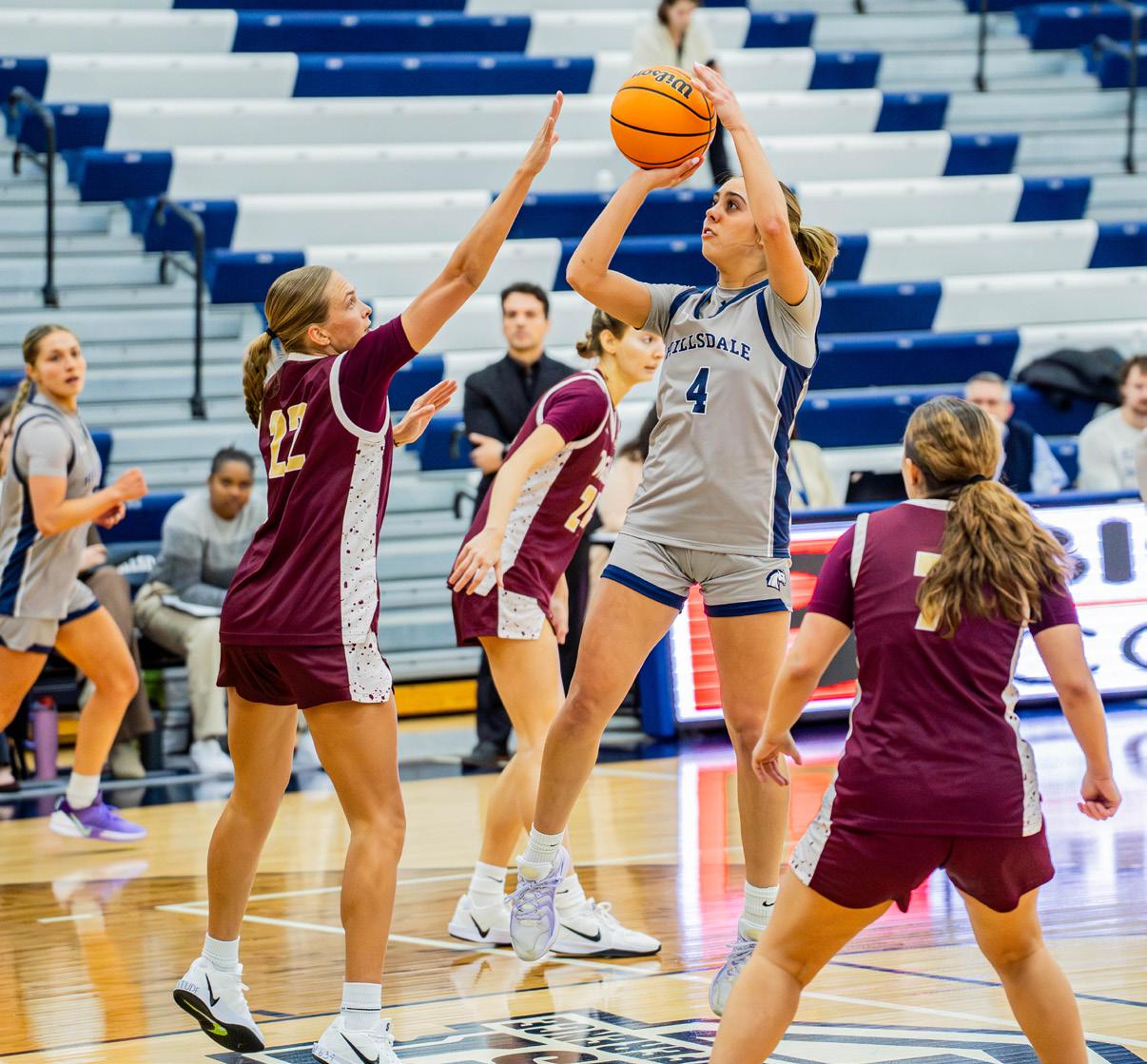
By Robert Matteson Collegian Reporter
Hillsdale women’s basketball outscored Ursuline College 21–7 and held the Arrows to 16% shooting from the field in the final quarter to defeat the Arrows 70–54 Jan. 29 on the road before a 72–63 loss at Walsh University Jan. 31.
“We showed a lot of toughness and played great team defense to minimize their scoring,” head coach Brianna Brennan said.
With the split, the Chargers’ record moved to 10–8 overall and 6–6 in Great Midwest Athletic Conference play, placing them eighth in the conference.
“Road wins are huge for us,” junior forward Savannah Smith said. “It not only helps us in the G-MAC standings, but it’s a huge boost of confidence knowing that we took down a team on their home court.”
Savannah Smith led the
Chargers in scoring with 16 points on 8–9 shooting from the floor. Junior guard Annalise Pietrzyk added 12 points, six rebounds, and four assists.
“Savannah’s really been a huge asset for us lately,” Pietrzyk said. “Some teams have begun to double her once she has the ball, which opens up our shooters more.”
Sophomore guards Magdalena and Emilia Sularski, and sophomore center Ellie Bruce each contributed 9 points.
“Our balanced scoring in Ursuline was really great,” Brennan said. “It shows our depth and selflessness.”
Senior guard Emma Ruhlman added 7 points, six rebounds, and three assists. Freshman guard Maddie Smith contributed 6 points,
six rebounds, and three assists.
“Our rebounding was spread out too, so it was great that everyone’s individual effort was on a high and helped our team come out on top,” Brennan said.
Sophomore guard Sarah Aleknavicius returned to the lineup for the Chargers against Walsh following an eight-game absence due to injury.
“Having Sarah back in the lineup is very exciting,” Brennan said. “Sarah is such a versatile player, and she typically defends the other team’s best players.”
Hillsdale fell behind the Cavaliers late in the second quarter and remained within striking distance of the lead the entire second half. Hillsdale was unable to take the lead before falling to Walsh.
“I don’t think we rolled over and gave up, but it’s also
important to keep focusing on taking care of the ball,” Pietrzyk said. “Turnovers have been a weak spot for us, and we gave Walsh 20-plus points just on turnovers.” Pietrzyk led the Chargers with 28 points, including 6–11 shooting from beyond the three-point line. Ruhlman added 10 points.
“We are excited for the opportunity to keep growing, so we are playing our best basketball come March,” Brennan said.
Following the two-game road trip, Hillsdale returns home hoping to avenge an earlier loss to Tiffin University Feb. 5 at 5:30 p.m. The Chargers also play Ohio Dominican University Feb. 7 at 1 p.m.
“We are excited for both our home games this week and grateful for the support of the college and community thus far,” Brennan said.
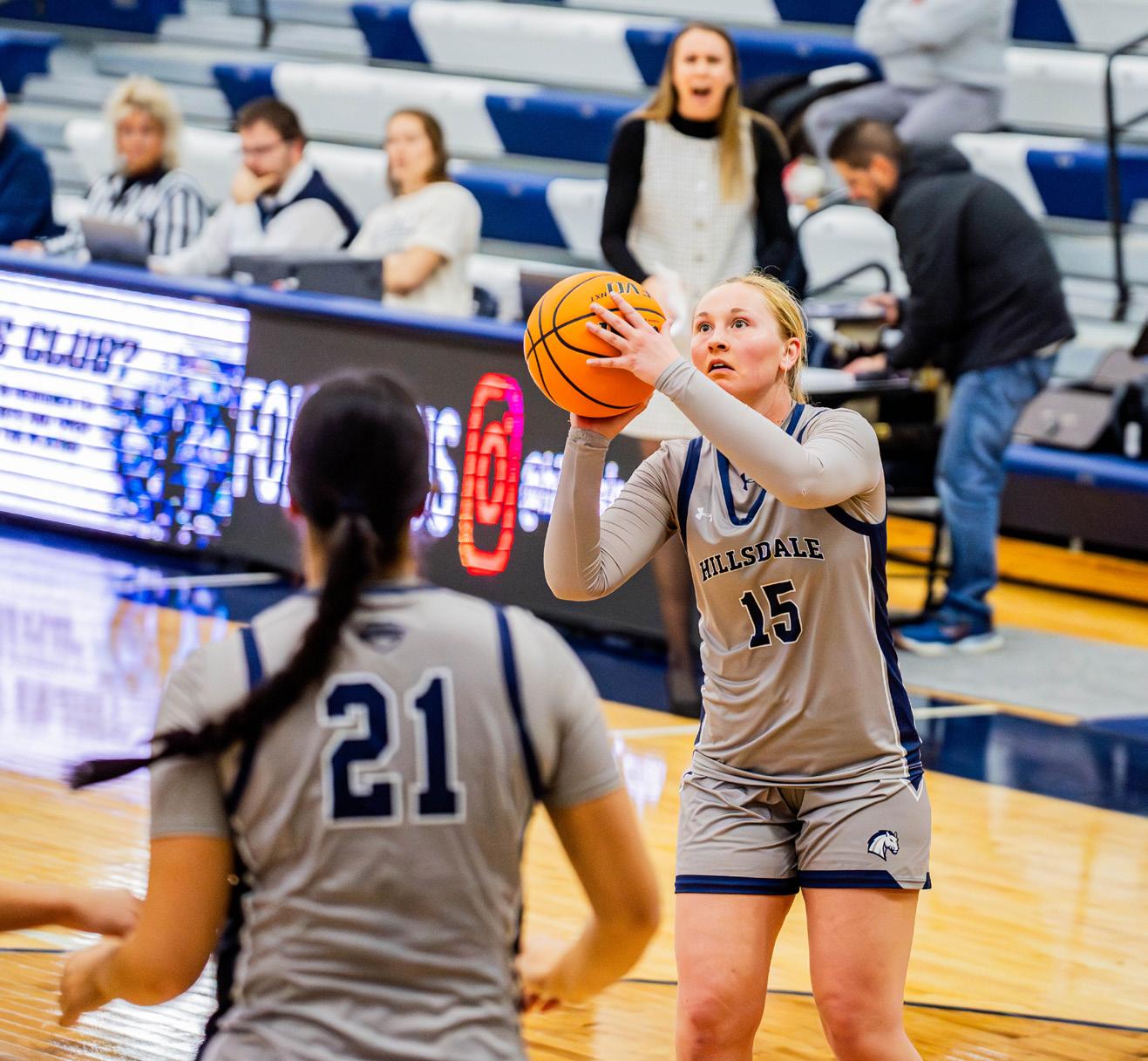
“I feel like this is by far our best year as a whole group, not just as an individual person,” head track and field coach Jessica Bridenthal said. “Track’s an individual sport. Sometimes you’ll see an individual have a great year, but across the board we’re seeing a lot of really good things.”
Freshmen Wyatt Widolff and Watson Magwenzi competed at the Jet’s Pizza Invite hosted by Saginaw Valley State University Saturday, with Widolff running a personal best of 1:56 in the 800-meter dash and placing 15th overall. Magwenzi took 11th in the 60-meter dash and 17th in the 200-meter dash with times of 7.00 and 22.26, respectively.
“I was hitting what I had been hitting in January and in our other meets, and it was the last throw,” Wight said. “Teammates were one and two, and there were one or two girls ahead of me, and we really wanted to sweep the podium for that meet because it would be fun. I knew my technique, I had all the pieces, I just had to throw hard. I put it all together and just let it rip.”
Junior Olivia Newsome took first with a throw of 18.53 meters, sophomore Tori Tyo came in second with a personal best of 18.52 meters, and Wight placed third.
The Chargers will divide the team to compete in Grand Valley State’s Mike Lints Alumni Meet and in the Michigan Invitational hosted by the University of Michigan Feb. 7.
Men's Basketball Road loss teaches tough lessons
By Evelyn Shurtliff Collegian Freelancer
Junior forward Caleb Glaser came back from an injury to score a team-high 15 points, but the Hillsdale men’s basketball team lost 71–51 to the No. 1 ranked team in the Great Midwest Athletic Conference, Walsh University, Jan. 31 on the road.
“A good team will expose your weaknesses, and I think that Walsh did a good job of showing those to us,” assistant coach Jackson McLaughlin said. “It’s all about growth, and our season is far from over, so this gives us a good chance to focus on improving and learning from our losses.”
The Chargers scored only 13 to Walsh’s 41 points in the first half, but outscored Walsh 38–30 in the second half. Despite Hillsdale’s comeback, the initial deficit was too great to overcome, leaving the team 5–7 in the G-MAC and 8–12 overall.
In the first half, the Chargers fell behind quickly due to turnovers and difficulty completing the shots they managed to get off against Walsh’s pressure. At the close of the half they were 3–18 for field goals and 0–10 for 3-point shots. The second half saw the Chargers put up a good battle, with Glaser returning after missing the last two games to lead the team in points. Freshman guard Braylon Morris also contrib-
uted 11 points, and senior guard Ashton Janowski added 10.
“After a first half that went so wrong, I was proud of our team for not giving up and continuing to play hard the entire game,” Janowski said. “We told ourselves we needed to break the game down and make it more simple, which meant focusing on things we can control every possession on both offense and defense. It took a lot of effort and focus that we had lacked in the first half, but to our credit, we turned that around in the second half.”
With only one game that week, McLaughlin said they were able to take a day off practice on Wednesday.
“It allowed for a bit of a re-
set, which will help us to get through the rest of the season,” he said.
Junior forward Garrett Bolte said the loss provided them with good material to focus on in practice this week.
“The game exposed a lot of our weaknesses, but knowing those will prepare us well for a homestand this coming week,” Bolte said. “We need to start by handling pressure better and being far more disciplined on defense going forward if we want to try to make a run in the conference tournament.”
The Chargers face Tiffin University Feb. 5 at 7:30 p.m. and Ohio Dominican University Feb. 7 at 3 p.m. at home.
Hoose
Senior Ross Kuhn broke the school record. Courtesy | Athletic Dept.
Sophomore guard Magdalena Sularski goes up for a shot.
Courtesy | Ashley Van Hoose
Freshman guard Maddie Smith in her first game back from injury.
Courtesy | Ashley Van Hoose
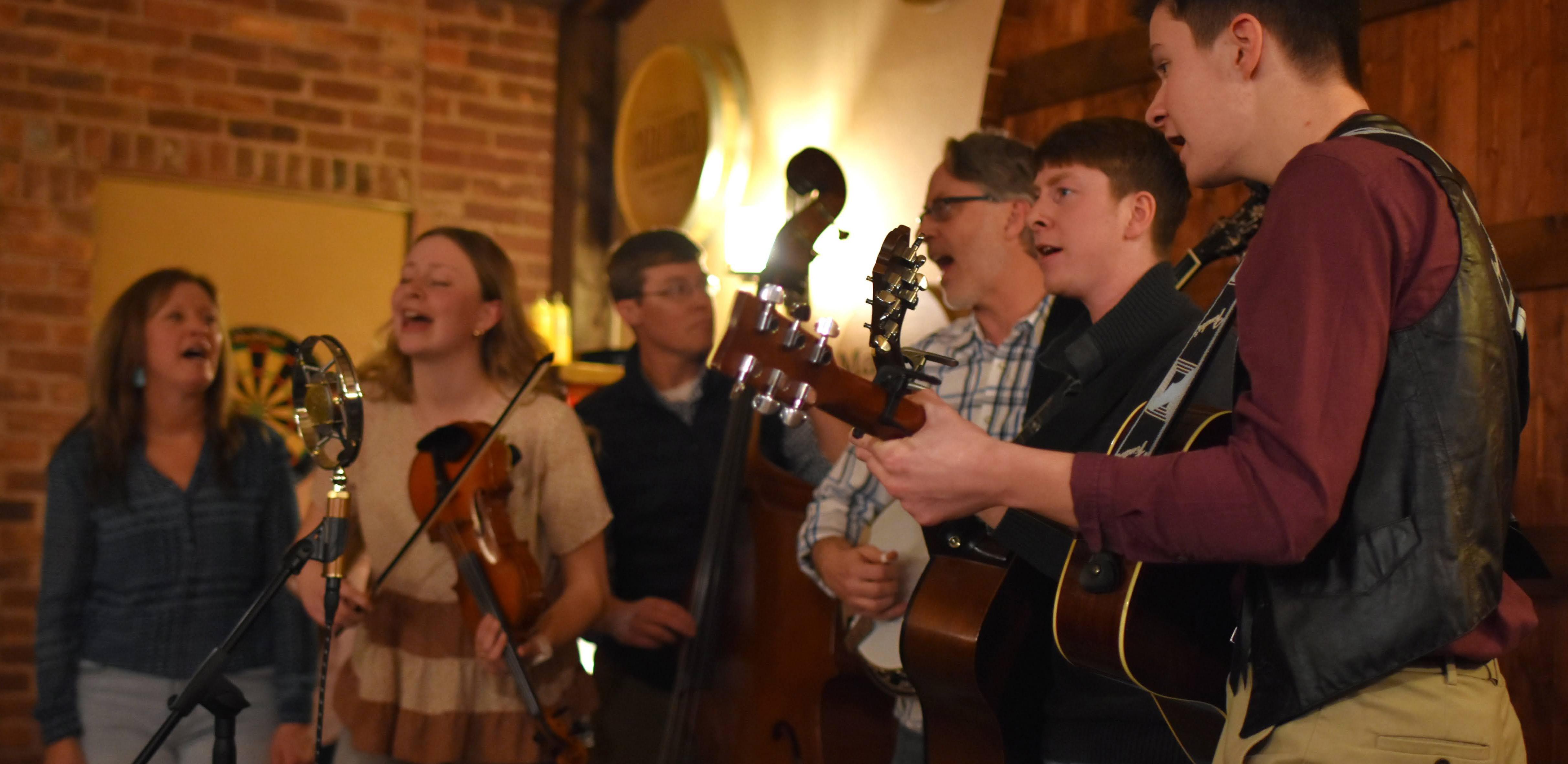
C u l t u r e
The twang is a family thang for the Schlueters
By Elaine Kutas SportS Editor
Banjo, fiddle, and harmonizing voices carried through Dante’s Paradiso Wine Pub Jan. 31, as ice clinked in cocktail-filled glasses. The environment hummed with background chatter, laughter, and clapping along with the music. The effect that the Schlueter Family Band has on their community was tangible in the standing-room-only restaurant as the family performed a mix of folk, bluegrass, and classic rock songs, prompting singing along and even some impromptu line dancing.
The selections they play range from covers of Mumford and Sons’ “I Will Wait,” Johnny Cash, Chris Stapleton, and Bob Dylan’s “It Ain’t Me Babe,” to classic campfire favorites like
“Rocky Top Tennessee,” “Wild Rover,” and even some hymns.
Despite the family being Hillsdale-famous for its musical talents, Nathan Schlueter, professor of philosophy and religion at Hillsdale College, said he never expected his family band to become what it is today. Schlueter began playing guitar leisurely when he was in high school, but only became serious about it when he was in his 30s.
“There wasn’t some decision to have a family bluegrass band — that was not in my background,” Schlueter said. “The pieces kind of slowly came together because it was very important to me for my kids to have some kind of musical lessons as part of their education, whatever that instrument would be.”
Schlueter began by teaching his oldest children how to play

guitar, then quickly realized he wanted them to learn instruments that they could enjoy forever. When the opportunity arose, his oldest daughter, Helen, began lessons to learn fiddle, prompting Schlueter and his oldest son to play in accompaniment.
Then, a failed fly-fishing hobby led Schlueter to take up the banjo, a decision that would soon shape the dynamics of their family jam sessions.
“I went on a fishing trip with a friend — fly-fishing,” Schlueter said. “I came back to my wife and told her how fun fly-fishing was. She bought me a fly-fishing rod for my birthday, and I thought that was fun. I went out and cast it a few times, and I realized I don’t want to fly-fish anymore, so I sent it back and bought a cheap banjo.”
Realizing that learning to play the banjo was harder than he anticipated, Schlueter tried to convince his kids to play. When none of them showed interest, he stubbornly decided that his learning would add some dimension to their ensemble, and since they had the banjo, someone had to play.
“I just slowly, painstakingly started learning to play the banjo very late. I was probably 45,” Schlueter said. “It’s honestly a really hard instrument to learn.
I’m still not great at it, but it’s something different.”
Schlueter said as the years went on, he and his wife, Elizabeth, continued to instill the importance of musical talent in their children, even through the beginner’s learning curve, and sometimes even tears.
“For all of my kids, the five oldest ones, at least, they hit a point when they were 12 or 13 where something flipped, and they got excited,” Schlueter said. “You can’t control that, you can’t make that happen. It happened for the first, and then the second, and then the third. Suddenly, they took ownership, they internalized it, and then they went way beyond where I could even teach them, and just took joy in it.”
The band started without much anticipation of it actually gaining attention, but after news of their family’s talent spread, they began playing small local gigs.
“We’ve had to build up a repertoire, and we have a big repertoire right now, so we probably have enough songs to do three different sets if we wanted to,” Schlueter said. “The first time we did a set, we only had like 10 songs, and even those were a little shaky.”
But the Schlueter Family Band doesn’t perform for attention or fame — it wants to share its talents and cultivate culture within the Hillsdale community.
“I don’t think of what we’re doing as a performance,” Schlueter said. “What we’ve got is kind of a special thing, and for me, the greatest joy of playing is when everyone is singing along, and they’re clapping along, and they’re just taking joy and being part of it, and not just spectators. That’s how I think about what we’re doing, and we want to encourage that.”
Freshman Jefferson Regitz said he loves hearing the
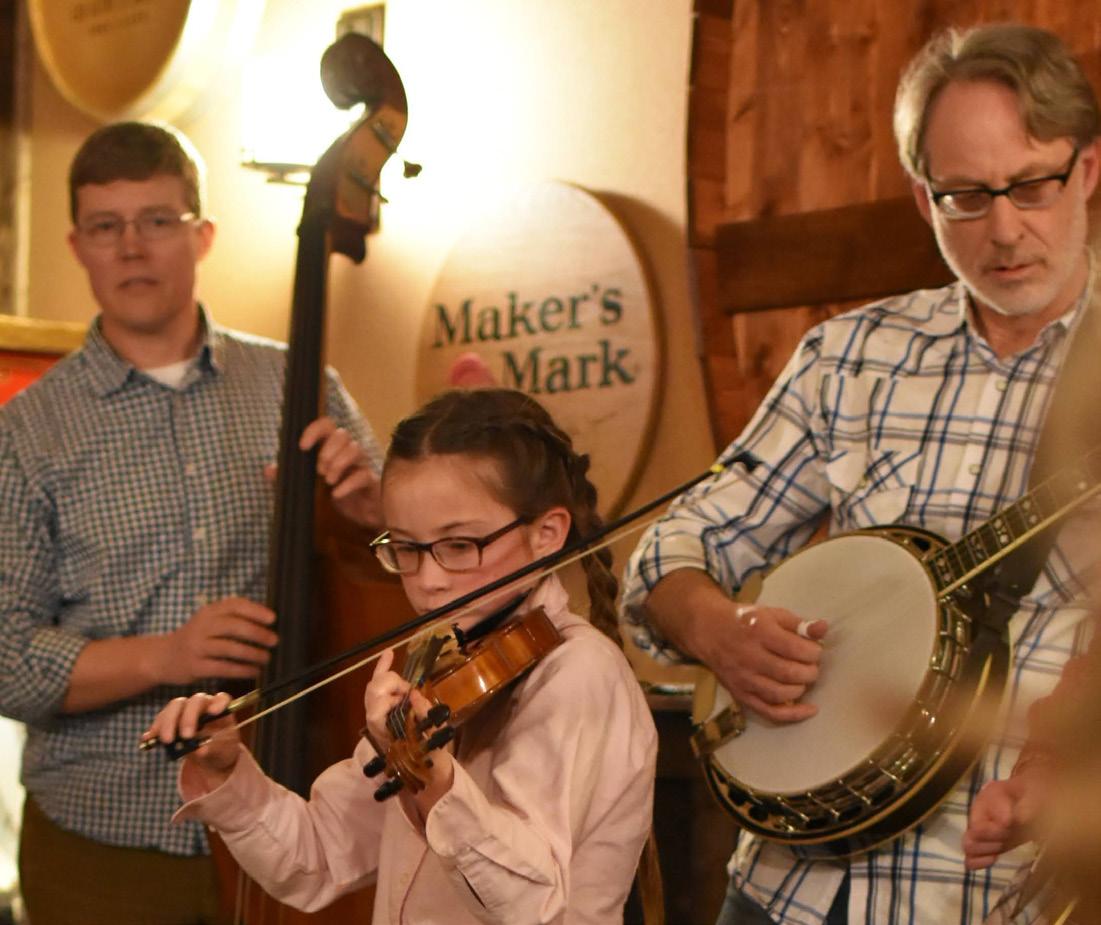
Schlueters play because the environment fosters community.
“I am a runner on the cross country team with Emil Schlueter, and since folk music is my vibe, I had to come support,” Regitz said. “They’re all very comfortable performing with one another and bounce back and forth so well.”
Michael Hoggatt ’24, a Hillsdale Academy teacher, said that the dynamics of the Schlueter family are something he hopes to cultivate in his future family.
“I love the idea of a family having a shared appreciation and performance of music, even if it’s not in public,” Hoggatt said. “It’s a way to cultivate a sort of liturgy within the family, whether it’s religious or rock music. I think it’s just very good for cohesion and building memories in a very healthy way.”
Although his children learned at a young age, Schlueter said that instruments can be learned at any age.
“That is the biggest mistake people make — giving up,”
Schlueter said. “They get frustrated because they want to be good, but they’re not seeing immediate payoff. Learning anything, any instrument, just takes slow investment, and it pays off later. I would really encourage, especially college aged people, to start somewhere since you’ve got versatility, a lot of muscle memory, and you’re growing and developing, so you can get really good and fast on these things.”
Schlueter’s mission with their family band is to create shared culture, and as a part of this mission, they will be playing at Folk Fest, March 7, at the Dawn Theater.
“I want us to be makers of culture, and that means actually doing the hard work of learning,” Schlueter said. “But that’s the joy. I do think I’ve seen the joy of people when they’re starting to make music instead of just being entertained. That’s how I kind of think about what we’re doing here — just encouraging that.”
Campus crusaders: Brains take a break for brawn
By Ty Ruddy CulturE Editor
The roar could be heard from Central Hall. The thuds of bodies hitting snowy ground and the unmistakable clang of battle: foam on foam. Last Wednesday Jan. 28 was Land Battle, an annual clash during which the men of campus wield PVC wrapped in pool noodles and unleash on one another the barbarism suppressed by a liberal arts education.
“We can read all we want about virtue and heroes, but what’s the use if all that just stays on the page?” junior Austin Piecuch asked. “Now, people would laugh that I’m comparing wrestling in the snow to the feats of literary heroes, but why not? It’s hard to be out there when it’s so cold, and yet some show up even without a shirt.”
Traditionally, the men of campus meet on the north quad to duke it out for Land Battle in the winter each year. Construc-
tion forced a relocation, so the men’s residences stormed the field across from the College Park Townhomes.
It would hardly be a battle without a rally cry. It’s true in
“Braveheart,” and it’s true on Hillsdale’s campus. Simpson Residence’s William Wallace was senior and co-Head Resident Assistant Jonathan Williams.
“The pregame speech is to get the boys riled up,” Williams said. “We take pride in who we are as Simpson and the pivotal role we have on this campus.”
Piecuch said he also poured his heart out to his brothers before they took to battle.
“I reminded our boys that we are the heartbeat of culture on this campus,” Piecuch said. “And I reminded them that we were going out to keep that culture alive.”
But Simpson does not have a monopoly on pride, according to junior Dylan Glover, a resident assistant at Whitley Residence.
“We had 29 guys show up
from our dorm,” Glover said.
“That’s nearly 60% of everyone who lives there.”
Land Battle was broken into three rounds of two minutes
pants for certain rounds. Glover himself is a veteran of rounds two and three.
“I battled a fella — who shall remain nameless — for most of
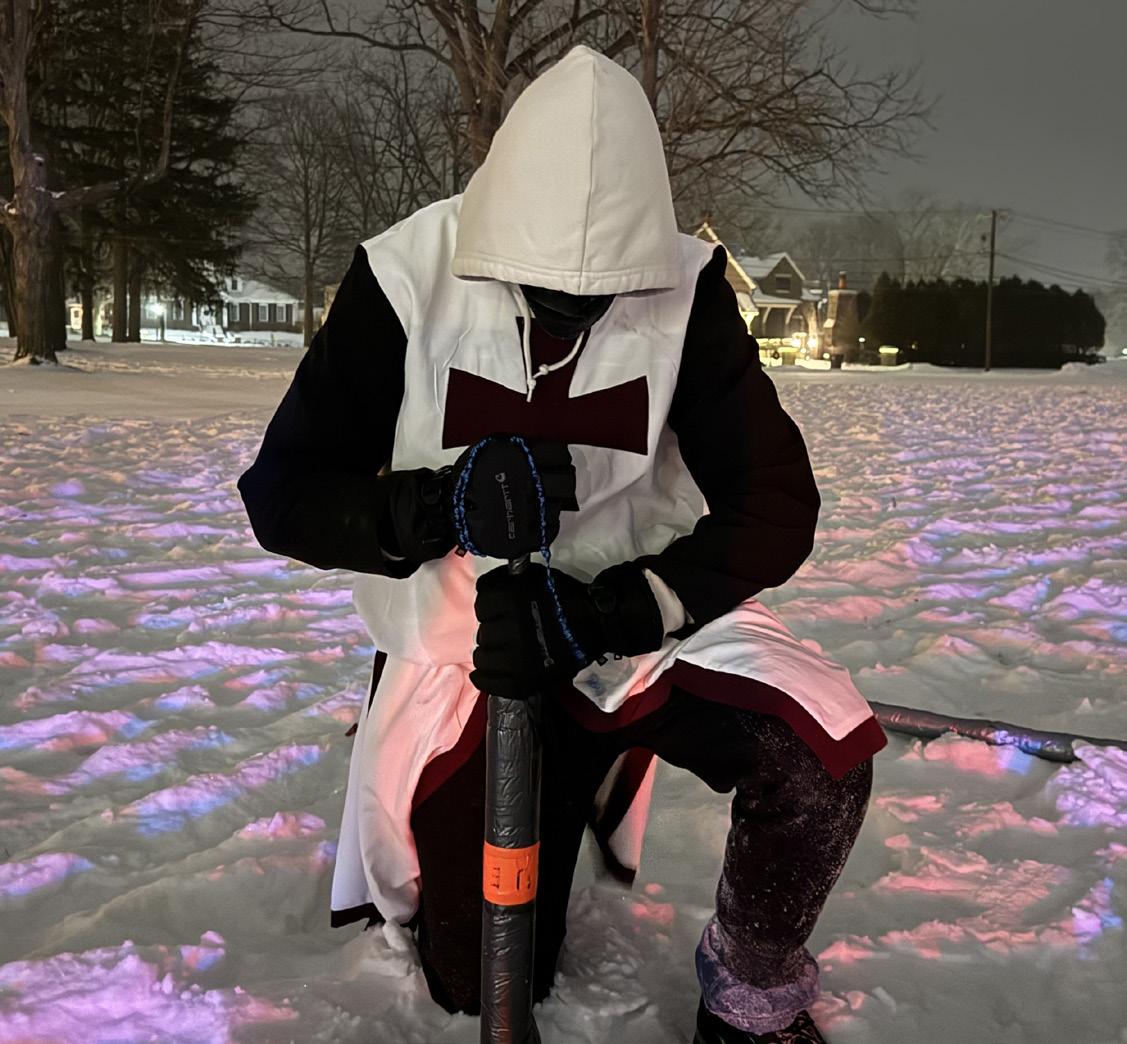
each.
egy plays a big part. Glover said Whitley saved certain partici-
knocked out of him,” Glover said. “He dodged me in round three.”
After three rounds of dormwide battle, the men gathered in a circle for one-on-one wrestling matches.
“Land Battle is a great way to think about both the strength of each dorm as an individual and the strength of Hillsdale as a united campus,” Williams said. “Once we all wrestle, we unite as Hillsdale men, and it’s awesome.”
But the shouts of conflict died away momentarily when the sirens blared. According to Williams, the Hillsdale police and campus security were told that men were hitting each other with baseball bats. Williams assured the attending officer that there were no weapons more harmful than a duct tape sword.
“Then beat the shit out of each other, hell yeah,” the officer said. Cries of approval resounded from the fighters.
Any other year, the wrestling matches would have ended the
battle. But there was unfinished business. Galloway did not show. The other dorms had no choice but to conduct an impromptu raid.
“There are a lot of rumors around campus that dorm culture is dying over at Galloway, and this certainly seemed to give credence to those rumors,” Piecuch said. “But the fact that every dorm marched and raided Galloway after the fact made me very proud and hopeful that dorm culture will persist. It was a moment where dorm divisions disappeared.”
The Galloweigans holed up, even against the chants of every other dorm.
Still, according to Piecuch, Land Battle was a success and a chance to learn valuable lessons.
“It’s a battle of wills out there in the unforgiving cold and whoever has more heart to fight will often win,” Piecuch said. “Unless the other guy was a state champ in high school, then you’re cooked.”
The Schlueter Family Band performs
As with any battle, strat-
round two. At the end though, I finally got my hands on him and dropped him. He got the wind
Nathan, Will, and Emil Schlueter tune their instruments.
Elaine Kutas | Collegian
Fortune favors the bold in Land Battle. ty Ruddy | Collegian
Paul Meyer, Judy Schlueter, and Nathan Schlueter play a tune. Elaine Kutas | Collegian
C U L T U R E
‘Angels of Bataan’ honors WWII vets
By Alessia Sandala City News e ditor
Her hands were stained red after she spent the afternoon standing in the kitchen brewing fake blood.
Senior Moira Kate Forrester developed a concoction of cocoa powder, peanut butter, xanthan gum, and red dye to set the scene for her senior project, the play “Angels of Bataan” by Tracy Wells.
“Angels of Bataan” tells the stories of eight nurses and their courage during the days leading up to their capture and the nearly three years they spent in a Japanese internment camp with little food, water, or medicine.
Forrester said her dad showed her “Angels of Bataan” because he grew up participating in theater and introduced theater to her. After a few years break, Forrester made her return to theater in 10th grade when a teacher began searching for a stage manager.
“She sent a school-wide email, and I replied within the first hour that she sent it,” Forrester said. “She came into my classroom, completely interrupted class, and said, ‘I’ll take you.’ She was a very intense director. I actually learned from her what not to do as a director.”
Forrester got her first experience directing as a sophomore at Hillsdale when she took a directing course with Chairman and Associate Professor of Theatre Christopher Matsos.
Directing, Forrester said, quickly became her favorite part of theater.
“I know people think it’s a very unsung or unappreciated part, because you don’t have a bow or anything. But I never really minded that because I don’t really like being up in front of the crowd,” Forrester said. “I’m really bad at taking compliments.”
She said she is now working on a play of her own, using all of the skills she has learned at Hillsdale.
“In playwriting class we wrote a lot of our own plays. One of the ones I wanted to write, that I’m still working on, is a play about my family.
I’m half Japanese. My mom’s Japanese, my dad’s American,” Forrester said. “During WWII, there were these actual internment camps they had for the Japanese in America. I want to do it in a way that when you are watching the play, you don’t realize what is happening until the end.”
She said directing “Angels of Bataan” stemmed from the WWII play she is working on because it highlights the American servicemen and
Detroit Symphony scores with students
By Grace Brennan AssistAN t e ditor
Hillsdale students heard the Detroit Symphony Orchestra perform “Epic Film Scores” live, hosted by the Student Activities Board on Jan. 31.
After two hours of freedom in the city, students settled into their seats at the Orchestra Hall. The performance began the way all good movies do — with the 20th Century Fox opening song, “20th Century Studios Fanfare” composed by Alfred Newman in 1933. The symphony began with songs from Hollywood’s golden age and ended with today’s biggest blockbusters. Conductor Steven Reineke brought the silver screen to life with 16 classic movie scores.
tened to a horror movie score on purpose,” Houts said. “It was fun to imagine the scenes of a silent film that accompanied the early scores, or laugh with the rest of the audience at hearing the classic Hitchcock ‘Psycho’ strings live.”
According to sophomore SAB member Ross Phelps, one of his favorite movie scores was the “Love Theme From ‘The Godfather.’”
“They killed that one,” Phelps said. “I felt in love at that moment.”
At intermission Phelps said the symphony had already blown him away with its performance of the Wild West theme from “The Magnificent Seven,” and the sound of the 1962 James Bond film “Dr. No.”
“Hearing ‘The Magnificent Seven,’ brought me back to all those great western movies I grew up watching,” Houts said.
Freshman Samuel Goetz said it was an amazing experience to watch a live symphony perform iconic movie scores he has always loved.
“All of the symphonies I’ve been to have played pieces I’m not super familiar with,” Goetz said. “So, it was a refreshing and new experience to hear pieces I’m so familiar with.”
Goetz said his favorite movie scores were classics by Michael Giacchino and Erich Wolfgang Korngold.
they would have if it was played formally, like all the other pieces they played.”
According to Phelps, the SAB team will consider hosting the trip again next year.
“The trip has been anticipated by the SAB board,” Phelps said. “We thought everyone would really enjoy it, and I think now that everyone is enjoying it, we will definitely put it on the ‘we should do this again’ list.” Goetz said he would attend the trip again.
“The night was wonderful,” Goetz said. “It was so great to be able to go for such a good price, and it’s such a unique experience that I loved.”
women imprisoned by the Japanese and the struggles they faced while fighting to survive.
“Having a play that’s set in that kind of environment makes the moments you have with the characters that much more sweet,” Forrester said.
Sophomore Alex Rigal, who played Army nurse Sally Bailey, said it was difficult to accurately portray a character who had suffered so much and witnessed one of the most tragic events of the war.
“I think at some points it may have been a little hard to balance the feeling of normalcy in certain moments, especially during the attack scenes,” Rigal said. “There were so many moments where that normalcy did show, like in the love story between Jean Perkins and Dr. Stevens.”
The actors had to find a way to capture both the constant terror the characters would have felt and the hope that they would all make it home alive, according to Rigal.
“You have to take moments seriously, but also we’re all human, and we have to laugh,” Rigal said. “You know the expression, ‘if you don’t laugh, you’ll cry.’ It’s just getting into character mode where you say, ‘Okay, you can laugh here then be serious there.’”
The nurses find ways throughout the play of preserving their humanity. Jean, a nurse played by senior Vinny Acuña, marries Stevens after he nearly dies.
When the characters first came under fire from the Japanese, chaos set in and no one would have known how to react as they saw the destruction of the world around them, according to Acuña.
“You get to see what the first thoughts are that are going through someone’s mind during a crisis,” Acuña said.
“For me, in the bombing scene, I think the one thing I found myself saying initially was ‘this doesn’t happen.’ Then I tried to quickly reassure the nurses around me. I quickly realized that I don’t know what happens in this situation and I don’t know what to do.”
Forrester said staging scenes embroiled in chaos were challenging, but also the most rewarding part of directing “Angels of Bataan” as her senior project.
“I love the scenes where there’s lots of people on stage, like there’s so much happening, and they’ve gotten really good at filling the space, even when they’re not saying a line or something,” Forrester said.
“It makes the scene feel really alive, and all the stuff that’s happening in those scenes I just adore.”
The movie scores spanned from the 1922 German silent film “Nosferatu: A Symphony of Horror” to the 2022 horror/scifi movie “Nope.” Classic horror films were a common theme of the night. A crowd favorite was Alfred Hitchcock’s 1960 “Psycho,” according to junior and SAB member Devin Houts.
“I’ve never sat down and lis-
“They’ve done an incredible job, and we’re not even to the ’80s, which in my opinion is the greatest era of music,” Phelps said. “They’ve blown my socks off already, and I still have the rest of the night, so I need to find my socks.”
Houts said, “Main Theme (From “The Magnificent Seven”)” was her favorite song of the night.
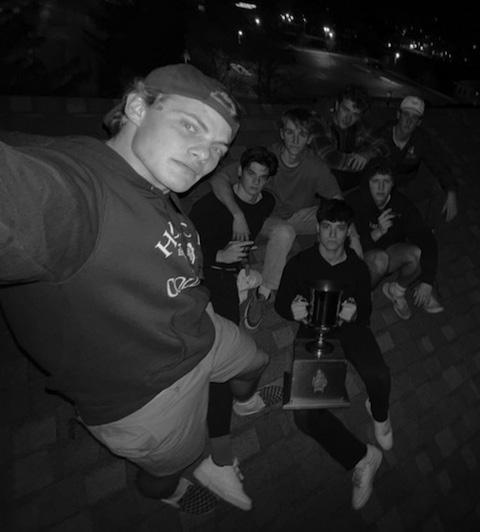
told him the ATOs had taken it when they trashed Triplex.
“I 100% believed we had lost the trophy at that point,” Stanic said.
“We were all at Jungle, and Jonathan Williams showed up,” Lennington said.
According to Lennington, while Williams was in the hallway of the house, Fleischer and Sosa snuck the trophy out a window.
Lennington said the group brought the trophy to his brother Henry’s off-campus house, Triplex.
Senior Luka Stanic, who lives at Triplex with Henry Lennington, said that after the ATO freshmen brought the trophy to the house, chaos ensued.
“When I woke up the next morning, the house was trashed,” Stanic said. “The trophy was missing, and my three housemates were like, ‘We have no idea what happened.’”
Stanic assumed his house had been raided. When Williams arrived and asked Stanic about the trophy’s whereabouts, Stanic
In the following weeks, photos of the homecoming trophy at various Hillsdale landmarks appeared on the anonymous campus messaging app Jodel.
“My housemates were still acting a little funny about it,” Stanic said.
Stanic said he still suspected nothing when over winter break, he and his Triplex housemates drove 15 hours to Louisiana.
“I roll out of the driver’s seat,” Stanic said. “I’m half asleep, stumbling to the shower. I come back out, I’m getting dressed, and the guys are talking to me about the mini fridge. And I’m like, ‘What about it?’”
The trophy was on the mini fridge, right in front of him. His housemates had brought it in from the car without him noticing.
“I lost it,” Stanic said. “They trashed the house, and used it
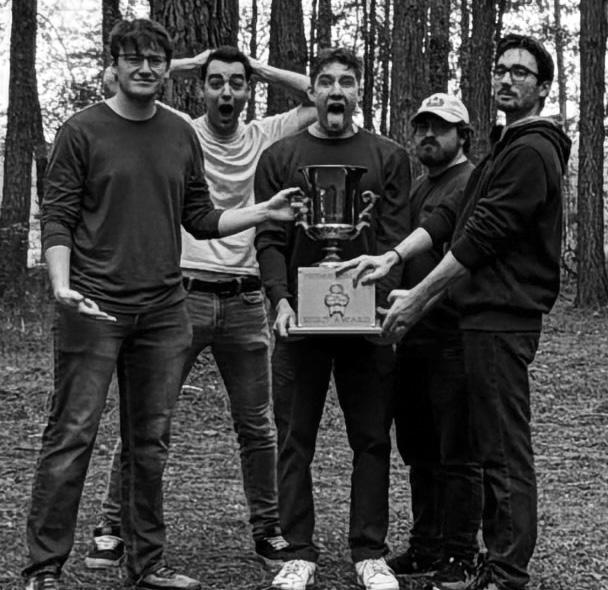
“I think Giacchino’s music from ‘Spider-Man: Far From Home’ was amazing,” Goetz said. “I also loved Korngold’s music from ‘The Sea Hawk.’ It made me tear up a bit.”
The audience was pleased with a surprise at the end of the performance, according to Goetz.
“When they played their ‘last’ piece, and then started playing the ‘The Imperial March (Darth Vader’s Theme),’ that was a fun surprise that I think made the audience appreciate it more than
as an excuse, and told me it was trashed, and I was their convenient witness. Master class on their part.”
After Louisiana, the trophy journeyed with Stanic’s housemate, senior Carter Brett, to New York and Louisville, finally returning to campus in January.
But last week, friends of Stanic discovered the trophy in his closet.
“So we put together this plan,” Stanic said. “We’re gonna create a little scavenger hunt to get rid of the trophy — have someone else do something with it, because we’d had our fun.”
The next day, Stanic and his housemates created a five-step scavenger hunt and sent the invitation from an anonymous email address to a collection of Simpson, Galloway, and off-campus friends.
James Lennington and freshman Wyatt Widolff won the scavenger hunt and brought the
Houts was emotionally taken by the symphony, and would not have left the moment if given the chance to stay.
“The opportunity to experience all the musical moments — the emotional swells and ups and downs you feel while watching a film — all the while sitting in a symphony hall with nothing to watch except the artists themselves, was delightful,” Houts said.
for the trophy.
“It actually isn’t that big of an issue to me as some might think,” Williams said. “We’re doing just fine over here.”
According to Teder, the current whereabouts of the trophy are unknown.
“The trophy hopefully will be returned to those who have earned it via a test of virtue and valor and cunning, the likes of which Hillsdale College has never seen,” Teder said. “But wow, you’re dumb for losing it. And in order to regain the trophy, they’re gonna need a little more brains and a little less brawn.”
Christian said that he hopes the trophy will make it back to the SAB office at the end of the year.
“A lot of people want the trophy gone for good, or defaced,” Christian said. “I think that’s a terrible idea. I won’t go along with it. I won’t allow it.”
That said, Christian said he

trophy to another off-campus house, Camelot, for protection. But it soon came into Casablanca’s hands, and within an hour, became a cereal bowl.
“We were able to leverage our months of video production experience to have such a quick turnaround when Providence placed such a beautiful opportunity into our lives,” Teder said. The instant success of the sketch brought visitors to Casablanca’s door.
“Jonathan Williams and his entourage arrived at our domicile to inquire after the whereabouts of the trophy,” Teder said. “We invited them in and had a really great moment of collegiate bonding. We offered them some tea, but unfortunately, they refused.”
According to Williams, he has not been actively searching
hopes the trophy hide and seek becomes an annual tradition.
“All they have to do is throw a little bit of a tantrum, and everything they want gets plopped in their lap,” Christian said. “Sometimes I think it’s better to show a group of ankle-biting bed wetters that life doesn’t give them everything they want.” Williams said that Simpson has no game plan for recovering the trophy.
“If you’re reading this and either have it or currently know where it is, I would so appreciate a nudge toward a return of the trophy to Simpson,” Williams said. “To have that marker of victory and hard work paying off back in our lobby would be so awesome. But, like I said, the intangible rewards will stay with us for a lifetime.”
TROPHY from A1
Senior Moira Kate Forrester gives direction to her actors.
Courtesy | Charlie Cheng
The pledges of Alpha Tau Omega kicked off this fiasco in the fall. Courtesy | James Lennington
Henry Lennington, Colby Langler ‘25, Law Schoeman, Carter Brett, and Luka Stanic pose with the trophy in Louisiana. Courtesy | Luka Stanic
Seniors Aidan Christian, Thomas McKenna, and Erik Teder taunt Simpson from their kitchen. Courtesy | Aidan Christian



Houses for Rent for 2026-2027
January 22, 2026
The following houses are for rent for the 2026-2027 school year:
● 85 East Fayette Street - This is a very spacious, recently renovated, partially furnished, five-bedroom, one and a half bath Victorian home that is two blocks from campus It is centrally air conditioned, has a large eat-in-kitchen with a garbage disposal and dishwasher, separate dining room, living room, parlor, large front porch, deck off the back, unfinished basement useful for storage, and is equipped with a washer and dryer The rent is $550 per student per month based upon five student occupants Available August 1, 2026 (earlier if desired)
● 173 West Street – This is a partially furnished three-bedroom, onebath Victorian home that is only two blocks from campus It has a separate dining room, living room, and unfinished basement that can be used for storage and is equipped with a washer and dryer The rent is $525 per student per month based upon three student occupants A fourth student may be added at a reduced rate if desired Available August 1, 2026
● 171 West Street – This is a three-bedroom, one bath Victorian that is two blocks from Campus It has a living room, den, eat-in-kitchen, and an unfinished basement available for storage that is equipped with a washer and dryer The rent is $525 per student per month based upon three student occupants A fourth student may be added at a reduced rate if desired Available August 1, 2026
If you are interested, please call Berry LeCompte at: 847 809-4843 (cell phone; preferred), 847 381-2514(office) or email at cblecompte@aol.com.


FEATURES
‘Grace Over Grind’ podcast talks faith and health
By Ashley Luke Collegian Reporter
When junior Lily Ferrell brainstormed ideas for a podcast, she had no idea that she would soon interview one of the world’s top health and wellness podcasters.
Conservative podcaster Alex Clark was one of the first guests Ferrell’s “Grace Over Grind” podcast hosted.
It began as a passion project to give young women a forum for faith-centered encouragement. Ferrell said she was concerned that women were not hearing the voices of strong Christian women in the podcasts they listened to.
“I decided, ‘You know what, I’m going to start a podcast,’” she said. “I wanted to have it centered on people’s faith and how they incorporate faith into their careers, whether it be in the health space, or in Christian discipleship, or in the medical field, or whatever it may be. And that’s how it really took off.”
sodes with these women. After hosting them, she received the attention of other notable women in the conservative field, including Mia Rofrano, founder of Masa Chips, and Tori Hope Petersen, a 2018 Hillsdale alumna who advocates for foster care.
Through the foundation of faith, Ferrell has discussed topics such as holistic and mental health, entrepreneurship, and foster care.
Junior Emma Mohler, a friend of Ferrell’s who helped with initial ideas for “Grace Over Grind,” said Ferrell’s foundation for the podcast comes from her own walk with God and interest in mentoring young women about healthy lifestyles.
“Lily has been very passionate about health and wellness for as long as I have known her,” Mohler said. “She was already very educated herself, and she wanted to have a platform such that she could educate other people.”
Senior Analise Hess, listener and president of the

Ferrell began making a “dream list” of women whom she wanted to interview and began messaging them constantly. The top two names on the list were Clark, host of the “Culture Apothecary” podcast, one of the top 10 health and wellness podcasts in the world, and Johnson, wife of political commentator Benny Johnson. The commonality between all the women on the list was a life of integrity and powerful Christianity.
“I want to bring really strong women in the podcasting world onto ‘Grace Over Grind,’ people that are super outspoken about their views and are really strong imitations of Christianity in the journalism space,” Ferrell said.
She was surprised when, just a few days after messaging them, she received replies from both Clark and Johnson.
“I was driving to get pizza with my parents and all of the sudden I get a DM from Kate Johnson and from Alex Clark as the first guests on the podcast, and I was astounded,” Ferrell said.
A few weeks later, the first episode of “Grace Over Grind” debuted with Ferrell interviewing Johnson about keeping a healthy lifestyle, both physically and spiritually. Shortly after that interview, Ferrell hosted Clark, discussing her career in journalism, advice on dating, and passion for health.
Ferrell credits the success of her podcast to her epi-
Compiled by Elizabeth Caneday Collegian Freelancer
In this Quick Hits interview, Associate Director of Admissions
Ben Strickland ’16 talks raiding Galloway, tacos, and “Bluey.”
As a kid, what did you want to be when you grew up?
Like many young boys, I wanted to be in the Army.
If you had to be a professor instead of working for admissions, what subject would you teach?
Theology would be awesome.
What’s one of your favorite college memories?
Quick Hits with Ben Strickland

We raided Galloway during Feast once. I remember looking back at the army of Simpson boys behind me. It was basically straight out of “Braveheart.” We had flags fluttering in the wind, war paint, and a buddy of mine was even playing the bagpipes.
What’s one of the funniest things your kids have ever said?
When looking at a Van
Know a
By Henry Flifet Circulation Manager
If you’ve forgotten a guy’s name at Hillsdale and want to hazard a guess, your best bet is John. If it’s a girl, try Sophia.
The most common name among students is John, with 37 men answering to it, followed by 20 Williams and 19 Samuels, Nathans, and Andrews.
Gogh painting, my daughter Marianne asked, “Is that a house that got punched?”
What is the best piece of advice you have received? “Live in the spectacular now.”
If you could play any sport at Hillsdale for one game, which sport would you choose?
Since we don’t have men’s
volleyball, then maybe football.
If you could swap lives with a cartoon character for a day, who would it be?
Maybe Bandit, the dad in “Bluey,” though he probably lives a pretty similar life to me now. So let’s go with Captain Rex from “The Clone Wars.”
What’s the most useless skill or talent you have?
I’m pretty good at disc golf and board games. Both are pretty fun and equally useless. Are tacos sandwiches? Flour, yes. Corn, no.
What’s your favorite part of working for Admissions? I love talking to the best high schoolers in the nation. It gives me hope.
What’s the weirdest difference between Hillsdale in 2016 and 2026? That some of my classmates are now professors.
What’s the best dorm on campus?
Simpson, easy. They are the most involved on campus.
What’s your wildest hot take?
Every Star Wars movie (minus “Rogue One”) is actively bad.
What’s the funniest thing that’s ever happened to you in a professional setting? It’s not the most professional thing, but I do a roast of prospective students during the scholarship weekends. It’s a good time.
What’s the most annoying thing students do? For some, taking things too seriously. For others, not caring more.
‘John’? Hillsdale has 37
For some students, the shared name was motivation to build a club around it.
The nine then-freshmen named Sophia or Sofia in the 2028 graduating class made sweatshirts with the name in Greek and wore them on the same day.
Women’s Holistic Health Club, said she appreciates how the podcast frames health as an approachable and meaningful goal through the variety of guests and topics on the show.
“I think Lily’s podcast does a really good job of putting health and healthy practices at the top of people’s minds and encouraging people to take the first step,” Hess said.
Ferrell said she hopes “Grace Over Grind,” which is available on Spotify, Apple Podcasts, and Instagram, will help listeners become more forward about their faith in the professional realm.
“I hope that they will be inspired to be more convinced in their faith and to really exude that in the things that they are passionate about, so going forward, they feel like they can commit to their values in any field and follow the lead of so many other women that are doing the same,” Ferrell said. Mohler said she has been inspired by the way Ferrell has brought faith to life through the podcast.
“I’ve been really encouraged and inspired to live out my faith and have those conversations about faith and professionalism,” Mohler said, “Even if I don’t have all the answers, Lily has provided a platform where you don’t need all the answers.”
The most popular woman’s name is Sophia, with 29 of them. There are 27 Annas and 22 Elizabeths, Abigails, and Marys.
To figure this out, I extracted and counted from the campus directory to identify the most common names of Hillsdale students. To keep things simple, I counted different spellings and hyphenated names (like Jon or John-Henry) as the same root name.
Tree from B6
The tree’s location on Half Moon Lake Road is familiar to the team.
“We run out on that road more often than any other road,” Schlueter said.
For Roberts, the road is an intimately familiar place.
“I’ve spent so much time
Owl from B6
“We’d all driven back and John had been gone for a while,” freshman John Richardson said. “He shows up and he’s like: ‘I found an owl!’”
They jumped into action.
“We brought a cardboard box and a blanket, grabbed the owl, put it in the box on top of the blanket, wrapped a shirt around it and carried it back to the Suites like that,” Ahrabi said.
Once in the Suites, Ahrabi cared for the owl, whom he named Sebastian.
“Don’t feed it. That’s what they told me,” Ahrabi said.
“It started as a joke,” said sophomore Sofia LaHood. “We were in Olds one night, and we were like, ‘Wait, we could actually do this. This would be really funny.’”
This year, however, the Sophia club hasn’t reappeared.
“We did it one year, and it was just kind of a fun joke,” LaHood said.
Senior John Frenz is not part of a campus club for the name, but it does link him to seven generations of family history.
“My father’s name is John, too,” Frenz said. “My grandfather was also named John, and my grandfather’s father,
out there,” Roberts said. “It’s like your daily commute.”
But runs on Half Moon Lake Road are no joy rides for the teams.
“Oftentimes our progression runs will go out there and it starts to get tough right when you get to the shoe tree,” Osborne said.
and so on. Seven generations in total, all having different middle names to avoid suffixes, all being firstborn sons.
The pressure’s on for me, right?”
Frenz said he doesn’t think his name is particularly common outside of the college, since people might think it’s bland.
In fact, Frenz said most people call him by his nickname, “Fish.”
“Some people treat the name John like unseasoned food: There’s always a modifier or spice to add,” Frenz said.
Sharing a common name leads to funny situations, Frenz said.
“When two Johns simultaneously raise their hands for the same name, one of us must shamefully lower his hand.”
The shenanigans that can come out of having a shared name seems to be a common theme at Hillsdale.
Yet, Roberts said, should runners look up, they will find inspiration.
“They said if you give him too much water he could fall into it and drown, especially if he’s injured. You have to put the water from an eye dropper into the corners of its beak and then some of it will go into its mouth.”
For the time, Sebastian was safe, but Ahrabi knew he had to find a way to get Sebastian to the rehabilitation center.
“He was prepared to drive somewhere to save the owl,” Richardson said.
Initially, no one from the shelter wanted to take the owl from Hillsdale. After an anxious few hours, a volunteer
“It’s hard. You’re running; you see it. You look up and you’re like ‘I can do it,’” Roberts said.
Although the tree may look creepy to those passing by, for the cross country team, it carries the memory of those who came before.
“You see all of those shoes and there are so many of them
stepped up. “She just came down to the Suites, I brought him out, and she took him,” Ahrabi said.
According to the clinic, Sebastian had head trauma — likely the cause of other symptoms — and right eye trauma.
Sebastian has been recovering after undergoing an eye removal surgery Jan. 24. Once he heals, he will still be able to hunt, despite his missing eye.
However, according to Wildside Director Louise Sagaert, Sebastian will not be returned to the wild in the foreseeable future.
“I think that it is easier to make friends with someone who has the same name as it provides an avenue for initial conversation,” said Anna Coyle, one of 27 people with her name. “It can be difficult to have multiple Annas in the same class, since it can be unclear who the professor is referring to.”
Some common names were worthy of forming a club, or a link to family history. For senior Nathan Emslie, it means being part of a group with rare good looks.
“Originally my parents were going for Jason, but at the first ultrasound they decided I looked more like a Nathan,” Emslie said. “Considering how dashing the rest of the Nathans on campus look, I think I’m in good company.”
and you know that ‘this many people have gone before me,’” Roberts said. “They have done the same things and there is a lot of pride in that pursuit.”
“Because it’s a young bird from this past summer, it will not be released,” Sagaert said. “It will be placed into an educational situation.” Many rehabilitated birds like Sebastian who may struggle to survive in the wild are incorporated into educational programs at schools and zoos.
“This owl will be part of one of those programs as long as it stays in good health and takes well to it,” the representative said. Sebastian may now become the star of the show. He would have been roadkill were it not for Ahrabi’s second glance.
Ferrell records an episode of “Grace Over Grind” at the WRFH studios. Courtesy | Lily Ferrell
Strickland met his wife Jennifer, ’18 while at Hillsdale. They have two kids, Marianne and Frankie. Courtesy | Ben Strickland
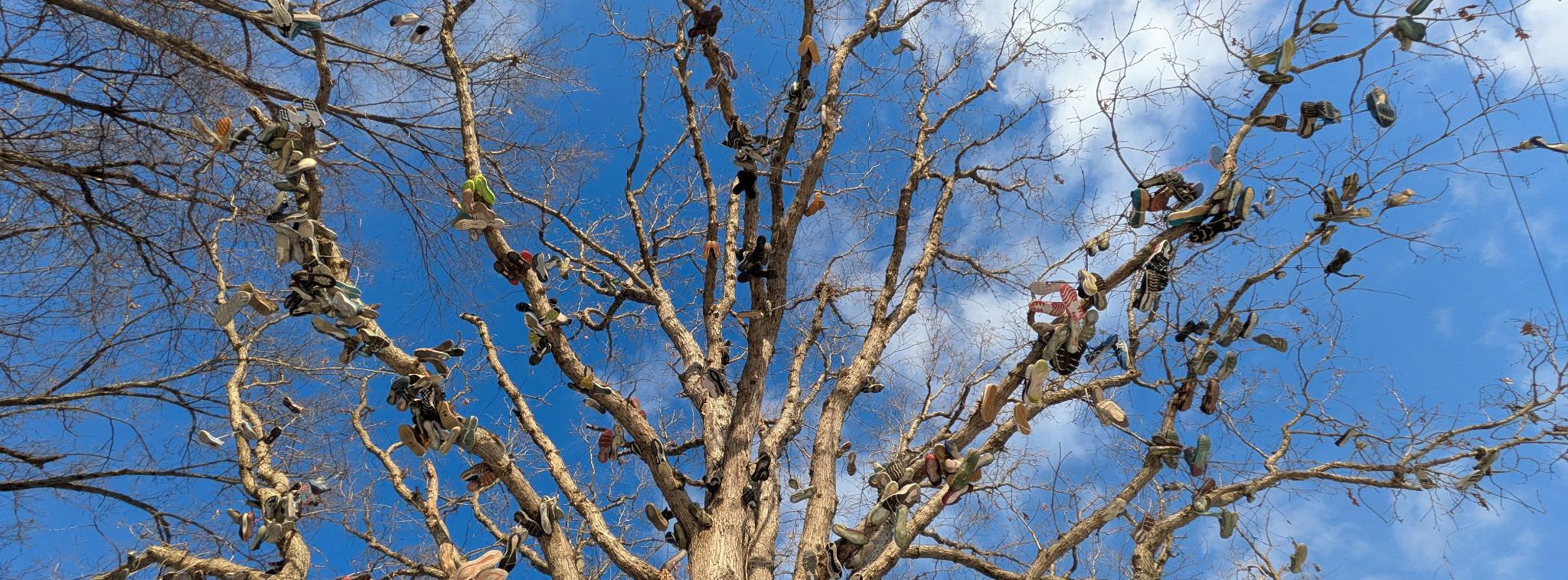
Footwear fills centuries-old tree
By James Joski Collegian Reporter
FEATURES Campus Character
It was early spring when junior Ted Fehringer first saw the shoe tree.
“It’s creepy as hell,” Fehringer said. “I feel like all those shoes belong to dead people.”
Out for a run on Half Moon Lake Road a few miles from campus, Fehringer noticed the aged tree’s bowers coated with pieces of modernity: running shoes.
As he stared apprehensively, a pair of shoes plummeted from the tree.
“I looked at it for a minute, felt creeped out, and turned around,” Fehringer said. “The tree is surely demon-possessed.”
Fehringer’s superstitions are not isolated. Shoe trees can be found across Michigan, often surrounded with sinister folklore. In Salem, Michigan, a shoe tree is widely rumored to have started when a serial killer threw the shoes of his first
victim into its branches.
At the corner of Half Moon Lake and Ball Road, Hillsdale’s shoe tree sits on the Cook family property, land that has belonged to the family for generations.
“It is at least 200 years old,” Dennis “Gate Guy” Cook said. “When my dad was a kid, it was already large.” Cook’s father grew up on the property with his siblings. Today, Cook’s uncle owns the land and the shoe-laiden white oak on it.
The beleaguered giant is a survivor from the 1800s. Cook said other large trees once stood near it, but when some of the land was sold they were cut down to make way for farming.
In the 1950s, long before footwear adorned its branches, the tree had witnessed college parties permitted by Cook’s grandfather.
“He was quite welcoming,” Cook said. “He would let students come and party. They
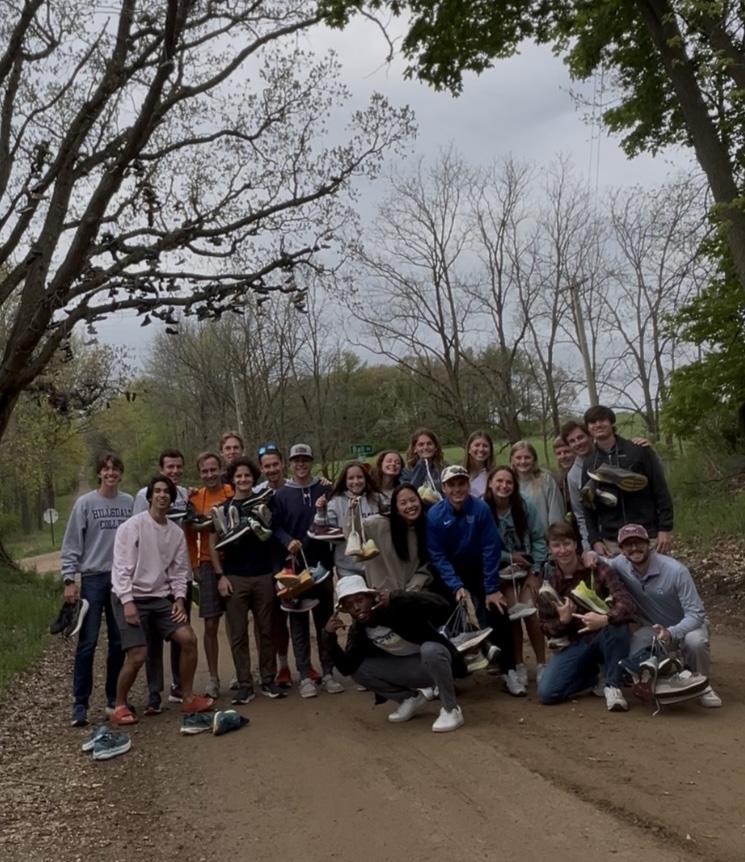
had a piano and a bonfire one year.”
Eventually the parties came to a stop, but the college would soon revisit the tree in an unexpected way.
In the early 2000s, something strange began appearing on the tree: shoes. Each year the crop multiplied until dozens of shoes nested in the tree’s canopy.
One day, Cook decided to investigate the tree while with some friends. He ascended the weathered titan to find a pair of shoes marked with a state and year. Looking into a second pair, he found a very different surprise: a bird’s nest. It was puzzling.
“We wanted to find out more,” Cook said.
And so one question remains: whose shoes are these?
The answer can be seen on nearly any fall or spring day. On a quiet afternoon you might hear their pattering steps or see their bobbing forms coming up the road. It’s the Hillsdale Cross Country Team.
“The shoe tree has been a big part of team culture for a long time,” said senior Nathaniel Osborne, captain of the men’s cross country team. “We go and tie up our old running shoes and we toss them up into the branches.”
But what about getting back? Cook’s mom had mused they did so barefoot.
“No,” Osborne said. “We will have a group that runs out there and maybe one person who is injured has a car with the shoes in it,” Osborne said.
Getting there isn’t the hard part. It is getting the shoes to stay in the tree that requires some strategy and a bit of luck.
“Some will tie the shoelaces together, hold both shoes
together, and throw them up into the tree,” senior Emil Schlueter said. “I don’t think that usually works. I like to tie my shoes together and then spin it like a windmill so that when it hits the branch it will wrap all the way around and stay on.”
One way or another, the shoes eventually fly up into the tree to nest within its broad branches.
In winter they hang in clear view like strange Christmas decorations that were never retrieved.
It is a sight that begs for an explanation, yet the team has none. The shoe tree is one of many traditions they observe whose roots have been lost to time.
“The stories about them change and no one on the team knows how it started,” Schlueter said. “But there is sort of a reverence for it that keeps going as well as a mystery because no one knows how it started.”
It’s not for the team to know the tree’s history, senior and women’s cross country team captain Anna Roberts said. Instead, it’s to follow in the footsteps of tradition.
“We respect the tradition that has been there, we don’t question it, so we continue with that tradition out of respect for those that have come before just like students at Hillsdale,” Roberts said. “They may not know the exact origin of the traditions here and how traditions that have come to be were founded, but they respect it out of that tradition.”
Suites resident rescues owl in distress
By Daniel Johnson Collegian Reporter
When sophomore John Ahrabi trekked across campus to meet up with his cross country teammates in late November, he didn’t expect it would lead to an owl rescue mission.
“I was taking a walk, going to team Bible study,” Ahrabi said. “I was already 10 minutes late. I saw a woman looking at something.” He doubled back to investigate.
“There was a little owl just sitting there,” Ahrabi said. It was a screech owl, four or five inches tall, speckled brown, with needle-sharp talons, and in bad shape.
“It seemed to have something wrong with its foot,” Ahrabi said.
“It didn’t want to open its eyes, and it had an injured wing.” Ahrabi felt he couldn’t leave the bird to die.
“I’ve kept chickens for a long time, so birds are important to me,”
he said.
“I was going to try to move it off the side walk, into some bushes, but it didn’t seem to like that. So I left and it flew across the street.”
After Ahrabi’s Bible study, the bird was still there. Clearly, Ah rabi thought, the owl could not survive by itself.
“My cousin-in-law is a veterinarian,” Ahrabi said. “So I texted him, and he told me to contact a raptor center.”

Wildside Rehabilitation and Education Center, located an hour away in Eaton Rapids, Michigan, came up on Ahrabi’s phone, the only facility anywhere close to Hillsdale.
“I called them,” Ahrabi said. “They said, ‘Try to contain it and keep it warm and dark until to-
morrow, and we’ll figure out a way to get it back to us.’”
Ahrabi hustled back to his dorm, the Suites Residence, where he met some friends.
Compiled by Zoe Barnes Collegian Freelancer
Senior Anna Heldt is from Denver, Colorado and is an English major on the pre-med track. She works at the contact center and is a member of the Hippocratic society. She unapologetically loves the “Barbie” movie, “Wicked,” “Bridgerton” season two, and “The Summer I Turned Pretty:” (she’s team Conrad).
How would freshman Anna be surprised by Anna now?
I think freshman Anna would be devastated that Anna now has stopped going to swing club. And I think freshman Anna would be proud of Anna now for the amount of books that she’s read and the papers she’s written. It would be a mixed bag for sure.
his online courses account. And then he was like, “Oh, you’re such a great listener. I’d love to take you in a ride in my convertible and take you to dinner.” And I was like, “Oh.” He was 70 years old. I don’t remember how I got out of that situation. I think I just let the connection die.
What’s your party trick?
I can bug my eyes out. Really big. Part of it is Hashimoto’s disease. It’s a thyroid condition. So my eyes come out a little farther than they’re supposed to, but I also just have really big eyes. I made a boy cry in fifth grade with my eyes, which scared him, even though we were friends.
What is your favorite thing about yourself?
I gotta say, my sense of humor. I really love it. If you can make

Do you have any crazy stories from working in Colorado?
At a restaurant one night, there was a big party in the middle of the room. I’m hosting, and I look up and see this guy walk in, and I know that the party in the middle is waiting for one more guest. You could just tell that he was looking for people. I was like, “Oh, hey. Are you part of that big party? If you’ll follow me…” And I realize he’s not looking at me anymore. He’s looking somewhere over my shoulder with this, like, tender love in his eyes. I’m like, “Oh, perfect. His wife just showed up.” And I turn and look, and two feet from me is this other guy, and he’s smiling. And then my brain re-interprets. I was like, “Oh, cute. Brothers or something.”
Not brothers! The guy at the door makes a beeline for the guy who’s, you know, two feet from me, and they start kissing. I just had to stand there because that’s my job, and I could see all my coworkers staring at me and laughing at these two men. It was giving, “There was a war, and they just reunited.” But no. Anyway, such is Colorado, and that’s probably my craziest restaurant story.
What about at Hillsdale?
At the contact center, I’ve gotten yelled at quite a bit. Turns out, I’m a closed-minded fascist. I didn’t know. I was really grateful to someone random for telling me. Another elderly man asked me out once over the phone. I was so helpful, helping him navigate
someone laugh, they can’t stay mad at you. And I don’t know if I have a specific example, but I just love being able to help others with my laughter. I’d say my sense of humor has definitely helped me cope with so many things. I mean, it’s helped me at Hillsdale. It’s helped me with health stuff basically anything. If you can find the funny in anything, you’re fine. If you could teach a class at Hillsdale, what would it be?
I think it’d be really fun to teach a class on the silver lining. I think that’s what I would call it, “The Silver Lining.” Everyone would come in at the beginning of the week with an experience, either something they experienced themselves or a story they heard. For other people, it has to be a tough situation. I think we would all read that, or maybe they submit them for homework on Sunday, and I’d read through them, and then bring the top ones the next day, and then we’d all hand them out, and then we’d discuss and try and find the silver lining, but also the funny bit, because in anything sad that happens to you, there’s going to be something funny.
What does your entire name mean?
Anna means “gracious.” Elizabeth means “pledge to God,” and Heldt means “hero.” So all together, my name means gracious, pledge to God, hero. So I’m kind of set really nothing bad can happen.
Anna Heldt
Sebastian is safe with Wildside Rehab Center but will not return to the wild anytime soon. Courtesy | John Ahrabi
Sophomore John Ahrabi saved Sebastian’s life in November. Courtesy | John Ahrabi
When Heldt finished the final book of the “Anne of Green Gables” series at age 13, she threw the book against the wall because she loved it so much. Courtesy | Anna Heldt
The cross country team throws old running shoes into the tree every year. Courtesy | Anna Roberts