THE HILL NEWS VERBA VOLANT, SCRIPTA MANENT
VOLUME CXXXVI. NO.1
OCTOBER 21, 2026
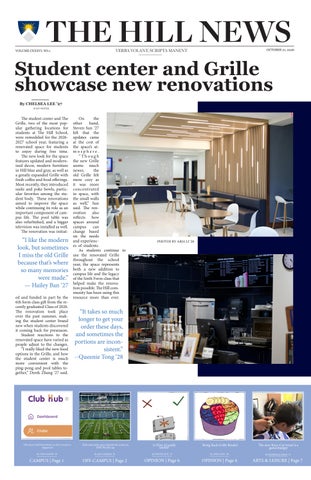
Student center and Grille showcase new renovations By CHELSEA LEE ’27 STAFF WRITER
The student center and The Grille, two of the most popular gathering locations for students at The Hill School, were remodeled for the 20262027 school year, featuring a renovated space for students to enjoy during free time. The new look for the space features updated and modernized decor, modern furniture in Hill blue and gray, as well as a greatly expanded Grille with fresh coffee and food offerings. Most recently, they introduced sushi and poke bowls, particular favorites among the student body. These renovations aimed to improve the space while continuing its role as an important component of campus life. The pool table was also refurbished, and a bigger television was installed as well. The renovation was initiat-
“I like the modern look, but sometimes I miss the old Grille because that’s where so many memories were made.” — Hailey Ban ‘27 ed and funded in part by the 6th form class gift from the recently graduated Class of 2026. The renovation took place over the past summer, making the student center brand new when students discovered it coming back for preseason. Student reactions to the renovated space have varied as people adjust to the changes. “I really liked the new food options in the Grille, and how the student center is much more convenient with the ping-pong and pool tables together,” Derek Zhang ’27 said.
On the other hand, Steven Sun ’27 felt that the updates came at the cost of the space’s atmosphere. “Though the new Grille seems much newer, the old Grille felt more cozy as it was more concentrated in space, with the small walls as well,” Sun said. The renovation also reflects how spaces around campus can change based on the needs and experiences of students. As students continue to use the renovated Grille throughout the school year, the space represents both a new addition to campus life and the legacy of the Sixth Form class that helped make the renovation possible. The Hill community has been using this resource more than ever.
PHOTOS BY ARIA LI ‘28
ILLUSTRATION BY RYAN QIU ’26
“It takes so much longer to get your order these days, and sometimes the portions are inconsistent.” --Queenie Tong ‘28
Hill adopts ClubHub platform in effort to improve engagement
Hill community goes behind the scenes in FIFA World Cup
By LYDIA SAHIN ‘28
By MO CAMARA ‘30
CAMPUS | Page 1
OFF-CAMPUS | Page 2
Is Flint AI really useful?
Bring Back Grille Breaks!
The new Buzz-Cut trend is a gamechanger
By STEVEN SUN ’27
By ANNA SUN ’28
By MARDELLE ZHAO ’27
OPINION | Page 6
OPINION | Page 6
ARTS & LEISURE | Page 7
CAMPUS NEWS
THE HILL NEWS | 2
OCTOBER 21, 2026
Hill adopts ClubHub platform in effort to improve engagement
By LYDIA SAHIN’28 STAFF WRITER
Hill’s annual club fair took place on Sept. 25, showcasing new tools that many hope will increase student engagement in the coming school year. This year’s fair introduced ClubHub, an application where Hill students can browse Hill’s clubs, join with a single click, and track discussions and events on one page. Clubs give students opportunities to pursue interests beyond the curriculum. Before ClubHub, managing clubs required substantial administrative work. Students would have to navigate communication through an intricate and disparate web of emails, Microsoft documents, sheets, and extensive copying and pasting. The introduction of ClubHub was made in the hope to streamline engagement for students. “It was very timely,” stated Ms. Keefer, Director of Leadership Programs. “I will say more than likely not always accurate or reflective of what student groups were doing and, in some cases, what they were not doing.” The switch to ClubHub has allowed for “greater over-
sight of club membership, events and activities,” noted Keefer. Student leaders have also found ClubHub useful. Minjae Youn ’27, chair of Hill’s board game club, found some of the new tools helpful. “For example, if I’m setting up events on ClubHub, there’s an automatic RSVP, which really helps out,” Youn said. While Youn is unsure whether ClubHub has changed how he organizes events, he said he finds himself planning further ahead.
“I’m not sure it’s affected how I organize events, although I do find myself planning further out in advance,” Youn said. Student clubs were not the only student organizations that shifted to ClubHub. DEI affinity groups are also present in ClubHub in addition to the email lists. Luji Mohamed ’28, MENAA co-chair, spiritual life co-chair, and DEI Council representative, found that the program hems well with already existing forms of com-
munication for affinity groups. “Affinities found that switching to ClubHub would be another way to notify students about upcoming events they host,” Mohamed said. “Instead of email, Instagram, and lunch announcements, a notification may be more visible.” Like Youn, Mohamed agreed that ClubHub is an efficient platform for coordinating events, but she questioned whether it will increase student engagement. “I personally do not think Club-
Hub is necessary, especially for example, DEI making a ClubHub page, since DEI events are usually always open. ClubHub would only notify the people subscribed to the app,” Mohamed explained. “It has not yet impacted engagement, nor do I think it’ll eventually impact it.” ClubHub has simplified club administration and event coordination, but students differ on whether those improvements will lead to greater participation.
Hill strengthens educational practices and policies in response to AI By MICHAEL PHAM ’27 EDITOR-IN-CHIEF
With the advent of increasingly sophisticated generative artificial intelligence, including notable large language models, or LLMs, such as ChatGPT, Claude, and Gemini, a task that once took hours can now be completed within minutes. According to Storm Wisler, Director of Information Technology and Services, AI serves as an integral part of his work. Guided by some prompt engineering, AI could streamline the school’s accounting system, which could significantly reduce redundant work previously required. “We’re mapping student billing information into spreadsheets, but we allow AI to do much of the heavy lifting,” Wisler said. Such gains exemplify one of many potential uses of AI. At The Hill School, while adopting these technologies can lead to more productivity, it risks undermining the importance of academic integrity and negatively affects independent thinking. Thus, the extent to which Hill navigates in this circumstance poses a challenge. Regarding the unintended effects of using AI in workflows, Wisler stressed the importance of human oversight. “Whatever work that you produce, whether it’s your own or AI, you still have your name behind it,” Wisler said. As a result, checking billing numbers, evaluating subscription costs, and carefully weighing the tradeoff between incorporating AI and protecting data privacy are essential. In classrooms, Hill’s new approach involves faculty preparation through experimentation. Katy Hudak, Academic Dean and Athey Family Master Teacher of English, asked teachers this year to implement at least one AI-based assignment through Flint, an educational AI platform Hill partnered with to allow faculty to tailor AI interactions to their assignments’ goals and students to engage with those activities.
Despite this push for AI integration, Hudak takes an overall cautionary position. “I do not want to make it a requirement that every teacher uses AI in their class, as long as they can articulate the reasons,” Hudak said. According to Hudak, her approach reflects Hill’s responses to earlier technology initiatives. “We were told that we had to use iPads, but it didn’t always fit within the curriculum,” Hudak recalled. She believes that AI adoption should accommodate different educational needs. One of the clearest steps Hill took in reaction to the growing use of AI is the addition of a Director of Academic Technology to the academic office. Michael Webster, the new program director, supports Hudak’s emphasis on informed decisions. Working with Hudak and a board member, Webster advises on technology’s role, including taking ethics into account, and adapted AI training for faculty over the past summer. On the student side, feedback from focus groups and a survey has informed Hill’s AI approach. Last year, Hill also introduced the 1–5 AI Assessment Scale. Currently, for classes associated with Flint AI, students ask questions as the chatbot often responds with a stimulus, assisting students in formulating answers themselves. For example, according to Hudak, students in English 1 use FlintAI to help brainstorm thesis statements and essay outlines. Students’ experiences with Hill’s AI policies vary, with some expressing concerns about the guidance they receive. While Jackson Miller ’29 sees AI as a tool that reinforces classroom knowledge, he understands limitations of AI. “For mathematics, I sometimes prefer attending office hours because I truly value the learning process through verbal communication,” Miller said. “I am also well aware that submitted work must be my own.”
Max Lloyd ’28 has a different perspective, reflecting that though new strides have been made in the classroom, clear AI direction seems to be lacking. “Teachers provide little guidance beyond the AI Assessment Scale and generally seem to discourage AI use.” Other students, who requested anonymity due to judgement from their peers, worried that AI use in classrooms may encourage students to bend the rules by using AI in ways that go undetected to gain a competitive advantage. In the long term, Hill’s AI policies and Honor Code could only establish guardrails and baseline expectations. As constant supervision is infeasible,
how students choose to engage with AI is contingent on their own judgment and intentions. That said, unchecked AI assistance can blur the line between tasks students need to complete themselves to develop critical thinking and what is considered “tedious work” they can appropriately delegate to AI. Webster warns against “cognitive surrender,” where students and faculty allow AI to do the thinking for them. “A critical part of my role is to ensure that AI supports and enhances thinking rather than replaces it,” Webster said. Similarly, Hudak posed a rhetorical question to underscore how AI cannot replace doing the harder task
ILLUSTRATION BY GIOVANNA CARSWELL ‘27 of completing academic work independently: “You’re not going to get better by bringing a forklift into the weight room, right?” In the future, Webster hopes AI-supported practice could leave more classroom time for students to work on applied projects. Achieving this vision requires further examination of what students learn along with what AI helps them accomplish. At the end of the day, with Hill’s educational strength grounded in its teachers and liberal arts tradition, AI cannot be said to have broadly transformed the institution’s curriculum.
OFF-CAMPUS NEWS
OCTOBER 21, 2026
THE HILL NEWS | 3
Impact of El Niño storms remain unclear SHINYU ZHANG ‘27 STAFF WRITER
El Niño, translating to “little boy” in Spanish, is a climate pattern that disrupts normal conditions. Usually, trade winds blow west, taking warm water from South America to Asia. Cold water then rises to replace that warm water, a process called upwelling. During El Niño, trade winds weaken, causing warm waters to be pushed back east. The pattern generally occurs for around 9-12 months at a time, on average every two to seven years. El Niño can have a significant impact, with the warmer waters causing the Pacific jet stream to move south. Areas in the northern U.S. and Canada are then dryer than usual, whereas in the Southeast it is wetter and there may be increased flooding. The eastern/central tropical pacific regions will likely become warmer due to El Niño, although Pottstown is far from these areas. However, “sci-
entists are predicting a likelihood of a warmer and wetter winter for Pottstown,” says Mike Kolter, environmental science teacher. “This could translate into more precipitation, which may fall as rain, snow, or mixed. What is certain is that predicting the timing and severity of precipitation would become even more difficult.” The weather change may also have an impact on plant life, which would likely influence produce supply and allergies. “Earlier blooms can compromise the health of plants by making them more vulnerable to frost and pests and could impact the entire ecosystems that rely on the timing of the blooms,” stated Kolter. If these earlier blooms do end up impacting the health of plants, it “could mean our produce supply could be affected.” Kolter also mentioned that “allergy sufferers may have a worse spring,” due to potential earlier releases of pollen. There may also be an increase of mosquitoes, ticks, and other pests
when spring comes around. As Kolter put it, “This could create a bigger food supply for the animals that eat these insects potentially altering ecological niche and competitive relationships.” The recent nor’easter affecting the Philadelphia region is a reminder that although Pottstown is far from the ocean, the effects of major East Coast storms could still be felt. Nor’easters are storms that bring northeast winds and can cause heavy rain or snow, strong winds, and flooding. Inland areas may deal with flooded roads, downed branches, power outages, and rising streams or rivers. The storm itself cannot be blamed entirely on El Niño, but El Niño can influence the broader weather patterns that make certain East Coast storm tracks more likely during the colder months. To prepare for El Niño, Kolter suggests “a decent umbrella, wet
ILLUSTRATION BY NORAH CHEN ‘28 winter clothing, and bug spray for the spring.” He also added that our stown through a warmer, wetter, and winter will most likely be warmer and less predictable winter and spring. wetter, with some form of precipita- As Kolter advises, the Hill commution, whether that is snow or rain. nity should “monitor the weathEl Niño’s effects may be felt in Pott- er closely” as the season develops.
Hill community goes behind the scenes in FIFA By MO CAMARA ‘30 STAFF WRITER
The World Cup, the biggest sports tournament in the world, only happens once every four years, but the 2026 World Cup was one of the most prominent yet, with 308 goals over the whole tournament, which sets a historical record. This is paired with a whopping 6 billion views, beating Qatar’s 5.1 billion views. Unsurprisingly, several members of the Hill community took part in this historical sport event. Derek Zhang was one of those people. Derek served as a flag bearer, one of the people who walk out before the game starts with a country of the World Cup’s flag for the exciting England vs. Panama game. The score ended 2–0 to England, with Kane scoring in the 67th minute, and Derek was just 3 meters away from him. The game took place in the enormous MetLife Stadium in
New Jersey, with an attendance of over 80,000 people. “The stadium was phenomenally big and super loud.” says Derek. He was able to witness and experience many aspects of this match, like walking through the tunnel and even on the pitch. “The grass quality was great.” Derek noted. Aside from Zhang’s surreal experience, another member of our school was also involved—Elena Dauphinais, world language department chair. She also contributed to the operations of the world cup, although a bit more behind the scenes. Daphinais was working with the uniform department, sending uniforms to FIFA employees and volunteers like Zhang.
Although spending less time on the stadium, Dauphinais reflected that her small part of this world event gave her a greater appreciation of the whole. “It was very interesting to see the behind the scenes of an event of this scale,” Dauphinais said. It also
allowed her to do many other things, such as spectating the Côte d’Ivoire vs. Curaçao, the smallest country in the tournament, as well as going to festivals near Philadelphia.
PHOTOS COURTESY OF ELENA DAUPHINAIS citing she plans on volunteering again for the Women’s World Cup in 2031.
Dauphinais’ experience was so ex-
New Pottstown businesses opened By WILLIAM ZHU ‘29 STAFF WRITER
The Pottstown community is evolving, and members of The Hill community are paying attention. With a few new restaurants opening their doors in recent months, students and faculty have more reasons than ever to go off campus and explore the surrounding area. Among the most renowned new businesses are Chicky’s, a spicy chicken spot on High Street, and Firebirdz Hot Chicken, both of which quickly gained popularity among students and faculty after opening. Altitude On High, an upcoming rooftop bar and restaurant, also hopes to attract visitors when it opens. These businesses join an expanding roster of local businesses that have transformed the Pottstown area in recent years. Hans Doerr, an instructor in the history department, is an avid supporter of Pottstown businesses. He has witnessed this transformation firsthand and encourages students to explore beyond the convenience of chains such as McDonald’s and Popeyes. “Convenience and experience are often not the same thing,” Doerr said.
As Doerr mentioned, Charlotte Street Coffee Roasters, which opened within the last 18 months, has become a popular spot for locals and students. It is located next to the former Downtown Records, where Hill students once bought CDs. Meanwhile, the coffee shop Beekeepers Cafe has found a new beginning in its current location at the corner of Beach and Charlotte streets. Doerr emphasized that supporting local businesses keeps money moving within the community, benefiting the town. Among these places, High Street Terminal is a great option to support. It is a mini food court featuring Nicky’s & Ant’s pizza and cheesesteak shop, Ileana’s Kitchen with its empanadas, and a Greek restaurant whose food, he insists, is excellent. “When I thought about High Street as I was a student, there were a whole lot less businesses and a whole lot fewer twinkling lights,” Doerr recalled. “High Street especially has good bones for a town. A lot of downand-out towns would kill to have the architecture and old buildings that High Street still has.” For students wondering how to
PHOTO OF RESTAURANT “JERSEY MIKE”
support these businesses, Doerr of- working and trying to make a living. In fact, many students have developed fered simple advice. “Just go and be nice. I think that’s a special relationship with local business owners. all it is,” Doerr said. “There are some sixth formers The connection between The Hill who have a good personal relationand Pottstown matters a lot. ship with Nicky and Ant’s. They go “We’re all people,” he said. It is a great experience to get food there enough that they actually know ILLUSTRATION BY LILLIAN CHENG ’27 directly from people who are
the guys making the pizzas and cheesesteaks,” Doerr said. As Pottstown continues to grow, the relationship between the Pottstown community and campus remains vital. Whether it’s grabbing a slice at Nicky & Ant’s or enjoying Sunday brunch at Blue Elephant, every dollar you spend locally helps sustain the community we call home.
FEATURES
THE HILL NEWS | 4
OCTOBER 21, 2026
SGA co-presidents unveil plans for the year By GIOVANNA CARSWELL ’27 STAFF WRITER
What are your goals as SGA Presidents next year? Jill Patel ’27: We have two sections to our goals. One is about having study hall outside during the spring when the weather gets nice, and the other one is about being able to check in at other common rooms. So you don’t have to go back to your common room when you’re hanging out with your friends in a different dorm. Jackson Bala ’27: To add on, we’re changing the format in some ways where we’re trying to just get as many proposals past as possible, or at least propose them. Keeping people updated and keeping them on task and putting as many proposals out as we can throughout the year, kind of all surrounding our ideas of Community, Engagement, and Opportunity (CEO). We want to not only gear our proposals around that, but help all of SGA create proposals around that for the year. What do you think will be the most challenging aspect in achiev-
ing these specific goals? Bala: No one’s a president twice. We’re always new to us every time every year, every rollover, like, there’s gonna be two new people. Luckily, Jill and I were representatives last year, that kind of gives us a nice base to go off of. But the process is new. How do we not only govern what we’re doing, but also what every form rep is doing? The schedule gets busy. It’s nothing we can’t manage now. Patel: I was really, really close with Avery, and I know Jackson is too. I’ve asked them so many questions about what being a president was like, and how they ran things and what they felt that we should change or what they kind of wanted to keep from their presidency. Having them to lean on is really important and really helpful. What lessons have you learned from previous experiences that you’ll bring into next year as presidents? Bala: I was inspired to run for SGA by Mason Moore. He gave a talk about not cutting corners, hypothetically and literally, across campus. It really sat with me. It was more of him
being personable and going around campus and he remembered my name. I’ve known home my hill my whole life, but not as a student. Them being such big leaders across campus, but still finding the little moments to help engage and connect with new kids on campus, and help make sure they’re that bridge between new kids and social life. I want Jill and I to be those people. Patel: Something that I’ve learned just throughout hill and throughout being in a community where everyone works together and wants to help each other is that doing things in a group can make whatever you’re working on a lot easier, but also bring new perspectives in. And that’s how we want to shape the inner circle of SGA this year with our proposals. We want to work together where everyone can help proposals together and share their ideas and feedback from their perspective as a form rep or just as a whole in general. What do you think will be the biggest challenge of being Co-presidents? What are you worried about? Patel: I think the biggest thing will be how busy I am. I know this year
is going to be really busy, but I know I can handle it. Bala: The biggest thing is buying into the school, leading by example, helping kids engage, and being helpful with the proposals we’re doing. What advice would you give your previous self or anyone wishing to run for SGA? Patel: Even if you have the littlest inkling to do SGA, just do it. It’s such a good experience to have because it teaches you so many skills, like public speaking and communication. Bala: All I’ve known is Hill and I wanted to give back. Anything I could do to give back to the school felt good to me. I would say don’t give up. I ran for SGA and lost twice, but I was able to keep going and keep trying. Just
PHOTO COURTESY OF JILL PATEL ‘27
keep pushing and lead by example and others will follow.
TIME CAPSULE: Dr. Edwards gives very forceful talk during morning exercises Following is the talk given by Dr. Edwards on Thursday, September 20th: Do you know what is happening on The Hill today, and who are meeting here? Boys from Oregon and California, from Minnesota and Texas, from New York and Louisiana, from Maine and Massachusetts, sit down together here at this hour. Even the new boys looking around can see the captains of football, of baseball, track and basketball, the presidents of the Sixth Form and the Y. M. C. A., the editors of “The News,” “The Record,” and “The Dial.” The old boys looking around can see, as if they were in these seats immediately before me, Freeman Stearns, Cowgill, Howard and Clarence Paulsen, Herbie Walker, and Francis Redwood. We who are older still, looking about with the mind’s eye, see Jimmie Andrew, Caleb Gates, Dick Quay, Dick Robinson, Don White, Bruno Hills, Harry Allen, Ted Hume. Closing our eyes yet more tightly against the clamorous present, so that memory may do a more perfect service, we older ones see Joe Scheerer, Bill Warren, Guthrie Speers, Bert Bowman, Tom Shevlin, Ted Wylie, Billy Fincke, Claire Fincke, Billy Schultz, Chauncey Stillman, Clarence Warden, Charles Hatfield, Charles R. Wylie, and lifted above them all in radiant value, the face of John Meigs—like granite with sunlight on it. They and their fellows are meeting
on The Hill today—meeting with us. However new we are, we are of that company now. What they dreamed and sought and wrought is ours without effort or merit of our own: because we belong to The Hill, we all belong together. We are entitled to the honor which comes to The Hill from “Those immortal ones / Who live again in lives made better by their presence; / Live in pulses stirred to generosity; in deeds of daring rectitude; / In scorn for miserable aims that end with self; / In thoughts sublime that pierce the night like stars, and with / their mild persistence / Urge men’s search to vaster issues.” Their meaning is the music of our world, and it is rousing martial music to which we must march. What, then, is happening at The Hill today? Stop a moment and think about that affair, so great and thrilling for us. Why are we here? You ought to get the answer to that question before you go much farther along this road. If I may adopt a figure of speech out of the world of the radio, I would say that we are here to learn to “listen in.” Already you boys have heard the wireless message of our football captain. I do not mean the words he speaks but the meaning he has in this School. You will shortly hear the wireless of the President of the Sixth Form and of the Y. M. C. A., of the editor of “The News,” of the scholar of distinction in your class; of the masters of instruction here; and presently, if you
are worthy of this opportunity, you will find yourself hearing the message of the meaning of The Hill; the glory of its past, the promise of its present, the challenge and hope of its future will all be a stirring and beautiful message that you can hear. You boys have already heard the wireless message of Buster Keaton, Charlie Chaplin, Bill Hart. Here you are to learn how to listen in so that you may hear the meaning of Shakespeare and Milton, and even of the great drama of human life. Already you have heard the wireless message of Irwin Cobb, Sherlock Holmes, Rudyard Kipling, and Robert Louis Stevenson. Here you are to learn to listen in to Lincoln and Lowell, Gladstone and Morley, Socrates and Cicero, Moses and Micah; and above all, to Jesus Christ. The daily studies you are to pursue, along whatever line, will give you a certain knowledge and ever growing acquaintance with the codes of this great wireless which gives to you the messages of the past, the meaning of all human life; your knowledge here gained in Language and Literature, in Arithmetic and Science, in Geography and History, and supremely in religion, gives you acquaintance with the codes. Your intelligence, which is something more than knowledge, is really your equipment, your receiving station, making it possible for you to listen in, putting you in tune with the great and the beautiful and the true
out of all the past. Your character, in turn, is your sending station, your broadcasting power—what you are allows you to have a wireless message of meaning right here and through all the memories of The Hill in the years that are to be. It is more conventional to say that the purpose which brings us here is culture. Culture has been most happily and strikingly defined by Professor Charles Horton Cooley of the University of Michigan in a book called “Social Progress.” Here is his definition: “Culture is growth to fuller membership in the human race through enlarging personality and social comprehension.” What does that mean “Fuller membership in the human race” is right on the nerve of the ambition everyone of us has to belong to a team, to a fraternity, to a fine group of distinction or social opportunity. We have to qualify to belong more and more fully to the human race. We all belong by birth to the animal kingdom but we have to qualify by spiritual qualities for a real membership in humanity, and we qualify by social comprehension—that means larger sympathies, a wider understanding—far horizons for our personal landscape. You have to be able to listen in, in other words, on peoples of other languages and lands and ages, and realize that you and they are one in all the great fundamental qualities and interests of humanity. It is just that larger
sympathy and understanding which enlarges your personality. It stretches your mind. It makes you try harder. It challenges the strength that is latent in you and reaches after fulfillment. Then you are challenged by everything that is worthiest in you to get your broadcasting station, your character which sends out your influence, into healthy, powerful working order. And now I come to a word not only for the boys but for our masters of The Hill. “Culture comes to him who breathes the large air of great traditions imparted through one who is living the great life.” Living the great life! That is a challenge to us men who are masters of The Hill. And here is a motto I would give you for this year at The Hill in this high task, a task “too fine for haste, too high for rivalry.” “Our boys of The Hill are measured by what we require; “We master of The Hill are measured by what we inspire.” For all of us this year I give you this practical counsel of Professor Cooley. Live it out:—“To do something well makes culture.” Perhaps there is but one thing you can do—do it well! If there are more, do them well, but above all, the something that is greatest about us all we should strive most eagerly and proudly to do well—the living out of life. That will make you a dear friend, a trusted citizen of the community, large or small, an upright servant of your fellows.
Student social spaces evolve as By EMMA FANG ’27 FEATURES EDITOR
Alumni of The Hill School returning to Pottstown this year will find that a busy summer left the student center thoroughly updated. The project, funded by the graduated Class of 2026, has given the Grille its first major architectural overhaul since 1998. In recent years, the Grille has remained the central social hub for students. “Students usually spend their free
time hanging out in the student center playing ping pong or pool,” said Jill Patel ’27. “When it’s nice outside, they sometimes go out to play spikeball or football on the Quad with their friends,” she added. It is an old story. As Ellen Nelson, arts faculty and emeritus puts it, “Teenagers are essentially still the same. They just want to be with their friends. And fortunately, Hill has been pretty good at providing those kinds of spaces for the students.” As documented in Hill Ties and
an article of the Hill School Bulletin published in September 1978, the earliest iteration of the Grille emerged in 1926 with the founding of The Hill School Women’s Club. The club frequently engaged in charity fundraisers, the most prominent of which was a weekly cake sale that took place in an old commons room situated in what is now the map room. An almost comical origin for a century-long campus presence, “the boys spilled many crumbs on the floor of the Commons Room”, prompting the school
to move the cake sale to the basement of the Middle School. That space officially became The Hill School Grille on November 3, 1931. The first Grille opened business with
PHOTO COURTESY OF ARCHIVES
FEATURES
OCTOBER 21, 2026
a simple menu of sandwiches, donuts, and milk. In 1935, however, the Grille decided to purchase a fountain to satisfy the craze for ice cream sodas that was sweeping the country. In preparation for the purchase, faculty wives “made the trip to 8th and Arch Streets in Philadelphia to attend ‘soda jerk’ class. Armed with yellow smocks and stainless steel dippers, the volunteers dug into an ice cold and very profitable business.” Beyond food, the Grille also hosted weekly visits from high-end tailors, such as Brooks Brothers, Jacob Reed’s Sons, and S. Miller & Son, who sold the latest fashions directly to students. The Grille was later modernized and moved to the James I. Wendell Student Center, where the Cleveland Leadership Center is today. Nelson remembered the routine of buying food there: “The boys would have to
come in, buy a ticket, and then they would give the ticket to the chef.” The 4,500-square-foot space also contained an abundance of amenities, including pool, ping pong, bumper pool, and foosball tables, alongside a color television, a pinball machine, and snack dispensers. The Grille aside, another major hotspot in the 1900s was the Gun Club. The earliest known record of the Gun Club comes from a 1903 Hill News article, which reads: “The Gun Club held their first spring practice on February 29. It has been decided to hold a dual shoot with Lawrenceville sometime during the spring.” “The boys could shoot guns in a building on campus,” Nelson said. According to a 1981 article of The Hill School Bulletin, this indoor rifle range featured “milled, tongue-andgroove wainscoating and hand-op-
By ARIA LI ’28 STAFF WRITER
erated target transport trolleys.” The range lasted until the 1990s, when it made way for the construction of the Mercer Field House. In the spring, students traveled to the weekend camp, an off-campus Hill property, for overnight stays and skeet shooting. The weekend camp was first described at length in a 1969 article of The Hill School Bulletin: “On October 27, The Hill School Gun Club opened a new skeet range at the School’s Gordon Tripp Clement weekend camp, about eight miles from Pottstown.” Records point to a dedicated school skeet team of considerable prominence at the time; the team had already defeated Lawrenceville, prompting the opening of a private range donated by Allan H. McAlpin ’33. The school also maintained a Pipe Club, a designated two-story house where students were permitted to
THE HILL NEWS | 5
gather. “You had to have permission from your parents to smoke on campus,” Nelson recalled of the house. The founding of the Pipe Club was detailed in a 1925 article of the Hill School Bulletin: “The days when one had to walk beyond the Far Fields before ‘lighting up’ passed out of the thoughts of the smokers at The Hill last spring. The School remodeled the old sable located northwest of the Chapel and has amended the old smoking rules so that those desiring to smoke may now go there.” Weekends on campus belonged entirely to clubs. With ample free time to arrange their own activities, students poured their energy into extracurricular life. “The clubs were more active,” Mark Pearson ’78 said. “Students had more time on weekends, and we didn’t have a lot of entertaining activities.” Most of the weekend
New Faculty This Year
PHOTOS BY ARIA LI ‘28
For Michael Webster, returning to The Hill School this year means com-
ing back to a familiar place in an entirely new role. He had previously worked at Hill from 2015 to 2020 as his first position after earning a master’s degree in secondary education. He and his wife spent the next six years in the Dominican Republic before moving back to Pennsylvania this June. He has returned to Hill as its first Director of Academic Technology,
while also teaching mathematics and coaching strength and conditioning and girls JV basketball. The newly created position reflects his growing interest in the role of technology, particularly artificial intelligence, in education and adolescent life. When he heard Hill was creating the position, he saw an opportunity to combine his familiarity with the school with his interest in understanding how AI could affect teaching, learning, and students’ social and emotional lives. “I’m most excited about the flex-
ibility and latitude I have to operate within a private school, but specifically a boarding residential private school as well,” he said. He hopes to use that freedom to explore technology’s impact on teaching and learning while considering its broader effects on students and society. His return to Hill has already given him plenty to look forward to. His immediate answer to what he was most excited about was, “the dining hall.” With a fourth child recently born, he said the convenience of the dining hall has been especially wel-
After living in Pottstown for the past two and a half years, Martiza Gallegos was already familiar with the area when she joined The Hill School this year as an instructor of mathematics. What ultimately drew her to Hill, however, was its sense of community and interdisciplinary approach to education. “I liked the sense of community here,” Gallegos said. She also appreciated the way Hill brings together different areas of student life, from mathematics and science to journalism and athletics. While she considers
mathematics an important subject on its own, she said she values the opportunity to see it as part of a broader education. Gallegos’ path to the mathematics classroom was not entirely traditional. Before coming to Hill, she worked in many areas such as historic preservation and management. Now, in her first year of teaching at Hill, she is excited to settle into her classes and meet new people. “I’m excited to see all the students grow,” she said, particularly as classes begin to steady after some challenging
units at the start of the year. Her biggest initial concern at Hill, however, had little to do with mathematics and teaching. Instead, it was one of The Hill’s most distinctive traditions: seated lunch. “There were so many moving parts,” Gallegos said. Mr. Von eventually sat down with her and several other new faculty members to explain and demonstrate the process. Still, with several new students who were also unfamiliar with seated lunch, Gallegos found the system more intimidating than expected.
With the school year off to a great start, Gallegos is much more comfortable with seated lunch, and she can focus on what first attracted her to Hill: its community, interdisciplinary environment, and her students.
two things he already knew he loved: mathematics and working with young people. As a mathematics instructor, he combined both interests in his first year at Hill. Densmore majored in mathematics in college and spent several summers coaching rowing between semesters. Working with high school students, helping them improve their tech-
nique and watching them grow in the sport showed him that he wanted to continue working with young people. “I knew I wanted to be involved in teaching,” Densmore said. “And I also love math.” Teaching at Hill offered him a chance to bring the two together. His decision to join Hill was also influenced by the people he met during the interview process. He described the faculty as particularly “supportive and welcoming,” while the reputation of Hill students as kind and friendly also contributed to his decision.
“I’m super happy to be here,” he said. As someone new to both Hill and the boarding-school environment, Densmore is especially excited to experience some of the traditions he has heard about, including Lawrenceville weekend. He said he is still learning about the school and looks forward to continuing to discover its traditions and community. That learning process extends beyond getting to know Hill. As a first-year teacher, Densmore is also figuring out how to become the best teacher he can be.
MICHAEL WEBSTER
WILL DENSMORE Fresh out of college, Will Densmore arrived at The Hill School with
After working as a hospitalist at Bryn Mawr Hospital, Dr. Benish Aqil is taking on a new role at The Hill School as the medical director of the Wellness Center. In her position, she oversees the Wellness Center as well as the counseling and athletic centers. Dr. Aqil had long been interested in working in a school setting, so when she saw an opening at Hill, the opportunity came at a time when she was looking for a change. Before joining Hill, Dr. Aqil worked as a hospitalist at Bryn Mawr Hospital on the Main Line, caring for patients after they were admitted from the emergency room until they
were ready to return home. Moving from a hospital environment to a boarding school has given her a new opportunity to work with students beyond their immediate medical needs. “I think [I’m most excited about] developing the relationships with the students,” Dr. Aqil said. “It’s going to be new for me.” While she is excited to get to know the Hill community, Dr. Aqil is also aware of the legacy of the person whose position she is stepping into. She is nervous about “filling Dr. Spencer’s shoes,” noting the impact she had on the school during her sev-
eral years at Hill. Rather than trying to replicate that legacy, however, Dr. Aqil hopes to establish her own place within the community. “It’s going to be hard to find myself filling them,” she said, “but hopefully I can make my own space here.” Dr. Aqil also hopes students will feel comfortable approaching her, whether they simply want to say hello or are interested in learning more about medicine. She said she is happy to talk with and mentor students interested in pursuing the field. Her message to the Hill community is simple: “Believe in yourself and your dreams, and they’ll come
was spent on publications like The Hill News and The Record. When students looked beyond the campus boundaries, the options were classic. Saturdays had buffet meals— “three meals you didn’t have to go to over the weekend,” Pearson recalled— so students walked downtown to local sandwich joints or took trips to the farmer’s market. “There was also a train you could ride to Philadelphia,” Pearson added. Looking back on decades of change, Nelson noted that one part of Hill student life has remained constant: the desire to find community and belonging. “There’s always been a need for Hill students to socialize, and they’ve always tried to carve out spaces for themselves. They just want to be with one another.”
come for his family. At the same time, being the first person to hold the position comes with its own uncertainty. Without a previous model for the role, he said it can feel like “building the plane while taking off.” For someone who likes to know whether his work is succeeding, defining what success looks like in a completely new position will be one of his biggest challenges. After six years away, he is ultimately glad to be back. “I’m happy to be back and happy to get to work,” he said.
MARTIZA GALLEGOS
“I’m always thinking about how I can do better,” he said. His students, however, have helped make that process easier. In particular, he said his third formers have been learning alongside him as they adjust to Hill together. “We’ve all arrived at the same time, and we’re learning about the Hill School together,” Densmore said. “It seems like we kind of had the same starting point.” For Densmore, that shared experience has made his first year at Hill a chance to learn and grow alongside his students.
true.” For Aqil, persistence is key, especially when facing something that initially seems difficult. As she begins her first year at Hill, Dr.Aqil hopes to bring that same openness and encourDR. BENISH AQIL agement to her new role by while establishing her own place in building relationships with students the Hill community.
OPINION
THE HILL NEWS | 6
OCTOBER 2026
Bring Back Grille Breaks! By ANNA SUN ’28 STAFF WRITER
This year, our school ended Grille visits during classroom breaks. Students may now visit the Grille during class periods only if they have a free period. For me, the change required an adjustment to my morning routine. Last year, I knew I could buy breakfast at the Grille during a class break. This year, I had to wake up 10 to 15 minutes earlier to visit the Grille or dining hall before class. That may seem like a minor inconvenience, but for someone who already rushes through the morning, those minutes matter. Grille breaks also gave students more flexibility in how they used their downtime. Last year, I noticed that some students stayed in the classroom to study while others went into the hallways or visited the Grille. Since the change, more students seem to remain in the classroom. I have also noticed more
side conversations, which can make it difficult for those trying to concentrate. Allowing students to choose where they spend their breaks could accommodate both those who want to socialize and those who need a quiet place to work. In conversations with several students, most shared my concerns and wanted more freedom during classroom breaks. Others, however, did not object to the change. Evan Meyers, a fifth former, offered a different perspective. He suggested that students could find time “throughout the day to get food” rather than visit the Grille during classroom breaks. However, he acknowledged that the time between classes is often too short to get food from the Grille or dining hall. To address this, Meyers noted that students should be able “to have longer breaks between classes to visit the dining hall.” He agreed that students need time to get food but believed those breaks should occur between classes rather than during them. Overall, though the removal of Grille
breaks could have its own reasons behind it, it is my firm belief that allowing students to go to the Grille during class breaks would be more convenient for students in the same class. Without breaks, many students like me would have to alter their schedules to get food, and many students who prefer to study during Grille breaks could get distracted by people in the room. Although some students like Evan believe that longer breaks between classes would be a better solution, it ultimately comes down to the need for students to have more freedom in how they use their time during breaks. ILLUSTRATION BY GIOVANNA CARSWELL ’27
Is Flint AI really useful? By STEVEN SUN ’27 STAFF WRITER
AI is becoming more common in schools, and Flint AI is one tool intended to help students learn. Rather than simply providing answers, it is supposed to guide students through difficult concepts and help them understand material they find confusing. That sounds useful on the surface, but in my experience, Flint often fails at the one thing it is supposed to do: help me learn. Using Flint can feel like talking to someone who hears the question but misses the point. It takes around a minute to respond, and yet it often seems unable to correctly identify what kind of help I need. When I do not understand something and try approaching it differently, Flint can be slow to adjust. Instead of getting an explanation that addresses my confusion, I sometimes find myself working out exactly how to phrase a question just to receive a useful answer. I experienced this during an economics assignment that required me to use Flint to better understand basic economic concepts. The tool end-
ed up making the assignment more frustrating. If I paused, clicked on something else or moved outside the conversation, my work would disappear completely. I would then have to restart and enter all my answers again. I spent more time repeating myself and debating the AI than learning the concepts. The biggest issue is how poorly Flint adapts to the help I need. Different students may need different explanations of the same material. If one explanation is unclear, an example, simpler wording or another approach may help. This is where an AI learning tool should be especially useful. Instead, Flint often seems to follow a fixed routine. Getting a helpful response can feel like cracking a code, adding another obstacle to an already difficult assignment. I do not expect Flint to hand me the answer immediately. That
would defeat its purpose as a learning tool. The problem is how long it can take to understand what I am asking. If I spend more time guiding the AI than it spends guiding me, it is not doing its job well.
Flint is not entirely without value, and other students may have different experiences. The idea behind it makes sense: a tool that helps students work through difficult concepts could be useful in the classroom. For
Editors-in-Chief Visual Managing Editor Campus News Chase Zhang ’27 Off-Campus News Shinyi Zhang ’27 Features Emma Fang ’27 Sports Brody Fronheiser ‘27 Layout Lillian Cheng ‘27
that to work, however, it needs to respond to the individual student and change its approach when an explanation is not helping. So, is Flint AI useful? In my experience, not yet.
Max Yang ‘27, Michael Pham ‘27 Lillian Cheng ‘27 Arts & Leisure Mardelle Zhao ’27 Opinion Josh Gong ’28 Head Photography Aria Li ’28 Head Illustrator Lucy Ward ’27 Digital Media Frank Xu ’26
Anaika Bandi ’27, Gia Carswell ’27, Shane Duo ’26, James Gong ’26, Staff Writers & Casper Hao ’27, Griffin Hopper ’26, Aaron Kraus ’28, Chelsea Staff Contributers Lee ’27, Aria Li ’28, Leo Li ’28, Vincent Lin ’28, Arthur Miller ’26, Bach Nguyen ’26, Michael Pham ’27, Ian Ryu ’28, Alex Vogt ’27, Frank Xu ’28, Chase Zhang ’27, Derek Zhang ’27 Faculty Advisers Alec Swartz, Nancy Body, Catriona Miller Content Policy The Hill News is the student-run newspaper of The Hill School. Content is determined by and reflects the views of the student editorial board and staff and not school officials or the School itself. The Hill News acts as an open forum for student expression where they have complete control over the content produced.
@hillnews ILLUSTRATION BY LUCY WARD ’27
@TheHillNews1
Want to contribute to The Hill News? Come to our bi-weekly meetings or contact a member of our staff. To submit a letter to the editors or an opinion piece, email mlawrence26@thehill.org rqiu26@thehill.org
thehill.news
/whatsoeverthingsarenews
ARTS & LEISURE
OCTOBER 2026
THE HILL NEWS | 7
MOVIE REVIEW: What does ‘Obsession’ tell us about love? By REANNA ZHU ’28 STAFF WRITER
ILLUSTRATION BY NIK BANDI ’27
This summer, my friend insisted I see the new horror film “Obsession,” directed by Curry Barker. The film begins with a familiar premise: a wish gone wrong. The protagonist, Bear, breaks a wish-granting object called One Wish Willow in the hope that Nikki will love him more than anything in the world, but Nikki’s affection soon becomes a terrifying obsession. Let me be clear: I am not the biggest fan of horror. I often leave the theatre knowing that whatever I just watched will follow me in my nightmares for the next several weeks. Indeed, “Obsession” proved no exception. However, unlike many horror films that primarily rely on jump scares, gore, and grotesque imagery, “Obsession” derives its horror from something even more uncanny and unsettling. The true horror in “Obsession” lies not merely in the supernatural destruction of Nikki’s free will, but in Bear’s willingness to accept that destruction in exchange for romantic fulfillment. Although Bear’s loneliness may make him sympathetic, his conscious decision to
prioritize his desires over Nikki’s autonomy ultimately establishes him as the villain of the story. Bear fully knew that Nikki’s “love” for him came from the One Wish Willow, and, more importantly, he recognized that she had lost her free will. Curry Barker confirms that Bear became aware of the wish’s power in the scene where he takes Nikki out for brunch. In this scene, Nikki gives Bear a “tiger’s eye”, which was passed on to her by her mother - a gift that, under ordinary circumstances, would not be passed on to someone like Bear. Nikki tells Bear that she loves him “so, so, so, so, so much.” Bear, visibly shaking, asks, “You love me more than anything in the world?” Nikki responds, “Yes, more than anyone in the world.” This scene happens not long after Bear and Nikki got together. Bear recognizes that the wish has produced the exact thing that he had wished for. He realizes that the One Wish Willow has fundamentally altered Nikki’s feelings and actions towards him. Yet, he continues to act as if the love was genuine. In the following scene, Bear engages in sexual intercourse with Nikki, knowing that he does not have consent from “the real Nikki.” This is precisely what makes the film horrifying. The One Wish Willow not only grants Bear Nikki’s affection, but it also removes the freedom that makes her affection meaningful in the first place. Bear understands that Nikki is no longer able to choose for herself, but he accepts her affection because it satisfies his own desire. Near the end of the film, Bear gets up from bed next to Nikki to meet up with Sarah. Fearing that Nikki would wake up, he moves slowly, inching away from her when suddenly, Nikki whispers to him. Bear frantically explains he was just getting water, but Nikki doesn’t get out
of bed. “Kill me, please,” she begs. “She’s sleeping. It’s me.” Instead of coming up with a solution or complying with “the real Nikki,” Bear responds by asking, “What’s so bad about being with me?” Nikki responds by saying, “I’ve never been with you, Bear.” Then, Bear leaves. Nikki recognizes that whatever is inhabiting her body is going against her free will. Bear’s response to Nikki in this scene reveals that although he has been explicitly confronted about Nikki’s loss of autonomy, he cannot understand why his possession of her love should be a problem. This scene also reveals that the only reason why Bear ever asked whether Nikki’s love was real was not to be more conscious of or empathetic toward “the real Nikki,” but to reassure himself that he has achieved the romantic fulfillment he wanted. The horror of the scene, therefore, lies in the fact that Bear considers Nikki’s love worth having even at the expense of her free will. We often think of love as something inherently beautiful, but Barker challenges that belief. Bear’s greatest horror is that he cannot have Nikki. What makes “Obsession” so disturbing, then, is not simply that Bear is obsessed with Nikki or that “Nikki” is obsessed with Bear but Bear’s refusal to accept rejection. Bear is easy to sympathize with because his desires seem so recognizable: he wants to be loved by someone; however, the film gradually exposes the danger within that desire. I may have left the theatre with nightmares that night, but perhaps the horror of the film “Obsession” does not end when the credits roll. In a world where love is increasingly confused with possession, control, and entitlement, Bear’s obsession is far less distant from reality than we might believe.
Arts department expands music offerings with new DJ course By Mardelle Zhao ’27
ILLUSTRATION BY NORAH CHEN ‘28
STAFF WRITER
Boom. Boom. Drop. This year, The Hill School expands its digital music program with a new Level 2 course, Digital Music 2: Production and DJ Performance. The class builds on Digital Music 1: Make Your Beats & Introduction to DJing, allowing experienced students to develop their production and performance skills. The new course stems from years of development in Hill’s digital music program. When Yoon Soon Lim, chair of the Arts Department and instructor of both courses, first came to Hill 13 years ago, she wanted to offer an alternative for students who did not play an instrument or sing. Although she had experience singing, playing piano and conducting, she taught herself DJing to teach the course. “I think it was a really cool option for students to give student voice to something that wasn’t tradi-
tional,” Lim says. Students who completed Level 1 asked for a second level so they could continue developing their skills rather than repeat the introductory course. “They’re the ones who asked for it,” Lim says. “They said, ‘Hey, you know, I want to learn more.’” Level 2 takes students further into both music production and DJ performance. During the fall term, students learn to use Ableton Live, a digital audio workstation used for music production. They then apply those production skills to DJing, learning advanced techniques including remixing, transitions, looping and live performance effects. For Slater Frank ’27, a student in the class, that process changes how he listens to music. “You get to kind of experience music in a way that you haven’t really
before,” Frank says. “You’re looking at the BPM and the key, and little things that you don’t really look into music when you’re just listening to it.” With Lim’s support, students can explore the sounds and music they want to produce. Looking ahead, Lim hopes to expand the program by inviting DJs and alumni to campus, holding a DJ-focused festival and incorporating student DJs into live performances at Hill. Further student interest could also lead to a Level 3 course focused on composition and creating original songs. Lim also hopes to see more female students in the DJ program. “I hope the future will be that it will be an equal number of female DJs,” she says. She hopes more girls will feel encouraged to choose the class and ex-
plore DJing alongside their other interests. For Lim, digital music involves more than learning software or DJ techniques. The course gives students a space to experiment, create and develop an identity through music and sound. “Music making and mixing in general is like your own personal voice, and I feel like this is a class where you can really express that, which is hard to find in other classes,” Frank says.
The new Buzz-Cut trend is a gamechanger PHOTO BY XXX
By Mardelle Zhao STAFF WRITER
Around campus, a new trend has emerged: buzz cuts. From students looking for a fresh start to those simply wanting a haircut, more students at Hill are choosing to cut their hair short. But why exactly have buzz cuts become so popular? After talking to several students, three main reasons stood out: convenience, a fresh start, and connection. The first advangage for the rise in buzz cuts is convenience. For many students, a
buzz-cut saves the time and effort that usually come with maintaining longer hair. There is no need to worry about styling it in the morning, or use lots of hair products. Jackson Toscano, a 4th Former, explained that “it’s easy to maintain because there really is no maintenance.” Jackson is not the only student who sees this as a major advantage. With busy school schedules, sports, homework, and other activities taking up students’ time, having a hairstyle that requires almost no effort can be a major benefit. A buzz cut gives students one less thing to worry about in their daily routines. Another reason is that buzz cuts represent a fresh start. For some students, cutting their hair is more than just changing their appearance. Jackson Toscano described this feeling, saying, “I think specifically at
the start of the year it can feel like a refresh for people.” Declan Ragan, a 3rd Former, similarly said, “It’s sort of a way of starting fresh.” This idea seems to be one of the most common explanations students give for getting a buzz cut. Changing something as noticeable as your hair can create a sense of change and allow students to feel like they are going into the new academic year with a clean slate. In this way, the buzz cut becomes not just a hairstyle but a symbol of starting over. Finally, buzz cuts provide students with an opportunity for social connection. At Hill, where students spend so much time living and working alongside one another, shared experiences can help bring people closer together. Getting a buzz cut can become a group
activity, a joke between friends, or even a way for an entire hall to participate in the same trend. Coop Kennedy, a 4th Former, said, “It brings a house together.” His comment shows how something as simple as a haircut can create a shared experience among students. Other students, such as 4th Former Winston Culver, indirectly pointed to the same idea when he explained that students get buzz cuts “because it’s funny,” encouraging more students to participate. Ultimately, whether students get one for convenience, a fresh start, or simply because their friends are doing it, the buzz cut has clearly become more than a hairstyle around campus. It has become a trend, a tradition, and, as I said, “Why not?”
SPORTS
THE HILL NEWS | 8
OCTOBER 17, 2025
Hill’s first home volleyball game brings community together By PETER SHEVCHENKO ’29 STAFF WRITER
Hill’s new girls volleyball program played its first home game against Perkiomen on September 22, 2026, in Sweeney Gym. Despite the loss, head coach Stephanie Lawrence said the crowd’s energy kept the players encouraged throughout the match. “The crowd in general was just insane. Their energy was unmatched. I’ve never seen a high school game that intense in my life,” Lawrence said. The match marked a milestone for the program, which launched this school year. Although the
players were disappointed not to secure their first home win, Lawrence explained that the support from the stands shaped how they experienced the day. “And they were upset that we didn’t come out with our first home game win, but they were just so amped up from the crowd and just the energy in the gym, that they didn’t really feel like they lost that day,” Lawrence added. Many players are new to volleyball, making the opening games an opportunity to build skills and learn to work together on the court. Lawrence pointed to positioning and communication
as areas the team still needs to improve. “I’ve never seen something where you must start from scratch to where we ended up in our first game. The only thing that we need to work on is knowing where to be and communicate with each other on the court during the game,” Lawrence explained. Beyond the competition, the match offered moments that brought the players and spectators together. Lawrence recalled an unexpected pass by Angel Cheng ’29 that drew a particularly enthusiastic response. “Everyone is talking about An-
Sculling gains momentum at Hill and beyond
gel’s head bump. She had a pass that was a perfect pass off her head. The crowd went nuts. We were laughing for the next few points after that,” Lawrence recalled. The encouragement carried into the next practice, where, according to Lawrence, the players remained eager to improve and demonstrate what they could accomplish together. “So, their spirits were up PHOTO COURTESY OF HILL PIXEVETY the next day of practice,” really hard and show what they Lawrence said. “They’re working can do as a team to fuel that fire.”
Hill football responds to a rough start By SISSI LIN ’30 STAFF WRITER
By WILLIAM ZHU ’29 STAFF WRITER
Traditionally, sweep rowing has been the most popular option among high school and college students. In fact, many school crew programs offered sweep rowing as the only option. However, in recent years, sculling has become a preferred choice worldwide, especially among secondary schools. “There has been a definite increase in the percentage of rowers who are sculling right now, and the Philadelphia area has been the vanguard of that in a lot of ways,” Steven Ciraolo, head coach of varsity boys crew, said. “We have some areas, especially down in Conshohocken, White Marsh, as well as here at The Hill School that are really excited about sculling and we’re dedicated to it.” The two types of rowing differ in many ways, such as the presence of a coxswain and differences in boat size. However, the main differences between sweep rowing and sculling are the equipment and technique. “The nature of sweep rowing with only one oar is asymmetrical because they’re pivoting out to a side with two hands on the oar, versus sculling, rowers get two smaller oars, one in each hand and is a symmetrical rolling pattern,” Sarah Manno, head varsity girls crew coach, explained. According to Manno, as schools have started to introduce sculling as an additional part of their crew programs, this developing trend has been closely linked to the health of young athletes. “There’s a larger consensus to move to sculling for youth and younger athletes because it’s easier to learn and it poses less injury risks when it comes to learning how to move your muscles. It works all the muscles evenly on both sides of the body,” Manno explained. In fact, Manno herself learned sculling when she started as a rower. Equipped with this experience, Manno considers Hill’s fall sculling program to be important. The crew program at Hill began
in 2018, when Ciraolo joined the Hill community. Not long after, sculling was added to Hill’s fall program, with sweep rowing still offered in the spring. Both coaches said they chose to bring in the sculling program because its training can protect rowers from potential injury. “The fall is also a good time to experiment,” Ciraolo said. It’s a chance to move rowers between different boats and positions to find the best fit for the spring racing season. Moreover, fall crew is also a great time for beginners to try the sport and become familiar with it. “It’s to learn about balance, blade work, and the finer points of rowing,” Ciraolo explained. After becoming familiar with these skills, rowers will be prepared to develop at a higher level and race in the spring. To newcomers, rowing can resemble a moving machine rather than a traditional game. Behind those synchronized movements, however, are teamwork and resilience. “Rowing is often seen as a grind thing,” Ciraolo said. “And it is, but it lends to a big sense of achievement, of accomplishment, of pride in the work that you’re doing,” Manno added. The Head of the Charles Regatta is approaching, along with a few other nearby races, and Hill’s crew team will be sending members from both the boys’ and girls’ teams to learn and gain valuable experience. With a positive start to the season, the team is dedicated to making themselves and their teammates better. “I hope that the crew at Hill is a joyful experience for everybody whether it is fall sculling, winter training, or spring crew,” Ciraolo said.
ILLUSTRATION BY GIOVANNA CARSWELL ’27
PHOTO COURTESY OF HILL PIXEVETY Hill football entered this season with high hopes. After finishing 3-6 in 2025 against one of the toughest schedules in the region, the program brought back several AllLeague performers: two-time All-League safety Chase McCusker ’27, tight end Griffin Boyer ’28, and offensive lineman Blake Smallwood ’28. Pointing to improved depth and a stronger passing game with two incoming quarterbacks, head coach Michael Boyer said before the season that this year’s Hill football team would be better equipped than ever to compete against elite programs. However, with four games in, the results haven’t matched that prediction. The Blues have opened 0-4, with losses to Kiski School and Calvert Hall both coming by 30-plus points, with most scores decided well before the final whistle. “Currently, we struggle to protect our quarterback in the pocket,” Boyer said. “We’ve rotated certain [players] in hopes of improving our ability to make more accurate throws and read the field.” The losses have tested morale that a scoreboard cannot fully capture. Abreal Okyere ’29 stated that losses leave some players feeling defeated and questioning their place on the team, but the group leans on each other to maintain mo-
rale. “After every loss we learn something new about ourselves, about the team, and we come back with a bounce-back mentality that we will be better in the future,” Okyere said. The team’s underclassmen have also played a role this season, with multiple freshmen seeing significant varsity playing time, including starters Lawson Pollard ’30 and Dalton Mourar ’30. Mourar stated that although the toll of consecutive losses is real, the team spirit remains strong. “We have the ability to win, but we’re just out of position,” he said. “We just have to translate that into the games.” Specifically pointing to the defense, he noted that the unit has improved lining up correctly in practice; however, it has struggled to carry those fundamentals into games. Pollard emphasized the team’s determination: “We have heart.” He added that Boyer has told the team to “burn the ships” heading into the back half of the season—a message to leave the losses behind. Beyond morale, players pointed to a specific gap between practice and game day. Shane Reardon ’30 said that while the team’s linebackers routinely execute assignments correctly in pratice, mounting pressure driven by a combi-
nation of factors such as live photos, running clock, and tougher opponents has led to countless mental errors. Thus, Reardon thought that the strategy should be to ensure players stay “locked in” during practice to avoid mistakes that result from losing focus. After a recent tough loss to Pennington, Hill turns its attention to Peddie, with many believing this is the week when the tide will turn. As Mourar put it, “The next four games are going to be the total opposite of the first four.” Whether that confidence translates into success remains to be seen. Interviewed players agreed that the record doesn’t reflect where the team is headed. That optimism received a boost on Monday as Hill’s JV team defeated Blair Academy by a convincing 28-0 score. “These guys fight every day,” Boyer said. “They’re a tremendous group of young men who I enjoy working with. They’ve been working very hard and trying to do things in the right way.” With Peddie, Kingswood Oxford, Wyoming Seminary, Blair Academy, and Lawrenceville still ahead, Hill’s season is far from concluded. For now, the team’s focus is on looking forward and dialing in for what’s next.