The Index
The student voice... since 1888
Ευταξια Σωζειν Δοκει
October 2017
Volume LXXX, No. 2
Haverford, Pennsylvania
www.havindex.com
PHOTO BY INDEX STAFF
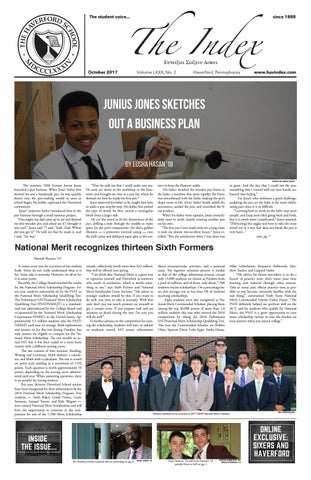
This summer, Fifth Former Junius Jones launched a pen business. When Jones’ father first showed his son a handmade pen, he was quickly drawn into the pen-making world; as soon as school began, his hobby captivated the Haverford community. Jones’ carpenter father introduced him to the pen business through a small summer project. “One night, my dad came up to me and showed me this wooden pen and asked me if I thought it was cool,” Jones said. “I said, ‘Yeah, Dad. Where did you get it?’ He told me that he made it, and I said, ‘No way.’
“Then he told me that I could make one too. He took me down to the workshop in the basement and brought me over to a pen kit, where he showed me how he made his first pen.” Jones observed his father as he taught him how to make a pen step-by-step. His father first picked the type of wood; he then carved a rectangular block from a larger slab. He cut the wood to fit the dimensions of the pen, drilling a hole through the middle to make space for the pen’s components. He slid a golden filament — a protective internal casing — into the drill cavity and dolloped super glue at the cor-
ners to keep the filament stable. His father attached the wooden pen frame to the lathe, a machine that spins rapidly; the frame was smoothened with the lathe, making the pen’s shape come to life. Jones’ father finally added the accessories, sanded the pen, and varnished the final product. When his father went upstairs, Jones immediately went to work, hastily creating another pen on his own. “The first one I ever made took me a long time; it took me almost two-to-three hours,” Jones recalled, “But the satisfaction when I was done was
so great. And the fact that I could use the pen, something that I created with my own hands, enhanced that feeling.” For Jones, who embraces a good challenge, sculpting the pen on the lathe is the most exhilarating part since it is so difficult. “Learning how to work on the lathe may seem simple, and [may seem like] going back and forth, but it is much more complicated,” Jones asserted, “[Perfecting] the angles and how to take the most wood out in a way that does not break the pen is very hard...” cont. pg. 7
National Merit recognizes thirteen Sixth Formers Neetish Sharma ’19 It comes every year for a portion of our student body. Some do not really understand what it is for. Some take it seriously. However, we all sit for it at some point. Recently, the College Board revealed the results for the National Merit Scholarship Program. Every year, students nationwide sit for the PSAT or the National Merit Scholarship Qualifying Test. The Preliminary SAT/National Merit Scholarship Qualifying Test (PSAT/NMSQT) is a standardized test administered by the College Board and co-sponsored by the National Merit Scholarship Corporation (NMSC) in the United States. Approximately 3.5 million students take the PSAT/ NMSQT each year on average. Both sophomores and juniors sit for this test during October, but only juniors are eligible to compete for the National Merit Scholarship. The test models an actual SAT, but it has been scaled to a more basic version with a different scoring curve. The test consists of four sections: Reading, Writing and Grammar, Math without a calculator, and Math with a calculator. The test is scored on point scale totaling to a maximum of 1520 points. Each question is worth approximately 10 points, depending on the scoring curve administered each year. When answering questions, there is no penalty for wrong answers. This year, thirteen Haverford School seniors have been recognized for their achievement by the 2018 National Merit Scholarship Program. Five students — Satch Baker, Grady Nance, Grant Sterman, Samuel Turner, and Kyle Wagner — were named National Merit Semifinalists and will have the opportunity to continue in the competition for one of the 7,500 Merit Scholarship
awards, collectively worth more than $32 million, that will be offered next spring. “I do think that National Merit is a great way to represent yourself and Haverford as someone who excels in academics, which is worth something to me,” says Sixth Former and National Merit Semifinalist Grant Sterman. “My advice to younger students would be this: if you want to do well, you have to take it seriously. With that said, don’t put too much pressure on yourself to get a certain score. If you prepare well and are attentive to detail during the test, I’m sure you will do well.” To further advance in the competition for earning the scholarship, students will have to submit an academic record, SAT scores, information
Mr. Kolade provides nuanced take on protesting on pg. 6
about extracurricular activities, and a personal essay. The rigorous selection process is similar to that of the college admissions process, except only 15,000 students are chosen as Finalists from a pool of millions, and of those, only about 7,500 students receive scholarships. On a percentage basis, this averages out to less than 1% of students receiving scholarships. Eight students were also recognized as National Merit Commended Scholars, placing them among the top 50,000 scorers of more than 1.6 million students this year who entered the 2018 competition by taking the 2016 Preliminary SAT/National Merit Scholarship Qualifying Test. This year the Commended Scholars are Robbie Chen, Spencer Davis, Luke Egan, Eusha Hasan,
Mike Schlarbaum, Benjamin Stallworth, Matthew Tucker, and Gaspard Vadot. “My advice for future test-takers is to do a bunch of practice tests; don’t waste your time learning new material through other sources. Take as many past official practice tests as possible so you become extremely familiar with the real thing,” commented Sixth Form National Merit Commended Scholar Eusha Hasan. “The PSAT definitely helped me perform well on the ACT, and for students who qualify for National Merit, the PSAT is a great opportunity to earn some scholarship money to ease the burden on your parents when you attend college.”
Thirteen students were selected as 2017-2018 National Merit Scholars.
INTEL CHEN ’19
Drew Sterman ’16 and Grant Sterman ’18 provide Notes to Self on pg. 4
PHOTO COURTESY OF DREW STERMAN ’16
MS. DAWN BLAKE
Page 2
The Index - Editorial
October 2017
Empty bleachers and low morale: addressing low attendance The vibrations from the bleachers would not cease. Shades of maroon and gold flooded the student section as chants and screams filled the air. A band of Sixth Formers orchestrated their symphony to repeat the encouraging cheers that would fire up their classmates who were in the midst of battle. Everyone had been on their feet the entire game. There was no point in sitting down to rest; you would miss all the action. The final quarter of the game crept up on us since we lost a sense of time one time. Our focus was on the men in the spotlight: our friends, acquaintances, our classmates, and our Haverford brothers. A heroic Ford dribbled past his defender and cut down a lane to find an opening. He had a clear view of the net, and all he needed to do was execute. The rest was history and the Fords prevailed once again. That night following the win, a sense of pride and accomplishment lingered. I was proud for the team, the players, and the great victory they had just pulled off. I had never really talked to the Sixth Former that scored the game winning goal or the few athletes that I high-fived while coming off the field. All I cared about was that they went to Haverford, and so did I. I was proud to know that I was a part of a community that could rally behind their classmates to support each other through some of the the toughest events, either on the field, stage, or classroom. This was four years ago, and the excitement
and memories that were created during the blissful moments of unity and brotherhood will be something I cannot let go. The environment at those games was electric, rowdy, and unifying. I cannot, however, say the same for this year. The turnout for fall sports has been lackluster. A sharp decline in attendance from years’ past has lead to empty bleachers and student indifference. Reflecting back on that soccer game, sure, the one hundred students that dedicated their Friday night may not have known the person that they were rubbing shoulders with well, but the sense of community sends a message that the student body cares. This year, it just feels that no one really cares. Haverford’s soccer game against Conestoga this year was just a glimpse of what had been the status quo from years past. With the disparity in numbers, the poor attendance can be cited to the absence of hype surrounding games, overall lack of interest, and lack of motivation from many students across the forms. Students should not feel shamed on Facebook or be called out for not attending. The cursing rant does not work; it used to work, but now it does not, and we must see a more effective approach in motivating the student body if we want a greater turnout. Ask a Sixth Former for his top-five Haverford memories and chances are, he will tell you that one of these memories was from a Haverford sporting event. Of course, crowds and sporting environments
are not meant for everyone, but the feeling of unity among classmates while cheering for one common goal is something special. It is now time
to rethink our fan section. Support your classmates all the way to the finish line, and they will do the same for you.
INDEX STAFF
2017-2018 Editors-in-Chief: (L to R) Samuel Turner ’18, P.J. Rodden ’18, Nick Chimicles ’19
Looking forward to service events Will Henderson ’18 Service Board begins to get busy organizing several upcoming events. Below is a list of some of our upcoming programs. Rowan House Tutoring: The Rowan House Tutoring project is led by Alex Ciardi, Tim Scheuritzel, and Eusha Hasan. Haverford students get to tutor younger kids in Philadelphia one to two times each month. We have a large list of students volunteering for this and can always add more. Please contact any Service Board members if you are interested. Riverbend Shiverfest: Every year, Haverford and Agnes Irwin students support the Riverbend Environmental Education Center by participating in its Halloween festivities. Students will be able to dress up and scare people on the “haunted” trail. All proceeds will go to support the Riverbend Foundation. This is one of the most-attended events of the fall, so we would especially recommend this event to any students
participating in service activities for the first time. Peanut Butter & Jelly Club: The Peanut Butter and Jelly Club will have several meeting dates in the next two months, and it continues in its efforts to get as many attendants as possible. We work with Agnes Irwin to make bagged lunches to feed the homeless in Philadelphia. We donate our lunches to Project HOME for distribution to people living on the streets of Philadelphia. If you are interested, contact the club’s leaders, Sam Turner and Matt Tucker, or ask any of the club’s members to add you to the Facebook page. Can Drive: The annual Can Drive will begin in November this year, and cans will be collected between Haverford, Agnes Irwin, and Episcopal Academy. The cans will then be donated to centers like St. Barnabas and Project HOME. Other Information: If you have any other questions about service at Haverford, stop by the
Students from Haverford and Agnes Irwin participate in Empty Bowls biannually.
Service Learning Center (first floor office next to Ms. Kasmen) and take a look at the upcoming
MS. DAWN BLAKE
service events or talk to Ms. Loos, David McKay, Jackson Overton-Clark, or Will Henderson.
The Index’s 2017-2018 Staff
P.J. Rodden ’18, Samuel Turner ’18, Nick Chimicles ’19, Editors-in-Chief Neetish Sharma ’19, News Editor Eusha Hasan ’18, Features Editor Toby Ma ’20, Assistant Features Editor Will Henderson ’18, Opinions Editor John Comai ’18, Opnions Editor Grant Sterman ’18, Politics Editor Robert Esgro ’19, Assistant Politics Editor
Lleyton Winslow ’20, Head Web Editor Noah Rubien ’20, Web Editor T.J. Malone ’18, Web Editor Payton Hollway ’18, Web Editor Aditya Sardesai ’20, Web Editor
Gaspard Vadot ’18, Arts Editor Vincent Scauzzo ’20, Assistant Arts Editor Matt LaRocca ’18, Sports Editor Nick Pippis ’19, Assistant Sports Editor Ms. Alicia Evans, Faculty Advisor Bobby Stratts ’18, Staff Photographer Mr. Thomas Stambaugh, Faculty Advisor
All opinions and viewpoints expressed herein do not necessarily reflect those of The Index or the school. The Index is designed and produced digitally. Photographs may be retouched. Submissions and letters to the editors regarding any and all articles are welcomed at index@ haverford.org. The Index is a student-run publication of the Haverford School that does more than bring news: it provides the diverse perspectives of the Haverford student body. It is an outlet for student writers to take stands on issues they deem important. It chronicles the daily struggles and accomplishments of the Haverford community. The Index also provides a forum for discussion of pertinent issues, such as student culture, academic policy, and Haverford’s place in world affairs. The Index presents new ideas and aspires to influence constructive change. The Index, a member of the Columbia Scholastic Press Association, is composed on Mac OS X, using Adobe InDesign CS 2017. Its surveys are conducted via SurveyMonkey and are advertised on Facebook to current Haverford students. Graphic designs are created by Index staff via Canva. Southern Dutchess News prints 200-400 copies of each issue, and its editorial staff distributes them in the Upper School on the day of release. The Index serves the needs of a total school population of 1091 community members, consisting of 975 students and 116 faculty members. Contact The Index: 450 Lancaster Ave, Haverford, PA 19041 index@haverford.org Twitter: @Haverford_Index http://www.havindex.com/ (610) 642-3020 x. 1222 Volume LXXX, No. 2 - October 17, 2017
Page 3
The Index - Features
October 2017
Do you think Ken Burns gave an accurate representation of the Vietnam War?
Cpl. Bill Ehrhart at Con Thien, a Marine outpost on the DMZ, Vietnam, November 1967.
How did Ken Burns and PBS find you for the documentary? I’m not exactly a famous person, but I have spent most of the past fifty years talking about the Vietnam War, and once you start looking at the Vietnam War, you find that I am hard to avoid. I was in a documentary in 1983, the first major documentary made about the Vietnam War, and I had a fairly prominent part in one episode of that, so I’m sure they were aware of that. Lynn [Novick] first contacted me in February of 2011, and ever since then she has been the person I have been dealing with entirely. She has done all the interviews. She is the one who went to Vietnam. I met Ken at a preview showing in New York City in June, and that is only time I ever met him. Lynn has been terrific, and I was very pleased to see an article from The Washington Post that calls her “the most famous documentary filmmaker you’ve never heard of.” She has been co-producing this stuff with Burns, certainly since the WWII one [The War], Prohibition, Baseball, and Jazz. They are equals. By the way, when you see those interviews, you are looking at a guy from six and half years ago. I was interviewed in June of 2011. This thing has been in the works for almost a decade. What types of questions did they ask you? It would be hard to characterize it because we actually spoke for four hours. They actually had to call someone in New York and have someone drive down with more film because I had more to say than they anticipated. So, I talked about everything: the whole range of stuff. A tiny bit of it makes it into the show. For every bit you see of those 18 hours, they probably got several
thousands of film footage. It’s why doing a documentary is a scary business because they pick and choose how they represent you. In fact, this was the first time I had allowed myself to participate in a documentary in twenty-five years. My first experience was a very good one, but then I had several bad experiences with people using me to say what they wanted said, and I stopped giving interviews. I turned down Cronkite Productions, ABC News, the Military Channel, the History Channel. I can tell my own story, but with this one, Novick had taken some time to figure who I am before she contacted me. She clearly read some of my work, and I have to admit: Ken Burns, wow, that was impressive.
PHOTO COURTESY OF W.D. EHRHART
nesses, but at least it has people talking, and I’m part of the conversation. Did you strategically pick your words when they were interviewing you? No. When God was handing out discretion genes, I must have been bent over tying my shoes
No. There are some things about it that are very accurate, but there are some things, like I said, some glaring omissions, that are highly misleading. In the opening episode, the narrator [Peter Coyote] said, “The Vietnam War was a tragedy and [paraphrasing] created by decent men who meant well but did not understand the situation.” Well, no, that’s not true. These were arrogant, proud people who thought they could shape the world the way they thought it should be. They did not listen to people who knew better, who were subordinate to them, and by the time you get to 1965, Lyndon Johnson knows he cannot win the war. He has not sent a single infantry troop to Vietnam. He knows he can’t win the war and he and his advisors send three million American kids to get their asses shot off in Vietnam. That’s not decent men, that’s arrogant people who aren’t willing to sacrifice their own ego and pride. Another thing is, if you don’t understand the history of China and Vietnam, you will never understand the Vietnamese. China at one point, between the second century B.C. and the tenth century A.D. occupied Vietnam, the Red River valley in what is now northern Vietnam. A thousand years! A thousand years, and the Vietnamese never accepted them, and finally, after many rebellions, finally kicked them out. How long were we willing to stay in Vietnam and fight these people? Ten years? Fifty years? We couldn’t beat them with five hundred thousand troops on the ground. We send a million people and we leave them there for how long? A hundred years? How about a thousand years, a millennium? These people were not going to quit. They were going to fight until the last person, and yet that entire history of Vietnam, and China is covered in exactly one sentence in episode one. You can’t understand why we didn’t win if you don’t understand that these are people that aren’t ever going to quit.
“He knows he can’t win the war and he and his advisors send three million American kids to get their asses shot off in Vietnam. That’s not decent men, that’s arrogant people who aren’t willing to sacrifice their own ego and pride.” So I went ahead and agreed, but I’ve been very nervous for the last six years waiting for it to come out. There’s things that I don’t like. There are things that I wish they would have included. You have to remember, and I have to remember, that Bank of America is not going to underwrite a scathing report of American imperialism. At least this way, I get to be in the conversation. The documentary has some glaring omissions and weak-
Cpl. Bill Ehrhart on Operation Pike, Quang Nam, Vietnam, August 1967.
or something because I never got any of those. People ask me questions and I answer them. In one of the episodes, I talked about something very personal and shameful, and I’ve had emails from people telling me about how courageous I am — no, I’m just too stupid to keep my mouth shut. They asked me questions, and I answered them. What, if you interacted at all, was it like working with the other veterans on set? I did not see them. We were all interviewed individually. Lynn and her camera crew came to my house. Actually we were at my neighbor’s house. It was a stinking hot day in June and at the time we did not have AC, so we went next door to Ed and Gloria’s (neighbors) house, and they graciously let us use their air-conditioned house. It was just me. Again, this process took years. There is one guy in the documentary who is a very good friend of mine, a guy named Ron Ferrizzi. I’ve known Ron for years. In fact, when Novick contacted me, I said, “There’s this guy you have to talk to.” He is the only one in it who I know very well. I know Tim O’Brien and Phil Caputo, but Ron and I are very close friends. In fact, by sheer coincidence, I was just at his 50th wedding anniversary. Otherwise, most of these people, I do not know who they are.
Cpl. Bill Ehrhart eating lunch (Combat Rations) in Quang Tri, Vietnam in October 1967.
PHOTO COURTESY OF W.D. EHRHART
PHOTO COURTESY OF W.D. EHRHART
The bottom line for the documentary you are watching is, the United States meant well, we did our best, but things just didn’t work out the way we thought they would. That lets us off the hook, but as I said, Bank of America is not going to underwrite a scathing indictment of US imperialism. There are some other things. You will see this anti-war person, years later, tearfully apologizing for calling the soldiers baby killers — that never happened! It’s just nonsense. Nobody ever spit on me or called me a baby killer. By 1970, I was in the anti-war movement, and I was not doing stuff like that, and I didn’t see anyone else doing stuff like that. Yet, that mythology was reinforced in episode ten of the show. So, I got a lot of problems with it, but it’s on the table, people are talking, I get the chance to say this stuff to newspaper reporters, so maybe somebody will learn something. Is there anything else you want to add? I’m glad I participated. I had very serious reservations all through the last six years waiting for this but, for all of its flaws and warts — and I’ve spent time explaining some of them at least — it’s worth doing, and there are things about it that are very good.
Page 4
The Index - Note to Self
Grant Sterman ’18
Dear Grant, You are four years old. You are entering a school under reconstruction. Little do you know that you will go through a renovation as well. You are surrounded by dozens of unfamiliar, intimidating faces. Some of these people will become your closest friends, and others will teach you how to act during conflict. You may never form a relationship with a few, but they will still impact you. Make the effort to understand all your classmates, they each have perspective necessary for your future growth. Eventually, some of your relationships will fade away. Despite the childhood voice telling you otherwise, cherish the happy memories with these people and learn from the not-so-great ones.
October 2017
Drew Sterman ’16
You will go to your first EA day and spot maroon and gold on everyone’s shirts and jackets. The solidarity of a still-unfamiliar community will blow you away. Unfortunately, sometimes you will feel alone and targeted. Even when you feel ostracized, picture the Fords in your mind. Always remember that these guys, even if they are not your close friends, care about you and your health. You will leave Junior Kindergarten for your
Dear Drew, You are eighteen, on the forefront of your senior year. You have roamed these hallowed halls for the last decade and a half, where familiar faces greeted you every day. What lies ahead is the hardest but wildest year of your life. On September 8th, 2015, you and your best friend will stand with a kindergartener in between you, holding your hands. You will enter the gym for the same opening assembly you attended every
first summer break with a weird feeling in your heart. You will realize how much Haverford has changed you. If you do not take a second to enjoy its magic, you will not comprehend how much you have really changed. As a senior, you will reminisce about your unforgettable tenure here, upset but hopeful as it comes to an end.
first day of school, but this time will be your last. The task ahead is daunting. But do not let this scare you. You will rise to the challenge and surpass every expectation you set. You will build confidence and composure in times of great pressure and failure. You will soon become the man you were destined to be.
“You will see big words that you still cannot understand: compassion, integrity, honesty, and respect.” You will walk to the opening ceremony, holding an unknown senior’s hand. It is hard to imagine yourself looking and acting like an eighteen year old, but you admire these men for their poise. You cannot fathom enduring a decade of school, eventually becoming just like them. You are completely oblivious to the emotional rollercoaster the next 14 years will be. However, do not fear; your blissful naivete will let you enjoy many moments. You will see big words that you still cannot understand: compassion, integrity, honesty, and respect. Your experiences and the people around you will inculcate these values in you. You will try to uphold each virtue but will frequently make poor decisions. Thankfully, you will learn from your imperfection, and realizing that others are also imperfect will comfort you.
MS. JAMINE SHECTER
You will fail. You will be rejected. You will cry, encountering greater sorrow than ever before. There will be mornings where you will wake up and stare at the ceiling, dreading another day of monotony. You will be heartbroken after ten schools tell you that you are simply not good enough for them. But only through this process will you find your new home, a university in the outskirts of Atlanta, where you will use all that Haverford has given you to excel at whatever life will throw at you. You will learn the true values that Haverford has bestowed upon you. You will support your brothers on the field and on stage. That will build camaraderie. On December 15th, you will see your best friend break down, weeping, hiding his sorrow. But you will embrace him, a moment more precious than any acceptance letter. That will build love. However, do not fret. You will not journey and suffer alone; your brothers will surround you. Mrs. Ley will be your best friend in times of disenchantment. Mr. Lengel will make you laugh on days when you wanted to be anybody but yourself. Mr. Stambaugh will give you advice when you need it most. Dr. Ehrhart will reassure you that life is not quite over just yet. On June 10th, the day after your nineteenth birthday, you will cross the stage in your illfitting maroon blazer, a blur in the annals of your personal history. By now you will have experienced rejoicing, victory, love, and pride. Not too long into the future your brothers will go their separate ways, but the love will remain. It will be ingrained in them, transcending great distances. A year and a half later, you will sit in a lecture twice the size of your graduating class. The professor will know neither your name nor your face. And you will revisit the times when you played Blokus in the library with your brothers.
Ryan Sanflippo ’18 Dear Ryan, You are scared now, but there is no need to be. The same fears that race through your head and the challenges that lie ahead are things that will define your next four years at Haverford. The halls that you will soon call home seem foreign to you. The people are nameless and their faces might as well be blank. You will find yourself going back to your comfort zone and hanging out with people from your old school, but you will know the bonds with your classmates at Haverford will be unlike anything you ever had at Gwynedd. You will soon find that there is no need to seek out friends. They will have a way of coming into your life without you even realizing it. Not only that, but some of the kids you are friends with in the beginning will not be as close to you by the time senior year rolls around, and some of your best friends will not reveal themselves until much later. Haverford will become your home. It will take you too long to realize that the things you do freshman year matter. The grades will matter. The activities you do matter. The relationships you build matter. But, most importantly, the hurdles you will overcome matter. Freshman year is like the warm-up for the rest of high school. Would you really go into a water polo game or a swim meet without warming up and expect to do well? No. So why would you set yourself behind the eight-ball by not doing what you need to do when you can? Over the course of your four years at Haverford,
you will meet many amazing people; many of them will actually be your teachers and coaches. Listen. Observe. Take mental notes. These people
will be in your life for a reason. The only thing they want to do is help you achieve the success you have always wanted. Do not be afraid or lazy
INDEX STAFF
to see them for extra help. What you put into something is what you get out: there is no way around it. You will come to find that the worst and best things in life are regrets. You cannot change the past but can definitely change what you do in the future. Only you control your destiny. The biggest obstacle you will face is yourself. Battles will ensue through your head, and they will sometimes escape into the world. These battles, internal and external, will distract you from your end goal. Keep a steady hand on the tiller and everything will work out for you. The time you have at Haverford is the best gift you will receive in your life up to this point. Sometimes you will want to quit, throw in the towel, even transfer, but do not let your setbacks discourage you from achieving your dreams. Remember that Churchill quote in your eighth grade yearbook: “Success is not final, failure is not fatal: it is the courage to continue that counts.” Too late will you realize how quickly time flies. Every day, minute, and second counts. But, Ryan, just remember to always stay true to yourself; never forget where you come from and the things you have accomplished. It will all go by in the blink of an eye, and, before you know it, you will be at your desk listening to A$AP Rocky writing this letter, wondering where all the time went. Your time at Haverford moves fast. If you do not stop to look around, you can miss it.
Page 5
The Index - News
October 2017
OBAIDA ELAMIN ’20
Jaili Khujali, center, at the Kurdofan village well, July 2017.
Protests against sanctions in Sudan in front of the White House, September 2017.
In the fast-paced, interconnected world, Sudan flies under the radar for most Haverford students. Sudan is a north African nation, home to the ancient Nubian civilization that rivaled Egypt to the north. Later Egypt and the British empire controlled the region for more than a hundred years until the Sudanese people claimed independence in 1956. Since then, a series of civil wars have embroiled the once-thriving nation.
JUNIED KHUJALI
In 2011, Sudan made headlines when its southern portion gained independence in a referendum, becoming South Sudan. More recently, President Donald Trump’s travel ban featured Sudan due to the country’s classification as a “state sponsor of terrorism.” Nonetheless, many Americans do not understand Sudan and its people, seemingly worlds away from the Main Line. But one
Elamin visited his grandmother’s house in the Fourth Square neighborhood of Khartoum.
OBAIDA ELAMIN ’20
Haverford student, Fourth Former Obaida Elamin, seized the opportunity to visit Sudan and experience Sudanese life. Elamin, born in Sudan, left the country when he was just five years old, so the trip was also a homecoming. During his two-month stay, Elamin learned to understand his family better and “opened [his] eyes to the issues going on in Africa and specifically Sudan.” One part of Elamin’s trip included “seven hours of driving” into the countryside, “where [he] only had a 2G cell signal, no electricity other than solar power, and no roads.” After that long excursion, Elamin drove to the village where his father grew up. The community was very small, housing only 200 to 300 people. Elamin caught a glimpse of “what [his] dad went through…and what kind of stuff he experienced.” This eye-opening experience made him feel lucky to live in America and attend Haverford. In Sudan, Elamin also swam in the Nile River and saw the flooding season unfold. “The water came out almost thirty meters, and it comes out even more during September and October,” recalled Elamin, “…[T]he water comes out in front of my grandmother’s house and floods the roads in front of them…the flooding season is insane over there.” “If you look at a satellite photo of the Nile River Valley before and after the flood, you’ll get a sense of the scale.” Elamin also enjoyed playing with his grandmother’s goats and buying groceries every day, opportunities to gain more insight on the Sudanese people. “People there are a lot more comfortable with others and a lot more kind,” said Elamin, “They will start a conversation with you.” The reason why people are so approachable, Elamin mused, is because they bond under one religious and cultural background. The naming system epitomizes their unity. “You had a four-part name…you had your first name, then your father’s, and his father’s, and his father’s,” said Elamin, “So if you had two Sudanese people in a room together for five minutes, they could figure out how they were related.” Elamin now has a different outlook on his lifestyle than those less fortunate than him. “[My] eyes have been opened to new perspectives about third-world countries and my family over there…,” reflects Elamin, “I’ve changed in that I’ve tried to avoid living only through the Internet, through my phone, through technology; I want to live day-by-day in person…” “Technology is a wonderful thing, but we can do away with a lot of unnecessary and separating things.” Elamin explains that many people in the same building choose to text with each other instead of “going and talking; seeing a person
Elamin on camel-back in Kurdofan.
JAILI KHUJALI
face-to-face is a lot better.” Haverford students should consider Elamin’s advice, as many students are absorbed in their smartphones walking through the halls and during free periods. Elamin is convinced that many people have “a pretty ignorant point of view” of Sudan. He cites the recent U.S. sanctions against Sudan, shattering the nation’s fragile economy. “Even though Sudan, like other African countries, is a third world country. It is moving very quickly technologically and it’s advancing very well,” argued Elamin, “but the sanctions [were] really stunting its growth, and now that the travel ban has been lifted, I’m really grateful that people over there like my family and others can come over to America and have the opportunity like I did to come to a great school and work hard and achieve whatever goal they want.” Elamin is eager to share his journey with Haverford community because he feels that travel helps people understand others from various backgrounds. “It’s important for us to open our eyes to perspectives of other people,” said Elamin.
Checking in on Clubs culture Obaida Elamin ’20 This year the Haverford Upper School features 47 clubs, each of which taps into the student body’s diverse interests. Student leaders have also formed new clubs to expand the variety of school activities. One of the most anticipated new clubs is Finance Club, where students discuss their common interests in the financial world. The club is not too involved but will be stimulating for students interested in finance. Fourth Former Matt Mignucci, one of the student leaders, said, “We discuss the finance leaders of the world today and famous stories and scandals relating to finance.”
Fantasy Premier Club, run by Sixth Former Bobby Stratts, is an easygoing club for soccer fans. Anyone can join, regardless of soccer background; the club is great for anyone who loves soccer and follows the Premier League. Students meet to discuss pressing Premier League matters and compete in Fantasy outside of school. Stratts said, “The typical person who joins the club is not necessarily a soccer player himself. I have people come in simply because they support a English Premier League team and can relate with other people in the room who also support that team… Many soccer players themselves join because they simply love the game and want to
watch highlights and compete with their peers.” Another new club on the roster is Quiz Bowl. People who are good with trivia or interested in learning more should join. Although the club requires a higher time commitment, Fourth Former Toby Ma, student leader of Quiz Bowl, encourages everyone to sign up. Ma explained, “Questions can be based on high school subjects, current events, sports, and popular culture…Anybody can join Quiz Bowl, but people should come in ready to do learning outside of school and be interested in going deeper into select topics. If someone already knows a lot about a particular topic, he would
also be welcome to join.” Last but not least is Knitting Club, where students can have a lot of fun. Requiring no previous experience, knitting is fun and easy because it can be done simultaneously while working on something else. The best part is the gratification after a student completes a project. This year’s clubs have something to offer for everyone. Students should check out these new clubs to see if any pique their interest.
Page 6
The Index - Opinions
October 2017
Tell me why you’re mad: protesting the protest Mr. Luqman Kolade Let’s begin with this premise: true protest is by its nature disruptive. If you can agree with that, then the rest of this should be fairly easy to grapple with. If you cannot accept that protest makes people uncomfortable and makes them realize that one disagrees or objects to something in the effort of making change, then this might be difficult for you. With that said, we should remember that America is born from protest, and as such, the country has social change in its DNA. Though progress has not always been fast enough for those who desire it, change has happened in ways that make this country unique. This is why I’ve been so struck by the hostile reactions to the various protests in the sports world that have taken place over the past year or so, especially the president’s comments denigrating those protests and the protestors as anti-American. The protests that began with Colin Kaepernick taking a seat during the national anthem to bring attention to what he and many others believe is a systematic discrepancy in how black people are policed and disproportionately killed by police have become distorted to be a salvo against America, its flag, and its soldiers. One of the ironies of this conversion by those who either willfully or ignorantly have disregarded the original meaning of the protest is that after conversations with veterans, Kaepernick went from sitting during the anthem to kneeling. Kneeling, as Tim Tebow showed us, conveys a respect and reverence that sitting does not; however, according to the president’s comments and tweets, kneeling is now too much. Reframing the narrative of this protest as an attack on the very essence of America is not only a shrewd political move by the president but also a great way to distract from what is really the issue, an issue that is thorny and difficult for many to deal with as it exposes the racial underbelly of America
we would much rather ignore. Think about it. What is the best way to dispossess a group of people of their power? Telling their story for them. By labelling the kneeling as an unpatriotic act, the president and those who have taken up his cause, have done a few significant things. They have not only disregarded the First Amendment aspects of protest but also made this an “us vs. them” way of looking at what is ostensibly an equality issue. They have challenged those who feel the need to protest to find more convenient and acceptable ways to do it, which is oxymoronic. Additionally, they have equated a plea for America to be better as being anti-American. How does demanding more of your country because you know what it can be equate to being against America? Isn’t that making America great? One way to skirt this question is by saying that there are other, less disrespectful, less disruptive ways to protest. I have yet to see anyone against this movement posit a suggestion as to how the protestors should address their concerns aside from just do it differently. All I have seen and heard is vitriolic anger at the protestors, including, ironically, people booing during the singing of the national anthem. Another problematic response to the protests is pointing out the wealth of a majority of these athletes. The commonly held idea is that because they are rich they should have nothing to complain about, as if one’s wealth precludes him from being aware of what is happening in the world. As if there is no moral obligation to fight injustice once you have made a certain amount of money. This particular tact, of attempting to delegitimize one’s activism because of economic status, is pathetic when looked at objectively. Should only poor or middle-class people be able to look at their country and comment on its flaws? If only the oppressed fought for themselves,
social change would rarely happen. It takes those with power and influence to help make change. The other side of this argument is that these men, who are majority black, should be thankful for being paid to play a sport and consequently should keep quiet. As Jeanine Pirro of Fox News put it, “America’s been incredibly good to every one of you. […] America’s allowed you to shine and become financially prosperous... shame on you. Shame on all of you!” The obvious racial dog whistling in this line of reproach has a long history in America and again brings up the idea that one should keep quiet if he has “made it.” “Just be happy and not rock the boat,” they seem to say. But my statement from earlier still rings true here: should one ignore injustice if it does not apply to him? How is that pro-America? One of the most interesting aspects about this protest conversation is how people forget how past protests were seen in America. If we look back at what is arguably the most famous protest in American history, the Civil Rights Movement, many might be surprised by how it was perceived at the time. A Gallup poll taken in May of 1964 revealed that 74% of Americans believed that “mass demonstrations by Negroes” were more likely to hurt “the Negro’s cause for racial equality.” Another Gallup poll taken in October of the same year indicated that 73% of Americans believed that “Negroes should stop demonstrating.” A Harris survey taken in October of 1966 revealed that 85% of White Americans felt “the demonstrations by Negroes on civil rights have […] hurt […] in the advancement of Negro rights.” What do these numbers tell us? Primarily, that there is no right way to protest. Secondly, that the majority seemingly never wants to hear what those who feel oppressed have to say, regardless of how they deliver their message. The numbers say that
Mr. Luqman Kolade teaches English II and III this year.
many believe the oppressed are not oppressed, or they should just be patient and everything will work itself out. Lastly, the numbers reveal that even the “best” of America’s protests was considered counterproductive at the time, yet many of those who are most outspoken against the kneeling have championed those leaders of the Civil Rights Movements as examples of how people should fight for change. I remember people speaking up during the Black Lives Matter protests and saying how Martin Luther King would be against the movement because it was so divisive and people should follow his lead, as if he never disrupted the norm or made a significant majority of the country uncomfortable. Considering all this, where do we go from here? The best we can do is understand why the protests have started in the first place and avoid the “us vs. them” bait. If we can engage in conversations instead of trying to find ways to silence those who protest, we can progress. Trying to dispossess people of their right to fight or simply not listening to what they have to say does nothing but make everyone angry. I have a question I have posted in my classroom this year: Why does THIS make you feel how you feel? If we could step back from our anger, be it seemingly legitimate or otherwise, understand why we are upset and talk things out, maybe we could begin to fix some things. However, for those who cannot get over the discomfort of these specific protests and see them as antiAmerican, know that they will not go anywhere just because you are angry. Your anger may have the opposite effect and unite people even faster, as the president’s comments seem to have done. You should also realize that eventually people will look back at this time for answers as to why it took us so long to recognize that something was not right.
INTEL CHEN ’19
Why lower school is worth it William Henderson ’18 There is no question that admissions into the lower grades of independent schools like Haverford are struggling. With a quick (and slightly ignorant) glance, many parents and even students question a rather high price tag for what some call “arts and crafts.” No amount of money, however, can quantify a Haverford education for thirteen years. I have attended this school since kindergarten, and I can confidently say if I did not go here for all of those years — especially in Lower School — I would not be the person I am today. People are quite impressionable at young ages; I still use the skills I developed in kindergarten as a senior in Upper School. Haverford taught me more than “fine-motor skills” or how to read
a chapter book or how to add and subtract; it taught me how to love doing all of those things. Would I feel comfortable speaking at an Upper School assembly if I never recited the Gilligan’s Island theme song in Mr. Lignore’s class? Would I have proper manners if I didn’t give Mrs. Thorburn a piece of Halloween candy each time I said “Can I use the bathroom?” Would I look at the sky each time I go outside without going inside Mr. Palmer’s planetarium? Would my friends be different if I had not met them on the first day of school thirteen years ago? Had I not been at Haverford during those consequential years of my life, everything about me would be different today. The Lower School’s greatest asset is instructing a single-sex student body because it helps teachers make traditionally slow activities more engaging. For example, learning about wind resistance, buoyancy, and colonial America may not be particularly interesting to a third-grader. However, building a Mayflower out of popsicle
sticks and using electric fans to blow them across the school’s pool is much more enjoyable and exactly what we did in science class. When learning about immigration into the U.S. during the early twentieth century, rather than simply reading about Ellis Island, our class actually went there. Finally, studying money and time can be a bit difficult for a second grader. But, if the days of the week are themed “Money Monday, Time Tuesday, and Wacky Wednesday,” the learning becomes enjoyable. Now, as a Sixth Former, I can appreciate the development my teachers have helped me undergo since kindergarten: they have helped me transition from an environment with lots of movement and energy to one akin to college classrooms, where I can still thrive. As I walked a kindergartener into the openingday assembly, I had a mixture of emotions. I was grateful because I saw so many people who had helped me reach where I am now. I was nostalgic, as I saw people like my fifth-grade English teacher, who had sent me a letter over the summer,
offering advice for senior year. I was sad because I knew this was, in fact, my last year at the only place I had ever known. Above all, though, I felt prepared for the year to come. I was ready for my calculus class because my third grade teacher told me to memorize my times tables. I was ready for English because my kindergarten teacher helped me construct my first sentence. I was ready for my Engineering class because my fourth grade science teacher helped me create a mousetrap-catapult and launch a CO2-powered car. Every skill, every habit, and every rudimentary knowledge I have about anything is because of my teachers in Lower School. To anybody hesitant about making the sacrifice to send their son to the Lower School and to anybody who questions the value of a thirteen-year Haverford education, I can tell you unequivocally, every penny is worth it.
Page 7
The Index - Opinions
Rethinking gym requirement
October 2017
Ethics of illegal streaming
Biagio DeSimone ‘19
Cole Stecker ‘21
Mr. Trocano sits in his office, awaiting his GBlock chemistry honors class with a stack of tests. In a forty-five minute span, the intense Chapter 6 test will challenge this group of Fourth Formers. All that they need is a quick review in their free period to master the material; on this day, however, they have gym. The “G-block” dilemma is near and dear to the hearts of many. Why does the gym requirement occur in the Fourth Form year, a year far more academically rigorous than Third Form? The academic leap from Third Form to Fourth Form is enormous, and the possibilities of accomplishment in one free period are endless. The free period relieves stress on the student because they know they have time ahead. The gym period, however, chops time out of the student’s schedule. While the administration does allocate a free period to Third Formers, this study hall is often counter productive. Third Formers do not understand the value of this period or how to capitalize on their free time. Furthermore, Fourth Formers need this free period much more, especially with the possible addition of a larger workload and perhaps the hardest honors class in the school. The pressures of standardized testing and college even begin to encroach the minds of Fourth Formers, a pressure far removed from Third Formers.
Let’s also note the purpose of Third Form year. The school expects Third Formers to begin to acclimate in the high school and build camaraderie with classmates. Boys are their truest selves in competition and athletics. So, what is a better way to build friendships than in a sports realm? For new students, this also provides an interactive experience outside of the classroom. This would also improve the social sphere in the Third Form. A free period in Fourth Form year would be so much more meaningful. In a year where academic rigour is multiplied, another forty-five minutes in any given day could have meant the difference between an A or a B on a certain quiz, test, or homework. That free would enable me to clear up time because, after school, I would be swamped by other athletic and non-athletic requirements. Moving the gym requirement to the Third Form year would benefit all underclassmen. The Third Form would build a stronger basis of camaraderie and class relations. The Fourth Form would be able to concentrate more on their academics. Social relations across the Third Form would increase, and grades across the Fourth Form would also increase. This swap would relieve both social and academic stress from two Forms.
Though some may be unaware, there is a massive market for internet piracy. Everything from movies to shows to games to music can be obtained at no cost by using various illegal methods. Many years ago, pirating required advanced torrents to steal media. However, pirating has become rather easy. Even though the use of torrents is still ubiquitous among the pirating community, a new form of piracy has emerged using simple techniques: simply by opening one of the millions of illegal internet streaming websites and searching for desired media. Such easily accessible sites are the reason why the Game of Thrones season 7 premiere has been illegally streamed over 15-million times in the United States alone; many sources even argue that it has been viewed illegally more than it has been viewed legally. This figure is massive, and it gives insight into how mainstream piracy has become. Because pirating has become so easy, it has skyrocketed in popularity, with an estimated 300-million unique pirating websites in 2017. Piracy has greatly damaged revenue for musicians, game developers, and anyone else who produces paid media. In addition to revenue loss, piracy also discourages the creation of new content, as
new artists and developers are more hesitant to create content because of losses in profit due to pirating. To thwart piracy, large corporations such as Netflix and Spotify offer a legal, cost-effective way to stream music and television shows which has had a profound effect. Even with the major successes of such companies, they still struggle to compete and slow the growing piracy market. Why is internet piracy so widespread? There are psychological differences between stealing from the internet and going into a store to steal a video or DVD. Also, there are different consequences for each of these crimes. Stealing from a store is considered shoplifting and punishable by law. Stealing from the internet, however, is illegal, but it is not punishable by law. In addition to being morally wrong, one is deterred from stealing from a store because of possible legal consequences, but this deterrent is absent on the internet. Clearly, internet piracy is horrible, but it is here to stay, and there is little anyone can do to prevent it.
Does the school give too much homework? Gaspord Vadot ‘18 Students often discuss their large workloads. From time to time, we are thankful for the unusually light amount of work we are assigned, but most of the time, discussions about homework revolve around the absurdity of teachers expecting us to finish a WebAssign and 30 math problems and an outline to a paper and a presentation all in one night. So should the school be giving us less homework? The quick and easy answer is no. Absolutely not. The big problem at Haverford is not our workload: it’s procrastination. In other words, the problem lies not within the teacher’s expectations but rather in the student’s inability or unwillingness to anticipate and work in advance. The school’s teachers have been teaching for a longer time than we’ve been in high school, and most of them have taught at a number of different institutions. They have a lot of experience molding their classes and preparing assignments. Their expectations are by no means unrealistic: they are calculated and defined by years of students before us who have taken the course and finished all those assignments. So why do we feel so overwhelmed by our assignments on a daily basis? Simply said, we put
ourselves in that very situation. We often aren’t willing to work so that we aren’t overwhelmed by the mountains of reading and math problems. The culture of procrastination at this school is widespread. It is not necessarily more widespread here than other schools in the area, or even the nation, but my experience here has shown me that this is a major issue for us. I am not claiming that I hold a moral high ground because I do not procrastinate; that would be a blatant lie. I am also not claiming that every single student here procrastinates; that would be an ever bigger lie. I procrastinate. Others might not. I might do better in some assignments than those students who don’t procrastinate, and they might do better on other assignments. But I understand that the way that those of us who procrastinate do our work is not sustainable. I wouldn’t be surprised if the students who complain the most about their workload are the same students who don’t do an assignment until it appears on the calendar for the following day. Most teachers post their homework early in advance, and large projects and tests are always posted at least a week in advance. It would be easy to set aside some time during the weekend, or on days when our workload is lighter, so that we
are not as overwhelmed when the time comes to finish the assignment. Then comes the day of the assignment: even then, many of us would rather complain about the size or vagueness of the assignment than sit down and do it. Teenagers our age should be getting at least eight-to-nine hours of sleep a night. If we were to ask around the school, we’d probably find that the majority of students at Haverford average six-toseven hours of sleep. Not sleeping enough leads to a wide range of health issues; in other words, procrastination is physically hurting us. Students who argue that we should have less homework usually point to one large issue: sports. With the sport requirement, a large number of students lose up to two hours after school to practices and games, and it is conceivable that this could lead them to feel overwhelmed. But teachers have molded their courses around students at Haverford, and the two-sport requirement is not new. The teachers are aware and understanding of the athletic and extracurricular commitments we make as individuals to our team and our school. If, by chance, a student is truly overwhelmed, there are few teachers that would refuse him an extension, provided that it is reasonable and asked
in advance. Similarly, coaches tend to understand that we are students with demanding academic schedules. But they are just that: demanding, not unrealistic. Homework is an important part of our education. As much as I would love to have more free time after school, the work we do outside of class is imperative to our understanding of the subject and the forward progression of the course. Learning comes from the application of what we know; it helps us find what we don’t know, and lets us focus our efforts on that unknown. I think we often forget that we go to a school that is academically challenging. We are here because those who sent us here want us to have a great education. If we aren’t challenged by the work we are given, then the school wouldn’t be doing it’s job properly. Homework is not an evil torture device: it’s an opportunity to apply and improve our learned skills.
“If I have too much homework or any big tests coming up, school comes first. I usually spend four to five hours per week in my dad’s workshop, averaging four to five pens.” Jones’ hefty time commitment to pen-making says a lot about his passion for the art. “I just thought that the pens my dad showed me were beautiful because wood is never the same,” Jones explained, “[Wood] is unique each time you [work with] it, and although the process is similar, it never turns out to be the same ... because [the wood] used to be a part of a tree—a living thing. “No tree has the same grains structure or lines within it, which endows unique qualities to each pen.” About a week before school, Jones planned out his business’s objective for the coming months: to sell to the Haverford community. “I felt as though with a higher education should
also come a higher quality for the tools we use, such as pens and mechanical pencils,” Jones said, “So I knew my classmates and teachers would love my creations.” Jones currently sells $10, $15, and $35 pens, as well as $25 mechanical pencils. He has sold over twenty pens and mechanical pencils. Jones is now learning how to create custom pens and mechanical pencils. Since his standard models sold well, Jones predicts that the demand for personalized items will skyrocket once he learns how to make them. “I am actually planning on making myself a dragon pen, with scales on the tip and a tail encircling the divide [in the center] of the pen,” Jones said, “I want to test my skill in making custom pens before I start customizing pens for buyers.” Haverford commemorates Jones’ entrepreneurial zeal and wishes him the best in future endeavors.
Junius Jones’ pen business, cont. To get as low as you can to the correct size of the pen—even though there really is no correct size for the pen—is super hard.” However, with each success Jones has failed countless times. A few culprits are always responsible for his mistakes. He regularly encounters problems with the type of wood he sculpts. “Different trees pose a different challenge each time; for example, mahogany is a lot easier to get down to the finish, but a lot easier to break,” Jones noted, “[But] maple is the hardest that I’ve ever used. It just doesn’t budge when you cut into it, and it takes much longer. It requires much more angle skill than any other type of wood.” Jones believes that pen-making helped improve his patience, a vital skill for creating the best artwork possible. “The patience came from standing over the lathe and going back and forth with the lathe tool for hours,” Jones said, “The first time I tried on
mahogany wood alone, I broke three pens in total. It was so frustrating because it took me in total around two hours to do all three of those, [only] to see them break. “On [my] second [try], I actually screamed. And for [my] third [attempt], I just sat down for a second, sulking in my disappointment.” However, Jones grew more patient as he worked with mahogany more, boosting his focus throughout the arduous pen-making process. After making a several more pens, Jones devoted his weekends to the craft. Once junior year commenced, he stayed faithful to his weekly schedule. “I try to finish all my weekend work by the end of Friday; and then on Saturday after my job at the Franklin Institute, I go over to my dad’s house and make pens. On Sunday, I go to church, and then my mom takes me home, where I usually finish the remainder of my homework and study for upcoming assessments.
Page 8
The Index - Politics
October 2017
China’s environmental politics: superpower status ceased Yan Graf ’20 China has been long hailed as the next world superpower, the country to unseat the United States as the preeminent global leader. Decades of double-digit economic growth, an endless supply of cheap labor, massive quantities of natural resources, and the world’s largest army have all led to predictions that China will reclaim its spot as the center of the world. Cracks are emerging, however, in China’s bid for global supremacy. Despite being the largest land army in the world, China’s army remains a comparatively ineffective fighting force. Soldiers are cheaply equipped, with a standard People’s Liberation Army (PLA) soldier carrying $1,523 worth of equipment, just one-tenth of that of an American soldier. The PLA has also not been in a military conflict since 1979, thus attributing to its gaping inexperience. Perhaps the biggest weakness of the PLA is that the Chinese Politburo, rather than a government branch, runs it. Consequently, party officials, who offer little knowledge of war official and poor leadership, are making the most important decisions instead of generals and experienced soldiers. Also, recent reshuffles in the Chinese military command have only further confused the PLA’s ranks. China has also been isolated diplomatically. China’s only dependable allies (and questionably so) are North Korea and Pakistan, and China has a slew of international opponents and enemies. In order to alleviate this situation, China has initiated the One Road One Belt program, a trillion-dollar-foreign-infrastructure project meant to more closely connect China with the rest of Eurasia. Still, China’s relations with neighbours have only worsened. Powerful enemies like India, Japan, South Korea, Vietnam, The Philippines, and Malaysia surround China, and its recent incursions into the South China Sea have certainly not helped ease tensions with many of these governments. Internal secession movements in Tibet and Xinjiang province, where many Tibetans and Uyghurs have combatted Chinese oppression with violence, have compounded these problems. Central to China’s rise as a global force was its swift economic rise. After Mao Zedong’s death, his successor Deng Xiaoping pursued a policy of opening up the country towards capitalism, eliminating his predecessor’s disastrous communist policies and redirecting China towards modernization. This opening has helped China lift hundreds of millions out of poverty and has
seen China’s economy grow to become the world’s second largest economy by nominal GDP. This economic miracle, however, is soon coming to an end. China’s growth rate has slowed down to 6.9%, its lowest in 25 years. That being said, economic data such as GDP growth have become so unreliable that even China’s Premier, Li Keqiang, doesn’t believe the figures. It is well-known that provincial administrators have artificially raised GDP figures, far above actual values. Measuring China’s real GDP growth has proved to be an impossible task, with some, like Christopher Balding, Associate Professor at Peking University, placing China’s growth to being as low as 1-2%. Fake GDP numbers are only the beginning of China’s problems. China’s economy has historically relied on being the world’s factory, providing cheap manufacturing jobs and constant trades. This is coming to an end: many factories are already failing in China, due to rising labor wages, and relocating to other countries like India, Bangladesh, and Vietnam. Throughout the past decade, the Chinese Communist Party (CCP) has adopted a growth-at-allcosts mindset. The CCP knows that its survival as ruling party relies heavily on sustained economic growth in order to satisfy the populus. While this method has been recently successful, recent figures suggest it is no longer working. As a result, in a bid to re-stimulate economic growth, China’s companies and government have been raking in an enormous amount of debt with China’s debt recently surpassing America’s in its debt to GDP ratio. China’s debt is growing at an unprecedented rate, much faster than America’s, and a rate that is dangerously high, according to the International Monetary Fund (IMF). China is funneling the loaned money into the real estate market and building boom in China, which constitutes more than a fifth of China’s GDP. Massive real estate bubbles have been popping up in China, fueling cheap loans and outof-control infrastructure spending. Ghost cities built to house millions, like Ordos in Inner Mongolia, stand empty across China. According to a 2010 study, there were enough empty residential units across China in 2010 to house 200 million people. China’s upper class has been purchasing these apartments, driving housing prices through the roof. Chinese authorities have been trying to battle these bubbles, but the success of their efforts was only temporary.
China’s 17th National Congress convened in Beijing in 2007.
Pollution is another issue China must overcome in order to reach global superpower status. Air pollution spending, as a study by the University of Chinese Academy of Sciences in Beijing shows, costs China nearly 6.5% of its GDP. Pollution has been responsible for 1.6 million premature deaths per year in China. Mr. Jamison Maley, who recently wrote a paper about pollution in China, believes that one of the main government issues that has heightened the pollution problem is the amount of Technocrats in the government. Mr. Maley said, “this has led to a supply-based approach to solving China’s environmental problems through grandiose building projects as opposed to a demand-based approach encouraging efficiency and adequate pricing.” For example, the Three Gorges Dam, the world’s largest hydroelectric dam, has displaced nearly 1.2 million people. Mr. Maley remains cautiously optimistic about this problem, in the wake of the Paris Agreement and the contents of President Xi Jinping’s newest five-year plan. While China has promised the international community that it will reduce its pollution, its efforts to clean up the country prove even more problematic. Mr. Maley said, “It’s called a fragmented bureaucracy… If you look at a lot of these environ
PHOTO VIA SOUTH CHINA MORNING POST
mental laws, they are very notable with what they want to achieve, but by the time they get down to the local level, local officials have to counterbalance them with economic growth, making environmental enforcement difficult.” According to Frank Holmes, C.E.O. and C.I.O. at U.S. Global Investors, one solution to China’s gaping economic woes may be the transition away from traditional manufacturing and industrial jobs towards a more service and consumer oriented economy. Alibaba, Tencent, and other large internet and service companies are evidence that this transition is already underway. However, only first-tier cities like Shanghai, Beijing, and Shenzhen are transitioning so far. These cities make up a small portion of China itself, and the CCP cannot depend on change in these cities alone. Much of the country has yet to make the switch, and the consequences like losing jobs have been tangible in areas like Northeastern Rust Belt. Despite its immense progress, China will not be able to achieve its goal of overtaking the U.S. unless it undertakes painful changes in political and economic structure. With Xi Jinping’s unwillingness to implement these changes and his continued power consolidation in the upcoming 17th Party Congress, China’s door to superpower status may be closing soon.
NFL Controversy over the Pledge of Allegiance Matt Mignucci ’20 For the past two weeks, the Pledge of Allegiance has been a major topic of discussion between the political world and the sports world. A little over a year ago, San Francisco 49ers quarterback Colin Kaepernick took a knee during the National Anthem as a protest against the racial injustices in America. When reporters asked Kaepernick why, he responded, “I am not going to stand up to show pride in a flag for a country that oppresses
black people and people of color... To me, this is bigger than football, and it would be selfish on my part to look the other way.” This sparked a movement throughout the NFL for players to kneel or sit during the National Anthem, and that continued throughout the season last year. After the season ended, Kaepernick opted out of his contract with the 49ers and has yet to be signed.
When the new NFL season started a couple weeks ago, many NFL players protested. This season NFL teams have escalated the protest and have decided to not only kneel, but to also sit, ignore, or stay in the locker room as the National Anthem is being played. The growth of the protest created constant media buzz and also attention from the President of the United States, President Trump.
Washington players kneeling during National Anthem, September 24, 2017.
PHOTO BY KEITH ALLISION VIA WIKIMEDIA
At one of the President’s campaign rallies, he stated that if players kneel or disrespect the National Anthem then the owners should, “get that son of a b**** off the field right now….He’s fired!” As usual, the media took off with this story, and it was a major topic of controversy in the news, and even caused more players to participate in the protest. The hashtag, “StandForOurAnthem, has been started trending on almost every form of social media like Twitter, Instagram, Facebook, etc. Viewers of NFL games are plummeting, and fewer people are watching football each week. The main argument behind those who are against the protests of the NFL is they believe that kneeling is disrespectful towards the American Flag and America itself, and that they should be proud to be American and appreciate our country. That side of the argument sees the kneeling as a disrespect to America and also towards the honorable, brave troops who fight for our freedom every day. But one of the rights we have because of the freedom that our troops fight for is the freedom of speech. Regardless of whether kneeling is disrespectful or not, the players have their freedom of speech. Everyone is entitled to their own opinions, and not everyone is ever going to agree about what is right or wrong in this situation, but the least we can do is respect each other’s opinions and come together again on Sundays for some football.
Page 9
The Index - Politics
October 2017
and transparency behind it, direct e-democracy could solve many of the pitfalls our current political system bears. Instead of professional politicians, unaccountable businessmen, and bureaucrats making critical decisions, direct democracy would enable the self-regulation of full democracy to kick in. The founders may have feared mob rule, but in an age where technology makes information accessible universally, their woes have little relevance. Just like King George III did not have the resources to micromanage the emergence of American institutions, the government does not have the resources to control the influence of technology and make it as just as possible. The new 1787 will be in the form of democracy conducted
using a technocratic system which allows users to propose, debate, and vote on issues and legislation within a publicly-regulated platform. The real solution to the barrage of stupidity in politics isn’t less democracy, it’s more. If people are forced to engage actively with both local and national politics, preferably through a universally accessible technocratic system, the trend towards apathy will be necessarily ended. As the founders did with their constitution, we must do with our own new political reckoning. The exact vision for the future has yet to be had, but it is clear now that our ossified political system has reached its limits. It’s time to look for new solutions utilizing the potential of technology, before it’s too late.
Potential of technology for democracy John Comai ’18 The state of contemporary American politics is grim. At least, this is what is generally agreed upon both by the general population and the pundit class. And who can blame them? After all, President Trump, if not the least knowledgeable and most incompetent commander-in-chief, is at least the goofiest and most surreal of them all. Congress sits in a gridlock while both sides shout past each other. Political conversation mostly consists of hot takes and loud, simplistic opinions devoid of nuance. Yet, who is to blame for this disastrous political climate is anyone’s guess. Each side has their own opinion on what exactly it is that has bred this indecisive, anti-intellectual muddle that has now come to define American institutions. To properly examine the roots of our current political culture, we must examine how people interact with their government. Looking back into the nation’s founding may provide a case study from which to draw conclusions. The Constitutional Convention of 1787 was, although heated, an incredibly productive affair which procured one of the longest-lasting national constitutions to this day. At that time, political involvement was extremely limited. Under the British crown, there was almost no way to concentrate political will and change a situation, unless it simply involved petitioning the monarchy for specific concessions. The lack of democratic institutions ultimately led to the American revolution and inspired the country’s founders to seek alternative methods of governance. However, the constitutional convention and the Constitution itself were by no means a totally democratic affair; most of
the population was completely excluded from the drafting, and only a delegation voted on the ratification. This neglects to mention the vast quantities of landless people who were excluded, as well as slaves, women, and Native Americans. But nonetheless, it was a step forward in producing a more just and viable political structure. The revolution and the slow formation of the new American government, which took over a decade in total, was necessitated by a shift in the conditions of Britain and the New World. A monarchy was simply not built to handle a society which contained so many powerful elements, including landowners, artisans, factory owners, and professionals. This is why the new American liberalism was both so effective in the long term, and so inevitable in hindsight. In a similar way, our current political institutions are simply not built to handle several new developments of the modern age, technology chief among them. For example, Twitter is a form of technology that simplifies political discussion and condenses it into meaningless jargon due to its character limit and fast-paced nature. The American republic requires the citizenry to be responsible, active, and well informed when it comes to voting, but social media platforms obstruct this, giving us a reality-TV star as the foremost political player in the country. Television and computers further distance people from politics by making involvement equivalent to entertainment rather than activism. Technology has bred apathy rather than increased participation. Still, technology brings many promises to politics. Utilized correctly, with democratic will
The aftermath: Frank Rizzo monuments Rob Esgro ’19 To those who live in the Delaware Valley, the name Frank Rizzo is immediately associated with controversy. Some brand the former Philadelphia police commissioner and mayor’s policies and harsh tone as culturally inappropriate, while many others continue to support his toughness against crime. The Democrat-turned-Republican’s name has been in and out of the spotlight since his death in 1991, but, recently, Rizzo memorials Rizzo in the city have drawn the most attention. In August of this year, Charlottesville’s City Council decided to remove a statue of Robert E. Lee, the general of the Army of Northern Virginia during the Civil War, sparking outrage, protests, counter-protests, and murder. In many other cities, protesters began to follow suit by illegally tearing down statues of Confederate soldiers, such as in Durham, N.C., where a woman was slammed with a felony charge after pulling down a public statue of a Confederate soldier. Although there are no statues of Confeder-
PHOTO BY ZENOS FRUDAKIS VIA WIKIMEDIA
INDEX STAFF
Why millennials are hesitant to participate in politics Will Clark ’19
ate soldiers within miles of Philadelphia, some people still wanted to find a way to jump in on the action. The perfect opportunity came when, on Twitter, Councilwoman Helen posted: “All around the country, we’re fighting to remove the monuments to slavery & racism. Philly, we have work to do. Take the Rizzo statue down.” Rizzo, who was born in South Philadelphia, joined the Philadelphia police department in the 1940s. He rose through the ranks to eventually become police commissioner in 1967. As commissioner, he was notorious for his heavy-handed authority as well as his harsh language. He was slammed for the way his officers handled those who broke the law; he was nicknamed “The General” because his officers sometimes resorted to brutal means in forcing criminals to comply. The statistics show, however, that under Rizzo’s five-year tenure as police commissioner, Philadelphia’s crime rate was the lowest out of the top-ten largest American cities. This helped the conservative Democrat get elected as mayor in 1972. He served as mayor until 1980. In 1991, he reentered the political scene and ran for re-election, but died of a heart attack during the campaign. The councilwoman’s call to remove the statue, which is seated on the steps of the Municipal Services Building in Center City, invoked fiery protests for the prompt removal of both the statue and a mural in the Italian Market of Bella Vista. These “protests” have morphed into something much worse than citizens exercising their First Amendment rights: they have become downright criminal. Illegal graffiti inciting anti-police violence was spray-painted onto the Rizzo statue; the mural has been destroyed indefinitely after a delinquent threw a balloon filled with white paint onto Rizzo’s face, as well as more graffiti calling for violence against law enforcement; and John Sheeran, a schoolteacher who was (formerly) employed by the School District of Philadelphia, was arrested for terroristic threats. As a result of this new violence, many who are related to or in support of Rizzo or his memorials are afraid of harm that may come to them. David Neukirch, owner of Nina’s Trattoria, the building on which the Rizzo mural is painted, told The Philadelphia Daily News that he fears for the safety of both his building and himself. “I just bought the building,” he told the newspaper. “I didn’t sign up for this.” Los Amigos Food Market’s Raul Aguilar fears that “people are going to
In the last election cycle, Generation Y, 4-to-25 year olds, made up the same percentage as baby boomers for the first time ever. In a disappointing reality, much of voting-age Generation Y lacked the will to go out and vote for their next president. The only thing Millennials have time for is whining and complaining about their president, a man they were too busy to go and vote against. In a time where Millennials have access to any piece of information within seconds, true characteristics, which for centuries humans have built their lives upon, are thrown out. Why have patience, when the iPhone exists? Why vote, when you can complain? Why listen, when you can criticize? Boys today grow up and are taught to be nothing but boys. All of society has been reshaped to coddle boys from the realities of life, an act which has strangled positive values. With electronic use on the rise, the youth have lost the will to become involved. Many today run to their safe spaces, even having to think about reading the newspaper, because the mean reporter quotes the words “Terrorist Attack” twice. Young people lack so much in the way of virtues that politics are seen as a scary and intimidating part of life. The common response to politics
is, “Who cares?” or “I don’t care!” There once was a time, where students tried to absorb all the knowledge they could, but in an era of video games, television, and world wide reach, students no longer seek out politics. The reason why Millennials don’t care about politics is not from lack of interest, but lack of will. Students would rather argue from opinion rather than fact, and rather pout than support their claims. In the busy life of a Millennial, politics is an inconvenience that requires too much time and energy for something that won't even be graded. After all, if a boy isn't going to read a book for a class, why would he read what’s happening in China? The next generation is a group of boys and girls, not men and women; their eyes fill with tears while their heads leak out air. Politics is a game of the good and the evil, where it has become too easy for the youth to cry foul based off nothing but opinion. Students refuse to take the time to build their own views, instead they listen to five minutes of MSNBC or FOX and shout out quotes they heard. Worse of all, when they are challenged, they refuse to listen to logic and reasoning, and instead unite to reject the real world and politics as a whole.
Jack Roarty ’17 active at the Climate March in Washington, D.C.
JACK ROARTY ’17
Page 10
Charlie Baker ’20 drives against SCHA on September 18th.
The Index - Sports
MR. JIM ROESE
After weeks of intensive training and hard work, it all came down to the golf team’s performance on September 18, 2017. The Fords entered their InterAc golf tournament hoping to seize the coveted top seed in the Inter-Ac. The team started its season slowly, with losses where there should have been easy victories. One such example was the team’s matchup against Conestoga. Fifth Former David Hurly said, “A couple of our key players, including myself, were not putting up the numbers we needed to win our matches.” As the weeks progressed, the players found their rhythm and found themselves tied for the number one seed. The tie-breaker tournament occurred at Sunnybrook Golf Course. Entering the tournament, the team knew that at the very least, they had to perform well enough to maintain their top seed in the Inter-Ac. They shattered this expectation. The
The courses are brutal, the practices are long, and the competition is fierce. “It is the thought of winning EA Day and defending our Inter-Ac title that keeps us motivated each day,” said Sixth Former and Captain, William Merhige. The cross country team has trained tirelessly during the offseason and into the early fall months in pursuit for great success. During their past season, Fords’ endurance achieved some of the greatest results within the past decade. Coming off with a heavy upperclassmen team, the runners claimed their stake as a top cross-country team by placing second in the state, winning the Inter-Ac, and defeating Episcopal Academy on home turf. However, after graduating the core veteran runners from last year’s team, their response was uncertain. “Every guy has stepped up to take on a bigger role after we lost four of our top seven runners to graduation. All of our returning guys knew how important the summer was to re-establish our depth, and the younger runners have really made an impact. It’s always difficult to adjust to new training groups and replace varsity guys, but we have done a good job throughout the early parts of the season,” said Merhige. In just one month of their stellar performances, the team is on track to mirror the same results from last year. “We have a great culture on the team; everyone is really supportive of each other and ultimately wants to get better,” noted Assistant Head Coach Mr. Brian Long. Having this chemistry and desire to improve, the team has already shown promising results. Since the start of their season, the Westtown Invitational was key. The afternoon in West Chester would set the tone for the rest of their season. “Almost everyone on the team ran their best time of the season despite the course being pretty challenging,” said Merhige.
Additionally, the team currently stands undefeated in their league dual meets, after tieing to Episcopal Academy, and easily cruising past Springside Chestnut Hill Academy and Germantown Academy. Having only a month to prove their new roster, the inevitable void from the class of 2017 has been filled with a set of novice runners. Apart from the leadership of the Sixth Formers – William Merhige, Mark Gregory, and Robert Manganaro – young talent has stepped up to make an impact for the rest of the team. “A lot of younger guys have put in the hard work and have distinguished themselves on the courses,” said Head Coach Mr. Tim Lengel. Underclassmen like A.J. Sanford and Sawyer Hoyt have made a serious impact on the team’s overall performance. “All of our returning guys knew how important the summer was to re-establish our depth. It is always difficult to adjust to new training groups and replace varsity guys, but we have done a good job throughout the early parts of the season,” said Merhige. Looking into the rest of their season, the nimble Fords will take on Malvern Prep in one of their most contested races of the season. “They look like the team to beat in the Inter-Ac, but we are certainly up for the challenge to win on their home course,” noted Merhige. Following the Malvern matchup, the Fords will head into the Inter-Ac championships with immense momentum. In addition, the Fords will have one last opportunity to reclaim higher results from last year with crucial meets at State Championships held at Belmont Plateau and the final clash against the Episcopal Academy rivals. Coach Lengel said, “For the rest of the season, we will work hard and continue to grow as men and as runners.”
Beginning the season with a record of 12-5, the water polo team has dominated most of its opponents this year. After building the team for the past four years, Haverford has a chance to win the Inter-Ac for the first time since 2009. If they win, this will be Coach Kevin Van Such’s first title. The Fords’ authoritative play can be attributed to many factors including its phenomenal coaching staff and the excellent team play. Haverford’s coaching staff is unarguably the best in the Inter-Ac. Both Assistant Coach Sean Hansen and Head Coach Kevin Van Such share one common goal: helping their players grow as both players and men. With this constant support, Haverford has improved significantly from years prior. “All of the coaches I have here at Haverford help me become both a student of the game and a better person,” said Sixth Form Captain Matthew LaRocca. Fantastic team play has also accounted for a successful start to the team’s season. Involving everyone in the pool on each possession, Haverford appears unified as a team and family. Every game, players are involved in different ways on offense, which has helped them overcome teams who think they can win by simply marking one player. On every occasion, Sixth Former and Captain John Nelligan has showed his dominance in the water. Nelligan, whose versatility brings success to the Fords, is on pace to break the Fords’ single-season scoring record set in 2013. Nelligan commented on this success in an article regarding
his recent Main Line Boys’ Athlete of the Week recognition, appreciating the benefits of the teamoffense Haverford runs: “I think my overall success against Gonzaga was running our offense and cycling through our drives. I also found success countering them and using my speed to my advantage.” With a great coaching staff and team offense, Haverford took on Malvern on October 3rd in
October 2017
Fords put on one of the season’s best performances. Key players like Fifth Formers David Hurly, Peter Garno, and A.J. Aivazoglou played extremely well and led the team to a record-breaking performance at Sunnybrook. “The win at Sunnybrook really gave us the confidence we needed to continue to perform well throughout the rest of the season,” said Aivazoglou. Since their triumph at Sunnybrook, the golf team won yet another Inter-Ac tournament, setting them further ahead in first place. With EA Day coming up, many have been wondering how the team will shape up against the Churchmen. Aivazoglou said, “I feel that we have the talent and skill necessary to beat EA on EA Day. All that matters is that we show up on the day, keep our composure, and play our game.”
Michael Pilkington ’18 clears in EA Day 2016.
MR. JIM ROESE
Mark Gregory ’18 racing SCHA on September 26th.
Malvern’s pool. Haverford fell short to the reigning champions 6-11. Down 8-1 at halftime, Haverford bounced back and won the second half 5-3. Ultimately falling short in the end, Haverford proved that they are capable of sticking with Malvern. Haverford takes on Malvern for their second and final Inter-Ac meeting of the season on Thursday, October 19.
Matej Sekulic ’20 prepares to pass.
INDEX STAFF
MR. JIM ROESE
Soon after being subbed into the game, Sixth Former Jackson Spahr had an immediate effect. Under the lights at Great Valley High School, the Fords clashed against the number-one nationally ranked team: Conestoga High School. Both teams played well and looked threatening early on, but neither could muster the final breakthrough to score. Off of a short throw in, Fifth Former Nick Brill lofted the ball into the air towards Spahr. Spahr quickly swiveled his hips and sprinted towards Conestoga’s goal at the midway line. After obtaining possession, Spahr played it towards the streaking Sixth Former Kyle Wagner. The ball spun and cut against the momentum of the last Conestoga defender, catching him off guard. Wagner seized upon this opportunity and slotted the ball calmly into the corner of the net. “The first goal was a brilliant finish,” remarked Sixth Form Captain and Goalie, Will Baltrus. “Additionally the goal was a gift... [and] a wakeup call for an exciting second half to come.” Just two minutes later, after the moment of success, Conestoga evened the score on a header from a long free kick. After the equalizer, the game continued it’s frantic and energetic pace. Haverford continued to pepper away at the Conestoga net, while the Conestoga forwards responded with shots of their own. With a corner kick early in the second half, Sixth Former Parker Gravina floated the ball into the box. Sixth Former Nik Golz met the ball, and his header pinged across the goal line. With five minutes left in regulation, Conestoga equalized. The game finished 2-2, as no team could find a way to create separation even in double overtime. Speaking on Golz’ effort, Gravina stated, “Early in the second half, we had many chances to score and Nik’s goal gave us the reward for our efforts.” Speaking on the frustrating tie, Gravina said, “My outlook on the season after the game was simple: we know we are as good as anyone in the country, and now we have to deliver for the Inter-Ac and state championship.” The nationally competitive non-conference schedule prepared Haverford well, and the team continues this positive momentum into the InterAc schedule. Most recently, the Fords celebrated a 3-0 thrashing of Penn Charter at home after bouncing back from a 1-0 loss to Malvern Prep. Taking the experiences from both the wins and losses, the Fords have proved that with their skill, motivation, and desire to win, greater success is right around the corner.
Page 11
The Index - Arts
Watching Christopher Nolan’s Dunkirk is a draining, yet powerful, experience. The viewer is wrapped up in the action, as though he is one of the soldiers in the planes over the English Channel or on the beaches of Dunkirk. At the end of the movie, there was a tangible sense of relief among audience as the credits rolled. The action is relentless, and in true Nolan style, the tension is palpable. Well worth watching on the big screen, Christopher Nolan’s latest masterpiece is sensually fascinating and historically important. Dunkirk, a box office success both in the U.S. and internationally, is Nolan’s first film based on true events. In the past, he created mind-bending masterpieces such as Memento, Inception, and Interstellar, but he claimed that this was his most personal movie to date. Telling the stories of real people, people who died for their country, was a brand new task for Nolan. Between May 26 and June 4, 1940, German forces surrounded 400,000 British and French soldiers stranded on the beaches of Dunkirk in northern France. While the French forces defended against the German siege, the British organized a retreat by the sea, mobilizing hundreds of ships — military and civilian. 338,226 soldiers were successfully evacuated from Dunkirk. A decisive moment for the Allies, the film heavily impacted
English and French veterans and their families. The opening scene immediately displays the relentless tension that the viewer should expect for the next 107 minutes. A British soldier played by Fionn Whitehead runs through the streets of Dunkirk as bullets fly by him and into fellow Englishmen. When he finally reaches the beach, he finds thousands of men waiting for evacuation, and before he can digest this scene, a German Junker plane dive-bombs the beach. Dunkirk moves through three settings, each with their own time period. The first perspective,“The Mole,” lasts over the period of one week on the beaches and in the nearby waters. The second perspective, “The Sea,” takes place over a day on a civilian boat owned by Mark Rylance’s character, Mr. Dawson, on the English Channel. Along with his son Peter (Tom Glynn-Carney) and his friend George (Barry Kheogan), he travels to Dunkirk to assist in the evacuation. The final perspective, “The Air,” follows Royal Air Force Spitfire pilots, like Tom Hardy’s character Farrier, as they provide aerial reinforcements. The narrative is nonlinear and switches freely between these perspectives, at times even overlapping different perspectives. Nolan bases all three perspectives solely on the stories of survivors; he includes neither historical background nor context. Instead, he showcases the heroic patriotism of several individuals, without
INDEX STAFF
Nate Whittaker ’18 drives against Imhotep on September 30th.
Last fall, Haverford Football finished with a 3-2 Inter-Ac record, culminating with an exciting 21-19 win over Episcopal on EA Day. Even though the football team lost key players to graduation, this year’s time still has high expectations. “The team’s goal for the season is to win the Inter-Ac and bring home a championship,” said Sixth Former Anthony Reginelli. To obtain Reginelli’s goal, the Fords will rely on strong leadership from upperclassmen such as Colin Hurlbrink, Christian Arakelian, Bobby Gibson, Sam Lindner, and Anthony Reginelli. Fifth Formers Asim Richards, Ben Gerber, Nate Whitaker, and Dan Whaley will also make significant contributions. Playing only out-of-conference games so far, the team has started off the season 1-4. Their lone win came from behind victory over West Catholic at Widener University. Despite the overall record, the Fords are not dismayed. “We wanted to show everyone who doubts us everywhere that we’re not afraid to play bigger named schools. We wanted to make a statement that we have what it takes to be a top competitor in high school football,” said Reginelli. Their four losses resulted from Imhotep, Penncrest, HD Woodson, and Blair Academy. The team believes that these games have made the team much stronger and more determined. It would be unwise to write off the Ford’s chances of winning the Inter-Ac title. “This league is a whole different ball game, and we have the bye-week before facing our first opponent at home. I believe that we can flick the switch and make a comeback,” said Manager Jonathan Hanson. The Fords are not the only Inter-Ac team to struggle in out-of-conference play. Defending league champions Malvern Prep also stands at 1-4 with losses to LaSalle College High School and the McDonough School. The Friars are regarded as the Fords’ main competition in the Inter-Ac this year. Co-defending champion Germantown Academy has not played well. On September 2, the Patriots suffered a blowout 31-7 loss to powerhouse Simon Gratz of Philadelphia. Do not read into the Ford’s out-of-conference games too much. The Fords are still very talented compared to the other teams in their league and are highly motivated.
October 2017
delving very far into the characters themselves. The purposeful omittance of personalities absorbs the viewer into the narrative. The movie has little dialogue. This may be attributed to Nolan’s restraint in his reproduction of history, but it also facilitates a deeper connection between the audience and the on-screen characters. Witnessing soldiers in a sinking ship, the viewer too becomes disoriented and claustrophobic. Water enters the frame from strange angles, and the audience can almost feel the water entering their own lungs as well. Dunkirk, which was shot on 70mm IMAX film whereas more and more movies are filmed digitally, was both taxing and humbling. Nolan’s excellent cast direction matched with Hans Zimmer’s stellar use of sound and Hoyte von Hoytema’s beautiful cinematography — from tight spaces to grandiose seascapes — encapsulates the audience in a moving story. Like the soldiers in Dunkirk, the viewer is exhausted from the ever-rising tension. Zimmer, Nolan’s long-time collaborator, outdoes himself. His use of sound, silence, and ticking clocks to raise tension are recurring themes in his films, and Dunkirk is no exception. Specifically, Zimmer uses a Shepard Tone, a sound effect consisting of three tones separated by an octave each. The highest tone gets quieter, the middle tone stays the same, and the lowest tone gets louder; when played at the same time, the tones sound as if they are constantly rising in an endless crescendo. This perfectly mirrors the nonstop tension on screen as soldiers face obstacle after obstacle. Bigger losses often obscured small wins, breaks in the action were scarce, and the suspense was plentiful. Zimmer’s apt use of sound heightened all of those feelings. Nolan’s Dunkirk is not a conventional war movie: it is a thrilling tale of survival. It does not have the blood and the gore of a war movie. And it does not have the score of a war movie, the orchestral sun rising above, loud and proud and heroic. Instead, it has sounds and themes that rise but do not fall. It has bullets and bombs, but it is not about killing or death. Dunkirk is about time running out, tight spaces, and impossible situations. Even at the movie’s end, Churchill’s message rings in the audience’s ears, telling the harrowed soldiers to “never surrender.” The tension is never released, the coils are never unsprung.
WARNERBROS.COM
Is the IPhone X worth It? Harrison Fellheimer ’18 Is the iPhone X worth its steep $1,000 cost? The release of the phone was one of the most exciting to date. As it is the tenth anniversary since the original iPhone was released, Apple decided to release a special edition, incorporating many new features such as wireless charging, Face ID, a 5.8 inch infinity edge display, and dual OIS cameras for increased stability and better depth perception. Though all these features are unprecedented (at least for Apple), are they worth the staggering price? For some, the phone is too expensive. Many other devices such as the Samsung Galaxy line provide similar features for a lower cost. However, for Apple fanatics, the dent of the price is a formality. It is proven that Apple users pay more than any Android users due to the top-of-the-line build quality and the materials of the products. But does being made out of metal instead of plastic justify a price that is several hundred dollars higher? Some people believe it does, such as sixth former Zach Mattiola, who said, “The cost of the technology to create it is expensive. In order to not take a loss in profit margins, the prices must go up.” The iPhone X does not consist of new technology; all of these new features — wireless charging, face recognition, and infinity edge displays — can be found in other companies’ previous models. However, Apple did upgrade these features, taking their own spin with the animoji face recognition, which copies your facial movements to an emoji of your choice. However, this technology has yet to be proven. Leaning away from Touch ID, having to hold the phone up to your face in order
to unlock it could cause problems in some tight spaces. The technology is super secure, however, and Apple claims the chance of anyone else unlocking your phone is one in a million. For those pessimistic about this, they should stick with the newly released iPhone 8 or 8 plus, which still offers the original Touch ID. Additionally, Apple is forcing users who want to use wireless charging an additional $70 to buy a wireless charging pad. The wait for the iPhone X could take a while for those unwilling to stay up until 3 a.m. on the morning of preorders. Apple, which is used to making close to a million phones before launch date, has seen major setbacks, only making approximately 10,000 models a day. This shortage could mean months until some people get the phone. Despite the steep price and delay, the new iPhone X is worth the price. Apple fanatics have been anticipating this device for many years. Apple has finally caught up to the market. The phone embodies the best of both worlds, combining premium materials with new features. The
vertically placed cameras adds increased stabilization and has better depth perception. Some of the reviewers who have tested the phone after Apple’s conference have stated that the clarity and perception of the photos are comparable to cameras produced by Nikon and Canon. Fifth Former Intel Chen said, “This year’s new iPhone X comes equipped with generally the same camera system as last year’s iPhone 7 Plus. The only added features are they upgraded the OIS (Optical Image Stabilization), which now covers both cameras instead of the old wide-lens only, and the lens aperture is slightly enlarged from f/2.4 to f/2.2, producing a better image in lowlight environment. It’s also worth noting that the iPhone X has perhaps the most advanced front facing camera array in the market, translating roughly to your better looking Snapchat selfie DM’s.” The iPhone X will be available for pre-order on October 27 this year and will be in stores November 3rd.
The iPhone X will hit stores on November 3rd.
APPLE.COM
Page 12
The Index - Arts/Outdex Mr. Darren Hengst and the theater department have been hard at work putting together the fall play, Henry V. This will be the theater department’s first Shakespearean play directed by Mr. Hengst, and it is the third in a trilogy starting with Henry IV. The play follows the life of Henry V, a fifteenth-century English king. The story starts in the court of young Henry, where the Archbishop of Canterbury tries to distract him from passing his father’s bill to remove half of the Church’s land in England. The Archbishop of Canterbury moves Henry to go reclaim his ancestor’s territories in France. The play then follows Henry’s ambitious escapades in the hills of France. Mr. Hengst describes the play as “the true underdog story,” citing a scene where the French outnumber the English five to one. Fifth Former Jeff Pendergast will play King Henry V. This role will be centered around Henry’s growth as a leader as he commands armies in France. Pendergast’s role in Henry V differs greatly from his previous roles, and the audience will witness a young king’s coming of age. Mr. Hengst said Pendergast’s role is “similar to our students, where they, through their upper school careers, learn about what they want in life... This is the third part of the trilogy, where in the first two stories, Henry doesn’t want anything to do with the throne, and this is the story where he finally becomes king and he becomes the great leader he actually is.”
Oc-
The show will run from Thursday, November 16 to Saturday, November 18. Fourteen actors, extras, and the Stage Crew are involved in this upcoming play. With such a great cast and such detailed preparations for the play, Mr. Hengst hopes that many attend the performance this year. The thrilling play features rousing speeches, love, an undercover boss, and most importantly, “a huge battle on stage,” said Mr. Hengst.
INDEX STAFF
Luke Egan ’18, PJ Rodden ’18, Will Baltrus ’18, Satch Baker ’18, Aidan Mantelmacher ’18, Eusha Hasan ’18, John Walsh ’18, Ryan Sanfilippo ’18, Matt LaRocca ’18, Will Yoh ’18, Matthew Tucker ’18, Robb Soslow ’18