The Index Eutαxia Swzein Dokei
Volume LXXV, No. 2
October 2013
Haverford, Pennsylvania - haverfordindex.com
Do Students Follow Politics? Jack Henderson ‘15 evaluates whether or not Haverford students are as politically aware as they should be, arguing that they are not as intellectually involved. Jack Henderson ‘15
2016 is sooner than you think. On Tuesday, November 8th, 2016 students currently in every form in the Upper School will be legally allowed to cast their vote in the 58th presidential election. We may still feel like kids, but in just three years we will all take part in changing the nation. However, the modern day student has tended to shy away from politics. Students are not as intellectually involved in politics or aware of current events as they had been in past years and even decades. This problem has been brewing for years, and, although we are more globally connected than ever before, we have not become more informed of the world around us. Political scientists debate how this problem has originated despite the smartphones in our pockets that provide us with instant communication and access to virtually every piece of information at our fingertips. There is nothing more important in a democracy in which every person of a certain age has the right to vote than a wellinformed electorate. Some find it alarming that many young people do not understand the complexities of the political world and the
monumental decisions being made today that will affect their lives for many years to come. Some have argued that part of this problem may be due to the behavior of various media outlets because some news stations have based their content on viewer ratings, or what will get the most people to tune in to their channel. Media outlets used to pride themselves on successfully informing and educating the electorate by providing context and facts with their stories without all the hyperbole and speculation that have run ramped in the news recently. The news should present stories with different perspectives and opposing arguments in a simplified way that every participant can understand, so that the electorate may remain informed and prepared for elections. However, the media cannot take all the blame because it is the responsibility of the people to open their minds for an honest consideration of values and core beliefs. Sixth Former Jonathan Paras, co-president of the Politics and Global Awareness group, does not believe he is in the majority for paying close attention to politics. Instead, he thinks “many [students] follow politics in a very shallow manner. Rather than picking up glimpses of the political world
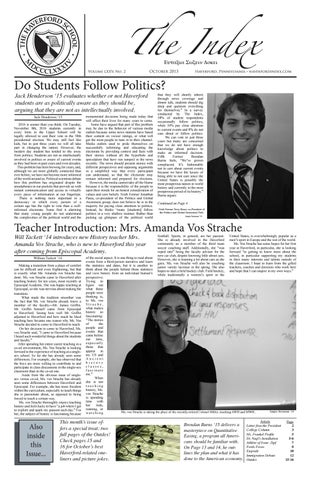
that they will shortly inherit through news coverage and dinner talk, students should dig deep and question everything for themselves.” In a survey conducted by The Index, 58% of student respondents occasionally follow politics, while 34% pay close attention to current events and 8% do not care about or follow politics. We can vote in just three years but many are concerned that we do not have enough knowledge about politics to make an informed decision. Fifth Former Brendan Burns feels, “We’ve grown complacent. It’s fashionable not to care about current events because we have the luxury of being able to not care since the United States is possibly the most prosperous nation in world history and currently in the most prosperous period of its history.” Burns argues Continued on Page 4 Sixth Former Terry Rossi, co-President of the Politics and Global Awareness Club. Sanjay Naryanan ‘14
Teacher Introduction: Mrs. Amanda Vos Strache Will Tackett ‘14 introduces new History teacher Mrs. Amanda Vos Strache, who is new to Haverford this year after coming from Episcopal Academy. William Tackett ‘14
Making a transition from a place of comfort can be difficult and even frightening, but that is exactly what Ms. Amanda vos Strache has done. Ms. vos Strache came to Haverford after teaching history for ten years, most recently at Episcopal Academy. She was happy teaching at Episcopal, so she was nervous about making the transition. What made the tradition smoother was the fact that Ms. vos Strache already knew a member of the faculty—Mr. James Griffin. Mr. Griffin himself came from Episcopal to Haverford. Seeing how well Mr. Griffin adjusted to Haverford and how much he liked teaching here became one reason why Ms. Vos Strache decided to come to Haverford to teach. On her decision to come to Haverford, Ms. vos Strache said, “I came to Haverford because I heard such wonderful things about the students and faculty.” After spending her entire career teaching in a co-ed environment, Ms. Vos Strache is looking forward to the experience of teaching at a singlesex school. So far she has already seen some differences. For example, she has observed that the boys are more willing to contribute to and participate in class discussions in the single-sex classroom than in the co-ed one. Aside from the obvious issue of singlesex versus co-ed, Ms. vos Strache has already seen some differences between Haverford and Episcopal. For example, she has more freedom within the curriculum, especially to teach things she is passionate about, as opposed to being forced to teach a certain way. Ms. vos Strache thoroughly enjoys teaching history and feels lucky to have “a job where I get to explore and spark my passion each day.” For her, the subject of history is fascinating because
Also inside this Issue...
football. Sports, in general, are her passion. She is already involved in the Haverford community as a member of the third team soccer coaching staff. Additionally, she “was roped into” being the faculty advisor for the new car club, despite knowing little about cars. However, she is learning a lot about cars as she goes. Ms. vos Strache will also be coaching junior varsity lacrosse in the spring. She also hopes to start a field hockey club. Field hockey, while traditionally a women’s sport in the
United States, is overwhelmingly popular as a men’s sport in Europe and the rest of the world. Ms. Vos Strache has some hopes for her first year at Haverford, in particular, she is looking forward “to getting to know more about the school, in particular supporting my students in their many interests and talents outside of the classroom. I hope to learn from the gifted teachers, coaches and directors who work here and hope that I can inspire in my own ways.”
of the social aspect. It is one thing to read about events from a third-person narrative and learn the statistics and dates, but it is another to think about the people behind those statistics and view history from an individual human’s perspective. Trying to figure out what these people were thinking is, to Ms. vos Strache, what makes history so fascinating: “The stories of the people and events that came before our time, especially those that appear in my US and Ancient history classes, fascinate me.” When she is not teaching history, Ms. vos Strache is spending time with her kids, running, or Ms. vos Strache is taking the place of the recently-retired Colonel Miller, teaching AWH and MWH. watching
This month’s issue offers a special treat: two full pages of the Outdex! Check pages 15 and 16 for October’s best Haverford-related oneliners and picture jokes.
Brendan Burns ‘15 delivers a masterpiece on Quantitative Easing, a program all Americans should be familiar with. On Page 13 and 14, he outlines the plan and what it has done to the American economy.
Sanjay Naryanan ‘14
Article Letter fron the President College Column Ms. Frankel Profile Dr. Nagl’s Installation Athlete of Issue: Zipf Fords Focus Engrade Immigration Debate Outdex
Page 2 3 5 5-6 7 8 10 12 15-16
Page 2
The Index
Editorials
October 2013
Letter from the Editors Dear Reader,
Ahhh, autumn. As the weather gets colder and the leaves turn yellow and orange and, eventually, fall to the ground, it is a reminder that the school year is now in full swing. It seems just yesterday that we rang in the new school year (literally) with so much potential and promise and now it is time to buckle down and make that potential a reality. Fall is one of the busiest times of the year--there’s the play, fall sports, and on top of all that, the academic term is at its peak. For seniors, early college applications are due and it certainly does not help that the Common App runs into technical difficulties when it is most needed. To top it all off, the first quarter is ending and the inevitable end-of-quarter work is piling up. As the academic workload increases, cramming for tests and quizzes becomes even more prevalent, as Andrew Gushner ‘15 discusses in his News piece in this issue. However, there is indeed a light at the end of the tunnel. Believe it or not, EA Day and then Thanksgiving Break are just around the corner. Winter break is shortly after Thanksgiving and before we know it, we are in the second semester. But the school year just started a month ago! Indeed it did, but, despite the pile of English and History papers and lab reports you have to arduously work your way through, the time moves quickly. On the topic of EA Day, this is likely the last Letter from the Editors before the December issue. For the new students and Third Formers, this is because the November issue is the EA Day issue. That is, it is an issue devoted entirely to athletic coverage, specifically relating to the competition itself. Again, speaking to the new students and Third Formers, EA Day is the single biggest athletic event of the year. We won’t go into too much detail, as you will certainly hear more about it as we draw nearer to the competition, but it is something to look forward to as you endure this busy time of year. But back to fall. There are many events besides EA Day to look forward to: the play, A Few Good Men, that opens October 24th,
the infamous Sixth Form-Faculty costume contest, Open Mic Night. These are just a few of the multitude of things to do around Haverford this time of year; they are what makes the fall season such a great one. We have already seen some events this year, most notably the Dr. Nagl’s Installation as Headmaster. The ceremony was, let us say, unconventional, and Greg Boyek ‘14 has an excellent piece in this issue investigating the planning and decision-making that turned Dr. Nagl’s brainchild into a reality. Now, with the school year in full stride, issues regarding school life have inevitably popped up. This Grayson Sessa ‘13 Editors-in-Chief Manav Khandelwal ‘15 and William Tackett ‘14 with Faculty Advisor Mr. Kellen Graham. issue seeks to chronicle some of those know anything about the financial strategy of issue. We look forward to spotlighting her issues. The Opinions section this month is quantitative easing, look no further than Fifth in next month’s issue. Of course, we are also stacked with problems of school life. For Former Brendan Burns’ comprehensive piece excited about this edition of the Outdex, which example, Rudy Miller ‘14 gives his take on the on the controversial subject. is stacked with new athletic uniform changes, while Fourth Also in this issue are two teacher profiles. more jokes than we can fit, including some from Former Kenny Fitzpatrick argues that clubs These are of two new teachers--Ms. Fatema Dr. Nagl himself. will probably not be given more time to meet, Frankel (Math) and Mrs. Amanda vos Strache As always, stay classy and enjoy yourselves, despite the wishes of some students. (History)--that unfortunately did not make it gentlemen. This issue is also stacked with Politics articles, into the September issue. Be sure to read these ranging from the Gang of Eight Immigration articles and more, as this issue of the Index is Sincerely, bill, to Russia’s role in the Syria conflict, a good one. We regret, however, that we were Will Tackett ‘14 and Manav Khandelwal ‘15 to U.S. global policing. If you ever want to unable to include a profile on Ms. Royer this Editors-in-Chief
Letter from the President
Dear Student Body,
We are fully entrenched in our school lives now and the first month of school has flown by. Schoolwork, if it hasn’t already, will start to pick up and you will have times where you are absolutely overwhelmed. This can be a lot, but remember that we have all been there. Use your teachers, see them outside of class, and if you need to get an extension because you have a lot going on, then do it. If you are proactive, then you will be fine. I know it’s hard, but try not to leave things until the last minute, because the quality of your work will decline if you have to do it all in one sitting. One thing that I want to start to focus on and hope that we can improve on as a whole is the attendance of sporting and school events. This past Saturday, I went to Malvern and watched our football team pull off an unbelievable OT win against our rival. We had barely twenty students in our student section and it was upsetting to see that there weren’t more kids that wanted to support their peers in one of the biggest games of the season. Joe Raymond
doesn’t get up every assembly and make an announcement just to be funny. Well, maybe he does, but still, take note of what is going on around you and do your best to get out and cheer on your boys. This goes for all sports and not just football. I speak from experience when I say that it is one of the best feelings in the world to look up while you are down on the field and see/hear your classmates cheering you on. I want to make this a point of emphasis moving forward as I believe we can support our classmates a lot better than we have up to this point in the school year. Other than that, I think we have been doing pretty well as a whole up to this point from a respect standpoint and I hope that we can keep this up. Let’s not become complacent and think that we are perfect, because we can all be better individually and as a whole at respecting our peers and teachers. Sincerely, Peter Blynn ‘14 Student Body President
The Index
2013-2014 Staff
Manav Khandelwal ‘15, Editor-in-Chief Will Tackett ‘14, Editor-in-Chief Sanjay Naryanan ‘14, Head of Photography Jack Henderson ‘15, News and Features Editor Brendan Burns ‘15, Opinions Editor Jackson Simon ‘15, Sports Editor Gregory Boyek ‘14, Arts Editor Noah Cutler ‘14, Outdex Editor Graham Gaddes ‘14, Senior Web Editor Kenny Fitzpatrick ‘16, Junior Web Editor Grant Yu ‘16, Junior Web Editor Brendan Burns ‘15, Graphics Editor Mr. Kellen Graham, Faculty Advisor
The Index is a student-run publication of the Haverford School that does more than bring news: it provides the diverse perspectives of the Haverford student body. It is an outlet for student writers to take stands on issues they deem important. It chronicles the daily struggles and accomplishments of the Haverford community. The Index also
Student Body President Peter Blynn
Sanjay Naryanan
provides a forum for discussion of pertinent issues, such as student culture, academic policy, and Haverford’s place in world affairs. The Index presents new ideas and aspires to influence constructive change. All opinions and viewpoints expressed herein do not necessarily reflect those of The Index or the school. The Index is designed and produced digitally. Photographs may be retouched. Submissions and letters to the editors regarding any and all articles are welcomed at hsindex@gmail.com. The Index, a member of the Columbia Scholastic Press Association, is composed on Mac OS X, using Adobe InDesign CS5.5. Its surveys are conducted via SurveyMonkey and are advertised on Facebook to current Haverford students. Southern Dutchess News prints 200-400 copies of each issue, and its editorial staff distributes them in the Upper School on the day of release. The Index serves the needs of a total school population of 1091 community members, consisting of 975 students and 116 faculty members. Contact The Index: 450 Lancaster Ave, Haverford, PA 19041 hsindex@gmail.com http://www.haverfordindex.com/ (610) 642-3020 x. 1222 Volume LXXV, No. 1 - September 6, 2013
Page 3
The Index
Columns
October 2013
College Column: University of North Carolina Columnist Brendan Burns ‘15 profiles the University of North Carolina at Chapel Hill, the alma mater of Fifth Form US History* teacher Ms. Hannah Turlish. Brendan Burns ‘15
In the third edition of my College Column, I will profile one of the original eight “Public Ivies”, and the oldest public university in the United States – the University of North Carolina at Chapel Hill. Although its title is contested, UNC can be considered to be the oldest public University in the United States as it was the only public university to admit students and confer degrees in the 18th century. Today, UNC enrolls almost 30,000 students, both graduate and undergraduate. As mandated by state law, 82% of incoming UNC freshmen are from North Carolina. UNC’s 730-acre campus is situated in Chapel Hill, North Carolina, 140 miles from Charlotte and 30 miles from the State capital, Raleigh. Situated inland, Chapel Hill sees temperature highs in the mid-eighties Fahrenheit during the
summer and low fifties in the winter. Chapel Hill is a highly intellectual (a 2008 US Census Bureau Survey found that Chapel Hill was North Carolina’s best-educated city), wealthierthan-average, and very Democratic college town (70% or more of Chapel Hill voters chose Barack Obama in the last two Presidential elections). The University of North Carolina is divided into multiple schools and colleges, of which the largest undergraduate school is the College of Arts and Sciences. UNC also maintains graduate schools in Business, Medicine, Education, Law, Public Health, Government, and more. The most popular UNC majors are Biology, Business Administration, Psychology, Journalism, and Political Science. UNC Chapel Hill has been called a “Public Ivy” as it offers the combination of Ivy League-quality education (it is currently ranked as the 5th best Public University in the country) and Public
An undergraduate accounting building in the center of UNC’s campus.
School price. Kiplinger’s Personal Finance magazine ranked UNC Chapel Hill as the best value in public colleges for the 12th time, citing its “stellar academics, reasonable sticker price, and generous financial aid”. With an acceptance rate slightly south of 30% and average SAT/ ACT scores of 1940 and 30, respectively, UNC is a selective school; however, it is still within reach of a large number of students. almost 80% of UNC admits for this school year were in the top 10% of their class. UNC’s relatively low price in a phase of higher tuition prices also increases its practicality: out-of-state tuition for
UNC Official Website
2 0 1 4 was $30,122, representing a slightly higher-than-average price for much betterthan-average public college. 70% of UNC undergraduates received financial aid for the 2012-2013 school year; 58% of students received grants and 21% received loans. Besides being overwhelmingly North Carolinian, UNC Chapel Hill’s undergraduate student body is almost 60% female and live in equal proportion in and out of Universityprovided housing. More than 3,000 students are members of fraternities and sororities. UNC has also achieved excellence in two other fields:
journalism and athletics. Chapel Hill’s studentrun newspaper, The Daily Tar Heel, was ranked the 3rd-best college newspaper in the country and employs a volunteer staff of over 200
students. UNC’s athletic teams have won 40 NCAA Division I championships. The Tar Heels’ most famed team, their mens’ basketball squad, has appeared in the Final Four 18 times and won the NCAA championship five times. UNC has longstanding athletic rivalries with the University of Virginia and Duke University, the latter being located only eight miles from the Chapel Hill campus. Similar to Haverford, UNC’s student body is governed by an Honor Code and a body of students similar to the Honor Council. UNC’s Honor Court is led by the Student Attorney General, who is appointed by the Student Body President. Haverford records show that, in the years 2008-2013, 21 Haverford students applied to the University of North Carolina at Chapel Hill. Of these, 4 out of 12 students who applied via the regular decision option were accepted, and 3 of 9 students who applied via the nonbinding early action option were admitted. The seven accepted students posted average SAT scores of 2058 and 2047 for the regular and early action options, respectively. The University of North Carolina at Chapel Hill is a superb school for Haverford students seeking a well-balanced, affordable school not too far from home. It offers a happy medium of strong academics, athletics, and affordability that is hard to find.
Career Column: The Risky Life of a Venture Capitalist Jack Henderson ‘15 explores the responsibilities and skills involved with a career as a venture capitalist. Jack Henderson ‘15
One of the many advantages of a Haverford education is that you will hopefully graduate with an understanding of the world around you. With that knowledge you may pursue a variety of fields and careers that appeal to you. One occupation that many Haverford graduates and successful businessmen have pursued is venture capitalism. The venture capital industry provides money to early-stage firms and small businesses as an investment in their growth potential. This system is beneficial for businesses that do not have access to capital markets, thus creating more U.S. jobs and economic growth by encouraging innovative businessmen and entrepreneurs to transform their ideas into products and services that continue to alter virtually every aspect of life. Venture capitalists support this system by providing the necessary leadership and capital, while taking on additional risk, with the expectation of building businesses with potential for high growth. Although investment is risky, venture capitalists enjoy a large return, as well as an equity stake in the company and the ability to influence the direction of the company, if they invest wisely. Startup companies often require support from venture capitalists to invest in the company. Predictably, venture capitalists are very cautious when forking out big dollars to unproven small businesses, but they consider a variety of factors to decide if the investment and chance for an impressive return is worth the risk of losing it all. The end game for venture capitalists is to reduce risk while obtaining the highest return on investment that they can.
Venture capitalists usually tend to invest more in companies with innovative ideas in markets that have not necessarily peaked in their growth yet. The expectation of significant growth is the single most important factor for venture capitalists in determining the companies in which they will invest. To maximize their return on investment, they will often invest in the early stages of a company, even before the idea has turned into a product, even though there is substantial risk for the entrepreneurs. The company’s risk restricts the sources of capital critical for the company’s growth, but the venture capitalists are willing to provide the necessary capital in exchange for a share of the company’s equity, thus assuming the risk along with the founders of the company. Another main factor that the investors take into consideration is the company’s management team. They look for leaders who have successfully built businesses with high returns on investment who have the ability to carry out the specific business plan for the good or service. Venture capitalists are particularly looking for a company with a popular product that is long lasting and has a competitive edge on the market. Venture capitalists must be sure of the potential of the companies in which they invest because of all the risk they assume, so obviously they research deeply into the startup business to make sure they know what they are getting into. They hope to find out if the company is legally safe, if the product could be popular and grow for the next several years, the proper allocation of funds to the company, and if they will eventually be able to pull out of the company and receive an impressive return on
their investment. Because of their ability to support small businesses with their guidance and experience, monetary funds, and the assumption of much of the risk, venture capitalists are crucial to maintaining economic growth and help make the US economy stronger than others on the international market. If any of this sounds interesting to you, it is never too early to start deciding if you would like to pursue this as a career. Work hard in school, focus on the liberal arts, and get involved in the community just to see if you may consider a business career. There is plenty of time to change your mind, or make up your mind, about what you would like to do for a living and being at Haverford with plenty of opportunities to get involved is a great way to start.
References: National Venture Capital Association, Investopedia, Slate, and Forbes
Draper, the co-owner of a five-billion dollar venture capitalist firm in Menlo Park, CA.
Wikipedia
Page 4
The Index
News
October 2013
Student Cramming Is Pervasive at Haverford
Haverford students are extremely busy, and when you add sports and extracurriculars to one’s rigorous academic schedule, time management can be diffficult. Andrew Gushner ‘15 explores the problem of cramming. Andrew Gushner ‘15
a common way we students get our work done. Fifth Former L.J. Barlow keeps his Haverford is well-regarded for its academic grades up while being heavily involved with excellence. However, the school was not extracurricular activities at Haverford. When simply given the reputation it has. Haverford asked how he deals with it all, he told me, earned this reputation because of its rigorous “Haverford has a strenuous workload for any workload. Every student has to take five core student. Being committed to extracurriculars classes at our school and some even take six only makes is harder on me as a student. I am or seven. Regardless of the level of class, most often forced to cram. It is tough to manage teachers assign a lot of work to their students. my time well but not impossible.” Later in the Completing a post lab for science class, writing conversation, Barlow expressed how he is always a 1000 word personal essay for English class, forced to cram, but the strategy works for him. and even studying for an oral exam in Spanish Although it may not be the best way of class puts a lot of pressure on students. Also, working, many students succeed using this engaging in extracurricular activities outside strategy, like Barlow. Many students argue that of school puts yet more pressure on students. if they don’t start studying in advance, they So what does this pressure cause us as students easily forget the material, thus wasting their to do? Cram. Cramming is a verb which time. Fifth Former Louie Brown made a great means forcing more than you can hold. As point saying, “While it might not be the most a whole, we can all agree we do a great deal effective way of studying, it works well enough of this every week. The heavy workload and to get the grade, and not the knowledge.” Louie minimal time to do it causes most of us to cram. brings up a great point that cramming gets the It’s not necessarily a bad thing; it’s just job done and that is what most students care about. A lot of students cram all of the material in just to get a good grade, caring less about what they will actually take away from the material. This is where cramming can become a bad thing, because the knowledge that is acquired is very short term. To avoid this would be to simply plan ahead and start studying in advance for whatever that student is preparing for. Many students push back their work, and do not manage their time productively. Instead of studying for a test or getting some homework done, a lot of kids choose to play around in the library or play benchball outside. Not that this is a bad thing, but students might see some Compiled by Sanjay Naryanan ‘14 more success if they cut some of the
unproductivity out of their schedule. However, it is also fair to say that many students have not learned that valuable lesson yet. Hopefully cramming enough times will eventually teach students to plan ahead and not procrastinate, which is a necessity in the real world. Many people in our community wonder if there is a way that the faculty could spread out the workload, not forcing their students to cram. Suggestions such as further notices from teachers would help, but students still find themselves cramming because we tend to procrastinate
and push it back. However, there are other alternatives to this, such as long term projects. Instead of piling on homework and assessments, teachers could assign more long term projects, which would allow students to spread out the work and help alleviate the pressure. Also, less strenuous projects could prevent the short term memorization that happens with cramming. Students could actually learn and understand the material, rather than cramming in the soon-to-be forgotten information.
that can go on to benefit society and make decisions as part of a well-informed electorate. Although voter turnout among voters aged Continued from Front Page 18-24 have increased in the last few elections, that we are content in our situation and have many are concerned that the reasoning behind not retained the imaginative, hard working the voting behavior has not always been for mentality that lead to the founding of this nation. political reasons, but sometimes because of their Co-president of the Politics and Global family’s beliefs. Director of a youth research Awareness Group, Sixth Former Terry organization at Tufts University, Peter Levine, Rossi, provides the attendance sheet from clarifies, “Young people were proportionately the club’s first meeting. Rossi explains, “At well represented in the 2012 electorate.” Tufts the highest point there were seven people in also produced a study in 2007 explaining the the room I believe. For most of the meeting tendency of young voters to be influenced there were four. It was a very disappointing in their voting behavior by their parents. The Huffington Post printed an article during turnout.” It can be a challenge for a teenager to pay close attention to politics. However, last year’s election describing the lack of interest once the students have graduated, they are in the presidential campaign, and politics in out in the real world. They have to make general, citing students who are politically decisions for themselves and they do not have engaged that explain the lackluster attentiveness as easy an opportunity to form an opinion towards politics. This story reveals that, while for themselves in such a safe and scholarly voter turnout may have remained around 50% environment. If students were to graduate for 18-24 year old voters, the background with, on average, a deeper understanding of knowledge and political opinion that define a politics and knowledge of current events, well-informed electorate could not be found Haverford would be producing gentlemen in last year’s election for the youth voters. Fifth Former Manav Khandelwal reminds us that there are students who are educated in politics and are more comfortable about the situation because “there are a select group of students who follow news and politics closely, and I am fortunate to say that I am close with a lot of them so finding people to talk politics with is not difficult.” However, some would argue that many students Avery Weiss The Index conducted a survey, in which 79 students responded the following way.
are not in that position and do not choose to acquire substantial information to form his or her opinion and the problem remains. Because many students do not follow politics closely, many have found that they resort to an easier option and simply adopt his or her parents’ views or beliefs. Sixth Former Terry Rossi explains, “Interestingly enough, I do not consider myself a minority as a conservative. But I consider myself a minority in that, from what I can see, the majority is not all that engaged in politics, nor do they eagerly follow current events. It’s unclear to me how much of the political opinion at Haverford is a product of independent t h o u g h t / r e s e a r c h , or a default assumption of belief because of one’s parents.” Is this system of adopting your elders’ values without creating your own opinion efficient? Can the nation sustain such a vicious cycle when thirty years down the road we will not have conceived any new ideas but are simply regurgitating ideas that were thrown upon us as young adults? This is a growing problem that should be addressed, but there are possible solutions. Burns, who considers himself in the minority at Haverford because he follows politics, believes, “Students should receive much more exposure to current issues, politics, and civics (from a variety of perspectives) in history class. It should be an informal but large part of the curriculum. Involving students in conversations with teachers about current events is the best tool Haverford has to spark interest in this area and produce politically aware and responsible graduates.”
Paras goes on to acknowledge, “There is no easy solution to this [problem]. Sometimes these sorts of things work best if you let folks figure it out as they go along, they’ll be much wiser for it. Or perhaps by doing so, some political source will take advantage of their naiveté, but that is a risk that must be taken.” Paras brings up a good point in that the American electorate has had the ability to remain informed, and our generation will continue this tradition, as long as we are given time to carefully consider political beliefs and realize the importance of politics and keeping up to date with current events. This solution assumes some risk, but still can achieve the end goal of educating the populace. There could be an advantage to the simplicity of Paras’ solution, as Khandelwal explains, “I think the solution to this problem is reminding people what it means to be “informed.” You don’t have to know the specifics of the Affordable Care Act; you just need to understand what’s going on in the world and some of the connections between events.” This solution would work, but there is no guarantee that a majority of the young voters will follow that strategy. Perhaps a combination of everyone’s points arrives at a solution. Rossi goes on to reaffirm Burns’ solution, believing, “The solution to the problem is to engage students in discussion of current events in history and other courses significantly more than we are now. At a certain point, the study of history and the humanities is irrelevant if it cannot be applied to analyze current world issues. If our school were to make an effort to integrate current events at a greater level into the curriculum, we would have a more engaged student body.” At the end of the day that should be the goal moving forward regarding this issue. If Haverford can provide a curriculum with a priority on current events and politics, students will be more prepared for college, for life, and for the 2016 election.
Some students can feel crushed under the weight of balancing schoolwork and extra-curriculars.
Do Students Follow Politics (Cont.) Jack Henderson ‘15
“Students should receive much more exposure to current issues, politics, and civics (from a variety of perspectives) in history class. It should be an informal but large part of the curriculum.” - Brendan Burns ‘15
Lairdodgen
Page 5
The Index
News
October 2013
Teacher Introduction: Ms. Fatema Frankel Jack Henderson ‘15 introduces the newest addition to the mathematics department, Ms. Fatema Frankel, outlining her background and accomplishments. Jack Henderson ‘15
the camaraderie I saw among the students.” She also holds an M.A. in Mathematics Having taught around the world Ms. Fatema Education from Teacher ’s Frankel brings a travelled culture full of College at profound experiences and global Columbia connections. After University. attending Karachi One of Grammar School the most in Pakistan, she important eventually made lessons she the long trip to learned there Mount Holyoke was that as College in a teacher Massachusetts the focus where she should be received a B.A. on students in Mathematics. understanding She loved what they her time there are learning. and is one of Fifth Former the reasons she Sam Dyer decided to teach is taking at Haverford. PreCalculus Ms. Frankel taught by explains, “One Ms. Frankel, of the things and in her that drew me to class, “She Haverford was makes sure the fact that that we all it is a single have had sex institution. a chance I went to an to fully all women’s understand college and had the material a wonderful before she experience in moves on to a single sex new things.” Ms. Computer Weekly Ms. Frankel hopes to use iPads in her classroom. environment. Frankel has made When I visited that a goal in all of her classes. Haverford I was immediately attracted to Ms. Frankel clarifies, “I have great confidence
that my students will be able to do all the calculations required of them but the real challenge for me as an educator is to make sure they really understand the ideas behind every computation. My goal is to develop math as a body of ideas, and have the students understand these so well that computations feel like natural consequences.” She has taught mathematics on three continents and keeps her class “engaging,” according to Dyer. Ms. Frankel has high hopes for her classes this year and plans on instituting some innovative tools and strategies to supplement her lessons. She explains, “I am excited to start using an iPad as a time saving device in the classroom so students can spend more time sharing their work.” So far her class has discussed fundamental mathematical concepts including graphing functions, but she hopes to put emphasis on real world application of concepts. Ms. Frankel comes to Haverford well travelled with a vast knowledge of mathematics and a yearning to help out students. She says, “I have had a great time meeting faculty and staff but I am most excited about meeting and working with students.” Dyer affirms, “Ms. Frankel’s class is characterized by her energy and her love of teaching math.” It is this desire to teach boys both the value of understanding mathematics and the life lessons that she has accumulated during her worldly experiences that will guarantee success for Ms. Frankel at Haverford. You can contact Ms. Frankel at ffrankel@haverford.org.
Ms. Frankel will be teaching several subjects, including PreCalc.
Dr. Nagl Rocks Out Installation Ceremony! Greg Boyek ‘14 discusses Dr. Nagl’s incredible Installation Ceremony; he explores the thinking behind it, and its artistic merits, and the many people who performed and organized the vent. Gregory Boyek ‘14
The Haverford School’s new Headmaster, Dr. John Nagl, made an unforgettable first appearance at his Installation Ceremony. Bearing more resemblance to a rock concert than a formal ceremony, it helped Dr. Nagl make an instant connection with the school community -
even though, as he stated in an recent interview with The Index, “I didn’t see much. I was in a box.” Arriving to his new post in a shipping crate, he made a resounding promise to think “out of the box” in order to promote his three big dreams for The Haverford School. Dr. Nagl has adapted an expression from cult classic “This is Spinal Tap”. He enthusiastically pointed out “my new tagline is ‘We Go to Eleven’. If you do not currently understand that reference [look up ‘These Go
Dr. Nagl posing with his family after the ceremony ended.
Mr. George Scarino
Up to Eleven’ on YouTube.] To make it very clear, the Haverford School Goes to Eleven.” The Haligoluks, Dr. Nagl’s rock band, were created to provide live walk on music for the ceremony. Nagl explained. “I’m a baseball fan. Walk-on music says something about the players and the message they are trying to convey.” “I’m also a big classic rock fan. I love the song Boys are Back in Town. It’s a boys school – I can’t believe nobody has thought of claiming Boys are Back in Town as our unofficial theme song.” In his speech, Dr. Nagl explained the choice of his own ‘roll-on music’ Dream On which represented his three big dreams for the Haverford School, “a school that provides a 21st century education for life, on the campus and in the classrooms we need, with the boys we want to be here to fill this institution with life and learning and love.” Nagl grandly and boldly stated that he dreams of making Haverford “the best boy’s school in America.” As for the other songs of the Installation, “obviously we had to do the Alma Mater. I’m a veteran and a patriot so we had to do the Star
George Hall ‘15
Spangled Banner. If you’re going to do the Star Spangled Banner and you’ve got Mr. Brodine on the stage you’ve got to ask him to do a little Jimi Hendrix tribute. [Hendrix] is the greatest rock guitarist of all time and that’s pretty tough stuff but [Brodine] pulled it off beautifully.” “In my own high school, Queen’s We Will Rock You/We Are the Champions was big at the time. I wanted to do a tribute to the school and the boys and everything they accomplish so I asked if we could do a video montage to the strains of We Will Rock You. Matt Cloran turned it up to eleven with an inside the park home run--and Darren Hengst adding a tribute to Michael McKean took it to 13.” “I needed to transition from the formal ceremony with the fog machines to the less formal after party. I wanted to give the message: let’s celebrate the school, its achievements and its boys all with no boys allowed, since you all had homework to do anyway.“ Continued on Page 6
The Haligoluks, the main source of entertainment, featured such personalities as Mr. Stambaugh, Mrs. Snyder, and Senor Latorre.
Mr. George Scarino
Page 6
The Index
News
Dr. Nagl’s Installation A Success (cont.) Continued From Page 5 Hey, homework is good for you. There were concerns expressed with I Want to Rock and Roll … Our legal proviso … I hope made it clear that our school does not endorse rocking and rolling all night nor parting every day.” At Dr. Nagl’s recommendation,
and having a good time all mixed together.” Producing Dr. Nagl’s music was a collaborative effort by hard working community members in addition to their normal responsibilities. English Department Chair and Haligoluks guitar player Thomas Stambaugh explained that “in our opening full faculty meeting, Dr. Nagl asked if there were any teachers with experience in rock music. He wanted a band to play the walk on
The Haverford School Notables and Celebrantes performing at the Installation.
the full text of the disclaimer is printed in this issue as a public service to the school. Referring to both that particular communication and in general, Nagl stated that “if I can do something that is both funny and provides a message, I’m going to go with it because I think humor is enormously powerful. I also think music is enormously powerful. They can both touch emotions, and we are not just analytical creatures, we are emotional creatures. I was trying to get at strong human emotions of pride and respect
have this ‘Rock Concert’ and he was very excited – he has so much enthusiasm … we were all bouncing ideas back and forth but it was definitely Nagl’s brainchild. He put the call out there for any faculty interested in joining the band ‘come one come all’. We talked about hiring professional musicians but that would have taken away from the sense of community. I think having, for example,
Since its inception in 1887, The InterAcademic league has allowed student-athletes to thrive both in the classroom and on the athletic field. The league established a discrete set of regulations and rules of conduct for each gender. After many deliberations, the headmasters of nine schools have agreed to unite both genders under a new set of rules and regulations. In addition to Springside Chestnut Hill academy, Episcopal Academy, The Haverford School, Malvern Preparatory Academy, William Penn Charter School and Germantown Academy the league will feature three all girls schools: The Agnes Irwin School, Baldwin School and The Academy of Notre Dame. The motivation for revising the league derived from the ambiguity about two main topics: transfer eligibility and out-of-season practices. Under the old set of rules, if you stepped foot on an athletic field and competed in a varsity sport, you would go through an appeal process and be ineligible to play in league games for your first year regardless of what school you came from. After the recent change, there will still be an appeal process but you are eligible to play immediately as long as you transfer from a non-member school to a member school. Still, when transferring within the Inter-Ac league, you are ineligible to play at the varsity level of any sport for the first year. One way to keep the athlete on the playing field is to have them play at the Junior Varsity level. On the other hand, freshmen and JV players who transfer from one Inter-Ac school to another and make varsity are eligible to play. Head Athletic Director at Haverford, Coach John Nostrant, is still ambivalent as he sees the benefits and setbacks of this new rule. Nostrant states, “I don’t like kids being part of our community and not being able to play. It’s a lot of money here regardless. I also don’t like that if kids don’t play right away and/or have problems with their coaches, they will be able to transfer.That’s not right either. “ Nostrant highlights the debate among the headmasters with these two concerns. Especially after considering the large sums of tuition, why should we restrict young athletes from competing in the sports they love at the varsity level they deserve to play at? Shouldn’t they be included and welcome in their respective communities? On the other side of the debate lies the athlete who leaves his school because of a falling out with a coach. Is
October 2013
level,” Mr. Stambaugh said “when we put people into little boxes, we have to be careful because they often have many other sides to them ... As Whitman says in Song of Myself, “we all contain multitudes.” Dr. Nagl was also proud of the collaborative effort between many different parts of the community: “The band included everything from sixth graders to a trustee, as well as teachers
Mr. George Scarino
music of the people in the event. Dr. Duska, the Head of the Lower School spearheaded gathering the band.” Stambaugh stated that he joined the effort because “I played guitar when I was in high school and thought that I could contribute. When I got there, I realized I was with a bunch of people who were real musicians. We came up with a list of the walk on music and some other songs Dr. Nagl wanted. We only had about five or six rehearsals before the performance.” According to Upper School Music Instructor Mark Hightower, “It was Dr. Nagl’s idea to
The Haverford School Notables and Celebrantes performing at the Installation.
the Head of the English Department up there with his shades on and having sixth graders on the drums added to the magic.” These two sixth grade drummers, Trip Biesecker and Jack Nagl, handled their positions with the maturity and strength of the adults on stage. The band brought together community members who do not often receive the opportunity to work together. “On a personal
Inter-Ac League Changed, Schools Added Jackson Simon ‘14
it fair to let him transfer from school to school until he finds the program that gives him more playing time or suits to his liking? Nostrant describes the last question of debate among the headmasters that still hasn’t been answered comprehensively as follows, “What constitutes a practice and when can we practice.” Just like the former league, coaches have freedom to practice in June and July whether it be a fall, winter or spring sport. The new addition is that teams can be coached one day a weekend in one season out of season. “Lacrosse is the easiest example for me because we run a fall league here. 50 teams play at Shipley and I have never been able to coach my guys but now I can coach them. Now if I wanted to practice I could practice on a Sunday,” says Nostrant. He continues, “Again all these rules are great but as I have told all my head coaches that just because a rule has changed and allowed us to do something, I am not going to let us hurt ourselves. I don’t want the basketball team practicing in the fall if that meant that kids varsity soccer kids didn’t play soccer. We have to be careful. Even though we are all boys there are only 420 of us and we need guys playing multiple sports.” In other words, Nostrant does not necessarily encourage that we use this option because he prefers to see well rounded athletes. Another reason not to utilize this option is that specializing in the same sport and playing it year round puts the athlete at a greater risk of injury than he would be if he changed ports seasonally. With regards to what constitutes a practice, there are still many meetings to come. For example, Nostrant says, “What if there was an open gym and three basketball kids were working on shooting, and three on post play, two other guys on something else. Does that constitute a practice?” Nostrant hinted towards having special athletic events with the girls schools such as double headers to promote the new league. He says he is, “in favor of helping out the co-ed schools because it is tougher for them to field competitive teams.” In addressing the the new league as a whole he maintains, “I am not opposed to the new league but I am trying to get my arms around it and see if at all it is beneficial to Haverford or not. The fact that we are nine schools instead of six is beneficial because there is more experience. I think there are things we can do to advance the league, but as far as being a single sex school in the league a lot will have to play out for us to determine whether or not it is a good thing or bad thing for Haverford. I am excited about the change.” Obviously, there
is still ambiguity and uncertainty about some issues, but there seems to be improvement from the last set of rules. The league is one of the last acts of two beloved figures in their respective communities: Dr. Joe Cox of The
Mr. George Scarino
from Upper, Middle and Lower School. The whole Haverford community was a part of this.” He felt that the Installation Ceremony performance neatly fits into Teddy Roosevelt’s words “it is not the critic that counts … but the man in the arena.” Our new Headmaster proudly added an amendment to that statement: “I may not have been the man in the arena, but I was the man in the box.”
Haverford School and L. Hamilton Clark of Episcopal Academy. Hopefully, the league will be a positive part of both of their tremendous legacies they leave behind with the league and their respective schools.
The new league is a merger of two older leagues which will put Haverford in the same league as several all-girl schools, including Baldwin.
Baldwin Official Website
Page 7
The Index
Sports
October 2013
Athlete of the Issue: John Zipf Water Polo Looks to End Season Like It Started It Sam Dyer ‘15
years of my high school career we have had the talent to win, but we narrowly missed the championship each time.” He would like to change that this year, however. With Zipf, Heldring, and fellow Sixth Formers Sawyer Warden and Dan McGrath leading the team, the Fords’ prospects of taking home the Inter-Ac Championship look very strong. Aside from Water Polo, Zipf also competes for the Varsity Swimming and Tennis teams. When he isn’t competing athletically, Zipf spends his time training and captaining the Mock Trial team. Whether he is swimming, lifting, or playing club water polo, Zipf works year round to improve his game. Although Zipf has shined so far this season, he is also focused on making sure that the Fords
This season, the Haverford School Water Polo team has jumped out to a solid 11-5 start, in large part due to the efforts of Sixth Form Captain John Zipf. So far this year, Zipf has scored a teamhigh 77 goals while leading the Fords to victories over strong local programs like Pennington, La Salle, and The Hill School, among others. If you go to a Varsity Water Polo game, it isn’t hard to pick Zipf out: just look for the smaller guy scoring goal after goal. Along with fellow captain Sixth Former Alex Heldring, Zipf is always at the front of the Fords stat sheet, no matter the opponent. Despite all of his high school success, Water Polo has not always been easy for Zipf. When Zipf started playing the game in 7th grade, he was often doubted because of his lack of size. Frequently, John would hear people say that he was “too small to play the game well.” While many middle schoolers would use this as an excuse to quit, Zipf decided to prove his doubters wrong. Since then, his game has improved tremendously, which he credits largely to the great coaches he has had during his time in high school. He notes that, “We have great coaches who know the game inside and out in: Kevin Van Such, Sean Hansen, Matt Deasey, Eddie Barnard, Zipf has always been one of the team’s hardest workers. Corey Fader ‘14 and Brandon Yoshimura.” While the Fords’ great coaching staff has walk away with a win on EA day. He predicts played a large role in Zipf’s growth as a water that the Fords will win 15-12, which would polo player, he also credits much of his success be yet another huge win for Haverford water to the support of his older brother Kevin Zipf polo on EA Day. While Zipf predicts a smaller ’12, who also played for Haverford. Zipf margin of victory than some, it’s easy to see how especially appreciates that “Kevin has always this team could blow the Churchmen out this been very supportive and wanted me to do my November. Just look at some of these lopsided best. He’s encouraged me the entire way through wins for the Fords: 18-8 over Mount Saint and loves it if I put up higher stats than he did.” Joseph’s, 19-5 over Germantown Academy, 22Although he has been on the Varsity team 11 over Pennridge, 19-6 over Hill, 18-8 over since his sophomore year, Zipf has taken his Muhlenberg, and 18-2 over Friends Central. Although Zipf says he is not thinking about game to another level this year. With 6 goals, 3 assists, and 4 steals per game, Zipf is leading this it, many people will be watching to see if he year’s team in almost every statistical category. can break Andrew Helber ‘12’s record for EA Although he is proud of these achievements, Day goals. Make sure to pay close attention to Zipf puts more emphasis on his major goal for Zipf and the rest of the Fords water polo team this season: to bring the Inter-Ac championship because the future of this year’s team is bright. back to Haverford. He believes that, “all four
Curran Aiyer ‘15
After a disappointing start to the season, accumulating a 2-2 record during preseason and both losses coming during the Philmore Cup, the Fords water polo team has played very well its past nine games, including a seven-game win streak that ended with a crucial loss to rival Malvern Prep. The Fords are currently 11-5 (2-3) with both Inter-Ac wins coming against a weaker Germantown Academy team. With the first regular season game coming against Germantown, second-year head coach Kevin Van Such emphasized in practices how the team needs to come together. When asked what he mainly was going to focus on during preseason and the first few couple weeks of the season, Coach Van Such replied, “Just getting in shape and being able to determine where everyone is. From day one, Coach Sean
Pennington, 15-11. The next game was against Malvern Prep, a game for which the Fords had worked extremely hard and were expected to possibly win. Unfortunately, that game resulted in a tough 11-5 loss. The Sixth Form co-captains, Heldring and John Zipf, had to rally the troops after such a tough loss. Heldring has been the team’s main offensive hole-set, or center, all season, and he has racked up an impressive 54 goals, 37 assists, and 32 drawn ejections. Zipf has been equally as effective, with 75 goals, 59 steals, and 46 assists. The two managed to help the Fords rebound quickly from that demoralizing loss, winning again against Friends Central and Germantown Academy. Unfortunately, losses to Malvern (this time 10-7) and Penn Charter (18-10) have the Fords in a position where they are unlikely to take home the Inter-Ac trophy. The next 7 games, including Easterns,
The team huddles during a timeout against Pennridge.
[Hansen] and I told the team that we expect 100% effort and respect in and out of the pool.” After handling Germantown fairly easily, the Fords gained more and more confidence heading into the season. From there, most of the games they played were blowouts, the most noticeable coming against an 18-2 win against Friends’ Central; the Fords were so dominant that co-captain Alexander Heldring ‘15 played goalie despite having no prior experience at the position. However, things started to get a little uncomfortable after a close win against
make up the roughest part of the schedule. The Fords take on Episcopal, The Hill School, Lawrenceville, and Penn Charter at home, have Easterns for two days, and then end on EA Day on November 9. When the going gets tough, the tough has to get going. The Fords clearly have the talent, drive, and chemistry to compete with the best teams. Now, it’s just a matter of playing well and staying positive, especially if the Fords lose a very close and emotional game.
filled in for injured starter Brendan Burke, the Fords took down Pennwood 38-19. The next Saturday, the Fords offensive machine ran into a brick wall in Cardinal O’Hara, as Haverford fell 46-7 on what was a weird afternoon. This past weekend, however, the Fords put together their most complete performance of the season in a huge 34-31 overtime win
how they can surprise every opponent. Because of the competitive nature of the Inter-Ac, teams scout each other to create successful game strategies. Episcopal Academy, Germantown Academy, Springside-Chestnut Hill, and Penn Charter will more than likely game-plan to stop Haverford’s star running back, Fifth Former Phil Poquie. Coach Murphy and the rest of the staff are adjusting the playbook to prepare for teams that will pay close attention to Poquie by creating new plays and attempting to establish the passing game more often. Players will be rotated throughout the game more often as well so that first, second, and even third string players will have the opportunity to contribute throughout the game. This will allow the Fords to be wellrested and fresh throughout the game, even with the new fast-paced offense that is in place. Defensively, the Fords have not changed much significantly throughout the season because strategy seems to be working for the most part. Often, the defense will have physical or mental miscues, but these small errors can be easily corrected. Strategically, the Fords have switched from running a 3-4 defense to a more run-oriented 4-3 defense. The Fords have faith that their linebackers, led by Fifth Form middle linebacker LJ Barlow, and a strong corps of defensive backs will help the team protect against the pass. New starts for many of the Fords, including the Third Formers, has helped a team that is coping with the loss of many from last year. Not only were many talented players lost, but also a brother and a teammate. The Fords will don the “10ve” logo in memory of Kip Taviano, who passed away last May. Fourth Former Keyveat Postell echoes a feeling shared by the whole team: “This logo stands for much more than a fallen brother. It stands for a brotherhood that through the wins and loses will always stick together. Because even when we are driven back, on and off the field, we have to pick our heads up and get back in the huddle. Finally, our ultimate goal as a team is to bring home a championship for our fallen teammate Kip Taviano, and we plan on doing just that.”
Football Team Putting Tough Start In Rearview Mirror Kyle Colburn ‘14 and Michael Solomon ‘14
thirty formations and many more plays. Now, however, the playbook has been reduced to far fewer formations and plays. The new strategy for the offense is to play faster than opposing defenses, rather than to try to out-smart the other team. Coach Murphy hopes to have an offense that runs “at a faster pace than the Eagles under Chip Kelly.” Still, the team sputtered in the
Corey Fader ‘14
So far, the season has not gone perfectly according to plan for Haverford football, but the players are not letting this unfortunate start lower their morale, as evidenced by their recent play. With a record of 3-4, some may wonder what the Fords have been doing wrong. While making some simple, correctable mistakes early in the season, just as any high school football team does, the Fords have, in fact, been playing better than their record suggests. Coach Murphy often schedules some of the tougher teams in the tri-state area to see how his team matches up against toptier competition. Eventually, however, the team comes together and prepares to enter the real season, the Fords Sports Photos (Parents) Sixth Form quarterback Brendan Burke begins to celebrate his game-winning touchdown rush, which came in Double OT. Inter-Ac portion of its schedule. The 2010 football squad started off the season with a record of 0-6 after playing following two weeks, primarily due to injuries against Inter-Ac rival Malvern. Fourth Former some of the best teams in the Philadelphia and poor execution, against McDonogh (0-42) Dox Aitken intercepted a pass in the third area and followed with an undefeated record Lawrenceville (21-31). Those who attended the quarter to help keep the Fords in it and then in the Inter-Ac. The competition in the first Fords’ home game on September 21, however, caught the game-tying touchdown in the six games was great preparation. While the saw the first glimpse of the fast-paced, effective fourth quarter. With the game on the line, the Fords football team does not expect to start the offense that the Fords hope to continue for the defense came up big with a 3-and-out which season in a similar fashion, they, nonetheless, rest of the season. To Coach Murphy and the allowed the Fords offense to march right will be prepared to take on the Inter-Ac. rest of the organization’s delight, the change in down the field and score the game-winning Since the tough loss in week one to strategy seemed to work when the Fords took touchdown, which came on a Burke rushing West Catholic High School, the Fords have down Blair Academy 13-12 to get their first win TD. This win improved the team’s record to dramatically changed their game strategy to of the season. The following week, on the back 3-4, and it was a great start to Inter-Ac play. As for the future, the players are all eager to win. The season started with an elaborate of a strong rushing performances QBs Kevin offensive playbook, which contains over Carter and Derek Mountain, both of whom hear about the next game plan, waiting to see
Page 8
The Index
Sports
Fords Focus: Class of 2016 Turning Heads Manav Khandelwal ‘15
The Sixth Formers may walk the corridors of Wilson Hall as the oldest, most experienced students at The Haverford School, but the members of the Class of 2016 have dominated Fords Nation headlines over the past few weeks. Fourth Formers in nearly every sport have been making crucial plays or receiving their fair share of recognition. Despite it being nearly six months until the start of lacrosse season, Fourth Formers Dox Aitken, Tommy McNamara, Brendan O’Neill, Forry Smith, and Alex DeMarco have already made it onto national headlines these past few weeks. Aitken (attackman/midfielder - University of Virginia) was ranked the No. 1 player in the Class of the 2016 by Inside Lacrosse. In case that didn’t register with you, he is considered the best player in the nation for his age by the most credible high school lacrosse website. Fellow Fords McNamara (midfielder) and O’Neill (midfielder – Johns Hopkins) were ranked 19th and 22nd respectively. Smith (attackman – Johns Hopkins) and DeMarco (goalie – University of Pennsylvania) were Honorable Mentions—just outside the top 25. After a disappointing regular season, the Fords went on a postseason streak, defeating Malvern and EA on their way to the Inter-Ac
October 2013
Invitational title. The Class of 2016, especially DeMarco and McNamara, who started in the championship game, was instrumental in that run. With such talented, young players along the midfield and at goalie, it is easy to be optimistic about Haverford lacrosse’s future. Fourth Formers have been leading fall teams to big victories as well. The soccer team has rebounded from an 0-2 start by going 9-1 over its past ten. While twins Shane (1 goal) and Conor Bradley (3 goals, 1 assist), both of whom started last year as Third Formers, have continued to make big impacts for the Fords, this year’s 2016 breakout performer has been striker Connor Gregory, who has recorded 10 goals and an assist in his first year as a starter. Brett Campbell, a two-time Gatorade Player of the Year, left big shoes to fill, but Gregory has done an excellent job even with all the added pressure. Center back Jimmy Tricolli, another first-year starter, has made a huge impact along the back line, anchoring a unit that has only allowed just seven goals all year. Several other Fourth Formers have made additional impacts of the bench. Left wing Jerry Karalis has been striking the ball extremely well this year, with three goals and three assists already on the season. Center-mid Matt Mayer, Senan Farrelly, and right wing Alec Haas have also been strong, just showing the depth of the class of 2016.
Fourth Formers have been making waves, literally and figuratively, in other sports as well. Harrison White, a member of the Haverford water polo team, is one of the few freshmen to have played on EA Day (he saw some 4th quarter action last Fall). An extremely hard worker, White has put together another solid season for Haverford, playing quality minutes and recording 10 goals in 11 games this season. Max Siegfried has made his mark with the varsity golf team as well, the only member of the Class of 2016 to play a match the past two years; he was so impressive last season that he even got an opportunity to play on EA Day. The football team has seen the emergence of several Fourth Formers as well. Brian Denoncour, also known as “Big Red,” starts along the offensive line, the aforementioned Aitken starts at safety and wide receiver, Mickey Kober has been solid at the linebacker position, and QB Kevin Carter has seen increased snaps since the injury to starter Brendan Burke. Carter ran for two TDs to lead the team to a 13-12 win over Blair, and added another two rushing TDs and a 56-yard passing score to help the Fords beat Penn Wood 38-19. Overall, it’s clear to see how impressive the Class of 2016 will be athletically in the
years ahead. If this Fall shows us anything, it’s that Fords sports teams have a bright future.
Golf Analysis: The Three Most Distinct Fords Ryan Tetrault ‘14 Every player on the golf team has his own way of playing the game, ranging from the somewhat short, yet accurate style to the long-hitting and scrambling style. While no style of play is better than another, every player on the team has mastered his style and understands how to apply his skills to different courses with the goal of playing a good round of golf. Understanding your own game is extremely important in golf on an individual and team level because playing to your strengths will almost always guarantee a better score and will allow for a successful team. Sixth former Cole Berman, who has won the Individual Inter-Ac Championship for the past two years, is accurate off the tee and hits many greens in regulation. If he misses a green, however, Cole has the best short game in the Inter-Ac and you can count on him to get up-anddown from almost anywhere. His chipping is stellar due to his extraordinary finesse around the greens; even in the off chance that he hits a poor chip, he will likely make the putt for par anyway. Cole says, “In my opinion, my short game is the strongest part of my game. It has helped me shoot a good score even when I’m not playing well. It’s definitely the main reason for my success so far.” While he has never been known for his distance off the tee, you can almost always find him in the fairway, which allows for aggressive play onto greens. His standout iron and wedge play gives him many looks at birdies and opportunities to post a low score. If there were a single reason as to why he has been playing golf
consistently at a high level since he joined the can hit higher lofted clubs into tough greens,” team in 8th grade, it would be his short game. which is an advantage because he is more likely Good luck finding a true weakness in his game. to stop the ball on the green. If he is in the Sixth Former Jake Van Arkel, a member of fairway, he will likely hit the green, and there is the team since 8th grade as well, plays a very still a good chance he will do the same from the different game than Cole does. If you simply rough given a clear view of the putting surface. heard the sound of his tee shots, you would know that he can rip it. Jake is by far the longest hitter on the team and is without a doubt one of the longest hitters in the Inter-Ac. That said, similar to many of the long hitters on the PGA Tour like Dustin Johnson, being able to control this distance and put it in the fairway is sometimes a challenge for Jake. If he is hitting it straight like he does most of the time, he can be an extremely dangerous competitor. Van Arkel, the team’s big hitter, lines up a putt. His length can be a serious advantage in that he is hitting shorter clubs into some of the tougher He has a solid short game to back up his long holes and can therefore be more aggressive, game that helps him play consistently when leading to more birdie opportunities, but he isn’t as straight off the tee as he would like. keeping the ball in good positions on the course Unusual for long hitters like himself, he has an is a must to play at a high level. His length excellent sense of touch around the greens that also gives him the opportunity to reach par 5s gives him many chances to save par if he misses in two, something that not all golfers can do. a green. He can be a streaky putter at times, but Over the past few years, Jake has developed even when he is not putting well, never count into a strong iron player, mentioning that, him out as he will find a way to post a good score. “length in my irons is great because it means I Fifth Former Otis Baker is a regulation golf
Soccer Mowing Down Inter-Ac Foes Kenny Fitzpatrick ‘16 Heading into the second third of the season at 9-3, the Fords look to continue playing at a high level. Coming off of an unforgettable 182-1, state championship season last year, the squad hopes to cement its legacy as one of the most talented teams in the area. Throughout the summer the team held intense preseason workouts to get the boys back in shape for another exciting year. During the closing stages of summertime, they squared off against two of the top teams in the country, both from Maryland. The first game was played against Loyola-Blakefield. The game turned out to be a great one and looked as if it was going to be a 0-0 draw until a controversial last-minute penalty gave Loyola the heartbreaking win. The next day, the Fords once again failed to find the back of the net despite controlling the majority of the game and fell to Archbishop Curley 2-0. The team’s home opener was set to be an exciting one with a matchup against Conestoga, a team it beat in the PAISAA state championship last Fall. The Fords cruised
to victory as they shut out the Pioneers 2-0 behind Fourth Form striker Connor Gregory (2 goals). This win gave the team some momentum going into the next game against St. Joe’s Prep, whom the Fords dominated. Fourth Former Conor Bradley netted his first of the season in another 2-0 victory. The next two games on the schedule provided similar results as Haverford defeated Shipley 3-1 and The Hun School 3-0. Haverford’s next match, against Maryland’s McDonogh, lived up to the hype as it was closely contested for its entirety. After a first-half stalemate, both teams exchanged second half goals. During the overtime period, McDonough finished the game off with a breakaway and took the air out of the crowd as the Fords fell 2-1. However, the team rebounded with their blowout victory over the Phelps School (5-0) and wins against Lawrenceville (2-1) and Malvern (2-1). Then they picked up two more key Inter-Ac victories against SCHA (3-0) and Germantown Academy (4-0). When Sixth Former Peter Blynn was asked about his opinion on how the team is playing, he responded: “The team has been playing well against top competition. We hung with
Gregory leads the team with 10 goals.
Ms. Lisa Ament
machine in that he hits a lot of fairways and greens. It is not unusual for Otis’s scorecard to have lots of pars with the occasional birdie and bogey because he consistently finds himself in the middle of the fairway and, after a well-struck approach shot, in the middle of the green. His ability to keep himself out of trouble is key in avoiding blow-up holes and posting good scores for the team. He also has great touch around the green like Jake and Cole, which helps him post solid scores very frequently in case he happens to miss a green or get out of position off the tee. In the last year alone, he has become a good putter under pressure– a key characteristic he shares with many great golfers. When asked about his weaknesses, Otis said that, “On a bad day, I’ll start missing the fairway off the tee and put myself in bad spots, but because I can still usually play out of them, my scores stay pretty consistent.” Otis is the kind of golfer that isn’t likely to shoot a low or high score; he always stays around Mr. Jim Roese two or three over par. He is simply a strong player in every facet of the game. While all three players highlighted above have many similarities in their games, each one has something distinct that they have developed over time to become better golfers. The team’s record over the past three years attests to the fact that there has been a wealth of golfing talent in the school and that, just like Jake, Cole, and Otis, every golfer has ownership of his game and has his own way of shooting good scores.
Mcdonogh and took them to overtime which Fourth formers, starting or earning significant is a huge step forward because they are one of minutes.” the top teams in the country.” Blynn has a valid argument, as the team Blynn says he has high hopes for the does possess young talented players, many of season as he foresees another possible Interwhom have put on a show thus far. The team Ac title. He stated that the squad is constantly hopes that this trend continues as they have the improving and that they set themselves up for meat of their schedule rapidly approaching. accomplishing this goal with their tough out of league schedule. When asked about his thoughts for the future of the team, this is what he had to say, “We continue to improve each and every day as we have a very young team which has lots of room for improvement but the future of the program looks very bright with Conor and Shane Bradley, Connor Gregory, Jimmy Tricolli and Ms. Lisa Ament The McBride twins, Shane (left) and Tucker (right), lead a counter. Jerry Karalis, all
Page 9
The Index
Opinions
October 2013
Have the Risks of Concussions, Especially In Contact Sports, Made Certain High School Sports Unplayable?
To explore the effect of concussions on high school students, Drew Sterman ‘16 provides statistics and explains why certain sports might be too dangerous. Drew Sterman ‘16
Amid the seven-hundred and sixty-five million-dollar lawsuit between the National Football League and its former players, there has been a debate over concussions and the risk of incurring one in contact sports. Even at a high school level, there is a lot of risk associated with concussions, both in the short and long term. A concussion occurs when the brain experiences excessive acceleration as a result of being hit or jerked, and the brain’s nerves and tissues are damaged. Nowadays, an athlete can get a concussion very easily. Whether on the football field, the hockey rink, the soccer pitch, or the lacrosse field, one wrong move can affect a student-athlete for many years to come. Concussions can lead to loss of mental capacity, dementia, headaches, Alzheimer’s, Parkinson’s, migraines, muscle spasms, and many other mental issues. And in the case of some, such as Damon Janes, a sixteen year old junior running back from Buffalo, New York, concussions can lead to death. Jones died on September 17th because of complications with an injury he sustained from a helmet-to-helmet hit. Even though this a very rare and unusual occurrence, this level of risk is still present in contact sports. So is it really worth risking one’s mental health in the future just for the sake of a game? In recent years America has seen a spike in the frequency of concussions. However, players are now required to leave games and get checked with a sideline test, as opposed to the past, when concussed players would often return to the game. According to Dr. Maryse Lassonde, a neuropsychologist and the scientific director of the Quebec Nature and Technologies Granting Agency, even when the symptoms of a concussion appear to have gone, the brain is
still not yet 100% percent recovered. Lassonde says, “If a child or any player has a concussion, they should be kept away from playing or doing any mental exercise until their symptoms abate. Concussions should not be taken lightly. We should really also follow former players in clinical settings to make sure they are not aging prematurely in terms of cognition.” Sixth Former Bryan Rodriguez, who was
concussed almost fourteen months ago, still has recurring mental problems. “The effects of any given concussion are unpredictable, which is the most frustrating aspect of a concussion. Every concussion is unique, so the doctor cannot give you an estimated time of recovery. I’ve been on various prescribed medications to help me with resulting symptoms relating to migraines and back pain. However, the symptoms have intensified since because of effects rising months after the incident, such as damaged nerves in my brain stem and muscle spasms along my entire spine. This pain up my spine creates significant migraines, which affect my mental capacity due to the difficulty
Helmet-to-helmet hits in football are the number one source of concussions. Only recently, however, have they been penalized.
Uniform Standardization A Success Rudy Miller ‘14 discusses the positives associated with the uniform athletic gear, and how it is a huge success for the Haverford Athletic Department. Rudy Miller ‘14 Have you ever been hanging out around the sports fields after school, and noticed a team practicing with some fancy-schmancy uniform that only said team can acquire? Ever been irritated that you had to purchase uniforms for your sport, when others receive their gear for free? Or have you just wondered which of the 4 or 5 “HS” designs on school attire is the real deal? Well, your problems have been (mostly) solved. While issues remain with certain sports, Haverford’s new athletic uniform policy, instituted this fall, helps greatly to level the playing field (no pun intended) between sports teams, allowing everyone in the school to have the same quality gear and every family to save money on their boys’ sports. This policy was instituted, according to Assistant Athletic Director Michael Murphy, to “create some uniformity out on the field” among teams, as well as to reduce cost for families, as having to purchase different sports uniforms for different teams can “add up substantially” cost-wise. The idea of uniformity is part of a school-wise overhaul of the Haverford logo, a good idea considering the similar logos of Haverford College and Haverford High School. By standardizing the various “HS,” “THS,” “H,” and other abbreviations on Haverford gear, people will be able to recognize the school right away. As Coach Murphy said, “people can look at us and say, ‘That’s Haverford.’” The cost-reducing aspect is even more helpful to the community as a whole. Rather than purchasing team-specific practice gear through team-exclusive stores, everyone gains a set of the same standard issue gear – a t-shirt, a pair of shorts, a long-sleeve T, a sweatshirt, and a pair of sweatpants – at the beginning of the year (these were the yellow bags that were handed out on the first day of school). Students can then purchase more sporting gear through the FordsStore, at the brick and mortar location
in the Café or online twice a year. Ordering online has the added bonus of customization for any sport, eliminating the need for teams to found their own stores to get custom attire. While this not only saves parents a few hundred dollars throughout the year, it also places all students, from those who only do sports to fulfill graduation requirements to those striving for the Ironman Award, on equal ground in terms of gear quality. In addition, the gear, made by Nike, is “very good quality” according to students like Sixth Former Matt Larson. Speaking for myself, the quality is fantastic, and we should be thankful that the school got us such superior uniforms. Another great aspect of this new plan is the allowance for team uniforms that had to be bought in previous years to be provided to athletes for free. In previous years, Haverford students participating in sports like squash, tennis, and swimming were required to purchase their own competition gear, which could sometimes cost close to $100. This was due to the inability to reuse these types of uniforms for later years. However, Haverford has now found room in
their budget to supply these uniforms for free to all participants. This advantage is purely economic, and thus very helpful – if a family has multiple kids playing sports like these, they
to concentrate with the throbbing pain. Also, it interacts in how easily I fatigue, mentally and physically. It requires a lot of patience, since I have no idea when I will fully recover. After almost 11 months with the concussion, the only thing I can do is learn to cope with the symptoms by knowing my limits and staying optimistic.” Rodriguez still experiences pain, to the point where he has had to leave school. Many other students have been afflicted with mental problems due to the symptoms of a concussion. According to a study by scholarshipstatus. com, only 7.6% of high school athletes even play in college. Seven point six. That means that out of 4,476,156 surveyed high school athletes during the 2011-12 school year, only 341,383 stepped on the field at a university. Even though at Haverford we have many alumni currently playing in collegiate ranks, whether it be football or baseball or lacrosse or soccer, that number is quite small. Unless one is absolutely sure that he is going to play at the next level, and even possibly at the level after that, it is not in the best interest of his mental health to play a contact sport and risk concussion. This is particularly true for football, which has the highest concussion rate (by far) of any sport. Schutt Sports, a manufacturer of helmets and other football equipment, summarizes the debate most accurately in the dispassionate warning on all the helmets it sells: “No helmet system can protect you from serious brain and/or neck injuries including paralysis or death. To avoid these risks, do not engage in the sport of football.” Getty Images
now save a substantial chunk of cash. Of course, there are drawbacks, but there are legitimate reasons for them. The one that most people complain about is the names written in Sharpie on the standard issue gear, which some anonymous students say makes the gear look “tacky.” However, the cost for personally monogrammed items is much higher than you would think. According to Coach Murphy, this personalization would “double the cost” of the uniforms, something that Haverford could not invest in, especially in the first year of the program. Another problem is the remaining cost found in “accessory items” required to play some sports, such as Haverford golf bags, lacrosse helmets, squash racquets, et cetera. While some complain that this is biased against certain sports, the issue again comes back to the availability of budget in the first year of a new program. If the program is a success, maybe Haverford will set aside enough money to be able to purchase these items for students if they need them. But for now, we have to accept that this is a year to test the waters, and that fixes to systems like this do not come overnight. Overall, however, the student body should be very pleased with the program. It gives them quality gear, saves their parents’ money, and allows them to be easily identified as members of The Haverford School, not Haverford High or Haverford College. The system is clearly not perfect, but it is a Mr. Jim Roese Another way the school could level the monetary playing field is through subsidizing purchase of step in the right direction. equipment like golf clubs, seen above next to Fifth Former Otis Baker.
Page 10
The Index
October 2013
Opinions
Semesters A Better System Than Quarters Justin Shah ‘16 looks at the implementation of a semester system, which has replaced the old quarter system, and some of the benefits that come along with the change. Justin Shah ‘16
With the start of a new school year, Haverford has introduced a brand-new policy, changing from dividing the school year into four academic quarters to a two-semester schedule without quarters. Each semester will now account for 50% of a student’s year-end grade. Many agree that the change was made to allow teachers to spread their coursework more evenly throughout a longer period of time, rather than cramming material in at the end of each quarter. Upper School head Matthew Green explains the rationale for the new system: “Our premise,
supported by research, is that giving students access to timely and accurate feedback greatly enhances their learning. Additionally, your ability to know your grades in each class at all times [via the new Engrade Pro system] will eliminate the need for formal quarterly reporting, an artificial construct once required in the era of paper mailings. Third, we have enabled a student’s team, his advisor, his parents, the ELC faculty, etc. to get updates on student progress ‘on demand,’ allowing us to intervene on their behalf before a little problem becomes a big problem. Finally, we believed that the assessment ‘crunch times’ that accompanied the end of the first and third
quarters are unnecessarily stressful times for the students, periods of ‘binge and purge’ study that actually were inhibiting deep and lasting learning.” Mixed opinions have spread throughout the school on both the positives and negatives of only two marking periods. One of the positive changes is that an entire marking period grade would not depend as heavily on any given test. Fifth Former Ian Riley believes, “switching to a two semester system just makes sense. First off, it allows more time before your grade becomes set in stone. In the quarterly system, one bad test or major assignment could drag your grade down tremendously. Without the quarters it makes the big, difficult things less daunting and the smaller, easier things add up in one’s favor.” Despite many benefits to the new grading system, some students believe that quarters helped in regards to course management. They
feel a semester system will cause the number of assessments to increase dramatically. Fourth Former Cameron Miller also adds, “The Quarter System keeps students on their toes, and makes them strive to continually do well in class. From a points perspective, a student only needs to work hard in the first half of a semester, and can afford to become more lax in their studying, with little effect on their point average. The Quarter System kept students active and determined throughout the year.” I would argue that a dual semester system works better for students because the marking period grades that are sent to parents depend less on any given assessment, and teachers are given more time to cover material without an overload of work at the end of each marking period. Only time will tell how the change affects the school and the results it will have, but we all hope for a more efficient and productive way to manage our grades.
to make sure that “students were actively and consistently engaged in a club throughout the year.” He emphasized this point in particular mostly because it is very common for a club to begin with high attendance levels, but see less
when they could be accomplishing something. Something else to consider is the fact that most clubs are very flexible and can, if necessary, be scheduled for a later time. When asked about his opinion, Sixth Former Graham Gaddes (who leads the Economics, DECA, and Diplomacy clubs), offered his input: “Once per week is probably enough as clubs are often able to find other times to meet. Meeting once a week is often more than enough for most clubs, and in the case that extra time is needed, an extra meeting can always be scheduled for before school. Gaddes proves the point that clubs do not need more allocated time to meet solely because they can easily schedule their own time. Finally, the most important factor as to why clubs will likely not receive more time to meet is simply because there are many other activities, Avery Weiss ‘15 meetings, and assemblies that need to be scheduled. The focus of these assemblies range from teacher and student reflections and guest speakers to service announcements. These meetings take priority over clubs and will continue to do so.
Are Community Periods Being Used Correctly?
Kenny Fitzpatrick ‘16 argues that community periods are being used correctly, even if it means that certain clubs’ meeting dates are being sacrificed. Kenny Fitzpatrick ‘16
The community block in Haverford’s daily routine is in place to, according to Dean of Students Mr. Mark Fifer, “provide programming that allows students to engage in the life of the school and develop meaningful connections with peers and faculty.” This is accomplished through a combination of both large assemblies and small group meetings, such as advisory and clubs. Each week’s four community blocks are divided up for different activities, and the week is almost always rounded out with a clubs meeting. One important question that must be asked is, “Are clubs receiving enough time every week to actually accomplish something?” From Mr. Fifer’s perspective, the clubs period is a “fantastic way for students to engage in the community and connect with peers with whom they do not typically interact.” The only thing to question here is if students are connecting with these peers substantially enough. Fifth Former Austin Krell doesn’t think so, as he views clubs as “merely a filler for the 30 minutes on Fridays that we have between second and third period.” Krell views most clubs, while putting aside a select few, as optional activities that “by no means are serious.” While Krell may have a valid point on the subject, he also mentions in his argument that not all students partake in clubs. This is a very important factor to consider. If the school was to allocate more time for clubs and
Bigger clubs like DECA, pictured above, meet before or after school, so they are not affected by less clubs periods.
essentially make them a larger part of students’ lives at school, students would presumably need to be required to participate in a club, lest the extra clubs period become a non-constructive, de facto free period. As Mr. Fifer indicated, he and the rest of the administration would want
and less interest as the year progresses. This is probably the most important deciding factor as to whether clubs will not receive more time as Haverford teachers will not implement a change that results in students wasting their time
Engrade: A Positive or Negative? The entire Upper School has made the switch to Engrade this school year, and Sam Dyer ‘15 explains why he’s ambivalent about the whole process. Sam Dyer ‘15
In years past, parents could only see their students’ grades when a quarter ended, or if a student chose to show their grades to their parents through their personal Engrade account. This year, however, the addition of an online resource called Engrade Pro allows both students and parents to see grades in real time. While only students used to have access to their Engrade accounts, which gave them a
certain amount of time to make up for mistakes without repercussions from parents, Haverford now gives parents the chance to see their sons’ grades at any given moment in any class they are enrolled in. While this does hold students more accountable for their work and keep them honest with their parents, it also creates an extra level of stress that did not exist with the previous system. While many students would not like to admit it, there are several upsides to parents being able to see students grades in real time.
Fourth Former Reed Haabestad agrees with the change because “it is fair for the parents to be able to see kids’ grades. Parents can stay on top of kids, and it makes kids be responsible to keep their grades up.” History teacher Mr. Tryon agrees. He says that it is “a good idea for parents to have access so that parents are aware of their sons’ progress, especially if disaster is looming.” As with the previous Engrade system, Engrade Pro gives students a chance to see how they are doing on a day-to-day basis. Although there are benefits to the new Engrade Pro system, there are also clear downsides. One Fifth Former dislikes it because “if a student bombs a quiz or doesn’t do well on a summer assessment, your parents
A sample Engrade homepage for a Fith Former. Grades (blotted out here) can be seen at all times, by both the student and his parents.
immediately know.” He continues, “A small quiz that doesn’t impact your grade all that much in the long run immediately makes it seem as though you’re struggling. I’m not trying to advocate lying to your parents or hiding grades; however, the way that Engrade displays your grade can lead to ugly misunderstandings.” Since every Haverford class now uses Engrade, concerns that the new system will create an overly grade-centric environment have arisen. Latin teacher Andrew Fenton believes that “now that students can access their grades online, they never ask to get tests back. To me, this shows they are not interested in learning the material, but only in their grades.” In conclusion, while it has many supporters, there is also a sizable group of both teachers and students who see downsides to the new system. The downsides can be lessened greatly if parents are willing to be supportive and understanding if their son’s grades are not stellar right off the bat. Even if the student’s grades continue to dip below his parents’ expectations, parents should use Engrade Pro as a tool to help support their son in raising his grades rather than an expedient to harangue their son over individual assignments. As Haverford continues to add new technology for Upper School students and parents to use, there will likely be more programs like Engrade Pro that help keep parents “in the loop” about their sons’ progress. While the full effects of the new Engrade system haven’t been seen yet, it seems likely that there will be both continued positives and Index Staff negatives to this new grading system.
Page 11
The Index
Politics
October 2013
Politics Spotlight: The Situation in Syria Russia’s Role Highlighted in Syria Russia, one of Syria’s closest allies, has been key in any and all negotiations regarding the civil war-torn country. Alex Sanfilippo ‘16 discusses its impact on the US. Alex Sanfilippo ‘16
For many weeks, a military strike against Syria following the Assad regime’s alleged use of chemical weapons against civilians seemed imminent and unavoidable. However, recent events have shown that Russia is doing everything in its power to resolve this issue diplomatically and without force. The Russians have proposed the idea that the Syrian chemical weapons arsenal should be brought under international control and then ultimately destroyed. According to recent reports, President Assad has agreed to surrender control of Syria’s chemical weapons. While this leaves many Americans opposed to military intervention breathing sighs of relief, people all over the world are still wondering why a military strike was the only option considered by President Barack Obama. Among these people is Russian President Vladimir Putin. Putin recently published an article in the New York Times in which he argued, “It is alarming that military intervention in internal conflicts in foreign countries has become commonplace for the United States.…Millions around the world increasingly see America not as a model of democracy but as relying solely on brute force, cobbling coalitions together under the slogan ‘you’re either with us or against us.’”
The relationship between the United States and Russia has always been turbulent, but recently it seems as if Russia has had more practical and peaceful solutions for these conflicts. It is important to consider where Russia is coming from when thinking about their sudden interest in peaceful and diplomatic solutions. Simmons wrote, “There is genuine concern within the Kremlin that an American strike could lead to an escalation or even a wider war,” and that, “there are Russia’s fears about terrorism.” President Putin has stated
only believe that it is important to understand why the Russian solution to the situation in Syria is much more logical and less likely to provoke more violence and terrorism. President Obama has backed up his intention for a military strike by stating that, “We should These statements leave many Americans understand that when we start saying it’s okay wondering why it is necessary for America to to -- or at least that there’s no response to the act as a “global police force,” and try to assist gassing of children, that’s the kind of slippery countries where our ideologies are despised and slope that leads eventually to these chemical for the most part, our interventions unwanted. weapons being used more broadly around the America now appears hostile and as willing world.” What he said is true: if dictators and to use brute force, no matter the cost. On the insurgents see that the usage of chemical weapons is not met with swift and fierce opposition, then they may be encouraged to use those weapons. However, why can’t the President take his plan for a military strike to the United Nations Security Council and have it authorized? It would show those tempted to use chemical weapons that the most influential nations in the world are fiercely opposed to the usage of them and would pursue a joint military response not unilaterally waged and financed by the United States. Even if the UN Security Council were to reject a proposed military strike, it is very plausible that it would be able to devise a diplomatic and peaceful solution. Said President Putin, “No one wants the United Nations to suffer the fate of the League of Nations, which collapsed because it lacked real leverage. This is possible if influential countries bypass the United Nations and take military action without Security Council authorization.” The United Nations was created to help prevent catastrophes and heinous crimes like those committed in World War II. A chemical attack on civilians is exactly the type of event that the members of the Security Council should discuss and carry out a plan of action together in A Haverford wrestler prepares to flip an opponent. CNN.com response to. Although the Russians have other hand, as NBC News Correspondent Keir as reminder to people everywhere, “Russia made some poor diplomatic choices in years Simmons says, “President Vladimir Putin’s is a victim of international terrorism too.” past, their approach on finding a solution to the It is therefore clear why Russia is doing situation in Syria has been more logical and proposal to put Syrian chemical weapons under international control, and now his everything in its power to avoid a military practical than the United States’s. It is important letter to the American people through The strike on another volatile Middle Eastern that the United States learns that the UN is New York Times, casts Russia’s behavior in country. Do not get the impression that my an invaluable resource in times like this; it is a different light: diplomatic and pragmatic.” argument is an entirely “pro-Russian” one; I imperative that we use it to solve future conflicts.
Should the United States Act As the World’s Police Force? Political columnist Harry Bellwoar ‘15 discusses the United States’ foreign policy and whether or not it should be responsible for taking action in Syria. Harry Bellwoar ‘15
Over the past few decades, the United States has been at the forefront of issues around the world. The United States claims it is trying to create peace, but other countries claim the United States is causing more problems than it is solving. The most recent example of this is the US’s handling of the Syrian civil war. The obvious question is, “should the United States involve itself?” There are many reasons for the United States to take action against Syria, with the main reason being use of chemical weapons by the Syrian government. As time passed, the United States considered
multiple plans for dealing with the Syrian conflict, but it has not followed through on any of them, due to lack of support from some nations and opposition from others. A Russian plan was eventually set forward that would require Syria to turn over all of its chemical weapons. This proposal was made in hope of leaving no rationale for the US to intervene. The Syrian government accepted this plan, and now the United States, along with other countries, will oversee the removal of Syria’s chemical weapon supply. This begs the question of whether it is still the United States’ responsibility to act as ‘global police’ to enforce international bans and “keep the peace”.
American ground foces in Iraq. The US has already spent trillions to intervene in the Middle East; it’s time to stop.
Although the fact may surprise many people, the United States has not always been at the forefront of policing world issues. The idea of non-interventionist foreign policy was first encouraged by George Washington, who aimed to prevent the US from becoming involved in the conflicts of volatile European nations. One of the first major instances of American intervention in a foreign conflict was World War I, although the US joined the war effort relatively late. However, even when the war ended America stayed relatively quiet. Even though then president Woodrow Wilson spearheaded the creation of the League of Nations, an international body that Wilson thought could mediate future conflicts, America opted not to join. The United States began to find itself more entangled in world issues following World War II. During the Cold War, the US found itself fighting for power with the Soviet Union. Although the two superpowers never fought each other in battle, multiple “proxy wars” broke out in which the USSR and US supported opposing groups. When the Soviet Union broke apart, the US became the world’s sole superpower and thus had the ability to impose its foreign policy to an even greater degree. The US Department of State asserts that its goal is to “to create a more secure, democratic, and prosperous world for the benefit of the American people and the international community.” This statement gives the US a very broad foreign policy purview and often leads to justification of military action, which is partly accountable for the US’s annual defense spending budget of over The Guardian (UK) $700 billion. This extremely
high defense budget, which is close to half the entire world’s military spending, has enormous implications for American citizens. The US currently remains in a recession and has an oversized national debt. Could it be possible that excessive global policing in the name of saving people overseas is hurting Americans at home? Why should the United States be responsible for spending so much of its taxpayers’ money to protect those who are not its constituents? Another reason America should not be responsible for policing foreign countries is that is engenders negative feelings toward the US. Interventionist foreign policy has encouraged terrorist attacks and religious war against both American troops and civilians. In his fatwa, Osama bin Laden claimed that the rationale for his opposition to the US was the United States’ interference abroad in support of Israel. One argument for why the United States should act as “global police” to enforce international bans and support peace is that there is no similar superpower that is capable of doing the same job. The financial capability of the US to reach out into foreign nations surpasses that of any other. However, capability does not equal responsibility. Considering the Syrian Civil War, it might seem obvious that the US should support the rebels. But one must first ask, if the rebels were to take control, would that result in any more peace? Look at Libya or Egypt. These nations both underwent revolutions that seemed to hold promise, but those who took control did not lead the country to peace. In Egypt, the new government is still in conflict with a significant percentage of the population. The United States should remained involved in foreign issues; however, rash actions against other countries, no matter what the reason, put Americans in danger. With an economic crisis and budget issues that need to be settled, money spent on overseas conflicts that do not threaten US security does not constitute “defense spending”, instead, it is wasting money.
Page 12
The Index
Politics
October 2013
Politics Column: Burns, Petersen Debate Immigration Bill Yes, IT IS THE RIGHT MOVE Eric Petersen ‘15 Lately, immigration reform has been at the forefront of American politics, although it has been an issue throughout American history. During virtually every era of America’s existence, pro-immigration supporters have succeeded, and the United States has received industrious and innovative people from around the world. Ever since the founding of our country, men and women have looked to America has a land of unencumbered prosperity and opportunity. Around 99% of Americans have ancestors who left behind oppressive nations lacking social mobility to start a new life. It seems null to argue against something as fundamental to our existence in the United States as the right to immigrate. For the past few months, politicians have been debating an issue that has its root at the core of the nation’s history and culture. Earlier this year, a “Gang of 8” from both sides of the aisle in the Senate created a bill to ensure that America’s rich history of immigration will continue. The bill contains a “path to citizenship” and provisions for higher education for certain illegal aliens, as well as stronger border security. These provisions open the door for full societal integration. Allowing immigrants easier access to the world’s best universities is one of the greatest accomplishments of this bill. It not only allows migrants to learn useful job
skills, but also will force migrants to integrate into the miniature society that a university offers. Another is the “path to citizenship” that has been one of the most debated aspects of the bill. Although it does not provide full amnesty, it rewards good behavior and a steady source of income over the course of several years
The eight senators who drafted the bill, known as the “Gang of Eight.”
with permanent residency. Another portion of the bill allocates capital and resources to border patrol. It provides the framework to increase the number of federal agents patrolling America’s border with Mexico, in an effort to slow down drug and people smuggling. It does not provide amnesty for people
threshold for all future American citizens. Some would view this bill as bad for lowskilled workers, as they seem to be helped far less. This is partially true, but the bill also includes temporary visas for low wage laborers, ensuring that employers, especially in the agricultural industry, can legally find workers.
(or may not) be dampened by the addition of more border security agents proposed by the Reform Bill, creating a pathway to citizenship would make illegally entering the country easier and more rewarding than trudging through the long immigration approval process administered by the US government. Illegal immigration would be rewarded with residency
economic activities of illegal immigrants, the CBO estimates that as few as 50% of illegal immigrants pay taxes. Illegal immigrant labor, although undoubtedly valuable to the US economy, has led to decreased standards of living for many Americans. Harvard professor George Borjas calculated that increasing numbers of illegal immigrants from 1980 to 2000 resulted
NO, IT IS A MISTAKE Brendan Burns ‘15
In April of this year, a bipartisan committee of eight senators introduced the Border Security, Economic Opportunity, and Immigration Modernization act, known colloquially as the “Immigration Reform bill.” The bill’s team of sponsors consisted of Republicans John McCain, Lindsey Graham, Marco Rubio, and Jeff Flake, and Democrats Chuck Schumer, Dick Durbin, Bob Menendez, and Michael Bennet. The Gang of Eight bill was created with two main goals in mind: creation a legal pathway for illegal immigrants who meet certain standards (a longstanding item on the Democratic agenda) and enhancement of border security (to assuage longstanding Republican concerns about increased illegal immigration). Supporters of the Immigration Reform bill rightly point out that the United States’s population is primarily of immigrant origin. We ourselves our immigrants. Why then should we deny others the right of citizenship? Creation of a “pathway to citizenship” – no matter how difficult or careful the process of granting residency is – would incentivize more more illegal immigration. While this may
who broke the law to reside in the US, but rather outlines a long appeal process to finally become an American citizen. It sets up a point system, based on structure already successfully implemented in Canada. An emphasis will be placed on level of education and overall contribution to society, ensuring a minimum
Anti-immigration protesters gather in Washington D.C. to denounce the Gang of Eight bill.
and benefits, whereas legal immigrants face months of hurdles to obtain a green card. The main “problem” with the United States’s immigration system is not that it is not accommodating enough to illegal immigrants. Although 8 million US jobs rely on the
in a 7.4% wage loss for workers with a high school diploma. Illegal immigrant activity has hurt poor and uneducated Americans, dramatically diminished the career prospects for those who cannot afford college tuition, and led to high unemployment rates among young
One of the most important aspects of this bill is not what it mentions directly, but what it implies. It is implied that illegal aliens want to be Americans, and that their main concern is being integrated into our society. Although this seems obvious, the urge to be a part of the host nation is far from universal. In Europe, immigrants mainly reside in host countries for work, education, to take advantage of generous welfare, or to be reunited with family members. Many decide to keep their original citizenship, and refuse to integrate. This is one problem that the United States does not have. Migrants come to America because they see it as the shining “City on a Hill”, a land of opportunity, and a source of hope and inspiration. This fact cannot be understated, because the desire to be a functioning member of our society is central to eventual assimilation. Immigrants to the United States want to find jobs, Politico assimilate, and provide opportunity for their children; the only obstacle is the federal government’s restrictive position on immigration. This is why the government needs to act, because they are restricting the integration process for ambitious and passionate people who desperately want to become Americans.
Americans. Illegal immigrants also run up tabs for health care, education, and other services. But let’s ignore the economic data. Why does the United States owe anything to people who chose to enter the country at odds with US law, whether they are productive or not? Using euphemisms like “DREAMers” or pointing out their supposed patriotism does not change the fact that they entered the United States illegally. A much more noble goal would be simplifying the legal immigration process. Immigration is good for the economy. The US should be encouraging immigration, however, it should be encouraging legal immigration that brings in more law-abiding, taxpaying, voting Americans. The European immigrants who came to the United States in the 19th and 20th centuries did not pay the Los Zetas Cartel to smuggle them across the Sonoran Desert, swim across the Rio Grande, or travel through an underground tunnel to San Diego. They immigrated to the United States legally. Congress currently maintains a cap for visas that it hands out each year to skilled and educated immigrants, who have to renew their legal status periodically and only eventually become eligible for a green card and citizenship. The Gang of Eight should be working to simplify this elaborate, overcomplicated, and expensive procedure, but not rewarding those who circumvent it. In its current state, Associated Press the Gang of Eight Reform Bill is “bipartisan” only in the sense that it implements a radical, liberal piece of legislation that also allows the Republican Party to pander more effectively to the Hispanic electorate. Fixing the United States’ legal immigration system should be prioritized instead.
Page 13
The Index
Politics
october 2013
Quantitative Easing: What Is It And What Does It Mean For The Future of the United States? Brendan Burns ‘15 provides an in-depth look into quantitative easing, the unconventional monetary policy to maintain the money supply. Brendan Burns ‘15
After bottoming out at 6,547.05 in 2009, the Dow Jones Industrial Average reached an alltime high of 15,676.94 on September 18, 2013. The real estate market has recovered from its 2009 lows, as well. Many look to the return of the stock and real estate markets as signs of returning economic prosperity. Yet, all is not well with the US economy. Despite the apparent decrease in unemployment suggested by the current 7.3% unemployment rate, participation in the labor force – a more accurate metric that takes into account adults no longer looking for work – is at 63.2% (9/13), compared with 65.4% four years ago. According to US Bureau of Labor statistics, this is the lowest labor participation rate in 35 years. The U-6 unemployment rate, which measures both unemployment and underemployment (discouraged workers and workers that cannot find full-time jobs), stands at 13.7%. What accounts for the combination of stagnant job market and bull stock market? Enter Quantitative Easing (QE), the Federal Reserve’s monetary policy of choice for combating a stagnant economy and unemployment over the past five years. Due to the complexity of this policy, a full explanation is required before its deficiencies can be analyzed. A Reuters/Ipsos poll conducted in September revealed that only a quarter of Americans know what Quantitative Easing actually is, making it one of the least-known, yet most wide-reaching economic issues. “Quantitative Easing” is nothing more than a fanciful term for “increasing the money supply”. The Federal Reserve does this by creating money (it doesn’t actually print this additional money, it remains in credit on the
Fed’s balance sheet) and then making monthly purchases of mortgage-backed securities (MBS) and US treasury bonds. (A mortgage-backed security is a security that is comprised of a pool of mortgages. MBS pay dividends in the form of interest from mortgage payments, and do not “mature” like treasuries; rather, the investor’s principal is paid back in regular payments with interest as the mortgages are paid.) The Federal Reserve is not permitted to buy US Treasuries directly from the Treasury, instead, it buys both MBS and treasury bonds from financial institutions (read: Wall Street Banks). These monthly purchases are designed to accomplish two main goals. The first is to make it easier for banks to lend money to businesses and individuals at lower interest rates. This, in turn, is supposed to encourage spending, growth in the housing market, speculation in the stock market, and ultimately, reduced unemployment. When the Fed buys MBS from banks, it purges the banks of large amounts of toxic assets (if you can think back five years ago, the failure of risky MBS ignited the 20082009 recession) and replaces it with newly created money that the banks can lend freely. The same effect is created when the Fed buys treasury bonds from banks. Quantitative Easing is used as a monetary policy of last resort when the Fed’s usual means of lowering short-term interest rates have already been exhausted. The second goal of QE is known as “monetizing the debt”. When the Federal Reserve buys long-term treasuries, it has the effect of removing those treasuries from the market and replacing it with money (hence “monetizing” the debt). This is designed to cause the long-term treasuries still on the market to increase in value (due to the basic law of supply and demand). These treasuries
can then be sold at a lower yield (lower interest rate) because they are more valuable. Lowering the yield of long-term treasuries makes it easier for the Federal Government to pay off interest on its debt (very important given a $1 trillion annual deficit). Effectively, QE allows the Federal Reserve to finance the Federal Government’s irresponsible spending at lower interest rates. The Fed denies that monetizing its debt is a goal of its
QE2’, respectively) expanded the Fed’s balance sheet by more than $2 trillion, but in September 2012, Bernanke decided that the economy hadn’t improved enough and announced ‘QE3’, an asset-buying program that Bernanke said will continue indefinitely at $85 billion of new purchases each month until the economy improved. (For those who don’t have a calculator on hand, that’s just over $1 trillion of expanded balance sheet per annum.) Now that Q E has
been
stimulus program, making this a controversial issue. The Federal Reserve, led by Chairman Ben Bernanke, has done 3 rounds of QE since the 2008 recession. The first and second rounds of QE (nicknamed ‘QE1’ and
Ben Bernanke, Chariman of the Federal Reserve and the mastermind behind Quantitative Easing.
New York Times
explained, the two questions that need to be asked are, Has it been effective? and Do the benefits outweigh the drawbacks? The answer to the first question is a simple ‘no’. A 2011 Goldman Sachs study found that QE was “unlikely to be a panacea for growth” and that every $1 trillion of asset purchases by the Federal Reserve can result in a maximum increase in GDP of 0.5%. This prediction has proved to be prescient as five years of QE have failed to speed up economic recovery. The U-3 unemployment rate is not on track to meet the Fed’s goal of 6.5% until at least 2015, and as previously mentioned, participation in the workforce has dropped steadily since 2009. The discussion of GDP growth leads to the first of many deficiencies of QE that will be discussed in this article. GDP growth does not directly translate into economic prosperity or increased standards of living. QE aims to grow GDP by encouraging consumer spending with easy credit. This policy prioritizes short-term growth and spending above everything else and encourages the same kind of reckless loaning that precipitated the 2008 housing bubble. True economic prosperity is the result of a balance of spending, savings, and investment. Ironically, irresponsible lending and spending caused the 2008 housing bubble, and in response to the ensuing recession, the Fed’s go-to policy presents irresponsible lending and spending as the solution. It is perhaps Spanish economist Pedro Schwartz who summarized the insanity of this philosophy in the most eloquent way: “What kind of science is this? It’s homeopathic medicine of the worst kind. Your ailment comes from excessive demand and you use excessive demand to cure your ailment.” However, QE has not panned out the way the Fed originally planned. Wary of the risks of heavy lending in an iffy economy, the banks that have been on the receiving end of trillions of dollars in QE money have been unwilling to play along with Bernanke’s strategy. Instead of increasing loans, banks have been hoarding and investing the cash for their own purposes. FRED data (Federal Reserve Economic Data, a database maintained by the St. Louis Branch of the Fed) shows that banks’ excess reserves have grown from near zero in early 2008 to over $1.8 trillion in 2013. In addition, FRED M2 velocity (which measures the frequency at which money changes hands) is at a 50+ year low. All these data confirm that trillions of QE money are being hoarded by banks instead of being loaned. This explains the relatively low inflation that is being seen given such a dramatic expansion of the monetary base (inflation is a product of money supply and velocity) and the somewhat muted response to the influx of so much cash. Continued on Page 14
Page 14
The Index
October 2013
Politics
The Complete Guide to Quantitative Easing (cont.) Continued from Page 13 The result of so much excess cash sitting in the banks’ coffers, combined with higher bond prices, is a surge in speculation in the stock market. What do banks do when they have trillions of dollars in excess money? They invest it. The result of this and low borrowing costs is that QE has driven the Dow Jones north of 15,000 and stock prices have risen far faster than increases in GDP and inflation. The Fed has claimed that these higher stock prices will create a “wealth effect” that will boost the economy. In a 2010 piece in the Washington Post, Bernanke claimed that “higher stock prices will boost consumer wealth and help increase confidence, which can also spur spending.” However, inflated stock prices can also have disastrous effects. The first is that QE has caused the market to become conditioned to stocks at inflated pricing. This means that eventually weaning the stock market off of QE will be nearly impossible. Former hedge fund manager Stanley Druckenmiller, who owns one of the most successful trading records in history, explained the dangerous ‘sugar high’ associated with inflated stock pricing while appearing on CNBC: “We have been forced into securities at subsidized prices, and when those subsidies are removed, whenever that is going to be, at some time in the future, those prices will adjust…and they will adjust immediately.” Like a drug addict, the market will undergo a painful withdrawal when the Fed decides it can no longer expand its balance sheet by $85 billion every month. Further complicating the problem is that the bull market created by QE has forced Americans into risk assets and increased their exposure to a stock bubble. “I don’t believe the academics at the Fed understand the unintended consequences of the potential exit”, says Druckenmiller. It would seem that Druckenmiller is right. When Bernanke hinted in a June press conference that the Fed might slow down its rate of bond purchasing later in the year if “economic data” continued to improve, the Dow Jones dropped almost 700 points in the 3 days following the announcement. However, the cutback in asset purchases never happened. On September 18, when Bernanke was expected to finally announce the taper, the Fed said it had “decided to await more evidence that progress will be sustained before adjusting the pace of its purchases” and will therefore continue purchasing treasuries and mortgage-backed securities. The announcement came as a surprise to analysts. If anything, it indicated that the economy is worse than anyone, even Bernanke, previously thought. An even greater problem is that the Federal Reserve has for all intents and purposes become the world’s main buyer of Treasury bonds and now owns more than $2 trillion of US debt. This makes the Fed’s eventual exit from the bond market extremely problematic. Amid speculation that the Fed would taper its QE program, the yield on US 10-year Treasuries rose over the summer to almost 3.0% from around 1.6% earlier in the year. While this might
not sound like a lot, this is in fact an enormous difference. Higher yields on US treasuries mean that it takes more money for the US to finance its debt because it has to pay more interest to its creditors. Higher interest rates on $16 trillion of debt amounts to a catastrophe. If the Fed were to suddenly end its bond-buying program, demand for new US debt would plummet, sending yields skyward and destroying the value of the Dollar, ultimately resulted in decreased living
an enormous bond bubble that it cannot control. The United States will issue treasuries to fund itself, and when the interest on its debt rises as its foreign creditors become fed up, it will borrow more money, at interest, to finance the interest on its previous debt (if this sounds confusing or mindless, that’s because it is). All along, the Federal Reserve will be there to buy US treasuries, keeping yields artificially low. No one knows for sure what the endgame of
Stockman, a vocal critic of the Fed’s easymoney policies, says that the Fed’s course of action puts in in “uncharted territory.” Stockman elaborates, “Just draw a line on 100 years of history and show zero moneymarket rates for six years. You will find nothing remotely similar, not even during the Great Depression, actually. And then you have to ask, ‘Where is this leading?’ The answer is, ‘Who knows?’ Because it is so unorthodox, it is in
The Dow Jones Industrial Average during the 2000s. One can see that QE led to a huge spike in stock prices after the 2009 recession.
standards and massive destruction of wealth. In case “higher interest rates on US treasuries” doesn’t sound scary enough, picture this: the average interest rate that the US has paid on its debt in the past 20 years is 5.7%. This is by no means an enormous percentage. As a result largely of QE, the US currently pays an average interest rate of 2.4% on its debt. In a recent editorial written for CNBC, 40-year investment veteran Peter J. Tanous calculated that if this rate were to rise from 2.4% to the average 5.7%, 85 percent of all personal income taxes collected by the IRS would go to paying off interest on US debt. Higher interest rates on US debt would constitute a fiscal nightmare of the highest order. Unfortunately, this may be a question of not if, but when. Goldman Sachs CEO Lloyd Blankfein said in June, “Eventually interest rates have to normalize. It’s not normal to have 2% rates.” Essentially, the Federal Reserve has created
A political cartoon by conservative Eric Allie, depicting Bernanke and his monetary policy of Quantitative Easing.
this Ponzi scheme will be or when exactly it will come. Robert Wiedemer, who along with a team of economists predicted the collapse of the housing and equities markets in 2008, forecasts “50% unemployment, [and] a 90% stock market drop” for a resulting financial crisis. Exaggeration or not, perpetual asset-buying with no exit strategy was never a good long-term idea. Quantitative Easing is also a form of regressive taxation. The vast majority of Americans will never benefit from the trillions of dollars of new money. Because QE drives down interest rates below inflation, savings is discouraged and unprofitable. Instead, QE drives up stock prices, which disproportionately benefits the richest Americans. As the value of ordinary Americans’ money deteriorates, hedge fund managers’ stock portfolios grow. Druckenmiller (who has a net worth of over $2 billion) describes it as “the biggest redistribution of wealth from the middle class and the poor to the rich, ever.” “Who owns assets?”, he asks. “The rich!” Ironically, as politicians frame their campaigns around redistribution of wealth and the dangers of economic inequality, many support monetary policy that only widens those gaps. What will be the conclusion of this monetary policy? Assessing exactly what will happen as a result of QE is very difficult because there is little precedent for an economic recovery driven almost entirely by a central bank’s monetary policy. Former Michigan Rep. and Director of the Office of Management and Budget David Furious Diaper
FoolCDN
such complete repudiation of what mankind has learned through many decades and centuries.” However, Stockman is sure of one thing: a second financial crisis would not end comfortably for the banking industry: “there will be no new round of bailouts like the ones the banks got in 2008. Instead, America will descend into an era of zero-sum austerity and virulent political conflict, extinguishing even today’s feeble remnants of economic growth.” Despite all this, there are those who say that Bernanke’s solution to the 2008 recession was bold and mature. With a Congress squabbling over budget issues, Bernanke was praised as “the adult in the room” by Forbes in 2012 and was named “Time Person of the Year” in 2009. This praise bears eerie similarity to the “rock-star” treatment given to Alan Greenspan when he was Fed chairman. Greenspan was almost universally admired as a monetary policy genius, until the very low interest rates he championed (the same “cheap money” Bernanke is trying to drown the economy in) led to inflated housing prices and played a major role in blowing up the US economy. If this “cheap money” policy is so bad, why is it our only answer to the crisis? The answer is a political one. Quantitative Easing requires esoteric knowledge to understand and, as you have probably seen by reading this article, is replete with economic jargon, ensuring that it remains obscure to many Americans. It requires no consensus from elected representatives or even the consent of the President. Instead, the World’s largest economy is manipulated by a 12-person Politburo of bankers and academics. QE allows politicians to kick the can down the road, accomplish little, and know that at the Fed, the money printing machines are still cranking out Bennies to compensate for it. And the Fed isn’t likely to stop cranking out those Bennies anytime soon. Bernanke is in a catch-22: cut back on stimulus and erase gains in the stock market and destroy whatever “wealth effect” was created, or continue pumping money and see what happens. Bernanke’s term as Federal Reserve Chairman ends on January 31, 2014. Bernanke’s second-in-command, Janet Yellen, has been tapped to succeed him as Chairman, meaning that a change in the current policy is unlikely. In the meantime, Americans can wait, grab some popcorn, and watch as the effects of QE–whatever they may be–unravel.
Page 15
The Index
October 2013
OUTDEX: 2-Page Special Edition
When asked what he was doing for the first two weeks of school, Sixth Former James Ekhator commented, “chillin.” Lou’s acting during the installation ceremony has been nominated for several academy awards. Dr. Nagl, it’s time that we confront the elephant in the room. Why don’t you just drink the soup from the bowl instead of eating it with a knife?? Mrs. Vos Strache has recently changed her name to “Mrs. Versace” in an attempt to better relate with teenage pop culture. The WiFi connection at Haverford is underwhelming. BRING BACK DENNIS ARMS! The words “honor” and “honorable” were used 60 times in this year’s Honor assembly, beating last year’s mark of 52 times. This year’s assembly also smashed records for awkward silences, sleeping students, and monotonous speeches. Jon Smith’s speech about the Honor Council was, quite frankly, very deep. Out of fairness, Mr. Fifer recently has agreed to let the water polo team wear their speedos during school on game days. Later that day, Ben Nelligan was seen doing vertical pushups against the lockers in the first floor hallway in order to get a nice pump for the rest of his day. As the days get shorter this Fall, Mr. Murtha announced that he is reducing his daily intake of caffeinated beverages to only five gallons per day. Starbucks shares and Coffee futures plunged on the news.
Graham Gaddes is used to driving into much larger spaces.
In addition to the new soap dispensers, Dr. Nagl has also promised to resurrect the Defense Against the Dark Arts program and introduce Quidditch in the Spring.
His summer lab research proved to be a transformative experience for Jonathan Paras.
Page 16
The Index
October 2013
Outdex (cont.)
Noah Cutler ‘14, Terry Rossi ‘14, Sanjay Narayanan ‘14, Dylan Henderson ‘14, Brendan Burns ‘15, Graham Gaddes ‘14, Jon Block ‘14, Miller Joyce ‘15, Otis Baker ‘15, Greg Kirwan ‘15
As Seen on 2004: The year my dad last used turn signals Curran would mess Lesko up, man #PrayForFBlockFree Lol is homework really a thing during the Inter-Ac portion of our schedule? EA could really use the sweater on a day like today #chilly some kid named Zach Geriak rated me a 1.2 on lulu my self-esteem is at an all-time low GOT DAT VARSITY JAZZ BAND LETTER DOEEE #HYPEEE Teachers idea of reliable sources: school libraries/resources; Everyone else: Wikipedia, Yahoo! Answers Only Cole Smith would longboard into school the SAT kinda makes me want to go to #dccc
The Haverford School has asked their best statistics investigator Dr. Mark Gottlieb to figure out why students have been spending increasingly more time in the cafe this year. Unfortunately, he still has not been able to figure it out. Did you know that Superman’s real name is Tim Stay? He lives in the basement of Wilson Hall and does all of Dr. Nagl’s publicity. When asked how they help the homeless in the Greater Philadelphia area, the service board responded “By scaring them, of course!” In related news, the student body clamors for more service board assemblies. Chris Wong would like to apologize for forgetting so many clubs videos, and after a brief investigation, he has found the cause. Many people sent their videos to cwongproductions@ christopher.net, christopher@wong.wong, cwizzle@ wongproductions.org, or Chriswong@chriswong.chriswong. Chris’s e-mail address dedicated solely to Haverford TV is gahwing@aol.com.
Where is Cheyse Johnson’s super suit?
Students clamored for a closer view of Graham Gaddes’s face after the clubs video. Graham Gaddes has started a new club at Haverford; it’s tentatively being called “How to Pad Your College Resume.” Stephen Boyd’s subtweeting has gone out of control. Unfortunately, we were unable to approve this statement with Mr. Boyd, and as a result, he subtweeted the Outdex.
Let’s be honest: Sam Denious’ recent haircut makes him look like Simple Jack.