The Harvard Crimson The University Daily, Est. 1873 | Volume CXLVI, No. 67 | Cambridge, Massachusetts | MONDAY, MAY 6, 2019
editorial PAGE 4
Sports PAGE 6
sports PAGE 6
The UC’s disappointing ‘Great Reform’ misses the point.
Women’s golf prepares for NCAA Regionals.
Women’s lacrosse ends season with loss to Penn.
Students Protest Sullivan at Sit-In Faculty to Discuss Alcohol Policy By Jonah s. berger and molly c. mccafferty Crimson Staff Writers
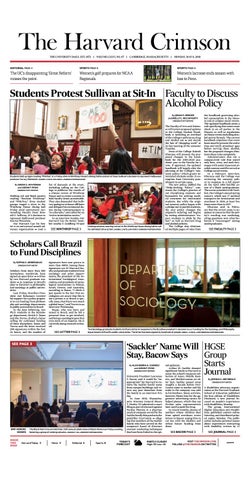
Students held up signs reading “#MeToo” at a Friday sit-in in Winthrop House’s dining hall in protest of Dean Sullivan’s decision to represent Hollywood producer Harvey Weinstein. NAOMI S. CASTELLON-PEREZ—Crimson photographer By sHERA S. AVI-YONAH and AIDAN F. RYAN Crimson Staff Writers
Holding red and black posters reading “Reclaim Winthrop” and “#MeToo,” three student groups staged a sit-in in the Winthrop House dining hall Friday amid controversy surrounding Faculty Dean Ronald S. Sullivan, Jr.’s decision to represent Hollywood producer Harvey Weinstein. Our Harvard Can Do Better — an anti-sexual assault advocacy organization — read a
list of demands at the event, including calling on the College to publicize the results of a climate review of Winthrop House and to create a system to hold faculty deans accountable. They also demanded that Sullivan apologize to house affiliates and delegate his ceremonial duties during Commencement to “an alternate,” and called for an “end to intimidation tactics.” In an interview Sunday, Our Harvard Can Do Better member Amelia Y. Goldberg ’19 said
See winthrop Page 3
Undergraduates wearing red sat in the Winthrop House dining hall to call for administrative action. NAOMI S. CASTELLON-PEREZ—Crimson photographer
The Faculty of Arts and Sciences will review proposed updates to the College Student Handbook — including an overhaul of the College’s policies on drug and alcohol use — and decide the fate of “shopping week” at its last meeting of the semester Tuesday. Dean of the College Rakesh Khurana will present the proposed changes to the handbook for the 2019-2020 academic year to the Faculty for a vote. If approved, the updated handbook will largely alter the phrasing of the College’s “amnesty policy,” which grants intoxicated students under 21 exemption from University punishment in certain cases. The new policy, dubbed the “Help-Seeking Policy,” continues the College’s practice of not disciplining students and bystanders for seeking medical treatment for intoxicated students. But while the original amnesty policy began with a pledge not to punish students, the new policy changes the original’s ordering and begins by stating administrators “expect students to abide by the law,” as well as Harvard drug and alcohol policies. The College also eliminated multiple pages of rules from
the handbook governing alcohol consumption in the Houses and at campus social events. The updated handbook omits a rule specifying that tutors must check in on all parties in the Houses, as well as regulations on House events including alcohol and on formals. The current handbook stipulates that event hosts must be present the entire time and verify attendees’ ages before serving them alcohol, but the proposed changes eliminate these rules completely. Administrators also cut a campus-wide rule that stated only beer, wine, and malt beverages with under 15 percent alcohol content could be served at College social events. In a February interview, Khurana said the College was reviewing the amnesty policy in response to a fall report on the April 2018 forcible arrest of a black undergraduate. The arrest coincided with Yardfest, the College’s annual spring concert, which saw 17 medical transports for intoxication and overdoses in 2018, at least five times more than in 2017. Khurana said in February that the review came in response to concerns that the policy’s wording was confusing, citing questions over what behavior it “encourages” among undergraduates.
See FACULTY Page 3
Scholars Call Brazil to Fund Disciplines By SOPHIA S. ARMENAKAS Crimson Staff Writer
Scholars from more than 800 institutions worldwide have signed an open letter — written by two Harvard graduate students — in response to Brazil’s plan to disinvest in philosophy and sociology at public universities. Last Friday, Brazilian President Jair Bolsonaro tweeted his support for a policy proposal to cut funding from philosophy and sociology departments at public universities in Brazil. In the days following, two Ph.D. students in the Sociology department, Derick S. Baum and Mo Torres, drafted a letter calling for continued funding of these disciplines. Baum and Torres said the letter received 200 signatures within the first 24 hours, and the number of
signatures have now grown to more than 8000. Among those signatures are 83 Harvard faculty and graduate students from sociology and other departments; the president of the International Sociological Association; and presidents of sociological associations in Poland, Israel, Greece, and Australia, according to Baum. “I think it just speaks to the fact that sociologists are aware that this is not a person — or Brazil — specific issue, that this is very much a global issue,” said Torres in an interview Wednesday. Baum, who was born and raised in Brazil, said he felt a personal draw to get involved, and being a sociologist gave him even more of an impetus. He is currently doing research in Brazil.
See LETTER Page 3
Two Sociology graduate students drafted a letter in response to the Brazilian president’s decision to cut funding for the Sociology and Philosophy departments in Brazil’s public universities. The letter has been signed by hundreds of people. EMMA L. KANETI—CONTRIBUTING photographer
‘Sackler’ Name Will HGSE Stay, Bacow Says Group Starts Journal
SEE PAGE 3
By alexandra a. chaidez and aidan f. ryan Crimson Staff Writers
University President Lawrence S. Bacow said it would be “inappropriate” for Harvard to remove the Sackler family name from campus buildings and return any past donations from the family in an interview Friday. In June 2018, Massachusetts Attorney General Maura T. Healey ’92 submitted a court filing as part of a lawsuit against Purdue Pharma — a pharmaceutical company owned by the Sackler family that produces the painkiller OxyContin — alleging that members of the Sackler family who have served on the company’s board of directors oversaw marketing techniques that have been linked to the opi
BMF HONORS WOMEN
Inside this issue
The Black Men’s Forum held their 25th annual celebration of Black Womxn on Friday evening, honoring a group of undergraduates. AMANDA Y. SU—Crimson photographer
Harvard Today 2
News 3
Editorial 4
Sports 6
Today’s Forecast
oid epidemic. Arthur M. Sackler donated significant funds to Harvard to name the school’s museum collection of Asian, Middle Eastern, and Mediterranean art after him. Sackler passed away roughly a decade before OxyContin came to market and his stake in the company was sold to his brothers. Many activists, however, blame him for the aggressive advertising tactics he helped pioneer, which they say Purdue sales representatives later used to push the drug. In recent months, dozens of mothers whose children died from opioid overdoses wrote letters to Bacow urging him to cut ties with the Sacklers and refuse future funding from them.
PARTLY CLOUDY High: 59 Low: 46
See BACOW Page 3
By JOSHUA S. ARCHIBALD Crimson Staff Writer
A disabilities advocacy organization at the Harvard Graduate School of Education published the first edition of Disabilities Disclosed, a new journal focused on people’s experiences with disabilities, Monday. The group, International Higher Education and Disabilities, published content online Saturday, and distributed printed copies Monday. The publication includes personal essays about experiences interacting with disability written by 12
See JOURNAL Page 3
Visit thecrimson.com. Follow @TheCrimson on Twitter.
spoons