2025-26
Mitra FAMILY GRANT Recipient
On the Border of Virtue and Vice: Chinese Migrants and the Political Economy of Mexicali
Linda Zeng
On the Border of Virtue and Vice:
Chinese Migrants and the Political Economy of Mexicali
Linda Zeng
2026 Mitra Family Scholar
Mentors: Dr. Chris Gatto and Ms. Connie Hollin
April 20, 2025
Introduction
Borders are often imagined as clear lines separating nations, laws, and identities. In practice, however, they produce spaces of ambiguity and contention, where legality and morality are shaped by shifting political and economic forces. Along the U.S.–Mexico border between 1882 and 1940, policies designed to regulate immigration and commerce instead generated new forms of cross-border migration and underground economies, where activities illegal on one side of the boundary could become profitable only a few miles away. Chinese migrants, part of a growing global diaspora during the late nineteenth and early twentieth centuries, became deeply entangled in these borderland dynamics. Across the Americas they were often praised as disciplined workers and successful entrepreneurs while simultaneously accused of criminality, vice, and moral corruption.
This tension became especially visible in the border town of Mexicali. Following the passage of the Chinese Exclusion Act in 1882, Chinese migrants moved south from California into northern Mexico, where American investment in the Colorado River Valley created cotton plantations that required labor. 1 Over time, Chinese migrants established businesses, restaurants, and commercial networks that formed the district known as La Chinesca, Mexicali’s Chinatown and one of the largest Chinese communities in northern Mexico. 2 The community became a thriving commercial center characterized by entrepreneurship, cultural exchange, and intermarriage. Yet historical accounts of the same district also describe smuggling routes, gambling houses, opium dens, prostitution, and alcohol trafficking operating in the same spaces. 3
1 James R. Curtis, "Mexicali's Chinatown," Geographical Review 85, no. 3 (1995): 337, https://doi.org/10.2307/215277.
2 Curtis, 335.
3 Robert Chao Romero, The Chinese in Mexico, 1882–1940 (University of Arizona Press, 2010), 32–42, http://www.jstor.org/stable/j.ctt1814j07; Curtis, 345.
Despite the frequent appearance of vice economies in these historical accounts of Mexicali, the tension between virtuosity and vice is rarely analyzed directly. 4 Rather, much scholarship emphasizes the marginalization of Chinese migrants on the geopolitical borders of the United States and Mexico by examining the ambiguities of their racial, social, marital, and national identities, while paying far less attention to the moral borderland they also inhabited. 5 Most historians quickly resolve the contradiction between virtue and vice by attributing accusations of vice to propaganda or economic resentment. Some scholars argue that Mexican hostility toward Chinese merchants stemmed from their commercial success, suggesting that “Mexican inability to compete effectively with the Chinese in local commerce constituted the basic motivation behind the anti-Chinese campaign.” 6 Others interpret anti-Chinese rhetoric as the product of nationalist anxieties and broader social upheavals during the Mexican Revolution. 7 In this historiography, stories of vice become merely “exaggerated” or “caricatured” distortions of the Chinese-Mexican experience. 8
4 Curtis, "Mexicali's Chinatown," 340; Julia María Schiavone Camacho, Chinese Mexicans (University of North Carolina Press, 2012), 34-35, https://doi.org/10.5149/9780807882597_schiavone_Schiavone Camacho; Manuel Lee Mancilla and Maricela González Félix, Viaje al corazón de la península: testimonio de Manuel Lee Mancilla; Maricela González Félix (Mexicali: Instituto de Cultura de Baja California, 2000), 42-50; Gabriel Trujillo Muñoz, Un santuario fronterizo: la comunidad china, la chinesca y Mexicali (Instituto Nacional de Estudios Históricos de las Revoluciones de México, 2022), 271–280, accessed March 8, 2026, https://inehrm.gob.mx/recursos/Libros/Un_santuario_fronterizo_03112022.pdf; Juan Fernández Velázquez and Benjamin Smith, "A History of Opium Commodity Chains in Mexico, 1900–1950," Journal of Illicit Economies and Development 4, no. 2 (2022): 118-123, accessed February 16, 2026, https://doi.org/10.31389/jied.113.
5 Julian Lim, "Chinos and Paisanos: Chinese Mexican Relations in the Borderlands," Pacific Historical Review 79, no. 1 (2010): 50, https://doi.org/10.1525/phr.2010.79.1.50; Scott Warren et al., "La Chinesca: The Chinese Landscape of the Mexico-U.S. Borderlands," Yearbook of the Association of Pacific Coast Geographers 77 (2015): 71, http://www.jstor.org/stable/26384964; Verónica Castillo-Muñoz, "Intermarriage and the Making of a Multicultural Society in the Baja California Borderlands," in Red and Yellow, Black and Brown: Decentering Whiteness in Mixed Race Studies, by Joanne L. Rondilla, et al. (Rutgers University Press, 2017), 49, http://www.jstor.org/stable/j.ctt1q1cqvn.6.; Grace Delgado, Making the Chinese Mexican: Global Migration, Localism, and Exclusion in the U.S.-Mexico Borderlands (Stanford University Press, 2013), 6.
6 Evelyn Hu-DeHart, "The Chinese of Baja California Norte, 1910–1934," Proceedings of the Pacific Coast Council on Latin American Studies 12 (1985): 24, accessed March 15, 2026; Curtis, “Mexicali’s Chinatown,” 341.
7 Evelyn Hu-DeHart, "Immigrants to a Developing Society: The Chinese in Northern Mexico, 1875–1932," The Journal of Arizona History 21, no. 3 (1980): 289, http://www.jstor.org/stable/42678263; Philip A. Dennis, "The Anti-Chinese Campaigns in Sonora, Mexico," Ethnohistory 26, no. 1 (1979): 71, https://doi.org/10.2307/481468.
8 Schiavone Camacho, Chinese Mexicans, 50.
Yet practices associated with vice are not absent from the historical record. In fact, Chinese smuggling networks have been documented in considerable detail, sometimes forming the focus of entire studies. 9 What is striking is that these activities are rarely integrated into broader interpretations of Chinese immigrant life. Instead, scholarship tends to separate narratives of Chinese respectability from the illicit economies of the borderlands. When smuggling is discussed, it is often romanticized as an illustration of Chinese ingenuity or treated as a logistical phenomenon rather than as part of the same social world. 10 Similarly, in discussing Mexicali’s vice economy, Trujillo observes that the American press constructed a “double image” of the Chinese as at once hardworking and disciplined, yet also portrayed as harmful simply for embodying a “different” culture. 11 While this interpretation usefully highlights the contradictory representations at the center of this paper, its explanation looks over the material practices of gambling, drinking, and smoking present, instead attributing racialized perceptions primarily to the fact that Chinese culture appeared “different.”
These separations obscure the unique dynamics of Mexicali as a border space. Beyond serving as a settlement for Chinese migrants, La Chinesca also functioned as a staging ground for migration into the United States and as a node within a wider borderland vice economy. To overlook these overlapping roles is to overlook the ways in which the borderlands themselves produced the moral ambiguities that defined Chinese immigrant life, where respectability and illicit economies could coexist within the same social and economic landscape.
9 Romero, Chinese Mexicans, 30–66; Lawrence Douglas Taylor Hansen, "El contrabando de chinos a lo largo de la frontera entre México y Estados Unidos, 1882-1931," Frontera Norte 6, no. 11 (2017), accessed February 16, 2026, https://doi.org/10.17428/rfn.v6i11.1549; Jason Oliver Chang, "Outsider Crossings: History, Culture, and Geography of Mexicali's Chinese Community" (PhD diss., UC Berkeley, 2010), accessed January 18, 2026, https://escholarship.org/uc/item/9pc5f6zm; Delgado, Making the Chinese, 73–103.
10 Romero, Chinese Mexicans; Taylor Hansen, "El contrabando."
11 Gabriel Trujillo Muñoz, Un santuario fronterizo: la comunidad china, la chinesca y Mexicali (Instituto Nacional de Estudios Históricos de las Revoluciones de México, 2022), 267 accessed March 8, 2026, https://inehrm.gob.mx/recursos/Libros/Un_santuario_fronterizo_03112022.pdf.
This paper argues that the apparent contradiction between Chinese virtue and vice in Mexicali emerged from the political economy of the U.S.–Mexico border itself. U.S. exclusion policies created markets for illegal migration, while American demand across the border generated profitable vice industries within Mexico. Together, these forces reshaped the economic landscape of the borderlands and compelled Chinese migrants to operate within systems where survival depended on both discipline and participation in illicit economies. In navigating these vice industries through discipline and organization, they came to inhabit a world in which respectability and vice were inseparable conditions of life at the margins.
The Paradox of Virtue and Vice in the Borderlands
When thinking of the U.S.–Mexico border today, one rarely imagines a Chinese community. Yet Chinese settlers played a central role in the development of Mexicali. They first arrived in the Mexicali Valley at the turn of the twentieth century through a convergence of American capital, Mexican state policy, and global migration pressures. In the late nineteenth century, political instability and economic transformation in China pushed many migrants to seek opportunities abroad, while the passage of the Chinese Exclusion Act in the United States in 1882 barred Chinese laborers from entering the country directly. As a result, many migrants moved south to northern Mexico, settling in the Mexicali Valley along the U.S.–Mexico border. 12 At the same time, the American-owned Colorado River Land Company, founded in 1902, had acquired over 800,000 acres of land in the valley and sought cheap labor to cultivate cotton plantations in what investors described as an empty desert waiting to be transformed into 12 Romero, The Chinese, 15–18.
fertile farmland. 13 Recruited for this labor force, Chinese workers were often transported first to San Francisco and then by railroad into Mexicali, where they became essential to the valley’s agricultural development and the broader economic integration of the Imperial and Mexicali Valleys through irrigation canals that diverted water from the Colorado River. 14
Over time, Chinese migrants moved beyond plantation labor and established businesses, restaurants, and commercial networks that formed the district known as La Chinesca, Mexicali’s Chinatown. By the 1910s and 1920s, the Chinese population in the region had grown rapidly, with estimates ranging from five to eleven thousand settlers in Mexicali alone at its peak. 15
Chinese merchants, farmers, and entrepreneurs became deeply embedded in the local economy, transforming Mexicali into a productive agricultural and commercial center. Yet the very success of Chinese migrants also provoked resentment and suspicion, particularly as their presence grew increasingly visible within the borderland economy. By the 1930s, virulent anti-Chinese campaigns across northern Mexico led to expulsions, land dispossession, and the dramatic decline of the Chinese population. 16 The fact that Chinese migrants are rarely associated with the history of the U.S.–Mexico border today reflects their erasure from historical consciousness, a consequence of this exclusion.
Accounts of Chinese immigrants in northern Mexico often begin with praise for their industriousness and commercial success. Oral histories and archival records repeatedly describe Chinese merchants as disciplined, trustworthy, and hardworking entrepreneurs who integrated
13 Curtis, "Mexicali's Chinatown," 336–337; Dorothy Pierson Kerig, "Yankee Enclave: The Colorado River Land Company and Mexican Agrarian Reform in Baja California, 1902–1944" (PhD diss., University of California, Irvine, 1988), 16, https://www.proquest.com/openview/aaa82115d54d9e6bcba64526bac5d083/1?pqorigsite=gscholar&cbl=18750&diss=y
14 Curtis, 339; Warren et al., "La Chinesca," 65.
15 Curtis, 338.
16 Curtis, 340; Romero, The Chinese, 56.
into local communities and built prosperous businesses. Yet these same narratives frequently turn, sometimes only a few pages later, to discussions of opium dens, gambling halls, prostitution, and smuggling networks. 17 This tension appears not only in written histories but also in oral accounts and in the physical geography of places such as Mexicali’s La Chinesca, where respectable storefronts and commercial districts existed alongside neighborhoods associated with vice industries. As shown in Figure 1, the many cabarets, dance halls, and beer gardens, indicated by the crown symbol, reside directly beside the block occupied entirely by the Chinese. How, then, can these seemingly incompatible depictions be reconciled?
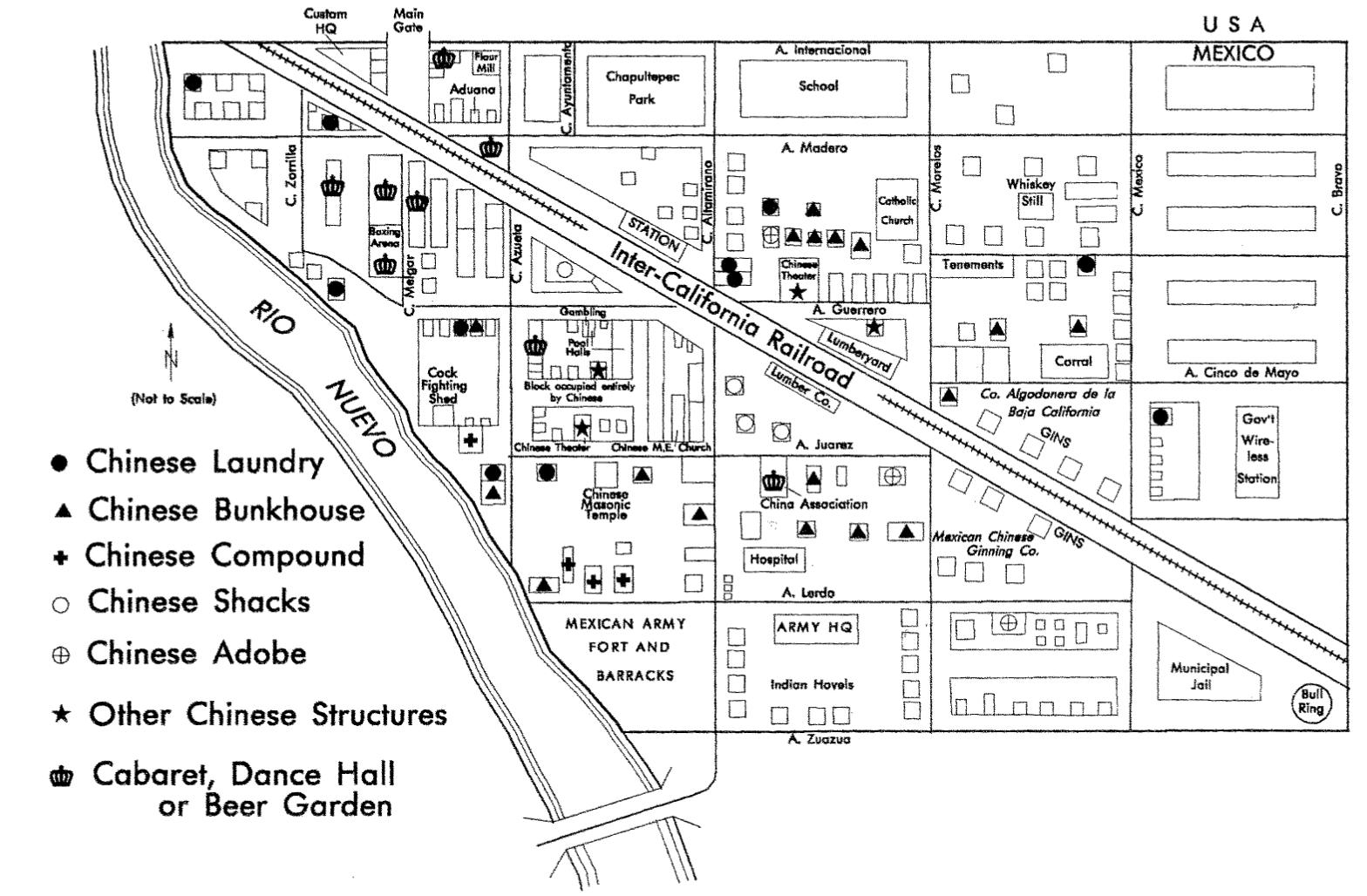
Figure 1. Map of Mexicali (1925), indicating the location of Chinatown. From James R. Curtis, “Mexicali’s Chinatown,” Geographical Review 85, no. 3 (1995): 344, https://doi.org/10.2307/215277, based on a 1925 Sanborn Map Company map.
17 Curtis, "Mexicali's Chinatown," 340; Schiavone Camacho, Chinese Mexicans, 34–35; Lee Mancilla and González Félix, Viaje al corazón, 42–50.
One way this reputation for industriousness appears in the historical record is through the language used to describe Chinese merchants. Several Spanish terms confianza, el pilón, and sangrita became associated with Chinese business practices and personal character. Their preservation in oral narratives underscores the lasting impression Chinese immigrants left on local communities. Drawing on oral interviews with Chinese settlers in Sonora, a northern Mexican town near Mexicali, historian Camacho describes the strong economic and social relationships they built with local communities, noting that Chinese merchants cultivated relationships of confianza—a cultural concept dating to Mexico’s colonial period that emphasized mutual trust and understanding in social and commercial interactions. 18 The Chinese adoption of this term suggests a deep familiarity with Mexican social norms and an ability to navigate local systems of trust and reciprocity with others of both Mexican and Chinese descent, a perception that appeared to fade as Chinese exclusion began. Evidence of these relationships appeared in everyday economic interactions. Indigenous communities regularly patronized Chinese businesses: the Mayo of the Río Mayo Valley shopped in Chinese stores in Navojoa, while Yaqui customers frequented establishments such as Fu Pau Hermanos in Guaymas. One account describes the proprietors Agustín and Pablo as impeccably dressed “gentlemanly Chinese” who personally attended to Yaqui customers and spoke their language fluently. 19 Such examples illustrate how Chinese merchants adapted linguistically and culturally to their surroundings, reinforcing their reputation for trustworthiness and service. The willingness of Indigenous communities to frequent these businesses further complicates later nationalist narratives that portrayed Chinese migrants as socially isolated or fundamentally incompatible
18 Schiavone Camacho, Chinese Mexicans, 26.
19 Schiavone Camacho, 30.
with Mexican society, particularly within the framework of mestizaje, which rhetorically invoked Indigenous identity to justify the exclusion of Chinese immigrants. 20
Beyond establishing basic trust and bonds, Chinese merchants were also remembered for their extraordinary generosity and frugality. One interviewee recalled that Chinese shopkeepers practiced el pilón, offering small gifts to customers with purchases in order to cultivate loyalty and goodwill. 21 Advertisements and newspaper accounts similarly portrayed Chinese business owners as generous and community-oriented. A 1905 commercial directory described merchant Guillermo Leytón as an “excellent Chinese who enjoys general popularity,” praising him for selling essential goods at reduced prices during difficult times to prevent local families from going hungry. 22 Such depictions reinforced the widespread perception of Chinese immigrants as disciplined and socially responsible entrepreneurs. The use of such specific terms suggests that Chinese merchants were remembered not merely as economic actors but as individuals whose conduct shaped everyday social and economic relationships.
Alongside confianza and el pilón, which emphasized the relations of the Chinese merchant class with respect to others in the community, oral accounts from Mexicali emphasize sangrita, a term used to describe the resilience, discipline, and industrious spirit associated with the Chinese laborer class. 23 According to these narratives, Chinese workers were admired for their endurance and work ethic, qualities that allowed them to build independent businesses and achieve economic mobility. The quantitative evidence of Chinese immigrants as business owners
20 Chang, "Outsider Crossings", 83; José Vasconcelos, La Raza Cósmica (Agencia Mundial de Librería, 1925; 2018), accessed January 18, 2026, https://archive.org/details/vasconcelos-jose.-la-raza-cosmica–1925–2018/page/n7/mode/2up; Manuel Gamio, Forjando Patria (Librería de Porrúa Hermanos, 1916; 2009), accessed January 18, 2026, https://archive.org/details/forjandopatriapr00gamiuoft/page/n7/mode/2up.
21 Schiavone Camacho, Chinese Mexicans, 29.
22 Hu-DeHart, "Immigrants to a Developing," 287.
23 Lee Mancilla and González Félix, Viaje al corazón, 19.
confirms this: According to a population census in 1930, of the total Chinese immigrant population in 1930 (18,965 people), 36.61% were involved in commerce and 21.84% in agriculture, the two largest categories. Chinese participated in diverse occupations, from poor underclass to merchants and wealthier social classes. 24 This reputation even produced a form of implicit bias among Chinese-Mexican descendants, who associated Chinese labor with strength, unity, and entrepreneurial success: As Manuel Lee Mancilla recalls, “Americans weren’t able to do with the Chinese what they later managed to do with Mexicans. Mexican migrants have been kept working the entire time, and under those conditions, they can be kept like that until they die.” 25 He frames sangrita as an admirable quality that allowed Chinese to rise from laborers to business makers. As a result, Mancilla’s account extends this characterization beyond entrepreneurial elites to include working-class laborers, suggesting that these traits were understood as broadly shared rather than limited to a select few. In this way, the language of confianza and sangrita reflects how Chinese migrants were remembered as both trustworthy merchants and exceptionally hardworking laborers.
Outside of work, accounts of everyday life further reinforced this reputation for discipline and moral character. Mancilla recalls the strict routines followed by Chinese agricultural workers, who ended each day by bathing methodically before dinner. Each worker mixed hot and cold water in a basin under a small tent and washed carefully before the evening meal, a ritual repeated daily across the labor camps. 26 Such practices contradicted common stereotypes that portrayed Chinese migrants as dirty or diseased. These accounts to virtue extend not simply then to merchants but also to everyday laborers. Likewise, Spanish officials, such as Esteban Flores of
24 Romero, The Chinese, 98–99.
25 Lee Mancilla and González Félix, Viaje al corazón, 19.
26 Lee Mancilla and González Félix, 30.
the Department of Labor, noted the broader contributions of Chinese agricultural workers to local communities in 1919. In many regions, Chinese vegetable farming was “promoted” because it lowered food costs and improved diets by increasing access to fresh produce, while institutions such as the Chinese Association in Mexicali even provided social services and medical care to both Chinese and Mexican residents through the Hospital Chino. 27 These contributions portray Chinese migrants not only as hardworking laborers but also as disciplined and socially responsible participants in the local economy and community life. Notably, such praise even appeared in reports by Mexican officials and observers, suggesting a striking contrast with the virulent depictions that cast Chinese migrants as socially harmful or morally corrupt. Although individual laborers alone could not transform regional diets, the widespread recognition of their agricultural output indicates that their labor had a tangible and visible impact on local living conditions. The fact that Chinese labor was “promoted” even over labor of other groups suggests the efficiency at which the Chinese worked, supporting Mancilla’s anecdote of sangrita. At the same time, the activities of the Chinese Association demonstrate that Chinese involvement extended beyond economic exchange to broader forms of social and public welfare, reinforcing the perception of Chinese communities as productive and responsible contributors to regional society.
Alongside positive depictions emerged a starkly different narrative. Figures 2–4 illustrate the opposing image of Chinese immigrants that circulated widely in Mexican political and popular discourse. Rather than industrious workers and trusted merchants, Chinese migrants were increasingly portrayed as economic parasites, sources of disease, and agents of moral corruption. Figure 2 reflects the economic anxieties that underpinned much of the anti-Chinese
27 Esteban Flores, "Informe que rinde el jefe de la sección sobre la situación de las colonias asiáticas en la costa occidental de la república" (1919), 35–36, 50, 71, quoted in Lim, "Chinos and Paisanos,” 71.
campaign. The cartoon, published in El ejemplo de Sonora by José Ángel Espinoza and associated with the activism of anti-Chinese political leader José María Arana, depicts Arana holding a sign warning Mexicans that every peso spent in a Chinese business ultimately enriches Shanghai and enslaves Mexico. 28 This representation stands in sharp contrast to the earlier image
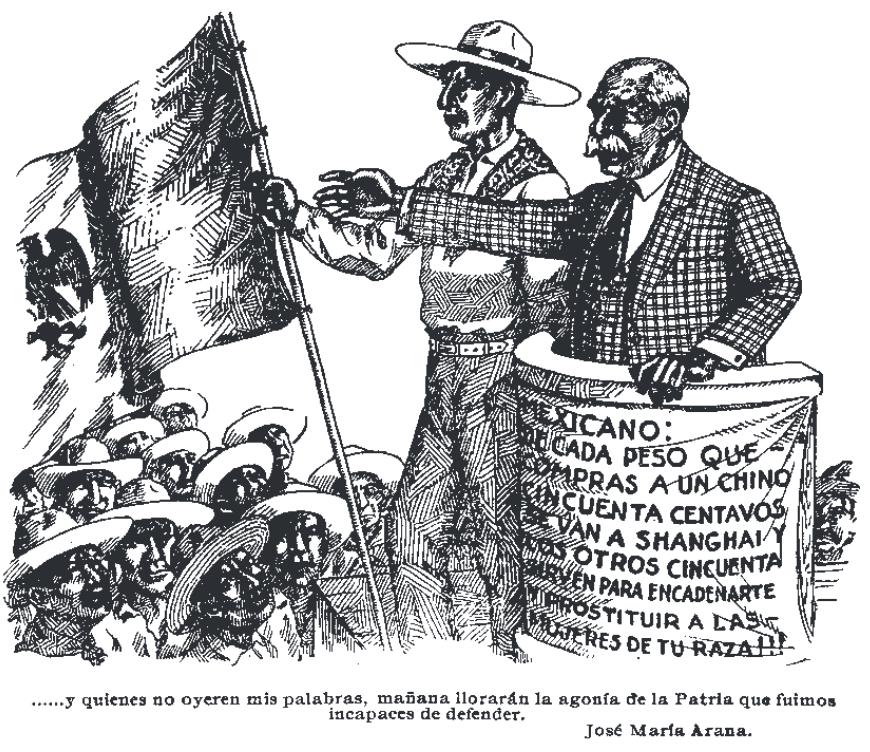
Figure 2. Anti-Chinese cartoon of José Maria Arana, featuring a sign that reads, “Mexican: of every peso that you buy from a Chinese business, fifty cents go to Shanghai and the other fifty cents serves to shackle you and to prostitute the women of your race!!!” From José Ángel Espinoza, El ejemplo de Sonora (1932), 33.
of the “gentlemanly Chinese” merchant who observed local social customs, cultivated relationships of confianza with Mexican and Indigenous customers, and offered el pilón, small 28 José Ángel Espinoza, El ejemplo de Sonora (1932), 33.
gifts, to build goodwill. Instead of neighbors who understood and even exceeded expectations of reciprocity within Mexican communities, Chinese merchants transformed into deceptive outsiders who exploited those very relationships. The warning that Chinese commerce will “shackle” Mexicans suggests that Chinese economic influence is so powerful that ordinary consumers can unwittingly fall into a trap of depending on it. The connotation of a trap suggests that the Chinese may still have an outward appearance of being honorable while inwardly being viceful, epitomizing and implicitly acknowledging this contradiction in representation to help viewers understand it. Meanwhile, the invocation of “race” signals how economic competition was reframed as a threat not merely to the Mexican labor economy but also to the moral and racial integrity of the nation.
Figure 3 extends this rhetoric from economic fears to concerns about health and bodily cleanliness. Unlike Manuel Lee Mancilla’s account describing Chinese laborers bathing meticulously each evening, the cartoon depicts racialized caricatures of Chinese breadmakers preparing food in unsanitary conditions littered with insects, sweat, and trash. 29 On the literal level, such imagery echoed broader accusations that Chinese communities spread diseases such as syphilis, trachoma, and leprosy and sold contaminated food products. 30 On a symbolic level, however, the bread itself becomes a vehicle symbolizing the Chinese infiltration of Mexican society on both an economic and social level. Because bread is a staple consumed daily by the broader population, the image suggests that Chinese presence seeps invisibly into the bodies of Mexicans through ordinary consumption. Rather than portraying Chinese labor as productive or nourishing—as suggested by accounts of Chinese agriculture improving regional diets—the cartoon transforms it into a process that corrupts the very sustenance of the nation. This depiction
29 Lee Mancilla and González Félix, Viaje al corazón, 30; Espinoza, El ejemplo, 69.
30 Romero, The Chinese, 160–61.
sharply contradicts accounts such as Mancilla’s, which emphasize the pride Chinese migrants took in their cuisine and food preparation, as well as the social services and medical care they provided to Mexican communities. 31 The metaphor therefore undermines earlier depictions of confianza in commercial relationships while simultaneously attacking the moral character and bodily cleanliness of Chinese communities.
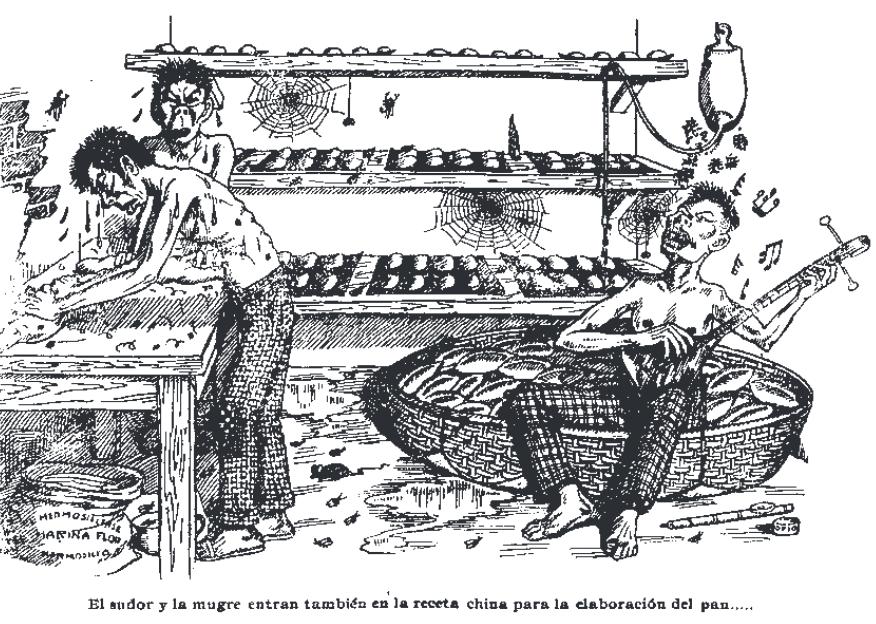
Figure 3. Anti-Chinese cartoon depicting Chinese breadmakers working in unsanitary conditions. The caption reads: “Sweat and grime also enter into the Chinese recipe for the production of bread.” From José Ángel Espinoza, El ejemplo de Sonora (1932), 69.
Indeed, this perspective reinforces a broader rhetoric that cast Chinese migrants as an “Asian microbe” threatening the wider health of the Mexican social body, a characterization
31Lee Mancilla and González Félix, Viaje al corazón, 30; Flores, "Informe que rinde," 35-36, quoted in Lim, "Chinos and Paisanos," 71
35
promoted by anti-Chinese activists such as José María Arana. 32 Economic attacks devolved into attacks of moral character: From “greedy and dishonest” businessmen, they became “brutal,” “unfeeling,” “diseased,” and “degenerate.” 33 Anti-Chinese crusader Ramón Garcia framed Chinese presence as “the vehicle for the penetration and contamination of the national organism,” a metaphor that extended the language of disease beyond literal illness to the imagined corruption of the nation’s racial and moral atmosphere. 34 Other official correspondence even described a broader “Chinese plague” encompassing prostitution, opium trafficking, business monopolies, corruption, and “general untrustworthiness,” revealing how disease imagery became a flexible metaphor encompassing moral, economic, and racial anxieties alike.
Figure 4 makes this logic of contamination and deception even more explicit. The image depicts a Chinese opium seller who outwardly appears respectable while secretly trafficking in vice. The reference to “snow” a slang term for narcotics—suggests furtiveness, implying that what appears helpful or harmless in public conceals moral corruption beneath the surface. Chinese migrants were frequently accused of smoking or distributing opium in private homes, businesses, and so-called “temples of vice,” reinforcing the idea that their influence operated through hidden and clandestine channels. 36 The cartoon’s power lies in this emphasis on deception: it portrays the Chinese figure as masking illicit activity behind respectable labor and commerce. Yet in doing so, it indirectly acknowledges the very reputation it seeks to undermine. The accusation only works if Chinese migrants were already seen as outwardly disciplined, trustworthy, and socially integrated through practices such as confianza and commercial success.
32 Schiavone Camacho, Chinese Mexicans, 51.
33 Schiavone Camacho, 49.
34 Schiavone Camacho, 50.
35 Letter from Secretary of Foreign Relations, Mexico, to Governor Nacozari de García, Mexico, January 1, 1917, tomo 3124, paquete 1, quoted in Delgado, Making the Chinese Mexican, 109.
36 Romero, The Chinese, 162.
The image quietly reveals the contradiction at the center of this paper: Chinese migrants were depicted as both respectable and dangerous at the same time. This contradiction raises an important question: to what extent did these accusations reflect perception compared to reality?
Just as positive narratives emphasized trust, discipline, and industriousness, negative portrayals emphasized vice and moral corruption. It remains difficult to determine where these
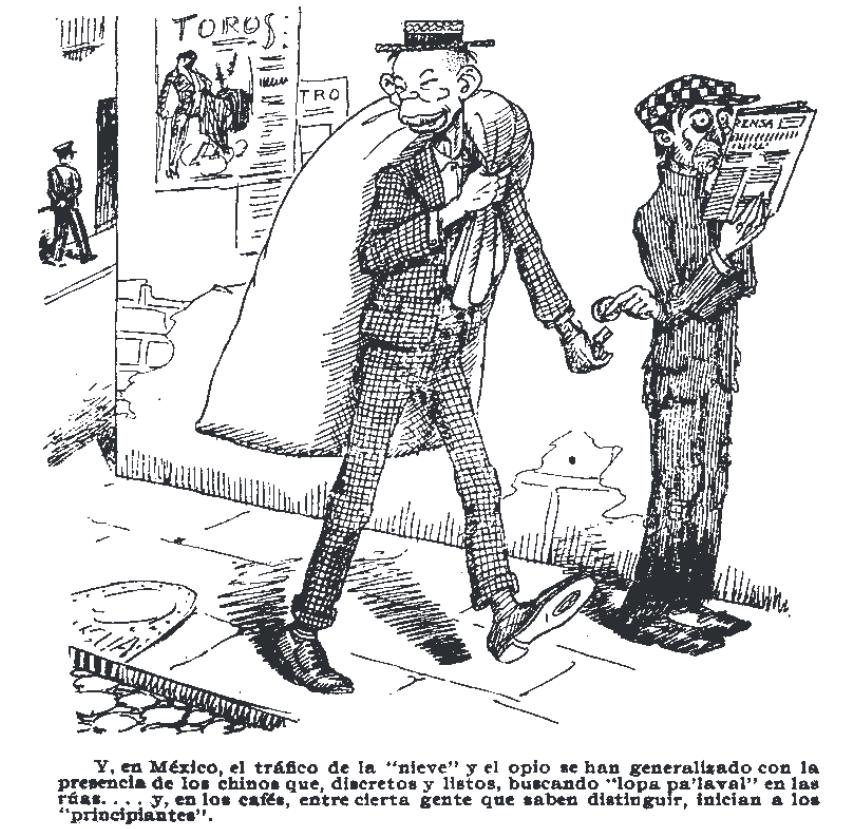
Figure 4. Anti-Chinese cartoon depicting a Chinese businessman peddling opium to a Mexican customer while pretending to be a launderer. The caption reads: “And, in Mexico, the traffic of “snow” and opium has spread with the presence of the Chinese, who, discreet and shrewd, seek ‘clothes for washing’ in the streets … and, in the cafés, amongst certain people that they know
how to distinguish, they initiate the ‘inexperienced.’” From José Ángel Espinoza, El ejemplo de Sonora (1932), 228.
accusations originated and how much they reflected lived practices. Stories of opium use and smuggling did circulate in the borderlands, and Chinese communities were sometimes associated with illicit economies. 37 However, much of the current historiography explains these contradictions primarily through the lens of propaganda emerging from the Mexican Revolution and economic tensions in the early 20th century.
The rhetoric of the anti-Chinese crusade was closely tied to the ideology of mestizaje that emerged during the Mexican Revolution. While mestizaje celebrated racial mixture as the foundation of Mexican national identity, it defined that mixture narrowly as a union of whiteness and indigeneity.
38 Within this framework, Chinese workers came to be cast as the “antithesis of the newly independent Mexican nation,” according to many scholars.
39 Nationalist texts such as El ejemplo de Sonora insisted that Chinese mestizos lacked even “a drop of Indo-Latina blood.”
40 This language framed the “Chinese problem” as one of racial blood and national purity, where Chinese people were a direct threat to Mexican identity. State officials echoed this logic, warning that regions such as the Colorado River Delta had become an “Asian empire” and calling instead for “genuinely Mexican colonization.” 41 Such language rendered Chinese
37 Eric Michael Schantz, "All Night at the Owl: The Social and Political Relations of Mexicali's Red-Light District, 1913–1925," Journal of the Southwest 43, no. 4 (2001), http://www.jstor.org/stable/40170171; Taylor Hansen, "El contrabando."; Juan Fernández Velázquez and Benjamin Smith, "A History of Opium Commodity Chains in Mexico, 1900–1950," Journal of Illicit Economies and Development 4, no. 2 (2022), accessed February 16, 2026, https://doi.org/10.31389/jied.113.
38 María Josefina Saldaña-Portillo, "'How many Mexicans [is] a horse worth?' The League of United Latin American Citizens, Desegregation Cases, and Chicano Historiography," South Atlantic Quarterly 107, no. 4 (2008): 811, https://doi.org/10.1215/00382876-2008-018.
39 Lim, "Chinos and Paisanos," 67; Hu-DeHart, “Immigrants to a Developing Society,” 285.
40 Chang, "Outsider Crossings," 84.
41 Chang, 84.
residents fundamentally incompatible with Mexicanness despite intermarriage and long-term settlement.
These racialized narratives translated directly into policy. In 1937, President Lázaro Cárdenas enacted agrarian reforms that redistributed land to Mexican nationals while expelling Chinese communities. As shown in Table 1, the Chinese population in Mexico fell from 24,218 in 1926 to just 4,856 by 1940, illustrating the material consequences of mestizaje-driven exclusion.
Table 1. Chinese population in Mexico, 1895–1940.

Source: Scott Warren et al., “La Chinesca: The Chinese Landscape of the Mexico-U.S. Borderlands,” Yearbook of the Association of Pacific Coast Geographers 77 (2015): 71, http://www.jstor.org/stable/26384964, adapted from Robert Chao Romero, The Chinese in Mexico, 1882-1940 (University of Arizona Press, 2010), 56, http://www.jstor.org/stable/j.ctt1814j07.
Although many of these campaigns originated in Sonora, the conditions that fueled such rhetoric were not confined to that state. Baja California initially functioned as a relative refuge from intensifying exclusionary policies elsewhere. 42 Yet as Chinese farms and ranches expanded in the Mexicali Valley during the 1920s, the same economic anxieties began to emerge locally.
42 Warren et al., "La Chinesca," 69.
Mexican officials warned that Asian immigration in the Colorado River basin threatened control over fertile agricultural lands, and by the 1930s, labor unions and repatriated Mexican workers increasingly demanded the expulsion of Chinese and other Asian farmers. 43 While this outcome was undeniably tragic, an emphasis on exclusion alone obscures the complexity of Chinese life in the borderlands.
Taken together, these accounts reveal a striking duality in perceptions of Chinese immigrant life in Mexicali. On the one hand, Chinese migrants were remembered as disciplined laborers and trustworthy merchants who cultivated confianza, practiced generosity through el pilón, and embodied sangrita through their work ethic and social contributions. On the other hand, political discourse and popular imagery recast these same individuals as agents of vice, disease, and moral corruption, fundamentally incompatible with the Mexican nation. Existing scholarship has largely explained this contradiction as the product of nationalist ideology, economic competition, and revolutionary-era propaganda. Yet this explanation does not fully account for the persistence of these competing representations or their grounding in the material realities of the borderlands. To understand this tension, we must examine the material practices that produced these seemingly contradictory perceptions.
Smuggling: The Economy of Exclusion
Smuggling itself is not overlooked in historical literature on Chinese Mexicans in Baja California and Mexicali. 44 Yet it is rarely integrated into analyses of the moral contradiction that defined Chinese immigrant life: namely, the simultaneous portrayal of Chinese communities as
43 Warren et al., 69.
44 Romero, Chinese Mexicans, 30–66; Taylor Hansen, "El contrabando"; Chang, "Outsider Crossings"; Delgado, Making the Chinese, 73–103.
disciplined, respectable, and industrious, while also depicting them as criminal and morally suspect. However, human migrant smuggling was undeniably dangerous, illegal, and legible as “vice” within U.S. legal and moral frameworks. This raises the question: Were these viceful practices then separate from the “gentlemanly” communities who stayed in Mexicali? Moreover, is the interpretation of this practice as simply “vice” even adequate? Through closer analysis, this section argues that smuggling was a structural outcome of exclusionary border regimes, produced by the U.S. decision to rigidly define legality on one side of an arbitrary line, and that it generated moral ambiguity that neither vice-focused nor virtue-focused interpretations adequately explain. Smuggling itself required virtue, discipline, trust, and contracts, but it was also highly dangerous and led to destabilization of racial identity along with moral identity and distrust.
Illegality under Chinese Exclusion
Human migrant smuggling in Mexicali did not emerge as an incidental or reactive practice but as a market produced by American exclusion. The passage of the Chinese Exclusion Act barred Chinese immigrants from entering the United States, but rather than halting migration as intended, the act merely restructured it into a clandestine illicit economy. As Robert Chao Romero argues, “entrepreneurial Chinese invented undocumented emigration from Latin America,” forming a transnational smuggling network that linked China, Mexico, Cuba, and the United States, such that the Chinese community became “the first illegal aliens from Mexico.” 45 This characterization is itself revealing: Romero’s juxtaposition of “entrepreneurial” and “illegal” reveals how the contradiction between Chinese virtuosity and supposedly viceful
45 Romero, The Chinese, 31–32.
practices has been implicitly, and arguably unavoidably, present in past scholarship without being explained directly. What was labeled as “vice” was in fact grounded in the same fastidiousness, discipline, and industriousness attributed to Chinese communities, now redirected into practices rendered illegal by the United States. As Romero frames smuggling as not only “resisting” but also “circumventing” exclusion, Chinese migrants emerge not simply as oppressed subjects reacting to an external force, but as active agents who both navigate and reshape that system. This characterization mirrors their trajectory under the Colorado River Land Company, where they began as laborers within imposed economic structures before developing their own commercial networks and merchant labor systems, demonstrating how Chinese communities channeled these same capacities toward both legal and illicit forms of mobility.
Beyond scholarly analysis, there is a clear correlation between U.S. legal rulings and rising Chinese populations in northern Mexico that helps explain the emergence of smuggling. Decisions such as Ju Toy v. United States (1905) limited migrants’ ability to challenge exclusion, increasing reliance on illicit entry. 46 Correspondingly, Chinese migration to northern Mexico rose sharply in the early twentieth century, with annual arrivals reaching roughly 3,000 to 5,000 between 1911 and 1913 and persisting at near-peak levels even during the violence and xenophobia of the Mexican Revolution, before declining with the onset of World War I and rebounding again after 1918. 47 This pattern suggests that migrants were not primarily responding to conditions within Mexico, but instead using it as a strategic transit space with the explicit intention of entering the United States through smuggling. As Romero argues, Chinese migrants were not oriented toward permanent settlement in Mexico; rather, their trajectory remained fixed on the United States, rendering them relatively indifferent to the instability and xenophobia of
46 Romero, 53.
47 Romero, 54–55.
the Mexican Revolution. 48 In this sense, “vice” did not emerge after the fact through propaganda, but it was constitutive from the origins of Chinese settlement in Mexicali, both coexisting with and enabled by the same qualities that defined these communities as “virtuous.”
More broadly, these illicit migration patterns reveal a borderland political economy in which U.S. constructions of legality extend beyond its territory, reshaping the movement and categorization of foreign populations. Chinese migrants were not uniquely or permanently “illegal,” nor the last to be produced as such; rather, they were among the first, as similar dynamics would later be applied to Mexican migrants along the same border. 49 As Rosario Cardiel Marín demonstrates, Chinese migrants crossed into Baja California to escape the “restrictions and attacks” they faced in the United States, and the region’s proximity generated a “constant illegal movement” across the border. 50 Illegality, then, did not arise from moral failure, but from systems of exclusion that produced it; likewise, smuggling emerged not from individual vice, but from the border itself, where nationality was rigidly defined and migration criminalized. Mexicali, in particular, emerged as a central node within this system due to its accessibility to California and its integration into transnational Chinese commercial networks. Contemporary reports noted hundreds of migrants waiting in nearby ports such as Ensenada and paying hundreds of dollars to smugglers, underscoring the profitability and organization of this trade. 51 Borderland regions, in this context, became critical nodes of both immigrant circulation and economic production, helping to explain why Chinese communities concentrated there.
48 Romero, 54–55.
49 Warren et al., "La Chinesca," 76.
50 Rosario Cardiel Marín, "La migración china en el norte de Baja California, 1877–1949," in Destino México: un estudio de las migraciones asiáticas a México, Siglos XIX y XX, by María Elena Ota Mishima (El Colegio de México, 1997), https://muse.jhu.edu/pub/320/oa_edited_volume/chapter/2571822.
51 Yolanda Sánchez Ogás, Historia de los chinos en el Valle y ciudad de Mexicali, Rumorosa (Mexicali, Mexico) 18 (Mexicali: Gobierno del Estado de Baja California, 2021), 81–82, accessed February 16, 2026, https://www.bajacalifornia.gob.mx/Documentos/icbc/libros/Autores/18-Historia-de-los-chinos/AutBChistoriachinos-final.pdf.
Settlement in Mexicali, therefore, cannot be separated from its smuggling market. What appears as “vice” is thus better understood as a structural outcome of exclusion, embedded in the geography and governance of the U.S.–Mexico border.
Virtue within Illicit Networks
Beyond its emergence as a structural necessity, the smuggling network itself embodied both virtue and vice. While it was produced by a borderland political economy shaped by U.S. exclusion, the practice of smuggling depended on qualities typically associated with respectability, such as discipline, trust, and contractual obligation, thereby further blurring the boundary between moral legitimacy and criminality. This organization is evident in the diverse methods through which migrants were transported and integrated. Along the U.S. side of the border, migrants followed predetermined routes through ravines, irrigation ditches, and remote trails, often guided by Mexican intermediaries who escorted them to the boundary before transferring them to U.S.-based contacts. 52 In border towns such as Tombstone and Globe, established Chinese residents provided employment or facilitated movement further inland, while homes were equipped with basements, caves, or abandoned mine shafts to conceal undocumented migrants. 53 These practices reveal not only a high degree of coordination and local knowledge, but also sustained collaboration across multiple actors, including Mexican guides and Chinese residents within the United States. Even as these activities were classified as illicit, they closely mirrored formal mercantile systems, where routes were standardized, labor was divided, and risks were distributed.
52 Taylor Hansen, "El contrabando," 50..
53 Taylor Hansen, 50.
At a more institutional level, smuggling networks relied on contracts, payments, and documentation systems that reproduced the logic of legitimate economic systems without their legal recognition. For instance, the Chinese Six Companies, a powerful nineteenth-century federation of wealthy merchant-made associations in San Francisco that provided welfare, social services, and protection for Chinese immigrants, developed an extensive underground market for forged certificates produced with official seals, signatures, and notarization. 54 Despite the illegality it sought to navigate, this system mirrored the supply and demand of normal economic markets, requiring the same modes of agreement and coordination. Crucially, however, it was made possible through the intertwining of virtue and vice: only with the help of these legitimate associations could certificates obtain the seals and signatures for documentation. In this sense, the authority and legitimacy cultivated by the Six Companies in lawful contexts were repurposed to facilitate illicit migration. Moreover, this network operated across class lines. While elite organizations like the Six Companies coordinated and legitimized documentation practices, lower-level actors participated in the circulation and use of these papers within the underground market. In this sense, identity itself became flexible and transactional, as migrants adopted, exchanged, or fabricated legal personhood in order to move across borders. Letters between American officials, such as the Secretary of the Treasury and regional inspectors in cities like San Diego, document practices such as the “deportation substitution” system, in which detained migrants bribed officials to exchange their identities with others. 55 Meanwhile, in the 1891 Joseph Lam case, migrants paid $100 to $125 to legal residents in New Orleans to travel in their place to Cuba effectively taking free vacations while they remained in the United States
54 Romero, The Chinese, 41.
55 Romero, 39.
under the substitutes’ identities, blending into existing Chinese communities. 56 Migrants also exploited transit privileges by briefly entering Latin American countries and using that movement to facilitate unauthorized entry into the United States. 57 What is striking about these cases is, first, their ingenuity. Rather than outwardly criminal or purely violent activity, the organization of the Chinese Six Companies illustrates a highly structured and agreement-based system, requiring vast transnational networks, ranging from San Francisco to New Orleans to Cuba, and coordination between multiple actors. In particular, the participation of legal residents in these exchanges reveals how deeply virtue and vice were already intertwined, as legitimate actors willingly entered and sustained these illicit systems. Second, these methods revealed how Chinese migrants exploited their own marginal, ambiguous identities. Positioned at the border, they reshaped and impersonated identity and nationality to enter the U.S., manipulating the very legal categories that excluded them.
Policing an Imaginary Line
The power and effectiveness of these smuggling networks is evident in the intensity of U.S. reactions. Images such as Figure 5 circulated widely in newspapers, underscoring the prominence of this issue in the American public consciousness. The phrase “Wrecking the Chinese Underground Route” invokes rumors of subterranean tunnels linking Mexicali and Calexico, pointing to the perceived sophistication and scale of the infrastructure supporting clandestine movement. 58 The terminology itself is revealing: by echoing the earlier American underground route that aided enslaved people’s escape from the South, it both sensationalizes
56 Romero, 36.
57 Romero, 40.
58 Warren et al., "La Chinesca," 68.
and reframes Chinese migration as an organized threat. These same tunnels would later be repurposed during Prohibition for the smuggling of alcohol and other illicit goods, further attesting to the durability yet furtiveness of these cross-border networks. 59
In response, specialized “Chinese Inspectors” were deployed along the border to monitor and restrict movement. Likewise, a 1904 El Paso Herald report warned that continued Chinese migration through Mexico might require the construction of a barbed-wire fence along the Rio Grande, revealing U.S. anxieties about the seemingly uncontainable nature of Chinese smuggling networks. 60 Yet such statements also implicitly acknowledged the limits of enforcement: the border, as it existed, was too porous for exclusion laws to be fully imposed without physical infrastructure.
59 Curtis, "Mexicali's Chinatown,” 345. 60 Taylor Hansen, “El contrabando,” 48.
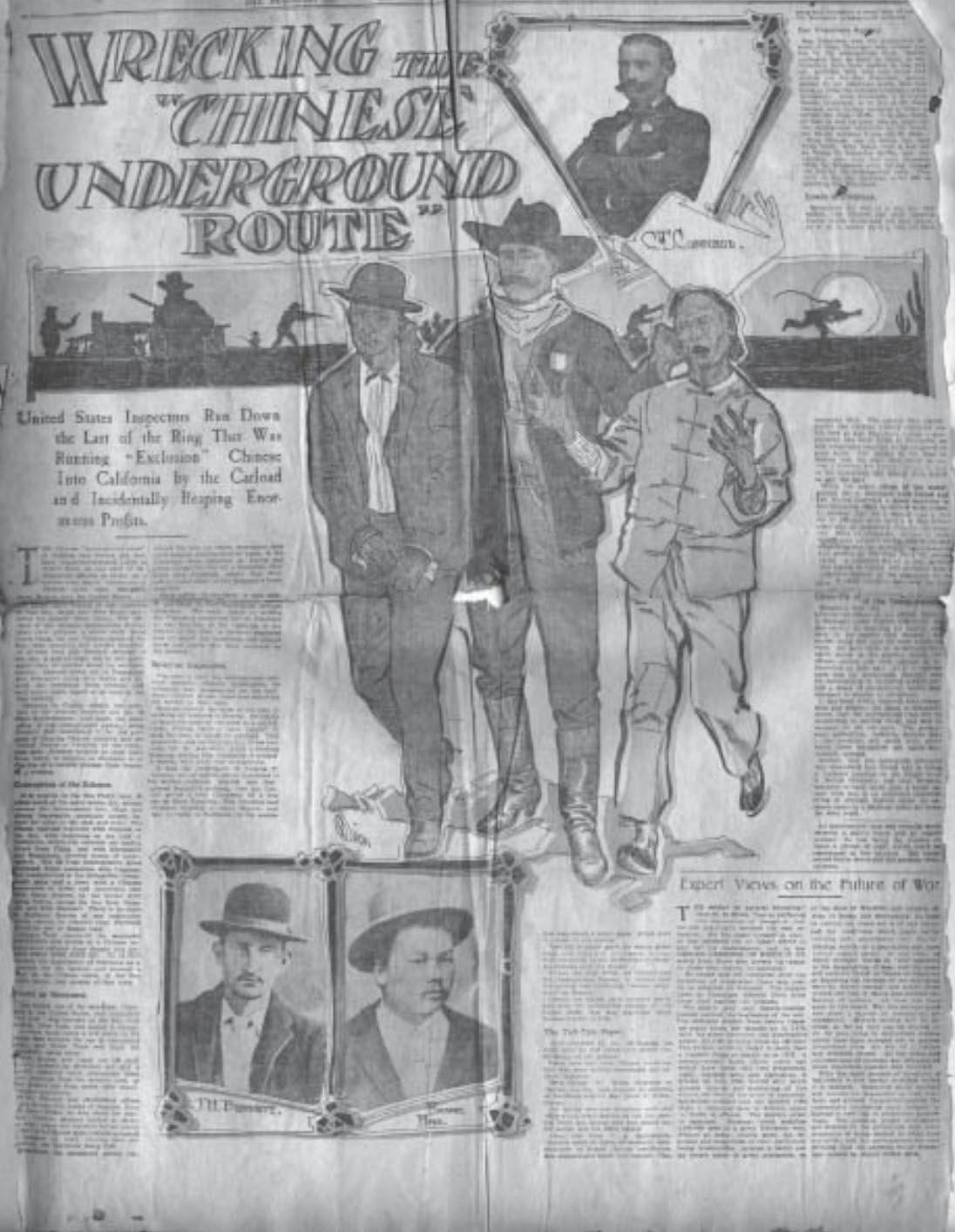
Figure 5. San Francisco Bulletin, “Wrecking of the ‘Chinese Underground Route,’” August 21, 1904. Reproduced in Grace Delgado, Making the Chinese Mexican: Global Migration, Localism, and Exclusion in the U.S.-Mexico Borderlands, 95. Originally from the Connell Family Scrapbook, folder 2, Charles T. Connel Papers, MS 0166, Arizona Historical Society, Tucson.
There is a further irony in the diction of the “Chinese Inspector.” Their very presence suggests that identifying who counted as “Chinese” was not always straightforward. Immigration Service official Clifford Alan Perkins observed that the use of false identities by Chinese migrants became so widespread and effective that officials eventually stopped seriously contesting many such claims. He remarked that “if all of those who claimed to have been born in San Francisco had actually been born here, each Chinese woman then in the United States would have had to produce something like 150 children.” 61 His exaggeration illustrates both the scale of the smuggling networks and the degree to which Chinese migrants exposed the fragility of the exclusion regime in attempting to define legality on often ambiguous and racial identities.
Contemporaries themselves recognized these limits. One Colorado River Land Company stockholder admitted that it was “quite a hard matter to get the Chinaman to stay south of the line,” when only an “imaginary line” separated him from higher American wages. 62 The phrase “imaginary line” is especially revealing. It exposes the contradiction of the border itself: an invisible political boundary was made to bear the full weight of racial exclusion. If Mexicans could lawfully cross, why should a Chinese man be treated differently? In practice, this tension pushed officials to confront how exactly a person could be classified as Chinese and Mexican. Some immigration officials even began allowing certain Chinese migrants to cross from Mexico, treating them as Mexican citizens despite their Chinese appearance, since Mexican nationals were legally permitted entry. 63
Other immigration officials attempted to catalog “Chinese” characteristics and devise methods to test for Mexicanness, transforming border enforcement into a process of racial and
61 Romero, The Chinese, 35.
62 Warren et al., "La Chinesca," 68.
63 Delgado, Making the Chinese, 67.
cultural classification. For instance, suspicions were raised when an American official, Tippet, observed that many Chinese migrants spoke English despite claiming to have arrived from Spanish-speaking regions. 64 Beyond demonstrating how language became an indicator of identity, and consequently legality, this detail reveals how Chinese migrants were often compelled to learn both English and Spanish to navigate transnational labor markets and evade exclusion. What officials framed as deception was, in fact, a strategy of survival within a system that denied them legal mobility. As enforcement grew increasingly elaborate and performative, captured Chinese migrants were sometimes coached by smuggling networks, such as the Six Companies, to appear more “Americanized” by the time of their hearings, receiving language training, new clothing, and even provided with fake witnesses prepared to testify to fabricated family histories. 65 While highlighting the sophistication of smuggling infrastructures, they also show the desperation produced by exclusionary regimes. The fact that legal identity itself could be constructed, rehearsed, and contested in court illustrates the unfair criteria of race that caused such illegal practices in the first place. At the same time, the state responded by attempting to formalize racial distinctions with increasing rigidity, even as such distinctions proved untenable. Officials developed stringent and often absurd criteria to determine identity, administering a standardized 46-question interrogation, and inspectors were required to train themselves on example scenarios such as “A Chinese woman marries an [American]-born Chinaman, in Mexico. Should she be examined under the immigration laws?” 66 The many races involved in this scenario highlight the entangled concepts of race, nationality, and legality on the U.S.–Mexico border and the absurdity of exclusion.
64 Romero, The Chinese, 38.
65 Taylor Hansen, "El contrabando," 54.
66 Delgado, Making the Chinese, 128.
This instability is vividly illustrated in the testimony of Manuel Lee Mancilla, a Mexicanborn man of Chinese descent who was initially denied entry solely because of his surname. Despite asserting his Mexican nationality, he was told that “as long as [the inspector] was there,” he would not be allowed to cross. Only through military intervention and direct appeals to higher authorities was he ultimately recognized as Mexican and granted passage. 67 His case underscores the extent to which “Mexicanness” had to be actively proven and often exaggerated. A similar dynamic appears in the case of Lee Sing, an ambitious merchant who moved frequently between the United States and Mexico. Although his Mexican citizenship and merchant status should have facilitated his mobility, he was detained and subjected to scrutiny, forced to repeatedly assert his “Mexicanness” to gain entry. Even after being admitted, his status remained precarious: once inside the United States, he risked being reclassified as a laborer and arrested by immigration officials. 68 Taken together, these cases demonstrate that the line between vice and virtue in smuggling was neither stable nor inherent. Rather, it emerged from a porous and amorphous borderland political economy in which rigid exclusion laws collided with fluid social and economic realities. Migrants adapted through practices that officials labeled illicit, yet these same practices were often necessary for survival. In this context, smuggling was not simply criminal behavior but a rational response to a system that rendered legal belonging both arbitrary and unattainable.
Violence, Coercion, and the Limits of Romanticization
While smuggling in the borderlands often demanded discipline, coordination, and even a kind of moral resolve, these qualities should not invite an overly romantic interpretation. To
67 Lee Mancilla and González Félix, Viaje al corazón, 57–58.
68 Delgado, Making the Chinese, 64–65.
frame smuggling purely as ingenuity or resistance risks obscuring the vice embedded within it. Rather, smuggling was the product of a borderland political economy that normalized danger, coercion, and the erosion of identity. These were acts of survival, but it was survival within a system that forced individuals into morally ambiguous and often exploitative conditions. The porous yet exclusionary border reconstituted legality into an unstable entity, where identity itself became negotiable.
Indeed, much of the historiography leans toward admiration, and this analysis has, at moments, risked reproducing that same framing. Scholars describe these systems as “brilliant,” “sophisticated,” and “ingenious,” emphasizing the tactical success of smuggling networks such as the Six Companies. 69 Romero similarly frames practices like deportation substitution, in which migrants bribed officials and exchanged identities mid-transit, as effective strategies within a transnational “commercial orbit.” 70 This language of an “orbit” itself abstracts and smooths over the violence and coercion embedded in these movements, recasting precarious, often dangerous acts of survival as part of a stable, even elegant system. This framing flattens the deeper implications of these acts. What is being celebrated is not merely ingenuity, but the systematic falsification and disappearances of identity itself, as seen in the Lam case where Chinese migrants exchange identities before disappearing into New Orleans society. 71 The same sentences that praise the sophistication of smuggling are inseparable from terms like “illegal,” “convicted,” and “collusion” in analyses. Therefore, these practices cannot be understood solely through the lens of ingenuity or resistance.
69 Delgado, Making the Chinese, 72; Taylor Hansen, “El contrabando,” 52.
70 Romero, The Chinese, 31.
71 Romero, 36.
To recover this tension is to recognize that smuggling was not simply clever but also dangerous, coercive, and often deadly. The borderland political economy produced conditions in which migrants relied on criminalized networks and traversed hostile environments at immense risk. Chinese Inspector Jeff Milton once discovered sixteen migrants murdered in a desert canyon after paying guides who abandoned them. 72 In 1902, thirty-five migrants died of exposure crossing from San Felipe to the Mexicali-Imperial Valley, giving rise to the region’s name El Desierto de los Chinos. 73 As a result, there existed moral ambiguity in that migrants were both perpetrators and victims of borderland crossings.
Violence was not limited to the desert. Within urban smuggling infrastructures, coercion and brutality persisted. A 1911 Calexico Chronicle report described a Chinese man found chained, starved, and near death in a Mexicali basement, likely a victim of Chinese underground criminal societies’ enforcement mechanisms within smuggling networks. 74 Such accounts expose the darker underside of these “sophisticated” systems: participation was not always voluntary, and refusal could carry severe consequences. Smuggling, in this sense, was not only a response to exclusion but also a site of internal exploitation. Those who organized, enforced, and participated in these networks could themselves enact violence and coercion, even as they operated under conditions of extreme precarity. Members of the Chinese community were at once victims of an exclusionary system and agents within a broader economy of vice shaped by that very system. This tension is captured in a poem carved into a detention cell at San Francisco’s Angel Island, written by a migrant detained after crossing from Mexico into the U.S.:
72 Warren et al., "La Chinesca," 68.
73 Warren et al., 68.
74 Trujillo Muñoz, Un santuario, 195–196.
Stay at home and lose opportunities;
A hundred considerations lead me to sojourn in Mexico.
Political parties are like wolves and tigers eliminating each other;
Hatred and prejudice against foreigners take away our property and many lives.
Unable to stay on I sneak across the border to the American side, Bump into an immigration officer who sternly throws the book at me And orders my expulsion back to China …
Fate is unlucky and times are perverse;
Therefore, I suffer these ordeals. 75
Here, smuggling emerges not as a choice between right and wrong, but as a constrained response to a world in which every option carried risk. As Mexico offered limited refuge, the United States enforced exclusion, and migrants were left to navigate a system in which legality, identity, and morality were all unstable. While discussions of virtue and vice may frame these practices at a distance, the lived reality was far more immediate, as illustrated in this poem, where individuals acted under pressure, attempting to survive.
Smuggling along the U.S.–Mexico border, then, was neither purely vice nor purely resistance, but a structural product of an exclusionary borderland political economy that rendered legal migration nearly impossible while sustaining a demand for movement. In this system, virtue and vice became inseparable: the same discipline, trust, and organization that defined “respectable” Chinese communities also enabled illicit networks marked by danger, coercion, and the instability of identity. Smuggling thus reveals less about individual morality than about a border regime that sought to impose rigid legal and racial categories onto inherently fluid lives,
75 Warren et al., "La Chinesca," 70.
compelling migrants to transgress not only the physical boundaries of the border, but also the moral boundaries those divisions produced.
Vice Industries: The Product of Borderland Demand
Just as people of Chinese (or perceived Chinese) nationality could be legal on one side of an “imaginary line” and illegal only yards away, so too could certain activities invert their moral and legal status across that same boundary. Progressing from the early twentieth century the height of Chinese smuggling—into the era of the U.S. Prohibition in the 1920s and 1930s, the border crossers now became U.S. residents, who crossed southward into Mexicali to engage in activities criminalized at home, including gambling, seeking entertainment, and, most importantly, consuming alcohol.
76 Chinese communities became the visible suppliers of these vice economies.
By focusing on activities in Mexicali itself, this section examines a more concentrated and highly scrutinized form of vice embedded within La Chinesca’s everyday urban life. It argues that these industries did not emerge from inherent cultural tendencies, nor can they be dismissed as merely racialized propaganda shaped by the instability of the Mexican Revolution, but rather they were structurally produced at the intersection of U.S. demand and Mexican governance. American consumers, constrained by domestic prohibition and moral regulation, generated a steady cross-border demand for alcohol, gambling, and entertainment. Mexican authorities, in turn, permitted and at times facilitated these industries as part of a borderland political economy. Within this system, Chinese migrants—already marginalized, excluded from many legal avenues of labor, and spatially concentrated in segregated districts—were pushed
76 James R. Curtis and Daniel D. Arreola, "Zonas De Tolerancia on the Northern Mexican Border," Geographical Review 81, no. 3 (1991): 340–341, https://doi.org/10.2307/215636.
into these economic niches as some of the few available means of survival and profit. In turn, this system imposed a disproportionate moral burden on Chinese communities, racializing them as the agents of vice within a borderland economy they did not create but were compelled to sustain.
Displaced Demand under U.S. Prohibition
Much like U.S. exclusion laws generated smuggling networks, U.S. Prohibition laws catalyzed the rise of vice industries in Mexicali. Just as the Chinese Exclusion Act did not eliminate immigration but instead pushed it into clandestine systems, Prohibition did not eliminate alcohol consumption but instead redirected it across the border. As scholars note, Mexicali’s rapid growth in the 1920s rested on two interdependent forces: cotton production and what has been described as a “culture of sin” produced by U.S. Prohibition. 77 American consumers, constrained by new moral and legal restrictions at home, traveled “down Mexico way” in search of alcohol, gambling, prostitution, and nefarious sports like cock-fighting. 78 In the words of Curtis, Mexicali became one of the “convenient foreign playgrounds for a nation gone dry and straitlaced.”
79 The phrase “playground” here reduces Mexicali to a site of leisure and consumption for U.S. visitors, implicitly stripping it of its own social and economic complexity. In doing so, it exposes the deeper asymmetry of how U.S. moral regulation was displaced onto Mexican space, while those within that space—especially Chinese communities—were racialized as the agents of vice within an economy fundamentally driven by American demand.
77 Curtis, "Mexicali's Chinatown," 345.
78 Curtis and Arreola, "Zonas De Tolerancia" 340–341.
79 Curtis, "Mexicali's Chinatown," 345.
This demand materialized in a dense vice economy concentrated near the border. Mexicali’s landscape included casinos, cabarets, brothels, and alcohol production sites, many clustered in La Chinesca, where Chinese-run establishments such as El Casino Chino became central nodes. 80 As shown in Figure 1, these sites were interspersed with Chinese businesses. These venues were often presented as “recreational centers” or family spaces but in practice concealed gambling and opium use, revealing a dual structure of outward respectability and internal vice. 81
Even before Prohibition, these industries were significantly founded and expanded by U.S. capital and clientele. A 1909 consular report submitted by Enrique de la Sierra, the Mexican consul in Calexico, to Mexico’s Secretary of Foreign Relations, Victoriano Salado Álvarez, described Mexicali in stark terms, noting that roughly 75% of its buildings were saloons, brothels, or gambling houses, largely owned and frequented by Americans escaping California’s moral regulations. 82 As Californians sought moral reform in the early 20th century, the vice— and the capital that sustained it—flowed south. This dynamic parallels earlier patterns of American economic intervention in the region, such as the influence of the Colorado River Land Company, where U.S. investment and demand now extended into vice industries rather than cotton labor. 83 Nonetheless, the effect is consistent: Chinese migrants, searching for economic opportunities they were often legally excluded from, answered the call across the border. This dependency becomes most visible when U.S. demand is removed. Border residents described the resulting instability as “el caos americano [the American chaos].” 84 Despite
80 Curtis, 345.
81 Sánchez Ogás, Historia de los chinos, 181.
82 Sánchez Ogás, 181.
83 Curtis, "Mexicali's Chinatown," 336–337.
84 Lim, "Chinos and Paisanos," 76.
describing Mexican chaos, the use of “American” captures how economic life in Mexicali remained inseparable from U.S. policy. That is, one cannot exist on the border without being highly related to what goes on across the border. When Prohibition ended in 1933 and Americans no longer crossed to drink or gamble, border economies unraveled. Contemporary accounts note that the repeal triggered a crisis “that rivaled the Great Depression,” with over 150 businesses closing and entire districts reduced to “a place of famine.” 85 As Manuel Lee Mancilla recalls, “everyone used to come for the gambling, but when it was prohibited, people stopped visiting… Immediately afterward Prohibition in the United States ended, so Americans no longer came to get drunk or to gamble. Tijuana fell into a terrible crisis… By 1934 the city was starving, because people had become used to living off gambling.” 86 His account makes clear that these industries were not self-sustaining local phenomena but fundamentally dependent on U.S. consumption. At the same time, it reveals the extent to which borderland economies had been restructured around vice, such that entire communities came to rely on American demand for gambling as a means of survival. Thus, vice in Mexicali was not an isolated or internally generated phenomenon, but rather the product of a transnational political economy in which U.S. legal restrictions displaced both demand and capital across an “imaginary line,” producing a borderland system that forced many into the market of vice for survival.
Everyday Entanglements of Virtue and Illicit Life
Nonetheless, these borderland vice industries became a prime example of the entanglement of virtue and vice. Chinese communities were not immune to corruption, but it is crucial to consider the scale and variation of participation. On one end, there existed mafiosos,
85 Lim, 76.
86 Lee Mancilla and González Félix, Viaje al corazón, 49–50.
who were drug traffickers and violent actors who operated within highly exploitative systems. On the other hand, many ordinary individuals, including small business owners and laborers, participated in gambling as a routine and normalized activity. In this context, the boundary between vice and entertainment becomes difficult to clearly define, especially within an economically precarious environment where such activities also functioned as social and financial outlets.
Gambling, in particular, occupied an especially blurred space between recreation and exploitation. As noted, Chinese migrants established casinos beginning in 1915 under the guise of “recreational centers,” spaces that could indeed function as sites of leisure while simultaneously facilitating betting. 87 In a first-hand account, Mancilla himself mentions this duality: “There has been everything: Chinese who were very hardworking and others who turned out to be big mafiosos.” Yet even this distinction collapses upon closer inspection, as gambling was ubiquitous—“every day the lottery was sold and every day it was played”—with large sums of money circulating through these systems and around the local “businesses.” 88 For such activity to be sustained daily, it must have enjoyed widespread popularity, even among businessmen with otherwise legitimate enterprises. Participation extended across class and community lines: Chinese migrants, Americans, Filipinos, Japanese, and Black patrons all frequented these spaces. Mancilla recounts how even his own father, an affluent grocery owner, lost over $50,000 to gambling, underscoring how what appeared as recreation could easily become financial ruin. As he notes, gambling was widely embraced as “their passion, their hobby.” 89 In this sense, vice was not separate from everyday life, but embedded within ordinary
87 Sánchez Ogás, Historia de los chinos, 181.
88 Lee Mancilla and González Félix, "Viaje al corazón," 43–46.
89 Lee Mancilla and González Félix, 43–46.
social and economic practices, coexisting alongside, and often within, otherwise virtuous communities.
At the same time, these systems were structurally exploitative and could give rise to more extreme forms of vice. As Mancilla explains, lotteries ensured that “out of ten, only one was the winner,” while in casinos “the house” ultimately took the majority of the money, so that “little by little the house kept all the money. Competition over these profits led to violent conflicts among a small number of actors—“maybe around twenty”—who fought for control of gambling operations. 90 Thus, while only a limited group engaged in organized crime, their actions emerged directly from the same systems that sustained everyday participation. Indeed, since the origin of La Chinesca, Trujillo characterizes early La Chinesca as a landscape of opium use and not much else, describing “wooden barracks” filled with cots, pipes, and tools for smoking—“That was La Chinesca.” 91 While this may suggest vice, it can also be read as a space of cultural familiarity.
Just as migrants recreated familiar foods such as buns and celebrated the Moon Festival as they had in China, opium use may also have functioned as a way to cope with the hardships and homesickness of life in a new country. 92 This interpretation is more apparent given that the early La Chinesca barracks themselves primarily served as a place of safety and decompression where laborers returned each night. 93 This reality does not negate the presence of addiction, but complicates it, especially considering that the global circulation and Asian addiction of opium itself was shaped in part by earlier U.S. and Western imperial involvement in China. Similarly, brothels proliferated not simply out of desire, but because restrictive migration policies made it
90 Lee Mancilla and González Félix, 45–56.
91 Gabriel Trujillo Muñoz, La Chinesca: la comunidad china en Mexicali (Gobierno del Estado: Instituto de Cultura de Baja California: CONACULTA, 2014)
92 Lee Mancilla and González Félix, Viaje al corazón, 31.
93 Trujillo Muñoz, La Chinesca
costly and difficult for Chinese men to bring wives, pushing some into vice economies that could also produce violence and tragedy. 94 Cases like Enrique Ley Ton and Mercedes Juarez—where the intimacy of these two prostitutes led to a legal case accusing the Chinese immigrant Ley Ton of killing Juarez, who in reality committed suicide—illuminated the conditions of danger and survival intertwined with vice. 95
Containment and Invisibility
Much like smuggling provoked increasingly racialized systems of surveillance at the border, vice economies in Mexicali produced a parallel dynamic, generating a deeply racialized perception of the Chinese community despite being largely driven by American demand. This paradox emerged through spatial containment. Rather than eliminating vice, Mexican and U.S. authorities sought to regulate and displace it, pushing it out of visible civic spaces and concentrating it within La Chinesca. In doing so, they created the very conditions through which vice could later be attributed to the Chinese as an inherent cultural trait.
This process began with formal systems of regulation. The Mexican state did not seek to eradicate prostitution or gambling, but to manage them through spatial segregation. As scholars note, the barrio de tolerancia, which designated regulated zones where gambling, entertainment, alcohol, cocaine, and opiates were permitted and controlled, functioned as Mexico’s counterpart to the segregated prostitution districts, which were similarly institutionalized spaces of tolerated vice in the United States. 96 While rooted in Mexico’s longer colonial history of regulated vice, Mexicali’s system became increasingly shaped by U.S. models of widely open, laxly enforced
94 Lee Mancilla and González Félix, Viaje al corazón, 39; Schiavone Camacho, Chinese Mexicans, 34–35.
95 Schiavone Camacho, 34–35.
96 Schantz, "All Night," 571–572.
cities and Chinatown districts, contributing to its development as a center for vice tourism.
Tourists “flocked to Mexicali’s premiere casino, brothel, and vaudeville theatre, the Owl,” where bourgeois visitors “slummed” alongside an international mix of workers and vice actors. 97 This again illustrates the perturbing influence of U.S. demand.
Over time, however, this regulated vice was not simply managed but spatially displaced. Municipal authorities relocated gambling houses and dance halls from the central avenue of Porfirio Díaz to the backstreets of Chinatown, deliberately pushing these activities out of visible civic space. The Calexico Chronicle, an American newspaper from across the border, praised the resulting separation, noting that “we have a clean town here” and expressing hope that such industries would be kept “back and not… under our noses on the border.” 98 This reaction is ironic in that American demand fueled these vice economies, yet American observers insisted on their removal from sight, almost “exporting” them to La Chinesca. At the same time, the construction of civic institutions such as Escuela Cuauhtémoc in former vice districts attempted to align Mexican public space with education and respectability. As Schantz asserts, “education, not debauchery, would symbolize the Cantú legacy.” 99 Yet while debauchery was displaced from central Mexicali, it was increasingly associated with La Chinesca and, by extension, with the Chinese community itself.
Moreover, vice was rendered invisible through underground infrastructures. The same underground tunnels thought to be used to smuggle Chinese migrants into the United States in the early twentieth century were also said to connect “subterranean bars, brothels, and opium dens” all the way into Calexico. 100 On one hand, this spatial concealment physically embodied
97 Schantz, 551, 571–572.
98 Schantz, 562–563.
99 Schantz, 562–563.
100 Curtis, "Mexicali’s Chinatown," 345.
the duality of the Chinese communities as it appeared outwardly virtuous and gentlemanly but engaged in trans-national borderland vice industries. On the other hand, this invisibility fed Western and Mexican imaginations. Descriptions of La Chinesca as a space of “secret passageways… binational tunnels… and labyrinthine underground spaces,” alongside sensational accounts of “underground passageways, where drug addicts smoked opium into eternity,” transformed hidden infrastructures into sites of exotic mystery. 101 In the context of opium in particular, such secrecy allowed onlookers, especially American tourists and journalists, to exaggerate and aggrandize the perceived depravity of the Chinese community. Thus, beyond hiding vice through containment, the American newspapers and Mexican government reframed it through exoticism and secrecy, turning a regulated and transnational system into a racialized spectacle that cast the Chinese community as inherently corrupt.
Opium, Exoticism, and Racialized Vice
Exoticized tourism and sensational media narratives further intensified the racialization of vice by transforming La Chinesca into a space where cultural difference could be consumed as entertainment. Chinese communities were not only spatially segregated and economically constrained, but also funneled into specific industries tied to Mexicali’s expanding vice economy. As Schantz notes, Mexicali was distinguished from other border towns by its “Asiatic” component and its mix of “erotica and exotica,” while Trujillo explains that La Chinesca itself was described as “a city within another city.” 102 By framing the vice economies of La Chinesca as an opportunity for tourism, journalists and travel narratives transformed spaces of labor and survival into spectacles of racialized leisure, where Chinese-run establishments were both
101 Trujillo Muñoz, Un santuario, 197–198, 268.
102 Schantz, "All Night," 573; Trujillo Muñoz, Un santuario, 267.
consumed as exotic attractions and condemned as sites of moral danger. In this way, economic practices shaped by borderland constraints were recoded as cultural traits.
Within this framework, opium emerged as the most potent symbol of racialized vice. Rather than being understood as part of a regulated and transnational economy, it was recast through sensationalist and orientalist imagery. A 1920 Calexico Chronicle report described a raid on Mexicali’s opium dens in strikingly theatrical terms: “fantastically carved lamps,” “opium pipes inlaid with pearls, ivory, and silver,” and a “horde of smiling Chinese” gathered within a so-called “drug colony.”
103 The language of “horde” and “colony” reduced individuals to a racialized mass, collapsing a complex, multiethnic vice economy into a singular image of Chinese vicefulness. Similarly, one newspaper report recounted how American tourists, driven by “rumors” of “mysterious opium dungeons of Mexicali,” ventured into Mexicali in search of adventure, only to be arrested after attempting to enter a den. 104 Such accounts underscore a central contradiction of how the same American audiences who fueled demand for these spaces also produced narratives that racialized and stigmatized their operators.
At the same time, official policy reinforced these associations through explicitly racialized language. The legalization and taxation of opium production under Cantú Jiménez framed it as an uncontainable vice inherent to the “yellow race.” This rhetoric obscured the multiethnic reality of the opium economy, which included Mexicans and Americans who also smoked, by assigning responsibility to a visible and already segregated population. 105 Importantly, these representations erased the broader functions of La Chinesca itself. While being a site of illicit activity, its underground spaces also served as residential quarters for
103 Trujillo Muñoz, 204–205: All primary source quotations in the following notes are drawn from sources reproduced in Trujillo Muñoz.
104 Trujillo Muñoz, 197–198.
105 Trujillo Muñoz, 199–200.
Chinese workers, storage and transit routes for smuggling people and liquor during U.S.
Prohibition, and semi-private social spaces where Chinese residents could gather beyond the scrutiny of outsiders. 106 As Trujillo notes, reporters often overlooked the labor exploitation in La Chinesca, instead focusing on sensational depictions of vice. Thus, the seemingly contradictory representations of the Chinese as both disciplined and viceful did not arise simply from cultural misunderstanding. Rather, they were produced through a system that confined Chinese communities to particular economic roles and then reinterpreted those roles as evidence of moral deficiency.
Conclusion
The history of La Chinesca matters not simply because it reveals a forgotten Chinese community in Mexicali, but because it forces us to rethink how minority groups are understood, especially when they live at the margins of dominant political and legal systems. The simultaneous image of Chinese migrants as disciplined, industrious, trustworthy, and yet also as criminal, viceful, and dangerous was not merely a problem of racist misperception, though racism undeniably shaped how these communities were represented. Nor was it simply a matter of isolated individuals falling into vice. Rather, this paper has shown that such contradictions were structurally produced by the political economy of the U.S.–Mexico border itself. What appears as moral inconsistency is, in fact, the product of a system that simultaneously demanded, constrained, and criminalized Chinese labor.
We began by establishing the persistence of these conflicting perceptions. On one hand, Chinese migrants were embedded within local economies and communities, where practices such
106 Trujillo Muñoz, 268.
as confianza, el pilón, and sangrita reflected systems of trust, reciprocity, and discipline that were central to the everyday functioning of Chinese businesses and social networks in Mexicali.
On the other hand, political discourse and the press circulated a racialized counter-image, portraying Chinese migrants as economic threats, sources of disease, and agents of moral corruption. The language of a so-called “Chinese plague” demonstrates how anxieties about race, the national economy, and individual morality were collapsed into a single racialized image. Crucially, these were not competing narratives in which one replaced the other. They coexisted, revealing that the contradiction itself was a defining feature of how Chinese migrants were understood.
This paper then demonstrated how that contradiction emerged materially through smuggling. Human migrant smuggling in Mexicali arose as a market produced by the Chinese Exclusion Act, which reorganized migration into the U.S. into an illicit and clandestine system rather than completely eliminating it. As a result, Mexicali became both a site of settlement and a key node in a transnational smuggling network shaped by U.S. policy. Meanwhile, Chinese participants in these networks embodied both virtue and vice. Within these networks, virtue and vice were inseparable. Smuggling required endurance across dangerous terrain, coordination among brokers and guides, and systems of payment and contract that mirrored legitimate economic exchanges. Migrants and organizers demonstrated ingenuity by manipulating unstable legal categories impersonating other nationalities, substituting identities, and forging documents thereby exposing the fragility of the very racial and legal boundaries the state sought to enforce. However, these networks were not purely sites of resilience. They also produced coercion, exploitation, and violence, revealing the limits of romanticizing smuggling as heroic resistance. The intensification of U.S. enforcement further amplified this dynamic: as
authorities attempted to police an “imaginary line” through increasingly rigid and racialized definitions, migrants continually adapted, exposing the fragility of a system that sought to impose rigid boundaries on inherently fluid identities.
Just as Chinese migrants could be legal on one side of an “imaginary line” and illegal only yards away, so too could activities shift between legitimacy and vice across the border. This paper therefore extends the argument from smuggling to the rise of vice industries in Mexicali.
During U.S. Prohibition, American demand for alcohol, gambling, and entertainment was displaced into border cities, where such activities were permitted and often regulated. Chinese communities in La Chinesca became central participants in these industries, not because of inherent cultural tendencies, but because of their structural positioning. Excluded from many legal economic opportunities, they were funneled into sectors that catered to cross-border demand. These vice economies were thus produced at the intersection of U.S. consumption and Mexican governance.
Within these industries, the boundary between vice and everyday life became increasingly indistinct. While organized crime certainly existed, many forms of gambling and entertainment also functioned as routine social and economic practices, serving as sites of leisure, community, and income in an otherwise constrained environment. Like smuggling, these activities required organization and discipline, even as they were condemned. Yet these economies were never purely local. Their growth depended on American consumers, and their collapse following the repeal of Prohibition illustrates their reliance on cross-border demand. Despite American demand, these material realities became racialized through processes of Mexican containment. Authorities concentrated vice within La Chinesca, making it both more visible and more easily attributed to the Chinese community as an inherent trait. Sensational
media and exoticized tourism transformed these spaces into spectacles of “Oriental” vice, where cultural difference itself became something to be consumed. What had been a transnational, demand-driven economy was thus recoded as a racial characteristic, and practices tied to survival in the border economy were reinterpreted as evidence of moral deficiency. Taken together, these cases reveal a broader pattern, where U.S. border policies simultaneously restricted movement and generated demand, producing parallel systems of illegal migration and legal consumption that depended on Chinese labor. Exclusion created the necessity for smuggling, while Prohibition and cross-border tourism created the demand for vice. In both instances, the same system that produced these economies then condemned them. This dynamic destabilizes any clear moral distinction between virtue and vice. Smuggling required trust and discipline even as it was criminalized; vice industries were structured, regulated, and socially embedded even as they were stigmatized. Consequently, the experience of Chinese migrants in Mexicali exposes the limits of rigid moral categorization: what appear as opposing qualities were, in practice, intertwined. To separate “virtuous” Chinese merchants from “viceful” actors is therefore to impose a false distinction onto a system that, by its very nature, blurred such boundaries.
This dynamic extends beyond Mexicali. Borderlands more broadly function as spaces where efforts to restrict movement generate new forms of mobility and underground economies. What appears as illegality is often the direct product of regulation colliding with demand, an attempt to divide what cannot be cleanly divided. As Chicano American poet Alberto Ríos writes, “The border is a line that birds cannot see,” a reminder that human systems impose boundaries on inherently fluid realities. 107 Contemporary concerns in 2026 over tariffs and
107 Alberto Ríos, "The Border: A Double Sonnet," Academy of American Poets, 2015, accessed April 13, 2026, https://poets.org/poem/border-double-sonnet.
transnational product trafficking between China, Mexico, and the United States echo these earlier patterns, serving as modern manifestations of the literal underground tunnels that once facilitated Chinese migration across the U.S.–Mexico border. In both cases, restriction and demand operate simultaneously, producing the very activities they seek to eliminate.
Yet the implications reach further still. This is not only a story about a single border, but about how systems of control shape the lives and moral perceptions of minority groups more broadly. More broadly, the burden of this contradiction was not evenly shared. Although these economies were driven by U.S. demand, Chinese communities were cast as their primary agents and symbols. Through spatial segregation and racialized representation, they came to embody the very vice that the borderland economy itself produced. The tension between virtue and vice, then, was not simply inherent but imposed by a system that both required their participation and condemned it.
As Alberto Ríos goes on to write, the border can be understood as “a belt that is too tight, holding things up but making it hard to breathe.” 108This history ultimately narrows from systems to individuals. It challenges the impulse to categorize any person as purely virtuous or viceful— or, more broadly, to constrain them within rigid labels—revealing instead how such classifications obscure the structural conditions that shape behavior and often survival itself.
Rather than fixed qualities, virtue and vice emerge along a spectrum shaped by each individual’s unique and changing circumstances. In this sense, borderlands unsettle not only racial and national categories, but moral ones as well, revealing how rigid classifications fail to capture the complexity of lived experience. To study borderlands, then, is not simply to understand the past,
108 Ríos, "The Border."
but to reconsider how we assign morality in the present, and to recognize that no individual exists entirely at one end of any moral continuum.
Bibliography
Cardiel Marín, Rosario. "La migración china en el norte de Baja California, 1877-1949." In Destino México: un estudio de las migraciones asiáticas a México, Siglos XIX y XX, by María Elena Ota Mishima. El Colegio de México, 1997. https://muse.jhu.edu/pub/320/oa_edited_volume/chapter/2571822.
Castillo-Muñoz, Verónica. "Intermarriage and the Making of a Multicultural Society in the Baja California Borderlands." In Red and Yellow, Black and Brown: Decentering Whiteness in Mixed Race Studies, by Joanne L. Rondilla, Rudy P. Guevarra, and Paul Spickard. Rutgers University Press, 2017. http://www.jstor.org/stable/j.ctt1q1cqvn.6.
Chang, Jason Oliver. "Outsider Crossings: History, Culture, and Geography of Mexicali's Chinese Community." PhD diss., UC Berkeley, 2010. Accessed January 18, 2026. https://escholarship.org/uc/item/9pc5f6zm.
Curtis, James R. "Mexicali's Chinatown." Geographical Review 85, no. 3 (1995): 335-48. https://doi.org/10.2307/215277.
Curtis, James R., and Daniel D. Arreola. "Zonas De Tolerancia on the Northern Mexican Border." Geographical Review 81, no. 3 (1991): 333-46. https://doi.org/10.2307/215636.
Delgado, Grace. Making the Chinese Mexican: Global Migration, Localism, and Exclusion in the U.S.-Mexico Borderlands. Stanford University Press, 2013.
Dennis, Philip A. "The Anti-Chinese Campaigns in Sonora, Mexico." Ethnohistory 26, no. 1 (1979): 65-80. https://doi.org/10.2307/481468.
Espinoza, José Ángel. El ejemplo de Sonora. 1932.
Fernández Velázquez, Juan, and Benjamin Smith. "A History of Opium Commodity Chains in Mexico, 1900–1950." Journal of Illicit Economies and Development 4, no. 2 (2022): 11327. Accessed February 16, 2026. https://doi.org/10.31389/jied.113.
Gamio, Manuel. Forjando Patria. 2009. First published 1916 by Librería de Porrúa Hermanos. Accessed January 18, 2026. https://archive.org/details/forjandopatriapr00gamiuoft/page/n7/mode/2up.
Hu-DeHart, Evelyn. "The Chinese of Baja California Norte, 1910-1934." Proceedings of the Pacific Coast Council on Latin American Studies 12 (1985): 9-30. Accessed March 15, 2026.
Hu-DeHart, Evelyn. "Immigrants to a Developing Society: The Chinese in Northern Mexico, 1875–1932." The Journal of Arizona History 21, no. 3 (1980): 275-312. http://www.jstor.org/stable/42678263.
Kerig, Dorothy Pierson. "Yankee Enclave: The Colorado River Land Company and Mexican Agrarian Reform in Baja California, 1902-1944." PhD diss., University of California, Irvine, 1988.
https://www.proquest.com/openview/aaa82115d54d9e6bcba64526bac5d083/1?pqorigsite=gscholar&cbl=18750&diss=y.
Lee Mancilla, Manuel, and Maricela González Félix. Viaje al corazón de la península: testimonio de Manuel Lee Mancilla; Maricela González Félix. Mexicali: Instituto de Cultura de Baja California, 2000.
Lim, Julian. "Chinos and Paisanos: Chinese Mexican Relations in the Borderlands." Pacific Historical Review 79, no. 1 (2010): 50-85. https://doi.org/10.1525/phr.2010.79.1.50.
Ríos, Alberto. "The Border: A Double Sonnet.”"Academy of American Poets. 2015. Accessed March 15, 2026. https://poets.org/poem/border-double-sonnet.
Romero, Robert Chao. The Chinese in Mexico, 1882-1940. University of Arizona Press, 2010. http://www.jstor.org/stable/j.ctt1814j07.
Saldaña-Portillo, María Josefina. "'How many Mexicans [is] a horse worth?' The League of United Latin American Citizens, Desegregation Cases, and Chicano Historiography." South Atlantic Quarterly 107, no. 4 (2008). https://doi.org/10.1215/00382876-2008-018.
Sánchez Ogás, Yolanda. Historia de los chinos en el Valle y ciudad de Mexicali. Rumorosa (Mexicali, Mexico) 18. Mexicali: Gobierno del Estado de Baja California, 2021. Accessed February 16, 2026. https://www.bajacalifornia.gob.mx/Documentos/icbc/libros/Autores/18-Historia-de-loschinos/AutBC-historiachinos-final.pdf.
Schantz, Eric Michael. "All Night at the Owl: The Social and Political Relations of Mexicali's Red-Light District, 1913-1925." Journal of the Southwest 43, no. 4 (2001): 549-602. http://www.jstor.org/stable/40170171.
Schiavone Camacho, Julia María. Chinese Mexicans. University of North Carolina Press, 2012. https://doi.org/10.5149/9780807882597_schiavone_camacho.
Taylor Hansen, Lawrence Douglas. "El contrabando de chinos a lo largo de la frontera entre México y Estados Unidos, 1882-1931." Frontera Norte 6, no. 11 (2017): 41-57. Accessed February 16, 2026. https://doi.org/10.17428/rfn.v6i11.1549.
Trujillo Muñoz, Gabriel. La Chinesca: la comunidad china en Mexicali. Gobierno del Estado : Instituto de Cultura de Baja California : CONACULTA, 2014.
Trujillo Muñoz, Gabriel. Un santuario fronterizo: la comunidad china, la chinesca y Mexicali. Instituto Nacional de Estudios Históricos de las Revoluciones de México, 2022. Accessed March 8, 2026. https://inehrm.gob.mx/recursos/Libros/Un_santuario_fronterizo_03112022.pdf.
Vasconcelos, José. La Raza Cósmica. 2018. First published 1925 by Agencia Mundial de Librería. Accessed January 18, 2026. https://archive.org/details/vasconcelos-jose.-la-razacosmica-1925-2018/page/n7/mode/2up.
Warren, Scott, Wan Yu, and Donna Ruiz y Costello. "La Chinesca: The Chinese Landscape of the Mexico-U.S. Borderlands." Yearbook of the Association of Pacific Coast Geographers 77 (2015): 62-79. http://www.jstor.org/stable/26384964.