GW SELLS VIRGINIA CAMPUS
GIANNA JAKUBOWSKI
ASSISTANT NEWS EDITOR
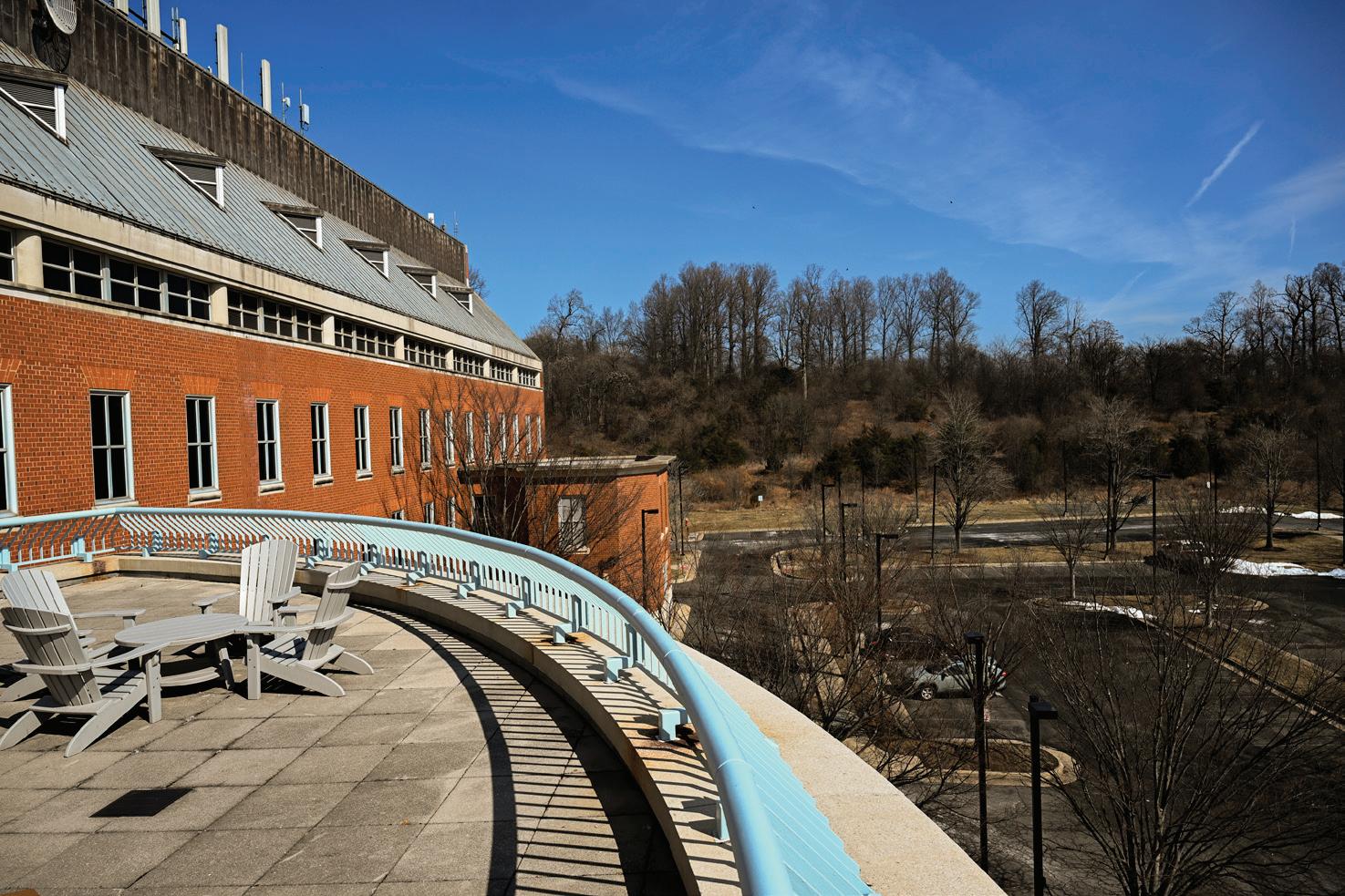
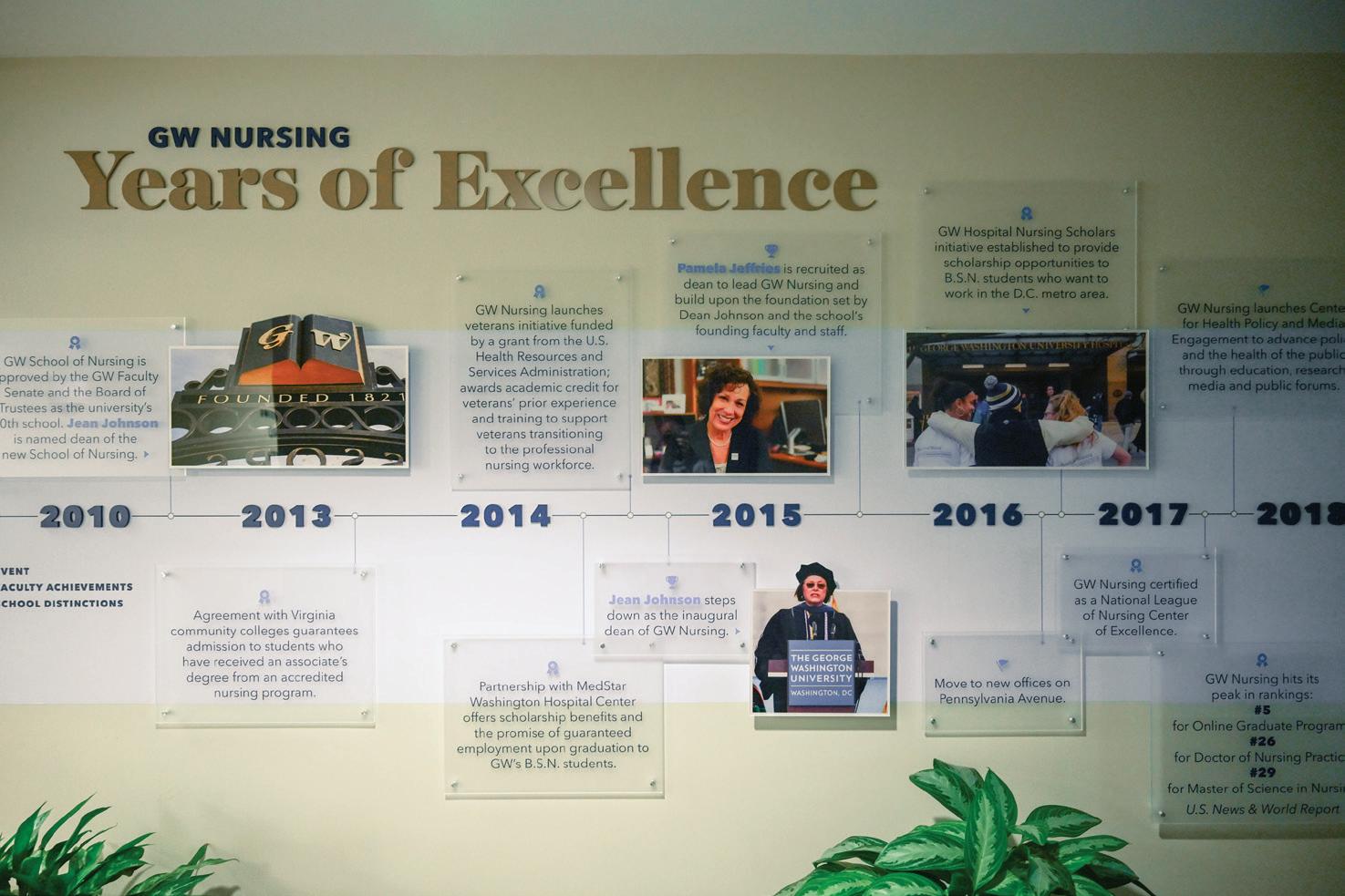
GW sold the Virginia Science and Technology Campus to an undisclosed buyer Friday. The deal will help fund GW’s new strategic framework and strengthen its fiscal health as the University navigates a period of financial instability, Chief Financial Officer Bruno Fernandes told The Hatchet Thursday, though he said the sale “won’t solve” the University’s structural deficit. The agreement permits the VSTC, which houses the School of Nursing and 17 research labs, centers and in-
stitutes, to retain the 120-acre property for up to five years as officials work to relocate operations without shrinking programs or the campus’ over 850 faculty and staff.
Officials declined to disclose the buyer’s identity or price point for the land, citing “confidentiality provisions” in the agreement, which closed Friday. Fernandes said several interested buyers approached GW roughly 18 months ago about purchasing the property, which officials started to “seriously consider” amid rising land prices in Ashburn’s Loudoun County, where the campus is located.
He said officials will use the profits from the sale — which the Board greenlit in October — to create a new quasi-endowment for University President Ellen Granberg’s strategic framework initiatives, including her planned investments in research, teaching and student financial aid. Prior to the framework’s October launch, Granberg said officials would have to hold off on funding the plan’s “fancy initiatives” because of GW’s financial instability. Fernandes said officials will also use money from the sale to fund a one-time bonus for eligible faculty and staff.
“This is a pivotal moment for the University,” Fernandes said in an interview. “This transaction will bolster our financial resources and provide us critical opportunities to deal with our priorities going forward.”
GW used a donation from former trustee Robert Smith to open VSTC in 1991 with a single building on 50 acres of land. Officials expanded the campus over the next two decades, purchasing a final 22.5 acres in 2012 to transform the space into the 120-acre campus it is today.
The campus houses more than 20 degree and certificate programs and 17 research
labs, centers and institutes, including the nursing school, the Avenir Foundation Conservation and Collections Resource Center and the University’s main data center. Several University offices also operate out of VSTC, including the Office of the University Controller, the Office of the Registrar and the Office of the Vice President of Finance and Treasurer.
Loudoun County’s commercial land values rose 55 percent over the last year, with the average price per acre hitting $3.76 million in 2026 — a $1.4 million increase since 2025 — which Fernandes said officials wanted
to “capitalize” on. Fernandes said officials will “ideally” move the nursing school to the Foggy Bottom Campus over the next five years and will spend the next few months creating plans for other operations, including the University’s data center and storage for The George Washington University Museum and The Textile Museum. Fernandes said he doesn’t expect the deal to impact current and future research GW conducts on the campus, though it’s “too early” to tell, as officials haven’t spoken with community members about the sale.
ELIJAH EDWARDS
EDITOR
ASSISTANT NEWS
The Department of Defense will bar senior military officers from a fellowship placement at GW starting next academic year, citing the University’s alleged “anti-American resentment and military disdain,” a memo confirmed Friday. The memo, signed and released Friday by Defense Secretary Pete Hegseth announcing terminations across 22 universities, identified one current GW participant in a DOD Senior Service College Fellowship — a partnership with a higher education institution that high-ranking military officers complete to strengthen analytical and strategic skills — that the department will terminate starting next academic year. The move comes weeks after an internal DOD memo, first obtained by CNN last month, labeled GW as one of 34 universities at “moderate to high risk” of losing graduate military tuition assistance for the 2026-
27 academic year due to alleged bias against the U.S. military and “troublesome partnerships” with foreign adversaries.
“We will no longer invest in institutions that fail to sharpen our leaders’ warfighting capabilities or that undermine the very values they are sworn to defend,” Hegseth wrote in Friday’s memo.
Friday’s memo does not address GW’s eligibility for the DOD Tuition Assistance program — the focus of Hegseth’s Feb. 6 memo, which allows active-duty service members across all branches to receive tuition support for off-duty education programs.
As of Sunday, a DOD tuition assistance database still listed GW as an eligible institution.
Chief Pentagon Spokesperson
Sean Parnell said in a Friday release individuals currently enrolled in an SSC Fellowship at one of named universities will be allowed to complete their courses of study. The Pentagon canceled a total of 93 fellowships across 22 universities and
research institutions that exhibited “wicked ideologies,” according to the memo and an accompanying video, and suggested potential new partner institutions for military fellows.
SSC fellowships give senior service members opportunities to study national security policy, strategy and operational issues to “substantially enhance” their ability to perform their duties in the national security field, according to the United States Army War College. Fellows attend more than 60 host institutions that the department selects and reviews each year based on their “strategic focus areas, academic excellence and resident national security professionals.”
“They’ve replaced the study of victory and pragmatic realism with the promotion of wokeness and weakness,” he said in the video announcing the cuts. “They’ve traded true intellectual rigor for radical dogma, sacrificing free expression for the suffocating confines of leftist ideology.”
Retiring School of Medicine & Health Sciences Dean Barbara Bass concluded her tenure marked by a consequential leadership legacy on Saturday.
Bass — who GW tapped to lead SMHS and the Medical Faculty Associates in January 2020, two months before the COVID-19 pandemic upended hospitals and universities nationwide — guided the school through one of the toughest modern moments in healthcare and also led the MFA as it struggled with deep financial losses that reached $107 million in her final fiscal year at the helm.
The Hatchet reached out to over 500 physicians, SMHS faculty members and former MFA officials and found mixed assessments of her leadership, with some commending her crisis management and academic initiatives, others describing a distant, occasionally disengaged approach that
strained trust and communication across the enterprise.
In an email, Bass described her time through the lens of resilience, saying the community forged that theme almost immediately in its response to the pandemic. She said physicians, staff, students and faculty met the COVID-19 crisis with “courage” and “sheer brilliance,.”
Bass declined The Hatchet’s request for a sit-down interview, a tradition most outgoing deans partake in, but shared written responses indicating she views the pandemic as the defining moment of her tenure at both SMHS and the MFA, which she stepped down from in May 2024 to allow GW to bring in an executive better suited at addressing its losses. In answering nearly every retrospective question, Bass cited the “global upheaval of the COVID pandemic” and the unprecedented “financial impact” across GW’s clinical and academic operations as the central successes, challenges and hardships of her time leading the two institutions.
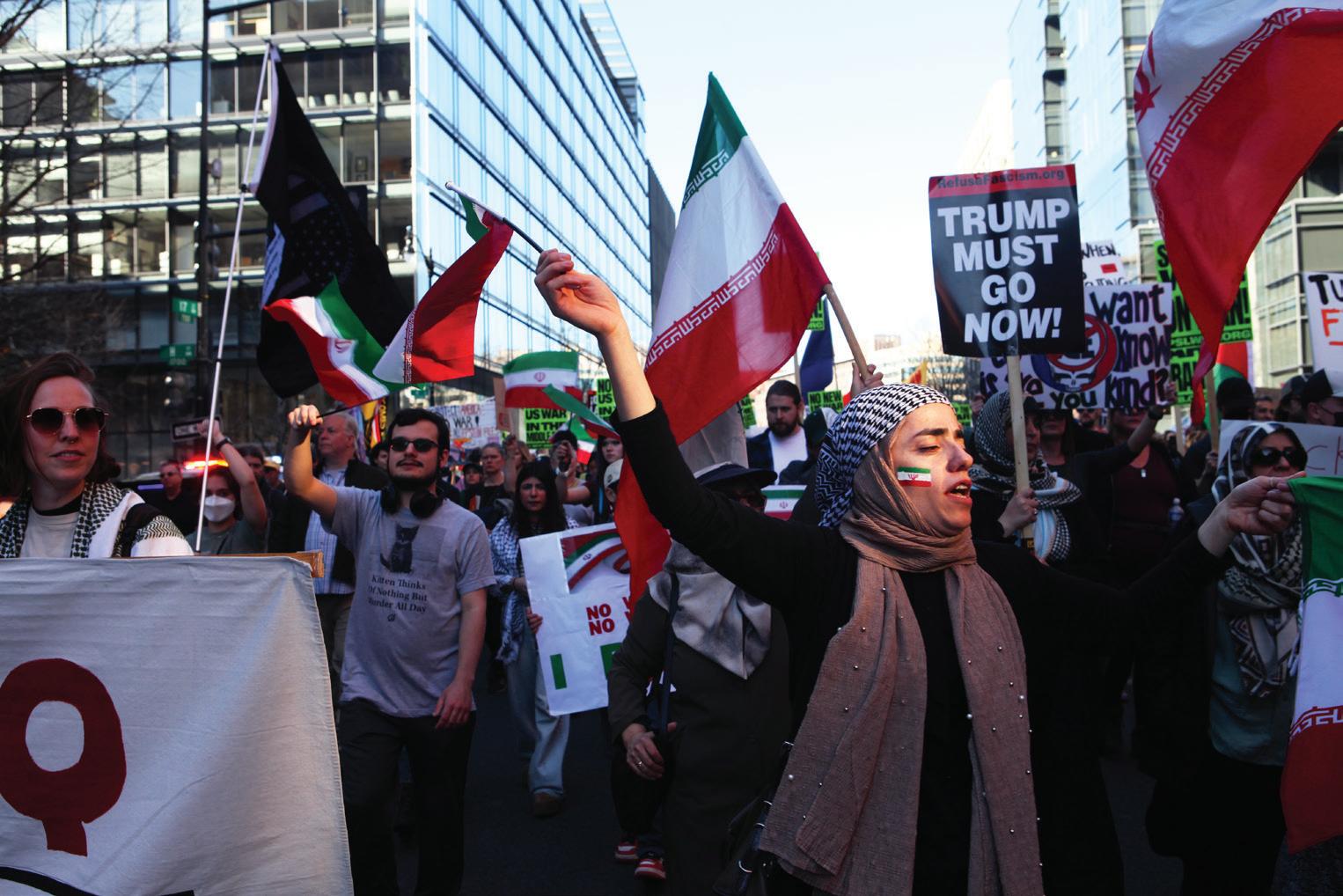
Protests and celebrations erupted across D.C. on Saturday after the United States and Israel launched strikes on Iran that killed its supreme leader, with demonstrators divided between fear of escalating U.S. involvement in the region and hope for an end to repression in the country. Demonstrators near the White House condemned the operation as a move by the U.S. government to impose another “endless war” in the Middle East, drawing parallels to the 2003 invasion of Iraq, and accused President Donald Trump of plunging the military into war without Congressio-
nal approval. Meanwhile, crowds in Georgetown and at the World War I Memorial celebrated the death of Iran’s supreme leader, Ayatollah Ali Khamenei, seeing the action as a potential turning point against a repressive regime responsible for the deaths of thousands of protesters over the last month and widespread crackdowns on civil liberties.
The United States and Israel launched a major campaign of strikes early Saturday targeting Iranian government and military sites — including locations in and around Tehran — after President Donald Trump said U.S. intelligence showed Iran was preparing attacks on American targets overseas and moved to “defend the American people.” Outside of the White
House and Lafayette Park Gerima and his fellow organizers stood on the back of a white pickup truck, leading the crowd in chants and inviting speakers to address the group of roughly 200 demonstrators. Gerima said the organizers planned the protest within hours after U.S. and Israeli missiles hit Iran early Saturday morning, viewing the move as an attempt to further entrench the U.S. military in the Middle East.
Demonstrations celebrating the death of Khamenei also cropped up throughout D.C., including on M Street and Wisconsin Avenue in Georgetown and at the World War I Memorial near the White House. Hundreds of people at both locations chanted “USA” and “Thank you President Trump.”
specify which ones.
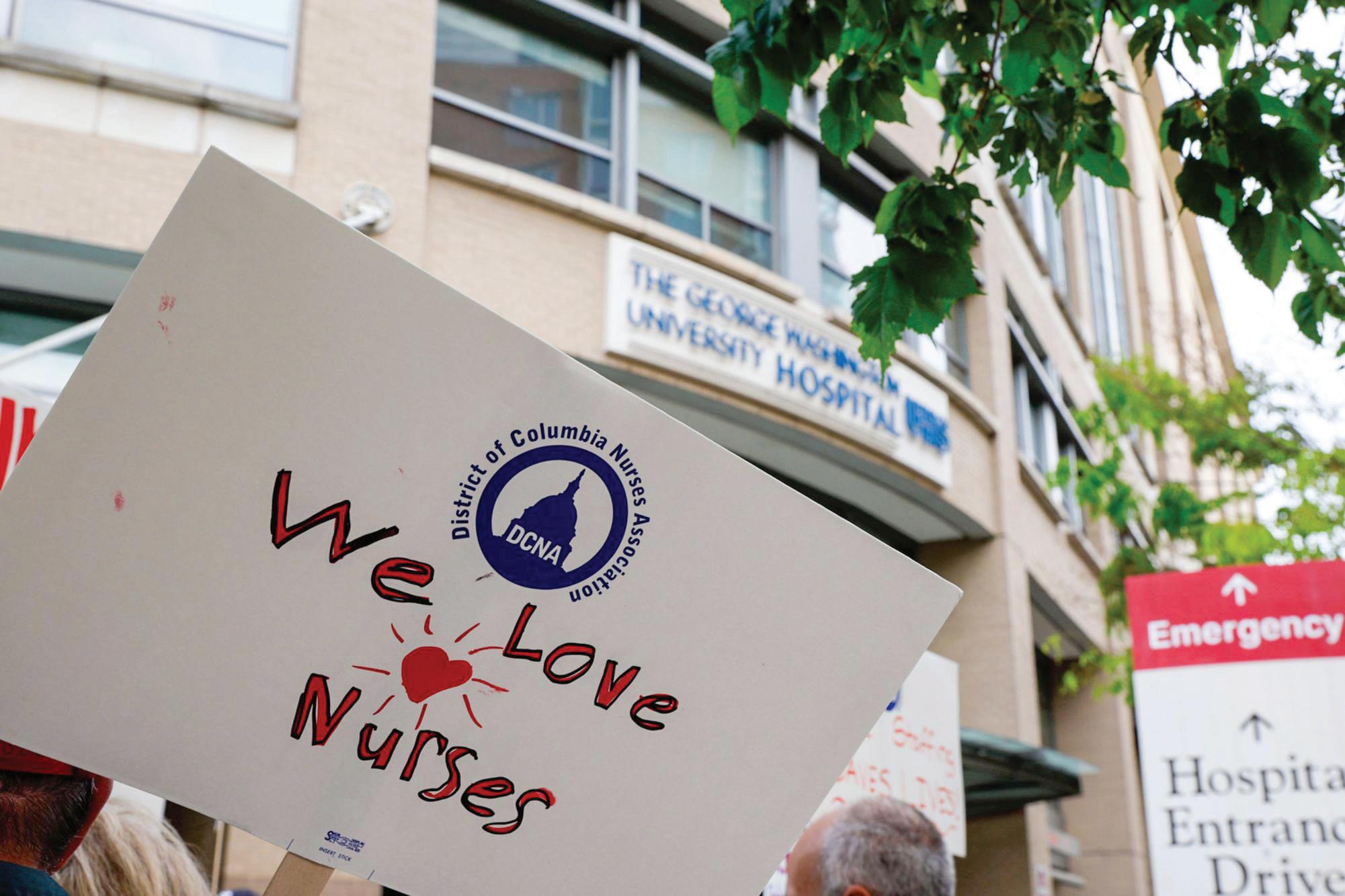
A year into contract negotiations, the union representing GW Hospital nurses says most issues remain unresolved, stalled by hard bargaining from the hospital’s owner and limited bargaining sessions.
GW Hospital nurses voted to unionize in July 2023 but did not begin bargaining until last March, after a nearly two-year appeals process before the National Labor Relations Board, which rejected the hospital’s challenge, certified the union and required the hospital to recognize it.
But as of Feb. 9, Executive Director of the District of Columbia Nurses Association Edward Smith said the nurses and hospital leadership had agreed on just 10 or 11 of roughly 30 contract articles — leaving high-priority issues like compensation unresolved.
The union has reached a tentative agreement with the hospital on employee discipline and discharge policies, a nondiscrimination clause and layoff procedures but has yet to resolve issues, like nurse autonomy — how nurses are allowed to delegate nursing and non-nursing — and compensation, according to monthly updates from the DCNA newsletter on ongoing bargaining.
Negotiations are moving slowly because Universal Health Services, GW Hospital’s owner, and other hospital management are “bargaining very hard,” Smith said. He said parts of the contract the union expected to be straightforward have become heated points of debate, though he declined to
GW first partnered with UHS, one of the country’s largest hospital management companies, in 1997 to run GW Hospital, and it became the sole owner of the hospital when the University sold its minority stake in 2022. Experts and union leaders in September 2024 said UHS has previously signaled union avoidance at GW — a legal approach employed by corporations and hospitals to slow union progress by attempting to stop union election wins.
They pointed to UHS’ history of not recognizing unions and refusing to bargain, with Smith describing the company as “one of the most anti-union care companies” he has ever worked with. Union efforts at UHSowned hospitals in Pennsylvania, California and Nevada have also failed in recent years.
Smith said bargaining is always a long process because hospital management has to look over every proposal the union places on the table, which are often dense. He said UHS has limited bargaining sessions to only two per month as coordinating with UHS’ Florida attorneys makes it difficult to find more times to meet, which is elongating the process.
Despite working without a contract for the past year, GW nurses’ union representation means hospital leadership and UHS cannot change working conditions without consulting union representatives and reaching an agreement, Smith said. But without a contract, there is no grievance arbitration process, meaning any complaints nurses have must be handled in court, not internally with an inde-
pendent arbiter.
Without a grievance arbitration process, the only course of action the union has to resolve disputes over the interpretation of the contract with GW Hospital is to take the complaint straight to court or the National Labor Relations Board. This is often more costly than working with an impartial arbiter and takes significantly more time, Smith said.
“It’s true and tested,” Smith said. “The arbitration system has been around in labor disputes for longer than I’ve lived and certainly longer than you’ve lived, and it’s much, much less costly.”
Smith in September 2024 alleged that UHS officials suspended a nurse for participating in union organizing, installed surveillance cameras in staff spaces and discouraged union participation in private meetings with nurses. For nearly a year after the union vote, GW Hospital refused to recognize the union, arguing its messaging, voter identification and the brief presence of supervisors at the union election thwarted the vote. DCNA has since filed at least nine unfair labor practice charges since the nurses announced their intent to unionize.
The nurses voted to unionize in the summer of 2023 to advocate for better patient care and working conditions, Smith said. A February 2023 release from the union stated that previous attempts to work with hospital leadership failed to result in “lasting systemic improvements,” leading them to unionize in an attempt to address inadequate staffing issues and poor working conditions.
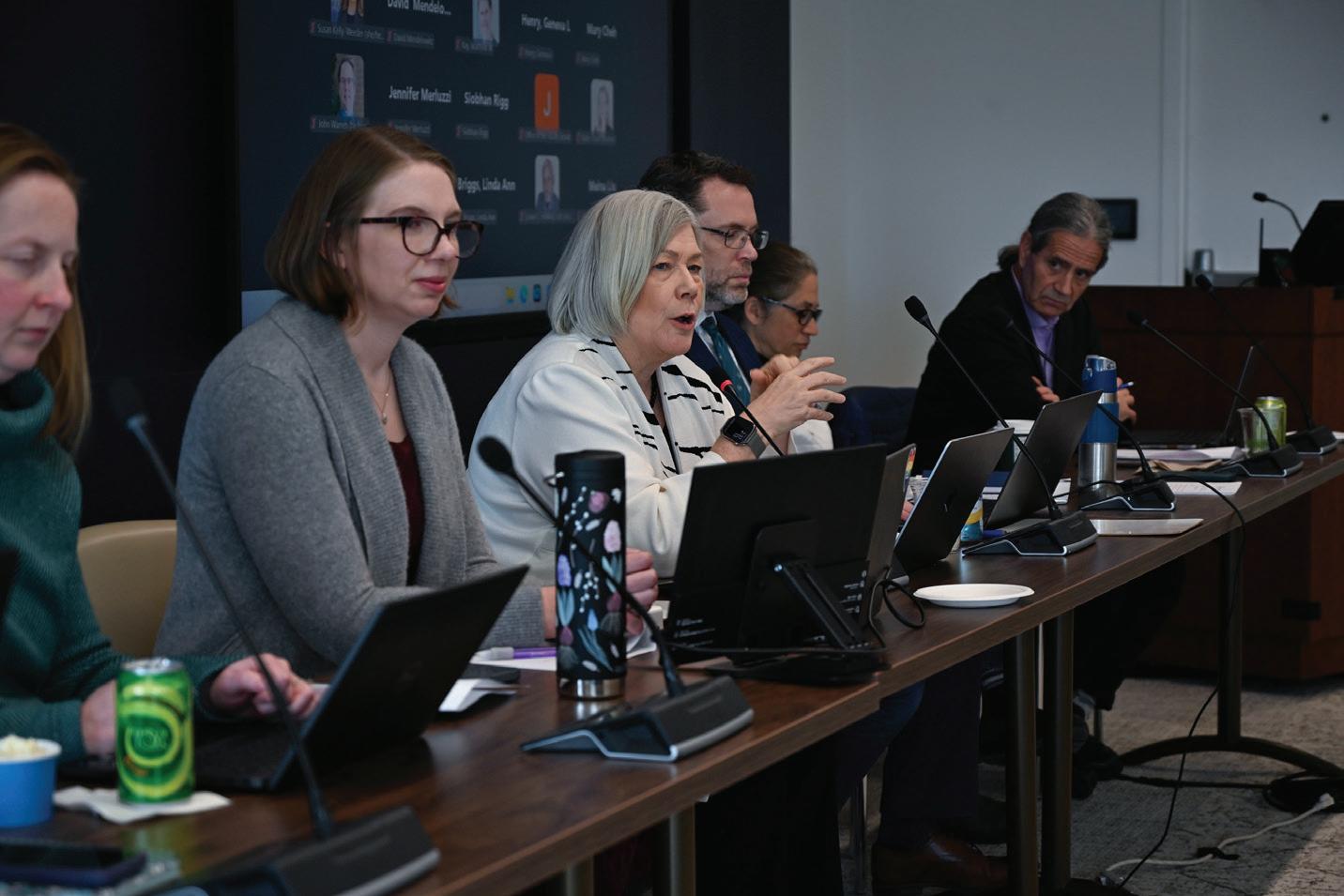
Faculty senators said officials’ executive sessions during their public meetings lack justification for privacy, limiting transparency because the discussions don’t involve information that the senate needs to keep confidential from the rest of the community. Since the start of the Faculty Senate’s 2025-26 term in May, senators have motioned three times to remove members of the public from its monthly meetings, including twice at the request of University officials seeking to discuss the plans for the debt-ridden Medical Faculty Associates and GW’s new budget model privately, according to the senate’s meeting minutes. Although the senate unanimously approved those requests, several senators said administrators need to provide clearer justification for why the information requires confidentiality, noting that recent sessions included details they felt didn’t warrant a privacy shield, which has hindered them from updating constituents on issues affecting GW.
The Faculty Senate has entered executive session for three out of eight meetings so far this term to discuss with top University officials like University President Ellen Granberg, Interim Provost John Lach, Chief Financial Officer Bruno Fernandes, vice presidents and deans. Senators also motioned at their own behest in October to enter executive session to discuss the Faculty Senate Executive Committee members’ requests for its chair step down.
All members of the public in attendance — including Hatchet reporters,
community members and lower-ranking officials not approved to enter executive session — must exit the room during executive session, though GW’s Faculty Organization Plan does not specify what information, if any, senators can discuss outside the meeting. Despite this, senators said they currently operate under the assumption that they can’t share “a word” from the executive session discussion.
University spokesperson Julia Garbitt justified administrators’ use of executive sessions by saying it is “standard governance practice” that reinforces the Faculty Senate’s governance role and allows for “thoughtful and candid” discussion between faculty and officials. She said executive sessions protect confidential information and “strengthen the partnership” between faculty senators and officials.
Granberg in August motioned the senate move into executive session so she could provide a “more fulsome” update on the MFA amid ongoing negotiations with Universal Health Services over the enterprise, which she said was on the advice of the University’s counsel.
Garbitt said the University is committed to “expanding opportunities” for consultation with the Faculty Senate on significant issues, like GW’s new budget model. She said by going into executive session on the budget model last month, officials allowed for senators to exchange ideas on the budget model proposal issues that have not yet been finalized.
Faculty Senator David Rain said he understands officials may want to enter executive session for sensitive deliberations, but he be-
lieves officials have increasingly used them to signal to the Board of Trustees that they have briefed faculty on University decisions. He said the information officials share in executive sessions, in reality, is often not sensitive enough to warrant a private discussion.
“We’re getting the impression that we’re being let in on all these deliberations, but I’m not sure that’s happening,” Rain said. He said officials during the Faculty Senate’s executive session last month told faculty they would share updates about the University’s new budget model they expect to roll out this spring, but they didn’t share the information faculty “really want to know.”
Faculty Senator Jennifer Brinkerhoff said requests to enter executive sessions — whether from officials or faculty members — should include a clearly stated rationale and be reserved for “specific circumstances” that are sensitive in nature, like issues related to federal challenges facing the University or budget-related issues. She said the senate should consider drafting a resolution outlining clear parameters for executive sessions, which would include what information, if any, from the executive session senators could share with their constituents.
Faculty Senator Jamie Cohen-Cole said executive sessions block officials’ communication with the rest of the community, hindering senators’ ability to do their elected jobs by preventing them from sharing information with their constituents. He said officials didn’t share any information in the two executive sessions they requested this year that could have put the University in legal jeopardy.
LIQUOR LAW VIOLATION
Media and Public Affairs Building
Clark Hall
2/24/2026 – 10:46 p.m.
Closed Case
The GW Police Department and an administrator on-call responded to a report of non-GW-affiliated individuals in the basement. The administrator on-call observed an alcoholic beverage in plain view and disposed of the alcohol on-scene. Case closed. Referred to Conflict Education & Student Accountability.
URINATING OR DEFECAT-
ING IN PUBLIC
1900 Block of F Street NW
2/20/2026 – 11:32 p.m.
Closed Case
GWPD received an email containing a photograph of a GW student urinating in a flower bed. GWPD identified the student and referred them to CESA. Case closed. Referred to CESA.
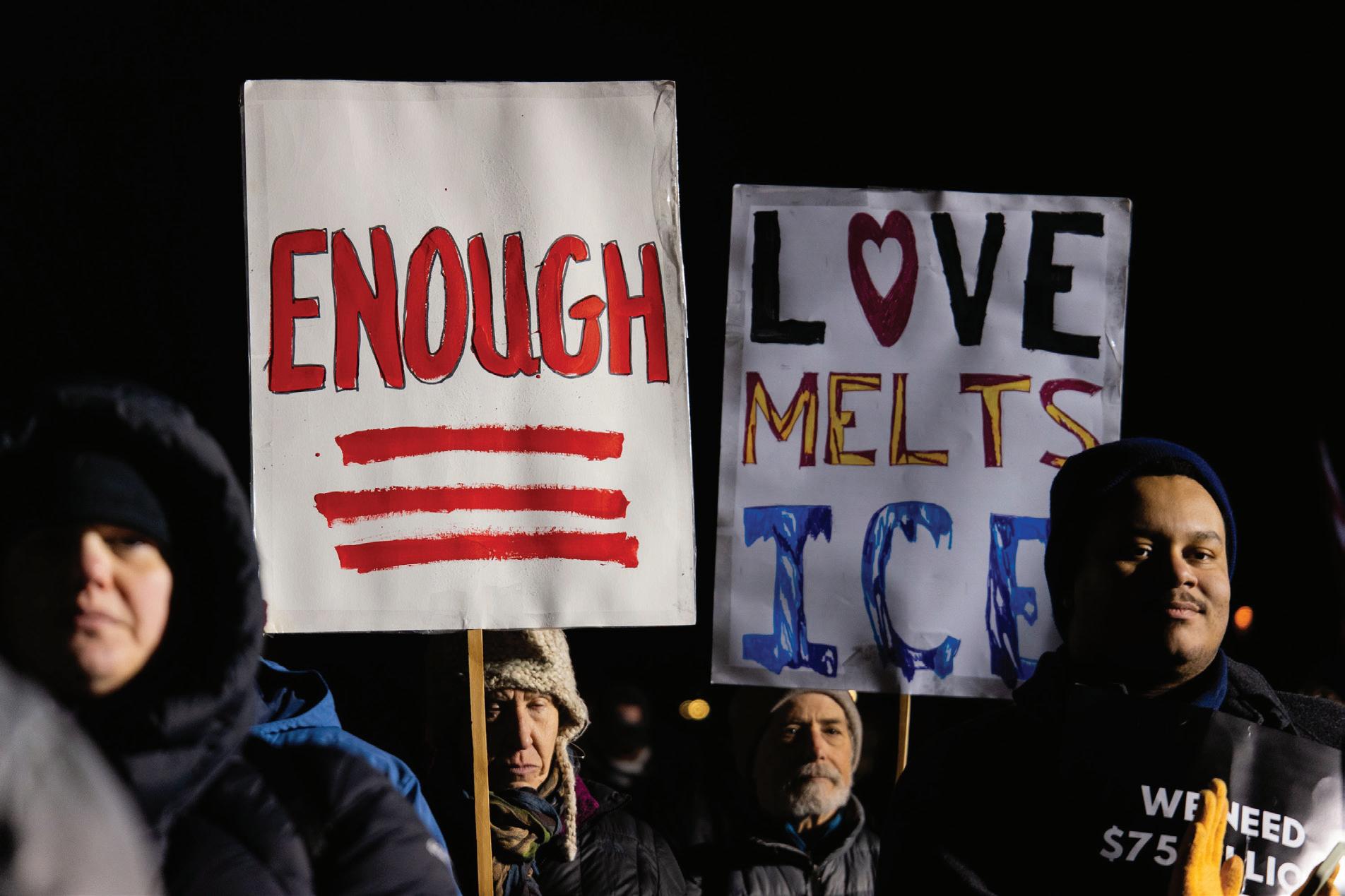
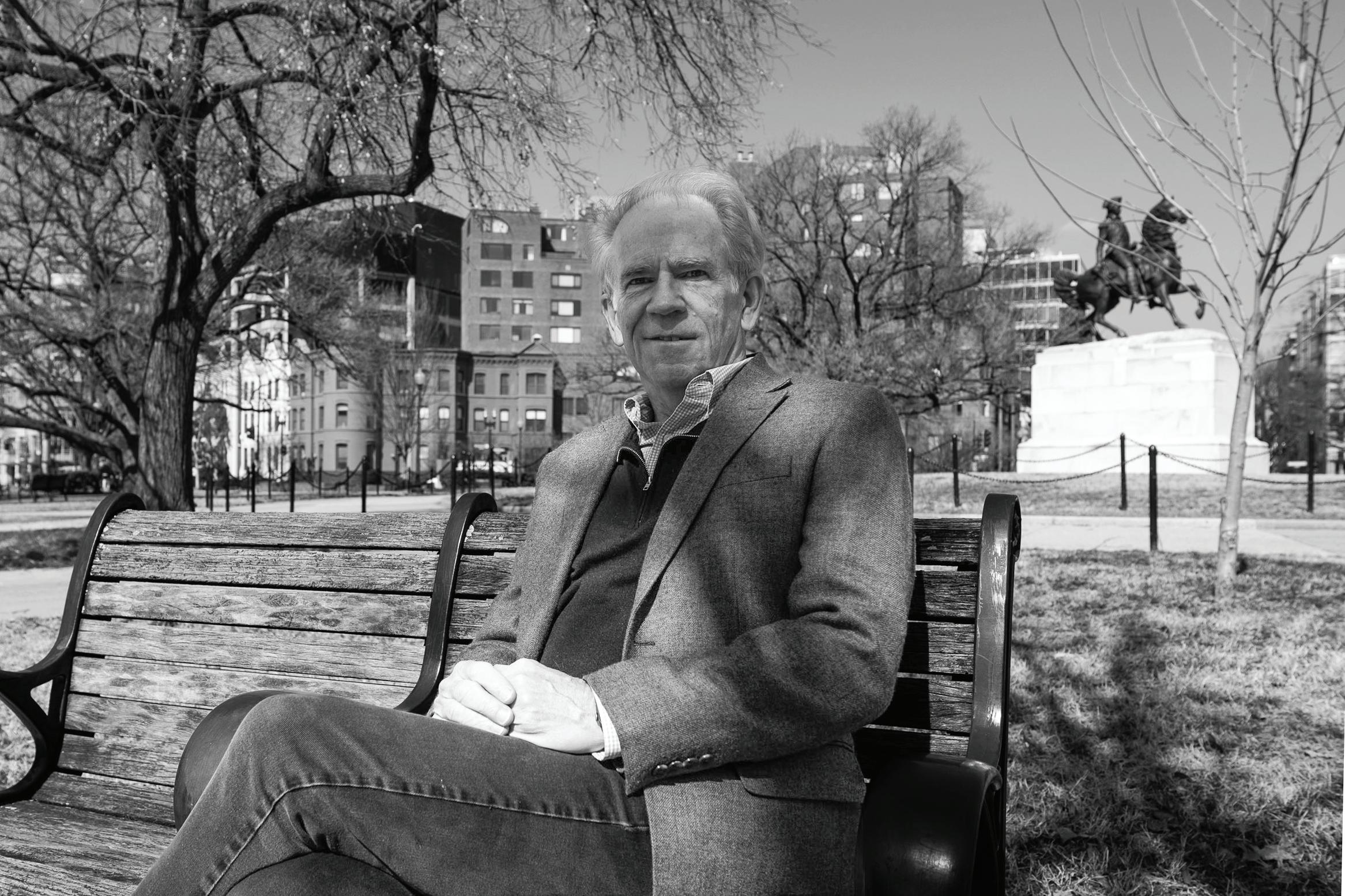
A financial consultant began his tenure on the Foggy Bottom and West End Advisory Neighborhood Commission in late January, providing representation to a district that went without a commissioner for over a year.
Wealth and markets specialist John Dolan — who now represents the West End’s 2A06 seat, which had been vacant since January 2025 — said he ran to restore district representation and bring his finance and local government experience to the ANC. Before moving to D.C. eight years ago, Dolan chaired his district on the Greenwich Representative Town Meeting in Connecticut, inspiring him to pursue a similar street-level role in Washington and a seat that could influence transportation and neighborhood issues in 2A06.
“I liked that process in terms of having a sense of knowing what’s going on in the neighborhood and also meeting like-minded people,” Dolan said. “And I was prompted by an inquiry from the Washington Area Bicyclist Association.”
Dolan, whose district includes The Aston unhoused shelter, said the facility is the
most pressing issue in his district, noting that it has gone largely without representation since opening — except for the first three months. He pointed out that last year, the ANC passed resolutions and
questioned officials to advocate for increased shelter capacity, despite the fact that no commissioner was in place to represent The Aston’s district.
“There was a period of
Joint Committee.
ADELAIDE PETRAS STAFF WRITER
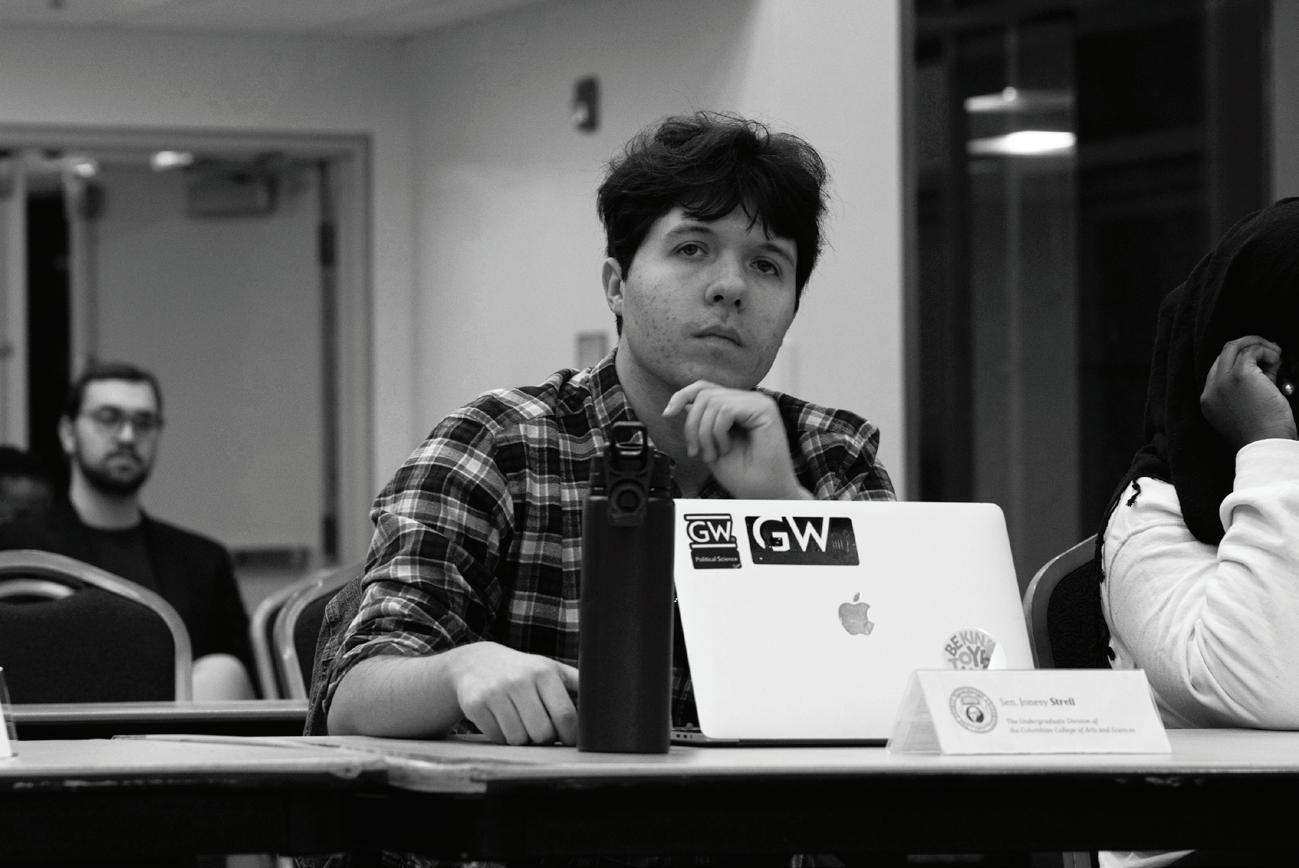
The University-Wide Programs Fund is nearly empty with 10 weeks left in the spring semester, which student organization leaders say is forcing them to scale back or cut large cultural events.
The UWPF — a joint fund between the University and the Student Government Association to provide support to student organizations for campus-wide and heritage celebration events — has disbursed $188,929.56 to 52 events since the start of the academic year, leading officials to impose a Feb. 15 deadline for student organizations to submit funding applications for the remainder of the semester because the fund was running low, SGA Sen. Jonesy Strell (CCAS-U), who serves as one of two SGA representatives on the UWPF Joint Committee, said. UWPF committee members said the fund is depleted with months to go in the spring semester because the committee appropriated too much money to only a few events this fall at the suggestion of GW administrators, leaving student organization leaders hoping to host large events this spring with narrow funding pathways.
The UWPF stood at $203,299 for the 2025-26 academic year and is now at $4,797, SGA Sen. Cheydon NaleimaileEvangelista (CCAS-U), the SGA’s other UWPF representative said, adding the
fund’s public tracker is out of date. Student organizations requested roughly $459,877 this year, compared to $365,707 last year when the SGA distributed $248,138.
A University spokesperson did not return a request for comment.
Strell said UWPF administrator representatives pushed to fund events in full because they assumed the committee would get the bulk of its requests in the fall, a logic he said demonstrated “recklessness” as the committee still received an influx of requests this semester. UWPF has historically funded about an equal number of events in the fall and spring semesters, according to the tracker, with roughly half of last year’s 57 UWPF-funded events taking place in the spring compared to only about a dozen of this year’s 52 events.
“You always got to expect that you’re going to get a large number of requests,” he said. “One week, you may have 10 requests. Next week, you may have 30.”
Naleimaile-Evangelista, who is also the SGA Finance Committee’s chair, said he has seen organizations submit funding requests to the SGA this semester that UWPF would typically fund because of the fund’s depletion.
“The UWPF committee just needs to take accountability for how they mismanaged their money,” NaleimaileEvangelista said.
time where the Aston discussions were moving forward, but there was nobody in that particular SMD who could speak to those issues,” Dolan said.
2A06 has lacked repre-
sentation on the ANC since January 2025, when former Commissioner Joel Causey’s term ended after he decided not to seek re-election. Dolan previously served on the Chatham, Massachusetts
Bikeways Committee, an advisory group that made recommendations to town trustees for projects spanning jurisdictions. He said Foggy Bottom and the West End’s patchwork of federal, local and GW-owned land will likely require him to evaluate similarly cross-jurisdiction projects on the ANC. At his first ANC meeting as commissioner Wednesday, he introduced a resolution, which the ANC unanimously passed, opposing a rumored forthcoming attempt by the federal government to remove the bike lane on 14th and 15th streets NW. Dolan attended the ANC’s January meeting but was unable to vote on any topics because the D.C. Board of Elections hadn’t yet certified his victory. Dolan said he decided to run for commissioner as he moved further into retirement and had more time for local civic work. A spring 2025 announcement from the Washington Area Bicyclist Association seeking more representation in local government from people who understood cycling and other two-wheeled transportation issues pushed him to run, he said.
“I heard an announcement and reacted,” Dolan said.
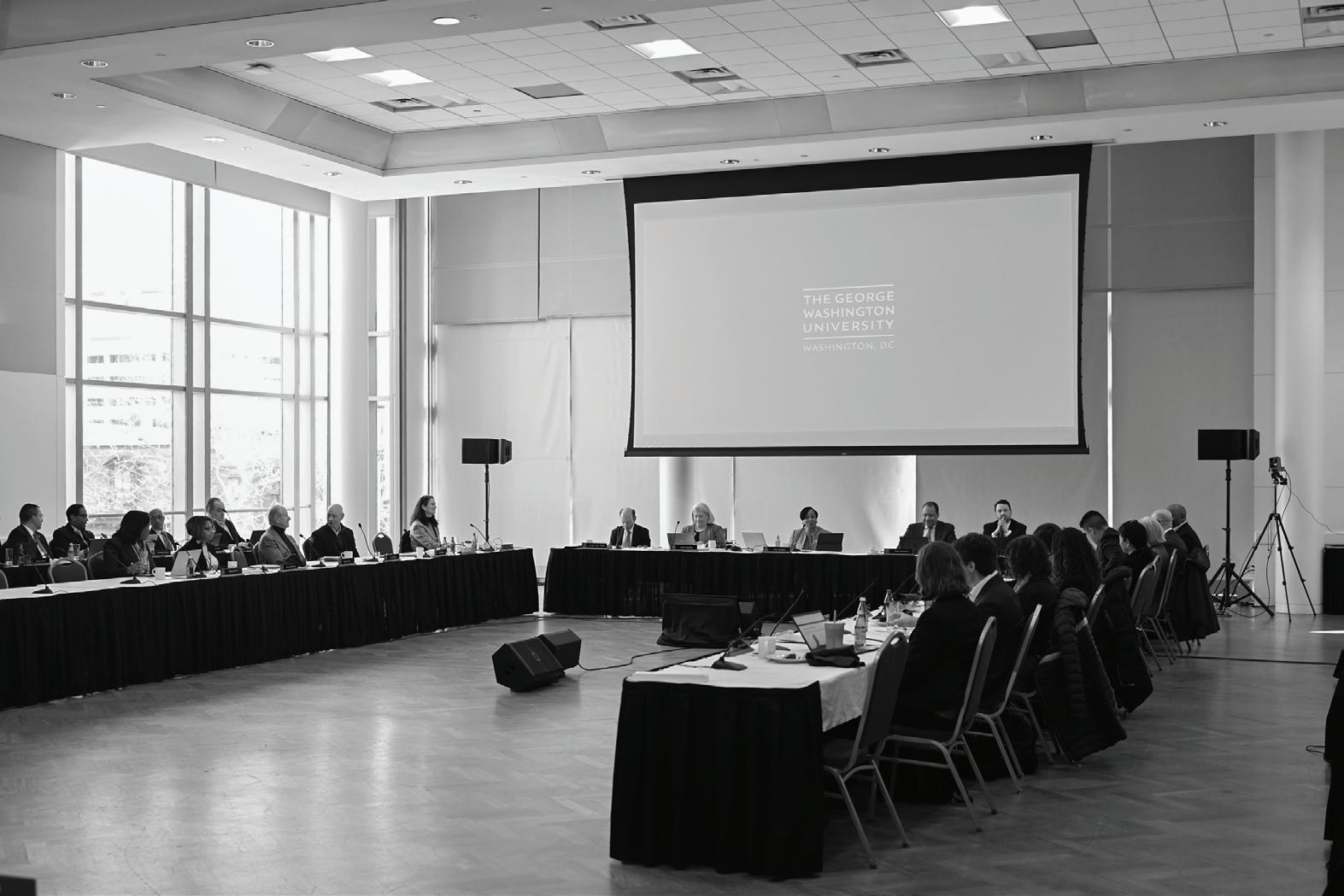
The Board of Trustees will convene for its retreat and a private meeting in Baltimore, Maryland, later this month, in place of its typical winter, partially public, on-campus meeting, a University spokesperson confirmed Friday.
The spokesperson said Baltimore is a “cost-effective” location for the Board’s retreat, which web archives from August show was planned for March 18 to 21, noting that its off-site location reduces the body’s yearly meeting expenses. The retreat, coinciding with the Board’s private meeting, departs from its longstanding practice of keeping portions of its three annual mandated meetings open to the public.
University spokesperson Julia Garbitt said trustees and officials from the executive leadership team will attend the retreat, which provides an opportunity for the Board and
officials to collaborate on planning for years ahead. Garbitt declined to comment on the projected total cost of the retreat and what expenses the cost of the retreat covers, including if it covers trustees’ travel and lodging expenses. She declined to comment on the exact venue of the retreat.
The Board, in recent years, has convened for regular meetings in the University Student Center, with virtual registration for the public portion open to community members.
The Board’s bylaws, which the body last revised on March 24, 2025, require trustees to hold an annual meeting each May and at least two additional regular meetings during a calendar year, with retreats optional at the chair’s discretion. The bylaws do not mandate that the meetings be partially public or disclosed on the governing body’s calendar, but web archives over the last decade show the Board has routinely listed at least three meetings,
including any retreats, online. The trustees held three regular meetings last year — in February, May and October — each of which included a public session. The Board also met in late June for a retreat, according to web archives. The Board’s website in August initially listed the Board’s meeting and retreat from March 18 to 21, 2026, according to web archives. University spokesperson Shannon McClendon said in November that the Board’s March meeting no longer appears on the calendar because they eliminated the public portion.
The meeting marks the first time since at least 2014 that the Board has omitted one of its three regular meetings from online records, according to available web archives.
The website does not currently mention the Board’s private meeting or retreat but lists May 15 as the next scheduled session, with no date yet listed for its third meeting of the year
A year after Foggy Bottom residents raised concerns to local leaders about 911 dispatch delays, the District has seen drastic improvement in call response time and accuracy following oversight into the program and reforms by Ward 2 Councilmember Brooke Pinto, a D.C. government dashboard shows.
As repeated 911 outages have struck the District since 2024, Pinto increased oversight on the Office of Unified Communications — which fields emergency and
non-emergency 911 and 311 calls — by conducting unannounced visits to OUC’s 911 call center, hosting monthly public oversight hearings and introducing a bill last month aimed at boosting accuracy in dispatching services at the call center. Staffing and funding issues have plagued OUC for years, leading to dispatch mistakes and delays in response time, but recent agency data shows the call center is now in line with national standards, with average answer time falling from 6.5 seconds in February 2025 to 1.8 seconds in February 2026. The OUC answered 96.3 percent of 911 calls within 15 seconds in February, up from about 88.2 percent last Febru-
ary, according to the dashboard. The dashboard also shows a smaller share of callers who abandoned their call after waiting more than 15 seconds, dropping from 4.7 percent to 3.1 percent from 2025 to 2026 — a 726-call decline from 2,282 in 2025.
A spokesperson for OUC said strategic investments in training and technology have pushed the office to exceed the national 911 standards of answering 95 percent of calls within 20 seconds. They said OUC answers 98 percent of 911 calls within four seconds, down from 15 seconds in 2024.
The daily share of 911 calls operators picked up within 15 seconds stayed above 90 percent throughout
that 2026 window after dipping below 90 percent on 12 separate days in 2025, the dashboard shows.
The improvements come a year after residents of Claridge House Cooperative in Foggy Bottom raised concerns about 911 call wait times after more than 200 residents evacuated the building in February 2025 after a tenant spotted smoke in the elevator and a front desk agent dialed 911 — only to allegedly be put on hold for a half-hour.
D.C.’s 911 call center has struggled with staffing shortages since 2023, which the center’s director said contributed to the delays in services and accuracy at a Committee for the Judiciary
and Public Safety meeting in September 2024. In January, 13 out of 66 — or about 19 percent of shifts — did not meet the agency’s minimum staffing target, according to the OUC dashboard. The dashboard only contains staffing data for the three most recent months, but The Washington Post reported in July 2024 about 90 percent of shifts at the call center did not have enough staff that month. The issues mirror shortages at call centers across the United States that have been struggling to respond to emergencies with speed, efficiency and accuracy without national mandates for the industry for about the last five years, CNN reported in August.
At a Feb. 19 Committee on Judiciary and Public Safety oversight hearing for D.C. Fire and Emergency Medical Service and the Office of Neighborhood Safety and Engagement, public witness Marie Drissel testified that she is supportive of FEMS’ performance over the last year but is “remaining critical” of OUC because the office accidentally dispatched a first responder to an address earlier that month that didn’t exist to help an elderly patient who was having difficulty breathing.
“This wasted extremely valuable time. D.C. Fire and EMS is doing their part, now the city must fix the Office of Unified Communication,” Drissel said.
“The MFA was caught in that maelstrom like so many others at the time, and recovery was challenged by multiple factors,” Bass wrote.
The MFA’s losses began in the fiscal year that coincided with the start of the pandemic, though the $43 million deficit in FY2020 represented only the initial four months of the threeyear-long pandemic. The enterprise went on to lose $48 million in FY2021, $78 million in FY2022, $78 million in FY2023 and $107 million in FY2024 — Bass’ final fiscal year leading the institution. The MFA lost an additional $100 million in FY2025, current MFA CEO Bill Elliott’s first full year in the role.
Officials are now finalizing a deal with Universal Health Services, the owner and operator of GW Hospital, to end the University’s financial support of the debt-ridden institution.
“My approach was always to lead with authenticity, especially when facing difficult financial truths and to engage expertise to craft new strategies, despite headwinds,” Bass wrote. “The pandemic more deeply revealed the essential structural changes that were needed in our GW academic medical enterprise to achieve a sustainable future.”
Some MFA leaders, physicians and SMHS faculty
didn’t paint as rosy a reflection on the school and practice’s culture under Bass’s leadership, instead emphasizing that she was physically absent from the MFA and SMHS sites during her stint as both CEO and dean, which inhibited the community from building trust with her.
“She did not leave GW stronger than she came to it, she has weakened it,” said a former physician who worked under Bass during her tenure as Dean and CEO and has since left the MFA.
The physician, who requested anonymity out of fear of retaliation from GW, echoed the same sentiment that many members of the MFA and SMHS communities shared in interviews, describing Bass as distant from the people and institutions she led. They said she “never set foot” in the clinic, medical school or hospital, signaling a disinterest in the work GW brought her in to do, also saying that Bass had a tendency to pursue what she felt was right for SMHS and the MFA rather than listen to the advice that those around her provided.
The physician said her unwillingness to listen to those around her hindered the MFA’s ability to return to profitability.
“As a leader, the people that are the most important to listen to are the people that disagree with you,” they said. “She did not in any way tolerate any dis-
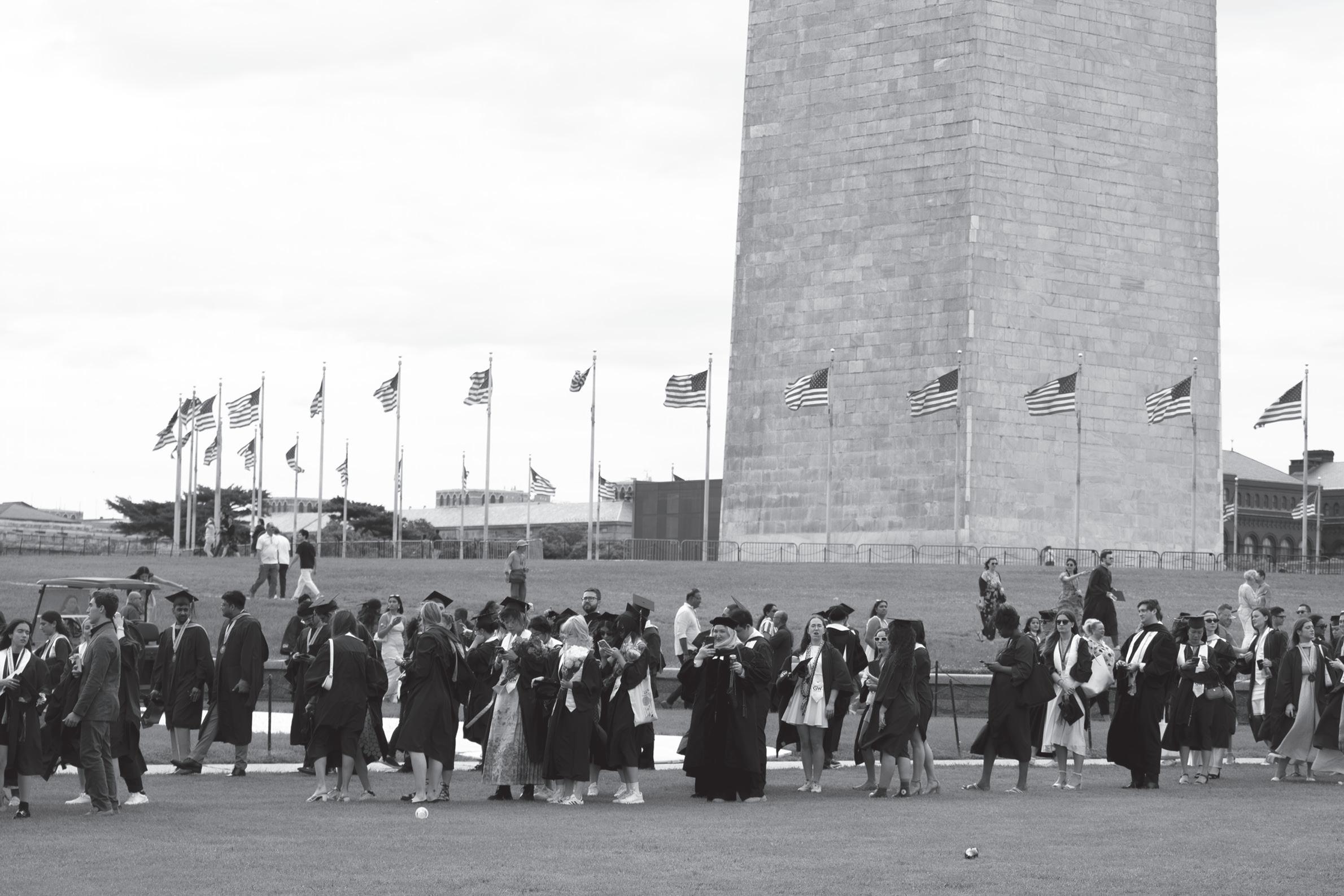
President Donald Trump’s Freedom 250 commission to celebrate the country’s semiquincentennial will host a prayer event on the National Mall at the same time as GW’s May Commencement Ceremony, a University spokesperson confirmed.
The Rededicate 250: National Jubilee of Prayer, Praise, and Thanksgiving event will take place on the National Mall near 12th Street on May 17 from 6 a.m. to 6 p.m., overlapping with GW’s Commencement Ceremony, which will take place less than half a mile away at the base of the Washington Monument from 10:30 a.m. to 12:30 p.m. University spokesperson Kathleen Fackelmann said officials do not expect Freedom 250’s event to interfere with GW’s ceremony.
sent. When anybody would push back, then it would be an issue.”
A former senior MFA official, who worked alongside Bass during their time at GW and requested anonymity out of fear of retaliation, said Bass’ physical absence meant the medical enterprise’s employees never developed a connection and a loyalty with their top boss. The official said many clinical faculty talked among themselves about how Bass wouldn’t make small efforts to get to know the people she worked alongside, pointing out how previous deans would take advantage of eating their lunches in the doctor’s lounge, for example, to socialize with their employees.
“Nobody felt any loyalty to her in the sense that nobody knew her,” the official said. “She was never around, and she was never supportive of anything, at least on the MFA side.”
The official also criticized GW’s decision to bring Bass on in 2020 as both MFA CEO and SMHS dean because there’s an “inherent economic conflict” between the two bodies. Because the MFA and SMHS share revenue streams and financial obligations, leading both meant Bass would have to prioritize one institution’s financial standing over the other, the official said, adding that Bass chose SMHS over the MFA.
“You can’t be fair to both, and her primary goal

was SMHS,” the official said. “It’s not a question of time, it’s a question of you’re heading two groups that have always, to some small extent, been in conflict.”
Lead MFA Physician for West End Alexandria Jacinta Elder-Arrington applauded Bass’ work steering the medical enterprise through the storm of COVID-19, adding that although there is a sentiment within the community that Bass could have handled the pandemic and the MFA’s losses differently, “hindsight is 20/20.” She said GW is one of many healthcare centers nationwide dealing with
rising labor costs, Medicare reimbursements and the effects of inflation, but she emphasized that it matters more how officials create stopguards to prevent similar challenges in the future. She said in retrospect, it’s easy to understand why the MFA would benefit from its own leader separate from the GW umbrella.
“Not just the University, but the enterprise, would benefit from asking the question, how can we shore up the governance structures such that this is avoided through crises in the future?” Elder-Arrington said.
An MFA physician, who requested anonymity due
“We are in close contact with the National Park Service and have confirmed that the event will be held on a separate part of the Mall and will not impact GW’s Commencement program,” Fackelmann said in an email. Freedom 250 will hold the event on 12th Street, near the National Museum of American History, and feature artists and faith leaders, according to a Freedom 250 release. National media outlets will also
Three GW students are expanding the reach of and pursuing nonprofit status for an organization they formed last year to foster students’ empathy by inviting women from conflict zones to campus to engage in dialogues on their experiences.
Trigger Empathy, a project started by three students in January 2025, has so far invited three women with personal experience in an international conflict for discussions on GW’s campus, creating intimate, safe spaces for students to learn from their stories with the hopes to influence the next generations’s leaders and changemakers to be more empathetic. The group’s leaders said they hope to receive nonprofit status after applying for it in December and aim to become a larger organization with chapters at universities nationwide in the future, expanding the network of events and fostering greater empathy at colleges throughout the United States.
“Our model is that we want people to look at international conflict from the perspective of human experience as expertise, instead of always looking at policy first,” said Ella Kushins, one of the group’s co-founders.
“Of course, policy is important, but it’s not the only thing that’s important.”
Kushins, a sophomore majoring in political science and women’s, gender and sexuality studies, said women tend to be the most marginalized and unheard group in conflicts, like the Israel-Hamas war and the lasting impacts of the U.S. war in Afghanistan. She said Trigger Empathy focuses on bringing women from conflicts to college campuses to add new perspectives that can supplement students’ education on global conflicts.
She said she got the idea for the project after attending a panel in January 2025 that an external organization hosted at GW with a Palestinian woman and an Israeli man speaking about peacebuilding work. Kushins said she felt the man was muffling the Palestinian’s experiences as he kept speaking over her.
Kushins, who participated in GW’s Women’s Leadership Program as a first-year student, said her connections to the program have also helped Trigger Empathy receive funding through WLP’s Humphries Grant — a scholarship that provides funds for WLP alum pursuing unpaid projects.
“Being able to apply my
broadcast the event, which will be livestreamed to churches and partner organizations across the
gender studies political activism lens to such a relevant and important topic was what enabled us to come together and create this idea for Trigger Empathy,” Kushins said.
Natasha Halbfinger, Trigger Empathy’s co-founder and a junior studying international affairs, said the organization is currently pursuing nonprofit status so they can cement themselves as a more permanent organization — a move she said will support their own goal of adding empathy to education by continuing to foster discussions about women’s often ignored experiences in conflicts and their speakers’ goals of advocacy for those currently living in conflict zones.
Halbfinger said she would like to eventually see Trigger Empathy establish chapters at college campuses around the world and develop a large network for speakers sharing their experiences, organizations advocating for humanitarian issues and attendees wanting to learn and stay connected.
Lara Jalal, the third cofounder and a sophomore studying international affairs, said Trigger Empathy has hosted three speakers so far — one each semester since their founding last year. The group brought in Yazidi sur-
country, the release states. GW has hosted its commencement ceremony on the National
to privacy concerns, said Bass’s tenure as CEO was “disappointing.” They said despite the MFA staff’s initial positive reception to her placement, her lack of communication between herself and her physicians quickly defined her time at the enterprise. “I think she said the right things,” the physician said. “I don’t know if, necessarily, she put it in practice.” In response to physician concerns about Bass’s leadership, a University spokesperson said Bass prioritized “direct” and “consistent” engagement with the community, citing the monthly town halls she hosted throughout her tenure.
Mall since 2005 and has drawn upwards of 25,000 guests in past events. GW’s University Commencement website states officials plan to hold the ceremony on the National Mall unless National Park Service directs them to move it or if conditions make the location unsafe.
The Rededicate 250 event is one of many events planned throughout D.C. this summer, including the Great American State Fair — which will also take place on the Mall in June — to celebrate the 250th anniversary of the United States’ independence. The Freedom 250 describes Rededicate 250 as a national prayer event where attendees will “bear witness” to the story of how God has shaped U.S. history through speech, song and storytelling.
“Join with neighbors and friends from every state in the Union in giving thanks and praise to God for 250 years of His Providence for the United States, in praying that God Bless and Protect America for the next 250 years,” the event description states.
Both Freedom 250 and the NPS did not return a request for comment about the event and how many attendees they expect to attend the Rededicate 250 event.
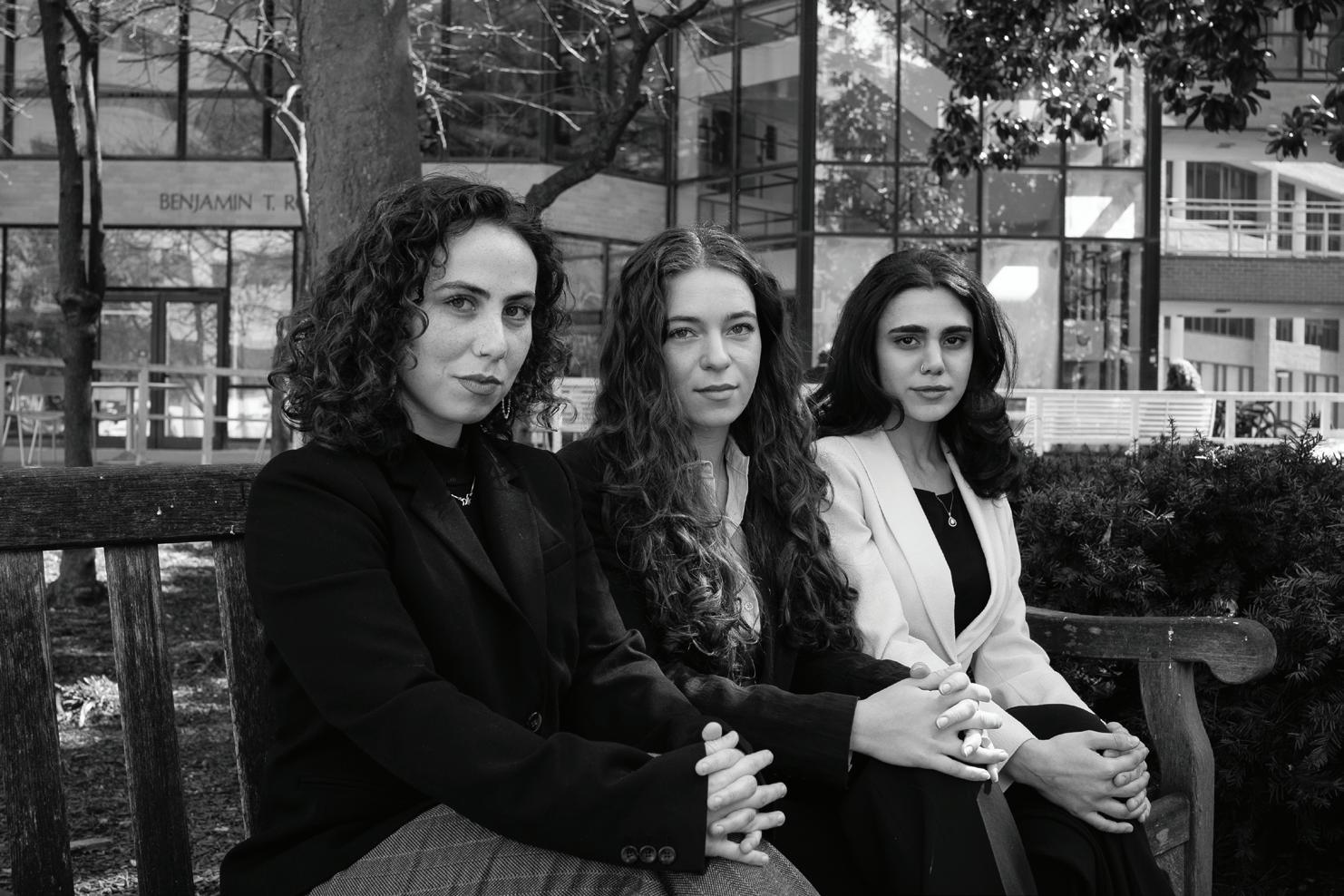
vivor and filmmaker Mediha Alhamad for two events last month, while other events have featured a Palestinian woman from the West Bank and an Afghan activist and teacher, she said.
Jalal said the group’s events are intentionally small — with a maximum of 20 attendees sitting in a circle — to facilitate more intimate conversations where attendees can better understand and talk about the women’s backgrounds and use that
knowledge to become empathetic to experiences like theirs.
“A big part of feeling empathy for someone is also connecting it to your own personal experiences, and that’s what small-scale events are mostly about,” Jalal said.
Jalal said Trigger Empathy currently screens attendees who express interest in participating in the dialogues, asking questions about their motivations to ensure an intentional and
engaged audience for the speaker and a meaningful experience for all participants. She added that the group eventually plans to make events less selective, phasing out the screening process once they have a better understanding of how to facilitate discussions.
“An important aspect of triggering empathy is triggering empathy in people who are not very empathic in the first place,” Jalal said. “So that is our goal in the future.”
April’s Student Government Association elections are fast approaching, and with them comes a familiar reckoning. Each election cycle revives the same questions among the student body. How much power does the SGA really wield? What has it accomplished? How well do students actually understand the body’s capabilities and the real influence it has on University decisions? For a student government with direct access to top officials and the ability to influence which student issues reach the highest levels of University leadership, it’s crucial that students understand and use the body’s power. At GW, the SGA’s leaders sit at the table with senior officials, maintain direct access to decision makers and hold a level of institutional influence few other student organizations can claim. In practical terms, that means agenda-setting power and the ability to elevate concerns, negotiate policy shifts and advocate for changes that shape the student experience. The infrastructure for engagement already exists. The body hosts caucuses where students can raise concerns. Public meetings offer transparency into the SGA’s deliberations. Office hours with the body’s president and vice president provide direct access to these leaders, who are ready to advocate for student concerns. But access does not automatically translate to impact. Many of these forums remain underutilized by the student body. Representation is only as strong as the participation behind it.
Students have an opportu-
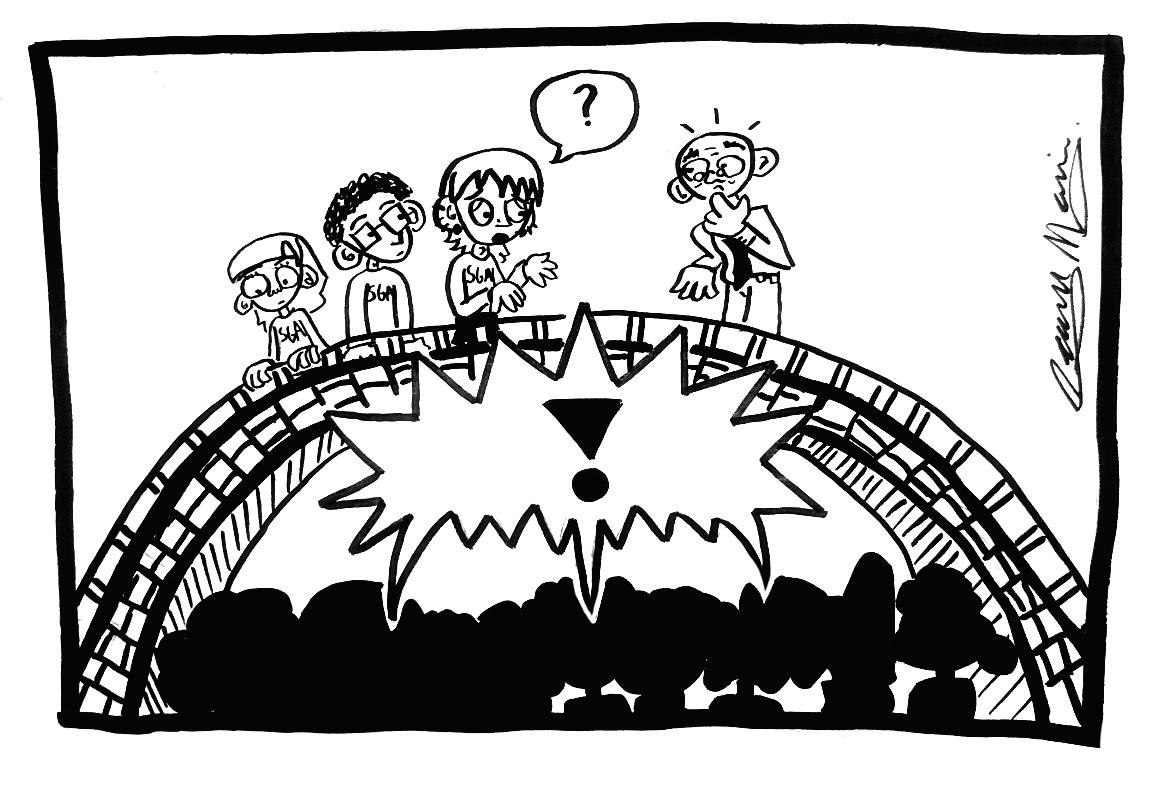
nity, and arguably a responsibility, to better understand how the SGA operates, evaluate its track record and articulate concrete priorities for the year ahead. Elections should be a time for students to learn about the structures available to them to drive measurable change. The SGA’s influence is real. But its effectiveness depends on student engagement. The governing body is frequently dismissed by large segments of the student body, reflected in consistently low voter turnout year after year. Too often, students forgo the very mechanisms designed to amplify their voices, leaving concerns about GW aired in private conversa -
tions rather than public forums where change can take shape.
The SGA has advocated for significant change this year. It pushed for 24-hour access to Gelman Library and worked directly with officials to help move the issue forward. It has spoken out against proposed Code of Student Conduct changes and launched new mental health initiatives aimed at expanding support for students. It has spoken out about National Guard presence on campus, the Immigration and Customs Enforcement raid conducted at Circa and the heavy ICE presence in Minnesota. Students want the University to be held accountable, and the
Students see the problems at GW. It’s time to step up and lead
It isn’t difficult for GW students to identify campus concerns. Officials over the last year have implemented budget cuts and layoffs without full transparency or public reporting on the details of what they’re eliminating and why. They are preparing to implement Code of Student Conduct changes that revoke students’ rights to a fair panel hearing and an appeals process in disciplinary cases. They have gone back on GW’s stated commitment to diversity, equity and inclusion. The cost of attendance for students and families rises each year. These are all issues many students want to see officials address.
Problems at our school are easy to spot. Finding solutions is harder — it takes passion and dedication, fresh ideas and good leadership. If we are to tackle the tough challenges GW faces, we need good leadership in our student government working hard for positive change. This spring, the student body will choose new Student Government Association leadership through an open election, and all students can throw their hat in the ring. As the new chair of the SGA’s Joint Elections Commission, I am surprised
whenever I hear that students are reluctant to run for an SGA position because they’re not sure whether they, or the SGA as a whole, can accomplish much. The issues we experience on this campus can only be solved by effective advocates determined to take them on.
Driven students who seized the mantle of leadership and pressed for solutions in the past years won discounted U-Pass Metro cards for GW students, restored 24/7 Gelman library access, increased funding for campus clubs, expanded health services and many more benefits we enjoy each day.
Now, we need a new generation of leaders and advocates to fight for the GW we want to see and to lift up student voices.
Sure, many candidates are SGA insiders who have been preparing to lead and are well equipped to win. And if that’s you, I hope you’ll step up because your experience and know-how are essential.
But the system also benefits from new voices, who represent more students, more organizations on campus. Whether you’re a leader in a cultural group, a religious association, a fraternity or sorority, a club sport or a political organization or a concerned student passionate about making change, the SGA needs your energy and has a place for you.
I often hear from wouldbe leaders who are interested in running but daunted
by what they deem to be cutthroat competition and a complex process.
But the numbers reveal a surprising fact: If you run for an SGA position, whether it’s in the senate or other positions, campaign hard and offer a promising vision, you have a good chance of winning your election.
The second major hesitation I hear from students mulling a run is the campaign process — long assumed to be time and laborintensive and ridden with roadblocks. And in previous election cycles, that might have been the case.
All that changes this year. The new JEC will have a different mission: open the doors to promising candidates and support them along the way.
Our commission is breaking down the barriers to running, clarifying the process and inviting more students into the fold. We could all benefit from a diverse pool of candidates that more fully represents GW’s many perspectives.
So, if you are ready and determined, then I encourage you to run for an SGA position this spring. And if that’s not the path for you, then I hope you’ll vote — because it’s our best chance to make our voices heard as GW students.
—Eric
Gitson, a sophomore studying political science, has served as chair of the Student Government Association’s Joint Elections Commission since February.
SGA is one of the primary vehicles to articulate concerns.
At a moment when students are asking more of the University, they must actively engage with the student government. The student body must be willing to understand how the SGA operates and how far its advocacy can reach. Lynne has also used his platform to support other constituencies at GW, including staff and Faculty Senate members, reinforcing the idea that student leadership can play a role in broader campus conversations. But preconceived notions about the SGA have persisted, often overshadowing its progress. For some students, the
body is synonymous with campaign season drama or viewed as ineffective in passing legislation and meaningfully advocating for the student body. Two years ago, the SGA faced sharp criticism over what many students perceived as a lack of support for pro-Palestinian protesters. In past administrations, internal conflicts between candidates have also fueled skepticism about the organization’s focus and stability. Those moments have shaped a narrative that can be difficult to shake.
The SGA cannot accomplish every goal the student body might hope for, but that does not mean it’s powerless. It holds significant influence over which issues reach GW’s top officials and where they focus advocacy efforts. It is concerning that many students remain uninformed or disengaged, often guided by preconceived notions of ineffectiveness, and miss the ways the SGA can act on their behalf.
This can begin to change this semester if students dedicate time to understanding and engaging with the representatives who speak for them. In the coming weeks, the campus community has an opportunity to identify specific issues the SGA can address or influence, shaping its priorities through active participation. Instead of just discussing frustrations about GW’s latest actions among ourselves, students should channel concerns into productive avenues that can lead to real change. One of the most direct and effective ways to do that is through the SGA. This is an opportunity that students should not waste.
Powerhouse K-Pop girl group TWICE sold out two nights at Capital One Arena in February. A great number of GW students attended both days, signifying a growing interest in nonEnglish music among the student body. K-Pop has risen in popularity in recent years along with an array of other genres that, combined, reflect a broader trend of diversified media and art in the United States. As President Donald Trump-era policies targeting diversity, equity and inclusion initiatives, it’s crucial that the student body makes a concerted effort to engage with diverse perspectives. Creative media can play an influential role in this.
Hurwitz Contributing Opinions Editor
I attended both of TWICE’s concerts and was shocked by how many students I recognized. I had attended their previous two world tours as well, and I noticed markedly more engagement this time around. It signifies a novel willingness from the wider American public to learn about and engage with South Korean culture, despite the strong stance that Trump has taken against diversity, including targeting East Asian cultures.
“Debí Tirar Más Fotos,” Bad Bunny’s Grammywinning album, is almost
entirely in Spanish. When they play, everyone, regardless of nationality, race or political background, begins to sing. Trump’s dismissal of Puerto Rico and Latino communities as a whole makes it only more significant that students still find ways to directly show their support for the group. And it makes it even more important that artists and the public are finding ways to fill their knowledge gaps by consuming the media of different countries or communities.
Another notable Grammy win came from the hit Netflix movie, K-Pop Demon Hunters’ “Golden.” As the first ever K-Pop song to win a Grammy, it is clear that the movie was able to reach a wider audience than most regular, non-Netflixassociated songs would have. Investors pointed out that there have been increased sales of Korean food products, as well as expanded investments in the K-Pop industry itself from overseas in the latter half of 2025. A single movie generated a butterfly effect — Americans are even learning Korean to understand some of the lyrics of “Golden” and other songs. Korean language courses exploded in popularity in 2025, even surpassing Italian on Duolingo in terms of ranking on the platform. Along with engagement in the creative media itself comes a genuine learning experience in the culture
that the media is based upon.
I am currently in Advanced Spanish II at GW, which is the last class I am required to take as an International Affairs major to fulfill my language requirement. As a supplement to our in-class learning, my classmates and I listen to music in Spanish, mostly Bad Bunny and Rosalía. So when I heard that Bad Bunny was set to perform at the Super Bowl, I was ecstatic. In preparation, I spent time studying his lyrics and looking up meanings, and in doing so learned a lot of new vocabulary. Additionally, “Debí Tirar Más Fotos” is notable for its political and historical messaging, and I was able to find many interesting articles discussing this in depth.
Diversity is under attack right now, and we have limited resources to fight back with. But creative media is at our disposal, and is stronger than ever. The artists and producers who make this possible should be spotlighted, especially when higher-ed is struggling. GW students, many of whom will be our future politicians or world leaders, should keep engaging with diverse media as a way to gain cultural awareness and competency.
—Ava Hurwitz, a sophomore majoring in international affairs, is the contributing opinions editor.
Clarinets, trumpets and bass drums fill Phillips Hall’s basement band room as the Foghorns surge in with the force of a pregame storm, an hour before the next basketball showdown.
Author of the GW Fight Song, Patrick M. Jones, revived the nowFoghorns — the University’s pep band for basketball’s home games and tournaments — in 1989 after a 23-year hiatus sparked by officials’ decision to dismantle the football team in 1966. Beyond energizing and soundtracking the men’s and women’s basketball games throughout the season, the band has also created a close-knit, harmonious community, traveling to and from games, rehearsing and sharing post-game meals.
No matter how packed the Smith Center gets, the Foghorns fuel the energy in Section 220, blasting tunes from Taylor Swift to Ariana Grande, releasing blowups and waving white pool noodles to distract opponents at the free-throw line and erupting each time the Revs sink a basket.
Student conductor and teaching assistant for the Foghorns senior Caroline Lovell said each game begins with a brief meetup in the Phillips Hall band room, where members prepare to bring music and energy to every basketball game.
Lovell said after being a part of band since middle school, she knew she had to join the Foghorns when she came to GW because band has always been a place of community and friendship for her.
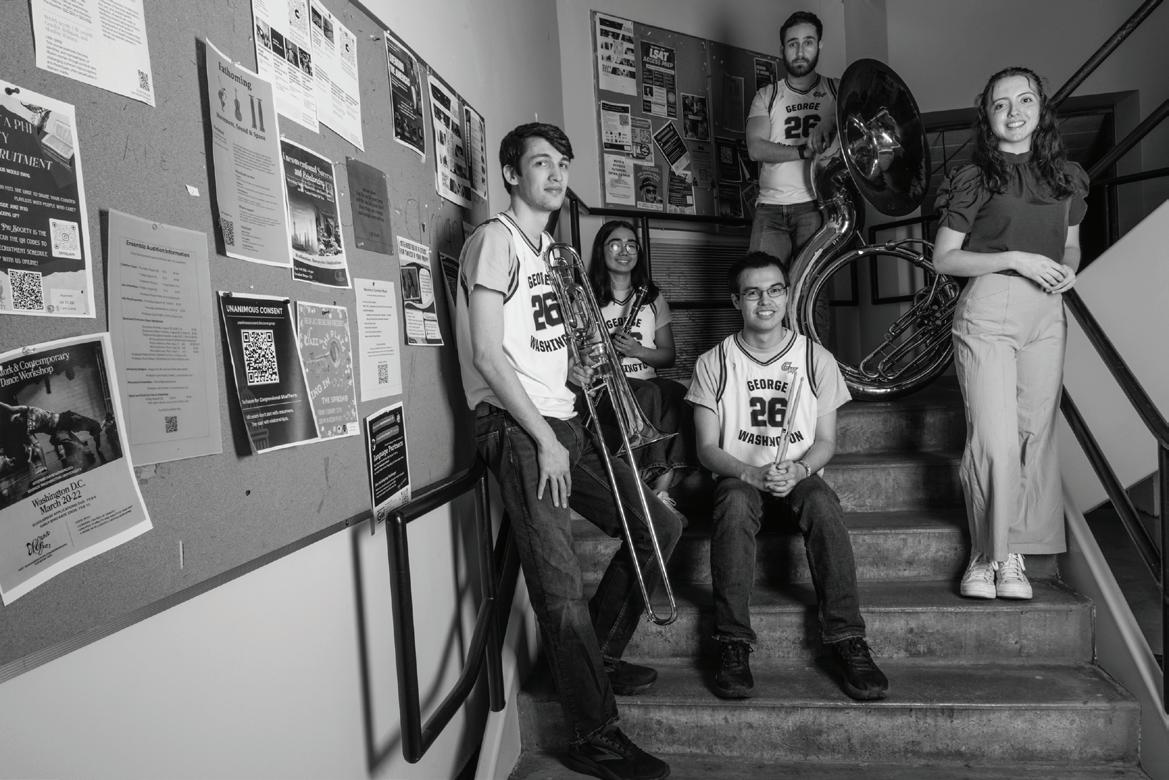
Lovell said although crowd favorites are hard to predict, she usually considers them songs the band visibly enjoys playing because it draws more audience attention.
“Uprising” by Muse and “Apache” by The Sugarhill Gang, Lovell said, put a spotlight on the drummers, creating an uplifting energy within the band
As the sole teaching assistant for the band, Lovell said she’s responsible for making the set list, consisting of roughly 20 songs per game, which she mixes up for each men’s and women’s game. She said some crowd favorites always appear on the list, like “Seven Nation Army” by The White Stripes and “Land of 1,000 Dances” by Wilson Pickett. She said she also has a goal to make Despite the hefty time commitment — especially during the season with twice-weekly practices and up to three games in one week — Lovell said oftentimes it doesn’t
feel like work to the band, instead a way to simply have fun, playing music with close friends.
With almost 50 members, the pep band accepts any student already in one of the three University Band ensembles, Alana Khona, a clarinet player and the Foghorn’s incoming teaching assistant said.
With Khona, a junior majoring in political science and economics, stepping into the role of the teaching assistant next academic year, she said she hopes to bring in more people to join to keep the community thriving and have the experience they hope to get out of the band.
Flute section co-leader and senior Maddie Daggett said being a Foghorn as a first-year and hearing the packed stadium roar during Revs’ victory against University of South Carolina in 2022 — a matchup that marked men’s basketball’s first visit from a Power 5 school in five years — filled her and her fel-
LIJAH LEWIS REPORTER
After 7 p.m. on Mondays at Tonic at Quigleys, the dim, brick-walled room hums with students and trivia buffs packed shoulder to shoulder, pencils poised over answer sheets, as whispers about Beatles lyrics and ancient gods fill the air — all for the grand prize of a $50 gift card.
Tonic has been running trivia nights on Mondays from 7:30 p.m. to 9:30 p.m. for the last 20 years, drawing close to 50 people from around the Foggy Bottom area who filter into the restaurant’s third floor before happy hour ends at 7 p.m. to claim seats and size up the competition. Armed with stapled scorecards, each marked with a shamrock for double points, teams rank their answers by confidence, competing for the gift card and the added feat of securing the most creative team name. The two-hour game unfolds over seven rounds — four random, one featuring weekly TV references, a song round and a “lightning round” — with Tonic teasing the theme on its Instagram story each Monday, just hours before the competition begins. Questions range from the color of sulfur in its natural state at room temperature — yellow — to the country that hosts the world’s oldest and deep-
est lake — Russia.
Trivia Host Regan Baker, a 2023 graduate and former server who’s hosted trivia night for the last two years, said she initially began as a scorekeeper and hadn’t planned to take over. She said she was hesitant to accept her boss’ offer after the previous host quit two years ago because she was afraid of public speaking, but she’s become a commander of the crowd in the time since, instructing the rowdy crowd to quiet down.
Despite having a separate 9-to-5 job for the last two years and being a server at Tonic for three years prior, she said she’s stayed on doing trivia as a side job, not just a way to make extra money, but also because she enjoys pushing herself outside her comfort zone.
Baker said she comes up with the questions by going on a deep dive in an archive given to her by the previous host, who served in the role for seven years. She said she also thinks of trivia questions randomly throughout the week and jots them down for use in future rounds.
Baker said there are a few regulars each week, but she enjoys seeing new people squeeze into Tonic’s third-floor booths and tables, creating a new, competitive and fun community each time.
On Monday, team members put their heads together
to guess each answer correctly as Baker asked each question. By the end of the first round, players were visibly confident, penning down each of their answers, easily dotting their i’s and crossing their t’s.
Monday’s winners were “Jack Hughes’ Two Front Teeth,” inspired by the U.S. Olympic hockey player who got his teeth knocked out during the gold medal game against Canada. Senior Nicholas Lane said the team earned first place with a grand total of 94 points.
After three years of attending Tonic Trivia, Lane said the restaurant’s proximity to campus and food options, like the famed tots and brownie sundae, keep his team coming back each week, now for two months straight because they enjoy the food, proximity to campus and because they have “nothing better to do” on Monday nights. More importantly, he said he shows up for the grand prize offered to each week’s winners.
Meghan Foster of the team “Nikita’s Seven Dwarves,” said they chose Tonic because it was the only restaurant that let them cut their own cake, marking the game’s ending in perhaps one of the more unique ways: the Happy Birthday song.
“We were tied for sixth place, but I don’t know what our score was,” Foster said.

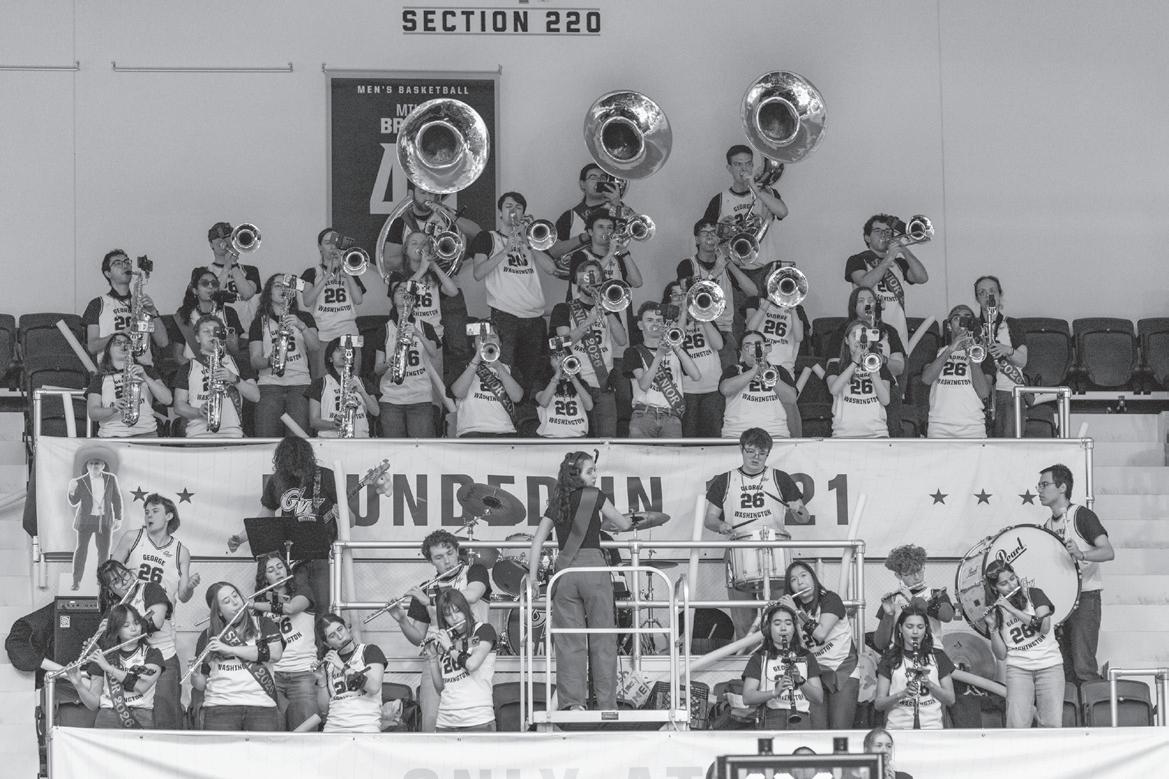
low Foghorns with adrenaline as they performed throughout the game, fueling them for the ones ahead.
The 10-person flute section, Dagett said, shares a bond due to their common interest in their music, but their friendship goes outside the Smith Center’s bleachers, with another group of friends to spend time with together.
Although being part of the band is a “large commitment,” with twice-a-week rehearsals up to two to three games per week, she said, all of the hours are worth it because the team has come a long way since she started three years ago, becoming closer as friends and developing their sound along the way.
Though many students know GW doesn’t have the best school spirit, graduate student and trombone player Andrew Spurgeon said he feels the exhilarating atmosphere when fans max out the
Smith Center, like when GW played against the University of South Carolina in 2022, or the first matchup in 40 years against Georgetown University this opening season. Spurgeon said although the University is not big on school spirit as the games are often low in attendance, the pep band experience is still something he greatly enjoys because it allows for inclusivity with band members and improvement in their musical skills, and he gets the opportunity to watch college basketball each week, something he’s followed since he was young. He said other state schools are much more competitive with their selections of marching band members.
“There’s actually kind of a silver lining in it because we are taking anyone that we can,” Spurgeon said. “You are guaranteed that you’re going to be able to come to everything that you want to.”
DIANA ANOS CULTURE EDITOR
JESSICA ROWE CONTRIBUTING CULTURE EDITOR
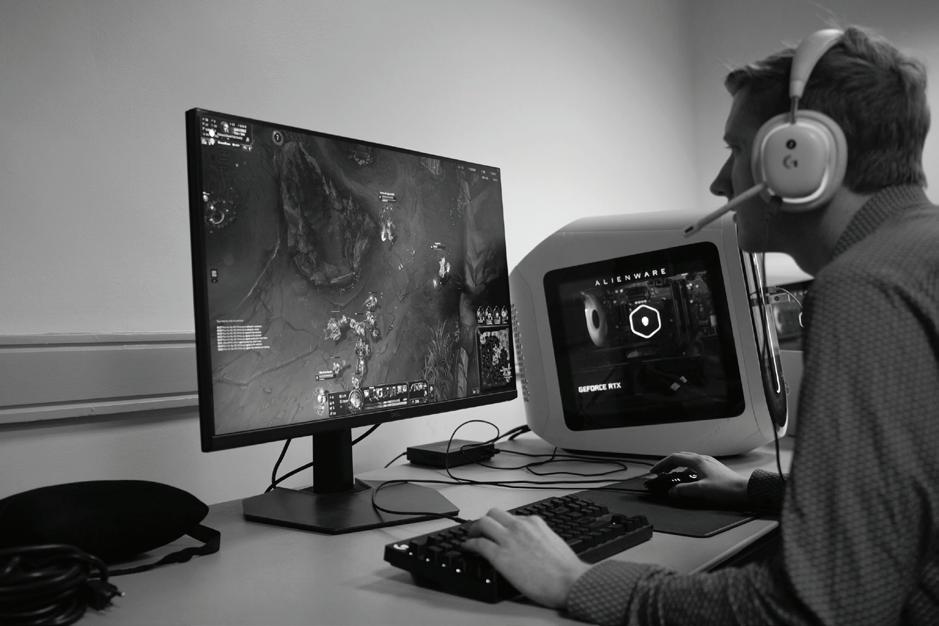
Beneath the fluorescent lights of the University Student Center, GW Esports players hunch toward glowing monitors, their faces flashing with color as rapid mouse clicks slice through the steady hum of computer fans.
The GW Esports team meets several times a week to drill strategies, review gameplay and compete in online and in-person tournaments that can take them across North America. Players say the program demands the same coordination and mental stamina as traditional athletics, but it also offers something less visible — a tight-knit community where pressure, persistence and late-night practices turn teammates into close friends.
Grina Pacheco, a senior and political science major, said a friend who was on the team recommended she join as a first-year after she mentioned loving Super Smash Bros., a fast-paced fighting game where players battle to knock opponents off the stage.
The camaraderie has been the most rewarding part of the experience, she said, giving her not only a space to deepen her competitive drive but also a close-knit group of friends who share it.
Super Smash Bros. wasn’t one of the team’s primary games when Pacheco first joined, she said, but she helped change that by recruiting new players and built a dedicated roster in her first year — a group she has remained with ever since.
That commitment paid off when she traveled to New York City with some other teammates in late January to compete in the team’s first big travel tournament, Let’s Make Big Moves, an annual Super Smash Bros. matchup — a trip students paid for on their own.
She said she initially went on the LMBM trip to play as an individual, but she also had the opportu-
nity to play as a team with GW members. They didn’t perform as well as she had hoped, but Pacheco said it was still a good experience competing against people in a stronger caliber than them.
First-year international affairs major Isla Ellis said she focused her college search exclusively on schools with recreational esports programs, driven by four years of both competitive and casual gaming, which is one of the reasons she ended up at GW. She tried out and secured a spot on the team’s VALORANT roster in September, a fast-paced firstperson tactical hero shooter that tests strategy, reflexes and teamwork.
Ellis said the team plays in the Eastern College Athletic Conference, which hosts one season each semester, with a seven-week regular season and a playoff period that lasts three to four weeks and plays a different group of people each one. Last semester the team made the playoffs — a feat she did not expect after initially losing to several teams in their league, she said. Ellis said the VALORANT B team placed ninth of 16, Super Smash Bros. Ultimate A team placed third, Super Smash Bros. Ultimate B team placed ninth of 16, and Overwatch finished fifth of eight. With the spring season underway, Ellis said the team is preparing to make it to the playoffs during March, currently playing weekly 5v5 matchups with the team on top winning two maps in the series. Playing in a coordi-
nated environment and at a higher level with friends, she said, has allowed her to learn more and improve her skills. But besides the video games themselves, Ellis said upon joining as a first-year, she immediately bonded over a shared hobby with members, who quickly became her friends. Maxwell McGovern, the marketing executive and captain of the Super Smash Bros. B team, said he immediately joined Esports when he got to GW, playing the game since middle school. During competitions, which he manages, he and his team play against other schools on the east coast, like SUNY schools in New York like Brooklyn College. McGovern, a sophomore and marketing major, said he also runs the tournaments that take place every Saturday in the USC’s esports room, helping set up monitors in addition to the ones already present, Nintendo Switches and start the livestream. McGovern said the team’s equipment was around since before he became a student at GW, including around 15 monitors that former students donated, but the computer towers, headphones, keyboards and mice were funded by the school. Alongside his roles on the team, McGovern said he appreciates the welcoming community the team fosters.
“They become my best friends on campus, like hanging out outside of video games a lot of times,” he said. “It really fosters a nice community, and everyone’s just trying to help each other improve all the time.”
BEN SPITALNY MANAGING DIRECTOR
is trying ‘almost everything’ to increase
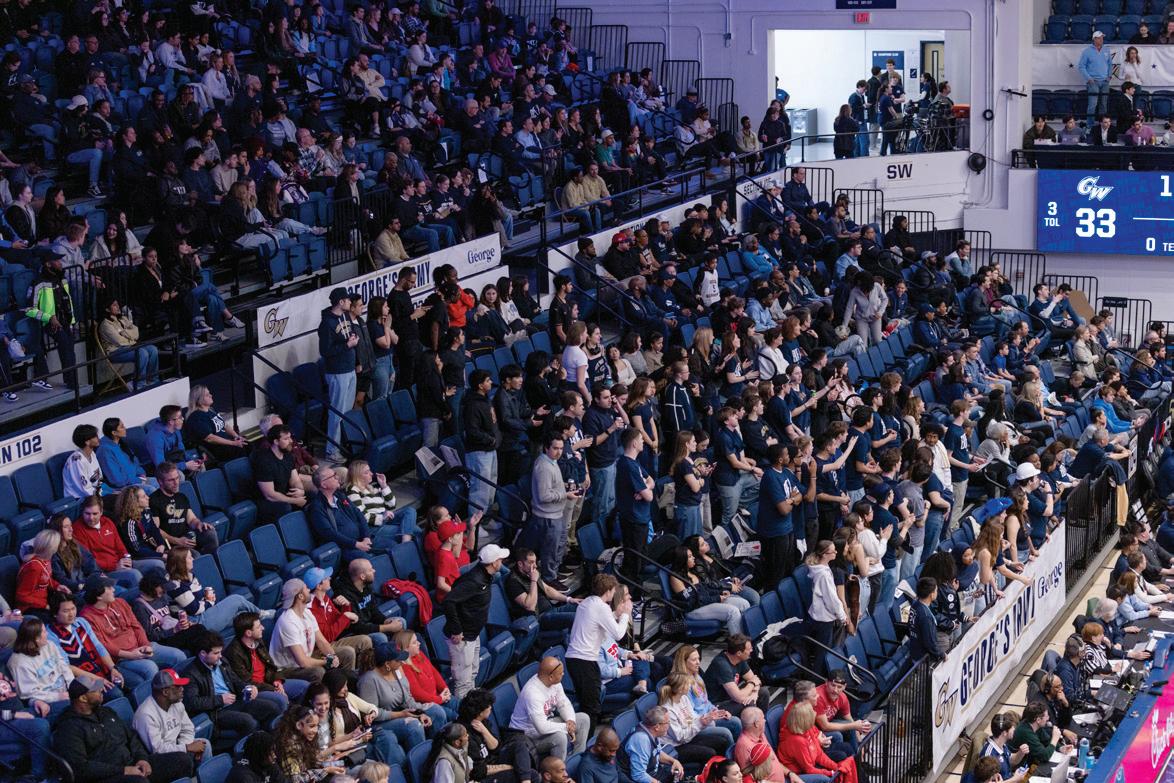
Almost 4,300 fans piled into the Smith Center in October for men’s basketball’s exhibition loss to Georgetown University — GW’s first sellout in nine years.
With palpable energy from a crosstown rivalry matchup and an extensive marketing campaign, it felt like a turning point for a program that has struggled to fill seats over the past decade, consistently ranking in the bottom five in Atlantic 10 turnout rankings. But as men’s and women’s basketball struggle to improve mediocre records and close games this season, that October moment looks like just a flash in the pan.
With one game left in the season, men’s basketball average a modest 2,292 fans per home game, ranking 10th in the A-10 and up roughly 300 from last year, though the numbers still reflect a program struggling to fill seats consistently. The gap with women’s basketball is even starker as the team averages just 628 fans per game, forcing Athletics to close the Smith Center’s upper decks.
Despite the marginal yearover-year improvements, turnout remains a tenacious issue for Athletics. That’s pushed Athletics to reshuffle department hierarchy by hiring its first chief revenue officer, Markus Jennings, last May and partner with college sports marketing company Taymar Sales U in September to help boost fan engagement.
Several students said that GW’s low levels of school spirit and excitement at games make attending athletics a low priority, a dynamic that only worsens the turnout problem. Sophomore Isabella Corrieri echoed that sentiment, noting
she has attended just one men’s basketball game during her time at GW because she feels sports are not a prominent part of the student experience.
“If there was more community, if more people started promoting it and just a culture change, maybe [I’d go more],” Corrieri said.
There is, however, evidence that community interest in GW athletics is not absent but rather inconsistent and heavily tied to high-profile matchups and competitive success. Men’s basketball, which has climbed nearly 150 spots from its 2022-23 KenPom ranking, has earned increased national TV exposure and more primetime opportunities, creating rare peaks in turnout.
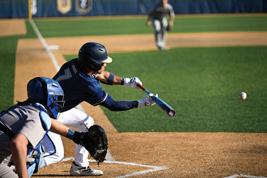
Two Friday night conference games in February illustrate this trend: A Feb. 13 blowout win over George Mason drew 3,694 fans, boosted by a local opponent and above-average student attendance, while Friday night’s nationally televised loss to Dayton brought 3,703 fans, marking the largest Smith Center regular-season crowd in three years.
These spikes, however, highlight the structural challenges of sustaining attendance. Highprofile opponents and primetime broadcasts are difficult to schedule, often reserved for programs with both consistent success and a lively, visually engaging fan environment. GW Athletics has tried to overcome this by leaning into marketing and campus activations. For the Dayton game, the department rolled out player-led video campaigns and weekendlong events tied to GWPalooza, an effort designed to make the experience feel more like a social and cultural event rather than just a sporting contest.
Athletics has also attempted to
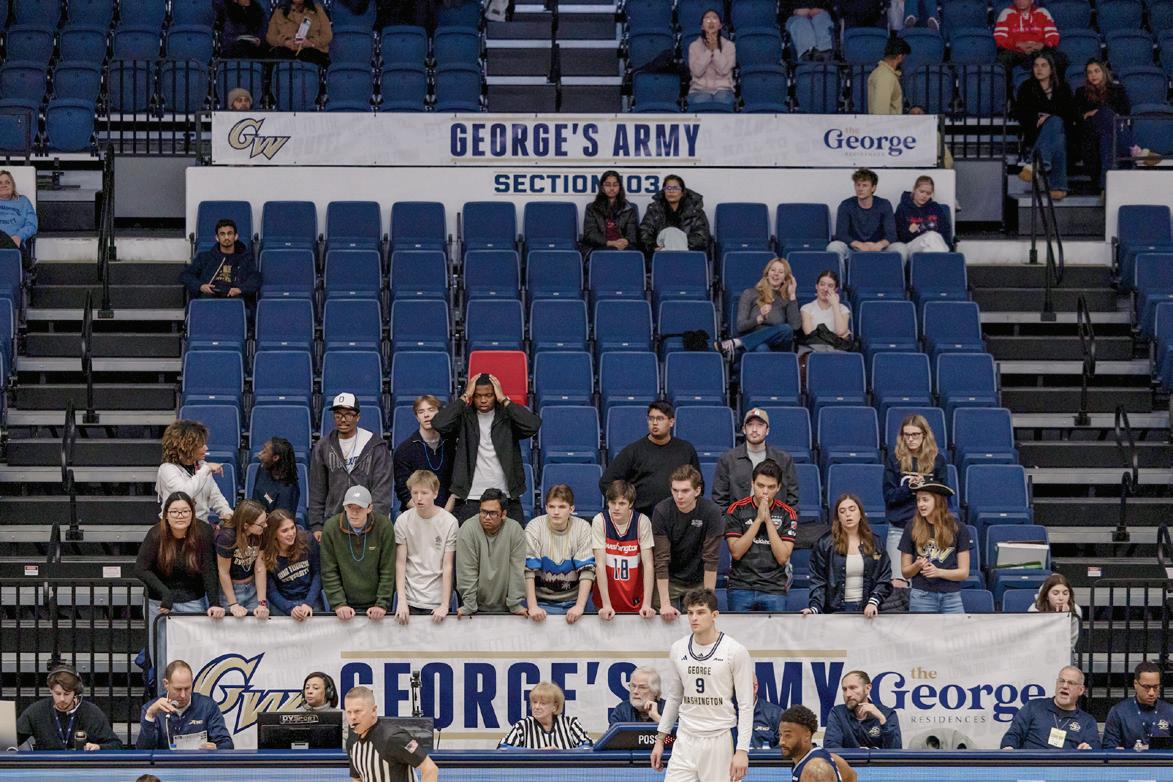
ramp up attendance at the lowerprofile games with varying success. George’s Army — GW’s official student section — collaborated with men’s basketball on Instagram in November ahead of the matchup against University of Maryland, Baltimore County. But that game’s turnout lagged behind the team’s average, logging 1,703 in attendance despite the team carrying a perfect record through the game.
George’s Army leaders feel this trend firsthand at each game. Katherine Carroll, a senior and George’s Army co-president, said George’s Army has found it hard to recruit students to attend games because most students are drawn to GW for academic or job-based reasons and spend free time exploring the city, resulting in a student body that is largely unaware of GW Athletics.
“Our culture is not just a campus, it’s the city,” Caroll said. “And because of that, it really is hard to want people to take two or three hours out of their weekend — that they barely get any time off — to come and watch a game.”
That strategy is not new for Athletics and George’s Army. Kate Carpenter, a 2023 GW graduate who served on the executive board of George’s Army while a student, said giveaways played a key role in driving student engagement during her tenure. Carpenter said Caputo made it a priority to increase student attendance after his hiring because of its impact on a team’s environment and standing.
“He would push out a lot of messaging, pay for tailgates, have ideas and they would be executed,” Carpenter said. “
Nearing the end of his first year at GW, Jennings said the department is experimenting with “almost any and everything,” from social media campaigns to residence hall turnout competitions, in an
effort to boost attendance among both students and general ticket buyers, which he said has seen mixed levels of success. He added that the season-opening game against Georgetown, his first on staff, demonstrated the program’s
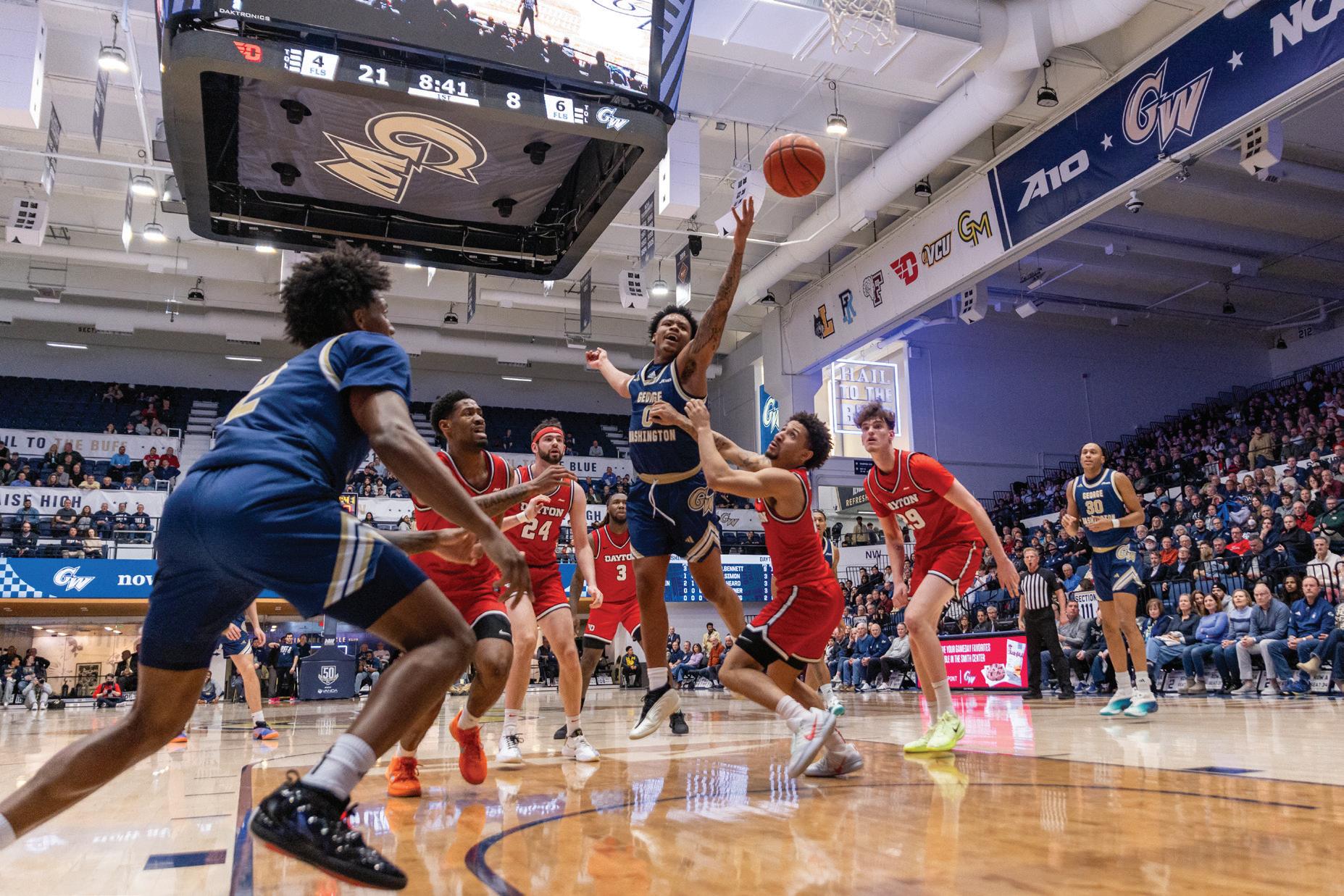
Men’s basketball falls 68-66 to Dayton in back-and-forth battle decided in final seconds
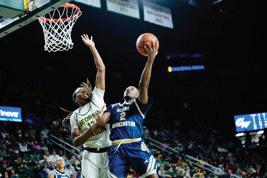
Men’s basketball (16-13, 7-9 Atlantic 10) dropped a 68-66 heartbreaker to Dayton (20-9, 11-5 A-10) on Friday night in front of a roaring crowd at the Smith Center. In a back-and-forth contest aired on ESPN2, the Revolutionaries and Flyers traded leads 10 times, with the game coming down to the final possession. With four seconds remaining, the Revs had a chance to hit the game-winner but came up short in a game plagued by missed free throws.
Redshirt senior center Rafael Castro struggled from the line, going 2-of10 and missing two free throws with 20 seconds left that would have given the Revs a three-point cushion. Postgame, Head Coach Chris Caputo said he feels Castro has made strides with his free-throw shooting throughout the season, but the struggles “came in bunches” tonight.
“I would say [Castro] is one of the most stable people,” Caputo said. “
Despite his free-throw troubles, Castro led all Revs in scoring with 16 in his second game back from injury. Junior guard Trey Autry had 15, with nine coming from beyond the arc and junior guard Jean Aranguren and graduate student forward Tyrone Marshall Jr. each added 12. It was a slow start for the Revs, as they saw the Flyers jump out to a 16-3 lead seven minutes in. But a dunk and a layup from Castro would cut into the Flyers’ lead and get the crowd into the game just moments after.
Out of a timeout, the Revs cut the Flyers’ lead to five, using a dunk from redshirt junior forward Garrett Johnson, his lone points of the night, to force a Dayton timeout. As the half wound down, Autry hit a three to cut the lead to 27-26, but that would be the closest the Revs got to tying the game, eventually facing a 34-31 deficit after 20. The Revs came out firing to start the second, tying the game at 37 on a three from Aranguren just
under three minutes in and taking the lead on a slam from Castro with 15:55 to go, forcing a Dayton timeout.
The Castro dunk was immediately responded to by a three from senior guard Javon Bennett, who had a game-high 25 points and went 6-of-9 from three.
Autry’s bid was good from downtown, giving the Revs a 51-49 lead with 10:31 to go, but Bennett immediately responded with a layup to tie the game once again. A pair of layups from redshirt sophomore guard Christian Jones and Castro put the Revs in front 55-51 with 8:30 to go, the biggest lead the Revs could get all night.
Bennett once again gave the Flyers the lead from deep with 7:16 to go, which began a stretch of play from Dayton that gave them a five-point margin over the Revs with 5:36 left.
Autry found Marshall for a 3-pointer to get the Revs within a basket with 3:56 remaining, leading into the final media timeout. Marshall, riding the hot hand, found nylon
with a layup out of another timeout to cut the score to 64-62 with 2:08 to play. With the crowd behind them, Aranguren was fouled by Bennett, sending him to the line for a pair of free throws that tied the game at 64. After a Revs timeout, Marshall took a keeper to the basket for two points for a 66-64 lead with 46 seconds left.
Araguren then fouled Bennett on the following possession, but the Flyers’ guard went 1-of-2 from the line. After Castro secured the rebound, he was fouled, sending the 67% free throw shooter to the line for a pair.
After missing both, graduate student forward Luke Hunger fouled sophomore forward Amael L’Etang, who drained both free throws to take a 67-66 lead.
On the ensuing possession, Marshall, using the same play that worked earlier, drove to the hoop but was blocked, leading to chaos around the basket, where the Revs were unable to find the loose change and win the game.
potential for strong fan turnout, even if similar levels haven’t been consistently reached since.
“We’re still trying to find a secret sauce of how we get the students out more consistently,” Jennings said.
RYAN JAINCHILL
BASKETBALL EDITOR
Women’s basketball (1516, 7-11 Atlantic 10) dropped its final game of the season to Rhode Island (25-4, 16-2 A-10) 72-48 on Saturday at the Rams’ Ryan Center. Despite flashes from sophomore guard Gabby Reynolds and contributions from up and down the roster, the Revs were outmatched from the opening tip by the top-seeded Rams, who fell in a game that highlighted the difference in consistency and execution between the two programs. The defeat locks GW into the No. 10 seed in the Atlantic 10 Conference tournament, underscoring a season defined by inconsistency as the Revs head into postseason play in search of a sharper edge.
Reynolds led the way with 17 points on 7-of-13 shooting, and although 10 of the 11 Revs who saw action scored, none reached double figures, with junior forward Sara Lewis coming closest at 6 points and four rebounds.
Right off the bat, the Rams took it to the Revs, holding an 11-2 lead four minutes in. GW finished the first 10 minutes of play trailing 19-10.
The second quarter unfolded much like the first as the Revs went scoreless for the opening five minutes, allowing the Rams to stretch their lead to 28-10 by the 5:53 mark.
Late layups from Reynolds and senior forward Caia Loving provided a brief spark, but GW still entered halftime trailing 40-25.
In the third, the Revs faced
a 46-29 deficit less than four minutes into the third quarter and, despite showing more offensive rhythm, could not string together enough stops to seriously threaten the Rams’ lead. A Reynolds 3-pointer trimmed the margin to 12 and offered a flicker of momentum, but Rhode Island quickly regained control with Mbu’s jumper at the one-minute mark stretching the advantage back to 20.
The lead grew to 25 to start the final frame on a pair of baskets from Mbu. Two baskets from Reynolds and a layup from Lewis cut the deficit to 19 with 6:35 to play, but it was not until there were 46 seconds left that the Revs found nylon again, sealing the 26-point loss.
Excluding the postseason, the Revs will close the season with a 15-16 record, falling below .500 and missing an overall winning record for the third consecutive year. In Head Coach Ganiyat Adeduntan’s first season at the helm, the team showed flashes of potential but struggled with inconsistency, ultimately finishing 10th — the same spot predicted in the preseason poll but higher than last year’s 13th seed. The season had its highlights, including an overtime upset of Richmond and a seven-game winning streak heading into A-10 play, though two losing streaks ultimately pushed the Revs toward the bottom of the conference standings.
The Revs will travel to Henrico, Virginia, on Thursday for the beginning of the A-10 tournament, facing the seventh-seeded Dayton Flyers.
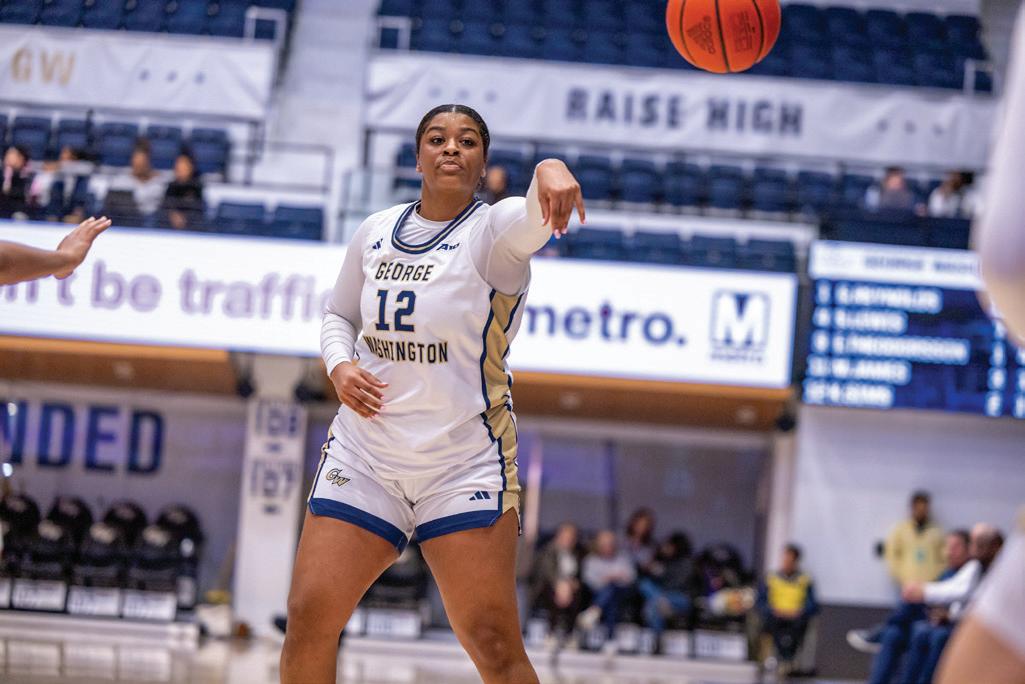
The District has historically been one of the country’s hotbeds when it comes to basketball talent.
The area has produced stars across generations, from superstars like Kevin Durant, who got his start at Montrose Christian School in Bethesda, Maryland, to Los Angeles Lakers legend Elgin Baylor, who played at Phelps High School in Northeast D.C. For men’s basketball Head Coach Chris Caputo, the DMV isn’t just home — it’s a talent-rich pipeline, and few program leaders are as fortunate as he is to build a roster in a region so steeped in hardwood history and homegrown stars.
During his four seasons as the Revolutionaries’ head coach, Caputo has recruited five local players, including former forward transfer Darren Buchanan Jr., former guard Jacoi Hutchinson and freshman guard Jalen Rougier-Roane. The active roster also features two other DMV natives: sophomore guard Ty Bevins from Maryland and redshirt junior forward Garrett Johnson, a transfer from Princeton University who grew up in Northern Virginia.
“You’re going to always want to recruit in your local area, a little differently than other schools,” Caputo said. “We’re in a situation where we’re an attractive location for within the DMV and beyond, and historically, that’s been the case.”
The DMV has long been a talent hub for GW basketball, producing recent standouts like former forward Ricky Lindo Jr. and former guard
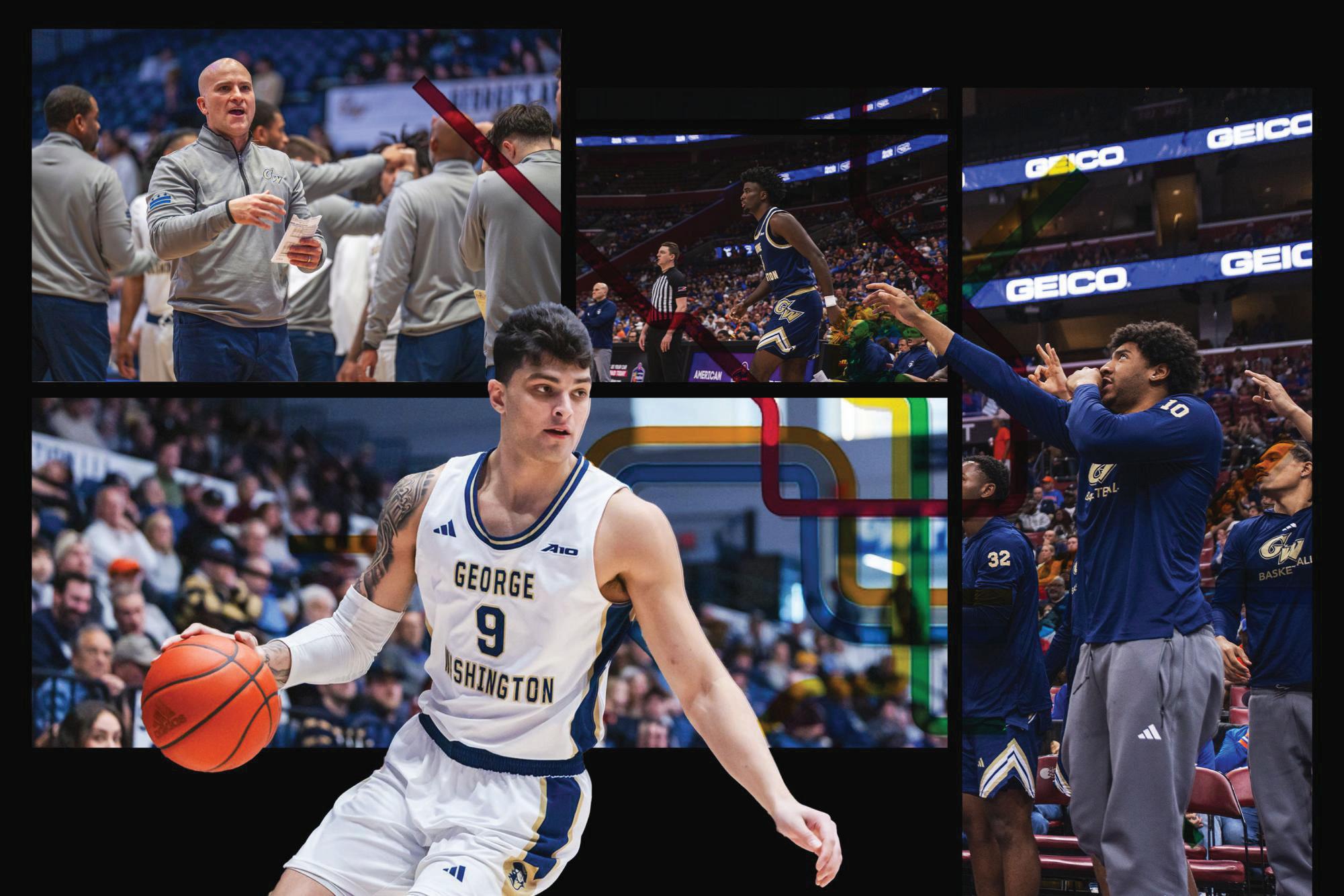
James Bishop, key pieces of a 2022-23 roster that featured six local natives. That deeprooted regional connection has also shaped program legends such as all-time leading scorer Chris Monroe and former guard John Holloran, reflecting the DMV’s lasting imprint on GW’s success.
But as conferences expand, and program budgets grow, the DMV has become more than GW’s secret feeder — it’s now on the radar of college basketball’s power programs because of its prime talent. Caputo said he has felt the competition intensify as better-resourced
schools increasingly pursue the region’s top talent, a trend that has accelerated in recent years and stands in stark contrast to his early days coaching at George Mason between 2005 and 2011, when the area’s prospects largely flew under the national radar.
Now, coaches from programs outside the region travel to the DMV during the summer to watch Amateur Athletic Union games, with recruiters from across the country sitting in on leagues to scout some of the nation’s top talent.
“If you’re here, every
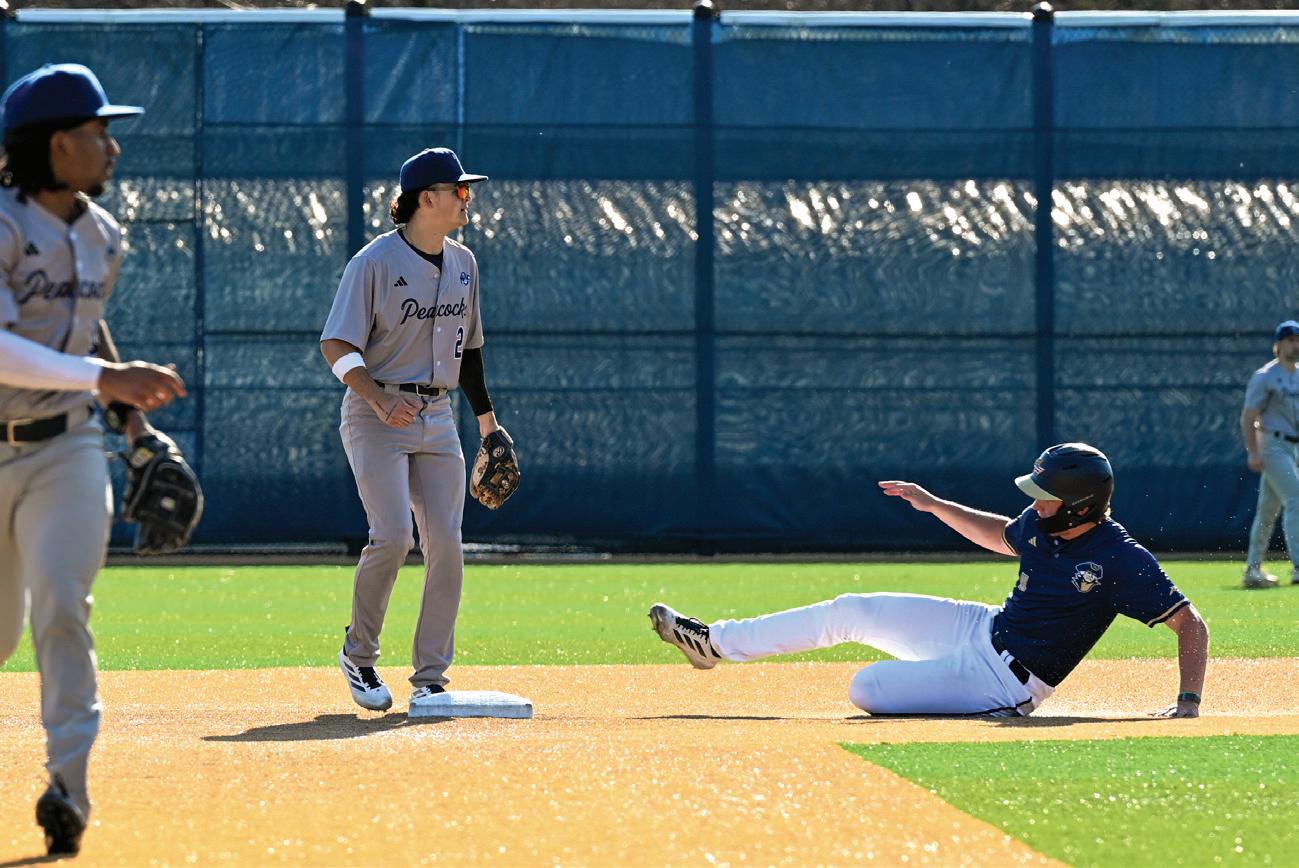
GRANT
PACERNICK SPORTS EDITOR
Men’s baseball (4-6) went 3-0 over the weekend series, sweeping Saint Peter’s University (0-7) at Tucker Field for their first series win of the season.
The Revolutionaries dominated the Peacocks in a three-game sweep, outscoring them by 25 runs and setting the tone early, even as the series finale proved more tightly contested. After opening the season with a sweep at the hands of Western Carolina University, dropping a competitive series to Lehigh University and suffering an 11-0, seven-inning rout against the University of Virginia, the Revolutionaries entered the weekend facing questions about their ability to score runs effectively. Now, with less than two weeks before conference play begins, the Revs sit at four wins and carry renewed momentum into a critical early stretch of the season.
“We have a young group that are growing each inning and each game,” Head Coach Gregg Ritchie said in an email after the game. “These young men are hungry and are continuing to prepare for A-10 play.”
The Atlantic 10 preseason poll picked the Revs to finish ninth in the conference — one place lower than they finished last season. Ritchie, who is now in his 14th season at the helm, has yet to win a conference crown.
Here’s a recap of this weekend’s action:
Game 1: GW 17, Saint Peter’s 0
The opening game of the series Friday was the most lopsided affair of the weekend as the Revs pitched a shutout thanks to senior Max Haug, who pitched five innings. Graduate student outfielder Jack Kent went 3-for-4 at the plate, scoring three runs for the Revs.
The team’s five-run fourth inning left the team with a nine-run lead going into the fifth inning, giving them
a comfortable cushion and all but ensuring a victory for the team. Still, the Revs continued to pile on with a threerun homer from sophomore outfielder Brodie Frecker in the sixth-inning to bring the lead to 13. The rout didn’t end there as the Revs scored two more runs in the eight and ninth innings, respectively. The Revs scored in every inning besides the second, scoring effectively throughout the whole day.
Game 2: GW 8, Saint Peter’s 2
In the second game of the series, the Revs secured their first series victory of the season scoring eight runs in just six hits. The Revs scored the first five runs of the game, getting off to a fast start for the second game in a row. A two-run fourth-inning from the Peacocks turned the momentum back in their favor, cutting the lead to 3, but a three-run eighth-inning Revs surge sealed the series. A pair of walks in the eighth inning helped contribute to the Revs steady offense. Last year, all A-10 Rookie team member and sophomore infielder Charlie Walsh went 4-for-5 with two RBIs on the day. Redshirt Junior first baseman Charlie Rogan had three RBIs.
Game 3: GW 9, Saint Peter’s 6
The Revs finished off the series sweep on Sunday, holding off a lastminute comeback from the Peacocks. Starting sophomore pitcher Declan Wywoda didn’t give up a single earned run in the six innings he pitched. The bullpen gave up a three-run ninth-inning, and St. Peter’s cut the lead to 3, but the Revs secured the final out.
Next week, the Revs will host the University of Maryland, Baltimore County on Tuesday, Georgetown University on Wednesday and Yale University for a weekend series.
school — ACC, Big 10, SEC, down the line — is in the gym watching players,” Caputo said.
Rougier-Roane, the freshman guard from Sidwell Friends School, said growing up surrounded by top-level talent pushed him to refine his skills and accelerate his development. His high school teammates included rising stars like Villanova University’s Acaden Lewis and University of North Carolina at Chapel Hill’s Derek Dixon, while jerseys hanging in the gym rafters honored alumni such as New York Knicks star Josh Hart,
a national champion with Villanova, giving the school a legacy of producing elite players.
“I’m playing against a bunch of high-level guys from this area,” RougierRoane said. “A lot of the guys are on to college, contributing at a big stage. It’s been good to kind of see everybody develop and, you know, it’s always challenging.”
Rougier-Roane’s basketball journey from Cathedral Heights to Foggy Bottom was unexpected, as he grew up in Maryland but played high school ball in D.C., ul-
timately committing to the Revs in November 2024 after a recruitment process lasting more than two years. A broken foot in his senior year narrowed his options to GW and Xavier University, and he chose the Revs due to their persistent and consistent recruitment throughout his recovery.
“GW is the place I want to go, just because of the way they were always pushing,” Roagier-Roane said. “I felt wanted from day one, the staff heavily contacted me, especially when I was going through my whole foot injury.”
Bevins, a graduate of Gwynn Park High School in Prince George’s County, Maryland, told a similar tale. He said he chose GW because the Revs relentlessly pursued him, making their interest clear at every turn even as other programs, like George Mason and American, Iona and Temple universities, courted him.
“It wasn’t necessarily like knowing I wanted to be close to home, but it was like, ‘If that’s the schools that are showing interest in me, why not?’” Bevins said. “I was 18 coming into college, and it was just like being close to home might benefit me in the long run.”
As he continues his sophomore year, the feeling of being home is important to Bevins, especially with his family nearby.
“It’s always been pretty cool,” Bevins said. “Depending on the situation, my parents, they try not to miss a game. High school coaches, high school teammates, cousins, friends, everybody tries to support if they can, if they have free time.”
MATTHEW CINQUE STAFF WRITER
As men’s basketball has waded through an up-anddown season, there’s another squad that’s climbed up national rankings — the managers. Played the night before NCAA-sanctioned team matchups, Manager Games are informal, pride-driven exhibition games — typically in near-empty gyms — but this year the Revolutionaries have treated them like something more, compiling a 6-2 record with wins over Georgetown, St. Louis and VCU, climbing to a No. 21 ranking. Although the Manager Games may not carry the same notoriety as the main season, they play a crucial role in fostering camaraderie and a shared sense of purpose throughout the program, strengthening bonds among players, squad members and coaching staff alike, and offering a unique space where development, teamwork and competitive spirit intersect.
“Being ranked is a fun thing to be able to put out there, especially because GW managers barely really existed until the last few years with [Head Coach Chris Caputo],” Noah Greenspan, a graduate assistant and member of the managers team, said.
The managers started their season with a narrow 58-57 victory over their Georgetown University counterparts, though the men’s basketball team later fell in an exhibition
against the Hoyas. By January, a 58-37 blowout win in St. Louis sparked an impressive hot streak that culminated in a dominant 100-58 victory over the VCU managers, improving their record to 6-2.
Manager Games feature a 64-team playoff bracket that runs alongside NCAA Division I Men’s Basketball Tournament, but instead of teams facing off on the field, matchups are decided entirely by fan voting on X. Teams are seeded based on their regular-season rankings, and during the first three rounds, fans determine who advances through headto-head polls.
Higher-seeded teams — like GW, currently — receive a built-in advantage, needing a smaller share of the vote to move on, while lower seeds must earn a larger percentage to pull off an upset.
“Unlike some like the high major teams like Wisconsin, we had like a couple, maybe three or four thousand followers on their Twitter page, we have like 200 maybe,” Greenspan said. “So we really need to win games to get as high ranking so we can hopefully get through those first few rounds.”
Although Greenspan is new to Foggy Bottom, joining the Revs ahead of this season, he noted that the squad has significantly strengthened their manager team in recent years, particularly with Caputo’s leadership, helping the team grow from playing just 3 games to 8-10 this year. He added that the managers’ dedi-
cated mindset carries over onto the court, contributing to some of the team’s newfound success this season.
In addition to Greenspan, graduate assistants DeAndre Harvey, Ryan Kaliner and Richie Martin all start for the team and see consistent playing time, though the Manager Games allow for flexible lineups across games due to the lack of an official roster. For instance, availability issues led Assistant Coach Dwayne Lee to step in for a game on Feb. 3 against his alma mater, St. Joe’s, which the Revs dominated, winning 80-52.
By emulating the fastpaced, high-switching system of the GW team, the managers have been able to translate strategies from practice into tangible results on the court.
“Taking on the identity of GW and our offensive coach, Matt Colpoys, we’re a high three point shooting team,” Martin said. “We like putting them up and the key is to crash the glass. If there’s a better offensive rebounding manager team in the country, I haven’t seen them.”
The Revs Managers, like the NCAA team, have a potential of two more games before the Managers Games tournament commences against St. Bonaventure and Loyola Chicago. If a team were to progress through to the Elite Eight, they would play in the Manager Games National Championship, which occurs alongside the NCAA Final Four Fan Fest later this month.