The GW
HATCHET
August 17, 2026 Vol. 123
Iss. 3
AN INDEPENDENT STUDENT NEWSPAPER • SERVING THE GW COMMUNITY SINCE 1904 • ONLINE AT GWHATCHET.COM
Credit rating agency lowers GW’s bond rating, returns outlook to stable
Granberg’s total pay nears $2 million, surpasses previous GW presidents: tax forms ARUNMOY DAS
ASSISTANT NEWS EDITOR
GW paid University President Ellen Granberg $1.9 million in her first full year in the University’s top post, topping the compensation of her two immediate predecessors in their first year at the helm. Granberg received $1.4 million in base compensation, the highest of any employee in base pay in available records, and $507,380 in bonuses and other compensation from January 2024 to December 2024. In her first full-year publicly reported pay since she began her role as president in July 2023, Granberg’s total pay in 2024 surpassed those of former University Interim President Mark Wrighton and University President Thomas LeBlanc during their first years in office, even when adjusted for inflation. GW’s Form 990, which annually reports the University’s revenues and expenses, also reveals four top officials and employees received total pay increases of at least 10 percent, including Vice President and Chief Financial Officer Bruno Fernandes, Vice President for Board Relations and Secretary of the University Jonathan Post, Men’s Basketball Head Coach Chris Caputo and Professor and Director of GW Online Engineering Programs Shahram Sarkani. The University shared GW’s FY2025 Form 990 with The Hatchet after the paper requested it under a policy requiring tax-exempt organizations to provide copies digitally upon request before they’re posted online. The form is now publicly available on sites like ProPublica, which displays Form 990s after Internal Revenue Service processing. GW’s status as a nonprofit institution requires officials to report its revenues and expenses to the IRS using the Form 990 each fiscal year, which begins July 1 and ends June 30, and includes the compensation of up to 20 current employees who make more than $150,000 a year from GW and “related organizations.” Officials’ compensation on the form is reported by calendar year from January to December, unlike the form, which is reported based on the fiscal year. Here is a breakdown of the University’s latest public finan-
PARIS ALBRECHT
CONTRIBUTING NEWS EDITOR
GW’s six highest-paid officials each earned more than $1 million in total compensation in 2024, including senior administrators and a professor. In 2023, only three current employees — Bass, Sarkani and former Provost Christopher Bracey — made more than $1 million in total compensation. Former Chief Financial Officer Mark Diaz also made over a $1 million in 2023, the majority of which comprised of severance pay. Fernandes saw a pay raise of $407,261 in 2024, earning a total of $1,068,130 compared to $660,869 in 2023. He received the highest pay bump of all University employees listed in the form — about 62 percent — in 2024.
A top credit rating agency on Wednesday downgraded GW’s bond rating but boosted the University’s credit outlook to stable after dropping them to negative last year. Moody’s Ratings dropped GW’s bond rating from A1 to A2 in its fiscal year 2025 report, citing high debt, weaker operating performance due to losses associated with the Medical Faculty Associates and low asset liquidity as factors contributing to the decreased ratings. The report states the stable outlook comes from the agency’s expectation that operating performance will stabilize as the MFA transitions to the new non-profit physician enterprise Capital Medical Group, reflects liquidity gains from the sale of the Virginia Science and Technology Campus and acknowledges “generally consistent” student demand. A downgrade in an institution’s bond rating signifies the borrower is less likely to pay its debts on time or in full as expected when the debt obligation began, and also often subjects the organization to paying higher interest rates for new loans. The downgrade in credit rating comes after Moody’s gave the University a negative credit outlook last year, citing the MFA’s years of debt as central to its decision and warning that continued financial pressure from the organization could weaken GW’s liquidity and lead to a lower credit score in future years. A University release published Tuesday said officials expected the downgrade from Moody’s but added that they remain focused on improving GW’s financial position and operating results while maintaining strong enrollment and meeting student demand. “We are committed to building on GW’s strong foundation and advancing our academic mission for the long term,” Chief Financial Officer Bruno Fernandes said in the release. S&P Global Ratings, another top credit rating agency that released a report on GW’s creditworthiness in August 2025 and also downgraded the University’s outlook from stable to negative, has not yet published a report for the University this year.
See CONTRIBUTIONS Page 5
See GW Page 5
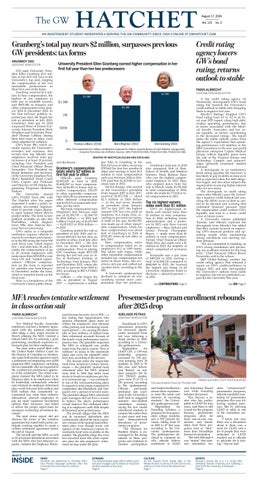
GRAPHIC BY MATHYLDA DULIAN AND SOFIA ANG
cial disclosure:
Granberg’s compensation totals nearly $2 million in first full year in office
Officials paid Granberg $1,907,439 in total in 2024: $1,400,059 in base compensation, $210,000 in bonus and incentive compensation, $39,157 in other reportable compensation, $143,150 in retirement and other deferred compensation and $115,073 in nontaxable benefits, per the form. Her total compensation tops Wrighton’s first full-year total pay of $1,293,735 — $1,386,719 in 2024 dollars — in 2022 and LeBlanc’s total pay of $1,451,969 — $1,813,835 in 2024 dollars — in 2018. Granberg started her role as president in July 2023 and received $815,103 for her first six months in office, from July 2023 to December 2023 — the first time tax forms reported her compensation. Prior to joining GW, Granberg made $577,338 during her last full year in office at Rochester Institute of Technology from January 2022 and December 2022, where she served as provost from 2018 to 2013, according to RIT’s FY2023 tax forms. LeBlanc — who began his role as president in August 2017 — experienced a similar
pay hike to Granberg in his first full year in office, receiving $797,662 his first five months in office and earning at least $1.2 million in total compensation each year between 2018 to 2021. GW paid him $1,167,000 in severance pay in 2022. Steven Knapp, who served as the University’s president from August 2007 to July 2017, received $1,972,528 — about $2.5 million in 2024 dollars — in his last seven months as president from January 2017 to July 2017, the highest amount GW has ever paid an employee in a single year, according to previous tax forms. A bulk of his pay, $1,050,787, was made up of other reportable compensation, while his base compensation was about half of Granberg’s in 2024 at $728,187 when he left office in July 2017. Base compensation refers to compensation listed on an employee’s W-2 or 1099 forms, like salary and wages, while other reportable compensation includes any compensation not listed on those forms, like severance, sick pay and cashed out vacation leave, according to the IRS. A University spokesperson declined to comment on why Granberg earned more compensation than her predeces-
sors. Granberg’s total pay in 2024 also surpassed that of thenSchool of Health and Medical Sciences Dean Barbara Bass, who was the highest compensated employee in 2023. Bass, who stepped down from her role in March, made $1,501,840 in total compensation in 2024, while she made $1,777,614 in total compensation in 2023.
Top six highest earners make more than $1 million
MFA reaches tentative settlement Presemester program enrollment rebounds in class action suit after 2025 drop PARIS ALBRECHT
CONTRIBUTING NEWS EDITOR
Two Medical Faculty Associates employees reached a tentative agreement with the medical enterprise after filing a class action lawsuit in March alleging the MFA violated a federal labor law by selecting a poor performing, needlessly expensive retirement plan for their employees. The joint status report filed with the United States District Court for the District of Columbia on Wednesday states both parties agreed to reach a settlement encompassing over 4,000 impacted MFA employees, including the two plaintiffs who are expected to file a motion for preliminary approval of the settlement. The initial complaint claimed the MFA failed in its fiduciary duty to its employees when its leadership continuously selected and retained an employee retirement plan worth between $216 million and $345 million that consistently accumulated less value than industry alternatives, allowed employees to pay for more expensive investment options than necessary and failed to utilize the proper supervision for managers overseeing investment decisions. The joint status report did not disclose the terms of the tentative agreement but stated both parties anticipate working together to create a written settlement agreement before the end of August. The lawsuit said the MFA, as well as 30 unnamed defendants associated with the MFA who had fiduciary capacity, violated the Employee Retire-
WHAT’S
INSIDE
ment Income Security Act of 1974 — a law stating that organizations who sponsor retirement plans must act within the employees’ best interests when picking and monitoring investment options — by causing the plaintiffs to lose millions of dollars from their retirement accounts because of the fund’s weak performance and expensive fees. The plaintiffs requested the MFA to relinquish any profits made from the plans, restore “tens of millions” in losses to the retirement plans and cover the plaintiff’s attorneys fees, according to the lawsuit. The lawsuit states the target-date fund from American Century Investments — the plaintiffs’ mutual fund retirement plan the MFA retained from 2018 to 2024 that shifts from stocks to bonds as employees get closer to retirement age — was consistently one of the worst-performing plans in regards to total assets compared to competitors like BlackRock and Vanguard over a period of several years. The plaintiffs alleged MFA retirement plan managers did not have a reason to believe the plan’s performance would improve but continued offering it to employees until 2024 despite its historical poor performance. The lawsuit alleges that the MFA and its unnamed defendants also continuously offered the more expensive version of the mutual fund retirement plan, even though lower cost options of the American Century Investments fund were available on the market. The plaintiffs allege the extra fees incurred from this more expensive plan ate into employees’ retirement savings under the plan.
NEWS Students are petitioning to reinstate GW’s only Persian language professor after the University did not renew his contract. Page 2
ADELAIDE PETRAS
ASSISTANT NEWS EDITOR
Enrollment in GW’s presemester programs for first-years significantly increased from last year following a sharp decline in 2024, according to a University spokesperson. Registration for LEAD GW, a GW-run leadership program, increased by 150 percent, jumping from 38 students in 2025 to 95 this year, and Adventure Bound, an outdoor program led by GW TRAiLS guides, grew from 23 to 53, or 130 percent, according to the spokesperson. Officials previously attributed last year’s drop to the University’s shift back to staggered summer new-student orientation sessions, saying the new model introduced students to campus life earlier than in past years and may have disincentivized attendance of presemester programs. “The Division for Student Affairs is encouraged by the strong interest in these programs and continues to monitor participation
OPINIONS The Editorial Board urges GW to reflect upon last year’s budget cuts to deliver an improved student experience this year. Page 6
First-year students move into Thurston Hall.
and student feedback to ensure these experiences meet the needs and interests of incoming students,” the University spokesperson said. Registration for Founding Scholars, a program for first-generation college students, saw a 29.9 percent decrease, falling from 67 in 2025 to 47 this year, according to the University spokesperson. The spokesperson declined to comment on why officials believe enrollment in LEAD
YNGRID GUEVARA | STAFF PHOTOGRAPHER
and Adventure Bound rose while Founding Scholars decreased. Siya Nayyar, a senior who has participated in LEAD for four years, said there is still a need for the program because presemester programs allow for more one-on-one connection, and friendships from those programs tend to “stick” more than friendships formed at orientation. She said although it was “unfair” that summer orientation ses-
CULTURE As the Dupont Circle staple Sign of the Whale shutters its doors, the GW community reflects on their time at the beloved bar. Page 7
sions “overpowered” presemester programs, officials expanded marketing for presemester programs this year following student advocacy, like by allowing LEAD to table at one of the orientation sessions. “I know last year there was a discussion about if there was a need for LEAD, and a lot of people that were dedicated to LEAD reached out to officials to advocate for it staying,” Nayyar said.
SPORTS Women’s soccer sits at a 1-1 record after defeating Temple University and suffering a blow from the University of Delaware. Page 8
NEWS
August 17, 2026 • Page 2
NEWS
THIS WEEK’S
EVENTS
THE GW HATCHET
LATE NIGHT MONUMENT WALKS Thursday, Aug. 20 | 8 p.m. | National Mall Join fellow GW community members for a walk among the various monuments that line the National Mall.
THIS WEEK IN HISTORY Aug. 18, 1997
MONUMENTAL MOVIES: “NATIONAL TREASURE” Saturday, Aug. 22 | 7 p.m. | University Yard Attend a screening of the action-adventure film “National Treasure.”
Officials unveil the GWorld card for all students, faculty and staff.
Students petition to reinstate sole Persian professor after contract nonrenewal SARAH GROSS
ASSISTANT NEWS EDITOR
Students are advocating for officials to renew GW’s only active Persian language professor’s contract for the academic year. The petition, created two weeks ago by recent graduate Sophie Mansuri, has over 400 signatures as of Sunday and urges the University to reconsider its decision to not renew professor Maziar Valamotamed’s contract, detailing his “exemplary” record and mentorship to Iranian students over the course of his 11 years teaching at GW. Current and former students said the University’s decision to not renew Vala-
motamed’s contract came after an April physical altercation outside the Elliott School of International Affairs building involving Valamotamed and an individual who Mansuri said had previously been “heckling” Persian professors at University events. Valamotamed declined to comment on the non-renewal of his contract and said he is working with his union, SEIU Local 500, regarding the University’s decision to not reappoint him. Representatives from SEIU Local 500 did not return a request for comment. A University spokesperson said officials are working with the Department of Classical and
Near Eastern Languages and Civilizations to ensure that “appropriate instructional arrangements” are made for the 2026–27 academic year. They added that officials don’t expect any changes to the Persian curriculum, which includes three levels of Persian language, all of which were previously taught by Valamotamed over the past two years according to the class schedule. No new professor has been listed to teach the courses as of Sunday. The spokesperson declined to comment on the decision not to renew Valamotamed’s contract and the circulation of the petition, stating the University does not comment on “individual person-
nel matters.” All three levels of Persian appear on the fall semester schedule as classes, though none currently has an instructor assigned, and web archives show that Valamotamed had previously been scheduled to teach them. Following the physical altercation involving Valamotamed on April 21, Persian program director Christopher Rollston acknowledged the incident between “a non-GW person” and a “CNELC faculty member” in an email to students studying Persian on April 23, obtained by The Hatchet. Rollston sent another email on Aug. 4, obtained by The Hatchet, to students enrolled in Persian
courses for the upcoming semester, welcoming them to the program and reporting “healthy” enrollment in Beginning Persian. Mansuri, who completed all three levels of Persian during her time at GW, said Valamotamed did “everything in his power” to make the Persian program more robust and advocated for more funding from the University to better the program. She said the University’s decision to not renew his contract is a “really bad move” given Valamotamed’s positive reputation among students. “We were so angry because it’s like why would you wait a whole two weeks before the school year starts to do all this,” Mansuri said.
Protesters rally against National Guard troops in DC one year after deployment ISAAC HARTE
CONTRIBUTING NEWS EDITOR
A cluster of protesters gathered in the U Street Corridor Saturday to protest the continued presence of National Guard troops one year after President Donald Trump first deployed them to the District. Organized by the D.C. chapter of the Party for Socialism and Liberation, speakers at the protest called on the nearly 4,500 Guard troops currently in D.C. to leave the District and denounced their presence as an effort to instill fear in D.C. residents rather than legitimately combat violent crime. The protest came as the District marks a year after Trump first deployed National Guard troops and other federal agents to the nation’s capital after declaring a “crime emergency” within the city and after the Pentagon extended the deployment last month to the end of Trump’s presidential term. Beginning at noon, approximately 20 protesters chanted and played music at the corner of 14th and U streets, while about a dozen Metropolitan Police Department officers stood nearby to observe. Over the course of 40 minutes, five speakers took turns at the microphone, characterizing the Guard deployment and Trump’s broader federal takeover within the District as being based on racist rhetoric that portrays D.C. as more crime-ridden than
it actually is. Cam White, an activist with the organization the ANSWER Coalition — which stands for Act Now to Stop War and End Racism — who spoke at the rally, said the rhetoric the Trump administration uses to describe D.C. unfairly portrays it as “disgusting” and said the administration had spread “lies” about D.C. After deploying troops within D.C., Trump said D.C. had been “taken over by violent gangs and bloodthirsty criminals.” “There’s been a lot of lies about our city, and that’s a big part of the reason why there’s currently a National Guard foot patrol,” White said. The Guard deployment in D.C. began with Trump deploying 800 troops solely belonging to the D.C. National Guard, but the number of troops within the District has steadily increased as governors from mostly Republican states have sent their own National Guard troops to Washington. The number of troops currently in D.C. sits at 4,471 as of last week. In January, Pentagon officials extended the deployment of troops within D.C. through the end of 2026, before announcing they troops would remain in D.C. through the end of Trump’s term. Since the deployment District residents, leaders and students have met the deployment with fierce backlash, organizing doz-
ISAAC HARTE | STAFF PHOTOGRAPHER Protesters gather outside the Franklin D. Reeves Municipal Center on Saturday to protest the year long presence of National Guard troops in D.C.
ens of protests, revitalizing the “Free D.C.” movement, filing legal challenges saying the deployment violates the city’s home rule. At the protest, organizers held up a banner behind those who spoke that read “Troops out of D.C. Statehood Now!” and protesters within the crowd held up signs reading “National Guard off D.C. Streets.”
In between speeches, the crowd yelled chants of “Money for jobs and education, not for racist occupation,” as well as “The people united will never be defeated.” Madoka, an organizer who spoke at the protest and did not give a last name, said the presence of the Guard in D.C. had accomplished “nothing” from
ANC treasurer’s departure to reduce GW’s local government representation
report in February stating that the ongoing deployment costs D.C. taxpayers $1.65 million each day, despite the mission proving ineffective at tangibly reducing crime. A study from the nonpartisan Niskanen Center in May found no measurable effect of the deployment on violent crime, while “opportunistic” property crimes fell 24 percent.
CRIME LOG SIMPLE ASSAULT
Public Property on Campus (2300 Block of H Street NW) 8/6/2026 – 8:50 a.m. Open Case A female GW staff member reported being assaulted by an unknown male suspect while walking past the suspect.
ISAAC HARTE
CONTRIBUTING NEWS EDITOR
GW’s Foggy Bottom campus will lose a significant portion of its representation on the Foggy Bottom West End Advisory Neighborhood Commission early next year after a commissioner representing a portion of campus did not file for reelection. ANC 2A Treasurer and 2A09 Commissioner Sean Youngstone, who won his seat on the ANC in a special election early last year and represents the area containing Amsterdam, Madison, Fulbright, Munson and JBKO halls and GW Hospital, did not file to run for reelection by the deadline and no other candidates have filed to run in his district, meaning his seat will sit vacant at the start of ANC 2A’s next term. A current commissioner, as well as a GW alum who previously served as an ANC 2A commissioner, said vacancies within the single-member districts covering GW’s campus on the commission would mean that GW students would be without critical representation on issues before higher levels of D.C. government. A vacancy within Youngstone’s district will also mean the vast majority of the Foggy Bottom campus will lack representation, with District House becoming the only hall out of the 19 on the Foggy
a public safety standpoint and said the troops were intended to “instill fear” in residents of the District. “We know that these troops have only been here to try to instill fear in us, to make us docile and obedient in the face of a slow move towards militarization and a police state,” she said. Senate Homeland Security Democrats published a
Case open.
SIMPLE ASSAULT
Lerner Health & Wellness Center 8/6/2026 – 4:50 p.m. Open Case The GW Police Department and Metropolitan Police Department responded to a reported simple assault. Upon arrival, officers made contact with two female GW students who reported being assaulted by an unknown male suspect. Officers canvased the area but were unable to locate the male subject.
Case open.
MATHYLDA DULIAN | SENIOR PHOTO EDITOR ANC 2A Treasurer and 2A09 Commissioner Sean Youngstone poses for a portrait in 2025.
Bottom campus that has a sitting ANC commissioner representing their district. The Mount Vernon Campus lies within one single-member district of ANC 3D, which is entirely separate from ANC 2A, and is represented by Bernie Horn. Candidates who wish to run for ANC must have resided in their district for at least 60 days prior to running and must collect 25 signatures by a set filing deadline — which was August 5 this year. Youngstone declined to comment on why he opted
against running for reelection, but said in an email he encourages GW students to run for the ANC because of the prominent position the University plays within Foggy Bottom. “It would be great to have a voice from GW as they’re such a dominant institution in our neighborhood,” Youngstone said in an email. The last student commissioner to serve on the commission, 2024 alum Dasia Bandy, resigned from the commission in July 2024, pending a move outside of
the District. Bandy said a lack of student engagement on the commission means students have less representation on the ANC and said the broader Foggy Bottom community is also disenfranchised because stakeholders living within the vacant districts lack representation on the ANC. “I want fresh ideas, fresh talent, and young people, and it disservices our community and our commission when all single-member districts don’t have a role to play in that formally,” Bandy said.
DESTRUCTION OF PROPERTY/VANDALISM
Academic Building (Mount Vernon Campus) Unknown – Unknown Open Case A female GW staff member reported vandalism in a conference room and a classroom.
Case open.
—Compiled by Isaac Harte
THE GW HATCHET
NEWS
August 17, 2026 • Page 3
GW to review education secretary’s letter urging reforms LAKSHMI DEV
ASSISTANT NEWS EDITOR
Officials are planning to review a letter the Department of Education sent to universities nationwide earlier this month, calling on them to publicly outline their commitments to academic excellence and national service by the end of this year. Education Secretary Linda McMahon sent a letter, which she dubbed “a national call to action,” to university presidents and governing boards on Aug. 3 asking institutions to publicly answer seven questions regarding admissions transparency, campus discourse, academic standards, college costs, artificial intelligence, foreign influence and national interests by the end of 2026. Officials said in a Federal Update email Thursday GW will determine the “most appropriate approach” to address the department’s recommendations while serving the best interests of the University community. “Senior leadership will also engage with the Faculty Senate along with others as appropriate on this matter, and will be as transparent as possible with our community as the university considers its approach,” a University spokesperson said in an email. McMahon called on universities to publish statements describing both reforms they have already adopted and changes they plan to make regarding the topics she laid out in the letter. She asked that the statements be posted “prominently” on institutional websites, noting that transparency is necessary to rebuild public confidence in higher education because trust in American universities is at “record lows” and there has been a “politicization” of the humanities and social sciences. “Before the end of 2026, I call on every postsecondary institution to describe to the American public your commitments to rigorous teaching, pathbreaking research and national service — commitments that make our universities a bedrock institution of the American republic,” McMahon wrote in the letter. McMahon, in her letter, asks universities to explain how they will make their admissions criteria transparent and ensure that decisions are based on merit, achievement and each institution’s educational purpose. The department’s letter links the request to concerns about allegations of favoritism, discrimination and efforts to circumvent the Supreme Court’s 2023 decision that ended affirmative action in higher education. The admissions question comes as GW faces a Justice Department review of its admissions practices related to diversity, equity and inclusion. The DOJ notified GW in January that it had opened a Title VI compliance review into the University’s admissions practic-
es and “related matters,” which GW said it would cooperate with the review and demonstrate that its admissions practices comply with federal civil rights law. McMahon also asked universities how they will protect free speech and open debate while preventing protests from disrupting classes, research and campus operations. Another question asks institutions to promote intellectual pluralism across academic departments and ensure faculty hiring and evaluation practices consider relevant perspectives. McMahon called on institutions to refuse gifts with “problematic conditions,” prevent foreign actors from influencing academic programming, research personnel and student admissions and restrict access by foreign actors to sensitive research and technology. McMahon also called on institutions to contain administrative and other costs, improve pricing transparency, reduce student attrition and loan defaults and ensure academic programs prepare students for employment and enable graduates to repay their loans. The question comes as universities are grappling with changes to federal student lending under President Donald Trump’s administration, including the elimination of federal Graduate PLUS loans and the lowering of borrowing caps for graduate students, effective as of July 1. McMahon asked universities how they will maintain high academic standards in the age of artificial intelligence, combat grade inflation and prioritize excellence in teaching and learning. At GW, officials have been developing a University-wide strategy for artificial intelligence following a yearlong mapping exercise that examined how the University uses AI. Officials published the exercise’s findings and announced Professor Zoe Szajnfarber as a special advisor on AI to President Ellen Granberg and Provost Ed Balleisen this month. The final question asks universities how they will advance U.S. security and economic interests through their campuses and academic programs. McMahon called on institutions to prioritize American students and faculty, align research with the country’s economic and security needs and prepare students to meet urgent workforce demands. The letter does not require universities to adopt specific policies or outline consequences for institutions that do not respond. “I encourage universities to respond concretely to these questions and provide full transparency to the American people,” McMahon wrote. “This forthright conversation with the American people is long overdue. And it is the essential first step toward rebuilding trust in the sector.”
LEXI CRITCHETT | ASSISTANT PHOTO EDITOR Crowds gather to watch the removal of President Donald Trump’s name at the Kennedy Center in June.
Kennedy Center board votes to shut down for two years, reinstall Trump’s name SHIVU SATHE
ASSISTANT NEWS EDITOR
The John F. Kennedy Center for the Performing Arts Board of Trustees voted again Thursday to shut down the center for two years of renovations and restore President Donald Trump’s name to the building three months after a judge halted their earlier plans. The board voted 20-3 during an almost two-hour virtual meeting, with the three dissenting votes coming from Democratic members of Congress who sit on the board exofficio, Rep. Joyce Beatty (DOH), Sen. Sheldon Whitehouse (D-RI) and Rep. Rick Larsen (D-WA), according to multiple news outlets. Under the plan, the building’s facade would read “The John F. Kennedy Center for the Performing Arts Restored and Renovated By President Donald J. Trump,” and the outdoor plaza would be renamed “President Donald J. Trump Plaza.” The board first voted to close the center in March and voted to add Trump’s name in December, but was ordered by U.S. District Judge Christopher R. Cooper to halt those plans and remove Trump’s name in May, following a lawsuit brought by Beatty. The board’s latest move, reported by mul-
tiple news outlets, pushes the boundaries of Cooper’s order, which found that trustees had abandoned their fiduciary duty to the center by voting to close it and that the center’s name could not be changed without an act of Congress. “This morning’s decision to close the center and the surprise agenda item to put Donald Trump’s name back on the building was more of the same,” Beatty said in a statement. Ahead of Thursday’s decision, trustees were presented with two closure options by JLL, the construction management firm consulting on the renovations, according to news reports. The twoyear closure was the quickest plan, as opposed to the partial shutdown plan presented, and would have a $250 million budget with renovations expected to be completed in summer 2028. Trump first announced plans to close the building for two years of renovations in February, saying at the time that the changes were needed to bring the “tired, broken and dilapidated” institution to the “highest level of success.” In his May ruling, Cooper said the board’s decision to close the center for renovations was “ill-informed,” and the law was “crystal clear” that
the center be named only after President John F. Kennedy. Cooper’s order was a preliminary injunction, or temporary order, to prevent “irreparable harms” while the case is ongoing, and did not prohibit future closures of the center. Construction crews removed Trump’s name from the building in June, following Cooper’s decision, but the scaffolding and tarp used during that work still stand outside the center today. Cooper has given the board until Aug. 18 to report back to him on the outcome of Thursday’s vote, including its plans for the tarp still covering the building’s facade. The Kennedy Center did not respond to a request for comment. Trump’s takeover of the performing arts center began in February 2025 when he purged the existing board members and replaced them with political allies, naming himself as the board’s chair. Since the takeover in early 2025, the center had fallen half a million dollars short of its $1.5 million budgeted revenue goal. Since the takeover, ticket sales at the center have plummeted and numerous artists have pulled their performances or associations with the center.
Milken to waive application fee for first 1,000 master’s applicants LAKSHMI DEV
ASSISTANT NEWS EDITOR
The Varsity on K residential building on 24th Street.
HATCHET FILE PHOTO
Student housing firm acquires residential property near campus ARUNMOY DAS
ASSISTANT NEWS EDITOR
A Maryland-based real estate firm specializing in student housing acquired a residential property next to GW’s campus Tuesday, according to the property’s website. HH Group — a private equity real estate firm based in Silver Spring, Maryland, that primarily focuses on student housing investments — announced in a release its acquisition of Varsity on K, a 197-unit and 212-bed property on 950 24th Street NW, to expand its presence in D.C. The firm, which has owned the property since Aug. 12, has rebranded the property to The Haven on K and plans to implement a “comprehensive repositioning program” to improve the experience for the property’s residents and support its long-term performance by offering ex-
panded amenities and upgrading existing facilities, according to a release published in GlobeNewswire. “Varsity on K is representative of the opportunities we continue to pursue: well-located assets with durable demand drivers, attractive long-term fundamentals, and meaningful potential for value creation,” HH Group Founding Partner and Chief Investment Officer Gary Chen said in the release. The release also states the acquisition pushed assets under HH Group’s management to over $1 billion. The deed of the acquisition is not available on D.C. Recorder of Deeds as of Aug. 16. The firm’s Thursday release states plans to complete mechanical, commonarea, security and building-system upgrades and transition the property’s management to HH Red
Stone, its property management arm. The release also states the firm will coordinate asset management, leasing strategy, marketing and community outreach efforts to maximize income generated from the property. The Haven on K will be HH Group’s third property in D.C., after they acquired The Lanes At Union Market at 400 Florida Ave NW in July 2025, which primarily serves students at Howard and Gallaudet Universities, and The Ledger on 29th Street, which primarily serves Georgetown and GW students. Varsity Investment Group had been managing Varsity on K since 2016 up until the HH Group’s acquisition. Current residents of the property will not need to sign new leases as a result of the acquisition, according to The Haven on K’s updated website.
The Milken Institute School of Public Health will waive its $155 application fee for the first 1,000 students who apply to its master’s of public health program as part of a new initiative for the 2026-27 application cycle. Eligible applicants have been able to request a fee waiver since the application opened on Aug. 12, and those who meet the school’s Jan. 15 priority scholarship deadline will also be considered for additional scholarships, according to a Milken release. Applicants must apply through the Schools of Public Health Application Service and list Milken as their first application to qualify for the waiver, with only the first 1,000 eligible appli-
cants being sent a code on a first-come, firstserved basis, which must be used by Oct. 1. “As communities continue to face increasingly complex public health challenges, we want to ensure that talented future public health leaders are not deterred by the cost of pursuing their education,” Milken Dean Kelly Gebo wrote in the release. GW has offered application fee waivers in the past, including in 2017 when the University waived application fees for prospective undergraduate students affected by hurricanes in Texas, Florida and Puerto Rico. General undergraduate applicants can request a fee waiver through Common Application or review the criteria within the Coalition Application.
The Milken Institute School of Public Health.
The School of Business, School of Engineering & Applied Science, Elliott School of International Affairs and School of Medicine & Health Sciences offer application fee waivers at all levels of study for activeduty military personnel or veterans, info session attendees, GW alumni and for any applicant upon request and review. The College of Professional Studies also currently waives its standard $80 graduate application fee for certain applicants when they request it, including current students and alumni, military members and veterans, McNair Scholars and participants in programs such as AmeriCorps, Peace Corps and Teach for America, to reduce financial barriers to graduate education for eligible applicants.
HATCHET FILE PHOTO
NEWS
August 17, 2026 • Page 4
THE GW HATCHET
Officials complete Mitchell Hall remodel, renovate campus over summer ISAAC HARTE
CONTRIBUTING NEWS EDITOR
Officials completed the renovation of Mitchell Hall, installed new fencing surrounding University Yard and undertook a series of other renovations to infrastructure across GW’s campus this summer. Officials reopened Mitchell Hall for the 2026-27 academic year with an upgraded lobby space, a wheelchair accessible ramp connecting the street to the first floor lobby and the addition of laundry facilities on all eight residential floors within the building, among other upgrades officials made to the facility after renovating it over the course of a year. Officials also replaced the fencing surrounding U-Yard with a less noticeable, spiked fence design rather than the previous non-scalable, barricade style fencing — which a defense contractor installed in December 2024. A University spokesperson said updates to GW’s campus are part of the University’s long-term plans for building renovations and that officials stagger them to avoid significant impacts to building use. “Major upgrades made this summer are part of GW’s long-term schedule for
ongoing major building renovations, which are evaluated during the annual capital planning budget process,” a University spokesperson said. Among the upgrades to Mitchell Hall are a series of accessibility enhancements including the addition of ramps to the building’s exterior, interior ramps on the first floor, accessible bathrooms located throughout the hall and the addition of an elevator that goes to the building’s rooftop, which was previously only accessible by stairs. Prior to the renovation during a February 2025 town hall, students reported malfunctioning elevators within the building, during which officials also stated the building was not in compliance with the Americans with Disabilities Act, which guarantees equal opportunities for disabled people in education and transportation. Officials also revamped the lobby space within the building, adding a lounge and study space for students on the first floor. Mitchell will now feature panels with D.C. themed art pieces — one on every floor of the eight story building. The new fencing surrounding U-Yard replaces the fencing officials installed
ERIKA LOPEZ-CEPERO | PHOTOGRAPHER A contractor works on renovations in Mitchell Hall.
in the months following the pro-Palestinian encampment which occupied the green space for thirteen days in spring 2024. At the time, officials said the fencing would “aesthetically” integrate with the space better than the temporary fencing that surrounded U-Yard in the aftermath of the encampment. The new fencing is similar to the style of fencing outside of Kogan Plaza with arched sections and University branding above the walkways where students enter the outdoor space. Officials also installed an artificial green turf on a part of the third floor University Student Center terrace, coating the concrete-laden build-
ing with a green outdoor space. A University spokesperson said officials added the turf to the building in an effort to improve outdoor spaces intended for student use. “Turf was added to the USC terrace to enhance outdoor spaces by creating a more welcoming, comfortable environment where students can relax, study, gather with friends, and build community,” the University spokesperson said. Last year, officials installed a similar artificial turf within Square 80 — the outdoor space adjacent to South, Guthridge and Strong Halls. Officials also continued to make upgrades to the HVAC systems within Gel-
NICHOLAS WARE | ASSISTANT PHOTO EDITOR New fences stand in front of University Yard after renovations.
man Library — which has been closed for two consecutive summers because of electrical installations. The University spokesperson said additional HVAC upgrades are required to take place during summer 2027 within the facility but that officials do not anticipate closing the library for a third consecutive summer. Officials are actively installing solar panels at the USC, Francis Scott Key Hall and Bell Hall after officials said they would install solar panels on about 11 buildings at a Campus Planning Advisory Committee meeting in April. A University spokesperson said they do not anticipate other buildings to receive solar panels.
Officials also made additional upgrades to residence hall lobby spaces other than Mitchell Hall, renovating the lobby space of Potomac Hall after updating the lobby space of Guthridge Hall and FSK Hall during the previous summer. Officials also replaced the security desk and painted the surrounding walls in the I Street lobby 0f District House in the weeks before the building’s dining venues open to the public. Officials also anticipate the completion of projects in Lisner Auditorium, like HVAC upgrades and the installation of a new elevator during the fall semester according to the University spokesperson.
Student organization leaders praise, report snags with new RevConnect platform DIYA JHAWAR
CONTRIBUTING NEWS EDITOR
Student organization leaders embraced GW’s new student organization platform, praising its new features while raising concerns about missing organization data and delays in access to funds. The Division for Student Affairs launched RevConnect, a student involvement platform powered by CampusGroups, to replace Engage for student organization leaders on Aug. 3 ahead of its scheduled Aug. 17 launch for the larger student body. Organization leaders said the early rollout has given their organizations time to familiarize themselves with the platform ahead of the fall semester, but some said incomplete data transfers and delayed access to financial functions have complicated their preparation. Officials in February said student feedback was a “primary driver” of the switch after student leaders previously criticized Engage’s outdated interface and complicated financial system. A University spokesperson said RevConnect offers a dedicated mobile app, improved site navigation, streamlined student organization processes and updated communication tools to create a more modern and centralized experience. To ease the transition, the spokesperson said student leaders received an email on Aug. 3 with a go-live checklist, links to download the mobile app and training guides. The spokesperson said in-person training sessions for student organization leaders are scheduled throughout August and the fall semester, including sessions hosted at the Student Org Summit on Sept. 5 and 6, which student leaders were notified of in the Aug. 3 email. Org Help will also provide workshops, drop-in office hours, email support and one-on-one appointments for students seeking additional assistance, the spokesperson said. Eric Gitson, a junior and president of GW College Democrats, said the organization first learned about the transition last spring and urged the DSA to open the platform well before the start of the semester — a plan he said the office was receptive to. He said College Democrats wanted student leaders to have time to prepare for fall events and familiarize themselves with the new platform before the fall semester began. “They did everything they said they were going to,” Gitson said of the DSA. “They were receptive to that concern, and they said that they would do everything to have it ready by August 1. And that’s essentially what happened.” Gitson said RevConnect is easier to navigate than Engage and offers clear and tangible benefits, saving organizations money by replacing services they previously paid for separately. He said College Democrats can use the platform to create their own website and send mass emails to members, eliminating the need for services like Squarespace and Mailchimp that were using valuable funds from the organization’s individual bud-
get. Gitson said the transition of information from Engage to RevConnect is not yet complete, which has complicated planning ahead of the group’s first meeting of the year set for Aug. 31. He said his organization’s membership list and financial information had not yet appeared on the platform as of Aug. 12, making it difficult to communicate with returning members about the upcoming events, like the first meeting. The University spokesperson said officer information, organization constitutions and financial account balances were migrated from Engage to RevConnect. They said Engage will remain available as an archived resource through October, and student leaders are responsible for verifying their current officers, rosters and portal settings through a re-registration process that runs through Sept. 30. Gitson said the incomplete transition is also worrisome for College Democrats, since the group is preparing for events that require advance payments, like campaign trips that require chartering buses. With payment requests unavailable until Aug. 17, Gitson said the organization could have difficulty paying for transportation, equipment and other services, delaying the early start of event preparation. “This is a challenge for us in particular when you have early events like we do,” Gitson said. Caroline Demetrakas, a senior and president of GW Women in Business, said her organization’s transition to RevConnect has been smooth because the new platform is intuitive to navigate and better designed. “I think the platform is a lot easier to use than Engage,” Demetrakas said. “A lot more visually appealing as well and easy to access for a various amount of people.” Demetrakas said she did not receive an Aug. 3 email from the DSA announcing RevConnect’s launch and therefore did not receive the training materials included in the message. Despite that, she said she and the organization’s executive board have been able to navigate the platform easily. “It’s very straightforward. The transition was super easy to figure out and update everything on our end,” Demetrakas said. Ria Karam, president of AIESEC in D.C. — an organization that connects youth with opportunities to develop leadership skills — said she hopes the September training will provide more detailed guidance on the University’s financial process, which she described as difficult to navigate last year. She said the training could give student leaders a clearer understanding of how to access and use their organization’s funds under the new system. “If they gave us really good training to help us really understand the processes of how to access our funds easily, what information layout that they need us to do and just give us all the required information that they need from us, we can just one and done it,” Karam said.
CARSTEN HOLST | ASSISTANT PHOTO EDITOR Student Government Association Senate Pro Tempore Mathew Reis speaks at a meeting in May.
SGA to begin filling majority-empty Senate, combat chronic vacancies AMELIA NELSON
ASSISTANT NEWS EDITOR
The Student Government Association’s newly elected pro tempore is eyeing to fill the more than half-empty Senate, as senators say vacancies have decreased legislative output and narrowed the range of issues the body can address. Sen. Mathew Reis (CCAS-U), the SGA’s pro tempore who oversees the Senate, said shortened appointment timelines, the creation of at-large seats and expanded marketing of the body will help to fill vacancies this academic year. Senators said they attributed chronic vacancies to procedural delays and students not joining because they do not perceive the SGA as an avenue for advocacy, and they hope that through filling seats in the Senate the body can increase productivity to ultimately help the SGA appeal to students as an avenue for change on campus. Only 38 percent, or 16 out of 42 total Senate seats, are currently filled, with 20 of the 26 vacancies allotted for graduate students, according to data collected by the SGA in August and obtained by The Hatchet detailing the Senate’s school representation makeup and vacancies. There are currently no senators from the School of Medicine & Health Sciences, School of Nursing or Graduate School of Education and Human Development, which account for eight vacant seats. The first round of applications for open seats closed Tuesday, prompting the Committee on Governance and Nominations to meet Thursday and convert four vacant undergraduate seats to atlarge undergraduate positions, creating room for up to seven undergraduate senators to be appointed mid-September — the latest step in filling the body’s 26 vacancies. Seat conversions have been a tool used by the SGA since February, when the Senate passed
the Senate Vacancy Efficiency Bill which granted the Committee on Governance and Nominations authority to convert school-specific vacant seats to at large seats, shortening the two to three week process requiring a bill to a decision be made during weekly committee meetings. 24 students applied for positions in August, including 19 undergraduates from the Columbian College of Arts & Sciences, two undergraduates and one graduate student from the Elliott School of International Affairs, one undergraduate from Milken Institute School of Public Health and one graduate student from GSEHD, according to Reis. There are currently no vacant undergraduate ESIA or MSPH seats and only one vacant undergraduate CCAS seat, according to SGA data, meaning only one of the 22 undergraduate applicants could be considered without having to convert seats. The committee converted the single undergraduate seats from the College of Professional Studies and SON and two undergraduate seats from SMHS to at-large seats Thursday, creating four vacancies to be filled by any undergraduate applicant. Of the 24 applicants, at most five undergraduates and two graduate students can be appointed — which Reis said will occur at the next Senate meeting Sept. 14. Reis’ election to become pro tempore July 29, after the former pro tempore announced she was transferring universities, allowed the Committee on Governance and Nominations to start meeting Aug. 4. Reis said senators debating seat conversion at the committee’s meeting Thursday discussed whether they believed students could be adequately represented by senators from other schools with widespread at-large seats. Senators converted four out of the six vacant undergraduate positions to at-large seats at the meeting. “A lot of the issues students wrote in their applications to be
senators that they believe are issues aren’t school,” Reis said. “Almost all of them were University-wide, were critiques on the current financial aid system that GW is doing, its facilities, stuff like that.” Even if both graduate candidates are appointed to the Senate at the Sept. 14 meeting, which would double the current number of graduate senators, only 18 percent — or four out of 22 — of graduate seats would be filled. Former pro tempore José Dalmau, who wrote the Senate Vacancy Efficiency Bill, said he wrote the legislation after observing high turnover rates among senators — often to study abroad, for personal circumstances or increased academic workloads. The Senate dropped from 82 percent full in December 2025 to 80 percent in April despite numerous appointments. “I believe it was not completely filled because as I filled vacancies there were others that left,” Dalmau said. The upcoming academic year will be the first full semester the Senate Vacancy Efficiency Bill is in effect. Dalmau said he is optimistic that a faster process will allow the SGA to bring in more students who may have wanted to participate, but felt the body moved too slow to be “productive.” Sen. Madison Wyman (CPSG), chair of the graduate caucus and member of the Committee on Governance and Nominations, said some graduate vacancies may stem from students not knowing about the SGA or not realizing they can participate. She said she plans to reach out to graduate school advisors so they can market the opportunities to students. “If I can just get one or two or three more schools involved with the SGA and let them know they have a voice, that’ll be good,” Wyman said. “But ultimately, the goal is to have, throughout the years, all of the graduate community involved with SGA or other things on campus.”
NEWS
August 17, 2026 • Page 5
THE GW HATCHET
SAO set to focus on students’ accessibility, AI concerns in second year AMELIA NELSON
ASSISTANT NEWS EDITOR
As the Student Advocate’s Office enters its second year, the office’s director is aiming to expand its resources by developing existing processes to assist students dealing with conduct cases related to artificial intelligence and reviewing campus accessibility. Erika Cole, director of the SAO, said she wants to further office initiatives through collaboration with the Student Government Association’s legislative branch — a body she said shares the SAO’s goal of advocating for students, but that she could not extensively work with last year due to internal divisions and bureaucracy that led to decreased efficiency. Cole and SAO members from last year said they would like the office to conduct the SGA’s first accessibility review in six years, push for a standardized reporting process for students facing artificial intelligence misconduct cases and increase their overall casework load in the upcoming academic year. Former SGA President Ethan Lynne created the SAO in August 2025 as a way to assist students facing conduct procedures, advise
the SGA and officials on conduct procedures and handle student grievances. Cole, who the Senate confirmed as the SAO’s director in June, has not yet appointed anyone to the office for the upcoming school year. dents until later in the year. Cole said the office partnered with Conflict Education & Student Accountability, the GW office responsible for enforcing behavioral and academic conduct on campus, and other student organizations last year, but she would like to continue to reach out to the SGA legislative branch this year for more internal collaboration. She said she feels the legislative branch would be more welcoming than last year given SGA President MJ Childs and Vice President Aicha Sy’s emphasis on supporting students, something she said was exemplified throughout their campaigns. “I intend on reaching out and beginning that conversation, especially considering how lovely both sides of the current SGA, for legislative and executive, are,” Cole said. Ben Wieser, the SAO’s inaugural director, said he hopes Cole will work with
KRIS PARK | ASSISTANT PHOTO EDITOR
The Student Advocate’s Office Implementation Act.
CESA and the Faculty Senate to standardize practices for faculty members’ handling of AI-related academic integrity violations after students reported professors bypass-
ing CESA, which he said can limit students’ opportunities to appeal decisions. He said the office learned about this issue at the end of last semester when students came to
the office informally to ask what they could do in the situation, but he did not have time to act before the year ended. “It puts students in a bad
dilemma where they need to consider reporting themselves to CESA so that CESA can override the professor,” Wieser said. “It’s just not a great system.”
GW researchers receive new grants to study applications of trustworthy AI SARAH GROSS
ASSISTANT NEWS EDITOR
Four GW professors are the recipients of grants from a multiuniversity initiative GW co-leads to research and improve the trustworthiness and societally beneficial implementation of artificial intelligence. The Institute for Trustworthy AI in Law and Society, which launched in May 2023 with a $20 million award from the National Science Foundation and the National Institute of Standards and Technology, awarded five new grants totaling $515,000 to fund research into how institutions use AI and build trust over time. The grants are helping to fund new projects to measure and understand trust in AI and to improve its use in education, autonomous drones and local government. The new grants issued by TRAILS — made up of scholars from the University of Maryland, GW, Morgan State University and Cornell University — range from $40,000 to $160,000 and fund projects across disciplines including computer science, engineering, law, public policy and the social sciences. This year’s round of grants marks the lowest amount awarded in the program’s history, following eight grants totaling $1.5 million in 2024 and seven totaling $750,000 in
Students work in the Science and Engineering Hall.
2025. The new funding follows officials’ April announcement that the University is backing the Trustworthy AI Initiative, the parent
initiative to TRAILS at GW, as its first major research-focused project under the strategic framework GW. A University spokesperson said TRAILS is “deeply aligned” with
HATCHET FILE PHOTO
GW’s strategic framework, which identifies AI as a pressing societal challenge and calls on the University to combine its interdisciplinary strengths.
“That is precisely the model TRAILS represents: research across computer science, engineering, law, international affairs, public health, education, psychology and information science, connected to government, standards organizations, industry, educators and communities,” the spokesperson said. Joseph Dunne, a researcher with the GW Institute for Public Policy and a grant recipient, said his work will compare how local governments in D.C. and Maryland implement AI to improve efficiency while protecting data and public trust. “Somehow, the public sector hasn’t been able to keep up with AI, and that’s the area that we’re sort of zooming in on or focusing on because we want to help,” Dunne said. “We think that our research will produce lessons that will be useful for the public sector or for governments everywhere.” Dunne, who is working alongside two UMD researchers, Katie Shilton and Jwan Khisro, said the team secured an agreement with the D.C. government to participate in the study before their research proposal was approved. He said the D.C. government is “very interested” in AI research to improve government efficiency and welcomed the project.
Contributions to GW rebounded in FY2025 after sharp downfall, tax forms show From Page 1 Fernandes’ pay hike in 2024 was the second-largest bonus the University has given an employee in the last 10 years, according to a Hatchet analysis of GW’s Form 990s. Diaz secured the highest bonus of any University employee since 2015 when he received $874,000 more in total compensation — which included $976,440 in severance pay — in 2022. Officials paid Bracey $1.08 million in 2024, a $46,763 hike from 2023. Bracey resigned as provost in June 2025 after serving four years in the role. Sarkani earned a total compensation of $1.5 million, a $152,338 raise from 2023. He has
held the spot of the highest-paid professor at the University for more than a decade, according to tax forms. GW Cancer Director Center Julie Bauman made $1,027,218 in total compensation in 2024. She made $976,308 in total compensation the previous reporting cycle. The form listed three new officials on its list of highest compensated employees, including engineering management and systems engineering department chair Thomas Mazzuchi, Chief of Staff Scott Mory and former Vice President for Development and Alumni Relations Donna Arbide. The three received $877,041, $505,672 and $828,706 in total compensation in 2024, respectively.
Former top official receives over $700,000 in severance pay
The form indicates GW paid Paulsen $897,310 in 2024, making her the eighth highest paid employee in 2024. Her compensation in 2024 included $746,750 in severance pay, making her the only employee who received severance pay that year. GW did not pay former School of Nursing Dean Mei Fu and Diaz severance payments in 2024, although the two received severance payments the previous year. In 2023, officials paid Diaz $1,366,440 in total compensation, including $976,440 in severance pay, after he departed from his role in 2022. GW paid Fu $708,333 in severance pay in 2023, follow-
ing her brief two-month tenure at the University. GW paid Diaz $125,000 in base compensation in 2024, but a University spokesperson declined to comment on what he was paid for. University spokesperson Shannon McClendon said last year the University retained Diaz in July 2022 to “maintain continuity” after officials in May 2022 announced plans to restructure the agreement between the Medical Faculty Associates and Universal Health Services.
Contributions and gifts grew by 35.6 percent after year of significant decline
Non-governmental donations grew by $18.5 million from
FY2024 to FY2025 — from $51.9 million to $70.4 million — according to the form. Government grants fell by $11.2 million, from about $22 million in FY2024 to $10.8 million in FY2025, the lowest level of government grants the University has received since FY2023. The decrease comes after the President Donald Trump’s administration cut almost $18 million in research grants in 2025. Total contributions also grew to $81.3 million in FY2025 after a steep decline in FY2024 to $74 million. In FY2023, GW brought in $99.6 million in total contributions. At the tail end of FY2025, officials raised just over $2 million during the University’s annual Giving Day in April 2025.
GW’s improved outlook reflects predicted stability after MFA deal: credit report From Page 1 Moody’s evaluates corporate and nonprofit organizations’ creditworthiness and debt payment reliability through a six-step process in which an analytical team assigns issuer and bond ratings — with triple A being the highest and subject to the lowest level of credit risk and C being the worst rating with the highest level of credit risk — based on the amount of debt accumulated, available cash flow and investments and ability to tap the institution’s endowment. Moody’s report said the agency returned the University’s credit outlook to stable because the analytical team expects GW’s operat-
ing performance to stabilize after the announcement of the MFA deal and an increase in real estate asset liquidity following the VSTC sale. GW in May announced they reached an agreement with Universal Health Services to transition the MFA’s clinical operations to the new physician group CMG, capping the University’s financial support for the practice at $230 million over the next five years after consistent continued losses and absorbing more than $370 million in loans made to the enterprise. UHS will take over full financial responsibility for clinical practice operations for GW Hospital, Cedar Hill Regional Medical Center and affiliated outpatient sites. The report states a history of
“uneven” operating performance from the MFA has caused GW to increase use of lines of credit, and that while the MFA transition to CMG should “support moderation” of operating performance, GW’s commitment to financially support the MFA for five years will likely mean its margins will remain below peers. Despite the VSTC sale, Moody’s report states that GW’s large investments in illiquid real estate assets — totaling over 38 percent of the University’s wealth — will remain a “challenge” relative to peer institutions with more liquid assets. Moody’s and S&P have repeatedly cited GW’s real estate investments as a risk factor for the University in the event of a market downturn.
GRAPHIC BY SOFIA ANG
THE GW HATCHET
OPINIONS
August 17, 2026 • Page 6
OPINIONS
WHAT THE UNIVERSITY WON’T TALK ABOUT THIS WEEK
Why GW is still paying former Chief Financial Officer Mark Diaz, who left the University in 2022. p.1
GW must learn from last year’s mistakes STAFF EDITORIAL As we enter the new school year, the vestiges of last year’s budget cuts, cuts to student resources, changes to GW’s public-facing diversity, equity and inclusion language and increased federal presence around campus are lying all around us. While the start of a new school year often represents starting again on a clean slate, the impacts of monumental decisions in the last year, including the slashing of the University’s budget for the second year in a row and the renaming of GW’s diversity office to the Office of Community, Culture and Inclusion, cannot be ignored. These administrative decisions mean GW’s educational and fiscal landscape is rapidly changing, but throughout most of these events we have been met with limited visibility and communication from the University’s top officials. Last school year was in many ways defined by students, faculty and staff expressing their frustrations with not only officials’ decisions, but their lack of community engagement regarding them. Our editorial board recognizes that officials have continued to act with GW’s best interests at heart, but as a new school year commences, students are owed more comprehensive explanations as to how GW is redirecting its resources in the wake of budget cuts and how they are responding to increasing scrutiny into higher education from President Donald Trump’s administration. At the end of last year, our editorial board gave officials credit for their efforts to meet the community’s requests for more transparency, like when former Provost John Lach sent a campus-wide email reaffirming GW’s commitment to DEI and stating that the University
I
CAROLINE MORRELLI | STAFF CARTOONIST
is not retreating from those values. There is still more work to be done, but we believe if officials continue to actively listen to student feedback, we can rebuild the trust that appears to have been lost between the community and the administration. Officials have made myriad financial decisions this year, many of which without soliciting community input, in the name of executing University President Ellen Granberg’s strategic framework, an initiative that is supposed to act as a roadmap for the next seven to ten years of GW’s development. Granberg in a sit-down interview at the
end of last academic year said she is aware of student frustrations with cuts to resources, but she believes that budget cuts in strategic areas will allow officials to provide meaningful improvements to the student experience through strategic framework initiatives. The problem is, it isn’t exactly clear how and when those benefits will manifest. Not only is the strategic framework vague in its aspirations, its goals are unlikely to be fully realized while this current class of students still attends GW. While we respect Granberg’s long-term vision, officials need to make clear to students how they can expect to
Amazon cannot bypass public approval in its data center plans
n late July, Amazon filed with Loudoun County an application seeking approval for the construction of four new data centers on GW’s Virginia Science and Technology Campus, totaling over 800,000 square feet. Amazon will build the Bridgefield Tech Center, the tentative name for the project, after the University sold the campus to Amazon for $427 million. What is new however, is the development that Amazon is resorting to increasingly shady tactics to expedite its Bridgefield Tech Center development, attempting to use outdated zoning laws to allow the project to dodge the regular public approval process. GW must ensure that Amazon follows the legal process and upholds its obligations to the Loudoun County community. Even if it can no longer realistically turn back on the deal, GW knew who it was dealing with when selling the land to Amazon, and the University — with its leverage and procedural resources — must push back against Amazon’s legal machinations. GW must publicly call on Amazon to abide by local law and reaffirm its support to the residents of Loudoun County as part of the University’s community.
Ethan Vargas Contributing Opinions Editor Knowing Loudoun County would fight The GW
Hatchet 609 21st St. NW Washington, D.C. 20052 gwhatchet.com | @gwhatchet eic@gwhatchet.com news@gwhatchet.com opinions@gwhatchet.com photo@gwhatchet.com sports@gwhatchet.com culture@gwhatchet.com copy@gwhatchet.com multimedia@gwhatchet.com
back — the local government has sought to put in place a moratorium on data center construction — Amazon has pursued legal loopholes that get around community input to hasten their vision for the campus. In 2025, Loudoun County joined in this effort by requiring data centers to go through a far more stringent process of approval compared to other projects, which includes public hearings and a vote by the Board of Supervisors. However, because VSTC is located within a special tax district that exempts certain zoning laws due to its location near a critical highway, it does not follow the same updated zoning laws of Loudoun County and is instead governed by an older 1972 ordinance. In 2000, a zoning determination ruled that data centers should be treated as office buildings under the 1972 ordinance and do not require additional approval from the local government for construction — a ruling which Amazon is seeking to exploit. The Loudoun County administrator released in a statement that the 2000 data center decision is no longer in effect, but that has yet to be tested in a court of law. While Amazon’s argument may be legally sound, in practice it undermines the autonomy of Loudoun County and casts aside any health and safety concerns for the local community in favor of an expedited building process. If successful, Amazon’s
legal loophole will entirely circumvent any public hearing or board vote — an action that Loudoun County has vigorously opposed. For GW, having already failed Loudoun County residents before by failing to consider their input when selling the campus to Amazon, to simply stand idly by as Amazon walks back on their promises contradicts the University’s focus on being a positive influence in the communities it inhabits. Not to mention, it is strictly illegal for Amazon to violate local ordinances. GW needs to acknowledge that, in dealing with a corporation such as Amazon, it jeopardizes the security and autonomy of Loudoun County. GW has considerable resources it can employ to help Loudoun county and its local government fight Amazon’s wrongs. Its law school is widely recognized as one of the country’s best, and any legal aid could go far in standing by the Loudoun County supervisor’s ardent opposition to Amazon’s vision. GW can publicly call on Amazon to abide by current zoning laws and affirm that Loudoun County is a part of the University’s community. As an academic institution dedicated to the rule of law, GW cannot hide inside a smoke-filled room to escape its responsibility to the residents of Loudoun County. —Ethan Vargas, a rising sophomore majoring in political science, is the contributing opinions editor.
reap the rewards of last year’s sacrifices in the coming year. GW’s communications regarding federal issues affecting universities and D.C. have been similarly sparse and unspecific. While officials continuously make references to the unique federal environment and pressures on higher education when discussing the University’s financial constraints, they do little to assure students that they are maintaining independent governance and looking out for student safety amid these challenges. When officials renamed the Office of Diversity, Equity and Community Engagement to OCCI and
rebranded the diversity summit, they insisted these changes were not because of Trump’s crackdown on DEI at universities. Officials also failed to issue a GW Alert when Immigration and Customs Enforcement officers raided Circa in Foggy Bottom in September. As federal pressure against universities seems to show no sign of stopping and with federal agents staying in D.C. through the remainder of Trump’s term, officials need to be more forthcoming with how these pressures have the potential to impact not only University decision making, but student safety. This frustration and sentiment is reflected in what different governing bodies in the University have asked for. We have seen in the past year that the GW community has called for more shared governance when it comes to budget cuts, changes to DEI language in University offices and websites and federal actions as a response to GW’s lack of consistent communication. The community must keep up these efforts, as it is us that keep reminding GW what we want to see and keep them accountable. This upcoming year, we want to see GW’s growth. Communication should be more open and mutual between the administration and the community. GW should not stay silent on their rationale or when it comes to federal actions and the community cannot stop asking GW what we need from them. This year should be lead with upfront communication and clear stances. We want to see GW’s past decisions and communication taking root and starting to bloom. There is nothing we want more than see GW triumph and for the administration to be leading the University there.
In a polarized climate, expressing our political views is critical
H
aving served as The Hatchet’s opinions editor for two years now, I have had the unique opportunity to observe the changes in students’ attitudes and opinions throughout the past few years. While student opinions on certain issues ebb and flow in response to changing political climates and news cycles, the largest shift that I have witnessed that after President Donald Trump’s election to a second presidential term, after which I started watching how students slowly began pulling back from sharing their political opinions publicly, becoming fearful of discussing these ideas freely as they once did. I’ve seen that students are more reluctant to put their views to print for fear of backlash not only from the administration, but from their peers. I find this to be particularly worrying — especially coming from students at a university that should be pushing students to have difficult conversations and express their opinions. A sign of a healthy democracy is the ability and freedom to engage in civil discourse, even when we disagree, and that is the responsibility we should all be exercising this next school year.
Andrea MendozaMelchor Opinions Editor Ever since Trump entered his second term, we have seen how the president indiscriminately
goes after protesters, many of whom are college students, and anyone who seems to hold different viewpoints than him. While American politics was already polarized before Trump, the crackdown on political dissension and his encouragement of attacking one’s political opponents has only added fuel to the fire. He is leading by example of how easy it is to go after those who hold a different opinion and has caused political discussions to be less civilized. And this has led to the fear of discussing and sharing opinions with one another. In the past year, I have seen fewer people pitch pieces or want to contribute to the opinions section. When I started out in the Hatchet, I would see more engagement or people jumping at the opportunity to criticize Trump. Now, when a student pitches a political piece, they often say they are not comfortable mentioning Trump. Even when I edit pieces, it is more common for me to see students asking me if we can remove Trump from the article. Students became more cautious, and that desire to call out the federal government faded. I understand why certain student groups might feel more inclined not to express their opinion when Trump is mostly going after international and immigrant students who are politically active. IHowever, most of what I have seen as the opinions editor is students not only
being worried about their safety from the Trump administration but fearing they may not get certain job opportunities if they are associated with certain political beliefs or that they will face backlash from their peers for sharing their opinions. This is concerning because it means that it is not just one entity that is causing pressure but part of a larger environment where many of us are becoming more intolerant to political discourse. One of the most troubling trends I have seen in my tenure as opinions editor has been students increasingly facing backlash for their opinion pieces. I think that as a new school year begins and we watch how Trump tries to limit free speech, we should not further those attempts by shutting down dialogue within our own campus and between each other. For those of us who can be vocal, we should not be quieting our opinions, criticisms and beliefs, nor should we be actively doing that to others. This school year, let’s do better and ensure that we are not quieting ourselves because of the Trump administration and that we are especially not silencing others in the process. Right now, more than ever, is when we need people speaking out about the injustices occurring in our country. —Andrea MendozaMelchor, a senior majoring in journalism and mass communication and creative writing, is the opinions editor.
Jenna Lee, editor in chief Molly St. Clair, managing editor Tyler Iglesias, managing editor Mollie Weiner, managing director Sachini Adikari, community relations director Gianna Jakubowski, senior news editor Ryan Saenz, senior news editor Adelaide Petras, assistant news editor Amelia Nelson, assistant news editor Arunmoy Das, assistant news editor Lakshmi Dev, assistant news editor Sarah Gross, assistant news editor Shivu Sathe, assistant news editor Diya Jhawar, contributing news editor Isaac Harte, contributing news editor Paris Albrecht, contributing news editor Andrea Mendoza-Melchor, opinions editor* Ethan Vargas, contributing opinions editor* Milo Rosenzweig, sports editor Sophia Caputo, contributing sports editor*
Ryan Jainchill, basketball editor Diana Anos, culture editor Jessica Rowe, contributing culture editor Carly Cavanaugh, contributing culture editor Mathylda Dulian, senior photo editor Carsten Holst, assistant photo editor – news Kris Park, assistant photo editor – news Lexi Critchett, assistant photo editor – sports Nicholas Ware, assistant photo editor – culture Marcel Richardson Villenas, video editor Misha Cohen, video editor Ethan Tsai, copy chief* Juwon Kim, copy editor Marlene Orantes, copy editor* Raina Pawloski, copy editor Kya Hoffman, research assistant* Louisa Hannoucene, research assistant Ida Liben, podcast host – news
Maddie Flesch, podcast host – news Aadarshini Vijesh, podcast host – culture Arjun Srinivas, podcast host – culture Livi Tuber, design editor Daniela Garcia Perez, contributing design editor Sofia Ang, graphics editor Madeleine Phillips, social media director Andrew Rooney, contributing social media director Victoria Smajlaj, contributing social media director Alex Batzar, ad sales manager Annika Krause, web developer Ryan J. Karlin, donor relations manager Arushi Agarwal, financial manager * denotes member of editorial board
Submissions — Deadlines for submissions are Friday 5 p.m. for Monday issues. They must include the author’s name, title, year in school and phone number. The GW Hatchet does not guarantee publication and reserves the right to edit all submissions for space, grammar and clarity. Submit to opinions@gwhatchet.com Policy Statement — The GW Hatchet is produced by Hatchet Publications Inc., an independent, non-profit corporation. All comments should be addressed to the Board of Directors, which has sole authority for the content of this publication. Opinions expressed in signed columns are those of the authors and do not necessarily reflect the view of The GW Hatchet. All content of The GW Hatchet is copyrighted and may not be reproduced without written authorization from the editor in chief. Cost — Single copies free. Additional copies available for purchase upon request.
THE GW HATCHET
CULTURE
August 17, 2026 • Page 7
CULTURE
THE
SCENE RELEASED
THIS WEEK:
VOICES AND VOTES: EXPLORING DEMOCRACY ACROSS AMERICA Tuesday, August 18
WATER’S EDGE: THE ART OF TRUMAN LOWE Thursday, August 20
NEW SONG: “I CAN’T WAIT” BY PHOEBE BRIDGERS
Remembering Sign of the Whale, the GW staple worth blubbering about CARLY CAVANAUGH CULTURE COLUMNIST
The floors were sticky, the familiar faces were bountiful and the drinks flowed like water, frequenters of the bygone Sign of the Whale said. Since cancelling its license last fall, the doors of the Dupont Circle staple and GW student hotspot Sign of the Whale have remained shuttered. After new signage for “Dupont Public House” surfaced on the spot’s exterior earlier this month, a nearly 45-year chapter filled with closures, catastrophes and dancing galore has come to a close. According to Barred in D.C., Sign of the Whale has undergone at least eight closures since its opening in 1981 — including a shutdown following a devastating fire in March 2022 that led to a seven-month-long halt in operations. Located just a few blocks off of GW’s campus, the beloved establishment has experienced a slew of various ownerships and went through a stint of being known as “DC Tap House” from Oct. 2017 through Feb. 2018 before returning to its original name. In December 2024, a temporary closure sign was placed outside the establishment due to safety violations from the D.C. Department of Buildings, which included citations of sagging floors and ceiling beams. Now, PoPville reports the Irish pub Across the Pond that closed its space on Connecticut Avenue in late 2025 will be moving operations to Sign’s M Street space under the name
The former Sign of the Whale facade on M Street NW is rebranded as Dupont Public House.
“Dupont Public House.” An opening date is yet to be announced. “We wish the GW students and alumni the very best in their future endeavors and appreciate all the memories and support over the years,” a representative from Sign of the Whale’s management team said. Students and alumni said the bar helped define their GW experience, providing them with sing-alongs, a sense of camaraderie and generation-spanning memories that solidified its place in GW’s nightlife culture.
Neil Baumgarten, a GW class of 1988 alumni, said Sign wasn’t a regular part of the GW bar rotation during his time at the University, but he often went, functioning as a “lowkey” atmosphere to get away from the masses of students at other spots in the area. After getting a job right off campus during his final two years at GW, he said he introduced his mid20s coworkers to Sign, and it became their go-to happy hour locale. “There were quite a few times when my night started at The Whale for happy hour with my co-workers and
Resident adviser program looks to make residence halls feel like home DIANA ANOS
CULTURE EDITOR
Each year, a new class of first-year students enter their residence halls for the first time, filled with questions and anxieties about living away from home — from doing their laundry to solving roommate disputes. But GW’s hybrid resident adviser model is hoping to tackle just that, with seasoned GW upperclassmen present to guide students through dining hall dilemmas and campus life, while fostering residence hall community along the way. Campus officials in January confirmed they would be starting the program at the beginning of the 2026-27 academic year with RAs in first and second-year residence halls, and this year’s RAs say they are aiming to encourage students to attend programming that is geared towards their interests and act as a relatable figure to ask for help and resources. Francis Scott Key Hall RA Natalie Martin, a senior majoring in political science, said she hopes to break the Foggy Bottom bubble the minute firstyears step on campus.“There’s so many other experiences that can be just as valuable if someone encourages you to go look for them,” Martin said. Outside of social activities, she said she hopes to partner with campus offices to help first-years understand the resources available to them, like
having a campus dietician come and talk about healthy eating habits. Sophomore Ramatoulaye Jalloh, who studies international business and will be an RA in Thurston Hall, said RAs are required to do one social program, one educational program and one “take-to” program, where they take residents to events outside of their residence halls. After her experience on the Residence Hall Association for West Hall as a programming chair during her first year, Jalloh said she was drawn to the role to continue hosting events for residents and incorporate service work into her programming. She said this upcoming year she hopes to partner with local organizations like Miriam’s Kitchen. In addition to his RA role, he said he is a site leader at the Welcome Day of Service — an annual volunteer day for firstyears and transfer students aimed at introducing them to organizations and neighborhoods across the District — and hopes his residents can join him at his site, to show off GW’s connection to community service from the start. “I show them how I think about community service and what community service is by actually going out and demonstrating and engaging with them to show them what it is to contribute to something greater than yourself,” McLaurin said.
AURORA UNDERWOOD | STAFF PHOTOGRAPHER Thurston Hall Resident Adviser Ramatoulaye Jalloh poses for a portrait.
NICHOLAS WARE | ASSISTANT PHOTO EDITOR
ended there with my college friends,” he said in an email. Baumgarten said his son became a student at GW in 2012, prompting him and his wife to visit the bar once again during his son’s summer inauguration after learning of its proximity to their hotel. Over his son’s four years at the University, he said they often frequented the bar, becoming friendly with the bartenders and patrons Beatriz Leschziner, a senior studying cognitive neuroscience, said she met her best friend outside Sign of the Whale on Halloween
2023, when a fellow student was standing alone and asking if anyone there was a student at GW and wanted to share an Uber back to campus. Leschziner said she wanted to make sure the girl was okay, so she got in with her, then went their separate ways once they arrived at their shared residence hall. Two months later, she said they were at a dinner with mutual friends, recognized each other and subsequently formed a friendship. Grace Munn, a 2026 public health graduate, said from fall 2022 through fall 2023 she consistently
went and saw “every single person” from GW. From people in her biology labs to sorority sisters, she said Sign was a “hub” of college students. Munn said her group chat with her friends is called “Sign Apologists,” an homage to their adoration for the spot and its place in formulating their friendship. The “voyage” to the edge of Dupont from pregames with friends was a communitybonding experience, she noted, with the crowd at the bar making her feel like “a true college kid and not a GW city school kid.” When someone she knew who interned on Capitol Hill 10 years prior heard Munn was attending GW, he recommended Sign to her before she began her first year. Hazel Collier, a senior studying criminal justice and political science, said the first time she went to Sign, other girls in her sorority were introducing her to the bartenders and bouncers, and they all started requesting songs. Another time, she said they were “frolicking around” the neon-lit, twostory bar adorned with TV screens, listening to Disney Channel songs. She said Sign had a much more relaxed atmosphere than other clubs and bars in the area — with other local GW spots, like Sax Restaurant and Lounge and HEIST, bearing more upscale ambiences — where she didn’t feel like she had to dress up and could enjoy her evening in a comfortable, “chill” environment. “It’ll be forever remembered,” Collier said.
GW Textile Museum displays local traditions under Inkan influence JESSICA ROWE
CONTRIBUTING CULTURE EDITOR
A set of knotted cords used for record keeping, a dress associated with royalty and a tunic featuring an ancient sacred symbol are among many of the featured items in The George Washington University Museum and The Textile Museum’s new exhibit, “Weaving an Empire: Textiles of the Inka World.” The exhibit, which aims to bring together artifacts from the Inkan Empire and the diverse communities across the Andes, opens Saturday, Aug. 15 and features 49 pieces, a majority of which are sourced from the museum’s internal collection. The exhibition, running until Dec. 19, focuses on telling the stories of communities like the Aymara groups and coastal Peru populations, and how they maintained their cultural identities through textiles while existing under the expanding Inka Empire. Shelley Burian, the museum’s Lisa and Bernard Selz curator, said she chose to spotlight the Inka period in this exhibition because of its familiarity among public audiences, as it is the biggest empire to ever exist in South America. She said rather than place a focus on the elite class of the empire, she wanted to concentrate on the civilian populations living within the empires, showcasing everyday objects like clothing and household textiles. “Diversity is an important theme right now to give people an avenue to discuss, engage with, to see that issues with people maintaining culture under some type of imperial rule, overarching rule, majority, minority relationships goes back a long way,” Burian said. While selecting pieces for the exhibit, Burian said she wanted to concentrate on demonstrating how communities could adopt aspects of Inka cultures while maintaining their own traditions, featuring items of clothing like men’s tunics, women’s dresses, shoulder mantles, belts, bags and sandals that were representative of their communities but similar amongst the larger Inka cultures. She said her favorite piece in the collection is a women’s wrap dress that is the only known example of its type depicted in colonial manuscripts as being worn by royal women. “I about fell over when I found it,” Burian said. “It was repurposed in the colonial period as a tunic, which was kind of funny they did
NICHOLAS WARE | ASSISTANT PHOTO EDITOR The exhibition floor of Weaving an Empire at the GW Textile Museum.
NICHOLAS WARE | ASSISTANT PHOTO EDITOR A visitor looks at an artifact on display at the GW Textile Museum.
repurpose things in the colonial period like that, and dresses don’t really survive because they are really big, and they were primed for cutting up to be turned into other garments, like in this case it was.” Katrina Orsini, the museum’s program associate for academic engagement, said many of the textiles were too delicate to display and others were too damaged for visitors to understand their significance, so the museum included recreations of several garments to show visitors how the original textiles would have been worn. The exhibit features two mannequins dressed in the recreated textiles designs.
Orsini said the museum will host programming events throughout the exhibition’s run, with one event focusing on khipus and another featuring a presentation from Nilda Callañaupa Alvarez, an Indigenous weaver and founder of the Center for Traditional Textiles in Cusco, Peru, discussing the conservation of textile traditions in the Andes. “So, although the textiles are very fragile and we can’t do a lot to like shape them or sometimes even put them on mannequins because they’re so fragile, we can and we have recreated what it would look like so everyone can get an idea of what actually wearing them would have looked like,” Orsini said.
SPORTS
August 17, 2026 • Page 8
SPORTS
New gymnastics head coach focused on strengthening relationships, accolades MILO ROSENZWEIG SPORTS EDITOR
One month into her role at the helm of gymnastics, new Head Coach Hilary Steele is in trustbuilding mode. Steele, who was tapped to lead the program last month after twoyear Head Coach and former GW gymnast Stephanie Worrell announced her departure in June, said she is focused on guiding her gymnasts toward achieving their goals. She said her most immediate priority is to build a foundation of trust with her squad, recognizing that she brings a unique coaching style influenced by a seasoned career as a USA Gymnastics National Team gymnast, collegiate national champion and, most recently, head coach at Temple University. “The biggest part of that transition will be building trust with the team,” Steele said. “I know that trust has to be earned, and that starts with getting to know them individually, being consistent, communicating and showing them that I’m invested in them as both athletes and people.” Steele was an integral part of the University of Georgia’s gymnastics program’s success in 2008 and 2009, when the program won back-toback NCAA National Collegiate Women’s Gymnastics Championships. She pointed to her accomplished athletic background as experience she can draw on in her coaching and pass on to her gymnasts. “I’ve been fortunate to experience gymnastics from so many different perspectives — as a gymnast, student-athlete, Team USA
THE GW HATCHET
GAMES CRUNCH
vs. Old Dominion University on Thursday, August 20 at 2:00 p.m.
vs. Howard University on Wednesday, August 19 at 7:00 p.m.
OF THE WEEK
NUMBER
MEN’S SOCCER
WOMEN’S SOCCER
0.67
The percentage of freshmen women’s soccer forwards who have already scored a scored a goal in the regular season.
Women’s soccer takes down Temple, falls to Delaware as regular season kicks off MILO ROSENZWEIG
athlete, NCAA national champion and many aspects of coaching,” Steele said. “I’ve taken pieces from the coaches and experiences that helped me succeed, while also learning a lot from the more challenging experiences.” Steele has experience competing against the Revolutionaries in the East Atlantic Gymnastics League, of which Temple is also a member. Steele said her time coaching in the EAGL, which amounted to four total seasons at Temple, with a promotion from lead assistant to head coach after one season, and her familiarity with the conference’s competition have taught her the value of season-long growth. “I also learned the importance of peaking at the right time,” Steele said. “It’s a long season, and you don’t need to be your best in January. You want to keep building so you’re competing your best gymnastics when championships arrive.” While Steele said she is focused on learning each Rev’s individual aptitudes and learning styles, she outlined tangible goals for the program, focused on boosting its national ranking and consistently making NCAA Regional competition, a feat the Revs accomplished 15 times under former Head Coach Margie Foster-Cunningham, who retired after nearly four decades in 2024. “Competitively, I want to build on GW’s foundation and traditions while establishing ourselves as a program that consistently competes for the EAGL championship, finishes in the top 35 and advances to NCAA Regionals every year,” Steele said.
JESSIE ZHAO | PHOTOGRAPHER The gymnastics team cheers during a meet against the University of Maryland.
SPORTS EDITOR
SOPHIA CAPUTO
CONTRIBUTING SPORTS EDITOR
Women’s soccer (1-1) took down Temple University on Wednesday with a 4-0 shutout but fell to the University of Delaware 2-3 on Saturday in the Revolutionaries’ first two regular season matches of the fall. The split opening week offered an early look at the team’s versatility with a dominant defensive shutout on Wednesday followed by a back-and-forth offensive battle on Saturday. After two preseason exhibition matches earlier this month, Head Coach Jeremy Williams said he had a stronger look at his team in game-like situations, noting that the roster’s chemistry was continuing to grow as the Revs’ veterans welcomed the new arrivals. “Being able to see the team in true game-like situations against outside competition allows us to see what our true colors are in many different situations,” Williams said in an email. Coming off last season, Williams placed heavy emphasis on penalty-box defense, off-theball movement and possession tempo during summer training. While Williams said those areas look much improved on the training field, he emphasized that live execution in games would be the best measure of progress. On Wednesday, early scoring allowed the Revs to get ahead of Temple, and four saves from sophomore goalkeeper Jasmine Black contributed to a 4-0 shutout to kick off the regular season. Junior defender Julia Bilal got the scoring started for the Revs at the 23:49 mark, putting the Revs ahead 1-0. Fifteen minutes later, junior forward Kalia Kau kept the momentum going, scoring two goals in less than four minutes and giving the Revs a 3-0 lead headed into halftime. “The movement from our front players has been creating a lot of good situations for us in the attack, and Kalia has done a good job of finding herself in good spaces to get the ball,” Williams said. “I still think we have another level or two we can hit, but for our first game I thought it was solid.” In the second half, the Revs’ offense lulled, but a goal from freshman forward Mckenna Wickman, assisted by Ella
RACHEL KURLANDSKY | STAFF PHOTOGRAPHER Junior defender Julia Bilal dribbles during a game against Howard University.
Provost-Heron, another freshman forward, gave the Revs the 4-0 lead. “Anytime you get a new goal scorer, as a coach you are happy,” Williams said. “Both players came into preseason prepared from a fitness standpoint and got rewarded for it yesterday. Ella has a good ability to stretch the opponents backline, and Mckenna did a great job of positioning herself in the box for the goal.” Black blocked two shots in the second half, rendering the Owls scoreless and giving the Revs their first win of regular season play. Williams said assistant coach Nick Benson, who joined the squad earlier this summer with a particular focus on goalkeeper training, has helped prepare Black for game situations. “We allowed Temple too many good chances, and Jasmine was a reason they did not get back in the game,” Williams said. “I think Nick Benson has done a good job of preparing Jas for the games, and I am excited to see her play this season.” Notably, only one of the Revs newest transfer acquisitions — Ariana Gronauer — got playing time on the pitch against Temple. But Williams said these newcomers, who have racked up significant prior NCAA experience, have been able to set the tone for the six freshmen, adding that living together during the preseason stretch on the Mount Vernon Campus has allowed bonding time for all the new players. “There is no substitute for experience, both on the field and off the field navigating life as a student-athlete,” Williams said. “They have done a great
job of carrying themselves in a professional manner and setting a good example for the younger players.” While discussing the versatility of the nine newcomers, Williams highlighted the immediate impact of freshmen players Provost-Heron, Sophia Michel and Kolby Moss, whom he had seen develop over the course of the preseason. “Really all of them have shown that they are capable of having good careers here,” Williams said. “If they continue to apply the information and keep their focus on improving, then I have no doubt they will have outstanding careers.” On Saturday, the Revs faced a much heavier offensive press from Delaware. The Fightin’ Blue Hens scored once in the final minutes of the first half, but the Revs answered back in the second half with a goal from sophomore forward Naomi Kim evening the score. After another Delaware goal, freshman forward Michel recorded her first collegiate goal, tying the game 2-2. But a final minute surge from Delaware put the Fightin’ Blue Hens over the edge, 3-2, and putting the Revs at 1-1 in the early season. With conference play beckoning a month out, Williams said building confidence and energy will be crucial to the team’s success in those more critical matches. “I think momentum and confidence are huge,” Williams said. “Along with building a foundation of how we want to play. We need to get tested and put in challenging situations so that we are prepared for conference play.”
Men’s soccer leans into its culture as it welcomes new recruits during preseason SOPHIA CAPUTO
CONTRIBUTING SPORTS EDITOR
With a heavy 13 player recruitment class and just a 16 day preseason, men’s soccer is racing against the clock to build a cohesive squad ahead of the team’s season opener against Old Dominion University on Thursday. Taking over the program this past December, Head Coach Matt Watts is tasked with integrating seven transfers and six freshman newcomers into the men’s soccer program’s existing 15 returning players and establishing a shared identity. Watts said he utilized a “balanced” recruiting approach to build out the roster during the offseason, while relying on team bonding exercises and preseason practices to develop chemistry and help finalize his starting 11. “The goal was to build the strongest, most sustainable roster possible,” Watts said. Watts said that his dual approach in recruiting both transfers and freshmen was designed to fortify the team both immediately and for future seasons. “The transfers addressed specific immediate needs that we have, while the freshmen protected the long-term development and stability of the program,” Watts said. “We evaluated every player based on fit, character and the ability to help us as a program, but just not simply whether they were a transfer or freshmen.” Watts added that daily team workouts and practic-
es over the past few weeks, along with an overwhelming majority of the players living together on the Mount Vernon Campus, have undoubtedly helped the team’s chemistry on the field. He also said that seeing the players’ vulnerability with each other has been “brilliant to see.” “I’ve loved hearing their stories of what’s got them here,” Watts said. “We’ve used something that I’ve done previously called ‘Triple H,’ which is a hardship, a hero and a highlight of their career, and each of the guys are sharing that before each training session.” Watts credited veteran players like senior goalkeeper Tom Macauley and junior defender Jake Poole for setting the standard for many of the incoming players. He said Macauley organized Zoom team calls over the summer and facilitated early arrivals on campus for training, unbeknownst to the coaches, ahead of their 16-day preseason preparation push. An approach he emphasizes in training is the importance of a player-led program, saying that while the coaching staff handles on-field performance, day-today player expectations must be enforced by players themselves in the locker room and on the field. “We’ll work on the football side, on the soccer side of things, but in terms of how this program looks day in, day out from the standard expectation side of things, that has to come from the players, and we have to lead that,” Watts said.
Members of the men’s soccer team huddle before a game against George Mason last season.
The roster has already seen a preseason shift with senior defender Mark Nakamura announcing his medical retirement on Instagram. While Nakamura had been on the team since his freshman season in 2023, Watts viewed his departure as a standard part of college athletics. “We’re always prepared for those things,” Watts said. “From that side of things, we’ve got a great group of freshmen that can step into
that role, no problem.” While Watts acknowledged that every aspect of the team’s system needs refinement, he said their immediate priority is defensive organization. After conceding too many goals last year, he said the coaching staff is heavily focused on securing “clean sheets.” With a 0-7-1 Atlantic 10 finish at the bottom of the conference and over half of the team’s losses last season ending in shutouts, Watts
MARCELA MATALLANA | PHOTOGRAPHER
must rely on defensive strategizing to prevent goals and incoming recruits to secure a top finish this season. The coaching staff brought in three defenders in the 13-player incoming class, including freshmen Jeremy Meloney and Santi Cremaschi, as well as graduate transfer Foday Bangura. Heading into the regular season start on Aug. 20 against Old Dominion, Watts notes that the roster won’t be a finished product by open-
ing day but believes each week will show improvement. “Again, this is going to take some time. It’s a big build moment for this program. It’s not going to happen within 16 days,” Watts said. “We’re not going to be a finished article, but we’ve shown the guys a lot of video, the boys have worked really hard on the pitch day in and day out, so for us, it’s just a case of keep getting better every day.”