GW reaffirms stance against tapping endowment to offset budget deficit
GIANNA JAKUBOWSKI
NEWS EDITOR
ASSISTANT
Officials will not draw from GW’s endowment to combat its structural deficit, a University spokesperson confirmed — echoing the Board of Trustees’ stance during a period of pandemic-induced financial instability.
As GW nears the end of FY2026’s first quarter, a faculty and staff working group is considering “additional measures” beyond University-wide budget cuts to address a yearslong structural deficit, but University spokesperson Julia Garbitt confirmed officials are not considering tapping the endowment. The assertion reflects the University’s 2020 stance — when GW faced a $180 million budget gap during the COVID-19 pandemic — and comes amid ongoing debate in higher education over whether schools should draw from their endowments to offset President Donald Trump’s cuts to federal research and student loan programs.
University spokesperson Julia Garbitt said officials will continue to “responsibly leverage” the endowment and “maximize distri-
butions,” but much of the fund is restricted, and the pool of money is not intended to cover the University’s structural deficit.
Faculty in 2020 urged officials to draw on GW’s endowment, reserves and loan funds before considering layoffs, furloughs and salary cuts after the Board pledged not to tap into the funds, citing a fiduciary duty to protect the University’s long-term financial health.
As universities grapple with a looming demographic cliff and Trump-era policies targeting higher education, school leaders, higher education experts and politicians in recent months have weighed the feasibility of institutions tapping their endowments to navigate financial instability. University leaders argue they must preserve their endowments for school-wide operations, but others — including former Harvard President Larry Summers and former U.S. President Barack Obama — have doubled down on the notion that universities should leverage their endowments to combat Trump-era cuts and defend academic freedom.
Campus living staff turnover climbs for second consecutive year: web archives
RYAN
J. KARLIN
STAFF WRITER
SENIOR
At least seven Campus Living and Residential Education central office staff and nine community coordinators have left over the past year, marking the second consecutive year of turnover after five central staff members left CLRE last summer.
CLRE’s leadership shrank from 11 to eight employees since August 2024, and the number of community coordinators dropped from 24 to 17 across 25 residence halls, according to web archives. Former CLRE Director Joe Paulick left in July after just
seven months in the role, and a University spokesperson declined to comment on the status of the search for a replacement — there is currently no job posting for the position online — or whether CLRE is exempt from the University-wide hiring freeze officials implemented that month.
Five assistant directors — who serve in a middle-management role within CLRE and are typically responsible for residential operations and safety and equity assessment — have left their roles since August 2024, according to web archives and analysis of LinkedIn profiles.
In August 2024, CLRE had six assistant directors but now has three after five departures and officials’ move to hire two replacements in December. A University spokesperson declined to comment on whether officials redistributed responsibilities to cover the staffing changes or if the positions remain vacant. Currently, the University does not list job postings for any of these roles. The spokesperson declined to comment on whether University-wide budget cuts caused the department to downsize.
Maddie Ochoco and Chelsey Johan-
son, former assistant directors of residential education, left the University in July and August, respectively. Johanson took a similar role at Georgetown University, according to her LinkedIn profile. Former Assistant Director Allen Clay Jr. left last September to become an associate dean at Eastern Mennonite University, and Mariam Martinez left her role as an assistant director in January but is still employed as a faculty lecturer at GW. Kendall Daniels, a former housing associate for CLRE, also left her position in June, according to web archives and her LinkedIn profile.
Granberg’s 10 leadership hires help define University’s direction
GIANNA
Ten members of top University leadership have joined GW or been elevated to new positions since University President Ellen Granberg took office in July 2023, signaling her growing imprint on the University’s future.
Granberg in the last two years has assembled a leadership team — including senior administrators, provost-level leaders and academic deans — whose expertise and alignment with her priorities are central to advancing major institutional initiatives. Those leaders have been tasked with driving future planning efforts including Granberg’s new strategic plan and the University’s new budget model, both designed to reinforce GW’s mission and confront systemic challenges as the University navigates a period of significant transition.
Now in her third year, Granberg and leadership team is guiding the University through a redefining era marked by the search for a permanent provost, ongoing budget cuts and a hiring freeze as they attempt to address a structural deficit and intensifying political pressure on higher education — conditions that are expected to shape the University’s trajectory for years to come.
University spokesperson Shannon McClendon said Granberg has been “actively engaged” in shaping the University’s leadership team since the start of her tenure, adding that the president and other University leaders balance institutional needs and community members’ input when hiring top administrators.
McClendon also said GW follows “best practices” in its searches by conducting them nationally and engaging external search advisors on search committees. She said officials emphasize appointing leaders who have “extensive experience” in the position’s field and a strategic vision for how their perspectives will benefit the University.
The Hatchet reported in January that seven of former University President Thomas LeBlanc’s top appointed
officials had left GW, announced their plans to leave or scaled back their roles since his 2021 departure — openings that have allowed Granberg to reshape the University’s leadership team with officials positioned to carry out her strategic agenda. Five higher education experts said such turnover is typical during presidential transitions, adding that while it creates opportunities for institutional realignment, it can also usher in a period of uncertainty and adjustment for faculty and staff who work closely with senior leadership. Granberg’s efforts to reshape University leadership began in earnest in March 2024 with her first top-level hire, marking the start of a series of key appointments that have gradually formed the core team responsible for advancing her agenda.
Here is breakdown of how her leadership team has taken shape: Spring and Summer 2024 Granberg named Scott Mory her senior vice president and chief of staff in March 2024 and announced that he would begin his tenure that July, replacing Aristide Collins Jr. who left in July 2023 — the same month Granberg started — after almost six years in the role. Mory has been involved with key University decisions since starting at GW, including the implementation and April and July announcements of budget cuts, supervising the investigation into the arming of the GW Police Department while also serving as a frequent liaison to the Staff Council.
Chief Financial Officer Bruno Fernandes, who works alongside Granberg, announced in June 2024 that he appointed Baxter Goodly as the vice president for safety and operations, a position he’d served in in an interim capacity for six months. He previously served as senior associate vice president of facilities planning, construction and management from June 2021 to June 2024 and the interim head of safety and facilities from the beginning of 2024 until his permanent appointment in June.
GW declines to disclose specifics of talks with UHS regarding future of MFA
GIANNA JAKUBOWSKI ASSISTANT NEWS EDITOR
Officials declined to share details of their negotiations with Universal Health Services over ending GW’s financial ties to the Medical Faculty Associates after University President Ellen Granberg teased the discussions earlier this month. Granberg at a Faculty Senate meeting earlier this month said GW is negotiating with UHS, GW Hospital’s owner and operator, in an attempt to end its financial support for the MFA — which has amassed more than $400 million in debt to GW and other entities since GW took the reins in 2018 — marking the first time officials publicly disclosed efforts to cut financial ties from the medical enterprise. A University spokesperson has since
declined to comment on the details of the negotiations, including when they began, when the parties expect to conclude talks and whether GW has engaged external consultants, like lawyers or financial advisors, though Granberg said officials expect to provide a “substantive” update on negotiations at October’s Faculty Senate meeting.
University spokesperson Julia Garbitt earlier this month said officials, UHS and the MFA were working to chart a “sustainable path forward” for all parties to eliminate the University’s financial support for the medical enterprise.
“Our goal is to ultimately eliminate GW’s financial support of the MFA to cover its operating losses while preserving high quality medical education and health care for the communities we serve,”
Garbitt said in an email in midSeptember.
The negotiations with UHS suggest GW is planning to restructure its relationship with the MFA for the third time over the last 30 years, which most recently included GW bringing the MFA under its governance in 2018, giving the University control of its budget and leadership.
A University spokesperson declined to comment on why officials would potentially deepen their relationship with UHS with a restructuring of the MFA given legal disputes between UHS and the MFA and ongoing negotiations surrounding the Cedar Hill hospital and whether GW’s current University-wide financial strains have played a role in officials’ decision to change their financial support for the MFA.
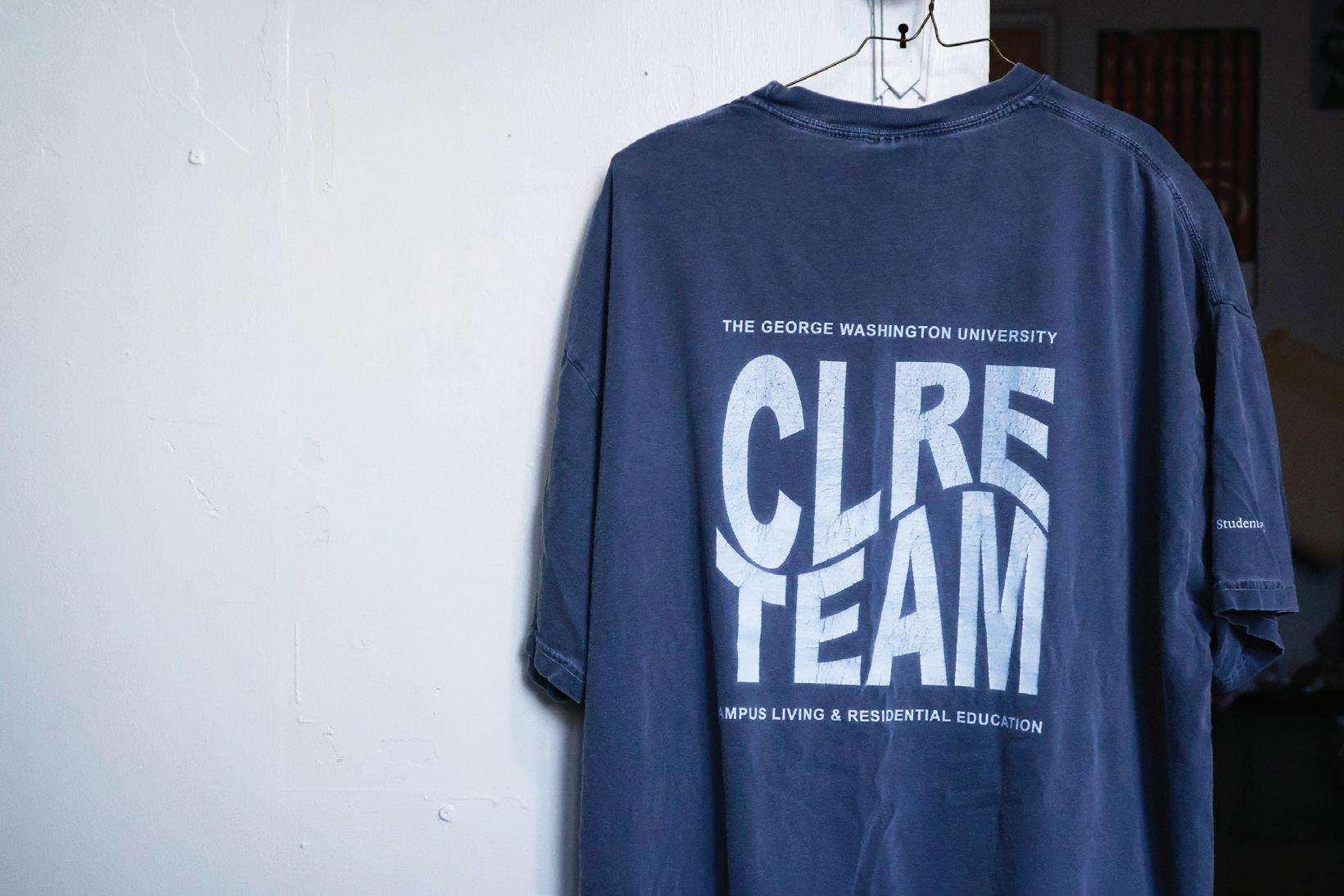
KYRA WOOD | ASSISTANT PHOTO EDITOR
A Campus Living and Residential Education shirt hangs in a residence hall room.
ARWEN CLEMANS | SENIOR PHOTO EDITOR
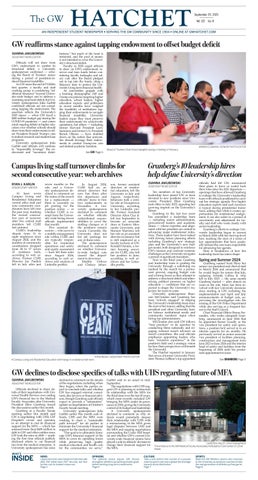
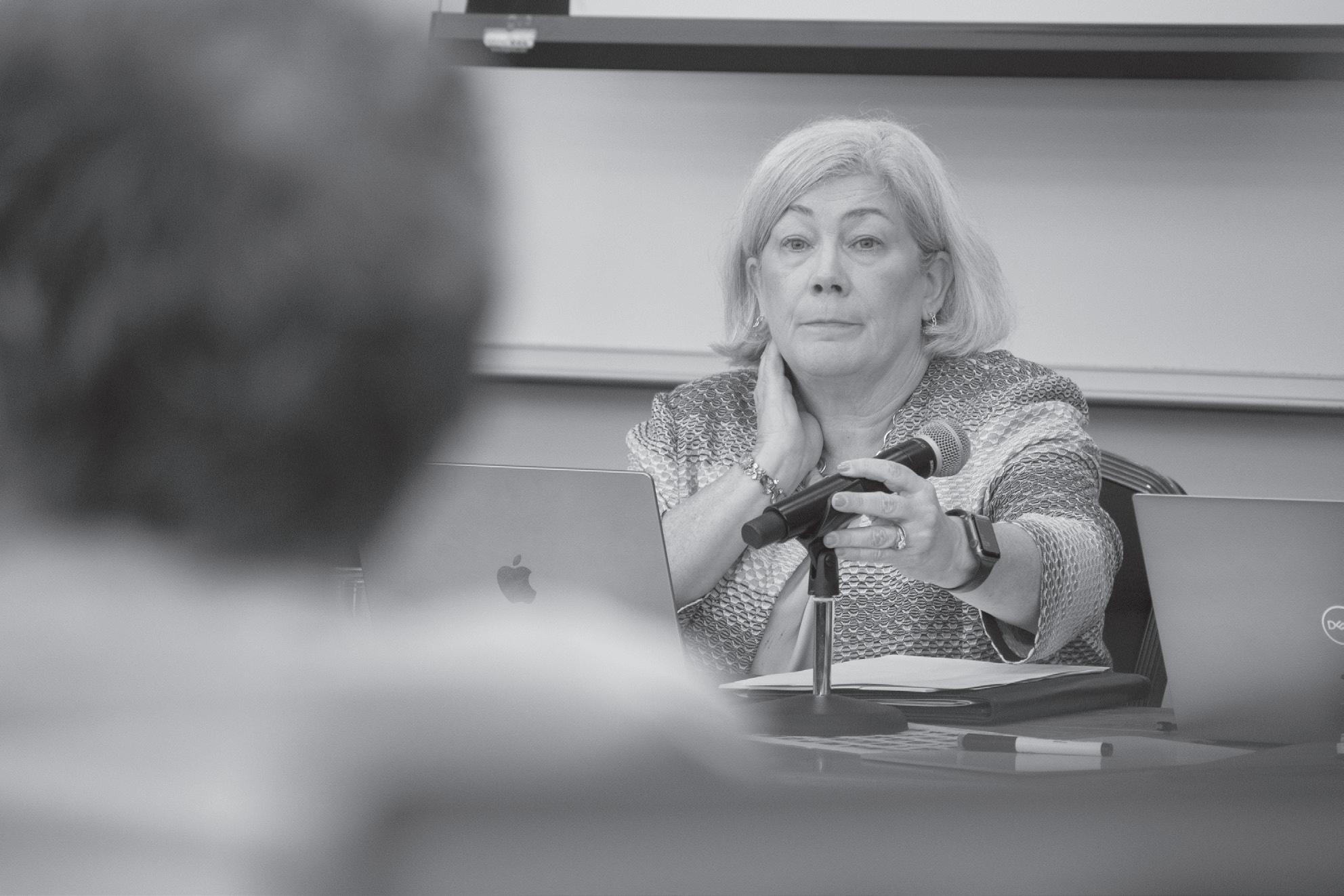
Board of Trustees Chair Grace Speights during a meeting in February. See GW Page 5
JAKUBOWSKI ASSISTANT NEWS EDITOR
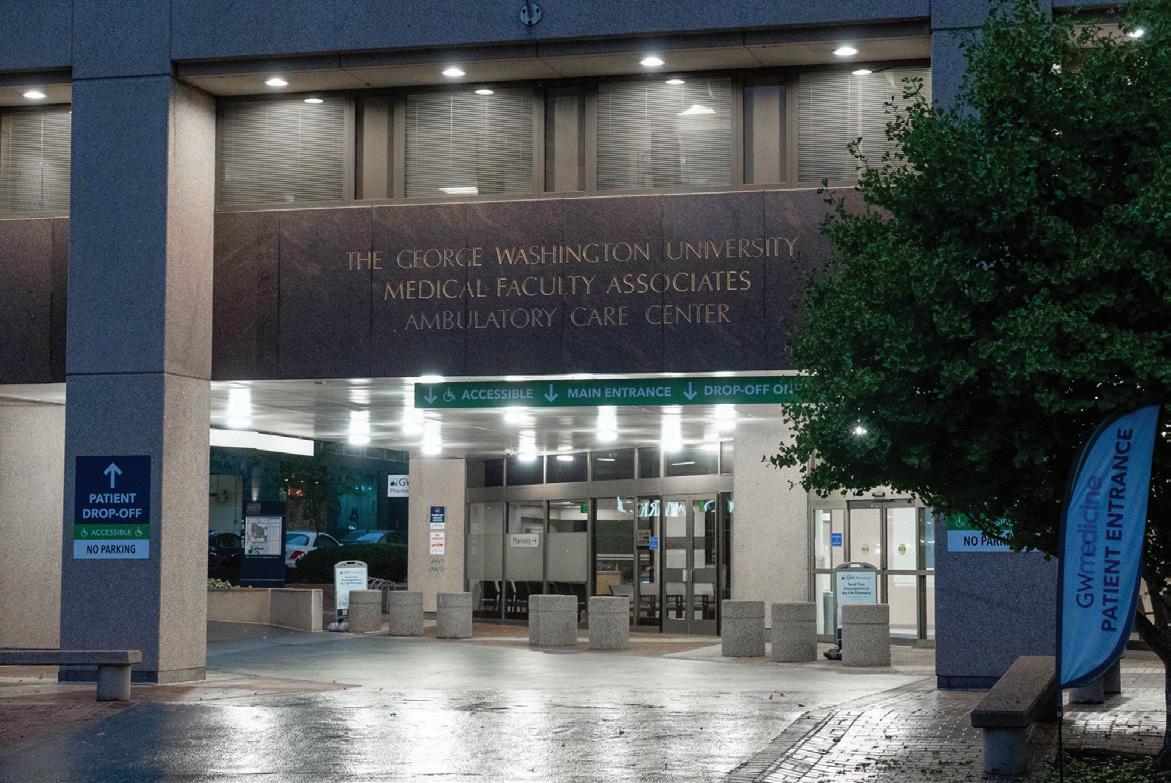
CARSTEN HOLST | PHOTOGRAPHER The entrance to the GW Medical Faculty Associates Ambulatory Care Center on 22nd Street.
See GRANBERG Page 5

Tracking FY2026 cuts to campus operations, resources
FIONA RILEY
EDITOR IN CHIEF
HANNAH MARR
MANAGING EDITOR
GW is grappling with a yearslong budget deficit as Trumpera attacks on higher education and looming declining enrollment threaten universities’ fixed revenue streams. In response to the deficit — which sat at $24 million in July — officials have cut GW’s fiscal year 2026 budget by 3 percent, implemented a hiring freeze, paused merit-based salary increases and launched a working group to consider “additional measures” beyond University-wide budget cuts.
Officials have directly tied some — but not all — of these reductions to their work slashing University costs, though each announcement followed their April decision to reduce GW’s FY2026 budget. GW’s cuts are emblematic of a larger trend playing out at schools nationwide as they weather a demographic cliff and Trump’s policies.
Through FY2026’s first quarter, The Hatchet covered these cuts in isolation. But in reporting, the paper detected a larger trend in the University-wide cuts — something GW last experienced in FY2020 when GW faced a $180 million pandemic-induced budget gap.
For the remainder of the fiscal year, this tracker will document cuts to campus operations, programs and resources. The Hatchet has directly asked GW if each of the changes outlined below are tied to University-wide budget cuts. Any responses officials provided to individual cuts are included below.
In a general response to questions on changes during FY2026’s first quarter, University spokesperson Shannon McClendon said officials evaluate “fiscal responsibility” and community needs before making any changes to resources like dining, transportation and student organization processes.
While upperclassmen students say they still feel safe in their dorms after officials rolled back around-the-clock security guard presence in certain residence halls this academic year, they worry about the mounting University-wide cuts to student services.
Officials rolled back security coverage — previously 24/7 in all residence halls — in certain sophomore and upperclassmen residence halls this semester, which they said was based on the halls’ locations and crime reporting in the area, only stationing security personnel in the halls overnight. While more than a dozen students said they feel just as safe in the wake of the changes, some say they’ve grown weary of scaled-back student services since officials announced University-wide budget cuts in April.
The reduced security guard presence is one in a string of limits on student services since officials’ April announcement that they’d cut the University budget by 3 percent to combat a yearslong structural budget deficit. Officials implemented a hiring freeze in July, and this semester, GW has slashed Gelman Library’s hours because of staffing issues stemming from the hiring freeze. Officials also closed District House and University Student Center eateries’ weekend hours, which officials attributed to low foot traffic. Andre Seañez, a junior living in Shenkman Hall, said the University’s trim-
What: University President Ellen Granberg said officials will refrain from funding “fancy initiatives” tied to the strategic framework until GW’s budget stabilizes.
When: Granberg shared officials’ stance on funding large initiatives at September’s Faculty Senate meeting but said “that doesn’t mean there isn’t plenty that we can do.” She also announced working groups to explore the three initiatives officials deemed most important to prioritize.
GW’s commentary on the change: McClendon said the strategic framework will guide the University through “challenging times” and reiterated that the working groups will develop plans for “realizing these goals in the future.” She declined to comment on whether officials are altering their original rollout plans for the framework in response to budget cuts or whether the current focus on the three key initiatives differs from the initial plan.
What: The Student Bar Association Senate said officials cut GW Law’s student government budget by roughly $40,000, dropping from over $200,000 in 2024 to $151,000 this year. SBA Senators linked the reduction to broader budget cuts across the University.
When: SBA Senators announced the budget reduction at their Sept. 9 meeting, but the cut will affect the entirety of the SBA’s 2025-26 academic year budget.
GW’s commentary on the change: McClendon said officials weigh the University’s fiscal responsibility alongside community needs, including student organization processes but declined to confirm whether the SBA’s budget reduction is directly linked to University-wide cuts.
What: Officials terminated Gelman Library’s long-standing policy of 24/7 student access, which a library employee said was in response to the University-wide hiring freeze as it left the library with an inadequate number of staff to keep the building open in-
cessantly.
When: Officials implemented the change at the beginning of the fall semester, although Student Government Association officials announced soon after the change took effect in August that the library would return to 24/7 operating hours sometime within the next “few weeks.” A staff councilmember who sits on the body’s library committee said in mid-September that officials are still determining the exact date Gelman will return to its normal hours of operation.
GW’s commentary on the change: McClendon declined to comment on whether officials’ decision to rollback Gelman’s overnight hours related to Universitywide budget cuts.
What: GW closed District House and University Student Center dining venues on weekends.
When: Officials implemented the change at the beginning of the fall semester.
GW’s commentary on the change: University spokesperson Claire Sabin said in midSeptember officials implemented the change because the dining vendors faced lower foot traffic on the weekend also adding that the adjustments to hours help officials “balance operations.”
What: Officials slashed the frequency of the Mount Vernon Express shuttle service by 50 percent this semester and removed two buses from circulation, a move students say is worsening their yearslong reports of long lines and delays.
When: Officials implemented the change at the beginning of the fall semester.
GW’s commentary on the change: University spokesperson Julia Garbitt said earlier this month officials made the decision partly in response to GW’s introduction of a new shuttle model, which seats 30 passengers instead of 25.

ming of security protocols, in addition to cutting hours in Gelman and dining locations, is upsetting because he frequently used those campus services. “I think for the amount of tuition we’re paying, I think it’s just a bit disappointing that the University is not doing more,” Seañez said.
University spokesperson Kathleen Fackelmann said officials decided to change residence hall security protocols in upperclassmen halls this year based on “very low incident data” in those halls, not “financial considerations.” Fackelmann said safety remains GW’s “highest priority." All first-year residence halls, as well as District House, International House, Francis Scott Key, Jacqueline Bouvier Kennedy Onassis and Munson halls will continue to have security guards present 24/7. All other halls have security cover-
age from 10 p.m. to 6 a.m., according to an August University release. Gelman, which used to operate 24/7, reduced its hours this semester to 7 a.m. to midnight Monday through Thursday, 7 a.m. to 10 p.m. on Friday, 8 a.m. to 10 p.m. on Saturday and 8 a.m. to midnight on Sunday as officials address a staffing issue, according to Dean of Libraries and Academic Innovation Geneva Henry. Students this month also lamented officials’ decision to axe weekend dining hours in USC and District House.
Maria Szamrej, a junior living in Shenkman, said Shenkman’s location at the edge of campus and the fact that students do not have to tap to get into the elevator in Shenkman gives the appearance that “anyone” can enter the building, compared to other residence halls, where students have to scan their ID to get into the elevator. Szamrej said
she doesn’t feel less safe with the reduced security hours, but she said it feels like a message from the University that they are not putting student safety first.
“I don’t think it really makes a difference in terms of our actual security, but it kind of feels like a stab in the back from the school that they’re not prioritizing that,” Szamrej said.
Bineta Ndiaye, a junior student living in Lafayette Hall, said it seems “crazy” to her that anyone could walk in during the day without security guards there, and since there is typically more foot traffic in the hall during the day than at night, it makes sense to have security presence during the day.
“I would hope that nothing would happen, but I wouldn’t be surprised if something happened that was
ventable,” Ndiaye said.
MCMAHAN | PHOTOGRAPHER
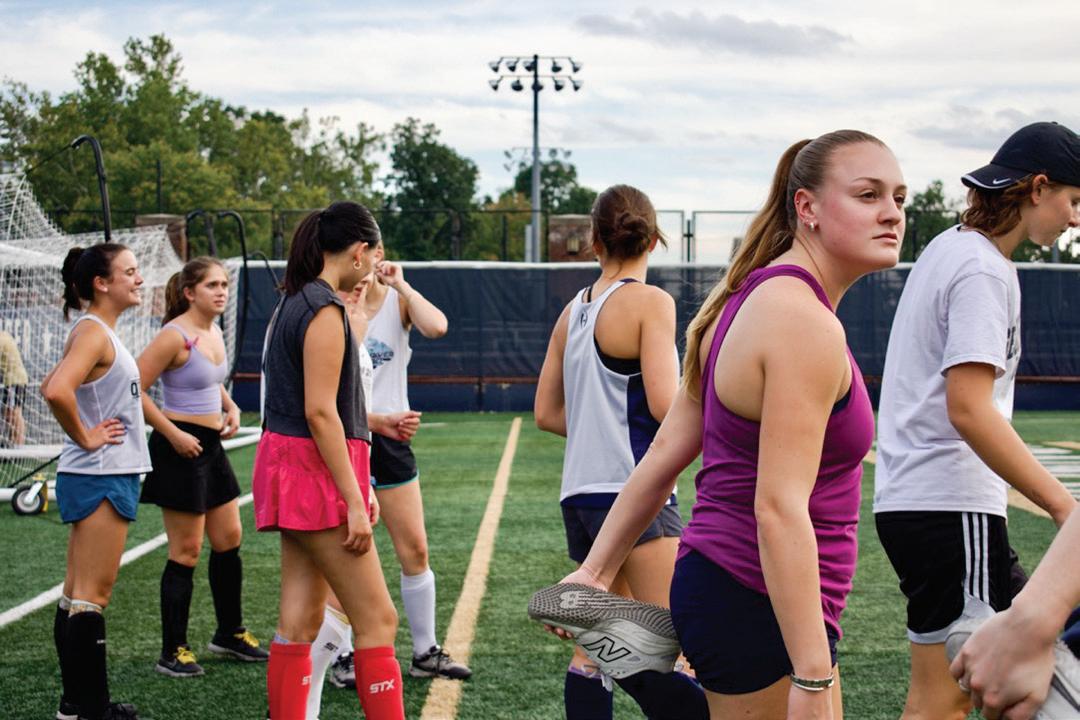
Members of the club field hockey team stretch before practice at the Mount Vernon Campus soccer field Friday.
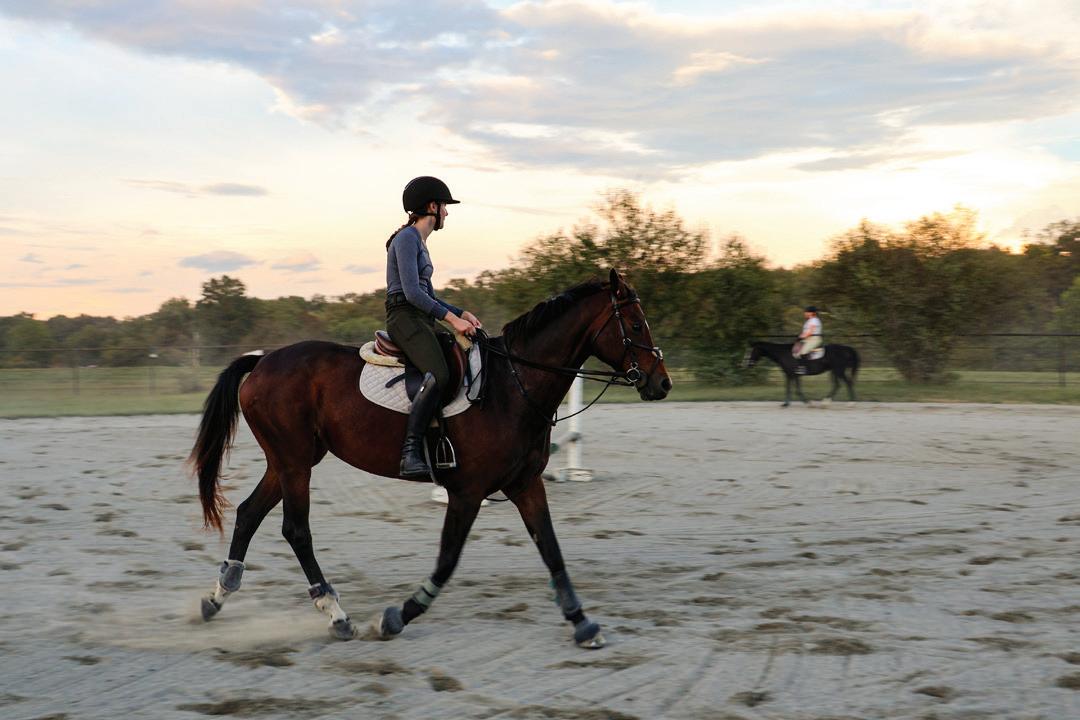
KYRA WOOD | ASSISTANT PHOTO EDITOR Sydney Holland trots without stirrups during an evening practice with the equestrian team Tuesday.
LEXI CRITCHETT | ASSISTANT PHOTO EDITOR
GW Sailing Captain Ari Angueira skippers a boat while running through drills Friday.
ARWEN CLEMANS | SENIOR PHOTO EDITOR
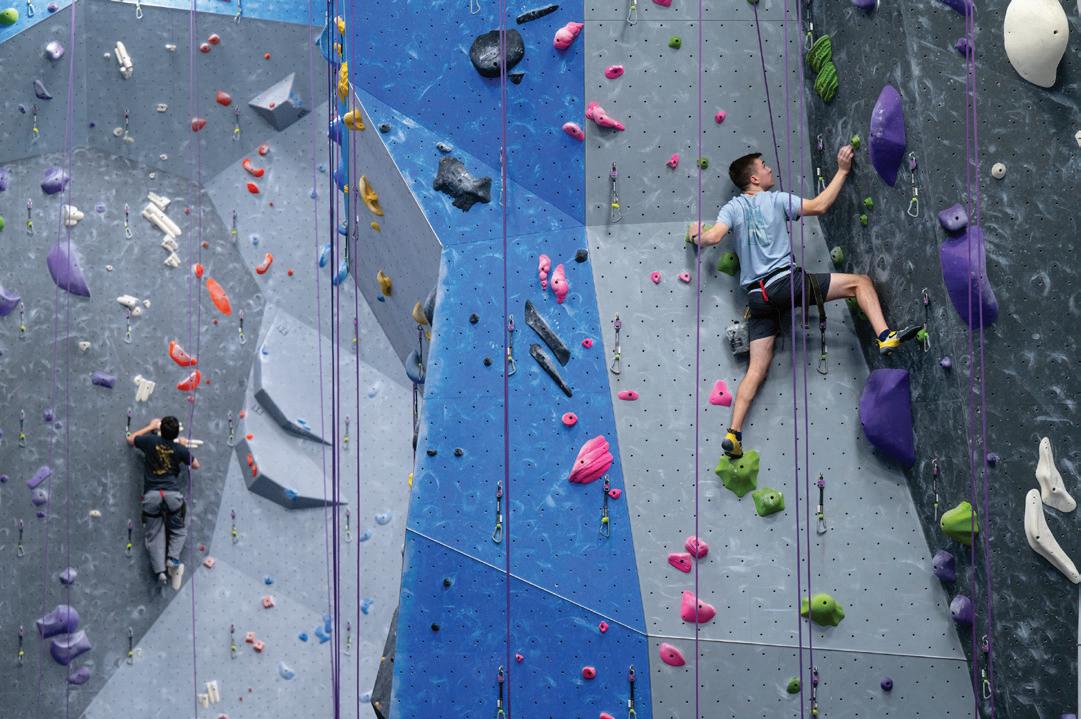
Members of the club climbing team, including Jacob Goldberg on the right, toprope a wall during tryouts for the team last week.
MATHYLDA DULIAN | ASSISTANT PHOTO EDITOR
A student taps their GWorld card at the vacant Shenkman Hall security desk.
Student attendance sparse at first public SGA Finance Committee meetings
After years of calls for increased transparency, the Student Government Association’s Finance Committee opened its meetings to the public for the first time this month, but so far no students have attended to watch senators debate funding allocations once made behind closed doors.
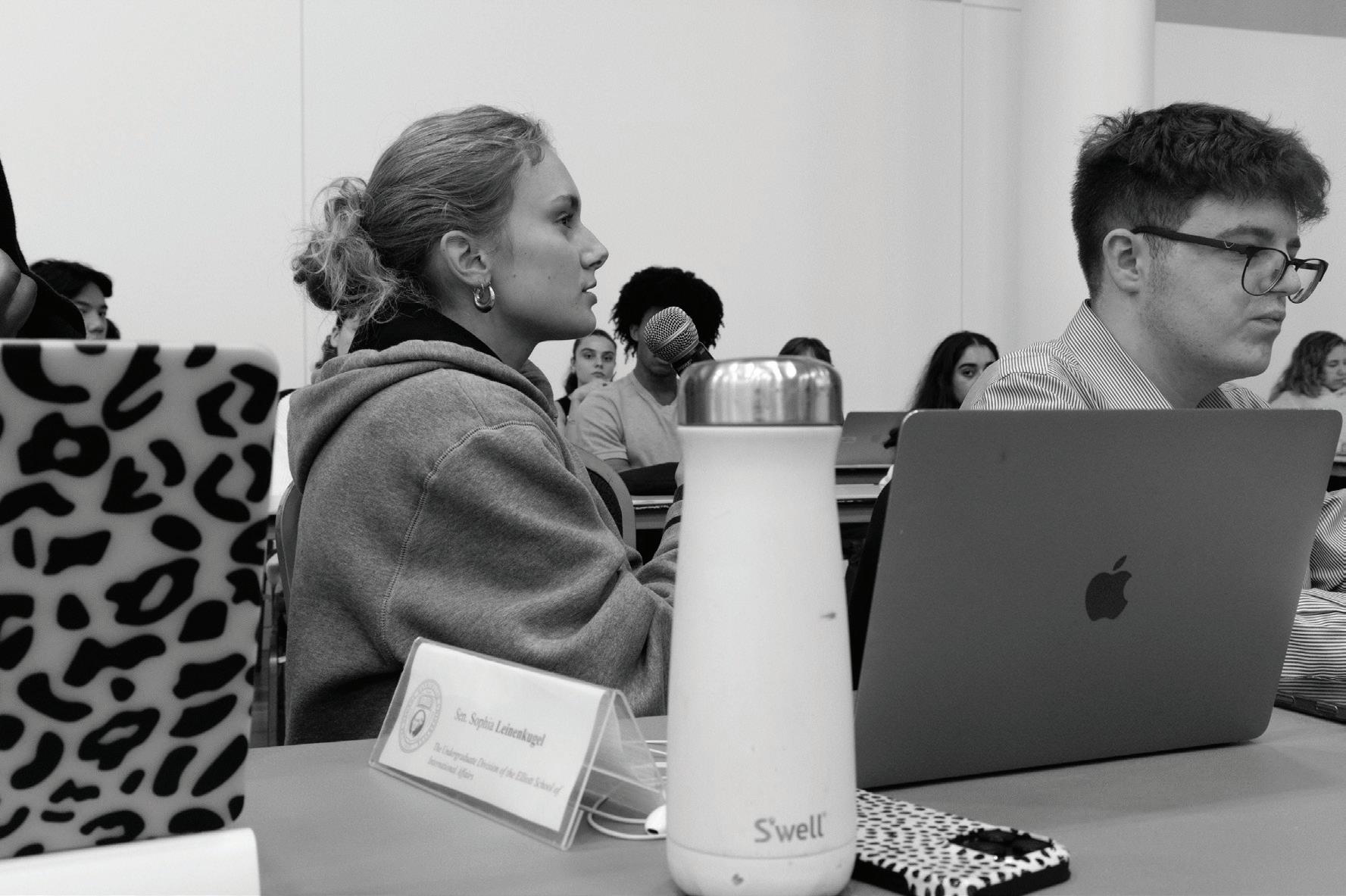
The decision to open meetings followed renewed calls from SGA senators and student organization leaders since at least 2022 for greater financial transparency, although students have complained for years that the committee was not clear about how it allocated funds to student groups. SGA Sen. Sophie Leinenkugel (ESIA-U), the chair of the Financial Services and Allocations Committee, said zero students attended either of the committee’s first two open meetings, and only one student has indicated they will attend a future meeting.
Leinenkugel said she thinks the committee needs to do a “better job” of publicizing the meetings and encouraging students to attend, but she is still working with other members of the committee and SGA Vice President Liz Stoddard on the details of how to boost attendance.
She said the committee currently promotes its meetings through the SGA’s weekly newsletter, which
she thinks is less widely read than other platforms — like posts on the SGA’s Instagram — that typically draw more engagement to boost attendance.
Closed-door Finance Committee meetings have long dominated
criticisms of the SGA’s lack of transparency, with students and organization leaders urging the committee to allow public attendance since at least 2014. During SGA elections in 2023 and 2024, vice presidential candidates — who oversee the SGA
Senate’s allocation of money to student organizations — echoed those calls and promised to open finance meetings to their platforms. In 2014, after a former senator accused the Finance Committee of secrecy, the committee pledged
to revise bylaws to increase its accountability and transparency. More reports emerged in 2022 after the SGA’s legal counsel accused the then-finance chair of negligence and bias in fund distribution. Students can RSVP to finance meetings, which occur weekly on Thursdays at 8:30 p.m., through a form in the SGA newsletter, which collects basic details like if they have a public comment, the meeting they will attend and any ties to student organizations. Leinenkugel said the system helps the committee anticipate attendance and organization affiliations and gives her the option to deny entry to certain students if they become disruptive.
Leinenkugel said Finance Committee meetings have grown longer this year as student groups request more cosponsorships, since the SGA bolstered the cosponsorship fund while reducing upfront allocations at the beginning of the year. She said long meetings have placed a “strain” on some senators — especially graduate students — and may discourage public attendance, an issue she said she is “actively trying to solve” but still working on specific solutions as to how to bring meeting times down.
“I remember being on the Finance Committee last year when we’d have 18 requests to consider. Those numbers, they don’t really exist anymore,” Leinenkugel said.
Economics department relaunches center to showcase, strengthen research
The economics department is seeking funding and new staff for a research center it relaunched earlier this year, after going dormant and without a director for over a decade, aiming to promote department research and strengthen research collaborations.
The Center for Economic Research was largely inactive between 2010 and 2024, during which time it only operated a macroeconomic and microeconomic forecasting program and lacked a director until the economics department chair, Tara Sinclair, stepped into the role in summer 2024 to help resuscitate the center and bolster event offerings. Now, department faculty said the center plans to grow its staff, which currently consists of a director and two undergraduate
work-study students, secure more outside funding to spotlight GW’s economic research, expand events and forge stronger connections with outside scholars.
Sinclair said the Columbian College of Arts & Sciences formally approved the center’s term for three years — as is standard for CCAS centers — effective April 1. The relaunch comes after CCAS finalized its rechartering policy for centers during the 2023-24 academic year and subsequently asked all its existing centers to apply for reapproval, according to Evangeline Downie, the CCAS associate dean of research and special initiatives.
Tomas Williams, CER’s new director and an associate professor of economics and international affairs, said the department reorganized the center’s research programs to match the economics department’s seminar series as
a way for faculty, students and visiting researchers to platform their academic work. Williams added that CER now coordinates and promotes the seminar-series events tied to its five research areas — microeconomics, trade and development, macro-international and artificial intelligence economics — under the single umbrella of the center.
The economics department is holding in-person seminars throughout the semester on a near-weekly basis, as the seminars connect to the research areas of CER.
“The idea is to highlight that research, the events that are regularly conducted by these different research programs and to put in contact our researchers with external researchers, so collaboration can emerge from that, and yet, really showcasing our work, the work of different researchers,” Williams said.
Sinclair said GW has advised the center on how to solicit outside donors and grants to expand its reach and staff. She said the University is no longer rebating some of the indirect cost recovery — the overhead from sponsored research used for expenses like office space and administration — GW collects from external grants, like it did for the center before it was periodically inoperative.
“We don’t have any full time staff working for the center right now, so obviously, this is one of the reasons why we want this organization to help us to connect more with funding sources, so grants, donors, with the goal of having more support,” Sinclair said.
Anthony Yezer, an economics professor who served as the center’s director from 1985 to 2010, said in an email that GW “killed” CER when
Anonymous social media app harms campus discourse: students
Two years after the anonymous social media app Fizz debuted on campus, students agree the platform has damaged campus discourse and culture, including making it more aggressive at times, but are split on if the app should have increased moderation.
Subjects of Fizz discourse — including a Student Government Association candidate and a first-year running for a Residence Hall Association position — said reading negative posts about themselves was “alarming” and forever damaged their reputations on campus. But over a dozen students said Fizz has become an integral part of their campus experience because it is the only place where students can have open discussions about GW-specific issues, like dorm fire alarms and classes.
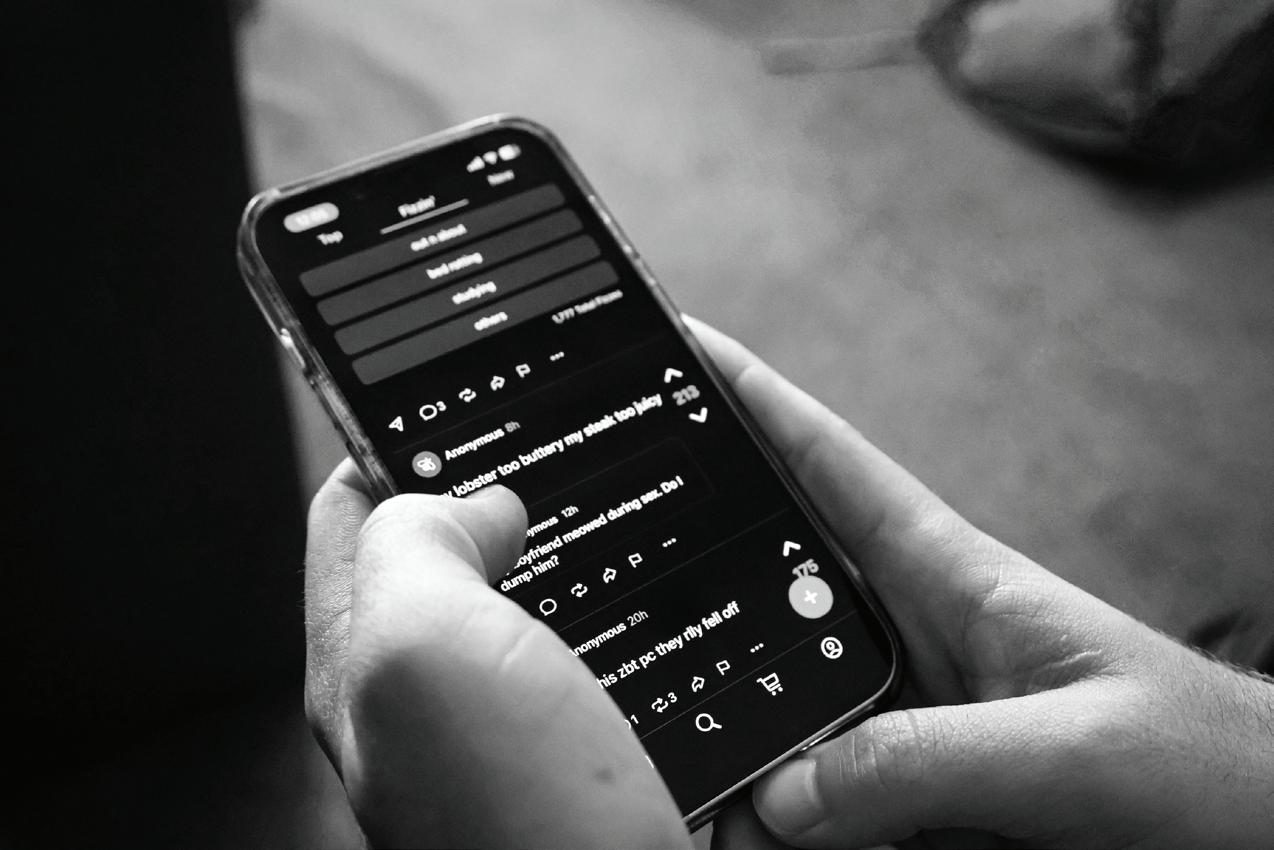
Fizz allows students at a university to post content with under 200 characters anonymously or under a pseudonym of their choice, with the option to add GIFs or photos, after they make an account with their university email. Students can also upvote or downvote posts, adding to a user’s “karma” points. Users can add flags, like “Question” or “Crush,” to help categorize posts and comment under posts or “ReFizz” a post — which makes a new post with the original post embedded.
In the past two years, Fizz has been the scene of discourse and discussion on a variety of campus issues, including SGA and RHA elections, as students purse through the slate of candidates for student-elected positions. The app was also the floor for debate following Charlie Kirk’s assassination and throughout the April 2024 proPalestinian encampment in University Yard.
First-year student Jack McConnel said since he began posting his second week on campus, he’s risen to the second place of all Fizz users at GW in the last 30 days. He said he first started posting on Fizz to see if people would believe “crazy” rumors or exaggerated stories that he posted.
McConnel said a back-and-forth banter between him and his friends, mentioning each other’s Thurston Hall room numbers on Fizz, gained traction, leading to students knocking on his door and making TikToks in front of his room after the number was posted. He said the exchange also contributed to his decision to stop posting on the app because it became overwhelming to have multiple students knocking on his door and bothering him in person.
“It definitely is part of the reason why I stopped is because I’m tired of people banging on my door,” McConnel said. “I literally had a week where every night someone would come and knock on my door. I had someone leave a note, slide it under the door, bang really loud and run away.”
SGA presidential candidate Dan Saleem, who ran and lost in 2024 and ran again in 2025 before dropping out of the race, said his friends made him delete the app during the 2024 campaign because they were concerned posts about him would harm his mental health.
He said he’s found out about what students have said about him on Fizz through friends, including an incident on Sept. 11 after conservative activist Charlie Kirk’s assassination that read “Charlie Kirk: yesterday. Dan Saleem:
next.” Saleem said he reported the post, and it is currently being investigated by Conflict Education and Student Accountability.
“It just shocks me how far people are willing to take things,” Saleem said. “There’s some level of expectation whenever you run for any office, even student government, that you will be spoken about.”
Kieran Laffey, chairman of the GW College Republicans, said the posts students made in response to Kirk’s assassination were “scary” for the organization, especially those made following a vigil for the conservative activist. He said the anonymity adds a level of negativity to the app, because people do not know who is making disparaging comments about them or their clubs.
In the wake of Kirk’s assassination, students took to Fizz to share their opinions on the conservative activist’s death, including a poll gauging support for the killing. The poll has over 3,000 votes as of Sunday, with 65 percent of voters saying Kirk didn’t deserve to die, while 35 percent, or just over 1,100 voters, say he did.
“Our members hold many similar views as Charlie Kirk, so does that mean, if Charlie Kirk’s death is justified, does killing one of our members mean that’s justified?” Laffey said.
officials ended an agreement to share indirect cost recovery and redirected the funds elsewhere. Yezer said the economics department should work to reach a similar agreement with the University, like the one it initially had and that supporting economics studies does not carry some of the costs that other research has, like lab upkeep.
“Sponsored research in economics does not require significant institutional support,” Yezer said. “At other universities, this is recognized by the administration.”
Sinclair said AI economics is a “brand new” research program created to reflect the growing role of AI in economics, both as a subject of study and as a tool for research.
The program supports both theoretical and empirical research on how AI will
impact people’s economic behavior and the economy overall, as well as empirical research that uses AI tools — including machine learning — in its analysis, according to the center’s website.
“I’m really excited about the range of work that that program is both cultivating and highlighting, and the new opportunities there to collaborate with a wide range of researchers here at GW and in the broader academic community and in D.C. and elsewhere,” Sinclair said. Sinclair said before the revival, CER’s research programs were narrowly defined and not well coordinated with the seminars and events the economics department held. The website did not list the four research areas before this year’s relaunch and just mentioned the forecasting program, according to website archives.
CRIME LOG
HARASSMENT: EMAIL AND ELECTRONIC MEDIA
Science and Engineering Hall
Multiple dates and times
Open Case
A male GW staff member reported harassing emails from a female former GW-affiliate. Suspect identified.
THEFT II/OTHER, CREDIT CARD FRAUD
Western Market
9/23/2025 – 12:00 p.m. to 1:39 p.m.
Open Case
A male GW student reported their credit cards stolen and used for unauthorized purchases. Case open.
THEFT II/FROM BUILDING
Science and Engineering Hall
Reported – 9/23/2025
Open Case
A female contractor reported several personal items stolen from their office. Case open.
THEFT II/FROM BUILDING
Thurston Hall
9/22/2025 – 7:40 p.m.
Open Case
A male GW student reported their wallet stolen after leaving it in a communal bathroom. Case open.
THEFT II/FROM BUILDING, CREDIT CARD FRAUD
Duques Hall
9/22/2025 – 5:00 p.m.
Open Case
A female GW student reported their credit cards stolen and used to make unauthorized purchases. Case open.
—Compiled by Bryson Kloesel
JERRY LAI | STAFF PHOTOGRAPHER
Student Government Association Sen. Sophie Leinenkugel (ESIA-U), speaks at a SGA meeting in September.
PHOTO ILLUSTRATION BY KYRA WOOD
A student scrolls through Fizz.
Students revive group spotlighting African politics, culture
AMELIA NELSON
RYAN
International affairs students revived an organization this semester focused on African politics and U.S.Africa relations after a year of inaction, aiming to raise community awareness of Africa’s role in global affairs on campus.
Operation U.S.-Africa hosts speaker events featuring African officials and holds discussions on topics related to the continent, including politics, international influences and domestic issues in specific countries. The group’s student leaders said they plan to expand discussions beyond security issues to include topics like local infrastructure projects and economic development in specific African countries as the group works to strengthen its presence on campus after a year of inactivity.
OPUS Africa hosts general body meetings every few weeks on different topics relating to the African
continent, where students take turns researching and presenting. The group’s most recent meeting last week focused on the Grand Ethiopian Renaissance Dam — a dam and hydroelectric power plant on the Nile River in Ethiopia — which they hosted in tandem with GW’s Ethiopian-Eritrean Students Association.
The group also hosts speaker events, like a September presentation about counterterrorism in Mozambique with Ambassador of Botswana to the United States Mpho Churchill O. Mophuting.
Robert Jackson, OPUS Africa’s vice president, said master’s students first founded the organization in spring 2024 to discuss security-related issues in Africa, like election security. He said the previous leadership, comprised of master’s students, had busy workloads that caused the group to remain inactive for much of the 2024-25 academic year.
Jackson said OPUS Africa’s initial focus on security issues is a crucial component of discussions on Africa, but the organization’s new
leadership wants to expand beyond the original securitybased discussions and focus on other topics relevant to the African continent, like business and economic related topics.
“We thought that Africa is more than just a war zone or that kind of topic,” Jackson said. “That’s usually what dominates the discussion, but there’s so much opportunity and really interesting stuff.”
Jordan Grossman, OPUS Africa’s finance officer, said the organization’s leadership is a completely new slate of students, all of whom have an interest in further educating themselves and other students about the African continent. She said they all feel they haven’t had an adequate education on the continent because there are few African-based courses available in the Elliott School of International Affairs.
Students in the Elliott School can pursue a concentration in African studies, which includes courses on African international politics or literature from the continent, and all international affairs. The Elliott School also
GW researcher finds order in metal alloys’ atomic structure
VIANNA HAMIDI REPORTER
A GW researcher found in a study last month that certain metal mixtures’ atomic structures have order despite scientists’ previous beliefs that they were random.
The study, authored by Xiaochen Jin as her thesis while she was a doctoral candidate at the University, used machine learning to determine that the atomic structure of Group 4 alloys, metallic substances composed of multiple elements, are orderly, meaning atoms from different substances within the alloy arrange themselves in consistent patterns. Jin said her findings will have practical applications in making more efficient versions of products with Group 4 alloys like semiconductors — which are often used in smartphones and other electronic devices to conduct electricity — since scientists can now predict the atomic structure of the materials used to make them.
“This understanding of short order will be very helpful for fabricating or manufacturing these semiconductor materials with desired property,” Jin said.
Jin’s research found evidence of short-range order in the alloys, meaning the atoms have a tendency to arrange themselves in predictable patterns over small distances, even if the overall atomic structure of a material appears to be random.
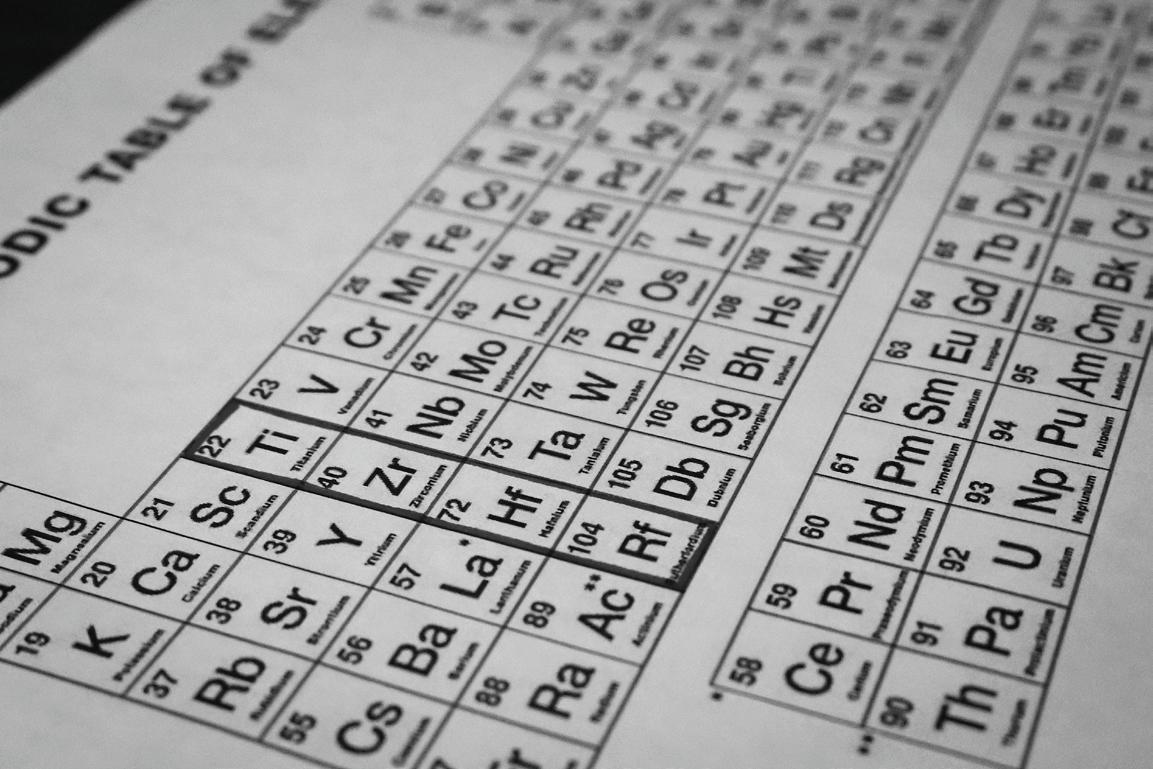
Group 4 alloys contain elements from Group 4 of the periodic table — like silicon, tin and titanium — and are critical to the making of electronic products because other orderly metallic elements, like those from Group 3 and 5 of the periodic table, are too scarce or toxic to use in electronics, Jin said. She added that the findings of her study could lead to a dramatic reduction in cost for making materials like semiconductors and other electronics because now scientists can more easily manipulate and utilize these cheaper materials.
Scientists previously believed Group 4 elements had random atomic structures, meaning atoms of different elements were mixed together in no particular order. However, by using machine learning to create a more extensive atomic model than was previously technically feasible, Jin found evidence of short-range-order in these materials, meaning they’re more predictable to work with.
“So first of all, we can afford to simulate a more realistic system,” Jin said. “And secondly, this system is also comparable to the actual size of experimental char-
acterization. So we can afford to do side by side comparisons with experimental characterization. So this is a very important development.”
Jin said she believes her study will be one of the first on atomic structural nonrandomness in Group 4 elements, made possible by using machine learning to develop more sophisticated modeling for the structure of atoms within the alloys and that the results provide a “new understanding” of material sciences by making it easier to design electrical components.
“So basically, we found there’s a coexistence of multiple, multiple types of ordering existing in these materials,” Jin said.
David Dunand, a professor of metallurgy at Northwestern University, said using alloys allows engineers to create more energyefficient products. Dunand said alloys can accomplish this by having better temperature absorption, lighter weights and better electrical conductivity.
“A lighter car means a more efficient car,” Dunand said. “The second is how to make better batteries for electric cars, and the third one is how to make better engines for engine cars that use gasoline and by better for the case of engine, I mean operating at higher temperature, so we can burn less gasoline and get high mileage.”
The increased predictability of atomic structures in Group 4 alloys helps manufacturers fabricate more reliable and cheaper products because it is easier to simulate the behavior of the materials under stress, according to Dunand.
Michael Kaufman, a professor at the Colorado School of Mines, said the study’s finding of order in materials like Group 4 alloys could help engineers prevent defects like fractures in electronic products and “maximize” ductility, the ability of a material to maintain its physical form under stress, by making material outcomes clearer for engineers.
Kaufman also said researchers should be “careful” studying shortrange order and atomic structure in alloys because supposed atomic patterns that could be recognized as short-range order can actually be caused by unrelated phenomena like energy waves.
“We showed that you have to be really careful, and we showed that some of the scattering that people were contributing to shortrange order was not due to shortrange order, it was more due to a diffraction effect that we could explain,” Kaufman said.
has the Institute for African Studies, but the school does not offer a major in African studies, unlike Middle Eastern studies and Asian studies.
Grossman said they are working on expanding the club’s focus beyond African security policy and U.S.-Africa relations to include domestic issues as well, like the ongoing civil war in Sudan, which began in 2023. She said the group is also interested in exploring economic development in Africa, along with infrastructure and the influence of the United States and Russia on African politics.
Grossman said she believes students overlook the African continent, favoring other countries and regions, like China and the Middle East. She said she believes if countries like Nigeria, which have a larger population in Africa, continue to grow, they will become more crucial on the global political stage, and GW students should be more interested in learning about them.
Grossman said she wants students, like those who attended their event on Bo-
tswana, to become informed about the African continent, not just from the U.S. and foreign relations perspective but domestic politics and culture as well.
“Our modern OPUS Africa is more concerned also with economic welfare in Africa and what actual Africans in African countries want for their countries,” Grossman said. “Because it’s not always, ‘Oh, we want more U.S. aid,’ maybe they want roads or trains or something.”
Grant Perry, the group’s outreach director, said that OPUS Africa is accepting applicants for students interested in conducting research about the continent, which will be published in their online journal after it goes through an editing process.
He said students can submit papers they wrote for other classes or write them with the organization’s help on different topics, adding that he himself wrote a governance article about terrorism in Mali and West Africa.
“We have one on security and conflict, we have a governance one, we have an economic one, African diaspora and African history, those
are the five subtopics,” Perry said.
Matthew Volfson, the organization’s president, said the group would like to conduct site visits to embassies and think tanks related to U.S.-African relations. He said the site visits align with the club’s broader goal of connecting students with African officials for potential internships and future career aspirations, given D.C.’s international presence.
“But also for people who are hired, that kind of know what they are doing already, like myself and some of my e-board members, we’re giving people a professional opportunity to get into the door,” Volfson said. Volfson said a goal he has for this year is to expand OPUS Africa’s collaborations with African cultural organizations, such as EESA, addressing a lack of collaboration between organizations he believes many groups on campus overlook. He also said he wants to include more speaker events, which can pique students’ interests in the continent and expose students to networking opportunities.
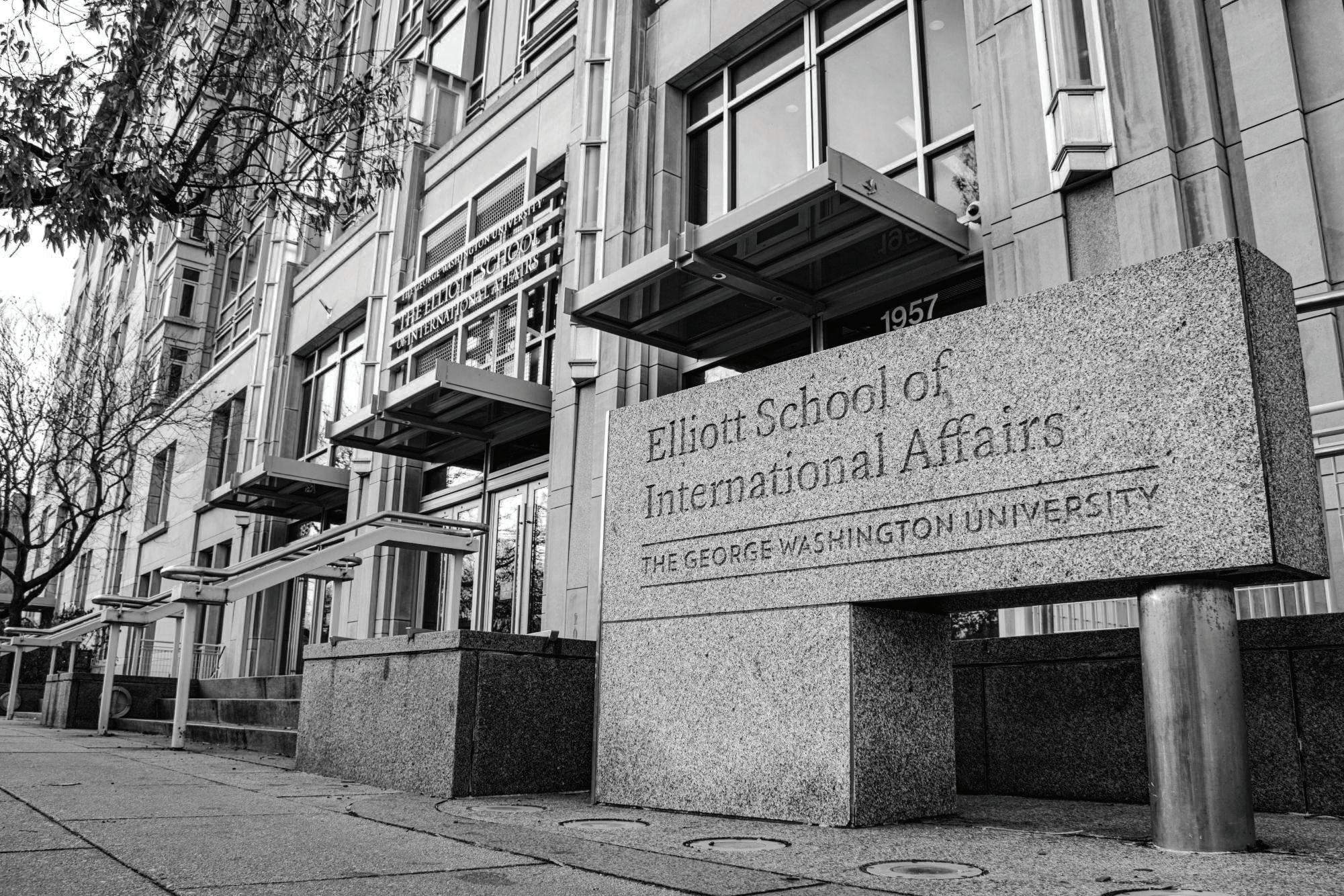
Elliott faculty member launches initiative to advance global human rights
SHIVU SATHE REPORTER
A professor in the Elliott School of International Affairs launched an initiative last week aiming to counter democratic backsliding from authoritarianism and poor human security through public events and student advocacy trainings.
The Athena Initiative will collaborate with various Elliott programs — beginning with the Institute for Middle East Studies — to hold events featuring foreign policy experts to discuss human rights and humanitarian issues stemming from ongoing conflicts. Shirley Graham, director of the initiative and a professor of international affairs, said her goal is to equip students with the information to confront what she sees as a rising global authoritarianism that impacts underrepresented groups, like women and girls.
Graham said the idea to create the initiative started from conversations with students and other faculty about the “authoritarian turn” happening globally, including in Iran and Afghanistan. Graham said GW’s Student Consortium on Women, Peace and Security, which she founded in 2021 to promote women in the study of national security, was a helpful resource for brainstorming ideas, including what to name the initiative.
“We wanted to create a space where we could convene conversations with different communities,” Graham said. “Particularly, places where we could bring in the perspectives and views of populations who are often underrepresented. And we wanted to really harness the energy of a sort of figure that could inspire us.”
Graham said while the Athena Initiative is not directly affiliated with other Elliott School programs, it is designed to work across the school’s academic programs since the events cover different countries and issues, like Middle East studies, women’s rights, conflict prevention and U.S. legislation about improving genocide and atrocity awareness.
“In all of these crises, the
voice of the most marginalized people are the ones that are most silenced,” Graham said. “Here in the Athena Initiative, we will be centering those voices, particularly the voices of women and girls.”
Graham said students can get involved by attending the initiative’s events and incorporating what they learn into their class assignments to help raise awareness about human security, which refers to how people protect themselves when dealing with troubling events outside their control, like civil wars and food insecurity.
“It’s not all about women, peace and security, they’re just some of the events lined up in the near term,” Graham said. “But it’s a much wider topic, obviously.”
Graham said the initiative will also host Capitol Hill advocacy trainings where students learn how to brief congressional staff and support U.S. legislation that supports global peace and security. She said the training will walk students through the process of arranging meetings with staffers, presenting policy arguments and urging funding for measures like the Women, Peace and Security Act, the Global Fragility Act and the Elie Wiesel Genocide and Atrocities Prevention Act.
“A lot of students have said to me how frustrated they feel at the moment, and you know that they want to take action, and they’re not sure where they have power, what they can do and what specific action to take,” Graham said.
The initiative kicked off last Tuesday with a panel event about the September 2022 death of Iranian activist Mahsa Amini, which sparked massive protests in Iran in 2022 and 2023 when she died in police custody after they arrested her for not wearing her hijab correctly. Graham said at the event that there are multiple crises facing the world, including an escalation in “man-made” famines, genocide and an erosion of democratic institutions, reinforcing the importance of the initiative.
Just after the three-year anniversary of Amini’s death, Graham said it felt appropriate to honor her by kicking off the new program focused on human se-
curity and women’s rights with a panel focusing on Amini’s legacy and the Iranian women’s freedom movement.
“This was a good event to have as our inaugural event because it marked her death, which sparked the movement in Iran,” Graham said. “We wanted to honor her and bring in experts, who were Iranian, Iranian American or American, who had a lot of knowledge on this topic to really flesh it out for us because we often don’t hear enough about what’s actually happening to people on the ground in Iran.”
Sina Azodi, an assistant professor of Middle East politics, moderated the event, which featured panelists Barbara Slavin, a fellow at the Stimson Center, Shirin Saeidi, a professor at the University of Arkansas and Emily Blout, a professor at Georgetown University.
The speakers at the Tuesday event said that rising authoritarianism erodes basic freedoms, from women’s bodily autonomy to freedom of speech and described how Iranian women’s defiance and global solidarity movements challenge those crackdowns.
Slavin said Iranian women’s protests demonstrate a cultural shift that governments don’t have the power to reverse, noting that despite state attempts to monitor hijab-wearing, some Iranian women still protest the regime by opting not to.
“And sometimes your car gets impounded and sometimes a cafe gets shut down for allowing women to come in without hijab,” Slavin said. “But women are still going without hijab. They cannot force them back into it.”
Saeidi said freedom is a collective struggle that requires conversation between civil rights organizations and state officials and those in power, which she said is happening in Iran. She said more women are choosing not to wear the hijab and see it more as a lifestyle choice now rather than an act of protest.
“One of my co-authors in Iran told me yesterday, she said, ‘We feel like this is a new chapter. We feel like things are changing,'” Saeidi said.
KAIDEN J. YU | STAFF PHOTOGRAPHER
The Elliott School of International Affairs on E Street.
GW researcher challenges assumptions about voter competence in democracies
BATI KARABATAK
REPORTER
QUINN VAN MOURIK-
RUDNIK
REPORTER
A GW researcher published a study this month suggesting that ordinary citizens possess more civic understanding than previously believed, challenging assumptions about their capacity to engage in government and sustain democracy.
Ethan Porter, an associate professor of media and public affairs and political science, and Steven Klein, a senior lecturer in political theory at King’s College London, coauthored the study, which analyzes recent evidence about voters’ ability to discern truth from misinformation and act responsibly in political life. Porter said the study seeks to dispute long-held worries in the research community about a lack of citizen competence — people’s ability to act as a responsible citizen — by proving that more recent evidence demonstrates people are not as affected by phenomena, like echo chambers and political polarization, as previously thought.
“Work I’ve done and work others have done has shown that actually people will respond to factual information by becoming more factually accurate, irrespective of preexisting divides in beliefs that they may have,” Porter said.
The study synthesizes recent evidence, mainly from the United States, on citizens’ abilities to gather accurate information, discern false claims and hold leaders accountable in democratic governments. This includes data from multiple elections and surveys show-
ing that people’s decisions as a whole tend to reflect informed judgments rather than random or illogical choices.
The study states most data contributing to the negative perception of citizen competence was conducted using small-scale surveys, while more recent evidence has used more causal methods, like experimentation, and yielded more positive results.
The study suggests that citizens generally have enough knowledge and understanding to know how to sustain democracy, but the concept of competence remains difficult to define. The current model of studying citizen competence puts too much emphasis on individual ignorance and not enough on structural factors that may hinder citizens’ participation in democracy, like wealth inequality and collective action problems, according to the study.
“We decided to start to sort of write this paper because we thought that the strain of pessimism that exists about the competence of American citizens and people more broadly for democracy was not reflective of emerging empirical evidence,” Porter said.
According to the study, high citizen competence is crucial to the buildup and upholding of a strong democracy because it allows citizens to make informed choices, keep leaders accountable and build trust in democratic institutions.
Scholars debate whether citizen competence should be measured through knowledge of political facts, the ability to deliberate with others or the capacity to hold leaders accountable. Klein said the study sought to present a new view of what scientists mean when
they talk about citizen competence.
“The way we talk about citizen competence is often quite simple and doesn’t really capture the nuances of what we want from citizens in a democracy,” Klein said. Klein said that there were three main things people needed to be capable of in order to be competent citizens. They must be able to update their beliefs based on new facts. Second, they must learn enough about their leaders to meaningfully participate in elections and third, understand and recognize the motivations and beliefs of other citizens, recognizing that they, too, are committed to democracy.
“People are just much more responsive to new factual information in ways that were kind of unexpected, given that in political science, there’s been this long standing literature that argues that citizens, in many ways, fall short of ideals of democratic citizenship,” Klein said.
Klein said ordinary people tend to get blamed for pitfalls in democracy, but the evidence suggests people are competent enough to hold leaders accountable and meaningfully participate in politics. He said this indicates researchers should look to other institutional causes of democratic backsliding.
“We should be looking at other explanations, like the rise in inequality, the way that certain political systems might empower small groups to have an outsized voice in democracy, the way that global economic decisions have not helped ordinary people,” Klein said. “So those are much more like plausible explanations for why democratic societies are going through difficulties right now.”
GW may dip into endowment if deficit widens: experts
From Page 1
“GW is not alone in facing federal and financial challenges, and we are taking steps to address both short- and long-term financial stability,” Garbitt said in an email.
Higher education experts said GW will likely prioritize reducing personnel and boosting revenue sources before tapping the endowment, but drawing from it may become necessary if the deficit widens. GW is facing a $24 million budget deficit as of July.
GW’s endowment, which stood at $2.7 billion as of March 31, is made up of donated funds and assets that support the University’s mission, including scholarships, faculty positions, research and facilities. Donors often specify how they want their gifts to be used, resulting in legally binding restrictions for the endowment to honor donors’ wishes.
GW’s Finance Division hasn’t updated the financial highlights website with broken down-figures for the $2.7 billion endowment number, though the website states officials will update the data in October. At the end of FY2024 the endowment sat at $2.6 billion, with 55.7 percent allocated to general support — unrestricted funds, including real estate investments and other assets the Board can use at their discretion. The rest of the endowment was restricted, including for student aid, research, libraries, facilities, lectures and academic chairs and professorships.
Officials in July announced a University-wide hiring freeze and cuts to administrative and academic budget fiscal year 2026 that would likely include laying off some staff and faculty to address “unsettling” financial challenges worsened by a yearslong structural deficit and federal attacks on higher education.
Joseph Cordes, co-chair of the Faculty Senate’s Standing Committee on Fiscal Planning & Budgeting, said GW’s $24 million budget deficit as of July doesn’t yet justify drawing on the endowment — but officials may have to consider this measure in a year or two if the structural deficit continues to grow, though there’s no set benchmark that would trigger that move.
“I would think things would have to get really bad for them to consider going there,” Cordes said. “As bad as they are now, I don’t think they’re that bad.”
He said the University could see “unpleasant enrollment shocks” where international enrollment rates decline and affect GW’s revenue flow, though he’s not sure how large they would have to be to prompt officials to tap the endowment.
Vice Provost for Enrollment and Student Success Jay Goff told the Faculty Senate in August GW could face a $10 million decrease in revenue from international student tuition because officials are expecting a 15 percent student summer attrition rate, where students commit to GW but ultimately do not enroll due to visa and immigration actions taken by Trump’s administration.
Cordes said faculty during the COVID-19 pandemic persuaded the Board to consider pulling up to $10 million from the endowment to help cover its $180 million budget gap. He said because the
pandemic was a temporary problem, faculty thought it would not have lasting impacts on the University, though the Board ultimately didn’t need to tap the endowment.
The University projected losing tens of millions of dollars during the COVID-19 pandemic, when officials stopped most hiring, halted base and matching retirement contributions for faculty and staff, laid off 339 staff and froze all employee salaries to mitigate the $180 million pandemic-induced budget gap in FY2020.
Officials in 2020 vowed not to tap into the endowment as they projected losing tens of millions of dollars from the pandemic. Board Chair Grace Speights at the time said officials have a fiduciary duty to protect the University’s long-term financial health despite the short-term effects of the pandemic.
Cordes said he suspects the University’s revised budget model will make the structural deficit easier to deal with, though it’s not going to fix it because it doesn’t get at the root of the problem. He said to solve the structural deficit, officials need permanent ways of reducing the University’s expenses.
“The key here is it can’t be like temporary savings,” Cordes said. “In other words, it really has to be permanent changes that will right-size this.” Larry Ladd, a subject matter specialist at the Association of Governing Boards of Universities and Colleges, said tapping the endowment is rarely an option because most funds are already designated for specific expenses, like financial aid and certain faculty salaries, meaning the funds are restricted.
“It’s never close to a solution because it’s restricted and all of it is committed, even if it’s not restricted,” Ladd said.
Ladd said the University has undertaken measures — like implementing a hiring freeze — that are typical for universities enduring financial struggles, in an effort to reduce expenses and minimize impact on short-term operations.
Chief of Staff Scott Mory told the Staff Council in July the University’s finance team had already provided unit leaders their budget targets for the upcoming fiscal year. He said the scope of layoffs would depend on how office and division leaders adjust their budgets to meet their assigned targets, which differ across divisions and departments.
Ladd said the University could ensure financial stability in the long term by looking at its revenue streams to either tailor their expenses to match their revenue or increase their revenue. He said the University could increase its revenue by identifying and developing attractive programs, improving marketing to attract students or combatting low student retention on campus.
“It’s highly likely that the university is doing everything it can to increase revenue,” Ladd said. “It’s more painful to cut expenses.”
Knut Anton Mork, professor emeritus of economics at the Norwegian University of Science and Technology, said universities facing financial challenges must determine whether their revenue shortfalls are temporary or permanent. Drawing from the endowment may be reasonable for short-term gaps, he said, but doing so in response to long-term structural issues could worsen the problem and delay necessary reforms.
Granberg’s leadership takes shape amid strategic planing, budget crafting
From Page 1
Goodly oversaw GWPD during a period of institutional scrutiny last year, leading its response to an investigation into undisclosed safety violations and internal dysfunction, a role that placed him at the center of the reorganization of campus safety operations and its hiring of a new chief.
Fernandes in June 2024 also appointed Hemant Bakshi as GW’s vice president for finance and assistant treasurer, positioning him to now support the University’s financial planning and capital management at a time when internal budget shortfalls and mounting fiscal pressure under the Trump administration’s higher education policies are testing GW’s ability to stabilize long-term institutional finances.
Granberg also hired Michael Lipitz as GW’s director of athletics effective August 2024, following a search for a new department head after former Director Tanya Vogel’s departed the University in May 2024. Lipitz has focused on increasing the department’s revenue by attempting to boost sales from ticket, merchandise, sponsorships and philanthropy, which comes as Granberg eyes athletics as a potential catalyst for student recruitment and increased donations from alumni.
Fall 2024
The Medical Faculty Associates Board of Trustees named Bill Elliott the permanent Chief Executive Officer of the Medical Faculty Associates, a group comprising physicians and faculty from the School of Medicine & Health Sciences and GW Hospital, in October 2024, following his five month stint serving in the interim
position. Since stepping into the role, Elliott has focused on addressing the MFA’s significant financial challenges, working to reduce more than $400 million in debt owed to the University.
Officials announced earlier this month that they are negotiating with Universal Health Services — GW Hospital’s owner and operator — in an attempt to end GW’s fi-
nancial support for the MFA, a move poised to redefine the University’s relationship with its medical arm. Granberg said last year that Elliott’s hiring was one of the most important moves officials made in 2024 because of the expertise he brought to the table.
“Bringing in Bill in, for me, was one of the most important things that hap-
pened this year so that we could have someone overseeing this who understood and could identify where the improvements are needed,” Granberg said during an interview with The Hatchet last fall.
Summer 2025 Granberg announced she hired David Unruh as the senior vice president for
University advancement in June, who later started at the University in August. His appointment follows the March renaming of the office to the Division of University Advancement and the office’s work to rebrand GW’s alumni network as GW looks to recreate its interaction and engagement with alumni.
Unruh stepped into the role after total contributions to the University dropped by $25 million in fiscal year 2024, with further declines potentially looming under new tax laws enacted by President Donald Trump that could discourage charitable giving.
Granberg also in June appointed John Lach, the thenSchool of Engineering & Applied Science dean, to serve in as provost in an interim capacity starting in July as officials launched a national search for a permanent provost following former Provost Chris Bracey’s resignation.
Since the beginning of Granberg’s tenure, officials have also hired two new deans — who directly report to the provost, not Granberg — including School of Business Dean Sevin Yeltekin, who started in August and incoming Milken Institute School of Public Health Dean Kelly Gebo, who will enter the role in October. Officials, under the leadership of Goodly, also hired a new chief of police, Victor Brito, in July.
MATHYLDA DULIAN | ASSISTANT PHOTO EDITOR
University President Ellen Granberg sits at a Faculty Senate meeting in September.
KYRA WOOD | ASSISTANT PHOTO EDITOR
The Institute for Data, Democracy and Politics in the School of Media & Public Affairs.
OPINIONS
When officials first entered negotiations with Universal Health Services over the Medical
To win big, GW must play the long game with athletics
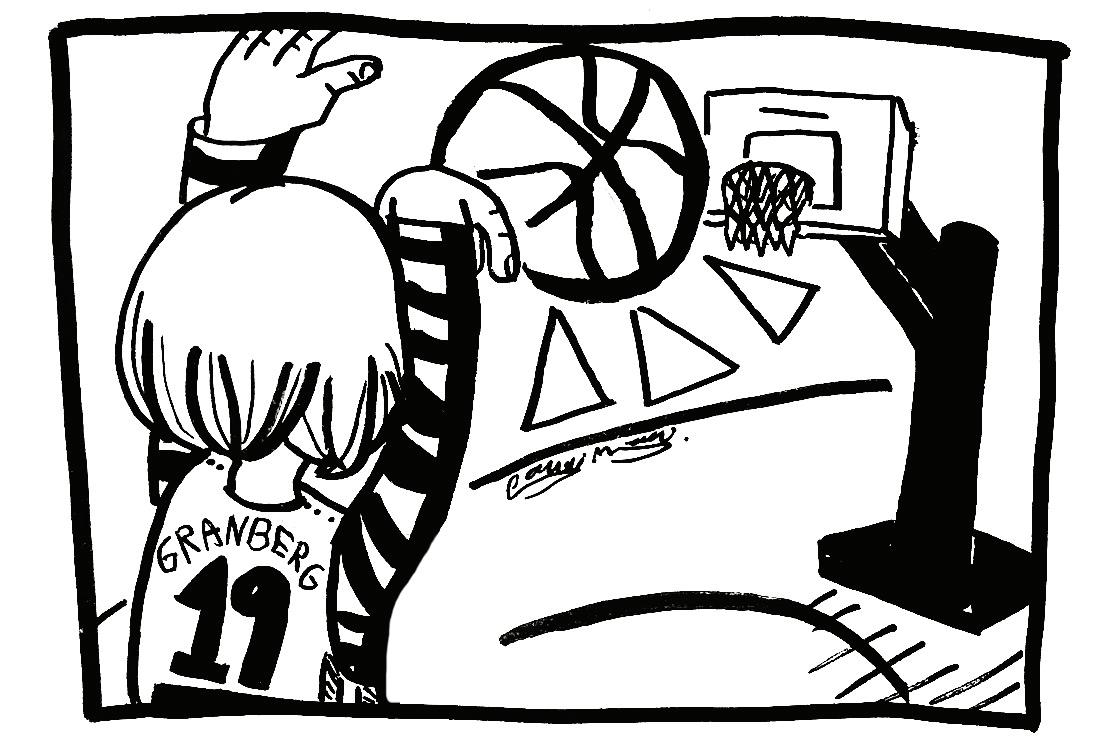
GW’s sports community has taken note of an uptick in administrative focus on athletics over the last year. That effort is coming top down from University President Ellen Granberg. This isn’t the first effort GW has made in the last 30 years to amplify athletics, but Granberg’s renewed focus signals a promising future for GW’s athletics and its role within the University’s broader mission.
The University needs to sustain this momentum by committing to a long-term vision for its athletics program. GW should prioritize smaller, tangible initiatives that deliver lasting benefits over time. This approach is critical given the challenges mid-major programs, like GW, face in competing within the NCAA’s name, image and likeness landscape — struggling to retain successful players who receive more lucrative offers from wealthy power conference schools. By tapping into existing strengths — like a student body that, with the right marketing, would show up for games — GW can first build a strong fan foundation before investing in broader infrastructure to support its diverse and competitive team.
Strong sports programs — especially high-profile ones like basketball at GW — can elevate a university’s reputation, attract more applicants, boost donor support and strengthen community engagement. This trend is evident at other universities — including Clemson University, Granberg’s former school. GW has seen similar momentum in the past, proving that a winning team can drive University-wide transformation.
In the 1990s, GW’s men’s basketball team made a historic run to March Madness for the first time since 1961, reaching the Sweet 16 and making four NCAA tournament appearances in just six years. That success led to undergraduate
STAFF EDITORIAL
applications rising by 23 percent, driven in part by the national exposure the basketball program brought to the University. GW’s acceptance rate dropped from 81 percent to 49 percent between 1988 and 2000, reflecting growing selectivity tied to increased demand.
As the University faces a budget deficit, investing in building competitive athletic programs could yield long-term benefits — boosting GW’s prestige, community pride, donations and applications. These gains would extend well beyond the teams themselves, positively impacting the entire GW community.
One of the most pressing challenges facing GW Athletics is the lack of adequate infrastructure.
GW’s urban location creates significant logistical barriers, as many teams are unable to practice, host home games or even meet regularly on campus due to the absence of appropriate facilities. Tennis and track teams can’t host competitions in D.C., and the swim and dive team — one of GW’s most successful programs — lacks access to diving facilities. Meanwhile, soccer and lacrosse games held on the Mount Vernon Campus often suffer from limited fan turnout due to space constraints and the remote location. Baseball faces a similar issue, with games played off campus in Arlington, Virgina, making it harder to attract student supporters.
If GW is serious about leveraging athletics to build prestige and
Take advantage of GW’s mosaic of ideological diversity
At GW, students are provided with the most conducive environment to study and challenge themselves and others. GW is an excellent example of an ideal place to celebrate and embrace political tolerance and exchange. During a time of deep polarization, specifically in the U.S, the University needs to ensure it continues to embrace and uphold debates, cultural exchange and ideological diversity on our campus. This is a rare opportunity that not many students have.
In a time of political turmoil and uncertainty, some politicians, businessmen, TV personalities and even students have chosen to propagate division and point out our differences. Many have already seen it: political commentator and polemicist Charlie Kirk was shot dead in an act of indiscriminate political violence while on a college campus, where dialogue is supposed to be fostered and embraced by the academic community. We should not normalize violence as a means of solving political differences, nor the political use of tragedies such as this one to favour one specific ideological group. In times like these, I urge GW students and faculty not to give in to this division. Do
not let the academic community fall into this trap. Especially when we have the opportunity to live in D.C. and study at GW, where dialogue between people of different identities and beliefs can be so fruitful — that’s something the GW community should not give up on. This isn’t the norm in many other places.
Reflecting on my time in France, I remember certain situations that shaped the way I think about political and ideological variety. In my second year of studies, the university campus was blocked by a considerable number of mobilized students in the context of the war in Gaza and the subsequent humanitarian crisis. The voices that opposed this arbitrary takeover never got too loud. Many remained in silence due to fear of stigmatization by their peers, of being judged and thrown out of the political discussion. Many embraced selfcensorship not by choice, but out of fear of their own classmates. This signaled to me the death of dialogue and pluralism. At GW, I have found clear hints at how a student body can contest this divisive illness. Whether at The Hatchet or in chats with friends and class discussions, I have had many opportunities to engage in fruitful debates, exchange opposing ideas and find respect for those who think differently. During office hours and after classes, I have had the chance to chat
with professors whose political views I don’t agree with. In some of the many cafes that surround campus, I’ve openly debated about politics, intolerance, immigration, left-wing populism or the rise of the far-right. At Hatchet meetings, I’ve freely exchanged views on current U.S. politics and our expectations for the future.
In a time of widespread violence and discontent, I urge you to embrace ideological and political diversity. Have friends with different political opinions. Discuss with them, respect them, let them challenge you — you are at a university that encourages this.
As at GW, political diversity is everywhere in this country. It is even inscribed in the nation’s motto: E Pluribus Unum. Out of many, one. A nation made up of many cultures, religions, sensibilities, ideologies and families.
Former U.S. President Jimmy Carter expressed this in just a few words: “We have become not a melting pot but a beautiful mosaic. Different people, different beliefs, different yearnings, different hopes, different dreams.” That is what I encourage you to do, embrace ideological differences. Let us decorate the GW campus, the beautiful city in a bunch of colorful, beautiful and diverse mosaics.
—Santino Bernacchi, an exchange student from Sciences Po Paris majoring in social and political science, is an opinions writer.
deepen community engagement, it must first ensure that teams have a true home-court advantage. These venues could generate revenue by hosting ticketed events and serving as rentable spaces for other local programs, turning an investment in infrastructure into a long-term asset. Even smaller upgrades, like installing field lights on the Vern, could make a noticeable difference. Allowing games to be played later in the evening, after most classes and internships have ended, would make it far easier for students to attend.
GW has made efforts to boost student engagement at basketball games through prize giveaways, entertainers at the Smith Center
and themed events organized by George’s Army, the official student section. Rather than continuing to invest in flashy, short-term incentives, GW should consider simpler, more sustainable solutions. Basic improvements — like offering concession stands at sports events that typically lack them, could strengthen the game-day experience. Selling team jerseys and gear in the Campus Store would give students, parents and alumni an easy way to show their support. Providing transportation to offcampus games, particularly those held outside of D.C., could also increase student turnout, in addition to continuing to schedule high-profile matchups.
Men’s basketball, for example, is slated to face off against Georgetown for the first time in 40 years. When GW played Power Five opponent South Carolina three years ago, it was one of the most attended games of the year. Following last year’s run and an active offseason, the team enters the season ranked 60th in pre-season rankings, with nine games set to be streamed on ESPN — giving GW a clear opportunity to capitalize on national visibility.
Rather than trying to compete immediately with top-tier programs in the NIL and transfer portal, GW should focus inward on infrastructure and communitybuilding to strengthen the foundation of its athletics program. If GW hopes today’s students and fans become tomorrow’s donors and engaged alumni, it must start cultivating that relationship now. Our editorial board recognizes how impactful a strong athletics program can be for the entire University. But to get there, GW must first address the internal barriers preventing its athletics department from growing in a meaningful, sustainable way.
Congress should repeal the DC
Home Rule Act
Last month, President Donald Trump declared a “crime emergency” in D.C., citing high murder rates and an ineffective local government. The executive branch subsequently took over the Metropolitan Police Department for a period of 30 days. The D.C. takeover was instantly challenged by D.C. Attorney General Brian Schwalb which grants Congress exclusive authority over the nation’s capital.
I don’t agree with Trump’s decision to take over the local government, but I think Congress needs to take back control of D.C and overturn the Home Rule Act. Congress passed the act in 1973.
There are several places where D.C. municipal and federal laws create gray areas, like in the cannabis market in D.C. Local lawmakers passed Initiative 71 in 2014, which legalized the recreational cannabis market in D.C.
Delegating limited power to D.C under the 1973 Home Rule Act was against the framers’ intentions. They believed that the federal government needed its own district, so it would never need a local government to defend
them. The fears the framers had were supported by the Jan. 6, 2021, insurrection, in which ultimately the capital siege was quelled by D.C. Mayor Muriel Bowser’s MPD, which had to be requested by U.S. Capitol Police Chief Steven Sund instead of the capitol police chief ordering them. Without home rule, MPD could have arrived sooner and responded faster — time is lost to extraneous questions on jurisdictional obligation.
The judicial system in D.C. represents a continuation of a complicated bureaucracy. MPD arrests the vast majority of offenders in the District but is only able to prosecute the juveniles. The adult felony offenses are prosecuted by the U.S. District Court, separate from the D.C. government.
All D.C. adults are sent to federal prisons across the country, and juveniles are incarcerated by D.C. municipal facilities. Unlike anywhere else in the country, age determines whether a case will be prosecuted by local or federal courts.
The complicated relationship between the District and the federal government has ripple effects across D.C., down to the roads. In 2021, a pipe desperately needed repairs under the National Mall as it was causing delays in a tunnel, but since it crossed both federal and D.C. jurisdictions, DC Water
had to get federal approval, D.C. municipal approval and authorization. Authorization of local funds and coordinate with the National Park Service, all before even touching the pipe. These systems of joint authority increase waiting times for municipal services — under one governing body, there would be no need for approval from a separate entity. The jurisdictional clashes in D.C. infest all of the public sectors. All local D.C. bills must go through a Congressional purgatory review period before they become law. From start to finish, a bill becoming a law in D.C. requires eight steps, while a federal law takes six. With a more streamlined system of government through Congress, legislation would not have to go through two bodies of government. MPD under our current system does not keep the capital safe. Safety will not be achieved with the Ohio National Guard walking around. It can only be achieved by Congress repealing the Home Rule Act and fending off the illegal incursions into congressional authority. The Home Rule Act ultimately impedes progress and safety in the city, and we must repeal it. —Roan Smith, a sophomore majoring in history, is an opinions writer.
Roan Smith Opinions Writer
CAROLINE MORRELLI | STAFF CARTOONIST
Santino Bernacchi Opinions Writer
THE SCENE CULTURE
Matcha craze, global shortage drives Georgetown cafe to cap tea sales
Intrigued customers have been lining up in a Georgetown alley to be one of the few people to get a taste of a cafe’s limited daily matcha supply.
Two Nine, an omakase restaurant and cafe, serves an iced shaken tea made with premium Uji matcha, simple syrup and water that racks up a price of $10. Thomas Chen, Two Nine’s tea director, said they originally intended to make matcha the “centerpiece” of the cafe’s drink menu, which has gained traction on social media, and that they now cap their Uji matcha sales to just 10 cups a day due to a global matcha shortage in part from a steepened demand that has affected businesses’ supply and increased matcha production costs.
“Demand has outpaced the supply because the farmers, the producers and suppliers — they only harvest once a year, so they have to plan that allocation like over a year before in advance, and so that the system kind of doesn’t work anymore with how much demand there is,” Chen said.
Chen said he has seen the viral videos about Two Nine’s matcha drinks on social media, drawing the “matcha craze” to the restaurant. He added that the bigger Japanese matcha companies that used to supply “the whole world” are not taking new accounts. Chen said despite there only being 10 iced shaken matchas a day, there are other drinks on the menu with matcha that come from other suppliers and have a “different favor profile.”
Customer Eileen Hong said she found Two Nine on TikTok,
as she does with most restaurants in the District. Hong said she does not feel like there is a “good matcha scene” in D.C., with places like Blank Street not being “authentic.”
Lela Singh, the tea buyer for Teaism, a set of three D.C. tea houses, said the business has had a 30-year working relationship with a “well-established” tea producer from Kyoto, Japan, as Teaism orders tea that comes into storefronts themselves and also distributes to local restaurants and cafes in the area.
Singh said this year has been an “interesting experience,” as Teaism has not been able to fill the demands of the businesses they supply due to the matcha shortage.
Singh said a variety of factors create the “perfect storm” in causing the shortage, including the fact that “good” matcha is grown in a small region in Japan that is picked from the earliest harvest. She said climate change has affected the short growing season with heavy rainfall, and the “explosion” of consumers wanting betterquality matcha has increased the demand with an already small supply.
She said beverage shop business models have also shifted in response to the U.S. demand for matcha because consumers expect the drink to be on the menu. Singh added the cafes Teaism supplies are continuing to request increased amounts of matcha
She said despite the current shortage, she believes that this will not be a permanent situation, and it will eventually “balance out.”
“We’re going to have probably better matcha in our lives for it,” Singh said.

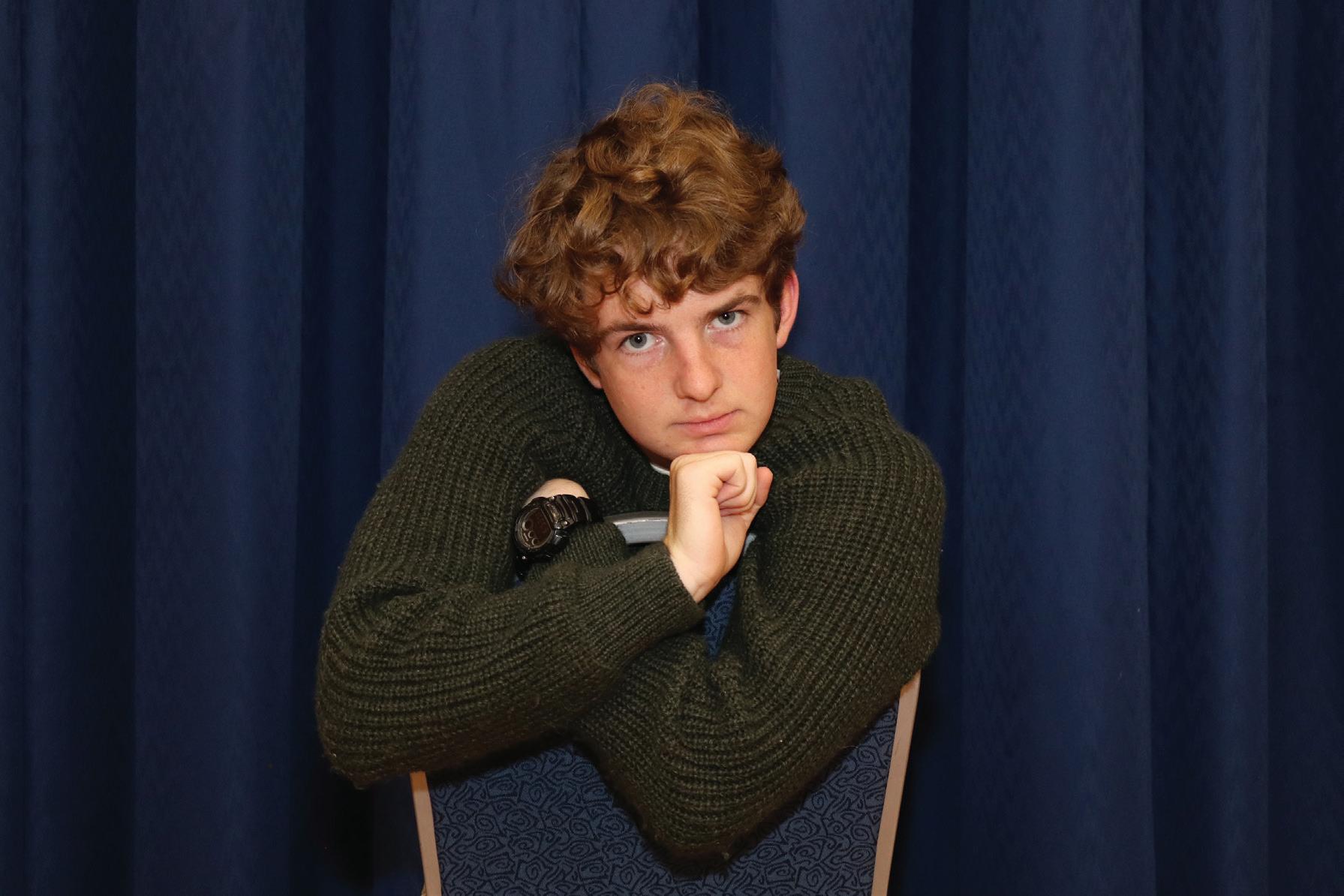
Student comedians bring quick wit, skits to campus
While other students spend their evening hours studying or slumbering, members of student comedy groups are out on the scene embracing the late-night comedic tradition.
As the semester pushes along, GW’s farcical student organizations — including the all-improv [insert here], sketchand-improv receSs and stand-up GW Comedy Nights — have gotten the ball rolling on their annual programming. Student jokesters said being involved in the GW and greater D.C. comedy scenes has helped them find like-minded, comedically-inclined communities, express their creativity and hone their humoristic skills.
Danny Duncan, a member of receSs and master’s student studying cybersecurity, said the team’s tight-knit nature helps their comedy thrive during performances, adding that it comes in especially handy during improv scenes where it’s necessary to predict what other actors will say.
“We spend a lot of time with each other, and
our whole deal is knowing what each other is going to do before they do it,” Duncan said. Duncan said he auditioned for receSs on a whim, drawn to the yellow posters promoting the group hung around campus.
Senior Delaney Martin, also a member of receSs, said the group’s performances generally include 30 minutes of sketches and 25-30 minutes of improvised material. She said she especially enjoys sets where the comedians go off stage and into the crowd, which receSs members refer to as “in-betweeners.”
Martin said receSs has performed at a variety of locations across the District, including the Washington Improv Theater, Rails Comedy and at the GW Inaugural Ball, and they have an upcoming show on Oct. 18 featuring their newest members, or “noobs.”Martin said receSs’s status as D.C.’s oldest comedy group, established in 1991, helps them maintain connections with groups at these colleges.
In addition to receSs, GW Comedy Nights helps bring laughs to the
Expression takes shape in larger-than-life exhibit
What was once a plain, white gallery in the Flagg Building has been brought to life with the abstract shapes and vibrant colors of the Corcoran School of Arts & Design’s latest exhibit.
James Huckenpahler, a professorial lecturer in the studio arts programs, started the “ALIAS” project in 2023 in conjunction with Art Enables — a nonprofit organization spotlighting and providing employment opportunities for artists with disabilities — the core theme of the exhibit stemmed from 12 artists drawing any abstract shapes that came to their mind in the moment. Huckenpahler helped transform the drawings into towering structures for viewers to walk through, now on display in the Flagg Building until Oct. 4, representing each artist’s essence in a tangible way.
Pinks, greens, oranges and yellows draw viewers’ eyes in as they enter the gallery, with tall and short curvy abstract shapes popping up from the ground or hanging from the ceiling, some pieces resemble tall flowers while others look more like rocket ships and spikes. Apart from the cardboard structures on display, the artist’s flat designs are also placed as stickers on the wall, pushing out the gallery’s white space.
Huckenpahler said he was inspired to start ALIAS after asking artists to draw shapes that resonated with their personality and then blew up their designs on a larger scale using cardboard.
“This is a tough challenge to
University — on Sept. 19, the group hosted their first stand-up show of the semester at Dorothy Marvin Betts Theatre in the USC. Caroline Moore, a senior studying international affairs, and Cathy Pickett, a senior studying economics and history, emceed the recent performance. She said, similarly to The Ghost, GW Comedy Nights acts as an outlet for John Mulaneys-inthe-making to amusingly share their thoughts and reflections with fellow students. Students must also audition to be a part of GW Comedy Nights. Moore said in the college comedy scene, standup comedy tends to be “very overlooked,” differentiating GW Comedy Nights from other comedy organizations at GW, which tend to focus more on improv and sketch comedy.
Pickett said stand-up comedy is more “intimate” than other forms of comedy because of the personal nature of the content, drawing upon individual experiences and situations.
Preparation looks a little different for [insert here] — Declan O’Shea, a senior studying political

make this work in this space, and this is perfect,” Huckenpahler said in a discussion with his class.
Huckenpahler said the idea for the exercise — having the 12 artists at Art Enables draw abstract shapes — originated with him thinking about what shapes can mean and represent to different people, even in the abstract form. He said he was also inspired by digging through old notebooks and finding a page in his journal from an exercise drawing abstract shapes.
Huckenpahler said he’s been working with Art Enables Director and Curator Marissa Long since they first connected at Transformer Gallery in Logan Circle.
Huckenpahler said he and Long did not want to go with the norm of setting up a gallery exhibition — hanging pieces up on walls — but instead wanted to incorporate a three dimensional aspect in the space while still being mindful of not overcrowding the room. He said the set-up process in-
cluded steps like transporting the sculptures between the smaller gallery at Art Enables to Flagg, as well as issues with aligning the separate piece of the sculptures and certain pieces having ragged edges after using a CNC cutter, a device used to precisely cut heavy materials.
Long, who has worked with Art Enables since 2020, said the idea for the exhibition began with her and GW professor James Huckenpahler emailing back and forth and
science and economics, said the nature of improv makes it more difficult to anticipate how the show will go because students cannot rehearse exact scenarios ahead of time.
He said what used to be a detached group of students united only in their interest in comedy became a group of close friends over the course of many practices and casual meetups outside of rehearsals.
He said [insert here] distinguishes itself from receSs and GW Comedy Nights as GW’s only improv-specific comedy group. He said [insert here] shows, the next of which will happen in October, typically include a series of games, where performers act as certain characters that develop as the scenes move along.
He said one format they use is called the “Dating Game,” which involves two actors who are given a place where they’re on a date and a reason why one is breaking up with the other.
“I think it’s definitely a diverse group of people who do comedy in D.C., much of which is very funny and very accessible to people who are new,” O’Shea said.
cementing a final idea together.
Long said Huckenpahler was brought into Art Enables as part of their visiting artist program, where she invites visiting artists who have something “specific” to offer to collaborate with Art Enables on an exhibition.
Long said although the abstract project was “instinctive” for some artists, others do more work “figuratively,” encouraging them to explore abstract shapes and art forms.
Long said she wanted to make ultimate use of the space, playing with perspective and height. In order to fully give an audience an immersive experience, she said, careful planning and thought were required for where each piece was placed.
Long said Art Enables doesn’t want to be seen as a “little mom and pop shop” but instead as a real exhibition. She said this project also “challenged” artists, ultimately creating a piece that was larger than life thanks to the high ceilings and wide room of the Corcoran gallery space.
She said the project also gave artists the chance to work in a “new way,” giving them the opportunity to explore new mediums that they might resonate and continue to work with in their futures.
“We want to see our artists out in the world more and in spaces that have a prestige of their own because we feel the arts belong there, and it just really helps them get more visibility and credibility, which they already deserve, but that’s something that we’re always
and
striving for
pushing for,” Long said. VENNELA
JOSH STEINBERG | PHOTOGRAPHER
[insert here] senior Declan O’Shea poses for a portrait.
COOPER TYKSINSKI | ASSISTANT PHOTO EDITOR
Sculptures stretch across the expanse of the ALIAS exhibition at the Corcoran School of the Arts & Design Flagg Building.
COOPER TYKSINSKI | ASSISTANT PHOTO EDITOR Two Nine in Georgetown offers just 10 cups of hand-shaken matcha a day.
SPORTS


From players to coaches: Alumni athletes return to reshape GW’s game
MADELEINE PHILLIPS REPORTER
Over the past five years, an increasing number of former standout athletes have traded their jerseys for whistles, stepping into coaching roles to guide GW Athletics’ next generation of talent.
Five teams have welcomed alumni to their coaching staffs since 2020, including softball and tennis, who recently added former softball pitcher Sierra Lange and tennis player Stella Wiesemann as assistant coaches — moves that helped ease coaching transitions. Wiesemann, who was hired last year, credits the coaching staff’s familiarity with the team and a deep understanding of collegiate athletics for strengthening their programs.
Other alumni hires include water polo Assistant Coach Luca Castorina, men’s soccer Assistant Coach Stefan Triandafilou and women’s soccer Assistant Coach Kayley Sullivan, who came on board within the past two years after graduating from the programs in 2025, 1995 and 2013, respectively.
Weisemann, who is also a graduate student, said her time spent on tennis has made her a more successful coach because of the pre-existing relationships she has with players. She currently coaches players, including juniors Solange Skeene and Victoria Sasinka, who were once her teammates. And although she said this shift can be
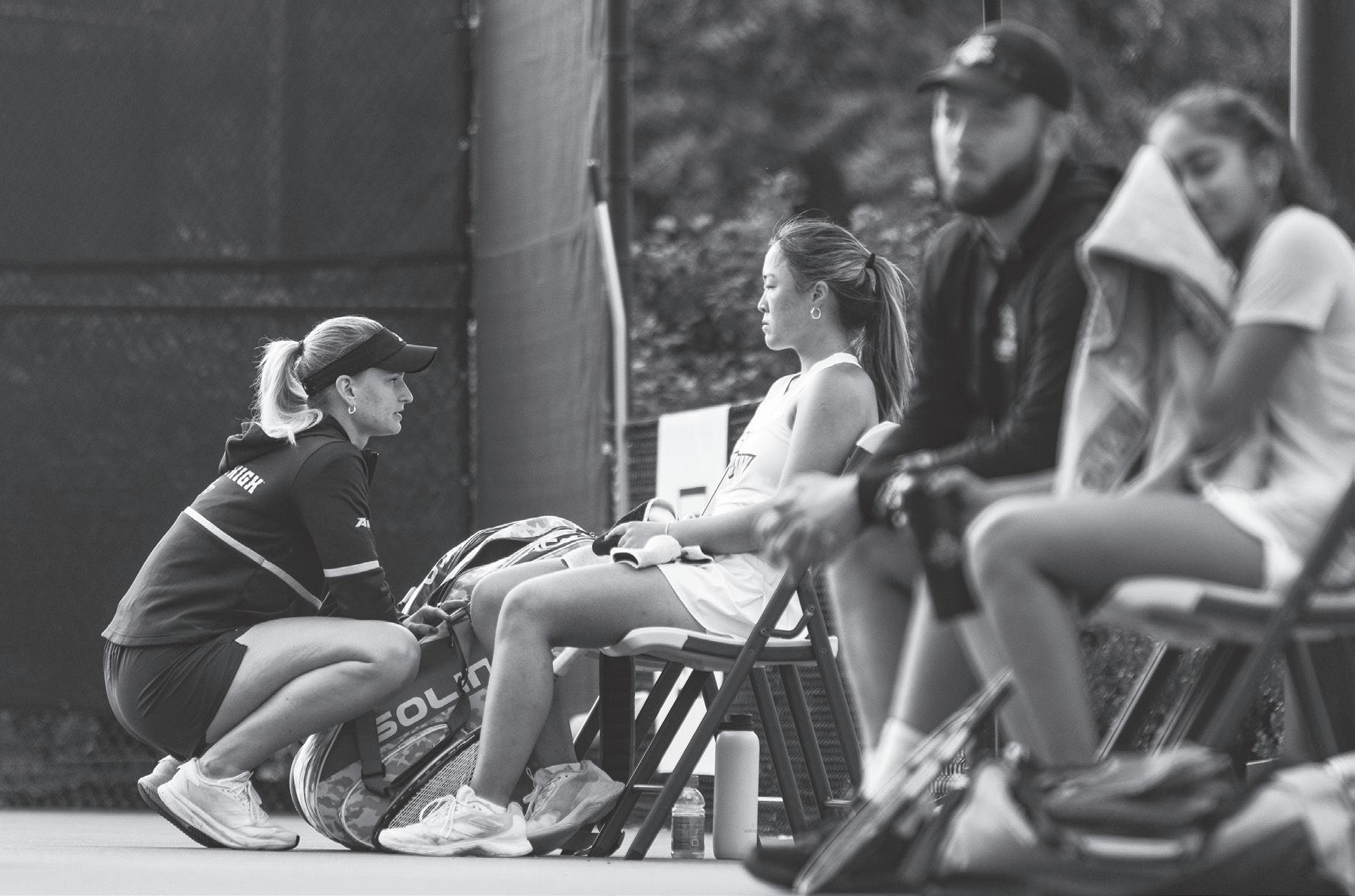
challenging for some teams because of the change in power dynamics, her experience has only furthered her ability to connect with the players.
“At the end of the day, it only has pros because I know them as people and as players,” Weisemann said. Weisemann spent her first
season as coach serving her former Head Coach George Rodriguez to six dual meet wins last year. Now working under new Head Coach Jackie Calla, Weisemann said she’s given her more responsibilities as an assistant coach, expanding her duties to include recruiting and travel coordination, which
she wasn’t involved in under Rodriguez. Athletics also hired softball’s Lange early this month after a twoyear stint as an assistant coach at Yale University. One of just two AllAmericans in GW softball history, Lange brings both elite playing experience and a deep connection
to the team.
“Because I’ve lived this studentathlete experience, I’m able to maybe relate and kind of understand where our kids are coming from when maybe they’re having a hard day in class,” Lange said.
Continuing on Lange’s legacy of stellar pitching, last year, graduate student Anna Reed won A-10 Pitcher of the Year and helped break the team record for strikeouts in a season before graduating in May. Lange will now be tasked with replacing Reed’s production by training the four pitchers currently on the roster — juniors Sophia Tereso and Cece Smith and seniors Chloe Green and Emma Fales.
“They want to work hard, and it’s more so them putting in all this work and then getting to showcase it,” Lange said. “I just want to help aid in their confidence, in the circle this year, and making them feel like they have my support and that they can take on hard things and take on hard games.”
She said she was “shocked” that Klampert invited her to join his staff in Foggy Bottom but has so far enjoyed working with him and the team’s other assistant coach, Sam Bean.
“Obviously, they were our rivals at the time, but I had huge respect for them because they were such a good opponent,” Lange said. “And he’s always been a great competitor, great competitor and a nice guy, and so when he asked for me to join the staff, I was over the moon.”
Lacrosse incorporates new freshmen crop into team during fall ball slate
MILO ROSENZWEIG
REPORTER
As lacrosse delves into a slate of exhibition fall ball games, the team is working vigorously to iron out its regimens and incorporate new talent before battling Atlantic 10 competition in the spring.
On the heels of a spring season where the team went 2-8 in the A-10 and 8-9 overall, Head Coach Colleen McCaffery is preparing the squad’s large cohort of freshmen — 11 in total — for the challenge of collegiate play, leaning on her recently named captains to bring them up to speed. McCaffery said she intends to use the fall to improve fundamentals, including stick handling, athleticism and intuition, while also integrating newcomers and gauging the team’s level of competitiveness.
“We have 11 great freshmen coming in, so we’re really excited about them,” McCaffery said.” Before the official season
begins in February, the lacrosse team will take the field this fall for a series of exhibition games, primarily against local opponents that bear no influence on the team’s NCAA or A-10 standings.
McCaffery said the freshmen who she worked to recruit after being impressed by the class’s overall talent have gelled with the upperclassmen in their first weeks in Foggy Bottom.
The new crop of players includes attack and midfield Sophia Im, who earned two USA Lacrosse All-American honors in high school and helped to lead her team to become Washington state champions in her senior year, winning MVP. The other AllAmerican joining the team, Attack Mia Milkowski, also won Second Team All-State in her native New Jersey last year.
“They’re soaking everything in, they go very hard and they’re committed, and now it’s our job to teach them through the lacrosse IQ piece,” McCaffery said.
To help the rookies acclimate to the challenges of college-level play, McCaffery is working to strengthen their lacrosse intuition by drawing up strategies on a whiteboard in a forum she calls a “chalk talk,” reviewing practice film and walking players through movements on the field. The rigor of fall ball training — while primarily intended for freshmen — extends to the entire lacrosse roster of 32, working within their NCAA-mandated practice restrictions.
McCaffery said she’s especially excited to play against the English team, calling them the “best of the best from England.”
On Friday morning, McCaffery named four seniors — midfielder Kiki Rotay, defender Parker Cranz, attacker Gracie Burke and defender Stella Ray — as team captains.
Rotay said her responsibility to the freshmen — many of whom, she noted, also play midfield — is to help them stay “afloat”
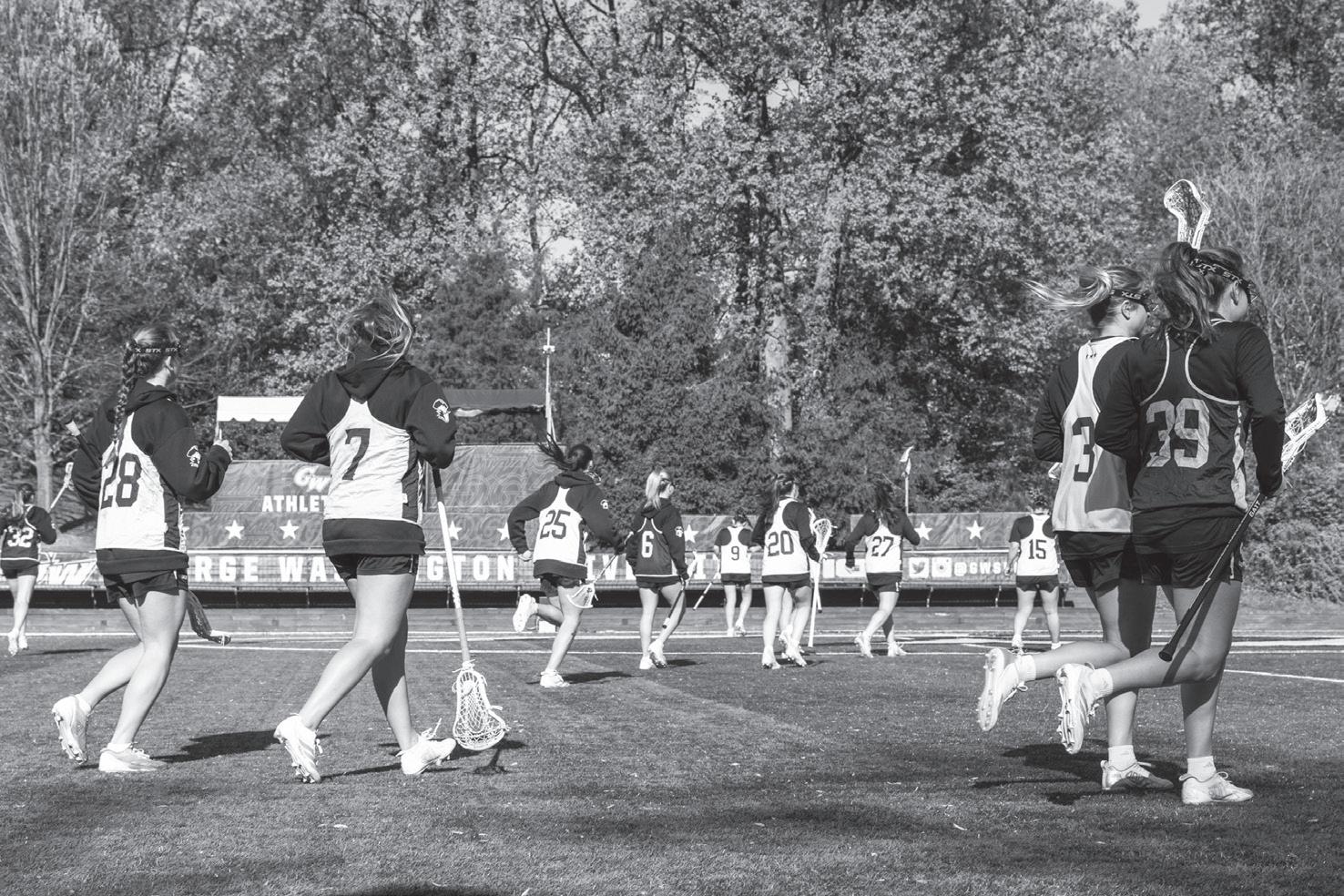
as they navigate the unique challenges of the position. She does this by serving as a positive role model and a reliable sounding board.
“Individually, I’ve been working on winning my matchups, winning more
1v1s, holding more 1v1s on defense and hold my own individual plays, individual matchups,” Rotay said.
For the group, Rotay and Cranz said fall ball is beneficial to let players settle into their roles and
Volleyball sweeps Rhode Island in opening conference play
Volleyball (9-5, 2-0 Atlantic 10) trounced Rhode Island (3-11, 0-2 A-10) in their first two conference matches this weekend as the team, uniting as a team to raise awareness for childhood cancer.
With 3-0 and 3-1 wins over Rhode Island on Friday and Saturday, the Revolutionaries extended their winning streak to four and opened A-10 play undefeated. The Revs are now on track to post back-to-back winning seasons — a milestone the program hasn’t reached since 2015.
Before Saturday’s match, the team honored Assistant Coach Nicole Alford’s three-year-old niece, Juniper, a consistent figure at games and practices, by naming her an honorary captain to mark the team’s annual cause game. Juniper is currently battling stage 4 multifocal osteosarcoma, a rare and aggressive form of bone cancer that accounts for less than 1 percent of all childhood cancer diagnoses.
Head Coach Katie Reifert said in a postgame interview that Juniper’s presence “energized” the team Saturday, adding that she and the team had wanted to show their honorary captain a strong performance.
On the court, GW dropped just one set this weekend, notching 33 more kills than the Rams
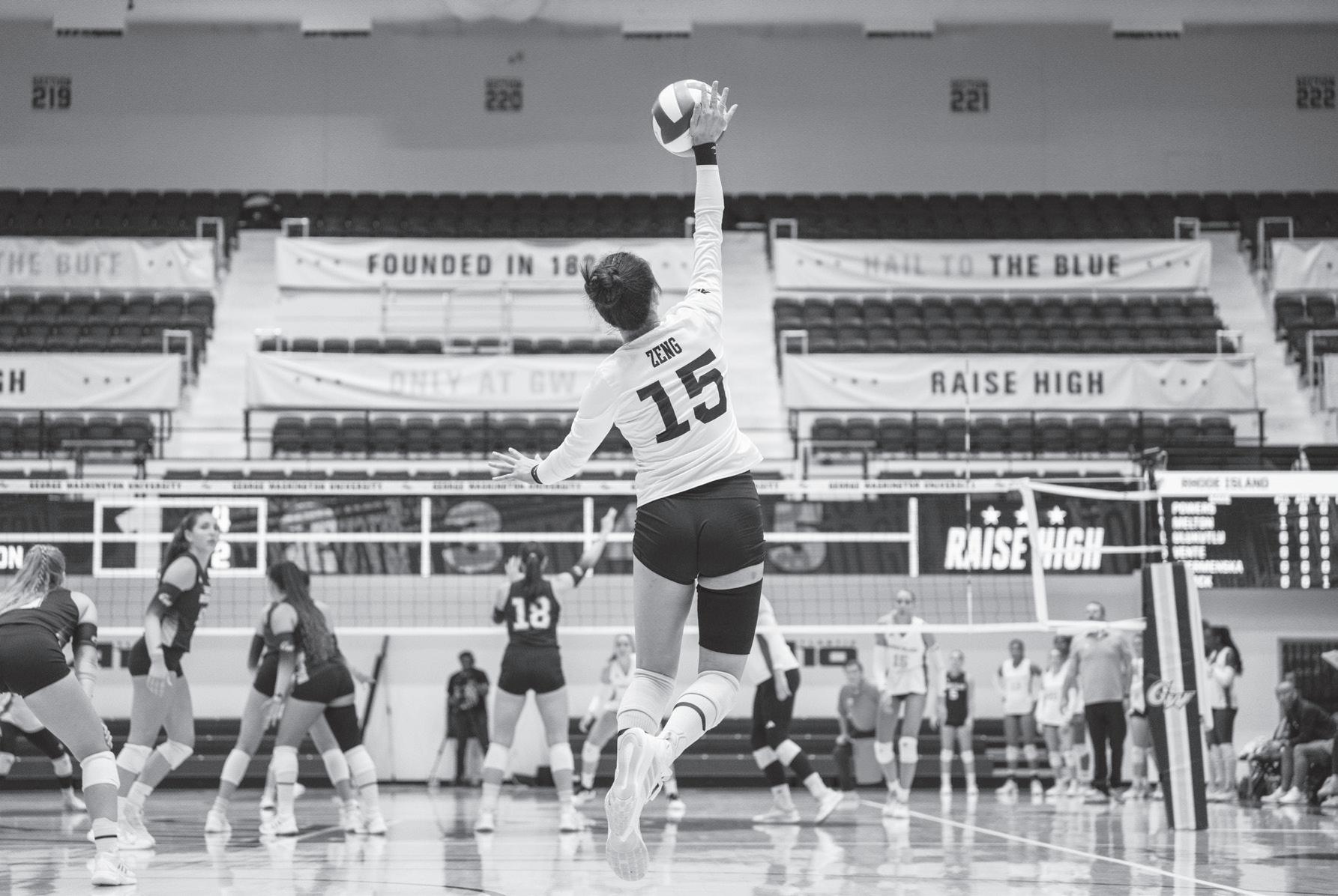
over the weekend as they begin conference play undefeated. Here’s a breakdown of the Revs’ play this weekend:
Match 1: GW 3, Rhode Island 0 Friday night, the Revs took all three sets in their first conference
game of the season, dominating in two out of three, besting the Rams’ hitting percentage throughout the game .358 to .168. They won the first set 25-18, with back-to-back kills from sophomore outside hitter Alexis Rodriguez and senior middle blocker Cianna Tejada clinching the point.
The Revs and Rams went neck and neck during the second set, despite GW recording their lowest hit percentage of the weekend at .179. The squad was just able to secure set point with a service error from Rhode Island junior middle blocker Chloe Abuto giving the Revs the second set 25-23.
discover how their unique skills contribute to the team at large. “Finding everyone’s niche and where they fit in on the field, I feel like, is always a big thing in the fall,” Cranz said.
The final set was the least competitive of the three, as the Revs dominated 25-13, recording their highest hitting percentage at .581, while Rhode Island had their lowest hitting percentage of the weekend at .037.
Match 2: GW 3, Rhode Island 1
On Saturday, the Revs won 3-1, narrowly taking both of the first two sets 26-24. Markworth played a vital role for the Revs’ offensive game, registering 56 assists as the team recorded 65 kills with a .229 hitting percentage. The match reached a climax at the set point of the second set. A back-and-forth battle ensued as the Revs sought to extend their initial lead, with players of both sides scrambling to keep the ball alive. With the back-and-forth momentum from the prior two sets continuing, the third set remained an even battle until Rhode Island strung together 4 consecutive points, setting the Revs back 2-1. The Revs started the fourth set on the wrong foot, going down 5-2, but Rodriguez’s three kills helped the team catch up 12-12. From then, the Revs expanded their advantage as kills from Cogan, graduate middle blocker Sydney Hasenfratz and Tejada helped wrap up the set 25-16, sealing the match for Juniper and the Revs.
The Revs will travel to Loyola Chicago to face off against the Ramblers on Friday at 7 p.m., aiming to secure their first away win of the season.
CHANCE HWANG | PHOTOGRAPHER
Sophomore defensive specialist and libero Lydia Zeng serves the ball during a volleyball game against Rhode Island this week at the Smith Center.
LEXI CRITCHETT | ASSISTANT PHOTO EDITOR
Assistant Tennis Coach Stella Wiesemann speaks to junior Madison Lee between sets of her semifinals singles match at the Bedford Cup tournament last week.
KRIS PARK | STAFF PHOTOGRAPHER
Members of the lacrosse team run onto the field during a practice in April.