New tax provisions likely to taper donations to GW in FY2026, experts predict
DAVIS LENHARDT
REPORTER
KAVYA KARTIK
REPORTER
Tax experts predict cuts to charitable contribution deductions set to take effect Jan. 1 could cause a brief surge in donations to GW this fall before contributions wane in the new year, which could further shrink a revenue stream weakened by reduced donations in fiscal year 2024. More than half a dozen tax law experts said while tax provisions in President Don-
ald Trump’s One Big Beautiful Bill Act may incentivize GW’s donors to give more before the new year, officials will likely see a drop in overall contributions to the University in FY2026 as wealthy donors and companies grapple with reduced tax benefits. The anticipated drop in donations comes as officials grapple with a $25 million drop in total contributions to GW in FY2024 and work to combat a yearslong structural deficit that prompted University-wide FY2026 budget cuts. The University’s non-
governmental donations — which include gifts from families, alumni and faculty — fell $36.8 million in FY2024, coinciding with threats from alumni to withhold donations if officials failed to address campus activism following Hamas’ Oct. 7, 2023, attack on Israel. Contributions to GW made up 4 percent of its operating revenue in FY2024, down from 6 percent in FY2023, though the University received more than $2 million from 3,596 donors during its annual Giving Day this year, the most revenue generated
since its conception in 2020. The OBBBA’s tax code changes make permanent the individual, estate and business tax provisions of Trump’s 2017 Tax Cuts and Jobs Act to prevent what Trump described as the “largest tax hike in history.” The changes also add new provisions to allow individuals who don’t itemize deductions or don’t subtract eligible expenses they can claim on federal income tax returns to reduce the amount of taxes they owe, to get a tax break.
Officials move to issue cease and desist to SJP over Instagram handle
RYAN
SAENZ ASSISTANT NEWS EDITOR
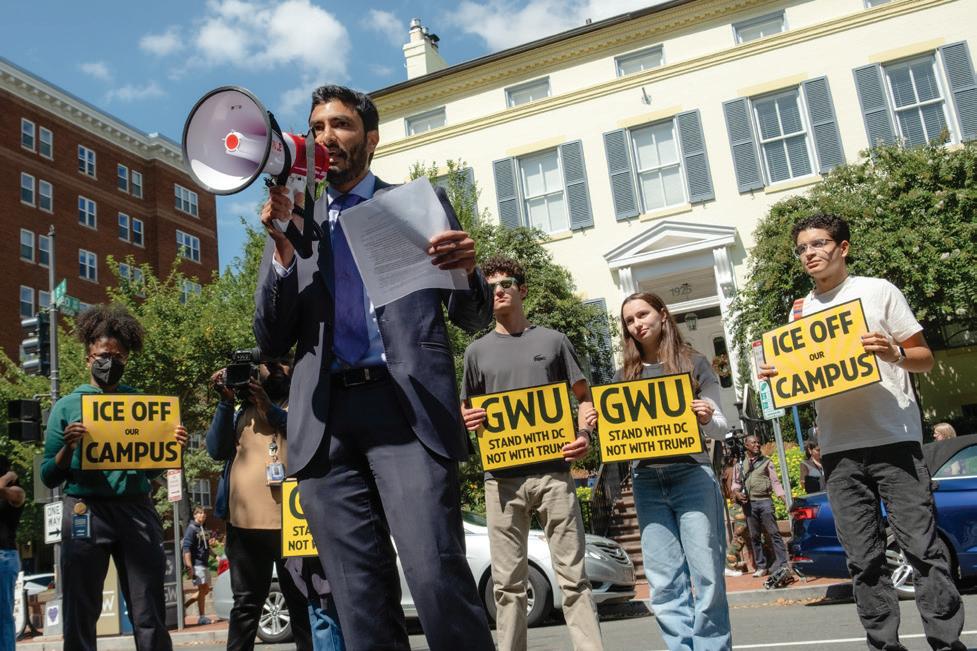
Officials announced they are sending a cease and desist letter to Students for Justice in Palestine for using an Instagram handle containing “GWU,” which they say falsely implies affiliation with the University despite the group’s revoked organizational status.
A representative from SJP, speaking on the condition of anonymity for fear of retaliation from the University, said neither the group nor its members have received any communication from officials about their Instagram username — “SJPGWU” — or the cease and desist letter. Officials’ Thursday announcement follows the University’s yearlong suspension of the organization in April for hosting events without adviser approval and a separate two-year status revocation officials issued over the summer for the group’s petition
calling on officials to fire economics professor Joseph Pelzman — actions that led the group to disaffiliate from the University last month.
“The university is issuing a legal letter demanding that the group cease and desist using the university’s name and will seek further remedies as appropriate if this group does not comply,” the Thursday release states. “Any posts or views expressed by this group do not reflect the views of the university.”
The SJP representative said the organization has not received any letter from any official ordering them to stop using “GWU” in their social media handle nor did they receive prior notice about officials’ plan to issue the cease and desist. They argued the University lacks any legal grounds to issue a cease and desist because they do not own the trademark for the “GWU” acronym.
Officials abandoned the trademark for “GWU” in 2001 when
they did not file to extend it, according to U.S. Patent and Trademark Office records. Gardner-Webb University, a private Christian university in North Carolina, currently owns the trademark for “GWU.”
According to the office’s website, even if a party’s trademark expires or is canceled, it may continue to have “common law” rights to the mark, which could validate a cease and desist. Common law rights are acquired by a business automatically when it uses a name or logo in commerce, and these rights are enforceable in state courts.
The representative said SJP’s social media posts never implied the group was trying to represent the views of the University.
“SJP does not represent itself as speaking on behalf of the University — we are very clear that the reason we exist is to criticize the university for its ties to the occupation of Palestine,” the representative said in a text message.
GW postponed its 10th Diversity Summit to spring 2026, creating a two-year gap between summits as the office responsible for the event faces a leadership vacancy and universities nationwide revise diversity, equity and inclusion programs to align with President Donald Trump’s policies.
Officials said this week they now expect to hold the Diversity Summit in spring 2026 — a shift that follows their decision months earlier to postpone the event from last spring to this October, leaving no summit during the 2024-25 academic year. The decision, which officials said will allow them to “reimagine a new opportunity,” followed community concerns last spring that canceling the event could signal the University is retreating from its commitment to diversity initiatives and comes amid Trump’s ongoing crackdown on DEI programs and a leadership vacancy in the Office for Diversity, Equity and Community Engagement.
Officials initially slated the 10th Diversity Summit for Oct. 16-18, according to a May release. Between Aug. 29 and last week, officials changed the website’s landing page to announce the postponement. According to web archives, officials also removed a “Latest Updates” tab when they updated the site but kept an archive page on past Diversity Summits.
“We anticipate that this event will be held in spring 2026,” the current Diversity Summit webpage reads. “Additional details will be forthcoming.”
The Office for Diversity, Equity and Community Engagement, which hosts the event, is led by the Vice Provost for Diversity, Equity and Community Engagement — a position that has been vacant since Caroline Laguerre-Brown left the Uni-
As GW charts its future, Granberg embraces athletics
HANNAH
MARR MANAGING EDITOR
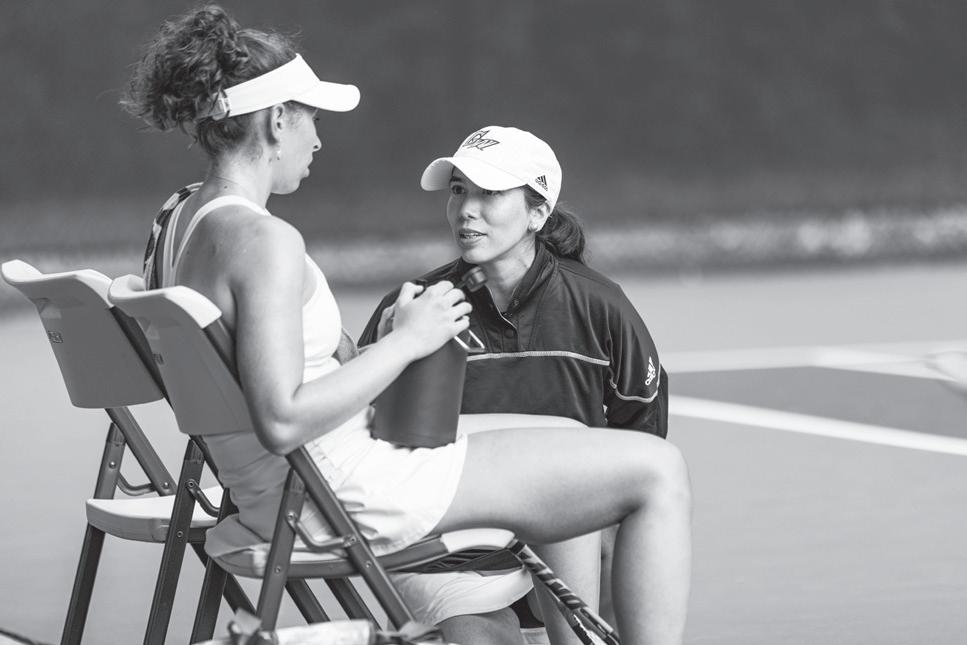
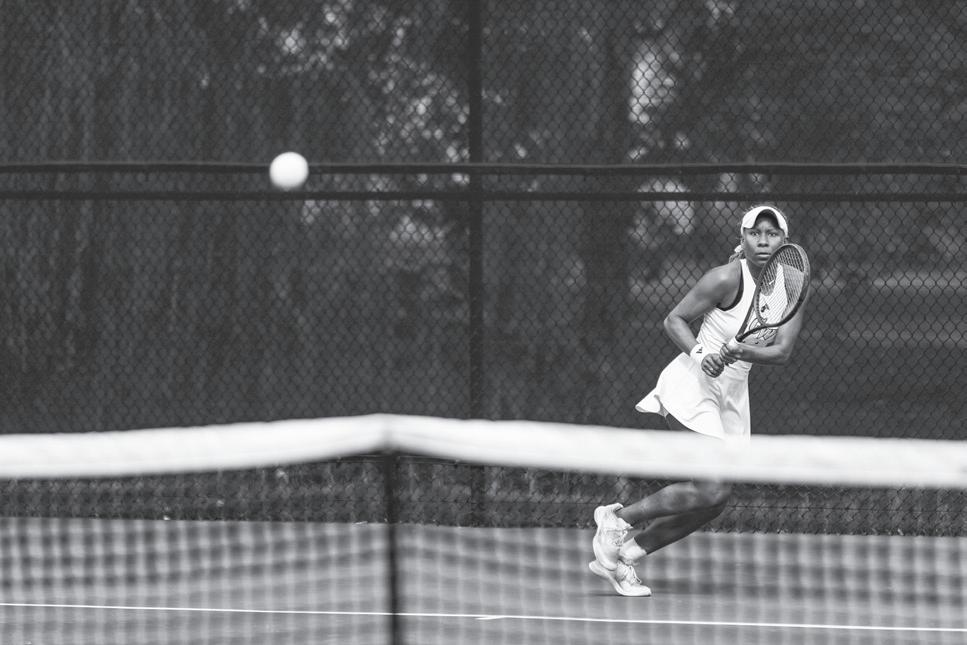
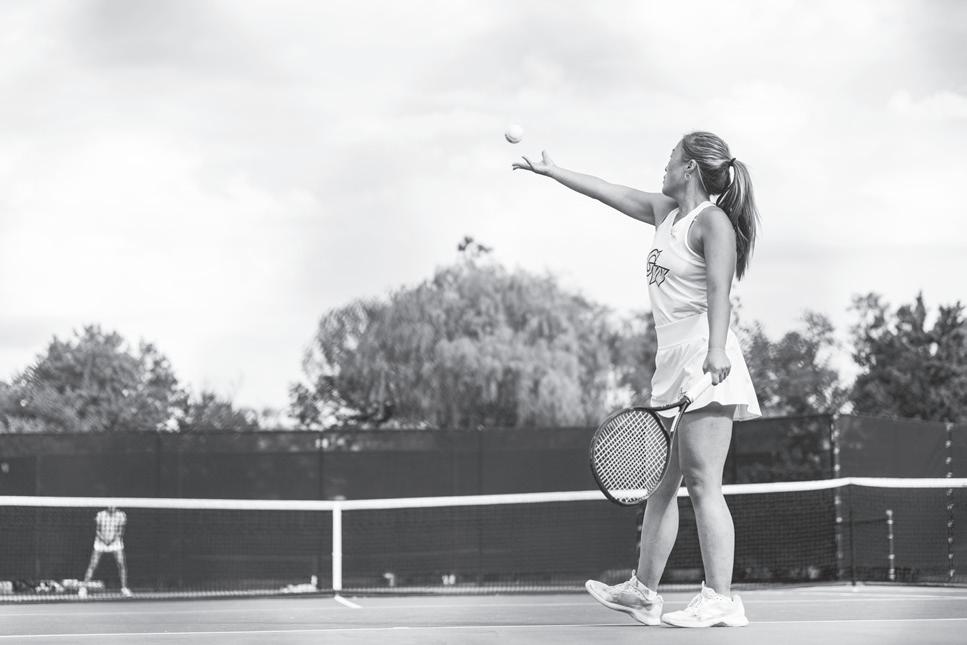
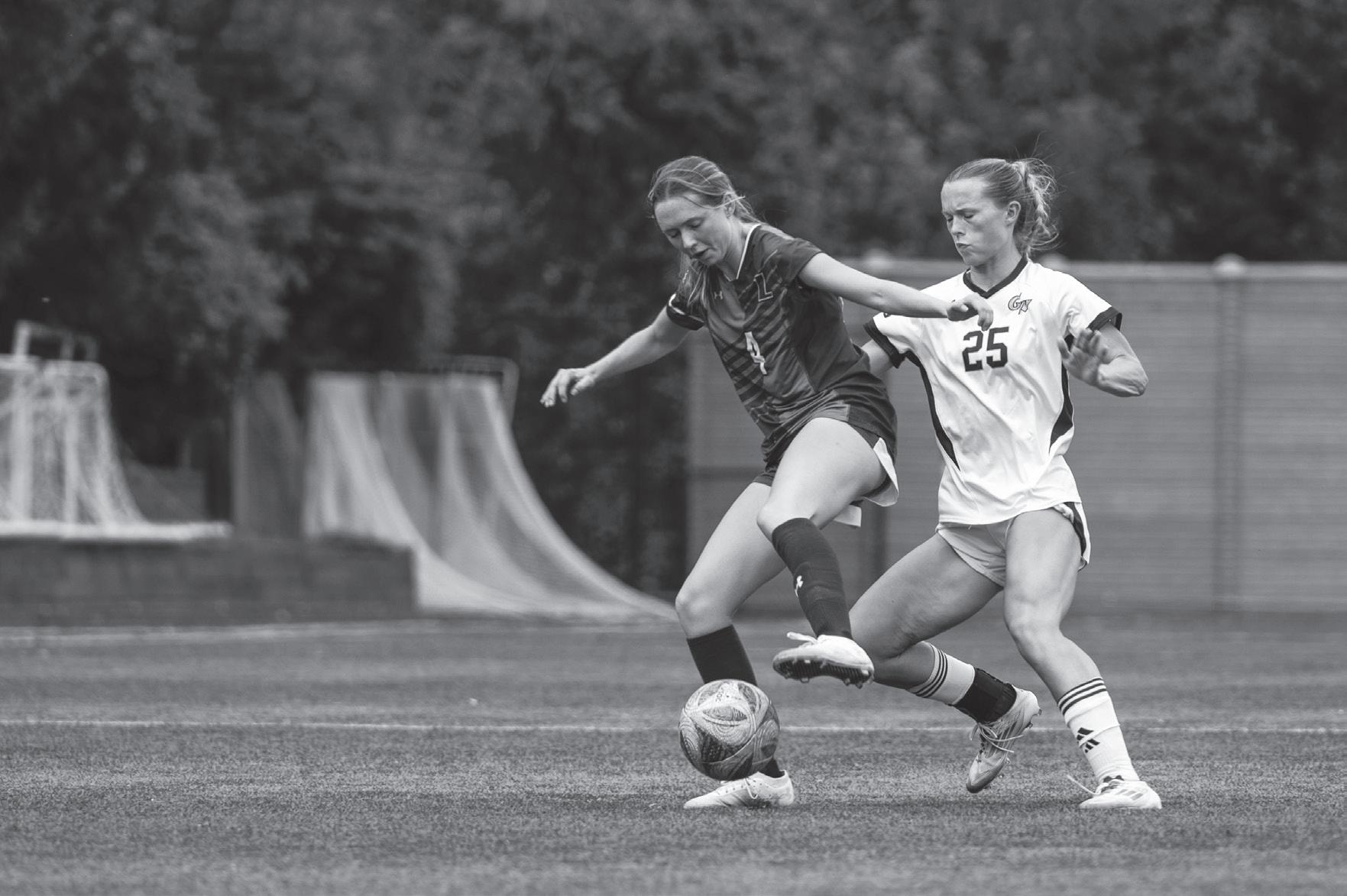
University President Ellen Granberg has seen what a winning team can do for a college.
As a sociology professor at Clemson University during the football program’s meteoric rise in the 2010s, she watched applications double, donations swell and school spirit seep into every corner of campus life. She also saw stronger faculty hires and a more competitive and diverse applicant pool as the Tigers’ success boosted the school’s national profile.
Now, as GW’s president, Granberg is trying to replicate that success in Foggy Bottom. She understands that Clemson and GW are “very different institutions” but believes athletics is an underutilized market officials should be using to recruit stronger students, woo donors and sharpen the school’s national profile.
“From my time [at Clemson], I developed an appreciation for how athletics, when aligned with a university’s culture, can help attract and retain highly talented students, faculty and staff be-
cause of the role it plays in creating a sense of vibrancy and fun on a campus,” Granberg said in an email.
She said athletics has emerged as a recurring priority in conversations with alumni, GW Athletics staff and students since she arrived, and recognizing the role athletics plays in the student experience pushed officials to fold the interest into GW’s strategic framework.
Even without a football team — unlike Clemson — GW’s own basketball record shows the benefits a university can have when athletics catch fire. The 1990s saw the then-Colonials return to March Madness for the first time since 1961, launch a thrilling Sweet 16 run in 1993 and secure four NCAA tournament appearances in six years. It was a defining stretch for the program, powered by iconic players, like Yinka Dare, Shawnta Rogers and Alexander Koul, and is a high that the program has been chasing since — though they’ve struggled to produce winning records.
versity in July 2024. The decision also comes as universities across the country grapple with Trump’s crackdown on diversity, equity and inclusion efforts, including the executive order he signed on his second day in office to terminate “to the maximum extent allowed by law” DEI offices and positions. More than 400 campuses eliminated or rebranded their DEI-related programs and centers heading into the 2025-26 academic year, as the executive order warned universities could lose federal funding if they did not comply.
A July memo from the Department of Justice warns higher education institutions that receive federal funding and are subject to federal antidiscrimination laws, like GW, of “significant legal risks” if they engage in what the Trump administration defines as discriminatory practices, like DEI programs. University spokesperson Shannon McClendon told The Hatchet in August that GW’s Office of the General Counsel was conducting a “careful review” of the memo and its implications for GW’s approach to abiding by federal anti-discrimination laws.
A University spokesperson declined to comment further on why officials postponed the summit, including whether Trump-related DEI policies influenced the decision.
GW hosted a diversity summit every academic year since 2015 until the 2024-25 academic year, with officials holding the last event in February 2024. The Diversity Summit’s current page notes only the postponement and an archive of past summits. When officials first announced in April that the summit would take place this fall instead of last spring, past participants and a higher education expert said the decision could signal the University is backing away from diversityrelated efforts.
KYRA WOOD | ASSISTANT PHOTO EDITOR
Pro-Palestinian demonstrators wave a flag in front of the Trustees Gate in Kogan Plaza in April.
RYAN SAENZ ASSISTANT
PHOTOS BY ARWEN CLEMANS AND LEXI CRITCHETT, ILLUSTRATION BY LEXI CRITCHETT
University President Ellen Granberg is looking to grow GW Athletics’ presence on campus in an effort to boost donor and applicant interest.
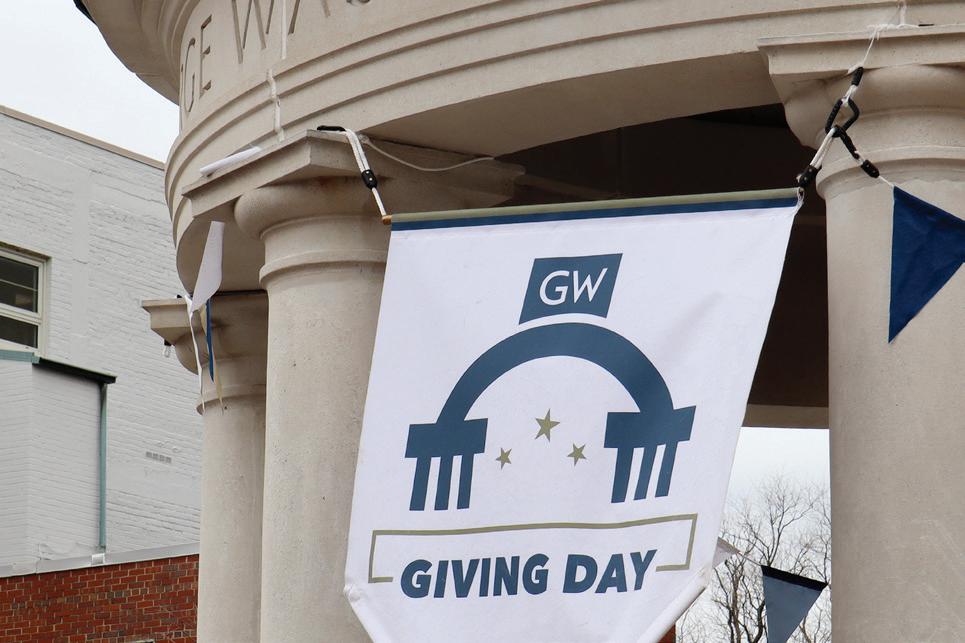
TALAN MASKIVISH | STAFF PHOTOGRAPHER A banner hangs from the tempietto in Kogan Plaza during GW’s 2025 Giving Day.
Staff hope new provost will boost morale, bridge divides with faculty
have an impact on it,” Simon said.
Staff Councilmembers said at their meeting Friday they hope GW’s next provost will remain in the position for several years, which could help support staff and dismantle divisions that have led staff to feel subordinate to faculty.
More than 10 councilmembers told John Simon, a consultant at Education Executives leading the search, and his colleague, Anda Webb, a senior adviser to the provost at the University of Virginia, that they hope the next provost will be a prominent presence on campus amid high provost turnover rates. They said they hope GW’s next provost will support staff roles that have experienced increased workloads, burnout and decreased morale during former Provost Chris Bracey’s tenure.
Katherine Puskarz, a councilmember representing the Milken Institute School of Public Health, asked Simon about the qualities officials are looking for in a candidate that will ensure they stay at the University longer than other provosts have stayed on average. Simon didn’t specify what qualities officials are prioritizing but said the average time in office for currently sitting provosts in the Association of American Universities is 2.3 years, adding that it’s a “concern that’s real” across higher education when searching for candidates.
“You have to be at an institution for probably more than five years to really
Simon said situations sometimes arise at universities that change their trajectory and the “aspirations” of their leaders, causing them to leave their positions earlier than anticipated. He said other provosts sometimes come in that are “serial job hunters” and want to move up in the ranks at universities or are looking for their next job.
Bracey, GW’s most recent provost, announced he was departing the role on June 4, 26 days before his four-year tenure as provost ended, while his predecessor Brian Blake served in the role for less than two years before he stepped down in June 2021 after Georgia State University selected him to be their president. Former Provost Forrest Maltzman served as provost for about three years before stepping down in 2019 to return to being a professor.
Simon said Granberg wants a “long-term” provost who will serve in the role for at least five years, which he will communicate to the candidates going into the search process. He said it will be necessary to be “really honest” about the state of the University with the candidates, including its current challenges and the expectations officials have for the provost to address them and outline a path forward.
“No one’s sitting in a job right now who would be a candidate for this job that isn’t facing really serious stuff,” Simon said.
Angelique Redmond, a councilmember from the School of Medicine & Health Sciences, said the provost’s office and University leadership are “still stuck” on the “traditional model” that faculty are higher ranking than staff,
REVS KICK OFF FIRST MONTH OF CLASSES
rather than them being at the same level. She said staff have expertise, including holding master’s and doctoral degrees, like faculty do, and the provost could help change how faculty and staff communicate and work together.
More than five councilmembers said they hope the next provost will work to eliminate the silos across the University or when divisions and offices work in isolation from each other, hindering communication and efficiency. They said the next provost should prioritize opening communication and collaboration across schools.
“We hear this a lot in all kinds of forums about breaking down the silos at GW, and somebody mentioned in the last forum how many schools have silos,” Staff Council Vice President Mindy Galván said. “GW, for whatever reason, their silos seem to be even more isolating.”
Erina Moriarty, a councilmember representing the Division of Human Resources Management and Development, said GW is a great place to work, and she wants the next provost to be equally committed to making it a great place to work for all employees. She said other councilmembers’ feelings about the University’s silos where staff are “second-class citizens” compared to faculty shows the need for a “one GW community” where staff and faculty are united.
“All of our leaders should be working hard to make it a great place to work for all of us every day so that we can all do our best and to make this a place where we all want to be and do our best and give our best,” Moriarty said.
A female GW student reported their laptop stolen after
GW must assess threats, enhance security for campus events to
RORY QUEALY MANAGING DIRECTOR
In the wake of conservative activist Charlie Kirk’s murder at Utah Valley University, security experts urge universities to conduct rigorous threat assessments for on-campus events and consider moving speaker engagements indoors to enhance safety.
Kirk’s assassination earlier this month marked the first time in recent memory that a speaker on a university campus was deliberately targeted and killed by an attendee, igniting a nationwide conversation around universities’ event safety protocols, especially for events with political speakers in outdoor campus spaces. Security experts say that in the face of this new threat, universities like GW that frequently host political speakers should enhance scrutiny in event planning by tailoring security measures to the likelihood of a threat when deciding to host outdoor campus events.
The national conversation around campus event safety comes amid reporting that Utah Valley University had less security than other campuses that hosted Kirk on his national tour — just six police officers for 3,000 attendees, according to Jeff Long, the campus police chief. The police force hasn’t said whether they swept nearby rooftops ahead of the event, including the university building from which the suspect shot and killed Kirk from hundreds of feet away.
Last week, student organizers told The Hatchet that officials pledged to add metal detectors and bag searches at all speaker events hosted by GW College Democrats and GW College Republicans. University spokesperson Julia Garbitt said last week GW is working with “external partners” to evaluate and make any necessary changes to campus security measures.
Garbitt declined to comment on the University’s security protocol for high profile speaker events or if security protocols and safety measures will change in the wake of Kirk’s killing.
“We are evaluating each event in the current environment and working with external partners to determine and adjust security measures to take as appropriate,” Garbitt said. “We continue to work with individual event organizers to assess specific safety and security needs.”
Supreme Court Justice Sonia Sotomayor and Judge David Tatel headlined an event hosted by Politics and Prose held Wednesday, which did not permit bags inside the Dorothy Marvin Betts Theatre in the University Student Center. Guests also passed through metal detectors when entering the venue.
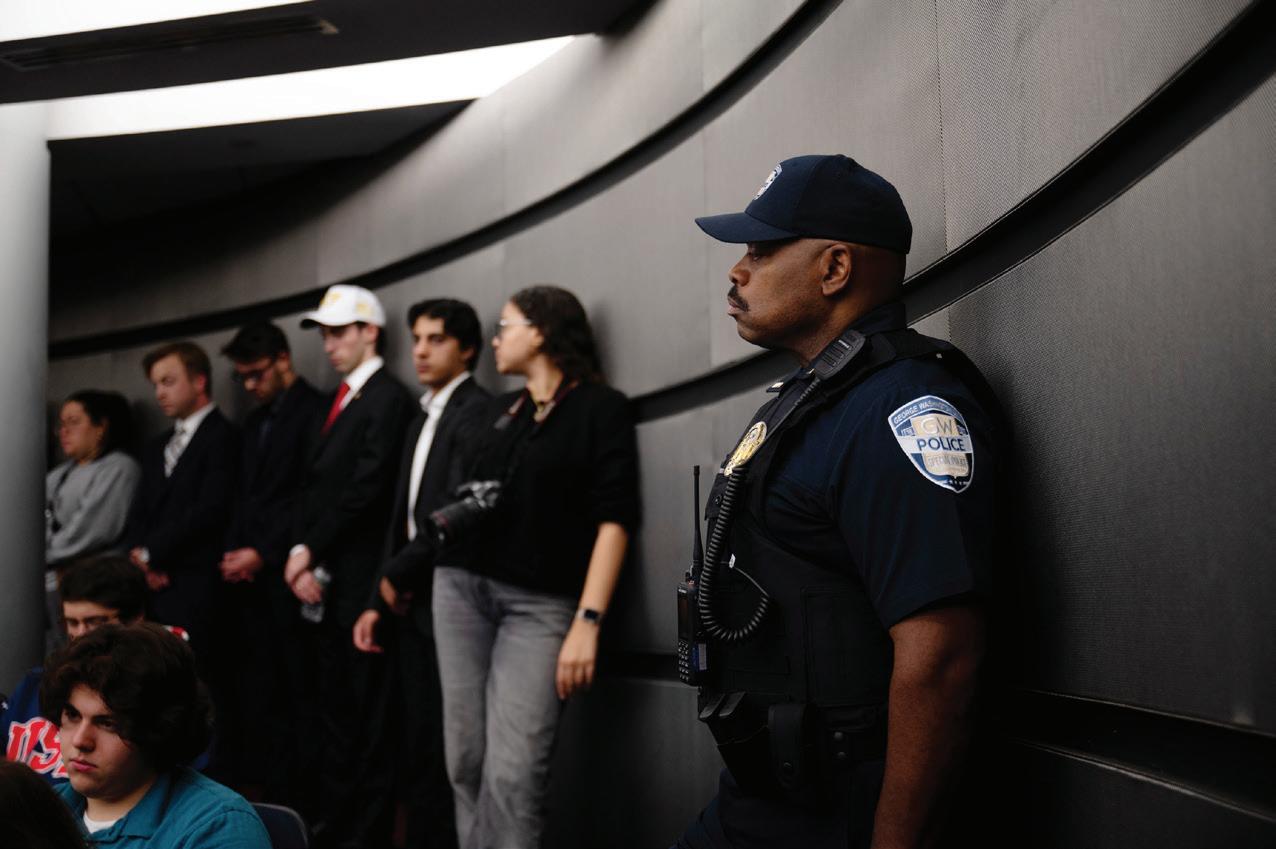
During a vigil where about 100 people gathered in the basement of the School of Media & Public Affairs to remember Kirk’s life Wednesday night, a security guard was posted on the roof of Gelman Library. Tin Nguyen — a principal investi-
avoid targeted attacks: experts
But last October, half a dozen for
Innovation, Technology and Education Center and an assistant professor of psychology at the University of Nebraska at Omaha — said the concern around bolstering security measures at GW, a highly politically engaged campus located in the nation’s capital, will be greater than on other campuses. He said this difference stems from the University likely bringing in more political speakers.
In the past year, GW has hosted on campus political figures like the Croatian Prime Minister, Rep. Johnny Olszewski (D-MD), and Supreme Court Justice Sonia Sotomayor, as well as prominent speakers like Bill Gates and John Green.
Nguyen said enhanced security protocols, like GW’s pledge to add metal detectors and bag checks at political events, are likely to remain as long as the nation’s political climate remains polarized.
“If law enforcement and security folks are aware that speaker events are potentially more contentious or more politicized on this particular campus more than others, the concern around bolstering security measures is going to be a lot greater,” Nguyen said.
The Division of Safety and Operations oversees a special events task force, composed of “key representatives from across university operations” who review events expected to host more than 300 guests so GW can organize event safety and security, per the task force’s website.
DSO also administers a Threat Assessment Team to evaluate behavior that individuals perceive as warning signs for future violent or self-destructive actions, which can be “rapidly convened” to assess threats whenever they arise, the team’s website states. The team met last week in response to a staff post calling Kirk’s killing “fair,” officials said at a Staff Council meeting, and officials boosted security on the Mount Vernon Campus shortly after for at least two days.
mer GW Police Department officers said the force’s firearms training was lackluster and left them unprepared to respond to urgent emergencies, like an active shooter. Officers said they lacked in-person scenario-based training, which would involve the department practicing its response to an active shooter as a team in a more realistic setting.
Last Monday, GWPD Police Chief Victor Brito said at a Student Government Association meeting that only eight officers are currently armed, a fraction of the planned allotment.
Princeton University’s Bridging Divides Initiative, which offers policy solutions to mitigate “rising threats” against political officeholders, recorded a 74 percent rise in threats and harassment against local elected officials since 2022 in a May study.
Nguyen said politically active universities like GW should conduct “vulnerability assessments” to determine potential risks for attendees or speakers before hosting any further outdoor events to identify areas on campus that are more susceptible to high-elevation attacks, like the kind that enabled Kirk’s murder. He noted that resources and staffing on campuses, especially urban ones, where security might be pulled in different directions, is a challenge in conducting assessments.
While the bulk of speaker events are held indoors, GW hosts some events outdoors, like its annual Commencement ceremony on the National Mall.
“Many of the things that you typically hope security and law enforce
ment would do, they’re mostly just trying to be more meticulous about those things going forward,” Nguyen said. “In most cases, you’d still see similar practices in place, but the amount of attention and effort put into each of those different planning elements, I think, is going to be heightened for quite some time.”
gator at the National Counterterrorism
—Compiled by Bryson Kloesel
ARWEN CLEMANS | SENIOR PHOTO EDITOR
A GW Police Department officer stands during GW College Republicans' vigil for Charlie Kirk on Wednesday night.
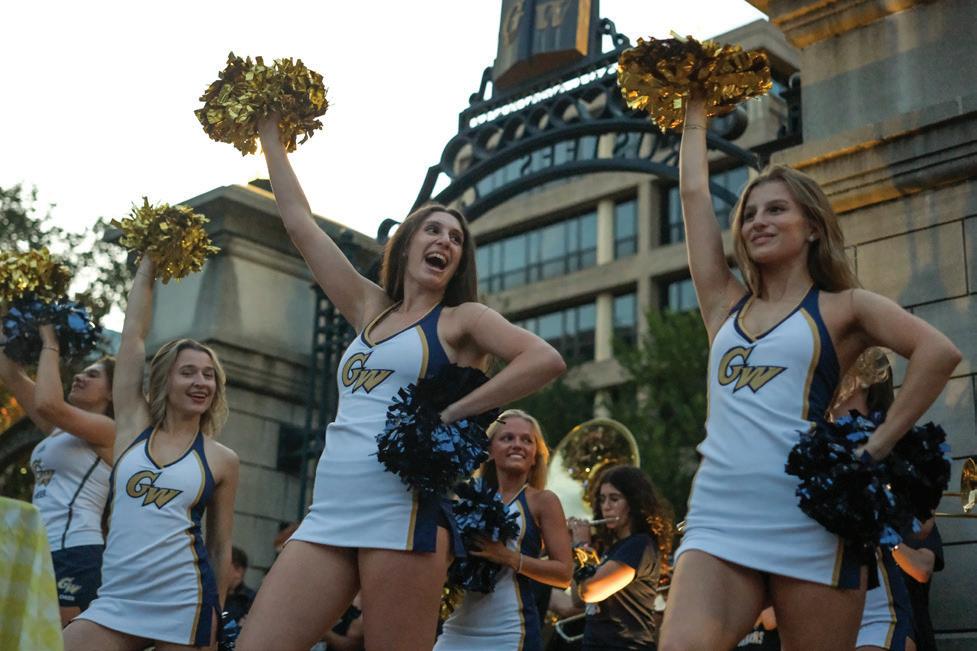
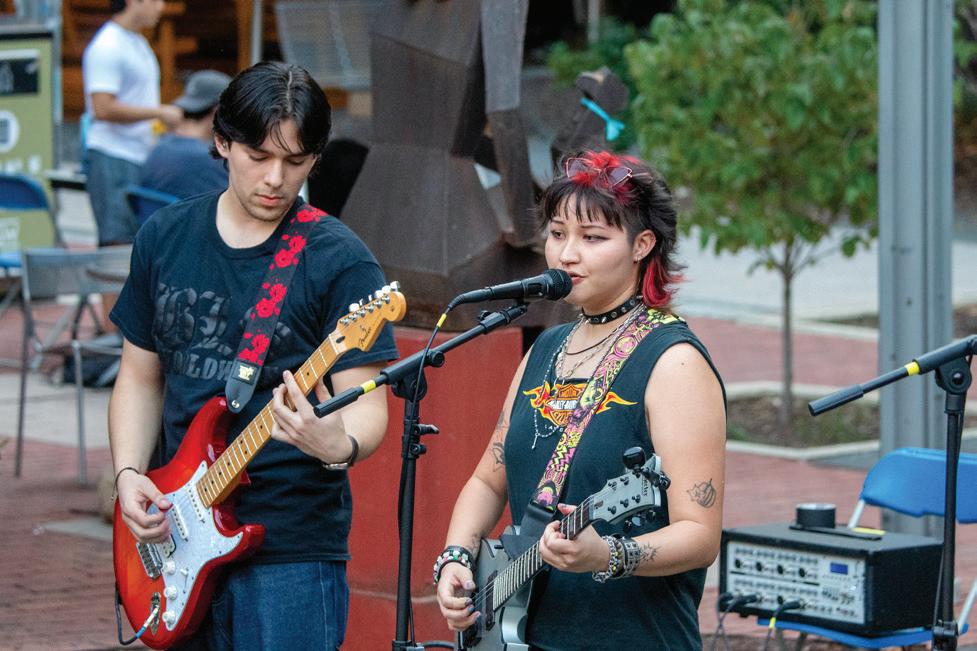
NICHOLAS WARE | STAFF PHOTOGRAPHER First Ladies perform at First Night in Kogan Plaza in August.
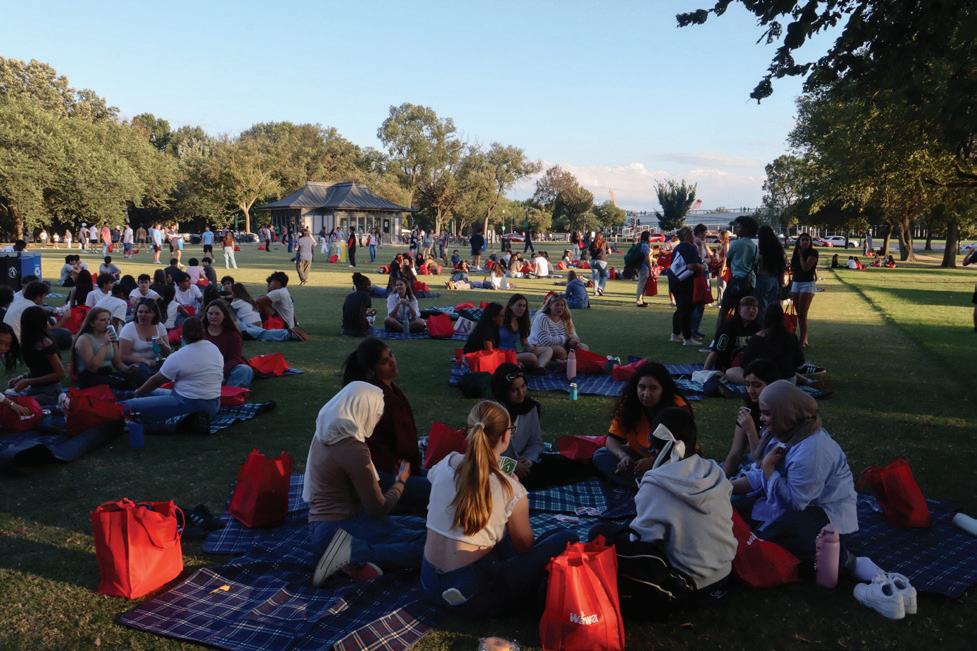
ABBY BROWN | PHOTOGRAPHER
First-year students picnic at the National Mall Kickback in August.
NICHOLAS WARE | STAFF PHOTOGRAPHER Students and faculty participate in a walkout in early September as part of the Free DC movement.
Jewish Voice for Peace chapter rebrands to Anti-Zionist Jewish Student Front
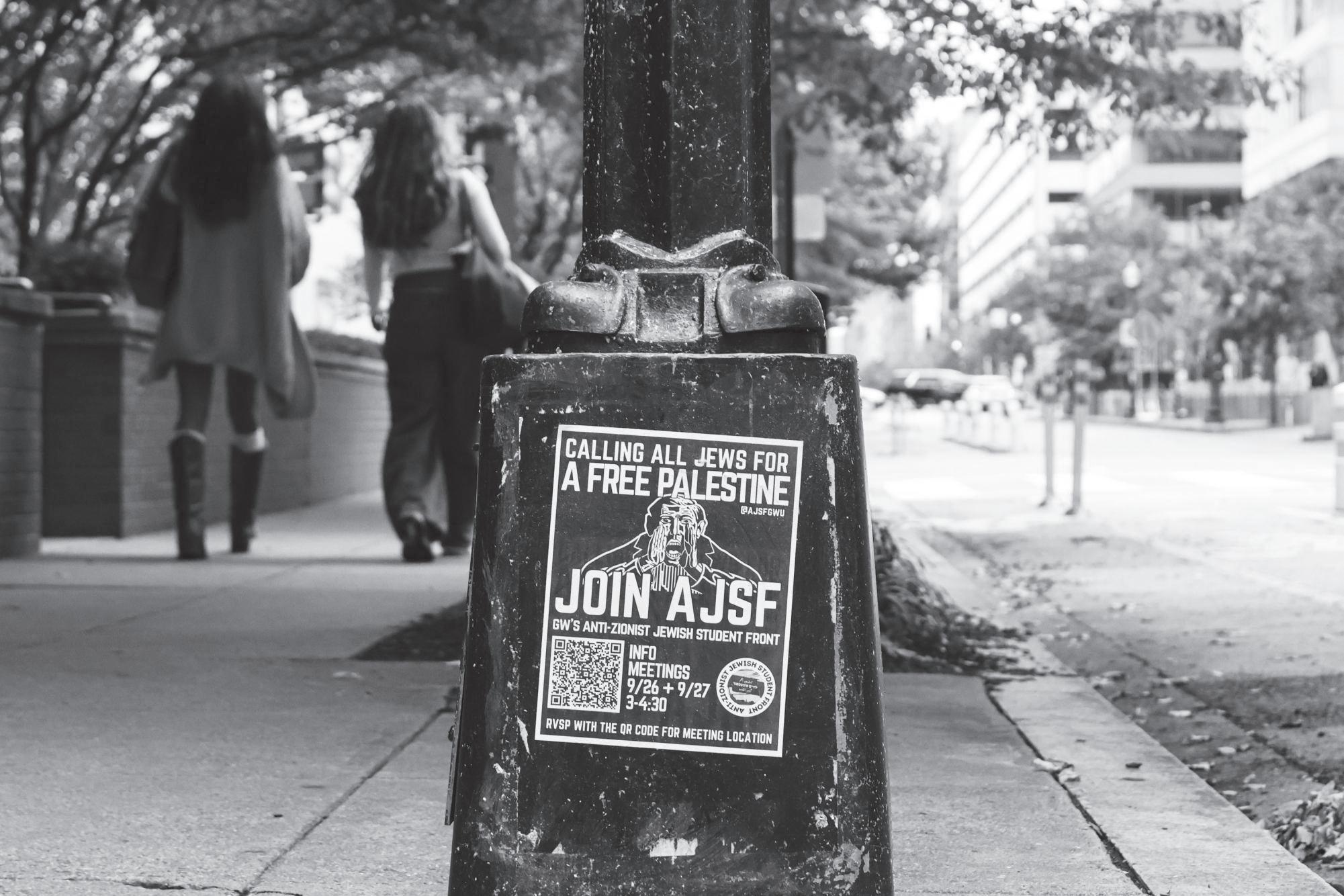
The Jewish Voice for Peace chapters at GW, American and Georgetown universities disaffiliated from the national organization earlier this month and formed the student-led Anti-Zionist Jewish Student Front, establishing a chapter at each campus.
The three chapters announced their name change and disaffiliation from JVP’s national organization in a joint Instagram post on Sept. 7, saying they were forming a separate student-led group for pro-Palestinian Jewish students at colleges and affirming their commitment to Palestinians’ rights to selfdetermination and an end to the ongoing war in Gaza. The change follows a one-year suspension of GW’s former JVP chapter, after officials said the group violated University policies by ignoring prior sanctions and posting content on social media that targeted Jewish students — prompting the group to disaffiliate from the University.
“We work to dismantle Zionism in its entirety by confronting Zionist institutions on campus, to struggle for divestment, and to pursue the criminalization of Zionism as a white supremacist weapon of war,” the joint Instagram post announcing the rebrand reads.
GW’s AJSF coordinating committee said in a statement that the rebrand creates a student-led organization — a divergence from JVP, which wasn’t just led by students and organized on college campuses, but rather a national
organization with local college chapters. The committee said the new group committed to “resisting Zionism,” the movement centered around the formation of a Jewish national state in Palestine, the ancestral homeland of the Jewish people, and promoting Palestinians’ right to return and live in the area.
“As Jewish students, it is our unique responsibility to expunge Zionism from our Jewish institutions, who are complicit in the genocide,” the coordinating committee said in an email.
In forming AJSF chapters on their three campuses, the GW, American and Georgetown chapters of AJSF created a new national organization. Only the three D.C. schools so far have rebranded from JVP to AJSF.
AJSF’s national organization did not return a request for comment and has only posted once on their Instagram, announcing the organization’s formation.
In the joint post announcing the change from both the national organization and three founding chapters, the groups reaffirmed their demands for their universities to divest from companies tied to weapons manufacturing and Israel in the video, adding that universities nationwide have become a site of resistance against imperialism.
The formation of the GW AJSF chapter comes a month after the former JVP chapter disaffiliated from the University following their suspension. A JVP member, who requested anonymity over fears of University repression, said in August that the group
disaffiliated from GW after it continually faced disciplinary proceedings from officials but will continue pursuing “the student struggle.”
“At this critical moment, anti-Zionist Jewish students will continue to organize and pressure the university to divest from genocide and protect its students amid an attack against immigrants and anti-Zionists in academia and across the country,” the member said in an email in August.
As the two-year anniversary of the Oct. 7 Hamas attack on Israel that sparked the outbreak of the war in Gaza nears, the GW coordinating committee said it is the responsibility of anybody living in countries that support Israel, like the United States, to demand their governments end their financial support and arming of the country’s military.
More recently, a United Nations commission of inquiry concluded last week that Israel is committing genocide in Gaza, as the United Kingdom, Australia and Canada formally recognized the state of Palestine on Sunday. Within the U.S., political leaders on both sides of the spectrum, like Bernie Sanders and Marjorie Taylor Greene, have said Israel is committing genocide in Gaza.
“After almost 2 years of US-backed Zionist genocide in Gaza, it is critical that antiZionist Jewish students are firmly united in unconditional solidarity with Palestinians and in demanding our universities and institutions cease material and intellectual support for the ongoing genocide,” the coordinating committee said.
Trailblazing history scholar who sued GW for
equal
pay dies at 98
nedy said.
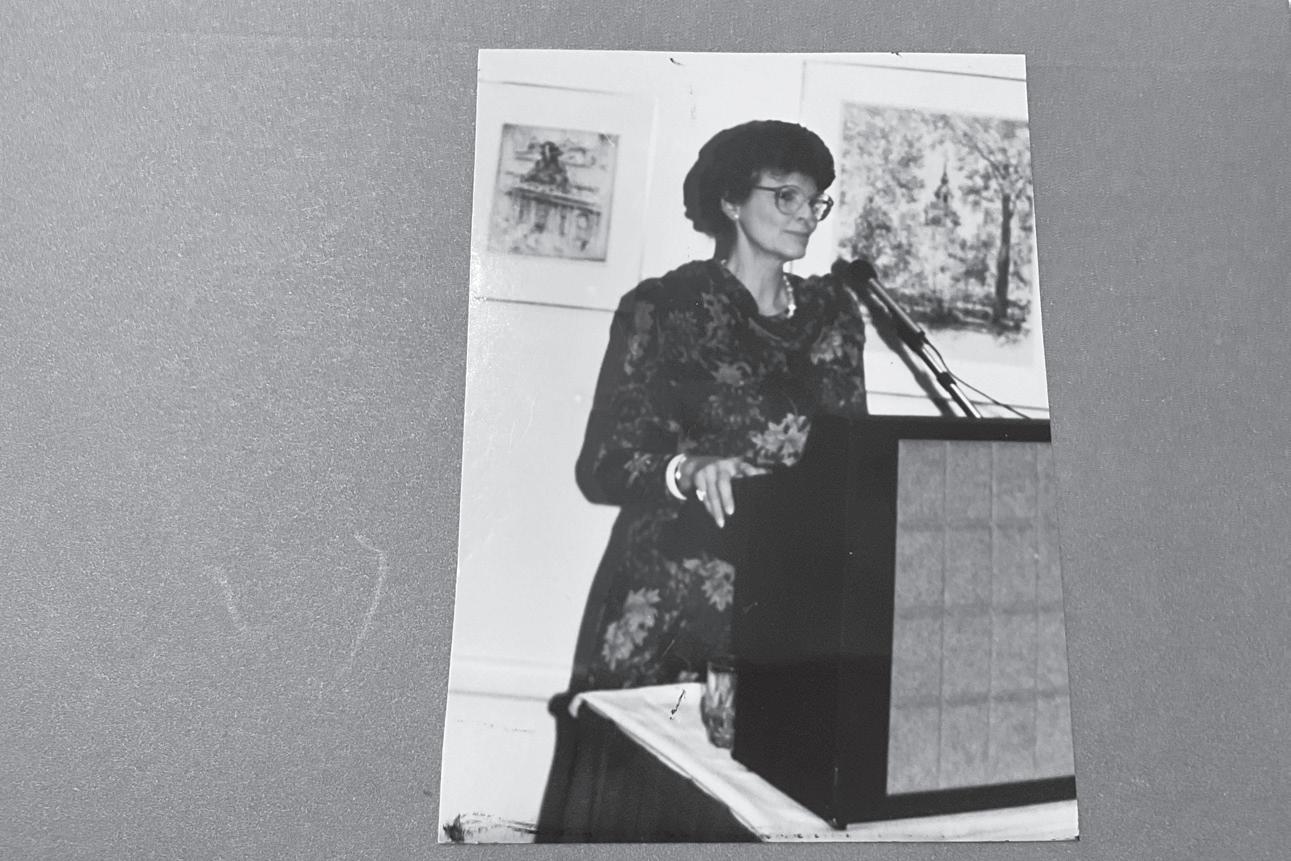
Lois Green Schwoerer, the history department’s first female professor and department chair, died last month. She was 98.
Schwoerer, who taught at the University for 31 years before she retired in 1996, helped found the women’s studies program in 1975 and was the history department chair from 1979 to 1981, before a graduate fellowship in Early Modern English and European History was established in her name after her retirement. Colleagues and friends remember Schwoerer as a gracious and dedicated educator who was passionate about her research on early modern English political thought and growing opportunities for women in academia.
Schwoerer was born in Roanoke, Virginia, in 1927 and grew up in New York City before graduating from Hunter College High School in the city’s Upper East Side neighborhood. She graduated from Smith College in 1949 and earned both her master’s and doctorate in European and English history from Bryn Mawr College in 1956, according to her obituary.
Schwoerer was also a member of the founding committee that created GW’s master’s degree program in women’s studies in 1975 and started and taught a course on the history of European women to GW’s curriculum, according to her obituary. The University awarded her an honorary Degree of Letters in 2002.
Schwoerer sued GW — and later won — while serving as a faculty member, believing her salary was unfair compared to that of her male colleagues, Dane Kennedy, a professor emeritus of history said. He said that action, as well as her accolades like leading a conference dedicated to British studies, showed her determination and drive.
“She entered the profession at a point when it was still quite hard for women to get jobs as academics,” Ken-
Muriel Atkin, a professor emerita of history, said Schwoerer was “enormously helpful” and offered her wise advice about how things worked at the University, which she said was helpful especially when she was new to the faculty in 1980.
“Anytime I had a question, especially when I was new to the GW faculty, I could always go to her and get advice that was always helpful,” Atkin said.
Atkin also said Schwoerer played an active role in a special committee addressing a controversy when the administration tried to hire a history professor without going through the normal search process shortly before Schwoerer retired in 1996. She said Schwoerer devoted significant energy toward resolving the problem.
“Her devotion was admirable in the extreme,” she said.
Christel McDonald, who took about five of Schwoerer’s classes as an undergraduate at GW in the 1970s and later became her friend, said Schwoerer was a tough but fair professor who encouraged her students to continue pursuing history beyond the classroom.
“What I really appreciated was her support and mentoring of students and of young historians, and I know of several who, thanks to her and her connections, have been able to create their own very beautiful careers,” McDonald said.
Denver Brunsman, the current chair of the history department, said Schwoerer was one of the most “eminent” historians in the field of early modern England. Though she retired before he arrived at GW, he met her on a couple of occasions and said he deeply admired her scholarship.
“She was a real pioneer within the University and within the discipline of history,” Brunsman said. “By all accounts, she was very welcoming and helpful in hiring additional women who went on to have incredible careers at GW.”
Schwoerer is survived by her son John Schwoerer and grandchildren Emma Schwoerer and Charles Schwoerer, according to her obituary.
Senior, former SGA senator launches bid for Nebraska legislature
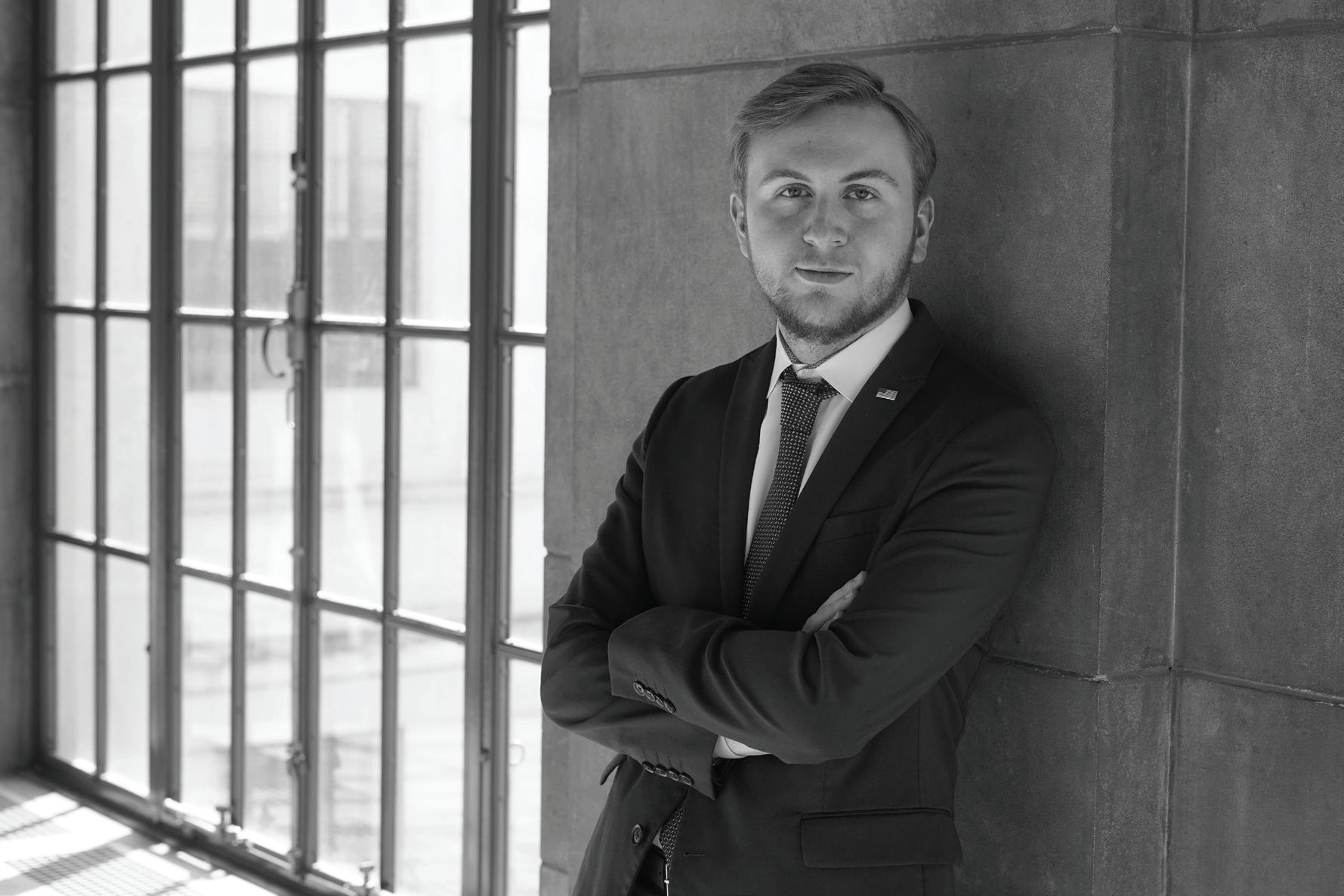
At just 20 years old, former Student Government Senator Jayden Speed is running for the Nebraska Legislature, aiming to become the youngest lawmaker in state history next November.
Speed, a senior majoring in political science, said he’s campaigning for Nebraska’s State Senate District 2 to stop the state from “hemorrhaging” young people and strengthen youth representation in state politics by increasing statelevel public education funding and creating affordable housing incentives. Speed — who will turn 21 this December, the minimum age to serve in the legislature — said he believes he can win by casting aside partisanship and focusing on popular policies in Nebraska, like property tax cuts and infrastructure development.
Convincing voters he’s not too young to serve is just one of many challenges Speed will face in his campaign, along with resistance from conservatives determined to keep control of the district. Although elections for the Nebraska legislature are officially nonpartisan — meaning party labels do not appear next to candidates on the ballot — Speed would be the first non-registered Republican to serve the 2nd District since 1944.
As he juggles the demands of his senior year with a competitive campaign, Speed is balancing coursework and election prep ahead of the May 12 nonpartisan primary — just days before GW’s Commencement on the National Mall. He travels back to Nebraska at least once a month and has arranged his class schedule to keep Fridays free, allowing for longer weekend trips home as the election approaches. Speed said the more time he spends in D.C., the more rooted
he feels in Nebraska politics, realizing that national issues often feel “abstract” compared to challenges facing “real people.” He said he has tried to keep his campaign grounded in his community by focusing on the people behind the policies instead of national ideological fights.
“My values have always been the same values,” Speed said. “And I think the longer I’ve been in D.C., I’ve just been more and more focused on how do we take this abstract policy and use it to actually help real people?”
Speed said although historically left-leaning candidates have consistently lost by about 2,000 votes in his district, he thinks he will be able to “mend that gap” through a campaign message that focuses on popular policies — like property tax relief and expanding universal preschool access — rather than partisan messaging.
Speed’s district leans heavily Republican, with 16,821 voters registered Republican, 7,334 registered Democratic and 7,436 registered nonpartisan in September 2025.
But a 2024 poll found 79 percent of Nebraskan voters supported using some of the state’s $2 billion surplus to fund affordable child care and another poll found nearly two-thirds of Nebraskans supported cutting property taxes, policies Speed has championed in his campaign.
Speed said despite potential criticisms of his age or political inexperience, he already has accomplishments as an organizer and advocate for young voices in his community.
He said he led the charge in 2023 with other local organizers to hold a recall election for a school board member after she attempted to ban access to certain books in a school library, which led to her removal with 62 percent of the vote.
Speed said he thinks many members of the legislature are “out of touch” with the state’s priorities
because they are older, independently wealthy and tied to personal business interests rather than the issues their constituents care about, like creating more jobs in the state.
“Being my age, I’d be much closer to people, much closer to the young people that we’re fighting to retain in our state,” Speed said.
Speed said his experience at GW, including his time serving as an SGA senator last year, taught him how to build and maintain relationships with colleagues and constituents to accomplish his policy priorities.
“I think that applies elsewhere in government,” Speed said. “That just building relationships is really important to being successful in
getting things done.”
Sarah Slattery, a 2022 candidate for Speed’s district who lost to her more conservative opponent by about 2,000 votes, said she thinks Speed has a better chance of winning because the current District 2 officeholder is term-limited, so Speed will not have to face an incumbent. She said because there are no party affiliations listed on the ballot in Nebraska, Speed can push for policies like affordable housing and responsible gun ownership without having the reputation of a national party attached.
Slattery said after her defeat in 2022, she decided not to run again and turned to Speed — who she saw as a prominent local voice in
politics — encouraging him to take the reins and launch his own campaign for legislature.
“I think that he’s been just waiting to be old enough to run for office, I think that he’s always kind of wanted to,” Slattery said.
Logan Olszewski — a junior studying international affairs and political science and Speed’s director of strategy and finance —said said he thinks what sets Speed apart from other candidates is that he has “true character” and cares deeply about issues in his district because he grew up there.
“I see Jayden as having all those traits that I look for in a candidate and that I think most people look for in a candidate,” Olszewski said.
KYRA WOOD | ASSISTANT PHOTO EDITOR
A poster for the GW Anti-Zionist Jewish Student Front near the intersection of H and 20th streets.
RYAN SAENZ ASSISTANT NEWS EDITOR
DYLAN EBS
ASSISTANT NEWS EDITOR
LAKSHMI DEV REPORTER
COURTESY OF THE SCHWOERER FAMILY
The history department’s first female professor, Lois Green Schwoerer, in an archive photo.
COURTESY OF JAYDEN SPEED
Former Student Government Association Senator Jayden Speed poses for a campaign portrait.
Researchers predict CDC budget cuts will stifle economic growth, employment
ALYSSA WISMAR REPORTER
TIARA CIRINO REPORTER
Researchers found President Donald Trump’s proposed $5 billion cut to the Centers for Disease Control and Prevention’s fiscal year 2026 budget would cause state economies to shrink and increase unemployment.
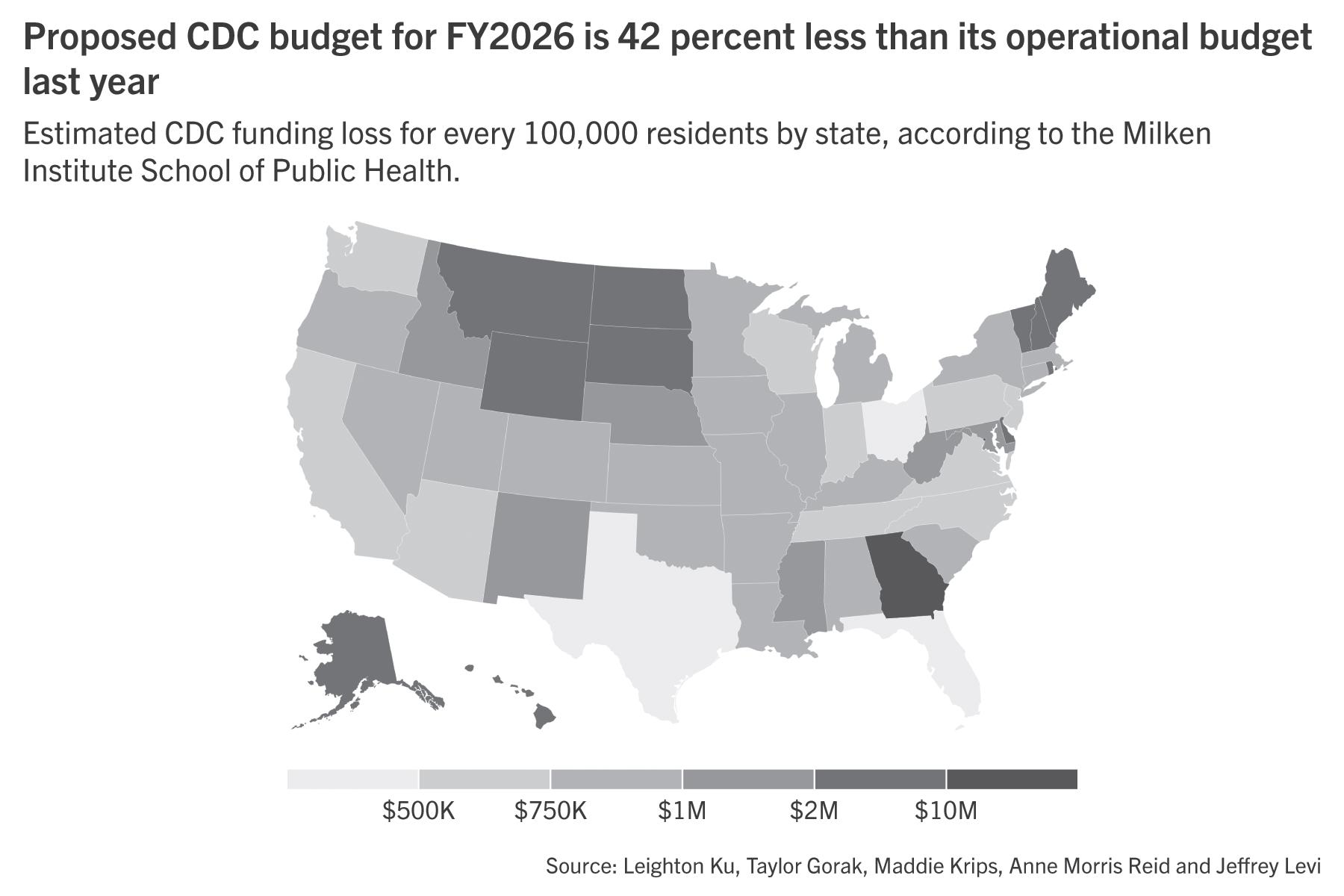
The study, led by Leighton Ku, a professor at the Milken Institute School of Public Health, published earlier this month by the Center for Health Policy Research, predicted the 2026 cuts — if approved by Congress — will cause national GDP to decline by $1.6 billion in 2026 alone and will contribute to a loss of 42,000 jobs nationwide, with about one-third of job losses being indirect losses in sectors outside of public health. Ku said the CDC’s FY2026 budget would further weaken the “chronically underfunded” U.S. healthcare system by diminishing public health and disease prevention efforts nationally.
“If you cut someone who’s a staff person, this person’s out of a job, and this therefore means they have a harder time affording their groceries, affording their rent, doing all sorts of those things,” Ku said. “So there’s going to be necessary impacts.”
The CDC is a national health organization that provides services like health screenings, national surveys and vaccination programs, according to the institution’s website.
Trump’s FY2026 bud-
get proposal, announced in May, cuts the Department of Health and Human Services — which houses the CDC, the National Institutes of Health and other public health agencies — budget by 26.2 percent compared to FY2025. Organizations like the American Public Health Association have since urged Congress to reverse these funding cuts before they’re enacted. GW also signed an open letter to Congress in June urging them to reject cuts to the NIH proposed in the budget.
Ku and his research team used the economic analysis program “Impact Analysis for Planning” — which estimates the economic impact of changes in employment rates, wages and supply chains — to find the repercussions of the budget cuts in different departments of the CDC. The program then compared the proposed 2026 budget to the agency’s FY2024 budget. The software then calculated how the states’ economies and jobs would be directly impacted by the cuts.
Of the $5 billion in proposed cuts in the FY2026 budget, more than $1 billion will be transferred to other agencies in HHS, meaning the net reduction in funding to the CDC would be approximately $3.8 billion. The study found state economies would decline by $5.4 billion as a result of job losses and wage cuts, meaning the loss to economic output would be 40 percent larger than the savings.
The study also estimated Georgia, California, Florida, Texas, Arizona, Illinois,
New York and Pennsylvania would lose more than 1000 jobs because of layoffs and reduced economic activity resulting from the budget cuts, and all 50 states would lose at least 160 jobs. Georgia, where the CDC is headquartered, would have the largest net loss in GDP at $1.9 billion. Under the budget proposal, programs related to HIV prevention and environmental health would lose most of their federal funding, and the National Center for Chronic Disease Prevention and Health Promotion, which focuses on cancer screen-
Sonia Sotomayor discusses new book, experience with Type 1 diabetes
JENNA LEE SENIOR NEWS EDITOR
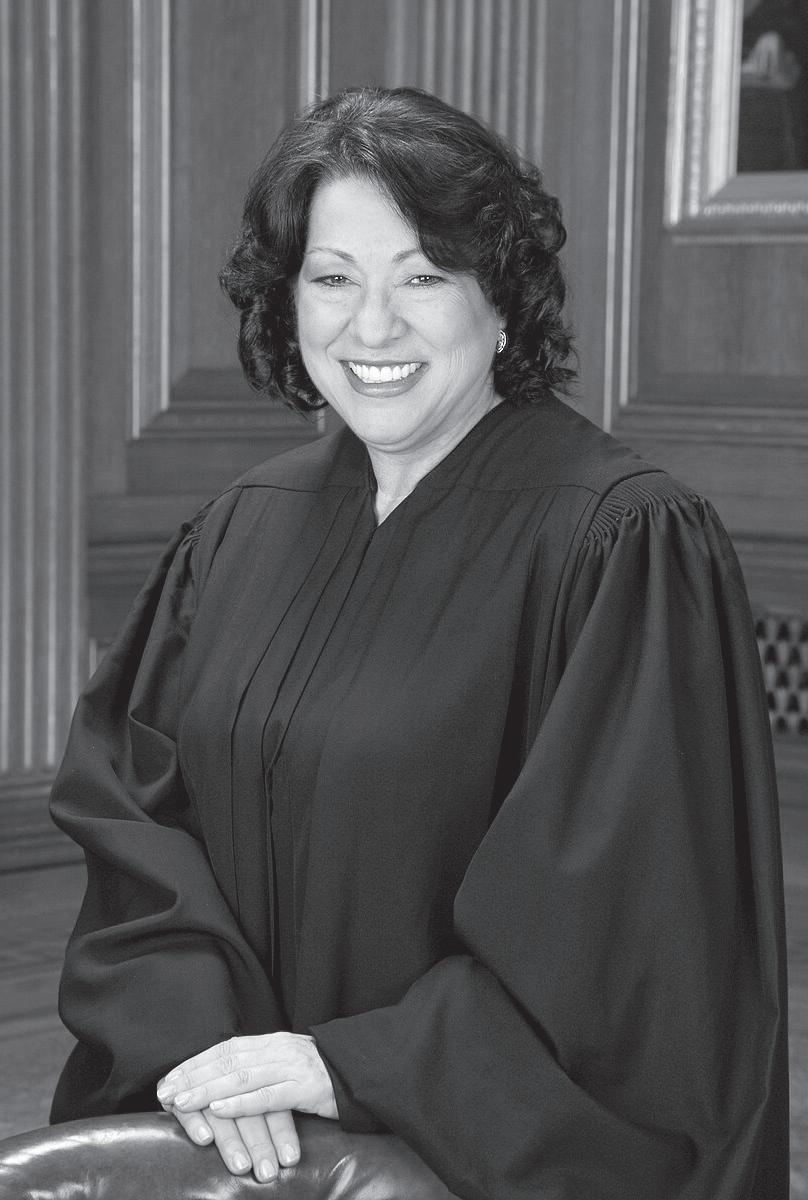
Supreme Court Justice Sonia Sotomayor and former Federal Judge David Tatel discussed their new books and the value of being open about their experiences with disabilities Thursday in Dorothy Marvin Betts Theatre.
Sotomayor discussed her new children’s book “Just Shine!” which centers on the evolution of her relationship with her mother, while Tatel discussed his memoir “Vision: A Memoir of Blindness and Justice” about how he came to terms with his blindness throughout his career as a lawyer and judge. Nina Totenberg, a legal affairs correspondent for NPR, moderated the conversation, which was hosted by GW in collaboration with local bookstore Politics and Prose.
Sotomayor, who has written five children’s books, said “Just Shine!” was inspired by her mother’s recent passing. She said she spent almost half of her life angry at her mother for leaving her alone while she worked long hours but realized after her mother died that she had taught her how to be herself. She said the book reflects lessons her mother taught her that she had not given her enough credit for, like many children do with their parents.
“Children are following your example, and so to the extent that you’re reading this book and asking them to think about others, you have to model that too,” Sotomayor said to parents in the audience. “My mother did it for me in such a special way, and this is what this book is about.”
Both Sotomayor, who has type 1 diabetes, and Tatel discussed the emotional value of being open about their disabilities and letting those around you help when you need it.
Tatel, who served on the U.S. Court of Appeals for D.C. for 30 years, said his book reflected his struggle to feel comfortable with his blindness. He said for years he refused to tell people about his disability out of shame even as he started losing his sight in adolescence. He said after decades of working as a judge, he realized his disability did not define him to others, which allowed him to open up about his blindness after years of hiding it.
“I became confident that people viewed me not as a blind judge but as a judge who happened to be blind,” Tatel said. “That gave me a huge amount of personal confidence.”
Tatel also discussed the transformative effect his guide dog Vixen — a German Shepherd who sat by his feet during the talk — had on his life by allowing him to do more on his own, like use public transportation without another person. He said after years
ings and smoking reduction, would lose 100 percent of its federal funding. Ku said this would lead to higher mortality rates nationally because some patients would then be screened for cancer later.
Ku said he fears cuts to the CDC will affect states’ ability to prevent the spread of infectious diseases like HIV and the flu because researchers will be unable to conduct research of the same caliber. Ku said the health data the CDC provides is “necessary,” and he believes people will realize after a public health crisis that the
of only using a cane, Vixen gave him a degree of independence he had never enjoyed before and took some of the caretaking burden off of his wife, whom he has been married to for 60 years.
Sotomayor said she related to Tatel’s struggles with opening up about his blindness due to her experiences with type 1 diabetes because she also felt shame about asking for help. She said over time, she learned to accept help from loved ones when she experienced difficulties, like blood sugar lows, because she realized their offers were a sign of love.
She also credited a culture of open dialogue about disabilities in the world now as opposed to when she was growing up, with giving her the confidence to speak up about her struggles with diabetes.
Totenberg then asked Tatel about the part of his book where he said he retired from the bench last year because he was tired of having his work reviewed by a Supreme Court that held the legal principles he has dedicated his life to “in such low regard.”
Tatel commended Sotomayor for her powerful dissents on decisions from the court. He said the decisions of the conservative majority on the court are “erod-
ing” the capacity of the federal government to protect the health and safety of Americans.
Sotomayor said she continues to stay on the court despite often not siding with the majority because the Supreme Court has the power to set precedent that lower courts must follow. She said she feels obligated to use her platform on the highest court to write what she thinks is right.
She said in addition to her work on the court, she is passionate about civic education of young people and has devoted her free time to visiting schools to encourage children to learn about their government. She said children need to not only understand the structures of government but why those structures exist and what they risk losing with the erosion of democratic institutions.
“The mistakes we’re making today as adults are going to change your lives, and if we’re going to change your lives and you don’t like what we’re doing, you need to figure that out early and figure out how you can get together as kids and make sure that the world is better than what we’re leaving you with,” Sotomayor said.
government needs to invest in public health institutions like the CDC.
Liz Borkowski, a senior research scientist at Milken, said the budget cuts will lead to more public health crises in the future because the CDC will no longer be able to track the spread of infectious diseases or create preventative measures.
Borkowski also said the reduction in capacity of the CDC’s data collection programs would hinder public health research and innovation, like vaccine development.
Richard Riccardi, a professor of clinical practice at the School of Nursing, said the cuts will most affect vulnerable populations, like people diagnosed with HIV or breast cancer, by making it harder for them to access treatment. Riccardi said this will increase health inequities by reducing the capabilities of the CDC.
“The prevention programs will be at risk, particularly chronic disease prevention, HIV and AIDS, and as I mentioned, opioid programs and maternal child health programs,” Riccardi said.
Business student group to boost networking for Black students
ADELAIDE PETRAS STAFF WRITER
Students formed a group this semester to help Black students connect with business student organizations on campus and explore their niche interests in the business field.
The Black Business Students Association began hosting events this month to prepare Black students for careers in business, including a handful of social and recruitment events, alumni panels and workshops. BBSA currently operates as a subgroup of the Multicultural Business Student Association, as it is unable to become an official student organization after the University paused the official process for forming new student organizations over the summer for the 2025-26 school year.
Junior Hanna Araya, co-founder and president of BBSA, said she launched the organization because career success is based heavily on forming connections, especially within the School of Business. She said while GWSB has numerous professional and social groups, she wanted to create one specifically for Black undergraduate business students and produce a safe space for them in the professional sphere.
“I wish it wasn’t that way, but if it is going to be that way, we should make our own group for Black people and make it where it’s like, ‘Okay, I’m a Black student in business. Where do I start?’” Araya said.
Shortly after Araya came up with the idea to found BBSA with her friends last school year, she said she met with Vice Provost for Student Affairs and Dean of Students Colette Coleman, who suggested Araya create a subgroup of MBSA due to the pause on new student organizations during the 2025-26 academic year.
Araya said when the BBSA wants to host any event, they have to let the MBSA know and have the group book spaces for them on campus. She said most BBSA events are therefore extensions of MBSA
events, even if they are just for the BBSA, but when the pause on forming new organizations is lifted they plan on applying to become an official student organization.
“We have to be in communication and understanding kind of appreciating what MBSA has done for us in terms of allowing us to kind of operate under their functions,” she said.
Araya, also a member of business fraternity Delta Sigma Pi and diversity career prep programs Management Leadership for Tomorrow and Sponsors for Educational Opportunity, said she noticed some of her friends were unaware of career opportunities available to them, like business fraternities.
Araya said this led her to want to create BBSA as a space specifically for Black business students to better share these career opportunities with them that they might have missed out on through other social connections. She said a crucial part of hearing about opportunities in the business school is often through word of mouth, rather than traditional advertising to students on social media.
Araya said many BBSA members are also part of various business organizations on campus, like Wall Street Finance Alliance, Commercial Real Estate Network, DSP and Alpha Kappa Psi. She said the group is focusing on getting underclassmen involved with other business organizations and diversity career prep programs that specialize in their interests.
She said while GW is academically strong, the University does not properly advertise resources for students of color and first-generation students to get jobs in business after graduating.
“We want to close the gap between academic success and career preparedness,” Araya said.
Araya said the group has secured events later this semester with JP Morgan and Deloitte, along with a panel of upperclassmen an alumni panel and social events.
GRAPHIC BY AN NGO
COURTESY OF MIA SMITH
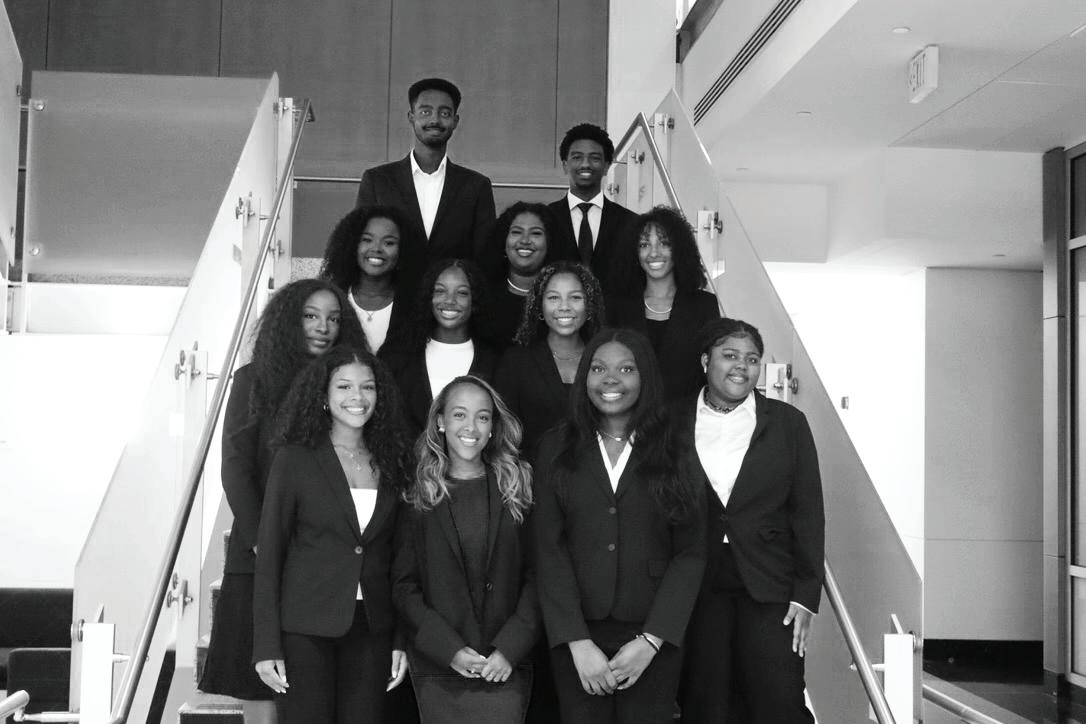
The Black Students in Business Association executive board poses for a group photo.
CREATIVE COMMONS
The official portrait of Supreme Court Justice Sonia Sotomayor.
ANC urges District leaders to resist National Guard presence
Commissioners call on D.C. leaders to continue resisting National Guard presence
Tax provisions could dissuade large donors from contributing to GW: experts
From Page 1
GW issued guidance to donors on its planned giving website following the passage of the OBBBA in July, stating that those in the top tax bracket should consider donating more this year to maximize tax benefits, which experts said could result in top earners giving less after the bill’s enactment with fewer tax incentives. The guidance also outlined the new tax deduction for smaller donors, adding that smaller donations still make an impact on the University.
exceed 0.5 percent of their income, while corporations must donate more than 1 percent to qualify — limits that replace the previous system, which offered deductions regardless of the amount given. Additionally, individuals in the top tax bracket will now receive 35 cents in tax relief for every dollar donated, down from 37 cents prior to the passage of Trump’s tax reform, reducing the overall incentive for large donations.
Foggy Bottom’s local governing body passed a slew of resolutions urging D.C. officials to continue resisting federal law enforcement presence in the city and infringement on the District’s self-governance at a meeting Wednesday.
The Foggy Bottom and West End Advisory Neighborhood Commission passed seven resolutions in response to the National Guard’s continued deployment throughout the District — which the ANC has opposed since President Donald Trump’s decision to deploy federal agents into the city in August. One resolution requested a formal response from D.C. Mayor Muriel Bowser’s office to commissioner questions about the unscheduled homeless encampment clearings in Washington Circle early last month, and another requests the Metropolitan Police Department end cooperation with federal officers.
Trump’s 30-day emergency control over the D.C. police expired on September 10, but federal officers, immigration enforcement and more than 2,300 troops — mostly from the D.C. guard — continue to patrol the city. Bowser pledged earlier this month ongoing coordination with federal agencies, and the guard is expected to remain active in the District performing duties, including beautification, through the end of November.
Commissioners passed a resolution denying the guard’s request to take up beautification projects in residential neighborhoods and also heard from University representatives about the status of GW’s 2027 campus plan.
Commissioners also approved an alcohol license and a carry-out and delivery endorsement for Gigi’s Pasta, a new restaurant set to replace The Bussdown D.C. in Western Market, which closed in January.
Here are some highlights from the meeting:
The body discussed and passed seven resolutions relating to Trump’s deployment of guard troops in the District.
The Commission unanimously passed a resolution, authored by 2A08 Commissioner Jim Malec, requesting answers from the mayor’s office on decisions regarding the encampment clearing in Washington Circle Park and the surrounding area on Aug. 15. The resolution questions why the Office of the Deputy Mayor for Health and Human Services, in accordance with D.C. protocol, scheduled and posted notice that the encampment would be cleared on Aug. 18 before conducting the clearing early.
The clearing in Washington Circle park conducted by local law enforcement was one of many — including at least four near campus — in August after Trump demanded people experiencing homelessness “move out” of D.C.
The resolution requests a “formal, written” response from the mayor’s office answering about a dozen questions about what D.C. government agencies were responsible for the decisions made before and during the clearing of the Washington Circle encampment and how they came to those decisions.
The Commission also passed a resolution drafted by 2A03 Commissioner and Chair Trupti Patel denying the D.C. guard’s Sept. 8 request for ANCs to identify potential sites in their neighborhoods for troops to conduct beautification work, such as trash removal. Patel said she has received calls and emails from constituents expressing that they do not want guardsmen in their neighborhood for fear that they will use that opportunity to target residents.
“This is a Trojan horse tactic,” Patel said. “This is a way for the National Guard to kind of see who’s in the neighborhood, who they can start profiling and who they can start targeting.”
University spokesperson Kathy Fackelmann said it’s too early to know how changes to the tax code will affect donors or donations to the University, given they go into effect Jan. 1. She said officials have been evaluating the OBBBA since its July enactment to understand its potential impacts on students, higher education and charitable donations to the University.
The Office of Planned Giving and GW Alumni will host a webinar next Monday on navigating the new federal tax law, which will be led by two alumni certified in financial planning, Fackelmann said.
Several other universities, including the universities of Kentucky, Wisconsin-Parkside, Michigan and Massachusetts Boston, along with American University, issued the same guidance — down to the same wording — following the bill’s passing, although it’s unclear who provided universities and other nonprofits with the templates on how they should advise their donors.
More than half a dozen tax law experts said the new tax laws may disincentivize some corporations and individual donors from giving both large and small amounts to the University.
They said taxpayers can currently choose to itemize deductions to maximize their tax break or take the standard deduction, which typically doesn’t allow for additional deductions like charitable contributions. Roughly 90 percent of Americans opt for the standard deduction and therefore don’t receive a tax break for donations, per the IRS. Under the new tax law, high-income individuals only receive a tax break on charitable donations that
Students weigh campus free speech, rising
More than a dozen students gathered Wednesday night to discuss the rise of political violence in the United States, their reactions to conservative activist Charlie Kirk’s assassination and how debates around free speech have shaped dialogue on campus.
The event, hosted by BridgeGW — a student organization that bills itself as a nonpartisan forum for political dialogue — drew participants from across the political spectrum and Dean of Students Colette Coleman, who listened to the discussion but did not participate. In debates about the limits of free speech, students discussed the removal of a GW staff member who called Kirk’s assassination “fair” on Facebook, with some students saying universities should not restrict controversial speech and others saying the employee’s removal was justified due to his insensitivity regarding the killing.
The discussion comes in the wake of a stark increase in political violence against officials on both sides of the political aisle across the United States. In the last year alone, President Donald Trump faced two assassination attempts, a man threw molotov cocktails into Pennsylvania Governor Josh Shapiro’s home, a gunman assassinated Minnesota State Rep. Melissa Hortman and her husband and most recently, a sniper fatally shot
Starting Jan. 1, the new provision will allow those who don’t itemize to claim a tax break of up to $1,000 for individuals and up to $2,000 for married couples filing jointly. Experts say while the change could encourage more small-scale giving, the boost won’t counteract an expected reduction in contributions from wealthy donors.
Ben Kershaw, the director of public policy and government relations at Independent Sector, said top earning donors only receiving 35 cents off their taxes for every dollar donated — compared to the previous law of 37 cents — is “unequivocally harmful” for charitable giving in future years, as donors will be less incentivized to make gifts. He said while the change may seem minuscule, donors are “really tax sensitive” and research from Indiana University found the changes could result in a $4 to $6 billion loss from donors across all nonprofits annually.
“If you’re thinking about this year versus next year, it’s much more advantageous for a corporation or a high income individual to be giving this year,” Kershaw said.
Joann Weiner — an economics professor at GW and a former senior economist in the Office of Tax Policy at the U.S. Treasury Department — said corporations’ donations to GW could drop after the tax law changes go into effect because companies that tend to give less than 1 percent of their taxable income will no longer get a deduction.
Weiner said the impact on corporations could be “bigger than expected” because companies are a large source of funds for charitable organizations and often sponsor events, like conferences and sports games.
Weiner said individual donors who take the standard deduction when filing taxes — which about 90
percent of taxpayers claim — can receive a $1,000 charitable deduction that would reduce donors’ taxable income. She said the changes are designed to encourage lower-income individuals to donate who otherwise wouldn’t because they didn’t receive a tax benefit. The number of Americans who donate plummeted from 66.2 percent in 2000 to 45.8 percent in 2020, according to an Indiana University study, due to shifting demographics, economic uncertainty and shifts in public policy that were exacerbated by the COVID-19 pandemic. The OBBBA could help reverse the trend of declining giving among lower-income Americans by boosting donations from them because it provides them with a tax break.
Brian Flahaven, the vice president of strategic partnerships at the Council for Advancement and Support of Education, said the bill could have a “strong positive” effect on giving before the end of the year because there is historically a spike in giving before tax laws change, and the new limitations mean higher income donors will be “incentivized” to give before Jan. 1. He said he is encouraging institutions to make sure they maximize the opportunities before the end of the year while strategizing how to communicate to donors once the law takes effect.
“Most donors are motivated for a passion of giving back and why they’re giving in the first place. So the tax policies just impacts the timing and the size of the gift, not the decision to give in the first place,” Flahaven said.
Richard Schmalbeck, a professor emeritus of law at Duke University, said universities like GW rely “pretty heavily” on “very large contributions” from wealthy donors, but wealthy individuals don’t have much of a tax incentive to make donations due to long-standing tax laws that do not allow individuals to get a tax break for more than 50 percent of their donations.
“At the moment, there’s no clear resolution of those two different strains of academic work on this,” Schmalbeck said. “Probably the best summary of the various studies is that tax features have some impact but not a huge impact.”
political violence at BridgeGW event
Kirk at Utah Valley University on Sept. 10. Officials removed Anthony Pohorilak, the Mount Vernon Campus’ assistant director of academic initiatives who called Charlie Kirk’s assassination “fair” in a personal social media post, from GW’s internal directory as of Wednesday. University spokesperson Julia Garbitt confirmed Thursday that Pohorilak is no longer an employee at GW. Niv Agaram, co-pres-
ident of BridgeGW and a senior majoring in political science and finance, said the group hosted the discussion to encourage open dialogue during a tense political time for the country in the fallout of Kirk’s shooting. “What everyone is looking for right now is people who are willing to openly debate ideas with and engage with the other side,” Agaram said.
Agaram said she hopes students can engage in these
conversations to understand differing political opinions and perspectives instead of only surrounding themselves with beliefs similar to their own. She said she believes Kirk followed a similar mission as BridgeGW because he led debates aiming to civilly discuss differing ideologies and beliefs rather than launch personal attacks.
“People criticized him, saying that he did not advocate for free speech,” Agaram said. “What he did was
go to college campuses and say, ‘Attack my idea, attack me ideologically, do not attack me as a person.’” Students during the discussion said Kirk’s assassination reflected their broader concerns about escalating political violence and inconsistent public responses depending on the individual killed and people’s partisan beliefs. They said the killing also raised questions about how universities should handle free speech and dis-
ciplinary action for officials who express their opinions online.
Ryan, a sophomore majoring in political science who did not provide his last name during the conversation, said in the fallout of Kirk’s killing, universities should resist punishing free speech on campus. He said Pohorilak’s departure from GW was troubling to him because he thinks universities should promote diverse perspectives, even if they’re controversial.
“I mean, despite us being a private institution, it’s still within a university’s goal for doing that,” he said. “And to continuously punish them is going to scare people from saying things that move us forward because frankly many of us are afraid of change.”
Following Kirk’s assassination, educators and staff across the country have faced termination and discipline after sharing personal opinions on social media about the killing. As of Sept. 18, more than three dozen university faculty and staff across the country have been met with disciplinary action over posts about Kirk’s death, NBC News reported. Another student, who asked not to be named due to a fear of retaliation, said those speaking out justifying Kirk’s killing should not be free from consequences from universities. The student said that they thought Pohorilak’s removal was justified because his comments affected other students and their safety as well.
JOSH STEINBERG | PHOTOGRAPHER
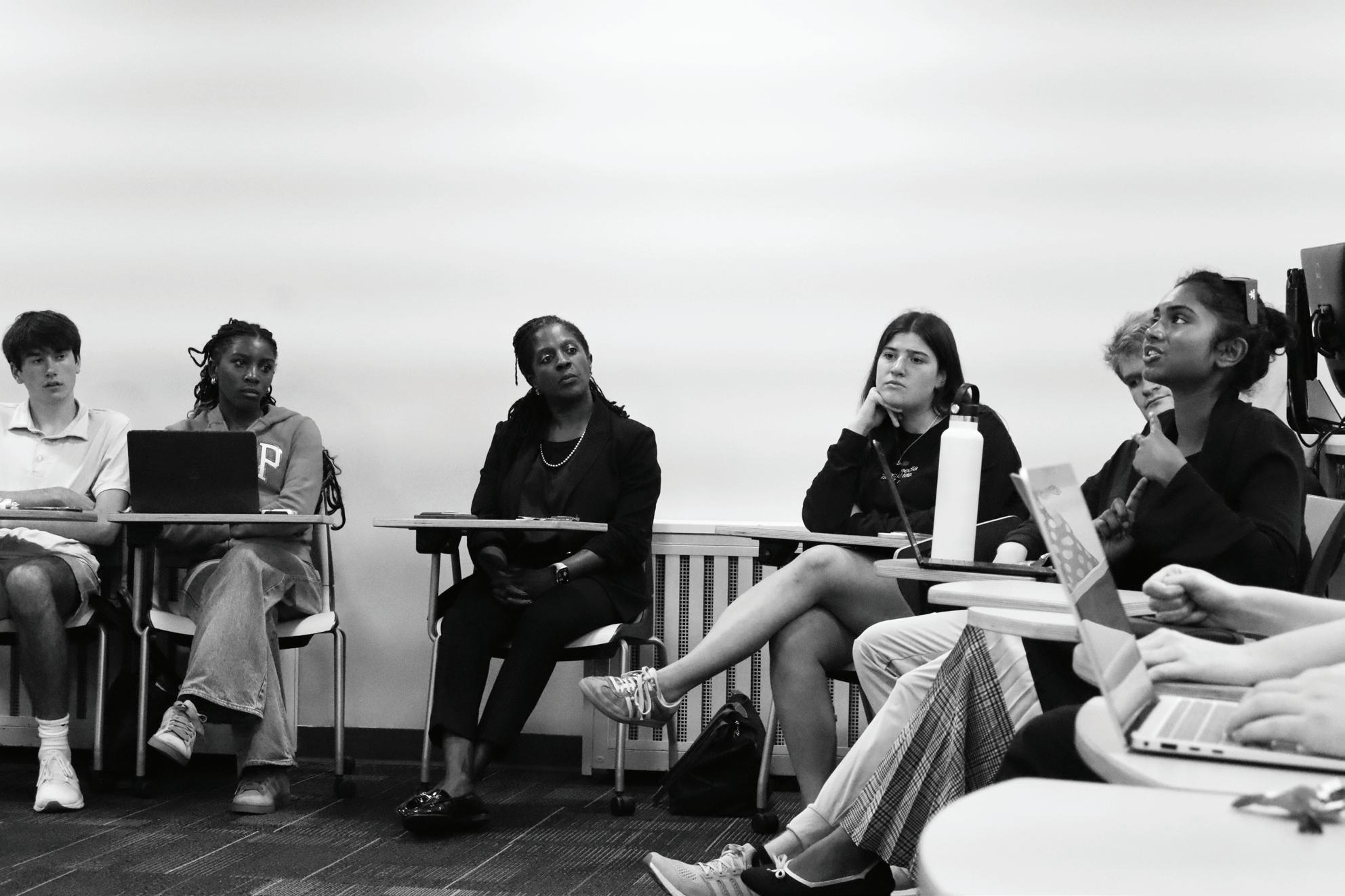
Dean of Students Colette Coleman joined more than a dozen students at an event hosted by BridgeGW on Wednesday.
ANN DUAN | STAFF PHOTOGRAPHER
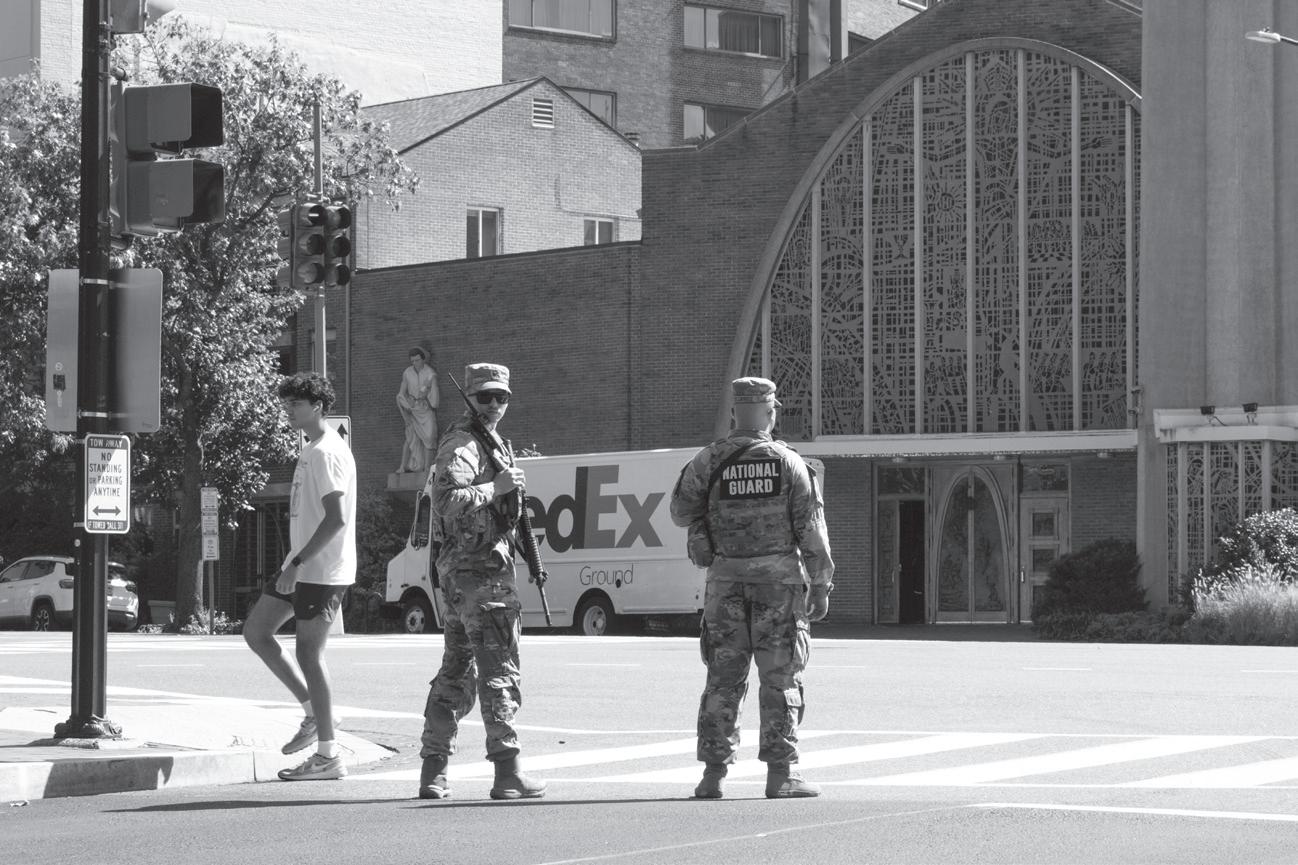
Members of the National Guard walk through the West End Neighborhood on Thursday.
OPINIONS
Whether President Donald Trump’s crackdown on diversity initiatives influenced officials’ decision to postpone the Diversity Summit p.1
GW, combatting a rise in political violence starts in the classroom
Charlie Kirk’s assassination pushed conversations about political violence to the forefront of national and campus discourse, spotlighting the deepening polarization fracturing the country. His killing is part of a broader, alarming pattern: the 2022 attack on former House Speaker Nancy Pelosi’s husband during an attempted kidnapping, the attempted assassination of President Donald Trump at a campaign rally in July 2024, the fatal shooting of UnitedHealth’s CEO in December 2024 and the June assassination of the former Minnesota House Speaker and her husband. These are just a few of the high-profile examples in a growing wave of ideologically driven violence, and the trend is deeply terrifying.
Kirk’s assassination must serve as a national reckoning. The rise in political violence is too serious and too dangerous to fade from public discourse. At GW — which University President Ellen Granberg dubbed “the most politically engaged student body in the country” while acknowledging the impact of Kirk’s killing at an event — these conversations are especially consequential. In order to help get students there, GW should teach its students to acknowledge and engage seriously with this moment. We believe many students did so in the immediate aftermath of Kirk’s assassination. While many student leaders across the aisle condemned the political violence, reactions were divided, with some students openly denouncing Kirk on social media and saying he deserved to die. The conversation surrounding political violence and its implications for the future of discourse must continue on campus. For this to happen, the entire University must commit to discussing it, and officials must lead by example. So far, they have not. GW as an institution has remained largely silent on the as-
STAFF EDITORIAL
sassination. It’s not surprising that GW, like many universities, did not release a formal statement in the wake of Kirk’s assassination. But after news broke that a staff member is no longer employed by the University after Fox News reported on them calling Kirk’s assassination “fair” in a personal social media post, we expected GW to directly share the news with the community. Faculty and staff across the country have faced termination or suspension over comments they made online about Kirk’s assassination, and many of these schools released statements explaining their reasoning and formally announcing the decision. We were disappointed by GW’s decision not to release a formal
statement regarding the staff member. Given the contentious nature of the issue and the intense public discourse surrounding both Kirk’s assassination and firings related to employees’ responses, the University should have been as transparent as possible about its decision — including on whether officials had fired the staff member or if they left on their own volition. GW confirmed to The Hatchet and Fox News that the staff member is no longer employed by the University, but we believe a comment from GW should not have required outside prompting from journalists. The University should have released a statement clarifying whether they’d fired the staff member, acknowledging the gravity and illustrating
Environmental costs must factor into debates over generative AI use
Many students and faculty have not been exposed to the readings and research about how AI is shaping our environment and impacting communities. At a school with such a high level of civically engaged students, many people are overlooking how their relationship with generative AI is impacting the environment. I believe everyone in the GW community should pay more attention to how generative AI is shaping the world because the impacts of generative AI will soon impact everyone’s life.
One of the key environmental concerns with generative AI is the really high water usage. A large data center consumes the equivalent of the water usually consumed by 4,200 people. On top of that, 20 percent of data centers draw water from already stressed watersheds in the western United States. Twothirds of the new data centers since 2022 are in areas of high levels of water stress, like the 26 data centers in Arizona. High generative AI usage will put strain on minoritized communities, which is not something the government or people who are not directly impacted by water scarcity will think about.
The budding industry also requires high amounts of energy to simply exist. Asking ChatGPT a simple question requires 10 times the amount of energy as a Google search asking the same question. By 2030, it is projected that U.S. data centers will require 88 terawatt hours yearly. Virginia gets 63 percent of its energy from fossil fuels, which it largely imports from Pennsylvania. This not only causes electricity to become more expensive, but it also pollutes Pennsylvania. This pollution can pose significant health risks, including an increased risk of asthma. Even if you do not live in a state that has a lot of data centers, high generative AI usage will end up affecting everyone, since the power grid is so interconnected and pollution travels. Using all of this energy can also increase electricity prices. Virginia uses 25 percent of its total energy to power data centers in the state. Virginia is not on its own independent power grid, so the increased demand for energy in Virginia can cause energy prices across the Mid-Atlantic to rise. In the future, this usage will likely continue to increase, with companies like Google investing $1 billion in Northern Virginia. Northern Virginia continues to be the largest data center market in the world, with 13 percent of all reported data center operational capacity globally. This massive market has caused Vir-
ginia’s energy demand to increase, even doubling in the next 10 years. If people keep using generative AI at the rates they are, by the time 2040 rolls around, the cost to power a home in the state will increase as much as $37 per month.
The environmental impacts of generative AI are not just shaping ecosystems and nature. It is being felt by real people and communities. These effects are very visible in South Memphis, which houses a data center for X’s, AI feature Grok. The University of Tennessee Knoxville found that the average concentrations of nitrogen dioxide have increased by 3 percent since X built its AI data center. After the data center opened, residents began to complain about the smell in the air and started to struggle to breathe. All air pollution disproportionately impacts marginalized communities, including pollution as a result of generative AI. Being able to operate in a world where generative AI is the norm is essential, but it is also essential for students to think about the impacts of using these resources. To write this opinion article using generative AI, it would have required 3.6 liters of water and 980 watts of energy. GW students need to start thinking more critically about when they use generative AI before it destroys our world.
—Caroline Moore, a senior majoring in international affairs, is an opinons writer.
Pif and how the staff member’s actions violated University policies, especially given the broader concerns around free speech. Whether officials and professors realize it or not, students’ opinions on Kirk’s death have sharply diverged and reveal deeper tensions across party lines. In a poll on Fizz, an anonymous social media app, around 1,100 of the more than 3,200 respondents said Kirk deserved to be shot. GW College Republicans’ executive director also reported that students wrote “very heinous things” on a poster they set up for community members to share what Kirk meant to them, including “Nazi” and “white supremacist.” These reactions reflect the broader polarization.
As a higher education institution with a highly politically engaged student body, GW must act. Given many students eye a career in government, the University has a responsibility to teach the next generation of politicians the importance of constructive engagement with differing viewpoints. When the campus leans heavily left, classroom discussions must still challenge students’ perspectives and prepare them to engage thoughtfully with opposing ideas. Failing to fully prioritize this, especially amid rising political violence, would risk complacency that could worsen the problem. As a country, we cannot afford for our future political leaders to overlook the importance of civil discourse and constructive dialogue. Students took steps in the right direction, with their hosting of a listening circle in the wake of Kirk’s assassination, an action we commend and hope to see more of across the University. Still, our professors and students must continue to prioritize learning and teaching about the importance of finding common ground in classes because the future of our democracy depends on it.
Officials must remember their responsibility to lead by example for the entire community. In this critical moment, they must clearly convey the gravity of the situation and ensure that students grasp its significance. Transparency and openness are essential. Moving forward, we urge the University to reaffirm its commitment to preparing students to engage in difficult political conversations, including surrounding the rise in political violence. The University is educating the future leaders who will shape political discourse, and for the health of our democracy, it must fully commit to teaching students the importance of respectful and constructive dialogue.
Don’t take your anger out on the National Guard
resident Donald Trump deployed the National Guard to D.C. in August. Many in the GW community and D.C. directly blame the men in uniform for feeling unsafe in the city. This reaction often stems from not stopping and thinking through the situation. They overlook the fact that the guardsmen are simply taking orders and treat the service members poorly as a result.
Ava Hurwitz Contributing Opinions Editor
A few weeks after they had become a fixture of life in the city, I realized during a phone call with my parents that my anger wasn’t productive. My father served in the Air Force for 20 years, and my mother worked alongside several organizations that support military families. experiences. They helped show me that individual guard members themselves weren’t at fault — it’s the Trump administration that we should be holding accountable at the ballot box.
The guard technically works for both the state and federal governments, while the other branches of the U.S. military only serve the federal government. This dual service can pose issues, especially when the state governments disagree with the regulations that
the federal government is issuing. We are seeing this in full force with the current administration’s actions going against states’ wishes, as they urge Trump to reconsider the deployment of the guard in their own cities. This means it is very likely that many members of the guard are being forced to carry out duties in their own cities even if they don’t want to.
Most members of the guard enlisted or became officers because they wanted to serve their country. If you take a look at the job description, it doesn’t offer any advice about what to do if you disagree with an order coming from high up the chain of command. They are in a very tight spot right now, especially if their views don’t align with those of the current administration. Many signed up to serve their state governments, not envisioning that they would be called to carry out federal directives, and in places like D.C., where local leaders disagree with the deployment, the tension is even more palpable. It isn’t accurate, nor productive, to assume that guard members signed up to serve in order to patrol D.C. for crime. Regardless of the work, the show must go on — or there could be serious consequences.
My parents laid out all of this, which left me with a question: If the guard didn’t sign up for this, why
don’t they just quit their job? I wondered how a person could go along with authority that was advising them to go against their morals. My dad directed me to the Uniform Code of Military Justice, Article 92, which states that any person who fails to obey an order — like staying at their post — can face up to two years in prison, forfeiture of all pay and be dishonorably discharged. A dishonorable discharge would make it quite difficult to procure a civilian job, and one in the military is out of the question. In our politically inclined school, we get caught up on just the looks of it, and we don’t consider the complexities that come with the job or their position. It isn’t the individual guard member we should direct our anger or frustrations toward but the administration who deployed the guard. Midterm elections are on the horizon, and if you missed National Voter Registration Day on Sept. 16, GW has a plethora of resources for students. Focusing your anger on the guard isn’t productive: They do not write the orders — they only follow them. If you want change, direct your attention toward the policymakers misusing their service.
—Ava Hurwitz, a sophomore majoring in international affairs, is the contributing opinions editor.
ABBY TURNER | STAFF CARTOONIST
Caroline Moore Opinions Writer
SCENE CULTURE
Annual
community-led tours connect residents to city’s lesser-known history
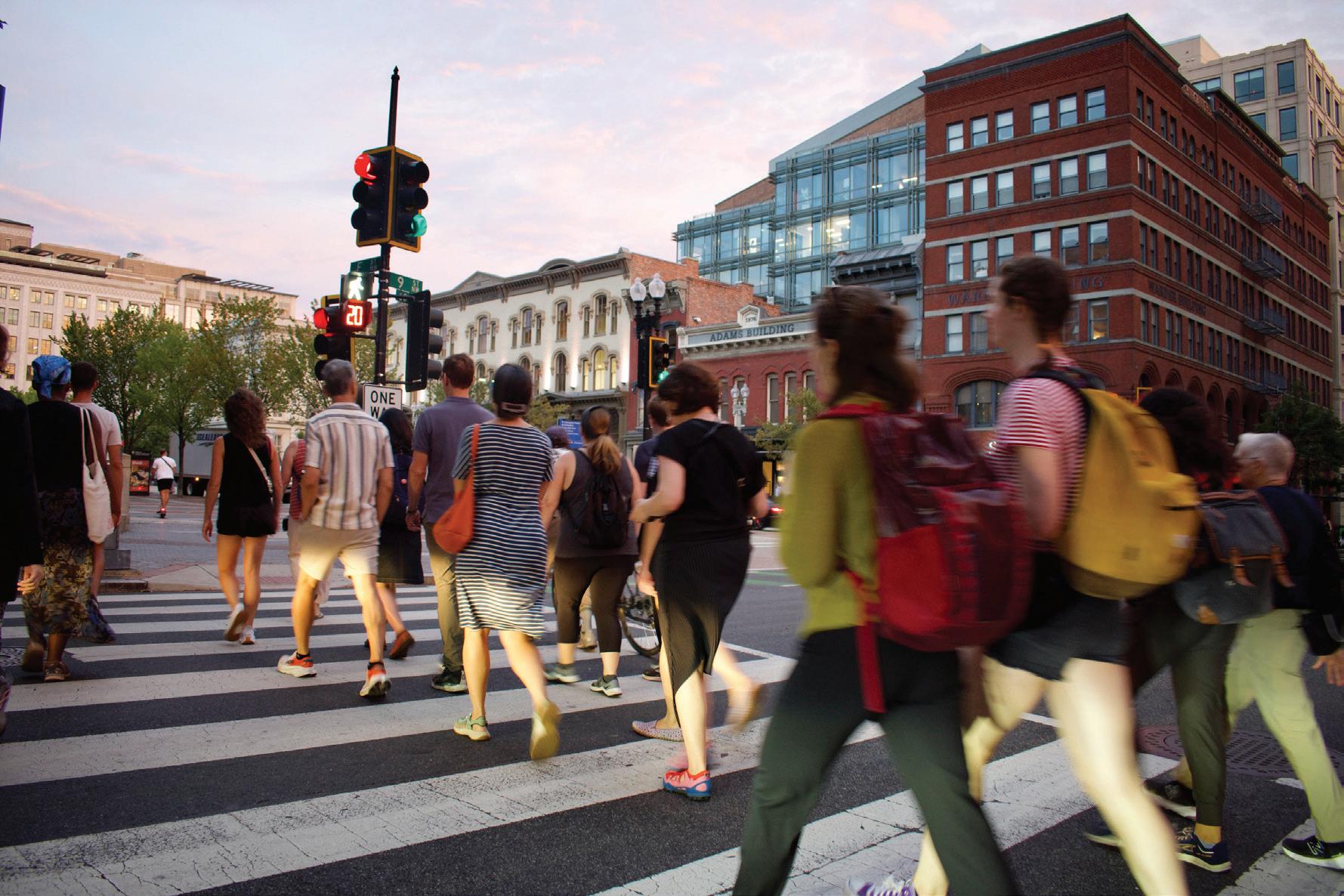
For the past eight days, official guides and historically savvy D.C. residents have guided a series of tours through the District’s rich past and over 100 neighborhoods.
Launched in 1999 and organized by Events DC, WalkingTown has led an annual series of free walking and biking tours across all eight wards, focusing on eclectic topics ranging from “Queering Capitol Hill” to “All Good in Deanwood.”
WalkingTown has grown to be the city’s longest-running public tour program, crafted by both licensed tour guides and residents who then lead their own tours, giving tourgoers a chance to explore D.C.’s communities through a personal, passionate lens.
From September 13-20, the program offered over 50 tours across the District. Many resident tour guides are longtime D.C. locals, guiding tours through their neighborhoods and hyper-specific interests — like self-proclaimed nature
lover Maria-Elena Montero’s “Discover the Birds of Capitol Hill.”
Jim Byers, a marketing director for Arlington Cultural Affairs, said he has led tours in the Hillcrest neighborhood of Southeast D.C. for more than 20 years. He said his tour, “Hillcrest Architecture: Hidden Gems of SE,” encourages attendees to observe the true nature of the neighborhood, instead of relying on preconceived notions and stereotypes.
Byers said he utilizes important landmarks of neighborhood
leaders, like houses, churches and parks, as guides to tell the complex history of segregation and resilience in Hillcrest and Southeast D.C. He said Hillcrest is a community that has created space for leaders like Pastor Frank Senger, who helped host events during the 1960s that bridged the gap between white and Black communities in the neighborhood.
“I was astounded that this beautiful neighborhood was here that nobody really talked about,” he said.
He said he remembers an early tour where a former Hillcrest resident returned to the neighborhood with his daughters, expecting it to align with the negative stories he’d heard about how the area changed over time — instead, he said to Byers that Hillcrest surpassed his long-held expectations from when he had lived there in the 1950s.
Moments like that, Byers said, demonstrate how firsthand experience can change long-standing stigma about the neighborhood’s safety and upkeep and highlight
Student thrifters venture to recover old styles, shop sustainably
NOOMAH UDDIN
REPORTER
SOPHIA SHAIK
REPORTER
Carefully sifting through packed clothing racks lined with colorful statement pieces are students on the hunt to up their wardrobe game and parse out their personal style.
Thrifting has become increasingly popular in recent years, especially among college-aged people as they seek out more sustainable alternatives to retail shopping and quest for styles from bygone eras. Despite spots like The Loop on the Mount Vernon Campus and Get Flea in Kogan Plaza right on campus, students say the shopping is worth the trek to Northern Virginia or Maryland for student-budget-friendly pieces and a wider selection of options.
Fast-fashion, or clothing that has been cheaply and quickly produced and allows stores to pump out the latest trends to their customers, has detrimental effects on the environment, as dying and textile preparation are the top factors of global pollution.
Senior Emily Meltzer said an important aspect of thrifting for her comes out of environmental concern — and
recognizing the amount of textile waste that occurs daily in the United States. Back home in South Carolina, she said she often frequented her local Goodwill but found the large company — which spans thousands of chains across the nation — had congested the market of secondhand clothing. Meltzer said she’s also able to hop on the Mount Vernon Express to the Mount Vernon Campus in search of a new thrift find, as the Office of Sustainability’s free clothing exchange, The Loop, opened last April in Academic Building room 122 and is open from 10 a.m. to 4 p.m. every Friday. Meltzer said the biggest mistake thrifters make is liking a piece while at the store but not seeing the appeal once going home.
Senior Liv Deol said after beginning her thrifting journey back in high school, she has traversed through a number of thrift stores scattered across different cities having found some of her favorite items like a winter coat and a jean jacket. Deol said she also enjoys shopping at Unique, as they have three different locations in the DMV with extensive selections, ensuring that almost everyone will find something suitable to their fashion taste.
Junior Paige Nelson said her motivation for thrifting — especially with the long commutes — comes from Unique’s Virginia location, which she discovered her freshman year through a District Connections trip. She said she commutes to find better spots because D.C.’s stores are “picked through” and inaccessible due to cost.
Nelson said she only thrifts and her closet has been majority thrifted for two years, due to her liking the materials used and the fit of older clothing. She said the price of new clothes is not worth the “cookie cutter vibe,” as many people purchase and wear the same trendy items.
The endless racks of clothing and the atmosphere can be overwhelming, so Nelson said she usually goes in with a plan, with a water bottle and protein bars to fuel the shopping trip. She said she goes straight to the rack that holds the clothing item she is in search of — most often jackets. Nelson said if she doesn’t “feel” the selection and vibe of the store, it can dictate the rest of the trip.
“It gets hot so fast, it gets busy so fast,” Nelson said. “And I also lose motivation, sometimes I’ll walk in and walk out 30 minutes later because it’s just not the right day.”
the importance of resident-led tours as opposed to commercial ones.
“I think both serve a purpose, but they’re different purposes,” Byers said. “And I think the benefit of a program like WalkingTown DC, where you have a lot of people who live in the community and are personally invested in the community is that it’s very personal.”
Byers said longtime residents, along with tourists, often limit their perception of the city to the National Mall, federal buildings and well-known memorials. He said
WalkingTown pushes people into communities and neighborhoods, where history is told through alleyways, corner stores and churches.
“The Mall is wonderful. The federal core is amazing, it’s monumental, all of those things,” Byers said. “But the real quote-unquote D.C. is off of the Mall. It’s in the neighborhoods and across the city — Northeast, Southwest, Southeast, Northwest.”
Friday afternoon, Len Shabman, historian of the New York Avenue Presbyterian Church, led his “Abraham Lincoln’s Journey to the Emancipation Proclamation” tour. For the first hour of the tour, visitors gathered in the church’s “Lincoln Parlor” on the first floor of the building, which functions as a micro-museum honoring the church’s connection to President Lincoln — who was known to have worshipped there regularly during the Civil War and built a close relationship with then-Reverend Phineas Gurley.
For two decades, Shabman said he has been guiding visitors through these artifacts and stories in the Lincoln Parlor after the conclusion of Sunday morning services. He said people are often unaware of the church’s memorial to the late president, which includes bells gifted by Lincoln’s granddaughter in 1929.
“There really is only one memorial given to Lincoln by his family and it’s the chimes and the clock in our tower, and I don’t think people understand,” Shabman said. “There’s a little fact bubble, a little fun fact about D.C. — when you’re walking down the street, if you’re a Lincoln person, stop and listen to the chimes.”
Creativity, choreography, casting: Corcoran students churn out productions in 24 hours
ABIGAIL ROSEN
REPORTER
SOPHIE LOIACANO
REPORTER
Twenty-four hours before the curtain opened, writers, directors and actors hunkered down in the Leggette room of the Smith Hall of Art on Friday, hoping to craft an original show for their 6 p.m. performance the following night.
Corcoran Theatre and Dance hosted their second 24-hour theater festival, titled “Get! Workin! 24-Hour Theatre Festival,”on Saturday in the Building XX Blackbox, delivering a horror-themed performance. The six one-acts featured everything spooky, from murder mysteries to the ghost of George Washington, with everything from script writing to rehearsals to the performance itself taking place within 24 hours.
The festival is the brainchild of co-producers Ally Fenton and Brandon Ogin, both junior theater majors who are pursuing double degrees. Fenton and Ogin said they came up with the concept of a 24-hour production where the entire performance is created in just 24 hours after competing at the Kennedy Center American College Theater Festival last February. The pair said they brought the concept to CTAD program head Holly Dugan and developed a less competitive, more accessible 24-hour production, with a small-scale trial run successfully premiering last May.
Fenton said she and Ogin’s roles as co-producers are allencompassing, with their duties including spearheading all technical aspects of the performance and adding their creative input alongside the directors during rehearsals. She said they also organized recruitment through social media and handled finances behind the scenes.
As a veteran theater kid, Fenton said she is no stranger to tackling the crucial elements of productions needed for a polished final run, from advertising to finances to securing a stage to perform on.
Fenton said about 30 students headed to Building XX on Friday night at 6:30 p.m. to put their name and their desired role in the production — either director or actor — in a cup to be chosen by playwrights for the acts they would perform in.
After the initial headcount and sorting of roles, Fenton said playwrights gathered in the Leggette room in Smith Hall to start chipping away at their acts Friday night.
Fenton added that said playwrights were given prompts for inspiration and had until 8 a.m. Saturday morning to write 10 pages worth of scripts for each act. She said at 10 a.m. on Saturday, directors were then given one hour to cast their shows, and then rehearsals with actors ensued for the rest of the day.
Fenton said tech rehearsals were from 4 to 5 p.m., and then the curtain raised for the showing at 6 p.m.
“Nobody is there for 24 hours — we would never trap someone in XX for 24 hours,” Fenton said.
Co-producer Brandon Ogin said after the success of the production they took part in, he and Fenton wanted to continue the festival after seeing a blossoming community created through theater.
Ogin said despite his role being behind the scenes, the majority of he and Fenton’s preparation was facilitating the production with CTAD administrators and managing the “system of bureaucracy” of GW, working with faculty to secure dates and rooms. He said the unpredictability of the end product of the show itself was what he was looking forward to the most.
The five one-act plays, “The Spectre,” “Graveyard,” “Alive,” “Give Me Liberty or Give Me Death” and “The Temple,” each ran 10 to 15 minutes long, incorporating a myriad of Halloween cliches and bone-chilling plots. Each one-act brought a new energy, with participants varying from veteran theater majors to ambitious newcomers, work-
ing together to perfect the endless aspects of developing a theatrical production.
First-year Connor Chase, who played an anxious teen’s mother and a detective, said this production was unlike any that he’d done before in his six years of theater performance due to its fast-paced nature. Chase said after attending an introductory presentation Friday night, he came back Saturday morning to brand new scripts that were ready to be rehearsed. Chase said he enjoyed the casual nature of the performance with minimal technological production. He said the acting blocks, tablecloths and cardboard props left the audience to use their imaginations as actors performed on stage.
Brenna Griffin, a first-year who played a detective and lovestruck student, said she enjoyed pulling a production together so quickly and enjoyed the opportunity to meet the CTAD community. She said while there were challenges, like pulling costume pieces together last minute, working with a community of people who share a love of acting made the process worth it.
CTAD program head Holly Dugan said unlike most CTAD productions, her role in the 24-hour theater festival was largely hands off. Dugan said she was willing to help Fenton and Ogin out with the production, as it was a way to involve more students with CTAD and to try theater out for fun.
“We’re really getting to see all the skills that we work in the classroom come to life, to put student created works of art together on
for their own audiences,”
GRACE MCMAHAN | PHOTOGRAPHER
Participants walk through the streets of D.C. during the city’s annual September WalkingTown event.
stage
Dugan said. “That to me, I always get goosebumps when I think about that.”
RACHEL KURLANDSKY | STAFF PHOTOGRAPHER Students perform during GW’s 24-hour theater festival.
COOPER TYKSINSKI | ASSISTANT PHOTO EDITOR
Emily Meltzer contemplates purchasing a sweater in the mirror at The Loop, a free clothing exchange store on the Mount Vernon Campus.
Tennis falters in first tournament of season despite strong doubles performance
Tennis opened their season at the Bedford Cup in College Park, Maryland this weekend, finding early momentum in doubles but coming up short in their singles draws.
The Revolutionaries stepped onto the court to begin their season at the Junior Tennis Champions Center less than a month after GW Athletics hired former Syracuse University assistant coach Jackie Calla as the team’s head coach. Freshman Devika Manu advanced the furthest of any Rev in the singles draw, reaching the semifinals of flight three with back-toback wins in her collegiate debut before falling to Johns Hopkins University freshman Isabel He in the semifinal.
Freshman Alexandra Lindqvist also won her first collegiate singles match,
taking home the deciding tiebreak 11-9 in flight three. The freshmen doubles team made it to the semifinals in draw two, winning their first two collegiate matches.
“It’s always a transition for the freshmen, but I think they also got included and involved very well already,” Assistant Coach Stella Weisemann said in an interview prior to this weekend’s tournament.
In the upper flights, Juniors Madison Lee and Victoria Sasinka did not make it out of their opening singles matches in flight one, with Lee running out of gas at the end of her comeback effort, falling 10-3 in the deciding tiebreak. Junior Solange Skeene managed a win in straight sets before falling in the second round to West Virginia University graduate student Julie Bousseau who dominated the match winning the first set 6-2 and the second set 6-1.
Skeene and Sasinka also
lost in the first round of the top doubles flight, falling to Bousseau and her partner, senior Audrey Moutama, 6-1. Last season, Skeene led the team in singles with nine wins while the Atlantic 10 named Sasinka to the allconference second team.
Last year, the team notched three third place finishes across all draws in the singles tournament and took home three flight titles in 2023. Although last year’s tournament was held around the same time — the weekend of Sept. 15 — this year’s schedule was publicly announced Sept. 9 – a full month later than last year and just 10 days before competition was slated to begin.
Former Head Coach George Rodriguez abruptly left the team for Calvin University in early July, likely contributing to the delay in announcing this season’s schedule. Weisemann said the time period without an
official coach — the nearly two month span where she was the only coach on staff — was challenging for her given the sudden shift.
“That was very sudden for me too,” Weisemann said. “I think it was just a lot of figuring things out on the spot and communicating with a lot of people that I didn’t know.”
Weisemann said the time was good for her personally to grow as a coach but made it difficult to confirm matches with the scheduling for next spring.
Calla said the move to Foggy Bottom was a “quick process,” as she moved here to D.C. with her husband and started practicing with the players less than a week after she was officially hired. She said she wants to include more technical analysis in the program, providing technique handouts and having the athletes write in journals.
“I look at a tennis
Strong athletics could woo donors,
The success of the 1990s wasn’t confined to the court. Off it, GW was undergoing a parallel transformation. The University became more selective, with the acceptance rate dropping from 81 percent in 1988 to just 49 percent by 2000. At the same time, the total cost of attendance nearly doubled when adjusted for inflation, climbing from $34,184 in 1989 to $62,281 in 1999.
The surge in student interest in GW — undergraduate applications shot up 23 percent after the team’s 1993 March Madness run — because of the University’s elite basketball program wasn’t the only reason GW was able to expand in such ways. But it was part of it, said former Senior Vice President for Student and Academic Support Services Robert Chernak, who oversaw much of the University’s development at the time.
“It allowed for more flexibility to divert funds for other enterpris-
es,” Chernak said. “It wasn’t just athletics but in parallel with athletics.”
But unlike the 1990s, GW’s present compounding financial pressures and the fast-changing landscape of name, image and likeness deals mean officials will need to carefully balance the amount of money they put toward the program.
Even as men’s basketball enters this season in one of its strongest positions in years, Granberg said she understands her first responsibility is to ensure GW’s academic programs and operations remain strong before funneling additional money to athletics. And although bolstering the program is a priority for the president, a University spokesperson said athletics’ budget will not increase in fiscal year 2026 — an assertion that comes after officials in April said GW would cut its FY2026 total expense budget by 3 percent.
“Our goal is to do everything we can to continue to deliver on our
program — a collegiate tennis program — as an extension of a class that these student athletes are in and helping them become students of the game,” Calla said.
The Revs will have just four contests this fall, playing tournaments the next two weekends consecutively before finishing their season at the ITA Regional Championships from Oct. 16-21. Last year, the team participated in five fall events. George Mason, who was also at the Bedford Cup, has nine official events listed on their fall schedule.
Saturday’s competition was temporarily halted due to rain in the area. The rest of the day’s matches were later moved to the indoor courts at the facility with the remaining matches going later than anticipated.
The sophomore doubles team of Madison Lee and Karen Verduzco worked their way through the top
doubles draw, winning their first two matches 6-2 and 6-1 respectively in the condensed format Saturday. Manu and Lindqvist teamed up in the second flight doubles, working their way to the semifinals where they fell in a tight match, losing in the tiebreak 7-5 Sunday. Calla said the team has been constantly experimenting with new doubles pairings in the few weeks she has been practicing with the team but is focusing more on overall doubles play rather than honing in on specific pairings.
“Mainly my basis for when I’m thinking about doubles is having them follow principles of playing good doubles, and it really doesn’t come necessarily from this person with that person,” Calla said.
Next weekend the Revs will head to the Blue & Gold Invite hosted by Navy in Annapolis, Maryland.
boost national image amid budget cuts: alumni
mission and move forward as an institution despite the headwinds that we are facing,” Granberg said. She said she understands that increased revenue from ticket sales, merchandising, sponsorships and philanthropy will be critical to sustain any investment in athletics, adding that expanding those revenue streams is a “top priority” for Director of Athletics Michael Lipitz. Athletics officials will have to work aggressively and rethink how they attract fans to meet that goal. Last season, the average attendance for both men’s and women’s basketball ranked No. 13 out of 15 in Atlantic 10 teams. In the 5,000-seat Smith Center, the women’s team averaged just 479 fans per home game, while men’s basketball drew 1,869.
To help the University lay the foundation for athletics to become a central driver of both school pride and institutional support, Lipitiz hired Markus Jennings as GW’s first deputy athletics director and
Women’s soccer falls to George Mason in 2-1 loss
Women’s soccer (3-3-3) fell 2-1 to George Mason (2-5-2) in their first Atlantic 10 conference game Saturday night, continuing their streak of struggles on the road in their past four away games.
The Revolutionaries failed to capitalize on graduate student defender Amelia Booth’s early goal, conceding to a far strike from George Mason graduate midfielder Ariana Reyes and a penalty kick from redshirt senior Zoë Vidaurre. The Revs started their conference season 0-1 as they look to improve on last season’s 2-7-1 conference record through what Head Coach Jeremy Williams said would require growth in decision making habits throughout the season by the team pushing each other consistently in practice.
“At the end of the day you want to give yourself a chance to compete for a championship, and the first benchmark of that is qualifying for the tournament,” Williams said in an interview prior to the season.
Despite Williams’ hope for the team to develop consistency, the Revs failed to develop a steady attack in their first A-10 matchup.
On Saturday, the Revs secured the early lead, taking advantage of a misplaced Patriot backpass
to the goalkeeper, landing at the feet of Booth, who slotted the ball to the right of the George Mason goalie. The Patriots responded quickly, registering four shots in the following 15 minutes, including two shots from Ariana Reyes. In the 25th minute, Reyes displayed tidy ball-control, weaving between Rev midfielders to fire the ball 25 yards out, clipping the crossbar past sophomore goalkeeper Kate Silverstein, leveling the score 1-1. Reyes suffered an apparent shoulder injury in the 52nd minute following a duel for the ball. Reyes — George Mason’s top scorer — grabbed her shoulder as she walked off the pitch, leaving her sidelined for the rest of the game. Coming off the bench, George Mason sophomore midfielder Isabella Yousefi helped spark creativity into their attack from the right-hand side of the pitch, taking defenders on and sending the ball into dangerous areas.
In the 68th minute, Yousefi crossed the ball into the 18-yard box where the referee blew his whistle for a penalty kick. George Mason junior midfielder Molly Starner drew a two-handed push from sophomore defender Alex Caldwell while shielding the ball with her back to the goal.
George Mason’s Vidaurre stepped up to take the penalty,
chief financial officer in May to lead revenue generation and fan engagement.
Since Jennings’ hiring, athletics has debuted its first ticket-voucher packs, signed a sponsorship with Serendipity ice cream — which GW announced on Jennings’ second day in the position — and scheduled the first home matchup with Georgetown University in more than 40 years.
Jake Sherman, who graduated from GW in 2008 and served as The Hatchet’s sports editor and later editor in chief, said he remembers the energy that pulsed through campus when the men’s basketball team cracked the top 10 nationally. Sherman, who is also a friend of Men’s Basketball Head Coach Chris Caputo, said the Smith Center was packed with fans every game, and the buzz around the team created a shared experience that brought students and alumni together.
“It was a massive, massive boost to the culture and to the community of the University,” Sherman said.
Political journalist and alum Chuck Todd, who remains a large figure and donor in GW’s athletic world, pointed to Axios’ June analysis that reported students from the Northeast are increasingly flocking to southern universities with large sports programs in part because of the school spirit and sports culture — a worrisome statistic for GW, given roughly 43 percent of undergraduate students hail from the Northeast.
Still, Rodney Paul — a professor in the Department of Sport Management and director of Sport Analytics at Syracuse University — said the payoff of athletic investments is hard to predict because so many factors are out of a school’s control. Success, he said, can hinge on variables as simple as luck, an injury, a player’s academic troubles or a team that doesn’t get along, as these factors can derail even the best laid plans.
“It’s what makes sports wonderful for us to be able to watch,” Paul said.
LEXI CRITCHETT | ASSISTANT PHOTO EDITOR
Tennis Head Coach Jackie Calla speaks to junior Victoria Sasinka between sets in her singles match at the Bedford Cup on Saturday.
LEXI CRITCHETT | ASSISTANT PHOTO EDITOR
Junior Solange Skeene runs to hit the ball during her first singles match at the Bedford Cup on Saturday.