In a year defined by cuts, Granberg sees strategic framework as path forward
GIANNA JAKUBOWSKI
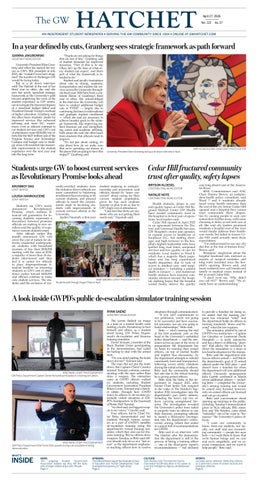
University President Ellen Granberg said when she started her tenure as GW’s 19th president in July 2023, she “couldn’t even have imagined” the number of challenges GW would be facing today.
But in a sit down interview with The Hatchet at the end of her third year in office, she said she sees her newly launched strategic framework as the University’s path toward amplifying the roots of the student experience as GW continues to navigate the financial impacts of a structural budget deficit and President Donald Trump’s overhaul of higher education. Granberg said she often hears students’ desire for improved services like enhanced advising and more D.C. experiences, even as officials continue to cut student services and GW’s cost of attendance nears $100,000, but efforts like the $427 million sale of the Virginia Science and Technology Campus and budget cuts in strategic areas will manifest into measurable improvements to the student experience over the next year and into the long term.
“People are not asking for things that are out of line,” Granberg said of student demands for improved resources. “Part of this is to say, ‘Okay, let’s up the base of what every student can expect,’ and that’s part of what the framework is intended to do.”
Student and faculty frustrations about cuts to dining, academic, transportation and student life services across the University throughout fiscal year 2026 have been a consistent theme of Granberg’s third year in office. She acknowledged in the interview the University will have to conduct additional budget cuts in FY2027 — largely due to continuing declines in international and graduate student enrollment — which she said are necessary to achieve broader goals in the strategic framework, like improving student financial aid and strengthening career and academic advising, both issues she said she often hears from students that officials need to improve.
“It’s not just about cutting, it’s also about how do we make sure that we’re spending our money in the places that are going to have this impact?” Granberg said.
Students urge GW to boost current services as Revolutionary Promise looks ahead
ARUNMOY DAS
LOUISA HANNOUCENE
Students say GW’s newly announced Revolutionary Promise, which outlines financial aid guarantees for incoming students, represents a disconnect between promises officials are making to new enrollees and the quality of experience current students enjoy.
After officials earlier this month announced GW will cover the cost of tuition for domestic residential undergraduate students with household incomes of less than $100,000 starting with the class of 2030, a majority of more than 30 students interviewed said they feel it is unfair for officials to place disproportionate financial burdens on returning students as GW’s cost of attendance inches toward $100,000 and officials continue to make cuts student services. The students said the exclusion of cur-
rently-enrolled students from the initiative shows officials are more committed to bolstering enrollment than investing in its current students, and pressed officials to match the commitments made to incoming students with improvements to current services offered at the University.
Jayden Nuamah, a first-year
student majoring in entrepreneurship and innovation, said officials should be “more concerned” about caring for their current student population, given he has seen students transfer or plan to do so due to GW’s high cost of attendance. “I just feel like there are students who are not getting their needs met,” Nuamah said.
Cedar Hill fractured community trust after quality, safety lapses
BRYSON KLOESEL
CONTRIBUTING NEWS EDITOR
NATALIE NOTE CONTRIBUTING NEWS EDITOR
Health citations, delays in care and quality lapses at Cedar Hill Regional Medical Center GW Health have eroded community trust in the hospital in its first year of operations, local leaders said.
Cedar Hill opened in April 2025 in an agreement between the District and Universal Health Services, GW Hospital’s owner and operator, to expand access to healthcare in Southeast D.C., but staffing shortages and high turnover in the hospital’s highest leadership roles have spelled long wait times, unopened services and low quality of care for residents. Local leaders in Ward 8, which has a majority Black population and has long experienced health disparities due to lack of access to medical care, said surgical mistakes — including a patient death in January — and numerous health citations have fostered community mistrust toward the hospital, dashing hopes that the hospital would finally deliver the quality
care long absent east of the Anacostia River.
8D01 Commissioner and ANC Chair Dionne Brown, an independent health policy consultant, said Ward 7 and 8 residents already faced worse health outcomes than the rest of the city before Cedar Hill opened, and a hospital they cannot trust compounds those disparities by causing people to seek care somewhere further away, with some choosing to delay or not seek care at all. She said city leaders promised residents a hospital east of the river would finally address their healthcare needs, but failed to ensure Cedar Hill could actually meet those expectations.
“I’m embarrassed to say our city did this at the risk of human lives,” Brown said.
Residents’ skepticism about the hospital hardened into mistrust as reports of surgical mistakes and long waits mounted since the hospital’s opening, Brown said, and many residents now call friends and family in medical crises instead of 911 to avoid Cedar Hill.
“I don’t even say, ‘Why didn’t you call 911?’” Brown said. “We already have an understanding.”
A look inside GWPD’s public de-escalation simulator training session
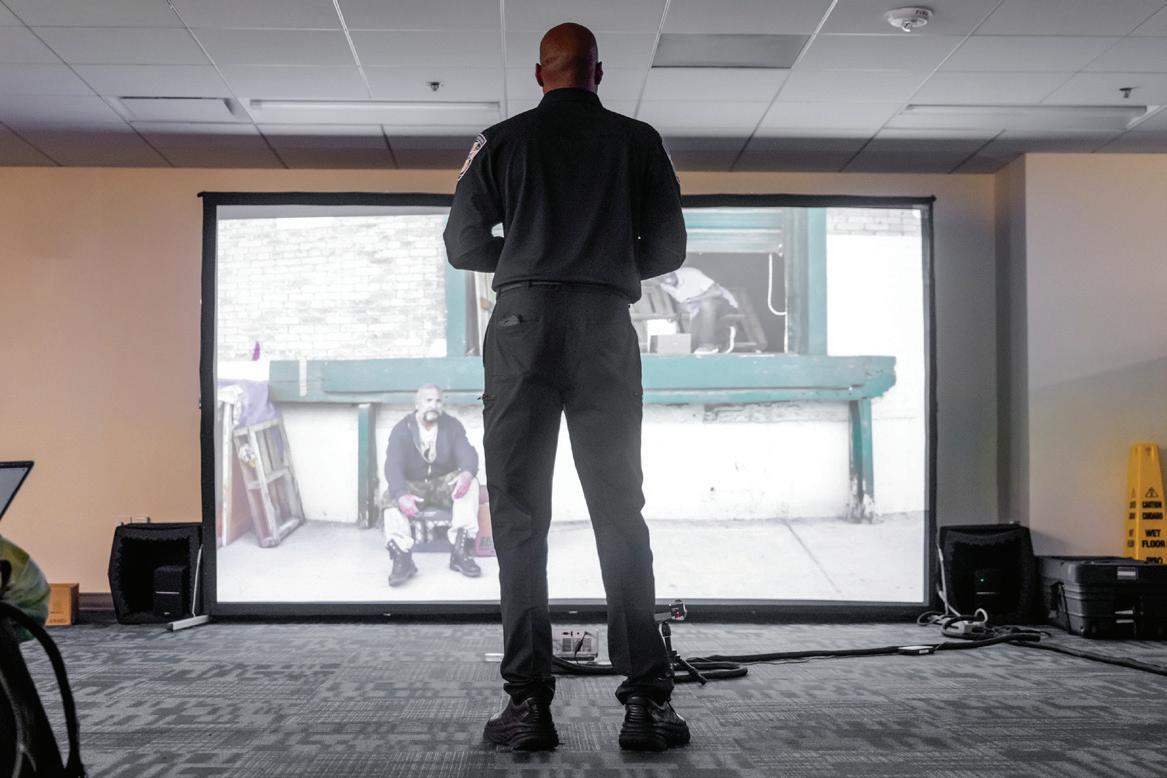
The screen flashed an image of a man in a mental health crisis holding a knife, threatening to hurt himself and others, as a student stood facing GW Police Department’s de-escalation and firearms training simulator.
David Tennant, a member of the Black Student Union participating in the demonstration, had called for backup to deal with the armed man.
“Do you mind putting the knife down for me?” Tennant said.
The man did not put the knife down. But Captain Cheryl Crawley insisted Tennant continue communicating with the man rather than draw a weapon. The interaction came as GWPD officers walked six students, including Student Government Association President Ethan Lynne, Tennant and a Hatchet editor, through how GWPD trains its officers to de-escalate potentially violent situations at GWPD’s headquarters in the basement of Rome Hall Tuesday.
“As chief said, our biggest weapon is our voices,” Crawley said.
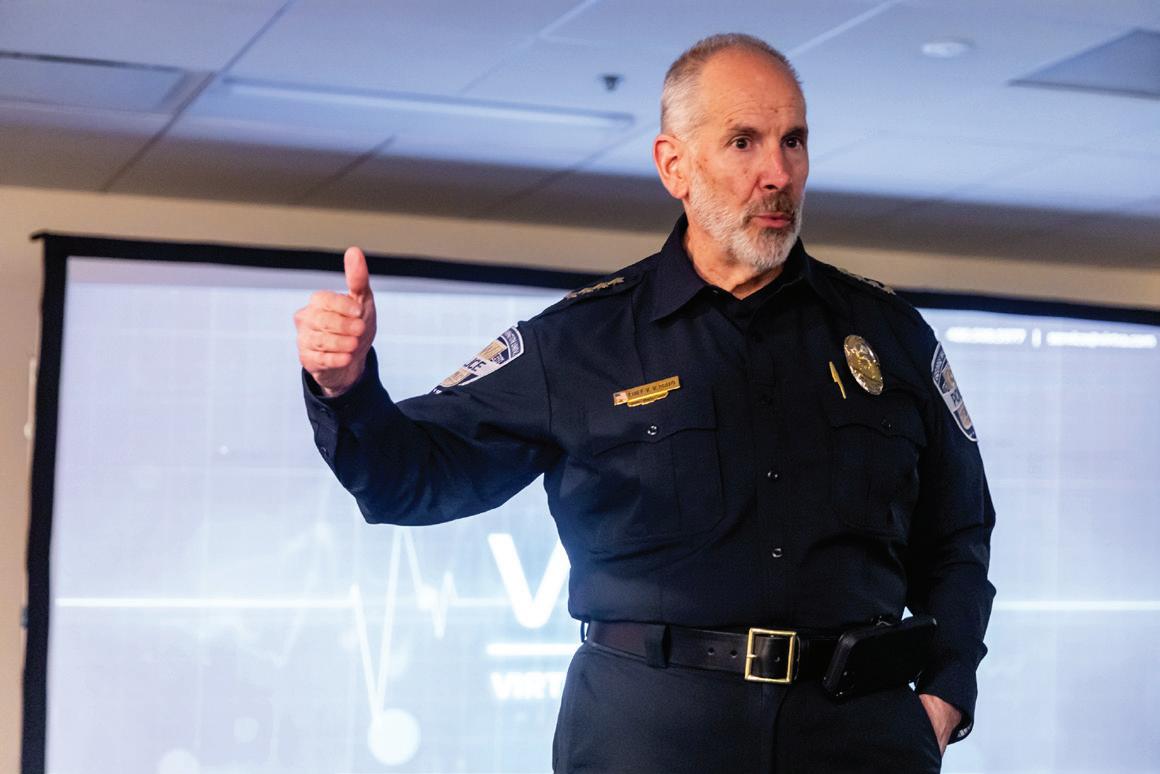
Four officers, led by Chief Victor Brito, demonstrated and led students through various scenarios as a part of GWPD’s monthly de-escalation training using the department’s virtual training simulator, which they also use for firearms training. But no officers drew weapons Tuesday, as Brito said officers should only do so as a “last resort” as the department emphasizes teaching officers how to resolve
situations through communication.
“If you can’t communicate in our profession, you’re not going to be successful and have successful outcomes, nor are you going to build relationships,” Brito said.
Brito — who’s nearing the end of his first academic year as the head of the University’s embattled police department — said the simulator serves as part of the trove of preparations the department has on hand for training their armed officers, on top of mental health and implicit bias discussions. As the department attempts to rebuild community trust and transparency following severe safety violations during the initial arming of officers, Brito said the community should feel safe due to the robust training he is giving armed officers.
Brito took the helm of the department in August 2025, after former Chief James Tate resigned in the wake of The Hatchet’s September 2024 investigation into the department’s gun safety failures, including the force’s top two officers carrying unregistered firearms. The investigation revealed the University’s police force failed to properly train its officers to use their firearms, prompting officials to launch a third-party investigation into the department’s controversial arming rollout that ended in a report full of recommendations for GWPD.
The simulator, piloted by one of GWPD’s two instructors — Captain Ian Greenlee or Lieutenant Derek Hemphill — is fairly interactive and has a flurry of differing “playlists” that allows the instructor to direct the simulation to a more or less hostile situation for the trainee.
Brito said the department only has six officers armed — well below the department’s goal of 22 armed officers under the 2023 plan — and doesn’t have a timeline for when the department will arm additional officers. University spokesperson Julia Garbitt confirmed in March seven additional officers — including Brito — completed the University’s arming training and would be armed once licensed, however, only six armed officers are licensed and can go on patrol.
Brito said conversations about opening up trainings to the public, including Tuesday’s demonstration given to SGA officials, BSU members and The Hatchet, came about “naturally” out of his want to “humanize” the University’s police officers.
“I want our community to know, from our students, our faculty, our staff and our overarching community — people live near here — is I want them to know that we’re human beings and we care and we’re empathetic, and we exercise compassion, and we want to help people,” Brito said.
Brito said in an interview with The Hatchet after the demonstration the department is still in the process of hiring a training officer — one of the third-party report’s recommendations — but declined to provide a timeline for doing so. He added that the training program has remained “solid” and the department holds its officers to training standards “above and beyond” what the law requires.
MATHYLDA DULIAN | ASSISTANT PHOTO EDITOR
University President Ellen Granberg during a sit-down interview in April.
KRIS PARK | STAFF PHOTOGRAPHER
GW Police Department Captain Derek Hemphill participates in a training simulation.
KRIS PARK | STAFF PHOTOGRAPHER
GW Police Department Chief Victor Brito speaks during a de-escalation training demonstration.
ABBY BROWN | STAFF PHOTOGRAPHER
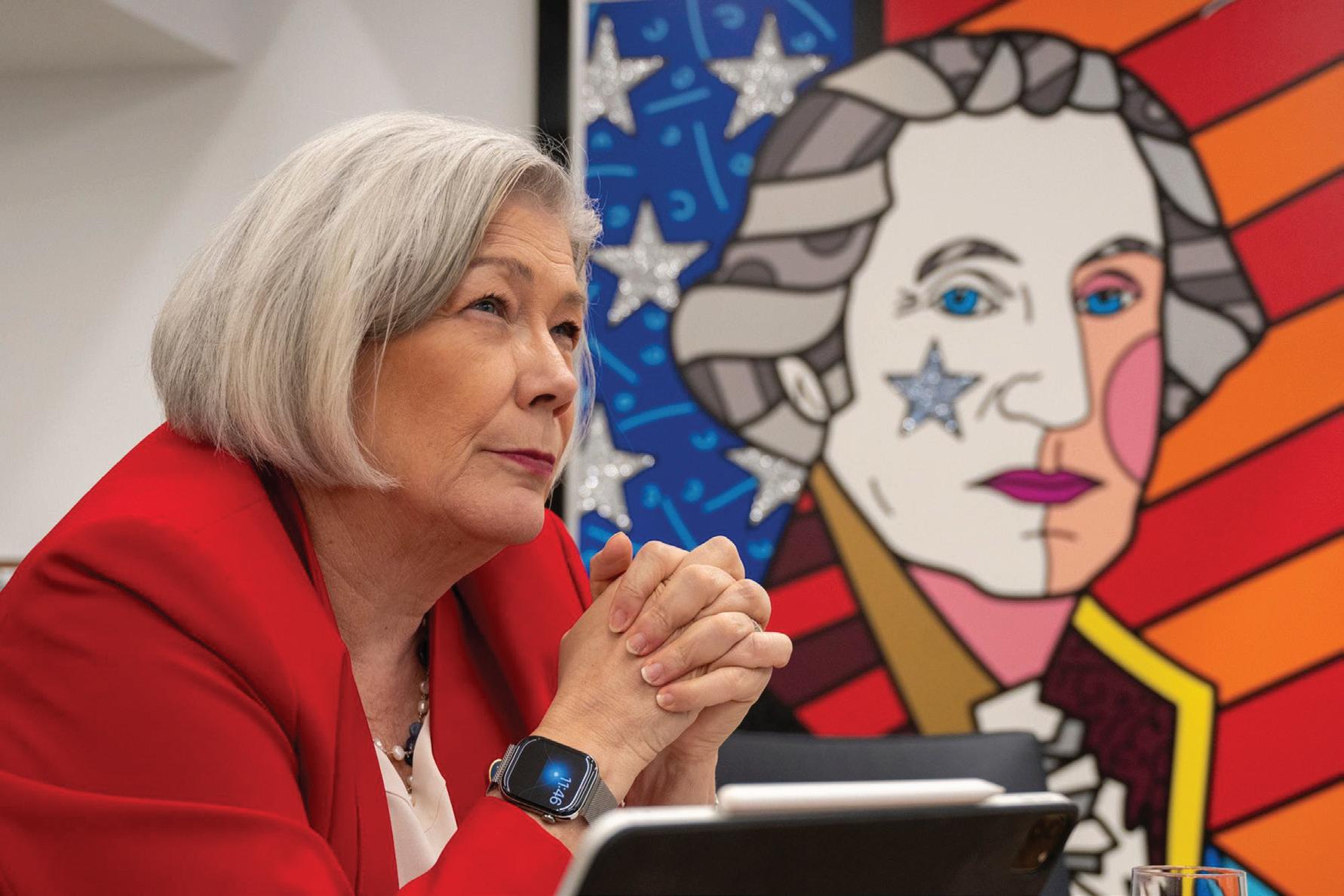
Students walk through Kogan Plaza in April.
AFFRAY
1900 Block of E Street
4/21/2026 – 2:12 p.m.
Open Case
The GW Police Department responded to a report of a fight in progress. Upon arrival, GWPD officers made contact with a non-GW-affiliated subject and a male GW faculty member involved in an altercation. Both parties were separated and no further action was taken. Case open.
DRUG/LIQUOR LAW VIOLATION
Thurston Hall
4/22/2026 – 1:14 a.m.
Closed Case GWPD responded to a report of an intoxicated male GW student. While on scene, an administrator on call observed a bottle of marijuana edibles in the student’s room. GWPD confiscated the edibles and transported them to a secure location. The student was transported to the GW Hospital for further medical evaluation. . Case closed. Referred to Conflict Education & Student Accountability.
THEFT
22nd & G streets NW
4/22/2026 – 09:10 a.m.
Open Case
A female GW student reported her electric scooter stolen. Case open.
SGA resolution presses officials to adopt AI policy as faculty call for further research
AMELIA NELSON STAFF WRITER
The Student Government Association and Faculty Senate contrast in their recommendations for the University’s artificial intelligence policy, with the bodies both passing resolutions this month encouraging officials to implement their approach.
SGA senators passed a resolution earlier this month urging officials to reframe the University’s AI policy, emphasizing AI’s potential as an educational resource and accessibility tool, and encouraging faculty to view students’ AI usage from a less critical lens and reduce rising academic integrity cases by clarifying guidelines. But members of the Faculty Senate Educational Policy & Technology Committee, which passed a resolution earlier this month recommending the University consult EPT before implementing technological decisions — including AI policies — opposed the SGA’s resolution, saying it ignores decreased student engagement with course material stemming from increased AI usage and provides simple solutions for deeper issues that require restructuring curricula and further research into AI.
The Office of the Provost released its current generative AI guidelines three years ago, suggesting faculty adopt one of three options to generally permit, forbid or allow the tools in classes at a faculty’s discretion, declaring students could use AI to find ideas, but not submit AI-generated content for evaluation. The University’s nonbinding guidelines have led professors to adopt a wide range of policies and attitudes towards AI.
The SGA’s AI Latitude and Literacy Framework Resolution, passed on
April 13, proposes requiring professors to categorize assignments into one of their pre-established tiers, distinguishing between assignments where AI tools are required, where AI can be used to brainstorm and research or completely prohibited. SGA Senator Ernest Chambers Jr. (G-At Large), who sponsored the SGA resolution, said under their framework faculty would still decide which tier assignments fall under, but the policies associated with the chosen tier would be consistent for students University-wide.
SGA Senator Sophie Munson (CCAS-U) said she interpreted the 47 percent increase in academic misconduct cases from spring 2023 to 2025 that Conflict Education & Student Accountability reported as GW needing clearer and more consistent AI policies.
University President Ellen Granberg said at this month’s Faculty Senate meeting she expects the faculty researching AI’s uses, opportunities and risks since December as part of the University’s AI strategic mapping exercise to present their findings at next month’s meeting. She said the exercise’s findings, which officials will use to inform the University’s AI policies, will likely include reports on the pedagogical impacts of AI.
University spokesperson Julia Garbitt said officials in the AI strategic mapping exercise were aware of the SGA’s resolution, but declined to comment on whether officials supported the SGA’s approach to developing AI policies. She said officials used a student-specific survey sent out earlier this year that received more than 130 responses and a focus group for students to inform the mapping process on student perspectives.
The Faculty Senate passed their AI
resolution, which the EPT introduced, on April 17, declaring the EPT as the body leading discussions on how technology shapes professors’ pedagogical choices and consulting with administrators about institution-wide technology decisions given the significant ways in which AI shapes students’ ability to learn.
Jamie Cohen-Cole, an EPT cochair, said the committee’s resolution ensures faculty, particularly those in the EPT, have a say in what policies regarding technology, including AI, the University adopts.
He said due to AI’s potentially large-scale impacts on students and GW, students should be included in conversations about AI policies, but said he doubted whether the SGA was an accurate representation of students as a whole, citing the roughly 10 percent turnout in SGA elections this month.
Alexander Dent, an EPT member and anthropology professor, said he “applauded” the University’s mapping exercise for its efforts to research AI before implementing policy, and said the EPT’s resolution will allow faculty members’ opinions on AI formed through their own research and experience teaching students who use AI to inform the University as well.
Dent said he was hesitant about the SGA asking the University to formally consider AI as an accessibility tool as research about its impacts is incomplete.
“There is lots of research to suggest that AI can be helpful,” Dent said. “There is lots of research to suggest that it creates cognitive deskilling and burnout. It is simply too early to be able to say that it’s definitely good or bad – we should be cautious, experiment and evaluate.”
MPD secures area near GW Hospital after correspondents’ dinner shooting
RYAN SAENZ ASSISTANT NEWS EDITOR
The Metropolitan Police Department secured the area surrounding GW Hospital after a shooting at Saturday’s White House Correspondents’ dinner.
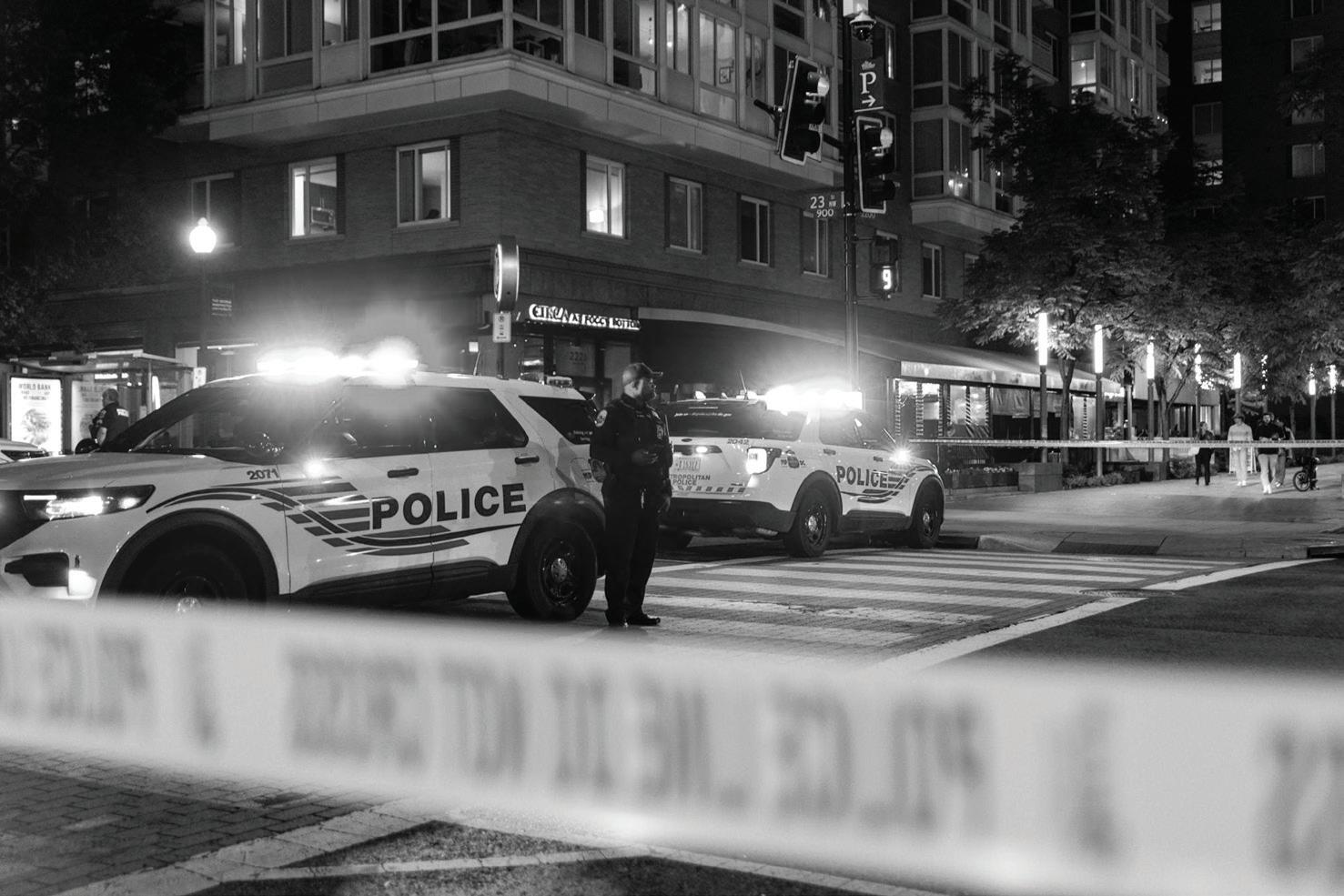
An unidentified suspect fired shots at the Washington Hilton hotel about five minutes into the dinner Saturday night, prompting law enforcement at the event to evacuate President Donald Trump, Vice President JD Vance and other upper-level government officials. Over a dozen MPD cruisers blocked off traffic from moving past GW Hospital on 23rd Street and in Washington Circle as officers sealed off the sidewalks near the hospital with caution tape immediately following the shooting.
Law enforcement officials told the Associated Press that one U.S. Secret Service officer in a bullet-resistant vest was shot but is expected to survive, which Trump confirmed at a press conference following the dinner. One ambulance arrived at the hospital while the MPD blocked it off, but it is unclear if it is connected with the incident.
GW Hospital and the MPD did not immediately return a request for comment.
Secret Service Chief of Communications Anthony Guglielmi said in a statement on X at 9:24 p.m. that the agency and MPD had apprehended a suspect and were investigating the shooting that took place near the main magnetometer screening area of the event. He said the
As they prepare to end their student government tenures, outgoing Student Government Association
President Ethan Lynne and SGA Vice President Liz Stoddard said the body’s relationships with officials and students has transformed since they joined it as first years.
Lynne, who rose through the SGA as a senator, finance committee chair and vice president before winning the presidency last April, and Stoddard, who ascended from first-year legislative assistant to pro tempore and vice president, said they’re most proud of securing the largest increase to student organization funding in the SGA’s history and building closer relationships with University officials during their terms. Both leaders said, despite falling short on some of their campaign promises, like removing University Yard’s fences, adding expanded dining options and having the University conduct a third-party free speech audit, their increased relationships with GW’s leadership taught them how to identify and achieve feasible goals by working with the right officials.
Lynne said he hopes the community will remember him as a “relationship builder” who rebuilt the SGA’s credibility with students and officials over his years in the body, after previous presidents had tarnished the body’s legacy at the University. He said when he arrived at GW, the SGA was making headlines over an internal coup attempt, and the community widely viewed the SGA as a “joke,” a reputation he said he has made strides rebuilding over his two years in SGA leadership. He said as president, he continued to build foster relationships with officials from his vice presidential term, including holding
president, First Lady Melania Trump and other protectees are safe, but the condition of others involved is not yet known.
Officials issued a GW Alert at 9:32 p.m. — 30 minutes after the MPD had secured the intersection of 23rd and I Streets and Washington Circle — directing community members to avoid the area around the hospital.
MPD officers reopened the roads near GW Hospital just before 10:00 p.m., with MPD and Secret Service cruisers remaining stationed outside of GW Hospital on 23rd Street. GW officials issued an all-clear at 10:42 p.m.
The hotel is the same location where an attempted assailant shot President Ronald Reagan in 1981. Reagan received surgery at GW Hospital.
monthly meetings with top officials like University President Ellen Granberg, the provost, Dean of Students Colette Coleman and other housing and dining officials.
“Hopefully three or four years from now, whoever the SGA president is has so many meetings they don’t even know what to do with,” Lynne said. “Because they have built up so far and connections and relationships with admin that students really are everywhere.”
Lynne said despite his administration falling short on some of its original campaign goals, like having the University conduct a thirdparty audit of free speech on campus and creating a 24-hour dining option on campus, he is excited to pass on his understanding of GW’s “complicated bureaucracy,” built through his tenure as vice president and president and concurrent role as a student employee in admissions, to incoming SGA president MJ Childs, which he said helped him advocate for students in seemingly small ways. Lynne said he is most proud of
securing an over $1 million annual increase to student organization funding through working with the Board of Trustees since his sophomore year as finance committee chair to implement a $50 fee on fulltime undergraduates to raise additional funds starting this academic year because of the labor and high number of people the initiative required. Stoddard said at a meeting at the end of last semester the SGA would have a similar amount of general allocations for student organizations, $279,500 this semester, but increased co-sponsorship funds — additional money groups can request throughout the year — for a total of over $600,000 in student organization funding this semester.
Stoddard, who ran for president this spring and lost to SGA President-elect MJ Childs, said she expanded the role of the vice presidency beyond its traditional focus of ensuring bills go through committees, senators attend meetings and staff write their reports into an advocacy position, which she believes is now a permanent feature
of the job. She said the shift to advocacy continued the work of her predecessors like former SGA Vice President Demetrius Apostolis, who campaigned on promises like increasing dining options.
Stoddard said accomplishments she’s made this year, like successfully advocating for women’s inclusive gym hours, late night dining options and ensuring students’ access to the finals exam schedule at the start of the semester are indicative of the vice president’s advocacy working.
Stoddard said she has spent much of this year pushing back on the “corporate B.S.” administrators “spew” by communicating to officials about student-raised issues in an “unfiltered” and “honest” manner, sometimes at the expense of her own popularity among administrators to push them for solutions.
Stoddard, like Lynne, said she was unable to achieve some elements of her platform, like a “training table” that would have provided food for athletes early in the morning, due to University-wide bud-
get constraints. She said she made some progress on other ideas, like Blackboard standardization and allowing students to view aggregated course feedback, but those policies were more complicated to implement because they required consulting bodies like the Faculty Senate and obtaining approval through multiple University channels.
Stoddard said she does not plan to let losing the presidential race define how she looks back on her three years in the SGA. She said she hopes her successors streamline the long procedures students currently go through if they want to meet with administration to express opinions through advocacy and effectively serving as a voice for students.
“Does it make me sad to close this chapter of my life that I spent three years in? Yeah, it does,” Stoddard said. “But I still have so many friends that I’m going to keep, so many things that I care about, so many things that I got done that I’m proud of, and I’m still going to want to give back.”
—Compiled by Isaac Harte
COOPER TYKSINSKI | ASSISTANT PHOTO EDITOR Metropolitan Police Department officers block I Street and 23rd Street outside GW Hospital Saturday.
KYRA WOOD
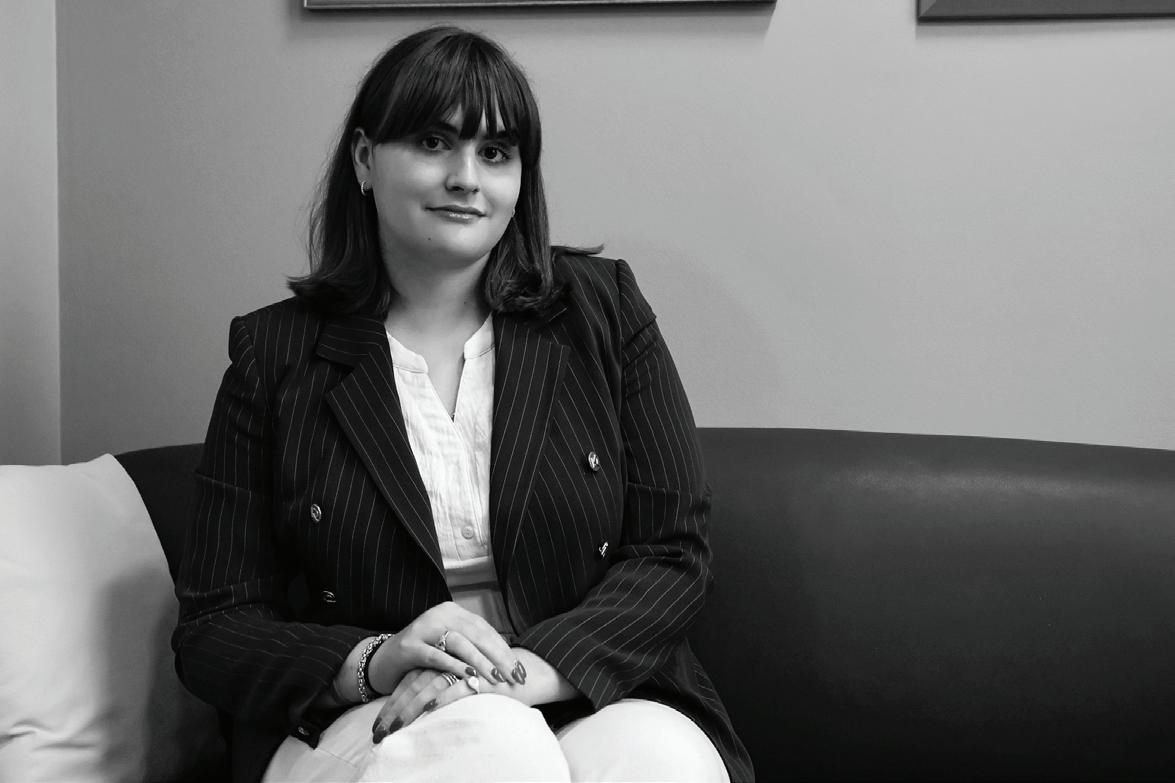
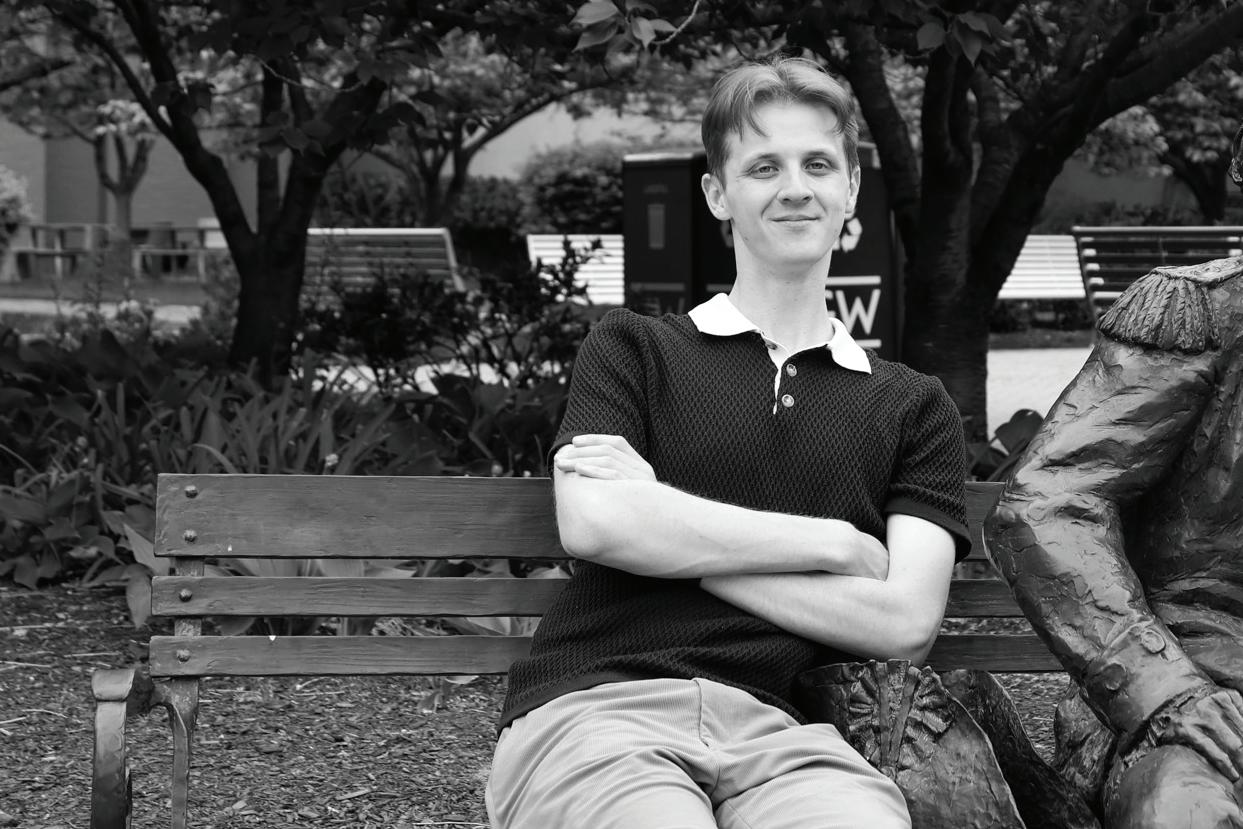
Stoddard poses for a portrait in the SGA office.
General counsel says federal pressure on GW will persist following departure
Outgoing Vice President and General Counsel Charles Barber told the Staff Council Friday the University must continue to balance upholding its values and its risk tolerance as it navigates ongoing federal legal pressures from President Donald Trump’s administration.
Barber, who will depart from his role as the University’s top legal advisor in June, said while fielding questions from councilmembers the University has only complied with federal actions rooted in law, rather than expressions of the Trump administration’s policy preferences, as GW has worked through ongoing federal scrutiny on higher education. He said as his successor takes the helm this summer, the University must continue to balance upholding its values and its risk tolerance, as he expects the Trump administration to continue to use federal actions to influence higher education policies in areas like diversity, equity and inclusion, discrimination, visa policy changes and federally funded research.
“I expect that that kind of thoughtful assessment will need to continue with respect to federal actions,” Barber said.
Barber announced in January that he intended to step down from his role in June, but said at the meeting will stay on as a special advi-
sor to University President Ellen Granberg until Dec. 31. Staff Council Vice President Andrea Johnson said Staff Councilmembers have recently been invited to interview candidates for the role . Johnson asked Barber what les-
sons he’s learned about the legal landscape of higher education during his tenure that have helped him navigate Trump-era policy changes.
Barber said he has learned that the federal government and its initiatives have become increasingly
impactful on various institutions of higher education since Trump returned to office in 2024, especially regarding Title VI and Title IX policies, which prohibit discrimination based on race and gender. He said he had to learn how to navigate
advising the University on how to comply with these changes, whether through legislation or executive action.
Over the past year, GW has had to manage increased scrutiny of higher education by the Trump administration, including Justice Department probes into campus antisemitism and DEI and “related matters” in GW’s admissions practices. Officials last July also assessed the impact of a DOJ memo on DEI programs to institutions that receive federal funding, which warned “significant legal risks” for institutions that engage in what the Trump administration defines as discriminatory practices.
Barber also said changes to research compliance has affected the types of research that can be done at GW. He said the University’s status as an Association of American Universities member may be challenging to maintain in the future, given cuts to federal research funding.
The Trump administration cut $18 million worth of federal research projects at GW in 2025 amid the Trump administration’s regulatory changes and cuts to federal research projects.
“We pride ourselves on being a member of the AAU, but that will become more challenging as research funds dry up to some extent and the focus of research may change,” Barber said.
Corcoran to launch new textile and dress studies micro-minor in fall 2026
MADELEINE
PHILLIPS STAFF WRITER
The Corcoran School of the Arts & Design will offer a new micro-minor in textile and dress studies starting next academic year.
Program Co-Directors Katrina Orsini and Bibiana Obler said they began developing the micro-minor, a collaboration between Corcoran’s art history program and The George Washington University Museum and The Textile Museum, nearly 2 years ago after students expressed heightened interest in fashion and textile courses. Starting fall 2026, GW undergraduate students can declare the nine-credit micro-minor made up of six existing art history and sustainability courses, including fashion histories, global textiles and responsible fashion. The textile and dress studies program will be the
fourth ever micro-minor available to students in the Columbian College of Arts & Sciences, adding to its existing disability studies, health equity and immigration and migration studies micro-minors. The school introduced micro-minors — a ninecredit credential comparable to a concentration — in fall 2021 to bridge a gap between the humanities and other academic disciplines by expanding interdisciplinary opportunities across departments.
Obler, an art history professor, said she and Orsini worked with officials like Corcoran Deputy Director Laura Schiavo, CCAS Vice Dean of Programs and Operations Kimberly Gross and Associate Dean of Undergraduate Studies Rachel Riedner to organize the curriculum after generating the concept for the program around 2 years ago based
on existing coursework and student interest. Obler said officials gave them the goahead to launch the program in December after approval from art history faculty, the Corcoran Academic Committee and the CCAS Undergraduate Studies Committee.
“Students are coming to GW because of the textile museum, because of opportunities they’re having at the textile museum, except they’re interested in textile dress studies,” Obler said. “It seems like there’s this demand for it from the students.”
Obler said the program allows students to develop foundational knowledge of fashion and textiles because the courses offered survey multiple disciplines, including art history, anthropology and business, giving students the opportunity to learn about textiles through varying lenses.
Orsini, a program associate for academic engagement at the textile museum, said students who add the microminor will study the fibers of varying textiles and their historical and cultural significance through an interdisciplinary lens by analyzing how textiles are impacted by their countries of origin, production process and distribution.
“We already have a number of offerings that students have become very interested in,” Orsini said. “It only made sense to kind of give it a name and make sure that students got credit for what they were learning about and taking classes in.”
After taking the required foundational course, Textiles 101: Fiber to Fabric, Orsini said students in the microminor will take elective courses from two groups — cultures and collecting, and production and impact — in
which students will analyze fabrics and materials that carry cultural significance across different countries and the production of textiles over time.
Orsini said she plans to advertise the program during the various existing workshops the museum offers for students like weaving, activism through art and knitting, which she said draws thousands of GW students every year.
John Wetenhall, the director of the textile museum and associate professor of museum studies, said the new micro-minor aligns with the University’s commitment to “hands-on” experiential learning — as outlined in the new strategic framework — that a traditional classroom could not replicate.
“A micro-minor, however it’s packaged, creates access,” Wetenhall said. “It’s accessible to bring people in so that
they are not intimidated in the world of textiles and have the basic understandings that they can build further more in depth knowledge.”
Audrey Emanuel, a senior studying art history, said students who enroll in micro-minor coursework will be able to take advantage of primary source research within the textile museum’s Cotsen Collection, a rare fabric collection that houses one of the biggest textile collections in the world at nearly 4,000 historical and cultural textiles. She said she thinks the micro-minor will provide students interested in textiles and fashion with more resources for their academic interests.
“We have amazing staff and an amazing faculty that can teach,” Emanuel said. “It naturally makes sense for GW to have an official course offering, or a degree offering.”
Progressive group seeks to unite first-year students in opposing Trump, ICE
ADELAIDE PETRAS STAFF WRITER
A group of mostly first-year students is mobilizing opposition to President Donald Trump’s administration while looking to build a first-year-friendly community for progressive students.
Students with Revs Rise Up, an unofficial student organization founded last semester by a group of nine first-years, said they have urged officials over roughly the past six months through protesting and petitioning to oppose Trump’s education compact offering funding in exchange for policy changes and cut ties with one of GW’s preferred car rental service, Enterprise RentA-Car, which allegedly provides vehicles to U.S. Immigration and Customs Enforcement. Members said Revs Rise Up fills a gap among progressive student organizations by emphasizing recruitment efforts and community-building activities for members and focusing their advocacy on how students want University officials to respond to Trump’s actions. Molly Weber, a first-year studying political science, said she came up with the idea for an organization like Revs Rise Up because she was involved with environmental organizing in high school and wanted to continue advocacy work at GW. She said after founding the group, she chose to primarily target first-years through recruitment efforts, including tabling and social media direct messaging, because Trump will be president for the duration of their college experience and time in D.C.
“I think we’re in a really unique moment in history right now,” she said. “There’s a lot of confusion about where our country is headed.”
Revs Rise Up is a branch of Students Rise Up, a national movement that launched in November 2025 with walkouts and protests at schools nationwide opposing Trump — who Weber called authoritarian because of his deployment of the National Guard and ICE in the District and involvement in the Iran war — and urging students to engage in strikes and protests. Weber said Revs Rise Up has
successfully recruited mass numbers of students by directly messaging potential members on social media and having one-on-one conversations with students who attended their tabling event last month.
Weber said roughly 25 of Revs Rise Up’s 30 active members are first-years, and she wants to create a space for underclassmen like herself to gain leadership skills by heading an organization, which first-years can’t typically do because of the existing hierarchical structures in other student organizations. She said the group plans to expand their outreach beyond the first-yearcentered model next academic year, as the current members become upperclassmen, while continuing to recruit the incoming first-year class.
Weber said Students Rise Up has three broad goals that guide their activism — to protect freedom and security, freedom of speech and affordability on campus — though the group’s GW branch is focusing on freedom and security
through their campaign pressuring the University to disaffiliate from Enterprise Rent-A-Car.
Weber said Revs Rise Up plans to launch an online petition on May 1, calling on GW to disaffiliate from Enterprise Rent-A-Car, whose parent company, Enterprise, has come under fire from local protesters in St. Louis and Minnesota in recent months for allegedly providing vehicles to ICE.
“That really ties into the security part of Students Rise Up, making sure that all students feel safe on campus and that we feel like our tuition is going towards companies that actually support us and aren’t supporting ICE,” Weber said.
Amaka Agwu, a first-year majoring in international affairs and a member of Revs Rise Up, said the organization attempts to build a sense of belonging through advocacy with activities like picnics and craft nights, while simultaneously sharing information about how to “combat authoritarianism.” She said the group seeks to build a commu-
nity that wants to be together while seeing change enacted on campus.
“More so than just being part of an org, you want to feel part of a family, a friend group, and see the actions that you’re doing impact not only the people within that org but GW as a whole,” Agwu said. Agwu said Revs Rise Up conducted a listening campaign in February where they asked students through tabling and a Google Form earlier this semester what issues on and off campus they were most concerned about, where students highlighted issues like climate change, the war in Gaza, rising tuition, GW’s sale of its Virginia Science and Technology Campus to Amazon Data Services and ICE, prompting the organization’s anti-Enterprise campaign.
She said the group is part of a coalition of progressive student organizations, including Democracy Matters, Swing Left and GW American Civil Liberties Union, who helped plan last month’s “No Kings” protest where hundreds
denounced ICE and Trump’s ties to Jeffrey Epstein.
The group in November and December through a petition and teach-in called on the University to reject Trump’s education compact, which would require GW to change policies to adopt institutional neutrality, mandate applicants submit standardized test scores and ban consideration of race and gender in admissions. Agwu said Revs Rise Up delivered over 100 letters from students asking GW to reject the compact to University President Ellen Granberg’s office, though the group never heard back from officials.
Officials confirmed in October GW was not considering adopting the compact and said GW was not invited to comment on or adopt the compact, despite Trump inviting all universities to consider the compact.
Jack McConnel, a first-year majoring in creative writing and political science and a member of Revs Rise Up, said the group being made up primarily of first-years is beneficial because first-years are “passionate” about politics and have more free time than upperclassmen.
“I was like, I want to do something. I want to affect real, meaningful change at GW, make students’ lives better,” McConnel said. “And for me, I think it’s the best place to start, is Revs Rise Up.”
He said the group serves a “different utility” than other student organizations by protesting and petitioning to get the University to work for students, as opposed to “traditional” avenues of communication with administrators, like the Student Government Association.
McConnel said being an unofficial student organization puts Revs Rise Up in the “best” position to advocate for students because the group is not subject to the same regulations as student organizations, though he did not specify which policies might hinder their advocacy and said the group has not done anything to warrant being suspended.
“They shut down Revs Rise Up, we’ll show up again,” he said. “You can’t kill us. There’s not really a way to shut us down.”
KAIDEN J. YU | STAFF PHOTOGRAPHER
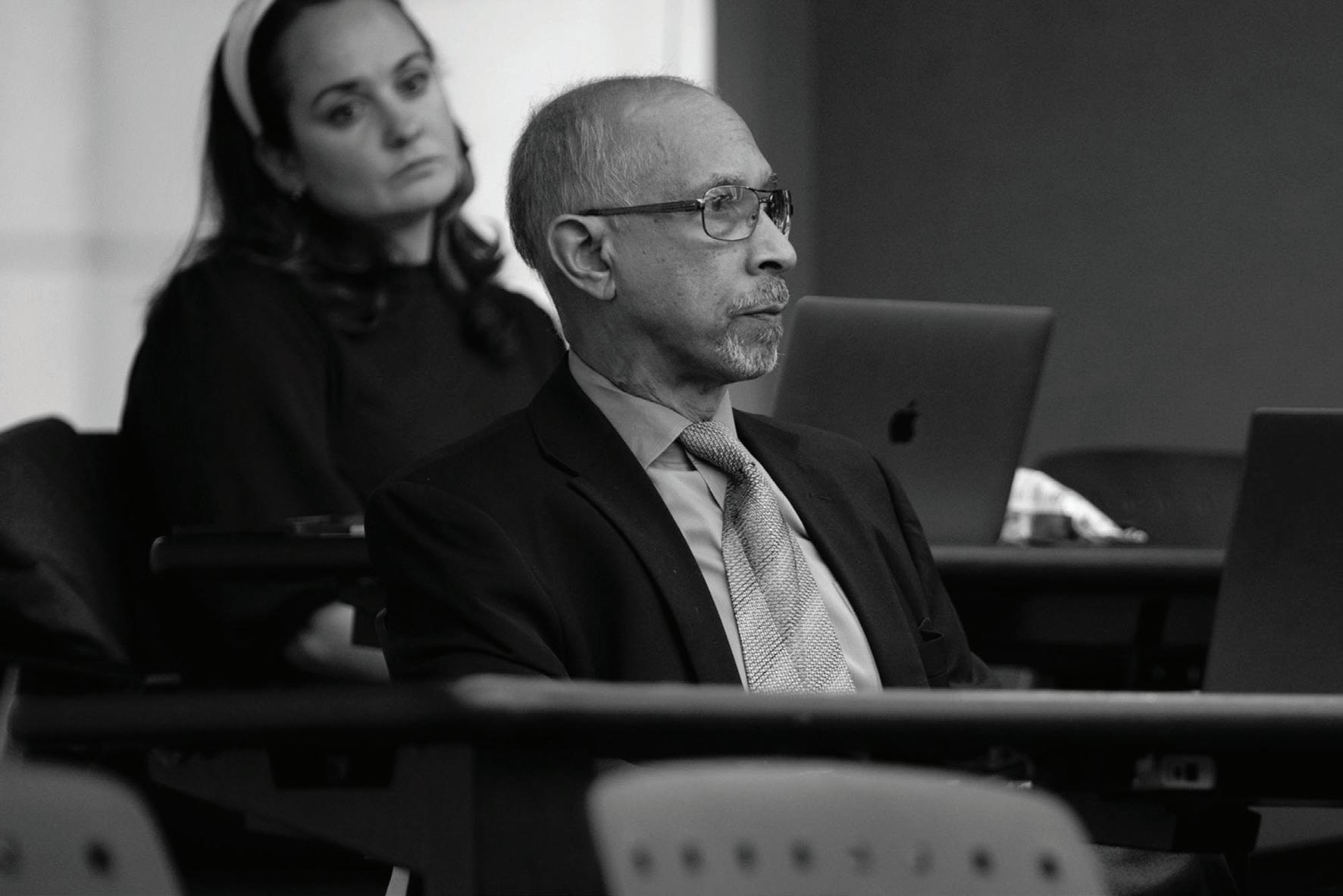
Vice President and General Counsel Charles Barber at a Faculty Senate meeting in November.
CARSTEN HOLST | STAFF PHOTOGRAPHER
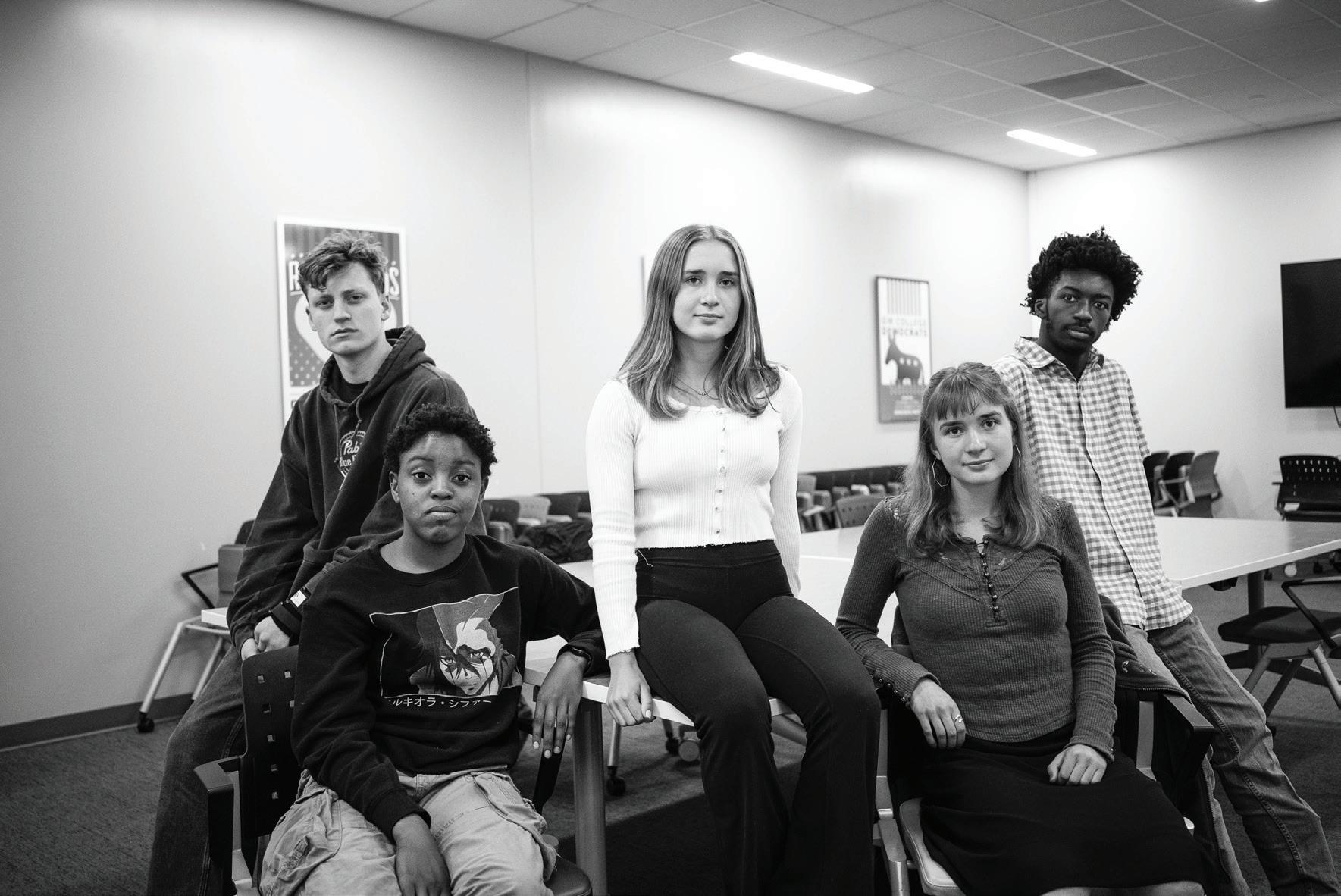
Members of Revs Rise Up pose for a portrait in the District House basement.
DC must up traffic control, design safer roads to curb pedestrian deaths: experts
After a fatal hit-and-run in the West End earlier this month, urban planning experts said D.C. needs to more aggressively enforce traffic laws and implement safer street designs in order to achieve its goal of reaching zero traffic fatalities, first proposed in 2015.
Vision Zero D.C., the District’s arm of a global initiative to eliminate all traffic fatalities and serious injuries by 2024, has seen limited success as annual traffic fatalities have climbed since the program’s launch in 2015. With the District now totaling six pedestrian fatalities in 2026, experts in traffic safety and urban planning said D.C. needs to achieve more of the design and safety goals in the Vision Zero plan, like installing curb extensions and reducing traffic speeds in order to reach zero fatalities, but stressed that the city still remains relatively safe among metropolitan areas.
Pedestrian fatalities in D.C. have risen since 2020, with 52 pedestrians killed on D.C. streets between the beginning of 2022 and the August 2024, before the number dropped in 2025. To date, there have been 141 pedestrian fatalities in the District since Vision Zero began tracking them in 2017.
The Foggy Bottom and West End neighborhood has seen several traffic fatalities in recent years, with a Jeep striking a 61year old woman while she was using a crosswalk on the intersection of 23rd and L streets this

month, a car hitting a graduate student in 2023 while he was cycling through the intersection of Connecticut Avenue and L streets and a construction truck driver fatally striking a cyclist on the corner of 21st and I streets in 2022.
Cheryl Cort, the D.C. and Prince George’s County policy director at the Coalition for Smarter Growth — a group that advocates for more walkable urban development in the DMV region — said
D.C. needs “to do a lot more” with regards to its Vision Zero plan by redesigning arterial roads, which are high-capacity urban roads — often with numerous lanes that encourage drivers to speed — to prevent pedestrian fatalities.
Virginia Avenue and K and 23rd streets are all considered arterial roads in Foggy Bottom, according to the District Department of Transportation.
“We really need to commit to
more rapidly rolling out redesign of arterials where most people are killed,” Cort said. Vision Zero fell short of its initial goal of zero traffic fatalities by 2024 — when there were 52 total traffic fatalities in D.C. that year — and a 2023 report from the Office of the District of Columbia Auditor found that Vision Zero lacked adequate funding set aside for the program in D.C.’s budget, but Vision Zero’s director
told the Washington Post in 2024 that spending had since increased since the report was released.
Cort said D.C.’s automated traffic enforcement, like traffic cameras, is necessary for improving pedestrian safety because enforcing traffic laws more stringently “complements” the “coreeffort” of designing streets that are safer for pedestrians with measures intended to reduce driver speeds.
“This is a proven measure for improving safety, discouraging dangerous drivers from speeding, drivers from running red lights,” Cort said. “It’s a proven measure and to take it away means that we will just introduce new hazards into our street, where dangerous drivers can run red lights and speed with impunity.”
Traffic cameras are a major component of Vision Zero, with DDOT installing them across the District. DDOT has committed to placing cameras at locations where crashes frequently occur, according to a DDOT webpage.
Peter Furth, a professor of civil and environmental engineering at Northeastern University, said pedestrian fatalities tend to be spread across cities because pedestrian safety issues are usually systemic problems stemming from the city’s design, rather than problems isolated to a cluster of intersections.
“You cannot solve them by fixing spots,” Furth said. “What you have to do is make a systemic change to just make road traffic safer.”
Cancer Center course improves confidence, preparedness in patient navigators
LAKSHMI
DEV STAFF WRITER
A study from the GW Cancer Center last month found its cancer patient navigator training course improves participants’ confidence and ability to guide patients through cancer care.
The School of Medicine and Health Sciences launched the Oncology Patient Navigator Training course in 2015 to provide aspiring patient navigators — trained professionals who help patients overcome financial and logistical obstacles to accessing care and cancer treatment — a standardized, foundational introduction to patient navigation and equip learners with the basic knowledge and skills needed to address challenges such as insurance hurdles, transportation issues and care coordination across providers. The study found
the course was successful in strengthening navigators’ abilities to support patients as they move through complex cancer treatment systems, where delays in access, fragmented communication between providers and logistical constraints can directly affect care outcomes.
The free, fully online, selfpaced course is open to anyone interested in patient navigation and does not require enrollment in a degree program, making it accessible to learners from a wide range of professional and educational backgrounds. The course has trained over 13,000 patient navigators across 42 countries, and has been translated and adapted for use in three other languages — Spanish, Portuguese and American Sign Language — according to the study.
Researchers conducted a retrospective analysis of data collected from participants
over a 10-year period, using pre- and post-course assessments across multiple cohorts to measure changes in knowledge and self-reported confidence in core patient navigation skills before and after completing the training, according to the study.
Mandi Pratt-Chapman, the associate director of scientific communication and dissemination at the GW Cancer Center and the study’s author, said she designed the GW program to create a consistent foundation for aspiring navigators with widely varying backgrounds and training levels.
“We are the go-to training for many cancer centers onboarding patient navigators,” she said.
Pratt-Chapman said patient navigation in oncology as a whole emerged from efforts to address disparities in cancer outcomes, specifically differences in diagnosis stage
and survival rates between patients of different races.
Participants in the GW training course showed measurable gains in both knowledge and self-reported confidence after completing the course, suggesting that structured, standardized training can strengthen preparedness for real-world navigation work.
Pratt-Chapman said the GW course ultimately aims to improve equity in cancer care by training patient navigators to identify, address and help patients overcome logistical and structural barriers like transportation gaps, insurance coverage issues and difficulties coordinating care across multiple providers that can delay treatment.
“The premise of patient navigation is getting people to the place where they can benefit from the innovations that have happened,” she said. “We need the science to
advance the medicine; navigation is trying to get more people to benefit.”
Pratt-Chapman said the program’s free and accessible format has been key to its widespread reception, especially compared to other inperson trainings that are often costly. She said the course is available online and is primarily used by cancer centers, health systems and public health programs that incorporate it into onboarding or workforce training for patient navigators.
Nathaly Garces-Lenis, the lead bilingual patient navigator at the Georgetown University Ralph Lauren Center for Cancer Prevention and a participant in the course, said the training has been a key foundation for how she approaches her work with patients today. In her role, she said she regularly draws on what she learned in the program in her day-
to-day interactions with patients, especially when it comes to communication and patient support.
“I use everything that I learned in the course,” she said. “I use it most of the time like how to connect with patients.”
Katie Fox, another patient navigator at the Georgetown Center for Cancer Prevention, said that while she had not previously encountered GW’s training program, she sees value in its accessibility and in expanding structured training opportunities for future navigators.
“Having a program that’s easy to access and hopefully recruit people in the community to become patient navigators is really great,” she said. “And it’d be a great opportunity to not only help individuals with getting jobs, but also help create a stronger and more trustful community.”
Humanitarian Action Initiative aims to serve as hub to study US foreign aid cuts
When the Elliott School of International Affairs launched the Humanitarian Action Initiative in 2020, the United States Agency for International Development had a workforce of over 12,000 and a budget of over $30 billion.
But since President Donald Trump’s administration dismantled the lead U.S. agency for delivering humanitarian aid in early 2025, effectively laying off its entire workforce and eliminating its budget, the Elliott initiative has sought to position itself as a center for research on the impacts of the cuts, Maryam Deloffre, the initiative’s director, said. The initiative, which focuses on facilitating and leading humanitarian research across the University, including hosting book talks, conferences and workshops on the global aid system, has shifted to research projects and conversations on how the Trump administration has changed the funding landscape for humanitarian aid.
Trump’s administration cut over 90 percent of USAID’s contracts in February 2025 and rescinded over $8 billion in foreign aid last June, saying the projects waste federal money and promote a “liberal agenda.” Since then, the initiative has launched a research project surveying humanitarian organizations and how their relationship with the U.S. government has changed since the cuts, hosted a day-long “teach-in” that brought together faculty from across schools to discuss the impact of losing USAID and started an event series on the future of aid.
“We’ve become a bit of a hub for this research,” Deloffre said. “What we’re trying to do is formalize that somehow, in either a working group or a community of practice, but to continue leading in this space
of convening research and knowledge accumulation on the impacts of the aid funding cuts.”
The growth of the initiative is the accumulation of more than six years of work for Deloffre, who said there was “not a lot” of top-down instruction on how she should lead the initiative when the Elliott School hired her in 2019 to lead the initiative, adding that the lack of direction made leading the program a somewhat “tricky” task to navigate.
Deloffre said she spent her first year on the job mostly conversing with faculty working on humanitarian assistance to understand the state of research on it at GW. From those conversations, Deloffre said faculty identified two main areas of interest on humanitarianism to focus the initiative on, including locally-led humanitarian assistance
and the regulation of the humanitarian field.
Deloffre said those talks with faculty led to two of the initiative’s major events, including a conference on localization in February 2024 and a workshop on standards of global governance in May 2024.
The initiative also partners with the Global Food Institute to further develop Deloffre’s goal of GW as a hub for research on disruptions to humanitarian aid systems. She said the initiative plans to hold future events, working groups and research exchanges similarly to an event they held earlier this month with 25 attendees representing 12 ongoing research projects from universities, think tanks and nongovernmental organizations about the impact of foreign aid cuts.
“Our value added as an aca-
demic institution is this kind of stuff,” Deloffre said. “It’s education, it’s research, it’s policy, it’s evidencebased policy.” Deloffre said she is currently working with engineering professors Erica Gralla and Caitlin Grady to study how relationships have changed in the humanitarian ecosystem following the Trump administration’s cuts. The first wave of the survey, released last October, included more than 20 interviews conducted between May and June 2025 that found the cuts fractured trust among local aid organizations that received U.S. funding.
“Our initial reaction was to ensure that we were using our scholarship and our academic credentials to try to inform the debates on the discussions that were happening, also ensure that we were edu-
cating the campus community and also the public on these issues on campus,” Deloffre said. Babak Bahador, a School of Media & Public Affairs professor who teaches a course on media and peacebuilding, said Deloffre spoke to him when she first set up the program to discuss how to connect humanitarian work in SMPA and Elliott, since having spoken at the initiatives’ events about misinformation during humanitarian crises.
“The idea was to kind of coordinate our activities, so we just know about each other,” Bahador said.
Bahador said the initiative’s ongoing focus on interdisciplinary collaboration has raised awareness at schools across GW, which he said can help engage more faculty and students and potentially attract more donors.
“It’s a huge uphill battle right now for the whole sector,” Bahador said. “And if there’s going to be a time to turn things around, it starts at the awareness level and the information level.”
Eden Hailu, the initiative’s program coordinator, said she’s noticed that students and alumni attending the initiative’s events are increasingly asking about the future of working in humanitarian aid and what the field will look like after the Trump administration’s cuts.
“One of the big questions is just the uncertainty about the field itself, from the students, the alums, the people who attend our events,” Hailu said.
Michael Barnett, a professor of international affairs and political science, said despite “tight constraints” due to GW’s budget, Deloffre has done an “amazing job” bringing in different professors and experts to the initiative’s events.
“This is a moment where, especially now, where humanitarianism feels under threat, where it just feels like as much dialogue and conversation as we can have, the better,” Barnett said.
JOSH STEINBERG | STAFF PHOTOGRAPHER
Vehicles drive down K Street.
MATHYLDA DULIAN | ASSISTANT PHOTO EDITOR
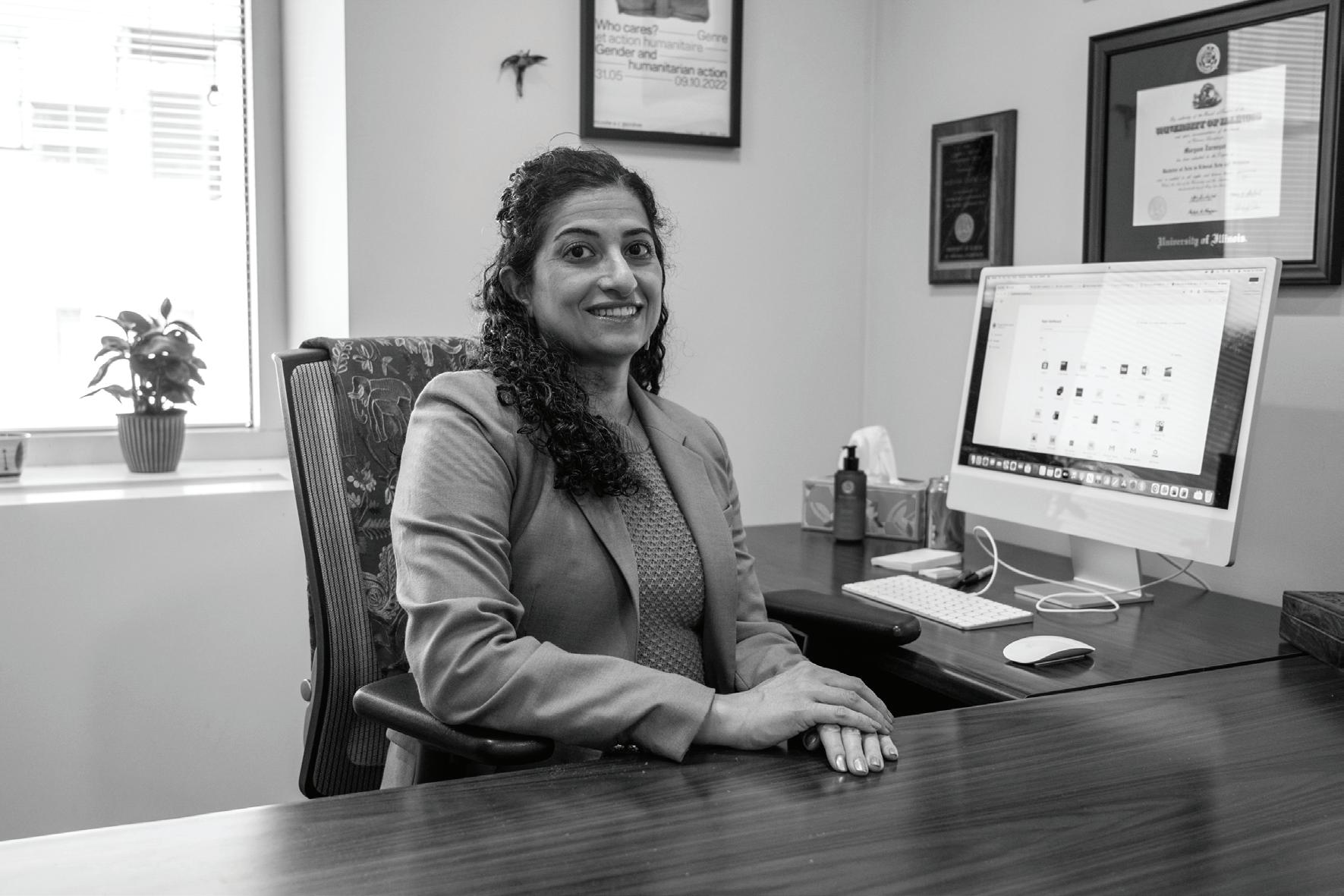
Humanitarian Action Initiative Director Maryam Deloffre poses for a portrait.
ISAAC HARTE STAFF WRITER
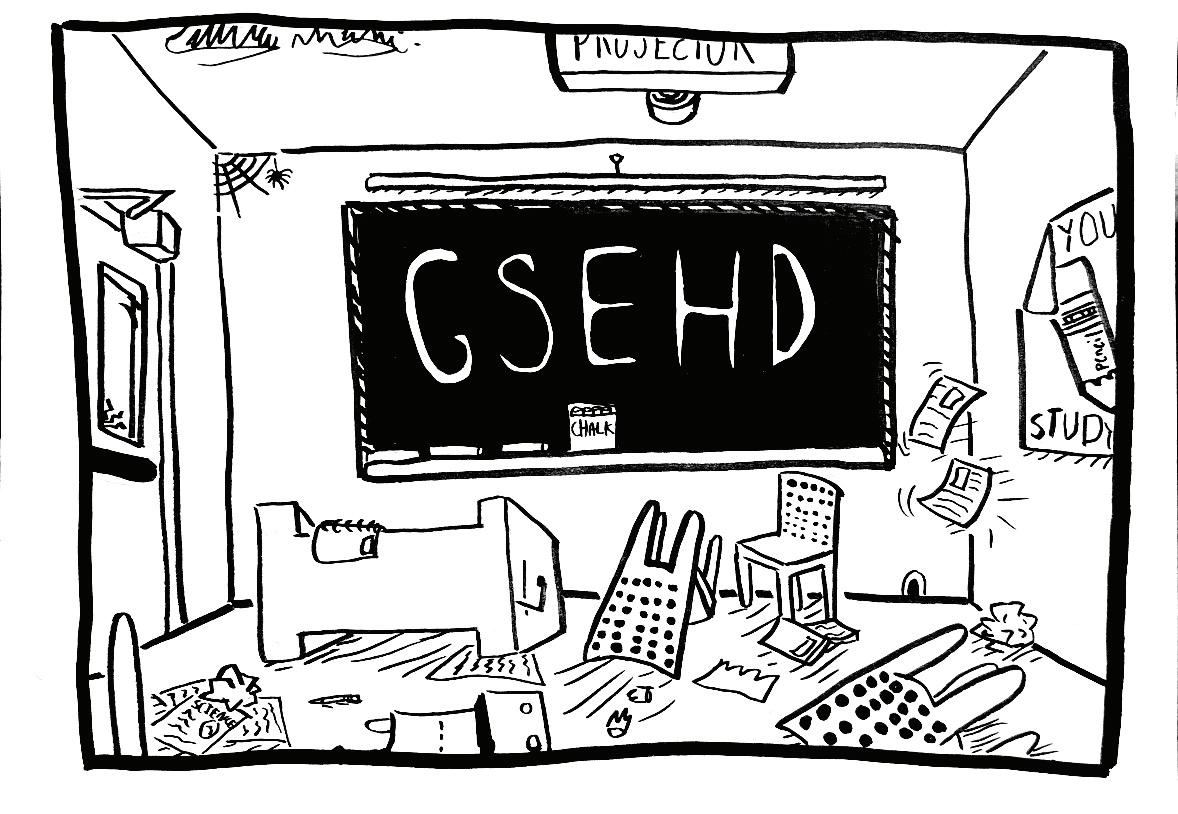
Officials must center community input as GSEHD cuts reshape school
The Graduate School of Education and Human Development recently delivered imminent termination notices to three out of four GWTeach program leaders as the school undergoes “right-sizing” amid declining enrollment and years of financial turmoil. Faculty and students in the school said the notification, which came after Interim GSEHD Dean Lionel Howard sent possible termination notices to 25 percent of the school’s contract faculty in June, could spell the end of the GWTeach program. The GWTeach downsizing comes after almost a year of vague communication from officials, leaving faculty and students unsure of the school’s direction as it undergoes restructuring. GSEHD faculty and students deserve to be at the forefront of conversations regarding which positions get terminated and which programs will shutter as officials have said the decisions remain largely unfinalized. The GSHED community deserves an explanation on officials’ rationale for these decisions and a substantive update on how the school’s programs will look in the future.
The communication thus far from officials reflects a lack of commitment to clearly informing the community about the University’s decision making process and the future of programs at GSEHD. The GWTeach program leaders likewise have little clarity about the fate of their program, with faculty reporting the contract nonrenewals will force the program to offer fewer classes, potentially pausing minor declarations and new student enrollment.
GSEHD currently hosts town halls and forums where community members can directly ask officials questions about their plans, deci-
STAFF EDITORIAL
sions or offer feedback. But students and faculty have said officials are often vague in these meetings, providing little additional information than what they already communicated in community messages. Instead, the meeting left them with more questions than answers. GW should be utilizing this platform more purposefully, coming prepared to answer specific questions and assuage faculty and student worries about the future of their programs. As officials work to expand consolidate classes, students are in the best position to inform them of which classes can be more lecture-based and have a larger
roster of students, or which classes require small sizes to retain one-onone faculty-student interactions. Officials are currently looking at cuts from a top-down approach, but that is not what the community needs.
The lapses in transparency have not gone unnoticed by the community. The SAVE GSEHD coalition as well as the graduate student union has been outspoken in protests and in petitions about their desire for more communication on the fate of the school. We are asking GW to listen. We as an editorial board recognize that myriad financial issues outside the University’s control
Officials must take a comprehensive approach to mental health
Young adults in the United States are at the center of an alarming mental health crisis, with a 2021 national survey finding almost three-quarters of college students reported moderate or severe psychological distress. GW has failed to meet the moment with a comprehensive plan to address it. Aiming to address this, the Student Government Association passed a resolution earlier this month calling on the University to grant students two mental health days per semester, officials to create a Mental HealthInformed Teaching Guide for faculty to include a Personalized Mental Health Statement in course syllabi. The resolution represents a step in the right direction toward a more comprehensive plan, and when considering how to tackle declining student mental health, GW must take the SGA’s recommendations into account and couple those efforts with institutional support for students in a crisis.
In colleges across the United States, the mental health crisis continues to get more and more pervasive. About 37 percent of college students in the United States report experiencing moderate to severe depressive symptoms, and about 32 percent report high levels of anxiety. Any measures officials take must be rooted in an under-
standing of the nature of these conditions, that they do not simply go away, but instead can prove debilitating for extended periods of time. The diagnostic criteria for major depressive disorder explicitly mention the need for symptoms to be ongoing, lasting two or more weeks. And for generalized anxiety disorder, the most recent edition of the Diagnostic and Statistical Manual of Mental Disorders spells out the need for experiencing “persistent” symptoms.
In addressing this crisis, the SGA resolution spells out some policy recommendations that the University should consider. For one, officials should provide students with reasonable opportunities to make up missing work with minimal penalties, accommodating mental health needs without negatively affecting grades. The SGA’s proposed teaching guide would provide professors with suggested language for offering academic flexibility for students experiencing mental health problems and guidance on distinguishing between short-term distress and situations that warrant referral to Counseling and Psychological Services. Similarly, the resolution recommends professors provide an explicit statement in their syllabi telling students extension policies in mental health situations and the professor’s communication preferences regarding mental healthrelated absences. Having these changes written into course syllabuses would
provide students clear procedural guidelines for if they experience a mental health episode, reducing further anxiety caused by remaining in academic limbo. This would also give clear communication channels for students and professors regarding mental health related topics, as professors could expand on their expectations for students who have missed classes or assignments due to depression or anxiety.
Officials should also couple the SGA’s recommendations with improvements to institutional mental health resources. Students this year have complained that CAPS discontinued walkin appointments in the fall, which the center has offered since at least 2017. Students said this limits options for students experiencing mental health problems in the office that is supposed to be designated for this exact purpose. The University cannot claim to be committed to bolstering student mental health while also cutting resources meant to help students’ wellbeing.
GW must adopt the SGA’s proposals as a first step because it provides a solid foundation for students undergoing crisis, and the interpretive language of the resolution allows the University to chart further policy. Long-term solutions are necessary for the well-being of the student body, and the University must do more to meet the moment.
— Ethan Vargas, a firstyear majoring in political science, is an opinions writer.
Iare driving these cuts. GSEHD has faced declining enrollment of about 39 percent since 2014 as careers in education become less lucrative to incoming students, and as the educational landscape continues to evolve under President Donald Trump’s policies. Federal actions have overhauled graduate education nationwide. We recognize that cuts need to happen, but we ask that the University be transparent about their decisions and proactively engages faculty and students in the process. GSEHD faculty have reported feeling undervalued by officials, as they are consistently the lowest paid pro-
fessors out of any school, and officials owe it to them to show through their actions and engagements that they care. Updates on GSEHD have been a short-winded and do not actually detail what the “path forward” will look like or how officials are informing themselves on their decisions. As officials navigate these cuts they should be relying on the knowledge of faculty and students to inform their cuts.
Budget cuts and cuts to programs in GW’s schools will never be easy, which is why GW must ensure that they are informing and cutting programs in the right way — communicating in a thorough, extensive and transparent manner. During a time when higher education faces a combination of unforeseen pressures, we need more people willing to take the helm of higher education institutions and combat this scrutiny. As a higher education institution, GW needs to be thinking of the students they are training who will someday lead these institutions. And in order for GSEHD to continue delivering a quality education to its students, GW needs to loop in community feedback more actively and directly as it reshapes the school’s future.
This fall, GW launched and started to implement its strategic framework, which includes supporting graduate programs. Realistically, officials will have to make cuts, but the GSEHD community can still be somewhat part of the decision making by including their input and feedback and gauging what it is that students are saying about the program. The strategic framework commits to fostering a “strong and inclusive student experience,” which officials can achieve by consulting students on what they want that experience to look like.
GW must prioritize advertising its career services to students
f you know where to look, GW has several helpful career resources for students to choose from. The catch is that you have to know they exist in the first place.
Chiraura
Trinity Mapendere Opinions Writer
That discovery comes too late for far too many students, and usually through a chance encounter. A friend may mention they scheduled a time with the F. David Fowler Career Center, or a professor will casually drop the name of an industry contact or upcoming networking event. As a result, by the time students hear about these services, they’ve oftentimes already spent weeks fumbling through the job search. Students try various strategies to secure a job, whether by approaching staff members to find on-campus work or attending as many career fairs as possible, but without institutional support, these strategies often prove ineffective.
This isn’t the result of a lack of career resources on campus, as some students contend. On April 20, the Fowler Center hosted a School of Business Alumni Mixer aimed at connecting graduate students with alumni who could offer real guidance on navigating a tough job market. Officials also hosted the fall 2025 career expo in September, offering students the opportunity to meet
recruiters from over 50 employers. The problem: turnout at both fell short, with the career expo seeing a significant drop in student participation and only about 20 students attending the Fowler Mixer. These are not isolated incidents, but the symptoms of a structural issue. GW’s career services have a marketing problem. Students who would have benefited most from these events simply didn’t know about it, or didn’t hear about it in time to show up.
The resources exist. The communication doesn’t.
It’s a pattern: students find out a tool would have been useful right around the time it stops being useful.
In a job market this difficult for new graduates, that gap is hard to close once it opens. The job market is experiencing a “frozen state” that has low hiring and turnover, with employer hiring at the lowest rate since 2013. While top-line unemployment remains low at 4.3 percent with 178,000 jobs added in March, hiring is slow, layoffs are increasing and long-term unemployment is rising.
GW currently has the first year experience class that all first year students have to take, which is meant to introduce students to GW and the services they offer. While the class may provide students with one-time help building a resume, rarely does it expose students to the institutional resources GW offers for actually finding employment in a specific field. If the one mandatory touchpoint
GW has with every single freshman isn’t carrying this information, that’s not a gap in the system. But even that hasn’t consistently done the job of laying out what career services are available and when students should be using them. GW has plenty of resources, but the issue is those resources are not fully integrated in students’ everyday experience at the University, but rather are services students must proactively seek out themselves. Career support needs to show up earlier, more consistently and in context, rather than buried in a mass email or mentioned once at orientation. Some professors already understand this — building resume submissions, headshots or portfolio work directly into their courses so students stay ready without having to seek it out themselves. That instinct is right, and it should be more widespread. With GW’s cost of attendance climbing toward $100,000, students should feel confident that their education is preparing them for lucrative career opportunities once they leave college. The University owes them more than a list of services they might eventually stumble across. In a place that’s supposed to prepare students for what comes next, it shouldn’t feel like a lucky break when someone figures out where to start.
—Chiraura Trinity Mapendere, a graduate student studying interdisciplinary business, is an opinions writer.
CAROLINE MORRELLI | STAFF CARTOONIST
Ethan Vargas Opinions Writer
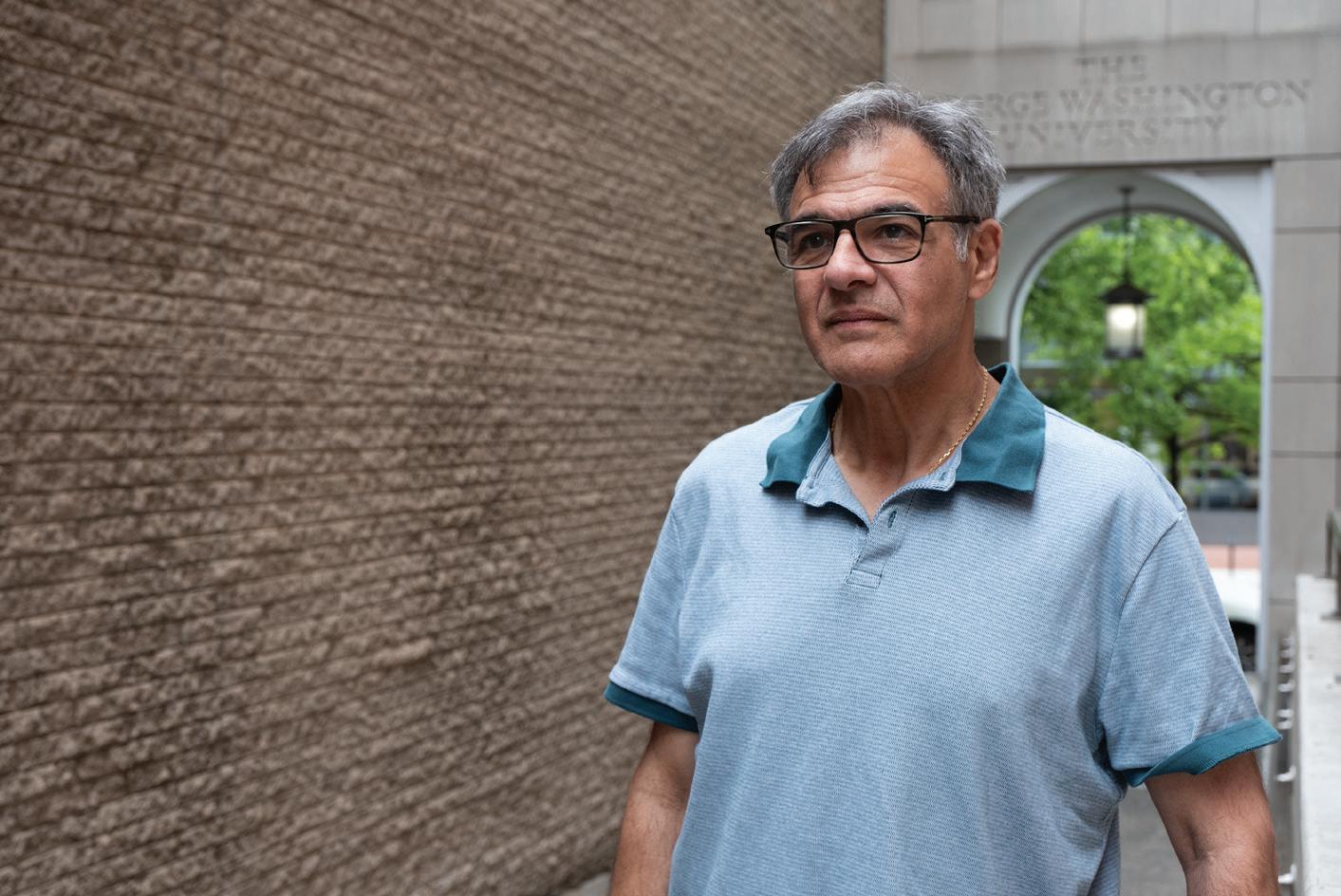
John Kiriakou’s revolutionary path from Elliott to CIA whistleblower
Before Central Intelligence Agency whistleblower John Kiriakou exposed the agency’s torture program, he sat in the classrooms of GW, mastering his knowledge in Middle Eastern affairs. Originally recruited to join the agency in 1988 by his then-professor and former CIA agent Jerrold Post, Kiriakou went on to spend nearly eight years with the CIA before departing in 2004 and later exposing the agency’s inhumane torture operations. Today, Kiriakou has seen a resurgence in fame across social media, telling his engaging stories about his recruitment to the agency from GW and whistleblowing experience on podcasts and interviews, which regularly garner millions of views from intrigued audiences.
Among some of his most viral moments that users have clipped on TikTok include an excerpt of Kiriakou discussing how he blew the whistle on the CIA’s waterboarding of Al-Qaeda terrorist Abu Zubaydah — an action that added to the growing list of confirmed CIA torture operations from the early 2000s — in 2007 in an interview with ABC News journalist Brian Ross. Kiriakou said upon completion of his undergraduate degree in 1986 and master’s
degree in legislative affairs at in 1988 from GW, he was content with going into public service as a diplomatic affairs official or seeking out a job on Capitol Hill, but Professor Post’s encouragement and recommendation secured his role at the CIA.
Arriving at the CIA in 1990, Kiriakou said the agency put him on the Iraq desk to gain knowledge of the agency because he was new to the job and “nothing ever happened there.” That sentiment quickly changed in August 1990 when Iraq invaded Kuwait, thrusting Kiriakou and his knowledge of Middle Eastern affairs from his GW degree into the limelight.
In late 2007, Kiriakou received national attention for his ABC News interview with Ross, where he disclosed information about the U.S.’s torture of Zubaydah — a high-ranking AlQaeda official the CIA detained in March 2002 in the wake of 9/11.
He said he agreed to the interview after Ross told Kiriakou he had a source that claimed Kiriakou had tortured Zubaydah — which he said was an “absolutely untrue” claim he had to rectify. In the interview, Kiriakou gave insight into the agency’s torture practices, highlighting how the agency utilized waterboarding to extract information about the planning of 9/11 from Zubaydah at Guanta-
namo Bay detention camp. Kiriakou said he was under the impression his interview with Ross would not add much to the pre-existing national conversation around the agency’s torture program, given that reports of the government’s torture of detainees had been floating around for years. However, after the ABC News interview, Kiriakou became the first government official to publicly reveal information about the torture program’s existence, specifically about waterboarding a detainee to get them to reveal information.
Nearly nine years after leaving the CIA, officials arrested and imprisoned Kiriakou for two and a half years after leaking the name of a covert CIA agent to a freelance journalist, who published the information in the New York Times.
Kiriakou said his recent resurgence in fame via social media has been a “gratifying” experience, adding that he’s appreciative of how younger generations are taking the story of the CIA’s torture program “seriously,” and wanting to become more aware of the agency’s inner workings.
“I’ve provided this window into an organization that everybody has always been interested in, but wasn’t really allowed to see the inside,” Kiriakou said. “I’m happy to have played a part.”
Mall ball founders reflect on roles as new leadership takes to the field
MAEVE HANSCOM REPORTER
RAINA PAWLOSKI STAFF WRITER
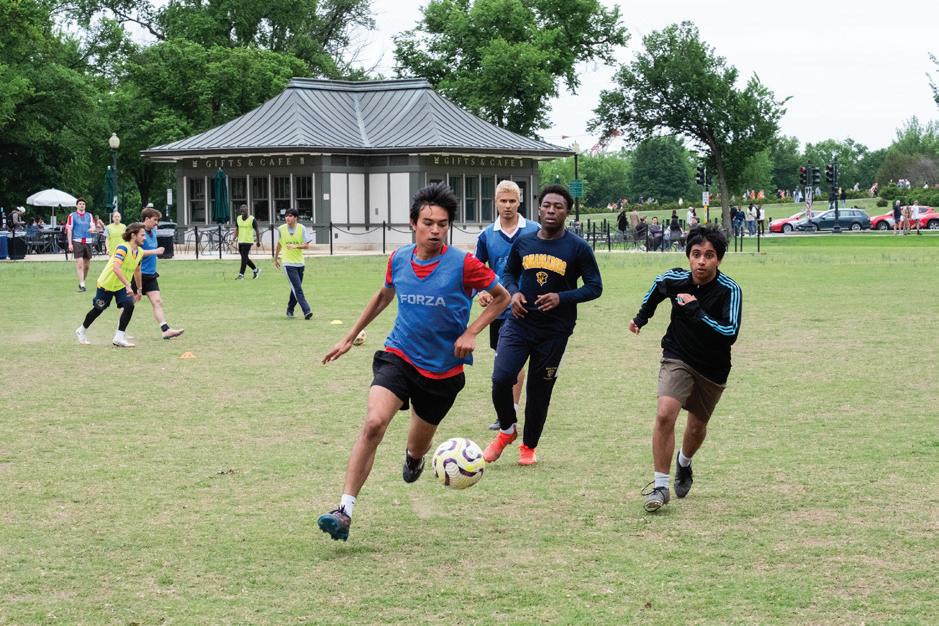
While strolling down the National Mall on a typical sunny Saturday, you can always expect to see a few things: 8th grade D.C. trips, swaths of tourists from across the world and the GW Football Club playing their weekly soccer games.
Graduating seniors Brian Rapuano and Benji WolfWagner, who serve as vice president and president of GWFC, respectively, founded the club in 2022, inspired to create the group from an Instagram group chat of GW students interested in setting up watch parties for the 2022 World Cup. After growing GWFC over the past three years and sparking a surge of interest in casual soccer at GW, the architects of the mall ball team will depart the club’s top positions as they graduate this spring, leaving GWFC in the hands of the next generation of GW footballers.
Wolf-Wagner said he wanted to start the club with his friends after having difficulty reserving spaces across the District to play casually, as many nearby fields were typically fully booked by the GW Soccer teams and other established club sports groups around D.C.
Wolf-Wagner said mall ball — the unofficial name for GWFC, derived from their typical practice and game location on the fields at 23rd Street and Constitution Avenue — has been a “consistent” routine throughout his four years at GW. Unlike the GW club soccer team, mall ball doesn’t require members to try out, but rather serves as a relaxed, open space for students to play soccer each week. He said the weekly agreement to play has been a way for him to “take a break” from the stressors of school. Rain or shine, Wolf-Wagner said you can find him and his fellow club members on the mall in the shadows of the Lincoln Memorial every Saturday at precisely 2:30 p.m., striking up that afternoon’s scrimmages.
While GWFC plays most games with its own mem-
bers, the club has recently expanded to play against non-soccer related student organizations like the Puerto Rican Student Organization in an effort to expand their community across student organizations. As he leaves GW in the spring, Wolf-Wagner said he has faith in the rising leadership of GWFC to carry the club forward and ensure a continued commitment to keeping the organization inclusive to all, with this being the first time the club transitions into a fully new leadership.
Rapuano said he remembers Wolf-Wagner coming up to him and his roommate their freshman year, after noticing both of them wearing soccer jerseys, to ask them about joining his soccer group chat to set up games and watch parties for the World Cup matches. Since then, he said the club has grown from an original 20 members to a routine turnout of about 65 people on a warm and sunny Saturday afternoon. Rapuano said mall ball “means the world” to him because of the club’s ability to bring people together for their love of the sport.
Rapuano said the organization has transformed from just a club to play soccer into a more social organization, with organized trips to D.C. soccer games like D.C United and Washington Spirit and routine cookouts throughout the semester for the team to spend time together off the field. The club has also started volunteering this semester with the community service organization DC Scores, — a local group that provides free after-school soccer pro-
grams for youth throughout the District.
Malia Robinson, a sophomore studying speech, language and hearing sciences, will take over as the club’s co-president next semester. As a life-long soccer player, Robinson said soccer has acted as an escape from stressors, instantly curing any bad mood. Robinson said she initially tried out for GW’s club soccer team her freshman year — another soccer student organization with separate men’s and women’s teams, which requires members to try out — and after not making it, went on to join mall ball, sticking with the team ever since.
Jamie Duke, a junior and current “mall ball general,” will join Robinson as GWFC’s co-president next semester. He said his current role of general sounds “scarier than it is,” but he has enjoyed helping out with logistical aspects of practices like setting up the goals and boundaries on the field to help practices run smoothly, and is excited to take on more responsibility next semester.
Duke said he thinks GWFC is more of a “collective” because of how easy it is for students from all ability levels and backgrounds of soccer expertise to come play with the team week after week. He said because of the welcoming nature of the team, he has noticed a difference in the community formed at GWFC as opposed to other GW athletic clubs and organizations.
“It’s a very good springboard for that level of connection, which is hard to foster in other spaces on campus,” Duke said.
The Sirens’ path to choreography stardom at the Battle of the A Cappellas
DIANA
JESSICA ROWE
Under the dimmed Lisner Auditorium stage lights, The Sirens a cappella team assembled in perfect formation in preparation for the annual Battle of the A Cappellas competition, their sights set on the first place spot.
Competing against five other student a cappella organizations, including last year’s winners The Troubadours, The Sirens prepared mashups and choreography to match this year’s theme of songs by British bands or singers. After a semester of long vocal rehearsals and group dance practices, The Sirens took home the award for best choreography Wednesday night.
Sophomore and Music Director for The Sirens Fiona Doyle said their early rehearsals in January focused on learning the sheet music and nailing down harmonies, adding in choreography later in the semester to sync with the group’s soloists.
Doyle said The Sirens’ preparation for performance day was stunted by a few challenges, with practices taking a short break in February while the group performed singing valentines to students on campus as a fundraiser for the group. She said the GW Motherfunkers used one of their original song choices, “Diet Pepsi” by Addison Rae, so they had to quickly pivot earlier in the semester to performing “Want U Back” by Cher Lloyd instead.
One day before the competition
The day before Battle, The Sirens mThe day before Battle, The Sirens
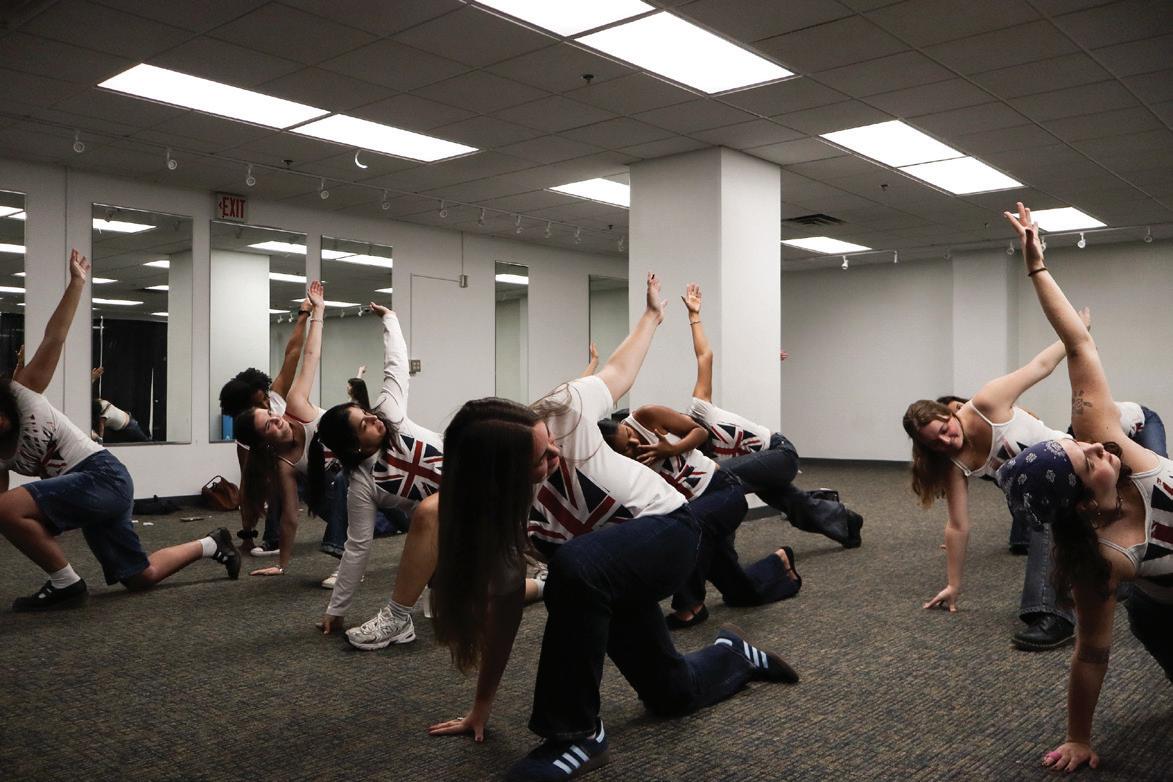
met for a final rehearsal in the lower level of the University Student Center, marking the end of their tech week after rehearsals every day leading up to competition. With the team rehearsing this particular set since January, Doyle said repetition was the most integral part to the process to keep the choreography fresh in their minds.
After warming up, the members stood in a circle to run through the set’s vocals, briefly pausing to correct the most minute details — how they’re pronouncing a word, or focusing on a specific vocal group to ensure that all the parts blended together seamlessly.
The Sirens then conducted a group stretch session to the song “Nobody’s Girl,” by Tate McRae to warm up their bodies before the big performance, followed by a rehearsal of each of the songs from their set with some Sirens holding their phones as fake microphones.
Though the rehearsal room was small, The Sirens made the space their stage with bold vocals and fierce choreography, preparing themselves to take to the stage only a few hours later.
Day of the competition
Eager students trickled into Lisner Auditorium around 7:00 p.m., packing the front half of the space, some holding small bouquets to congratulate friends after the show.
The lights dimmed around 7:45 p.m. as Student Government Association President Ethan Lynne stepped on stage to host the evening’s competition. As the final group of the night to perform, The Sirens took the stage, introduced by a cheering crowd with some audience members standing up to cheer on their friends on stage. The 14 Sirens strutted on stage wearing Union Jack tank tops and t-shirts paired with
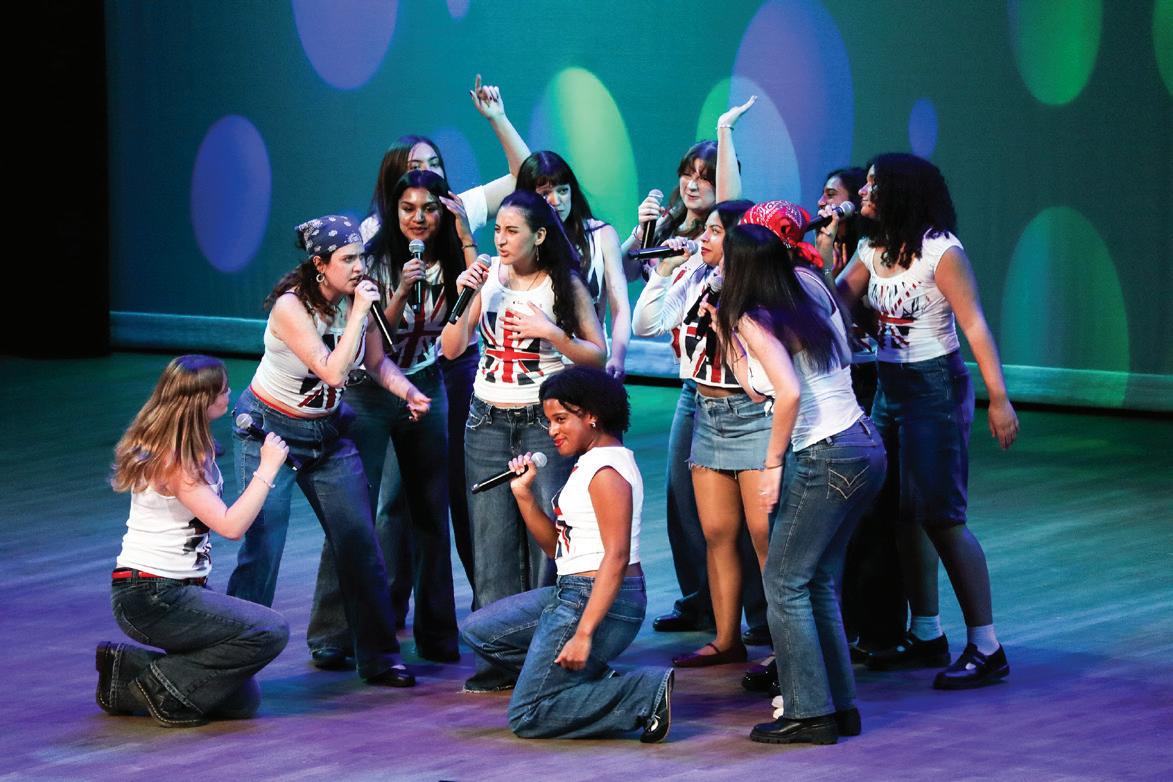
blue jeans, starting their set off with “Primadonna” by MARINA. The Sirens blended harmonies across soprano and alto vocal parts, concluding the number with two members lifting the soloist near the last chorus of the song.
After the first song, Doyle quietly used the pitch pipe to cue the group into “Want U Back” by Cher Lloyd as the second song of their 15 minute set, leaning into the British theme of the night with heavy accents. The end of the Lloyd tune transitioned into a medley of popular Tate McRae hits, like “Tit for Tat,” “Revolving Door” and “Sports Car.”
The Sirens’ signature beatboxer, senior Guinevere MacLowry, made car-like revving sounds to introduce “Sports Car,” with the group filing into formations across the stage in varying lines and groups and imitating car-like motions with their choreography.
Post-show
Following a 20 minute deliberation period for the judges to decide upon winners, each team returned to the stage awaiting their soon-to-be-announced fate. Dean of Students Collette Coleman proclaimed Sons of Pitch as the audience’s fan favorite award winner. Following this victory, Zimmerman and Conrado announced a slew of other specialty awards, including best choreography, secured by The Sirens.
Following the awards ceremony, Doyle said she was really proud of the team’s accomplishment of winning best choreography, and she wouldn’t have changed anything about their preparation or performance that night.
Following their performance, The Sirens left the auditorium as a group, satisfied with their production and awards and ready to return to Battle next year.
PETER PARK | STAFF PHOTOGRAPHER GW Football Club members play soccer at the Henry Bacon Ball Field Saturday.
JOSH STEINBERG | STAFF PHOTOGRAPHER
The Sirens practice Wednesday ahead of their Thursday performance.
NICHOLAS WARE | STAFF PHOTOGRAPHER
John Kiriakou poses for a portrait outside the University Student Center Saturday.
RYAN SAENZ ASSISTANT NEWS EDITOR
JOSH STEINBERG | STAFF PHOTOGRAPHER
The Sirens perform at the Battle of the A Cappellas at Lisner Auditorium Thursday.
SPORTS
Lacrosse defender closes GW career defined by record-breaking defense, leadership
Lacrosse senior defender Stella Ray may be graduating in just a few weeks, but her name isn’t leaving the team’s record books anytime soon.
After four years of dominating the draw circle and anchoring the defensive line while setting team records for single-season and career draw controls and single-season ground balls, defender Stella Ray is leaving behind a lasting legacy. Ray said departing the team after four years is bittersweet, but emphasized her pride in the team’s evolution and the foundation she helped build for its underclassmen to inherit, as she transitioned from a defensive stalwart to a veteran leader during her senior season.
“Freshman year to now, I would say our culture right now is so insanely cohesive, and we mesh so well in the chemistry and friendships that we have, is awesome, but as a freshman, I couldn’t say the same thing, and that was a big struggle for me,” Ray said. “But I think having those challenges has really taught me a lot about who I am and how to overcome these challenges and struggles to learn how to move past those.”
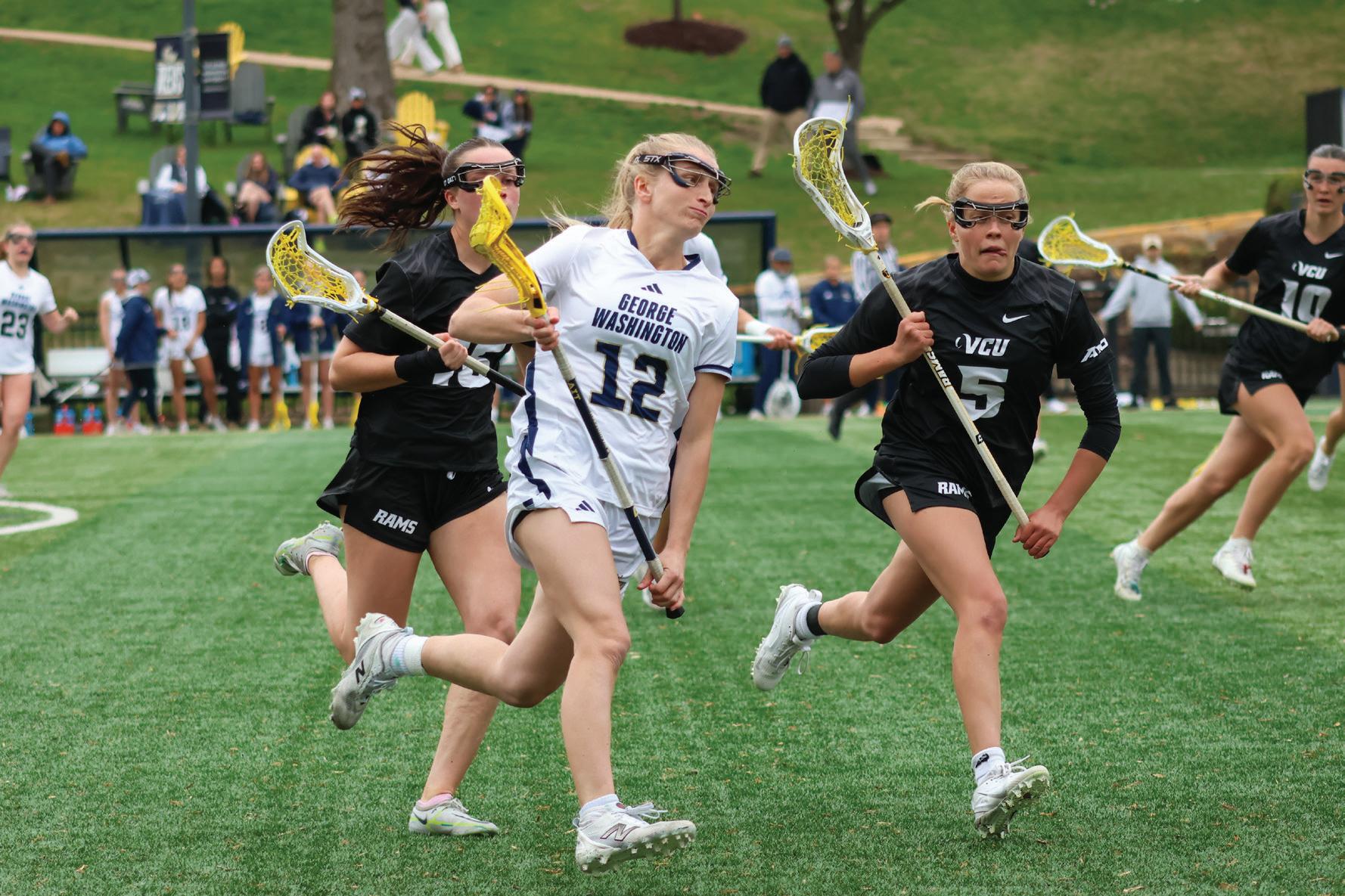
in 2013. In her sophomore season, Ray set the all-time single-season record for draw controls with 87, shattering the previous record of 72 set by Lacey in 2012. By the end of that season, she became the fourth player in GW lacrosse history to record over 100 career draw controls, sitting at third all time with 146. Ray has added to her record this season with 40 draw controls, but has also stepped back from the draw circle to mentor the team’s large freshman class in mastering the skill.
“I think being against them on the circle has taught them how it’s supposed to be and look like and feel with that physicality. They see how hard I’m going 100 percent on them, and I’m pressuring them and acting as if they were another team,” Ray said.
While Ray spent her first three seasons perfecting her skillset, she said that stepping up as a veteran and mentoring underclassmen has defined her senior season, thanks to the help of her teammates and coaches in supporting her growth as both a leader and a player.
“My coaches and my teammates are the real reason I am the way I am and who I am now and I wouldn’t be here without them.” Ray said.
Softball secures 2-1 series win over Rhode Island to cap final homestand
ETHAN TSAI STAFF WRITER
SAMANTHA BURCHARD STAFF WRITER
Softball (21-19, 10-11 Atlantic 10) prevailed over Rhode Island (17-26, 6-15 A-10), winning two out of three games in a weekend series at home.
The Revolutionaries dominated the Rams in the first game on Saturday with a score of 10-2, on the back of strong pitching by junior pitcher Cece Smith, but dropped their second matchup the same day 2-5 after an error-laden sixth inning allowed the Rams to score five runs off loaded bases. The Revs came back 9-1 in the last game on Sunday, ending the series 2-1 and bumping the Revs up one spot to sixth in the A-10 standings.
After the series victory, GW will look to carry its offensive momentum into its final regular season road series at St. Bonaventure this weekend. Securing wins on the road will be critical to solidifying their spot in the A-10 Championship next week.
Here’s a recap of this weekend’s action:
Game 1: GW 10, Rhode
Island 2
The Revs opened the series in the first game with a solid outing on the mound by Smith, who allowed six hits and two earned runs over the course of five innings.
After a quiet first two innings offensively, the Revs broke open the game in the third inning with a careerfirst grand slam by freshman third baseman Sydney Hogue, instantly putting GW in the lead 4-1. The Revs built on their lead in the fourth inning as several walks allowed the Revs to load the bases.
A double from junior center fielder Paige Hayward and hits from Smith, senior pitcher Emma Fales and junior shortstop Cadence Gilliland pushed the score to 10-2, closing out the game with an assertive win for the Revs.
“I think we did really well starting the series,” senior left fielder Ashley Corpuz said. “We really attacked, and Sydney’s grand slam was an awesome kickstart, and we all wanted to be a part of it and contribute to the team win.”
Game 2: GW 2, Rhode Island 5
The team’s momentum
stalled in game two, as the Revs fell 2-5 to Rhode Island in a game defined by a late defensive breakdown and limited offensive production.
Rhode Island struck first with a sacrifice fly in the second inning to take a 1-0 lead. GW kept the deficit within reach through the middle innings, holding a one-run deficit behind senior Chloe Greene’s pitching before the Rams broke it open in the sixth. Rhode Island capitalized on two throwing errors by the Revs to load the bases, scoring four runs and extending their lead to 5-0.
GW mounted a late push in the seventh, stringing together consecutive extrabase hits by Corpuz, Hayward and Hogue to plate two runs. The rally, however, came too late to erase the deficit as Rhode Island freshman relief pitcher Olivia Kuhne locked down the inning, causing the Revs to drop the middle game of the series.
Game 3: GW 9, Rhode Island 1
The Revs answered back in the series finale with a dominant, run-rule victory in six innings. The game’s offensive explosion was spearheaded by Smith, who went
Rowing takes on powerhouse programs at Lake
Wheeler Invitational
Rowing competed this weekend at Duke University’s Lake Wheeler Invitational in Raleigh, North Carolina. While none of GW’s five boats ranked among the top half of finishers overall, the varsity eight, second varsity eight, third varsity eight and varsity four boats all improved in overall rankings between their first and third rounds. On the heels of a sweep of Atlantic 10 competitors Duquesne and Fordham at the GW Invite on April 11, the Revolutionaries continued to build momentum, placing just behind some of the top collegiate programs throughout several rounds of their final regatta before the A-10 Championship. The varsity eight, which was named the A-10 Boat of the Week after their lights out performance at the GW Invite earlier this month, led the way for the Revs, shedding just over four seconds across three rounds. The crew opened the regatta with a time of 6:46.43, placing sixth in its first heat and finishing 15th of 20 boats across the three heats comprising the first round. In the second round, GW
a perfect 4-for-4 with a pair of doubles and a team-high five RBIs, single-handedly driving in more than half of the Revs’ runs. Corpuz also reached base four times, finishing 2-for-3 with two walks, an RBI and a run scored.
Head Coach Matt Klampert pointed to the team’s increased aggression early in counts and more consistent pressure in at-bats as the defining adjustment after game two. He credited the team’s energy and aggressive approach for the dominant performance, as GW executed consistently to secure the run-rule win.
“I think it’s just attacking the moment, attacking the pitch, attacking what’s in front of you,” Klampert said. “That’s really the biggest lesson from this weekend. Just attack what’s in front of you and attack the moment.”
Veteran leadership also played a central role in the bounce-back win with Corpuz contributing key plate appearances throughout the game, capping her 4-for-7 weekend with four runs scored and five walks. Earlier in the series, she set the program’s single-season walks record at 45, reflecting her consistent ability to reach base and extend in-
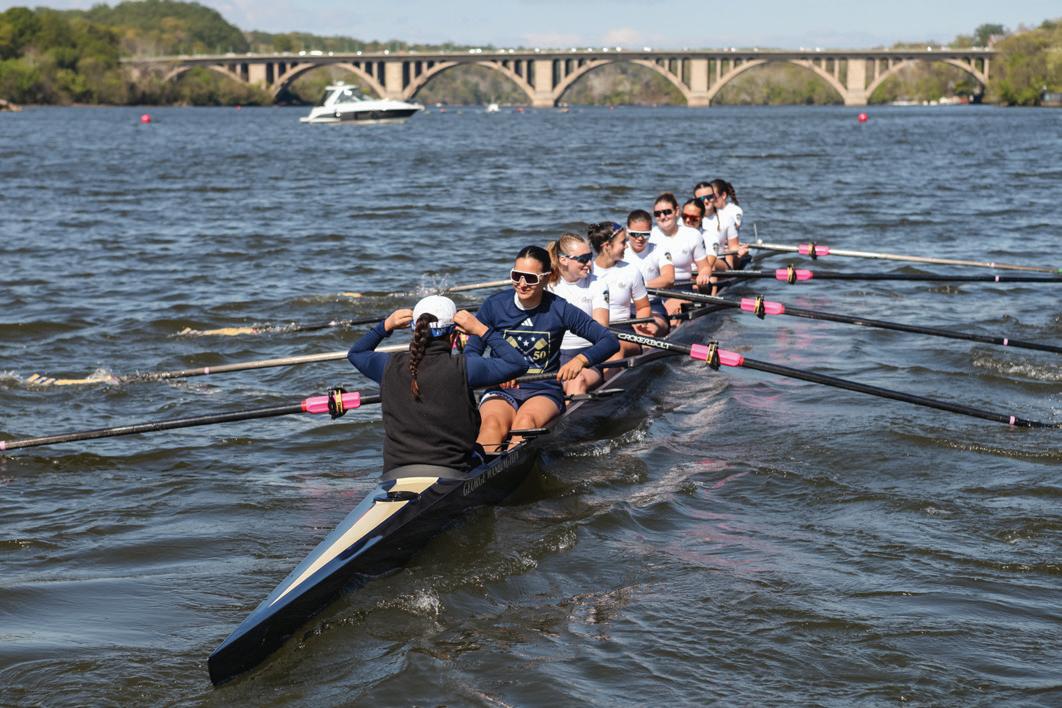
Members of the rowing team warm up before the GW Invitational in April.
improved slightly to 6:44.42, again finishing sixth in the heat while moving up to 13th overall out of 20 boats. The varsity eight closed the weekend with its fastest performance in the third round, clocking a 6:42.21 to place fifth in its heat and 12th overall.
The second varsity eight opened its first round with a 6:55.97 finish, placing fourth in its heat and 13th overall, while posting a 6:59.71 in the second round for a sixth place finish. The strongest performance came in the final round, where GW dropped its time to 6:47.49 — an improvement of more
than eight seconds from its first race — and placed fourth in the heat and 11th overall, the highest placement for a GW boat at the regatta. The regatta marked the Revs’ final competition before the A-10 Rowing Championship on May 16, held on Cooper River in Pennsauken, N.J. The team won its last A-10 Championship in 2023, falling to Rhode Island in 2024 and 2025. The Revs will effectively need to win the competition to earn an automatic bid to the NCAA Championship, which is set to be held in Gainesville, Ga. from May 29-31.
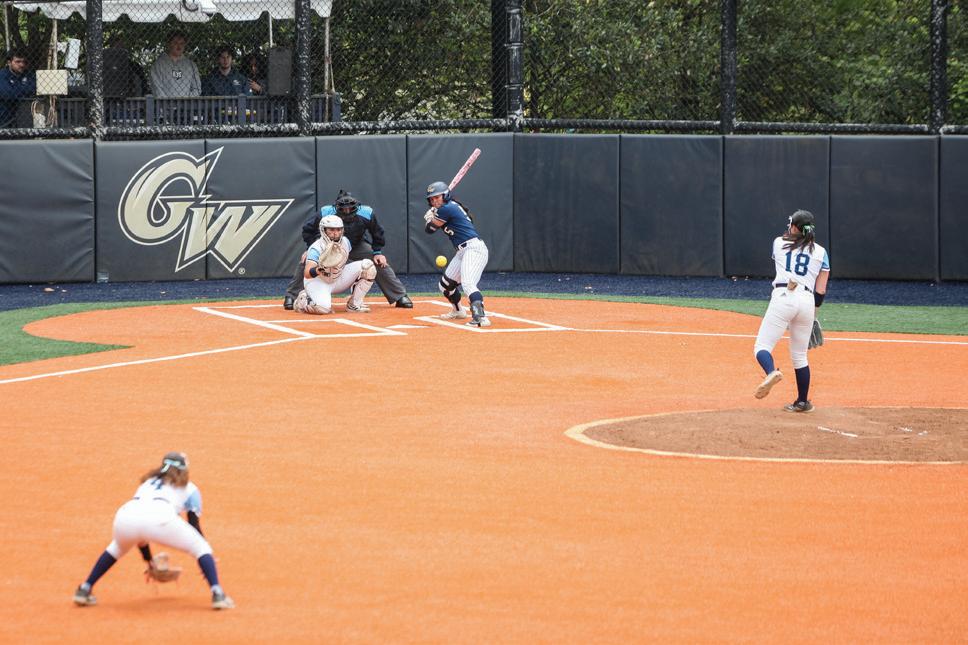
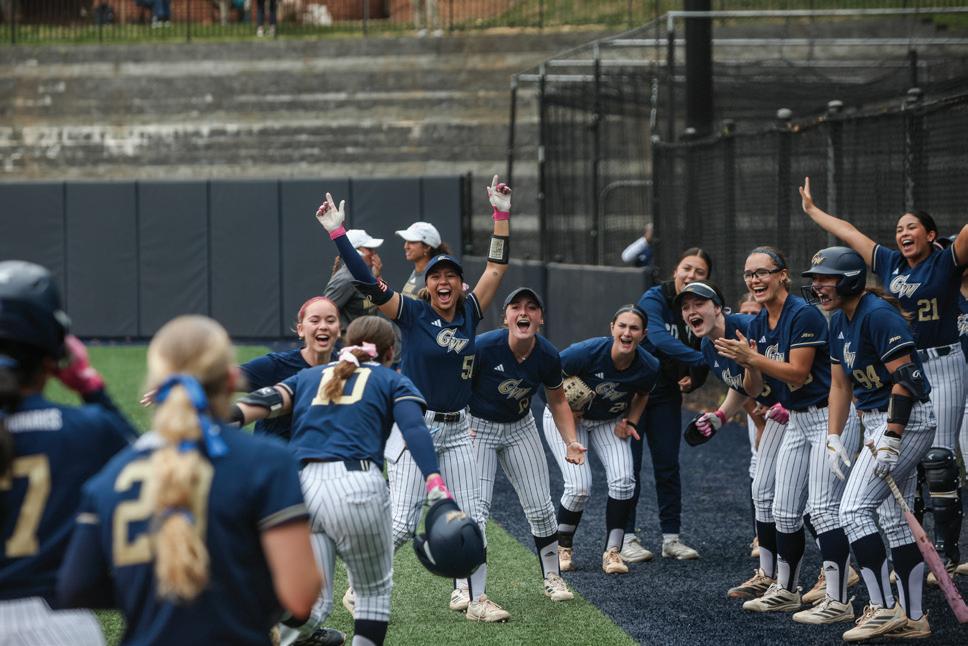
Men’s basketball added Oklahoma State University rising junior forward Andrija Vuković, Slovenian center Lovro Urbiha and University of Notre Dame rising sophomore forward Ryder Frost from the transfer portal this week, according to three separate social media posts. The 6-foot-11 Vuković, 6-foot9 Urbiha and 6-foot-7 Frost add much-needed size to a Revolutionaries front court that lost four forwards to the transfer portal and graduation. The three forwards join transfers Malachi Arrington, Dylan James and Terrance Arceneaux as other forward additions Head Coach Chris Caputo and his staff made from the portal in recent weeks.
Vuković mostly came off the bench last season with the Cowboys, averaging 5.3 points, 3.4 rebounds and 0.6 assists per game across his 27 appearances. He scored a career-high 12 points in Oklahoma State’s 91-84 victory over the West Virginia University Mountaineers on February 24.
Prior to committing to Oklahoma State, Vuković attended the First Sports Basketball High School – College Belgrade in Serbia and played the 2024-25 season in the Basketball League of Serbia
for KK Vršac, where he averaged 6.1 points and 2.5 rebounds per game. Urbiha is currently averaging 9.7 points per game, 3.1 rebounds and 2 assists for the Krka Novo Mesto in the Slovenian First League. He represented Slovenia at the FIBA U20 European Championship in 2022 and 2023, averaging 5.3 points and 5.1 rebounds per game over seven appearances in 2023’s tournament. Frost appeared in 26 games last season for the Fighting Irish, averaging 2.7 points and 0.8 rebounds per game and shot 38.5% from three — the second-highest mark on the team. Frost had a seasonhigh 12 points on 4-5 from three in the Fighting Irish’s 73-68 loss on February 21 to the University of Pittsburgh. As a high school recruit, Frost was ranked No. 79 overall prospect by ESPN coming into last season. Frost won the 2024 NEPSAC Class A Player of the Year Award his junior year at Phillips Exeter Academy in Exeter, N.H., while averaging 21.6 points, 7.7 rebounds and 3.2 assists per game. The additions of the three big men bring size and rebounding prowess to a Revs team that lost players with those attributes, like Rafael Castro, whose size and athleticism forced defenses to game plan around him. Men’s
Softball senior outfielder Ashley Corpuz’s on base percentage this season, good for third in the Atlantic 10.
RYAN JAINCHILL
BASKETBALL EDITOR
Ray’s career at GW was defined by her commanding presence on the draw circle and lockdown de-
fense, accumulating a record-breaking 265 career draw controls for the Revolutionaries thus far, with the
Atlantic-10 tournament still coming up, surpassing Nicole Lacey’s program record of 245 draw controls set
LILY KRAMP | STAFF PHOTOGRAPHER
Senior lacrosse defender Stella Ray cradles the ball during a game against Virginia Commonwealth in March.
SOPHIA CAPUTO STAFF WRITER
SAMANTHA BURCHARD STAFF WRITER
JESSIE ZHAO | STAFF PHOTOGRAPHER
nings for the Revs.
“The Revs will travel to compete against St. Bonaventure in a series in New
York on Friday at 2 p.m. before concluding the season next week at the A-10 Championship starting on May 6.
JESSIE ZHAO | STAFF PHOTOGRAPHER Senior outfielder Ashley Corpuz bats during Saturday’s game against Rhode Island.
JESSIE ZHAO | STAFF PHOTOGRAPHER Softball players celebrate during Saturday’s game against Rhode Island.