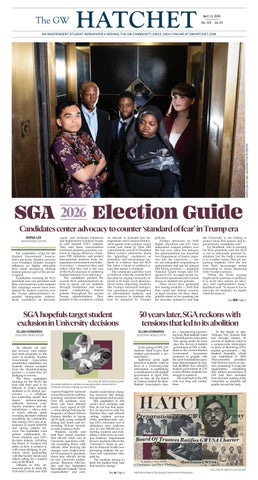
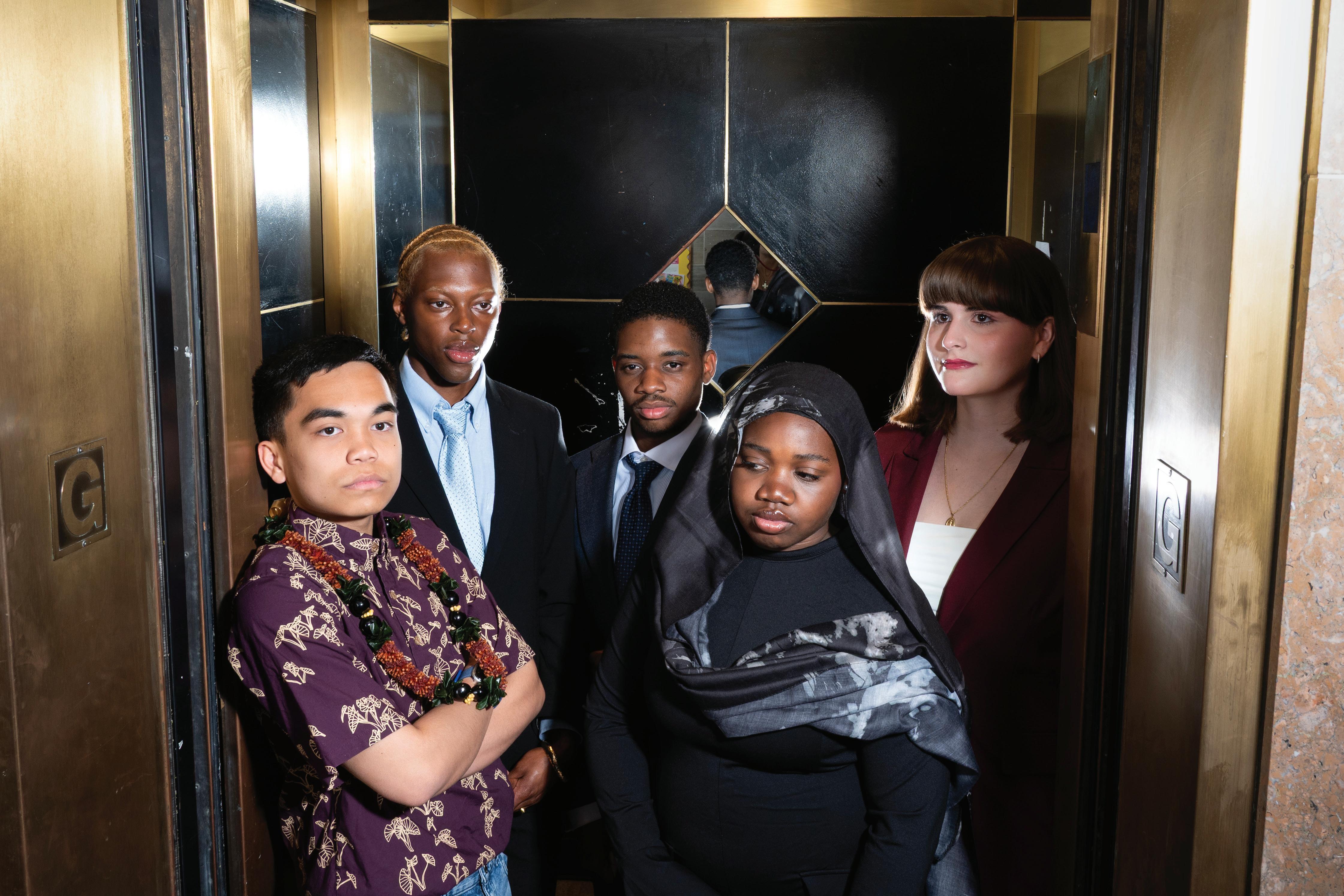
SGA Election Guide 2026
Candidates center advocacy to counter ‘standard of fear’ in Trump era
JENNA LEE SENIOR NEWS EDITOR
For candidates vying for the Student Government Association’s top posts, student concerns over President Donald Trump’s influence on higher education have made navigating shifting federal policies part of the job description.
Candidates running for SGA president and vice president said their conversations with students this campaign season have been shaped by student concerns over the Trump administration’s expanded immigration enforcement, crackdown on diversity,
equity and inclusion initiatives and deployment of federal troops in and around GW’s campus. They said those conversations informed platform priorities centered on urging officials to champion DEI initiatives and protect international students from immigration enforcement and federal scrutiny — measures they said reflect what they feel is the core of the SGA’s purpose of centering student interests in its advocacy. The candidates praised the current SGA administration’s efforts to speak out for students through resolutions and statements condemning federal policies throughout the second Trump administration. They pointed to the resolutions calling
on officials to formally ban Immigrations and Customs Enforcement agents from campus career events and stand by their DEI commitments and SGA President Ethan Lynne’s statements about the “appalling” crackdown on protesters and international students as evidence that the SGA has taken a stand on political issues that matter to students.
The candidates said they want to build on what the current SGA has done by urging University officials to be more vocal about political issues impacting students, like Trump’s increased immigration operations and clampdown on international students, and offer resources to students who may be impacted by Trump’s
SGA hopefuls target student exclusion in University decisions
As officials cut campus services, raise tuition and slash programs in the name of austerity, Student Government Association presidential candidates say students remain excluded from the decision-making process — a trend they are pledging to reverse. The three candidates running for the SGA’s top post said their goal is for officials to better include students in its shared governance — a collaborative leadership model that shares decision-making authority between community members and administrators — after a year in which officials made sweeping decisions without consulting the community, like raising GW’s cost of attendance to nearly $100,000 and cutting campus services. The candidates want greater collaboration between students and GW’s decision makers, including the Board of Trustees, but differ on how to achieve it, with some pledging to prioritize closer partnership with the Faculty Senate and others calling for a student seat on the Board.
Officials in May announced plans to slash the University’s fiscal year 2026

Candidate platforms outlined increasing student involvement in University decision-making as a top priority.
expense budget by 3 percent across the board to combat a yearslong structural deficit. Over the academic year, those cuts have affected nearly every aspect of GW — from officials halving the frequency of Mount Vernon Express shuttles to laying off 43 staff, axing weekend dining hall hours and terminating 24-hour security in some residence halls.
Students, faculty and staff have raised concerns that officials made cuts to University operations without consulting them, with officials often denying the changes were budget-related. In response to questions about how officials decide on cuts, University spokesperson Shannon McClendon said last September that officials evaluate “fiscal responsibility” and com-
munity needs before changing resources like dining, transportation and security.
But candidates in this week’s SGA elections said they do not buy that narrative. In interviews with The Hatchet, they said officials cutting student services while simultaneously raising GW’s estimated cost of attendance next academic year to over $98,000 for returning students and instituting a three-year on-campus residency requirement for new students reflects the University’s desire to protect its financial health over providing students the services and experiences they paid for.
The students aiming to helm the student body said that needs to change.
policies. Trump’s pressures on both higher education and D.C. have dominated campus politics over the last year. Since last January, the administration has launched two Department of Justice inquiries into the University — one for not adequately responding to antisemitism and one for alleged DEI hiring practices — deployed National Guard troops and ICE agents to D.C. to ramp up law enforcement operations and cracked down on student visa policies.
These moves have generated fear among students — both that they could face federal scrutiny or legal recourse for their immigration status or for speaking out for diversity initiatives and that
the University is not willing to protect them this federal and legal pressure, candidates said.
Liz Stoddard, who is running for SGA president, said the SGA is not an inherently partisan institution, but the body’s mission is to weather issues that are impacting students. Over the last year, that’s increasingly meant responding to issues stemming from Trump’s policies.
“While the SGA’s mission might not be partisan or political, it is, at its very nature, an advocacy and representative body,” Stoddard said. “It means it has to advocate for students, no matter what the issue is.”
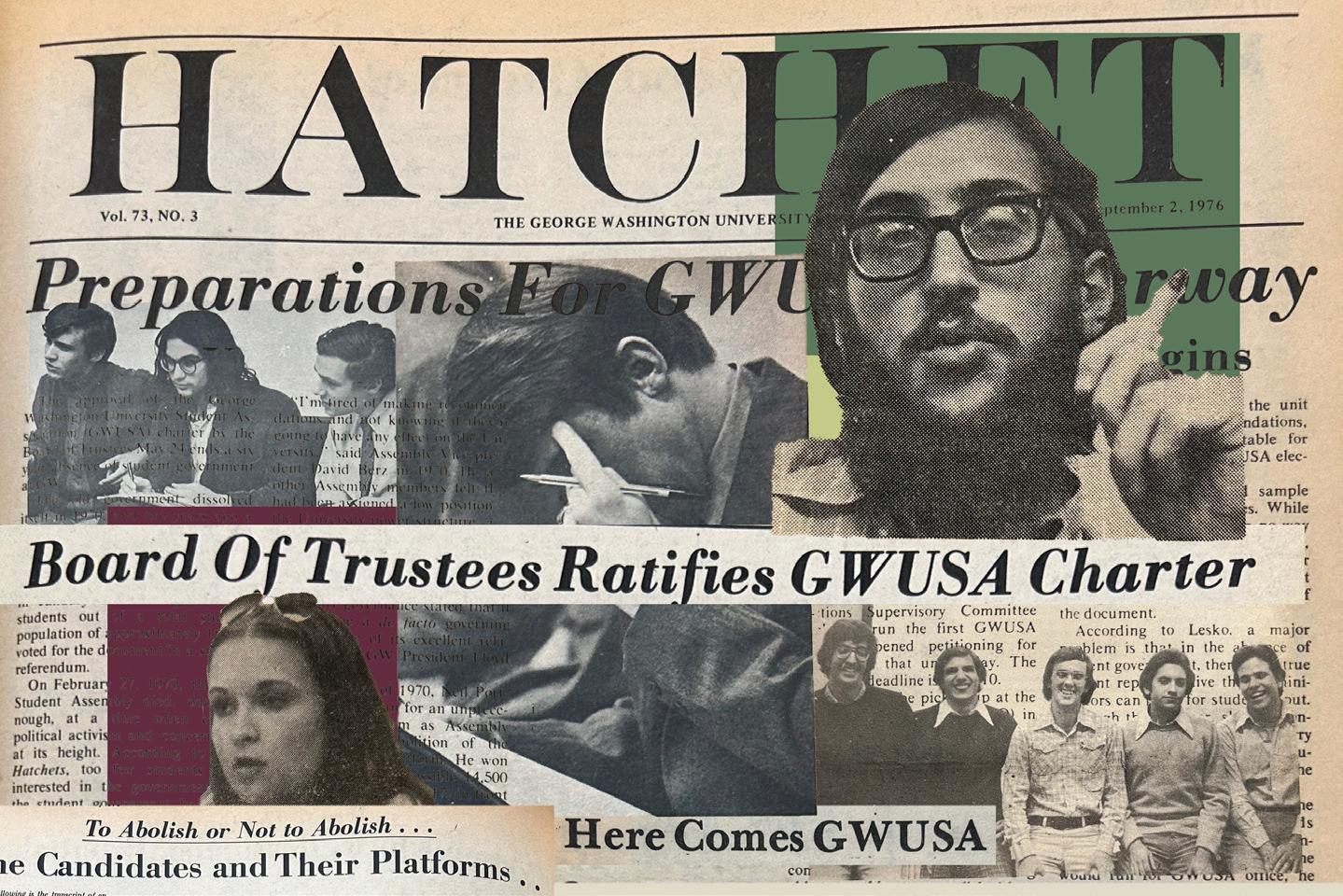
50 years later, SGA reckons with tensions that led to its abolition
ELIJAH EDWARDS ASSISTANT NEWS EDITOR
In the spring of 1976, GW students voted to give their student government a second chance.
Eight-four point eight percent of students voted in favor of a University-wide referendum re-establishing a constitution for the student government in April 1976, and on May 24, the Board of Trustees ratified the thenStudent Association’s char-
ter — resurrecting a governing body that students voted to abolish just six years prior.
This spring marks 50 years since the revival of student government at GW, a milestone as the current Student Government Association continues to grapple with the same foundational questions that prompted its original abolition: how effective student government at GW is and whether students care enough to sustain it. The road back to the 1976 vote was long and contentious.
At the height of antiVietnam War protests that tore through campus, 69 percent of students voted in a campus-wide referendum in favor of dissolving GW’s student government — the Student Assembly, which was established in 1909. Then-assembly president Neil Portnow ran for re-election, promising to scrap the organization, concluding that student government at GW had been excluded from decision-making at the University as students felt apathy toward the body.
MATHYLDA DULIAN | ASSISTANT PHOTO EDITOR
ELIJAH EDWARDS
ASSISTANT NEWS EDITOR
COLLAGE BY MATHYLDA DULIAN
Hatchet archives of the Student Government Association.
See SGA Page 4
COLLAGE BY MATHYLDA DULIAN
SGA 2026 Presidential Candidates Election Guide


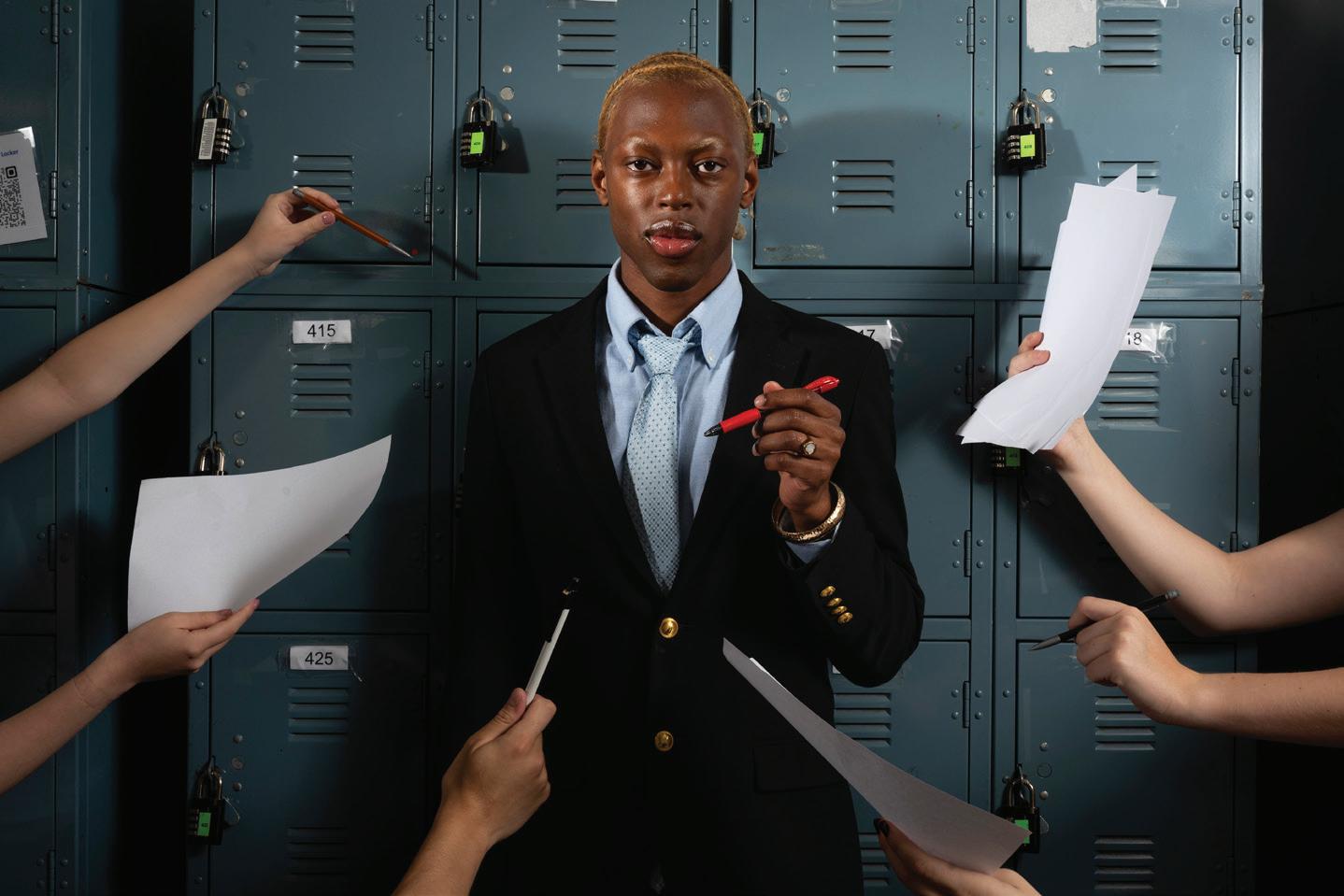
Alfred Lewis Jr.
In January, Alfred Lewis Jr. arrived in D.C. with no clear sense of what the future might hold. Four months later, he is running for the Student Government Association’s top post.
Lewis said he became aware of gaps in student representation almost instantly after transferring to GW in January after talking to cultural organizations, like the GW chapter of the National Association for the Advancement of Colored People and the African Student Association, where students voiced concerns over limited input in University decision-making and unclear SGA funding rules. He said hearing about these issues pushed him to run for president, a decision he said was rooted in the lifelong commitment to service instilled in him by his parents.
“When there was an op-
portunity, like SGA, to be able to take student voices and their concerns and amplify it, I saw it as a responsibility on my end to come together with students,” Lewis said.
Lewis said that if elected, he would work with University officials to advocate for a student representative on the Board of Trustees to ensure student voices are included in decisions that affect student life at GW, building on former SGA President Ethan Fitzgerald’s push for student representation in his presidential platform, which ultimately did not succeed. In 2023, the SGA passed a resolution requesting the Board to add both the SGA president and vice president as full voting members, but the Board rejected the proposal without providing a reason.
Lewis said he plans to push officials to further clarify why they are not willing to consider student representation but did not specify how. He said he also plans to reach out to
Fitzgerald to better understand where the former president’s efforts fell short, but he did not say when.
“The reason is something that I want to investigate, which is why I want to talk to the administration to see how could it look like, how can we negotiate for those things,” Lewis said.
Lewis said he wants to implement a “forgiveness meal swipes” program, giving students a 10-minute window to exit a dining hall without it counting as a meal swipe for situations when a student enters and does not find anything they want to eat. Under the current system, students on the All Access and Revolutionary 85 plans must wait 1 hour before swiping again after a meal swipe.
Ye�r: Junior
Major: Philosophy
Hometown: Teaneck, New Jersey
MJ Childs
gent or physically disabled students at another school.
MJ Childs wants to give back to GW.
Childs said GW’s professors, students and staff have shown him a level of love and acceptance he had never experienced before, fueling his decision to run for president and give back to the community that embraced him. He said this year’s budget cuts and rollback of student services sharpened that mission, driving him to fight for restoring those resources so students get the full value of their tuition.
“It’d be a presidency for all of us,” Childs said. “It’s MJ Childs, but it’s MJ Childs for GW, MJ Childs for the SGA and for the community as a whole.”
Childs described himself as a lifelong advocate, with work that began in middle school when he urged school officials to keep a program allowing students to work with neurodiver-
He said the advocacy work he’s engaged in since then — whether that be mental health awareness at his high school or challenging President Donald Trump’s attacks on diversity, equity and inclusion on social media and through the Black Student Union — sets him up as the right candidate to represent and champion GW’s student body.
“My involvement on campus and my understanding as a student and my experience in leadership but also just my will to be an advocate and a leader, I think is more than enough,” Childs said.
Childs said his status as an SGA outsider does not meaningfully distinguish him from other candidates, pointing instead to experiences like his work with the BSU as evidence of his qualifications.
Childs said he chose to run for president after feeling GW’s cuts to student services across the Univer-
sity, starting when officials eliminated his position at the West Hall fitness center on the Mount Vernon Campus, which he suspects was a part of the Universitywide budget cuts. He said officials relocated him to the Lerner Health and Wellness Center but also reduced his hours, a move he said added to his frustration as student services were being cut.
He said officials have not sought out sufficient student input when choosing which campus services to close, which he called a “slap in the face” to students, especially since they are the ones paying for the services through their tuition. Childs said he would create new student committees aimed at increasing engagement on campus.
Ye�r: Sophomore
Major: Creative writing, marketing
Hometown: Philadelphia, Pennsylvania
Liz Stoddard said she has a track record of getting what she wants.
Stoddard started her Student Government Association tenure during her first semester at GW as a first-year legislative assistant before climbing the ranks, serving as a Columbian College of Arts & Sciences senator, Senate pro tempore and now vice president, positions she said taught her how to navigate tough conversations with officials and advocate in the best interest of students. Now a junior, she’s set her sights on the body’s top post, aiming to draw on her experience navigating GW’s bureaucracy to hold officials accountable and amplify student voices — an effort she argues is especially critical as she worries that officials, wary of potential retribution from President Donald Trump’s adminis-
tration, have become less willing to be transparent.
“Right now, more than ever, we need a strong leader for students who’s not going to back down from protecting, defending and advocating for students,” Stoddard said. “I find myself to be the most equipped in this race for that.”
Stoddard said students’ trust in the University to act in the best interest of students has “never been worse” in her three years at GW than it is now because of officials’ “complicit response” to the Trump administration. She said officials haven’t publicly reaffirmed protections for transgender students, reproductive rights and the existence of the Multicultural Student Services Center since Trump took office last year — all topics she believes officials should send a message about to make it known where they stand on issues and what protections students have.
Stoddard said her tenure as vice president has
equipped her with the experience necessary to push officials on issues affecting students, which she said she’s done this year with their lack of messaging about diversity, equity and inclusion rollbacks and what to do in the event an Immigration and Customs Enforcement officer is on campus. She said she’s urged officials to put out statements about issues more promptly, also saying she played a role in getting Interim Provost John Lach to release a statement about the University’s commitment to DEI. “Students deserve honesty about why decisions are being made and not after there’s backlash, but just tell us why you’re doing it,” Stoddard said.
Ye�r: Junior Major: Political science
Hometown: Delaware County, Pennsylvania
Fact-checking presidential platforms
SACHINI ADIKARI
SENIOR STAFF WRITER
TYLER IGLESIAS
SENIOR NEWS EDITOR
The Student Government Association’s presidential and vice presidential candidates are campaigning on expanded student services and stronger diversity, equity and inclusion efforts, but many of their proposals overlook existing policies and the limits of the office.
A majority of candidates relied on vague language or minimally detailed proposals in their platforms, making it difficult for The Hatchet to discern the true scope of their ideas or how they intend to implement them. While many emphasized collaboration with officials and the importance of greater transparency and student awareness, few outlined concrete strategies for engaging
Liz Stoddard
University leaders and students or for translating their priorities into actionable outcomes. The Hatchet reviewed and fact-checked four out of the five candidates’ outlined platform points for misleading, inaccurate or unclear information to provide additional context as students prepare to vote. Alfred Lewis Jr., a presidential candidate, did not share his platform with The Hatchet. Here’s what we found:
Platform Point: Stoddard wants to work to “expand access” to the School of Business’ F. David Fowler Career Center’s coordinators program — which pairs underclassmen with paid upperclassmen mentors in the business school to help with resumes and cover letters — to students from all schools.
Check: The coordinator program — which officials paused during the fall semester due to budget cuts but reinstated this semester — is currently housed in GWSB’s career center, with business students serving as coordinators, designed to help students looking to go into GWSBrelated career fields. To expand the program, Stoddard would have to work with each school’s career center or the University-wide Center for Career Services to create a similar program, since the Fowler coordinators are currently exclusive to GWSB students. The University’s career service center provides professional staff who can help with coaching on resumes, cover letters, interview prep and more but does not offer peer-to-peer mentoring.
MJ Childs
Pla�form Po�nt: Childs said he would create an optional post-FixIt survey for students after maintenance workers complete a request.
Check: GW Facilities Planning, Construction and Management already sends out an optional post-FixIt survey for students to complete.
Pla�form Po�nt: Childs pledged to work with University donors to expand the “emergency support fund” to every school, so students facing financial hardship or emergencies are supported by GW.
Cl�r�fication: The Office of Student Financial Assistance offers emergency funding for all students, ranging up to $600 per semester for undergraduate students’ personal expenses and up to $2,600 for graduate students’ personal expenses as well as up to $1,000 for tuition-related charges, but not every school has a school-specific fund. The Division for Student Affairs also offers a Student Assistance Fund for assistance outside of tuition-related needs.
KRIS PARK | STAFF PHOTOGRAPHER
Student Government Association presidential candidate Liz Stoddard.
KYRA WOOD | ASSISTANT PHOTO EDITOR
Student Government Association presidential candidate Alfred Lewis Jr.
MATHYLDA DULIAN | ASSISTANT PHOTO EDITOR
Student Government Association presidential candidate MJ Childs.
GIANNA JAKUBOWSKI ASSISTANT NEWS EDITOR
Liz Stoddard
RYAN SAENZ ASSISTANT NEWS EDITOR
ARJUN SRINIVAS CONTRIBUTING NEWS EDITOR
SGA 2026 Vice Presidential Candidates Election Guide

to translate them into policy.
Aicha Sy believes divisions inside student government are reflected in how it connects with students.
Sy said the Student Government Association’s perceived seriousness can make it harder for members to form personal connections with one another, reinforcing the idea among students that senators are less approachable and more distant than their peers. She plans to combat this by reworking town halls, building a policy-writing office and expanding social media to help humanize senators and help students better understand their work.
“Making it a place that’s more enjoyable, then that encourages more people to want to join the org and really strikes out all of the misconceptions that a lot of people spew out about SGA,” Sy said.
Sy said she has observed senators struggling to understand the parameters of their roles, limiting their ability to use those positions to their full potential and leaving students unsure of what the SGA does for them. She said she wants to create a policy-writing office staffed by the SGA Senate’s Community, Advocacy and Inclusion Committee, where non-SGA-affiliated students can bring issues they are facing on campus and be paired with a senator
“I think I’ve established a lot of momentum in terms of my involvement with SGA, and I thought that the best way to really harp on that and maximize the impact I can have on campus was pursuing the position of vice president,” Sy said.
In her platform, Sy details ideas like a forum for first-year students, which would bring them together for a roundtable discussion with the SGA about issues they face at the University. She said first-years who participate in the forum would become “point people” for their peers, hearing students’ concerns and informing the SGA about them. She said she would advertise this forum and other town halls by reaching out to student organizations that many first-years are in, which she said would increase turnout, including getting students to join the forum with their friends, rather than alone, which can be intimidating.
Sy said she wants to rework how the SGA structures its town halls, which saw low turnout from nonSGA students this year, by making them more of a roundtable discussion rather than students posing questions to a panel. She said town halls this semester saw limited turnout because the panel model was not attractive to students, and the new, more conversational model would be more appealing.
Two of Sy’s four roles
within the SGA have focused on diversity, which she said has shaped her strongest asset as a candidate: her ability to empathize with and connect to GW students across backgrounds and identities. Sy pointed to a listening circle she hosted as deputy director of diversity, equity and inclusion with Latino student organizations, saying it deepened her understanding of their experiences on campus.
“I really pride myself in my curiosity and trying to figure out other people’s experiences, and this position solely relies on understanding the needs of the student body,” Sy said. “And I think that’s a trait that comes inherently to me.”
Sy said after the recent tuition hike, bringing the estimated cost of attendance to over $98,000 next academic year, and cuts to student services this year, GW’s affordability is students’ top concern. Sy said she knows she will not be able to lower the cost of attendance as vice president, but she would advocate for more transparency between University officials and the student body about where tuition dollars go and context for why costs are “constantly rising.”
Ye�r: Sophomore
Major: Political science
Hometown: Martinsburg, West Virginia
Fact-checking vice presidential platforms
Aicha Sy
Pla�form Po�nt: Sy is “aiming” to get the Mount Vernon Express running again at its “usual schedule” in response to the projected increase in tuition for the 2026-27 academic year, after officials slashed their frequency by 50 percent this year.
Cl�r�fication: Sy would have to work with University administration to do so, and it is not clear if they would respond to student pressure and revert the schedule. The University scaled back Vex services amid University-wide fiscal challenges, including a 3 percent budget reduction for FY2026. Officials said the schedule changes were implemented due to additional seating in the new shuttles this academic year.
Pla�form Po�nt: Sy said she would “restore” weekend dining hall hours for locations in the University Student Center and District House.
Cl�r�fication: Officials shut down weekend dining hours at District House and the USC in the fall, pointing to lower foot traffic. The SGA does not have the power to change dining hall hours. Sy would need to work with officials and GW Dining to implement any changes to dining hours.
Cheydon Naleimaile-Evangelista
Pla�form Po�nt: Naleimaile-Evangelista wants to work with Follett, the operator of the GW Campus Store, to accept GWorld as a payment method, allowing students to pay for GW swag and course materials at the store using dining dollars.
Cl�r�fication: The campus store already accepts GWorld Campus Cash as a form of payment for all items but does not accept dining dollars. Campus Cash is not included in students’ cost of attendance and must be loaded to their card through an app.
Pla�form Po�nt: Naleimaile-Evangelista said he wants to partner with the Tıtle IX Office to host an “annual event” with the SGA in Kogan Plaza, featuring student and community organizations and giving students an opportunity to hear from them and engage in open dialogue.
Check: While not in Kogan Plaza, the SGA and the Tıtle IX Office launched the Denim Day event last spring to raise awareness and provide access to resources for sexual assault prevention in Square 80. Over 200 students attended the event, which featured participation from 22 student groups, as a way to inform the community about the resources available to them regarding sexual assault and harassment. The SGA, Tıtle IX Office and other student organizations scheduled Denim Day for April 29 this year.
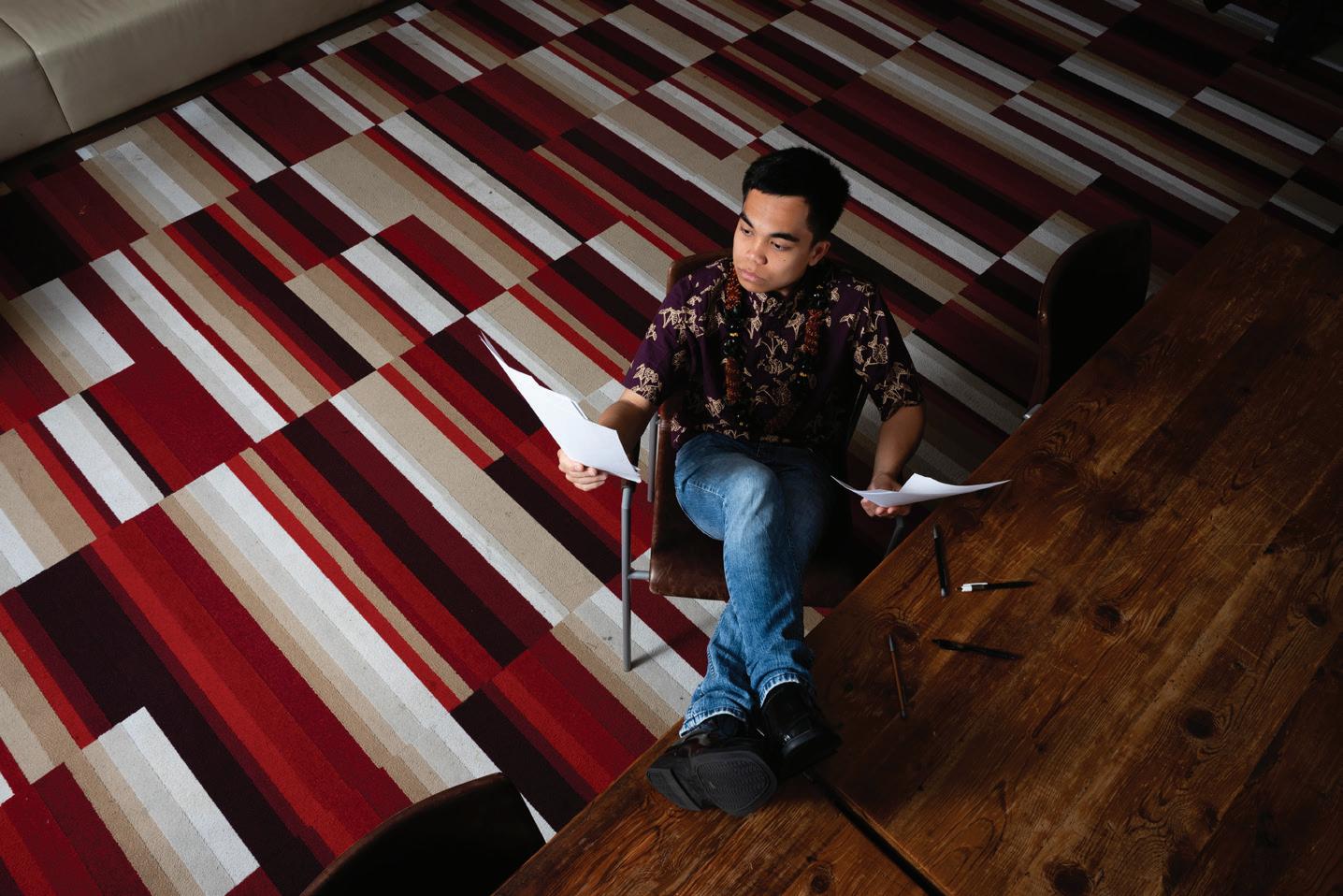
Cheydon NaleimaileEvangelista wants to bring the aloha spirit to GW.
Naleimaile-Evangelista, the only Native Hawaiian senator in the SGA, said people in his home state live a “laid-back lifestyle” that does not exist at GW — a vibe he wants to instill in students. He said GW’s often-cutthroat culture leaves little room for students to prioritize their own wellbeing and argued that the University has failed to fill that gap — prompting him to run on a platform focused on strengthening student support across issues ranging from sexual misconduct, dining and immigration.
“During this campaign period, one of the biggest things I’ve been doing is bringing that Aloha spirit to GW and reminding students to take time for yourself,” Naleimaile-Evangelista said.
Naleimaile-Evengelista said his first action as vice president would be to work with officials in the Title IX Office to commit GW to being a “violence-free campus.” He said he would work to amend the wording used on the University’s Title IX policy — which currently states GW is a campus committed to maintaining an environment free from violence — to specifically commit GW to be a “violence-free campus” that
supports survivors of sexual assault.
He said the current policy’s wording pushes the Title IX Office to focus more on punishing wrongdoers than supporting victims of sexual assault, which he said amended language and expanded survivor resources could change.
“Not mentioning having zero tolerance for sexual misconduct definitely persuades these other services and support systems that we have,” Naleimaile-Evangelista said. He said he would work with survivor support organizations, like Students Against Sexual Assault and It’s On Us at GW, during the amendment process to expand the Title IX Office’s own resources for survivors and ensure the University is directing students toward what the organizations offer, which often goes beyond what the office currently provides for comforting and aiding victims.
“That would be the first step on how to amend the services and support we provide to student survivors,” Naleimaile-Evangelista said.
Naleimaile-Evangelista has previously served as an SGA senator, chair of the Finance Committee, chair of the Student Life Committee and executive assistant to former SGA Vice President Ethan Lynne. He said beyond Title IX advocacy, he was involved in organizing three SGA town halls this year, where he heard stu-
dent grievances, including one in which students asked the body how it would advocate for officials to be more transparent about National Guard troops on campus.
Naleimaile-Evangelista said the town halls allowed the SGA to hear student concerns directly, informing their policy decisions and helping diminish a “barrier” between the SGA and students. He said as vice president, he would encourage more committees to host town halls hearing student grievances across different issues. As a senator this year, he wrote a bill requiring the Committee on Student Life to host at least one town hall a semester.
Naleimaile-Evangelista said he has heard from members of GW Dining’s student advisory panel that they feel administrators do not take student concerns at meetings seriously, coming up with excuses and brushing off their grievances instead of working to solve issues. Naleimaile-Evangelista said the vice president title would give him the opportunity to communicate more with GW Dining officials who run the panel meetings and push them to make more substantive changes suggested by students.
Ye�r: Sophomore
Major: Political communication
Hometown: Hilo, Hawaii
A look inside campaigns for the SGA’s top posts
AMELIA NELSON STAFF WRITER
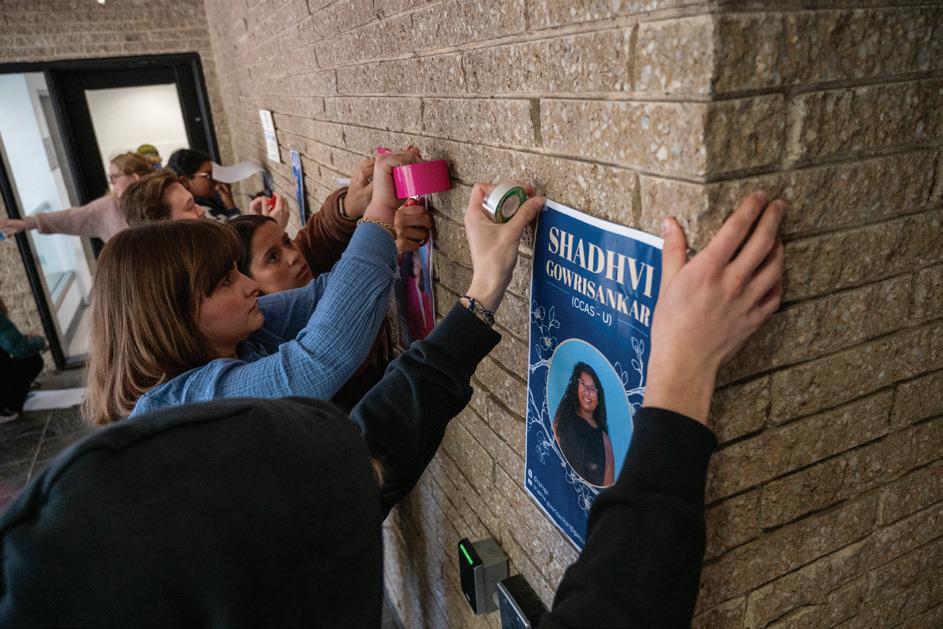
Liz Stoddard’s campaign for Student Government Association vice president didn’t draw sophomore Aimee Okagawa’s attention through its policies — it was the pink that stuck in her mind and encouraged her to sign on this year as manager of Stoddard’s presidential campaign. She’s one of dozens of students now filling the ranks of SGA presidential and vice presidential campaigns, which have ballooned in size this election cycle following the body’s removal of the cap of 12 authorized agents earlier this year, leading to candidates enlisting as many as 40 volunteers to spread their message throughout campus. Thanks to the campaign teams working around the clock to reach potential voters in as many ways as possible, viral TikToks, colorfully taped posters and Instagram infographics have filled students’ feeds and the campus’ hallways in the days leading up to this week’s elections.
The SGA Senate reformed the Joint Elections Commission’s charter earlier this year to raise campaign finance limits and remove
caps on authorized agents — volunteers registered with the JEC to represent a candidate — in an effort to allow SGA campaigns to gain more traction and recruit more students to vote.
Here’s a look at some of this year’s campaigns and their approaches to student outreach: MJ Childs: Powered by the algorithm You may know MJ Childs is running for SGA, thanks to his campaign team’s viral TikToks. Troi Davis, a senior studying marketing and campaign manager for Childs who manages media production, said her strategy to attract audiences requires playing into online algorithms: fast-paced
videos under 60 seconds to hook views and captions to be inclusive for people who can’t hear or prefer listening without volume.
Liz Stoddard: Branding the bob
Liz Stoddard’s campaign manager is seeking to continue a legacy.
Okagawa said the campaign — Stoddard’s third — aims to build up Stoddard’s established brand by continuing the two-year tradition of emphasizing her distinctive style, composed of bright pink attire, pantsuits and, of course, her signature bob. She said the campaign seeks to remind voters of Stoddard’s experience in the SGA by continuing the tradition of pink in posters and duct tape.
MATHYLDA DULIAN | ASSISTANT PHOTO EDITOR Candidates and campaign managers plaster their posters outside the University Student Center.
CARSTEN HOLST | STAFF PHOTOGRAPHER
Student Government Association vice presidential candidate Aicha Sy.
Aicha Sy
KYRA WOOD | ASSISTANT PHOTO EDITOR
Student Government Association vice presidential candidate Cheydon Naleimaile-Evangelista.
SGA Election Guide 2026
Number of SGA senators running for re-election hits three-year low
ISAAC HARTE STAFF WRITER
The Student Government Association Senate is heading into elections with its lowest incumbent return rate in three years, as senators either graduate or decide to step away from the body, leaving a ballot dominated by first-time candidates for the second straight year.
Only three of 16 eligible incumbents are seeking senate re-election this year — with others leaving the body altogether or running for higher office — leaving a ballot of 20 verified senate candidates across all schools, down from 26 last year and 25 in 2024, competing for 39 seats. Twenty-eight of those seats are set to remain vacant if no write-in campaigns win, and nearly three-quarters of candidates on the ballot will be first-timers, more than half of whom are currently first-year students.
The SGA Senate can fill vacant seats throughout the year by voting to appoint students who apply.
Incumbent senators not seeking re-election cited diverging reasons for why they will not be returning to the body, including plans to study abroad and frustration with difficulty accomplishing their initiatives this year and a lack of internal support within the SGA. Eight incumbents ran to retain their seats in last year’s elections, and in 2024
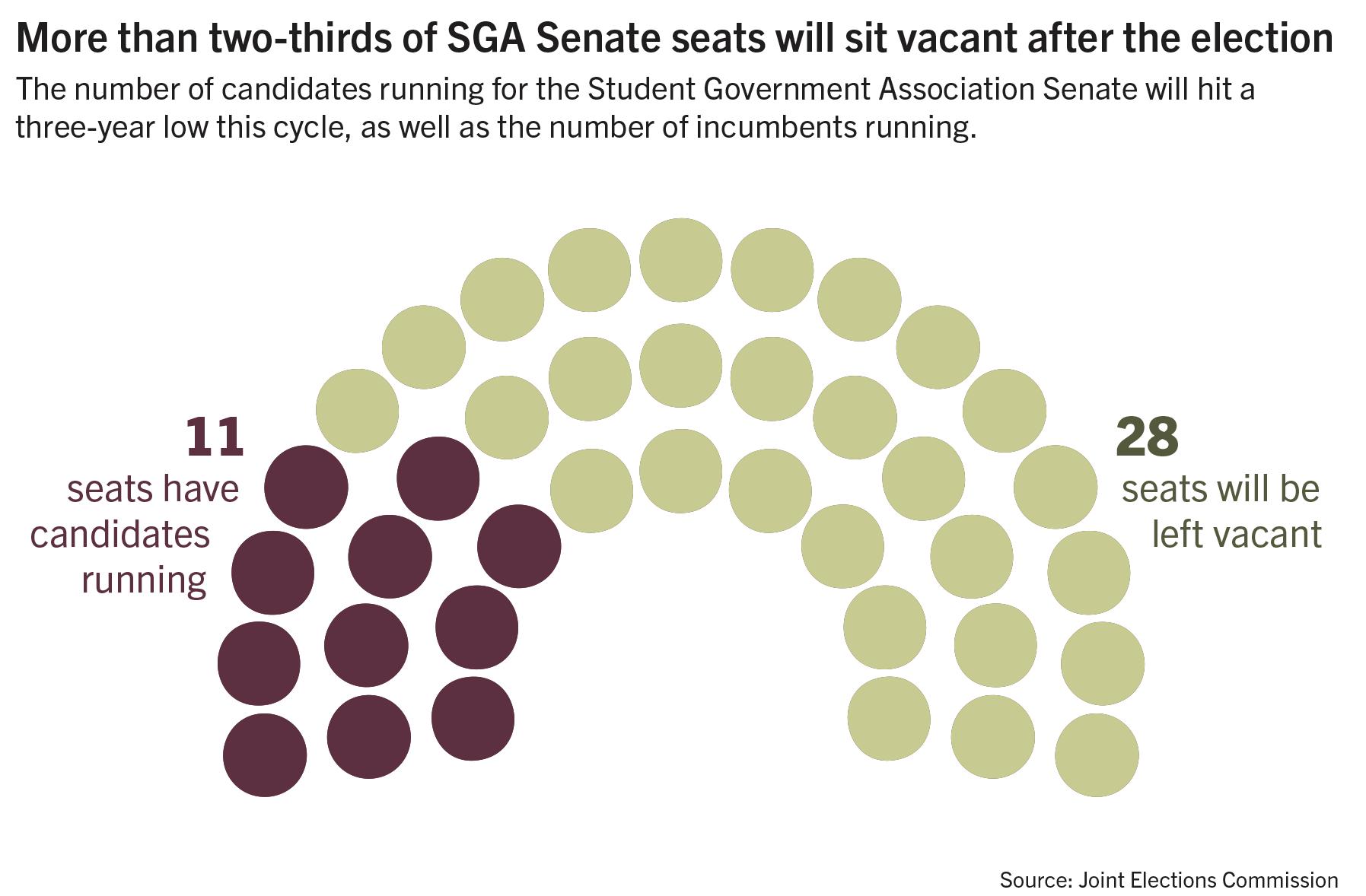
nine candidates ran for re-election.
In 2023, the SGA Senate saw its smallest campaign pool in 21 years, where only 14 students and one incumbent ran. This year, 23 of 42 senators are ineligible to run for re-election due to graduating from their programs, with two others, SGA Sen. Aicha Sy (CCAS-U) and
SGA Sen. Cheydon NaleimaileEvangelista (CCAS-U), staging runs for vice president.
Joint Elections Commissioner Eric Gitson, whose commission is tasked with administering the SGA’s elections and recruiting candidates, said he noticed a lack of incumbents running this year but
does not have a “concrete reason” for the trend. He said there is a “notable number” of seniors graduating from the body, and many others have said they are studying abroad. He said incumbents retiring has opened up new opportunities for first-time candidates to run for
positions in the body, keeping with a trend over the past two years where greater numbers of first-time candidates competed for seats.
Eleven candidates are competing in the undergraduate Columbian College of Arts & Sciences senate race — the largest and most competitive of the elections — marking one more candidate than last year and down from 13 in 2024. The slight growth in the number of candidates competing for a CCAS seat comes as the school is set to lose a senate seat, decreasing from eight to seven due to a slight drop in the school’s undergraduate enrollment.
SGA Sen. Beatriz Salim (CCASU), a sophomore and one of the three senators running for re-election, said the SGA environment is “not the friendliest,” and the workload of reaching out to constituents, student organizations and administrators to accomplish initiatives can be “exhausting.” She said she weighed whether to leave the body but ultimately decided to run to keep her seat because she has “unfinished business,” like working with dining officials to launch a recycling awareness initiative.
“I want to better the environment so people can feel comfortable reaching out to people to ask for help,” Salim said. “That’s my biggest reason for running, just bettering the SGA as a whole, from internal to outside.”
SGA elections
How a short-staffed commission steered this year’s
ADELAIDE PETRAS STAFF WRITER
Behind the proceedings of this year’s Student Government Association elections, an understaffed commission has been holding the process together and candidates accountable.
Despite being shorthanded and thrown into their roles months behind schedule, members of the Joint Elections Commission have managed to run a full election season, complete with candidate forums, the commission’s first candidate disqualification in years and efforts to boost falling student voter turnout. This year’s election watchdogs said they’ve had to learn their roles on the go as they grappled with their late appointments to the commission and ensuring a fair playing field between candidates.
The JEC is responsible for preparing and administering SGA elections, including reaching out to prospective candidates, verifying votes and signatures and enforcing campaign regulations.
This year’s JEC — made up of an all-new slate of members — said election season has been demanding, as they have dealt with first-year SGA presidential candidate Zain Masood’s disqualification, and JEC Commissioner Eric Gitson and other members’ midyear appointments to the commission. The members said the commission was also left with no funding,
leaving them scrambling to stage events, like a Mount Vernon Campus candidate forum and the SGA debate on April 15, though they eventually secured funding from the SGA.
“It’s like you’re fighting a fire at all times because this is typically a process where you would have from September or October all the way until April,” Gitson said.
SGA President Ethan Lynne tapped Gitson to serve as commissioner in January after former JEC Commissioner Alex Wan, whom SGA senators appointed in late October, resigned from the role, only citing a “combination of factors.” Gitson said he received a call from Lynne on the first day of the spring semester asking him to take over the JEC and agreed because Lynne helped him “get his start” in the SGA.
The current JEC consists of three voting members, compared to the
typical five, which JEC members said is due to Gitson’s late appointment, and four non-voting members, including the chief investigator and first-year election assistants. The SGA bylaws require the JEC to have five voting members but allow the commission to function should they not all be appointed by the elections.
Gitson said having fewer voting members than usual has not made a difference in how the commission functions but that being appointed late has increased each individual’s workload because they had to do the same amount of work, like securing funding and recruiting candidates, on a shorter timeline. Last year, Ubis struggled to staff his JEC, appointing friends to fill the five seats he said were not wellversed in JEC regulations.
Gitson said the JEC held a meeting for student organization presidents and senate staffers, to encourage them to run for office.
SGA candidates say officials must take firm stances on
From Page 1
Stoddard has used this approach in her current role as SGA vice president, where she has led town halls to hear student concerns about National Guard presence near campus, pressed officials to make firmer commitments to DEI — as they did in a community message earlier this month — and condemned ICE operations near campus at senate meetings.
“Our advocacy has never been more important because our advocacy can actually lead to real change,” Stoddard said. Stoddard said those running for higher offices in the SGA
cannot be afraid of taking public political stances and must encourage University officials, who she described as “tight-lipped” on issues of student safety and immigration enforcement near campus, to not stay silent for fear of federal retribution. Specifically, Stoddard said officials “dropped the ball” by not making a specific community-wide statement about increased ICE presence on campus. She said officials cannot continue to “hide” crucial information in lengthy newsletters — like the Weekly Federal Update email officials launched in January 2025 — but should instead send shorter, more targeted emails and host more community town halls addressing specific
ICE, DEI
student concerns. Sophomore and SGA presidential candidate MJ Childs said federal policy has extra significance for GW students because of the campus’ proximity to the White House. He said part of the SGA president’s role is to “speak out” about federal policies that could impact students, like ICE operations and Trump’s crackdown on DEI, which he feels Lynne has done effectively during his term as president.
“We cannot pretend that politics don’t affect us because they affect everybody, no matter where your stance is on a political spectrum,” Childs said. Politics is not something you can ignore when heading a student government, Childs said.

Officials must treat students as ‘real partner’ in decision-making: candidates
From Page 1
MJ Childs, a sophomore presidential candidate, has largely centered his platform around a single question: “Where’s my $100k?” — a reference to the University’s rising cost of attendance — making videos walking around campus showing dining locations and the Student Health Center closed. Childs said the “throughline” of his campaign is bridging a gap he sees between students and officials, who he said have vastly different visions of how to balance financial health with student services.
He said officials have made vast cuts to student services this year — like cutting Vex frequencies and slashing rideshare credits for Vern residents — without consulting or properly notifying students before implementing them. He said GW is a tuition-dependent institution, but
the University’s top officials seldom interact with students, leaving a divide between those who make the cuts and those who feel the impact.
“You can’t make those large decisions when you depend on us to have the institution run as a whole,” Childs said.
Childs said if elected SGA president he would work to create more formalized opportunities for faculty, students, staff and top officials to be in the same room to discuss shared priorities through discussion groups that would meet a few times each semester. Childs in his platform calls on the Board of Trustees to create a “studentcentered committee” to assess concerns, develop initiatives to support student life and boost administrator accountability.
The University currently holds a slate of collaborative working groups with students, faculty and staff to discuss shared issues. Officials revived the Joint Committee
of Faculty & Students in January, made up of seven student representatives appointed by the SGA president, seven faculty members and seven administrators, who meet regularly to discuss issues facing the University and potential solutions.
“What is benefiting faculty typically also benefits students as well, and what benefits us benefits them,” Childs said. “Because we’re all here essentially working together. All of us are trying to benefit and also give to this community.”
The Board previously included students in task forces, like one discussing the renaming of on-campus buildings and memorials and another focused on environmental, social and governance responsibility. Officials did not include students in a task force discussing shared governance from 2021-22, though faculty were, as the task force focused on the Board, University administration and faculty’s
roles and responsibilities. SGA Vice President Liz Stoddard, a junior running for the presidency, said University officials see consulting students as a “check box,” sometimes seeking feedback from students on changes but not implementing their recommendations. She said students need to be treated as a “real partner” in decision-making because they support every aspect of the University, from creating community through organizations to working campus jobs and paying tuition. Stoddard said a representative from the Board once spoke at an SGA meeting when she was a senator and told them GW is a “threelegged stool” made up of the Board, the administration and the faculty, and did not mention students as part of GW’s governance. She said that meeting showed her that administrators do not view students as valuable decision-making partners, despite students funding
most of GW’s operations.
“None of those people would get a single cent in their pocket if the students weren’t here,” Stoddard said.
Stoddard said getting students more involved in the decisionmaking process starts with giving the SGA more “legitimacy” among administrators by partnering with other organizations that have the power to pressure officials and create change, like GW’s graduate student union and the Faculty Senate — the only governing body formally incorporated into the University’s shared governance framework. She said partnering with these bodies that have more overt power to pressure the administration rather than advocacy alone could also help the SGA accomplish its desired goals.
“I really honestly think that pushing those relationships and making that stuff happen is really the first step in the door of shared governance,” Stoddard said.
COLLAGE BY MATHYLDA DULIAN
Students frequently raised concerns about Trump-era policies on the campaign trail, candidates say.
KRIS PARK | STAFF PHOTOGRAPHER
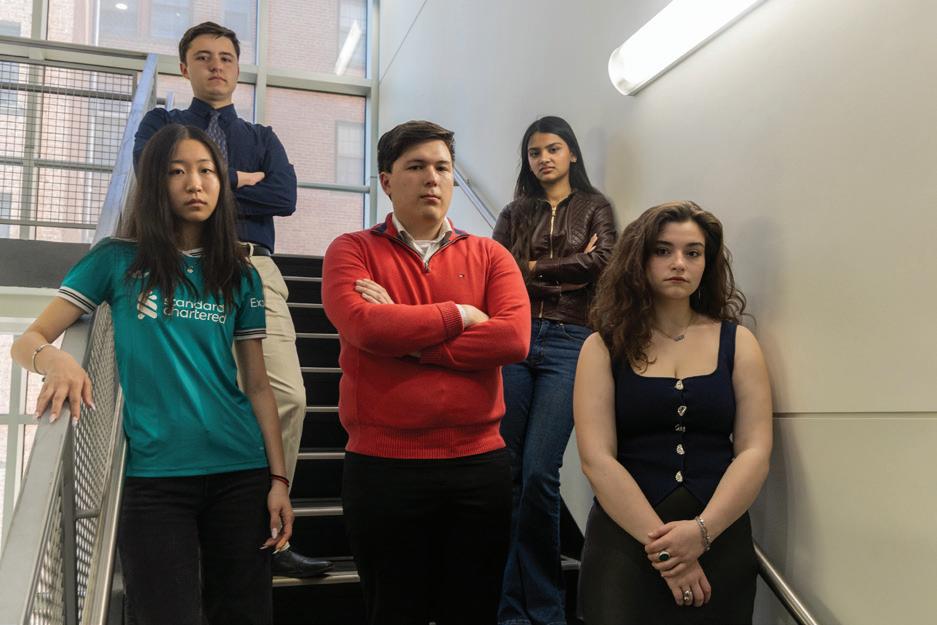
Student Government Association Joint Elections Commission members pose for a portrait.
Student life office operating at just over half of last year’s staffing levels
RYAN
The Division for Student Affairs’ Office of Student Life is operating with nearly half its previous staffing levels after multiple employees departed between last January and October.
Since the start of 2025, the DSA’s student life office lost six staff members — the assistant dean of student life, the director of student involvement, the assistant director of involvement and leadership and three student program associates — roles officials have chosen not to fill, while adding just one new position, an assistant dean of student engagement, according to web archives. A University spokesperson said the DSA spent the past year reviewing its “structure, services and delivery models” to ensure they aligned with students’ needs and GW’s priorities, and as a result of the review, the office decided to purposely leave several positions vacant.
The spokesperson did not say whether officials plan to open job postings for the office’s current vacancies and, if so, when they plan to do so.
“As part of this process, we intentionally decided to leave several positions vacant,” the spokesperson said in an email. “This pause created the necessary space to evaluate how best to organize our teams, clarify functional areas, and ensure we are investing in roles that most directly support student success, involvement, and belonging.”
The Office of Student Life is responsible for student organizations, including approving new student groups and advising existing ones like running the central advisory unit, Org Help. The office is also responsible for organizing fraternities and sororities at the University.
The spokesperson said the staffing changes reflect multiple “natural” transitions in the office, including staff departures and role re-evaluations, rather than a single event or decision. Two former DSA staff members — Assistant Dean of Student Life Brian Joyce and Assistant Director of Involvement and Leadership David Bonilla-Ciferri — confirmed over the summer that they left the University to pursue other professional opportunities.
Former Director of Student Involvement Meredith Bielaska announced her departure in a May LinkedIn post, saying she had hoped the University would be her “new home” but ultimately determined it “wasn’t meant to be.”
Matthew Siegler and Milo Alfarero, student program associates in the office, left the University in June and October, respectively, according to their LinkedIn pages. Bri Guerrero, the third student program associate to depart the University, left sometime between January and May, according to web archives.
Joyce declined to comment on current vacancies, and Bielaska and Alfarero did not return a request for comment. Bonilla-Ciferri, Siegler and Guerrero could not be reached for comment.
The spokesperson declined to comment on individual personnel matters, like why specific people left the University, but confirmed the office redistributed duties to fulfill the student involvement office’s responsibilities. They also declined to comment on why officials added the assistant dean of student engagement position, which they hired Anne Graham for in August, or the role’s responsibilities.
Graham previously worked at GW for over 13 years, coming to the University in 2008 as the assistant director of communications for the Graduate School of Education and Human Development. She came to the Office of Student Life in 2014 as coordinator of student involvement, eventually becoming director of student involvement in January 2020 until March 2022 when she left to work at a software development company in Virginia, according to her LinkedIn.
The office’s current structure reflects a shift toward a “more integrated” approach to student engagement, the spokesperson said, including aligning the office’s structure to strengthen the University’s support for student organizations and the Student Government Association. They said they “reimagined” some roles to reduce duplication and clarify leadership. There are currently no job
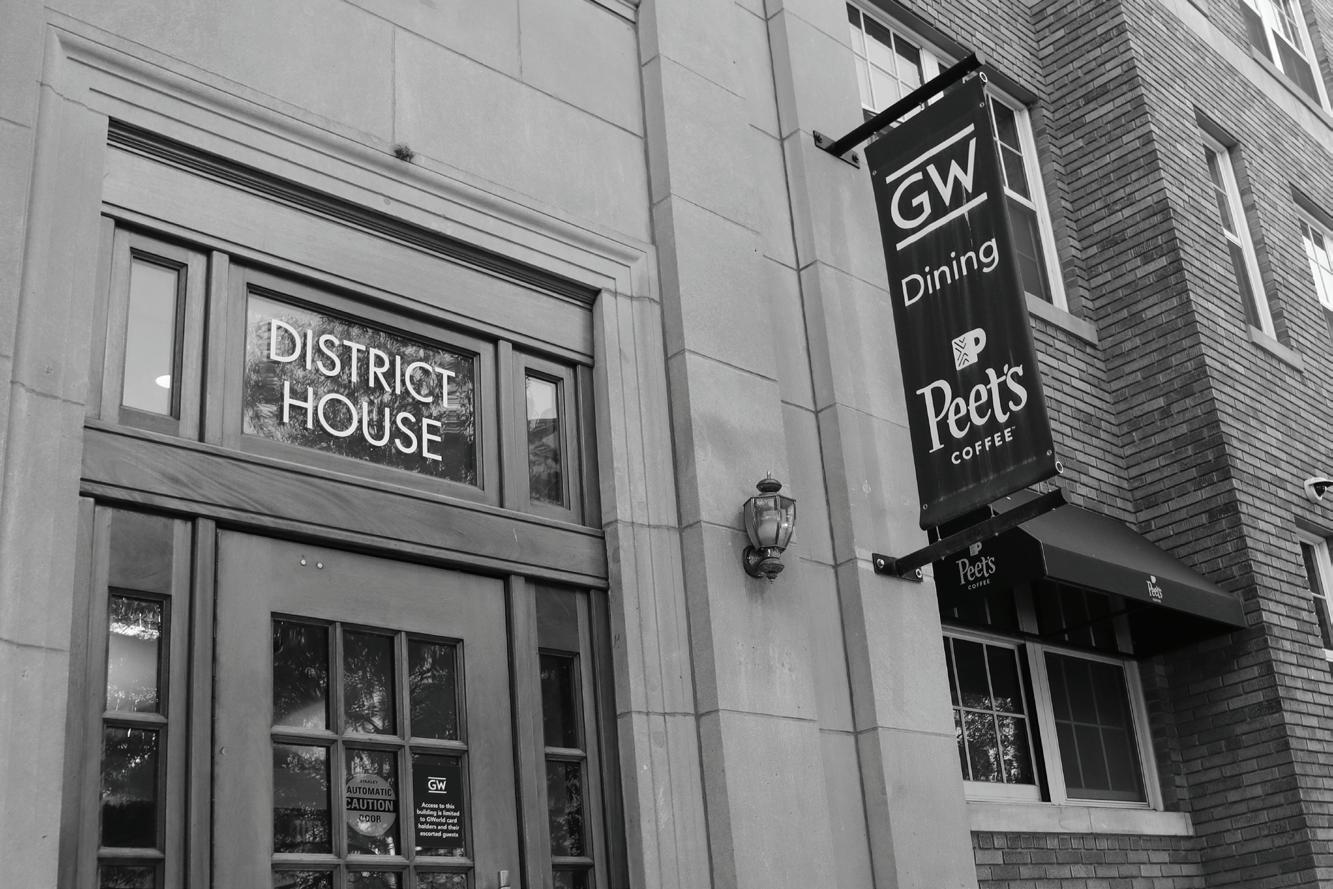
The Peet’s Coffee in District House will close next month after nine years of operation.
University spokesperson Claire Sabin confirmed that Peet’s declined to renew its lease with the University, which expires May 30, and a storefront employee said they will remain open through Commencement weekend. Sabin said Damor Chai Cafe will move into the space, accepting meal deal swipes and dining dollars.
“Once Damor Chai has a set opening date, it will be announced to the GW Community through GW Dining social media accounts and the Hungry Hippo Newsletter,” Sabin said.
Sabin said GW Dining is partnering with Damor Chai to employ student workers to run the cafe, just as current GW students and graduates work at Peet’s.
Damor Chai, an Afghan-American heritage-inspired cafe, currently has two locations at the University at Albany in New York and San Diego State University in California. Its menu offers various protein lattes, matchas and chais as well as bagels, sandwiches and salads.
Officials announced Peet’s would open on the ground floor of District near the I Street entrance, along with five fast-casual restaurant options in the building’s lower level, in August 2016.
Anna Krantz, a spring 2025 GW graduate who has worked at Peet’s for four years, said she and her coworkers had heard officials were looking to replace Peet’s with a GW Dining-run facility but were not expecting it to happen so soon.
“We had heard that they might not want to renew our lease, but that was kind of far in the future,” Krantz
postings for any of the six vacant positions.
Five of the staff departures came after the DSA shut down the formation of new student organizations for 10 months, closing the application process at the end of the spring 2025 semester to re-evaluate the support structures in place for GW’s existing student organizations. Officials reopened applications last month after revising the process to expand the new student organization evaluation rubric and field more community input on the viability and potential liabilities of a new organization.
The departure of Joyce, who now serves as the associate vice president of campus life at Albright College in Reading, Pennsylvania, left one of the office’s higher-ranking positions vacant. During his time as assistant dean of student life, Joyce was a part of DSA’s response to pro-Palestinian protests and events — including the April 2024 pro-Palestinian encampment in University Yard — and debuted a new student organization advising system that categorized student groups into four distinct “pathways” that dictated the amount of advising they would receive based on factors like membership size. He said in a June LinkedIn post his exit from GW would allow him to transition to a new professional opportunity that reconnects him with values he’s had throughout his career.
Bonilla-Ciferri said in June 2025 he left the University mainly due to low salaries and a lack of career advancement opportunities and now works as a multi-unit sales and operations manager at Empire Portfolio Group — which helps oversee multiple Orangetheory Fitness studios across the northeast, including in D.C.
Bielaska served as the advisor for Students for Justice in Palestine for the 2024-25 academic year.
Students
say GW’s education, resources aren’t worth the price
SOFIA ANG REPORTER
As the University’s cost of attendance for undergraduates without aid nears $100,000 next academic year, students say the GW experience and quality of education are not worth the price tag.
Officials late last month announced that tuition will rise by 3 percent for the 2026-27 academic year, bringing the total cost of attendance to $95,155 for new undergraduate students and $98,165 for returning students. More than 50 current undergraduates said the resources GW offers are not sufficient relative to the cost of their education, warning officials that their continued lack of investment will turn students away from attending the University.
During the 2025-26 academic year, officials cut an array of student resources to combat a yearslong budget deficit, including halting a School of Business career mentorship program, canceling some “highly used” journal subscriptions and discontinuing weekend operations for District House and University Student Center dining venues.
Students urged officials to restore funding to resources they cut this academic year and increase support for underfunded services — like facilities, dining, research opportunities and academic advising — in response to the tuition hike, aiming to improve academic quality and student life.
“They’ve been cutting and cutting and cutting all year, and then they turn around and say, ‘Hey, you got to pay more now,’” sophomore Benjamin Rush said. “It’s not great. I’m gonna be completely honest, it feels pretty abusive.”
University spokesperson Julia Garbitt said officials acknowledge budget cuts have impacted some services, but the University has worked “diligently” over the past several months to strengthen its financial position and minimize direct community impacts. She said officials’ decisions to reduce services are informed by data about
each services’ usage, and officials will continue to work with departments and units to minimize impacts on services.
Garbitt said GW is utilizing expanded need-based aid, multi-year scholarship guarantees and income-based tuition-support programs to provide greater predictability and financial stability for students and families. She said GW’s financial plan aims to provide affordability for students — through measures like financial aid as officials outlined in the strategic framework they launched in October — though operating the University is costly due to its more than 24,000 students, location in an expensive metropolitan area and smaller endowment compared to its peers.
Garbitt said a “significant portion” of the proceeds from GW’s $427 million sale of its Virginia campus in February will be used to create a new endowment to advance GW’s strategic framework priorities, like in research, teaching missions and financial aid. University President Ellen Granberg said at the March Faculty Senate meeting the proceeds from the sale will get officials a quarter of the way toward achieving their goal of meeting the full demonstrated financial need of residential undergraduates while also working on a fundraising campaign to help match what’s currently in that endowment.
Seventy percent of GW undergraduate students in 2023-24 academic year received financial aid, with the average grant or scholarship amounts awarded sitting at $37,813, according to the Integrated Postsecondary Education Data System.
Hannah De Lange, a junior majoring in criminal justice and English, said the tuition increase was “disheartening” because she thinks GW’s quality of education has been decreasing, pointing to how she’s seen a decline in the number of humanities classes each semester. She said GW’s cost of attendance is hard to conceptualize because it ranked No. 59 in the 2026 U.S. News & World Report, though students pay more than most of the Ivy League universities.
said. Then, last week, store managers told employees the contract between Peet’s and the University was ending, and the store would be closing, Krantz said. Krantz said customers are disappointed to see the place where they got their morning coffee or afternoon pick-me-up close, adding that the response has been “validating” for employees.
“As much as we’re really sad, seeing the response and the appreciation for us is nice,” Krantz said.
Employees added a sign to their tip jar informing guests of the store’s closure and encouraging them to contribute to the “Peet’s unemployment fund.” Krantz said management told her the store will be open through commencement weekend, which is May 14-17.
Krantz said she is glad the University is not taking a student employ-
ment option away when they replace Peet’s, and she’s enjoyed working a job on campus that was not Federal Work Study, which often comes with limited hours. She also said she will miss the Peet’s culture, adding that the storefront is where she met some of her closest friends and her boyfriend.
“I hope that whatever is there can, even if it’s GW Dining, I hope that it can harbor a similar community because it’s been really a great experience for me,” Krantz said. At a Student Government Association meeting in November, Associate Vice President of Business Services Seth Weinshel said officials were planning to bring more dining options to the Foggy Bottom Campus in the next one to two years, including a coffee shop similar to Buff & Brew, a GW Dining-run coffee shop on the Mount Vernon Campus.
THEFT II/FROM BUILDING
Lisner Auditorium
Reported – 4/8/2026
Open Case
A male GW staff member reported property stolen from a secured area. Case open.
UNLAWFUL ENTRY
JBKO Hall
4/8/2026 – 10:19 a.m.
Closed Case
The GW Police Department responded to a report of an unknown person refusing to leave the building. GWPD barred the person from campus and transported them to GW Hospital for medical treatment. Case closed. Subject barred.
LIQUOR LAW VIOLATION
Guthridge Hall
4/5/2026 – 3:31 a.m.
Closed Case
GWPD and the GW Emergency Response Group responded to a report of an intoxicated female GW student.
EMeRG conducted a medical evaluation and transported the student to GW Hospital for further treatment. Case closed. Referred to Conflict Education & Student Accountability.
HARASSING TELEPHONE
CALLS
District House
4/4/2026 – Multiple times
Closed Case
A female GW student reported receiving harassment phone calls from her boyfriend. Case closed. Referred to Title IX Office.
Peet’s Coffee to close beloved District House location after nine years
ABBY BROWN | STAFF PHOTOGRAPHER
The Peet’s Coffee located inside District House.
JOSH STEINBERG | STAFF PHOTOGRAPHER
The Division for Student Affairs’ office.
NICHOLAS WARE | STAFF PHOTOGRAPHER
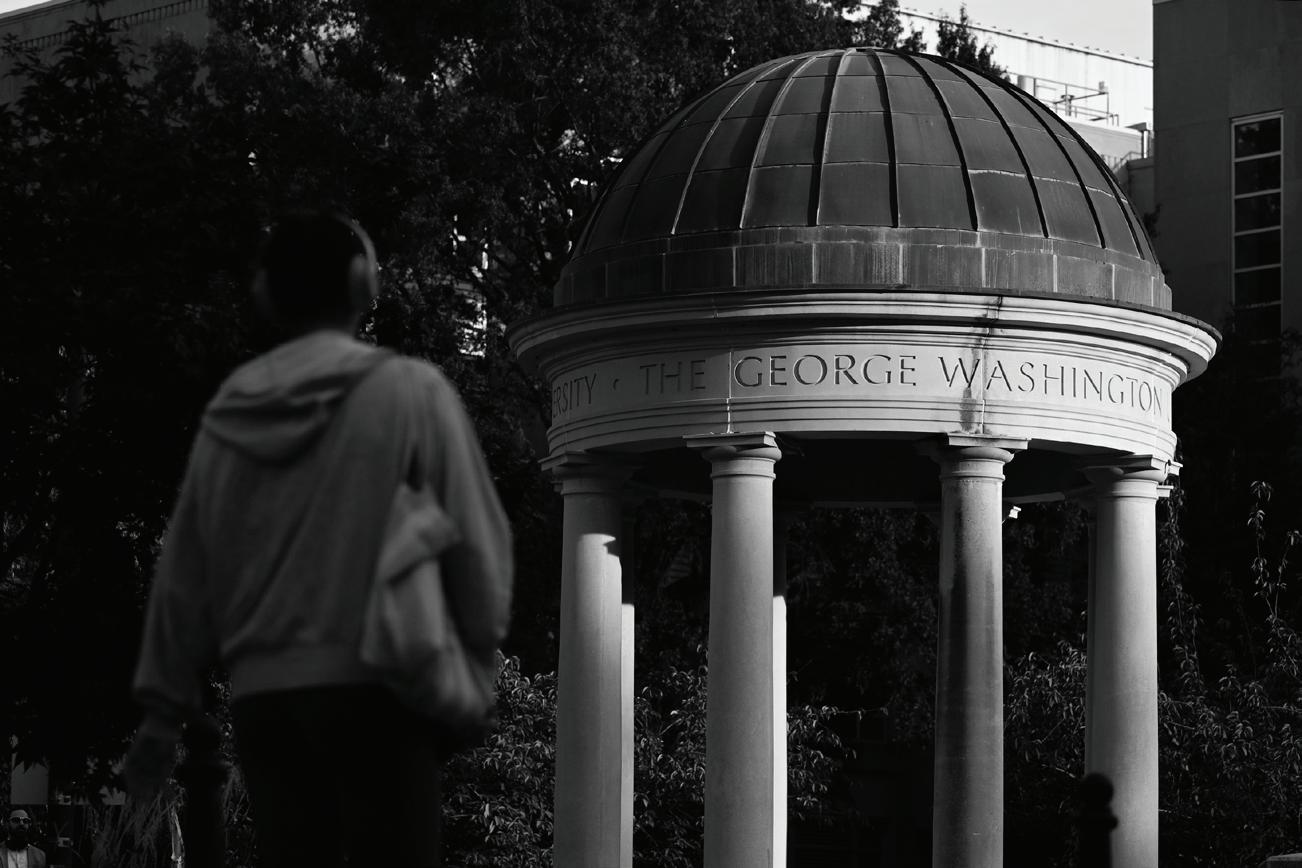
A student walks past the tempietto in Kogan Plaza.
Revered emeritus history professor, military scholar dies at 83
Ronald Spector, an esteemed emeritus history professor, war veteran and author, died on March 26. He was 83.
Spector — who taught history at GW from 1990 until he retired in 2020, serving as a department chair at one point — fought in the Vietnam War for over 13 months before becoming one of the first historians to study the war and its effects on the Americans and the Vietnamese who fought in it. His colleagues remember him as an engaging teacher and a humble presence in the department who never let his “distinguished” legacy as an author of critically acclaimed military history overshadow his interactions with peers and students at lunches and gatherings.
“He was a demanding perfectionist, which makes his books so amazing,” Thomas Long, a professor emeritus of history, said in an email. “At the same time, he was generous and friendly to all his students. He was a great role model and a wonderful friend.”
Born in Pittsburgh, Pennsylvania, in January 1943, Spector received his bachelor’s degree in history from Johns Hopkins University in 1964 and completed his doctorate in history from Yale University in 1967. The same year he graduated from Yale, he was drafted to the Vietnam War, where he served as a combat historian in the U.S. Marine Corps until 1969 and reached the rank of Major. He later joined the Marine Corps Reserve, retiring as Lieutenant Colonel, according to his obituary.
Spector authored several books on U.S. military history, including “Eagle Against the Sun: The American War with Japan” in 1985, which won the Theodore and Franklin Roosevelt Prize in Naval History. The New York Times called the book the “most concise and comprehensive” account of the Pacific Theater during World War II in a book review.
Spector also wrote two books drawing on his time as a combat historian in the Vietnam War, which
unlike other scholars in the field who focused largely on the American perspective, put equal time into researching and writing about the Vietnamese — “Advice and Support: The Early Years of the U.S. Army in Vietnam, 1941-1960” and “After Tet: The Bloodiest Year in Vietnam,” according to his New York Times obituary.
Long said he met with then-chair Spector in 1999, who encouraged him to apply to GW as he was retiring from law and pursuing a doctorate in history, adding that reading “Eagle Against the Sun” influenced him to apply to the University. He said he took several classes Spector taught, with him also serving as one of his dissertation directors.
“He was an extraordinary researcher and an even better writer,” Long said in an email.
History Professor David Silverman said when he arrived at GW, Spector already had a reputation as one of the department’s premier scholars of military history. He said despite Spector’s stature as a premier historian, he always made time out of his busy schedule to meet
and engage with new faculty, adding that Spector would schedule lunches with every single member of the department each year, which made a “real difference” in acclimating Silverman to the school.
“What I remember most fondly about Ron Spector were his wry, sardonic comments about the University administration and the department,” Silverman said. “He was a real crack-up that way.”
Silverman said Spector studied history the “right” way by using empirical evidence instead of allowing himself to be swayed by cultural or social expectations, while making his work understandable to a general audience.
“He believed that that’s part of what’s special about the practice of history, that we don’t have specialized language, that we produce scholarship that is accessible to everybody,” Silverman said.
He said veterans like Spector are becoming increasingly rare in the field of history, and he believes losing the perspective of people who fought for their country has made the field “worse off.”
GWPD quiet on progress toward safety reforms after third-party report
CONTRIBUTING
CONTRIBUTING
Officials have repeatedly declined to disclose the GW Police Department’s progress in implementing a third-party investigation’s recommendations to expand and improve transparency and safety practices after the report found officials bypassed community input when deciding to arm officers.
The Hatchet has directed more than 25 questions since January to GWPD Chief Victor Brito and Associate Vice President for Campus Safety Katie McDonald regarding the third-party recommendations, but University spokespeople have responded to the requests without providing specific updates on officials’ progress implementing them. Willkie Farr & Gallagher’s March 2025 report recommended GW hire a dedicated training officer, create a mental health response team and rapid response unit and build a secure armory as well as arm all sworn officers to better protect campus safety.
University spokesperson Julia Garbitt earlier this month declined to comment on which specific recommendations officials were weighing or implementing.
Garbitt said the University continues to engage with the community and the Campus Safety Advisory Committee, which officials created in April 2024 to increase the GW community’s awareness of and
engagement with campus safety matters, and are using the third-party report’s recommendations to guide GWPD’s future policy.
Officials released the third-party report last march, following The Hatchet’s September 2024 reporting that officials’ arming rollout was riddled with safety violations that went undisclosed to the community, prompting GWPD Chief James Tate to resign.
The report calls on University leadership and the department to engage with faculty, students and staff before implementing changes and to formalize communication channels with campus stakeholders about updates in the department.
Since Chief Brito assumed his post in August, he and McDonald attended a Student Government Association meeting in September and gave a sit-down interview with The Hatchet in October. The University also released an update last month on Brito’s tenure so far, including that the department armed several more officers and that GWPD officers participated in a training that month with the Metropolitan Police Department and D.C. Fire and Emergency Services.
But the department has not provided a comprehensive public update on the status of implementing the third-party recommendations, including whether officials plan to do so and on what timeline. GWPD officials have not provided an update to the full Faculty Senate this academic year,
which a University spokesperson said is because the senate has not requested an update.
The Faculty Senate pressed officials for information on GWPD’s arming decision in October 2023, October 2024 and March 2025. Senators passed a resolution in 2023 asking officials to halt the second phase of arming until they release data on community feedback, questioned Granberg and other officials while calling for greater transparency from GWPD in 2024 about alleged safety violations and said in March 2025 they felt ‘deceived’ by the limited information officials shared about trustees’ decision-making process. The report recommended the University consider arming all officers because the decision to arm only supervisors was Tate’s “alone” and did not result from a discussion of the pros and cons, and Tate only presented the supervisors-only option to the Board of Trustees. The report says arming all officers would “more adequately” protect public safety.
Officials have said the department is not considering moving away from the current hybrid model of arming up to 22 supervisory officers, with McDonald in an interview with The Hatchet in October and at an SGA meeting in September saying the department has no plans to move away from that model and a University spokesperson confirming the department has always adhered to a hybrid model.

Students urge stronger career services as job market concerns grow
Students are calling on the University to better advertise and provide adequate career support as they navigate one of the toughest job and internship markets since the COVID-19 pandemic.
More than 30 students said the University’s career services have not eased their concerns or helped them secure employment in a struggling job market — one some companies predict will be the worst for college graduates in five years by the end of 2026 — citing limited promotion of available resources and often learning about resources, like online networking sites and career advising through friends or professors instead. Despite students’ calls for improved career support, a University spokesperson said GW increased the number of career fairs this academic year from nine to 11, and the Center for Career Services saw an 11.5 percent increase in career coaching appointments over the past year.
Piper Hogg, a senior majoring in international affairs, said she feels GW has advertised few career resources this year, leaving her worried about entering the “rough” job market after graduation. She said she has had to expand her job search beyond D.C. and the federal government, especially as the field she hopes to enter — aiding women internationally — is receiving reduced federal funding.
“When I do look into anything from GW, in terms of like, here are some companies to look into, there are no job postings whatsoever,” Hogg said.
Hogg said that when the University promotes career support, it’s only the resources students are
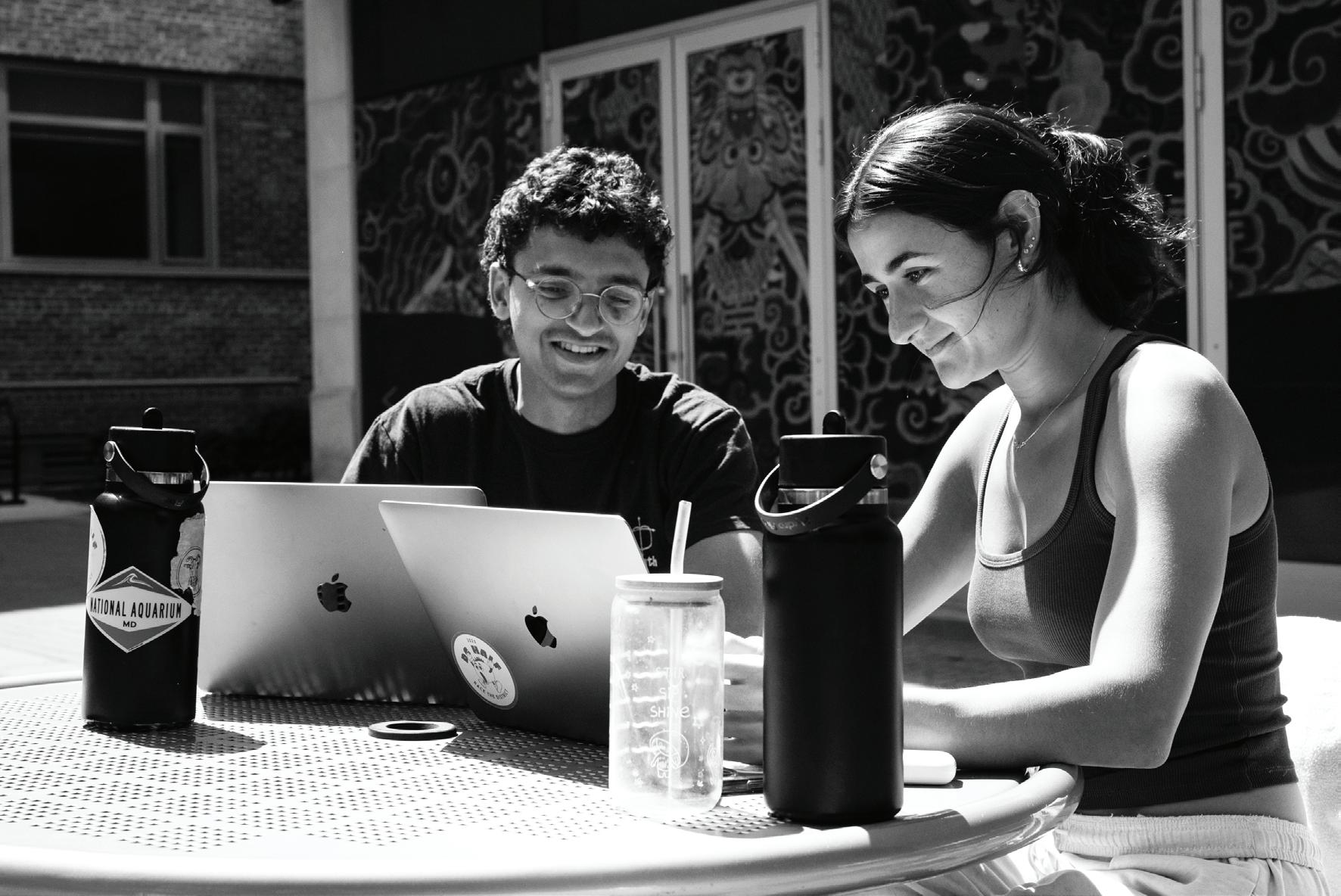
already well aware of like the employment website, Handshake. She said she even learned about GW Career Connect, a platform that connects current students with alumni in their field, from a friend, not from any officials. “The stuff that’s easy to find is so basic, it’s kind of like, ‘Do you think I’m dumb?’” Hogg said. “I know to look at this stuff.”
Asim Ebrahim, a senior majoring in human services and social justice, said while he is looking to go to graduate school first, part of him is still nervous about entering the job market after earning his master’s because he keeps reading negative news about the poor job market for college graduates.
He said he had a professor who encouraged his class to familiarize themselves with many of the professional resources available to him and his peers like GW Career Connect, but if he hadn’t taken that class, he wouldn’t have known they existed. He said even still, resources like Career Connect are “not helpful at all,” adding that other platforms like LinkedIn already exist and serve a similar purpose, while Career Connect is “basic” and “repetitive.”
“I get what they were trying to do with it, but I feel like they kind of put 50 percent into it, and they’re like, ‘Okay, this is as good as it needs to be,’” Ebrahim said.
A University spokesperson said
students receive initial exposure to career services in their First Year Experiences courses and are currently building credited courses in each undergraduate school, where career development managers will serve as instructors. They said the University has numerous outreach efforts for career support, including newsletters, events and offerings through Handshake, as well as a social media presence on Instagram and LinkedIn. Anna Nunes, a first-year history student, said she worries about the current state of the job market because she is unable to find summer internships. She says she finds it difficult to secure entry-level internships without any experience, since
most require prior work experience, based on her interactions with employers at career fairs.
Internship postings on the job site Indeed were down compared with the past five years, slipping below the 2019 level. Handshake reported an average of 109 applications per internship posting in 2025, nearly double from 2024.
“If there’s no opportunities for people of lower experience to get even lower experience jobs, then you can’t really build up at all,” Nunes said.
The entry-level job market is considered to be one of the poorest since the pandemic with an underemployment rate — measuring those with jobs that do not use their skills — of 42.5 percent as employers expect a small increase in hiring and most plan to either freeze hiring or cut jobs this year. The unemployment rate among people aged 22 to 27 with college degrees is near its highest level since the pandemic ended at 5.6 percent.
Nunes said it would be helpful for GW to host a career event with companies that are primarily looking for students to fill entry-level intern positions, something she feels current career fairs don’t offer as employers look for students with higher levels of experience. She said she had previously attended a career fair focused on history and archival studies looking for an entry-level internship, but wasn’t able to find many opportunities for her current experience.
“I felt like going in there I was a little lost, and I didn’t really know what I was supposed to be doing there,” Nunes said.
The University spokesperson said officials have offered more career fairs and expanded their focus to host specialized, industry-focused fairs aligned with students’ academic and career interests.
KAIDEN J. YU | STAFF PHOTOGRAPHER
GW Police Department officers monitor a protest from the sidewalk in October.
NICHOLAS WARE | STAFF PHOTOGRAPHER
Seniors Asim Ibrahim and Piper Hogg work on their computers in University Yard.
COURTESY OF DENVER BRUNSMAN
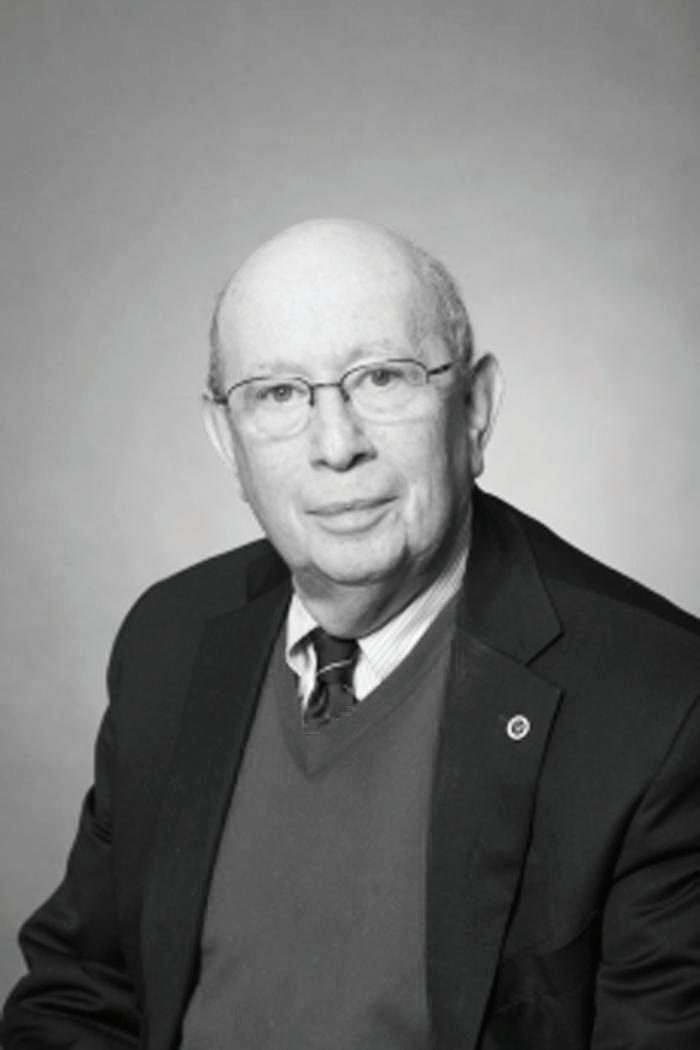
History professor, war veteran and author Ronald Spector.
Foggy Bottom metro fare evasion rebounded in 2025 despite enforcement surge
Fare evasion at the Foggy Bottom-GWU Metro station climbed back to near-2023 levels by the end of 2025, despite the Washington Metropolitan Area Transit Authority’s increased enforcement efforts, new fare gates and President Donald Trump’s ordered National Guard presence at the station.
Transit data show nonpaying entries more than tripled between April 2024 and December 2025, about a year after WMATA installed new fare gates and three months after National Guard troops joined patrols at the station. Transit and public safety researchers said the Foggy Bottom data suggest the enforcement push centered on low-level offenses, and the rebound in non-tapped entries indicates any deterrent effect did not hold.
Station-level fare gate data show the station’s nontapped entry rate, the share of all entries made without tapping a fare card, averaged about 5.4 percent from January 2023 through March 2024, before the District’s Secure D.C. law expanded Metro Transit Police Department’s enforcement powers and WMATA installed more robust fare gates. The rate fell to 1.56 percent in April 2024, then climbed steadily through 2025, returning to 5.37 percent by December — nearly identical to its preenforcement baseline.
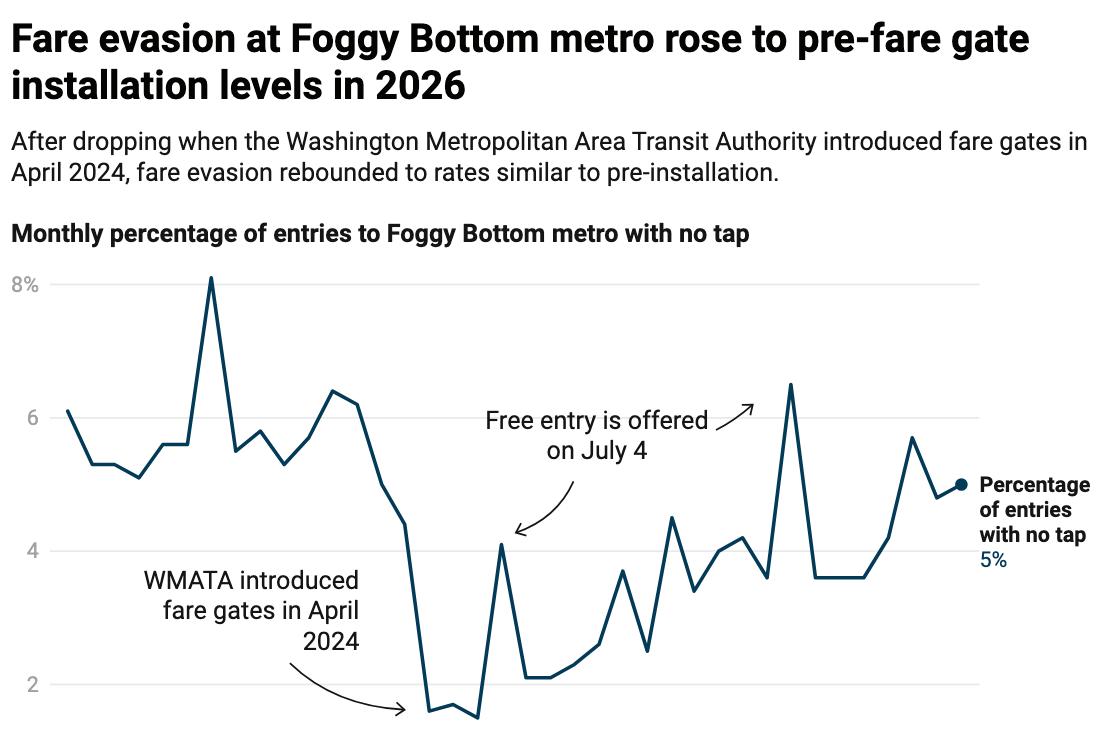
tracking non-tapped entries at the station.
Foggy Bottom logged about 5.16 million total entries in 2025, up from 4.13 million in 2023, and MTPD citations rose from less than one per 100,000 entries to 11.32 — a roughly 14-fold increase on a per-rider basis, according to WMATA data.
Foggy Bottom ranked sixth among D.C. Metro stations for fare-evasion entries in 2024 and 2025, behind Anacostia, Fort Totten, Columbia Heights and Minnesota Avenue, according to the data.
Non-fare evasion crime climbed in 2025 as well, with MTPD recording 46 non-fare crime reports at the station — including 10 assaults, five thefts and two robberies — compared to 29 total nonfare reports in 2024 and 25 in 2023.
Metro began issuing civil citations for fare evasion in 2022, and Ward 2 D.C. Councilmember Brooke Pinto’s Secure D.C. law in 2024 gave MTPD more authority to require identification from riders and arrest those who refused.
WMATA also replaced Foggy Bottom’s fare gates in April 2024 as part of a systemwide modernization ef-
WMATA’s fare gate sensors record passengers who pass through the gates without tapping a fare card as non-tapped entries, whether or not the ride is free — such as on holidays when gates are opened to the public, like July 4. The sensors do not distinguish between deliberate fare evasion and unintentional non-taps caused by equipment malfunctions or insufficient card balances, according to WMATA.
fort — changes that coincided with the sharpest drop in non-tapped entries recorded since the agency began tracking the data in January 2023.
A WMATA spokesperson said the new fare gates have contributed to an 82 percent decrease in systemwide rail fare evasion since installation.
Trump deployed the National Guard across D.C. in August 2025 and sent troops into 10 metro stations, including Foggy Bottom, Anacostia and Gallery Place, according to the Joint Task Force-District of Columbia. A WMATA spokesperson declined to comment on
whether and how WMATA coordinates with the National Guard.
A spokesperson for the Joint Task Force-District of Columbia said guard members do not conduct fare enforcement or possess arrest authority, and their role at stations including Foggy Bottom is limited to maintaining a visible presence and reporting observations to MTPD.
At the Foggy Bottom station, MTPD issued 275 citations in 2024 and 584 in 2025, according to WMATA data. In 2025, 97.8 percent of those citations were for fare evasion alone, rather than for
fare evasion tied to another alleged offense.
To determine enforcement trends at Foggy Bottom, The Hatchet analyzed WMATA’s daily crime blotter, a record MTPD officers generate each time they make an arrest, file a report or issue a citation. Blotter classifications reflect conditions at the time of the report and are subject to change as investigations progress, WMATA said. The Hatchet identified fare evasion entries by filtering for incidents where officers’ written notes contain notations like “F.T.P.,” or “failure to pay,” and cross-referenced with WMATA fare gate data
GW Dining to offer meal swipe discounts for dining hall guests
Officials will introduce a 25 percent discount for guests accompanying students with meal plans at GW Dining halls starting next semester, following Student Government Association advocacy.
Guests accompanying GW students at Shenkman, Thurston and Pelham Commons dining halls will receive a 25 percent discount on their swipes, which cost $12 for breakfast, $17 for lunch and $20 for dinner, starting in fall 2026. Members of the SGA’s Dining Assembly announced that all students, on any dining plan, can bring guests into dining halls for a discounted rate at an SGA meeting last month, and University Spokesperson Claire Sabin confirmed officials made the decision after receiving consistent SGA and student feedback over the past year.
Sabin said students have communicated to the Division for Student Affairs their desire for more flexibility when bringing friends, family members and peers into campus dining halls. Sabin said officials created the discount in response to student feedback asking officials to add guest swipes to meal plans.
“This change is a direct result of student advocacy and ongoing dialogue about how we can make campus dining more accessible and community-centered,” Sabin said. “It reflects our commitment to listening and taking action in ways that enhance the student experience.”
SGA dining team members said they have been advocating for guest swipes for
about two years, but Beatriz Salim (CCAS-U), co-chair of the SGA’s Dining Assembly, who helped advocate for the initiative, said, officials rejected the proposal last year when they brought it to them, saying the system currently used in dining halls could not support guest swipes. Salim said this is a “reoccurring excuse” from dining officials, which has limited what the Dining Assembly can do.
“We almost have to always lower the scope of every single project for them to approve us,” Salim said.
The SGA unanimously passed the Guest Swipes Act in April 2025, sponsored by SGA Sen. Sophie Munson (CCAS-U), calling for officials to implement free guest swipes for families and friends of GW students at the dining halls but did not specify how many guest swipes students should get.
Munson said at the time eight of the University’s 10 peer schools have guest swipes at the dining halls.
Some of GW’s peer schools, like Boston University and Syracuse University, offer meal plans that feature a free guest pass for students to invite their friends and family to the dining hall.
Emma Johnson, one of the SGA’s directors for dining, said when officials rejected the original proposal, the Dining Assembly shifted to advocating for a discount after hearing feedback that students wanted to bring guests like their parents into the dining halls but didn’t want their guests to have to pay full price.
“During our research, we found that other Chartwells locations and locations that use
Officials must reinstate campus resources after tuition spike: students
From Page 5
Garbitt said GW’s rankings don’t “fully capture” the advantages of studying in the District or the opportunities available to students, but they are an “important measure” in determining the value the University provides students.
“I definitely feel like for what I’m paying, I’m not getting as much out of it, like it’s such a substantial amount of money, and I don’t really see tangible effects,” De Lange said.
Ella Wentzel, a sophomore studying biology, said GW’s high price tag is “most certainly” not worth almost $100,000, noting that she believes the University lacks sufficient advising services.
Wentzel said she receives scholarship money from the University, but officials haven’t previously increased her scholarship amount when tuition rose,
making it a struggle for her to keep up with GW’s high cost of attendance.
Sehrin Hossain, a senior majoring in environmental studies, said she is graduating early because as the University increased tuition each year, she found herself unwilling to pay a full four years or study abroad. She said rising tuition should be matched by improvements in academic rigor and access to resources — areas she feels are currently lacking — like better maintained facilities, a more efficient class registration process and a greater availability of required courses, so students can fulfill their requirements on time.
Aryana Morales, a sophomore majoring in Latin American studies, said officials should use a greater percentage of tuition money to increase research resources for undergraduates and opportunities for students given GW’s position as a
top-tier research University. She said the University has instead cut departmental resources, like research opportunities for undergraduates studying Latin America and Hemispheric Studies in the Elliott School of International Affairs, making her feel like many students aren’t getting enough for what they pay to attend GW.
GW first announced plans in late April to cut the University’s budget by 3 percent for fiscal year 2026 to combat “difficult and immediate budget challenges,” like a structural deficit and higher-education “headwinds.”
“We have the opportunity, obviously, with this tuition cost to add more resources, build up students more in their experiences here, and we actively don’t,” Morales said. “It just kind of leaves a bad mark on us.” Officials have raised GW’s tuition every year since 2019.
A WMATA spokesperson said plainclothes and uniformed MTPD officers, Allied Universal Security staff and crisis intervention specialists work at Foggy Bottom and across the system, coordinating with the GW Police Department and GW security officers around the station. The spokesperson said fare evasion throughout the metro system remained at 4.6 percent in the first quarter of fiscal year 2026. Christopher Herrmann, professor of criminal justice at John Jay College, said WMATA implementing cameras, increasing officer deployments and adopting new Secure D.C. policies makes it difficult to credit any single intervention with the drop in evasion. “It sounds like there’s a bunch of other things going on,” Herrmann said.

similar softwares to us did include guest meal swipes, so we were a little confused,” Johnson said.
When the Dining Assembly presented officials with this research, Johnson said they could not get a “straight answer” from them as to what in the current system prevented them from adding guest swipes.
Emma Lin, co-chair of the Dining Assembly, who also helped advocate for the initia-
tive, said GW is a central campus in a major city, meaning a lot of people are coming to visit students and explore, increasing the demand for guest swipes. She said not being able to offer guest swipes into the University’s dining hall “detracts” from the GW experience.
“Although we currently do have a discount, we hope that eventually we’ll still be able to work towards a guest swipe,” Lin said.
Colleagues remember Spector as dedicated historian, friend
From Page 6
“A sense of what the nation stands for and what’s required to keep it standing,” Silverman said. “I think there’s an appropriately deep skepticism about uncritical patriotism in the academy, and yet, at the same time, this is a place that allows us to do what we’re doing.”
Dane Kennedy, a professor emeritus of history and a friend of Spector, said Spector had a “wry disdain” for University administrators and preferred teaching to his role as chair. He said some students might have seen him as “curmudgeonly” at first, but they would always quickly warm up to his curious and engaged presence.
“It didn’t take long for smart students to realize how warm and wise and supportive he really was,”
Kane said in his eulogy at Spector’s funeral, which he shared with The Hatchet.
“Over the years, I’ve been struck by how many deep and lasting relationships he established with his students.”
Kennedy said he and his wife bonded with Spector and his wife over their shared political commitments and love for ethnic foods, like Chinese, Indian and Uyghur restaurants. He said family was their greatest “shared delight,” and they’d often share stories about their children’s careers and grandchildren.
“Family meant everything to Ron, and I’m sure he was comforted in his final days with the knowledge that he had left such a lasting, loving legacy,” Kennedy said in his eulogy.
Denver Brunsman, an associate professor and the chair of the history department, described Spector as one of the “pillars”
of the department, adding that when he first came to GW, Spector immediately reached out asking to get lunch, a tradition the two continued until Spector’s retirement.
“He was the most famous member of the department, based on his bestseller ‘Eagle Against the Sun: The American War with Japan,’ but you wouldn’t have known it by his down-to-earth nature and kindness,” Brunsman said.
Hope Harrison, a professor of history and international affairs, said unlike most academics, Spector was very social, constantly getting lunch with colleagues and hosting parties with his wife at their house for faculty.
“Going through a heart transplant and then cancer, he never complained and was incredibly brave,” Harrison said in an email. “He was a model human being.”
NAOMI BONE-URBINA | PHOTOGRAPHER
A student swipes into Thurston dining hall.
OPINIONS
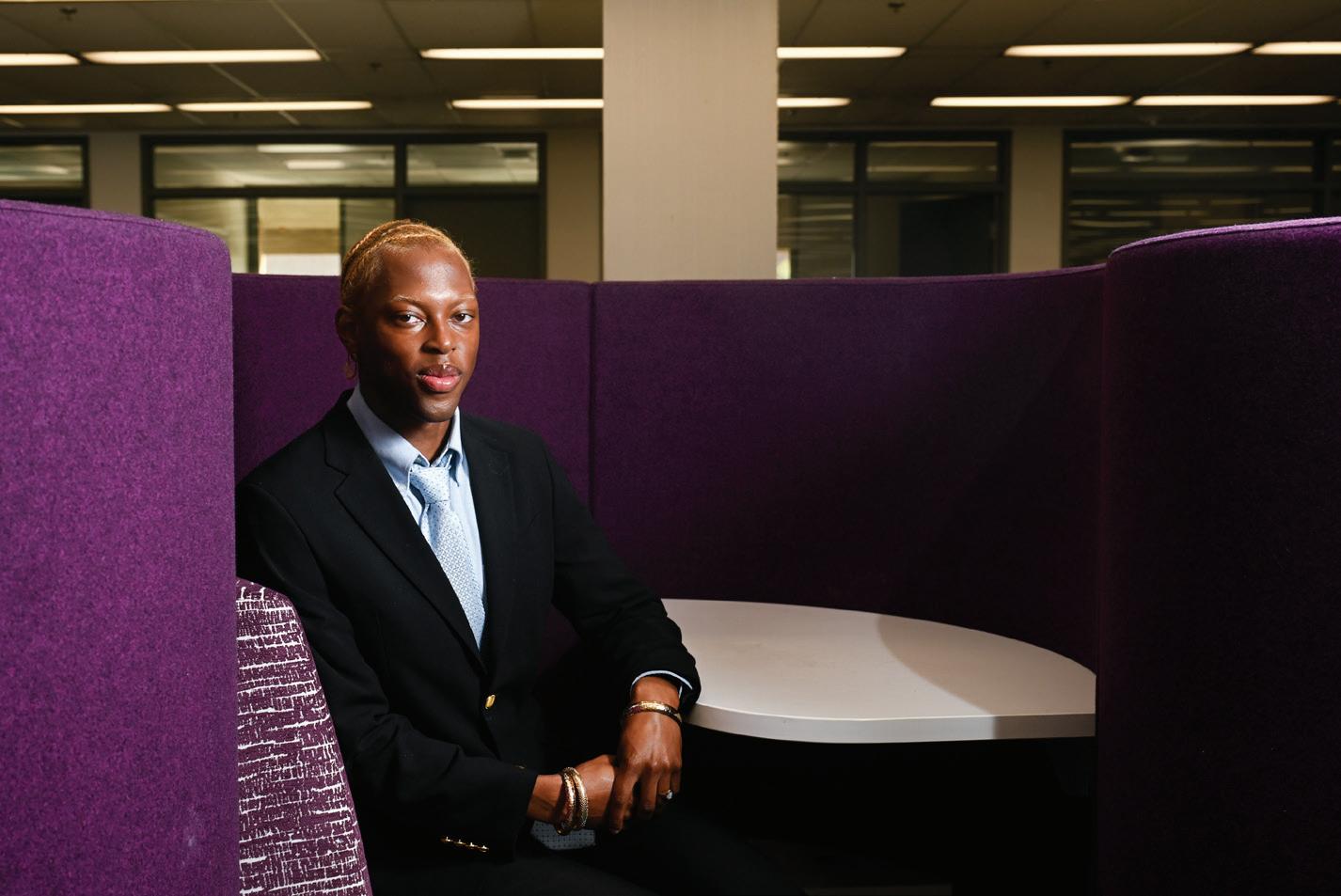
MJ Childs for president
Student Government Association presidential candidate Liz Stoddard says ensuring student concerns are reflected in what University officials hear and act on starts with centering perspectives from outside the SGA bubble. We agree. That is why we are endorsing MJ Childs.
The SGA has long been shrouded in stigma, with many students viewing it as disconnected from real student concerns. Both Stoddard, the body’s current vice president, and Childs, a sophomore and SGA outsider, acknowledged this perception. They said bridging that gap requires grounding SGA priorities in the everyday student experience and ensuring their concerns are reflected in what administrators hear, Our editorial board believes that addressing this stigma requires rebuilding trust in SGA as an accessible, student-facing body. We believe meaningful progress on this front comes from bringing in an outsider.
Childs said many students view the SGA as a “career politician” pipeline, where involvement requires climbing a rigid ladder of positions rather than simply representing peers. He argued that this percep-
Ation creates unnecessary barriers and distracts from the SGA’s core purpose of serving students, not replicating hierarchical politics.
Since launching his campaign, he said he has spoken with groups, like GW Democrats, GW Hillel, College Republicans and the Left Coalition, and plans to continue those conversations with more communities, including multicultural organizations. He emphasized that he is intentionally engaging groups that have historically felt the SGA has not been responsive to their needs.
Stoddard said making the SGA more accessible and inclusive is key to ensuring a broader range of student perspectives are reflected in University decision-making. We believe that, given her role as the body’s vice president and the stigma many students attach to its top posts, the most effective way to drive broader engagement right now is to have the SGA led by an outsider.
What stood out in Childs’ reasoning for running was how rooted it was in everyday student experiences rather than campus politics or internal SGA dynamics. His motivation reinforced the sense that he is connected to the con-
cerns students actually face in their day-to-day lives. Childs also acknowledged that empathy and understanding go both ways, noting that students are sometimes uninformed about institutional matters. He said he is willing to act as a “translator” between University administration and the student body by communicating through videos rather than relying solely on infographics. Childs has the right idea of what effective governing is: mutual understanding and communication.
We’re not arguing that Childs’ platform is perfect. It lacks substantial detail on how he would implement many of his proposed changes. But it reflects a thoughtful, student-centered approach to campus issues.
We are not convinced that Childs currently has a clear roadmap for how he would execute some aspects of his platform. But the editorial board feels this is not the central issue at hand. What matters is that the SGA must meet students where they are right now — and students need to feel that they can bring their concerns forward and be heard. Childs, in our view, is well positioned to do that.
Why officials didn’t include students in the University’s formal shared governance principles. p.1
The next Student Government Association vice president must do more than represent — they must connect. In evaluating candidates for the 2026-27 Student Government Association vice presidency, our editorial board prioritized a clear set of qualities: a demonstrated commitment to the broader GW community, a platform grounded in realistic and actionable policy and a readiness to embrace the legislative demands of the role. The vice president must not only understand the mechanics of student government but also actively work to close the gap between the SGA and the students it represents. We believe SGA Sen. Aicha Sy (CCAS-U) best embodies these priorities and is equipped to lead with both purpose and pragmatism. Sy has a clear understanding of the vice president’s role as a legislative leader, making us confident she has the ability to translate that understanding into action. Throughout her time in the SGA Senate, Sy has demonstrated a consistent commitment to policy work, whether that be her resolution that asked officials to “resist pressure”
from President Donald Trump’s administration to remove diversity, equity and inclusion initiatives or her plan to build a policywriting office as vice president. Plus, we feel her experience as chair of the SGA Senate’s Community, Advocacy and Inclusion Committee gives her a familiarity with both the inner workings of the SGA and the needs of the student groups it serves. Sy’s proposed policywriting office stood out to our editorial board as one of the most tangible ways to strengthen the connection between students and their government. Not only is the policy point fresh — no candidate in past years has proposed such a plan — she recognized that drafting legislation can be an intimidating and often inaccessible process, particularly for students who are not already involved in the SGA. By creating a space where students can receive guidance and actively participate in writing policy, Sy aims to lower that barrier to entry and make the legislative process more inclusive.
Much of Sy’s platform struck our editorial board as both practical and achievable, including
her proposal to expand cultural-food offerings in dining halls. Sy emphasized that “being realistic is what rooted this whole campaign to start with,” a sentiment that consistently came through in both her platform and her explanations of implementation. Without a doubt, SGA Sen. Cheydon NaleimaileEvangelista (CCAS-U)’s “Aloha” spirit shone through his interview, and we appreciated the passion he brought to the table. But we felt his interview and platform did not resonate as strongly with our editorial board, particularly in terms of scope and feasibility — key details we were looking for.
We concluded our conversation with Sy by asking what legacy she hopes to leave behind at the end of her tenure in the SGA. Her response captured both her approach to leadership and the core of her platform: she hopes students will have the “wiggle room to make mistakes and learn new things.” That emphasis on openness and growth extended to her broader vision of the SGA. We believe Sy is well positioned to turn that vision into a more engaged and cohesive campus community as SGA vice president.
As DSS demand doubles, GW must address misuse of accommodations
s a student whose family struggles with disabilities, I felt conflicted when I learned that demand for Disability Support Services at GW doubled over the past few years. It is impossible to ignore the rising lax requirements for proving disabilities, as a means to game the system. Disabilities carry life-altering consequences for affected individuals and their families — they are not to be taken lightly, nor broadly defined. GW must wrestle with this uncomfortable truth, whether or not the story of my family fits the aesthetic narrative of disability our generation has been conditioned to see.
Ethan Vargas Opinions Writer
Over the past decade, the number of college students with disabilities has risen by more than 50 percent nationwide. Among young people living in the United States, autism diagnoses have increased by nearly 300 percent and ADHD by around 42 percent. Data con-
sistently shows that students in wealthier areas — where parents have the resources to spend tens of thousands of dollars on various diagnostic tests — have more academic accommodations. It has led to a phenomenon of affluent families “shopping” for disabilities, so their children can have extended time on examinations, special testing rooms and accommodations in their residence halls.
At GW, the process for proving disabilities is not stringent. Providing proof of disability simply requires one of three documents: a doctor’s note, an accommodation letter from a previous institution or a completed disability verification form that includes a provider’s signature. It is easy, therefore, for students to pursue confirmation of their disability — whether the intent is malicious or not — and receive DSS accommodations. The rapid pace by which accommodations have grown on college campuses implies disability is a common, minor inconvenience on one’s life. In doing so, the stories of individuals who suffer with severe, debilitating disabilities are drowned out by the flood of new diagnoses,
changing the scope of research and treatments as well.
This abuse in the medical system that encourages over diagnosing undermines the struggles of actually disabled individuals. My brother, who has a low-functioning autism and ADHD diagnosis, suffers the real consequences of these diseases. He is nonverbal apart from a few select words and cannot advocate for himself. Every day, he must take specific doses of different medications for various symptoms — the effects ranging from regulating irritability to preventing tonic-clonic seizures. The other boys in his adult living home also share similar experiences. To lump these people into the same category as fully independent college students is a dishonest definition. The rapid rise of the autism and ADHD phenomenon on college campuses, including at GW, minimizes the harsh realities of social work for disabled people.
My brother can never live a normal life because of his condition, and my family has lived through all the debilitating consequences of serious disabilities like autism. It hurts me deeply to think of rich
people and others taking advantage of the system so their children get more accommodations or for self-diagnosing disability as a part of their identity. It can feel like a slap in the face that overshadows people like my brother and the hard work my family puts in to care for him and his needs. I know there are many students at GW who need DSS accommodations, but we need to ensure we have a solid understanding of how serious these disabilities are and not downplay them.
The focus shifts away from them and instead on treatments and therapies for the higher-function end of the spectrum, which continues to stray further away from people like my brother with every new DSM manual authored by the United States medical community. More and more, doctors and the medical community continue to cast autism as a multi-dimensional mosaic of traits, not a disease. Thus, the suffering on the severe end of autism is seen as not needing a cure or treatment, leaving families like mine hopeless.
The breathtaking pace by which the share of students eligible for accommodations at GW has risen im-
plies the University is not immune to this phenomenon. The school has an obligation to treat disabilities seriously for the equitable distribution of resources. T GW cannot tolerate the abuse of this system, and the process for obtaining accommodations must be more stringent. I say all this to spotlight a part of the disabled community often overlooked. I want to remind people that disabilities are not to be glamorized and made into a trend, nor are they to be used for academic benefit. Rather, disabilities carry real suffering for real people and have tremendous consequences on their lives and the lives of their caretakers. The increasing lack of seriousness surrounding disabilities reflects the brokenness of the medical system and a failure on society’s part to recognize overlooked and vulnerable people. GW must understand the true severity of disability and recognize that the unprecedented portion of the student body receiving DSS accommodations hurts our understanding of disability as a whole.
—Ethan Vargas, a first-year majoring in political science, is an opinions writer.
Aicha Sy for vice president
ARWEN CLEMANS | SENIOR PHOTO EDITOR
Student Government Association presidential candidate MJ Childs.
ARWEN CLEMANS | SENIOR PHOTO EDITOR
Student Government Association vice presidential candidate Aicha Sy.
SCENE CULTURE
GW parody account puts political alumni under the magnifying glass
DIANA ANOS CULTURE EDITOR
A new satirical X account is putting GW’s political influence in the spotlight, one buff-and-blue post at a time.
STOP GWU started its operations last month, posting graphics featuring politicians and candidates that currently attend or have graduated from the University to track their “invasive influence in American politics,” and encourage people not to vote for them. The first-year political communications major running the account, who The Hatchet granted anonymity to discuss his work freely, said the account was born out of a “parody venture” to poke fun at the overtly political campus culture at GW.
He said GW’s reputation as a politically active campus inspired the idea, pointing to the visibility of politics both on campus and online. The Princeton Review ranked GW No. 6 on its 2026 list of most politically active student bodies, reinforcing that perception. Plus, over 200 congressional staff members and 13 elected congressional officials are GW alumni, ranging from Sen. Elizabeth Warren (D-MA) and Rep. Johnny Olszewski (D-MD), two people the
account has posted about. The account also warns followers against GW alumni running for congress, like Nate Morris, a Republican running for a Senate seat in Kentucky, and Graham Platner, a Democratic U.S. Senate candidate in Maine.
A post from alum Patrick Burland about a fictional “Stop GWU PAC” influencing midterm elections prompted him to launch the account in late March, he said. Class of 2020 alum Kat Abughazaleh ran for a seat in Illinois’ ninth congressional district and lost in the democratic primary in March to Evanston Mayor Daniel Biss, with 25.9 percent of the vote. He added that the post helped translate an existing joke about GW’s political reach into a format he could build on.
“I have seen it online and also in the GW culture of being known for sometimes overly performative in politics and not in a negative way, of course, but seeing it be posted online,” he said.
The student said he modeled the account after TrackerPAC, which runs projects like TrackAIPAC and TrackOilPAC to monitor political donations from lobbying groups. He said those accounts can be “vicious” toward candidates,
and he wanted STOP GWU to take a more comedic approach while also poking fun at both Democrat and Republicans in attempt to treat all GW-affiliated politicians equally with the same sense of sarcasm.
The student said TrackAIPAC reached out to him on his second day of running the account because they felt STOP GWU was encroaching on their brand, despite it being a parody account. He said they asked him to change the logo due to its perceived similarity to theirs, which he said he’s since rebranded to a more “revolutionary” design featuring a magnifying glass topped with a tricorn hat.
The account amassed more than 1,600 followers in under two weeks, quickly gaining traction online. Its posts have also drawn responses from alums turned politicians, including Rep. Jared Moskowitz (D-FL), who replied, “you found me,” to a post highlighting his GW connection.
“I was somewhat surprised just the acknowledgement,” he said. “It did get larger than I thought it would in such a short time.”
The account also told followers not to vote for Jayden Speed, a current GW senior running to represent Nebraska’s second legislative district, instead
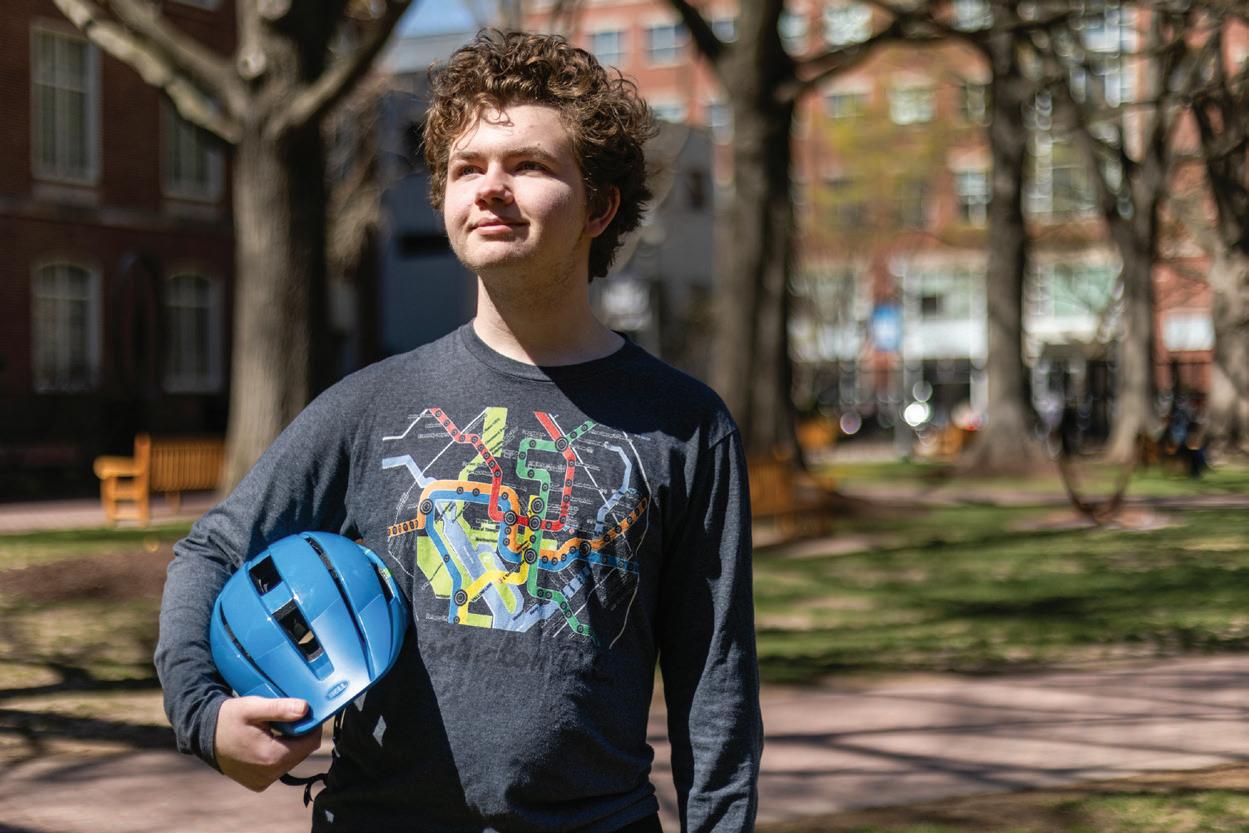
GW Biking advocates for safety as officials shape campus plan
tendance at meetings can grant them a seat at the table of planning these campus changes.
CULTURE EDITOR
A group of GW bicycle enthusiasts has emerged as a prominent advocate for officials to prioritize cyclists’ safety in campus development following a series of collisions in recent years.
As officials devise their 2027 campus plan — an outline of how officials will develop the campus for the next 20 years — and implement the newly launched strategic framework, GW Biking has urged club members to attend planning meetings to advocate for improved safety measures for cyclists around campus and throughout D.C. The organization, whose usual activities include organizing recreational bike rides around the DMV, is advocating for GW and D.C. officials to construct infrastructure to protect pedestrians and cyclists to make the campus and city safer.
The advocacy follows two fatal bike crashes near Foggy Bottom in recent years, including the death of a GW graduate student Nijad Huseynov in 2023 and cyclist Shawn O’Donnell in 2022.
Avery Kane, the advocacy chair of GW Biking, said to prevent future collisions GW and D.C. officials must implement infrastructure developments, like curb extensions on crosswalks and measures to slow cars down, like pedestrian refuge islands in the center of larger avenues where pedestrians can seek refuge while crossing bustling streets.
Kane said the GW Biking members have attended two campus planning meetings this semester, hoping to lay out the club’s vision for a safer campus, which includes making the campus largely “car free” to prioritize pedestrian and cyclist safety. While he said officials have not yet made specific changes because of their advocacy, the group is hoping their at-
GW’s campus plan — which officials designed in 2007 and is set to expire in 2027 — lays out the framework for campus development for the next 20 years. An October presentation on the campus plan notes the campus has “limited protected bike lanes” and said the plan will aim to “enhance pedestrian safety.”
Officials have also worked to ensure the campus plan aligns with the strategic framework, launched in October, which defines the University’s priorities for the next seven to 10 years, including commitments to create a “vibrant and welcoming” campus environment through sustainability initiatives.
Gianluca Carboni, the president of GW Biking, said the club has worked on creating a “united front” this semester to push the University to make changes to the strategic framework, specifically hoping to create new bike lanes and pedestrian walkways in busy areas around campus, like H Street and I Street.
Carboni said the club often works with WABA and the Department of Transportation via email and through attending meetings to advocate for issues like ensuring cars and trucks don’t stop and unload in the middle of bike lanes.
Gabi Susoiu, the events co-chair for GW Biking, said making cyclists feel safe while riding on campus will increase students’ comfort level in using cycling as a reliable mode of transportation. She said the club aims to do this through education on cyclist safety, emphasizing the importance of helmets and increasing the number of safe bike lanes around the city without obstacles in the way.
“If we advocate more for bike safety measures, then more people will feel compelled to bike around the DMV area and see how it’s a very reliable transport and also environmentally friendly,” Susoiu said.
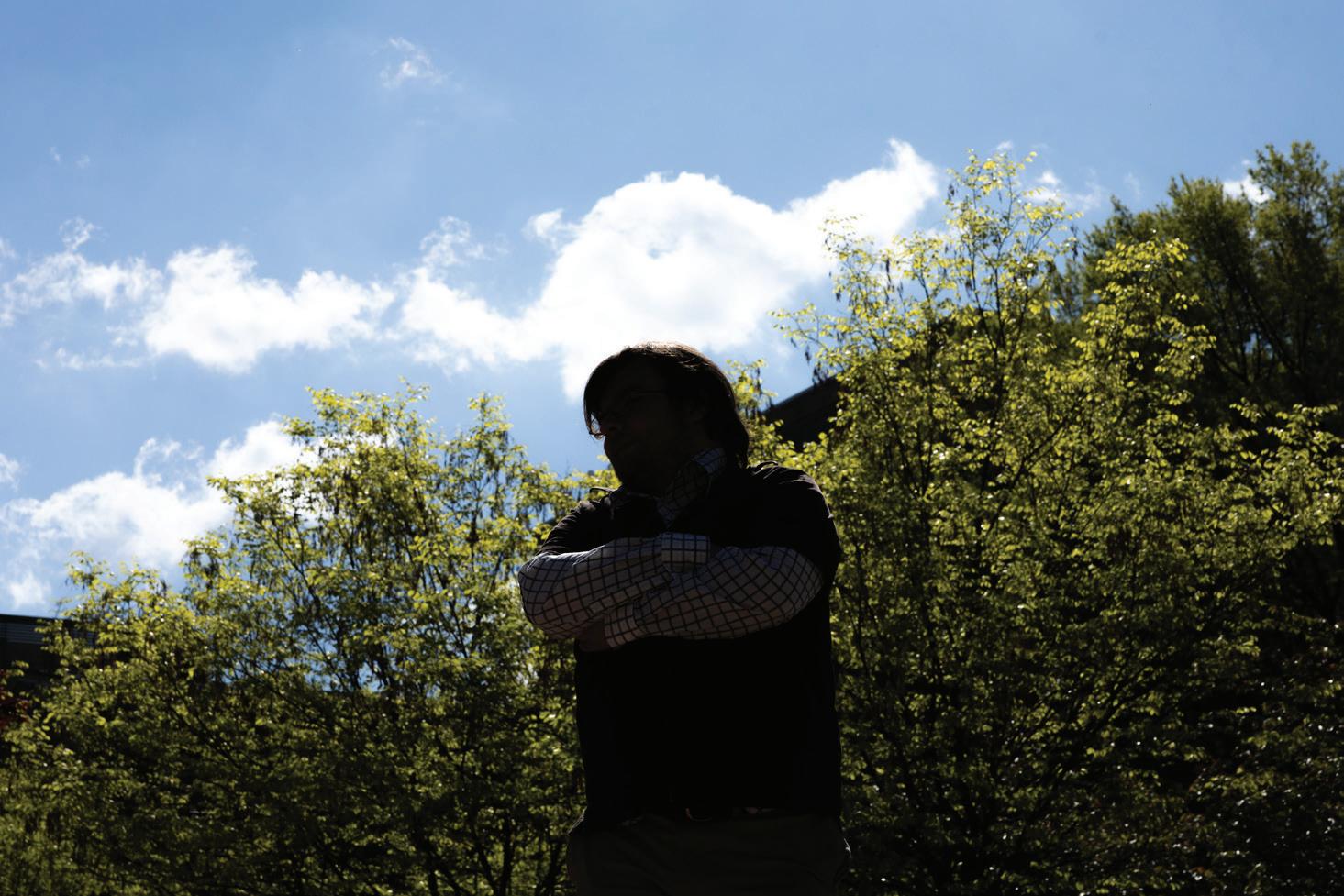
endorsing his primary opponent, Caitlin Knutson, a Creighton University graduate. Speed declined to comment on the matter while campaigning in Nebraska.
Aside from interactions with politicians themselves, the student said he has also had positive engagement with current GW students on the account, noting that politics are deeply embedded in campus culture given students’ frequent internships on Capitol Hill and proximity to the White
House, which makes the
humor especially relatable.
“I haven’t seen any negative responses from the average reply, the average person will follow and like,” he said.
The account caught the attention of FOX Live Zone on March 30 — a segment on the local channel featuring local stories — and discussed the account, saying that it was “bizarre” and that GW alumni can be known as “obnoxious” and “overly political.”
“Obviously this account
is run by some disgruntled somebody that possibly never got a date in college and is mad at other politics or lost a political debate,” one host said.
A political communications major himself, the student said he hopes to go into grassroots organizing and work in campaigns in his future, building “social capital” in political circles at the local and state levels, though he is unsure if he’ll run for office.
“That’s the thousanddollar question,” he said.
Flo Milli rocs the Smith Center steady at Spring Fling concert
Rapper Flo Milli energized the Smith Center at the GW Program Board’s annual Spring Fling event Saturday, performing her biggest hits to a small yet roaring crowd.
Flo Milli — the stage name for Tamia Monique Carter — performed her biggest hits for a moderately sized but passionate crowd of around 100 fans on the floor and attendees sprinkled throughout the stands, anxious to see the rapper. At around 7:30 p.m., attendees formed short lines at the entrances of the Smith Center with enthusiastic fans taking pictures of their outfits and waiting to get to their seats.
Earlier on Saturday, the Program Board hosted a daytime festival in University Yard with local artist performances, like Blake Madison and Pack Light, free food from Wawa and Red Bull, inflatable slides and free Spring Fling merchandise. By the time the band The Montaines closed out the day’s programming around 5:45 p.m., only a small crowd remained in U-Yard. Many students and staff walked past grabbing what remained of the free food and swag but didn’t stay for the final performances.
Before Flo Milli’s set began, Shelailai came out at 8:05 p.m. to perform and hype up the crowd with songs like “By You,” one of her first singles. Although the crowd didn’t know a majority of
the lyrics from her discography, Shelailai interacted with the audience by asking the crowd to put their middle fingers in the air while she sang.
After Shelailai and the Program Board came on, a DJ came on stage at around 9 p.m. to play popular songs from artists like Rihanna and Charli xcx to build up crowd excitement for the main performance. The crowd waited anxiously as the set was delayed by about 15 minutes before Flo Milli came on stage at 9:30 p.m.
Flo Milli started out her performance fashionably late, dressed in a sparkly, pink set with a pink fur jacket and silver, glittery sneakers. Two dancers joined Flo Milli on stage, coming in and out throughout the performance for joint choreography.
Fans danced and sang along to Flo Milli’s upbeat hits, like “Beef FloMix” and “Conceited,” and took pictures with the rapper as she frequently hopped down from the stage to the barricades to greet the crowd. Attendees sang along until she quickly ran off the stage at around 9:55 p.m., about five songs into her set, without warning.
Flo Milli kept the show running and managed to re-energize the audience after the brief lull when she returned, even throwing her jacket to the audience to one lucky crowd member to catch. She thanked the audience for their energy right before ending her set with “Never Lose Me,” one of her biggest hits from
her most recent album “Fine Ho, Stay.” The crowd erupted into their highest energy of the night as the opening bars rang out through the Smith Center.
After announcing Flo Milli as the headline artist March 18, Program Board drove their advertisement game home with Instagram posts, tabling in Kogan and banners around campus leading up to the day of the concert.
Program Board addressed the audience twice — once before Shelailai’s performance and once before Flo Milli made her appearance on stage — telling the crowd that this year’s Spring Fling is different from the past concerts because all ticket proceeds would be donated to World Central Kitchen, a humanitarian organization created by renowned chef and GW Global Food Institute founder José Andrés.
“Throughout this entire week of Buff and Bloom, GW students came together and raised over $23,000 for WCK,” a member of the Program Board said. “Pat yourself on the back because all of you contributed to that tonight.”
As Flo Milli concluded her performance, students exited the Smith Center before the rapper returned to the crowd one last time to take pictures and say goodbye to the amped-up audience.
“Y’all have been a f*cking vibe,” Flo Milli said. “I appreciate all the love, I love you guys. I wish everyone in this mother f*cking room the best.”

AURORA UNDERWOOD | PHOTOGRAPHER
The administrator of the “STOP GWU” X account poses for a portrait.
Students dance to Spring Fling headliner Flo Milli in the Smith Center on Saturday.
MARLENE ORANTES STAFF WRITER
LEXI CRITCHETT | ASSISTANT PHOTO EDITOR
GW Biking Advocacy Chair Avery Kane poses for a portrait in University Yard.
SPORTS

Castro leaves men’s basketball as both product and pillar of program’s turnaround
JADEN DEGRUY REPORTER
Men’s basketball is losing its anchor.
With seven players entering the transfer portal after a disappointing 19-16 season, next year’s squad will be unrecognizable. But the biggest change is coming around the basket, with star forward Rafael Castro out of eligibility after four years of college basketball.
His impact on the team is obvious in the numbers alone — he led the team in points, rebounds, steals and blocks per game while shooting an efficient 62.7% from the field. But his absence this season is even more telling: After a narrow loss to eventual NCAA Tournament team Saint Louis, Castro missed nearly a month with a foot injury, sidelined in a boot and unable to play.
Castro’s absence only magnified the Revolutionaries’ existing struggles with playmaking as they struggled to replicate his presence on both ends of the court. During the six games he missed, GW went 2-4 — two of those losses coming by a single basket — as the team continued to falter in close contests, particularly against strong Atlantic 10 opponents. That stretch ultimately contributed to an 8-10 conference record and a ninth-place seed in the A-10 Championship.
Sidelined during a critical
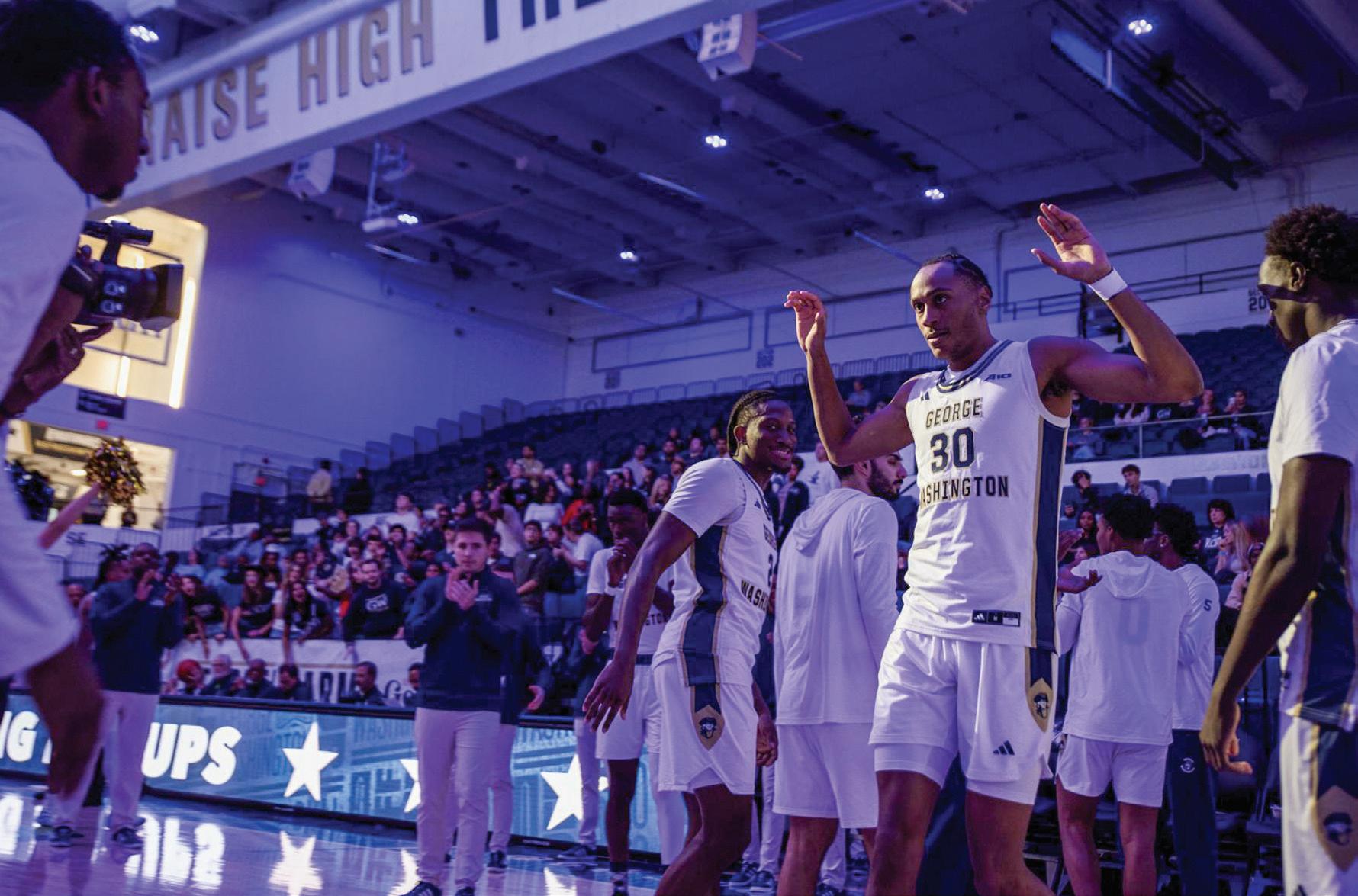
point in the season, Castro said he was forced to adapt, taking on a different kind of leadership role without being able to contribute on the court.
“Obviously, it took a lot of patience,” Castro said. Despite the injury, Castro’s individual performance this season was far from merely decent. Building on a strong debut year, he elevated his play to solidify his
status as one of the A-10’s most impactful two-way players and the clear centerpiece of the program. Plus, his rise coincided with a turnaround for the team. In his two seasons in Foggy Bottom, Castro helped lead the Revs to back-toback postseason appearances, with the 2024-25 squad competing in the inaugural College Basketball Crown tournament and this season’s team reaching the second
Rowing shines at GW Invite as women’s program marks 50 years
GRANT
Rowing swept Duquesne and Fordham on the Potomac at the GW Invite on Saturday, also ringing in celebrations for the team’s 50th anniversary.
The Revolutionaries’ top two varsity eight and varsity four boats beat their opponents by at least five seconds each across the day of racing in their penultimate competition before the Atlantic 10 championships, which the conference will hold at Cooper River in Pennsauken, New Jersey, on May 16. The men’s club first boat lost a tight race to Washington State University and the University of Michigan with under four seconds separating the three teams, but bounced back in the afternoon with a two-second victory over the University of Minnesota Twin Cities and the University of North Carolina at Chapel Hill.
The GW Invite, which the University debuted in 1988, included some of the top club men’s programs, such as second-ranked Bucknell University and ninth-ranked University of Michigan and on the women’s side typically features conference competitors and local teams like Georgetown University.
The women’s varsity eight boat’s sweep included a row of 6:29.52 to Dusquene’s time of 6:38.21, and got even faster in the afternoon crossing the finish line in in 6:24.32 ahead of Fordham.
The varsity four boat also swept its A-10 competition winning both races by nearly twenty seconds with a 7:26.28 in the first race and 7:26.68 in the second race.
As the women’s team nears the end of its 50th season, the year has been a mixed bag, evidenced by their rivalry win over George Mason and their struggles against competitive programs, like Cornell and Princeton. Rhode Island has taken home the women’s A-10 championship the past two years after the Revs won the 2023 crown, but the Rams haven’t yet looked as dominant as in years past. The 2023 season marked the first time in GW history that the team made an appearance at the NCAA championships where they placed 20th.
The American Collegiate Rowing Association ranked
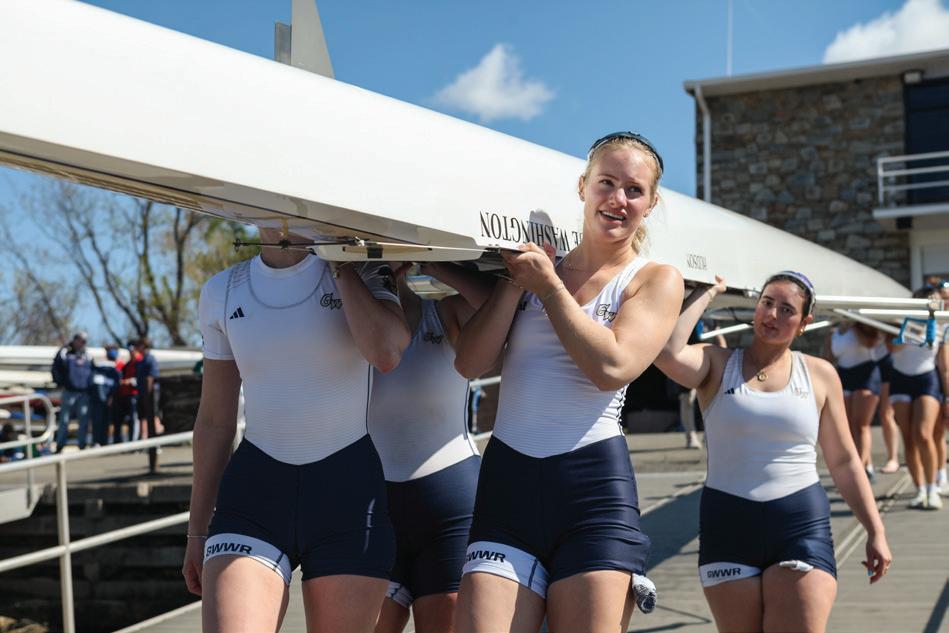

this year’s men’s club varsity eight boat ninth in the nation to start the season, although the team just slipped out of the April 8th poll with Minnesota moving into the top 10.
The men’s program has shifted between club and varsity status throughout its existence, starting out at the club level in 1956 and being adopted by the University as a varsity sport in 1959. A series of University budget cuts in 2021 eliminated the men’s varsity team, however the team has been racing at the club level ever since, and the women’s team remains a varsity program.
Men’s club rowing celebrated their milestone 70th anniversary with a banquet Saturday night that brought together alumni, including one of the original members of the first men’s club rowing team at GW, Sandy Morrison and Olympian Aquil Abdullah, who made history at the 2004 Athens Olympic Games as the first African American rower to represent the United States.
The men’s team three varsity eights all placed last in the first session. After the morning races, Vice President of Men’s Club Rowing Oliver Bjorkman who sat in the second varsity
eight said the team didn’t race as cleanly as they would have liked, adding that they were partially impacted by the windy conditions.
“For our boat personally, we got a little frantic and couldn’t handle the bad conditions,” Bjorkman said.
The team bounced back later in the afternoon with the 1V8 boat taking home the win over North Carolina and Minnesota and the 2V8 boat falling less than a second short of doing the same.
Bjorkman, who did not row prior to enrolling at GW, said he has grown to love rowing although it “sucked” at first. He said he is amazed the team has continued to exist through the support of donors over 70 years.
“We have been through some ups and downs, but it is great that we’ve had 70 years of unbroken rowing, whether the school has cut us or upgraded us,” Bjorkman said.
Looking ahead, the men’s team will have a scrimmage at Rutgers on April 25, followed by the Mid-Atlantic Rowing Conference championship on May 2 in Camden, New Jersey. Women’s Rowing will head to Raleigh for the Lake Wheeler Invite hosted by Duke on April 24 and 25.
round of the NIT. Before his arrival, the program had not appeared in postseason play since 2017.
Castro’s opportunity to perform came after two seasons at Providence College. With the Friars, he played sparingly and showed only flashes of his potential. Castro arrived at GW in April 2024 in search of a larger role and immediately turned that opportunity into production. Using
his size and length to his advantage, he quickly became a consistent force in the paint on both ends of the floor.
In his first season with the Revs, Castro quickly found the playing time he hadn’t seen in the Big East, translating his big stature and long arms into consistent paint scoring and shot blocking.
In his Revs debut, a 76-59 victory over Mercyhurst University on Nov. 5, 2024, he recorded a doubledouble, his first of 13 that season. Castro finished the year leading the team in points and rebounds per game.
This season, Castro once again proved why he was the star of the Revs. He scored in double figures 24 times and notched nine doubledoubles. His season high in points, 27, came in the first game of A-10 play against Richmond.
Now, Castro could be taking his talents to a higher level. Head Coach Chris Caputo said in an interview that Castro “may very well end up in the NBA.” Many draft experts agree, with ESPN placing him at 97 in their Big Board — the thirdhighest mid-major player and a spot for a potential undrafted free agent signing.
Despite being a league hopeful, Castro hasn’t lost sight of the training and patience still needed ahead of the draft.
“I’m just a day-to-day type of dude,” Castro said. “I’m gonna just stay in the gym, stay locked in, you know, stay in shape and just prepare myself for whatever is next to come. It’s in God’s hands.”
Junior stars keep baseball afloat
lected for this mid-season watch list,” Lavey said.
Amid a sluggish first half of the season for baseball (12-22, 6-9 Atlantic 10), a slate of juniors has emerged as a bright spot.
Catcher and first baseman Robbie Lavey, redshirt first baseman and outfielder Charlie Rogan, right-hand pitcher Andrew Cutler and left-hand pitcher Gavin Miller are posting impressive numbers and leading several statistical categories, respectively, as the Revolutionaries try to claw back in the second half of the season. After losing six of their first seven games of the season, the team found its level after sweeping Saint Peter’s University and winning their first A-10 series against Rhode Island.
Lavey, who splits time behind the dish and in the infield, has led the team with a .350 batting average, 27 walks and 43 hits. Ranking among the top five hitters in numerous other categories, Lavey has boasted a .512 slugging percentage, driven in 23 runs and notched four home runs.
Head Coach Gregg Ritchie said Lavey provides a sense of stability for the rest of the team.
“He’s a big life blood of the team,” Ritchie said.
Lavey is on the Buster Posey National Collegiate Catcher of the Year Award Midseason Watchlist, one of just 50 catchers across the country to receive the accolade.
“It’s super cool to be se-
For junior pitchers Gavin Miller and Andrew Cutler, Lavey’s experience and reliability behind the plate make him a vital leader who instills confidence in the rest of the team.
“It’s awesome having Lavey behind the plate,” Cutler said. “He’s just a good player. You get a little bit more confidence in the pitchers having a great catcher back there.”
Miller credits Lavey’s leadership with anchoring the defense.
“He’s truly a gift,” Miller said. “He’s just a leader among men out there and, just to know someone that’s very reliable is behind there, it really helps with the confidence.”
For their own part, Cutler and Miller are providing the Revs with valuable consistency on the mound.
Cutler, who started only one game during his freshman campaign, blossomed into one of the Revs’ key arms during his sophomore season, during which he made 17 appearances, starting four and recorded five saves. Cutler finished his sophomore season with a perfect 6-0 record, in addition to a 4.20 earned run average, and was named to the A-10 All Conference Second Team.
Halfway into the spring, Cutler has made nine starting appearances, tallied four wins and kept his ERA to 4.44.
Rogan, who transferred from Wichita State after forgoing his freshman season, is also having an explosive year. He currently leads the team in slugging percentage at .550 and home runs, having knocked 10. Rogan also boasts a team-best 71 total bases in 129 at-bats.
Having already surpassed his home run total from his first two seasons at GW combined, Rogan’s offensive improvement comes alongside his reliability on the field. After leading the team with 326 putouts last season, he currently ranks fifth in the Atlantic 10 for putouts, with 231.
The on-field impact of juniors, like Lavey, Rogan, Miller and Cutler, is a testament to the tight knit culture of the team — a bond Cutler says contributes to their on field chemistry.
“When you’re closer off the field and play closer, like we’re better friends with each other,” Cutler said.
That tight-knit culture is something that the players collectively agree with, with Lavey saying that’s exactly the type of relationship he hopes to foster during his time playing for GW. He said that everybody he’s played with during his career has impacted him and tries his best to be a positive presence for everyone he comes across.
“That’s kind of the way I try to live my life, the way that I’m trying to do at GW,” Lavey said.
As for Miller, he is in the midst of a breakout season despite the Revs’ losing record. In 12 appearances, Miller has recorded three wins in 26.1 innings pitched, keeping his ERA to an impressive 2.05 and solidifying himself as one of the team’s most dependable bullpen arms.
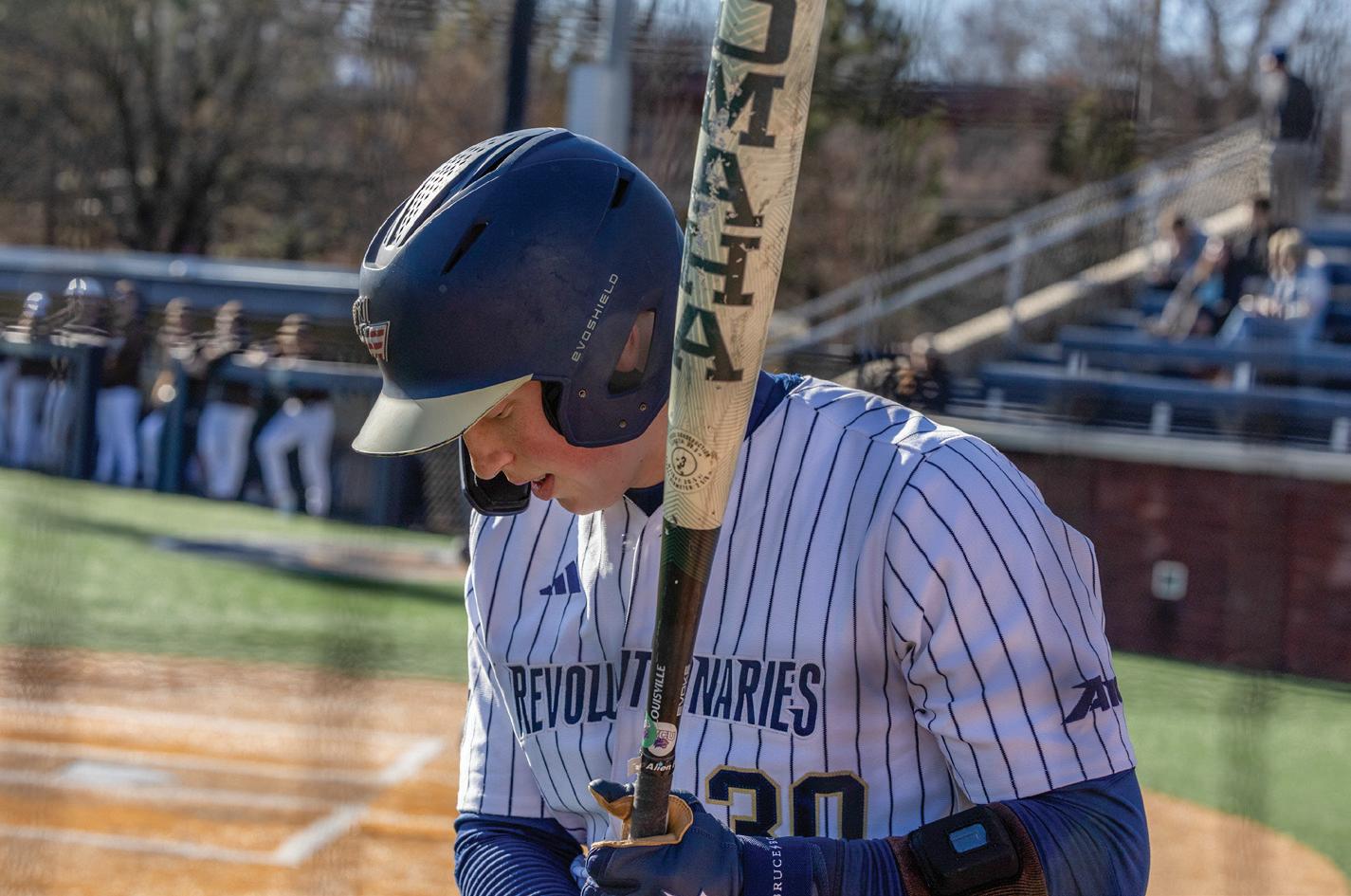
KRIS PARK | STAFF PHOTOGRAPHER
Junior catcher and first basemen Robbie Lavey prepares to bat.
LEXI CRITCHETT | ASSISTANT PHOTO EDITOR
Redshirt senior center Rafael Castro walks out during the starting lineup announcements in November.
JESSIE ZHAO | STAFF PHOTOGRAPHER Members of the women’s rowing team carry a shell to the water.
JESSIE ZHAO | STAFF PHOTOGRAPHER Members of the men’s rowing team compete in Saturday’s regatta.
MILO ROSENZWEIG STAFF WRITER
SOPHIA CAPUTO STAFF WRITER