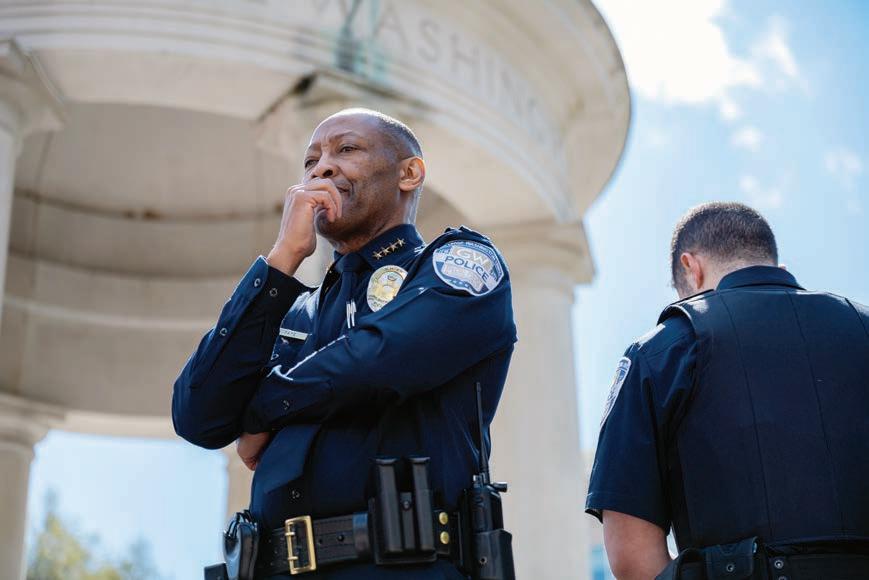
Former GW Police Department officers said the yearlong rollout of the controversial plan to arm some police officers was riddled with safety violations that went undisclosed to the community.
Former officers ranked at the sergeant level or above said the department initially failed to register the guns that the force’s top two officers carried and lacked rigorous firearm training that prepared officers to respond to major emergencies, like an active shooter. Interviews with six former officers, human resources reports and emails reveal that the volume of departmental safety concerns related to the arming rollout triggered mass officer departures in the last year, with the force’s current reduced personnel aggravating the former officers’ existing campus safety concerns.
The allegations contrast with the gun safety policies and commitments that GWPD Chief James Tate and officials outlined for the department alongside the Board of Trustees’ decision to arm about 20 supervisory GWPD officers in April 2023 in response to growing national gun violence and shootings on college campuses, a contentious decision met with opposing protests and letters.
Upon the announcement, officials said arming officers would enhance public safety on campus by allowing GWPD to more immediately and effectively respond to developing emergencies in GW’s “densely populated setting.”
“I feel bad for the GW community, because you’ve been lied to,” said Ryan Monteiro, a former sergeant since January 2022 who left in May. “The arming program was a disaster. It was an absolute disaster.”
Officials completed the final phase of the plan’s rollout ear-
lier this month, saying 22 officers would carry handguns once GWPD fills vacancies. But in the face of department turnover, about six or seven officers are currently armed, Monteiro said. The Hatchet directed more than a dozen questions about firearm training, alleged firearms policy violations and department turnover to Tate or Vice President for Safety and Operations Baxter Goodly, who oversees GWPD. Goodly said the University doesn’t comment on specific personnel matters but said officials take allegations of workplace concerns seriously and that armed supervisors meet “extensive training, certification and safety requirements.” He said all weapons issued to GWPD officers are properly registered. “Effective training for all GWPD personnel is evaluated
Trustees report endowment drop, condemn vandalism
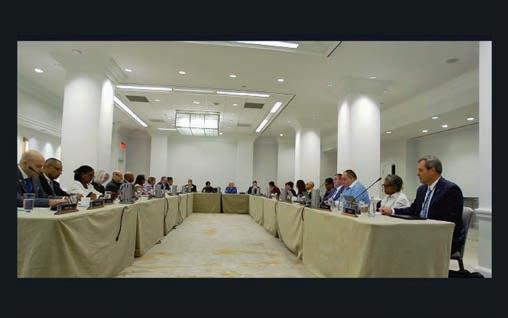
Trustees announced that GW’s endowment dropped $200 million this quarter at a meeting held in a hybrid capacity Friday, with the Board of Trustees chair condemning “attacks of vandalism” that some trustees experienced last week.
Board Chair Grace Speights said there are “real and complex” issues and tragedies confronting the world, but they will not be addressed through “destructive activities” that “threaten individual safety,” pointing to a University release last week that expressed concerns about reports of pro-Palestinian demonstrators spray-painting outside the homes of several trustees and distributing letters about the University’s alleged role in the war in Gaza to their neighbors. Trustee Michelle Rubin also said the University’s endowment stands at $2.6 billion as of June 30 — $200 million less than trustees’ last report in May, returning GW’s financial foundation to the level it stood at the end of 2023.
“This type of behavior undercuts meaningful and productive dialog and stands in stark contrast to our community values,” Speights said.
University spokesperson Julia Metjian said deans, the Board observers, like
the Student Government Association president, Staff Council president and other senior officials, were invited to participate virtually Thursday before officials moved the meeting location officially.
She said officials moved the meeting to another space to limit any disruption to the “academic operations” and “student experience” in the student center. Metjian declined to say where the Board meeting was held.
Rubin, who gave Board Secretary Ave Tucker’s Committee on Finance and Investments report because he was absent from the meeting, said the University’s endowment now stands at $2.6 billion, but GW’s financial performance and liquidity positions remain strong, “especially” relative to GW’s peer institutions.
A drop in endowment means the University’s pool for endowed professorships, scholarships, research and facilities has shrunk, but the University’s endowment has grown exponentially in recent years. In March 2021, the endowment sat at $1.803 billion and increased by $1 billion by May 2024.
“Despite continued uncertainty in the markets, GW’s pooled endowment has outperformed the benchmarks,” Rubin said, but she did not discuss the endowment drop or specify what caused the fall.
continually to ensure continuous improvement and to maintain best practices,” Goodly said in an email. “The safety and security of all students, faculty, and staff remains GW’s top priority.”
Arming training
Officials in June 2023 outlined training requirements for armed officers, which included a police academy course with two weeks of firearms training, a 56-hour firearms training course and the use of a virtual training simulator, a $50,000 piece of equipment. When announcing the arming implementation plan in August 2023, officials described the training for armed officers as “robust.”
But former supervisors said the requirements were basic and didn’t adequately prepare officers to use handguns or respond to armed emergencies, especially if other local law enforcement agen-
cies, like the U.S. Secret Service and Metropolitan Police Department, take longer to respond and lack access to campus buildings.
The former officers said the 56-hour firearms course is minimal and meant for security guards who have never operated a firearm, not armed police officers. Others said GWPD leaders also used the virtual training simulator as a replacement for inperson scenario-based training, which would involve the department practicing its response to an active shooter as a team in a more realistic setting.
“The presentation to the outside community, outside of GWPD, is drastically different than what’s inside GWPD,” said Former Captain of Operations Gabe Mullinax, who left the department in April.
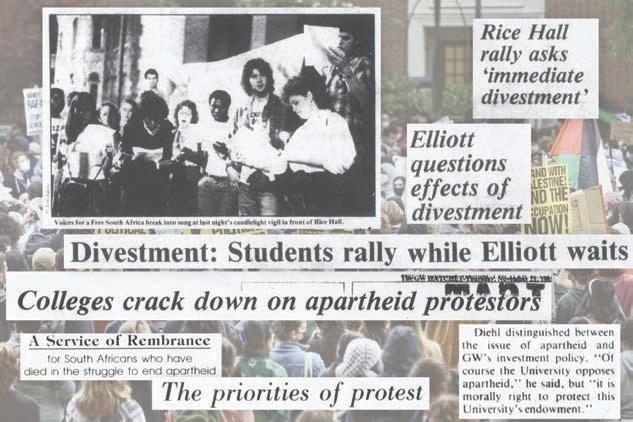
When then-University President Lloyd Elliott announced that GW would not divest from companies tied to South Africa in April 1986, he had engaged in months of forums about divestment with the Student Government Association, Faculty Senate and other stakeholders.
Now, almost 40 years later, student protesters at GW and across the country have a similar demand — divest from all companies with ties to Israel, as the country’s government continues a military assault on the Gaza Strip following Hamas’ attack on Israel in October. GW has since similarly maintained that they won’t divest.
But this time, officials have kept their decision-making process on rejecting divestment from companies that provide arms to Israel more privately, to the chagrin of faculty and students who call for more financial transparency.
University President Ellen Granberg, Provost Chris Bracey, Chief Financial Officer Bruno Fernandes and Dean of Students Colette Coleman invited seven pro-Palestinian student organizations to a meeting in May, two days after local police arrested 33 pro-Palestinian demonstrators after encamping in University Yard to protest Israel’s war in Gaza. Officials said they planned to discuss issues raised during protests like free speech and Islamophobia on campus but will not consider changes to its endowment investment strategy, academic partnerships or student conduct processes.
Pro-Palestinian demonstrators protest quarterly Board of Trustees meeting
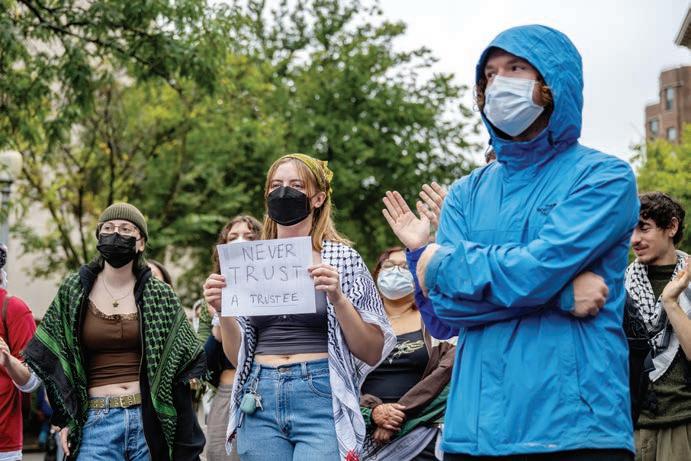
About 40 pro-Palestinian protesters stood outside of the University Student Center on Friday to call out the Board of Trustees during their first meeting of the academic year, continuing months of protest against the University’s decision to not divest from Israel.
In the demonstration organized by DMV Students for Justice in Palestine, protesters gathered at James Monroe Park at 9:30 a.m. — thirty minutes after the meeting’s scheduled start time — and marched to the student center, where the Board typically meets.
Five students from the Student Coalition for Palestine at GWU, the Muslim Students’ Association and the Lebanese Student Association spoke to the crowd and said they would continue to protest on campus until the Board meets their demands for financial disclosure and divestment from Israel.
University Spokesperson Julia Metjian said the Board moved their meeting to another location to ensure they did not disrupt “academic operations” and “student experience” in the student center. She said officials on Thursday invited Board observers, deans and other senior administrators to attend the meeting virtually, before moving the location of the meeting.
Demonstrators at James Monroe Park initiated chants of “We will honor all our martyrs, all our siblings, sisters and brothers,” while standing in a circle, clapping to the beat of the chant. The crowd began marching on Pennsylvania Avenue toward 21st Street at 9:54 a.m., while more
than a dozen Metropolitan Police Department cars trailed behind, closing off the streets that protesters walked through. Four minutes later, protesters stopped in front of the 21st Street entrance to the student center, chanting “Board of Trustees have some shame, all our martyrs have a name” and “Stop funding genocide,” before turning the corner to gather in front of the H Street entrance. The group continued chanting for about an hour and a half, while some organizers handed out flyers to passersby that outlined the coalition’s divestment and disclosure demands.
The protesters are demanding that GW disclose all investments and funding sources for the endowment, donations, externally funded research and the decision-making process around finances, according to the flyer.
A second flyer read “Meet your trustees 4 out of 20 war criminals & genocide profiteers.” The flyer claimed that Board Chair Grace Speights defends corporations in discrimination cases and “purport-
edly supports” Israel and outlined two trustees’ connections to Israel. Jefferey Flaks partnered with the Israeli Innovation Authority, the investment arm of the Israeli government, and Charles Bendit was honored by Israel bonds and awarded the Israel Peace Medal, the flyer reads. The flyer also states that Bendit’s real estate firm is buying buildings and land in Manhattan’s cheapest neighborhood, which the flyer says would likely displace Dominican residents. The flyer claims that Board member Ali Kolaghassi trapped thousands of South Asian workers without food in Saudi Arabia and served as the Senior Advisor to Lebanese Prime Minister Saad Hariri, who was forced to resign in 2019 after embezzling money and electricity.
A representative from the Student Coalition for Palestine at GWU said the Board plays an integral role in developing the University’s endowed resources and participates in their strategic initiatives. They added that the University has a $2.8 billion endowment, part of which goes
toward weapon manufacturers that collaborate with Israel.
“Most of these trustees, in their own personal endeavors, too, have direct ties to Zionism,” the representative said in a speech.
“Charles Bendit won an Israeli war bonds award, and Jeffrey Flaks is partnered with the Israeli government’s investment arm. For each of these trustees at this university, the ties only run deeper.”
Last Wednesday, proPalestinian demonstrators allegedly spray-painted in front of the homes of several Board members and sent letters about the University’s alleged role in the war in Gaza, according to an anonymous submission to the coalition’s Instagram.
During a speech at the protest, a representative from the Muslim Students Association said officials have told coalition representatives that they cannot divest from a specific industry but noted the Board in 2020 committed to divesting from fossil fuels.
“What they’re saying is that divestment for our people is not possible,” the MSA representative said.
DANIEL HEUER | ASSISTANT PHOTO EDITOR Students protested trustees outside the University Student Center on Friday.
DANIEL HEUER | ASSISTANT PHOTO
HANNAH MARR
GW
denied
requests to divest from apartheid and Israel, but their communication style has changed
Pro-Palestinian protesters have since met with University officials several times to discuss their disclosure and divestment demands, but earlier this month, students said they “walked away” from their fourth meeting after determining the talks wouldn’t result in “material outcomes.” Students met with two Office of the Provost officials, who said they had only been involved with discussions about the protesters’ demands “for a few days.”
Fernandes said GW does not support divestment or academic boycotts against Israel, which is consistent with the University’s “long-standing position” on the Boycott, Divestment and Sanctions movement to Israel, but said the mix of investments in GW’s endowment — a financial foundation used to fund professorships, scholarships and construction projects largely from donations — are “fluid” and change to maximize returns in line with GW’s investment policy, which is approved by the Board of Trustees.
“GW is contractually barred from providing specific details about these funds in order to maintain a competitive market advantage, consistent with our fiduciary obligations to fund the academic enterprise,” Fernandes said in an email.
The investment firm offers a framework for divestment, noting that they can build “mission-sensitive portfolios,” according to SIG’s Socially Responsible Investing with Hedge Funds packet. SIG is currently aiding GW’s divestment from the fossil fuel industry.
Fernandes said officials have been
working to provide “more and better”
information about the University’s endowment. After calls for investment disclosure, officials launched a website last week displaying the University’s publicly available financial documents, containing nine categories of financial data for fiscal year 2023 — including endowment growth, philanthropy and operating expenses — and financial reports for the last five fiscal years.
The University’s current communication on its divestment decisionmaking differs from past divestment movements, in which top officials demonstrated more of a willingness to discuss specifics and explain GW’s approach to investments.
In 1985, a coalition of students who dubbed themselves GW Voices for a Free South Africa set up a campaign
to pressure University leadership to pull its investments in apartheid — a government-enforced system of institutionalized racial segregation against the country’s nonwhite majority that lasted from 1948 to the early 1990s.
Students spent the year setting up protests on campus and vigils outside administrators’ offices to bring attention to the issue, garnering support from other students who agreed it was unjustifiable for the University’s endowment to include funds from companies that aided South Africa’s segregation and discrimination tactics.
“No progress can be made until every last vestige of apartheid is removed,” GW Voices for a Free South Africa member David Goldstein shouted at a campus candlelight vigil in November 1985.
CRIME LOG
THREATS TO DO BODILY HARM, HARASSMENT (VERBAL OR WRITTEN)
University Yard
8/24/24 – 3:42 – 4:06 p.m.
Closed Case
A female GW contractor reported being the victim of harassment and threats by an ex-boyfriend while she was working on campus. Case closed. No further action.
PUBLIC DRUNKENNESS
District House 9/25/24 – 11:07 a.m.
Case Closed
GW Police Department officers responded to a report in District House of an intoxicated male contractor. Emergency Medical Response Group also responded to the scene and conducted a medical evaluation. Officers barred the contractor from campus and then transported him to the GW Hospital emergency room. Closed case. Subject barred.
THEFT II/OTHER
Kogan Plaza
9/25/24 – 6:05 p.m.
Case Closed
A GW contractor reported his cooler stolen from Kogan Plaza after leaving it unattended for several days. The cooler was later found and returned. Referred to the Division of Conflict Education and Student Accountability.
—Compiled by Ella Mitchell
Faculty groups hope community guidance grows transparency from officials
Officials will implement about six out of more than 40 recommendations from faculty working groups tasked with developing proposals on addressing “community challenges” since June, Provost Chris Bracey said last week.
Bracey said officials will accept some recommendations from the volunteer-based working groups — organized by the Office of the Provost over the summer to reinforce the University’s plan to strengthen productive community dialogue amid tensions after Oct. 7 — and work with the Division for Student Affairs and the Office for Diversity, Equity and Community Engagement to promote free speech, productive dialogue and work with humanitarian nongovernment organizations. Faculty in the groups said the experience marks a step
in the right direction for expanded faculty input in GW’s decisions, but they hope officials provide more transparency on the status of recommendations that officials do not currently plan to implement.
The groups, each composed of eight to 12 members, submitted a recommendation report Aug. 15 to the Provost’s office after meeting several times over the summer, faculty in the groups said. The groups produced recommendations on topics decided by University President Ellen Granberg and Bracey, like community conversations, free speech, humanitarian efforts through partnerships, organizing lectures about the war in Gaza, ensuring diverse community members feel included by the University and sustainable investing.
Dwayne Kwaysee Wright, the co-chair of the Free Speech and Community Group, said the Pro-
vost’s office told groups in July to brainstorm at least two to three recommendations that the University could “reasonably” implement during the current academic year.
The free speech group ultimately produced six recommendations, like developing a “comprehensive free speech framework” into GW policies and practices, which would define “encouraged,” “permitted,” and “prohibited” forms of speech and develop educational resources on responsibly engaging in free speech in a shared community.
Bracey said officials will embrace the “free speech within a shared community” vision and “begin to consider” the development of a free speech framework.
Wright said he wishes there was a more concrete plan for how officials will follow through with faculty recommendations. He said
the group was not provided with any information on why the Provost’s Office did not accept some of his group’s recommendations.
“We do too many things here at GW that are one-time, one-off type of events without a more strategic, comprehensive plan,” Wright said. “I think it would have been better if the Provost, when he sent out the report said, ‘I’m going to meet with the groups two or three more times before the end of the next year to have a conversation and keep them informed on the implementation.’ Unfortunately, even if that is the plan, it was not announced as the plan.”
Melani McAlister, a member of the Free Speech and Community Group, said the group’s recommendation for GW to review responses to protests from the spring “within the context” of existing free speech policies was
SMHS residents, fellows form picket calling for union contract
ELLA
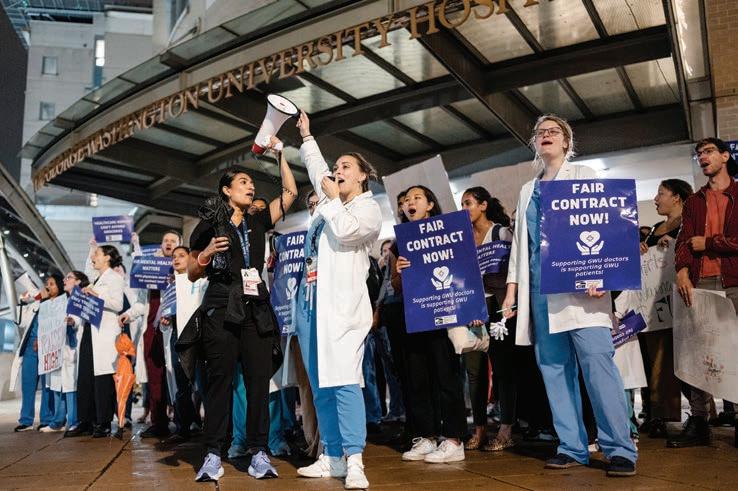
More than 70 people formed a picket line on the sidewalk stretching between GW Hospital and Ross Hall on Wednesday, demanding the University reach a collective bargaining agreement with residents and fellows at the School of Medicine and Health Sciences. As they looped between Ross Hall and the hospital, picketers held white plastic hand-clappers, megaphones and signs reading “We can’t afford our own health care,” “Wages should be raised high” and “Health care heroes can’t afford groceries.” SMHS residents and fellows said GW officials have stalled on reaching agreements related to higher wages and mental health care since the two groups initiated contract negotiations in November 2023. The SMHS residents and fellows overwhelmingly voted to unionize in April 2023 — with 253 voting in favor and 16 against — hoping to improve residents’ salaries and benefits. The rally marks the second time the union has publicly called on GW to accelerate a collective bargaining agreement since starting talks with officials. In April, nearly 300 resident physicians signed a petition
urging officials to expedite union negotiations.
“We’re disappointed at the pace of the progress that has been made by the University on our contract proposals,” said Maryssa Miller, a resident physician who helped organize the formation of the union and ongoing unionization efforts.
The picket began at 6 p.m. and lasted two hours. The group of demonstrators — sporting white doctor’s coats and scrubs — swelled to a 100-person peak at about 7 p.m. as the crowd chanted “G-O-T-T-O-G-O union’s busting’s got to go,” “When we fight, we win” and “We put in our 80 hours, now pay up, you broke *ss cowards.”
Miller said it is “the norm” for residents to work more than 80 hours a week, which she said causes burnout and sleep deprivation and increases peoples’ risk for depression. She added that “no one” wants to be taken care of by a doctor that is sleep-deprived or depressed.
A union press release from last week states that some residents make $15 per hour while the hospital faces “chronic” understaffing. The national average salary for first-year residents is about $60,000, according to the American Medical Association.
GW residents earn between $66,628 and $86,903 per year, which officials annually raise to account for
employees’ number of years post-graduation, according to the School of Medicine and Health Sciences’ website. Residents can opt into benefits like medical insurance coverage provided by UnitedHealthcare, which includes prescription drug coverage through CVS Caremark, access to Simple Therapy, Castlight, Real Appeal and the Maternity support program.
The release states physicians struggle to live and work in the area under extreme conditions — often 80 or more hours per week in the fast-paced hospital environment — without mental health benefits.
The picket line on Wednesday blocked the entrance to the I Street Mall, including the Foggy Bottom-GWU Metro station. Residents distributed flyers with a QR code linking to a Google Form petition with a letter from the union to University President Ellen Granberg, which people can add their names to, calling on officials to agree to a contract with salary increases and mental health benefits.
Miller said she and other residents and fellows feel that GW officials aren’t taking the union seriously and don’t bring proposals to the bargaining table in a reasonable time frame. She said residents negotiate with Meredith Dante, a lawyer GW hired for negotiations, who
excluded from the recommendations advanced by the provost’s office this fall.
She referenced officials closing Kogan Plaza and University Yard and installing metal fencing after police cleared the pro-Palestinian encampment last spring, as well as alleged student and student group disciplinary charges due to and stay-away agreements with federal prosecutors.
“We thought that the University should really examine some involvement with the closure of the University spaces, including the University Yard, Kogan Plaza, its involvement with court cases that have followed the arrests, the STET agreements with students, the sanctions that the students received,” McAlister said. “We would really like to know exactly what the University’s role was in all of that and how they might do this differently in the future.”
“often” says she will bring their proposals back to officials and that she wishes GW’s leaders would attend meetings to speed up the negotiation process. “We have made some movement in noneconomic proposals, but really haven’t seen the movement we would like from the economic proposal side,” Miller said.
A University spokesperson said GW has continued to engage in good faith negotiations with the union and that University representatives are in “regular communication” with stakeholders
to ensure they give “thoughtful consideration” to its proposals. The spokesperson also referenced a website outlining the 24 noneconomic agreements officials made with the union in eight meetings since November 2023, including the grievance procedure, childcare and union payrolls. Mary Melati, a resident on the union’s bargaining unit, said after the union proposed wage increases at a contract negotiations meeting earlier this week, officials said it was only possible to grant them a 2 or 3 percent
increase, which residents said is the “status quo” for how current wage increases. She said the bargaining unit were also “shocked” officials weren’t willing to change mental health benefits, following William West, an ophthalmology resident, death by suicide in March. She said at each negotiations meeting, officials join about 15 minutes late and tell union representatives that they “need to think about it.” “This is the continuation of that frustration finally bubbling over,” Melati said of the picket.
GRAPHIC BY AN NGO
Nursing school dean talks building communication, strategic plan in first year
IGLESIAS ASSISTANT NEWS EDITOR
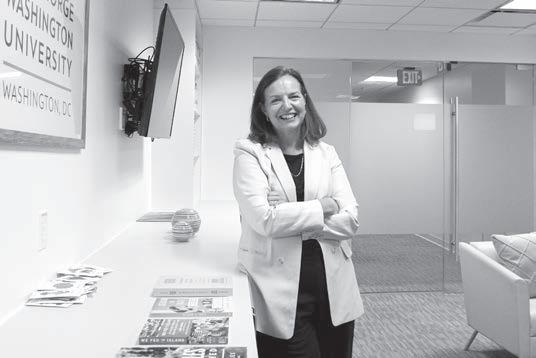
Susan Kelly-Weeder settled into her new role as dean of the School of Nursing last year by scheduling a 45-minute meeting with every faculty and staff member in the school — from professors to lab technicians to security guards.
She said the discussions were part of a larger initiative to grow and rebuild trust with the school’s community after a two-year era of administrative turnover and improve communication with faculty and staff. During the meetings, she asked each person what they love most about the nursing school, what challenges they see and how she as dean can help them work toward their goals, like uniting faculty and staff through building a culture of collaboration and community and expanding curriculum.
The nursing school cycled through four deans in two years, from 2021 to 2023. In 2021, interim Dean Pamela SlavenLee assumed the role from former Dean Pamela Jefferies, who left earlier that year, until former Dean Mei Fu permanently assumed the position in January 2023 before abruptly resigning two months later. Founding Dean Jean E. Johnson then ran the school starting in April 2023 until officials tapped KellyWeeder from Boston College’s nursing school for the role in May 2023, who began the position last July.
Kelly-Weeder said her discussions with faculty and staff revealed that much of the lack of communication and “undermined” trust in the school’s previous administrations stemmed from the significant turnover in leadership the school faced before her arrival.
“It’s a lot about being consistent and reliable and doing what you say you’re going to do and listening to what people say and responding to what their needs are, right?” Kelly-Weeder said. “I think if I can build trust in myself and the way I’m lead-
ing the school, I think we’ll find that we get more collaboration, more cooperation across all those venues.”
Kelly-Weeder said the insight she learned from her meetings with faculty and staff led her to find ways to bring the school together, since the school’s programs are offered virtually or in person at the Virginia Science and Technology Campus in Ashburn. She said she has opened more channels of communication by reinstating town hall meetings, altering the “format” of school-wide meetings and attending Staff Council meetings to field questions.
Kelly-Weeder said she also focused on developing a new 2024-26 strategic plan for the school — which officials posted publicly this month, detailing pillars of cultural transformation, student success, curriculum redesign and building toward future growth — as “nothing had been done” about the one in place when she arrived. She said she sees the plan she developed in collaboration with faculty as an interim framework aligned with the school’s current priorities as it heads into an accreditation process in spring 2025 and University President Ellen Granberg develops a University-wide strategic plan with the goal of presenting the plan to the Board
of Trustees in May 2025.. “I call it the ‘strategic plan 2.0’ because it’s an interim plan to get us to the next step and the big topic areas came from these conversations with the faculty and staff,” Kelly-Weeder said.
Kelly-Weeder said the school is redesigning its curriculum by developing an entrylevel nurse master’s program, which she hopes to launch in spring 2026 and reforming many of its courses from lecture formats to “competency based” approaches that teach students more hands-on skills. She said these classes show students to manage and care for patients in real-world situations instead of memorizing facts and figures.
The nursing school currently has four male members of its 69-person faculty, according to the school’s faculty directory, and the school has lagged behind peers.
Kelly-Weeder said hiring more male faculty is “very important,” but a shortage of men in nursing industry-wide is hindering how many men there are in the field for the school to hire as faculty. She said she is “happy” to see a growth in male students in the school — which has seen a rise in male students over the past decade, with 50 male students in 2013 and 134 in 2023, according to enrollment data — and its programs contributing to more men in nursing.
SMPA professor launches consortium to combat researcher harassment
JENNA LEE
ASSISTANT NEWS EDITOR
A School of Media & Public Affairs professor is leading an initiative to combat harassment of researchers through institutional policies and provide emotional and legal support for faculty researchers.
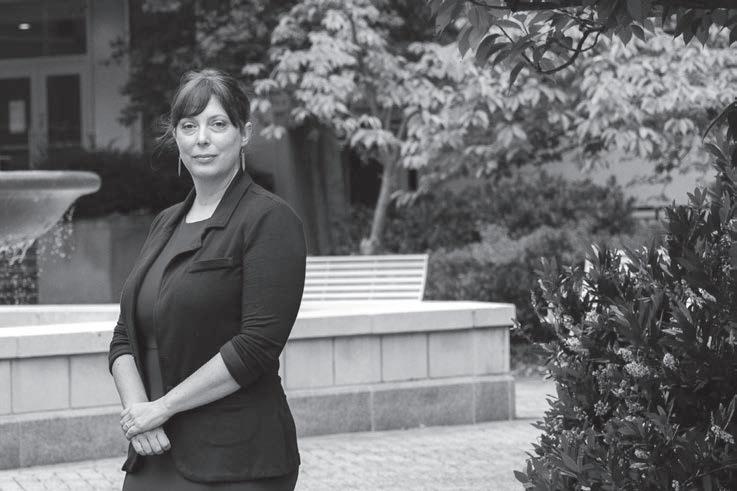
Rebekah Tromble, the director of the Data, Democracy and Politics Institute and an associate professor of media and public affairs, launched the Researcher Support Consortium, an initiative to provide guidelines for universities to deal with the harassment of researchers, earlier this month. Tromble said the consortium — which includes her and Kathleen Searles, a professor of political science at the University of South Carolina — aims to raise awareness of researcher harassment among the public and university administrators and provide schools with specific frameworks to support researchers’ well-being.
“We want real change here in the sense that the campaigns of intimidation and harassment, ultimately, they have fewer harmful impacts,” Tromble said. “And then you know that we effectively reduce the incentives for these actors to target scholars, precisely because they can’t have such a great impact.”
According to the consortium website, harassment of experts is a “widespread problem” and mainly affects researchers of contentious or politically polarizing topics like climate change and race and gender discrimination. Seventy-three percent of climate researchers who appear in the media at least once a month experience abuse, including doxxing, threats or attacks on the researcher’s reputation, according to a study by Global Witness, a nongovernment climate organization.
Tromble said she interviewed dozens of professors around the country to develop solutions for
GW adds plots to G Street Park, expands
NPHC representation
BROOKE FORGETTE
CONTRIBUTING NEWS EDITOR
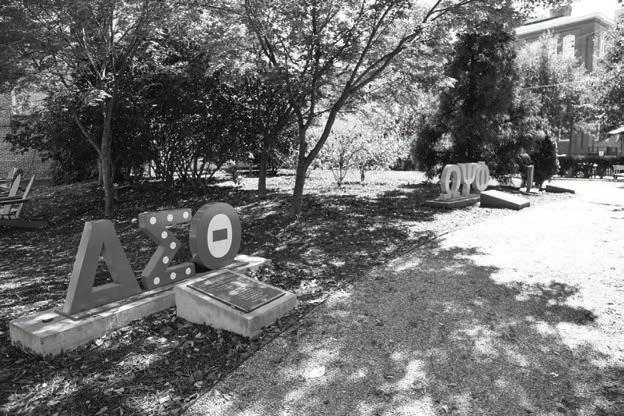
More than a year after GW’s Mu Beta chapter of Delta Sigma Theta, Inc. unveiled an effigy of the sorority’s letters in G Street Park, seven historically Black Greek organizations joined them over the summer to establish a symbolic home that honors the chapters’ communities and contributions to campus.
Officials installed seven monuments ahead of the fall semester along a walkway in the park across from Duquès Hall to represent the University’s chapters of National Pan-Hellenic Council organizations known as the Divine Nine. Chapter leaders said the plots pay homage to chapter alumni and establish an additional physical presence for Black Greek letter organizations at a predominantly white institution.
Each plot includes colors of its respective chapter, and the plaques that accompany the letter monuments include the chapter’s charter date at GW and the names of all of its founding members.
Senior Stephanie Animdee, the president of GW’s Mu Beta chapter of DST, said the chapter revealed their plot right before the organization’s 48th charter anniversary in April 2023. She said her chapter brainstormed the plot idea as a way to showcase her chapter’s excellence and presence on
campus as the first Black Greek letter organization chartered at GW in 1975. Animdee said she proposed the plots to Dean of Students Colette Coleman, who then brought the idea to other officials and spearheaded the effort to erect the plots. She said every time she walks by the letters, she has a feeling of pride in honoring alumni that “paved the way” for her, sorority sisters and Black students on campus.
“If it wasn’t for them, I mean, who knows the type of issues as a Black woman I’d be experiencing, and especially as a Black woman in Greek life, all the prejudice that they had to endure,” Animdee said. “So that plaque is a constant reminder of how far we’ve come as Black Greeks on campus and also the amount of work that my charter members, like my sorors within my chapter, has put in.”
Coleman said members of GW’s NPHC chapters originally advocated for the plot initiative in 2018, looking to expand representation of the Divine Nine within the University’s Greek community. Coleman said the addition of the NPHC townhouse on Townhouse Row on 23rd Street — which opened in August 2021, according to GW NPHC’s Instagram — also served to boost the presence of the chapters on campus.
“At their core, plots are meant to educate about history and tradition, serving as a gathering space for the NPHC community,” Coleman said.
funders of research, institutions like universities and for individual researchers themselves. The website recommends that funders contribute to legal defense funds for researchers impacted by harassment and publicly defend faculty when they experience harassment.
The website also provides a toolkit for universities to support their researchers, which includes creating a form where they can report harassment to university officials and informing researchers in advance if the university plans to publish news regarding their research. Other university policies the website recommends include developing support teams for researchers with administration, human resources and legal personnel within the university and having a specific communications strategy that includes prepared language that is communicated broadly with staff to keep messaging consistent to deal with harassment.
The website recommends that individual researchers ask for support from their university officials and build a supportive community of people they trust around them-
selves.
“We want to make sure that people really understand how significant a problem this is and that there is essentially a playbook that’s put into action in these instances,” Tromble said.
Tromble said she started the project two years ago because of abuse she experienced after publishing her research on the spread of misinformation on online platforms on a research grant from X, formally known as Twitter. She said she experienced death threats and had to have police patrol outside her house due to the harassment.
“I decided that one of the ways that I could personally take my power back and really work to help others is to make this part of my own research agenda,” Tromble said. “I was already studying harmful things that happen online, and so I began to research in more earnest issues around harassment, online harassment, specifically.”
An expert who studies researcher harassment said researcher abuse and intimidation negatively affects those receiving it and the quality of research be-
ing produced as a whole.
Isaac Kamola, the director of the Center for the Defense of Academic Freedom at the American Association for University Professors, said there has been a growing “politicization” of academic research in the last few years led mainly by conservative advocacy groups over research surrounding politicized issues like climate change and racial discrimination.
“Those political activists who benefit from disinformation or those fossil fuel companies that benefit from climate denial, when scientists come out and demonstrate the opposite, that there is a considerable amount of disinformation or that climate change is human made, then they tend to not like that knowledge as being produced within a university,” Kamola said.
Kamola said the backlash has led to increased harassment of researchers who produce work on contentious topics and that universities do not know how to support their research properly. He said the consortium “impressed” him with its specific policies for universities to implement like support teams for researchers.
Two-thirds of trustees donated to political groups in last four years
GIANNA JAKUBOWSKI REPORTER
HANNAH MARR NEWS EDITOR
More than two-thirds of the Board of Trustees, including the governing body’s three officers, have donated to Democratic campaigns and political action committees over the last four years.
Thirteen of the 20 trustees have donated between $20 and $56,150 to Democratic candidates and campaigns from 2020-24, according to a Hatchet analysis of Federal Election Commission Campaign Finance data. Experts in higher education governance said these donations can signal trustees’ political affiliations, but does not impact their decision-making processes because the Board has a legal obligation to act in the University’s best interest.
Board Chair Grace Speights, who works as a partner at Morgan, Lewis & Bockius law firm, donated $34,530 to Democratic causes since 2020, according to the public records. Vice Chair Mark Chichester — who serves as President of Atlas Research, a strategic consultation firm in D.C. — donated $4,800 in 2020 to President Joe Biden’s reelection campaign. Secretary Avram Tucker, who works as Chief Executive Officer at TM Financial Forensic and lives in Orinda, California, donated $22,000 since 2020 to the Democratic Senatorial Campaign Committee and senate campaigns for Raphael Warnock and Steve Bullock.
University President Ellen Granberg, who serves as an ex-officio member of the Board,
donated $1,025 in total to Democratic PACs like ActBlue and Biden’s campaign between 2020 and 2022.
Jeffrey Flaks is the only trustee who has donated to a Republican over the last four years. Flaks donated $1,000 to Republican Themis Klarides in 2022. Robert A. Scott, who served as president of Adelphi University and Ramapo College of New Jersey and authored the book “How University Boards Work,” said trustees prioritize protecting the University’s interests, including the institution’s independence, academic freedom and principles. He said trustees have a right to support candidates through donations, but added it may be difficult for them to separate personal politics when making University decisions because people have “political inclinations.”
The Board’s bylaws grant trustees the ability to manage, direct and govern over GW. Trustees did not return a request for comment on their political donations.
University spokesperson Julia Metjian said trustees are volunteers who serve as the fiduciaries and are legally bound to act in the best interest of the institution and adhere to a Trustee Conflicts of Interest Policy, which officials updated last fall to consolidate processes, modernize and align language with D.C. law and provide more clear expectations and responsibilities. Metjian said the policy ensures that decisions are not improperly influenced by their personal, familial, business or other interests. She said trustees have a “clear criteria” for selecting individuals of the “highest integrity” to the Board.
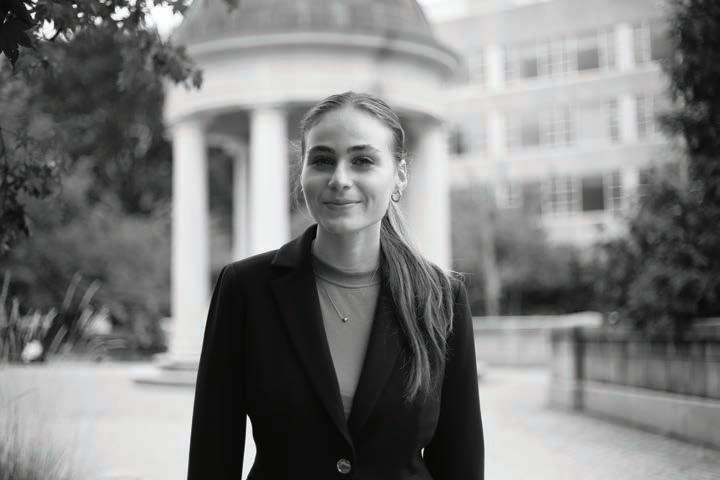
HATCHET FILE PHOTO Institute for Data, Democracy and Politics Director Rebekah Tromble poses for a portrait in Kogan Plaza in 2021.
HANNA LEKA | PHOTOGRAPHER
School of Nursing Dean Susan Kelly-Weeder poses for a portrait.
TYLER
COOPER TYKSINSKI | PHOTOGRAPHER
The Greek letters of Delta Sigma Theta, Inc. on the G Street Park pathway.
Half of DC Circulator drivers face layoffs at start of service phaseout
The D.C. Circulator on Tuesday will lay off more than half its bus operators and scale back operations, initiating the service’s three-month phaseout amid calls from its union, drivers and local governing bodies for District officials to redeploy drivers and salvage routes.
A year after the Circulator’s employer, RATP Dev USA, reportedly told drivers that the District Department of Transportation extended the service’s contract until 2028, bus operators are waiting to find out if they’ll lose their job this week or at the end of the year after officials in July announced plans to terminate routes by Dec. 31. The Circulator’s union and local leaders are pressing District officials to transfer the service’s operations and workers to the Washington Metropolitan Area Transit Authority, while drivers brace for pay cuts and low severance packages.
The Circulator on Tuesday will end its Rosslyn-Dupont Circle route and late night service for Georgetown-Union Station — two of the three routes that pass through Foggy Bottom. Circulator employees said RATP Dev will notify 93 of the 178 bus operators of their immediate termination Monday.
In April, D.C. Mayor Muriel Bowser released her proposed budget for the upcoming fiscal year, which would terminate the Circulator in spring 2025 and temporarily adjust some Metro services until officials unveil a plan next summer to expand routes. Ben Lynn, the press and communications associate for Amalgamated Transit Union Local 689, said the union initially agreed to support the termination on the condition that the mayor’s office would help WMATA absorb all employees and routes.
He said Bowser ceased communication with Local 689 in late April after her office requested earlier that month that union leaders support the budget cut and help Circulator workers transition to other jobs during the phase out. DDOT on July 29 announced it would terminate the service by the end of the year, which Lynn said has forced the union to quickly develop service transfer proposals.
“It does not appear that a transition plan is a priority for the mayor and DDOT,” Lynn said.
Lynn said a negotiated transfer would allow WMATA to absorb all Circulator routes and employees, who would receive an hourly wage relative to their years of service. He said currently Circulator employees must apply to Metro and if hired “start over from scratch” without seniority, which will result in an average hourly pay cut between $9 and $11.
Last week, the union held a rally outside of the John A. Wilson Building calling on the mayor to demand a negotiated transfer, but Lynn said they received no response from the mayor’s office or DDOT following the rally. The mayor’s office and DDOT did not return a request for comment.
Circulator employees who are set to receive a potential one-day notice of their termination said they feel they’ve been discarded by District officials who didn’t listen to their reports of faulty bus equipment.
Glynda Dansby, who has worked as a Circulator operator and supervisor for seven years, said people who have worked for the service for fewer than two years will receive one week of severance pay, those who have worked at least five years will receive two weeks and those with 10 or more years will receive three weeks.
“We’re going to fight because we need answers, and we need to know why we’re being thrown out like this and at least not given a decent severance pay,” Dansby said. Lynn said Circulator workers have raised concerns to the union about low severance payment packages, which the union negotiated with DDOT but noted there was a “limited amount” the District was willing to allocate.
Dansby said last Monday RATP Dev held a bid day and gave everyone a number based on their seniority. She said she still won’t know officially when she’ll be terminated until RATP Dev issues letters to employees on Monday.
Latino student groups share campus representation concerns with SGA
Students from GW’s Latino community asked the Student Government Association to better advocate for Latino students and cultural organizations with the University at a forum in Monroe Hall on Thursday.
The SGA invited Latino students and student groups to share their experiences on campus and concerns about representation at GW for Latin Heritage Month, which GW celebrates from Sept. 15 to Oct. 15. SGA leaders, including Vice President Ethan Lynne and Darianny Bautista, the SGA’s legislative director of diversity, equity and inclusion, said they want to help Latino students find campus community by boosting awareness of Latino organizations and on-campus heritage celebrations with the goal of ultimately improving communication between cultural groups and the SGA.
Javier Orellana — the president of UndocuGW, a student group dedicated to advocating for the rights of undocumented students — said he wants the SGA to push officials to implement a dream center, a dedicated campus space for immigrant and undocumented students to receive specialized support from the University. He said GW already has the Cisneros Hispanic Leadership Institute — a research center that creates academic programming for Latino students — but a dream center could provide immigrant and undocumented students with extra
support for navigating financial aid, legal assistance for Deferred Action for Childhood Arrivals recipients and emotional counseling support.
“Immigrants and undocumented students can come and feel more supported,” Orellana said at the meeting. “For me, the closest support that I’ve had is the Hispanic Leadership Institute as well, I feel like there’s a little bit of a gap in understanding.”
Adriana Hernandez, the president of the Organization of Latin American Students at GW, said she wants the SGA to help grow “visibility” for Latino students by collaborating and hosting events with more Latino communities.
She said she wants recognition for her community in more spaces than the Multicultural Student Services Center. She said the MSSC is an “incredible” student resource, but she wants her culture represented outside of that space as well as through more campus-wide events.
“I also don’t want visibility just to be focused on that floor of USC,” Hernandez said, referring to the MSSC’s office in the University Student Center. “Visibility means seeing the Latino community in all aspects, especially during LHC, not just that floor.” Hernandez said she was happy to see the SGA leaders “stepping up” this year to represent different identity groups on campus through this month’s forum. She said it was “great” to see SGA senators who share her Latino identity, like SGA Sen. Claire Avalos
(CCAS-U), present at the forum.
Bautista said SGA senators can forget that the body’s mission is to make students feel “seen and heard” because they’re aspiring to become a “politician,” which creates an “environment of unwelcomeness” in the body.
“We want students to come in, tell us what you’re angry about, tell us what you’re feeling, tell us how we can better represent you because through that constructive and proactive dialogue is how we can truly better represent and create those initiatives and move forth with how we want student government to truly be on campus,” Bautista said.
Bautista said she will host new mandatory DEI training sessions during executive sessions in SGA Senate meetings. She said these trainings will supplement training that SGA members receive from the MSSC at the annual SGA retreat that members attended earlier this month.
Bautista said she spoke with Vanice Antrum, the new director of the MSSC, and Jordan Shelby West, the associate vice provost of the Office of Diversity, Equity and Community Engagement, who said they felt a sense of “competitiveness” among SGA members about how they propose and debate legislation.
She said senators need to be able to “disconnect” themselves to understand how the legislation they pass in the SGA should not be about their own opinions but instead students they represent.
Natasha Guest, who has served as a bus operator for the last four years, said RATP Dev initiated a point system where if a driver receives two or more points for missing work between Aug. 14 and their date of termination, they don’t receive severance pay.
“How can you not call out if you have to go to a job interview, I’m trying to find a job by the end of month,” Guest said.
A bus operator who has worked for the Circulator since 2006 and requested anonymity for future employment reasons, said at least 75 drivers have worked at the Circulator for a “long time,” and their pay will be cut from $40 to $29 an hour
if they apply to WMATA because their seniority won’t transfer over to their new job.
WMATA did not return a request for comment. She said DDOT claims that “ridership is low” on the Circulator because the bus’ fare boxes and Clever Devices that track ridership don’t work. She said the radios and engine lights also don’t work in most buses, and the District has “sabotaged” the service by ignoring workers’ continued requests for repairs. She said ridership also appears low because many citizens evade the fare given that the service used to be free.
Student group to tackle food waste, insecurity via free meal distributions
DYLAN EBS STAFF WRITER
A student group that launched in August is aiming to reduce food waste from restaurants and food insecurity on campus by distributing free food at pop-up events.
Sharing Excess GWU, a campus chapter of a national organization, plans to distribute excess food donated by local restaurants and stores to students for free. Junior Ashleigh Sorokin, the chapter’s founder, said the pop-up events are inspired by the app Too Good To Go — which restaurants use to sell fresh, leftover meals from vendors at discounted prices.
Sorokin, a public health student, said the group has set a goal to distribute free food through a pop-up event by the end of October. She said the group in August began reaching out to about 20 Foggy Bottom stores and restaurants to gather excess food and have since received “positive” responses but no partnering businesses have been confirmed.
Once they secure donations, student volunteers plan to walk around campus with baskets of food and encourage people to take items as they pass by, she said.
“We’re really focusing on bringing this food access to the GW community and bringing everyone together around this idea, rather than donating the food to food kitchens and food pantries in the area,” Sorokin said.
Sorokin said as the club grows, she plans to register the group as an official stu-
dent organization next semester.
Sorokin said the group will post signs around campus to announce food distribution days. She said it would not be feasible for the group to rent a table in Kogan Plaza for distribution because members won’t know in advance when a restaurant has excess food available.
Sorokin said Sharing Excess GWU will distribute the food items that it gets from vendors like perishable baked goods, fresh produce and premade goods, like sandwiches and bagels, to students the same day they are received.
“We’re just really waiting to hear back when they have that food available that would need to be distributed,” Sorokin said.
Sorokin said the group is focused on spreading awareness about their mission this semester through word of mouth and posters with QR codes linking to its Instagram around campus.
The group had its first general body meeting late last month, and she estimated that it has about five students involved members.
Sorokin said she was inspired to start the group after interning for Sharing Excess this summer with their community engagement team. One month into her internship, Sorokin said she got the idea to ask her boss about starting a chapter at GW.
“I asked the development director if that would be a good idea, and she was like, ‘Yes, of course, go for it,’” Sorokin said. Sorokin said she was
also meeting with the GW Food Recovery Network this week — an organization that donates leftover food to homeless shelters and donation centers around D.C. — to discuss holding joint events since both work toward reducing food waste. Sorokin said she has reached out to a variety of student organizations, like The Store — a food pantry for students located in District House — to establish relationships and hopes to collaborate with other student organizations in the future. She added that Sharing Excess GWU may be able to donate excess food from their distributions to The Store.
“We’re really trying to broaden our network and get new members and get everyone involved and be a part of the GW community,” she said.
Fifty-six percent of GW students reported feeling food insecure in the 2022-23 academic year, according to the GW Capital Peers Nutrition Initiative, an organization that educates students on positive health practices.
Nourhan Ibrahim, the development director for Sharing Excess, said the student chapters play a “vital” role in the organization’s mission because the chapters redistribute the surplus food “quickly and efficiently” to community members.
“Through events, campaigns, and outreach, they inspire others to join the fight against food waste while fostering a culture of sustainability and destigmatizing food-sharing on campus,” Ibrahim said in an email.
YNGRID GUEVARA | PHOTOGRAPHER
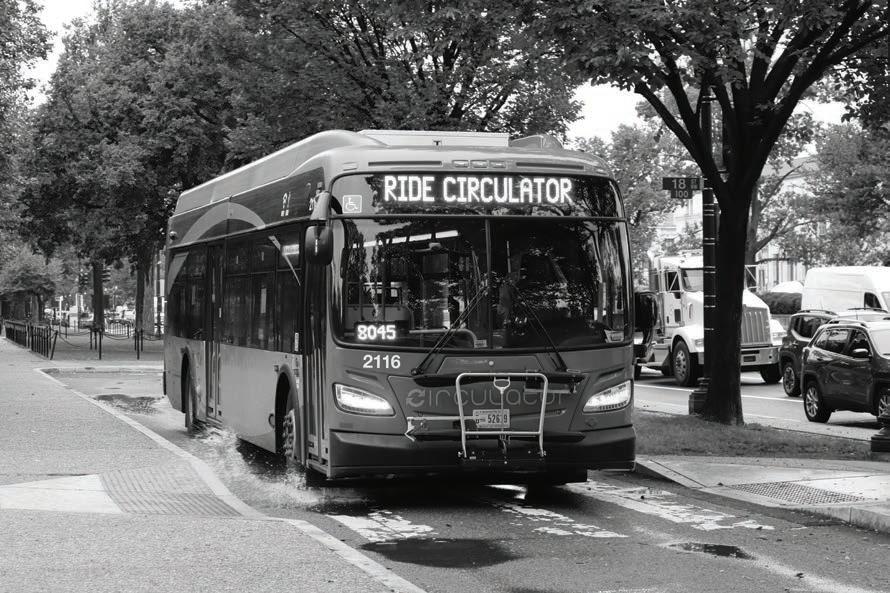
A Circulator bus hits a puddle on Constitution Avenue.
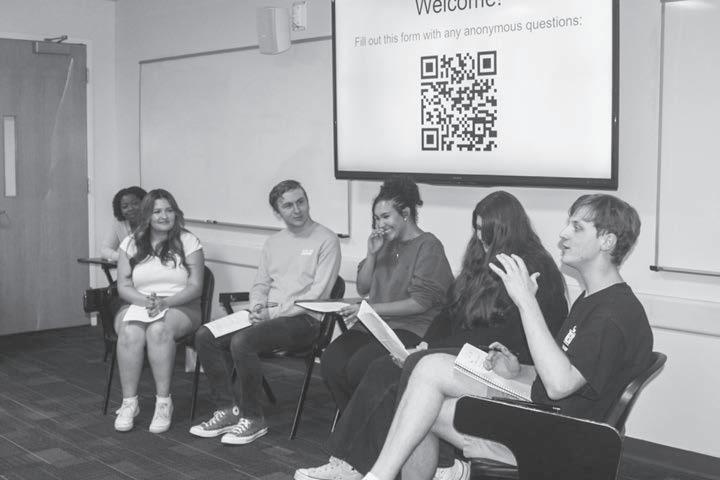
BELLA FOURNIER | PHOTOGRAPHER Student Government Association Vice President Ethan Lynne welcomes student leaders to the meeting.
Western Market expands composting efforts to customers
A year after Western Market launched an eco-friendly partnership with a waste management company to reduce vendor food waste, the market installed composting bins at food disposal stations to include customers in the initiative.
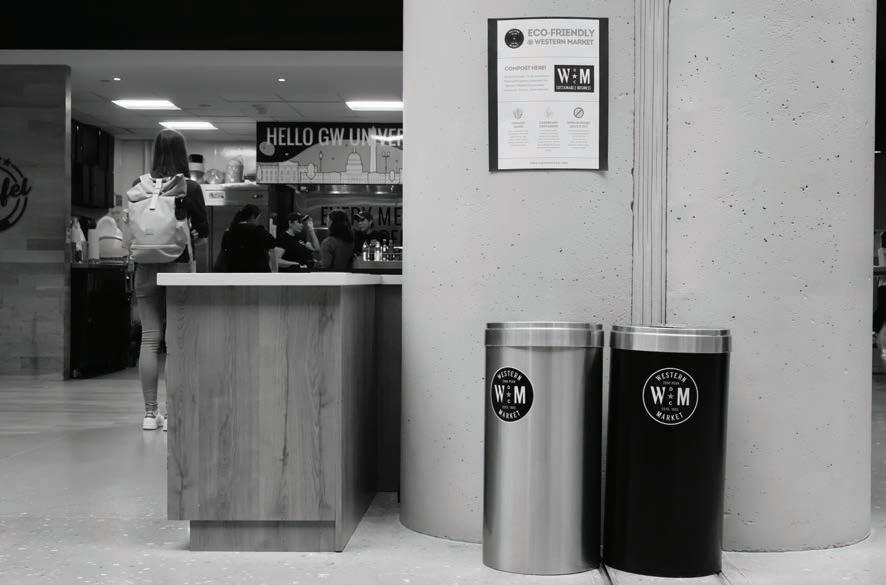
Western Market placed composting bins at the three trash disposal stations located around Western Market for customers to throw away food scraps, biodegradable to-go containers and eco-friendly utensils, which Compost Cab, a waste management service, then picks up and transports 20 miles away to a composting site, according to vendors and posters in the market. Vendor participation in the initiative — which requires business owners and employees to dispose of all back-of-the-house food waste — is voluntary, and at least four of the market’s 15 vendors currently participate.
Bandoola Bowl, Arepa Zone and Capo Deli are participating in the composting program, according to “Western Market Sustainable Business” stickers posted at the front of their stores. Andy’s Pizza also participates in the program, and The Bussdown DC originally opted in, but the restaurant’s owner said they pulled out of the project a few months ago because they determined it would be more economical for them to reduce waste internally.
“With a set of shared goals and an infrastructure customized to support them, we’ve helped Western Market expand their program from back-of-house-only to include all visitors and guests,” said Jeremy Brosowsky, the founder and CEO of Compost Cab, in an email.
Brosowsky said Western Mar-
ket initially partnered with Compost Cab in February 2023 through the District’s Food Waste Innovation Grant program — managed by the Department of Small and Local Business Development — which covered the cost of composting equipment. He said the program helped Western Market assess their composting needs and launch a composting program for free. The grant ended in August 2023, and Brosowsky said Western Market decided to “stick with” the program with Compost Cab, beginning their partnership in September 2023. “Western Market has been a great partner for the community, providing vendors and visitors
the opportunity to be sustainable no matter where they work and dine,” Brosowsky said in an email. “They’re a role model for food halls and other culinary hubs looking to start or up their sustainability game.”
Brosowsky said composting bins in Western Market are “strategically located” and labeled throughout the market, and the market’s maintenance staff put the contents from the bin into a “centralized location” for Compost Cab to collect twice per week. He said Compost Cab then transports the materials — about 100 pounds per month — to Prince George’s County for composting.
Former officers say GWPD training left them unprepared for emergencies
From Page 1
Gun registration
Three former supervisors and an HR report filed in September 2023 obtained by The Hatchet states that Tate and Mullinax carried firearms unregistered in D.C. on campus from Aug. 30 to Sept. 27, 2023, after the pair became armed in GWPD’s first arming phase.
Goodly declined to say whether Tate and Mullinax initially carried unregistered guns.
“That’s the way the arming process has gone,” Mullinax said. “It’s been mistake after mistake, and then the mistakes get corrected, and then it’s publicized or pushed out like we have made no mistakes and it’s going flawlessly.”
Gun storage
Mullinax wrote in a separate HR report filed on Dec. 19, 2023, that Tate “routinely” stored his firearm in
GW’s armory while it was still loaded, which the report says is a violation of the department’s armory and safety policies that require officers to unload their firearm and store it empty with the magazine separated.
The report states that six days before the report’s filing, Mullinax wrote that Former Lieutenant Christina Hunsicker, who worked at the department for 11 years and left in August, noticed that Tate left his weapon in the armory with a fully loaded magazine with a live round in the chamber.
Hunsicker placed the weapon in the slide locked to the rear position and a live bullet ejected from the gun’s chamber without firing, the HR report states.
Department turnover
Former supervisors said GWPD faces a staggering amount of officers leaving the department and hiring struggles because of the alleged lack of training, internal arguments over arm-
ing implementation and a stressful work environment in the department.
Since April, three of the department’s top six officers have left GWPD, as Mullinax left in April, and Brown and Hunsicker left in May and August, respectively. Former Lieutenant Christopher Coleman, who worked for the department for 14 years, left GW in May 2023.
Mullinax said if GWPD hired officers to fill all its current vacancies and those people stayed in the department long-term, it would likely take the department between 18 months and two years to arm 22 officers because of how long it takes to hire and train officers. He said the vacancies hinder the department because there are constantly officers learning new roles and adjusting to new leadership styles.
“It has the potential of being catastrophic,” Mullinax said of the turnover. “I mean, it’s just a revolving door.”
Aung Myint, the part-owner of Bandoola Bowl, said his business joined the composting initiative last year. He said Bandoola Bowl preps the majority of food at another location, so there isn’t a large quantity of waste, but the organic scraps that do exist are brought to the back-ofthe-house composting bin.
Myint said when Western Market rolled out the composting project, Western Market management hosted training with all of the vendors to teach them about the composting process.
“It was easy enough where when someone showed it to you, we jumped on it,” Myint said. Myint also said Bandoola Bowl
uses biodegradable containers, so customers can use the compost bins.
“Most of the time it’s up to the customer,” Myint said. “We don’t really touch the containers after they leave here.”
Andy Brown, the owner and founder of Andy’s Pizza, said the pizza joint began composting about two months ago. He said on the kitchen-side, composting is “easy” because staff set aside food scraps as they work. Brown said the next step is for Western Market vendors to ensure guests know where to dispose of their compostable material.
“Where it really gets hard is communicating to the guests what they’re supposed to do,” Brown said. “We’ve all seen trash cans with like 19 different holes in it and you’re like, ‘What am I supposed to do with my stuff?’”
Solomon Johnson, owner and chef of The Bussdown DC, said Western Market provided composting bags for each of the vendors that fit into the trash bags in their kitchens. He said the market showed business the location — down the corridor where the bathrooms are — of the vendor-only composting bins and left it optional to vendors if they wanted to purchase a specific composting bin beyond the provided bags.
Johnson said The Bussdown DC partook in the initiative at first, but withdrew from the project a few months ago in favor of outsourcing their own composting partner, which he said would allow him to use the composting effort as a tax write-off.
“When we do restart it, we plan on working with some more grassroot-based composting company, so we will be able to reap the benefits of it instead of it going directly to the building,” Johnson said.
Community health centers expected to lose money this year: study
JENNA LEE ASSISTANT NEWS EDITOR
Researchers in the Milken Institute School of Public Health project that community health centers around the country will have reduced their profit margins by almost 4 percent in 2024, which could impact the services they provide to marginalized communities, in a study published earlier this month.
Researchers analyzed financial data of community health centers — which provide healthcare at a subsidized cost to low-income communities — from 2019 to 2023 from the Uniform Data System, a database for all health centers across the country, and found that the health centers’ profit margins dipped from 4.5 percent in 2022 to 1.6 percent in 2023. Leighton Ku, professor of health policy research and co-author on the study, said the upcoming election leaves uncertainty for the future of community health
center funding in the coming years because of differences in health care policy between the two parties. Ku said Republicans tend to support providing less funding to the health care sector in general, so if Donald Trump wins the election or Republicans control Congress, it could be harder for funding for community health centers to get approved.
“The majority in the House right now would say, ‘We don’t want to spend any more money on things like this,’” Ku said. “And so they’re basically taking — and I don’t know that they particularly care about community health — but they’re, generally speaking, ‘We want to sort of freeze, or better yet, cut federal spending in part so that we can do things like lower taxes, reduce the deficit.’”
The research also projected that community health centers will operate on a negative profit margin of 2.2 percent in 2024.
He said community health center funding will be unpredictable until Congress sets the budget for the next fiscal year. He said Congress passed a short-term resolution to continue federal funding last week amid the end of the fiscal year and debates about the budget, but funding will still expire in December unless Congress finalizes the budget.
“When we look at the sort of center-by-center data, about half the health centers in the country were losing money in 2023, and we think that by 2024 it’ll be the substantial majority,” Ku said. Ku said one of the factors contributing to the loss in funding is the Medicaid unwinding that Milken researchers discovered earlier this year that lead to massive losses in insurance coverage. Medicaid unwinding refers to when Congress ended a pandemic-era continuous enrollment provision in March 2023 and paused eligibility checks on Medicaid recipients.
Ukrainian art exhibit showcases resilience, cultural survival amid ongoing war
JOSHUA HONG REPORTER
MEHEK LASKER REPORTER
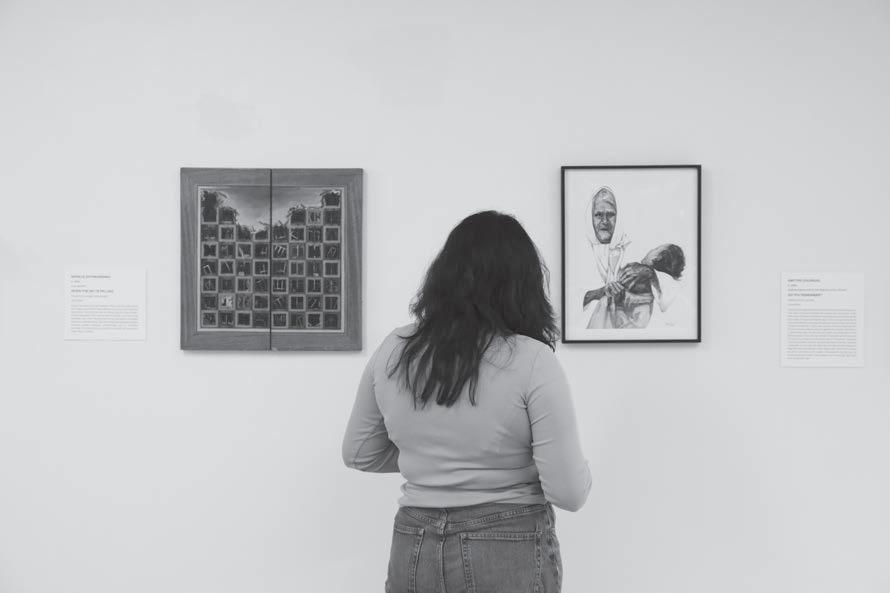
A Ukrainian soldier’s military ID card, fragments from a Russian jet and a propeller from an Iranian drone sat on display at the Smith Hall of Art for over a month in an exhibit that concluded Sept. 28. The exhibition, titled “We Know Who They Are” spotlights a curation of Ukrainian artwork developed by junior Benjamin Cunningham and Yevgen Nemchenko, a professional Ukrainian artist. Cunningham said the project serves as a reminder of the need to preserve Ukraine’s cultural identity amid the ongoing war with Russia, which has escalated in the past two years following Russia’s invasion of the country.
The gallery featured stark white walls, where paintings of areas desecrated by the war were hung on the walls next to pieces of debris from the front lines of the conflict. At the entrance to the exhibit, Cunningham operated a table where he sold merchandise, whose proceeds go to the artists to fund future cultural projects and ranged from $10 stickers and postcards to $50 hoodies of the “We Know Who They Are” brand.
Cunningham said the exhibition began as a project for his firstyear dean seminar “Intro to International Humanitarian Assistance” with Michelle Kelso, a professor of sociology and international affairs.
He said Kelso encouraged students to “engage in various means of advocacy for Ukraine." The Ukrainian-American Student Association collaborated with Cunningham’s exhibit to host an event Friday at Smith where community members observed the artwork and ate Ukrainian cuisine.
Cunningham said Aydan Ibadova, the president of the UASA, emailed him earlier this month to introduce herself and discuss a potential collaboration with the ongoing exhibit. He said he and Idadova worked together to develop the name and description of the event and eventually chose to title it “Ukrainian Voices Through Art.” He said the UASA catered food for the event and promoted it through community members within the Elliott School of International Affairs and the school’s Institute for European, Russian and Eurasian Studies.
“They also were incredibly communicative and responsive to any questions I had pertaining to the event,” Cunningham said in an email.
Cunningham said the artwork in the exhibit show the country’s “present identity” and serve as a “testament to the resilience” of Ukrainian people amid threats to their sovereignty like Russia’s annexation of Crimea in 2014. He said the exhibit featured 22 works of art and 10 artifacts by different Ukrainian artists focused on their firsthand experiences navigating the violence surrounding them.
“Hosting this exhibition in the United States, specifically Washington, D.C., this exhibition was also of critical importance as funding for Ukraine has been a controversial topic among the partisan divide in the American political system,” Cunningham said in an email.
Before Russia’s invasion of Ukraine, the two countries have faced decades of political and territorial strife, following Ukraine’s
independence from the former Soviet Union in 1991 and Russia’s annexation of Crimea in 2014. Since the invasion, Ukraine has regained more than 54 percent of formerly Russian-occupied territory and received more than $278 billion dollars in aid from the U.S. Cunningham said the exhibit serves as a form of “cultural protectionism and survival” because Rus-
sian forces have stolen thousands of pieces of Ukrainian art and artifacts since their invasion of the country in 2022.
“Presenting the localized perspectives and storylines of the artists has allowed us to heighten the visibility of Ukrainians amid the conflict while preserving the artwork in an exhibition catalog,” Cunningham said in an email.
ELLIE SULLIVAN | PHOTOGRAPHER Western Market compost bins located next to a pillar inside of the market
NICHOLAS WARE | PHOTOGRAPHER
A student examines the collection of art at the "We Know Who They Are" exhibit in the Smith Hall of Art Gallery.
OPINIONS
“This
—JAMES POMIAN on 9/23/24
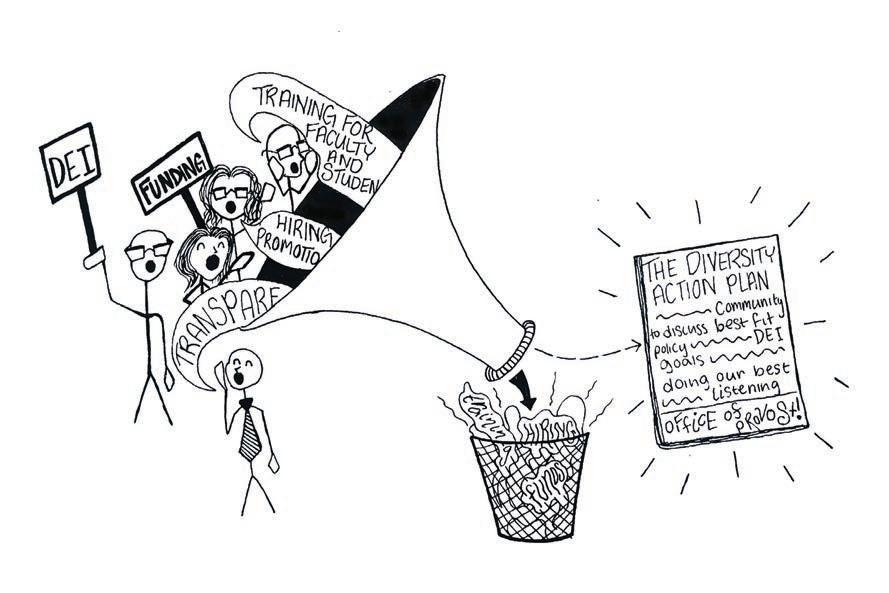
GW needs to make an action plan that calls for action
In August 2021, the Office of the Provost initiated a review of GW’s diversity climate to improve it. As part of the process, a subgroup of 26 community members — including students, officials and faculty — produced a list of recommendations on how to solve ongoing issues of diversity, like increasing faculty from minority groups. The next year, officials surveyed the diversity climate at GW, revealing poor results, with about half of respondents having experienced general negative interactions or negative interactions regarding their identity.
Survey results and faculty recommendations were supposed to be included to create a final report to cultivate a more diverse GW, but after three years of waiting for a plan that turned these issues and recommendations into solutions, the product lacked faculty input, accountability and transparency from GW — missing the “action” part of the “action plan.”
The result of the review was a nine page document with 10 recommendations, some corresponding with staff and faculty suggestions and subsequent responses to feedback. The recommendations included adding all-person restrooms to all “major” buildings, adding more staffing to the Multicultural Student Services Center and cluster hiring diverse staff. But throughout the document, officials used vague language that lacked actionable timelines for the implementation of initiatives and, according to faculty, excluded their proposals.
What went wrong?
Provost Chris Bracey, in 2021, deviated from GW’s past diversity reviews — which were previously more dependent on outside firms instead of GW’s community — by proposing a process that heavily prioritized GW’s involvement on top of an external review to determine if the community’s eventual recommendations were appropriate. It came at time of deep faculty distrust with administration, who
STAFF EDITORIAL
said then-University President Thomas LeBlanc was “inflexible” and rarely listened to faculty recommendations, so a project willing to prioritize faculty input was readily welcomed.
A good plan takes its time, and if GW took three years for a thoughtful, specific plan, that’s even better. But faculty members spoke out about how many of their most substantive suggestions were not represented in the final plan.
One professor said earlier this month that the plan was so general that it could’ve been written without “analysis and input.” They acknowledged that while not everything can be represented, most of the recommendations didn’t seem to make it on the page at all.
Faculty brought up issues they felt passionate about, like cluster hiring — hiring faculty or staff for multiple positions and keeping
ABBY TURNER | CARTOONIST
track and metrics of GW’s diversifying progress. But they were brought up in passing in mentions, with officials saying they “will take the recommendation of cluster hiring, consistent with applicable law” but providing no clarification on how it will be implemented. And for the past three years, department chairs have pressured administrators to cluster hire more diverse faculty.
As professor Shaista Khilji asked earlier this month, what are the specific steps that will address the root of the diversity issues at GW? How will they address that three-quarters of students struggle to afford GW and improve diversity recruiting — and retention — across the University?
Later on, when discussing trainings and hiring diverse faculty, the report states that the Human Resources Management and Development will “encourage a diverse pool
GW has to approach safety threats with transparency
As gun violence continues to ravage communities across the country, another, lesserdiscussed epidemic sweeps through schools: false threats of violence, which often cause confusion, panic and very real responses from both the public and school officials. Earlier this month, we got a small taste of that here on campus.
RJ Doroshewitz Opinions Writer
On Sept. 13, officials sent a GW Alert to community members warning of “Urgent: Police Activity” at Thurston Hall. Without any information, I started to worry. Without concrete information to go off of, anything could be happening. Back in my junior year of high school, a student thought they saw a firearm on campus in the days following the high-profile Oxford High shooting in 2021. Despite the questionable validity of the source it ended up triggering a multi-hourlong lockdown as armed police conducted a room-byroom sweep of the building. I spent four hours huddled with six or so other students in a dark technology closet near the library, frantically trying to figure out what was going on.
Experts say that upward of 100,000 K-12 schools experience at least one false threat report per year.
It’s better to be safe than sorry, but. I remember getting frantic texts as kids tried to piece together a cohesive narrative of what was happening,. With officials failing to disseminate information to the student body, we did what teenagers do best: We made up our own story, born out of panic and a need to feel on top of the situation.
In the modern era of frequent mass shootings, protecting students is of utmost importance. But assuming you’re in active danger when a potential risk arises can be traumatizing, regardless of whether a perceived threat actualizes into violence.
“I saw something that looked vaguely like a gun” isn’t the same as a clear and present threat, but without knowing the circumstances behind an emergency scenario students can’t make a judgment call on how to handle it.
Despite good intentions, GW alerts have a history of suffering from poor communication and struggles with conveying the level of risk associated with a scenario. In four days, I received six texts about Thurston Hall — while living over a mile off campus — from GW’s emergency alert system. The alerts have lost any
semblance of meaning due to their overabundant use.
Repeated exposure to the messaging risks desensitizing students and heightening the danger for real emergencies. I can tell you, many stop bothering to get out of bed after the third or fourth fire alarm of the semester. Students stop listening to warnings when all are treated as the same regardless of severity. The next text that pings students’ phones could be someone burning their dinner again or an active shooter.
I urge school officials to be more transparent in their communications. If there’s a contained fire, say it’s a contained fire. If they’re investigating an unconfirmed report of a weapon, tell us that. Seventeen-year-old RJ in the closet would have greatly appreciated knowing the extent of the risk to himself and his friends.
I don’t blame schools for hesitation. I don’t want to be the one making the life-ordeath decision and I don’t know where the line should be drawn on what should be treated as credible. Nevertheless, s the current system isn’t working right, and there has to be a way to convey important messages without causing panic or diluting the meaning.
—RJ Doroshewitz a sophomore majoring in political science and public policy, is an opinions writer.
Iof candidates.” But “encourage” isn’t a plan community members can hold administration accountable for. GW should go into depth about their plans and what they’ll do — and if it’s too much detail to put into the report, they could always offer a more detailed plan that isn’t concise.
GW also mentions throughout their report that to improve diversity, they have an”optional orientation program” that includes key sessions like “Interrupting Unconscious Bias” and “Title IX/AntiDiscrimination” for new faculty and offer an optional exit survey for departing faculty. But these are all not required when they could be mandatory, and for the most part only apply to new faculty members or those leaving, with little on their time in between.
When discussing accessibility, the report states that “a committee
has already been established to address issues of accessibility,” but we don’t receive any future plans about what else they can do. What kind of accessibility issues? How will they address them?
In response to long-standing issues among GW’s community that haven’t been resolved in the last few years, it seems that at times, officials simply restated what procedures GW already has in place. Past actions are worth mentioning, but they shouldn’t be the substitute for the University’s main response to recommendations for the future.
GW should be stating the actions they will have moving forward, while acknowledging past issues that may have contributed to hurting diversity on campus. They mention hiring more staff for the MSSC in response to increasing resources for the center, but don’t acknowledge the personnel turnover that happened before it. They mention the launch of a new interfaith center and prayer space in response to a recommendation to provide meditation and prayer rooms, but don’t mention that the relocation of the MSSC’s G Street townhouse in 2023 caused the University to get rid of a previously existing one. The GW community would be more inclined to accept and appreciate the contents of the report if officials acknowledged past GW actions or inaction, deliberate or not, that contributed to these problems escalating, especially if officials can acknowledge that the diversity landscape has experienced “momentous change” over the past two years in the beginning of the document.
GW should start moving away from vague language and put out a plan that is willing to dive into the diversity issues that are so present in our institution. Bracey originally rejected diversity improvement plans from external firms in 2021 because they weren’t able to provide “concrete” recommendations, but so far, officials haven’t been able to either.
I miss being liberal in the South
’ve always wished to leave Roswell, Georgia, the conservative town I call home. Like many other students, I’m searching for community and likeminded people at GW, but the pursuit seems to have come at the expense of facing and fielding challenges to my political beliefs.
Reagan Higgins Opinions Writer
At GW, I notice myself agreeing with most people on politics, but if I were to express my views back home, I would have to defend my point over and over in arguments. It was once crucial that I completed extensive research to prepare strong arguments that proved the merit of political views pertaining to climate resilience, civil rights and economic policy. My mom would watch Fox News in the morning at home, and I would respond by reading through articles to support or argue against the opinion I had seen on TV. When any dispute arose, I was ready.
In fourth grade when our teachers had us vote for Barack Obama or Mitt Romney in a mock 2012 presidential election. After I selected Obama, royal blue appeared on my screen. At the same moment, I scanned the room to see red on my classmates’ screens. I knew early on that if I wanted to
have my blue voice heard, I needed to develop wellresearched arguments.
But after a month at GW, I’m now being challenged to research for a different reason than before: My liberal peers seemingly know more than me. Walking into this predominantly liberal institution, I feel behind during conversations among my left-wing friends.
In Georgia, it felt like I had all the minutiae attributes down on Democratic politics, but when exposed to students from liberal communities, I can’t help but feel like I don’t know as much as I thought I did.
I remember going out of my way to learn that COVID was not a plan implemented by the Chinese government to wipe out all Americans, while most of my classmates at GW were already informed that it’s a contagious virus originating from a bat. At GW, it doesn’t feel like there’s a point in such extensive researching because I haven’t yet been exposed to controversial arguments where my point needed to be proven. I sometimes miss being in uncomfortable conversations at the dinner table and arguing with the anti-choice boys at school. I enjoyed having a point to prove in situations that would force me to leave my comfort zone and reaffirm what I believed in. Now, I not only agree with many
students at GW, but I feel as if I’ve lost confidence in my own political debate skills. Back home, I never felt uneducated in political conversation because I also miss hearing from different perspectives that sometimes cause me to sympathize with conservative arguments. At GW, I’m the one listening, but I worry that my political education has become static because I don’t need to rely on the need to inform others anymore. When I’m sitting at the Washington Monument at midnight with my friends, they bring up the names of liberal figures and I honestly have no idea who they’re, I listen to them speak about Lina Khan and how she’s the youngest-ever Federal Trade Commission chair. In moments like these, it is apparent that the liberal ideologies I had in Georgia are no match for the liberal ideologies among much of the student body. I will always long for being the teacher instead of the student, but at least these moments prove that I won’t have to stop researching as much as I once thought. So here I sit yearning for one more late night at Waffle House, missing the sore sight of camo and mullets. I’m learning to adapt to this new liberal world I have entered — maybe the ultimate challenge, after all. —Reagan Higgins, a first-year majoring in political communication, is an opinions writer.
CULTURE
Parried to married: The love story behind GW Fencing’s co-coaches
Sixteen years ago in a supply closet on the third floor of the Lerner Health and Wellness Center, two GW fencers had their first kiss.
It’s a story murmured among members of the GW Fencing Club who have heard the tale about the fencers’ 2008 meet-cute — because those fencers, Hunter Higgison and Joanna Klatzman, are now the married co-coaches of GW’s club fencing team. Klatzman said the fencing team now resembles a family that continues to grow after over a decade of the pair serving as the backbone of the program, once as players and now as coaches.
“It’s been wonderful seeing this team evolve from such a small group to this really big community where they stay connected after school too,” Klatzman said.
In 2008, Higgison was a junior at GW when he joined the team and met Klatzman, who was a sophomore. He said despite the age difference, she was a more experienced fencer than him and served as the captain of GW’s épée team, a methodical fencing style where fencers can target the entire body compared to other styles, which only target the waist up or chest.
Klatzman said Higgison’s height — a benefit when fencing in épée style because of one’s longer wingspan — and good looks caught her eye, and she immediately tried to get him to join the épée team.
had learned the French system of fencing while she learned the Eastern European system, which each have their own definitions of a “parry eight.”
Despite the tiff, Klatzman said fencing attracts similar types of people — people who are a blend of analytic and strategic.
She said the couple’s time together at their Springfield, Virginia, home isn’t all fencing, all the time. She said Higgison is a history buff that belongs to a discussion group focused on World War II and the Cold War.
But Klatzman said sharing a passion for fencing over the past 16 years has kept them focused on the same goal: coaching the GW fencing team. Higgison said he became a coach immediately after graduating from GW in 2010 because Klatzman, a then-senior, was still the group’s president.
Klatzman said she joined him as a coach a year later, and they have led the team ever since. Their bond as a couple helps them as fencing coaches, each serving as a sounding board for the other and bringing different skill sets and coaching styles to practices, she said.
Klatzman said she remembers the “bucket of pasta” brimming with three boxes of noodles she made for Higgison during that first dinner. She said their first official date quickly followed the pasta night: a Target run to buy a toolbox for the fencing team. They were a couple within two weeks, Klatzman said.
Klatzman said fencing defined their relationship to the point that her contact information on Higgison’s phone was inspired by the sport.
“We knew really fast,” Klatzman said. “I remember just one morning we were both reading a magazine together. I think it was ‘The Week,’ quietly reading at 8 in the morning, and I was like ‘This is so natural feeling.’”
“I was ‘Jo Fencing’ in his phone until we got married,” she said.
Higgison said, with a laugh, that he didn’t change her contact on his phone all those years “on principle.”
He said their arguments are also fencing related, recalling that
Meet the student DJs mixing tracks in nightclubs across the District
2022 on Spotify.
As the bass pumps through the speakers of a D.C. nightclub and students pack the dance floor like sardines, a familiar face may be controlling the track from behind the DJ booth.
At undergraduates’ frequented D.C. clubs, like Sax Dinner Theater and Lounge and Heist, you will find fellow Revolutionaries mixing tracks and hyping up crowds through their DJ sets. From full-fledged professionals to hobbyists, student DJs said they have honed their skills through performances at venues from D.C. to Barcelona, solidifying their place in the D.C. nightlife scene with their musical prowess.
Mitchell Sozio, a junior majoring in business, said he first dove into the DJ scene four years ago after he became interested in music production during the COVID-19 pandemic. He said he would watch YouTube videos of the DJs he looked up to, like James Hype, R3HAB and John Summit, to learn their techniques and develop his own DJ and music production skills.
Sozio has since racked up more than 70,000 streams on his track “Didn’t Think” and more than 30,000 streams on tracks like “Forever Young” and “Not Sorry,” all released in
Sozio said his stage name M-SOZ is inspired by David Solomon, the CEO of Goldman Sachs who also DJs on the side under the name DJ D-Sol and is someone he looks up to professionally.
Sozio said his first professional DJ experience was during his first year at a GW formal event. Since then, he said he has played sets across the District, like at the Dupont Circle clubs Rosebar Lounge and Heist, and secured gigs DJing events for companies like JLo Beauty, BMW and Derek Lam by building relationships with clubs and brands via social media.
Sozio said he likes to play a blend of EDM, throwback songs and rap during his sets, focusing on creating transitions between tracks that are specific to his work. He said he prepares track lists ahead of time and performs mixes and transitions live based on how the audience reacts to the music.
Matthew Kornblau, a junior majoring in business and a self-taught DJ, said when he plays a set at the Penn Quarter nightclub Sax, a favorite among GW underclassmen, students in the crowd will often recognize him from campus, allowing him to connect with the audience on a “deeper level.”
Kornblau said he has been involved with music as a drummer for 5 years, but
he didn’t take up DJing until he interned in Barcelona, Spain, this summer, where he made friends who taught him how to mix songs during their sets.
Kornblau said he likes to play house music, mixing in some throwback hits from ABBA, and always ends with a remix of Frank Sinatra’s “New York, New York” to Jay-Z and Alicia Keys’ “Empire State of Mind” to pay homage to his New York City upbringing.
Kornblau said aspiring DJs should practice as much as possible to build confidence with DJ programming software like Serato DJ Pro, and connect with clubs via social media to ask about DJing opportunities. If the club rejects an offer, Kornblau said promising DJs can still keep them updated on progress and future opportunities.
Sophomore Jack Wosk, an entrepreneurship student and Kornblau’s little in AEPi, said he decided to learn how to DJ in June through YouTube tutorials after seeing content from other college DJs on Instagram and TikTok. Since then, he said he has practiced DJing with a close group of friends in their rooms and performed his first professional gig with Kornblau at Sax a few weeks ago.
“When you have, let’s say like, 30 odd people in front of you, they’re kind of relying on you to kind of set the mood,” Wosk said.
their biggest fight was over a “parry eight,” a technique in fencing. Higgison said he was convinced the term referred to someone parrying an eight — where the numbers refer to hand positions, with an eight being an outside position and a six being an outside upper position — while Klatzman said it was a six being pushed out into an eight. Higgison said they settled the spat when they acknowledged he
Higgison said he focuses on referee techniques and mainly trains with a saber, while Klatzman helps students work on their form to avoid injuries and continues to practice épée fencing.
Assistant Coach Dan Howlett, who graduated from GW in 2017, said the fencing club is like a family, with Klatzman and Higgison as the team’s “parents.”
“Jo and Hunter have become kind of my adopted parents,” Howlett said.
Lincoln’s legacy, literature comes to life in Ford’s Theatre one-man show
NICK PERKINS CULTURE
On a Tuesday night at Ford’s Theatre, Abraham Lincoln’s life flashed before his eyes.
The 16th president, wearing suspenders that pulled his pants nearly halfway up his torso, gazed up from the stage to the theater’s presidential booth — a luxury box suite draped with the American flag where almost 160 years earlier he was shot. Lincoln looked out to the audience, telling them how he remembered sitting there in April 1865, watching the play “Our American Cousin” before he saw a white flash of light, pulling him into a daze of his childhood years. But Lincoln wasn’t really there. Instead, actor Scott Bakula was monologuing Lincoln’s life as the starting point for “Mister Lincoln,” a revival of a one-man play about the former president’s life running until Oct. 13 at Ford’s Theatre, the site of Lincoln’s assassination in 1865. The play transports audience members from his log cabin childhood in Illinois to the day he died, all through Bakula’s solo narration.
José Carrasquillo, the director of artistic programming at Ford’s Theatre and director of “Mister Lincoln,” said the play is from the late 1970s and opened in Canada before eventually coming to Ford’s Theatre in 1980. Carrasquillo said since Lincoln’s life and death is Ford’s
“brand” and as Americans navigate the current polarized political climate ahead of the upcoming presidential election, he wanted to revive Lincoln’s memory to remind people of the character and moral compass of the “quintessential American president.” Carrasquillo said the theater has put on shows centered around Lincoln before, but he wanted to feature this iteration of “Mister Lincoln” specifically because about 85 percent of the play is dramatic readings of the late president’s writings.
“Mister Lincoln” touches on the broad contours of Lincoln’s anti-slavery, proUnion ideology, often using direct quotes from writings and speeches like his famed Second Inaugural Address or his letters to his wife Mary Todd.
Seeing his speeches performed with thespian flair before a backdrop of pictures of the former president and pages of his writing brought his works to life more than reading them in a class. But save for those moments, Bakula’s Lincoln, who looks a bit like a waxy Hall of Presidents creation, is a goofy character.
There is something endearing about seeing a venerated figure of American political history become a self-deprecating performer — even if there sometimes was a morbidity about the experience happening mere feet from where the real Lincoln died. “Mister Lincoln” deserves kudos for letting
audiences see the president’s famed words acted out while also containing maybe the funniest portrayal of Lincoln possible without devolving into parody. Lincoln did feel like a fully defined character, but sometimes seeing Bakula act out dramatic interactions while talking to himself felt a bit ridiculous. In one scene, an imaginary Republican powerbroker courts Lincoln to run for president, but with no one to act against, the audience is left seeing Bakula try to react to nonexistent propositions from an otherwise empty stage. The affair doesn’t quite reach the level of unintentional hilarity as Clint Eastwood talking to an empty chair during the 2012 Republican National Convention, but it sometimes distracted audiences from the rest of the show.
After Tuesday’s performance of “Mister Lincoln,” I was walking out of the theater when I held the door for an elderly man in a tan patchwork plaid suit jacket. The usher smiled at him as he walked out, and said he hoped the man enjoyed the show.
“The show, yes, but that part after, no!” the old man declared, referring to a brief thank you the director had given. I imagine if you had asked Mary Todd Lincoln what she thought of the first two acts of the April 14, 1865, performance of “Our American Cousin,” she’d have said pretty much the same thing.
TAYTUM WYMER | STAFF PHOTOGRAPHER Matthew Kornblau hypes up the crowd at Sax Restaurant & Lounge.
Actor Scott Bakula takes center stage at Ford’s Theatre.
COURTESY OF JOANNA KLATZMAN, HUNTER HIGGISON
The couple poses on their wedding day in 2016.
KAIDEN J. YU | ASSISTANT PHOTO EDITOR
Fencing blades, helmets, gloves and water bottles decorate the gym floor.
KAIDEN J. YU | ASSISTANT PHOTO EDITOR
Joanna Klatzman observes a practice duel using épée blades.
LILY SPEREDELOZZI | STAFF PHOTOGRAPHER
Joanna Klatzman and Hunter Higgison pose for a portrait in their fencing gear at the Lerner Health and Wellness Center.
SPORTS
From team practices to Vex commutes, athletes find sanctuary on the Vern
GRANT PACERNICK STAFF WRITER
A Mount Vernon Express brimming with first-year students late for class weaving through rush hour traffic doesn’t necessarily scream “pregame environment,” but for GW athletes, it’s a refuge before practices or games.
For the seven teams that utilize the facilities on the Mount Vernon Campus throughout the year — lacrosse, women’s and men’s cross country and soccer teams, softball and tennis — athletes have come to appreciate the quarterhour commute and the peace and quiet they find on the Vern, nestled away in Foxhall. Student-athletes said they’ve embraced the Vern as the home turf for their games and practices, harnessing athletic resources, like spacious weight rooms and a fueling station, amenities that some players prefer over those on Foggy Bottom’s campus.
Once athletes reach their destination on the Vern, players pile onto a field shared by soccer and lacrosse lined by Adirondack chairs, while softball players head to a field near Somers and Ames halls and tennis players
checker a court outside of West Hall. After games and practices wrap up, the Revolutionaries’ chariot takes them back to Foggy Bottom, where athletes said they use their time on the Vex to chat about their days, play Wordle and bond as a team through conversations, while some ride alongside NARPs — or nonathletic regular people.
“After waking up at 6 a.m., going through a threehour physical experience, it’s nice to be able to talk about whatever and just giggle and let loose,” senior lacrosse player Everly Kessler said of her almost daily commute.
Lacrosse senior Haley Bolton said she has formed a bond with a STEM major named Laura after sitting next to each other over several years, with the two having overlapping schedules despite their different destinations upon arriving to the Vern.
“She was also a STEM student, so we became friends, and she’s awesome,” Bolton, a neuroscience major, said. Bolton said that despite sometimes having to leave practice early to get back to Foggy Bottom in time for class, she enjoys that the commute allows her to bond with teammates
and nonteammates alike.
In addition to its fields and courts, the Vern offers a locker room, treatment room, weight room and a new fueling station to provide athletes nutritious food options, such as applesauce — the lacrosse team’s favorite. Practices for all of the teams usually range from two to three hours, but some athletes spend much longer on the Vern getting treatment, watching game film and lifting weights.
While similar facilities are offered in the Smith Center, junior lacrosse player Parker Cranz said that the green space and hills on the Vern offer peaceful perches to do homework or relax before or after practice. She said that spending time on the Vern has helped her build a community with other sports teams who also congregate at the campus’ shared spaces.
“It’s nice to be able to go and get treatment, and there will be soccer in there or tennis or softball and have that community outside of just your own direct team, too,” Cranz said. “And it’s similar just for all the facilities on the Vern, I feel like it bonds the teams who are over there together even more.”
Atlantic 10 officials released the men’s basketball schedule for the upcoming season Tuesday, and Head Coach Chris Caputo said he expects his team to bounce back after a rocky conference record last season.
The Revs kick off the season with a face-off against Richmond on Dec. 31, the start of a total of 18 games against A-10 opponents, with an even split of nine home games and nine away games. GW finished last in the A-10 with a 4-14 conference record last season and was eliminated from the A-10 Tournament with a 61-60 loss to La Salle.
Despite starting the last conference season 3-1, a 12-game losing streak would sink the Revs to the bottom of the rankings. Caputo said in an interview that this year’s team is looking to improve on their conference play struggles. Last season, the Revs went 11-3 in out-of-conference play before a 4-14 conference record saddled the team with an overall 15-17 record.
Caputo said the record in A-10 play could be attributed to the handful of players dropping to injuries and that his team was in a good spot before their slew of bad luck, which began with an injury to redshirt sophomore Garrett Johnson.
“What changed for us is when Garrett [Johnson] deteriorates,” Caputo said. “We have to shut him down. At the same time, Darren gets hurt. We’re going into games with six guys in league play.”
GW’s home A-10 slate will tip off Jan. 4 with a matchup against the Dayton Flyers, who finished last season ranked 24th in the country according to a ranking from the Associated Press and received an at-large bid to the NCAA tournament.
The Revs will host Duquesne on Jan. 15, marking the return of junior guard Maximus Edwards, who transferred to the reigning A-10 champion this spring after two seasons with GW. The Dukes defeated Brigham Young University 71-67 in the first round of the NCAA tournament last season before falling to University of Illinois 89-63 in the second round.
Caputo said he hopes the student body will be in full force when returning from winter break in January to attend the first game against the Dukes.
“We want a great environment here,” Caputo said.
“My hope is that we’ve created excitement to that point and we
Cranz said among the families, friends and students cheering on the Revs, you may also find Charles, a former Vex driver, in the stands. Cranz said during her first year, on their routine drives to and from the Vern, the lacrosse team became close with Charles, who would drive the players consistently to the point where he befriended the team. He would come to their games and even brought other Vex drivers along for
have a great student turnout.”
In February, the Revs will host George Mason in the second edition of the Revolutionary Rivalry. GW won their home matchup against the Patriots last season, which brought the team to 14-3.
GW will travel north to visit St. Bonaventure on Feb. 9 for its lone matchup with the Bonnies. A win against the Bonnies in March broke GW’s 12-game losing streak last season. The following week, the Revs will host VCU on Feb. 12, after the Rams concluded an 11-7 A-10 record, giving them a 24-14 overall record.
Closing out play in February, the Revs will visit Loyola University Chicago on Feb. 26. The Ramblers, who joined the conference in 2022, were the first seed in the 2023-24 A-10 Tournament after finishing with a 15-3 record.
The Revs’ final home game is March 1, when they will welcome La Salle to the Smith Center. GW’s 2024-25 season concludes with their only game against Fordham on March 5. Last season, the Rams ended their league play 6-12.
Caputo said that he considers many goals, like trying to make the A-10 a two-plus-bid league, when creating his team’s outof-conference schedule. Caputo said he believes that in order to make the A-10 a two-bid conference, each team would need to win around 80 percent of their out-of-conference games. Last season, the Revs won 78 percent of their out-of-conference games, holding their weight for a conference that received two bids last year in Dayton and Duquesne. Fox College Hoops’ Mike Decourcy even projected GW near the bubble for the NCAA Tournament in December 2023, when the Revs boasted a 10-2 record.
The Revs play eight of their 13 nonconference games at the Smith Center this season. Three
of the five remaining will be played in the U.S. Virgin Islands, and the other two at American and Old Dominion universities.
“You gotta have home games,” Caputo said. “You gotta have a percentage of those games played at home. Because that’s the best chance to get you to 80 percent is to play more home games.”
Caputo said that the program buys games to try to reach the desired 80 percent, and he and his staff reaches out to teams to schedule home and home matchups to both achieve that goal and keep consistent opponents.
Last season, GW’s out-ofconference opponents averaged a 256.125 NCAA Evaluation Tool ranking, meaning they ranked in the bottom half of the country. Entering this season, GW’s opponent average NET stands at 324.875, which means they have a weaker out-of-conference schedule than last season.
Besides the teams scheduled for GW’s multi-team event, which includes Kansas State University and Liberty University or University of Louisiana, their highest ranked competitor is American, who ended last season at 287.
Caputo said he looks at the makeup of the Power Five conference teams when considering the Revs’ schedule. He said playing Kansas State will ensure his team faces a challenge as they start to approach A-10 play. But he said playing a loaded nonconference schedule may veer his team off the course of the desired winning percentage.
“Go play Kansas State in the MTE,” Caputo said. “In a very good MTE field and then go somewhere and play, now you’re starting to tilt it away from the idea of trying to get to 80 percent, not that you can’t win those games. But the reality is, over time, there’s a big sample size to say this is what the high major programs have been doing.”
the ride.
Between practices and games, some teams, like women’s soccer, spend up to five days a week on the Vern.
Ainsley Lumpe, a senior on the women’s soccer team, said the Vern’s fields and facilities are where she learned how to be a leader, through her regular games and practices on the campus over the years, and she said she’ll always remember the team blasting music to get hyped before games.
On game days, the teams
ride the Vex to their home turf together, this time tuned in to their own music. Headphones on, blasting pump up songs from AC/ DC or “Nightcrawler” by Travis Scott, the athletes lock in until they step onto the Vern to continue their pregame routine, like women’s soccer’s pregame dance circle ritual.
“I love the Vern,” Lumpe said. “I feel like it’s our own little escape from Foggy Bottom. It’s our own little home.”
Annual Buff & Blue Fund Challenge raises $560,000
CARRIE MCGUINNESS STAFF WRITER
SANDRA KORETZ SPORTS EDITOR
The Athletic Department’s annual Buff & Blue Fund Challenge raised more than $560,000 during its 10-day campaign, breaking last year’s record fundraising totals.
The Buff & Blue Fund Challenge, which stretched from Sept. 18 to Sept. 27, aims to cover academic support, travel, nutrition and scholarship costs of athletes. The department aimed to raise $150,000 this year, following last year’s fundraiser that garnered more than $460,000.
Launching in 2012, the Buff & Blue Fund seeks to bolster monetary support for the Athletics Department. The Challenge, which engages in athletes, their families and alumni in rewards based competition, started in 2015, raising more than $80,000 in its first year.
The 2023 Buff & Blue Fund Challenge more than doubled the total from 2022 challenge, which raised about $200,000, and fundraising totals for the challenge have steady increased over the last decade.
Donors designated their donation to a specific athletics team, the Buff & Blue Fund, Student Athlete Scholarship Fund or the overall GW Athletics Department. By the end, the Buff & Blue Fund raised $560,437 dollars.
This year, gymnastics led donation totals, amassing more than $100,000 with 203 donors, with rowing earning silver with $89,574 raised and 126 donors. Rowing more than quadrupled last year’s totals, when the team raised about $21,000 with 295 donors.
Donors hailed from across the country, excluding six states. This year, men’s soccer led with the most improved number of donors with 119, a 253.2 percent increase from last year’s 47 contributors that raised $21,125. Lacrosse earned second on donor totals with 179 donors, who raised $28,126.
Men’s water polo led for the fourth year in a row on the highest number of former student-athlete participation, earning $21,723 from 124 GW Athletics alumni donors, less than their 156 donors from last year’s campaign.
This year, 31 percent of donor affiliates are former student-athlete alumni and 33 percent are family members of athletes, according to the fund’s website.
The University splits the fundraising event into public competing categories, like the team with the most money raised or the biggest increase in total donors from the previous year, to further incentivize donations.
Executive Director of Development for Athletics Jennifer Montgomery said these categories are designed to harness the competitive nature of sports.
“Student-athletes are competitive by nature, and this challenge pushes us to get people to give, and it’s fun to have a lot of fun trying to meet each other just with philanthropic support,” Montgomery said.
Donors and advocates could also create donation challenges that would match donation totals. Men’s soccer alum Jack Edlow, who earned a spot on the GW’s All-Time Roster for his performance in 1967 and 1968, matched $1 donations up to $5,700 for men’s soccer. 2015 softball alum Samantha Santos also matched $1 donations to $1,000.
Rich DiPippo, a 1979 alum and a former GW wrestler, heads the Buff & Blue Fund and is a member of the 1732 Circle, an alumni group named after George Washington’s birth year that helps steer the fund.
“Alumni and families are a big part of the challenge,” Montgomery said. “People that have direct impact and then what the sport did for them as they were there. As studentathletes and participants, they want to pay it forward and make a better experience for our current studentathletes.”
TOM RATH | STAFF PHOTOGRAPHER
West Hall, located on the Mount Vernon Campus, during a game of men’s soccer against Duquesne this month.
SARAH HOCHSTEIN | PHOTOGRAPHER
Men’s basketball Head Coach Chris Caputo poses for a portrait.