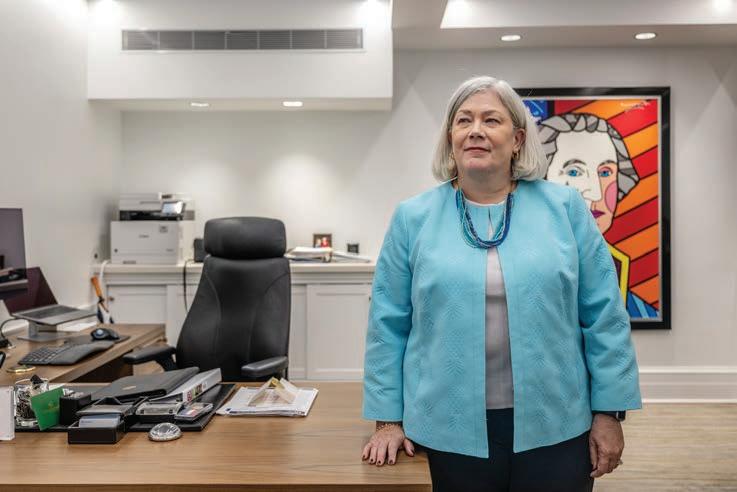
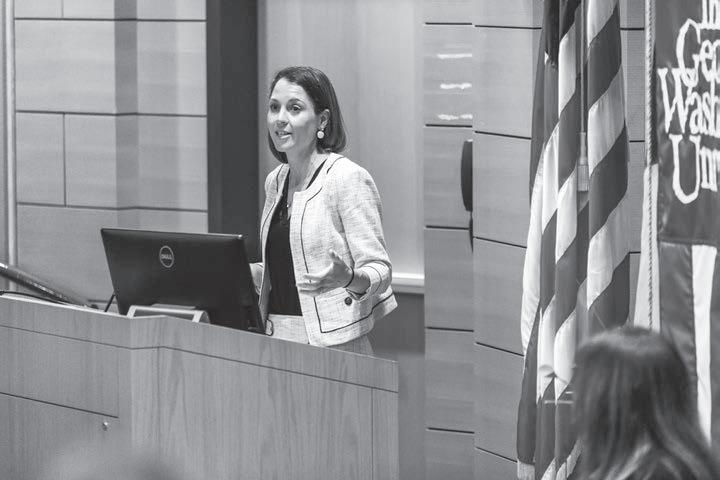
When University President Ellen Granberg entered office last year, she hoped to set a higher standard for community involvement in University decision-making to ensure that faculty, staff and students had a voice in handling “critical” issues at GW.
But on Wednesday in her second sit-down interview with The Hatchet since her inauguration, Granberg said she regrets not consulting a broader range of community members on the University’s daily and big-picture choices when she reflects on officials’ handling of the pro-Palestinian encampment on campus last spring.
Granberg said during the two weeks of protests that called for GW to disclose investments and divest from companies supplying arms to Israel, she believed she was adequately consulting and communicating with GW officials and other stakeholders, including presidents of other universities with encampments. But she said “it was clear” that those feelings weren’t shared by the community at-large upon receiving feedback after the Metropolitan Police Department cleared the encampment in May.
She said she couldn’t say for certain that fielding input from different groups would have changed the outcome of officials’ decisions but that adding an “additional frame” of reference changes the way people think about a situation. If protests continue this semester, officials will seek input from a wider array of community members beyond campus leaders, Granberg said.
“What would be different this fall is that there would be a much more
programmatic outreach beyond those folks, rather than those folks representing their communities,” Granberg said.
Faculty senators pressed Granberg in May on officials’ “scant” communication and lack of consultation with faculty on handling the encampment. Students last week also called on Granberg to increase her visibility and engagement with the student body as she enters her second year.
Despite her communitywide regrets, Granberg said officials from the Division for Student Affairs, the Division of Safety and Facilities and faculty representatives engaged in thorough dialogue with students in the encampment.
“My understanding from the folks who were responsible for carrying that out, is it was pretty rich, and there was a lot of communication back and forth,” Granberg said. “The place where I became the most aware of communication being not enough was with our community.”
Granberg did not visit
or communicate directly with any protesters during the two weeks of demonstrations. A representative from the pro-Palestinian student coalition that set up the encampment — who requested to remain anonymous because of a fear of doxxing and repression from GW — said they believed Granberg’s “primary mistake” was her lack of direct communication with the student protesters.
In response to protesters’ ongoing demands of divestment from companies that supply arms to Israel, Granberg reiterated the University’s position that GW is not considering divestment. She said it is “virtually impossible” to divest from a specific industry, which became clear to trustees and officials over the last five years after GW committed to divesting from the fossil fuel industry in 2020. She said the way universities invest in companies has changed “so much” in recent years and deferred to Chief Financial Officer Bruno Fernandes when asked for specifics on the shift,
saying he could answer the questions “factually.”
“I’m actually going to have to punt based on ignorance, because I don’t want to act like I know,” Granberg said.
Fernandes declined to comment on how investments have changed in recent years.
Granberg said she is potentially interested in considering limitations on adding new investments to their portfolio but did not specify what investments she would consider limiting.
“What I’m interested in is, are there ways that we can think about this, not from what we remove but from what we add?” Granberg said.
The coalition representative said they were “glad to hear” that Granberg was considering this strategy, which the coalition had proposed to officials during talks with Office of the Provost staff but said they were previously unaware officials were considering it.
Faculty suggestions not ‘recognized’ in delayed diversity plan debut
Members of a University-wide diversity review team said the Office of the Provost’s diversity, equity and inclusion plan released earlier this month after a yearlong delay excluded several recommendations from faculty.
The plan comes nearly three years after a Diversity Program Review Team began assessing GW’s diversity climate in 2022, a process that included using results from a survey conducted with students, faculty and staff that year to develop a set of final recommendations to improve diversity at GW. Professors within the review team’s faculty subgroup said the final plan — which comes after officials submitted a draft report of the team’s recommendations to an external review team months later than initially promised — is generic and leaves out suggestions that faculty outlined in the plan’s development.
“I understand that you want to keep it succinct, and I understand that you can’t address everything that came out of every subcommittee, but it’s so general that it almost reads like you could’ve written it without all of that analysis and input,” Jennifer Brinkerhoff, a member of the faculty subgroup, said at a Faculty Senate meeting earlier this month.
Provost Chris Bracey first announced that the provost’s office would conduct a yearlong review to improve campus diversity in August 2021.
In February 2022, Bracey announced the creation of the Diversity Program Review Team, a group of 26 faculty, students and administrators, who that spring conducted a diversity climate survey for faculty, staff and students.
Officials in March 2023 held community forums to share survey findings, which revealed that half of survey respondents experienced a negative experience on campus, with LGBTQ+ respondents experiencing the most negative identity-based treatment. In April 2023, the faculty subgroup of the review team submitted their draft report to officials, who compiled a comprehensive report to include plans from every subgroup.
Officials originally projected to submit the comprehensive report for external review in spring 2023 and receive the plan back for its final release in summer or fall 2023, according to web archives. But the provost’s office website now slots external review for fall 2023 and report submission for spring 2024, months later than originally planned. Officials changed the website’s timeline as early as Feb. 27, 2023, according to web archives but did not formally announce the delays.
Bracey declined to comment on the delayed timeline and why it took an additional year for officials to publish the plan. He also declined to say how the office plans to address concerns about recommendations that went unaddressed in the final plan.
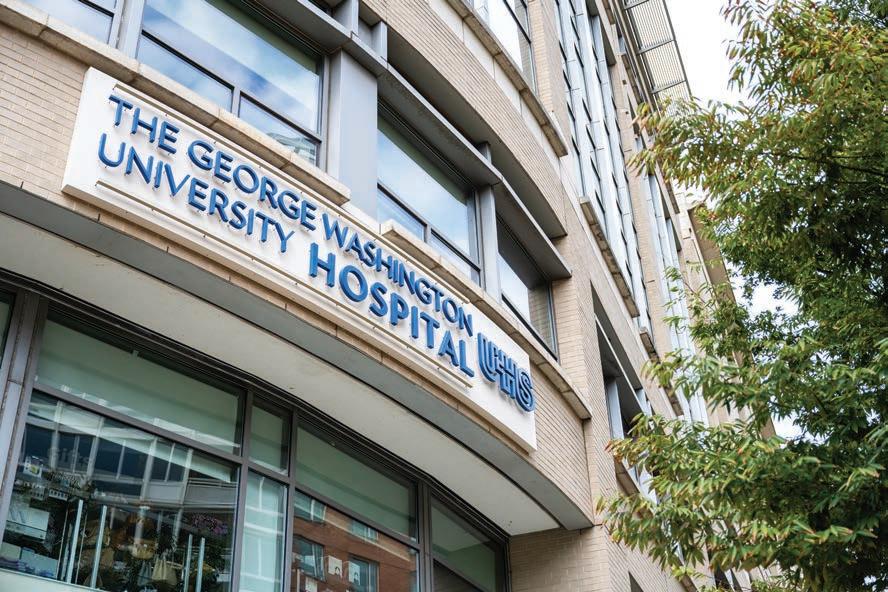
Union leaders at GW Hospital have engaged in yearslong, deadlocked battles with the hospital’s owner over union recognition and bargaining in what experts say is part of an ongoing nationwide trend of union avoidance.
GW Hospital’s nurses’ union and service workers union filed unfair labor practice charges against Universal Health Services, Inc. the hospital’s owner and provider, in 2023 and 2018, respectively, alleging UHS attempted to thwart union presence by discouraging participation and engaging in bad faith bargaining. Both unions won elections among hospital employees — the nurses in 2023 and service workers more than two decades ago — but UHS doesn’t recognize either union, so officials won’t come to the bargaining table.
UHS is a for-profit Fortune 500, and one of the country’s largest hospital management companies. GW and UHS first partnered in 1998 to operate GW Hospital, and UHS became the sole owner of the hospital in May 2022 when the University sold UHS its minority stake.
The National Labor Relations Board, which enforces U.S. labor law, is taking UHS to court on Oct. 21 after escalating three of the nurses union’s unfair labor practice charges.
The board ruled in May the UHS engaged in bad-faith bargaining and ordered its leaders to resume good-faith contract negotiations with the service worker’s union.
GW Hospital spokesperson Susan LaRosa said GW Hospital is pursuing “all legal rights” related to the nurses’ union election. She said if the NLRB again certifies the election — after UHS in June appealed the regional labor board’s decision to certify the union — GW Hospital will engage in good-faith negotiations with the union.
“GW Hospital denies the allegations of any unfair labor practices and is defending against those charges vigorously,” LaRosa said in an email.
Experts in labor history said
UHS’s legal moves signal union avoidance — a legal approach employed by corporations and hospitals to slow union progress by attempting to stop union election wins because they view unions as a threat to profits and management prerogatives.
“It’s a legal specialty in advising managers how to avoid bargaining with the union. That’s become kind of the norm in both the corporate world, including both for-profit and nonprofit hospitals and also in university administrations,” said William Jones, a professor of history at the University of Minnesota.
Just over a third of newly organized unions obtain a collective bargaining agreement with their employer within the first year, and about two-thirds secure a deal within three years, according to the U.S. Department of Labor.
Here’s a breakdown of union battles at GW Hospital and other UHS-owned facilities:
GW Hospital nurse’s union Nurses initiated union organization with the D.C. Nurses Association in February 2023 after previous repeated attempts to work directly with leadership to address the hospital’s lack of staffing and a lack of “lasting systematic improvements” following the COVID-19 pandemic. GW Hospital in February also laid off 60 employees, or 3 percent of its staff.
David Zonderman, a professor of history at North Carolina State University and an expert in American labor history, said low staffing worsens working conditions in hospitals, often triggering nurses to organize unions.
“The for-profit entity wants to increase its profits,” Zonderman said. “It’ll cut staff and/or cut wages, benefits.” Edward Smith, the DCNA’s executive director, said after nurses announced plans to unionize, UHS leaders’ anti-union practices were immediate. DCNA filed five unfair labor practice complaints in March 2023, alleging UHS officials suspended a nurse for participating in union organizing, installed surveillance cameras in staff spaces and discouraged union participation in
private meetings with nurses.
UHS suspended and then fired registered nurse Angelo Estrellas in March 2023, which the nurses’ union said was due to his involvement in the union organization.
“They’re probably one of the most anti-union health care companies I’ve dealt with,” Smith said.
Smith said he believes UHS officials weren’t aware of nurses’ plan to unionize until about two weeks before DCNA launched its union campaign.
As nurses waited for the NLRB ruling that allowed them to hold a union election, union leaders said GW Hospital management removed pro-union signage and put glass frames over bulletin boards in the hospital to prevent union representatives from posting material.
In June 2023, the union set election dates for the end of that month, and nurses voted 310-207 to form a union. Smith said part of the reason why the association won the vote was because UHS didn’t have time
to dissuade people. UHS objected to the election results within a few weeks, contesting the union’s messaging, voter identification and brief presence of supervisors at the election. The regional NLRB director quashed the objection in June — which Smith said UHS has appealed.
“I was 100 percent positive they would fight,” Smith said. “It’s not rocket science. No, all you need to do is look at this company’s history with labor unions.”
The regional NLRB in late May ruled to dismiss one of UHS’s charges, which alleged that Estrellas was a supervisor — a position that labor laws bar from participating in union efforts. The NLRB’s decision affirmed that Estrellas was not a supervisor and couldn’t have coerced nurses into joining. UHS has since appealed the decision.
“It affected me finding work, emotionally, psychologically and financially,” Estrellas, who worked at GW Hospital for more than a decade, said in June.
The NLRB regional director ordered a court hearing for Oct. 21 over three unfair labor practice charges, including Estrellas’ termination.
GW Hospital service workers’ union
The 1199 Service Employees International Union had represented more than 150 GW Hospital cleaning, ambulatory and food service workers for more than two decades before the hospital received a decertification petition in October 2018 — which 81 of the 156 employees in the bargaining unit signed. UHS officials notified the union that they were immediately withdrawing recognition of the union, claiming it had lost support of a majority of employees in the bargaining unit. UHS officials then canceled all future bargaining sessions and implemented a new compensation structure and employee wage rates.
Pro-Palestinian demonstrators allegedly spraypainted in front of several Board of Trustees members’ homes and sent letters about the University’s alleged role in the war in Gaza to their neighbors Wednesday night, according to an anonymous submission to the Student Coalition for Palestine at GWU’s Instagram.
The coalition posted on Instagram Thursday afternoon photos of “Stop funding genocide” and “Disclose divest now” stenciled onto sidewalks and driveways, which the post claimed depicted pavement in front of Board members’ homes. The post included photos of letters addressed to neighboring houses with “Danger: war criminal lives in this
area,” written across the top of the letter and photos of Board members, their families and injured children in Gaza included inside.
A University spokesperson said officials on Thursday learned of “vandalism and intimidation” targeting Board members and their families at their homes, and GW Police Department officials brought the issue to law enforcement officers. The spokesperson said the University will take “appropriate steps” that align with D.C. laws and University policies if officials identify the “perpetrators of these cynical and threatening acts.”
“The real and complex issues and tragedies confronting the world will not be addressed through destructive activities that implicitly threaten individual safety; in fact, they undercut meaningful and productive dialogue and stand in stark
contrast to our community values,” the spokesperson said in an email.
The Instagram post states the coalition will not “allow” GW officials to engage in “performative” discussions, and requests that the Board consider their demands for financial disclosure and divestment from companies with ties to Israel in “good faith” during the Board meeting on Sept. 27.
“Every GW Trustee is a war criminal and profiteer — funding the murder, rape, and torture of Palestinians,” the post states.
Last month, the coalition posted an anonymous submission they received on Instagram that depicted “disclose divest now” spraypainted onto what the post claimed was Provost Chris Bracey’s driveway, and another photo of the same message painted on the George Washington bust at the corner of 23rd and F Streets.
CRIME LOG
THEFT II/OTHER, CREDIT CARD FRAUD
Various Locations
9/16/24 – Between 3:10 p.m. and 7:30 p.m.
Open Case
A female student reported that her wallet was stolen after she left it on the Mount Vernon Express. She said the card was used fraudulently at various offcampus locations. Case open.
SEXUAL ASSAULT
Kogan Plaza
Reported 9/17/24 – 8:50 p.m.
Open case
A female student reported being a victim of sexual assault when an unknown man grabbed her butt when she was walking through Kogan Plaza. Case open.
THEFT II/FROM BUILDING
Gelman Library
Reported 9/18/24 – Unknown Time
Closed case
A student reported his laptop and backpack stolen after leaving it unattended at Gelman Library. Case closed. No suspects or witnesses.
THEFT II/OTHER
Thurston Hall
9/18/24 – 11:33 a.m.
Open Case
A student reported his birthday balloons — estimated to be worth about $130 — stolen after they were left at the front desk of Thurston Hall. Case open.
STALKING
Various Locations
Multiple Dates and Times
Open Case
A student reported being stalked by an unknown man on her way home from her off-campus housing. She reported the incident to the GW Police Department and Metropolitan Police Department. Case open.
Finance Division officials on Friday launched a website displaying the University’s publicly available financial documents for fiscal year 2023 amid student requests for transparency on GW’s investments and funding.
The website, which University President Ellen Granberg pledged to develop over the summer at a May Board of Trustees meeting, contains nine categories of financial data for FY 2023 — including endowment growth, philanthropy and operating expenses — and financial reports for the last five fiscal years. Granberg in May said the website, which consolidates financial reports and documents already accessible through various GW websites, will offer community members “greater clarity” on the University’s finances and investments.
Officials launched the website after months of pro-Palestinian student protests and discussions with administrators about their demands that the University disclose all financial endowments and investments and divest from companies supplying arms to Israel. Representatives from GW’s Student Coalition for Palestine shared a policy suggestions document with officials earlier this month that outlined potential next steps for the University to disclose investments.
“The website fulfills a commitment university leadership made to community members to provide greater financial transparency and clarity after hearing in recent months a desire to better understand
university finances,” Chief Financial Officer Bruno Fernandes said in University release announcing the website.
The website contains information on FY 2023 operating revenues, expenses and margin, research, philanthropy, endowment market value, endowment growth, balance sheet highlights and revenue sources and uses. The website also provides links to endowment stewardship reports for the last five fiscal years, bond issuances and GW’s Moody’s Investors Service ratings.
The website states that 62 percent of GW’s $1.209 billion operating revenue for FY 2023 comes from student tuition, which University Controller Neena Ali said at a May Faculty Senate meeting makes GW a tuition-dependent institution. According to the website, 27 percent of the revenue from tuition comes from undergraduate students, 24 percent comes from graduate students and 11 percent comes from online tuition. The website states that 8 percent of the operating revenue comes from endowment support and 10 percent comes from auxiliaries — housing and
dining revenue. Employee compensation comprises 56 percent of GW’s $1.197 billion operating expenses for FY 2023, and purchased services — which includes contracts for third party services like grounds maintenance and dining — accounts for 17 percent.
GW’s endowment market value grew from $1.577 billion in FY 2014 to $2.522 billion in FY 2023.
billion for FY 2023, with 59 percent of the endowment comprising “general support,” which the website states includes University real estate investments. The website’s 2023 Revenue Sources & Uses tab states GW’s academic schools receive $600 million from the University’s revenue, but does not break down the amounts granted to each school. The website states that $400 million of University revenue goes to an “administration & other” category, but does not specify funds for that section.
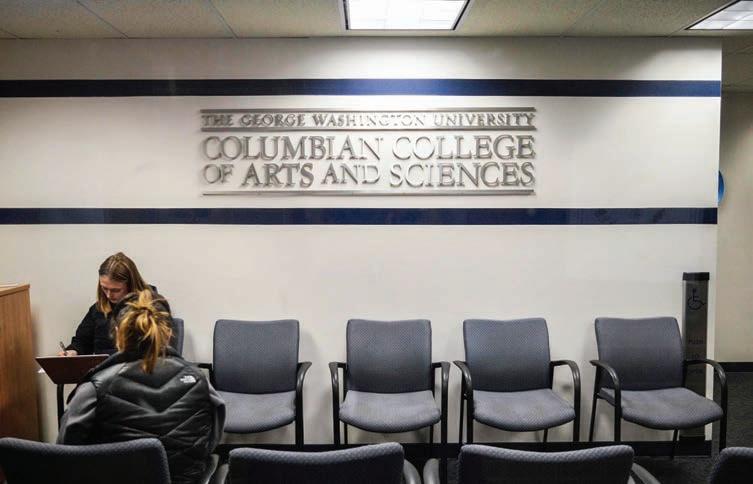
The Columbian College of Arts & Sciences in August reinstated academic travel reimbursements for tenured faculty and graduate students after officials eliminated the funding last year.
After CCAS officials notified department chairs in spring 2023 that the school was cutting reimbursements last academic year due to a decline in graduate enrollment and expenses related to inflation and compensation, faculty and graduate students said the lack of funding hindered their ability to complete their research goals because they could not attend conferences or visit archives.
Faculty said they are happy to have the funding back, but the $1,250 in reimbursement credit they receive from CCAS is still too low to cover their travel costs.
CCAS Dean Paul Wahlbeck said the school notified all department chairs and directors in the spring that travel funding would return during this academic year and notified all full-time faculty Aug. 1.
He said funding would return for doctoral students this academic year, but some graduate students said they haven’t received word on the funding while others have received notification from their departments that they would not be receiving funding this year.
“This reinstates the previous scholarly travel policy, providing up to $1,250 to support expenses for faculty presenting or actively participating in conferences,” Wahlbeck said in an email.
In June 2023, 37 professors sent a letter to University President Ellen Granberg that discussed the harm posed on their research by the lack of travel funding, which the letter said was counterintuitive after the University that
reimbursements
month joined the Association of American Universities — an invitation-only group of top research universities.
Masha Belenky, a professor in the Department of Romance, German & Slavic Studies and a faculty senator, said she is “delighted” that the funding was restored but that the $1,250 per year she receives barely covers the cost of travel, lodging and food for a domestic conference about 19th-century French studies she attends every year.
“Even with that amount of money, we’re only able to travel to one conference, and even there, I usually share a room with a colleague,” Belenky said. “It’s just not enough, it doesn’t go far enough to cover all the expenses.”
She said she had never seen the reimbursement cuts taken away since she joined the University in 2001, besides during the COVID-19 pandemic, and that faculty previously couldn’t complete an “intrinsic” part of their jobs when officials took away travel funding.
“Traveling to conferences
is not something that we do for fun, it’s part of our jobs in the University, and I think that’s a good thing,” Belenky said. Maddie House-Tuck, a doctoral candidate in the American studies department, said she received an email from the department in August that said CCAS would not be providing reimbursements for doctoral students for this academic year, but the department would provide $750 for travel reimbursements for each student for the year. She said she would previously receive $600 to travel from CCAS and an additional $600 from the department.
House-Tuck said there is some research she can’t do without CCAS funding because she doesn’t have the financial means to travel to archives as needed for her work.
“If GW really wants to be responsible for its graduate education and how it’s producing new academics entering the fields that they’re working within, they also do have this responsibility to support our travel, to meet
other scholars and to present our work and to become established in the field,” HouseTuck said. Daniel Ziebarth, a doctoral candidate in the political science department, said he had previously received a $700 reimbursement to attend a conference before officials cut the travel funding last year. He said he sent an email to a department official to ask about funding for this year and was told none was available, forcing him to look for funding provided through some conferences themselves and affiliated groups.
Eric Lawrence, an associate professor and the chair of the political science program, said there were repeated discussions about the state of the funding throughout last academic year in meetings with CCAS leadership.
“The view of all the faculty, and I’m not gonna speak for the deans, but everyone believes that this should be a very high priority because we are a research university and expected to do research, and we want to allow faculty to pursue that,” Lawrence said.
HATCHET FILE PHOTO
The Columbian College of Art & Sciences o ce in Phillips Hall.
JENNA LEE ASSISTANT NEWS EDITOR
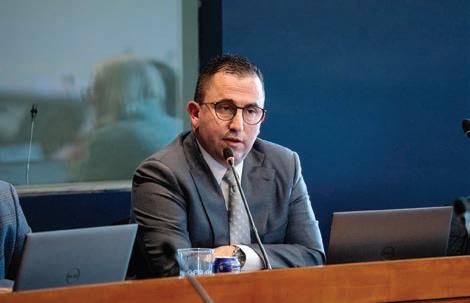
DANIEL HEUER | ASSISTANT PHOTO EDITOR Chief Financial O cer Bruno Fernandes at a meeting in April.
Lloyd Elliott, the namesake of the Elliott School of International A airs, assumed the presidency of GW.
HATCHET FILE PHOTO
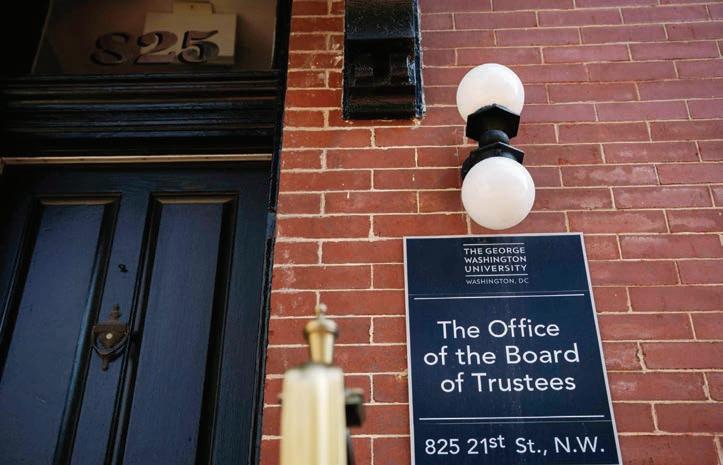
The O ce of the Board of Trustees on 21st Street.
Officials boost security policies in campus residence halls
RORY QUEALY
Officials bolstered security procedures in Foggy Bottom campus residence hall lobbies this semester, which students say make them feel safer, but only when security personnel is attentive.
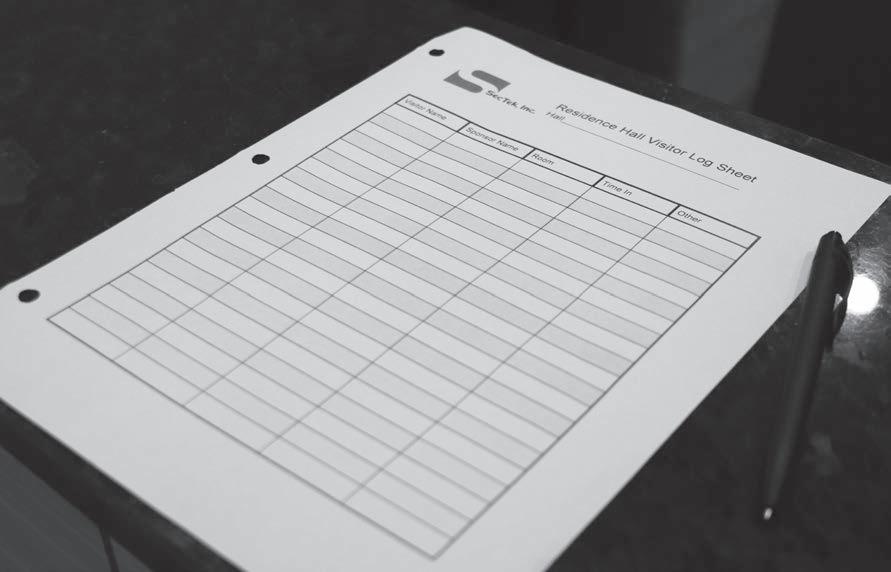
A dozen students reported that this semester security officers began requiring off-campus students and non-GW guests to present forms of identification and fill out a sign-in sheet — which logs the names of the guest and resident, their time of arrival and the room the guest is visiting — before they are permitted to walk through the lobby. While multiple students called the policy change “annoying,” and others said it makes them feel safer in their residence halls, students agreed that enforcement of the procedures is inconsistent based on the building and on-call security officer.
Students said before this semester, when bringing a non-GW affiliate or off-campus guest to their rooms, they would tell the security officer the person was their guest, and the officer would typically allow them to enter without asking them to sign a sheet or show an ID.
Students said security officers are now required to document the time a guest enters, but security guards typically don’t ask guests to sign out when they leave the building. Students said off-campus students also must sign in each time they enter an on-campus residence hall and that security officers limit the number of guests to four.
Baxter Goodly, the vice president of the Division of Safety and Operations, said GW employs a security company to verify that residents tap their GWorld cards appropriately and that guests sign in and are accompanied by a resident to “maintain the safety” of residence halls. Goodly declined to say which security company GW currently uses, and declined to
comment on when and why officials implemented new guest signin policies in residence halls. In 2021, GWPD Chief James Tate said residence hall security officers are responsible for controlling building access, verifying GWorld tap access and preventing potentially dangerous people from entering the building. He also said officials contracted Allied Universal Security that year to assign security officers to residence halls to monitor building access. Goodly declined to say if GW still uses this same company.
Before the COVID-19 pandemic, student employees oversaw building security via the University’s Student Access Monitor program, which officials officially terminated as students returned to in-person instruction in fall 2020.
A November 2018 Hatchet analysis found that Student Access Monitors weren’t present in Amsterdam Hall or South Hall more than 95 percent of the time.
Students’ observations of increased residence hall security this semester comes after Campus Living & Residential Education officials expanded security guard presence in halls last November in response to ongoing activism in the District, and began requiring that all students tap GWorld cards at a second card reader located by security desks upon entering their hall’s lobby. University President Ellen Granberg said in October 2023 that the University would be strengthening campus security by increasing GW Police Department patrols, monitoring outdoor spaces and increasing the amount of assigned security officers in halls “as needed.”
During the pro-Palestinian encampment in University Yard last semester, officials diverted security officers in Foggy Bottom from their posts in residence hall lobbies to monitor buildings surrounding U-Yard.
Lindsey Giffin, a junior major-
ing in English and creative writing, said one of her friends who lives off campus frequently visits her Amsterdam Hall room, and she finds it “annoying” that she needs to sign in the same friend every time she enters the residence hall, especially when they only leave the building for a few minutes to grab food.
She said the security officers ask each time for her friend’s GWorld so they can jot down their name, Giffin’s room number and the time her friend arrived at Amsterdam Hall. Giffin said the security officers haven’t asked her guests to sign out when they leave, which she said makes the whole process “pointless” for monitoring guests.
“I think all the security guards literally know her by name now because of the amount of times I’ve had to write down her information,” Giffin said.
Raquel Korff, a sophomore living in JBKO Hall, said her boyfriend attends Georgetown University and he and his friends often visit her room. She said this semester, security officers have asked her to sign in the guests and have limited the number of guests to four, which she said makes her “frustrated.”
She said when her boyfriend brought five of his friends over and the security officer told her she exceeded the four-guest limit, she “negotiated” with the guard, who ultimately let her friends in because she said it was the end of her shift.
Korff said the process of signing in guests is “extensive” because it can take up to 10 minutes to sign in six guests.
“I absolutely understand that if you are bringing outside guests in,
whether they’re 30 years old or an 18-year-old from another college practically next door, I understand that they do not go here, and they should have to sign in or just show ID,” Korff said. “But this whole guest limit thing, this whole extensive process, it doesn’t make me feel any safer.”
Carly Palmer, a first-year living in Thurston Hall, said she feels “relatively safe” in her residence hall, but is more “cautious” after GW Police Department officers took possession of a secret camera in a Thurston bathroom earlier this month. She said it can be easy for guests to sneak past the security desk if security officers aren’t paying close attention or if there’s a big crowd of Thurston residents entering at once but that she’s glad the policy is in place because it makes her feel safer.
Staff report insufficient salaries, minimal career growth in Staff Council survey
AIJALON GOURRIER
REPORTER
ARJUN SRINIVAS
REPORTER
Staff Council survey respondents said they receive low salaries and limited opportunities for professional growth in a survey discussed at a Staff Council meeting Friday.
In a Staff Council survey recently administered to all staff members, 67.6 percent of respondents said their compensation is “not sufficient” for their work and 51.9 percent of respondents believe they could find more opportunities for professional growth if they left GW. Amanda Kohn, the council’s correspondence and engagement secretary, said at the meeting that low wages have resulted in staff members claiming they need to main-
tain multiple jobs to ensure they can pay for their basic expenses.
Staff Council President Bridget Schwartz said about 14 percent of all staff members responded to the survey, including executives and other individuals who aren’t covered under the Staff Council. The Staff Council has released more than half a dozen surveys throughout the year to collect information on staff experiences, which Schwartz says she takes to her conversations with the Board of Trustees, if the respondent gives her permission.
Kohn shared a presentation with the body that highlighted comments from survey respondents, including that many don’t make enough money through GW to support themselves despite their dedication to their jobs. One respondent said they have worked at GW for
more than eight years and has had to seek “outside income” for their entire tenure to cover basic expenses.
“I have a second job to make up for the gaps in my salary,” one survey respondent said. “While I enjoy this job, working 40 hours a week at GW and then heading to another job is not ideal for my mental health and well-being. The cost of living, food and transportation in the DMV has continued to rise, while my salary has relatively stayed the same.”
Councilmembers voted to approve a resolution in April that requests the University increase staff wages beginning in fiscal year 2025, arguing that GW staff salaries and wages have failed to rise correspondingly with the increasing cost of living in the D.C. area.
Councilmembers did not discuss the survey result that revealed 51.9 percent of
staff believe they have minimal opportunities for career growth at the University.
Schwartz said she plans to share responses and data from the survey at the Board of Trustees meeting next week.
Some councilmembers expressed concern that low survey response rates paint an inaccurate picture of staff concerns at the University.
Paul Regis, the School of Business Staff Council representative, said he strongly encourages the councilmembers to carefully evaluate and consider the fact that people tend to “jump on” the internet when they’re upset about something. He said this tendency could skew the accuracy of Staff Council surveys because the people who feel positively about the University often don’t respond.
“I worry that with such a small sample size that you’re going to have more people
who are already frustrated and feeling upset about things, and they’re going to rush to the survey, whereas there possibly may be a significant portion of the population that everything’s fine, and they don’t jump on, and they don’t jump on and do the survey because they have nothing to complain about,” Regis said.
Schwartz said she will take note of concerns surrounding the low response rate but said she thinks the responses are accurate to how most staff feel at the GW, based on conversations she’s had and based on the quality of comments received.
“After over a year of hearing feedback and listening to staff, I find that this likely paints a pretty good picture of what’s happening at the University,” Schwartz said.
She said while staff left “hundreds of comments,” in the survey, councilmembers
only presented the responses they had permission to share. Michelle Fargher, who serves as the staff development and recognition committee chair, asked that the Staff Council publish the results in the next newsletter and conduct an additional survey to see if staff members feel the results are representative of the entire body. Schwartz did not respond directly to Fargher’s comment. Staff Council Vice President Kim Fulmer discussed the upcoming Staff Council elections, which she said would last from Sept. 30 to Oct. 18, giving staff members a month to vote. Councilmembers will serve in oneyear terms, from Jan. 1 to Dec. 31. Current councilmembers are serving an 18-month term due to the revised end date of the term from July to January.
Students, restaurant employees say new GWorld ‘tap’ system speeds up lines
Officials this semester implemented GWorld “tap” payment scanners at dining halls and University dining partners, which students and local restaurant employees say expedites transactions.
Officials installed new payment readers at GW Dining locations and local dining vendors that accept GWorld cards this summer as part of “ongoing efforts” to upgrade dining technology, a University spokesperson said. More than a dozen students said the GWorld tap scanners help lines move more quickly, and local vendors say payments process quicker on their end.
A University spokesperson said officials installed new payment readers at dining halls, the University Student Center and District House. GW also distributed the new readers to all of GW’s on- and off-campus dining partners, the spokesperson said.
“These new readers allow GW community members using their meal plans to tap instead of swiping their GWorld card,” a University spokesperson said in an email.
GWorld cards grant students access to academic buildings and residence halls and act as currency for students to “swipe” or “tap” for meal credit at Shenkman and Thurston dining halls and the Eatery at Pelham Commons in addition to more than 50 Dining Partners. Participating vendors include South Block Juice Co., Carvings and CVS.
Prior to the switch this semester, students handed their cards to dining employees to scan. For
vendors who accept GWorld — like CVS — students would also need to sign a printed receipt certifying the charge and including whether or not they wanted to leave a tip.
Grace Suter, a junior and barista at Peet’s Coffee, said the tap feature speeds up lines, except when Peet’s gets really busy and students rush through the transaction. Suter said the new system offers multiple interface screens — including options to add a tip and enter students’ GWorld card numbers
— and students often tap their card before the correct screen is loaded. She said this causes the tip amount to populate as an eight-digit GW identification number, and the employee then has to restart the transaction process.
“Because we get so busy, people try to go too quick,” she said.
She said Peet’s has since moved the tap machine to the employee’s side of the counter to prevent issues caused by students tapping too soon.
Iridiam Solano, an employee at Bullfrog Bagels, said students’ ability to tap GWorld has improved wait times because the transaction moves more quickly when employees don’t need to physically take and scan the card.
“It’s better because the students can tap and it’s more easy for us,” Solano said. “I think it’s pretty cool.” Latoya Morris, a shift supervisor at CVS, said she found out officials were implementing the tap
GWorld payment at CVS in May or June. She said the tap system is working well at CVS, speeding up the lines and minimizing a point of physical contact between employees and students during the transaction.
“When I say great, it’s perfect for us,” Morris said. “It’s much faster, like I said, easier, and especially with a lot of stuff that’s going around with the seasons changing and everyone getting sick, it kind of helps us out a lot.”
Emma Milchunes, a junior majoring in international affairs and former Flower Child employee, said the previous system was more time consuming because it required employees to enter the price, requiring more “manual work” to process the transaction. She said she wishes Flower Child, which closed in May, had the tapbased system because the process appears more seamless.
“I’m sure it’s much easier in terms of it saves them a lot less time and probably causes less mistakes,” Milchunes said.
Kassidy Corey, a first-year studying journalism and dance, said she noticed the switch from swipe to tap at Thurston dining hall this year. She said when students carry their GWorld card on a lanyard — which is often closed with a Ziplock-like seal — it is inconvenient to pull it out to swipe, so the tap system makes the process more efficient.
“You have to stand there and take it out and put it back in,” Corey said. “So really it’s more convenient: I can just leave it in the lanyard.”
ELLA MITCHELL CONTRIBUTING NEWS EDITOR
PHOTO ILLUSTRATION BY TALAN MASKIVISH
A student taps their GWorld on a new card reader in the Thurston Hall dining hall.
Nursing school working to improve nurse retention, job satisfaction
Researchers at the GW School of Nursing are using funding awarded this year to finance new projects to improve the retention and working environments of nurses.
The project is in the third year of a four-year grant awarded by the Robert Wood Johnson Foundation, a philanthropic organization that funds projects that combat health barriers. Ashley DarcyMahoney, the senior associate dean for faculty affairs for the nursing school and principal investigator on the project, said researchers will launch projects to reduce nurse turnover and improve job satisfaction with funding awarded this year by the AARP Center for Health Equity through Nursing and the Future of Nursing: Campaign for Action.
“I am actively involved in supporting the implementation of these initiatives, working to ensure that the nursing profession plays a pivotal role in creating a more equitable healthcare system for all,” Darcy-Mahoney said in an email. “Through these collaborative efforts, we hope to build a sustainable framework that empowers nurses and promotes health equity across communities.”
Darcy-Mahoney said the project started after the Robert Wood Johnson Foundation published a report in 2021 that laid out guidelines for nurses’ roles in reducing health inequities, which included recruiting a diverse workforce to match an increasingly diverse population, educating nurses on how to respond to natural disasters and public health emergencies and having nurses in leadership positions to train others in advancing health equity. She said the project aims to
end in 2025 and ultimately provide recommendations to better nursing in what the project identifies as “key areas” like leadership training, nursing education and identifying structural inequalities of health.
Darcy-Mahoney said since the start of the project in 2021, researchers received funding from nursing organizations like the AARP Center for Health Equity through Nursing to develop methods, like focusing recruitment efforts from underrepresented research areas and creating infrastructure to “support nurse well-being,” to improve working environments and combat structural racism in the nursing profession.
According to the report, the infrastructure involves both individual-level interventions like nurses improving their diet and physical exercise and structural interventions like integrating mental health training into nursing school curriculums.
“The overall goal is to achieve health equity in the United States by strengthening nursing capacity and expertise, enabling nurses to be change agents and leaders in advancing health equity and dismantling structural racism,” Darcy-Mahoney said in an email. “This initiative seeks to improve access to care and services for populations disproportionately impacted by health disparities.”
Experts in nursing said nurses are experiencing higher stress now due to staffing shortages, which has led to retention and burnout.
Megeen White, a health suite nurse at the University of Maryland, said the pandemic exposed the emotional toll nurses’ work takes on them.
“Caring for others can be very taxing, both emotionally, physically, mentally, all of the above,”
White said. “And now people get into this profession because they want to care, but it’s difficult for nurses to have that balance between self-care and caring for others.”
White said the national nursing shortage has placed more stress on the workforce, which she attributed in part to the aging population in the U.S. that needs more attentive care.
“If there’s already a current shortage of not enough nurses, the nurses that are currently working are going to undergo more stress and strain because they won’t leave their patients hanging,” White said.
Sue Anne Bell, a professor of nursing at the University of Michigan, said the recommendations developed by research projects can be helpful but only if they are visible to leaders in the nursing field and government officials so they can implement them.
“Staff nurses who are working in hospitals or other health care settings, hopefully they’re reading the report too and thinking about how they can change practice, implement findings from the report on a clinical practice level,” Bell said.
Bell said nurses play a role in helping health inequities in patients by not just treating patients for their current symptoms but looking into the root causes and “social determinants” of their health outcomes to create more preventative measures for future patients.
“What is the social situation in their home?” Bell said. “What is the health of their neighborhood like? What are their financial resources like? All of those factors are the way that nurses have been educated to meet social determinants of health and to provide equitable health care for all.”
Latin-based student groups celebrate heritage, modify event planning
Student organizations will celebrate their Latin and Hispanic culture and traditions in an annual monthlong celebration after student leaders refurbished the event planning process to include events from a wider range of student groups.
This year’s Latin Heritage Celebration, centered around the theme, “Herencia Unites, Cultura Ignites,” launched Sept. 15 with a kickoff event titled “Meet La Familia,” a Latin and Hispanic student organization fair, where students met many cultural student organizations on campus. Adriana Hernandez Jimenez, the president of the Organization of Latin American Students, said the LHC planning committee started planning this year’s celebration last semester instead of the beginning of the school year like previous years to allow more opportunities for more student groups to participate and acquire funding and spaces on campus.
The heritage celebration will culminate with “Fiestasa” on Oct. 19, a party at Opera Ultra Lounge, hosted by OLAS.
Hernandez said her organization began reaching out to Latin-based organizations like LATAM@GW and UndocuGW last semester to form this year’s committee and to get a head start on planning the celebration. She added that OLAS realized that starting the planning process for LHC during the same semester as the event takes place did not provide enough time to coordinate logistics like booking spaces and acquiring money for the events.
“We noticed the year before that when it came to LHC planning, since we’re just starting celebratory month or heritage month, we have minimal planning time if we start during the regular school year,” Her-
nandez said. “So school starts in August, but then we only have about a month and then our celebration starts, so that leaves us with a very tight turnaround to both plan events, ask for funding and reserve spaces.”
Hernandez said LHC is designed to give students the space to embrace their Latin backgrounds and identities, as well as establish a presence of Latin Americans on campus.
“When it comes to OLAS, it’s really aligned with our mission of uniting students with a community,” Hernandez said. Hernandez said having grown up in a predominantly Mexican community, she enjoys the opportunity to learn more about the “cohesion” of Latin cultures between other students because they have different experiences depending on which states they are from.
“Coming from the West Coast, we’re very Mexican heavy, so the East Coast definitely does show a different Latin community, and it’s been amazing to learn about different foods, different customs and different cultures as we all come together at GW,” Hernandez said.
Javier Orellana, the copresident of UndocuGW, an organization that advocates for undocumented students and students facing immigration-related issues, said the LHC planning committee worked to ensure all Latinos were included on campus by being mindful about using Hispanic, Latin and Latinx when promoting events.
“Herencia means the heritage from our ancestors and that feeling of all of us coming from one place, it sort of unites us together,” Orellana said. “Then cultura, we all know that it’s different for each country but that at the same time, it sort of ignites that unity from herencia to continue moving forward.”
Orellana said they host-
ed the event, “Empoderate: Latines Vote Matters” last Tuesday because UndocuGW wanted to encourage Latin American students to register to vote after the District started allowing noncitizens and international students to vote in local elections in 2022.
“Empoderate: Latines Vote Matters” took place on the first floor of the University Student Center and coincided with National Voter Registration Day, a holiday dedicated to registering people to vote in time for the upcoming election. The event featured tabling from organizations including GW Votes, a nonpartisan group that promotes voter registration and participation and free donuts, candy and stickers.
Orellana said his organization will host “Latine Heritage Month Parade Celebration” for the first time during this year’s celebration, a parade with all Latinbased student organizations on campus that will make two or three laps around Kogan Plaza. The parade will also feature attendees sporting different Latin American flags and face painting, accompanied by live music and dance performances.
Avril Silva, the president of the GW Association of Hispanic Journalists and a Hatchet reporter, said her organization is planning an event called “Beyond the Classroom: Latino Student Identity and Civic Impact in Today’s America” on Sept. 27 in Jack Morton Auditorium, which will feature a panel with Omar García-Ponce, an associate professor of political science and international affairs, Antonio Lopez, the English department chair, and Priscilla Alvarez, a CNN correspondent who covers the White House. “It’s really important for people to see that we are in these spaces,” Silva said. “And it’s not just for some diversity quota. It’s like, yes, they deserve to be there.”
GW Law students this semester revived an independent, studentrun online news site that reports on all aspects of the law school.
Nota Bene, which the Student Bar Association initially founded as Amicus Curiae in 1952, produces online articles on law school events and academics as well as the SBA. Connor J. Toth, the previous director of student feedback on the executive branch of the SBA and Nota Bene’s current editor in chief, said Nota Bene currently has a staff of about a dozen students who actively contribute to writing, editing and uploading stories to the website, and the paper will host its first general body meeting this week, which is open to all law students.
The paper published regular print editions through the 1950s and 1960s, covering law school events and new hires within the school’s administration, until the publication shut down in 1968 due to SBA budget constraints. In 1969, law students revamped the paper under the name The Advocate before renaming it Nota Bene — a Latin phrase meaning to note well or observe carefully — in 1996.
Nota Bene published online up until its shutdown at the start of the COVID-19 pandemic in 2020 because of a lack of activity and leadership.
Toth sponsored an act to bring the publication back to campus and recognize the organization in the SBA in April after a four-year hiatus last semester. He said he wants to introduce a creative writing and photography section into the existing news, opinion and culture sections the website currently has to allow law students to enjoy the writing experience outside of legal writing.
“It can be very draining, and it can sometimes even ruin your ability to write if you don’t go about it the right way,” Toth said. “And so we want to have a forum that we can enable students to have that informal writing, that creative writing style.”
Toth said he wanted to relaunch the publication because law students are “secluded” from the rest of the GW community because of differing academic schedules from the greater University, and publications like The Hatchet don’t always provide information that is relevant to the average law student’s daily life.
He said he wants to cover SBA finances and law school administration decisions, which he said lack transparency.
“There is a disconnect between the University community as a whole and law students, but I think that because we are in that little microcosm, having a specialized publication that caters directly to what
law students are worried about is good,” Toth said.
Among the first articles published by the paper this semester was an opinion piece by Shalom Samuels, the chief judge of the SBA’s Supreme Court — the governing body which interprets the SBA constitution and provides legal guidance to the senate — titled “Let’s Cut the Drama: Why the SBA Should Ditch the Three-Branch System.”
In the opinions piece, Samuels said the SBA is “unnecessarily complex” and its executive, legislative and judicial branches complicate the SBA’s main goals of allocating funds to organizations and advocating for the student body.
“Honestly, if we’re the only law school with a Supreme Court and a senate that thinks it’s Congress, maybe that’s a sign we’re taking ourselves just a little too seriously,” Samuels wrote.
Samuels, the deputy editor in chief of Nota Bene, said his roles on the publication and within the SBA act in a “similar” capacity as checks on the SBA government. Samuels said his role on both the SBA and Nota Bene allows him to “mediate” the disputes between the senate and executive branch of the SBA, adding that forms of media, like Nota Bene, act as a “fourth branch of government” to check the power of leaders.
SBA Executive Vice President
Nigel Walton said he is glad Nota Bene covers the SBA, but it was “wrong” for the opinions piece to be written by a person who holds the position they are criticizing. He said he hopes future articles, in both the news and opinions sections, are written “with truth” by people who are not directly affiliated with the body they are criticizing. “You can’t write an article about the three branches of government as a problem, and you sit as the chief of the damn Supreme Court,” Walton said. Toth published a piece in the
“SBA News” section titled “Disarray in the SBA,” where he outlined a history of “systemic” executive overspending — something Toth said has gone back “two to three” years in the SBA — and closed with a set of recommendations to amend the SBA bylaws by adding procedures that require the executive branch to submit line-item budget requests to the Senate Finance Committee and report any overspending to the student body. In the piece, he said the SBA was financially “a disaster” that necessitates “immediate intervention.”
COURTESY OF ASHLEY DARCY-MAHONEY
Professor Ashley Darcy-Mahoney delivers a lecture.
RACHEL KURLANDSKY | STAFF PHOTOGRAPHER
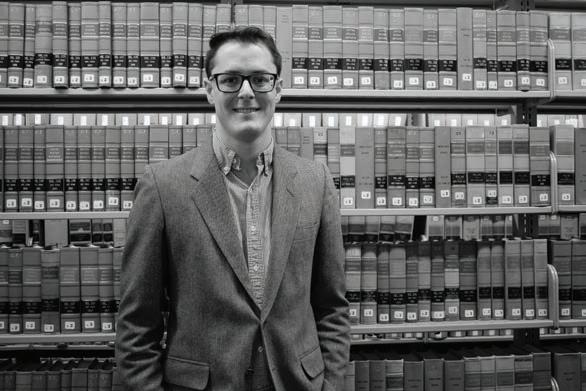
Nota Bene Editor-in-Chief Connor J. Toth poses for a portrait in the Jacob Burns Law Library.
JENNA LEE ASSISTANT NEWS EDITOR
DAVIS MARKS REPORTER
JENNIFER IGBONOBA | STAFF PHOTOGRAPHER
Members of Vavá Samba, a local Brazilian dance organization, perform during the Meet La Familia celebration.
Researchers receive funding to improve trustworthiness of AI
JENNA LEE
A multi-university initiative including GW announced new funding for research to improve the trustworthiness of artificial intelligence earlier this month.
The initiative, the Institute for Trustworthy AI in Law and Society — which launched in May 2023 and involves four universities including GW — announced five new grants, totaling $685,000, to fund research into the ethical use of AI. Valerie Reyna, a researcher with the School of Engineering & Applied Sciences and a project lead for Cornell University on the initiative, said her work will train medical AI to use more logical principles in their decision-making to improve patient outcomes and increase trustworthiness.
“We want to, on the one hand, make sure that society is able to take advantage of these remarkable technological achievements,” Reyna said. “But on the other hand, we want to make sure that there are appropriate protections and safety elements in this.”
The initiative is made up of four universities, the University of Maryland, GW and Cornell and Morgan State universities. The five new grants are funding projects to improve the quality of AI in health, autonomous vehicle safety, social media platforms, academia and educational settings, according to a release announcing the funding.
Reyna said a key part of how researchers determine the trustworthiness of AI is by applying human psychological principles to analyze the decision-making processes of AI models. She said researchers look for psychological principles
in AI decision-making to see if the technology is making consistent decisions based on logic, which can be applied to a range of AI forms from chatbots like ChatGPT and Gemini to AI medical technology.
“If I ask you a bunch of choices and your decisions contradict themselves, then you’re not really making sense,” Reyna said. “And then we can say we worry that that’s not a rational decision process. If decisions are inconsistent with one another, it’s kind of a minimum condition.”
She said her research studies physician decision-making to understand how people make decisions in health care and will use that to train the AI health models to ensure they are based on real perspectives.
Reyna said a common problem in medical research is the lack of diversity among participants and scientists, which she said this project aims to change by relying on community participation to inform their results. She said most medical research focuses on expert opinions.
“We’re very much dedicated to the importance of community participation and active participation in research,” Reyna said. “And that’s extremely important to diverse communities and people from different backgrounds and people with different needs and bringing them into this discussion and in an active way in terms of helping shape the research.”
Experts in AI said the lack of trustworthiness is a problem in the AI field because of how popular its usage has become and the number of people making AI programs in recent years — many of whom have not properly trained their models, leading them to provide inaccurate information and decrease users’ trust.
Janusz Wojtusiak, professor of health informatics at George Mason University, said the biggest issue in AI right now is distinguishing the “good stuff from the not so good stuff.” Wojtusiak said because AI has gotten so popular, the market has become saturated with newer programs that have not been tested.
Wojtusiak said a lot of AI programs can be what he calls a “black box” where users feed it information and it gives them a result, but they don’t know how it got to that answer. Wojtusiak said research into the decisions of AI can increase user trust, and experiences with AI providing inaccurate information and a lack of information can cause
He said the external team evaluated the review team’s report in fall 2023 and that the “feedback” provided by the external team was “thoughtfully incorporated” into the recommendations listed in the final action plan.
“We look forward to continuing to work with the community and provide any necessary updates as we implement the diversity, equity and inclusion efforts outlined in the action plan,” Bracey said in an email.
But faculty said the released action plan did not provide metrics to track progress of diversifying GW, like documentation for rejected diversity hiring proposals and data on hiring underrepresented faculty. Members of the review team reported uncertainty
over why the University has taken longer than promised to release the report.
Shaista Khilji, the chair of the Faculty Senate’s Appointment, Salary and Promotion Policy DEI Subcommittee and a member of the faculty subgroup, said the review team had been “pushing” administration to release the report since early 2024. The subcommittee emailed Bracey in March to ask about the report’s status and were told administration would meet with them and release the report “soon,” but the meeting never happened, she said.
Khilji said there is a general level of disappointment among faculty on the final report and its delayed timeline because “so much” has changed across the nation in the past two years, like the Supreme Court ruling against affirmative action in August 2023, the removal of
DEI offices at universities in June and tensions on college campuses from pro-Palestinian protests.
The recommendations advised the University to improve its policies and procedures for promoting DEI, like hiring, promotion and transparency around diversity issues and training of students, staff and faculty about diversity issues.
The final report states that GW Institute for Racial, Ethnic, and Socioeconomic Equity, an institute researching worldwide disparities, will provide opportunities for “bringing together faculty” interested in diversity issues and “additional hiring around the study of racism and social justice,” adding that the provost’s office will consider the cluster hiring recommendation as part of the strategic framework development process this academic year.
people to distrust. Peter Szolovits, a professor of computer science and engineering at the Massachusetts Institute of Technology, said the trustworthiness of chatbots like ChatGPT has improved since they first launched. He said about two years ago, he asked ChatGPT to write a synopsis of his career, and it got most of the facts wrong, but now, the model will tell you if it does not have enough information to give you an accurate answer.
“That’s one thing that has actually helped, and empirically, that does seem to reduce the amount of hallucination done by systems, although not to zero,” Szolovits said.
Szolovits said in the medical field, AI models succeed at making broad generalizations from large data sets that are mostly accurate. He said AI models run into problems with specific case studies, where it is more likely to miss key information.
“If you’re going to make clinical decisions about an individual patient, then I’m much more nervous about models,” Szolovits said. “Because basically if it misses some important thing in my medical record or if it makes up some important thing in my medical record, that could kill me, and I’m not interested in having that happen.”
The representative said the Strategic Investment Group — which handles most of GW’s pooled endowment and has overseen GW’s divestment from the fossil fuel industry following the University pledge to do in 2020 after nearly a decade of student protests — has a framework for divestment that can be added to their analysis if it provides “institutional value.”
“Strategic can build diversified, mission-sensitive portfolios that minimize market exposure and offer the potential to produce uncorrelated alpha streams,” according to SIG’s Socially Responsible Investing with Hedge Funds packet.
Granberg and the University have faced pushback from community members following police’s clearing of the encampment, with some saying administrators knowingly endangered students by requesting police assistance in handling the protest.
Granberg said officials asked MPD to help the University relocate protesters from U-Yard to Anniversary Park on the first day of the encampment but said to her “knowledge” no officials asked the department to clear the encampment, contradicting the Washington Post’s reporting on April 26 that local police declined the University’s requests to clear the encampment.
“Any communication I had with the mayor or with MPD directly was all about the safety side of it,” Granberg said. “We did not ask again.”
GW hired a lobbying firm in May to navigate un-
specified “higher education issues,” and a disclosure form showed in July that officials have paid the firm $90,000 since May, which surpassed the amount other universities paid their firms surrounding higher education issues following the encampment.
Granberg said GW hired the firm after the House Oversight Committee called D.C. Mayor Muriel Bowser and MPD Chief Pamela Smith to testify on why they denied requests to clear GW’s encampment. She said GW hired the firm to ensure officials didn’t create a “bigger issue” because the University doesn’t have connections to manage a “situation” between lawmakers and administration.
“We did discover that they allowed us to have a voice on Capitol Hill that we hadn’t had before, and so selectively, I mean, lobbying firms are expensive, so selectively we are still in touch with them,” Granberg said.
Granberg said the Medical Faculty Associates — a group of physicians and faculty from the School of Medicine & Health Sciences and GW Hospital, who are $200 million in debt to the University — is continuing to make payments to GW on time and said officials over the past year have increasingly recognized the MFA as a “modern clinical management practice.”
She said the recognition pushed former MFA CEO and current Dean of SMHS Barbara Bass to step down from her CEO post to make room for full time leadership. Officials hired interim CEO Bill Elliott in May.
Granberg said in her first interview last fall that the MFA hired a new chief operating officer and chief
GW Hospital unions press UHS for recognition, bargaining
From Page 1
In response, union workers filed a complaint with the NLRB that month, alleging UHS bargained with the union in bad faith by opening negotiations with a “wish list, throw-in-the-kitchen-sink” proposal — a form of hard bargaining — and claimed for this reason the hospital could not legally withdraw their recognition of the union.
An administrative law judge ruled in favor of the union in September 2019 before the NLRB overturned the ruling in May 2021, determining the hospital was en-
gaging in “hard bargaining” but didn’t violate labor law because the union had allegedly insisted on maintaining the terms in the expired agreement instead of negotiating with the hospital to form a new one.
“1199’s position has stayed the same since GW Hospital workers were unfairly stripped of their union in 2018: workers have the right to organize, and Universal Health Services should respect that right,” Carrietta Hiers, 1199 vice president for D.C., said in an email. Joseph McCartin, the executive director of Georgetown University’s Kalmanovitz Initiative for Labor and the Working Poor, said hos-
pital managers like UHS are often against unions because they want to make decisions without input from employees.
“That is fundamentally a problem in so many labor relations, power even more than money,” McCartin said.
In May, the NLRB ruled GW Hospital’s contract negotiations with the union unlawful because it “failed” and “refused” to bargain with the union in good faith from 2016 to 2018 before ceasing recognition of the union.
After reviewing the union’s unfair labor charges, the NLRB in May also ordered UHS to recognize and bargain with the union in good
faith, rescind changes the hospital made to employment terms and conditions unilaterally after October 2018.
Other UHS-owned hospitals Union efforts at UHS-owned hospitals in Pennsylvania, California and Nevada have also failed in the past few years. Tamara Kraynak — a former nurse supervisor at The Meadows Psychiatric Center, a UHS-owned mental health facility in Centre Hall, Pennsylvania — said she and another nurse attempted to organize a union because hospital owners understaffed the center, which
financial officer who will renegotiate MFA contracts with more “favorable” terms for the University. Officials are currently searching for a new MFA CFO after Robin Nichols left the role fewer than nine months in. Granberg said officials are planning to launch a website “pretty soon” with the three pillars of the strategic plan, which will include how to prepare students to thrive postgraduation in the “new economy,” the University’s role in interdisciplinary research and how officials can form groundwork to help GW succeed after “contractions” in staff in recent years.
Katrin Schultheiss, a faculty senator and professor of history, said there has been a “mixed bag” of faculty feelings surrounding official’s incorporation of faculty’s academic freedom requests into the strategic plan, as they requested administration’s political, religious or philosophical ideologies aren’t implemented into their teaching.
Faculty Senate Executive Committee Chair Ilana Feldman also announced plans in January to create a portal for faculty to report academic freedom concerns in the classroom or other professional settings to ensure GW upholds its policy of protecting free inquiry, free expression and “vigorous” discussion and debate. Schultheiss said there isn’t a consensus among faculty on the encampment and officials’ response, but some faculty senators felt faculty should have been consulted more. Schultheiss said Granberg is “very perceptive” to faculty’s concerns and that seeing each other as adversaries won’t work to anyone’s benefit.
made working conditions dangerous.
Kraynak said she filed the union election at the end of February 2022 and faced termination in March 2022. UHS said in her termination letter that officials fired her because of her role in attempting to organize a union. In response, the Service Employees International Union, which worked with the center’s employees, filed in 2022 unfair labor practice charges with the NLRB and Kryanak said the NLRB escalated the charge related to her termination. Instead of going to court, she said she reached a monetary settlement with UHS.
SAGE RUSSELL | SENIOR PHOTO EDITOR
Provost Chris Bracey speaks to Ilana Feldman during the September Faculty Senate meeting.
SAGE RUSSELL | SENIOR PHOTO EDITOR
Pedestrians pass the Science and Engineering Hall in April.
From Page 1
OPINIONS
“I
GW tried selling students on housing. They need a new sales pitch
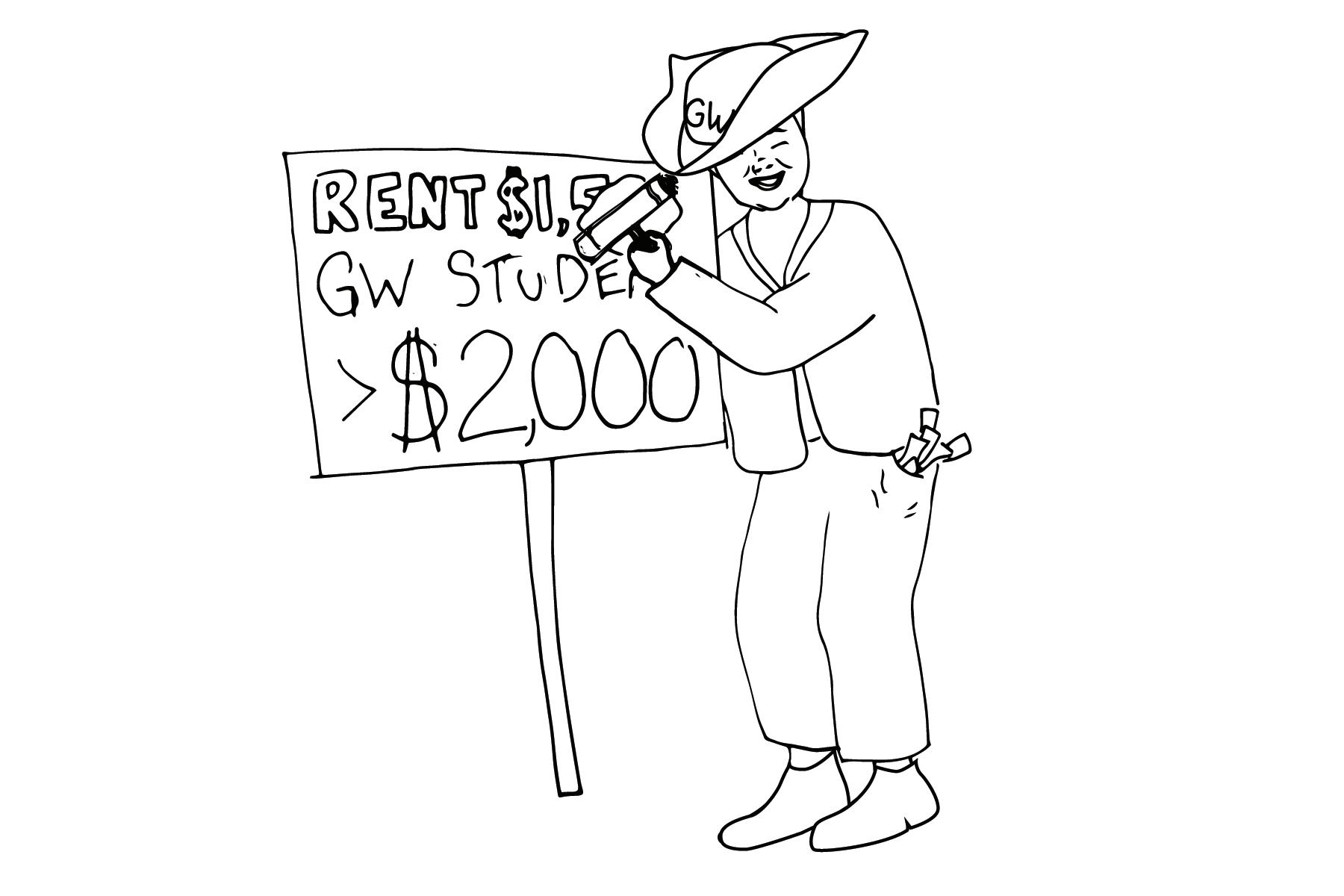
The University’s page paints the experience of attending GW as “living and learning in the heart of D.C.” For some students, this is GW’s draw. . But as one of the most expensive schools in the country located in one of the nation’s most expensive cities, GW sells its students the idea of a rose-colored metropolis without sufficiently acknowledging how officials can make GW financially accessible for students, like addressing the exorbitant prices of housing or offering further resources.
GW keeps getting more expensive. The cost of on-campus housing increased by 3 percent this academic year — from $5,350 to $5,510 and meal plans increased by around $140 per semester. Yet they still encounter major issues in their residence halls, from mold and ceiling leaks or water outages to accessibility issues. But the University never clarified why they bumped up housing and dining costs, sidestepping any progress toward reaching transparency.
Private universities in 2023 saw a roughly 26 percent increase in tuition and room and board in the last two decades, outpacing the growth of median family income, which sits at 13 percent. But many universities do this intentionally, catering to wealthier students to attract families to their institution. Universities may also hike their prices to fairly compensate professors and administrators, whose wages outpace inflation. Especially considering the growing housing crisis in D.C., where rent prices have increased by almost 11 percent since 2019, officials should be prepared to break down the root of the uptick for oncampus housing costs as off-campus housing alternatives become
The political climate of the United States today is reliant on superficial contents of limited media and seemingly random endorsements. Whether it be Charli XCX randomly tweeting “kamala IS brat” or the clip of former President Donald Trump raising his fist after being grazed by a bullet, campaigns are exploiting such moments to build up their own perceptions of candidates. And Americans are feeding into it. It is time we stop relying on these candidate-centered impressions and start justifying our votes with policy research to produce a much more substantive and conscious electorate.
James Pomian Opinions Writer
When discussing voting preferences and election patterns, many Americans tap and harness morality to justify whether a candidate is worth their vote . I’ve heard classmates claim that Vice President Kamala Harris is politically inconsistent or that Trump’s policies hold some ground, but they can never vote for “him.” This is surely understandable, given that Trump faces blatant felony convictions and criticisms of racially divisive rhetoric alongside irrational reactions to election results. On the flip side, Harris carries a prosecuting record featuring wrongful convictions on criminal charges and complete legal turnarounds — a trend she carried into her political career.
The continuous scrutiny
STAFF EDITORIAL
EDITOR
| GRAPHICS
AN NGO
more expensive. Many students seek off-campus housing as a reprieve from the headaches of GW facilities, turning to pricier options. Last year, the average D.C. studio apartment totaled around $1,847, and earlier this year, landlords in Foggy Bottom faced a lawsuit for allegedly colluding to increase rent prices at apartment buildings near campus.
Inflated housing costs are a symptom of multiple issues. For one, there aren’t enough homes to keep up with the demand across the nation, including D.C., making available spaces even more expensive. In the D.C. region alone, offi-
cials would have to build 87 homes every day to keep up with demand. If off-campus housing proves to be too costly and scarce, prompting students to rely on the University’s on-campus options, it makes sense why the rise in demand has made GW’s housing more pricey.
The increasing unaffordability of local homes and GW Housing incentivizes real estate investments for the students and families that can afford it. Affluent parents of GW students have been purchasing $2 million homes in cash in D.C. . Realtors then justify their prices, soaring into the millions and makes the area financially out of reach.
Foggy Bottom used to be a lowincome neighborhood before GW moved in and began renovation of historic properties, furthered the expansion of campus. Most of these properties acquired throughout the years were bought for affordable prices from working- and middleclass communities, eventually displacing low-income families and the once-predominant Black community in the neighborhood. Between 1960 and 1970, the Foggy Bottom population dropped around 25 percent, pushing out the remainder of residents who couldn’t keep up with the rising prices. And now those homes or
buildings go for millions of dollars, as GW owns more than $400 million in taxable property and in 2018 paid around $8 million in property taxes. GW students may be here for only the time of their education, but the residents of D.C. and Foggy Bottom are the ones that are here to stay.
Last year, GW decided to drop the on-campus residency requirement for third-year students, placing upperclassmen and sophomores on the housing waiting list or rejecting them for housing. . Officials claimed they didn’t see strong demand from students to stay on campus. But later in the meeting officials said they planned to add more beds to keep up with demand.
Many scrambled to find offcampus options with manageable rent or travel costs, GW should have sprang to action, providing advice on how to navigate D.C. leases, offer financial assistance for those forced to move off campus or simply provide explanations .
GW should make housing more accessible for students, whether it’s by mitigating on-campus costs to accommodate students from different backgrounds or providing assistance and support for students navigating the D.C. housing market. As the landlord thousands of students, GW could introduce rentcontrolled properties to offer consistent prices
Even breaking down housing costs could remove the veil from the reality of D.C. real estate. It’s easy to misinterpret GW’s housing prices when it’s not explained.
The University tells us that attending GW means living in our nation’s capital, giving us those “#OnlyatGW,” moments and the least the University can do is try and live up to its promise.
Stop voting for people and start voting for policies
of such discussions undermine the policies and plans each party will enact in the event its candidate wins. Simply enough, it does not matter if Trump is convicted or if Harris’ political patterns are inconsistent — neither will necessarily impact the policy-based decisions they will implement as president as many of these policies are predetermined and fall in line with their political party. Surely, the character which leads us nationally and represents the United States on the international stage is critical, but prioritizing the character of the candidate above the context of campaign promises and party policies is fallacious.
The individual voter being swayed by the character of a candidate, surface-level information and cultural forces forfeits the ability to develop an educated and independent political identity. Voters should process the election by keeping themselves well-informed on the variety of topics, rooted in trusted sources, direct information and a panoramic view of the political scene . Having one particular topic of interest should not limit one’s awareness or attention to other policies a party or candidate stands for. Bringing attention to the vast political grounds on which a candidate stands allows you to fully understand what — not just who — this country will be structured on for the next four years.
Relying strictly on the “who” could leave voters illprepared for what may come when the next president takes office. The sweet, language heard from candidates during campaigns will turn
into action as they take office. Responsible voters should be aware of such actions and hold successful candidates responsible for fulfilling campaign promises. Such awareness after inauguration is only possible if that policy knowledge is already instilled.
One way to develop one’s understanding of the current political climate is to abandon the notion that Republican and Democratic views are easily distinguishable and complete opposites.
Some policies remain similar for both candidates but are founded on different premises. Take immigration. Sure, Harris, along with the Democratic Party, has more lenient tendencies on the subject than Trump’s right, but the policies revolving around the situation, especially at the southern border, have become homogeneous.
In her speech to the Democratic National Convention, Harris claimed she would sign a bipartisan deal involving $650 million for
border wall construction, a project introduced by Trump. Trump as president put his words to action by implementing travel bans. Voters should take time to recognize the differences beyond expressed sentiments This could be done by researching party platforms on their informational sites, staying updated via trusted news sources or looking at how these candidates’ perceptions and actions transformed over time. This way, we can curate a political
identity that isn’t reliant on a celebrity’s endorsement or viral TikToks. Instead, we can support a party because the substance of their policies along with their delivery process justifies our vote thus allowing us to be conscious of the effects of our casted ballot and develop a relationship with a party whose policies represent our long-standing ideals, regardless of the candidate.
BY CAROLINE MORRELLI
—James Pomian, a junior majoring in political science, is an opinions writer.
CARTOON:
“MAKE U-YARD GREAT AGAIN!”
CULTURE
Chinese-language bookstore opens in Dupont after facing censorship in China
Behind a facade of minimalistic green LED signs, walls lined with bamboo shelves holding Mandarin translations of “American Prometheus” alongside pink and red spindly orchids welcomes customers to Dupont Circle’s new hotspot for Chinese literature and learning.
JF Books opened its doors on Connecticut Avenue on Sept. 1 as the District’s only Chinese-language bookstore, the reincarnation of Shanghai bookstore chain Jifeng Bookstore, which served as a harbinger of free speech in China until the country’s government forced its ultimate closure in 2018 in a wave of censorship over bookstores. JF Books founder and CEO Yu Miao said he hopes to use the bookstore as a place to build connections among the Chinese community in D.C. and promote “the joy of embracing freedom.”
As customers peruse the twostory shop, books priced between about $15 to $35 line the space in genres ranging from fiction to social sciences with editions in English and Chinese. Jifeng-branded postcards cover a wall along the right side of the store, each with farewell messages from former customers and an array of framed photos of the Shanghai store.
“The bookstore here is more open, more free, more inclusive,” Yu, who owned the flagship Shanghai store, said.
Jifeng, which means monsoon in Mandarin, once owned eight locations dotted throughout Shanghai and hosted forums, lectures, readings and documentary screenings. But when Xi Jinping, the president of the People’s Republic of China,
rose to power in 2012, the government purged books it deemed inappropriate, like those written by prodemocracy authors, and increased control over publishers. The crackdown left only one branch of the bookstore standing. When the final Jifeng store also faced the threat of closing due to increased rent prices in 2012, Yu — who was working with a public welfare foundation at the time — stepped in as the store’s new owner and found a new, cheaper storefront at a different location in Shanghai to continue carrying out Jifeng’s mis-
sion of freedom of expression. He ran the business from 2012 to 2018 until the Shanghai Library, a state-run institution that owned the space, refused to extend Jifeng’s lease because the store’s mission challenged the government’s ideologies. As Jifeng’s final days approached, customers wrote farewell messages like “Jifeng Bookstore is waiting for your return” on postcards mounted to a clock in the store that counted down until the store’s closure.
Until the beginning of this year, Yu — who had been studying at
Community garden looks to grow with pumpkin harvest, painting
The GroW Community Garden is home to all sorts of colors — greens from the shrubbery and rosemary sprouting out of the ground, sky blue plastered on the mural behind it and soonto-be white “ghost” pumpkins, thanks to a new patch of gourds.
Colin Bohula, a senior majoring in political science and one of three garden managers, said the team plans to hold a pumpkin harvest for the first time this October, where students can buy pumpkins and carve them. The burgeoning pile of Halloween produce is part of the garden’s student managers’ efforts to invigorate student involvement with the student-run plots, alongside stone and brick painting events.
Bohula said while this isn’t the first time GroW has cultivated pumpkins, it’s been “a while” since they have.
“My goal is, really, I want to have the pumpkin harvest,” he said. “I’m from Illinois, and the actual county I’m from is the pumpkin capital.”
Bohula said busting out the scoops and knives for pumpkin carving isn’t the only way GroW is expanding its reach at GW. He said he is planning a brick labeling event, where students come to the garden and
paint labels for the various garden plants onto bricks, which currently sit in a pile near the cucumbers.
Rows of pumpkins, tomatoes and peppers grow in carefully tended rows that stretch across the garden space, planted squarely in urbanity just steps away from Amsterdam Hall. Bohula said there weren’t any volunteers around to help with weeding and planting over the summer, meaning the two garden managers who were in the District had to get their hands dirty constantly just to keep GroW Garden functional. He said volunteers back in town are deployed to handle the summer weed overgrowth while he and his fellow garden managers focus on making the garden “prettier.”
He said winter can be a challenging time to maintain engagement with GroW because not a lot of plants tend to blossom amid frosty temperatures, so these events and changes are intended to help draw people in, even when watermelons can’t blossom. Bohula said he also hopes that the less outdoor-intensive garden activities help draw in some people who aren’t naturally farmers.
Garden manager Elizabeth Hajosy, a sophomore majoring in international affairs and Spanish, said the garden isn’t just laying a new painted brick here
and there — they’re putting together an entire space full of painted stones. She said she stumbled across a large pile of rocks within the garden, which she has been cleaning in preparation for a “fairy garden,” an area within the garden’s fences with fairy-like decor and set with colorful painted stones, creating a walking path for visitors.
Hajosy said some of the community’s interactions with GroW aren’t quite as positive. Hajosy said the garden had a “beautiful” pumpkin growing — until someone stole it. She said the thief’s heist was entirely “nonsensical” since the pumpkin has little practical use, being grown mostly for aesthetic value.
She said great pumpkin capers aren’t the only gourd-adjacent problems she has encountered. She said this year just as Halloween approaches, the garden’s pumpkins have been dying from “powdery mildew.” Hajosy said she dives into the weeds of gardening tips and tricks on Google to solve such dilemmas.
“We deal with that by just doing research, just a little Google search, and figuring out what we need to do to help them,” she said. “So for example, me and Colin are actually going to go later today to go get some sulfur containing fungicide. Hopefully that will help save the pumpkins.”
American University and University of the District of Columbia since 2019 — said he had not even thought about reopening the store. But after enjoying the “peaceful pace of life” in the District, he said his friends floated the idea of reopening Jifeng Books as a D.C. bookstore and he quickly leapt into the project. He wanted the new store to be in a lively business area in the District, so after two months of searching for the store’s new home, he landed in Dupont Circle. After four months of renovation and three months of gathering merchandise
and shop fixtures, Jifeng opened its D.C. doors under the new name of JF Books, a name he hopes will be easier for non-Chinese speakers to pronounce while still paying homage to the original name of the Shanghai shop.
Yu said the revived bookstore purchases some of its stock from mainland China focusing on Chinese political science and the humanities, as well as traditional Chinese-language literature from Hong Kong and Taiwan. He said he purchases about 30 percent of the books in the store from U.S.-based publishers whose English-language books center on Chinese and Asian studies or were written by Asian American authors, like Lisa See’s “Shanghai Girls.”
He said he decided to add fiction and nonfiction English-language books like “Unofficial China” by Perry Link to the store’s inventory to embrace the wider range of languages among the clientele he was likely to find in D.C., which has the sixth-highest Chinese population in the U.S. In the few weeks since JF’s opening, Yu said he has noticed a more diverse social environment in the D.C. shop. The shop sits adjacent to beloved D.C. bookstore and restaurant Kramers, but Yu said JF’s different “positioning” means there is no direct competition between the stores. He said the addition of JF to Dupont Circle adds “more tastes of culture” to the neighborhood and opens a space for D.C.’s Chinese community.
“I want to contribute to the whole community, not only a specific community,” Yu said. “I want to build the connection among the Chinese community, but I want to do more.”
With endless virtual lines and exorbitant prices, buying concert tickets for the chart-topping artists who headline in the District is no easy feat for music aficionados.
If you are tired of navigating the ticket-buying hellscape but still itch to catch some live music, here’s a full-proof solution: Exit out of Ticketmaster, step outside into the fresh air and head to one of the local D.C. venues showcasing the dynamic — and budget-friendly — music scene flourishing across D.C.
From grungy pop-rock brimming with anthemic lyrics to traditional Latin music with a genre-bending flair, here’s a rundown of can’t-miss performances from D.C. bands this fall.
Bad Moves at The Black Cat
The power pop quartet Bad Moves first made waves in the District with their 2016 self-titled EP that demonstrated the controlled chaos of their energetic guitar riffs, passionate vocals and politically attuned lyrics. Now, Bad Moves is celebrating the Sept. 13 release of their third album, “Wearing Out the Refrain,” with a show Friday at The Black Cat — a go-to venue near U Street for independent art-
ists since its opening in 1993. Throughout “Wearing Out the Refrain,” the members of Bad Moves toss vocals back and forth to the rhythm of their sprightly pop-rock instrumentals. Their lyrics are simultaneously witty and astute, as they address general feelings of nihilism on the aptly titled track “Let the Rats Inherit the Earth” and challenge the recent slew of legislation targeting LGBTQ+ people across the country on the track “Hallelujah.”
The New England art punk band Perennials and the D.C. punk band Ekko Astral will open for Bad Moves.
Rare Essence at Ivy City Smokehouse
In the District’s historic go-go music scene, the ensemble Rare Essence reigns supreme. The group formed more than four decades ago following the birth of the funk subgenre in the 1960s. Since then, Rare Essence has played countless shows across the D.C. area and collaborated with major artists, like Run-DMC and Erykah Badu. On Oct. 13, Rare Essence, which currently boasts an official lineup of 10 members, will close out their 2024 run of shows on the seafood restaurant Ivy City Smokehouse’s rooftop. The night will also feature a set from DJ Reddz, who is a part of the DMV-area radio station
WPGC-FM. With go-go’s improvised instrumentals and signature call-and-response between the artists and the audience, there is no better way to experience Rare Essence than a live show.
Cumbia Heights at DC9
Like their name’s homage to Columbia Heights suggests, the alternative tropical band Cumbia Heights is rooted in Northwest D.C., where many of the bandmates lived and first met. Composed of about 10 members, the dynamic group blends guitar, trumpet, accordion, saxophone and drums as they put their own spin on cumbia — a popular Latin American musical tradition originating from enslaved people in the Spanish colonies that carries African, Indigenous and European influences.
On the night of Halloween, Cumbia Heights will showcase their dreamy and rhythmic sound at the U Street neighborhood venue DC9 after an opening set from psychedelic folk group Ames Harding and The Mirage. The concert follows the March release of their first EP “Amaneciendo” since forming in 2021, which features their artful fusion of instruments with hints of psychedelia and funk that coaxes you to get up and sway.
LILY COHEN REPORTER
CAITLIN KITSON CONTRIBUTING CULTURE EDITOR
HATCHET FILE PHOTO
Songbyrd Music House located in Union Market.
BROOKE SHAPRIO STAFF WRITER
MATHYLDA DULIAN | STAFF PHOTOGRAPHER
JERRY LAI | STAFF PHOTOGRAPHER
Newly opened Chinese bookstore JF Books on Connecticut Avenue located in Dupont Circle.
SPORTS
Water polo ends West Coast weekend games 2-2
Water polo (5-5, 1-0 MAWPC) took home a split record after its California tournament this weekend, securing fourth place in the conference.
The Revolutionaries faced off against California teams San Jose State (4-1, 1-0 WCC), Fresno Pacific (0-6, 0-1 PacWest), UC Merced (07, 0-0 WWPA) and Santa Clara (5-2, 0-1 WCC) following two losses at the Princeton Invitational earlier this month. After placing fifth in MidAtlantic Water Polo Conference preseason polls last month, the team currently maintains a split record of 5-5.
The Revs began their weekend with a Thursday afternoon 3-14 loss against No. 9 San Jose State on Spartan territory in San Jose, California. Freshman utility Andrei Khudiakov, junior defender Adonis Vlassis and senior attacker Andrija Sekulic each netted a shot during the game, but the Revs were no match for Spartans’ 14 goals. Vlassis is currently tied for second in the conference for most goals thus far, with 21. After driving more than two hours south, the Revs took on Fresno Pacific at the Sunnyside Aquatics Complex in Fresno, California, beating the Sunbirds 19-13
on Friday evening. Vlassis collected more than half the team’s points, with eight goals and three assists. Graduate student goalie Luca Castorina guarded the net, racking up seven saves. The Revs’ victory over the Sunbirds extended Fresno Pacific’s losing streak to six games. Harnessing their previous victory, the Revs beat UC Merced 18-7 during the Bobcats’
season opener at the UC Merced Aquatics Center. GW ended the first half leading 8-4 and the third quarter 14-6. During the game, freshman attacker Antonio Florena — who ranks ninth in the conference for most goals, racking up 16 since the season’s start — and senior utility player Leo Lueddemann each secured four goals. Castorina collected nine
Men’s soccer loses conference opener, struggles with defense
KRISTI WIDJAJA STAFF WRITER
Men’s soccer (2-6-0, 0-1-0 Atlantic 10) opened A-10 conference play with a 0-1 loss against Duquesne (5-1-1, 1-0-0 A-10) at home Saturday, tallying their sixth loss of the season, but the team says morale remains high.
The loss also marks the start of a two-game losing streak after losing 1-4 to Iona on Tuesday. After five new roster additions, the team has faced its ups and downs in the preconference and is currently ranked 13th in the A-10.
The team ranks last in the conference in average goals scored against them at 2.63 goals per game, letting up 21 goals this season compared to their six scored goals.
Head Coach Craig Jones said the team “let ourselves down” defensively. He said he has tested different starting player lineups this season following three starting defenders’ inability to play: graduate student Lucas Matuszewski, senior Jared DeMott and sophomore John Matlock, which he said has contributed to their losses thus far.
“I think some of the losses have been on us trying to experiment with some different options at the back,” Jones said. “We lost three starters to our back line who haven’t played yet this year so shuffling some guys around, playing some different systems.”
Dukes’ senior forward, Maxi Hopfer, scored the team’s only goal, which was enough to secure the Dukes’ win, despite the Revolutionaries attempting more shots than the Dukes. The Revs attempted 13 shots, four on target,
and the Dukes had 10 shots, three of which were on goal.
Jones said he and his team are not looking back to the preconference record of 2-5 going into the A-10 games. During the 2023 season, the Revs concluded their season 4-9-4 overall and 2-5-1 in conference play, ultimately earning 13th out of 14 teams in the A-10.
“I’ve been here a long time and gone 2-7, going in and winning the conference,” Jones said. “I’ve gone 7-2, going in and not finishing the top six, so that’s the conference.”
He said the upperclassmen and coaches kept everyone positive despite the loss.
“I just believe in the process,” Jones said. “Some of the stuff we already have in place. We were so closely connected on that mentality, and consistency is going to help us to win games and culture.”
Freshman forward Louis Crofts said the loss against Iona taught the team a lot about their defensive growth and staying disciplined.
Crofts said the team has worked on getting stronger to “keep a clean sheet” and looks to create chances to score.
“I think the mentality has been good,” Crofts said. “Obviously, it’s hard to keep coming back after these games, but the spirit on the team’s pretty good, everyone’s keeping a high morale.”
Graduate student midfielder Roee Tenne led the Revs with four shots and one shot on goal. The Dukes’ goalkeeper, senior Zoltan Nagy, saved all three attempted shots on goal by the Revs.
The Revolutionaries will head across the District and play against rival Howard on Tuesday at 7 p.m.
saves, adding two more from the game prior. A Revs victory dealt out a losing streak extension for the Bobcats, lengthening UC Merced’s dry spell to seven straight games. GW ended the weekend with a loss 1017 against No. 18 Santa Clara at their Sullivan Aquatic Center. Although only being down three shots at half, the Revs
were unable to keep up with the Broncos. Freshman attacker Yam Kabakov, Florena, Sekulic and Lueddemann each bagged two goals and Castorina made 11 saves. Saving 28 goals thus far, Castorina holds third in the conference for most saves. At the Princeton Invitational on Sept. 14, a week before the California tournament, the Revs lost
7-22 to No. 7 Pacific after trailing 4-11 at half. With a roster that almost doubles the Revs, Pacific was able to rotate their 24 players and tired out the Revs’ 16 men, seven of which are freshmen.
The Tigers netted a goal 45 seconds after gameplay started. Junior defender Adonis Vlassis made the Revs’ first shot of the game 40 seconds later, which the Tigers reciprocated with two more goals. During the third quarter, the Tigers went on a six-goal run, netting six shots in as many minutes. In the fourth quarter, senior attacker Andrija Sekulic notched two goals — the Revs’ only goals during the period. Following their loss to Pacific, the Revs fell to Harvard 10-16. GW fought back in the first quarter, ending the period 3-4 after Kabakov knocked in two goals and Vlassis one. The Crimson built a lead in the second, capping it 8-5, and gained momentum in the third quarter where they netted five goals. Sekulic tallied two goals during the third quarter, the only goals that period for the Revs, and GW notched three goals in the final quarter. The Revs will face off against conference rival Wagner on Saturday at 10 a.m. in Staten Island, New York, giving the Revs an opportunity to break their split record.
Men’s club ice hockey shut out by Georgetown in annual showdown
CARRIE MCGUINNESS STAFF WRITER
SOPHIA CAPUTO REPORTER
Men’s club ice hockey fell 3-0 to Georgetown University in their annual “Battle of DC” showdown at the Capitol One Arena on Sunday.
The match is the first out of a three game series against the Hoyas, which resulted in an overall GW victory in the series last season. The loss ties off a four-game losing streak for the Revs after dropping all three games during a road trip to Tennessee last weekend, where they faced off against the University of Tennessee and Vanderbilt University.
“We’re going to come back on Saturday, and we’re going to be a lot more ready to go, and we’re going to have a lot of fun, and I think we’re going to take it to them,” senior captain Cade Llewellyn said.
He said despite the difficult matchup, the Revs kept their spirits up and fought a tough battle.
“This game every year is a lot of fun for us,” Llewellyn said. “I think tonight’s no different. It’s the same result we had here last year, exact same score. But I can never
fault these guys with how hard we work off the ice, on the ice at practice.” After dropping the first matchup against Georgetown last season, GW went on to win the season series, beating them 5-4 and 6-1 and finishing the fall semester with a 7-2 record.
The first period opened with aggression under Hoya possession, and within the first five minutes, Georgetown had seven attempted shots on goal. The Hoyas opened scoring with back-to-back goals with 8:19 and 7:17 remaining in the first period.
The Revs struggled to keep up, finding difficulties completing passes throughout the first period. Georgetown had both roughing and tripping penalties after their two-goal scoring streak, but GW failed to capitalize on the opportunity, unable to work against the Hoyas’ physicality.
The Revs blocked multiple Hoya attempts at the goal in the second period. GW attempted to claw back with numerous shots on goal in the first half of the second period, but none were successful.
The Hoyas continued their physical play in the third period with numerous body
checks against the Revs. With 8:36 remaining in the game, the Hoyas scored one final time, going up 3-0 and clinching the win.
Llewellyn said that this year’s team consists of a majority of returning players and an influx of four freshmen to the roster.
“We lost one senior, and so it’s already a pretty tight knit group,” Llewelyn said. “Our freshmen that came in, they’re buying into our systems.” Freshmen forwards Jungung Park, Eric Schuster and Barak Landis joined the roster this season.
Llewellyn said the team gets excited and brings extra energy to play against the Hoyas every year because the showdown takes on a new meaning of playing in the professional arena of the Washington Capitals. He said that the D.C. showdown is the only game where the team has a dress code, wearing turtlenecks and blazers as a way to honor their old captain, Augie Burkhardt.
“But we figure, you know, we get to be in an NHL rank,” Llewelyn said. “Let’s try to be NHL for today.”
GW will face-off against the Hoyas for redemption this Saturday at 9:30 p.m. at the St. James.
SANDRA KORETZ SPORTS EDITOR
HATCHET FILE PHOTO A player passes the ball in a game against Fordham in 2019.
DANIEL HEUER | ASSISTANT PHOTO EDITOR
Senior forward Shawn Montgomery battles over the puck against the Hoyas during the second period of the matchup.
TOM RATH | STAFF PHOTOGRAPHER
Graduate midfielder Roee Tenne kicks the ball as an opponent from Duquesne University slides.