Faculty senators press officials on funding, staffing concerns
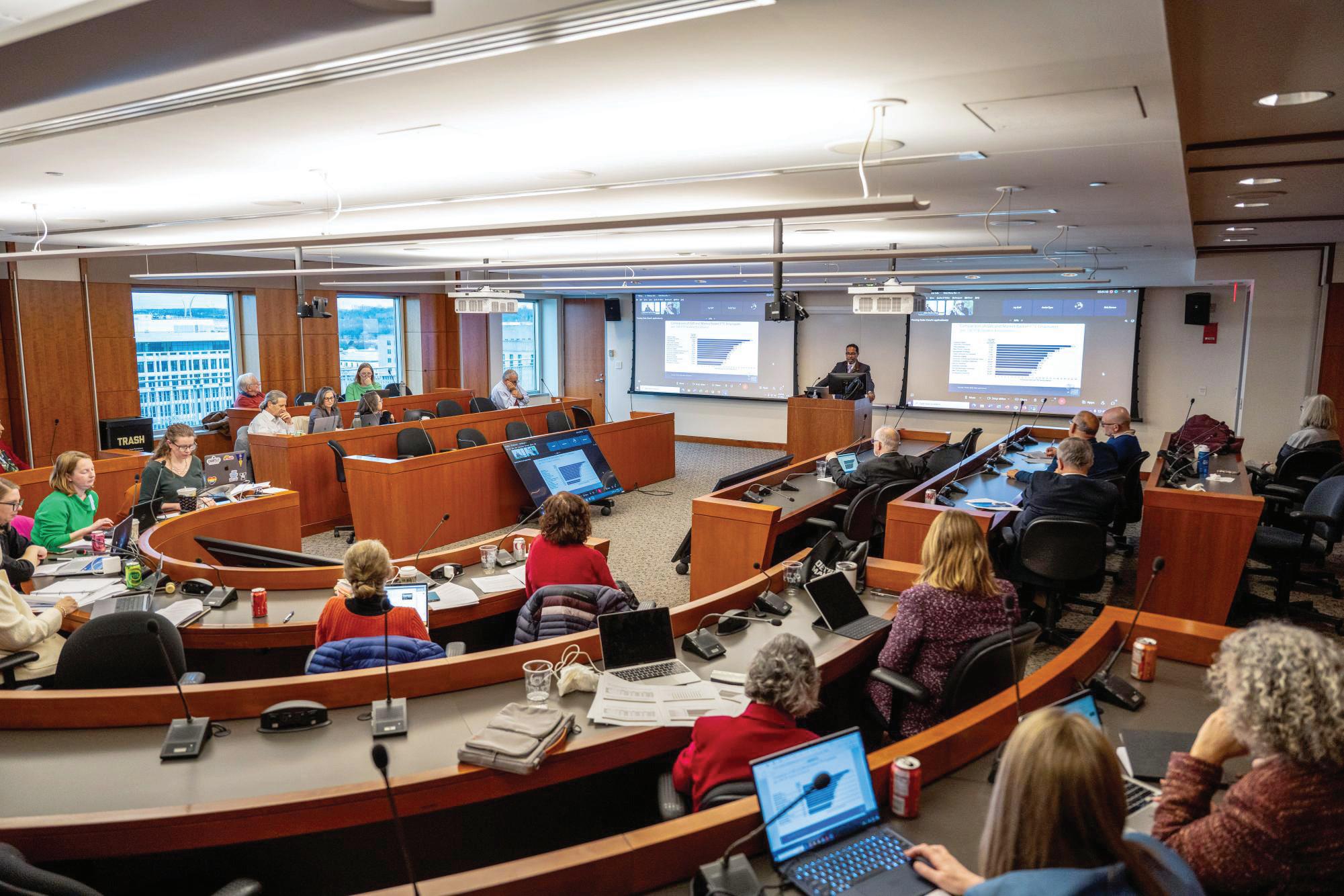
Faculty senators raised concerns about personnel vacancies, resource allocations and missing department budgets at a meeting Friday — points of contention that officials didn’t directly address.
Members of the Faculty Senate said Columbian College of Arts & Sciences departments like history and Romance, German and Slavic studies have yet to receive a budget for FY2025, which hampered their ability to plan events and arrange speakers. Katrin Schultheiss, a faculty senator and professor of history, asked if the department is lacking a budget because officials haven’t yet allocated one to CCAS and questioned how GW is “investing heavily” in the University’s academic mission while paying “huge” salaries to top-level administrators.
“It hasn’t been visible to us in CCAS where those enormous investments in the academic mission of the University are being done and huge salaries are being paid to top-level administrators,” Schultheiss said.
University President Ellen Granberg did not respond to Schultheiss’ comment. CCAS officials told department chairs in January to accommodate a 15 percent cut of the school’s expected noncompensation spending to meet its budget target set in late March by GW for fiscal year 2024.
Kausik Sarkar, a faculty senator and professor of mechanical and aerospace engineering, said the School of Engineering and Applied Science has 25 empty faculty positions across the school.
Provost Chris Bracey said some ongoing faculty searches have not yet yielded candidates, but he noticed SEAS has been filling vacancies. He said the University has a dashboard for faculty to track the last years of statistics on full-time faculty “in real time,” which students cannot access.
Tarek El-Ghazawi, a faculty senator and the electrical and computer engineering department chair, said his department has lost a dozen faculty members over the last decade, who have not been replaced.
Masha Belenky, a faculty senator and professor of French, said the University hasn’t replaced faculty tenure-lines for certain departments, including hers, after departures. She said instead, officials fill the vacancies with nontenured contract faculty, who are compensated at a lower rate.
Officials failed to meeting a Faculty Code clause requiring 75 percent of regular faculty to be tenured or on a tenure track for the fifth-consecutive year in April.
“We have people in our department who are making $60,000 teaching seven classes a year, and I think that’s important to state in a public forum because those faculty really struggle with morale, which makes sense because they’re working really hard and
not getting any compensation,” Belenky said.
Faculty senators also raised concerns during the meeting about whether GW is properly allocating funding to schools and departments, citing the more than $900,000 in severance payments since 2022 to former officials like former University President Thomas LeBlanc and former Chief Financial Officer Mark Diaz as a particular worry.
Granberg said the University has begun talks with Grant Thornton — an independent CPA firm based in London, England, who has a “long-term contract” with GW and audits the University’s consolidated financial statements — to receive input on the University’s budget model, which she said is in need of revisions.
“We are hampered by a budget model that does us no favors, and so I am, that’s part of why I’m very excited that the budget revision process is moving forward,” Granberg said.
Task force members question progress on emissions cuts Severance extended to former officials may have incentivized exits, faculty senators say
Granberg also said officials were working on a new budget model to make more efficient use of GW’s money, which she previously announced at a Staff Council meeting in January. The current model has not been updated since 2017, Bracey said at the Friday meeting.
“There is a clear sense in speaking with several deans that the budget model that was adopted in 2017 really does need to be tweaked and fine tuned to provide additional resources and support for the academic enterprise,” Bracey said.
Faculty senators also pressed officials on the input they reportedly gave to the U.S. Attorney General for D.C. regarding stayaway orders, which barred five students arrested by local police at the pro-Palestinian encampment last spring from entering any public spaces in Foggy Bottom for six months.
Community members said they are skeptical of the University’s pledge to divest from fossil fuels by 2025 due to a lack of communication from officials, who maintain that they are on track to reach their goal.
GW reduced its emissions by 29 percent between 2008 to 2023, according to the University’s public emissions report, leaving the University with two more years to lower emissions by an additional 11 percent to hit its target of 40 percent by the end of next year. After almost a decade of student protests for fossil fuel divestment, the Board of Trustees in 2020 established the Environmental, Social & Governance, Responsibility Task Force and adopted environmental recommendations from the group that included total divestment, lowering emissions and a 10year acceleration of GW’s initial plan to reach carbon neutrality by 2040.
GW Office of Sustainability Director Josh Lasky said the University has a “multi-pronged strategy” to meet its emission reduction goal by next year, with an emphasis on energy efficiency on campus and the administration’s renewable energy development and sourcing. He said officials are currently working to to reduce the University’s energy consumption through lighting, heating and cooling in 43 campus buildings.
The GW Police Department faces more than five months of turnover and leadership vacancies at the completion of its contentious three-phase plan to arm 22 officers with 9 mm handguns.
In April, GWPD Chief James Tate said the department planned to fill three supervisor vacancies but cited a regional and national trend of fewer applicants with less experience as reason for a potential hiring lag. Since then, the department has turned over three senior leaders and faces vacancies in some of its 22 armed officer roles, meaning despite officials’ announcement earlier this month of the end of GW’s arming implementation plan, the number of armed officers falls short.
Former Lieutenant Christina Hunsicker left GWPD in August after working at GW for more than a decade. Hunsicker was the sole officer in the department’s senior leadership to precede Tate’s hiring in January 2020. Prior to Tate, GWPD changed its leader four times in about two years.
Former GWPD Chief RaShall Brackney and former Assistant Chief Michael Glaubach resigned simultaneously in early 2018. The resignations prompted interim Chief Bessie Burrus to take over until officials hired Darell Darnell
as superintendent of police in April 2018. Darnell left the department in March 2019, and Mary Paradis, who was serving as assistant chief of police, headed the department on an interim basis before Tate.
Hunsicker’s departure comes after former Lieutenant Sean Brown — who served at the University since March 2022 — left the department in May, and former Captain of Operations Gabe Mullinax departed in April. Mullinax was one of the first two officers armed in September 2023.
As lieutenants, Hunsicker and Brown served in the department’s third-highest rank, while Mullinax occupied a role in the second-highest position. Officials filled Mullinax and Brown’s vacancies by hiring Captain George Davis and Lieutenant Cheryl Crawley this summer, but the department’s senior leadership holds one lieutenant vacancy.
Tate declined to comment on how many of the department’s 22 armed officer positions are vacant and if turnover within the GWPD senior leadership impacts how the department trains armed supervisors or other operations.
“As with any police force or organization, staffing fluctuates from time to time for a variety of reasons, and we continue to successfully manage our staffing to ensure we fulfill our mission,” Tate said in an email.
Faculty senators said the over $3 million in severance that the University paid four former officials between 2022 and 2023 may have been used as a tool to help administrators carry out departures.
Annual financial disclosure forms from fiscal year 2023 show that former University President Thomas LeBlanc received $1,167,000 in severance since he retired from the University in 2021 and former Chief Financial Officer Mark Diaz has received $976,440 since leaving in 2022. A University spokesperson declined to say if the officials left on their own volition or involuntarily, and members of the Faculty Senate suspect the administration may have used the severance payments to usher them out of their positions. By the time of their departures, both former top officials were considered deeply unpopular among faculty, staff and students. LeBlanc’s fouryear term culminated with widespread calls for his resignation from faculty members who felt his leadership did not match the University’s core values. Diaz and LeBlanc came under fire by faculty in January 2020 over the 20/30 plan, with some faculty senators saying the move would force GW to take on more debt to account for lost revenue. Jennifer Brinkerhoff, a faculty senator and professor of international affairs, said decisions about severance payments were made by the University before she was a senator, but some of the severance paid to Diaz could be the
result of GW trying to replace LeBlanc’s administration.
“These buyouts can become very large if the ‘separation’ of that person from the university is a high priority, they already command a large salary, and they know they are in a strong bargaining position,” Brinkerhoff said in an email.
She said it is common in the “business world” to use severance as a way for a new leader to phase out the old administration and replace it with their own people.
Diaz was hired by LeBlanc in August 2018 after the two worked together at the University of Miami and left shortly after the former University president. LeBlanc stepped down in January 2022 after announcing months earlier that he planned to leave in at the end of the academic year and told trustees he was “flexible” about his end date and would be open to leaving earlier if desired.
Officials announced LeBlanc’s departure as
a retirement and main-
tained that Diaz chose to depart on his own accord, never specifying where he would work after GW.
Severance pay provisions are common across higher education, with 60 percent of respondents to a 2014-15 survey of fouryear college and university presidents reporting they had severance agreements in place with their leaders, according to Inside Higher Ed. GW does not list a severance policy on their Human Resource Management & Development website.
A University spokesperson declined to explain GW’s policy for granting severance payments to employees who leave on their own accord. They also declined to comment on how officials determined severance payments for LeBlanc, Diaz or former General Counsel Beth Nolan — who retired from the University in June 2021 — who determines severance recipients, payment frequency and the method used to calculate allocations. The spokesperson de-
ferred comment on LeBlanc and Diaz’s severance payments to a previous statement on the University’s Form 990 filing in August, which states that “compensation for senior administrators is determined by a multitude of factors, including the prevailing market rate, experience and the qualifications that an employee brings to the job.”
Philip Wirtz, a faculty senator and professor of decision sciences and of psychological and brain sciences, said he wonders if money that could have been used for faculty, staff and student needs was instead allocated to severance payments last year. He said he has to ask “where is the money coming from” to support these expenses, including the “eye-popping” salaries that recently appointed administrative hires have received like Provost Chris Bracey, who received a $391,811 pay bump in the 20222023 tax cycle to earn $966,960.
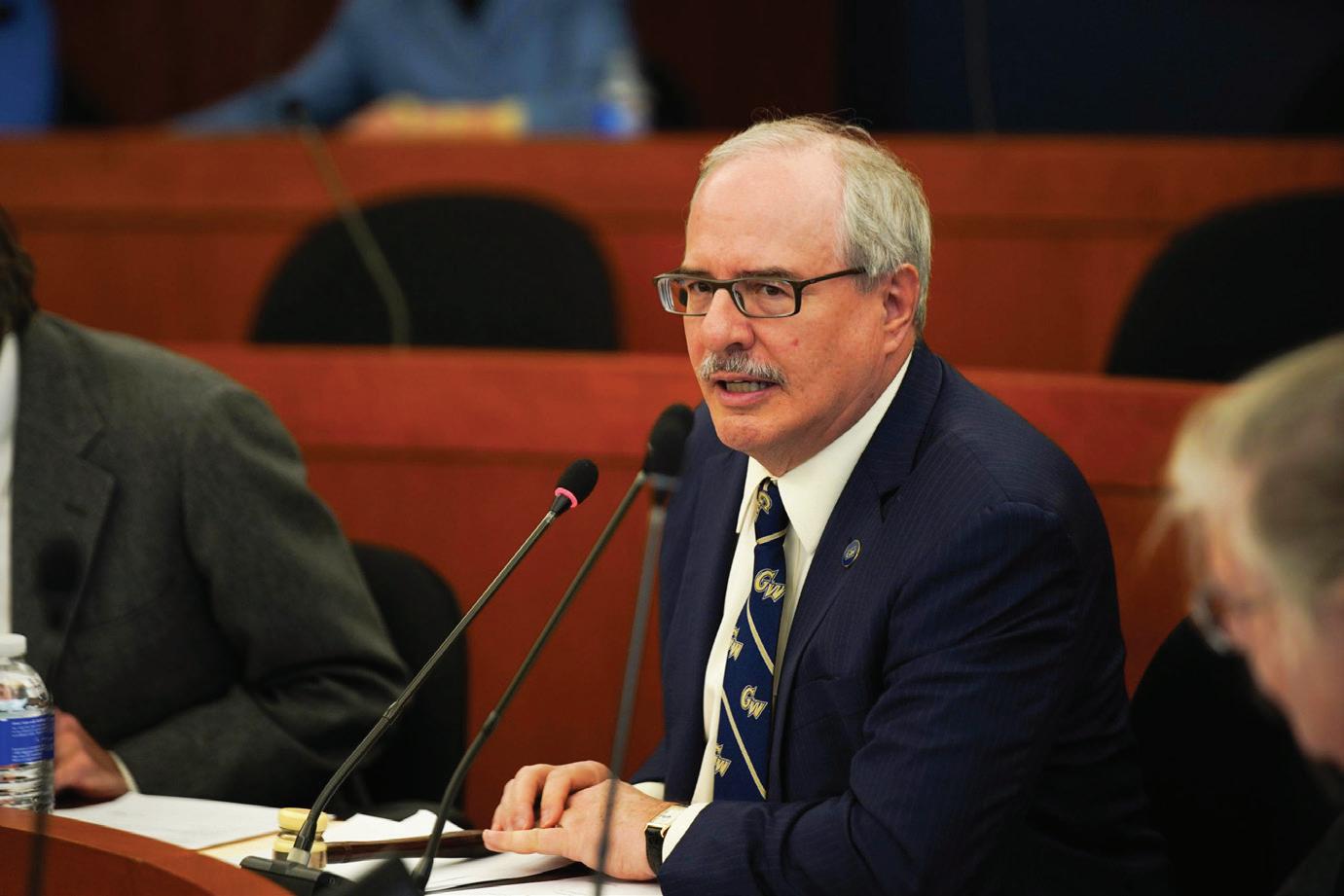
HATCHET FILE PHOTO Former University President Thomas LeBlanc speaks during a Faculty Senate meeting in 2020.
DANIEL HEUER | ASSISTANT PHOTO EDITOR
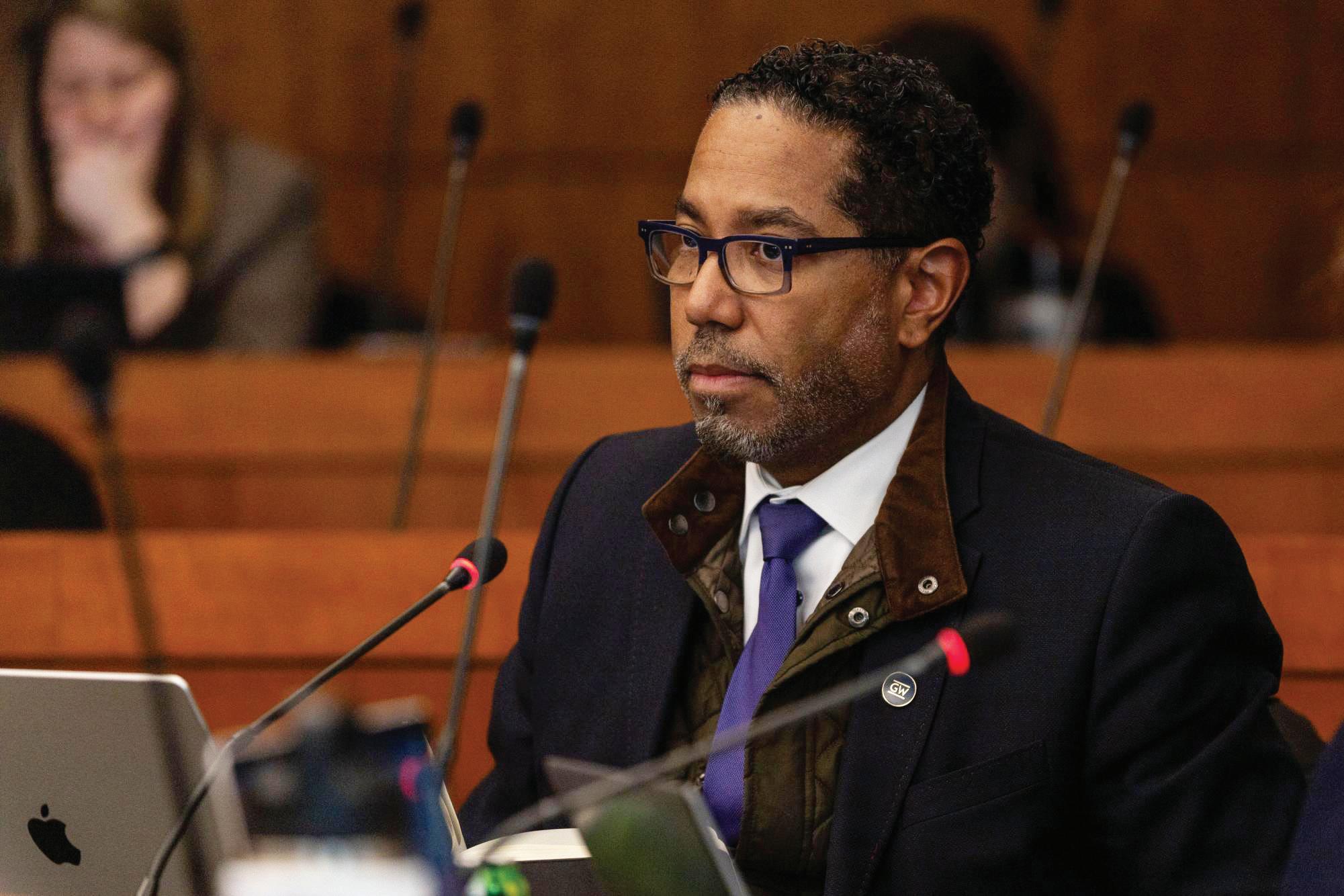
Faculty senators listen to Provost Chris Bracey during a senate meeting in March.
GW receives below-average score on religious inclusion index
JENNIFER
IGBONOBA NEWS EDITOR
A national database that evaluates a school’s efforts toward promoting an inclusive environment for students with different religious identities scored GW two out of five stars.
The University’s recent score on the Interfaith, Spiritual, Religious and Secular Campus Climate Index is one star lower than the average for the 30 participating nonsectarian, private institutions, according to the index’s website. As GW plans to launch this semester the new Center for Interfaith and Spiritual Life, religious student organization leaders said GW must use the results to guide and strategically support faith-based student organizations to ensure the center accommodates all religious students in the future.
The INSPIRES Index, which colleges voluntarily opt into, requires a “campus representative” to complete the 53-part questionnaire about their campus climate. Colleges can opt out of publicly displaying their scorecard, but the index encourages schools to make them accessible. Of the more than 170 colleges participating in the index, 127 published their report.
The report determines a college’s overall interfaith climate score based on their performance of the criteria in seven categories: religious accommodations, institutional behaviors, efforts to reduce negative engagement, extracurricular engagement, space for support and expression, structural diversity and academic engagement.
Compared to other private nonreligious universities, GW scored one star higher in academic engagement, one star lower in religious accommodations and extracurricular engagement, losing marks for criteria like the lack of interfaith community service op-
portunities and interfaith-focused living affinity groups. GW currently has nine living and learning communities and affinity housing in District House.
GW scored a two out of five for its dietary religious accommodations because some, but not all, dining halls have food options for religious dietary restrictions and accessible hours for students fasting.
The University also got marked down for the lack of an exemption for religious students from the dining plan, nearby restaurants or grocery stores for religious dietary needs and transportation for students to access stores for religious dietary grocery shopping.
GW scored a three out of five on the academic engagement category, losing checks for the lack of an interfaith major or minor and required religious or interfaith courses in the core curriculum.
GW’s scores in institutional behaviors, structural diversity, space for support and expression and efforts to reduce negative engagement were average compared to private nonreligious universities, ranging between two and four stars.
Officials launched plans for the new interfaith center over the summer as a part of GW’s “Strengthening Our Community in Challenging Times” plan — which the University released in January to review free speech policies and bolster religious programming in response to campus tensions over the war in Gaza.
The center plans to hire an interfaith chaplain, a director to oversee its daily operations and a program coordinator to host events. A University spokesperson said updates about the center’s location and staff will be shared “soon” but did not specify a date or time frame.
CRIME LOG
THEFT I/FROM VEHICLE
Off Campus
Reported 9/10/24 – Unknown Date and Time Case Closed
A staff member reported GW property stolen from his car when he parked it off campus. The stolen materials included keys and a form of personal identification. Closed case. Off campus incident.
ATTEMPTED FRAUD
Off Campus Reported 9/11/24 – Multiple Dates and Times Closed Case
A student reported being the victim of attempted fraud by unknown subjects after receiving numerous scam emails with similar content. Case closed. Off campus incident.
THEFT II/FROM BUILDING
Lerner Health and Wellness Center
Reported 9/11/24 – Unknown Date and Time Open Case
A student reported his headphones, which he left unattended, missing when he returned to pick them up the next day. Case open.
THEFT II/OTHER
Ross Hall (Courtyard)
9/12/24 – 2:04 p.m.
Open Case
A GW contractor reported the theft of a scooter by three non-GW affiliated men who fled the scene when GW Police Department officers arrived. Case open.
Students call for greater presence, visibility from Granberg
frequently with students and in forums that allow the GW community to freely ask questions about their most pressing concerns, like financial transparency.
In a welcome address in 2023, University President Ellen Granberg expressed her excitement to embed herself in GW life upon moving to campus by attending student events and collaborating with the University community.
Now, as Granberg enters her second year in office, students and community members said they hope to see more visibility and engagement with the student body from the University president.
More than 30 students expressed mixed reactions to Granberg’s first year, some criticizing her handling of ongoing campus protests since the start of the war in Gaza while others expressed sympathy for the turbulent start to her first term. Many students called for Granberg to visibly engage more
TYLER IGLESIAS
SACHINI ADIKARI
NEWS EDITOR
The Office of the Provost on Friday released a diversity, equity and inclusion action plan, which has been in the works since 2021, that includes new and existing actions taken by the University to address campus climate issues suggested by students, faculty and staff.
The plan, an initiative of the Provost’s office from August 2021, includes recommendations made by student, faculty and staff subgroups and comes more than two years after officials conducted a diversity climate survey in April 2022 to improve campus-wide diversity. The report includes actions the University has already taken or “plan to explore” in addressing issues relating to diversity, equity and inclusion, with notably more than half of survey respondents in 2022 reporting a negative experience on campus and LGBTQ+ respondents reporting the most “negative” identitybased treatment.
“The DEI action plan reveals that GW is well on the
Junior Mac Colomb, a journalism and mass communications student, said students want “more” from Granberg, adding that “nobody” is happy with her first year in office — a sharp contrast from his perception of former interim University President Mark Wrighton, who he said had a sense of “playfulness,” as he would occasionally walk his dog on campus.
Colomb said it’s “tough” to support all sides of students’ views from an administrative standpoint and that it would take officials “a lot of time” to connect with students who were upset by the University’s handling of the pro-Palestinian encampment last spring. Granberg was never spotted at the encampment, but officials like Dean of Students Colette Coleman and Provost Chris Bracey made appearances.
right track to address some of the issues of concern identified by our community and the Diversity Program Review Team,” Provost Chris Bracey said in the release.
In August 2021, Bracey said the office would conduct a yearlong comprehensive review to assess and improve campus diversity, replacing a diversity audit that former University President Thomas LeBlanc and former Provost Brian Blake initiated in January 2021 for an outside firm to conduct research in faculty composition, financial aid packages and police engagement.
In February 2022, Bracey announced the creation of the Diversity Program Review Team, a group of 26 total faculty, students and administrators tasked with creating a comprehensive review of the University’s diversity climate with plans to make recommendations to administrators on campus-wide diversity improvements. In April 2022, Bracey announced that the review team would open a climate survey for faculty and students, entering the third of the then-11 phases the review team planned to conduct. The diversity plan states
“Whether or not Granberg can gain back trust depends on students,” Colomb said. “It’s on her and the administration to work toward rebuilding that trust, but whether or not they’re able to do that depends on if students are willing, and if they’re not, the admin messed up.”
During her first year as president, Granberg said she hoped to “set the tone” for shared governance and involve students, faculty and staff in the decision-making process for critical issues at GW. Students said they were initially optimistic about Granberg, expecting her experience in diversity, equity and inclusion would improve GW’s response to discriminatory actions, improve student and administrative relationships and make the University’s policies more transparent.
One year later, at least 27 student organization leaders did not return a request for comment about their thoughts on Granberg’s first year.
that “many” in the GW community feel the University is not responding strongly enough to its commitment to diversity, with half of respondents from the 2022 survey reporting some sort of negative experience from other members of the community.
The report adds that these experiences, on top of pay issues for staff and cost of attendance for students, lead to low morale and problems with retention for both staff and students. The cost of tuition is $67,420 this academic year, the second year in a row that officials raised tuition by 4.2 percent. In 2022 the cost of attendance exceeded $80,000 for the first time with tuition increasing from $59,780 to $62,110.
The plan states that the University has allocated an unspecified amount of new funding for nearly every individual school to create a diversity, equity and inclusion office, with eight schools already establishing one and the College of Professional Studies in the process of creating one. These offices will regularly meet with the Office of Diversity, Equity and Community Engagement beginning next academic year, according to the plan.
—Compiled by Ella Mitchell
in second year
Five organizations declined to comment due to potential future collaboration with administrators and a desire to avoid speaking on their organization’s behalf.
Junior Christina Carris, the director of public relations for GW College Republicans, said campus tensions that developed after the start of the war in Gaza put Granberg in a “sticky situation” in balancing support for all students with their respective views. She said she appreciates how Granberg has been holding meetings with students but didn’t specify which conversations.
“She’s trying to appease both and honestly hear both sides out,” Carris said. “Whether I agree or disagree with her on an issue I respect anyone that’s willing to hear both sides out and hear what they have to say.”
Raven McAuliffe, a 2024 alum who studied women’s, gender and sexuality studies, said when the University announced Granberg’s presidency, she hoped Granberg
would make an effort to connect with LGBTQ+ students on campus, as a member of the community herself.
“Maybe she was doing more things behind the scenes, but as someone that was in a lot of the organizations and social circles of queer people on campus, I didn’t see her making any effort to connect with queer people in particular,” McAuliffe said.
Kathy Fackelmann, the director of media relations at the University, said Granberg has prioritized getting to know the “entire” GW community and has hosted and attended more than 150 events with students, faculty and staff on the Foggy Bottom and Mount Vernon campuses since her start at the University.
“As we embark on the new academic year, the president looks forward to continuing to engage with our students at various events and activities as much as possible,” Fackelmann said in an email.
The report states the University will periodically review its diversity plan and develop a plan to use resources from ODECE with a committee of “key stakeholders.”
The report states the University acted on recommendations from the review team to provide more resources to the Multicultural Student Service Center like hiring three new staff members, which Bracey announced in April, and created a Center for Religious and Spiritual Life, which the University announced in June. The report adds that the University expects the full staffing of the MSSC to help meet a
SAGE RUSSELL | SENIOR PHOTO EDITOR
Provost Chris Bracey listens during a Faculty Senate meeting in March.
DANIEL HEUER | ASSISTANT PHOTO EDITOR
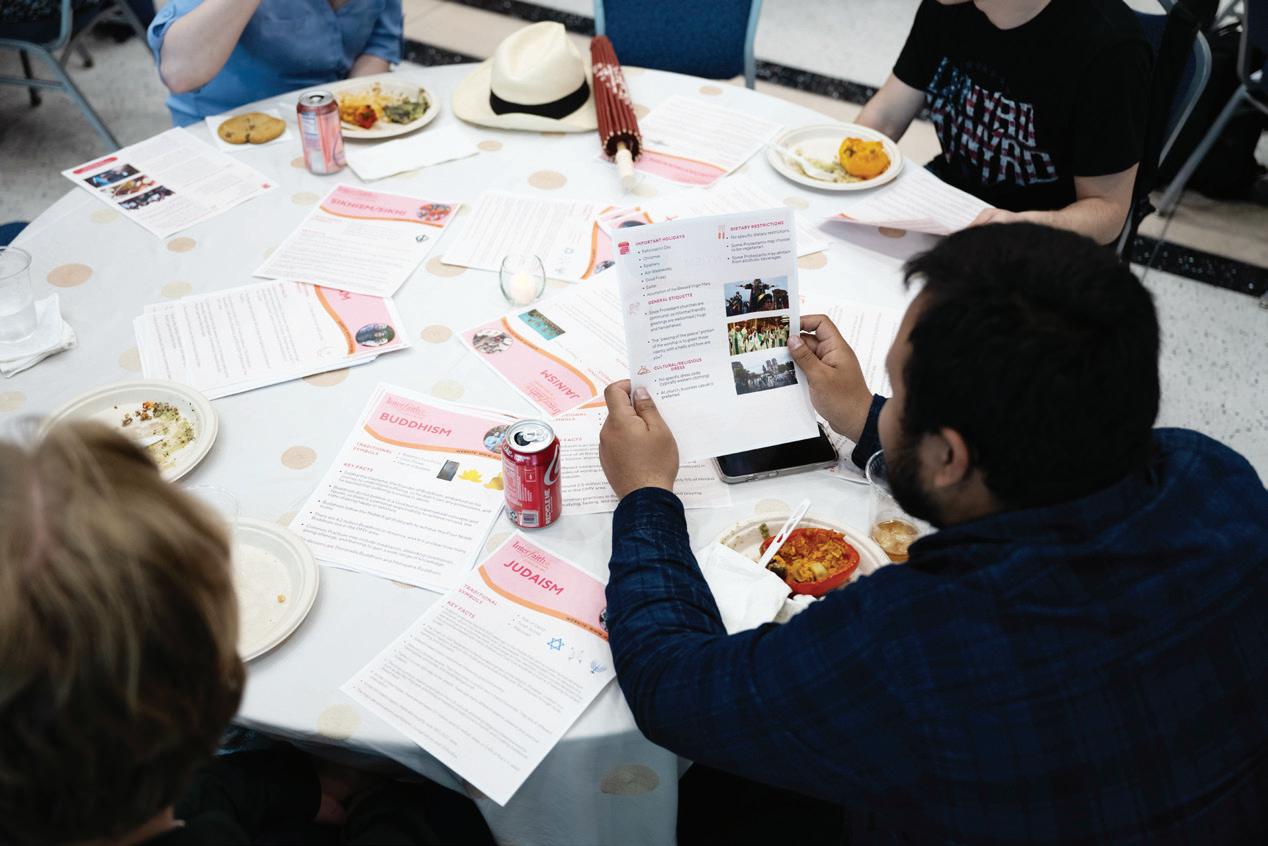
Students review pamphlets summarizing key components of religions at the Interfaith Dinner in April.
Years after budget cuts, Libraries face continued staff turnover, low morale
Faculty and staff said GW Libraries continues to face staff retention and morale issues eight years after budget and staff cuts.
Reports in the spring by the Faculty Senate Committee on Libraries and the Staff Council highlighted continued staff shortages and morale issues among existing staff, which have persisted since prepandemic layoffs. Geneva Henry, the dean of libraries and academic innovation, which manages Gelman, Eckles and the Virginia Science and Technology Campus libraries, said LAI is actively working to maintain and backfill vacancies and thinking “strategically” about staffing for the future.
Henry said staff acquisition and retention continue to be a priority despite the libraries’ “very low” turnover rate, with the exception of its overnight shifts due to their challenging schedules. Henry said LAI has worked to promote employee satisfaction through an “emphasis” on career growth, an internal “LAI Institute” to share knowledge and skills, newsletters and meetings with workplace updates, employee appreciation events and participation in University-wide employee engagement surveys.
“The dedicated librarians and staff of LAI take great pride in providing exceptional services to support GW’s teaching and learning mission and they continue to do so despite some challenges that include reduced staffing levels since 2015,” Henry said in an email. “Retaining our current staff and strategically adding additional positions would allow us to better prepare for and meet the needs of the future.”
Holly Dugan, an associate professor of English and co-chair of the Faculty Senate’s Libraries Committee, said the issues facing the libraries’s staff are a combination of the long-term effects of pre-pandemic layoffs and the additional responsibilities library staff have taken on since the COVID-19 pandemic, like facilities management and event planning, which used to have dedicated staff roles.
Dugan said some staffing issues
date back to 2015 and 2016, when officials cut numerous library positions after a decline in graduate enrollment spurred a budget crisis.
Former University President Steven Knapp directed officials to cut 40 jobs across the libraries, technology, student affairs, safety and security and treasurer’s offices in 2016.
“Many of those positions remain unfilled, backfilled, they were cut, they haven’t been reopened and been filled,” Dugan said.
“From that moment, the needs of the library have also changed.”
In 2021, members of the libraries committee said the University’s hiring freeze in March 2020 prevented the libraries from recruiting new staff to fill vacant positions as it had intended to do before the pandemic.
She said the libraries experienced issues including staff turnover and employees covering multiple roles pre-pandemic, which other departments like the Multicultural Student Services Center and Disability Support Services offices only started to experience
during the pandemic, because the libraries’ staff was already “bareboned.”
The Libraries Committee expressed concern in their 2021 interim committee report that library staff had to pick up more duties outside their job description including managing Gelman Library’s book deliveries and overseeing building maintenance issues.
“What did impact and change was the nature of the work, and the shift to central services left a lot of the support and wraparound of the library, like facilities, left librarians having to now take on additional roles to shepherd us through that crisis,” Dugan said.
Dugan said the additional roles that library staff had to take on during and after the pandemic have led to a “crisis of morale.” She said library staff are now splitting their attention between running the daily operations of the library and helping faculty and students adjust through transitions in learning like using generative AI tools.
“You have these incredibly tal-
ented and skilled people who are also managing all kinds of tasks that are linked to keeping things running smoothly but that were outside of the normal job description,” Dugan said. “And certainly folks in other areas in University did that, but I think it was particularly acute in LAI because of that dramatic change and what the work entailed in terms of new learning environments, both virtual, hybrid and back in person.”
During an April Staff Council meeting, Tricia Greenstein, the representative for Libraries and Academic Innovation and GW Museums on the council, said leadership of specialty libraries like the Jacob Burns Law Library and the Himmelfarb Health Sciences Library, were reporting “immense” turnover and actively searching for new librarians. She added the lack of staff has had a “considerable” impact on student experience and research goals across all three major University libraries.
A recent survey conducted by the Staff Council reported that non-
executive level staff across the University are facing “overwhelming” burnout, heavy workloads and inadequate job training.
“If you don’t fill in the spots, you don’t fund spots, for us to be fully staffed, the work it’s going to stay there and the work it’s going to go on the remaining staff and librarians and that puts an impact on how they serve the missions of the student experience and research,” Greenstein said.
Dugan said the committee is currently working to raise awareness among faculty and administrators of the current staffing and retention issues facing the libraries and partner with other Faculty Senate committees where issues overlap like the Physical Facilities & Campus Safety, Research and Educational Policy & Technology committees.
“This committee is really a good example of the partnerships,” Dugan said. “We need multiple folks looking at these issues and balancing sort of the needs, but we also need faculty being willing to recognize and celebrate the work that our librarian faculty and staff contribute to our work of research and teaching.”
Experts in academic libraries and higher education staffing said cutting roles and having existing employees cover multiple job responsibilities can lead to burnout among staff and hinder the services it provides to students and faculty.
Krista Soria, an associate professor at the University of Idaho’s College of Education, Health, and Human Sciences said her research shows that when students use libraries, it leads to higher grade point averages, retention and graduation rates. She said cutting library staff positions “undermines” research, student support and the resources a library can make available to a campus.
“Academic libraries are so vital to college student success that to make any cuts to the folks that are leading the libraries, making them function and operating them on a day-to-day basis is sort of criminal and is sort of going against what institutions desire to do, which is to support student success,” Soria said.
Officials collect Vex feedback amid reports of unreliable shuttle times
from community coordinators to their residence halls.
Officials relaunched a program this semester to collect feedback on wait times and travel experiences from frequent Mount Vernon Express riders amid ongoing student reports of long lines and shuttle delays.
GW’s student health insurance plan covers 100 percent of abortion costs from in-network physicians, a 20 percent increase from last year’s coverage.
The Student Health Insurance Plan, a Universityprovided health insurance plan with automatic enrollment and an option to opt out, covers 100 percent of the cost of student abortions, an increase from last year’s 80 percent, from in-network physicians and 60 percent of costs for out-of-network abortions this year. A University spokesperson said the decision to increase the coverage was partly due to advocacy of student organizations like the Student Government Association and GW Reproductive Autonomy and Gender Equity.
“The Division for Student Affairs negotiated an increase in the coverage of cost of medication and surgical abortion services provided by in-network providers from 80% in the 2023-2024 academic year to 100% in the 2024-2025 academic year,” the University spokesperson said in a statement.
GW RAGE and the SGA collaborated last semester to pass a bill advocating for abortion pills in the Student Health Center and for the University to commit to prioritizing comprehensive reproductive health care to increase accessibility.
GW RAGE has collected over 1,000 signatures on a petition for medicated abortion in the SHC since last fall, according to their September newsletter. The University has previously denied requests to provide abortion pills on campus and Dean of Students Colette Coleman said in an email to RAGE last academic year that the SHC is meant to be a primary care practice that “refers to specialists when necessary.”
“The Student Health Center currently offers a robust array of options for students interested in gynecologic care,” the University spokesperson said in an email. “Offerings include ‘well women exams’ for Pap smears, visits for pelvic concerns like vaginal discharge, pelvic pain, UTIs, STIs and irregular periods, as well as contraceptive care and breast health care.”
The University spokesperson declined to comment on if DSA plans to offer medicated abortion on campus after student advocacy
SHIP costs $2,999 for this year, an increase of $158 from last year, and the University spokesperson said in an email that the increase is not due to the expansion of abortion coverage.
for the pills. In the District, there are currently 11 virtual abortion providers — which provide telehealth services and mail abortion pills — and three in-person providers. Of the three brick-and-mortar providers, one is in Foggy Bottom. SHIP covers 13 innetwork OB-GYNs in the District.
The cost of abortion varies widely based on the provider, the trimester of pregnancy the person is in and the method of abortion, according to Planned Parenthood. On average, Planned Parenthood abortion pills cost around $580 while an in-clinic abortion during the first trimester costs around $600, with late-trimester abortions being even more expensive.
Experts in abortion said the increase in coverage helps to destigmatize abortion procedures, and students should continue to advocate for increased abortion access on campus.
Mary Ziegler, a professor of law with a focus on reproductive rights at the University of California at Davis, said universities insuring the cost of abortion for students helps reduce the stigma of the procedure by making people see it as the same as other kinds of health care.
“It sort of normalizes the procedure,” Ziegler said.
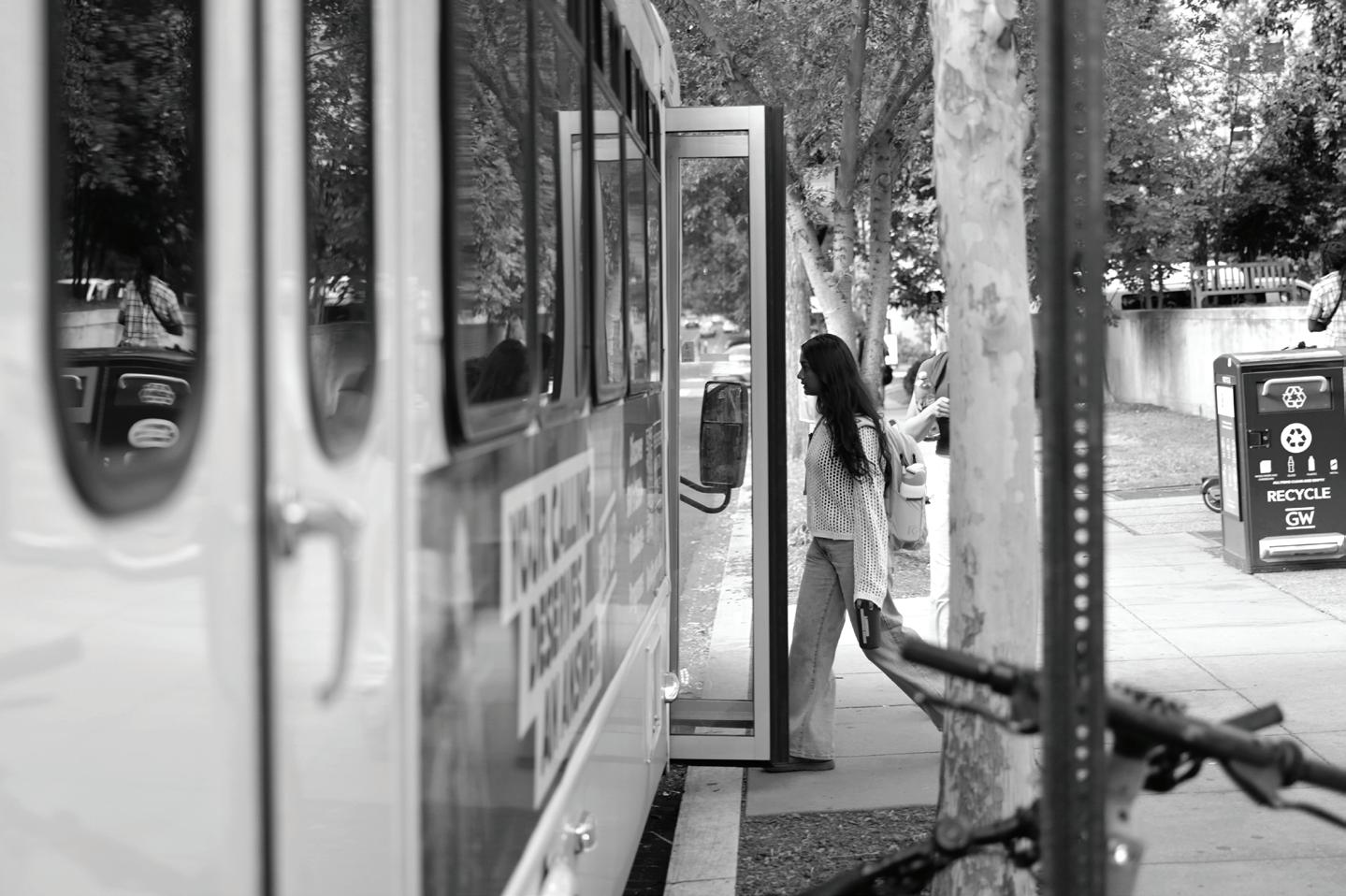
The Vex Secret Shopper Program, an initiative the Division of Safety & Operations debuted for the semester on Sept. 2, offers student volunteers up to $60 in Lyft vouchers for filling out a series of feedback forms to evaluate wait times, driver friendliness and shuttle safety. The program’s launch follows reports from students since 2021 of unpredictable Vex schedules and long lines, which students riding the shuttle say can cause them to arrive late to class.
Officials in the Division of Safety & Operations didn’t return a request for comment on whether officials are considering changes to Vex operations that this feedback may influence, how many students are participating in the program or how officials will collect feedback.
It is unclear when the program officially began, but students could sign up for the program last semester, according to an email
Division of Safety & Operations Stakeholder Engagement Coordinator Stephanie Stinfort sent a separate email to students this semester with information about the program, a change in outreach from last semester, students who did the program last semester said.
Within 15 minutes of completing their ride, program participants must fill out a survey asking them to report the date and time they boarded the Vex, if the shuttle arrived on time, if there was a line to get on the vehicle and whether the driver greeted and checked students’ GWorld cards as they entered, according to an email from Stinfort sent to program participants earlier this month.
The form asks about the temperature and cleanliness of the vehicle, whether the rider felt safe during the drive, if a “supervisor” was present at the pickup spots and if the driver allowed students to stand during the ride to indicate how full each shuttle was.
“All data collected through this form will be analyzed to better serve the students of the George Washington University,” the survey reads.
Last September, GW partnered with Reston
Limousine to launch a new fleet of shuttles to the Vern. University spokesperson Julia Metjian in September 2023 declined to comment on why the University partnered with Reston Limousine and retired the former Vex provider service but said the propane-fueled vehicles would help “reduce emissions and engine noise.”
The secret shopper program offers a $20 Lyft credit to participants for filling out the survey for seven Vex trips between 7 a.m. and 8 p.m., five of which have to be on weekdays and the other two during the weekend, according to an email from Stinfort to program participants earlier this month.
Officials will send vouchers to students every one to two weeks, with a maximum of $60 in credits in a weeklong period, the email states.
Sadie Stern, a first-year who lives in Somers Hall, said she rides the Vex four to eight times a day to get to her classes and extracurricular activities on Foggy Bottom.
“I shouldn’t have to wait for my transportation to get to a class when I didn’t choose to live on the Vern,” Stern said in a text message. “I wanted to be able to walk and be in control of my time.”
HATCHET FILE PHOTO
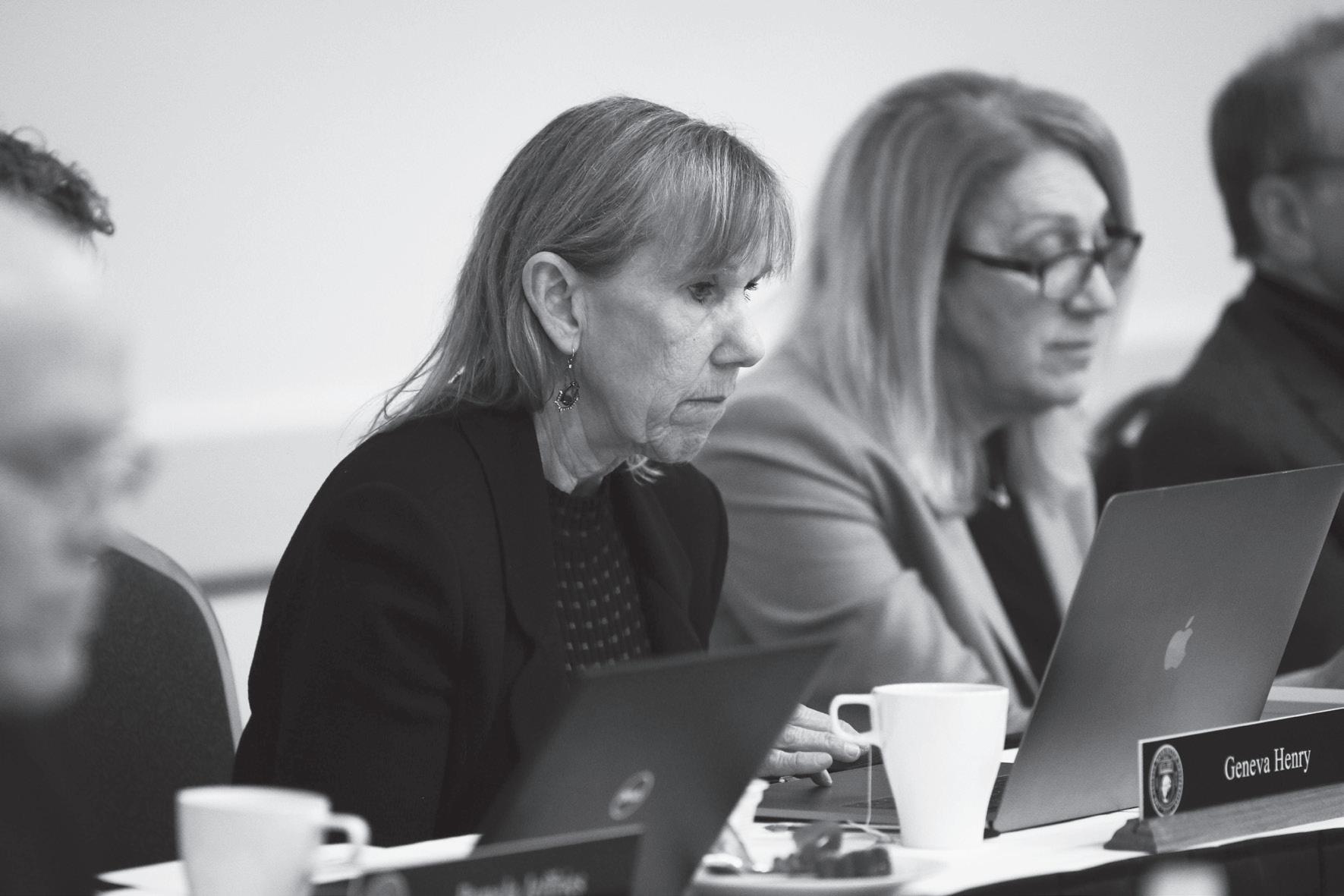
Geneva Henry, the dean of libraries and academic innovation, during a Board of Trustees meeting in 2019.
JENNA LEE ASSISTANT NEWS EDITOR
FIONA BORK SENIOR STAFF WRITER
Number of RHA Council candidates, elected officers exceed last year’s race
MAGGIE
The Residence Hall Association filled more than three-quarters of hall council seats during last week’s election, a nine percent jump from last year’s race, which RHA leaders attribute to increased outreach at the semester’s onset.
Starting last Monday at noon, 160 students competed to fill 100 hall council positions in the RHA’s annual races — about a 27 percent rise in candidates compared to 2023 — with students voting Thursday through Saturday on their picks for advocacy and programming leaders in the mini-government representing each of GW’s 25 residence halls. RHA President Andrew Levin said the association upped its outreach during the first few weeks of the semester by attending more than a dozen events, including tabling at first-year move-in and the Buff and Blue Kickoff, which he said likely contributed to the uptick in candidates.
“It’s definitely nice to see the enthusiasm from people running,” Levin said. “I can’t say anything for sure, but I’d like to think that all of the events that we have attended over the first couple weeks of school have made a difference.”
Students vied for president, communications chair, programming chair and finance chair positions in their respective residence halls. The RHA dropped the vice president role in 2023 to reduce redundancy and allow hall council members to take more active roles in the body’s decision-making processes.
Each elected leader will play a role in organizing community events and advocating for hall improvements like accessibility, facilities and safety, Levin said.
“We want people to not just put on events, even though that’s a lot of what we do and is extremely important, we also want to equally emphasize that advocacy perspec-
tive,” Levin said. This election cycle, 24 seats across the residence halls weren’t filled, a drop from last year’s 34 vacancies.
Levin said he plans to offer vacant seats to residents who ran for a different position in their hall but lost because the positions’ responsibilities overlap. He said, for example, if a student running for president came in second but the finance chair position in their hall was still open, RHA leaders would offer the second-place presidential candidate the finance chair position. He said the method is effective in filling vacancies because these students have already shown interest in participating in RHA.
Levin added that hall councils will also work to appoint students to fill remaining vacancies after the positions are offered to everyone who vied for an RHA position. He said to fill a vacancy, the other council members would appoint a resident to fill the position and vote on the appointee.
“I think we’re going to be able to fill the whole hall councils,” Levin said.
RHA Director of Communications Jacob Wilner said he spoke with about 500 people to encourage them to join RHA in the first few weeks of school at University events like the Mount Vernon Campus pool party, with the goal of raising the number of students running for council positions. He said he told students within RHA they can hold events and advocate for their hall’s needs.
“These hall council members have had to become friends with everyone in their hall council or hall and figure out what issues they might have or what’s stressing them out about living in that hall,” Wilner said.
To campaign, students hung posters on the designated flier boards in their halls and used personal Instagram accounts to broaden their platform — strategies in ac-
cordance with the RHA’s 2024-2025 elections guide, which the association developed. Some candidates in first-year residence halls held debates in community spaces, including one on Wednesday between the two candidates running for Potomac House president, which about 30 students attended.
Julia Yam, a first-year majoring in political science, said she decided to run for president of Thurston Hall — a race she did not win — after she discovered she had showered in a Thurston bathroom with a hidden camera, which she reported to her community coordinator. After Yam reported the camera, she said officials sent an email to Thurston and Mitchell Hall residents explaining GW Police Department officers found a camera “placed surreptitiously” in a second-floor Thurston bathroom earlier this
month. She said she ran to request that officials increase the number of security guards present at the Thurston entrance and push for security guards to be more vigilant. Yam said Thurston has one security officer at a time who she noticed is typically “very not attentive.”
“There’s been many security issues, so I’ve been very active in that already,” Yam said. “It’s something that I’m passionate about.”
First-year Nathan Arst won the Thurston Hall presidential election. Hayden Rometty, a sophomore majoring in political communication, ran for president in Lafayette Hall — a race which he did not win — because he was “upset” at the administration for switching the residence hall from a first-year to a sophomore dorm. He said Lafayette is not “accommodating”
Milken professor heads global commission on gun violence
JENNA LEE ASSISTANT NEWS EDITOR
A GW professor will cochair a global commission examining gun violence as a global public health issue to influence global policy after launching the study earlier this month.
Adnan Hyder, a professor of global health at Milken Institute School of Public Health, will serve as the co-chair of the Lancet Commission on Global Gun Violence and Health, along with Lorena Barberia, a professor of political science at the University of Sao Paulo in Brazil. Hyder said the commission aims to gather the perspectives of experts across the globe to examine gun violence from a “public health framework” by focusing on the mental and physical health impacts of gun violence.
Hyder said the commission’s public health and policy experts from around the world will conduct a review of published papers and databases to compile research on the causes and possible
solutions of gun violence and publish a report in the Lancet, a British medical journal, with their findings and policy recommendations in 2026. He said the commission plans to meet in early 2025 to discuss a plan for compiling research.
“We are launching this Lancet commission, one, because it’s a pressing issue in multiple countries around the world, not just this country,” Hyder said. “Number two, it has not been given the appropriate attention as a global public health problem that it deserves.”
Hyder said gun violence often affects people’s health by leaving them with injuries or causing fatalities, but people tend not to think of gun violence as a global health emergency, which people typically associate with contagious diseases. He said examining case studies of gun violence from around the world will give researchers an idea of how to prevent injuries from gun violence by learning about approaches in certain countries like stricter gun laws
and applying it elsewhere.
“Is the United Kingdom doing something that may be helpful to the United States?” Hyder said. “Is South Africa doing something that might be helpful to India? So what are the cross border lessons?”
Hyder said there is a misconception that gun violence only affects a few countries, but it is a problem all around the world and is not a geographically isolated phenomenon.
“We have to confront this issue because thousands of people are dying every day, and it’s happening every day, and we seem to be accepting it,” Hyder said.
Hyder said his goal for the commission is to raise awareness of gun violence as a public health issue on par with the AIDS epidemic or malaria and prompt policymakers to treat it as such and implement policies that are backed by global evidence. Hyder said there is evidence that stricter gun law passed in other countries have been effective in reducing gun violence,
and he hopes policy leaders across the globe utilize this information to inform their own approaches to gun control.
“We hope that ministers of health, secretaries of health, secretaries of labor and justice, will look upon this as the best evidence to inform their policy development,” Hyder said. “So when people are thinking about and hopefully in this country, for example, when we think about sensible gun policies, we choose the ones that have evidence.”
Experts who study gun violence said the global nature of the commission will help individual nations learn from the solutions other countries are implementing like regulations on gun ownership.
Caterina Roman, a professor of criminal justice at Temple University, said the international structure of the commission will inform individual scholars on solutions to gun violence that they may not have considered due to their culture. She said in the United States
to the second-year experience because it is one of three second-year residence halls without private kitchens, and he said he wants to advocate for officials to upgrade the hall’s sole communal kitchen and to eventually increase the number of kitchens in the hall. Officials plan to eliminate kitchens in FSK Hall, a sophomore dorm, over the next five years to make room for more beds.
He said there are general facility issues within the building, like that the only water fountain in the building leaks. As president, he said he wants to advocate for resolving facilities issues by initiating conversations with administrators to discuss potential upgrades to community spaces.
“I like to see if there’s some way we can coordinate with the administration to at least get some of these issues resolved,” Rometty said.
it is often assumed the best deterrent of crimes like gun violence is mass incarceration, but in other countries law enforcement is more focused on rehabilitating offenders.
The United States has the highest rate of incarceration in the world, with more than 4.9 million Americans being jailed annually and the government spending $80 billion dollars each year on incarceration.
“We don’t even know what our biases are if we’re not exposed to people who have different cultures and experiences with things,” Roman said. “So for instance, in the U.S., like I was saying earlier, the typical response to crime has been punishment and incarceration. You certainly can be learning from the nations that don’t rely on incarceration or even lengthy sentences.”
Roman said one of the obstacles to combating gun violence is the lack of consensus among experts and lawmakers on what causes gun violence and what poli-
Members of dissolved sorority establish Jewish student group
About two months after Sigma Alpha Epsilon Pi disbanded, former members established a new student organization to support and connect Jewish students on campus. In late May, the national SAEPi Board of Directors told former members of the sorority that they voted to dissolve the organization — which at the time included a dozen active branches nationwide — amid declining membership after the COVID-19 pandemic and a lack of volunteers for the national board, according to an email obtained by The Hatchet. When GW’s SAEPi chapter announced they would no longer operate after the national organization closed its doors, its members said they would continue to advocate for a space to support Jewish women and nonbinary students.
Last month, former members of SAEPi created an Instagram account for a new organization called “Club 18,” which is not a registered student organization, according to OrgHelp’s list of active student organizations. The organization is listed on Engage, with the same description, profile picture and contact information as SAEPi. SAEPi was founded as a Jewish sorority in 1998 at University of California, Davis, according to the sorority’s website and was recognized
as a chapter at GW in spring 2018.
As the chapter grew on campus, sorority leaders said they hoped the chapter provided a platform to connect with other Jewish women to ensure members didn’t have to sacrifice their Jewish identity for a traditional Greek experience.
“We know that Sigma Alpha Epsilon Pi Sorority has meant a great deal to hundreds of women over the years, including each and every one of you,” the SAEPi Board of Directors’ May announcement reads. “The sisterhood is no less special to each of us as individuals
and as a collective group of leaders, but our beloved Sorority is no longer functional.” Rachel Zemil, a 2022 alum and current graduate student, said she joined SAEPi’s GW chapter because it wasn’t “pretentious” and she admired the chapter’s commitment
cies would work to solve it. She said without consensus, no effective policy can be passed.
“No one can say one thing causes gun violence and there are no easy solutions,” Roman said. “So we unfortunately have a partisan, we have a divided response, so nothing gets done in prevention.”
Benjamin Dowd-Arrow, an assistant professor of social sciences and public policy at Florida State University, said the United States has more gun violence than most developed nations, so researchers here can benefit from hearing the perspectives of other countries through the commission.
“I think having these other perspectives allows us to look at what worked, especially when we look at comparable nations,” DowdArrow said. “Nations that have a similar history of colonialism, like the United States. So if we look at Brazil, or we look at Australia, we can see they have very similar histories of how their peoples were moved there.”
to volunteer work. Zemil said the chapter struggled to increase membership during her time as an undergraduate student, but the chapter equally valued recruitment and community building.
“In order to have the sisterhood, you had to get enough people into the chapter,” Zemil said.
Zemil said she likes the “Club 18” organization name because 18 means chai or life in Hebrew and represents good luck in Judaism.
“First of all, that’s a good name to have, but also I’m hoping at some point, SAEPi can go back to being a sorority that gives to people, to animals, to whatever it was that we did,” Zemil said.
Junior Tamar Guggenheim, the president of Sigma Delta Tau, said the chapter utilizes its heritage as a historically Jewish sorority to improve how chapter members support one another. She said chapter members empathize with SAEPi members and hope that they continue to find a community at GW outside of their national organization.
“I hope that Jewish people across campus can find a space that they feel seen in, and find a community that reflects their values, too,” Guggenheim said in a message.
Members of SAEPi and Club 18 declined multiple requests for comment, some members stating that they wanted to focus on the new organization’s development.
HATCHET FILE PHOTO
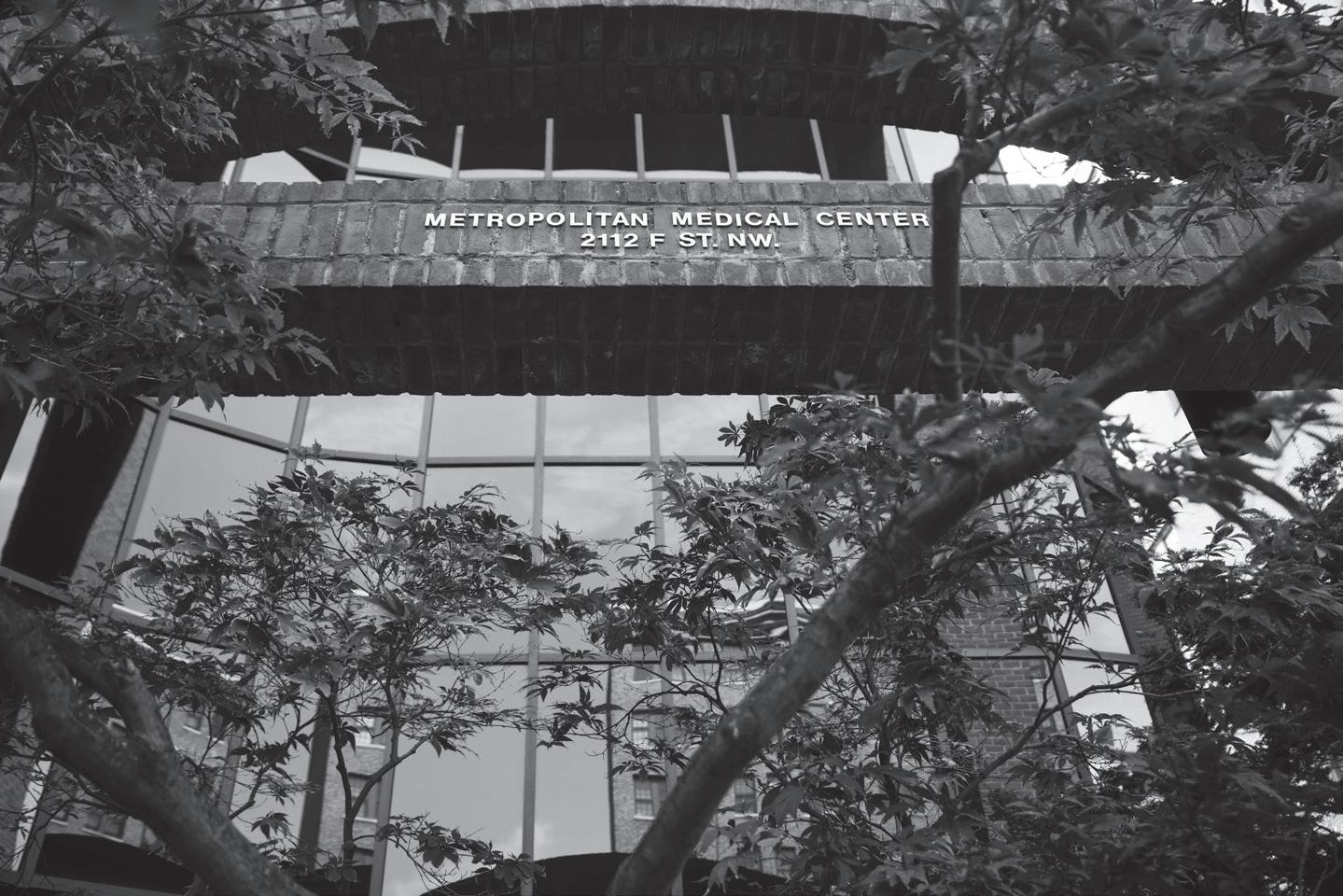
South Hall located on F Street.
JENNIFER IGBONOBA NEWS EDITOR
COURTESY OF ALANA MONDSCHEIN
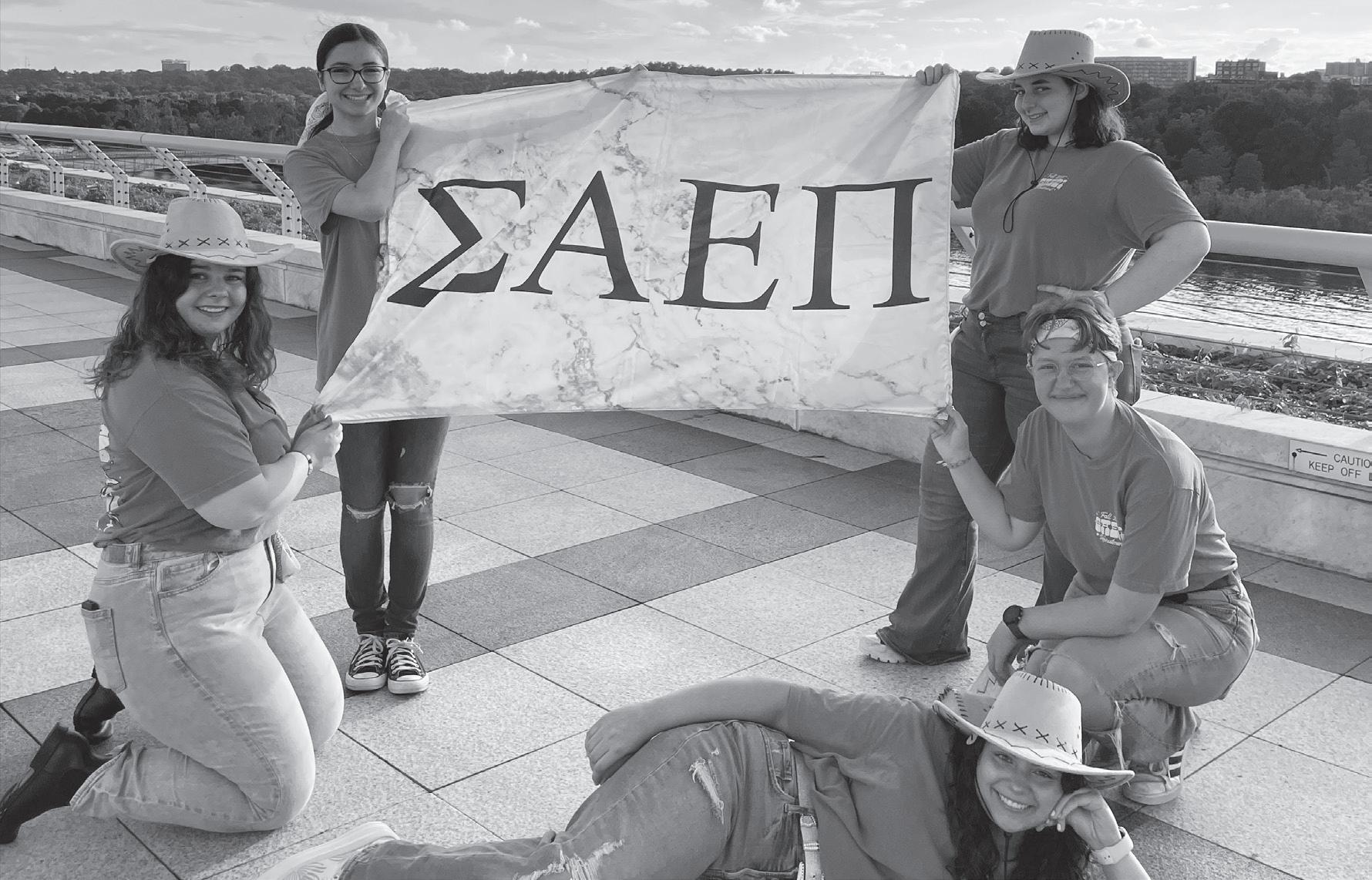
Former members of GW Sigma Alpha Epsilon Pi hold up the sorority's flag.
Student groups lower Plan B vending machine costs
On-campus Plan B vending machine prices decreased to $5 following constant efforts from student groups to make emergency contraceptives more accessible for GW students.
Stephanie Spector, the president of GW Reproductive, Autonomy and Gender Equity, said the prices decreased from $15 to $5 after former SGA President Arielle Geismar gave RAGE the remainder of her executive budget at the end of last semester to put toward purchasing Plan B for the vending machines. The cost reduction is the latest step from students working to increase affordable access to emergency contraceptives and other sexual health resources almost five years after Foggy Bottom Plan B, an off-campus and student run organization, started providing free Plan B for the Foggy Bottom and GW community.
Spector said during the summer, the vending machine price was $1 for the emergency contraceptives, but RAGE decided to increase the price to $5 because most students can afford the contraceptive, and the price is sustainable for the organization to maintain.
“There are also, of course, other ways to get free Plan B in the area,” Spector said. “So
we’re hoping that if $5 still is a barrier for folks, they’ll turn to Foggy Bottom Plan B, which RAGE is very involved in, where they can get free Plan B as well.”
SGA and RAGE said in an Instagram post that the pricing may change in the future when RAGE finds a new supplier for the machine.
Officials installed a vending machine in the University Student Center stocked with Plan B in January 2023 for $25 and later replaced it with two new machines in District House and West Hall, lowering the cost to $15 in collaboration with the SGA and RAGE in August 2023.
RAGE announced in July that Canteen, the company that stocks the Plan B vending machine, will no longer be stocking nonfood items. Spector said the Student Health Center currently purchases generic emergency contraceptives from the Medical Faculty Associates and that GW Business Services are stocking the machines until they find a new supplier.
EJ Tennant, the co-president of Foggy Bottom Plan B, said the organization used to purchase the contraceptives themselves when it first formed in 2019 and relied on individual monetary donations from students who requested Plan B from them to fund their stock. She said the
Sparse messaging sparks doubt in emission reduction progress: task force members
From Page 1
Lasky said officials are also developing a “decarbonization plan” to modernize building systems and reduce GW’s carbon footprint but did not specify what the plan would entail, who is developing it or whether officials think the University is on track to become carbon-neutral by 2030.
“GW is on track to meet the interim 40% reduction target by 2025,” Lasky said in an email.
Officials said in May 2023 that GW’s investment in companies that earn a majority of their revenue from burning fossil fuels dropped from roughly 3 percent in 2020 to under 2 percent. Lasky deferred comment on any additional steps officials have taken toward divestment to an April 2023 release, which states that GW worked with a fund manager to create a “fossil fuel free strategy” and invested with a fund manager that will transition remaining holdings.
Lasky said GW is working with an adviser to create a “sustainable transportation strategy” for the Mount Vernon Express, which includes transitioning to electric vehicles, Lasky said. He said the University has already begun to transition the shuttles to liquid propane gas, which reduces emissions by 25 percent compared to diesel vans.
Jeremy Liskar, a former graduate student and member of the ESG task force, said he would have liked to see more updates on GW’s progress toward sustainability. Liskar said when the ESG task force’s recommendations were adopted by the Board, which included a promise of updates on the University’s progress toward divestment, the task force was notified.
Liskar said the 2020 update was the most recent update he heard.
organization now has connections with organizations like Advocates for Youth, and Julie, a healthcare brand that provides emergency contraceptives, so they no longer have to purchase their supplies thanks to donations from their partners.
She said students who request Plan B are required to sign a waiver that acknowledges they are receiving an emergency contraceptive from students and not from a doctor or medical service.
Tennant said the Dobbs v. Jackson decision that overturned the landmark case Roe v. Wade that federally protected abortion access makes it difficult for students to access abortion services in their home states. She said the SHC does not provide medical or surgical abortion and refers students to the DC Planned Parenthood, which is about 30 minutes from campus via public transportation.
“Access to all health care is important to the well-being and success of students at GW,” Tennant said in a message. “The University needs to prioritize achieving access to all reproductive health care services for students so DC can continue to provide abortion and reproductive health services for its residents and neighboring states.”
She said the amount of requests the group received
“There really wasn’t much transparency or follow-up at all,” he said.
Melani McAlister, a professor of American studies and international affairs and a member of the ESG task force, said she hasn’t heard details from officials about how they plan to achieve emissions and divestment benchmarks since their initial commitment to do so in 2020.
“We need to be hearing about that from our leadership, what we can do, what they’re doing, how things are going to change, and I know we just simply don’t,” McAlister said. “I don’t see that kind of messaging when I’m on campus. I don’t get the lessons and how these old buildings that we have are going to be changed.”
She said because the University took 15 years to cut 29 percent of its emissions, she is skeptical that officials will reach their pledge of a 40 percent reduction in the next two years.
“I’d have to see something pretty dramatic, and I haven’t seen it,” McAlister said.
The largest contributor to the 29 percent drop in emissions is the University’s purchased electricity, which shrunk from 74,980 tonnes of carbon dioxide in 2008 to 14,270 tonnes in 2023, according to GW’s public emissions report.
About 60 percent of the University’s energy use is obtained through renewable sources, according to the Office of Sustainability’s website.
Lasky said GW has approved the installation of solar panels on more than a dozen rooftops on the Foggy Bottom Campus, including Francis Scott Key, Lerner, Guthridge, South, Stockton, Science and Engineering and Rome halls, Gelman, Himmelfarb and Jacob Burns Law libraries, Building JJ and the University Student Center.
has decreased since the establishment of Plan B vending machines on campus but still maintains a “steady flow” of distribution because their Plan B is free. She said the organization has expanded their outreach across the GW and Foggy Bottom communities by increasing their social media presence and maintaining their website to be a consistent resource for the Foggy Bottom community.
Tennant said the group has repeatedly applied to become a registered organization on campus since it was
formed in 2019, but officials rejected their most recent application in spring 2022. Tennant said she thinks officials don’t want the “responsibility” of students giving out free emergency contraceptives without a prescription or doctors’ approval.
A University spokesperson said Foggy Bottom Plan B was denied as an official student organization because the Office of Student Life could not verify how the organization obtained the contraceptives that they were going to distribute. They added that officials had concerns about improper storage temperatures, expired medication and the lack of a medical professional’s consultation, which also led to the decision to deny their application. The University spokesperson said the SHC is able to prescribe emergency contraceptives when a student has an appointment and is covered under “most” insurances, including the GW Student Health Insurance Plan. They added that the SHC has to complete a medical assessment before recommending any medication that is prescribed or over the counter.
Faculty senators question motive behind severance payments to former top officials
From Page 1
He also pointed to the more than $80 million dollar deficits run by the Medical Faculty Associates each year — a nonprofit group of doctors, nurses and health care staff controlled by GW who owe the University $200 million after several years of financial shortfalls.
“I have to wonder if the answer to that question is ‘from funds which would otherwise go to supporting GW’s academic initiatives — very much including student financial aid,’” Wirtz said in an email.
Wirtz said the University needs to be able to “fully financially support” the needs of its students and its academic initiatives before issuing large severance payments to its administration.
“If, instead, we are paying millions of dollars in ‘severance’ to former executives, it would make me wonder if GW has its priorities straight,” Wirtz said.
Former Head Basketball Coach Jamion Christian, who officials fired in 2022 after a poor season by GW’s basketball team, received $774,000 in severance pay during FY 2022-23. Nolan received $338,000.
GW has offered severance to 14 former employees between FY
2017 and FY 2023, according to the University’s publicly available tax forms. Former Chief Financial Officer Lou Katz received the highest payment out of the payments reported during the six pay cycles — $1,736,534 in severance in FY 2020 upon his retirement after 28 years at GW.
Other notable payments include $1.32 million in FY 2019 to former Athletic Director Patrick Nero, who resigned in 2017.
Brinkerhoff pointed to severance payments to past faculty members that she theorized officials used to drive personnel turnover, including a buyout in the School of Business in 2014, where GW offered six-figure sums to business school professors who had taught at the school since 1990 in an effort to boost GW’s profile with younger, more research-minded professors.
“Even faculty members are on occasion offered buyouts to agree to retire or move on,” Brinkerhoff said. “The Business School did this in 2014 publicly and at scale. Sometimes buyouts, faculty or otherwise, are negotiated on a case-by-case basis and so don’t make the news.”
GW also paid former professor of biochemistry Rakesh Kumar $650,000 in severance pay and a buyout of tenure between in FY 2018, after receiving $828,150 in severance the year before, per GW’s financial docu-
ments.
Kumar resigned in 2016 following an $8 million lawsuit against GW for removing him from his position as chair of the biochemistry and molecular medicine department without following protocol, which was settled in August 2016.
Steven Levine — a lecturer at the Boston University School of Law and senior partner at Brown Rudnick, an international law firm — said the severance payments could have been stipulated by the former administrators’ contracts in the event of departures. He said contracts often include a provision that allows officials to receive severance regardless of their reason for leaving, unless they are fired for cause.
Levine said offering severance can also be used by universities and their trustees, who oversee top administrators’ paychecks, to entice someone to leave their position when they haven’t done something illegal or immoral that merits their firing.
“While that may be ambiguous, if the trustees decided that it was in the best interest of the institution for this guy to leave, they have to make some type of arrangement to induce him to do that and that would be true to the CFO and the president,” Levine said.
Faculty senators voice concerns about stay-away orders for pro-Palestinian student protesters
From Page 1
The Student Coalition for Palestine at GWU alleged in late July that officials pressured the attorney to revoke legal agreements issued to students after the encampment clearing that allowed them to enter spaces in Foggy Bottom not owned by GW and replace them with harsher agreements that banned students from campus altogether for six months.
Phil Wirtz, a faculty senator and professor of decision sciences and psychological and brain sciences, said officials should advocate for the U.S. Attorney General for D.C., who issued stay-away orders, to loosen restrictions to ensure students have access to their full University experience, like the Disability Support Services office and Gelman Library.
“Somebody’s got to stand up for the kids,” Wirtz said. “Somebody’s got to take an action that says, wait a min-
ute, you’re hamstringing, you’re kneecapping our students. And while I certainly appreciate the legal process, I also think that at some point the University needs to step in.”
Granberg said GW took a “neutral position” regarding D.C. court hearings this summer for arrested students in the spring. She said the University did not issue suspensions to any of the students with stayaway orders, meaning students are still able to attend classes.
Granberg said she was “extremely pleased” that sanctions against students would not appear on their permanent record if they chose to accept their agreements but did not specify when she became aware the sanctions wouldn’t be on their records. She said the courts are a “fairly blunt instrument” but that students facing legal proceedings would have access to mental and physical health facilities on campus through the Student Support Office and the Division for
Student Affairs. She did not specify how students would be able to access these resources.
“We were very, very welcome to every idea that came across the transom about how to make this workable for the students,” Granberg said.
Vice President and General Counsel Charles Barber said students would have to go back to court with their attorneys to be able to access spaces in Foggy Bottom or make other revisions to their orders.
Granberg said total student registration stood at 24,689 on the first day of the fall semester, which is two fewer student registrations than last fall. She said the figure demonstrates GW’s “continued stability” and attractiveness during “very trying times” in higher education. She said total enrollment has exceeded 25,000 as of last week, and officials expect additional students to enroll over the coming weeks.
Faculty senators
also passed a resolution 22-1 defining the term “consultation with the faculty” surrounding University policy as ensuring that there is “adequate” time for members of the senate and committees to consult on proposed policies. The resolution requests that policies should be publicly posted for at least 60 days of review before being approved and administration should address feedback from faculty before officially announcing the policy.
The senate also held a moment of silence for professor Murli Gupta, who died in August at age 78. Schultheiss said Gupta served as a faculty senator for 22 years and was a member of the mathematics department for 45 years before he retired this spring.
She said Gupta was a steadfast advocate for faculty rights, fairness, safety and protection and promotion of the central educational mission of the University.
“Your example remains,” Schultheiss said. “Thank you, Murli.”
PHOTO ILLUSTRATION BY CHUCKIE COPELAND
The selection screen of the Plan B vending machine in the basement of District House.
OPINIONS
To address traffic fatalities, Vision Zero must think long term
Back in 2014, Mayor Muriel Bowser made a promise to D.C. residents: In a decade, traffic deaths in the District would be reduced to zero. But in 2024, D.C. hasn’t eliminated traffic deaths or even cut them down. They’ve increased.
In 2023, D.C. hit a 16-year high in traffic fatalities with a total of 52 deaths, double the number from 2014, when D.C. first adopted the plan. And according to a Washington Post analysis, we’re on track to hit the 52 mark from last year, with the city recording 40 deaths so far in 2024. This time last year, we had reached 35 deaths.
The District has focused on enforcement, with about 467 traffic cameras since 2014 and plans to add more in eight locations next year. Last year, D.C. officials decided to start sending targeted messages to high-risk drivers. But evidence shows that the enforcement-heavy focus may not be enough. The District is limited in ability to enforce photo-enforced tickets because of a lack of regional legislation to enforce automated tickets for nonresident drivers. And according to the Post’s analysis, nine of the 33 people killed in traffic crashes so far this year died within 250 feet of a traffic camera.
The city has made some steps to change road design and take safety precautions that slow down drivers, like speed limit decreases, adding stoplights and bike lanes and implementing limited revisions to arterial lines, like a couple of bus lanes on Georgia Avenue in 2016 and an interim revision on Florida Avenue in 2019 that added bike
ASTAFF EDITORIAL
lanes on each side and reduced car lanes. But there hasn’t been much more progress to fundamentally — and permanently — change these roads.
Some of the government’s
most drastic steps to curtail dangerous driving have fizzled, killing bike lane projects on high-risk roads, like Connecticut Avenue, and delaying project completions, like on Florida
Trying to embrace DC before graduation
few weeks ago, I found myself with the ultimate firstworld problem: I had to figure a way around the White House, so I could get to work.
I was annoyed as I stared at the D.C. bike map on my standing desk .My life would be so much easier if that essential symbol of America wasn’t there, so I could make fewer turns.
Then I realized how ridiculous I sounded.
I’m sure if I told anyone who didn’t live in D.C. that I was annoyed about having to pass the White House, they’d be extremely confused. Isn’t passing the White House something I would’ve wanted when I was eagerly awaiting to go to GW?
With so many symbols of American politics and history , it can be too easy to become totally desensitized and lose an appreciation for everything that makes D.C. noteworthy. As I enter my senior year, I don’t want to take anything else about this city for granted.
I sometimes feel like I’ve become “Mr. D.C.” to friends of mine not in the area. On one level, my constant political and historical nerdiness predisposes me to be interested in what the District has to offer. Last month, I legally registered as a voter and registrant of
the District. I’ve got a massive paper print-out driver’s license in my wallet that, while not always amusing to bartenders, says that I live in D.C. I even edit the culture section of this very D.C. newspaper.
And yet, there’s almost no chance I’ll be a District resident a year from now. I worked on a campaign this summer thousands of miles away and completely fell in love with the job. The energy around the office every day was infectious. For my own campaign obsessiveness, it was simply wonderful to spend time around people who knew what I’d be talking about when I’d reference the mismanagement of a Maine Senate race from four years ago. Because campaigns need to be close to specific voters, they are basically the only jobs in politics that are hard to do in D.C. The whole appeal, is getting to live in and learn about the politics of everywhere, to be on the ground with a bunch of fellow underpaid twentysomethings working for something everyone cares about. It’s harder to find that, say, in a national D.C. based organization or, on a small-scale, a local primary.
I also just found it extremely interesting this past summer to live in a smaller city with a much different culture than I was used to.I could move back here some day, but I always talk about how everyone should spend a year in New York City when you’re young because of all the opportunities and classic writing about late
nights in the city. I entered into love affairs with the cities of San Francisco and Chicago after I visited them this year. Life can take so many turns, so I’m not gonna bank on living in D.C. forever or maybe ever again after I graduate.
There’s 289 days from when I’m writing this article to when my lease. I don’t want to fill those 289 days thinking about what a hassle it is that my daily commute passes the White House. Instead, I want to take advantage of everything the District has to offer before my time here is up. I used to go down to the National Mall every night on a walk while listening to the evening’s New York Mets game on the radio, but at some point I stopped, too consumed at my desk with all of life’s business and readings.
I want to get back into that habit, back into seeing the glimmer of the spotlights on the Washington Monument.
I have yet to complete my exploration of other D.C. quadrants. There’s classic D.C. events I’ve still never been to. I don’t want to miss my chance to experience those. And I haven’t actually taken a tour of the White House, whereas millions of people had.
I’ve got 288 afternoons to fill now, after I spent this one writing this story and I want to use the others to soak in my beloved college town while I’m still here. —Nick Perkins, a senior majoring in political science, is the culture editor.
BAvenue. Additional plans were made for Connecticut Avenue, like adding curbs and left turn lanes, but the delayed project will still take a while to complete.
D.C.’s infrastructure, from small lanes to several one-way routes or traffic circles, can make driving in D.C. complicated and frustrating, allowing for more accidents and high-risk driving. D.C. officials have tried to identify locations that attract the most accidents or fatalities, focusing on the top 15 from June 2016 to July 2021, ensuring there are emergency first responders to help avoid fatalities or serious injuries.
But the city doesn’t seem to have the funding to implement bigger projects for Vision Zero, failing to fully fund the program in 2020 and pushing back larger initiatives passed by the D.C. Council in favor of cheaper ones in 2023. In fact, the mayor wants to use revenue from traffic cameras to help reduce D.C.’s fouryear budget gap, redirecting the money that the Council had voted should go to Vision Zero.
These short-term plans don’t truly address D.C.’s main traffic safety issues, its layout and road design. The city must stabilize the fragile financial foundation on top of which it created Vision Zero, accounting for recent budget shortfalls and propose revisions to the plan that bring effective road safety revisions into focus.
Addressing these deadly issues, from D.C.’s traffic infrastructure to the culture of its commuters, is something that takes time and can’t be resolved immediately. But ambitious proposals call for realistic amendments, especially as the number of traffic fatalities is projected to climb, and we hope to see a plan that considers the city’s future in its next update come January.
Don’t underestimate extracurriculars on your resume
eing a political communication student at GW means, internships and the constant pressure to build a perfect resume. But as a senior, I’ve managed to keep my head up due to my participation in student theater.
Aaliyah Guzman Opinions Writer
At first glance, participating in an extracurricular unrelated to one’s major might seem unproductive. But sometimes, the most valuable lessons are learned not in the classroom or the office but under the warm glow of a spotlight or behind the curtain of a student production.
My experience as a senior member of diversity, equity, and inclusion and my previous role as the director of DEI honed my leadership skills and brought the significance of representation to the forefront. Try telling a group of passionate actors why we need to shake up our casting choices, and you’ll learn how to articulate complex ideas that resonate with people quickly. These roles aren’t just titles on my resume — they have been crash courses in advocacy, negotiation and public speaking.
When I interned at the Office of Rep. Sean Casten (D-IL), I drew on my student theater skills when drafting legislative correspondence or managing phone interactions with
constituents. I would receive daunting quantities of new information that I had to reiterate to others, I had to think on my feet and lead with confidence in the face of uncertainty, and the same applied at my internship.
At my latest internship with Amtrak this summer, I helped the company respond to a critical service disruption in a way that acknowledged the implications on riders stemming from train delays or cancellations. Press releases would need insanely fast turnarounds or events would be planned within a week. In these situations, the hectic nature of theater — from forgotten cue lines and delayed shuttles to the Mount Vernon Campus for rehearsal — prevented me from losing my calm.
Theater also eased the process of writing about personal experiences or complex subjects, like the Kenyan Femicide, when writing op-eds for the Feminist Majority Foundation, a nonprofit women’s group and magazine. The storytelling techniques I learned on stage now help me unpack ideas and express myself by leaving my comfort zone and articulating my opinions. Beyond career skills, I’ve learned valuable life lessons about trust, respect, teamwork and genuine pride through my process of directing the full-length musical RENT with Forbidden Planet Productions at GW in 2023.
Despite the struggle to produce a show — which included our leading man missing technical rehearsal because of a positive COVID-19 test — I have never been more proud of anything I have done. And now, I have experience running and managing an organization with more than 30 members in multiple departments. College can be overwhelming, and the pressure to academically excel can take a toll on your mental health. Remember that extracurriculars should alleviate stress and make college fulfilling. Choosing to make space for your passions, or guilty pleasures is integral to developing as a human being — even when those pastimes don’t directly connect to your career. So, to all my overachieving, sleepdeprived, career-obsessed peers: Take a breath. Join that club you’ve been eyeing. Write that weird experimental short story. Not only will it keep you sane in the pressure cooker that is college, but it might be the thing that lands you your dream job. Trust me. When you’re writing speeches for the future president — a girl can dream — you’ll be thankful for every Canva graphic design, every latenight rehearsal, practice or meeting and every moment you spend doing what you love.
—Aaliyah Guzman, a senior majoring in political communication, is an opinions writer.
ABBY TURNER | CARTOONIST
Nick Perkins Culture Editor
CULTURE
Students seek a taste of home at grocery stores across the DC region
ELLA MITCHELL CONTRIBUTING NEWS EDITOR
Senior Nareg Panossian often craves the Armenian yogurt drink, tan, for its sour-yet-salty fermented flavor and its refreshing electrolytes, ideal for a hot summer day.
But it’s not a beverage he can purchase from local grocery stores like Trader Joe’s or Whole Foods. Like other GW students searching for a taste of home or looking to expand their palates, Panossian ventures beyond the confines of campus for his desired grocery picks, making his way to off-campus cultural markets for foods that connect him with his Armenian culture.
Boarding a Metro train for an hour-long ride from campus, Panossian treks to Rockville, Maryland, to peruse the aisles of Asadur’s Market, an Armenian and Mediterranean grocery shop, always leaving with a bottle of tan in hand.
“I’ve been able to find most of the stuff I’m used to eating there,” he said.
Panossian, who grew up in an Armenian-Lebanese family, said he enjoys sharing Armenian foods with his friends from other cultural backgrounds because it introduces them to a cuisine they might not otherwise try. After introducing them to their first sips of tan, he said he gets particular enjoyment from watching their faces turn from
excitement to a grimace in response to the often unexpected flavor profile.
Beyond getting a good chuckle from his friends’ sour-drink-induced grimace, Panossian said access to traditional Armenian ingredients from the grocery store helped smoothen his transition to college from New Jersey and connect him with his ArmenianLebanese heritage by giving him access to food that reminds him of home, like the grain bulgur, used in the Armenian salad eech and Arabic coffee, which is mixed with cardamom.
In addition to those ingredients, Panossian said his hauls typically include za’atar, feta, labneh, tan and Armenian snacks. He said one of his favorite Armenian dishes to make — mulukhiyah, which he describes as a chicken stew — requires the mulukhiyah vegetable, a leafy, bitter ingredient that shoppers can only find at Middle Eastern grocery stores.
Emme Seeley, a junior majoring in Asian Studies, said she frequents Safeway on a weekly basis but makes monthly trips to H Mart in Annandale, Virginia, a Korean grocery store that is just over an hour away from Foggy Bottom by Metro. She said when she ventures to H Mart, she is sure to stock up on the grocery store’s variety of brands of instant noodles — there’s an entire aisle dedicated to it, after all
— Asian pears, dragon fruit, passion fruit, Pocky, kimchi and a chocolate-covered cookie called binch.
Rami Hanash Jr., a senior majoring in marketing, said he likes making grocery runs to Hana Japanese Market in Adams Morgan, a 30-minute walk north of campus. He said the store carries affordable and tasty ramen like Nissin RAOH Instant Ramen, which he is always sure to leave with.
Kareem Aly, a senior majoring in international affairs, said he frequents Mexican Fruits, a producecentric grocer near Union Market just over 30 minutes from campus via Metro, for his groceries. He said Mexican Fruits offers a wide selection of affordable produce — specifically varieties of mangoes and limes — freshly made bread, beans and $2 fresh hot tamales on Sundays to choose from.
Aly said exposure to grocery stores with a more culturally diverse selection of food has expanded his palate and ability to Remy-it-up with new cuisines like the arepas he makes — something that wasn’t possible at the likes of Whole Foods due to the grocery store’s relative lack of variety.
“I’m able to now get more diverse goods than I was able to previously at Whole Foods, so now I have a lot more room for creativity in my recipes and just trying out new cuisines,” he said.
Students meticulously count and stack multicolored poker chips, shuffle cards emblazoned with violet diamonds and hit play on a playlist titled “Amigos and Cards.” Elton John began to croon “Bennie and the Jets” followed by Kanye West’s “Gold Digger.” In other words, the GWU Poker Club was ready to start its weekly meeting. About 15 newcomers and returning members trickled into a Duquès Hall classroom on Friday evening, eager attendees pushing tables together to create setups for five poker games. Players bought in by picking up $750 worth of chips in fake money, and Poker Club veterans and executive board members acted as dealers, laying out blue poker mats with spots designated for six players’ chips and cards at each table.
Members of the GWU Poker Club have been playing the game for years and competing against each other each week since the organization’s founding in 2021.
“Learning to play poker has helped me do things outside of poker,” GWU Poker Club President Camil Walkiewicz-Yvon said. “In my life, it’s made me a better worker at my job and made me better at school and all of that because it requires mental fortitude and also the ability to make decisions under some level of pressure.”
Classically the domain of chain-smoking gamblers and more anodyne card lovers alike, poker requires players to win hands
with the best set of five cards. Each round, players use chips to bet a particular wager based on how confident they are in their cards — or how confident they are in their ability to bluff and make everyone believe they have a good hand.
On Friday, as dealers began to deal cards, some members’ hands trembled as beads of sweat formed on their foreheads under the bright florescent lights. Other competitors had cooler heads — one saying “I have the nuts” right before the game began.
One member was enthused about his hand, flashing his acein-the-hole with a thumbs up to a Hatchet reporter on scene. The game began with casual chitchat, but with each new wager, the room quieted as players’ focus intensified under the fluorescent lights.
Walkiewicz-Yvon, a junior majoring in biomedical engineering, said he has been playing poker variations Texas hold ‘em and Omaha for six years and went all-in on GWU Poker Club, now spending his fourth semester in the student organization and first as president.
The group meets on Friday nights from 5:30 to 11 p.m. and players can stay for as long as they want, Walkiewicz-Yvon said.He said the organization uses fake money to control the leaderboard and players’ semesterly earnings using a spreadsheet that tracks their total “bankroll” winnings, the number of sessions they have played and their winnings per evening of poker, which they post on Instagram on a weekly basis for 12 weeks.
How a
GW student fueled the ‘Brat’ trend in the Democratic Party
GIANNI STAFF WRITER
After dissatisfaction with President Joe Biden’s performance in the June presidential debate, senior Aly McCormick found refuge in the album that dominated the summer: “Brat.”
With pop artist Charli XCX’s chart-topping record as her soundtrack, McCormick, a political communication student, said she decided to create a video spotlighting someone she believed could be a better opponent of former President Donald Trump: Vice President Kamala Harris. She said she hunkered down over the July 4th weekend, compiling clips of Harris dancing, laughing and delivering infamous lines like, “You think you just fell out of a coconut tree,” and scoring them to the album’s bouncy opening track, “360,” on the editing platform CapCut.
“I love Charli XCX, and there’s so many GIFs of Kamala dancing, having fun, and they went really well with the beat,” McCormick said.
The result is a 20-second video, featuring a lime green filter and a text overlay of “I’m so Kamala” in grainy sans serif font to reference the “360” lyric “I’m so Julia” — a design that has become synonymous with the marketing and album cover for “Brat.” After uploading the video to her personal TikTok account @flextillerson on July 6, McCormick said her video quickly went viral, amassing 100,000 likes within a few days of posting.
The day after Biden dropped his reelection bid and Harris launched her bid for the presidency in July, McCormick said she woke up to CNN featuring her video as its popularity surged once again — reaching more than 1.6 million views that day. The trend continued to gain momentum in the following days, with the Harris campaign rebranding their “Kamala HQ” social media accounts to match the “Brat” aesthetic, and Charli XCX weighing in on the growing political trend surrounding her album by posting “kamala IS brat” on X, formerly known
At the end of the semester, he said the winner receives prizes like commemorative buttons, decks of cards or poker chips, funded through cosponsorship requests.
“GWU Poker Club doesn’t endorse gambling, which seems like a really weird statement to make, because we are a poker club,” said Walkiewicz-Yvon. “But the game is, for us at the club, it’s all about the social aspect and playing competitively with your friends, and it’s not about the money.”
The GW student organization handbook states that organizations may not use funds from GW on purchases related to gambling.
GWU Poker Club Co-Vice President Varun Kandarpa, a sophomore majoring in international business and finance, said during his second or third time at a poker night last year, he was a fish in a pool of sharks — sitting at one of several tables with all upperclassmen and organization executive board members.
But Kandarpa had a “cooler,” a situation in which your poker opponent may have a great hand, but your cards are even better. After his full house took home the table’s fictional winnings, he worried he may have ruined all his relationships in the group one hand in.
Poker is the most played “social game” in the country, but many people don’t know the difference between a two-pair and a royal flush, Kandarpa said. He attempts to rectify players’ lack of poker literacy by teaching — and defeating — opponents at meetings in a more welcoming environment than the backrooms of Atlantic City.
as Twitter.
Later that week, McCormick was featured in articles from the New York Times and NBC News, breaking down how Harris’ campaign merged its marketing strategy with the popularity of “Brat.” McCormick’s video sits at 4 million views and more than 700,000 likes, as of Sunday.
Before the “Brat” trend took over her campaign, Harris was no stranger to memes. Her now-legendary “coconut tree” speech from a May 2023 White House event first went viral on social media in February, with clips from the speech dominating X feeds.
Since “Brat” and Harris had received significant attention online separately over the summer, McCormick said combining the two created a “crossover episode” that contributed to the success of her video and other content from the “Brat” and Harris trend.
McCormick said the “Brat” trend helped redefine the perspective of those who criticized Harris’ mannerisms as “cringey or weird,” rebranding the vice president’s quotes, laugh and dance moves as examples of
her fun-loving side. Beyond their “Brat” content, McCormick said the campaign’s social media accounts also prioritize highlighting Harris’ policy stances by promoting clips from her rallies and the second presidential debate last week, like her statements about restoring abortion rights. Prior to the debate, Harris faced criticism from undecided voters who said her campaign had avoided defining her policies. Harris’ campaign never formally reached out to her, but McCormick said she’s heard from friends who work in Democratic Party circles that her content creation has gotten positive feedback, with some saying she “saved democracy.”
With the election fewer than two months away, McCormick said she’s officially creating more edits of Harris to other popular songs, like a choral version of “Like a Prayer” by Madonna, for Youth for Harris-Walz — a youth-led organization in support of Harris’ campaign.
“I’m glad that people are more energized to vote because it’s ‘Brat’ election season,” McCormick said.
He advertised the group at the Orientation Week organization fair with the slogan “If you don’t know how to play poker, we’ll teach you, and if you do, we’ll beat you.”
Senior Joao Cardoso, one of the five-pair of Poker Club’s vice presidents, said members announce the group’s weekly meetings on Instagram with posts of the fabled inventor of poker, John Poker. Cardoso said the pictures posted are actually a Brazilian man named Alberto Santos-Dumont, who played a large role in developing the airplane, but Cardoso labeled him “John Poker” because he thought he looked like “a really old-timey fellow.” Cardoso said members claimed in another post that John Poker invented Texas hold ‘em when he was in the Union Army during the
Civil War and fought in Texas. Santos-Dumont was born in 1873, eight years after the Civil War ended.
“The lore has really evolved,” Cardoso said.
Senior Tyler Alexander, a political communication student and another organization vice president, said his favorite matchup was not one he played in, but instead one he anxiously watched in fall 2021, his first year as a member. He said the tension was “incredible” among the six players as they remained laser-focused on winning each hand as someone recorded the event in the background.
Since Alexander joined the club, he and his fellow rounders have had the success of a royal flush as the organization has grown, with 71 players attending the meeting before Friday’s.
KATHLEEN
RAPHAEL KELLNER | STAFF PHOTOGRAPHER
A poker chip with the GWU Poker Club’s logo stands on a table surrounded by chips.
PHOTO ILLUSTRATION BY JORDAN TOVIN
Aly McCormick sits at her computer for a portrait.
PHOTO ILLUSTRATION BY JORDAN TOVIN
The “Brat” album cover reflected in McCormick’s glasses.
SPORTS
Q&A: Athletes weigh in on department changes, hopes for GW sports
With steady staff turnover, athletics facilities shrouded with turmoil and uncertainty and a new athletic director taking the helm, the Revolutionaries step into the 2024-25 year during a period of transition.
Associate Vice President and Director of Athletics Michael Lipitz started his tenure in August, coming to Foggy Bottom after holding the same position at the University of Illinois Chicago. After attending his introductory press conference last month, I left with hope for the future of GW’s sports.
The Hatchet sat down with veteran athletes across several teams to hear their views on the state of our sports programs, from excitement about Lipitz’s hiring to calls for updated facilities and optimism surrounding the future of their sports and GW athletics.
Tennis – Senior Alejandra Ramirez
How do you feel about the overall direction of the athletic program? What aspects are currently working well, or where do you see room for improvement?
It’s a little frustrating how we don’t have playable courts. Our home matches are technically off-campus, which is upsetting because we don’t really have a big crowd to cheer us on, which is huge for tennis or any sport. But what can you do as a player? Just roll with it. I know there’s some other issues, but I know we have a new AD, which I’m really happy about because he also is a former tennis player. I’m excited to see how that goes.
What additional resources do you think could benefit your team and some of the other teams?
I think we’d really like having our own athletic trainer on site. I think that could help sometimes, because for example, lacrosse and volleyball, they always have their athletic trainer on site. So sometimes it would be nice if our wrapping comes undone, or we need to tape our shoulder really quick, just having someone on standby would be helpful.
Men’s Soccer –
Graduate Student
Roee Tenne
How do you feel about the overall direction of the athletic program? What aspects do you think are currently working well, or where do you see room for improvement?
Speaking about Michael [Lipitz], I met him a few times in the past few weeks. He comes with a very good background from UIC, not only helping in financial stances but also bringing in championships and wins. So we’re very happy and grateful to have him here. Hopefully he can push, continue to push sports into GW and make the culture around it more strong and robust, and continue that positive, kind of upward trend.
Are there any additional resources or facilities that you believe that your team would benefit from the most?
We’re very lucky that we’re getting a new locker room in the next few months. So that’s been very, very helpful. That’s been a big thing for us over the past three years and will help elevate and make the players feel a lot more comfortable,
more at home. So it’s been very good. The turf was redone a few years ago, which improved the facilities here. So overall now I think we are really lucky to have full-time athletic trainers and sports conditioning coaches. It’s been great for us in terms of what we have.
Softball – Junior Ashley Corpuz
How do you perceive the support provided to student-athletes in terms of training facilities and academic resources?
All of our staff is amazing, from our academic advisors to our strength and conditioning staff to overall admin. I really feel the support even like them coming out to games and supporting us in various ways. But everyone from the top to our coaches to just the teammates in general, everybody’s so supportive, and it’s a great environment.
What facilities upgrades do you guys have?
We got a new padded wall, which is huge, especially because I’m an outfielder, we run into the wall sometimes, and the padding helps a lot. And we recently got lights, so now we’re able to play night games, which will be super exciting.
Water Polo –Graduate Student Luca Castorina
How do you perceive the support provided to student-athletes in terms of training facilities and academic resources?
We already are seeing a step up for our water polo program, because for the first year, we’re not going to play any home games at the Smith Center, where you cannot really play any proper water polo. We’re gonna play two
Golf lands fourth in season debut
GRANT PACERNICK
STAFF WRITER
Golf finished fourth out of twelve teams in their first tournament of the season last week.
The team shot an 853, 13 shots over par, across three rounds in the Howard USF/ Intercollegiate at the Manor Country Club in Rockville, Maryland, finishing just two strokes behind their crosstown rival, Georgetown University. The Revolutionaries’ top performer of the match, junior Rodrigo Barahona shot 4 under par, 206 across 54 holes, tied for second best in the competition.
Princeton University won the tournament with a 12-under par 828, Loyola Marymount University came in second and the Hoyas rounded out the team podium at third place.
“I think the tournament was a reflection of what we have been doing this past month as a team,” Barahona said. “So I think it was great signs of the right trend, moving in the right direction as a team.”
Head Coach Chuck Scheinost said they played well as a team throughout the tournament, with golfers picking up the slack when others were struggling. The four best scores out of the five golfers on each team count for the team score for each 18-hole round.
Scheinost said the tournament was a “productive start,” especially after three contributing golfers from last year’s lineup graduated in the spring. He said the team of eight will focus on hitting out of the rough in practice to clean up some of the mistakes they made in their first outing.
“We lost three big pieces from last year,” Scheinost said. “And while we’ve got two of our leaders back in Rodrigo and Manuel, it can be a little rocky when you flip out half your lineup. So I was very pleased.”
After a rough start, shooting 87 in the first round, sophomore Benjamin Garcia Moreira bounced back with a 18-stroke improvement, turning in a 69 for his second round. Scheinost said it’s one of, if not the largest, comebacks he’s seen from one round to another in his twentyyear coaching career.
The Revolutionaries finished as the Atlantic 10 runner-up last
games at The Long Bridge, which is just a mile away from campus, just across the bridge.
How do you feel about the overall direction of the athletic program?
I’ve been enjoying all the events that the athletic program has. I don’t know, it’s not typical from where I’m from back home, but here in the U.S., I really like how we gather all the teams together every time before every season starts.
Women’s Soccer – Senior MockenhauptMaggie
For the women’s soccer team, what additional resources or facilities do you guys think would benefit the team most, if any?
We got Jordan Butler this year. He’s our mental health advisor, so that has already been super helpful. I think the girls have really been using it. And besides that, we have great strength and conditioning staff, which is always pretty strong, and obviously our new three new coaches and Gary [Malebranche] this semester, just helping us with every aspect.
How do you feel about the overall direction of the athletic program, and what aspects do you think are currently working?
I think with soccer, our new coaching staff coming in has been super helpful, we already created a new identity, and we’re already doing so much better than we have just because he’s just showing us new skills. I think GW Athletics as a whole is moving forward.
These interviews have been edited for length and clarity.
season, after placing fourth in the preseason A-10 poll. Scheinost said he was left a little disappointed by last season’s team in their failure to reach their full potential. Scheinost said during the 2022-23 season, the Revs broke 39 program records and finished in fourth at the A-10 Championship, which was followed by a less successful 2023-24 season despite the team clinching silver in the A-10 Championship.
After team leader and twotime First Team All-Conference Jakub Hrinda graduated in the spring, Barahona and Junior Manuel Barbachano now aim to fill their place as the heads of the team, leading the Revs as the topperforming returners from last season. Last season, Hrinda led the team with an average score of 71.18, compared to Barahona’s 72.75 and Barbchano’s 72.69.
“Now that I have more of that leadership, it also comes with more responsibility in showing the guys how things should be done,” Barahona said.
Barahona said his introverted personality and Barbachano’s extroverted personality provide an opportunity for the two to share leadership responsibilities. He said Barbachano can lead with a motivating voice, and Barahona can lead through quiet example.
The pair met through the Junior National Tour in Mexico when they were ten. Barbachano had been playing and winning the junior tournaments in Mexico since he
Volleyball comes up short against Georgetown
GRANT PACERNICK STAFF WRITER
Volleyball (7-3) fell to crosstown rival Georgetown University (72) 3-1 concluding the D.C. Showdown with a loss on Hoya territory Saturday.
The team struggled with hitting, knotting just a .214 hitting percentage compared to Georgetown’s .365. The Revs also lost the battle at the net, scoring just three blocks, compared to the Hoyas’ eight.
was six, until Barahona beat him in their first tournament together. The two have competed in Mexico ever since, and Barahona said the two still maintain the competitive spirit as they lead their team.
They’ll be leading a team of newcomers, which includes junior transfer Phillippe Thorin, who joined the Revs from north Texas last season but did not compete due to an ankle injury and Garcia Moreira who transferred from Swarthmore College after being earning GCAA All-Freshman honors. Freshman Adam Bencik and senior Luke Lyu round out the team’s lineup.
“I think this is going to be a special group if they continue to put in the work throughout the year. I think we can do some really special things come the end of the year,” said Scheinost. “The A-10 is probably more wide open this year than it’s been last couple years.”
Scheinost said Richmond and Davidson are teams that could challenge the Revolutionaries in the conference. The two schools both placed ahead of GW in last year’s A-10 preseason poll, at three and one, respectively. Reigning A-10 champion VCU is only returning two of its golfers from last year.
The team will head to The Goat in Annapolis, Maryland, next weekend for a 15-team tournament hosted by Navy, playing against regional opponents like Georgetown and the University of Maryland. GW won stroke-play competition in their last tournament at Navy in 2018.
Head Coach Katie Reifert said last month that defense was a priority during the team’s practices, after having difficulty blocking opponent’s attacks last season.
The Revolutionaries swept the first day of the D.C. Showdown Friday defeating Rider University and Indiana University Indianapolis, both 3-1. Georgetown also defeated both teams on Friday, 3-0 and 3-1 respectively.
The Revs previously took on the Hoyas at home last season on Sept. 9, winning 3-1, and collecting an overall .244 hitting percentage during the match. Current junior setter Dilara Elmacioğlu notched 14 assists and four service aces in last season’s match.
Senior outside hitter Salem Yohannes led the team in kills on Saturday notching 14 over the four set contest. She also had the most digs in the match with 17. Freshman opposite Taylor Treahy helped out at the service line, with two aces. Elmacioğlu led the team in assists with 28, doubling the amount of assists she logged during her last showdown with the Hoyas.
After a back-and-forth start to the first set, the Revs took the lead at 14-13, and never gave it up during the set, taking the opener 25-21. The Revolutionaries
continued to build on their first set success throughout most of the second set, at one point leading 20-16, but they were unable to fend off a late Hoya comeback that captured the set 26-24. The Hoyas carried this momentum, starting off the third set with a 4-0 run led by Hoya sophomore setter Emily Wen at the service line. The lead quickly ballooned to 13-3 and Reifert took the team’s second and final timeout of the set. The Hoyas would go on to win the third set 25-8.
During the third set, junior middle blocker Cianna Tejada appeared to slip on a slick spot on the floor but got back on her feet and continued to play the rest of the match with no apparent injury. She finished the match as the hitting leader for the team with a .400 hitting percentage.
The fourth set was tight with neither team leading by more than two points the whole set. GW was able to fend off two match points, but on their third match point, the Hoyas sealed the win over their crosstown rivals.
All four of Hoya Coach AJ Bonetti’s challenges successfully aided the Hoyas in key moments, including a challenge late in the fourth set that gave Georgetown their first match point. The original call of no touch by the GW block was reversed, changing the score from 24–23 in favor of the Revolutionaries, to 24-23 in favor of the Hoyas. The Revolutionaries will compete in their last tournament before they enter conference play next weekend, traveling to Dover for the Delaware State Tournament where they will face New Jersey Institute of Technology, Delaware State University and Harvard University
KARSYN MEYERSON | STAFF PHOTOGRAPHER
Graduate goalkeeper Luca Castorina poses for a portrait in the Smith Center pool.
SAGE RUSSELL | SENIOR PHOTO EDITOR
Sophomore Benjamin Garcia Moreira swings from the teeing area as his opponents look on.
KARSYN MEYERSON | STAFF PHOTOGRAPHER
Senior Alejandra Ramirez poses for a portrait on the Mount Vernon Campus tennis courts.
RAPHAEL KELLNER | STAFF PHOTOGRAPHER
Senior defender Maggie Mockenhaupt, left, and freshman defender
Julia Bilal, right, pose for a portrait after a Sunday game.