LeBlanc, Diaz received more than $900,000 in severance pay, tax forms show HANNAH
Officials’ salaries increased from 2021 to 2022, with GW tacking on severance payments for former top employees, University tax forms show.
The IRS requires all nonprofit organizations to report its revenues and expenses, including the compensation of up to 20 current key employees who make more than $150,000 a year from GW and “related organizations” using the Form 990, which discloses financial data from July 1 to June 30 each year. The form shows that four officials who left GW from June 2021 to June 2022 have received severance payments of between $338,000 to more than $1.1 million, and the University extended loan guarantees to the Medical Faculty Associates that now total more than $300 million.
The form reveals that GW paid former interim University President Mark Wrighton a salary of about $1.3 million and raised Provost Chris Bracey’s compensation by almost $400,000 during the 2022 calendar year. The University also paid about 53 percent more in legal fees during the Fiscal Year 2023, dishing out $11.6 million to firms compared to $7.6 million the previous year, according to the form.
Here is a breakdown of the University’s latest public financial disclosure:
Severance pay
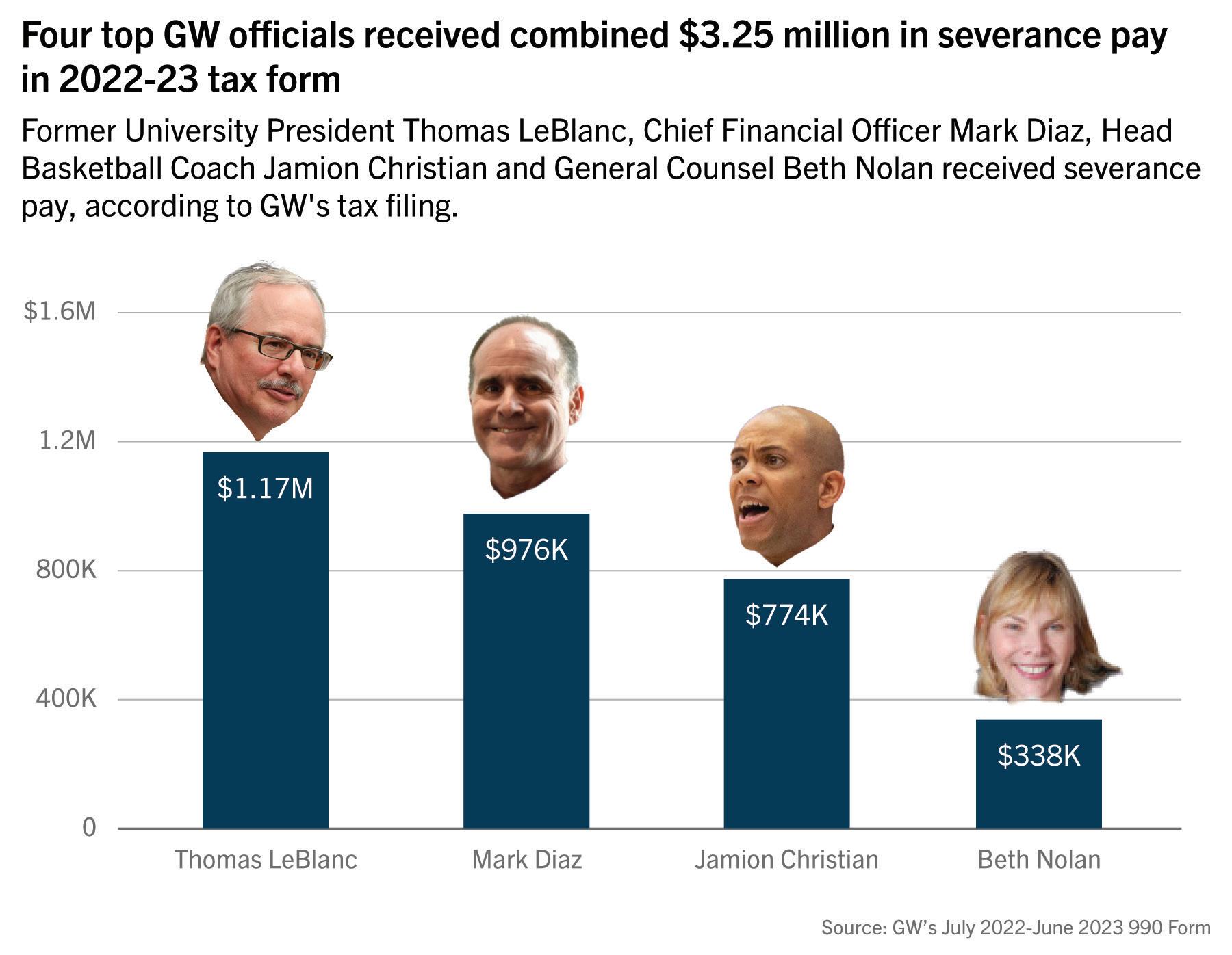
The forms show that since 2022, former University President Thomas LeBlanc, former Chief Financial Officer Mark Diaz, former Head Basketball Coach Jamion Christian and former General Counsel Beth Nolan received severance payments of at least $1,167,000, $976,440, $774,228 and $338,250, respectively.
LeBlanc left GW in December 2021 after serving as president for four years, which culminated with widespread calls for his resignation from faculty members who felt his leadership did not match the University’s core values. He came under fire from faculty who criticized officials for violating principles of shared governance with his 20/30 plan, which proposed decreasing the
undergraduate population by nearly 20 percent and increasing the proportion of STEM students to about 30 percent of GW’s population.
LeBlanc made $1,527,713 during his last year in office, a $280,910 pay increase from the year before.
LeBlanc hired Diaz in August 2018 after working with him at the University of Miami from 2005 to 2017. In an April 2022 survey, faculty members reported an “overwhelmingly negative” view of GW leadership, with Diaz being mentioned in a negative light by 62 survey participants.
In January 2020, Diaz also came under criticism from faculty over the 20/30 plan, with some faculty senators saying the move would force GW to take on more debt to account for lost revenue.
Diaz left the University in June 2022, after making $1,318,578 in 2021. CFO Bruno Fernandes said in March that GW still pays Diaz for consulting on arrangements with Universal Health Services, which has owned GW Hospital since 2022.
GW fired Christian — who joined the University in 2019 —
GW is seeking a new chief fi nancial officer for the Medical Faculty Associates less than a year after officials hired the former CFO.
Robin Nichols began her role as CFO on Oct. 16, 2023, and officials listed a job posting for her position on July 2, fewer than nine months after she assumed the position. School of Medicine and Health Sciences Dean Barbara Bass, who also served as the MFA’s CEO until May, said in February that she hoped new “expertise” in MFA leadership, including Nichols, would make “tough moves” by the end of the fiscal year to begin paying off the organization’s $200 million debt to GW.
Nichols declined to comment on why she left the University because of a non-
Five Campus Living and Resi-
left GW this summer, shrinking the department’s leadership
and his three assistant coaches in March 2022 after poor performance and the basketball team’s third-consecutive losing season. Christian made $725,851 during his final year at GW. Nolan, the first of the four officials to depart, retired and left the University in June 2021 after leading GW’s legal services for almost 14 years. Nolan made $654,360 during her last year.
A University spokesperson declined to comment on how the University determined the four former employees’ severance payments.
Compensation of top of cials
Officials paid Wrighton $1,293,735 between January and December 2022 — $1,210,000 in base compensation and $83,735 in nontaxable benefits, per the form. The interim former president’s income during his term, which began on Jan. 1, 2022 and ended on June 30, 2023, remained slightly lower than LeBlanc’s in three of his four years in the role, excluding 2020 when LeBlanc took a pay cut due to the onset of COVID-19. Before his stint at GW, Wrigh-
disclosure agreement she signed that prevents her from speaking about GW but confi rmed Thursday that she is no longer working for GW. Nichols’ LinkedIn states that she still holds the position.
The job posting lists the salary range for the role as $290,900 to $589,900. Former CFO Lance Kaplan made $482,236 between July 1 2022 and his departure in February 2023, according to the MFA’s tax forms.
The CFO is responsible for balancing short-term and long-term strategic objectives to maximize the MFA’s fi nancial performance as well as developing models that respond to new fi nancial or operational circumstances, according to the posting.
GW took the reins of the MFA in 2018 and acquired governing power over the nonprofit physician group, replacing its
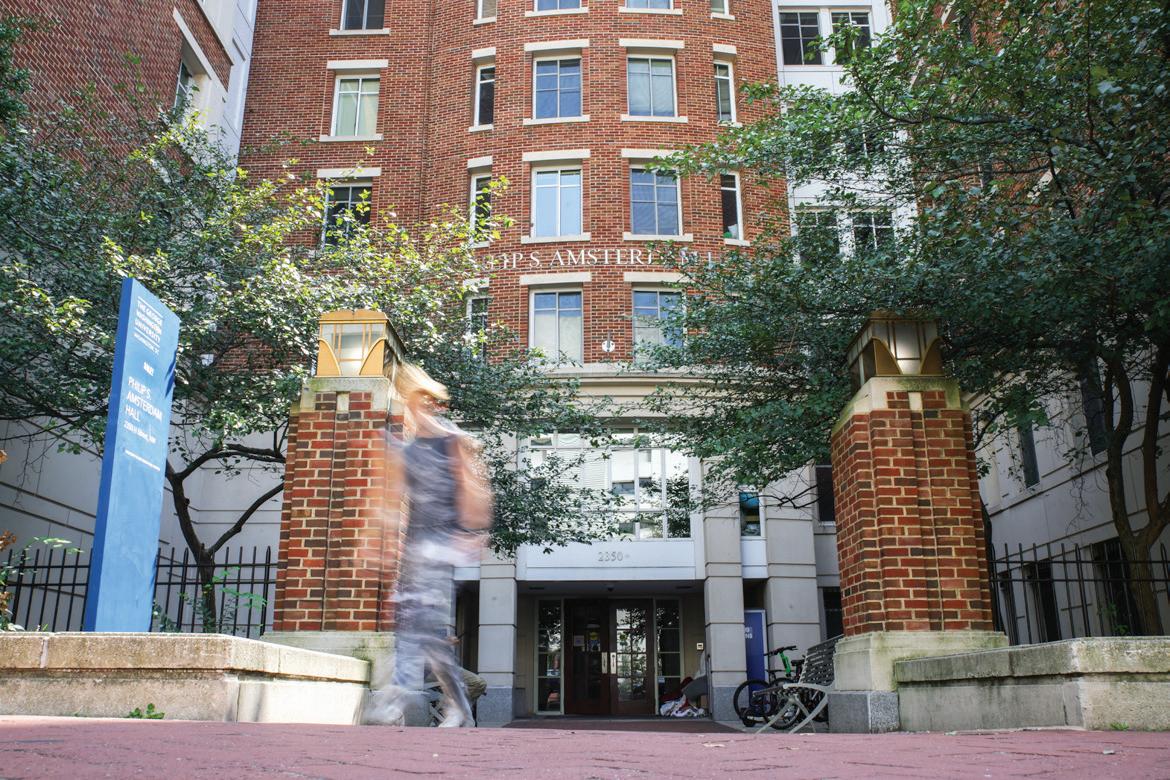
from 16 to 11 employees, according to website archives. Assistant Vice Provost for Student Support and Residential Engagement Kevin Stensberg will leave the University next month after working at GW for about
ton served as the chancellor of Washington University in St. Louis from 1995 until 2019, collecting more than $2.8 million in total compensation from his 24 years in office.
The form did not include University President Ellen Granberg’s compensation because she began her tenure on July 1, 2023, the first day of the 2023-2024 tax cycle.
Bracey saw a $391,811 pay bump in the 2022-2023 tax cycle, earning $966,960 compared to $575,149 the previous year. When asked for comment on the pay bump, a University spokesperson pointed to Bracey’s transition from interim to permanent provost in February 2022.
Vice President for Health and Dean of the School of Medicine and Health Sciences Barbara Bass earned $1,399,361, a $74,444 raise from the year prior.
Professor and Director of GW Online Engineering Programs Shahram Sarkani earned $1,278,666, a $64,127 raise from the 2021-2022 tax cycle. Sarkani is the highest-paid professor at the University, per the form.
leaders in the following years with officials like Bass and outside hires. By early this year, the MFA was floundering close to a $250 million deficit since fiscal year 2020, and GW has paid for their losses out of pocket, granting loans to the MFA that total almost to $200 million.
In 2022 and 2023, officials have projected the MFA would break even during the year and walked back those forecasts months later. GW CFO Bruno Fernandes said in February 2024 that he expects the MFA to lose between $30 million and $50 million in FY2024.
Bass said in a September press release that Nichols would be a “great asset” to their organization because she understood the intricacies of day-to-day fi nances, as well as how to drive long-term strategy and vision.
“She is a highly sought after senior ex-
a year, making him the second CLRE department leader to leave in fewer than four months after former Campus Living Director Dan Wright left in June. The departures of Stensberg and Wright leave two of the four highest leadership positions in CLRE vacant. Stensberg oversaw the Residential Education branch of the department and officials hired Kyle Johnson in March to serve as director of Residential Education — a position that had been left unfilled for more than a year. Seth Weinshel, the associate vice president of business services, leads the Campus Living team, which now lacks a director without Wright.
The Campus Living director typically oversees on-campus housing facilities and housing registration while the Residential Education director leads residential programming and student leadership opportunities, according to CLRE’s website.
A University spokesperson declined to comment on how CLRE will adjust its operations to ac-
HANNAH
protesters march on first day of class
JENNA LEE ASSISTANT NEWS EDITOR
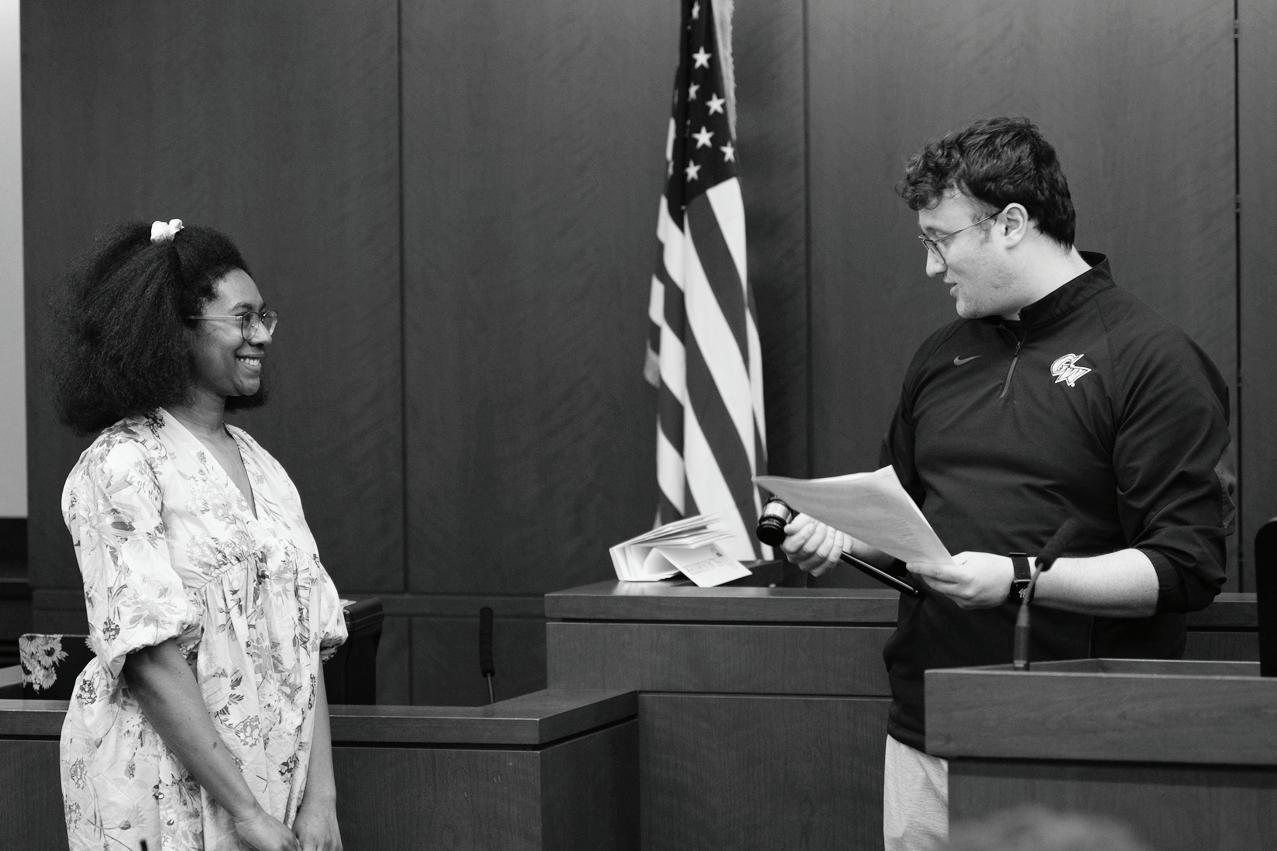
Pro-Palestinian protesters rallied outside University President Ellen Granberg’s on-campus house and the barricades surrounding University Yard on the first day of the fall semester to underscore ongoing demands that GW discloses its finances and divests from Israel.
At 6 p.m. on Thursday, about 100 demonstrators gathered at James Monroe Park on the corner of 20th and I streets to hear speeches from GW pro-Palestinian student organization representatives and D.C. activist groups before marching to Granberg’s F Street House, and then to the barricades that officials installed around U-Yard following the pro-Palestinian encampment in the spring. At the beginning of the protest, University security personnel asked students in U-Yard to leave and closed the gates, which are supposed to remain open daily from 6 a.m. to 11 p.m.
One security officer guarding Kogan Plaza told Hatchet reporters not to walk through the area but officials did not erect any barriers to block off the space during the protest. Officials had previously fenced off Kogan during the encampment in the spring before removing them on July 14.
The rally and march marked the first pro-Palestinian protest of the semester promoted to the public via social media. More than a dozen protesters gathered for an unannounced demonstration at the National Mall Kickback orientation event Wednesday with signs like “GW funds genocide” and voluntarily dissipated after roughly an hour.
ecutive leader with an expansive career and involvement in national CFO networks,” Bass said in September. The MFA brought Nichols into the enterprise after Kaplan left the CFO role in February 2023.
GW hired Bill Elliott in May to replace Bass as interim CEO to provide full-time leadership in both the MFA and SMHS that officials hoped would enhance the “integrated performance” of the GW academic medical enterprise by allowing Bass to focus solely on SMHS while Elliott focuses on the MFA.
Elliott’s appointment as CEO marks the third time in the last decade that the MFA has changed its executive management. The MFA brought in Robert Kelly as a new CEO in January 2017 after terminating former CEO Stephen Badger, who held the position for more than 15 years.
count for leadership vacancies and what positions, if any, would absorb the responsibilities associated with Wright’s director role.
Officials posted a job listing for Wright’s role in late May and removed the posting in early August. The page doesn’t list a job posting for Stensberg’s role. The spokesperson declined to comment on if officials plan to announce a replacement for Stensberg.
Stensberg will become the interim senior student affairs officer and dean of students at Bemidji State University effective Sept. 3, according to a BSU release. Wright will join the University of Michigan’s housing office, a University spokesperson said in June.
Residence Hall Association
President Andrew Levin said staff turnover within CLRE is “par for the course” at GW. He said sometimes he will work on an RHA initiative with a University employee within the Division for Student Affairs — which houses CLRE — and discover a few months later
that the employee left.
“It can be difficult to know who to go to, just because of these changes,” Levin said.
One of CLRE’s seven assistant directors also left the University this summer. Mitchell Foster, the unit’s former assistant director of equity and assessment, took a position in July at Saint Mary’s College of California as the director of its Intercultural Center.
Two of CLRE’s three housing associates — who contribute to supervising student staff and executing housing operations and assignments alongside assistant directors — departed GW this summer. Former Front Desk Operations Housing Associate Trennise Harrison left in July and former Communications and Summer Operations Housing Associate Alexandria Vieux left in May, according to their LinkedIns. “The University’s residential experience is designed to help students partake in a safe, inclusive, community-oriented environment,” the spokesperson said.
GRAPHIC BY AN NGO
SAGE RUSSELL
SENIOR PHOTO EDITOR Protesters march up 20th Street to University Yard.
THIS WEEK IN HISTORY
Aug. 28, 1986
Officials sanction pro-Palestinian groups: students
The Student Coalition for Palestine at GWU alleged Monday that officials suspended two pro-Palestinian student organizations and placed an additional six organizations on disciplinary probation for their reported involvement in campus protests last spring.
In an Instagram post last week, the coalition claimed that officials suspended the GW chapters of Students for Justice in Palestine and Jewish Voice for Peace through the fall semester and placed the two organizations — in addition to six others — on disciplinary probation through either the fall or spring semesters. The announcement follows the coalition’s claim in June that Conflict Education and Student Accountability officials charged 10 student organizations for Code of Student Conduct violations related to the pro-Palestinian encampments in University Yard and on F Street, and an April protest at the Elliott School of International Affairs.
The post states that officials placed the Arab Student Association, Muslim Students Association and the Asian American Student Association on disciplinary probation through the end of the fall semester and GW Dissenters, Socialist Action Initiative and Black Defiance on disciplinary probation through the spring semester. The post states that that these alleged sanctions prevent the student groups from accessing Universityallocated funds and require that the organizations receive approval from officials before hosting events.
The coalition post alleges
that for the fall semester, GW SJP and JVP will lose their recognition as student organizations, all University-allocated funds and the right to host events on campus or affiliate with GW.
A University spokesperson said GW discloses student organizations’ conduct violations when disciplinary proceedings, including time for an appeals process, are completed. DSA has not yet published sanctions for any alleged violations that took place this spring.
Officials charged Black Defiance, GW Dissenters, JVP and SAI with prior conduct violations that expire in spring 2026 for incidents that officials investigated in 2023 on Dec. 1 and Dec. 8, according to the DSA sheet. Officials charged Black Defiance, GW Dissenters and SAI with organizational censure — an official written warning that outlines their community disturbance and disorderly conduct violations — and “restorative justice action” through spring 2026, and JVP with disciplinary probation through May 2024 and restorative justice action through spring 2026. The coalition held an
UNLAWFUL ENTRY
University Student Center
8/18/2024 – 7:30 a.m.
Case closed
GW Police Department officers responded to a report of an unknown man sleeping in the University Student Center’s common area. Metropolitan Police Department officers approached the man and learned he has a recent bar notice from campus. The officers recorded the incident and escorted the man out of the building. Subject barred.
FRAUD 1D
Off Campus
Reported 8/19/2024 – Multiple dates and times
Open Case
A female student reported being a victim of fraud while trying to rent property from a GW alum. Case open.
THEFT II/BICYCLES
District House
Reported 8/20/2024 – Unknown date and time
Case closed
A student reported that his bike was stolen from the District House bike storage. No suspects or witnesses.
LIQUOR LAW VIOLATION
2000 Block of F Street NW
8/21/2024 – 1:20 a.m.
Case closed
GWPD officers responded to a report of an intoxicated female student outside of Potomac House. Emergency Medical Response Group personnel arrived on scene and after medical evaluation the student was transported by EMS to the GW Hospital’s Emergency Room. Referred to Division of Conflict Education and Student Accountability.
CREDIT CARD FRAUD, THEFT II/FROM BUILDING
Tonic Restaurant
8/20/2024 – Unknown time
Case closed
A non-GW affiliated woman reported that her credit cards were stolen and used fraudulently while she was working at Tonic. Referred to MPD. —Compiled
CESA director talks free speech limitations, campus protests
JENNA LEE ASSISTANT NEWS EDITOR
Director of Conflict Education and Student Accountability Christy Anthony shared limits to free speech on campus and advice for navigating protests at a first-year orientation event Wednesday.
impromptu rally outside University President Ellen Granberg’s F Street House on Dec. 1 and students demonstrated in Kogan Plaza and marched to the F Street House on Dec. 8.
A University spokesperson declined to confirm each of the student organizations’ alleged sanctions. The spokesperson also declined to comment on what University policies officials charged each organization with violating, when they issued the sanctions and whether new sanctions will extend the expiration date for any student organizations’ current sanctions.
A representative from MSA and the coalition, who requested anonymity due to fear of doxxing, said each of the eight student organizations have appealed the outcome of their case, which student organizations received the outcomes of on Aug. 6. .
The representative said the MSA plans to continue offering resources and programming to members.
“We’re gonna continue providing these essential resources for the sake of the students,” the representative said.
Anthony’s “You Can’t Say that at GW… or Can You?” presentation tackled Code of Student Conduct violations, hate speech and free expression through mock protests and audience polls in the Lisner Auditorium. Anthony said while GW as a private institution is not required to uphold First Amendment free speech protections, University officials prioritize granting students the right to express their thoughts and ideas on campus.
“GW’s commitment isn’t dependent upon the First Amendment of the U.S. Constitution,” Anthony said. “This is actually a choice we have made as a university, because we believe that if you are going to come here and learn with us, then there needs to be a really robust and free exchange of ideas.”
Anthony had staff pose as protesters during her presentation in the auditorium to show what forms of free speech University officials permit and don’t tolerate on campus.
The orientation event follows months of statements and facilitated conversations from officials about free speech following Hamas’ Oct. 7 attack on Israel and the subsequent war in Gaza. In January, the University unveiled a plan to review free speech policies and strengthen community engagement, which
included updated safety policies, fencing rules and faculty working groups.
Anthony declined to comment on how protests, demonstrations and discourse on campus last year influenced her presentation.
Anthony asked students to use the flashlight feature on their phones to indicate whether they agree or disagree with statements about free speech. Almost all students shone their light in agreement that “GW should place some limits on free speech.”
Anthony distinguished between speech that is restricted regardless of content and speech that is restricted based on content. Content-neutral restrictions involve the time, place and manner of the speech, she said. Anthony gave the example of restricting speech for quiet hours in Kogan Plaza during finals week.
To demonstrate different kinds of restricted speech, Anthony pointed to staff members at the back of the auditorium who had their backs to the stage. Anthony said these staff members represented protesters, and since they were not disrupting the event, this kind of demonstration would be allowed. She then had the staff move onto the stage holding blank signs. Anthony said this would not be allowed since it is interfering with an event whose organizers reserved the space, regardless of the protest’s content.
“The standing up, turning their backs to me, I’m going to allow our protesters to do that, and the University allows our protesters to do that, because the fundamental nature of this event can still continue,”
Anthony said. To demonstrate speech restricted due to its content, staff members then held up signs that read “Christy SUCKS. Quit Now,” and “Christy, I know where you live.” Anthony asked students to shine their flashlights to indicate if they believed those signs should be allowed. Most students said the first sign should be, and the second should not. Anthony said this consensus aligns with University policy.
“People have a right to challenge me and my ideas, in part because of my role at the University as a staff member, but also because part of free speech is challenging ideas,” Anthony said.
Anthony said the University will tolerate speech that might make people feel uncomfortable, but not threats of violence. Anthony said some discriminatory speech might be tolerated to support a free exchange of ideas on campus, but that context matters and whether this kind of speech is allowed may depend on how targeted the hate speech is.
“Now, if David, who’s holding the poster, follows me around all day, chanting it at me so that I can’t get my work done, that’s probably going to be a violation,” Anthony said. “And it’s part of the reason to know how much the context matters.” Near the end of the event, Anthony recommended that when students encounter speech that makes them feel uncomfortable, they should breathe, ask clarifying questions, give the person the benefit of the doubt and ask about why the person feels the way they do.
Student leaders call for funding, support from new director of student involvement
ANNA FATTIZZO STAFF WRITER
BROOKE FORGETTE
CONTRIBUTING NEWS EDITOR
Student leaders hope the University’s director of student involvement who began this month will help student organizations receive more funding and attention on campus.
Meredith Bielaska, who has served as the chief Panhellenic officer at the Delta Phi Epsilon International Headquarters for the past four years, is the new director of student involvement in the Office of Student Life and will oversee leadership programs like GW TRAiLS, Fraternity and Sorority Life and student groups, according to an email last month sent to members of Greek life. Student leaders said they hope Bielaska will address consistent organizational challenges like a lack of funding for multicultural Greek life, adviser shortages and improving communication between officials and students.
Roy Montgomery, the former director of student involvement, left GW in October 2023, and the role remained vacant for the rest of the academic year, according to web archives. The Multicultural Greek Council restructured its executive board last year following Montgomery’s departure and frequent adviser turnovers, which caused a lack of council-wide events and support from officials.
Bielaska said the Office of Student Life continually evaluates advising and support for student organizations and student-led governing councils. She said this year, student life officials reviewed advising assignments to ensure student groups were supported through the Pathways framework and by knowledgeable
“All student organizations will have full access to advisors through Org Help, the Excellence in Leadership Sessions, and online guides,” Bielaska said in an email. “In addition to these resources, some organizations will be assigned a specific staff advisor based upon individualized needs and criteria such as levels of spending and programming.”
Stephanie Animdee, a senior and the president of the Mu Beta Chapter of Delta Sigma Theta Sorority, Inc., said she hopes Bielaska will assist chapters of National PanHellenic Council — which represent historically Black fraternities and sororities — to receive more funding from sponsorships or the University Wide Program Fund, an allocation program between the Student Government Association and the OSL for student organizations to fund events and celebrations.
She added that her chapter has had issues with a “severe” lack of funding while planning a celebration for their 50th anniversary on
“In terms of getting advice, I would think that’s definitely a good example, having them support us with the amount of members that we have, increasing visibility and letting people know, we’re still running things,” Animdee said.
Junior Thomas Broyles — the president of GW TRAiLS, an outdoor leadership program that connects students to the outdoors — said the organization has struggled with advising in previous years, which limited its capacity to carry out some planned trips and activities last semester. Broyles said TRAiLS gained a new fulltime adviser in June through the office of Campus Recreation after cycling through part-time advisers since 2019. Broyles said the new adviser, Senior Outdoor Education Coordinator Lucy Puentes, has 15 years of experience in outdoor education and has already helped the group with their programming, including their preorientation cohort Adventure Bound. Broyles said most
of the organization’s direct pus Recreation, but TRAiLS wants to work more with the Division for Student Affairs and Bielaska to promote the group’s programming and wide events, like First Night and Late Night @ the Rec, an troducing first-year students
gled with communication from higher-up officials dent Affairs,” Broyles said. “I’m hoping the creation of this new position can help us get more concrete answers
SGA President Ethan Fitzgerald said he plans to
meet with Bielaska to raise frequent concerns from student organizations like the availability of campus spaces for events, fundraising and access to “effective” advising for student organizations.
“They already have to go through enough challenges with not being able to get enough resources in terms of funding, whether it be booking spaces,” Fitzgerald said.
“So we want to make sure that this person is accessible to our students.” Fitzgerald said the SGA also plans to work with the DSA and Bielaska to organize events like the annual Career Expo, a mental health resource fair and a student organization summit that will invite presidents of different student groups to connect with fellow student leaders. Bielaska will co-advise the Panhellenic Association this year — along with Andrea Davis, the assistant director for student involvement — according to the email sent to members of Greek life last month.
by Ella Mitchell
DANIEL HEUER | ASSISTANT PHOTO EDITOR
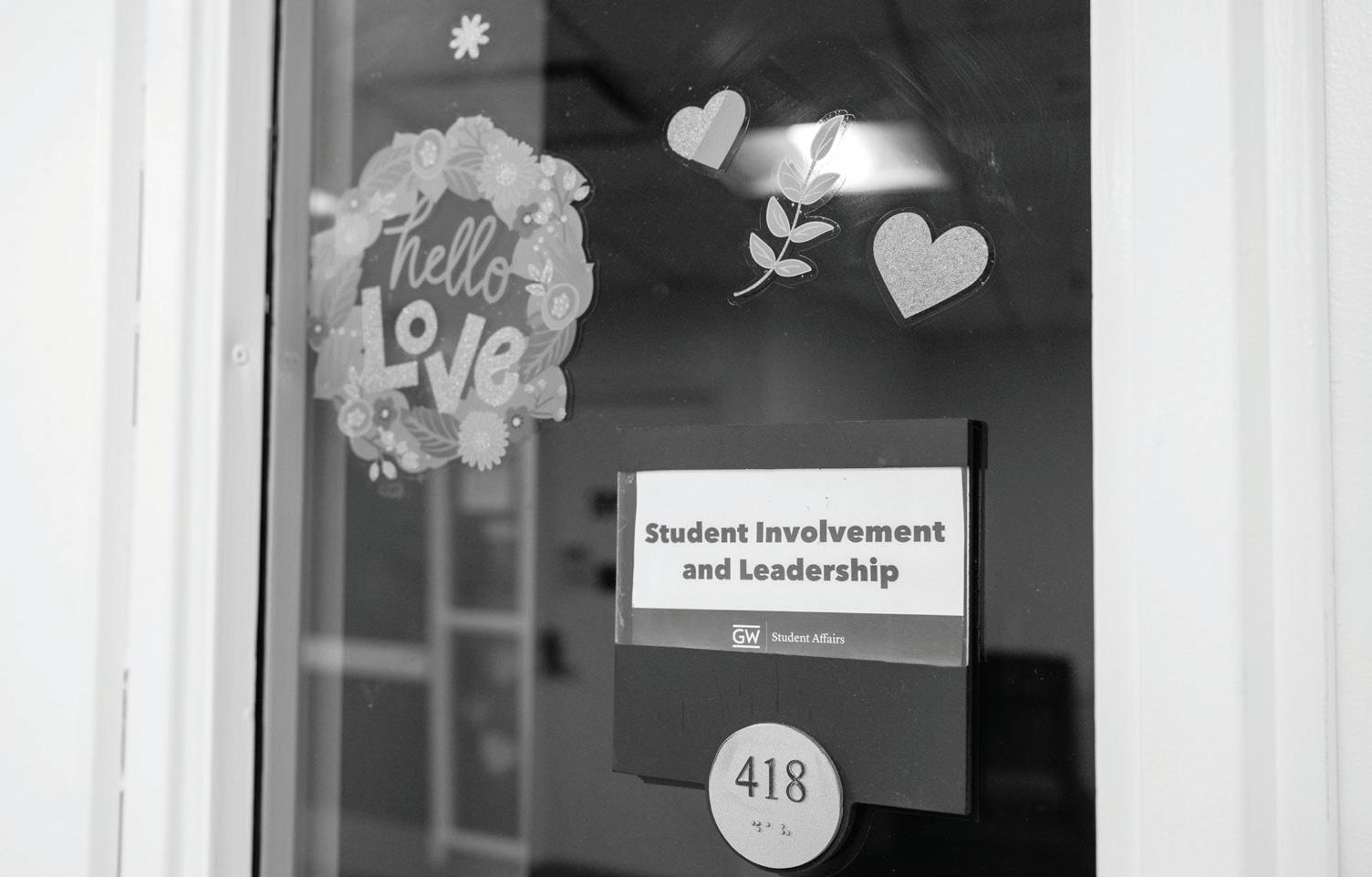
The office of Student Involvement & Leadership is located on the fourth floor of the University Student Center.
LEXI CRITCHETT | ASSISTANT PHOTO EDITOR
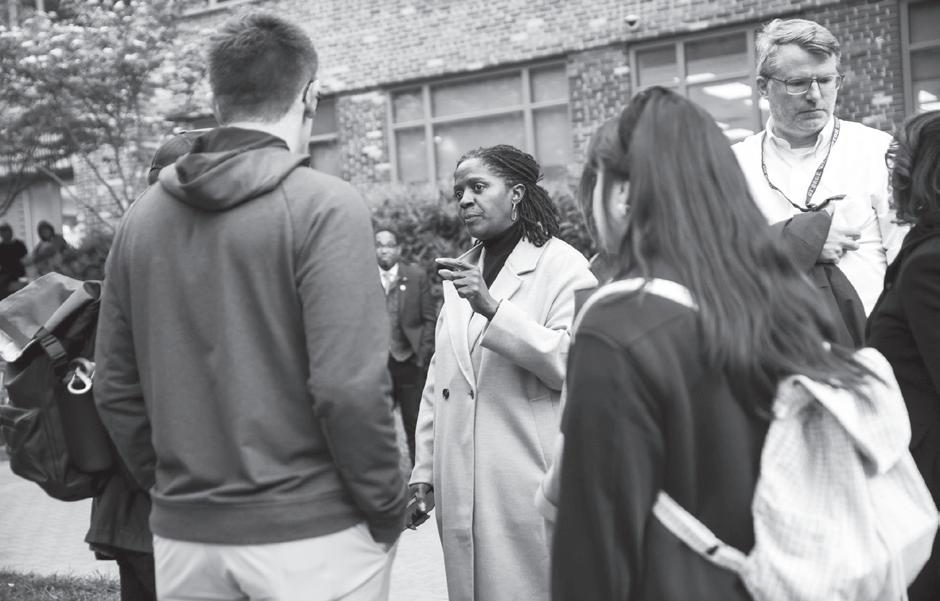
Dean of Students Colette Coleman speaks with students at the proPalestinian encampment in University Yard last spring.
Former DC Mayor Marion Barry proposed legislation to raise the legal drinking age for beer and wine from 18 to 21 in
Focus on fossil hotspots creates bias in human evolution research: study
Researchers found that focus on fossil hotspots in Africa where most human fossils are found creates bias in our understanding of early human activity across the continent in a study published Tuesday.
The study — led by W. Andrew Barr, a GW assistant professor of anthropology and co-authored by Bernard Wood, a University professor of human origins — found that sites in areas like the East African Rift System, where researchers excavate many human fossils, make up on average only 1.6 percent of the total geographic range of modern mammal species. Wood said the study aimed to convince researchers that information collected from existing hominin and hominid fossil sites may be comprehensive for those sites but is not representative of the complete possible fossil record across Africa.
“We’re trying to persuade people not to fall into the trap of thinking that’s because that’s where the fossils came from, that’s where they lived, and that’s where they like to live,” Wood said.
Wood said researchers wanted to understand the amount of information absent from the fossil record because of the abundance of research sites in the East African Rift System — a continental rift valley where two tectonic plates meet — and in south African cave systems. Wood said since paleontologists seek to reconstruct evolutionary history through the discovery of fossils, evidence is usually collected at a less frequent level than in experimental sciences.
“We don’t know where the hominins lived in Africa, they could have lived
all over Africa, they could have lived in certain parts of Africa where the climate and habitat were suitable,”
Wood said. “But we only know where they were because of the fossil sites and the reasons that the fossil sites are there are nothing to do with whether those early hominins liked those places, they just happen to be places where we find evidence.”
Wood added that research is often concentrated in this geographic area because erosion in the region has exposed layers of sediment containing fossils within the rift valley, eliminating the labor and time costs researchers would have if they were studying fossils elsewhere.
Wood said researchers used existing data sets on living animal species like baboons and monkeys to compare information like habitat preferences and skull shape. He said researchers compared data sets from the East African Rift System with data collected across Africa to gauge how representative the system is of species diversity across the entire continent.
“Some of these data sets have taken a decade to accumulate, so we just sort of hitchhiked on those data sets,” Wood said.
Wood said researchers don’t know how much of the fossil record they would need to recover to get a “reasonably good” idea of the process of human evolution, but they can estimate the constraints from overrepresentation of research at specific site areas.
“It’s comprehensive for what we have, but it’s not comprehensive for the problem that we’re trying to solve, so I think that’s the message, really,” Wood said.
Experts in human evolution said the study reveals the tendency of researchers to generalize their understanding of human history based on a small sample of fossil findings.
Michael Bisson, a former professor of anthropology at McGill University, said the reason researchers find more fossils in such a small area of Africa is because those are often locations full of volcanic ash, changing the composition of the soil to make it more suitable to preserve fossils.
“We will never be able to assess the fossil record in lots of parts of Africa simply because the fossil record doesn’t exist,” Bisson said. “But the fact that fossil record doesn’t exist doesn’t mean that hominins weren’t there.”
Communications
office mum on filling director vacancy
Officials from the Office of Communications and Marketing are quiet on the status of filling its executive director vacancy following a period of increased press attention due to pro-Palestinian campus protests.
Former Executive Director of Media Relations Josh Grossman left the University in August after serving in the role for almost three years, according to his LinkedIn. Officials posted a job listing for the position in July, which they removed by the end of the month.
Members of the media relations team are responsible for the University’s public communications regarding all of GW’s schools and units.
“The George Washington University’s Office of Media Relations is the primary source for sharing news at the university for both the media and the GW community alike,” OCM’s website states.
MSSC hires director, staff after months of turnover
SACHINI ADIKARI CONTRIBUTING NEWS EDITOR
The Multicultural Student Services Center hired a new director and two staff members this summer after months of leadership vacancies, officials announced in a release Thursday.
The MSSC concluded its five monthslong search for a director and hired an associate director and program coordinator for race, ethnicity and culture over the summer, according to the release. The recruitments follow complaints from students and former staff about continuous staff turnover and low funding, which they said in February stifles the center’s ability to provide support for student organizations.
Officials hired Vanice Antrum, the former director of multicultural affairs in the Office of Diversity and Inclusion at Salisbury University, as the new MSSC director in July to replace interim Director Mitchell Foster, who left the University in June. Foster is now the Director of the Intercultural Center at Saint Mary’s College of California, as per their LinkedIn.
Officials appointed Foster as the center’s interim director in February following former director Dustin Pickett’s resignation Feb. 1 after one year in the role. Pickett had replaced former MSSC Director Michael Tapscott, who retired in June 2022 after serving in the role for 19 years.
Antrum said in the release that she will prioritize “uplifting” the voices and experiences of students from historically excluded backgrounds at GW. She said she is excited to work with the MSSC team to ensure students have the resources needed to “feel a true sense of belonging” at the University.
“We will continue to prioritize providing a safe, inclusive, intellectually challenging and supportive space with a focus on the intersections of student identities,” Antrum said in the release.
There are now four full-time staff members at the MSSC in addition to a graduate assistant for student belonging and community engagement, according to the MSSC’s staff page.
Following Pickett’s resignation in February, Student Program Associate Elise Greenfield was the only full-time staff member in the center.
Hannah Youssef, the assistant director and former program associate of the Office of Diversity, Equity and
Belonging in the Steinhardt School of Culture, Education and Human Development at New York University, joined the MSSC as the assistant director in July, according to her LinkedIn. Youssef said in the release that she hopes to implement programming and resources that will improve students’ “quality of life.”
“My motivation has both evolved and remained the same: to create spaces and resources for students to thrive as their most authentic, joyful and complex selves,” Youssef said. “I believe in a holistic approach to educational equity and social justice, as students cannot academically or professionally succeed without basic needs fulfillment and mental, emotional and spiritual wellness.”
Hailey Williams, a former graduate intern in affiliate organizational management equity and inclusion at the American Civil Liberties Union, joined the University in July as the MSSC’s program coordinator for race, ethnicity and culture, according to her LinkedIn.
Williams said in the release that she is excited to help identity based student organizations “flourish” by giving them the support needed to grow.
“As a part of the MSSC team, I will support and develop programs that promote racial, ethnic and cultural equity and work to foster an inclusive and empowering environment for marginalized students and communities at GW,” Williams said.
Tapscott said in February that the unit has struggled with staffing since 2019, when officials removed the administrative coordinator and program coordinator roles from the formerly five-person full-time staff. He said soon after, the MSSC became an “uncomfortable” place to work.
Caroline Laguerre-Brown, the vice provost of the Office of Diversity, Equity and Community Engagement — which houses the MSSC — left ODECE in July after eight years at the University, and the role has remained vacant. Former Associate Director of the Multicultural Student LGBTQIA+ Resource Center AJ King left in December 2023 to become the director of Intercultural Affairs and LGBTQ+ Resource Center at Howard University.
In February, Robert Zayd KiaNouriZigmund, the former graduate assistant for religious and spiritual life at the Multicultural Student Services Center, left the MSSC.
Geography department changes name, reshapes master’s program
The Department of Geography and Environment rebranded itself and reformed its master’s program to match the growing popularity of its environmental studies programs over the last year.
ment retreat in Maryland last fall, where department faculty were “very supportive” and voted to approve it. He said the department received final approval from the University bulletin and the Office of the Registrar in June.
of universities in the D.C. area that share resources, including the opportunity to take classes not offered at their home institution.
Rain said the department decided to rebrand and reform the master’s program in geography and environment to make the degree more STEMcentric by implementing new course requirements to appeal to students wanting to study science and the environment. He said the new change will offer international students more time in the U.S. by aligning the program with the Department of Homeland Security’s definition of a STEM degree.
He said the department has struggled to hire new faculty members, including replacing faculty that have left within the past few years, due to CCAS budget restraints, hindering the quantity of new courses they can offer.
The University spokesperson said OCM staff work daily to support the University’s strategic priorities and “protect and enhance the University’s reputation” through various communications channels and publications, social media, creative design, marketing services and media relations.
“The media relations team handles both proactive and reactive media relations, which ranges from pitching daily tip sheets on faculty experts and developing ways to highlight faculty research while also fielding numerous media inquiries from outlets locally, nationally and internationally,” the spokesperson said in an email.
Former Media Relations Specialist Danny Parra and former Senior Media Relations Specialist Rachel Larris left their posts in June 2023 and September 2023, re-
A University spokesperson declined to comment on whether the office has hired a new executive director and, if so, when they will begin working. The spokesperson also declined to comment on if the responsibilities of the office’s six current media relations staff members have changed to accommodate for its lack of an executive director.
spectively, according to web archives.
Over the last few months, major news publications including the New York Times, the Washington Post, BBC, Fox News, the Hill and NBC News have reported on proPalestinian protests at GW and asked the University for comment on the spring encampment and the students Metropolitan Police Department officers arrested in University Yard in May.
The Hatchet, which also utilizes the OCM office, sent more than 10 requests for comment during the nearly two weeklong encampment.
The spokesperson declined to comment on if and how the office has prepared for the influx in media attention that could follow another potential wave of large protests on campus. Grossman said it was an honor to be part of GW’s communications team and that he will miss the people and professionals he worked with.
“Being able to tell the many amazing stories about students and faculty was the best part of my time here,” Grossman said in a message.
The department added “environment” to its title and changed its master’s degree curriculum to become more STEM-focused by changing its course requirements and lowering its credit total. David Rain, the department chair and professor of geography, said the changes better represent the department’s makeup as its environmental studies programs have swelled in popularity due to the increasing interest in climate change and the environment amid worldwide calls for urgent action regarding the climate crisis.
“We’ve gone from zero to 60 in a couple of years now, with over 60 majors and it’s popular,” Rain said. “Students are coming and it’s for obvious reasons, climate change, you name it, there’s some kind of environmental crisis going on.”
In 2023, there were 41 environmental studies students, 41 environmental and sustainability science students and 40 geography students enrolled in the department’s undergraduate programs, according to enrollment data. Rain said the popularity of the environmental studies programs had been increasing steadily but gained momentum after the department introduced the environment and sustainability science major in 2020.
The environmental studies program focuses on environmental impacts and communicating about them through a humanities and social sciences lens, according to the department website.
“We were thinking, they’re just cannibalizing the environmental studies, so it’ll be a zero-sum,” Rain said. “But no, they’re way more who are into science, want to do that more. They might be looking for a job working in climate, climate policy or something like that, so it sort of became a whole thing unto itself.”
Rain said he proposed the name change during a depart-
Rain said the new master’s program offers more flexibility for students by reducing the required credits for students writing a thesis from 36 credits to 30 credits.
Rain said the original master’s program will still operate for its final year this year for students who want to finish their degree in the former program, but the department has encouraged students to request readmission to the new program. He said the program has 12 incoming graduate students this semester in addition to the existing ones who transferred from the original program.
Rain said to maintain flexibility for students, the program needs to add more courses besides the ones offered by the department, the Trachtenberg School and the Consortium of Universities of the Washington Metropolitan Area — a group
Michael Mann, a professor of geography and the department’s director of graduate studies, said the department has been growing STEM offerings over the past few years by expanding GIS and physical geography classes. He said new requirements to take classes about GIS, the environment and human geography offer students background in all aspects of geography as a discipline.
“Many of our students are doing GIS and modeling, but I think that if you want to model the environment, you really have to understand the processes behind that,” Mann said.
“This will be helpful in that they’ll get some domain expertise as well, whether that’s sort of qualitative methods or human geography or scientific methods, through the sort of environmental requirements.” Mann said he sent a Google Form to existing students to readmit them into the new program by transferring their information from GWeb and DegreeMap. He said he also worked with international students to adjust their visas due to the degree’s new classification.
DANIEL HEUER | ASSISTANT PHOTO EDITOR
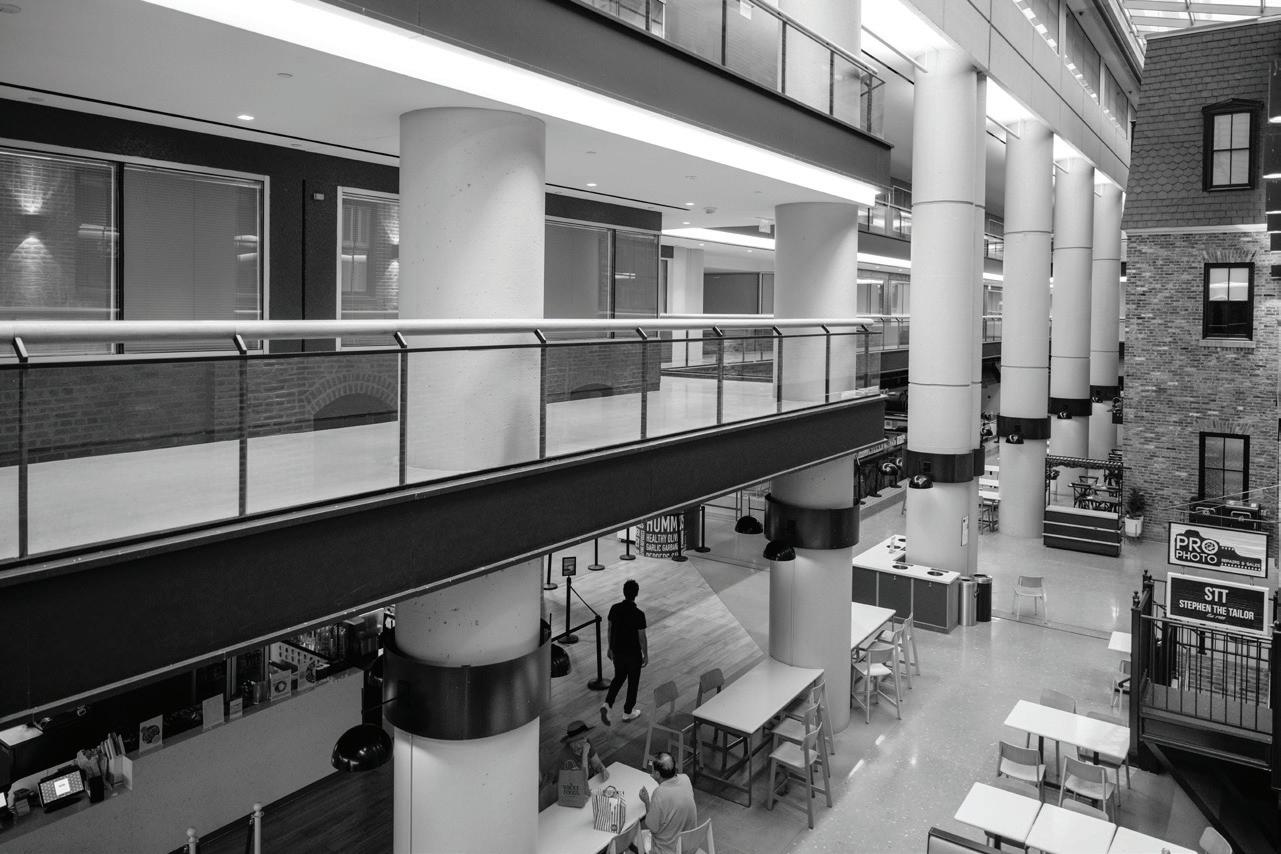
The Office of Communications and Marketing, housed on the upper floors of Western Market
HANNAH MARR NEWS EDITOR
TYLER IGLESIAS ASSISTANT NEWS EDITOR
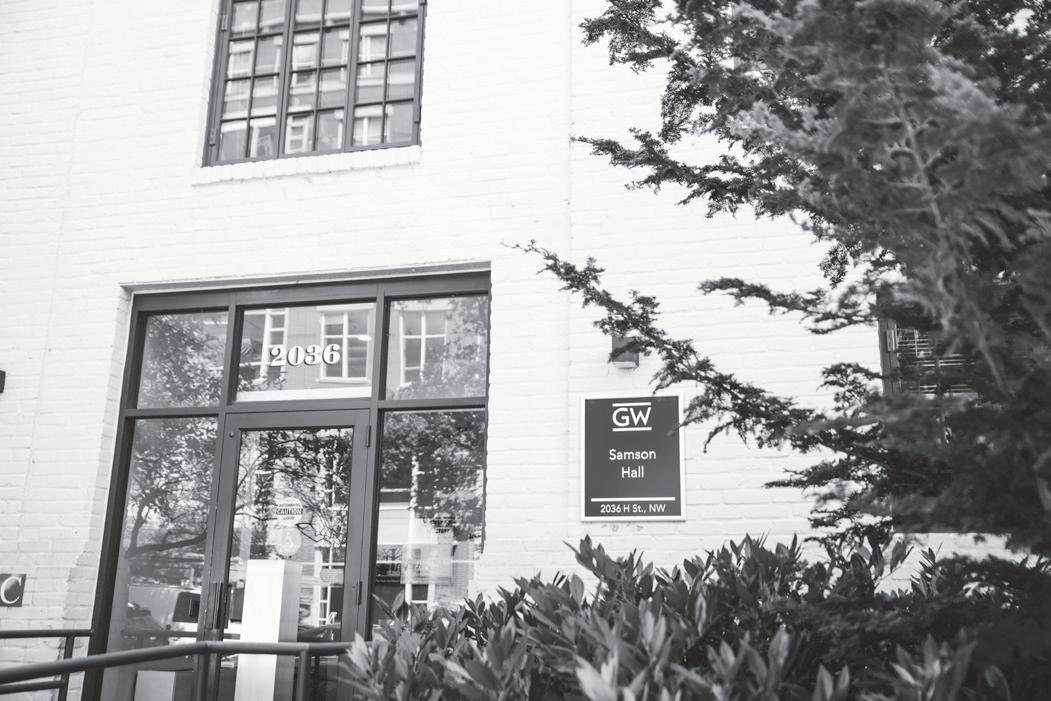
LEXI CRITCHETT | ASSISTANT PHOTO EDITOR Samson Hall houses the Department of Geography and Environment.
LEXI CRITCHETT | ASSISTANT PHOTO EDITOR
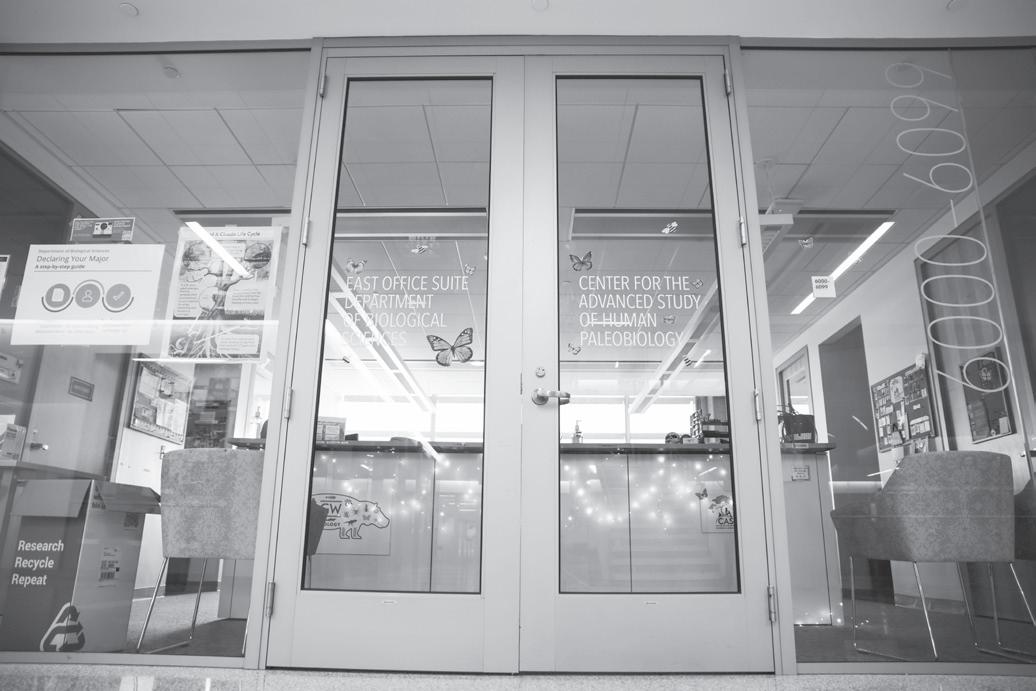
The Center for the Advanced Study of Paleontology office on the sixth floor of the Science and Engineering Hall
JENNA
Global Food Institute launches food leadership minor
The Global Food Institute debuted a minor in food leadership this fall after increased student interest in studying food systems.
Officials at the institute said the minor is the first academic program within the institute after a year of student demand for more food system-related courses. Tara Scully, an associate professor of biology and director of curriculum development at the institute, said the minor’s four course pillars — nutrition, policy, innovation and humanity — will allow students to better understand food-related issues, like food apartheids, where access to affordable and healthy food options is limited or nonexistent.
José Andrés, a celebrity chef, restaurateur and humanitarian, founded the institute at GW in May 2023 with goals to research and improve global food security, sustainability and distribution. The institute utilizes cross-disciplinary research and teaching to educate students on solutions to address hunger, poverty and public health while reshaping food systems, according to the institute’s website.
The minor consists of 18 credit hours and six courses, requiring that students take a course from each of the four pillars, from International Nutrition in the policy pillar to Cultural Politics of Food in France under the humanity pillar, with an additional leadership capstone experience and a required course in Introduction to Food Systems, an introductory class that examines the life cycle of food and human impact on the environment, according to the program’s website.
Scully said students don’t need to look any further than their “backyard” for historical injustices in food systems, especially in historically Black and minority communities, like those experiencing gentrification in the District. She said the minor aims to educate the next generation of individuals who
want to be part of or understand the food system, from agricultural approaches to understanding the policies that have shaped food industries.
We have so many different policies related to food in our country and internationally, so it’s really important for us to think about food in the context of how it’s being regulated,” Scully said. “We are a growing population globally, and we have the fear and danger of climate change, and we need to address those issues.”
Scully said when creating the minor, she received input from more than 50 affiliate faculty across GW. She said after holding an input session in October 2023 and receiving feedback from faculty about the minor, she worked with the institute’s team and the provost’s office to “solidify” a place for the minor within the institute. She said students had also said
that they wanted more courses like World on a Plate, a class offered since spring 2013 and previously taught by Scully in collaboration with Andrés, which discusses food history and the food industry’s connections to social and sustainability issues.
“So this kind of led to, once the institute was founded, us to think, ‘All right, what do we want to do?’
And that kind of also led to us to want to develop the undergrad first, because we had so, so much interest from that class and students taking more classes,” Scully said.
Scully said the minor is the first academic program within the institute because the undergraduate student body is the largest on campus and because the institute had existing courses that could be used to “populate” the minor, like World on a Plate. She said the institute will look into creating gradu-
Top officials’ salaries rise from 2021-22
From Page 1
Vice President for Development and Alumni Relations Donna Arbide earned a total compensation of $814,314, a $74,520 raise from the previous year. The form indicates that compensation for the company’s highest officer — which is the University president for GW — is determined using a compensation committee, a compensation consultant, an analysis of other organizations’ Form 990s, a compensation survey or study and approval of a board or committee.
MFA & contractor payments
The University reported that by June 2023 it extended $301.2 million total in loans or loan guarantees to Medical Faculty Associates, a nonprofit group of doctors, nurses and health care staff controlled by GW. The MFA currently owes GW $200 million
after several successive years of financial deficits.
Fernandes said in October 2022 the University extended a $50 million loan that it granted the MFA in March 2021 to a $140 million loan to help offset the MFA’s losses during the pandemic. He said the MFA is expected to pay back $120 million of the loan with interest to the University in the next 15 years, and the MFA will use the other $20 million for operating costs.
The University reported that it paid the MFA $43.6 million for teaching and research services between July 2022 and June 2023 — up from $35 million the year before — making it GW’s highest-paid contractor that year. The University spokesperson declined to comment on why the University provided more funding to the MFA during this period.
Other top contractor payments included $27.9 million to facility servic-
es provider Aramark for services like custodial and maintenance work, $26.8 million to Clark Construction Group and $24.6 million to 2U, Inc. for e-learning services.
GW paid $47.9 million to Clark Construction Group and $33.7 million to 2U during the 20212022 tax year.
GW compensated Chartwells Higher Education $17 million for dining services like dining hall administration and employees between July 2022 and June 2023.
Gifts & legal fees
The University received $99.6 million in contributions and gifts, tax forms show — a 9.49 percent increase from the year before. GW’s tax forms from previous years indicate that the total from 2022-2023 is GW’s highest since 2014. The University saw its outside legal fees increase 53.3 percent to $11.6 million from $7.6 million the year prior.
GW faced ongoing lawsuits from July 2022 to
June 2023, including cases over alleged athletic department pay discrimination, alleged racial discrimination against a former studentathlete and the alleged unjust firing of a library employee.
The University reported new international fundraising from people in regions not seen the year before, including East Asia and the Pacific, Europe, North America and South Asia.
GW also described conflict of interest policy as of June 2023, including annual disclosure forms for trustees and key employees, which are reviewed by University leadership to mitigate “actual or apparent conflict.” GW revised its conflict of interest policy in October 2023 to consolidate processes, modernize and align language with “best practices” and D.C. law and provide “more clear expectations and responsibilities,” according to a University press release.
ate-level courses in the future.
Mya Price, an assistant professor in the institute who teaches World on a Plate, said there is “so much passion” regarding the food justice movement. She said there is an “untapped” opportunity for students to explore, practice and develop their understanding of the systemic oppression faced by many communities, like Black and Indigenous farmers facing a lack of access to equipment and infrastructure support needed in the agriculture space.
“When we think specifically about communities of color, Native Americans, African Americans, Hispanic, Latino, there are so many disparities, particularly when we’re thinking about access to food, access to housing, access to so many social determinants that those communities are continuing to face,” Price said.
Price said she hopes students
Demonstrators
who take the minor have “immersive” experiences by hearing from outside experts in the food leadership field and learn from community service opportunities by connecting with local communities and organizations, such as Feeding America, Share Our Strength and the Food Research and Action Center.
“I think that there’s so much exploration for building together, learning together, getting out in the community and putting the learnings into practice through collaboration with other organizations in our own backyard of DC,” Price said. “I think it really will allow students to set themselves up to pursue potential career opportunities that will make the biggest and greatest impact for not only their future but then also for our nation.”
Lexi Romanowsky, a junior studying communications, said she plans to declare a minor in food leadership after having conversations with faculty, like Rebecca Fallick, an intern at the institute and a GW alum, about sustainability in the food sector.
“I love to cook, I’m from California, I’m spoiled by all the incredible produce, farmers markets there and different multicultural influence of food,” Romanowsky said. “Moving to the east coast, it’s still great, but it’s not the same, and so I was like, ‘I want to learn more about why this is the way it is.’” Romanowsky said she is taking Italian Foodways this fall, a course on the history of Italian food culture, which fulfills a minor requirement under the humanity pillar.
“The more educated we can all be on where we’re getting our food, what we’re eating, how and why one food comes from the grocery store and one food doesn’t, all those things matter when it comes to equity and climate change and technological development and policy and everything,” Romanowsky said. “It’s just another way to look at bettering people’s lives that you wouldn’t expect.”
rally outside F Street House, U-Yard
From Page 1
“During the summer and at the end of last school year, GW used the opportunity that classes were ending and people were getting off campus,” said a GW student, who chose to remain anonymous in solidarity with other Palestinian activists who have been doxxed. “And so we’re able to come in and say ‘Nope, we’re back and we’re here, nothing happened.’”
The DMV Students for Justice in Palestine Coalition announced the Thursday protest in an Instagram post on Tuesday. In the post, the coalition called on community members to pressure GW officials to accept the demands previously put forward by pro-Palestinian GW student organizations.
“As negotiations resume, let GW know that the people of this city demand divestment from genocide,” the post reads, referring to officials accepting conditions from the coalition to begin discussions with administrators about its demands for the University to cut academic and financial ties to Israel and protect pro-Palestinian students.
During the rally, one organizer
read a speech on behalf of the Student Coalition for Palestine, which students claimed on Monday that GW suspended through the fall semester for involvement in protests last spring.
“The GW administration knows this power,” the organizer said on behalf of the coalition. “They have seen this campaign erupt in moments of mass organization and have seen how such collective power transforms the consciousness of everyone, and that makes the administration afraid.”
After more than an hour of rallying, protesters marched to the F Street House, chanting “Granberg Granberg we know you, you endanger students too” and “From the river to the sea, Palestine will be free.”
A representative from the DMV At about 8:40 p.m., demonstrators marched from the F Street House to the fences surrounding U-Yard. Some protesters began pushing on the fencing before MPD officers stepped between demonstrators and the fencing and shoved people who were banging on fences. Protesters voluntarily dispersed around 9:30 p.m., reminding other demonstrators to use the buddy system to get home safely.
Law student assumes SBA presidency after predecessor steps down
The Student Bar Association’s former executive vice president assumed the role of president in June following her predecessor’s resignation after a month in office.
Third-year law student Cherissa Lindsay, who was elected the SBA’s executive vice president in April, said she began transitioning into the role of SBA president in May after former SBA President Raisa Shah told her earlier that month that she was stepping down for “personal reasons.”
Lindsay assumed the position on June 20 after a four-week training process that included speaking with last year’s SBA President Shallum Atkinson about how to navigate her upcoming tenure. According to the SBA bylaws, the executive vice president is to take the helm of the SBA in the event of the president’s resignation.
“I have a supportive cabinet, supportive friends and family that’s been really helpful, but definitely it’s much more work than I anticipated,” Lindsay said. “But I’m ready to do the job, and
so far, I think I’m doing an okay job.” Shah ran for SBA president in April and previously served as the vice president of first-year law students under former SBA President Shallum Atkinson during the 2023-24 term. Shah declined to comment on why she stepped down from her role as president in May after she was sworn in by the SBA Senate in April.
Lindsay served on Atkinson’s cabinet during the 2023-24 SBA term as a vice president of programming, where she planned GW Law events throughout the year like a Washington Nationals baseball game and “bar reviews,” events where law students got together to explore local bars.
Lindsay said the first thing she did when she stepped into the role in June was appoint a new cabinet and select former SBA Sen. Nigel Walton as her executive vice president. Lindsay said before the start of her presidency, she had chosen Walton to serve as the SBA Senate’s director of legislative affairs and later appointed him as her executive vice president because of his experience as an SBA senator and
his “direct” approach to SBA senate proceedings.
“I needed someone on my staff who is much more firm than I am,” Lindsay said. “I’m someone who’s sort of more kind, outgoing, I don’t want to hurt people’s feelings. Nigel doesn’t care about that. He’s straight to the point, he’s here to do the work.”
Lindsay said she knew she wanted to remain in the SBA going into the election last semester but initially did not want to take on more responsibility than the role of executive vice president. Lindsay said although she never expected to assume the role of SBA president, she is confident she can learn quickly and lead the body.
“It’s a little nerve-racking, because obviously I want to do a good job in any position,” Lindsay said. “It does get hard sometimes because this isn’t the position I ran for, and I wasn’t expecting to do this position, but so far, it’s been good.”
Lindsay said her goals as president are mainly a “rollover” from the goals she set as executive vice president, which include creating a more inclusive community for all GW Law students and providing part-time
and evening law students with a more “traditional” law school experience by ensuring their voices are heard within the SBA through conversations with GW administrators. Lindsay said the first step she took to accomplish her goals during the 2024-25 term was to set up monthly meetings with deans at the law school and appoint students with “diverse interests” to her cabinet. Lindsay said she appointed “nontraditional” students like part-time and evening students as well as students of color in order to have more diversity within the high positions of the SBA.
“I think, honestly, we just needed people in positions that they actually care about and are actually passionate about who will do the work,” Lindsay said.
KIMBERLY COURTNEY | PHOTOGRAPHER
Students prepare meals in the World on a Plate class in September 2023.
ARWEN CLEMANS | STAFF PHOTOGRAPHER Third-year law student Cherissa Lindsay being sworn in as executive vice president in April 2024
OPINIONS
Over the past year, it has felt like the country and our campus are making history every day. And let’s face it: the constant swirl of news makes it difficult to discern key takeaways and much less decide where you stand.
The Hatchet’s editorial board — made up of Hatchet staff — meets weekly to make sense of these complex headlines, particularly those that we feel are most salient to our readers and community. The product of our discussions is our paper’s weekly staff editorial, an article that represents the voice of our student staff and takes a stance on a trend, event or concept at GW or in the District.
We’ll be the first to say that at times, the news we discuss stumps us. Issues — even the most hyperlocal — are rarely surface-level. Declaring a defined opinion can demand clarity when, in our conversations, our editorial board detects anything but.
I’ve been worried. I thought GW might be broke. For the last few years, when members of our community have asked for the basic resources needed to keep this organization running, we have been consistently and dispassionately told no.
Ivy Ken Guest Contributor
Let me give a couple of examples. CCAS just hired 10 new faculty members, but we still need many more. The number of students enrolled as majors, minors and graduate students in the Department of Sociology has increased from 500 to 683 over the last five years, but we only have 12 fulltime faculty. Other CCAS departments have healthy student-to-faculty ratios of 10:1 or 15:1, not like our department when it’s more around 56 students per
A“You are embarking on a remarkable adventure, and the world is eager to see all the fantastic things you offer.”
A letter from The Hatchet’s editorial board
STAFF EDITORIAL
The digital age, in which words can be immortalized in web archives and social media posts forever, has fostered skepticism toward sharing one’s opinion with confidence. At the same time, any given topic, there are more perspectives, commentary and analysis being circulated than ever before. The abundance of nuance on issues is enlightening, but it makes taking a side hard. So, sometimes, we won’t. There may be times when we align with campus consensus, break from it or fall right
in the middle. But our goal is to engage in the conversations that we believe matter most to our community and express the perspectives that shine
The challenges that lie ahead in our role as an editorial board only demonstrate the increasing need to put forth an opinion we believe in. As members of a journalistic institution that has aged and grown alongside the University for the past 120 years, it is our responsibility to push against GW’s power players, unpack complex narratives and demand attention toward GW’s unsung heroes and stories.
through — nuance, caveats, asterisks and all. But we know we need to meet this moment. The challenges that lie ahead in our role
as an editorial board only demonstrate the increasing need to put forth an opinion we believe in. As members of a journalistic institution that has aged and grown alongside the University for the past 120 years, it is our responsibility to push against GW’s power players, unpack complex narratives and demand attention toward GW’s unsung heroes and stories. There might be times when we mess up. We’re students and members of a learning institution, but we will own our
Is GW actually broke? No! Thank goodness
professor. But when the sociology department has asked if we can hire more tenure-line faculty to bring our ratio down to even 30:1 so that our students will be better served, the dean has repeatedly told us no.
Here’s another example. We would like to attract excellent graduate students to the University, but the funding we can offer has dropped substantially. Back in 2010 to 2015, as the director of graduate studies in sociology, the college allowed us to offer full tuition plus a stipend to students. Now, we can only offer partial tuition to a few students and only a teaching assistant job — with no tuition benefits — to other students. When we have asked if we can offer more competitive funding so that we don’t lose excellent applicants to other universities, we have been told no.
A more mundane example — that seems important only because it is so minor — relates to what we call “scholarly
fter living in D.C. for about two years, I’ve grown accustomed to the good life: walkable cities. Cities that prioritize their people, promising accessibility, affordability and convenience. Almost everywhere in the District is within walking distance. Buying groceries or depositing money isn’t a challenge. I can just walk there, take the Metro or hop on a bus, on GW’s coin.
Andrea Mendoza-Melchor Opinions Editor
But today, only 6.8 percent of the U.S. population is located in a walkable city, and about 80 percent of drivers feel that they highly depend on their cars.
travel funding.” For faculty members to present their research to members of their professional communities at regional, national and international conferences, we need the University to fund our travel. This is a standard source of support at almost all universities. When I first got to GW 23 years ago, the level of funding was $1,000 to $1,200 per year. This was insufficient to cover plane fare, conference fees, a hotel reservation and meals, but it was better than nothing. Now, we get nothing. For the last few years, when we have asked for travel funding — even at the same low level as 23 years ago — we have been told no.
You can see, then, why I have been worrying that GW must be broke. The University has consistently declined to make major investments into the running of the institution — like enough faculty to support our students — as well as minor contributions to
things like scholarly travel support.
So is GW actually broke? Apparently, the answer is no! In fact, I now think we must be really rich.
The Hatchet just reported that the University will spend up to $90,000 to hire a firm to lobby Congress for us. What great news! I assume this firm’s top priority will be ensuring Congress understands the importance of students’ right to free speech and educating members about the inspiring solidarity of GW students who have protested Israel’s ongoing genocide.
In addition to hiring this lobbying firm, GW regularly hires outside consulting firms to improve the culture and executive search firms that help identify potential high-paid administrators. When I have asked administrators and members of the Faculty Senate for full information about the amount of
mistakes and learn from them. In fact, staff editorial serves as a record of the things we learn and the growth of our voices. We also understand that our opinions are not the opinions of the whole University or student body, nor do we expect them to be. We strive to discuss every possible angle in our meetings, but not every perspective may end up shining through in our pieces. For that reason, if you find yourself disagreeing with us or wanting to offer a different take, we encourage you to join the conversation. Submit a letter to the editor or an op-ed. We want to hear from you. This year, we’ve assembled a team of six student journalists who come from multiple corners of The Hatchet to reflect an array of experiences on our editorial board. Members of the newsroom — news editors, reporters or writers — are not allowed to join the editorial board, contribute to our discussions or help write the staff editorial.
money GW pays to these firms, I have been told no. We really should trust that GW officials are making the best financial decisions, though. After all, the University has proven its financial wisdom and integrity by taking money from folks like Michael Milken and Charles Koch. Rest easy, then, faculty, students and staff. GW has tons of resources. Our $2.8 billion endowment is at the highest level it has ever been. Apparently, we also own around $4.99 billion in assets, like real estate. Our students collectively shell out $778 million in tuition each year, according to our finance division. Yes, we spend almost $8 million a year on executive compensation, but who doesn’t need a well-paid provost — or a dozen?
Employees here shouldn’t worry that we have to endure another 5.8 percent increase in medical coverage costs, even though our merit raises are set at
Walkable cities aren’t just a convenience
People from my hometown of Calexico, California, certainly fall into that 80 percent. The town had a population density — the total population divided by total land area — of nearly 5,000 people per square mile in 2023, while D.C.’s is more than 11,000.
California residents are notorious for complaining about how unwalkable most of the state is, critiquing the many highways and distance between buildings. Calexico has similar problems: vast desert wastelands dividing buildings and stores and farmlands dotted by highways. So, a working car is essential. Without one, my brother and I faced significant challenges completing basic tasks like buying groceries or paying bills. The closest store was a couple of miles away and public transportation was scarce. No buses pass through my
neighborhood — in fact, the closest bus stop was located in the store we tried to get to. It was the same story for paying certain bills. Since we didn’t have checks, we would have to complete payments in person, or certain bills had to be paid in the neighboring city of El Centro, California, which meant longer distances to travel and more highways.
I still try to forget the embarrassing memory of when I got my period a week early and had to ask one of my friends if they could buy pads for me. It took more than an hour to meet my friend and retrieve them. If I was in D.C., I could’ve just walked to CVS. There are taxis or Ubers, but they aren’t always affordable, especially for lowerincome families. There’s no reason to spend up to $20 just to get to Walmart. When my brother was
taken to the hospital during the summer after an accident and fell ill, it was incredibly stressful and infuriating to have to pick him up from the hospital in another city — especially when no one else in my family could help. When he woke up vomiting after his first hospital visit, we had to wait for my aunt to pick us up because the lack of a car and other transportation meant I couldn’t immediately address the situation or quickly help him access health care.
The U.S. has become heavily “car-centric,” where owning a car is not just a preference, but a need — especially when about 90 percent of households own at least one car. For most of my life, my family has had no choice but to rely on cars, and when we haven’t had one, we’ve felt the effects almost instantly. There’s nothing wrong with
3 percent. Staff, you have reported dissatisfaction with the merit pay system, but GW’s chief financial officer has said that the University is “looking at improving” the financial situation that has led to ire, so let’s have some faith. Professors, it should be no problem for you to squeeze more students into your classrooms and continue to do more with less, right? Students, you really don’t need to take that required course that’s not available again this year because there aren’t enough faculty to teach it, do you? Just remember: We’re rich! Let’s just relax, GW community. The money is obviously in good hands. Our president and 11 vice presidents have the situation under control, and as the lobbying decision makes clear, they’re ready to start saying yes!
—Ivy Ken is an associate professor in the Department of Sociology in the Columbian College of Arts & Sciences.
driving, but it shouldn’t be the main — or only — form of transportation. A walkable city provides free or more affordable transportation and more opportunities for exercise. In some cases, public transit is even safer than cars.
Some cities are already trying to become less “car-centric” and make cities more pedestrian friendly, whether by creating crosswalks or closing down streets for a couple of hours. Developments like these are always positive and show that we can always do more to make our cities accessible for all. It’s not just about getting rid of cars but having more options available that will benefit families like mine and many others. The heart of a city is its people, not its vehicles. —Andrea Mendoza-Melchor, a junior majoring in journalism and mass communication, is the opinions editor.
SPORTS
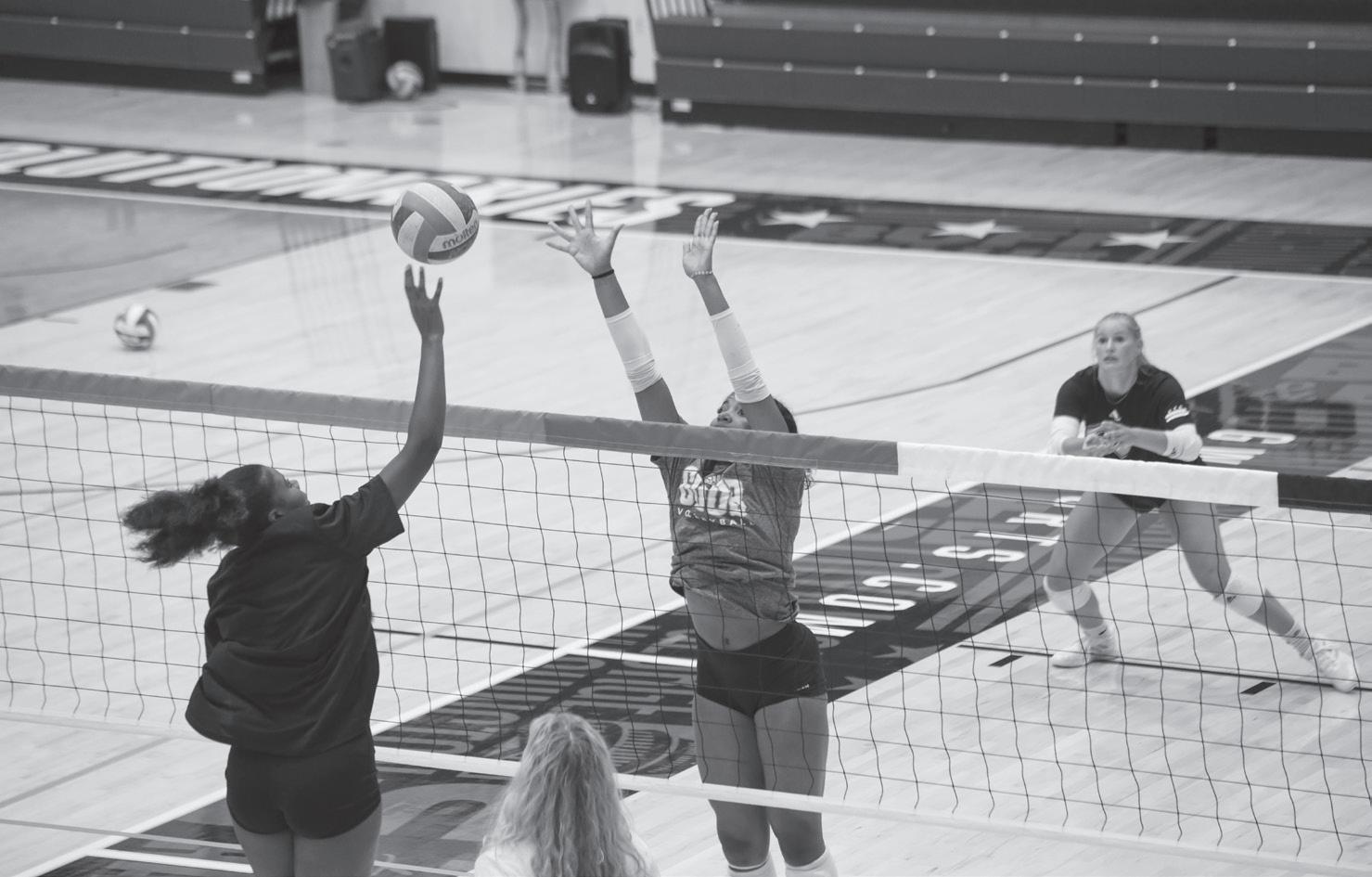
Volleyball seeks to thwart offensive attacks after last season’s losing streak
BEN SPITALNY SPORTS EDITOR
After ending last season with a 10-match losing streak, volleyball Head Coach Katie Reifert said the team changed its strategies and training this offseason in hopes of improving their record.
The team finished the year with an overall 7-22 record and a 4-14 record against Atlantic 10 opponents, placing ninth out of 10 teams. The team struggled with their defense, ranking last in the conference in opponent hitting percentage at .247 and ninth in opponent kills, allowing an average of 13.10 per set.
Reifert said defense was the team’s primary focus this offseason due to its struggles stopping opponent attacks, which gave them few scoring opportunities.
“So when we did hit the ball, it was pretty good, but we weren’t doing that enough because of our defense or because of our
passing,” Reifert said. “So we really focused there this past spring and then to really bring that into the fall. And that looks better.”
The team was fourth in the conference in hitting percentage with .200, a slight improvement from the .195 hitting percentage in the 2022 season, when the team finished 18-15.
After struggling to control opponents’ attacks last season, Reifert said she wants to see her team be the aggressor this year and put the other teams’ defense on their heels.
“We’ve been taking that theme with our serving, with our offense,” Reifert said. “It’s really just trying to figure out how to give the other team across the net a really hard time. Rather than focusing on stopping the other team, focusing on us and our offense and how our offense is going to stop them.”
This summer, the team welcomed six new players: five freshmen and one transfer student.
Transfer and graduate libero Reilly Heinrich joins the Revolutionaries from the University of Texas, who won the NCAA National Championship in 2022 and 2023.
In addition to Heinrich, Reifert said she’s excited about the team’s freshmen class and that they have quickly adapted to both the team’s values and playing style.
“We’ve got a fantastic freshman class,” Reifert said. “They have come in and embraced being a part of this culture, taking this culture on their shoulders, rather than just being wallflowers or sitting in the background.”
In 2022, Reifert’s first year as coach, the team improved from its 2-25 record from the year prior to make the tournament. There, they beat Saint Louis 3-1 in their first match before losing to Loyola Chicago in five sets in the semifinals.
Reifert said that entering last season, the team set goals to match the improvement and success of 2022 but
ultimately failed to do so. She said that this offseason, the team has worked on managing expectations and learning to play well under pressure.
“This past spring, we’ve been working a lot on setting
an expectation and then meeting that expectation and feeling the pressure and inviting that pressure,” Reifert said. “That’s been really fun. It’s been really fun challenging them in that way and seeing their growth.”
The team opens their regular season Friday, when they welcome UC Riverside to the Smith Center at 6 p.m. for their first home match, the first of three in the D.C. Showdown.
Basketball teams hire general manager, assistant coaches
RYAN JAINCHILL BASKETBALL EDITOR
A general manager will oversee both men’s and women’s basketball teams, a new position in a slew of hires that officials say will elevate the programs to the standard of other Division I teams.
Former men’s basketball Director of Operations and Assistant Coach Cooper Handelsman was named GW’s first general manager of basketball earlier this month, a role that allows him to oversee both basketball programs. Men’s basketball also added Eric Sebastian as the team’s new director of operations for the 2024-25 season, to fill Handelsman’s former role.
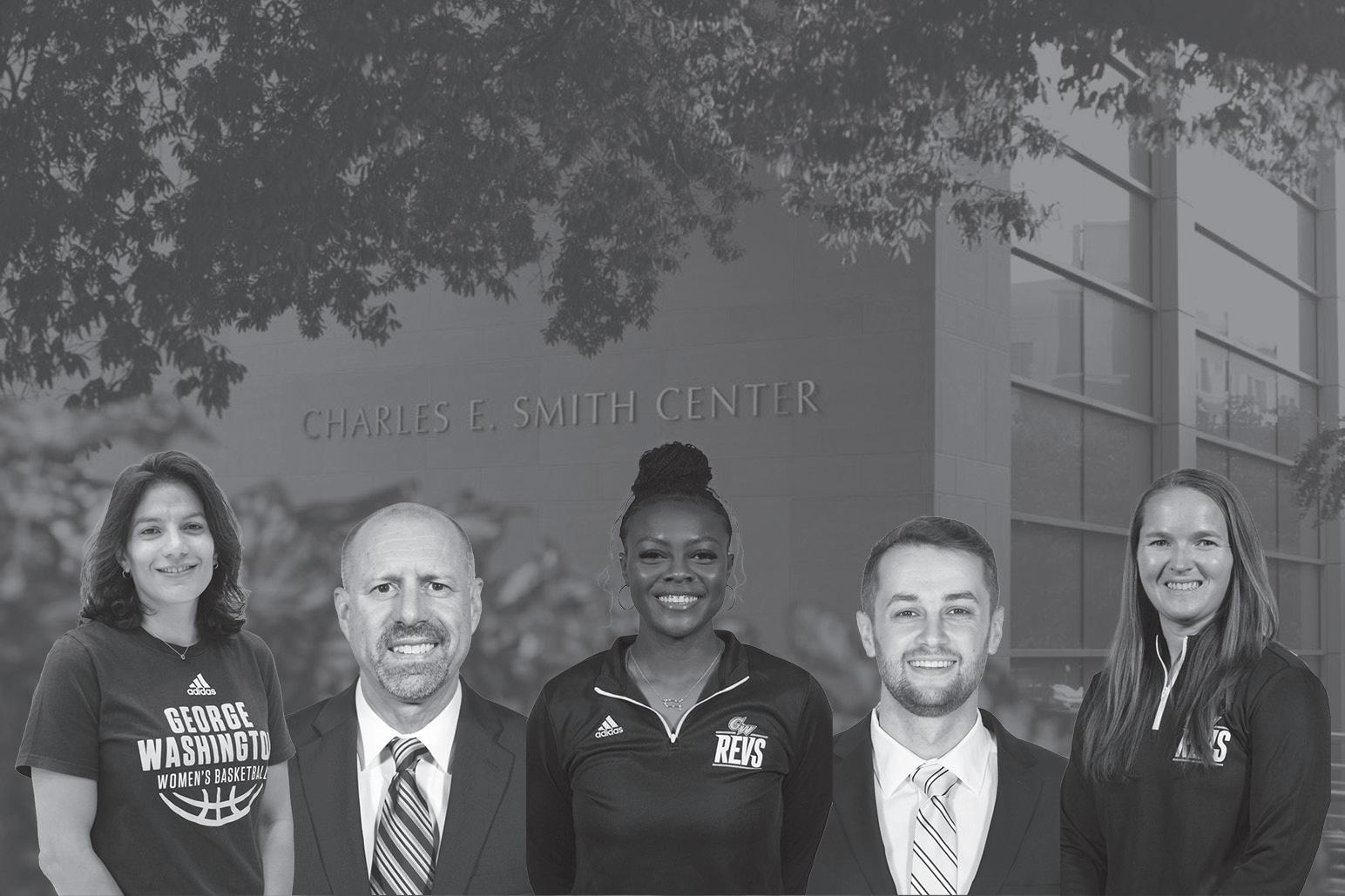
Women’s basketball Head Coach Caroline McCombs added three assistant coaches, Amy Pryor, Jasmyn Walker and Doug Novak and a new Director of Basketball Operations, Carolina Blanco.
Prior to the August hires, officials promoted Matt Colpoys to assistant coach from director of recruiting in April after former Assistant Coach Zak Boisvert departed for the same position at fellow A-10 school Saint Louis. Officials also promoted Aaron Thompson from director of player development to assistant coach in July.
The hires come amid a slump for both basketball programs. The women’s team finished 11th in the Atlantic-10 last season, and the men concluded their season in last place.
Cooper Handelsman – General Manager of Basketball
Then-Director of Athletics Tanya Vogel announced that former men’s basketball Director of Operations and Assistant Coach Handelsman would shift roles to become the University’s first general manager of basketball. This new role was created to continue advancing both basketball programs in the Division I field and allow student-athletes to benefit from name, image and likeness deals, according to a release.
GW joins St. Joseph’s as the only A-10 teams that employ general managers for their basketball programs. Before the 2023-24 season commenced, St. Joseph’s promoted Rob Sullivan to the general manager position.
NIL allows college athletes to benefit from paid endorsements and sponsorships from companies.
Handelsman will also serve as the liaison between the basketball programs and other University departments.
“We’ve been trying to do some research and just seeing how many programs across the country have this position,” McCombs said. “Sometimes it’s just for one sport, but to have this for the sport of basketball, for our men and our women, is really important.”
Men’s basketball Head Coach Chris Caputo said the creation of the general manager position demonstrates the University’s dedication to advancing the basketball programs.
“I think it shows a commitment by President Granberg and our administration and our board,” Caputo said. “We understand that these are some of the things that are happening in college basketball, and we need somebody to help us with navigating that.”
Eric Sebastian – Men’s Basketball Director of Operations
Sebastian joins the men’s basketball program as the director of operations after spending seven seasons as the director of coaching operations for the Washington Wizards.
His responsibilities for the Wizards included scheduling, booking travel and communicating between them and their
G-League affiliate, the Capital City Go-Go. Caputo said that Sebastian will take on a role similar to his with the Wizards.
After graduating from Southern Methodist University in 1994, Sebastian interned with the Dallas Cowboys and the Denver Nuggets. During his 15 years with the Nuggets, he rose from intern to director of media relations. In 2009, he was hired as the director of basketball operations at the University of Memphis, where he worked with the Tigers until 2016.
Caputo said Sebastian’s work across the NBA, NFL and NCAA will benefit the Revolutionaries by bringing more professional experience to the program.
“I think just having that high level,” Caputo said. “When you’re trying to build a first-class program, you bring somebody from the NBA, and the NBA does things first class. It’s a good match for what we’re trying to do.”
McCombs hired three new women’s basketball team assistant coaches this offseason after Ali Jaques, Adria Crawford and Hailey Zeise left the program.
Pryor comes to the District after spending two seasons at Eastern Michigan University, the first season as the director of basketball operations and the second as an assistant coach. As an athlete, she played her first two collegiate seasons at Northern Oklahoma-Tonkawa College before transferring to Oral Roberts University and spending her final season at Oklahoma Baptist University.
Pryor previously coached at Northern Oklahoma as an assistant coach in the 2010-11 season and at Eastern New Mexico State from 2011 to 2013.
McCombs said Pryor will primarily focus on the point guards, the position she played during her career. In her two seasons at Northern Oklahoma-Tonkawa, Pryor averaged 12.4 points per game.
Walker joins the Revs’ staff after spending the 2023-24 season at Purdue University Fort Wayne as an assistant coach. Before joining the Mastodons staff, Walker was the coordinator of recruiting and creative content at Butler University. She also served as an assistant coach at Davenport University and Ferris State University.
While playing college basketball, Walker spent her first two seasons at Valparaiso University and her final two at Western Michigan University. McCombs spent six seasons at Valparaiso as an assistant coach and an associate coach in 2004 when Walker was on the roster.
McCombs said she believes Walker will be an essential contributor to her coaching staff because of her previous
work as a coach and player.
“Jasmyn is first and foremost, a good young person for our players to watch,” McCombs said. “I think she’s going to be very highly involved, in recruiting, whether that’s nationally, regionally, just looking for her to really make her mark in that area this year.”
As a wing in college, Walker will work to develop other players in the same position for the women’s team this upcoming season.
Novak joined McCombs’ staff on July 15 as an assistant coach. He previously served in the same role at Northern Kentucky University last season and coached at Mississippi State and Army.
The University of Tennessee graduate spent most of his coaching tenure with the Bethel University men’s basketball team, leading the program to a 131-68 record over his eight years.
McCombs said she has implemented Novak’s offense into her coaching repertoire and is grateful to work alongside him.
Novak will also work on player development throughout the season.
“Coach Novak is a veteran, seasoned coach,” McCombs said. “He has a lot of wisdom. He has a lot of expertise. I’ve been fortunate to build a friendship with him over the past few years.”
Carolina Blanco – Women’s Director of Basketball Operations
On the same day Pryor and Walker were hired, officials announced that Blanco would join women’s basketball as the new director of basketball operations.
Blanco spent her career working in a wide array of industries, most recently spending time as a consultant for the 318 Foundation, a company striving to empower marginalized communities through sports and mentorship.
Blanco spent 18 seasons as the executive director of Sports International Group, a sports agency representing professional and collegiate athletes and coaches. As a Duquesne graduate, Blanco is no stranger to the A-10.
McCombs said Blanco’s work as a sports agent in the area and her familiarity with the A-10 conference will help the program grow. Blanco was the agent of GW Athletics Hall of Famer Jonquel Jones.
“The relationships that she has with really high level college basketball players, now pros, helping them make that transition, from college to Pro is a skill that she has really developed,” McCombs said. “So now we’re just looking at high school to college, and that development, but the connections that she has with people around the world is really awesome. She definitely has strong connections in the DMV.”
Men’s soccer wins first game of season against Saint Peter’s
MARGOT DIAMOND STAFF WRITER
Men’s soccer (1-1) picked up their first win of the season in a 2-1 victory against Saint Peter’s University (0-11) after a 2-4 loss on Aug. 22 to Old Dominion (1-0) in their season opener earlier this week. With five new faces on the roster and the addition of Assistant Coach Nick Conklu to the team’s coaching staff, Sunday’s win marks the Revolutionaries’ first nonconference victory of the 2024 season. The early season victory sets the stage for the Revs to extend their winning streak as they continue through another month of nonconference play, leading up to their Atlantic 10 opener against Duquesne on Sept. 21.
Saint Peter’s made their first visit to the Mount Vernon Campus since 2014 for the Sunday match, bringing with them a 2-9-5 record from their 2023 season and a 1-6-3 performance in the Metro Atlantic Athletic Conference. Aiming to build on their 2023 season overall record of 4-9-4 and A-10 record of 2-5-1, the Revs attacked the field — dominating the offense and registering 26 shots throughout the game, vanquishing the Peacocks’ six shots.
The lone goal for Saint Peter’s came in the first half with a penalty kick by graduate student forward Conlan Paventi. Despite their persistence, the Revs were unable to capitalize on their
13 shots and three corner kicks in the first half.
Revs’ goalkeeper and graduate student Duncan Wegner saved two of the three shots on target during the game, compared to Saint Peters’ goalkeeper Pedro Alves who saved seven out of nine shots on goal. Wegner had a standout season in 2023, appearing in a career-high seven matches with a 1.07 average of goals allowed and a save percentage of .739. He played more than 500 minutes throughout last season, securing all four team victories with a 4-1-0 record, faced 78 shots on goal and had 72 saves.
The Revs picked up after halftime, with the equalizer goal coming from sophomore defender Colin Prendergast after a well-placed downfield pass from freshman midfielder Finn Roberts. Roberts, hailing from the United Kingdom, is one of the five new additions to the roster this season, making his GW debut last week in the matchup against Old Dominion and playing 54 minutes of Sunday’s game. Among the six Revs who played the full 90 minutes, graduate student midfielder William Turner led the team last season with 11 points and played in all 17 matches. In this most recent matchup, he delivered a notable performance with two shots on goal and a successful assist to junior forward Alex Nicholson for the game-winning goal. The Revs will hit the road next week to play West Virginia on Aug. 30 at 7 p.m.
ERIN LEONE | STAFF PHOTOGRAPHER
Freshman Riley Samuel jumps to block the ball during a practice Thursday.
PHOTO COLLAGE BY JORDYN BAILER
From left to right, Carolina Blanco, Eric Sebastian, Jasmyn Walker, Cooper Handelsman and Amy Pryor
JAMES SCHAAP | STAFF PHOTOGRAPHER Graduate midfielder William Turner looks to pass in a game against Mary Washington University in August.
The number of freshmen on the men’s water polo team – half of its 16-player roster.
WELCOME BACK GUIDE WELCOME BACK GUIDE
Take it with
CAITLIN KITSON CONTRIBUTING CULTURE EDITOR
More than 10,000 GW undergraduates populate the blocks between Pennsylvania Avenue and E Street, sparking campus gossip to spread like wildfire.
You may have only told a few friends about your gripes with a professor, but students’ aptitude for yapping accelerates the circulation of our opinions about one another. By the end of your four years at GW, you will undoubtedly collect impressions of countless campus figures — especially ones that influence your decision to add or drop a course this semester.
From GroupMe chats to hushed conversations outside of lecture halls, students voice their assessments of faculty both on-and-offline. But there is one platform that reigns supreme in its ability to showcase some of students’ most brutally honest opinions about their professors: Rate My Professors.
The faculty review site first launched in 1999 under the name TeacherRatings before solidifying itself as Rate My Professors in 2001. Rate My Professors has garnered about 20 million ratings since its launch, averages about 9 million viewers per month and rakes in about $3.4 million in revenue every year. Students who sign up for the site can rate their professors’ “overall quality” and “level of difficulty” on a scale from
‘a grain of salt’: Faculty unpack Rate My Professors reviews
1-5 and report whether they would take a class with them again.
The site may be a friend for students, but for faculty, it can be a foe. GW professors said the website often draws polarized opinions that do not accurately reflect their teaching abilities, making the site an unproductive resource for feedback and an ineffective tool for students building their course schedules.
Paul Carrillo, a professor of economics and international affairs, said he checks his reviews on Rate My Professors about once an academic year, but he takes them all with a “grain of salt.” He said he places more emphasis on GW’s official Student Feedback system — which allows students to write evaluations for their courses every semester — and feedback from his colleagues in the economics department.
“The people who self-select to give an opinion about your performance in Rate My Professor are people who have very strong opinions about you,” Carrillo said. “Either those who really, really like your course, or those who really struggle then just don’t like your course.”
Carrillo said he compares Rate My Professors to the restaurant review website Yelp because both platforms require users to create an account, leave their ratings and write their reviews. He said the effort and time required to use these websites often draws stronger opinions
than those of an average student.
Carrillo said Rate My Professors’ decision to ditch their “hotness” metric in 2018 was a positive change that made the website more appropriate and professional. The website’s removal of the rating, which was represented by a chili pepper icon, followed a social media campaign led by thousands of faculty members and stu-
Hatchet staff share dorm decor favorites
THE GW HATCHET
While living in the District, some students have spiced up their decor in a Capitol-esque fashion.
From terrifying presidential statues to obscure newspapers, Hatchet staffers have done their dorms up in true only-at-GW fashion.
A miniature e gy of Washington himself
Rachel Moon | Senior News Editor
Visitors to my room often fixate on a perch of the TV stand, where “Creepy George” lives.
My best friend bought Creepy George off Etsy for $38 while wine drunk and gifted him to me for my 21st birthday because he couldn’t think of anyone else to off-load the terrifying talisman onto. Creepy George is a hand-carved wooden version of the George mascot from the 1950s. Creepy George stands roughly six inches tall, with arms akimbo in a bent position and chest puffed. He sports 18th century garb with a white powdered wig and blue boots painted onto his polished carved surface.
A newsprint tribute to one glorious month
Nick Perkins | Culture Editor
For William Henry Harrison, March of 1841 was the best month ever. That was the only time that Old Tippecanoe, as he was nicknamed, served as president, before he died from enteric fever. That moment is now captured and immortalized on my wall, where a newspaper clipping covering his inauguration hangs next to one from a month later: “President John Tyler Inaugurated. Harrison Funeral Services.” For admittedly opaque reasons, our country’s ninth chief executive has had a much longer lasting impact on my life than he did on America. While I acknowledge it’s really random to have a man crush on William Henry Harrison, I remember finding it extremely funny when my history professor mom told me there was a guy who had just been president for a month.
A license plate with bicoastal insults
Caitlin Kitson | Contributing Culture Editor
As much as I cherish public transportation, my childhood in the Big Apple left me without a crucial marker of adulthood: a driver’s license. While I despise car-centric infrastructure, jealousy still creeps in when my GW friends discuss the independence driving afforded them in high school. Luckily for me, I found that buying a kitschy, vintage license plate helped fill the carsized void in my heart.
I found this particular souvenir for just $8 in an antique store in San Juan Capistrano, California. In a whimsical script, the plate displays some cutting words for New Yorkers and Angelenos: “Too Dumb for New York City, Too Ugly for L.A.”
My Californian friend and I felt a connection to this absurd license plate immediately, declaring it a testament to our bicoastal bond.
The contraption that brings the world’s past to life
Jackson Lanzer | Sta Writer
Sitting on my bookshelf is an odd contraption: the telebinocular. Now more commonly known as a stereoscope, the device works by viewing two identical images simultaneously, morphing them into a 3D image. I was lucky enough to stumble upon a collection of photographs produced by the Keystone View Company in the 1920s. The box of stereographic images includes shots of life from around the globe like one of a hiker atop Mount Fuji in Japan standing above the clouds and gazing at Lake YamanakaIt’s this wonky, historic vibe that made me choose this device as decor for my D.C. apartment, because what is D.C. but a city fi lled with the wonky and historic
dents.
Daniel Mackay, an assistant professor of economics, said he used to check his Rate My Professors profile more often as he was beginning his career as a professor but now doesn’t frequent the website as he’s moved further into his tenure.
“When I was first starting out, I used to check,” Mackay said. “I was very self conscious, right? Am I doing a
good job?” In the age of social media, Mackay said Rate My Professors allows students to engage with an anonymous online forum and discern for themselves what is accurate and inaccurate. He said some reviews can demonstrate a professor’s teaching skill but others may represent a student’s “axe to grind” with a particular faculty member.
Eva Trotter, a sophomore majoring in marketing and English, said Rate My Professors draws divisive reviews that often skew professors’ ratings one way or another. She said she’s routinely used the website, but she’s never left a review for any professor herself. “I’ve never had enough vengeance or admiration, I think, to leave one,” Trotter said.
‘We’ll always have Ultrabar’: Hatchet staff on nights out gone wrong
THE GW
With no football team to tailgate for and a campus located in the heart of a major city, GW is not your typical party school.
While GW students are not afforded the preeminent Greek Life scenes and boatloads of darties often found at state schools, they do have the D.C. nightlife scene at their fingertips. But navigating the trials and tribulations of partying in the District is no easy feat for fresh college students.
Here Hatchet staffers recount some of the most memorable, and the most vomit-inducing, going-out experiences from their years at GW.
From Ultrabar to a family road trip
Brianna Kimmel | Reporter
Living on the Mount Vernon Campus and wanting to go out was a difficult dichotomy to juggle. The first step in schlepping to the clubs in D.C. was boarding the Mount Vernon Express, which used to run every 30 minutes after 7 p.m. on weekends.
The first night of Labor Day weekend, my friends and I landed at Ultrabar — a nightclub near Chinatown with laser lights, deafening music and a $20 cover fee that takes advantage of students who don’t know better.
The next morning, I woke up at 6:30 a.m. with the memo-
ries from last night a blur and only 30 minutes to get ready before my uncle arrived to drive me home to surprise my mom for her birthday. When my uncle arrived at the Vern, I told him I had food poisoning — too nauseous to care if he bought my lame excuse.
Halfway through Pennsylvania, I was forced to ask my uncle to pull over, and I became intimately acquainted with the shoulder of I-81. After a stop at the gas station Sheetz for Gatorade, we made it home to surprise my mom — who cried when my sister and I both arrived.
Although the experience was avoidable, it felt like a rite of passage. A fuzzy night at Ultrabar full of bad choices followed by a six-hour car ride isn’t a fun way to learn your limits, but it worked for me.
It’s the “Sign of the Times” to get out of here
Caitlin Kitson | Contributing Culture Editor
As the youngest on both sides of my family, I had heard my fair share of college party stories before I even stepped foot onto GW’s campus. Some were epic tales of bar hopping and dancing the night away with lifelong friends, but most were peeks into the disappointing reality of most universities’ party scenes.
Yet when I started my first
year at GW, I was still naively intrigued by the 18-plus clubbing scene available to D.C. college students. So as my first Halloweekend rolled around, my friend and I decided to embrace our curiosity and finally make the trek to the much-discussed club, Decades DC.
We pulled up to the lengthy line outside Decades decked out in our Halloween attire: I went as Emma Stone’s character in the 2010 film “Easy A” while my friend opted for a dark angel costume. But as we finally made our way into the club, the reality of Decades’ environment snuffed out any sparkle of excitement we had left.
The floors of Decades were mostly packed with college students, but there was also a frightening presence of middle-aged men who seemed to flock to an 18-plus club for all of the wrong reasons. We attempted to shake our uneasy feelings and stake out a territory near the DJ booth to at least enjoy the music.
But you should never put your faith in a nightclub DJ. For reasons unknown, the Decades DJ decided to start blasting Harry Styles’ somber 2017 single “Sign of the Times” and play the accompanying music video on every available screen. We took this as a sign from God, or maybe Harry Styles, that it was time to call it quits on our attempt to enjoy the D.C. clubbing scene.
JORDAN TOVIN | ASSISTANT PHOTO EDITOR
Professor Daniel Mackay sits for a portrait in his o ce.
STAFF
HATCHET STAFF
WELCOME BACK GUIDE WELCOME BACK GUIDE
Host roommate watch parties with these weekly fall TV shows
It can be really hard to befriend your roommates or learn to room with your friends. After spending all day dreaming about how you wish your roommates would wash the dishes or decorate the walls differently, sometimes you need a reminder that you do like this person and there is a reason you chose to live together. Coming together over a shared passion — like a show you watch together — gives you an excuse each week to sit down and bond over the blue glow emanating from your television.
With Sunday night staples like House of the Dragon and Succession dominating the last few years of headlines, watch parties have returned to American living rooms after years of binge-watching domination. From spy thrillers to long-running reality TV, there’s no shortage of new week-to-week shows you and your roommate can make your own this fall.
Survivor 47
Premieres Sept. 18, airs on CBS on Wednesdays at 8 p.m.
To answer the often-asked question — yes, “Survivor” is still airing. The island-set competitive reality show is
trucking along into year 25 on the air, with dimpled host Jeff Probst still at the helm. With strategy abounding, there’s plenty of chances to discuss over breakfast what move a given player really should’ve made.
“Survivor” is also a convenient option because the show is extremely easy to pick up and watch even if you’ve never seen a single second — such is the benefit of having casts of new players every six months — so if one roommate is a diehard fan, the others can easily glom on. Plus, the new season has some extra celebrity juice added to it, with “Pod Save America” host Jon Lovett appearing as a contestant, fresh off potentially influencing the replacement of the Democratic presidential nominee.
The Penguin Premieres Sept. 19, then airs on HBO on Sundays at 9 p.m.
Colin Farrell can do no wrong. The Irish Academy Award nominee has impeccable taste in projects, be it working with excellent directors like Martin McDonnough and Yorgos Lanthimos or headlining silly, if enjoyable, action flicks like “Total Recall” and “Miami Vice.” That alone is enough to get one pumped for Farrell’s last turn as the infamous Batman villain The Penguin. The show, which sees Far-
rell reprise his role from 2022’s “The Batman,” might seem like an extremely harebrained idea.
But Farrell’s goofily charming performance in “The Batman” makes the show worth checking out, even if only to see the role at the center. Plus, in a 1960s version of Batman, the Penguin ran for mayor as a Donald Trump-esque showman in contrast to the more boring Batman who cared about being a good citizen. In an election year, who knows what campaign antics might occur in the new series.
Rescue: HI-Surf
Premieres Sept. 22, airs on FOX on Mondays at 9 p.m.
Not every TV show has to win awards. Sometimes, TV shows just need to give you an excuse to have running riffs with your roommates for a semester — and a show as simple as “Rescue: HI-Surf” can do just that. In the tried-and-true case of the weekly format, the show follows heavy water lifeguards going off on all sorts of lifethreatening capers. Maybe this is going out on a limb, but as a show with no notable actors and no real discernible concept beyond hot people hanging out on beaches, it’s possible some of the plot points will be a bit unrealistic and can inspire entertaining bits for you and your roommates.
What we saw at a four-hour stakeout in Carvings
Instagram followers — 1,393 at the time. We both follow and see the counter slowly tick up to 1,394 and, after a multi-minute delay, to 1,395.
There’s only one place where a GW student’s first Thursday night in college can end: Carvings. Everyone went through the experience as a first-year: going out to Decades for the nightclub’s 18+ night and stumbling back to campus in desperate need of sustenance from the only late-night eatery on campus. The restaurant serves up fried favorites like chicken tenders and mozzarella sticks until 2 a.m. on Thursday and 3 a.m. on Friday and Saturday.
During a four-hour-long stakeout in the beloved campus snack shack, The Hatchet documented the sights and sounds in Carvings on the first Thursday night of the academic year.
9 p.m.
We arrive — perhaps not shockingly, considering the time — as the only patrons of Carvings. To earn our table at the venerated GW culinary institution, we buy a Diet Coke and fries, settling into a table with four seats in the back corner.
A group enters Carvings, all in workout clothes. They purchase food and a bottle of orange juice, a can of San Pellegrino and a Red Bull can, respectively, with the last beverage clearly being key preparation for a big first night out as a college student. Twenty minutes later, a fourth person, who burst into Carvings in blue Crocs, plops alongside the trio before dashing up to order a chicken quesadilla. The initial trio departs the restaurant, but two new people sit next to the man in Crocs. The fashionable footwear fellow complains that he’s still extremely hungry, to which one of his friends suggests he get chocolate milk.
Not fond of this suggestion, he mutters “F*ck” and turns to a new Carvings patron with huge first-year energy. He asks if the dining halls are still open, clearly dismayed to learn they close in five minutes. He mutters another obscenity and declares that he’s given up, going up to the front to buy more french fries.
10 p.m.
We turn our attention to the ceiling above the Carvings couch, where there’s a live count of the eatery’s
Just before 11 p.m., a new patron enters Carvings: a tall twenty-something with headphones sitting atop his head. He sits down at the table next to us and waits for chicken tenders while sipping a vanilla Coke.
11 p.m.
We decide to order Carvings’ famed mozzarella sticks to get us through the evening — and immediately drop one onto the floor because they’re too hot. But after letting them cool down, we find heaven: gooey mozzarella mixed with an expertly breaded exterior, just like three years ago.
Two mysterious individuals, who may or may not be the authors of this article, eat a mozzarella stick “Lady and the Tramp” style. The man with headphones takes a sip of his vanilla Coke and looks at us, confused.
12:30 a.m.
Another group enters Carvings, stumbling onto the table. Just before they get up to the front, we dash up for round three of mozzarella sticks. One of the members of the group interrupted our coverage to ask about a sticker from Huntington Beach on one of our laptops. He pointed at it, saying he too was from California. Before conversation could continue, two girls walked in the door, and the sticker fiend suddenly shifted his attention toward the girls. In an act of suave rizz, the man asks a question bound to elicit interesting conversation and seduction: what their years and majors were.
One says she is a business major, to which our debonair gentleman responds with something that totally isn’t condescending: “I’m going to be running the company that hires you.”
He asks for their phone numbers, but his previous comments didn’t appear to charm them enough to exchange digits. He leaves Carvings in defeat.
We stay for several more minutes, but the restaurant only receives a trickle of customers. People walk by outside, and they don’t even glance at the establishment that had once been a sanctuary for GW’s inebriated masses.
A long fi rst week of cramming into the dining hall to see old friends might put exhausted students in the mood for a black-tie dinner out, but luxurious events aren’t always affordable. Despite this obstacle, there are cost-conscious ways to bring these opulent dinner parties home to your dorm. Swap $17 mezcal cocktails for cheap Trader Joe’s wine, and drop the hundred dollar table settings for reusable decor with this guide to putting on a fancy dorm feast on a budget.
Colonel Mustard
slayed his murder mystery party in a Shenkman quad
A theme with movies, games and costumes helps put the ‘party’ in ‘dinner party.’ Plus, fi ring up a movie at home or playing charades gives you a way to create lasting bonds at no cost.
A tried-and-true classic, the murder mystery party is one of the easiest themes to implement. Assign people roles from the board game “Clue” and instruct them to come dressed in the colors corresponding to their characters. Then, lay out various “murder weapons” you might have laying around the house like scissors or butter knives and invent a murder mystery that your
guests must solve. While the game might be labor intensive, nothing brings new friends closer together quite like trying to hunt down a mysterious killer — just look at any slasher fi lm. If acting and roleplaying games aren’t your speed, opt for a moviethemed dinner party. Pick a fi lm, instruct your guests to dress as the movie’s characters and follow up your meal with a dorm watch party. Say you’re a big “Pulp Fiction” fan — visitors can come wearing oversized suits to enjoy Big Kahuna burgers and fries drowned in mayo.
Cocktails, mocktails and wines — oh my!
Drinks help take your dinner party from a regular Monday in the dining hall to a fancy Friday night in D.C. You can fi nd affordable wines at Trader Joe’s, like Merlot and Chardonnay for as low as $5, or at local favorite, McReynold’s Liquors, where you can fi nd Barefoot, the quintessential cheap college wine. Almost every part of GW has some sort of D.C. theming to it, and there’s no reason that your dinner party can’t have the same. After a McReynold’s run, try whipping up a Gin Rickey, a dry cocktail with gin, lime juice and club soda named after a 19th century D.C. lobbyist. Or embrace your patriotic side and make a Red,
White and Blue Martini, containing blue curaçao and grenadine for the colorful additions.
A communal kitchen-friendly meal
You can’t have a dorm dinner party without the most important ingredient: food. Providing a home-cooked meal to a party of friends on a college student budget can
sound intimidating, but it doesn’t have to be. For those in dorms like Thurston and Mitchell, where you don’t have access to a full in-room kitchen, try
PHOTO ILLUSTRATION BY LILY SPEREDELOZZI
Roommates lounge on the couch while watching television.
NICK PERKINS CULTURE EDITOR
HANNAH BURCH
PHOTO ILLUSTRATION BY SAGE RUSSELL
A student grabs a bottle of wine from Trader Joe’s