Faculty senators Friday unanimously extended temporary changes made to the Code of Academic Integrity last year and pressed officials to be more active in finding and recruiting professors to sit on student disciplinary panels.
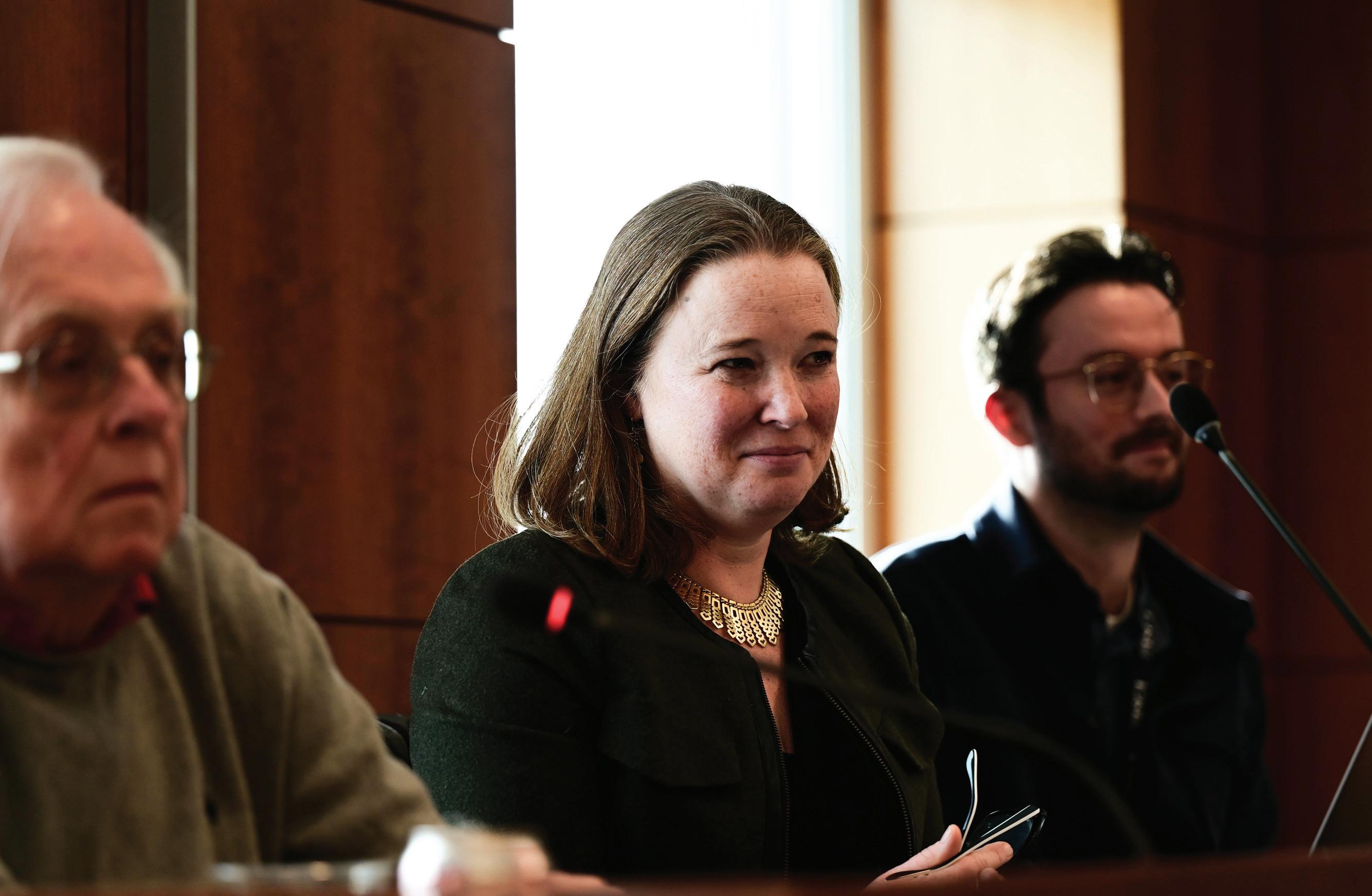
The Faculty Senate Educational Policy and Technology Committee co-chair Sarah Wagner and Office of Conflict Education & Student Accountability Director Christy Anthony proposed prolonging last year’s temporary reduction in the number of people required at student conduct panels and the elimination of the rule that panels must convene for proposed sanctions less severe than suspension. Faculty senators supported the extension and encouraged Provost Chris Bracey to recruit more faculty for the panels to address a backlog in student disciplinary cases.
Students who challenge academic integrity violations are required to attend a student conduct panel
which includes one student and one faculty member selected from a pool of trained members, unless they receive a warning. Before last year’s panel reduction, a full panel consisted of two faculty and three students.
Last year, Anthony said artificial intelligence misuse, which is typically categorized as a cheating violation under the code, has contributed to the rise in cases because faculty are checking for AI use and reporting more students.
Cynthia Core, a faculty senator and a professor of speech, language and hearing sciences, suggested that the University should mandate serving on the panels as part of faculty member’s service requirements. She said she has served on panels previously and filed a recent grievance that took three semesters to resolve due to the lack of faculty serving on the panels.
“It was excruciating to me, to the students, it diminished their experience at the University,” Core said. “It created bitterness among the student group toward our faculty.”
Phil Wirtz, a faculty senator and a professor of decision sciences and psychological and brain sci-
GW’s location in the heart of D.C. could subject the University to heightened scrutiny from Presidentelect Donald Trump as he enters his second term vowing to repress proPalestinian protests and diversity initiatives on college campuses, experts said.
Trump has proposed several education policy changes, including cracking down on pro-Palestinian demonstrations on campus, eliminating President Joe Biden’s student loan forgiveness programs, reversing diversity, equity and inclusion initiatives at the federal level and dismantling the Department of Education. Higher education policy experts said given GW’s location blocks from the White House, the University could face heightened levels of federal scrutiny, although there’s a slim chance the Republican-controlled executive and legislative branch will approve extensive changes to higher education.
University spokesperson Shannon McClendon said officials will continue to collaborate with partners across higher education over the next four years to ensure the University is accessible and offers opportunities for prospective students. She declined to say whether GW plans to retain or bring on outside consultants during Trump’s second term to navigate potential higher education policy changes.
Officials hired a lobbying firm last May after the House of Representatives Oversight Committee called on D.C. Mayor Muriel Bowser and Metropolitan Police Department Chief Pamela Smith to testify about reports that they denied GW’s requests to clear the pro-Palestinian encampment in University Yard last spring.
ences, said he’s heard from his colleagues that there’s a “general misunderstanding” among faculty members that the University is in need of professors to sit on the conduct panels.
Don Parsons, a faculty senator and a professor of economics, said some faculty may not like being obligated to serve on panels and suggested the University should instead identify incentives like monetary encouragement to persuade faculty to sit on the panels.
“As labor economists suggest, look the other way, look for incentives,” Parsons said. “If you’ve talked to deans and there are deans that don’t care about encouraging people to do that in salary or otherwise, then you talk to the provost and have him talk to the dean about incentive set-ups.”
Anthony — whose appearance on Friday marked her return from a leave of absence during the fall when she took a leadership position for the Semester at Sea program — said at the meeting that she has a “few concerns” with mandating faculty service because professors in the past have reneged on past promises to sit on the panels, which
University President Ellen Gran-
berg said in September that officials hired the firm to ensure they didn’t create a “bigger issue” because the University doesn’t have sufficient connections to manage a “situation” between lawmakers and administration.
McClendon said the University monitors the “federal regulatory landscape” and will continue to assess potential policy changes that would impact the University. She said GW will provide resources to support “impacted members” of the GW community.
“Our proximity in the heart of the nation’s capital provides the University a unique level of access to leaders as well as the opportunity to continue to demonstrate the vital role of higher education institutions,” McClendon said.
John Aubrey Douglass, a senior research fellow of public policy and higher education at the University of California, Berkeley, said Trump’s current agenda and threats for universities like GW are “opaque.” He said Trump has presented some policies that could have a large impact on students and faculty, but others are “less worrisome” in terms of policy and money.
“It seems that the verbal attacks and threats we have seen thus far from Trump and Vance on universities as leftist, elite bastions will continue as it appears to work for them politically,” Douglass said in an email.
Here’s how some of Trump’s proposed education policies could impact the University:
Pro-Palestinian protests
GW became a lightning rod for congressional scrutiny over the University’s handling of proPalestinian protests on campus, its proximity to the White House and
As she arrived home after a night of celebration on New Orleans’ bustling Bourbon Street, sophomore Ana Claire Hanley looked at her phone to see that a deadly attack had occurred right where she had been ringing in the new year with her friends just moments before.
At 3:15 a.m. on New Year’s Day, a man intentionally drove a rented pickup truck into a crowd of pedestrians on the street — a popular destination in the city’s French Quarter — killing 14 people and injuring dozens more. The FBI is investigating the attack as an “act of terrorism” after finding an ISIS flag in the attacker’s truck, but the Islamic State has not taken responsibility for the attack as of Sunday.
complicates scheduling.
She said faculty participation is also challenging because the panels typically take about two hours and the University prohibits adjunct faculty members from serving on the panels, shrinking the pool of eligible faculty.
In response to a question from Wirtz, University President Ellen Granberg said the University is working with Universal Health Services — which owns GW Hospital and has partnered with the District to open a medical care facility in Southwest D.C. — to renegotiate the University’s 2021 agreement with UHS regarding the number of physicians the University will provide to the hospital.
The University pledged in the original negotiation to staff the Cedar Hill Regional Medical Center GW Health with 160 Medical Faculty Associates physicians. The MFA is a group of physicians and faculty from the School of Medicine and Health Science and GW Hospital and has faced continuous financial losses in recent years, rounding out FY2024 with a deficit of more than $107 million.
Hanley, a political science student from the city’s uptown, said she had walked out of the French Quarter minutes before and was heading home when she heard of an accident that occurred on Bourbon Street through news articles and text messages. Having worked in the French Quarter years ago and understanding that the area could be “hectic” due to its high crime rate, Hanley said she initially assumed a drunk driver caused the accident.
“No one really knew the magnitude of what was going on in the moment,” Hanley said.
When she read news reports and heard the mayor speak about the incident, Hanley said she started “piecing everything together” regarding what had occurred
on Bourbon Street. About five hours after the truck collision, New Orleans Mayor LaToya Cantrell said the city had experienced a “terrorist attack” and asked for prayers for those who had been killed. The suspect was killed in a shootout with local police shortly after the collision.
“It was just really shocking, there’s no other way to describe it,” Hanley said.
Hanley said in the days that followed, she learned the suspect had reportedly placed an IED — which did not detonate — in a fried chicken restaurant that she had entered that night. The FBI said on Jan. 3 that the suspect intended to detonate two IEDs he hid on Bourbon Street with a transmitter found in his truck.
“I was standing in one of the shops that they found an IED in, which was pretty jarring,” she said. Hanley said she was “disappointed” in city officials’ handling of the attack because she felt they “prioritized” the Sugar Bowl — a college football playoff game — over citizens’ safety. Federal, state and local officials postponed the game from Jan. 1 to Jan. 2 as locals remained uncertain and panicked about the safety of Bourbon Street and the French Quarter after the truck collision, she said.
“They were more concerned about packing a Superdome full of people than like the 15 people and their families that just lost their lives, or the livelihood of all the people that were going and wanted to go experience New Orleans,” Hanley said.
Congress appearing to draw the attention of Republican leaders. Trump said he plans to crack down on pro-Palestinian demonstrations on all university campuses in his next term, potentially using his office to push federal investigations onto protesters and deport protesters, which some free speech and civil rights groups say would limit free speech and censor students.
As president, Trump has the federal authority to direct the Department of Justice to investigate protests that involve violations of federal law or national security concerns. However, he does not have the authority to directly regu-
late protests or speech on private university campuses, as they are not subject to the same public institution standards under the First Amendment. The University faced pressure from House Republicans to clear the pro-Palestinian encampment last spring and arrest student protesters after six Republican House Oversight Committee members visited U-Yard and called on Bowser and Smith to testify about their handling of campus protests. In October, the House’s Committee on Education and Workforce released a report criticizing GW and 10 other schools for an alleged “stunning
lack of accountability” for students who trespassed, damaged property, violated University policies and exhibited alleged antisemitism. Ben Cecil — a senior education policy adviser at Third Way, a national center-left think tank — said because GW is in the “backyard of the White House,” the University must consider the “competing interests” between the University and Trump administration and pledge to protect free speech on campus while also trying not to be a “target of ire” from the White House or Congress.
COURTESY OF PEDRO SZEKELY UNDER CREATIVE COMMONS Pedestrians walk down Bourbon Street in New Orleans in 2018.
Facing tight budget, SBA criticizes finance reform proposed by GW Law official
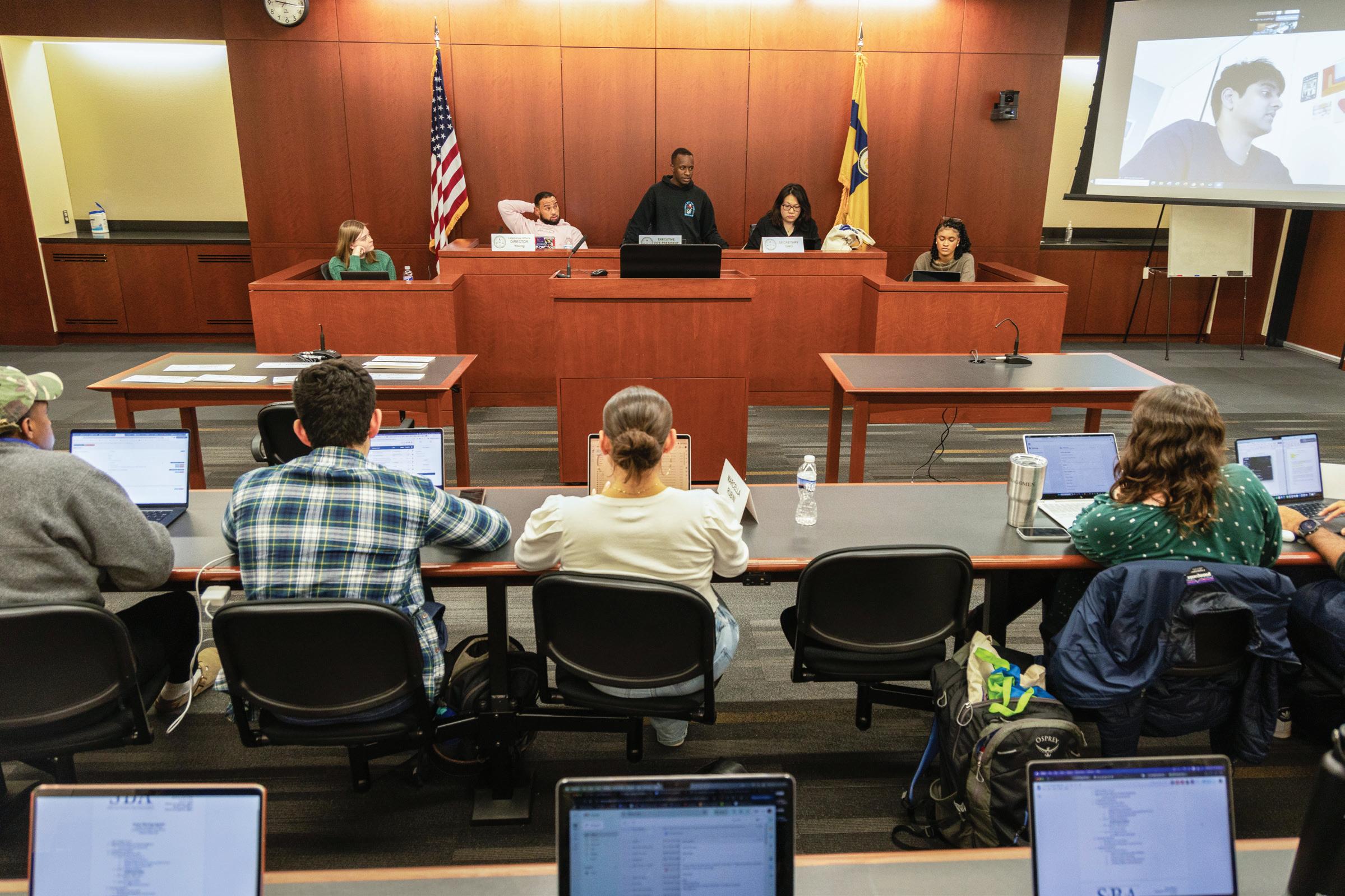
Student Bar Association leaders are sidestepping a GW Law dean’s recommendations to reform the body’s spending, claiming his oversight last semester threatened to subvert the SBA’s authority over funding and jeopardize annual events.
SBA President Cherissa Lindsay said GW Law Associate Dean of Students Jason Belk dismissed the body’s funding concerns last semester and said he’d only add money to their professional development fund if they restricted the types of events eligible for reimbursement through the ad-hoc budget. Lindsay said Belk’s solutions to the SBA’s tight budget endangered its continuation of annual events, forcing her to begin “going above” him to more senior officials, like law school Dean Dayna Bowen Matthew.
At the start of each academic year, the SBA allocates funds to student groups, its executive branch and an ad-hoc budget, which has historically operated without input from the law school and distributes money throughout the year to students and groups that form after the general allocations process in the fall.
In October, Lindsay said Belk implemented guidelines for the SBA’s ad-hoc budget — including that the SBA should not fund more than 20 percent of a student event cost or finance events without a “clear academic benefit” — and said he would consider allotting $10,000 toward the SBA’s professional development fund if the body adhered to these proposed rules.
She said the SBA isn’t required to follow his recommendations but that the body must abide if they wish to continue financing students’ attendance at academic and career-related events through the fund, which is currently empty due to this year’s limited budget.
“We do have to basically adhere to what the Dean of Students’ Office wants, and if they’re not satisfied with how we are distributing funds for these events, we are at risk of not having a professional development fund,” Lindsay said at the SBA’s October meeting.
At the same meeting, the SBA Senate complied with Belk’s guidelines by upholding Lindsay’s veto of an ad-hoc bill that the body had initially passed at an earlier meeting. Lindsay said Belk “was not pleased” that the SBA Senate had initially voted to allocate $500 to
a student to attend a one-day law summit, and she vetoed the bill in an effort to follow his recommendations.
Lindsay said that when she met with Belk at the start of the fall semester to discuss securing additional University funds for student groups that said they couldn’t finance their programming alone, Belk suggested redirecting all funding allocated to the SBA executive branch to student groups.
Lindsay said the move would eliminate funding for law schoolwide events hosted by the executive branch, like the annual end-of-year Barrister’s Ball. This year, the executive branch allocated $75,000 toward the event.
She said the SBA began the year with a tight budget that forced the body’s leaders to split funds evenly between the executive branch and student groups as opposed to allocating more to student organizations, a common trend in SBA gen-
eral allocations.
She said the SBA used to supplement its budget with unspent money from the COVID-19 pandemic in 2020, leaving this year’s executive branch without an extra “pool of money” previous SBA leaders relied on.
Lindsay added that in previous years, the SBA operated “without oversight” from the Dean of Students Office and was free to allocate money to events, students and student groups without stipulations. The previous executive branch’s spending of the COVID-19 surplus last year “redefined” the relationship between the office and SBA, forcing the body to more heavily rely on the University for financial support.
“They have power over the SBA now that they didn’t have previously,” Lindsay said.
Matthew said the deans have been “more engaged” in the SBA finance process this year but will not
“interfere” with the body’s management of “financial decisions.”
“This year, unlike any year since the pandemic, the SBA chair has no surplus funds to distribute,” Matthew said in an email. “Said another way, this is the first year since 2019 that the SBA has had to stick to what is its ‘traditional’ budget.’”
Matthew said she allotted an “additional amount” of funding to the SBA’s “discretionary allocation” to help the body transition back to a “nonsurplus reality” this year.
“Although Dean Belk and others have provided advice and counsel regarding which expenditures might make the most sense and which do not, no law administrators control the SBA budget or spending,” Matthew said.
Lindsay said that when she began meeting with Matthew in early December to discuss Belk’s advising strategy during the fall semester, Matthew was “interested” in hearing her concerns and had a
Appeals court rejects write-in candidate petition to join ANC
GIANNA JAKUBOWSKI REPORTER
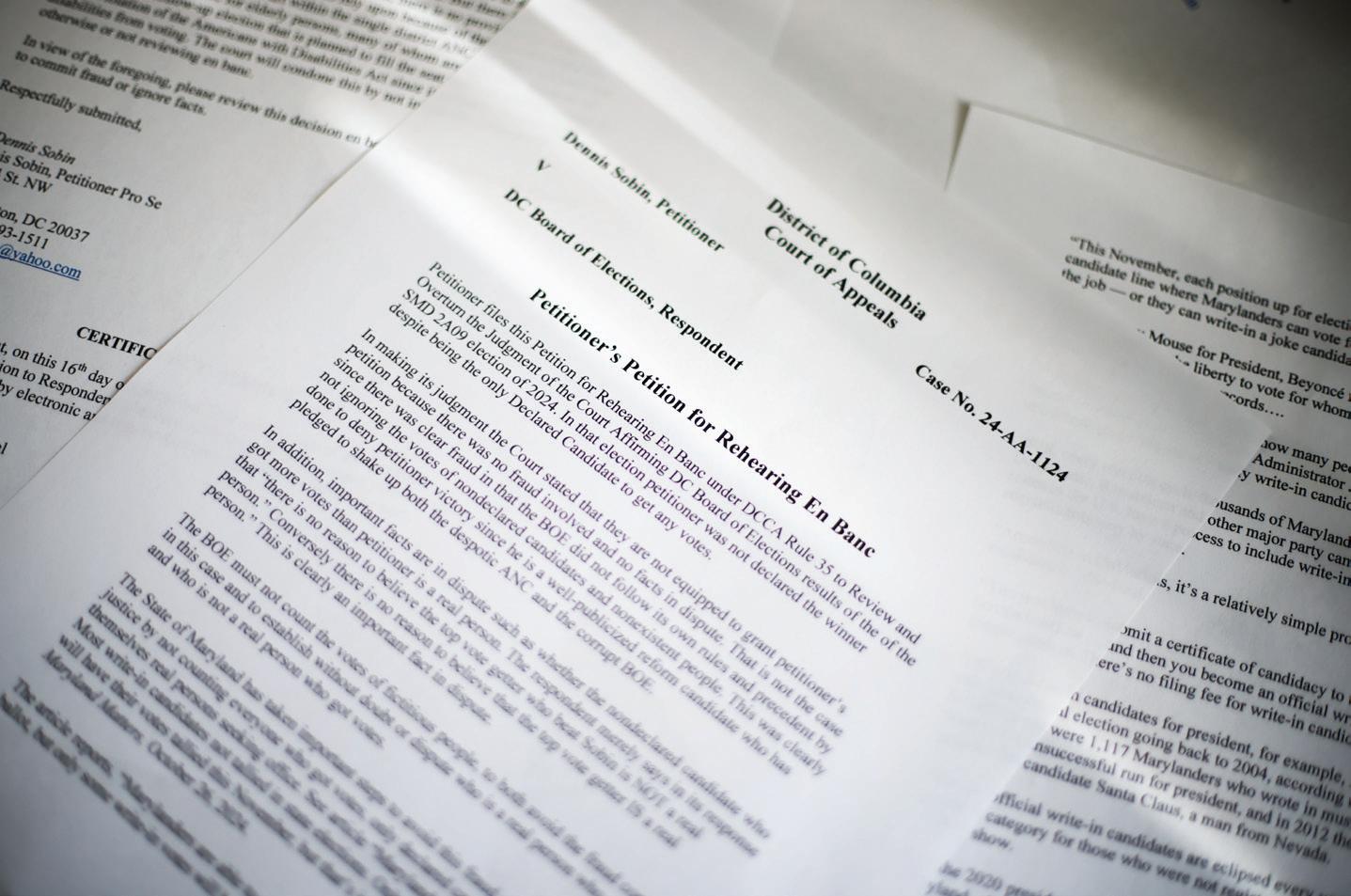
The D.C. Court of Appeals late last month denied a write-in candidate’s petition to secure a seat on a local governing body, officially rendering it unable to conduct official business due to its number of vacancies. A week after the D.C. Board of Elections announced in early December that two Foggy Bottom and West End Advisory Neighborhood Commission writein candidates did not earn seats in their uncontested elections because other unregistered write-in nominees received more votes, single-member district 2A09 candidate Dennis Sobin filed a petition to reverse the decision, according to D.C. Court of Appeals records. The judge’s Dec. 26 ruling blocking the petition will leave the 2A09 seat vacant along with four additional seats, preventing the body from operating in an official capacity.
The D.C. Board of Elections declined to comment on the D.C. Court of Appeals’ decision to dismiss the case. The District’s court documents in the case are not available to view on the appellate e-filing system.
The D.C. Code states that an ANC may declare quorum and take “official action” if the majority of its members are present. ANC 2A Chair Trupti Patel said in December that the ANC will hold monthly meetings to hear presentations
and community concerns, but the body will be unable to provide advice carrying the “great weight” authority allowed by the ANC Act of 1975 due to its vacancies.
Write-in candidates must complete a form declaring they will accept the position if elected and file the document with the D.C. Board of Elections at least seven days after the election. Sobin completed the form on Nov. 12, seven days after the election, which he argues in the filing makes him the only “legitimate” candidate eligible to win the seat, as the unregistered nominees who secured more votes did not submit the form.
Former ANC commissioners Yannik Omictin, Joel Causey and Evelyn Hudson
— none of whom ran for re-election — all received more write-in votes than Sobin with two, four and three votes, according to court documents obtained by 2A08 Commissioner Jim Malec through the Freedom of Information Act.
DCBOE said in an email to Sobin on Dec. 6 that the election represents the will of the people, and since Sobin did not receive the most votes, he cannot be declared the winner, despite being the only candidate to file the appropriate paperwork, according to an email attached to Sobin’s petition.
DCBOE filed a motion on Dec. 12 to affirm the board’s initial determination that Sobin would not assume seat 2A09, meaning
they believed the appeal raised no substantial legal questions. The DCBOE also filed a motion to strike on Dec. 12, and Sobin replied with a filed opposition to the motion and summary affirmation on Dec. 16.
On Dec. 26, the D.C. Court of Appeals granted the DCBOE’s motion to strike, upholding the decision to not certify Sobin as the winner of single-member district 2A09. Sobin then filed a petition on Dec. 27 for rehearing en banc, according to the U.S. Court of Appeals for the Federal Circuit.
The appellate e-filing system updated the cases’ status to “dismissed” and was affirmed by judgment on Dec. 26, according to the site.
“plan of action” to improve communication between the office and the SBA. She said Matthew plans to donate money to GW’s food pantry, The Store, following reports of law student food insecurity.
Lindsay said she has not been in communication with Belk “recently” and wants to continue talking with Matthew and GW Law Senior Associate Dean for Academic Affairs Steven Schooner..
“She was talking to Dean Schooner about the Professional Development Fund to see if they can put some money together, so there’s more action on her side, so it’s essentially going above Dean Belk instead of communicating to him,” Lindsay said.
SBA Sen. Rohin Balkundi said his “main gripe” with the Dean of Students Office’s efforts last semester was Belks’ indication that if the SBA complied with his regulations, they would receive the $10,000 for its professional development fund.
FRAUD 1D/FRAUD
Off Campus
Reported 12/19/24 – Multiple Dates and Times Open Case
A female student reported being the victim of fraud by another female student.
Case open
DESTRUCTION OF PROPERTY/VANDALISM
Guthridge Hall
Reported 12/21/24 – Unknown Dates and
Times
Closed Case
A male staff member reported vandalism involving damage to a wall and door. No suspects or witnesses
THEFT II/FROM BUILDING
Ames Hall
1/3/25 – 12:50 p.m.
Open Case
A GW contractor reported merchandise — including mouth wash, snacks and a toothbrush — stolen. The items were later recovered in a stairwell. Case open
SIMPLE ASSAULT (DOMESTIC VIOLENCE), HARASSMENT E-EMAIL AND ELECTRONIC MEDIA
Off Campus
Reported 1/07/25 – Multiple Dates and Times
Closed Case
A male student reported that a non-GW affiliated ex-girlfriend assaulted him on multiple occasions during their relationship in 2023. He and his parents said they received unwanted messages from the female subject recently. Referred to the Title IX Office.
LILY SPEREDELOZZI | STAFF PHOTOGRAPHER
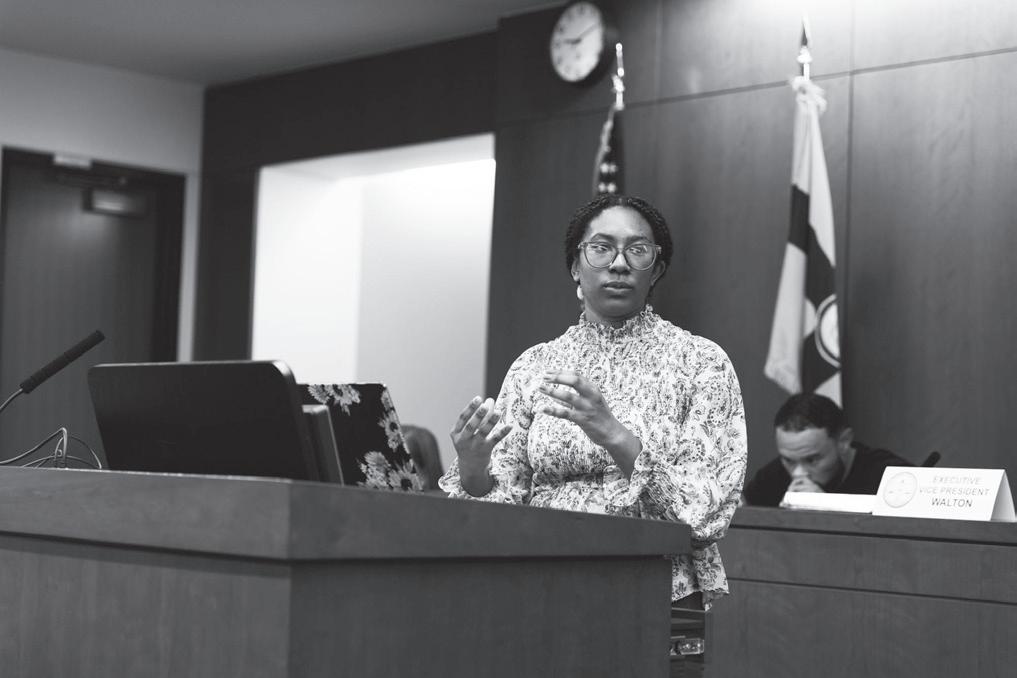
Student Bar Association Executive Vice President Nigel Walton speaks at a meeting in November.
Decline of trust in government split down party lines post-election: GSPM poll
A plurality of Americans have less trust in the government following the 2024 presidential election, with significant gaps between Democrats and Republicans, according to a Graduate School of Political Management poll released last month.
The poll, in partnership with New York-based consulting firm Schoen Cooperman Research, surveyed 800 American adults in November and found 39 percent of Americans said they have less trust in the government following the 2024 election. Lesley Lopez, an organizer of the poll and the director of the public relations and communications program at GSPM, said the results confirmed that people’s perceptions of the government and mainstream media are divided along demographic and partisan lines.
“This is our third installment of the trust in government poll and given the tensions around this very divisive election season, it made for the perfect topic to explore and examine,” Lopez said in an email.
The poll showed a gap in government trust between political parties and genders, with 61 percent of Democrats saying they have less trust in the government after the election and 58 percent of Republicans saying they have more trust in the government postelection. Only 17 percent of Democrats said their trust in government increased following the election and only 16 percent of Republicans said their trust decreased postelection.
Additionally, 43 percent of women said they have less trust in the government after the election, while 32 percent said they have more trust. About 37 percent of men said they have more trust in the government after the election, while 34 percent said they have less trust, according to the poll.
The poll also found that 69 percent of respondents felt online misinformation hindered their ability to access accurate news about the election during the campaign. About 45 percent of respondents said they did not trust the government or news organizations to give them fair and accurate information, according to the poll’s results.
The poll showed that Democrats
were more likely to trust news organizations than Republicans, with 28 percent of Democratic respondents saying they trust news organizations to provide fair and accurate information over the government, compared to only 15 percent of Republican respondents.
“Biggest takeaway is that we have confirmation of suspicions about just how divided the media consumption landscape is,” Lopez said.
The poll also found that the majority of surveyed adults under 40 rely on social media to get their news instead of traditional news sources. The poll found 18-29 year olds are more likely to get their news from platforms like TikTok and Instagram, while older groups are more likely to use Facebook for their daily news intake.
Political scientists said the results are a piece of a trend dating back to the 1960s showing declining trust in the government and media, which they said in recent years has increasingly split among party lines.
Robert Shapiro, a professor of political science at Columbia University, said declining trust among Democrats shows that they feel the election of former President Donald Trump means government institutions have failed them after the Jan. 6, 2021 Capitol riot. He said the postelection increase in trust among Republicans and men shows that the demographics that supported Trump on the presidential ticket are now more confident that the government will be effective under his incoming administration.
“The reaction that a political fig-
DANG REPORTER
MAGGIE RHOADS STAFF WRITER
Reported crime in the greater Foggy Bottom neighborhood fell by nine percent in 2024 after an uptick in incidents the previous year. Violent crime in Ward 2, which includes the National Mall and neighborhoods like Foggy Bottom, West End and Dupont Circle, dropped from 525 reported incidents in 2023 to 276 in 2024, and reports of crime in the bounds of the Foggy Bottom and West End Advisory Neighborhood Commission fell by 9 percent, from 478 reports in 2023 to 434 reports in 2024, according to Metropolitan Police Department crime data updated earlier this month. Police say new crime reduction initiatives contributed to the dip, which comes after the department reported heightened crime in 2023, while experts said it could be attributable to inconsistent data collection methods.
MPD Second District Commander Tatjana Savoy said between 2023 and 2024 the department implemented new crime reduction measures like Operation Ac-
tion Teams Leaving Areas Safer, Operation THRIVE and the Real-Time Crime Center under the command of Chief of MPD Pamela Smith, which she attributed to the lower incident reports. In ANC2A, which represents greater Foggy Bottom and West End, homicides and burglary plateaued at zero and six cases, respectively, in both 2023 and 2024. Motor vehicle theft, assault with a dangerous weapon, theft from auto and robbery in ANC2A also dropped from 2023 to 2024. Motor vehicle theft declined by 47 percent this year, and reports of assault with a dangerous weapon dropped from five reported instances in 2023 to two in 2024. Theft from auto in ANC2A declined by 27 percent, with 73 reported instances in 2023 and 53 reported instances in 2024, and reported robbery declined by 74 percent, from 27 instances in 2023 and seven instances in 2024. Other forms of theft, not involving a vehicle, robbery or burglary, increased by about eight percent from 314 reported instances in 2023 to 338 in 2024. Ward 2, which is comprised of 78,878 residents, had 4,726 total reported incidents of crime in 2024, the second-highest reported in-
cidents in the District. Ward 5 garnered the highest number of reported incidents, with 4,930.
In Ward 2, reported incidents of homicide, assault with a dangerous weapon, motor vehicle theft, theft from a vehicle, burglary, sex abuse and robbery decreased from 2023 to 2024. Incidents of vehicle theft and robbery had the steepest decline between 2023 and 2024, dropping by 38 percent and 54 percent, respectively. Reported incidents of arson in Ward 2 remained at one in 2023 and 2024.
The total reported crime incidents across categories in the District also dropped from 2023 to 2024.
The end of the year report from MPD states homicides in the District decreased by about 32 percent, from 273 incidents in 2023 to 187 in 2024.
Patrice Sulton, a GW Law professor and the director of the DC Justice Lab, a local criminal justice advocacy group, warned against attributing the decline in overall reported cases of crimes to a specific change. She said violent crime became widespread during the COVID-19 pandemic as a result of economic hardship, a trend that is reflective District-wide and nationally.
ure who incited a riot on January 6, 2021, could be elected president, is suggestive that our institutions have failed them,” Shapiro said.
“And that’s how those people probably viewed it and also genuine disgust with Trump.”
Shapiro said the declining trust in government is part of a trend that started during the Vietnam War — when the government falsely insisted the war would be quick — and has only worsened with increased partisanship. He said the poll shows that people are dissatisfied with the performance of the government, and government officials can improve it by bettering the quality of life in America through economic policies and enhanced messaging of those policies.
“If things turn around in the economy in particular, I think peo-
ple will start to feel better in general and that will be reflected in their attitudes concerning government institutions,” Shapiro said. “So it’s really based on the performance of political leaders in government.” Shapiro said the root of public distrust in the media comes from a focus on conflict and polarization in news organizations, which ties people’s personal beliefs to news stories and causes them to distrust outlets that report on issues they do not agree with.
“A lot of the distrust may have to do with the fact that in the media, you’ve really got the amplification of conflict in a way that really is really quite stunning,” Shapiro said. “And people are just basically tired of the perpetual, ongoing conflict conveyed and amplified with the media.”
Students propose economy, security policy for Ukraine in working group
An international affairs student organization is launching a working group this month for students to develop policy proposals for Ukrainian government officials.
The Alexander Hamilton Society at GW’s Ukraine Working Group, which is set to run from January to late March, will consist of a group of about 10 to 20 students who are passionate about international affairs and interested in Ukrainian policy and the ongoing Russo-Ukrainian War. Senior Oleksandra Pashkina, the project’s leader, said students will participate in self-guided discussions focused on economy and security policies for a post-war Ukraine.
“No matter where I am, I’m trying to do something for my country,” Pashkina said. “And so that probably was the main reason I wanted to make American students learn a bit more about this.”
Pashkina, a Ukrainian and an exchange student from a French university, said the group will host meetings every week and learn from experts in Ukrainian policy recommended to her from AHS’ national branch. She said the group will also visit the Embassy of Ukraine in D.C. Russia and Ukraine have faced decades of political and territorial strife, which escalated in February 2022 following Russia’s invasion of the country. Since the invasion, Ukraine has regained about 54 percent of its occupied territory, and the United States has sent the country more than $100 billion in aid.
Any student can apply to the group through a Google form that asks applicants to input their contact information and propose a brief policy recommendation for Ukraine before its Jan. 17 deadline. Pashkina said she will hold interviews with the applicants to help narrow down the candidates.
Pashkina said Russia’s attacks on Ukraine’s power grid last month have caused mass blackouts in Ukraine and disrupted its nuclear power plants, an issue the working group plans to address with their recommendations.
The group also plans to send their recommendations directly to members of the Verkhovna Rada, the Ukrainian parliament, who work on issues of the group’s “concern and interest,” through official forms and will request meetings with Ukrainian officials to discuss their findings, Pashkina said.
Pashkina said as a native Ukrainian, she feels “a bit sad” when she returns to Kyiv, Ukraine, because the reality of the war shows the “ruined destinies and lost lives” as more than 11,700 Ukrainian civilians have been killed since Russia’s
invasion.
“When you come back home, you see only one New Year’s wish for the war to end because it’s impossible to live in the war, and Ukraine is managing,” Pashkina said. Her personal connection to Ukraine fuels her fight for her country, she said, adding that the “spirit” and “bravery” of Ukraine inspires her to keep going and fight against Russia.
“I believe that every person should fight, in his domain,” she said. That’s why I’m trying to contribute through my domain because I’m not trained to go and serve in the army. It’s not for everyone and even not for every man. It’s very difficult, and I believe that people have to be trained for that. If you want this fighting to be successful, it should be done on all the levels.”
Foggy Bottom crime dipped in 2024 after jump in previous year
SAGE RUSSELL | SENIOR PHOTO EDITOR
The D.C. flag reflected on the window of a Metropolitan Police Department car.
LEXI CRITCHETT | ASSISTANT PHOTO EDITOR
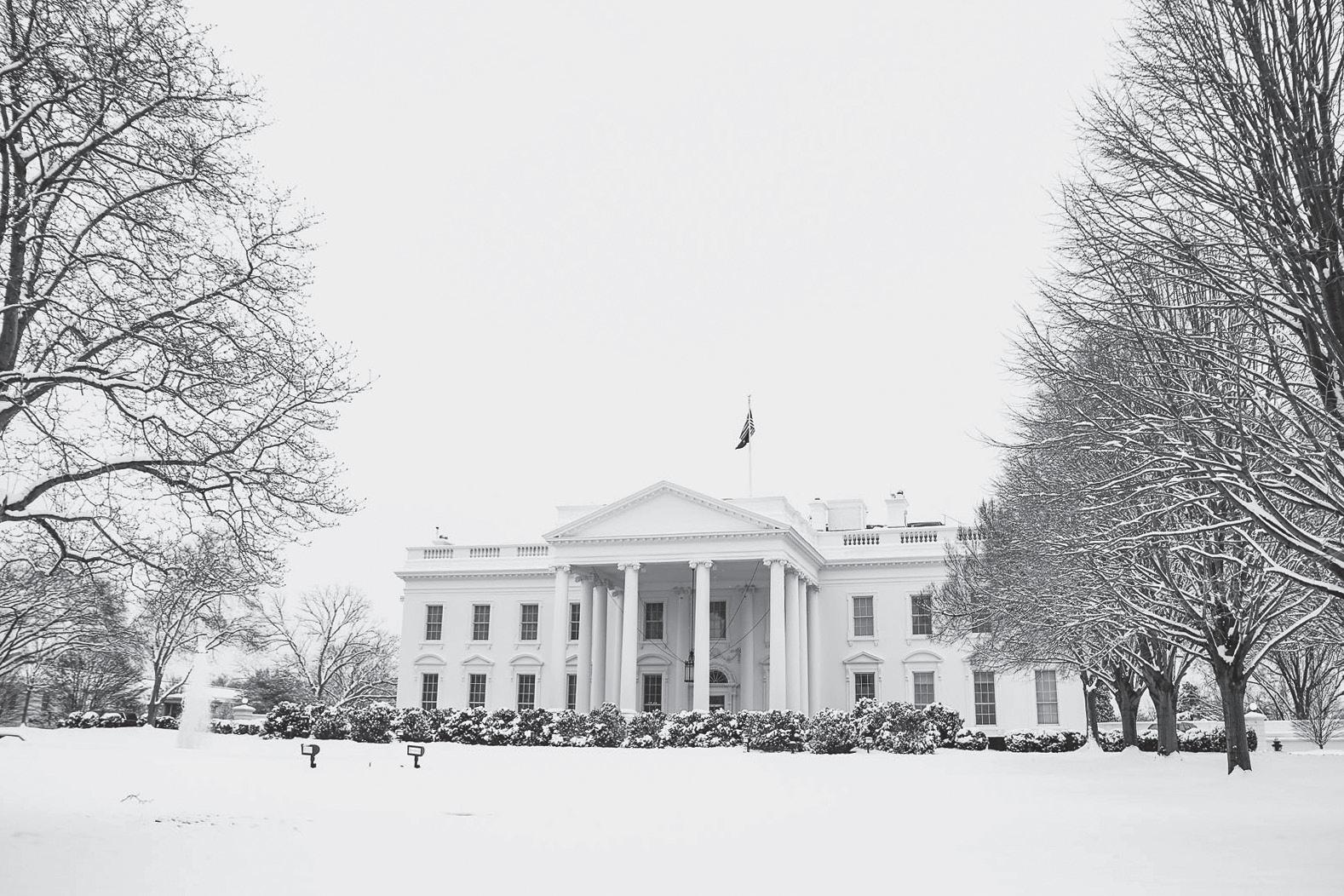
Snow blankets the White House lawn in January 2024.
KHANH
DYLAN EBS STAFF WRITER
COURTESY OF OLEKSANDRA PASHKINA Oleksandra Pashkina, the leader of The Alexander Hamilton Society at GW’s Ukraine Working Group
Irish dance group looks to de-stress sport, setting sights on future competition
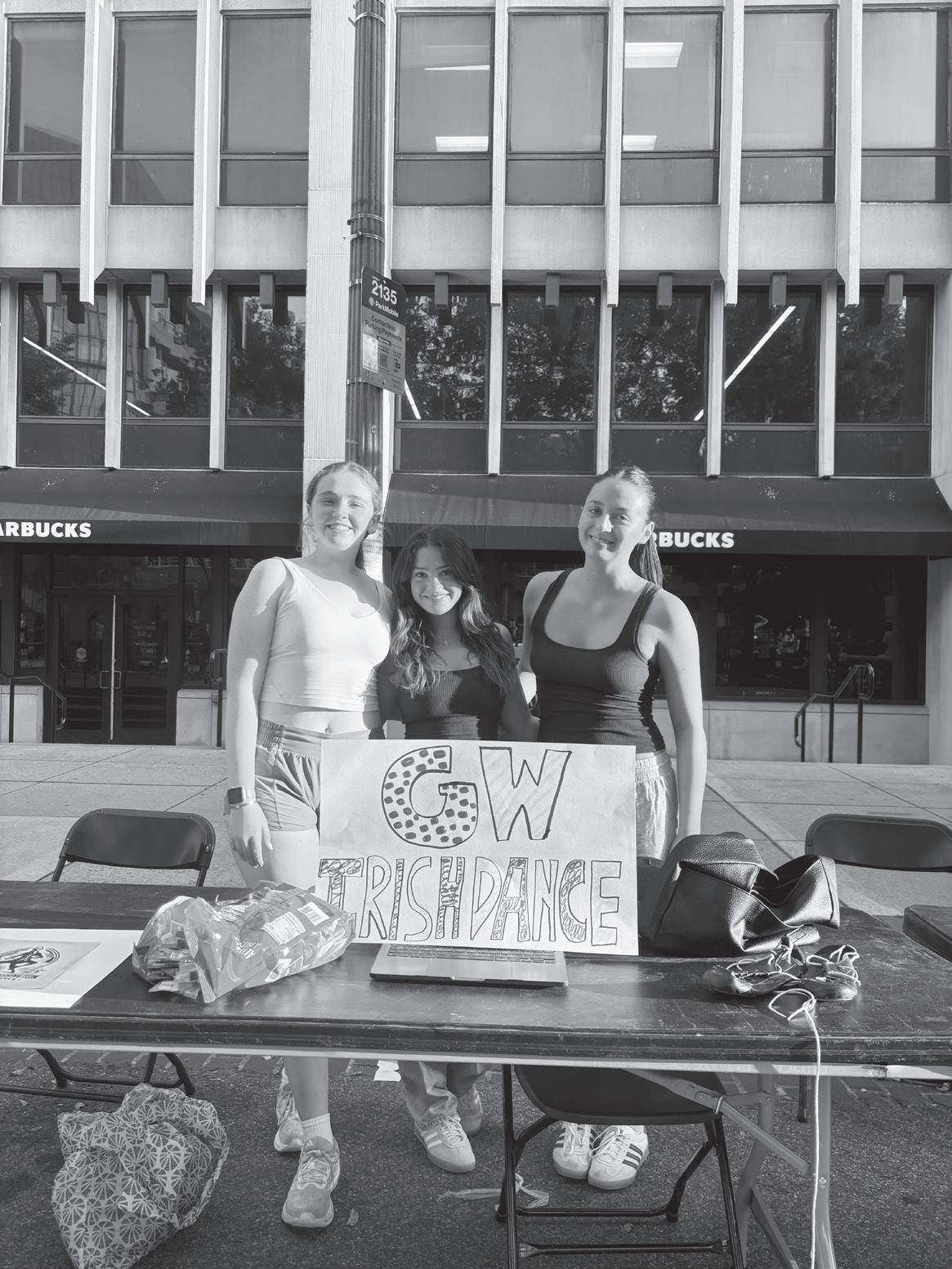
The lilts of fiddles and flutes began to sound through campus last semester as a newly formed Irish dance group hosted practices with hopes to perform at the collegiate level starting next fall.
The GW Irish Dance Club started hosting team practices once a month in September to teach and rehearse traditional sets in Irish step dancing like St. Patrick’s Day, The Blackbird and King of the Fairies to step dancers. Co-presidents Anya Spevacek and Lily Woloshin said they hope to foster an environment that differs from the “toxicity” and “competitiveness,” which they said veteran dancers often associate with Irish dancing and collegiate competitions.
Spevacek, a sophomore, said she hopes members of the organization can compete against other local colleges next academic year through the national Collegiate Irish Dance Association. She added that the competitions that the association hosts are more relaxed, and participants aren’t as focused on their scores or critiques from judges, as opposed to more intense competitions where dancers’ scores impact their future advancement of competitions.
“This isn’t the same competition that you went to when you were 10 years old, and you had a teacher yelling and screaming at you,” Spevacek said. “This is not that. This is us, we’re gonna go have a fun trip and get to go experience something all together.”
Spevacek said she wants the organization to maintain a laidback environment for dancers, in
contrast with the intense competition within the sport she said many veteran Irish dancers experienced growing up.
“I think just communicating that to people that have danced in the past and be like, ‘No, we’re not trying to bring up old memories or bad experiences. This is just for fun and just to kind of be with each other and do something that we all have a tie to,’” Spevacek said.
Most Irish step dancers begin competing at an early age after mastering the shoes, music and first steps of the sport, where they will be judged on their rhythm, technique, mastery of steps and styling. To qualify for the World Irish Dancing Championships, young dancers are required to place in the top percentages of regional and national competitions after performing three separate dances for nine judges and about one percent of dancers ever qualify as solo dancers.
Woloshin, a sophomore, said Irish dance is a “niche” sport which makes it easy for dancers to connect with each other because of its small population among students. She added that her and Spevacek bonded over their shared interest in Irish dancing upon coming to GW and met up on campus to dance together.
“I noticed that Anya on the GW students page for 2027 had a picture of her dancing, and I was like, ‘Oh my goodness, let’s see if we can get together, and maybe she’d want to dance sometime,’”
Woloshin said. “And then it slowly progressed into us wanting to recruit members who are retired dancers who still wanted to practice and get together on the weekends or weekdays.”
Woloshin said during initial recruitment efforts, the group reached out to students they knew danced as children in order to find people who shared the “universal” steps of Irish dancing like the jig and sets. She said the organization will be a space where all members will have a chance to teach each other as some dancers’ knowledge may differ from others.
“I think that’s the fun of the club, learning new things instead of repeating dances that have been engraved in our memories for years,” Woloshin said. “It’s always really cool to take a step back and let someone lead a new step that we haven’t seen before or aren’t too familiar with.”
Woloshin said the organization hopes to promote a relatable community for dancers by incorporating Céilí dances — a native Irish group dancing which can be traced back to the 1500s — like the Four Hand Reel and other traditional sets. She said these dances consist of “universal” choreography, so most Irish dancers already know the steps.
“Even though we haven’t rehearsed and practiced together, we can still meet each other and still know the same steps, which is pretty cool,” Woloshin said.
Spevacek said the dance group experienced difficulties booking consistent rehearsal spaces for their practices last semester due to high demand for rooms like the studio on the fifth floor of the University Student Center.
Student organization leaders expressed similar concerns last fall with limited availability and high rental fees for programming in spaces like Lisner Auditorium and the City View and State rooms in the Elliott School
Global Food Institute expands minor, adds four courses
SACHINI ADIKARI
CONTRIBUTING
The Global Food Institute introduced four new courses as part of its food leadership minor this spring.
The institute’s new courses include Food Leadership Capstone, Culinary Diplomacy, Global Food Institute Upper-Level Seminar and Systems Thinking for Sustainable Agrifood System Transformation. Faculty said the courses will allow students to see how food relates to fields of study like international relations and public health and encourage students to take the minor, which educates students on the food system and the life cycle of food, from the policies that have shaped food industries to agricultural approaches.
The food leadership minor now offers 27 courses after the program debuted last fall within the institute and offered 22 courses. José Andrés, a celebrity chef, restaurateur and humanitarian, founded the institute at GW in May 2023 with the goals of researching and improving global food security, sustainability and distribution.
Tara Scully, an associate professor of biology and the director of curriculum development at the institute, said the new courses provide students with experiential learning, shifting away from traditional test-taking to more interactive and fieldbased experiences, like visits with professionals in various fields like regional food systems.
Scully said she saw a high demand for more food-related courses when teaching both a nutrition course and World on a Plate, a course Andrés developed for the institute, where students expressed interest in having more diverse course offerings.
“Food connects everyone, it connects the world, and we want to make sure that if our faculty are interested, that we support them in incorporating food into their courses,” Scully said. “I think that this is going to be an ongoing process, it’s not going to be stagnant either, we’re constantly going to be looking out for new faculty who are interested in working with us and incorporating food into their
of International Affairs. Last semester, officials announced three new rehearsal spaces for performance-based organizations located on the lower level of the student center, which some student leaders called “impractical” due to thin curtains dividing the room that allow sound to escape.
subject matter.”
Scully said the institute is growing rapidly because it aims to fill gaps in course offerings at the University with classes centered on food. She said the institute plans to engage with professionals within the next calendar year to develop eight more courses centered on subjects like food journalism and regenerative agriculture, so students from any major can connect their interests to the minor and jobs in food systems.
“What’s great about what we’re looking to do, including the two courses that we’re offering that are new this semester, is looking to professionals who are out there doing this work and bringing them in to teach our students and show them how it can relate to a future career and talk about their career paths,” Scully said. Mya Price, an assistant professor who teaches Food Leadership Capstone and GFI UpperLevel Seminar, said the two courses will push students to integrate research to discuss food system solutions and develop their careers with opportunities to publish research in journals and articles.
Price said the final capstone class for students in the minor will be a “deep dive” into a specific area of interest and produce research projects in collaboration with faculty members within the institute and community organizations. Price said the upperlevel seminar course will focus on the food movement and challenges in the United States food industry, from understanding
agriculture from a domestic and global standpoint to discussing federal programs and how they relate to nutrition.
She said her work with Indigenous communities, Black farmers and farmers of color allows her to bring perspectives on the different levels of the food network to her courses.
“I think a lot of times it’s so easy to think, ‘I need to explore what is happening at the national level,’ without really understanding at a deeper level what’s happening in our own backyard, here in D.C. or in rural communities or in urban communities across the nation,” Price said.
Sam Chapple-Sokol, an adjunct professor within the institute who teaches Culinary Diplomacy, said the course will show students how food is used as a form of “soft power” within governmental or interpersonal relationships, whether it is heads of state using food as a tool to entertain and reach agreements or individuals using food every day to interact and correspond.
“Whether you and I are meeting over a meal, or heads of state are meeting to decide the fate of a treaty, it’s usually done over a meal,” ChappleSokol said. “What’s on the table can be just as powerful and just as important in having us see eye to eye or having us reach agreement.”
Chapple-Sokol, an as-
sociate of Andrés and former White House Pastry Chef during former President Barack Obama’s administration, said there are a lot of courses focused
on the policy and innovation pillars within the Global Food Institute but not a lot of focus on the humanity aspect yet. He said his course focuses heavily on the humanity pillar by emphasizing storytelling and understanding how food brings people together.
“I’m really excited to bring that element to it, where we can talk about history and food studies in a way that isn’t taught at very many universities around the country,” Chapple-Sokol said. “There’s only a handful of schools that are talking specifically about food and agriculture policy or sustainability policy.”
Chapple-Sokol said there are many instances around the world where leaders have used food as a way to increase soft power, like in Thailand where pad thai was invented by the King of Thailand as a national dish in the 1940s and how there are now Thai restaurants all around the United States because of a “push” by the Thai government to gain visibility around the world.
“There are cases all around the world of governments who decided, ‘Hey, I want to double down on food as our selling point, to increase soft power, to increase tourism, to increase trade,’” Chapple-Sokol said. “All of that stuff is happening whether or not we’re looking and the fact that there are not very many opportunities to learn about that in the country or around the world can be remedied and that’s what I’m hoping to do with this class.”
“We know if there’s an empty room in the USC, we’ll use it,” Spevacek said. “Maybe we’re not dancing in our dance shoes, but we’re still gonna dance if it’s in our socks, if it’s in our gym shoes. We still want to get that time together and have that community experience.”
Student Bar Association President Cherissa Lindsay shared updates on the body’s efforts to secure funding through the Dean of Students Office, the Student Government Association and ticket sales at an online meeting Tuesday night.
SBA Sen. Omer Turkomer, the chair of the SBA Finance Committee, said the body received additional funding this year from the SGA’s allocations, but the Dean of Students Office has not yet added the money to the SBA’s budget. He said the SBA has had a “disagreement” with officials from the Dean of Students Office about whether or not that money would be added but did not specify the nature of the dispute.
“When we spoke with the Dean of Students Office, we were told that our budget wouldn’t be increasing, even though we’re getting additional money,” Turkomer said.
“We’re speaking with University admin, not necessarily Law School University admin, to try and get some more clarification on what exactly is going on.”
Turkomer said the SGA allocates “a portion” of funding to the SBA budget each year. He said the SGA Finance Committee told him the SBA was supposed to receive “a little bit more” funding from the body than they were initially allocated at the start of the fiscal year on June 31. Turkomer said he plans to provide updates to the body on SBA finances “as they come,” and he will continue to meet with officials during the spring semester.
Lindsay said the body raised an additional $20,000 for the SBA’s Barrister’s Ball — an end of year formal gala event for law students — from ticket sales for the school-wide Halloween celebration in October, which brings the event’s budget to $75,000. She said the event will likely take place on April 5 but may change once the planning committee solidifies the venue.
The SBA held last year’s Barrister’s Ball at the International Spy Museum in D.C. on March 1. Former SBA President Shallum Atkinson said tickets for last year’s ball sold out among students in “record time.”
Lindsay said she met with GW Law Dean Dayna Bowen Matthew at the end of the fall semester to work on “redefining” the SBA’s relationship with the Dean of Students Office after heightened tensions last semester following Dean Jason Belk’s alleged lack of response to the removal of pro-Palestinian posters and increased requirements for ad-hoc funding approvals. Belk advised the SBA not to take action or release a statement in response to reports of someone tearing down pro-Palestinian posters, but SBA Executive Vice President Nigel Walton released a statement condemning the removal of the posters on behalf of the SBA executive branch. Lindsay also said the SBA will hold the annual election on Feb. 23 to elect the incoming president and executive vice president for the term starting in April. She said the election for the two positions will be open to all law students.
The next SBA meeting will be held Tuesday, Jan. 21 at 8:50 p.m. in the LLC.
COURTESY OF ANYA SPEVACEK
From left to right, GW Irish Dance Club members Anya Spevacek, Lily Woloshin and Bella Teasdale in fall 2024.
KIM COURTNEY | PHOTOGRAPHER
Students prepare meals in the World on a Plate class in September 2023.
RAPHAEL KELLNER | STAFF PHOTOGRAPHER
Student Bar Association President Cherissa Lindsay speaks during a meeting in October.
Faculty senators probe officials on MFA finances, Cedar Hill hospital staffing
SMHS Dean and former MFA CEO Barbara Bass claimed during the senate’s December meeting that the Washington Post’s reporting last month that the MFA’s past pledge to provide the hospital with 160 clinicians was an error and the staffing plan is “not complete.”
Granberg said on Friday that she isn’t aware of which specifics of the report Bass felt were incorrect, but she said some of the information that was quoted in the Post report about the staffing plan was “not the way” she understood it.
Granberg also responded to a question from Wirtz about the MFA’s current financial status by saying that there has been “progress” with getting the MFA’s finances back on track but said she can’t speak about the specific details.
“There is movement, and I do see that we’re going to be getting toward a resolution of some type in the next few months,” Granberg said. “I just can’t talk about the details of it right now.”
Chief Financial Officer Bruno Fernandes said officials are still “working through” the numbers regarding the results of the MFA’s FY2025 Quarter 1 and 2 performance and expect to provide an update at the March Faculty Senate meeting.
Fernandes delivered both the FY2024 MFA financial report and last year’s Q1 and Q2 financial report in executive session, meaning all non-senate and non-administrative attendees were required to leave during that segment of the meeting.
Wagner said the EPT Committee has for “several years” spoken with Vice Provost for Enrollment and Student Success Jay Goff about
concerns that the University is unable to meet every student’s financial aid needs while the MFA is still losing millions of dollars that seems to be “amounting to nothing.”
She asked Granberg who is responsible for deciding when the MFA’s losses are “too much” and how officials are accounting for the losses’ potential impact on students’ financial situations.
Granberg responded that the MFA’s “senior leadership” and Board of Trustees are responsible for making that decision and added that “everyone” is in agreement that the MFA’s losses are “unsustainable.” She said the solution to resolving the losses is “not a quick
‘Sudden and tragic’:
From Page 1
Bourbon Street reopened to pedestrians a day following the attack with a heavy police presence and makeshift memorials of flowers and candles lining the street, NBC News reported.
Hanley said she thought that D.C. would be a more dangerous place than her hometown when she moved to Foggy Bottom two years ago because of the District’s inherent political tension as the nation’s capital. She said there was gang vio -
one” but said officials are working as quickly as possible to get the MFA on stable footing.
She said finding stability and solving the MFA’s ongoing debt problems may not be the same task — in what appears to be the first time Granberg has publicly suggested that the MFA’s financial stability and GW’s solution to its losses may not be correlated.
“We are all in agreement that that is something that we all want to see happen, and so as soon as we can bring stability and resolution to the MFA, the two are not necessarily connected, but everybody agrees that we need to bring stability to the MFA without a question,”
Granberg said. Interim Provost of Research Bob Miller also presented the University’s annual research report, which stated that GW ranked No. 26 in patents per research expenditure among U.S. universities and earned $330,000 in new venture competition prizes.
The report also stated that there was a jump in non-federal expenditures as the University’s ranking in total expenditure rose from No. 106 in FY2022 to No. 88 in FY2023. Miller attributed the hike to a new reporting process where the University counted its “institutional investments” as expenditures.
“In the past, we had undersold
ourselves as an institution because we were not recording our institutional investment in graduate students, in tuitions, in a whole variety of activities,” Miller said. “So if you look at that big jump, that jump is as a consequence of counting and looking effectively at our institutional investments.”
The University’s federal research expenditures rose from about $161.87 million in FY2022 to about $162.89 million in FY2023, but GW dropped from No. 95 to No. 98 in the National Science Foundation’s Higher Education Research and Development Survey in FY2023, according to the report.
GW had previously dropped from No. 91 in FY2021, which drew concern from faculty senators last year, along with delays in research approvals. Miller said the University was able to “streamline” the approval and review process for human-subject research this year from 45 days to 15 days, which should address delays in research approval.
Miller also said there is “trepidation” among faculty about the status of federal funding sources with President-elect Donald Trump’s incoming administration and that researchers must be “flexible.”
“It’s not clear what’s going to happen over the next four years,” Miller said. “There isn’t an impact in the next few months, but potentially we have to be ready to be able to respond to changes in the opportunities that are coming through our external funders.”
Faculty senators also unanimously voted to amend the senate’s bylaws in order to change the wording of a 2023 resolution that tweaked verbiage in the Faculty Organization Plan to be more inclusive and reflect the phrasing of a similar Faculty Assembly resolution.
Students process early morning Bourbon Street attack
lence and shootings when she worked the French Quarter, but she would have never expected violence of this nature to occur, especially in a tourist-dominated part of the city.
“When I think about New Orleans, it’s definitely not known for being a safe city, but you would never think that it’d be the site of a terrorist attack, especially on Bourbon Street,” Hanley said. “It would be the last place that I would anticipate anything like that to happen.”
Sophomore Mary Napoleon, a political science
student, said she was at home in eastern New Orleans when she heard of the attack because of a flurry of texts that night from her friends and roommates from GW asking if she was safe.
“I checked the news and saw my newsfeed and family group chats flooded with concern,” Napoleon said in a message. “I was shocked, but even more confused that something so sudden and tragic would take place in the heart of the city.”
Napoleon said she felt sadness and fear after hearing of the attack, and said she was concerned
not just for the victims but also for the New Orleans residents left “traumatized” from it.
Junior Krish Sadhwani, who lives in the Algiers neighborhood on the west bank of the Mississippi River, said a member of his family had just closed the convenience store they own on Bourbon Street when the attacker’s truck collided with a nearby crowd. Sadhwani said his family member’s store, as well as other businesses on Bourbon Street, started normal operations the day after the attack following the FBI’s initial investigation.
“I think once people found out that it was a terrorist attack, and there was an ISIS flag, people became more scared and more startled that this was happening so close to us,” Sadhwani said. At the time of the incident, New Orleans was in the process of renovating the security bollards that guard Bourbon Street from vehicle traffic, temporarily replacing the security measures with police vehicles that worked to but did not prevent the suspect from entering the area. Sadhwani said the city should’ve expanded its security in the area
as a precaution because people often go out to celebrate the new year.
“People in the city should have been paying more attention to things that were happening,” Sadhwani said. “I feel like because the city didn’t do that, things like this can happen.” He said New Orleans is resilient when faced with adversity. The city “always comes back,” he said.
“We won’t let something like this really stop us from continuing to do our day-to-day,” Sadhwani said. “New Orleans is strong.”
Trump administration could imperil federal financial aid, DEI efforts: experts
Cecil said University leaders may not be able to prepare for Trump’s second term because there are “so many” proposed policies that Trump has promised to act upon.
“We have a bit of a playbook from how the first Trump administration approached higher education,” Cecil said. “We don’t know that that will be the same in Trump 2.0, and so what I think that means is that institutional leaders really have to be prepared for anything.”
Financial aid and student loans
Project 2025, a sweeping policy blueprint for the next Republican president penned by the conservative Heritage Foundation, calls for the elimination of Biden’s student loan programs, the public service loan forgiveness program and the privatization of all lending programs.
Cecil said the Trump administration will likely shake up current student financial aid and loan policies because Trump has been openly against Biden’s student loan forgiveness plans and has the authority to revoke or replace executive orders made by past presidents.
He said “several” of the Biden administration’s repayment plans for student loans are actively being litigated and will “likely not” be enacted by the Trump administration, including Biden’s plan to lower monthly payments and shorten the time it takes to receive student loan forgiveness.
“What that means is for students that take out loans to go to college that it could be potentially, you know, more challenging for those to be repaid afterwards,” Cecil said.
3,171 undergraduate students at GW — 29 percent — received
federal loans in the 2020-21 academic year, which is nearly half of the national rate of about 60 percent of undergraduates at other private nonprofit institutions who borrow federal loans.
Cecil said Trump would have to go through Congress for certain education policies, including eliminating any loan forgiveness provision, so the likelihood of passing legislation that would significantly change higher education is small. Despite Republicans controlling both chambers of Congress, the House’s Republican majority is “really slim,” and there are varying perspectives within the party toward education, he said.
“Just because there’s a majority there doesn’t necessarily mean that that majority is going to be able to push something across the finish line and over to the Senate,” Cecil said.
Diversity, equity and inclusion
GW met diversity and enrollment goals for the Class of 2028 despite delays in federal aid applications and the Supreme Court’s 2023 ban of race-based affirmative action in college admissions. In his second term, Trump said he plans to eliminate DEI-focused initiatives at the federal level and cut federal funding for schools that teach curricula surrounding the principle.
Linda McMahon, Trump’s pick for education secretary who has yet to be confirmed by the Senate, serves as the board chair for a right-wing think tank founded in 2021 to help develop Trump’s public policy plans. The institute has previously advocated for strategies to dismantle DEI initiatives on college campuses, including defunding DEI offices, ending mandatory diversity training and prohibiting diversity statements, particularly for public universities in majority-Republican states
where such changes may be easier to enact than in liberal states.
As president, Trump can sign executive orders and appoint judges who may influence the outcomes of present and future DEI-related cases, which could reshape the legal landscape around DEI policies.
David Blazar, an associate professor of education policy at the University of Maryland, College Park, said there are different ways the Trump administration can “rein in” DEI initiatives in the college admissions process and the accreditation process. He said if the college accreditation process, which evaluates a college’s quality and educational experience, and a university’s board was politicized and leaned more right, higher education institutions’
federal funding would be dependent on them eliminating DEI initiatives.
“There are some pathways through which Trump may be able to reign in his administration, may be able to reign in DEI initiatives, but not all of them are going to be legal,” Blazar said. “The court system and legal teams I think will play an important role in this next administration.”
Department of Education
The Department of Education establishes policy, administers programs and enforces laws involving federal financial aid and student loans for students. Trump said he plans to disband the department, which could move or cut certain initiatives including the U.S.’s federal student loan
program and civil rights laws that bar discrimination at schools.
Blazar said there would be “severe consequences” for the American education system if the department were shut down, but added that it’s “unlikely” it would be dismantled because its initiatives are “very popular,” and Congress would have to approve it, requiring 60 of 100 senators’ votes. Republicans will have 53 senators in 2025.
Blazar said the Department of Education could still be “slimmed down” under Trump if not shut down, which could impact the federal student loan program and the accessibility of loans for students and families because the department is responsible for administering federal student loans for higher education.
DANIEL HEUER | STAFF PHOTOGRAPHER
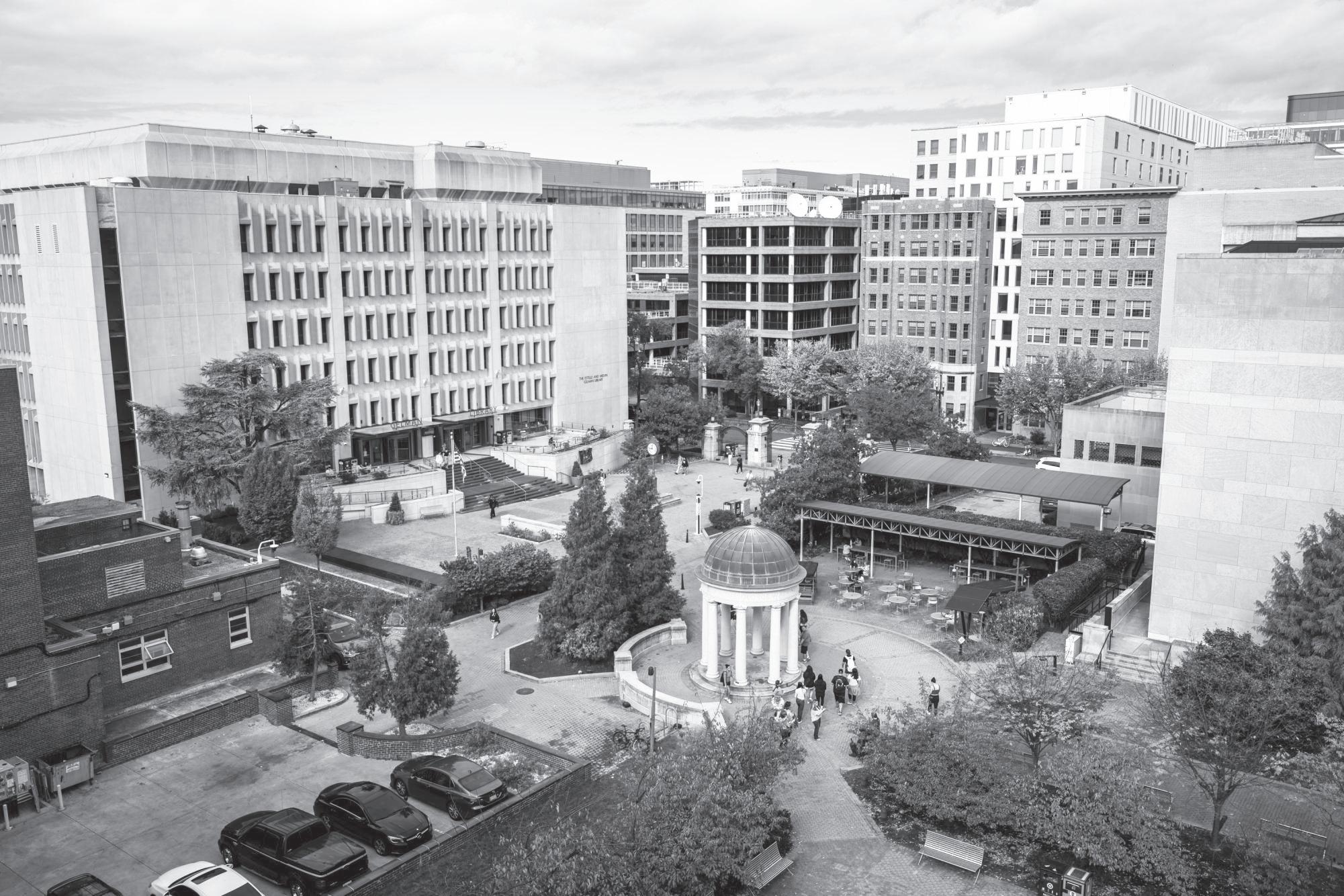
Students study and walk through Kogan Plaza.
ARWEN CLEMANS | ASSISTANT PHOTO EDITOR
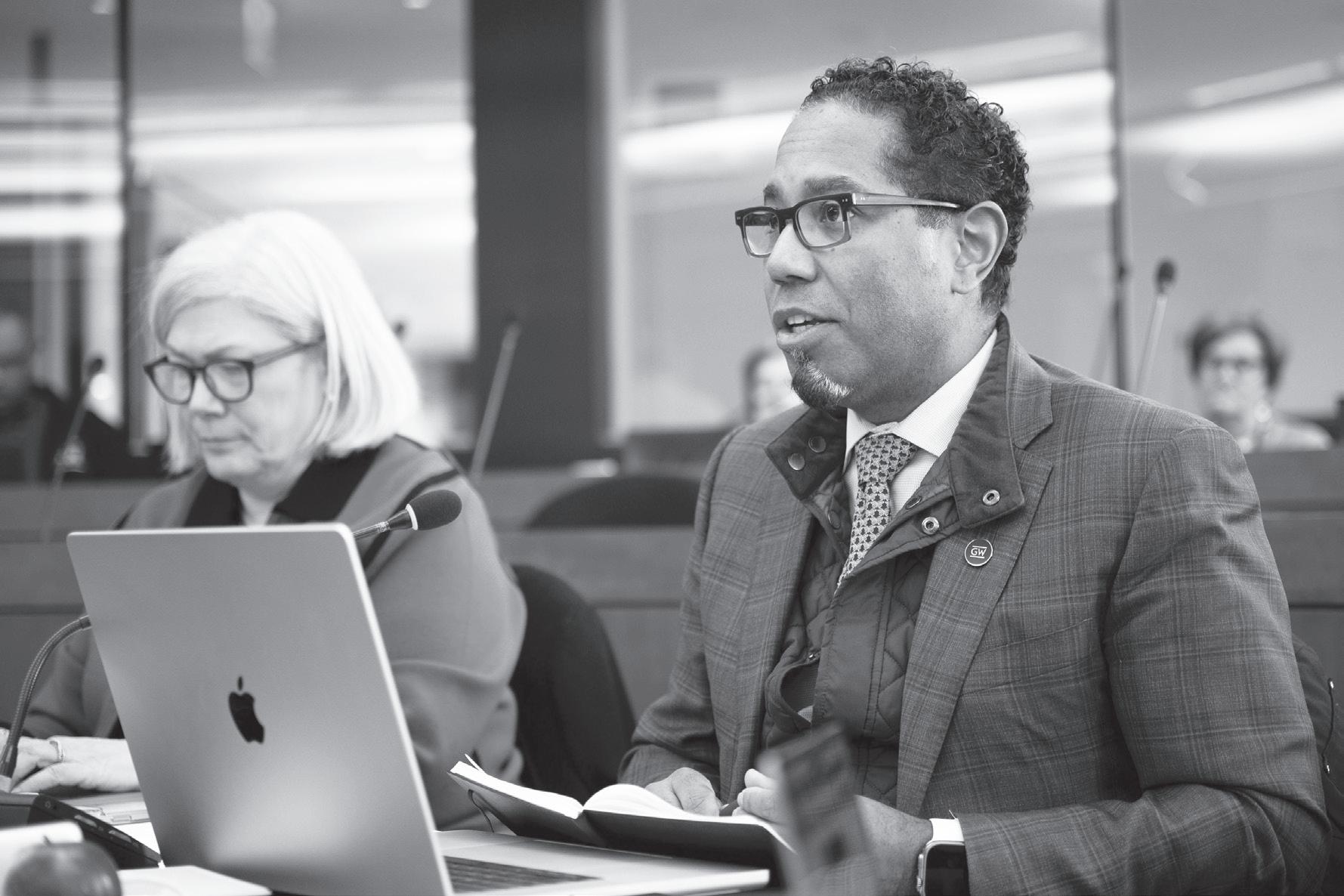
Provost Chris Bracey speaks at Friday's Faculty Senate meeting.
From Page 1
From Page 1
OPINIONS
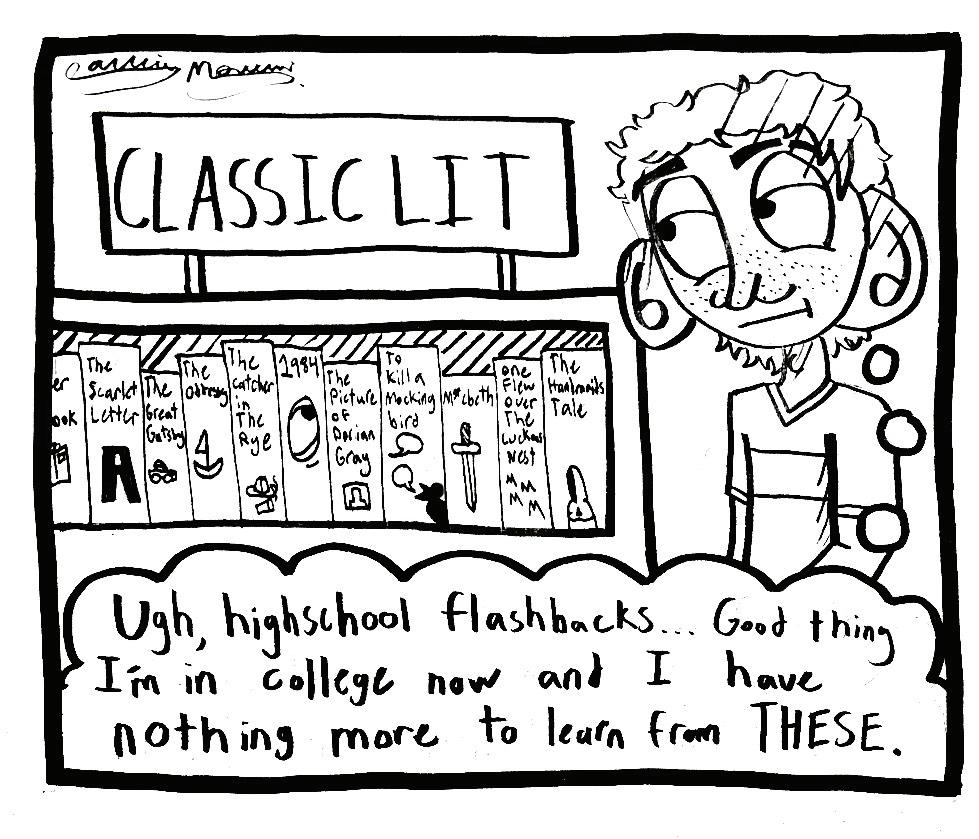
Speaking to the Columbia University Class of 1968, professor Richard Hofstadter called college “a community devoted to inquiry.” GW and its students must recenter the classics of the humanities to live up to that.
In the past decade, there has been a worldwide decline in humanities studies, the majors and classes that often teach classical texts like the Federalist Papers or even Harper Lee’s “To Kill a Mockingbird.” As technology and artificial intelligence flourishes, the study of art, history and literature feel obsolete.
President-elect Donald Trump and Republicans are staging an all-out war on half of the world’s great literature. And many of the most foundational takes on those ideas come from the classics. GW isn’t a copy-paste university from Columbia — at times, the University is closer to a political trade school than one that necessarily promotes intellectualism. But that doesn’t mean it’s any less vital for students here to get and take the chance to read the classics.
Amid all the change and turbulence we expect to see in higher education in 2025, the University needs to meet the moment by ushering in more course offerings and opportunities that expose students to core texts. We hope our professors will show our peers the value of such readings by revealing the fingerprints of great thinkers and writers on today’s news and culture, and we hope our classmates will dive in to such literary exploration with enthusiasm. Whether it is a deeper understanding of differing ideologies and crucial historical context or introducing the effects or starting points of a genre or literary movement — studying,
FROM GWHATCHET.COM/OPINIONS
“In a strange way, having to explain my multicultural upbringing to people has made me reflect on and appreciate my background more than I ever did before.”
—CAROLINE MORRELLI on 12/09/2024
Let’s not leave the classics on the bookshelves
STAFF EDITORIAL
analyzing and writing about the classics only strengthens reading comprehension and writing skills.
A few years back, GW decided to invest more into STEM disciplines, cutting and redistributing funding in part because of STEM’s increasing dominance in the research and job markets and the discipline’s traditionally higher in-
comes. The move harmed humanities students and faculty in ways that have persisted in the present day with understaffed humanities departments, like the libraries and the Department of Religion — which heavily focuses on classical religious texts.
But it is not just an institutional matter. Professors and students
Embrace bite-sized goals to find growth in the New Year
As 2025 begins, so do New Year’s resolutions. It often begins with lofty yet noble goals — eating healthier or taking up a new language. But in my three years at GW, I’ve noticed that smaller goals have as much of an impact on my life as bigger resolutions.
I was inclined to chase bigger goals for most of my teenage life but as each year went on those plans never stuck. I concluded that I didn’t have the discipline or patience to work out for two hours every day. So in high school, I gave up on resolutions.
Embarrassed by my yearly defeat, I decided to aim for much smaller, simpler resolutions. In my freshman year, I was considering giving up my participation in the opinions section at The Hatchet because I hadn’t yet written anything.
In an attempt to write more, I decided to write at least three pieces throughout the spring semester. I ended up writing four pieces that semester, which isn’t a whole lot, but it did help me slowly become more comfortable in my own voice. I remember my earlier pieces were always vague, but I slowly started growing more confident in my writing. I still get shy at times, and I know that I have written my fair share of run-on sentences, but I feel confi-
dent in my growth. As the year progressed, I started writing more consistently, and my previous editor announced The Hatchet was looking for new opinions editors. At the time, I was certain I would never apply. Even though I had made it a goal to be more involved in The Hatchet, being an editor just seemed way out of my reach. When applications and interviews for the position rolled around, I still wasn’t convinced, but I had committed to being more involved and tossing my name in the hat for the position seemed to fulfill that.
It may be obvious given my byline, but I did end up getting the job. It’s now a huge part of my life, but taking such a large leap was an amalgamation of much smaller steps, having bitesized goals made it easier to forge a path toward significant change in my life. I have always enjoyed writing, but I was never confident, there was always doubt lingering in my words and opinions. It’s not that I never get shy or nervous anymore, but I’ve built trust in myself and my writing. . I applied the same idea to my classes and major last year. I have always been interested in creative writing. I never expected to fall in love with it, but all it took was taking one fiction writing class. I didn’t have to commit myself to any unreachable goal. I don’t feel scared anymore in the face of doing something new, or in this case.
Last year I also took a
feature writing class that was mostly intended for upperclassmen. My professor even warned me that it was a rigorous course and that it may be harder to keep up as a sophomore — I was scared. I took the opportunity and the course ended up being one of my favorite classes, with now one of my favorite professors. I trust my writing abilities more but that came after trying again and again after several mistakes.
In the New Year, we’re inclined to chase those ambitious goals that will make that perfect life we’re envisioning. But sometimes the enormity of those goals makes them harder to complete. Smaller goals serve as stepping stones to those bigger changes. There’s nothing wrong with keeping those large goals, but we shouldn’t discard those smaller promises, because they add up . I still get scared, make grammatical errors and need to do more work on my self-esteem. But when I look back to my freshman year, I see my growth and feel different than the girl who wouldn’t utter a word in class or the girl trying to sink into her seat during her section meetings. My growth and satisfaction in myself didn’t happen in a few weeks or months or come about by big ambitious goals, it happened through the years after a series of smaller goals. —Andrea MendozaMelchor, a junior majoring in journalism and mass communication, is the opinions editor.
need to seek out these pivotal texts. A student interested in political science probably has a basic familiarity with the top news story of the moment, and breaking that down in class can only add so much. What’s less likely is that the student has had the Federalist Papers or the works of William Faulkner taught to them by a
scholar steeped in those words — an experience that can only come in college and that GW students need to take advantage of.
If professors don’t put core texts in terms that students can and will want to engage with, then even the most genius literature will seem outdated and irrelevant today. We encourage faculty to position a text as the centerpiece of a class to promote sweeping discussion that analyzes not just a select few passages, but the myriad of literary corroborations and counterpoints that surround such texts.
We as students don’t do enough to understand the value of the classics and the way they intersect with multiple disciplines, like the way that J.R.R. Tolkien birthed modern fantasy novels or philosopher John Locke’s ideas influenced the Declaration of Independence. Any idea has probably been thought before, and it’s easier to understand the world and marketplace of thought around us if we expose ourselves to those past pivotal writings.
Many of us in our generation strive to be genuine and wellinformed, sometimes even revering the past with collections of vinyl records and thrifted books, clothing and furniture. We should match that energy at school by reading the book that catalyzed the science fiction genre or the texts that served as the building blocks of modern politics.
The decline of the humanities — and with it, its core classical texts — has been happening for over a decade, despite the resilience of the literature in question. In 2025, GW must not fall victim to this trend, but such a feat will demand the effort of everyone in the University community.
Attending Trump’s inauguration would compromise my morals
Months ago, GW students — many of us first-time voters — grappled over selecting a presidential candidate who reflected our view for the direction of our country. And now, with the election results certified and President-elect Donald Trump gearing up to return to the White House, the community is faced with the question of whether or not to attend next week’s presidential inauguration.
Mara Riegel Opinions Writer
For many, the inauguration offers a frontrow seat to history. It’s the second time in American history that a former president will re-enter the Oval Office. But, to me, attending next week’s ceremony is a tangible symbol of support for a man who would never support my identity.
I did at one point consider attending the ceremony. I realized the event would happen with or without me, so why not observe history? But then I thought about what I was taught as a child about one’s physical presence is a sign of support in and of itself.
Trump has encouraged racism, sexism, homophobia, xenophobia and other forms of hatred, shedding light on the prejudiced beliefs that some of our peers, neighbors and
family members embrace. His language toward immigrants and he has repeatedly failed to respect communities of color.
In showing up for Trump at the inauguration, you show publicly that you stand with hateful policies, like his attempt to terminate Deferred Action for Childhood Arrivals, or his termination of temporary U.S. protection for Haitians after an earthquake caused them to leave their country. Attending his inauguration says you are in agreement with the values that got Trump to the steps of the Capitol building.
The president-elect is a civilly liable sexual abuser, as was found in Trump’s case against novelist E. Jean Carroll. There are at least 26 additional women who have come forward publicly claiming he sexually assaulted them, too. Attending an inauguration of a man who doesn’t agree that I should possess the rights to my own bodily autonomy feels like I’ve lost something larger than the presidency.
Whether or not someone attends this ceremony should come down to if you want to support a man who has driven a wedge into the soul of this country. What message does it send to my loved ones that I, a queer, assigned female at birth, Jewish and disabled person, will attend the inauguration of someone who opposes all of my identities and experiences?
Many will say attending Trump’s inauguration is
a rare opportunity and that its historic value outweighs the character of the president that is being inaugurated. There is value in witnessing history but that value is negated by the fact that you tarnish your conscience in the process by supporting someone who, in all likelihood, wouldn’t support you back. Trump has even used crowd sizes as a metric of his success, mostly in the context of rallies.
As college students, we are all young, newly anointed adults, and every action we take from here on out tells the rest of the world what kind of priorities we hold for ourselves. If we begin to make certain choices now, they will shape the people we are in a permanent way, either reinforcing what we do or showing us that something is wrong. Attending this inauguration is wrong for the kind of person I want to be: someone with integrity, compassion and empathy for those like and unlike myself.
Inaugurations are infrequent, but they are not once in a lifetime. I understand that living in D.C. for an inauguration may be much rarer, an “only at GW” opportunity, but there will be many more in our lifetimes to see. But if you aren’t okay with the moral implications of aligning yourself with Trump, then sit this one out.
—Mara Riegel, a first-year majoring in political science, is an opinions writer.
CAROLINE MORRELLI | CARTOONIST
Andrea Mendoza-Melchor
Opinions Editor
CULTURE
Meet the GW alum orchestrating DC’s cutthroat snowball scrimmages
NICK PERKINS
CULTURE EDITOR
Last weekend, Denis Baranov was glued to the weather channel.
Like many other District residents bracing for school closures and icy sidewalks, the 2009 GW alum was continuously monitoring the arrival of the largest blizzard in the District since 2019, which came to D.C.’s doorstep amid a cold front that froze the Midwest. But Baranov had extra incentive — as one of the co-founders of the Washington DC Snowball Fight Association, a group that organizes local snowball fights when there’s sufficient precipitation, he needed to see if the forthcoming flurries would bring enough flakes to set up winter activities.
“Running the whole thing is super easy for most of the year, and then it becomes extremely stressful in the three days coming up to the blizzard,” he said.
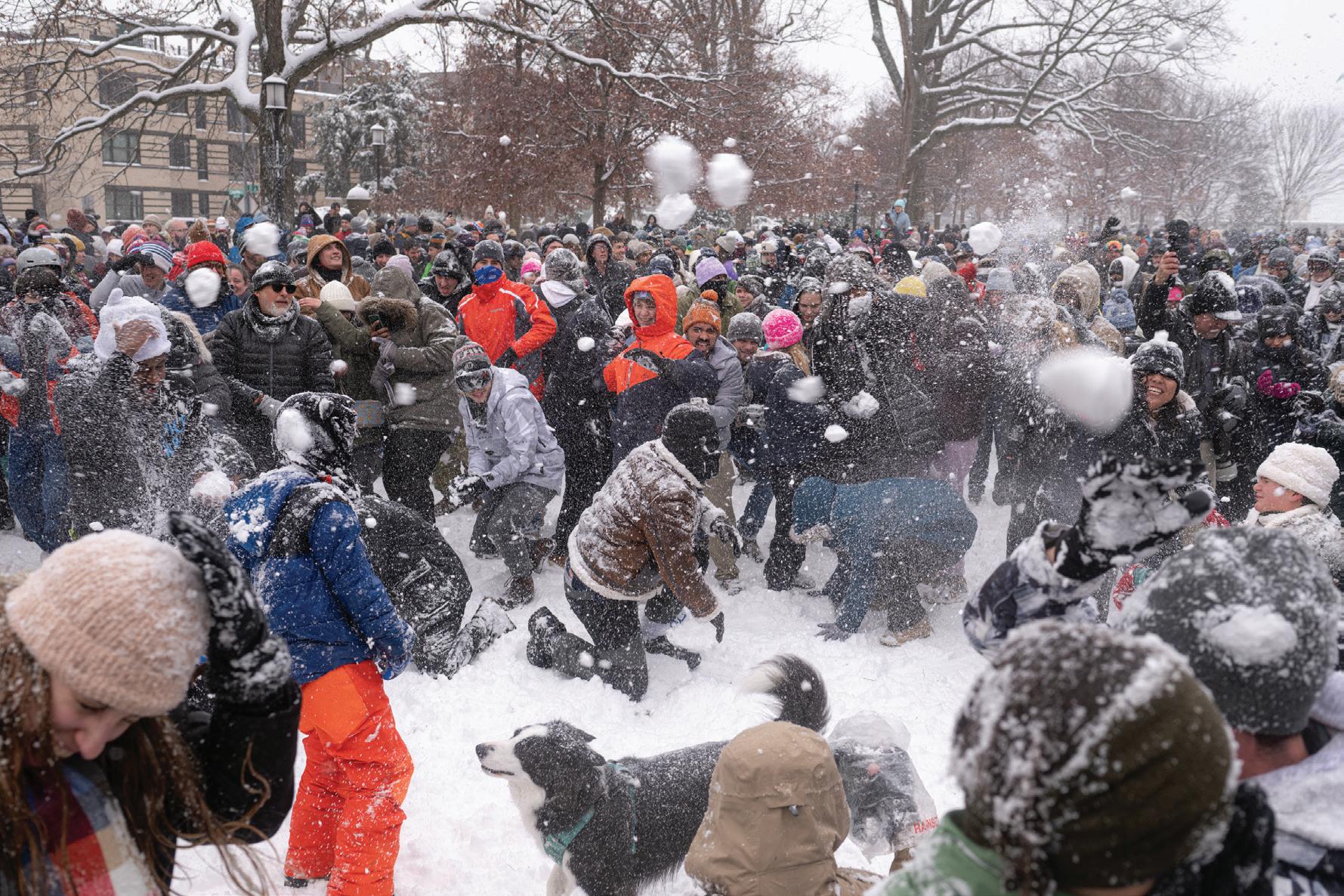
He said he and two other “snow elves” who run the group with him decided to hold a snowball fight last Monday in Meridian Hill Park after a perfect snowstorm Monday, where more than five inches of flakes fell onto various parts of D.C. The duel attracted at least 500 winter warriors, from adults taking an extra long lunch break to toddlers watching on the sidelines. One black and white canine competitor even joined the action.
“Somebody brought their Border Collie, and it was like a circle of people around the dog, and they were throwing snowballs, and the dog was trying to catch them from the air,” he said. “People started lightly tossing snowballs for the dog to catch.” Under the shadow of drab of-
fice buildings and leafless trees, Monday’s snowball fight saw more snow dashing through the air than during even the most intense winter storms. Some participants were forced to craft their battle tools onehanded as they used their other palm to film the action. One group of snowball fighters interested in self-preservation hid behind neon green and yellow sleds, so they weren’t directly in the line of fire. Baranov said there’s a sweet spot a snowstorm has to strike to be suitable for a snowball fight, which he said tends to happen no more
than twice per winter — at least four inches of snow that’s neither too soggy nor flaky.
Baranov said planning snowball fights can start as soon as the night before if conditions come together at the last minute, with the association posting all planning information on Facebook. He said they prioritize picking times when most people will be off work, like a lunch break, and hold the events in public places like the National Mall and Dupont Circle.
Baranov said his involvement in facilitating the District’s most
The dolls and presidential assassins set to define pop culture in 2025
CAITLIN KITSON
CONTRIBUTING CULTURE
NICK PERKINS CULTURE EDITOR
Striking colors saturated pop culture in 2024. Lime green splashed across the cover of Charli XCX’s “Brat” and Vice President Kamala Harris’ marketing campaigns. Red, white and blue adorned Beyoncé’s “Cowboy Carter” and the uniforms of Team USA during the Summer 2024 Olympics. Glittery pinks sparkled on the wardrobes of pop star Chappell Roan and Glinda the Good in the blockbuster adaptation of the musical “Wicked.”
We didn’t predict this cultural kaleidoscope in last year’s pop culture preview, but that won’t stop us from taking our dusty crystal ball out for another spin this year.
“M3GAN 2.0”: June 27
Helen of Troy may have had the face that launched 1,000 ships, but M3GAN was the murderous, artificially intelligent robot doll that launched 1,000 memes in 2023. With the style of a business casual American Girl Doll and an eerie and somewhat ironic dance routine, the titular star of the 2023 horror film “M3GAN” took the internet by storm and drew about $181 million
at the box office. Beyond the memes, “M3GAN” was a surprising highlight of 2023 with its self-aware tone and deft blend of humor, horror and social commentary on artificial intelligence. The same is bound to be true for 2025, as M3GAN is set to make her return to the silver screen this summer in the sequel “M3GAN 2.0.” Little is known about the plot of the sequel, but the modern horrors of AI are sure to spiral further out of control as M3GAN took control of a smart home device at the end of the 2023 film.
“Mission: Impossible – The Final Reckoning”: May 23 May 2025 is the end of an era for GW seniors: They’ll be graduating, entering into the workforce full time and starting “real adult” life. But all of that pales in comparison to the massive conclusion coming the weekend after Commencement: “Mission: Impossible – The Final Reckoning,” the conclusion to Tom Cruise’s 20-year run of madcap stunt spy adventures. While there’s probably some story threads that’ll get tied up in the franchise’s eighth installment, the reason to get pumped for the film comes from the anticipation of what insane danger Cruise will put himself in this time. Maybe he’ll finally reveal the secrets
of Scientology — it would seem to be the only act more dangerous than scaling the Burj Khalifa.
“Death by Lightning”: TBD 2025
In Stephen Sondheim’s “Assassins,” a musical about presidential assassins that’s just as delightfully odd as it sounds, the assassin of 20th President James A. Garfield, Charles Guiteau, sings a ballad where he resolves to “look on the bright side” as he’s sentenced to death because he’ll be remembered in history.
And lucky for Guiteau, director Mike Makowsky did remember him, as he brings one of the most under-the-radar perplexing presidential assassinations to Netflix in the upcoming series “Death by Lightning.”
The show follows the lead up to the assassination, prompted by a crazed Guiteau thinking that Garfield had screwed him over by not offering him a job in his administration — which eventually led to the creation of the civil service system as it exists today.
“Death by Lightning” features a murder’s row of recognizable faces, if not superstar actors, playing mildly notable historical figures: “Succession’s” Matthew McFayden as Guiteau, Michael Shannon as Garfield, Nick Offerman as Chester A. Arthur, even Shea Whigham as Rep. Roscoe Conkling.
dramatic snow duels dates back to 2009, after he graduated GW, when a massive blizzard hit the District right before Christmas. He said he and a group of friends went down to the National Mall to have a smallscale flaky fight. Two months later, when two snowstorms hit D.C. in a single week in a torrent of flurries Baranov called “Snowzilla,” their plans quite literally snowballed. He said his friends advertised through a Facebook event to promote a snowball fight in Dupont Circle, and thousands flocked to the snowy skir-
mish. He said bar owners were also pleased about the snowball fight, as it gave them a rush of customers during the otherwise shivery times.
Baranov said that during the next snowball fight “season” in 2010 to 2011, he and his friends set up a formal Facebook page for their association, and the rest is a snow-filled history. He said he and his friends settled on the name “Washington DC Snowball Fight Association” as a way to embrace being part of the “unserious” side of the District.
“The whole name of DC Snowball Fight Association is poking fun at the seriousness of the city,” he said.
Baranov said he’s continued leading the group for more than a decade because of the adrenaline rush he gets in the lead-up to a snowstorm, desperately organizing people and precipitation-based projectiles alike.
Baranov said his heart wasn’t warmed by another organizer setting up a snowball fight for that same day by the Capitol because no one knew the extent of the security surrounding the building as Congress certified the 2024 election.
Ericka Hume, a digital production assistant based in Ward 1, said she attended her first D.C. snowball fight Monday to take advantage of the storm after seeing online postings about the scheduled duel. Hume said there were teams in the east and west of the park, plus a “snowman’s land” in the middle where no one was safe from the onslaught of snowballs — including journalists filming the action.
“I saw a snowball directly hit a television camera, which made me a bit nervous as a photographer but I hoped made for a great bit of footage,” she said.
beating reliable, $4 bagel sandwiches that are covered with GWorld dollars.
Screenshots of “In and Out” lists scrawled in Notes apps have dominated Instagram and TikTok feeds for the past few years, dethroning New Year’s resolutions — a 4,000-year-old practice with roots in ancient Babylon.
This new ritual is simple: Write a list for what you deem should be “in” for 2025 and another for the things that are best left littered in the glitter and confetti of 2024.
Now, two weeks into 2025, you’ve probably grown weary of swiping through vague and repetitive declarations about “ins” and “outs” — like how “financial literacy” is apparently “in” and “internet slang” is apparently “out.” But here, I present an alternative list tailored to life at GW.
IN: GW Deli
This year, our beloved GW Deli is celebrating its 80th birthday. The deli’s cozy, hole-in-the-wall location is a campus landmark, sandwiched between a grassy lawn and a GW office building on G Street. When you take a stroll down G Street around lunchtime, you will almost always see an extensive line of students longing for bagel sandwiches. Ultimately, there is no
In 2025, reject modernity, embrace tradition and dine with GW Deli.
OUT: Excessive post- ing on LinkedIn
A common token of advice from wellness influencers in recent years is to “move in silence.” While it’s hard to take anyone who deals in corny mantras and platitudes seriously, this is not a bad recommendation to consider. Instead of broadcasting every milestone and achievement on social media, keep those moments of celebration to yourself.
GW students’ tendency to overuse the professional networking site LinkedIn is the exact opposite of moving in silence. When you take a scroll through the Revolutionaries’ social media platform of choice, your eyes will inevitably glaze over from the countless refrains of “I’m excited to share” and “I’m thrilled to announce.” Your “connections” — a generous title for people you barely know — do not need a post for every time you breathe at your Hillternship.
IN: Meet-cutes on campus
Meet-cutes are the foundation of every beloved romantic comedy — from Harry and Sally driving
to New York together in “When Harry Met Sally” to Summer and Tom bonding over The Smiths during an elevator ride in “(500) Days of Summer.” But these picture-perfect moments are sadly few and far between in real life — especially for college students and especially on GW’s campus. So this year, let’s liven up our campus, and our love lives, with some cinematic magic. Drop your textbooks while walking out of the Elliott School of International Affairs in the vein of Rory from “Gilmore Girls,” and you may just meet your Dean. You never know what could happen.
OUT: Dating apps
As we embrace cinematic meet cutes on campus, let’s also put the dating apps out to pasture. The Hinge heads and Bumble bros out there may disagree with me on this one, but college students should not have to rely on dating apps to fulfill their romantic aspirations. Unless you decide to attend graduate school, there will be no other time in your life when you are constantly surrounded by people your age on a daily basis. So why do many of us look down at our phones rather than up at the more than 10,000 undergraduates that surround us? In the new year, let go of your romantic security blanket and start dropping books and locking eyes.
CAITLIN KITSON CONTRIBUTING CULTURE EDITOR
PHOTO ILLUSTRATION BY JORDAN TOVIN
Two students meet over dropped books on the sidewalk of New Hampshire Avenue.
JORDAN
KAIDEN J. YU | ASSISTANT PHOTO EDITOR
Hundreds met in Meridian Hill Park on 16th Street for a snowball fight last week.
SPORTS
Gymnastics sticks third in season debut
NOLAN GREJDA REPORTER
Gymnastics finished third in a season debut Saturday against Western Michigan and Illinois State universities and the University of Pittsburgh during a meet in Kalamazoo, Michigan. Falling to the University of Pittsburgh and Illinois State University, the team topped Western Michigan University by 1.525 points, closing out the meet with a score of 194.375. Saturday’s meet marked the Revolutionaries’ first under newly appointed Head Coach Stephanie Worrell, after she took the reins from former coach Margie Foster-Cunningham, who retired this offseason following 39 years leading the Revs. SophomoreDelaney DeHaan and graduate student Kendall Whitman stood as the Revolutionaries’ top performers Saturday, taking home firstplace medals in the all-around and beam events, respectively.
DeHaan tied for first allaround with a total score of 39.100. She secured a score of 9.825 on vault and floor, a 9.700 on bars and a 9.750 on beam. Whitman also put up impressive scores on the beam with a 9.825 in the event, only 0.075 shy of her career-best 9.90.
Sophomore Brooke Izzo and junior Deana Sheremeta also put up high scores on floor, each earning a solid 9.825. On vault, junior Kasey Burke scored a 9.725, and the team later finished the event with a final score of 48.625. Freshman Lola Montevago led the way for the Revs on bars, earning a 9.725 alongside returners sophomore Sophia Tyeryar and
senior Rachel Katz. Finishing on beam, Sheremeta scored a 9.800 and Izzo followed closely with a 9.700.
Following her hiring as head coach in July, Worrell said in a release that she was excited to grow with the team this season and continue to push the Revs to victory.
“I believe this championship program is greater than the sum of its parts, and together, this team and future teams will accomplish greatness through discipline, commitment and respect,” Worrell said.
The Revs were slotted second in the East Atlantic Gymnastics League preseason poll in December coming into their 2025 season, just behind reigning conference champions Towson. After falling short during the last two seasons, GW looks to win their fourth alltime EAGL championship after finishing first in 2022.
The Revs posted their highest overall score in program history last season, a 197.200 during a meet against Towson and College of William & Mary. The team also posted the program record for floor at 49.50 for the event. Whitman, who returned this year for her graduate student season, earned EAGL’s senior award of the year for her performance last season.
Following their season opener, the Revs will travel to their next scheduled meet in Chapel Hill, North Carolina, to face the University of North Carolina on Jan 17. The team will return to the Smith Center on Jan. 26 for their home opener for the Lindsey Ferris Invite against Yale and Fisk universities and the University of Pennsylvania.
RYAN
Men’s basketball (13-3, 2-1 Atlantic-10) is off to a strong start in A-10 play on the backs of defeating two Top-100 teams in Division I.
The Revolutionaries emerged with a statement victory over previously 22nd-ranked Dayton on Jan. 4 (11-5, 1-2 A-10) 82-62 after dropping the conference opener to Richmond (7-10, 2-2 A-10) 6661 on Dec. 31. The Revs followed the win with a 75-67 victory over Rhode Island (13-3, 2-2 A-10) on Jan. 8, becoming the first team to beat the Rams on their home court this season.
Redshirt freshman guard Christian Jones set a career-high against Dayton with 23 points, shooting 50 percent from the field, including 5-8 from three. Graduate student guard Gerald Drumgoole Jr. recorded 21 points, going 5-12 from beyond the arc and sophomore guard Trey Autry recorded a careerhigh 17 points.
The Revs came out of the gate firing against the Flyers, jumping out to a 23-7 lead at the 13:30 mark on the back of threes from Drumgoole, Jones and Autry. The teams traded buckets in the first half, with the Revs holding a 43-27 lead at the break. The Flyers stormed out of the half to cut the lead to 48-43 at the 15:47 mark, and the Revs’ lead remained single digits for the majority of the half.
Junior guard Javon Bennett got a layup to go at the 6:32 mark to get Dayton within four points, causing Head Coach Chris Caputo to call a timeout. Out of the well-timed timeout, the Revs went on an 18-2 run in the final five minutes of play to notch their first victory in conference play and knock off the second seed in the A-10 preseason polls.
Women’s basketball sinks in A-10
standings
as conference play starts
Women’s basketball (8-8, 1-4 Atlantic 10) has floundered at the start of A-10 play, dropping three straight as the offense struggles to put points on the board.
On Saturday, the team suffered its biggest loss of the year, falling 97-55 to Duquesne (11-5, 2-3 A-10).
The Dukes outscored GW 30-9 in the first quarter alone as they dominated both sides of the court throughout the game, forcing 26 turnovers and knocking down 19 3-pointers on 42 attempts. By comparison, the Revolutionaries were 5-18 from deep, with four of those coming from senior forward Maxine Engel, who was the only Rev in double digits with 18.
After losing their conference opener 87-55 against George Mason on Dec. 3, the Revs went 2-2 to finish out nonconference, including a win against Hampton University and a loss to Miami University during the
team’s multiteam event in Miami.
The Revs then travelled to play La Salle on Dec. 29, who entered the game 7-7 with a 1-0 A-10 record, to begin the bulk of their conference play, winning 65-54. Graduate student forward Paige Mott led the game with 18 points off an efficient nine out of 11 shooting from the field. The Revs were in control the whole game, leading by as many as 19 points to start the fourth quarter. For the team’s first game of 2025, they welcomed Loyola Chicago to the Smith Center on Jan. 5, ultimately losing a backand-forth affair 67-63. Down one point with one minute left, the Revs failed to put another point on the board, with freshman guard Gabby Reynolds missing potential gamewinning and game-tying shots. Reynolds finished with 17 points against the Ramblers in 32 minutes off the bench. Reynolds is second on the team in scoring with 10.1 points per game, just
behind graduate student guard Makayla Andrews, who averages 11.8. Despite her scoring prowess, Reynolds is not in the team’s regular starting lineup, starting five of her 15 games played.
The Revs travelled to the Bronx to take on Fordham on Jan. 8, who entered the game with a 8-6 record, including 2-1 against A-10 opponents, where they lost 61-53. The team got off to a hot start, leading 15-9 after the first quarter, ending the quarter with a 9-2 scoring run. The Revs extended the lead to 22-11 midway through the second quarter, but the Rams narrowed their deficit with an 11-2 run to end the half.
Fordham continued to pull away in the third quarter, outscoring the Revs 18-13 to go up 40-37. The Rams’ third quarter performance was aided in large part by five straight free throws from Fordham junior guard Chaé Harris off a shooting foul and technical foul fall
After the convincing victory over a previously ranked opponent on home court, the Revs traveled to Kingston, Rhode Island to take on the Rams, and a 75-67 victory would end Rhode Island’s 9-0 start from the Thomas M. Ryan Center. Again playing without their leading scorer Buchanan, redshirt junior forward Rafael Castro would lead the Revs offensively with 16 points, shooting 70 percent from the field. Hutchinson and graduate student forward Sean Hansen both recorded double figures, and Autry would notch his first career double-double with 10 points and 10 rebounds. The Revs started strong with
an Autry layup to take a 17-7 lead at the 12:37 mark. The Rams fought back, cutting the lead to 6 points on a tip-in from senior guard Quentin Diboundje halfway through the first half. The teams traded baskets in the back half of the first half, with the Revs hanging on to a 38-30 lead as time expired. While the Revs led by as many as 10 in the first 10 minutes of the second quarter, Rhode Island matched them point for point. A pair of free throws from senior guard Sebastian Thomas got the Rams within two at the 10:06 mark and a Diboundje dunk tied up the game with 9:31 to play. The Rams took a 58-57 lead on
a Thomas free throw with 8:29 to play, but the Revs continued to fight back. After the teams traded leads for four minutes, Hansen was fouled on his successful layup attempt and completed the 3-point play to give the Revs a 64-61 lead at the 4:14 mark. Hutchinson would follow suit, completing a 3-point play of his own to bump the Revs lead to six with just under four minutes to play and a pair of Hansen free throws would close out the Rams and hand them their first loss at home this season.
In their opening matchup with Richmond, Drumgoole led the way offensively for the Revs, recording 27 points, including seven
on Andrews. The Rams continued to ride the wave in the fourth, outscoring the Revs 21-16 in what was the highest-scoring quarter for both teams.
After the loss against Duquesne, the team stands at 12th in the A-10, ahead of only La Salle, Saint Bonaventure and Saint Louis. Their scoring compared to their A-10 opponents reveals early offensive and defensive struggles. Their 61.6 per game average ranks No. 12 out of 15 teams and their 62.2 allowed per game average comes in at No. 11 out of 15 teams. The team’s NET ranking also paints a dim picture for the team. The NCAA metric, which measures strength of schedule and quality of wins or losses, places GW at 269 out of 362 DI teams and 12th in the A-10. The Revs will look to get back in the win column as they travel to Saint Louis, Missouri, to take on the last-place Billikens on Jan. 15 at 8 p.m.
3-pointers. Redshirt junior guard Trey Moss and redshirt sophomore forward Darren Buchanan Jr. tallied 11 points apiece, with Buchanan adding nine rebounds. Despite a three-point lead within the first six minutes, the Revs found themselves trailing 2921 at the half. The Revs would take a 38-37 lead at the 14:17 mark on the back of a Drumgoole three, one of three he drained to start the half. After taking the lead, the Revs would go on an 12-2 run spanning just under five minutes left, with the score sitting at 50-38 at the 9:30 mark. At the 6:18 mark, the Spiders would begin to cut into the Revs’ lead, cutting the lead to five with 4:56 to play. The Revs held on to a 61-57 lead after a Drumgoole layup with 1:37 left, the last points the Revs scored in the contest. The Spiders responded with a 3-pointer from junior forward Apostolos Roumoglou to cut the lead to one with over a minute to play. After Buchanan’s jumper was off-target, the Revs were handed a loss in their opening game of A-10 play.
Before beginning A-10 play, the Revs finished their out-ofconference slate with a pair of victories, defeating Lafayette 82-62 on Dec. 18 and taking care of business against Division II University of Virginia Wise 102-62 in their final test before conference play. The Revs concluded their outof-conference schedule with an 11-2 record, one loss better than their 11-3 record in nonconference play last season. With the two strong victories over conference foes, the Revs sit at 2-1 in A-10 play and 13-3 overall on the season. The Revs welcome former player Maximus Edwards and his Duquesne
7-9 A-10) to the Smith
on Wednesday, Jan. 15 with
for 7 p.m.
Dukes (2-1,
Center
tipoff set
JAMES SCHAAP | STAFF PHOTOGRAPHER
Junior forward Caia Loving looks to defend the ball during Saturday’s game against Duquesne.
BEN SPITALNY SPORTS EDITOR
DANIEL HEUER | STAFF PHOTOGRAPHER
Sophomore guard Jacoi Hutchinson drives the ball up the court during a game last fall.
LEXI CRITCHETT | ASSISTANT PHOTO EDITOR Junior gymnast Deana Sheremeta leaps on the balance beam during a meet last season.
The number of rebounds per game by junior forward Rafael Castro, good for third in the A-10