Title IX Office, SGA to launch peer adviser program next fall
The Title IX Office and Student Government Association late last month opened applications for a peer adviser program set to launch next fall to support students involved in Title IX cases.
The program will grant students undergoing Title IX processes the option to select a peer adviser from a pool of trained students and alumni who can attend hearings with the student, provide emotional support and discuss Title IX Office resources. The application for students to apply to become an adviser opened in late November and will remain open until Dec. 17, when officials will begin the selection and interview process for the program.
Assistant Provost and University Title IX Coordinator Asha Reynolds said the program will supplement the current Title IX policy that allows students to select their own adviser or receive a GW-appointed adviser to provide more peer-topeer support throughout the Title IX process.
If a student can’t find an adviser or doesn’t want to select their own, the University can provide an adviser free of charge, according to the Title IX website. Reynolds said the advisers the University appoints to students are typically attorneys with “substantial” Title IX knowledge who provide students free information on Title IX processes and investigate cases for students.
“Volunteer advisers will offer an added layer of support to members of the GW community who are impacted by sexual harassment,” Reynolds said in an email.
Reynolds said pro-
spective candidates are required to submit a resume and letter of interest, and if selected, will undergo an interview process with Title IX officials. She said officials will hold training sessions for the selected volunteer advisers on GW’s Title IX policy, offer onand-off-campus support resources and traumainformed care so they can accurately assist students undergoing Title IX processes.
Reynolds said the Title IX Office will continuously request feedback from students who receive a volunteer adviser to actively assess whether they are providing sufficient support to parties. Reynolds said the selected advisers will sign a “privacy agreement” with the University and with the student who selects them to act as their adviser to ensure information about the Title IX case remains confidential. She said people accepted into the program
must commit to serving in the role for a minimum of one year to ensure students can work with the same adviser for the duration of their case.
Current Title IX privacy policy states that filing a report with the Title IX Office is not entirely confidential, as case details are shared with a “limited circle” of University employees and Title IX Office staff members who discuss how best to move forward.
SGA President Ethan Fitzgerald said the Title IX Office permits students to bring an adviser of their choosing to hearings under current Title IX procedure, but the program will give students who don’t have someone they feel comfortable confiding in another option for support. He said the adviser program can also provide a third-party student adviser to students who don’t feel comfortable sharing details of their case with their friends.
“This is really to help students who maybe don’t have someone they can turn to, or maybe even if they do, don’t feel comfortable bringing someone who’s so close to their life or who might know the other person that’s related to the case,” Fitzgerald said. Fitzgerald said the SGA’s idea for the program stemmed from conversations between the SGA’s executive branch and Title IX officials, like Reynolds and Assistant Director of Sexual Assault Prevention and Response Beth Riley about expanding peer-to-peer support for students involved in the Title IX process. He said Title IX respondents and complainants may feel more comfortable sharing their experiences with a peer than an adult who may not understand their perspective as well.
Fitzgerald said the University “finalized” the questions for the application and will conduct an internal selection and in-
terview process next semester to select the pool of advisers. He said the SGA helped craft questions for the application. The University will hold a series of training sessions where selected advisers will sign confidentiality agreements, learn about GW’s Title IX proceedings and review a handbook the Title IX Office created for the program to train advisers on GW-specific policies, Fitzgerald said. Jennifer Locane, the SGA executive secretary for graduate affairs and a second-year graduate student, said she met with Fitzgerald and SGA Vice President Ethan Lynne in July to discuss her ideas to include students and alumni advocates. She said she had learned in her studies in the Clinical Rehabilitation Counseling program at GW about how peer-to-peer support can benefit the individual seeking support and the advocate by fostering a meaningful relationship.
51 percent hike in reopened Title IX complaints in 2023-24: report
The Title IX Office reported a 51 percent increase in reopened complaints in the 2023-24 academic year as new complaints of sexual harassment, sexual assault, domestic and dating violence and stalking plateaued, according to the office’s third annual report released last month.
The data shows that there were 408 new reports of sexual harassment, sexual assault, stalking, dating violence, domestic violence, pregnancy and related conditions and retaliation in the 2023-24 reporting period, compared to 405 reports received the year before. The report also stated that there was a 51 percent increase from the 2022-23 reporting period in complaints that were reopened after a complainant asked for additional support — which Asha Reynolds, the Title IX Office’s director and coordinator, said shows students are willing to continuously reach out to the office for support.
Of the 408 reports filed in the 2023-24 period, 272 were for sexual harassment, 95 were for sexual assault, 91 were for stalking, 31 were for dating violence and 20 were for domestic violence. Nineteen complaints were requesting support for pregnancy or related conditions and three were for retaliation.
Complaints of stalking and domestic violence in 2023-24 rose the most out of all categories compared to the previous reporting period, with the 2022-23 report recording 68 complaints of stalking and 11 complaints of domestic violence.
Of the 408 complaints, 89 of the incidents happened in residence halls, 110 took place in nonresidential parts of campus — a rise from last period’s 76 — 44 occurred online, 83 were off campus and 82 had unknown locations, a drop from last period’s 108. The report also states that 276 complainants were undergraduate students, 78 were graduate students, 26 were staff, three were faculty, 22 were non-GW affiliated and 26 were unknown.
International students brace for visa uncertainty as Trump’s second term nears
we’re gonna be fine, but the fact that we still got the email from ISO, from the school, was just kind of unsettling.”
Officials urged international students late last month to return to the United States before President-elect Donald Trump’s inauguration, a message that students said served as a reminder of the uncertainty that clouds international travel and the availability of visas in the near future.
The email, sent from the International Services Office on Nov. 26, encouraged students to return to the United States before Trump can execute potential executive orders when he enters office on Jan. 20 that restrict travel. Some international students with F-1 visas — which allow students to travel to the United States to attend an accredited school or college — said they are worried about potential travel bans hindering their student status, and many fear that Trump’s policies could hinder their ability to find employment post graduation and remain in the United States.
Officials are not mandating the recommendation, the email states. But officials said the announcement was made out of an “abundance of caution” to prevent future student travel disruptions since the new administration can enact policies within days of taking office.
Trump issued an executive order one week into his first term that banned Syrian refugees indefinitely and people from Sudan, Yemen, Somalia, Libya, Iran and Iraq, including those with a valid U.S. visa, from entering the country for 90 days. In September, Trump said he would ban refugees from the Gaza Strip and reinstate his previous travel ban.
“When I got the email, I was like, ‘Whoa this could be a lot more serious than I thought,’” said sophomore Bulgan Enkhjargal, who is from Mongolia. “But I did my best not to scare myself or anything because I knew that
Enkhjargal, who serves as the assistant publicity director for the International Students Association, said she was initially confused why the email specified that students should return before Inauguration Day on Jan. 20 because classes for most degree programs begin on or before Jan. 13.
She was originally “caught off guard” because she didn’t completely understand the potential complications a Trump presidency could have on international students, like limiting visas to people from certain countries, she said.
Trump’s 2017 travel ban was contested in the judicial system and in protests that erupted in airports and college campuses across the country, with some GW students arguing bans would limit campus diversity. In January 2017, an Iranian student, set to obtain his master’s degree from the University in applied economics, was refused a visa by the government following the travel ban.
University officials vocalized their support for international students immediately after Trump’s travel ban efforts and challenged the executive order’s initial version along with 30 other colleges and universities. In 2018, international student enrollment at GW dropped for the first time in nearly a decade from 15.1 to 14.2 percent.
There are 3,044 international students currently enrolled at the University, according to a released report scheduled to be presented at a Faculty Senate meeting on Friday.
University spokesperson Shannon McClendon said the email intended to raise awareness about possible changes that could occur when the new administration starts in January. She said the guidance, which other universities, like Cornell and Brown have similarly issued following
the election, is “rooted” in keeping the campus community safe.
“As ISO monitors potential policy changes with the new administration, the office will continue to provide resources and guidance to ensure the entire community feels welcomed, valued, and supported in pursuing their academic and professional goals,” McClendon said in an email.
Most international students hold either an F-1 or J-1 visa, which allows people to participate in specific education programs. Both visas typically end after a recipient graduates or completes an educational program with a one to two month grace period, depending on their permits.
Junior Carlos Herrera, an international affairs student from Mexico, said he was “worried” that officials felt it was necessary to send the email because
it shows the severity of the possibility of travel bans. Herrera said he is concerned about the availability of H-1B visas, which allow employers to sponsor foreign workers in certain occupations because he hopes to remain in the country due to the better job prospects for his field in the United States compared to Mexico as he prepares to graduate spring 2026.
Trump heightened requirements for obtaining the H-1B visa in his first term, with denial rates for the program increasing amid his crackdown and a rise in the required minimum salary that employers must pay visa holders, until federal courts blocked the new regulations in 2020.
“For a lot of international students the end goal is to stay here and work, obtain a visa and then a green card, et cetera,” Herrera said. “And during his original presidency, the lottery system for
work visa changed and things are very uncertain, especially because I’m going to be graduating during his presidency.”
First-year Amen Tamirat Mulu, an economics and political science student from Ethiopia, said that throughout his college application process, he believed a second Trump term would not happen, but he is now worried about returning to the United States next year because he has to annually renew his visa.
F-1 visas are usually valid for up to five years but depending on someone’s nationality can be shorter. The period for F-1 visas from Ethiopian nationals is one year. Mulu said his visa expires next August and he still plans to return to Ethiopia to renew it, despite some of his peers’ reluctance to leave the United States due to fears of potential travel disruptions.
COOPER TYKSINSKI | PHOTOGRAPHER
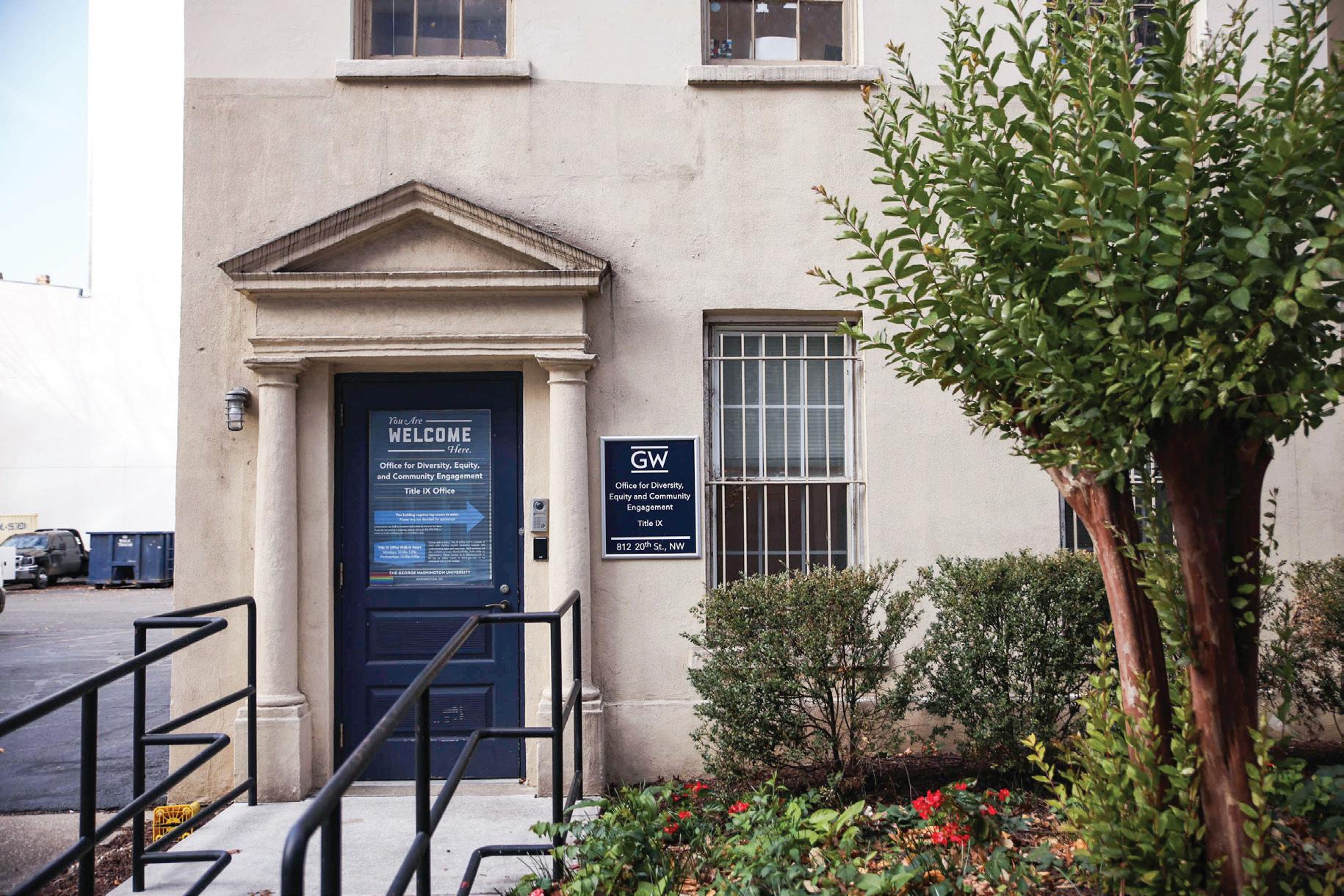
The entrance to the Title IX office located on 20th Street
JENNA LEE ASSISTANT NEWS
AMAAN NABEEL | PHOTOGRAPHER
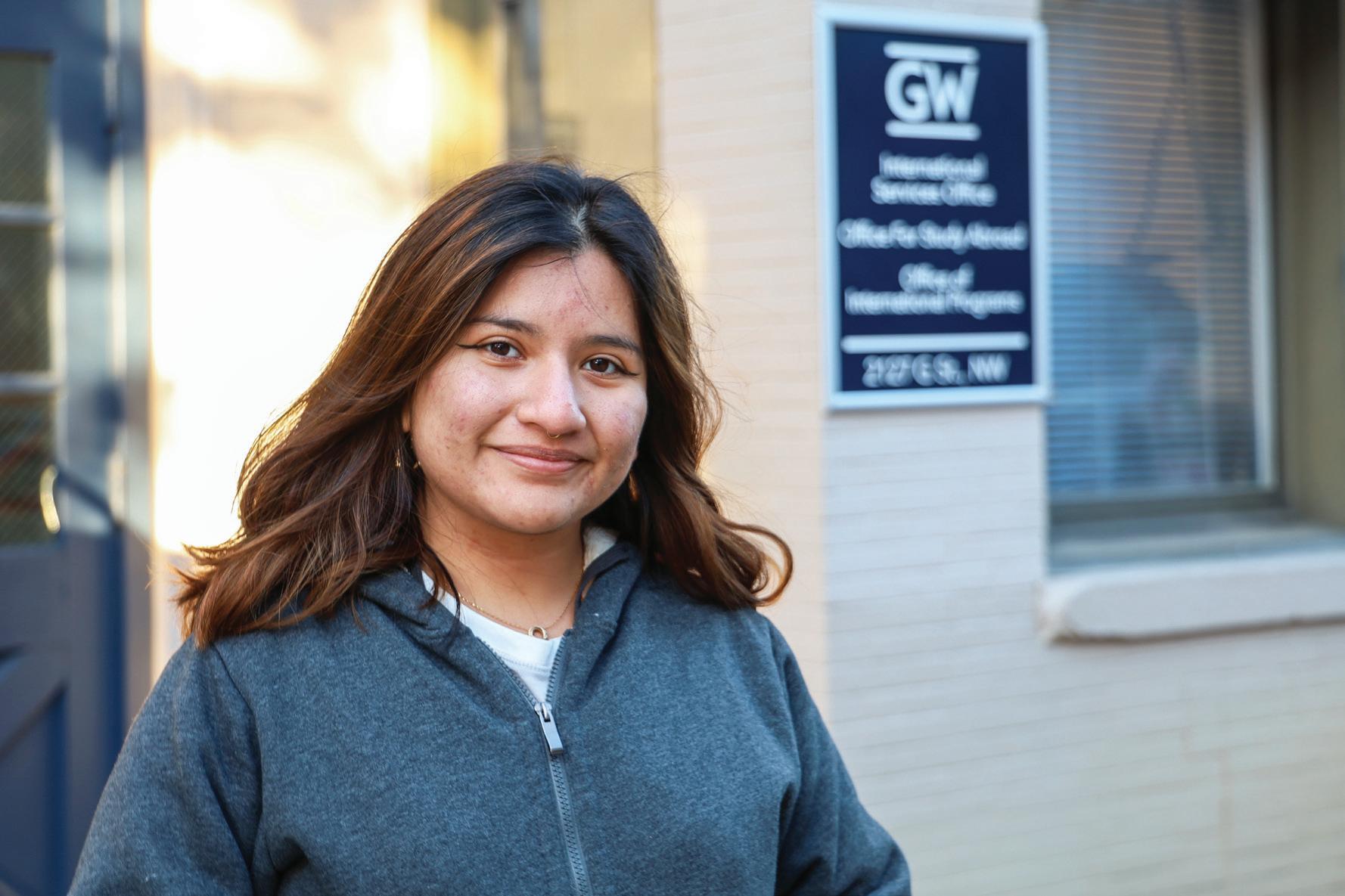
Sophomore Paola Sigüenza poses for a portrait in front of the International Students Office.
WMATA approves bus network redesign after initial neighborhood backlash
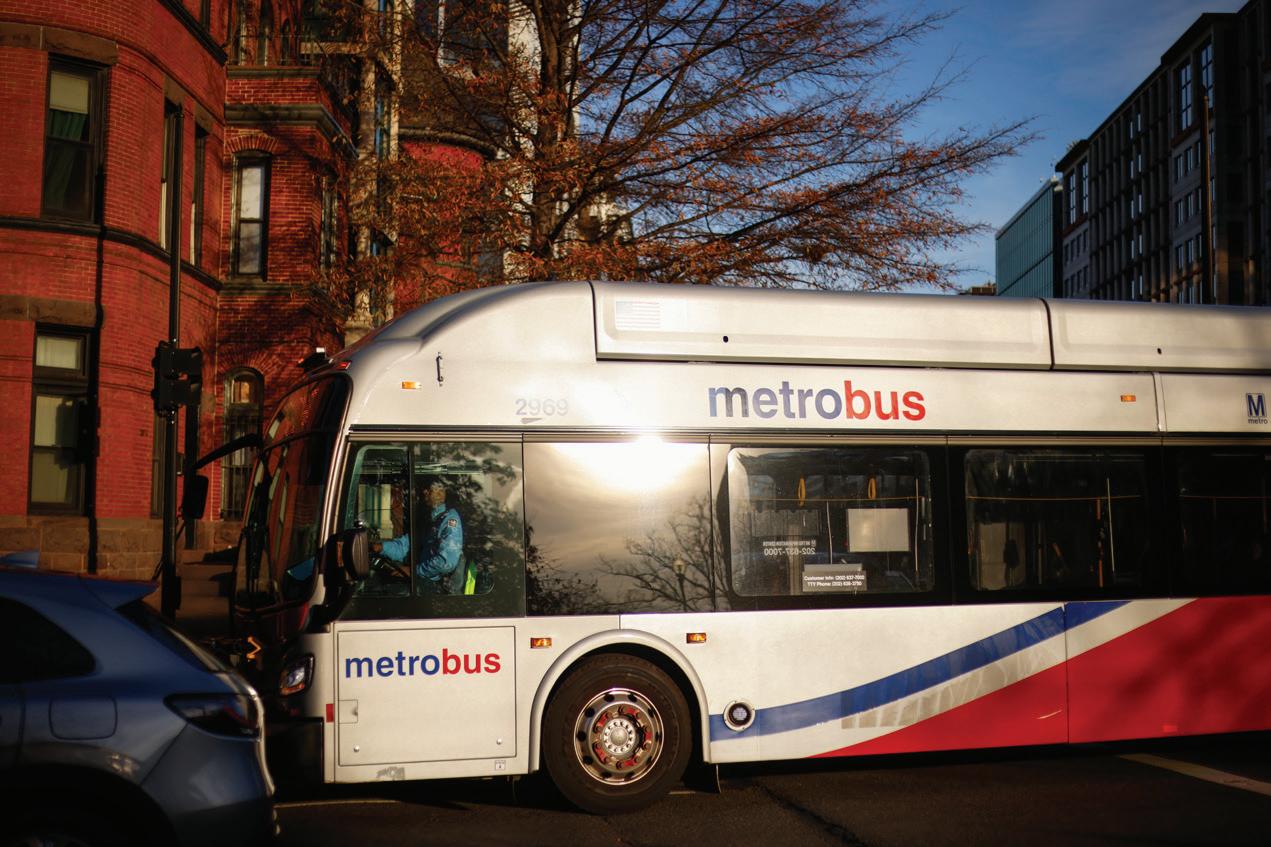
The Washington Metropolitan Area Transit Authority finalized a plan late last month to adjust routes and schedules for D.C.’s bus system, extending two routes in the plan’s first draft after Foggy Bottom community members worried the plan would reduce their access to public transportation.
WMATA’s Board of Directors on Nov. 21 approved the Better Bus Network, the first comprehensive Metrobus redesign, which will go into effect in June to boost the number of frequent service routes, eliminate 500 underused bus stops and extend bus services to low-income neighborhoods. Facing backlash from Northwest D.C. residents over its initial June plan to cut the 42 and 43 bus routes — which residents said would reduce service to the Kennedy Center, Department of State and Columbia Plaza Apartments — WMATA’s November plan revised 70 of 125 routes and restored 150 stops, including in Foggy Bottom along 23rd Street and near the Kennedy Center, which community members said would better serve commuters.
WMATA opted to remove stops that are within 660 feet of another stop and lack ridership or those that are deemed unsafe for pedestrians due to a lack of access to crosswalks or sidewalks. The Better Bus Network will also add services to neighborhoods like Anacostia that have been in transit deserts.
The first draft, released in June, eliminated the 42 and 43 bus routes, which connect the Kennedy Center to the Mount Pleasant neighborhood with stops in Foggy Bottom on both Virginia Avenue and 23rd Street near the Columbia Plaza Apartments and the Department of State’s building. The plan’s proposed bus routes in the same direction only had Foggy Bottom pickup spots on 19th and 17th streets, blocks away from the 42 and 43 stops.
Data provided by the WMATA Office of Planning shows that the 42
and 43 routes in 2023 serviced a combined 37,922 riders who used UPass, a program providing full-time GW students unlimited use of Metro services for a discounted flat fee, making it the second highest-ridership route pair by UPass usage in the District and the most popular in Foggy Bottom. The proposed plan to cut the 42 and 43 was met with pushback from local community members and officials.
The Foggy Bottom and West End Advisory Neighborhood Commission in June passed a resolution supporting the plan but urging WMATA to extend the proposed D72 route directly to Foggy Bottom, as the resolution states not doing so would force some residents to walk for as long as 30 minutes to access the service. The resolution was one of many from local governing bodies and organizations advocating to restore service to the Department of State, including ANC 1A in Columbia Heights.
Renee McPhatter, GW’s associate vice president for Government and Community Relations, raised concerns to the chief executive officer of WMATA in a written comment on July 15, saying the new routes would “deprive”
the Foggy Bottom community of costeffective transportation.
York Chow, who identified themself as a resident of Columbia Heights, said in a June testimony they and their husband, GW professor Jonathan Chow, rely on Routes 42 and 43 to transport between Northwest neighborhoods.
“We moved to that location primarily because of the 42, 43,” Chow said. “It makes it very easy for him to get to work, and it’s something that we rely on.”
The revised plan approved by the Metro Board of Directors on Nov. 21 sought to incorporate more than 13,000 comments into the final proposal. The final product dropped the number of recommended stop eliminations by over 100 and altered more than half of the proposed routes, WMATA said.
The agency didn’t restore the 42 and 43 routes but extended the D74 and D12 routes in Foggy Bottom. WMATA extended the D74 and D12 bus routes’ last drop-off spot from the Farragut West Metro station to the Kennedy Center but renamed D12 to D10. The D72 remained unchanged.
CRIME LOG
THEFT II/FROM BUILDING
Milken Institute School of Public Health
12/04/24 – 10:20 p.m.
Open Case
A staff member reported her space heater stolen from the front desk. C ase open
LEWD, INDECENT OR OBSCENE ACTS
Eckles Library
12/04/24 – 7:20 p.m.
Closed Case
GW Police Department officers responded to a report of a student engaged in a lewd act. Upon arrival at the scene, GWPD officers made contact with the student and sent him on his way. Referred to Division of Conflict Education & Student Accountability.
THEFT I/FROM BUILDING
Thurston Hall
12/05/24 – 9:44 p.m.
Open Case A student reported her shoulder bag and iPad stolen. Case open.
LIQUOR LAW VIOLATION
Shenkman Hall
12/06/24 – 1:18 a.m.
Closed Case
GWPD officers responded to Shenkman Hall for report of a drunk female student. GW Emergency Medical Response Group arrived on scene, and after medical evaluation the student was taken to GW Hospital’s emergency room. Referred to CESA.
—Compiled by Ella
Mitchell
Student engineering group plans trip to Uganda after yearlong postponement
An engineering student organization postponed their trip to northwest Uganda, where they planned to start installing a learning center, for the second time this academic year due to limited funds.
The Uganda team from GW’s chapter of Engineers Without Borders now plans to visit their project site in Yumbe, Uganda, in June after pushing back the trip earlier this semester. Leaders of the organization said limited funding resources from grants, bake sales and University allocations hinder their ability to travel internationally and initiate construction on their projects.
Senior Tamar Todd, the co-lead of EWB’s project in Yumbe, Uganda, said the group previously planned on going to Uganda this past summer and later postponed it to winter break but ultimately delayed the trip again to June after raising $17,000 out of their goal of $20,000 for the trip to Yumbe. She said EWB will continue applying for grants, reaching out to companies for donations and hosting on-campus fundraisers to try and reach their goal.
The learning center will be located on the property of their nongovernmental organization, Nested Savings — an organization dedicated to “alleviating poverty” in Africa through environmentally friendly initiatives — along with their single-room library. Each EWB projects have an assigned nongovernmental organization that assists with connecting team
members with members of the community in their project location.
Todd said the learning center will contain study rooms, books, computer labs, a conference room and an early child development center to expand educational access and opportunities for all community members. She added that the group will begin setting the foundation for the center and overseeing the early stages of construction during their trip in June.
“The purpose of this Learning Center is for everyone to have access to education, not just if you’re in formal education,” Todd said.
Grace Zereski, a sophomore and co-lead of the project in Uganda, said the organization decided to delay their trip to Yumbe early in the semester to June during Uganda’s dry season — a period of time with low amounts of rainfall — to allow EWB more time to raise money and reach their $20,000 goal.
Zereski said the group relied on fundraising to reach their goals through profit shares with Panera, bake sales, grants and a fundraising event offering henna tattoos. She added that herself and another member of the group are Clark Engineering Scholar recipients, which is a scholarship for engineering students that combine engineering, business, leadership and community service, which EWB uses for additional funding for their projects.
Zereski said EWB raised $6,000 on Giving Tuesday last week and is waiting to hear back from
a few grants, but the group believes that they’ll receive them since they’ve gotten the same grants in the past.
“We are confident that we will be traveling this June,” Zereski said. “I don’t see it being pushed back any further.”
Junior Isabella Perusse, the president of EWB and team lead of the organization’s project in Bhutiya, India, said her team finished the six-yearlong project in India in May, where they installed a percolation pond — a pond that collects rainwater and use gravel and sand to allow the runoff to replenish groundwater — to pro -
vide water for agricultural needs due to water scarcity within the community.
Perusse said her team is trying to gain enough funding through fundraising, donations from different companies, the Student Government Association and School of Engineering & Applied Science allocations and grants to travel to Bhutiya next semester to check on the pond and community members to see if it’s working properly.
If EWB does not raise enough money, Perusse said the group will have to conduct virtual monitoring and evaluation through phone calls with
CPS, DC Parks and Recreation to launch youth development certification program
The College of Professional Studies’ Center for Excellence in Public Leadership and the D.C. Department of Parks and Recreation will unveil a certification program for youth development professionals early next year.
The certification will offer leadership coaching and hands-on experience to professionals working in youth programs to further their mentorship skills, according to a D.C. Department of Parks and Recreation press release. Leaders developing the certification program said it will launch in February 2025 and teach participants how to deploy conflict resolution tactics and empathy, manage trauma and work with parents and guardians.
Ina Gjikondi, the center’s director of executive education and coaching, said the program organizers aim to complete the curriculum by the end of the year, with applications opening in January. She said the first cohort will include 24 participants and run until September or October.
She said D.C. Department of Parks and Recreation Director Thennie Freeman pitched her the idea for the youth development program while completing the center’s e-Co Leadership Coaching Program two years ago. She said once Freeman became the department’s director in 2023, they began discussing what the program could look like.
“She’s like, ‘This is the project, I really want to move this project forward.’ And her vision not only she wants to support people in the city, but also people in this region,” Gjikondi said.
Jim Robinson, the center’s executive director, said the center began planning for the program in October with two focus group sessions featuring about 60 people who work in youth development fields to solicit feedback on what skills and features the curriculum should include. He said the program’s leaders are working with Sandra Vanderbilt, a research assistant professor in the Graduate School of Education and Human Development, to sift through feedback from the focus groups and develop the program’s curriculum.
Gjikondi said Vanderbilt will give the center and DPR a report of her initial findings this week, before future meetings, to determine what should be included in the curriculum and details like if sessions will be in-person, virtual or both.
Robinson said the program is looking for professionals working in the DPR like camp counselors, school-related officials, aquatic center employees, other D.C. gov-
ernment departments and leaders from nonprofit organizations and religious organizations to participate in the program. He said having participants from different backgrounds allows them to share ideas and resources with each other.
“‘Oh, I didn’t know that you all did that. Oh, I didn’t know that was happening over there. Oh, I didn’t know you had that resource. I need that resource for my kids over here.’ Those are some of the connections that we want to make happen,” Robinson said. Robinson said the program will have “no problem” attracting applicants, as there was strong interest in the program at the focus group events and the center’s large alumni network will promote the program.
“I think we’re blessed in that we have an extensive alumni network,” Robinson said. “Also, Director Freeman, from her work in the District of Columbia. She has a vast network of people that she works with.”
Robinson said the School of Business founded the center more than 25 years ago to develop leadership and executive education programs for employees in the D.C. government, which at the time faced financial and leadership challenges. He said the center moved to CPS in 2005 after expanding its offerings, including programs for students who work in federal jobs and other municipalities outside of the District.
“Our portfolio really broadens quite a bit, but the mission is still to develop public leaders who make a positive difference in their agencies and for the people in their organizations and for the people that they serve, and that mission still holds true today,” Robinson said.
Robinson said he hopes the program opens a pathway for the cen -
ter to create additional programs to address other community needs like training for violence interrupters and to partner with the Honey W. Nashman Center for Civic Engagement to make their programs applicable to undergraduate students.
“We’d like to do more of these kinds of things, and there’ll be other opportunities, but that’s one of the ways I think that will impact us and impact not only our center, but impact the whole College of Professional Studies,” Robinson said.
Freeman said the program’s goal is to train participants how to be flexible in their approach to managing young people, since each child has their own way of responding to situations.
“When you are coaching, educating, developing, empowering, mentoring young people, the skills you had the day before may be different today, and understanding that you have to be fluid, you have to be able to read, to take social cues, you have to create safe spaces for young people,” Freeman said.
She said the program fills a void in professional development opportunities since people want to receive certification and development in working with children, but there are few programs available.
The D.C. Office of Out-of-School Time Grants and Youth Outcomes also offers professional development opportunities and workshops for professionals working in youth programs. The program is the only one among D.C. universities that is specifically for youth development workers, according to a Hatchet analysis of program offerings from universities in the District.
“We wanted to equip anyone who works with youth with the tools to make sure that they are leading youth correctly because ultimately, today’s youth are tomorrow’s adults,” Freeman said.
the team’s partnering nongovernment organization, Jagran Jan Vikas Samiti, and India’s chapter of EWB.
She added that EWB is in the “monitoring and evaluation” phase of the project where members of the group will communicate with their NGO to receive updates on the pond and if there are any issues.
Perusse said the percolation pond has overgrowth of vegetation, which takes the water to allow plants like weeds to grow, instead of putting the water in the ground for recharge purposes. She said the organization has to wait until the water lowers in the pond to remove the growth and will later add sand at the bottom of the pond to try and prevent growth.
“Our hope is that that water will eventually decrease into the ground during the dry season,” Perusse said.
“Every week, I meet with my team and we figure out, at least right now, we’re focusing on how do we make sure that this project is going to work, what steps do we take to make sure that it’s actually raising more water levels and make sure that it’s working?” Perusse said.
GW alum, real estate firm founder to join Board of Trustees
The Board of Trustees elected a new member to GW’s top governing body, according to a University release last week.
Alum Raymond Brimble, who graduated from GW with a master’s in international affairs in 1976, is slated to begin his term on Jan. 1, per the release. Brimble is the founder and CEO of Lynxs Holdings, an international real estate firm that specializes in aviation-related real estate development and management, per the company’s website. Brimble has founded more than 50 companies involved in oil fields, technology, logistics and aerospace, per the University release. He also serves in the executive circle for GW’s Institute for International Economic Policy. Executive circle members help advance IIEP’s mission and help “shape strategic initiatives,” per the institute’s website.
Trustees are elected by the Board to serve for one four-year term that can be renewed for a second or third, per the Board’s bylaws. Board members do not receive paid compensation, according to public tax records.
Brimble’s election brings the governing
body to 20 members, after downsizing to 19 members in June. The Board elected three alumni earlier this year, with Richard Jones, Jennifer Park Stout and Camila Tapias joining the Board on June 1. The Board downsized from 43 members to 21 members between 2013 and 2018 in an effort to increase productivity and improve communication between members.
Trustees provide counsel on the University’s top decisions, including the decision to arm some GW Police Department officers, the election of University President Ellen Granberg and the decision to retire the Colonials moniker.
Trustees are typically elected to serve terms beginning on June 1, unless a different date is specified, per the Board’s bylaws. The Board’s Governance and Nominations Committee oversees the process for reviewing and nominating trustee candidates for consideration by the Board, and new trustees have to be elected by the majority of trustees present at the meeting, according to the bylaws.
Prospective trustees and trustees who are eligible for reelection are nominated at one meeting and considered for election at a subsequent meeting, per the bylaws.
COURTESY OF MICHAEL TUCKER
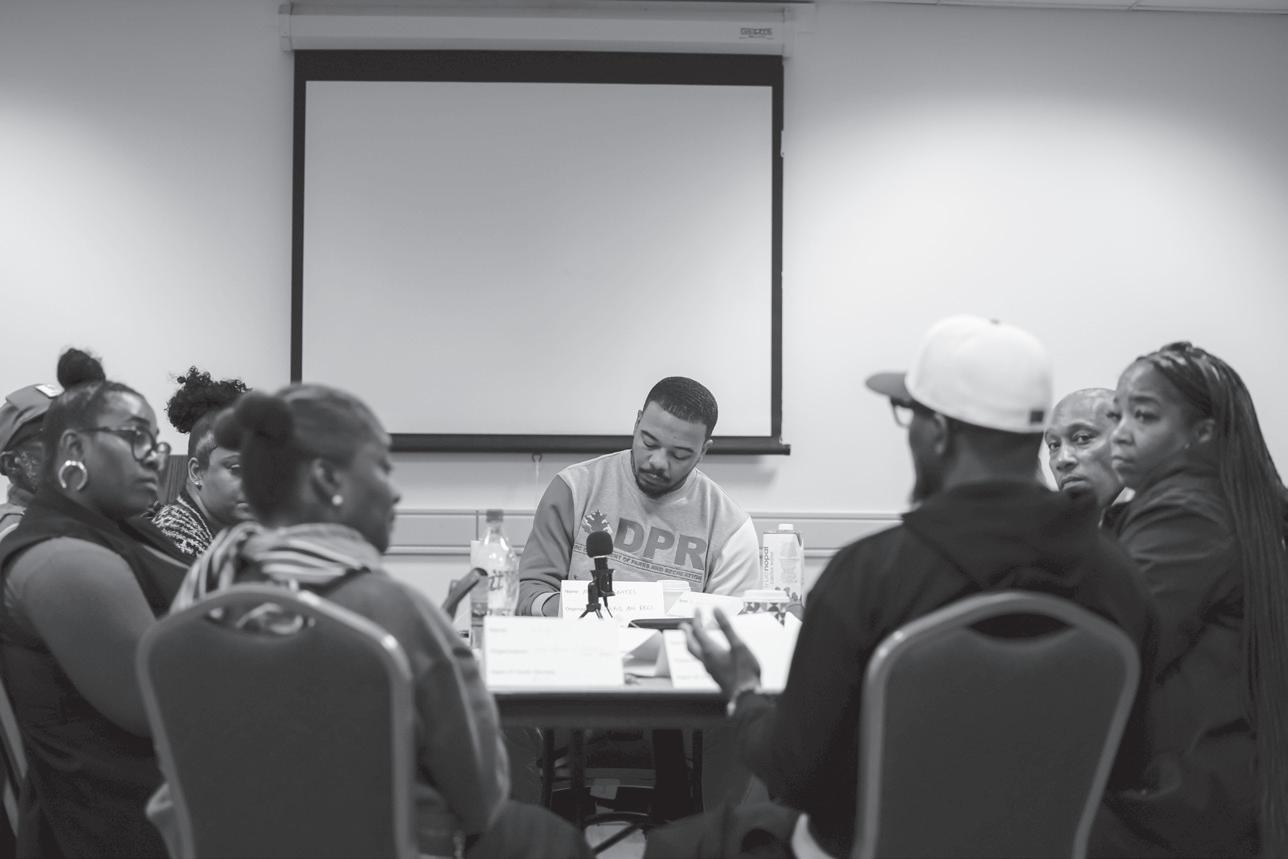
Program organizers host a focus group in October to develop the curriculum.
ARWEN CLEMANS | ASSISTANT PHOTO EDITOR
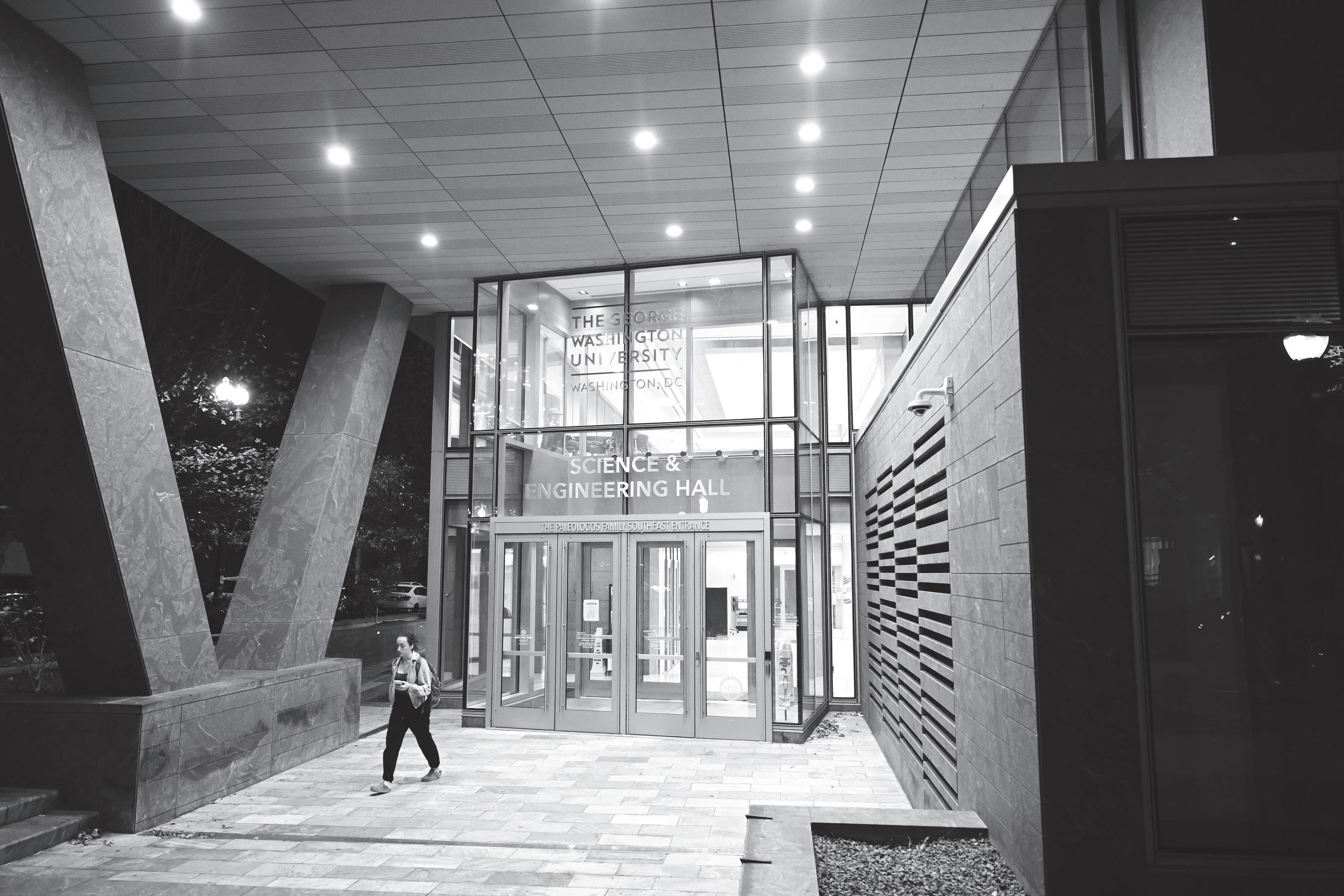
A student exits the Science and Engineering Hall.
TYLER IGLESIAS
ASSISTANT NEWS EDITOR
HANNAH MARR NEWS EDITOR
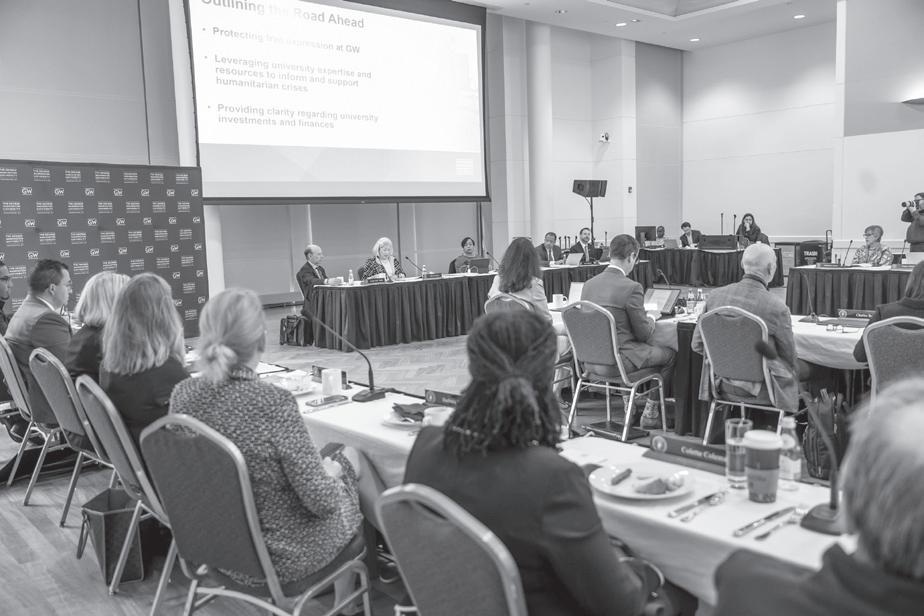
ARWEN CLEMANS | ASSISTANT PHOTO EDITOR University President Ellen Granberg addresses the Board of Trustees during a May meeting.
Nursing school studies link between long COVID, obesity among veterans
AIDAN FARRELL REPORTER
LOUISA HANNOUCENE REPORTER
A GW School of Nursing professor is collaborating with the Department of Veteran Affairs for a five-year study that launched in April 2024 to examine the relationship between obesity and long COVID, with an emphasis on its effects on veterans.
Kathleen Griffith, a professor of nursing at GW and the associate dean of research at the School of Nursing, and Alice Ryan, a professor of medicine at the University of Maryland School of Medicine, are co-leading the $1.9 million research project funded by the Department of Veteran Affairs and will study how obesity impacts the severity of long COVID symptoms like coughing and muscle pain. Griffith said she hopes the study will facilitate the long-term rehabilitation of veterans suffering from long COVID through physical therapy and weight loss interventions and provide guidance to physicians on treating the intersection of the two conditions in the future.
“The research team is focused on long-term rehabilitation of veterans with chronic health conditions in the Veteran population,” Griffith said in an email. “We hope our work will provide insight into the value of exercise and weight loss as an intervention to reduce PCCs.”
Long COVID, otherwise known as Post-COVID Conditions, can cause multiple health issues in patients. Griffith said symptoms of long COVID can include fatigue, cough, mental fogginess and muscle or joint pain, among others.
a randomized controlled trial to determine the effects of exercise and weight loss in improving the physical functioning and quality of life of veterans suffering from long COVID symptoms.
Veterans experience obesity at higher rates than the general population — with only 27.8 percent being at a healthy weight compared to 42.6 percent of the population, according to the National Institute of Health, which some studies have suggested could be due to the stress of transitioning back to normal life after serving.
“It will evaluate whether a weight loss intervention, including dietary modification and exercise, in obese veterans with and without PCC will reduce whole body and adipose tissue inflammation and deterioration and promote PCC recovery,” Griffith said in an email.
Ten percent of veterans who contracted COVID later developed long COVID symptoms, according to the Department of Veterans Affairs. The Centers for Disease Control and Prevention found that among the general population who had COVID, only about 6.9 percent of adults had long COVID. Griffith said veterans are twice as likely to suffer from PCCs as the general population, and she hopes that the study will serve as a “starting point” for research and treatments for long COVID. She said it is unclear among researchers why veterans are more at risk of experiencing long COVID.
not different from risk factors in the general population,” Griffith said in an email.
“The risk factors of PCCs in veterans including advanced age, chronic health conditions, more severe acute COVID-19 at first presentation, and lack of vaccination, are
Griffith said the five-year study will examine the effectiveness of weight loss interventions in increasing quality of life and reducing tissue inflammation and cellular aging, which can further contribute to the symptoms of long COVID.
The School of Nursing’s website states that the study will use
Physical therapists and professors of respiratory research said responses to treatments like exercise and dietary restrictions can vary in efficacy across demographic groups and studies should prioritize finding treatments that work for an array of patients, as patients likely to have pre-existing health conditions like veterans may respond to treatments differently.
Louise Wain, a professor of respiratory research at the University of Leicester, said groups of people with preexisting conditions like obesity are more susceptible to COVID as it is a preexisting health condition that can impair the immune system. She said veterans may be more likely to experience severe long COVID symptoms because of the high rates of obesity in the population.
GWSB to launch certificate in hospitality management, leadership
NIDHI NAIR REPORTER
The GW School of Business International Institute of Tourism Studies will offer a new professional certificate program in hospitality management and leadership this spring.
The online program consists of six courses led by experts in the hospitality industry that will equip professionals with expertise in hotel and resort management, according to the program’s website. Larry Yu, a professor of hospitality management, said they designed the courses and objectives of the program around skills that entry-level and mid-managers in the hospitality industry should be familiar with, like customer service.
“We have complete, professional and continued education opportunities for students on campus and also for professionals working in the industry to advance, to upscale their knowledge and to reskill, retool their knowledge, and if they want to elevate their career and working with a very celebrated team of instructors for this hospitality program,” Yu said.
Yu said discussions of expanding the institute’s con-
tinued education activities and opportunities for professionals first began before the pandemic to compete with other universities, community colleges and for-profit education companies with similar programs. He said he and Seleni Matus, the director of the institute, began working on the specific aspects of the program last year and building the curriculum after discussions with other faculty and industry experts.
“I think the support was very positive from the school,” Yu said. “Since this summer, we started to work on the details, building the website and committing the faculty for the six courses.”
Yu said the certificate program is nondegree bearing and provides continuing education credits with participants required to have the equivalent of a high school diploma, although a bachelor’s degree is strongly encouraged.
The program will offer the courses Inclusive Leadership in Hospitality, Global Talent Development and Sustainable Hospitality Strategies in the spring. The program will add three more courses, Hospitality Financial Management, Hospitality Digital Marketing and
Hospitality Business Analytics, in the fall, according to the program’s website.
The workload for each course will entail lectures, readings, discussion board posts, guest lectures and a final assignment. The courses have an estimated time commitment of approximately 10 to 12 hours per course and have a pass-fail grading system, according to the program’s website.
Yu said the key difference between the certificate program in hospitality management and leadership in comparison to the institute’s other programs is how it integrates all the different functional areas of business. The other tourism-related programs that the institute offers include event management, destination management and cultural tourism, but the new program integrates many aspects of business management.
“Hospitality is more business focused in this case. We basically discuss how to manage a hotel, and so to do that, there are many business functions used or applied in running a business of hospitality,” Yu said. “Most of the disciplines we teach in the business school can be used as functional skills and
knowledge in running a hotel.”
Yu is the program’s sole academic instructor and will teach the Sustainable Hospitality Strategies course in April 2025. The course will focus on the environment, society and governance designs and approaches within hospitality to reduce climate impacts and conserve resources.
“This course really will be focusing on ESG, championed by all the International Hospitality organizations,” Yu said. “So in doing this, as you can see, we integrate all the different functional areas in business, in hospitality management and also focusing on leadership.”
Yu said the courses will assist existing professionals in the hospitality industry to lead hospitality business and operations. He said the skills that students will acquire from the certificate program, like customer service, also apply to other sectors, like health care, the military, artificial intelligence, sustainability and marketing.
Yu said, as industry professionals, he and his fellow instructors have helped students find internship and job opportunities in the past, with one of his students re-
cently getting a job at the Watergate Hotel.
“My advice is that if you have a passion for working in the hospitality industry, this will be a good way to expose yourself to an industry,” Yu said.
Yu said the virtual format of the program also paves the way for the institute to expand the reach of professionals participating in the program by appealing to different regions of the U.S or other regions of the world if they see the program’s value.
Yu said the program aims to have around 15 to 20 participants in its first cohort and to soon begin marketing the program more “vigorously” to promote the certificate program. Gregg Rockett, an academic lecturer and hospitality industry thought leader, will teach the certificate program’s course on Inclusive Leadership in Hospitality. He said this specific module will inform participants about motivating team members, linking job satisfaction and organizational culture as well as leadership and diversity in the workforce.
“What this course hopes to do is instill in hospitality professionals and understanding between what
is management and what is leadership and concepts like emotional intelligence and how it manifests itself in leadership qualities,” Rockett said. Rockett said he worked as a hospitality professional at Marriott and Hilton throughout most of his career, and he later began pursuing career academia in 2019 through multiple university programs. He said the concept of inclusive leadership as it relates to his course has significantly evolved since working with Hilton in the 2000s. Rockett said he will give examples of his personal experiences in the hospitality industry within his online course to illustrate how leadership works and bring in a guest speaker to share their real life experience.
“I spent 35 years in the hospitality industry and saw its evolution and learned from some of the best hospitality companies in the world,” Rockett said. “So what I’m hoping to bring to the table, particularly in my course is, apart from theory and skills, what is practical application of that in the industry? How can you practically apply yourself to be a good leader, as opposed to the theory behind it?”
Student group seeks to spread campus positivity through sticky notes, booklets
A student group that launched earlier this semester is spreading positivity one sticky note at a time.
Write for Heart GW, which is composed primarily of first-year students, aims to spread mental wellness on campus through sharing students’ writing, according to their Instagram page. Organizers said they started the group, which currently has 10 members, with goals to create an inclusive space for writers, promote positive mental health by allowing students to share positive messages for other students and share students’ creative skills on a developing booklet.
Co-president Rachel Zuckerman, a first-year majoring in cognitive neuroscience and minoring in creative writing, said the group is planning to make booklets featuring poetry, short stories, essays, photography and art submitted by students. She said a Google Form that the group promotes through Instagram is open for students to submit their pieces to be published in digital booklets that they hope to print and distribute around campus, local businesses and the pediatric floor of the GW Hospital.
The Google Form asks if contributors want the executive board to provide feedback or editing for work.
“I’m just very excited to see where Write for Heart is at later in the future, and I’m excited to see it grow in this community,” Zuckerman said.
Co-president Vy Vuong, a firstyear majoring in neuroscience and English, said she met Zuckerman in her abnormal psychology class this semester. She said as neuroscience majors, the pair had trouble finding a student organization that would accept creative writing submissions from non-English majors.
Student organization Capitol Letters allows students to submit creative works for publication, according to their Engage.
“That’s why we’re like ‘What if we did it?” Vuong said.
Vuong said she and Zuckerman were inspired to work on a website, which will serve as a digital platform for people to share their writing and artwork, for the group after seeing a pamphlet with studentwritten poetry on a professor’s door in Phillips Hall in October.
“We were really interested in seeing if there were any platforms to share your writing, even if you’re not just like an English or a traditional major,” Vuong said.
She said after they discussed their shared interest in creative writing and potential goals of creating a booklet, she and Zuckerman went to the Org Help office in the University Student Center to learn the process of creating a student organization, and their application to officially establish is pending approval.
Vuong said the group hopes to grow by hosting more general body meetings and increasing their social media following. They have hosted two meetings this semester. Vuong said the group’s first
the
campus
“I was like, ‘Okay, what is a way that’s really easy for us to produce something, and then also to have it be really easy for people to either take or just look at?’”
said. Chris Briggs, a first-year majoring in political science, said he decided to join Write for Heart after
project, which started Nov. 13, involved putting up about 200 to 300 sticky notes with positive messages like “we appreciate you” and “proceed without certainty” and the group’s Instagram handle at the bottom around the Mount Vernon Campus and Madison and Thurston halls. She said she was on “hope core” TikTok where she saw an abundance of inspirational quotes and wanted to spread similar messages to other community members.
proud of.
HATCHET
Vuong
he spotted
sticky notes around
and saw Vuong putting them up. In his role as a group officer, he said he will spearhead the layout and design of the booklets, putting together art, photography and writing. Briggs said he joined the group to help people produce creative, artistic work in a place they can be
DIANA ANOS STAFF WRITER
MATHYLDA DULIAN | STAFF PHOTOGRAPHER
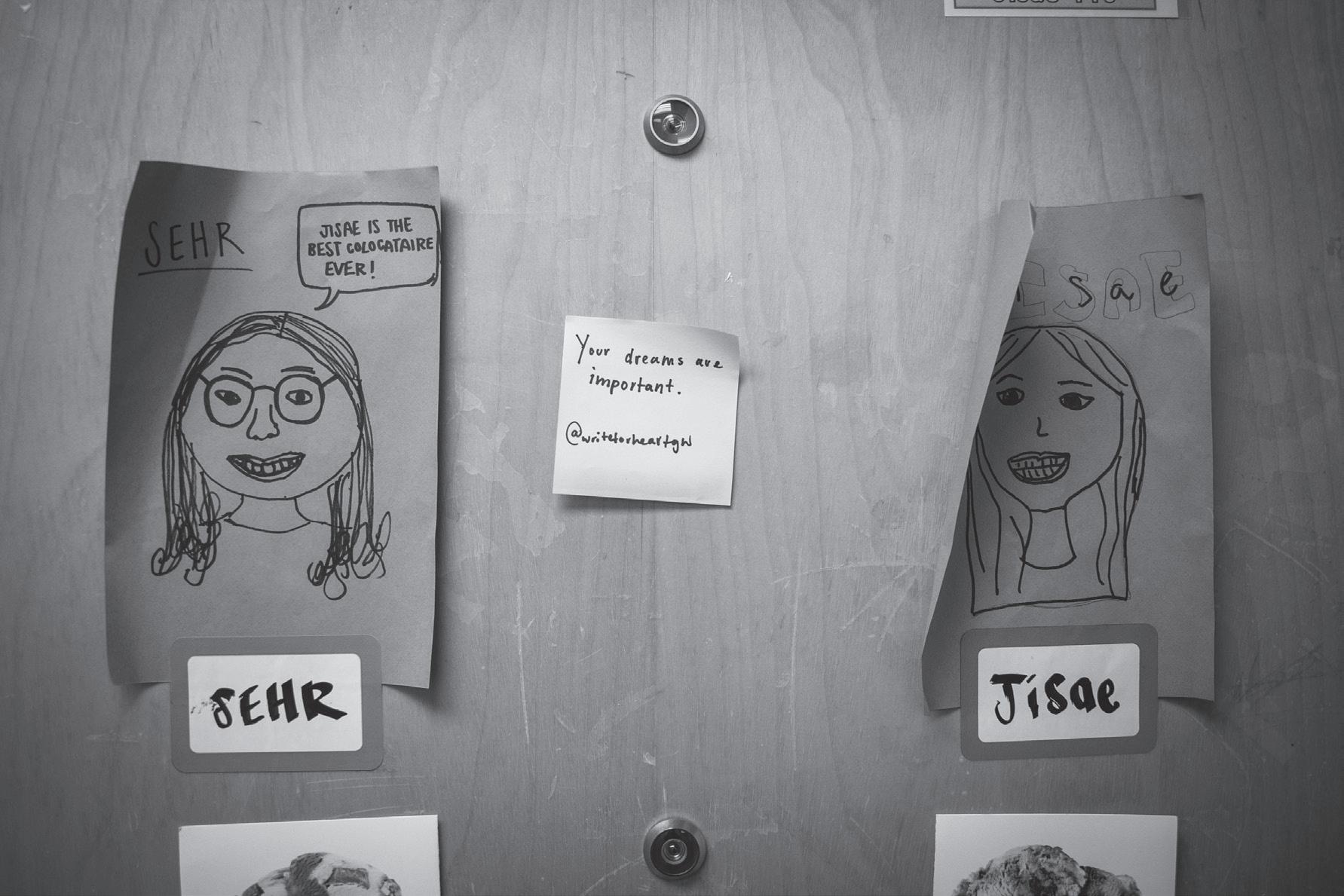
A Write for Heart GW sticky note on the door of a room in Madison Hall.
OPINIONS
Once a week, our editorial board comes together to talk about salient issues and subjects in the GW community. We’ve discussed the lack of transparency in the arming of GW Police Department, GW’s past mistakes when addressing unionization efforts and more, and as we approach the end of the semester, it’s clear that those conversations often focus on the need for transparency and communication from University and District leaders. But as students, we don’t always discuss how students like ourselves play a large role in bringing change.
Students are quick to point out GW’s shortcomings and flaws, what it can do better or what it should have done in the first place. Most of the time, it is easier to criticize or complain while we sit on the sidelines instead of opening ourselves up to engaging with the University’s efforts for increasing of communication and transparency. We should recommit ourselves to improving our University and community as the year and semester come to a close by becoming more active community members.
Confidence in higher education has been declining in the past decade, with more frequent discussions of the value of college degrees and rising costs and student debt. And the confidence in GW has shifted in past couple of years, stemming from the tenure of former University President Thomas LeBlanc, to the University’s current responses to campus protests and discussions on how to navigate free speech. When GW makes decisions that community members feel have a lack of transparency or consideration from stakeholders, it’s normal
“Our shared commitment as educators is to cultivate an environment where justice is pursued in a manner that respects all identities.”
In the new year, let’s recommit ourselves to GW
STAFF EDITORIAL
to want to detach oneself from the University and forgo attendance at events or meetings. But by deciding to stay outside of the GW community, students don’t have as much of a say in what the University can or should be doing.
In this past semester, there have been widespread calls for more active engagement and discussion between the community and GW’s leadership. But if GW holds forums or already-established University events with administrators, and no one shows up to them, then one can’t expect the University to listen to its student body. This sort of
thinking soon ends up limiting the potential that students have to help the University and community improve with communication. When students go back for winter break, that thinking should start shifting into a reflection of what we can do to be more involved at GW.
Students have noted that at some GW events, like Interfaith Week, have been underpopulated by students and overpopulated by staff. Maybe this is a sign that these events need to include more student input, but by not attending or sounding off on the event’s aim or success, students end up exclud-
My life as a pizza bagel at GW
When I would tell people back home
I was half Jewish and half Italian, they’d pretty much go, “Yeah, obviously.” That’s just what New Jersey is like: It seems like everybody is Italian, Jewish or both. We even called ourselves “Jew-ish” or “Pizza Bagels” — a mixture of Italian and Jewish heritage wrapped into one.
Before I arrived in D.C., I never thought about how many students had never met a Jewish person prior to GW. I didn’t realize that things like keeping a lightup menorah next to a Christmas tree, which to me had been a core aspect of growing up, was unheard of to others. The way I was raised can be hard for my peers to understand, especially considering how valuable religion is to a lot of them, and how I’ve interacted with the holiday season in a way that combines two religions — Catholicism and Judaism. In a strange way, having to explain my multicultural upbringing to people has made me reflect on, and appreciate my background, more than I ever did before. When I have been fortunate enough to be the first Jew someone has met, they are usually surprised to learn I have any Jewish heritage at all. The shock is not the unfamiliar part to me: As far as I know, there are only four Jews in New Jersey with the last name “Morrelli” — my immediate family. But it’s the necessary elaboration that is new.
Once I tell them I’m only half Jewish, and the other half is Italian, I am pelted with questions.
The non-Jewish students ask if I went to church or synagogue growing up, and I tell them I did neither. They ask if I keep kosher, and I tell them I did when I was living “ten months for two,” an inside joke for people who go to sleepaway camp, meaning you live through the ten months of the school year just for two months of summer camp. Did I have a Bat Mitzvah? Nope, but for my sweet sixteen, I went to see SIX on Broadway, which is way more Jewish if you ask me. It’s a strange reminder that I don’t observe certain customs or participate in traditional events like some Jewish people — or at least what goyim think most Jewish people do.
Back in New Jersey, people seemed to understand that I had a different experience during the holidays than people who were just Italian or just Jewish, so it was unsettling to suddenly be around people who didn’t grow up with families like mine. My combination of religions was normal and it’s not necessarily abnormal here, either. But it’s less common than the realities of some students here, who grew up in areas without a lot of religious diversity.
My family all lives in the Tri-State Area, so the more holidays we can all gather for, the better. When I’m asked about the holidays, their eyes light up like a Christmas tree when I tell them I got to celebrate both. They seem to think I was living the dream as a child in December’s past. I feel bad bursting their bubbles but I wasn’t getting eight
straight days of big presents.
As much as I would have loved receiving over a week of gifts for Hanukkah, it was never like that in my house. We would see my Mom’s side of the family on whatever Sunday happened to coincide with one of the nights of Hanukkah, and I’d get gifts from my Nana and Grandpa then. On the other nights of Hanukkah, my family would shuffle into the dining room and try not to set the entire house on fire while lighting a menorah. Mom would have us close our eyes since she would usually forget to wrap the Hanukkah gifts. We’d open our eyes, look down and thank our parents for what usually ended up being erasers or candy. This was normal to me, and coming to GW made it seem like something befuddling.
After a few days, we would usually forget about Hanukkah. At some point, Christmas would come and overtake Hanukkah, if it hadn’t already trampled its momentum by coming before it. Fried potato pancakes left in the fridge would slowly be replaced by seafood salad, rice balls and struffoli.
I never really saw these sides of my family as separate parts to be analyzed or questioned before coming to GW. To me, they were all my family. It made me appreciate the way I grew up. I love talking about my family and about how we spend the holidays. It’s been an odd experience, but I feel lucky. At the end of the day, pizza and bagels are both just bread anyway.
—Caroline Morrelli, a first-year majoring in political science and minoring in history, is an opinions writer.
Iing themselves from being able to appreciate or take note of changes being made in their benefit. When officials try and make themselves available to their community, and students don’t show up, it’s counterproductive. According to GW’s “GWrapped” of 2024, the University had over 10,000 events in the last year. We’re curious to know how many people showed up. Substandard community participation from the community doesn’t have to be carried over to the new year and semester. Sometimes, it’s easier to think that by rejecting the GW commu-
nity, one is rejecting the institution too, but we would hope that the effort and participation that one puts into the community is the effort we get back from the University. Inaction may send a message, but participation sends a much bigger message. As the saying goes, when you’ve got skin in the game, you stay in the game. Effort goes both ways. It’s clear that people voice their concerns or criticize GW because they care about the University, and want to see GW at its best, so engaging in this passion shouldn’t be viewed as a job or a chore. There should be integrity behind participation, especially when at the end of the day, the outside world sees us students as part of GW — the community and institution.
Participating doesn’t mean students have to become best friends with University President Ellen Granberg or go to every event, but it can start small. People always make a list of resolutions for selfgrowth for the new year, like how to be a better person, friend or student. So go to office hours with professors and express your thoughts about their course or your major — after all, almost every student at GW has complained about something in their courses. Complete those course evaluations that professors beg their students to fill out every semester. It can even be as simple as participating more in class with professors and classmates. GW already lacks a sense of community because of its location in a metropolitan area, so when students start rejecting the GW community even more, there is virtually no community left at the end of the day. Our change and growth for the new year marks the change and growth of our institution too.
Going home for the holidays made me realize my self-growth
grew up on Long Island, New York, in a quiet town called Hewlett. The guys at the local pizza place all knew my name, the local politics all revolved around the nearby synagogues and the same five moms were always leading the Parent-Teacher Association. Because our community was tiny, Hewlett was where everyone knew everyone’s business, offering no opportunities for second impressions. As a result, growing up made it impossible to evolve under anyone’s gaze. It felt like no matter how much I changed, there was no escaping the person I was at six years old, sparking a resentment for my environment.
Mara Riegel Opinions Writer
When I came to GW, I had a fresh start to be anyone I wanted to be. I was able to pursue only what I wanted to, choosing the people I surrounded myself with instead of having my community assigned to me. I was more empathetic to my friends and more outgoing in forming new relationships. I wasn’t met with constant judgment about my weight, or identity or beliefs but with lots of opportunity through my campus organizations and in my classes. Through time on campus and support from my friends, I realized that the only expectations I had now were those I put on myself. Coming to GW was the best choice I could’ve made for my personal
growth. GW was open to the idea of someone like me, a neurodivergent, queer Jewish Democrat who isn’t afraid of being uncomfortable with new concepts or hard conversations. At home, this kind of thinking didn’t exist. Returning home demonstrated my growth and how desperately I needed to leave that town.
When I visited New York during Thanksgiving break, I came to realize that my insatiable focus on my peers and teachers’ opinions during high school was unattainable. I had an English teacher who made me miserable my senior year, choosing obvious favorites and grading unfairly. There was no course of action that would lead to me getting out of that class unscathed mentally or academically, so I couldn’t say a thing. Now, if I have a challenge with a professor, we either talk about it like adults or at the worst, I make my peace with seeing them for just two hours per week. Returning home showed me that college has allowed me to relax more than I realized and stop living in fear. When I was home for Thanksgiving break, I ran into two girls I knew growing up, and they also commented that leaving our town seems to have made all the difference in getting me to a place where I’m noticeably happier. These girls seemed to have found their niches at school, coming to the same conclusion that I did, that the world gets easier when you have options rather
than directions. When I moved on to seeing teachers at my high school’s alumni day, they made note of the fact that the life I have now is so much bigger than what I had a year ago. If I want to learn anything, I can. If I want to go somewhere or do something, I do. Going back to that school only showed me why I was so happy to leave it behind. My newspaper adviser was so proud that I moved on from working on our tiny school paper to writing for The Hatchet, a paper that itself is an institution. Many teachers were happy for me knowing that I now go to school somewhere much more tailored to my interests in history and politics. GW has let me lean into my interest in social issues in a way I never could have before while growing up in a homogenous, Republican area. Most importantly, seeing the two teachers who got me through school and having them say that they’re happy for me for finding better, even while they stayed in the same place, told me all I needed to know.
Going back to my high school and seeing people I’ve already seen for 14 years quite frankly just made me sad because it felt like a regression. My life now is bigger and brighter than I could have even imagined this time a year ago, and honestly, thank God that going back home showed me that.
—Mara Riegel, a first-year majoring in political science, is an opinions writer.
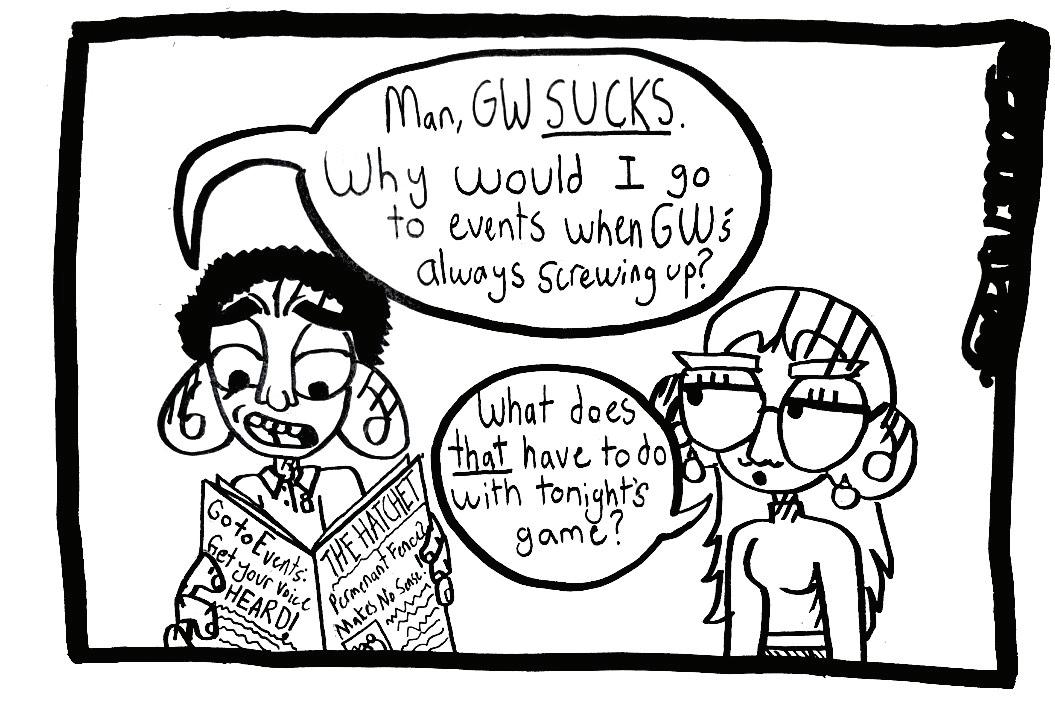
CAROLINE MORRELLI | CARTOONIST
Caroline Morrelli Opinions Writer
SPORTS
GAMES
Frontcourt men’s basketball duo dominates the paint
BEN SPITALNY
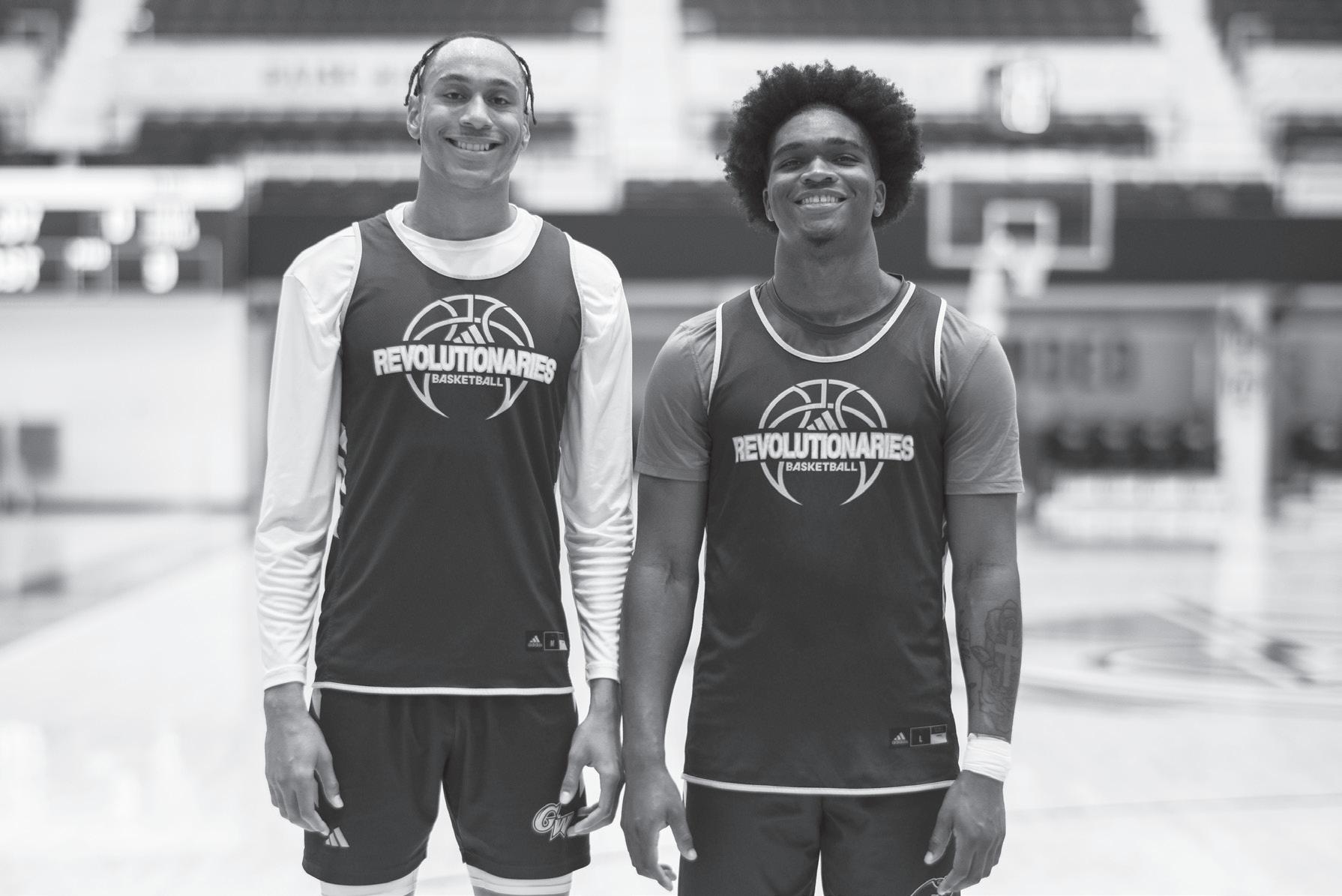
There are two big reasons for men’s basketball’s 8-2 start: Darren Buchanan Jr. and Rafael Castro.
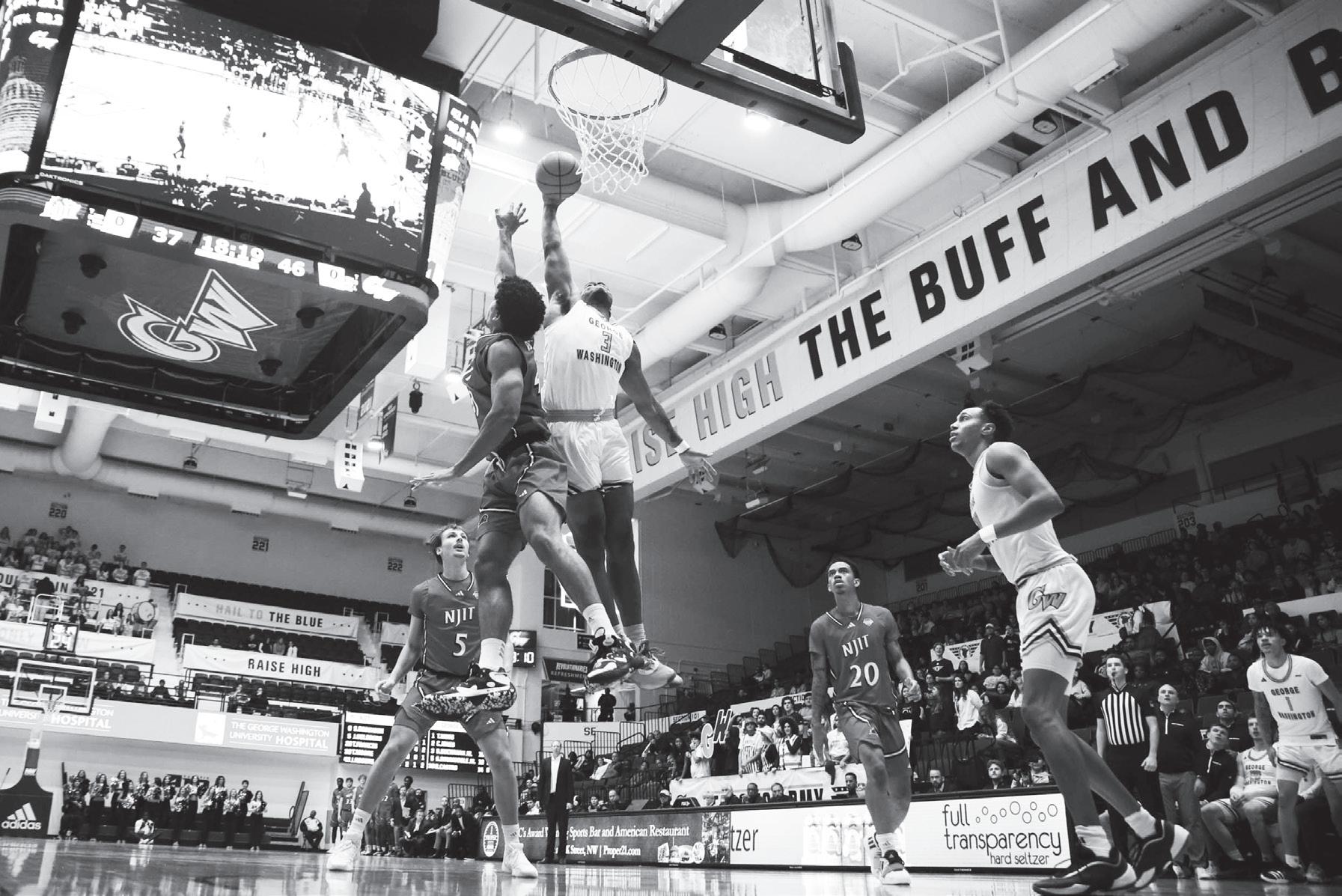
Through the Revs’ first 10 games, the team has connected on just 31.0 percent of their 3-point shots, good for 282nd out of 364 Division I teams. While these struggles from deep could be a warning sign for offensive struggles for the team, they’ve been balanced by the team’s successes inside the paint. The team has outscored its opponent in the paint in all but four games, including by 34 in the team’s loss to American University on Wednesday.
Redshirt sophomore forward Buchanan and redshirt junior forward Castro help to lead the team’s paint prowess. The two, who are first and fourth on the team in scoring — averaging 16.4 and 10.1 points per game, respectively — have anchored the frontcourt on offense and defense.
“I know if I get stopped, I can easily throw it up to him, he’s gonna make a play,” Buchanan said of playing with Castro. “It also helped my vision on the court as a player, just knowing where he is all the time, knowing how he can affect the game, playing in a dunker and the low post.”
As of Sunday, Castro and Buchanan are one of just two pairs of teammates in Division I who average at least 10 points and eight rebounds per game, along with the University of Maryland’s Julian Reese and Derik Queen. Castro, who transferred to GW this season from Providence, said his connection with Buchanan dates back to this spring when he served as his host for Castro’s visit to GW.
“He was very genuine and honest with me,” Castro said of the visit. “He told me I’m going to have a lot of opportunities to win a lot of games in front of a great crowd and just work on my game and get better.”
Buchanan said that when he watched Castro’s film before his visit, he knew immediately that he was “a crazy athlete” and that it was a “no-brainer” for him to come to GW.
After averaging fewer than 10 minutes per game and under 3 points per game in his first two years at Providence, Castro has started every game for the Revs this season, contributing an efficient 64.7 shooting percentage and bringing down 8.0 rebounds per
RYAN JAINCHILL BASKETBALL EDITOR
Men’s basketball (8-2) defeated the Old Dominion University Monarchs (4-6) 78-70 Saturday night. Despite trailing 3534 after the first half, the Revolutionaries used a dominant second half to score 44 points to return home with a win. This game marks the Revs’ first win on the road this season and GW’s first nonconference road win in exactly eight years.
Redshirt freshman guard Christian Jones led the Revs with 17 points off the bench, setting a new career high. Graduate student guard Gerald Drumgoole Jr. recorded 16 points and redshirt sophomore forward Darren Buchanan Jr. and graduate student forward Sean Hansen added 13 and 10, respectively. As a team, the Revs recorded 34 points off the bench Hansen led the team in rebounds with seven, but overall, the Revs were outrebounded 40-36 by the Monarchs.
The Revs trailed from the get-go, finding themselves down by as many as seven points at the 12:45 mark. But a Drumgoole layup would tie the game at 29-29 with 2:15 left in the first half, leading to GW taking a 1-point lead into the final seconds of the half before junior guard Devin Ceaser would drill
game, behind only Buchanan, who averages 8.2. Buchanan, playing in his second season, has increased his points, assists, rebounds, steals and blocks
both free throws with a second remaining to give the Monarchs the lead going into the break.
Drumgoole would immediately give the Revs the lead back at the 19:24 mark of the second half with a 3-pointer, but the Monarchs would recapture the lead at the 19:00 mark — with 18:07 marking the final time the Revs trailed in the game.
Tied 42-42, Jones would score the Revs’ next six straight points, culminating with a layup in the paint at the 13:52 mark. Hansen and Buchanan would continue to record points, increasing the lead to as many as 13 points when Buchanan slammed down a dunk.
Even as the Monarchs clawed back and were only trailing by 5 with 29 seconds remaining, Drumgoole drilled five free throws with less than a minute remaining to secure the victory.
The team connected on seven of its 17 3-point attempts, good for a 41.2 shooting percentage and over 10 points better than their season average of 31 percent. This effort was led primarily by Drumgoole, who went 3-4 on the night. In the team’s previous game, a loss at American, they didn’t connect on a 3-pointer until the overtime period.
With the triumph, the Revs moved to 8-2 on the season. They will face off against Army West Point on Friday at 7 p.m. in the Smith Center.
per game, despite a 7.2 decrease in shooting percentage. He ranks 11th in Division I in free throw attempts per game with 8.0, helping to lead the team to fifth overall with 28
attempts per game overall. Entering the season, Buchanan said he was an “energy guy” who looks to lead teammates on and off the court. Buchanan said his physicality
helps him get to the line so often. Buchanan has a 65.0 free throw shooting percentage this season but has struggled in the past two games, including going 10-21 in an overtime loss against American.
“I think for how I play so physically, I got to get to the free throw line,” Buchanan said. “I got to make them, so I think that just comes with the work that I put in, just trusting my game, knowing that I’m gonna get fouled by trying to just go up and finish through contact every time.”
Castro said that playing with Buchanan has given the team mismatches as he attracts more defenders driving to the paint. If Buchanan draws double teams or bigger defenders, it oftentimes leads Castro open in the paint.
“Playing with [Buchanan], basically, I tell everybody it’s pick your poison,” Castro said. Buchanan said Castro on the court lets him play with more confidence because he knows that if he gets stopped, he can pass it to him. Buchanan already has three games with at least five assists, more than he had all of last year. Both Buchanan and Castro said that the time they’ve spent together off the court has gone a long way to help develop their on-court partnership. Buchanan said they hang out together “pretty much all the time,” playing 2K, making music or eating their meals together.
A D.C. native, Buchanan said he recently hosted the team at his house for Thanksgiving, where they “ate a lot of good food” and spent time talking basketball with his family.
“We’re always going to get food somewhere,” Buchanan said. “Dining hall, restaurant, doesn’t matter, we’re going to get food somewhere.”
As conference play nears, the duo said they’re excited to match up against top “bigs” in the A-10, like Saint Louis’ junior center Robbie Avila. Buchanan said he’s confident that his versatility and Castro’s defensive skills will make any matchup advantageous.
“I don’t think there’s a big man that can guard me on the perimeter, and that’s why I’ve been playing that a lot this year, playing the perimeter and getting to the basket,” Buchanan said. “So if a coach’s game plan is to put his big man on the perimeter, good luck. That’s all I’ll say to that. And I feel [Castro] is a great defender in the post, so we’ll be fine matching up against other forwards and bigs in the conference.”
Column: Women’s basketball veteran-freshman fusion rises to top with blend of energy, experience
With the departure of key veterans at the close of last season, this season’s women’s basketball team has been faced with a new task — creating cohesion on the court with a roster of fresh faces.
Some arrived at GW as true rookies to the world of college basketball while others who joined the Revolutionaries this season are no strangers to the NCAA. Graduate guard Makayla Andrews and true freshman guard Gabby Reynolds have embraced the challenge to rise to the top of the ranks despite a gap in age and experience between the duo.
Between redshirting, COVID-19 years and the emergence of the transfer portal, eligibility rules have altered the world of college hoops. Roster and scholarship management has become more complex for coaches, career transitions are delayed and player development is stifled by minute-snagging elders. Like many other teammates across the country, Andrews and Reynolds have entered the game at very different eras of NCAA basketball.
Regardless of how the court of opinionated fans feels about the current state of NCAA eligibility, youthful and veteran players bring a balance of fresh skill and seasoned experience to their rosters. Andrews and Reynolds
have combined their energy and experience to form an offensive bond that is unstoppable. Reynolds came to Foggy Bottom as the newly crowned recipient of the Michigan Miss Basketball Award. The West Ottawa graduate averaged a lofty 29.9 ppg, 3.9 rebounds per game and 3.9 assists per game over her entire high school career.
Reynolds opened her college debut in the Smith Center with a three-ball against Delaware, netting the Revs’ first points of the 2024-25 season. Her basket sent a message to fans very early on that she would be an impactful playmaker on the court this year.
Andrews transferred to GW after four seasons in the Patriot League at Lafayette, where she earned second-team AllConference honors last year. Adding GW to her belt of collegiate experience, Andrews closed out her junior and senior campaigns at Lafayette, playing in all 59 games combined and starting in 28 during the 2023-24 season. She averaged 13.2 points and 5.2 boards in her final season with the Leopards. As Andrews joins the Revs from Lafayette College, named after the French military hero the Marquis de Lafayette who served in the American Revolution under George Washington, her arrival to GW can be seen as almost prophetic. For history
buffs, it is symbolic of her transition into senior leadership to lead the Revs into battle during her final season in college basketball. Andrews currently leads the team with 111 points across the eight games GW has played so far. She tabbed her season high in their home opener but has added four more games with double-digit scoring. Despite their age difference, Reynolds and Andrews have combined their offensive abilities to lead the Revs’ front court. McCombs commended Reynolds’ adaptability on the college court despite being a freshman. “Gabby’s continuing to emerge as a Division I player here,” McCombs said after Reynolds led the team with 22 points against Howard on Nov. 8. “The ball is in her hands a lot, and we leave her on the floor. She can make plays and shoot the ball, so I think she’s getting used to the pace of the game, the style of play, those kinds of things.” Last year’s star returners, now-graduated forward Mayowa Taiwo and now-transferred sophomore guard Nya Robertson, led the Revs as familiar faces on the roster. It is refreshing to see successful, young and new talent emerging, regardless of their time in the NCAA. Andrews and Reynolds bring a new dynamic, sharp-shooting style of play to the team.
The range of experience on GW’s roster has benefits. Young players bring fresh athleticism, speed and energy to the team. An eagerness to prove themselves can also create a dynamic and competitive atmosphere. However, veteran players like Andrews have experience navigating high-pressure situations, contributing to better decision-making during critical moments on the court. While young players might be more adaptable to new systems or roles, older teammates come in with established positions that foster coordination on the court. A fusion of youthful energy and experienced stability is recipe for a cohesive team dynamic. GW’s standout duo has harnessed the strengths of their age difference for the good of the team. They may not share a birth year, but Reynolds and Andrews do share their first challenge as Atlantic 10 players this season. The women’s team fell a humbling 55–87 to George Mason in their conference opener last week. GW stands 5-3 overall and 0-1 in A-10 play. However, the season is far from over. With 21 games left in this year’s campaign, including a MTE Christmas Classic in Miami over break, the Revs have the opportunity to prove that what the young can do with energy, the old can do with experience. Together, they are unstoppable.
TOM RATH | STAFF PHOTOGRAPHER
Redshirt junior forward Rafael Castro and redshirt sophomore forward Darren Buchanan Jr. pose for a portrait in the Smith Center.
COOPER TYKSINSKI | PHOTOGRAPHER
Redshirt sophomore forward Darren Buchanan Jr. shoots the ball, while redshirt junior forward Rafael Castro prepares to defend during a game against the New Jersey Institute of Technology.
HOLIDAY GUIDE
Con actual divorce spurs new DC holiday market, vendor migra ons
Two holiday markets, both alike in dignity, in fair D.C. where we lay our scene.
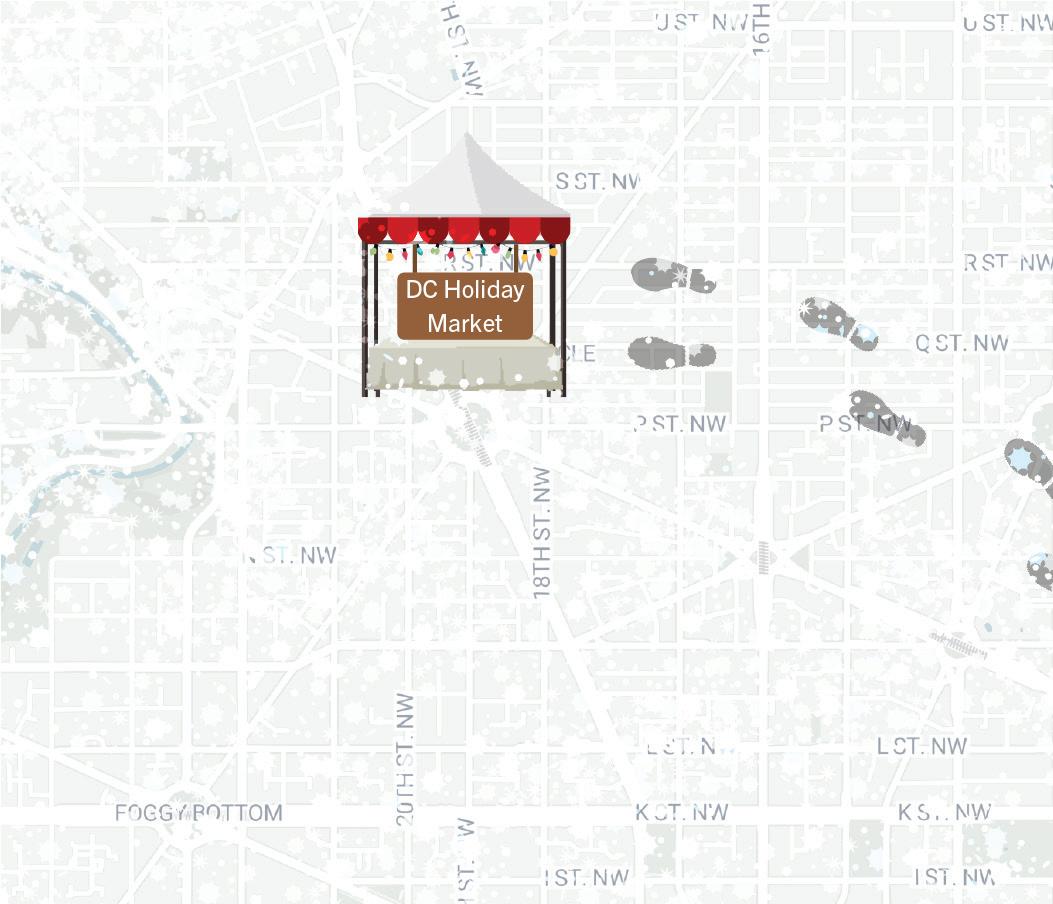
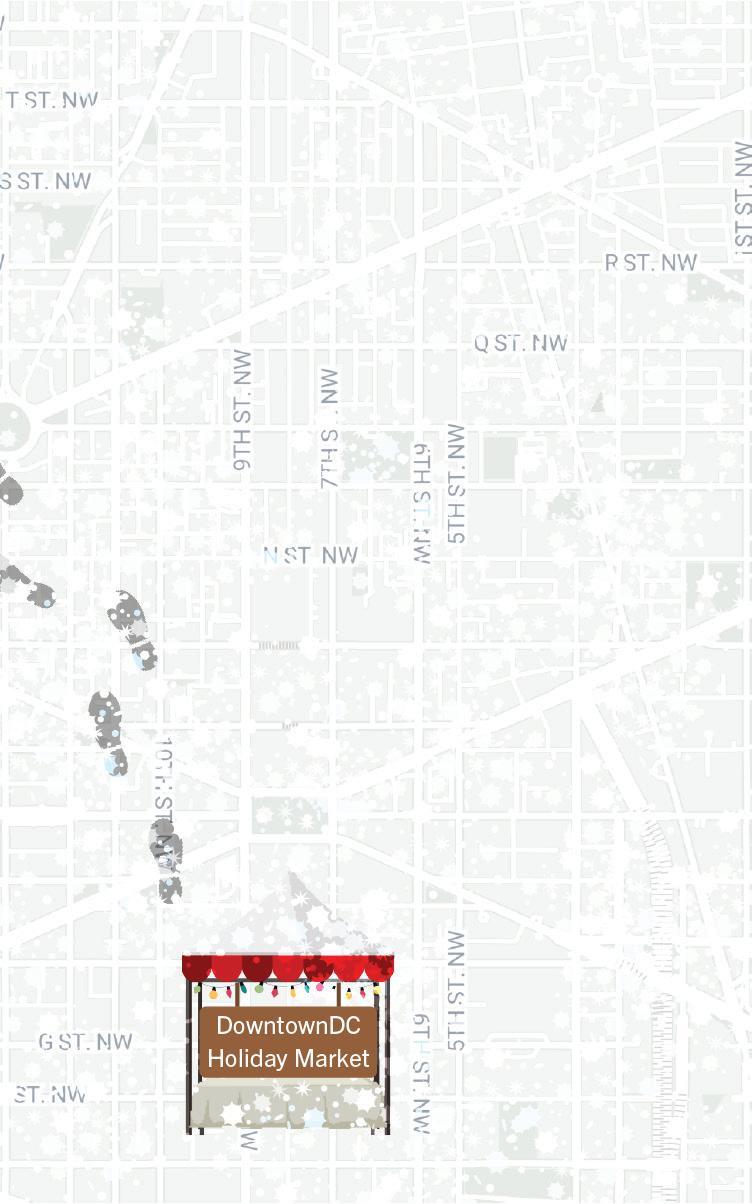
A few blocks away from the Gallery Pl-Chinatown Metro Station, the Downtown Holiday Market this year ditched its classic white tents for wooden booths adorned with pine needle garlands and boasts a new name: the DowntownDC Holiday Market. But just a 15-minute Metro ride away in Dupont Circle, the DC Holiday Market stretches across 19th St NW with a sea of white tents connected by red signs and strings of twinkling lights, once quintessential to the original Downtown Holiday Market.
Dupont’s DC Holiday Market’s aesthetic similarity to the Downtown Holiday Market’s former look is no coincidence. The DowntownDC Business Improvement District coproduced the original Downtown Holiday Market with Diverse Markets Management for 18 years. But last December, the DowntownDC BID asked Diverse Markets Management to compete to produce the 2024 market and ultimately dumped them for the Brooklyn-based Makers Show, which runs markets in New York and Boston.
I’m not sure if my childhood Christmas trees were the most or least progressive plants to ever exist.
On the one hand, my family shirked any religious iconography. At the same time, our trees were a glorified tribute to consumerism with ornaments of pop culture icons like Captain Kirk from “Star Trek” and a glitzy Post Malone in a Santa hat hanging from the branches.
Michael Berman, the president of Diverse Markets Management, said in a Washington Post article in October that he was “angered by the decision,” which booted his market from their post outside of the National Portrait Gallery. But after he
consumerism. I’d deck my tree out in the maximalist tastelessness of my youth, but to stick it to the man, I’d do it on a $100 budget and only acquire my tree locally and my decor secondhand.
So this year, when I decided to get myself a Christmas tree for the first time in college, I decided to strike a compromise to recapture the nostalgia those pine needles bring without also promoting pure
“ran into a brick wall” fighting the decision, he said he opted to find a new space for their market in Dupont Circle.
Gerren Price, the president of the DowntownDC BID, told the Washington Post that the BID’s decision to hire Makers Show followed “community
“2000.” They were so bizarre, there was no world where I couldn’t get them.
On the Sunday at the end of Thanksgiving break, my roommate and I trudged through the cold to Unique Thrift Store in Falls Church, Virginia, a 20-minute Metro ride followed by a 20-minute walk, to hunt for ornaments and decorations. I lucked out, since the table with Christmas decor was right at the front of the store.
The real win of my visit, though, was a strange, crystal ball-esque orb sitting atop a scarf, two stick arms and wide black shoes, with a cord sticking out the back. I was a bit mystified by the object. What was it? Why did it resemble something one would use to summon a demon? What happened when you plugged it in?
and stakeholder feedback” about the “declining quality” of the Downtown Holiday Market under Diverse Markets Management’s leadership.
Blake Buege, a publicist that represents Diverse Markets Management, said in a statement to The Hatchet that due to the
about getting bullied by “the kids” over his weight. After I pressed a button on his back, he launched into a very, very, very slow and long rendition of the New Year’s Eve classic “Auld Lang Syne.” Between the joyous singing and pure bizarre hilarity, I felt I had found the soulmate for my pro-oddness but anti-consumerist holiday extravaganza.
change in location, the DC Holiday Market is currently not able to accommodate as many vendors in their Dupont market as they had in their Downtown market but hopes to “expand its footprint” next year. He said that moving the market to Dupont Circle has also increased costs in “planning, structural changes, services and advertising” but did not specify how much the costs increased by or why.
Now, the DC Holiday Market hosts 33 vendors in the Dupont Circle location, compared to the 70 vendors they would host at a given time at the original Downtown Holiday Market, while the DowntownDC Holiday Market now hosts more than 100 vendors.
Sonda Allen, a local gold and silversmith and the owner of the handcrafted jewelry business Turtle’s Webb, said she was one of the founding vendors of the original Downtown Holiday Market in 2005 and worked there for nearly 20 years. Following the split, she said she decided to move with Diverse Markets Management to Dupont Circle because of the “trust” she had in the company after they had built and sustained the market since its inception.
“You’re coming in now,” Allen said. “You’ve been handed somebody’s hard work.”
to walk the hour to Gheens Trees. To get in the cheery holiday spirit while strolling all alone, I put on Ezra Klein’s solemn interview with former President Barack Obama’s Chief of Staff Rahm Emanuel.
and-a-half foot tree, with branches that needles were still fresh.
I became instantly enamored with two of the oddest ornaments I could find: a circus clown with a demonic look encapsulated in a glass bell, and an ornament whose box says it is a “Celebration of the New Millenium,” in which a bear poked its head out of a gaudy pop art
As commuters emerged from the Dupont Circle Metro station, a trio of carolers dressed in Victorian garb greeted them with jingle bells and holiday hymns.
In front of the adjacent Krispy Kreme and alongside passersby’s puffy coats, the carolers’ capes, top hats and bonnets made them seem out of place on 19th Street NW — almost like they had materialized from the pages of a Charles Dickens’ novel. Washingtonians and tourists alike stopped in their tracks and broke out into wide grins at the sight of these Victorianera singers and the sound of their perfect three-part harmonies.
The singers belong to Olde Towne Carolers — one of the largest caroling companies in the country with offshoots in East Coast and Midwest cities, like Chicago, Illinois; Baltimore, Maryland; and D.C. Their performance at the station Saturday was the third in a tour around the Golden Triangle neighborhood,
The $8.95 price tag was no deterrent — I needed my questions answered.
When I got home and plugged the orb in, the results exceeded my wildest expectations. The front of the object lit up with a snowman face, who began ranting in a Brooklyn accent
sponsored by the Golden Triangle Business Improvement District in collaboration with Heurich House Museum — which honors the legacy of the German-American brewer and real estate investor Christian Heurich — according to an employee at the museum.
Jennifer Graf-Domijan, the founder and CEO of Olde Towne Carolers, said she founded Olde Towne Carolers in 2005 in the Philadelphia area in order to create more regular gigs for herself, as a classical singer, and her friends who are also professional singers. She said at the time, she found few other caroling companies while searching on the internet, making this endeavor “uncharted territory.”
Now, Graf-Domijan said her company has more than 200 gigs across 11 states every holiday season, which is roughly split between private events, like corporate parties, and public performances — like their residency at the Longwood Gardens outside of Philadelphia.
Graf-Domijan said the company’s approximate 160 carolers all either hold a degree in
Next on my agenda was getting the tree. I settled on going to Gheens Trees, a Christmas tree farm located on the north end of Georgetown.
The problem was figuring out how to get to Gheens Trees. I don’t own a car, and there wasn’t an easily Metro-able way to get there. I considered biking, but I worried that Capital Bikeshare would push me out of the budget I imposed upon myself.
So, rationally, given that it was 20 degrees out, I decided
music or possess the equivalent in years of performing experience and rehearse the carols independently. She said Olde Towne Carolers boast about 90 songs in their repertoire, from hymns, like “God Rest Ye Merry Gentlemen,” to 20th century classics, like “Frosty the Snowman,” but “Jingle Bells” is the one that always garners the most enthusiasm from crowds.
Graf-Domijan said said the Olde Towne aesthetic pays homage to the Victorian tradition and helps transport audiences from the “stressful” times of the modern holiday season to the simpler Christmases of their childhoods.
As a frigid wind whistled through the streets of Foggy Bottom, I ventured through the cold to Dupont Circle’s Heurich House Museum. A trio of Olde Towne Carolers were set to kick off their series of performances throughout the Golden Triangle neighborhood on the Heurich House’s steps as people lined up to enter the museum’s annual Christmas Markt.
From “Joy to the World” to “Hark! The Herald Angels
After trudging uphill for an hour, I found the Christmas cheer I was hunting for. I spotted four massive, 30-foot tall pine trees mere steps away from where I stood. Blinded to anything else, I stormed ahead, convinced I had found the home of Gheens Trees. An overalls-wearing lumberjack came over to me and asked if I needed any help. I pleaded with him for cheaper trees, so he directed me to the far left of the farm, where trees that looked straight out of “A Charlie Brown Christmas” were
lined up. I picked out a fourand-a-half foot tree, with branches that protruded out enough to fill with ornaments. There weren’t any conspicuous gaps of green on the tree, and its pine needles were still fresh. The salesman, whom I later learned from his Venmo handle was the son of the titular Gheen, told me I had chosen a nice tree — so nice that it would cost me $70.
After hauling the tree home and arranging it in the corner of my room, I launched into decorating, hanging ornaments up with paper clips and wrapping lights all around the tree. To truly communicate the tree’s anti-consumerist intentions, I placed the copy of Marx’s “Capital” that I finished as the first gift under the pines.
Sing,” the trio sang through the quintessential hymns of the Christmas season acapella, with the passing traffic on New Hampshire Avenue as their backing track. Rob Tucker, who has been a part of the Olde Towne Carolers for the past three years and is a public school drama teacher in Maryland by day, said
the tradition of caroling transcends any religious denomination by providing collective experiences for people to gather in song.
“There’s almost always a look of recognition, sometimes a giant smile, that you’ve made someone’s day and they’re participating in that shared cultural experience,” Tucker said.
CAITLIN KITSON
KHANH DANG REPORTER
NICK PERKINS CULTURE EDITOR GRAPHIC
RACHEL KURKLANDSKY | STAFF PHOTOGRAPHER Carolers sing Christmas hymns on the steps of the Heurich House Museum.
HOLIDAY GUIDE
Facul cry ‘huzzah,’ savor scien
With a St. Nick-inspired George Washington stitched across his blue sweater atop reindeers and hearts, Denver Brunsman prepared for the Department of History’s annual
sweets at department fes vi
their Huzzah “secular and nondenominational” to recognize that attendees come from a variety of cultural and religious traditions by not doing much one would think of as typically “holiday,” outside of putting a digital yule log on a television.
the series of “Huzzah” celebrations the department throws throughout the year, including the “Holiday Huzzah,” the “First Huzzah” party that kicks off the academic year and the “Last Huzzah” that ends the year — bringing the department to three huzzahs, like the number of times Americans would traditionally chant the word during the Revolutionary era.
“The American revolutionaries would chant ‘huzzah,’ usually three times when they were happy about something,” Brunsman said.
“It’s really as much a celebration of the end of the semester as it is the holiday season,” Brunsman said.
Brunsman, an associate professor and the department’s chair, said faculty and staff in the department have gathered annually in Phillips Hall to enjoy catered food and stare at a digital yule log in their “Holiday Huzzah,” a nod to celebratory chants of “huzzah” during the American Revolution. From historical homages to scientific sweets, the history department is one of many departments across GW that celebrates the end of the fall semester and the start of the holiday season with disciplinespecific festivities.
Brunsman said his department has hosted its annual holiday party for “as long as anyone can remember,” though it was briefly interrupted by the COVID-19 pandemic as GW pivoted to virtual instruction. Since returning to inperson teaching in 2021, he said resuming the winter tradition has been a fun way to get the department’s faculty back together — especially professors whose teaching schedules don’t typically align.
Brunsman said his students gifted him a golden balloon sign this semester that spells out “Huzzah,” which serves as decor for
From longtime history professors to faculty from other disciplines who are “friends of the department,” Brunsman said at least 50 people show up to the “Holiday Huzzah” every year for socializing and catered food.
Brunsman said they keep
To assist in any and all latke craving dilemmas, three Hatchet reporters braved the cold after researching the District’s most popular latkes.
No Hanukkah miracle at Call Your Mother Brooke Shapiro | S Wri r
My Catholic friend and I ventured to the District’s notorious Call Your Mother Deli to try their latkes. Despite the tourist hotspot being a self-proclaimed “Jew-ish” deli, we quickly discovered that, like the story of Hanukkah, it is a miracle that people enjoy eating the squares of salty potato Call Your Mother sells as latkes. For the price of $7.50 for three or $2.50 for one, customers can get oddly thick latkes that for some reason are squareshaped instead of the traditional circle.
To my tastebuds’ dismay, the expected flavor of a traditional latke’s blend of potato and onion was instead overtaken by salt, muted only by dipping the latke in the perfectly sweet side of applesauce — the dish’s main redeeming quality. While I knew it would be hard to top my grandmother’s homemade
latkes, Call Your Mother’s made me want to, indeed, call my grandma and beg her to send me latkes of her own.
Latkes and paleoconserva ves at Bu alo & Bergen
Jordan Juliano | Repor r You might not expect it, but the best latkes in D.C. are right next to the Heritage Foundation, the far-right think tank. Buffalo & Bergen, a New York-inspired dinette two blocks away from Union Station, is the compact modern rendition of a vintage diner — with its vinyl white countertop seating surrounding the narrow green tiled kitchen and 1950s decor.
The “Live, Love, Latkes” ($10) dish provides diners with three old-fashioned latkes straight from the fryer, served with sides of bourbon applesauce and créme fraîche. Cutting into the crispy, golden brown crust, topped with chives, reveals layers of fresh, delicious potatoes and onions. By itself, the latkes, each about the size of a silver dollar pancake, stick to the traditional savory, comforting potato flavors, yet its layers of caramelized onions and additive sides gave the dish an extra kick.
Dipping the latkes into the créme fraîche, a sour cream-esque buttermilk
associate professor and the chair of the Department of Physics who has taught at GW since 2015, said the University’s “very active” chapter of the Society of Physics Students — a preprofessional organization for college students interested in physics — plans most of the department’s celebrations throughout the academic year, from the annual Halloween party to the holiday party in Corcoran Hall on Friday.
He said at the holiday party, the students in the organization often supply hot chocolate, cookies and physics-inspired, homemade liquid nitrogen ice cream — a kind of ice
side, elevates the potato pancakes by adding a rich, creamy flavor that meshes with the dish’s saltiness. The neighbors might not be ideal, but the melt-in-yourmouth blend of flavors at Buffalo & Bergen makes their latkes worth the trip.
Loeb’s NY Deli’s Big LatkesApple-sized
Diana Anos | S Wri r
Down the street from Farragut West Metro Station lies a taste of New York City in the District: Loeb’s NY Deli. The restaurant features screaming bright red walls, cherry benches and chairs and high top tables. After ordering, the dish arrived quickly to the table on a brown cafeteria tray. For $5.99, the delicatessen-aires placed two massive “potato pancakes” on a white plastic plate, alongside sour cream and applesauce in small togo cups. The latkes were each the size of a hockey puck and were dark brown with some more burnt black edges. The inside was — for lack of a better word — mushy, with potato shreds oozing out of the pancake. The two completely different textures of crunchy and gooey threw me off. Overall, the dish wasn’t bad, but it was a far cry from the classic New York experience advertised.
cream that is frozen using liquid nitrogen instead of ice, giving it a creamier consistency. Van der Horst said he and Evangeline Downie, a professor of physics, spearheaded what they call a “quizmas” — a trivia game with biographical questions about the people of the physics department and fun facts about GW — for the holiday party earlier on in his tenure at GW, which they have continued ever since. He said one year, they rounded up physics professors’ baby pictures and had
“What’s to-day, my fine fellow?” Ebenezer Scrooge called out to a young boy on the street at the end of Charles Dickens’ “A Christmas Carol.”
The day was Christmas, the boy responded — a holiday that Scrooge had learned to embrace after three ghosts visited him the night before to inspire a positive shift in his miserable, frugal and Grinch-esque outlook on life. With fears for the uncertain future and a growing distance from our childhood holiday memories, we searched for locations across the District where we might cwonjure the ghosts of Christmas past, present and future to recreate Scrooge’s beloved story arc.
Christmas Past: Discos and Spiro Agnew at Tudor Place
Jackson Lanzer | S Wri r Tudor Place, an oldtimey home founded in 1805 by the granddaughter of Martha Washington and step-granddaughter of George Washington, seemed like the spot to encounter the spirit of Christmas past, a nearby glimpse into the 19th century of Charles Dickens. No one has lived in the house for half a century, leaving anyone who walks through as lonely as Scrooge was when the Ghost of Christmas Past forced him to rewatch his engagement falling apart.
I braved the cold last Friday to trek out to the house and take a tour. But the Christmas past I encountered was a bit more recent: The tour was 1970s disco-inspired, with disco balls, spangled pillows and vinyl records sprinkled throughout the estate. The tour guide led me
party attendees guess who was who. Van der Horst said the Society of Physics Students has taken the reins on the trivia games over the last couple of years, bringing a “Jeopardy!”-inspired game with similar trivia categories to the party this year.
“Even if the holidays are not that cheerful for someone, it’s still important to be together with others and with people that you spend a lot of time with,” van der Horst said.
to a room with a family tree of the past owners of Tudor Place, including the final mansion owner’s favorite record: a collection of speeches by Spiro Agnew, Richard Nixon’s vice president, prominently displayed on a table. The Ghost of Christmas Past reminded Scrooge about how kind his mentor was, so perhaps it was fitting to see a tribute to someone whose boss kept them on for years despite allegations of corruption.
Christmas Present: Trapped PentagonatCi
Nick Perkins | Culture Editor
In “A Christmas Carol,” the ghost of Christmas Present whisks Scrooge off to see how people in his life are celebrating Christmas Eve — often, it turns out, by mocking Scrooge. Wanting to get my own mini-tour of how people observe the holidays weeks in advance, be it through shopping or Christmas feasts at a food court, I decided to go to the Pentagon City mall. Plus, I couldn’t think of anything more “Christmas Present” than embracing capitalism to shop for Christmas presents.
Seven cops stood directly in front of the Metro gates and another eight surrounded the entrance to Pentagon City. I was a bit worried that I’d wandered into a situation akin to M. Night Shyamalan’s “Trap,” where the whole mall was just a lure to find one Scrooge-turned-serial killer, but I powered on nonetheless.
Pentagon City is a massive, all-white, semibrutalist construction with four floors stuffed with brand-name outlets and, on this fine December Friday evening, holiday shoppers and high schoolers who don’t yet know how to drive.
I continued to wander through J. Crew outlets and shops selling “Let’s Go Brandon” bucket hats until I saw a sign I figured was certain to lead to Christmas cheer: “Come meet Santa Claus this way.” But when I followed
the arrows to a small outpost in the corner, with a snowy backdrop and sign promising I could get my photo taken with Santa, all that was there at 6:24 p.m. on a Friday was a notice that if I went upstairs another floor, I could do more shopping. If that’s not Christmas Present, I don’t know what is.
Christmas Yet to Come: A failed ip to Zoo Lights Grace Chinowsky | Editor in Chief In Dickens’ tale, the spookiest and most consequential spirit in spurring Scrooge’s transformation is the Ghost of Christmas Yet to Come. To track down this revelatory ghost, I felt I needed to trek to a location that inspired selfreflection. ZooLights, the annual light show at the National Zoo in Woodley Park, seemed like the ideal spot to stroll and contemplate my future. The twists in prophecy began before I even arrived, as myself and my travel sidekick, engrossed in discussion about our futures post-graduation, got on the wrong direction of the Metro. Having arrived eventually, we were confident that the rest of our journey was set in stone — only to see a “PASSES SOLD OUT” sign at the zoo entry point moments later. We got back on the Metro, dejected that we hadn’t seen any lights, until a pungent smell of tobacco wafted over from the seat next to us. A man in a hood eerily similar to the one donned by the Ghost of Christmas Yet to Come had lit a cigarette. All we could see as he hunched over in his seat was the single flame from his lighter. Before we were able to catch a glance of the mysterious figure, we got off the train. It felt as if the unpredictable progression of our night had underscored the fickleness of our future more than any programmed LED light show could provoke.
JORDAN TOVIN | ASSISTANT PHOTO EDITOR Denver Brunsman, an associate professor of history, poses for a portrait in his o ce.
RAPHAEL KELLNER | STAFF PHOTOGRAPHER
Latkes and containers of applesauce and sour cream from Loeb’s NY Deli.
Alexander van der Horst, an associate professor and the chair