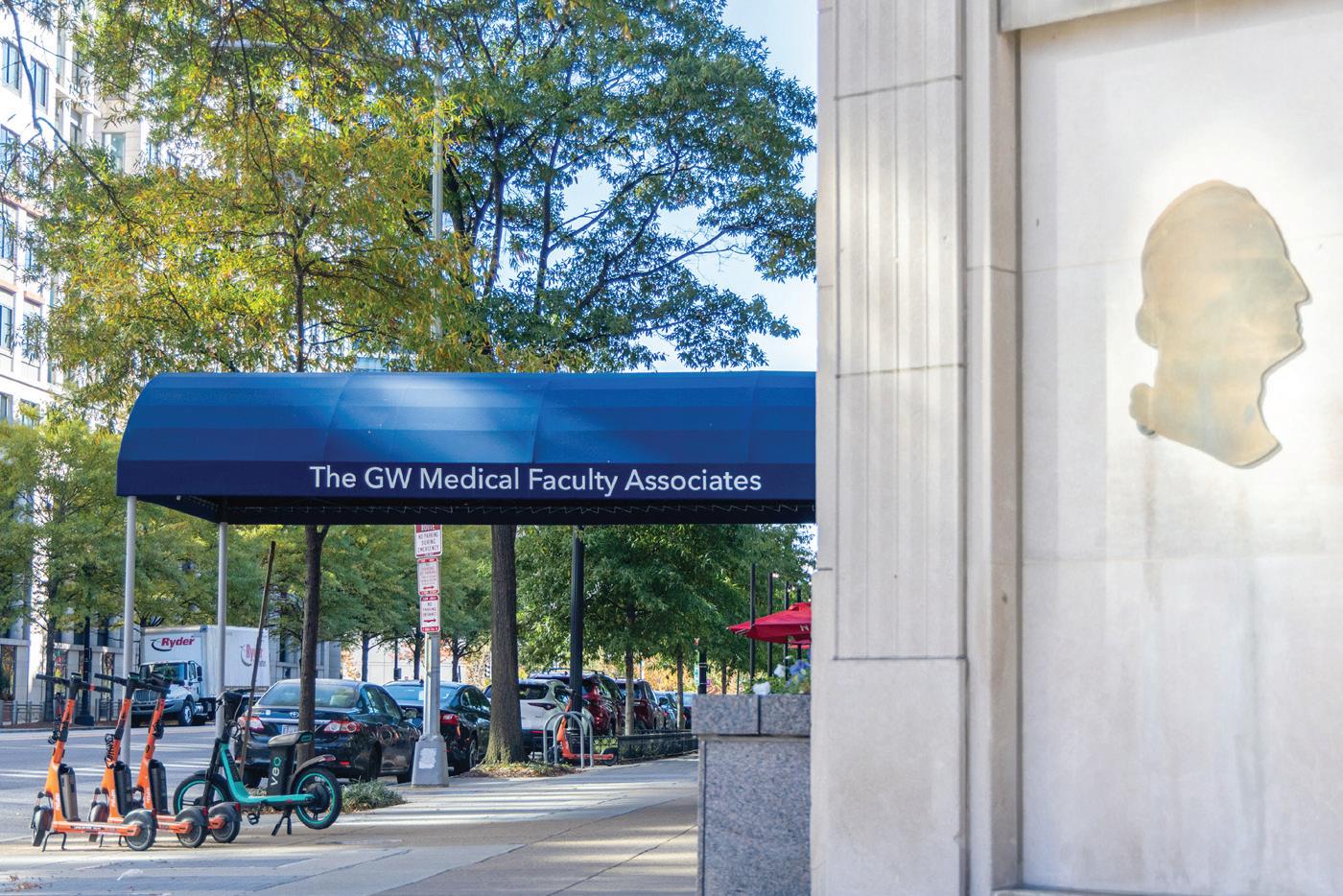
The Medical Faculty Associates lost more than $107 million in fiscal year 2024, more than doubling officials’ projected deficit and marking its greatest annual loss since GW assumed control of the medical enterprise.
Officials said last October that they expected the MFA — a group of physicians and faculty from the School of Medicine & Health Sciences and physicians at the GW Hospital — to lose between $30 and $50 million in FY2024 after they lost nearly $80 million in FY2023 and another $80 million in FY2022, according to the financial statements, which are audited each fall by accounting firm Grant Thornton, LLP.
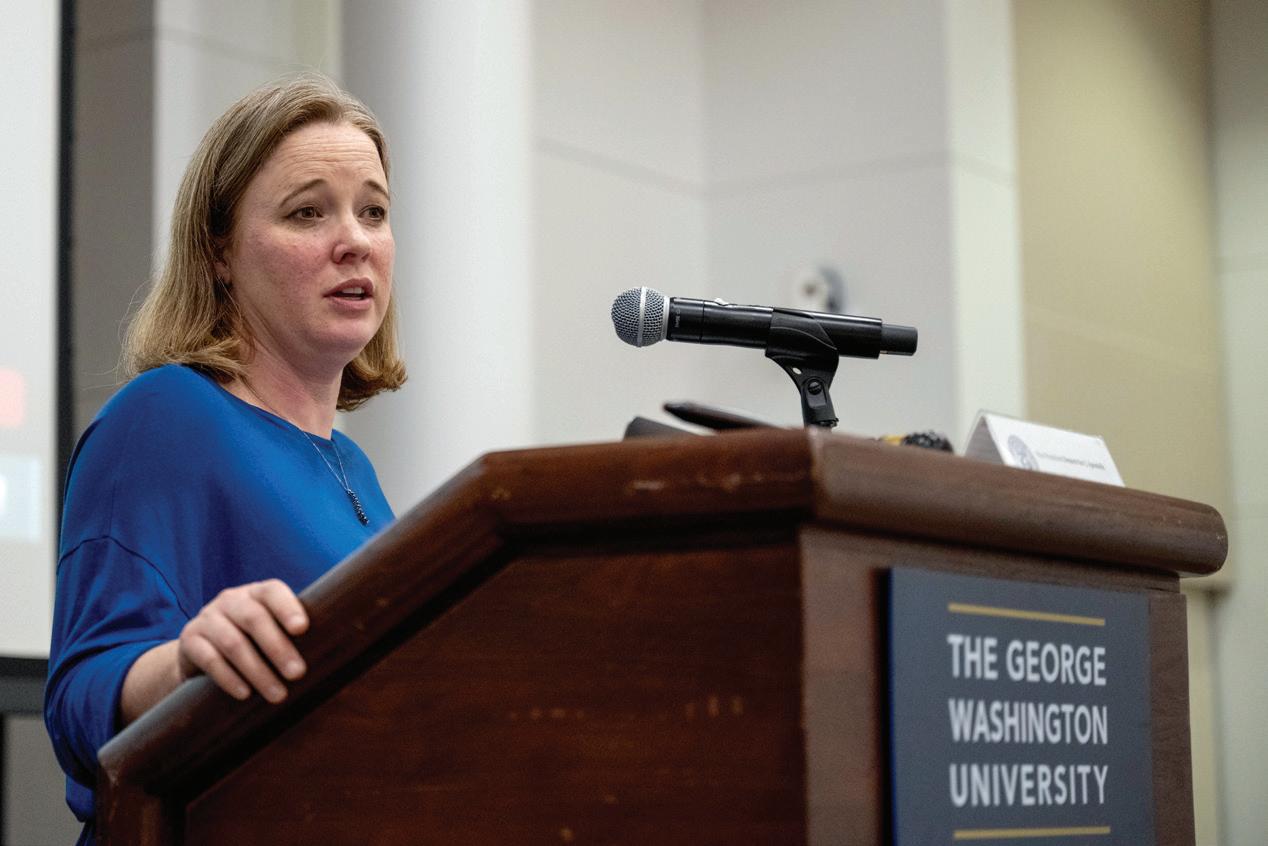
Chief Financial Officer Bruno Fernandes declined to comment on why the MFA lost more than $107 million this fiscal year and what officials think caused the MFA’s losses to surpass initial projections.
MFA Chief Executive Officer Bill Elliott said in an email obtained by The Hatchet sent to MFA staff before his and Fernandes’ update during last week’s Faculty Senate meeting that the GW and MFA boards of trustees and the MFA’s leadership agree that the enterprise’s “continued and significant losses” are “unacceptable and unsustainable.”
He said it is evident that “additional operational and structural changes” are needed to ensure the MFA is financially viable. Elliott said it is currently premature to discuss some of the “possible future changes” to the MFA’s structure, but he can assure staff that they will continue looking for ways to improve the MFA’s performance.
“No idea is off the table and we are committed to finding sustainable, longterm solutions that will benefit the MFA’s patients, and the clinicians and staff who care for them every day,” Elliott said in the email.
Fernandes declined to comment on why the MFA lost almost $30 million
more this fiscal year than the last two fiscal years or when officials became aware that the MFA was expected to lose more than they initially projected. He declined to say when officials will reevaluate their financial support for the enterprise and if they’ve considered declaring bankruptcy on the MFA or selling it.
He also declined to say how much he projects the MFA to lose in FY2025.
Faculty senators went into executive session during last week’s senate meeting to hear Fernandes’ annual MFA’s fiscal year update, where he typically publicly shares how much officials project the MFA to lose during the current fiscal year. All nonsenate and nonadministrative attendees are not allowed to attend executive session.
Fernandes said despite ongoing efforts to “curtail” the MFA’s losses, the boards of trustees overseeing both GW and the MFA decided that bringing on a full-time CEO was “necessary.” Officials hired Elliott in May to serve as interim CEO after former CEO and SMHS Dean Barbara Bass stepped down to allow for “full-time leadership” to lead, and appointed him permanent CEO in October.
Fernandes declined to say if officials’ realization that the MFA would lose more than $50 million more than initially
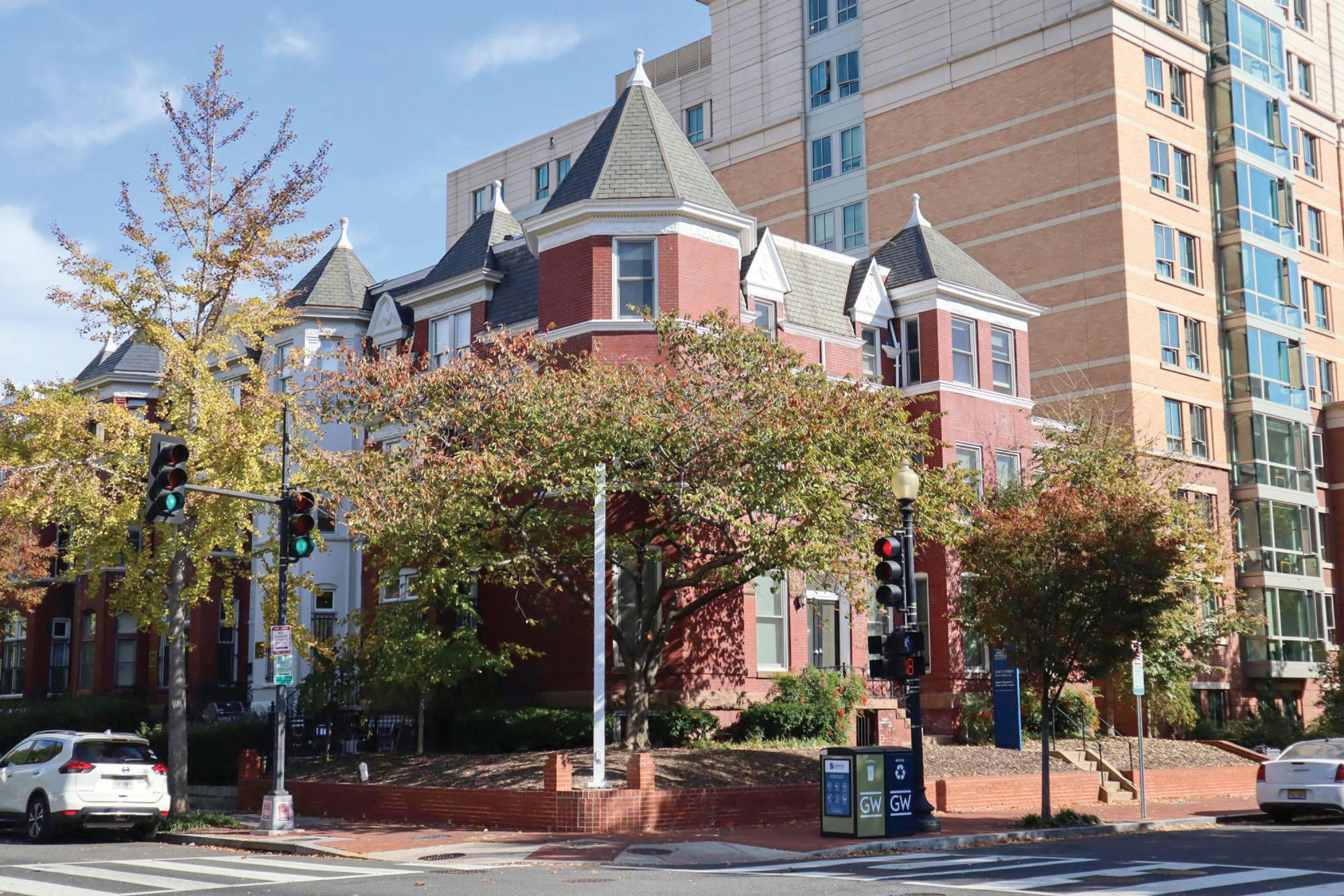
Faculty in the Department of Religion said a lack of University funding has led to a shortage of full-time professors and gaps in the depth of religion course offerings. Professors within the department said GW is not providing them with the necessary funding to fill vacancies for full-time faculty, which has created heavier workloads for existing faculty and stripped the department of the capacity to offer advanced courses on all major world religions. Faculty said there are currently no full-time faculty that teach courses on Christianity, Hinduism or Buddhism, which they said has hindered the depth of student learning on the trio of religions amid reported student demand for more religious course offerings.
The department currently has nine core faculty, according to its website. Between 2014 and 2023, two full-time religion professors left, shrinking the department from eight to six full-time faculty, causing a 25 percent drop in full-time faculty within the department and a 42.9 percent decrease in all tenured and tenure track full-time faculty within the department after three tenured and tenure track faculty left, according to the Office of Institutional Research and Planning internal faculty dashboard data obtained by The Hatchet. Columbian College of Arts & Sciences Vice Dean for Programs and Operations Kim Gross said hiring additional full-time faculty is determined by factors, like student enrollment, “short-term fiscal considerations,” scholarship needs and the “local market” for part-time faculty in the “vacated discipline.” “The department’s size does
expected influenced their decision to hire Elliott.
“Since Bill Elliott joined the MFA as CEO in May, he has been addressing an array of issues comprehensively with the goal of building a sustainable clinical practice to support the region’s health and well-being while providing the essential training setting for our SMHS students and residents,” Fernandes said in an email.
The MFA spent more than $485 million and racked in slightly more than $377 million in revenue in FY2024, following a similar spending trend in FY2023 where officials spent nearly $450 million and made about $370 million in revenue. The report also states that the MFA has accumulated a total of $272,107,000 of debt to GW and a $120 million debt to other entities, which likely includes EagleBank, the MFA’s primary external lender.
The University’s verbiage surrounding the MFA in recent months has departed from previous statements, diverging from maintaining that the MFA has faced “strong headwinds” due to inflation after officials published the FY2023 consolidated financial documents last year, to last week pointing out the MFA’s “deep and systemic challenges.”
The financial statements say that GW is
held liable for decisions the MFA makes, meaning GW would have to pay the MFA’s borrowed debts if it were to file for bankruptcy. Faculty senators have long pressured the University to reevaluate the MFA’s financial losses and their potential effects on GW’s “underfunded areas,” like student financial aid and undergraduate education.
Officials walked back predictions that the MFA would break even in FY2022 and FY2023. Fernandes said last year that he doubted the MFA would break even in FY2024.
University President Ellen Granberg said in September that officials over the past year have increasingly recognized the MFA as a “modern clinical management practice,” which encouraged officials to hire Elliott. She also said the MFA is continuing to make all debt payments to GW on time.
Former MFA CFO Robin Nichols left the enterprise earlier this year less than nine months after she began her role as CFO on Oct. 16, 2023, with officials listing a job posting on July 2, 2024. University spokesperson Julia Metjian declined to say if Nichols resigned or was fired. She also declined to comment on the status of hiring a new CFO because the University “will not” comment on personnel matters.
Graduate student workers vote to unionize
Graduate student employees overwhelmingly voted to unionize Tuesday and Wednesday after publicly launching unionization efforts last month and unsuccessful attempts to do so among graduate students more than six years ago.
99.4 percent of the 349 graduate assistant workers who participated in the election in the University Student Center voted to unionize through the GWU Graduate Workers United, an affiliate of the Service Employees International Union Local 500, according to their Instagram.
Graduate workers involved in the union said the election is “monumental” for graduate assistants as they look to improve the pay and benefits for their roles at the University.
Provost Chris Bracey and Suresh Subramaniam, the vice provost for graduate and postdoctoral affairs, sent an email to graduate assistants Thursday informing the workers that a majority of voters favored unionization. The officials said that they have made their commitment to supporting graduate assistants “clear” as the employees contribute to the University’s academic mission.
“We will continue to work diligently with you to ensure that you have a meaningful and successful graduate experience at GW, and we look forward to your continued contributions to our scholarly community,” Bracey and Subramaniam said in the email.
University spokesperson Julia Metjian said the University will work “diligently” with graduate students to make sure they have a meaningful and successful graduate experience at the University.
“We look forward to their continued contributions to our scholarly community,” Metjian said.
Employees can unionize through an election run through the National Labor Relations Board, the method used by GW graduate students or via voluntary recognition by their employer.
Once employees have collected authorization cards — or documents that express support for union representation — from at least 30 percent of employees, the group can file a petition to hold an election. Employees can ask for voluntary recognition once they have cards from a majority of employees, according to the National Labor Relations Act. If a group goes through the voluntary process, the employer has the right to deny recognition, forcing the employees to either strike for recognition or petition for an election. If a group of employees files for an election, they must receive more than 50 percent of the vote to require the employer to begin bargaining negotiations, according to the National Labor Relations Act.
Leaders in GWU2 said they had “hundreds” of graduate student workers sign authorization cards during their October launch event. SEIU Local 500 filed a petition for an election on behalf of the group on Oct. 7, according to NLRB filings.
not diminish the importance of its work, particularly when looking at what’s happening in the world today,” Gross said in an email. “Through this and other disciplines within the college, students gain a critical understanding of those from different faiths and cultural backgrounds and gain the ability to talk across differences and bridge divides.”
Five students are declared religion majors in 2024, according to the enrollment dashboard. In 2017, there were 10 declared religion majors on campus. There are currently no live job postings for religion faculty positions.
Gross said the University annually reviews support and resources for the department and that after staffing turnover, the University has a “full-time administrator in place supporting the department” but did not specify when the turnover occurred or when the administrator was placed. She said officials have hired temporary parttime faculty to ensure courses were covered where there was demand for them.
“The department chair acts as the primary liaison between the department faculty and the dean’s office on these issues,” Gross said in an email. “We work with the chairs
to determine departmental needs and how best to meet them.”
Students majoring in religion must complete an Introduction to World Religions prerequisite, a required course titled Thinking About Religion: Classic and Contemporary Approaches, a required Senior Capstone Seminar and nine religion electives ranging from The New Testament to Islam and Hinduism in South Asia.
Gross said the department has offered a “similar” number of undergraduate courses over the past three years, including this academic year. The department initially offered 26 courses for the fall 2024
semester, but six were canceled post-registration, according to the schedule of classes. In fall 2017, the department also offered 26 classes.
Irene Oh, the chair of the department, said the lack of funding for full-time faculty in Christianity and Hinduism relates to the University’s limited budget and “differing priorities” between the department and the dean’s office, not because of poor communication between the two offices.
“I am hopeful, however, that this situation will be rectified, as a well-rounded Religion Department would demonstrate GW’s commitment to the liberal arts,” Oh said in an email.
Oh said within the last decade, three of the seven tenured and tenure-line faculty have left but have not been replaced. She said the department has attempted to meet student demand for more course offerings by hiring part-time faculty, adding that GW as a research institution should have tenured professors in religious studies because religion is needed to understand topics, like artificial intelligence and war.
Robert Eisen, a professor of religion and the former chair of the department, said requests from department faculty to hire full-time professors have been “consistently” denied by the University in recent years, and he said that “resources” from GW have diminished over his 34 years in the department, which has made it difficult to provide a full curriculum in religion.
Eisen said the department lacks full-time professors for three of the six global religions that are practiced most widely — Buddhism, Christianity and Hinduism. He said the department has never had a full-time professor specializing in Buddhism.
RACHEL KURLANDSKY | STAFF PHOTOGRAPHER
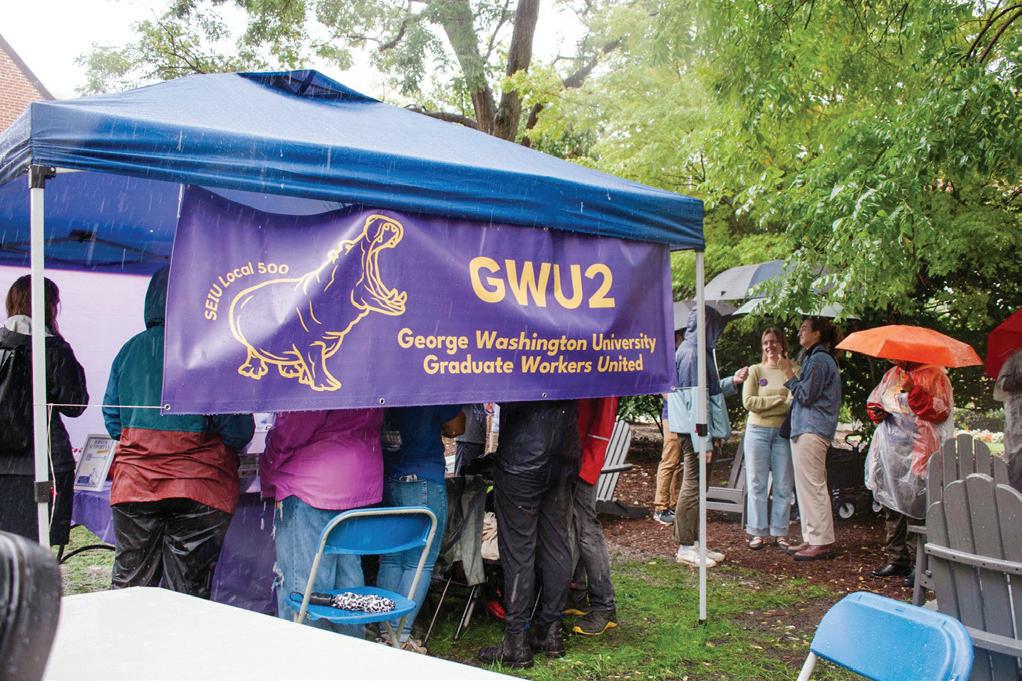
Members of GWU Graduate Student Workers United celebrate the launch of union efforts in October.
Conflict Education & Student Accountability director on leave for fall semester, email shows
HANNAH MARR NEWS EDITOR
Conflict Education & Student Accountability Director Christy Anthony is on leave for the fall 2024 semester, according to an automatic reply from her GW email address.
Anthony left her director position for the fall semester to serve as the assistant dean of students for Semester at Sea — a study abroad program that takes place on a cruise ship — according to the program’s website. A University spokesperson did not return a request for comment on whether Anthony’s leave was voluntary or involuntary and if students are still undergoing disciplinary proceedings for student conduct cases she initially oversaw in her role as CESA director.
Anthony’s automated email reply states that she plans to return to her role for the spring 2025 semester. Her online appointment scheduling platform allows community members to schedule meetings starting Jan. 8, 2025.
“During the Fall 2024 semester, I will be on a leave of absence from my professional role as GW’s Director of Conflict Education and Student Accountability,” Anthony’s automatic email reply reads.
Officials renamed the Office of Student Rights and Responsibilities to CESA in August after Anthony said the name better reflects
the staff’s efforts to address student conflicts and violations through coaching and mediation. Anthony joined GW as CESA director in May 2018, according to her LinkedIn. The University spokesperson didn’t return a request for comment on when Anthony went on leave, given that she hosted an event during first-year orientation at the start of the fall semester. The spokesperson also didn’t return a request for comment on who assumed Anthony’s responsibilities in her absence.
Locals prepare for potential infringement on DC home rule
CADE MCALLISTER
SENIOR STAFF WRITER
Local government officials and civil rights groups said they are preparing for the possibility that President-elect Donald Trump and a new Republican congressional majority will interfere with the District’s right to self-govern.
Several times during his 2024 campaign, Trump vowed to “take over” D.C. to “clean it up” and reduce crime, claiming Mayor Muriel Bowser has “horribly run” the nation’s capital during her tenure. Trump and the Republican majority in the House of Representatives and Senate have the power to wield broad authority over D.C.’s law enforcement, limit access to abortion and cannabis and replace the District’s elected officials and nonpartisan federal workers with Republican appointees, according to federal law.
“Republicans will reassert greater federal control over Washington, D.C. to restore law and order in our capital city, and ensure federal buildings and monuments are well-maintained,” Trump’s campaign platform states.
The federal government retains ultimate authority over D.C. because it is not a state, deriving its self-governance powers through the District of Columbia Home Rule Act of 1973. While the bill allows the District an elected mayor and legislature, Congress must review and approve or block D.C. laws, control its budget and can repeal the Home Rule Act under the Constitution’s Enclave Clause.
Congress has also delegated some of its constitutional authority over D.C. to the executive branch through laws like the Home Rule Act and the National Defense Authorization Act, granting the president oversight of federal law enforcement in D.C. and control of the D.C. National Guard.
Bowser said Tuesday that her administration has spent “many months” preparing in case the District has to “defend itself” from threats to its system of self-governance, or home rule, whereby D.C. residents elect the mayor and D.C. Council to govern the
city.
“As your mayor, I have worked with three presidents, including President-elect Trump, and congressional leaders of both parties to advance the priorities of the District — infrastructure, housing affordability, downtown revitalization and our self-determination,” Bowser said in the letter.
Here are some ways Trump and congressional Republicans could exercise their authority in the District over the next two to four years:
Once sworn in as president, Trump has the power to take control of the Metropolitan Police Department for up to 30 days if he determines it necessary to manage an emergency, according to D.C. law.
Robinson Woodward-Burns, an associate professor of political science at Howard University, said Trump considered seizing control of the MPD to quell Black Lives Matter protests during his first term in 2020. Woodward-Burns said it is unclear how federalizing MPD — which no president has ever done — would affect policing crime in D.C. but that Trump could do so in an effort to “score points” in front of his Republican constituents.
Woodward-Burns said Trump could deputize the D.C. National Guard to act as law enforcement to curb crime in the District, which has dropped by about 15 percent this year after a 2023 spike. Trump deployed the D.C. National Guard to clear BLM protestors for a photo-op in front of St. John’s Episcopal Church in 2020, a move which sparked rebukes from local and state executives, congressional lawmakers, faith leaders and foreign governments.
Eleanor Holmes Norton, D.C.’s nonvoting delegate in Congress, said a second Trump presidency presents “risks” for the District — including to D.C. officials’ authority over MPD — because it lacks statehood and full control over its local government.
“During his first term as president, Trump considered federalizing D.C.’s police force for his own purposes,” Holmes Norton said in an email.
The spokesperson also didn’t return a request for comment on how Anthony’s departure has impacted the University’s ongoing student conduct violations and stay-away orders against students that Metropolitan Police Department officers arrested at the pro-Palestinian encampment last spring. The Student Coalition for Palestine at GWU alleged in late June that the University charged at least 13 students and 10 student organizations “without evidence” for their involvement in the encampment for Code of Student Conduct violations.
CRIME LOG
SIMPLE ASSAULT (DOMESTIC VIOLENCE), THREATS TO DO BODILY HARM
Shenkman Hall
11/12/24 – 8:39 p.m.
Case Open GW Police Department officers made contact with a GW contractor who reported that her ex-boyfriend assaulted and physically threatened her. Open case.
HARASSMENT, EMAIL AND ELECTRONIC MEDIA, HARASSING TELEPHONE CALLS
Amsterdam Hall
11/13/24 – Multiple Times
Case Closed A female student reported receiving unwanted phone calls, texts and social media messages from a non-GW affiliated ex-boyfriend. Referred to the Title IX Office.
ATTEMPTED ROBBERY,
AGGRAVATED ASSAULT
Kogan Plaza
11/15/24 – 1:26 a.m.
Open Case
A student reported being the victim of a robbery after he was attacked and tased while walking on 21st Street. The subject demanded money from the student, but he did not hand any over. Case open.
—Compiled by Ella Mitchell
Community members refute House committee report on campus antisemitism
HANNAH MARR NEWS EDITOR.
RYAN J. KARLIN CONTRIBUTING NEWS EDITOR
Community members said they disagree with a congressional assessment claiming that officials failed to sufficiently hold pro-Palestinian student protesters accountable for violating University policies after the onset of the war in Gaza.
The Republican-led House Committee on Education and the Workforce published their findings last week from an 11 monthslong investigation into antisemitism on college campuses, accusing GW and 10 other universities of a “stunning lack of accountability” for students who trespassed, damaged property, violated University policies and exhibited alleged antisemitism. Students and faculty who supported the protests said the committee’s report inaccurately categorized students’ protests as antisemitic, while community members who condemned the protests said officials handled pro-Palestinian campus activism as best they could.
The report describes and documents the outcomes of 73 incidents of alleged antisemitism and Islamophobia on campus between Oct. 7, 2023, and May 9, 2024, which GW provided to the committee. Incidents include the pro-Palestinian encampment in University Yard, anti-Israel projections onto Gelman Library and the removal of posters of Israeli hostages from the GW Hillel building, which the committee listed as examples of antisemitism, Islamophobia and
misconduct.
University spokesperson Shannon McClendon said earlier this month in response to the report that officials have “devoted additional significant time and resources” over the last year to meet community needs. She said officials will continue to educate the community about antisemitism and Islamophobia while working to ensure students can freely express themselves and their religious beliefs.
Community members who supported pro-Palestinian protests on campus said the report falsely accuses students of antisemitism and overlooks their reasons for protesting, while critics of the protests said the University has done everything it can to respond to displays of activism that violate GW policies.
A representative from the Student Coalition for Palestine at GWU, who requested anonymity due to fear of administrative repression and doxxing, said they disagreed with the committee’s assessment that GW insufficiently disciplined pro-Palestinian protesters because they’ve been disciplined more than “any other group.”
Officials allegedly suspended two pro-Palestinian student organizations and placed an additional six organizations on disciplinary probation for their involvement in the encampment, and 22 students entered student conduct processes between October 2023 and May 2024 for the encampment and other protests, per the committee’s report.
“The only thing that they could do further is to expel students,” the representative said. “They’ve already banned half of
our orgs off campus. That’s precisely what House Republicans want, because they don’t want anti-Zionist speech on campus. They, quite frankly, don’t want Muslim and Palestinian people on campus.”
The representative said GW hasn’t sufficiently responded to “rampant” Islamophobia on campus, including reports from Muslim students that they were spat on and had their hijabs ripped off by an unknown person on campus. They added that GW has been identified by the Council on American-Islamic Relations as one of three institutions of “particular concern” where Palestinian, Muslim, Arab, Jewish and other students and faculty who oppose the war in Gaza face backlash from officials.
GW for Israel Vice President Sean Shekhman said Jewish students’ experiences on campus have varied, but he believes officials have “done an incredible job” handling protests. He said in every conversation he has had with officials, they have tried to foster dialogue between both sides while protecting students’ free speech rights.
“I do legitimately believe that University administration is working to do their best to try to find solutions and cooperation for people on both sides, not just Jewish students, but also, I’d argue, for Palestinian students,” Shekhman said.
Shekhman said students shouldn’t be disciplined solely for protesting and that pro-Palestinian protests aren’t necessarily antisemitic, but it depends on if there are any antisemitic actions occurring at a protest.
HATCHET FILE PHOTO
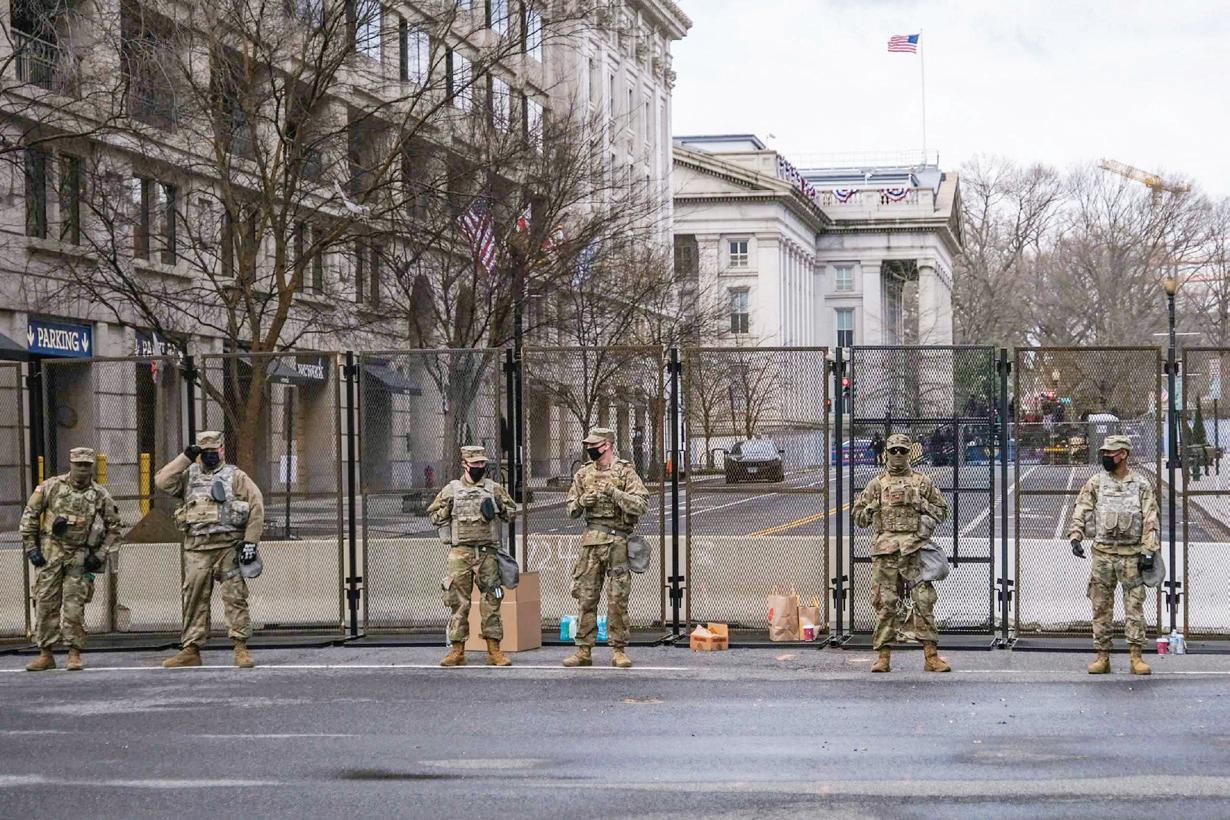
Members of the National Guard stand in front of the Treasury Department during the 2021 presidential inauguration.
DANIEL HEUER | STAFF PHOTOGRAPHER
Conflict Education & Student Accountability Director Christy Anthony speaks at a Student Government Association meeting in February.
School of Nursing adds virtual reality learning to simulation center
The School of Nursing added virtual reality features to its Simulation and Innovation Learning Center this semester after years of planning.
Faculty involved in the center on the Virginia Science and Technology Campus in Ashburn, Virginia, said they introduced 20 Oculus virtual reality headsets to the center, which students will use to practice nursing in an additional simulated clinical environment to the physical simulation center during their third semester of the nursing bachelor’s program. Faculty and students who work in and with the center said the additions give faculty more options to allow students to learn in different environments as they prepare to enter the nursing field.
Crystal Farina, the associate dean of Bachelor of Science in Nursing programs, said the school decided to add a virtual reality component to its simulation lab after she attended the International Meeting for Simulation in Healthcare several years ago. She said vendors at the conference were demonstrating virtual reality simulation software that focused on student learning and critical thinking rather than simulations that looked like a “game.”
She said the school began its efforts in virtual reality when former Dean of the School of Nursing Pamela Jeffries decided to build a virtual reality room at Innovation Hall, the school’s headquarters on the VSTC before the pandemic. Farina said the school piloted the virtual reality simulations with a group of students over the summer and it worked “beautifully,” so faculty and officials introduced it into the school’s curriculum this semester.
“The whole key is to expose our students to a variety of different patients and different patient settings, so they can gain that confidence in communication and critical think-
ing and patient centered care,” Farina said. Of GW’s nine peer schools with a nursing school or program, only Wake Forest University and the University of Rochester also had virtual reality simulation experiences.
Chris Thomas, the director of simulation and experiential learning, said during the third semester, half of the students’ simulation sessions will be in virtual reality and the other half will be in the physical simulation center over the course of 40 hours of simulation experience they receive in a semester.
Thomas said students in the simulation center learn how to perform tasks like interacting with patients, giving them medication and reacting to situations like patients’ blood pressure dropping. She said
the simulation center offers students the opportunity to learn how to make decisions in real time while doing so correctly and safely without the risk of impacting real-life patients.
Thomas said the simulation center is currently using “prepackaged” simulations, but they are working with AccessVR, a virtual reality immersive learning production company, to design their own simulations that are customizable to the school’s curriculum.
“As they’re learning now, they have that experience that they can apply, and then the next episode with a real patient,” Thomas said. “They’re making decisions in real time, they’re incorporating and multitasking with the psychomotor and the communication and the decision-making.”
Interfaith center organizes second Interfaith Week of year
DIANA ANOS STAFF WRITER
JENNIFER
IGBONOBA NEWS EDITOR
The Center for Interfaith and Spiritual Life concluded the University’s annual Interfaith Week on Saturday, the second iteration of the programming this year.
The event, which consisted of a variety of educational workshops, is the first major programming the center has hosted since its establishment this semester. The Office of Diversity, Equity and Community Engagement hosted a separate week of programming in April after officials canceled the Multicultural Student Services Center’s version of Interfaith Week in January.
Leadership within the center said the annual event was traditionally held in the fall — different from previous years when it was hosted in early February — and this Interfaith Week marks a return to its original timeline. The center’s leadership said the Division for Student Affairs invited all University community members to submit proposals for programming that would contribute to the goals of the center and Interfaith Week.
The leaders said the week “highlights” the center’s launch, and religious studies faculty members have been “engaged” in its development and contributed to the week by hosting an event titled “Rel-X talks” Friday, where some of the department’s students and faculty presented their research about topics, like religion and artificial intelligence.
“The Center looks forward to continuing to collaborate with student organizations and encourages all students to reach out to learn more about ways they can get involved in upcoming initiatives,” CISL leadership said in an email.
The programming included events to introduce community members to the center’s leadership, including a meet-and-greet and an open house on the lower level of University Student Center, where the former Campus Store was located.
In October, officials hired Kristen Glass Perez to serve as the University’s chaplain and Simran Kaur-Colbert as the center’s inaugural director.
effects like a patient coughing and talking to students as the patient. Students must then respond to the situation by performing actions directly on the mannequin.
Farina said the simulation component to the school’s curriculum began in the early days of the school’s founding in 2010. She said when Jeffries became the dean in 2015 the school redesigned and rebuilt the simulation learning center due to Jeffries’s background in simulation education, or using realistic scenarios to help students practice skills.“All of it comes from her philosophy and her theory on simulation and nursing education and how important it is for students to practice providing care before they actually do it,” Farina said.
Diana Lora, a clinical instructor in nursing, said classes at the school are structured to have a didactic or lecture section as well as a lab section and a simulation section. She said as a didactic instructor, she works closely with the lab and simulation instructors so students can build on each of the sections.
When students enter the virtual simulation, they see a patient in a medical room who directly communicates with them throughout the simulation and responds to the student administering treatment to them. The simulation features a number of objects ranging from medical equipment to a computer that students can click on to perform actions based on what’s required of them in that situation, like clicking on the patient to ask them a question, on equipment used to take the patient’s heart rate or perform a test or on the phone to make a prescription order. In the physical simulation center, students treat a mannequin while a faculty member sits in a control center following a script and controlling the simulation by changing the patient’s vitals, playing sound
In April, the MSSC’s former graduate assistant for religious and spiritual life said he resigned from his position after officials canceled the center’s original plans for its annual Interfaith Week in January and transferred religious and spiritual life to the Division for Student Affairs, who oversees the center.
Students who engaged in programming said faculty and staff also attended the events, and student organization leaders said they gave input on the week’s events despite varied involvement in programming.
Sophomore Lydia Noteman, an education intern at GW Hillel, facilitated a conversation between attendees about religious pluralism Wednesday at an event at Zinger’s — Hillel’s cafe — titled “Wings and Wisdom.” Noteman said about 20 people, primarily staff members, attended the discussion, which centered on the influences of faith and how it affects views on different religions.
“I went into yesterday thinking I was going to be talking to a bunch of students, and then all these staff members kept showing up,” Noteman said.
Officials hosted the Interfaith Dinner on Thursday in the student center’s Grand Ballroom where Dean of Students Colette Coleman read remarks about the importance of fostering interfaith engagement from University President Granberg, who she said couldn’t attend the event in person.
Earlier this semester, the University scored a two out of five stars on a national database that evaluates a participating school’s efforts toward promoting an inclusive environment for students with different religious identities.
The dinner included faith practitioners from different religions, including Hinduism, Buddhism and Protestantism from the Interfaith Council of Metropolitan Washington, who facilitated a workshop earlier in the week titled “Ask Me Anything” — the same one they hosted during the ODECE’s iteration in April. Leaders facilitated conversations about religious and spiritual identities amongst attendees while they ate food, like caprese sticks and tofu kabobs.
Melissa Carter and Robert Taylor Jr., the associate and assistant director of The Center for Global Spiritual Life at New York University, hosted a “Faith Zone Training Workshop” on Monday, where attendees shared spiritual memories from childhood and were asked how they would respond to scenarios that excluded different religious groups. About 20 attendees, the majority of which were faculty and staff members, learned about religious literacy — the ability to understand religious and cultural intersectionality — and how they aim to apply it daily. Most student leaders of faith-based organizations said they were invited to participate in the week’s programming, but their attendance varied depending on their existing plans. In previous years, the nowdefunct Interfaith Council, a collective of students from other faiths, hosted the annual week with the MSSC. Junior Sai Charan Chodavarapu, the Hinduism chair for the Hindu Students Association, said HSA was invited to participate in Interfaith Week this semester but couldn’t because the organization is planning for their Diwali festival usually held in November.
“In didactic, we teach them the theoretical. In lab, they get to play with some of those theoretical stuff, like some of the tools,” Lora said. “But in simulation, they’re able to actually take those concepts and apply it, which is, I think, crucial for our nursing profession.”
Lora said faculty’s experiences in the clinical setting allow the instructors to modify syllabi and simulations each semester to align with the skill students need in the field.
“Our offices are down the hall from each other, so we’ll touch base with content, what we would like to do better, things that we’re seeing,” Lora said.
Vivian Bowman, a dedicated simulation educator, said when students learn in their lab section about administering medication, their simulation sections that week focus on teaching students how to administer oral medication, muscular injections and IVs.
Geology program’s future still clouded after inconclusive task force results
TYLER IGLESIAS ASSISTANT NEWS EDITOR
The Geological Sciences Program remains in limbo after a task force set up to determine its steps forward last academic year came to “no single decision,” according to the program’s director.
Catherine Forster, a professor emerita of biology and the program’s director, said the task force concluded its work at the end of 2023 and came to no conclusion about the future of the program. Faculty said those involved in the program are continuing to act as if it will exist “in perpetuity,” but uncertainty still looms over Columbian College of Arts & Sciences’ ultimate decision on the program’s outcome — including whether to hire a new faculty member or possibly dissolve the program — and when the verdict will be made.
Forster said she wrote up the task force’s report and submitted it to Kim Gross, the CCAS vice dean for programs and operations, but officials have not decided on any action regarding the program. She said the last time she had communication with CCAS officials was a couple of months ago about a separate issue.
“We have no idea on the future of the program,” Forster said.
Gross declined to say if the task force was dissolved, what actions CCAS was taking as a result of the task force, what factors the college was evaluating when
determining the program’s future and if they plan on hiring an additional faculty member for the program.
She said last fall that officials charged the task force with determining how programs fit into the CCAS curriculum and the program’s future. The task force recommended a variety of options on the “best path forward,” which CCAS was evaluating, she said at the time.
The University eliminated the Department of Earth and Environmental Sciences in 2004, moving the environmental studies program into the geography department and downgrading geology to a program within the biological sciences department. The move had come after CCAS had cut the program’s budget and moved faculty to other departments, which then-CCAS Dean William Frawley said were done to “better position” the sciences at GW.
Forster, who is in her second year continuing to manage the program after her retirement as the program’s only tenured professor in August 2023, said the program is at its “breaking point” and needs another tenure-track faculty member despite CCAS officials denying her repeated requests since spring 2022.
She said she is going to retire as program director in a “year or two,” which she said increases the program’s need for at least a full-time administrator to keep the program afloat.
Forster said in 2023 that the University had denied
her request to hire a tenuretrack faculty member to replace Richard Tollo, the program’s other full-time faculty member who retired in 2022 but approved her request to hire a “special service faculty” member. She said the program last academic year hired James Kerr, an assistant professor of geology, as a full-time faculty member. He is in his second year of a three-year contract. Forster said her “worry” is that CCAS’s decision about the future of the program will be solely based on finances. She said the program does a “huge service” to the University by teaching many general education requirement courses and the most credit hours for the least amount of money of all CCAS academic programs. The program currently offers three GPAC courses, according to the GPAC course list. She said the program teaches 850 students for GPAC requirements every semester.
“I would certainly hope that any decision they make is not just financial, that it’s also the importance of diversity of STEM courses, and I hope that that plays into this ultimate decision they make as well,” Forster said.
She said if the program is cut, it would be more cost-effective to hire another faculty member to keep the program alive than to provide more resources to other STEM departments to teach GPAC courses to students who would have taken geology GPAC courses.
ANN DUAN | PHOTOGRAPHER
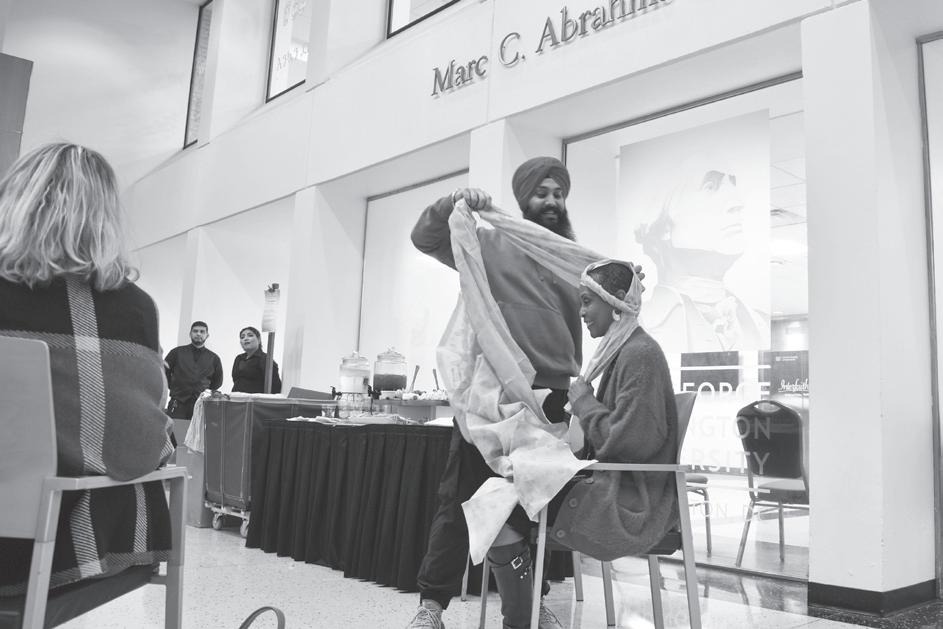
Gurdeep Singh fastens a staff member's turban for Interfaith Week.
NICHOLAS WARE | PHOTOGRAPHER
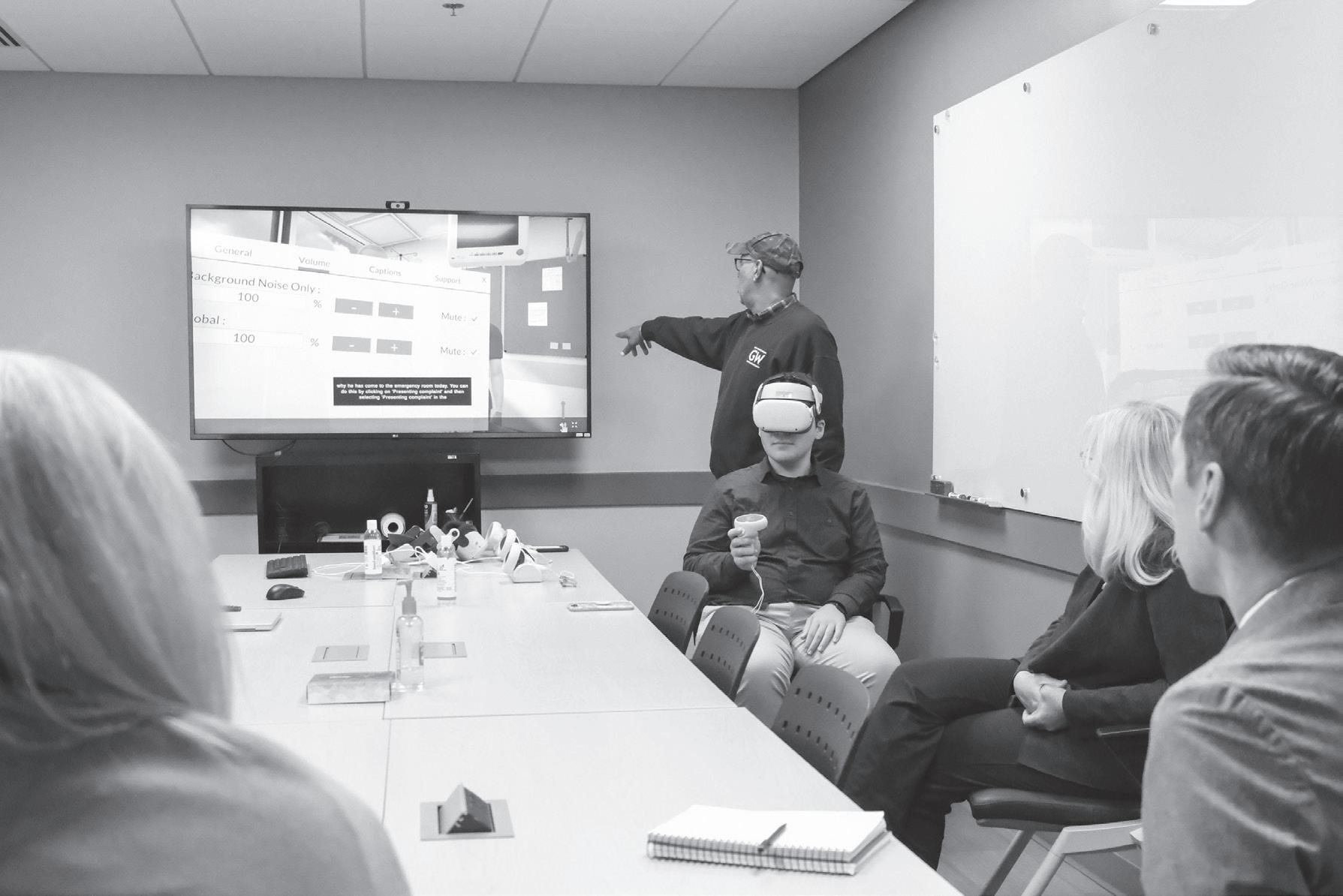
Assistant News Editor Tyler Iglesias tests out the virtual reality simulator at the Simulation and Innovation Learning Center.
Students host events for 100th year of Native American citizenship
Students for Indigenous and Native American Rights hosted a series of programming last week to commemorate Native American Heritage Month and the 100th anniversary of the U.S. government’s recognition of Native Americans’ citizenship.
SINAR hosted events like film screenings, art exhibitions and lectures related to Native American history as part of the annual observation of the month. Leaders of the organization said they focused the programming, which was themed “Native American Citizenship, 100 Years Strong: Resilience and Progress” this year, on educating attendees on Native American history and hope more people take an interest in learning about the community to understand the current challenges Native Americans face.
Senior Julia Swanson, SINAR’s president, said this year’s programming centered on highlighting the histories and cultures of Indigenous people outside of the D.C. area, a pivot from last year’s programming that focused on Indigenous peoples within the D.C. metropolitan area. Swanson said the student organization’s executive board always directs the month of programming because SINAR is the only organization dedicated to serving Indigenous students.
“It’s pretty, pretty chaotic,” Swanson said. “I think, not necessarily chaotic, just busy, hectic, because, since we’re the only Indigenousfocused org on campus, it’s an entire month of programming that essentially comes down to like five people planning it.”
Congress officially recognized November as National American Indian Heritage Month in 1993 because it traditionally concluded the harvest season with the Thanksgiving holiday. Swanson said this year
marks the 100th anniversary of the Snyder Act, which Congress passed in 1924, that granted citizenship to all Native Americans.
“I think definitely the number one is education, awareness because there’s not a significant native presence here on GW’s campus,” Swanson said. “It’s really just about taking advantage of this month.”
The week consisted of seven events both on and off campus, with some hosted by SINAR and others by local organizations like the Center for Native American Youth from Tuesday to Thursday. The organization’s programming included collaborations with the Foreign Film Society for a film screening of the 2023 movie “Frybread Face and Me,” about a 12-yearold Navajo boy who spends a summer on his family’s reservation which had a predominantly Native American cast and crew.
The week’s programming schedule listed two events hosted by the Department of History including a discussion Wednesday with Camilla Townsend, a history professor at Rutgers University, about the misconceptions surrounding the history of the Aztec people — part of the department’s annual Diana Silvia Rodríguez Lecture series, which features distinguished scholars in Latin American history. The schedule also included a Native American Heritage Month celebration at the DACOR Bacon House, which about 30 community members attended, where speakers discussed the Department of State’s efforts to protect and promote tribal sovereignty.
Swanson said Multicultural Student Services Center supported the organization when they planned programming.
“I’d say they’re like the best or only branch of the school that makes efforts to reach out to us and help us with planning for this,
which is great because just for a smaller org, smaller group on campus, like any kind of administrative support is great,” Swanson said.
Sophomore Jacob Brittingham, the vice president of SINAR, said some students believe SINAR is a space only for Native American students, but the organization provides a space for both Indigenous and nonIndigenous students and he encourages all students to attend the organization’s future programming.
The organization will host a Red Shawl Day Acknowledgement Tuesday in the MSSC to raise awareness of the Native American women who go missing and are murdered at a rate more than 10 times higher than the national average.
“SINAR is for everyone,” Brittingham said. “It’s for allyship. It’s for those who are curious.”
Senior Natalia Mejia, a member of SINAR, said she attended the lecture on the Snyder Act with David Silverman, a professor of history, which about seven students attended, because she plans on taking a class with him next semester and wanted to learn about the history of Native American citizenship and their difficulties gaining recognition as U.S. citizens because she didn’t know much about it prior.
“I think that’s my main takeaway. It’s like not understanding how deep rooted like America’s, like violence towards Native groups by not giving them decisions until 1924,” Mejia said. “Even with that, it didn’t mean that they were treated as such, and that their land was still being stolen over and over again, still now.”
Senior Emily Zaphiro da Silva attended the event Friday on the Snyder Act, and said as someone from outside the U.S., she thinks people should learn about Native American history because it is not fully taught in school.
Advisory group passes Aston tenantneighbor agreement
A local advisory team approved an agreement between unhoused shelter The Aston’s tenants and neighbors ahead of the facility’s opening last Wednesday in an effort to bolster transparency amid some community opposition to its opening.
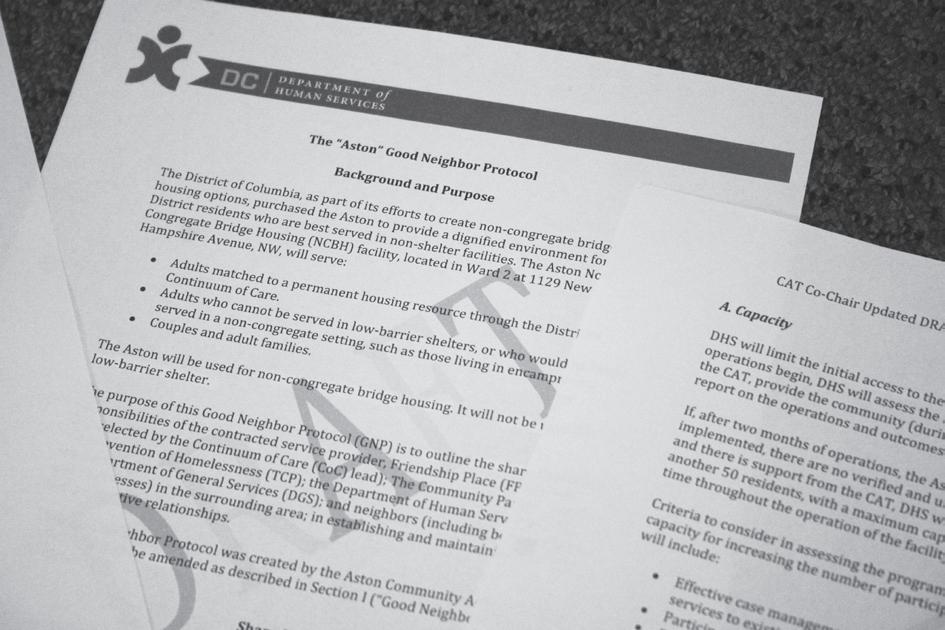
The Community Advisory Team earlier this month voted unanimously to approve the 11-page, nonlegally binding Good Neighbor Agreement, which outlines what communication about The Aston community members should expect from the Department of Human Services, the advisory team and Friendship Place, the shelter’s provider. CAT co-chair Jim Malec said the advisory team’s members can amend the document by a vote at any time and that its embedded agreements — like the terms of use for The Aston shelter’s residents, metrics to be shared with the public on the number of participants and their length of stay and a website where neighbors can contact Friendship Place — will hold District officials, CAT and neighbors accountable for ensuring the shelter runs smoothly.
“It’s sort of taking these general ideas about what transparency would look like and putting them in concrete language, which, in my opinion, creates a level of accountability,” Malec said.
The agreement states that DHS will garner community feedback during monthly CAT and ANC 2A meetings, respond to community concerns and share updates within 10 business days if the shelter’s provider changes.
The agreement also states that DHS planned to create a website with information on the shelter ahead of its opening, though officials have not yet released one. The website would include updates “relevant” to The Aston’s housing program, contact information for Friendship Place and its program manager, Jeremy Jones, and information on how community members can submit feedback and nonemergency concerns, the agreement states.
At the November CAT meeting, DHS Deputy Administrator Anthony Newman said the website is not yet available and he couldn’t confirm when it will be complete. Interim co-chair to the CAT Sakina Thompson said in an email that the District is working on a solution to the website’s absence for next week.
The body approved the agreement after soliciting community input for more than six months, Malec said. The Aston is the second unhoused shelter in Ward 2 and the first to offer apartment-style living for unhoused populations like
medically vulnerable people and families.
“I still understand that this is a new thing for the community,” Malec said. “There’s some anxiety about it. There’s some anxiety about how it’s going to work.”
Amid a year of delays, The Aston drew support from the Foggy Bottom and West End Advisory Neighborhood Commission, a local elected group, but some community members voiced concerns about the cleanliness outside the property and security at the shelter — which the agreement addresses through a trash and recycling plan and staffing The Aston with case managers, support staff and security. The West End D.C. Community Association, an anonymous group of locals, also sued the District twice and filed a zoning appeal to delay the shelter’s opening.
“There are checkpoints throughout this document that touch on some of these things that neighbors have brought up,” Malec said. The CAT also discussed creating a dashboard to track updates on The Aston’s residents and volunteer opportunities for the community, adding a glossary detailing the partners and terms within the document and including specific metrics about the shelter’s progress like average number of participants and how many are then placed into permanent housing. Updates to the website, a glossary of key terms and metrics are all part of the document.
“When people start worrying, it’s when there’s not transparency,” Maria Valleca, a former CAT member, said at an August CAT meeting.
Over the last seven years, District officials have established advisory teams to oversee shelter openings across wards. Each of the teams outlined commitments about the exterior facility, safety and security, a clear and expedient process for communication and problem solving through drafting a neighbor agreement.
“One of the tasks that is always assigned to community advisory teams is the development of a good neighbor agreement,” Malec said. “So that, I think, was baked into the DNA of the
GW researchers use novel treatment to fight prostate cancer case
respond to certain proteins, including the HER2 protein — and the patient began showing results of tumor size reduction.
Researchers said they discovered a new treatment that can reduce the effects of aggressive prostate cancer in a case report published Nov. 4.
Maneesh Jain, the report’s lead researcher and an oncologist at the School of Medicine & Health Sciences, and researchers from GW and the D.C. Veterans Affairs Medical Center began their study in June 2022, where they treated a prostate cancer patient and discovered new drug treatments for him that were chemically linked to a specific protein in his tumor. Jain said he hopes the case study will “motivate” other researchers to look into this treatment and see if other prostate cancer patients respond to it.
“I hope that what the case report predicts that others will respond, and if others respond, then I think the research possibilities are, there’s just a lot of them,” Jain said.
Jain said the patient initially did not respond to multiple kinds of treatment the researchers tried, and then they tested the patient’s tumor for the HER2 protein. He said when the patient tested positive for the protein, they used the antibodyconjugate drug T-DXd — a cancer drug that is specifically targeted to
T-DXd consists of two parts — one part containing the antibody to HER2 that locates the protein in the body and binds to it and another part that works as a chemotherapy drug that assists in killing the cancer cells.
Jain, who was the doctor in charge of specifically interacting with and treating the patient, said the study marks the first time this drug had been used on a patient with prostate cancer as it is used to treat breast and gastric cancer.
“It was very moving for me. On that day that I gave it to him, I remember telling him ‘I don’t know if this works,’” Jain said. “‘You do have this HER2 expression. We don’t do this in prostate cancer, and you might be the first person in the world that we’ve tried this on.’”
More than 3 million men in the United States have prostate cancer, but according to the Prostate Cancer Foundation, the disease disproportionately affects Black men, who are more than twice as likely to die from the disease and one in six develop prostate cancer at some point in their lives.
The patient from the case study is a Black man, who had stage four prostate cancer. Jain said Black men are more likely to have “aggressive” prostate cancer — which research-
ers have not found a definitive reason for — and the HER2 protein tends to show up in patients where the disease is more severe, so he hopes that the treatment will be effective for other Black patients.
“Maybe this particular drug, if it works for others, it might help that population out because of the features that they have,” Jain said.
Victor Nava, a pathologist with SMHS who contributed to the case report, practices at the Veterans Affairs Medical Center in D.C. Nava said the research team reviewed medical literature to find outcomes of identifying HER2 in prostate cancer, and researchers disagreed about whether the protein was significant to prostate cancer research, as it is most commonly used in breast cancer and gastric cancers.
“When we review the literature, we saw it was all over the place,” Nava said. “What the role of HER2 in the prognosis of prostate cancer was like, if you were positive or negative that may indicate your survival over time or how your disease is going to be more or less aggressive. So the literature was kind of variable.”
Nava said since the drug is an antibody-conjugate to HER2, it only specifically targets protein and will likely not lead to the typical side effects of cancer treatment, like hair loss and sickness, because it only kills the cancer cells it needs to, as opposed to also killing healthy cells
CAT from the beginning.”
The District in the agreement states that officials will not convert The Aston into a low-barrier shelter, meaning it will not accept people on a nightly basis.
The agreement states that the District will notify the community through ANC 2A and the CAT if officials intend to change the shelter’s use, which includes use for housing programs that are “significantly different” in time or style than The Aston’s program, migrant housing, hypothermia shelters, a drug or alcohol rehabilitation facility, a medical facility for unsheltered patients or a youth shelter.
The agreement states that the Department of General Services will maintain the exterior of the building and continue “necessary structural repairs.”
The Foggy Bottom and West End Advisory Neighborhood Commission unanimously passed a resolution in May urging the D.C. Council to fund roofing repairs in fiscal year 2025. In August, officials said they would fully replace The Aston’s roof in FY 2025. The agreement also states DGS will develop a plan to pick up trash and recycling on a regular schedule once the shelter opens to prevent trash buildup around the property.
“Just as neighbors are expected to keep their property well-maintained, presentable, and within the design standards of the community, so shall the District keep the Aston presentable and in good condition,” Section B of the agreement states. If District officials consider The Aston’s opening a success after operating for two months and there are no “unresolved” safety concerns, the shelter will jump from housing 50 to 100 tenants.
“DHS will aim to augment the operation by up to another 50 residents, with a maximum capacity of 100 participants at any given time throughout the operation of the facility,” Section A of the agreement states. Officials also agreed to report the average length of stay for Aston tenants, the number of successful participants exiting into any type of housing and the number of total participants, the agreement states.
in the body, like other treatments including chemotherapy.
“When you give systemic chemotherapy, all the patients lose hair, and they get really sick because you’re killing all the cells in the body,” Nava said. “With this, you can give micro doses of chemo, so you direct the chemo just to the tumor.” Fayez Estephan, an assistant professor of medicine at SMHS, said he joined the study under an oncology fellowship in June 2022 and that prostate cancer lacks targeted therapy even though there are many drugs that target HER2,
which are involved in targeted therapies such as lung cancer.
“It’s mainly hormonal therapy and chemotherapy, and that’s it. So we wanted to look into something different, something that worked in other tumors and see if it’s going to work in prostate cancer,” Estephan said.
Starting in September 2024, the study is expanding into a second phase of clinical trials led by Jain at the D.C. VA to further test Enhertu, a brand name of T-DXd, in prostate cancer patients with HER2 expression to see if they exhibit the same response as the case study patient.
BELLA FOURNIER | PHOTOGRAPHER
Members of a panel discuss Native American Heritage Month.
HATCHET FILE PHOTO
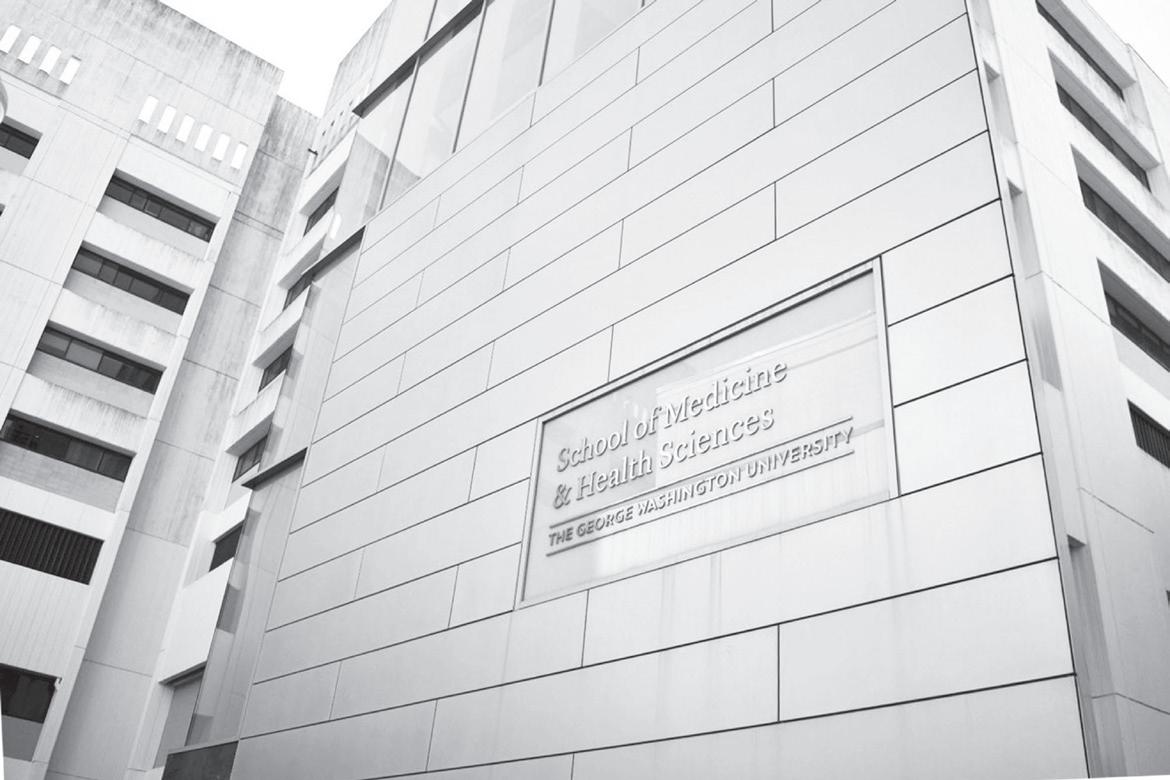
The School of Medicine & Health Sciences, located on I Street.
SAMUEL PEREZ REPORTER
ELLA MITCHELL
CONTRIBUTING NEWS EDITOR
CAROLINE MOORE | STAFF PHOTOGRAPHER An annotated copy of the Good Neighbor Agreement
Staff Council, ethics office discuss University accessibility
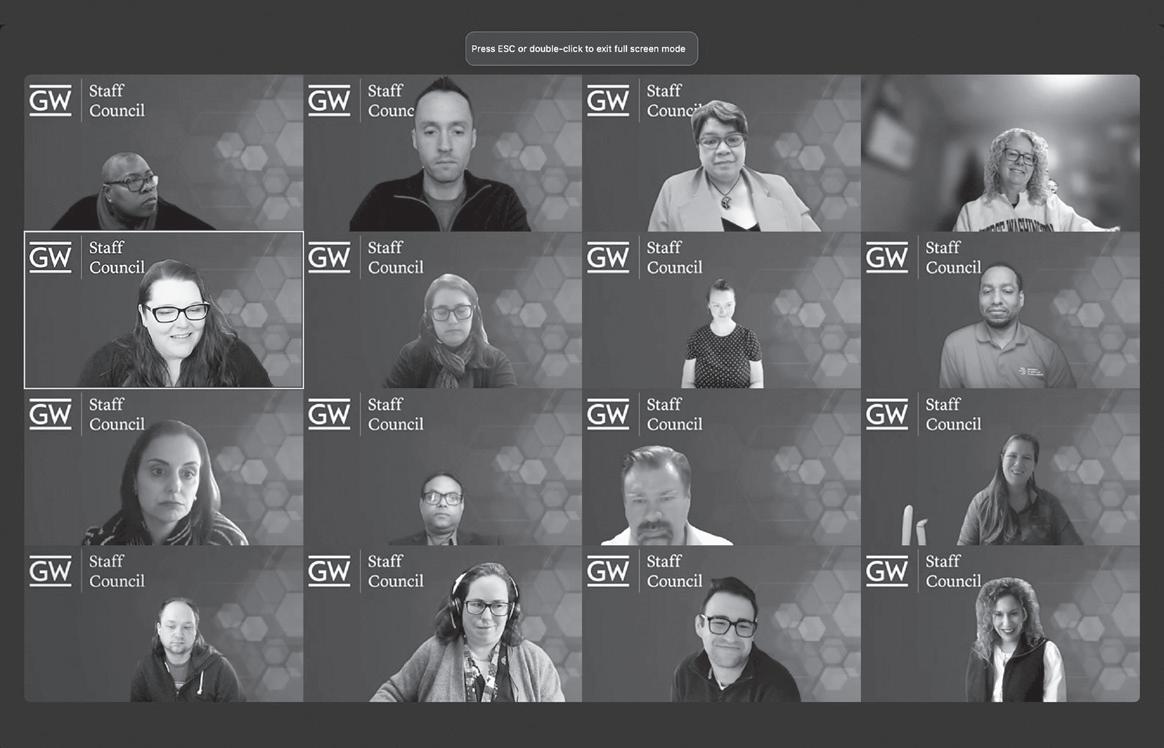
The Staff Council met with representatives from the Office of Ethics, Compliance and Risk during their meeting Friday to discuss officials’ efforts to make the University more accessible for all community members.
The Staff Council met virtually with Senior Compliance Associate Aaron Howell and Associate Vice President Dorinda Tucker to discuss the office’s new priorities after they expanded the University’s Accessibility Committee’s scope during the spring to ensure they are complying physically and digitally with federal law that ensures fair treatment and equal opportunities for people with disabilities. Howell said the office broadened the scope of their compliance during last spring after the office received a complaint in 2017 that the University’s digital content was inaccessible for people with disabilities.
He said the office first created the Digital Accessibility Com-
mittee in 2020 to ensure that the University was digitally compliant with Section 504 of the Rehabilitation Act and Title II of the Americans with Disabilities Act, and officials changed the name to the Accessibility Committee and expanded the committee’s scope earlier this spring so they now oversee the University’s physical compliance. Howell also said the committee is made up of “senior level representatives” from across the University who guide the University’s efforts to move toward “seamless access” for all.
He said the committee also collaborates with stakeholders to address accessibility concerns, and they advise and advocate for solutions to compliance risks related to the ADA and Rehabilitation Act. Howell said anyone at the University can submit accessibility concerns that they are experiencing across the institution to on the Accessibility at GW website.
“This can be thought of as a general hub for accessibility initiatives here at GW,” Howell said.
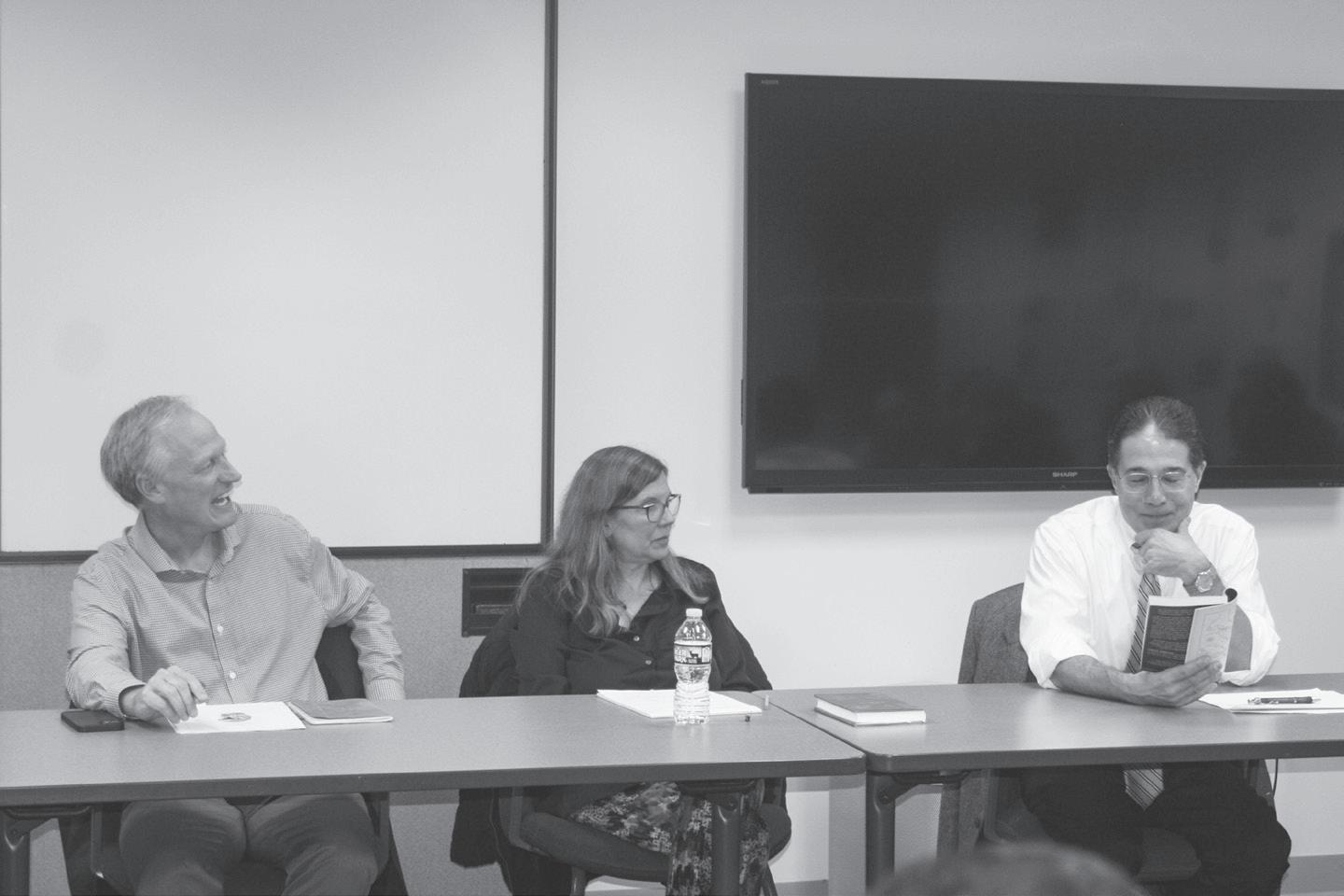
Terry Carter, the council’s representative from the Office of Communications and Marketing,
GW Law to introduce trio of clinical programs next spring
Schaffner said the division hopes to continue the work of the animal welfare project and continue proposing legislation to the D.C. Council through the program to protect animal rights.
A legal education program that provides hands-on training for law students will incorporate three new clinical programs in the spring semester.
The GW Law Jacob Burns Community Legal Clinics’ three new programs will operate out of the Access to Justice Clinic, a family law-based clinic that students participate in to provide legal service to those in and out of the District. The programs will include an animal law division, a citizenship and naturalization division and a criminal appellate division, according to a GW Law release earlier this month, and faculty who lead the divisions said the programs aim to expand opportunities for student involvement in the District’s legal sphere by involving students in litigation and crafting policy.
In May 2023, officials announced the law school would offer five new clinics in the fall 2023 semester — one health equity policy and advocacy clinic and four civil access to justice clinics, including education-access advocacy, nonprofit and entrepreneurship, prison civil rights and workers’ rights divisions.
The animal law division will be led by Joan Schaffner, an associate professor at GW Law, and Kathy Hessler, the assistant dean for animal law. Hessler said the animal law division will expand upon the Animal Legal Education Initiative, a program aimed at improving awareness of animal law directed by Schaffner and Hessler and Director of the Fundamentals of Lawyering Iselin Gambert, by increasing consistency in policy and education work through legal analysis and client interviewing skills.
Hessler said clinical programs usually handle litigation, but it is hard to pursue animal law cases without providing educational resources first because there is a lack of legal knowledge among judges regarding animal law. She said she hopes to develop resources for lawyers and judges who may not have a lot of legal expertise in animal law.
“Most people don’t understand the consequences or the circumstances animals find themselves in, how they’re used and abused and how little legal protection there is for them,” Hessler said. Schaffner said the animal law division is an extension of the Animal Welfare Project, a project through the law school’s animal legal education initiative, which focuses on policy expansion of animal law and awareness of animal legal issues in the District, according to the initiative’s website.
said OCM requires all community members who create digital content on behalf of the University to take a biannual 25-question training to help content managers create and deliver accessible content.
“If you have a base level knowledge of accessibility, which most people at the University that are already working on digital content do, the assessment should be pretty straightforward,” Carter said. “But I would still encourage you to review the training because we do update those periodically.”
Nicole Mintz, the chair of the Staff Experience Committee, encouraged staff members to submit an idea brief to propose new opportunities for the University and attend Community Conversations with officials to ensure staff initiatives are included in the University’s new strategic plan. Officials are currently in their conversation phase of the strategic plan development and expect to deliver the plan to the community in the spring or summer.
Mintz said last month that the Staff Experience Committee reviewed officials’ strategic framework — which will guide officials in shaping their new stra-
tegic plan — and concluded that officials didn’t recognize or incorporate staff perspectives into its outline.
Mintz asked council members to utilize the initiatives to get involved through the idea brief and encouraged them to share the resources with their colleagues.
“I encourage you to keep going and use this past year and a half as a momentum for the future,”
“I think one of the things that we try to explain to folks, why they should take animals’ interests seriously is because, in many respects, the animals’ interests are either directly or indirectly related to humans’ interests,” Schaffner said.
Ashley Carter, a GW Law alum and a visiting professor of clinical law, will head the first-ever GW criminal appeals and post-conviction clinic in the District. Carter said the criminal appellate division will provide students with direct experience in the criminal justice system through criminal justice reports and analyzing “real-world” cases on an appellate level, specifically in post-conviction appeals in D.C.
“Our main focus in the clinics is really building student skill sets and focusing on student experiences and so making sure that I give them the best experience possible,”
Carter said.
Carter said because students in the criminal appellate division will represent real clients, students are trained to think quickly on their feet, be thoughtful when interviewing clients and prepare for each case. She said the clinical program will teach students the research and writing skills needed to “dig” into a research topic in-depth.
“Some want to be prosecutors, some want to be public defenders, some want careers outside of criminal justice entirely, so helping them think through these issues and have that bigger picture conversation with them, I really hope that they take away a sense for what can change in the future, how we can always be improving access to the justice system,” Carter said.
Carter said she plans to have guest speakers come in from different local organizations involved in the justice system to help students get a sense of the various roles in the work field.
“I hope to give the students the best experience possible because these are real cases, we can’t know which cases will be assigned, what they might look like,” Carter said. “It’s really about making sure that I am preparing students as much as I can for their future careers and for their ability to advocate for others in the future.”
The citizenship and naturalization division led by Tania Valdez, an associate professor of law and Cori Alonso-Yoder, an associate professor of fundamentals of lawyering, will provide students with the experience to work on a citizenship case. Valdez said the division is devoted to helping immigrants gain a sense of stability, community and belonging in the United States.
Mintz said.
Staff Council President Bridget Schwartz said University President Ellen Granberg invited the presidents and chair of the Staff Council, the Faculty Senate, Student Government Association, the Alumni Association and other University leaders to a lunch in early December, which she said she will “report out” about afterward the lunch.
SGA leaders push for efficient dining services, expanded food options
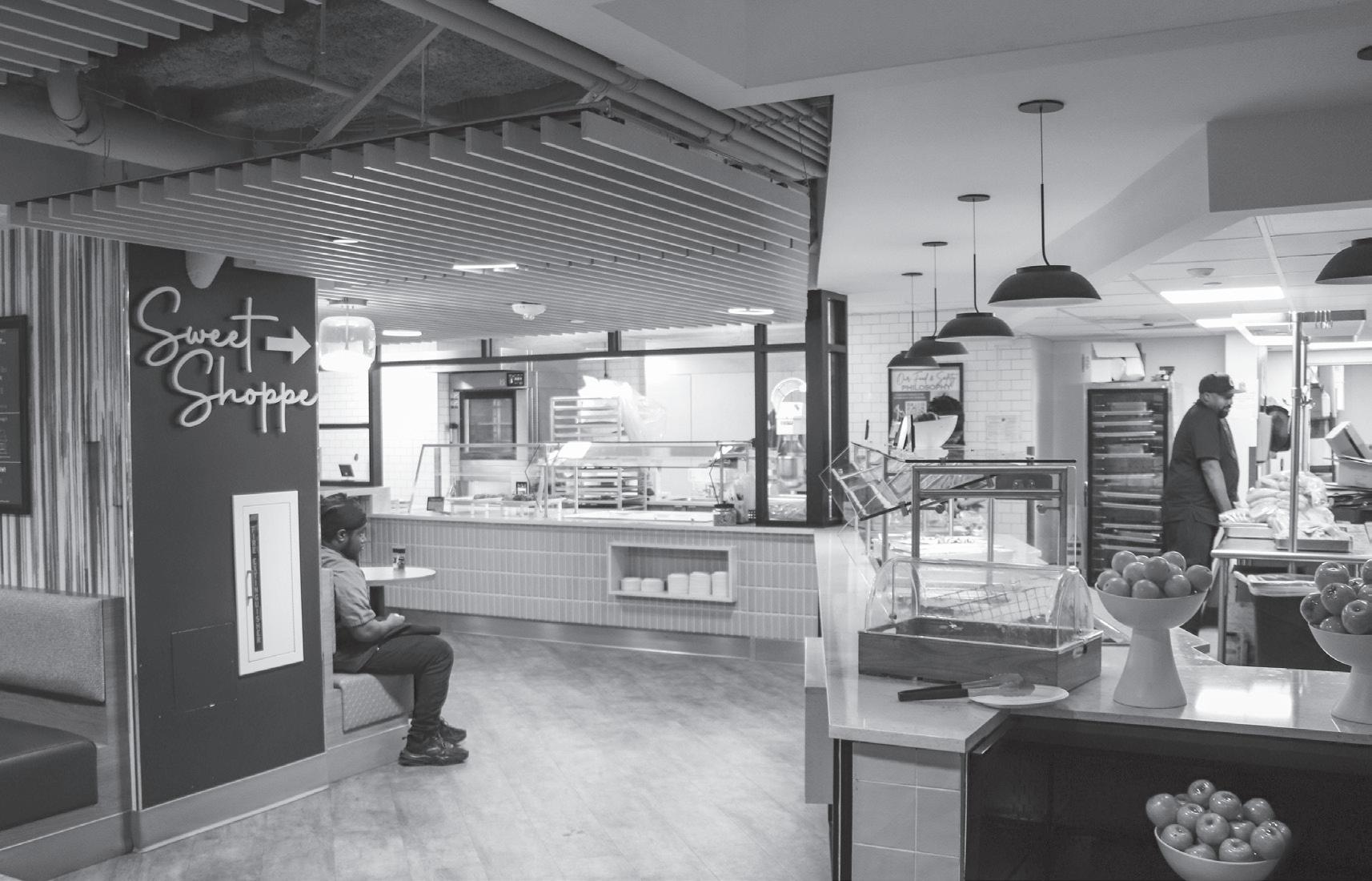
A year after the Student Government Association launched a committee to address dining concerns, SGA leaders said they’re tackling student requests for guest meal swipes, accessible online-ordering options and guidance on the use of reusable dining containers.
Jorey Reyes, the chair of the Special Committee on Dining, said the committee is developing proposals with the Student Advisory Panel — a group of students chosen by dining administration who meet with GW dining officials once per month — to discuss implementing guest meal swipes and partnerships with meat substitute companies. Reyes said she has received emails from students that have demonstrated “a real want” for guest meal swipes to allow students’ friends and family to eat in dining halls, but the committee is still waiting to hear back from GW dining “partners” at Chartwells about whether this is a possibility.
“In terms of our coding process, how do you distinguish between a student meal swipe and a guest meal swipe?” Reyes said. “Can you do this both at the same time? Those are kind of the questions that are being talked about.”
Reyes said the SGA and dining officials are also discussing the incorporation of plant-based meat partners into dining halls to offer students a “wider variety” of dishes in dining halls that include alternative dining options for people who don’t eat. Campus dining halls currently offer an array of dishes that incorporate tofu, meatless fish and chicken options. She said GW Dining offers vegan meat options, but a specified plantbased partner would be “more effective” to ensure higher quality vegan and vegetarian dishes.
“We’re going to be able to access that kind of recipe book, that cookbook of ways that they use their plant-based product to have a variety of different recipes, of different options,” Reyes said. Reyes said the committee
plans to table on campus to increase student knowledge about the rollout of the OZZI to-go container program after students expressed not knowing how to use the boxes. Students from the dining advisory panel have hosted tabling sessions in Kogan this semester to help students sign up for the program.
To access the program, students pay a $5 deposit in return for their first token, which they can present at dining halls to receive a reusable box, per the GW dining website. The OZZI boxes can then be used for takeout food from dining halls and returned in exchange for a new, clean box.
“We want to make sure that things are sustainable, but also easy for students, and so that’s definitely something we’ve been working on, is ensuring that students have their questions answered,” Reyes said.
SGA President Ethan Fitzgerald said he attends the dining committee’s biweekly Friday meetings along with SGA Vice President Ethan Lynne and Executive Secretary of Dining Elizabeth Musick to discuss solutions to dining issues they have seen on campus throughout the week, like malfunctions with dining hall coffee machines and slow water dispensers. Fitzgerald said he has asked University officials to allow students to preorder food online from on-campus vendors like District House through a partnership with the app Grubhub starting this spring. He said he has heard from students that Boost mobile, which offers online preordering, “does not work,” and he wants to instead use Grubhub so students can preorder food more efficiently.
“So if you are walking in between class and only have 20 minutes, you can maybe make that process more efficient by ordering online, and every indication I have received is that that will start in the spring,” Fitzgerald said.
The SGA created the Special Committee on Dining in May 2023 at the first meeting of the 2023-24 term. Former SGA Sen. Dan Saleem sponsored the Dining Examination and Reform Act — which the SGA passed in May 2023 — to
launch the committee after a D.C. Health food establishment inspection revealed reports of mice droppings in The Eatery at Pelham Commons.
At the end of the previous SGA Senate term, the body passed legislation to create a permanent dining subcommittee under the existing senate committee on Physical Facilities and Urban Affairs to ensure advocacy from the SGA regarding student dining concerns continued into future senates.
Saleem said he worked with former SGA Sen. Izzy Brophy last year to connect dining committee members with students by distributing surveys to students about dining hall preferences and issues with closures during the fall semester’s final exam period. He said the committee spoke with dining officials last year like Seth Weinshel, the associate vice president business services, to ultimately expand dining hours during finals weeks for future semesters.
“Obviously, dining wasn’t going to get fixed in a year, and Izzy and I, our main goal was ‘Let’s have something that can be a check on administration, that can be an outlet for students to voice their concerns more easily than going straight to administration,’” Saleem said.
Saleem, who serves as one of the student representatives on the SAP and has attended two of the biweekly meetings this year, said he has not seen much “contribution” from the SGA representatives at conversations with dining officials and other SAP members during meetings this year.
Saleem said he has seen “a lot of rhetoric” from the committee but not much action when it comes to dining initiatives like ensuring proper “hygiene” within dining halls on campus.
“We’re seeing Instagram posts and social media about what they plan to do, but I don’t really see a lot of follow up,” Saleem said. “I don’t see talks happening with administration, and when I speak to people like Doug Frazier, Dean Coleman, they too say that there isn’t really a lot of conversation as well as action going on regarding dining.”
JERRY LAI | STAFF PHOTOGRAPHER
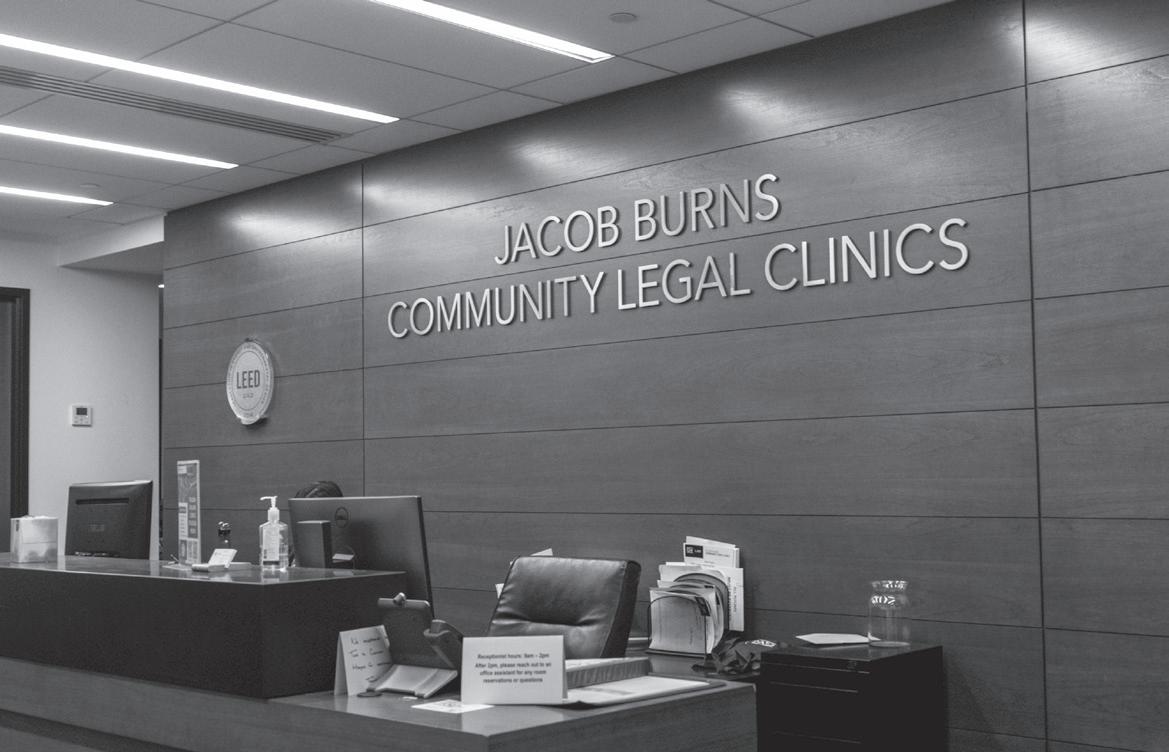
The front desk at the Jacob Burns Community Legal Clinics
MOLLY ST. CLAIR ASSISTANT NEWS EDITOR
JERRY LAI | STAFF PHOTOGRAPHER
Staff Council President Bridget Schwartz speaks during the meeting.
OPINIONS
“I will call out professors who ignore the pain and promote harassment of Jewish and Israeli students.”
SOFFER on 11/14/24
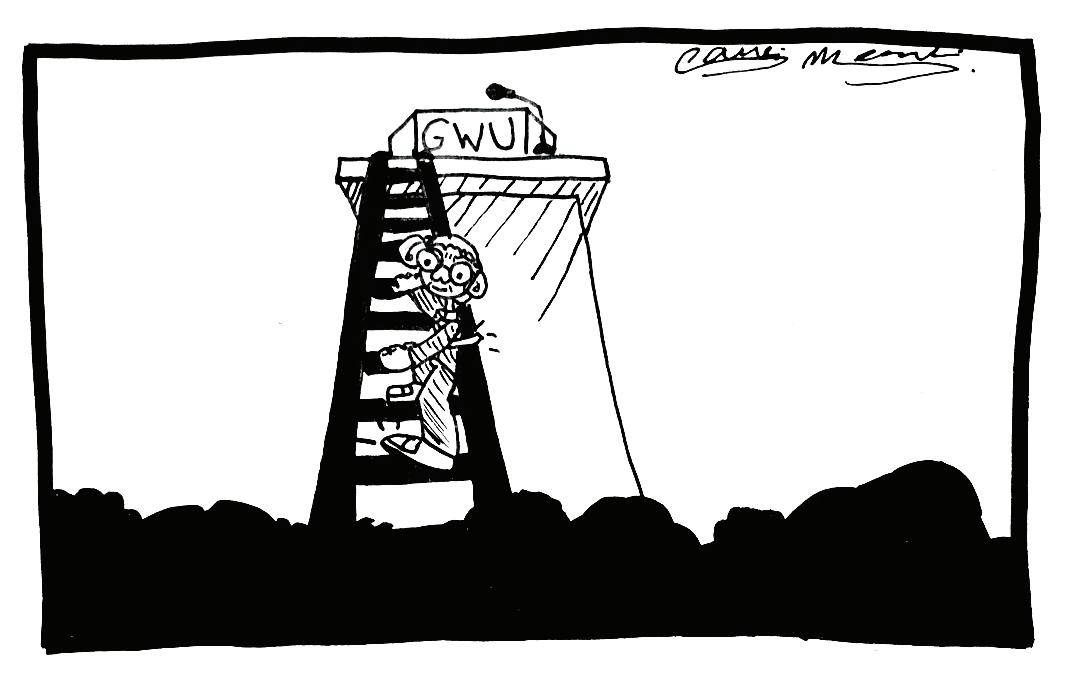
After rejecting institutional neutrality, GW must step up to the plate
The University said earlier this month that GW is not considering implementing institutional neutrality and that if officials were to do so, they would take into consideration the thoughts of faculty, staff and students. The announcement follows a rise of universities across the country, like Stanford and Purdue universities and the University of Chicago adopting the policy, which mandates that colleges refrain from taking public stances on political or social issues to foster more open discussion on campus.
Avoiding an institutional stance for the betterment of dialogue on campus may seem appealing. It, ideally, implies that a university won’t play sides when navigating free expression among their faculty, staff or students, so long as it doesn’t violate any University rules or policies. But adopting institutional neutrality also enables or endorses a university’s silence on issues that are significant to its community and campus.
We therefore commend GW’s decision to, for now, avoid shutting themselves out of such conversation. The president of the University of Chicago called off conversations and negotiations with student protesters about divestment from Israeli companies because doing so would violate the university’s institutional neutrality policy, leading him to shut down the protest altogether because the demands of the protesters would never be met. Regardless of a university’s action or inaction on such student demands, it’s clear that supposed neutrality policies can rationalize unfinished conversations with students about their desires or questions about the institution they attend. Instead of taking the tough but transparent way out — clarifying to community members why and when a university chooses to respond
ISTAFF EDITORIAL
or stay quiet on certain subjects — institutional neutrality would allow universities to back out completely from the arena of campus discourse in a manner that doesn’t reflect their inherent positions of power on campuses. Especially now, universities should be encouraged to speak out about issues that affect their campus. The decision of when to speak is admittedly not an easy one, but we believe that our leaders should be inherently best equipped to embrace these conversations in a thoughtful and open way. In the past, when consequential events related to higher education unfolded — like the Supreme Court ending affirmative action — former Interim University President
Mark Wrighton and University President Ellen Granberg sent out a joint email stating they were “deeply disappointed” and promising that they would try and retain a “diverse student body.” At this present moment, the incoming presidential administration promises to make sweeping changes to education nationwide that could have devastating trickle-down effects on our campus, like the disbandment of the Department of Education affecting students’ financial aid, eliminating diversity and inclusion offices or the withholding of federal funds from schools with vaccine or mask mandates. It’s unclear what the limits of institutional neutrality would be if ever implemented at GW, but stay-
Stop sexualizing criminals
was in my 8 a.m. class, watching the girl in front of me scroll through her TikTok. There was a slow-motion hair flick, a smirk aligned with the beat of “Blame It on the Rain” and bright red text flickered on the screen. She appeared entranced by an edit of clips from Ryan Murphy’s latest Netflix special “Monsters: The Lyle and Erik Menendez Story.”
Ava Hurwitz Opinions Writer
Editors of TikTok thirst traps try to play on the attractive appearance of characters by splicing clips to create a narrative that doesn’t fully represent the reality of their crimes. The focus on looks taps into young people’s fascination with attractive personas, overshadowing their dark behaviors and leading the public to glorify criminals or problematic characters to the point of being desensitized. But these edits or “romanticizations” don’t just stay on our screens. They have made their way into pop culture, with the film industry, social media and young people focusing more on the attractiveness or sensationalism of the characters than their stories. I remember that when I was wandering the streets on Halloween in 2022, there were count-
less Jeffrey Dahmer-inspired outfits after the release of “Monster: The Jeffrey Dahmer Story.” Dressing as Dahmer was all the rage — to the point that eBay banned all listings of any costumes related to the serial killer — which made me feel disgusted at people’s blatant disregard for Dahmer’s victims and their suffering. They were forced to relive the violent crimes every time a teenage trick-or-treater knocked on their door clad in a blonde wig, orange prison suit and sunglasses, all because the media neatly boxed him into an attractive package and sold it to youth as entertainment.
The glorification of killers can be traced back to Ted Bundy, a name known worldwide for his extreme charisma and sinister crimes. His trial was the first to be nationally televised, which allowed people around the United States to actually see his face. Young women found him so attractive that they would show up outside the courthouse with signs proclaiming their love. In the 2019 hit show “Extremely Wicked, Shockingly Evil and Vile,” Zac Efron — an actor who was named People’s Sexiest Man Alive in 2017 — played Bundy. And as such, when my classmates were tasked with discussing the psyche behind serial killers in my high school AP Psychology class, we instead spent
most of the class talking about Bundy’s charming and desirable nature. “Extremely Wicked” was overshadowed by Efron himself — he was even nicknamed “Hot Ted Bundy.” And my generation helped feed this narrative by embracing the romanticized portrayal and engaging with it on social media.
Youth are the main contributors to this disturbing trend. Our attention spans have decreased as social media platforms have shortened content and emphasized quick, engaging visuals. The phenomenon has resulted in a heightened interest in genres that won’t lose our focus within the first 10 minutes. Violence and sexuality amass curiosity — and so it is the combination of the two that makes “sexy” serial killers so apparently appealing. Ultimately, this intrigue often shifts the focus on criminals from justice and awareness to entertainment.
But Generation Z has the power to break this cycle by shifting our approach to consuming such entertainment. We must honor victims and survivors instead of uplifting the characters who robbed them of their well-being. If we are the primary consumers, we hold the power to demand ethical storytelling.
—Ava Hurwitz, a first-year majoring in international affairs, is an opinions writer.
Iing quiet and under the guise of the policy amid such threats to the status quo at higher education institutions would make struggling community members feel alone and less acknowledged. But since GW has committed to not implementing institutional neutrality, we ask them to lean in and dig deep on what they do want to say and when to say it. Last year’s editorial board mentioned the inconsistency in GW’s communication with students about last spring’s protests, noting their abrupt switch from “rapid condemnation” to “radio silence.” Now that we know the University does believe that they should retain their institutional voice, they should use it. It’s likely impossible to speak to
every student on campus or put out a community message that will satiate everyone’s concerns or opinions, but transparency goes a long way in our community. Taking questions from community members in public and digital forums about the most pressing questions on campus — the rationale behind GW’s divestment policy, potential threats to education posed by the incoming president, diversity — in a fashion akin to past University presidents would make a sometimes-faceless institution more visible and trustworthy. We don’t think the University should take a stance on every political and social issue that arises, but holding spaces to answer questions about how top University officials grapple with such subjects could be effective in showing that our leaders never pull the wool over their eyes on challenging subjects. Whether or not the University starts hosting public forums about thorny topics, we feel that choosing not to adopt institutional neutrality provides a compelling opportunity for officials to clear up questions about how and when they choose to make statements. GW has said that if officials were to implement the policy, they would consult with students, faculty and staff. We applaud this vow — but we question how and when leaders have consulted students, faculty and staff about the messages they have sent out in the past, and if they will continue to do so in the future. Garnering such input should run parallel to all efforts to communicate as an institution. GW not adopting institutional neutrality shows that the University doesn’t want to be limited in the support and conversations they can have or catalyze within their community. We hope officials also view this decision as a chance to strengthen how they speak to their community.
What DC can learn from Butte, America
visited America for the first time last summer — or, at least, I visited Butte, America, for the first time.
Butte is a small, declining mining town with an old toxic copper mine pit on the western end of heavily Republican Montana. The town has adopted the lofty nickname not just of “Butte, Montana,” but “Butte, America,” implying that the fifth-largest city in the eighth-smallest state was somehow worthy of the recognition we give to the most famous cities in other countries. Paris, France. London, England. Butte, America.
Nick Perkins Opinions Writer
The first time I saw the gaudy highway signs with massive red letters along I-90 welcoming me to “Butte, America,” journeying from my home in Billings where I worked on a Senate campaign, I thought it was weird. Sure, the whole nickname was probably in part a knowing ironic riff on the reputation of Butte, the place where FBI and George McGovern campaign screwups were sent to have their careers rot. But still, the idea that a Montana town with 30,000 people somehow deserved the implied title of the ultimate, defining American city was laughable coming from D.C. — the nation’s capital and the home of nearly every
famous quintessentially American symbol. Yet at the same time, the idea that Butte should be called Butte, America, made sense because of what I was seeing out in Montana. The area is extremely Republican, and such symbols of America are the exclusive domain of the right. Almost every house has an American flag flying outside. Mount Rushmore, which in theory shows off our four greatest presidents to inspire as much national pride as possible, is a day’s drive from where I lived in Billings. The fact that these heavily conservative areas embrace these symbols implicitly turns them into the “real” America, and thus the party that represents the area as the “real” American party.
But the great irony is that all of these symbols that supposedly make the West the most patriotic part of the country are all reappropriations of D.C. monuments. The presidents who adorn Mount Rushmore did their work in D.C. — notably, George Washington University isn’t in South Dakota but the District. The Democratic Party needs to recognize the need for some form of patriotism to chart a path forward.
Perhaps the starkest example of the Mountain West’s attempt to claim patriotism with symbols from D.C. came when I trekked south to Cody, Wyoming, to see the town’s
famed “Nite Rodeo.” The event is a glitzy spectacle, where rodeo riders from ages eight to 80 decked out in American flag-patterned cowboy hats compete to best wrestle horses and cows, with occasional jokes about gas prices sprinkled in. The rodeo makes its initial assertion of patriotism before the event begins, though after the nightly “Cowboy Prayer.” The evening’s host tries to emphasize the true Americanness of the event by reading a poem about 9/11, and leading guests, many of whom were visiting from Montana, in a performance of “The StarSpangled Banner.” 9/11, which in part took place in D.C.; “The Star-Spangled Banner,” which was written about a flag currently hanging in D.C. D.C. not leaning into its patriotic nature gives the political right extra legitimacy. Conservatives get to claim to represent the shining city on the hill, the idea of America, while they say the heavily Democratic District — where every symbol of America resides — and the left as a whole is against those ideas. Democrats don’t need the same sort of Americanism that you see in Butte, Montana, the glamorized version of our country’s story, but they need some brand of patriotism.
—Nick Perkins, a senior majoring in political science, is the culture editor.
CAROLINE MORRELLI | CARTOONIST
A GW official descends from a podium to address the campus community.
CULTURE
English professorship recipient reads from memoir
As a steady rain fell and a cold wind blew through the District on Thursday night, students and locals gathered indoors to hear writer and NPR reporter Kat Chow tell a ghost story.
Chow — the recipient of an English department professorship fund — read from her 2021 memoir, “Seeing Ghosts,” as an installment in the program’s reading series. The Jenny McKean Moore Writer in Washington program, established in 1976 with an endowment from former GW playwriting student Jenny McKean Moore, brings a working writer to campus for two semesters every other year to teach an undergraduate creative writing course and a free on-campus workshop for District locals.
Relatives of the late Moore, past professorship recipient and author Cutter Wood and a group of students from Chow’s classes attended the reading and Q&A on the top floor of Gelman Library. Director of Creative Writing Lisa Page introduced Chet’la Sebree, an assistant professor of English, who gave a glowing synopsis of Chow’s memoir and career as a journalist and author. Chow then made her way to the podium, thanking her students for their attendance and giving a quick introduction about her memoir.
“I think that writers in general tend to gravitate toward a subject or a question that is a bit thorny,” Chow said, projecting a circa 1994 Sears photograph of her family behind her. “And for me, it was the question of my family: ‘What does family look like to me?’”
“Seeing Ghosts” is a story about grief, loss, history and family, centering around the death of Chow’s mother when she was 13. Chow read aloud poignant, painfully funny and intimate passages from her worn and marked copy of the memoir. She said interviews with distant relatives and family stories of her parents’ lives in China were key in compiling her story.
The sharp smell of hairspray lingered as dancers gazed into dressing room mirrors and cemented their hair into place. Down the hallway, students buzzed around the Dorothy Betts Marvin Theatre, some locked in on their laptops to organize lighting and sound cues while another ran around searching for a missing pair of blue plaid shorts. The Fall Dance Concert dress rehearsal Wednesday marked the culmination of Choreography and Performance, a Corcoran School of the Arts & Design course where students organized auditions, developed the stage design and designed routines for the concert, which was the first time students choreographed the entirety of the event.
Jessica Denson, an adjunct professor in the dance program who teaches Choreography and Performance, said there were 10
student choreographers from her course who arranged the eight performances for the concert. She said she acted as the artistic director to advise the students through her “professional eye,” but her students were in charge of everything for the concert.
Sophomore Maryn Chambers, an anthropology and dance student and the stage manager for the concert, said all of the performances fell into the modern or postmodern genres but were “drastically different” from each other in practice due to their varying themes and interpretations of the genres.
Ahead of the dancers’ 7 p.m. arrival time, the wardrobe team set up shop backstage and chatted among themselves as they scrolled on their phones and laptops. Students from the lighting and sound teams were sprinkled across the audience seats, coordinating their cues on their laptops amid a sea of coffee cups, notebooks and a
bright pink flamingo figurine of unknown origin.
Below the line of mirrors framed by warm, glowing bulbs, dancers’ backpacks, purses and UGG boots littered the dressing room floor and tables. Two racks of multicolored button downs, shirts and flowing pants stood labeled for the eight routines. A nearly empty Coca-Cola bottle sat next to an abandoned Panera Bread bag on the table, a few mirrors down from a sign reading “No Eating in Costume.”
As the words “warm up” rang through the speakers, the dancers filed into horizontal lines. Student choreographer Sadie Tucker led the dancers through a routine set to Britney Spears’ dance-pop hit “Gimme More” as the final portion of the warm-up.
“Oh my God, y’all are so hot,” Tucker shouted.
With the routine completed, warm-up was over, and the dancers had until 7:30 p.m.
to unwind and get ready. In the hallways behind the three dressing rooms, two groups of dancers huddled together while their choreographers gave them final critiques ahead of their run-through.
While the choreographers stationed themselves in the audience, dancers fluttered around through the dimly lit backstage, took their places in the wings and waited for their cues to go on stage. In one routine, a blend of striking red and blue lights washed over the stage, as dancers sauntered and struck poses that created shadows along the wall.
After the last routine came to a close and the stage lights casted a warm glow, the choreographers migrated from the audience to take a bow of their own. Grinning from ear to ear with hand in hand, the choreographers looked off into the audience and took in the culmination of months of rehearsing ahead of the opening night.
The passages she shared had a common theme of preservation: her mother’s dedication to documentation, her father’s attachment to material items and Chow’s commitment to retaining her mother’s presence in her life. For Chow, the best embodiment of preservation is taxidermy, a central metaphor in the memoir.
“This book is framed around a story of taxidermy that is a bit macabre,” Chow said. “Which is that my mother is this ghost-like formation that visits the speaker or me.”
Chow said the theme, oddly enough, has presented itself throughout her life, the first time being when she was nine years old and sitting in her mother’s van, a scene she depicts in “Seeing Ghosts.”
“‘When I die,’ you said, as you made that face,” Chow read, quoting a passage where her mother is talking. “‘I want you to get me stuffed so I can sit in your apartment and always watch you.’ This was the first and would be the only time you would address your death with me.” Chow frequently referred to the importance of images to the story, in terms of photographs and symbols, to give her grief a physical manifestation. She said that as a child, her family talked to her about ghosts, passing down a belief from Hong Kong that ghosts will linger if you didn’t “do the right things” while processing grief. She said these ideas stuck with her, guiding the theme of prolongation.
“Holding and hoarding can’t turn ghosts to flesh, but we create those souvenirs nevertheless,” she read. “It allows us, in a way, to hold our loss close.”
Just after learning that his band’s song “I Want to Hold Your Hand” had charted in America, John Lennon was annoyed.
Lennon was sitting in a Paris hotel room alongside his bandmates and Scottish photographer Harry Benson, who had been assigned to travel with The Beatles during their first tour in the United States in 1964. Benson, wanting to capture some behindthe-scenes shots of the band, suggested that they have a pillow fight on the bed he could photograph — but Lennon didn’t like that idea one bit.
“When I suggested they have a pillow fight, three said okay but John said ‘No, it will make us look silly,’” Benson said in an email.
But Benson had a little help from his friends — in this case, Paul McCartney.
“So that was that until John sneaked up behind Paul and hit him over the head with a pillow, spilling a drink all over him,” Benson said. “And then it was everyone for himself.”
The picture, showing the four jubilant band members wrestling and laughingly threatening each other with pillows, now hangs in the District at the Harry Benson: Washington DC exhibit. The gallery, which sits next door to Capi-
tol One Arena, is a collection of more than 150 of Benson’s images, often taken in D.C., documenting historical events, political figures and celebrities from the 1950s onward.
The photo collection, which is run by Washington Wizards and Capitals’ owner Monumental Sports & Entertainment, will be up until the NBA and NHL seasons end, open 10 a.m. to 5 p.m. Wednesday through Sunday, except on Wizards’ and Capitals’ game days when it is open until 7 p.m., and is free.
The 94-year-old Benson said the plan for the gallery came six months ago over a dinner between him and Ted Leonsis, the CEO of Monumental Sports & Entertainment. Benson said that during their dinner, the two talked about how Benson had photographed every president since Dwight D. Eisenhower, many of which immortalized moments in D.C. history, sparking the idea for a gallery chronicling Benson’s long history of work. Upon entering the gallery, visitors face a wall displaying a short note and bio of Benson, as well as a photo of The
off
CARLY CAVANAUGH STAFF WRITER
Top: Student choreographer Livvy Loxton takes a moment with her dancers for one last hug before the start of rehearsal. Left: Cate Conde touches up her lipstick while getting ready in the dressing room. Right: Two student performers sway to the rhythm during Sunday’s tech rehearsal.
RAPHAEL KELLNER | STAFF PHOTOGRAPHER
YNGRID GUEVARA | PHOTOGRAPHER
YNGRID GUEVARA | PHOTOGRAPHER
KYRA WOOD | PHOTOGRAPHER
SPORTS
Water polo gears up for conference championship after second-place season
After wrapping up their regular season and earning the second seed in the Mid-Atlantic Water Polo Conference, water polo (158, 11-3 MAWPC) is readying to compete in the conference championship tournament on Friday.
Last season, the Revolutionaries finished with a 13-14 overall record and earned fifth in the MAWPC Championship. They will begin championship play with a Friday game against Johns Hopkins (11-21, 3-11 MAWPC).
The Revs gained eight additions to their roster this year, adding seven freshmen and one transfer to their ranks. Freshman center Joseph McCreary said he is excited to play in the conference championship, and he looks forward to the opportunity to continue helping lead the team’s offensive structure. He said he’s seen improvement in his individual and team play as the year has gone on.
“Speaking for the freshmen, it’s of course our first time playing in conference, and it’s very exciting, kind of nerveracking,” McCreary said.
Graduate goalkeeper Luca Castorina has been a leading force for the team this season, with a 47.86 shots-saved percentage in his fifth season and three MAWPC second team titles under his belt. Head Coach
Barry King said Castorina is “stalwart” for the team.
“We want to do things that are built around his skillset and his ability to keep balls out of the goal,” King said.
The regular season started off strong for the Revs with a 17-8 win over Mercyhurst (7-23, 0-14 MAWPC), followed by victories in two of their next three games at the Navy Invitational. The team
competed in a California tournament and the Princeton Invitational in September, losing two games in Princeton but winning two of four in California. The Revs capped off their season with an 11-7 defeat against Navy (20-9, 10-4 MAWPC), ending the season winning two of their last three games.
The team will open championship play with a matchup against Johns Hopkins. This will be the
Women’s basketball flounders on offense in 52-40 loss to Ohio
KRISTI WIDJAJA STAFF WRITER
Women’s basketball (2-2) fell 52-40 to Ohio University on Saturday in Athens, Ohio.
The Revs struggled on both ends of the court offensively, making 27 percent of their field goals and only gained one lead throughout the game, three minutes into the first quarter. Senior forward Mariona PlanesFortuny and junior guard Filipa Calisto dropped 10 and 11 points, respectively, and were the only two Revs scoring in double figures.
The starters struggled with their shooting, connecting on only six of 38 shots. The team as a whole only made four of 14 free throws, their lowest free throw percentage so far this season. Sophomore forward Sara Lewis led the team with nine rebounds, all on the defensive end of the court.
Ohio’s graduate student guard Anyssa Jones made the game’s first point, hitting both free throws at the seven-minute mark. Graduate student guard Makayla Andrews then drained a 3-pointer, giving the Revs the first and only lead of the game and their only 3-pointer of the game. The Revs didn’t score another point until over six minutes into the game, when a layup from Andrews brought the score to 7-5.
Freshman guard Gabby Reynolds struggled with her shooting, going 0-11 on field goals and attempting six 3-point shots. She ended the game with 3 points, all from the free-throw
line, where she had six attempts. Reynolds also contributed six assists and five rebounds. In her first three games of collegiate basketball, Reynolds has impressed, averaging 15.7 points per game on 47.1 percent shooting.
Off a Bobcats turnover, Reynolds stole the ball and passed to Lewis for the layup to open the second quarter. Junior guard Filipa Calisto then made a layup in the next offensive possession, bringing the score to 13-11. With just a one-possession margin separating the teams, Ohio went on a 9-0 run to extend their lead to 22-11. Seven GW points to end the half brought the score to 24-18.
GW’s offensive struggles continued into the third quarter, and the Bobcats outscored them 7-1 in the first few minutes of the second half. Turnovers proved to be a key struggle throughout the game, with the team giving up 19 overall, including 12 from the starting lineup.
Going into the fourth quarter, the Bobcats scored 5 points to extend the lead to 14, bringing the score to 46-32, leading Head Coach Caroline McCombs to call a timeout. Off the timeout, the Revs missed on three scoring opportunities, with two offensive rebounds failing to lead to any points. 14 points proved to be too big of a deficit to make up in just a quarter, and the Revs only scored eight overall in the period.
The Revs will return to the Charles E. Smith Center and play at home for their next five games, starting with a matchup against Towson on Wednesday at 6 p.m.
teams’ third dance this season after the Revs beat the Blue Jays 14-12 on Oct. 20 and won 11-7 against them earlier this month. Castorina said he hopes the team can build off the momentum from their previous wins against the Blue Jays and create bigger score differentials.
“We can do much better than what we did during the season against Johns Hopkins,” Castorina said.
“Especially because it’s the
first match of conference, so we can start immediately by showing teams that we’re here for just one reason, that is to play the final against Fordham.”
King said after their Johns Hopkins matchup, he expects the team to face Navy, which sits in third place in the MAWPC, just one seed below the Revs.
The Revs battled Navy twice in the regular season and both were close games, with
the Revs walking away with a narrow 13-12 win in a late October game and losing to Navy in a 7-11 defeat on Nov. 9. “What we need to do, what we’re better at than they are, the kind of advantages that we have versus them,” King said. “We’re working on strengthening those and ensuring up the things that they might do a little better than us.”
Fordham (28-0, 14-0 MAWPC) poses the biggest threat to the Revs in the championship tournament, holding the No. 1 seed in the MAWPC and an undefeated record. The Revs twice faced and lost to Fordham in the regular season, falling to the Rams 9-20 in September and again in a 5-19 loss earlier this month.
“Our task is pretty Herculean in terms of trying to unseat Fordham, but really, the whole thing is to get to that game and then give ourselves the chance in the one off,” King said. Castorina said he and his team hope to strengthen their play for upcoming championship games and fix errors during the season against past opponents.
“We made this mistake the last few times,” Castorina said. “But I don’t think it’s gonna be the same case Friday at 6 p.m. because we’re ready, and you know we’re gonna give it all one more time.” Water polo will face John Hopkins in Annapolis, Maryland in the first round of the MAWPC Championship on Friday.
Club pickleball takes flight at GW
A basketball court on the third floor of the Lerner Health and Wellness Center transforms into three pickleball courts each Thursday evening, with temporary fabric lines laid down on the court to mimic permanent markers.
Some students on the beginner courts said they have only played pickleball twice in their lives, while those on other courts play the sport competitively. Senior Parker Schwadron was among the founders of GW Pickleball, creating the club shortly after picking up the sport from his parents and launching the group in the spring of his sophomore year in 2023.
“We have a club on campus that is really doing successful, and it’s really doing hot,” Schwadron said.
Schwadron said that when he began the club in 2023, he limited advertisements of their practices due to the fear of too many people showing up due to the rise of popularity of pickleball as a sport.
When he founded the club, it had 80 members, with about eight to 12 people showing up consistently at weekly practice.
The club now has more than 200 members registered on Engage, and its first practice of this year had more than 90 attendees, Schwadron said.
“There’s, usually this stigma
where it’s like ‘Oh, pickleball is for old people’ or whatever, but honestly it is, but it isn’t at the same time,” Schwadron said. “It’s a lot of fun. Once you start to play, you start to get addicted to it.”
The club still mainly consists of open play at practices, but they now have a 12-member competitive team as well, which they formed a few weeks ago after tryouts. The team practices Thursday nights at Lerner, but they also use the tennis courts on the Mount Vernon Campus for their Saturday practices, which the competitive team members are required to attend.
When the club first started practicing on the Vern tennis courts, their executive board spent more than an hour measuring and chalking the pickleball boundary lines because they weren’t permitted by the University to lay semipermanent taped lines, members said. Schwadron said that after Walmart hosted a Sept. 14 pickleball event on the Vern court with taped lines, the staff who run the tennis courts allowed the lines to remain.
Junior Lucas Golluber currently serves on the club’s board. Golluber organized the competitive team’s first-ever competition at George Mason University on Sunday, facing off against Gallaudet University as well as their Revolutionary rival after reaching out to schools in the area.
“It’s sort of one of those things that you play once, and you’re
hooked,” Golluber said. “It’s really addicting when you play.” On top of continuing to create more competitive opportunities as the club’s scheduler, Golluber said one of his major goals as Pickleball Club president will be to get permanent lines on courts around campus. He also said he’s had conversations with officials at Lerner about adding permanent pickleball lines to one of the basketball courts.
“I’m definitely hoping to keep pushing for the permanent lines on the tennis courts at least,” Golluber said. “That is definitely just a fight we need to keep having.”
Senior board member Sabrina Causley said after searching for somewhere to play on campus, she found the pickleball club and joined their “lowkey” practices on the Vern last year. She became part of the group that helped turn the organization into an official club sport, relying on her past involvement in other student organizations to lay the groundwork for GW Pickleball. Causley also said she hopes the club grows to compete in more tournaments in the D.C. area.
“I’ve done quite a few things in my time at GW, and this is definitely the most fun thing I’ve done,” Causley said. “And most rewarding thing, to be able to start something that I didn’t expect so many people would have an interest in because you don’t hear people talk about pickleball too often on campus.”
COOPER TYKSINSKI | STAFF PHOTOGRAPHER
Graduate student goalkeeper Luca Castorina blocks an incoming ball during a game against Bucknell last month.
TANNER NALLEY | STAFF PHOTOGRAPHER
Marina Grillasca hits the ball during a pickleball practice at the Mount Vernon Campus tennis courts on Saturday.