


Less than 12 hours after polls closed on Election Day, news outlets began declaring Donald Trump the nation’s 47th president.
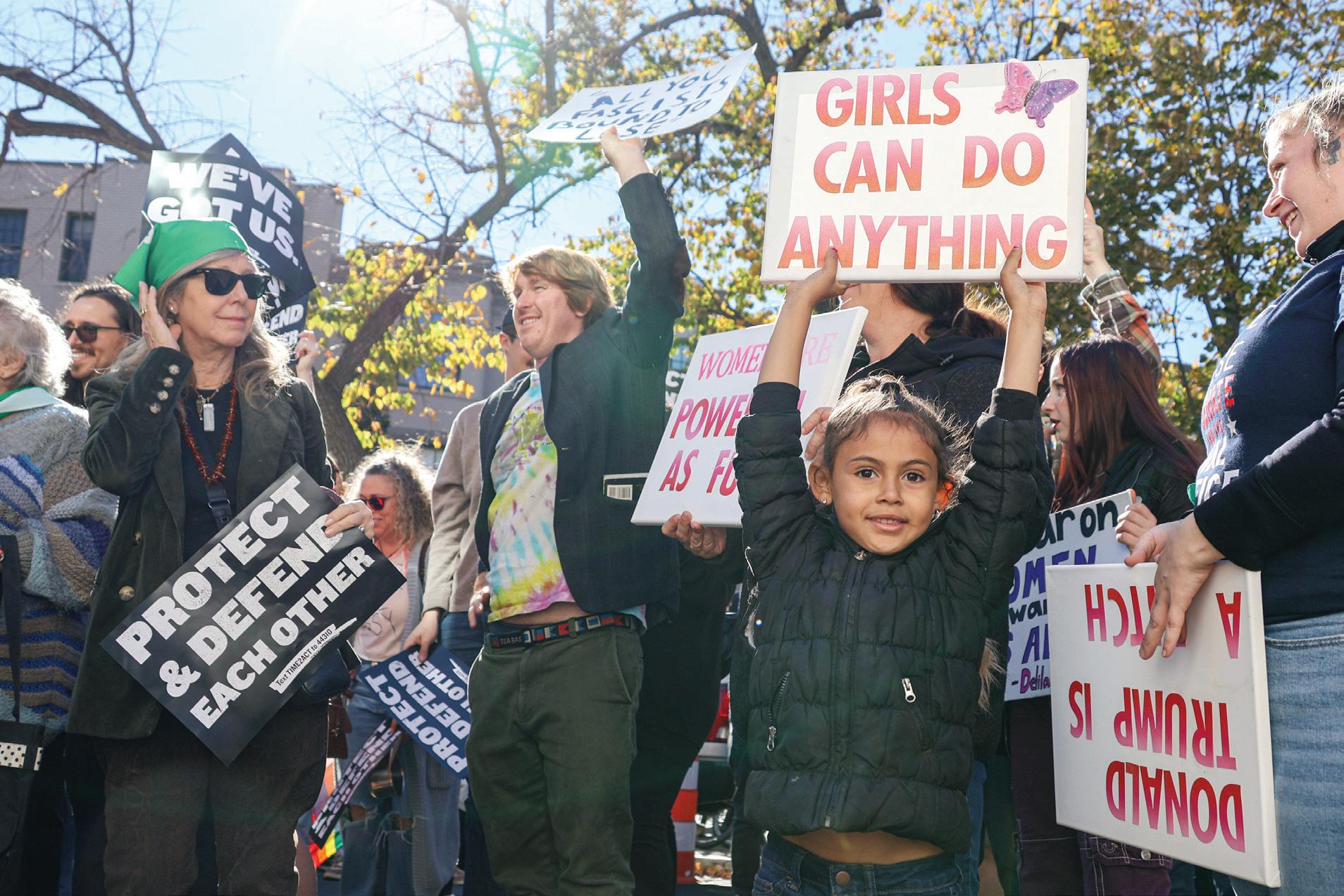
Blocks away from the White House, some GW students celebrated the Republican Party’s victory while many others grappled with their disappointment and fear of Trump winning a second term in the Oval Office. More than 20 students said they were surprised by the former president’s sweeping victory, with some hoping his economic policies will lower costs and others worrying he will threaten democracy, citizens’ financial stability and reproductive rights.
Trump centered his campaign on immigration and the economy, agenda items that appeared to resonate with the majority of Americans as the former president secured a victory in the electoral college and the popular vote, breaking down the “blue wall” and winning all seven battleground states.
First-year Max Schwartzman watched the election results late Tuesday night at the GW College Republicans watch party in the University Student Center Amphitheater, which he said was full of “excitement” all night.
“It was just so electric,” Schwartzman said.
When Trump clinched the election early Wednesday morning, Schwartzman said GW Republicans celebrated with a late-night march to the White House and then to the National Mall, during which they wore Trump hats and carried signs.
Schwartzman said he expects Trump will lower prices that have climbed during President Joe Biden’s term, when the country faced a peak inflation rate of 9.1 percent in 2022 that settled to 2.4 percent in September.
Junior Victoria Carlson, the GWCR’s chairwoman, said the watch party lasted until 4 a.m. and reached a 50-person peak, adding that people became more “rowdy” when Sen. Deb Fischer (R-NE) won a third term in the Senate, securing a Republican majority in the upper chamber.
Carlson said she is hopeful Trump’s presidency will lower costs for Americans and tighten up the borders to minimize drug trafficking and crime.
“One of the big questions that he would ask around his whole campaign is ‘Do you feel like you’re better off today than four years ago?’” Carlson said. “And a lot of people for them, the answer is no, and those are the people that ended up voting for Trump.”
The energy at GW College Democrats’ simultaneous watch party in the student center Tuesday night started hopeful, with the
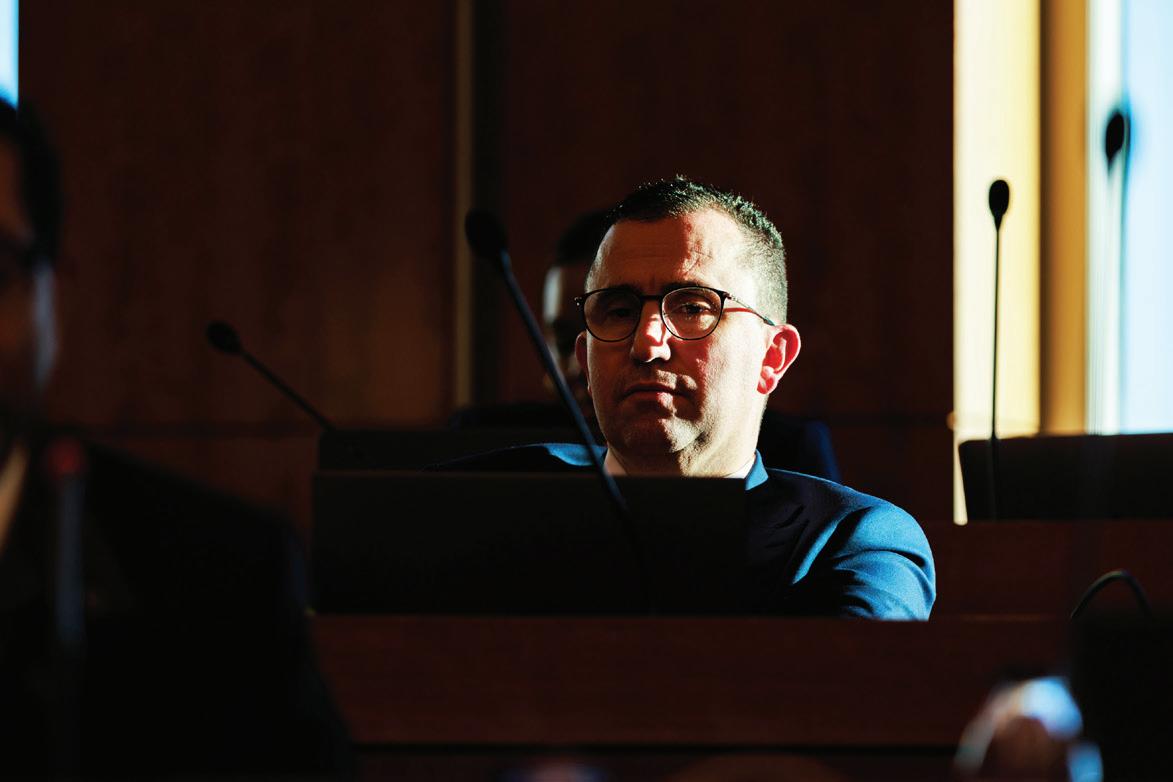
Faculty senators went into a closed-door session Friday to hear a report on the financial status of the Medical Faculty Associates, a group that owes more than $250 million to GW.
Faculty Senate Operations Coordinator Liz Carlson told the senate via email a day before the meeting that she moved Chief Financial Officer Bruno Fernandes’ MFA report to the top of the agenda after discussions with him, the senate’s Fiscal Planning & Budgeting Committee Chair Susan Kulp and Executive Committee Chair Ilana Feldman. In a second, unsigned email sent less than two hours before the meeting’s scheduled start time, the senate office said the meeting would begin in executive session, meaning all nonsenate and nonadministrative attendees would not be admitted.
Dean of Students Colette Coleman, Vice Provost for Enrollment and Student Success Jay Goff, Vice President for Safety and Operations Baxter Goodly and Executive Director of Media Relations Shannon McClendon were among the officials that left the meeting after senators went into executive session. The email told attendees to expect 45 minutes for the closed-door portion of the meeting, but the executive session lasted roughly an hour and a half.
roughly 150-person crowd buzzing with anticipation for a potential Kamala Harris presidency, according to GW Democrats Chief of Staff Logan Olszewski.
But between 11 p.m. and midnight, attendees began to “see the writing on the wall” and disappointment swept through the room when news outlets began projecting Trump’s victory, Olszewski said.
Olszewski said he’s worried that Trump could threaten democracy by putting political appointees in bureaucratic positions who serve his personal interests instead of those outlined in the U.S. Constitution.
Junior Emily-Anne Santiago, the programming director for GW College Democrats from Florida, said Trump’s second win against a female candidate shows that the nation doesn’t believe a woman should be in power. She said she was disappointed in the Latino voter turnout for Trump — as he received about 45 percent of Latino votes, a 13 percent increase from 2020 — adding that the voting bloc chose the prospect of economic gain over the risk of deportation.
“Yeah, your eggs might be cheaper, but at what cost? If your family members are being deported, if your friends are being deported,” Santiago said. “I always say jokingly, but who knows, that he would sell Puerto Rico for a donut. You know what I mean? He doesn’t care about us. Truly.”
University spokesperson Julia Metjian said a faculty senator made a motion for executive session, which was voted and approved by the senate. She said executive sessions are usually held when there is a need for a “closed or confidential discussion” with administrators and faculty senators.
Metjian said the MFA has been working to reduce its budget deficits, but persistent losses point to “deep and systemic challenges.”
She said Bill Elliott, the MFA’s new CEO, is working to address the MFA’s issues “comprehensively” as they aim to build a “sustainable clinical practice” that supports both the District’s health and wellbeing and provides a training setting for GW’s medical students.
“While external factors have played a role, internal structure and operations are also contributing factors,” Metjian said in an email.
The financial status of the MFA — a group of physicians and faculty from the School of Medicine & Health Sciences and GW Hospital that owes more than $250 million to GW — has been a source of frequent conflict between officials and faculty senators as faculty have long pressured the University to evaluate the MFA’s financial losses and their potential effects on GW’s “underfunded areas.”
Fernandes typically delivers the MFA’s fiscal year update at the Faculty Senate’s October meeting. In last year’s report, he said the MFA wouldn’t pay back its $200 million debt to the University by the end
As the hour passed from 11 p.m. to midnight on Election Day, the White House was dark.
The massive black metal gates and wooden platform for the media obscured any sight of light from 1600 Pennsylvania Ave. as it was becoming clear that former President Donald Trump would be elected as the 47th president. Outside, a handful of supporters of the former president and a trio of people supporting his losing opponent, Vice President Kamala Harris, exchanged barbs with each other as the stars shone through the dark more than the District’s light pollution tends to allow.
The words between the dueling supporters degraded into personal insults, from attacks on their appearances to racial and homophobic slurs hurled by both sides. But perhaps this was to be expected, given the vicious barbs the major political leaders threw at each other all election cycle. An impromptu protest that felt more like a YouTube comment section was almost a natural step from the present-day political arena.
At 1:24 a.m., just as news outlets called Pennsylvania for Trump, a man with a “Harris-Walz” sign and a megaphone and a group of Trump supporters wearing
of FY2024 and projected it would instead lose between $30 to $50 million this fiscal year, walking back GW’s profit projections for the second year in a row.
Senators moved into executive session in February to discuss the MFA’s Q2 financial report at Feldman’s suggestion. At the time, Jennifer Brinkerhoff, a faculty senator, asked Feldman about the status of filling in faculty not in the senate about the MFA’s finances.
After the MFA granted GW full governing power over the enterprise in 2018, the organization lost more than $43 million in FY2020 and another $49 million the next year. The nonprofit group of doctors, nurses and health care staff used to break even, sometimes exceeding expenses by millions.
Officials initially attributed the enterprise’s losses on the outbreak of the COVID-19 pandemic in 2020 and have maintained that they can revive the organization’s financial viability, despite former MFA leaders’ comments that the enterprise should be financially stable by now.
After the senate ended executive session Friday, University President Ellen Granberg said the third-party firm that officials hired last month to investigate GW Police Department’s training protocols and safety and compliance measures taken by the department during the arming process are “on campus,” and “engaging in interviews.”
Officials hired the third-party firm after former GWPD officers in late September reported gun safety
MAGA hats erupted into an arguing match over the night’s results.
The latter cheered as they heard about the Pennsylvania results, proudly declaring they were Puerto Ricans for Trump.
“Kill yourself, kill yourself,” the Harris supporter responded to their hooting and hollering over his megaphone.
“Shut your gay *ss up,” one of the Trump supporters yelled back. Derek Torstenson, the Harris supporter with the megaphone, said he came to D.C. from Colorado Springs, Colorado, where he works as a server, to tell Trump supporters he wouldn’t stand for them taking away his rights. Torstenson said the method by which he took that stand was yelling anything and everything over his megaphone.
“I’m here to yell, scream, anything, profanity,” he said, seemingly not considering if berating his opponents as bigots contradicted Vice President Harris’ campaign slogan of “A New Way Forward.”
Torstenson is a frequent protester in D.C. and has a history of altercations with conservative activists and law enforcement. In 2021, Torstenson — or at least a man with the same first and last name — was charged for assaulting a police officer in D.C. during a demonstration, and in 2023, Torstenson called for counterprotests against an anti-abortion student group
at Citrus College, to which the president of the group threatened “I’ll send the proudboys after U.” Torstenson continued his mission on election night, yelling at the Trump supporters — who said they were first-generation immigrants — to go back to their country of birth. The MAGA group stayed outside Lafayette Square, across from the White House, and a member who declined to provide his name said they were there for one reason.
“Trump,” he said. The supporter said he wanted Trump to win every single state in the country because he believes he will create more jobs.
“We need jobs,” he said. “People who work hard, who are here. They need jobs.”
At 1:25 a.m., a group of five Christian activists marched past the White House, chanting Jesus’ name. One carried a lightup cross twice his height, while another hauled a nonilluminated cross. Another member of the fivesome wore a flashing cross chain and held a sign meant to look like an iPhone screen, reading “Jesus Calling,” another carrying a MAGAesque flag in the style of a Trump campaign sign that read “JESUS: Make America Godly Again.” After 10 minutes, the cross disappeared around the corner of the White House.
violations, insufficient firearms training and a poor working environment that led to high turnover within the department in the past year, but officials declined to say which firm they hired.
Granberg said officials “widened the scope” of the firm’s investigation, adding that officials expect a final report at the end of 2024 or the beginning of 2025. She did not specify why officials widened the scope of the investigation or what the third party is now additionally investigating but confirmed the investigation is not determining if officials should unarm the force.
Granberg also said officials intend to distribute a report to the community once the third party completes the investigation. She
said she’s not aware of any conversations with the Board of Trustees — who approved the department’s arming in 2023 — about potentially unarming the force.
“I am not aware right now of conversations within the trustees about this, I think everybody’s awaiting the results of what we’re looking at now,” Granberg said.
Vice Provost for Faculty Affairs Rumana Riffat also delivered her annual salary equity review progress report, which identified schools with potential faculty salary outliers that officials need to adjust to make more equitable. She said the Columbian College of Arts & Sciences saw the largest number of outliers, with 24 and said officials made 16 adjustments.
JENNIFER IGBONOBA NEWS EDITOR
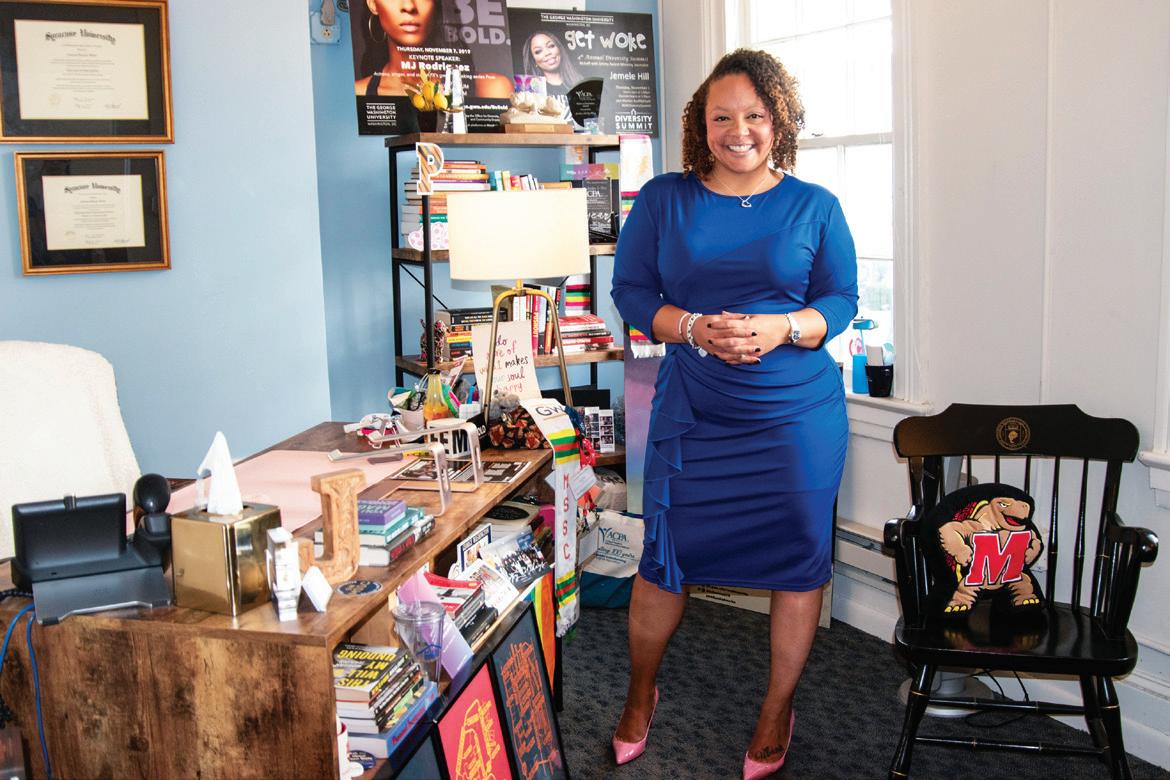
Jordan Shelby West charts the future of GW’s Office of Diversity, Equity and Community Engagement as one of potential and opportunity. Staff turnover and student concern about the office may prove that to be inevitable.
West, who has served as the associate vice provost of the office for six years, said she hopes for a time ahead in which the ODECE has the money to launch a scholarship fund, offer “experiential learning” in locations across the country and offer more retreats, like Horizons Summit — a multiday social justice retreat that began in 2023. She said the office is “building out” its resources for grant writing and opportunities for members of ODECE to meet with potential donors, like alumni, and amplifying the stories of students, faculty and staff to grow partnerships that bring in funding.
“What am I imagining? What am I hoping for? It’s really that we have the resources to be able to provide students with those types of experiences,” West said.
Throughout her tenure, West said the ODECE’s central programming has expanded, with the annual Diversity Summit growing into a multiday event centered around social justice, a “Race in America” lecture series with guest speakers in 2020 and 2021 and earlier this year, the start of a Viva Voce series — a program that highlights faculty scholarship. West said she also established a University-wide bias incident reporting system in 2019 where students can meet with a staff member in Conflict Education & Student Accountability about their reports.
She also said she replaced EverFi, the online education platform the University used for mandatory diversity training for first-year and transfer students in 2019 because it wasn’t “GW enough” and created her own diversity curriculum, which she said has generated posi-
tive feedback from students.
But West holds a leadership role in ODECE during a time of change and skepticism. The office currently lacks a primary leader after the departure of Caroline Laguerre-Brown, the former vice provost of diversity, equity and community engagement, in July. West now reports directly to Provost Chris Bracey and directly oversees the Multicultural Student Services Center — one of ODECE’s four hubs — as Catherine Guttman-McCabe, an outside hire from the Potomac Law Group, oversees Title IX and Disability Support Services. The search for a new vice provost is “ongoing,” according to a University spokesperson.
Dwayne Kwaysee Wright, the director for diversity, equity and inclusion initiatives at the Graduate School of Education and Human Development, said the ODECE is in an “era of transition” following Brown’s departure and oversight changes, leaving the University without a chief diversity officer.
Wright said he’s a part of the Council on Inclusive Excellence, an informal group of DEI administrators at GW, which formed in 2020,
and West has been “immensely valuable” to the group through offering services, like training faculty to reviewing applications and performing inclusive bias training when a bias incident report is filed.
“I hope that she sticks around, whether it’s in an interim role, the actual chief diversity officer role or in the role that she is right now because she is an invaluable source to GW, and there are hard times coming, regardless of how this election comes out,” Wright said.
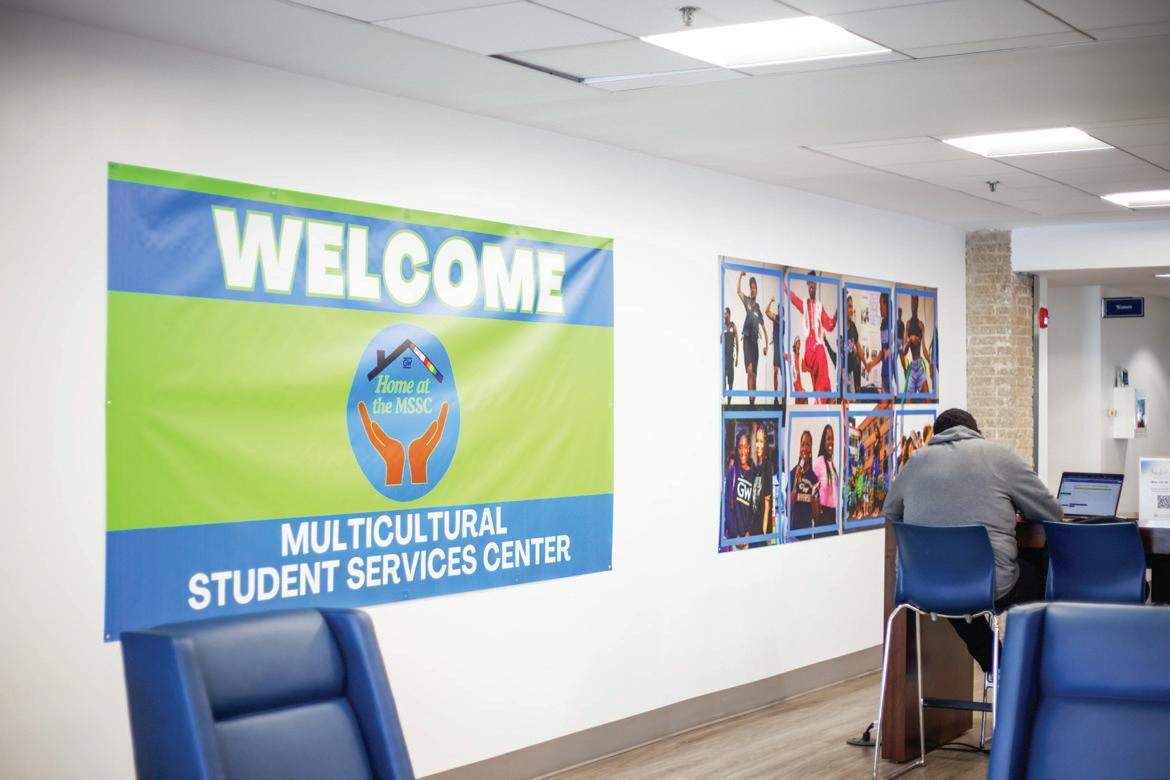
Over the last few years, the MSSC has faced turbulence. Sudden MSSC staff departures and turnover in February left the center with only one full-time staff member, and the center’s relocation to the University Student Center from its former G Street townhouse grew concerns among some community members that the center was losing autonomy.
But West said the center is “expanding,” stating that the hiring of MSSC Director Vanice Antrum in August and the staff members that they have subsequently brought in were “really significant.” She said the center’s new program coordinator for race, ethnicity and culture hired in August has been run-
ning programs “multiple times a week” and engaging with several student organizations to support students who are overseeing the heritage celebration months.
The center also hired Hannah Youssef, an assistant director, in August, but she is no longer listed on the center’s staff page as of Monday. The MSSC has since hired a program coordinator for gender and sexuality, who West said begins next week.
“As it relates specifically to the MSSC, the staff is pretty much new, with the exception of Elise Greenfield and so continuing to support them around ‘What is a programming framework, and how do we assess it? How do we measure long term impact?’” West said.
West said she also hired Eunice “Eunz” Dollete as the ODECE’s inaugural assistant director for cultural programming and social justice education in 2022, who hosts “Breaking Bread” — a weekly dialogue program on Wednesdays about topics including student activism and patriarchy.
Early this year, the Division for Student Affairs adopted oversight for religious and spiritual life at GW, a component of University
programming that was originally housed under the MSSC. The MSSC’s former graduate assistant for religious and spiritual life said in April that he resigned from his position after officials canceled the center’s original plans for its annual Interfaith Week in January and transferred religious and spiritual life to the DSA, with the department later hosting its own version of the week in April and establishing a Center for Interfaith and Spiritual Life in June.
“I don’t have an answer for you about that right now,” West said in response to why the MSSC’s original Interfaith Week schedule was canceled.
She said the MSSC has two pillars: gender and sexuality and race, ethnicity and culture — omitting religious and spiritual life, which past leaders said was a core component of the center. She said past University announcements have been “clear” that these components belong in DSA.
“What we will always do is welcome all students with open arms and be a space where students can contemplate identity, question their beliefs and thoughts,” she said.
Officials announced that faculty will pilot an initiative that enables an accessibility feature on Blackboard next semester during a Faculty Senate meeting Friday.
Sarah Wagner, a faculty senator and co-chair of the Education Policy & Technology Committee, said at the meeting that the committee has worked over the past year with members of the Student Government Association and the Disabled Students Collective to introduce Blackboard Ally, an extension of the course management platform. Faculty and student leaders said the extension will make navigating courses on the platform more accessible for disabled, blind and deaf students by
providing options to faculty to modify their course materials, like ensuring documents have better visibility or adding text descriptions to visuals.
“We have a chance to gather data on how it’s working, on feedback from faculty,” Wagner said. “This is not a permanent initiative, it is a trial basis but one that I think could be beneficial to our students and to us as faculty.”
Geneva Henry, vice provost for libraries and information technology, said at the meeting that the program rates the accessibility of the documents that faculty upload on Blackboard and recommends modifications, like putting documents in e-readers, offering documents in audio options, changing documents’ colors
and contrast and adding text descriptions to images and graphs.
“It will give you some guidelines on what you could do to go in and quickly make some adjustments to make it accessible,” Henry said. “And from my perspective, it’s just a very positive tool.”
Henry said officials will activate the extension automatically for all courses during the spring 2025 semester, with an option for faculty members to turn off the tool. She said Libraries & Academic Innovation will host faculty workshops and provide instructions on its website to help faculty use the tool.
SGA Sen. Jonesy Strell (CCAS-U) said Blackboard Ally was first brought to his attention by members of the
Disabled Students Collective in February as they tried to raise awareness of the tool to faculty since many didn’t know about the feature or how to use it.
Strell said earlier this year, Madison Jennings, the president of the DSC at the time, met with Faculty Senate’s EPT Committee cochairs Sarah Wagner and Irene Foster to present the idea to the senate. He said former SGA President Arielle Geismar also had separate conversations with faculty senators to prompt the idea earlier this year.
Strell proposed a bill in the SGA Senate that passed unanimously in March encouraging the Faculty Senate to pass their own resolution requesting faculty to use the program. The DSC created a petition earlier that month
that called on officials to make Blackboard Ally mandatory in classes, which garnered 249 signatures.
Strell said the SGA initially proposed a mandate in the bill that would require faculty to use Blackboard Ally, but faculty pushed back because they didn’t like the idea of a policy forcing them to use the program. Strell said he believes the extension should be mandatory because accessibility is a “must” for all courses to give all students an equal opportunity to succeed in their courses.
“I think a mandate isn’t something we should be scared of because we’re talking about accessibility for all,” he said.
Strell said he had been working with the director of Disability Support Services this semester to make an official accommodation available to students, which would require faculty to use Blackboard Ally in their courses, should they turn off the extension.
“Part of DSS accommodation should be that students should be able to go to DSS and be like, ‘Hey, I’m taking this course, it’s not fully accessible for me, I need accommodations,’ and the DSS office should require that professor to make that course accessible,” Strell said.
Foster, a professor of economics, said the EPT Committee has worked throughout the summer and fall with the Provost’s Office, DSS and the Office of Information Technology to understand how the program works and what steps were required to implement it. Foster said the extension has been easy to use as she has utilized it in her own classes this semester.
“I think it will be beneficial,” Foster said in an email. “It is a common sense idea that educational resources should be readily accessible to everyone.”
Foster said the committee, the SGA, LAI and IT will examine faculty feedback on the usage of the program.
“We are hoping to collect information on usage, any pain points and whether it is making a difference for students at the end of the semester,” Foster said in an email. Foster said the program is currently not mandatory as universities don’t usually mandate how faculty teach, including the use of Blackboard or class recordings. She said the committee can make student needs “clearer” to faculty and provide training to faculty on best practices to help students.
SGA President Ethan Fitzgerald said he had conversations with Faculty Senate Executive Committee Chair Ilana Feldman, Wagner and Foster about implementing the program this semester after progress “stalled” in the Faculty Senate last year after the SGA resolution.
“We’re working together on a number of projects, but Blackboard Ally was one of the ones that I recommended that we move rather quickly on,” Fitzgerald said. Fitzgerald said he hopes that implementing the program helps students feel comfortable in classes with course materials that are “catering” to their needs.
“My hope is that it shows students that we’re recognizing varying challenges that different people face and that it’ll improve their learning outcomes and their ability to participate in the course material,” Fitzgerald said. Fitzgerald said he plans to possibly conduct a survey with students about their experiences with the pilot initiative during the semester to report back to the EPT Committee and the Faculty Senate.
“The main goal is to ensure that we’re hearing from students if there are problems, we’re advocating for them, and if there’re positives, we’re communicating it back to the EPT and the Faculty Senate, so that they know that they’re made the right decision and that they’re having a positive impact on students,” Fitzgerald said.
The Aston unhoused shelter will admit its first tenants Wednesday after a year of setbacks that delayed its debut.
The Aston, a former GW residence hall that District officials converted into an unhoused shelter, will offer short-term, private rooms for unhoused people as the city’s first noncongregate shelter. The Aston will open a year after officials initially projected opening in November 2023 after enduring a series of five delays.
The unhoused shelter will serve medically vulnerable people, mixed-gender couples and families with adult children who officials select through D.C.’s Coordinated Assessment and Housing Placement process.
Here’s a timeline of The Aston’s development and setbacks:
June 2023: D.C. pitches plan for Aston conversion
The Department of Human Services proposed at a special meeting of the Foggy Bottom and West End Advisory Neighborhood Commission in June 2023 that the District purchase The Aston from GW for $27.5 million to convert the space into a shelter with apartment-style rooms, which they said would fill a gap in the city’s housing system.
The DHS chief of staff said the shelter would open in October or November 2023.
Ward 2 Councilmember Brooke Pinto wanted to give the community time to weigh in on the proposal, so she filed a disapproval resolution to allow the public 30 days to submit comment. ANC members and Pinto requested that D.C. officials form a Community Advisory Team to solicit neighborhood feedback and add transparency to the project.
July 2023: D.C. Council approves contract for Aston conversion
The D.C. Council approved officials’ contract to buy The Aston from GW. Pinto withdrew her disapproval resolution days after, following DHS officials’ agreement to establish the CAT at Pinto and the ANC’s request.
The West End D.C. Community
Association, an anonymous group of locals in West End, sued D.C. in an attempt to halt the sale of The Aston, alleging that the District did not provide apt time for the public to comment on the project.
August 2023: Community rallies around Aston
About 150 community members rallied in support of turning the former residence hall into a shelter a month after the anonymous opposition lawsuit was filed. An organizer at the demonstration announced at the time that D.C. finalized the sale of The Aston. The West End D.C. Community Association withdrew the lawsuit later that month.
October 2023: Second opposition lawsuit filed West End D.C. Community Association filed a second lawsuit against D.C. and Bowser, alleging the District cannot build a medical clinic in The Aston because of zoning issues.
November 2023: First Aston delay announced
The DHS chief of staff said The Aston would not open until the spring or summer of 2024 instead of that month as originally projected because of challenges securing a provider — a nongovernment organization that will run and provide services in the shelter — the ongoing lawsuit between the District and the West End D.C. Community Association and a hazy construction timeline.
December 2023 to January 2024: D.C. officials attempt to dismiss lawsuit
The Aston did not open in time for hypothermia season — from Nov. 1 to March 31 — in 2023. Two people experiencing homelessness died from hypothermia or cold exposure in the District last year, according to the D.C. Interagency Council on Homelessness.
February to March 2024: District judge denies dismissal
A D.C. judge denies the D.C. government’s motion to dismiss the case, meaning a judge will hear the case. The DHS interim director said the agency did not receive guidance
to stop progress on The Aston in the wake of the litigation.
April 2024: August move-in date tentatively set
The DHS deputy administrator said tenants would move into the shelter the week of Aug. 12 or 19, and Friendship Place, a D.C.-based homelessness services organization, would oversee programming at the shelter.
May 2024: Good Neighbor Agreement drafted
The director of the Mayor’s Office of Community Relations and Services, who served as co-chair to the CAT at the time, said the team released an initial draft of the Good Neighbor Agreement, a document that outlines the shared responsibilities of tenants and neighbors.
June 2024: Aston again delayed
The president and CEO of Friendship Place said The Aston’s opening was unofficially pushed from August to October, which members of the CAT and public said they did not previously know
JENNA LEE
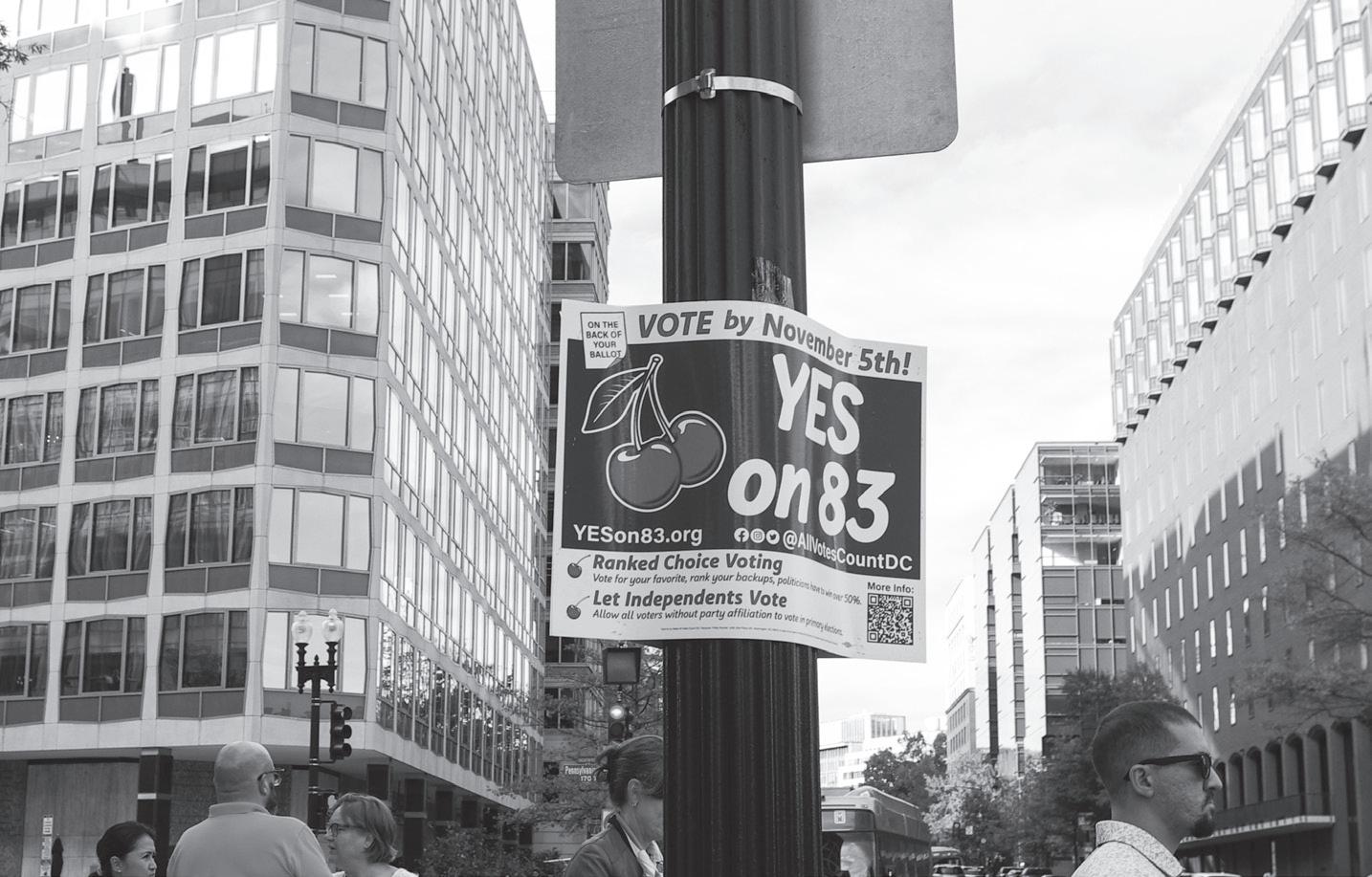
Voters in the District approved a measure on Tuesday to implement rankedchoice voting in the city, which political scientists and initiative stakeholders said could have mixed results in terms of increasing voter representation in elections. Initiative 83 passed with 72.8 percent of the vote, allowing independent voters to vote in primary elections starting in 2026 and changing D.C.’s voting system to ranked-choice voting — a system where voters can rank up to five candidates by preference instead of selecting one. Political scientists said there is a lack of consensus about if the measure will elect more minority candidates and candidates with broad electoral appeal, while the measure’s supporters said it will improve voter input in D.C. elections. Under the initiative’s system, if a candidate wins more than 50 percent of first-choice votes, they win the race. If no candidate receives the majority of firstchoice votes, the candidate with the least first-choice votes is eliminated and people who put that candidate first have their vote transferred to their second choice. The process continues until a candidate has a majority of votes. The D.C. Council will need to appropriate funds for the measure to be implemented, which will likely happen next summer.
Before the measure, only registered partisans could vote in D.C. primary elections, meaning more than 75,000 registered independents in the District cannot choose the candidates that will compete in the general election.
Andy Eggers, a professor of political science at the University of Chicago, said it is hard to measure the effects of ranked-choice voting because few jurisdictions have implemented it, and most of these areas
about. District lawyers and Bowser requested again to dismiss the second lawsuit filed by the West End D.C. Community Association.
July 2024: District officials backpedal on October move-in date
The DHS deputy administrator said officials are “still moving forward” with construction and plan to open The Aston in late August.
August 2024: Aston delayed fourth time
The DHS deputy administrator said The Aston is slated to open in late October, instead of late August, as officials completed plumbing work.
A judge denies D.C.’s second motion to dismiss the anonymous locals’ case.
September 2024: Aston delayed fifth time
The CAT held a public meeting to solicit community feedback on their draft of the Good Neighbor Agreement. The discussion centered on local residents’ questions
tend to be more liberal and less representative of how it would work in areas with different partisan makeups.
Eggers’ 2024 study for the University of Chicago’s Center for Effective Government showed that rankedchoice voting is more likely to elect moderate candidates with broad electoral appeal in certain instances because it incentivizes campaigning to more voters than candidates’ core partisan base. The study concludes that the overall effects of rankedchoice voting are small and depend on the circumstances.
“It’s just really hard, in general, to measure the effects of an institution like this when we can’t run a big experiment, and so what we’re doing is comparing places that adopted it and places that didn’t,” Eggers said.
“And if you just look at the set of cities that adopt ranked-choice voting, you can see that they’re not typical cities.” Eggers said many advocates say that ranked-choice voting will result in more minority candidates being elected. He said this can be true in some instances, but it depends on the demographics of the city and how many minority candidates are running. Overall, the evidence for this claim is
“weak,” he said.
“If you’re looking at circumstances where there is a majority of support for, let’s say, women candidates or racial minorities, but there’s a problem that that support is divided among several candidates, then rank choice voting will help ensure that one of those candidates will get elected,” Eggers said.
A 2023 study by Cambridge University researchers concluded that minority candidates are equally disadvantaged in plurality and ranked-choice voting systems but that support for minority candidates can improve under ranked-choice voting if voters are more informed about the candidates.
Ruby Coleman, a master’s student at American University who works for Make All Votes Count DC, a nonprofit that campaigned to get the initiative passed, said because D.C. often has primary contests with multiple candidates running for a party nomination, candidates can win the nomination with as little as 23 percent of the vote.
She said ranked-choice voting would ensure that candidates receive a majority of votes in primary elections.
“There’s no way to get a majority of the vote when
you have so many candidates and have so many people choosing between all these options,” Coleman said.
Coleman said the initiative will force politicians to campaign to all of the District to gain wider electoral support instead of continuing their current strategies, which she said often do not include outreach to areas east of the Anacostia River.
The Democratic Party of D.C. — including D.C. Council Chair Phil Mendelson and Mayor Muriel Bowser — publicly opposed the initiative, saying it would confuse voters and undermine Democratic votes in the city.
Coleman said elected Democrats opposed the initiative because they fear they will not be able to win a majority of votes. Bowser received 43 percent of the vote in the Democratic mayoral primary in 2014.
“A lot of elected officials who were opposing this are people who won with less than 50 percent of the vote,” Coleman said. “And it seems like they are a little hesitant to institute a system where you get the majority of the vote because they’re not sure if they would win again. And so I think it’s a matter of retaining power in that regard.”
about The Aston and incoming tenants’ use of public community spaces, their anticipated cleanliness and security at the shelter.
At the same meeting, District officials indefinitely delayed the opening of The Aston because the shelter failed a building inspection.
October 2024: Aston’s opening in limbo
The interim co-chair to the CAT said it was still unclear how long it would take to fix building code violations, and members of the CAT voiced concerns that the shelter wouldn’t open before hypothermia season.
The West End D.C. Community Association filed an appeal challenging the D.C. Department of Building’s decision to grant The Aston a building permit.
November 2024: Aston to open Wednesday
The Aston will begin admitting tenants Wednesday with the goal of moving the entire 50-person cohort into the shelter by Thanksgiving, District officials said earlier this month.
UNLAWFUL ENTRY
Science and Engineering Hall
11/08/24 – 2:07 a.m.
Case Closed GW Police Department officers responded to the report of a partially clothed, unhoused male sleeping in the Science and Engineering Hall lobby. GWPD had previously barred the man from campus, so the officers arrested him for unlawful entry. Referred to the Division of Conflict Education & Student Accountability.
DRUG LAW VIOLATION
JBKO Hall
11/07/24 – 2:15 p.m.
Cased Closed
GWPD officers responded to JBKO Hall for the report of drugs found in a room inspection by the administrator on call. GWPD officers took the rolled joints to the Academic Center for processing. Referred to CESA.
JBKO HALL
11/07/24 – 1:45 p.m.
Cased Closed
GWPD officers responded to JBKO Hall for the report of drugs found in a room inspection by the administrator on call. GWPD officers took the grinder and bag of weed to the Academic Center for processing. Referred to CESA.
HARASSING TELEPHONE CALLS
Various Locations
Reported 11/06/24 – Multiple Dates and Times Case Closed
A female student reported receiving harassing phone calls from her ex-boyfriend. Referred to the Title IX Office.
THEFT II/FROM BUILDING
Thurston Hall 11/06/24 – 4 to 6:20 p.m.
Open Case
A male GW staff member reported their backpack stolen from an unsecured locker. Case open.
DRUG LAW VIOLATION, WEAPONS VIOLATION
Munson Hall 11/06/24 – 10:09 a.m.
Closed Case
During a health and safety inspection, officials detected a weed-like scent. Shortly after, two male students surrendered a tool that GWPD officers originally thought was a knife and a marijuana cigarette. Referred to CESA.
—Compiled by Ella Mitchell
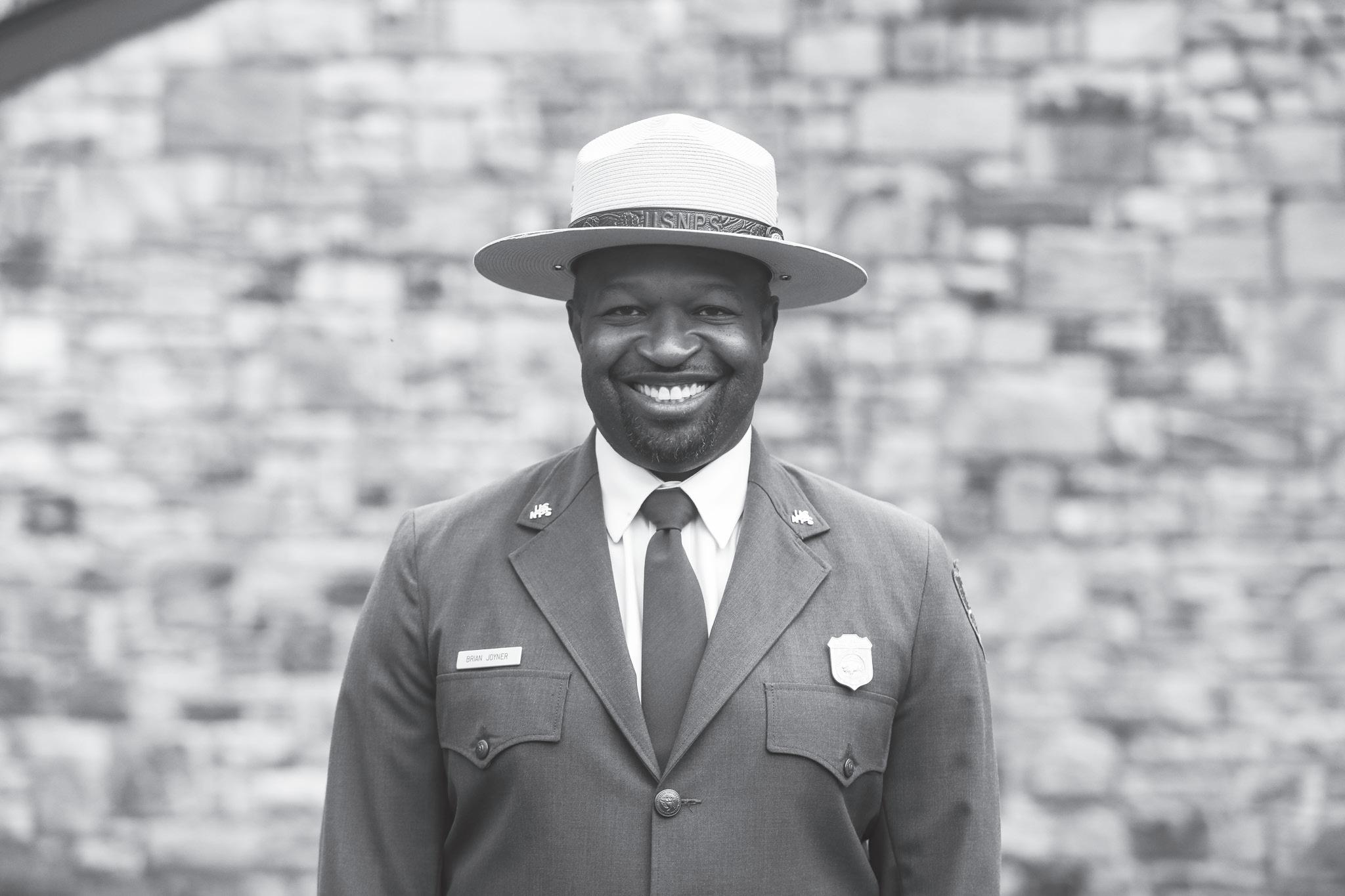
Former GW student Brian Joyner last month assumed responsibility for maintaining and managing Rock Creek Park after spending two decades exploring his passions for preservation and D.C. history with the National Park Service.
The park service late last month appointed Brian Joyner — who took graduate classes in historic preservation at GW from 2001 to 2004 — as the superintendent of the District’s oldest federally managed park after he spent 20 years documenting public history, managing parks and drafting federal policy with the agency. As a D.C. native, Joyner said he grew up visiting Rock Creek Park and hopes to boost the community’s interest in park rehabilitation projects while continuing to document its cultural and historical significance, like the role it served as a meeting point for White House-bound protesters.
“Rock Creek Park has always been a part of my life,” Joyner said. Rock Creek Park is divided into more than 20 green spaces, spanning 2,749 acres. The largest area falls between the National Zoo and Silver Spring, Maryland, making up 1,754 acres, according to its foundational documents. Rock Creek Park also includes significant parks outside of the main park, including Meridian Hill Park and the Rock Creek and Potomac Parkway’s termination at the Theodore Roosevelt Memorial Bridge, which brings Joyner’s jurisdiction deep into Foggy Bottom. Joyner, who served as the park’s deputy superintendent since 2022, succeeded Superintendent Julia Washburn, an adjunct professor of educational leadership at GW who served in the role from 2017 to 2024. Before he became deputy super-
intendent, he oversaw the maintenance and personnel for a national historical park that honored Harriet Tubman’s role in the Underground Railroad and conducted research and advocacy on environmental policy for the park service in Congress.
During his period as acting superintendent at Harriet Tubman Underground Railroad National Historical Park between 2014 and 2015, Joyner oversaw the park’s transition from a national historic site to a national historical park, which required him to negotiate boundary adjustments with government officials. He had to mitigate community opposition to the adjusted boundaries, which helped him learn how to balance federal priorities, he said.
“Learning how to manage that, engage with the politics around that, engage with the communities in that space that had definite feelings about whether the park service should be there was really eyeopening,” Joyner said. “That probably would be the thing that probably most prepared me for what I’m doing now.”
Joyner’s Bevinetto Fellowship, a specialized park service program that the park service selected him for in 2015, involved analyzing legislation, communicating the park service’s needs to lawmakers and independently studying environmental issues. Joyner said he learned how to write legislation and how policy and budget discussions “collide,” broadening his perspective beyond interacting with park stewards.
While taking historic preservation classes at GW, Joyner said he worked a full-time job at the park service as an editor for the Cultural Resources Diversity Program at Rock Creek Park, a program to pro-
mote inclusive historical preservation. He contributed to its “Reflections on the American Landscape” series in 2003, listing historic sites in the American landscape through various cultural lenses.
“I would get done with work, leave work at like 4 o’clock and try to get over as fast as I could to GW to get to my 4:30 class,” Joyner said.
Balancing graduate courses and a full-time job, Joyner said he never forged a strong connection with the GW community but instead grew an appreciation for the Foggy Bottom campus by spending time in nearby parks, like Washington Circle, Rawlins Park and the National Mall.

RATH | STAFF PHOTOGRAPHER
ALEX GATES
REPORTER
GIANNA JAKUBOWSKI
REPORTER
A dozen Mitchell Hall residents said they have noticed mold in their dorm rooms, kitchens and common spaces this semester.
Three of the 12 students who said they found mold in Mitchell said they submitted FixIt requests about the fungus to the University. Facilities personnel investigated and mitigated the mold after receiving their reports, the students said.
University spokesperson Julia Metjian said since August the University has received a “handful” of FixIt requests from Mitchell Hall residents for “separate incidents” of mold and mildew. Officials are considering renovating Mitchell in the future as part of the University’s ongoing residence hall refurbishment plans, she said.
“GW takes reports of suspected mold very seriously,” Metjian said in an email. “When a FixIt ticket is submitted about suspected mold, it receives an emergency priority code and a Facilities technician will respond within 24 hours to conduct an initial inspection of the area.”
First-year Isabella Perryman said after she developed a cough and sore throat within two weeks of moving into her Mitch-
ell Hall room, she and her roommate Kiki Steinberg ordered mold test kits because they suspected their “dirty” ceilings and air vents contained mold. She said within eight days of placing the petri dishes on her dresser in October, mold swabs from her window sill grew into yellow, white and black swaths of fur, overtaking the dish. Perryman said the University in October removed the mold in her room after she and Steinberg submitted a dozen FixIt requests, posted viral TikToks about the mold and urged their parents to call the University. Perryman said before facilities workers removed the mold, a doctor diagnosed her with a “severe” mold allergy in October, and she and Steinberg relocated to a hotel.
The pair said in an Oct. 26 TikTok with 29,000 views that members of GW Facilities said they would replace the “brown” ceiling tiles in their room and clean out the air conditioning unit.
Perryman and Steinberg said facilities replaced their ceiling tiles, repainted the walls and replaced the HVAC in their room between Oct. 27 and Oct. 30. The University reimbursed her for the hotel with a housing credit of between $700 and $800, Steinberg said.
Eighth-floor resident Daniel Monk said the day they moved into Mitchell Hall, “dark” mold cov-
ered their mattress and coated the HVAC unit.
Monk said they submitted a FixIt “so quickly” because they have asthma and didn’t want the mold to cause health issues. Monk said FixIt workers removed the mold from the room that day.
“The room was just disgusting, in horrible condition,” Monk said. “It looked like it hadn’t been touched in years, like it was horrible.”
Junior Stella Holmes, who lives on the fourth floor, said she was cooking in the communal kitchen in October when she opened the cabinet and found that it was “covered in green.”
She said she did not submit a FixIt request, but two days later, the communal kitchen cabinets were “renovated” on all the floors in Mitchell Hall.
Sophomore Olivia Campbell said when she moved into her Mitchell Hall room on the fourth floor she found mold growing on a piece of paper in her closet. She said she was “in shock” after finding the moldy paper but did not report her discovery and instead threw the paper away.
In 2019, officials relocated summer Mitchell residents after maintenance workers discovered mold on the fourth and seventh floors. Displaced residents relocated to Thurston Hall for the rest of the term and received a $525 housing credit as reimbursement.
As superintendent, Joyner said he wants to document in the park service’s collections how traditions like Native Americans’ 50-year-old annual drum circle at Meridian Hill Park compare to the space’s modern uses, like picnicking. He said when Native Americans participated in the “Longest Walk” in 1978 from California to D.C. to protest legislation that would eliminate Native American reservations, people chose to go to Meridian Hill because they viewed it as a sacred site in connection with the Anacostan people who lived in the area. Joyner said he will oversee significant rehabilitation efforts at Rock Creek Park, focusing on
the restoration of two major facilities — the Rock Creek Golf Course and Carter Barron Amphitheatre. Joyner said he plans to engage community members in the projects because park boundaries are scattered throughout residential districts like Georgetown and Fort Totten. As deputy superintendent of the park, Joyner said he led discussions to hear community input on projects.
“Our borders are fairly porous, in some ways, they literally abut people’s backyards,” Joyner said. “It is incumbent upon the park, and I think the park service in general is, to stay in dialogue with all the different constituencies in the District.”
GW’s nonwhite graduation rate lags behind most peer schools: data
JENNA LEE ASSISTANT NEWS EDITOR
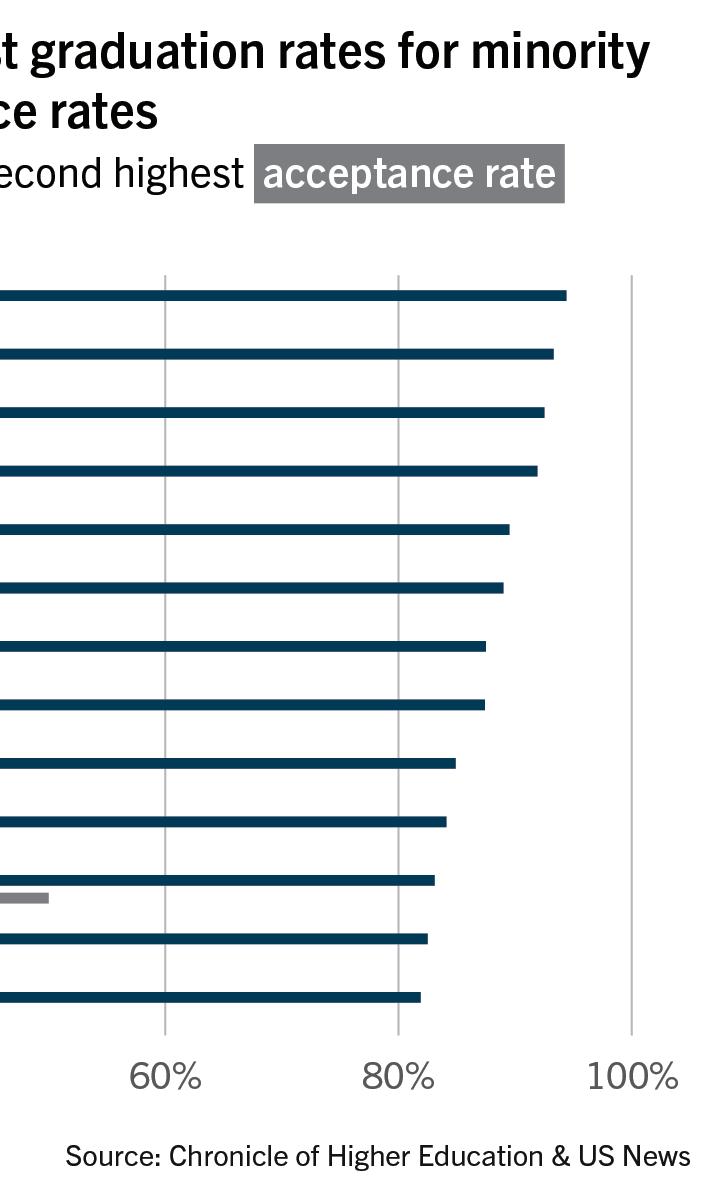
GW lags behind most peer universities in nonwhite student graduation rates, according to the Chronicle of Higher Education’s analysis of U.S. Department of Education data. The data — which analyzed the graduation rates of a cohort of students seeking bachelor’s and two year degrees who started their degrees in 2016 and 2019 respectively at more than 2,000 institutions — showed that nonwhite students at GW had a six-year graduation rate of 84.1 percent, which is the 10th highest rate out of GW’s 12 peer schools. Experts in diversity in higher education said the data reflects the causal relationships between the selectivity of institutions and higher nonwhite student graduation rates but factors like students’ financial situations can also contribute to differences in student success.
Under the Chronicle’s methodology, nonwhite or “total minority” graduation rates consisted of the average of all students not characterized as white: Black, Hispanic, Asian, Native Hawaiian/Other Pacific Islander, American Indian or Alaska Native and two or more races, U.S. nonresidents or race unknown. GW’s white student graduation rate was 86 percent according to the Department of Education data.
Among its 12 peer schools, GW’s six-year nonwhite student graduation rate was only above the rates of three peer schools — University of Pittsburgh, University of Miami and
Syracuse University, which had nonwhite student graduation rates of 83.1 percent, 82.5 percent and 81.9 percent, respectively.
Black and Hispanic students had the lowest graduation rates at GW — a trend consistent across all peer schools — with Black students having an 80.4 percent six-year graduation rate and Hispanic students having an 83.7 percent six-year graduation rate. GW was ranked 10th for Black student graduation rates and 11th for Hispanic student graduation rates.
Experts in higher education said schools with more resources, like higher endowments and more selective institutions, are likely to see higher overall graduation rates and nonwhite student graduation rates because they select the students most financially equipped to finish their education.
Shelly Lundberg, a professor of demography at the University of California Santa Barbara, said GW’s nonwhite student graduation rate data reflects a trend in which universities with lower acceptance rates tend to have higher nonwhite student graduation rates because they prioritize admitting the students who are most equipped to finish and have the resources to succeed, meaning their graduation rates are higher overall, regardless of race or gender.
The universities with the highest nonwhite student graduation rates among GW’s peer schools also had the lowest acceptance rates, with GW ranking 10th in nonwhite graduation rates and having the secondhighest acceptance rate of all
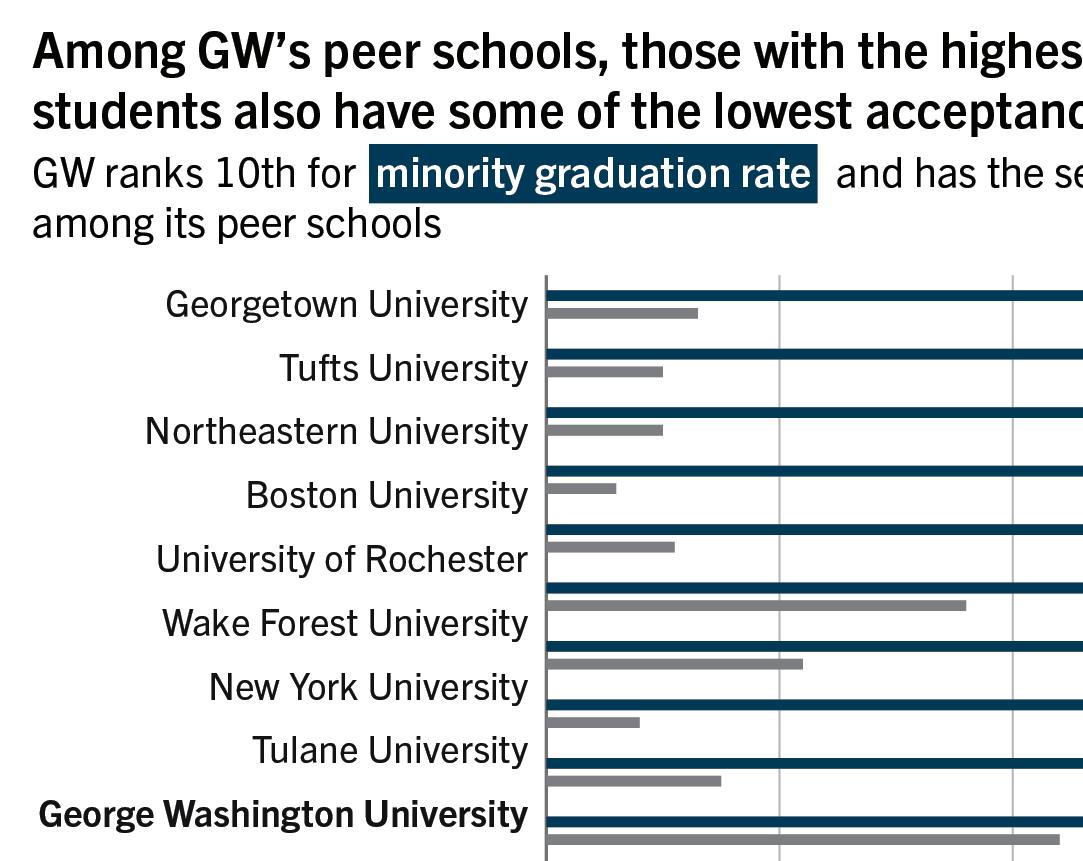
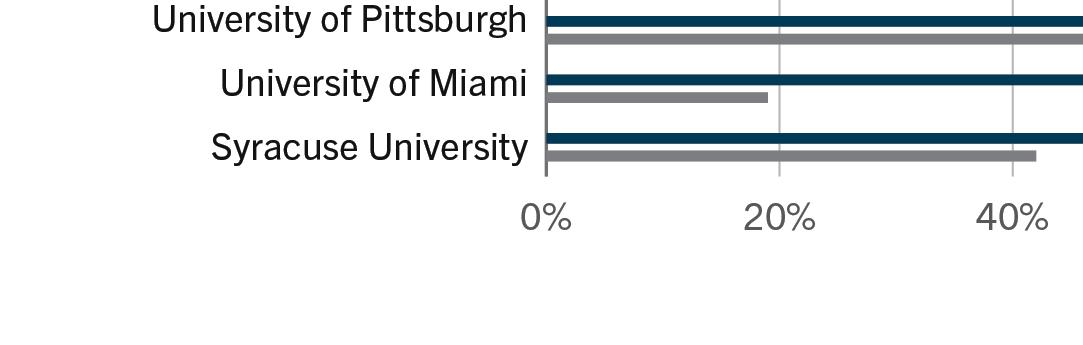
peer schools of 44 percent. Georgetown University had the highest nonwhite student graduation rate of 94.4 percent and the fifthlowest acceptance rate of 13 percent of all GW’s peer schools.
Lundberg said the data also reflects a long-standing trend of women excelling in higher education at greater rates than men.
From 2016 to 2022, 60 percent of students enrolled in GW were women.
Lundberg said women’s success in education at all levels of school is because of how they are socialized growing up, with women being socialized to be more compliant and obedient as children, and men being socialized to be more independent, which leads women to have better classroom behaviors.
Andrew Porter, a retired professor of education at the University of Pennsylvania, said elite universities with low acceptance rates tend to have less gaps between racial groups’ graduation rates because they select the students who are the best perceived academic “fit,” and they have the highest quality programs that help students graduate.
Porter said schools where nonwhite students can find a “sense of belonging” are more likely to have higher nonwhite student graduation rates. Porter said there is “variability” among how much different institutions are investing into support systems catered toward nonwhite students who are struggling academically or emotionally due to these external hardships, which can lead to differences in graduation rates.
BROOKE FORGETTE
CONTRIBUTING
REPORTER RORY QUEALY
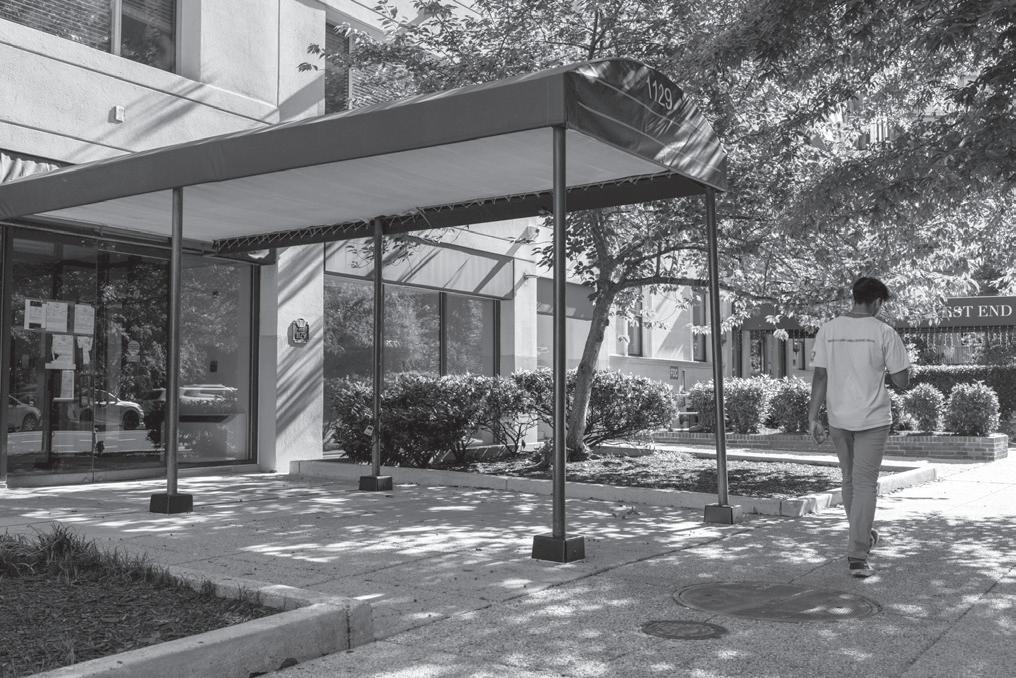
D.C.’s Board of Zoning Adjustment on Wednesday denied an unincorporated group of West End locals’ emergency request to halt the opening of The Aston unhoused shelter and upheld a January hearing to review the group’s appeal of the shelter’s building permit. At a virtual hearing Wednesday, BZA officials rejected emergency requests from the West End D.C. Community Association — an unnamed group of locals in “close proximity” to The Aston on New Hampshire Avenue — to postpone the former GW residence hall’s opening as an unhoused shelter. The body also denied WEDCCA’s request to expedite a Jan. 29 BZA hearing to review the group’s claim last month that the D.C. Department of Buildings violated zoning rules by issuing the shelter a building permit.
BZA Chairperson Fred Hill said WEDCCA didn’t prove that the shelter’s opening would cause “irreparable harm” to warrant a postponement and that the January hearing is not “that far away.” Hill said instead, D.C. officials face a greater risk of harm if the BZA delayed The Aston’s opening as a shelter because the DOB already granted officials a certificate of occupancy, which verifies that a building’s use complies with zoning requirements and other legal and safety standards. District officials on Monday announced that The Aston would open its doors to unhoused residents on Tuesday, following about a year of delays, and Hill said D.C. officials are operating at “their own risk” because if the BZA upholds the appeal at the January hearing, then the District can no longer operate the shelter.
“I look forward to hearing the appeal when we have an opportunity,” Hill said. “Because I do think that there are some questions about how the District government got to this point, but we can hear about it at that time during the appeal.”
WEDCCA last month filed an appeal to the BZA in an attempt to thwart The Aston’s opening, arguing that the DOB violated zoning regulations by issuing a building permit on Aug. 7, which allowed D.C. officials to convert the former GW residence hall into an unhoused shelter. WEDCCA’s last month appeal stated that District officials didn’t receive a required special exception or Zoning Commission approval to change the Aston’s use from a residence hall to a shelter and requested the DOB revoke the building permit until D.C. officials remedy the alleged violation.
WEDCCA has repeatedly tried to prevent The Aston’s opening since District officials announced their intention to convert The Aston into a shelter for unhoused people in June 2023. The group filed its first lawsuit in July 2023, alleging D.C. officials failed to provide community members adequate time to comment on The Aston’s purchase before District officials bought it. WEDCCA withdrew its lawsuit a week later, prompting the District to complete its purchase.
The group filed a second lawsuit in October 2023, arguing that The Aston would violate zoning rules associated with providing temporary housing and medical services to unhoused residents, which WDECCA’s appeal to the BZA mirrors. A District judge twice rejected the D.C officials’ requests to dismiss the case and in August scheduled a hearing for Feb. 7.
QUINN GIORDANO
Two student groups will conduct peer-to-peer sexual assault prevention and awareness trainings for fraternity Beta Theta Pi this month.
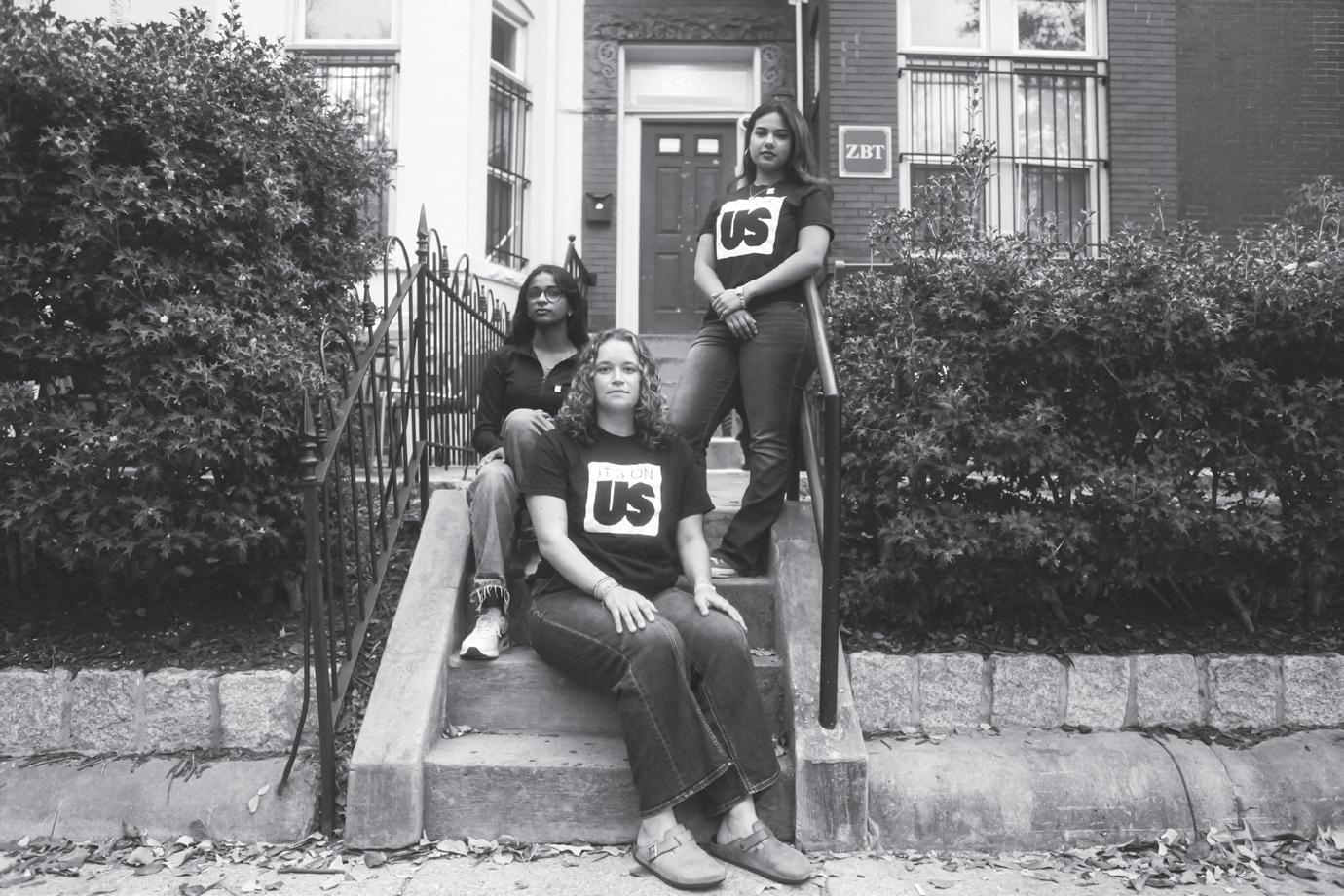
It’s On Us at GW, a chapter of the national organization that combats sexual assault on college campuses, and GW Reproductive Autonomy and Gender Equity will host their inaugural training with the fraternity Nov. 17 to have conversations about sexual assault prevention. Leaders of the student groups said GW’s annual mandatory Title IX trainings for incoming students and on-campus organizations underemphasize the prevalence of sexual violence on campus, and they hope engaging directly with men about sexual assault prevention will fill a gap in direct advocacy on campus.
The training will follow a peer-to-peer model, with students teaching other students instead of a professor or official leading the training. Leaders of It’s On Us — a sexual assault survivor-led group — and GW RAGE said the structure of the Nov. 17 training is still being determined but said each group will lead half of the training for Beta members.
Junior Zoe Larkey, the founder and president of It’s On Us at GW said she hopes that peer-to-peer sexual assault prevention training with Interfraternity Council chapters will engage male students in conversations about prevention methods including bystander intervention, which involves inserting oneself in an interaction to stop a potentially problematic situation.
Larkey said her organization and RAGE are speaking with male student groups because research has shown that men are more likely to commit acts of sexual assault on college campuses than other demographics. Male students in fraternities are three times more likely to be the perpetrators of sexual assault than their nonaffiliated peers, according to the Guardian.
“We’re not trying to attack them or make them feel othered,” Larkey said. “It’s more how can we bring them into this conversation and make them feel included?”
Larkey said the peer-topeer model allows chapter members to ask the stu-
dent educators questions directly, as well as open a discussion between attendees to make male students feel included and willing to share their previous experiences with sexual misconduct. She said the training will go over bystander intervention and emphasize topics men have told her they are concerned about, like receiving consent without “ruining the mood.”
“If you think about who young men are going to listen to, the chances that they listen to a fellow student are a lot statistically higher than someone coming in from the department, like the Title IX office, to speak to them,” Larkey said.
Research has shown that peer education models have higher rates of retention of information and participation. SafeBAE reported in March 2023 that after participating in a peer education training, students reported a 66 percent increase in their understanding of being an active bystander, an 81 percent increase in understanding Title IX rights and a 56 percent increase in understanding “healing options” after experiencing sexual violence. Larkey said she hopes to work with the remaining IFC chapters, as well as male club athletics teams in the future.
Larkey said she is glad that GW enforces mandatory Title IX training for first-years and student groups but said the hourlong training is a “complete understatement” of how large the problem of sexual assault on campus is, which Larkey said is a major issue that does not get discussed enough. Larkey said she hopes the peer-to-peer training will teach male students what to do when their friends
are bringing someone home that seems “too drunk,” which she said the Title IX training didn’t “touch on.”
The Title IX Office received 104 reports of sexual assault between July 1, 2022 and June 30, 2023, according to the office’s second annual report released last December.
“I think that Title IX should be the floor, not the ceiling,” Larkey said.
RAGE Co-President Stephanie Spector said that when sexual prevention trainings are in the form of online modules, like GW’s training for student groups, participants often “mindlessly” scroll through it and do not have discussions about what they learned. She said RAGE has been in communication with the Title IX office to improve the mandatory training for student organizations on a University-wide scale, like making them more interactive and discussion based.
“I just think that’s something hard for folks to really relate to and take something away from,” Spector said.
Spector said the format of the training is still being “fleshed out” but that RAGE wants to inform participants about safe sex options and sexual health resources, like STD testing and birth control. She said she hopes conversationbased training about sexual misconduct opens the floor to hear perspectives from survivors firsthand and to ask questions.
“There’s definitely kind of a stigma and talking about safe sex and talking about consent and things like that among those spaces,” Spector said.
Beta President Alec Shafran, a junior, said the University’s mandatory Title IX training is “arbitrary,” and since fraterni-
ties carry a negative reputation surrounding sexual assault, additional training from peers “puts a face” to the experiences they’re learning about.
He said these informational conversations are easier with someone he knows than a GW official.
“We just wanted to be a part of that change and a part of a very important movement of people that are starting to talk about this as the serious issue that it is,” Shafran said.
Shafran said his chapter takes sexual misconduct
“extremely seriously,” and this training serves as a reminder to chapter members that sexual assault is something the entire fraternity has to look out for constantly, instead of only designated members, like the vice president of risk management and sober monitors.
“Bringing it into that environment is something that will have a positive nonetheless, even if it is something that plenty of others have already done over and over and over again,” Shafran said. Shafran said GW Students Against Sexual Assault used to host similar trainings for IFC chapters in previous years, but last year, the trainings switched to being led by University officials. He said Title IX trainings are helpful for learning the process of reporting sexual assault to the University and the “chain of command” with reports, and SASA’s training was “more educational” when learning specific language about sexual misconduct and available resources.
“I feel like the SASA training was a lot more applicable to just overall dayto-day stuff, whereas Title IX is a little more useful in an official capacity,” Shafran said.
MOLLY ST. CLAIR
NICOLE AKUMATEY
The Student Government Association will vote this month on a bill of rights aimed at bolstering support resources for sexual assault survivors and organizing public information on Title IX policies.
Aly McCormick, a co-president of Students Against Sexual Assault and a co-sponsor of the Survivors Bill of Rights — an SGA resolution to support survivors of sexual assault and harassment on campus — said the legislation would help consolidate information on University resources into one document to distribute to survivors of sexual assault through Title IX office email communications. She said if the resolution passes at the Nov. 18 SGA Senate meeting, Title IX officials will include the bill of rights in emails they send to students who file a report, condensing resources on campus counseling, off-campus support initiatives and information about access to medical resources like emergency contraceptives and rape kits.
McCormick said at American University, which she attended for two years before transferring to GW in 2023, she helped the student government develop a similar bill of rights as speaker of their senate and was inspired to create the legislation at GW after hearing students express a general “confusion” about resources available to sexual assault survivors. In her campaign for SGA vice president last spring, Mc-
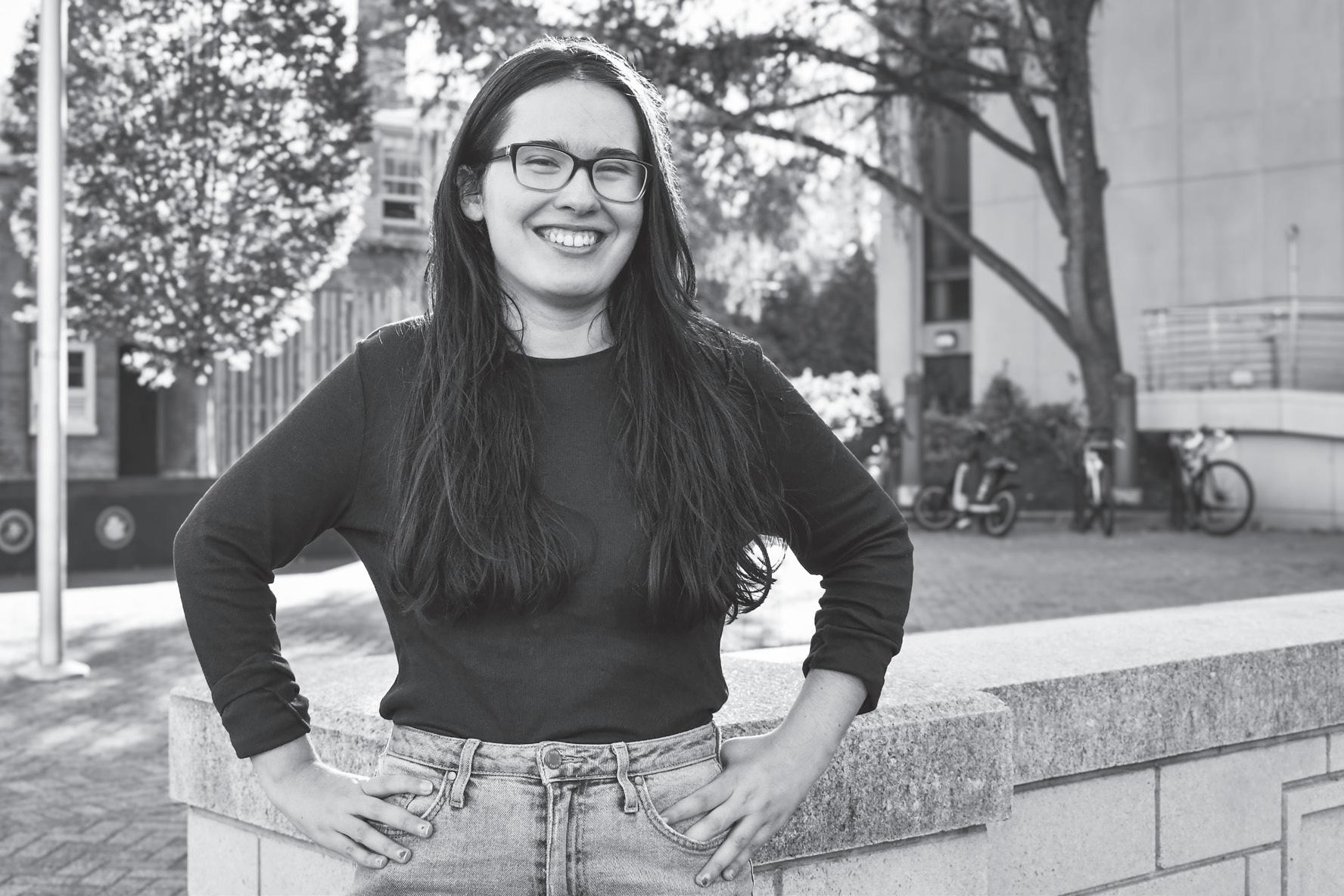
Cormick said if elected she would implement the bill of rights at GW. “Survivors of sexual assault, when they’re going to reach out for help, have already been through enough,” McCormick said. “I feel like adding extra work for them by having to research everything themselves is too much, it was too much for me when I was going through my process.”
SGA Sen. Sophie Leinenkugel (ESIA-U), who endorsed the reso-
lution, said the legislation would ask the Title IX office to annually update trainings like the required first-year online session to ensure they align with nationwide Title IX policies.
Leinenkugel said once the resolution passes in the SGA Senate, she hopes senators and SGA committees like the Community, Advocacy and Inclusion Committee will continue to put forward legislation and other “women-led initiatives”
to further on-campus support for survivors and supplement the bill of rights. SGA Senate Pro Tempore Liz Stoddard, who sponsored the resolution, said she can “guarantee” the SGA Senate will pass the bill of rights at its Nov. 18 meeting because fellow senators already demonstrated support during discussions at the first women’s caucus last month and other senate meetings. Stoddard said she believes
through the resolution’s display of the SGA’s urgency and advocacy on the issue, the resolution will place “pressure” on the Title IX office to comply with legal guidelines and further communicate to students about the support measures available to them. She added that because of the SGA’s “limited” power to influence administration to alter University policy, there are no binding requirements that will ensure a response from the University.
Stoddard said the resolution also places an emphasis on “outside investigation” and options like contacting the Metropolitan Police Department instead of the GW Police Department about an assault to allow students to decide which department they want involved. The Title IX website currently offers GWPD as a reporting option, “local emergency response” and clarifies that police are only contacted if the student who filed the report wishes to contact law enforcement.
Zoe Larkey, a junior and the president of GW’s chapter of It’s On Us — a national organization dedicated to student-led sexual assault prevention on college campuses — said faults within GW’s Title IX office don’t stem from a lack of resources or support from the University but a lack of overall student awareness about options they have.
GW’s Title IX website provides students with options for reporting incidents of sexual assault or harassment including an online report or contacting the office directly through a phone call or email. The website also lists GWPD and MPD as resources under a separate tab on the website.
“It’s hope that coexists with rage, fear and exhaustion — not canceling them out, but working alongside them.”
If you’re upset about the election results, now is the time to act
On Election Day, students made passionate pleas to their peers and family and posted infographics on social media urging people to go out and vote. But by the next morning, the presidential election was called and former President Donald Trump was declared the winner — making all past efforts of civic action, for some, feel in vain. Whether you celebrated the outcome, cried with disappointment or were completely apathetic, the results of the election brought a tidal wave of emotions to a city that voted overwhelmingly blue and to a school with a majority–liberal student body. Students have every right to feel disheartened by the Democratic Party’s failure, energized by the Republican Party’s victory or curious about the uncertain future of many of the causes they voted for. But, like GW always reminds students, you are in a politically engaged school in the nation’s capital where you have a prominent ability to get out there and understand the issues you care about. Whatever you believe in can be pursued and fought for here.
As more days pass since Trump’s victory, it’s clear that support for the former president has increased in more than 2,000 counties, with only 240 counties reporting an eroded favorability for the Republican nominee. That means the Democratic Party’s message and issues need to be reshaped, and for Republican students, there’s rarely been a more decisive modern embrace of one party than we just saw. If there were a time to be active in both parties, it’s now, and GW students are ideally positioned to do so. Our University sells us again and again the idea of living in D.C., the heart of politics and policymaking, and though it can be a tiresome message to hear,
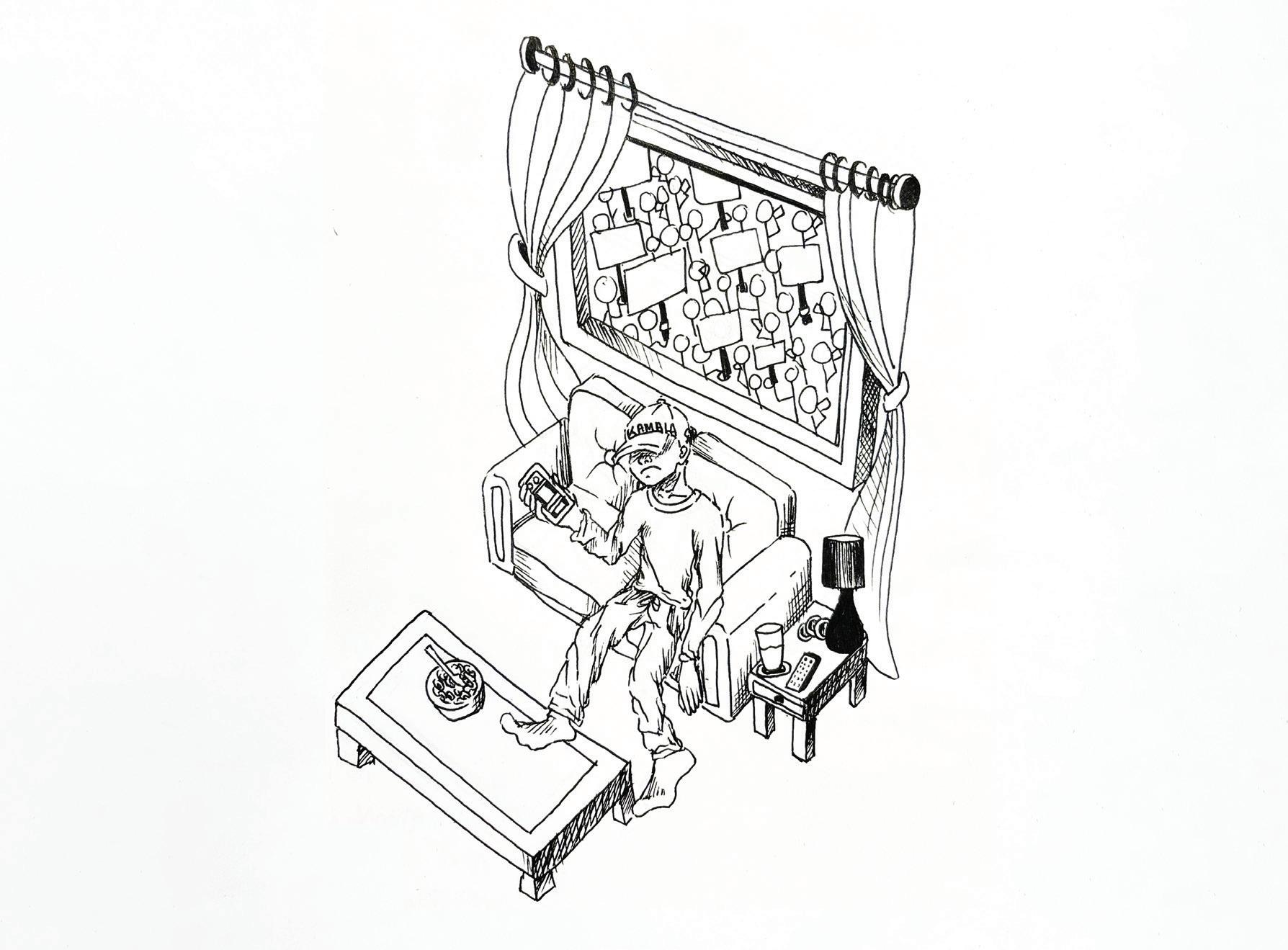
it’s not wrong. Since the wee hours of Wednesday morning, we’ve all seen Instagram graphic after Instagram graphic from students despairing over the election’s outcome. We don’t doubt that all these students are genuinely upset and have a real sense of confusion and anger at the election’s results. But strongly worded statements about the state of the nation broadcasted to a couple hundred Instagram followers aren’t going to push the envelope on issues one cares about. Most of us probably grew up watching acts of activism outside of the White House, Capitol Hill
ABBY TURNER | CARTOONIST
and the Supreme Court through our TV screen. And at some point, many of us thought, “I wish I could do that.” It’s crucial to remember that these places are a few blocks or a short Metro ride away. Being a student at GW means that if you feel strongly about a cause, you have opportunities to affect change on that issue beyond social media activism — using reproductive rights as an example, students at no other school in the country had an easier time traveling to protests outside the Supreme Court after the Dobbs v. Jackson Women’s Health Organization ruling. Change doesn’t
grew up hearing a wide range of political beliefs in my mostly Hispanic and Latino community in Calexico, California. My community showed me how identity plays a central role in political beliefs. It came down to a form of selfpreservation. You wouldn’t vote for something that conflicted with who you are.
Andrea MendozaMelchor Opinions Editor
That’s why seeing Latino and Hispanic voters support Trump in the 2024 presidential election felt like a personal hit.
In 2019, Trump visited my hometown in Calexico. When my ninth grade class got wind that Trump’s car was going to pass by our school, even the most politically uninvolved students talked about walking out of class to boo at the president’s motorcade, shouting that he was not welcome in our town. We understood one key fact: Trump was not on our side. And knowing that, inherently, meant we could not support him.
But now, those people are the ones I see supporting him on Instagram.
In this election, around 46 percent of Hispanic voters voted for Trump, . In my community, where more than 95 percent of residents identify as Hispanic, 45 percent voted for Trump. One in 13 residents in Imperial County — in which 14,000
of almost 180,000 residents are undocumented. But almost half of voters in my community and half of Hispanic voters in the country voted for Trump. The president-elect has promised to execute a mass deportation of undocumented immigrants in the United States, possibly affecting 11 million people. I have grown accustomed to the fact that I can’t make people believe what I believe if it doesn’t immediately affect them. I almost resent how much I get it. My cousin being indifferent to women’s rights? Yup, I get it. Or still wanting to vote for Trump despite the fact he threatens the possibility of me completing my education? I can even understand that.
But when my cousin says he’s going to vote for him with a grandpa who crossed the border illegally with his whole family — I can’t understand that. When the only reason that our grandpa was able to stay in the United States was because someone decided to help him out and offer him a job, eventually receiving his citizenship and allowing us to build a life here — no, I don’t understand that.
When others express they want to vote for Trump despite living in the United States for having the privilege to move from Mexico to California and obtain residency — something that will become harder to obtain under Trump’s presidency — I can’t get it.
Or when those in my community who so strongly believe in making “America Great Again” as if their neighbors, aren’t one of those one in 13 undocumented people Trump could deport, I can’t get it. Who cares about the rest of the Latino and Hispanic community when you have residency or citizenship?
Let’s pretend our grandparents or great-grandparents were not undocumented. Let’s pretend we didn’t vote against our heritage, against ourselves.
I once wrote that when Trump says something degrading about undocumented immigrants, I think of him saying it about all immigrants. Now, when I see that almost half of Hispanics and Latinos have voted for Trump, I don’t believe they only voted against undocumented immigrants. They voted against our entire community and our entire people. No, they voted against their own family, their greatgrandparents who left behind their families, communities and country in Mexico for the “American Dream” for future generations. They voted against their ancestors who came to America so that they could go up to that booth and fill in the circle next to Trump to stop others from having a future..
—Andrea MendozaMelchor, a junior majoring in journalism and mass communication, is the opinions editor.
Ocome from a Canva graphic or an artfully worded paragraph on your Instagram story. As student movements throughout history have shown, change comes from on-the-ground advocacy. Yes, Congress and the president make decisions about the country. But it’s people who make changes, too. GW students need to be those people by advocating for what they believe in. Just because the election may not have turned out in some people’s favor, doesn’t mean the issues that many people felt so passionately about no longer matter or need to be advocated for.
Fighting for such issues and embracing or reforming your political party must go beyond GW and the District, though. True, a student from Massachusetts calling a working-class Pennsylvanian the day of the election to urge the voter to vote a certain way is a form of political involvement. But it’s out-of-touch political engagement rooted from a place of privilege.
GW is one of the most expensive schools in the country, and most students living on campus are required to have housing and a meal plan — privileges that many others don’t have. Not everyone is in a position to care about broader issues beyond themselves. That’s a broader problem with American systems, but it doesn’t change the fact of the current situation: Most people in this country think a lot more about putting food on the table than they do how our current political climate connects to Hannah Arendt’s “The Origins of Totalitarianism.”
We implore students who care deeply about the results of Tuesday’s election to go out into the world to get a better grasp of the issues they fight for, just as we hope less politically motivated students join the fray. If the rationale behind the majority of Americans’ ballot selections feels incomprehensible to you, it should be a sign to spend more time talking to people with whom you disagree — which we would argue is the only way to really understand their views. And, in turn, organizing in person on behalf of issues you care about is the only way to conversely make those voters understand your perspective. For many of us, it’s going to be a long four years. But all the negativity you may have right now is going to last far beyond that period unless you act.
n Wednesday, Donald Trump marked what is unquestionably the greatest political comeback in American history. After Jan. 6, 2021, Trump was a political pariah. Still, Trump’s approval ratings improved. After President Joe Biden dropped out of the race, Vice President Kamala Harris was to convince the American people that she had what it took to serve as president. The Democratic Party seemed to have thought that because of Trump’s history, the election was in the bag, and that, despite it all, they ran a fantastic campaign. But this is patently false, and, without introspection, the Democratic Party will descend deeper into hopelessness.
Kamdyn McClain Guest Contributor
Her entrance to the top of the ticket was one unlike any we have seen in modern politics — without any votes cast. However, this does not excuse Harris for the failures that took place in the 107 days of her candidacy.
I must preface this by saying I did not vote for Kamala Harris, I am a supporter of Presidentelect Trump. But I do offer a perspective on the several mistakes Harris made in her campaign.
I grew up in a small Appalachian town, south of Buffalo, New York. My county is overwhelmingly Republican, and I have seen the impacts of globalization, hollowedout factories, addiction and economic rot. I understand and embrace Trump’s appeal, making Harris’ first major decision even more of a head-scratcher — running mate Tim Walz.
A close friend, who works for a Democratic member of Congress, shot me a text after Election Day: “Walz is a f*cking joke… he’s a caricature of what moronic consultants in New York and D.C. think people are like from where we grew up.” The Walz pick for vice president seemed to be an attempt to connect with noncollege-educated white men. As my friend pointed out, Walz’s persona was totally synthetic. It not only backfired but also demeaned the people they were trying to reach.
I have also seen Harris’ loss being blamed on a racist and misogynistic undercurrent in American society. Viral social media posts have said that “America failed women.” It is not the United States that failed women, it is Harris who failed them. Her inability to build a coherent message and distance herself from Biden ultimately dealt the death blow. Any attempts to pin this loss solely on her race or gender are misguided and will only dig the
Democratic Party into a deeper hole. Harris lost for a very simple reason — she did not understand the country she sought to preside over. Harris downplayed the devastating effects of inflation on lower- and middle-income Americans, while holding star-studded rallies with guests who are unaffected by the economic challenges. My home county has a median income of $56,889, meaning many people are living paycheck to paycheck and unable to keep up with inflation. The effect of a presidential nominee playing it down cannot be overstated.
Donald Trump, though an imperfect vessel, has a real and deep connection with those who support him. For better or worse, he is authentically himself. There is a certain charm in a politician who seems above the character molding that has infected and destroyed many politicians.
Outside of the Beltway and coastal cities is an America that is deeply hurting, an America desperate for a fighter. Lacking was a real connection with voters. Some may read this piece and label, or name-call, me, but it is that “holier than thou” mentality that has them in this position today. So to those people, I ask that they enjoy the next four years of Trump. —Kamdyn McClain is a junior majoring in finance.
From Page 1
Closer to the gates to enter Lafayette Square, a separate Harris supporter — a short woman who ripped a vape after each heckle — screamed at the Puerto Rican Trump supporters, “Hasta luego, go home to your country ahora,” ignoring, like some in the Trump campaign, that Puerto Rico is part of the United States.
She then began yelling “Ingles! Ingles!” Pierre Caulfield, a Harris supporter who wasn’t partaking in the xenophobic chants, said he traveled from Philadelphia earlier in the day to protest Trump. It was his first time in D.C. since he was eight, he said.
“I feel like this is the final election before I stop caring and never vote again,” Caulfield said.
He said there were more Trump supporters protesting outside the White House that night than Harris supporters, a turnout that disappointed him.
“I feel like no one in D.C. gives a crap,” he said. “They’re all in their homes, and it’s fine if the party that we don’t want to win wins, but the fact that you don’t show your support or show your face.”
“Would you like to go viral on Twitter?” Caulfield’s friend later asked him in jest, imploring him to ratchet up the provocation of his protests.
“No, I just want Kamala to win,” Caulfield said.
Minutes later, Caulfield began singing the words to Chappell Roan’s “HOT TO GO!” with one slight modification: “H-O-T-T-O-GO, you vote for Trump, now you’re
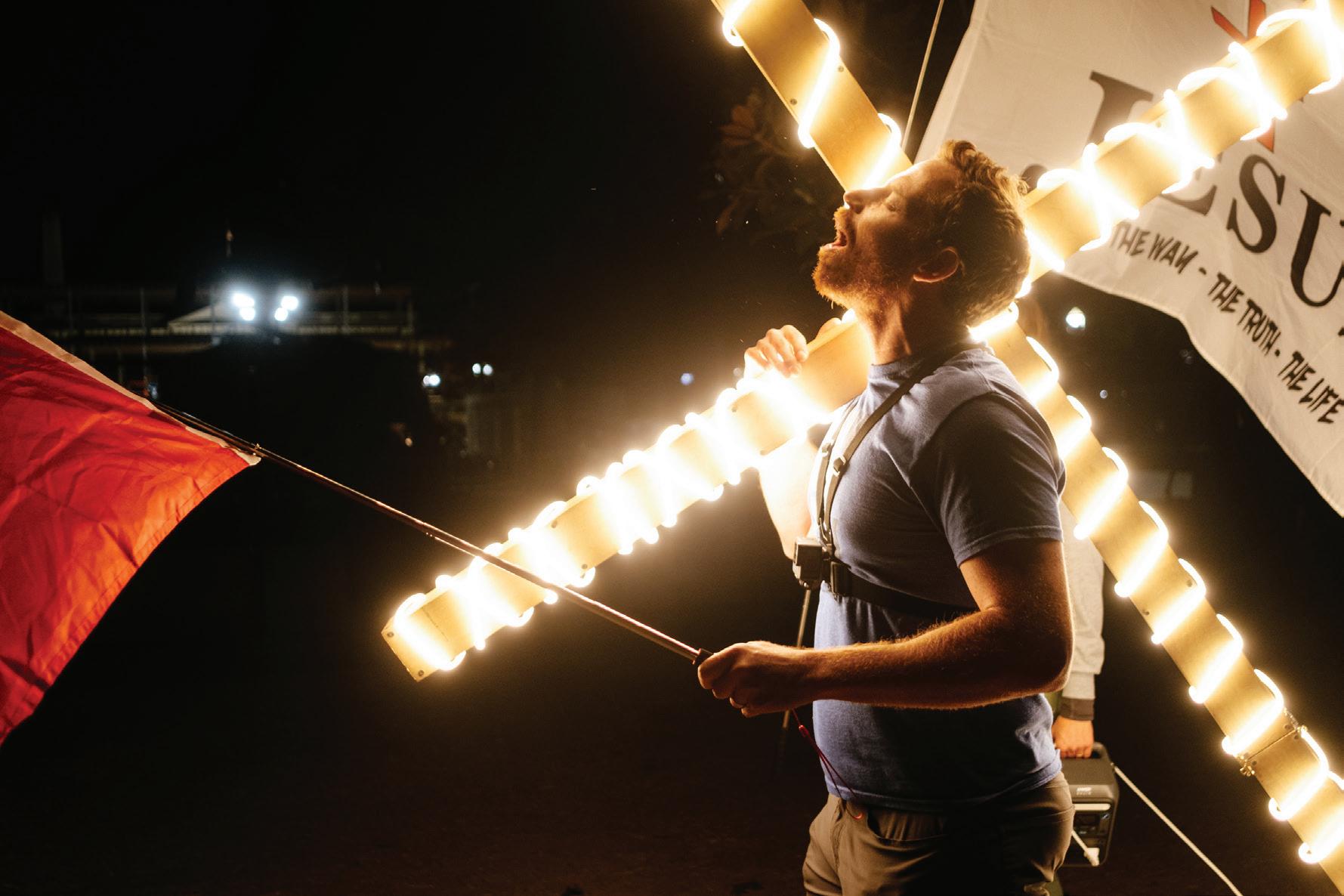
a hoe!” The recipient of those verbal barbs, a Trump supporter named Daniel who declined to provide his last name or line of work, said he came to the White House because he wanted to be involved with a “riot” to celebrate Trump’s victory. “Maybe we can rob a Best Buy or some sh*t,” he said, a manifestation of the brand of “law and order” that comes from a party who nominated a convicted felon for president.
At 2:32 a.m., a pro-Trump young man who had just been cheering for the now-president-elect walked up
to Torstenson, and asked the question at the bottom of everyone’s mind: What was going to happen to Jack Smith, the special prosecutor assigned to Trump’s criminal charges?
Torstenson said he would “suck him off,” to which the Trump supporter rallied fellow MAGA fans in a “Jack Smith” chant to mock the crusading lawyer.
Shortly after, the cross bearers returned. The cross illuminated Lafayette Square once again, and reporters swarmed the group. “Evangelist of Christ” — a middle-aged
ANNIE O’BRIEN STAFF WRITER
Exhausted with dating apps and eager to find her match in the D.C. dating pool, GW alum Nina Zafar turned to an unconventional solution: joining the D.C. edition of reality dating show “Love Is Blind.” Before joining the lovehungry cast, the 33-year-old contestant graduated from GW in 2013, where she completed a bachelors in Near and Middle Eastern studies and began an eight-year relationship with someone she met during her senior year. Zafar, who now works as a social media editor for the Washington Post, said she joined the now-local season of “Love Is Blind” to push herself out of her comfort zone.
“People can have a million reasons for wanting to go on a reality show,” Zafar said. “I don’t think that there should be any judgment involved. It takes a lot of going out of your comfort zone and putting yourself out there to do that.”
The Netflix original reality show tracks singles who converse for 10 days in “pods” — individual rooms where contestants can hear their date but not see each other. The most recent season of “Love Is Blind,” which released in October and included Zafar, was made up of all singles from the D.C. area, though lots of
the scenes were filmed in Arlington, Virginia. On the show, singles speed date before getting engaged or dumping the person with whom they feel the strongest connection. An openhearted few emerge with a fiancé after their trials in the pods and finally get to see their match. The successful couples are then followed for four weeks, which tends to conclude with either a happy marriage or the demise of their betrothal.
Zafar did not emerge from the pods engaged, which meant many viewers were blind to her presence on the show, in which she appeared just twice despite 10 days of filming. The GW alum said she didn’t apply to join the show but instead responded to casting directors who reached out to her on Instagram asking her to audition.
Zafar appears mostly in the first episode, speaking to the other women in their compound. Her longest scene, a mere 20 seconds, features her among a group of women encouraging fellow contestant Hannah to break up with Nick D., as they found his natural flirtatiousness a “walking red flag.” After that moment, Zafar does not appear in the show again.
She said she was disappointed with how little airtime she was given in the show but not surprised since
she didn’t leave her pod with a fiancé. She wished she had something to show for this “huge thing” she pushed herself to do, Zafar said.
Zafar said controlled storytelling from the producers shifted how the show portrayed her romantic journey. Zafar said she connected with Bohdan, a 36-year-old tech consultant and Ukrainian refugee. The “Love Is Blind” producers did not show their romance on screen, instead presenting Bohdan as a part of a love triangle with 35-yearold Ramses and 32-year-old Marissa.
Zafar said this narrative felt “weird” as it wasn’t the “truth of the story” and that the true spark was between herself and Bohdan, who left the pods at the same time. According to Cosmopolitan, Bohdan and Zafar left the show dating but not engaged as Zafar was worried about rushing into an engagement, a fear that was only compounded by her feeling “self-conscious” around the show’s cameras.
Zafar said the central question of the show — if love is blind — wasn’t answered by her experience. She said the timeline of 10 days is not enough for the majority of people to find love but acknowledged the show’s success rate.
“I don’t want to say that it doesn’t work because it clearly does work for some people,” she said.
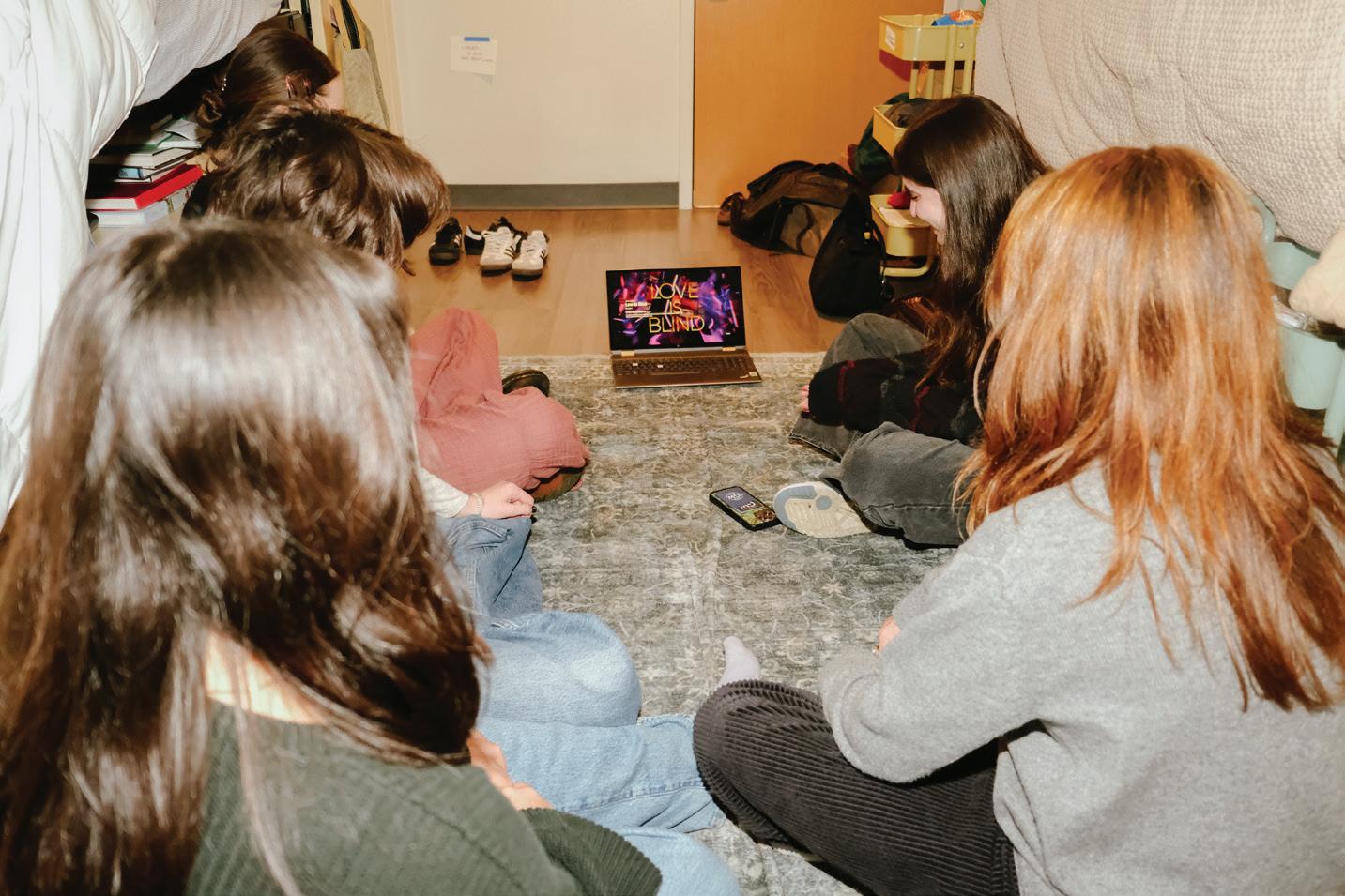
man who insisted he wasn’t joking about his name, and the group’s leader — said the group are nonpartisan street evangelists from Arizona who preach in public places and had been protesting since the start of the day in D.C.
“Our message is that we’re calling America to turn to Jesus because we believe that the problems in our nation are ultimately rooted in hearts,” Evangelist of Christ said. “Systems can’t change hearts, but Jesus can change hearts.”
At 2:53 a.m., a mere 90 minutes before Trump would win Wiscon-
sin and the election, about 10 local police officers on foot and on bikes went up to protesters and encouraged them to leave, one by one.
Ten minutes later and about two blocks away from Western Market, a group of about 20 student Trump supporters turned the corner near the International Monetary Fund Headquarters building, marching toward the White House.
Some carried Trump flags, others wore red MAGA hats. One donned a “Don’t Tread on Me” flag wrapped around his shoulders, and another wore a “Tim Sheehy for Senate” shirt, celebrating the soonto-be-called victory of the Republican Senator-elect from Montana, considered the tipping point seat for Senate party control.
The group began singing Queen’s “We Are the Champions” as they walked toward the White House. It was 3:02 a.m., and Trump had yet to be declared as the winner, but the writing was on the wall with the former president only needing Alaska’s electoral votes to win.
They didn’t get very far until several local police officers on bikes rode up to them, allowing the group to take a group photo near the White House — though it took minutes for them to find a photographer, until a photojournalist on the scene took pity and snapped their picture — before escorting them past a group of counterprotesters, including Torstenson, who were leaving the White House but turned back when they saw the Republicans approach.
The Trump-supporting crowd then walked off into the dark night, their speaker blaring the Village People’s “YMCA.”
DIVIJA CHERUKURI REPORTER
NIDHI NAIR REPORTER
Last fall, Bumble swarmed senior Grace O’Reilly’s apartment.
Once a month from August to November, the dating app sent O’Reilly, who is majoring in creative writing and English, a large box brimming with Bumble-branded merchandise, including trucker hats, frisbees and T-shirts. With most items designated to give away to other GW students and some to keep for herself, O’Reilly’s endless supply of merchandise was just another part of her job description as a Bumble College Ambassador — one of the four brand ambassador positions she’s held throughout her time at GW.
“It’s definitely a fun experience, and I definitely recommend it to anyone, especially college students,” O’Reilly said.
O’Reilly is among the ranks of dozens of GW students who are giving away branded merchandise, hosting events on campus and posting sponsored content on their personal social media accounts for companies looking to increase engagement with college students, from Bumble to UberEats.
O’Reilly currently has more than 1,600 followers on Instagram. Before her Bumble ambassadorship, O’Reilly said her first experience as a brand ambassador was for the food delivery service DoorDash during the spring semester of her sophomore year. She said she made about $200 a month and was required to post DoorDash content on her Instagram three times a month, which she had to keep visible on her account for at least six months after the program.
O’Reilly posted an Instagram reel ordering from the taco spot Surfside on DoorDash and a graphic of a Surfside shopping bag riding a DoorDash-branded surfboard for the ambassadorship, according to her Instagram.
O’Reilly said Bumble paid their ambassadors about $20 to $50 for each task they completed, like
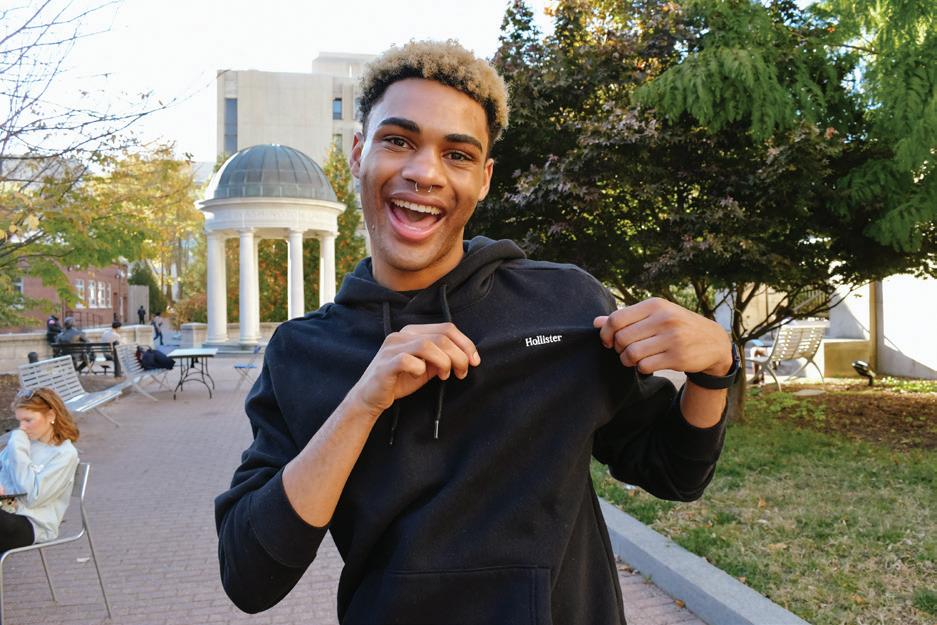
promoting Bumble in an Instagram post, rather than paying on a regular, monthly basis. She said the payments totaled to about $250 a month, which she said was “definitely not enough” for working on a new Bumble project every week while also managing her coursework, her Federal Work Study position and an editorial internship at Hotels Above Par — a publication that covers luxury hotels and travel.
O’Reilly said posting an Instagram reel for DoorDash when she first started the program felt a “little awkward” and repping a Bumble-branded T-shirt and cowboy hat in an Instagram post was “interesting but fun.” She said ultimately the program was a “great experience” that allowed her to connect with other GW students through promotional events, like nonalcoholic social events and Bumblethemed cupcake giveaways and ambassadors from other universities in the DMV area, like American and Howard universities.
Jaden Jennings, a senior majoring in women’s, gender and sexuality studies, said they are currently working as a brand ambassador for Hollister and previously worked as an ambassador for Bumble during summer 2023, an opportunity the company direct messaged them about via Instagram. They said working in social media and communications for the Division for Student Affairs from 2021 to 2023 gave them relevant experience to apply for brand ambassador opportunities. Jennings currently has more than 3,100 followers on Instagram and more than
8,700 on TikTok.
“I think what they are really looking for and emphasize is someone on campus with a connection and a lot of reach, whether that’s student orgs, like cultural events, or, in my case, Student Life,” Jennings said. “So I think that’s sort of what led to that qualifications of being scouted and sort of kept on building from there.” Jennings said they also just finished up working on a four month back-to-school campaign for Aeropostale, making about $100 to $150 a month for about six to seven hours work of filming and editing videos a month. They said the company would send them an additional $150 a month to purchase Aeropostale clothes to curate looks that felt “natural” to their own style, film and edit promotional videos and submit the videos for approval from the brand.
“I really like doing the brand ambassador thing, especially for the college setting because they sort of encourage creative autonomy,” Jennings said. Jennings said they prefer brand ambassadorships that involve creating digital content, like the Aeropostale campaign, rather than organizing in-person events and handing out merchandise because they require less time while also managing school work and internships. When merchandise from brands piles up, they said they often give away extra items to their friends.
“Giving them to my friends and figuring all that stuff out is definitely helpful because I don’t like having a million different hats in my house,” Jennings said.

Women’s basketball (1-1) lost to crosstown rival Howard (2-1) 69-66 Friday, failing to profit off a second-half comeback.
The Revs were able to build up a lead in the fourth quarter after trailing by ten points at halftime, which ultimately was not enough to win the affair. Freshman guard Gabby Reynolds proved to be a strong bright spot despite the tough loss, scoring 22 points in her second collegiate game, on 7/15 shooting.
“Gabby’s continuing to emerge as a Division I player here,” Head Coach Caroline McCombs said. “The ball is in her hands a lot, and we leave her on the floor. She can make plays and shoot the ball, so I think she’s getting used to the pace of the game, the style of play, those kinds of things.”
Thirty seconds after tipoff, the Bison opened the game with a layup, starting an early 7-point scoring run that led the Revs unable to earn a basket until the second minute of the game. Sophomore guard Kamari Sims picked up the Revs’ first points of the game, with a layup bringing the score to 7-2. The first quarter finished with the Revs down 17-9 after they made only 25 percent of their field goal attempts.
The second quarter started with graduate forward Mariona Planes Fortuny sinking a layup to match the Bison’s layup 30 seconds in the quarter. Fortuny led the Revs with 14 rebounds in the game, with Reynolds following with eight rebounds.
Graduate student forward Paige Mott’s successful layup and free throws, followed by Reynolds’ driving layup tightened the lead to a seven point differential, putting the Revs down 14-21.
As the clock dwindled down in the second quarter, the Revs and Bison fought basket for basket. After a twominute scoring dry spell for the Revs, graduate student guard Makayla Andrews scored a bucket, as well as sophomore forward Sara Lewis, putting the Revs down 25-35 entering halftime.
McCombs said going into the second half of the game, her message to the team was to fight back and move past the beginning part of their game when the Revs struggled with scoring droughts and ball possession.
“We knew we were going to have a tough matchup at Howard and so don’t think we started the game that way, so just reiterating that is how we need to come out in the second half and obviously be hungry,” McCombs said. “We’re down 10 and so we had to fight back.”
Howard defeated Florida A&M 78-66 on the road for their first game last week, shooting
30/57 from the field.
The script flipped in the second half, and GW were able to outscore the Bison 19-9 in the third quarter. GW was able to build a 44-41 lead with two minutes left in the quarter, after Andrews sunk two free throws. However, a jumper and a free throw from Howard tied the game to end the quarter.
McCombs said that the team was able to find more success in all phases of the game during their third-quarter turnaround and were able to execute the game plan in the way they had intended.
“I think we got to the free throw line an unbelievable amount tonight,” McCombs said. “We just didn’t knock all of them down.” Out of 41 free throw attempts, the Revs only made 25, which was good for 61 percent.
GW had an early lead in the fourth quarter when Mott successfully dropped two free throws, which was shortly followed by a layup from the Bison that tied the game. The game was largely back-andforth until there were five minutes left on the clock, when two Howard free throws and jumper put them up 3 points — a lead which GW was unable to come back against as Howard continued to rack up points.
Women’s basketball will tip off against Virginia University of Lynchburg Monday on home territory at 6 p.m.
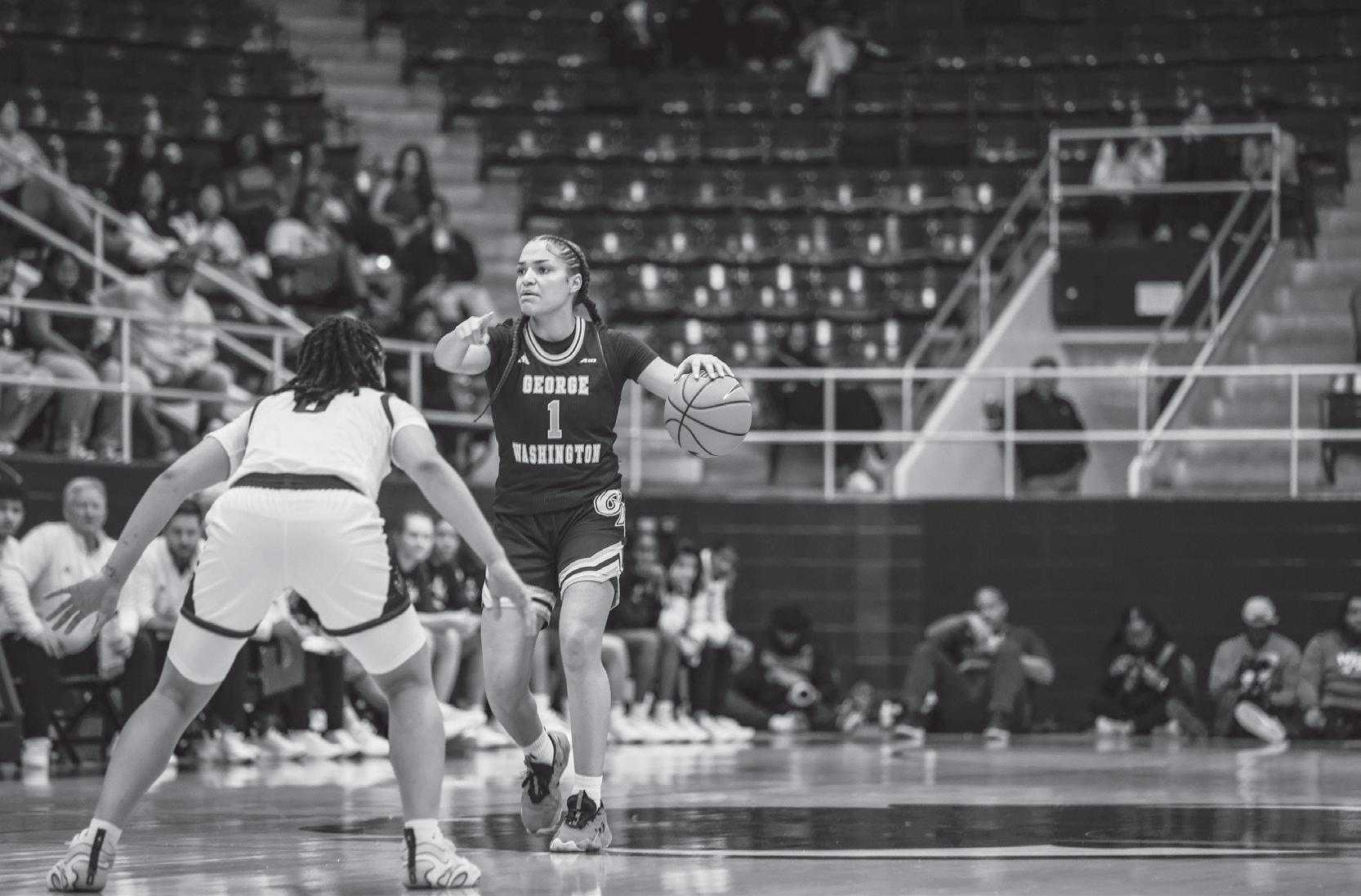
The field goal percentage in women’s basketball’s second nonconference game against Howard
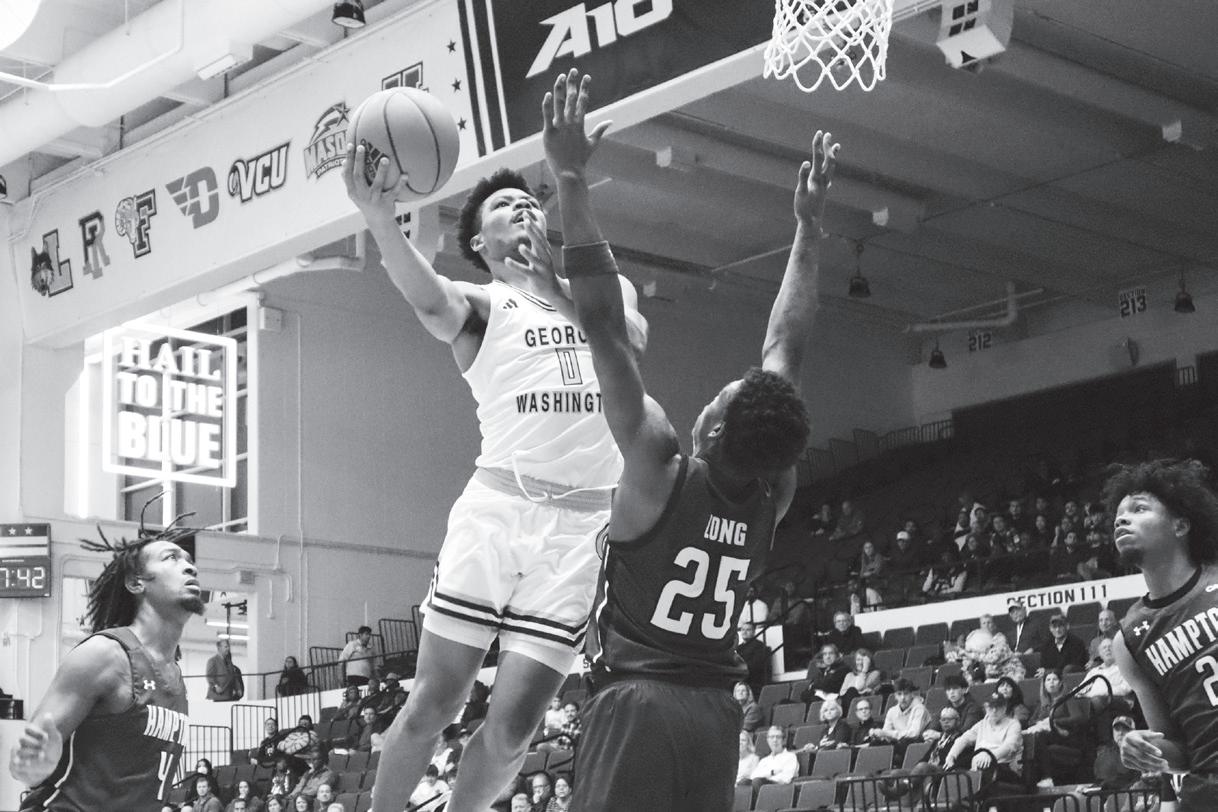
Autry sets career high in men’s basketball win over Hampton
Men’s basketball beat Hampton University 82-54 on Friday at the Charles E. Smith Center.
Leading the pack offensively for the Revs was sophomore guard Trey Autry, who set a new career high in points with 14. The Revs led 32-24 at halftime, and a 19-point run that brought the score to 55-36 put the game out of reach for the Pirates at the end of the second half.
Graduate student guard Gerald Drumgoole Jr. scored 13 points and sophomore guard Jacoi Hutchinson added 12 of his own. Redshirt sophomore forward Darren Buchanan Jr. and redshirt junior forward Rafael Castro, who led the team in points last game, each scored 10 points.
Despite the rather quiet night from his teammate Buchanan, who typically is the Revs’ leading scorer, Hutchinson said that the team relies on Buchanan to be a leader night in and night out.
“A lot of people don’t know he’s a very good leader for the team, we look up to him both vocally and the way he plays,” Hutchinson said.
After three minutes of no scoring by either team in the middle of the first half, redshirt freshman guard Christian Jones broke the pattern with a long 3-pointer, bringing the score to 12-4. Hampton’s sophomore guard Trevor Smith nailed home a 3-pointer, raising the score to 127, but Hutchinson immediately followed with another 3-pointer from the right, increasing the score to 15-7.
Out of a timeout, Castro’s jump shot fell for the Revs at 6:44 minutes remaining in the first half, bringing the score to 21-11.
Autry said that the addition of Castro has been crucial to the team’s start. Castro recorded a double-
double in the Revs’ victory over Mercyhurst University earlier in the week.
After the Pirates found themselves in foul trouble, Buchanan scored a tip-in, bringing the score to 32-24 at the end of the first half.
Graduate student guard Wayne Bristol Jr. opened the second half for Hampton with a quick 2-pointer, bringing the score to 32-26. Castro rebounded Drumgoole with a dunk at 16 minutes left, securing the Revs’ 10-point lead yet again, bringing the score to 38-28.
Autry would record all 14 of his points in the second half, providing the Revs with the insurance they needed to put the game out of reach for the Pirates. GW would go on an 18-4 run across the middle five minutes of the half.
Autry said he credits his teammates and coaches for all their support after his new career high in points. Last season, Autry averaged 5.6 points per game, recording a then-career high of 13 points in the Revs’ 76-45 victory over Coppin State University.
Head Coach Chris Caputo said that he is pleased with his team’s performance in Friday’s matchup. He added that Jones, Hutchinson and Autry’s strong performances are a product of their second years with the team.
“They’ve been hardened by their experience,” Caputo said.“In Christian’s case, it’s the red shirting piece. But I think Trey and Jacoi got thrown really into the fire in a way that some players say they want, but it’s very difficult, right? The pressure is real. The coaching is real. The mistakes are not acceptable when you’re in the fire.”
The win brings GW to 2-0 on the young season. The Revs will face off against the North Carolina A&T Aggies next at 7 p.m. on November 12 in the Smith Center.
After just two games in the 2024-25 season, men’s basketball is finding its footing.
Marking the start of college basketball this week, the Revolutionaries unleashed a protean, highenergy offense filled with slam dunks and catch-andshoot threes. Paired with a gritty lock-down defense, the team is sending a clear message to anyone in their path: They are here to score big and shut opponents down.
The Revs exploded offensively in their first two games with scoring spread across the roster. GW advanced to 2-0 on the season after finishing 76-59 and 82-54 over Mercyhurst and Hampton universities, respectively.
Six players recorded double-digit scoring nights against Hampton, the first of that type of allaround performance for the team in over six years.
Redshirt junior transfer Raphael Castro tabbed a double-double in his first game as a Rev against Division I Mercyhurst last week, alongside redshirt sophomore guard Darren Buchanan Jr., who added double-doubles in both games. Sophomore Trey Autry broke his personal scoring record later that week by notching 14
points against Hampton, and sophomore Jacoi Hutchinson came into his own after a quiet first game, earning Player of the Game accolades for his 12-point, three-assist contribution.
Christian Jones, who displayed an 11-point, four-assist and four-steal game, had a promising performance after a redshirt first season with the Revs. The dominant win against Hampton even allowed bench players, like senior forward Keegan Harvey and sophomore guard Amir Arrington, to see court time, with Arrington banking a three ball that brought the Friday night Smith Center crowd to its feet.
GW’s balance between new and returning talent has strengthened its scoring depth, displaying an early-season powerhouse. The team’s offensive distribution, despite the loss of standout shooters, like James Bishop IV and Garrett Johnson, is promising. While the team lost the ability to finish on the midrange shot, it is capitalizing in the paint and from beyond the arc.
Trey Autry’s breakout performance solidified him as a new shooting option from the 3-point line.
Despite struggling against Hampton early, offensive boards led the team to outscore Mercyhurst 25-9 on second-chance points. The Revs only maintained an
8-point lead going into the second half, standing at 2432 but outscored Hampton 46-28 under the rim over the game.
The Revs struggled to come out with a fire in the first half of both games, going back and forth with opponents they should have dominated. But their ability to lean on different rotations, especially against teams under a new coach with little film, like Hampton, showcases Head Coach Chris Caputo’s ability to rally his team. The team’s midgame comeback displayed the Revs’ adaptability to tweak plans for dominant finishes.
Despite lofty wins, the Revs’ defensive prowess stands out — particularly in first halves where they use the backcourt to quench leads when shots aren’t falling. GW outrebounded Hampton 19-16 in the backcourt during the first half of play. The Pirates also struggled to get good shots off before clock violations, highlighting GW’s pressure on the floor. Clamping down on defense establishes a solid foundation that enables the team’s secondhalf scoring bursts, which the Revs proved in their 22-5 run against Hampton in the second act of the game.
The chemistry between players, like Castro and Buchanan Jr., who connect seamlessly in the frontcourt as the two tallest in the
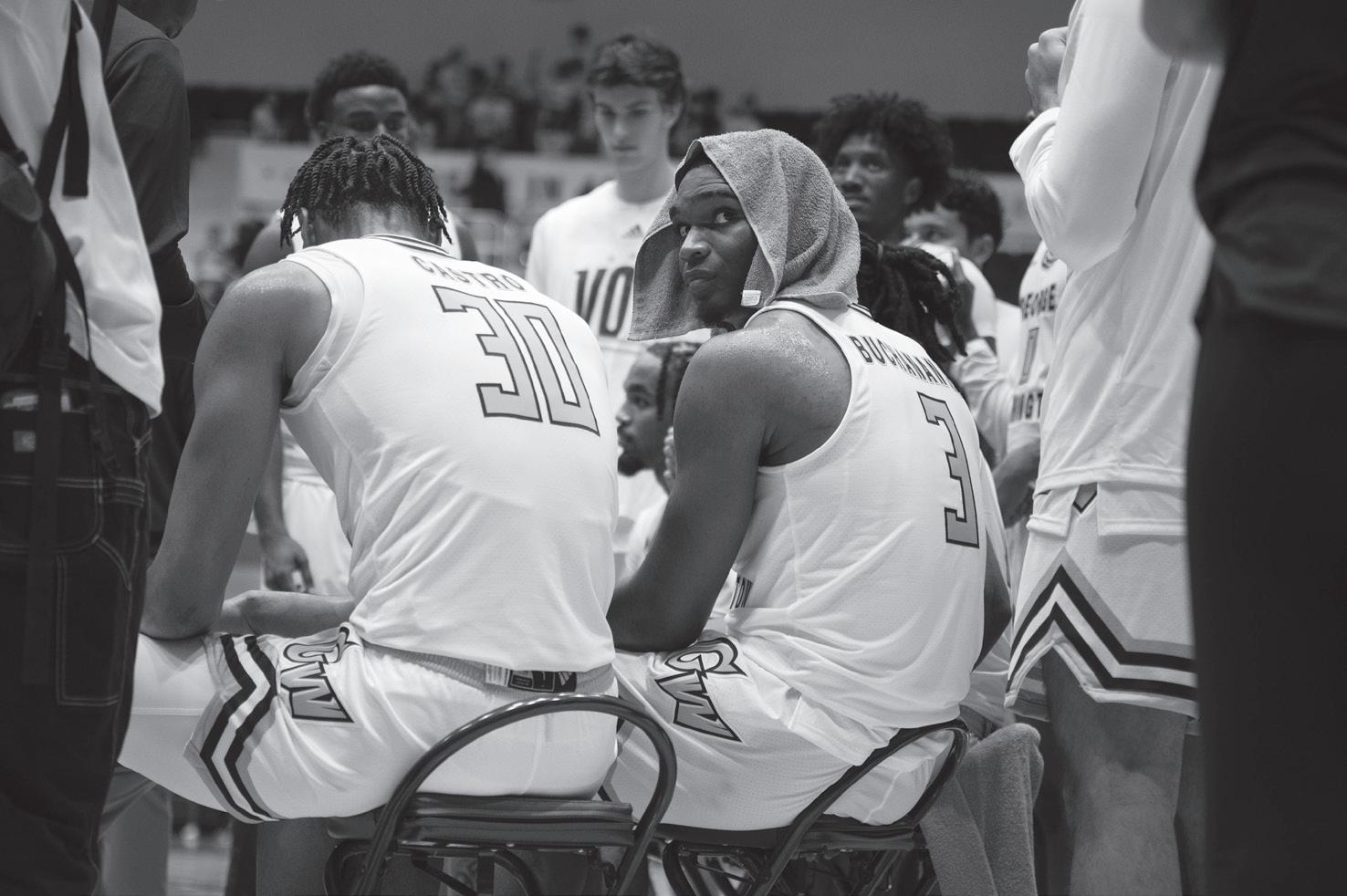
starting lineup, creates a quick-paced offensive set for the team. Crafty ball movement and quick athletic guards, like junior Trey Moss, are filling critical roles and giving the team a versatile edge on the attack.
A mix of transfers, like Moss and Castro, alongside emerging leaders, like Hutchinson and Buchanan Jr., have added a relieving layer of skill depth and mature experience to GW’s lineup. Veteran transfer Gerald Drumgoole eclipsed his 1,000th point in his first game as a Rev, showcasing his collegiate experience
to the Foggy Bottom community. The strong roster allows Coach Caputo to test different five-man combinations and alleviate fatigue that could come from 40-minute expectations for players. After two games, no player on the team is averaging more than 30 minutes of playing time.
The team’s balance is proving invaluable with a myriad of players capable of stepping up each game to fill roles.
Despite a zero-point performance by Hutchinson against Mercyhurst, he was a leader on the court in GW’s crusade versus Hampton. Vice versa, Moss had a quieter second game. But Autry, Jones and others stepped up in the stat book for the team. Caputo’s trust in the bench, even in highstakes stretches, proves GW’s ability to draw on contributions from a diverse set of players. On a broader scale, this action signals a promising season and expectations for big wins against upcoming opponents North Carolina A&T State University and New Jersey Institute of Technology.