


ALEXIA MASSOUD REPORTER
OLIVIA EARLEY
Harris can understand, advocate and design policy in ways that men cannot, resembling “a breath of fresh
ALEX GATES REPORTER






Students who voted for Democratic nominee Vice President Kamala Harris said they support her vow to protect reproductive rights, endorse economic policies focused on boosting the middle class and empower historically marginalized communities if elected as the country’s first woman of color president.



More than 20 students port a candidate fighting for bolstered economic support of small business owners tion of reproductive rights in the wake of the repeal of
tions and an election cycle in which abortion access is on the line in many states. Many of the students said they believe Harris, a Black and South Asian woman, will better represent their communities in office than past presidents because of her experiences combating misogynistic and racist remarks from her opponents that seek to delegitimize her career advancement.













air.” She said Harris empathizes with the struggles Black women face in the United States, having faced ponents like being called a “DEI hire.” ally, feel safer for my future, ing to be advocating from ways thought not everybody else understands,” Robinson said.


help grant women better access to safe abortions. Harris has made abortion rights a core tenet of her campaign and has backed eliminating the filibuster to restore Roe v. Wade in the Senate after the Supreme Court overturned the federal abortion protections in June 2022. “A Trump presidency would put the work that D.C. community members do to provide reproductive health in grave danger, and I think a Trump federal abortion ban is still on the table,” Tennant said.
HENRY ROBINSON REPORTER
Students who cast their ballot for Republican nominee and former President Donald Trump in the 2024 presidential election said they laud his stances on immigration and economic policy but favored younger candidates in the party’s presidential primaries.
years of rising inflation. The U.S. inflation rate sat at 2.4 percent in September, the most recent available data, after settling from a peak of 9.1 percent in 2022.




the title.
Emily-Anne Santiago, the programming director for GW College Democrats from Georgia, said she believes Harris’ plan to provide a $6,000 child tax credit to parents of newborns would also open doors for women to join the workforce. She said the policy would allow women to focus on their job and not “strain themselves” as much when they come home.
land, California, and 2010, Harris was narrowly elected nia, the first woman and the first Black American to hold national abortion protections and an election cycle in which abortion access is on the line in many states. Many of the students said they believe Harris, a Black and South Asian woman, her experiences combating marks from her opponents that seek to delegitimize her career advancement.


First-year William O’Donnell, an international affairs student, said Harris’ middle-class background makes her more relatable than Trump, who is a businessman worth nearly $8 billion, and his running mate, Ohio Sen. J.D. Vance, who worked in the Silicon Valley tech industry.
Junior Amina Robinson, the treasurer of the Black from Detroit, Michigan, said
the treasurer of the Black Student-Athlete Alliance from Detroit, Michigan, said
EJ Tennant, a senior from Tennessee and the co-president of Foggy Bottom Plan B, said Harris’ election would
said Harris’ election would

lion, and his running mate, Ohio Sen. J.D. Vance, who worked in the Silicon Valley tech industry.




FAITH WARDWELL
MANAGING EDITOR
RORY QUEALY NEWS
EDITOR
As much of the community fixates on the historically narrow presidential race, some GW students are weighing in on contentious down-ballot elections that could determine control of the U.S. House of Representatives and Senate.
In an election cycle marked by fiery debates and polarizing ad buys, congressional control relies on seats in battleground states, like Montana, Pennsylvania, Ohio, Michigan and Arizona, which will shape the legislative agendas for the House and Senate for the next two years. More than a dozen students — many of them first-time voters — said these air-tight races catalyzed them to vote, but even as the students monitor competitive races through local media coverage and dispatches from family members at home, uncertainty remains on which major party will tip the scale on the Hill.
Congress is currently split down the aisle, with Republicans controlling the House and Democrats controlling the Senate, both with slim margins. But with 34 seats in the Senate and all 435 House seats up

Senior Stephanie Animdee, the president of the Mu Beta Chapter of Delta Sigma Theta Sorority, Inc. and a member of Alianza — an Afro-Latinx student organization — compared Harris to the late Shirley Chisholm, the first Black woman to campaign for a presidential nomination for a major political party, because they are part of both the Black and Caribbean communities and sought powerful political

Senior Stephanie Animdee, the president of the Mu Beta Chapter of Delta Sigma Theta Sorority, Inc. and a member of Alianza — an Afro-Latinx student organization — compared Harris to the late Shirley Chisholm, the first Black woman to campaign for a presidential nomination for a major political party, because they are part of both the Black and Caribbean communities and sought powerful political positions.
Ten Republican students said they’re voting to reelect Trump due to his plans to curb inflation by cutting taxes and expanding tariffs and reduce illegal immigration by increasing security at the Mexican border. Half of the students said they initially supported Republican candidates for president, like former South Carolina Gov. Nikki Haley and entrepreneur Vivek Ramaswamy, but rallied around Trump when the GOP declared him the party’s nominee in July.
Sophomore Parker Malphrus, a contributing member of the GW College Republicans’ Political Affairs Committee from South Carolina, said he’s voting for Trump this election because he believes the former president will help the country return to a more stable economy after three
“It comes down to the economy and who’s best for my interest,” Malphrus said. Malphrus said in the primaries, he initially voted for Haley, who is 52, because he hoped the party would back a younger candidate than Trump, who is 78. Hailing from South Carolina, Malphrus said he appreciated Haley’s track record on election integrity and business, referencing how she signed a law as governor that required voters to present one of five forms of photo ID to vote, and brought jobs from large manufacturers like Boeing and BMW to the state. He said he nonetheless plans to support Trump because he received the Republican nomination.
“It seems like Donald Trump is the best fitted to advance this American Dream for young people that I think is fading away,” Malphrus said.
publican students in reelecting Trump in 2020 reflected a national trend marked by the emergence of antiTrump Republican groups. Junior Christina Carris, a student from Illinois and the public relations director of GWCRs, was the former president of Students for Haley at GW before Trump won the Republican primary. She said Haley’s rhetoric appeals to moderate and undecided voters more than Trump’s, which would have allowed her to court “soft Democrats.”

In the 2016 and 2020 presidential election cycles, Republican students were divided over the decision to elect Trump as president, with some claiming he had a “polarizing” effect on the part. Division among Re-
“I do believe if she was the nominee, the Republicans wouldn’t be as worried as they are about this election,” Carris said. Carris said she disapproved of Trump’s delay in condemning the riots on Jan. 6, 2021 — when a crowd of his supporters stormed the Capitol in an attempt to subvert the 2020 presidential election certification — but still intends to support him in the upcoming election because she supports his “strict” border policies. Carris said drugs coming in from across the Mexican border exacerbates the U.S.’s fentanyl crisis. She added that Chicago, Illinois, her hometown, has one of the largest sex trafficking rings and claimed that “a lot of that” came from across the U.S.-Mexico border.
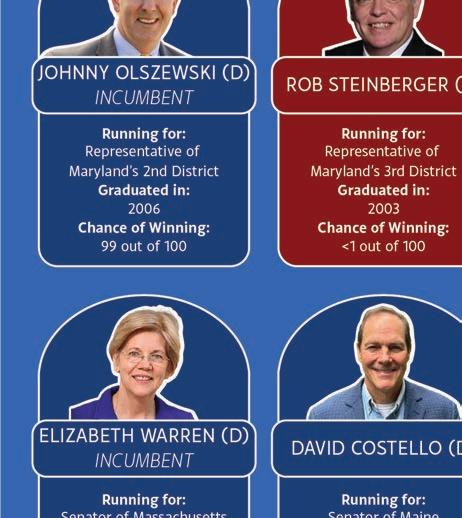
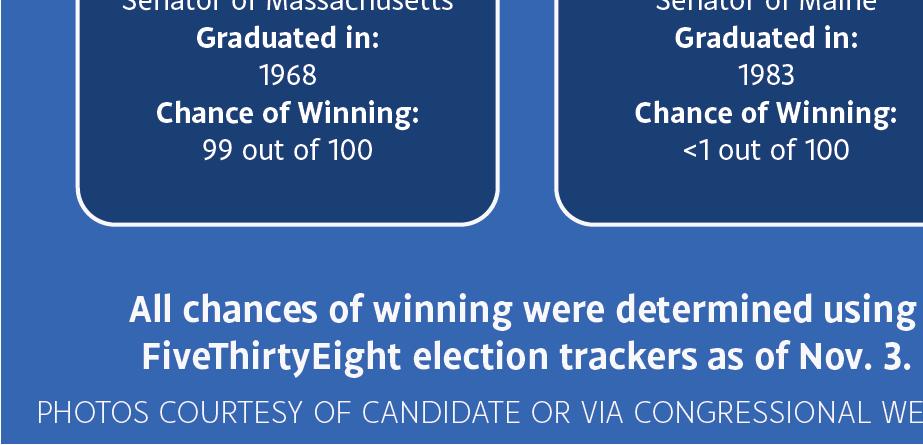
vote in battlegrounds deciding congressional power balance
for grabs this year, the parties have wrestled to flip the chambers in their favor.
Junior Isabella Marias, a political science student from Scottsdale, Arizona, said the deadlocked local House race for Arizona’s 1st congressional district — one of 22 tossup House races — pushed her to the polls. She hopes voters unseat seven-term incumbent Rep. David Schweikert (R-AZ) and elect Democratic physician Amish Shah, a former member of the Arizona State House of Representatives, who she campaigned for in the primaries.
“It’s a completely unpredictable election,” Marias said.
As a resident of a border state, she said immigration policies are particularly salient to her when voting and that she opposes Schweikert’s stances that she said “treat immigrants as subpar to Americans.” Schweikert opposes illegal immigration and giving amnesty to undocumented immigrants and has supported former President Donald Trump’s plan to build a border wall since 2016.
Shah has worked to strengthen border security through a bipartisan approach by increasing funding for the border by more than $200 million in Arizona’s state legislature, but Republicans say he hasn’t gone far enough after he voted against a package of budget
legislation that included border security funding.
Marias added that she values Shah’s record of defending reproductive rights because she doesn’t want to send a representative to Congress who would vote to restrict a woman’s right to make abortion choices in Arizona. Schweikert has sponsored a “Life at Conception Act” six times that would have made abortion nationwide almost completely illegal and voted against protecting access to contraceptives.
“Schweikert has been in office for around 20 years now, I want to say, so that would be a huge deal if the Democrat were finally going to win,” Marias said.
Marias said friends at GW have told her that her vote matters “a lot more” than theirs because she lives in an area with tight House, Senate and presidency races. She said she sent in her mail-in ballot on Oct. 21 but is anxious about the possibility of her ballot not being received, which would help candidates she opposes, like Schweikert, win.
“There’s no doubt in my mind that it’ll be a very close race,” Marias said. “The fear is definitely like my vote isn’t counted, and it’s that close.”
Junior Brandon McNamara, a political science and entrepreneurship student from Austin, Texas,
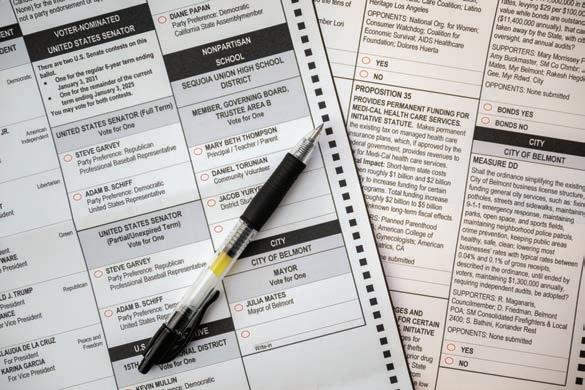
said he was close to abstaining from voting this election year because he didn’t feel represented by either major party’s presidential candidate. But he said the highly contentious race for the Texas Senate seat, where he felt a stronger pull to support Democratic candidate Rep. Colin Allred (D-TX), pushed him to cast his ballot. He said he sided with Allred because of his stances on issues, like immigration, where he feels Allred has taken a more bipartisan stance in establishing border security, like
pushing for the Bipartisan Senate Border Bill, and on abortion, where Allred has committed to protecting reproductive rights in Congress amid the state’s abortion ban. “I should vote at least for the candidates I agree with strongly or feel strongly towards, like Allred,” McNamara said. “I felt much stronger about voting in the Senate race than in the presidential where I felt that there was a clearer choice in candidate.”
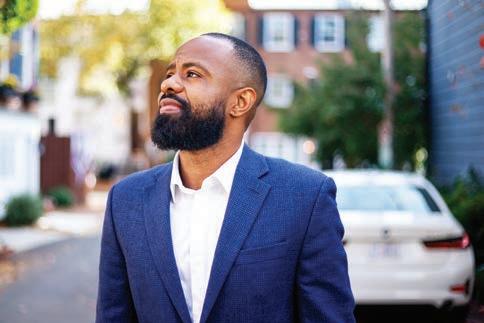
A civil rights attorney and Dupont Circle resident is challenging incumbent Ward 2 Councilmember Brooke Pinto in Tuesday’s D.C. Council election, with a write-in campaign centered on promoting racial justice and affordable housing.
Rondell “Magic” Jordan said he decided to launch his bid for the seat, which represents Foggy Bottom and the surrounding area, after D.C. officials in March enacted Pinto’s bill to address a spike in District crime by harshening punishments for some offenses and reviving a 1990sera tool that allows city police to create temporary drug-free zones in public spaces with illegal drug activity. Jordan, a Brooklyn native who moved to D.C. in 2019, said he grew up during New York City’s stop-and-frisk policing in the 1990s where he witnessed the “viscerally racist” policy target Black men in his community.
He argues that Pinto’s crime bill would do the same in D.C.
“I saw again what I experienced as a kid,” Jordan said. “This is an attempt to snatch away a generation of people who are hurting, honestly, and again, criminalizing Blackness and criminalizing Black childhood. I testified several times. I implored Councilmember Pinto and the entire D.C. Council to not pass this legislation.”
The Secure DC bill included more than 100 provisions, spanning from lower-
ing the threshold for felony theft from $1,000 to $500 and increasing penalties for gun possession offenses. Before officials enacted the bill, a D.C. Council office that assesses bills’ potential impact on racial equity found that the bill would likely aggravate racial inequity in D.C. and contains provisions that “are not substantiated by evidence-based research.”
Jordan said alternatively, he has helped Black, lowincome communities, which he said are the most marginalized and vulnerable people in the city, since he moved to D.C. after graduating from the University of Pittsburgh law school in 2018. He works at Open City Advocates, a nonprofit defending and advocating for youth in the D.C. juvenile justice system and represents youth in court. He said he’s witnessed the disproportions in D.C.’s justice system, as Black people make up 44.4 percent of the city’s population but those in youth and adult jails in the District are “almost
exclusively” Black. He said Pinto’s crime bill will make this trend more pervasive by lengthening prison sentences in a justice system that already disproportionately incarcerates Black residents.
“I was just so frustrated, like this is not gonna happen again,” Jordan said. “And I got guidelines and got in this race to unseat her.”
Jordan said he felt a spiritual call pulling him to D.C. in 2018 amid a housing affordability crisis in the District that caused swaths of evictions, particularly for low-income, Black residents. After his move, he began working as a staff attorney at the Legal Aid Society of the District of Columbia, where he represented Black, lowincome tenants in eviction cases before the D.C. Superior Court during the pandemic’s onset. He said landlords were evicting tenants who struggled to pay rent in 2020, despite the federal government enacting an eviction moratorium in September 2020.
AN NGO GRAPHICS EDITOR
SACHINI ADIKARI CONTRIBUTING NEWS EDITOR
TYLER IGLESIAS ASSISTANT NEWS EDITOR
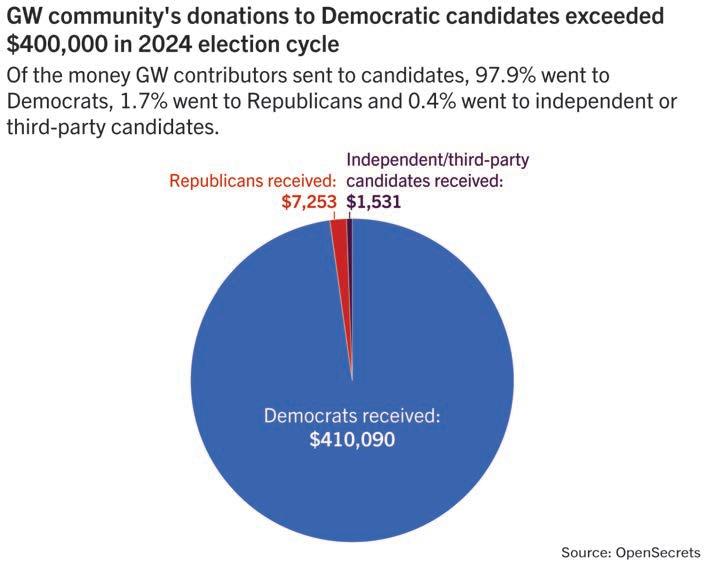
University community members donated more than half a million dollars to political campaigns and committees during the 2024 election cycle, according to a nonprofit campaign finance organization.
Faculty, staff, contractors and students who listed their employer as GW to the Federal Election Commission donated $551,752 to political committees, with 97.19 percent of contributions going to Democratic or Democratic-affiliated committees and 2.09 percent of contributions going to Republican or Republican-affiliated committees,
according to OpenSecrets data. GW community members donated the largest sum of any candidate to the campaign of Vice President Kamala Harris, totaling $206,796, and gave a total of $1,623 to the campaign of former President Donald Trump — the most they gave to a Republican candidate or affiliated group.
The Democratic Congressional Campaign Committee and Democratic Senatorial Campaign Committee, which are tasked with turning their respective chambers blue, received $18,101 and $19,328, respectively, from GW community members.
The congressional candidate campaign that received the most donations from GW community members was Angela Alsobrooks, a Democrat running to represent Maryland in the Senate against former Maryland Gov. Larry Hogan, a Republican. Community members donated $26,711 to Alsobrooks during the 2023-24 election.
FIONA BORK SENIOR STAFF WRITER
QUINN
GIORDANO REPORTER
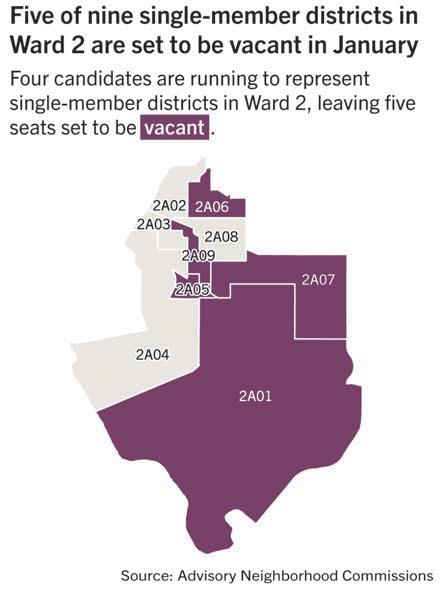
With a trio of leaders in Foggy Bottom and West End closing their chapters of serving the neighborhoods’s local governing body this year, five of its nine seats are set to be vacant once new terms begin in January.
on and helping mitigate community concerns for District officials, have little legislative power, but D.C. agencies are required to give “great weight” to their recommendations and proposals. Candidates who wish to appear on the ballot are required to declare candidacy several months before Nov. 5, but write-in candidates can win the empty seats with only a handful of votes. If no write-in candidates emerge and seats remain unfilled past January, when newly elected commissioners begin their terms, the ANC will hold a special election the following year. Some candidates said people aren’t running for ANC because the position is unpaid and a large time commitment — between 20 and 30 hours a week — which members said contributed to poor attendance at meetings this past term. Patel said high ANC turnover extends to all districts, but she is “positive” the rest of the body’s seats will eventually be filled by write-in candidates after election night.

“We’ll run with the commission that we have and look forward to hopefully having a full commission of nine,” Patel said. Here’s what you need to know about each of ANC 2A’s races this year:
2A01: Two-term GW alum does not stage run for reelection

DYLAN EBS STAFF WRITER
ELLA MITCHELL CONTRIBUTING NEWS EDITOR
D.C. and University officials are bracing for a potentially tumultuous 11 weeks between Election Day and the inauguration on Jan. 20 by heightening police presence at polling stations and limiting tap access to University buildings for anticipated protests.
nate with federal authorities for large-scale or emergency situations.
“We will not tolerate any violence of any kind,” Smith said. “We will not tolerate any riots. We will not tolerate the destruction of property.”
D.C. Mayor Muriel Bowser said in a press briefing on Oct. 22 that MPD officers will play a support role at polling stations across D.C. to prevent inference from protesters and oversee transportation of ballots to the D.C. Board of Election counting location.

his tenure, but the ANC is an unpaid role with a high workload, leaving him “exhausted.”
Yannik Omictin, Joel Causey and Evelyn Hudson — three members of the Foggy Bottom and West End Advisory Neighborhood Commission who have each served for two or more two-year terms — are not staging a run in the upcoming election Nov. 5. Two incumbents on the nine-member governing body, Chair Trupti Patel and Secretary Ed Comer, face no opposition in their runs to continue representing their single-member districts of 2A03 and 2A04, respectively. Former ANC Chair Jim Malec looks to return to the body as a commissioner for singlemember district 2A08, and the only candidate who is a newcomer, May Yang, is running unopposed for singlemember district 2A02. Two seats on the body are already vacant after 2A07 commissioner and GW alum Dasia Bandy and 2A08 commissioner Jordan Nassar resigned in July. Luke Chadwick, the former 2A05 commissioner, dropped his reelection bid in September. With four candidates running for nine total ANC seats in this race, single-member districts 2A01, 2A05, 2A06, 2A07 and 2A09 are set to be vacant by the end of election night. ANCs, tasked with gathering information
In his two terms as commissioner, Omictin was a staunch critic of unhoused encampment clearings and an advocate for affordable housing solutions, denouncing the city’s plan to clear the encampment at 21st and E streets until more shelter space becomes available and advocating for housing voucher accommodations for unhoused people. He has also called on Mayor Muriel Bowser to transfer D.C. Circulator bus routes and fleets to the Washington Metropolitan Area Transit Authority to preserve local transportation in the area. He has supported expanding bike lane implementation.
2A02, which encompasses the uppermost northwest quadrant of West End. The seat has been vacant since Malec resigned in April after moving out of the area. Yang said she decided to run for the seat because she views it as a way to meet her neighbors.
“It’s a really nice feeling of just getting to know people,” Yang said.

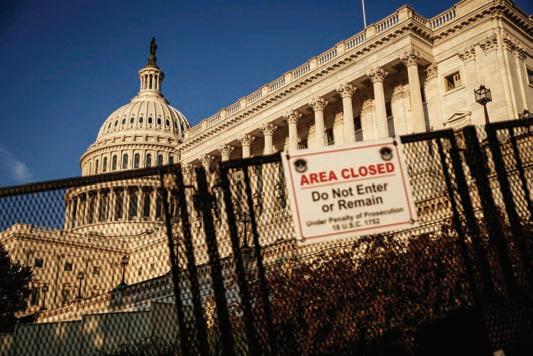
This election marks the first presidential election since a mob backing former President Donald Trump breached the Capitol on Jan. 6, claiming the election results — which declared President Joe Biden as winner — were invalid. Metropolitan Police Department Chief Pamela A. Smith said at a press conference Tuesday that MPD is not aware of any current credible threats of political violence or riots, but she said that all eligible 3,300 MPD officers will be deployed “across the city” to D.C.’s city center, which borders the White House and early voting centers across the District beginning this week to ensure safe voting at polling places.
“We will not stand for any instances of voter intimidation, of disruption in this electoral process,” she said.
“We may not have a declared winner on election night,” Bowser said at a press briefing on Oct. 22. “Almost nobody thinks that we’re going to have a winner declared.”
Clint Osborn, the acting director of the D.C. Homeland Security and Emergency Management Agency, said District officials are working with MPD to collect information about what security threats the departments should be prepared for and how preventative measures like road closures may impact residences’ day-to-day lives this week.

Yang said she is still determining what role she wants to play on the ANC but hopes to serve as a neutral sounding board between neighbors on contentious issues like unhoused encampments and The Aston.
She said at the press conference that collaboration with branches of MPD from neighboring jurisdictions is the “backbone” of the department’s security strategy. Smith also said MPD is activating the Joint Operation Command Center, which allows MPD to coordi-

Some businesses by the White House like local Asian restaurant Pow Pow on I Street and McDonald’s on 17th Street have begun boarding up their windows ahead of potential unrest on Election Day. But Jonathan Langel, the manager of Bobby Van’s Grill at 12th and New York, which is about a 10-minute walk from the White House, said he’s waiting to hear official guidance from local officials before boarding up.
Omictin, a 2021 alum who has served on the ANC since 2020, is not running for reelection this year, leaving the single-member district that represents Mitchell and Thurston halls and apartments like The York and The Statesman empty. He said he is proud of what the body accomplished during
2A02: Seat to represent ANC’s only new face Yang, an attorney at a local law firm, is running unopposed in single-member district
“A lot of people have different opinions, and most of them are valid,” Yang said. “I try not to make it a judgment of character and more of a from different points of view and standards and see if there’s common ground that we can fi nd.”



AIJALON GOURRIER
Junior Grace Munn thought she was picking up her South Carolina ballot when she visited the GW Mail and Package Services center last month, but when a mailroom employee handed her a Massachusetts ballot instead, she knew there had been a mistake and immediately handed it back.
“It’s just a little scary because someone out there could be using my ballot, and I would have no idea,” Munn said.
The mix-up would be the first of three hurdles she’d face in accessing her ballot to vote in her first presidential election, a historically narrow race for the top of the ticket. On her second attempt, she said the package center didn’t notify her that her ballot arrived. She then requested her ballot for a third time, asking her county election board to send her ballot to a friend’s off-campus apartment.
“I had to order it three different times, so they never got it,” Munn said. “But I fi nally ordered it to one of my friends’ apartments, and I got it through that.” Munn is one of a dozen stu-
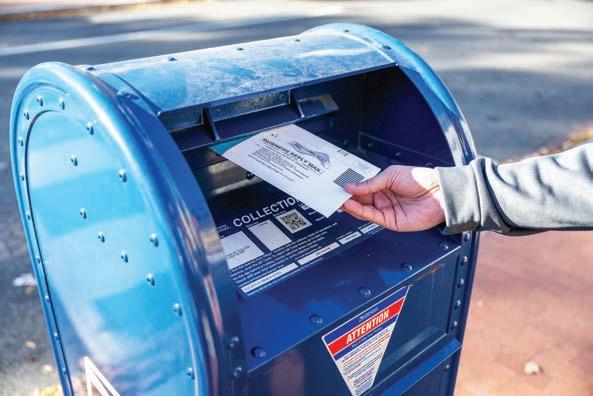
dents who said the package center has lost or delayed their ballots this year, causing them to pivot their voting plans for an election where the presidency, 34 Senate seats, all 435 House seats and thousands of local positions are on the line. But officials say they’ve implemented several policies this election cycle like processing updates and mailbox renovations to expedite the delivery of absentee ballots ahead of Tuesday’s general election.
University spokesperson Julia Metjian said GW Mail and Package Services employees began sorting absentee ballots separately from other mail and sent election-specific “Ballot Pickup” emails to students when their ballots arrived, a move that followed students’ reports in 2022 of broken campus mailboxes, lost ballots and package center processing delays that prevented them from accessing their ballots in time to vote in the midterm elections.
ANNALIESE PERSAUD REPORTER
SARAH GROSS STAFF WRITER
Students said they plan to cast their ballots for the presidential race with a focus on issues like reproductive care, preserving democracy and the state of the economy — all subjects they feel are at the forefront of American politics this election. Out of more than 60 students, nearly half said reestablishing abortion protections and preserving reproductive rights after the overturn of Roe v. Wade — a landmark Supreme Court case that granted access to abortion under the 14th Amendment’s right to privacy — is a top issue for the 2024 election. Others said issues like upholding democracy and improving the economy were deciding factors in their vote, followed by presidential candidates’ trustworthiness and lowering student debt.
More than 25 students who plan to vote said electing officials who support codifying reproductive rights is the most pressing issue at stake this election year. This election will be the first presidential race since the Supreme Court overturned Roe v. Wade in 2022.
Vice President Kamala Harris has said she supports national access to abortion, blaming former President Donald Trump for the reversal of Roe. She has made her staunch support for reproductive rights a key point of her vice presidency and presidential bid, saying she’d urge Congress to pass a national law codifying abortion rights if elected to office and would abolish the filibuster to constitutionally protect the right to abortion.
Junior Allie Robinson, an international affairs and economics student from Texas, said she’s voting to protect abortion rights because the United States was founded on the principle of freedom, which she said includes the right to choice and bodily autonomy. Twen-
ty-one states currently ban or restrict abortion earlier than the precedent set by Roe, which mandated that pregnant people could receive the procedure until 24 weeks.
Robinson said she’s worried about risks to women’s health in her home state. Abortion is banned in Texas with the exception for situations where the life or health of the pregnant person is at risk.
Democracy
Nine of more than 60 students said the state of democracy in the U.S. hangs in the balance this election, especially in the wake of Jan. 6, 2021, when a pro-Trump group stormed the Capitol in an attempt to halt the certification of election results.
Harris has shaped her campaign around fighting for democracy, condemning Trump’s efforts to overturn the 2020 election and pledging to accept the results of the 2024 election. Trump, who did not accept the results of the 2020 election, has run to make election integrity a large component of his second reelection campaign.
Students said they
used the trustworthiness and likability of candidates as a metric for how effective and committed they expect both presidential candidates would be in upholding democracy. Some students said they worried Trump would retaliate against American politicians with opposing views and fail to wield the power of the presidency responsibly and interact diplomatically with foreign leaders, based on Trump’s last term.
Anna Maag, a junior majoring in international affairs, said her parents were immigrants who grew up under a communist regime, so they underscored what it meant to have choices and freedom in a democratic country. Maag said Trump, if elected, resembles a threat to democracy, which is why she’s voting for Harris.
Economy
With voters ranking the economy as a top issue this election, Harris has said she wants to raise taxes on those earning $400,000 per year or more, and corporations, a policy in line with President Joe Biden’s plan.

GW community members who immigrated to the United States or come from immigrant families say they worry their lives in the United States will be uprooted if former President Donald Trump wins a second term.
Trump’s first term was marked by stringent immigration policies, including an effort to dismantle the Deferred Action for Childhood Arrivals program and heightened xenophobic rhetoric that spread fear and resentment toward immigrants. Now, as he campaigns for a second term, immigrant students and alumni from GW said the possibility of a renewed Trump presidency brings uncertainty about their families’s futures as the Republican presidential nominee has voiced his intentions to roll out mass deportations and tighten border policies that may make it more difficult for migrants to enter and stay in the country.




Officials announced the purchase of 2001 Pennsylvania Ave for $35 million in a release Friday.
The building will temporarily serve as a “swing space” for administrative and academic offices and will be managed by Carr Properties, its former owner, on behalf of GW while officials develop a long-term plan for the new property, according to the release. The University’s acquisition of the commercial office building comes after GW acquired Residences on The Avenue, an off-campus apartment complex, in February for $140 million and 600 19th St in December 2022 for $11.5 million.
The building is 161,000 square-feet with 67 percent of the space leased to third-party tenants, including Strada Education Foundation, according to the release. The release said 2001 Pennsylvania Ave, which is adjacent to James Monroe Park, will provide “immediate” revenue and cash flow toward GW’s endowment and reduce the University’s reliance on students’ tuition.

“This is a unique moment in the real estate cycle for the university to purchase this Class A asset that supports our academic mission,” Chief Financial Officer Bruno Fernandes said in the release. “The institution is making a strategic investment into the future by taking an as -
set at a great value on historic Pennsylvania Avenue.” Class A properties are considered the highest quality property in their market and area with amenities and highincome tenants.
Fernandes said at a Board of Trustees meeting in October that GW’s endowment has dropped $200 million since February 2023 due to the depreciation of the D.C. real estate market. A Moody’s Investors Service rating of GW’s finances released in March states that GW’s purchase of The Avenue will boost the University’s investment income, which is largely comprised of GW’s real estate portfolio and accounts for 40 percent of the University’s wealth. Associate Vice President and University Controller Neena Ali said at a Faculty Senate meeting last December that tuition made up 57 percent of GW’s operating revenue in fiscal year 2023. GW has been financially tuition-dependent for over a decade, but Fernandes said in May that officials have decreased their reliance on tuition revenue over the past five fiscal years.
Amid a national influx of universities formally enacting institutional neutrality policies following the outbreak of the war in Gaza, GW is not considering adopting the approach. Since the outbreak of the war in Gaza last October, more than 15 universities have adopted an official position toward “institutional neutrality,” which would require universities to refrain in issuing statements regarding any political issues, specifically those that do not directly affect the university’s main goals. University spokesperson Julia Metjian said GW isn’t considering adopting the stance, but some faculty and academic freedom organizations said GW should adopt policies that enable students to discuss and learn about both sides of political and social issues.
“At this time, the University is not considering implementing institutional neutrality,” Metjian said in an email. “If the administration were to consider adopting a stance on institutional neutrality in the future, we would consult with faculty, staff, and students as part of the process.”
GW has issued a host of statements on political issues, including after the June 2022 Supreme Court decision to overturn Roe v. Wade and after a shooting in Buffalo that killed 10 people in May 2022. University President Ellen Granberg has also released statements regarding Israel’s war in Gaza, using language describing Hamas’ Oct. 7, 2023, attack on Israel as “evil” and condemning the “acts of terrorism.”
Officials also condemned various forms of protest and expression by their students and faculty in the wake of Oct. 7, calling a student vigil for Palestinians killed by the Israeli military in the days after the attacks a “celebration of terrorism” that “glo-
rifies acts of violence.” Some speakers at the vigil hailed the attackers, adding that the attacks marked a new era in Palestine’s struggle for liberation.
University leaders across the country have struggled to address the war in Gaza and in some cases faced a tug-of-war between pro-Israel and pro-Palestinian factions on and off campus that are critical of their messaging to community members.
This year, universities like Harvard, Stanford and Syracuse have adopted the principle that administrations shouldn’t comment on political issues that don’t directly affect their mission.
Other universities, like the University of Chicago, adopted the principle for all political issues decades ago, following a report from a commission that sought to address how the university should respond to political and social upheaval of the 1960s as simmering racial tensions exploded into riots and the death toll from the Vietnam War mounted daily.
GW’s mission statement says the University has a duty to educate individuals, conduct scholarly research and publish the findings of their research.
Spokespeople for Harvard, Stanford and Syracuse did not return a request to comment on why officials decided to implement institutional neutrality and what impacts it has had on their campus. The universities said in their announcements of the policy that the adoption of institutional neutrality aims to promote academic freedom and free speech through on-campus civil discourse.
Three national free speech organizations — Academic Freedom Alliance, Heterodox Academy and the Foundation for Individual Rights and Expression — issued a joint letter in July calling on all college and university trustees to adopt neutral policies on political and social issues that do not concern core academic matters or institutional operations.
The letter calls on insti-
tutions to only comment on policy issues that impact the university’s ability to fulfill its mission, like the Supreme Court’s decision to overturn affirmative action, the consideration of race and other characteristics in college admissions.
Ryan Ansloan, the senior program officer of policy reform at the Foundation for Individual Rights and Expression, said GW is “uniquely positioned” to foster different perspectives on campus, and institutional neutrality can only further this discourse by allowing all sides to voice their opinions.
”
“The purpose of remaining neutral is that the university should be the home and sponsor of the critics and not the critic itself,” Ansloan said. “I think making clear from the outset to the campus community how the university is approaching making statements in general is a useful thing for schools.”
Ansloan said when institutions pursue a neutrality policy, the focus of students’
GW Reproductive Autonomy and Gender Equity is advocating for initiatives to protect abortion that will appear on the ballot in 10 states Tuesday.
New York, Maryland, Colorado, South Dakota, Nebraska, Nevada, Florida, Arizona, Montana and Missouri have ballot initiatives to either protect or restrict abortion on the state level — the most abortionrelated ballot initiatives in a general election on record. Stephanie Spector, the co-president of GW RAGE, said the organization held an event Oct. 15 to educate students about each of the ballot initiatives and has posted on social media detailing the initiatives on the ballot in each state.
Nebraska is the only state in this election cycle with a measure to ban abortion in the second and third trimester on the ballot, while the other nine states that have abortion initiatives on the ballot have measures that would protect the right to abortion. Of the 11 abortion initiatives on state ballots, nine are citizen-initiated and two come from the legislature.
Spector said many students did not know abortion-related measures were on the ballot in their state because some of the language on the ballots can be misleading. She said many of the state amendments do not have abortion in the title, so people may be confused on what they are voting on if they do not read the full text on the ballot, which can be lengthy.
“A lot of the ballot language is really confusing, and a lot of that is very intentional,” Spector said. “They’re kind of supposed to trick people into voting the opposite way. We’ve been just trying to educate
folks about what these initiatives are, you know, what the language is saying and how to vote for them.”
In June 2022, the Supreme Court overturned the landmark case of Roe v. Wade, which federally protected the right to abortion until 24 weeks. In the 2022 midterm elections, six states had abortion on the ballot. Voters in Kentucky, Kansas and Montana rejected initiatives seeking to restrict access to abortion and voters in California, Michigan and Vermont approved initiatives to protect the right to abortion.
28 states have laws banning abortion before viability with the procedure being almost completely illegal in 13 states, including South Dakota and Missouri.
Spector said Florida’s abortion ballot initiative is particularly “confusing.” The Florida initiative includes language about how the rise in abortions that could occur if the measure passes could “negatively impact the state budget.”
“It’s obviously a very, very leading question,” Spector said. “And if folks didn’t really know anything about it, much about abortion access in the state after reading that, they would just be inclined to vote no because they don’t know really any better.”
Spector said the abundance of ballot initiatives seeking to protect the right to an abortion in their respective states shows that people want their states to solidify access to abortion that Roe v. Wade once protected.
“The fact that so many states have been able to bring it to their ballots just really goes to show that people want abortion rights enshrined,” Spector said. “A lot of folks do not agree with the abortion bans that are being implemented by their governments.”
A 2015 study in the Political
protests shift from the administration to the campus community, since the university makes clear it will not comment on social and political issues.
Raheem Williams, the policy analyst of the Heterodox Academy, said it’s impossible to “unring the bell,” but GW officials should stop “compounding” potential past mistakes by continuing to weigh in on Israel’s war in Gaza. He said officials should make it “absolutely clear” that they will respect the free speech and academic freedom rights of students and faculty who disagree with their past statements and do everything they can moving forward to avoid the impacts institutional statements have by implying that there is a “campus orthodoxy.”
“GW should adopt an institutional statement neutrality policy because doing so ensures that University leadership will focus on creating a forum where faculty and students are free to debate the issues and make up their own minds,” Williams said.

Communication journal found that obscure or confusing ballot language in close races is enough to skew the outcome by misleading voters to vote a certain way, especially if voters have not heard of the initiative before voting.
Isel Neira, a first-year from Florida, said she voted to protect abortion rights in her state because she does not agree with the current sixweek abortion ban the state has in place. She said she had seen posters around her hometown encouraging people to vote yes on the amendment. “Banning abortion up to six weeks is a public health crisis,”
Neira said. “On an actual health perspective, I think it’s important. Second, I just believe that it’s a woman’s choice to be able to control what happens to her body. So I don’t think that the government should be interfering with that.”
Lila Wolk, a junior at GW from New York, said she voted yes on the Equal Rights Amendment to the state constitution — which would protect against discrimination based on pregnancy and reproductive healthcare outcomes — because she wanted people to be free to make decisions about all aspects of their reproductive healthcare, not just abortion, with conservative
lawmakers in some states attempting to ban other forms of contraception and IVF procedures.
“With laws about reproductive justice, people don’t quite understand how broad that is,” Wolk said.
“People tend to think that reproductive justice is just about abortion. And what I think these laws are actually doing is they’re enshrining the rights of you to have a child, to not have a child and to parent that child how you want.”
Reproductive rights advocates said amending state constitutions can protect abortion regardless of the beliefs of politicians, but ballot language can hinder these efforts.
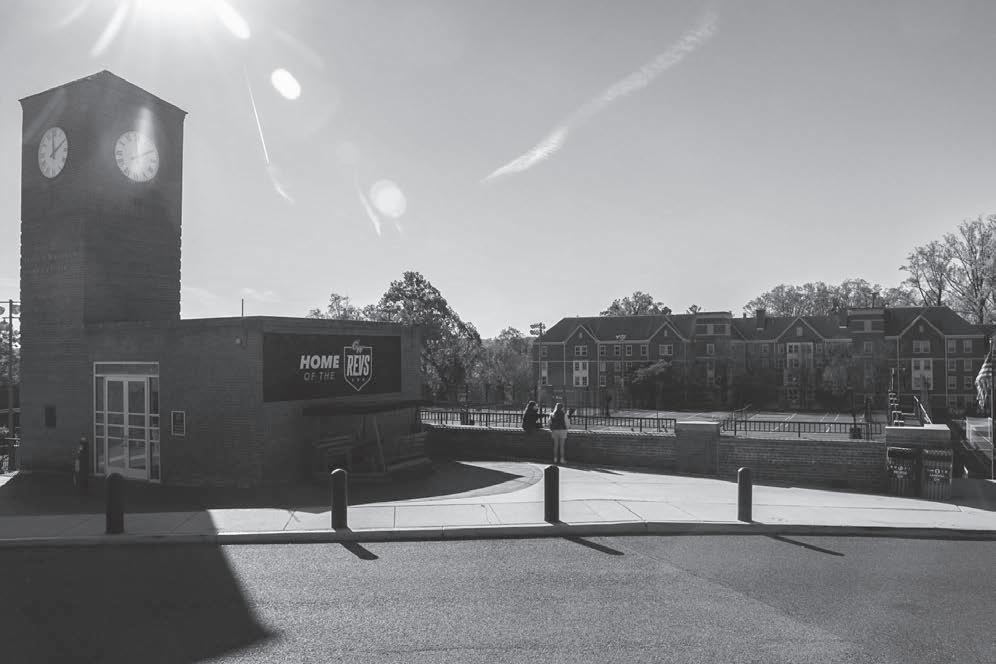
The University hired a new assistant dean of the Mount Vernon Campus in early September who students said they hope will advocate for heightened programming to enhance community-building efforts and greater health and food resources.
Betsy Shimberg will oversee the Vern’s programs, living-learning communities — or groups of residents living with other students in their academic program — and events after her predecessor, Laci Weeden, became the assistant dean for family engagement, according to her LinkedIn.
Students said Shimberg has made herself accessible on the Vern through multiple meet the dean events and hope she will continue to bolster programming on the campus.
Shimberg said she has convened the Residence Hall Association’s presidents for monthly meetings and met with representatives from multiple student groups so far in her role. She said she’s heard “insights” from residents at meet the dean events, during her office hours and while dining with students at the Eatery at Pelham Commons since she started at the University.
Shimberg comes to GW after more than 10 years at Brown University, where she most recently served as the senior associate dean of the College for Co-Curricular and Experiential Learning, leading a team that managed resources like undergraduate research, fellowships and pre-professional advising, according to her LinkedIn. She previously worked at Brown’s Swearer Center for Public Service, which she later directed.
“The opportunity to be the dean of the Vern combines my experience in university operations
and administration with my passion for nurturing robust student communities,” Shimberg said in an email. “With my family’s recent relocation to Washington, D.C., I am honored to serve in this role and to guide GW students to find community and connection on our beautiful Mount Vernon Campus.”
Shimberg said she has identified “broad” objectives and actions centered around the Division for Student Affairs’ goals of student belonging, connections and campus pride.
“These goals reflect the insights and feedback that some GW students have shared with me and I look forward to continued conversations as I refine a vision for the Vern,” Shimberg said in an email. “I am grateful to be working with our MVC team, as well as GW faculty and staff on the
Mount Vernon campus, to achieve these and additional goals in support of Vern students.”
She added that she met with alums of the Mount Vernon Seminary and College, the institution housed on the campus before GW bought the school in 1999, at their reunion event last month during Alumni and Families Weekend.
Junior Lauren McCutcheon — the president of Women’s Leadership Program, a living-learning community housed on the Vern — said she attended one of Shimberg’s “Coffee with the Dean” events and observed how responsive she was to students who live on the Vern and students who just visit the campus for their University Writing classes, a program required for all undergraduate students mainly taught on the Vern.
“I saw students bring
concerns to her about sustainability on the Vern, the Student Health Center and CAPS access on the Vern, and she was taking notes and I know she has followed up with multiple students on their concerns,” McCutcheon said.
McCutcheon said Shimberg is actively working to reduce the isolation some Vern residents can feel while living about 10 minutes away from GW’s main campus in Foggy Bottom by encouraging student organizations and Greek life to hold meetings and events on the Vern, offering to provide snacks and resources to support the gatherings.
“It’s been a very positive change to have someone who’s dedicated to advocating for the Vern and bringing those opportunities for the freshmen,” McCutcheon said.
McCutcheon said there should be more events
and opportunities cen -
tered around GW Athletics, as well as taking advantage of the Vern’s ample outdoors space, like hosting soccer game tailgates, bonfires and outdoor movie nights.
“Really making use of the beautiful outdoor space that the Vern has since it’s something that Foggy definitely doesn’t have, and I missed it when I moved to Foggy last year,” McCutcheon said.
First-year Sam Calderwood, the RHA president of West Hall, said Shimberg has hosted numerous events to connect with students so far in her position like “Cobbler with the Dean” last month by the Webb Building where students could chat with her while enjoying cobbler around the Mount Vernon Express stop.
“She’s working very hard to get her name out there and make sure
people know her,” Calderwood said. “I don’t think everyone’s super aware of who she is and what she’s doing behind the scenes.”
Student Government Association President Ethan Fitzgerald said he met with Shimberg shortly after her hire in September to share his past feelings of isolation as a former Vern resident during his first year and introduce her to other student leaders who could help identify areas for campus improvement. Fitzgerald said there’s a growing recognition of the need to build community on the Vern among administration because of advocacy from students.
“I’ve certainly seen the difference between the Foggy Bottom and the Vern,” Fitzgerald said. “Just the ease of access to resources on Foggy Bottom, the ability to go to events quickly and the general community of being able to be with your friends since obviously a lot more live on Foggy.” In September 2023, officials added a breakfast time to Pelham Commons after students said the campus had limited breakfast options and they would travel to the Foggy Bottom campus. Fitzgerald said SGA is working with Shimberg and the SHC to expand mental and physical health resources on the Vern like lengthening SHC hours, improving emergency response times, addressing food insecurity and dining improvements and advocating for broader student concerns. He said the SGA also aims to support leaders on the Vern in enhancing events and programming that promote community building.
“First of all, there should be the basic services that are guaranteed on any campus you’re on,” Fitzgerald said. “I think there are services that, rega rdless of your campus, should be offered.
Amsterdam Hall
10/27/24 – 1:52 a.m.
Closed case
GW Police Department officers responded to a report of drunk students. When officers arrived at the scene, they made contact with the three women: two Howard University students and one GW student. GW Emergency Medical Response Group arrived and evaluated the students before transporting the two Howard students to the GW Hospital. Referred to the Division of Conflict Education & Student Accountability.
THEFT II/BICYCLES
2200 Block of H Street NW
10/28/24 – 12:10 p.m.
Open Case
A male student reported their secured bicycle stolen. Case open.
DRUG LAW VIOLATION
Lafayette Hall
10/29/24 – 11:52 p.m.
Closed case
The administrator on call in Lafayette Hall called GWPD officers when they smelled a suspicious scent in the building. GWPD officers received a controlled substance, which was taken from a male student, from the administrator and brought it to the academic building for processing. Referred to CESA.
LIQUOR LAW VIOLATION
Cole Hall
10/30/24 – 10:57 p.m.
Closed case
GWPD officers responded to the report of two drunk female students. EMeRG arrived on scene and completed a medical evaluation on the students. One woman was taken to the Georgetown Hospital and the other refused further treatment. Referred to CESA.
BUILDING
Science and Engineering Hall
Reported 10/31/24 – Unknown Date and Time
Open Case Staff reported two laptops stolen from a secure IT office. Case open.
—Compiled by Ella
Mitchell
BROOKE FORGETTE
CONTRIBUTING NEWS EDITOR
VALERIE WATSON
REPORTER
The National Pan-Hellenic Council’s eight campus chapters hosted a series of events centered on civic engagement throughout this semester leading up to Election Day in an effort to amplify Black student voices in the general election.
Divine Nine chapters at GW and across the country hosted voter registration drives and educational events about politics and voting in a push to prepare students to vote in the upcoming razorclose presidential election. Chapter leaders said this semester’s mobilization in civic engagement proved successful, with high levels of student engagement in roundtable and panel discussions and handfuls of students registering to vote in the upcoming election.
Matthew Jones, a junior and the vice president of GW’s Nu Beta chapter of Alpha Phi Alpha Fraternity, Inc., said educating Black communities, in this case on topics, like the stances of the presidential candidates and how to cast their vote, is a commitment each member made when joining their organizations, which is why the chapters centered their programming around voting ahead of the election.
“We want to serve our communities in whatever way that we can, and so voting is a big part of that and especially with it are all of our organizations having an emphasis on promoting African American civic engagement and uplifting communities, that’s something that we all just naturally sort of would do on our own,” Jones said.
Alpha Phi Alpha, a District-wide chapter that encompasses GW, held a series of events during their voter education week at American University from Sept. 29 to Oct. 3, where attendees spanning from chapter members from colleges across the District discussed the campaigns of Vice President Kamala Harris and former President Donald Trump in panels and information sessions. At one event, students were able to participate in a panel discussion with members of the NAACP about candidates’ specific policies, Jones said.
“We just wanted to highlight the differences in the way Black voters think and then also the importance of our Black people being able to participate in the election,” Jones said.
Jones said at the events, the fraternity would present the polling numbers of the election to stress how narrow the election is predicted to be and the impact one vote can have because he says some people within Black communities feel
like their votes don’t matter as much due to the slow pace of political change.
“Change can be very slow, so there’s a lot of voter nihilism and just overall apathetic attitude towards the voting system,” Jones said.
Jones said the chapter also aimed to highlight the nuanced political opinions among students and “demystify” the misconception that all Black people are Democratic and vote the same way by inviting students to share their opinions on the presidential race and which policies impact them the most.
Jones said his fraternity focuses on continuing the legacy of Martin Luther King Jr. — an alum of the Sigma chapter of Alpha Phi Alpha Fraternity, Inc. — and his political and social contributions to the Black community by continuing to spark change on GW’s campus. King, most known for his “I Have a Dream” speech, spearheaded the Civil Rights Movement through nonviolent techniques, like protesting and grassroots organizing and advocating for legal freedom and equality for Black people, efforts Jones says the fraternity hopes to renew on campus.
“Honestly, as a member of the fraternity, I still feel like I’m a part of what Dr. King set forth through all his actions throughout the Civil Rights Movement,” Jones said. “So yeah, I’m sure if he was still around, he would love to be able to see a Black woman being able to run for president now in 2024.”
Brittany Myers, a senior and the historian of GW’s Mu Delta chapter of Alpha Kappa Alpha Sorority, Inc., said Harris, an alum of the Alpha chapter of Alpha Kappa Alpha Sorority, Inc. at Howard University, serves as a “role model” for her and her chapter at GW.
“It’s the best feeling to know that someone who is and was in our shoes is in a place of power that’s so high,” Myers said.
Myers said through her chapter’s four events on voter engagement, which ranged from a registration drive to a streamed podcast, AKA strived to give a voice to Black students who may feel like their votes don’t count.
“Voting isn’t just like a college time period, this isn’t just something that they’ll learn in college, but it’s something that they have to do, like long, and so we want to make sure we’re making lifelong impacts that can stay with them for the rest of their lives,” Myers said.
AKA hosted an event Sept. 17, which is National Voter Registration Day, which helped students register and to be prepared to vote, and an informational event titled “Pretty Politics,” where the chapter discussed the platforms of each presidential candidate and how to navigate media coverage of each candidate. The chapter also hosted a live podcast in September on their Instagram, which allowed audience members to engage with chapter members.
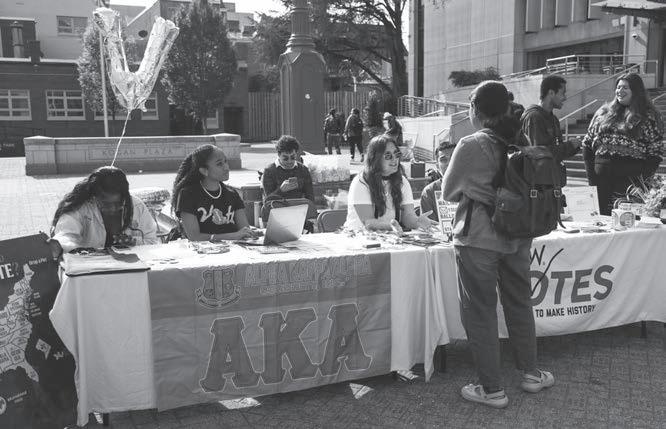
AKA tabled in Kogan Plaza last Tuesday with GW Votes, a nonpartisan coalition of students, faculty and staff that promotes voter registration and participation among students, for National Vote Early Day to provide voting materials for students.
“In a broader sense, just helping inform students of the political landscape in an approachable way and connecting issues in the community to the values and concerns that they have and just making sure that they felt that they were fully informed on political environments today,” Myers said.
The Student Bar Association’s food security committee is gathering data about student experiences with a lack of local, affordable food options and planning free food events during its inaugural semester to combat law student food insecurity.
SBA Sen. Elan Reisner, the chair of the Special Committee on Food Security, said he was inspired to launch the committee in April after he heard his peers joking about skipping meals last semester. Reisner said the committee is hoping to organize a Thanksgiving event to distribute meals to law students and is currently administering a survey on food insecurity to GW Law students.
“If you’re hungry, you’re going to perform worse on a final,” Reisner said. “If you’re hungry, you’re going to be stressed more than the average person.”
GW added all-you-care-toeat dining halls in Thurston and Shenkman halls to campus meal plans in 2022 in an effort to alleviate food insecurity on campus and offer healthy and “high-quality” food options for students. Prior to the opening of dining halls on campus, students voiced concerns about a lack of food options accessible by GWorld swipes, including Student Government Association leaders, who created a list of recommendations in 2019 for more dining hall and meal deal options for the University to implement. All registered GW students, including law and graduate students, are able to purchase any of the meal plans GW offers.
Reisner said the committee of five SBA members has met twice so far this semester and plans to continue meeting throughout the year but has not outlined a specific meeting schedule. He said he’s
mentioned the committee to SBA senators at recent full senate meetings to grow committee membership and has recruited at least one of the newly appointed senators to join the group. The committee currently consists of SBA members from the executive and legislative branches, but Reisner said he is “open” to inviting non-SBA law students to meetings so they can also provide feedback on campus food accessibility.
He said the committee launched the survey at the start of the semester, which asks students if they have experienced food insecurity on campus and what they believe is its predicted effect on their academic performance. Questions also asked students about their awareness of
GW’s food pantry, The Store, in the District House basement and if they would be interested in “peer support” programs, like a Thanksgiving food distribution initiative led by the SBA, to provide food to students.
Reisner said the committee included the survey in the weekly SBA email newsletter, which GW Law distributes to the school’s student body.
So far the survey has garnered over 50 responses — about 3 percent of GW Law’s total population — and has revealed a lack of respondents’ awareness of food resources. 62.7 percent of surveyed students responded that they were not aware of GW’s food pantry and 78 percent said they were not aware
of the Supplemental Nutrition Assistance Program, previously known as food stamps.
Survey respondents said it would be “advantageous” to them if the University supplied healthier free food options at law school events instead of the frequently offered pizza and donuts and if officials increased advertisements of the food pantry in places, like the SBA newsletter and GW’s website to increase student awareness of the resource.
Reisner said D.C.’s high cost of living and an influx of law students taking out student loans has contributed to more GW students facing food insecurity.
A Department of Education study from June 2021 found 23 per-
cent of undergraduates and 12 percent of U.S. graduate students in the United States experienced a lack of accessible food options within the year.
“When you have an issue like food insecurity, you need to have a way to get a starting point,” Reisner said. “You need to understand the issue in a way that’s not just editorializing, that’s actually grounded and true.”
Briahnn Middleton, the SBA’s director of legislative affairs and a Special Committee on Food Security member, said she wants to present the survey results to GW Law deans and work with officials to implement a food distribution program on campus.
Middleton said the committee is developing an event for Thanksgiving so students who are staying in the D.C. can receive free food or “meal prep” meals.
As a first-year law student, Middleton said many of her peers have told her they were not aware they could purchase meal plans as law students, resulting in many of them not eating for the entirety of their school day because of a lack of accessible food.
“I’m at the school from like 12 to 8 most days, and a lot of people I know are not eating from the time they come to campus to the time they leave,” Middleton said. “So I think nutrition and stuff like that can really impact your performance at school.”
SBA Executive Vice President Nigel Walton said he joined the committee because he has experienced food insecurity himself, citing times he had to choose between a meal and paying rent during law school. He said the recent increases in GW tuition has caused more students to “wonder” where their next meal will come from, and he believes “no one should have to choose” between food and other monetary obligations.
University President Ellen Granberg joined a national initiative of university presidents to strengthen civic engagement on college campuses, according to a University release last month.
The release states that the College Presidents for Civic Preparedness will work to develop campus-specific programming including new courses, speaker events and voter education initiatives and will meet regularly to discuss how to help faculty engage with free speech and civil discourse in the classroom. Some faculty said they hope the initiative will foster difficult conversations on topics like the war in Gaza and boost students’ civic engagement.
“In this era of increasing polarization, it is critical that universities continue to emphasize and teach the enduring values of civic engagement, civility, integrity and transparency,” Granberg said in the release.
The Institute for Citizens & Scholars, a nonprofit organization, launched the College Presidents for Civic Preparedness in 2023 to prepare students as “confident” citizens within democratic society through fellowships,
higher education and civic learning research, according to the institute’s website. The group’s initiatives include hosting events, promoting democratic themes and centering free speech as a guiding principle on campuses.
Over 100 university presidents are involved with the initiative, according to the College Presidents for Civic Preparedness website.
During the 2023-24 year, 88 percent of presidents in the initiative created classes that centered civil discourse, 98 percent hosted debates, speaker series or dinners, 98 percent generated new research initiatives or fellowships and 94 percent held civic and politically engaged events, according to a progress report by the initiative.
The University of Pittsburgh, which GW also considers to be a peer school, designated the 2023-24 academic year as the “Year of Discourse and Dialogue” as part of the initiative, where the school funded 35 proposals for speaker events, activities and workshops about discourse, according to the initiative’s progress report.
Ned Lazarus, a teaching associate professor of international affairs, said he feels optimistic about the University’s involvement with the
initiative and believes it will support lasting dialogues and open discussion on campus.
“It seems to support the kinds of values that lead to constructive debate and to a community where people feel that they have the legitimacy to think for themselves and develop their own point of view and express it,” Lazarus said.
Lazarus said he hopes the GW community can continue to engage in difficult national and global conversations while ensuring that people feel their perspectives are acknowledged on campus and not “delegitimized.” He said having difficult conversations will help create constructive conversation and learning surrounding the war in Gaza and future conflict that the upcoming election might cause.
Lazarus said he thinks Granberg joined the initiative in response to the “eruption” of protests last academic year and the “divide rhetoric” surrounding it. He said he hopes initiatives like College Presidents for Civic Preparedness don’t “flame out” once discussions over the protests end.
“It is hard work of learning how to engage in dialogue and also in debate that
doesn’t cross over into civil war. That’s going to remain very important,” Lazarus said.
Lazarus said promotion of critical thinking and civic discourse can begin with faculty ensuring that students receive multiple perspectives on a controversial topics. He said he requires his students to conduct conflict analysis, or examining aspects of conflict to find resolutions, in his conflict resolution courses to

understand all sides of a conflict through an empathetic and human lens.
“In order to understand what’s happening in a political conflict, you need to understand why some people support views that you may find completely wrong and you can’t do that when you are filled with antagonism towards them,” Lazarus said.
Granberg and Provost Chris Bracey initiated faculty working groups this summer to address challenges to the University community after campus tension surrounding the war in Gaza last academic year, including ones focused on community conversations and free speech.
Lazarus, who was a member of the community conversations working group, said he “hopes” the initiative adds to the work done by the group over the summer, which revealed a larger, ongoing need for faculty-led engagement in difficult community-wide discussions.
The community conversations working group recommended the University provide workshops laying the groundwork for respectful conversation around difficult topics and report back to the University on the outcomes of those conversations to ensure student voices are heard and respected, according to the group’s report.
“We should probably have that all the time, we should probably have faculty engaged in building these kinds of conversations,” Lazarus said. “That should be just a constant part of our work at the University.” Michelle Kelso, an assistant professor of sociology and international affairs and
director of the Human Services and Social Justice program, said Granberg joining the initiative underscores the importance of civic engagement in and beyond academia.
“I’m so excited that she has done that because I think it sends a signal to how important civic engagement is, not only in academia, but more broadly and partnering academia with community and local organizations,” Kelso said.
Kelso said she hopes the initiative will bring more resources for civic education courses and emphasize the importance of service learning for students to boost their civic engagement and promoting their career goals.
“There’s not enough understanding of the pressures that faculty have when you’re teaching fully engaged community service courses,” Kelso said. “I think that that means some more training needs to be done with the administration, and I’m hoping that that’s what this organization will help university presidents understand is that, yes, this is so important for our students.”
Nizar Farsakh, a lecturer of international affairs and a member of the community conversations working group, said he hopes that the initiative informs student activism and conversations and redirects it to be more intentional.
“I would want them to be more active, but active in more productive ways and in ways that are smart,” said Farsakh.
Farsakh said along with the initiative, professors play a vital role in directing civic engagement in the right direction.

Page 2
2A03: Patel runs unopposed, eyes on her fourth term
Patel, who graduated from GW with a master’s degree in 2005, is running unopposed for her fourth term in singlemember district 2A03, which lies between New Hampshire Avenue and Georgetown.
After three terms on the ANC, Patel said she planned to retire but decided to run again to oversee the opening of The Aston, a former GW residence hall in single-member district 2A06 that D.C. officials are converting into an unhoused shelter. The governing body voted in June 2023 to request that officials establish a Community Advisory Team to provide input on the conversion, and two ANC commissioners were elected to represent the body on the team in November 2023.
Patel, who took over as chair of ANC 2A after Malec resigned in April, led the body in sponsoring two resolutions requesting The Aston’s roof undergo repairs after D.C. officials determined in fiscal year 2023 it needed “immediate replacement.”
2A04: Comer stages second-term run
Comer will run unopposed for the single-member district 2A04, which stretches
from K Street to the Arlington Memorial Bridge by the Potomac River. Comer said in his second-consecutive term, he hopes to communicate with GW to promote neighbors’s use of campus spaces like Gelman Library and encourage people to attend student-run events, like theater shows.
2A05: Chadwick dropped out in September
Chadwick, who took over the previously vacant singlemember district 2A05 seat in January, withdrew his reelection bid in late September, leaving the seat vacant. The master’s student at Georgetown University said he would not have been able to balance his “professional and academic responsibilities” with the ANC’s time commitments.
When Chadwick entered the ANC in January, he filled the last remaining vacant seat on the commission. He most recently sponsored a resolution in May requesting that city officials change heating and cooling time frames to allow rental companies more flexibility in meeting tenant needs.
“I hope that another member of our community will be able to pick up where I leave off,” Chadwick said in an email. “It has been a deeply rewarding experience that has filled me with so much pride for our part of the city.”
2A06: Causey leaves ANC after two terms
Causey is not running for reelection in single-member district 2A06, which includes the northeastern side of West End and properties like Yours Truly and the Ritz-Carlton.
Causey, who first joined the ANC in January 2021, stepped down as chair of the ANC in April 2023 after The Hatchet reported he is a registered sex offender in Florida, but he continued to serve out his term as a commissioner. He represented his district on The Aston’s Community Advisory Team and was a voice behind efforts to remove bike lane barriers and fully illuminate the traffic signals on Virginia Avenue to increase pedestrian safety.
Causey did not return a request for comment on his decision to not run for reelection.
2A07: Seat left vacant after alum resigns
No one is running for single-member district 2A07, which covers Potomac House, South and Guthridge halls. The seat was formerly filled by Bandy, who graduated from GW in May and resigned in August to pursue education outside of D.C. after graduating.
2A08: Malec seeks to return to ANC amid Aston delays Malec, the former chair
of the ANC from May 2023 to May 2024, is running for single-member district 2A08 — which starts at the intersection of 20th and L streets — after he moved to the District in April. As co-chair of the CAT, Malec oversees community debate on The Aston. He said he hopes to help get the shelter’s opening “over the finish line” after almost a year of delays, which is an “amazing opportunity” to show D.C. and other cities how neighborhoods can work to solve homelessness.
ANC members need to conduct more “outbound” and “proactive” communication by being more visible in the community, Malec said. “We should be where people are so that we can hear from them about what is happening in the community and act on that but also so that they know that we exist, so they can become involved in that,” Malec said.
2A09: Hudson leaves ANC after serving for five years
Hudson is not running for reelection for single-member district 2A09, which covers Amsterdam, Madison, Fulbright and JBKO halls and the GW Hospital, leaving the seat vacant. Hudson has not been to an ANC meeting since May 2023 due to health issues.
From Page 1
Allred faces off against Republican twotime incumbent Sen. Ted Cruz (R-TX), who has held the seat since 2013 and received an endorsement from Trump. Democrats have poured millions into the race in efforts to flip the seat blue, while Republicans are confident Cruz can hold onto his post as polls show the race in a dead heat.
McNamara said he thinks Cruz will pull off a win on Election Day but added that many Texans don’t view the incumbent as a “common man” after he received backlash in 2021 for traveling to Cancún, Mexico, as Texas endured the harshest storm locals had seen in generations.
“It seems like he’ll desert us sometimes in times of need,” he said.
Sophomore Hayden Rometty, a political communication student from Farmington Hills, Michigan, said he’s voting for Republican Senate candidate Mike Rogers because of his emphasis on bringing manufacturing jobs back to Michigan, which have dropped by 6.4 percent since 2019, and curbing inflation, which spiked in 2021. Sen. Debbie Stabenow (D-MI) retired this year, leaving the seat open and pitting Rogers, a former Michigan congressman, against Democratic candidate Rep. Elissa Slotkin (D-MI) — one of four toss-up Senate races expected to determine control of the upper chamber.
He said he opposes Slotkin’s support for electric vehicle mandates. Slotkin has been under fire from Republicans who tie her to President Joe Biden’s emission standards that would require two-thirds of cars to be electric by 2032 because of her refusal to vote to overturn the Environmental Protection Agency’s limits on tailpipe pollutants from cars and trucks.
Rometty said Rogers has contended that electric vehicle mandates would reduce manufacturing and auto jobs in Michigan, industries central to Michigan’s economy. He added that Republicans criticize Slotkin for voting for the Inflation Reduction Act in Congress, which they said didn’t lower inflation.
“A lot of people in Michigan see her as someone who is maybe less understanding of some of the issues that Michiganders are concerned about,” Rometty said. “She’s a little bit more distant, and she’s a little more connected to Washington.”
Junior Bridget Munoz, a statistics and philosophy student from Bucks County, Pennsylvania, said she voted this election to unseat incumbent Rep. Brian Fitzpatrick (R-PA), who’s been in office since 2017, because she opposes book bans and mandating parental consent for a student’s request to change the name or pronouns they use at school. Fitzpatrick voted in favor of the Parental Bill of Rights Act, which passed the House in March 2023 and would have mandated parental consent for pronoun changes and required parents to receive a list of books accessible in the school library, among other proposed policies.
Munoz said her high school district had a “serious book banning issue” and forbade students from reading any book that mentioned homosexuality. She said Fitzpatrick’s support for such mandates could put students in unsafe situations at home.
NORAH WOODS STAFF WRITER
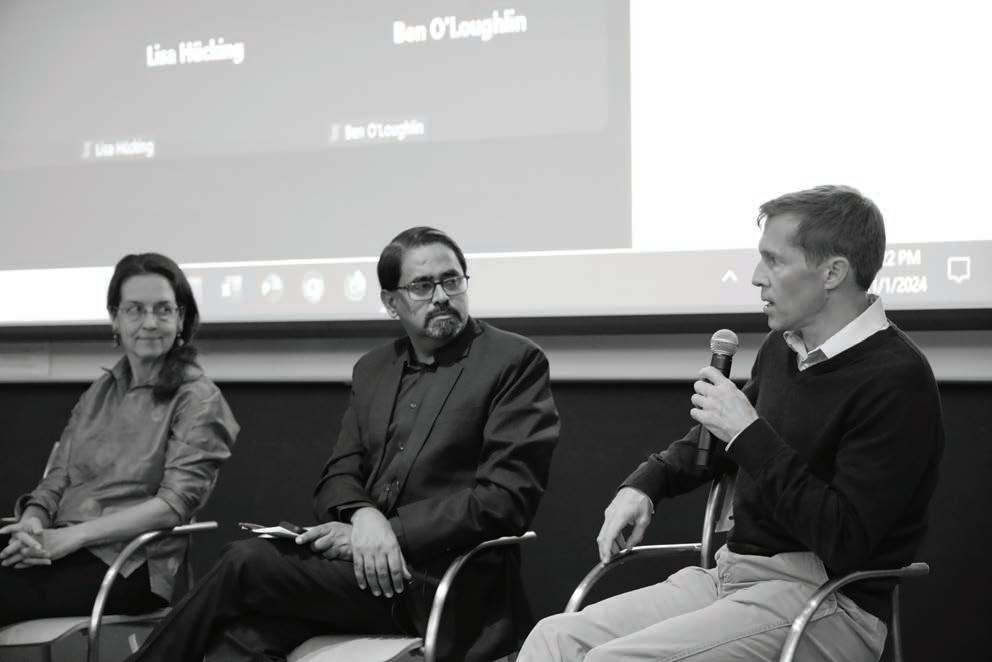
Three experts on international political discourse discussed strategies for preventing election violence at the Elliott School of International Affairs on Friday.
Susan Benesch, a journalist and communication researcher, Vasu Mohan, an expert in conflict advising, and Theo Dolan, an activism advisor at the U.S. Agency for International Development, discussed the growing risk of political violence in western democracies and highlighted lessons they said the U.S. can learn from regions affected by election violence. The event was moderated by Babak Bahador, the director of GW’s Media and Peacebuilding Project — which studies how communication affects security and peace — and was hosted by GW’s Institute for Public Diplomacy and Global Communication.
Benesch said after the 2007 elections in Kenya, a devastating surge of violence resulted in over 1,000 deaths and the displacement of half a million people. She said the wave of violence was caused by candidates deliberately and strategically pitting their supporters from various ethnic groups against one another.
She said leading into the Kenyan national and parliamentary elections
in 2012, concerns in the country remained high for the possibility of violence in future elections. Benesch described this manipulation tactic as a prolonged campaign of “dangerous speech.”
“Dangerous speech is rhetoric that has the capacity to lower normal social barriers against violence and inspire intergroup violence by getting one group of people to perceive another as a threat,” Benesch said.
Bahadur said it is “interesting” how seriously Americans often take politicians’ words as they are often performing and may not even think of the rhetoric they are using as a campaign tactic.
Mohan said while international political processes and U.S. elections may appear different, there is considerable overlap, especially in addressing shared challenges. He said the U.S. could learn from other countries’ experiences, like Indonesia’s, in tackling electionrelated violence, divisive rhetoric and incitement in their communities.
Mohan spoke about his work in Indonesia during the gubernatorial elections in 2018 in West Kalimantan, a province of Indonesia on the island of Borneo, where he worked as a conflict advisor for the International Foundation for Electoral Systems. He said candidates from the majority Muslim Malay ethnic group and pre -
dominantly Christian or tribal Dayak community competed in the election, with tensions already high among communities divided along ethnic lines.
Mohan said much of the hateful rhetoric came from supporters rather than the candidates themselves. He said election authorities worked to address potential election violence, including the training of religious lead-
ers to use their platforms to de-escalate tensions without taking sides.
Mohan also said Mafindo, which he described as a hoax-countering organization, developed a fact-checking tool prior to the elections that was instrumental in addressing hoaxes and disinformation. Mohan said a comprehensive, “whole-of-society” approach is crucial, as no single intervention would
have achieved the same level of success.
“We look at election violence as sort of topdown responses,” he said. “But I feel like when you have a combination of these factors, I think we’re likely to see less violence.”
The panel spoke about the deliberate spread of disinformation and the urgent need for comprehensive media literacy that not only identifies
content generated by artificial intelligence and misinformation but also encompasses ethics, social cohesion and conflict resolution training to recognize how certain content can incite harmful actions.
Mohan said it is important to incorporate a diverse range of voices in discussions about peace initiatives to effectively address both violence and political violence.
“Our country can’t properly serve its people if the government only represents one gender.”
—ALEXIA GREEN on 10/28/24
The key to Magic Johnson’s game was always communication. That desire to interface with those around them is shared by Rondell “Magic” Jordan, the independent, write-in candidate for the D.C. Council’s Ward 2 seat — who happens to be nicknamed after the basketball legend.
Jordan, a Brooklyn native who moved to Dupont Circle in 2019, is a civil rights attorney. Jordan wants to take on city-wide issues like the housing crisis and poverty without retreading failed policies. That’s why this election, we urge Ward 2 residents to vote for him.
Jordan wants to help unhoused people in the District by, talking to them to form an evidence-backed understanding of how to help them. His plan to address poverty in the area is very simple but refreshingly visionary: Just give people money. He said he’s happy to eliminate managerial jobs if it alleviates poverty for a handful of D.C. residents. We view this direct approach to reducing poverty as a breath of fresh air. We can’t guarantee that the policies will work, but we know the current plans aren’t effective, and Jordan does too.
Jordan said he also wants to hold D.C. housing developers accountable by “calling them out.” He slammed developers who take advantage of tax breaks that root in the construction of “affordable” housing units. He said he wants to talk to unhoused residents about their situation because “the people who are experts on homelessness are the unhoused.” We’re glad to see a public leader in the District focused on listening to all their residents, not just those who wield the most power to influence politicians.

Another tenet of Jordan’s campaign is a conversation-based approach to gun violence issues. He said most leaders are eager to defi ne young Black boys and men as either “super predators or particularly dangerous human beings” that should be locked up. Having a leader willing to identify problems in the criminal justice system is the only way those problems can be fi xed.
Ward 2 Councilmember Brooke Pinto — the Democratic incumbent for the seat who does appear on the ballot — whose Secure DC law passed earlier this year, instituted harsh penalties and broader defi nitions of crimes. Jordan plans to examine the history of crime reduction,

educate young people about the harms associated with gun violence and offer grief and trauma counseling for victims of such violence — a preventative, rather than retroactive, approach. In an interview with the Georgetowner, Pinto said she wants to “maintain the systems in Georgetown.” But we’ve seen that approaches to crime prevention like Pinto’s don’t work.
Every politician, would say they wanted to listen to their constituents and solve problems accordingly — but Jordan made his case in a way that put his passion on display and showed that status-seeking career advancement isn’t at the forefront of his work.
I’m voting for I-83, but I’m not happy about it
view D.C.’s Initiative 83 as a band-aid over a bullet wound.
Nick Perkins Opinions Writer
I-83 is a two-pronged ballot initiative on the ticket in D.C. this election cycle. If passed, the measure would let registered independents vote in the party primary of their choosing and put ranked-choice voting in place for all city elections, in which voters rank their preferred candidates.
The initiative is abstractly positive and in theory, a series of good ideas. But it ignores the realities of D.C. as an overwhelmingly Democratic city, and I worry that it will be ineffective as a result.
There’s no chance for a mass group of D.C. voters to hold the election winners accountable. Any attempt at electoral reform that wants to promote democracy and competitive elections needs to recognize that — which I-83 fails to do by continuing to silo off decisive District elections in primaries.
Sure, letting independents vote in the Democratic primary will in some small sense boost the total representation. But the point of I-83 is to promote democratic values in D.C., and the initiative ignores the main issue of the District’s democracy, which is that voters don’t get to choose
between viable alternatives in general elections.
.Just look at 2022: Incumbent Democratic Mayor Muriel Bowser received about 30,000 more votes in the noncompetitive general election than all candidates did in the much closer Democratic primary where she eked out a 9-point win. Regardless of if you like Bowser, it’s ridiculous and antidemocratic that someone can be mayor for three terms without ever sniffing a truly competitive election where everyone in D.C. has a chance to vote.
In the District, whoever wins the Democratic primary for all intents and purposes wins the election. That’s a problem for any leader claiming to have the consent of the governed because, in a major way, they don’t. They have the consent of a smaller subset of the governed who happen to be politically involved enough to vote in a primary election. To achieve a real, classically democratic majority, they’d need a majority of people in the most open election — the general — to vote for them over another viable alternative. That doesn’t happen in D.C. when the general election is between a Democrat and a Republican. In that way, I-83 helps the injury of undemocratic elections in the District, but in reality, it’s an insufficient solution that ignores the severity of the wound.
A commonly advanced method of expanding the
influence of primaries is instituting jungle primaries, which are in place in heavily Democratic states, like California and Washington. In these cases, primary voters choose between a massive field of candidates, and the top two advance to the general election regardless of party. That way, you guarantee the winner of the general election gets a majority, while also allowing for competitive general elections in one-party areas. result of this system.
I don’t view this method as a one-size-fits-all solution, since in a jungle primary, the top two candidates could advance with something like 25 percent of the primary vote each. But a jungle primary combined with ranked choice voting would be a better fit to the actual circumstances of D.C. than what I-83 tries to put forth.
With all that said, I’m still going to vote yes on I-83. I view the initiative’s goals as “absolute” positives — politicians actually representing a majority of their constituents is good for democracy, and more people getting a chance to choose their representatives is good too. But I-83 isn’t addressing the fundamental issues in D.C. voting. Until reform makes general elections more competitive, the wound in the District’s democracy will just keep bleeding.
—Nick Perkins, a senior majoring in political science, is the culture editor.
FWard 2 is also yearning to have a councilmember that they can trust. In 2020, longtime Councilmember Jack Evans resigned amid corruption. Pinto, his replacement, has faced allegations of campaign fi nance law violations. This campaign hasn’t been free of controversy, either. Johnson said he wound up running as a write-in for the seat after Pinto contested the signatures he collected over the summer, deemed invalid due to what he called honest mistakes. Our editorial board wrote in 2020 that Ward 2 voters had a chance to “turn over a new leaf” by voting for Pinto’s opponent. That’s still true today. We reached out to Pinto’s
campaign to meet before writing this endorsement and received no response.
If Jordan were to win, we don’t think that he will have solved poverty, gun violence and housing insecurity four years from now. But we do think he would have had the right conversations with the right groups than our current representative. That’s all you can ask from your leader in local government. That being said, we hope to see Jordan expand the realm of his communication with constituents. He admitted that he doesn’t spend time in Georgetown, though the neighborhood falls in Ward 2. We appreciated his ideas on how to fi x Districtwide problems, but we also would have liked to see more plans specifically targeted for Ward 2. If he emerges victorious, we encourage him to strike a balance between serving Ward 2 as he works to solve the most pressing city-wide issues. We also want the idealistic Jordan to view governance through a more practical lens. It can be refreshing to hear a candidate openly blast “Suits”-style bureaucrats as “the worst kind of lawyer,” but amid the impending possibility of a Republican in the White House that seeks to ramp up federal control over D.C., we hope Jordan can balance his desire to take on the establishment with necessary compromises that make up the core of governing. Ultimately, we see Jordan as a candidate who promises the communication, approach and advocacy that a local politician should have, and Ward 2 residents should write in his name for D.C. Council because of that. Like his namesake, Jordan deserves a chance to run the point on Ward 2 policy.
ormer President Don-
ald Trump’s “Make America Great Again” slogan evolved into a cultlike movement across his three presidential races, with white evangelical Protestants at its core. Christian nationalism has morphed into a new type of faith where the MAGA community is the church and Trump is the savior.
Carter Willis Opinions Writer
The MAGA community elevates Trump to the status of not just a leader, but a God-like figure. In fact, they treat him as a messiah, someone sent down to save America and democracy.
Baptist minister and former Arkansas Gov. Mike Huckabee said “God gave us Trump,” and the Republican presidential nominee has played a video at his rallies that echoes similar rhetoric.
MAGA’s rise even brought some of my conservative family members into this new “religion.” They now own MAGA merchandise and proudly sport it around their small Illinois town.
I remember sitting in my home’s United Methodist church in Florida as a young kid listening to a pastor preach a sermon about how people should be able to recognize us as Christians by our actions. That sermon now reminds me of my pro-
Trump family members. When they see other people wearing the same MAGA merchandise, they appear more willing to bond because they can predict that they hold the same religious and political beliefs. I once watched two family members who weren’t close immediately bond at a family get-together because one was wearing a TrumpVance 2024 shirt. The beauty in communal connection over shared beliefs that was previously reserved for religion has been reincarnated in the emergence of MAGAism. MAGA-ism has contributed to a following bigger than politics — one that is centered around a belief that Trump alone can save the country.
Last year, I attended a nondenominational Christian church one Sunday with my family to see my sister’s friend get baptized. There were people with proSecond Amendment bumper stickers on their cars and people wearing MAGA paraphernalia. The service opened with a hymn of “God Bless America,” invoking the atmosphere of a worship service for the country rather than for Jesus. By the time the baptism was over, I wasn’t sure which one she was baptized for.
In my experience, there is a large swath of people attending white churches in the South who attend service to dress up, see their friends, sing songs and then head to brunch. But when Fox News’ latest reporting
becomes a subliminal part of the discussion at church and Trump’s promise to “Make America Great Again” is the gospel, that’s when the overlap gets incredibly scary. Trump’s words now supersede everything. Their MAGA and “Appeal to Heaven” flags with pride on Jan. 6, 2021, vouching for a man that expressed wanting to hang his vice president and overturn a free and fair election. These people, threatened a core tenet of our democracy because they will do anything for the person they believe will save them.
It has been almost four years since Jan. 6, 2021, and it’s only going to get worse if Trump is elected this year because the movement — and with it, his power — is growing. Trump got 10 million more votes in 2020 than he did in 2016, and the race is still in dead-heat.
The amalgamation of church, the country and Trump must go. There is a sacred communal aspect to religion. But true religion follows a good, forgiving God. And he is the antithesis of such a deity. During and after this election — especially if Trump wins — I implore people to find solace in a healthy spiritual setting instead of following him. A God would not be racist, abuse women and be a convicted felon, so why worship — or even tolerate — Trump?
—Carter Willis, a first-year majoring in political science, is an opinions writer.
NEW SONG: “PUNISH” - ETHEL CAIN
For Nick Gingold, the sound of election night 2008 came from one-hit-wonder pop group Steam.
After pundits called the 2008 presidential election for Barack Obama, Gingold and other GW students flocked to the White House, with Georgetown and American universities students later joining to bid then-president George W. Bush farewell with a performance of “Nah Nah Hey Hey Kiss Him Goodbye.” Gingold said the musical number came after months of campus-wide enthusiasm and advocacy for Obama.
The election had the same effect on campus as a football team’s big win at a big state school, with Obama’s focus on change palpably resonating with politically aware young people at GW, he said.
“In the case of Obama’s first election, there was so much excitement, and it was really cool to sort of be a part of that and witness those moments of history,” he said.
Election night was the culmination of months of anticipation in 2008, but in 2000, the campaigns of George W. Bush and Al Gore launched into the daily GW lexicon at about 2 a.m. on Nov. 8, when networks ini-
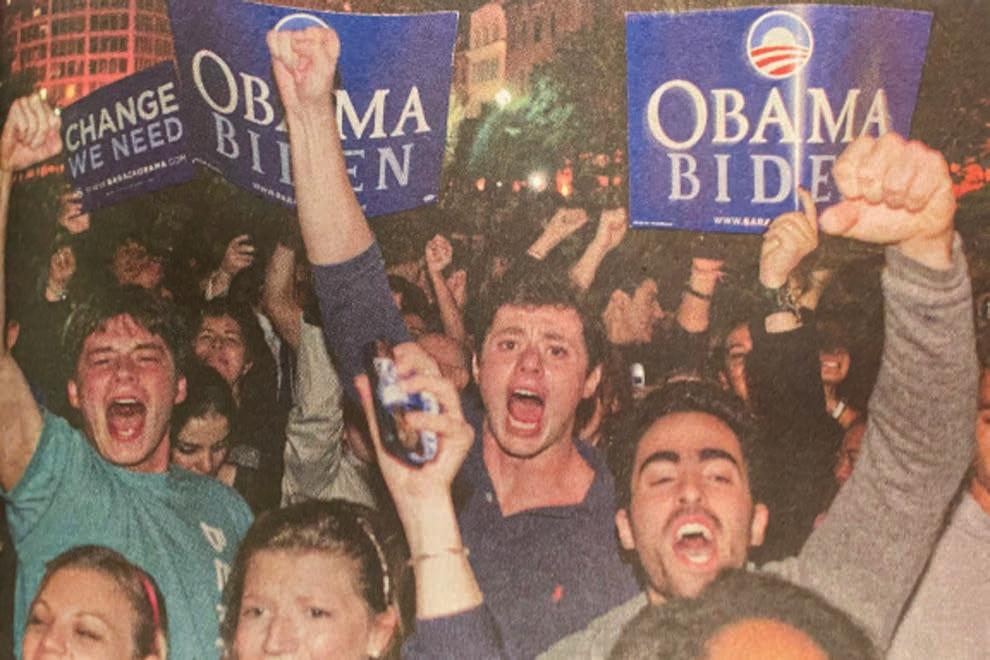
tially called the election, according to Ashley Heher, an associate news editor at The Hatchet at the time. Heher said students were invested in the race, but it didn’t dominate campus discourse that fall as much as usual back-to-school chatter did.
Joshua Riezman, The Hatchet’s managing editor during the 2004 presidential election, said his time at GW during the campaign — which saw Bush narrowly defeat Democrat John Kerry — was a personal “rite of passage.” Gabriel Okolski, The
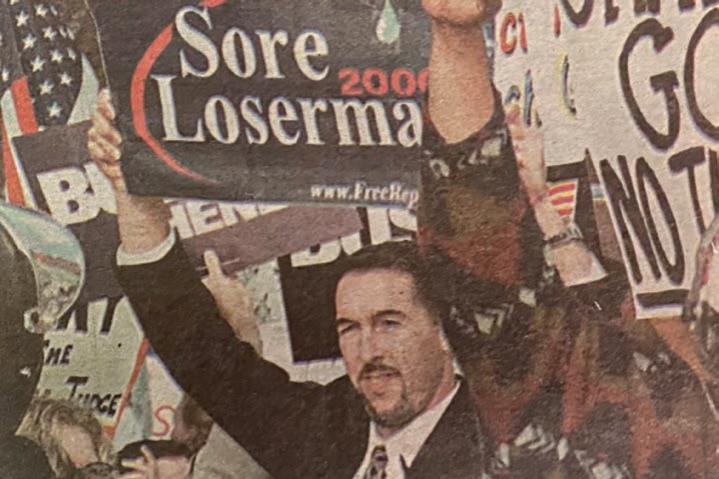
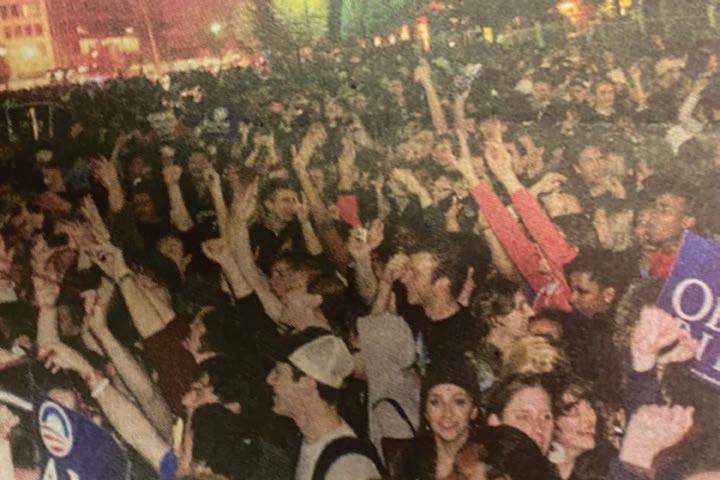
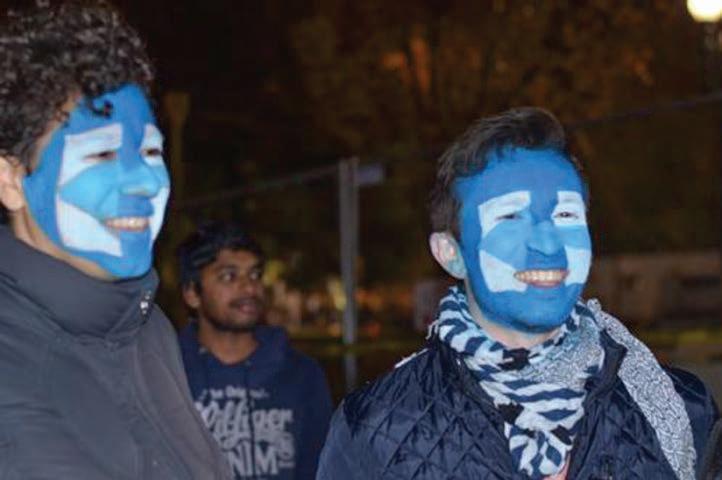
Hatchet’s campus news editor during that same election cycle, said pro-Bush students trekked out into light-red Virginia to knock doors in hopes of shoring up support for the Republican incumbent.
There wasn’t the same buzz around Kerry that
year, despite the passive student support for the challenger, Okolski said.
Part of the lack of enthusiasm for Kerry was due to a different star of the cycle on campus: Howard Dean, a Democratic candidate who didn’t make it past the primary election.
Okolski said his thengirlfriend and now-wife’s roommates covered their dorm with Dean signs, but once he ended his campaign after a third-place finish in Wisconsin, they drew the shades in their residence hall rooms and played somber music in mourning.
“Howard Dean was like the f*cking dude, man,” he said.
Zach Schonfeld, a contributing news editor for The Hatchet during the 2020 election in which Joe Biden snuck out a win over Trump, said at the time there wasn’t a ton of campus election talk beyond conversations in classes, which had moved to an online format amid the COVID-19 pandemic, curbing any form of on-theground campus campaigning characteristic of past election cycles, like 2018. Twelve Januarys before, Nick Gingold had found himself on the National Mall, too. Gingold said he went to cover Obama’s 2009 inauguration along with other Hatchet photographers, getting to the scene before the sun rose. He said the final culmination of the election cycle, in the bitter cold among thousands of people, is one of his “fondest memories” from GW due to how it energized campus.
“It was just one of those historic days that you just never forget,” Gingold said.
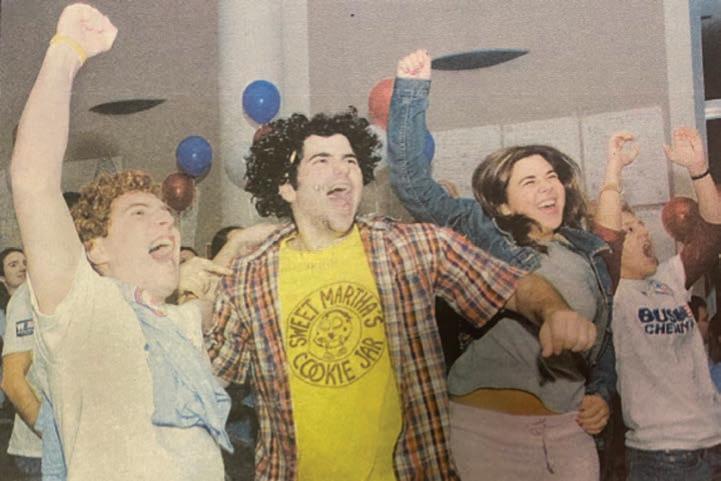
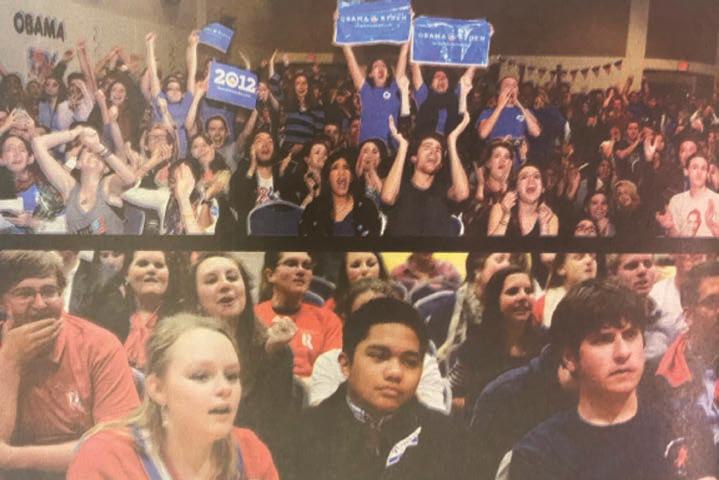


KRISTI
NOLAN
Water polo (14-7, 10-2 Mid-Atlantic Water Polo Conference) fell to Fordham (24-0, 10-0 MAWPC) 5-19 and defeated Wagner (12-15, 4-5 MAWPC) 8-7 in a twogame weekend in Springfield, Virginia, on Saturday, ranking the Revolutionaries second in the MAWPC.
The team also welcomed eight newcomers to their roster this season, who have combined for 173 goals of the team’s 253 goal total. The Revs have gone 14-7 overall and 10-2 in the conference so far this season, marking an improvement from last season’s 13-14 overall and 5-7 conference standings.
Riding a seven-game win streak, the Revs took on No. 1 conference-ranked Fordham and Wagner on Saturday.
The Revs fell 5-19 to Fordham — currently ranked first in the MAWPC rankings with a 24-0 overall record this season — in their first game of the weekend, having previously lost to the Rams 9-20 in a September game. The Rams took control early, restricting the Revs from potential comebacks, and led 2-1 in the first quarter. Fordham went on a 5-2 run in the second and secured 7-3 by halftime.
The Rams continued on a 6-0 run in the third quarter, leaving the Revs with no opportunity to retaliate. GW started the last quarter of the game with a score of 13-3, with the Rams promptly adding three moral goals to the tally. In the final few minutes, the Revs secured two goals, but the Rams responded with another three, concluding the game 5-19.
Senior attacker Andrija Sekulic and freshman attacker Antonio Florena put up the scoring for the Revs with two goals each, and junior defender Adonis Vlassis contributed one goal. Vlassis leads GW with the most goals scored this season,
clocking 58 goals, 13 assists and a 45.31 shooting percentage. Florena and Sekulic follow behind, each netting 44 shots.
After the loss against Fordham, the Revs faced off against Wagner.
The Revs led the game against Wagner at halftime with a score of 4-2, adding two more goals while the Seahawks scored one, bringing the score to 6-3 in the third quarter. In the fourth, the Seahawks took a 3-0 run to tie the game, extending to overtime. Sekulic — who scored half of the Revs’ total game goals — then hit the game-winning goal to secure an 8-7 win.
Looking for their fifthstraight win in conference play, the team won against No. 20 Navy 13-12 at Long Bridge Park in Arlington, Virginia, in a close contest Oct. 25. Leading 9-7 at the half, the Midshipmen extended their lead to 12-9 after the third quarter. Digging deep, the Revs scored four goals during the final minutes of the game to come back and win.
After emerging victorious from their battle against Navy, the team traveled back home the next day to the Smith Center to extend their win streak to six when they defeated Bucknell 1210. The Revs posted seven goals compared to their opponents’ four before halftime, even with a slow start to the match. Continuing to lead the Bison the rest of the way, the Revs allowed Bucknell six goals in the second half.
The Revs also beat Mount St. Mary’s 17-11 in Annapolis, Maryland, on Oct. 27. The Revs started the game outscoring the Mountaineers 12-6 in the first half, with Vlassis scoring three of the 12 goals scored before halftime. Both teams tied in the second half 5-5, but the Revs’ 12 points in the first half secured the win. The Revs concluded the three-day weekend competition with a full sweep.
The team returns to action Friday against Johns Hopkins in Arlington, Virginia. The team will play against Navy the following day in Annapolis, Maryland.




The story
When Rodrigo Barahona joined Mexico’s junior golf tour as a child, he knew then-10-year-old Manuel Barbachano as his extroverted competitor who he always faced in his early matches, as the two consistently locked horns in routine battles for first place on the green.
Now, a decade later, the two juniors have both taken their skills to Foggy Bottom, suiting up for GW and continuing to battle for gold against each other.
The two golfers grew up in Mexico as kids, with Barahona in the northeast region of Monterrey and Barbachano in the northwest region of Mérida. They first crossed paths at age 10 when Barahona joined Mexico’s Junior National Tour, which Barbachano belonged to.
Barahona remembered being stunned by Barbachano’s cow-print golf slacks, which he wore during the first match in which they faced off. The two have battled for first place in tournaments since meeting each other, a friendly rivalry that has continued into their college days, Barahona said.
“It was nice because we’re always fighting for first and second
place when we were at the national level as kids, and that’s where our relationship started growing,” Barahona said.
For his sophomore year of high school, Barahona moved to the United States to attend IMG Academy, where he continued to play golf through high school. Barbachano moved to the United States to attend his freshman year of high school in Maine in 2018 before moving back to Mexico to finish high school at the Madison International School.
He had already committed to GW for his collegiate career in November 2021 when he flew to a tournament in San Diego, California, and ran into Barahona, who said he was only looking to attend college on the West Coast at the time. Barbachano said he was disappointed that him and his golf opponent might be playing collegiate golf from opposite sides of the country.
“I wanted him to come with me,” Barbachona said.
About a month later, Barahona joined GW’s ranks, announcing his commitment in December 2021.
Barbachano said the pair has contrasting leadership styles, with Barahona preferring to work one-on-one with players during
CHRIS PETRARCA REPORTER
GRANT PACERNICK STAFF WRITER
Volleyball (18-9, 8-6) swept Saint Louis (9-17, 4-10) this weekend, winning 3-2 Friday and 3-1 Saturday at the Smith Center.
The first match was a back-andforth affair, with the Revs losing the fourth set by just 2 points before notching the fifth for the win. In Friday night’s five-set thriller, senior outside hitter Salem Yohannes led the team with 16 kills and freshman opposite Taylor Treahy also contributed with 13 kills and 9 digs that night. The team entered the weekend coming off of a decisive 3-0 victory over Atlantic 10 rival George Mason. Prior to Wednesday night’s victory, the team had lost five games in a row. They have since rebounded, and this weekend’s series win marks the start of a three-game win streak. The Revolutionaries failed to lead the entire first set of Friday’s match, as Saint Louis captured it 25-17. . The Revs couldn’t fend off Saint Louis’ freshman outside hitter Addy Brus who had seven kills in the set. The Revs’ first lead of the match came at 5-4 in the second set. They extended this lead to 15-9, forcing a Billikens timeout. However, later
practice and Barbachano encouraging newcomers to bond with each other outside of practice. Barahona’s short game is stronger than Barbachona, he said, while his opponent has more powerful shots out of the tee box.
“We are the complete opposite,” Barahona said. “My strength as a player, which is putting, is his main weakness, and his ball striking is phenomenal.”
Barbachano said their families have a joint group chat called “GW: Rodrigo and Manuel,” where they share updates about the performance of the pair during tournaments and cheer for the players over text.
“We have very similar families, in a sense,” Barahona said. “It’s different because where I’m from is from the North, and they’re from the South. So we do have differences in cultures in a sense, but we just get along so well. I don’t know what it’s about, we can just sit at the table with both families and not even watch the time pass and it would just be the end of the day.” Head Doach Chuck Scheinost said the pair have brought their familylike bond and shared background to the team, which welcomed three newcomers this season.
“From their cultural
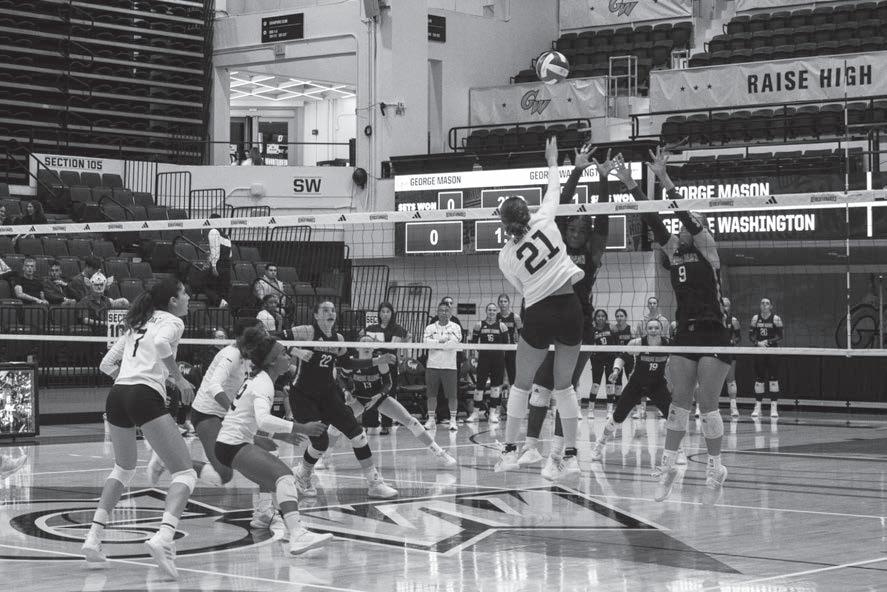
in the set, Saint Louis scored 6 unanswered points to jump ahead 22-21. The Revolutionaries extended the set, fending off a set point and ultimately clinching 29-27. With the match tied at one set apiece, the Revolutionaries dominated the third set, winning
25-17. The set began to slip away from the Billikens midway through, as the Revs seized a commanding 14-8 lead. The fourth set was closely contested right up to the end, but Saint Louis managed to eke it out, 25-23.
The Revolutionaries started the definitive fifth set strong with consecutive points from junior libero Penelope Hiepler and a strong performance from Salem Yohannes who currently leads the team in overall points accumulating 342.5
standpoint, where there’s other parts of the world where family is maybe not a priority, in terms of how they rank it,” Scheinost said. “For both Rodrigo and Manuel, that’s a big piece of it, is trying to create more of a family atmosphere here for the team and a group that wants to hang out together and do things together, is a big part of what they’re trying to push and do.”
Scheinost said the two have taken on a leadership role on the team, per his request, helping the three newcomers adjust to DI golf and blending them into the eight-person team, seven of which hail from countries across the globe. Barahona and Barbachano have consistently proven themselves as the team’s top scorers this season, with Barahona tying for second during their season opener in early September and Barahona leading the Revolutionaries in the Monterrey Collegiate Classic on Oct. 25 in his hometown, scoring 221 — despite the team placing last of 12 teams.
“They’re definitely taking that responsibility on of helping the new guys learn how we do things and how we practice and making sure that we’re being serious when we get to practice and getting in the extra time that we need in order to be competitive,” Scheinost said.
out of the team’s 1,630 points across the season. Ultimately, sophomore outside hitter Haylee Brown delivered the final blow, sealing the set 15-8 and the match 3-2.
Saturday’s contest also resulted in a GW win, but it wasn’t nearly as close as Friday’s match. The Revolutionaries came out with a burst, winning the first set 2514. Though they cooled off in the second, falling 21-25, they bounced back to claim the final two sets 2725 and 25-22, securing the weekend sweep.
The third set remained close until Saint Louis pulled ahead with an 18-14 lead. The Revolutionaries fought off two set points to lock up the set, shifting the momentum in their favor and setting them up to secure a match-winning victory in the final set.
The team is now fifth in the conference, with only a few weeks to go before the A-10 Championships in Dayton, Ohio, which will feature the top six teams in the division. The Revolutionaries stand fourth in the conference in points per set at 16.8 while Saint Louis is seventh with 16.17. With four games left in the regular season, the Revs set their sights on four more victories and a chance to clinch the fourth seed as they head into playoffs. Next up, GW will take on the
in matches this coming Friday and Saturday in